The Broad Ax
Saturday, April 30, 1927
Chicago, Illinois
Page text (machine-generated)
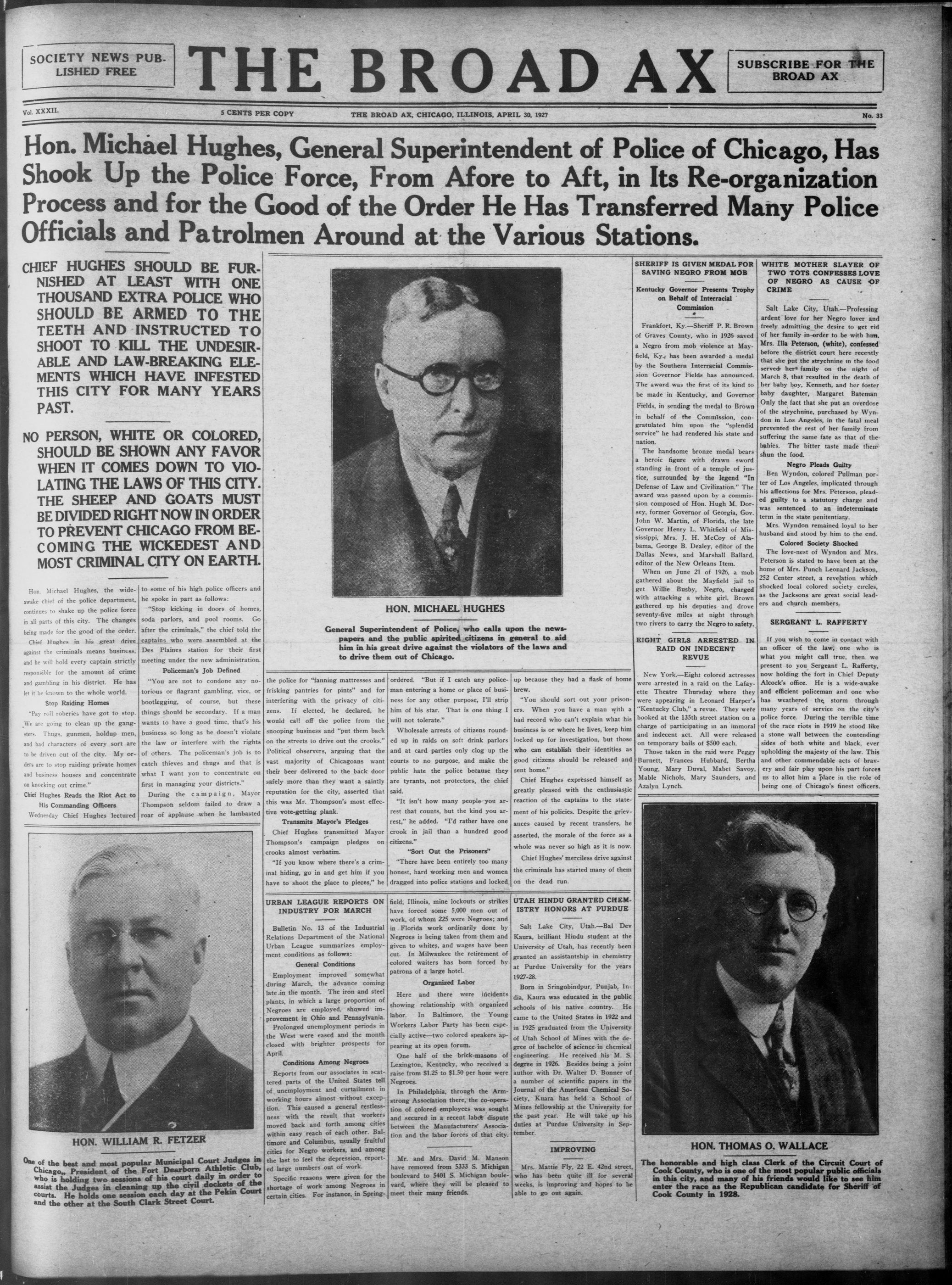
Hon. Michael Hughes, General Superintendent of Police of Chicago, Has Shook Up the Police Force, From Afore to Aft, in Its Re-organization Process and for the Good of the Order He Has Transferred Many Police Officials and Patrolmen Around at the Various Stations.
SOCIETY NEWS PUBLISHED FREE
Vol. XXXII.
Hon. Michaëel Shook Up the Process and the Officials and
CHIEF HUGHES SHOULD NISHED AT LEAST THOUSAND EXTRA SHOULD BE ARMED TEETH AND INSTITUTE SHOOT TO KILL THE ABLE AND LAW-BRIGHTMENTS WHICH HAVE THIS CITY FOR MOST PAST.
NO PERSON, WHITE OR SHOULD BE SHOWN WHEN IT COMES DO LATING THE LAWS OF THE SHEEP AND BE DIVIDED RIGHT NOW TO PREVENT CHICAGO COMING THE WICKET MOST CRIMINAL CITY
M. Michael H. took Up the business and for specials and Pa
HUGHES SHOULD BE READ AT LEAST WITH HUNDREDS EXTRA POLICE SHOULD BE ARMED TO WITH AND INSTRUCT NOT TO KILL THE URBAN AND LAW-BREAKING CITY WHICH HAVE INCITATED CITY FOR MANY
SON, WHITE OR COULD BE SHOWN ANYWHERE IT COMES DOWN THING THE LAWS OF THE SHEEP AND GOATS VIDED RIGHT NOW IN PREVENT CHICAGO FIREING THE WICKEDEST CRIMINAL CITY ON
CHIEF HUGHES SHOULD BE FURNISHED AT LEAST WITH ONE THOUSAND EXTRA POLICE WHO SHOULD BE ARMED TO THE TEETH AND INSTRUCTED TO SHOOT TO KILL THE UNDESIRABLE AND LAW-BREAKING ELEMENTS WHICH HAVE INFESTED THIS CITY FOR MANY YEARS PAST.
NO PERSON, WHITE OR COLORED, SHOULD BE SHOWN ANY FAVOR WHEN IT COMES DOWN TO VIOLATING THE LAWS OF THIS CITY. THE SHEEP AND GOATS MUST BE DIVIDED RIGHT NOW IN ORDER TO PREVENT CHICAGO FROM BE-COMING THE WICKEDEST AND MOST CRIMINAL CITY ON EARTH.
Hon. Michael Hughes, the wide-awake chief of the police department, continues to shake up the police force in all parts of this city. The changes being made for the good of the order. Chief Hughes in his great drive against the criminals means business, and he will hold every captain strictly responsible for the amount of crime and gambling in his district. He has let it be known to the whole world.
Stop Raiding Homes
Stop Raiding Homes "Pay roll robberies have got to stop. We are going to clean up the gangsters. Thugs, gunmen, holdup men, and bad characters of every sort are to be driven out of the city. My orders are to stop raiding private homes and business houses and concentrate on knocking out crime."
Chief Hughes Reads the Riot Act to His Commanding Officers Wednesday Chief Hughes lectured
[Name]
[Name]
[Name]
HON. WILLIAM R. FETZER
One of the best and most popular Municipal Court Chicago,, President of the Fort Dearborn who is holding two sessions of his court day assist the Judges in cleaning up the civil courts. He holds one session each day at the and the other at the South Clark Street Court
fast and most popular Municipal Court President of the Fort Dearborn and holding two sessions of his court day Judges in cleaning up the civil of the holds one session each day at the other at the South Clark Street Court
One of the best and most popular Municipal Court Judges in Chicago, President of the Fort Dearborn Athletic Club, who is holding two sessions of his court daily in order to assist the Judges in cleaning up the civil dockets of the courts. He holds one session each day at the Pekin Court and the other at the South Clark Street Court.
MIAEL HUGHE
the Police
and for the G
and Patrol
SHOULD BE FUR-
EAST WITH ONE
TRA POLICE WHO
ARMED TO THE
INSTRUCTED TO
ALL THE UNDESIR-
W-BREAKING ELE-
HAVE INFESTED
FOR MANY YEARS
TE OR COLORED,
DOWN ANY FAVOR
SS DOWN TO VIO-
AWS OF THIS CITY.
AND GOATS MUST
HT NOW IN ORDER
HICAGO FROM BE-
WICKEDEST AND
L CITY ON EARTH.
to some of his high police officers and he spoke in part as follows:
"Stop kicking in doors of homes, soda parlors, and pool rooms. Go after the criminals," the chief told the captains who were assembled at the Des Plaines station for their first meeting under the new administration.
Policeman's Job Defined
"You are not to condone any notorious or flagrant gambling, vice, or bootlegging, of course, but these things should be secondary. If a man wants to have a good time, that's his business so long as he doesn't violate the law or interfere with the rights of others. The policeman's job is to catch thieves and thugs and that is what I want you to concentrate on first in managing your districts."
During the campaign, Mayor Thompson seldom failed to draw a roar of applause when he lambasted
```markdown
```
Sular Municipal Court Judges in Fort Dearborn Athletic Club, of his court daily in order to bring up the civil dockets of the on each day at the Pekin Court Clark Street Court.
THE BROAD AX
5 CENTS PER COPY
Hughes, O
Police F
the Good
Petrolmen
FUR-
ONE
WHO
THE
D TO
DESIR-
ELE-
ESTED
YEARS
ORED,
EAVOR
D VIO-
S CITY.
MUST
ORDER
D M BE-
T AND
EARTH.
---
the police for "fanning mattresses and frisking pantries for pints" and for interfering with the privacy of citizens. If elected, he declared, he would call off the police from the snooping business and "put them back on the streets to drive out the crooks." Political observers, arguing that the vast majority of Chicagoans want their beer delivered to the back door safely more than they want a saintly reputation for the city, asserted that this was Mr. Thompson's most effective vote-getting plank.
Transmits Mayor's Pledges
Chief Hughes transmitted Mayor Thompson's campaign pledges on crooks almost verbatim.
"If you know where there's a criminal hiding, go in and get him if you have to shoot the place to pieces," he
URBAN LEAGUE REPORTS ON
INDUSTRY FOR MARCH
Bulletin No. 13 of the Industrial Relations Department of the National Urban League summarizes employment conditions as follows:
General Conditions
Employment improved somewhat during March, the advance coming late in the month. The iron and steel plants, in which a large proportion of Negroes are employed, showed improvement in Ohio and Pennsylvania. Prolonged unemployment periods in the West were eased and the month closed with brighter prospects for April.
Conditions Among Negroes
Reports from our associates in scattered parts of the United States tell of unemployment and curtailment in working hours almost without exception. This caused a general restlessness with the result that workers moved back and forth among cities within easy reach of each other. Baltimore and Columbus, usually fruitful cities for Negro workers, and among the last to feel the depression, reported large numbers out of work. Specific reasons were given for the shortage of work among Negroes in certain cities. For instance, in Spring-
THE BROAD AX, CHICAGO, ILLINOIS, APRIL 30, 1927
M.
General Superintendent of Police, who calls upon the newspapers and the public spirited citizens in general to aid him in his great drive against the violators of the laws and to drive them out of Chicago.
HON. MICHAEL HUGHES
intendent of Police, who calls us
the public spirited citizens in
great drive against the violators o
m out of Chicago.
ordered. "But if I catch any policeman entering a home or place of business for any other purpose, I'll strip him of his star. That is one thing I will not tolerate."
Wholesale arrests of citizens rounded up in raids on soft drink parlors and at card parties only clog up the courts to no purpose, and make the public hate the police because they are tyrants, not protectors, the chief said.
"It isn't how many people you arrest that counts, but the kind you arrest," he added. "I'd rather have one crook in jail than a hundred good citizens."
"There have been entirely too many honest, hard working men and women dragged into police stations and locked field; Illinois, mine lockouts or strikes have forced some 5,000 men out of work, of whom 225 were Negroes; and in Florida work ordinarily done by Negroes is being taken from them and given to whites, and wages have been cut. In Milwaukee the retirement of colored waiters has been forced by patrons of a large hotel.
Organized Labor
Here and there were incidents showing relationship with organized labor. In Baltimore, the Young Workers Labor Party has been especially active—two colored speakers appearing at its open forum.
One half of the brick-masons of Lexington, Kentucky, who received a raise from $1.25 to $1.50 per hour were Negroes.
In Philadelphia, through the Armstrong Association there, the co-operation of colored employees was sought and secured in a recent labor dispute between the Manufacturers' Association and the labor forces of that city.
Mr. and Mrs. David M. Manson have removed from 5333 S. Michigan boulevard to 5401 S. Michigan boulevard, where they will be pleased to meet their many friends.
---
up because they had a flask of home brew.
"You should sort out your prisoners. When you have a man with a bad record who can't explain what his business is or where he lives, keep him locked up for investigation, but those who can establish their identities as good citizens should be released and sent home."
Chief Hughes expressed himself as greatly pleased with the enthusiastic reaction of the captains to the statement of his policies. Despite the grievances caused by recent transfers, he asserted, the morale of the force as a whole was never so high as it is now.
Chief Hughes' merciless drive against the criminals has started many of them on the dead run.
UTAH HINDU GRANTED CHEM
ISTRY HONORS AT PURDUE
Salt Lake City, Utah.-Bal Dev Kaura, brilliant Hindu student at the University of Utah, has recently been granted an assistantship in chemistry at Purdue University for the years 1927-28.
Born in Sringobindpur, Punjab, India, Kaura was educated in the public schools of his native country. He came to the United States in 1922 and in 1925 graduated from the University of Utah School of Mines with the degree of bachelor of science in chemical engineering. He received his M. S. degree in 1926. Besides being a joint author with Dr. Walter D. Bonner of a number of scientific papers in the Journal of the American Chemical Society, Kuara has held a School of Mines fellowship at the University for the past year. He will take up his duties at Purdue University in September.
IMPROVING
Mrs. Mattie Fly, 22 E. 42nd street, who has been quite ill for several weeks, is improving and hopes to be able to go out again.
SHERIFF IS GIVEN MEDAL FOR
SAVING NEGRO FROM MOB
Kentucky Governor Presents Trophy
on Behalf of Interracial
Frankfort, Ky.—Sheriff P. R. Brown of Graves County, who in 1926 saved a Negro from mob violence at Mayfield, Ky.; has been awarded a medal by the Southern Interracial Commission Governor Fields has announced. The award was the first of its kind to be made in Kentucky, and Governor Fields, in sending the medal to Brown in behalf of the Commission, congratulated him upon the "splendid service" he had rendered his state and nation.
The handsome bronze medal bears a heroic figure with drawn sword standing in front of a temple of justice, surrounded by the legend "In Defense of Law and Civilization." The award was passed upon by a commission composed of Hon. Hugh M. Dorse, former Governor of Georgia, Gov. John W. Martin, of Florida, the late Governor Henry L. Whitfield of Mississippi, Mrs. J. H. McCoy of Alabama, George B. Dealey, editor of the Dallas News, and Marshall Ballard, editor of the New Orleans Item.
When on June 21 of 1926, a mob gathered about the Mayfield jail to get Willie Busby, Negro, charged with attacking a white girl. Brown gathered up his deputies and drove seventy-five miles at night through two rivers to carry the Negro to safety.
EIGHT GIRLS ARRESTED IN
RAID ON INDECENT
REVUE
New York.—Eight colored actresses were arrested in a raid on the Lafayette Theatre Thursday where they were appearing in Leonard Harper's "Kentucky Club," a revue. They were booked at the 135th street station on a charge of participating in an immoral and indecent act. All were released on temporary bails of $500 each. Those taken in the raid were Peggy Burnett, Frances Hubbard, Bertha Young, Mary Duval, Mabel Savoy, Mable Nichols, Mary Saunders, and Azalyn Lynch.
```markdown
```
M. H.
The honorable and high class Clerk of the Cic
Cook County, who is one of the most popular p
in this city, and many of his friends would li
enter the race as the Republican candidate
Cook County in 1928.
The honorable and high class Clerk of the Circuit Court of Cook County, who is one of the most popular public officials in this city, and many of his friends would like to see him enter the race as the Republican candidate for Sheriff of Cook County in 1928.
SUBSCRIBE FOR THE BROAD AX
No. 33
Chicago, Has organization Many Police
L FOR MOB
Trophy
WHITE MOTHER SLAYER OF TWO TOTS CONFESSES LOVE OF NEGRO AS CAUSE OF CRIME
Salt Lake City, Utah.—Professing ardent love for her Negro lover and freely admitting the desire to get rid of her family in-order to be with him. Mrs. Illa Peterson, (white), confessed before the district court here recently that she put the strychnine in the food served her* family on the night of March 8, that resulted in the death of her baby boy, Kenneth, and her foster baby daughter, Margaret Bateman Only the fact that she put an overdose of the strychnine, purchased by Wyndon in Los Angeles, in the fatal meal prevented the rest of her family from suffering the same fate as that of the babies. The bitter taste made them shun the food.
Negro Pleads Guilty
Ben Wyndon, colored Pullman porter of Los Angeles, implicated through his affections for Mrs. Peterson, pleaded guilty to a statutory charge and was sentenced to an indeterminate term in the state penitentiary.
Mrs. Wyndon remained loyal to her husband and stood by him to the end.
Colored Society Shocked
The love-nest of Wyndon and Mrs. Peterson is stated to have been at the home of Mrs. Punch Leonard Jackson, 252 Center street, a revelation which shocked local colored society circles, as the Jacksons are great social leaders and church members.
SERGEANT L. RAFFERTY
If you wish to come in contact with an officer of the law, one who is what you might call true, then we present to you Sergeant L. Rafferty, now holding the fort in Chief Deputy Alcock's office. He is a wide-awake and efficient policeman and one who has weathered the storm through many years of service on the city's police force. During the terrible time of the race riots in 1919 he stood like a stone wall between the contending sides of both white and black, ever upholding the majesty of the law. This and other commendable acts of bravery and fair play upon his part forces us to allot him a place in the role of being one of Chicago's finest officers.
M.
th class Clerk of the Circuit Court of one of the most popular public officials any of his friends would like to see him the Republican candidate for Sheriff of 18.
No. 33
HON. ADOLPH MARKS Member of the State Senate from the First Senatorial District of Illinois, who is one of the head wheel horses of that law making body, who is ready at all times to assist Mayor William Hale Thompson to make this great city bloom and blossom like the beautiful rose.
THIS WEEK
By Ernest Rice McKinney
(For Preston News Service)
The Philippino Veto
Australia Furnishes a Laugh
The Legion Strikes Again
Socrates Vindicated
Broadway Temple
Mr. Coolidge has decided that independence is too sacred a commodity for the little brown Philippines to be dabbling with. He therefore sustained the veto of General Leonard Wood, Commander-in-Chief of the islands. The island legislators decided that the time had come for the Philippines themselves to decide whether or not they wished to be a free and independent state. A plebiscite was to be held to answer the question—"Do you desire the immediate, absolute and complete independence of the Philippine Islands?" The legislature repassed the measure by the necessary two-thirds majority over the veto of General Wood.
Mr. Coolidge said in sustaining the veto: "Independence is a very appealing word. Few people will vote against independence for themselves or against independence for anybody else. To submit to a man the question whether he desired to be independent or not is really trifling with the sacred feelings innate in all humankind. Political activity is not the end of life but rather a means to obtain those economic, industrial and social conditions essential to a stable existence."
This is one of the most remarkable statements that I have ever read. It reads like some of Emerson's poetry, the halleujah inanities of a foot-wash revivalist and a police magistrate's oration on patriotism, all combined into one glorious hash of words.
Perhaps political activity should not be an end in itself. But it is an all-consuming end for some gentlemen. Were this not true Mr. Coolidge would not be President now. Only a group of men who live, think and dream politics could have been astute or dull enough to pick out Calvin Coolidge for the highest office in the land. Furthermore, were there no such group of men our citizenry could never have been bunked into voting for such a human zero.
I must confess too, that the White House Spokesman is entirely correct when he defines the role of political activity as a means of getting more money, bigger corporations and higher social position. This is certainly true of the activities of certain groups. It was these groups that made Mr. Coolidge president.
But the Philippines should remember that Louis XVI was opposed to the independence of the French masses, George III rightfully looked upon Samuel Adams and John Hancock as rebels and the last Czar felt that political independence was not the "end of life."
And now we turn to the opposite end of the earth and get our weekly laugh. The great Paderewski, pianist and one time premier of the French
dependency of Poland, was scheduled for a concert in Melbourne, Australia Baron Stonehaven of Ury, Governor-General and Commander-in-Chief of the magnificent Ku Klux commonwealth of Australia, sent word—the day before to Paderewski—that when His Baronship entered the concert hall the pianist was to stand—reverently and respectfully the same as the natives and remain standing until the baronial party was seated. Paderewski remained off the platform until the baron was in and seated. He then came out and began to play. The next day the world was informed, by the baron, that Paderewski had insulted "His Majesty the King as represented in the person of His Excellency the Governor-General." This reminds me of some of our contempt of court proceedings charging that the Majesty of the Law has been violated as represented in the person of His Honor the Judge.
It will be remembered that Australia is somewhat in the same boat with our feudal barony of Mississippi. That is, it has never produced anything worth while with the exception of Nellie Melba. But the country is best known for its kangaroos and head hunters. Of course these three put Australia in front of Mississippi which can claim only the head hunters.
The American Legion in West Chester, Pennsylvania, is boasting over its triumph in driving two competent, upstanding and liberal teachers from the State Normal School. One of these men, Mr. Kerlin, was driven from a school in Virginia for being too fair to Negroes. This same tendency has cost him his job at West Chester. The "Americanizers and patrioteers" of the Legion decided that a man who was kindly disposed to mere Negroes was not fit to teach white children. The other teacher was objected to because he was liberal and was promoting a liberal club among the students. It's pretty tough when accomplished scholars are driven from their posts by Kiwanian saviors and ignorant flag wavers.
Greece has decided without court action as was requested, that old Socrates, ugly, flat nosed and thick lipped, the greatest liberal of his time, was not guilty. A lawyer had asked the court to make a pronouncement in the matter. The court wisely concluded that this was not necessary. All the world has vindicated the Old Master if there was ever such a person outside the mind of Plato. Many of us who never heard of Lycon and Anytus, his accusers, representing the Garys and the Babbits of their day, still are uplifted by the wisdom of the old philosopher and suffer no damage to our morals. The trial of Socrates is perfectly modern. Charged with denying the gods recognized by the state, setting up new gods, corrupting the Athenian youth.
New York is to have a great new proletarian temple commonly called a church to be known as Broadway Temple. It can be said without reservation and without attributing the information to a certain "Spokesman" that the temple will surely go up.
***
THE BROAD AX, CHICAGO, ILLINOIS, APRIL 30, 1927
Jehovah is behind the movement. For hear Mr. McRoberts, chairman of the Chatham National Bank, New York: "The plans for the Broadway Temple could not help but succeed with God as our ally. The downtown financial district recognizes the need." Surely no chance to yell "bunk" here.
MUSIC NOTES
By Clarence Cameron White, Premier Violin Soloist, Former President National Association of Negro Musicians (For Preston News Service)
The recent award of John Simon Guggenheim Memorial Foundation fellowship to Nicholas G. J. Ballanta of Free Town, Sierra Leone (Africa) for the comparison of these conceptions with the musical conceptions of the older systems of music in Europe is of great importance to Afro-Americans. Mr. Ballanta or Ballanta-Taylor as he is sometimes called, began his musical activities as a lad in Sierra Leone and his early struggles should be a source of inspiration to his American cousin. He first became interested in music when a British Regimental Band was stationed at his home and through the kindness and interest of a clarinetist of this band he was taught this instrument and the rudiments of music. Probably through the knowledge of the achievements of S. Coleridge-Taylor, whose father was a native of Sierra Leone, although he was not a relative of Ballanta, our young musician early aspired to compose, and although his knowledge of composition and the theoretical subjects leading up to composition was entirely self acquired, he wrote several anthems and sent them off to England to a publisher who was much taken with the talent displayed and offered encouragement in the way of books and music which he sent young Ballanta. After attempting a sacred cantata written with full orchestra accompaniment and an orchestral rhapsody written on African rhythms, he managed to get to England for serious study. Here Ballanta made many friends but failed to receive the financial support to go on with his studies so he decided to try America.
He first came to Boston at the suggestion of Mrs. Casley Hayford and her niece, Miss Kathleen Easmon (Samango) who were in America in the interest of an African school. While in Boston the African Rhapsody was performed at Symphony Hall in an African Pageant under the musical direction of the writer. Mr. Ballanta stayed that winter in Boston and studied Orchestra under Jaccie, Director of the Boston Conservatory of Music, but later went to New York where he attracted the attention of Walter Demrosch who brought him to the attention of his brother, Frank Demrosch, head of the Institute of Musical Art where he was given a scholarship and after several years' study graduated. During his sojourn in New York, he was brought to the attention of Mr. George Foster Peabody, who gave him financial aid and made it possible for him to visit St Helena Islands off Charleston, South Carolina and compile and publish a splendid book of rare Negro Spirituals. Later, through the assistance of Mr. Peabody he was enabled to return to Africa for research work.
Mr. Ballanta has already done some excellent work in the scientific study of African scales and rhythms and the award will enable him to do much more along this line. Being a talented and thoroughly trained musician with an unparalleled opportunity for this work in Africa, we may expect much valuable material to be placed at the disposal of musicians at large, and although Mr. Ballanta is not an American Negro, we are glad to know that this honor and well placed philanthropy has come his way. It is well to know that before this award was granted that through the efforts of Mr. Peabody, Dr. Robert Moton, Principal of Tuskegee, and a number of Negro musicians in America, a movement was started to give financial assistance to Mr. Ballanta to continue this fine research work.
MAKING ANNUAL VISIT
Hon. J. B. Street, state grand master of U. B. F. & S. M. T., Illinois and jurisdiction, is making his annual visit to the lodges throughout the city and state. Friday evening, April 29, he visited Chicago jurisdiction, at which time a large attendance of brothers were present at 3120 Giles avenue, the U. B. F.
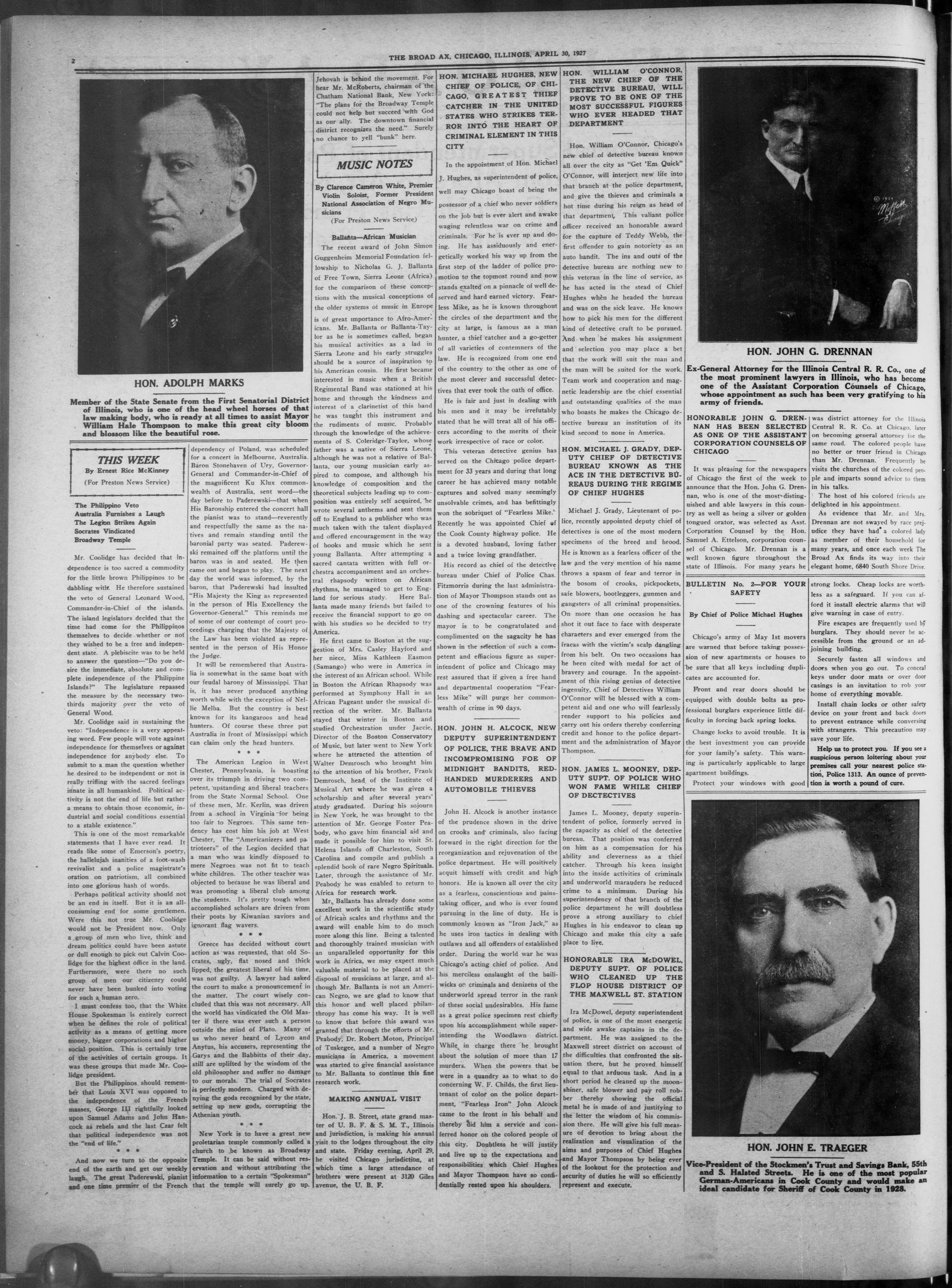
HON. MICHAEL HUGHES, NEW CHIEF OF POLICE, OF CHICAGO, GREATEST THIEF CATCHER IN THE UNITED STATES WHO STRIKES TERROR INTO THE HEART OF CRIMINAL ELEMENT IN THIS CITY
In the appointment of Hon. Michael J. Hughes, as superintendent of police, well may Chicago boast of being the possessor of a chief who never soldiers on the job but is ever alert and awake waging relentless war on crime and criminals. For he is ever up and doing. He has assiduously and energetically worked his way up from the first step of the ladder of police promotion to the topmost round and now stands exalted on a pinnacle of well deserved and hard earned victory. Fearless Mike, as he is known throughout the circles of the department and the city at large, is famous as a man hunter, a thief catcher and a go-getter of all varieties of contemners of the law. He is recognized from one end of the country to the other as one of the most clever and successful detectives that ever took the oath of office.
He is fair and just in dealing with his men and it may be irrefutably stated that he will treat all of his officers according to the merits of their work irrespective of race or color. This veteran detective genius has served on the Chicago police department for 33 years and during that long career he has achieved many notable captures and solved many seemingly unsolvable crimes, and has befittingly won the sobriquet of "Fearless Mike." Recently he was appointed Chief of the Cook County highway police. He is a devoted husband, loving father and a twice loving grandfather.
His record as chief of the detective bureau under Chief of Police Chas. Fitzmorris during the last administration of Mayor Thompson stands out as one of the crowning features of his dashing and spectacular career. The mayor is to be congratulated and complimented on the sagacity he has shown in the selection of such a competent and effacious figure as superintendent of police and Chicago may rest assured that if given a free hand and departmental cooperation "Fearless Mike" will purge her commonwealth of crime in 90 days.
HON. JOHN H. ALCOCK, NEW DEPUTY SUPERINTENDENT OF POLICE, THE BRAVE AND INCOMPROMISING FOE OF MIDNIGHT BANDITS, RED-HANDED MURDERERS AND AUTOMOBILE THIEVES
John H. Alcock is another instance of the prudence shown in the drive on crooks and criminals, also facing forward in the right direction for the reorganization and rejuvenation of the police department. He will positively acquit himself with credit and high honors. He is known all over the city as a fearless, conscientious and painstaking officer, and who is ever found pursuing in the line of duty. He is commonly known as "Iron Jack," as he uses iron tactics in dealing with outlaws and all offenders of established order. During the world war he was Chicago's acting chief of police. And his merciless onslaught of the bailiwicks on criminals and denizens of the underworld spread terror in the rank of these social undesirables. His fame as a great police specimen rest chiefly upon his accomplishment while superintending the Woodlawn district. While in charge there he brought about the solution of more than 17 murders. When the powers that be were in a quandry as to what to do concerning W. F. Childs, the first lieutenant of color on the police department, "Fearless Iron" John Alcock came to the front in his behalf and thereby did him a service and conferred honor on the colored people of this city. Doubtless he will justify and live up to the expectations and responsibilities which Chief Hughes and Mayor Thompson have so confidentially rested upon his shoulders.
HON. WILLIAM O'CONNOR,
THE NEW CHIEF OF THE
DETECTIVE BUREAU, WILL
PROVE TO BE ONE OF THE
MOST SUCCESSFUL FIGURES
WHO EVER HEADED THAT
DEPARTMENT
Hon. William O'Connor, Chicago's new chief of detective bureau known all over the city as "Get 'Em Quick" O'Connor, will interject new life into that branch at the police department, and give the thieves and criminals a hot time during his reign as head of that department. This valiant police officer received an honorable award for the capture of Teddy Webb, the first offender to gain notoriety as an auto bandit. The ins and outs of the detective bureau are nothing new to this veteran in the line of service, as he has acted in the stead of Chief Hughes when he headed the bureau and was on the sick leave. He knows how to pick his men for the different kind of detective craft to be pursued. And when he makes his assignment and selection you may place a bet that the work will suit the man and the man will be suited for the work. Team work and cooperation and magnetic leadership are the chief essential and outstanding qualities of the man who boasts he makes the Chicago detective bureau an institution of its kind second to none in America.
HON. MICHAEL J. GRADY, DEPUTY CHIEF OF DETECTIVE BUREAU KNOWN AS THE ACE IN THE DETECTIVE BUREAUS DURING THE REGIME OF CHIEF HUGHES
Michael J. Grady, Lieutenant of police, recently appointed deputy chief of detectives is one of the most modern specimens of the breed and brood. He is known as a fearless officer of the law and the very mention of his name throws a spasm of fear and terror in the bosom of crooks, pickpockets, safe blowers, bootleggers, gunmen and gangsters of all criminal propensities. On more than one occasion he has shot it out face to face with desperate characters and ever emerged from the fracas with the victim's scalp dangling from his belt. On two occasions has he been cited with medal for act of bravery and courage. In the appointment of this rising genius of detective ingenuity, Chief of Detectives William O'Connor will be blessed with a competent aid and one who will fearlessly render support to his policies and carry out his orders thereby conferring credit and honor to the police department and the administration of Mayor Thompson.
HON. JAMES L. MOONEY, DEP-
UTY SUPT. OF POLICE WHO
WON FAME WHILE CHIEF
OF DECTECTIVES
James L. Mooney, deputy superintendent of police, formerly served in the capacity as chief of the detective bureau. That position was conferred on him as a compensation for his ability and cleverness as a thief catcher. Through his keen insight into the inside activities of criminals and underworld mauders he reduced crime to a minimum. During his superintendency of that branch of the police department he will doubtless prove a strong auxiliary to chief Hughes in his endeavor to clean up Chicago and make this city a safe place to live.
HONORABLE IRA McDOWEL,
DEPUTY SUPT. OF POLICE
WHO CLEANED UP THE
FLOP HOUSE DISTRICT OF
THE MAXWELL ST. STATION
Ira McDowel, deputy superintendent of police, is one of the most energetic and wide awake captains in the department. He was assigned to the Maxwell street district on account of the difficulties that confronted the situation there, but he proved himself equal to that arduous task. And in a short period he cleaned up the moonshiner, safe blower and pay roll robber thereby showing the official metal he is made of and justifying to the letter the wisdom of his commission there. He will give his full measure of devotion to bring about the realization and visualization of the aims and purposes of Chief Hughes and Mayor Thompson by being ever of the lookout for the protection and security of duties he will so efficiently represent and execute.
© 1924
Moffett
Chicago
HON. JOHN G. DRENNAN
Ex-General Attorney for the Illinois Central R. the most prominent lawyers in Illinois, wh one of the Assistant Corporation Counsel whose appointment as such has been very g army of friends.
Ex-General Attorney for the Illinois Central R. R. Co., one of the most prominent lawyers in Illinois, who has become one of the Assistant Corporation Counsels of Chicago, whose appointment as such has been very gratifying to his army of friends.
HONORABLE JOHN G. DRENNAN HAS BEEN SELECTED AS ONE OF THE ASSISTANT CORPORATION COUNSELS OF CHICAGO was district attorney for the Illinois Central R. R. Co. at Chicago, later on becoming general attorney for the same road. The colored people have no better or truer friend in Chicago
It was pleasing for the newspapers of Chicago the first of the week to announce that the Hon. John G. Drennan, who is one of the most-distinguished and able lawyers in this country as well as being a silver or golden tongued orator, was selected as Asst. Corporation Counsel by the Hon. Samuel A. Ettelson, corporation counsel of Chicago. Mr. Drennan is a well known figure throughout the state of Illinois. For many years he
BULLETIN No. 2—FOR YOUR
SAFETY
By Chief of Police Michael Hughes
Chicago's army of May 1st movers are warned that before taking possession of new apartments or houses to be sure that all keys including duplicates are accounted for.
Front and rear doors should be equipped with double bolts as professional burglarls experience little difficulty in forcing back spring locks.
Change locks to avoid trouble. It is the best investment you can provide for your family's safety. This warning is particularly applicable to large apartment buildings.
Protect your windows with good
[Image of a man with a mustache and a black suit and bow tie].
HON. JOHN E. TRAEGER
Vice-President of the Stockmen and S. Halsted Streets. H German-Americans in Cool ideal candidate for Sheriff
Vice-President of the Stockmen's Trust and Savings Bank, 55th and S. Halsted Streets. He is one of the most popular German-Americans in Cook County and would make an ideal candidate for Sheriff of Cook County in 1928.
Illinois Central R. R. Co., one of
ers in Illinois, who has become
poration Counsels of Chicago,
has been very gratifying to his
was district attorney for the Illinois
Central R. R. Co. at Chicago, later
on becoming general attorney for the
same road. The colored people have
no better or truer friend in Chicago
than Mr. Drennan. Frequently he
visits the churches of the colored people
and imparts sound advice to them
in his talks.
The host of his colored friends are
delighted in his appointment.
As evidence that Mr. and Mrs. Drennan are not swayed by race prejudice they have had" a colored lady as member of their household for many years, and once each week The Broad Ax finds its way into their elegant home, 6840 South Shore Drive.
strong locks. Cheap locks are worthless as a safeguard. If you can afford it install electric alarms that will give warning in case of entry.
Fire escapes are frequently used by burglars. They should never be accessible from the ground or an adjoining building.
Securely fasten all windows and doors when you go out. To conceal keys under door mats or over door casings is an invitation to rob your home of everything movable.
Install chain locks or other safety device on your front and back doors to prevent entrance while conversing with strangers. This precaution may save your life.
Help us to protect you. If you see a suspicious person loitering about your premises call your nearest police station, Police 1313. An ounce of prevention is worth a pound of cure.
THE LEGENDARY
MAN OF THE
TOWN
's Trust and Savings Bank, 55th
le is one of the most popular
County and would make an
of Cook County in 1928.
1
BISHOP W. SAMPSON BROOKS
One of the most powerful speakers of the great Church, who has for almost seven years served of that church in Liberia, West Africa, has a clearing up his financial difficulties through the missionary department of his church. If the local bishops and other big men connected with would have raised the money which was due Brooks would not have the slightest financial his hands when he landed back in Liberia.
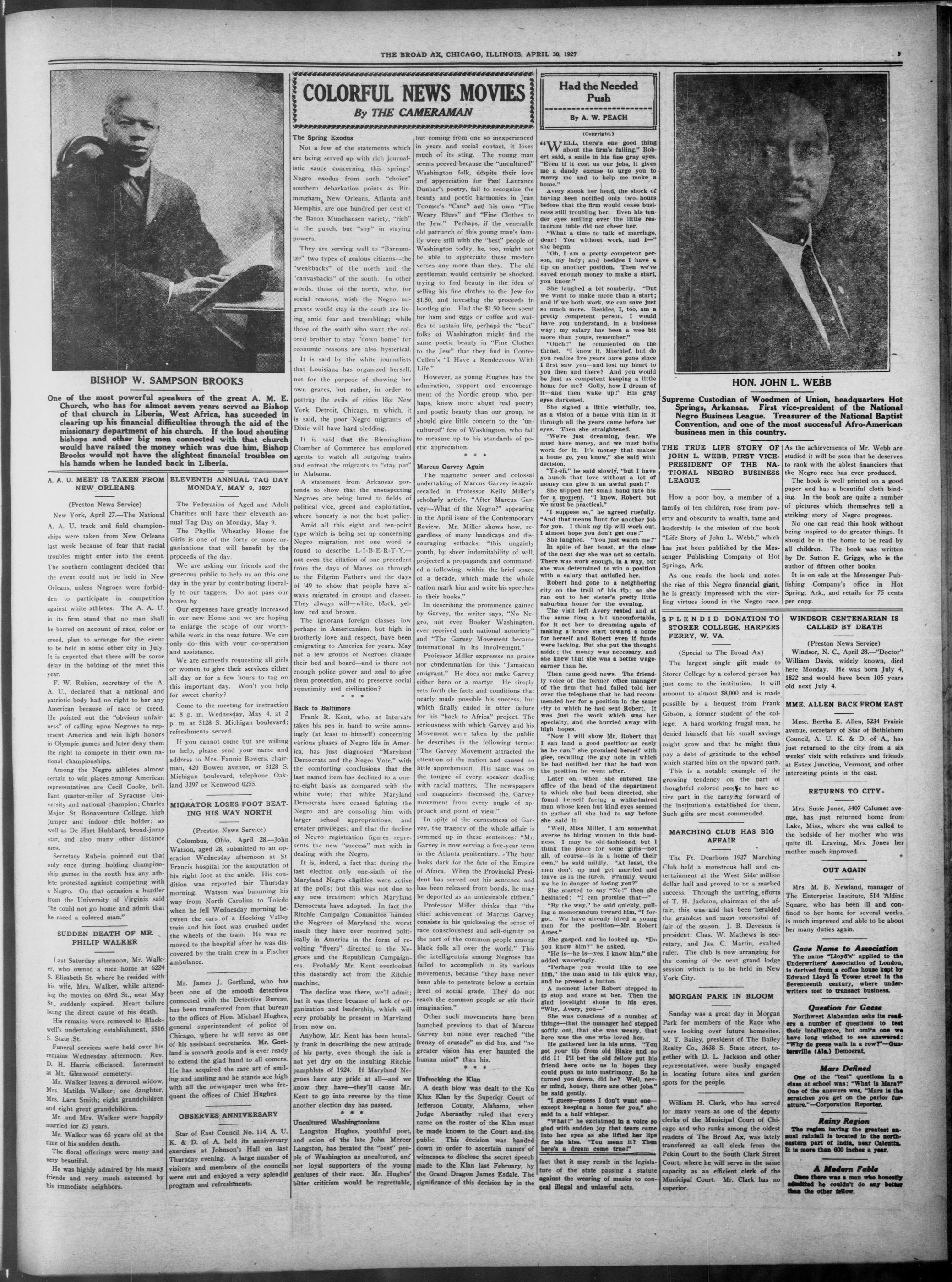
One of the most powerful speakers of the great A. M. E. Church, who has for almost seven years served as Bishop of that church in Liberia, West Africa, has succeeded in clearing up his financial difficulties through the aid of the missionary department of his church. If the loud shouting bishops and other big men connected with that church would have raised the money which was due him, Bishop Brooks would not have the slightest financial troubles on his hands when he landed back in Liberia.
A. A. U. MEET IS TAKEN FROM ELEVENTH ANNUAL TAG DAY NEW ORLEANS MONDAY, MAY 9, 1927
(Preston News Service)
New York, April 27.—The National A. A. U. track and field championships were taken from New Orleans last week because of fear that racial troubles might enter into the event. The southern contingent decided that the event could not be held in New Orleans, unless Negroes were forbidden to participate in competition against white athletes. The A. A. U. in its firm stand that no man shall be barred on account of race, color or creed, plan to arrange for the event to be held in some other city in July. It is expected that there will be some delay in the holding of the meet this year.
F. W. Rubien, secretary of the A. A. U., declared that a national and patriotic body had no right to bar any American because of race or creed. He pointed out the "obvious unfairness" of calling upon Negroes to represent America and win high honors in Olympic games and later deny them the right to compete in their own national championships.
Among the Negro athletes almost certain to win places among American representatives are Cecil Cooke, brilliant quarter-miler of Syracuse University and national champion; Charles Major, St. Bonaventure College, high jumper and indoor title holder; as well as De Hart Hubbard, broad-jump star, and also many other distance men.
Secretary Rubein pointed out that only once during holding championship games in the south has any athlete protested against competing with a Negro. On that occasion a hurdler from the University of Virginia said "he could not go home and admit that he raced a colored man."
SUDDEN DEATH OF MR.
PHILIP WALKER
Last Saturday afternoon, Mr. Walker, who owned a nice home at 6224 S. Elizabeth St. where he resided with his wife, Mrs. Walker, while attending the movies on 63rd St., near May St., suddenly expired. Heart failure being the direct cause of his death.
His remains were removed to Blackwell's undertaking establishment, 5516 S. State St.
Funeral services were held over his remains Wednesday afternoon. Rev. D. H. Harris officiated. Interment at Mt. Glenwood cemetery.
Mr. Walker leaves a devoted widow, Mrs. Matilda Walker; one daughter, Mrs. Lara Smith; eight grandchildren and eight great grandchildren.
Mr. and Mrs. Walker were happily married for 23 years.
Mr. Walker was 65 years old at the time of his sudden death.
The floral offerings were many and very beautiful.
He was highly admired by his many friends and very much esteemed by his immediate neighbors.
seakers of the great A. M. E. E. set seven years served as Bishop of West Africa, has succeeded in difficulties through the aid of the thes church. If the loud shouting is connected with that church key which was due him, Bishop slightest financial troubles on back in Liberia.
ELEVENTH ANNUAL TAG DAY
MONDAY, MAY 9, 1927
The Federation of Aged and Adult Charities will have their eleventh annual Tag Day on Monday, May 9.
The Phyllis Wheatley Home for Girls is one of the forty or more organizations that will benefit by the proceeds of the day.
We are asking our friends and the generous public to help us on this one day in the year by contributing liberally to our taggers. Do not pass our boxes by.
Our expenses have greatly increased in our new Home and we are hoping to enlarge the scope of our worthwhile work in the near future. We can only do this with your co-operation and assistance.
We are earnestly requesting all girls or women to give their services either all day or for a few hours to tag on this important day. Won't you help for sweet charity?
Come to the meeting for instruction at 8 p. m. Wednesday, May 4, at 2 p. m. at 5128 S. Michigan boulevard; refreshments served.
If you cannot come but are willing to help, please send your name and address to Mrs. Fannie Bowers, chairman, 420 Bowen avenue, or 5128 S. Michigan boulevard, telephone Oakland 3397 or Kenwood 0255.
MIGRATOR LOSES FOOT BEAT
ING HIS WAY NORTH
(Preston News Service)
Columbus, Ohio, April 28.—John Watson, aged 28, submitted to an operation Wednesday afternoon at St. Francis hospital for the amputation of his right foot at the ankle. His condition was reported fair Thursday morning. Watson was bumming his way from North Carolina to Toledo when he fell Wednesday morning between the cars of a Hocking Valley train and his foot was crushed under the wheels of the train. He was removed to the hospital after he was discovered by the train crew in a Fischer ambulance.
Mr. James J. Gortland, who has been one of the smooth detectives connected with the Detective Bureau, has been transferred from that bureau to the offices of Hon. Michael Hughes, general superintendent of police of Chicago, where he will serve as one of his assistant secretaries. Mr. Gortland is smooth goods and is ever ready to extend the glad hand to all comers. He has acquired the rare art of smiling and smiling and he stands ace high with all the newspaper men who frequent the offices of Chief Hughes.
OBSERVES ANNIVERSARY
Star of East Council No. 114, A. U. K. & D. of A. held its anniversary exercises at Johnson's Hall on last Thursday evening. A large number of visitors and members of the councils were out and enjoyed a very splendid program and refreshments.
THE BROAD AX, CHICAGO, ILLINOIS, APRIL 30, 1927
COLORFUL NEWS MOVIES By THE CAMERAMAN
---
The Spring Exodus
Not a few of the statements which are being served up with rich journalistic sauce concerning this springs' Negro exodus from such "choice" southern debarkation points as Birmingham, New Orleans, Atlanta and Memphis, are one hundred per cent of the Baron Munchausen variety, "rich" in the punch, but "shy" in staying powers.
They are serving well to "Barnum-ize" two types of zealous citizens—the "weakbacks" of the north and the "canvasbacks" of the south. In other words, those of the north, who, for social reasons, wish the Negro migrants would stay in the south are living amid fear and trembling; while those of the south who want the colored brother to stay "down home" for economic reasons are also hysterical. It is said by the white journalists that Louisiana has organized herself, not for the purpose of showing her own graces, but rather, in order to portray the evils of cities like New York, Detroit, Chicago, in which, it is said, the poor Negro migrants of Dixie will have hard sledding.
It is said that the Birmingham Chamber of Commerce has employed agents to watch all outgoing trains and entreat the migrants to "stay put" in Alabama.
A statement from Arkansas portends to show that the unsuspecting Negroes are being lured to fields of political vice, greed and exploitation, where honesty is not the best policy.
Amid all this eight and ten-point type which is being set up concerning Negro migration, not one word is found to describe L-I-B-E-R-T-Y,—not even the citation of one precedent from the days of Manes on through to the Pilgrim Fathers and the days of '49 to show that people have always migrated in groups and classes. They always will—white, black, yellow, red and brown.
The ignorant foreign classes low perhaps in Americanism, but high in brotherly love and respect, have been emigrating to America for years. May not a few groups of Negroes change their bed and board—and is there not enough police power and zeal to give them protection, and to preserve social equanimity and civilization?
Back to Baltimore
Frank R. Kent, who, at intervals takes his pen in hand to write amusingly (at least to himself) concerning various phases of Negro life in America, has just diagnosed "Maryland Democrats and the Negro Vote," with the comforting conclusions that the last named item has declined to a one-to-eight basis as compared with the white vote; that white Maryland Democrats have ceased fighting the Negro and are consoling him with larger school appropriations, and greater privileges; and that the decline of Negro registration figures represents the new "success" met with in dealing with the Negro.
It is, indeed, a fact that during the last election only one-sixth of the Maryland Negro eligibles were active at the polls; but this was not due to any new treatment which Maryland Democrats have adopted. In fact the Ritchie Campaign Committee handed the Negroes of Maryland the worst insult they have ever received politically in America in the form of revolting "flyers" directed to the Negroes and the Republican Campaigners. Probably Mr. Kent overlooked this dastardly act from the Ritchie machine.
The decline was there, we'll admit; but it was there because of lack of organization and leadership, which will very probably be present in Maryland from now on.
Anyhow, Mr. Kent has been brutally frank in describing the new attitude of his party, even though the ink is not yet dry on the insulting Ritchie pamphlets of 1924. If Maryland Negroes have any pride at all—and we know they have—they'll cause Mr. Kent to go into reverse by the time another election day has passed.
Uncultured Washingtonians
Langston Hughes, youthful poet, and scion of the late John Mercer Langston, has berated the "best" people of Washington as uncultured, and not loyal supporters of the young geniuses of their race. Mr. Hughes bitter criticism would be regrettable.
but coming from one so inexperienced in years and social contact, it loses much of its sting. The young man seems peeved because the "uncultured" Washington folk, despite their love and appreciation for Paul Laurance Dunbar's poetry, fail to recognize the beauty and poetic harmonies in Jean Toomer's "Cane" and his own "The Weary Blues" and "Fine Clothes to the Jew." Perhaps, if the venerable old patriarch of this young man's family were still with the "best" people of Washington today, he, too, might not be able to appreciate these modern verses any more than they. The old gentleman would certainly be shocked, trying to find beauty in the idea of selling his fine clothes to the Jew for $1.50, and investing the proceeds in bootleg gin. Had the $1.50 been spent for ham and eggs or coffee and waffles to sustain life, perhaps the "best" folks of Washington might find the same poetic beauty in "Fine Clothes to the Jew" that they find in Contee Cullen's "I Have a Rendezvous With Life."
However, as young Hughes has the admiration, support and encouragement of the Nordic group, who, perhaps, know more about real poetry, and poetic beauty than our group, he should give little concern to the "uncultured" few of Washington, who fail to measure up to his standards of poetic appreciation.
Marcus Garvey Again
The magnetic power and colossal undertaking of Marcus Garvey is again recalled in Professor Kelly Miller's scholarly article, "After Marcus Garvey—What of the Negro?" appearing in the April issue of the Contemporary Review. Mr. Miller shows how, regardless of many handicaps and discouraging setbacks, "this ungainly youth, by sheer indomitability of will, projected a propaganda and commanded a following, within the brief space of a decade, which made the whole nation mark him and write his speeches in their books."
In describing the prominence gained by Garvey, the writer says, "No Negro, not even Booker Washington, ever received such national notoriety" and "The Garvey Movement became international in its involvement."
Professor Miller expresses no praise nor condemnation for this "Jamaican emigrant." He does not make Garvey either hero or a martyr. He simply sets forth the facts and conditions that nearly made possible his success, but which finally ended in utter failure for his "back to Africa" project. The seriousness with which Garvey and his Movement were taken by the public he describes in the following terms: "The Garvey Movement attracted the attention of the nation and caused no little apprehension. His name was on the tongue of every speaker dealing with racial matters. The newspapers and magazines discussed the Garvey movement from every angle of approach and point of view."
In spite of the earnestness of Garvey, the tragedy of the whole affair is summed up in these sentences: "Mr. Garvey is now serving a five-year term in the Atlanta penitentiary. - The hour looks dark for the fate of the Empire of Africa. When the Provincial President has served out his sentence and has been released from bonds, he may be deported as an undesirable citizen."
Professor Miller thinks that "the chief achievement of Marcus Garvey consists in his quickening the sense of race consciousness and self-dignity on the part of the common people among black folk all over the world." This the intelligentsia among Negroes has failed to accomplish in its various movements, because "they have never been able to penetrate below a certain level of social grade. They do not reach the common people or stir their imagination."
Other such movements have been launched previous to that of Marcus Garvey but none ever reached "the frenzy of crusade" as did his, and "no greater vision has ever haunted the human mind" than his.
Unfrocking the Klan
A death blow was dealt to the Ku Klux Klan by the Superior Court of Jefferson County, Alabama, when Judge Abernathy ruled that every name on the roster of the Klan must be made known to the Court and the public. This decision was handed down in order to ascertain names of witnesses to disclose the secret speech made to the Klan last February, by the Grand Dragon James Esdale. The significance of this decision lay in the
By A. W. PEACH
(Copyright.)
"WELL, there's one good thing about the firm's falling," Robert sald, a smile in his fine gray eyes. "Even if it cost us our jobs, it gives me a dandy excuse to urge you to marry me and to help me make a home."
Avery shook her head, the shock of having been notified only two hours before that the firm would cease business still troubling her. Even his tender eyes smiling over the little restaurant table did not cheer her.
"What a time to talk of marriage, dear! You without work, and I—" she began.
"Oh, I am a pretty competent person, my lady; and besides I have a tip on another position. Then we've saved enough money to make a start, you know."
She laughed a bit somberly. "But we want to make more than a start; and if we both work, we can save just so much more. Besides, I, too, am a pretty competent person. I would have you understand, in a business way; my salary has been a wee bit more than yours, remember."
"Ouch!" he commented on the thrust. "I know it, Mischief, but do you realize five years have gone since I first saw you—and lost my heart to you then and there? And you would be just as competent keeping a little home for me? Golly, how I dream of it—and then wake up!" His gray eyes darkened.
She sighed a little wistfully, too, as a vision of a home with him in it through all the years came before her eyes. Then she straightened.
"We're just dreaming, dear. We must have money, and we must both work for it. It's money that makes a home go, you know," she said with decision.
"Ye-eh," he said slowly, "but I have a hunch that love without a lot of money can give it an awful push!" She slipped her small hand into his for a moment. "I know, Robert, but we must be practical."
"I suppose so," he agreed ruefully. "And that means hunt for another job for you. I think my tip will work out. I almost hope you don't get one!" She laughed. "You just watch me!" In spite of her boast, at the close of the next day she was not so certain. There was work enough, in a way, but she was determined to win a position with a salary that satisfied her. Robert had gone to a neighboring city on the trail of his tip; so she ran out to her sister's pretty little suburban home for the evening.
The visit left Avery rested and at the same time a bit uncomfortable, for it set her to dreaming again of making a brave start toward a home for herself and Robert even if funds were lacking. But she put the thought aside; the money was necessary, and she knew that she was a better wage-earner than he.
Then came good news. The friendly voice of the former office manager of the firm that had failed told her over the telephone that he had recommended her for a position in the same city to which he had sent Robert. It was just the work which was her specialty, and she hurried away with high hopes.
"Now I will show Mr. Robert that I can land a good position as easily as he can," she promised herself with glee, recalling the gay note in which he had notified her that he had won the position he went after.
Later on, when she entered the office of the head of the department to which she had been directed, she found herself facing a white-haired man whose keen but kind eyes seemed to gather all she had to say before she said it.
"Well, Miss Miller, I am somewhat averse to hiring women in this business. I may be old-fashioned, but I think the place for some girls—not all, of course—is in a home of their own," he said mildly. "At least, the men don't up and get married and leave us in the lurch. Frankly, would we be in danger of losing you?"
She started to say "No!" then she hesitated: "I can promise that—"
"By the way," he said quickly, pulling a memorandum toward him, "I forget. We have already hired a young man for the position—Mr. Robert Ames."
She gasped, and he looked up. "Do you know him?" he asked.
"He is—he is—yes, I know him," she added wavingly.
"Perhaps you would like to see him," the man said in his quick way, and he pressed a button.
A moment later Robert stepped in to stop and stare at her. Then the glad lovelight shone in his eyes.
"Why, Avery, you—"
She was conscious of a number of things—that the manager had stepped softly out, that she was wary, that here was the one who loved her.
He gathered her in his arms. "You got your tip from old Blake and so did I! I'll bet the old fellow put his friend here onto us in hopes they could push us into matrimony. So he turned you down, did he? Well, never mmd, honey, there are other jobs," he said gently.
"I guess—guess I don't want one—except keeping a home for you," she said in a half whisper.
"What!" he exclaimed in a voice so glad with sudden joy that tears came into her eyes as she lifted her lips for his kiss. "You mean it? Then here's a dream come true!" fact that it may result in the legislature of the state passing a statute against the wearing of masks to conceal illegal and unlawful acts.
M.
HON. JOHN L. WEBB
Supreme Custodian of Woodm Springs, Arkansas. First Negro Business League. Tr Convention, and one of the business men in this country
Supreme Custodian of Woodmen of Union, headquarters Hot Springs, Arkansas. First vice-president of the National Negro Business League. Treasurer of the National Baptist Convention, and one of the most successful Afro-American business men in this country.
THE TRUE LIFE STORY OF JOHN L. WEBB, FIRST VICE-PRESIDENT OF THE NATIONAL NEGRO BUSINESS LEAGUE
How a poor boy, a member of a family of ten children, rose from poverty and obscurity to wealth, fame and leadership is the mission of the book "Life Story of John L. Webb," which has just been published by the Messenger Publishing Company of Hot Springs, Ark.
As the achievements of Mr. Webb are studied it will be seen that he deserves to rank with the ablest financiers that the Negro race has ever produced. The book is well printed on a good paper and has a beautiful cloth binding. In the book are quite a number of pictures which themselves tell a striking story of Negro progress. No one can read this book without being inspired to do greater things. It should be in the home to be read by all children. The book was written by Dr. Sutton E. Griggs, who is the author of fifteen other books.
As one reads the book and notes the rise of this Negro financial giant, he is greatly impressed with the sterling virtues found in the Negro race.
S PLEN D I D DONATION TO
STORER COLLEGE, HARPERS
FERRY, W. VA.
(Special to The Broad Ax)
The largest single gift made to Storer College by a colored person has just come to the institution. It will amount to almost $8,000 and is made possible by a bequest from Frank Gibson, a former student of the college. A hard working frugal man, he denied himself that his small savings might grow and that he might thus pay a debt of gratitude to the school which started him on the upward path. This is a notable example of the growing tendency on the part of thoughtful colored people to have active part in the carrying forward of the institution's established for them. Such gifts are most commended.
MARCHING CLUB HAS BIG
AFFAIR
The Ft. Dearborn 1927 Marching Club held a monstrous ball and entertainment at the West Side' million dollar hall and proved to be a marked success. Through the uniting efforts of T. H. Jackson, chairman of the affair, this was and has been 'heralded the grandest and most successful affair of the season. J. B. Deveaux is president; Chas. W. Mathews is secretary, and Jas. C. Martin, exalted ruler. The club is now arranging for the coming of the next grand lodge session which is to be held in New York City.
MORGAN PARK IN BLOOM
Sunday was a great day in Morgan Park for members of the Race who were looking over future homesites. M. T. Bailey, president of The Bailey Realty Co., 3638 S. State street, together with D. L. Jackson and other representatives, were busily engaged in locating future sites and garden spots for the people.
William H. Clark, who has served for many years as one of the deputy clerks of the Municipal Court of Chicago and who ranks among the oldest readers of The Broad Ax, was lately transferred as call clerk from the Pekin Court to the South Clark Street Court, where he will serve in the same capacity as an efficient clerk of the Municipal Court. Mr. Clark has no superior.
```markdown
```
en of Union, headquarters Hot vice-president of the National easurer of the National Baptist most successful Afro-American r.
As the achievements of Mr. Webb are studied it will be seen that he deserves to rank with the ablest financiers that the Negro race has ever produced. The book is well printed on a good paper and has a beautiful cloth binding. In the book are quite a number of pictures which themselves tell a striking story of Negro progress. No one can read this book without being inspired to do greater things. It should be in the home to be read by all children. The book was written by Dr. Sutton E. Griggs, who is the author of fifteen other books.
It is on sale at the Messenger Publishing Company's office in Hot Spring, Ark., and retails for 75 cents per copy.
WINDSOR CENTENARIAN IS
CALLED BY DEATH
Windsor, N. C., April 28.—"Doctor" William Davis, widely known, died here Monday. He was born July 4, 1822 and would have been 105 years old next July 4.
MME. ALLEN BACK FROM EAST
Mme. Bertha E. Allen, 5234 Prairie avenue, secretary of Star of Bethlehem Council, A. U. K. & D. of A., has just returned to the city from a six weeks' visit with relatives and friends at Essex Junction, Vermont, and other interesting points in the east.
RETURNS TO CITY.
Mrs. Susie Jones, 3407 Calumet avenue, has just returned home from Lake, Miss., where she was called to the bedside of her mother who was quite ill. Leaving, Mrs. Jones her mother much improved.
Mrs. M. B. Newland, manager of The Enterprise Institute, 514 Aldine Square, who has been ill and confined to her home for several weeks, is much improved and able to be about her many duties again.
Gave Name to Association
Gave Name to Association
The name "Lloyd's" applied to the Underwriters' Association of London, is derived from a coffee house kept by Edward Lloyd in Tower street in the Seventeenth century, where underwriters met to transact business.
Question for Geese
Northwest Alabamaan asks its readers a number of questions to test their intelligence, but omit's one we have long wished to see answered: "Why do geese walk in a row?"—Gunterville (Ala.) Democrat.
One of the "test" questions in a class at school was: "What is Mars?" One of the answers was, "Mars is the scratches you get on the parlor furniture."—Corporation Reporter.
The region having the greatest annual rainfall is located in the northeastern part of India, near Calcutta. It is more than 600 inches a year.
Once there was a man who honestly admitted he couldn't do any better than the other fellow.
OUT AGAIN
Mars Defined
Rainy Region
Williamson's
CUNNINGHAM FUNERAL CARS
Are distinguished by their Style and Elegance but foremost by the protection to passengers guaranteed by proper Insurance.
USE THE WILLIAMSON FUNERAL
OR REQUEST WILLIAMSON'S INSURED CARS
Protect Yourself BY USING OUR
Latest Style Leatherback Indemnified Hearses and Cars
It costs no more
We have
Invested in $200,000 Indemnity for our 5 Hearses and 15 Cars. $10,000 each.
Why take a Chance?
Use our cars and be assured of protection. The above policy is back of our up to date Cars. If any one is killed or injured in your funeral we will look after all suits and pay damages
AMBULANCE SERVICE AT ALL HOURS
Prompt Service Night and Day
PHONE KENWOOD 0455
Ernest H. Williamson
In this city since July 15th 1899
without missing one single issue. Re-
publicans, Democrats, Catholics, Pro-
testants, Single Taxes, Priests, in-
fidels or anyone else can have their say
as long as their language is proper
and responsibility is fixed.
The Broad Ax is a newspaper whose
platform is broad enough for all, even
claiming the editorial right to speak
to own mind. It is neither Democ-
ratic nor Republican. It is stricly
or absolutely independent in politics.
Local communications will receive
attention. Write only on one side of
the paper.
Subscriptions must be paid in ad-
vance.
One Year ..... $2.00
Six Months ..... $1.00
Advertising rates made known on
application.
Address all communications to
THE BROAD AX
206 S. Elizabeth St. Chicago.
Phone: Wentworth 2597
JULIUS P. TAYLOR
Editor and Publisher
Vol. XXXII
Chicago, April 30, 1927
No. 33
Entered as Second-Class Matter, aug.
19, 1902, at the Post office at Chicago.
Ill. "Under Act of March 8, 1879"
Real Democracy
In the minds of many people, democracy rests upon the colossal untruth that "one man is as good as another," so that a large number are more likely to be right than a small number. In reality democracy rests upon the ubiquitous fact that all men are directly interested in securing good government, while its successes have often been due to its practical recognition of the truth that some men are born to lead and others to follow.—John Fiske.
If the stars being studied by the astro-physicists could be weighed actually, instead of by mathematical computation, it would be found that a spadeful would weigh a ton. The stars are accordingly much denser than the earth. The earth is said to be only about five and a half times as heavy as water.
The Fount of Glory
Real glory springs from the silent conquest of ourselves; and, without that, the conqueror is naught but the veriest slave. - Capper's Weekly.
Playing It on Pessimist
Even the pessimist will have to admit that if it ween't for the sunny days we couldn't appreciate the cloudy ones.—Boston Transcript.
Gracious Lady's Tact
in Trying Situation
It took a society leader from Boston to teach me just how gracious a gracious lady may sometimes be. For some incredible reason (in our hotel) there was a door leading from her bathroom into the hall, and, equally incredible, when a husky sweeper mistook his broom closet and pulled at the bathroom door it came open to admit him to the immediate presence of a society leader enjoying her bath. The sweeper's consternation, pulsating through the service channels, was registered at the desk in about three minutes.
By and by the blue-blooded Bostonian, marvelously gowned for dinner, as she always was, entered the lobby, and the young men at the desk prayed that she would pass on into the dining room. When she headed in their direction they stood their ground beorically, but the blood froze in their veins.
She glanced from room clerk to front clerk and back again, smiled sweetly and said: "My mother, taught me to take my bath regularly, but she affixed one rigid requirement—that I should always take it in private. If you'll be good enough to have some one nail up that public entrance to my bathroom I'll be grateful."—Rufus Steele in the Saturday Evening Post.
Wrong Town
Back in Westby, Wis., where the population is Norwegian, they tell this little story on themselves.
A big touring car came through the town one day and accidentally ran down two men. It wasn't the driver's fault, so he hastened to the police station to make his report and arrange to proceed on his way.
"I believe I have killed two Norwegians," the driver tersely explained to the marshal.
"Vell," said the marshal, "we don't do nothing about dat here. You got to go down to Viroqua for the bounty.
—Los Angeles Times.
Left Name in History
King-Maker was the name given to Richard Neville, earl of Warwick, one of the most powerful nobles of the Middle ages. He took a prominent part in the Wars of theoses. He raised an army of 30,000 and placed the duke of York on the throne. Then he turned to the house of Lancaster, deposed Edward of York and restored Henry VI. The restoration lasted only a few months, for the Yorkists won the bloody battle of Barnet in April, 1474, in which Warwick was slain. The duke of York was restored as King Edward IV. Lytton's historical romance, "The Last of the Barons," is based on the career of Warwick, the King-Maker.—Montreal Family Herald.
The Wrecking Crew
The car was brought to a local garage for repairs and was badly damaged. -Texas paper.
THE BROAD AX, CHICAGO, ILLINOIS, APRIL 30, 1927
Fighting Men Imported
Many soldiers from Germany and Poland were imported by the federal government for service in the Union army during the Civil war, according to official correspondence between the Department of State and the United States consulate at Hamburg in 1863. The plan was operated extensively, it is said, and large sums were paid in bounties to the men obtained in that way. Many of those who came to fight remained in this country after the close of the war. It is believed the plan was largely directed by and in the interest of wealthy Eastern men who resorted to it to obtain substitutes for military service when the draft was adopted.—Detroit News.
Oad Kaitroad Troubles
Railway accidents caused by animals are not infrequent in some parts of the world. A passenger train in Slam a few years ago was delayed by running over a tiger on a viaduct. Shortly after this an elephant, charging a freight, derailed several cars and wrecked the locomotive before it was killed. Insect pests in South Africa have been known to cause railway troubles. One report tells of a train having been delayed for two hours while the right of way was disrupted with millions of "thousand legs." In 1923 there were such swarms of locusts in one district that the right of way had to be sprayed daily for more than a week.
Ancient Feared Beans
Wise men of old had a great fear of beans. Even stern stold Hippocrates was frightened when the blooms were on, for fear harm would come to his patients, and Pythagoras and his followers refrained from eating beans less disaster should befall their parents. But Adonis helped upset the fear of the bean by ordering beans to be offered on the aurat of the god of Dyad and of Fine Arts, but in parts of Europe, as late as the middle of the Sixteenth century, there were communities where the fear of the bean and its blossom was to be found.
Astor's Business Projects
John Jacob Astor, who became one of the outstanding fur dealers in this country, had only $75 when he arrived in America. He wheeled his own skins to market, says Maude Stewart Welch in her book, "Vrow Knickerbocker." There were few musical instruments in the colonies and later Astor became a dealer in planes, the Astors in London being engaged in the manufacture of these instruments. Through his connection with the fur and trapping industry, Astor founded the first white settlement in Nebraska, and also the town of Astoria in Oregon.
Academic Dispute
A dispute has arisen among scientists as to whether a lightning flash is spiral or jagged. For the man who tries to field it in, the question is purely academic.
Frog Unable to Live
An old natural history problem has once more cropped up, and unless a word or two of advice are given the same old, queer beliefs will persist, and frogs and toads will still be looked upon with suspicion as uncanny creatures, says Charles H. Lee in Our Dumb Animals.
The problem is: Can a frog or a toad live embedded in a rock? Two men working on the rocks near Barmouth have found a live frog inside the solid rock, and it is believed that it must have been there for years.
Toads and frogs are often found imprisoned inside lumps of coal and rock, so it is not surprising that people marvel at the apparent endurance possessed by these reptiles. Yet the phenomenon has a proslae explanation. When the creatures were little they must have crept through some crevice into a hole, and there existing on insects, they have grown larger. So long as they can get a little air and a few insects, they can live as long as ordinary frogs, so that there is nothing marvelous.
Dean Buckland is authority for the statement that frogs die in less than a year if they are deprived of air and food, and that they cannot live more than two years without food, even if given plenty of air, so that the old belief that they can live for centuries entombed in a solid rock is a fallacy. There must always be an airhole and a means for insects to crawl in, for the frog or toad to live many months.
Many Flying Creatures
William Beebe, well-known explorer, says "Borneo is a land of flying creatures, and besides birds, bats and insects. I saw squirrels, lizards, frogs, and even snakes occasionally, trusting themselves to the thin air, buoying themselves, or at least breaking their fall with parachutes or membranes of fur, skin or scales."
Ranch Appellations
The name "Lazy" so often affixed to western ranches, refers to the brand used on its animals by the ranch. When letters of the alphabet are used they are often varied by their position. When tilted at an angle of 45 degrees they are said to be "tumbling"; when lying flat on their back or face, "lazy."
Good Word, Anyway
A little girl in one of the Kansas City grade schools misspelled the word, "immense." She was detained after others were dismissed and instructed by her teacher to write 100 sentences, using the word she misspelled. This was her first sentence: "This is an immense job."-Exchange.
Res. 5400 Washington Blvd.
Branch Office: 606 Racine
MILES J.
ATTORNEY
SUITE 318-320 B
CLARK AND WA
Telephone CENTRAL 1239
WEST ENGLEY
AND SAVI
Cor. 63rd Street and
JOHN BAIN, President
Vice-President; EDWA
President and Cashier;
Assistant Cashier and T
Res. 5400 Washington Blvd. Res. Phone: Mansfield 5436
Branch Office: 606 Racine Ave., Phone Monroe 2714
MILES J. DEVINE
ATTORNEY-AT-LAW
SUITE 318-320 REAPER BLOCK
CLARK AND WASHINGTON STS.
Telephone CENTRAL 1239 CHICAGO
WEST ENGLEWOOD TRUST AND SAVINGS BANK
Cor. 63rd Street and Marshfield Avenue
JOHN BAIN, President; MICHAEL MAISEL, Vice-President; EDWARD C. BARRY, VicePresident and Cashier; W. MERLE FISHER, Assistant Cashier and Trust Officer.
TELEPHONE REPUBLIC 5000
TELEPHONE DOUGLAS
GEORGE F. HARDING
REAL ESTATE
Up-to-Date or Modern Houses, A
REAL ESTATE
Up-to-Date or Modern Houses, Apartments
and Stores to Rent
3101 COTTAGE GROVE AVE.
Corner 31st Street, Chicago
The Welsh are a Celtic people. At the time of the coming of the Romans in 55 B. C. the natives of Wales represented a mixture of the primitive Iberians and the later invading Celts, all bearing the general name of Cymry. Afterward the Celtic inhabitants of Britain took refuge in Wales, where they were driven westward by the Anglo-Saxons. In time they merged with the natives.
Few Leave Great Wealth
Few Leave Great Wealth
Eleven people out of 100—whose estates are probated with the courts—bequeath to their heirs less than $500;
ten leave from $500 to $1,000; twenty from $1,000 to $2,500. Between five and six leave estates from $25,000 to $50,000.
Oldest National Bank
Oldest National Bank
The national bank which received
the first national bank charter is the
First National bank of Philadelphia.
A charter was granted this bank in
1863.
Notary Public
Phones: Office Main 4153; Residence,
4751 Champlain Avenue
Phone Kenwood 5611
Walter M. Farmer
ATTORNEY AND COUNSELOR
AT LAW
Suite 708—184 W. Washington St.
CHICAGO
Telephone: State 3278
A. D. GASH
ATTORNEY AT LAW
Suite #13, Ashland Bloch
156 N. Clark Street
CHICAGO, ILL.
Phone Main 2017
A. L. WILLIAMS
ATTORNEY AND
COUNSELOR AT LAW
Suite 706 Firmenich Building
184 W. Washington St.
CHICAGO
Residence 3646 Michigan Ave.
Phone Douglas 9133
Res. Phone: Mansfield 5436
Ave., Phone Monroe 2714
DEVINE
Y-AT-LAW
LEAPER BLOCK
WASHINGTON STS.
CHICAGO
WOOD TRUST
INGS BANK
Marshfield Avenue
; MICHAEL MAISEL,
RD C. BARRY, Vice-
W. MERLE FISHER,
Trust Officer.
DOUGLAS
HARDING, JR.
ESTATE
Houses, Apartments
Approved Safe Investments yield 7% interest. $100 Bonds sold on easy payment plan. See our Mr. Avery of the Bond Department.
LOANS MADE ON REAL ESTATE
Savings Department open from 9 A.M. to 8 P.M. Saturdays.
SAFETY DEPOSIT BOXES for less than one cent a day. Protect your Valuable Papers, Jewelry, etc.
NINCOLN STATE BANK
OF CHICAGO
Under State Government Supervision
31st and South State Streets
Telephone Victory 4500
THE
COMMONWEALT
EDISON
COMPANY
LINCOLN STATE BANK
OF CHICAGO Under State Government Supervision 31st and South State Streets Telephone Victory 4500
THE COMMONWEALTH EDISON COMPANY
72 WEST ADAMS STREET
Phone: Randolph 1280
E WEEK'S SUPE
BRONZE BEAUTY Face Powder is made by a new French process, and is not affected by perspiration. Used satisfactorily on dry or oily skin. Makes the complexion soft and velvety and stays on until removed. Three tints which blend with any complexion: High Brown, Bronze Glow and Flesh. Fill out and mail the coupon below and we will send you a whole week's supply free.
Depository for State County and City Funds
LINCOLN
Under
31st
Te
COMI
ONE W
LINCOLN STATE BANK 60 CHICAGO
Capital and Surplus $500,000.00