The Broad Ax
Saturday, May 21, 1927
Chicago, Illinois
Page text (machine-generated)
SOCIETY NEWS PUBLISHED FREE
Vol. XXXII.
M. J.
C. H. G.
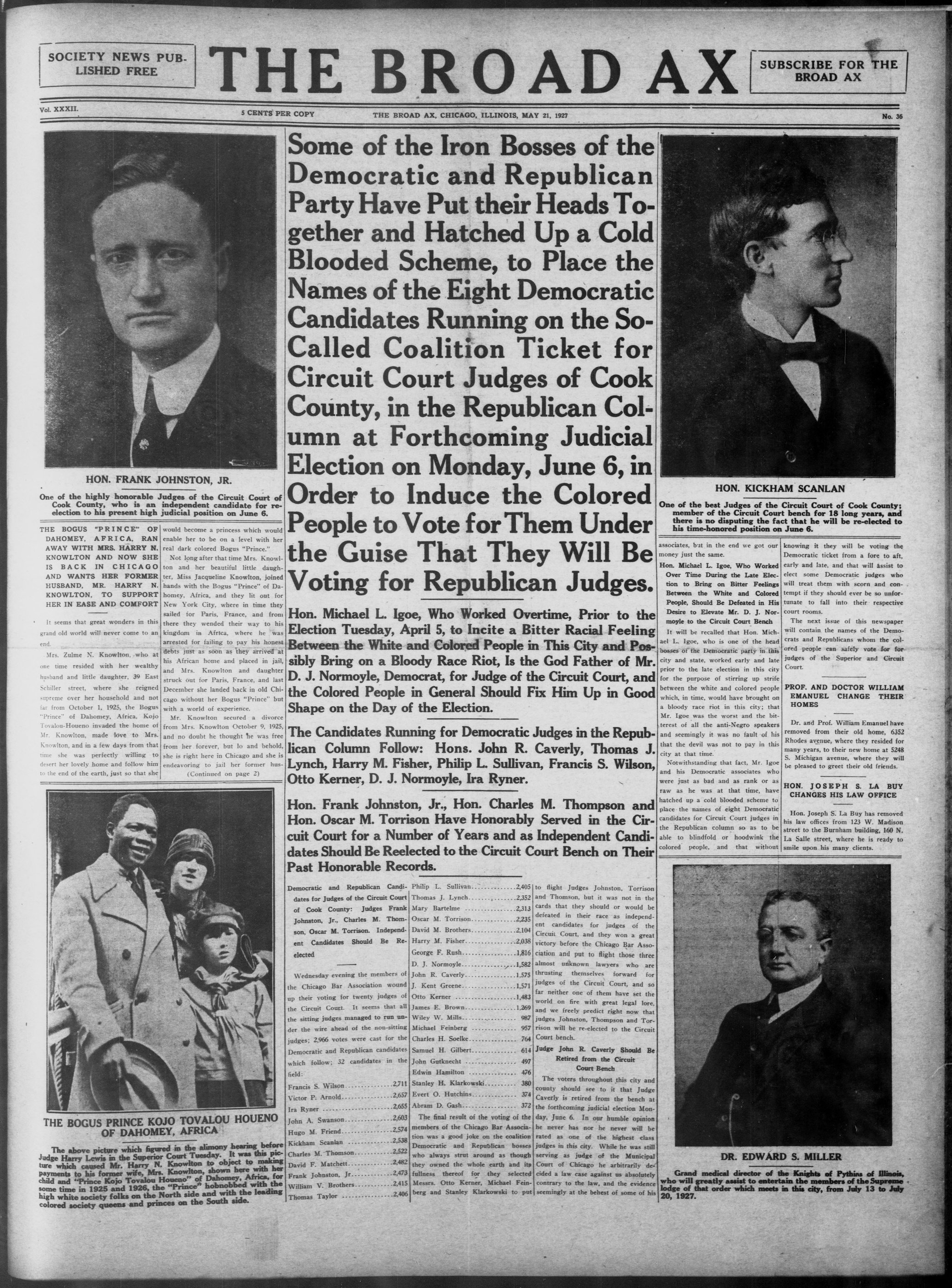
HON. FRANK JOHNSTON, JR. One of the highly honorable Judges of the Circ Cook County, who is an independent cand election to his present high judicial position o
highly honorable Judges of the Circ county, who is an independent cand to his present high judicial position of
One of the highly honorable Judges of the Circuit Court of Cook County, who is an independent candidate for re-election to his present high judicial position on June 6.
THE BOGUS "PRINCE" OF DAHOMEY, AFRICA, RAN AWAY WITH MRS. HARRY N. KNOWLTON AND NOW SHE IS BACK IN CHICAGO AND WANTS HER FORMER HUSBAND, MR. HARRY N. KNOWLTON, TO SUPPORT HER IN EASE AND COMFORT
It seems that great wonders in this grand old world will never come to an end.
would become a princess which would enable her to be on a level with her real dark colored Bogus "Prince."
Not long after that time Mrs. Knowlton and her beautiful little daughter, Miss Jacqueline Knowlton, joined hands with the Bogus "Prince" of Dahomey, Africa, and they lit out for New York City, where in time they sailed for Paris, France, and from there they wended their way to his kingdom in Africa, where he was arrested for failing to pay his honest
Mrs. Zulme N. Knowlton, who at one time resided with her wealthy husband and little daughter, 39 East Schiller street, where she reigned supreme over her household and not far from October 1, 1925, the Bogus "Prince" of Dahomey, Africa, Kojo Tovalou-Houeno invaded the home of Mr. Knowlton, made love to Mrs. Knowlton, and in a few days from that time she was perfectly willing to desert her lovely home and follow him to the end of the earth, just so that she
A
THE FILM "THE MOTHER OF THE GREAT GREAT GREAT"
THE BOGUS PRINCE KOJO TOVALOU HOUENO OF DAHOMEY, AFRICA
The above picture which figured in the alimony hearing before Judge Harry Lewis in the Superior Court Tuesday. It was this picture which caused Mr. Harry N. Knowlton to object to making payments to his former wife, Mrs. Knowlton, shown here with her child and "Prince Kojo Tovalou Houseno" of Dahomey, Africa, for some time in 1925 and 1926, the "Prince" hobnobbed with the high white society folks on the North side and with the leading colored society queens and princes on the South side.
Vol. XXXII.
J391
Judges of the Circuit Court of independent candidate for rejudiicial position on June 6. would become a princess which would enable her to be on a level with her real dark colored Bogus "Prince." Not long after that time Mrs. Knowlton and her beautiful little daughter, Miss Jacqueline Knowlton, joined hands with the Bogus "Prince" of Dahomey, Africa, and they lit out for New York City, where in time they sailed for Paris, France, and from there they wended their way to his kingdom in Africa, where he was arrested for failing to pay his honest debts just as soon as they arrived at his African home and placed in jail, and Mrs. Knowlton and daughter struck out for Paris, France, and last December she landed back in old Chicago without her Bogus "Prince" but with a world of experience.
Mr. Knowlton secured a divorce from Mrs. Knowlton October 9, 1925, and no doubt he thought he was free from her forever, but lo and behold, she is right here in Chicago and she is endeavoring to jail her former hus-
(Continued on page 2)
THE BROAD AX
5 CENTS PER COPY
Sou
Do
Pa
ge
Bl
Na
Ca
Ca
Ci
Co
um
Ele
On
Pe
uit Court of
late for re-
June 6.
Otto Hon. Hon. cuit dates Past
HOUENO
bearing before
was this pic-
ture to make
here with her
, Africa, for
need with the
at the leading
side.
Francis
Victor P
Ira Ryne
John A.
Hugo M
Kickham
Charles
David F
Frank J
William
Thomas
Some of the Iron Bosses of the Democratic and Republican Party Have Put their Heads Together and Hatched Up a Cold Blooded Scheme, to Place the Names of the Eight Democratic Candidates Running on the So-Called Coalition Ticket for Circuit Court Judges of Cook County, in the Republican Column at Forthcoming Judicial Election on Monday, June 6, in Order to Induce the Colored People to Vote for Them Under the Guise That They Will Be Voting for Republican Judges.
Hon. Michael L. Igoe, Who Worked Overtime, Prior to the Election Tuesday, April 5, to Incite a Bitter Racial Feeling Between the White and Colored People in This City and Possibly Bring on a Bloody Race Riot, Is the God Father of Mr. D. J. Normoyle, Democrat, for Judge of the Circuit Court, and the Colored People in General Should Fix Him Up in Good Shape on the Day of the Election.
The Candidates Running for Democratic Judges in the Republican Column Follow: Hons. John R. Caverly, Thomas J. Lynch, Harry M. Fisher, Philip L. Sullivan, Francis S. Wilson, Otto Kerner, D. J. Normoyle, Ira Ryner.
Hon. Frank Johnston, Jr., Hon. Charles M. Thompson and Hon. Oscar M. Torrison Have Honorably Served in the Circuit Court for a Number of Years and as Independent Candidates Should Be Reelected to the Circuit Court Bench on Their Past Honorable Records.
Democratic and Republican Candidates for Judges of the Circuit Court of Cook County: Judges Frank Johnston, Jr., Charles M. Thomson, Oscar M. Torrison. Independent Candidates Should Be Re-elected
Wednesday evening the members of the Chicago Bar Association wound up their voting for twenty judges of the Circuit Court. It seems that all the sitting judges managed to run under the wire ahead of the non-sitting judges; 2,966 votes were cast for the Democratic and Republican candidates which follow; 32 candidates in the field:
THE BROAD AX, CHICAGO, ILLINOIS, MAY 21, 1927
The final result of the voting of the members of the Chicago Bar Association was a good joke on the coalition Democratic and Republican bosses who always strut around as though they owned the whole earth and its fullness thereof for they selected Messrs. Otto Kerner, Michael Feinberg and Stanley Klarkowski to put
to flight Judges Johnston, Torrison and Thomson, but it was not in the cards that they should or would be defeated in their race as independent candidates for judges of the Circuit Court, and they won a great victory before the Chicago Bar Association and put to flight those three almost unknown lawyers who are thrusting themselves forward for judges of the Circuit Court, and so far neither one of them have set the world on fire with great legal lore, and we freely predict right now that judges Johnston, Thompson and Torrison will be re-elected to the Circuit Court bench.
The voters throughout this city and county should see to it that Judge Caverly is retired from the bench at the forthcoming judicial election Monday, June 6. In our humble opinion he never has nor he never will be rated as one of the highest class judges in this city. While he was still serving as judge of the Municipal Court of Chicago he arbitrarily decided a law case against us absolutely contrary to the law, and the evidence seemingly at the behest of some of his
K
JOHN H. HARRIS
HON. KICKHAM SCANLAN
One of the best Judges of the Circuit Court of
member of the Circuit Court bench for 18 le
there is no disputing the fact that he will b
his time-honored position on June 6.
est Judges of the Circuit Court of of the Circuit Court bench for 18 lo disputing the fact that he will be honored position on June 6.
associates, but in the end we got our money just the same.
Hon. Michael L. Igoe, Who Worked Over Time During the Late Election to Bring on Bitter Feelings Between the White and Colored People, Should Be Defeated in His Desire to Elevate Mr. D. J. Normoyle to the Circuit Court Bench
It will be recalled that Hon. Michael L. Igoe, who is one of the head bosses of the Democratic party in this city and state, worked early and late prior to the late election in this city for the purpose of stirring up strife between the white and colored people which, in time, would have brought on a bloody race riot in this city; that Mr. Igoe was the worst and the bitterest of all the anti-Negro speakers and seemingly it was no fault of his that the devil was not to pay in this city at that time.
knowing it they will be voting the Democratic ticket from a fore to aft early and late, and that will assist to elect some Democratic judges who will treat them with scorn and contempt if they should ever be so unfortunate to fall into their respective court rooms.
The next issue of this newspaper will contain the names of the Democrats and Republicans whom the colored people can safely vote for for judges of the Superior and Circuit Court.
PROF. AND DOCTOR WILLIAM EMANUEL CHANGE THEIR HOMES
Dr. and Prof. William Emanuel have removed from their old home, 6355 Rhodes avenue, where they resided for many years, to their new home at 5248
Notwithstanding that fact, Mr. Igoe and his Democratic associates who were just as bad and as rank or as raw as he was at that time, have hatched up a cold blooded scheme to place the names of eight Democratic candidates for Circuit Court judges in the Republican column so as to be able to blindfold or hoodwink the colored people, and that without
THE NEW YORK TIMES
M.
DR. EDWARD S. MILLER
Grand medical director of who will greatly assist to enter lodge of that order which meets 20,1927.
medical director of the Knights of Pythagorely assist to entertain the members of order which meets in this city, from
Grand medical director of the Knights of Pythians of Illinois, who will greatly assist to entertain the members of the Supreme lodge of that order which meets in this city, from July 13 to July 20. 1927.
SUBSCRIBE FOR THE BROAD AX
No. 36
of the Circuit Court of Cook County; it Court bench for 18 long years, and the fact that he will be re-elected to election on June 6.
got our
Worked
the Elec-
feelings
Colored
in His
J. Nor-
Bench
M. Mich-
ne head
in this
and late
this city
p strife
people
ought on
knowing it they will be voting the Democratic ticket from a fore to aft, early and late, and that will assist to elect some Democratic judges who will treat them with scorn and contempt if they should ever be so unfortunate to fall into their respective court rooms.
The next issue of this newspaper will contain the names of the Democrats and Republicans whom the colored people can safely vote for for judges of the Superior and Circuit Court.
PROF. AND DOCTOR WILLIAM
EMANUEL CHANGE THEIR
HOMES
Dr. and Prof. William Emanuel have removed from their old home, 6352 Rhodes avenue, where they resided for many years, to their new home at 5248 S. Michigan avenue, where they will be pleased to greet their old friends.
HON. JOSEPH S. LA BUY CHANGES HIS LAW OFFICE
Hon. Joseph S. La Buy has removed his law offices from 123 N. Madison street to the Burnham building, 160 N. La Salle street, where he is ready to smile on his many clients.
1910
or of the Knights of Pythias of Illinois, entertain the members of the Supreme meets in this city, from July 13 to July
1
REV. JOHN W. ROBINSON
The eloquent pastor of the New York City, N. Y., who is fi Chicago this coming summer.
"CHICAGO'S HEALTH"
Weekly Bulletin, Chicago Department of Health
GIRL SCOUTS
By Herman N. Bundesen, M. D., Commissioner
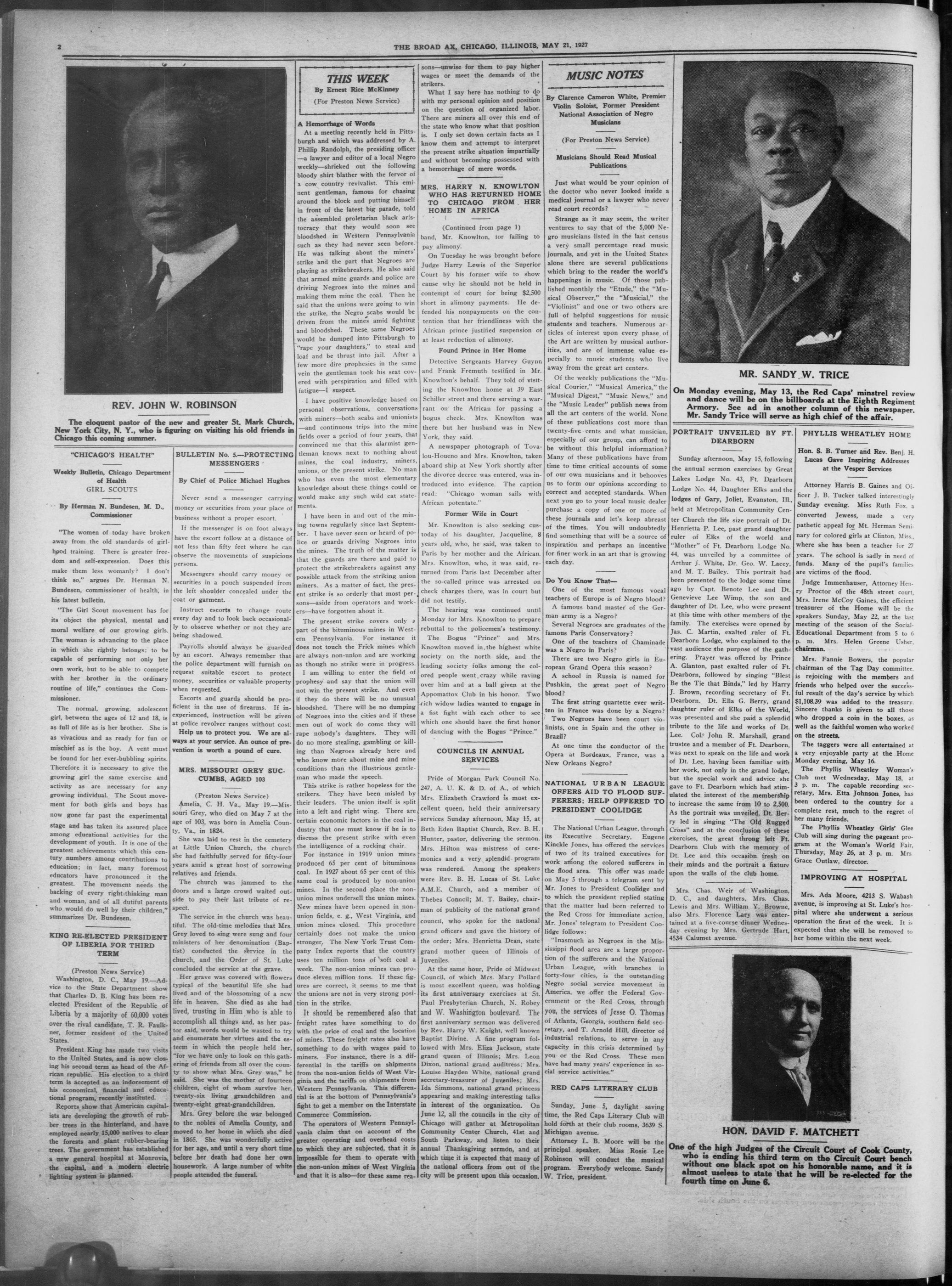
The eloquent pastor of the new and greater St. Mark Church, New York City, N. Y., who is figuring on visiting his old friends in Chicago this coming summer.
"The women of today have broken away from the old standards of girlhood training. There is greater freedom and self-expression. Does this make them less womanly? I don't think so," argues Dr. Herman N. Bundesen, commissioner of health, in his latest bulletin.
"The Girl Scout movement has for its object the physical, mental and moral welfare of our growing girls. The woman is advancing to the place in which she rightly belongs; to be capable of performing not only her own work, but to be able to compete with her brother in the ordinary routine of life," continues the Commissioner.
The normal, growing, adolescent girl, between the ages of 12 and 18, is as full of life as is her brother. She is as vivacious and as ready for fun or mischief as is the boy. A vent must be found for her ever-bubbling spirits. Therefore it is necessary to give the growing girl the same exercise and activity as are necessary for any growing individual. The Scout movement for both girls and boys has now gone far past the experimental stage and has taken its assured place among educational activities for the development of youth. It is one of the greatest achievements which this century numbers among contributions to education; in fact, many foremost educators have pronounced it the greatest. The movement needs the backing of every right-thinking man and woman, and of all dutiful parents who would do well by their children," summarizes Dr. Bundesen.
KING RE-ELECTED PRESIDENT OF LIBERIA FOR THIRD TERM
Washington, D. C., May 19.—Advice to the State Department show that Charles D. B. King has been reelected President of the Republic of Liberia by a majority of 60,000 votes over the rival candidate, T. R. Faulkner, former resident of the United States.
President King has made two visits to the United States, and is now closing his second term as head of the African republic. His election to a third term is accepted as an endorsement of his economical, financial and educational program, recently instituted.
Reports show that American capitalists are developing the growth of rubber trees in the hinterland, and have employed nearly 15,000 natives to clear the forests and plant rubber-bearing trees. The government has established a new general hospital at Monrovia, the capital, and a modern electric lighting system is planned.
new and greater St. Mark Church guring on visiting his old friends in BULLETIN No. 5—PROTECTING MESSENGERS
By Chief of Police Michael Hughes
Never send a messenger carrying money or securities from your place of business without a proper escort.
If the messenger is on foot always have the escort follow at a distance of not less than fifty feet where he can observe the movements of suspicious persons.
Messengers should carry money or securities in a pouch suspended from the left shoulder concealed under the coat or garment.
Instruct escorts to change route every day and to look back occasionally to observe whether or not they are being shadowed.
Payrolls should always be guarded by an escort. Always remember that the police department will furnish on request suitable escort to protect money, securities or valuable property when requested.
Escorts and guards should be proficient in the use of firearms. If inexperienced, instruction will be given at police revolver ranges without cost.
Help us to protect you. We are always at your service. An ounce of prevention is worth a pound of cure.
MRS. MISSOURI GREY SUC
CUMBES. AGED 103
(Preston News Service)
Amelia, C. H. Va., May 19—Missouri Grey, who died on May 7 at the age of 103, was born in Amelia County, Va., in 1824.
She was laid to rest in the cemetery at Little Union Church, the church she had faithfully served for fifty-four years amid a great host of sorrowing relatives and friends.
The church was jammed to the doors and a large crowd waited outside to pay their last tribute of respect.
The service in the church was beautiful. The old-time melodies that Mrs. Grey loved to sing were sung and four ministers of her denomination (Baptist) conducted the service in the church, and the Order of St. Luke concluded the service at the grave.
Her grave was covered with flowers typical of the beautiful life she had lived and of the blossoming of a new life in heaven. She died as she had lived, trusting in Him who is able to accomplish all things and, as her pastor said, words would be wasted to try and enumerate her virtues and the esteem in which the people held her, "for we have only to look on this gathering of friends from all over the country to show what Mrs. Grey was," he said. She was the mother of fourteen children, eight of whom survive her, twenty-six living grandchildren and twenty-eight great-grandchildren.
Mrs. Grey before the war belonged to the nobles of Amelia County, and moved to her home in which she died in 1865. She was wonderfully active for her age, and until a very short time before her death had done her own housework. A large number of white people attended the funeral.
THE BROAD AX, CHICAGO, ILLINOIS, MAY 21, 1927
A Hemorrhage of Words
At a meeting recently held in Pittsburgh and which was addressed by A. Phillip Randolph, the presiding officer—a lawyer and editor of a local Negro weekly—shrieked out the following bloody shirt blather with the fervor of a cow country revivalist. This eminent gentleman, famous for chasing around the block and putting himself in front of the latest big parade, told the assembled proletarian black aristocracy that they would soon see bloodshed in Western Pennsylvania such as they had never seen before. He was talking about the miners' strike and the part that Negroes are playing as strikebreakers. He also said that armed mine guards and police are driving Negroes into the mines and making them mine the coal. Then he said that the unions were going to win the strike, the Negro scabs would be driven from the mines amid fighting and bloodshed. These same Negroes would be dumped into Pittsburgh to "rape your daughters," to steal and loaf and be thrust into jail. After a few more dire prophesies in the same vein the gentleman took his seat covered with perspiration and filled with fatigue—I suspect.
I have positive knowledge based on personal observations, conversations with miners—both scabs and unionists—and continuous trips into the mine fields over a period of four years, that convinced me that this alarmist gentleman knows next to nothing about mines, the coal industry, miners, unions, or the present strike. No man who has even the most elementary knowledge about these things could or would make any such wild cat statements.
I have been in and out of the mining towns regularly since last September. I have never seen or heard of police or guards driving Negroes into the mines. The truth of the matter is that the guards are there and paid to protect the strikebreakers against any possible attack from the striking union miners. As a matter of fact, the present strike is so orderly that most persons—aside from operators and workers—have forgotten about it.
The present strike covers only a part of the bituminous mines in Western Pennsylvania. For instance it does not touch the Frick mines which are always non-union and are working as though no strike were in progress. I am willing to enter the field of prophesy and say that the union will not win the present strike. And even if they do there will be no unusual bloodshed. There will be no dumping of Negroes into the cities and if these men out of work do come they will rape nobody's daughters. They will do no more stealing, gambling or killing than Negroes already here and who know more about mine and mine conditions than the illustrious gentleman who made the speech.
This strike is rather hopeless for the strikers. They have been misled by their leaders. The union itself is split into a left and right wing. There are certain economic factors in the coal industry that one must know if he is to discuss the present strike with even the intelligence of a rocking chair.
For instance in 1919 union mines produced 65 per cent of bituminous coal. In 1927 about 65 per cent of this same coal is produced by non-union mines. In the second place the non-union mines undersell the union mines. New mines have been opened in non-union fields, e. g., West Virginia, and union mines closed. This procedure certainly does not make the union stronger, The New York Trust Company Index reports that the country uses ten million tons of soft coal a week. The non-union mines can produce eleven million tons. If these figures are correct, it seems to me that the unions are not in very strong position in the strike.
It should be remembered also that freight rates have something to do with the price of coal and the location of mines. These freight rates also have something to do with wages paid to miners. For instance, there is a differential in the tariffs on shipments from the non-union fields of West Virginia and the tariffs on shipments from Western Pennsylvania. This differential is at the bottom of Pennsylvania's fight to get a member on the Interstate Commerce Commission. The operators of Western Pennsylvania claim that on account of the greater operating and overhead costs to which they are subjected, that it is impossible for them to operate with the non-union mines of West Virginia and that it is also—for these same rea-
sons—unwise for them to pay higher wages or meet the demands of the strikers.
What I say here has nothing to do with my personal opinion and position on the question of organized labor. There are miners all over this end of the state who know what that position is. I only set down certain facts as I know them and attempt to interpret the present strike situation impartially and without becoming possessed with a hemorrhage of mere words.
MRS. HARRY N. KNOWLTON
WHO HAS RETURNED HOME
TO CHICAGO FROM HER
HOME IN AFRICA
band, Mr. Knowlton, tor failing to pay alimony.
On Tuesday he was brought before Judge Harry Lewis of the Superior Court by his former wife to show cause why he should not be held in contempt of court for being $2,500 short in alimony payments. He defended his nonpayments on the contention that her friendliness with the African prince justified suspension or at least reduction of alimony.
Found Prince in Her Home
Detective Sergeants Harvey Guynn and Frank Fremuth testified in Mr. Knowlton's behalf. They told of visiting the Knowlton home at 39 East Schiller street and there serving a warrant on the African for passing a bogus check. Mrs. Knowlton was there but her husband was in New York, they said.
A newspaper photograph of Tovalou-Houeno and Mrs. Knowlton, taken aboard ship at New York shortly after the divorce decree was entered, was introduced into evidence. The caption read: "Chicago woman sails with African potentate."
Former Wife in Court
Mr. Knowlton is also seeking custoday of his daughter, Jacqueline, 8 years old, who, he said, was taken to Paris by her mother and the African. Mrs. Knowlton, who, it was said, returned from Paris last December after the so-called prince was arrested on check charges there, was in court but did not testify.
The hearing was continued until Monday for Mrs. Knowlton to prepare rebuttal to the policemen's testimony. The Bogus "Prince" and Mrs. Knowlton moved in, the highest white society on the north side, and the leading society folks among the colored people went, crazy while raving over him and at a ball given at the Appomattox Club in his honor. Two rich widow ladies wanted to engage in a fist fight with each other to see which one should have the first honor of dancing with the Bogus "Prince."
COUNCILS IN ANNUAL SERVICES
Pride of Morgan Park Council No. 247, A. U. K. & D. of A., of which Mrs. Elizabeth Crawford is most excellent queen, held their anniversary services Sunday afternoon, May 15, at Beth Eden Baptist Church, Rev. B. H. Hunter, pastor, delivering the sermon. Mrs. Hilton was mistress of ceremonies and a very splendid program was rendered. Among the speakers were Rev. B. H. Lucas of St. Luke A.M.E. Church, and a member of Thebes Conncil; M. T. Bailey, chairman of publicity of the national grand council, who spoke for the national grand officers and gave the history of the order; Mrs. Henrietta Dean, state grand mother queen of Illinois of Juveniles.
At the same hour, Pride of Midwest Council, of which Mrs. Mary Pollard is most excellent queen, was holding its first anniversary exercises at St. Paul Presbyterian Church, N. Robey and W. Washington boulevard. The first anniversary sermon was delivered by Rev. Harry W. Knight, well known Baptist Divine. A fine program followed with Mrs. Eliza Jackson, state grand queen of Illinois; Mrs. Leon Dixon, national grand auditress; Mrs. Louise Hayden White, national grand secretary-treasurer of Juveniles; Mrs. Ida Simmons, national grand princess appearing and making interesting talks in interest of the organization. On June 12, all the councils in the city of Chicago will gather at Metropolitan Community Center Church, 41st and South Parkway, and listen to their annual Thanksgiving sermon, and at which time it is expected that many of the national officers from out of the city will be present upon this occasion.
MUSIC NOTES
By Clarence Cameron White, Premier
Violin Soloist, Former President
National Association of Negro
Musicians
(For Preston News Service)
Musicians Should Read Musical
Publications
Just what would be your opinion of
the doctor who never looked inside a
medical journal or a lawyer who never
read court records?
Strange as it may seem, the writer ventures to say that of the 5,000 Negro musicians listed in the last census a very small percentage read music journals, and yet in the United States alone there are several publications which bring to the reader the world's happenings in music. Of those published monthly the "Etude," the "Musical Observer," the "Musical," the "Violinist" and one or two others are full of helpful suggestions for music students and teachers. Numerous articles of interest upon every phase of the Art are written by musical authorities, and are of immense value especially to music students who live away from the great art centers.
Of the weekly publications the "Musical Courier," "Musical America," the "Musical Digest," "Music News," and the "Music Leader" publish news from all the art centers of the world. None of these publications cost more than twenty-five cents and what musicians especially of our group, can afford to be without this helpful information? Many of these publications have from time to time critical accounts of some of our own musicians and it behooves us to form our opinions according to correct and accepted standards. When next you go to your local music dealer purchase a copy of one or more of these journals and let's keep abreast of the times. You will undoubtedly find something that will be a source of inspiration and perhaps an incentive for finer work in an art that is growing each day.
Do You Know That—
One of the most famous vocal teachers of Europe is of Negro blood? A famous band master of the German army is a Negro?
Several Negroes are graduates of the famous Paris Conservatory?
One of the teachers of Chaminade was a Negro in Paris?
There are two Negro girls in European Grand Opera this season?
A school in Russia is named for Pushkin, the great poet of Negro blood?
The first string quartette ever written in France was done by a Negro?
Two Negroes have been court violinists, one in Spain and the other in Brazil?
At one time the conductor of the Opera at Bordeaux, France, was a New Orleans Negro?
NATIONAL URBAN LEAGUE
OFFERS AID TO FLOOD SUFFERERS; HELP OFFERED TO PRESIDENT COOLIDGE
The National Urban League, through its Executive Secretary, Eugene Kinckle Jones, has offered the services of two of its trained executives for work among the colored sufferers in the flood area. This offer was made on May 5 through a telegram sent by Mr. Jones to President Coolidge and to which the president replied stating that the matter had been referred to the Red Cross for immediate action. Mr. Jones' telegram to President Coolidge follows:
"Inasmuch as Negroes in the Mississippi flood area are a large proportion of the sufferers and the National Urban League, with branches in forty-four cities, is the outstanding Negro social service movement in America, we offer the Federal Government or the Red Cross, through you, the services of Jesse O. Thomas of Atlanta, Georgia, southern field secretary, and T. Arnold Hill, director of industrial relations, to serve in any capacity in this crisis determined by you or the Red Cross. These men have had many years' experience in social service activities."
RED CAPS LITERARY CLUB
Sunday, June 5, daylight saving time, the Red Caps Literary Club will hold forth at their club rooms, 3639 S. Michigan avenue.
Attorney L. B. Moore will be the principal speaker. Miss Rosie Lee Robinson will conduct the musical program. Everybody welcome. Sandy W. Trice, president.
[Portrait of a man in formal attire, wearing a suit and tie, with a badge on his lapel. The background is a plain, light-colored surface.]
[The image is black and white, with a plain background. The man is centered in the frame, facing the camera directly.]
MR. SANDY W. TRICE On Monday evening, May 13, the Red Caps' minstrel review and dance will be on the billboards at the Eighth Regiment Armory. See ad in another column of this newspaper. Mr. Sandy Trice will serve as high chief of the affair.
Sunday afternoon, May 15, following the annual sermon exercises by Great Lakes Lodge No. 43, Ft. Dearborn Lodge No. 44, Daughter Elks and the lodges of Gary, Joliet, Evanston, Ill. held at Metropolitan Community Center Church the life size portrait of Dt. Henrietta P. Lee, past grand daughter ruler of Elks of the world and "Mother" of Ft. Dearborn Lodge No. 44, was unveiled by a committee of Arthur J. White, Dr. Geo W. Lacey, and M. T. Bailey. This portrait had been presented to the lodge some time ago by Capt. Benote Lee and Dt. Genevieve Lee Wimp, the son and daughter of Dt. Lee, who were present at this time with other members of the family. The exercises were opened by Jas. C. Martin, exalted ruler of Ft. Dearborn Lodge, who explained to the vast audience the purpose of the gathering. Prayer was offered by Prince A. Glanton, past exalted ruler of Ft. Dearborn, followed by singing "Blest Be the Tie that Binds," led by Harry J. Brown, recording secretary of Ft. Dearborn. Dt. Ella G. Berry, grand daughter ruler of Elks of the World, was presented and she paid a splendid tribute to the life and works of Dt. Lee. Cols John R. Marshall, grand trustee and a member of Ft. Dearborn, was next to speak on the life and work of Dt. Lee, having been familiar with her work, not only in the grand lodge, but the special work and advice she gave to Ft. Dearborn which had stimulated the interest of the membership to increase the same from 10 to 2,500. As the portrait was unveiled, Dt. Berry led in singing "The Old Rugged Cross" and at the conclusion of these exercises, the great throng left Ft. Dearborn Club with the memory of Dt. Lee and this occasion fresh on their minds and the portrait a fixture upon the walls of the club home.
Mrs. Chas. Weir of Washington D. C., and daughters, Mrs. Chas Lewis and Mrs. William Y. Browne also Mrs. Florence Lary was entered at a five-course dinner Wednesday day evening by Mrs. Gertrude Hart 4534 Calumet avenue.
HON. DAVID F. MATCHETT
One of the high Judges of the Circuit Court of Cook County, who is ending his third term on the Circuit Court bench without one black spot on his honorable name, and it is almost useless to state that he will be re-elected for the fourth time on June 6.
PHYLLIS WHEATLEY HOME
Hon. S. B. Turner and Rev. Benj. H.
Lucas Gave Inspiring Addresses
at the Vesper Services
Attorney Harris B. Gaines and Oi-
ficer J. B. Tucker talked interestingly
Sunday evening. Miss Ruth Fox, a
converted Jewess, made a very
pathetic appeal for Mt. Herman Semi-
nary for colored girls at Clinton, Miss,
where she has been a teacher for 27
years. The school is sadly in need of
funds. Many of the pupil's families
are victims of the flood.
Judge Immenhauser, Attorney Henry Proctor of the 48th street court, Mrs. Irene McCoy Gaines, the efficient treasurer of the Home will be the speakers Sunday, May 22, at the last meeting of the season of the Social-Educational Department from 5 to 6 p. m. Mrs. Helen Greene Usher, chairman.
Mrs. Fannie Bowers, the popular chairman of the Tag Day committee, is rejoicing with the members and friends who helped over the successful result of the day's service by which $1,108.39 was added to the treasury. Sincere thanks is given to all those who dropped a coin in the boxes, as well as the faithful women who worked on the streets.
The taggers were all entertained at a very enjoyable party at the Home Monday evening, May 16.
The Phyllis Wheatley Woman's Club met Wednesday, May 18, at 3 p. m. The capable recording secretary, Mrs. Etta Johnson Jones, has been ordered to the country for a complete rest, much to the regret of her many friends.
The Phyllis Wheatley Girls' Glee Club will sing during the pageant program at the Woman's World Fair, Thursday, May 26, at 3 p. m. Mrs Grace Outlaw, director.
IMPROVING AT HOSPITAL
Mrs. Ada Moore, 4213 S. Wabash avenue, is improving at St. Luke's hospital where she underwent a serious operation the first of the week. It is expected that she will be removed to her home within the next week.
COLORFUL NEWS MOVIES By THE CAMERAMAN
SUN KISSED AMERICANS
WILL PRESENT
Red Caps'
Minstrel Review
and Dance
"HITS AND BITS" 1927
Benefit BOYS' CAMP, Y. M. C. A.
Monday Evening, May 23, 1927
EIGHTH REGIMENT ARMORY
35th and Giles Avenue
General Admission, 75 Cents
1. Wages in Sunny Tennessee
2. Bon Voyage Petites Femmes
3. "Who's Who in Colored America"
4. Negro Folk Songs
Wages in Sunny Tennessee
The United States Women's Bureau has come out frankly with some findings and statements which should make Sunny Tennessee pass resolutions to purge its industrial soul of sin and shame. Following an investigation of 216 factories, stores and laundries in 28 cities and towns in Sunny Tennessee, the Women's Bureau says: "The earnings of Negro women workers in Tennessee fell very much below those of white women. While half of the white women earned as much as $11.10 a week, half of the Negro women earned less than $6.95, all of the latter receiving less than $22 and only about one-seventh of them as much as $10.
"In laundries, where the largest group of women were employed, the median earnings were $6.55, while the figure for white women was $8.95. In the manufacture of tobacco products other than cigars, the industry employing the second largest number of Negro women, the median earnings were $7.60. For white women in this industry the median figure was $13.20. "The number of hours of work which brought the highest earnings was greater for the Negro women than for the white, the highest median among the Negro women being that of women who worked 54 hours. One-half of these earned as much as $9.25.
"Only two hour groups had medians lower than that of the women who had worked 57 hours" $6.60—and they represented the standards for those women who had worked less than 30 hours, or 30 and under 39 hours. The year's earnings of the majority of Negro women fell between $300 and $400 the middle figure for the whole group being $386."
Think of wives, sisters, mothers and daughters toiling 54 hours a week for $9.25—seventeen cents an hour—and then do not be surprised when you read, or some one says, that Negro infant mortality in Tennessee is high; that Negro health is at a low ebb; that the Negro death rate is soaring. Could it be otherwise with the mothers of tomorrow—the human cloth textiles of the future Negro Tennesseean—playing the role of industrial slaves? Hardly, we think.
Bon Voyage Petites Femmes
A group of notable Republican colored women has just closed a three-days' political session at the Phyllis Wheatley Y. W. C. A., with a splendid representation and an enthusiastic wave which bids fair to have far-reaching results. Co-operating with the colored group at one session were such notables of the other race as Mrs. Alvin T. Hert, Vice Chairman of the Republican National Committee, and Honorable James J. Davis, cabinet member.
Without attempting to name the delegates present or to tabulate the detailed events of the several sessions, which will doubtless be well done by regular press correspondents, this column desires to comment upon what we believe to be of greater significance than names and events.
The women who braved the venture
of coming together to take an inventory of the political stock of their group; to formulate plans to strengthen the bulwark of Republicanism; and to serve notice upon all concerned that a vigorous, verile band of intelligent and determined women has resolved to have a day in the political court—a day of offering and a day of asking—offering their force and faith, and asking full recognition for themselves—are indeed worthy of deep gratitude.
These women are courageous, and they have done a great service as well as set a splendid example to the colored men, whose efforts to organize determinedly and scientifically, have not entirely met the requirements of our group. We congratulate the female group which has put practical politics into play. We believe that their motives are pure and unsullied by individual selfishness.
And when they shall have consummated their plans for group organization, we are sure they will offer the hand and the example of fellowship and service to the dormant man of the part, whose ankles have long since been beset by weeds of neglect and inertia.
Bon voyage petites femmes.
* * *
"Who's Who in Colored America"
"Who's Who in Colored America"
We have just completed a pleasant perusal of "Who's Who in Colored America," off the press of the "Who's Who in Colored America Corporation" of New York, and edited by Joseph Boris, after being fertilized in the active brains of Prof. Roscoe Conkling Bruce and Commissioner Ferdinand Q. Morton of New York, who, for some reason, turned the factual project of recording America's mighty genius of color over to the present promoters, parenthetically speaking, the name of Prof. Bruce, original editor of "Who's Who" does not appear in the volume.
The foreword of the editor bespeaks many kind and useful purposes of "Who's Who," but despite his assurances that the work is purely altruistic, the memories of the ten-dollar fee which had to accompany the biography of each entrant psychologically overshadows the announced high ideals of the publishers.
However, like Lord Lufborough, a late but celebrated English commoner, who once said concerning the stenographic report of one of his parliamentary speeches: "There are many things in the report which I did not say, but which I sincerely wish I had said; and many things not in the report which I did say and which I sincerely wish had been included," the "Who's Who" seems to omit the names of many notables whose careers would seem to warrant an inclusion, in bold type; while there appear in the volume the names of many who,—oh, well, at least everyone named is apparently doing a useful and meritorious service somewhere, somehow.
A. N. Marquis and Company, however, publishers of "Who's Who in America," without regard to the color complex, will by no means be jealous of the new biographical contemporary which deals solely with the "brother." As a first effort, the new volume has fairly well accomplished its purpose; yet we still contend that it would have been preferable to have striven for a larger Iisting, in the original Marquis
THE BROAD AX. CHICAGO. ILLINOIS. MAY 21. 1927
"Who's Who,"—for, after all, what's the use of measuring ourselves by oursides. There's far more honor and prestige by vieing for fame with the fellow who's forever preaching superiority, but who can prove it? The new book has a tendency to stimulate his belief that he's in a class by himself, which, according to the Good Book of Old, is wrong, all wrong.
Negro Folk Songs
Comes now R. W. Gordon (white) of New York, with his versions and explanations of Negro folk songs. We don't know whether it will cause joy or sorrow to the rank and file in noting that Mr. Gordon says that "Negro" folk songs are not distinctively Negro, but are the adaptation and assimilation of spiritual songs which were sung in the white churches long before the earliest date yet definitely ascertained for any Negro spiritual. In other words, says Mr. Gordon, the Negro "listened in" and thereby gained his interpretation of the white man's spirituals.
With all of which we heartily agree and to the extent of averring that environment, opportunity, contact, and precedent have far, far more to do with shaping "racial traits" than do blood and skin tints.
The Negro in America has followed in the wake of the white man, absorbing both his virtues and his faults. Had the white man been thrown in Africa under similar circumstances, he would probably now be singing "white" folk songs in dark Africa; for he would have similarly absorbed the faults and the virtues of the black man, made so not by Divine Providence, as southern gentlemen so blantantly shout, but by climatic and other conditions over which man has no control. (And this does not mean that we are evolutionists or atheists—quite the contrary.)
Father Adam was undoubtedly the sire of both black and white, and the lyres of old probably gave the impulses which unconsciously are now guiding the vocal chords of all men of today, black, white, spiritual, sentimental, or "blues."
FORTY-SIXTH ANNIVERSARY
EXERCISES OF THE TUSKE-
GEE NORMAL AND INDUS-
TRIAL INSTITUTE
The first of this week the writer received an invitation to attend the anniversary exercises of Tuskegee Normal and Industrial Institute at Tuskegee, Ala., beginning Sunday, May 22, and concluding Thursday, May 26.
The following program was rendered:
Sunday, May 22, 2:00 p. m., Commencement Sermon, Dr. Plato T. Durham, Dean Candler School of Theology, Emory University, Atlanta, Ga.
Monday, May 23, 7:30 p. m., Junior College class day exercises.
Tuesday, May 24, 7:30 p. m., Trinity Church (Boston) prize contest.
Wednesday, May 25, 7:30 p. m., Senior Normal class day exercises.
Thursday, May 26, 10:00 a. m., and
2:00 p. m., Annual commencement exercises, annual address, Dr. Charles Albert Tindley, Pastor East Calvary M. E. Church, Philadelphia, Pa.
TOO BAD, NEW ORLEANS!
Washington—The city of New Orleans not long ago invited the National Amateur Athletic Union to hold its track and field championship meet in the Crescent City and it seemed a settled thing that the games would be run off there on July 14. But an obstacle has suddenly appeared to throw the whole plan out of gear; that obstacle is the drawing of the color line.
New Orleans officials, hearing that colored athletes were likely to compete in the games, wrote to Fred Rubien, president of the Union in New York, and asked that no one of the race be allowed to compete, giving as a reason for this that the presence of colored contenders in that city might give rise to "race troubles."
To the honor of Rubien, that gentleman replied that colored athletes were going to compete and that the Union was not in the business of withdrawing athletic privileges from anybody otherwise qualified on account of his race or complexion. So New Orleans loses the meet, and after that exhibition of intolerance, it is much better so.
Mrs. Willie Miller, 4619 Vincennes avenue, entertained a number of guests at 500 Monday afternoon in honor of Mrs. Dorothy Pruitt of New York, nee Miss Dorothy Shoecraft of Chicago. After a delicious luncheon was served, 500 was the feature of the afternoon. Mrs. Pattie Brown winning the first prize. The second and the booby prize was carried off by Mrs. Fay Crump. All guests expressed an enjoyable afternoon.
CLOSE SEASON WITH PARTY
The Laura Sewing Club, of which Mrs. Laura A. Cantrell is president and instructor, closed its needlecraft work season Saturday evening with a house party at the home of Mrs. Estella Crawford, 4742 Evans avenue. About 35 members and friends enjoyed a pleasant evening at cards after which a dainty menu was served. The president presented to Mesdames Crawford and Gant a beautiful perfume container, for their regular attendance of the meetings. To each member of the club as her token, the president presented them with a most dainty tea apron. Work of the club will be resumed next September. All kinds of embroidery work is taught and the class work is interesting.
SOLDIER OF FORTUNE GETS
ANOTHER RESPITE
Chicago, Ill., May 17—Elin Lyons, Columbian soldier of fortune, was again given a respite by the Illinois Supreme Court Friday. Lyons was to have been hanged that day having been found guilty last summer of slaying a policeman following a robbery. The court notified the sheriff of Cook county that a stay of execution had been granted to permit Lyons to review his conviction for murder.
TWO SEEK POST IN LIBERIA
Washington, D. C.--Among the many names actively being pushed for the post of Minister to Liberia, still vacant because of the declination of Hon. James C. Carter, have been added S. M. Dudley, of Washington, and Charles W. Mitchell of W. Va. Dudley is an attorney and Secretary of the Church Extension Department of the A.M.E.Z. connection while Mitchell is business manager of the W. Va. Collegiate Institute, a former Virgin Island Commissioner and bank president.
JOHN LEWIS SLAIN IN HOMH
BY FRIEND
Pittsburgh, Pa., May 20.—James C. Lewis, aged 30 years, was slashed to death Friday night during a quarrel in his home. William Winters, aged 46, who lived in the same house is being sought. Mrs. Blanche Winters, aged 38, widow of the slain man, was taken as a suspicious person. Police claim that the Lewis trio were drinking in the Lewis home.
GIRLS ON STRIKE WITH
DRIVERS IN LAUNDRY
WALKOUT
New York City, May 18—Twenty-two white laundry drivers and fifty Negro girls are continuing their strike against the North American Laundry in Harlem. The drivers who had been averaging 60 hours a week with $40-43 on commissions struck first. The girls loyally walked out with them. It is said that several strikers have been arrested for picketing.
Mrs. Abe B. Clark is leaving the city soon for a three weeks' rest.
DOG LOST
German Police Dog. Liberal reward. No questions asked. Call Victory 9757.
Artistic Electric Sign
A novel electric sign in Parts was made to represent a bird cage eight stories high filled with fluttering, moving birds. It advertised a store.
Spread of Orange Culture
The orange is a native of India or southern China, but has been distributed to all parts of the subtropical and warm temperate regions.
Let not the emphases of hospitality lie in bed and board; but let truth and love and honor and courtesy flow in all thy deeds.—Emerson.
The Future
No man can tell what the future may bring forth, and small opportunities are often the beginning of great enterprises—Demosthenes.
There is no such a thing as a good man gone wrong. It's just a bad man found out. Atlanta Georgian.
The way of the 'transgressor is hard
—and so is any other well-beaten path.
-El Paso Times.
Quickest and Lightest
The quickest known thing in the
world is the electron. The lightest
known substance is hydrogen.
Duvetyn Coat Is Smart for Balmy Spring Days
VOLDEWARD &
VOLDEWARD
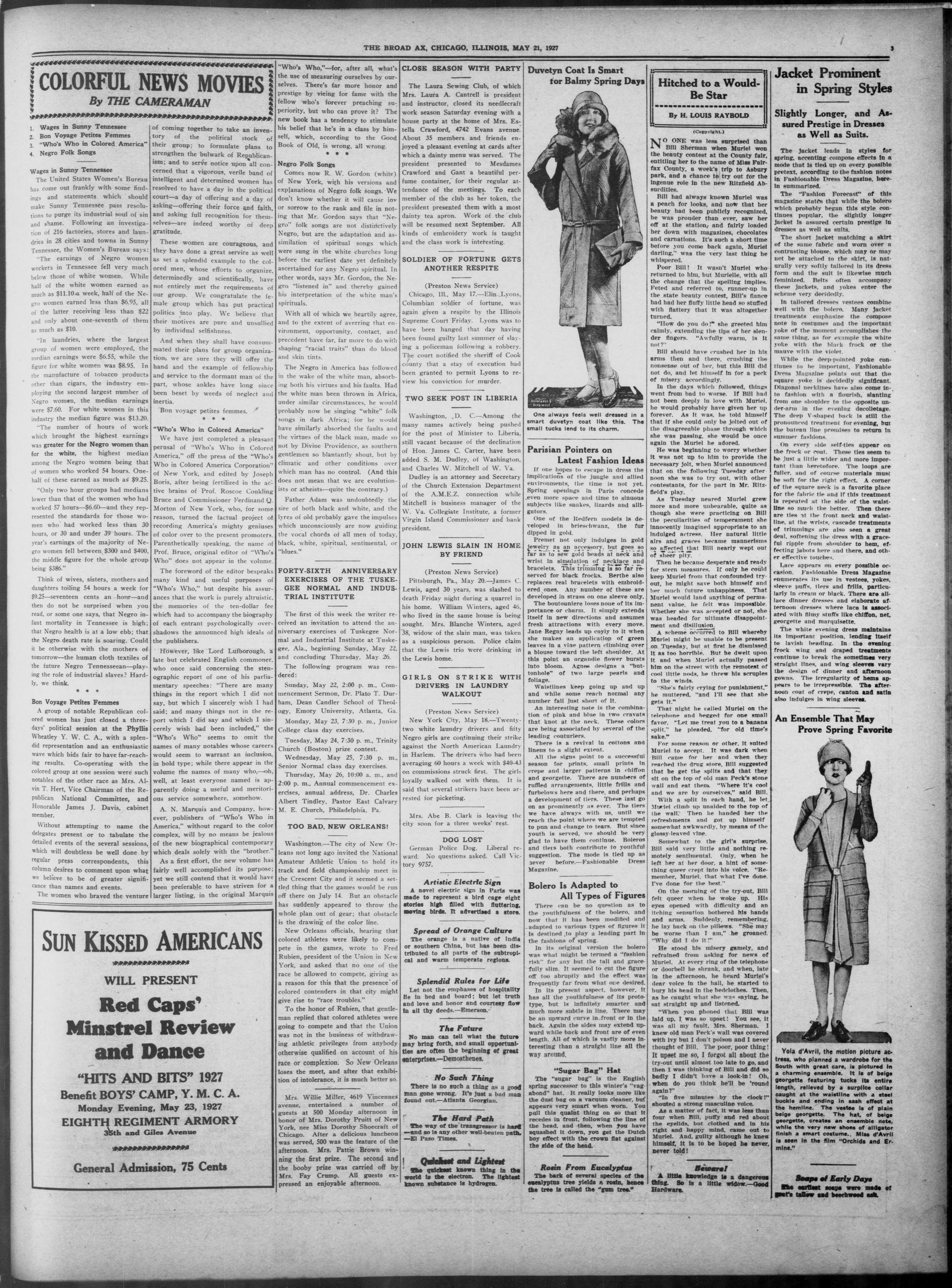
One always feels well dressed in a smart duvetyn coat like this. The small tucks lend to its charm.
Parisian Pointers on
Latest Fashion Ideas
If one hopes to escape in dress the implications of the jungle and allied environments, the time is not yet. Spring openings in Paris concede even more space and time to sinuous subjects like snakes, lizards and alligators.
One of the Redfern models is developed in brieschwanz, the fur dipped in gold.
Premet not only indulges in gold jewelry as an accessory, but goes so far as to sew gold beads at neck and wrist in simulation of necklace and bracelets. This trimming is so far reserved for black frocks. Berthe also replaces real bracelets with embroidered ones. Any number of these are developed in strass on one sleeve only.
The boutouniere loses none of its importance or charm. It simply extends itself in new directions and assumes fresh attractions with every move. Jane Regny leads up coyly to it when she makes an application of green leaves in a vine pattern climbing over a blouse toward the left shoulder. At this point an organdie flower bursts into bloom. Agnes designs a "buttonhole" of two large pearls and foliage.
Waistlines keep going up and up and while some reach normal any number fall just short of it.
An interesting note is the combination of pink and blue in two cravats that knot at the neck. These colors are being associated by several of the leading couturiers.
There is a revival in cottons and linens to a slight extent.
All the signs point to a successful season for prints, small prints in crepe and larger patterns in chiffon and georgette. There are numbers of ruffled arrangements, little frills and furbelows here and there, and perhaps a development of tiers. These last go on as prominently as ever. The tiers we have always with us, until we reach the point where we are tempted to pun and change to tears. But since youth is served, we should be very glad to have them continue. Boleros and tiers both contribute to youthful suggestion. The mode is tied up as ever before.—Fashionable Dress Magazine.
Bolero Is Adapted to All Types of Figures
There can be no question as to the youthfulness of the bolero, and now that it has been modified and adapted to various types of figures it is destined to play a leading part in the fashions of spring.
In its original version the bolero was what might be termed a "fashion risk" for any but the tall and gracefully slim. It seemed to cut the figure off too abruptly and the effect was frequently far from what one desired.
In its present aspect, however, it has all the youthfulness of its prototype, but is infinitely smarter and much more subtle in line. There may be an upward curve in front or in the back. Again the sides may extend upward while back and front are of even length. All of which is vastly more interesting than a straight line all the way around.
"Sugar Bag" Hat
The "sugar bag" is the English spring successor to this winter's "vagabond" hat. It really looks more like the dust bag on a vacuum cleaner, but appears very smart when worn. You pull this quaint thing on so that it recedes in front, following the line of the head, and then, when you have squashed it down, you get the Dutch boy effect with the crown flat against the side of the head.
**Rosin From Eucalyptus**
The bark of several species of the eucalyptus tree yields *n* rosin, hence the tree is called the "sum tree."
By H. LOUIS RAYBOLD
(Copyright.)
NO ONE was less surprised than Bill Sherman when Muriel won the beauty contest at the County fair, entitling her to the name of Miss Fairfax County, a week's trip to Asbury park, and a chance to try out for the ingenuine role in the new Ritzfield Absurdities.
Bill had always known Muriel was a peach for looks, and now that her beauty had been publicly recognized, he was prouder than ever, saw her off at the station, and fairly loaded her down with magazines, chocolates and carnations. It's such a short time before you come back again, Muriel darling," was the very last thing he whispered.
Poor Bill! It wasn't Muriel who returned to him, but Murielle, with all the change that the spelling implies, Feted and referred to, runner-up in the state beauty contest, Bill's fliance had had her fluffy little head so stuffed with fatttery that it was altogether turned.
"How do you do!" she greeted him calmly, extending the tips of her slender fingers. "Awfully warm, is it not?"
Bill should have crushed her in his arms then and there, crushing the nonsense out of her, but this Bill did not do, and let himself in for a peck of misery accordingly.
In the days which followed, things went from bad to worse. If Bill had not been deeply in love with Murielle, he would probably have given her up forever. As it was, he told himself that if she could only be jolted out of the disagreeable phase through which she was passing, she would be once again the Muriel he adored.
He was beginning to worry whether it was not up to him to provide the necessary jolt, when Muriel announced that on the following Tuesday afternoon she was to try out, with other contestants, for the part in Mr. Ritzfield's play.
As Tuesday neared Muriel grew more and more unbearable, quite as though she were practicing on Bill the peculiarities of temperament she innocently imagined appropriate to an indulged actress. Her natural little airs and graces became mannerisms so affected that Bill nearly wept out of sheer plum.
Then he became desperate and ready for stern measures. If only he could keep Muriel from that confounded try-out, he might save both himself and her much future unhappiness. That Muriel would land anything of permanent value, he felt was impossible. Whether she was accepted or not, she was headed for ultimate disappointment and disillusion.
A scheme occurred to Bill whereby Muriel might be unable to be present on Tuesday, but at first he dismissed it as too horrible. But he dwell upon it and when Muriel actually passed him on the street with the remotest of cool little nods, he threw his scruples to the winds.
"She's fairly crying for punishment," he muttered, "and I'll see that she gets it."
That night he called Muriel on the telephone and begged for one small favor. "Let me treat you to a banana split," he pleaded, "for old time's sake."
For some reason or other, it suited Muriel to accept. It was dark when Bill came for her and when they reached the drug store, Bill suggested that he get the splits and that they sit on the top of old man Peck's stone wall and eat them. "Where it's cool and we are by ourselves," said Bill. With a split in each hand, he let Muriel climb up unalined to the top of the wall. Then he handed her the refreshments and got up himself some awkwardly, by means of the glossy-leaved vine.
Somewhat to the girl's surprise, Bill said very little and nothing remotely sentimental. Only, when he left her at her door, a hint of something queer creep into his voice. "Remember, Muriel, that what I've done. I've done for the best."
On the morning of the try-out, Bill felt queer when he woke up. His eyes opened with difficulty and an itching sensation bothered his hands and arms. Suddenly, remembering, he lay back on the pillows. "She may be worse than I am," he groaned. "Why did I do it?" He stood his misery gamely, and refrained from asking for news of Muriel. At every ring of the telephone or doorbell he shrank, and when, late in the afternoon, he heard Muriel's dear voice in the hall, he started to bury his head in the bedclothes. Then, as he caught what she was saying, he sat straight up and listened.
"When you phoned that Bill was laid up, I was so upset! You see, it was all my fault. Mrs. Sherman. I knew old man Peck's wall was covered with ivy but I don't poison and I never thought of Bill. The poor, poor thing; It upset me so, I forgot all about the try-out until almost too late to go, and then I was thinking of Bill and did so badly I didn't have a look-in! Oh, when do you think he'll be 'round again?"
"In five minutes by the clock!" shouted a strong masculine voice. As a matter of fact, it was less than four when Bill, puffy and red about the eyelids, but clothed and in his right and happy mind, came out to Muriel. And, guilty although he knew himself, it is to be hoped he never, never told!
A little knowledge is a dangerous thing. So is a little widow.—Good Hardware.
Jacket Prominent in Spring Styles
Slightly Longer, and Assured Prestige in Dresses as Well as Suits.
The jacket leads in styles for spring, accenting compose effects in a mode that is tied up on every possible pretext, according to the fashion notes in Fashionable Dress Magazine, herein summarized.
The "Fashion Forecast" of this magazine states that while the bolero which probably began this style continues popular, the slightly longer jacket is assured certain prestige in dresses as well as suits.
The short jacket matching a skirt of the same fabric and worn over a contrasting blouse, which may or may not be attached to the skirt, is naturally very softly tailored in its dress form and the suit is likewise much feminized. Belts often accompany these jackets, and yokes enter the scheme very decidedly.
In tailored dresses vestes combine well with the bolero. Many jacket treatments emphasize the compose note in costumes and the important yoke of the moment accomplishes the same thing, as for example the white yoke with the black frock or the maue with the violet.
While the deep-point yoke continues to be important, Fashionable Dress Magazine points out that the square yoke is decidedly significant. Diagonal necklines have also come into fashion with a flourish, slanting from one shoulder to the opposite under-arm in the evening decolletage. The deep V-shaped back is still the pronounced treatment for evening, but the bateau line promises to return in summer fashions.
On every side self-ties appear on the frock or coat. These ties seem to be just a little wider and more important than heretofore. The boops are fuller, and of course materials must be soft for the right effect. A corner of the square neck is a favorite place for the fabric tie and if this treatment is repeated at the side of the waistline so much the better. Then there are ties at the front neck and waistline, at the wrists, cascade treatments of trimmings are also seen a great deal, softening the dress with a graceful ripple from shoulder to hem, effecting jabots here and there, and other effective touches.
Lace appears on every possible occasion. Fashionable Dress Magazine enumerates its use in vestes, yokes, sleeve puffs, tiers and frills, particularly in cream or black. There are all-dinner dresses and elaborate afternoon dresses where lace is associated with filmy stuffs like chiffon, net, georgette and marquette.
The white evening dress maintains its important position, lending itself to lavish beading. In the evening frock wing and draped treatments continue to break the sometimes very straight lines, and wing sleeves vary the design of dinner and afternoon gowns. The irregularity of hems appears to be irrepressible. The afternoon coat of crepe, canton and safin also indulges in wing sleeves.
An Ensemble That May Prove Spring Favorite
1
Yola d'Avril, the motion picture actress, who planned a wardrobe for the South with great care, is pictured in a charming ensemble. It is of beige georgette featuring tucks its entire length, relieved by a surplice collar caught at the waistline with a steel buckle and ending in sash effect at the hemline. The vestee is of plain beige georgette. The hat, of beige georgette, creates an ensemble note, while the very new shoes of alligator finish a smart costume. Miss d'Avril is seen in the film "Orchids and Ermine."
Soaps of Early Days
The earliest soaps were made of
pat's tallow and beechwood ash.
Williamson's
CUNNINGHAM FUNERAL CARS
Are distinguished by their Style and Elegance but foremost by the protection to passengers guaranteed by proper Insurance.
USE THE WILLIAMSON FUNERAL
Protect Yourself BY USING OUR
Latest Style Leatherback Indemnified Hearses and Cars
NAME OF ASSURED
ADDRESS OF ASSURED
THE TERM OF THIS POLICY BEGINS AT NOON ON THE 10th DAY OF
AND ENDS AT NOON ON THE TIME AS TO BOTH DAYS
1. LIABILITY.
2. PROPERTY DAMAGE.
INSURANCE PURCHASED
$5,000 and $10,000
It costs no more
we have invested in $200,000 Indemnity for our 5 Hearses and 15 Cars. $10,000 Each.
Why take a Chance?
Use our cars and be assured of protection. The above policy is back of our up to date Cars. If any one is killed or injured in your funeral we will look after all suits and pay damages
AMBULANCE SERVICE AT ALL HOURS
Ernest H. Williamson
Undertaker
JAMES SYKES
Licensed Embalmer
Prompt Service Night and Day
PHONE KENWOOD 0455
5121-5123-5125 South State Street
Notary Public
CHICAGO, ILL.
1
THE BROAD AX Published Every Saturday
In this city since July 15th, 1899 without missing one single issue. Republicans, Democrats, Catholics, Protestants, Single Taxes, Priests, infidels or anyone else can have their say as long as their language is proper and responsibility is fixed.
The Broad Ax is a newspaper whose platform is broad enough for all, ever claiming the editorial right to speak its own mind. It is neither Democratic nor Republican. It is strictly or absolutely independent in politics.
Local communications will receive attention. Write only on one side of the paper.
Subscriptions must be paid in advance.
One Year .....$2.00
Six Months .....$1.00
Advertising rates made known on application.
Address all communications to
THE BROAD AX
6206 S. Elizabeth St., Chicago.
Phone: Inventor 2597
JULIUS F. TAYLOR
Editor and Publisher
Vol. XXXII
Chicago, May 21, 1927
Entered as Second-Class Matter, Aug.
19, 1902, at the Postoffice at Chicago,
III. Under Act of March 8, 1879.
Boone Gravestones Saved
Daniel Boone's parents died before their son had come into prominence. His father, Squire Boone, died in 1765 and his mother in 1777. They were buried in the Joppa graveyard, near Mocksville, N. C., and two small stones were erected to mark the graves.
Almost a century passed before the accomplishments of Daniel Boone brought about a historic interest in the graves. Then visitors began to chip off little pieces of the gravestones as souvenirs. Fearing the stones would be destroyed, residents had them taken to a Mocksville bank and placed in safekeeping. There they remained until the Boone Trail Highway association had them returned to the graveyard and set into solid concrete beyond the reach of the casual vandal—Kansas City Times.
Wil
No Parents Nor Alumni
The story goes that several college presidents were discussing what they would do after they retired. What would they be fit for, was the question.
"Well," said one of them, "I don't know that I'd be fit for anything, but I know what I'd like to do. I'd like to be superintendent of an orphan asylum, so that I would never get any letters from parents."
"I've a much better ambition," exclaimed another, "I want to be warden of a penitentiary. The alumni never come back to visit."—Harper's Magazine.
Earliest Taximeters
A deliver into the writings of Virtuuvus, a Roman architect of the First century B. C., has found references to the taximeter. The horse charlots were fitted with a device which released a small ball into a box every thousand steps taken by the horse, the cost of transportation being calculated on the number of balls thus dropped.
There were no doubt canny travelers in those days who would wait until a horse with a long stride came along.
Danger From Icebergs
Icebergs may be sighted at various distances, depending upon the state of visibility, height of berg and of observer. On very clear days a crow's best lookout may see one at 12 to 15 miles, and they have been picked up at a maximum distance of 18 to 20 miles by a mashead lookout. In a light tug a berg cannot be seen more than a hundred yards ahead of a ship.
Uses for Vulcarite
Vulcanite, or ebonite, is a dark brown or black form of India rubber. Its hardness is due to the presence of more sulphur than soft rubber contains, and to the fact that it is "vulcanized" at a high temperature. It is used for the mouthpieces of pipes, for combs, for screw-stoppers in bottles, and largely as an insulator in electrical instruments.
More Protable
Our idea of preparation is the boy who took four years of journalism and then opened a news stand—Exchange.
THE BROAD AX, CHICAGO, ILLINOIS, MAY 21, 1927
Jean became ill with chicken pox. Her mother made her stay in the house from play, and a wondering friend called to find out why she was not out. Jean's mother told him that she had the chicken pox and could not come out. The lad rushed away and breathlessly broke the news to his mother. "Oh, mother, Jean can't come out because she's got the chicken coops."
Really Important Point
Father—"Daughter, we are obliged to break some very unpleasant news to you and must ask you to make a momentous decision. Mother and I have decided to separate and we are leaving it to you to choose which one you will live with." Daughter—"Which one is going to get the car?" Pathfinder Magazine.
Uses for Glucose
In the United States glucose is almost entirely manufactured from corn; in Europe much glucose is made from potato starch. Glucose does not crystallize, and when mixed with cane sugar prevents the cane from graining. For this reason it is much used in candy, preserves, jellies, etc.
Buck Up and Boost
Give a little, live a little, try a little mirth; sing a little, bring a little happiness to earth. Pray a little, play a little, be a little glad; rest a little, jest a little, if the heart is sad. Spend a little, send a little to another's door; give a little, live a little, love a little more.—A. Nutt in Ottawa Citizen.
Seeing the Bright Side
When her mother forgot to ask the blessing, little Joan reminded her, "Off course, mother," she added, "there isn't much lunch to be thankful for but you might thank God for this pretty day."—Capper's Weekly.
True Greatness
True greatness is made known through its work, coming up like a sunrise, its arrival needing no label that "This is the greatest dawn that ever dawned"—Pittsburgh Post.
Cor. 63rd Street and Marshfield Avenue
JOHN BAIN, President; MICHAEL MAISEL, Vice-President; EDWARD C. BARRY, VicePresident and Cashier; W. MERLE FISHER, Assistant Cashier and Trust Officer.
3101 COTTAGE GROVE AVE. Corner 31st Street, Chicago
JAS. B. McCAHEY, President PHILIP J. DUNN, Secretary
FRANK J. DUNN, Vice-President H. X. COMERFORD, Treasurer
ESTABLISHED 1877
JOHN J. DUNN
COAL CO.
Telephone Oakland 1560
5100 Federal Street CHICAGO
Immortal Phrases
Alexander Pope was only twenty when he wrote "An Essay on Criticism," in which occur at least two phrases which are familiar the world over: "Fools rush in where angels fear to tread," and "A little learning is a dangerous thing."
Steadfast
Thou must be like a promontory of the sea, against which though the waves beat continually, yet it both itself stands, and about it are those swelling waves stilled and quieted.—Marcus Aurellus.
Peculiar Tribute
Little Boy (writing to his school teacher)—Everybody at home is delighted with the progress I have made at your school. When I came to you I knew nothing, and now, even in this short time, I know ten times as much
Discovered by Dutch
The Spitzerbergen islands in the Arctic ocean, north of Norway and northeast of Greenland, were discovered in 1596 by Dutch sailors who, thinking them to be part of Greenland, named them "New Land."
Narcissus Bulbs
Narcissus bulbs grown in pebbles should be kept in a dark cool place for a week before they are set in the sunlight. Otherwise they will go to foliage and refuse to bloom.
Shelter for Travelers
In his "Outline of History" Wells says that Lydia was reputed to be the first country in the world to provide the convenience of inns for travelers and traders.
Extend Pity to Fool
You pity a man who is lame or blind, but you never pity him for being a fool, which is often a much greater misfortune—Sydney Smith.
Admired Daddy
Little Girl (as she sees her father march in with the choral)—Oh, look, mother, there goes daddy in his singing shirt—Corporation Reporter.
Time Is Money
Time is money—and maybe that's the reason why so many folks never have time.—Gloversville Leader-Republican.
Blissful Ignorance
Mrs. Newbride—I want a pound of
mincemeat, and please take it from a
nice young mince.
Res. 5400 Washington Blvd.
Branch Office: 606 Racine
MILES J.
ATTORNEY
SUITE 318-320
CLARK AND W
Telephone CENTRAL 1239
LINCOLN STATE BANK
BRONZE BEAUTY Face Powder is made by a new French process, and is not affected by perspiration. Used satisfactorily on dry or oily skin. Makes the complexion soft and velvety—and stays on until removed. Three tints which blend with any complexion: High Brown, Bronze Glow and Flesh. Fill out and mail the coupon below and we will send you a whole week's supply free.
"John is so good-natured," said his wife, "and it only makes him laugh when his collar button rolls under the chiffonier, no matter how big a hurry he's in."—Cincinnati Enquirer.
Chemical Atoms
The electronic theory is the theory that the chemical atom is not the smallest possible part of an element, but is composed of electrons describing orbital and vibratory motions.
Depository for State County and City Funds
Bearer of the Censer
Bearer of the Censer
The person who carries the thurible
or censor in a church procession is
known as a "thurifer." Formerly he
was always an acolyte, but now he is
often a layman.
Primitive Car Springs
Freight cars in the Pennsylvania
coal trade 70 years ago had wooden
springs made of two pieces of ash
supporting the boxes.
Notary Public
Phone: Office Main 4153; Residence,
4751 Champlain Avenue
Phone Kenwood 5611
Walter M. Farmer
ATTORNEY AND COUNSELOR
AT LAW
Soret 708—184 W. Washington St.
CHICAGO
Telephone: State 3278
A. D. GASH
ATTORNEY AT LAW
Suite 813, Ashland Block
156 N. Clark Street
CHICAGO, ILL.
Phone Main 2017
A. L. WILLIAMS
ATTORNEY AND
COUNSELOR AT LAW
Phone Main 2017
Suite 706 Firmenich Building
184 W. Washington St.
CHICAGO
Residence 3646 Michigan Ave.
Phone Douglas 9133
Res. Phone: Mansfield 5436
Ave., Phone Monroe 2714
DEVINE
Y-AT-LAW
REAPER BLOCK
WASHINGTON STS.
Approved Safe Investments yield 7% interest. $100 Bonds sold on easy payment plan. See our Mr. Avery of the Bond Department.
LOANS MADE ON REAL ESTATE
Savings Department open from 9 A. M. to 8 P. M. Saturdays.
SAFETY DEPOSIT BOXES for less than one cent a day. Protect your Valuable Papers, Jewelry, etc.
LINCOLN STATE BANK
OF CHICAGO
Under State Government Supervision
31st and South State Streets
Telephone Victory 4500
THE
COMMONWEALT
EDISON
COMPANY
OF CHICAGO Under State Government Supervision 31st and South State Streets Telephone Victory 4500
72 WEST ADAMS STREET
Phone: Randolph 1280
E WEEK'S SUPE
LINCOLN STATE BANK 60 CHICAGO
Capital and Surplus $500,000.00