The Broad Ax
Saturday, June 11, 1927
Chicago, Illinois
Page text (machine-generated)
SOCIETY NEWS PUBLISHED FREE
Vol. XXXII.
M.
Governor of Illinois, who is able to give spades and then by some slight of $650,000 in interest money belonging appear out of sight like a snowball on the good old summer time.
Governor of Illinois, who is able to give anyone cards and spades and then by some slight of hand trick cause $650,000 in interest money belonging to the people to disappear out of sight like a snowball on the hottest day in the good old summer time.
MRS. BERTHA MONTGOMERY HAS RETURNED TO THE CITY FROM SPRINGFIELD, OHIO
The latter part of last week Mrs. Bertha Montgomery, 4735 Indiana avenue, boarded the fastest express train running between this city and Springfield, Ohio, in order to be at the bedside of her aged father, Mr. Willis Francis, who was run over by an automobile recently in that city.
going to continue in the future, as in the past, then it will be up to the people to take the laws into their own hands in that respect and protect themselves and the lives of their dear children and the elderly people and to utterly exterminate for all time to come the murderous auto and taxicab drivers.
WHITE MAN'S PRIMARY BILL FINALLY PASSED
(Preston News Service)
Four of the best white and colored physicians of that city contend that he has one chance in a thousand in recovering from the effects of the internal injuries sustained by him. He was just alighting from a street car when a taxi, running at full speed, rushed onto him, knocking him down, breaking three ribs and otherwise almost crushing the life out of him, and the doctors expect his death to occur any hour. The taxi driver made his getaway without anyone securing his number or identifying him.
We believe in law and order, but when automobiles and taxi drivers in the most cold-blooded manner run over men, women and children, and especially elderly people, the taxi and automobile drivers should be shot down like mad dogs. For it seems that in every city of any size the constituted authorities of the cities are utterly unable to cope with that class of crazy or demented auto drivers.
If the slaughter of human beings is that city
6
DR. A. WILBERFORCE WILLIAMS One of the popular M. D.'s in Chicago, also one of the directors of the Binga State Bank, who is, with some of his many friends, making a pleasant tour through some parts of the Old World.
Vol. XXXII.
1910
ble to give anyone cards and a slight of hand trick cause belonging to the people to disowball on the hottest day in the going to continue in the future, as in the past, then it will be up to the people to take the laws into their own hands in that respect and protect themselves and the lives of their, dear children and the elderly people and to utterly exterminate for all time to come the murderous auto or taxicab drivers.
WHITE MAN'S PRIMARY BILL
FINALLY PASSED
(Preston News Service)
Austin, Tex., June 8. — The white man's primary bill, intended to meet the United States Supreme Court ruling affecting the present law which bars Negroes, was finally passed by the house Tuesday by a vote of 77 to 26. Representative DeBerry of Red River county made an effort to eliminate the amendment by Nabors, adopted on engrossment, which prohibits the state executive committee from barring persons from voting because of previous political views or membership in a secret or other organization, but his amendment was tabled, 98 to 43.
Representative Purl of Dallas attempted again to have the bill referred to the judiciary committee for redrafting, claiming the measure gives the state committee too much power, but his motion was voted down.
Mrs. Anna Hayman is preparing a trip to Cincinnati, Ohio, to attend the wedding of Mrs. Daisy Merchant of that city, which takes place June 30th.
.
THE BROAD AX
5 CENTS PER COPY
cards and
trick cause
people to dis-
t day in the
By
(For
---
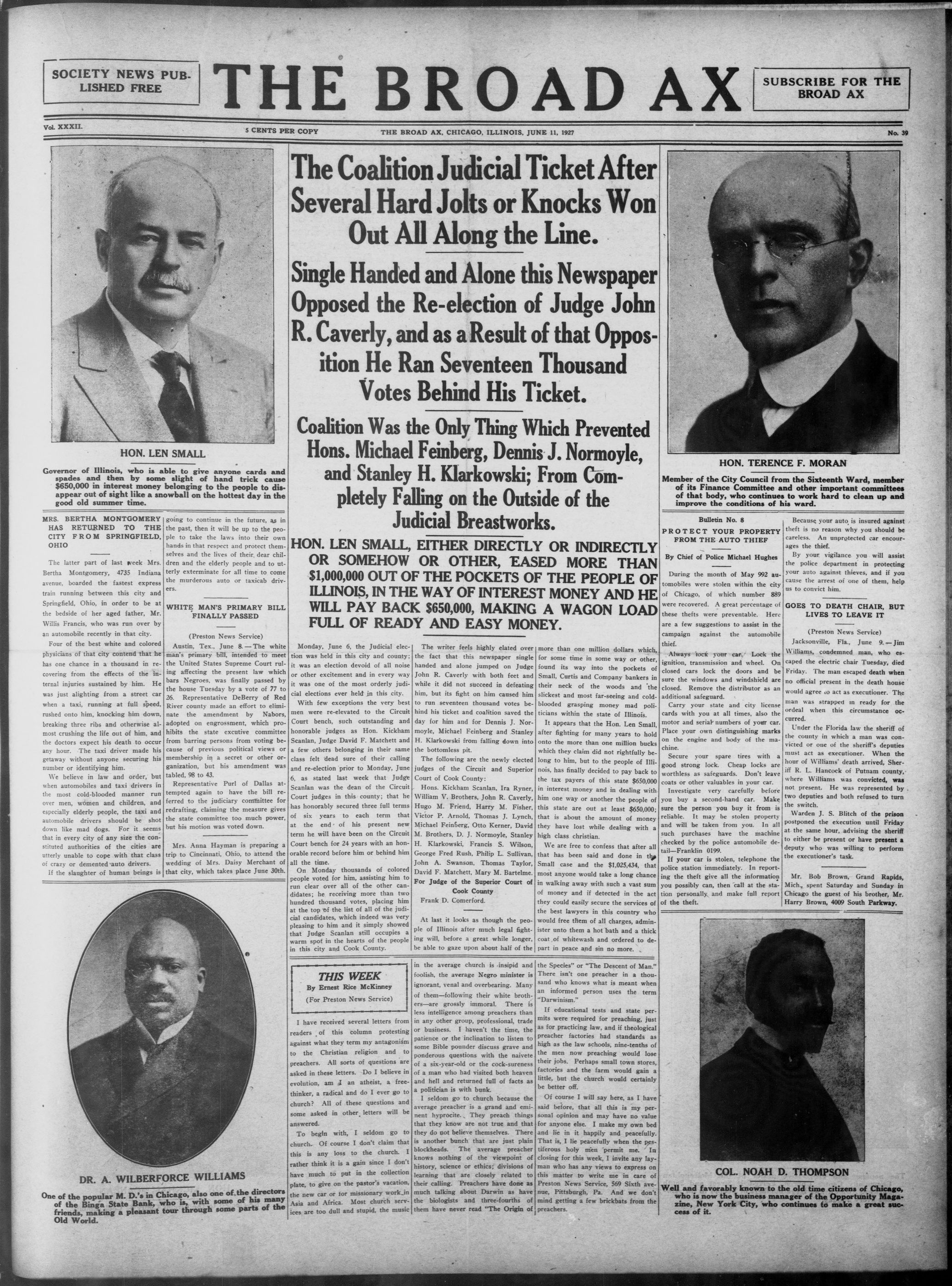
The Coalition Judicial Ticket After Several Hard Jolts or Knocks Won Out All Along the Line.
Single Handed and Alone this Newspaper Opposed the Re-election of Judge John R. Caverly, and as a Result of that Opposition He Ran Seventeen Thousand Votes Behind His Ticket.
Coalition Was the Only Thing Which Prevented Hons. Michael Feinberg, Dennis J. Normoyle, and Stanley H. Klarkowski; From Completely Falling on the Outside of the Judicial Breastworks.
HON. LEN SMALL, EITHER DIRECTLY OR INDIRECTLY OR SOMEHOW OR OTHER, EASED MORE THAN $1,000,000 OUT OF THE POCKETS OF THE PEOPLE OF ILLINOIS, IN THE WAY OF INTEREST MONEY AND HE WILL PAY BACK $650,000, MAKING A WAGON LOAD FULL OF READY AND EASY MONEY.
Monday, June 6, the Judicial election was held in this city and county; it was an election devoid of all noise or other excitement and in every way it was one of the most orderly judicial elections ever held in this city. With few exceptions the very best men were re-elevated to the Circuit Court bench, such outstanding and honorable judges as Hon. Kickham Scanlan, Judge David F. Matchett and a few others belonging in their same class felt dead sure of their calling and re-election prior to Monday, June 6, as stated last week that Judge Scanlan was the dean of the Circuit Court judges in this county; that he has honorably secured three full terms of six years to each term that at the end of his present new term he will have been on the Circuit Court bench for 24 years with an honorable record before him or behind him all the time.
On Monday thousands of colored people voted for him, assisting him to run clear over all of the other candidates; he receiving more than two hundred thousand votes, placing him at the top of the list of all of the judicial candidates, which indeed was very pleasing to him and it simply showed that Judge Scanlan still occupies a warm spot in the hearts of the people in this city and Cook County.
THIS WEEK
By Ernest Rice McKinney
(For Preston News Service)
I have received several letters from readers of this column protesting against what they term my antagonism to the Christian religion and to preachers. All sorts of questions are asked in these letters. Do I believe in evolution, am I an atheist, a free-thinker, a radical and do I ever go to church? All of these questions and some asked in other letters will be answered.
To begin with, I seldom go to church. Of course I don't claim that this is any loss to the church. I rather think it is a gain since I don't have much to put in the collection plate, to give on the pastor's vacation, the new car or for missionary work in Asia and Africa. Most church services are too dull and stupid, the music
THE BROAD AX, CHICAGO, ILLINOIS, JUNE 11, 1927
The writer feels highly elated over the fact that this newspaper single handed and alone jumped on Judge John R. Caverly with both feet and while it did not succeed in defeating him, but its fight on him caused him to run seventeen thousand votes behind his ticket and coalition saved the day for him and for Dennis J. Normoyle, Michael Feinberg and Stanley H. Klarkowski from falling down into the bottomless pit.
The following are the newly elected judges of the Circuit and Superior Court of Cook County:
Hons. Kickham Scanlan, Ira Ryner, Wons V. Brothers, John R. Caverly, Hugo M. Friend, Harry M. Fisher, Victor P. Arnold, Thomas J. Lynch, Michael Feinberg, Otto Kerner, David M. Brothers, D. J. Normoyle, Stanley H. Klarkowski, Francis S. Wilson, George Fred Rush, Philip L. Sullivan, John A. Swanson, Thomas Taylor, David F. Matchett, Mary M. Bartelme.
For Judge of the Superior Court of
At last it looks as though the people of Illinois after much legal fighting will, before a great while longer, be able to gaze upon about half of the in the average church is insipid and foolish, the average Negro minister is ignorant, venal and overbearing. Many of them—following their white brothers—are grossly immoral. There is less intelligence among preachers than in any other group, professional, trade or business. I haven't the time, the patience or the inclination to listen to some Bible pounder discuss grave and ponderous questions with the naivete of a six-year-old or the cock-sureness of a man who had visited both heaven and hell and returned full of facts as a politician is with bunk.
I seldom go to church because the average preacher is a grand and eminent hypocrite. They preach things that they know are not true and that they do not believe themselves. There is another bunch that are just plain blockheads. The average preacher knows nothing of the viewpoint of history, science or ethics; divisions of learning that are closely related to their calling. Preachers have done as much talking about Darwin as have the biologists and three-fourths of them have never read "The Origin of
more than one million dollars which, for some time in some way or other, found its way into the pockets of Small, Curtis and Company bankers in their neck of the woods and 'the slickest and most far-seeing and cold-blooded grasping money mad politicians within the state of Illinois.
It appears that the Hon. Len Small, after fighting for many years to hold onto the more than one million bucks which they claim did not rightfully belong to him, but to the people of Illinois, has finally decided to pay back to the tax payers of this state $650,000 in interest money and in dealing with him one way or another the people of this state are out at least $650,000; that is about the amount of money they have lost while dealing with a high class christian.
We are free to confess that after all that has been said and done in the Small case and the $1,025,434, that most anyone would take a long chance in walking away with such a vast sum of money and if detected in the act they could easily secure the services of the best lawyers in this country who would free them of all charges, administer unto them a hot bath and a thick coat of whitewash and ordered to depart in peace and sin no more.
the Species" or "The Descent of Man." There isn't one preacher in a thousand who knows what is meant when an informed person uses the term "Darwinism."
If educational tests and state permits were required for preaching, just as for practicing law, and if theological preacher factories had standards as high as the law schools, nine-tenths of the men now preaching would lose their jobs. Perhaps small town stores, factories and the farm would gain a little, but the church would certainly be better off.
Of course I will say here, as I have said before, that all this is my personal opinion and may have no value for anyone else. I make my own bed and lie in it happily and peacefully. That is, I lie peacefully when the pestiferous holy men permit me. In closing for this week, I invite any layman who has any views to express on this matter to write me in care of Preston News Service, 569 Sixth avenue, Pittsburgh, Pa. And we don't mind getting a few brickbats from the preachers.
X
[Picture of a man with a bald head and glasses, wearing a dark suit with a white shirt and a tie. The background is plain white.]
[The caption reads: "A portrait of a man in a dark suit with a white shirt and a tie."]
Member of the City Council from the Sixteenth W of its Finance Committee and other importa of that body, who continues to work hard to improve the conditions of his ward.
Bulletin No. 8 Because your auto
The City Council from the Sixteenth W
ance Committee and other important
body, who continues to work hard to
the conditions of his ward.
Member of the City Council from the Sixteenth Ward, member of its Finance Committee and other important committees of that body, who continues to work hard to clean up and improve the conditions of his ward.
PROTECT YOUR PROPERTY FROM THE AUTO THIEF
By Chief of Police Michael Hughes
During the month of May 992 automobiles were stolen within the city of Chicago, of which number 889 were recovered. A great percentage of these thefts were preventable. Here are a few suggestions to assist in the campaign against the automobile thief.
Always lock your car. Lock the ignition, transmission and wheel. On closed cars lock the doors and be sure the windows and windshield are closed. Remove the distributor as an additional safeguard.
Carry your state and city license cards with you at all times, also the motor and serial numbers of your car. Place your own distinguishing marks on the engine and body of the machine.
Secure your spare tires with a good strong lock. Cheap locks are worthless as safeguards. Don't leave coats or other valuables in your car.
Investigate very carefully before you buy a second-hand car. Make sure the person you buy it from is reliable. It may be stolen property and will be taken from you. In all such purchases have the machine checked by the police automobile detail—Franklin 0199. If your car is stolen, telephone the police station immediately. In reporting the theft give all the information you possibly can, then call at the station personally, and make full report of the theft.
```markdown
```
1910
COL. NOAH D. THOMPSON
Well and favorably known to the who is now the business magazine, New York City, whocess of it.
porably known to the old time citizen
w the business manager of the Oppor
York City, who continues to make
Well and favorably known to the old time citizens of Chicago, who is now the business manager of the Opportunity Magazine, New York City, who continues to make a great success of it.
SUBSCRIBE FOR THE BROAD AX
No. 3
acil from the Sixteenth Ward, member
bittee and other important committees
continues to work hard to clean up and
ass of his ward.
BERTY
EF
Hughes
1992 au-
the city
Because your auto is insured against
theft is no reason why you should be
careless. An unprotected car encourages the thief.
By your vigilance you will assist
the police department in protecting
your auto against thieves, and if you
cause the arrest of one of them, help
us to convict him.
GOES TO DEATH CHAIR, BUT
LIVES TO LEAVE IT
Jacksonville, Fla., June 9. — Jim Williams, condemned man, who escaped the electric chair Tuesday, died Friday. The man escaped death when no official present in the death house would agree so act as executioner. The man was strapped in ready for the ordeal when this circumstance occurred.
Under the Florida law the sheriff of the county in which a man was convicted or one of the sheriff's deputies must act as executioner. When the hour of Williams' death arrived, Sheriff R. L. Hancock of Putnam county, where Williams was convicted, was not present. He was represented by two deputies and both refused to turn the switch.
Warden J. S. Blitch of the prison postponed the execution until Friday at the same hour, advising the sheriff to either be present or have present a deputy who was willing to perform the executioner's task.
Mr. Bob Brown, Grand Rapids, Mich., spent Saturday and Sunday in Chicago the guest of his brother, Mr. Harry Brown, 4009 South Parkway.
1930
n to the old time citizens of Chicago, ss manager of the Opportunity Maga- who continues to make a great suc-
M.
HON. HARRY S. NEW
The honorable Postmaster Gem in urging that Capt. Lindbe in the world, will be greeter States by all sections of the master Arthur C. Lueder in air birds will make a wone
"CHICAGO'S HEALTH"
Weekly Bulletin, Chicago Department of Health
Postmaster General of the Urs
Capt. Lindbergh, the great
will be greeted upon his ar
sections of the country by a
C. Lueder is anxious that
make a wonderful showing
The honorable Postmaster General of the United States is busy in urging that Capt. Lindbergh, the greatest flying air bird in the world, will be greeted upon his arrival in the United States by all sections of the country by air mail, and Postmaster Arthur C. Lueder is anxious that the Chicago mail air birds will make a wonderful showing on the occasion.
OLD IRONSIDES
In this week's issue of "Chicago's Health" Dr. Herman N. Bundesen, commissioner of health, compares a well-built and healthy body with that beloved, stout old vessel, "Old Iron-sides."
Says Dr. Bundesen of this gallant ship: "She could resist the cannon balls of her enemies and shots popped off her sides because she was built well, made of stout oak and manned by a crew that defied danger and knew no fear.
"In the longevity of this old battle-ship there is a fine health lesson to be learned by our present generation, to build up our bodies so that all forms of disease will 'pop off' of them like the balls shot at 'Old Iron-sides.'
"Good building depends not only upon the materials employed, but also upon the methods by which these materials are put together. We must not only eat the right food, but eat it in such a manner that it will bring
[Name]
P.
P. A.
REV. W. D. COOK
The popular and progressive Community Center Church Parkway, who draws large ices every Sunday.
and progressive pastor of the Center Church, Forty-first to draws large numbers of the day.
The popular and progressive pastor of the Metropolitan Community Center Church, Forty-first Street and South Parkway, who draws large numbers of people to his services every Sunday.
eral of the United States is busy
ergh, the greatest flying air bird
upon his arrival in the United
country by air mail, and Post-
anxious that the Chicago mail
erful showing on the occasion.
the most benefit to our bodies," con-
tinues Dr. Bundesen.
"It is decreed that no wastes shall
remain in the body, but shall be
thrown off regularly and completely.
Natural fatigue induced by our daily
labors must be 'slept off' and 'rested
off' regularly; the lungs must at all
times receive a constant supply of
fresh air and the 'decks' and 'passage-
ways' of our bodies must be 'swabbed'
frequently and well," says the com-
missioner.
"Let us man the 'upper deck' with an army of healthy teeth; let the rigging of our bodies (the nerves, muscles, bones and sinews) be firm and invulnerable like those of the ship we now admire so much.
"There is nothing better in life that so gains admiration, insures long life, brings success and victory to most of our endeavors, than a healthy body. Physical and mental health win most, if not all, of our battles," concludes the commissioner.
Mrs. Jerry M. Brumfield informs us that plans have been completed for her summer home at Lake Ivanhoe, Wis., and the building will be completed within the next few weeks. The builders state the "Brumfield home" will be one of the most modern at the resort.
[Name]
the pastor of the Metropolitan, Forty-first Street and South numbers of people to his serv-
THE BROAD AX, CHICAGO, ILLINOIS, JUNE 11, 1927
PEONAGE CHARGES GO TO WASHINGTON
Danville, Va., June 8—The story of James Felton, who says he recently escaped from peonage in Georgia, has been communicated to the United States Department of Justice in Washington by Champe Barksdale, United States commissioner here, in the belief that the government is better prepared than any other agency to determine the truth or expose the falsity of the story.
"I assume that the government will refer the matter to the federal attorney of the Georgia district," Mr. Barksdale said, "or an agent may be sent there."
In the meantime Felton remains voluntarily in detention here though he has betrayed anxiety for the past week to be freed. Felton told officers and newspaper men Tuesday the name of the man, who he, says, holds seventy colored men and women in peonage in Georgia. Felton calls him Dr. King, but does not know the given name. The plantation is near Lexington and is served by a small railway. The nearest city of size, he says, is Athens, 52 miles away.
The name of the deputy sheriff who, Felton charges, is cognizant of peonage conditions, is John Paul. Felton says he was in peonage one year, four months and fourteen days. He escaped two weeks ago through a swamp and went without food for three days. "They had 45 men and 25 women when I left," Felton said. "Some of them worked on the farm and some in the sawmill. We got the same food three times a day, peas and corn bread. We could not sing, write letters or talk, and when we did not work fast enough, we were whipped with a strap.
"These burns," he said, extending his hands and revealing livid scars, "were caused by pouring hot babbitt on them in the swamill when I did not work fast enough." Displaying gaps between the teeth of the upper and lower jaws, he said the teeth had been beaten out by a guard. Felton says he saw five men shot and hit by an ax were killed because their plot to escape was discovered. All were killed, he insists, at the same time. Two others disappeared and never returned. Felton's peculiar gaze, which has led some to believe he is mentally unsound, is due, he says, to working underground in West Virginia mines. He is of robust physique, talks better than the average Negro and knows about the National Association for the Advancement of Colored People, to officers of which he would like to tell his story.
He is prepared to return to Georgia only under official protection, he says
TO HOLD ANNUAL SERMON
Sunday, June 12th, will be a big day with the Ancient United Knights and Daughters of Africa of Chicago of which Mrs. Eliza Jackson is state grand queen. The anniversary exercises will be held at Metropolitan Community Church, 41st and South Parkway. Every department of the organization will be represented. At 1 o'clock the military department, the first regiment of Illinois, under the command of Col. Wm. Williams and his staff, led by the A. U. K. and D. of A. band, followed by grand officers and most excellent queens in automobiles, will leave U. B. F. Hall, 3120 Giles avenue, marching to 32nd street, over to Calumet, south to 39th, then to Prairie avenue, thence to the church, where a splendid program will be rendered, following which the anniversary sermon will be delivered by Dr. W. D. Cook, pastor of the church. Hon. William H. Fields of St. Louis, Mo., national grand master, is expected to be present to review the military parade and to witness these exercises.
THE METROPOLITAN COMMUN
NITY CENTER SUNDAY EVE-
NING CLUB, WHICH HOLDS
FORTH AT REV. W. D. COOK'S
CHURCH, 41ST STREET AND
SOUTH PARKWAY
Sunday evening, June 12th, at 7:30
p. m., Attorney William E. Lilly will
be the leading orator on that occasion.
His oration will be delivered in the
main auditorium of that church.
Prof. J. Wesley Jones has arranged
a very special musical program.
Mrs. Nettie George Speedy of 4824 Prairie avenue will be leaving the city soon for a complete rest for a number of weeks. En route home she will visit some of the principal cities of the East.
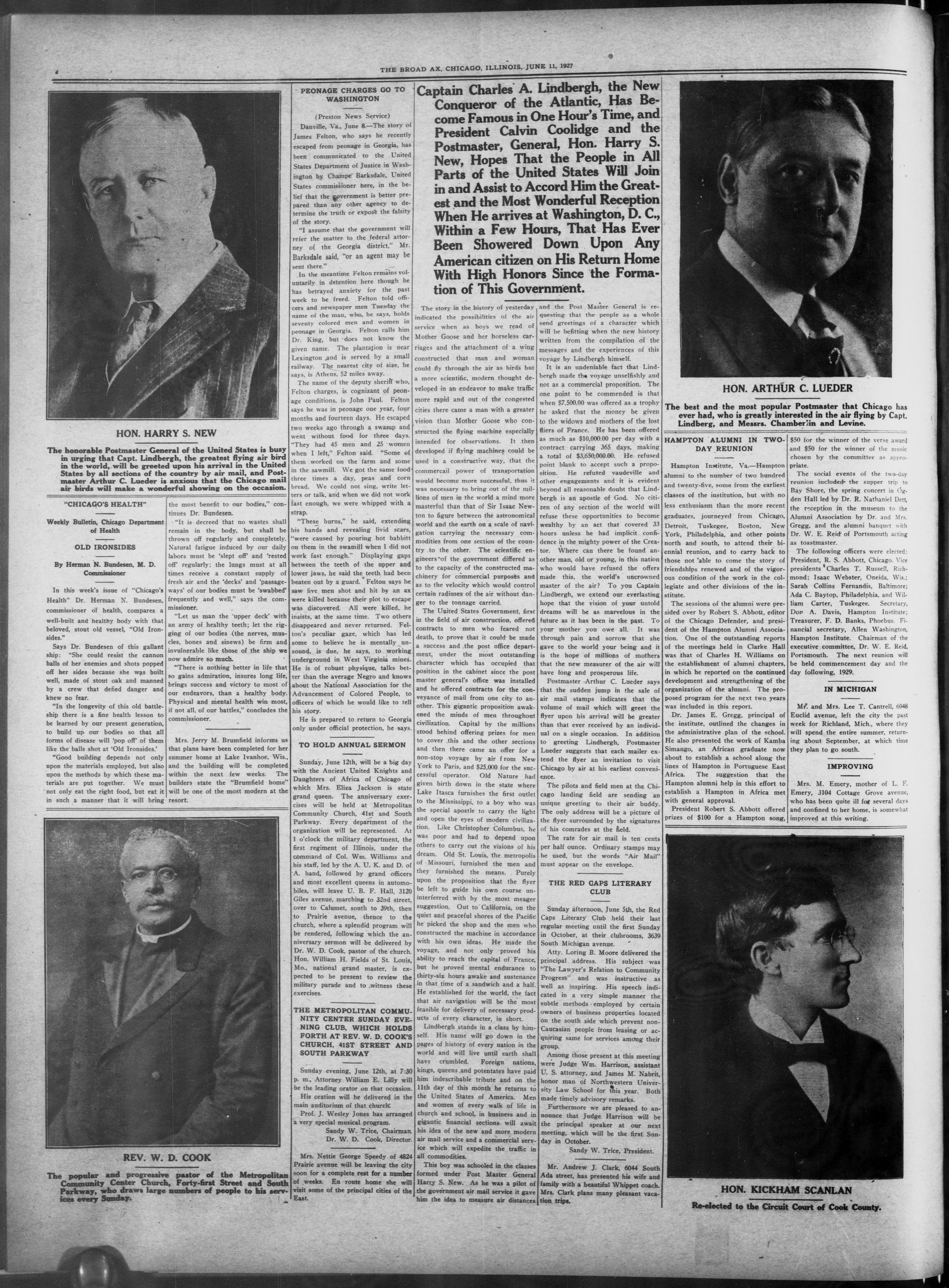
captain Charles A. Lindbergh, the New Conqueror of the Atlantic, Has Become Famous in One Hour's Time, and President Calvin Coolidge and the Postmaster, General, Hon. Harry S. New, Hopes That the People in All Parts of the United States Will Join in and Assist to Accord Him the Greatest and the Most Wonderful Reception When He arrives at Washington, D. C., Within a Few Hours, That Has Ever Been Showered Down Upon Any American citizen on His Return Home With High Honors Since the Formation of This Government.
The story in the history of yesterday indicated the possibilities of the air service when as boys we read of Mother Goose and her horseless carriages and the attachment of a wing constructed that man and woman could fly through the air as birds but a more scientific, modern thought developed in an endeavor to make traffic more rapid and out of the congested cities there came a man with a greater vision than Mother Goose who constructed the flying machine especially intended for observations. It then developed if flying machines could be used in a constructive way, that the commercial power of transportation would become more successful, thus it was necessary to bring out of the millions of men in the world a mind more masterful than that of Sir Isaac Newton to figure between the astronomical world and the earth on a scale of navigation carrying the necessary commodities from one section of the country to the other. The scientific engineers of the government differed as to the capacity of the constructed machinery for commercial purposes and as to the velocity which would control certain radiuses of the air without danger to the tonnage carried.
The United States Government, first in the field of air construction, offered contracts to men who feared not death, to prove that it could be made a success and the post office department, under the most outstanding character which has occupied that position in the cabinet since the post master general's office was installed and he offered contracts for the conveyance of mail from one city to another. This gigantic proposition awakened the minds of men throughout civilization. Capital by the millions stood behind offering prizes for men to cover this and the other sections and then there came an offer for a non-stop voyage by air from New York to Paris, and $25,000 for the successful operator. Old Nature had given birth down in the state where Lake Itasca furnishes the first outlet to the Mississippi, to a boy who was the special apostle to carry the light and open the eyes of modern civilization. Like Christopher Columbus, he was poor and had to depend upon others to carry out the visions of his dream. Old St. Louis, the metropolis of Missouri, furnished the men and they furnished the means. Purely upon the proposition that the flyer be left to guide his own course uninterfered with by the most meager suggestion. Out to California, on the quiet and peaceful shores of the Pacific he picked the shop and the men who constructed the machine in accordance with his own ideas. He made the voyage, and not only proved his ability to reach the capital of France, but he proved mental endurance to thirty-six hours awake and sustenance in that time of a sandwich and a half. He established for the world, the fact that air navigation will be the most feasible for delivery of necessary products of every character, in short.
Lindbergh stands in a class by himself. His name will go down in the pages of history of every nation in the world and will live until earth shall have crumbled. Foreign nations, kings, queens and potentates have paid him indescribable tribute and on the 11th day of this month he returns to the United States of America. Men and women of every walk of life in church and school, in business and in gigantic financial sections will await his idea of the new and more modern air mail service and a commercial service which will expedite the traffic in all commodities. This boy was schooled in the classes formed under Post Master General Harry S. New. As he was a pilot of the government air mail service it gave him the idea to measure air distances
and the Post Master General is requesting that the people as a whole send greetings of a character which will be befitting when the new history written from the compilation of the messages and the experiences of this voyage by Lindbergh himself.
It is an undeniable fact that Lindbergh made the voyage unselfishly and not as a commercial proposition. The one point to be commended is that when $7,500.00 was offered as a trophy he asked that the money be given to the widows and mothers of the lost fliers of France. He has been offered as much as $10,000.00 per day with a contract carrying 365 days, making a total of $3,650,000.00. He refused point blank to accept such a proposition. He refused vaudeville and other engagements and it is evident beyond all reasonable doubt that Lindbergh is an apostle of God. No citizen of any section of the world will refuse these opportunities to become wealthy by an act that covered 33 hours unless he had implicit confidence in the mighty power of the Creator. Where can there be found another man, old or young, in this nation who would have refused the offers made this, the world's uncrowned master of the air? To you Captain Lindbergh, we extend our everlasting hope that the vision of your untold dreams will be as marvelous in the future as it has been in the past. To your mother you owe all. It was through pain and sorrow that she gave to the world your being and it is the hope of millions of mothers that the new measurer of the air will have long and prosperous life.
Postmaster Arthur C. Lueder says that the sudden jump in the sale of air mail stamps indicates that the volume of mail which will greet the flyer upon his arrival will be greater than that ever received by an individual on a single occasion. In addition to greeting Lindbergh, Postmaster Lueder suggests that each mailer extend the flyer an invitation to visit Chicago by air at his earliest convenience.
The pilots and field men at the Chicago landing field are sending an unique greeting to their air buddy. The only address will be a picture of the flyer surrounded by the signatures of his comrades at the field.
The rate for air mail is ten cents per half ounce. Ordinary stamps may be used, but the words "Air Mail" must appear on the envelope.
THE RED GAPS LITERARY
CLUB
Sunday afternoon, June 5th, the Red Caps Literary Club held their last regular meeting until the first Sunday in October, at their clubrooms, 3639 South Michigan avenue.
Atty. Loring B. Moore delivered the principal address. His subject was "The Lawyer's Relation to Community Progress" and was instructive as well as inspiring. His speech indicated in a very simple manner the subtle methods employed by certain owners of business properties located on the south side which prevent non-Caucasian people from leasing or acquiring same for services among their group.
Among those present at this meeting were Judge Wm. Harrison, assistant U. S. attorney, and James M. Nabrit, honor man of Northwestern University Law School for this year. Both made timely advisory remarks.
Furthermore we are pleased to announce that Judge Harrison will be the principal speaker at our next meeting, which will be the first Sunday in October.
Sandy W. Trice, President.
Mr. Andrew J. Clark, 6044 South Ada street, has presented his wife and family with a beautiful Whippet coach.
Mrs. Clark plans many pleasant vacation trips.
M.
HON. ARTHUR C. LUEDER The best and the most popular Postmaster the ever had, who is greatly interested in the air Lindberg, and Messrs. Chamber'in and Lev
The best and the most popular Postmaster that Chicago has ever had, who is greatly interested in the air flying by Capt. Lindberg, and Messrs. Chamberin and Levine.
HAMPTON ALUMNI IN TWO-DAY REUNION $50 for the winner of the verse award and $50 for the winner of the music
Hampton Institute, Va.—Hampton alumni to the number of two hundred and twenty-five, some from the earliest classes of the institution, but with no less enthusiasm than the more recent graduates, journeyed from Chicago, Detroit, Tuskegee, Boston, New York, Philadelphia, and other points north and south, to attend their biennial reunion, and to carry back to those not 'able to come the story of friendships renewed and of the vigorous condition of the work in the collegiate and other divisions of the institute.
The sessions of the alumni were presided over by Robert S. Abbott, editor of the Chicago Defender, and president of the Hampton Alumni Association. One of the outstanding reports of the meetings held in Clarke Hall was that of Charles H. Williams on the establishment of alumni chapters, in which he reported on the continued development and strengthening of the organization of the alumni. The proposed program for the next two years was included in this report.
Dr. James E. Gregg, principal of the institute, outlined the changes in the administrative plan of the school. He also presented the work of Kamba Simango, an African graduate now about to establish a school along the lines of Hampton in Portuguese East Africa. The suggestion that the Hampton alumni help in this effort to establish a Hampton in Africa met with general approval. President Robert S. Abbott offered prizes of $100 for a Hampton song,
THE NEW YORK TIMES
HON. KICKHAM SCANLAN
Re-elected to the Circuit Court of Cook
Re-elected to the Circuit Court of Cook County.
r Postmaster that Chicago has erected in the air flying by Capt.umberlin and Levine.
$50 for the winner of the verse award and $50 for the winner of the music chosen by the committee as appropriate.
The social events of the two-day reunion included the supper trip to Bay Shore, the spring concert in Örgden Hall led by Dr. R. Nathaniel Dett, the reception in the museum to the Alumni Association by Dr. and Mrs. Gregg, and the alumni banquet with Dr. W. E. Reid of Portsmouth acting as toastmaster.
The following officers were elected: President, R. S. Abbott, Chicago. Vice presidents Charles T. Russell, Richmond; Isaac Webster, Oneida, Wis.; Sarah Collins Fernandis, Baltimore; Ada C. Baytop, Philadelphia, and William Carter, Tuskegee. Secretary, Don A. Davis, Hampton Institute; Treasurer, F. D. Banks, Phoebus. Financial secretary, Allen Washington, Hampton Institute. Chairman of the executive committee, Dr. W. E. Reid, Portsmouth. The next reunion will be held commencement day and the day following, 1929.
IN MICHIGAN
Mr. and Mrs. Lee T. Cantrell, 6948 Euclid avenue, left the city the past week for Richland, Mich, where they will spend the entire summer, returning about September, at which time they plan to go south.
Mrs. M. Emery, mother of L. F. Emery, 3104 Cottage Grove avenue, who has been quite ill for several days and confined to her home, is somewhat improved at this writing.
THE LIFE OF JOHN B. HARRIS
Court of Cook County.
IMPROVING
COLORFUL NEWS MOVIES BY THE CAMERAMAN
(Preston News Service)
1. "The Daily Worker" Propagandists.
2. Merry (?)-go-round.
3. Save Fisk and Atlanta.
4. "Pay-day" (a Story).
1. "The Daily Worker" Propagandists.
The pen propagandists of "The Daily Worker," quasi-communistic organ of J. Louis Engdahl, William F. Dunne, and Bert Miller, are wide awake, as usual. Some months ago, being tired of affairs of the world, "The Daily Worker" printed a caricature of the Savior, the most nauseating newspaper display that the country has ever witnessed, and one which was an open insult to every God-fearing person in America.
When newspaper business becomes dull in the quasi-communistic world of America, the Daily Worker turns, for fodder, to the Negro, so frequently the "rubber bounce ball" of promoters and propagandists who have ultra-selfish axes to grind and ambitions to "achieve."
In keeping with this practice, the Worker's latest "rush" act, as propagandized in its issue of May 31, is noted in a series of sentences—not sense—relating to Secretary of Commerce Hoover and the Negro refugees of the flooded Mississippi river district, to whom, says the Worker, the cabinet officer has turned a deaf ear.
As illustrative of the brain poverty which crystallizes the Worker's propaganda, here are a few quoted sentences bearing upon the Negro and the flood situation:
"All government agencies from the Department of the Interior and the Department of Commerce on down deery and fear the revelations that the relief machinery, under Hoover's direct control, has vigorously repressed any attempt by the Negro peons to escape from their peonage. Many of them had hoped to escape during the confusion of the flood, but the relief machinery was too much for them. Hoover refuses to be bothered by any complaints from the Negroes or any of their friends."
The Daily Worker's editors, had they been sincere, might have inadvertently discovered that peonage conditions and other flaunts in the face of law and order, which continue to exist along the Mississippi river, are local persecutions which neither Mr. Hoover nor any one else since the days of Grant and Sherman, has been able to subdue. The Daily Worker, had it possessed such a sensitive conscience all along as it now exhibits, should, with its first issue, have begun a campaign to make the Solid South abort from its system the evils heaped upon its Negroes.
This has been and is the cause of the debacle of repression—not the advent of Mr. Hoover, for whom we hold no brief, but who, from accurate reports, is nobly performing the tasks to which he was assigned by the president, as an official of the National Government. The Worker could do well, after accurately informing itself upon the truths of the day, to concentrate and localize its efforts to bring about a reform in the Southland. This would be much preferable to villifying Government officials, on the one hand, and using the Negro as a smoke screen for vicious propaganda, on the other hand.
An aged colored woman, working at the "merry-go-round" of an eastern canning factory, otherwise known as the mechanical conveyor which carries the empty can around, where tired hands fill the cans with food products
[Name]
HON. DAVID F. MATCHETT
2. Merry (?)-go-round.
just prior to capping, recently made the following remark to an inspector who was making observations of conditions of labor:
"See dem blue glasses? Well, I wears 'em because if I don't, dem pans goin' roun' en roun' all de time makes me drunk."
Thus the whirling contrivance on its endless way throughout the long ten-hour day was subjecting the humble Negro matron and her co-workers to a strain which was wearing down mind and body for a paltry nine or ten dollars a week. Besides this mechanical depressant of brain, brawn and eyesight, numerous other persecutors of the human frame in the form of poor conditions of labor are daily exacting a heavy toll from the working women of America—and among them the colored woman is the greatest sufferer of all.
If woman is to have an equalized day in politics, in industry, and in everything, to say nothing of her original calling to wifehood and motherhood, then an equalized, yea, a greater, protection of her brain and body should be given by the giant industries of America. If they themselves will not heed the warning, then it is for society itself to turn back the "merry-go-round" trend of a large sector of American industrial life.
Colored women who are busy promoting sewing circles and give hundred clubs, as well as the men who are even yet so dependent upon them for the real refinement of life, would do well to take a place at the council table, whose delegates are striving to protect womanhood in industry. If neither the employer nor the state will act, then congress and the federal government may, if asked in the proper way.
3. Save Fisk and Atlanta.
Troubled reports of scant finances at Fisk and Atlanta universities continue to find their way northward, and apprehension gathers lest forced curtailment in the educational department of these beacon lights of the South might follow the lack of adequate funds in these two worthy institutions.
In the past, Atlanta and Fisk have not been as fortunate as their industrial contemporaries, Tuskegee and Hampton, in being favored with the vision of gracious educational financiers, such as Mr. Eastman, and others, who are sincerely anxious to do something for the struggling Negro youth of the South.
The trained Negro is a necessity in the South. With him in the field of higher education and his brother in the field of agriculture and industry, there is glorious hope that the Negro in the South will be most potent in working out his own destiny, despite his many hardships.
Fisk and Atlanta are as essential as Howard. They fill a geographical need which Howard University cannot begin to fill. Their graduates are illustriously blazing the trail and laying stronger foundations of faith and efficiency for the future. Scholars like DuBois, Proctor, Carver, Haynes, and others of Atlanta and Fisk, and physicians such as Rawlins and Bailey, of Leonard Medical College, would never have matured had the little southern schools not held for them the opportunity for learning which, at the time, they could not seek else-where.
We sound no faltering alarm for Atlanta and Fisk; but we do offer the prayer that for them full finances may be coming forthwith; and that they may continue to grow in the hearts and in the needs of black and white America.
THE BROAD AX, CHICAGO, ILLINOIS, JUNE 11, 1927
4. "Pay-Day" (a Story).
The last day of the month fell upon Sunday; and, of course, the Bluebird Hotel, at which Lucy Smith was a waitress, wouldn't pay off until Monday. Sunday was Lucy's day off, and hadn't she promised Momsie to take her on the Saturday night excursion to Atlantic City.
It was true Lucy's wages were only $9.00 a week, plus tips; but it was equally true that two $4.00 tickets would take her and Momsie to the seashore and back home; and since Lucy had, by dint of denial, saved $4.00 during the past month, there was a tidy sum of five whole dollars to spend on herself and Momsie.
But what good was that, without the nine dollars' wages, though Lucy, in half anger, as she raced back and forth from the dining hall to the Bluebird's pantry.
"We have to work three Sundays out of the month," mused Lucy, as she carried a heavy tray to a table of merrymakers.
"I don't see why the pay clerk can't work on one Sunday a month."
"Maybe he'll favor me," thought Lucy.
A brief visit to the office of Mr. Jones, the pay clerk, however, dispelled all hopes.
"No pay until Monday," he snapped.
"If you want to be paid today, you'll have to quit," he added with a rising tone in his voice.
Lucy went mournfully back to the waiting room, where the waitresses assembled at mealtime. She wasn't surprised. Hadn't she always known that the Bluebird was a third-class hotel? Hadn't even Momsie said that first-class people never ate at the Bluebird?
What else could be expected?
Half in tears and half in anger, Lucy responded to the bell rung from the table in the alcove, where there sat the old lady and her daughter, whom she had zealously served for two days.
"Hm, another ten-cent tip," said Lucy to herself, as she gave the two a set up.
"If Momieis hadn't taught me to be efficient at all times," thought Lucy, "I'd certainly slight this pair tonight. It's no use, though, to wear a grouch. Maybe I can borrow ten dollars on my winter coat, and take Momieis to the seashore anyhow."
The meal being shortly ended, the aged lady and her daughter arose from the table and prepared to leave.
"Waitress," the young lady said, pleasantly, "we are leaving tonight and we thank you for your kind and attentive service."
"You're welcome, Mam," answered Lucy, almost grumly, as her eyes spied a glistening dime, lying beside the empty tea cup.
But, could she believe it, as Lucy lifted the saucer from the cloth, there just beneath it was a crisp ten-dollar bill.
DR. GEO. E. HAYNES ELECTED
ASSISTANT MODERATOR
(Preston News Service)
Omaha, Neb., June 8—The election of Dr. George E. Haynes, secretary of the Commission on the Church and Race Relations of the Federal Council of Churches in America to the position of assistant moderator at the biennial meeting of the National Council of Congregational Churches of the United States here last week has met with world-wide approval. This is the first time in history that a Negro layman has been thus honored by this body.
Dr. Haynes' name was placed before the body by the Rev. Dr. A. C. Garner of New York City and seconded by the Rev. Dr. Henry Hugh Proctor, of Brooklyn, N. Y., and the Rev. J. C. Olden of Washington, D. C., amid a round of applause. The election was unanimous. There were three other assistant moderators (all white) elected at the same time.
Dr. Haynes' career includes three years (1905-08) as secretary of the Colored Men's Department, Y. M. C. A. ten years as professor of sociology and economics at Fisk University (1910-20) during which time, on leave of absence, he served as special assistant to the secretary of labor during the World War, with the title of director of Negro economics, from 1918-21. Dr. Haynes was founder and formerly executive director of the National Urban League for Social Service among Negroes; only Negro member of the President's Unemployment Conference; special advisor on Negro work, Interchurch World Movement of North America (1920-22). Dr. Haynes was educated at Fisk, Yale, and Columbia universities; he is an author of note, and a Christian leader of national reputation.
The many friends are glad to have Miss Nakomis Sandusky in our midst again after a two weeks' illness.
PLEASANT SOCIAL AFFAIR AT
AL-VIN DANSANT HALL
Last Saturday evening Al-Vin Dansant Hall, 51st and Michigan avenue,
was aglow with beautifully gowned ladies and debonair gentlemen,
the guests of the tea for Twelve club whose annual dance is looked forward to with much pleasure among the younger set which made the evening long to be remembered and look forward to as each year this club of society's younger set paves the way for others to follow; dancing was in order until the wee hours of the morning.
UNIVERSITY BUILDING IS TO COMMEMORATE BELL
The memorial to Alexander Graham Bell, inventor of the telephone, which is to be established at Boston University where Bell was a professor of speech at the time he perfected his invention, is to take the form of a building which will house the college of liberal arts of the university. An endowment of $1,500,000 for the college of liberal arts has recently been raised.
AFRICAN BEAUTIES NO LONGER WILL BE PRETTY UNDER THEIR STANDARDS
[Preston News Service]
Darkar, Senegal, June 8. — Lipstretching, nose-piercing, and teeth-filing, long practiced by the beauties of France's African colonies, have at last fallen under the ban of the law. From now on the government will punish such disfigurations with jail sentences ranging from two to five years. A decree to that effect, duly signed and sealed, has just been promulgated.
H. L. WEBBER ACQUIRES
PITTSBURGH GUARD
(President News Service)
Pittsburgh, Pa., June 10—Harry L. Webber, widely known newspaper man and editorial writer, has acquired the Pittsburgh Guard, formerly the Pennsylvania Guard, owned and published here by Stokes Pressley and Charles Gantt. The office of the publication is located at 2146 Wylie avenue.
SPEND WEEK END IN DETROIT
Mr. and Mrs. L. F. Emery, 3104 Cottage Grove avenue, spent Memorial Day week-end in Detroit, Mich., as the guests of Mr. and Mrs. B. Burchette, and were delightfully entertained during their stay.
RETURNS TO COLP
Mrs. Ethel Williams-Webb, who spent some time in the city visiting with relatives and friends after a long absence, returned to her home in Colp, Ill., the past week, much pleased with her stay.
CHIPS
Mrs. Beatrice Turner and her father, Mr. Goff, formerly of St. Louis, Mo., were the dinner guests of Mr. William Carroll of Cleveland, Ohio, father of Wm. and Mayme Carroll. Mr. Carroll, Sr., and Mr. Goff were classmates.
Mrs. Chas. Weir left the city Thursday for Washington, D. C.
Mrs. Nerlene K. Simons, 430 East 47th street, has been very seriously ill at her home. She is, however, at this writing, greatly improved.
Mr. Frank Jenen, assistant superintendent Chicago Lawn postoffice, is again able to return to his duties at the station after an operation which confined him to his bed for several weeks'. The boys at the station age very glad of his return.
Hid Surplus Coin in
One of the most interesting items in a coin bank collection is an ancient "bottijuela" or baked clay jar about a foot high obtained from San Juan, Porto Rico. It is round in shape and with an opening of about two or three inches in diameter. It was brought to Porto Rico from Seville and Cadiz during the colonization period of the island and served for a long time for the carrying of olive oil. Later, they were used by families; in the homes of the poor to carry water from the brooklets and rivers, and in the homes of the rich to store money. When filled with gold and silver coins, a cork or wooden stopper was put in them and then sealed with sealing wax. After this they buried the "bottijuelas" in the ground or hid them in the cellings of their homes.
The custom was brought over from Spain, where money was also buried in the ground. The use of the "botijuela" in Porto Rico started about the middle of the Sixteenth century, when the first settlers began to realize profits from their farms and from the sale of fruits.—Exchange.
A Few Roses, More or Less
By CLARISSA MACKIE
(Copyright.)
TABITHA came slowly down the wide stairway, her small gray suede shoes brave with silver buckles, her demure gray velvet frock Quakerish in its soft simplicity. Her golden hair shimmered in the gloom of the vast hall, and to Gerald Lang, standing at the foot of the stairs, her gray-blue eyes were blue, and as true as love's own flower.
As she reached the bottom of the stairs, Gerald bent to kiss her fingers with a gallant foreign gesture that amused and pleased her at the same time. Tabitha was sure that he had come to propose to her again. He followed her into the drawing room, where vases and bowls were filled with American Beauty roses. Tabitha took the largest vase in her arms. Her lips touched the roses.
"You dear things," she whispered, then to Lang, "Did you send them, Gerry?"
He nodded.
"Your birthday—two for every year." His dark eyes sought her face eagerly—for something—he scarcely knew what.
She was counting the roses. "Forty-eight!" she sighed.
Gerry looked uncomfortable. "Perhaps there should have been more—" he hesitated.
"There are too many!" she smiled brilliantly—a dazzle of blue-gray, eyes reproached him, ridiculed him.
"Does it matter, Tabitha, a few roses more or less?"
"It matters a great deal; I am only eighteen today, Gerry. With two roses for every year, three dozen would be just right."
His gaze crystallized on her eyes, more gray now than blue, and rather cold and hard. "Six years ago when I was last home," he said coldly, "you were eighteen, but I am a poor mathematician, Tabitha."
"Rather."
Tabitha rang for a servant and ruthlessly pulling out a dozen of the roses, ordered them to be thrown out, and when the man had gone, she turned to Gerald. "Now I am happy with your roses, Gerry."
"I am glad you are happy, Tabitha," and his voice changed. "I have come to make my adieux, Tabitha—I am joining the Bilzen exploration party after all."
"Into Aslaf?" she faltered.
She was pale now and not so pretty. She had been sure old Gerry was going to propose—she wondered why he had not.
He said good-by and went, and forgot to kiss her hands. He had first refused to join the expedition because he had resolved to marry Tabitha—but now, things were changed. Tabitha had had a birthday—she had lied to him, and no Lang of Lang's End had ever wedded a deceitful woman, or one who wasted precious roses.
Twenty years afterward he came home from Asla, a lean, silent brown man of fifty. One of the first things he did was to order roses for Tabitha. She had never married, and he wondered why. It never occurred to him that she could care, after all.
She came to him under softly shaded lights, looking not a year over twenty-four.
"Has time stood still?" he inquired, and he felt the old thrill at touch of her hand.
She smiled and shook her head.
"Does it ever? I am having another birthday, Gerald—must you always come on anniversaries?"
"They are anniversaries for me, too," he retorted.
They talked about some amazing discoveries he had made in Tibet, and he had brought her a small ornament of milky-white jade. "For your birthday," he said.
"And my roses? You see I am spoiled."
"I believe Jenkins is bringing them now," said Lang.
Tabitha was counting roses again, and he saw her reach out with a handful for Jenkins, but Gerald's long arm interposed and he squeezed these flowers in with the others.
"Tabitha," said Gerald firmly, "I came home to marry you if you would accept me—you know I love you—and we have wasted twenty years—if you are forty-eight years old, I want to marry you."
Tabitha grew very pink indeed, tears came into her lovely gray-blue eyes. "If you should hold my hands, Gerry," she whispered, "it would help a lot."
His hands swiftly sought and found hers, so small and so warm. He held them tightly. "Does it matter—these years, love—if you feel young—and your heart is young enough to love me as of old?" he murmured.
She leaned toward him fluttering, foolish Tabitha, who had been so tender of her years. "Ah, Gerry, darling, if I had known—if I had only known," she whispered contritely. "But I have suffered, dear, suffered in the waiting for you—take me quickly, Gerry, so that I can go away with you on your next voyage!"
"There will be no next voyage for me," declared Gerald happily—"only our wedding trip, if you wish to go a-sailing somewhere, my Tabitha!" Her face was very close to his, and her deep eyes were shining with love, "Ah, Gerry," she whispered, "any-where—with you—will be heaven to me."
And then Gerald was quite sure.
False Praze
Josh Billings—False praze is the wuest kind ov slander.
THE MUSICIAN
COL. JAMES HALE PORTER One of the leading citizens or statesmen in this city or Illinois, who was the head managing director of the Judicial contest for Judges Johnston, Thompson and Torrison, and with all of his political ability Col. Porter marched into defeat with those three distinguished Judges.
FT. DEARBORN ELECTS OFFICERS
Ft. Dearborn Lodge No. 44, I. B. P. O. E. W., which met at the clubrooms, 3920 South Parkway, June 1st, held the regular election of officers and delegates to the next grand lodge session. Principal officers elected were Jas. C. Martin, whose administration has been the most successful in the history of the lodge, was re-elected exalted ruler without a dissenting vote; Walter J. Brown was elected esteemed leading knight; Robt. L. Potts, secretary, and David Bishop, treasurer. During the administration of Jas. G. Martin, as exalted ruler, has found its way from 3120 Giles avenue, rented quarters, to a $65,000 clubroom on South Parkway; its membership has increased from a few to more than 2500. Ft. Dearborn has claimed the special attention of Elks the country over. Delegates to the next grand session elected were Jas. C. Martin, Walter Brown, Robert Potts, L. A. Newby, Arthur White, H. B. Williams, A. E. Patterson, Harry J. Brown, M. T. Bailey, Dr. W. H. Davis, Thomas H. Jackson, Dr. Geo W. Lacey, J. H. Zedricks, J. B. Deveaux, P. A. Glanton, C. T. Hume, Jesse Pitts, William Harrison, S. A. T. Watkins, T. J. Marshall, John T. Scott, William Middleton, William Boyd, and M. B. Rogers.
HEROIC WORK BRINGS AID
AFTER TORNADO
When the telephone exchange blew down at Rock Springs, Tex., during the recent tornado, when nearly 100 persons were killed and 150 injured, the operator, Miss Gladys Lowry, displayed a heroism equal to the occasion.
With a lineman she made her way through the devastated district to a point a mile and a half east of town. There, over a telephone nailed to a post in the open country by the lineman, she told the story of the storm to the outside world and appealed for help. Throughout the severe electrical storm she put in calls for relief to nearby towns. Lightning forced her from the line several times, prevent-
Save Steps
Save Time!
An extension telephone is a second instrument on the same line as the original, installed in some other location in your house or apartment. Calls may be made or the telephone answered at either instrument. An extension telephone saves many steps. The cost is small.
Call our Business Office today.
ILLINOIS BELL TELEPHONE COMPANY
BELL SYSTEM
One Policy • One System • Universal Service
ing a detailed report, but she stuck to her task throughout a night of horror until she was able to secure aid from Fort Clark, some sixty miles distant, and other points.
ANTI-LYNCH CHURCH AP-
PEAL
"Salem Day Sunday" Observance June 19th to Call for Abolition of Mob Murder
Boston, Mass., June 8.—As a fitting public finale to the nationwide public celebrations on June 17th of "Salem Race Day," in honor of Peter Salem, Salem Poor and the other colored soldiers at the Battle of Bunker Hill, way back in 1775, with resolutions to be adopted and sent to President Coolidge for the anti-lynching bill and against federal segregation, the National Equal Rights League has just issued an appeal to all race pastors to make June 19th a "Salem Day Sunday" by special prayers for deliverance and church resolutions of appeal to nation and government for an end to lynching and segregation to be signed by church officers and sent to President Coolidge and given to the press.
The first part of this nationwide stroke against these two major evils will begin, and also end, according to the league's request, with official resolutions to the president by fraternal lodges at their most convenient meeting in June before or after the 17th. With the civic observances, the one in Boston to cover two days, with the church and lodge resolutions and those by other bodies, a strong bombardment can be made of the White House and a good blow struck. The league, which supplies historical leaflets postpaid from 9 Cornhill for six cents in stamps, also asks that copies of all resolutions with addresses of officials and promoters of celebrations be sent to it to be later carried to the White House in bulk as a united race protest and appeal.
Miss Taylor of Pasadena, Calif., is the guest of Mrs. Triddy Ferguson of 4735 Michigan ave.
Williamson's
CUNNINGHAM FUNERAL CARS
Are distinguished by their Style and Elegance but foremost by the protection to passengers guaranteed by proper Insurance.
USE THE WILLIAMSON FUNERAL
Protect Yourself BY USING OUR
Latest Style Leatherback Indemnified Hearses and Cars
OR REQUEST WILLIAMSON'S INSURED CARS
It costs no more
We have invested in $200,000 Indemnity for our 5 Hearses and 15 Cars. $10,000 Each.
Why take a Chance?
Use our cars and be assured of protection. The above policy is back of our up to date Cars. If any one is killed or injured in your funeral we will look after all suits and pay damages
AMBULANCE SERVICE AT ALL HOURS
Ernest H. Williamson
Undertaker
JAMES SYKES
Licensed Embalmer
Prompt Service Night and Day
PHONE KENWOOD 0455
5121-5123-5125 South State Street
Notary Public CHICAGO, ILL.
In this city since July 15th, 1899 without missing one single issue. Republicans, Democrats, Catholics, Protestants, Single Taxers, Priests, infidels or anyone else can have their say as long as their language is proper and responsibility is fixed. The Broad Ax is a newspaper whose platform is broad enough for all, ever claiming the editorial right to speak its own mind. It is neither Democratic nor Republican. It is strictly or absolutely independent in politics. Local communications will receive attention. Write only on one side of the paper.
Subscriptions must be paid in advance.
One Year ..... $2.00
Six Months ..... $1.00
Advertising rates made known on application.
6206 S. Elizabeth St., Chicago.
Phone: Wentworth 2597
JULIUS F. TAYLOR
Editor and Publisher
Vol. XXXII No. 39
Chicago, June 11, 1927
Entered as Second-Class Matter, Aug.
19, 1902, at the Postoffice at Chicago,
Ill. Under Act of March 8, 1879.
Both Wondered
It is natural for many of us to stand off and wonder how our neighbor can live as he does. Because he has different standards and doesn't enjoy our kind of games, we wonder how he can possibly have any fun in life.
There is a delightful story which Jonas Lie, the artist, told. The artist was at the seashore working at a sketch, when he noticed an old fisherman who seemed to have no luck, but just constantly fished all day long, rebaiting his hook at intervals.
When the day ended, the fisherman sald to the painter: "HI, neighbor, been watchin' yer! How has yer the patience to stand and paint all day?"—Exchange
To Him Who Waits
Prosperity comes to him who advertises while he waits.—Harrisburg Telegraph.
Hat Doffing Traced
to Knightly Custom
Sunday promenaders on Fifth avenue see more hat doffing than do the crowds that move along the sidewalks on workdays. After church the avenue fills up with neighborhood people, who at least know many members of their own congregations. But few among them, from those wearing informal fedoras to those in ceremonial silk hats, probably ever question where this hat doffing originated.
As a fact, the doffing of the hat was a common custom long before the modern types of headgear were fashioned. In the days of knights in armor, when a man traveled incognito under all-enveloping helmets, it was customary to remove the iron headdress in the presence of a lady so that she might see his face. By this act she would be assured that her grim ironclad visitor was a friend or acquaintance.
As a custom of respect the practice thus came down from feudal times. Today not only to the fair lady but also to persons of dignity, and in places and situations demanding particular respect or reverence, men uncover their heads—New York Times.
The Exact Witness
A barrister was cross-examining a rather innocent-looking countryman.
"So you had a pistol?" the barrister asked.
"I had, sir."
"Whom did you intend to shoot with it?"
"I wasn't intending to shoot anyone?"
"Then was it for nothing that you got it?"
"No, it wasn't."
"Come, come, sir! By virtue of your solemn oath, what did you get the pistol for?"
"By virtue of my solemn oath," said the countryman. "I got it for ten-and-sixpence."—Weekly Scotsman.
Deadly Hailstorms
The hallstorms of India are frequently so severe that persons are killed by the icy stones.
The Empty Head
It's a strange paradox that an empty head is sometimes full of the darndest things.
THE BROAD AX, CHICAGO, ILLINOIS, JUNE 11, 1927
Nickel Pinchers Not
Exponents of Thrift
I have never known a stingy person who was nice, who was one of those persons the thought of whom makes your heart expand with warmth and affection. I am not inveigling against those who are sensibly economical and thrifty. When a man or woman says: "No, I can't afford that. It's only a dollar, but a dollar is important to me," that is all right. The quality of being unashamed transfigures almost anything into something all right, even charming.
But a stingy person tries to pretend that the expense is nothing; that isn't what interests him. Oh, no! Yet his worry over the slipping away of nickels is so intense in him that it makes your flesh creep. When there is a restaurant check to be paid, when you invite a tightwad to have a soda with you, click, click, you intuitively feel the cerebrations going on in his anxious brain as to which of you will have to give up the mazuma for the indulgence.
"I don't want to embarrass them by taking them to the Ritz," the very rich girl rationalizes her economy, "so I will just take them down to that interesting little place under the elevated, with the sawdust on the floor."
"I don't want persons to get to care for me only for my money," says the very rich snob, who as often as not is the richest debutante of the season. So she always makes it a point to "go Dutch"—Elizabeth Barbour in the Saturday Evening Post.
Easy for This Student
A school inspector in Hampshire, England, having set the children some sums to do, and having gathered the answers for correction, demanded attention, during which the class might write a description of a cricket match. Looking up a moment later he saw a boy with folded arms, regarding his paper with satisfaction. "Well, my boy," he said, "surely you can find something to say about cricket." "Oh! I've finished, sir!" was the answer, and the essay was handed up. "This is what the inspector read: 'Match postponed on account of the wet.'"
Modesty in Wisdom
Modesty in Wisdom
The wisest man is generally he who thinks himself the least so—Bollican.
FACTS ABOUT THE TELEPHONE
An average of 860,000 telephone calls a day are made in the city of Minneapolis.
About 2,500,000 of a total of the 18,000,000 telephones in the United States are dial system telephones.
More than 71,000,000 completed telephone talks take place daily in the United States, over 68,000,000 being focal exchange calls and more than 2,700,000 toll calls.
The total telephone wire mileage in the United States is about 60,000,000 miles of which approximately 53,000,-000 is Bell owned and nearly 7,000,000 connected.
If Africa were proportionately as well served from a telephone standpoint as the United States, the Dark Continent would have 135 times as many telephones as at present.
There are rumors that Rudyard Kipling, the famous writer, will get a telephone soon. Bernard Shaw resisted the insidious instrument for many years, but recently succumbed and so far has managed to survive.
HOWARD ALUMNUS INVENTS
UNIQUE FLAGHOLDER
Washington, D. C., June 9.—It was made public a few days ago that the flag which has been waving in front of the Howard University Library was invested and patented by Francis Duval Crichton, of Lynchburg, Va., a former student at Howard. This invention is unique in that it has the excellent advantage of automatically releasing and readjusting itself, when it becomes wrapped or entangled around the flagpole. The device is said to have attracted considerable attention because of this unique feature.
RETURNS TO CITY
R. W. Wells of the Wells Book Concern, 3710 Indiana avenue, has returned to the city from Colorado and other sections of the west where he spent two weeks.
Res. 5400 Washington Blvd.
Branch Office: 606 Racine
MILES J.
ATTORNEY
SUITE 318-320
CLARK AND W
Telephone CENTRAL 1239
WEST ENGLE
AND SAVI
Cor. 63rd Street and
JOHN BAIN, President
Vice-President; EDWA
President and Cashier;
Assistant Cashier and T
Washington Blvd. Res. Phone:
Office: 606 Racine Ave., Phone Monro
MILES J. DEVINE
ATTORNEY-AT-LAW
SUITE 318-320 REAPER BLOCK
CLARK AND WASHINGTON STS.
CNTRAL 1239
AT ENGLEWOOD TRE
ND SAVINGS BAN
rd Street and Marshfield
AIN, President; MICHAEL
President; EDWARD C. BARR
and Cashier; W. MERLE
Cashier and Trust Officer.
WEST ENGLEWOOD TRUST AND SAVINGS BANK
Cor. 63rd Street and Marshfield Avenue
JOHN BAIN, President; MICHAEL MAISEL, Vice-President; EDWARD C. BARRY, VicePresident and Cashier; W. MERLE FISHER, Assistant Cashier and Trust Officer.
TELEPHONE REPUBLIC 5000
TELEPHONE DOUGLAS 1
GEORGE F. H.
REAL
Up-to-Date or Modern
and Store
3101 COTTAGE
Corner 31st S
JAS. B. McCAHEY, President
FRANK J. DUNN, Vice-President
ESTABLISHED
AGE F. HARDING
REAL ESTATE
Date or Modern Houses, Ap-
and Stores to Rent
COTTAGE GROVE
Corner 31st Street, Chicago
HEY, President
IN, Vice-President
PHILIP J. D.
H. X. COMERFO
ESTABLISHED 1877
Up-to-Date or Modern Houses, Apartments and Stores to Rent 3101 COTTAGE GROVE AVE. Corner 31st Street, Chicago
JOHN J. DUNN COAL CO.
Telephone
5100 Federal Street
Telephone Oakland 1850
11 Street
MANY MOVE TO MORGAN PARK
Many members of the race are leaving the city and other suburban towns for Morgan Park, where they are building or buying comfortable homes for the future. M. T. Bailey of the Bailey Realty Co., D. L. Jackson, S. R. Benton, S. L. Coleman, and other representatives are working like trojans to make this the greatest suburb of the world's greatest city.
OPENS BEAUTIFUL LUNCH-ROOM
Arthur J. White, chairman of the house committee and one of the most energetic workers of Ft. Dearborn Lodge No. 44, has opened a beautiful lunchroom and barbecue stand at 26 East 47th street.
Phone: Office Main 4153; Residence
4751 Champlain Avenue
Phene Kenwood 8611
ATTORNEY AND COUNSELOR
AT LAW
Suite 708—184 W. Washington St.
CHICAGO
Telephone: State 3278
A. D. GASH
ATTORNEY AT LAW
Suite 813, Ashland Block
156 N. Clark Street
CHICAGO, ILL.
Phone Main 2017
A. L. WILLIAMS
ATTORNEY AND
COUNSELOR AT LAW
Suite 706 Firmenich Building
184 W. Washington St.
CHICAGO
Residence 3646 Michigan Ave.
Phone Douglas 9133
Res. Phone: Mansfield 5436
Ave., Phone Monroe 2714
DEVINE
Y-AT-LAW
REAPER BLOCK
WASHINGTON STS.
CHICAGO
WOOD TRUST
INGS BANK
Marshfield Avenue
; MICHAEL MAISEL,
RD C. BARRY, Vice-
W. MERLE FISHER,
Trust Officer.
HARDING, JR.
ESTATE
Own Houses, Apartments
to Rent
E GROVE AVE.
Street, Chicago
PHILIP J. DUNN, Secretary
H. X. COMERFORD, Treasurer
HED 1877
Berkland 1880
CHICAGO
Approved Safe Investments yield 7% interest. $100 Bonds sold on easy payment plan. See our Mr. Avery of the Bond Department.
LOANS MADE ON REAL ESTATE
Savings Department open from 9 A.M. to 8 P.M. Saturdays.
SAFETY DEPOSIT BOXES for less than one cent a day. Protect your Valuable Papers, Jewelry, etc.
NICOLN STATE BANK
OF CHICAGO
Under State Government Supervision
31st and South State Streets
Telephone Victory 4500
THE
COMMONWEALTH
EDISON
COMPANY
LINCOLN STATE BANK
THE COMMONWEALTH EDISON COMPANY
72 WEST ADAMS STREET
Phone: Randolph 1280
ONE WEEK'S SUPPLY
BRONZE BEAUTY Face Powder is made by a new French process, and is not affected by perspiration. Used satisfactorily on dry or oily skin. Makes the complexion soft and velvety—and stays on until removed. Three tints which blend with any complexion: High Brown, Bronze Glow and Flesh. Fill out and mail the coupon below and we will send you a whole week's supply free.
Please enter my name as a subscriber to THE BROAD AX. I inclose herewith Two Dollars, the annual subscriptions to same, or One Dollar for six months.
Depository for State County and City Funds
LINCOLN STATE BANK OF CHICAGO
Capital and Surplus $500,000.00