Chicago Defender
Saturday, March 19, 1910
Chicago, Illinois
Page text (machine-generated)
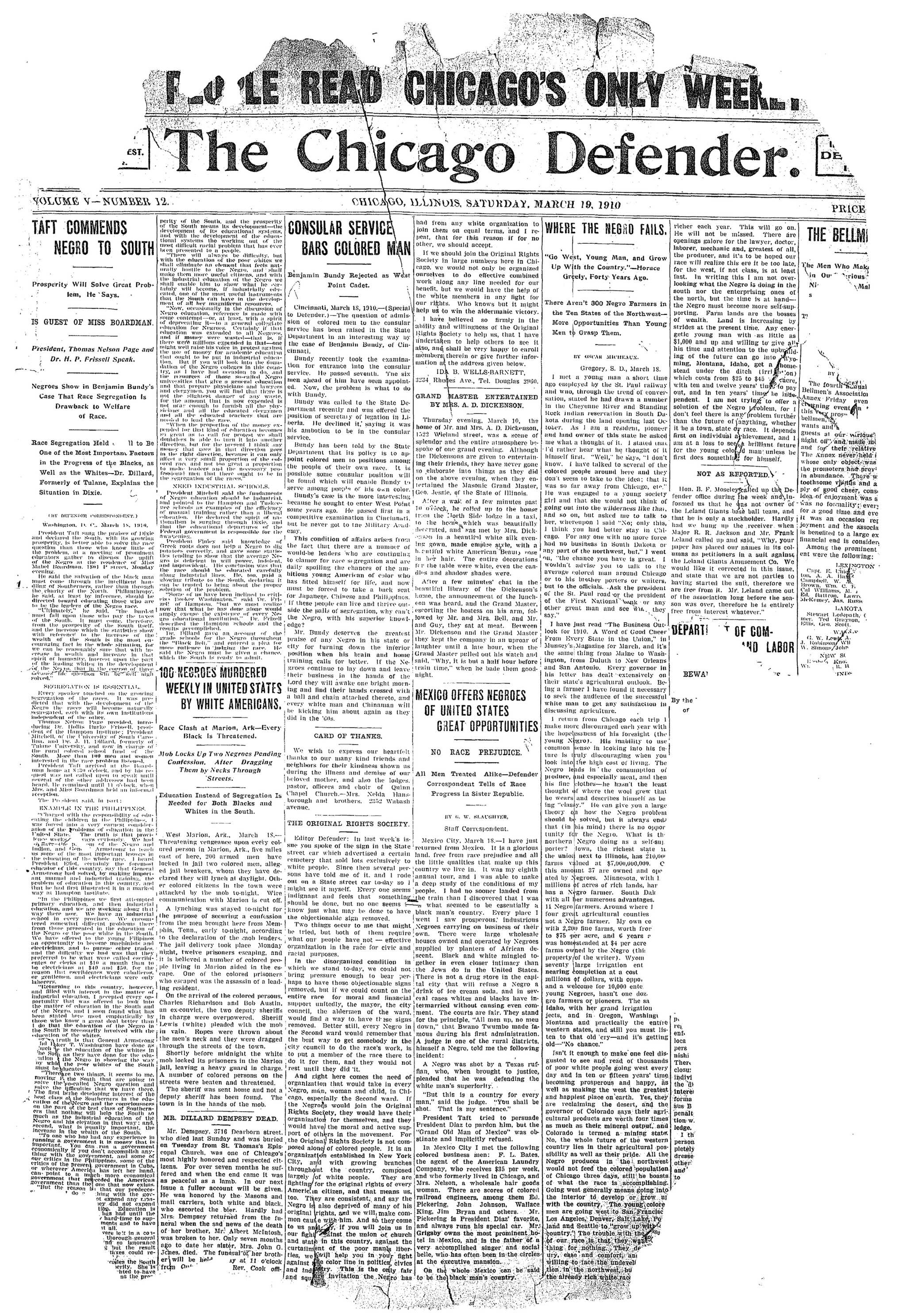
I'O LE READ CHICAGO'S ONLY WEEK... The Chicago Defender.
TAFT COMMENDS
NEGRO TO SOUTH
Prosperity Will Solve Great Problem, He Says.
IS GUEST OF MISS BOARDMAN.
President, Thomas Nelson Page and Dr. H. P. Frissell Speak.
Negroes Show in Benjamin Bundy's Case That Race Segregation Is Drawback to Welfare of Race.
Race Segregation Held all to Be One of the Most Important Factors in the Progress of the Blacks, as Well as the Whites—Dr. Dillard, Formerly of Tulane, Explains the Situation in Dixie.
President Taft sang the praises of Dixie and declared the South, with its growing prosperity, is better able to solve the race problem, but he did not address the problem, at a meeting of prominent educators gather to discuss the uplift of the Negro at the residence of Miss Bookdman. 1891 P street, Monday evening.
He said the salvation of the black man must come through the intelligent handling of Southerners, not through the weakness of the North. He said, at least by inference, should be directed toward educating those who are to be the leaders of the Negro race. He must fall upon those who pay the taxes of the South. It must come, therefore, from the prosperity of the South itself, with reference to the satisfaction with reference to the injustice of the wealth of the South is the most encouraging fact in the whole situation, for we can be reasonably sure that with improvement in the spirit of humanity, interest upon the part of the leading whites in the development of the Negro, that in the course of three decades the question will be well high solved.
SEGREGATION IS ESSENTIAL. Every speaker touched on the growing segregation of the races. It was presented that with the development of the National Association for the segregation, each with its own institutions independent of the other.
Thomas Nelson Page presided, introduced, and now president of the Hampton Institute; President Mitchell, of the University of South Carolina, and Dr. J. K. Dilhard, formerly of the University of North Carolina, and now in charge of the rural colored town of South. More than 100 men and women interested in the race problem listened. President Tatt arrived at the Hampton Institute, and his quest was not called upon to speak until several of the other addresses had been heard. He remained until 6 o'clock, when Mrs. and Miss Boardman hold an informal conference. The President said, in part:
EXAMPLE IN THE PHILIPPINES.
"Wereged with the responsibility of educating the children of the Philippine was forced into a very earnest consideration of the problems of education in the United State. The truth is that provider schools were certainly. We had graduate schools, New Indian, and Gap. Armstrong to teach us some of the most important lessons in the education of the whole race. I heard Mr. Armstrong say, 'I want to be an educator of this country, say that General Armstrong had solved, by making important manual and industrial training, the problem of education in this country, and that we are in a marked way at Hampton Institute."
"In the Philippines we first attempted primary education, and then industrial education, and we are working along that tradition. We have a school in every province. We encountered somewhat different problems there from those presented in the education of the Philippines, and we have offered to the young Filipinos an opportunity to become machinists and electricians, and to pursue other trades, and the difficulty we had was that they were not trained in the trades or clerks at $10 a month than to be electricians at $40 and $50, for the reason that apprentices were cadablers, electricians were only laborers.
To one who has had an experience in running a government it is money that is hung that you can run a government economically if you don't accomplish anything with the government until the end of our cities in the Philippines, some of the cities of the present government in Cuba, or wherever America has left her hand, can point to a much more economical government that preceded the American government than the one that now exists. "But the reason is that our predecessors did not expend any money did not expend it. Education is the main with the hard time to supplements and to have it all, were left in a cor- through general and so ignorance but the result taxes could re- codes the South verity. She is intended to have us the pro-
perity of the South, and the prosperity of the South means its development—the development of its educational systems, the national systems the working out of the most difficult social problem that has ever been presented to a people, difficulty, but with the education of the poor whites we shall eliminate an element that feels naturally hostile to the Negro, and shall increase the industrial education of the Negro we shall enable him to show what he certainly will become, if industrially educated, the most useful instruments that the South needs in the management of all of her magnificent resources.
"Now, occasionally in the discussion of Negro education, reference is made with respect to the degree of depreciating it—to a general college education for Negroes. Certainly if that education was extended to all Negroes, it would have been more expensive; there were millions expended in that—one might well raise his voice in protest against the use of money for academic education for Negroes. But if you will look into the foundation of the Negro colleges in this country, as I have had occasion to do, and the universities that give a general education and that prepare physicians and lawyers and clergymen, you will find that there is not much for the amount that is now expended is not near enough to furnish all the physicians and all the educated clergymen and the teachers that are needed to lead the race.
"When the proportion of the money expended for that kind of education becomes so great as to call for protest we shall doubtless be able to turn it into another form of money that goes in that direction goes in the right direction, because it can only affect a very small proportion of the colored race and not too great a proportion made leaders in the necessary professions, and that there ought to be in the segregation of the races."
NEED INDUSTRIAL SCHOOLS
President Mitchell said the fundamentals of Negro education should be industrial, and pointed to the Hampton and Tuskegee schools as examples of the efficiency of the educational trust that the Negro education department decribed the spirit of nationalism is surging through Dixie, and that the educational departures of the Federal government is responsible for the problem. President Flintley said knowledge of Greek roots does not help a Negro to dig potshes correctly, and gave some statistics tending to show that the average Negro in the United States is less educated and impatient. His concession was that the race should be educated carefully along industrial lines. He, too, paid a visit to Washington, said Dr. Ezzes now that what he has done alone would imply excuse the existence of every Negro educational institution." Dr. Fezelb describes the Hampton schools and the progress of Dr. Billard gave an account of the grade schools for the Negro throughout the "Black Belt," and entered a plea for the Negro to be given an account. Dr. Fezelb the Negro must be given a chance which the South is ready to admit.
100 NEGROES MURDERED WEEKLY IN UNITED STATES BY WHITE AMERICANS.
Race Clash at Marion, Ark-Every Black Is Threatened.
Mob Locks Up Two Negroes Pending Confession, After Dragging Them by Necks Through
Education Instead of Segregation Is Needed for Both Blacks and Whites in the South.
West Marion, Ark., March 18. Threatening vengeance upon every colored person in Marion, Ark., five miles cast of here, 200 armed men have locked in jail two colored men, alleged jail breakers, whom they have declared they will lynch at daylight. Other colored citizens in the town were attacked by the mob to night. Wire communication with Marion is cut off.
A lynching was stayed to night for the purpose of securing a confession from the men brought here from Memphis, Tenn., early to night, according to the declaration of the mob leaders. The jail delivery took place Monday night, twelve prisoners escaping, and it is believed a number of colored people living in Marion aided in the escape. One of the colored prisoners who escaped was the assassin of a leading resident.
On the arrival of the colored persons, Charles Richardson and Bob Austin, an ex-convict, the two deputy sheriffs in charge were overpowered. Sheriff Lewis (white) pleaded with the mob in vain. Ropes were thrown about the men's neck and they were dragged through the streets of the town.
Shortly before midnight the white mob locked its prisoners in the Marion jail, leaving a heavy guard in charge. A number of colored persons on the streets were beaten and threatened. The sheriff was sent home and not a deputy sheriff has been found. The town is in the hands of the mob.
MR. DILLARD DEMPSEY DEAD.
Mr. Dempsey. 3716 Dearborn street, who died last Sunday and was buried on Tuesday from St. Thomas's Episcopal Church, was one of Chicago's most highly honored and respected citizens. For over seven months he suffered and when the end came it was as peaceful as a lamb. In our next issue a fuller account will be given. He was honored by the Masons and mail carriers, both white and black, who escorted the bier. Hardly had Mrs. Dempsey returned from the funeral when the sad news of the death of her brother, Mr. Albert McIntosh, was broken to her. Only seven months ago to date her sister, Mrs. John G. Jones, died. The funeral of her brother will be held at 11 o'clock from Out. Rev. Cook offi-
CHICAGO, ILLINOIS, SATURDAY, MARCH 19, 1910
CONSULAR SERVICE BARS COLORED MAN
Cincinnati, March 18, 1910.—(Special to Detender.)—The question of admission of colored men to the consular service has been raised in the State Department in an interesting way by the case of Benjamin Bundy, of Cincinnati.
Bundy recently took the examination for entrance into the consular service. He passed seventh. The six men ahead of him have been appointed. Now, the problem is what to do with Bundy.
Bundy was called to the State Department recently and was offered the position of secretary of legation in Liberia. He declined it, saying it was his ambition to be in the consular service.
Bundy has been told by the State Department that its policy is to appoint colored men to positions among the people of their own race. It is possible some consular position will be found which will enable Bundy to serve among people of his own color.
Bundy's case is the more interesting because he sought to enter West Point some years ago. He passed first in a competitive examination in Cincinnati, but he never got to the Military Academy.
This condition of affairs arises from the fact that there are a number of would-be leaders who are continuing to clamor for race segregation and are daily spoiling the chances of the ambitious young American of color who has fitted himself for life, and now must be forced to take a back seat for Japanese, Chinese and Philippines. If these people can live and thrive outside the palls of segregation, why can't the Negro, with his superior knowledge?
Mr. Bundy deserves the greatest praise of any Negro in his state or city for turning down the inferior position when his brain and home training calls for better. If the Negroes continue to lay down and leave their business in the hands of the Lord they will awake one bright morning and find their hands crossed with a ball and chain attached thereto, and every white man and Chinanan will be kicking him about again as they did in the '60s.
CARD OF THANKS
We wish to express our heartfelt thanks to our many kind friends and neighbors for their kindness shown us during the illness and demise of our beloved mother, and also the lodges, pastor, officers and choir of Quinn Chapel Church.—Mrs. Nelda Hansborough and brothers. 2552 Wabash avenue.
THE ORIGINAL RIGHTS SOCIETY
Editor Defender: In last week's issue you spoke of the sign in the State street car which advertised a certain cemetery that sold lots exclusively to white people. Since then several persons have told me of it, and I rode out on a State street car to-day so I might see it myself. Every one seems indignant and feels that something should be done, but no one seems know just what must be done to have the objectionable sign removed.
Two things occur to me that might be tried, but both of them require what our people have not — effective organization in the race for civic and racial purposes.
In the disorganized condition in which we stand to-day, we could not bring pressure enough to bear perhaps to have those objectionable signs removed, but if we could count on the entire race for moral and financial support unitedly, the mayor, the city council, the aldermen of the ward, would find a way to have these signs removed. Better still, every Negro in the Second ward would remember that the best way to get somebody in the city council to do the race's work, is to put a member of the race there to do it for them, and they would not rest until they did it.
And right here comes the need of organization that would take in every Negro, man, woman and child, in Chicago, especially the Second ward. If the Negroes would join the Original Rights Society, they would have their organization for themselves, and they would have the moral and active support of others in the movement. For the Original Rights Society is not composed alone of colored people. It is an organization established in New York City, and with growing branches throughout the country, composed largely of white people. They are fighting for the original rights of every American citizen, and that means us, too. They are consistent, and say the Negro is also deprived of many of his original rights, and we will, make common cause with him. And so they come to us and affirm, if you will join us in our fight against the union of church and state in this country, against the curtailment of the poor man's liberties, we will help you in your fight against the color line in politics, civics and industry. This is the only fair and square invitation the Negro has
had from any white organization to join them on equal terms, and I repeat, that for this reason if for no other, we should accept.
If we should join the Original Rights Society in large numbers here in Chicago, we would not only be organized ourselves to do effective combined work along any line needed for our benefit, but we would have the help of the white members in any light for our rights. Who knows but it might help us to win the aldermanic victory.
I have believed so firmly in the ability and willingness of the Original Rights Society to help us, that I have undertaken to help others to see it also, and shall be very happy to enroll members therein or give further information at the address given below.
IDA B. WELLS-BARNETT,
3234 Rhodes Ave., Tel. Douglas 2960.
GRAND MASTER ENTERTAINED BY MRS. A. D. DICKENSON.
Thursday evening, March 10, the home of Mr. and Mrs. A. D. Dickenson, 1522 Wieland street, was a scene of splendor and the entire atmosphere bespoke of one grand evening. Although the Dickensons are given to entertaining their friends, they have never gone so elaborate into things as they did on the above evening, when they entertained the Masonic Grand Master, Geo. Jessie, of the State of Illinois.
After a walk of a few minutes past 10 o'clock, he rolled up to the house from the North Side lodge in a taxi, to the house which was beautifully decorated, and was met by Mrs. Dickenson in a beautiful white silk evening gown, made empire style, with a beautiful white American Beauty rose in her hair. The entire decorations for the table were white, even the candles and shadow shades were.
After a few minutes' chat in the beautiful Library of the Dickenson's home, the announcement of the lunch-ceon was heard, and the Grand Master, escorting the hostess on his arm, followed by Mr. and Mrs. Bell, and Mr. and Guy, they sat at meat. Between Mr. Dickenson and the Grand Master they kept the company in an uproar of laughter until a late hour, when the Grand Master pulled out his watch and said, "Why, it is but a half hour before train time," when he had them good-night.
MEXICO OFFERS NEGROES OF UNITED STATES GREAT OPPORTUNITIES
All Men Treated Alike—Defender
Correspondent Tells of Race
Progress in Sister Republic.
BY G. W. SLAUGHTER,
Staff Correspondent.
Mexico City, March 18. I have just returned from Mexico. It is a glorious land, free from race prejudice and all the little qualities that make up this country we live in. It was my eighth annual tour, and I was able to make a deep study of the conditions of my people. I had no sooner landed from the train than I discovered that I was what seemed to be essentially a black man's country. Every place I went I saw prosperous. Industrial Negroes carrying on business of their own. There were large wholesale houses owned and operated by Negroes supplied by planters of African descent. Black and white mingled together in even closer intimacy than the Jews do in the United States. There is not a drug store in the capital city that will refuse a Negro a drink of ice cream soda, and in several cases whites and blacks have intermarried without causing even comment. The courts are fair. They stand for the principle, "All men up, no men down," that Bwano Twumbo made famous during his first administration. A judge in one of the rural districts, himself a Negro, told me the following incident:
A Negro was shot by a Texas rufian, who, when brought to justice, pleaded that he was defending the white man's superiority.
"But this is a country for every man," said the judge. "You shall be shot. That is my sentence."
President Taft tried to persuade President Diaz to pardon him, but the "Grand Old Man of Mexico" was obstinate and implicitly refused.
In Mexico City I met the following colored business men: F. L. Bates, the agent of the American Laundry Company, who receives $35 per week, and who formerly lived in Chicago, and Mrs. Nelson, a wholesale hair goods woman. There are scores of colored railroad engineers, among them Ed. Plekering, John Johnson, Wallace King, Jim Bryan and others. Mr. Picklering is President Diaz' favorite, and always runs his special car. Mr. Griggsy owns the most prominent hotel in Mexico, and is the father of a very accomplished singer and social belle, who has often been in the circles at the executive mansion.
On the whole Mexico can be said
"Go West, Young Man, and Grow Up With the Country."—Horace Greely, Forty Years Ago.
There Aren't 300 Negro Farmers in the Ten States of the Northwest—More Opportunities Than Young Men to Grasp Them.
BY OSCAR MICHEAUX.
I met a young man a short time ago employed by the St. Paul railway and who, through the trend of conversation, stated he had drawn a number in the Cheyenne River and Standing Rock indian reservation in South Dakota during the land opening last October. As I am a resident, pioneer and land owner of this state he asked me what a thought of it. I stated that I'd rather hear what he thought of it himself first. "Well," he says, "I don't know. I have talked to several of the colored people around here and they don't seem to take to the idea; that it was so far away from Chicago, etc." He was engaged to a young society girl and that she would not think of going out into the wilderness like that, and so on, but asked me to talk to her, whereupon I said "No; only this, I think you had better stay in Chicago. For any one with no more force had no business in South Dakota or any part of the northwest, but." I went on, "the chance you have is great. I wouldn't advise you to talk to the average colored man around Chicago or to his brother porters or waiters, but to the officials. Ask the president of the St. Paul road or the president of the First National bank or any other great man and see Win, they say."
I have just read "The Business Outlook for 1910. A Word of Good Cheer From Every State in the Union," in Munsey's Magazine for March, and it's the same thing from Maine to Washington, from Duluth to New Orleans and San Antonio. Every governor in his letter has dealt extensively on their state's agricultural outlook. Being a farmer I have found it necessary to seek the audience of the successful white man to get any satisfaction in discussing agriculture.
I return from Chicago each trip I make more discouraged each year with the hopelessness of his foresight (the young Negro). His inability to use common sense in looking into his future is truly discouraging when you look into the high cost of living. The Negro leads in the consumption of produce, and especially meat, and then his fine clothes—he hasn't the least thought of where the wool grew that he wears and describes himself as being "classy." He can give you a large theory on how the Negro problem should be solved, but it always endes that (in his mind) there is no opportunity for the Negro. What is the northern Negro doing as a self-supporter? Iowa, the richest state in the union next to Illinois, has 210,000 farms valued at $7,000,000,000. C this amount 37 are owned and operated by Negroes. Minnesota, with 1 million of acres of rich lands, harms a Negro farmer. South Dak with all her numerous advantages. 11 Negro farmers. Around where I four great agricultural counties not a Negro farmer. My own co with 2,200 fine farms, worth fro to $75 per acre, and 6 years $ was homesteaded at $4 per acre farms owned by the Negro (this property of the writer). Wyom seventy large irrigation ent nearing completion at a cost millions of dollars, with oppo, and a welcome for 10,000 ente young Negroes, hasn't one dozgo farmers or pioneers. The sa Idaho, with her grand irrigation jects, and in Oregon, Washing Montana and practically the entire western states, and still you must listen to that old cry—and it's getting old—"No chance."
Isn't it enough to make one feel disgusted to see and read of thousands of poor white people going west every day and in ten or fifteen years' time becoming prosperous and happy, as well as making the west the greatest and happiest place on earth. Yes, they are reclaiming the desert, and the governor of Colorado says their agricultural products are worth four times as much as their mineral output, and Colorado is termed a mining state. No, the whole future of the western country lies in their agricultural possibility as well as their pride. All the Negro produces in the northwest would not feed the colored population of Chicago three days, still he boasts of what the race is accomplishing. Going west generally means going into the interior to develop or grow up with the country. The young colore men are going west to San Francisco Los Angeles, Denver, Salt Lake, Portland and Seattle to grow up with country. The trouble with the of our race is that they want thing for nothing. They dey, ease and comfort, an willing to face the undevelation in the northwest, by
richer each year. This will go on. He will not be missed. There are openings galore for the lawyer, doctor, laborer, mechanic and, greatest of all, the producer, and it's to be hoped our race will realize this are it be too late, for the west, if not class, is at least fast. In writing this I am not overlooking what the Negro is doing in the south nor the enterprising ones of the north, but the time is at hand—the Negro must become more self-supporting. Farm lands are the bosses of wealth. Land is increasing by strides at the present time. Any energetic young man with as little as $1,000 and up and willing to give all his time and attention to the upbuilding of the future can go into Wyoming, Montana, Idaho, get a housestead under the ditch (irrigation) which costs from $25 to $45, with ten and twelve years' time to pay out, and in ten years' time he independent. I am not trying to offer a solution of the Negro problem, for I don't feel there is any problem further than the future of anything, whether it be a town, state or race. It depends first on individual achievement, and I am at a loss to see a brilliant future for the young colored man unless he first does something for himself.
NOT AS REPORTED.
Hon. B. F. Moseley called up the Defender office during the week and informed us that he was not owner of the Leland Giants base ball team, and that he is only a stockholder. Hardly had we hung up the receiver when Major R. R. Jackson and Mr. Frank Leland called up and said, "Why, your paper has placed our names in its columns as petitioners in a suit against the Leland Giants Amusement Co. We would like it corrected in this issue, and state that we are not parties to having started the suit, therefore we are free from R. Mr. Leland came out of the association long before the season was over, therefore he is entirely free from interest whatever."
BEWA
By the of
p
re
en
loca
pers
nishi
There
closur
indivi
the
intere
forma
sus B
penaltion
w
ledge.
I th
person
pletely
dresse
other
and
to
:
The fourth Annual Bellmen's Association Annex Friday even chaining event on this very prose bellmen's wants and guests at our written night off, and made up and for their relative The Annex never held whose only object was the promoters had provision in abundance. There were toothsome vlands and a盼 of good cheer, consider of enjoyment was it was no formality; every for a good time and ever it was an occasion rejoployment and the assistance is benefited to a large ex financial end is consider Among the prominent ent were the following:
LENTINGTON
Capt. E. Ullman
tow. H. Hirsch
Campbell, W. Brown, W. C. F. Cal Williams, M. Ed. Batton, Lawrence McKenner, Jas. Russie
LAKOTA
Stewart Ledapath, C.mer. Ted Grayson, Ellis, Geo. S. Smith
W. Nose
G. W. Lowe, J. Robinson, W. W. Simons, John
NEW SC
E. Eubank, Kno.
W. R. B.
INDS
$1.50
1.00
75
ERTISEMENTS.
$0.75
en on large or long
Associate Editor.
att, Cartoonist.
eph, Society Editor.
FICE
ate Street
GO,
Vol. V.
a. 1910.
shows symptoms of
ry-Cook controversy.
the Tennessee has
his wants to
advance materially in
form to make them
judicious cobbling.
a grievance either be
nothing, worth taxing or
and must pay taxes
rumor that someone
assinate the Vice Presi-
sion he heard someone call
Jih."
were are those who will
to the end of the year,
that they possess re-
power.
were caught the
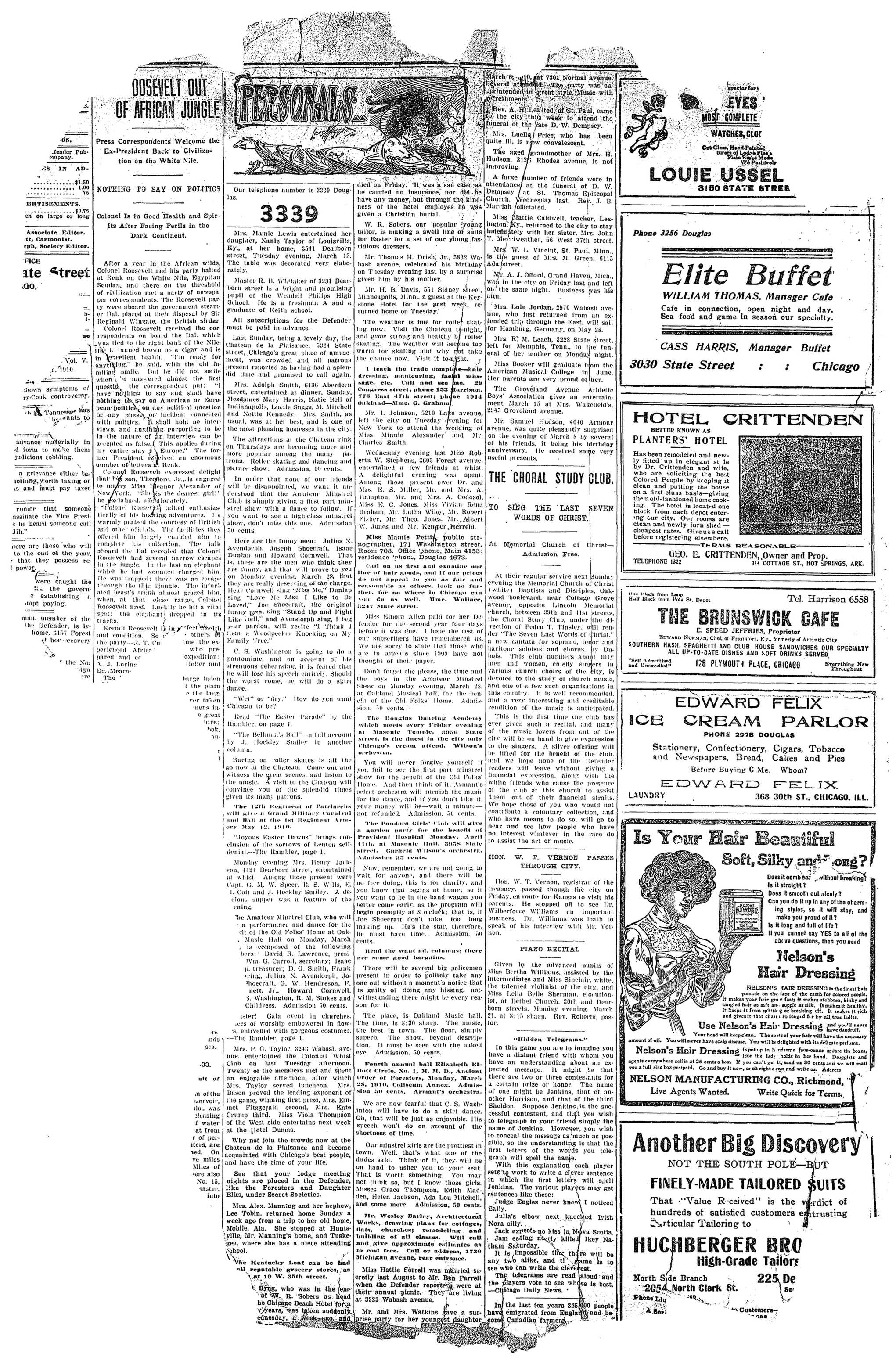
Press Correspondents Welcome the Ex-President Back to Civilization on the White Nile.
Colonel Is in Good Health and Spirit
Its After Facing Perils in the
Dark Continent.
After a year in the African wilds, Colonel Roosevelt and his party halted at Renk on the White Nile, Egyptian Soudan, and there on the threshold of civilization met a party of newspaper correspondents. The Roosevelt party were aboard the government steamer Dal, placed at their disposal by Sir Reginald Wingate, the British sirdar
Colonel Roosevelt received the correspondents on board the Dal, which was tied to the right bank of the Nile. He t. "arned brown as a cigar and is in excellent health. "I'm ready for anything," he said, with the old familiar smile. But he did not smile when he answered almost the first question, the correspondent put: "I have nothing to say and shall have nothing to say on American or European politics, on any political question or any phase or incident connected with politics. It shall hold no interviews, and anything purporting to be in the nature of an interview can be accepted as false. This applies during my entire stay in Europe." The former President received an enormous number of letters to Renk.
Colonel Roosevelt expressed delight that his son, Theodore, Jr., is engaged to marry Miss Heanor Alexander of New York. "She is the dearest girl; he explained affectionately.
Colonel Roosevelt talked enthusiastically of his hosting adventures. He warmly praised the courtesy of British and other officials. The facilities they offered him largely enabled him to complete his collection. The talk aboard the Dal revealed that Colonel Roosevelt had several narrow escapes in the jungle. In the last an elephant which he had wounded charged him. He was trapped; there was no escape through the thick jungle. The inturated beast's trunk almost grazed him, when, at that close range, Colonel Roosevelt fired. Luckily he hit a vital spot: the elephant dropped in its tracks.
PERSONALS.
Our telephone number is 3339 Doug las.
died on Friday. It was a sad case he carried no Insurance, nor did have any money, but through the k
3339
Mrs. Mumie Lewis entertained her daughter, Nanie Taylor of Louisville, Ky., at her home, 3541 Deairborn street, Tuesday evening, March 15. The table was decorated very elaborately.
Master R. B. Whitaker of 3231 Dearborn street is a bright and promising pupil of the Wendell Phillips High School. He is a freshman A and a graduate of Keith school.
All subscriptions for the Defender must be paid in advance.
Last Sunday, being a lovely day, the Chateau de la Pluisance, 5524 State street, Chicago's great place of amusement, was crowded and all patrons present reported as having had a splendid time and promised to call again.
Mrs. Adolph Smith, 6136 Aberdeen street, entertained at dinner. Sunday, Mesdames Mary Harris, Katie Bell of Indianapolis, Lucile Suggs, M. Mitchell and Nettie Kennedy. Mrs. Smith, as usual, was at her best, and is one of the most pleasing hostesses in the city.
The attractions at the Chateau rink on Thursdays are becoming more and more popular among the many patrons. Roller skating and dancing and picture show. Admission, 10 cents.
In order that none of our friends will be disappointed, we want it understood that the Amateur Minstrel Club is simply giving a first part minstrel show with a dance to follow. If you want to see a high-class minstrel show, don't miss this one. Admission 50 cents.
Here are the funny men: Julius N. Avendorp, Joseph Shoecraft, Isaac Dunlap and Howard Cornwell. That is, these are the men who think they are funny, and that will prove to you on Monday evening, March 28, that they are really deserving of the charge. Hear Cornwell sing "Kiss Me," Dunlap sing "Love Me Like I Like to Be Loved," Joe Shoecraft, the original funny pose, sing "Stand Up and Fight Like Hell," and Avendorp sing, I beg your pardon, will recite "I Think I Hear a Woodpecker Knocking on My Family Tree."
C. S. Washington is going to do a pantomime, and on account of his strenuous rehearsing, it is feared that he will lose his speech entirely. Should the worst come, he will do a skirt dance.
"Wet" or "dry." How do you want Chicago to be?
Read "The Easter Parade" by the Rambler, on page 1.
"The Bellman's Ball"—a full account by J. Hockley Smiley in another column.
Racing on roller skates is all the go now at the Chateau. Come out and witness the great scenes, and listen to the music. A visit to the Chateau will convince you of the splendid times given its many patrons.
The 12th Regiment of Patrarchs will give a Grand Military Carnival and Ball at the 1st Regiment Armory May 12, 1910.
"Joyous Easter Dawns" brings conclusion of the sorrows of Lenten self-denial.—The Rambler, page 1.
Monday evening Mrs. Henry Jackson, 4124 Dearborn street, entertained at whist. Among those present were Capt. G. M. W. Speer, B. S. Wills, E. L. Coit and J. Hockley Smiley. A delicious supper was a feature of the evening.
The Amateur Minstrel Club, who will a performance and dance for the fit of the Old Folks' Home at Oakland Music Hall on Monday, March is composed of the following bers: David R. Lawrence, presi-Wm. G. Carroll, secretary; Isaac p. treasurer; D. G. Smith, Frank ring, Julius N. Avendorph, Jothoecraft, G. W. Hendreson, P. nett, Jr., Howard Cornwell, S. Washington, R. M. Stokes and Childress. Admission 50 cents.
master! Gala event in churches.ces of worship embowered in flowers, enlivened with gorgeous costumes.—The Rambler, page 1.
Mrs. P. G. Taylor, 3243 Wabash avenue, entertained the Colonial Whist Club on last Tuesday afternoon. Twenty of the members met and spent an enjoyable afternoon, after which Mrs. Taylor served luncheon. Mrs. Bason proved the leading exponent of the game, winning first prize, Mrs. Emmet Fitzgerald second, Mrs. Kate Crump third. Miss Viola Thompson of the West side entertains next week at the Hotel Dumas.
Why not join the crowds now at the Chateau de la Plafsance and become acquainted with Chicago's best people, and have the time of your life.
See that your lodge meeting nights are placed in the Defender, like the Foresters and Daughter Elks, under Secret Societies.
Mrs. Alex. Manning and her nephew, Lee Tobin, returned home Sunday a week ago from a trip to her old home, Mobile, Ala. She stopped at Huntsville, Mr. Manning's home, and Tuskegee, where she has a niece attending school.
The Kentucky Lont can be had all reputable grocery stores, as at 10 W. 35th street.
died on Friday. It was a sad case, as he carried no insurance, nor did he have any money, but through the kindness of the hotel employees he was given a Christian burial.
W. R. Sobers, our popular young tailor, is making a swell line of suits for Easter for a set of our young fastidious dressers.
Mr. Thomas H. Drish, Jr., 5832 Wabash avenue, celebrated his birthday on Tuesday evening last by a surprise given him by his mother.
Mr. H. B. Davls, 551 Sidney street, Minneapolis, Minn., a guest at the Keystone Hotel for the past week, returned home on Tuesday.
The weather is fine for roller skating now. Visit the Chateau on night, and grow strong and healthy by roller skating. The weather will become too warm for skating and why not take the chance now. Visit it to night.
1 teach the trade complete—hair dressing, manicuring, facial massage, etc. Call and see me. 20 Congress street; phone 153 Harrison. 776 East 47th street; phone 1914 Oakland—Mme. G. Graham.
Mr. I. Johnson, 5210 Lake avenue, left the city on Tuesday evening for New York to attend the wedding of Miss Minnie Alexander and Mr. Charles Smith.
Wednesday evening last Miss Roberta W. Stephens, 3605 Forest avenue, entertained a few friends at whist. A delightful evening was spent. Among those present ewer Dr. and Mrs. E. S. Miller, Mr. and Mrs. A. Hampton, Mr. and Mrs. A. Codozol, Miss E. C. Jones, Miss Vivian Rena Braham, Mr. Lathe Wiley, Mr. Robert Fisher, Mr. Theo. Jones, Mr. Albert W. Jones and Mr. Kemper, Herreld.
Miss Mamie Pottie, public stenographer, 171 Washington street, Room 708. Office phone, Main 4153; residence phone, Douglas 4673.
Call on us first and examine our line of hair goods, and if our prices do not appeal to you as fair and reasonable as others, look no further, for no where in Chicago can you do as well. Mue. Wallace, 3247 State street.
Miss Elmora Allen paid for her Defender for the second year four days before it was due. I hope the rest of our subscribers have remembered us. We are sorry to state that those who are in arrests since 1909 have not thought of their paper.
Don't forget the please, the time and the noys in the Amateur Minstrel Show on Monday evening, March 28, at Oakland Musical hall, for the benefit of the Old Folks' Home. Admission, 50 cents.
The Douglas Dancing Academy which meets every Friday evening at Masonic Temple, 3956 State street, is the finest in the city only Chengo's cream attend. Wilson's orchestra.
You will never forgive yourself if you fail to see the first part minstrel show for the benefit of the Old Folks' Home. And then think of it, Armant's select orchestra will murnish the music for the dance, and if you don't like it, your money will be—wait a minute—not refunded. Admission, 50 cents.
The Pandora Girls' Club will give a garden parity for the benefit of Provident Hospital Monday, April 11th, at Mussonic Hall, 23558 State street. Carfield Wilson's orchestra. Admission, 35 cents.
Now, remember, we are not going to wait for anyone, and there will be no free doing, this is for charity, and you know that begins at home; so if you want to be in the band wagon you better come early, as the program will begin promptly at S o'clock; that is, if Joe Shoercraft don't take too long making up. He's the star, therefore, he must have time. Admission. 50 cents.
Read the want an. columns; there are some good bargains.
There will be several big policemen present in order to politely take any one out without a moment's notice that is guilty of doing any hissing, not withstanding there might be every reason for it.
The place, is Oakland Music hall. The time, is 8:30 sharp. The music, the best in town. The floor, simply superb. The show, beyond description. It must be seen with the naked eye. Admission. 50 cents.
Fourth annual ball Elizabeth Elliott Circle, No. 1, M. M. D., Ancient Order of Foresters, Monday, March 28, 1910, Coliseum Annex. Admission 50 cents. Armant's orchestra.
We are now fearful that C. S. Washington will have to do a skirt dance. Oh, that will be just as enjoyable. His speech won't do on account of the shortness of time.
Our minstrel girls are the prettiest in town. Well, that's what one of the dudes said. Think of it, it will be on hand to usher you to your seat. That is worth something. You may not think so, but I know those girls. Misses Grace Thompson, Edith Madden, Helen Jackson, Ada Lou Mitchell, and some more. Admission, 50 cents.
Mr. Wesley Barley, Architectural Works, drawing plans for cottages, flats, churches; remodeling and building of all classes. Will call and give approximate estimates as to cost free. Call or address, 1730 Michigan avenue, rear entrance.
Miss Hattie Sorrell was married secretly last August to Mr. Ben Parrell when the Defender reporters were at their annual picnic. They are living at 3223 Wabash avenue.
March 6, p10, at 7301 Normal avenue. Several attended. The party was superintended in great style. Music with refreshments.
Rev. A. H. Lealted, of St. Paul, came to the city this week to attend the funeral of the late D. W. Dempsey.
Mrs. Luella Price, who has been quite ill, is now convalescent.
The aged grandmother of Mrs. H. Hudson, 3126 Rhodes avenue, is not improving.
Mrs. Luella Price, who has been quite ill, is now convalescent.
The aged grandmother of Mrs. H. Hudson, 3126 Rhodes avenue, is not improving.
A large number of friends were in attendance at the funeral of D. W. Dempsey at St. Thomas Episcopal Church. Wednesday last. Rev. J. B. Marriah officiated.
Miss Mattie Caldwell, teacher, Lexington, Ky., returned to the city to stay indefinitely with her sister, Mrs. John T. Merriweather, 56 West 37th street.
Mrs. W. L. Vineint, St. Paul, Minn., is the guest of Mrs. M. Green, 6115 Ada street.
Mr. A. J. Offord, Grand Haven, Mich., was in the city on Friday last and left on the same night. Business was his aim.
Mrs. Lulu Jordan, 2970 Wabash avenue, who just returned from an extended trip through the East, will sail for Hamburg, Germany, on May 28.
Mrs. R. M. Leach, 3228 State street, left for Memphis, Tenn., to the funeral of her mother on Monday night.
Miss Booker will graduate from the American Musical College in June. Her parents are very proud of her.
The Groveland Avenue Athletic Boys' Association gives an entertainment March 15 at Mrs. Wakefield's, 2945 Groveland avenue.
aint, St. Paul, Minn. Mrs. M. Green, 6115
Grand Haven, Mich. on Friday last and left. Business was his
an, 2970 Wabash ave. returned from an ex- eighth the East, will sail Germany, on May 28.
Chich, 3228 State street, Tenn., to the fun- er on Monday night.
Will graduate from the Coll College in June. Every proud of her.
Avenue Athletic gives an entertain- at Mrs. Wakefield's, avenue.
Mr. Samuel Hudson, 4040 Armour avenue, was quite pleasantly surprised on the evening of March 8 by several of his friends, it being his birthday anniversary. He received some very useful presents.
THE CHORAL STUDY CLUB.
TO SING THE LAST SEVEN WORDS OF CHRIST.
THE CHORAL STUDY CLUB.
TO SING THE LAST SEVEN WORDS OF CHRIST.
At Memorial Church of Christ—Admission Free.
At their regular service next Sunday evening the Memorial Church of Christ (white) Baptists and Disciples, Oakwood boulevard, near Cottage Grove avenue, opposite Lincoln Memorial church, between 39th and 41st streets, the Choral Sturry Club, under the direction of Pedro T. Tinsley, will render "The Seven Last Words of Christ," a new cantata for soprano, tenor and baritone soloists and chorus, by DuBois. This club numbers about fifty men and women, chiefly singers in various church choirs of the city, is devoted to the study of church music, and one of a few such organizations in this country. It is well recommended, and a very interesting and creditable rendition of the music is anticipated.
This is the first time the club has ever given such a recital, and many of the music lovers from out of the city will be on hand to give expression to the singers. A silver offering will be lifted for the benefit of the club, and we hope none of the Defender readers will leave without giving a financial expression, along with the white friends who cause the presence of the club at this church to assist them out of their financial straits. We hope those of you who would not contribute a voluntary collection, and who have means to do so, will go to hear and see how people who have no interest whatever in the race do to assist the art of music.
HON. W. T. VERNON PASSES THROUGH CITY.
Hon. W. T. Vernon, registrar of the treasury, passed through the city on Friday, en route for Kansas to visit his parents. He stopped off to see Dr. Wilberforce Williams on important business. Dr. Williams was loath to speak of his interview with Mr. Vernon.
PIANO RECITAL
Given by the advanced pupils of Miss Bertha Williams, assisted by the intermediates and Miss Sinclair, white, the talented violinist of the city, and Miss Lelia Belle Sherman, elocutionist, at Bethel Church, 30th and Dearborn streets. Monday evening, March 21, at 8:15 sharp. Rev. Roberts, pastor.
"Hidden Telegrams."
In this game you are to imagine you have a distant friend with whom you have an understanding about an expected message. It might be that there are two or three contestants for a certain prize or honor. The name of one might be Jenkins, that of another Harrison, and that of the third Sheldon. Suppose Jenkins is the successful contestant, and that you wish to telegraph to your friend simply the name of Jenkins. However, you wish to conceal the message as much as possible, so the understanding is that the first letters of the words you telegraph will spell the name.
With this explanation each player sets to work to write a clever sentence in which the first letters will spell Jenkins. The various players may get sentences like these:
Judge Engles never knew I noticed Sally.
Julia's elbow next knocked Irish Nora silly.
Jack expects no kiss in Nova Scotia. Jam eating nearly killed Ikey Natham Saturday.
It is impossible that there will be any two alike, and the game is to see who can write the cleverest.
The telegrams are read aloud and the players vote to see whose is best. —Chicago Daily News.
In the last ten years 325,000 people have emigrated from England and become Canadian farmers.
years 325,000 people from England and be-armers.
spatior for
EYES
MOST COMPLETE
WATCHES, GLOE
Cut Glass, Hand Painted
turtles of Lodge Pines &
Plain Rings Mode
We Positively
LOUIE USSEL
3150 STATE STREET
Is Your Hair Beautiful
Soft, Silky and Long?
Does it comb ear without breaking?
Is it straight?
Does it smooth out nicely?
Can you do it up in any of the charming styles, so it will stay, and make you proud of it?
Is it long and full of life?
If you cannot say YES to all of the above questions, then you need
Nelson's
Hair Dressing
NELSON'S HAIR DRESSING is the finest hair pomade on the face of the earth for colored people. It makes your hair grow fast. It makes stubborn, kinky and tangled hair as soft and supple as silk. It makes it healthy. It keeps it from splitting or breaking off. It makes it rich and gives it that charm so longed for by all true ladies.
Use Nelson's Hair Dressing and you'll never have dandruff. Your head will keep ean. The roots of your hair will have the necessary amount of oil. You will never have scalp disease. You will be delighted with its delicate perfume.
Nelson's Hair Dressing is put up in handsome four-ounce square tin boxes, like the lady holds in her hand. Droughts and agents everywhere sell at 25 cent a box. If you can't get it, send us 30 cents and we will mail you a full size box postpaid. Go and buy it now, or sit right down and write us. Address
NELSON MANUFACTURING CO., Richmond,
Live Agents Wanted. Write Quick for Terms.
Phone 3256 Douglas
Elite Buffet
WILLIAM THOMAS, Manager Cafe
Cafe in connection, open night and day.
Sea food and game in season our specialty.
CASS HARRIS, Manager Buffet
3030 State Street : : Chicago
100
TERMS REASONABLE
E.O. E. CRITTENDEN, Owner and Proprietor
822 314 COTTAGE ST., HOT S
Group
Polk St. Depot
Tel. Har
THE BRUNSWICK GAR
E. SPEED JEFFRIES, Proprietor
ORD NORMAN, Chef, of Frankfort, Ky., formerly of Atlantic
H, SPAGHETTI AND CLUB HOUSE SANDWICHES CO.
L UP-TO-DATE DISHES AND SOFT DRINKS SERVE
128 PLYMOUT 1 PLACE, CHICAGO
REASONABLE
LINDEN, Owner and Prop.
314 COTTAGE ST., HOT SPRINGS, ARK
Tel. Harrison 655
HISWICK CAFE
EFFRIES, Proprietor
Frankfort, Ky., formerly of Atlantic City
CLUB HOUSE SANDWICHES OUR SPECIALT
TES AND SOFT DRINKS SERVED
T1 PLACE, CHICAGO
Everything Near
Throughout
EDWARD FELIX
CREAM PAR
PHONE 2928 DOUGLAS
onery. Confectionery. Cigars. Tob
AM PARLOR
1928 DOUGLAS
ionery. Cigars. Tobacco
Stationery, Confectionery, Cigars, Tobacco and Newspapers, Bread, Cakes and Pies Before Buying C Me. Whom?
That "Value Received" is the verdict of hundreds of satisfied customers entrusting particular Tailoring to