Chicago Defender
Saturday, January 27, 1912
Chicago, Illinois
Page text (machine-generated)
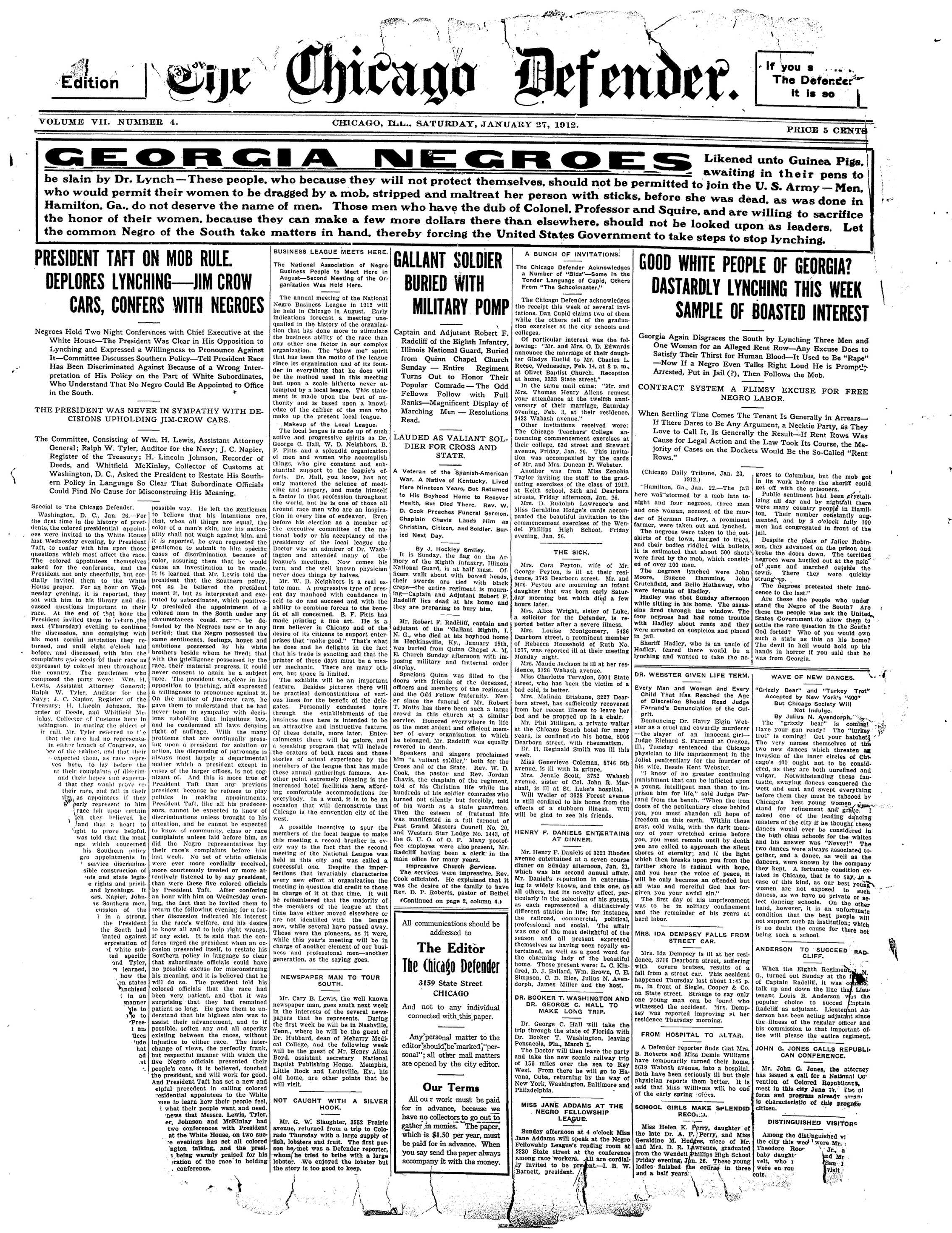
be slain by Dr. Lynch-These people, who because they will not protect themselves, should not be permitted to join the U. S. Army-Men, who would permit their women to be dragged by a mob, stripped and maltreat her person with sticks, before she was dead, as was done in Hamilton, Ga., do not deserve the name of men. Those men who have the dub of Colonel, Professor and Squire, and are willing to sacrifice the honor of their women, because they can make a few more dollars there than elsewhere, should not be looked upon as leaders. Let the common Negro of the South take matters in hand, thereby forcing the United States Government to take steps to stop lynching
and a half years.
VOLUME VII. NUMBER 4.
be slain by Dr. Lynch who would permit their Hamilton, Ga., do not die the honor of their work the common Negro of the
PRESIDENT TAFT ON MY DEPLORES LYNCHING—CARS, CONFERS W
Negroes Hold Two Night Conferences with White House—The President Was C Lynching and Expressed a Willingness It—Committee Discusses Southern Po Has Been Discriminated Against Be pretation of His Policy on the Party Who Understand That No Negro Cou in the South.
THE PRESIDENT WAS NEVER IN ST CISIONS UPHOLDING JIM-
The Committee, Consisting of Wm. H. L. General; Ralph W. Tyler, Auditor for Register of the Treasury; H. Lincoln Deeds, and Whitfield McKinley, C Washington, D. C., Asked the Presiden-ern Policy in Language So Clear The Could Find No Cause for Misconstrui
PRESIDENT TAFT ON MOB RULE. DEPLORES LYNCHING-JIM CROW CARS, CONFERS WITH NEGROES
Negroes Hold Two Night Conferences with Chief Executive at the White House—The President Was Clear in His Opposition to Lynching and Expressed a Willingness to Pronounce Against It—Committee Discusses Southern Policy—Tell President Race Has Been Discriminated Against Because of a Wrong Interpretation of His Policy on the Part of White Subordinates, Who Understand That No Negro Could Be Appointed to Office in the South.
THE PRESIDENT WAS NEVER IN SYMPATHY WITH DECISIONS UPHOLDING JIM-CROW CARS.
The Committee, Consisting of Wm. H. Lewis, Assistant Attorney General; Ralph W. Tyler, Auditor for the Navy; J. C. Napier, Register of the Treasury; H. Lincoln Johnson, Recorder of Deeds, and Whitfield McKinley, Collector of Customs at Washington, D. C., Asked the President to Restate His Southern Policy in Language So Clear That Subordinate Officials Could Find No Cause for Misconstruing His Meaning.
people's
the presi
And Presi
helpful i
resident
ouse to
l what
new
er,
two
at
e
ing
r
---
Special to The Chicago Defender.
Washington, D. C., Jan. 26.—For the first time in the history of presidents, the colored presidential appointees were invited to the White House last Wednesday evening, by President Taft, to confer with him upon those questions which most affect the race. The colored appointees themselves asked for the conference, and the President not only cheerfully, but cordially invited them to the White House proper. For an hour on Wednesday evening, it is reported, they sat with him in his library and discussed questions important to their race. At the end of that hour the President invited them to return, the next (Thursday) evening to continue the discussion, and complying with his most cordial invitation they returned, and until eight o'clock laid before, and discussed with him the complaints and needs of their race as expressed by colored men throughout the country. The gentlemen who composed the party were: Wm. H. Lewis, Assistant Attorney General; Ralph W. Tyler, Auditor for the Navy; J. C. Napler, Register of the Treasury; H. Lincoln Johnson, Reader of Deeds, and Whitfield Minlay, Collector of Customs here in Washington. In stating the object of his call, Mr. Tyler referred to the that the race had no representation in either branch of Congress, no伯 of the cabinet, and that their expected them, as race represents here, to lay before the their complaints of discrimination and their hopes and expectations that they would prove re their race, and full in their as appointees if they perly represent to him race felt upon certain which they believed he and that a heart to right to prove helpful was told that the most ngs which concerned his Southern policy gro appointments in service discrimin- sible construction of rights and state legis- rights and privil- and lynchings. It usrs. Napier, John- as Southern men, cussion of the in a strong, the President the South had inated against erpretation of white sub- tected specific and Tyler, learned, how the arn states unchised in an manner able to Pres- tent naces hide hat ad at
possible way. He left the gentlemen to believe that his intentions are, that, when all things are equal, the color of a man's skin, nor his nationality shall not weigh against him, and it is reported, he even requested the gentlemen to submit to him specific cases of discrimination because of color, assuring them that he would cause an investigation to be made. It is learned that Mr. Lewis told the president that the Southern policy, not as he believed the president meant it, but as interpreted and executed by subordinates, which positively precluded the appointment of a colored man in the South under any circumstances could. never be defended by the Negroes now or in any period; that the Negro possessed the same sentiments, feelings, hopes and ambitions possessed by his white brothers beside whom he lived; that with the intelligence possessed by the race, their material progress, it could never consent to again be a subject race. The president was clear in his opposition to lynching, and expressed a willingness to pronounce against it. On the matter of jim-crow cars, he gave them to understand that he had never been in sympathy with decisions upholding that iniquitous law, and he condemned all laws denying right of suffrage. With the many problems that are continually pressing upon a president for solution or action, the dispensing of patronage is always most largely a departmental matter which a president except in cases of the larger offices, is not cognizant of. And this is more true of President Taft than any previous president because he refuses to play politics in making appointments. President Taft, like all his predecessors, cannot be expected to know of discriminations unless brought to his attention, and he cannot be expected to know of community, class or race complaints unless laid before him, as did the Negro representatives lay their race's complaints before him last week. No set of white officials were ever more cordially received, more courteously treated or more attentively listened to by any president, than were these five colored officials by President Taft. After conferring an hour with him on Wednesday evening, the fact that he invited them to return the following evening for a further discussion indicated his interest in the race's welfare, and his desire to know all and to help right wrongs if any exist. It is said that the conferences urged the president when an occasion presented itself, to restate his Southern policy in language so clear that subordinate officials could have no possible excuse for misconducting his meaning, and it was believed that he will do so. The president told his colored officials that the race had been very patient, and that it was surprising that they had remained patient so long. He gave them to understand that his highest aim was to assist their advancement, and to if possible, soften any and all asperity existing between the races, without injustice to either race. The interchange of views, the perfectly frank, but respectful manner with which the five Negro officials presented their people's case, it is believed, touched the president, and will work for good. And President Taft has set a new and helpful precedent in calling colored residential appointees to the White House to learn how their people feel, what their people want and need. News that Messrs. Lewis, Tyler, er, Johnson and McKinlay had two conferences with President at the White House, on two success evenings has set all coloredington talking, and the presiding being warmly praised for hisoration of the race in holding conference.
CHICAGO, DLL.. SATURDAY, JANUARY 27, 1912.
BUSINESS LEAGUE MEETS HERE.
The National Association of Negro Business People to Meet Here in August—Second Meeting of the Organization Was Held Here.
The annual meeting of the National Negro Business League in 1912 will be held in Chicago in August. Early indications forecast a meeting unequalled in the history of the organization that has done more to stimulate the business ability of the race than any other one factor in our complex organization. The "show me" spirit that has been the motto of the league since its organization and of its founder in everything that he does will be the method used in this meeting but upon a scale hitherto never attempted by a local league. This statement is made upon the best of authority and is based upon a knowledge of the caliber of the men who make up the present local league.
Makeup of the Local League.
The local league is made up of such active and progressive spirits as Dr. George C. Hall, W. D. Neighbors, B. F. Fitts and a splendid organization of men and women who accomplish things, who give constant and substantial support to the league's efforts. Dr. Hall, you know, has not only mastered the science of medicine and surgery, and made himself a factor in that profession throughout the world, but he is one of those all around race men who are an inspiration in every line of endeavor. Even before his election as a member of the executive committee of the national body or his acceptancy of the presidency of the local league the Doctor was an admirer of Dr. Washington and attended many of the league's meetings. Now comes his turn, and the well known physician never does things by halves.
Mr. W. D. Neighbors is a real estate man. A progressive type of present day manhood with confidence in self to do and succeed and with the ability to combine forces to the benefit of all concerned. B. F. Fitts has made printing a fine art. He is a firm believer in Chicago and of the desire of its citizens to support enterprises that "make good." That's what he does and he delights in the fact that his trade is exacting and that the printer of these days must be a master mechanic. There are many others, but space is limited.
The exhibits will be an important feature. Besides pictures there will be practical demonstrations of various lines for the benefit of the delegates. Personally conducted tours through the establishments of the business men here is intended to be an attractive and instructive feature. Of these details, more later. Entertainments there will be galore, and a speaking program that will include the orators of both races and those stories of actual experience by the members of the league that has made these annual gatherings famous. Another point extremely pleasing is the increased hotel facilities here, affording comfortable accommodations for everybody. In a word, it is to be an occasion that will demonstrate that Chicago is the convention city of the west.
A possible incentive to spur the members of the local league to make this meeting a record breaker in every way is the fact that the second meeting of the National League was held in this city and was called a successful one. Despite the imperfections that invariably characterize every new effort at organization the meeting in question did credit to those in charge of it at that time. It will be remembered that the majority of the members of the league at that time have either moved elsewhere or are not identified with the league now, while several have passed away. Those were the ploneers, as it were, while this year's meeting will be in charge of another element of our business and professional men—another generation, as the saying goes.
NEWSPAPER MAN TO TOUR SOUTH.
Mr. Cary B. Lewis, the well known newspaper man, goes south next week in the interests of the several newspapers that he represents. During the first week he will be in Nashville, Tenn., where he will be the guest of Dr. Hubbard, dean of Meharry Medical College, and the following week will be the guest of Mr. Henry Allen Boyd, assistant secretary National Baptist Publishing House, Memphis, Little Rock and Louisville, Ky., his old home, are other points that he will visit.
NOT CAUGHT WITH A SILVER HOOK.
Mr. G. W. Slaughter, 3552 Prairie avenue, returned from a trip to Colorado Thursday with a large supply of fish, lobsters and fruit. The first person he/met was a Defender reporter, whom he tried to bribe with a large lobster. We enjoyed the lobster but the story is too good to keep.
GALLANT SOLDIER BURIED WITH MILITARY POMP
Captain and Adjutant Robert F. Radcliff of the Eighth Infantry, Illinois National Guard, Buried from Quinn Chapel Church Sunday — Entire Regiment Turns Out to Honor Their Popular Comrade—The Odd Fellows Follow with Full Ranks—Magnificent Display of Marching Men — Resolutions Read.
LAUDED AS VALIANT SOLDIER FOR CROSS AND STATE
A Veteran of the Spanish-American War. A Native of Kentucky. Lived Here Nineteen Years, But Returned to His Boyhood Home to Recover Health, But Died There. Rev. W. D. Cook Preaches Funeral Sermon. Chaplain Chavis Lauds Him as Christian, Citizen, and Soldier. Buried Next Day.
By J. Hockley Smiley
It is Sunday, the flag on the Armory of the Eighth Infantry, Illinois National Guard, is at half mast. Officers walk about with bowed heads, their swords are tied with black crepe—the entire regiment is mourning—Captain and Adjutant Robert F. Radcliff lies dead at his home and they are preparing to bury him.
Mr. Robert F. Radcliff, captain and adjutant of the "Gallant Eighth, I. N. G., who died at his boyhood home in Hopkinsville, Ky., January 19th, was buried from Quinn Chapel A. M. E. Church Sunday afternoon with imposing military and fraternal order display.
Spacious Quinn was filled to the doors with friends of the deceased, officers and members of the regiment and the Odd Fellow fraternity. Never since the funeral of Mr. Robert T. Motts has there been such a large crowd in this church at a similar service. Honored everywhere in life as the most ardent and efficient member of every organization to which he belonged, Mr. Radcliff was equally revered in death.
Speakers and singers proclaimed him "a valiant soldier," both for the Cross and of the State. Rev. W. D. Cook, the pastor and Rev. Jordan Chavis, the chaplain of the regiment, told of his Christian life while the hundreds of his soldier comrades who turned out silently but forcibly, told of his worth as a state guardman. Then the esteem of fraternal life was manifested in a full turnout of Past Grand Masters Council No. 20, and Western Star Lodge No. 1443, of the G. U. O. of O. F. Many postoffice employees were also present, Mr. Radcliff having been a clerk in the main office for many years.
Impressive Church Services.
The services were impressive. Rev. Cook officiated. He explained that it was the desire of the family to have Rev. D. P. Roberts, pastor of Bethel (Continued on page 2, column 4.)
All communications should be addressed to
The Editor
The Chicago Defender
3159 State Street
CHICAGO
And not to any individual connected with this paper.
Any personal matter to the editor should be marked "personal"; all other mail matters are opened by the city editor.
Our Terms
All our work must be paid for in advance, because we have no collectors to go out to gather in monies. The paper, which is $1.50 per year, must be paid for in advance. When you say send the paper always accompany it with the money.
A BUNCH OF INVITATIONS.
The Chicago Defender Acknowledges a number of "Bids"—Some in the Tender Language of Cupid, Others From "The Schoolmaster."
The Chicago Defender acknowledges the receipt this week of several invitations. Dan Cupid claims two of them while the others tell of the graduation exercises at the city schools and colleges.
Of particular interest was the following: "Mr. and Mrs. O. D. Edwards announce the marriage of their daughter Gladys Euclid to Mr. Charles L. Reese, Wednesday, Feb. 14, at 8 p. m., at Olivet Baptist Church. Reception at home, 3333 State street."
In the same mail came: "Mr. and Mrs. Thomas Henry Allens request your attendance at the twelfth anniversary of their marriage, Saturday evening, Feb. 3, at their residence, 3433 Wabash avenue."
Other invitations received were: The Chicago Teachers' College announcing commencement exercises at their college, 63d street and Stewart avenue, Friday, Jan. 26. This invitation was accompanied by the cards of Mr. and Mrs. Duncan P. Webster.
Another was from Miss Zenobia Taylor inviting the staff to the graduating exercises of the class of 1912, at Keith school, 34th and Dearborn streets, Friday afternoon, Jan. 26.
Mrs. D. Rudolph Lawrence's and Miss Geraldine Hodge's cards accompanied the beautiful invitation to the commencement exercises of the Wendel Phillips High School, Friday evening. Jan. 26.
THE SICK.
Mrs. Cora Peyton, wife of Mr. George Peyton, is ill at their residence, 3743 Dearborn street. Mr. and Mrs. Peyton are mourning an infant daughter that was born early Saturday morning but which died a few hours later.
Mrs. Alice Wright, sister of Luke, a solicitor for the Defender, is reported better after a severe illness.
Mrs. Louise Montgomery, 5436 Dearborn street, a prominent member of Rebecca Household of Ruth No. 1277, was reported ill at their meeting Monday night.
Mrs. Maude Jackson is ill at her residence, 3126 Wabash avenue.
Miss Charlotte Tervalon, 5004 State street, who has been the victim of a bad cold, is better.
Mrs. Malinda Brisbane, 3227 Dearborn street, has sufficiently recovered from her recent illness to leave her bed and be propped up in a chair.
Mr. Phil Milligan, a private waiter at the Chicago Beach hotel for many years, is confined to his home, 5006 Dearborn street, with rheumatism.
Dr. H. Reginald Smith was ill this week.
Miss Genevieve Coleman, 5746 5th avenue, is ill with la gripe.
Mrs. Jennie Scott, 3752 Wabash avenue, sister of Col. John R. Marshall, is ill at St. Luke's hospital. Will Weller of 3628 Forest avenue is still confined to his home from the effects of a stubborn illness. Will will be glad to see his friends.
HENRY F. DANIELS ENTERTAINS
AT DINNER.
Mr. Henry F. Daniels of 3221 Rhodes avenue entertained at a seven course dinner on Sunday afternoon, Jan. 21, which was his second annual affair. Mr. Daniel's reputation in entertaining is widely known, and this one, as all others, had its novelty effect, particularly in the selection of his guests, as each represented a distinctively different station in life; for instance, the railroad, commercial, political, professional and social. The affair was one of the most delightful of the season and all present expressed themselves as having been royally entertained, as well as a good word for the charming lady of the beautiful home. Those present were: L. C. Kindred, D. J. Ballard, Wm. Brown, C. E. Simpson, C. D. Rice, Julius N. Avendorch, James Miller and the host.
DR. BOOKER T. WASHINGTON AND
DR. GEORGE C. HALL TO
MAKE LONG TRIP.
Dr. George C. Hall will take the trip through the state of Florida with Dr. Booker T. Washington, leaving Pensacola, Fla., March 1.
The Doctor will then leave the party and take the new scenic railway trip of 150 miles over the sea to Key West. From there he will go to Havana, Cuba, returning by the way of New York, Washington, Baltimore and Philadelphia.
MISS JANE ADDAMS AT THE NEGRO FELLOWSHIP LEAGUE.
Sunday afternoon at 4 o'clock Miss Jane Addams will speak at the Negro Fellowship League's reading room at 2830 State street at the conference among race workers. All are cordially invited to be present—I. B. W. Barnett, president.
Likened unto Guinea Pigs, awaiting in their pens to
GOOD WHITE PEOPLE OF GEORGIA? DASTARDLY LYNCHING THIS WEEK SAMPLE OF BOASTED INTEREST
GOOD WHITE PEOPLE OF GEORGIA? DASTARDLY LYNCHING THIS WEEK SAMPLE OF BOASTED INTEREST
Georgia Again Disgraces the South by Lynching Three Men and One Woman for an Alleged Rent Row—Any Excuse Does to Satisfy Their Thirst for Human Blood—It Used to Be "Rape"—Now If a Negro Even Talks Right Loud He is Promptly Arrested, Put in Jail (?), Then Follows the Mob.
CONTRACT SYSTEM A FLIMSY EXCUSE FOR FREE NEGRO LABOR.
When Settling Time Comes The Tenant Is Generally in Arrears—If There Dares to Be Any Argument, a Necktie Party, as They Love to Call It, Is Generally the Result—If Rent Rows Was Cause for Legal Action and the Law Took Its Course, the Majority of Cases on the Dockets Would Be the So-Called "Rent Rows."
(Chicago Daily Tribune, Jan. 23, 1912.)
"Hamilton, Ga., Jan. 22.—The jail here was stormed by a mob late tonight and four negroes, three men and one woman, accused of the murder of Herman Hadley, a prominent farmer, were taken out and lynched.
The negroes were taken to the outskirts of the town, harged to trees, and their bodies riddled with bullets. It is estimated that about 500 shots were fired by the mob, which consisted of over 100 men.
groves to Columbus, but the mob go in its work before the sheriff could get off with the prisoners.
Public sentiment had been crystallizing all day and by nightfall there were many country people in Hamilton. Their number constantly augmented, and by 9 o'clock fully 100 men had congregated in front of the jail.
Despite the pleas of Jailer Robin son, they advanced on the prison and broke the doors down. The terrified negroes were hustled out at the point of guns and marched astern.
The negroes lynched were John Moore, Eugene Hamming, John Crutchfield, and Belle Hathaway, who were tenants of Hadley. Hadley was shot Sunday afternoon while sitting in his home. The assassins fired through the window. The four negroes had had some trouble with Hadley about rents and they were arrested on suspicion and placed in jail. Sheriff Hadley, who is an uncle of Hadley, feared there would be a lynching and wanted to take the ne-
DR. WEBSTER GIVEN LIFE TERM.
Every Man and Woman and Every Child That Has Reached the Age of Discretion Should Read Judge Farrand's Denunciation of the Culprit.
Denouncing Dr. Harry Elgin Webster as a cruel and cowardly murderer—the slayer of an innocent girl—Judge Richard S. Farrand at Oregon, Ill., Tuesday sentenced the Chicago physician to life imprisonment in the Jolet penitentiary for the murder of his wife, Bessie Kent Webster.
"I know of no greater continuing punishment that can be inflicted upon a young, intelligent man than to imprison him for life," said Judge Farrand from the bench. "When the iron doors of the penitentiary close behind you, you must abandon all hope of freedom on this earth. Within those gray, cold walls, with the dark memory of your wretched crime before you, you must remain until by death you are called to approach the silent shores of eternity; and if the light which then breaks upon you from the farther shore is radiant with hope, and you hear the voice of peace, it will be only because an offended but all wise and merciful God has forgiven you your awful sin."
The first day of his imprisonment was to be in solitary confinement and the remainder of his years at hard labor.
MRS. IDA DEMPSY FALLS FROM STREET CAR
Mrs. Ida Dempsey is ill at her residence, 3716 Dearborn street, suffering with severe bruises, results of a fall from a street car. This accident happened Thursday last about 1:45 p.m., in front of Slegle, Cooper & Co. on State street. Strange to say only one young man can be found who witnessed the accident. Mrs. Dempsey was reported improving at her residence Thursday morning.
FROM HOSPITAL TO ALTAR.
A Defender reporter finds that Mrs. B. Roberts and Miss Demie Williams have temporarily turned their home, 5619 Wabash avenue, into a hospital. Both have been seriously ill but their physician reports them better. It is said that Miss Williams will be one of the early spring prices.
SCHOOL GIRLS MAKE SPLENDID
RECORD.
Miss Helen K. Perry, daughter of the late Dr. A. K. Perry, and Miss Geraldine M. Hodges, niece of Mr. and Mrs. D. R. Lawrence, graduated from the Wendell Phillips High School Friday evening, Jan. 26. These young ladies finished the course in three and a half years.
If you s The Defender it is so
PRICE 5 CENTS
unto Guinea Pigs, in their pens to U. S. Army—Men, dead, as was done in willing to sacrifice on as leaders. Let stop lynching.
LELE OF GEORGIA?
CHING THIS WEEK
BOASTED INTEREST
South by Lynching Three Men and Rent Row—Any Excuse Does to Man Blood—It Used to Be "Rape" talks Right Loud He is Promptly En follows the Mob.
LIMSY EXCUSE FOR FREE LABOR.
Tenant Is Generally in Arrears—Argument, a Necktie Party, as They by the Result—If Rent Rows Was the Law Took Its Course, the Mats Would Be the So-Called "Rent
groes to Columbus, but the mob got in its work before the sheriff could get off with the prisoners.
Public sentiment had been crystallizing all day and by nightfall there were many country people in Hamilton. Their number constantly augmented, and by 9 o'clock fully 100 men had congregated in front of the jail.
Despite the pleas of Jailer Robinson, they advanced on the prison and broke the doors down. The terrified negroes were hustled out at the point of guns and marched outside the town. There they were quickly strung-up.
The negroes protested their innocence to the last."
Are these the people who understand the Negro of the South? Are these the people who ask the United States Government to allow them to settle the race question in the South? God forbid? Who of you would own such a state as this as his home? The devil in hell would hold up his hands in horror if you said that he was from Georgia.
WAVE OF NEW DANCES.
"Grizzly Bear" and "Turkey Trot"
Accepted by New York's "400"
But Chicago Society Will
Not Indulge.
By Julius N. Avendorph. The "grizzly bear" is coming! Have your gun ready! The "turkey trot" is coming! Get your hatchet! The very names themselves of the two new dances which threaten an invasion of the inner circles of Chicago's 400 ought not to be considered, as they are both unrefined and vulgar. Notwithstanding these fantastic, swaying dances conquered the west and east and swept everything before them they must be tabooed by Chicago's best young women stand for refinement and grace. I asked one of the leading dancing masters of the city if he thought these dances would ever be considered in the high class schools for the whites and his answer was "Never!" The two dances were always associated together, and a dance, as well as the dancers, were known by the company they kept. A fortunate condition existed in Chicago, that is to say, in a case of this kind, as our best young women are not exposed to such dances, as we have no private or select dancing schools. On the other hand, however, it is an unfortunate condition that the best people will not support such an institution; which is no doubt the cause for there not being such a school.
ANDERSON TO SUCCEED RAD-CLIFF.
When the Eighth Regiment, N. G., turned out Sunday at the funeral of Captain Radcliff, it was common talk up and down the line that Lieutenant Louis B. Anderson was the popular choice to succeed Captain Radcliff as adjutant. Lieutenant Anderson has been acting adjutant since the illness of the regular officer and his commission to that important office will please the entire regiment.
JOHN G. JONES CALLS REPUBLI-
CAN CONFERENCE.
Mr. John G. Jones, the attorney has issued a call for a National Convention of Colored Republicans, meet in this city June 17. The of form and program already arsen is characteristic of this progress citizen.
Among the distinguished vi
the city this week were Mr.
Theodore Roor Jr., a
baby daught and Mr.
velt, who i San I
were en rou visit
ents.
M. C. A.
ADQUARTERS
the Latest News of the Work in This City—Items of Interest—Speakers.
Y. M. C. A. Banquet Well Attended.
The team workers of the recent Ten Day campaign for subscriptions to the building fund of the South Side Department, Y. M. C. A., gathered at headquarters, 3330 State street, upon invitation from the executive committee to hear the work that had been done during the year in the collection of the moneys subscribed. The headquarters was decorated with the red, white and blue hunting for the occasion. Tables were spread over the entire floor space of the room for the accommodation of the guests who were to be served.
The table was beautifully set for the banquet and at 9 p. m, the grace was asked by Mr. J. W. Moore and the men sat down to partake of the menu: Bread and butter sandwiches, ham sandwiches, sweet pickles, olives, cheese sandwiches, crackers, patato salad, coffee, ice cream and cake.
Mr. Jackson Gordon volunteered to see to the serving of the menu and was ably assisted by Messrs. J. 'F. Williams and J. C. Caldwell. Every one present was served bonfuitely and many of the guests expressed the regret that they did not come prepared to be served to a larger degree. Those who had not stopped at their usual places for their suppers were glad that they were more fortunate than the other brothers.
While seated around the table Dr. George C. Hall, chairman of the executive committee, explained the nature of the meeting and outlined the results that can be secured from the co-operation of the men in the movement. The assistant secretary, Mr. Charles W. Pierce, was called upon for the reading of statistics that had been prepared by the office to show just what work had been done during the year. The statistics showed that the people had responded very liberally to the calls by letters for the payment of their pledges, especially so, when it is taken into consideration that all of the money has been collected at the office and that collectors have not been used.
The statistics showed that the teams stand in the following order with respect to the percentage of persons paying on their accounts during the year: Citizens' committee leads, followed by teams numbers 8, 14, 7, 12, 10, 9, 5, 15, 4, 13, 2, 3, 11 and 1. Statistics with respect to the percentage of money paid as subscribed by the teams: Citizens' committee leads again, followed by the teams as follows. Teams numbers 7, 3, 5, 8, 14, 15, 4, 12, 11, 9, 7, 6, 2, 1, 13, 10. The toastmaster then called upon Mr. Charles H. Davis for the reading of resolutions that were presented to the workers for consideration. The resolution called for the assembling of the teams and Citizens' committee and their co-operation with the office in the getting payments on the accounts of the subscribers. A motion was made by Mr. Adelbert H. Roberts calling for the meeting of the teams and 'the Citizens' committee on next Sunday to consider the plans that will be presented for the collection of the money.
The toastmaster called upon several speakers to respond in three minute addresses to the toasts, as follows: Geo. B. Arthur, Alex W. Curtis, R. A. Croley, Dr. S. C. Dickerson, Chas. A. Grillin, E. A. Lightfoot, R. M. McCoon, Dr. W. M. McDowell, Chas. S. Washington, A. G. Williams. These men spoke to the toast, "The Best Methods, in My Judgment, of Getting in the Money That Was Subscribed." "What Is the Outlook for This Department of the Y. M. C. A?" was responded to by David B. Hawley, B. H. Johnson, Adelbert H. Roberts and Jas. H. Tilghman. Rev. G. Calvin Campbell and Rev. H. A. Foreman told how the ministers stood with regard to the Y. M. C. A. movement. M. J. M. Higginbotham and A. J. Walton, two of the workers who are doing such excellent work in the collecting from the subscribers, spoke to a tost. "How I Get the Money from the Subscribers."
The men who were in attendance expressed their approval of the committee's plan in getting the men interested in seeing that the subscribers pay their pledges as soon as possible. It was announced that another banquet will follow in the next month. The South Side Department announce the following speakers for their Sunday afternoon meeting, Jan. 28: Rev. R. L. Darden, pastor of the Providence Baptist church; Feb. 4, Rev. M. Shimadzu, secretary of the Japanese Y. M. C. I.; Feb. 11: Dr. J. T. Jenifer. These meetings are to be held at the headquarters, 3330 South State street. Quite an improvement is noted in the attendance and all the men express themselves as pleased with the messages that the speakers bring.
On last Sunday afternoon Mr. Frank R. Stark, captain of team number 1, spoke to the men on the value of individuality, using the spiritual reference, "All power is given unto Me in heaven and in earth." Mr. Stark made many helpful suggestions.
The department has been called upon during the last week for applicants to fill several positions in the city. Two of these were for young men with recommendations and references as to character, etc. One was for a young lady stenographer. Young men of character and qualifications are asked to file applications with the office so that they might be laced in touch with firms needing air services. The office makes noarge for securing positions for desirable men.
Mr. George R. Arthur, one of our old workers, and a former Y. worker for Baltimore, Md., has selected secretary of the Na-Associate or the Advance-College called rday, Jan. 27, at the house. aid in cribers.criptions have
been made since our last report:
George B. Arthur, 321 East 29th street; D. C. Austin, 3156 Wabash avenue; Reuben Elam, 4555' Champlain avenue; Susan Hawley, 5234 Dearborn street; Robert Hawley, 5255 Dearborn street; Geo. H. Hutchinson, 1600 East 55th street; Wm. H. Jackson, 2542 North Sacramento avenue; J. H. Johnson, 652 East 65th street; J. H. Newsome, 214 W. 30th street; J. H. Newsome, 214 W. 30th street; Mrs. and Mrs. G. W. Roberts, 6350 St. Lawrence avenue; A. J. Walton, 4712 Dearborn street.
Paid on Account Subscribers.
J. P. Bryant, 3448 Dearborn street; John Hedgepach, 3420 State street; Dr. C. D. Trice, 2902 State street; M. E. Wilms, 3152 Forest avenue; J. E. Dickson, 2210 State street.
OUT IN ENGLEWOOD.
Weekly Letter from This Thriving Section of the City—All the News.
[The party sending in an article about a wedding for publication in this column this week only used initials instead of the all names of the contracting parties. The article was not published as we must know the names in communications like this.—Ed.]
Mrs. Carrie Prier of 1346 West Gist street gave a ten course dinner in honor of her mother's seventy-first birthday. The dining room was beautifully decorated with the colors of the American flag and the table was decked with carnations and American beauty roses. Covers were laid for eighty. Among the out of town guests were Mrs. Lizzie Parks and Mrs. Belle Radford of Topeka, Kans. Rally day at Shiloh Baptist church Sunday, Jan. 28. The choir will render special music.
Mrs. Harriet Green of 137 West Gist street is still confined to her home.
The Defender was very sorry to learn of the misfortune of Richard Penn, 7240 Wentworth avenue, being burned out.
Mrs. Stella Moore, who has been confined to her bed, is able to be around the house again.
The Ideal Woman's Club has given up the Field House and will meet around from house to house. The first Friday in February is election of officers for the year.
Shiloh choir will render "Babylon Wares" Sunday evening.
DOES ANYBODY KNOW HIM?
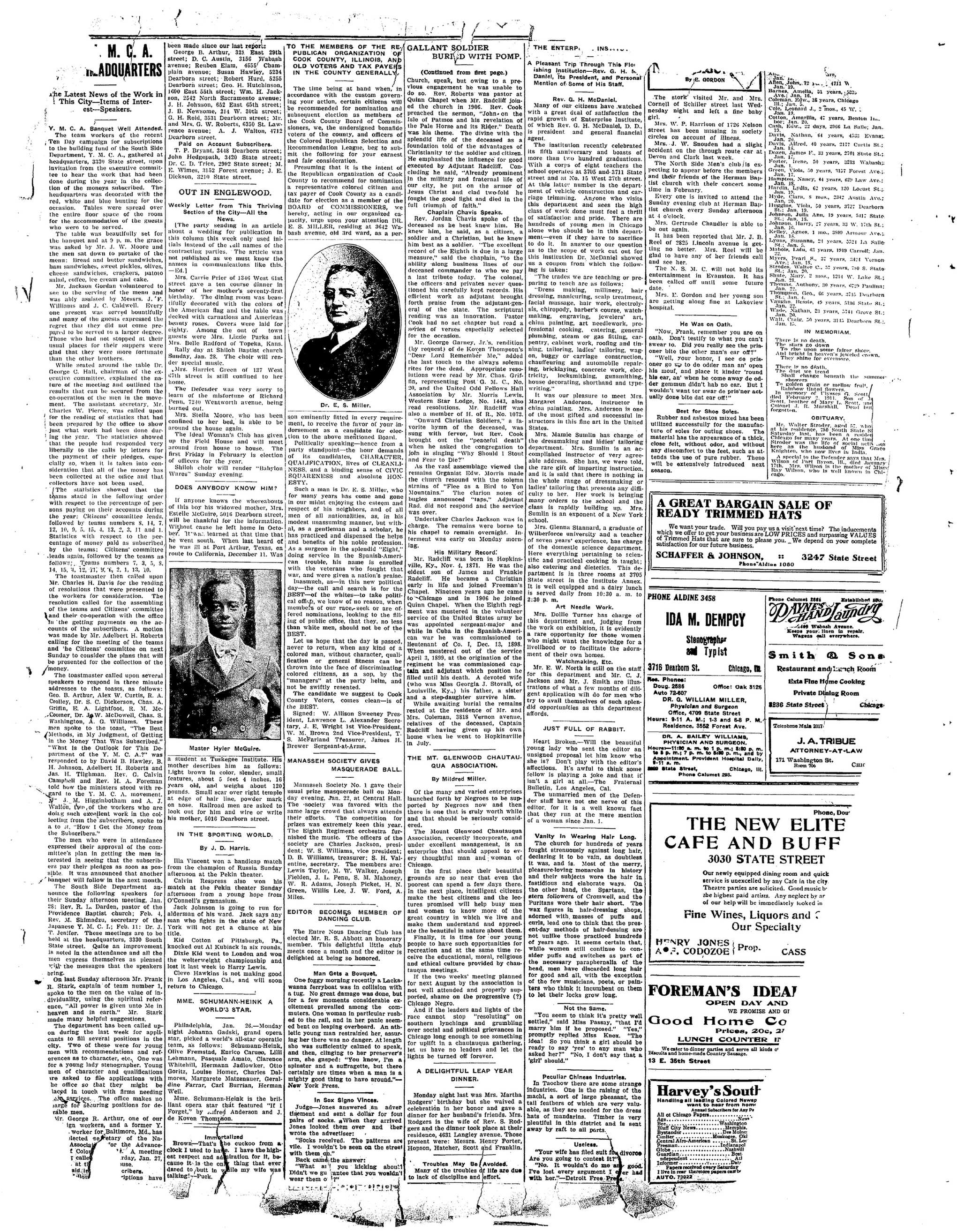
If anyone knows the whereabouts of this boy his widowed mother, Mrs Estelle McGuire, 5016 Dearborn street will be thankful for the information. Without cause he left home in October. It was learned at that time that he went south. When last heard of he was ill at Port Arthur, Texas, an route to California, December 11. Was
A. B.
Master Hyler McGuire
a student at Tuskegee Institute. His mother describes him as follows: Light brown in color, slender, small features, about 5 feet 4 inches, 16 years old, and weighs about 120 pounds. Small scar over right temple at edge of hair line, powder mark on nose. Railroad men are asked to look out for him and write or write his mother, 5016 Dearborn street.
IN THE SPORTING WORLD.
By J. D. Harris.
Illa Vincent won a handicap match from the champion of Russia Sunday afternoon at the Pekin theater. Calvin Respress also won his match at the Pekin theater Sunday afternoon at a young hope from O'Connell's gymnasium. Jack Johnson is going to run for alderman of his ward. Jack says any man who fights in the state of New York will not get a chance at his title. Kid Cotton of Pittsburgh, Pa., knocked out Al Kubiack in six rounds. Dixie Kid went to London and won the wetterweight championship and lost it last week to Harry Lewis. Cleve Hawkins is not making good in Los Angeles, Cal., and will soon return to Chicago.
MME. SCHUMANN-HEINK
A WORLD'S STAR.
Philadelphia, Jan. 28—Monday night Johanna Gadski, grand opera star, picked a world's all-star operatic team, as follows: Schumann-Heink, Olive Fremstad, Enrico Caruso, Lillie Lehmann, Pasquale Amato, Clarence Whitehill, Hermann Jadlowker, Otto Goritz, Loulse Homer, Charles Dalmores, Margarete Matenauer, Geraldine Farrar, Carl Burrian, Herman Well.
Mime. Schumann-Heink is the brilliant opera star that featured "If I Forget," by Alfred Anderson and J. de Koven Thompson.
Brown—That's the cuckoo from a clock I used to have. I have the highest respect and admiration for it, because it is the only thing that ever dared to butt in while my wife was talking!—Puck.
TO THE MEMBERS OF THE REPUBLICAN ORGANIZATION OF COOK COUNTY, ILLINOIS, AND OLD VOTERS AND TAX PAYERS IN THE COUNTY GENERALLY.
The time being at hand when, in accordance with the custom governing your action, certain citizens will be recommended for nomination and subsequent election as members of the Cook County Board of Commissioners, we, the undersigned bonafide voters of the county, and officers of the Colored Republican Selection and Recommendation League, beg to submit the following for your earnest and fair consideration.
Presuming that it is the intent of the Republican organization of Cook County to recommend for nomination a representative colored citizen and tax payer of Cook County as a candidate for election as a member of the BOARD of COMMISSIONERS, we hereby, acting in our organized capacity, urge upon your attention DR E. S. MILLER, residing at 3642 Wash avenue, old 3rd ward, as a per
PETER H. BURKE
Dr. E. S. Miller.
son eminently fitted in every requirement, to receive the favor of your indorsement as a candidate for election to the above mentioned Board. Politically speaking—hence from a party standpoint—the hour demands of its candidates, CHARACTER, QUALIFICATION, lives of CLEANLINESS, and a binding sense of CIVIC SQUARENESS and absolute HONESTY.
Such a man is Dr. E. S. Miller, who for many years has come and gone in our midst enjoying the esteem and respect of his neighbors, and men of all nationalities, as in his modest unassuming manner, but withal, as a gentleman and a scholar, he has practiced and dispensed the helps and benefits of his noble profession.
As a surgeon in the splendid "Eight," doing service in the Spanish-American trouble, his name is enrolled with the veterans who fought that war, and were given a nation's praise.
Inasmuch, as—in this new political day—the call and search is for the BEST—of the whites—to take political office, who of no reason, when members of our race, seek or are offered nominations, looking to the filling of public office, that they, no less than white men, should not be of the BEST.
Let us hope that the day is passed, never to return, when any kind of a colored man, without character, qualification or general fitness can be thrown into the face of discriminating colored citizens, as a sop, by the "managers" at the party helm, and not be swiftly resented.
The candidate we suggest to Cook County Voters, comes clean—is of the BEST.
Signed: W. Allison Sweeney President, Lawrence L. Alexander Secretary, J. E. Wright 1st Vice-President, W. M. Brown 2nd Vice-President, T. S. McKarland Treasurer, James H. Brewer Sergeant-at-Arms.
MANASSEH SOCIETY GIVES
MASQUERADE BALL
Manshass Society No. 1 gave their usual prize masquerade ball on Monday evening, Jun. 22, at Central Hall. The society was favored with the same large crowd that always attends their efforts. The competition for prizes was extremely keen this year. The Eighth Regiment orchestra furnished the music. The officers of the society are Charles Jackson, president; W. S. Williams, vice president; D. B. Williams, treasurer; S. H. Valentine, secretary. The members are: Lewis Taylor, M. W. Walker, Joseph Fielden, J. L. Penn, S. M. Mahoney, W. R. Adams, Joseph Picket, H. N. Green, Willis Lee, J. W. Ford, A. Miles.
EDITOR BECOMES MEMBER OF DANCING CLUB.
The Entre Nous Dancing Club has elected Mr. R. S. Abbott an honorary member. This delightful little club meets once a month and the editor is delighted at being so honored.
Man Gets a Bouquet
One foggy morning recently a Lackawanna ferryboat was in collision with a tug. No great damage was done, but for a few moments considerable excitement prevailed among the commuters. One woman in particular rushed to the rail, and in her paneled bent on leaping overboard. An athletic young man restrained her, assuring her there was no danger. At length she was sufficiently calmed to speak, and then, clinging to her preserver's arm, she gasped: "You know, I'm a spinster and a suffragette, but there certainly are times when a man is a mighty good thing to have around."—New York Press.
In Sox Signo Vinces.
Judge—Jones answered an advertisement and sent a dollar for four pairs of socks. When they arrived Jones looked them over and then wrote the advertiser:
"Socks received. The patterns are vile. I wouldn't be seen on the street with them on."
Back came the answer:
"What am I you kicking about? Didn't we gu' antee that you wouldn't wear them on?"
GALLANT SOLDIER
BURIAL WITH POMP.
(Continued from first page.)
Church, speak, but owing to a previous engagement he was unable to do so. Rev. Roberts was pastor at Quinn Chapel when Mr. Rudell joined the church in 1906. Rev. Cook preached the sermon, "John on the Isle of Patmos and his revelation of the Pale Horse and its Rider." Death was his theme. The divine with the splendid life of the deceased as a foundation told of the advantages of Christianity to the soldier and citizen. He emphasized the influence for good executed by Adjutant Radcliff. Concluding he said, "Already prominent in the military and fraternal life of our city, he put on the armor of Jesus Christ and clad two-fold he fought the good light and died in the full triumph of faith."
Chaplain Chavis Speaks.
Rev. Jordan Chavis spoke of the deceased as he best knew him. He knew him, he said, as a citizen, a soldier and a Christian, but he knew him best as a soldier. "The excellent record of the Eighth is due in a large measure," said the chaplain, "to the ability along business lines of our deceased commander to who we pay a last tribute today. The colonel, the officers and private never questioned his carefully kept records. His efficient work as adjutant brought forth praise from the adjutant-general of the state. The scriptural reading was an innovation. Pastor Cook had no set chapter but read a series of verses especially selected for the occasion.
Mr. George Garney, Jr.'s, rendition (by request) of de Kevon Thompson's "Dear Lord Remember Me," added the last touch to the always solemn rites for the dead. Appropriate resolutions were read by Mr. Chas. Griffin, representing Post G. M. C., No. 20, and the United Odd Fellows Hall Association by Mr. Morris Lewis, Western Star Lodge, No. 1443, also read resolutions. Mr. Radcliff was also a member of H. of R., No. 1073. "Onward Christian Soldiers," a favorite hymn of the deceased, was sung with fervor, but Rev. Cook brought out the "peaceful death" when he asked the congregation to join himself. Why Should I Stout on Near Die? As the vast assemblage viewed the remains Organist Edw. Morris made the church resound with the solemn strains of "Flee as a Bird to Yon Mountains." The clarion notes of bugles announced "taps," Adjantur Rad. did not respond and the service was over.
Undertaker Charles Jackson was in charge. The remains were borne to his chapel to remain overnight. Interment was early on Monday morn-
His Military Record
Mr. Radcliff was born in Hopkinsville, KY, Nov. 4, 1871. He was the eldest son of James and Frankie Radcliff. He became a Christian early in life and joined Freeman's Chapel. Nineteen years ago he came to Chicago and in 1906 he joined Quinn Chapel. When the Eighth regiment was mustered in the volunteer service of the United States army he was appointed sergeant-major and while in Cuba in the Spanish-American war he was commissioned to lieutenant of Co. I, Dec. 13, 1898. When mustered out of the service April 3, 1899, at the origination of the regiment he was commissioned captain and adjutant which position he filled until his death. A devoted wife (who was Miss Georgia J. Stovall, of Louisville, Ky.) his father, a sister and a step-daughter survive him.
While awaiting burial the remains rested at the residence of Mr. and Mrs. Coleman, 3818 Vernon avenue, relatives of the deceased, Captain Radcliff having given up his own home when he went to Hopkinsville in July.
By Mildred Miller.
Of the many and varied enterprises launched forth by Negroes to be supported by Negroes now and then there is one that is truly worth white and that should be seriously considered.
The Mount Glenwood Chautauqua Association, recently incorporate, and under excellent management, is an enterprise that should appeal to every thoughtful man and woman of Chicago.
In the first place their beautiful grounds are so near that even the poorest can spend a few days there. In the next place, intelligent citizens make the best citizens and the lectures promised will help busy men and women to know more of the great country in which we live and make them understand and appreciate the beautiful in nature about them.
Finally, it is time for our young people to have such opportunities for recreation and at the same time receive the educational, moral, religious and ethical culture provided by chautauqua meetings.
If the two weeks' meeting planned for next August by the association is not well attended and properly supported, shame on the progressive (?) Chicago Negro.
And if the leaders and lights of the race cannot stop "resoluting" on southern lynchings and grumbling over social and political grievances in Chicago long enough to see something for uplift in a chautauqua gathering, let us have no leaders and let the lights be turned off forever.
A DELIGHTFUL LEAP YEAR DINNER.
Monday night last was Mrs. Martha Rodgers' birthday but she waived a celebration in her honor and gave a dinner for her husband's friends. Mrs. Rodgers is the wife of Rev. S. Rodgers and the dinner took place at their residence, 4631 Langley avenue. Those present were: Messrs. Henry Porter, Hopson, Hatcher, Scott and Franklin.
Troubles May Be Avoided.
Many of the troubles of life are due to lack of discipline and effort.
THE ENTERPRISE INSTITUTE
A Pleasant Trip Through This Flour
fishing Institution—Rev. G. H. M.
Daniel, Its President, and Personal
Mention of Some of His Staff.
Rev. G. H. McDaniel.
Many of our citizens have watched with a great deal of satisfaction the rapid growth of Enterprise Institute, of which Rev. G. H. McDaniel, D. D., is president and general financial agent.
The institution recently celebrated its fifth anniversary and boasts of more than two hundred graduates. With a corps of eight teachers the school operates at 3705 and 3711 State street and at No. 15 West 37th street. At this latter number is the department of vehicle construction and carriage trimming. Anyone who visits this department and sees the high class of work must feel a thrill of satisfaction and pride. There are hundreds of young men in Chicago alone who should be in this department—even if they have to sacrifice to do it. In answer to our question as to the scope of work cut out for this institution Dr. McDaniel showed us a coupon from which the following is taken:
"The trades we are teaching or preparing to teach are as follows:
"Dress making, millinery, hair dressing, manicuring, scalp treatment, facial massage, hair work, electrolysis, chirpology, barber's course, watchmaking, engraving, jewelers' art, china painting, art needlework, professional cooking, catering, general plumbing, steam or gas fitting, carpentry, cabinet work, roofing and tining, tailoring, ladies' tailoring, wagon, buggy or carriage construction, chauffeuring and automobile repairing, bricklaying, concrete work, electricity, locksmithing, gunsmithing, house decorating, shorthand and typewriting."
It was our pleasure to meet Mrs. Margaret Anderson, instructor in china painting. Mrs. Anderson is one of the most gifted and successful instructors in this fine art in the United States.
Mrs. Mamie Sumlin has charge of the dressmaking and ladies' tailoring department. Mrs. Sumlin is an accomplished instructor of very agreeable address. She has, we were told, the rare gift of imparting instruction, and it is said that there is nothing in the whole range of dressmaking or ladies' tailoring that presents any difficulty to her. Her work is bringing many orders to the school and the class is rapidly building up. Mrs. Sumlin is an exponent of a New York school.
Mrs. Glenna Stannard, a graduate of Wilberforce university and a teacher of seven years' experience, has charge of the domestic science department. Here everything pertaining to scientific and practical cooking is taught; also catering and dietetics. This department is in three rooms at 3705 State street in the Institute Annex. It is well equipped and a dairy lunch is served daily from 10:30 a. m. to 2:30 p. m.
Art Needle Work.
Mrs. Dollie Turner has charge of this department and, judging from the work on exhibition, it is evidently a rare opportunity for those women who might want the knowledge for a livelihood or to facilitate the adornment of their own homes.
Watchmaking. Etc.
Mr. E. W. North is still on the staff for this department and Mr. C. J. Jackson and Mr. J. Smith are illustrations of what a few months of diligent application will do for men who try to avail themselves of such splendid opportunities as this department affords.
JUST FULL OF RABBIT.
Heart Broken.—Will the beautiful young lady who sent the editor an unsigned proposal let him know who she is? Don't play with the editor's affections. It's awful to think some play is playing a joke and that it isn't a girl at all.—The Fraternal Bulletin, Los Angeles, Cal.
The unmarried men of the Defender staff have not one nerve of this editor, for it is a well known fact that they run at the mere mention of a woman since Jan. 1.
Vanity in Wearing Hair Long.
The church for hundreds of years fought strenuously against long hair, declaring it to be vain, as doubtless it was, and is. Most of the merry, pleasure-loving monarchs in history and their subjects wore the hair in fastidious and elaborate ways. On the other hand, the Spartans, the stern followers of Cromwell, and the Puritans wore their hair short. The wax figures in hair-dressing shops, adorned with masses of puffs and curls, lead one to think that the present-day methods of hair-dressing are the same to those of years ago. It seems certain that, while women still continue to consider puffs and switches as part of the necessary paraphernula of the head, men have discarded long hair for good and all, with the exception of the few musicians, poets, or painters who think it incumbent on them to let their locks grow long.
Not the Same.
"You seem to think it's pretty well settled," said Miss Passay, "that I'd marry him if he proposed." "Yes," promptly replied Miss Knox. "The idea! So you think a girl should be ready to say 'yes' to any man who asked her?" "No, I don't say that a 'girl' should."
Peculiar Chinese Industries
In Taochow there are some strange industries. One is the raising of the machi, a sort of large pheasant, the tail feathers of which are very valuable, as they are needed for the dress hats of mandarins. Timber is very plentiful in this district and is sent away by raft to all parts.
Useless.
"Your wife has filed suit for divorce
Are you going to contest it?"
"Yes, I hope so. I'm good.
I've lost every argument I ever had
with her."—Detroit Free Press.
The stork' visited Mr. and Mrs. Cornell of Schiller street last Wednesday night and left a fine baby girl.
Mrs. W. P. Harrison of 1726 Nelson street has been missing in society circles on account of illness.
Mrs. J. W. Snouden had a slight accident on the through route car at Devon and Clark last week.
The North Side Men's club is expecting to appear before the members and their friends of the Herman Baptist church with their concert some time in February.
Every one is invited to attend the Sunday evening club at Herman Baptist church every Sunday afternoon at 4 o'clock.
Mrs. Gertrude Chandler is able to be out again.
It has been reported that Mr. J. B. Reel of 2825 Lincoln avenue is getting no better. Mrs. Reel will be glad to have any of her friends call and see her.
The N. S. M. C. will not hold its entertainment in Evanston. It has been called off until some future date. Irs. E. Gordon and her young son are getting along fine at Lakeview hospital.
He Was on Oath.
"Now, Frank, remember you are on oath. Don't testify to what you can't swear to. Did you really see the prisoner bite the other man's ear off?" "Well, your honor, I see de prisoner go up to do odder man an' open his moust, and place it kinder 'round his ear, an' when he come away de odder gemmun didn't hab no ear. But I wouldn't want tor swar de pris'ner actually done bite dat ear off!"
Best for Shop Soles
Rubber and asbestos mixed has been utilized successfully for the manufacture of soles for outing shoes. The material has the appearance of a thick, close felt, without odor, and without any discomfort to the feet, such as attends the use of pure rubber. These will be extensively introduced next season.
A GREAT BARGAIN SHOES READY TRIMMED HATS
We want your trade. Will you pay us a which we offer to get your business are LOW of Trimmed Hats that are sure to please you satisfaction for our future business.
SCHAFFER & JOHNSON,
Phone-Aldine
A GREAT BARGAIN SALE OF READY TRIMMED HATS
We want your trade. Will you pay us a visit next time? The inducements which we offer to your business are LOW PRICES and surpassing VALUES of Trimmed Hats that are sure to please you. _ We depend on your complete satisfaction for our future business.
PHONE ALDINE 3458
IDA M. DEMPCY
Stenographer
and Typist
Rec. Phones:
Doug. 2588 Office: Oak 3126
Auto 72-607
DR. G. WILLIAM MILLER,
Physician and Surgeon
Office, 4709 State Street
Heura: 9-11 A. M.; 1-3 and 6-8 P. M.
Residence, 3552 Forest Ave.
DR. A. BAILEY WILLIAMS,
PHYSICIAN AND SURGEON
Heura: 11:30 a. m. to 1 p. m.; 8:30 p. m.
to 5 p. m.; 7 p. m. to 8:30 p. m., and by
Appointment. Provident Hospital Daily,
B 111 State Street, Chicago, Ill.
Phone Callee 293.
THE NEW
CAFE AND
3030 STATE
THE NEW ELITE CAFE AND BUFF 3030 STATE STREET
Our newly equipped dining room and quick service is unexcelled by any Cafe in the city. Theatre parties are solicited. Good music be the highest paid artists. Any neglect by ar of our help will be immediately looked in
Fine Wines, Liquors and Our Specialty
HENRY JONES Prop. A. P. CODOZOE CASS
FOREMAN'S IDEAJ
OPEN DAY AND
WE PROMISE AND GI
Good Home Co
Prices, 20c, 21
LUNCH COUNTER JE
We enter to dinner parties and serve all kinds of
Biscuit and home-made Country Sausage.
13 E. 35th Street
Harvey's South
Handling all leading Colored Newspapers want to near from home
Annual Subscribers for Any Pa
All ot Chicago Papers.....News
Agents.....Washington
Bee.....Washington
Buff City News.....Memphis
Borderer.....De Klerk
Cumter.....Muskogee, Okl
Central Afro-American.....St. Loy
Marianan.....Indianwood
Globe.....Nashville
Guardian.....Bost
independent.....Al
Informer.....Dey
Papers received every Saturday
I live in near, therefore papers can be
AUTO. 729122
Arsen, Jan. 19
Allen, John, 72 years, 4711 W.
Allen, John, 72 years, 4711 W.
Barnes, Amelia, 51 years, 533
Ave. Jan. 16
Cobham, Amelia, 38 years, Chicago
Ill.; Jan. 5
Cole, Leonard J., 2 months, 45 W.
Cole, Amarillin, 47 years, Benton In-
bor; Jan. 20
Cotton, Edw., 22 days, 2966 La Salle; Jan.
19
Davis, Nathan, 64 years, 4535 Evans;
Davis, Alfred, 40 years, 2177 Curtis St.; Jan.
18
Davis, James F., 33 years, 2701 State St.; Jan.
17
Foster, Irene, 50 years, 3213 Wabash;
Green, Viola, 50 years, 3157 Forest Ave.; Jan.
17
Hampel, Nancy, 44 years, 629 Law Ave.; Jan.
18
Hardin, Lydia, 62 years, 120 Locust St.; Jan.
18
Hampel, Nancy, 44 years, 629 Law Ave.; Jan.
18
Hampel, Ciaru, 8 mos., 2342 Austin Ave.; Jan.
18
Hampel, Viola, 50 years, 3727 Dearborn St.; Jan. 19
Johnson, Julia Ann, 19 years, 5417 State
Johnson, Harry, 27 years, 33 W. 17th St.; Jan.
18
Kelly, Agnes, 1 mo., 3609 Armour Ave.; Jan.
18
Lyons, Susanna, 21 years, 5212 La Salle
Mahois, Lau, 43 years, 1819 Carruth; Jan.
18
Meyers, Pearl S., 37 years, 3424 Vernon
St.; Jan. 18
Meyer, C., 37 years, 379 S. State
St.; Jan. 20
Shute, Mary, 2 mos., 1214 W. Lake St.; Jan.
22
Thomas, Anthony, 30 years, 6729 Paulina;
Jan. 22
Thomas, Geo, 30 years, 6729 Paulina;
Jan. 24
Vaughan, Bessie, 40 years, 5386 State St.; Jan.
24
Wade, Nathan, 23 years, 5741 Grove St.; Jan.
20
Wilson, Kate, 50 years, 2145 Dearborn St.; Jan.
IN MEMORIAM.
There is no death.
The stars go down.
To rise upon some fairer shore.
And bright in heaven's jeweled crown.
They shine for evermore.
There is no death,
The best we treasured.
Shall change beneath the summer showers.
To golden grain or mellow fruit,
Rainbow thicketed.
In memory of Ulysses G. Scott died February 2, 1811. Son of of Scott, brother of Mr. H. Scott, uncle of Colonel J. R. Marshall. Dead but forgotten.
OBITUARY,
Mr. Walter Stroder, aged 57, who at his residence 780 South State St. Saturday last, headed Chicago for many years. At one time Stroder was the life of social activities here and the house of Miss Grace Knighten, who now lives in India.
A special to the Defender says that Mrs. Wilson of Port Byron, Ill., died January 17th. Mrs. Wilson is the mother of Miss Ray Wilson, who is well known in Chicago.
IN SALE OF
HATS
Can we a visit next time? The inducements
LOW PRICES and surpassing VALUES
se you. We depend on your complete
:: 3247 State Street
Value 1060
Phone Calumet 2884 Established 1890
PAYNES
HAND JAUNDRY
449 Wabash Avenue.
Keeps your, linen in repair.
Wagons call everywhere.
Smith & Sons
Restaurant and Lunch Room
Extra Fine Home Cooking
Private Dining Room
8286 State Street Chicago
Telephone Mala 2017
J. A. TRIBUE
ATTORNEY-AT-LAW
171 Washington St.
Room 706 CHICAGO
Phone, Dou
W ELITE
D BUFF
E STREET
DEAJ
AND
AND GI
CO
3, 27
1
IN MEMORIAM.
Aued Weekly by Chicago Defender Pub-
lishing and Printing Company.
Founded May 6, 1905.
SUBSCRIPTION RATES IN ADVANCE.
te Year. $1.50
x Months. 1.00
tree Months. 0.75
DISPLAY ADVERTISEMENT.
ne Inch, one time. $1.50
Special rates given on large or long
anding add.
Julus N. Avendorph, Society Editor.
Fon. Holly, Cartoonist.
3159 State Street
CHICAGO, IL.
Levered us second-class matter, February 1, 1906, at the Postoffice in Chicago, l. under lot of March 3, 1879.
Larger Circulation than all the other skilies, combined.
RATES OF ADVERTISING.
irths, Betrothals, Marriages and
plimentary and Obituary Reso-
lations, each, each
5,000
land beach, each
5,000
ing Notices per line, each
5,000
s for Display Advertisements fur-
ther compulsory than range of Address.-Please give both old and new address; and in writing the paper always be careful to give the state and Postoffice, as well as name.
SATURDAY, JANUARY 27, 1912.
CLUBS AND SECRET SOCIETIES.
Unique Temp. Law Enforcement of each on the second and fourth Thursday of each month. Mrs. Joe Sadier, D. R., 2420 W. Sec. 2204, Dearborn street.
CHICAGO LODGE, No. 43, I. B. P. O. E.
Courtesy, 812 St. and 26 Friday at
Hulette's Hall, 812 St. and 160 Hewy
Rhea, Secretary, 8430 Vincennes avenue;
J. W. Johnson, Exalted Ruler, 2947
Court Avenue.
COURT GENERAL ROBERT BELLOT
No. 7295, Ancient Order of Porcupines
meets every second and fourth Monday
night in each month at Odd Fellow
Hall, street.
Lodge Office.
Cherlanger, F. W. Babb, 5345
Dearborn street, phone 5010 Drex.
Secy., phone 7422 Dearborn street.
Treasurer, Frank L. Crittenden, 2414
Dearborn street, phone 3219 Calumet.
abuse.
But now I am as grain within the mill.
If so be thou must crush me for thy use.
Grind on, O potent God, and do thy will
Paul Lawrence Dunbar.
Can you see Lorimer's finish, like-
wise Bartzen's?
In politics it's the man on the fence
bought after.
The usual news comes from Georgia,
three men and a woman.
Chicago seems to be doing very
nicely without police inspectors.
No, gentle reader, we wouldn't advise
you to take your straw hat out
of the moth balls just yet.
What has become of all these
hotels, theatres, etc., that Jack Johnson
built upon his return—echo an-
swers what??
Everything points to a record crop of ice, but don't flatter yourself with the idea that it will make it cheaper next summer.
You will have to look now before you leap in taking a State street car those new through routes land you in all sorts of outlandish places.
Just because it is warmer these past few days don't take down the stove, it might freeze up again and the coal man would have the laugh on you.
How many knew that we had ten park systems in Chicago, and that it costs $500,000 for government? This is be saved the taxpayers if they outfitted—by one body. Thisature should take up at its ing.
dry said that the colored was afraid to go up in an but reports come from the d that one young man has made the venture but hashew records, there is no use they just can't keep us down.ity would be far better felt community if some of oures would send a few ladies if every Saturday to read the papers to our blind citizens,not try this and see the cheer would bring to those who cansee. Coming events cast their shadowsre. "The shadow of Roosevelt as to be eclipse the whole nut of presidential stars. The men color are disposed to give him an trial, with opportunity to ren the error of the Brownsville afi-To err is human, to forgive di-
business men are great
bid you ever see the like?
business men doing a
business, giving their advertise-
out to out of town papers;
is something unheard of. Why
build up your own home paper?
city in the union tries to have
aper so fine that it can boost
great paper; our citizens send
advertements out to make
eat.
children about the
perhaps the reason to
windows in the homes
wings. The jewels
with bright eyes to
meeting are
him at his
is done. As
sease to be
---
In death, in life the gallant Eighth Regiment is ever on the hiring line whatever the occasion of joy or grief, as a body of men the Eighth stadds out in has relief. We love to see them often emblematic of whatever is left to us in this "Land of the free and and in the land of the need we need inspiration of their martial skills in days like these to inspire us to sing, "My County 'Tis of Thee."
The early death of Capt. Radcliff, who was the first officer to decease since the organization of the regiment is lamentable. His life was a criterion for us all in integrity and duty, even the paths of glory lead us to the path of great answer as did he when the Great Commander calls, "All is well."
Let us still hope that planks will be put in both the Republican and the Democratic platforms to the effect that measures be taken to stop the unwarranted and barbaric mode of dealing with suspected criminals by the ignorant scum of the south. The law in many instances is simply a farce, you need but to have a black face and live within a radius of fifty miles where some unlawful deed was done, to be the target of the infiltrated mob. The affair in Georgia the other day when three men and a woman were taken to the edge of the town and burned alive before they were given a hearing is a fair sample of the justice that is meetd out to the race, let those of us who have a voice raise it in defense of these poor unfortunates and never rest till we have effectually stamped out this curse, this blot upon American civilization.
Dr. Harry Elgin Webster, the confessed wife, murderer, was sentenced by Judge Farrand to life imprisonment. It was thought by many that the death penalty would be evoked, but perhaps after all, as the judge said. "No greater continuing punishment can be inflicted upon a young man than to imprison him for life. When the iron doors of the penitentiary close behind you, you must abandon all hope of freedom on this earth. Within those gray, cold walls with the dark memory of your wretched crime before you, you must remain until by death you are called to approach the silent shores of eternity, and if the light which breaks upon you from the farther shore is radiant with hope, and you only because an offended, but merciful God has forgiven your sins" Little sympathy was wasted on the prisoner as he was led away to the tombs owing to the fact that he not only did not seem penitent but rumor had it he declared he would do the same thing over again bad he the chance. 'It is appalling in this civilized country of ours the barbarous crimes that are committed. Are we going backwards?
YANKEE GIRL DOESN'T FIT
Austrian Critic Declares No Formula
Can Be Defined Lady
Amstaff, Amstaff
Alice Schalek, Viennese traveler and writer, has provided the Vossische Zeitung of Berlin with a description of the manner wherein American women on tour differ from all others "The fact is," she says, "you cannot class them (American women); they won't fit into any accepted formula." "You can tell a Frenchwoman immediately, and be dead sure she's no prude, but a light-hearted flirt. If you meet an English woman you must wait to make her acquaintance until she drops her typical English reserve. An English woman wants to be asked about her hand and his profession, titles and their babies. An Austrian woman will be smarter and a 'good fellow'. But if you meet a woman who won't fit any of these categories and doesn't correspond to any particular type, you can be dead sure she is an American.
"There is a 17-year-old whose father, mother and elder sister are along, traveling in cabins de luxe. She flirts day and night on deck, and all so naturally that she retains her social position in circumstances no other nationality could survive. What has it got to do with you?" she seems to ask, and there's an end of it.
"Here are some pictures from my gallery of American girls abroad, just to see their differences. A girl who petted whitish cats and snakes in Kyoto; a young Y. W. Wei a apostle in Corea, who was as pious as the day is long, but who flirted to her heart content with a young English missionary, an energetic middle-aged American female, who was missionary for some obscure Parisian reincarnation of Budda.
"There were other less pleasant pictures, but each sticks in my mind with an individuality which no European woman ever achieved. Yet perhaps there is one feature common to all these Americans—each of them curled up some eccentricity, but, whichever one, out of them out with unwavering determination "I believe we can learn much from these American women."
Chinese Dellcacles
The Chinese have several tastes in which we do not join. The beche de mer is one of these, a big sort of a wormlike creature that is fished up out of the Pacific for his especial benefit. Shark's fins also are in demand. These Pacific islanders everywhere and sold to endangered cool them for the Chinese market. The bird's nest soup is a well-known delicacy. The nests are among the most expensive articles of food to be paid for anywhere.
Through the Swiss Mountains
IN CHICAGO AND ITS SUBURBS
Our Local Department—Personal Mention—Religious—Social and other short paragraphs—Read it over carefully, somewhere you will find a line or two about yourself or your friends.
Don't whip your horse when he displays more sense than you do and turns his back to the wind.
Mr. and Mrs. Alex L. McEwen have moved from 4930 Wabash avenue to 5143 Dearborn street, 1st flat. "Sabine," editor of "Our Women," invites short contributions to that department. The women of the race do many good things and this department was established for their benefit.
If your paper falls to come to you, there is a reason.
A. A. Wells will spend three months in Southern California, leaving the first of February.
street, flat 4. Good music. Admission 10 cents. Mrs. Elsa Au president, Mrs. Clara M. John editor.
Dainty Compliments.
The daintest compliment you pay a near and dear friend is as a picture of yourself as an X greeting. Peter P. Jones, 3519 St.
Miss Pathenia O. Brue, of No Ky., niece of Mrs. A. A. Wood, Prairie avenue, is in the city for indefinite stay.
Mrs. E. Azella Hackley writes Defender that weak from Calves Texas. The madame is well and ing well.
Mrs. Morris Lewis, of 3745 Wa
Attention! This is your last chance to secure a Dunbar book. Our offer is one Dunbar book and the Chicago Defender for one year for a $2.00 bill. Mrs. R. B. Lewis, of 3311 State, who has been visiting her mother and brother in Memphis, Tenn., has returned to the city. When Mrs. Bowman, 2959 Wabash avenue, turned the corner of 30th street. Sunday the morning returning for chickadee she was badly frigged to see a patrol wagon stained her door. But it was nothing serious, the police had picked up two lost children on the pavement, hence the excitement.
We Repeat It.
A dozen photographs will endear you to twelve friends. Make an appointment today for your Christmas photo. Peter P. Jones, 3519 State St.
Mr. James W. Fisher, superintendent Quinn Chapel Sunday school, fell on the ice Sunday on his way to church and sustained injuries that confined him to the house for several days.
If you know of any case of need, of any one without food or clothes kindly call up The Chicago Defender, Douglass 3339.
No more papers sent to any one without the money.
Mr. and Mrs. William Washington, of Boston, Mass., will arrive in the city and indefinite stay as the guests of their sister and brother.
Mr. and Mrs. Chas. S. Washington.
If you claim to be a good semantrian now is the time to show it.
Mr. Geo. R. Arthur has been elected secretary of the National Association for the advancement of colored people.
Have you paid your subscription yet.
Mrs. Sarah Burton, 445 W. 56th street, is not at Provident Hospital as has been reported. Mrs. Burton, however, is nursing a severe bruise on her foot which will necessitate hospital treatment later. Mr. M. McCullough left for Hot Springs, Ark., today with a crew of men for the Eastman Hotel Cafe. His Company graduated of Provident Hospital, was in the city last week from Jacksonville, Ill. Major Ots B. Duncan, of Springfield, Ill., was in the city Sunday to attend the funeral of Adj. Radcliffe.
The second concert of the season of the Choral Study Club will take place Monday evening, February 19th, at Grace Presbyterian Church, 34th and Dearborn streets, at 8:15 p. m. The program will be Mendelsohn's Lauda, Zion and the seven last words of Christ. The soloists will be Miss Cora Spriggs, soprano, Mr. Hackney, tenor, and Mr. George R. Garner, JR. The music will be a pre-Lenten program that all should hear. Tickets 35 cents.
The way to get good bread, r, k for the "Kentucky loaf."
Mrs. Bell, wife of Dr. Claudius Bell, was initiated into the mysteries of the Old Fellows Monday night, when she became a member or nebeka Household of Ruth, No. 1277.
Do you know Master Hyler McGuire? If you do and have any information as to his whereabouts in his mother, who lives at 5016 Dearborn street, or the Chicago Defender.
The friends of Mrs. Kirklin, 2342 Vernon avenue, who has been ill, say that her physician has a snap. No one would ever think that she ever suffered a day's pain. The W. A. Wallace. Bakery Co. make the "Kentucky Loaf" and Wallace Rolls. If you can accommodate any of the delegates to the National Republican convention which meets here in June you had better call at the office and make arrangements for a suitable quiff. Your delightful evening was spent at the home of Miss Floy Stephens where the Ancren Club gave a Leap Year party. The house was beautifully decorated for the occasion with club colors. Mr. Wm. Brown furnished the music while the club members served punch. Money first and paper next.
the best furnished rooms are advertised in the Chicago Defender. The Bonne Femme Coterie met at the residence of Mrs. Goldie Bishop Redmon, 4442 St. Lawrence avenue, on the 18th inst., with Mrs. Anna Pickens as associate hostess. At the conclusion of the games a flash light photo was taken of the club by Mr Wm. Wharton after which a most delectable luncheon was served. Mrs. W. W. Staunton, assisted by Mrs. Ingenie Norwood will entertain the Coterie on Feb. 1st at the residence of Mrs. J. P. Bryant, 4313 Langley avenue.
Little Miss June Fisher, of 5616 Wabash avenue, entertained with a beautiful party this week in honor of her birthday, being six years old. Mr. Louis DeCasta (Baby) told a Defender reporter that he would stand for "Baby Lou," but never for "Baby."
Mrs. Mary Jane Freeman, of Cleveland, O., is visiting in the city and is stopping at the Soldiers' Widows Rest, 3258 Forest avenue. Mrs. Freeman is a teacher at Brown, and her son, Homer Freeman, the Gandermus, Charity Club will
The Gandermus Charity Club will
evean an oyster supper Thursday even-
ing.
street, fat 4. Good music. Admission 10 cents. Mrs. Eliza August president, Mrs. Clara M, Johnson editor.
Dainty Compliments.
The daintest compliment you can pay a near and dear friend is to send a picture of yourself as an Xmas greeting. Peter P. Jones, 3519 State St.
Miss Pathenia O. Brue, of Noland, Ky., niece of Mrs. A. A. Wood, 2946 Prairie avenue, is in the city for an indefinite stay.
Mrs. E. Azella Hackley writes the Defender this week from Galveston, Texas. The madame is well and doing well.
Mrs. Morris Lewis, of 3745 Wabash and entertained thirty ladies on last Thursday afternoon from two to six at whistle, the occasion being one of birthday inversaries. Prizes were awarded and all present had a pleasant time. As usual, Mrs. Lewis proved a charming hostess.
The editorial dinner given in honor of the editor of the Defender by Mr. and Mrs. Brown, 5121 Grand boulevard, was one of the finest spreades ever laid on that thoroughfare in many years. The toasts to the Defender by Mrs. Brown were something unique.
Mr. James Cotton, after an absence from Chicago for several years, has returned and will probably take up his homestead here again.
Tuning Bells
When bells in a chime produce discord they can be tuned. The tone of a bell may be raised or lowered by cutting off a little metal in the proper places. To lower the tone the bell tuner puts the bell in his lathe and reams it out from the point where the swell begins, nearly down to the rim. As the work proceeds he frequently tests the note with a tuning fork, and the moment the right tone is reached he stops reaming. To raise the tone, on the contrary, he shaves off the low edge of the bell, gradually lessening the note and shortening it to shorten the bell, for of two bells of equal diameter and thickness the shorter will give the higher note. A noteworthy instance of bell-tuning was at Lausanne, where twelve bells, in three neighboring steeples, produced only seven distinct notes, and gave out a most curious discord.
Pole's Passion for Gambling
The trial at Crakow of a Polish ad-vocate named Steinfeld who has come to grief through gambling has been the occasion of some curious revelations about the hold which this vice has on business men in Austrian Poland.
Dr. Steinfeld's wife in her endeavour to keep her husband out of temptation tried the plan of never leaving him out of her sight even when he went to his office. The lawyer then made a practice of going to bed early and rising at 4 in the morning before his wife awake in order to hurry off to the hotel at Crakow, which he would find still full swing at that hour. When staying at hotels during the summer he would arrange meetings with other card players in the bathroom and play there for hours, while he told his wife that he was taking a cold water cure
Not a Bad Procedent
Some of the beauties of ancient Rome had marble busts sculptured of themselves, on which were placed different wigs corresponding to the changes of style and coloring. If modern woman followed sult there would be fewer atrocious colfures. A mirror should reveal unbecomingness, but it does not seem to do so. a bust of oneself, bedecked with chignon, psyche, Greek colls or the present daguerreotype disfigurations, could not fall to be a convincing proof of ourselves as others see us. The greatest beauty cannot afford to trifle with her hairaddressing. It is only the plain woman who boldly defies looks to be in the style.
Ornamental Second Husband
"I look on a second husband as a good dessert after a fine dinner and a woman oughehr swallow one when offered without no mincing. Of course, there never was such a man as Mr. Satterther, but he was always mighty busy, while Cal Rucker is a real pleasure to me, a setting around the house on account of his soft constitution. Mr. Satterther, I'm thankful to say, left me so well provided for that I can afford Mr. Rucker as a kind of ornament."—Maria Thompson Davless in "Rose of Old Harpeth."
The destroyers of fine dramatic myths tell us nowadays that the Calph Omar did not burn the ancient library of Alexandria, and therefore did not have a chance to say that all the books in it that agreed with the Koran were superfluous, and all that书籍 without the Koran were pernicious. Doubtless the perennial freshness and vitality of the Koran to an everlasting normal human hatred of weed-grown, literary graveyards.
Seemed Unreasonable
The pretty kindergarten teacher had spoken of the foliage of the trees as their clothes, but she was much surprised to hear wee Jamie pipe up; "But, Miss Blank, why do the trees take off their clothes in the winter and put them on when the summer's so warm?"
Iron Only Found In Ou
Iron ores are chiefly oxides, and native iron is almost unknown except in the meteorites occasionally picked up.
Truly Fortunate Map
Honor and fortune exist for him who always recognizes the neighborhood of the great, always feels himself the presence of high causes—Emerson.
FROM OUR EXCHANGES
FROM OUR EXCHANGES
(The New York Age.)
Policeman Battle is now a full-fledged coroner. He has gone for the sixth month's probation agency. His fellow officers like him and say of him that he is a gentleman and every inch an officer. That is good. Policeman Battle deserves a vote of thanks for showing the Negroes of New York that the trick not only can be done but that the only way to do it is to do it. That is a great lesson for a person to know and to teach others. But unless those who are taught by both precept and example put to the test what they have been taught they have themselves to lose the loss they sustain, and should not be taken for more Negro policemen in New York and we can get them, but only by having capable Negroes like Mr. Battle take the Civil Service examinations.
All About the Abbots.
(The Journal, Savannah, Ga.)
We read the Chicago Defender with pleasure and profit. Dr. R. T. Abbott is a distinguished relative in our school. No colored newspaper has shown greater enterprise than the Defender under Mr. Abbott.
Does the Shoe Fit You?
(The informer, Cadiz, Ky.) Many of the brethren who shout the loudest nursed their petty godfire at home last Lord's day. Yet they wonder why there is so much wickedness in the land. A religion that the weather man can chill will not stand the scrutiny of God.
Honor to U. S. Minister Crum.
(American League, Buchanan, Lite
Liberia now enters upon a new era by the passage of the American loan agreement by the Liberian legislature. And after all we give due credit to U. S. Minister Hon. W. D. Crum for the diplomacy which he used in securing the passage of the measure, and which gives America such a free hand to do good for the Republic of Liberia and the Negroes of America, for whom Liberia was founded. Had it not been for the Minister we feel sure that we would not have the present legal status in this country. A certain European gentleman of considerable thought decided that it was done by the diplomacy of the American Minister. Since this gentleman observed that, it tells us that there must have been some diplomacy to defeat the passage by some powerful agency as was believed by the contestants—and that increases the laurels of Minister Crum.
Our race in America will thank Minister Crum for what he has done for Liberia, for such great leaders as Dr. Booker T. Washington, Prof. Du Boise, Editor Moore of the Age and the other influential editors of the race on that side are all greatly interested in the salvation of Liberia. He will hall with pleasure the good work, the owning and masterpiece of Minister Crum, for by his diplomacy henceforth we have a new Liberia.
SPARE THE TIME TO LAUGH
Even in Depressing Circumstances It
Is Man's Dare to Strive to Be
Dishonest
It is the duty of mankind, even in depressing circumstances, to strive to be cheerful. It is the general belief that if a man is not naturally light-hearted, he cannot make himself so.
Yet this is far from being the case, and there is many a man who is at present a weary burden to his relatives, miserable through the carking care of some bodily alliment perhaps, or some worldly misfortune, who, if he had grown up with the idea that to be cheerful in all circumstances was one of the first duties of life, might still see a pleasant enough world round him.
The worries of a morose person will shorten his years, and the general justice of nature's arrangements provides that his early departure should entail no long regrets.
On the other hand, the man who can laugh keeps his health. To the perfectly healthy laughter comes often Too commonly, though, as childhood is left behind, the habit falls, and a half smile is the most that visits the thoughtful mouth of a modern man or woman. People become more and more burdened with the accumulation of knowledge and with the weighty responsibilities of life, but they should still spare time to laugh.
Street Cries In Minor Key
"Street cries are nearly always in the minor key," says the Paris journal des Debats. And an English commentator avers that this key is maintained in our own street cries—such as "Sweet Lavender." And he thinks the explanation is that the minor key involves less strain on the throat that to emit the same cry all day long. But London cries are few of them in the minor key of the Parisian boy who heralds the evening on the boulevards with "Volla Le Solr." Our own newspaper boy has cultivated the raucous monotone that collects politics and murders into one simple yell. But no singing of the minor key about the milkings is encouragement. And perhaps the least monotone cries is that of the man who hawks coal about the street. He does not shout "Coal." No stranger would suspect him of coal. He emits only a single bellow, repeated as short intervals, a bellow without form or comeliness; it is the least common denominator of the street cry.
What Milton Omlted
The rebellious angels had just been cast out of heaven. In the swift downward flight Lucifer overtook Beelzebub.
"What's troubling you, Bub?" he called.
"An old problem," answered the future foul flend, between somersaults:
"Where are we going this fall?"—Liphncott's.
Can You See the Point?
OUR WOMEN
MOTHERHOOD ONLY CAREER
Motherhood is the most sacred part of our existence. Motherhood is the supreme reason for a woman's existence. It gives her most complete happiness.
Miss Irene Hickman, our South Bend, Ind., correspondent, is what the editors call a good reporter. They say that she has a "nose for news" and always features the best story.
Our grand old woman, Mrs. Amanda Smith, celebrated her seventieth birthday Tuesday at the Orphan Home bearing her name in Harvey, Although long past the promised three score years and ten Mrs. Smith, she is a splendid object lesson for intelligent and vigorous women no matter what their role.
The public is awaiting another paper by Miss Irene McCoy. The success of her recent effort should be a stimulus for another at an early date. According to the Philadelphia Tribune Madame A. Azolla Hackley will not return here for a recital during
Improved Car Service on State Street.
Improved Car Service on State Street.
The Chicago City Railway Company is to be congratulated upon the splendid improvement in its service via State street from Lake to 73d street.
The recent addition of several through railroad lines to the degrees of the south side (who form the largest percentage of its patrons) unattended facilities for transportation to and from the business districts.
The Chicago Defender and its readers would be ungrateful if they overlooked this opportunity to express their pleasure for an improvement that benefits them so much. The Defender takes this occasion to speak in praise of Conductors Jerry Casey and James Sands and many other "old timers" along this line for their courteous treatment to the young and old and in denunciation of some of those young upstarts, no doubt big-headed by reason of their first responsible position, who can't even give you a civil answer. The management of the Chicago City Railway Company doesn't want this kind of business, and allow it. So be careful, "Mr. Knight the Bell Cord," or you will be called to the front. Call State street "The African Central" if you want to, but the "African Central" and its patrons must amount to something or the company would not make it the most complete through street car line in the city. "Can you see the point?"
Professional Dignity.
How proud we are of our professional men and women. How pleasant it is to point to this one and that
SUCCESSFUL FARMER
Mr. Ed Poole, Pioneer Farmer of Stafford County, Kansas—Threshed 12,000 Bushels of Wheat—Corn Piled Around Like Sweat—$12,000 in Bank—Raps Chicago—Claim Ownership for Property Not Paid For.
By Oscar Micheaux.
Whitten, S. Dak, Jan. 23.—We hear considerable talk of the successful Negro. One thing, have you noticed, and that is we have many, yes, a great many very successful Negroes few of us know anything about. In this I refer to Ed Poole of Stafford County, Kansas.
Before I begin what I'm going to write about, Poole, for that is how he is commonly known, not Mr. Poole, nor Ed, but just plain Poole, I wish here to emphasize on the word "actual," for so we听en we hear of so and so, of their worth, and so and so. Nearly ten years ago, when I first came to Chicago, I remember several men up and down State street, principally saloon keepers, owners of restaurants, men owning barbers shops, undertakers, etc., etc., were referred to as being worth so much and so much anywhere from $10,000 up to $100,000. Also, if you lived out of Chicago and came on a visit once a year, more or less, as I do, you would meet people who say, here is James Jones, or whoever it may be, he owns this flat or a big flat on such and such an avenue. The fact of the matter is that this man generally may have just begun buying the building and it may be costing him from $2,000 to $10,000, and he may have paid down anywhere from $100 to $1,000, generally from $200 to $500 and the proprietor of the above mentioned establishment may be only set up in such and such a place of business a brewer or on the "on time" paying basis. I know business man of a most popular place of business. I should consider this business be not being him an average income not less than $3,000 a year, and from the amount of business it seems should be worth $5,000 a year. He got into this business with about $1,000. He is sober, enterprising, pleasing and a good business man; yet, after having been in this place six years or more, he told me he was not worth $10,000.
I make this lengthy mention for this reason; for among some of my friends in Chicago I have been criticised in some instances of being exceedingly exact; perhaps so. Again of being a doubter of the colored man's ability. I do not care to appear as either. The fact is I live and am engaged in an industry in a community of entire whites and the custom is simply facts and figures. And now in regard to Ed Poole of the many of my race I know personally. I regard Poole as one of the most successful, although I am aware and am pleased to mention that there are great many whom are likely worth more. Poole is a farmer, one of the officers of Stafford county, Kansas, heart of the great Kansas.
Young and Old—Light and Serious Verse and Prose—History—Personal—In a Word Their Every Interest.
"convention week." Her recital at Orchestra ball some time ago was her final one, according to our Quaker City contemporary.
In fraternal orders our women are playing a prominent part. Mrs. Annie Taylor, Worthy Princess of Mt. Hope Temple No. 1, S. M. T., and Mrs. Eliza Jackson, past Princess of the same order, are considered as ideal workers for the benefit of womankind. Mt. Hope Temple is a unit in praise of the work of these two women.
Mrs. Fannie Barrier-Williams, although not heard from as often as of yore, has no superior when the spirit moves or occasion demands an article in the Chicago Record-Herald or the New York Age.
Mrs. Ida B. Wells-Barnett is doing effective work for the uplift of humanity as the guiding spirit of the Negro Fellowship League. As editor of the Fellowship Herald her literary fiction and essay vent. Her review in last weeks issue was publication of Mr. Alfred Anderson's souvenir booklet was a gem.
one and say there is Rev. X, or there goes Dr. Y, and over there is Attorney Z. But down goes our pride and in another direction our eyes when we see our leaders in various lines not only belltelling their own particular profession but disporting themselves oftimes below the average of an ordinary citizen.
Clergymen as a rule are made distinctive by dress. Lawyers and doctors are not. A medicine case sometimes displays the calling of an M. D, but even this is not always a true sign. No badge or high hat should distinguish lawyer or physician but the nature of their high calling should always be present in their minds and govern their actions in public.
Physicians in particular should always be careful of their conduct. The chance acquaintance of today may be the profitable patient of tomorrow. The lawyer, also—the eyes of the world are always upon those who must prescribe for us when we are ill or advise us when the law is needed.
The sacred functions of the clergyman place him ab. the head of the list, with the physician a close second. Always remember your profession—you must not act like the rabble. You have made for yourself a place in the three most important professions. Haughtiness, disdainful and arerogant actions are never taken for the quiet dignity that should always characterize the clergyman, the physician and the lawyer. Dignity, says the best authorities, is to exalt, to invest with honor, to make illustrious any office or calling.—"Can you see the point?"
sas wheat belt. Came to Kansas about the year of 1880, is unmarried, and between the age of 55 and 69 years. I first heard of Poole about ten years ago. At that time he owned about a section (640 acres) and was making money. Three years ago this winter I was visiting my parents, who lived neighbors to Poole at that time. He then owned about 1,000 acres and had threshed something like 12,000 bushels of wheat and had corn piled around like so much straw. Thousands of bushels besides any amount in the field to be husked. An army of fine mules and horses and an acre of ground covered with farm machinery, a full case of "Hayner's" rock and rye. and $12,000 in the bank. There isn't so much to say about Poole. He has kept "bach" for thirty years or more, is an intelligent, practical man, accommodating, has loaned money at a small rate or interest to a number of young colored men in the community to start them up on any amount of notes to secure his neighbors. The president of one of the largest banks in that part of Kansas told me that Poole was one of the soundest and most successful of business men.
As an example, Poole is the most careless and wasteful, which is due, no doubt, to "baching." Having had many years of that life on the Dakota prairies I am somewhat acquainted with its tendencies.
The spring following my visit Stafford county I heard that had purchased another farm, cost him $12,000, and the heard of him, about two month he had purchased another farm cost him $18,000, making in thing like 1,500 acres of the in Kansas, and was $10,000 The crop that year at least was good, and although 193 have been poor years for it purchased 320 acres more threats to retire when reaches $100 per acre. average price of land munity is about $80 per
Peculiarities of
The South Sea Island
disgust upon an Amor
roast beef, but he w
especially if he is a
great relish. He al
more relatives of
reef at low tide and
appetizing. There
instance. The se
being a delicacy.
Giving
The reply of
famous Missor
days, to a mar
crime, is hist
the lawyer to
to him his g
will not defe
shot out of
a barbed w
City Churches—Religious News
Frederick Douglass Center.
Sunday, Jan. 28, at 4 p. m., Mrs. Celia Parker Woolley will read George Elliot's dramatic poem, "Agatha," which bears on a musical theme. Several musical numbers will follow.
Bethel Literary Club.
The address of Hon. George W. Ellis at the meeting of the Bethel Literary club on last Sunday could not be excelled. He spoke on "The Moral Culture of the African Negro." A large audience greeted him. On next Sunday at 4 o'clock in the lecture room Atty. W. W. Johnson will address the club. Fine musical program.
1
Walter's A. M. E. Zion Church. The men of our church are preparing for an annual banquet which is to take place some time the last of next month. We are delighted with the Men's Utility club of our church, which is a new organization, composed of the members and friends of our church. We hope to see this organization grow and flourish. We are getting ready for our annual fair, which will open on the 18th of March. Rev. Callis, our pastor, who has been attending the Bishops' Council at Fayetteville, N. C., has returned and reports a pleasant and profitable meeting.
Sunday services; Prayer meeting at 6:30 a. m.; preaching by the pastor at 11 a. m., subject, "Set the Battle in Array"; Sunday school at 1 p. m., W. J. Bardine, superintendent; Christian Endeavor at 6:30, C. J. Jackson, president; preaching at 7:45 by the pastor, subject, "The Glories of the Victorious Army."
The Woman's Home and Foreign Missionary society is preparing for a Martha Washington tea. They were delightfully entertained on last Wednesday by Mrs. Phyllis Robinson at 3622 Calumet avenue. They will meet next week with Miss Amanda Claiborne, 3147 Armour avenue.
Dr. T. H. Tipton, the presiding elder, who has been spending some time in the city, left on last Thursday for South Bend, Ind., where he holds his next, quarterly meeting.
The services at Quinn chapel last Sunday were very interesting. At the morning service the sermon was delivered by Mr. James Wood, a wealthy business man, and yet a profound gible student and devoted churchman.
Mrs. Nora Taylor, the evangelist, preached her farewell sermon at the evening service preparatory to going to Brooklyn, N. Y., where she will conduct a series of meetings.
The ladies of Quinn chapel rendered excellent service to the worthy poor during the past cold spell. They administered to the necessities of more than six hundred persons.
Mr. Fisher was again elected superintendent of Quinn chapel Sunday
HORSE TAILS ARE IMPORTED
They Come From Many Lands and Are Used in Making Brushes and Cloth
An item that seemed odd in the manifest of a steamer lately arrived from Japanese and Chinese ports was this in the list of her cargo from Tlentsin: Fifty-five cases of horse tails.
As a matter of fact horse tails, or the hair thereof, are a common article importation into this country from China and from pretty much every other country on earth. The American market gets large quantities of them from China, but more from Russia; and horse tails are imported here from every other European country and from South America, from Australia, from all round the world. On the other hand there are more or less American horse tails exported.
From various causes the supply of horse tails, like that of anything else, may in one country and another vary from year to year, and there may be years when the world's supply is short and years when it is plentiful, with corresponding changes in the range of prices. Horse tails have sold as low as 20 cents a pound and they have sold for as much as $2. If stocks are scarce and high in London, and ample at lower prices here, New York importers ship horse tails to London; in the contrary circumstances London importers might ship horse tails here. Horsetail hairs are sorted for length and colors and they are used either one or mixed with other fibers in the manufacture of various sorts ofishes and mixed with other materials in the manufacture of hair.
ishop Was Ready for Them.
story is told of a certain Norman
1. who preached so eloquently
2. the wearing of long hair before
1. and his courtiers, that they
2. on the spot and agreed to
eir locks shorn. 'No sooner
made their decision than the
late, who had provided for
a contingency, pulled out a
hears from his sleeve and
ved the curls of the whole
city boys, visiting the
afraid of a horse which
razing near. They made
toward driving the horse
as evident that they de-
e. At last another boy
"Oh, Billy," one of the
ed to him, "just throw
orse, will you? We're
nd we can't."
keshift,
ere gathering manl
enough until we
buy patent break-
emarked.—Boston
cumstances.
out of circum
the same ma
palaces, while
a."G. H. Lewes
school and Mr. Freeman assistant. Mr. Augustus was elected musical director. The election of trustees resulted in the retaining of all the old board. This Sunday will be quarterly meeting day at Quinn, when there will be three services held. The afternoon service at 3 o'clock will be a union service. The Methodist pastors and their congregations will all worship with Mother Quinn. The Lord's Supper will be administered. An old fashioned love feast will take place on Monday night following. Quarterly conference will take place this coming Wednesday night, when the work of the church for three months will be reviewed. Dr. Timothy Reeves will preside at the meeting. The Young People's Improvement club of the church was entertained by Miss Eloise Cook Friday night of last week. A good time was experienced by all.
The Volunteer Workers' Club. The club met at the residence of Mrs. McAfee Wednesday, Jan. 24. Quite a number of the members were present. The club has been engaged in helping a great number of needy families during this hard winter in the way of clothing, food and coal. After the close of the meeting the club was very elaborately entertained by the hostess with a splendid menu. Mrs. Johnson, president; Mrs. Nina Tivis, secretary.
The Union Charity Club.
A delightful afternoon was spent last Thursday at the beautiful home of Mrs. Garner, 2817 Vernon avenue, when the Chicago Union Charity club held its meeting. There was an excellent attendance. The C. U. C. club is just two years old and has been very active in aiding the Home for the Aged and Infirm Colored People. The club has extended its charities somewhat into broader fields and is now listed as one of the Federated Woman's clubs of the city and state. Mrs. Emma Chandler, the club's president since its organization, has raised over $200 for the Old Folks' Home. Mrs. Ida Lewis, state organizer of woman's clubs, being the special guest, conferred the honors upon the following officers:
President, Mrs. Emma Chandler;
first vice president, Mrs. J. E. Livingston;
second vice president, Mrs. Susan Gains;
recording secretary, Miss Anna G. Nelson; assistant secretary, Mrs. Lillian McPheeus; corresponding secretary, Mrs. Ada Tranelman; treasurer, Mrs. S. W. Claboubone; banking committee, Mrs. Chandler, Mrs. J. W. Cross, Mrs. George Kersey; chairman of committee on ways and means, Mrs. Sadie Carter.
After the club had concluded the business Mr. George Gainer and his sister, Miss Gainer, rendered some very choice music.
Feeding a Convalescent Child.
When my small son was convalescing from a recent illness the doctor ordered hot gruels, broths, etc., and I realized that it would require some finesse to get him to take them. So after I had prepared the little dishes for the tray I rolled paper into cones and stood one up over each little cup. Then I pinned a penny flag onto one cone and, lo! I had Company "D" in camp and sonny and I went visiting.
We stopped first at the captain's tent (where the flag was) and he partook of the treat offered. Then he went gayly from tent to tent, eagerly lifting up the paper cones to see what was bornecah.
The next day I made a log cabin out of toasted bread strips piled log cabin fashion. It included a cup of beef tea, which he drank because it was presented in a way that appealed to his imagination.
We played soda fountain and he paid for his hot drinks with toy money, and thus I accomplished my purpose without friction.—Harper's Dazar.
Natives Eat Earth in West Africa.
Natives of West Africa, in French Sudan, practice "geophagy." Although the practice is common in many parts of the world, this particular case is remarkable for the systematic way in which the dirt is collected, and for the fact that it occurs in a well cultivated region, where food is abundant. The earth consumed is a clay, which is found intercalated among the grits of the region in beds of various thickness. The deeper layers are preferred, and for this reason the natives dig galleries, which are so crudely constructed that falls of earth frequently occur, sometimes with fatal results. When an unlucky miner is thus buried no attempt is made to rescue him, as it is believed that the divinities of the mines require an annual victim. It is stated that individuals not infrequently consume seven and a half pounds of clay daily.
Revolut. General's Uniform.
A Conti. uniform more than 100 years old, which was once the property of General Christie of Revolutionary war fame, was one of the interesting reliess of the estate of the late Margaret C. Benjamin of Ithaca, N. Y. The uniform is of white broadcloth, with silk and satin waist, knee breeches and satin stockings.
Too Soon.
The cave-man was gifted with prophetic vision, and when he perceived how hideously hairy he was, a discontent took possession of him. "If automobiles were only invented," he muttered bitterly, "I should be setting the style in winter coats." That sense of having been born too soon, when has it not served to rob men of their peace?—Puck.
Who Said We Couldn't!
Why can't we appreciate the more generous lines of the elderly woman's figure fully as much as the immature proportions of the girl? Why can't we see that one is really as beautiful as the other?—Edna K. Wooley.
A Brother Interferes
"If Reggie cares for you I'll be the most astounded mortal in this wide world," observed Hilda's elder brother Edward.
"Strange that you can't conceive of anyone admiring your sister," answered Hilda.
"A girl is really fortunate to have a brother to advise her. Did you ever notice that the popular girl, whom every fellow rushes after and likes to be seen with is not the first to catch the desirable eligible husband?"
"Stop your philosophizing and tell me what are you trying to insinuate."
"That Reggie is only amusing himself in your society while another has captivated his heart's desire," answered Edward.
"There's not the shadow of a doubt about it."
"You must be mistaken," answered Hilda hooping that he was.
"A lot of us fellows were discussing girls the other evening when Reggie became offended at the flippant tone some of the fellows took," replied Edward carnestly.
"He told of some girl whose picture he carried in his watch—what she meant to him. We kidded him, but he declined to show the picture until he showed us the girl some day. I felt pretty cheap because some of the fellows thought he meant you, but I explained differently at the first opportunity."
"That must be Shirley who he's always quoting," said Hilda.
"Be sensible, Sis, don't listen to his soft words. Give him the shake," asserted Hilda's brother.
"Heggle," said Hilda that night when he started to tell her how much sweeter than ever she looked "I'm weary of your profuse praise and laudations. It only inspires in me contempt for your insincerity and hypocritical actions. You doubtless shower compliments on every girl you meet, only varying them according to her size, the coloring of her hair, and eyes."
"But I am honest when I say that your eyes are like the stars in the heavens above," he contended. "Only bluer than the sky, and as the stars are sure to shine don't ever hesitate or distrust my love for you, or that I fall to appreciate your many alluring attractions. For some caprice you pay little attention to anything I say, I even wrote to Shirley today."
"Shirley, who's Shirley?" interrupted Hilda in a strained voice.
"If practice makes perfection may be she is responsible for your adept way in making one think with your cailing and soft words that she is your ideal when the reality is an entirely different person."
"Your pretty ears are the only ones that learn those words," persisted Reggie.
"Who's Shirley?" repeated Hilda. "It's always Shirley, this and that. Possibly she will not be so delighted to learn that others have been the recipient of some of the same sweet phrases that she is accustomed to receive."
"The compliments you pay your favorite sister-in-law are vastly different from those tributes you give the girl whom you hope to marry."
"Don't think for a moment," said Hilda, "that I am anxious for your society if you contemplate marrying another girl. Neither do I care to be conspicuous by your devoting your time to me. The girl whose photo is in your watch will appreciate your lover-like attitude vastly more." "Will she?" said Reggie as he opened his watch. "It's about time. Behold her picture." Curiously Hilda took the watch. "Why, it's my likeness," she ejaculated. "Naturally," assented Reggie. "Your brother must have told you about the girl whose picture I carried." Hilda nodded her head. "He insinuated something, but if I heeded his advice, dear, I never would have realized how much we loved each other." "I took it for granted that you knew Shirley was my elder brother's wife."
"It was a great blow to my parents when my brother married her, as she was only a governess minus a fortune. They have become reconciled, however, and simply adore her. No need to be jealous of her, for she's nearly old enough to be your mother." "Thank heavens for that," said Hilda. "If I'd only known sooner." "She was my governess," continued Reggle. "and is everlasting thankful to me for writing to my brother about her beauty and loveliness, so that he was prepared to lose his heart." Just then Edward sauntered in, and saw by his sister's blushing countenance that he just arrived in time to save her the humiliation of receiving any more adulation from Reggle. "I have a present for you," cried his sister. "This isn't my birthday," he replied vehemently, taking a look and starting to read.
"I want to present a brother-in-law to you, just the kind you like, my dear," said his sister Hilda with a winkle in her eye.
"Congratulations!" said the amazed young man.
"It certainly does help a lot." said his sister, "to nearly spoil a romance to have a brother listen to other fellows' remarks at the club."
Argument for Vegetarianism.
Vegetarianism has been claimed as a part of the wisdom of the east, and it clearly has its uses, for two centuries ago an Edinburgh physician who weighed 32 stone "by regular adherence to this regimen reduced his weight to almost a third, became strong, cheerful, active and healthy."
Gentemptible
"They say he failed for $50,000." "We'll, he always was a fellow that would do almost anything for a little money. I wouldn't think of fallin' for it little as that."
GUESS
Who?
The State and 11st Sts, doll is who says she will be so disappointed if she don't get her Sam.
The doll is who makes fun of everybody's clothing.
The high, yellow is who won't wear one thing unless she has everything to go with it. C. is she.
FOWLS LIKE RIDING ON AUTOMOBILE HOOD
Rostand's Famous "Chanticleer"
Has Nothing on an Oregon
Man's Pet Rooster.
---
Hood River, Ore.—Rostand's famous "Chanticleer" has nothing on a young rooster, the pet of Howard Hartley, a Hood River business man, which recently learned the delights of joyriding in his master's car with a couple of young pullets. Hartley has been accustomed to place his car in the garage about five o'clock in the evening. Several times
A man driving a car with three birds on the roof.
Chickens on a Joy Ride.
recently he has had occasion to use it about nine o'clock. The chickens, roosting on the hood, have refused to leave their night quarters and have accompanied the car on its trips about town, clucking in satisfaction, the young pullets snuggling under the protecting wings of the rooster. Lately, however, a great disturbance was created, when some friends of Hartley, who had stopped his car in front of the Boosters' club, tried to catch the chickens. One of the pullets flew over the building and, fanding in the rear court of the Hotel Oregin, struck a Japanese cook on the head and knocked him almost senseless.
TEACHER LASSOES A COYOTE
Young Woman Defelt Captures Animal With a Larlat, Then Dispatches It With a Stone.
Custer, S. D.—That she can throw a larlat as well as teach school was shown by Miss Alta Scott, a young teacher near here, who is proudly displaying the skin of a coyote which she caught with her rope.
Miss Scott was on her way to Hermosa when she spied the animal. The had the larlat handy, and, spurring her horse, she gave pursuit; she let the rope fly and defelt slipped it over the coyote's neck. She had no firearms.
A cowboy riding a horse chases a dog.
but well aimed stones dispatched the coyote. The hide was brought to town and is being made into a rug. Miss Scott learned to lasso after she came to the west.
The sister is who turned on such a
boss as the *new* *increscens* Leap Year
marry. Oh, you 2nd St.,
Bean Pole Mike is,
Englewood John is working for. Get $5
The Vernon Ave. dell is who has such
a mean Persian lamb cost.
CLASSIFIED ADVERTISEMENTS
FURNISHED ROOMS.
For Rent.
FURNISHED ROOMS.
VERNON AVE., 3420—First class large
conveniences to rent, with modern
conveniences and kitchen privileges.
Phone 1246 Aldine. 20
RHODES AVE., 3567, 3d flat. For rent, a
nice furnished front bedroom for a
gentleman. Steam heat, hot and cold
water. 20-27
NEATLY FURNISHED ROOMS WITH
hot and cold water, near 35th street car
lawrooms well lighted. 3423 Vernon ave.
ST. LAWRENCE AVE., 6517—Best fur-
nished front bedroom, best wi-
telephone, gas, near elevated station; No.
1 reference required; to married couple
single. Telephone Normi 6762. Write
Jas Coural or call up after 1 p. m. 20-27
STATE ST. 3218—Elegant, furnished rooms for light housekeeping; private rooms in every room, including gas and all conveniences. M. Baldwin, top flat. Automatic 72899. 64
LARGE FURNISHED ROOM IN STEAM LARGE FURNISHED ROOM in STEAM near 48th street car line. 3515 Water; near 48th street car line. 3515 Water; 2d flat. Phone Aldine 1957-27-3.
VERNON AVE. 3532—To rent, nicely furnished room, for man and wife or gentleman; steam heat, 3d flat. Phone 3115 Douglas. 13-20
CALUMET AVE. 3611½—Neatly furnished rooms, furnace heat, hot water. Automatic phone 71-745.
GROVE AVE. 3719—For rent, furnished rooms in a cottage, modern conveniences, telephone services, near the car line.
STATE ST. 3247—Fat B—Neatly furnished rooms, with bath and modern conveniences, hot water year around, all rooms well lighted. Phone 255 Dougles. 37-78
GRANIE AVE. 3255—Light ark, furnished rooms, modern conveniences, car man and wife or two young men convenient to car lines. Tel. Aldine 178. 37-78
Any lady can now have permanently waxy hair. Relearn the Hermann process. Be the first to learn the Hermann process. It takes time before others waken. Capable of $20 daily. Demand increasing. Scientifically chemical process. Skill pays. Investigate now. We also teach hair dressing, manicuring, facial massage, electrolysis and chapstick. We offer training and expert instructions. Established all large cities. Write us. Moorer System of colleges. 738 Urbush Ave., Chicago, IL, call if possible.
FLAT FOR RENT.
VINCENNES AVE., 6544, 2nd flat—Six light, rooms, toilet, bath, furnace or store heat. Apply to 6501 Rhodes Ave.
FOR SALE.
FINE BARBER SHOP on South Side. Owner going into other business. A bargain. Write A. B. Chicago Defender.
PHYSICIAN'S operation chair and instruments. In good condition, for sale. 857 Archer Ave. Phone Calcutta 2915.
PLAT FOR SALE.
TELEPHONE No. 201-700-3200; modern flat
building for sale, 4 to 7 room flats; also
vacant lots. Write to Jas. Conan, 6541
St. Lawrence Ave., for particulars. 20-27
St. Monica's Church.
Dearborn, 30th streets. Rev. John
S. Morris. Resident. 8:30, 8:30, 10:30,
mass Sunday, 6:30, 8:30, 10:30; bene-
lance, m. Sunday. Instruction for
converts, m. Sunday and Friday evenings
in church at 8 p. m.
THEY HAD PLENTY OF CLUBS
Postmaster of Cherrydale Village Names Over Its Various Organizations for the Stranger.
"I suppose that your town is almost too small, for the club movement to have affected it much. A town of only eight hundred inhabitants seldom has many clubs, I believe," said the stranger within the gates of Cherrydale to the postmaster.
"Well, we ain't clubbed to death as some places seem to be, but when you come to count 'em up we got considerable many clubs for a town of our size. We got a Woman's Club o' two hundred members, an' a Village Improvement Club, an' a Ladies' Social Club, an' a Friday Afternoon Club, an' a big Choral Club, an' a Current Events Club, an' a Library Club, an' a Dickens Club, an' a thought an' Work Club, an' a Art Club, an' a mixed club that calls itself the Progress Club, an' a Dancing Club, an' five whist clubs an' a Euchre Club, an' a Saturday Night Club. Then the W. C. T. U., an' the Odd Fellows, an' the amuses, an' the knights o' Phyllas, an' the D. A. R., an' the G. A. R., an' the Ancient Order o' Hibernians, an' the Eastern Stars, an' the Sons o' Temp'rance an' the Christian Endeavors all have societies here, an' they are tryin' to start a Y. M. C. A., an' a Y. W. C. A. C. Then with the Grange, an' the boys' Brigade, an' five churches, an' some Boy Scouts, an' a Lend a Hand Society, an' a Handicraft Society, an' the Good Samaritans, an' the Helpers' Guild, we got considdable many clubs, after all. Each of 'em has a fair an' a couple o' entertainments a year, so there's something goin' on a good deal o' the club time, even if the club movement ain't hit us very hard yet."—Judge.
Those Bird Men.
Those Bird Men.
Country Cousin—Blamed if this ain't the fust time I ever saw fire files when they was snow on the ground.
City Relative Those not firefiles. They are chate b failing from the aeropla
Change of Program Monday and Thursday FINEST THEATRE IN AMERICA 3110-12 State St. Chicago. Performers Send in Your Open Time
Chinase and American Restaurant in Connection. High Class Entertainers
HARRY J. KELLY, Proprietors;
Waiting for Business
Is very poor business. The only way to do business in a business-like way is to make business. If you are in business and are not satisfied with the volume of business you have been doing, we would suggest that you take the business advice of one who makes it his business to make business for others. Your announcements in the columns of this paper will bring you increased business. We can easily demonstrate to your satisfaction that waiting for business
Is Not Good Business
MRS. J. WALLACE, Hair Expe
French Pomade and Turkish Oil Manufacturer
Come and see our great offerings in popular and medium-priced sw
and hair goods. There is no store that will give you bigger and better bai
than we are offering at this time. We carry a full stock of French po
which promotes the growth of the hair and removes dandruff and curi
scalp trouble. And also carry a line of Turkish Oil, manufactured and b
Mrs. J. Wallace.
Phone Aldine 1080 3247 State St., Ctl
Palace Restaura
2701 State Street.
(Opposite Mott's Pekin Theater.)
C. T. Street, Proprietor.
Home Cooking a Specialty.
Modern Bill of Pare. Best Cr.
ONE
VORD
.
The New
Continuous Vaudeville
Change of Program M
FINEST THEATRE
3110-12 State St.,
Performers Send I
Phone Douglas 4482
The LaVerdo C
(Cafe New
3100-2 South
Chicago
Chinese and American Restaurant In Co
HARRY J. KE
..Star..
Employment Office
Private Waiting Parlor
for Ladies
Lounging Room for Men
M. WINCHESTER
3223 STATE ST.
Phone Douglas 2411
General House Work for Women Cooks, Maids, Laundress
MUSICAL AND DRAMATIC "ALL PASSES, ART ALONE ENDURES"
The Past Week at the Chicago Theatres—Notes of the Profession
All Around the World.—By Minnie Adams.
By W. M. O'Neal, Jr.
Hustle, hustle, my brothers, be active,
if you will. With me, who to the summit are striving,
You must hustle to capture the place.
You must dig for the stuff that is hidden
Deep down in earth's boulevard for you.
That is where you are hidden,
To hustle like it — for your due费.
Fear not for aught of this reason,
That your wealth will be hoarded in
vain, that you die at an inopportune season,
And here your life's labor remain.
For you are composed of the matter,
A part of the intrinsic whole,
And here in this land you may gather
The potent, the almighty gold.
Men prate of your proof against worry,
And you gather the coin while you laugh.
While your brain is free of the skurry,
They bury you deep 'neath your chuff.
For gold is a sovereign power,
That ruler the destiny of our
You have been shepherd too long, men,
Whilst their grazed on what you've sown;
Why not rush in with the herd, then,
And grab what is really your own.
You've earned a right to the feast, men,
And nations pour in at the gate.
That you graze on what you've grazed, men,
You leyl stand by with your plate.
Be valiant, demand of that portion,
Which God has allotted to you.
Discredit the malicious notion,
That your wants are meager and few.
That you are content with the color,
The lilies are broiling the ham,
It's in your mouth, the meat,
That thrives on the smell of the jam.
Since the dawning of the new year
theaters along the stroll have
taken on new life, and the acts seen
before are more like clockwork now,
and the new ones are better dressed
and better worked, for which we are
pleased.
The Grand.
The bill for the last half of week beginning Jan. 18 was fairly good. Fritz Houston, as the singing shadowgraphist, was amusing as well as interesting. Taken as a whole, the bill passed muster, but failed to impress as does the artists on the bill for first half of week of 22d inst., which includes Carl Dremarest, the dancing violinist. It was a novelty, 'tis true, to watch the player dance while playing his violin, but the novelty was wholly unnecessary, as Mr. Dremarest is a most alluring violinist. His fingers are as flexible and strong as steel, and every note from his instrument is sweet and clear; he is very good and in time will be great. Michaels and Michaels, a singing, talking and dancing team, are all O. K., and are not only giving the public good singing and dancing, but they have an excellent wardrobe, which it pleases all to see. Mrs. Michaels is a dancer of great ability. Her toe work is done with an ease and grace quite beyond anything witnessed in many moons. Nordstrom and Gibbs in a comic sketch, "By the Gas Route," were a scream; it is one of the best one-act comedies seen here for some time. Brilliant, captivating and harmonious Caritas' Day is scintillating before the footlights for the entire week. One never tires of watching this fine artist. Everything she does is done gracefully and with a sweet graciousness. Petram's comedy circus abounds in laughs; it is dandy and adds much flavor to the bill. The photo play of "The Ranchman's Mother-in-law" was fine.
The Monogram.
Every act is a winner and honors are divided venly. Lizzie Hart is smiling in all her prettiness and singing in her sweet, clear lyric voice, "Don't Wake Me Up," I am Dreaming" and she sings it as she understands how to sing most ballads, and that is excellently. The honors are with us again, and we had of it because they are entertainers, all the
brings us with us laid of it because I entertainers, alis is a little too loud lien she becomes o the popularity gained will leavenent had indeed a k when they en-Trio to appear at e trio consists of er and their daughter give a minstrel first their little daughter ability for one so . All the latest steps in ease which should f shame to the facesolder than she. Mr. fine in their work, tion scene as a close It did the heart goodills, he of much debelle on us over thesome of his jokes, so little and means so to argue the point;der, and his imitation running from Chicago city is great. is closed this week in 3. H. Dudley Smart Set, ng to crowded houses. lille Jones Downs, the some again, much to theer many friends.
son Emmanuel recital
indication of being one
enjoyable musicals of the
why not? The violinist
illiant player and should
arty encouragement of alls,
and then those who
thin are some of the best
e city.
In Gathering Gum.
unter gathered 1,300
ruce gum the last sum.
Adrondack mountains.
ever secured in a sin-
0 pounds. His profits
ted when it is known
gist will. gladly pay
for the gum.
of Great Man.
man is he who chooses
an invincible resolu-
sts the sorest tempta-
n and without; who
est burdens cheerful-
mest in storms and
a truth, on virtue, on
unfaltering. Chan
MR. HARRISON EMANUEL'S RECITAL.
The violin recital by Mr. Harrison Emanuel at Kimball Hall Monday eve, Jan. 29, under the direction of Mr. F. P. Mandy, should be the musical event of the season. Mr. Emanuel will be assisted by Mrs. Marie Burton-Hyram acerano soloist, and Mrs. Claire Cudden Mandy, accompanist.
It is not often that the lovers of
Mr. Harrison Emanuel.
must have the opportunity of hearing success in array of high class artists at the popular price of 25 cents. But the Emanuels in order to give the general public the opportunity to hear their talented son, insisted upon this remarkably low price. Tickets are now on sale at the Emanuel establishment, Wabash avenue and Monroe street, and at Rankin & White drug store, thirty-sixth and State streets.
ATTORNEY M. A. MARIS MAKES
TROUBLE.
Great excitement was caused during the week at the home of Attorney Madis, $333 Prairie avenue, when on the 23d inst. the nurse who was attending his sick wife announced that Mardis, Junior, had arrived and wanted to see his father for the first time. The attorney gave the rebel yell, ran into the street in his bath robe and yelled fire, murder, etc. A reporter for the Defender, who was crossing at 39th street, saw everybody running and the Wendell Phillips high school boys yelling, rushed through the crowd and found it to be Mr. Mardis. Rushing to him, he asked the trouble; he said "an eight-pound boy." Just then the fire department and the police patrol came up, and our reporter explained the trouble. They laughed, and after receiving four boxes of 25-cent eligars they all congratulated the attorney. Both babe and mother are resting well.
Wear of Traffic on Roads:
A machine that measures the wear caused by traffic upon public highways is among the scientific instruments on show at the exhibition of the Physical Society of London at the Imperial College of Science, South Kensington.
In speaking about this machine an official of the road board referred to the wear on the various main roads of London. "Wood pavement," he said, "wears down one inch in about six years, except in places where the traffic is particularly intense. The asphalt pavement in the city wears down about half an inch in ten years. The ordinary country highway wears down two inches in from three to ten years, according to the amount of traffic."
The Way it is Done in Virginia.
I desire to announce to my friends and kipsfolk that, assisted by Dr. Waulling and a miscellaneous assemblage of elderly dames, the first durbar ever held west of the Alleghenies was brought to a happy termination amid the enthusiastic cheers of the new subject of our realm this morning. Mother and daughter are doing well. I may pull through. Sid Wheeler.—Southwest Times.
Showing Chinese Advancement.
Dr. Mary Stone, a Chinese girl, whose family dates back more than 2,000 years, is the first woman named in her family tree. This pedigree is contained in 12 large volumes and gives the history of the family for more than 2,000 years. Other women, daughters and wives, are designated by numbers.
Dr. Stone was reared by missionaries and chose to become a physician.
Wisely Answered.
I am clearly for following Thimstocles' advice, who being once asked how he would marry his daughter, whether to one that was poor but honest, or to one that was rich but of an ill reputation, made answer: "I had rather have a man without an estate than an estate without a man."—Cicero.
Ninety Years in One Service.
Perhaps the world's record for service is held by the occupant of a grave in the churchyard at Battle, Sussex, England. This is Isaac Ingall, who died in 1798 at the age of 120. For ninety years he was in the service of the Websters of Battle Abbey. Sarah Thompson of Belfast served 83 years with one family, dying in 1895.
What He's Going to Give Up.
"For ten years I have been trying to give up smoking."
"That so?"
"Yes, but this year I am going to give up truing."
---
FLED FROM CHINESE REVOLT
Two Missionaries Arrive in California but Have Little to Tell About the Fighting.
The first missionaries to come out from war-striken China arrived in San Francisco the other day on the steamship Siberia from Hankow. They are Rev. James Webster, an English minister, who for seven years has been conducting a mission at Hunan, in the vice-royalty of Wu Chang, where the Chinese rebellion had its inception, and Rev. A. W. Martin, who for three years has had a mission at Nanking.
Their reports of the rebellion are rather meager, as both were gathered with all other foreigners into the consulates as soon as the war broke and were kept under excellent protection until the time of their departure.
Mr. Webster, who went to Hankow immediately following news of the uprising, with all other foreigners, left that city two days before it was captured, burned and sacked by the imperial forces. During his stay there the city was under the control of the insurgents, and he says those who had lived in Hankow for years declared that the municipality was governed better by the rebels than it had ever before.
Mr. Webster sent his family back to his old home at Nottingham, England, last February, and now is on furlough and on his way to join them during the holidays.
Mr. Martin is returning to his home in Iowa with his wife and children. All four of the children were born in China and now are receiving their first view of America.
He and his family, with all other foreigners, were hurried into the American consulat on November 8 as a result of the fighting near Nanking, and on November 9 all the women and children were rushed out of that city by rail to Shanghai. The city's gates were closed, and at the request of the American consul, Grace, a detail of 104 marines was sent ashore from the gunboat New Orleans to insure protection to the Americans—San Francisco Chronicle.
Where She Would Be Taught
Women, writes Marlon Harland, should emulate the sagacity of their apouses in selecting wisely the foodstuffs and whatever else goes to making up the comfort and comeliness of the home. Expenses should be regulated by the sum their husbands can afford to hand to them for the defrayment of domestic expenses. But who is to instruct the raw girl just out of school. In the principles and details of applied household economics? The almost universal fashion of sending the daughter to boarding school at the age of 12 or 14 and from boarding school to college for four years more, vacations being passed at watering places, the seaside, or abroad, effectually precludes the possibility of learning housewife from her mother. Admirable as may be—and in many cases are—the department of domestic science established in our leading institutions of learning for girls, one year of apprenticeship in the kitchen of a home where economy is a present and practical consideration would make a better business partner for the prospective husband than a four years' course in the model offices and demonstration halls of the best equipped college in the country.
An English actor was travelling with an American company and won his way into the heart of every member by his kindly courtesy and quiet consideration. One of the ladies, wishing to find out if a sense of humor was also one of his qualities, propounded to him the following conundrum:
"Which dies the harder, a sculptor or a barber?"
The Englishman gave it up, and she replied:
"A sculptor, because the barber curls up and dies, but the sculptor makes faces and busts."
The Englishman laughed, not bolsterously, but that she attributed to his well-bred reserve, and decided in his favor. Later in the evening he came to her and said:
"Miss F., would you mind if I told you something?"
"No," she answered.
"I wouldn't hurt your feelings," he went on in his delicate way, "you American ladies are so charming; but you do make some peculiar grammatical errors. That conundrum, now, You know, it isn't busts, it's burats."
New Nets for the "Wanted"
Through a Paris contemporary we learn of a novel method adopted by the Prague police authorities to detect the perpetrators of high crimes and misdemeanors. But whether the project will prove a success remains to be seen.
When a person of distinction in the annals of crime is being sought and the police experience difficulty in laying hands on the suspect, in future they will send to every cinematograph exhibition in Bohema a photograph of the person "wanted." During the entertainment the picture will be shown with some little explanatory note, and at the conclusion each member of the audience will be free to act as an amateur detective. It seems very likely that this method will be fruitful in actions for damages.
Not Heaven-Made.
A spirit message from the late Prof. William James says, among other striking things:
"I want you to never mind the material that surrounds the golden thread."
From which it appears that they split infinitives in heaven, and that the stern law against the pleasant practice is men-made and not divine, as so many saintly purists insist. Boy, 'he hatchet!'
sap.
"Here's a soap, Madam, who will not injure the finest fabrics," parroted the house-to-house canvasser.
"Fine," exclaimed the gentleman.
"Now, if you won't throw in the sage variety of laundress with each package I'll be a steady customer."—Cleveland Flain Dealer.
The Englishman.
Not Heaven-Made
Not All the Fault of the S
GETS STARVED ROCK
State of Illinois Buys Historic Tract for $46,000.
People Gain Possession of the Picturesque site on Illinois River Where the Indians Made Their Last Stand.
Ottawa, Ill.—Starved Rock passed into the hands of the state of Illinois recently, when negotiations were concluded between the Illinois park commission and Ferdinand Walther of Chicago, who has owned the property for the past 22 years. The papers signed and exchanged show that the state paid the sum of $46,000 for the 200-acre trust, which it is expected will prove to be the nucleus of one of the finest state parks in the country.
The new state park preserve lies ten miles west of Ottawa on the south side of the Illinois river, and in addition to Starved Rock proper consists of precipitous cliffs, canyons and glens which rival many of America's most famous scenic wonders.
No spot in Illinois is richer in history or legend than Starved Rock, which was visited by the early French missionary explorers and was also the scene of numerous bloody conflicts between Indian tribes. Upon its lofty summit the Illinois warriors made their last stand and after being starved were finally exterminated by their enemies.
The fight for the acquirement of Starved Rock by the state for park purposes may be said to date back to the forty-sixth general assembly, although there was considerable previous agitation in favor of the movement.
At that session of the legislature an act was passed authorizing the appointment of a commission to investigate and report on the preservation of certain lands for public parks, and an appropriation of $1,000 made to pay the expenses of the commission.
The memers on the commission which closed the deal are-Prof. J. A.
THE ROCKS OF THE MOUNTAIN
THE TENT CAMP
VIEWS OF STARPED ROCK
James of Evanston, A. Richards of Ottawa and the Rev. D. L. Crowe of Kewanee.
The boundaries of the park district, including 1,155 acres, were laid out by Mr. Richards, secretary of the commission. This tract has a frontage of five miles along the river, extending from the Utica bridge to the South Ottawa township line, including Fishburn's cave and Salt Well. The balance of this property is owned by about twenty people and options have been secured on practically all of it. No provision or appropriation has been made for the employment of help at Starved Rock or for the maintenance or improvement of the property.
HAVE COURSE IN MATRIMONY
High School Girls Taught Courtship, Mothercraft, and Domestic Science in Los Angeles, Cal.
Los Angeles, Cal.-A course of matrimony has been included in the curriculum of the Gardens Agricultural High school here. Five classes of girls are daily taking advantage of instruction in courtship, matrimony, the care of babies, mothercraft and domestic science.
It is planned that boys in Los Angeles shall be permitted to take the course next year, but some doubt is expressed about the need of this. It is argued that "the female of the species" will be so adept in the matter of courtship and marriage by the end of the year that she will have little difficulty in imparting her knowledge to the less deadly male.
The girls are taught how to deport themselves during courtship, and instructed in household management, home -dietetics, housekeeping accounts, dressmaking, millinery, and even in such practical matters as how plumbers are supposed to do their work and how much they should be paid.
PRIEST BANS "BRIDAL RICE"
Connecticut Divine Calls Showers on Newlyweds "Filthy Habit" and Forbids Repetition.
New London, Conn.—There will be no more rice showers on bridal couples leaving St. Mary's Roman Catholic church in this city, of which the Rev. Timothy M. Crowley is pastor. Recently as a popular bride and bridegroom stepped out of the edifice fully ten pounds of rice were hurled at the newlyweds, and this incident was evidently the last straw that led to the Rev. Crowley's spirited remarks later.
"I do not know where this filthy habit originated," said the priest, "but I am fully convinced rice throwing in the church vestibule and entrances must be abolished. I will see that there is no more of it about this church."
MME. SEAY.
THE HOTEL
GOES TO PURCHASE SPRING STYLES.
Mme. Seay, 3641 State street, our popular milliner, whose establishment is known as the "house of quality," leaves for New York next week to
THE UNIVERSITY SOCIETY
Will Present "The Princess," by Tennyson, Feb. 7, 1912, at Oakland Music Hall.
The University society, organized to promote the arts of literature, music and drama among its members, will present the drama, "The Princess," Feb. 7, 1912, at the Oakland Music hall. This organization is composed of students and graduates of the various institutions of learning, including Oberlin, Fiske, Wilberforce and many other reputable schools throughout the country, and the occasion promises a rare educational treat. The public is cordially invited. Wilson's orchestra and two hours of dancing will conclude the program. Admission 50 cents.
Time Wasted.
"I will detain you only a moment, Mr. Hepperly. Are you carrying all the life insurance you want?" "Yes, and more than I can afford; but I'm glad you dropped in. I have just taken the agency for a subscription book entitled 'The Voters' Manual.' It contains the platforms of all the existing political parties, brief biographies of all the prominent political leaders, statistics relating to the internal revenue, congressional debates on the tariff question—together with—what's your hurry?"
Subject of Prime Importance
Weather is the one topic of conversation that never grows out of date. We are almost as nearly at the merry of the sunshine, the rain and the snow storm as we were a century ago. Therefore we always scan the sky when we get up in the morning. It is almost instinctive, even with the city dweller. No farmer falls to take a long look at the sky when he first rises, for on the weather will depend his activities during the day.
When Walls Are Damp.
The walls of cupboards and pantries are often damp on wet or sultry days without apparent reason when other sections of the kitchen wall will be comparatively dry. The best device for any wall that is inclined to "damp" is to make it impervious to moisture by applying a varnish of one part shellac and two parts naphtha.
Argument for Vegetarianism
Vegetarianism has been claimed as a part of the wisdom of the east, and it clearly has its uses, for two centuries ago an Edinburgh physician who weighed 32 stone "by regular adherence to this regimen' reduced his weight to almost a third, became strong, cheerful, active and healthy."
look over and purchase the latest models in spring hats. Mime. Seay invites the public, after her return home, to visit her place and look over the new designs and styles in hats as she tries to please her customers in style as well as in price.
GREAT
Summer Excursion
TO THE
COAST and the NORTHWEST
Here is the trip of your life. A chance to spend your vacation among the ALPA and MERICA
See for yourself what's in nature. So join White's personally conducted
Excursion From Chicago, Ill.
JULY 14, 1912
to the Pacific Coast. Stops will be made going as follows:
Three Days at St. Paul, Minn.,
to attend the
National Negro Educational Congress
which convenes July 15, 1912
And in the Canadian National Park, the (city) Traveling in the mountains will be daylight. A day sail down the Puget Sound Vancouver Seattle) on one of the Canadian Spanning one day passage by none. Spending one day passage by Tacoma, Wash., and Portland, Ore. and Sustina route to San Francisco, Cal., where
STOP OF 60 WILL BE MADE
Return via Denver and Hid Grande Rd., passing through the Canyon of the Grand River, Eagle River, and Sustina route through the Royal Gorge. Steps will be made also at Lake City, Denver, Colorado Springs, write
Wonderful Island.
New Zealand has one of the most marvelous and phenomenal islands in the world. It is situated in the Bay of Plenty and is called White Island and consists mainly of sulphur, mi- with gypsum and a few other minerals. Over the island, which is about three miles in circumference, and rises over 800 feet above the sea, there continually floats an immense cloud of vapor, often attaining an altitude of 10,000 feet. In the center is a boiling lake of acid—charged water, covering 50 acres and surrounded with blow holes from which steam and sulphurous fumes are emitted with great force and noise. With care a boat can be navigated on the lake.
Moving Stairways.
The advantages of moving stairways include the following: (a) There is no waiting. (b) The service is continuous throughout traffic hours. (c) Passengers are carried practically to the point of their destination, and the necessity for long connecting passageways is thus avoided. (d) Moving stairways can deliver the same number of people for a short or long rise, whereas with lifts the capacity is dependent on the number of lifts and the depths of the shafts. (e) In case of breakdown passengers can walk up a moving stairway as up an ordinary staircase.
That
If she wants
In spite of
Though she
She's the d
She Ct
"I don't believe
I am opposed to a
a vote."
"That's right,
werent you at
day? Didn't you
the party?"
"Yes, but my wi
Three
Trust Ma Poe-
fn?
Secretary—Y.
T. M.—Very
checks, throw the
the waste basket,
ments over to
quashed—Puck.
A Soft A
"What are doin
the man of the h
bed.
"My dear sir,"
many burglar
the burean, "I am
the lost pleid of w
so feelingly written.
Inconvience
The Traveler—
but I seem to have
my other coat."
The Bootblack
"Dal's what com
coats."
Why T
Mrs. Howard-
son are Boy Se-
do their recoon
Mrs. Howard-
Life.
Limelight, by
correspondents—
'amazoo, Dowagiac
tarbor.
-
KING GOOD.
-
Progress—Per-
nt Paragraphs
—What They
ligious, Busi-
ircles.
NEWS.
an. 26.—Mrs. indisposed. spent Sunday a Hawk. rt, who has home of his Mrs. Charles eet, is slowly Chicago spent Mr. and Mrs. rs, who has able to be torm enter W. Carr and ek dinner Wedter a few mo Mr. Storm, Mrs. usly ill, a cond she was taken any friends wish
er has returned inter.
has been quite
to be out again.
has been quite
to take charge of
Benton Harbor.
form entertained
Chicago in honor
birthday.
it is quite indi-
t is quite indis-
fs being held at
tick church, after
ks' revival will be
G. W. H. Hill, pas-
l has chosen for his
subject, "Laying
right"; evening sub-
Are Ready—Come"
ZOO ITEMS.
Jich., Han. 26.—Mr. incinnati. O., is visit-
Mr. Joseph Brown.
ins is visiting friends
io.
Coggitts and Alworth
Rapids were in the
Out entertained a
University
on Oak street
on Oak street
of Battle Creek
the city.
Reference was held at
arch Tuesday evening,
or C. Emery Allen
excellent sermon,
ford, who was employed
ars in the barber shop
L. W. Stafford, and for
care with C. L. Thorn-
dip a very neat and
a last Street.
IGNS OF POVERTY
Is Child Sets Mother
ding Financial Stand-
Her Neighbors.
observant and impres-
to the house, excited
th. She had been call-
or's house.
!" she excalmed, "I
told the Smiths were
"use," the mother re-
niths are understood
lons."
the child, "I don't
I think they are
marked the aston-
ing you get such
s playing on
was Susle's
mother ex-
re playing a
namma. Mrs.
all the world
under trimmed,
as wearing his
unted the moth
namma. I
's trousers,
for George
at the bot
illiar with
ifs."
ase.
nease in the
silver and at
, though, on
the quality.
quantities is
the morning.
as.
ivor
"My dear," said young Mrs. Allison, peeling off her gloves and flinging them down with a snap, "you did well when you renounced the frivolities of life."
"When I—er—what?" gasped the matron with auburn hair, as she dropped an extra lump of sugar into her caller's tea and set the cup down hurriedly.
"Well, why not?" inquired young Mrs. Allison. "That will do, dear. I take only two lumps, not the whole bowiful."
"Explain yourself, Celeste!" demanded the young matron with auburn hair, severely. "Has any one been saying that I am getting fat and stolid or is this your infinitable way of criticising my winter wardrobe?"
Young Mrs. Allison smiled inscrutably.
"Celeste," said her hostess again, sharply, "If you weren't my best friend I should call that a positive grin."
Young Mrs. Allison continued to grin, happily, "Well, she said, after selecting the thinnest sandwich on the tray and biting into it with caution, "to begin with, you've moved to a suburb, haven't you?
"Um-mm; is that all?"
"No, but that's one thing."
"Very well; what next?"
"And you've stopped wearing false hair."
"Why, yes, so I have," admitted the hostess, tranquilly. "I got tired of the messy stuff, and when I happened to think it over I couldn't see any reason why I shouldn't let my hair stand on its own merits."
"Exactly," agreed young Mrs. Allison. "Thirdly, you've dropped the bridge club!"
The matron with auburn hair sighed, "I had to," she explained. "And," she added, with a sudden burst of confidence, "you've no idea, dearest, what a relief it is. For two years, once a week, I've hooked myself into my best clothes and sat all of a pleasant sunny afternoon in some one's stuffy drawing room gambling for, let us say, a green sunshade that would make me look, if I won it, like a horse show poster. I have partaken enthusiastically of siruplike ice creams and oily salads forty-five minutes before dinner hour." She paused for breath and smiled suddenly upon her caller. "Instead of all that," she concluded, "I now repose in this easy chair with a book and a box of chocolates, which achieve the same effect upon my appetite, but are less strenuous."
"Nonsense," said young Mills. Allison. "You're losing the social instinct, that's all! All suburbanites do. But, as I remarked to begin with, you have adopted the wise course." She frowned thoughtfully, while her hostess waited in silence. "What? her hostess demanded, frankly."
"It's very tragic," said young Mrs. Allison. "You know my Aunt Elvira?" The matron with auburn hair nodded. "The poor woman who was so ill at your house last summer," she said. "Poor nothing," contradicted young Mrs. Allison, sternly. "There's nothing the matter with Aunt Elvira but imaginary diseases. She's so erabbed that her own children won't live with her, and she's so rich that her other relatives have to. She takes a private car down to Florida every winter and I had thought that Fred and I could make rather pleasant use of an invitation to go with her this year, because Fred didn't get any vacation in the summer.
"Well, my love, last week Saturday I positively dragged Fred home from the office to go out to the Country club with me in the afternoon. I felt that my system demanded the diversion and I didn't want to go alone. It was a horrid, chilly trip and our supper out there was miserable. When we got home this is the message written on Aunt Elvira's visiting card that met me in the hand of the maid:
"Dear Celeste—I'm sorry you couldn't take time from your pursuit of pleasure to comfort my tired and travel stained self. I'm going over to Cousin Emma's. Respectfully, A. E."
The matron with auburn hair gasped. "But did you know she was coming?" she asked.
"Oh, no," said young Mrs. Allison, composely, "not having a sixth sense for her arrivals in town. It's just one of her little eccentricities, that's all! Cousin Emma goes to Florida on Thursday," she added, sadly.
"Well, of all things!" cried the matron with auburn hair, sympathetically.
"After you and Fred had it all planned!"
"We-l-1," admitted young Mrs. Allison, slowly, "as a mater of fact, Fred hadn't planned exactly. He seemed positively to enjoy the situation. He said he had a picture of himself going, anyway. And he added that he'd rather pound rocks than to go anywhere with Aunt Elvira. Good-by, dear; I'm going to join your easy chair brigade and do my hair flat in the back."
The General Scaregoat.
"Yas, yo bonah, dat cullud pusson ovah dah made some disparagements of de way I was whitewashin' de fence. an' I smacked him wif de brush." "Then you struck him in your anger? " No, sah. I struck him in de mout." "And is that your only excuse for committing the assault?" "No, indeed, sah. De whole trouble s wlf de artistic temperament, jedge-an' I got it an' got it strong!"
"And what did the doctor say when
he operation showed you did not have
app diclicitis?"
"Oh, he offered to take ten per cent
on bill."—Lipincott's.
Grace C. Strachan, Leader of the Movement for Equal Pay In New York.
New York.—Grace C. Strachan is considerable of a heroin among the 14,000 women who teach in the schools of New York. She is president of the Interborough Association of Women Teachers and was a leading advocate in the long struggle which resulted in equal pay for teachers regardless of sex.
In New York as elsewhere in American cities women predominate in the teaching force, but until lately what men were employed received larger salaries. The women believed they should receive the same remuneration
GRACE G.
STRACHAN
as men doing similar work and finally they won out. But the victory has not been altogether without its drawbacks. Heretofore, because of the difference in salaries demanded, the tendency has been to exclude the men in favor of the women wherever possible. Now, however, the salaries being equal, the women find themselves differentiated against whenever men teachers are procurable. The number of the latter, however, is limited, and not very many women find themselves excluded from the better positions. Out of the campaign for the passage of the equal pay bill have grown many charges of the corrupt use of money.
At the hearing held in New York Miss Strachan stated that the women had spent $100,000 to bring about the passage of the equal pay law. Miss Strachan denies that any of this mob was paid to influence legislation. Most of it went to lawyers. On the other hand Owen Behan has been charged before the grievance department of the Bar association with having raised a corruption fund to further legislation for the men teachers.
CROCKETT'S LONE STAR HOME
Old House Near San Antonio Treasured as a Memorial to the Texas Hero.
San Antonio, Tex.—Davy Crockett's old home in Texas in the vicinity of San Antonio is treasured as a memorial to the Lone Star hero whose adventurous career in the early days of the west is filled with many thrilling events.
As one of the defenders of the Alamo he has won fame as a martyr to liberty. He was one of the six survivors who surrendered to the Mexican general, Santa Anna, and was shot after the surrender by Santa Anna's orders. Crockett's career has furnished the theme for many a thrilling tale of the frontier.
He was born in Tennessee in 1786, and his youth was spent in hunting and pioneer work in the western part of that state. He was elected to cou
Davy Crockett's Home.
gress from that state in 1826, but his opposition to certain of Jackson's measures resulted in his defeat in 1830. He joined the Texans in the struggle for independence from Mexico in 1836, and was one of the famous 140 who defended the Alamo at the cost of their lives.
UMBRELLA ROUTS A FOOTPAD
Plucky Pennsylvania Young Woman Beats Bold Purse Grabber Tilt He Runs Away.
Altoona, Pa.—Instead of screaming and then fainting when she was held up by a bold highwayman while on her way home with half a month's pay in her purse, Miss Margaret Dixon, a pretty auditor in a shoe store, courageously repelled the insolent fellow.
She was carrying a closed umbrella, and when the footpad attempted to wrest her handbag from her grasp, she bravely began beating him over the head.
The attack took him by surprise, and he was on the run before he knew it, and there was not a single pedestrian in sight.
Smoker Stricken Blind.
Venice, Ill.-Martin Conway, an excavating contractor, inspecting work on the river levee here, stopped suddenly and raised his hands to his eyes. He tried for a moment to rub away the thick mist that had suddenly fallen over his vision. A moment before he had been looking over the long dike, without a thought of any impairment of his sight. Now he is totally blind.
His friends believe Conway's constant smoking affected the optic nerve, causing the sudden breakdown
Taking a Chance
"It's little less than outrageous, Leslie, for you to squander your hard-earned money on a worthless lottery ticket," said Leslie's wife in a burst of indignation. "I haven't heard of anyone being so shallow-brained in years."
"Never mind, if 51178 wins you'll be able to buy all the luxuries your little heart craves for and I've always desired you to have. Don't be too skeptical but—wait—" replied Leslie.
"I'd prefer any day to have the two dollars you've wasted for some real necessities instead of imaginary luxuries. A pair of gloves, a rug for the hall, silk for a waist, and a thousand and one things."
"Let's not quarrel over the money until we get it," broke in her husband. After the above conversation Mrs. Leslie tried to forget all about the lottery ticket, but impossible.
Meanwhile her husband, occupied with the cares of business, had forgotten completely about the little blue ticket. Matters of much greater import occupied his mind.
"Boilnda," he said one night, "the bills for the last month are simply enormous. My income does not warrant these expenditures. There's more money going out than coming in. I'm neither parsimonious, miserly nor stingy, but there's a limit to all extravagance."
For once Mrs. Leslie was silent; she simply smiled and kept on sewing. When she looked up she was staring to notice the silvery tinge to her husband's hair, how tired and he looked, while she seemed to grow more youthful in appearance every day.
"Don't you feel well," she questioned, anxiously.
"Can a man feel well and happy," was his curt answer, "when he's continually harassed with financial troubles?"
The wife, wishing to end the discussion, proposed that they go to the "nickel show."
"Astonishing that you did not suggest a box at the opera," grumbled her husband as he assented.
Mrs. Leslie finally threw all caution to the winds. She seemed to have been bewitched by the "demon of buy."
The old portieres in the little parlor were replaced by elegant new ones, which made the parlor carpet appear so shabby in contrast that it was not long before a new rug adorned the floor.
The comments of their friends were numerous. When they noticed the mahogany bookcases and the piano which had been purchased on the installment plan and Mrs. Leslie expected to pay for when the lottery money was distributed. "Mr. Leslie must have made a great deal of money," they said.
After three months of apprehension and anxiety Mr. Leslie gave vent to his pent-up feelings. Opening the new-fangled desk to look for a pencil, he burst forth in a voice of anger, dismay and exasperation, "Lills, bills, bills, that's the only kind of correspondence in this house nowadays. None of them receipted either. I'll have to borrow money on my life insurance if this continues."
"Yes," answered Mrs. Leslie with tears in her eyes. But I figure it will be all right if we only have a little patience."
"What do you mean?"
"It's rather inconvenient just now, but I fancy it will be all right when your lottery ticket comes due. Didn't you maintain vociferously that the lottery money would eventually pay for everything. Maybe then you can take a vacation and rest up a little."
"What coinage of your brain are these vivid imaginations?" said Mr. Leslie as he sprang to his feet, giving his wife one long look as if he had never seen her before. After a tense silence which seemed aged to his wife, he exclaimed, "The lottery money! What do you mean? I suppose it's a woman's prerogative to change her mind, but didn't you distinctly assert that you wouldn't touch one penny of that money?"
"Yes, but—"
"That's the reason why I never took the trouble to inform you that the drawing was weeks ago and our number was not among the lucky ones.
Mrs. Leslie turned pale. "What a foolish woman I've been," she said. "I thought so much about it that I didn't realize we could lose." "Mother," called a sweet, young voice, "where are you? I've some, wonderful, glorious news to tell you." "What is it, dear?" she asked, as a young girl entered the room. "Don't look so gloomy, mother mine," she replied, as she wound her arms around her mother's neck. "Bill Thorsch is coming tomorrow to ask father's consent to our wedding. Oh, I'm deliciously happy." "I was not prepared for this great surprise, my dear, I didn't know he was even courting you," said her father. "Oh, he's been coming here all winter. He said the parlor was so comfortable he simply couldn't stay away."
"Leslie," said Mrs. Leslie, taking her husband's hand, "it was a good investment nevertheless. Of evil good has come. If Bill, who is my ideal of perfection in a young man, hadn't enjoyed our pretty parlor and felt the atmosphere of influence around he might never have proposed to our daughter."
Does Seem Strange
"It takes all sorts of stuff to make up a newspaper."
"Quite so. The ladies wonder why they bother with telegraph matter when there are so many interesting items to be culled from old scrapbooks."
He—Where is the live chicken I bought for our party?
She—I put it in our icebox to keep it fresh until it is killed tomorrow.
—Mcgendorff Blatter
EVERY FRIDAY NIGHT
Prof. Garfield Wilson
Manager
GOOD MUSIC
Beginners Given Individual Atten-
tion
500 COMPLETE
DUNBAR BOOKS
The Defender has been successful in securing 500 complete works of Paul Lawrence Dunbar, complete in the truest sense of the word. All of his poems and stories. To be given away. Good Christmas present. The Chicago Defender for one year and one Dunbar book for $2. Don't delay, as our last lot was soon sold out.
ELLIS HALL
TO RENT FOR
Lodges, Parties, Entertainments, Etc.
REASONABLE RATES
J. ELLIS, 5728 So. State St.
Phone Went. 1002.
A
PORO Hair Grower
100 a Box, 100 extra out of city
Treatment $1.50
9420 Dearborn St. Chicago
Phone Oakland 2489
Madeline R. McFarland
FINE MILLINERY
Feathers Cleaned, Dyed and Curled
HATS BLOCKED
4746 State St. CHICAGO
Free List Suspended
THE DEFENDER
begs to an-
nounce the sus-
pension of the free list for all notices that come under the head of advertisement. All subscriptions for papers must be paid for in advance.
---
1311 West 61st Street
Phone Aldine 1877 Phone Normal 3083
short Orders All Day
Rogers' Resturant
Caterers to the Elite
Select Meats.
All Meals 25c. Tab.
A la Carte Lunch,
Breakfast. 7 a.
21 F. 33rd Street, Near L St.
Open from 7 a.
"House of
Establishment
We Have the Most
Chicago—Most of the
as our pat
A good funeral appeal
fitting memorial of r
I furnish a complete fiftion, for $65.00, or also have the finest goods are manufactured for the to an eternal bronze of hundreds.
I am in no way connected with the am not interested in the organized vicious persons and firms engaged in the burial of in Chicago and the manner and way my for building up for co-operation between advertising that I alone do right, but happiest pay of any place in America to statement at any time.
EMANUEL
DAN'L M. JACKSON
ERNEST H. WILLIAM
Only Place of Business
2959 and 2961
Phone 727 Douglas—
NOW OPEN FOR
WRIGHT &
TAILOR
3142 STATE
pressing and Repairing. Work called for
All Meals 25c. Table D'Hote 4 to 8 p. m.
Ala Carte Lunch, 11:30 to 2 p. m.
Breakfast, 7 a. m. to 10 a. m.
E. 33rd Street, Near L Station
CHICAGO
Open from 7 a. m. to 10 p. m.
"House of Quality"
Established 1865
We Have the Most Select Trade in Chicago—Most of the best families as our patrons.
Good funeral appeals to the living as a living memorial of respect to the dead.
Furnish a complete funeral—one of satisfaction for $65.00, or money refunded. We have the finest goods and furnishings that manufactured for the undertaking business in eternal bronze casket costing many hundreds.
Am in no way connected with the Casket and Undertaking Trust and interested in the organized vigorous attempt to slander and vilify other and firms engaged in the burial of our dead. My many years in business go and the manner and way my business is conducted proves that I are leading up for co-operation between honest business and the public, no matter that I alone do right, but happy to say that we give the best for the pay of any place in America today. I stand ready to prove that at any time.
MANUEL JACKSON
MAN'L M. JACKSON, Expert Embalmer
ERNEST H. WILLIAMSON, Assistant
Only Place of Business in Chicago
1959 and 2961 State Street
Phone 727 Douglas—Automatic 71-629
NEW OPEN FOR BUSINESS
WRIGHT & BLACK TAILORS
3142 STATE STREET
and Repairing. Work called for and delivered. Phone Aldine
All Meals 25c. Table D'Hote 4 to 8 p. m.
Ala Carte Lunch. 11:30 to 2 p. m.
Breakfast. 7 a. m. to 10 a. m.
We Have the Most Select Trade in Chicago-Most of the best families as our patrons.
A good funeral appeals to the living as a fitting memorial of respect to the dead
I furnish a complete funeral—one of satisfaction, for $65.00, or money refunded. We also have the finest goods and furnishings that are manufactured for the undertaking business, to an eternal bronze casket costing many hundreds.
I am in no way connected with the Casket and Undertaking Trust and I am not interested in the organized vicious attempt to slander and vilify other persons and firms engaged in the burial of our dead. My many years in business in Chicago and the manner and way my business is conducted proves that I am for building up for co-operation between honest business and the public, not advertising that I alone do right, but happy to say that we give the best for the smallest pay of any place in America today. I stand ready to prove this statement at any time.
EMANUEL JACKSON
DAN'L M. JACKSON, Expert Embalmer
ERNEST H. WILLIAMSON, Assistant
Only Place of Business in Chicago
2959 and 2961 State Street
Phone 727 Douglas—Automatic 71-629
M
Our Willow Plume
SPECIAL RATES TO MILLIE
3115 Prairie Ave.
MURRAY - ANDERSON
REAL ESTATE
Insurance in All
RENTAL
SALARY AND PERSONAL
Southeast Corner S
Phones Aldine 3592
Auto. 75811
WM. H. HACK
a pupilo one of America's most eminent
number of pupils in voice beginning
STUDIO 514 E, 33rd St. Telephone A
STUDIO OF MUSIC
MRS. MARTHA BROAD
TEACHER OF VOCAL
FALI T
PHONE NORMAL 3316
RESIDENCE
REAL RATES TO MILLINERS AND
115 Prairie Ave. Phone
MURRAY - ANDERSON - T
REAL ESTATE BROKERS
Insurance in All Its Branches
RENTING
SALARY AND PERSONAL PROPERTY LO
Southeast Corner State and 31st
Aldine 3592
Auto. 75811 Ch
WM. H. HACKNEY, Te
one of America's most eminent vocal teachers w
of pupils in voice beginning October 1. Call
0 514 E, 33rd St. Telephone Aldine 54.
STUDIO OF MUSIC
MRS. MARTHA BROADUS-ANDE
TEACHER OF VOCAL AND PIANO
FALL TERM B GINS S
RESIDENCE, 6450 CHAMPLAIN
MURRAY - ANDERSON - T
REAL ESTATE BROKERS
Insurance in All Its Branches
RENTING
SALARY AND PERSONAL PROPERTY LO
Southeast Corner State and 31st
Phones Aldine 3592
Auto. 75811
WM. H. HACKNEY, Te a pupilo one of America's most eminent vocal teachers w number of pupils in voice beginning October 1. Call STUDIO 514 E, 33rd St. Telephone Aldine 54.
MRS. MARTHA BROADUS-ANDE
TEACHER OF VOCAL AND PIANO
FALI TERM B: GINS S
PHONE NORMAL 3316
RESIDENCE, 6450 CHAMPLAIN
Madam Minnie Ad
SOPRANO
Will accept pupils wishing of vocal and dramatic art. 3752 Rhodes Ave., 3rd Flat.
accept pupils wishing a thorou
cal and dramatic art. Call morn-
Rhodes Ave., 3rd Flat. Phone
Will accept pupils wishing a thorou of vocal and dramatic art.Call morn 3752 Rhodes Ave.,3rd Flat. Phone
Electrical, Gas, Steam Fitting and Plumbing Work
Guarant
---
IFE-IDED ANDS
Farmers' famous In-7 and 18 Attendance
C. Wash-Speches
e Frissell, Institute;
Principal;
Joseph of Arkan-nd Many
ers.
RDED—D MEAT
and Display
s From a
; Letter T.
of the Va-
gee. Walls
sed With Ap-
peat Emphasis
good Relations
Fuskegee and
Ala., Jan. 26.—
ual Negro Con-
the chapel Jan.
ipal Washington
orium that ordi-
s well filled but
reises and after
rning train there
ing room avail-
ference of min-
other leaders.
Of the many who spoke on the
the Worker's Co-
B. Frissell, Prin-
institute; Dr. John
dent of Lincoln
Walker, a succe-
woman of India-
seph A. Booker,
sas Baptist Col-
Dr. E. W. Mo-
Secretary of the
Board of the Co-
copal Church; I
bert of Selma
Wilbur F. Craft-
C., General Secr-
tional Reform B.
A silver table-
dred dollars, the
of the Patchen-
of Kentucky, wi-
ward Willis, ma-
a testimonial of
his services.
About five hus-
present at the
which opened wi-
friend we Have
ture reading and
M. W. Gilbert of
Dr. Washington
livered an addr-
strong and intre-
undivided attenti-
HOTEL
All Up-to-date H
of B
By 8
Wm. McCullung
best hotel men, w
inst. for Hot S
crew of picked
of one of the f
Springs.
P. J. Wheatle-
nue, a popular
torium Hotel, wai-
the arm by an
coffee. At this
much better H
ference of ministers, teachers and other leaders. Of the many distinguished visitors who spoke on the evening preceding the Worker's Conference were Dr. H. B. Frissell, Principal of Hampton Institute; Dr. John B. Rendell, President of Lincoln University; Mrs. C. J. Walker, a successful negro business woman of Indianapolis, Indiana; Joseph A. Booker, President of Arkansas Baptist College at Little Rock; Dr. E. W. Moseley, Corresponding Secretary of the Church Extension Board of the Colored Methodist Episcopal Church; President M. W. Gilbert of Selma University, and Dr. Wilbur F. Crafts of Washington, D. C., General Secretary of the International Reform Burcau.
A silver tablet worth several hundred dollars, the gift of the owners of the Patchen-Wilkins Stock Farm of Kentucky, was presented to Edward Willis, manager of the farm, as a testimonial of their appreciation of his services.
About five hundred persons were present at the Workers' Conference which opened with singing "What a Friend we have in Jesus," after scripture reading and prayer by President M. W. Gilbert of Selma University.
Dr. Washington at this point delivered an address characteristically strong and interesting, holding the undivided attention of his auditors.
All Up-to-date Hotel News and News of Bell Hops.
Wm. McCullugh, one of the city's best hotel men, will leave on the 27th inst. for Hot Springs, Ark., with a crew of picked men to take charge of one of the finest hotels in Hot Springs.
P. J. Wheatley, 3349 Wabash avenue, a popular waiter of the Auditorium Hotel, was severely scaled on the arm by an over-boiling pot of coffee. At this writing he is very much better. His presence of mind saved him from a long siege of illness. Mr. Wheatley, after being burned, almost immediately poured a bottle of peroxide on his burns, which was a most happy forethought, and in consequence he is able to resume his duties at the hotel.
John C. Roth of the Great Northern and Eugene Beifeld of the Sherman were among those who went to Washington to try to secure the Democratic convention.
R. B. Mudge, late manager of the Home Dairy Restaurant, Denver, has been appointed inside steward at the Hotel Sherman.
John E. Kernott and C. E. Beck, proprietors of the Baltimore Inn, have purchased the property at Nos. 3237-41 Michigan avenue, 71x140 feet, and will improve it with a $100,000 commercial building.
W. C. Keeley of the New Southern Hotel is back from a trip to the east, whence he was called on account of the death of his sister.
Wm. Curry, one of the most efficient of our men, has succeeded Mr. Saunders as had waiter at the Seelbach Hotel in Louisville, Ky.
J. S. Evans, the popular second waiter at the Briggs House, has returned from his southern pleasure trip very much elated with the success of it all.
Mr. James R. Hayes, proprietor Hotel Wayne, Detroit; the Park Hotel at Sault Ste. Marie, Mich., and the Park Hotel, Hot Springs, Ark., was in Chicago recently. He said: "Prospects for the winter at Hot Springs are good, but the laws against racing do us much harm. People visiting a resort like Hot Springs want some entertainment and excitement. When they don't find it at our place they go to some spot where they can get it. It was a long pull to put the Park Hotel at Hot Springs over, but I felt sure it would come and it has come, and if only we could get decently liberal laws on the amusement and entertainment propositions we would be in fine shape. Hot Springs is a beautiful spot and people like it." Mr. Hayes also reports that the skating rink in the summer pavilion of the Wayne is doing a tremendous business.
L. Christian, who has been for many years one of Chicago's favorite hotel men, employed at the Palmer House, has accepted the position of doorman at the Hotel Gault. Chinese employees of a San Francisco hotel have been notified that dismissal will follow the cutting off of their ques. The management says that the costumes and the ques of the Celestials create a picturesque effect that is not only appreciated but expected by guests.
Tomato oil, useful for varnish and as a fuel, is now made from the waste of the tomato-preserving industry. In the province of Pormo, Italy, where 84,000 tons of tomatoes have been used in the last year, waste has been about 15 per cent, and partial freezing this from water by pressing left a mass—chiefly of seeds—of about 4,000 tons. The seed mass, by cold compression, yields 18 per cent of golden yellow oil.
school in your com-
might months during the
down in your pocket and
your school.
of the immoral ministers in
annuity. Have a painted,
d comfortable church.
you bring your wives and
town do not leave them
the seals and in pub-
lows and farm
anting seed for
to begin
it until
prove
more
can
Unprofit
It is the misse
that their activ
somewhat senses
like a stone in
stupidity of mec
still divided as a
into bond and fr
two-thirds of the
slave, no matter
erwise—statesm
or scholar.—Niet
The D
I fold mine h
wait and know m
me—unless a com
It is the misfortune of the active that their activity is almost always somewhat senseless. The active roll like a stone in accordance with the stupidity of mechanics. All men are still divided as they ever have been, into bond and free. Whoever has not two-thirds of the day to himself is a slave, no matter what he may be otherwise—statesman, merchant, official or scholar—Nietzsche.
"I fold mine hands; and stand and wait and know mine oyn shall come to me—unless a copper catches on and pinches me for vagrancy."—Houston Post.
IFE- IDED ANDS
Farmers' amous In- and 17 and attendance C. Wash-Speeches Frissell, Institute; Principal ; Joseph of Arkan- and Many rs. RDED- MEAT
and Display
s From a
Letter T.
of the Va-
gee. Walls
led With Appeat Emphasis
Good Relations
Fuskegee and
Ala., Jan. 26.—
ual Negro Conte
chapel Jan.
ipal Washington
orium that ordles
well filled but
reises and after
rning train there
ding room avail
the galleries and
the chapel and
old in the In-
sday night, signifi-
but relations existing between Atlanta University and Tuskegee Institute made by President Ware of Atlanta institute, a hearty endorsement of the work of Booker T. Washington, by Dr. E. R. Carter eminent Baptist divine and negro church leader, and equally encourages and helpful address by Dr. George W. Moore, of the American Mission-
society, with headquarters in
ville, Tenn., were the most not-
ture there is no difference of opin-
sion between Atlanta University and
ed Institute, and that the two
as, so far as he was concern-
ing as his efforts could
could work hand in
it to bind the highest
od and womanhood in
ing people was the deci-
President Ware. "Our
he said. "We must work
sympathy and in hearty
gratitude to Dr. Washing-
what has been done and I
high hopes for what is yet to
both here at Tuskegee and
own work."
e emphasis was placed upon
ood relations existing between
University, which he represent-
and Tuskegee was spoken of by
Moore of Nashville, while
Carter paid a high personal
the founder of Tuskegee
Other addresses were made
Perry, editor of The Tri-
elphia, Pa.; Miss Ida Tap-
Spellman Seminary, At-
r. F. W. Gross, president
Jollege, Houston, Texas,
ington spoke interestingly
ve audience, closing his
lying;
ople and colored people ting together in this the conference closes a you some demonstrat fact. What we have county you can do in one. We are going to deal about land, houses, hants, and all that and all are simply trying to the point where you can people, more useful people, ourselves and better to " was from an improp shaped like the letter n of the stage. This surrounded by products o and truck garden, variety of things raise farm
apel were dee-
ing mottoes:
own and im-
se he owes it
owes it to his
it to his country;
his God.
HOTEL NEWS
By S. Adams.
Tomato Oil in Commerce
Unprofitable Activity.
The Drawback.
By J. R. Winston.
Mr. John R. Winston, 4015 Cottage Grove avenue, was given a steady position in passenger service of the Chicago Great Western Ry. on trains 4 and 5 between Chicago and Oelwein, Ia.
Mr. Edward Brooks, who was frozen Jan. 5 flagging on a hand-car between Hampton and Empire, Miam., went out on his run Jan. 18 on train 1 at 6:30 p. m. to Minneapolis.
Mr. St. Clair Jones, who runs on the Overland Limited, has been indisposed for the past monta.
Messrs. Samuel Simmons, R. E. Coleman, F. Everett were in the city Jan. 17 from New York city in service of the Erie R. R. in the dining car service.
Mr. H. C. Slaughter, 3004 State street, is in the service of the Pullman company over the Chicago & Alton R. lines to St. Louis, Mo.
Mr. G. S. Jones, 4838 Wabash avenue, better known as "Deacon Jones" on the road, is in the service of the C. G. W. Ry. in the passenger service on trains 1 and 2 to Minneapolis.
Mr. Samuel Thompson is in the passenger service of the C. G. W. Ry. to Oweilwein, la., on trains 4 and 5.
Mr. Charley Hobbs, 4615 Armour avenue, is in the buffet service of the Illinois Central Ry. to New Orleans on the Panama Limited trains.
Mr. Wm. Guess, 5043 Dearborn street, is in Pullman service to the coast over the A. T. & S. F. Ry lines. Chicago, Il. 60612.
Chicago, Ill. Jan. 23. 1912.
Mr. R. S. Abbott. 3159 State St.
Dear Sir: I began on my regular run Sunday night, Jan. 21, on trains 4 and 5 to Oelwein, Ia., leaving Chicago every other night at 11:15 p.m. and due back the next night at 10:50 p.m., giving me a night and day at home and only away from home one night. I find only four colored families in Oelwein, Ia., and they all own property and are in business. Oelwein, Ia., has a population of 7,000. Good place for some good colored families to go. Yours truly, John R. Winston.
WHEN THEY HARVEST COFFEE
Guatomalan Pickers Are Paid Little, but Make Attractive Scene on the Plantation.
The harvest season on a large coffee finca in Guatemala is the busiest time of the year. At the first hint of dawn a great bell calls the Indians to work, and men, women and children, laden with wide, flat baskets, start for the fields, where all day long they pick the bright red berries. The result of a good day's work for each picker is about three bushels of berries. At sunset the great baskets, piled high with the crimson fruit, are brought to the weighing house, where the contents are weighed, each picker receiving a check for the amount due him. The Southern Workman says the wages are 7 or 8 cents a day, paid in full every Saturday night. There is no more beautiful or attractive scene in the world than a vast coffee field in this country when the harvesting is in full swing, for the costume of the Guatemala Indian is the most effective and picturesque in all Central America. The woman's dress usually consists of three pieces; along cloth (generally of many hues, red and yellow predominating) wound several times around the lower limbs; the jupil, or shirt, richly embroidered with curious designs—birds, animals, arrow patterns or geometrical figures in many colors; and a gandy belt or sash holding the two garments together. The hair is worn in two heavy braids, often intertwined with gay ribbons. In the north the women wear curiously woven head bands several yards in length, wound around and around the head and tied in a double knot over the forehead. They are made of silk, richly colored, ending in heavy tassels of silver, and are very effective.
Benny on the Carp.
The German carp is a creature shaped so as to resemble a fish. It can swim in any kind of water, and has one eye on each side of its head. Its food consists of small black bass and three cornered pieces of boiled potato. You catch a carp by throwing a stone in the water to attract its attention and then letting down a hook baited with a nice piece of garbage. There are people in St. Joe who will pay ten or fifteen cents for a big, fat carp, but as for me I would rather have a Welsh rabbit or a pound of angel cake.—"Benny," in the Chicago Tribune.
Novelty Brings Profits
A New York grocer has combined an advertising novelty and a source of profit in a butter churn, which is in almost constant operation in his store. The churn is driven by a small electric motor and the scheme is to sell a patron a quantity of cream and then, for a small charge, churn it into butter. The operation takes but a few minutes.
Good Profit in Baggage
The streets of London never fall to attract the professional beggar and neyer disappoint him. The Mendicity society tells us that a beggar can earn more than the wages of the average working man, and that "it is probably no exaggeration to say that well over £100,000 ($500,000) is given away haphazard to beggars in the streets of London every year."
Actual Salesmanship
A man may make $25 a day in his regular business, and not think much about it, but he always feels like a leading financier when he sells the old bottles in the cellar for 47 cents. Ohio State Journal.
Must Be Native Breed
It has been found in Andalusia that on hard trips the only saddle horses surviving extreme hardship and lack of food are the Spanish; the imported horses all succumb.
DATE GROWING IN TEXAS
Federal Government Aiding Development of Fruit in Southern Part of Lone Star State.
Fort Brown, Tex.—The federal government is lending valuable assistance to the development of the date growing industry in South Texas. In the government plant testing gardens at Fort Brown are a number of varieties of date palms which are said to be doing as well as in the countries where these fruit bearing trees are native.
There are already many producing date palms in the lower border region of Texas, but it was not until the last few years that steps began to be taken to place the industry on
LAKE
Texas Date Tree.
commercial basis. As a result of the success that has been attained at the Fort Brown reservation in growing the palms many people of this section have planted large groves of the trees and some of them have already come into bearing. A co-operative date farm, conducted by the United States department of agriculture, was also established near Laredo, Tex., a few years ago. Four acres of the palms have been planted and a large part of them are in bearing. The yield of some of the trees is enormous, often amounting to as much as 500 pounds of the delicious fruit.
One of the requirements of successful date growing is an abundance of water and plenty of sunshine. There must also be a minimum of cold weather. Rich soil is, of course, necessary. All of these elements are found in the region. Some of the seeding date palms on the ranches and farms of this section have been producing abundant crops of fruit for many years, but it was not until the government took hold of the matter and began to demonstrate the possibilities of the industry from a commercial standpoint that it was taken hold of on a scale commensurate with the profitable returns that it promises to bring the growers.
MAN WHO SUGGESTED PEACE
Was Long Time Finding Out What He Was Good For, But Finally Landed High.
New York—it took Lincoln Steffens a long time to find out what he was good for. He spent his youth in California hunting and having a good time generally. He was graduated from the University of California and then he went to Europe, where he studied in the Universities of Heidelberg, Leipzig, Berlin and the Sorbonne. He topped that study off by marrying a fellow student at Sorbonne and going to London, where he spent much time in research work in the British museum. Then he considered himself ready to enter the field of letters. He
J.
Lincoln Steffens. was made editor of McClure's after several years of newspaper work.
One day Mr. McClure, just back from abroad, entered Steffens' office and said without preamble: "Steffens, you're getting out a rotten magazine. You don't know anything about the country. Don't you realize you are living in the United States? Go out and see something." Steffens did. He had imagination and enthusiasm and had at last become limbered up mentally after his long years of academic study. He had energy and an unlimited supply of questions. The result of that trip was "The Shame of the Cities," a series of exposures of municipal graft that made him famous.
Fell 425-Year-Old Tree
Palouse, Wash.—Another immense tree in the white pine belt of northern Idaho was cut by the Potlatch Lumber company in the woods eight miles east of Bovill. The tree was 207 feet high and measured eight feet in diameter at the base. It is said to have been 425 years old.
There were no limbs on the first 70 feet of the tree, which was pulled down with a donkey engine, and the log scale of measurement showed 28,900 feet.
It was shipped to the big lumber mill at Potlatch, three logs making one car load.
RED CROSS FOUNDER
Clara Barton Celebrates Nineteenth Birthday Anniversary.
Falling Health of Woman Who Conceived idea of Alding Wounded Soldiers During Civil War Prevents Celebration.
Washington.—Miss Clara Barton, famous the world over as a Red Cross worker, reached her nineteenth birthday anniversary Christmas day. Congratulatory messages from friends and admirers in many parts of the world were received at the home of the famous nurse at Glen Echo, Md., a few miles from this city.
Friends and neighbors of Miss Barton contemplated having a celebration of her anniversary, but all plans in this direction were abandoned because of the precarious condition of her health.
Miss Barton has been falling ever since her serious illness last winter. Of the friends who called at Glen Echo only the most intimate were permitted to see her:
Few women of America have had a more active or more interesting career than Clara Barton. She was born in Oxford, Mass., December 25, 1821, the daughter of Capt. Stephen Barton, who fought under Gen. Anthony Wayne. In her early career she was a school-teacher. She founded a free school at Bordentown, N. J., which, beginning with six pupils, quickly grew until it numbered nearly 600. This work she gave up to accept a place in the patent office at Washington, which she held, until the outbreak of the Civil war.
After giving up her government position Miss Barton advertised in a newspaper in Worcester, Mass., that she would receive stores and money for wounded soldiers at the front, which she personally would distribute. Her appeal was liberally answered, and she began her great relief work.
Clara Barton.
She continued with the soldiers in Virginia during nearly the entire period of the war, being head nurse of the hospitals among the armies on the James.
Miss Barton went to Europe in 1869, and was abroad when the Franco-Prussian war broke out. She lost no time in going to Strassburg and beginning the work of nursing the wounded soldiers. She proceeded later to Paris and rendered assistance in relieving distress at the time of the commune.
The American Association of Red Cross was formed in 1881, and Miss Barton was chosen its first president, which position she continued to fill until the reorganization of the society several years ago, when, realizing that she was no longer young enough to direct the affairs of the society, she yielded the management to other hands.
During the more than twenty years that Miss Barton sustained the movement in America, she visited numerous scenes of disaster, such as Johnstown after the flood, Galveston after the tidal wave, sections where forest fires had denuded the country and impoverished its people, or where the abundant waters of the Mississippi had overflowed, carrying death and desolation to thousands.
It is to be earnestly hoped that Miss Barton will live to witness many more Christmas days. She is comforted and sustained in her declining days by the prayers and blessings of many who have benefited by her gentle ministrations, and by the knowledge of good work accomplished.
CAN'T TELL HIS SONS APART
Marvelous Texas Twins Who Exchange Sweethearts and the Latter Don't Know it.
Fort Worth, Texas.—John Cobb Harris, a wealthy Mansfield farmer, came to Fort Worth to make a new will, because he was unable to tell his twin sons apart. The will he destroyed gave John Harris certain property and Cobb, the other twin, other realty, but Harris had divided his property just opposite to his own desires.
Harris's sons are 22 years of age and among the most remarkable twins in the country. Both are six feet six inches tall and muscular. With their hats on their father cannot tell one from the other, but John is a little more bald than his brother.
The twins keep a common bank account and always speak of "our money," "our horse" and even "our girl," as they frequently play a joke on their sweethearts by exchanging them.
Once Wealthy, Dies In Road.
Newburg, N. Y.—Drivers of an ash wagon recently found the frozen body of Brayton W. Bennet, fifty-five years old, in the road running through the city dump. Bennet, who was once one of the city's most prosperous furniture merchants, lived in the city and town home. He had received a short leave of absence and was returning to the institution when the extreme solid overtook him.
WAS HER EYESIGHT FAILING?
Woman Who Could Not See the Tall of the Comma Went to Oculist.
Sometimes a comma makes a good deal of difference to the meaning of the sentence you happen to be reading. A woman who has reached the age of being called "Madam" by most shopkeepers, but whose friends always tell her how young and girlish she looks, was reading a newspaper paragraph. It didn't make any sense, so she read it again. Then she yanked the paper up close to her face, leaned toward the window and studied it out in a better light. Then she saw the tall on the comma. What had looklike a perfectly good period was after all but a divalion of a sentence
She sat for a moment with the paper in her lap. Then she rose, walked to her looking glass, studied herself for a few seconds, put on her hat and hastened to an oculist. "I will not wait," said she to herself, "until I try to thread the point of a needle or humillate myself by stooping to pick up a coin on a car platform and find it is a nail head worn smooth. I will turn my old age milopost as gracefully as possible. I wonder," said she with a sligh. "If the tail of that comma was perfectly plain, or was it blurred in the newspaper I was reading?"
Smart Set in Danger
From one of the fashion journals we learn that "stripes will be worn by the smart set next spring." Has the smart been combining in restraint of trade?
Wisdom.
The wisest man may be fooled, but not twice in the same way by the same person.
u Can't Beat
an't Beat It
You Can't Beat It
W. J. HARRISON, Esq.
Hot Home-Made Bread served all day with those delicious home cooked meals that are served at
The Model C
12 WEST 31ST STREET, Near S
Columbia Hotel Building
Moderate Prices Qu
Phones—Aldine 3368—Automati
EDWARD FELIX
CREAM PARL
PHONE DOUGLAS 2928
ilk, Cream, Stationery, Confectionery, Tobacco, Cig
newspapers, Bread, Cakes and Pies. Before buying C
give Fish and Weber Stamps with Groceries, Ice C
Sodas. A First-Class Laundry Agency in Connec
RD FELIX :: :: 52 W. 3
Edw. Felix's Hairdressing
lands open for all kinds of Hairdressing, Scalp Tr
ent, Hair Goods to order. Special care taken of
lands and nails. A complete line of toilet arti
duglas 2928
General Mail Order Business
to all parts of the country. 52 W.
Is Thompson Hardware
DEALER IN ALL KINDS OF HARDWARE
We do roofing, guttering and all kinds of tin
work. Stoves and furnace repairing especially.
Phone 3059 Evanston
Railroad Ave.
The Model Cafe
12 WEST 31ST STREET, Near State St.
Columbia Hotel Building
Moderate Prices Quick Service
Phones—Aidline 3368—Automatic 173-174
WARD FELIX
TEAM PARLOR
ONE DOUGLAS 2928
Dionery, Confectionery, Tobacco, Cigars,
Cakes, Cakes and Pies. Before buying CMe.
Weber Stamps with Groceries, Ice Cream
First-Class Laundry Agency in Connection.
52 W. 30th ST.
Felix's Hairdressing Parlor
All kinds of Hairdressing, Scalp Treat-
s to order. Special care taken of the
A complete line of toilet articles.
General Mall Order Business
to all parts of the country. 52 W. 30th St.
Ampson Hardware Co.
IN ALL KINDS OF HARDWARE
Giving, guttering and all kinds of tin
ties and furnace repairing especially.
Phone 3059 Evanston
EDWARD
ICE CREAM
PHONE DO
Milk, Cream, Stationery, Co.
Newspapers, Bread, Cakes s
We give Fish and Weber Sta-
and Sodas. A First-Class L
EDWARD FELIX ::
Mrs. Edw. Felix's
Stands open for all kinds
ment, Hair Goods to order
hands and nails. A com
Tel. Douglas 2928
General l
to all par
Bonus Thompson
DEALER IN ALL K
We do roofing, gutter
work. Stoves and furn
Phone 305
1910 W. Railroad Ave.
Phone A
HOME BAKERY A
Mrs. Edw. Felix's Hairdressing Parlor
Stands open for all kinds of Hairdressing, Scalp Treatment, Hair Goods to order. Special care taken of the hands and nails. A complete line of toilet articles.
Tel. Douglas 2928 General Mail Order Business to all parts of the country. 52 W. 30th St.
Bonus Thompson Hardware Co.
DEALER IN ALL KINDS OF HARDWARE
We do roofing, guttering and all kinds of tin
work. Stoves and furnace repairing especially.
Phone 3059 Evanston
1910 W. Railroad Ave Evanston Flll
Phone Aldine 3596
HOME BAKERY AND DELICATESSEN
Fresh Bread and Rolls Every Day
FINE CAKES A SPECIALTY
S. B. BROWN
9 "a" West 36th Street, Chicago
Western Life Inc.
Chartered
Has paid to its policy holders and
since organization.
DO YOU WANT
Our Combined Annuity Pension Policy
permanent total disability or to your
This Company issues six different
protection for the LEAST cost.
CHARLES A. GRID
Office, 3022 W
Western Life Indemnity Comp
Chartered in 1884
to its policy holders and their beneficiaries over $1
ization.
DO YOU WANT A PENSION?
Used Annuity Pension Policy provides a pension for you
total disability or to your beneficiary in the event of
many issues six different policies which give the G
or the LEAST cost.
CHARLES A. GRIFFIN, General Agent
Office, 3022 Wabash Avenue
Indemnity Company
Chartered in 1884
Dersers and their beneficiaries over $7 000,000.00
WANT A PENSION?
Pension Policy provides a pension for you in old age,
or to your beneficiary in the event of death.
different policies which give the GREATEST
cost.
A. GRIFFIN, General Agent
3022 Wahath Avenue
Has paid to its policy holders and their beneficiaries over $7 000,000.00 since organization.
Our Combined Annuity Pension Policy provides a pension for you in old age, permanent total disability or to your beneficiary in the event of death. This Company issues six different policies which give the GREATEST protection for the LEAST cost.
CHARLES A. GRIFFIN, General Agent
Office, 3022 Wabash Avenue
Phone Auto. 71-495
CHICAGO, ILL.
Over $100,000.00 deposited with the Insurance Department of Illinois for the protec
and security of the Policy Holders.
DON'T HESITATE
The contents of THIS PAPER are filled with advertisements of satisfied customers—our clients for years. It pays them; it will pay you. :: :: :: ::
SEND IN A TRIAL "AI
W.L. HARRISON, PROP.
Bivalve Conquered by Clinging to the Fowl's Bill Until the Bird Was Drowned.
Not long ago there occurred a lively contest in Maryland waters between a duck and an oyster. The oyster was victorious, but it was a fatal victory, for when the bivalve had killed the duck there appeared a man who killed the oyster and ate them both. The combat between the duck and the oyster was of the rough and tumble kind. The duck was large and full grown. It was of the diving species frequently seen in those waters. Now when the oyster feeds it opens its shell so wide that the full oyster itself is plainly visible. The sight of such a morsel was too great a temptation for the duck. He made a headlong plunge, inserting his bill between the oyster's open shell.
Like a flash the shell closed on the duck's beak. Then came a struggle for life. The oyster, which was qulae a large one, was dragged from its bed, with three smaller bivalves clinging to it, the cluster being heavy enough to keep the duck's head under water. In this way the bird drowned. Its buoyancy was sufficient to float it with the oysters, and thus it drifted near the dock, where it was captured. When taken from the water the oyster was clinging to the bird's beak with such force that considerable difficulty was had in breaking its hold.
Naturally Alarmed
"Ze bootiful heiress scared me to death when she asked if I had anything to hide from ze world." "Monstleur was alarmed?" "Terribly! I thought she had seen ze soiled shirt beneath zo big Windsor tie."—Boston Record.
Evanston, Ill.
Our Canadian Cousins in a Plea for Broom Makers, Upholsterers, Basket Makers and Other Skilled Artisans — Homestead and Farm Land at Reasonable Prices — Writer Knows That Chicago Has All of These—Tuskegee and Hampton. Students Take Notice.
SASKATOON, SASK., CANADA. DESCRIBED AS IDEAL PLACE FOR BUSINESS.
Same Writer Appealed for Cooks and Waiters a Short Time Ago—No Reason to Be Without Work—Information and Other Details for the Asking—The Chicago Defender Hopes for a Generous Response to This Call for Tradesmen and Skilled Workmen.
By James H. Lewis
Saskatoon, Sask, Canada, Jan. 20.
—Mr. Abbott, Dear Sir: I just want to write a few lines to your valuable paper, thinking that some of the readers of our race might be benefited. As I am a race man, I want to see some of our people get out here, while opportunities are so good. While looking over the field of opportunity I find there is not one basket-maker in Saskatoon, and the people cannot get enough of that kind of goods. There is also no broom makers in Saskatoon, and I know that there is some one in our race that can do such work, and have not got such a good field with no opposition to work in as this part of the country affords. I also have in mind a 160-acre 1-4 section of land 40 miles from here. This land is taken up, and there is no better land anywhere on this far homesteading. It is a very valuable piece of land, for the fact of it being so close to Saskatoon, and within 5 miles of a good size town, and will be worth $100 per acre in 5 years, or by the time one farms up some and gets his crown grant. The party that has this land filed at it last fall. He is pushed for finance, and will sell his rights for $200. Anyone that has a few hundred dollars that will accept this great opportunity, and prove up on this 1-4 section, will without a doubt, have a 1-4 section worth a great deal of money. Most home-seekers spend more than that amount trying to locate, and I consider this a cheap location. I know that there are several colored men in the city of Chicago that master the trade of upholstering and I do not labor under any doubt as to that fact. Young men of labor, listen to the pleas of the man who knows! Come out here and work at your trade, one can not get any of that work done at any price. This is a town of between 18 and 20 thousand, and can well afford and well support one upholstering business. Any further information that I can furnish I will cheerfully do so.
HOW TERM "MUG" ORIGINATED
In the Days of Old Faces of Men Were
Fitted Upon the Ale
When you call for a draught of ale in a chop house it is served quite as often as not in a toby, a jug modeled roughly after the form of a little old man in a cocked hat. This chop house toby of today was quite probably "made in Germany," but his ancestors came from England. Most of them belong to Staffordshire and there is not a solemn one among the lot. In the latter part of the eighteenth century and the early years of the nineteenth famous men's faces were fitted to pitchers much as nowadays the likenesses of our national characters are cast in plaster of paris and sold in the shops. So it is that we find Wellington and Drake, General Howe and Lord Nelson, hollowed into ale mugs for the greater glory of their deeds. It has even been asserted that here originated the unhandsome term "mug" as the colloquial designation of the face.
From the collector's viewpoint there are two classes of toby, the portrait toby and the jug, which is merely a comic. The portraits may be of historic worthies or they may simulate deal characters such as John Bull or mythical characters such as Punch or characters from fiction such as Fal- off—Country Life in America.
Irony of Fate.
te irony of fate crops out in the
that the men whose portraits
I look best in the magazines
succeed in making it worth
for the magazine to publish por-
f them.
The Humorous Sad.
' the funniest sad things we
to hear a man much the
' liquor telling his friends
he is to his wife.—Detroit
ng One Look Small.
taken for a deer is suffi-
lating, but when one is
partridge, as happened a
, it's making him look
Trying to go through the Field museum has become a sort of mania with McGinnis. It is at once a recreation, a dissipation, a lure and a disappointment. Years ago it dawned upon him that going through the museum was a duty he owed himself and his city. So, condescendingly one day while out for a walk he said to himself that he might as well drop in.
McGinnis had also something of the feeling of the amateur when he found a sign up saying that the museum was closed for repairs. He walked away with his respect for the institution increased as one's respect always increases for the unattainable. If he could have walked right in he probably never would have thought anything more about it, but his curiosity was now aroused. Right at hand was a wonderful collection of instructive things and he was puzzled to know why people persisted in talking about stocks and ocean trips and the cost of beefsteak and dairy products instead of holding up their hands and exclaiming over the marvels at their gates.
When his cousin John came to town McGinnis clapped him on the shoulder. "And now," he said, "we'll go and see the Field museum!"
Cousin John was glad to go. Both of them, however, became so interested in the cases of Pompeian relics and Roman bronze as one goes in that it was closing time before they knew it.
"Those bathtubs certainly were great!" Cousin John said that night. "To think that those old boys really took baths the same as we do!"
McGinnis' brother-in-law was better educated, so when some months later McGinnis started out to the museum with him in tow McGinnis felt he was going to have a treat. Having seen the first cases before, McGinnis took great pride in pointing out to his relative the old frying pans and vases and pitchers incrusted with lava.
"Over here," he said, "are a couple of bathtubs, too, that they dug up on a Pompeian estate—"
"Sorry," the attendant, hours later, tapping McGinnis on the shoulder, "but it's closing time."
"It does beat all," McGinnis said as they started reluctantly homeward, "how much time one can waste just at the very start! Didn't you see some stuffed elephants or something farther back? We'll have to try again some day!" The brother-in-law, however, had to leave unexpectedly and McGinnis started out alone. Bipps met him on the way and said he'd like to go, too. McGinnis laid a straight course in the direction of the huge elephants a mile or so farther back, but Bipps collared him.
"Look at those old Roman things!" he cried enthusiastically. "Fancy their being actually used thousands of years ago!" "There's some elephants back there," McGinnis protested. "I'm told the collection of stuffed wild animals has no equal in the world—"
"Jiminy!" chortled Bipps. "Look at the bronze tables and things! And if here aren't a couple of bathtubs! Say, those are bigger'n ours today—a fellow could take a regular swim—" "And cases of butterflies from India and Africa and China," pursued the anxious McGinnis. "Like enamels in their color." "They must have had oodles of water in those days," said Bipps. "Say, how'd you like a bath—" "And Egyptian tiles and inscriptions and birds from the moon, I guess, and—" "Those bathtubs certainly get me," insisted Bipps dreamily. "Look at the effect of the atmosphere on them! To think that maybe Nero took a bath in—" "Sorry," said an attendant while they were-still looking at the bathtubs, "but it's closing time!" McGinnis stamped out, followed by Bipps still talking about the tubs.
"There's a cuttlefish back there somewhere," McGinnis growled, accusingly. "Tweester saw it, so I know it there's. It has a tail like an aeroplane propeller and two rudders that extend back for yards! Yards, I'm telling you! And a relief map of the moon that—"
"They never could have got those bathtubs into one of our dinky modern flats," was Blippa's triumphant comment.
McGinnis went absolutely alone the next time. He resolved to cut his dearest friend if he interfered. He made a straight dash from the entrance past the Roman relics that he could see nights in his sleep and tore madly for the treasures beyond.
Just as he sighted the African war elephants and caught a gimpse of a whole menagerie of chimpanzees and gorillas and snakes and musk oxen and about a hundred doors leading into other entertainments Sadie Linman grabbed his arm.
"Oh, Mr. McGinnis!" she said. "I'm so-o-o glad I met you! I've got to write a paper for our club on Pompean days and I'm so-o-o stupid! Won't you come back with me to the entrance and tell me what all those queer old things are if they've dug up, from the ruins and read the inscriptions and things to me? There are a couple of bathbubs there, too, that are so-o-o interesting!"
THE NUTMEG STATE
Interesting Weekly Letters From Hartford, New Haven, and Other Cultured Points. Special Correspondence of the Chicago Defender.
Hartford, Conn., Jan. 26.—Rev. B. W. Swain, pastor A. M. E. Church, Pearl street, preached a very able and helpful sermon to an appreciative congregation Sunday 10:45 a. m.
The Sunday school, under the leadership of its efficient superintendent, Mrs. Rachel Wright Dixon, is still increasing in membership. The Sunday school held their annual election of officers Sunday, Jan. 21st. Superintendent Mrs. R. W. Dixon and Vice-Superintendent Miss Martha Biggs were re-elected.
Officers elected: Secretary, Mrs.
Geo. E. Daniels; Librarian, Jacob
Capron; Assistant Librarian, James
McKinney; Organist, Emma Pelham;
Assistant Organist, Miss Lillian
Christian; treasurer, Mrs. Lulu
Castin.
The Harriet Beecher Stowe Club
will give a Dutch supper at 146
Brown street. Wednesday, Jan. 24.
Hartford Banner Council, No. $25, of I. O. of St. Luke, met last Friday evening. Business in order installation of officers: D. C., Mrs. Fannie Carroll; W. C., Mrs. Ida Broxton; V. C., Mrs. Addie Shields; R. S., Mrs. Grace C. Mitchell; F. S., Mrs. Mary Nelson; W. T., Mr. Willis Tilman; C. A., Mr. Harrison Coleman; W. C., Mr. Moses Broxton; W. M., Mrs. Ella Daniels; R. W., Mrs. Corrinee Fevers; S. C., Earley Gans; J. C., Jas. Crutchfield; J. S., Mrs. Hattie Hanley; O. S., H. S. Hanks.
There were two candidates for initiation, W. Wm. Knight and John Goodman; after which a cation was spread. The St. Lukes solicits the names of any eligible person wishing to join. Address Mrs. F. N. Carroll, No. 8 Center street.
Mr. Johnnie Young, manager of the Roosevelt Republican Club and Hartford Giants baseball team, is suffering from an attack of laprine.
Mrs. Annie Byrd is ill at her home 47 Liberty street.
Mrs. Madeline Turner, 41 Liberty street, is suffering with malaria.
Mr. and Mrs. Burns, of New York, are spending their honeymoon in this city, guests of Mrs. Turpin, 23 Huntley place.
Mrs. Wm. Amos and daughter, and Miss Ethel Lewis, of New Haven, are visiting Mrs. Chas. Henderson and daughter, 14 Martin street. A reception was given in their honor Tuesday evening.
Mr. A. J. Stewart, organizer of the only colored brass band in this city, is quite pleased with the way the members attend weekly practice. Keep it up boys. Mr. Stewart was formerly a student at Tuskegee.
Miss Louise James, our lady druggist, is still at her old stand, 141 Martin street, and is fully capable of filling out your prescriptions, equally as well as the white druggists. A hint to the wise is sufficient.
Shiloh Baptist, Church can boast of a hustler in the person of Rev. W. A. Harrod. Their new church is nearing its finish. He delivered an able sermon Sunday, Jan. 21. Nothing new for him.
The E. C. Day Lodge, K. of P., are always glad to welcome visiting K. of P.'s at any time, at their lodge rooms, 734 Main street.
The Hyperson Whist Club had a social at the residence of Mrs. Laura Jones, 24 Martin street, Wednesday evening, the 17 instant. The Mozart Mandolin Club furnished 'music for the occasion. A buffet lunch was served. Those present were: Mr. and Mrs. James Morris, Mr. and Mrs. Chas Taylor, Mr. and Mrs. Wm. Wilson, Mr. and Mrs. R. N. Copes, Mr. and Mrs. Morris Holden, Mr. and Mrs. Ralph Green, Mr. and Mrs. L. H. Johnson, Mr. and Mrs. Edw. Jones, Mrs. James Gordon, Mrs. James Wilson, Mrs. Mabel Biggs, Miss Lillian Williams, Mr. Frank Shaw, Mr. James Richards, Mr. Eugene Seymour.
Union Baptist Church was filled Sunday morning. Pastor Klimball Warren preached an able sermon, his subject was "Confidence in God" and the manner in which the pastor quoted was of great interest to all. We only hope more of the members and friends will come out on Sunday mornings and hear the pastor's sermons, as we feel the morning sermons are the best, and yet it is hard to tell which of his sermons are the best. Sunday school was held in the basement, attendance 104. Superintendent, J. O. Taylor.
Mrs. J. G. Wheeler entertained the Progressive Club at her residence, 200 Bellevue street. The meeting was a harmonious one. After business was disposed of cocoa with other dainties were served.
Deacon James Allen underwent an operation at the Hartford Hospital. We are glad to learn that it was successful.—C. B. C.
Kansas Schoolgirl's Choice of Waye.
One day last week two little girls
in Parsons were hurrying to school
and were afraid they would be tardy.
One little girl said: "Let's kneel right
down and pray that we won't be
tardy." "Oh, no," said the other,
"let's hike on to school and pray while
we're hikin'."—Parsons Sun.
Abbreviated.
Words, says the Houston Post, should never be subjected to abbreviation save when it is appropriately done. "Xmas" is almost criminal. If you find abbreviation necessary, write it "$mas," and you will have it about right.
WASHINGTON GOSSIP
Paul Jones Not Permitted to Rest
Scandalized at Rank of "Furriners"
New Animals Discovered by Curator
Indian Population Rapidly Increasing
[Illustration of a man in a laurel wreath]
WASHINGTON.—Poor Paul Jones. It begins to look as though our first admiral of the navy, who was a giddy sort of old-time pirate, is never to be permitted to rest either in body or in memory. Gen. Horace Porter, formerly American minister to France, discovered the burial spot of John Paul Jones in the heart of Paris under a pile of masonry, which had been erected into homes since the American admiral had been buried there. At his own expense he had the building razed, secured the body of Paul Jones and brought it to this country. The identification of the body by General Porter was made upon comparative measurements of the body which General Porter had discovered in Paris. When the leaden casket was opened it was found that the body was in fine state of preservation, and the measurements agreed exactly with those which General Porter had discovered. The features were plainly the same as those of the Houdon bust of Paul Jones. The body had been
MARTHA HEARD has been on a visit to the White House. In a new homepun dress, with a new red bandana handkerchief wound tightly around her head and another crossed fuchi fashion over her ample bosom, Martha has been showing Mrs. Taft and Helen Taft how a good old southern mammy can give a French maid cards and spades and then beat her at a own game. Martha went to the White House as the maid of a young southern woman who visited Miss Helen Taft.
When preparations for a great dinner began at the White House Martha was in her element. Herself one of those famous cooks whose art has made the hospitality of the south traditional, Martha asked to be allowed to have a hand in the preparation of the menu selected by Mrs. Taft. That gracious lady readily gave her consent, and for the first time since the days of Andrew Jackson the savory odors of old-fashioned southern cooking rose from the White House kitchen stove.
One feature of Washington life at which Martha feels scandalized is the high social rank of the diplomatic corps.
"Dar in Washington city," she declares, with a note of scorn in her voice, "de white folks mixes in wild all sorts o' furriers—Chinamans, Japanese, Turks, an', wusser'n dat—yas, Lawd, wusser'n dat—dey actually goes wid a cullah'd couple." (She refers to the Haytian minister and his wife.)
"When I knowed 'bout dat cullah' comin' ter a state reception at
100 BELIEVE THIS ANIMAL BELONGS TO THE GENUS PUTORIUS N. Hollister, assistant curator of the division of mammals, United States National museum, announces the discovery of four new animals from the Canadian Rockies, in a paper just published by the Smithsonian institution.
During last summer a small party of naturalists from the Smithsonian institution accompanied the expedition of the Alpine club of Canada to the Mt. Robson region, where they made the first natural history collection ever taken in that vicinity. The paper mentioned above is the first publication issued by the institution on this expedition, although J. H. Riley, a member of the party, has written a description of two new species of birds discovered on the trip, which has recently been published in the proceedings of the Biological Society of Washington; both of the birds are of the sparrow family, one a song sparrow, and the
EXCLUSIVE of Alaska, the Indian population of the United States in 1910 was, in round figures, 305,000, as compared with 243,000 in 1890, and 270,000 in 1900. Contrary to the popular notion, the Indian is increasing. His gain in numbers, moreover, is far less surprising than is his growth in industry and intelligence. The 5,470 Indians residing in New York, chiefly remnants of the old Iroquois, follow the same pursuits as their white neighbors, dress the same, and, save in complexion, differ from the whites in no essential particular. Much more than a third of all the Indians in the United States, or 117,000, reside in Oklahoma.
found by General Porter in what was the only Protestant cemetery in the city of Paris at the time of the admiral's death, and was secured only after two months tunneling under buildings yet left standing. Congress declined to make an appropriation, but the president did send a warship, and the body was brought back to the United States in state and carried to Annapolis. There were great doings there at the time of the arrival of the body, and it was then put in a great leaden casket, and is now packed away under the stairs in a dark corner of one of the buildings. A great crypt is being prepared for the body, and it is expected that there will be ceremonies of magnificent character when the body is laid in this crypt. Mennwhile American critics are attacking the authenticity of the John Paul Jones find. Charles Henry Hart of Philadelphia, who is said to be an authority, declares that the body is not the body of America's first naval hero. General Porter says that Hart's attack on the authenticity of the body is too silly for serious consideration.
But whatever may be said or done, those in a position to judge, as well as the great majority of the American people, believe the body found in Paris is that of Paul Jones.
LAN' SAKES
OB ALL DE
FURRINERS
IVER SEED
de White House, hit look lak I couldn't
hol' in no longer. So I sez to Miss
Taft: 'Lawd Omighty, Miss Taft,
whut you reckin dis country gwin' ter
come ter, wild a nigger couple up
here mixin' roun' wid de white quality?
How come it I see all dem fhe
white folks prancing round wid dem
common black niggers. Dey belong in
de kitchen, not de pahla.
"Well, sah, hit looklak Miss Taft an' Miss Helen laf fit ter kill deyselves 'bout dis, but I had done got de burden off'n my mind by speakin' out. An' atter dat, Miss Helen she looklak she couldn't git over my bein' dar at de White House. Hit was allers, 'Well Marthy, what d'ye think o'dis? Or, 'Well, Marthy, what d'ye think o'dat?"
"And Miss Taft she ask ev'ry day: 'Well, well, Marthy, how do hit all strike you? You never did think you'd be a guest at the White House, did you?" And dem ladies had fust one cullah'd butler and den another, to take me all over dat town and show me de sights.
"An' de president? He couldn't 'a been no kinder ter me ef his own pa had done ben my olo marster in slavery times."
other a species known as fox sparrow. The natural history work of the expedition was under the charge of Mr. Hollister. He paid especial attention, however, to the mammals, four of which he describes—a chipmunk, a mantled ground squirrel and two bats. All the specimens came from the neighborhood of Mt. Robson, which lies in the wild and unexplored parts of British Columbia, at about 14,500 feet elevation.
The chipmunk is a new species, and all the specimens of it come from the region along the boundary line between British Columbia and Alberta, from Yellowhead Pass northward. The ground squirrel is a beautifully marked and highly colored form of the genus, and was found living in the alpine meadows and rocks of the snow-covered region above timber line. The head and shoulders are a rich and glossy Mars brown, and the sides are marked by conspicuous lateral stripes.
While the two new species of bats resemble some well known forms, externally they are quite distinct and readily distinguishable by the shape of the skull. One of them curiously enough, most resembles a species known only from Mexico.
INDIAN POPULATION 1870 = 245,000 1900 = 270,000 1910 = 305,000 AND STILL GROWING old Five Civilized Tribes (Cherokees, Creeks, Choctaws, Chickasaws and Seminoles), each of which, in the old Indian territory, which was part of the present state of Oklahoma, had a civil government of its own for two-thirds of a century, with schools, churches, mines, factories, mercantile houses, banks and other accessories of the highest civilization.
Fifty Thousand Dollars
SQUIRREL SHOWS DEEP GRIEF
Mourns Over Severed Head of Mate With Intensity That Seems Almost Human.
Almost every public park in the United States has its lively and half-domesticated colony of squirrels, and there is no other creature of the woods and fields with which city children may—and do—become so familiar. An interesting story which shows the depth of feeling which these little animals are capable, comes to the Companion from Waterloo, Ia:
A physician who lives near one of the parks in that city had long had an especial interest in a pair of squirrels which made their home in a tree within sight of his house. One day he noticed that one of this pair was running up and down a certain tree in the park, meanwhile chattering in the greatest excitement. Finally the little fellow appeared on a branch, holding between his paws the severed head of his mate, over which he was moaning and whining plitfully. On investigation, it appeared that the dead squirrel had been caught and actually decapitated by a limb split off from the tree by a storm of the night before. The grief-strecken mate would not abandon the body all that day, and mourned over the severed head with an intensity and absorption which seemed almost human, with a depth of emotion indeed, of which some human beings are hardly capable. Youth's Companion.
Boy's Bright Idea.
While teaching a class in the second grade, I once asked a little boy to tell what he could about the appearance of an Indian. After reciting at some length, he finished with the following statement: "He shaves all the hair off his head except a little bit on top, which is called 'the Happy Hunting Ground.'"
Know Thyself!
If you want to know how to account for yourself, study the characters of your relations. . . . You wonder at the eccentricities of this or that connection of your own. Watch yourself, and you will find impulses which, but for the restraints you put upon them, would make you do the same foolish things which you laugh at in that cousin of yours—O. W. Holmes.
Sure Enough.
The teacher had been telling the class about the rhinoceros family. "Now, name some things," said she. "that are very dangerous to get near to, and that have horns." "Automobiles!" replied little Jennie Jones, promptly-Unidentified.
Wise Business Move
Riggs—"Singular, isn't it, that neither of your stenographers wants a vacation this year?" Griggs—"No; it's easily explained. I recently took a good-looking young man into the office and neither of the girls is willing to go away and leave the field to the other one."—Roseleaf.
---
Indiscriminate Charity Wrong.
One of the greatest injuries you can do an able-bodied idle man is to feed him twice without payment.—John Howland.
Taking Grease Spots From Woolens.
For a mixture that is excellent for removing grease spots from woolens, use an ounce of pulverized borax, half an ounce of gum camphor and a quart of boiling water. Bottle the mixture and shake well before using.
DURING the past year and a half as a result of my fight for lower prices and against extravagance in funeral services, I have saved the colored people of Chicago thousands of dollars.
Before my advent into this war, widows and bereaved relatives were burdened with enormous exorbitant funeral bills. To remedy this condition I have waged a lone fight with great success. I have been encouraged by the support and co-operation of many of our best people, besides earning the thanks and good-will of grief-stricken relatives, to whom I have given service at a reasonable price. I have been censured and criticized by some misinformed persons for my attitude and position, but I have done "The greatest good for the greatest number," with regard to the "Other Fellow."
Excellence in Service
I have strived to make my service perfect in every detail. Up to date livery with courteous drivers, capable and experienced assistants and personal attention to every part of the funeral service.
Some magazine the day en and; ferrea c And 1 arery, rushed delicate Forty Angeles nounc'd especial one was tion and And only prefe she did than he And w the cus promptly ity and th to the de among then clever from mercial inst: And for a to such a p was foredoor outset unless to act the records one a good man But now such a dema only are the necessary in which intell um, but mer them!
Everybody knew he would not dine in public without attracting attention. When he left the dining room, his admirers would descend upon his table and carry off egshells, orange peels and other things that remained behind, so that they might have memorials of this great, and much loved writer.—Munsey's.
Unpopular Hygiene. Having received a hygienization, the new partner in the strongly recommended a paper for every loaf of bread. The old partner demurred good," he said. "People w for it. We tried paper good. We ready for body canceled them.
Money Concealed
Mrs. Herman Nicola
heard a rustling in one
coats. She ripped it off
seven certificates of depe-
nt banks amounting to
petticoat had been the pro-
woman's mother-in-law.
Serious Complicatic
"I know how to sympat
you, Mrs. Polhemus," said
sling. "My left eye was
once just as yours is and I h
time with it. The doctor
trouble was that the sub
granulated."
Reputation Careful
On the island of Jerse
of cattle is still syst
carefully carried on.
are particular that th
immune from cattle d.
bovines nor hay and
from the continent of
Dollars
from the embalmme
disposition at the c
Chapel and Sh
I boast of the m
and elegantly app
ment for color
country. A large
150 persons, w
other convenience
the disposal of
of charge. A
plete show
grades of
nishings.
One
All goods are with price, thus cm. padding of the price o suit the pocketbook o chaser. Your attention is re called to my prices a comparison of the our goods.
our price, $50; colored price, $30; $75; couch other trade I cha
S.
L
T1