Chicago Defender
Saturday, February 10, 1912
Chicago, Illinois
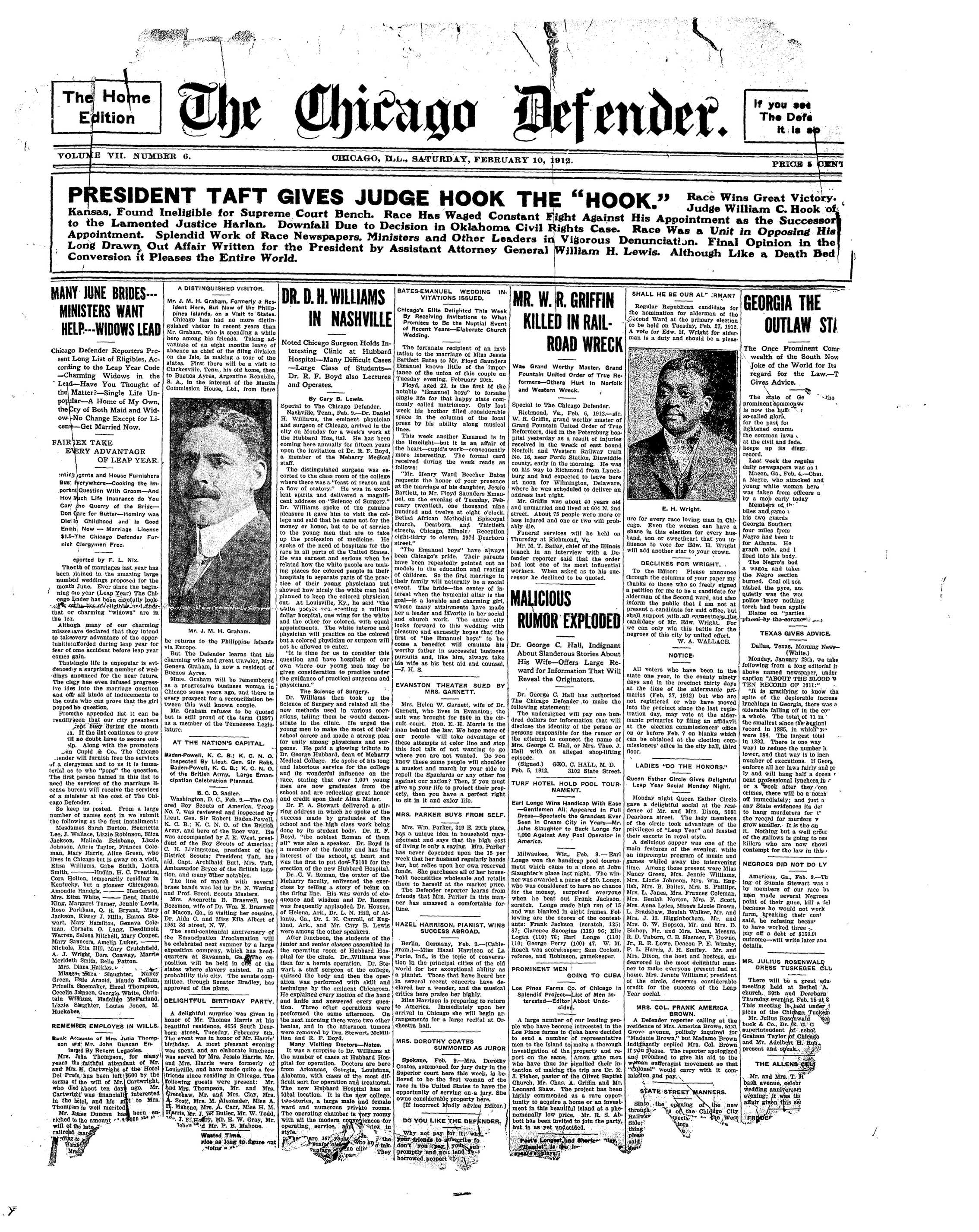
Page text (machine-generated)
PRESIDENT TAFT GIVES JUDGE HOOK THE "HOOK." Race Wins Great Victory. Judge William C. Hook of Kansas, Found Ineligible for Supreme Court Bench. Race Has Waged Constant Fight Against His Appointment as the Successor to the Lamented Justice Harlan. Downfall Due to Decision in Oklahoma Civil Rights Case. Race Was a Unit in Opposing His Appointment. Splendid Work of Race Newspapers, Ministers and Other Leaders in Vigorous Denunciation. Final Opinion in the Long Drawn Out Affair Written for the President by Assistant Attorney General William H. Lewis. Although Like a Death Bed Conversion it Pleases the Entire World.
MANY JUNE BRIDES---- MINISTERS WANT HELP----WIDOWS LEAD
Chicago Defender Reporters Present Long List of Eligibles, According to the Leap Year Code—Charming Widows in the Lead—Have You Thought of the Matter?—Single Life Unpopular—A Home of My Own, the Cry of Both Maid and Widow—No Change Except for Licens—Get Married Now.
EVERY ADVANTAGE OF LEAP YEAR.
intending agents and House Furnishers Bus Everywhere—Cooking the Important Question With Groom—and How Much Life Insurance do You Carr the Query of the Bride—Don Care for Butter—Hominy was Diel in Childhood and is Good Enough Now — Marriage License $1.5-The Chicago Defender Furnish Clergymen Free.
exported by F. L. Nix.
Theth of marriages last year has been plained in the amazing large numbeh weddings proposed for the month June. Ever since the beginneiing the year (Leap Year) The Chicago Lnder has been carefully lookeiin on her Alcithia, and ander that or charming "widows" are in the lea.
Although many of our charming missesave declared that they intend to takeevery advantage of the opportunitieaforsued during leap year for fear of one accident before leap year comes gain.
Thatingle life is unpopular is evidenced by a surprising number of weddings announced for the near future.
The clegy has even infused progressive idees into the marriage question and oor all kinds of inducements to the coule who can prove that the girl popped he question.
From the appended list it can be readilyseen that our city preachers
cept busy during the month as. If the list continues to grow will no doubt have to secure outlift. Along with the promoters Can Cupl & Co. The Chicago sender will furnish free the services of a clergyman and to us it is immatur- as to who "pops" the question. The first person named in this list to need the servicer of the marriage license bureau will receive the services of a minister at the cost of The Chicago Defender. So keep us posted. From a large number of names sent in we submit the following as the first installment: Mesdames Sarah Burton, Herrietta Lee, J. Wallace, Lizzie Robinson, Eliza Jackson, Malinda Erishane, Lizzie Johnson, Annie Taylor, Frances Coleman, Mary Williams, Alice Green, who lives in Chicago but is away on a visit, Eliza Williams, Gabe Smith, Laura Smith, — Hudlin, H. C. Prentiss, Cora Holton, temporarily residing in Kentucky, but a pioneer Chicagoan, Amondie Randig, — Henderson, Mrs. Eliza White, — Dent, Hattie King, Margaret Turner, Jonnie Lewis, Rose Parkham, Q. K. Bryant, Mary Jackson, Kissey J. Mills, Emma Stewart, Mary Hamilton, Geneva Coleman, Cornelia O. Lang, Desdimaol Warren, Salena Mitchell, Mary Cooper, Mary Sauncers, Amelia Luker, Nichols, Etta Hill, Mary Crutchfield, A. J. Wright, Dora Conway, Marrie Merlideth Smith, Belle Patton.
Mrs. Dana Hankley,
Misaga, Riza Slaughter, Nancy
Green, Esie Arnold, Maude Pellam,
Pricella Shoemaker, Hazel Thompson,
Cecelia Johnson, Georgie White, Christin
Williams, Madelite McFarland,
Lizzie Slaughter, Louise Jones, M.
Huckabee.
REMEMBER EMPLOYES IN WILLS.
Bank Accounts of Mrs. Julia Thompson and Mr. John Duncan. En-
glish
larges By Recent Legacies.
Mrs. Jula Thompson, for many
years the faithful attendant of Mr.
and Mrs. M. Cartwright of the Hotel
Del Prado, has been left 3600 by the
terms of the will of Mr. Cartwright,
who died about ten days ago. Mr.
Cartwright was financially interested
in the hotel, and his gift to Mrs.
Thompson is well merited.
Mr. James Duncan has been en-
riched to the amount
will of the late
railroad mar-
ricks to
Florida
Mrs.
The Chicago Defender.
A DISTINGUISHED VISITOR.
Mr. J. M. H. Graham, Formerly a Resident Here, But Now of the Philippines (islands, on a Visit to States. Chicago has had no more distinguished visitor in recent years than Mr. Graham, who is spending a while here among his friends. Taking advantage of an eight months leave of absence as chief of the filing division on the Isle, is making a tour of the states. First there will be a visit to Clarksville, Tennessee, his old home, then to Buenos Ayres, Argentine Republic, S. A., in the interest of the Manila Commission House, Ltd, from there
Mr. J. M. H. Graham. he returns to the Philippine Islands via Europe.
But The Defender learns that his charming wife and great traveler, Mrs. Geneva Graham, is now a resident of Buenos Ayres. Mme. Graham will be remembered as a progressive business woman in Chicago some years ago, and there is every prospect for a reconciliation between this well known couple. Mr. Graham refuses to be quoted but is still proud of the term (1897) as a member of the Tennessee Legislis-
AT THE NATION'S CAPITAL.
Baden-Powell, K. C. B.; K. C. N. O.
Inspected By Lieut. Gen. Sir Robt.
Baden-Powell, K. C. B.; K. C. N. O.
of the British Army, Large Emancipation Celebration Planned.
B. C. D. Sadler.
Washington, D. C., Feb. 9.—The Colored Boy Scouts of America, Troop No. 7, was reviewed and inspected by Lieut. Gen. Sir Robert Baden-Powell, K. C. B.; K. C. N. O. of the British Army, and hero of the Boer war. He was accompanied by J. E. West, president of the Boy Scouts of America; C. H. Livingstone, president of the District Scouts; President Taft, his alp, Capt. Archibald Butt, Mrs. Taft, Ambassador Bryce of the British legation, and many other notables.
The line of march with several brass bands was led by Dr. N. Waring and Prof. Brent, Scouts Masters.
Mrs. Anenretta B. Braswell, nee Bozemon, wife of Dr. Wm. E. Braswell of Macon, Ga., is visiting her cousins, Dr. Alda C. and Miss Ella Albert of 1851 3d street, N. W.
The semi-centennial anniversary of the Emancipation Proclamation will be celebrated next summer by a large exposition company, which has headquarters at Savannah, N. The exposition will be held in one of the states where slavery existed. In all probability this city. The senate committee, through Senator Bradley, has approved of the plans.
DELIGHTFUL BIRTHDAY PARTY.
A delightful surprise was given in honor of Mr. Thomas Harris at his beautiful residence, 4056 South Dearborn street, Tuesday, February 8th. The event was in honor of Mr. Harris' birthday. A most pleasant evening was spent, and an elaborate luncheon was served by Mrs. Jessie Harris. Mr. and Mrs. Harris were formerly of Louisville, and have made quite a few friends since residing in Chicago. The following guests were present: Mr. and Mrs. Thompson, Mr. and Mrs. Crenshaw, Mr. and Mrs. Clay, Mrs. A. Scott, Mrs. M. Alexander, Miss A. H. Mahone, Mrs. A. Carr, Miss H. M. Harris, Mr. J. W Butler, Mr. W. Todd, J. F. Henry, Mr. E. W. Gray, Mr. Schell and Mr. P. B. Mahone.
Wasted Time
since as long as figure out
soloing
CHICAGO, DLL., SATURDAY, FEBRUARY 10, 1912.
DR. D. H. WILLIAMS IN NASHVILLE
Noted Chicago Surgeon Holds Interesting Clinic at Hubbard Hospital—Many Difficult Cases—Large Class of Students—Dr. R. F. Boyd also Lectures and Operates.
By Cary B. Lewis.
Special to The Chicago Defender.
Nashville, Tenn., Feb. 9—D. Daniel H. Williams, the eminent physician and surgeon of Chicago, arrived in the city on Monday for a week's work at the Hubbard Hos, ital. He has been coming here annually for fifteen years upon the invitation of Dr. R. F. Boyd, a member of the Meharry Medical staff.
The distinguished surgeon was escorted to the class room of the college where there was a "a feast of reason and a flow of oratory." He was in excellent spirits and delivered a magnificent address on "Science of Surgery." Dr. Williams spoke of the genuine pleasure it gave him to visit the college and said that he came not for the money or honor, but to be of service to the young men that are to take up the profession of medicine. He spoke of the need of hospitals for the race in all parts of the United States. He was earnest and serious when he related how the white people are making places for colored people in their hospitals in separate parts of the practice of their young physicians but showed how nicely the white man had planned to keep the colored physician out. At Louisville, Ky., he said "the white people are expecting a million dollar hospital, one wing for the white and the other for colored, with equal appointments. The white interne and physician will practice on the colored but a colored physician or surgeon will not be allowed to enter.
"It is time for us to consider this question and have hospitals of our own where our young men may be given consideration to practice under the guidance of practical surgeons and physicians."
The Science of Surgery.
The Science of Surgery.
Dr. Williams then took up the Science of Surgery and related all the new methods used in various operations, telling them he would demonstrate in the clinic. He urged the young men to make the most of their school career and made a strong plea for unity among physicians and surgeons. He paid a glowing tribute to Dr. George Hubbard, dean of Meharry Medical College. He spoke of his long and laborious service for the college and its wonderful influence on the race, stating that over 1,000 young men are now graduates from the school and are reflecting great honor and credit upon their Alma Mater.
Dr. F. A. Stewart delivered a stirring address in which he spoke of the success made by graduates of the school and the high class work being done by its student body. Dr. R. F. Boyd, the "noblest Roman of them all" was also a speaker. Dr. Boyd is a member of the faculty and has the interest of the school, at heart and was the first to put down $100 for the erection of the new Hubbard Hospital.
Dr. C. V. Roman, the orator of the Meharry faculty, enlivened the exercises by telling a story of being on the fireline. His was words of eloquence and wisdom and Dr. Roman was frequently applauded. Dr. Houser, of Helena, Dr. L. N. Hill, of Atlanta, Ga., Dr. I. N. Carroll, of England, Ark., and Mr. Cary B. Lewis were among the other sneakers.
After lunchon, the students of the junior and senior classes assembled in the operating room of Hubbard Hospital for the clinic. Dr. Williams was then for a hernia operation. Dr. Stewart, a staff surgeon of the college, quizzed the body and then the operation was performed with skill and technique by the eminent Chicagoan. He explained every motion of the hand and knife and answered every question. Three other operations were performed the same afternoon. On the next morning there were two other henias, and in the afternoon tumors were removed by Dr. Stewart, McMillan and R. F. Boyd.
Many Visiting Doctors—Notes.
It was a surprise to Dr. Williams at the number of cases at Hubbard Hospital for operation. Doctors are here from Arkansas, Georgia, Louisiana, Alabama, with cases of the most difficult sort for operation and treatment. The new Hubbard Hospital has an ideal location. It is the new college, two-stories, a large male and female ward and numerous private rooms. The operating chamber is very room with all the modern conveniences for operating service, appraisal, etc in style.
There are 167 young men in the senior class who in the
BATES-EMANUEL WEDDING IN
VITATIONS ISSUED.
Chicago's Elite Delighted This Week
By Receiving Invitations to What
Promises to Be the Nuptial Event
of Recent Years—Elaborate Church
Wedding.
The fortunate recipient of an invitation to the marriage of Miss Jessie Bartlett Bates to Mr. Floyd Saunders Emanuel knows little of the importance of the union of this couple on Tuesday evening, February 20th.
Floyd, aged 22, is the first of the notable "Emanuel boys" to forsake single life for that happy state commonly called matrimony. Only last week his brother filled considerable space in the columns of the local press by his ability along musical lines.
This week another Emanuel is in the limelight—but it is an affair of the heart—cupid's work—consequently more interesting. The formal card received during the week reads as follows:
"Mr. Henry Ward Beecher Bates requests the honor of your presence at the marriage of his daughter, Jessie Bartlett, to Mr. Floyd Saunders Emanuel, on the evening of Tuesday, February twentieth, one thousand nine hundred and twelve at eight o'clock. Bethel African Methodist Episcopal church, Dearborn and Thirtieth streets, Chicago, Illinois." Reception eight-thirty to eleven, 2074 Dearborn street."
"The Emanuel boys" have always been Chicago's pride. Their parents have been repeatedly pointed out as models in the education and rearing of children. So the first marriage in their family will naturally be a social event. The bride—the center of interest when the hymenial altar is the goal—is a lovable and charming girl, whose many attainments have made her a leader and favorite in her social and church work. The entire city looks forward to this wedding with pleasure and earnestly hopes that the first of "the Emanuel boys" to become a benefict will emulate his worthy father in successful business pursuits and, like him, always take his wife as his best aid and counsel. —J. H. S.
EVANSTON THEATER SUED BY
MRS. GARNETT.
Mrs. Helen W. Garnett, wife of Dr. Garnett, who lives in Evanston; the suit was brought for $500 in the circuit court. Hon. E. H. Morris is the man behind the law. We hope more of our people will take advantage of these attempts at color line and stop this fool talk of not wanting to go where you are not wanted. Do you know these same people will shoulder a musket and march by your side to repell the Spaniards or any other foe against our nation? Then, if you must give up your life to protect their property, then you have a perfect right to sit in it and enjoy life.
MRS. PARKER BUYS FROM SELF.
Mrs. Wm. Parker, 319 E. 29th place, has a unique idea in household management and says that the high cost of living is only a saying. Mrs. Parker has never depended upon the 15 per week that her husband regularly hands her, but relies upon her own reserved funds. She purchases all of her household necessities wholesale and retails them to herself at the market price. The Defender reporter learns from friends that Mrs. Parker in this manner has amassed a comfortable fortune.
HAZEL HARRISON, PIANIST, WINS
SUCCESS ABROAD.
Berlin, Germany, Feb. 9—(Cablegram).—Miss Hazel Harrison of La Porte, Ind., is the topic of conversation in the principal cities of the old world for her exceptional ability as a pianist. Those that have heard her in several recent concerts have declared her a wonder, and the musical critics here praise her highly. Miss Harrison is preparing to return to America. Immediately upon her arrival in Chicago she will begin arrangements for a large recital at Orchestra hall.
MRS. DOROTHY COATES
SUMMONED AS JUROR
Spokane, Feb. 9.—Mrs. Dorothy Coates, summoned for jury duty in the Superior court here this week, is believed to be the first woman of the race in the United States to have the opportunity of serving on a jury. She owns considerable property here.
Why not pay for it: why
your friends to subscribe to
don't you pay, your sub
promptly and not lend
borrowed property
MR. W. R. GRIFFIN KILLED IN RAIL- ROAD WRECK
Was Grand Worthy Master, Grand Fountain United Order of True Reformers—Others Hurt in Norfolk and Western Wreck.
Special to The Chicago Defender.
Richmond, Va., Feb. 6, 1912—mr. W. R. Griffin, grand worthy master of Grand Fountain United Order of True Reformers, died in the Petersburg hospital yesterday as a result of injuries received in the wreck of east bound Norfolk and Western Railway train No. 16, near Fords Station, Dinwiddie county, early in the morning. He was on his way to Richmond from Lynchburg and had expected to leave here at noon for Wilmington, Delaware, where he was scheduled to deliver an address last night.
Mr. Griffin was about 40 years old and unmarried and lived at 604 N. 2nd street. About 75 people were more or less injured and one or two will probably die.
Funeral services will be held on Thursday at Richmond, Va.
Mr. M. T. Bailey, chief of the Illinois branch in an interview with a Defender reporter said that the order had lost one of its most influential workers. When asked as to his successor he declined to be quoted.
MALICIOUS RUMOR EXPLODED
Dr. George C. Hall, Indignant About Slanderous Stories About His Wife—Offers Large Reward for Information That Will Reveal the Originators.
Dr. George C. Hall has authorized The Chicago Defender to make the following statement: The undersigned will pay one hundred dollars for information that will disclose the identity of the person or persons responsible for the rumor or the attempt to connect the name of Mrs. George C. Hall, or Mrs. Theo. J. Hall with an alleged shop-lifting episode.
(Signed.) GEO. C. HALL, M. D. Feb. 5, 1912. 3102 State Street
TURF HOTEL HOLD POOL TOUR
NAMENT.
Earl Longe Wins Handicap With Ease —Gentlemen All Appeared in Full Dress—Spectacle the Greatest Ever Seen in Cream City in Years—Mr. John Slaughter to Back Longe for 1,000 Against Any Pool Operator in America.
Milwaukee, Wis., Feb. 9. —Earl Longe won the handicap pool tournament which came to a close at John Slaughter's place last night. The winner was awarded a purse of $50. Longe, who was considered to have no chance for the money, surprised everyone when he beat out Frank Jackson, scratch. Longe made high run of 15 and was blanked in eight frames. Following are the scores of the contestants: Frank Jackson (scratch, 125) 87; Clarence Snoogins (115) 96; Ellie Logan (110) 76; Earl Longe (110) 110; George Perry (100) 47. W. M. Roach was scorekeeper; Sam Cocken, referee, and Robinson, gamekeeper.
PROMINENT MEN
GOING TO CUBA
Los Pines Farms Co. of Chicago in
Splendid Project—List of Men In-
charge
A large number of our leading people who have become interested in the Los Pinos farms in Cuba have decided to send a number of representative men to the Island to make a thorough investigation of the property and report on the same. Amen gthe men who have thus far signified their intention of making the trip are Dr. E. J. Fisher, pastor of the Olivet Baptist Church, Mr. Chas. A. Griffin and Mr. Leonard Shaw. The project has been highly commended as a rare opportunity to acquire a home or an investment in this beautiful island at a phenomenally low price. Mr. R. S. Abbott has been invited to join the party, but is as yet undecided.
SHALL HE BE OUR AL" RMAN?
Regular Republican candidate for the nomination for alderman of the second Ward at the primary election to be held on Tuesday, Feb. 27, 1912. A vote for Edw. H. Wright for alderman is a duty and should be a pleas-
E. H. Wright.
ure for every race loving man in Chicago. Even the women can have a share in this election for every husband, son or sweetheart that you influence to vote for Edw. H. Wright will add another star to your crown.
DECLINES FOR WRIGHT.
To the Editor: Please announce through the columns of your paper my thanks to those who so freely signed a petition for me to be a candidate for alderman of the Second ward, and also inform the public that I am not at present a candidate for said office, but shall support with all earnestness the candidacy of Mr. Edw. Wright. For we can only win this battle for the negroes of this city by united effort.
NOTICE
All voters who have been in the state one year, in the county ninety days and in the preincinct thirty days at the time of the aldermanic primaries (Feb. 27, 1912) but who are not registered or who have moved into the precinct since the last registration day, may vote at the aldermanic primaries by filing an affidavit at the election commissioners' office on or before Feb. 7 on blanks which can be obtained at the election commissioners' office in the city hall, third floor.
LADIES "DO THE HONORS."
Queen Esther Circle Gives Delightful
Leap Year Social Monday Night.
Monday night Queen Esther Circle gave a delightful social at the residence of Mr. and Mrs. Dixon, 5001 Dearborn street. The lady members of the circle took advantage of the privileges of "Leap Year" and feasted their escorts in royal style.
A delicious supper was one of the main features of the evening, while an impromptu program of music and games whilied away the intervening time. Among those present were Miss Nancy Green, Mrs. Jennie Williams, Mrs. Lizzie Johnson, Mrs. Wm. English, Mrs. B. Bailey, Mrs. S. Phillips, Mrs. L. Janes, Mrs. Frances Coleman, Mrs. Beulah Norton, Mrs. F. Scott, Mrs. Anna Lyles, Misses Lizzie Brown, L. Bradshaw, Beulah Walker, Mr. and Mrs. J. H. Higginbotham, Mr. and Mrs. G. W. Hopson, Mr. and Mrs. D. Bishop, Mr. and Mrs. Desmer, R. D. Taborn, C. B. Hasmer, F. Downs, Jr. R. Lowe, Deacon P. E. Wimby, P. L. Harris, J. H. Smiley, Mr. and Mrs. Dixon, the host and hostess, endeavored in the most delightful manner to make everyone present feel at home, Mrs. Jennie Williams; president of the circle, deserves considerable credit for the success of the Leap year social.
MRS. COL. FRANK AMERIGA
BROWN.
A Defender reporter calling at the residence of Mrs. America Brown, 5121 Grove avenue, politely inquired for "Madame Brown," but Madame Brown indiscretly replied Mrs. Col. Brown if you please. The reporter apologized and promised to give his aid to the woman suitererian movement so that "Colonel" would carry with it commission and pay.
as Great Victory. William C. Hook of as the Successor in Opposing His Opinion in the like a Death Bed
GEORGIA THE OUTLAW STA
GEORGIA THE OUTLAW STA
The Once Prominent Comm
wealth of the South Now
Joke of the World for Its
regard for the Law.—T
Gives Advice.
The state of Ge
the
prominent commonwe
is now the hunt
so-called glor
for the past fo
lightened comm
the common laws
at the civil and fede
keeps up its disg
record.
Last week the regular
daily newspapers was as 1
Macon, Ga. Feb. 4.—Chat.
a Negro, who attacked and
young white woman here
was taken from officers a
by a mob early today
Members of the
biles and came
his two guards
Georgia Southern
four miles from
Negro had been it
for Atlanta. He
graph pole, and I
fired into his body.
The Negro's bod a wagon and taken the Negro section burned. Coal oil so finished the pyre, and quietly was the wot police knew nothing torch had been applite Blame on "parties placed by the coroner
TEXAS GIVES ADVICE.
Dallas, Texas, Morning News-
(White.)
Monday, January 29th, we take following from a long editorial it above named newspaper, under caption "ABOUT THE BLOOD WEN RECORD OF 1911."
"It is gratifying to know that spite of the deplorable increase lynchings in Georgia, there was a siderable falling off in the co' a whole. The number of 71 in the smallest, since the beginn1 record in 1885, in which we were 184. The largest total in 1892. There is one way way) to reduce the number it lower, and that way is to incr number of executions. If George enforce all her laws fairly and prily and will hang half a dozen nent professional lynchers in or a week after they, con crimes, there will be a notab off immediately; and just a any State evidences its def to hang murderers for t the record for murders w grow smaller. It is the on it. Nothing but a well grour of the gallows is going to res killers who are now show contempt for the law in this.
NEGROES DID NOT DO LY
Americans, Ga., Feb. 9—Thing of Sunnie Stewart was by members of our race but men made several Negroes point of their guns, kill a fel because he would not work farm, breaking their cont said, he refusing because to have worked three y pay off a debt of $1500. outcome—will write later and details.
MR. JULIUS ROSENWALD
DRESS TUSKEGER GLL
There will be a great edu-
meeting held at Bethel A.
church, 30th and Dearborn
Thursday evening, Feb. 15 at
8 This meeting is held under
pices of the Chicago Tuskegee
Mr. Julius Rosenwald
buck & Co., Dr. E. G. C
superintendent of, schot
Graham Taylor of Chicago
and Mr. Adelbert H. Rob
present and speak.
Mr. and Mrs. T. H
bash avenue, celebr
wedding anniversary;
evening; it was the
affair given this se
Jews of the Work in
This City—Items of Inter-
est—Speakers.
the Y. M. C. A. is in a progressive
lition, having covered more ground
edering all lines, than any time
lous. The most telling feature is
Bible study course, which has
issued all winter and bids fair to
true until spring.
its association has turned out fine
articles. In recent years, Mr. Bur-
now in Springfield, and Mr. Lay-
now in Atlantic City are making
very creditable showings.
Victoria.
Mr. J. C. Olden, class of 1911, Flsk;
Mr. Wm. O. Stokes, class of 1911, law;
Jio State University, Mr. W. R. Bur-
nate of this university, visited us
on 2nd. Mr. Olden is the new sec-
tory of the Y. M. C. A. of Dayton.
Stokes is practicing law in Day-
ton. Mr. Burden is secretary of
C. A. in Springfield, O.
Founder's Day exercises will be with a mock trial under the auspices of the Young Woman's Athletic station.
good-place to spend an hour is Y. M. C. A., 3330 South State St.
Meetings held at 4:00 p.m. maker for Sunday, Feb. 11, Dr. J. T.fer.
the result of the conference held month between the general off of the Y. M. C. A. of Chicago and Geo. C. Hall, chairman of the native committee, we have learned ground for the new building is broke March, and the corner going the month of May. towards helping
17
n and Rolley
Ind, Bnd, Inh
a few days dur
e show at the Coli
could not return to
hout visiting the Y. M.
looking over the plans
ding and conversing with
ry on Y. M. C. A. work in
they left very much pleased
ng they would be able to get
ations at our new building
ext trip to Chicago
Shimadzu, Y. M. C. A.
mae Y. M. C. A.
our Y. M. C. A.
unday afternoon.
devoted his life to
countrymen. He
is entire salary to
M. C. A. among his
produced at the meeting
of the following
the Lord with thy
th the first fruits of
; so shall thy barns
entry, and thy presses
with new wine." The
was received from
during the week:
end: You have given
opportunity for en associated with your alm Sunday afternoon. You do not w how highly your treatment was ceiated, and how deeply I was immed with so kind and generous atude of you and your men toward me. u generous gift that day was t o our home and presented to men. I having told them all about r kindness to me. All of them applated this very highly and have cided to purchase a number of the w Testament books out of that ney, and on each book we shall on your association as well as enerous gift. You will please per us to your members and whom I am indebted so I am, yours very truly, M. SHIMADZU. following letter shows the in that our subscribers have in M. C. A. movement. This sub ser sent in 25 per cent more than subscribed.
solved the letter which was
one from the Chicago address.
find enclosed a check for the
t and send me any literature
ay have concerning the associ-
I would like to join upon my
to the city.
A. W. Curtis, 5922 Aberdeen
made the banner collection for
week. Mr. Curtis succeeded in
ing cash payments from several
subscribers who had made no
ents on their accounts.
R. D. Taborn, financial agent of
see Institute, becomes a volun-
subscriber to our fund. Mr.
Baker, a young man who
employment through this de-
makes a cash contribution
building fund.
collector succeeded in getting
wrence with Assistant Chief of
H. F. Schuetttier, a few days
and was favored with the check
ring his subscription to our Y. M.
those paying their pledges
that he will be able to collect
friend in the future. Dr.J.T.
will speak at our meeting on
February 11th. Come out and
Laker, 6400 Woodlawn
Bantom, 3635 Forest
Childs, 6616 Vernon aven-
ton, 4521 Evans avenue;
Decatur, Ill.; Christat-
on, N. lee avenue; N.
Verde; J. C.
V
W. G. Carroll, 6614 Langley avenue;
Mrs. Erele J. Davis, 3546 Forest avenue;
Warren Dobblins, 4715 Dearborn street;
T. H. Gause, 4715 Dearborn street;
A. W. Hayes, 6618 Vernon avenue;
L. H. Lish, 4811 Vincennes avenue;
F. Phillips, 4811 Vincennes avenue;
H. R. Scurlock, 6633 St. Lawrence avenue;
H. P. Symma, 2807 Dearborn street;
Andrew Tate, 1416 E. 54th street; Jas. A. Terry, 3606 Wabash avenue.
HYDE PARK NEWS.
Woman's Club at Recent Meeting Surprised by Attendance of Notable Workers—Successful Bazaar.
The Hyde Park Woman's club met at the home of Mrs. L. Merrilwacher, 5478 Woodlawn avenue, on Jan. 24. The members were agreeably surprised by the large attendance of well-known club workers, who were out to encourage them, namely: Mrs. Ida D. Lewis, state organizer of the Women's Federation; Mrs. Theresa Macon, president of City Federation; Miss Carter, missionary; Mrs. Dr. Francis, also Mrs. De Courlander of the west side. Mr. Fredericks very ably responded* in behalf of the club, after which the ladies were beautifully served by the hostess.
On Jan. 31 the Hyde Park Woman's club held their bazaar at the home of Mrs. F. Byron, which was indeed one of the most unique affairs ever given at a private home. The friends feasted on the elaborate supper served by the committee, to the strains of the beautiful music furnished by Prof. Elgar's orchestra, until everything was sold. The affair was a success financially, and the president, Mrs. H. S. Claybrook, and members feel very much encouraged.
Encouraging Report From Knights of Pythias.
The quarterly report (October, 1911, to December 31st, 1911) of the Beneficiary Board of the Grand Lodge, Knights of Pythias, jurisdiction of Illinois, published by John R. Auter, secretary, has been presented at this office. The splendid balance in bank is a credit to the progressive spirit of the rulers of this wide-awake fraternal order. MF. Auter, who issues the report, was Chancellor Commander of R. B. Elliott Lodge No. 36 of Evanston for five consecutive terms, and when he declined another term they made him its financial secretary. Later we learned that it was through Mr. Auter's efforts that R. B. Elliott Lodge has such a strong membership.
GREAT PAINTER'S EARLY DAYS
Ziem Was a Tailor's Assistant, and Worked His Way to Italy to Study.
Zlem, sitting cross-legged on a table beside a window, worked as a tailor's assistant for several years. His life was thrown into a new channel by the arrival in the courtyard of an Italian family in which there was a handsome, auburn-hafred girl, who sang as a ballad singer. The father played a hard guitar, the mother made lace, and a boy performed divers gymnastic feats. The girl had a fine voice. Her father wanted a new coat and asked the elder Zlem to make it and Mime. Zlem to take in a part of the family as lodgers. She took in the boy and girl.
The latter lifted the future painter out of himself with her Venetian songs and accounts of the glorious city to which she hoped soon to return. Her name was Caterina. When she went away Zlem felt miserable. He lost spirit and could not shake off the sort of paralysis that had seized on all his faculties. At last he determined—with the help of his needle and his talent, as he thought, of portrait painter and violinist—to make his way to Venice. They answered to his hopes of going down by water to Marselles, for he knew no geography, and thence to Rome.
It would be now curious to see the portraits of Saone and Rhone captains of barges, wine and wood rafts that he did for them in lieu of passage money. In Rome he got in with painters and tourists. The former helped him to enlarge his artistic culture, and the latter took him about as a guide. But Caterina and Venice lay on his heart, and he took the bold resolution of going on foot to the city of his dreams. He so fell in love with it the first day he went on the Lido that he did not break his heart when he heard that Caterina had not turned up, but had gone to Paris to serve as a model.
Switzerland.
If flowers and sunshine were enough to satisfy all humanity, doubtless there would not be ice and cold. There are those who find in the snow-capped peaks of the Alps a charm which is never unfolded to them in the tropics, and even in winter there are those who dream of mountain climbing and those who even cross the ocean to enjoy the sport with its splendid exercise and its inspiration in the grandeur ever being unfolded before them.
Valuable Dog—Some Day.
Brother Jimpson says he owns a dog that not only points and retrieves, but he has taught him to spin on his tail like a top when he smells gasoline. Brother Jimpson says he's trying to develop a breed of dogs that will be invaluable in warfare, to point fighting aeroplanes trying to sneak over camp at night.
Artificial Turquoise.
From Ivory, which shows no-grain,
pieces of the size of the torquoise
desired are shaped and left for 15 days
in a saturated solution of ammoni-
cal copper oxide in water, then rinse
and dry them. If the color of the torquoise is not deep enough, the operation may be repeated.
pocket
f spe
pickpock
aris last
ly exer-
estible
aero
NATURE FURNISHES MANY SIMPLE BUT INTERESTING ONES.
Swiss_Weather_House, a Common Toy,
Quite Trustworthy — Chameleon
Barometer a Curiosity — Simple
Test for Humidity.
One of the oldest and simplest ways of telling whether the air is dry or moist is to suspend a piece of seaweed out of doors, or even in an apartment where there is no artificial heat. The weed is crisp and dry at the approach of fine weather, while it is febbly and moist when rain is likely.
A common toy, the Swiss weatherhouse, is really quite trustworthy in its forecasts, says the Strand. The woman, of course, emerges from the little house in fine weather, while the man comes out when wet conditions are to be expected.
In a medium state of the atmosphere both figures stand just inside the house. The movements are due to the twisting of a cord of catug, a substance which is highly sensitive to changes in the humidity of the air.
Two very singular weather devices are those in which a frog and a leech are employed. In the former case a glass jam-jar is filled to about two-thirds of its capacity with water. A little wooden ladder is constructed, and this is placed inside the jar. A frog will live quite happily in such a position for a few weeks, and it will be found that in fine weather the capture will climb out up to the top of the ladder. In stormy weather, however, the frog prefers to remain under the water.
Even more reliable as weather prophets are leeches. A single leech is placed in a broad glass bottle with a piece of perforated bladder or leather over the month. On the approach of fine or frosty weather the leech remains almost motionless, curled up at the bottom. When rain or wind is coming the creature rises to the surface, while a coming thunderstorm will cause it to be much agitated; at times the leech will even leave the water altogether, so sensitive is the animal to an electrical disturbance.
The chameleon barometer is a curiosity which has puzzled many people, but its construction is really very simple. The animal changes color according to the weather, being pink in damp conditions, purple in a variable state, and bright blue when the air is dry.
A cardboard mount is prepared, and this may be lettered in sections, Fair Storm and Change. The chameleon is sketched out on blotting-paper, and then immersed in a solution of chloride of sodium and gum arable. Any chemist will make up the mixture.
A more beautiful chemist hygroscope is formed of a flower made of white blotting-paper which has been immersed in the cobalt mixture. The blossoms show many varying shades, from bright pink to sky blue, with the changes, in the degree of dampness in the atmosphere.
A somewhat curious storm-glass was introduced by the late Admiral Fitzroy. This is formed of a glass tube, stoppered, but with a small hole through the cork. Into the tube has been poured a mixture of camphor, nitre, sal ammoniac, alcohol and water. The changes in the state of the atmosphere are indicated by the production of feathery growths, these extending upward at the approach of a storm and retreating to the lower part of the tube in quiet weather.
Spiking Obsolete Nowadays
One reads in the war news that the Italians found that guns in the Tripoli forts "spiked." If that is meant literally they must have been guns of mainly antiquarian interest. The expression, "spiking guns," is a survival from the day when all that was necessary to put a gun out of action (provided, of course, that you had access to it) was a large nail or spike and a hammer. You simply drove the nail into the touch-hole at the breech. If the nail was long enough to turn round at the end, on the bottom of the bore, so much the better.
It is just as simple, perhaps simpler, to put a modern gun out of action. All you want is a hammer. The breech block of the modern gun is held closed by screw threads, after the breech block is shut on the shell, a turn of two or three inches engages the threads. By knocking a burr on these threads you prevent them engaging. Any attempt to fire the gun without the breech block being perfectly closed would, of course, be of material assistance to the enemy.
In Practice.
Probably, one the heartiest laughs which the duke of Connaught, now governor general of Canada, ever enjoys, says the Tattler, was that occasioned by the remark of an Irish peasant, who one day while the duke was driving in Dublin with the duchess ran alongside the carriage and kept up with it in an astonishing fashion. So persistent was the man in his endeavors to keep pace with the carriage that at length the duchess had the vehicle stopped and asked the man what he wanted. He said that he was anxious to get a good look at their royal highnesses. The duchess was much flattered and asked him how he managed to keep up with them. "Oh," he said, "shure, haven't been chasing pigs all me lofe?"
Made Horseshoe for Royalty
A popular worthy, Robert Kidd of Kirkchin, Meigle, Scotland, celebrated his golden wedding the other day. Mr. Kidd is a blacksmith, and at one time he was in the employment of the Dowager Duchess of Atholl. While he was working on a horsehoe one day the Duchess accompanied by her late Majesty Queen Victoria, entered the smithy and watched Mr. Kidd at his work. He completed the shop which to his gratification was carried away by the distinguished visitors. I was hung in the cathedral, where I was by years till it was
UNIVERSITY
Chicago Defender Gladly Received by President, Teachers and Students—Instruments for the Brass Band Arrived—Girls' Basket Ball Team Making Good—Senior Class Presents Silver Lady to President—Preachers' Ald Association Entertains—Seniors Entertain Juniors—Famous A. M. E. College in the Limelight—Interesting Items Concerning Faculty and Pupils.
By R. G. Bruce.
WILBERFORCE, O., Feb. 9.—The Chicago Defender was gladly received at Wilberforce on last Monday. The president, teachers and the student body are putting forth every effort to support this paper. We have been successful in securing the services of four young ladies and one young man as reporters. The reporters are as follows: Reporters for Arnett Hall, Miss Hazel Thompson and Bernice E. Porter; Senior Hall, Miss Julia Bunny; Shorter Hall, Miss Mabela Spinks; O'Neil Hall, Mr. Wm. King, Secretary Jenkins has kindly consented to render us his personal aid and the entire school is at the back of us pushing us on.
Brass Band.
Instruments for a brass band arrived here last week and on last Thursday morning the twenty young men who are to compose the band marched into chapel, each man carrying his instrument, and were greeted with a loud and long continued applause. The band took a position on the rostrum and Supt. Joiner addressed them. A response was given by Mr. W. King of Bordentown, N. J., graduate of Ironside school, who is conductor of the band. After several other minor addresses the student body gave several of their school yells. Tuesday afternoon Mr. King led his band into the armory for practice and if George Ellot had been passing through our campus at the time she would have declared that it was Cliff's holiday.
The Girls' Basket Ball Team.
The girls' basketball team has done some real work this past month. Four new members joined the association. Through the kindness of our many friends the girls have been able to purchase their suits, and they expect to appear in a real game Monday, Feb. 12. The team takes this opportunity to thank the many friends for the help rendered in their first effort. The entire team appeared in chapel Tuesday morning in full uniform. They were greeted by a loud applause by the student body. The game is proving very beneficial to the girls, the weak are being made strong through hard practice. On Jan. 22 the following members were elected for the ensuing year: Miss Alma Havis, president; Miss Lucille Ford, vice president; Miss Hazel D. Thompson, secretary; Miss Bessie V. Morris, treasurer; Mr. T. C. Carter, manager and coach; Miss Bernice Rice, assistant manager; Miss Edith Thompson, chapain, and Miss Bessie Coward, referee.
Seniors Present Ladle to President.
The senior classes were entertained by President and Mrs. W. S. Scarborough at their most beautiful home, on Saturday evening, Feb. 3. A very interesting program was rendered, during which the president was presented with a silver ladle by the senior classes. Delicious refreshments were served. Mr. E. Hanna, president of the seniors, acted as toastmaster. A very enjoyable time was had.
Preachers Aid Association.
The members of the Preachers Aid Association of Payne Theological Seminary gave an entertainment Thursday evening, Jan. 31, in the chapel of Shorter Hall. A very interesting program was rendered. The program: Selection, orchestra; address by President W. Jones; vocal solo, M. A. W. Ward; recitation, Miss Julia Bunny; vocal solo, Miss N. Crosby; reading by Mr. R. C. Henderson; bass solo, Mr. W. Reid, and selection by orchestra.
Seniors Entertain Juniors.
The seniors entertained the juniors Friday evening, Feb. 2, at Arnett Hall. This occasion marks the annual entertainment that is given to juniors by the seniors each year. A very interesting and helpful program was rendered, after which a delicious luncheon was served. The hours were from six to ten.
The Campus Orchestra delighted the girls of Arnett Hall Saturday evening by a number of selections. At a seasonable hour a dainty repast was served in the dining room. All present voted that a happy evening had been spent.
The discipline committee met in the president's office Tuesday afternoon. Only want to ask one question: Were you there?
OUT IN ENGLEWOOD
Weekly Letter from This Thriving Section of the City-All the
"Ground Hog Day."
Mrs. Leah Edwards entertained the Carnell Charity Club at 5746 5th avenue, Feb. 2nd. Twenty ladies were in attendance. Mr. Wilson of the Fellowship Herald, gave a talk on newspapers and magazines. Luncheon was served at 4:30 p. m. Mrs. L. G. Macon and Kennedy, Mrs. Gerald and Mrs. Coleman assisted in serving the ladies. All said they never would forget "ground hog day."
Selenium for Burglar Alarms
The property of selenum of becoming conducting to electricity when exposed to light is to be made use of for the construction of burglar alarms. A selenium cell is inserted in an ordinary electric circuit comprising a bell and a battery. During the day the cell is kept covered sheltered from the light. At night the cover is removed. Any light then falling upon the cell closes the circuit and sounds the alarm bell.
An Irishman saw while passing in
through a graveyard these words writ-
e a tombstone: 'I still lived
there was dead I'd own up
your hand you
On Flossie's Advice
"Yes," said young Mrs. Tomlinson as she poured a glassful of water into a shallow bowl filled with blooming bulbs, "they did bloom at last and they are pretty. But don't you ever let any one tell you what Flossie told me about them, for it isn't true." "Chinese lilies or narcissus?" asked her visitor, as she slipped off her pink hat and warmed the tea blue tipped fingers against the tea cozy, all set for gentle brewing. "I'm sure I don't know. I bought both kinds of bulbs and they got mixed, and now every bowl has some flowers with yellow centers and some that are white and everybody tells me a different story about which is which. But that doesn't matter nearly so much as the rest of it." Young Mrs. Tomlinson sank into her wicker chair and began to arrange the delicate tea cups, and after that she uncovered a pile of cheese sandwiches.
"It is all lovely," exclaimed her friend. "All—ten, cheese, sandwiches and flowers. I am cold and hungry, so hurry the tea, and do tell me what Flossie said that wasn't true."
"None of it was true—about the bulbs," declared young Mrs. Tomilinson, sternly. "And she started me on them, you know. She was here last summer when we gave our rubber plant to Aunt Sophie because Harry said it was too big to live with and fussed so about it. I was sorry to see it go, for it was the only thing I ever made grow, and I have spent a fortune on ferns and various kinds of plants. They die the minute I touch them. So Flossie suggested bulbs. They were quite cheap she told me.
"Just get some cheap, plain glass bowls," said Flossie, and you can gather enough pebbles this summer to fill them. Then get the bulbs—at 25 cents a dozen—and you have flowers for the entire winter. Plant them two weeks apart and then keep them in the dark for two weeks. In six weeks they bloom and you can keep taking out your bowls as the old flowers die: It sounded delightful, so I decided to try it.
"That was in July. We were going north for the rest of the summer, so I just made a note of it and watched for pebbles. Whenever we were in swimming or were walking by the lake I made everybody pick up pebbles for me. Harry said his pockets were full of stones all summer long, and he got awfully mad once because I emptied the cigars out of a new cigar box to put stones in, though I covered up the cigars and they weren't hurt a bit.
"I brought back four boxes of stones — perfect beauties, blue and white and yellow and pink. Then I began to look up bowls. Flossie said the bowls would cost almost nothing at all, and I began to look for plain glass bowls. The cheap ones were dreadful pressed glass things and the only pretty ones were $1 each, so I got two of those and then looked at pottery bowls. Harry says that there's where I lost my head, but I looked on the bowls as an investment. And I got some beauties. They cost more than the others, but I thought they were worth the money, and the Japanese clerk was such a dear about choosing them. "Then I got the bulbs. And instead of costing 25 cents a dozen they were three for a quarter. Flossie said I went to the wrong place, but I didn't know that, and I had bought six bowls, so I had to have plenty of bulbs.
"About October 1 I began to set them out so they would begin blooming about November 15. I never have got over this part of it. Harry has always given his cigar boxes to a neighbor boy and he came over to play in our basement one day and found my pebbles in those boxes and threw them all into the alley!
"Harry wasn't at all sympathetic. He simply refused to go and gather more pebbles by the lake, which he might have done to save expense, and so I had to go back to the bulb store and buy little ugly, commonplace stones for ten cents a quart.
"I finally got one bowl started in the dark in the coat closet. There Harry found it before it was a week old and spilled it all over the silk lapels of his new tuxedo. Of course, his tailor could fix that, but he insists on counting it in as part of the expense. He never seemed to care for my bulb ambitions.
"That bowl was broken, and of course it was the nicest, and the little tender sprouts were harmed, so I had to begin again. I took all the things out of the closet and had the janitor put up some shelves, and it didn't cost much and was a splendid place for the bulbs.
"But all winter Harry has said that he hasn't been able to find a thing in its proper place. He quieted down a bit after the bulbs got to blooming—until he got his newspaper in a bowl one night, and then you really should have heard him rave, though it was just his own carelessness.
"Of course, I have learned a lot about bulbs. I tell Harry that next year, since I have my equipment, everything will go much better. It is an investment, you see, so I must go on, for there are only the bulbs to buy.
"If you ever want to try them, dear, come to me, or ask Harry. We know. Do have another sandwich."
Task for the Schools.
"What we want the schools to do is to make intelligent citizens and also virtuous citizens—those who can control themselves. A boy has been described as a centaur, half horse and half mule. And his life depends on whether the man shall drive the horse, or the horse drive the man. We want the reins of self-control placed in the hands of the graduating boy. We can maintain a self-governing
Ingenious Operations of a Burglar Who Was After Wealth of Berlin Money Broker.
The confidence of German manufacturers of safes in the resistance of their works against ordinary safe-blowing operations was rudely shaken not long ago by the feat of a single robber in Berlin, who operated in this fashion:
In a hotel a room was secured which was situated immediately above the office of a money broker. At night a hole was pierced in the ceiling of this office. By the use of a drill and saw a circular piece of the flooring was easily raised. Beneath lay a thick layer of cement. A small office was made in this and an umbrella shoved down into the space below. The umbrella was attached firmly from above, and when opened received without noise all the fragments of cement which were dislodged as the hole was enlarged so as to allow of the easy passage of a person. By means of a rope ladder the descent was made readily into the office below. The next steps of the thief's work consisted in the bringing down of two cylinders of compressed oxygen and an acetylene generator charged with calcium carbide and water. With these he was able to produce a blowen flame of such intensity that steel fuses in it like lead in an ordinary gas jet. It required only a brief space of time to melt away so much of the door that the contents of the safe were accessible.
TABLE DELICACY OF GERMANY
Westphallan Ham Is Given Its Piquant Taste by the Use of Juniper Berries.
Wherever a German table delicacy is in demand, there is the Westphalian ham to be found. It is given its peculiar piquant taste by the use of juniper berries in smoking the meat. The juniper shrub is indigenous to northwestern Germany and so pleniful, especially in Westphalia, that to its presence is due the growth, during the past several centuries, of two principal industries of this German province, the distillation of gin and the preparation of hams. After weeks of preparation the hams are ready to be smoked. The smoke houses consist sometimes of two, and sometimes of three stories, the fire being kindled in the lowest and the meat hung in the second and third, to which the smoke ascends through holes in the flooring. Westphalian hams are invariably smoked over a bright fire made of beech-wood only, except that junper twigs and berries are constantly thrown on the fire. Beech-wood sawdust is strewn over the fire in case it becomes too strong. The smoking process requires on an average about eight days.
FOOD VALUE OF CHESTNUTS
Are Rich in Starch and Fat, Better
Than Potatoes and Almost as
Good as Bread.
In France much attention is given
to the propagating of the chestnut,
and the fruit is spoken of with enthusiasm and respect. In French literature, especially in stories for children, the chestnut tree is quite as important a feature as the plum tree in the politics of this country, where we speak lightly of the chestnut and then pay at the rate of $5 a bushel for them. The small French chestnut is called the "chatalgine," but the large or giant chestnut is the "marron." The marron is cultivated extensively in France and Italy, where it is used in large quantities.
"Every soda fountain menu," says the New York Soda Fountain, a trade journal, "has some reference to marrons, and marrons glace are a favorite after-dinner morsel at all the larger hotels, yet few persons realize that while primarily a dessert delicacy, marrons are an exceedingly wholesome and valuable food. It is not generally known that the fruit of the chestnut tree is nearly as valuable as bread and more valuable than potatoes as a food, being rich in starch and fat."
In some districts of Pennsylvania much attention is now given to the planting of chestnut trees. There are several hill counties in Indiana, like Brown, Monroe and Morgan, where the marron and the smaller sized chestnuts could be made a source of profit.
Procrastination is the thief of time
WAKE UP! WAKE UP! WAKE UP!
WAKE UP! Don't allow yourself or those dependent on you to suffer in the time of need for the sake of a few paltry dollars. It requires very little to carry a splendid life insurance policy in the
Put Under Dessert of the Wes-
Bonner, Malach, 47 years, 3431 Dear-
bush, Cordella, 37 years, 211 N. Ada
St.; Feb. 2.
Coleman, John, 47 years, 6246 Peoria;
Chandler, Cordella, 37 years, 1342 Wells
St.; Feb. 5.
Falls, Julius G., 9 mos, 5945 Loomis; Feb.
Fields, Louis, 51 years, 9241 So. Chicago
Av.; Jan. 31.
Janeau, L., L., 51 years, 1450 Eberly
Av.; Feb. 1.
Johnson, Chas., 29 years, 1554 Jefferson;
Luck, Ida, 32 years, 21271 Clark St.; Jan.
Middax, Jessie, 23 years, 3890 Wentworth;
Feb. 2.
Ray, Oscar, 26 years, 3544 State; Feb. 1.
Richards, Infant, 6 days, 6113 Morgan;
Shan, Thompson, 42 years, 3386 Wabash;
Feb. 2.
Temple Kirkel, 27 years, 5220 Lake Av.
; Jan. 31.
Wiley, Raney, 51 years, 2303 State St.
Welch, Laura, 52 years, 9029 Commercial;
Feb. 3.
Walker, Geo., 52 years, 453 Armour; Jan.
Woods, Joseph, 39 years, 2324 Dearborn;
Jan. 31.
Mrs. Fred Hensler, who died at her home in Morgan Park this week, was the wife of Mr. Ezekiel. He supplied store at 5002 State Street. Three survive her, the best known being Predie survive her, the best known being Christopher Cooper and Mrs. Ellen L. Cooper, the best known being at the home of his son, 4010 State St., at the use of seventy-eight years. The many friends and appreciates the numerous beautiful floral tributes of sympathy and respect. Mrs. Johnson, husband of Mrs. Manuelle Johnson, 5540 Jefferson Ave. died Jan. 30, after a lingering illness, and was a devoted mother. He baptized church Friday, Feb. 2. He was baptized to Cleo罗 Johnson, Knights of Rythmic.
A Kodak owner printed some good negatives in soft sepla shades and mounted them in books made from heavy tinted paper, tying the booklets with pretty ribbon. An aunt, who never saw a mountain, enjoyed pictures of South Cheyenne canyon, Colorado. Another liked the homes of several relatives. Grandmother enjoyed a variety of snapshots of her grandchildren. A dozen negatives can be made in very short the and will cost less than $1.—Woman's Home Companion.
Figure Blotters.
Dainty blotters for a girl's made by cutting out and figure from cardboard. The hoop-skirted little ladies are Face the back with blotting well as the "cascel-back" piece board fastened to her to stand that she may preside over the tie.
Share Life of Apes.
As a modern example of a
lately primitive race of people,
W. Voiz of Breslau univery
brought to notice the Kubushan
completely isolated in the reser
terior of Sumatra. They are
life and habits of the ap in
same forest.
Modern Finance.
Knicker—"Are you cuttownown expenses?" Bocker—"Yes; it is paying only half the bill."—Puck.
Ree. Phones:
Doug. 2586 Office: Jak 3126
Auto 72 607
DR. G. WILLIAM MILLER, Physician and Surgeon
Office, 4709 State Street
Heure: 8-11 A. M.; 1-3 and 8 P. M.
Residence, 3552 Forest ve.
DR. A. BAILEY WILLIAM, PHYSICIAN AND SURDON.
Heure: 11:00 a. m. to 1 p. m. 2:00 p.
8 a. m. to 7 p. m. to 8:00 p. m. and Appointment, Provident Hospital Daf
8-11 a. m.
8200 State Street, Chicago, I.
Phone Calumet 233.
PHONE ALDINE 3458
IDA M. DEMPCI
Stenographer and Typist
3716 Dearborn St. Chicago, IL
Smith @ Sons
Restaurant and Lunch Room
Extra Fine Home Cooking
Private Dining Room
4286 State Street Chicago
low yourself or those de-
in the time of need for
doors. It requires very
life insurance policy in the
DEMNITY COMPANY
OBITUARY.
Kodak Booklets
Figure Blotters.
City Churches—Religious News
GRACE PRESBYTERIAN CHURCH
Mrs. David Mitchell and Mrs. Frank W. McCray have become teachers in the primary department. Mr. Wm. Sulzer is teacher of the class formerly taught by Miss Tibbs. We are very glad indeed to welcome these members into the work.
Dr. J. T. Jenifer preached a very interesting sermon last Sunday morning.
Rev. Jackson is improving slowly and we pray for his speedy recovery.
His wife has returned to the city.
Mrs. Joe Moore and Mrs. M. E. Henderson are on the sick list.
The C. E. Society had a very interesting program Sunday evening, it being the 31st anniversary of the endeavor movement, commemorated throughout the world as Endeavor Day.
Special program next Sunday evening, subject "Christian Stewardship." There will be three minute talks on the subjects "Stewardship of the Gospel," and "God's Ownership of All Things." One minute testimonies of "Rewards of Stewardship," "Presentation of the Fenth Legion." Remember the rally Feb. 12th.
We wish to sincerely thank the friends, "Volunteer Workers," "Ways and Means Society" and Sunday school for their beautiful floral tributes to our deceased, also for their letters of condolence and many kindnesses in our time of bereavement and sorrow. G. R. Barnes, Annie Fowler and Minnie Barnes, 4609 Vincennes avenue.
ST. MARY'S A. M. E. CHURCH.
(Rev. Jas. Higgins, Pastor)
Second quarterly meeting at St. Mary's A. M. E. Church. Rev. T. W. Reeves, C. E., will preach morning and evening.
Rev. R. E. Wilson, of St. Stephens'
A. M. E. Church will preach the
massal sermon at 9 o'clock. Love
Fenst Monday. We cordially
invited to all the services.
VOLUNTEER WORKERS CLUB.
By L. H. Webster.
The Volunteer Workers met at the home of their president, Mrs. Clara Johnson, 40 W. 34th street. The attendance was quite large. The club was delighted to have two of their members who have not met with them for some time on account of illness. The visitors were Mesdames A. E. Steel of the West Side Club, D. L. Ward and L. Sublet, president of the Calendar Club of Quinn Chapel. Each lady spoke in complimentary terms of the work of the Volunteers. Mother Wills responded in behalf of the club.
Mrs. B. Ray, one of the new members, favored the club with one of Dunbar's selections. After the routine business, the hostess served an elaborate luncheon.
The Volunteer Club will observe Lincoln and Fred. Douglas birthday anniversary Wednesday, Feb. 14th, 1912, at the home of Mrs. M. Webster, 6430 Vincennes avenue. A very interesting program has been prepared, and a silver offering will be received.
WYMAN CHAPEL A. M. E. CHURCH
The pastor, Rev. H. E. Stewart, is again able to take up the work of the church. He will preach Sunday morning at 11 a.m. The officers of the church have provided for the evening service. Dr. A. J. Carey has been invited to preach the sermon, the occasion is the winter rally.
Dr. L. W. Fenwick will preach at both services Sunday, Feb. 18th. Dr. Fenwick has kindly consented to assist in the work, and the members of the church feel very grateful to him for his services.
The Sunday school held its annual election of officers and teachers last week. Miss Beatrice Watts was selected as superintendent of the school and Mr. L. E. McIntyre as the assistant superintendent. Quite a few changes were made in the list of teachers. The work of the Sunday school will grow. The Sewing Circle will meet next Tuesday at Mrs. Mary Jones, 313 Chestnut street.
The Wednesday night and Friday night meetings are proving a great blessing as well as an opportunity for social and religious gathering of the members of the church.
The Sunday Club of Wayman Chapel will meet Sunday afternoon 4:30 p.m. The meeting will be presided over by Mr. O. F. Roberts, let all interested in the good work be present at that hour.
WALTERS A. M. E. ZION CHURCH.
The severe cold on last Sunday caused a marked decrease in the attendance at our church, the auditorium however was very comfortable and those present seemed to enjoy the services.
The Sunday school elected and installed a new crop of officers, for superintendent, H. J. Johnson; assistant superintendent, L. J. Denby; secretary, W. J. Burdine; assistant secretary, Eva Kelly; treasurer, Mrs. Ophella Mills; librarians, Mrs. Lucinda Jones and Earl Simpson.
The Men's Utility Club met with Mr. U. Collins Thursday evening at 3820 Dearborn street. They had a very enthusiastic meeting and enjoyed a social hour at the expense of their host. The Woman's Home and Foreign Missionary Society prayer service was well attended. Their place of meeting for next week will be announced on Sunday.
The sick of our church are Sister Price of 5223 Lake avenue, Sister Rice of 2735 LaSalle, Brother S. M. Hardin of 4110 State street, and Sister Burleigh of 4010 Dearborn street are all improving.
The death of Sister Nancy Lewis, who has been a familiar figure in our church for many years, removes one of Zion's landmarks. Sister Lewis will be much missed for she was one of those characters which impressed herself upon all who knew her.
The Sunday services will be as usual, Rev. Callis will preach morning and evening.
Do not forget the playlet entitled
The Ventures of Beetzebub, written
by the author of Tallabo, which will
appear in this church Monday, even
ing, Feb. 19th. This is a very interesting drama and will be well set. Don't fall to see it.
The man's banquet on Feb. 29th is to be the greatest social affair ever held in this church, the caterer has been secured and the tickets are going raplidly.
LITTLE "BUSY BEE" WINS QUILT.
Maybelle Hill, Nine Years Old Student Church Worker, Sells 362 Tickets.
"The Busy Bee Band" of Hope Presbyterian church presented "The Old District Schule" Thursday evening, Jan. 25th, in the lecture room of their new church, corner 61st street and Loomis boulevard, under the management of Mrs. B. B. Johnson, 442 West 57th place.
The house was packed to its utmost capacity and many were turned away. A beautiful bed quilt was to be given to the highest ticket seller.
Among the contestants was nine year old little Maybelle Hill, 6045
14
Little Maybelle Hill, Who Sold 362 Tickets and Beat All Competitors in a Contest for a Quilt; Prize Too Large for Winner to Handle.
Loomis boulevard, who, through her own efforts, reported the sale of 362 tickets, and turned over to the treasurer of the band $36.20. It is needless to say that amid a storm of applause and admiration the quilt was awarded to little Maybelle. She is a member of the Busy Bee bee, is never idle and responds eagerly to any call of the band to service. This is not the first time little Maybelle has been a winner in such contests. In her childish enthusiasm she doubled the amount brought in by any other competitor.
Mr. and Mrs. Hill are to be congratulated upon the whole-hearted manner in which they have given their little daughter to the Master's service. Three cheers for Little Maybelle, heroine of the Busy Bee band.
Maybelle has to have help when she attempts to handle her prize.
WHO WRITE THEM.
A Review—Our Literary "Round Table."
By D. W. Johnson.
"The Negro Problem." a work printed by the A. M. E. Book concern, 631 Pine street, Philadelphia, Pa., may be said, without exaggeration, to be worth its weight in gold. This work emanating from the fertile brain of such a brilliant and gifted man as Mr. R. R. Wright, Jr., is certainly a credit to himself and the science which he so ably advocates. It is a strong, masterly and sympathetic appeal to this great Christian, Liberty Loving Nation to do justice to a helpless and inoffensive race of people, whose only crime is their misfortune—not their fault—of being brought into this country without their consent. It would be well for both races from a sociological standpoint, and a very much needed panacea for the civic, economic and industrial condition of the country, if everyone with a spark of humanity and a grain of influence would read Mr. Wright's work and conform to its teaching. The first part of the work describes the relation and attitude of the social student to the race problems and the difficulties involved. There are numerous and splendid historical citations, showing the inconsistent and superstitious ideas of the people a few centuries ago, and as late as the last century, regarding scientific discoveries.
The second 'part is an analytical discussion of the Negro problem, which clearly demonstrates that it is a social problem—but suffering from a form of maladjustment somewhat peculiar to the American people, which can be slowly but easily solved by a change of attitude of the public mind from that of indifference, opposition or depreciation, to one not especially favoring the Negroes, but of fairness, justice and consideration. Let us hope the day will soon come when the American people can and will conscientiously lay aside their superficial or imaginary prejudices. Oh, what a joyous day!
Tramp Not Wholly Lost
A tramp stealing a ride on a train jumped off as it passed a burning hotel, aroused the sleeping lodgers and, his rescue work done, regained his place on the bumpers before the train left the yards. A pretty full volume of comment on American human nature is contained in the brief report of the incident.
"We've got a new brider at the house," said the bill clerk, as he dexterously trunched his stool into position and perched himself. "His name is Timothy Haysseed, and he's from Squash Center. Hod' have stayed there, but the cows were always mistaking him for something to eat and he got bitten up quite badly."
"How interesting," remarked the cashier. "A very odd name, isn't it?" "Well, I won't say that his sure-enough name," the bill clerk kindly explained. "But I ought to be. He's the worst fay you ever saw. He's got freckles all over his nose and—here's the joke:
"At breakfast he asked the landlady for another plate of cakes. Honest! And when she asked him if he wouldn't like anything more—sarcastic, you know—he says, 'I believe I'll have another piece of steak, please.' Just that way. And he'd labbed two pieces when the dish went around. He's looking for a job. I think we ought to make room for him here."
"Did the old lady throw the coffee pot at his head?" asked the cashier.
"She ought to have," replied the bill clerk, with a grin. "It's a wonder she didn't."
"She didn't then?"
"Of course, the didn't," said the bill clerk.
"You don't mean to say that he got his plate of cakes and his steak?" demanded the cashier. "Surely not?"
"Of course, he did," answered the bill clerk. "Did you suppose she'd tell him he'd had all she could afford to give him? What kind of a joint do you think it is?"
"Well, well," said the cashier. "No doubt it would be rather remarkable if the good woman objected to simplifying more food than this rustic person paid for."
"Oh, I guess he didn't get any more than he paid for, if you come to that," said the bill clerk.
"The strange thing was that the young man should ask for what he wanted then?" queried the cashier, "Is that it, Johnny?"
"If you knew the old lady, you'd think it was," said the bill clerk.
"And he got the cakes—and the steak," said the cashier. "He certainly must be a blockhead. If he'd kept still he'd have had the pleasure of leaving the table hungry, in all probability.
"It's to be hoped he will learn; if he doesn't, it's hard to predict what will become of him.
"To begin with, he'll go around asking for a job, I suppose, and he'll keep on asking until he gets it, instead of politely waiting for the job to come to him. It's quite evident that he hasn't any delicacy whatever. Think of a young man—with freckles on his nose, too!—asking busy people to give him work, just because he happens to want it. Shameful!"
"Well, if you think it's all right to put your feet in the trough, you can," muttered the bill clerk.
"I'm not sure that it isn't all right, if you happen to be a hog and your associates are hogglish," said the cashier.
"I'm not casting any reflections on your boarding house," he continued.
"I merely want to call your attention to the fact that this is a cold, cruel world. It isn't enough to look humky; you've got to holler for grub, and that in no uncertain tone. If you do that it's a hundred to one that you'll get it."
"Your friend, Mr. Timothy Hayseed, is making a pretty good beginning, if you ask me. When he gets his job, he'll ask, 'about anything he wants to know and then he'll ask for a raise of salary.'"
"That's all the good it would do him if he worked here," remarked the bill clerk.
"You can't ever until you try," said the cashier. "After he's got most of the knowledge regarding the business," he continued, "he'll ask for a partnership, and he'll naturally get that.
"In course of time he'll ask the other members of the firm to retire, and they will gracefully skidoo. If they don't, he'll scoop in a majority of the stock and kick 'em out.
"Having accomplished this, he'll ask the principal firms in the same line of business to consolidate with him and allow him to direct their destinies, and they will do so.
"Then he will consider that his industry is entitled to a little special legislation of the fostering order, and he will ask for it. If he can put up the right kind of an argument to the commission, he'll get what he asks for."
"Put up! is good," commented the bill clerk. "So all you need to do to be the head of a trust is to ask for another plate of buckwheat cakes when you are a young man. Is that it?" "You're putting it the wrong way, Johnny," answered the cashier. "Not every young man who asks for a second help will arrive at the eminence that I speak of, but if you take notice you will find that there is no trust magnate who is congenitally bashful about asking for anything that he thinks he wants." "I was under the impression that they took what they wanted without asking," said the bill clerk.
Australia's Tallest Tree
The tallest tree in Australia is probably one of the eucalyptus amygdalina regnan species, which was found some time ago on a spur of Mount Baw Baw, in Gippsland. Victorian experts now have ascertained the height of the tree to be 326 feet 1 inch. Its girth at 6 feet from the ground is 25 feet 7 inches. A tree of the same species $d^{2}$ overed at Neerim, also in Gippsland, while only 227 feet high, has a girth of 55 feet 7 inches at 6 feet from the ground.
GUESS WHO?
The L. R. P. is who met a tantalizing morning telephone calls. We know you brown on Dearborn St. but found out he hate to get up so early in the morning. didn't like browns.
The musician is who gave a certain 41st and Dearborn Sits, doll his telephone number and he is always late and she can't catch him. The Prog. is who says he can't hit
The Prof. is who says he don't like "wigs."
The Englewood doll is who says she is so sure of her F. that she knows nobody can tell. "Don't be too sure, Miss A. of Aberdeen Ski." The undertaker is who had better cut his cards straight or he will lose out. The actress is who says she can perform well enough to keep herself from starving. Oh, you "talaboo." The doll is who gets so angry when she sees her name in the Guess Who column. We all know she is just putting on. The P. O. dude is who has such early
CLASSIFIED ADVERTISING
FURNISHED ROOMS
For Rent
3543 STATE ST. APT. 2.—Nearly furnished room, all modern conveniences; man preferred. Telephone 3772 Douglas 10-17
3571 FOREST AVE.—Nearly furnished rooms to rest, steam heat and all modern conveniences. Phone 73-634 Authe 10-17
9 - 027 A $49 429. 291 1 - N330
3128 VERNON AVE. SECOND FLAT.—Nicely furnished rooms; steam heat; modern conveniences. Telephone Douglas 474. 10-17
RHODES AVE. SECOND FLAT.—Nicely furnished room; steam heat and bath; for man and wife or two gentlemen. 10-17
FOREST AVE. 3552 2nd flat—First class furnished room; to rest, steam heat and modern conveniences. Telephone 2586 Douglas 3-10
CALUMET AVE. 3555 3rd large, modern improvements, near 35th St. car. Call or write.
PRAIRIE AVE. 3512—Furnished rooms, for man and wife or postoffice or railroad gentleman. Phone 4380 Douglas. 3-10
VERNON AVE. 3420—First class large
advenues to rent, with modern
convenience kitchen priviledge
Phone 1246 Aldine
NEATLY FURNISHED ROOMS WITH
hat and cold water, near 32th street
carline, rooms well lighted. 3420 Vernon ave.
STATE ST. , 3218—Elegant furnished
furniture, two other light rooms
for light lamps, and a large room
in every room, including gas and all con-
struction. Baldwin, top flat. Automatic 2899
LARGE FURNISHED ROOM IN STEAM
heated apartment; hot and cold water
near 39th street car line. 3817 Vernon
ave, 2d flat. Phone Auline 1977-27-3.
CALUMET AVE, 3611½--N a tarly
furnished room, heat, hot water.
Automatic phones 71-74.
FLAT FOR RENT.
VINCENNES AVE, 6544, 2nd flat--Six
large heat. Apply to 6510 Rhodes Ave.
FOR SALE.
FINE BARBER SHOP on South Sides.
Dover going into other business. A
bargain. Write A. B., Chicago Defender.
20
GROCERY FOR SALE.
FOR SALE—Good grocery and delicatessen
in a neighborhood, on the south side
in an accession business
Write X Y. Chicago Defender. 10
PHYSICIAN'S operation chair and
instrument, in good condition, for sale cheap
1937 Archer Ave. Phone Calumet 2915.
FLAT FOR SALE
TELEPHONE Normal 6762. Modern flat
building for sale, 4 to 7-room flats; also
vacant lots. Write to Jas. Conrad, 6512
St. Lawrence Ave., for particulars. 20-22
MALE HELP.
WANTED—Men to learn the barber
makes. Men will be surprised to know
the splendid wages to take tips and
commissions added. Few weeks
completes. Tools given. Some wages
completes. Finishes department. Call or
write today. Muster Barber College, 733
S. Wabash Ave.
FEMALE HELP.
WANTED—Ladies to learn hairdressing,
massaging, facial massage, electro-
lysis, the best nail polishers
you can do. Good chance for resident
trade. Steady position or parlor of your
own. Few courses complete. Call or
write. Moler College, 738 S. Wabash Ave.
All communications should be
addressed to
The Editor The Chicago Defender
3159 State Street
CHICAGO
And not to any individual
connected with this paper.
Any personal matter to the
editor should be marked "personal"; all other mail matters
are opened by the city editor.
Our Terms
All our work must be paid for in advance, because we have no collectors to go out to gather in monies. The paper, which is $1.50 per year, must be paid for in advance. When you say send the paper always accompany it with the money.
None Left
Mabel (just engaged)—George said if I refused him he would never propose to any other girl. Her Dear Friend—Yes; I understand you were the last on the list.
morning telephone calls. We know you hate to get up so early in the morning.
"Mr. Gryl" is you, says the can whip "Vincent" in your mouth. You know you can, Mr. S. B. of 334 and State.
The 88th St. young gent is who pays so clothes. That's the proper stent, Elmer.
The doll is who went to the wrestling match at the Pelkin Tuesday night and stopped wrestling and asked her if she wanted to be the next victim.
Is going "far away" soon.
Ate rabbit and thought it was chicken.
Learned a lesson.
Forgot the number of his house.
A LITTLE BIT HUMOROUS
A woman crossing on a ferry boat told a deckhand that she wanted to see the captain when the boat reached the slip and make a complaint. When the captain came the woman said: "I want to make a complaint about those life preservers in the deck ceiling. Just look at them!" "Well, what in the world is the matter with 'em, madam?" asked the captain, as he looked up at them. "Matter with them!" echoed the woman. "Don't you see that they're dirty? They ought to be washed. If a woman with a nice summer dress on had to put one of those dusty things on over it, it would never be fit to wear again." "Ladies' Home Journal.
Classic Tale Explained
It was late) at night. The officer stopped Diogenes. "What are you doing?" asked the officer. "I am looking for an honest man," was the shrewd response. Muttering to himself, the policeman went away. "By jinks," said Diogenes. "If I hadn't come back at him like that, he'd have nabbed me for picking up his lantern."—Judge's Library.
Johnny's Kind Act
"It is the duty of everyone to make at least one person happy during the week," said a Sunday school teacher. "Now, have you done so, Johnny?" "Yes," said Johnny, promptly. "That's right. What did you do?" "I went to see my aunt, and she's always happy when I go home!"—Answers.
Insurance Agent—My company will send you a check in the morning for $2,000 insurance on your late husband.
Widow—My husband always said your company would never settle in full. Oh! if he had only lived to see this day.
Summing Up.
And after all the "life" and "sails"
And "only fors" and "buns."
The truth about us "also rans"
Is, we are simply "mutts."
—Puck.
"I would rather, if I had to be a fruit, be the grape than the peach."
"Why so?"
"Because there is so much pull about the peach, but lots more pluck about the grape."
His Trade.
Old Sailor—Why don't you take a preacher in your aeroplane?
Avigator—What good would a preacher be?
Old Sailor—Why, aln't be a sky pilot?
9
The New
Continuous Vaudeville
Change of Program M
FINEST THEATRE
3110-12 State St..
Performers Send 1
The New Gr
ious Vaudeville and Movi
age of Program Monday and T
INNEST THEATRE IN AMER
State St.. C
Performers Send in Your Open T
La Verdo Cafe and
(Cafe Newly Opened)
3100-2 South State St
Chicago, Ill.
American Restaurant In Connection. HIG
HARRY J. KELLY, Proprietors
The New Grand
Continuous Vaudeville and Moving Pictures
The LaVerdo C
(Cafe New
3100-2 South
Chicago
Chinese and American Restaurant in Gor
HARRY J. KE
The LaVerdo Cafe and Buffet
(Cafe Newly Opened)
3100-2 South State Street
Chicago, Ill.
Chinese and American Restaurant In Connection. High Class Entertal
HARRY J. KELLY. Proprietors
..Star..
Employment Office
Private Waiting Parlor
for Ladies
Lounging Room for Men
M. WINCHESTER
3223 STATE ST.
Phone Douglas 2411
aiting for B
If very poor business. The only way to do business in a business-like way is to make business. If you are in business and are not satisfied with the volume of business you have been doing, we would suggest that you take the business advice of one who makes it his business to make business for others. Your announcements in the columns of this paper will bring you increased business. We can easily demonstrate to your satisfaction that waiting for business
Is Not Goo
MRS. J. WALLA
French Pomade and T
Come and see our great offerings
and hair goods. There is no store that
than we are offering at this time. We
which promotes the growth of the ha
scalp trouble. And also carry a line of
Mrs. J. Wallace.
Not Good Busi
J. WALLACE, Hair
Pomade and Turkish Oil Maker
see our great offerings in popular and m
There is no store that will give you bigger
fering at this time. We carry a full stock
the growth of the hair and removes da
And also carry a line of Turkish Oil, manu
MRS. J. WALLACE. Hair k
French Pomade and Turkish Oil Manufacture
Come and see our great offerings in popular and medium-pr
and hair goods. There is no store that will give you bigger and bet
than we are offering at this time. We carry a full stock of French
which promotes the growth of the hair and removes dandruff and
scalp trouble. And also carry a line of Turkish Oil, manufactured an
Mrs. J. Wallace.
Phone Aldine 1050 3247 State St., Chl
Phone, Do
THE NEW ELITE
CAFE AND L
3030 STATE STR
THE NEW LIFE AND L
3030 STATE STR.
Our newly equipped dining room at service is unexcelled by any Cafe in Theatre parties are solicited. Good n. the highest paid artists. Any neglect d. of our help will be immediately looked
HENRY JONES
A.F. CODOZOE Prop.
---
Phone Douglas 4482
Phone Aldine 1080
3832 STATE STREET
CHICAGO
Phone Douglas 5766
New Grand
ville and Moving Pictures
Monday and Thursday
TRE IN AMERICA
Chicago, Ill.
in Your Open Time
Cafe and Buffet
Newly Opened)
North State Street
Cagoe, Ill.
Connection. High Class Entertal
KELLY, Proprietors]
Wa red!
Men and Women for All Kinds
of Laboring Work.
Butlers, Porters, Waiters and Cooks.
General House Work for Women Cooks, Maids, Laundresses.
IN AND OUT OF THE CITY
Good Business
ACE, Hair L.
Turkish Oil Manufacturing in popular and medium on that will give you bigger and better. We carry a full stock of French hair and removes dandruff and of Turkish Oil, manufactured as
3247 State St., Chicago.
Phone, Dougl.
NEW FLITE
D L
STATE STR
Liquors and
Specialty
CAS
Automatic Phone 71001
pit MEE Se Sey ef CES egg?
THD DAVENDER CO, PUBLISHERS.
2 See eee
R 8, ABBOTH, LL D,
‘Founder and ‘Editor.
iii eR agree aes
eq. Weokly by Chicago Defender Fub-
Unwed Tice cod Preis Company.
Founded Say! 6, 1905.
QUBSCRIPTION RATHS IN ADVANCE.
Qe fast crrteeyrcscseesettt
Bees foe ae
DISPLAY /ADVERTIOEMENT.
oye anh one nie saccaog HERE
iE Ee Stara ea
ullus WN. Avendorpn, Society Eator.
Pant Hoiyr Gatoonit.
OFFICE,
3159 State Street
CHICAGO, ILL,
Teleshone Bevalas 50,
“TEaitered as second-class matter, Febru-
say he toed, at the Foewmice tn Chicase,
BP, Mader act ot beach 8 e08,
Larger Ciroulatien than all the other
‘Sharper Siroutatie
RATES OF ADVERTISING,
Betrothale, Marriages and
camplimeniaiy’ and” Sbikdary “Baio?
Matlons, ©MCH sevesscsesesesecrserey 6.00
Wane ade each. ce0 e202 0
Beading None, per lines icici. |
Rates for Display” Adveitiserienis fur-
fished. on application,
Giatce, ot Addrest—Please. give, both
be gie ad new rane: an Forking
always. be. careful. to ive
Doth ‘the Wate and Postoffice, wx wall as
sign name.
SATURDAY, FEBRUARY 10, 1912,
Unique Templo, Lady, Elks, meste on
ganna tea ees ot
Set venat Slate apie a See,
ebsrh ace
LSERE no, 42,1. BP 0,
Bot Wmateaty the 1a and 34 igay
HAE Betieliny eu Wincunets abtnds
Bat So ake
HWW, Johnson, ineaited Ruler, 247 Cal
CEfS'~ GENERAL ROBERT BLLIOTT,
esis ost P'aah Saceeaa
Syne Gara BES
fove'"Yiall, 4287 State attest,
Lode ortcers
Chief Ranger, F. W. Babb, $345 Dear-
eg geet Mae ols Bree
Bin Bees. Ae do Sas Deazbor
Tithe Ana uenten, an
Dearborn atreat, phone 8219 Calumek,
SO SUDDEN.
She turned downj the light and tie
par lor wan di,
They sat in the /dusk side by side,
Sho whispered a few gente whispers
toni: |
“Oh, this is so pudden,” he cried.
Pleasant thought—six more weeks
of winter weathfr.
It is hard to tell whether the man
in politics is cofming or going,
‘The expression “swat the flies”
Seems to be obsolete at the present
wating.
‘That one colbred policeman in New
vor oe mae ene Nee
wo big
o haye a
a
. bachelor,
rece: ... nine Leap
8 one day. We pre
to cach was “This to
H, Harrison claims to
ya to boll eggs, It he
way to get thom in
frohibitive priges he
average houscizeeper
j
stite girevolu-
yro hasbeen try-
ry from Dictator
‘are fighting to
Madero regime,
x satlafled.
‘a * I prominently
* tdent’s cabinet.
in this country
. am honor, Chi
si him, He is a
the best we have
ood for him—our
and ‘sympathizers
+ pained to learn of
-kdown,. which will
‘im from the presi-
yof the leaders in
ic and Republican
ng easler for they
a formidable foe.
do for himself an
|, if not aow, the
3 tater show thelr
hat.
‘Rovord-Herald, one of
d best morning papers in
always tobe found on the
the question, and boldly
sly, presents’ the subject
. nand. We have never con-
.or any special favors, Justice
qo:aek, and that we get in tho
b -Record-Herald, and every
“tof gar raco should not only
‘ecafgaat ‘a subscriber of this
‘of Hinglandj” ‘ust re-
“fg triump” to In-
@ Wass -peror,
-© to the
president,
course, we
silver plat-
1s chances
who are al-
ne of the |
try the expert-
bite porters for
tobe without |
‘view with sev-
ompanies, they
as being fully
“I6ée our , boys
far as to
entire
Dorothy Coates, a very wealthy col-
‘ored woman of Spokane, Wash,, is the
‘first woman in the United States aum-
Es for jury duty in the Superior
Court, or, in fact, any court. Like the
immortal George Washington, some
member of our race is always "First
' war, ete.”
| The Chicago Defender has always
admired its sprightly young contem-
porary, The Amsterdam News; but
the Chicago Defender thinks that The
Amsterdam News ran astray last week
when they attempted to tell grand-
father what his grandson should do.
Sensation {5 the least of our thoughts.
We admire your headlines and stiby
by our own, Up-to-date {deas both In
writing and mechanical makeup 1s
our slogan and we think that {s yours
also.
‘Unon several occasions we have
commented on the fact that some of
our real estate dealers were charging
unreasonable prices to colored tenants
for their flats, prices that the owners
of the bulldings never dreamed of get-
ting when rented to whites; if this
practice Is continued much longer, ner:
haps an alring of the offenders might
‘hain neena
Ground is to be broken March 1st
for the Y. M. C. A. bullding, and the
work pushed rapidly until It is com-
pleted. It isn’t necessary to mention
‘that the committee would appreciate
your check {f you are in arrears,
‘Those who have not heretofore
pledged themselves should not hesi-
tate to contribute their share to this
great undertaking. Chicago, first in
jeverything, must not be outdone in
this matter.
Harry A. Levy, of the Lyric theatre,
New York, was fined $50.00 for refus:
ing Lewis F. Baldwin admission to the
theatre, Although he had bought his
seats in the regular way he.was céld.
ly informed by Levy that the manage
ment did not admit colored people
on the orchestra floor. Though the
fine was nominal {t served the pur
pose admirably. Hereafter while they
may not be welcome they will be per
mitted to sit in the gallery or the
basement Sf they choose.
‘The Zulus, a branch of the great
Bantu race of Central and South
Africa, at one time known the worl:
over as great warriors, but now the
Jowllest and least of England's sub.
fects, are petitioning the American
people to holp them out of thelr dun.
geons of intollectual darkness {1
which they have been enchained since
tho beginning of time. It is well to
be broad minded but it is also well
to bear in mind “Charity begins at
home.”
There are a number of good repre
sentative colored men who will rur
for office in the near future, and let
us to a man, regardless of ‘personal
likes or dislikes, vote solid for them
Wo can only make ourselves fett by
standing firmly together. One mau in
office is an entering wedge for others
Wo are forced by taxes and other
forms of assessments, to help support
the government, why not have a hand
in dispensing the funds? Let every
intelligent man form himself a em
mittee of one to advocate thix’ dae
trine,
‘Why more of our people do not avai
themselves of the free lectures an¢
free instruetions in our public school
at night, is a question that member:
of the Board of Education have asket
our teachers. ‘Truly, we, as a race
need the advantages offered in this
Way as much if not more than de
other races. It matters not how old
you are, there is no occasion to fee
embarrassed, men and women of al
jages are to be found in the schoo
Toom these winter evenings. Chicago
offers so many advantages that othe
cities do not, it is a shame not to avai
‘ourselves of these glorious privileges.
Jn another column of this issue we
are publishing a notice that should
bring a blush of shame to every mem:
ber of the Negro race, we are ad-
mitting that we have in our midst at
least one member whose infamous
methods would make a member of the
“Black Hand” Jook like an angel of
mercy. That the measly miscreant
should be found and punished we can
safely say is the ardent desire of the
people of this city. Dr. Hall will do
this community a lasting service
should he succeed in finding the guilty
party, as no doubt he will, and placing
them where they belong. In the mean.
time no man or woman should feel
safe until this 1s done.
MOB LAW.
Whites in Macon, Ga, blacks in
Chicago are before the ‘tribunal of
publle opinion as participants. The
press reports of the shooting to death
by a mob of a black boy alleged to
have committed a minor offense in
Macon were read by us with the us-
ual lamentations. We ery out to the
God of our fathers against such a flag-
rant injustice. But lsten, incline
your ears and your hearts and ask
yourself in the name of decency and
righteousness 1f you too, are not ad-
‘vooates and high priests amongst the
cohorts of Judge Lynch? Is the des-
polling of the black boy's life in Macon
by red necks and barbarians any worse
in the annals of crime than murder-
ing the reputations and good names of
our friends and brothers with the fork-
ed serpentine tonguo of slander? Did
any buraing at the stake ever com-
‘pare with thé evil work of the despoll-
ers of homes and reputations of men
and Women who have spent their ves
in service for the uplift of the race.
Ask yourselves the question in the sfl-
ence of the night and then pray again
to the God of our fathers to purity
us from the stain of false witness
against our neighbor, cruel agonizing
in ite harmful way. The Bard ‘of
Avon sings: “He who steals my purse
steals trash, It 18 something, nothing;
“twas mine it is his and bas been slave
to thousands, but he who robs me of
my good name, robs me of that which
enriches him not but Ieaves me poor
indeed.” Look up. : 1
Pertinent paragraphs in our lobal
columns do good ‘work, You read tbls
column, othors delight in the othdr,
“Can you see the point?” ny
" weewtl
IN CHICAGO AND ITS SUBURBS
_———$
Our Local Department—Personal Mention—Religious—Social
and other short paragraphs—Read it over carefully, somewhere
you will find a line or two about yourself or your friends,
All the latest news is printed in the
Chicago Defender.
Miss Alma Fisher, who has been vis-
iting Miss Sadie Ternolr, 6476 Ingle-
side avenue, for the past few months
has returned to her home in New Or-
leans, La.
Mrs. J. H. Brannan was called sud-
denly away to bury her mother-in-
law, Who died in Shreveport, La,, Feb.
a
Mr. Sandy Clark, 3031 Dearborn
street, private steward of the vice
president, E, P. Brecken, Burlington
railroad car, left for Cuba Thursday,
taking his car over with a party.
The Defender acknowledges the in-
vitation from The Orchid Whist Club.
Have you read our “Sick List?”
The matrimonial bee is on the war-
path. From now on it is up to the
society reporters.
Mrs, Jullus N. Avendorph and two
sons left the city on Tuesday at noon
for a three months stay in Mobile,
| Alabama, and New Orleans, La. Dur-
{og Mrs. Avendorph’s absence Mr.
Avendorph will make his home with
his sisters, Mesdames Jones and
“Mitchell, 4022 Wabash avenue,
| The W. A. Wallace Bakery Co.
make the “Kentucky Loaf” and Wal-
lace Rolle,
Rev. D. E. Skelton, district super-
intendent of the Indiana district of the
‘M. E, Church, will Jecture at St. Mark
M. EB. Church Thursday evening, Feb.
22, Don’t fail to hear him.
Be a man, do your duty, go to the
polls and yote for B, H. Wright for
alderman.
Remember the worthy poor.
A cough is not in and of itself a
disease, but a symptom of one.—Moral,
get a physician.
Mr. W. H. Hackley, formerly of Chi.
cago, but now of Brooklyn, N. Y., and
Dr. Beckman and Mr. Murry also of
Brooklyn, will accompany Mr. Hack.
ley to Chicago during the month ot
June in order to be here for the Re
publican national convention.
Wright will be right for alderman.
Mrs. Eliza Williams is now located
at 3744 Cottage Grove avenue.
‘Tho way te get seed bread, ack for
the “Kentucky .0af.”
Tell your children about Abraham
Lincoln, but also tell them about Dun.
bar, Booker T, Washington and the
other great men of the race.
A chance of a life time—vote for
‘HH. Wright for alderman.
Mr. and Mrs. Robt. Lawrence, of
Portland, Cal., and Mr. W. B. Law.
rence of Winnipeg, Man., who were
the city as the guests of Mr. and Drs
Wm. Hawkins, of 3450 Dearbor:
street, left for home Sunday nigne.
You can have an aldermaa if yor
want one, If you don't,’ clect. iin
never growl again,
We Reps it.
A dozen phot- graphs will endear
you to sure friends. Make an ap
Polnt ent today for your Christma
Fiiote, Peter P. Jones, 3519 State St
Mrs. Robert B. Albright and son
Arthur, formerly of 3641 Vernon ave
nue, left last Wednesday evening fo:
Oakland, Cal, expecting to make i
their future home. ‘They will join Mr.
Albright.
Mrs. Lilly Stevens, of Thirtieth and
Dearborn streets, has returned home
after an extended visit to various west
ern cities, including Kansas City, St.
Louis, Little Rock, Ark. She is great:
ly recuperated in health.
Mr. W. B. Williams will make 3
brief visit to the city to visit hie wife,
who has been quite ill at 3426 Vernon
avenue,
‘De yeu want good plain relie?. Ask
for Wallace's,
The friends of Dr. Allen Wesley arc
preparing to banquet the genial physi-
cian March 29th, the occasion being
the 20th anniversary of his practice
of medicine and surgery.
Did you know that President Taft
Bave Judge Hook the “hook.”
William P. Baker, a city policeman,
evidently was naughty for the merit
board discharged him this week.
‘Mr. Wm. Henry Browne, Jr., writes
as follows: “No one has yet called for
the piece of jewelry lost at 3205
Rhodes avenue, November 29th.”
Help Hon. E. H. Wright to forge a
strong “hook” in your interest by
sending him to the city council. “Can
you see the point?” oes
This office is in receipt of a card
from Mr. Wm. H. Payne, a former
Chicagoan now located at’ Los Ange
jes, Cal. “Henry Payne” will be re-
membered as cartoonist and Beau
Brummel.
Mr. F. Barnett of Omaha is the
guest of his brother, Mr. Al. Barnett,
443 East 324 street.
Mrs, Moses ackeoy wife of the pas-
tor of Grace Presbytérian Church, has
returned from New York, where she
went to settle up an estate,
Mr. Noah Davis Thomson this week
‘Tenewed his subscription from Los
Angeles, Cal, Mr, Thompson says
that he positively can not get along
| without the Defender.”
Dainty Comptiments.
| The dalntlest compliment you can
pay a near and dear frlend Is to sond
‘a picture of yourself as an Xmas
greeting. Peter P. Jones, 3519 State
et
Mrs. H. M. Smith, Kansas City, Mo.,
returned to the city this week to the
bedside of her mother, who lies critic-
ee ee ae re ee ee
Hook the “hook.” The United States
Government is not like the local gov-
‘ernment of Oklahoma.
‘Thirty-Atth concert, 10th year, sea-
som 1911-12, Th. Du Bois’ “The Seven |
Last Words of Christ” and Mendels-
sobn's “Lauda Zion,” (praise Jehovah)
by the Choral Study Club; 60 singers,
Pedro T. Tinsley, director. Grace Pres-
byterian Church, 34th and Dearborn
streets, Monday evening, Feb. 19, 1912,
at 8:80 o'clock.
‘There are some good fishermen leit.
Judge Hook was “hooked” this week
and the lue did not break.
THE SICK.
The Latest News About Your Friends
and Acquaintances Who Are Under
the Physicians Care.
‘Mrs. Sarah (Sis,) Burton has suffi-
ciently recovered from her recent op-
eration at Provident hospital and has
been removed to her home, 445 West
66th street.
Mrs, Malinda Brisbane, 9227 Dear.
born street, still improves, but is not
able to be out yet,
Rebecca-Household of Ruth No, 1277
reports the illness of Mrs. Simmons,
1518 North Wells street.
Mr. William Gwess is still reported
serlously ill at his brother's residence,
5043 Dearborn street.
Mrs. Louise Montgomery, 5436 Dear-
‘born street, ill for some time past,
4s still reported in a precarious con:
dition,
Mrs. Millie M. Jones, 5510 Ingleside
avenue, who has been ill for the past
few weeks, is improving slowly.
Mrs, Louise Washington of 9222
Vernon avenue, has been confined to
her home with a sprained foot, but
is now able to be out.
Miss Madeline R. McFarland of 12
East 37th street, who has been cgr
fined to her bed for the past six 26k
with pleurisy, is able to be ur ‘again,
and will be out to her piece of busi-
ness next week.
Mr. Jas. N. Buebuer, chancellor
commander of Cit _ro Lodge No. 29,
who has been-\ji at 5039 Lake avenue
is now unéur the care of his brother
Prof. O. “;, Buckner, at the home of
Mr. C, sfoftet, 3811 State street, anc
is imSroving.
Mr. G. MeDaniels is ill at the resi.
fence ot Mrs. H. C. Prentiss, 3457
Dearborn street.
Miss Priscilla Shoemaker, 4608
Evans avenue, is confined to the
house, suffering severe bruises from
a fall down stairs. No bones were
broken, however, and she is reported
doing nicely.
Mr. W. L, Dickerson is {ll at his
residence, 3558 Armour avenue. Mfr.
Dickerson has been ill for several
months, but is reported better.
Consderable improvement is noted
in condition of Rev. Moses H. Jack
son who recently underwent an opera
tion, Perhaps the return of Mrs. Jack
son from a trip east has something
to do with this rapid recovery.
Mrs. AugustaSWaldron is rapidly re
covering from the effects of a fal
some weeks ago.
‘Mr, Wm. H. Brown of 4723 Evans
avenue, is confined to his home with
pleursy.
Live Australian Freaks,
A calf, somewhat of a freak of na-
ture, was born on 'T. G. Ware's farm
at Little Akaroa, Australia, recently.
It has five legs, the extra one work-
ing in a socket {n the breastbone, The
calf is thriving, and 1s strong and
healthy. Another freak, a lamb, {s re-
ported to have been born at Plat
Point Station. It has three ears and
eight legs. It did not live,
Pioneer Tobacco Growers,
‘The original planters of fine tobacco
in Honduras were Cubans, who
brought their seed and methods of cur-
ing, and with favorable soil, climate,
and labor conditions were successful,
thelr tobacco taking first prize in sev-
eral international exhibitions; quantl-
ties were exported to Cuba and sold
8 Habana tobacco. These planters
became well to do and retired,
Banana Skia Law in Brazil.
During 2 Southwark inquest, in
which {t was suggested that an’ old
man bad silpped on a banana skin, a
furor-sald he had been in Brazil, and
there if a policeman saw a person
throw a banana or orange skin on tho
Foadway that person was at once ar
rested and fined or sent to prison—
London Dally Graphic,
Beauty Hint.
Red elbows, says tho Evening News,
are happily a thorn which may be ro-
moved. Saw off the red elbows, soak
them in a bleaching mixture of un-
alaked lime, steep them in carbollc
acid, and they will never trouble you
again, Cold feet may be treated sim-
Slarly.
Best Form of Prayer.
‘When the hearts of men and wom:
en are filled with heavenly love, a
power which makes for righteousness
constantly emanates from them.
‘Those who pray withe their lives of-
ter the most effective prayer, even
though they do not utter a word—
Chauncey Giles,
When the West Awoke.
‘The Great West stirred in hls sleep,
‘Then he awoke and looked about him.
“Talk about the caterpillar and the
dutterfly,” he exclaimed; “I was the
great American desert when I lay
down for a halt century nap, and I
wake to find myself in the ganten
spot of the world.”. z |
Arranging Flowere,
‘When arranging cut flowers in a
bowl, pour a tableglassful of water in-
to the bowl. Put bow of the flowers
{nto the glass. This makes a graceful
bunch, and is espedially practical when
blooms ara scarce.}—Suburban Life,
FROM OUR EXCHANGES
ee OF * opular Subject.
(Therapeutic Digest):
Many goodlpeople who 46 pot think,
but think they kmow,|have a notion
that freedom Ys a “yery |.dangerous
thing for other people ahd further-
more that it ff opposkd tb solidarity
“to unity and hence. Frait notion has
prevailed in all depsfrtments of our
soclal Ife but fortun Htely is passing
away and fs being shupplanted by a
more rational epaception of social re-
}atlons—the oufgrowth of such free
dom of thought and aiStion as we have
already attained;
The real fact is {; hat there exists
today—it not afréa ter treedom—at
Teast, a more/d¢orm ined and intellt
gent demand for free.dom on the part
of the people ang, ag the same time,
a manifest tent aof in the direction
of more numeroud, picts and schisms
but ‘toward sclid|city and co-opera
tlon; not to furttf.r division on non:
essentials, but tof inity of agreement
on baste principl |...
Freedom in ent} avor has ever beer
the handmaiden #’ unity in purpose;
and progress is{the child of both
‘There never wad in all history and
there never will bé-any progress with
‘out freedom. The dark ages—those
eras of corruption in high places and
in low have always bden periods of
tyranny and suppression of freedom
We are passing through a revolute
(of the Twenticth Contury type)” ane
are evolving new Ideas, new standard
of faith—political, religious, eGonomt
and social, and we may now ‘season
ably hope for a national life jof co
operative endeavor in matters of} publi
Weal and of individual freedom {1
wmiibiels Gf ceteeael tcenuen:
A Monument to “Black Marimy.”
(Christian Recorder.)
Much sentiment bas beer’ aroused
over the proposed monument to “The
Black Mammy." |While sé appreciate
the sentiment altachéd to such a
movement, we té'Spectfully submit that
to increas: ine wages of present
“black mzimmies and give them and
ther-daughters more protection from
white men is far more practical than
rearing @ monument.
A Call for “the Rough Rider.”
(The Kansas City Sun.)
“The ‘people at large want Roose
elt, how can he refuse?”
Negro Newspapers.
(The Light, Vicksburg, Miss.)
One of the greatest needs of the
race is good, strong race newspapers.
In order to have such newspapers
it is essential for Negro business men
to place their advertisements in such
papers at living fates and then settle
for the same promptly, when they fall
due.
It is also necessary for our preach-
ers, teachers, doctors, race leaders and
people generally to not only subscribe,
but pay their subscription in advance.
‘The Light regrets to say that the
leaders of the race are the slowest
to pay for a Negro newspaper and
some of them do not take Negro pa-
pers at all. The odd feature about
this is that thege race leaders. (°)
know the value |of the Negro press
but will not help ft only when they
have some selfisi end in view.
As for The Light we intend to sue-
ceed without their help. ‘There will
come a time “some day” when the
race will have true unselfish leaders,
who will help to hold up the Negro
editors’ hands. |
Pig's Costly Banquet.
Pat could neither read nor write,
‘and ft appeared that he had always
Kept hla recorde) on potatoes by ent
ting certain marks tn them for cer-
tain persons and amounts. One day
his pig found his way into the room
and made a sumptuous meal from the
| precious “records.”
(ee ick, Brees Bites See
“The proof of the pudding is in the
eating; you can't get away from
that,” says an advertisement. And
the Manhattan Mervury adds: “There
fre a lot more equally trite bits of
wisdom that it seems Impossible to
Get away from."—Kansas City Star.
‘Simple Allegory.
A Tear said to the Smile: “Mam-
ma {s gone; let us have a race.” They
started, Sometime the Tear was
ahead; then again little Smile ap.
eared. At last the Tear went in full
‘speed, and had nearly won—but there,
Smile saw mamma in the door—and
won the race.
Stained Boards.
Boards that are stained are apt to
become Nghter after a little wear;
Dut i€ rubbed with paramfn ofl they
‘will again become darker. They may
then be rubbed with beeswax and tur
Pentine, when they will look as well
asever. -
Nature Anticipates Art.
“The remains of that mastodon,”
said the scientist in the musoum,
“were found buried in an iceberg.”
“H'm,” responded the man from Chi
cago, “that cold storage {dea isn’t #0
‘pew after all.”
Disappointed Office Seekers,
A man will get 60 mad because the
Sob he wanted was given to someone
else that he will spend weeks fight
ing the appointing power, purely on
principle. |
Precarloug Industry.
* Ostrich feathers) dependent almost
entirely for their | valug upon the
fashions of the day, are one of the
‘most important products of Cape Col-
ony. |
saben
It all women were beautiful and
none of them ever row old a married
man's wife would never insist on take
ing him out to spend the evening any-
where, |
‘Strange, ~
Tt fs strange how & man who sits
for hours doubled.pver a touring car
steering wheel wif ad his back if
he handles a shovel for five minutes.
Can You See the Point?
| By SABINE |
‘The editor of this department is an
advocate of early marriages. Your
sirl or boy of sufficient age should al-
‘Ways be encouraged when they display
these tendencies. As a rule the pro-
testing mother was wedded at 15 and
ofttimes her partner in joy or sorrow
had not reached the voting age when
he secured the marriage Iicense.
Allow your offsprings the same priv-
ileges—encouyage Mr. Cupld whenever
he persumes to assert himself, and
by advice prepare the youngsters for
that important step in life when the
individual must be obliviated and
husband and wife or wife and husband
must take its place,
Don't allow your girl or your boy
to spend the best days of their lives
in “the pace that kills” for better the
humble cottage with scanty fare than
the glare of the “Great White Way.”
You were young but you learned;
You were a novice but you would not
barter the experience for its weigh
in gold. If this is so, cease yout
grumbling. When Willie or Alles teli
you that they would rather dle that
exist without each other, give them :
chance. Our column would be lack
ing in interest and influence if we hae
THE PASSING OF THE COLORED
JOCKEYS,
Tothe Editor: Isee that the Chicago
newspapers are commenting on colored
Jockeys during the last 20 years and
up to the present time. It is true the
colored jockeys are decreasing, (Why?)
Because the better class of popular
horsemen have passed away or have
Tetired and the poor white (touts)
have taken their places, Now they
g0 and get white stable boys, as they
¢an use them for their benefit. ‘They
first teach the boy how to sit on a
horse and then they will get him a
Jockey’s badge and take him (the boy)
‘with ‘them to the swell hotels and
jeafes and introduce him to some rich
man as Jockey Soandso, naming
some good jockey and tell’ the man
[that he will ride some good horee that
Js entered on the next day. Then they
will have the man put down a good bet
for the jockey they have famed. ‘They
cannot take a colored jockey and
mingle in the hotels with them. ‘That
is why there fs just a few colored
Jockeys today. ‘Take for instance, the
Tich white horse owners 20 years ago,
As August Belmont, the Dwyer Bros,
Major Thomas, Byron MecClenen, D.
D. Withers, Billy Lakeland and scores
of others, ‘They all had colored jock.
ER'S ADVICE
Last week The Chicago Defender
called the Tribune's attention to the
habit of Mr. Eckersall and other
writers designating Jack Johnson,
Hon. Booker T. Washington as NE.
GRO champion and NEGRO educator.
‘That our advice was timely was
evidenced during the week. ‘The story
by Mr. Eckersall under the caption
“Johnson to Fight Unknown in East.”
All through this very interesting story
the writer never forgot our advice.
Only the headline writer (and Mr.
Eckersall is not responsible for that)
used the obnoxious term,
?
THE EDITOR’S MAIL
OHIO EDITOR PRAISES DE-
FENDER.
To The Editor—Kindly allow me to
say that I am, indeed, pleased with
your splendid ‘accounts of my visit
to your city.
In the first place, I should say that
your news consists of good, clean-cut
refined expressions, such 2s, in my
mind, should appeal to the most par-
Ucular, practical, progressive people,
a noticeable feature of your paper
also is the advertising it carries, which
Is of a very tangible business nature,
enabling your patrons to put before
tho people their respective lines, bust-
hess, professional, educational, me-
chanical or worthy projects of ‘what-
soever nature, and in compact and
well revised form.
Tho clreulation’ of your paper has
attracted my attention also, and very
favorably; for the greater number of
circulations you have the more re-
turns, and better returns for your
advertiser per ratio for amount of
space they buy in your paper, and
tor the amount of money expended in
thete research for business in the
widely, though ever wisely used chan-
nel of newspaper advertising, as one
author has sa{d, “The most direct
method of getting the masses and
classes.”
Journalism comes in for a very im-
portant part In political triumph also,
and it fs with a deal of pleasure that
the writer reeslls having read in the
bast many of the Defender's splendid
endorsements of worthy constituents
Not using the untimely and uncouth
method of attacking tho candidate of
the opposing party; as perhaps many
throughout the country have done in
the past, resorting at times to de-
grading expressions to gain victory,
rather than to persist in showing the
good qualifications, good records and
manly principles, real worthiness and
the intentions, ete., of the aspirant,
which in any event appeals to the
higher senses of the reader. A refor-
ence at hand: When the writer hynd-
ed the Defender to the olty editot of
tho Ohio State Journal at Columbus,
the leading morning paper of Ghio,
in which was an account of my @ait
to your elty (copied from the
Young and Old—Light and
Serious Verse and "rose—
History—Personal—Ina
Word Their Every Interest.
ignored this subject. Fond parents,
think about it,
I am extremely interested in Jessie
Bates marriage to Mr. Floyd Emanuel,
Its just grand. ‘Two of “our deareat”|
to have a home'of thelr own. Can you
single girls imaging the joy of having
supper ready when the leige lord ar-
| tives? Can you imagine the pleasure
to be derived when your friends ad-
| mire your neat and carefully kept
'| house? What's the matter, are you
|} a spinster lke myself,
"| Another view. How do you like
}| Leap Year? “Why don’t you get a
| lady of your own,” is the language of
|| an old song, It is a pity that news-
paper folks don't think so, too, for
'|as I write I see both reporters and
| editors and they are single,
: Next week the country will talk
1| about and pralso Lincoln, and Doug-
Jass. I sanction the celebrations but
| put In a plea at this time for a cele-
t| bration extraordinary. This celebra-
t| tion fs not a “Woman's Celebration”
Fr) but @ celebration of our own local
s| celebritles—both men and - women.
1 | Those of our number who have chisel-
1 j ed success out of the solid rocks and
~| who have thereby become conspicuous
i] entries for universal praise.
eys, such as Isaac Murphy, Isaac
Lewis, Pike Barnes, Hamilton (Spider)
Anderson, Willie Simms, Coke Hollis,
Tiny William Stoval, Monk Overton,
the Claytons, Soup Perkins, Jobn
Hathaway and others. Those days you
could count all the good white jockeys
on one hand. A very few poor whites’
had horses those days, and then we
had high class racing and plenty of
colored jockeys; nothing in the rac-
ing business now but poor whites.
That it why the colored jockeys has
decrease. Any time a colored jockey
wins a race ‘he makes just as much
money as the owner. ‘They can't use
colored jockeys Ike they can white.
20 years ago the white and colored
Jockeys ate and slept together. Now
they draw the line because the tramp
class of whites are in the racing game
and below the Mason and Dixon line
at that. ‘The first derby run was in
Kentucky and was won by Oliver
Lewis, a colored jockey, now in the
saloon business in St. Louls. The first
American derby run at Washington
Park, I think in 1884, was won by E.
Corrigans (Filly Modesty) with the
freer of them all in the saddle. (Teanc
Murphy). Can you sce the point?
HERMAN WARD,
Feb. 6, 1912. 4953 State street,
fender), the editor said in part: “Well,
Mr. Ward, your friends in Chicago
have a good, condensed, newsy paper;
and as I am identified with the craft,
and know at a glance what it, means
to promote a paper of that proportion,
{ wish to inform you that there is a
considerable amount of thrift and in-
genuity required for its publication;
the entire staff deserves much credit,
and I would like to shake hands with
the editor and congratulate him for
his efforts in the field of journalism,
which s recognized as one of the fore-
most advocates of higher civilization
of any race or nation.”
Sincerely,
B, EARL WARD.
PROVIDENT HOSPITAL. |
While standing on the corner of
3ist and State streets the other day
1 overheard a conversation relative
to the treatment accorded our people
at Provident hospital, 36th and Dear;
born streets, and, wishing to give to
the readers of the Defender a true
statement, I set out on a thorough
mission of investigation, and these
conditions, dear readers, are facts a8
{ found them. On entering the hos-
pital I went in the office to ask Der-
mission to visit the sick which per-
mission was granted in a most cour-
teous manner, I then went through
the different wards, asking different
patients as to their treatment and
this verdict was unanimous: We have
here the best care from the physicians
that could be obtained anywhere. And,
in the language of Mr, H. S. Stewart
(who had an operation for appendl-
citis successfully performed by Dr.
A. W. Williams), “Our nurses, why,
I sometimes think there has been a
recess in heaven and all of the angels
have come down to minister to our
wants.” And looking around I saw
that his description of ‘the attention
received by him met the approval of
all the patients. And as I left the
ward on my way “home I heard a
mighty chorus of suffering humanity
sing, Long live Provident hospital, the
garden spot t) the sickI—A. G, F.
sims.
Unprofitahle Grav
_ossums are abundant around
Wattsboro,” says the Luenenburg Trib.
une, “but a man in that neighbor
‘hood went out bunting the other night,
and after bis dogs got after some-
thing he cut down two trees ahd
Snally ran his own cat into the dining.
room at his own home.”
Selfishness Universal.
_& Kansas City judge nnnounces se
an original discovery that selfishness
4s the chlet cause of divorce. Of
course it {s. It 3 also the cause of
most of the other troubles of human.
ity. Elfminate selfishness from the
nature of man ands the millennium
‘would be with us.
——____
Janus In Mythical History,
Janus was invoked at the commence:
ment of most actions; even in the wor:
ship of the other gods the votary be-
gan by offering wine and incense to
Janus, The first month in the year
‘waa named for him—M. A. Dwight,
For Law and Order,
Stricken Pugilist—Hi, police, stop
this sparring match;' it's going to de
generate into s prize fight!—Punch.
The Past Week at the Chicago Theatres—Notes of the Profession
All Around the World.—By Minnie Adams.
Ideals are like stars; you will not succeed in touching them with your hands; but, like the seafaring man on the desert of waters, you chase them as your guides, and, following them, you reach your destiny.—Carl Schurz.
king, and father to Ida, Jas. E. M. men; Ipse, nobleman in Gama's c. Harris Gaines; Lady Payche, Blanche, instructors in univer McCoy, Eunice Hunter; Mel daughter of Blanche, Mamle
The Grand.
The last half of the week of Feb. has contained all bright stars, making the bill one particularly pleasing. Chas Weber presented his most unique and original act. "The queer comedy juggler." Several of his comedys were burlesques of the finest grade and his dexterity in jugging won the highest praise of everyone. Harry Le Clair, a character comedian, whose sketches, although given in a funny vein, were so finely portrayed that laughter was forced to give place to most earnest admiration. Rogers and Wiley have several new songs in their sketch which work well. The Llojo trope of sensational wire acrobats were splendid, giving many daring exhibitions on the slack wire. The "Eva Comedy Four," a bunch of real singers, who look the part when before the footlights, gave a most enjoyable account of themselves. No quartette seen or heard bears more deservedly the commendation and plaudits of the theater goers. They possess an excellent repertoire of classic songs and it is to be regretted that more of them are not in their musical sketch, as the boys can use the higher class work in a way which would please a connoisseur. The first half of the week of Feb. is the most charming of the year, who several years ago was the "mature idol" of minstrelsy. Mr. Windom at that time gave to all the exquisite pleasure of hearing his sweet lyric tenor voice, which made him famous. In after years the singer was associated with the Original Giants' Quartette, and now we have him as a star attraction in vaudeville, and to say that his talking act is going big is putting it too mildly, he is great, and is a single star of first magnitude. Lamb's Dramatic Manikins were splendidly entertaining. Jerome and Lewis are, at least as far as one is concerned, a puzzle to the public, they have a dandy singing and impersonating act. Terry and Lewis, in their comedy dancing sketch, were fair. Nellie Andrews & Co., in gems from grand opera, were fine, they gave in voices which blended harmoniously the Sextette from Lucia, Quintette from Martha, Miserie from Trovatore, the solo of "My Hero," from the comic opera was most beautifully rendered by Miss Nellie Andrews.
...
The Monogram.
At no time need one wonder what is doing at the Monogram, always rest assured that you will find good people putting on the good acts. Lottie Grady, as the bright particular light this week, is just as interesting as ever. She is using some good songs and pleasing everyone with her pretty coquettish ways, and a number that meets everyone's approval. Johnson and Roper, two very classy young ladies, take the house by storm with their dainty and artistic style of a song and dance team. The Russells are as ever, clever and hold their own. The Arteses are a pair of most rapid fire talkers, and fill every moment of their time with laugh producers. It would not detract from the lady's work if she put a lighter vein on the monkey dance steps, as they are carried just a little too far.
The team of Madden and Rollison, in their laughable sketch, "Making Good," do make good until Rollison completely leaves the style of the act by singing the solo "My Cavalier," which is too far away from the style of their act. He has a beautiful robust tenor voice, but should choose songs that will conform to the idea of their sketch.
The Eva Comedy Four consists of Mars, Spencer, Brown and Poole, a quartette of the finest boys in the business. They were with us for one week at the Grand, having just returned from an extended tour west of several weeks, over the Empire line. They are expected to be in the city to open at the Weber theater the week of Monday, Feb. This present week they are in Peoria, Ill., and are cleaning up. It is safe to say that this quartette is one of the most instinctively musical organizations on the stage. They possess well under the control and capable of appealing to every human need. It is to be hoped this exceptional quartette of singers will make a big act for the big line next season, as they are capable of doing the very best of work and being on the best circuit in the world.
The Pekin theater management is making preparation to give to its patrons a matinee, in the near future, at which time the drama "Retribution" from the pen of Madame Minnie Adams, the musical and dramatic critic of this paper. For several weeks the players have been rehearsing under the direction of Jerry Mills and Madame Adams. And critics are most agreeably surprised at the great talent displayed by those assuming the role of the director. The capable direction of the play, leaves no room for doubt as to its success from a dramatic standpoint. The cast includes such well-known favorites as Jennie Watts Brown, Gertrude Johnson, Maud Chaudhry, Jennie M. Lacey, Junius H. Sayre, George Madden and Warren Douglas.
THE PRINCESS.
The University society of Chicago presented "The Princess," a delightful four act play at Oakland music hall, Wednesday night. Their efforts were rewarded by a large and brilliant assembly. The entire cast acquitted themselves in a manner that was in way easier than the cast was as a Prince. Prince I. Hayes son; Prince, Junius H. Saye; Florian, his friend, and brother of Psyche, F. W. Henry; Cyril, friend to the Prince and Florian. Opal D. Cooper; Gama,
king, and father to Ida, Jas, E. Mitcham; Ipsie, nobleman in Gama's court; Harris Gaines; Lady Payche, Lady Blanche, instructors in university, Irene McCoy, Eunice Hunter; Melissa, daughter of Blanche, Mamie E Gaines; Violet, daughter of Ipsie, Emma Kinchen; Portress, Kate S. Williams, Courtiers and pupils: Phoebe Jones, Emma Kinchen, Stella Williams, Katie Williams, Leonora Curtts, Mamie Gaines, Grace Clark, Laurie Fighe, Ethel Bowens, Ethel Jones, Ferris Lewis, Olga Porter, Ethel Hawkins, Virginia Gaines, Cynthia Black, Lena Webster. Solstists: Grace A. Clark, Ida M. Stevenson, Emma L. Kinchen, Phoebe Jones, Opal D. Cooper; Claydie Evans Reed, accompanist. The play was ended by dancing.
THE PHALANX CLUB'S
P-LEENTEN BALL.
The Phalanx Club has sent out announcements for its pre-Lenten ball, which will be given at Oakland Music Hall, 40th and Cottage Grove avenue Wednesday evening, Feb. 21, 1912.
As the postal clerks of Chicago have won great fame for entertaining, undoubtedly the "Smart Set" will look forward to this event with great pleasure.
The efficient committee on arrangements of which A. I. Jones is chairman, ably assisted by John A. Yeatman, M. C. Buckner, John W. H. Oglebsy and W. C. Lipschomb, promise to make this one of the most pleasurable entertainments of the season.
The program begins at 8 o'clock p. m. Prof. Garfield Wilson's orchestra.
LECTURE.
St. Mark M. E. church, corner 50th street and Wabash avenue, is going to have a treat in the form of an interesting lecture Thursday evening, Feb. 22, 1912, at 8:30 p. m.
The speaker is Rev. D. E. Skelton, district superintendent of the Indiana district, who is finishing his sixth year. Comel Admission 15 cents. Rev. H. A. Foreman, pastor.
JEALOUSY TO BE OVERCOME
Unpleasant Temperament That Is Certain in the End to Destroy Friendship and Love.
Jealousy apolls pleasures and destroys friendships, therefore it is most necessary to overcome a jealous temperament. One frequently hears how to overcome sensitiveness, but how to fight against jealousy is seldom told us.
It can manifest itself in numerous ugly ways and it is not an easy thing to fight. Who has not felt its painful prodding? But one must remember that neither friendship nor love can stand jealousy's eternal friction, so the sooner one eliminates it from one's character the more certain one is of keeping both love and friendship.
Take what is yours and do not worry over what is given some one else. If there is to be any comfort in social life or in the life of those who must work, every twinge of jealousy must be crushed out. The personal element must be done away with at all times and we must all learn to make ourselves as efficient as possible in our various walks in life. To live for and think of others is always a help; and added to this we must forget ourselves except in our efforts to improve our minds and our lives.
UTILIZING ODD BITS OF LACE
Beautiful Table Cover May Be Evolved From Scraps That Otherwise Would Be Throw Away.
A lovely, if somewhat costly, table cover recently seen in one of the shops suggested one of the numerous ingenious ways now in vogue of employing satisfactorily any scrap of lace or needlework one happens to have in the house.
This table cover or tea cloth, about sixty inches square, in ecrum linen, was cut out round the edges into four blunt corners, lived by four vandykes. Between each peak was inserted, point upward, a three-cornered specimen of fletch lace, while large ones, peak downward, were sewn along the base of the blunt corners.
A lace insertion framed the center, filled at the corners with a motif of broderie anglaise, crossed with bars and connected with powderings of the open work. Each of the four sides of the frame was tipped with a diamond medallion in fillet lace, and round the outside edges of the linen square was a white linen fringe with spaced tassels.
Spanish Lace Revived
With the return to favor of the many old-time materials, such as broche velvets and golden woven tissues, there is the return to favor of Spanish lace. Many afternoon and evening toilettes, now being designed for the Casino on the Cote d'Azur, are showing graceful trimmings of heavily designed with Spanish lace. The stoles are composed of the most beautiful lace. These long stoles fall in straight panel fashion down the front and back of the most gracefully draped robes.
"Yes. Her great grandfather had the moving picture rights at the opening of the Panama Canal."
Their Popularity.
"Do you notice that songs of the sea are generally popular?"
"I suppose that is on account of the ocean's whistling buoys."
Natural Antipathy.
"Our teacher says, we must do our hair plainly. She doesn't like rats."
"Just like the old cat!"
Prize Fighting, Baseball, Football, Wrestling and Other Sports.
By J. D. Harris.
RADICAL CHANGES IN FOOTBALL
RULES WILL IMPROVE THE GAME.
By Julius N. Avendorph.
Jim Judge is the champion of the Douglass Center lightweight wrestler, and is open to meet any man in the world up to 135 pounds.
Young White is hard at work to get a chance at some of the Chicago light weights. Address 2819 State street.
Kid Cotton fought a draw with John Wille, an old-timer. The paper men was with Wille so they gave the battle to him.
Illa Vincent is the light heavy weight champion of the world. Vincent wrestled Jess Pederson one hour to a draw at the Star and came back to the Pekin and plined Bux to the mat in one hour and forty minutes. Vincent handled Bux to suit himself, he done anything he wanted to with him. Bux wanted to give up but the referee told him he would have to take a fall. Vincent showed some of his old tricks, some he never let out before. The people of Chicago is with Vincent, they treat him fine everywhere he goes. Don't fail to see him Sunday afternoon with Ivan Romanoff, 265 pounds to a finish.
Calvin Respress, the Chicago Wonder, downed Jack Soldat; the West Side champion. Respress can't lose any more since he has been wrestling.
Jack Johnson will appear at the Haymarket theatre. in two shows a night. He will sing and accompany himself with his bass violin. The title of the song is "Down in Melody Lane." Jack wants to sell his Thomas Fly-
er, a six-cylinder close couple body, will run from four miles an hour to eighty-five, for eleven hundred. There is some talk about Tommy Burns asking Jack for a return match.
BLACK AND WHITE CRIMINALS.
By Mrs. J. E. Wright.
By Mrs. J. E. Weight.
It is with sorrow and regret that we read of the lynching of a Negro named Homer Stewart at Cedar Crossing, Ga. a small town near Vidalia, for the murder of another Negro and the fatal murder of two others. The deed, like all others that was horrible and when we learn that the mobs composed of colored men it was indeed shocking. We ask if there is any excuse? Some say there are none, in fact the majority of the people both white and black, that is the more intelligent classes, condemn mob law in any form. And while we regret this horrible deed perpetrated by a band of Negroes on one of their race we stand appalled. Let us say this but not in justification of the deed or the lawless men, who, in their misguided judgment, wreaked summary vengeance on the murderer, for nothing can justify either the crimes or criminals and we can but read another. It is given the history of lawlessness. It is the greatest imitator of the age, and no doubt those worldly Southern Negroes felt that they would receive world-wide applause for the act. Ever since the Negro was brought here protecting from the wilds of Africa they have been under the tutelage of the white man, and as we read and follow the lines of history from that time down to the present, their adaptability to follow wherever the white man leads has been demonstrated in almost every walk in life, and it is a regrettable fact that they follow blindly and indiscriminate. And we can not check a wave of pity that passes over us when we take into consideration the surroundings and environments of a large percent of the Southern Negro. I hope that no one will insisture these remarks as an approval of our violence, for we deplore lawlessness, whether committed by white or black, will anxiously await the outcome of the fate of the lynchers. Will they be apprehended, brought forward for identification and punished according to the laws of God and man? or will the trial will be farce and the guilty ones go unpunished? We can but wait and see.
CANDIDATE FOR ALDERMAN.
Mr. Hugh A. Quinn.
Mr. Hugh A. Quinn, the popular journeyman plumber, 4429 Wentworth avenue, is the Democratic candidate for alderman of the 30th ward, subject to the primaries Tuesday, Feb. 12, 1912. Mr. Quinn is one of the best men in the ward, a master in his life and a host of friends. He will no doubt support for it is men of his caliber that the voters now of days delight to elect.
NO PREJUDICE IN PARKS
During the week an illustrated lecture was given by Edward B. Do Groot on "Playgrounds," before the Men's League of the Chicago Sunday Evening Club, in the City Club auditorium. "People of so many nationalities are represented by the children who meet in our playgrounds," said the speaker; "that race prejudice is disapearing."
PETER H. HARRIS
Major R. R. Jackson.
Major R. R. Jackson, candidate for
representative to the legislature
from the Third Senatorial district.
Soldier, orator, statesman and public
spirited citizen.
GREAT
Summer Excursion
TO THE
COAST and the
NORTHWEST
Here is the trip of your life. A chance to
spend your vacation among the
ALPS OF AMERICA
See for yourself what's in nature. So join
White's personally conducted
Excursion From Chicago, Ill.
JULY 14, 1912
to the Pacific Coast. Stops will be made
going as follows:
Three Days at St. Paul, Minn.,
to attend the
National Negro Educational Congress
---
Similarity of Works Found in Oriental Temple With Monuments of Central America is Evidence Religion Existed in America.
Chicago—After 1,200 years of cross-legged meditation in a heathen temple of Korea, something exciting has happened to the giant stone Buddha of Kyong Ju. The idol has been measured, poked in its sacred ribs, and made the center of a new theory by Prof. Frederick Starr, the University of Chicago anthropologist, who returned recently from a trip of oriental exploration.
In the seated Buddha, which has stared at the eastern sea in comparative neglect for many centuries, Professor Starr believes he has found the masterpiece of an ancient fully developed Korean art, the prototype of the famous Japanese Buddhas of Nara and Kumakusha, and process of sculpture and architecture analogous to that of Yucatan and Central America.
The similarity of the works of art found in the temple with the Buddha to the monuments of Central America and Mexico is declared by Professor Starr to be striking. He will make a careful comparison of the data he has collected in the widely remote places, and he believes his evidence will be the strongest yet produced to prove that Buddhism formerly existed on the American continent.
The Chicago scientist asserted that the examination of the idol was one of the most impressive of his experiences in the Oriental. The Buddha is in high relief and is subterranean twenty feet in diameter, surrounded by fifteen slabs of stone, each bearing a sculptured figure. The temple crowns a high hill fifteen miles from Kyong Ju, the ancient capital of Silla, one of the three ancient Korean nations, on the eastern side of the southern half of the Korean peninsula. The only living
Buddhist Tower.
neighbor of the statue is a solitary monk who inhabits the deserted Buddhist monastery of Suk Kool Am nearby.
Professor Starr and his companion in all his travels, Manuel Gonzales, left the United States Aug. 29, sailing from Seattle on the same vessel with Admiral Togo.
"Japan's problem is to make the Koreans realize that their interests are those of Japan," said Professor Starr. The Japanese administration is doing well, but the Korean feeling is one of suffered dissatisfaction. The Koreans have a better government and better facilities of every sort than ever before, but the situation still is most difficult.
The Japanese and Koreans are most closely related than the Koreans and China, but geographically and culturally the Koreans have been profoundly affected by the Chinese.
"Korea was a center of illumination 1,200 years ago. The Buddha in the temple near Kyong Ju is a part of this beautiful flower of development where now all is souller and meanness."
THE BINGA BLOCK, 4712-4752 State street (Inclusive). The longest tenement row in Ch
flats, low rents, newly decorated. Boulevard, electric lights the entire premises—without cost
JESSE BINGA, Banker.
Main Office—
8. E. Cor. State and 36th Place.
Telephone—Douglas 1868.
Branch O.
4732 B. Stat
Telephone—
Absolute Identification Certain When the Practiced Slaughter Takes Up the Trail.
Many years ago Mark Twain, in his delightful story of "Puddin' Head Wilson," declared that every man's identity, and often, even his destiny, is always on his finger tips. Twice on one day this has been recognized in different parts of the country. It was found that the men who used a launch for the purpose of taking dynamite from the Glant powder works were not the McNamaras. Several finger prints completely exploded the theory. They are, however, the tracks by which others may be overtaken. There could be no doubt that "Edgar R. Jay" arrested in St Louis for forgery a week after he had married, is Jay Gould Hay, alias Jay Gould, alias Jule Lee. He can not escape the identity of his finger prints at the Indiana and Missouri reformatories.
It was only last year that there were two remarkable warnings to the criminal class to wear gloves. Charles Crispi was arrested and convicted for burglary in New York solely because he left behind on window glass four finger marks. They were only a few harline etchings, but they singled out of millions of people the only one who could have made them. It was difficult to obtain a jury that would convict on finger print evidence alone, but when it was shown that there is only one chance in sixty-four billions that two finger prints will be alike, that there was no great likelihood of any two of the 1,600,000,000 people now on the earth being able to make the same finger markings, the prisoner gave up. Again, in New York, was the remarkable case growing out of the murder of Isaac Vogel, an itinerate jewel broker. It was a single imprint of a finger on a silver cigarette case that led to the arrest of Joseph Roberts.
Thus far finger print evidence is associated in the public mind with criminology. But the day may come when people registering to vote will be required to press their thumb down next to their names. Philadelphia reformers, who are battling against the flatter and duplicate voters, advocate it. They insist that it is only necessary by writing the voter to write his name at registration and again—by the side of the first signature—when he comes to vote. It is thought the finger print would stop floaters.
Belasco's Flowery Apology
David Belasco, who bows with such modesty before the curtain calls that greet the presentation of his dramatic successes, occasionally loses his temper during recarabals of plays, and when he gets angry he does something up brown. For the time being, there isn't a peaceful thought in his fertile brain. When he began the rehearsals of "Sweet Kitty Belaire," Miss Henrietta Crossman, the star of the piece, warned him that he must not scold her.
A few days before the first public production, however, Belasco broke out in one of his fine tempers, and Miss Crossman, with head in the air, left the stage and the theater. She was walking rapidly up the street when she heard the rumble of footsteps behind her. Turning around, she saw the manager, with his arms full of flowers. These he held out to her imploringly.
This tribute effected a reconciliation. On the way back to the theater the star noticed a flower stand completely denuded of its stock. Belasco in his pursuit of the feeling actress, had bought all the flowers in sight.—From Twice-a-month Popular Magazine.
Beneficent Scheme
Mr. Spotcash (at the club)—Doing anything for your employee this winter?
Mr. Maynchantz—I'm going to give every man, woman and child in my shops a pleasant surprise next month.
Mr. Spotcash—Glad to hear it. What's the scheme?
Mr. Maynchantz—You know the month comes in on Thursday, and this is a leap year. Well, I'm going to do it every week. In few weeks, so they'll have five paydays in February. It'll tickle them most to death.
---
Annual
Easter
Knights
Cemplar
Ball
GIVEN BY.
reconciliation
the theater
tickle
Device for
To give rules in
streets an English built
used windows with double
sick rooms, lecture rooms an
the/sound of street cars and the
ble of wagons were greatly diminished
and the sound of voices was made imperceptible.
The Rialto.
The architect of the famous Rialto bridge in Venice was Antonio da Ponte. The bridge is a single arch, 90 feet in length, and is exceedingly strong and graceful. It is crossed by means of ascending and descending steps, while on the top are two ranges of shops, dividing the structure into three parallel streets.
Society, Friends.
Mrs. Gossip—How does it come that Mrs. Newlrich invited you to her party? I thought you were enemies. Mrs. Sharp—We are, but she thought I had nothing fit to wear and wanted to make me feel bad.
An Endless Job.
"How do you pass the long winter evenings at your house?"
"Studying the magazine club offers, trying to select a combination that will suit the entire family."
China's Long Waterway.
China has the longest canal in the world—the Grand. It is the longest certified waterway, and goes from Tungtu to Hangchoo, a distance of 600 miles.
Consider This.
I went to church to worship and I found a truth: I took it home with me, I took it to my office, it was with me wherever I went and in all that week I was not afraid. I was not ahaamed—The Universalist Leader.
Important Ocean "Crip."
When the herring season is at its height about 5,000 miles of net are set nightly in the North sea.
China's Iron Ore Deposits.
China has the greatest deposits of iron ore in the world and is beginning to export plg iron.
Somewhat Contradictory
One of the new books of reference states in its presface that the "names received too late for insertion will be found in the appendix." This reminds us of an Australian editor's contemptuous note to a correspondent:—"Your letter is so scurrilous that we omit any reference to it."
Hugh de Payne Com.
No. 19
Seventh Regiment Army
34th Street
Wentworth A
Easter Monday, Ap.
ADMISSION 7 80
Michigan in the Limelight, by Our Special Correspondents—Detroit, Kalamazoo, Dowagiac and Benton Harbor.
THE RACE MAKING GOOD.
The Race Making Progress—Personal and Pertinent Paragraphs About the People—What They Are Doing in Religious, Business and Social Circles.
DOWAGIAC NEWS.
Dowagiac, Mich., Feb. 9.—Rev. McGriff, of South Bend, was in the city on a business trip.
Rev. G. W. Carr left Monday morning for Ann Arbor, to assist Rev. Mead in revivals. He is widely known as a successful evangelist. He will stop with Rev. Mead, pastor, at 216 Beak street.
Mr. Ed. Allen has returned home after a week's visit in Vandalia with his daughter, Mrs. Clayton Brown and friends.
Mrs. G. W. Carr, who has been seriously ill with congestion of the lungs, is able to be out again.
Mr. Ed. Allen was taken with blood poison in the right foot last Wednesday evening. The cause of the alment is from trimming a corn too close. His many friends trust it is not serious.
GREAT PAINTER'S EARLY DAYS
Zlost Was a Taller's Assistant, and Worked His Way to Italy to Study.
Zlost, sitting cross-legged on a table beside a window, worked as a taller's assistant for several years. His life was thrown into a new channel by the arrival in the courtyard of an Italian family in which there was a handsome, aunburn-haired girl, who sang as a ballad singer. The father played a hurdy-gurdy, the mother made lace, and a boy performed divers gymnastic feats. The girl had a fine voice. Her father wanted a new coat and asked the elder Zlom to make it and Mime. Zlom to take in a part of the family as lodgers. She took in the boy and girl.
The latter lifted the future painter out of himself with her Venetian songs and accounts of the glorious city to which she hoped soon to return. Her name was Caterina. When she went away Zlem felt miserable. He lost spirit and could not shake off the sort of paralysis that had seized on all his faculties. At last he determined—with the help of his needle and his talent, as he thought, of portrait painter and violinist—to make his way to Venice. They answered to his hopes of going down by water to Marselles, for he knew no geography, and thence to Rome.
It would be now curious to see the portraits of Saone and Rhone captains of barges, wine and wood rafts that he did for them in lieu of passage money. In Rome he got in with painters and tourists. The former helped him to enlarge his artistic culture, and he latter took him about as a guide. ut Caterina and Venice lay on his art, and he took the bold resolution going on foot to the city of his us. He so fell in love with it the day he went on the Lido that he it break his heart when he heard na had not turned up, but
HE AGE OF WOMAN
is Doing Now What Was Considered the Work of Man.
ay be difficult to tell what is a stage, but unquestionably this men's colleges into which women made their way have had to out again in order to give chance at graduation honour, pulpit and the bar down line and the iron furnace doing what used to be man's work. The literature day is overwhelmingly in its character and very much or it is the work of women. Men are being told things about women that it was not deemed proper for their fathers to know, and as for themselves, they are being shown up without remorse.
Within a few days illustrations of the feminist revolution, physically and intellectually, have become public, man is destined to lose even his physical superiority. The superintendent of a hospital in Boston, where 2,000 babies are born annually, says: "We have noticed that girl babies are getting to" and that they are app world lately with more an formerly. The boy is on the average, both height."
to every time and sea-
sies of its own; and
to night, as from the
grave, is but a success-
ges so gentle and easy
mark their progress.
9.
Stick to Them.
y ears being in the way
one of these very high
so bad; but stick to your
they may be unfashion-
you may heed 'em in
hook your spectacles
n't cook, but we could y to do that." He "And o money, but we could to do that" - Puck.
Meeting Mrs. Fleming
Gerber is a bachelor. When his bosom friend Fleming suddenly married a girl unknown to Gerber, married without the slightest preliminary warning, Gerber felt hurt. He was in Shanghai when the news reached him. Smothering his feelings, he cabled his congratulations. Then he wrote, promising to drop in on the Flemings the very first moment he landed in Chicago.
Mrs. Fleming was anxious to know Gerber. She had heard all about the old school days, the tricks, the summer evening larks, the swimming hole and the pasture lot athletics. She felt as though she knew Gerber and would instantly recognize him, even though Will had no picture of his chum to show her.
Time went on regardless of matr-
mony and friendship. The business in
Shanghai proved long drawn out.
When a year and a half had passed
Fleming had ceased talking about his
boyhood days and Gerber's arrival
was a mislaid hope. Fleming put in
all his spare time amusing William
Fleming, Jr.
On the memorable night that Mrs.
Fleming was called away to her
mother's, at the other end of the city,
Fleming was alone with his son and
heir, his pipe and papers and mem-
ories.
The son and heir went to sleep.
Fleming's pipe was drawing well and
the memories slowly crept out of the
years. It was just then that Gerber
walked in.
The two old friends skimmed briefly
over the main events of their history
and Gerber was about to begin on
his oriental experience when Fleming
interrupted him.
"Just hold on a minute. I'll telephone Mildred that you are here. She's perfectly crazy to know you."
Fleming started for the nearest drug store to telephone. He no sooner had closed the door behind him than a fretful murmur from some corner of the flat caught Gerber's ear. Almost immediately the fretful murmur became a wail.
Gerber, panic-stricken, made one jump for his hat, put it on and started to escape. But a blood-curdling roar made him turn desperately toward the noise.
A baby! Fleming had a baby! What did one do for a dying infant and where was the fool father?
Gerber's knowledge of babies came slowly from the comic pictures in the newspapers. You picked them up and walked with them.
Gerber tried this with shaking hands. It worked like a charm. Round and round the flat went Gerber. On the twenty-second round, just as he swung with graceful stride toward the parlor, the door opened and a natty hatted, gowned and gloved young woman stood blinking dazedly at the interior of her home.
Gerber surmised that the young woman was Mrs. Fleming. He was sure of it when, with flashing eyes, she demanded: "What are you doing with my baby?"
Gerber stared helplessly. "I heard him crying and I thought I'd pick him up," he explained hesitatingly.
"Oh, you thought you'd pick him up!" cried Mrs. Fleming, her mind one gallery of newspaper headlines, pictures of kidnapers and "black hand" murderers. This dark, olive skinned, smooth faced tall man, with the soft slouch hat—
For one awful second Mrs. Fleming's heart stopped beating. Then with lightning swiftness she was at the library table and her hand touched her husband's brand new gun. She pointed it straight at the head of the man.
"Put that baby on the couch!" she ordered.
Gerber obeyed and then opened his mouth to explain.
"Don't move or make a sound. I'll fire if you do!" commanded the woman with the gun.
Gerber flushed and stood motionless.
Fleming found an interesting tableau on his return. A rigid Gerber, a deathly pale wife with a shining new gun rigidly poised and a sweetly slumbering infant.
"What the—Mildred! What in heaven's name are you doing with that gun? Put it down! This is Gerber. Gerber, you know. I went out to call you up to tell you to come home and meet him. Your mother said you had just left. I stopped in to get some cigars and—" Gerber began to gurgle something. Mrs. Fleming gave a sudden lurch and with a "Well! The baby!" crumpled up on the library table. Fleming gave one look at Gerber and then at the sleeping infant. Then he threw up his hands. "Gerber, I clean forgot the kld," he cried.
Would Save the Trees.
Mrs. Helen G. Longstreet is working hard to save the forests of Georgia, and is making speeches in the state to get money to carry on the work. She would have the state build dams in different parts of the state to provide power for mills. Mrs. Longstreet is very much interested in the work of Mr. Glifford Pinchot in the direction of conservation, and wishes to help him as much as possible.
Oilcloth Wrinkle.
Very little water should be used in washing oilcloth, as some of it will soak through the cloth beneath and rot it. Use a flannel cloth well wring out and wipe the floor until clean. Sal soda will aid greatly. Wipe the white spots caused by spilling any hot liquid on the oilcloth with a few drops of ammonia.
Seems immune to Earthquakes.
Earthquakes occur with considerable frequency in New Zealand, but no damage has so far been notic in the case of re-inforced concret
TALES OF GOTHAM
AND OTHER
CITIES
Dances Planned for City Buildings
Many Jobless Actors Besiege Chicago
Many Jobless Actors Besiege Chicago
WELL, WHAT DO YOU THINK OF IT?
NEW YORK—As if a page had been torn from the old Knickerbocker "blue book" and its personages summoned to court, was the remarkable assemblage before Surrogate Fowler when the contest to set aside the will of Maria L. Campbell, who left a $2,000,000 estate to four favorite cousins, was continued.
In the forty or more men and women of aristocratic ancestry who seek to break the octogenarian spinster's will there were stately Van Rensselaers, proud Livingstons, Crosbys; Campbell's, richly gowned; Townsends, with lorgnettes and splendid furs; Scudders and Berrys and others who go to make up "old New York." Many of the women, worn by age, gossiped and greeted others they had not met for years.
A woman who believed that a cat had a soul, and who believed that the
BOSTON.—Public dances in municipal buildings, with proper restrictions and chaperonage, is the suggestion advanced by Miss Alice P. Vanston of the Social Service House, as a remedy for the conditions in the dance halls.
"I want to say first of all." Miss Vanston replied, when asked her opinion on the dance problem, "that there should be some place where the girls and boys can dance. It may be that the chief injury done by the public dance halls comes from the fact that very young children are admitted to them.
"Boys and girls get their first and only idea of dancing from what they see in these balls. The remedy for this has been suggested in the raising of the age limit from seventeen to twenty-one years. This would cut out from the enjoyment of a very innocent recreation a very large number of young people. The enforcement of proper conditions and careful supervision would be better, it seems to me, than this discipline by elimination.
"When a girl is shut up in a factory all day she must have some other exercise, and dancing gives her a good general exercise, which she can enjoy with music and among her equals.
"Every neighborhood should have a building where the men who pay taxes and their wives and children
CHICAGO.—Fifteen hundred "professionals" — leading men and women, chorus girls and men, "leads," "heavies," vaudevillians, representing every type of actor and actress—are now resting on Chicago's Riatto. Within three weeks about forty companies have folded tents in nearby towns and the members have hurried to Clark and Randolph streets looking for "openings" and discussing the most disastrous year in theatricals in a decade.
Local theatrical agencies are crowded daily. Managers declare there are more theatrical men and women seeking employment in Chicago now than in years—even including the summertime, when "resting" is usually a habit.
"Company after company has returned to Chicago within the last week," said Harry Armstrong, a book
N YACK, N. Y.-Still garbed in the suit of boy's clothing she wore when captured, Miss Estelle McElroy, eighteen years old, was locked up in the Hillburn jail. The girl was arrested in the search for the leader of a band for whom the police have been looking for months. A charge of attempted burglary is made against her. The prisoner was a Sunday school pupil, active in church work and a member of the Temperance Union at Hillburn.
For months the police of villages in Rockland county have been looking for a band of burglaries who robbed factories, private houses and post offices. The robberies were evidently the work of skilled thieves, but not once was any clue left on which the detectives could start their work. Hillburn, Nyack and Suffern were visited and once the robbers stole several thousand dollars' worth of goods from a store at New City, within a stone's throw of the county jail. As a result of the many burglaries
Expert on Rugs and Tapestries.
Mine, Emmanuel Havenit, wife of the Belgian minister to Washington, is an expert on rugs and tapestries, having made a study of them during the four years that her husband was minister to Persia, residing at Teheran. Her father was one of the best known amateur collectors of rugs and tapestries, having the finest individual collection of Flemish tapestries in the world.
soul of her long dead sister Katherine was "still upstairs," was not in her proper mind, the aristocratic contestants hold, to make a will.
Mrs. Killaen Van Rensselaer, her son Stephen and William B. Blackwell, interested parties to the contest, have testified to acts of irrationality or intimated that their relative was not of sound mind.
Blackwell told of calling on Howard Townsend, Miss Campbell's man of business, and telling him the relatives intended to contest, as they knew Miss Campbell was of unsound mind, and in reply Mr. Townsend had remarked:
"I shall consider any contest as a reflection upon me personally."
It developed that Mrs. Campbell, sister-in-law of Miss Campbell, had found many past due dividend checks and coupons in the rooms of the testatrix. The entire amount so found footed up nearly $136,000, and some of the checks were three or four years old. It also developed that on December 14, 1905, a check for $100,000, and again, on November 19, 1906, a check for $250,000 had been given by Miss Campbell to her brother.
THEY'RE DOING FINE
may enjoy the things that are perfectly legitimate and healthful, under municipal direction. It is not paternalism. It is just ordinary common decency.
"The girls would be glad to go to good places if there were such. They enjoy intensely the dances arranged by the various social settlements. Those places are always overcrowded, and are always crying for more room.
"Why may not the public school buildings be used for the public? In most of them there are excellent halls which would make most desirable dance halls. People are willing to trust their daughters in a public school building. Behind such buildings stands the honor of the city; nothing harmful could be allowed there, and to the immigrants the honor of the American city means everything that is fine and beautiful and helpful.
"If there were properly supervised municipal dance halls there would be a decided gain in the mental, moral and physical equipment of the boys and girls."
ing agent. "There are 200 applicants for every place I can offer."
"At least a thousand actors and actresses are looking for work here now," was the statement from the Rowland & Clifford offices, which closed three companies recently. "Usually when the new year comes around there are a large number of companies going out, but this year it is 'all coming in and nothing going out.'"
"There are hundreds of chorus girls here now looking for places where usually it is hard to find any at this time of year," said Harry Askin, manager of the LaSalle opera house.
"Small dramatic and musical companies have had a hard season," said A. Milo Bennett, a veteran Chicago booking agent. "Managers are complaining that they cannot get enough shows, and the owners of the companies are saying they cannot get audiences."
Many companies are returning daily from neighboring states. Some of actors are being placed in southern stock companies, but hundreds, and maybe thousands, will be without work for some time to come.
THIS GETTIN' CAUGHT IS THE WORST PART OF BEIN' A BURGLAR
the villages have doubled their police forces, but such vigilance proved in vain. Houses and factories that were passed hourly were robbed by the thieves and no clue left.
Just before daylight the other day Constables Slavin and Sibley, of Hillburn, arrested the girl and Fred Monroe in the Hillburn Bronze Metal Works, which they were preparing to rob, it is alleged.
The McEilroy girl had her hair tightly braided and the braids concealed under a cap. When the girl was locked up she became hysterical for a time, but all efforts to get information from her regarding the other robberies in Rockland county proved futile.
Didn't Conform.
"Well," said the grouchy old dad, "here is the money you've been coaxing me for. I ought not give you a cent, but I'm doing it to get rid of you. You are a spendthrift, sk—a spendthrift. But remember—a fool and his money are soon parted. "I don't see how you make that out, guv-now," answered the youngster, pocketing the check. "I've been tormenting you for this money for more than two weeks."
EVERY FRIDAY NIGHT
Prof. Garfield Wilson
Manager
GOOD MUSIC
Beginners Given Individual Atten-
500 COMPLETE
DUNBAR BOOKS
The Defender has been successful in securing 500 complete works of Paul Lawrence Dunbar, complete in the truest sense of the word. All of his poems and stories. To be given away. Good Christmas present. The Chicago Defender for one year and one Dunbar book for $2. Don't delay, as our last lot was soon sold out.
A
MISS JUANITA TOLIVER
PORO Hair Crower
Make a Don, His entire out of city
Treatment $1.50
4430 Dearborn St. Chicago
Phone Ordned 2489
Madeline R. McFarland
FINE MILLINERY
Feathers Cleaned, Dyed and
Curled
HATS BLOCKED
4746 State St. - CHICAGO
Free List Suspended
THE DEFENDER
begs to an-
nounce the sus-
THE DEFENDER begs to an-
nounce the susp-
pension of the free list
for all notices that come
under the head of
advertisement. All
subscriptions for papers
must be paid for in
advance.
The bald man rushed into the shop, flopped into a chair and roared: "I want a haircut." The astonished barber meditated for a moment and then, picking up the scissors, with an inspiration, meekly inquired: "Which one, sir?"
Officer, He's Loose Again.
We do not know what these "themometer earrings" are, but we suppose they are the kind that you pay for by degrees.—St. Paul Pioneer Press.
THE NEW YORK TIMES
Short Order Rogers'
Art Orders All
Rogers' Resturant
Caterers to the Elite
Select Meats.
All Meals 25c. Tab.
A la Carte Lunch, 1
Breakfast, 7 a. 1
21 E. 33rd Street, Near L. St.
Open from 7 a. m.
"House of
Established
We Have the Most
Chicago—Most of the
as our pa
A good funeral appeal
fitting memorial of re
I furnish a complete fu
tion, for $65.00, or t
also have the finest goods
are manufactured for the
to an eternal bronze
hundreds.
I am in no way connected with the
am not interested in the organized vicious
pers. and firms engaged in the burial of
in Chicago and the manner and way my b
for building up for co-operation between
advertising that I alone do right, but happ
smallest pay of any place in America to
statement at any time.
EMANUEL
DAN'L M. JACKSON
ERNEST H. WILLIAM
Only Place of Business
2959 and 2961
Phone 727 Douglas—
NOW OPEN FOR
WRIGHT &
TAILC
3142 STATE
Pressing and Repairing. Work called for
House of Quality
Established 1865
Have the Most Select Trunk—Most of the best fare as our patrons.
Funeral appeals to the living memorial of respect to the
With a complete funeral—one of $65.00, or money refunded, the finest goods and furnishingsracted for the undertaking internal bronze casket costing a way connected with the Casket and Undertaker in the organized vicious attempt, to slander and engage in the burial of our dead. My many manner and way my business is conducted for co-operation between honest business and alone do right, but happy to say that we give any place in America today. I stand read time.
ANUEL JACKSON
M. JACKSON, Expert Emmerest H. WILLIAMSON, Assistant Only Place of Business in Chicago and 2961 State Street
727 Douglas—Automatic, 71
OPEN FOR BUSINESS
RIGHT & BLACK TAILORS
3142 STATE STREET
Hiring. Work called for and delivered.
All Meals 25c. Table D'Hote 4 to 8 p. m
'A la Carte Lunch, 11:30 to 2 p. m.
Breakfast, 7 a. m. to 10 a. m.
We Have the Most Select Trade in Chicago-Most of the best families as our patrons.
A good funeral appeals to the living as a fitting memorial of respect to the dead
I furnish a complete funeral-one of satisfaction, for $65.00, or money refunded. We also have the finest goods and furnishings that are manufactured for the undertaking business, to an eternal bronze casket costing many hundreds.
I am in no way connected with the Casket and Undertaking Trust and I am not interested in the organized vicious attempt to slander and vilify other persons and firms engaged in the burial of our dead. My many years in business in Chicago and the manner and way my business is conducted proves that I am for building up for co-operation between honest business and the public, not advertising that I alone do right, but happy to say that we give the best for the smallest pay of any place in America today. I stand ready to prove this statement at any time.
EMANUEL JACKSON
DAN'L M. JACKSON, Expert Embalmer
ERNEST H. WILLIAMSON, Assistant
Only Place of Business in Chicago
2959 and 2961 State Street
Phone 727 Douglas—Automatic, 71-629
NOW OPEN FOR BUSINESS WRIGHT & BLACK TAILORS
Our Willow Plume
SPECIAL RATES TO MILLI
3115 Prairie Ave.
MURRAY - ANDER
WILLOW PLUME
RATES TO MILLINERS AND T
Mirie Ave. Phone A
RY - ANDERSON - T
SPECIAL RATES TO MILLINERS AND THE TRADE 3115 Prairie Ave. Phone Aldine 1926
MURRAY - ANDERSON - TERRELL
REAL ESTATE BROKERS
Insurance in All Its Branches
RENTING
SALARY AND PERSONAL PROPERTY LOA
Southeast Corner State and 31st St.
Phones Aldine 3392
Auto. 75811
WM. H. HACKNEY, Tex.
a pupilo one of America's most eminent vocal teachers w
number of pupils in voice beginning October 1. Call
STUDIO 514 E. 33rd St. Telephone Aldine 54.
STUDIO OF MUSIC
MRS. MARTHA BROADUS-ANDER
TEACHER OF VOCAL AND PIANO
LARY AND PERSONAL PROPERTY LOA
Northeast Corner State and 31st St.
3302
5811
Cht.
M. H. HACKNEY, Tex.
America's most eminent vocal teachers w
copies in voice beginning October 1. Call
33rd St. Telephone Aldine 54.
O OF MUSIC
MARTHA BROADUS-ANDER
TEACHER OF VOCAL AND PIANO
WM. H. HACKNEY. Tenor.
a pupil one of America's most eminent vocal teachers will take a limited number of pupils in voice beginning October 1. Call or write today. STUDIO S14 E. 33rd St. Telephone Alone 54.
STUDIO OF MUSIC
MRS. MARTHA BROADUS-ANDERSON
TEACHER OF VOCAL AND PIANO
FALL TERM BEGINS SEPTEMBER 1ST
RESIDENCE, 6450 CHAMPLAIN AVE., CHICAGO, ILL.
PHONE NORMAL 3316
Madam Minnie Adams SOPRANO
Will accept pupils wishing a thorough knowledge of vocal and dramatic art.Call mornings at studio, 3752 Rhodes Ave., 3rd Flat. Phone Douglas 1058.
Geo. V. A. Brown
Specialist in
Electrical, Gas,
Steam Fitting and Plumbing Work
1311 West 61st Street
ers All Day Resturant
of Quality"
Published 1865
Most Select Trade in
of the best families
patrons.
Repeals to the living as a
of respect to the dead
The funeral—one of satisfac-
or money refunded. We
goods and furnishings that
the undertaking business,
the casket costing many
With the Casket and Undertaking Trust and I
concious attempt to slander and vilify other
of our dead. My many years in business
my business is conducted proves that I am
between honest business and the public, not
happy to say that we give the best for the
America today. I stand ready to prove this
JACKSON
SON, Expert Embalmer
WILLIAMSON, Assistant
Business in Chicago
1961 State Street
Las—Automatic, 71-629
FOR BUSINESS
& BLACK
LORS
STE STREET
ed for and delivered. Phone Aldine 366
G. W. Lambert
Press.
B. J. Lambert
Sociy.
Guarantee Feather Co.
Willow and French
Plumes
and all Styles of Feathers,
Cleaning, Curling, Bleach-
ing and Dyeing.
All Kinds of Feathers
for Sale.
ILLINERS AND THE TRADE
Phone Aldine 1926
ERSON - TERRELL
NATIONAL PROPERTY LOANS
or State and 31st St.
Chicago, Ill.
ACKNEY, Tenor,
iminent vocal teachers will take a limited
laning October 1. Call or write today.
No Aldine 54.
USIC
ROADUS-ANDERSON
VOCAL AND PIANO
Phone Normal 3083
CHICAGO
1.
THE CITY OF EVANSTOI
Personal and Otherwise.
Mrs. Marshall Sherrod returned to her home, 1735 Asbury avenue, last Saturday, from Evanston hospital, and at this writing is progressing rapidly. Mrs. S. E. Bell, 1918 Asbury avenue, delightfully entertained the Dunbar club at her home on Thursday afternoon. Dainty refreshments were served.
Mrs. James Taggart, East Railroad avenue, was taken to the Detention hospital on Tuesday morning.
Mr. Ernest Burns of Escanaba, Mich., is spending the week end with Mr. and Mrs. Charles Breckenridge, 1105 Clark street.
The Masonic Lodge held a very interesting session on Tuesday evening. Mr. Z. Woodward will be given the second degree on Tuesday, Feb. 20, on which date refreshments will be served.
The Dorcas Guild will not hold a meeting this week, but will be royally entertained at a St. Valentine luncheon on next Thursday.
Mr. Richard Blunt has gone south on a business trip.
Miss Lucy Watt will entertain a number of friends at a Valentine party Feb. 14 at the home of her sister. Mrs. James Pollard, 2020 Central street.
Mr. and Mrs. Henry Eskridge are enjoying a few weeks' vacation, and are stopping with Mrs. Calvin Cullars, 905 Grove street.
The Julia Gaston Woman's club met at the home of Mrs. J. E. Webb, 146 South Elmwood avenue. Friday evening.
Mrs. Bert Pickett, 1721 Benson avenue, was hostess to the Friday Afternoon Whist club at her home, on last Friday. A delicious repast was served.
Mrs. Emanuel, 1724 Oak avenue, received the sad news of the death of a brother, on Tuesday, living in Chicago.
A new social club has sprung from a surprise party that was given at the home of Mr. Charles Pope, 907 Grove street, two weeks ago. Its name, "The Shanty Club"; membership, eight; officers, the host is the president of each meeting; secretary, first one that can produce a lead penail; treasurer, each member his own treasurer. Meeting nights, Saturday, adjourning promptly at eleven-thirty. Swell refreshments are served at each meeting.
Mr. Jerry Reed, Clark street, is able to be out.
Ebenezer A. M. E. Church.
Revival meetings are in progress at Ebenezer A. M. E. church. Rev. Cato of Elgin, Ill., is assisting Rev. Graves. The meetings are quite interesting, quite a few converts and a number joining the church.
Teachers' meeting was held Wednesday night at the church. Supt. W. H. Turggs would like to meet every teacher on Wednesday nights.
Sunday school was fairly well attended, but the absence of many teachers was very noticeable. Trustees met in business session Monday night at church. Sunday services were well attended morning and night. Cato prescheduled and orchestrated at meeting. The choir rendered excellent music. Miss Adra Williams of Aurora played a violin solo.
Mt. Zion Baptist Church
Sunday services for Feb. 11, 1912:
11 a. m., sermon by Rev. D. P. Jones;
12:30, Bible school; 3:30, Young People's Progressive club, speaker, Rev. D. P. Jones; 6:45, B. Y. P. U., Rev. Jones will have charge of this meeting; 8 p. m., sermon by Pastor R. E. H. Fletcher.
The trustees of Mt. Zion church gave a chicken dinner at the church Thursday, Feb. 8, which was well attended.
Mr. N. G. Blair, 1011 University place, was a visitor at Waukegan Sunday.
Mrs. Mary Fields is now residing at 2084 Asbury avenue.
Deacon J. L. Blair, Sr., 1011 University place, spent last Sunday in North Chicago.
The services at Mt. Zion were well attended on last Sunday. At 11 a. m., praise and covenant meetings. The Bible school held a very interesting session at 12:30. The Young People's Progressive club was addressed at 3:30 by Rev I. A. Thomas, D. D., of Macon, Ga. B. Y. P. U. met at 6:45 p. m.
Praise For Rev. Gayles
To The Editor—Please publish these facts regarding Rev. B. P. E. Gayles. "I desire to speak of his real life in this community. As a man his life has been marked. As a Christian his life has been consistent. As a minister of the Gospel he possesses all the qualities that go to make one. He is diligent and faithful in the discharge of his duties. His place as a conscientious pastor will be hard to be successfully filled. His resigning as pastor of the Second Baptist church was all, but a wreck to at least the greater part of the membership. To those of you who have made choice of him as a pastor, judging from his past record, you will have nothing to regret. But I am sure Evanston has! He is trusty, worthy and reliable in his church work, and is well qualified and a competent leader. As for my part, I believe in giving honor to whom honor is due and not wait until a worthy man is dead to pile flowers on his grave." Respectfully,
1613 Greenwood Blvd.
Deacon and treasurer, Second Baptist
church, Evanston, Ill., Jan. 28, 1912.
Beneficial Laughter.
Nothing is better for a man or wom-
an than to have a good hearty laugh
Blame Hard Water for Bad Tea. A German scientist who has been conducting a series of experiments for the purpose of determining the relative values of hard and soft water for cooking purposes has discovered that water is very often to blame when the tea, coffee or soup doesn't taste just right.
For instance, if fcoca is made of soft water a pleasant and rich drink is obtained which after short boiling deposits the fcoca powder. Even if the fcoca, it can a paste with a little water and the cup then filled with hot water the largest part of the powder will precipitate and the l. average will still be rich and pleasant. If, however, hard water is used, flakes will at once appear and the oil on the fcoca will be seen floating on the oil of the dressing the flakes will soon settle and the beverage far less tasty than the one obtained with soft water. Similar observations may be noticed in the preparation of soups or oatmeal, which remain f软 even after long boiling. In the preparation of tea the hard water causes the formation of a thin film.
Why Steel in Concrete Won't Rust.
In these days of steel and concrete construction work on skyscraper buildings, structural engineers are frequently asked what the fate of the buildings will be when the steel beams have rusted away. The best answer to that is found in the report of the surveyor of St. Paul's cathedral, London, who recently caused an opening to be made in the concrete of the dome in order that the condition of the dome blinds it at its base might be disclosed.
This chain has been imbedded in concrete for more than 200 years, and it was found to be as bright and perfect as when new. The reason why steel encased in concrete is prevented from rusting is that the oxide of iron chemically combines with the cement, forming a covering of ferrite of calcium, which is a good protective agent.
Finds a Diamond In a Tuckey
A happy surprise developed at Greeley, Colo., for Mrs. Elvira Schumaker, a widow who lives with her three small children on a homestead. A neighbor had given Mrs. Schumaker a turkey for her Thanksgiving dinner. When the day set for the execution of the bird came the children had become so attached to the bird that the act of killing it was deferred until Christmas. But the turkey wandered out on the highway and was struck by an automobile and its leg was broken. It was later killed. Mrs. Schumaker was cleaning it when she felt a hard substance in its mouth. Its investigation revealed a diamond, which was pronounced to be worth about $45. She sold the stone and bought a generous supply of toys and another turkey.
Plant Which Makes You Laugh.
A plant that causes laughter grows in Arabia, and produces flowers of a bright yellow, with seeds that resemble small black beans. The natives dry and pulverize them, and the powder, taken in small doses, makes the soberest person behave like a circus clown or a madman, for he will dance, or the laugh most bolsteredly, and cut the flowers in an unproperly ridiculous condition for about an hour. When the excitement ceases the exhausted exhibitor of these artics falls asleep, and when he awakes he has not the slightest remembrance of his frisky doings.
Large Heads and Small Brains.
"Large heads do not mean large brains," said Doctor Dawson, an English physician, at an inquest recently on an infant whose brain weighed thirty-four ounces. The average weight of a man's brain is forty-two ounces. "Thackeryer had a large head," he declared, "and an archbishop of York wore a size eight hat, but a man with a small head may be as tall as a man's head." The brain resembles nothing so much as a walnut, and in men of great mental capacity the convolutions are deep."
Twins Play a Joke.
Frank and Will Lot, twins, who live in Springfield, O., look so much alike that they decided to play a joke on their employers recently. Frank is a dry goods clerk, while Will is a shoe salesman. They switched. Frank went to the shoe store to work and Will to the dry goods house, where the employers had different preferences of the trick after the stores closed at night. The twins act alike, have the same disposition, and they dress alike to deceive their friends.
Knew Them by Ear
"Johnny," said Mrs. Lapsling, "I wish you would go over to the grocer's and order another peck of those Spitz & Berg's apples he sent us the other day."
THE NUTMEG STATE
Hartford, Conn., Feb. 9.—The Historical Club Women's Federation will meet next Monday evening, Feb. 12th, at the residence of the president, Mrs. L. S. Johnson, 16 Warren street, regular business meeting and election of officers. All members are requested to be present and please come early. Miss Bertha Brown, secretary. The Summer club is the founder of the Old Folks' home on Mather street, any subscriptions sent to C. B. Culley or Mrs. J. W. Wheeler, 200 Bellevue street, will be mentioned in this paper. Mr. Jas. Allen is at home convalescing, after undergoing an operation at the lattord hospital. The Marian Jackson of Walnut street is at St. Francis' hospital, awaiting an operation. Mrs. Louise Pratt, Warren street, is on the sick list. The Union Baptist church has been conducting a two weeks' prayer meeting, preparatory to a revival to be conducted by Rev. Johnston of Boston, formerly of Indianapolis, but owing to an accident Rev. Johnston will not be able to keep the appointment.
The result of the two weeks of prayer is 24 converts, with 19 baptismal candidates, mostly young people.
Miss Grace Davis of Providence, R. I., formerly of New Haven, is visiting Miss Lynne Holmes of Martin street.
Miss Dora Powers is visiting Miss Francis Pierce of New Haven.
Mr. Frank Julien of New York is in this city demonstrating a vacuum cleaner Linnup. Fenn's big furniture store on Main Street is visiting her sister-in-law, Mrs. John Young, Withersfield avenue.
Mrs. A. S. Lee of Bilimental court is at the hospital with pneumonia.
Buy the Chicago Defender at the store of our popular young lady druggist, Miss Anna L. James, 141 Mother street. The Defender is just five cents.
Mrs. Louise Wheeldin gave a party Friday evening, Jan. 19th, in honor of her daughter, Vera Addell's twentieth birthday. She was the recipient of many beautiful presents. The evening was spent in singing and playing games. It being leap year, the young ladies waited on the gentlemen. Miss Major presented each guest with carnations as they departed. All present spent a pleasant evening, and wished Miss Major many returns of the day. Those present were the Misses M. Goodman, M. Butterfield, L. Christian, M. Hamilton, D. Powers, A. Biggs, M. Davis, M. Waugh, L. Stewart, L. Henderson, M. Taylor, G. Johnson, L. Patison, A. Taylor, M. Waugh, L. Davis, Messrs. A. Risby, J. Capron, H. Casey, H. Knight, B. Harrison, E. Moore, C. Heywood, G. Jackson, F. Davis, L. Johnson, A. Powers, J. McCrae, C. Rhone, B. Shaw, D. Jones, L. Rhone, E. Wilson, W. Selden, W. Briggs.
A pre-Lenten social will be given by the Ladies of St. Monica's mission Thursday evening, Feb. 8, 1912, at 8 o'clock at St. Thomas' parish house, Windsor avenue, Solost, Mrs. S. I. Holden; reader, Mrs. Edith Dixon Admission 20 cents. Refreshments for us. The ladies of the mission are planning a fair in the vestry of the parish house, Feb. 15, 16, 19, 20.
FIRST JAPANESE IN AMERICA
He Was a Shipwrecked Lad and Was
Brought to a Country in
1842.
The first Japanese who ever came to America, as far as is known, was Manjitro Nakahama, a 14-year-old lad, who was picked up by the captain of an American fishing vessel in 1841, twelve years before the coming of Commodore Perry to Japan. Nakahama with four companions had salied out into the ocean on a fishing expedition, their boat had been wrecked by a storm, and they were finally washed ashore on a desert island in the northern Pacific. Three months of dire privation were passed on the island before the little party was rescued by the American vessel. His companions were left in Hawaii, but Nakahama, who became a great favorite of the captain, was brought to the United States and sent to a New England school. And when Commodore Perry came to Japan, Nakahama was able to act as interpreter in the negotiations carried on between the American envoys and the Japanese feudal government authorities.—Dr. Jokichi Takamine in the Oriental Review.
Varying Qualities of the Sexes.
Woman sees deep; man sees far.
To the woman he presents to her; to
the woman the heart is her world.
Christian Dietrich Grabbe.
On Farming.
"Father," asked Johnny, "what is the difference between farming and agriculture?" "Well, my son; for farming you need a plow and a harrow and other implements, and for agriculture all you need is a pencil and a piece of paper."—Baltimore Sun.
Forte.
It was the most exciting moment of one of those midnight rehearsals. Try as he would, Donald Brian, the actor, could not induce the orchestra to play sufficiently loud for a smashing finale. Finally in desperation he called out to the orchestra conductor: "Swell! Vicars, Swell!" Whereent the phlegmatic, unruffled English conductor stopped the band, turned smilingly to Mr. Brian and said: "Thank you, sir."
At Both Ends of the 'Phone
By ELLA RANDALL PEARCE
Bir-r-r-r! Miss Gertrude Mackenzie, tiny, trim and brisk in manner, picked up the telephone receiver and answered the summons over the wire with a clear, crisp "Hello-yes." Then, with a change of tone, "Who is this, please? Who—for goodness' sake—Jancee!"
The single occupant of the outside office, separated from the inside one where Miss Mackenzie坐 by an oak railing and gateway, fairly jumped as the name left the speaker's lips. He was a young man of prepossessing appearance, very dark, with bright blue eyes, and a lotty, abstracted air that would have seemed somewhat amusing in one less distinguished looking. He had paid no attention to the young woman until that single ejaculation fell upon his ear. Janice! Why should he think of her? Was there only one Janice in the world? It was an odd name, to be sure, and perhaps—then he found himself listening eagerly to one side of the conversation, as he sat back and unfolded a newspaper before his face.
"Janice, well, I am surprise! Oh, fine, but I thought you were—What! didn't you marry him after all? But I thought that was what you went to London for. I never got the letter—no, indeed. Ye-e-s, but I can't tell you now. Can't you come up to the house soon?"
The young man outside shifted uneasily in his seat, and peered around a corner of his paper. Miss Mackenzie had lowered her voice, and her words reached him indistinctly—and he was growing anxious. Janice—London—to be married? It began to sound like a familiar story to him. The girl's laughter rippled guardedly across the office. "I don't believe it. How about the one you met at Atlantic City and raved about all last winter?" she said, teasingly. Atlantic City! That was where he had man Janie Ford, just about one year ago. Surely it was she—his old
Who is this, please?
sweetheart of a brief, beautiful romance by the seen, who now was speaking at the other end of the 'phone. If he could but see her—speak to her again!
Then came his companion's crisp tones. "Oh, I'd love to, but not today. I've had a quick 'lunch' already, for I expect Mr. Hadley in at any moment. Where are you now? At the Mayfair—oh!"
A heavy scrambling noise in the outer office and the loud slamming of the door, proclaimed the sudden flight of the late solitary occupant.
I sawings in the matter, Janice, answered Miss Kachaleh. "Only there was a splendid-looking chap sitting here waiting for Mr. Hadley, and he's just thrown over a few chairs and bolted, taking the door with him. Well, now I want to tell you something."
She launched into a recital of her own personal affair, thereby, if she had but known it, doing a certain young man a great favor; for the "splendid-looking clap" was making the best possible time in covering the stage, and building out of which he had read and the hostelry, called the Maxfair.
Of course it was his—that is, the same Janice, and she was not married. Perhaps she had quite forgotten him by this threep, but he would like to know. And, if he were to lose her now—well, of course he could see Miss Mackenzie. But Janice might hear of it, and take flight again. Besides he wanted to see her—oh, how he longed to see her! He had tried to forget her, and probably would have succeeded if she had remained in London and married the wealthy Englishman who had won her from him with his dazzling fortune. Why had she not married Curtbert Castle? He knew that such had been her intention when she had sailed from New York with her sister-in-law, who had really planned and carried out the affairs of the “brilliant match.” Why had Janice changed her mind? Quite breathless was the young man who hurried into the corridor of the Mayfair and looked anxiously along the line of telephone booths
::::
ranged across one side of the reading room. White feathers—large rosy face underneath; next, big, overshadowing black hat brim—sharp nose in view; ah! quaint little straw bonnet with a perky lace bow, a fluff of amber hair, a soft, pink cheek, sweeping brown lashes—Jancee! She was just rising from her seat in the booth when he caught sight of her; and he hastened down the other side of the room, out into the corridor, while she adjusted her scarf and vell.
Tall, calm, and with a lofty, abstracted air, stood a dark young man near the Mayfair entrance, as Jancee Ford tripped along, quite unsuspectingly. Then, with a start, she recognized the figure ahead, hesitated as if about to turn aside, approached with heightened color and averting her face, would have gone by; but he met her squarely, face to face, extending a welcoming hand.
"Is it possible!" he said cordially. "You have nearly taken my breath away. Mrs.—er—Castle. Is that right?"
Janice nodded her head, and fussed with her scarf.
"Your memory is all right, Mr. Dillingham," she said, with nervous animation, not seeking to correct his error.
His bright blue eyes were searching her flushed face, but he maintained his indifferent air. How lovely she looked—leveller than ever!
"Are you sight-seeing in America?" he asked politely. "Or did you get—homesick?"
"Neither," smiled Janice. "My—husband had some business here, and so she—then you intend to return to London, soon!"
"Yes—yes, next week."
"Then," said Dillingham, in slow, deliberate tones, "may I not have the pleasure of your company at lunch—once more before you go? Today?"
The girl's eyes met his.
"We parted in rather unfriendly fashion before, you know," went on the low tones. "Let us wipe out the memory of that last hour by a pleasant one—here."
"I—I have an engagement for lunch. I—"
Dillingham caught her elbow in the hollow of a firm hand. His eyes were blazing then as they looked at her, blazing with fascinating blue fames. "Janie, look at me. You have no engagement—you have no husband. I know—and more than this I know. I was in Mr. Hadley's office while you were telephoning."
"Oh!"
"Yes, and you have shown me, now—that you—Janie!"
"Please, Ellis, don't look at me like that, here," whispered Janice. "everybody's looking at us. You're very mysterious and very impertinent, but I'll go somewhere and listen to you—if you won't look at me as if you meant to eat me."
"It's eating time," said Dillingham, falling into an easy stride beside her as they walked along the corridor together. Janice drew him into the reading room.
"I want to 'phone to Gertrude," she said. "Come with me; you shall hear."
They crowded into the little booth, looking happily into each other's eyes.
Blr-r-r-r! Miss Mackenzie caught up the receiver again. A soft familiar voice came over the wire, with a new intense vibration in its tones.
"Gertrude, are you too busy to listen? That splendid chap who ran out of your office is my Atlantic City friend of hers now. And you were quite right. That's why didn't stay in London and marry the Castle millions. But I didn't suppose he'd ever, ever forgive me. And I'm so glad. That's all, now--good-by. Wait a minute, he wants to speak to you."
Then, from the other end of the 'phone, came deep, full masculine tones, deliberately distinct. "Will you kindly tell Mr. Hadley that Mr. Ellis will marry you tomorrow morning? Thank you—and bless you, Miss Gertrude Maskenle."
African Wireless Telegraphy.
Writing from German Africa, a European tourist says: "We found here in the dense forest, among people who know nothing of modern scientific discoveries or of time and labor-saving invention, a good and practical wireless telephone. The natives have for purposes of ceremony, peaceful and warlike, drums of various dimensions made of wood, and these, when beaten, emit sounds of about an octave in range. Aside from the ceremonies the drums are used also as means of communication, and the manner of striking, the number of strokes, the pauses, etc., make up words and sentences which are read and understood in sound. We had a proof of it one day, our van was ready to start when our head servant stopped suddenly in his work, listened intently and then gave unmistakable signs of pleasure. We learned later that the indistinct sounds conveyed to him the news that a boy had been born to his brother in a neighboring village."
Disclosed Crime In Sleep
Because he talked in his sleep, Andrew J. McCorrell of Findlay, Ohio, has gone to the penitentiary to serve six years for robbery. After receiving his sentence McCorrell, with three other prisoners, assaulted the sheriff and escaped. McCorrell believed he had killed the sheriff and it so preyed on his mind that he talked about it in his sleep while he was being held under arrest for drunkenness at Little Rock, Ark. The turnkey took notes and informed the authorities at Findlay.
IMPORTANT PRE-INCA FINDS
the first white men, I fancy, that had ever seen this city since the time of Plizuro, 400 years ago. The stones of the houses were beautifully joined and the cutting was perfect. The buildings were made without mortar. The foundation stones were very large, some being eight feet wide, six feet deep, and twelve feet long. We could not bring any of the specimens with us, as the Peruvian government will not let any of the ruins be taken from the country.
"The city is called by the natives Macchu Pichu. The pre-Inca remains are much more interesting and denote a higher condition of civilization than the Inca relics."
KAISER A BUSINESS MAN
since, where he has absolute quiet. Here he is awaited by his adjutants. A glance at the room shows that this is a "business office," not a lounging room for a king. On the wall are hung a few interesting but simple pictures. The polished floors are covered with a few handsome rugs, and there are several tables used for documents and typewriters. The secretary is always ready for work when the emperor reaches his desk at 8:30.
He is a hustler in the highest sense of the word, and has such an appreciation for American energy that when he wishes to compliment Americans he says, "I can use only Americans for my work." He is a thorough business man, and has studied all the important industries of Europe and America. He has been most enthusiastic in improving the interior waterways, enlarging harbors and building new docks. He owns a large porcelain factory which he visits frequently, and every check paid out is signed by him.
Fifty Thousand Dollars Saved
A. B.
the first white men, I fancy, that had Pizarro, 400 years ago. The stones and the cutting was perfect. The bull foundation stones were very large, son and twelve feet long. We could not be the Peruvian government will not let country.
"The city is called by the natives are much more interesting and denote the inca relics."
KAISER A BU
If all the rulers of Europe should make a bid for the title of "business" monarch, it would undoubtedly go to the emperor of Germany. He is an untiring worker, and loves work better than all else except his army. Nobody can be in Wilhelm's employ, whether he occupies an important position in the army or is servant in the royal household, and be an idler.
His rational mode of living is one of the main reasons for his ability to do so much work. Though he has a beautiful palace in Berlin the royal family live most of the time at Potsdam, a suburb, so that the emperor can work quietly. He goes into the kitchen daily by means of a fast-lying auto car. He meets the empress at eight o'clock and they breakfast together. The meal usually consists of coffee, rolls, butter and cold meat. By 8:30 he is seated at his desk in his study, which belongs to his royal
suite, where he has absolute quiet. Glance at the room shows that this is for a king. On the wall are hung a few polished floors are covered with a few tables used for documents and typewriters for work when the emperor reaches him. He is a hustler in the fullest sense station for American energy that when he says, "I can use only Americans for man, and has studied all the imports. He has been most enthusiastic in imping harbors and building new docks. He he visits frequently, and every check
Man's Hard Lot.
Gee, but it's tough to have to tell a bright, pretty, attractive, fascinating girl, the fervor of whose proposals shows how undying her affection is, that you can only be a brother to her!
—Boston Globe.
Fifty Thousand
DURING the past year and a half as a result of my fight for lower prices and against extravagance in funeral services, I have saved the colored people of Chicago thousands of dollars. Before my advent into this war, widows and bereaved relatives were burdened with enormous exorbitant funeral bills. To remedy this condition I have waged a lone fight with great success. I have been encouraged by the support and co-operation of many of our best people, besides earning the thanks and good-will of grief-stricken relatives, to whom I have given service at a reasonable price. I have been censured and criticized by some misinformed persons for my attitude and position, but I have done "The greatest good for the greatest number," with regard to the "Other Fellow."
Excellence in Service
I have strived to make my service perfect in every detail. Up to date livery with courteous drivers, capable and experienced assistants and personal attention to every part of the funeral service,
CHARLES S
Funeral
3249-51 STAT
Res. Phone
Douglas 5998
Calls answered promptly at
Automobile Lia
Dr. Hiram Bingham, assistant professor of Latin-American history in Yale university, who set out in June to find lost cities of the pre-Indoca period in Peru, has returned quite satisfied with the results of his expedition. With him were Prof. Isaiah Bowman, geologist; Kni Hendricksen, topographer, and H. L. Tucker, archaeologist-engineer.
The expedition found one of the lost cities covered with a cornfield on a plateau of the river above a valley of the River Urumee, and the explorers were attracted to the plateau by Indians who told them of marble relics there. A goat path led from the valley to the plateau, which was almost surrounded by precipitous rocks. Professor Bingham says:
"We found ruins of buildings almost palatial constructed of white granite, or, as the Spanish despoilers called it, marble, some still more than ten feet above ground. We were
ever seen this city since the time of of the houses were beautifully joined dings were made without mortar. The one being eight feet wide, six feet deep, bring any of the specimens with us, as any of the ruins be taken from the Macchu Pichu. The pre-Inca remains a higher condition of civilization than BUSINESS MAN
W. H.
here he is awaited by his adjutants. A man "business office," not a lounging room now interesting but simple pictures. The handsome rugs, and there are several writers. The secretary is always ready is desk at 8:30. Use of the word, and has such an apprehension he wishes to compliment Americans my work." He is a thorough business ant industries of Europe and America, proving the interior waterways, enlarges owns a large porcelain factory which paid out is signed by him
Hardest Kind c
"I want you to undo got my money by hard I thought it was left uncle," "So it was, work getting it away 1. years."
Dollars Saved from the embalmment disposition at the cer
Chapel and Shov
I boast of the most complete and elegantly appointed establishment for colored people in the country. A large chapel seating 150 persons, with organ and other conveniences which is at the disposal of our patrons free of charge. A large and most complete show-room, showing all grades of caskets and funeral furnishings.
One Price to All
All goods are plainly marked with price, thus eli- cating the padding of the price suit the pocketbook chaser.
Your attention is called to my prices a comparison of the our goods.
Black caskets, clot our price, $15; other $50; colored plush c price, $30; other $75; couch caskets, our p other undertakers, $125.
I make no extra or u chargees.
S. JACKS
Director
TE STREET
Pl once, A
An
any hour of the
or night
very if desired.
---
INELIGIBLE FOR THE SUPREME BENCH
Agitation by the Race Costs Judge William C. Hook Place on Supreme Court Bench—Race Made Determined Fight and Won—Civil Right Laws Are Facts Not Pliable Wire.
The millions of citizens of color in the United States of America are jubilant today because President Taft has decreed that Judge William C. Hook of Kansas cannot succeed the lamented Associate Justice John Maynard Harlan on the bench of the Supreme Court of the great U. S. A.
This eleventh hour decision, coming as it does, so near the time of the proposed celebration in honor of the birthday of Lincoln and Douglass, fills the race with that pride that they enjoyed at emancipation.
There is no need to discuss the case in detail. Judge Hook was opposed by press and pulpit from the beginning. It is a race victory—no subterfuge—no mis-statement of facts can rob us of the laurels.
Hon. William H. Lewis, assistant attorney general, wrote the deciding opinion. The leading legal authority of the world, Attorney General Wickersham, Secretaries Fisher, Knox and Stimson, listened. Then they talked—then they advised that other master minds in legal lore and Judge Hook got the "hook."
---
DR. WILLIAMS IN NASH
VILLE.
(Continued from page 1.)
come at 9 o'clock, remain until 12,
return at 1 o'clock and stay until the
clinic is dismissed.
In point of interest and enthusiasm
this year is exceeding past years of
Dr. Williams' visit. He has more
cases that are of a more intricate
nature. Drs. Stewart, Boyd, McMiliand
and Dean Hubbard are greatly
pleased with the first two days' work
which speak volumes for the remainder.
Dr. Williams will be here until Saturday,
arriving in Chicago the first of
the following week. The white papers
have spoken highly of Dr. Williams,
called him one of the noted surgeons
of the race. The work for the remainder
of the week and other items
of interest will be published in next
week's issue.
Tuesday night Fisk Jubilee singers
will give a concert at one of the large
tabernacles. It is expected to be the
musical event of the season.
Dr. Williams has been invited to dinner by a number of the prominent physicians, including Drs. Boyd, Stewart and Neel. Mr. Lewis will visit Fisk, Walden and Roger Williams universities next week.
Burstine With Self-Importance,
"Mr. Jones is a man with Jones' used to be a modest sort or yellow, but lately he seems almost bursting with self-importance." "Haven't you heard? Mrs. Jones is suing another woman for alienating his affections, and put the damages at fifty thousand dollars." - Judge.
Odd Method of Snite
A man in Temesvar, Hungary, who was summoned the other day for assaulting a neighbor, pleaded that the latter used to spit him by buying a new hat for his wife every month, so
Cork Shims.
ite of its buoyancy, will
surface again from a
set below the ocean's
to the great pressure
any depth short of that
adually work its way back
surface.
Varnish for Straw Suitcases.
A coat of white varnish applied to
straw-matting suitcases and shopping
such improves their looks and
The varnish causes them
er and makes them wa-
tational Magazine.
rage man is a person who can re-ember that you owe him $5 a good white after he has forgotten that you named one of your children after him.-Galveston News.
**Woman's "Gerdom."**
A half-grown man is, of course, a tyrant. And so it has come about that the rule of man in the world has for many ages meant the serfdom of woman.-Edward Carpenter.
Severe Indictment.
```markdown
```
Callous greed of certain individuals is responsible for the loss of more lives in Great Britain than its enemies and indicted in the severest indictment.
Little Thought Of
te world admires and ap-
pical courage, but morall
it is ten times harder to
cites no plaudits, but rath-
oplane is in its infancy
when it's a wonderfully pre-
nient." "In what way?" "It's
going the pace that kills."
unde Reasonable.
unt to communicate with
emarked Jocular Jims, "I
first thing to do is to learn
languages."—Browning's
s Great Step In Advance.
ie between employer and
could not only solve the so-
but, would rid us of a
evil in existence at the
Dinner Adventures
Young Mrs. Wilton hurried gulftily through the dusk. This was the third time within a week that she had attended a reception and remained so long that her conscience, if not her husband, reproached her.
"I till stay at home tomorrow and get up a regular dinner, frills and all," she promised herself, penitently.
The dining room clock chimed half-past 5 as she opened her door. There was no time to change her dress, so, slipping a big apron over her finery, she flew into the kitchen. There she put on the kettle, turned the heat on full blast under the oven and in ten minutes more was flopping biscuits into buttered pans.
She flew in and out of the kitchen and the dining room with the beautiful quickness and sureness that sometimes comes as a result of a happy, restful, worry free day. She felt somehow that dinner would be good, even though it was hurriedly prepared.
It was. The steak was broiled to perfection, the biscuits were so flaky that even Mrs. Wilton was astounded. The coffee had percolated itself into some sort of nectar.
"Say, young lady." Wilton remarked as he buttressed his fifth biscuit, "this is a dinner that must have been inspired. Why—" helping himself to more steak and mushrooms, "it's a regular poem!
"Oh, this isn't what I call a regular dinner," declared Mrs. Wilton, dimpling. "I got in rather late from Mrs. Bentley's this afternoon and so I didn't fuss. But tomorrow we are going to have a dinner that will take your breath away. I have the outline of it already in my mind, and you may bring that Mr. Ridgely home with you if you want to."
"Well, if you can beat this dinner you're a wonder. Of course, I'll bring Ridgely. I've been advising him to get married when he's kicked about boarding house meals, and a meal like this one will certainly inch my arguments."
Directly after Wilton's departure the next morning Mrs. Wilton sat down and put the outline of the dinner on paper. Everything worked out so smoothly and looked so well when written down that she felt as if the dinner was already half prepared.
Her mind was easy when she picked up one of the new magazines. The stories were interesting. When finally she turned from them she discovered that it was too late to get several of the dinner essentials in time for them to be prepared properly.
With a good deal of reluctance, she rearranged the dinner. As she was on her way to the telephone to order the new dinner materials the door opened and Mary Powers ran in, dazzling in her bridal finery and fresh from a European honeymoon.
The sunny afternoon melted away and when Mary Powers had vanished young Mrs. Wilton stood in the middle of the floor and an awful foreboding flooded her soul. She had forgotten for the second time to order the makings of that dinner!
One wild look at the clock told her that the last delivery boy had gone on his last round. There wasn't even time for her to dress and run out after the necessary things.
A sick fear came upon her and she whispered hoarsely: "There's not a thing in the house!"
Her feet were dead weights, her head was incapable of thought and her hands moved incessantly in maddening purposelessness.
Away up on the emergency shelf, where in a spirit of joking security her husband had put them, was the proverbal can of salmon and the pound of prunes. In the icebox were four sad little chops. And she baked biscuits, sad little biscuits, and a cake, a pitiful-looking cake. It was then past dinner time.
She arranged this harrowing feast, turned the lights low and waited.
When an hour that seemed eternity had slipped away and 'her head was throbbing like a dynamo the door opened gently and a conscience-stricken Wilton appeared—alone.
"Where's Mr. Ridgely?" asked Mrs. Wilton in a far-away voice.
"Why, you see. Bess, I—well, I'm frightfully sorry that I forgot about your magnificent spread tonight, but I had an out-of-town caller—Cheney, you know, my best customer—and I forgot about time. We missed my regular train, and Cheney couldn't stay over, so I didn't try to get home. We had supper in a restaurant. I'm awfully sorry, girl, but—" Mrs. Wilton began to clear the table with cheerful rapidity. "Never mind," she said, "I worked pretty hard over this dinner, but it can't exactly be called an inspired repast."
Misquotation.
It is very surprising to find in the Charlotte Observer this misquotation of an old phrase, "Everything was lovely and the goose was hanging high." This is the way the uninformed commonality have come to write it, but in the Tar Heel country they know better. The right rendering is "the goose honks high," as the wild goose does when the weather is fine, or, in other words, when "everything is lovely."—Nashville Banner.
Man and the Rat.
Man and the rat go everywhere and eat everything. They are the two creatures that dwell in houses and travel in ships. Each drives its other rivals to the wall, but neither, except locally and for brief periods, has ever come near to exterminating the other. The use of cement is greatly facilitating the fight going on against the rats.
By J. R. Winston.
Messrs. J. A. McDonald, J. Bates,
L. H. Abel, Boston Vanwinkle, are still
running to Chicago from New York
City in the service of the Erle R. R.
Co.
Mr. Samuel Ford, Oelwein, Iowa,
says people can purchase lots in that
town for $50 and up. Oelwein has a
population of 7,000, and the Chicago
Great Western Ry. Co. shops are located
there, and it is an open shop, a
boarding house would pay in that city.
Mr. J. O. Freeman is in the Pullman
service to Wheeling, W. Va., over the
B. & O. R. R. Co. lines.
Mr. Charley Mitchell, 5400 Dearborn street, is in the Pullman service to Des Moines, Iowa, over the C. G.
W. Ry. Co. lines.
Mr. C. C. Carter is running to Omaha, Nebr., in Pullman service over the C. G. W. Ry. Co. lines.
Mr. W. Smith, 6009 Ada street, Englewood, is in Pullman service to Des Mothes, Iowa, over the C., G. W. Ry. Co. lines.
Mr. S. C. Wethington, 5326 Dearborn street, is in Pullman service to Omaha, over the Chicago, Great Western Ry. Co. lines.
Mr. N. Hooneyes, 3005 Wabash avenue, is in Pullman service to the coast over the C., M. & St. P. Ry. Co. lines.
Girl Masquerade as a Boy.
After she had been masquerading as a man for eight months, the identity of Mrs. Mary Owens has been discovered and she has been forced to leave the factory town of Saxon Milla, S. C. The young woman had become engaged to a sixteen-year-old girl, who is broken-hearted over the revelation. Eight months ago, when "Oscar" Owens, his mother and young brother came to live in Saxon Mills, "he" was hailed by all as one of the finest young men who had ever come to that town. "He" was a leader in the social life of the mill workers and always ready for any sport that was proposed. Soon after "he" started to work in one of the mills the supposed young man met a girl worker, and within a short time it was announced that they were engaged. Owens told the girl that they would be married when "he" had saved up enough money to buy a cottage.
Wearing male attire was evidently not as comfortable to the young woman as she tried to make it seem, and, as a rest, some days ago she put on woman's garb again to take a walk. One of the policemen of the town thought he recognized the young mill worker, and her arrest followed.
Royalties' Belies.
The English royal treasures are stored in steel-lined vaults in Buckingham palace and in vaults of masonry, or feet thick, in Windsor castle. In Russia the imperial treasures find a secure resting place in the hermitage in St. Petersburg. The valuables have been catalogued by Count Ivan Tolstoy. In the collection are to be found some wonderful cabinets in the epoch of Catherine II., and two superb vases in bronze which adorned the bedchamber of Marle Antoinette. Works of beauty are the lockets of Potemkin and Souwarow, in form of pendants adorned with diamonds and other precious stones. The gallery of porcelain contains a remarkable service of 1,700 pieces of the time of Catherine II. The smallest plate cost $1,200. When the great fire occurred at the Winter Palace, eighty of these precious plates were stolen. Seventy were afterwards recovered, but ten are still missing, and it is suggested that they may be found in some private collections.
Curious Birth Notification
Curious birth notification.
Remarkable notifications of births occasionally reach the public health authorities in London—written sometimes in large schoolboy hand, probably dictated to her son by a mother, or by a neighbor. The following example is taken from a report for the past year, which has just been issued: "To the Gentlemen of the Gardians—I am taking my pen in hand hoping you are in the best of health as it leaves mother at present and for me to say that she has had a baby girl according to the rules of the board of health this is all at present with best respects from—Perce. It is a girl and she has got to have the name of rose after mother but father he don't hold with it. Execute penell, no more at present." In such letters it is not uncommon to find the name, the date and the address omitted.
Killed Bear With His Fists
What is claimed to be the champion bear story of the season was told by William Smith of Syracuse, N. Y., who returned to Boulder, Colo., recently, after a hunting trip of two weeks in the mountains. Smith claims to have killed a 250-pound black bear with a blow of his fist. After the bear had killed two valuable dogs with strokes of his paws, Smith, according to his story, put on a pair of brass knuckles and swung on the bear's jaw, knocking him out. Then, he said, he beat the bear about the head and spine until he was dead.
Success of the Pasteur Treatment.
The latest report of the Pasteur institute of Paris shows a continuous decrease in the number of cases of rabies occurring or treated in France. In 1886 the institute treated 2,671 cases, of which 25 proved fatal. In 1896 1,308 cases were treated, only four of which proved fatal. In 1908 the number of cases had fallen to 524, and in 1909 to 467, with one fatal case in each of these years. In 1910, 401 cases were treated, and there was no death. The earlier fatal cases are ascribed to the fact that the treatment was too long delayed.
All Using the Mack System
Harry Davis intends to teach the Naps a new system of play next season that has been in vogue on the Athletic team. With Hank O'Day declaring that he will follow the Connie Mack system, too, it looks like the Philadelphia manager had better put a copyright on his methods.
WASHINGTON GOSSIP
Paul Jones Not Permitted to Rest
New Animals Discovered by Curator
New Animals Discovered by Curator
Indian Population Rapidly Increasing
Most of these are members of the the highest civilization.
```markdown
```
WASHINGTON—Poor Paul Jones. It begins to look as though our first admiral of the navy, who was a giddy sort of old-time pirate, is never to be permitted to rest either in body or in memory. Gen. Horace Porter, formerly American minister to France, discovered the burial spot of John Paul Jones in the heart of Paris under a pile of masonry, which had been erected into homes since the American admiral had been buried there. At his own expense he had the building razed, secured the body of Paul Jones and brought it to this country. The identification of the body by General Porter was made upon comparative measurements of the body which General Porter had discovered in Paris. When the leaden casket was opened it was found that the body was in fine state of preservation, and the measurements agreed exactly with those which General Porter had discovered. The features were plainly the same as those of the Houdon bust of Paul Jones. The body had been
MARTHA HEARD has been on a visit to the White House. In a new homepusn dress, with a new red bandann handkerchief wound tightly around her head and another crossed fuchu fashion over her ample bosom, Martha has been showing Mrs. Taft and Helen Taft how a good old southern mammy can give a French maid cards and spades and then beat her at her own game. Martha went to the White House as the maid of a young southern woman who visited Miss Helen Taft.
When preparations for a great dinner began at the White House Martha was in her element. Herself one of those famous cooks whose art has made the hospitality of the south traditional, Martha asked to be allowed to have a hand in the preparation of the menu selected by Mrs. Tatt. That gracious lady readily gave her consent, and for the first time since the days of Andrew Jackson the savory odors of old-fashioned southern cooking rose from the White House kitchen stove.
One feature of Washington life at which Martha feels scandalized is the high social rank of the diplomatic corps.
"Dar in Washington city," she declares, with a note of scorn in her voice, "de white folks mixes in wild all sorts of furriers—Chinamens, Japanese, Turks an, wusser'n dat—yas, Lawd, wusser'n dat—dey actually goes wild a cullah'd couple." (She refers to the Haytian minister and his wife.)
"When I known 'bout dut culland' couple comin' ter a state retenace at
100 BELIEVE THIS ANIMAL BELONGS TO THE CENUS PUTORIUS
N. Hollister, assistant curator of the division of mammals, United States National museum, announces the discovery of four new animals from the Canadian Rockies, in a paper just published by the Smithsonian institution.
During last summer a small party of naturalists from the Smithsonian institution accompanied the expedition of the Alpine club of Canada to the Mt. Robinson region, where they made the first natural history collection ever taken in that vicinity. The paper mentioned above is the first publication issued by the institution on this expedition, although J. H. Riley, a member of the party, has written a description of two new species of birds discovered on the trip, which has recently been published in the proceedings of the Biological Society of Washington; both of the birds are of the sparrow family, one a song sparrow, and the
EXCLUSIVE of Alaska, the Indian population of the United States in 1910 was, in round figures, 305,000, as compared with 243,000 in 1890, and 270,000 in 1900. Contrary to the popular notion, the Indian is increasing. His gain in numbers, moreover, is far less surprising than is his growth in industry and intelligence. The 5,470 Indians residing in New York, chiefly remnants of the old Iroquois, follow the same pursuits as their white neighbors, dress the same, and, save in complexion, differ from the whites in no essential particular. Much more than a third of all the Indians in the United States, or 117,000, reside in Oklahoma.
Climbing for Cats.
A boy in northern Michigan was out hunting and saw two cats up a tree. The family needed a pussy about, and so he laid down his gun and took a clump. What he didn't know until late was that the animals were wild-cats. Before he could lay hold of the cats they laid hold of him, and the doctor who attended his hurts counted up 41 bites and scratches. In hunting for cats be careful that you don't get the wrong breed.
found by General Porter in what was the only Protestant cemetery in the city of Paris at the time of the admiral's death, and was secured only after two months tunneling under buildings yet left standing. Congress declined to make an appropriation, but the president did send a warship, and the body was brought back to the United States in state and carried to Annapolis. There were great doings there at the time of the arrival of the body, and it was then put in a great leaden casket, and is now packed away under the stairs in a dark corner of one of the buildings. A great crypt is being prepared for the body, and it is expected that there will be ceremonies of magnificent character when the body is laid in this crypt. Meanwhile American critics are attacking the authenticity of the John Paul Jones find. Charles Henry Hart of Philadelphia, who is said to be an authority, declares that the body is not the body of America's first naval hero. General Porter says that Hart's attack on the authenticity of the body is too silly for serious consideration.
But whatever may be said or done, those in a position to judge, as well as the great majority of the American people, believe the body found in Paris is that of Paul Jones.
LAN' SAKES OB ALL DE FUPSINERS IEVER SEED
de White House, hlt look lak I couldn't hol' in no longer. So I sez to Miss Taft: 'Lawd Umighty, Miss Taft, what you rockin' dis country gwin' tter come ter, wild a nigger couple up here mixin' round' wild de white quality?" How come it I see all dem fine white folks prancing round wild dem common black niggers. Dey belong in de kitchen, not de pahia.
"Well, sah, hit look lak Mift Taft an 'Miss Helen laft ter kill mydissess'bout dis, but I had done got de burden off'n my mind by breakin' out. An 'after dat, Miss Helen she look lak she couldn't git over my bein' dar at de White House. Hit was allers, Well Marthy, what d'ye think o'dis? Or, Well, Marthy, what d'ye think o'dat?
"And Miss Taft she ask ev'ry day: Well, well, Marthy, how do hit all strike you? You never did think you'd be a guest at the White House, did you?' And dem ladies had fust one cullah'd butler and den another, to take me all over dat town and show me de sights.
"An 'de president? He couldn't 'a been no kinder ter me of his own pa had done ben my ole marster in slavery times."
other a species known as fox sparrow. The natural history work of the expedition was under the charge of Mr. Hollister. He paid especial attention, however, to the mammals, four of which he describes—a chipmunk, a mantled ground squirrel and two bats. All the specimens came from the neighborhood of Mt. Robson, which lies in the wild and unexplored parts of British Columbia, at about 14,500 feet elevation. The chipmunk is a new species, and all the specimens of it come from the region along the boundary line between British Columbia and Alberta from Yellowhead Pass northward. The ground squirrel is a beautifully marked and highly colored form of the gonus, and was found living in the alpine meadows and rocks of the snow-covered region above timber line. The head and shoulders are a rich and glossy Mars brown, and the sides are marked by conspicuous lateral strines.
While the two new species of bats resemble some well known forms, externally they are quite distinct and readily distinguisherable by the shape of the skull. One of them curiously enough, most resembles a species known only from Mexico.
INDIAN POPULATION 1850 = 293,000 1900 = 270,000 1910 = 305,000 AND STILL CROWING old Five Civilized Tribes (Cherokees, Creeks, Chchoats, Chickasaws and Seminoles), each of which, in the old Indian territory, which was part of the present state of Oklahoma, had a civil government of its own for two-thirds of a century, with schools, churches, mines, factories, mercantile houses, banks and other accessories of the highest stratification.
Bishop Was Ready for Them.
A story is told of a certain Norman bishop, who preached so eloquently against the wearing of long hair before Henry I. and his courtiers, that they gave in on the spot and agreed to have their locks shorn. No sooner had they made their decision than the wise prelate, who had provided for just such a contingency, pulled out a pair of shears from his sleeve and soon removed the cords of the whole court.
HOTEL NEWS
All Up-to-date Hotel News and News of Bell Hope.
By S. Adams.
A unique and in some respects pathetic scene was enacted at the famous old Maxwell house in Nashville, Teen, recently, when Mr. J. Knox Hume voluntarily relinquished the management and retired from the hotel business. Mr. Hume has spent 32 years in the employ of the Maxwell House Company and announces that after a year spent in travel, he will embark in mercantile business in Nashville.
Upon the day of his retirement from the hotel, Mr. Hume was presented by the employees with a silver service, inscribed: "To J. Knox Hume, from the employee of the Maxwell house, 1879-1912."
In the group of employees which surrounded Manager Hume at the presentation exercises was one man who worked on the foundation as a hod carrier during the erection of the Maxwell house in 1859. This hotel was in unfinished state at the time of the outbreak of the Civil war, and was during that momentous period used as barracks for soldiers.
Soon after the close of the war, the structure was completed and immediately became one of the most popular hotels in the entire south, which popularity is still maintained.
Among other employees gathered upon the notable occasion of this presentation, were several dining room waiters and maids, who have been in the hotel since it opened, while other employees have spent as many as 25 years of uninterrupted service there.
You Can
Can't Bea
an't Beat It
You Can't Beat It
PETER H.
Hot Home-Made Bread served all day with those delicious home cooked meals that are served at
The Model Co.
12 WEST 31ST STREET, Near
Columbia Hotel Building
Moderate Prices
Q
Phones—Aldine 3368—Automate
EDWARD FELIX
CREAM PARK
PHONE DOUGLAS 2928
Cake, Cream, Stationery, Confectionery, Tobacco, Coffee
Papers, Bread, Cakes and Pies. Before buying C
ive Fish and Weber Stamps with Groceries, Ice C
Sodas, A First-Class Laundry Agency in Gennan
ED FELIX :: :: 52 W.
Edw. Felix's Hairdressing
Bands open for all kinds of Hairdressing, Scalp T
t, Hair Goods to order. Special care takes o
nds and nails. A complete line of toilst art
Dglas 2928
General Mail Order Business
to all parts of the country.
Is Thompson Hardware
DEALER IN ALL KINDS OF HARDWARE
The Model Cafe
12 WEST 31ST STREET, Near State St.
Columbia Hotel Building
Moderate Prices Quick Service
Phones—Aidine 3368—Automatic 73-174
WARD FELIX
BEAM PARLOR
PHONE DOUGLAS 2928
Tobacco, Cigars,
Cakes and Pies. Before buying CMs.
Weber Stamps with Groceries, Ice Cream
First-Class Laundry Agency in Connection.
:: :: 52 W. 30th St.
felix's Hairdressing Parlor
All kinds of Hairdressing, Scalp Treats
is to order. Special care taken of the
A complete line of toilet articles.
General Mail Order Business
to all parts of the country.
52 W. 30th St.
Hampson Hardware Co.
IN ALL KINDS OF HARDWARE
EDWARD
ICE CREAM
PHONE DO
Milk, Cream, Stationery, Co.
Newspapers, Bread, Cakes a
We give Fish and Weber Stor
and Sodas. A First-Class L
EDWARD FELIX ::
Mrs. Edw. Felix's
Stands open for all kinds s
ment, Hair Goods to order
hands and nails. A comp
Tel. Douglas 2928
Bonus Thompson
DEALER IN ALL KE
Milk, Cream, Stationery, Confectionery, Tobacco, Cigars,
Newspapers, Bread, Cakes and Pieces. Before buying CME.
We give Fish and Weber Stamps with Groceries, Ice Cream
and Sodas. A First-Class Laundry Agency in Georgetown.
We do roofing, guttering and all kinds of tin work. Stoves and furnace repairing especially.
Phone 3059 Evanston
1910 W. Railroad Ave.
Phone A
HOME BAKERY A
Phone Aldine 3596
HOME BAKERY AND DELICATESSEN
Fresh Bread and Rolls Every Day
FINE CAKES A SPECIALTY
S. B. B.
9 "a" West 36th
Beautiful Mount
Save $5.00 On a Beautiful Cemetery Lot
Cheapest Cemetery lots, each Cemetery in Cook County and visit in summer or winter. A warty gate in winter and it is a from the car into the Cemetery, or grave in ten minutes. After have a warm room where only have about thirty minutes.
Save $5.00 on each lot by b $2.00 cash, $2.00 per month. T with $2.00 cash will make a first lot in Section F or C, or with $ ment of $10.00 on any lot in Se.
This offer is not good after Mount Glenwood C
S. B. BROWN
9 "a" West 36th Street, Chicago
Tallful Mount Glenn
Leastest Cemetery lots, easiest payments, most comfort in Cook County and most comfortable Cemetery summer or winter. A warm car takes you to the tents in winter and it is a cool ride in summer. You the car into the Cemetery. You can go to the farth ave in ten minutes. After the service at the warm waiting room where lunch is served if desire have about thirty minutes to wait for returning train
B. BROWN
West 36th Street, Chicago
Mount Glenwood
very lots, easiest payments, most convenient
county and most comfortable Cemetery to
enter. A warm car takes you to the Ceme-
and it is a cool ride in summer. You step
Cemetery. You can go to the farthest lot
sites. After the service at the grave you
room where lunch is served if desired. You
may minutes to wait for returning train.
Beautiful Mount Glenwood
Cheapest Cemetery lots, easiest payments, most convenient Cemetery in Cook County and most comfortable Cemetery to visit in summer or winter. A warm car takes you to the Cemetery gates in winter and it is a cool ride in summer. You step up to the Cemetery gates. You can go to the farthest lot or grave in ten minutes. After the grave you have a warm waiting room where lunch is served if desired. You only have about thirty minutes to wait for returning March 1st. Terms $2.00 cash, $2.00 per month. This advertisement accompanied with $2.00 cash will make a first cash payment of $7.00 on any lot in Section F or C, or with $2.00 will make a first cash payment of $10.00 on any lot in Section G or D.
Phones: Douglas 5574
Automatic 71-866
DON'T H
The columns of
filled with advertise-
customers our cline
them; it will pay you
SEND IN AT
DON'T HESITATE!
The columns of THIS PAPER are filled with advertisements of satisfied customers—our clients for years. It pays them; it will pay you. :: :: :: ::
SEND IN A TRIAL "ADV"
W.L. HARRISON, Prop
Save $5.00 On a
beautiful Cemetery Lot
Kalamazoo, Mich.—Charged with embezzlement, Leonard Kinchan, the Chicago man who was arrested yesterday afternoon in connection with an alleged wholesale "butchering" of meal checks at the New Burdick hotel, was arraigned in municipal court this morning.
Kinchan pleaded not guilty and Judge Mason adjourned the case until February 9. The defendant was unrepresented by counsel.
A new hotel at Main and College streets, Asheville, N. C., to be opened July 4th, next, will probably be named "The North State." The projectors of the enterprise are Messrs. Gay Green and J. H. Lange.
The proposed addition to the Hotel Sinton at Cincinnati, will be seven stories high and of the same style of architecture as the main building. The new structure will cost about $100,000, and will occupy a plot of ground measuring 60 by 50 feet.
Bacon—"This paper says there is a spring in Nevada whose waters taste like chicken soup."
Egbert—"Well, I've often had chicken soup that tasted just like spring water."
Dentha of Misery
Downcast Alaskan Prospector—I just ain't got the heart to dig, 'cause with every ounce o' gold I takes out o' the earth, I decrease the purchasin' power of the dollar!—Puck.
Useless to Try.
You can't make a woman whose nose turns up up believe that the Grecian type of facial architecture is aristocratic.
Evanston,"Ill.