Chicago Defender
Saturday, February 24, 1912
Chicago, Illinois
Page text (machine-generated)
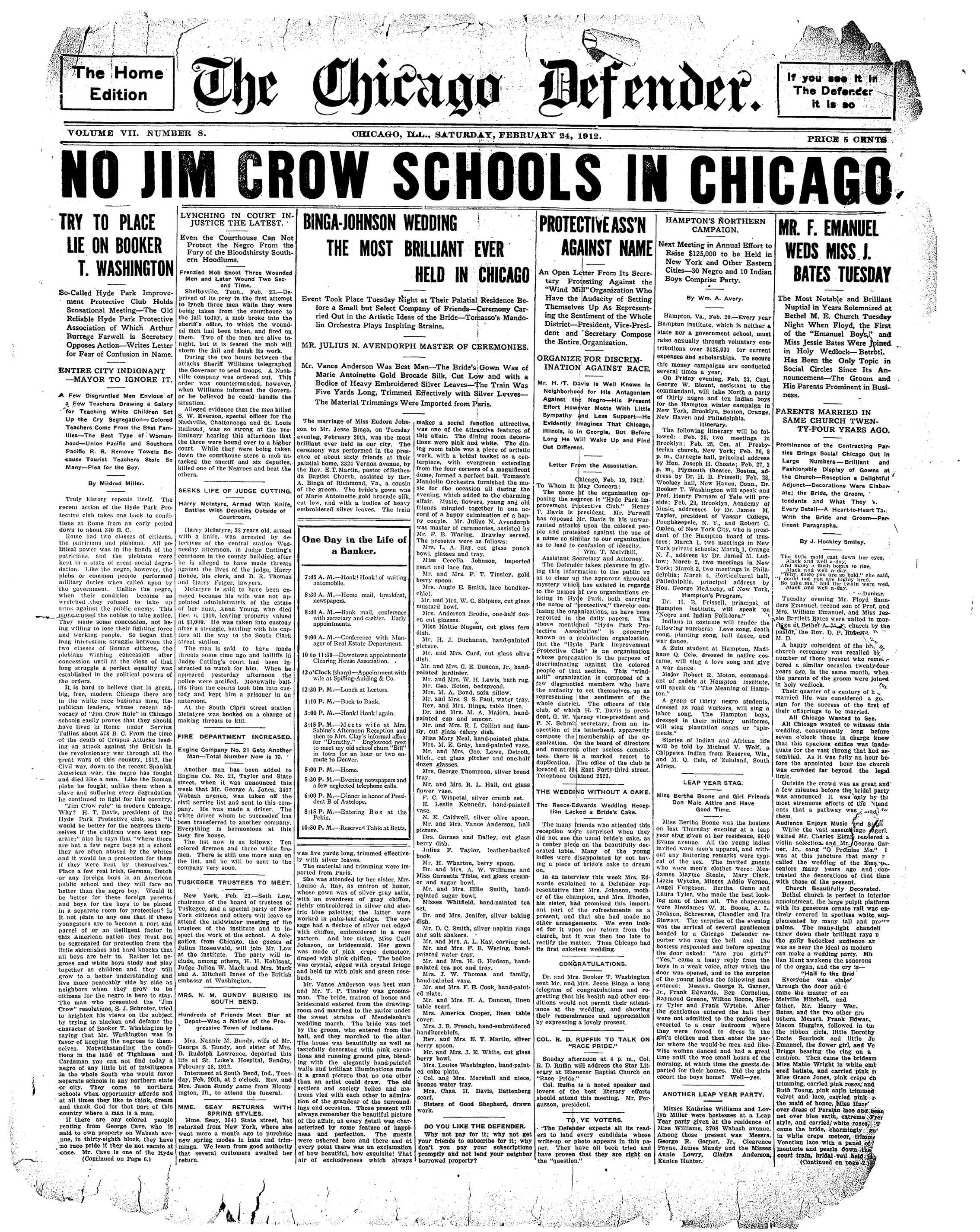
NO JIM CROW SCHOOLS IN CHICAGO
VOLUME VII. NUMBER 8.
Shelbyville, Tenn., Feb. 23.—Deprived of its prey in the first attempt to lynch three men while they were being taken from the courthouse to the jail today, a mob broke into the sheriff's office, to which the wounded men had been taken, and fired on them. Two of the men are alive tonight, but it is feared the mob will storm the jail and finish its work. During the two hours between the attacks Sheriff Williams telegraphed the Governor to send troops. A Nashville company was ordered out. This order was countermanded, however, when Williams informed the Governor he believed he could handle the situation.
Alleged evidence that the men killed S. W. Everson, special officer for the Nashville, Chattanooga and St. Louis Railroad, was so strong at the preliminary hearing this afternoon that the three were bound over to a higher court. While they were being taken down the courthouse steps a mob attacked the sheriff and six deputies, killed one of the Negroes and beat the others.
Harry McIntyre, 35 years old, armed with a knife, was arrested by detectives of the central station Wednesday afternoon, in Judge Cutting's courtroom in the county building, after he is alleged to have made threats against the lives of the judge, Harry Rohde, his clerk, and D. R. Thomas and Harry Felger, lawyers.
McIntyre is said to have been enraged because his wife was not appointed administratrix of the estate of her aunt, Anna Young, who died Dec. 6, 1910, leaving property valued at $1,000. He was taken into custody after a struggle, battling with his captors all the way to the South Clark street station.
The man is said to have made threats some time ago and bailiffs in Judge Cutting's court had been instructed to watch for him. When he appeared yesterday afternoon the police were notified. Meanwhile bailiffs from the courts took him into custody and kept him a prisoner in an anteroom.
At the South Clark street station McIntyre was hooked on a charge of making threats to kill.
FIRE DEPARTMENT INCREASED.
Another man has been added to Engine Co. No. 21, Taylor and State street, when it was announced this week that Mr. George A. Jones, 3407 Wabash avenue, was taken off the civil service list and sent to this company. He was made a driver. The white driver whom he succeeded has been transferred to another company. Everything is harmonious at this busy fire house.
The list now is as follows: Ten colored firemen and three white firemen. There is still one more man on the list, and he will be sent to the company very soon.
TUSKEGEE TRUSTEES TO MEET.
New York, Feb. 23.—Seth Low, chairman of the board of trustees of Tuskegee, and a special party of New York citizens and others will leave to attend the midwinter meeting of the trustees of the institute and to inspect the work of the school. A delegation from Chicago, the guests of Julius Rosenwald, will join Mr. Low at the institute. The party will include, among others, H. H. Kohlsaat, Judge Julian W. Mack and Mrs. Mack and A. Mitchell Innes of the British embassy at Washington.
MRS. N. M. BUNDY BURIED IN SOUTH BEND.
Hundreds of Friends Meet Bier at Depot—Was a Native of the Progressive Town of Indiana.
Mrs. Nannie M. Bundy, wife of Mr. George S. Bundy, and sister of Mrs. D. Rudolph Lawrence, departed this life at St. Luke's Hospital, Sunday, February 18, 1912.
Interment at South Bend, Ind., Tuesday, Feb. 20th, at 2 o'clock. Rev. and Mrs. Jason Bundy came from Bloomington, Ill., to attend the funeral.
Mme. Seay, 3641 State street, has returned from New York, where she went more a month ago to purchase new spring modes in hats and trimmings. We learn from good authority that several customers awaited her return.
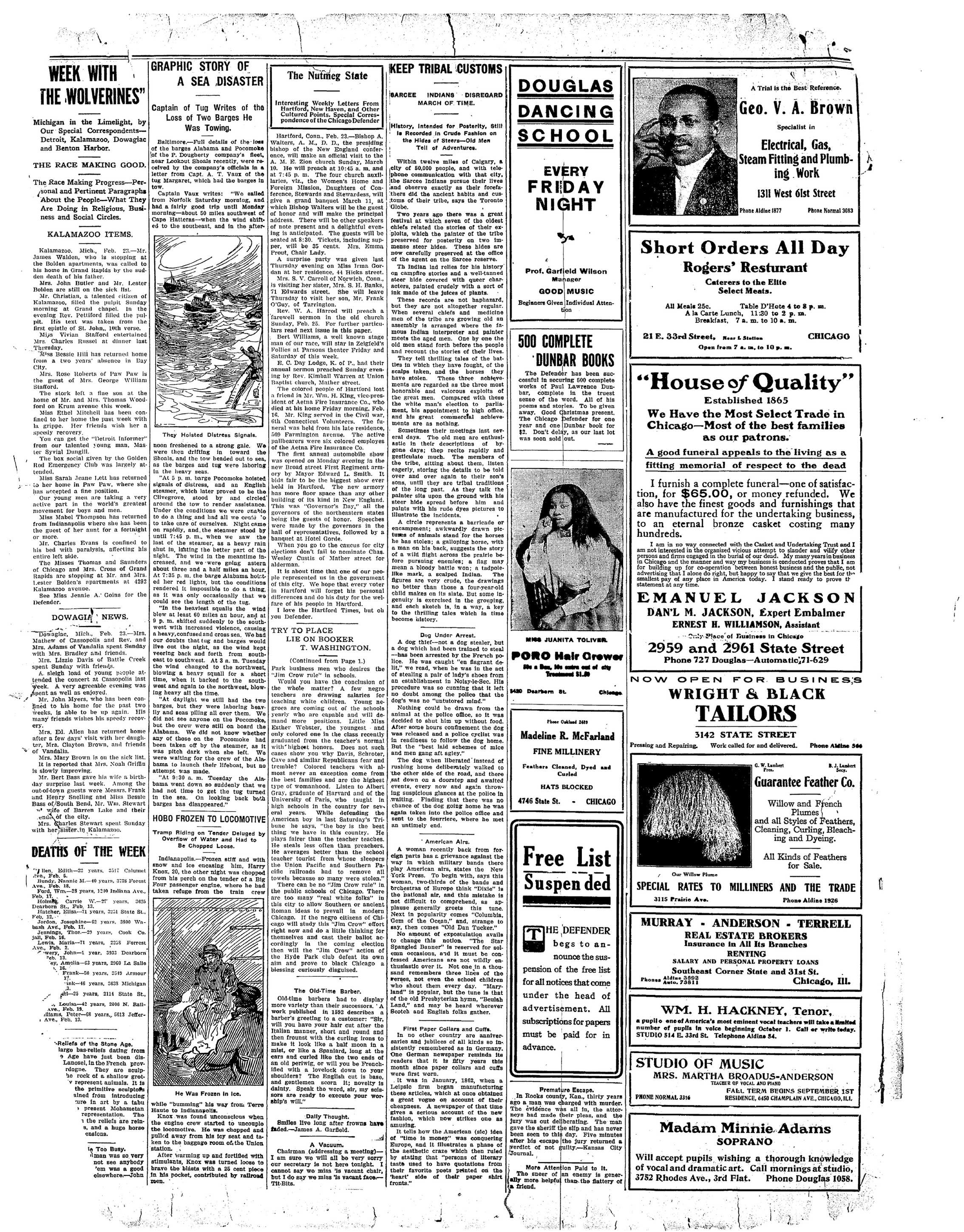
TRY TO PLACE LIE ON BOOKER T. WASHINGTON
So-Called Hyde Park Improvement Protective Club Holds Sensational Meeting—The Old Reliable Hyde Park Protective Association of Which Arthur Burrege Farwell is Secretary Opposes Action—Writes Letter for Fear of Confusion in Name.
ENTIRE CITY INDIGNANT
—MAYOR TO IGNORE IT.
A Few Disgruntled Men Envious of a Few Teachers Drawing a Salary for Teaching White Children Set Up the Cry Segregation—Colored Teachers Come From the Best Families—The Best Type of Womanhood—Union Pacific and Southern Pacific R. R. Remove Towels Because Tourist Teachers Stole So Many—Plea for the Boy.
By Mildred Miller.
Truly history repeats itself. The recent action of the Hyde Park Protective club takes one back to conditions at Rome from an early period down to about 310 B. C. Rome had two classes of citizens, the patricians and plebians. All political power was in the hands of the patricians, and the plebians were kept in a state of great social degradation. Like the negro, however, the plebs or common people performed military duties when called upon by the government. Unlike the negro, when their condition became so wretched, they refused to take up arms against the public enemy. This caused the nobles to take notice. They made some concession, not being willing to lose their fighting force and working people. So began that long interesting struggle between the two classes of Roman citizens, the plebians winning concession after concession until at the close of that long struggle a perfect equality was established in the political powers of the orders.
It is hard to believe that in great, big, free, modern Chicago there are in the white race business men, Republican leaders, whose recent advocacy of "Jim Crow Rule" in Chicago schools easily proves that they should have lived in Rome under Servius Tullius about 578 B. C. From the time of the death of Crispus Attucks leading an attack against the British in the revolutionary war through all the great wars of this country, 1812, the Civil war, down to the recent Spanish American war, the negro has fought and died like a man. Like the Roman plebs he fought, unlike them when a slave and suffering every degradation he continued to fight for this country.
"Jim Crow rule" in modern Chicago. Why? H. T. Davis, president of the Hyde Park Protective club, says "it would be better for the negroes themselves if the children were kept separate;" also says that "where there are but a few negro boys at a school they are often abused by the whites and it would be a protection for them if they were kept by themselves." Place a few real Irish, German, Dutch or any foreign boys in an American public school and they will fare no better than the negro boy. Would it be better for these foreign parents and boys for the boys to be placed in a separate room for protection? Is it not plain to any one that if these youngsters are to become a part and parcel of or an intelligent factor in this American nation they must not be segregated for protection from the little skirmishes and hard knocks that all boys are heir to. Rather let negroes and white boys study and play together as children and they will grow to a better understanding and live more peaceably side by side neighbors when they grow to be citizens for the negro is here to stay. The man who presented the "Jim Crow" resolutions, S. J. Schroter, tried to brighten his views on the subject by trying to blacken and defame the character of Booker T. Washington by saying that Mr. Washington was in favor of keeping the negroes to themselves. Notwithstanding the conditions in the land of Tighman and Cardaman you can not find today a negro of any little bit of intelligence in the whole South who would favor separate schools in any northern state or city. They come to northern schools when opportunity affords and at all times they like to think, dream and thank God for that part of this country where a man is a man.
If there are any colored people renting from George Cave, who is said to own property on Wabash avenue, in thirty-eighth block, they have no race pride if they do not vacate at once. Mr. Cave is one of the Hyde (Continued on Page 6).
The Chicago Defender.
LYNCHING IN COURT INJUSTICE THE LATEST.
Even the Courthouse Can Not Protect the Negro From the Fury of the Bloodthirsty Southern Hoodlums.
Frenzied Mob Shoot Three Wounded Men and Later Wound Two Second Time.
SEEKS LIFE OF JUDGE CUTTING.
Harry McIntyre, Armed With Knife, Battles With Deputies Outside of Courtroom.
Engine Company No. 21 Gets Another
Man—Total Number Now is 10.
MME. SEAY RETURNS WITH
SPRING STYLES.
CHICAGO, DLL., SATURDAY, FEBRUARY 24, 1912.
BINGA-JOHNSON WEDDING THE MOST BRILLIANT EVER HELD IN CHICAGO
BINGA-JOHNSON WEDDING THE MOST BRILLIANT EVER HELD IN CHICAGO
Event Took Place Tuesday Night at Their Palatial Residence Before a Small but Select Company of Friends—Ceremony Carried Out in the Artistic Ideas of the Bride—Tomasso's Mandolin Orchestra Plays Inspiring Strains.
MR. JULIUS N. AVENDORPH MASTER OF CEREMONIES.
Mr. Vance Anderson Was Best Man—The Bride's Gown Was of Marie Antoinette Gold Brocade Silk, Cut Low and with a Bodice of Heavy Embroidered Silver Leaves—The Train Was Five Yards Long, Trimmed Effectively with Silver Leaves—The Material Trimmings Were Imported from Paris.
The marriage of Miss Eudora Johnson to Mr. Jesse Binga, on Tuesday evening, February 20th, was the most brilliant ever held in our city. The ceremony was performed in the presence of about sixty friends at their palatial home, 3324 Vernon avenue, by the Rev. E.T. Martin, pastor of Bethesda Baptist Church, assisted by Rev. A. Binga of Richmond, Va., a cousin of the groom. The bride's gown was of Marie Antoinette gold brocade silk, cut low, and with a bodice of heavy embroidered silver leaves. The train makes a social function attractive, was one of the attractive features of this affair. The dining room decorations were pink and white. The dining room table was a piece of artistic work, with a bridal basket as a centerpiece, with evergreen extending from the four corners of a magnificent dome, formed a perfect bell. Tomasso's Mandolin Orchestra furnished the music for the occasion all during the evening, which added to the charming affair. Music, flowers, young and old friends mingled together in one ac
One Day in the Life of a Banker.
7:45 A. M.—Honk! Honk! of waiting automobile.
8:30 A. M.—Home mail, breakfast, newspapers.
8:40 A. M.—Bank mail, conference with secretary and cashier. Early appointments.
9:00 A. M.—Conference with Manager of Real Estate Department.
10 to 11:30—Downtown appointments Clearing House Association.
12 o'Clock (sharp)—Appointment with wife at Spiffing-Auding & Co.
12:30 P. M.—Lunch at Lectors.
1:10 P. M.—Back to Bank.
3:00 P. M.—Honk! Honk! again.
3:15 P. M.—Meets wife at Mrs. Sabine's Afternoon Reception and then to Mrs. Clay's informal affair for "Dorathy." Englewood next to meet my old school chum "Bill" in town for an hour or two enroute to Denver.
5:00 P. M.—Home.
5:30 P. M.—Evening newspapers and a few neglected telephone calls.
6:00 P. M.—Dinner in honor of President B of Antelope.
8:15 P. M.—Entering Box at the Pekin.
10:50 P. M.—Reserved Table at Betts.
was five yards long, trimmed effectively with silver leaves.
The material and trimming were imported from Paris.
She was attended by her sister, Mrs. Louise A. Ray, as matron of honor, whose gown was of silver gray satin, with 'an overdress of gray chiffon, richly embroidered in silver and electric blue palettes; the latter were worked in palm-leaf design. The corsage had a fischue of silver net edged with chiffon, embroidered in a rose pattern. And her sister, Miss Cecil Johnson, as bridesmaid. Her gown was made of pink crepe demeter, draped with pink chiffon. The bodice was crystal, edged with crystal fringe and held up with pink and green rosebuds.
Mr. Vance Anderson was best man and Mr. T. P. Tinsley was groomman. The bride, matron of honor and bridesmaid entered from the drawing-room and marched to the parlor under the sweet strains of Mendelsohn's wedding march. The bride was met by the groom, who entered from the hall, and they marched to the altar. The house was beautifully as well as tastefully decorated with pink carnations and running ground pine, blending with the elegantly hand-painted walls and brilliant illuminations made it a grand picture that no one other than an artist could draw. The old settlers and society belles and matrons vied with each other in admiration of the grandeur of the surroundings and occasion. Those present will always remember the beautiful picture of the affair, as every detail was characterized by some feature of happiness and perfection. The guests were ushered here and there and at every point there was an exclamation of how beautiful, how exquisite! That air of exclusiveness which always
makes a social function attractive, was one of the attractive features of this affair. The dining room decorations were pink and white. The dining room table was a piece of artistic work, with a bridal basket as a centerpiece, with evergreen extending from the four corners of a magnificent dome, formed a perfect bell. Tomaso's Mandolin Orchestra furnished the music for the occasion all during the evening, which added to the charming affair. Music, flowers, young and old friends mingled together in one accord of a happy culmination of a happy couple. Mr. Julius N. Avendorph was master of ceremonies, assisted by Mr. F. B. Waring. Brawley served. The presents were as follows: Mrs. L. A. Ray, cut glass punch bowl, glasses and tray.
Miss Cecelia Johnson, imported pearl and lace fan.
Mr. and Mrs. P. T. Tinsley, gold berry spoon.
Mrs. Angie E. Smith, lace handkerchief.
Mr. and Mrs. W. C. Shipnes, cut glass mustard bowl.
Mrs. Anderson Brodie, one-half dozen cut glasses.
Miss Hattie Nugent, cut glass fern dish.
Mr. H. J. Buchanan, hand-painted picture.
Mr. and Mrs. Curd, cut glass olive dish.
Mr. and Mrs. G. E. Duncan, Jr., hand-painted jardiner.
Mr. and Mrs. W. H. Lewis, bath rug.
Mr. Geo. Ecton, bedspread.
Mrs. M. A. Bond, sofa pillow.
Mr. and Mrs. S. S. Paul, water tray.
Rev. and Mrs. Binga, table linen.
Dr. and Mrs. M. A. Majors, hand-painted cup and saucer.
Mr. and Mrs. R. I. Collins and family, cut glass celery dish.
Miss Mary Neal, hand-painted plate.
Mrs. M. E. Gray, hand-painted vase.
Mr. and Mrs. Geo. Lowe, Detroit, Mich., cut glass pitcher and one-half dozen glasses.
Mrs. George Thompson, silver bread tray.
Mr. and Mrs. R. L. Hall, cut glass flower vase.
F. C. Wispetal, silver crumb set.
E. Leslie Kennedy, hand-painted vase.
N. E. Caldwell, silver olive spoon. Mr. and Mrs. Vance Anderson, hall picture. Drs. Garnes and Dalley, cut glass berry dish.
Julius F. Taylor, leather-backed book.
Mr. H. Wharton, berry spoon.
Dr. and Mrs. A. W. Williams and Miss Garnetta Tibbs, cut glass creamer and sugar bowl.
Mr. and Mrs. Ellie Smith, hand-painted sugar bowl.
Misses Whitfield, hand-painted tea set.
Dr. and Mrs. Jenifer, silver baking dish.
Mr. D. C. Smith, silver napkin rings and salt shakers.
Mr. and Mrs. A. L. Kay, carving set.
Mr. and Mrs. F. B. Waring, hand-painted water tray.
Mr. and Mrs. H. G. Hudson, hand-painted tea pot and tray.
Mrs. J. W. Thomas and family, hand-painted vase.
Mr. and Mrs. F. E. Cook, hand-painted plate.
Mr. and Mrs. H. A. Duncan, linen table scarf.
Mrs. America Cooper, linen table cover.
Mrs. J. B. French, hand-embroidered handkerchiefs.
Rev. and Mrs. E. T. Martin, silver berry spoon.
Mr. and Mrs. J. E. White, cut glass berry bowl.
Mrs. Louise Washington, hand-painted cake plate.
Col. and Mrs. Marshall and niece, bronze water tray.
Mrs. Chas. H. Davis, Battenberg scarf.
Sisters of Good Shepherd, drawn work.
DO YOU LIKE THE DEFENDER.
Why not pay for it; why not get your friends to subscribe for it; why don't you pay your subscriptions promptly and not lend your neighbor borrowed property?
PROTECTIVE ASS'N AGAINST NAME
An Open Letter From Its Secretary Protesting Against the "Wind Mill"Organization Who Have the Audacity of Setting Themselves Up As Representing the Sentiment of the Whole District—President, Vice-President and Secretary Compose the Entire Organization.
ORGANIZE FOR DISCRIMINATION AGAINST RACE
Mr. H. T. Davis Is Well Known In Neighborhood for His Antagonism Against the Negro—His Present Effort However Meets With Little Sympathy and Less Support—He Evidently Imagines That Chicago, Illinois, is in Georgia, But Before Long He Will Wake Up and Find Out Different.
Letter From the Association.
Chicago, Feb. 19, 1912.
To Whom It May Concern:
The name of the organization opposing the negroes is "Hyde Park Park Improvement Protective Club." Henry T. Davis is president. Mr. Farwell has opposed Mr. Davis in his unwarranted attacks upon the colored people and protested against the use of a name so similar to our organization as to lead to confusion of identity.
Assistant Secretary and Attorney. The Defender takes pleasure in giving this information to the public so as to clear up the apparent shrouded mystery which has existed in regards to the names of two organizations existing in Hyde Park, both carrying the name of "protective," thereby confusing the organizations, as have been reported in the daily papers. The above mentioned "Hyde Park Protective Association" is generally known as a prohibition organization. But the "Hyde Park Improvement Protective Club" is an organization whose propagation is the purpose of discriminating against the colored people of that section. This "windmill" organization is composed of a few disgruntled members who have the audacity to set themselves, up as representing the sentiment of the whole district. The officers of this club, of which H. T. Davis is president, G. W. Varney vice-president and P. N. Schmit secretary, from an inspection of its letterhead, apparently compose the membership of the organization. On the board of directors and numerous other useless committees, there is a marked resort to duplication. The office of the club is located at 394 East Forty-third street. Telephone Oakland 2523.
THE WEDDING WITHOUT A CAKE
The Reece-Edwards Wedding Reception Lacked a Bride's Cake.
The many friends who attended this reception were surprised when they did not see the usual bride's cake, as a center piece on the beautiful decorated table. Many of the young ladies were disappointed by not having a piece of bride's cake to dream on.
In an interview this week Mrs. Edwards explained to a Defender representative that Mrs. Johnson, mother of the champion, and Mrs. Rhodes, his sister, had promised this important part of the refreshments as a present, and that she had made no other arrangements. We even looked for it upon our return from the church, but it was then too late to rectify the matter. Thus Chicago had its first cakeless wedding.
CONGRATULATIONS.
Dr. and Mrs. Booker T. Washington sent Mr. and Mrs. Jesse Binga a long telegram of congratulations and regretting that his health and other conditions would not permit their attendance at the wedding, and showing their remembrance and appreciation by expressing a lovely present.
COL. R. D. RUFFIN TO TALK ON "RACE PRIDE."
Sunday afternoon at 4 p. m., Col. R. D. Ruffin will address the Star Literary at Ebenezer Baptist Church on "Race Pride." Col. Ruffin is a noted speaker and lovers of the best literary efforts should attend this meeting. Mr. Fergusson, president.
TO. YE VOTERS.
"The Defender expects all its readers to land every candidate whose write-up or photo appears in this paper. They have all been tried and have proven that they are right on the "question."
HAMPTON'S NORTHERN CAMPAIGN.
Next Meeting in Annual Effort to Raise $125,000 to be Held in New York and Other Eastern Cities—30 Negro and 10 Indian Boys Comprise Party.
By Wm. A. Avery.
Hampton, Va., Feb. 20.—Every year Hampton institute, which is neither a state nor a government school, must raise annually through voluntary contributions over $125,000 for current expenses and scholarships. To secure this money campaigns are conducted several times a year.
On Friday evening, Feb. 23, Capt. George W. Blount, assistant to the commandant, will take North a party of thirty negro and ten Indian boys for the Hampton winter campaign in New York, Brooklyn, Boston, Orange, New Haven and Philadelphia.
The following itinerary will be followed: Feb. 25, two meetings in Brooklyn; Feb. 25, Con. al Presbyterian church, New York; Feb. 26, 8 p. m., Carnegie hall, principal address by Hon. Joseph H. Choate; Feb. 27, 3 p. m., Plymouth theater, Boston, address by Dr. H. B. Frissell; Feb. 28, Woolsey hall, New Haven, Conn., Dr. Booker T. Washington will speak and Prof. Henry Farnam of Yale will preside; Feb. 29, Brooklyn, Academy of Music, addresses by Dr. James M. Taylor, president of Vassar College, Poughkeepsie, N. Y., and Robert C. Ogden, of New York City, who is president of the Hampton board of trustees; March 1, two meetings in New York private schools; March 1, Orange N. J., address by Dr. James M. Ludlow; March 2, two meetings in New York; March 3, two meetings in Philadelphia; March 4, Morticultural hall, Philadelphia, principal address by Hon. George McAney, of New York, Hampton's Program.
Dr. H. B. Frissell, principal of Hampton institute, will speak on "Negro and Indian Folk-lore."
Indians in costume will render the following numbers: Love song, death song, planting song, ball dance, and war dance.
A Zulu student at Hampton, Madikane Q. Cele, dressed in native costume, will sing a love song and give a war dance.
Major Robert R. Moton, commandant of cadets at Hampton institute, will speak on "The Meaning of Hampton."
A group of thirty negro students, dressed as road workers, will sing a labor song. The Hampton boys, dressed in their military uniforms, will sing plantation songs or "spirituals."
Stories of Indian and African life will be told by Michael V. Wolf, a Chippewa Indian from Reserve, Wis., and M. Q. Cele, of Zululand, South Africa.
LEAP YEAR STAG.
Miss Bertha Boone and Girl Friends Don Male Attire and Have Good Time.
Miss Bertha Boone was the hostess on last Thursday evening at a leap year stag given at her residence, 6640 Evans avenue. All the young ladies invited wore men's apparel, and without any flattering remarks were typical of the sex. The invited guests who wore men's clothes were: Mesdames Mayme Steele, Mary Clark, Lizzie Wytche, Misses Addie Vernon, Angel Furgeson, Bertha Gunn and Laura Tyler, who made the best looking man of them all. The chaperons were Mesdames W. R. Boone, A. L. Jackson, Schreaves, Chandler and Ira Stewart. The surprise of the evening was the arrival of several gentlemen headed by a Chicago Defender reporter who rang the bell and the hostess responded and before opening the door asked: "Are you girls?" "Yes," a cahy asked from the boys in a weak voice, after which the door was opened, and to the surprise of the young ladies the following men entered: Messrs. George R. Garner, Jr., Frank Edwards, Ben Cornelius, Raymond Greene, Wilton Boone, Henry Tyler and Frank Wytche. After the gentlemen entered the hall they were not admitted to the parlor but escorted to a rear bedroom where they were forced to dress in the girl's clothes and then enter the parlor where the would-be men and likewise women danced and had a great time until the wee small hours of the morning, at which time the guests departed for their homes. Did the girls escort the boys home? Well-yes.
ANOTHER LEAP YEAR PARTY.
Misses Kathine Williams and Lovyn Miller were hostesses at a Leap Year party given at the residence of Miss Williams, 3708 Wabash avenue. Among those present was Messrs. George R. Garner, Jr., Clearence Payne, James Mundy and the Misses Annie Lowry, Gladys Anderson, Eunice Hunter.
If you see it in The Defender it is so
PRICE 5 CENTS
```markdown
```
MR. F. EMANUEL WEDS MISS J. BATES TUESDAY
MR. F. EMANUEL WEDS MISS J. BATES TUESDAY
The Most Notable and Brilliant Nuptial in Years Solemnized at Bethel M. E. Church Tuesday Night When Floyd, the First of the "Emanuel Boys," and Miss Jessie Bates Were Joined in Holy Wedlock—Betroti. Has Been the Only Topic in Social Circles Since Its Announcement—The Groom and His Parents Prominent in Business.
PARENTS MARRIED IN
SAME CHURCH TWEN-
TY-FOUR YEARS AGO.
Prominence of the Contracting Parties Brings Social Chicago Out In Large Numbers—Brilliant and Fashionable Display of Gowns at the Church—Reception a Delightful Adjunct—Decorations Were Elaborate; the Bride, the Groom, tendants and What They v. Every Detail—A Heart-to-Heart Tail. With the Bride and Groom—Pertinent Paragraphs.
By J. Hockley Smiley.
The little maid cast down her eyes, Alack and well a-day. And away a mush begin to rise, Alack and well a day. Why, since you are so bold, she said, I doubt not you are highly bred. So take me, and the twain were wed, Alack and well a-day. —Dunbar.
Tuesday evening Mr. Floyd Saunders Emanuel, second son of Prof. and Mrs. William Emanuel, and Miss Jessie Bertlett Rates were united in marriage at Bethel A. A. church by the pastor, the Rev. D. P. Roberts. M. D.
A happy coincident of the bride church ceremony was recalled by number of those present who remembered a similar occasion twenty-four years ago, in the same month, when the parents of the groom were joined in holy wedlock.
Their quarter of a century of h-married life was considered a go-sign for the success of the first of their offsprings to be married.
All Chicago Wanted to See.
All Chicago wanted to witness this wedding, consequently long before seven o'clock those in charge knew that this spacious edifice was inadequate for the vast throng that had assembled. As it was fully an hour before the appointed hour the church was crowded far beyond the legal limit.
Outside the crowd was as great and a few minutes before the bridal party was announced it was only by the most strenuous efforts of the tend ants that a pathway was made them.
Audience Enjoys Music and Sight
While the vast assemblage eager,
waited Mr. Charles Elgan rendered a
violin selection, and Mr. George Garner,
Jr., sang "O Promise Me." I
was at this juncture that many r
called the wedding of the Emperors
seniors many years ago and contrasted
the decorations of that time
with those of the present.
Church Beautifully Decorated.
Bethel church is perfect in interior
appointment, the large pulpit platform
with its generous ornate rall was
entirely covered in spotless white
supplemented by many tall and pretty
palms. The many-light chandel
threw down their brilliant rays u
the gally bedecked audience ar
was as near the ideal as modern
can make a wedding party. Mii
lian Hunt awakens the sonorous
of the organ, and the cry is—
"Hall to the Brid Everyone was elate through the door and a came the master of co Melville Mitchell, and father, Mr. Henry War. Bates, and the two other gro ushers, Messrs. Frank Edwar. Macon Huggins, followed in tu the ribbon girls, little Dorothy Doris Scurlock and little Ju Emanuel, the flower girl, and Ve Briggs bearing the ring on a cushion. Then came the brideem Miss Mable Wright in white em ered batiste, and carried pink rt Miss Grace Jones, pink crepe ch trimming, carried pink roses, and Ruth Young, pink satin trimmed velvet and lace, carried pink r the maid of honor, Miss Haze over dress of Persian lace and beet net over blue satin, extreme Trio style, and carried/white roses. T came the bride, charmingly go in white crepe meteor, trimme Venetian lace with a panel of menterle and pearls down the court train, bridal veil held in (Continued on page 2.)
FLOYD EMANUEL WEDS
MISS JESSE BATES.
(Continued from page 1.)
with wreath of orange blossoms. She
carried a magnificent bouquet of lilies
of the valley and roses.
The groom with his brother Harrison
to support him met the bride at
the altar.
The ceremony over the crowd slowly
melted away, the majority to their
homes, but hundreds to the reception
at the Bates home across the way.
The Reception
The Bates home was agow with light. The happy couple with their attendants held sway in the parlor while friends swarmed around the beautiful table in the dining room for a piece of 'the bride's cake and an ice. The caterer in charge gave efficient service and every one was promptly served. During this enjoyable period Mr. William Henry
---
After the Wedding
Heart-to-Heart With the Writer
Ck
"Floyd will never have an unhappy day—so far as I am concerned. This ring will always be my most cherished possession."—The Bride.
4
.
"We are going to make the grandest little team that ever came down the matrimonial handicap."—The Groom.
e14
"Floyd is married; his mother and I are happy and we know that he will be happy also."—Prof. Emanuel.
c12
"Jesse is my heart—may her future life be a long and happy one."—Mr. H. W. B. Bates.
Browne, Jr., presided at the piano, assisted by Mr. Elgan, violinist. In a room adjoining the dining room the presents were displayed. An attempt at display should have been said, for many unopened boxes were in plain view, while a barrel full of smaller packages almost blocked the door. All in all it was the social event of the season. A wedding naturally attracts attention. But heralded so long advance by reason of the prominence of the principals it was an epoch making event, as things are considered socially. Master minds planned every detail, conscientious friends endeavored to carry them out. A public appreciative of sterling worth turned out in approbation.
the reception we noticed among the bride's relatives her aunt, Mrs Luella Doozler Wicks, in black satin; another aunt, Mrs. Susan Franklin, gray satin chiffon and violet trimming; Mrs. Pearl Reed, sister of the bride, lavender satin, trimmed with pearl passamaterie and diamonds; Mrs. Etta Briggs, white hand embroidered gown; Mrs. Mamie Harrison, all over embroidered white gown; Mrs. J. G. Wilson, white broadcloth and jewelry. Other gowns were Mrs. Wm. Emanuel, imported gown of ashes of roses chiffon, embroidered in jewels over white satin, train, pearls and diamonds; Mrs. Mamie Meredith Smith, blue we gown, gold trimming, diamonds; Mrs. Mattie Thornton, pink
folded crepe, diamonds; Mrs.
blue crepe, diamonds; Mrs.
Emil, Williams, grey crepe du chene.
Others who wore beautiful gowns were
Mrs. E. Fitzgerald, Mrs. Geo. Hall,
Mrs. A. Brown, Mrs. Mollie Taylor,
Irs. Hattie Wolridge, Mrs. Daniel
Fring, Mrs. Clifford Johnson, Mrs.
Mamie Selden Carrol, Miss Eloise
Carey and sister, Miss Ada Lou Mitchel, Mrs. Ethel Mitchel, Mrs. Erma
Jones, Miss Pearl Mayo, Miss Ethel
Peacock.
The carriage service was excellent,
under care of Mr. Chas, Jackson, who
had a dozen carriages constantly on
road and the guests were promptly
nveyed to and from their home.
Short But Rather interesting.
ster McKinley Emanuel said
he was glad that his brother was
led as he could now have a room
s own."
is, the bride's father, is with catering interests and as seen in the prettily pleated and the splendid servicing room. P. Roberts, the officiating man, always noted for his resemblance in the pulpit and on the sets, was the personification of term at this service. His miniature robes added impressiveness to occasion. Many of the friends of the bride groom declared "that the perfect vision in step in the march to and in the altar was due to their paration in the Reese-Edwards wedding a week ago." Practice makes feet you know. Dr. D. W. Nelson, the efficient door agent at the church, was also present at the reception. Mr. Bates found in him an able assistant throughout the entire evening.
After all the children carried off the
ors. Cute and daintily dressed
were petted and praised from
to finish. I mention these little
es elsewhere in this story, but they
need a large part in the success of
brilliant wedding.
and Mrs. Emanuel will be at
o their friends after March 10
Grove avenue.
OUT IN ENGLEWOOD.
Weekly Letter from This Thriving
Section of the City—All the
News.
The Ideal Woman's Club went in
a body to the residence of Mrs. B.
Bell, 6211 Loomis street, last Friday
with a baby shower. Everything
good for the new girl.
Mrs. Craighead of 6243 Morgan
street entertained Rev. Jefferson and
his wife at breakfast Tuesday morning.
Mrs. Hamilton of 6221 Morgan
street, has returned home after a
delightful visit in St. Louis, Mo., her
former homo.
Mrs. L. S. Williams has returned
after a sad trip home on account of
the illness of her mother, who passed
away Tuesday evening. The Defender
staff extend their sympathy to the
family.
The young ladies of Shiloh Baptist
Sunday school will give a Leap Year
party on March 1, at the church.
The Shiloh Baptist choir will render "The Ten Virgins" in May. The date will appear later.
The Hope Presbyterian church will dedicate its new church March 3. Services all day. Shiloh and St. John choirs will sing in the afternoon at 3 o'clock.
Mrs. Steward entertained the Cornell Club Club last Friday.
Mrs. Lear of 1317 West Sixtieth street entertained the ideal Woman's Club last Friday. The Hull House Woman's Club entertained the Ideal Woman's Club last Wednesday. Twenty-one members were present. The Ideal Woman's Club will give a musical at the residence of their president, Mrs. A. Lyles, 5922 Aberdeen street, Thursday evening, March 7th. A crowd of young ladies gave a linen shower on the bride-to-be, Miss Edith Bowman, whose wedding takes place in March. Look out for the June wedding in Englewood. Quite a society affair. The District School was repeated on George Washington's birthday at the Hope Presbyterian church, West Sixty-first and Loomis streets. Noticed in the vast throng at the Bates-Emanuel wedding Tuesday night were Mrs. D. W. Johnson and Mrs. Sol Morrison of 6034 South May street.
The North Side Woman's Club gave a very successful social last week at the residence of Mrs. John Guy, for the benefit of Mrs. George Allen. Addresses were made by Mrs. Fannie Turner and Dr. Holloway. The topic was, "Charity."
Mr. James B. Reel, who lost his reason about three months ago and who was located in St. Louis, has been sent back to Chicago. He will be taken to the Peoria insane asylum next week.
Mrs. Price, who has been on the sick list, is reported better.
HERRMAN BAPTIST CHURCH.
Rev. Chavis has been absent for two Sundays on account of sickness. Services were conducted by Rev. Carneil.
The ten-year celebration which was dated for February 22, has been postponed until February 23.
Mrs. George Allen's Sunday school class gave a birthday surprise party for their teacher, who has been seriously ill.
A new club was organized last month by the young ladies of the South and Nirth Sides. The name is La Marshellem. Mrs. Young is president, Miss Eugene Brady vice president, Oneida Daniel secretary, Etterk. The North Shore Men's Club will give their first annual St. Patrick's masquerade party Monday evening, March 18, at Phoenix hall, Sedgwick and Division streets.
The N. S. M. C. will be entertained February 27 by Mr. E. Gordon, 4457 Evanston avenue
The son of Mr. and Mrs. E. G. Gordon, who is five weeks old and weighs 14 pounds, has been named by his god-father, Mr. W. C. Smith of 742 Gordon terrace. Mr. Smith has named Master Gordon after one of the famous aviators, Earl Ovington Gordon, the man who drove his monoplane into Lake Michigan during the Chicago international aviation meet. Mr. Smith has also made a deposit at the Merchants' Loan and Trust Company for the promising young gentleman.
GRANT RIDEOUT
GRANTED NEW TRIAL
Attorney De Witt H. Hardin's Motion for a New Trial Granted by Judge Sullivan.
Grant Rideout, who was accused of murder of Thomas M. Teirney, a white man, at 4533 Kensington avenue, Sept. 19, 1911, and was indicted by the grand jury Oct. 23, 1911, has been granted a new trial. Rideout's case was called for trial Feb. 13, 1912, and on Feb. 15 of said year he was found guilty of murder in the first degree. De Witt Hardin was his attorney. Bepedict Short, state's attorney, represented the commonwealth. The case was tried before Judge Sullivan. The verdict was 14 years in the penitentiary. Hardin's motion for a new trial was granted by the court.
Picked Up Ancient Scotch Coln.
A unique, ancient coin dated 1677, was picked up recently by Mr. George Jackson, of Johnshaven, Klncardinshire, Scotland, while he was working in his garden. On the one side is the crossed sword and scepter with the crown, and on the other a Scotch thistle, with the date over the top. "Hib. Rex" can be distinctly read. The small copper coin, just the size of a present-day skipence, is in excellent preservation.
Poor Economy.
Probably the poorest economy in the world is to buy things you don't want in order to make acquaintances you don't need. - Galveston News.
AT THE Y. M. C. A.
HEADQUARTERS
The Latest News of the Work in This City—Items of Interest—Speakers.
The executive committee of the South Side Dept. Y. M. C. A. have arranged for a rally meeting to be held in the interest of the movement at Olivet Baptist Church on Sunday, March 10th, at 3:30 p. m. They have been fortunate in securing the services of Dr. Booker T. Washington of Tuskegee Institute, Alabama, who will address a meeting of men. Dr. Washington has shown a very deep interest in the work of the Young Men's Christian Association throughout the country. In response to a letter from Mr. L. Wilbur Messer, general secretary of the Y. M. C. A. of Chicago, he writes thus: "I have taken a good deal of interest in hearing by the Y. M. C. A. work in Chicago and have informed myself to some extent as to the wisdom of these plans in their practical bearing on the betterment of the condition of our race in Chicago, and I thoroughly approve of what is proposed to be done."
Another quotation from an address that was made previous to the ten-day campaign that was held in the interest of our department is as follows: "The trouble with the northern Negro is that he demands from the white people around him a measure of respect that he is unwilling to give himself. Before he can hold the position to which he is fairly entitled, he must show himself worthy of it by doing something for himself."
At the close of our campaign he gave forth these utterances: "Chicago has given itself a great reputation. Sometimes it is easier to get a reputation than it is to keep it, and as we have looked to you in the past, we are going to look to you in the future to see if you continue to lead the procession and set a high example for the whole country in this fine effort."
Mr. R. E. Moore, a member of the executive committee and the first chairman of the temporary organization of the South Side Dept. Y. M. C. A., will preside at this meeting. Dr. E. J. Fisher, pastor of Olivet Baptist Church, will introduce Dr. Washington. The committee has arranged for the admission to the meeting to be by ticket only. Tickets may be secured free of charge by making application at headquarters, 3330 State street.
Several inspection parties went from the South Side Department to visit the different departments of the Y. M. C. A. during the past week. The parties visited the Wilson avenue, the Sears-Roebuck and the Division street departments of the Young Men's Christian Association. These inspection visits have been arranged in order that our men may become acquainted with association work.
Mr. Jackson Gordan, 3435 Wabash avenue, has been very active in the association work. On last Sunday he brought in a large payment from one of our subscribers. Mr. Gordon has visited several of the Y. M. C. A.s. and is much impressed with the character of work that they are doing. Messrs. A. D. Brown, M. E. Wimes and J. C. Igou brought in subscriptions to our building fund during the week.
On last Sunday the men who were in attendance at the meeting had the pleasure of discussing the topic, "Sowing and Reaping." A large number of men used the three minutes that were allotted to each man in the discussion. Reports from persons who had visited the different Y. M. C. A. buildings were made. Each expressed themselves as very favorably impressed with the equipment, the buildings and the work the association is doing in other parts of the city. One speaker made the remark that if every man felt as he did, they would be able to put the association up without further aid.
Dr. J. F. Thomas, pastor of Ebenezer Baptist Church, will address our meeting on next Sunday afternoon. Dr. Thomas is very much interested in the work of the Y. M. C. A. and we are expecting a large number of men at our meeting. We advise you to come on time in order to be sure of getting seats.
Paid-in-Full Subscriptions.
Patterson on subscriptions.
Wm. A. Blackburn, 100 S. Water street; W. R. Boone, 6640 Evans avenue; C. B. Hosmer, 3913 Prairie; Benedr Irvin, 7224 41st street; Thomas J. Kelley, 5255 Bearborn street; L. K. Levy, 5156 Wabash avenue; Mrs. Thos. G. Maxwell, 3672 Wabash avenue; Dr. Thos. G. Maxwell, 3672 Wabash avenue; John G. A. Mell, 3032 State street! A. W. Miller, County Assessor; R. H. Porter, 7224 Wentworth avenue.
Paid-on-Account Subscribers.
S. A. Ellis, 493 Holden court; R. J.
B. Ellington, 4954 State street; Edgar
J. Faust, 3642 Dearborn street; Wm.
M. Farrow, 3538 Vernon avenue; T.
H. Gause, 4715 Dearborn street; F.
W. Harsh, Sr., 536 E. 44th place; F.
W. Harsh, Jr., 536 E. 44th place; Samuel
Lee, 6617 Langley avenue; G. J.
Scott, 146 W. 27th street; Dr. C. D.
Trice, 2002 State street; Mrs. C. D.
Trice, 2002 State street; C. E. Wills,
2807 Wentworth avenue.
Yellow Jackets Held Steeple
A contractor and three carpenters were painfully stung when they climbed to the top of the First Baptist church, in New Castle, Del., recently, to make repairs to the roofs. Thousands of yellow jackets had made their home in the belfry, and they presented the intrusion and drove the men to the ground. One of the men made his way to the belfry and with tar paper closed all exits by which the insects could escape. Then he placed four sulphur candles under the cupola and lighted them. After the candles had burned out enough dead insects were found to fill a peach basket to overflowing, and the carpenters then resumed work on the church root.
Double Blagged
The most modern typewriters are pigged for billing—and some of them for cooling.—Philadelphia Record.
GRIZZLY BEAR CUBS TRAINED BY TRAPPER.
Amusing and Playful After Their Capterer Had Conquered the Call of the Wild—As Easy to Train As Any Dog.
One day while wandering in the pine woods on the slope of Mount Meeker I came upon two young grizzly bears. Though they dodged about as lively a chickens, I at last cornered them in a penlike pocket of fallen trees.
Getting them into a sack was one of the liveliest experiences I ever had. Though small and almost starved, these little orphans proceeded to "chew me up" after the manner of big grizzlies, as is told of them in books. After an exciting chase and tussle I would catch one and thrust him into the sack. In resisting he would insert his claws into my clothes, or thrust them through the side of the sack; then, while I was trying to tear him loose, or to thrust him forcibly in, he would lay hold of a finger, or take a bite in my leg. Whenever he bit it at once dropped him, and then all began over again.
Their mother had been killed a few days before I found them; so, of course, they were famished and in need of a home; but so bitterly did they resist my efforts that I barely succeeded in taking them. Though hardly as large as a collie when he is at his prettiest, they were nimble athletes.
At last I started" home, the sack over my shoulder, with these lovely Ursus horribilis in the bottom of it. Their final demonstration was not needed to convince me of the extraordinary power of their jaws. Nevertheless, while going down a steep slope one managed to bite into my back through sack and clothes, so effectively that I responded with a yell. Then I fastened the sack at the end of a long pole, which I carried across my shoulder, and I was able to travel the remainder of the distance to my cabin without another attack in the rear.
Of course the youngsters did not need to be taught to eat. I simply pushed their noses down into a basin of milk, and the little red tongues at once began to plly; then raw eggs and bread were dropped into the basin. There was no hesitation between courses; they simply gobbled the food as long as I kept it before them.
Jenny and Johnny were pets before sundown. Though both were alert, Johnny was the wiser and more cheerful as readily as a collie or shepherd dog, and I have never seen any dog more playful. All bears are keen of wit, but he was the brightest one of the wild folk that I have ever known. He grew rapidly, and ate me almost out of supplies. We were intimate friends in less than a month, and I spent much time playing and talking with him. One of the first things I taught him was, when hungry, to stand erect with arms extended almost horizontally, with palms forward. I also taught him to greet me in this manner.—From the Spell of the Rockies, by Enos A. Mills.
Craig's Crazes.
Gordon Craig, who interlards his sapient utterances with more than the average man's nonsensical lapses, perpetrates this:
"I take an entirely common sense view of the man and his motives. He simply succeeded in performing in two months a task that has been tried in every court in Europe for centuries. He set out to cleanse social and official life of its moral grime and its degeneracy. He set about his task with direct purpose, and with the full enthusiasm of a young, virile, and cruelly wronged man. His ideas were logical, and he reasoned and thought out every movement and act during that brief time of storm and stress that ended in tragedy. That is my idea of Hamlet."
Apropos of which the Nation tartly remarks:
"If that really is Mr. Craig's notion of Hamlet, there does not seem to be much reason why he should be encouraged to promulgate it. What fatality is it that condemns so many enthusiastic stage reformers to be 'break吧!'
Bother the Button!
All know the annoying habit buttons have of coming off at a moment when they are most needed, says "Answers." It seems sometimes as though nothing short of wire thread will keep them in their places; and even wire breaks away from the cloth.
When next you' are sewing on a button, follow these directions, and that button will never trouble you again.
Place your button, take a hairpin—a strong one—and lay it across the button, then sew it over the hairpin.
When you have put as much thread through the eyes as they will hold, withdraw the hairpin. Then push the needle through near the button, pull the button up, and wrap the thread several times round between the button and garment. Fasten the thread on the under side of the button, and then you will find that that button will stay on until the garment is worn out.
Still Perilous.
Cortlandt Field Bishop was talking in New York about the dangers of flying.
"It is just as well," he said, "that flying is prohibitively costly. In its present state of development it is too dangerous for us to wish it to be common.
"I met a financier the other day who said:
"I know a man who has invented a cheap biplane. The whole machine, motor and all, will cost $150. Think of it! Flying within the reach of everybody! A great business undertaking should come of this, eh?"
"A great undertaking business should certainly come of it," said L.
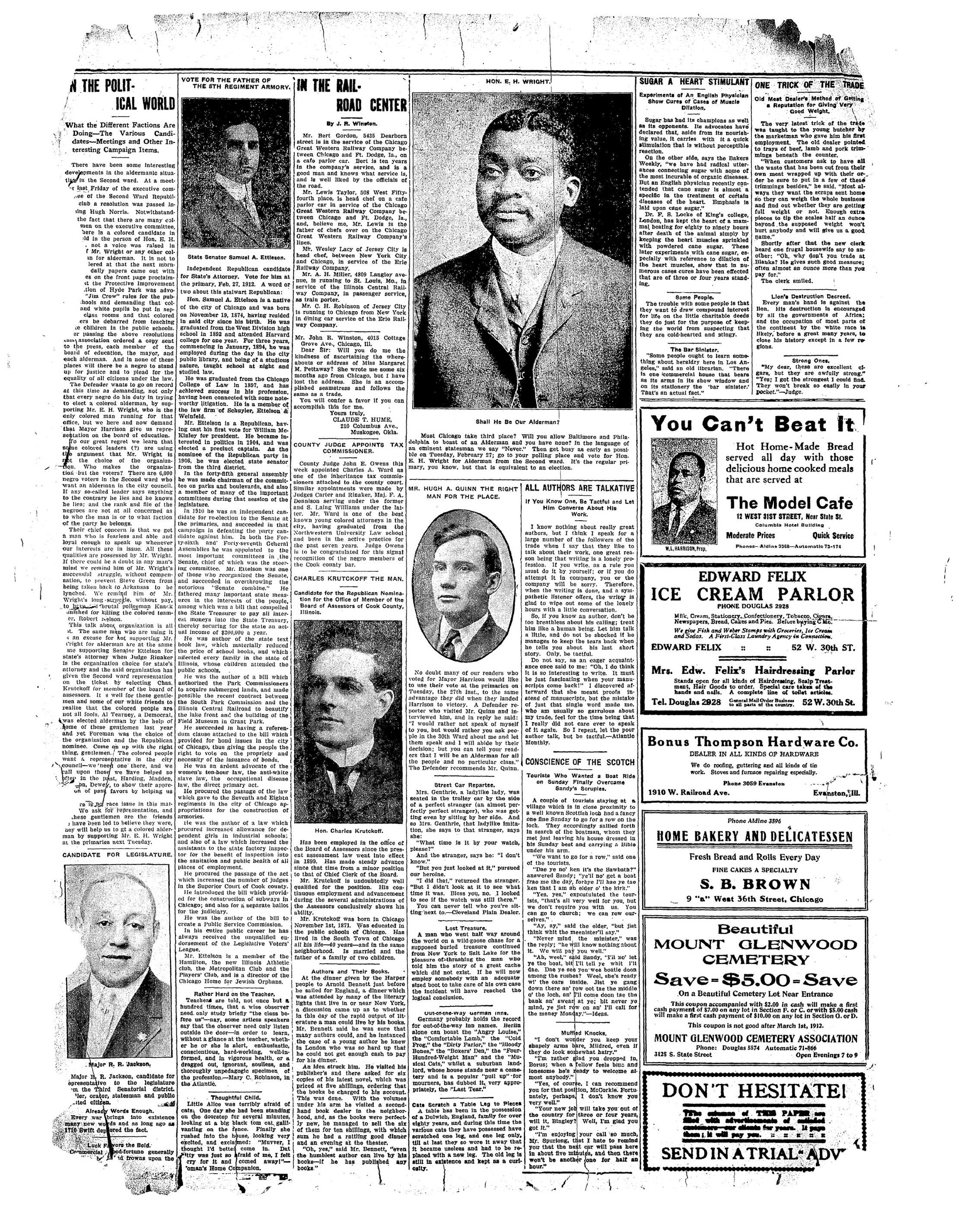
SINGLE MEN ELIGIBLE BACHELORS
A Large List of Marriageable Men Who Have Signified Their Willingness To Become Benedicts if a Lady "Pops the Question" and Has $5,000 as a Marriage Dowry—Each Proposal Will Be Promptly Checked Off in These Columns.
DON'T BE BASHFUL THIS IS LEAP YEAR.
The Chicago Defender's Publication of Marriageable Women Brings Results—Many Announcements Are to Be Made Next Week—One Reader Advertises for Rich, Christian Husband Under Forty Years Old—Please Answer Promptly.
At the earnest request of our many women readers whose names were published under the caption "Many June Brides," in our issue of Feb. 10, we herewish publish a list of single men and eligible widowers and bachelors.
We have interviewed many of them and all signify their willingness to become beneficts if a lady "pops the question," and has five thousand dollars as a dowry.
As a starter we reprint a letter from a subscriber signing herself as H. S., who is looking for a husband. Her requirements in a husband are very simple and the list below no doubt contains H. S.'s "future husband."
Here is the list, take your choice: Bachelors—W. B. Sobers, Joe Pope, Adam M. Beckley, N. Nesbit, Garfield Wilson, R. S. Abbott, Albert George, Wille Harsh, Dr. Harry Garnes, Zeb Ketrebaum, John Moore, Ben Thompson, Dr. W. G. Daily, William Farrow, Timmothy Carlyle, Jane Osboles, Bert Lewis, Sam Fielding, John Hedgepath, John Topp, Geo Price, Mr. Samnels, Robt, Lacy, C. Kyle, Wm. Smith of Boston, Wesley Barley, James Lee, Mr. Netherland, Monroe Johnson, Henry Rhea, Cary B. Lewis, T. W. J. Boxley, Edw Faulkner, Laurence Watkins, Opal Cooper, Charlie Laws, Dr. Wm. Rady, Geo Garner, Jr., Harrison Emanuel, Julius Green, Louis Thompson, Melville Mitchell, Lervy and Walter Hayes, Runus Estes, James N. Sims, Bob Fisher, Bird Lucky, Tom Hamilton, Thomas A. Nelson, Geo. Johnson, Anderson Brodie, Charles Congo Frank Thompson, Creighton Johnson, James Green, Ernest Johnson, James R. Parham, Plumer Butler, Frank Stephens, Richard Downling Joe Thomas, Charlie Settles, Frank Wooden, Israel Alexander, Frank Bishop, E. Canyt
Widowers—T. F. Dyson, Mr. Bird,
Mr. Wheeler, J. Hockley Smiley, Jerry
Williams, Daniel Webster, D. B. Peyton,
Geo. Ecton, Al Sloan, R. J. B. Elington, Henry Cole, De Koven Thompson.
HUSBAND WANTED!
Chicago, Ill., Feb. 20, 1912—Mr. Editor, Chicago Defender: Please find space in your paper for the following: "Husband wanted," by a middle-aged colored woman, about 39 years old. Would like acquaintance with a young Christian gentleman under 40 years with money. Call or write 4021 State street, rear second flat, H. S.
HYDE PARK NEWS.
Women's Club Meets at the Residence of Mrs. H. S. Claybrook.
Tuesday, February 7, the Hyde Park Women's Club met at the home of Mrs. H. S. Claybrook, its president. All of the members and several visitors were present. The report of the bazaar entertainment was made and the proceeds turned over to the banking committee. Several new members were taken in and the club adjourned to meet the following Wednesday at the home of Miss Ophelia Anderson.
At this meeting a report was made by the banking committee and another entertainment arranged. It will be a leap year party. "Mrs. Busby's Pink Tea" will be a feature of the evening.—Mrs. C. Tanner, secretary.
A FEW MORE LADIES.
A Reporter Who Was Out of Town On An Assignment Has Just Submitted the Following List.
Ada Lou Mitchell, Vlyian Harsh, Minnie Calcway, Lucile Woods, Elese Johnson, Cora Pride, Blauche Shelton, Margaret Huggins, Myrtle Mathews, Frank Drake, M. Gertrude Jackson, Nannie Alvis, Anna Smith, Sallie Bolton, Garnetta Tibbs, Fannie Woods, Lillian Granberry, Evangeline Whitman
Napoleon on Shakespeare
It is a fact that the great emperor of the French had a very poor opinion of Shakespeare's plays. According to Thibaudeau, in his "Bonaparte and the Consulate," Napoleon said one day; "Shakespeare was forgotten even by the English for two hundred years, until Voltaire took it into his head to write him up, to please his English friends; and ever since people have gone about repeating that Shakespeare was the greatest author that ever lived. I have read him, and there is nothing in him that approaches Cornelle or Racine. His plays are not worth reading."
Where Samson Would Shine
A fond father rendered a dull Sunday afternoon pleasant by telling his small son Bible stories. By and by he told how Samson carried away the great gates of Gaza. Said the son, who had learned much through many fittings: "Oh, daddy, wouldn't he be a fine moving man?"
BOOKS AND THOSE WHO WRITE
THEM.
A 'Review — Our · Literary Round
Table.
By D. W. Johnson.
As a people of the same race it is somewhat surprising that the colored people of the United States do not take more interest in the republic of Liberia. Liberia is a small negro republic on the grain coast of West Africa, founded in 1822 by American philanthropists for the settlement of freedmen who wished to return to their tribal land and enjoy the political and social privileges then and now denied them in the United States. Liberia has an area of about 40,000 square miles and a population of 2,120,000. The soil is very fertile and well suited for the growth of tropical crops. The riches of its wealth would be indescribable if the proper care and attention were given to its development.
The government is modeled after that of the United States, consisting of a president, a congress composed of a senate of nine members, a house of representatives of fourteen members, a supreme court and cabinet officers.
The distress of Liberia in recent years has been abnormal. While she has been fairly free from internal troubles, with the exception of an occasional uprising of the natives, her financial burdens and outside interference have been almost unbearable. But happily, now, through the good offices of the United States government and the successful diplomatic negotiations of our American minister, Hon. W. D. Crum, Liberia has been able to secure a sufficient loan to carry her on her way rejoicing and it is generally believed that a complete rehabilitation of the country will be soon accomplished.
It is gratifying to learn that Liberia has been fortunate in electing such a distinguished gentleman president, as the Hon. Daniel Edward Howard. Mr. Howard is a very able and accomplished gentleman, possessing a wide and varied experience in the affairs of the government, which makes him thoroughly capable to cope with the situation. His inaugural address as given in the New York Age February 8, is a masterpiece both from a literary standpoint and as a manifestation of his statesmanship.
MEETING OF PROTEST AGAINST SEPARATE SCHOOLS IN CHICAGO.
A meeting to protest against the action of the Hyde Park Protective League, in advocating separatism schools in Chicago for colored and white children, will be held under the auspices of the Bethel Literary Club, at Bethel church, Thirtieth and Dearborn streets, Sunday afternoon, February 25, at 4 o'clock.
Addresses by Hon. E. H. Wright, Hon. John G. Jones, W. G. Anderson, W. H. Wallace, S. B. Turner and J. T. H. Woods. A fine musical program will be rendered.
If you are interested in our children, come out at 4 o'clock. Everybody welcome.
DETECTIVE F. P. STARKS RETURNS.
Detective Frank P. Starks of Chief McWeeney's office returned from the east Thursday morning bringing with him Perry Bradford. Some time ago the foxy Mr. Bradford, then a member of a show, called "The Chicken Trust," got into an altercation and severely cut a man. He was arrested, omitted to bonds but forgot the fact and hastened from the city.
Detective Starks was detailed to hunt him dawn and the chase led him to New York, New Jersey and thence to Boston, where he captured his man as he was about to depart for Canada.
ORCHID WHIST CLUB'S PRE-LENT
EN DANCE.
The Orchid Whist Club gave their pre-Lenten dance on last Thursday evening at the Kenwood parlorists. Miss Cora Pride, the president, deserves much credit for the unique affair given by the club. Some of the leading young men of the city were among the guests of the club. They were Mr. George R. Garner, Jr., Drs. William Raby and Boger. The Orchid Whist Club will give their formal affair late in the spring.
Madagascar Wild Peaches.
In Madagascar wild peaches are found in great numbers.
Procrastination is the thief of time
WAKE UP! WAKE UP! WAKE UP!
WAKE UP! Don't allow yourself or those dependent on you to suffer in the time of need for the sake of a few paltry dollars. It requires very little to carry a splendid life insurance policy in the
CHAS. A. GRIFFIN, Agent. 3022 Wabash Ave., CHICAGO, ILL.
This old and reliable company invites you to form a part of its membership.
Equal rates and protection to all.
Colonel Saussier, General Zurliden and Others Have Escaped From Prisons in Germany.
About a dozen precedents for the escape of Captain Lux from his German prison can be found in the history of the Franco-German war, and a large proportion of the heroes of them lived to become famous.
A notable case was that of General (then colonel) Saussier, ultimately commander-in-chief of the French army; who was detained at Grandens, in the extreme east of Prussia. It is said that he put his boster to bed instead of himself, hid in an obscure corner of the fortress until nightfall, and then, having obtained a disguise by the help of his orderly, was allowed to walk out of the main prison gate.
He crossed the frontier to Poland and returned to France by way of Austria and Italy.
General Zurilden was another prisoner who got out of his prison at Glogan in Silesia, on Christmas eve. He made his way in disguise through Berlin, Frankfort and Karskruhe to Basei, a feast which was not difficult for him, as being an Alsatian, he spoke German quite as well as his failers.
Thirdly, we may note the experiences of M. Paul Deroulede, who escaped from Breslau, and it is pliant to recall that that vehement anti-Semitie did not disdain to disguise himself as a Polish Jew. He was very nearly betrayed by a peasant whom he had bribed to guide him into Bohemia; but he drew his knife with a ferocious gesture and the peasant changed his mind, with the result that M. Deroulede saw the final fights of the war as a sub-leutnant of Turcos.
More Favorable Ground.
When our son was a boy of four a family of children moved next to us who were simply incorrigible. Of course their doings were much commented on in our family, and many a time I talked about "those dreadful Smith children."
One day I had occasion to correct my little son, talking to him seriously. He listened quietly for avail, then looked up at me and said with the most engaging air: "Don't let's talk about this, mammal let's talk about the Smith children."
Res. Phones:
Doug. 2588 Office: Oak 3126
Auto 72-607
DR. G. WILLIAM MILLER,
Physician and Burgeon
Office, 4709 State Street
Heurs: 9-11 A. M.; 1-3 and 6-8 P. M.
Residence, 3552 Forest Ave.
DR. A. BAILEY WILLIAMS,
PHYSICIAN AND BURGEON.
Heurs: 11-380 a. m. to 1 p. m.; 8:30 p. m.
to 6 p. m.; 7 a. m. to 6:30 p. m., and by
assignment. Provident Hospital Dally,
111 a. m.
State Street Chicago 18
The Spirella Boning
makes the Spirella
Corset Belle,
comfortable, exudive, guaranteed shape-retaining.
An Expert Concierge, trained by us, will serve you at
your home. MISS LOLA M. NORTON
3004 Wabash Ave, Corsette Phase A128f
See Spirella magazine in leading magazine.
Dr. Theo. R. Mozee DENTIST
Office Hours, from 9 a.m. to 5 p.m; from 7 p.m.
to 9 p.m. Sunday by appointment.
Phones: Oakland 4662. Auto. 73-058.
4715 South State St, CHICAGO, IL 4151
PHONE ALDINE 3458
IDA M. DEMPCY
Stenographer
and Typist
3716 Dearborn St. Chicago, IL
Smith @ Sons
Restaurant and Lunch Room
Extra Fine Home Cooking
Private Dining Room
8236 State Street Chicago
low yourself or those de-
in the time of need for
dollars. It requires very
life insurance policy in the
EMNITY COMPANY
d in 1884
City Churches—Religious News
STANDARD LITERARY CLUB.
Program for the Standard Literary
Club of Bethesda Baptist church,
Sunday, February 25:
Tenor solo, Mr. P. Wayne; speaker
of the day, Rev. W. Durant Frode,
pastor of S. D. A. church, subject,
"The Rise and Fall of Empires;"
duet, M. S. Nellie Gregg and Mrs.
Johnson of Olivet choir.
ST. MARY'S A. M. E. CHURCH.
Sunday is Rally day. Services at
15:45 a. m. and 7:45 p. m. Sunday
school, 2 o'clock, Christian Endeavor,
6:45 p. m. At 3:15 p. m. reunion
rally of Christian Endeavorers.
Thursday, February 29, Founder's day
will be observed.
FREDERICK DOUGLASS CENTER
Sunday afternoon meeting, February 25 at 4 p. m. Miss Pauline Lee will give a musical program as follows: a, Preludio No. 15; a, Tocatta, G major (J. S. Bach); a, Nocturne, op. 15, No. 2 (F. Chopin); b, Au Printemps, op. 30 (Sigismund Nowskowski.)
WAYMAN CHAPEL CHURCH
Services Sunday, February 25, will be as follows: Preaching at 11 a. m. The Sunday Club will meet at 4:30 p. m., at which time the North Side Women's Club will furnish the program.
The pastor is preaching a series of sermons on the seven songs of Revelation. The sermon Sunday night will be "The Song of Power," in which is a prophecy of the final battle of the nations of the earth. This will be the third sermon on this very important subject. Preaching at 7:45 p. m. Sunday, March 3, there will be special services all day. Sunday night will be witnessed a Bible scene. Characters in ancient costumes will represent this scene just prior to the sermon.
Every Sunday morning during the month of March there will be special sermons on "The Law of the Lord" at 11 a. m.
Miss Ione Goode and Miss Blanch Abernathy will give a concert for the benefit of the rally. The Thimble Club was reorganized at the pastor's residence Tuesday night—Mrs, L. E. Stewart, president.
WALTERS A. M. E. CHURCH.
The two sermons delivered by our pastor, Dr. Callis, Inst Sunday were of unusual interest. In the morning he preached on "Character Bullding," in the evening on "Reigion in the Home." His discourse in the evening emphasized the responsibility of parents and especially that of fathers.
The annual banquet of the Men's Club, which is to take place next Thursday night, the 29th, is creating much excitement. The program will include some of the best talent in the city. The music is in charge of Mrs. Ida Stovall. Among the speakers will be Prof. Richard T. Greener, Hon. Frederick Lauden, Dr. A. J. Carey, Hon. William Hale Thompson, Hon. E. H. Wright and others. Many of the ladies are preparing special costumes for this event. The program in the auditorium will be free to the public.
Our third quarterly conference will be held on the 7th of March. Sunday services will be as follows: Early morning prayer meeting, 6:30; preaching at 11 a. m., by the pastor; Sunday school at 1 p. m. A special preaching service at 3 p. m. by Mrs. Mary E. Idell. Christian Endeavor at 6:30 p. m. The pastor will preach at the regular evening service. Easter rally pledge day will be continued.
VOLUNTEER WORKERS' CLUB
The Volunteer Workers' Club celebrated Abraham Lincoln and Frederick Douglas' birthday Wednesday, February 14, at the home of Mrs. Mary Webster, chairman of the executive board, 6430 Vincennes avenue. The program was in charge of the executive board. The speakers for they afternoon were: Mrs. Lang Williams, who spoke on "Douglas." Mrs. Tillie H. White, "The Man Lincoln." Mrs. Cella Parker Woolly, "Douglas."
Mrs. Harry A. Duncan, paper on Lincoln.
Mrs. Hattie Patten gave avocal selection.
Mrs. Sula May Williams recited Lincoln's favorite poem, "Why Should the Spirit of Mortals He Proud?" One of the most interesting features of the afternoon was a chorus of fourteen little girls, who sang two patriotic songs, "Our Flag" and "Marching Through Georgia." The hostess then invited the guest to luncheon in the dining room, which was beautifully decorated in red, white and blue. Each person was presented with a Lincoln souvenir. Proceeds of the silver offering amounted to $8.16.
The guests were Mesdames J. W. Cross, C. Roberts, M. Collins, L. Turnley, A. Harrison, B. Payne, A. Sprague, F. Hall Clint, C. Davis, A. L. Jackson, Ira Stewart, Sublet, Coppage, McComa, Gordon and Johnson.
— L. H. W.
A SHORT TALK ABOUT A FAMILY NECESSITY.
Secure a Resting Place for Your Dead
—Beautiful Mount Glenwood
Cemetery.
Every colored family in Chicago has a grand opportunity to secure a family cemetery lot at a very low price and on easy terms, $2 cash and $2 per month.
You will find a coupon printed on another page in this issue which is good for $5 as the first payment on a cemetery lot in beautiful Mount Glenwood when accompanied with a small cash payment of $2 on an lot in sections F or C, or $5 on any lot in D or G. This offer is only good until March 1st, so those who are wise will take advantage of this opportunity to buy a lot and make a saving of $5. A
cemetery lot is a family necessity and the time to buy it is when you are in health and are able to make the small payments. A Chicago cemetery lot in a new cemetery like beautiful Mount Glenwood is also a good investment, as these lots just grow in value as improvements are made and the demand increases each year for lots.
MORALITY OF THE ELEPHANT
He Makes a Cat's Paw of Boy's Hand to Steal the Unhusked Rice.
Singular as it may seem, elephants which have associated with men entertain the notion that, under special circumstances, they are not responsible if they utilize another to commit an illegal act. The following is an instance of this elephantine morality: A man in tangleoon bought three young elephants to send to England. They were tame and playful, but cunning. Knowing that it was wrong to steal paddy (unhusked rice)—the idea had doubtless been impressed upon them by punishment for stealing—they would not touch it themselves. But if a boy went to see them, he would be seized by one, the little trunk would be coiled around his arm, and he would be led to where the paddy was kept in bags. The elephant would make a cat's paw of the boy's hand to take up a handful of paddy. Then, letting go, he would turn up the end of his trunk, open it, and coaxingly invite the boy to drop in the paddy.
Should the boy, however, put it back in the bag, his arm would again be seized by the trunk, and his hand would be again inserted into the paddy bag.
The boy, anxious to be released, would usually drop the paddy into the trunk, and the elephant would blow the rice into his mouth. After repeating the operation several times, the elephant would swamper off, feeling that he had got the paddy without stealing it—Harper's Weekly.
KNEW HIM AND LOVED HIM
Dr. Courtenay, Mutilated Veteran of the Confederate Army, as He Was In Tippah.
Dr. Courtenay entered the Confederate army as a surgeon, and after the surrender found himself without home, family, or fortune. His right coat sleeve dangled empty; the hand that had saved so many lives could not save itself. It had been amputated after Gettysburg, and the story goes that Lee himself—the name is always pronounced slowly and reverently in Tippah—had said, "I wish I could give my hand to save yours, doctor." Another loss, equally grave, but less conspicuous, was that of his left lung. It was this trouble that had brought him to Tippah's mild climate, for nearly 20 years he had lived there alone in his three-room cottage, riding out every day to his little farm, five miles from town, and reading and smoking far into the night. His library was the wonder of Tippah. Books in five languages lined the walls of his house—all in the cheapest bindings, for the doctor was poor; but, as he used to say, it was the meat in the nut he cared for, not the shell outside. He never practiced medicine, except occasionally among persons too poor to pay for medical advice, or, more frequently, in serious cases when called in consultation. It was known that he had never taken a fee in Tippah. Every one believed implicitly in his skill. It was a common thing to hear it said, after a death, "Nothing could have saved him; Dr. Courtenay said so."—Lillian Kirk Hammond in the Atlantic.
An Indian Day.
In the dew-bespangled sunrise, while the air was caressingly cool, we went forth to ride along the river bank and beside fields of yellow mustard or dun stubble; then, on our return to the shadowed tents, a bath, breakfast, and the day's occupations; then again, in the swift dusk of evening, when furtive jackals rent the twilight stillness with wailing and demoniac laughter, or the silver bark of little foxes echoed over the mist-velled rice-fields, white under the moon, we gathered in comfortable deck chairs in a great, dim aliso of the mango grove, while the tents shone orange in the lamplight, to tell sad stories of the deaths of kinds, or listen to the Police Chota Sahib, who had a pretty, sentimental tenor, singing "The Long Indian Day."—Charles Johnston, in the Atlantic
Staining Glass.
The art of colored glass has been lost and refound, guarded and stolen so many times during the history of civilization that it seems almost impossible to say anything new on glass staining. Yet a process has been discovered for making the stained glass used in windows which is a departure from anything known to the old timers.
The glass first receives its design in mineral colors, and the whole is then fired in a heat so intense that the coloring matter and the glass are indisolubly fused. The most attractive feature of this method is that the surface acquires a peculiar pebbled character in the heat, so that when the glass is in place the lights are beautifully soft and mellow.
Popularity of #1 Results 2024
Popularity or "Rock of Ages."
When Toplady in 1776 wrote the "Rock of Ages" he could not have conceived that it would become so widely known or so popular among all shades of religious opinion. It was this hymn that Mr. Gladstone translated into three languages, and which the Prince Consort asked for when on his deathbed.
Best to Do It Well
If you are going to klick at all it is just as well to get there with both feet.
WIFE'S PLAN DID NOT FAIL
Hubby Shelled Out Promptly When He Realized Who Wrote the Letter to Her.
Here is a little scheme which a wife tried on a good—but rather tight—husband when she wanted a particular something for Christmas, which is commended to wives of a like mind. One night when he was comfortably seated after dinner smoking his pipe, she brought out a bundle of papers and said she had hesitated for a long time whether or not to read him some letters she had received. He pricked up his ears, seemed interested and she took the rubber band from the package, telling him he must promise not to ask who the writer was until she had finished, and then not to go gunning for her correspondent. He promised, with curiosity at boiling point, and she began to read:
"My own darling," she began, "I think of you all day and dream of you by night. Wherever I go you are with me, and I live for you alone. The other night when I discovered that you loved me—" at this point husband's pipe went out and he sat up very straight.
"What?" he said, rising with a red face, "who the—"
"Now," said his wife, "you promised to wait until the end, to be quiet until I had finished." "But—" said her husband. She continued to read, "your eyes are my sun, your mouth is the mouth of dreams, your lips—"
"Well, I'll be—" said her husband, furiously.
"I dream of a day when you'll be mine and mine alone," read on his wife calmly, "and I long for the day when I can call you—"
"Stop that!" shrieled the frate husband. "Who wrote that rot? Just let me get my hands on him—"
"You've got your hands on him now, dear," said his wife, sweetly, "you wrote these letters when we were engaged." He sat down and lighted his pipe.
"What did you say you wanted for Christmas?" he asked.—St. Paul Dispatch.
Insanity Not Inherited.
"Most persons think that insanity may be directly inherited," says Homer Folks in the State Charities' Bulletin. "This belief is undoubtedly wrong. One may inherit a greater or less tendency toward insanity. Mental instability may be inherited, just as weak constitutions may be inherited. Those who have reason to believe that some of their ancestors suffered from mental troubles need not be unduly alarmed, for this fact does not make it certain that they will suffer likewise. These tendencies toward insanity may lie dormant during the whole lives of the individuals. But such persons should take the proper precautions to prevent the development of this tendency. As a weak constitution may be built up by healthy habits, so may mental instability be made stable by good mental and physical habits. The individual whose family has had mental trouble may often escape the disease by proper surroundings, healthful and temperate activities, and proper mental and physical habits. The most important fact in heredity is that the vast majority of ancestors of every individual were normal. Heredity tends, therefore, rather more strongly toward health than disease.
Books With Uncut Leaves
In this country and Germany the practice of publishing books and magazines with uncut leaves has largely fallen into disuse, but it is still common in France, where its prevalence provides a dissatisfied author with a cause for grumbling. In "La Grande Revue" among other hlaindrances to the reading habit which is so much in need of encouragement, at any rate from the author's point of view, he instances the practice of publishing books with uncut edges.
Time, he says, is growing more valuable every year and yet the reader of a French volume of average proportions has to spend about twenty minutes in the petttifogging work of cutting the leaves in order to get at the contents. Some people of course who take their reading in leisurely fashion rather like being checked by the need for using a paper knife, but the ordinary reader does not want to be bothered in this way. He likes to go straight ahead without being compelled to cut his way through the book as he proceeds.—Westminster Gazette.
Hooked Perfect.
A few nights ago an old family friend was calling at the apartment of Gen. George Pennington Borden, U. S. A., retired. The general and his friends were conversing on military tactics when Mrs. Borden entered the room and with the brief explanation, after greeting the guest, "Malds busy," indicated to the majestic warrior that he was to fasten those two buttons at the back of her blouse which defy the most agile feminine contortions. Weekly the veteran arose, murmurring, "How are the mighty falen! What rights are left to men when a brigadier general of the United States army must button a blouse in the back? How can I pose as a military tactician when I can be driven into a corner by a simple wave of a feminine hand? Despite his wall, the struggle was soon over, and the gallant soldier was rewarded with the information: "You did that very well."
"Thank you, my dear," said the general mournfully. "I am glad to have my humble talents recognized."
Quser Form of Insurance
Lloyd's have insured people against many strange things, but few qualifier inquiries have been made than that of an undertaker, who asked the other day at what price underwriters would relieve him of any liability from shocks caused to private people by his coffins being taken to the wrong houses at night.
Underwriters did not feel themselves competent to quote a premium offhand, but expressed their willingness to consider the proposition provided details were supplied, such as the annual turnover, the number of such shocks known to have been green and their severity.
GUESS WHO?
The doll is who don't believe in going to school on stormy days. Oh, you F. D.
The doll is who certainly looked good at wedding Tuesday evening. Oh, you E. P.
The bride is who certainly looked beautiful Tuesday night.
The P. O. dudes are who were disappointed on Wednesday. Oh, you hall.
The club of boys are who were heard to play with cards and music they had had their dance on Shrove Tuesday instead of Ash Wednesday. Oh, you Phalanx.
The doll is who certainly believes in dance with cards and music in school. E. S. is she.
The milliner is who went to New York for new spring styles and brought back someone style (in the shape of a new husband).
Poor Rolle, is.
The middle-aged matron is who says when she goes to dancing, school she will
CLASSIFIED ADVERTISING
FURNISHED ROOMS. For Rent.
CALUMET AVE., 3555—Large, beautiful rooms or flat, steam heat, modern improvements, near 353th St. car line, Call or write.
VERON AVE., 2420—First, class large furnished rooms to rent with modern conveniences and kitchen privileges. Photo: 1246 Aldine. 20
CALUMET AVE., 36112—Nearly furnished rooms, furnace heat, hot water. Automatic phone: 71-746.
STORE TO RENT.
One-half of store to rent with modern conveniences, 3223 St. Call or write Mme. Winchester, phone Douglas 2411.
FLAT FOR SALE
TELEPHONE Normal 674. Modern flat
building for sale, 4 to 7-room flats; also
vacant lots. Write to Jas. Conrad, 6512
St. Lawrence Ave., for particulars. 20-27
MALE HELP.
WANTED—Men to learn the barber trade. You would be surprised to know that barbers have tips and commissions added. Few weeks complete. Tools given. Some wages offered in barber department. Call or write today. Holder Bar College, 733 S. Wabash Ave.
FEMALE HELP.
WANTED—Ladies to learn hairdressing,
manicuring, facial massage, electrolysis
or ointment. You can do. Good chance for resident
trade. Steady position or parlor of your
home. Five weeks complete. Call or
write. Mole College, 738 S. Wabash Ave.
CANVASSERS WANTED.
HOUSE TO HOUSE Canvassers wanted.
Can you package. Sales daily with a
good household necessity. If you need
guarantee $15 per week. Bigger results
mean bigger pay. Write or call. South
Side. Novello Works, 3644 Forest Ave.
Chicago, Ill. 24
All communications should be
addressed to
The Editor The Chicago Defender
And not to any individual connected with this paper.
Any personal matter to the editor should be marked "personal"; all other mail matters are opened by the city editor.
Our Terms
All our work must be paid for in advance, because we have no collectors to go out to gather in monies. The paper, which is $1.50 per year, must be paid for in advance. When you say send the paper always accompany it with the money.
Some Shakespeare Statistics.
Some Shakespeare statistics.
A Shakespearean enthusiast with much leisure time on his hands and a regular mania for statistics has discovered that the plays of Shakespeare contain 100,007 lines and 814,780 words. "Hamlet" is the longest play, with 3,930 lines, and the "Comedy of Errors" the shortest, with 1,777 lines. Allogether the plays contains 1,277 characters, of which 157 are females.
The longest part is that of Hamlet, who has 11,610 words to deliver. The part with the longest word in it is that of Costard in "Love's Labor's Lost," who tells Moth that he is "not so long by the head as honorificabil-tudinitibus."
---
be prepared for all emergencies. Take care of yourself, Mrs. G.
The family is that makes itself so silly along come and go.
GUESS WHO-EVANSTON.
The doll is that changes her name over the telephone.
The doll is that makes beautiful aprons in a hurry, too.
GUESS WHO-ENGLEWOOD.
The Englewood doll is on the list of young men get busy, this is leap year. J.
This is leap year; now is your chance, M.
GOT THERE AT LAST
STORY OF THE SHIPWRECK AS TOLD BY A WOMAN.
There Was a Joke In It but It Took Her a Long Time to Reach the Point, According to Tale Related by S. E. Kiser.
A story that S. E. Kiser told at the recent banquet given by the Chicago Association of Commerce for the sons of members follows:
"I told you about the difficulty of getting a woman to see the point of a joke. Now, there is another kind of woman. She is the woman who starts to tell you a joke and has difficulty in reaching the point of it.
"One of the loveliest little women that I ever knew had this trouble. She had once been unfortunate enough to be in a shipwreck. The vessel on which she was a passenger had been driven upon some rocks and was rapidly pounding to pieces when the lifesavers succeeded in shooting a line over the upper works of the boat, thereby rescuing the passengers one at a time by means of the breeches buoy. There was a little incident connected with the woman's trip from the ship to the shore which she told in about this way:
"O, it was the most awful experience I ever had in all my life. I do hope nothing of the kind will ever happen to me again, but do you know when I was about half way between the ship and the shore swinging on that little bit of line and expecting every minute was going to be my last, the funniest thought suddenly popped into my mind just when I was there half way between the ship and the shore, and O! how those waves dashed and roared beneath me as I swung there just as if they were going to tear me into pieces in a minute. My, it was awful! But as I say, I was there half way between the ship and the shore when this funny thing came to my mind of all the places in the world. I can't imagine why it came to me there. You know my husband always treats me like a mere child, he doesn't let me handle the money and wouldn't even allow me to go around and buy a piece of steak, but just as I was there about half way, as I say, this funny thought struck me—and my, it was dark, awful dark!
"Well, as I was there, I say, swinging on this little bit of rope about half way between the ship and the shore, and suddenly this funny thought came to my mind. Now, the captain, I thought, was a coward the minute we got on the rocks, because he gave up, but the mate was one of the bravest men I ever saw in my life. But there I was half way between the ship and the shore and with nothing but that little bit of rope between me and death, expecting every minute to be the last minute of my life, and suddenly this funny thought sprang into my head and I was thinking also that my children would have a stepmother inside of a year if I was drowned, and, O, how it thundered and lightened, and my, how wet I was, I never was so wet in my life. I sometimes think it runs in our family, because I had a cousin drowned at sea. Well, as I say, there I was, about half way between the ship and the shore, swinging there, and suddenly the thought popped right into my mind just as suddenly as if some one had spoken it to me right out loud—suddenly the thought popped into my head there. "Well, I had the breeches on for once anyhow."
Entertaining the Duke
That irrepressible artist, the late Phil May, "saved the situation" at the Savage club one night in a very happy manner. It was an occasion when the late duke of Teck was present, and on account of this royal visit the entertainment committee thought it incumbent upon them to substitute for the usual free-and-easy play a strictly conventional entertainment, which, for all the duke's good nature, plainly bored him to death.
The proceedings went on in a funeral gloom very alien to the surroundings, till, in despair, one of the committee begged Phil May to cheer things up a bit, as only Phil May could.
"Phil" asked for some black chalks and a drawing board. The duke had just become a | grandfather by the birth of the present prince of Wales, but few saw Phil May's drift as he drew, in his own infinitable style, an infant in long clothes grabbing at a feeding bottle, till he surmounted the
.
The New
Continuous Vaudeville
Change of Program M
FINEST THEATR
3110-12 State St.,
Performers Send in
The New Grand
Famous Vaudeville and Moving Pictures
Stage of Program Monday and Thursday
INEST THEATRE IN AMERICA.
State St., Chicago, Ml.
Performers Send in Your Open Time
Continuous Vaudeville and Moving Pictures Change of Program Monday and Thursday FINEST THEATRE IN AMERICA 3110-12 State St., Chicago, Ml. Performers Send in Your Open Time
The LaVerdo C
(Cafe Newly
3100-2 South
Chicago
Chinese and American Restaurant in Conn
HARRY J. KELI
LaVerdo Cafe and Buffet
(Cafe Newly Opened)
3100-2 South State Street
Chicago, Ill.
American Restaurant in Connection. High Class Entertainers
HARRY J. KELLY, Proprietors
star..
ment Office
Wanted!
The La Verdo Cafe and Buffet
(Cafe Newly Opened)
3100-2 South State Street
Chicago, Ill.
Chinese and American Restaurant in Connection. High Class Entertainers
HARRY J. KELLY, Proprietors
..Star..
Employment Office
Private Waiting Parlor
for Ladies
Lounging Room for Men
M. WINCHESTER
3223 STATE ST.
Phone Douglas 2411
Waiting for
Is very poor but only way to do a business-limited make business. Business and are with the volume you have been doing suggest that you ness advice of one his business to for others. Mentions in the co-paper will bring business. We can instruct to you that waiting.
Is Not Good
MRS. J. WALLACE
French Pomade and Turp
Come and see our great offerings in and hair goods. There is no store that we than we are offering at this time. We which promotes the growth of the hair scalp trouble. And also carry a line of Mrs. J. Wallace.
Waiting for Business
Is very poor business. The only way to do business in a business-like way is to make business. If you are in business and are not satisfied with the volume of business you have been doing, we would suggest that you take the business advice of one who makes it his business to make business for others. Your announcements in the columns of this paper will bring you increased business. We can easily demonstrate to your satisfaction that waiting for business
J. WALLACE, Hair Ex
Pomade and Turkish Oil Manufacturer
See our great offerings in popular and medium-paper. There is no store that will give you bigger and offering at this time. We carry a full stock of the growth of the hair and removes da. And also carry a line of Turkish Oil, mar.
1030 3247 St
Phone, D
THE NEW ELITE
FE AND BUFF
3030 STATE STREET
Waiting for Business
If very poor business. The only way to do business in a business-like way is to make business. If you are in business and are not satisfied with the volume of business you have been doing, we would suggest that you take the business advice of one who makes it his business to make business for others. Your announcements in the columns of this paper will bring you increased business. We can easily demonstrate to your satisfaction that waiting for business
Is Not Good Business
MRS. J. WALLACE. Hair Ex
French Pomade and Turkish Oil Manufacturer
Come and see our great offerings in popular and medium-p and hair goods. There is no store that will give you bigger and than we are offering at this time. We carry a full stock of which promotes the growth of the hair and removes da scalp trouble. And also carry a line of Turkish Oil, mar Mrs. J. Wallace.
Phone Aldine 1090 3247 St
Phone, D
THE NEW ELITE CAFE AND BUFF
3030 STATE STREET
THE NEW ELITE CAFE AND BUFF 3030 STATE STREET
Our newly equipped dining room and quick service is unexcelled by any Cafe in the city. Theatre parties are solicited. Good music by the highest paid artists. Any neglect by any of our help will be immediately looked into.
Fine Wines, Liquors and Cig
Our Specialty
HENRY JONES
A.F. CODOZOE Prop. CASS HA
The Wines, Liquors and Cig
Our Specialty
JONES
DOZOE Prop.
CASS HA
Phone Douglas 4482
Phone Aldine 1080
R. W. GREEN
Funeral
Director
3832 STATE STREET
CHICAGO
Phone Douglas 5766
Automatic Phone 71801
Men and Women for All Kinds of Laboring Work.
Butlers, Porters, Waiters and Cooks.
General House Work for Women Cooks, Maids, Laundresses.
IN AND OUT OF THE CITY
3247 St
2 as Be EAL Bagel ise \ J nae Rtg wep +. RSE ane 8 a - -
Sy
DEFENDER .00., PUBLISHERS.
RS, ABBOTT, LU D.,
‘Founder ‘and ‘Editor.
a
Jasued Weekly by Chicago Defender Pub-
Hshing and’ Printing Company.
Foundoa May 6, 1905,
SUBECRIPTION RATES IN ADVANCE,
She sfoweng 20000000 ao
Shee: Monta" .i.iiciiitctensccsss MB
sn 1ISPLDY ADVERTISEMENT.
Sahg Jaen, phe time igo i cnssons eh
Special ie ven’ on Taree" Sr fom
standing dase? & re .
fF Sued N. Avendoreh, Society Editor.
Fon, Polly, Cartoonist,
~ OFFICE, *
3159 State Street
. CHICAGO, ILL,
“Telephone Douglas 3339.
Dutered ae second-class matter, Fabra
‘aey 1, 1006, at tho Postamice In Chicago,
Tie tinder act of Maren. 3, 1879,
®@Larger Cirovlation than all the other
weeklies combined. ;
RATES OF ADVERTISING,
bene : sane aan t.80
CRitfona ones 0, OOMURY, R000" og
Want alle, cach... iieeccecssreee 060
Reading Notioon, pot iiae..222122°°! 26
Raton for Display Adveriiseriente’ tar-
Bisbed. on.-"Siication.
Gane h dareanmPleane, ve, boxh
Bee Bd tate aed rie
Borne cent ta twall as
wen phe
Se fy
SATURDAY, FEBRUARY 24, 1912.
CAMee ANG SECRET SOCIETING,
Untave Temoto, Elks, moet oF
the second and fourth Thursdays of cach
Tlonth.. Airs, Jon Sadien, D. Res 2420 Wa
Bash vavenuc: Battle Waylon in. See.
For Dearborh streets
‘CHIGAGG LODGE, No. 42,1. B. P.
Bot Wrcsteata the tat ind 24 Friday
Holetea "Hall dria Stato ‘treet HW
Bea. Searetiry, e440 Vincennes avenne:
5X9. Sohnoon, wxalted Hulory Z0dr Cale:
Biot avenue.
COURT GENERAL, RORERT BLLIOTT
‘No. 1898, Ancient Order of Foresters
Meets avery second aed fourth Hom
day night In, each ‘month ot Oda Bol
fower Beal, ‘S387 State atreet,
Lodge orficers,
ci FLW. Baby, 6245 Dear-
pop Styaet hing eal Drax”, SP Deer
Fin Bee. BW. Tavion, $422 Dearbors
stfeet, poe i810" Aldine.
‘Treasurer, Prank Lb. Crittenden, 2414
Dearborn street, phone’ 8219 Calumet,
To the slore once lier mother did send
her
To purchase a steak nice and ten:
der;
She forgot what ma said so brought
back instead
A copy of this week's Defender,
A little early to have spring fever.
. A few warm days and Stato street
begins to look like itself again.
Why don’t you run for office every:
body else is?
Weddings and more weddings.
‘upld is certainly busy of late,
‘cosevelt and Taft ‘are such good
ds, have.rew-noticed 1... ,*
“Limited”—a fast train going just
80 far before being wrecked. —Web-
ster,
Balmy one day and blizzardy the
next—but that’s Chicago went? er.
The Defender’s subscription list is
‘ing by leaps and bounds. Are
vu a subscriber, if not why not?
‘The man to support is the man who
is golug to do something not only for
you but for the race,
While street pianos like robins are
@ ‘orerunner of spring, it isn’t always
advisable to take off your flannels in
February. gets BP
Ministers are complaining of an ap-
‘lable falling i the attendance
churches.” What {s the reason
getting too good or too bad?
hing an eligible list of bach-
ght be some satisfaction to
maids—beg pardon bachelor
‘ publishing their financial
weuld be more to the point.
tt Se strdnge in a hundred
China doing things the
hem? We say one hun-
wdvisedly for that is just
* as they are hehind the
know where I'm going but
ay way” is an appropriato
vefore taking a trip on tho rall-
Jalk about aviation being dan-
it Isn't in it with what the
s are doing of late,
fal district In Berlin was
the Soclalists during a
Say’ the votes of the
svants, in order to
nees next time it might
wdea for him to establish
nent bureau,
of fact it will take more
‘ded bandful of would
Yavde Park, aided
vfalr and pre-
make broad-
{nto the bar-
=
-was hanged last
his innocence until the
1 was a rather peculiar
mber of public spirited
sted an investigation in
sifting the thing to the
3 to prove his innocence
Im no good, it may be
saving others in a like
yo Hearst's paper de-
complished moro the
8 in office than Roose-
ren he occupied the
you this was two
vthe meanwhile bas
he Hearst forces 60
‘opped and say if a
nt does get elected
Dreference—ita a
«no law against
=. a
cay ware of _ ph. We are
tod that it minutely one
can attach | ont door and
hear a cock aking In the
kitchen,
Tt should not .< necessary to urge
every voter to stand by his race re-
gardless of personal likes or petty
differences, when prejudice is creep-
ing about us bere in big. broad Chi-
cago, it behooves us to strike while
the iron is hot and strike hard.
United States of China, that doesn't
sound bad. Congratulations. With
‘such leaders as Dr. Sun we predict
for the new republic such an awaken-
ing as the world has never seen, for
thousands and thousands of years in
the main they have been densely ig-
norant, while their nearest brother,
the Japanese, have astonished al} with
their cleverness. Just how long our
doors will remain closed to them re-
mains to be seen. “Rome was not
‘built in a day.”
What has become of the editorial
backbone of ‘the Tribune?” Are we
to understand by its silence that it Is
in any way in sympathy with the sen-
timent expressed m_the article on
“Sim Crow" schools, furnished by the
socalled Hyde Park Protective club,
which it dignified by giving so prom-
inent a place on its front page? Or
is It merely an oversight on the part
of the editor? More than likely it is
the latter, for we are not quite ready
to believe that the great Chicago
Tribune wowld give so prominent a
place to an article of that character
and then neglect to tell the world
through Its editorial columns where
it stands on the proposition. We are
grateful to the “Evening Post” espe-
cially, and to all the other daily
papers, for the stand they have taken
in the matter. And we would say to
this handful of prejudiced would-be's,
if conditions as they find them now,
in this broad city of ours, do not meet
with thelr approval with the ‘vast
amount of money at their disposal,
they should have no difculty in
migrating to more agreeable surround-
ings. The Tribune can greatly relieve
the ansiety of a large number of its
subscribers and friends by stating its
policy regarding our race, we are as
anxious to have our criminals brought
to justice as any other race, but want
and insist upon having justice, Why
the necessity of saying “A burly negro
aid this thing or a burly negro did
that” and not say the same of an
Irishman, German, Frenchman or any
other nationality, is more than we
ean understand, save we again explain
it by prejudice; for example note the
articles concerning the men hanged
here a fortnight ago. Surely the prog:
ress we have made in the last half
century entitles us to a boost and not
fa knock.
KNEW HIM AND LOVED HIM
Dr. Courtenay, Mutilated Veteran of
the Confederate Army, as He Was,
In Tippah.
Dr. Courtenay entered the Confeder-
ate army as a surgeon, and after the
surrender found himself without home,
family, or fortune. His right coat-
sleeve dangled empty; the hand that
had saved so many lives could not
save itself. It had been amputated
after Gettysburg, and tho story goes
that Leo himself—the namo fs always
Pronounced slowly and reverently In
‘Tippah—had sald, “I wish 1 could glve
my hand to save yours, doctor.” An-
other loss, equally grave, but less
conspicuous, was that of his left lung.
Tt was thls trouble that had brought
him to Tippah's mild climate, for near-
ly 20 years he had lived thero alone in
Bis tlreeroom cottage, riding out ev-
ery day to his little farm, five miles
from town, and reading and smoking
far Into the night. His lbrary ‘was
‘the wonder of Tippah. Bovles in fivo
Igngnages lincd tho walls of his hotse
—all in the cheapest bindings, for tho
doctor was poor; but, as ho used to
say, It was the meat in the nut he
cared for, not the shell outside. He
never practiced medicine, except oc:
easionally among persons too poor to
pay for medical advice, or, more fre-
quently, in serfous cases when called
fn consultation. Tt was known that
he had never taken a feo in Tippah.
Every ono belfeved {mpl{citiy in his
skill, Tt was a common thing to hear
it eald, after a death, “Nothing could
have saved him; Dr. Courtenay sald
f0."—Lillan Kirk Hammond in the
“Atlantic,
Cultivate Presence of Mind.
Presence of mind is greatly depend-
ent on knowing what is best to be
done under conditions or alarm or
danger, It this knowledge is acquired,
a Yery moderate amount of courage
and some common sense will enable
Persons to act with discretion and
consequent safety in very trying clr
cumstances.
een ante eee
" ‘A good many mistakes arise from
‘misapprehension. For instance, a den-
tist advertises that he will ‘extract
‘teeth without pain. You suppose he
‘means the patient will not experlence
pain. That is a wrong conclusion. It
ia the dentist who feels no pain,
‘Advice From Kinaivy Busy Rady.
“Oh, my! Your house has an odor
of burning milk. Don’t you know how
to avold that?” asked the K. B. B.
“I didn’t think it was so terrible,
Ym sure. Bverybody has accidents of
that kind,” said the woman she was
‘visiting rather irritably,
“Now it’s all right, of course, I don’t
mind it, my dear, but next time just
sprinkle some salt on the stove at
once after the milk fs spilled and you
‘will avoid that unpleasant odor,”
Picked Up Anclent Scotch Coln.
A unique, ancient coin dated 1677,
‘was picked up recently by Mr. George
Jackson,} of Johnshayen, Kincardin.
ablze, Scbtland, while he was working
in his garden. ‘On the one sldo is the
crossed syord and scepter with the
crown, anf on the other a Scotch
thistle, gwith the date over the top.
“Hib, Rex” can be distinctly read.
‘The’ egal copper coln, just the size
of a ffresent-lay slxpence, ts in ex
cellent preservation,
IN CHICAGO AND ITS SUBURBS
a RR
” Our Local Department—Personal_Mention—Religious—Social
and other short paragraphs—Read it over carefully, somewhere
you will find a line or two about yourself or your friends.
ee ater
only alderman, Mr. Edw. H. Wright.”
—How pleasant that sounds.
‘The latest news is always in tho
Chicago Defender.
Mr. Robert Collins of 6323 Cham-
plain avenue was called home in
Springfleld, Obio, some ten days ago
on account of the serious illness of his
father.
Hon. Edw. H. Wright, the dauntless
champion of his people, is an_ Ideal
candidate for alderman of the Second
ward, Vote for him.
‘Mrs. Cella Parker Woolley lectured
to the Unity Chureh Culture club on
the West Slde, Tuesday evening ox-
plaining the principles of the Doug-
lass Center.
The W. A. Wallace Bakery Co.
make the “Kentucky Loaf” and Wal-
lace Rolls,
The traveling welfare exhibit will
be located in the Doolittle school
about the middle of March when that
section of the city will be informea
of mayy facts which influence neigh:
vorhood conditions.
Do you know Mr. Edw. H. Wright?
“Yes,” then vote for him at the prim-
aries for alderman.
George R. Garner, Jr., and his sister
left the city this morning for Kala-
mazoo, Mich., where Mr. Garner sings
tomorrow. He gives a recital in Paw
Paw, Mich, Monday evening.
Mr. and Mrs, Charles Lee Reese
write they are having a grand time In
New York, They are visiting friends
and will go to their beautiful apart-
ment in ‘Sixty-fourth and West End
next week,
‘Tho way to get good bread, ack for
the “Kentucky Weat”
Quite a large number of young
ladies and gentlemen from the city
attended the cotilton and dance in
Evanston last Thursday evening,
Mrs. E, M. Hill, 3611 Calumet ave-
nue, returned to the city after a ten:
day visit at South Bend, Ind., and re-
ports as having liad a fine time,
Elect Hon. Edw. H. Wright, ex-
county commissioner, as alderman
from the Second ward and you will
never regret it, Every other raco is
there, why not a member of our own
race?
‘The regular meeting of the Ways
and Means society of Grace Presby-
terlan church will be held at the rest
dence of Mrs. Besste Johnson, 3208
Wabash avenue, Monday afternoon,
Fob, 26, at 2 p.m. Clara Studymire,
president; Martha B, Mitchell, secre
tary.
Wo Repeat It.
A dozen photographs will endear
you to twelve friends. Make an ap-
polntment today for your Christmas
photo, Peter P. Jones, 3519 State St,
“The meeting was a large and en-
thusinstic one, among the speakers
‘was Hon, Bdw. H. Wright, alderman
from the Second ward.”"—Future news
item in the daily newspapers,
Mr. George R. Garner, Jr, the in
vineible baritone-tenor in” reeltal,
Monday evening, April 22, Oakland
Music ball,
Mr, and Mrs, E, Young announce
the engagement of thelr oldest
Gaughter Alice M. to Mr. Jefferson J.
McKinney.
Mrs, Barthenia Brady, 8548 Dear
dora street, mother of Miss Eugenia
Brady and Mrs, Letitia Littlejobn, ac.
companied by her grandson Master
Alfred Littlejohn, are visiting rela-
tives in New Orleans and Natchez,
also the Mardi Gras in the Crescent
City,
Mrs, L, R. Dago is visiting friends
in New Orleans and also the Mardi
Gras.
Do you want geod plain roiter Ask
fer Wallace's,
Fear never entered into the make-
up of Hon Edw. H. Wright, Back this
up with a profound knowledge of the
law and you have the proper material
for an alderman—Vote for him.
Mr, Carey B, Lewis is in Memphis
and writes he fc on his way further
south.
Mrs, Willa Jones, ‘6434 Vincennes
avenue, entertained the Clifsonian
club at her residence Saturday. All
present had a very enjoyable time.
Those receiving prizes were Mes:
dames Tansel, first prize, a beautiful
hand-painted vase; second prize, a
Mexican drawn ‘centerpiece. Mrs.
ackers won the booby prize, a min-
Jature deck of cards.
Mrs. R. A. Smith, 49 East Thirtieth,
entertained a few friends Monday
afternoon, All expressed themselves
as having had a delightful time,
‘Who, when, where?
Dainty Compliments.
The daintlest compliment you can
pay a near and dear friend Is to send
a picture of yourself as an Xmaa
greeting, Peter P. Jones, 2519 State
Mrs, Robt, Lincoln Hall, $21 East
‘Twonty-ninth place, returned home
from Rutland, Vt, Wednesday, where
she went to bury her mother.
Mr. C. B. Hosmer, fleld secretary of
the Tuskegee institute, is visiting in
the elty, stopping at 3631 Prairie ave-
nue,
The Phalanx club have postponed
thelr dance from Wednesday night to
April 10.
Mrs. Wood, wifo of Mr, Harry Wood,
8436 State street, died Thursday even:
ing. Mr. Wood is the popular barber
land society man.
Delicate Sign of Love.
When a Japanese malden desires to
show marked attention to her lover,
she uses the sharpened point of one
of her finger nails in writing to him.
Small Boy as Conservationist,
-A lecturer before a suburban wom-
an’s club raised his voice with em-
Dhatie confidence. “I venture to ag-
sert,” he sald, “that there isn’t one
in this audience who realizes the im-
portance of the conserving of our for
ests, not one who has ever done any-
thing to prevent the destruction of our
forests.” A small boy who bad sc-
companied his mother to the lecture
Snterrupted in a high, childish voice.
‘T once shot a woodpecker,” he said.
RED TAPE RULES IN LONDON
Man Who Fell Into the Thames Re
fused Admittance to Police Sta-
tions and Hospital.
2) ae ae. ee
‘In New York of the refusal ‘ot nos.
‘pitals to admit emergency patients,
some of them in’ desperate plight, are
brought to mind by the experience of
a London man who fell into the
Thames the other day.
In New York tho explanation bas
deen that the hospitals refustog to
treat patients were overcrowded and
it was Impossible to accommodate an-
other applicant for admission. In the
London case red tape appears to have
deen responsible for the dental of suc-
cor to the man who took an snvolun-
tary bath fn the toy waters of the
river.
Nothing fn the testimony on the
subject of the shivering unfortunate’s
treatment indicated that there was
not plenty of room for bim tn which
to get warm and dry his clothes,
‘The story came out in a police
court, when a young laborer was
charged with breaking a plate glass
window tn the Salvation army shelter
tn Whitechapel road. The accused
testiffed that after he pulled himself
out of the river he had applied at
two poltee stations for permisston to
have bis clothes dried, and was re
ferred to the casual ward of a hos
pital, but an official) there would not
admit him because he had no order.
It was then early on a December
morning. According to the testimony
of a night watchman at the Salvation
army shelter, tho prisoner had asked
to de admitted there about four
o'clock a. m. to dry his clothes,
When the watchman told bim to
call again at five o'clock, as It was
against the rules to admit anyone be
fore that hour, the prisoner threw bis
cap at tho window and broke the
glass.
‘The magistrate was fiterested in
the prisoner's story that he had been
turned away from police station and a
hospital, and declined to dispose of
the case until ho ascertained whether
It was true.
Another fale of red tape methods tn
a London hospital is told by an Ameri.
ean. He suffered an injury to bis eye
and was {n graat pain.
“Can you afford to pay for the
treatment?” asked the surgeon at the
hospital,
“Oh, yes," responded the American.
“Then woe can do nothing for you,’
sald the surgeon. “We treat only
those who cannot afford to pay."—N.
Y. Sun:
UL-Pald Hero. >
Mr. French Strother, writtig in the
World's Work about C, P, Rodgers
transcontinental filsut, says that
financially the trip ws a disappoint.
ment. He recetved five dollars a mile
for bis fight from New York to Fort
Worth, and from Fort Worth to Pas-
sadena, four dollars a milo and all the
purses he could arrange for on the
side. He thus received about twenty-
thousand dollars from his backers and
about three or four thousand dollars
prize money. But bis machine cost
five thousand dollars and repalrs cost
about seventeen thousand dollars
more, 80 bis net return was small.
But be unconscfously summed up
the significance of bis fight at Pasa:
dena, after ho had heard the last cou-
gratulations and had ald off the
‘American flag they had thrown across
his shoulders, when be placed his
hands on his mother's shoulder and
sald:
“Never mind about the money. It
don't amount to much that way—but
L did tt, didn’t 12”
Visionary Men Only Practical Ones?
John D. Rockefeller preached a
short sermon in tho Fifth Avenue
Baptist church a few days ago, says
the New York Sun. His bearer was
Rev. R. J. Campbell, pastor of City
Temple, London. Mr. Rockefelter
stood {n the aisle and eald to Mr.
Campbell, who bad just preached on
passage from a poem tn Deuteronomy
about tho eagle and her treatment
of her young:
“How strange that the press of this
country prints ordinary news’ and
fafls to cateh higher Inspiration and
deal oftener with lottier ideals, I
Mked exceedingly, Mr. Campbell, your
application of old lessons to modern
conditions. Seems to me we must
Teallze these conditions. There must
come a revolution, a reformation at
any rate, from ideals. of today. I
commend the mystic note in all you
said. Wo must reckon with that.”
‘The preacher had said that the
so-called practical man, who wants to
manage everything on a practical
basis, a business standerd, {6 the
most wnpractical of all men. The
really practical man {s the vislonary.
dohn Smith Everywhere,
‘The good old name of John Smith
does not suggest in English any great
degree of aristocracy, but transferred
to other languages it seems to climb
the ladder, 20 to speak.
Thus, in Latin {t Is Johannes
‘Smithus, the Italian smooths tt off in-
| to Glovanni Smithi, the Spaniards ren-
der it Juan Smithus, the Dutchman
adopts ft as Hans Schmtdt, the Franch
flatten it out into Jean Smeet and the
-Rugslan says Jonloff Smittowskt,
When John Smith gets into the tea
trade in Canton he becomes Jovan
Shimmit; if he clambere about Mount
Hecla the Icelanders refer to him as
Jahne Smithson; ff he trades among
the Tuscaroras he becomes Ton Qa
Smittia; to Poland bo fs known as
Ivan Schmittiwetski; should be wan-
dr among the Wolsh mountains they
talk of Jthon Schmidd; when hé goes
to Mexico he Js called Jontll FSmittt:
af of classte tura he Mngers among
Greek ruins he turns to Ion Smikton,
and in Turkey he is utterly dieguised
as Yoo Beet.
Eggs are five cents a dozen fn
China, and yet 3,000,000 poople are
starving there,
| “From Our Exchanges |
Ground Broken for Lincoln Hall.
(Philadelphia Tribune.)
Mayor Blankenburg turned the first
shovelful of sod preparatory to the
erection of the Lincoln Memorial
‘building of the Mercy hospital at Sev-
enteenth and Fitzwater streets, Mon-
day. He made a strong address at
the exercises preceding the turning
of the sod, in the First African Pres-
byterlan church on the opposite cor-
ner. Mr. Walter P. Hall, president of
the board of directors of the hospital,
presided. Addresses were also made
by Hon. Harry W. Bass and William
A. Creditt, D. D. Scripture lesson was
read by the Rev. J. D. Harewood, and
the invocation and benediction were
given by John W. Lee, D. D., and
Henry L. Phillips, D. D., respectively.
Posts 27 and 80, G. A. R., were repre-
sented.
Some Appropriate Book Titles,
(Indianapolis Freeman.)
“Couldn't Come Back,” by Jim Jef-
tries.
“Thirty Thousand Dollars,” by Jack
Johnson,
“History of a[Meal Ticket (Barry),"
by Sam Langford. *
I Like to Hear Myself ‘Talls,” by
Joo Jeanette,
“Me and Milly McClain,” by Sam
‘MeVea,
“The White |Hope Destroyer,” by
Jim lynn,
“ “Down and Ont," by Al Kaufman,
| “Back to Oklahoma,” by Carl Mor.
is.
"Directory of| Dubs and Lemons,"
by Abe Attell,
“Imitation Scraps for Real Money,”
by Philadelphia pack O'Brien.
“Diuffing and [Staling,” by Tommy
Burns.
» "“Butting Lessons,” by Battling Neb
son,
“Long Distance Conversations,” by
Jim Corbett, |
“Everybody Whips Poor Me,” by
Bin Lang.
“All Lightweights Look Alike," by
Ad Wolgast,
| “Lessons from the Cave Man," by
Jim Barry.
“Yellow Strealis," by Billy Papke,
“Never Was,” by Marvin Hart.
Signs Are Down at Camden Station.
(Afro-American Ledger, Baltimore.)
After he had made a personal in-
spection of the “Jim Crow wait
ing and retiring rooms at Camden
Station, Mr. Daniel Willard, pres.
dent of the Baltimore & Ohlo Rail
road, ordered the discriminations
abolished last Saturday.
The employes |2? Camden Station
were surprised by a visit from Mr.
Willard 123i Saturday. He looked in
tent'y at the big tins that announced
four weeks today that the colorcd
People must only use “Jim Crow”
waiting and retiring rooms, and then,
it is said, asked who was directly re
sponsible for the| discrimination. At
ter finding out who was responsible
for the “Jim crohns he immediate
ly ordered the signs taken down and
today-patrons of the rod pass in an¢
out without having to see signs an
novncing any discrimination, Judg
ing by the way Mr. Willard made in
auiries, ft fs not though that he
was in any way jresponsible for the
humiliating arrangements.
Regiment Parades.
(New York Age.)
Before a large trowa of onlookers,
composéd of colofed and white peo-
ple, the New Yotk provisional regi-
ment pafd tribute to Abraham Lin-
coln Tuesday by placing a wreath on
the Lineoin statue in Union square.
‘The marchers, nearly 500 strong, 5a-
thered in front of the statue and Cap-
tain W. R. T. Richardson introduced
Major Henry H.:Blunt, who spoke
briefly on Lincoli. Then the band
played “America”! and Colonel Fill-
more placed tho wyeath on the monu-
ment. t
The members of the colored reel
ment assembled dt Columbus circle
at 11 o'clock, and marched to the Lin-
coln statue, They presented a sol-
dierly appearance| as they marched
through tho streets of the city, and
favorable comment was frequently
heard,
Several companies of. the boy
scouts paraded with the regiment.
‘The young soldiers from New Ro-
chelle, about fifty in number, wore in
uniform and equipped.
THE SICK.
The Latest News About Your Friends
and Acquaintances Who Are Under
the Physicians Care.
| “Mrs, Frank King, 3604 State street,
4s reported seriously fll by Unique
‘Temple, Lady Elks.\
_ Mrs, Mattie Bell, who has been I
at Provident Hospital, is better.
| Mr, James H, Buckner {g ill at the
‘home of his brother, 811 State street,
Prof. 0. J. Buckner,
| Mra. Joseph Evans is fil at her res-
‘dence, 6116 La Salle.
"Mrs. Thomas Pierson, 3600 Wabash
avenue, is serious ML at her apart-
ment in the Crawford.
Fo Bey ko BL interruniad:
“Why didn’t you notify Mrs. Wom-
‘bot that her houso| was on fire?
“Well, I went over there for that pur
pose, But she's a rhther keen bridge
player, and I couldh’t get an oppor
tunity to Interrupt the game."—Wash-
ington Herald. |
Arbitration,
“Papa, what ddes ‘arbitration’
mean?” “It means| that when two
powers of equal strength get hold of
@ smaller country, they agree to di-
vide it equally.”—Lite,
a a lk |
" Yokobama’s firefighting apparatus
1s owned by the association of {nsur+
ance compantes, which also pays the
firemen, The coon assist when
@ blaze calls out any part of the de-
partment receive on an average four
cents per hour. The regular staff of
firemen and watchmen are paid an av-
erage of $7.47 s wanth.
Can You See The Point?
| By SABINE |
et
Life is a battle for both men and
Women, The “winner-out” is the one
who, through —_goa-head-itiveness,
stickitiveness, self-will, and economy,
compels the world to bow at his feet
and demands the respect of all. Such
@ character is the subject of this
sketch,
A beautiful girl, just out of seliool,
with her good moiher—Elnora came
to Chicago, Being an excellent dress-
maker, she was no time acquiring a
large trade, This brought Mrs,
Franklyn into contact with Chicago's
best and wealthiest white ladies, So
much of a favorite was she, that at
Advice to the Newlyweds.
If you're afraid to go home—don't.
‘There is safety in absence, Dodge
tho issue in an argument and dodge
the flatiron in the kitchen. The Iat-
ter is important.
Don't sneak in quietly at 2 a. m,
if your wife is in the habit of losing
sleep on your account, walk in Doldly
and slam the door. Thus will you bid
defiance to the lashing tongue.
When tate for dinner, throw your.
self wearily into a chair and remark
with a sigh: “I'm so worn out with
work that I don’t think 1 can eat a
mouthful.” A shrewd word turneth
away wrath,
If conversation should lag, don't
starting anythirg. Learn to let well
enough alone,
Never be cross when your wife
tells the point of your story before
you reach it. It may be a poor story,
anyhow.
if your wife says it's raining, it is.
If your wife says it's black, it is.
%
|THE EDITOR’S MAIL|
SEND THEM YOUR NAME.
To the Ealtor:
| ave are trying to get the names and
Addresses of all colored people in a
number of communities who could at
all be interested in the higher educa-
tion of our youth. We want to send
them literature on the subject,
|, We realize that there was never a
time when there was greater need of
serious agitation to arouse our people
abeut the question of higher educa-
tion for their promising boys and
girls, Wil you assist us by sending
a large list of names and addresses
of those to yhom literature:may be
sent? You can not send us too many
ames though the list reaches into
the hundreds, Thanking you in ad.
vance, I am, yours sincerely,
GEORGE EB, HAYNES.
Fisk University, Nashville, Tenn,
DIDN'T TRUST HIS LAWYER
Shrewd Cllent Paid Fee In Advance to
Learn if He Had Reasonable
Chance of Winning,
Tt was told at luncheon at the Law.
yers' club the day before the Eqult
able building burned down. A group
of Jegal luminaries were gathered
about @ table discussing the apparent
impossibility of insuring the honesty
of any man, and it was contended that
there was ‘no remedy for it save to
pick out your man and trust him ab:
solutely, “No matter what safeguards
you might hedge him about with, if
he was dishonest he would contrive
to cheat somehow. One of the law.
Yers toil this story to emphasize his
point:
A eliont went Into a lawyer's office
fn Pulton street and sald that he had
@ grievanco with his neighbor and
wanted to go to Jaw. He stated all
the circumstances of the case and
counsel listened attentively. ‘Tho cage
fully stated, the client asked:—
“Well, those are the facts, Do you
think I'm in the right safe enough to
win if I go to law with him?”
“If the facts are as stated you cer.
tainly hayo got a case. If I were in
your caso I should begin suit,” an-
swered the lawyer.
“And how much would your fee be
for taking the caso and pushing {t
clear through?”
“Ob, TN seo ft through for you for
& hundred dollars.”
‘The shrewd client produced from an
inside pocket agwell worn wallet, from
which he oxtrafied a roll of bills aed
peeled off one hundred dollars,
“There,” said he, “that’s yours, It's
your fee. That’s all you'd get It you
trled the case. Now, without doing
any work on it at ail, just tell mo,
honestly, whether I've any chance of
winning the case.”
OQhtasas Gamietatene
‘The exquisite complexion of the
young Chineso women {s due to the
great care which they give thelr skin.
Generally speaking, the result is due
to massage,
‘The Best Way,
Choose always tho way that seems
tho best, however rough it may bo;
custom will soon render {t easy and
agreeable-—Pythagoras,
Never.
Many a good man says “I done {t,”
but that is not what makes him good.
> Passing Hint.
“Know thyselt” is advice frequently
given, but ff you want to maintain
your self-respect know as little of thy-
self as posatble,
Originator of Taxes,
About twenty-five hundred years ago
the first taxes were levied on the Athe-
nian people by the legislator Solon,
‘True Friends of Cause,
‘The greatest friends of a cause are
those who put thelr fingers on the
‘weakest spot and try to find a remedy.
Young and Old—Light and
Serious Verse and Prose—
History—Personal—In a
Word Their Every Interest.
—$$_$____!
the world’s great fair her beauty was
put to a test and as proof of her su-
periority she was awarded and holds.
yet the gold prize in the beauty show.
At present Mrs, Franklyn is owner
of a first-class barber shop, Chicago
Droperty and loans money. As an
elocutionist she has no superior in
her race, _
Madame Franklyn’s motto has al-
Ways been: “Be truthful and bonest
tm all your dealings, always respect-
ful and kind, but never big-headed.”
Mrs. Franklyn is now being booked
{for several engagements down the
state this spring.
If your wife likes funerals, enjoy
them with her.
Play sympathy for place. It's the
best bet.
If your wife thinks she can cook,
don't tell her what you think.
When playing cards with your wife,
always ask her what's trumps. She
may know,
When your wife introduces you to
her friends appear to be interested in
them and glance at her admiringly
from time to time.
Don't belong to a club—that's your
wife's privilege,
Have a latchkey, but keep it to
yourself,
‘When your wife drops her hat pin
at the theater, crawl under the chairs
for it and then rise with a pleased
expression,
When your wife talks, listen; you
don’t have to hear—By an Otd-Timer.
“Can you see the point?”
Praise only the woman who weighs
more than your wife and js older
than her husband,
MORALITY OF THE ELEPHANT
He Makes a Cat's Paw of Boy's Hand
to Steal the Unhusked
Rice.
Singular as it may seem, elepbants
which bave associated with men en
terlain tho notion that, under special
circumstances, they are not respons!-
ble if they utilize another to commit
an illegal act. ‘The following Is an in-
stance of this elephantine morality:
A man in Rangoon bought three
young elephants to send to England
They were tame and playful, but cun
wing. Knowing that ft was wrong to
steal paddy (unhusked rice)—the kdea
had doubtless becn impressed upon
them by punishment for stealing—
they would not touch st themselves
But if a boy went to seo them, be
would bo selzed by one, the Iittie
trunk would be coiled around bis arm
and he would be ied to where the
paddy was kept in bags.
‘The elephant would make a cat's
paw of the boy’s hand to take up
handful of paddy. ‘Then, letting
ho would turn up the end of his trun
open it, and coaxingly invite the bop)
to drop in the paddy.
Should the boy, however, put it
back in the bag, his arm would agatp
be selzed by the trunk, and bis hand
woutd bo again inserted into the paddy
bag.
‘The boy, anxious to bo released,
would usually drop the paddy into the
trunk, and the elephant would blow
the rice into his mouth. After ro
peating the operation several times,
the elephant would scamper of, fee
ing that he had got the paddy’ with
out stealing it—Harper’s Weekly,
‘That Wooing Ham,
Ham, it has always seemed to ue,
Yarled ‘moro than any other articles
over which blessings are mumbled In
degree to palatableness, fragrance
‘and invitation. ‘The varlation Is due
to the manner of approaeb, If 2 per
son 1s off his appetite, bata does the
best when served as an Arizona breake
fast—something else for the man and
the bam for the dog.
But supposing you have been bunt-
ing, rising early and staying ate.
You have fost your lunch, You have
to trudge nome over a hard road. You
Pass a farmhouse, and from its open
door there comes the sound of sl
aling ham and the heaven'a breath of
its perfume. It matters not if that
ham sprang from a razorback hog in
the wilds of Arkansas, you recognize
that that ham {s tho ‘most glorious
flawer that grows, the world's desire,
the inner fountain of Eden, the pillar
of fire by night, the sweet influences
of the Pleiades and the deliverauco
from envy, batred and malico and all
uncharitableness. For the next threo
miles you can't say a word to your
companion because of o watering
mouth,
Destine a7 Ohne era ace:
When Toplady in 1776 wrote the
“Rock of Ages” he could not have com
ceived that it woulu become so widely,
Anown or so popular among all shades
of religious opinion, It was this hymn
that Mr. Gladstone translated into
‘three languages, and which the Prince
Consort asked for when on his death-
ded.
It Doean’t Help,
It 1s a mistake for the man who.
‘gets up in the morning with a bad
taste in his mouth to attempt to get
“Md of it by quarreling with his wife.
/F whipping the children,
Aivance of Civilization,
In point of time Europe and Amerl-
ean are nearer together now than Lon-
don and Edlaburgh were two hundred.
years ago.
Magazine and Pollticlane,
Many magazines aro Ike politicians,
im that thefr promises of good things:
for next month are the cleverest part.
of them—Detroit News,
DPraver and Work.
Tf you do not wish for his kingdom,.
don't pray for it, but if you do, you:
must do more than pray, you must.
‘work.—Ruskin.
Michigan in the Limelight, by Our Special Correspondents—Detroit, Kalamazoo, Dowagiac and Benton Harbor.
THE RACE MAKING GOOD.
The Race Making Progress—Personal and Pertinent Paragraphs About the People—What They Are Doing in Religious, Business and Social Circles.
KALAMAZOO ITEMS.
Kalamazoo, Mich., Feb. 23.—Mr. James Walden, who is stopping at the Bolden apartments, was called to his home in Grand Rapids by the sudden death of his father.
Mrs. John Butler and Mr. Lester Bolden are still on the sick list.
Mr. Christian, a talented citizen of Kalamazoo, filled the pulpit Sunday morning at Grand chapel. In the evening Rev. Pettiford filled the pulpit. His text was taken from the first epistle of St. John, 10th verse.
Mjs Vivian Stafford entertained Mrs. Charles Russel at dinner last Thursday.
Miss Bessie Hill has returned home from a two years' absence in Bay City.
Mrs. Rose Rohberts of Paw Paw is the guest of Mrs. George William Stafford.
The stork left a fine son at the home of Mr. and Mrs. Thomas Woodford on Krum avenue this week.
Miss Ethel Mitchell has been confined to her home the past week with her gripe. Her friends wish her a smooth recovery.
You can get the "Detroit Informer" from our talented young man, Master Syrial Dungill.
The box social given by the Golden Rod Emergency Club was largely attended.
Miss Sarah Jeane Lett has returned to her home in Paw Paw, where she has accepted a fine position.
Our young men are taking a very active part in the world's greatest movement for boys and men.
Miss Mabel Thompson has returned from Indianapolis where she has been the guest of her aunt for a fortnight or more.
Mr. Charles Evans is confined to his bed with paralysis, affecting his entire left side.
The Misses Thomas and Saunders of Chicago and Mrs. Cross of Grand Rapids are stopping at Mr. and Mrs. Lester Bolden's apartments at 4292 Kalamazoo avenue.
See Miss Jennie A. Goins for the Defender.
Dowagiac, Mich., Feb. 23.—Mrs. Mathew of Cassopolis and Rev. and Mrs. Adams of Vandalia spent Sunday with Mrs. Bradley and friends. Mrs. Lizzie Davis of Battle Creek spent Sunday with friends. A sleigh load of young people attended the concert at Cassopolis last week. A very agreeable evening was spent as well as enjoyed. Mr. John Myers, who has been continued to his home for the past two weeks, is able to be up again. His many friends wishes his speed recovery. Mrs. Ed. Allen has returned home after a few days' visit with her daughter, Mrs. Clayton Brown, and friends of Vandalia. Mrs. Mary Brown is on the sick list. It is reported that Mrs. Noah Griffin is slowly improving.
Mr. Bert Bass gave his wife a birthday surprise last week. Among the out-of-town guests were Messrs. Frank and Henry Snelling and Miss Bessie Bass of South Bend, Mr. Wm. Stewart wife of Barren Lake and their friends of the city.
Mrs. Charles Stewart spent Sunday with her sister, in Kalamazoo.
DEATHS OF THE WEEK
DEATHS OF THE WEEK
11. Allen, Edith—22 years, 3517 Columnet Ave., Feb. 5.
2. Bundy, Nannie M.—40 years, 3728 Forest Ave., Feb. 18.
3. Ford, Wm.—28 years, 1240 Indiana Ave., Feb. 17.
4. Carrie, Carrie W.—27 years, 3625 Dearborn St., Feb. 13.
5. Hatcher, Elliz—71 years, 3251 State St., Feb. 12.
6. Jordon, Josephine—62 years, 3800 Wabash Ave., Feb. 17.
7. Jennings, Thos.—20 years, Cook Co. John, Feb. 15.
8. Lewis, Matia—71 years, 2258 Forrest Ave., Feb. 2.
9. Wery, John—1 year, 3933 Dearborn Feb. 13.
10. Amelia—63 years, 2060 La Salle 16.
11. Frank—50 years, 3549 Armour 17.
12.unk—46 years, 3608 Michigan 3.
13.—25 years, 2114 State St.
14. Louisa—42 years, 2006 N. Rail Ave., Feb. 18.
15. Williams, Peter—08 years, 5613 Jeffer- Ave., Feb. 13.
Reliefs of the Stone Age. large bas-reliefs dating from 9 Age have just been dis-Lanosel, in the French prov-rodogne. They are sculp-he rock of a shallow grot-ve represent animals. It is the primitive sculptu-alsned from introducingure in art by a tabu 9 present Mohametan representation. The 1 the reliefs are reins, and a huge horse enslons.
le Too Busy. dman was so very not see anybody 'em was a good elsewhere.—John
GRAPHIC STORY OF A SEA DISASTER
Captain of Tug Writes of the Loss of Two Barges He Was Towing.
Baltimore.—Full details of the loss of the barges Alabama and Pocomoke of the P. Dougherty company's fleet, near Lookout Shoals recently, were received by the company's officials in a letter from Capt. A. T. Vaux of the tug Margaret, which had the barges in tow.
Captain Vaux writes: "We sailed from Norfolk Saturday morning, and had a fairly good trip until Monday morning—about 50 miles southwest of Cape Hatteras—when the wind shifted to the southeast, and in the after-
J.
They Holsted Distress Signals. noon freshened to a strong gale. We were then drifting in toward the Shonls, and the tow headed out to sea, as the barges and tug were laboring in the heavy seas.
"At 5 p. m. barge Pocomoke holest signals of distress, and an English steamer, which later proved to be the Clivegrove, stood by and circled around the tow to render assistance. Under the conditions we were able to do a thing and had all we could 'o to take care of ourselves. Night came on rapidly, and the steamer stood by until 7:45 p. m., when we saw the last of the steamer, as a heavy rain shut in, lasting the better part of the night. The wind in the meantime increased, and we were going astern about three and a half miles an hour. At 7:35 p. m. the barge Alabama holest ed her red lights, but the conditions rendered it impossible to do a thing, as it was only occasionally that we could see the length of the tug.
"In the heaviest squalls the wind blew at least 60 miles an hour, and at 9 p. m. shifted suddenly to the southwest with increased violence, causing a heavy, confused and cross sea. We had our doubts that tug and barges would live out the night, as the wind kept veering back and forth from southeast to southwest. At 3 a. m. Tuesday the wind changed to the northwest, blowing a heavy squall for a short time, when it backed to the southwest and again to the northwest, blowing heavy all the time.
"At daylight we still had the two barges, but they were laboring heavily and seas pilling all over them. We did not see anyone on the Pocomoke, but the crew were still on board the Alabama. We did not know whether any of those on the Pocomoke had been taken off by the steamer, as it was pitched dark when she left. We were waiting for the crew of the Alabama to launch their lifeboat, but no attempt was made.
"At 9:30 a. m. Tuesday the Alabama went down so suddenly that we had not time to get the tug turned in the sea. On looking back both barges has disappeared."
HOBO FROZEN TO LOCOMOTIVE
Tramp Riding on Tender Deluged by
Overflow of Water and Had to
Be Chopped Loose.
Indianapolis.—Frozen stiff and with
snow and ice encasing him, Harry
Knox, 20, the other night was chopped
from his perch on the tender of a Big
Four passenger engine, where he had
taken refuge from the train crew
JACKSON'S BROTHERS
He Was Frozen in Ice.
while "bumming" his way from Terre Haute to Indianapolis.
Knox was found unconscious when the engine crew started to uncouple the locomotive. He was chopped and pulled away from his ice seat and taken to the baggage room of the Union station.
After warming up and fortified with stimulants, Knox was turned loose to brave the blasts with a 25 cent piece in his pocket, contributed by railroad men.
The Nutmeg State
Interesting Weekly Letters From Hartford, New Haven, and Other Cultured Points, Special Correspondence of the Chicago Defender
Hartford, Conn., Feb. 23.—Bishop A. Walters, A. M., D. D., the presiding bishop of the New England conference, will make an official visit to the A. M. E. Zion church Sunday, March 10. He will preach at 10:45 a.m. and at 7:45 p.m. The four church auxillaries, viz., the Women's Home and Foreign Mission, Daughters of Conference, Stewards and Stewardess, will give a grand banquet March 11, at which Bishop Walters will be the guest of honor and will make the principal address. There will be other speakers of note present and a delightful evening is anticipated. The guests will be seated at 8:30. Tickets, including supper, will be 25 cents. Mrs. Emma Prout, Chair Lady.
A surprise party was given last Thursday evening on Miss Irma Gordon at her residence. 44 Hicks street.
Mrs. S. V. Carroll of Norwich, Conn., is visiting her sister, Mrs. S. H. Banks, 71 Edwards street. She will leave Thursday to visit her son, Mr. Frank O'Guy, of Tarrington.
Rev. W. A. Harrod will preach a farewell sermon in the old church Sunday, Feb. 25. For further particulars read next issue in this paper.
Bert Williams, a well known stage man of our race, will star in Zeigelfeld's Follies at Parsons theater Friday and Saturday of this week.
E. C. Day Lodge, K. of P., had their annual sermon preached Sunday evening by Rev. Kimball Warren at Union Baptist church, Mather street.
The colored people of Hartford lost a friend in Mr. Wm. H. King, vice-president of Aetna Fire Insurance Co., who died at his home Friday morning, Feb. 16. Mr. King served in the Civil war, 6th Connecticut Volunteers. The funeral was held from his late residence, 509 Farmlington avenue. The active pallbearers were six colored employees of the Aetna Fire Insurance Co. The first annual automobile show was opened on Monday evening in the new Broad street First Regiment armory by Mayor Edward L. Smith. It bids fair to be the biggest show ever held in Hartford. The new armory has more floor space than any other building of its kind in New England. This was "Governor's Day," all the governors of the northeastern states being the guests of honor. Speeches were made by the governors in the hall of representatives, followed by a banquet at Hotel Gorde.
When you go to the caucus for city elections don't fail to nominate Chas. Wesley Custis of Mather street for alderman.
It is about time that one of our people represented us in the government of this city. We hope that every voter in Hartford will forget his personal differences and do his duty for the welfare of his people in Hartford.
I love the Hartford Times, but oh you Defender.
TRY TO PLACE
LIE ON BOOKER
T. WASHINGTON.
(Continued from Page 1.)
# For more information 1-1
Park business men who invites the
"Jim Crow rule." in schools.
Would you have the conclusion of the whole matter? A few negro teachers are drawing salaries for teaching white children. Young negroes are coming out of the schools yearly who are capable and will demand more positions. Little Miss Esther Webster, the youngest and only colored one in the class recently graduated from the teacher's normal with 'highest honors. Does not such cases show you why Davis, Schroter, Cave and similar Republicans fear and tremble? Colored teachers with almost never an exception come from the best families and are the highest type of womanhood. Listen to Albert Gray, graduate of Harvard and of the University of Paris, who taught in high schools in the country for several years. While defending the American boy in last Saturday's Tribune he says, 'the boy is the best thing we have in this country. He plays fairer than the teacher teaches. He steals less often than preachers. He averages better than the school teacher tourist from whose sleepers the Union Pacific and Southern Pacific railroads had to remove all towels because so many were stolen."
There can be no "Jim Crow rule" in the public schools of Chicago. There are too many "real white folks" in this city to allow Southern or ancient Roman ideas to prevail in modern Chicago. If the negro citizens of Chicago will study this "Jim Crow" effort right now and do a little thinking for themselves and cast their ballot accordingly in the coming election then will the "Jim Crow" action of the Hyde Park club defeat its own aim and prove to black Chicago a blessing curiously disguised.
The Old-Time Barber
Old-time barbers had to display more variety than their successors. 'A work published in 1592 describes a barber's greeting to a customer: "Sir, will you have your hair cut after the Italian manner, short and round and then frounst with the curling irons to make it look like a half moon in a mist, or like a Spanlard, long at the ears and curled like the two ends of an old periwig, or will you be Frenchified with a lovelock down to your shoulders? The English cut is base, and gentlemen scorn it; novelty is dainty. Speak the word, sir, my scissors are ready to execute your worship's will."
Daily Thought.
Smiles live long after frowns have faded—James A. Garfield.
A Vacuum.
Chairman (addressing a meeting)—
I am sure we will all be very sorry
our secretary is not here tonight. I
cannot say we miss 'is vacant chair,
but I do say we miss 'is vacant face.—
Tit-Bits.
KEEP TRIBAL CUSTOMS
SARCEE INDIANS DISREGARD
MARCH OF TIME.
History, Intended for Posterity, Still Is Recorded in Crude Fashion on the Hides of Steers—Old Men Tell of Adventures.
Within twelve miles of Calgary, a city of 50,000 people, and with telephone communication with that city, the Sarcee Indians pursue their lives and observe exactly as their forefathers did the ancient habits and customs of their tribe, says the Toronto Globe.
Two years ago there was a great festival at which seven of the oldest chiefs related the stories of their exploits, which the painter of the tribe preserved for posterity on two immense steer hides. These hides are now carefully preserved at the office of the agent on the Sarcee reserve.
Th Indian lad relies for his history on campfire stories and a well-tanned steer hide covered with queer characters, painted crudely with a sort of ink made of the juices of plants.
These records are not haphazard, but they are not altogether regular. When several chiefs and medicine men of the tribe are growing old an assembly is arranged where the famous Indian interpreter and painter meets the aged men. One by one the old men stand forth before the people and recount the stories of their lives. They tell thrilling tales of the battles in which they have fought, of the scalps taken, and the horses they have stolen. These three achievements are regarded as the three most honorable and valorous exploits of the great men. Compared with these the white man's election to parliament, his appointment to high office, and his great commercial achievements are as nothing.
Sometimes their meetings last several days. The old men are enthusiastic in their descriptions of bygone days; they recite rapidly and gesticulate much. The members of the tribe, sitting about them, listen eagerly, storing the details to be told over and over again to their son's sons, until they are tribal traditions of the long past. As they talk the painter sits upon the ground with his steer hide spread before him and paints with his rude dyes pictures to illustrate the incidents.
A circle represents a barricade or encampment; awkwardly drawn pictures of animals stand for the horses he has stolen; a galloping horse, with a man on his back, suggests the story of a wild flight across the prairie before pursuing enemies; a flag may mean a bloody battle won; a tadpole-like mark, a scalped Indian. The figures are very crude, the drawings no better than those a four-year-old child makes on its slate. But some ingenuity is exercised in the grouping, and each sketch is, in a way, a key to the thrilling tales which in time become history.
Dog Under Arrest.
A dog thief—not a dog stealer, but a dog which had been trained to steal—has been arrested by the Freuch police. He was caught "en flagrant delit," we read, when he was in the act of stealing a pair of lady's shoes from an establishment in Nolts-le-Sec. His procedure was so cunning that it left no doubt among the police that the dog's was no "untutored mind."
Nothing could be drawn from the animal at the police office, so it was decided to shut him up without food. After some hours conflenthe dog was released and a police cyclist was in readiness to follow the dog home. But the "best laid schemes of mice and men gang agt agt"
The dog when liberated 'instead of rushing home deliberately walked to the other side of the road, and there sat down on a doorstep and awaited events, every now and again throwing suspicious glances at the police in waiting. Finding that there was no chance of the dog going home he was again taken into the police office and sent to the fourrille, where he met an untimely end.
American Alrs.
A woman recently back from foreign parts has a grievance against the way in which military bands there play American airs, states the New York Press. To begin with, says this woman, two-thirds of the bands and orchestras of Europe think "Dixie" is the national air, and this mistake is not difficult to comprehend, as applause generally greets this tune. Next in popularity comes "Columbia, Gem of the Ocean," and strange to say, then comes "Old Dan Tucker." No amount of expostulation avails to change this notion. "The Star Spangled Banner" is reserved for solemn occasions, and it must be confessed Americans are not wildly enthusiastic over it. Not one in a thousand remembers three lines of the verses, not even the school children who shout them every day. "Maryland" is popular, but the tune is that of the old Presbyterian hymn, "Beulah Land," and may be heard wherever Scotch and English folks gather.
First Paper Collars and Cuffs.
In no other country are anniversaries and jubilees of all kinds so insistently remembered as in Germany. One German newspaper reminds its readers that it is fifty years this month since paper collars and cuffs were first worn.
It was in January, 1862, when a Leipsi firm began manufacturing these articles, which at once obtained a great vogue on account of their cheapness. A newspaper of that time gives a serious account of the new fashion, which now strikes one as amusing.
It tells how the American (sic) idea of "time is money" was conquering Europe, and it illustrates a phase of the aesthetic craze which then ruled by stating that "persons of literary taste used to have quotations from their favorite poets printed on the 'heart' side of their paper shirt fronts."
---
DOUGLAS DANCING SCHOOL
EVERY
FRIDAY
NIGHT
Prof, Garfield Wilson
Manager
GOOD MUSIC
Beginners Given Individual Atten-
500 COMPLETE DUNBAR BOOKS
The Defender has been successful in securing 600 complete works of Paul Lawrence Dunbar, complete in the truest sense of the word. All of his poems and stories. To be given away. Good Christmas present. The Chicago Defender for one year and one Dunbar book for $2. Don't delay, as our last lot was soon sold out.
A
PORO Hair Grower
50s a Ben, No extra end of city
Treatment $1.90
1430 Dearborn St. Chicago
Phone Oakland 2489
Madeline R. McFarland
FINE MILLINERY
Feathera Cleaned, Dyed and
Curled
HATS BLOCKED
4746 State St. - CHICAGO
Free List Suspen ded
THE DEFENDER begs to an-
nounce the sus-
THE DEFENDER begs to an-
nounce the sus-
pension of the free list
for all notices that come
under the head of
advertisement. All
subscriptions for papers
must be paid for in
advance.
Premature Escape.
In Rooks county, Kan, thirty years ago a man was charged with murder. The evidence was all in, the attorneys had made their pleas, and the jury was out deliberating. The man gave the sheriff the slip and has never been seen to this day. Five minutes after his escape the jury returned a verdict of not guilty—Kansas City Journal.
More Attention Paid to it.
The sneer of an enemy is generally more helpful than the flattery of a friend.
Short Orders All Day
All Meals 25c. Table D'Hote 4 to 8 p. m.
A la Carte Lunch, 11:30 to 2 p. m.
Breakfast, 7 a. m. to 10 a. m.
21 E. 33rd Street, Near L Station CHICAGO
Open from 7 a. m. to 10 p. m.
"House of Quality"
We Have the Most Select Trade in Chicago-Most of the best families as our patrons.
A good funeral appeals to the living as a fitting memorial of respect to the dead
I furnish a complete funeral-one of satisfaction, for $65.00, or money refunded. We also have the finest goods and furnishings that are manufactured for the undertaking business, to an eternal bronze casket costing many hundreds.
I am in no way connected with the Casket and Undertaking Trust and I am not interested in the organized vicious attempt to slander and vilify other persons and firms engaged in the burial of our dead. My many years in business in Chicago and the manner and way my business is conducted proves that I am for building up for co-operation between honest business and the public, not advertising that I alone do right, but happy to say that we give the best for the smallest pay of any place in America today. I stand ready to prove the statement at any time.
EMANUEL JACKSON
DAN'L M. JACKSON, Expert Embalmer
ERNEST H. WILLIAMSON, Assistant
Only Place of Business in Chicago
2959 and 2961 State Street
Phone 727 Douglas—Automatic;71-629
WRIGHT & BLACK TAILORS
MURRAY - ANDERSON - TERRELL
REAL ESTATE BROKERS
Insurance in All Its Branches
RENTING
SALARY AND PERSONAL PROPERTY LOANS
Southeast Corner State and 31st St.
Phones Aldine 3692
Auto, 73811
Chicago, Ill.
W. H. HACKNEY, tenor
a pupil one of America's most eminent vocal teachers will take a limited
number of pupils in voice beginning October 1. Call or write today.
STUDIO 514 E. 33rd St. Telephone Aldine 54.
STUDIO OF MUSIC
MRS. MARTHA BROADUS-ANDERSON
TEACHER OF VOCAL AND PIANO
FALL TERM BEGINS SEPTEMBER 1ST
PHONE NORMAL 3316
RESIDENCE, 6450 CHAMPLAIN AVE., CHICAGO, IL.
Madam Minnie Adams
SOPRANO
Will accept pupils wishing a thorough knowledge of vocal and dramatic art.Call mornings at studio, 3752 Rhodes Ave., 3rd Flat. Phone Douglas 1058.
A.
Short Order
Rogers' R
Caterers to
Select M
All Meals 25c. Table
A la Carte Lunch,
Breakfast, 7 a.
21 E. 33rd Street, Near L. St.
Open from 7 a.
"House of
Establishment
We Have the Most
Chicago—Most of the
as our pat
A good funeral appeal
fitting memorial of r
I furnish a complete fun-
tion, for $65.00, or
also have the finest good-
are manufactured for the
to an eternal bronze
hundreds.
I am in no way connected with the
am not interested in the organized vicious
persons and firms engaged in the burial of
in Chicago and the manner and way my b
for building up for co-operation between
advertising that I alone do right, but happ
smallest pay of any place in America t
statement at any time.
EMANUEL
DAN'L M. JACKSON
ERNEST H. WILLIAM
Only Place of Business
2959 and 2961
Phone 727 Douglas—
NOW OPEN FOR
WRIGHT &
TAILOR
3142 STATE
Pressing and Repairing. Work called for
```markdown
```
Our Willow Plume
SPECIAL RATES TO MILL
3115 Prairie Ave.
MURRAY - ANDERSON
REAL ESTATE
Insurance in All
RENTI
SALARY AND PERSONAL
Southeast Corner S
Phones Aldine 3892
Auto. 73811
Electrical, Gas, Steam Fitting and Plumbing Work
ers All Day
Resturant
to the Elite
Meats.
Table D'Hote 4 to 8 p. m.
11:30 to 2 p. m.
a. m. to 10 a. m.
L Station
CHICAGO
a. m. to 10 p. m.
of Quality"
finished 1865
Most Select Trade in
of the best families
patrons.
reals to the living as a
of respect to the dead
the funeral—one of satisfac-
tor money refunded. We
foods and furnishings that
the undertaking business,
the casket costing many
with the Casket and Undertaking Trust and I
vious attempt to slander and vilify other
of our dead. My many years in business
my business is conducted proves that I am
between honest business and the public, not
happy to say that we give the best for the
ca today. I stand ready to prove th
J. JACKSON
ON, Expert Embalmer
WILLIAMSON, Assistant
Business in Chicago
961 State Street
—Automatic,71-629
OR BUSINESS
& BLACK
LORS
TE STREET
ed for and delivered.
G. W. Lambert
Pres.
B. J. Lambert
Secy.
Guarantee Feather Co.
Willow and French Plumes and all Styles of Feathers, Cleaning, Curling, Bleaching and Dyeing.
All Kinds of Feathers for Sale.
MILLINERS AND THE TRADE
Phone Aldine 1926
ERSON - TERRELL
STATE BROKERS
All Its Branches
PRINTING
NATIONAL PROPERTY LOANS
Per State and 31st St.
---
The Past Week at the Chicago Theatres—Notes of the Profession All Around the World.—By Minnie Adams.
Not without design does God write the music of our lives; be it ours to learn the tune and not be dismayed at the rests; they are not to be shurred over, not to be omitted, not to destroy the melody, not to change the keynote.—Ruskin.
of his musical organization's ed in their last concert because it desrates that his assiduous work has been in vain.
In Union is Strength. It is a shame so great that
The Grand.
The last half of the week beginning Thursday, Feb. 15th, contained many excellent acts. Miller and Lyles, those most entertaining comedians, were held over as the center of attraction from the first half of the week and the management of the above theater, but gave another account of their appreciation for good talent when they engaged this team for the entire week. Miller and Lyles are a pair of comedians with a string of rapid fire talk worthy of being handled by some of the world's famous comedy men. But allow me to state that the talk in the hands of these popular and efficient men loses none of its points of excellence, for the boys land every sentence spoken with telling force. Maurice Samuel and company, in their comedy dramatic sketch, "A Day on Ellis Island," was splendid. Every performer showed an ability far above the average. It was worth the while simply to watch the many expressions on the face of Mr. Samuels, in his character as an Italian emigrant. Warfield and Campbell, old-time favorites, did the comedy with the "Barnyard Frolickers." The sketch places nothing but laughs among the audience and always at the expense of the race. Especially is this noticeable in the continued expression of "chicken," and time worn scene of robbing a chicken coop. When we should try to make it plain that there is not such a particular preference for the fowl to cause us to endanger life, liberty and name for same, even in a play, it is after all, not refined, but ridiculous. A. W. Greer, a monologist, held his own and will grow better as he gains much needed stage poise. Con and Conrad have a much mixed up act, but it is so cleverly carried out that it produces many laughs and the boys do some fine work on a long pole balanced on a trapeze. The first half of the week, beginning Monday, Feb. 19, was A1. The five juggling Jordans were fine and gave a most interesting act of club manipulating. Santucci, the celebrated accordist, was a picturesque figure, and he is decidedly musical, his playing brought forth rounds of most deserved applause. Sadie Sherman in phototypes, which in plain English, means that Miss Sherman is an impersonator of various everyday characters, which she acts in the most approved way, giving to the audience a greater display of the artistic than is the privilege of we poor mortals to witness often. The three dreamers were the hit of the bill, they represent the dope fiend, the tough guy and a rather tough messenger, and their portraits are true to life. Their sketch is clever, but they need another stage setting as one would hardly find a plato setting in the street. The boys have a great act, only change the scene. Why not try a pool room or a barroom set up? They would be most effective. Lorraine, Dudley and Company, in a comedy sketch, "The Finish," proved themselves winners. The act overflows with lessons in morality, good advice and just punishments. It is one of the best and most thoroughly human sketches seen lately.
The Monogram.
The frequenters of the Monogram were delighted to greet Miss Mabel Gant again over the footlights. Everything about her is much improved; her work is clever and she is pretty, so what more need be said. Mills and Tansell are making good and the little lady is improving her stage costumes and now just a little less of the careless, indifferent air and a wee bit more of fire in her work will make her a dashing little soubrette. Claude Winfrey is back "from home," as he says, and we are glad to see him. He is putting over a good line of talk and the people like him. Wilson and Dewey are fast gaining prominence as a team. Mr. Wilson will be remembered as the partner of Cumby, but Dewey is a clever fellow and is making good. The team is all O. K., but please do not forget, "there is always room for improvement."
The Pekin
"The Hottest Coon in Dixie" is being given a dandy performance this week. A company of clever dancers and singers are proving that all the good performers have not gone East. There's music in the sighing of a reed;
There's music in the gushing of a rill;
There's music in all things, if men had ears;
Their earth is but an echo of the spheres—Byron
spheres—byron.
The thirty-fifth concert given by the well-known Choral Study Club of Chicago, Monday evening, Feb. 19, was successful in every way, although the solo voices were not as well chosen as we are accustomed to hearing in the club's concerts, still it could not be a failure under the proficient direction of Prof. Pedro T. Tinsley. The choruses were well rendered and the evening was enjoyed. The soprano for the occasion, Mrs. Cora Spriggs, possesses a sweet voice, but one much too light for the part assigned her. Her vocal training is yet in its infancy, still her willingness to do and an aptitude of the art gives promise of a bright future for this young singer. Miss Diana Hackley, contralto, was in good voice and gave a creditable account of herself. William Hackney, tenor, sang well but is still timid in his attack of notes, which, when thoroughly overcome will allow his hearers to better appreciate his worth. T. Theodore Taylor, baritone, gave a very good interpretation of his solos. And his voice shows much careful study and application. On the whole Prof. Tinsley can well be proud
of his musical organization's efforts in their last concert because it demonstrates that his assiduous work has not been in vain.
In Union Is Strength.
It is a shame so great that we should blush when we realize how little we care for the welfare of our own. The efforts of individuals for the betterment and the pleasure of the race should be met by the hearty cooperation of every man and woman. My reason for saying the above is the outcome of viewing the patrons of the theaters along the stroll. We are being censured daily by all races for our lack of unity and prognosticators say, "It is not in us to help one another, and that we never will do it." And every day we are proving their words true. On State street are four excellent playhouses. Please observe which of the four is the least frequented. Very little observation is needed, and we should hang our heads in shame when we are compelled to confess the Pekin is the neglected one. One might argue that the offerings at the above named house were not creditable, perhaps not at all times, but on whom can the blame be laid? By all means on the community. Give the theater your support and watch its policies improve. What other house has given our local talent as much consideration as the Pekin? And for that reason if no other, it should have our approval and patronage. Many theaters in the city we go to and are admitted to the sufferance and rear of the house, but we grin and bear it. Is the propensity to be charitable to outsiders so deep rooted in ouratures that we will ever play the fool and be the cat's paw for those who only laugh in your face for your coin and then are willing to lynch you if given half a chance, or, if they become prosperous after having bled you sufficiently they will turn you down. With all due respect for the theaters on State street, and their managers, I wish to say that I feel they are of the opinion that a race is crazy who would not assist to upbuild its own and feel a pride in doing so. There are sufficient of the race in Chicago to give to each of the theaters excellent box office receipts, so that all might live and flourish. I approve of all the playhouses, the Grand and Monogram are delightful places of amusement. The plays are fine and the managements are in the hands of men who are courteous and desirous of placing before us the best talent possible; and why? Because we make it easy for them. Now, if we would do our duty by the Pekin it would be enabled to do likewise. In saying these things we seek not to take away patronage from any house, but simply to show to the people the selfishness which is slowly but surely sapping the life's blood of our independence. In conclusion, we wish to say, "It is our most ardent wish that all the theaters be prosperous on the stroll, but do urge and entreat the people to wake up to the fact that they are not letting 'clarity begin at home.'"
Mrs. Eliza Dishman, the favorite soprano of Denver, Colo., is in the city attending the funeral of her beloved mother, Margerette Tompkins, who passed away Tuesday, Feb. 20. Mrs. Dishman, at the time of her mother's demise was on a recital tour and had appeared Feb. 15th in a pre-Lenten affair, given in New York City at the Palm Garden, where she won golden laurels as she possesses one of the finest voices of the race.
The Great Era Comedy Four will be the week of Feb. 26th, in Cedar Rapids, Ia., appearing at the Majestic Theater there. Good luck to you, boys.
DON'T FAIL TO SEE "RETRIB-
BUTION."
A dramatic production from the pen of Madame Minnie Adams, our dramatic critic, at the Pekin theater, Sunday matinee, February 25, for one performance only.
Cast—Jennie Watts Brown, Gertrude B. Dudely, Maud B. Chandler, Jennie M. Lacey, Junius H. Sayre, Warren B. Douglas, George E. Madden.
Boxes, 35c; main floor, 25c; balcony, 15c. Curtain 2:15.
Jerry Mills, director.
SOUTH SIDE WHIST CLUB GIVES LEAP YEAR PARTY.
An Enjoyable Progressive Game—Those Present—The Prizes.
The South Side Whist Club entertained at a leap year whist party on Friday evening, February 17th, at the residence of Mrs. Samuel Carter, 3426 Prairie avenue. Progressive whist was the feature of the evening until 11:30, at which time the prizes were awarded to the club members. Mrs. Etta Shoecraft won first prize, which was a handsomely painted plate and two cups. Mrs. Albretta Smith won second prize, a hand-painted plate, and the third prize was won by Mrs. Beatrice Blackwell, a hand-painted bonbon dish. The prizes were then awarded for the evening: First prize, cut glass bonbon dish, Mrs. Marguerite Anderson; second prize, a book, to Mrs. Annie Jackson. Mr. Dave Lawrence carried off the prize for gentlemen, which was a brass combination cigar and ash tray which stood about three feet high. The guests present were: Mr. and Mrs. D. R. Lawrence, Julius N. Avendorph, Major R. R. Jackson, Harry Craft, Dr. Plummer, Dr. Reginald Smith, D. G. Smith, Joe Shoecraft, Elmer Cheeks, F. B. Waring and J. Gray Lucas. The club members are: Mesdames, M. Anderson, B. Blackwell, R. Brannam, R. Carter, M. Denison, A. Jackson, Ollie Lucas, M. Morgan, Etta Shoecraft, A. Smith and M. Waring. A very delightful luncheon was served.
IN THE SPORTING WOLRD
YOUNG JACK JOHNSON
FLOORS KID MITCHELL
Bout for Championship of the South
not Satisfactory to Our Special
Correspondent.
Nashville, Tenn., Feb. 23.—The much-touted championship bout, a scheduled eight-round affair between the best two colored middleweights of this state, Young Jack Johnson of Memphis and Kid Mitchell of Nashville, for the championship of the South, was held here Wednesday night last at the Hermitage Club, when Kid Mitchell was knocked out in the second round after putting up a very poor fight. The bout was a flasco compared to the usual good bouts that are to be seen in this city and proved a big disappointment to the many fans and followers of the local boy, who had backed him off the boards.
In the first round, after much fiddling around the ring feeling each other out exchanging light taps, Johnson cut loose with a hard swinging right to the stomach, and this one punch was the beginning of the end. It seemed to take all of the steam from behind the rest of Mitchell's punches and Johnson, quickly observing his opponent's weakness, played with him until the end of the round. In the second round Johnson rushed and received a volley of rights and lefts to the head for his pains, but he continued his boring-in tactics, playing for the body, jabbing and up-percutting with hard, telling blows. Finally rushing his man to the ropes, he landed a terrible right uppercut to the jaw that lifted Mitchell clean over the ropes to the floor below, where he remained and was counted out.
"Young Jack" is making quite a reputation for himself in these parts, and if given the chance will be one of the stars in future pugilistic circles. BUSTER.
HORRIBLE EXPERIENCE ON
TRAIN.
Passenger Who Paid Full Fare Insulted—Quarantine Town.
Mrs. J. H. Brannon, 21 E. 36th street, returned this week from the funeral of Mrs. Mary Whipp, who died in Shreveport, La., Feb. 4. She told a Defender reporter of the horrible accommodations afforded while traveling through the Arkansas cotton belt last Friday night. The conductor allowed boisterous white men to smoke and drink in colored coaches. One white butcher occupied three seats. When appealed to, the conductor replied, "The white men did not know the rules," and she finally attempted to drive them out herself.
In Shreveport all the colored schools and churches are closed. There is an epidemic of spinal meningitis, but the city officials claim that only colored children are affected.
MOST PATIENT OF THIEVES
In San Francisco a Man Was Discovered Stealing the Parts of Roller Skates.
Out at the Coliseum skating rink there has been discovered evidence of one of the most patient and hopeful thieves in America. A day or two ago he undertook to steal a pair of skates pleaeam, but the evidence of his work was discovered and he remains in possession of three wheels, a bolt or two and a couple of pieces of metal that can be of no earthly use without he remaining sections of the skates, which remain in possession of the management. To compensate for the loss the Coliseum stands in possession of one felt hat, with the name of the dealer cut out of the band and a gap where the owner's initials were carried.
To evade the regulations of the rink the optimistic crook was obliged to carry an extra hat or cap and a set of tools which enabled him to take the skates apart. The unpunished portions were discovered by a special policeman in an unfrequented corner of the pavilion.—San Francisco Bulletin.
Pioneer In Good Move
In the middle of the sixteenth century a professor of theology in Strasburg insisted upon having individual communion cups, and during the plague in 1654 his demand was enforced.
Rare Archsological Find.
Colins and ornaments to the number of about 500 have been found in the village of Tersley, in South Seeland, which the director of the Copenhagen museum believes date from the end of the tenth century.
Promises,
A man usually wants the preacher to furnish proof that what he promises is going to come true, but he is willing to take the gib promoter's word for it.
"Papa, what does 'arbritation' mean?" "It means that when two powers of equal strength get hold of a smaller country, they agree to divide it equally."—Life.
Alpine Refuge.
The refuge huts of the Alps generally have telephonic communication with the monasteries and other houses in the mountains.
Marks Upward Step
If we can perceive beauty in everything of God's doing we may argue that we have reached the true perception of its universal laws—Ruskin.
Separation Sometimes Good.
Being sometimes asunder heightens friendship. The great cause of the frequent quarrels between relations is their being so much together.
With a little cry of pain, Alice sank to the snow covered pavement. Beneath the fresh fallen snow was an icy patch, and her ankle had turned under her.
She had been detained at the office rather late and the street was deserted. Even the policeman on beat had sought shelter from the storm.
She made an effort to rile, but sank back helplessly as she placed a strain on the injured ankle and she began to cry softly. For perhaps ten minutes she lay there, then from around the corner came a muffled form and she gave a glad little cry that attract attention.
"What's the matter?" called a cheery voice. "Had a slip?"
"I have sprained my ankle," she explained. "I can't get up and it began to look as though I should have to spend the night here."
"I guess not," was the cheerful response. "Live far from here?"
"Four blocks down and one over."
"Not worth while calling a cab," he commented, as he took a quick glance around. "I don't think we could get a cab if I telephoned for one. This seems to be the proper caper."
In a nearby basement some boy had left his sled, and the man caught it up. "This will do finely," he announced. "I'll have you down there in no time at all."
Gently he raised her in his strong arms and disposed her comfortably on the sled. Then he grasped the ropes and started off at a brisk trot. "It reminds me of the times when I used to draw my sweetheart to school on my sled," he called over his shoulder. "Ever live in the country?"
"Long ago," she answered. "It seems ages."
"Then I guess this makes you young again, too."
"That's polite," she replied with a laugh.
"I didn't mean that," he stammered.
"I meant it would make you a kid again. I didn't suppose that you were an old lady, though with that brown veil, you might be my own grandmother."
"Thank you again," she cried.
"I guess I won't say anything more," he chuckled. "Perhaps I wasn't built to pay compliments. Is this where your turn."
"To the right."
"Right it is," and the sled swung around the corner. Presently, at her word, he drew up in front of a house and again he lifted her in his strong arms. The ankle hurt terribly, but there was something comforting in the sense of his strength.
It was only a moment before his ring was answered and as the door swung open and the yellow light streamed out, Mrs. Donaldson gave a cry of surprise.
"Why, Ned Carson, what are you doing here?"
"I've a bundle marked 'damaged in transit,'" he explained, smiling, "but I did not know that it was for you. Is it Alice?"
"Certainly, the poor child. Take her in the parlor and I'll be right along with hot water and bandages."
"I never thought," he said softly, "when I spoke of carrying my sweetheart to school, that it was my real one-time sweetheart that I was talking to."
Alice colored vividly. She remembered those old days, and how they had plighted their childish troth. Ned and one away and they had ost sight of each other. What would he say when he heard of her engagement?
"I'll run away with that borrowed sled before the police get after me," he announced briskly. "Then I'll be back to see if I can be of any use."
"Alice heard the front door close and settled weakly back upon the pillow. It seemed cruel, just as he had found her again and just when circumstances recalled their childhood, that she should repay his kindness with disillusionment. She had been genuinely fond of Ned in the old days, and she hated to give him pain. Yet it was best that she should tell him frankly. It was a generous cruelty. Presently he came stamping back to announce that he had caught the small boy just going for a policeman, and that he had compromised for a quarter.
His good humor was infectious, and Alice found herself forgetting her pain in listening to his recital of his experiences in getting ahead. He was so frankly proud of his success that it seemed a shame to dispel the newly-awakened romance by a word, yet she nerved herself to the task.
"I have a surprise for you," she began. "After all this talk of old times, doesn't it seem funny to hear that I'm engaged. I'm going to be married in the spring." She shrank back against the pillows, awaiting the look of disappointment she feared. Ned's face lighted with kindly interest. "Take my advice," he said, "and go to Washington for your honeymoon. They are so used to bridal couples there that no one notices them. That's where we went last year." Then, blushing guiltily, they looked into each other's eyes and—laughed.
Signs That Foretell Weather.
The country dweller has a thousand weather signs that the city man never knows. A red sunset means very little to the man in the street, but to the man among the lanes it indicates rain and bad weather. Smoke that rises straight in the air is another of the signs that a farmer notices and foretells bad weather. Circles about the moon and sun, streaks of greasy clouds and the peculiar actions of birds and domestic animals are all indications of some change in the weather to the man whose eye has been trained to recognize the signs.
THE BINGA BLOCK, 4712-4752 State street (Inclusive). The longest tenement row In Chl
Cavour, William the Silent and George Washington Never Yielded to Despotio Ideals.
As a nation-maker Cavour stands with William the Silent and George Washington. Each of these men fought through the agony of a war of liberation, yet never yielded for a moment to the militarist or despotic ideals so liable to be bred in time of crises; each loved free institutions with his whole heart; each could have said as truly as William the Silent, "I was always on the side of the people;" yet each avoided the special faults of the demagogue as completely as Wellington or Peel; each planted justice and mercy amid the chaos of wrath and revolution; each kept an heroic equanimity of temper toward all their supporters, even toward the foolish and the false who bade fair to ruin their work; finally, each died leaving as his handiwork a nation whose every merit is symbolized in the life of the man who made it, whose every defect is due to the tradition which he started being too lofty for imitation. If Americans can boast that America is more true to the traditions of Washington than Italy is true to the traditions of Cavour, they may be sure that their country is reaping the benefit in due proportion. Measures and policies and constitutions must change with changing time, but the spirit that inspires a just policy is the same in the eighteenth, the nineteenth, and the twentieth centuries.—George Macaulay Trevelyan, in the Atlantic.
Special House for #UHJHu
Special House for "High Brow" Apes.
The "high brow" apes in the New York Zoological park are to have a house to themselves in the near future. The board of estimate and apportionment will soon be asked for an appropriation necessary to cover the expenses for such a structure. At present the erudite chimpanzees and orangoutangs are in the house with their less intelligent sisters and brothers.
The intelligent specimens now number four chimpanzees and five orang-outangs. Baldy is the leader of the social elect, and Susle, recently sold to the society by Professor Garner, is another inmate who stands aloof. The proposed structure is necessary to the continued health of the valuable specimens, as well as to give proper facilities for their exhibition to the public.
Reinforcement Generator of OH
Reinforced Concrete of Old Rome.
Although concrete has been used for many centuries, it is generally supposed that reinforced concrete is a modern invention. This, however, has been disproved, according to Popular Mechanics by the finding of bronze reinforcing rods in the concrete roof of an ancient Roman tomb, and in the discovery of reinforced concrete in the construction of one of the walls of the old palace of the Louvre, Paris.
The reinforced concrete in the latter dates back only 300 or 400 years, but created much comment because the walls were thought to consist entirely of ashlar and quarry stone. The discovery that the stone casing concealed a core composed in part of reinforced concrete was made while workmen were piercing the wall for an elevator installation.
Not as Bad as He Feared.
"I will be your Nemesis!" she hissed.
"All right," he sneered. "I was afraid you might take advantage of the fact that this is leap year and insist on being something else."
Some People.
The trouble with some people is that they want to draw compound interest for life on the little charitable deeds they do just for the purpose of keeping the world from suspecting that they are cold-hearted and stingy.
Their Comparative Bulk
The latest Russian dancer to arrive for an American tour is Mlle. Plaskowitzsitzkajskable. She will carry her wardrobe in a handbag and her name on three flatcars fastened together.
Never.
No man ever ceased to learn because he knew it all.
THE BINGA BLOCK, 4712-4752
flats, low rents, newly decorated.
Main Office
S. E. Cor, State and 36th Place.
Telephone—Douglas 1565.
Matinee
Performance
Sunday, February 25
at the
Pekin Theatre
CAST/
Jennie Watts Brown, Maud B.
Chandler, Jennie M. Lacey, Gertrude B. Dudley, Junius H. Sayre,
George E. Madden, Warren B.
Douglas.
Boxes.....35c
Main Floor.....25c
Balcony.....15c
Seat Sale Now Open
Songwriters and Composers
We need and must have more original song poems, complete songs and instrumental compositions, for immediate publication. Send us yours for examination. Our catalogue goes to press very soon.
ROSS BROS.
Music Publishers
[717 T Street, N. W.
WASHINGTON, D. C.
HATS
Trimmed Hats for $1.00 and $1.50
Untrimmed Shapes for $25 and $80
Be sure to sell good little hats.
Don't miss sale if you want
something good for little money.
MISS M. MATTHEWS
Phone Aldine 2852
6 EAST 33RD ST.
The One Big Man.
Getting tangled up is the job of the 999, and untangling them is the job of the other one in the 1,000.
England's Cost Newspaper.
Resides both, the government's best
journalistic property, the London Gazette is also the cidest existing English newspaper. It published its first number in 1665. In that troubled year the court was at Oxford on account o. the plague and the paper bore the name of the Oxford Gazette in consequence, not changing to its present title until the twenty-fourth number. We can get some idea of the cost of running it from the statement of one of its rivals that the rival's charge for "entertaining spies for information" was $2,500 in the first year.
Young Organist a Genius.
Angellina Spinello, organist of St Michael's Catholic church, New Haven, Conn., is said to be the youngest organist in the world. She is 10 years of age, and a wonderful future is predicted for her.
Be Ready for Opportunity.
"There is scope for chance ever where; let your hook be always hanning ready. In the eddies where ye least expect it, there will be a fish Ovid.
A HE CITY OF EVANSTON
a Py
'\DEFENDER’S BRANCH OFFICE, 621 GROVE ST: Phone 3499-R | EVANSTON
A Miss Florence A. White, Reporter. | - Mr. R. G. Bruce, Editor.
Fereona! and Otherwise.
+, The Dunbar club will ‘not havo a
ieeting this week, but will be enter
tained at the home of Mrs. Geo. Liv-
tngston, 1137 Chicuog avenue, on next
‘Thureday afternoon,
‘Miss Irene Barber is expected home
from St, Francls hospital next week.
Mr. Baker Depugh, 1721 Benson ave-
Rue, director of Ebenezer choir, was
quite iN a few days iast week, but 1s
able to be out at this writing.
‘Mr. Charles Morris, 1800 Sheridan
road, was host to the “Shanty: club”
on. last Saturday night.
Mr. and Mrs, Collier, 2916 Railroad
avenue, have moved to 810 Church
street,
Mrs, W. ‘T. Garnett, 1462 Elmwood
avenue, entertained the Dorcas Gulld
‘on ‘Thursday afternoon. Dellelous re
freshments were served and a very
enjoyable afternoon was spent,
Mr. West of Peoria, Ti, visited with
his sister, Mrs. Willis Brown, 1726
Oak avenue, Tuesday.
‘The Boys Athletic club gave a
‘Washington party at the home of Wil-
bur Twiggs, 1726 Oak avenue, on
‘Thursday night. Refreshinents. were
served and @ jolly good time Is re-
vorted.
‘Tho H. If. of Ruth will celebrate
Peter Ogden day, Friday, March 1, at
K. of P. Castle hall. A’ musical pro-
gram will be rendered. Tho public Is
cordially invited to attend,
The Julia Gaston Woman's club met
at the homo of Mrs. J. B. Webb, 1462
‘Simwood avenue, Friday evening. A
wrogram ‘was rendered and -efresh-
tents were served.
Mrs, Richard Williams, 1818 Darrow
aventic, was hostess to the Friday
afternoon Whist club on Priday, A
pleasant afternoon was spent. Dainty
refreshments were served by the
charming hostess.
Mrs. Louise White Dead.
Mrs. Louise White, 2 well known
woman of Evanston, died Monday at
hospital after an illness of a few
weeks. Mrs. White was a member of
Ebenezer churel. ‘The remains were
taken to Abbyville, S, C., by her neice,
Mrs. Julia Robinson of Ridge avenue
on Tuesday for burial.
Mr. Osear (Cap.) Walden of Spo-
Kane, Waub., is visiting his brother,
Mr. Harvey Walden, 1109 Clark street.
Mr. Walden and brother have not met
for eight years.
‘Mt. Zion Baptist Church.
Rev. W. D. Carter, financial agent
for Western colleges, Macon City,
Ind,, preached morning and evening.
Church was crowded both services.
‘here was one accession to the
church, Rey. D. P. Jones lectured to
the Progressive club at 3:30.
Services as usual. Sunday Bible
school, 12:80; Progressive club,, 3:20
p. m.; missionary meet, 6:30 p.m.
evening services, $ p.m
Ebenezer A. M. E. Church.
‘The three Weeks revival closed Sun-
day night at Ebenezer. It is one long
to be remembered. There were sixty-
four conversions and six united with
the church, making a total of seventy
souls to be brought {a the church.
Rey. Graves and Ebenezer in general
‘are happy over this glorious success.
Sunday Was @ beautiful day and Ebe-
nezer was well filled morning and
evening. Rev. H. S. Graves preached
fone of the best sermons that has been
ours to listen to for some time. In
the evening Dr. Terry of Garett BIblt
cal school delivered an excellent ser-
mon, Those who were absent Sunday
missed a Taro treat. Ebenezer makes
ail welcome and urge you to worship
with us.
Owing to the severe weather
Wednesday night Rev. Beeman, who
‘wis" to have preached to the young
converts, will preach on next Wednes-
day night, Feb. 28. All are cordially
Invited to’ attend.
Mrs. H. S. Graves will meet the
committee on the fair on next Wed:
nesday night at Bbenezer church, The
fair will be held April 16, 17, 18 and
promises to be a great thing. Fifty
Indies with their assistants are work-
ing hard to maxe this fair a success,
Will you help them?
‘The Stewardess of Ebenezer will
give a dinner at the church next
‘whursday, and a coucert in the even:
ing dinner will be served from 12 un-
BLS p.m.
If you are not an attendant at Ebe-
nezer Sunday school you do not know
what you are missing. ‘The school is
“yory Interesting and an hour spent
with them will give anyone pleasure.
‘The adult department meet upstairs.
‘A current topic class also has been
organized which is very instructive
and helpful. Supt. Twiggs Invites you
to come. We have classes for every:
one. Will you be present Sunday?
Less Poetic,
As I was walking along the street
1 saw a little girl who usually Joter-
ested me, and T said to ber: “What a
bright little girl you are; I can just
see the sunbeams playing all over
your face.” Sho looked up laughing
and sald: “Hum! My mamma’ calls
those freckles."—Exehange,
Tea Testing ac a Business.
In the far eest the chasi is the
most important man in the tea bust-
‘ness, He inspects and tests samples
of all teas offered to his firm, and his
Judgment determines the price to de
ald, In Formosa the tea testers are
‘Amerleans or Englishmen.
Fused Alumina,
“Alundum” fa the name given to a
fused form of alumina, It Is exten-
alvely used in the manufacture of
cruclbles and other vessels for which
a refractory material Is needed,
‘Why It Is So Often Done.
edt NO, e087 thing to laugh at
Nebody who {s trying to do an alto
» = new thing,
anaes ee
All Uptodate Hotel News and News
of Bell Hops.
By S. Adams.
H. Baxter and Dody Maxwell, two
of Detroit, Mich, prominent ‘hotel
men made a visit to Kalamazoo, Mich.,
and were highly entertained. Mrs.
Baxter, the wife of ‘the above named
gent, later joined her husband in Kala-
mazoo and endeared herself imme-
diately to the social set,
Frank Hanson, the most popular
head waiter in Grand Raplds, Micb.,
and in fact one of the best known
head waiters in the state, was for a
number of years chief steward of the
Lake Side Club in the abo = named
city. Mr, Hanson held this position
until the losing of said club, and he
is now the head man in the Morton
Gril Room, where ho is in the com-
plete confidence of his.employers and
Alghly respected by the guests.
Atlantic City, N. J., is preparing for
a galn season after Easter. The re-
sort Is sald to employ more girl walt-
esses of the race than any other sum-
mer resort in tho country. From two
to threo thousana of our girls Gnd
employment there. From excellent au-
thority we have it’ that the chef at
the Marlborough Blenheim receives a
salary of six thousand, dollars a year,
which salary is only ‘second to that
given to the white chef in one of the
other large hotels, who receives seven
thousand dollars 4 year. So girls of
the West get ready, go and meet your
Eastern sisters in the dining room as
Well as in the kitchen at Atlantic
city,
‘The old Rody House in Toledo, O.,
has been remodeled and is now the
New Boody Hotel, and wil give the
best service in Toledo. Mr. 'George
(Chappie) Rogers has accepted 2 posi-
tion there. This will not be new to
Chapple ag he can deliver the goods
at any stage of the game. “A wise guy
is old Chap.”
Minneapolis, Minn., Feb. 22—Bene-
fits of the tipping system—with refer-
ence to the receiver—came to light in
the Municipal Court here yesterday,
with the testimony of George Smith, 2
negro waiter at a hotel, that another
jman, Being tried on tho charge of
vagraney, was an expert mechaniclan,
‘and bad operated his automobite for
him.
“Yes, sir," sald Smith, “I own a six-
passenger $1,800 car, and I haven't
been anything but a waiter for the
Jast twenty-three years, My salary Is
only $25 2 month, and now and then I
am tipped a dime or two, so the
money for that machine came only
after years and years of savin’ up.”
‘Smith declares that there is only
one ambition left in life for him, and
that is to take his wife, Julla, in the
car to his old home near Norfolk, Va.,
and, throwing open the muffler, go
“down the pike" at the rate of fifty
miles an hour.
“Open confession” may be “good
for the soul” in some instances, but
f& “still tongue," it must be remem-
dered makes a “wise head.” It's a
pity that a man in whatever walk of
life must disgorge himselt of bis pri-
vate affairs to the first white man
who slaps hlm on the shoulder and
calls him “George.” ‘The above clip-
‘ping shows us plainly why our waiters
receive no batter salaries than they
do, they talk too much, and just be-
cause of too much mouth, today num
‘bers of the cafes down town pay no
salaries, but the waiters must exist
‘on tips and they have no one to blame
but their gabby brothers. In heaven's
ame forget tho money chatter, ee
down to business, buy what you want,
have all you can, but cut the noise,
“And white T think of it permit me to
Say a house and lot would have been
| the investment of a sensibie man
LA Gi.ANGE AND VICINITY.
La Grange, Ill, Feb, 23—The Sec-
‘ond Baptist church of La Grange gave
grand concert and play last Thursday
night that was largely attended.
Mr. Ctarence William ‘of Chicago
was the guest of Mr. and Mrs, George
Hawley of $25 Bast Calander street
Jast Sunday,
Miss Estell White of Hinsdale gave
a party in honor of Misses Alice and
Mary Brown of Chicago, Tho Uttle
folks bad a merry evening and lots
of fun.
Miss Enora Currie is a member of
the School Girls Basketball team of
Hinsdale that played at La Grange
‘Thursday. She is one of the stars,
Mr, Bert Crump of La Grange, who
has been ill for a long time, is able
to be out again.
The surprise party given in honor
of Mr. Joseph Koeho of East Frank-
lin street, by his wife last Saturday
night was a great social feature,
Light refreshments were served and
the evening was spent In playing old-
fashioned games.
‘The special program that was given
last Sunday evening by the Young
Men's Progressive Sunday club was
largely attended and was successfully
rendered,
‘Miss Ollle Stump of 316 Sixth ave-
nue is on the sick list.
Rev. Rufus E. Cobb was the guest
of Mr. and Mrs. J, Kocho last Sunday.
Rev. Lawson of Chicago preached
a beautiful sermon last Sunday at the
Second Baptist church.
it you wish the Defender call up
1097 RL
Dark Thoughts.
“Lean read your mind. I seo there
in dark thoughts.”
“Yes. I was wondering when we
‘would get our coal.”
Inhabitants of Corean-Manchy
Border in Constant Terror.
Villages Visited Almost Daily by the
Beasts and Absolutely Disregard
the Efforte of the Poorly Armed
Natives to Kill Them.
‘Viadivostock—Travelers from tho
Corean-Manchu border bring startling
tales of tho activities of the Stberlan
tigers in that locality. According to
an English writer, who just has re-
turned from an extensive trip tn that
region, the natives live in a constant
state of abject fear for thelr lives,
Some of the villages are visited al-
most daily by tigers, who, with an ab-
solute disregard of the efforts of the
mildly combative natives and tho
dozen or two small spears and arrows
that eventually, porcupine quill fash-
fon, decorate their rough hides, smash
in hut doors and proceed to devour
everybody in aight. Unable to get
within striking distanco of live prey
thgse Ugers will visit the graveyards.
‘Tho natives of the smaller villages,
with their primitive arms, being pow-
erless ngainst these "man-eating
beasts, big battues are organizing in
Seoul and are sallying forth in an of-
fort to rid tho country of the “noxious
vermin.”
Hunting tigers along the Corean-
Manchu border {s not the child’s play
that trailing similar beasts in India
has become. ‘Thero ts none of the
difficulty end exasperation of having
to deal with a small army of native
beaters; for, unlike the jungle tiger of
Bengal, who sleeps away the day and
ounces by night on his prey at drink-
ing places, the northern beast {s at
ls fullest activity by day. Instead of
having to steal, from the security of
an elephant howdah, with a sleepy,
surprised creature that cowers, alarm:
ed by the beaters, from the path of
your ponderous mount, one is out to
encounter a thoroughly well-awake
brute, ravaging the open countryside;
and you are, if you follow the Russian
custom, afoot. One may rely on the
element of sport betug Well to the
fore.
‘Well, fed, well exercised, long, lithe,
tawny ‘and glossy, the Siberian tiger
iy iN
ON \ ‘=
QU i)
OS
iN
vite Li yh) x
Yate URN Nt fn
Aieren Tier
is the finest wild beast alive. The
feats peer re
cimen of tiger one meets, till one
comes eventually to the pink of per-
fection, the super+tiger, on the hinter-
land of Viadivostock. He is as phys-
ically superior to the Bengal tiger as
the wildcat is to the domestic pussy
=
Crab near ta tae, say sata
tiger in a mild climate—has a thin
bai baat ert tae ee
Bee ad the od ce ene a
Patene cee re oe
ta tse cher cameras oto
icrees Saurus toe Ben boots
ne ee ae ee
both hands out of sight in it. The
Siberian tiger's pelt is worth nearly
twice as much, commercially, as that
Seek comers, a8 0
A Siberian tigress runs to only
about 250 pounds. The biggest Ben-
gal tiger encountered rarely will ex-
ceed 400 pounds. The Siberian tiger,
Sereten tees tae es oe ee
Borage
aS pe
Paris.—It {s a remarkable tribute to
the 100-franc ($20) banknote fssued in
1910 by the Bank of France that the
first attempt to forge one of them has
only just been reported.
‘The notes aro printed on back and
front, are complicated and artistic in
design, and in four colors—blue, pink,
Diack and yellow. Tho paper is pre-
pared with tho greatest caro, and
every time a chemical discovery ts
made ikely to hinder the work of a
forger it is incorporated in the print-
ing of the banknotes,
‘Slnce 1889 there havo beon only six
attempts to forge the $20 note, threo
attempts to forge the 60-frano ($10)
note, and one attempt to forge the
1,000-tranc ($200) note. ‘The Bank of
France, unlike the Bank of England,
does not destroy all banknotes when
returned, but puts them into clreula-
tlon several times. It is only after
about three years’ use that, tattered
and torn, they are burned.
Taft Ie Honored.
Savannah, Ga—Tho Irish lenders of
Savannah ‘have solemnly notifed
President Taft that if he will vislt
thelr elty, they will change St. Pat-
rick’s day from March 17 to any date
that will sult his convenience.
‘Women Young at Forty.
New York—"At 40, women aro
young, sf they'll go to balt games and
forget’ their worrles,” declared Miss
“"llla Faulkner Page'to the members
of the women's professional league,
ide lik ahiaaanai. Yiaees ‘aaieas ieces.;
Berlin—In & pamphlet “Good news
to the fat man,” Doctor Hikidascope,
aclentist, says there are more germs
cna thin man’s skin than on the epl-
dermis af the fat man, é
HAPPENINGS JN. 1
ANNIE CINIBS i=
Practical School for the Hee
Had Marriage License But No Bride
The “Turkey Trot” Barred by Society
“Joy Kiss” Causes Strike in School
Gree proven
aa SSE comon't cer)
OS Koes Ana
Ig SaaS A reuse
3 ey yeas —~
Pi dere, ene
PULteB ues Wahe the theme of
teaching love in the public schools
has been brulted by. theorlste, ma-
terlalists of the Margaret Morrison
Carnegie School for Women have been
arrangiog a practical ‘course for
brides, and havo announced. thet. tt
‘would bo added to the curriculum this
month.
It is explained in emphatic terms
that the new clusses are In no way
devised to encourage elopements, and
that only young women twenty-one
years or older will be admitted,
‘In considering the question of in-
atrueting young wives ia the serlous
slde of matrimony, the faculty ns ee.
Jected ‘subjects calculated in the
members’ minds to add to post-nuptlal
happiness, bring contentment. to bus:
‘bands, lessen milliners’ and dress-
makers’ bills, and preclude, as far a5
Possible, the presence of indigestion.
‘The particular eubject of bringing
contentment to husbands, is consid
ered the most puzzling. Of course any
fnstraction having’ s tongensy toward
Bes ion ie ne
negro walked into the forum pre-
sided over by Judge H. B. Abernethy
the other day and after looking
around in a stealthy manner, waddled
up to tho Judge's desk and said:
“'Guse me, sah, is yo' do Jedge of dis
vere cote?”
“I reckon so, uncle, What ean I do
for you?” replied Judge Ab,
“Does yo' marry folkes?”
“Sure; do you desire to enter the
state of connublal bliss and fellcity?”
“Jedge, what yo’ edys {s so, but ah
‘elar I aln’t done hit. What ah wants
fe ter got married.”
“Have you secured the license?”
“Yeseah, Jedge, yero hit aro,” sald
tho old man, as ho produced the pink
envelope that contained the document
dy authority of which bachelors are
changed into benedicts,
“This seems all right. Where's the
feminine part of this contract?”
“Sey which, Jedge?”
“Where ts the woman you are to
marry?” :
“Dat's what Ah wants yo' ter do,
Elt de ooman, Yo’ see, jedge, dat
Milindy pusson what has ber namo
‘writ on dat yere Hcenso promises ter
marry me, an’ Ah goes ter git de pa-
per. While Ah was gone she done
tuk up wid a trifin’ yaller nigger an’
rae SE HTOP IT
hae A Ren ga THAT
Ke Soe YE pS ADa cor.
PGA EA rec’:
CARO BM r00 |
=> GF Cfalricace
2 NE A tates
NE, YORK—The “Turkey Trot,”
“Grizzly Bear,” and even the
“Chicken Reel,” the last word in the
dance zoo, may be all right in New-
port, but they don't go among real
society folk in New York.
‘That much has deen learned fn fn
terviewg with several danclag masters
who nuinber fasblonable folk among
thelr pupils.
‘Theso teachors instruct in the va
tous dances, but they won't allow
them in public receptions or parties.
Discussion of these dances came
through the announcement by’ the
committee on amusements and vaco-
tion resources of working girls that
the “turkey trot” and “grizzly bear”
must go. The dances are supposed to
Pe ne ® ears te
that historic “emotional kiss,” the
boy and the girl students of the high
school slde by side marched out on
strike from the classrooms the other
day and paraded the streets, an-
nouncing that they were out to stay
until Principal Roy Leon Sinith was
relnstated,
Only those students who feared the
parental slipper remained anc it is
expected they will also go out later.
‘There were eighty odd In the demon-
strating procession and they mado
more noise than five times that
number of men would have done.
‘While they were marching along
they came upon Simuel R. Smith,
President of the board of education
and shouted to him that they wanted
Principal Smith back, ” President
Smith says some boys not only shook
their fists at him but insulted him
in other ways. The girls chorused,
“Smith, Smith; we want our principal
back!”
Ue lessening of milliners’ and dress-
makers’ bills, will help some, But the
item of well cooked food 1s generally
considered the most important of all.
Miss Dorothy B. Scott, assistant
registrar of the school, explains that
newlyweds will be taught all the diet-
ary and culinary frilla calculated to
make young men forget the cooking of
thelr mothers.
She also say8 tho hours of instruc.
tion will be so arranged that they
will ‘not interfere with the home iife
or encroach upon the evening hours
when husband and wife want, or
should want, to jbe together, but
probably will {ato| place in tho after-
noon, after the motning housework ts
completed and when many young
wives attend the mutinees,
Cooking, trom the bolling of eggs to
making of pastry, may be learned in
ten lessons at $18; theory of dress:
makjng and shirtwalst making, each
$10 for ten lessong; millinery, 16 les:
sons for $10, and garment design, 20
lessons for $15. |Thus the entire
‘course may be for $63, but any
‘one or more courses may be selected
and tho time lessehed. ‘They are also
to bo taught how |to launder clothes.
Women must workjout thelr education.
al salvation through the fundamental
‘occupations for women; they lead dl:
Teetly into a form of artistic expres
Reh 1
Se (SHE TUK UP
ESx Pe. )wir armen
Pr, Ray ALLER NiccER
ae WB ayeisy AM ves. suooK
| [| f] “les (Me —vassie
itp
no ds
gin mo de go by. | Sho aid jedge.”
“T can't fore the woman to marry
you, but you can suo her for breach
of promise.”
“Breeches o' do| promise, jedge! 1
don't reckon she Wear ‘em. Ain't dis
yere paper what Iipald six bits fer no
count?"
“Well, you might sue the woman
for the $1.76."
“Dat's hit, Jedgp, dat’s hit. What
Ah wants fs'ma money back. ‘Ter tell
do trufe, judge, atl would ruther have
de money dan de woman, anyhow.”
Finally Judgo ‘Ab told the old
@arkey to walt a fow days to see i
Milindy would not chango her mind
and carry out her promise, if not to go
to the clerk of the court’ who issued
the Heense and bo would refund the
money. I
‘The old man looked a ttle eres
fallen at not gettidg elther the woman
or the money, and left the court evi:
dently Misappeintad at the refusal of
the court to compbl the marriage.
have been originated by negroes of
the underworld. ‘The stage got them
next, then soctety folk and then the
tough dance halls, ‘Then the cry to
halt.
Tt didn’t come ‘soon enough, how-
ever, to stop tho “ehtcken reel" whieh
W. &, Reeves, hed of a dancing
school, at 2630 Brokdway, originated,
“T originated the “chicken reel,” sald
Mr. Reeves, “but I deny that tt'ts fm
proper. It is the latest development
and has none of the features of the
‘turkey trot’ and the ‘grizzly bear’
“I instruct in all three danceb, but
I do not allow them to bo danced at
my classes or my: receptions. I dance
tho chicken reel Tor a club dance tn
Newport last summer, when I was
asked to get up something new.”
Tn the “chicken! reol” the partners
hold hands and take four steps for-
ward, ‘lapping the outer arms like
the wings of a chicken and rising on
tho toes at the same time.
‘Then both stop and scratch like a
chicken four times with the right
foot facing each cher. |
S Esp (we wanr
| ae eee PRINCIPAL
aie SRS B SMITH BACK
CEL) See nice
Ky SR eek
chet — Ch ae SMITH
BE Sees
* In the primary! schools all te un-
rest. The younger children have
caught the strike fever, They aro in
general charge of Miss Carrie Atkin-
son, whom the board of education
Damed as temporary superintendent
when Mr. Smith Friday refused to
take the pobition pending the settle-
ment of trouble following the’ re
moval” of Village Superintendent
Barnes on charges that he was seen
‘with a teacher on his lap kissing him.
Barnes alleged the kiss was due to
hysterical gratitude because he - had
assisted the teacher In’ pasaing an
examination. Varlous petitions are
{n circulation asking the board to re-
‘Seosider bic dinmitons,
Fifty Thousand Dollars Sav
CHARLES S. JACKSON
Funeral Director
3249.51 STATE STREEY
see gine 3998 } ae Rete 1341.
Cale spoard prompvanyhow othe, ofa
HAPPY IN A SHED-LIKE HOME
Aged Kansas“ Woman Can't Keep
Warm In Old Shack—To Have
New House,
Kansas City.—There is happiness
tn the little Kansas City, Kan., shack
Of loose boards and boxes that Grand-
‘ma Base calls home. The little wom:
an, 78 years old, must sit shivering
beside an old broken stove, but she
does not complain. She {a happy in
tho promise of the Kansas City, Kan.,
polfco that they will bulld her a new
home, a home that at least will keop
out the cold. And the haunting fear
ot the poorhouse, which she has had
constantly with her the last two
years, bas vanished,
Formerly.Grandma Bass was used
to much better things. Even after the
death of her husband several years
go thoughts of becoming a public
charge did not enter her life. With
the income she obtained by sowing
and the money a son brought bome
for his work at tho packing houses
the te womarl managed. Then the
Son developed tuboreulosis and three
years ago was forced to leave. He
‘went up the Missouri river. where he
RO Ne fd
NANG 6
Ey ye a
ear hin a,
Le
es
i i ae se
iy eS
A SIE a os =e
now fe, living outdoors, attempting to
regain strength.
Grandma Bass was not at home
when visitors called. No smoke was
coming from the tin storepipe, which
was stuck through a hole in the aldo
of the little board and box shack, and
the visitors could seo no door at
which to knock. Presently the vial
tors found one large board leaning
against the shack {n such a position
‘that it was concluded st might be the
“door.” At the top the board was nail
ed to the wall. When it was pulled
away a hole was revealed which led
into a small dark room.
In the room, which had no floor
other than the bare earth, was a table
with broken legs, an old commode and
@ box which serves ns a chair. Ame
other small room adjoined the froft
one, and in ft was an old bed on
which were a thin blanket and a tat-
tered comfort, and a broken bowled
stove. A amall pane of glass set in-
‘securely in the side of the wall sery-
ed as a window. The snow was drift-
ing through the holes in the roof of
the shack and the wind was blowing
through chinks and holes in the walls.
‘The visitors started to leave. Up
tho railroad tracks halfmile they
came upon Grandma carrying a bas-
ket.
“Don't you nearly freeze in that Iit-
tle house?’ she was asked.
“Well, it gets pretty chilly some-
times, she answered. “But I've got
used to the cold. Once I would not
dolleve T could stand living as I now
live, but clroumstances force a person
to got used to everything,” she sald,
URING the past year and a
half as a result of my fight
for lower prices and against
extravagance in funeral services,
I have saved the colored people
of Chicago thousands of dollars,
Before my advent into this war,
widows and bereaved relatives
were burdened with enormous
exorbitant funeral bills. To rem-
edy this condition I have waged
a lone fight with great success.
I have been encouraged by the
support and co-operation of many
of our best people, besides earn-
ing the thanks and good-will of
(gronties) relatives, to whom
have given service at a reason-
able price. I have been censured
and criticized by some misin-
formed persons for my attitude
and position, but I tare done
“The greatest good for the great-
est number,” with regard to the
“Other Fellow.”
Excellence in Service
Thave strived to make my serv-
ice perfect in every detail. Up to
date livery with courteous drivers,
capable and experienced assist-
ants and personal attention to
every part of the funeral service,
RED TAPE RULES IN.LONDON
Man Who Fell into the Thanjus Re
fused Admittance to Pollew ata.
‘acne tne Hea
‘The complaints made occasion
in New York of the refusal of
pitals to admit emergency patie
some of them in desperate plight
brought to mind by the experien
a London man who fell inte
‘Thames the other day.
In New York tho explanatio
een that the hospitals refu
treat patients were overcrow
tt was tmposalble to accomm
other applicant for admission
London case red tape appears
been responsible for the denial
cor to the man who took an t
tary bath in the icy waters
river.
Nothing in the testimony o:
subject of the shivering unfortt
trentment Indicated that ther
pot plenty of room for bim in
{0 get warm and dry bis clothes.
‘The story camo out in a pr
court, when 2 young laborer was
charged with breaking a plate glass
window in the Salvation army slielter
in Whitechapel road, The accused
testified that after ho pulled bimsolt
out of the river ho had applied at
two police stations for permission to
have his clothes dried, and was re-
ferred to the casual ward of a hos:
pital, but an official there would not
admit him because he had no order.
It was then early on a December
morning. According to the testimony
of a night watchman at the Salvation
army shelter, the prisoner bad asked
to be admitted there about four
o'clock a. m. to dry his clothes.
When the watebman told him ‘to
call again at five o'clock, as it was
against the rules to admit anyone bb-
fore that hour, the prisoner threw hi:
cap at the window and broke ’ the
glass. *
‘The magistrate was interested tn
the prisoner's story that he had beon
turned away from police station and a
hospital, and declined to dispose of
the case until he ascertained whether
it was true.
Another tale of red tape methods 11
8 London hospital 1s told by an Amert
can. He suffered an injury to his eye
and was in great pain.
“Can you afford to pay for the
treatment?” asked the surgeon at the
hospital.
“Oh, yes," responded the American
“Then wo can do nothing for you,”
sald the surgeon. “We treat only
those who cannot afford to pay."—N.
Y. Sun,
“4 bWPald ete ~—
Mr. French Strother, writiig It
World's Work about C. P. Rodger
transcontinental fight, says th
Ananclally the trip Was a disappolt
ment. He received five dollars a mi
for hie Sight from Now York to Fo
Worth, and! from Fort Worth to Po
sadene, four dollars a tle and all thy
purses’ he could arrange for on the
alde. He thue recelved about twenty-
thousand dollars from his backers anc
about threo oF four thousand dollars
prize money: .But his machino cost
fivo thousand, dollars and ropairs cost
‘about seventeen thousand dollars
more, so his net return was small.
But ho unconsclously summed up
tho signineunce of his. fight at Pasa-
fiena, after be had heard the last con-
sratulotions and jhad told off the
Amerlean flag they had thrown across
tis shoulders, when he placed bis
hands of his’ mother’s shoulder and
wala: ‘
“Never mind abot tho motey. It
fon’t amount to mugh that way—but
(did dt, didn't 12" 1
from the emba!mment to the fim
disposition at the cemetery.
Chapel and Show-Room
I boast of the most complete
and elegantly appointed establish-
ment for colored people id the
country. A large chapel seating.
150 persons, with organ and.
other conveniences which is at
the disposal of our patrons free
of charge. A large and most com-
plete show-room, showing a’
gtades of caskets and funeral fr
nishings.
One Price to A’!
All goods are plainly
with price, thus eliminatin,
padding of the price of caske:
suit the pocketbook of the po
ous ”
our: attention is respectful
called to my prices and I ‘avs
a comparison of the quality of
our goods. te
Black caskets, cloth covéred,
war price, $15; other undertaker,
$50; colored plush caskets, our
price, $30; other undertakers,
$75; couch caskets, gurpries, 0;
other undertakers, $125. ' 3
‘T make no extra or unecessary,
charges. :
What the Different Factions Are Doing—The Various Candidates—Meetings and Other Interesting Campaign Items.
There have been some interesting developments in the aldermanic situation in the Second ward. At a meet- last Friday of the executive com- cee of the Second Ward Republi- club a resolution was passed In- ing Hugh Norris. Notwithstand- the fact that there are many col- men on the executive committee, here is a colored candidate in- lid in the person of Hon. E. H. , not a voice was raised in- f Mr. Wright or any other col- lin for alderman. It is not to- tered at that the next morn- dally papers came out with- es on the front page proclaim- tion of Hyde Park was advo- "Jim Crow" rules for the pub- schools and demanding that col- and white pupils be put in se- class rooms and that colored- ers be debarred from teaching- children in the public
we children in the public schools, or passing the above resolutions (us) association ordered a copy sent to the press, each member of the board of education, the mayor, and each alderman. And in none of these places will there be a negro to stand up for justice and to plead for the equality of all citizens under the law. The Defender wants to go on record at this time as demanding, not only that every negro do his duty in trying to elect a colored alderman, by supporting Mr. E. H. Wright, who is the only colored man running for that office, but we here and now demand that Mayor Harrison give us representation on the board of education.
Do our great regret we learn that some colored leaders (?) are using the argument that Mr. Wright is not the choice of the organization. Who makes the organization but the voters? There are 6,000 negro voters in the Second ward who want an alderman in the city council. If any so-called leader says anything to the contrary he lies and he knows he lies; and the rank and file of the negroes are not at all concerned as to who the man is or to what faction of the party he belongs.
Their chief concern is that we got a man who is fearless and able and loyal enough to speak up whenever our interests are in issue. All these qualities are possessed by Mr. Wright. If there could be a doubt in any man's mind we remind him of Mr. Wright's successful struggle, without compensation, to prevent Steve Green from being taken back to Arkansas to be lynched. We remind him of Mr. Wright's long struggle, without pay, to have a brutal policeman Knack unified for killing the colored teamer, Robert Telson.
This talk about organization is all it. The same man who are using it is an excuse for not supporting Mr. Wright for alderman are at the same time supporting Senator Ettelson for state's attorney when Judge Rinker is the organization choice for state's attorney and the said organization has given the Second ward representation on the ticket by selecting Chas. Krutckoff for member of the board of assessors. It is well for these gentlemen and some of our white friends to realize that the colored people are not all fools. Al Tearney, a Democrat, was elected alderman by the help of some of these gentlemen last year and yet Foreman was the choice of the organization and the Republican nominee. Come on up with the right thing, gentlemen. The colored people want a representative in the city council—we need one there, and we call upon those we have helped so often in the past, Harding, Madden, Dewey, to show their appreciation of our favorites by helping us
re is not race issue in this mats
We ask for representation, and
these gentlemen are the friends
have been led to believe they were
may will help us to gt a colored alder
man by supporting Mr. E. H. Wright
at the primaries next Tuesday.
CANDIDATE FOR LEGISLATURE
5
Major R. R. Jackson.
Major R. R. Jackson, candidate for
representative to the legislature
in the Third Senatorial district.
Her, orator, statesman and public
lit citizen.
VOTE FOR THE FATHER OF
THE 8TH REGIMENT ARMORY.
State Senator Samuel A. Ettleson.
Independent Republican candidate for State's Attorney. Vote for him at the primary, Feb. 27, 1912. A word or two about this stalwart Republican:
Hon. Samuel A. Ettelson is a native of the city of Chicago and was born on November 19, 1874, having resided in said city since his birth. He was graduated from the West Division high school in 1892 and attended Harvard college for one year. For three years, commencing in January, 1894, he was employed during the day in the city public library, and being of a studious nature, taught school at night and studied law.
He was graduated from the Chicago College of Law in 1897, and has achieved success in his profession, having been connected with some noteworthy litigation. He is a member of the law firm of Schuyler, Ettelson & Welfeld.
Mr. Ettelson is a Republican, having cast his first vote for William McKinley for president. He became interested in politics in 1904, and was elected a prescript captain. As the nominee of the Republican party in 1906, he was elected state senator from the third district. In the forty-fifth general assembly he was made chairman of the committee on parks and boulevards, and also a member of many of the important committees during that session of the legislature.
In 1910 he was an independent candidate for re-election to the Senate at the primaries, and succeeded in that campaign in defeating the party candidate against him. In both the Forty-sixth and Forty-seventh General Assemblies he was appointed to the most important committees in the Senate, chief of which was the steering committee. Mr. Etelson was one of those who reorganized the Senate, and succeeded in overthrowing the notorious "Senate combine." He fathered many important state measures in the interests of the people, among which was a bill that compelled the State Treasurer to pay all interest money into the State Treasury, thereby securing for the state an actual income of $200,000 a year. He was author of the state text book law, which materially reduced the price of school books, and which affected every family in the state of Illinois, whose children attended the public schools.
He was the author of a bill which authorized the Park Commissioners to acquire submerged lands, and made possible the recent contract between the South Park Commission and the Illinois Central Railroad to beautify the lake front and the building of the Field Museum in Grant Park.
He succeeded in having a referendum clause attached to the bill which provided for bond issues in the city of Chicago, thus giving the people the right to vote on the propriety and necessity of the issuance of bonds.
He was an ardent advocate of the women's ten-hour law, the anti-white slave law, the occupational disease law, the direct primary act.
He procured the passage of the law which gave to the Seventh and Eighth regiments in the city of Chicago appropriations for the construction of armories.
He was the author of a law which procured increased allowance for dependent girls in industrial schools; and also of a law which increased the assistants to the state factory inspector for the benefit of inspection into the sanitation and public health of all places of employment.
He procured the passage of the act which increased the number of judges in the Superior Court of Cook county.
He introduced the bill which provided for the construction of subways in Chicago; and also for a separate ballot for the judiciary.
He was the author of the bill to create a Public Service Commission.
In his entire public career he has always received the unqualified endorsement of the Legislative Voters' League.
Mr. Ettelson is a member of the Hamilton, the new Illinois Athletic club, the Metropolitan Club and the Players' Club, and is a director of the Chicago Home for Jewish Orphans.
Rather Hard on the Teacher
Teachers are told, not once but a hundred times, that a wise observer need. only study briefly "the class before us"-nay, some artless speakers say that the observer need only listen outside the door—in order to learn, without a glance at the teacher, whether he or she is alert, enthusiastic, conscientious, hard-working, well-informed, and in vigorous health, or a dragged out, ignorant, soulless, and thoroughly unpedagogic specimen of the profession—Mary C. Robinson, in the Atlantic.
Thoughtful Child.
Little Alice was terribly afraid of cats. One day she had been standing on the doorstep for several minutes, looking at a big black tom cat, gallivanting on the fence. Finally she rushed into the house, looking very excited, and exclaimed: "Muvver, I thought I'd better come in. Dat kitty was just so afraid of me, I felt sorry for it and comed away!"—"oman's Home Companion.
IN THE RAIL ROAD CENTER
By J. R. Winston.
Mr. Bert Gordon, 5435 Dearborn street is in the service of the Chicago Great Western Railway Company between Chicago and Ft. Dodge, Ia., on a cafe parlor car. Bert is ten years in the company's service, and is a good man and knows what service is, and is well liked by the officials of the road.
Mr. Lewis Taylor, 508 West Fifty-fourth place, is head chef on a cafe parlor car in service of the Chicago Great Western Railway Company between Chicago and Ft. Dodge, Ia., and, believe me, Mr. Lewis is the father of chefs over on the Chicago Great Western Railway Company's lines.
Mr. Wesley Lacy of Jersey City is head chef, between New York City and Chicago, in service of the Erie Railway Company.
Mr. A. H. Miller, 4809 Langley avenue, is running to St. Louis, Mo., in service of the Illinois Central Railway Company, in passenger service, as train porter.
Mr. C. H. Robinson of Jersey City is running to Chicago from New York in dining car service of the Erie Railway Company.
Mr. John R. Winston, 4015 Cottage Grove Ave., Chicago, Ill.
Dear Sir: Will you do me the kindness of ascertaining the whereabouts or address of Miss Margaret M. Pettaway? She wrote me six months ago from Chicago, but I have lost the address. She is an accomplished seamstress and follows the same as a trade.
You will confer a favor if you can accomplish this for me.
Yours truly,
CLAUDE T. HUME,
210 Columbus Ave.,
Muskogee, Okla.
COUNTY JUDGE APPOINTS TAX COMMISSIONER.
County Judge John E. Owens this week appointed Charles A. Ward as one of the inheritance tax commissioners attached to the county court. Similar appointments were made by Judges Carter and Rinaker, Maj. F. A. Dennison serving under the former and S. Laing Williams under the latter. Mr. Ward is one of the best known young colored attorneys in the city, having graduated from the Northwestern University Law school and been in the active practice for the past seven years. Judge Owens is to be congratulated for this signal recognition of the negro members of the Cook county bar.
CHARLES KRUTCKOFF THE MAN.
Candidate for the Republican Nomination for the Office of Member of the Board of Assessors of Cook County, Illinois.
J. B.
Hon. Charles Krutckoff.
Has been employed in the office of the Board of Assessors since the present assessment law went into effect in 1899. Has made steady advance since that time from a minor position to that of Chief Clerk of the Board.
Mr. Krutckoff is undoubtedly well qualified for the position. His continuous employment and advancement during the several administrations of the Assessors conclusively shows his ability.
Mr. Krutckoff was born in Chicago November 1st, 1871. Was educated in the public schools of Chicago. Has lived in the South Town of Chicago all his life—40 years—and in the same neighborhood. Is married and the father of a family of two children.
Authors and Their Books
At the dinner given by the Harper people to Arnold Bennett just before he sailed for England, a dinner which was attended by many of the literary lights that live in or near New York, a discussion came up as to whether in this day of the rapid output of literature a man could live by his books. Mr. Bennett said he was sure that many authors could, and he instanced the case of a young author he knew in London who was so hard up that he could not get enough cash to pay for his dinner. An idea struck him. He visited his publisher's and there asked for six copies of his latest novel, which was priceed at five shillings, ordering that the books be charged to his account. This was done. With the volumes under his arm he visited a second-hand book dealer in the neighborhood, and, as the books were perfectly new, he managed to sell the six for them ten shillings, with which sum he had a rattling good dinner and an evening at the theater.
"Oh, yes," said Mr. Bennett, "even the humble best author can live by his books—if he has published any books."
J. H. H.
Shall He Be Our Alderman?
Must Chicago take third place? Will you allow Baltimore and Philadelphia to boast of an Alderman and you have none? In the language of an eminent statesman we say "Never." Then get busy as early as possible on Tuesday, February 27; go to your polling place and vote for Hon. E. H. Wright for Alderman from the Second ward. It's the regular primary, you know, but that is equivalent to an election.
MR. HUGH A. QUINN THE RIGHT
MAN FOR THE PLACE.
[Picture of a man in a suit and tie].
No doubt many of our readers who voted for Mayor Harrison would like to use their vote at the primaries on Tuesday, the 27th inst., to the same advantage they did when they landed Harrison to victory. A Defender reporter who visited Mr. Quinn and interviewed him, and in reply he said: "I would rather not speak of myself to you, but would rather you ask people in the 30th Ward about me and let them speak and I will abide by their decision; but you can tell your readers that I will be an Alderman for all the people and no particular class." The Defender recommends Mr. Quinn.
Street Car Repartee.
Mrs. Genthrie, a ladylike lady, was seated in the trolley car by the side of a perfect stranger (an almost perfectly perfect stranger), who was getting even by sitting by her side. And so Mrs. Genthrie, that ladylike imitation, she says to that stranger, says she:
"What time is it by your watch, please?"
And the stranger, says he: "I don't know."
"But you just looked at it," pursued our heroine.
"I did that," returned the stranger.
"But I didn't look at it to see what time it was. Bless you, no. I looked to see if the watch was still there."
You can never tell who you're sitting 'tight'—Cleveland Plain Dealer.
A man who went half way around the world on a wild-goose chase for a supposed buried treasure continued from New York to Salt Lake for the pleasure of-thrashing the man who told him the story of a great cache which did not exist. If he will now employ somebody with an adequate sized boot to take care of his own case the incident will have reached the logical conclusion.
THE STORIES WAY GOSMAR LARA
Out-of-the-way German inn. Germany probably holds the record for out-of-the-way inn names. Berlin alone can boast the "Angry Louise," the "Comfortable Lamb," the "Cold Frog," the "Dirty Parlor," the "Bloody Bones," the "Boxers' Den," the "Four-Hundred-Wight Man" and the "Musical Cats," whilst a suburban landlord, whose house stands near a cemetery and is a popular "pull up" for mourners, has dubbed it, very appropriately, the "Last Tear."
Cats Scratch a Table Leg to Pieces. A table has been in the possession of a Dulwich, England, family for over eight years, and during this time the various cats they have possessed have scratched one leg, and one leg only, till at last they so wore it away that it became useless and had to be replaced with a new leg. The old leg is still in existence and kept as a curcully.
Lost Treasure.
ALL AUTHORS ARE TALKATIVE
If You Know One, Be Tactful and Let Him Converse About His Work.
I know nothing about really great authors, but I think I speak for a large number of the followers of the trade when I say that they like to talk about their work, one great reason being that writing is a lonely profession. If you write, as a rule you must do it by yourself; or if you do attempt it in company, you or the company will be sorry. Therefore, when the writing is done, and a sympathetic listener offers, the writer is glad to wipe out some of the lonely hours with a little conversation.
So, if you know an author, don't be too breathless about his calling; treat him like a human being. Let him talk a little, and do not be shocked if he manages to keep the tears back when he tells you about his last short story. Only be tacitful.
Do not say, as an eager acquaintance once said to me: "Oh. I do think it is so interesting to write. It must be just fascinating when your manuscripts come back!" I discovered afterward that she meant proofs instead of manuscripts, but the mistake of just that single word made me, who am usually so garrulous about my trade, feel for the time being that I really did not care ever to speak of it again. So I repeat, let the poor author talk, but be tactful—Atlantic Monthly.
CONSCIENCE OF THE SCOTCH
Tourists Who Wanted a Boat Ride on Sunday Finally Overcame Sandy's Scruples.
A couple of tourists staying at a village which is in close proximity to a well known Scottish loch had a fancy one fine Sunday to go for a row on the loch. They accordingly sallied forth in search of the boatman, whom they met just leaving his house dressed in his Sunday best and carrying a Bible under his arm.
"We want to go for a row," said one of the tourists.
"Dae ye no' ken it's the Sawbath?" answered Sandy; "ye'll no' get a boat free me the day, forbye I'hae ye tae ken that I am al ah elder the 'okkr'
"Yes, yes," exposulated the tourists, "that's all very well for you, but we don't require you with us. You can go to church; we can row ourselves."
"Ay, ay," said the elder, "but just think whit the meenster'll say."
"Never mind the minister," was the reply; "he will know nothing about it. We will pay you well."
"Ah, weel," said Sandy, "Til no' let ye the boat, but I'll tell ye whit I'll dae. Dae ye see you yon beatte doon among the rushes? Weel, she's ready wl' the cars inside. Jist ye gang down there an' row out tae the middle 'o the loch, an' I'll come doon tae the bank an' swear at ye; bit never ye mind, ye jist row on an' an' call for the money Monday"—ideas.
"I don't wonder you keep your shapely arms bare, Mildred, even if they do look somewhat hairy."
"I'm rather glad you dropped in, Bonus; when a fellow feels bunc and lonesome he's ready to welcome almost anybody."
"Yes, of course, I can recommend you for that position, McCorkle. Fortunately, perhaps, I don't know you very well."
"Your new job will take you out of the country for three or four years, will it, Bingley? Well, I'm glad you got it."
"I'm enjoying your call so much, Mr. Spurlong, that I hate to remind you that the next car will pass here in about five minutes, and then there won't be another one for half an hour."
Muffled Knocks.
SUGAR A HEART STIMULANT
Experiments of An English Physician Show Cures of Cases of Muscle Dilatation.
Sugar has had its champions as well as its opponents. Its advocates have declared that, aside from its nourishing value, it carries with it a quick stimulation that is without perceptible reaction.
On the other side, says the Bakers Weekly, "we have had radical utterances connecting sugar with some of the most incurable of organic diseases.
But an English physician recently contended that cane sugar is almost a specific in the treatment of certain diseases of the heart. Emphasis is laid upon cane sugar."
Dr. F. S. Locke of King's college, London, has kept the heart of a mammal beating for eighty to ninety hours after death of the animal simply by keeping the heart muscles sprinkled with powdered cane sugar. These later experiments with cane sugar, especially with reference to dilation of the heart muscles, show that in numerous cases cures have been effected that are of three or four years standing.
Some People.
The trouble with some people is that they want to draw compound interest for life on the little charitable deeds they do just for the purpose of keeping the world from suspecting that they are cold-hearted and stingy.
The Bar Sinister.
"Some people ought to learn something about heredity here in Los Angeles," said an old librarian. "There is one commercial house that bears as its arms in its show window and on its stationery the 'bar sinister.' That's an actual fact."
an't Beat It
You Can
Can't Beat
You Can't Beat It
HARRISON
Hot Home-Made Bread served all day with those delicious home cooked meals that are served at
The Model Co.
12 WEST 31ST STREET, Near S.
Columbia Hotel Building
Moderate Prices
Qu
Phones—Aldine 3368—Automati
EDWARD FELIX
CREAM PARIS
PHONE DOUGLAS 2928
Cream, Stationery, Confectionery, Tobacco, Cip,
Papers, Bread, Cakes and Pies. Before buying C
iow Fish and Weber Stamps with Groceries, Ice C
Godas. A First-Class Laundry Agency in Connect
D FELIX :: :: 52 W.
Edw. Felix's Hairdressing
Lands open for all kinds of Hairdressing, Scalp Tr
t, Hair Goods to order. Special care taken of
tins and nails. A complete line of toilet arti
glas 2928
General Mail Order Business
to all parts of the country. 52 W.
Jes Thompson Hardware
DEALER IN ALL KINDS OF HARDWARE
We do roofing, guttering and all kinds of tin
work. Stoves and furnace repairing especially.
Phone 3059 Evanaton
A railroad Ave.
Phone Aldine 3596
BAKERY AND DELICATE
The Model Cafe
12 WEST 31ST STREET, Near State St.
Columbia Hotel Building
Moderate Prices Quick Service
Phones—Aldine 3368—Automatic 73-174
WARD FELIX
TEAM PARLOR
PHONE DOUGLAS 2928
Honorary, Confectionery, Tobacco, Cigars,
and Cakes and Pies. Before buying C Me.
Weber Stamps with Groceries, Ice Cream
First-Class Laundry Agency in Connection.
:: :: 52 W. 30th ST.
Felix's Hairdressing Parlor
All kinds of Hairdressing. Scalp Treat-
s to order. Special care taken of the
A complete line of toilet articles.
General Mail Order Business
to all parts of the country. 52 W. 30th St.
Hampson Hardware Co.
IN ALL KINDS OF HARDWARE
ing, guttering and all kinds of tin
es and furnace repairing especially.
Phone 3059 Evanston
e. Evanston, Ill.
Phone Aldine 3596
ERY AND DELICATESSEN
EDWARD
ICE CREAM
PHONE DO
Milk, Cream, Stationery, Co.
Newspapers, Bread, Cakes
We give Fish and Weber St.
and Sodas. A First-Class
EDWARD FELIX ::
Mrs. Edw. Felix's
Stands open for all kinds
ment, Hair Goods to order
hands and nails. A com
Tel. Douglas 2928 General
to all pa
Bonus Thompson
DEALER IN ALL K
We do roofing, gutter
work. Stoves and fur
Phone 30
1910 W. Railroad Ave.
Phone A
HOME BAKERY A
Fresh Bread and Rolls Every Day
FINE CAKES A SPECIALTY
S. B. BROWN
9 "a" West 36th Street, Chicago
Beautiful
MOUNT GLENWO
CEMETERY
Save = $5.00 = S
S. B. BROWN
9 "a" West 36th Street, Chicago
Beautiful
UNT GLENWO
CEMETERY
ve = $5.00 = S.
S. B. BROWN
9 "a" West 36th Street, Chicago
Beautiful
MOUNT GLENWOOD
CEMETERY
Save = $5.00 = Save
On a Beautiful Cemetery Lot Near Entrance
This coupon accompanied with $2.00 in cash will make a first cash payment of $7.00 on any lot in Section F. or C. or with $5.00 cash will make a first cash payment of $10.00 on any lot in Section G. or D.
DON'T HESITATE!
The contents of THIS PAPER are filled with advertisements of entitled content, our clients for years. If pages them, it will pay you.
SEND IN A TRIAL ADV
Old Meat Dealer's Method of Getting a Reputation for Giving Very Good Welght.
The very latest trick of the trade was taught to the young butcher by the marketman who gave him his first employment. The old dealer pointed to trays of beef, lamb and pork trimmings beneath the counter.
"When customers ask to have all the waste that has been cut from their own meat wrapped up with their order be sure to put in a few of these trimmings besides," he said. "Most always they want the scraps sent home so they can weigh the whole business and find out whether they are getting full weight or not. Enough extra pieces to tip the scales half an ounce beyond the supposed weight won't hurt anybody and will give us a good name."
Shortly after that the new clerk heard one frugal housewife say to another: "Oh, why don't you trade at Blanks? He gives such good measure; often almost an ounce more than you pay for." The clerk smiled.
Lion's Destruction Decreed.
Every man's hand is against the lion. His destruction is encouraged by all the governments of Africa; and the occupation of most parts of the continent by the white race is likely, before a great many years, to close his history except in a few regions.
Strong Ones.
"My dear, these are excellent cigars, but they are awfully strong." "Yes; I got the strongest I could find. They won't break so easily in your pocket." - Judge.