Chicago Defender
Saturday, March 16, 1912
Chicago, Illinois
Page text (machine-generated)
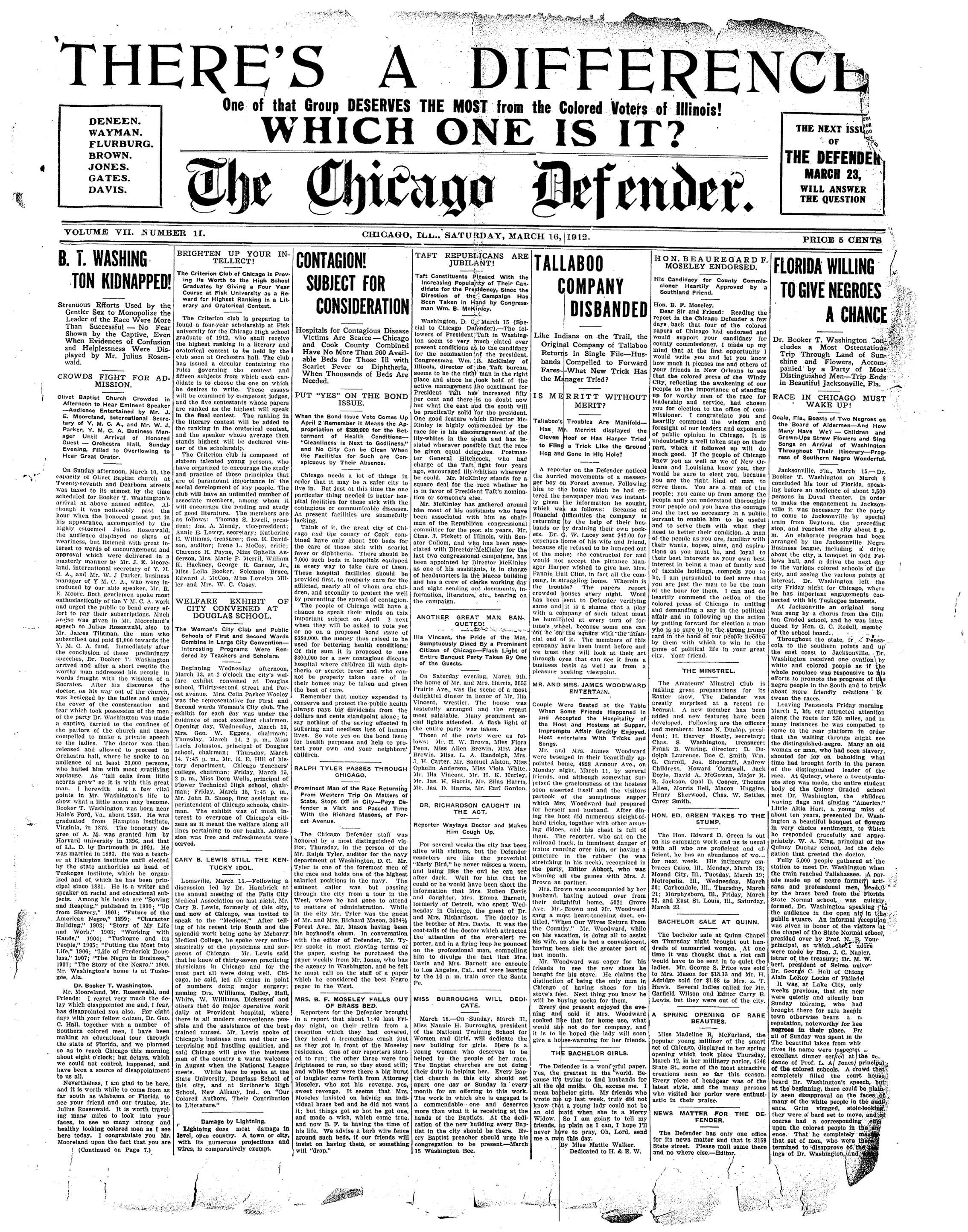
THERE'S A DIFFERENCE
VOLUME VII. NUMBER 11.
The Criterion club is preparing to found a four-year scholarship at Fisk university for the Chicago High school graduate of 1912, who shall receive the highest ranking in a literary and oratorical contest to be held by the club soon at Orchestra hall. The club has issued a circular containing the rules governing the contest and fifteen subjects from which each candidate is to choose the one on which he desires to write. These essays will be examined by competent judges, and the five contestants whose papers are ranked as the highest will speak in the final contest. The ranking in the literary contest will be added to the ranking in the oratorical contest, and the speaker whose average then stands highest will be declared winner of the scholarship.
The Criterion club is composed of sixteen talented young persons, who have organized to encourage the study and practice of those principles that are of paramount importance in the social development of any people. The club will have an unlimited number of associate members, among whom it will encourage the reading and study of good literature. The members are as follows: Thomas S. Ewell, president; Jas. A. Mundy, vice-president; Annie E. Lowry, secretary; Katherine E. Williams, treasurer; Geo. E. Davidson, auditor; Irene L. McCoy, critic; Clarence H. Payne, Miss Ophelia Anderson, Mrs. Marie P. Merril, William K. Hackney, George R. Garner, Jr., Miss Leila Booker, Solomon Bruce, Edward J. McCoo, Miss Lovelyn Miller and Mrs. W. C. Casey.
The Woman's City Club and Public Schools of First and Second Wards Combine in Large City Convention—Interesting Programs Were Rendered by Teachers and Scholars.
Beginning Wednesday afternoon, March 13, at 2 o'clock the city's welfare exhibit convened at Douglas school, Thirty-second street and Forest avenue. Mrs. Celia Parker Wooley was the representative for First and Second wards Woman's City club. The exhibit for each day was under the guidance of most excellent chairmen. Opening day, Wednesday, March 13, Mrs. Geo. W. Eggers, chairman; Thursday, March 14, 2 p. m., Miss Lucia Johnston, principal of Douglas school, chairman; Thursday, March 14, 7:45 p. m., Mr. E. E. Hill of history department, Chicago Teachers' college, chairman; Friday, March 15, 2 p. m., Miss Dora Wells, principal of Flower Technical High school, chairman; Friday, March 15, 7:45 p. m., Mr. John D. Shoop, first assistant superintendent of Chicago schools, chairman. The exhibit was of much interest to everyone of Chicago's citizens as it meant the welfare along all lines pertaining to our health. Admission was free and refreshments were served.
CARY B. LEWIS STILL THE KENTUCKY IDOL.
Louisville, March 15—Following a discussion led by Dr. Hambrick at the annual meeting of the Falls City Medical Association on last night, Mr. Cary B. Lewis, formerly of this city, and now of Chicago, was invited to speak to the "Medicos." After telling of his recent trip South and the splendid work being done by Meharry Medical College, he spoke very enthusiastically of the physicians and surgeons of Chicago. Mr. Lewis said that he knew of thirty-seven practicing physicians in Chicago and for the most part all were doing well. Chicago, he said, led all cities in point of numbers doing major surgery; naming Drs. Williams, Dalley, Hall, White, W. Williams, Dickerson and others that do major operative work daily at Provident hospital, where there is all modern convenience possible and the assistance of the best trained nurses. Mr. Lewis spoke of Chicago's business men and their entrepreneurship and hustling qualities, and said Chicago will give the business men of the country a warm welcome in August when the National League meets. While here he spoke at the State University, Douglass School of this city, and at Scribner's High School, New Albany, Ind., on "Our Colored Authors, Their Contribution to Literature."
Lightning does most damage in level, open country. A town or city, with its numerous projections and wires, is comparatively exempt.
DENEEN.
WAYMAN.
FLURBURG.
BROWN.
JONES.
GATES.
DAVIS.
B. T. WASHING TON KIDNAPPED!
Strenuous Efforts Used by the Gentler Sex to Monopolize the Leader of the Race Were More Than Successful — No Fear Shown by the Captive, Even When Evidences of Confusion and Helplessness Were Displayed by Mr. Julius Rosenwald.
CROWDS FIGHT FOR ADMISSION.
Olivet Baptist Church Crowded in Afternoon to Hear Eminent Speaker —Audience Entertained by Mr. J. E. Mooreland, International Secretary of Y. M. C. A., and Mr. W. J. Parker, Y. M. C. A. Business Manager Until Arrival of Honored Guest — Orchestra Hall, Sunday Evening, Filled to Overflowing to Hear Great Orator.
On Sunday afternoon, March 10, the capacity of Olivet Baptist church at Twenty-seventh and Dearborn streets was taxed to its utmost by the time scheduled for Booker T. Washington's arrival at above named edifice. Although it was noticeably past the hour when the honored guest put in his appearance, accompanied by the highly esteemed Julius Rosenwald, the audience displayed no signs of weariness, but listened with great interest to words of encouragement and approval which were delivered in a masterly manner by Mr. J. E. Mooreland, international secretary of Y. M. C. A., and Mr. W. J. Parker, business manager of Y. M. C. A., who were introduced by our able speaker, Mr. R. E. Moore. Both gentlemen spoke most enthusiastically of the Y. M. C. A. work and urged the public to bend every effort to pay their subscriptions. Much praise was given in Mr. Mooreland's speech to Julius Rosenwald, also to Mr. James Tilgman, the man who subscribed and paid $1,000 towards the Y. M. C. A. fund. Immediately after the conclusion of these preliminary speeches, Dr. Booker T. Washington arrived and after a short respite the worthy man addressed his people in words fraught with the wisdom of a Socrates. After his discourse the doctor, on his way out of the church, was besieged by the ladies and under the cover of the consternation and fear which took possession of the men of the party Dr. Washington was made a captive, carried to the confines of the partors of the church and there compelled to make a private speech to the ladies. The doctor was then released and allowed to proceed to Orchestra hall, where he spoke to an audience of at least 20,000 persons, who hailed him with most gratifying aplause. As "tall oaks from little acorns grow" so it is with this great man. I herewith add a few vital points in Mr. Washington's life to show what a little acorn may become. Booker T. Washington was born near Hale's Ford, Va., about 1800. He was graduated from Hampton institute, Virginia, in 1875. The honorary degree of A. M. was granted him by Harvard university in 1896, and that of LL. D. by Dartmouth in 1901. He was married in 1893. He was a teacher at Hampton institute until elected by the state authorities as head of Tuskogee institute, which he organized and of which he has been principal since 1881. He is a writer and speaker on racial and educational subjects. Among his books are "Sowing and Reaping," published in 1900; "Up from Slaves," 1901; "Future of the American Negro," 1899; "Character Building," 1902; "Story of My Life and Work," 1903; "Working with Hands," 1904; "Tuskogee and Its People," 1905; "Putting the Most Into Life," 1906; "Life of Frederick Douglass," 1907; "The Negro in Business," 1907; "The Story of the Negro," 1909. Mr. Washington's home is at Tuskogee, Ala.
Dr. Booker T. Washington.
Mr. Mooreland, Mr. Rosenwald, and Friends: I regret very much the delay which disappointed me and, I fear, has disappointed you also. For eight days with your fellow citizen, Dr. Geo. C. Hall, together with a number of Southern colored men, I have been making an educational tour through the state of Florida, and we planned so as to reach Chicago this morning about eight o'clock; but delays, which we could not control, happened, and have been a source of disappointment to us all.
Nevertheless, I am glad to be here, and it is worth while to come from as far south as Alabama or Florida to see your friend and our trustee, Mr. Julius Rosenwald. It is worth traveling many miles to look into your faces, to see so many strong and healthy looking colored men as I see here today. I congratulate you Mr. Mooreland upon the fact that you are
One of that Group DESERVES THE MOST from the Colored Voters of Illinois! WHICH ONE IS IT? The Chicago Defender.
BRIGHTEN UP YOUR INTELLECT!
The Criterion Club of Chicago is Providing Its Worth to the High School Graduates by Giving a Four Year Course at Fisk University as a Reward for Highest Ranking in a Literary and Oratorical Contest.
WELFARE EXHIBIT OB
CITY CONVENED AT
DOUGLAS SCHOOL
Damage by Lightning
CHICAGO, DLL., SATURDAY, MARCH 16, 1912.
CONTAGION! SUBJECT FOR CONSIDERATION
Hospitals for Contagious Disease Victims Are Scarce — Chicago and Cook County Combined Have No More Than 200 Available Beds for Those Ill with Scarlet Fever or Diphtheria, When Thousands of Beds Are Needed.
PUT "YES" ON THE BOND ISSUE.
When the Bond Issue Vote Comes Up
April 2 'Remember it Means the Appropriation of $380,000 for the Betterment of Health Conditions—
"Cleanliness is Next to Godliness," and No City Can be Clean When the Facilities for Such are Conspicuous by Their Absence.
Chicago needs a lot of things in order that it may be a safer city to live in. But just at this time the one particular thing needed is better hospital facilities for those sick with the contagious or communicable diseases. At present facilities are shamefully lacking.
Think of it, the great city of Chicago and the county of Cook combined have only about 200 beds for the care of those sick with scarlet fever or diphtheria. There should be 2,000 such beds in hospitals equipped in every way to take care of them. These hospital facilities should be provided first, to properly care for the afflicted, nearly all of whom are children, and secondly to protect the well by preventing the spread of contagion. The people of Chicago will have a chance to speak their minds on this important subject on April 2 next when they will be asked to vote yes or no on a proposed bond issue of $300,000, the money thus raised to be used for bettering health conditions: Of this sum it is proposed to use $300,000 for a new contagious disease hospital where children ill with diphtheria or scarlet fever and who cannot be properly taken care of in their homes may be taken and given the best of care.
Remember that money expended to conserve and protect the public health always pays big dividends from the dollars and cents standpoint alone; to say nothing of the saving effected in suffering and needless loss of human lives. So vote yes on the bond issue for health purposes and help to protect your own and your neighbors' children.
RALPH TYLER PASSES THROUGH
CHICAGO.
Prominent Man of the Race Returning From Western Trip On Matters of State, Stops Off in City—Pays Defender a Visit and Passed Time With the Richard Masons, of Forest Avenue.
The Chicago Defender staff was honored by a most distinguished visitor, Thursday, in the person of the Mr. Ralph Tyler, auditor for the navy department at Washington, D. C. Mr. Tyler is one of the foremost men of the race and holds one of the highest salaried positions in the navy. The eminent caller was but passing through the city from a tour in the West, where he had gone to attend to matters of administration. While in the city Mr. Tyler was the guest of Mr. and Mrs. Richard Mason, 36241⁴² Forest Ave., Mr. Mason having been his boyhood's chum. In conversation with the editor of Defender, Mr. Tyler spoke in most glowing terms of the paper, saying he purchased the paper weekly from Mr. Jones, who has the agency in Washington, and he felt he must call on the staff of a paper which he considered the best Negro paper in the West.
MRS. B. F. MOSELEY FALLS OUT OF BRASS BED.
Reporters for the Defender brought in a report that about 1:40 last Friday night, on their return from a reception which they had covered, they heard a tremendous crash just as they got in front of the Moseley residence. One of our reporters started to run; the other three were too frightened to run, so they stood still; and while they were there a big burst of laughter came forth from Attorney Moseley, who got his revenge, yes, sweet revenge. It seems that Mrs. Moseley insisted on having an individual brass bed and he did not want it; but things got so hot he got one, and made a wish, which came true, and now B. F. is having the time of his life. We advise a barb wire fence around such beds, if our friends will insist on having them, or something will "drap."
Taft Constituents Pleased With the Increasing Popularity of Their Candidate for the Presidency, Since the Direction of the Campaign Has Been Taken in Hand by Congressman Wm. B. McKinley.
Washington, D. C. March 15 (Special to Chicago Defender)—The followers of President Taft in Washington seem to very much elated over present conditions as to the candidacy for the nomination of the president, Congressman Wm. B. McKinley of Illinois, director of the Taft bureau, seems to be the right man in the right place and since he took hold of the active management the sentiment for President Taft has increased fifty per cent and there is no doubt now but what the east and the south will be practically solid for the president. One good feature which Director McKinley is highly commended by the race for is his discouragement of the lily-wishes in the south and has insisted wherever possible that the race be given equal delegates. Postmaster General Hitchcock, who had charge of the Taft fight four years ago, encouraged lily-wism wherever he could. Mr. McKinley stands for a square deal for the race whether he is in favor of President Taft's nomination or someone's else.
Mr. McKinley has gathered around him most of his assistants who have been associated with him as chairman of the Republican congressional committee for the past six years. Mr. Chas. J. Pickett of Illinois, with Senator Cullom, and who has been associated with Director McKinley for the last two congressional campaigns, has been appointed by Director McKinley as one of his assistants, is in charge of headquarters in the Maceo building and has a crew of clerks working day and night sending out documents, information, literature, etc., bearing on the campaign.
Illa Vincent, the Pride of the Mat,
Sumptuously Dined By a Prominent
Citizen of Chicago—Flash Light of
Entire Banquet Party Taken By One
of the Guests.
On Saturday evening, March 9th,
the home of Mr. and Mrs. Harris, 3655
Prairie Ave., was the scene of a most
delightful dinner in honor of Mr. Ila
Vincent, wrestler. The house was
tastefully arranged and the repast
most palatable. Many prominent social lights attended. A flash light of the entire party was taken.
Those of the party were as follows: Mr. E. W. Brown, Miss Flora
Penn, Miss Allon Brewin, Mrs. May
Browin, Miss. L. A. Randolph, Mrs.
J. H. Carter, Mr. Samuel Alston, Miss
Ophelin Anderson, Miss Viola White,
Mr. Illa Vincent, Mr. H. K. Hurley,
Mr. Jas, H. Harris, Mr. Silas Harris,
Mr. Jas. D. Harris, Mr. Earl Gordon.
DR. RICHARDSON CAUGHT IN THE ACT.
Reporter Waylays Doctor and Makes Him Cough Up.
For several weeks the city has been alive with visitors, but the Defender reporters are like the proverbial "Early Bird," he never misses a worm, and being like the owl he can see after dark. Well for him that he could or he would have been short the information that Mrs. Ruben Davis and daughter, Mrs. Emma Barnett, formerly of Detroit, who spent Wednesday in Chicago, the guest of Dr. and Mrs. Richardson. The doctor is the brother of Mrs. Davis. It was the coat-tails of the doctor which attracted the attention of the ever-alert reporter, and in a flying leap he pounced on the professional man, compelling him to divulge the fact that Mrs. Davis and Mrs. Barnett are enroute to Los Angeles, Cal., and were leaving by the 10 p. m. train over the Santa Fe.
MISS BURROUGHS WILL DEDI
CATE.
March 15.—On Sunday, March 31, Miss Nannie H. Burroughs, president of the National Training School for Women and Girls, will dedicate the new building for girls. Here is a young woman who deserves to be helped by the people of her race. The Baptist churches are not doing their duty in helping her. Every Baptist church in this city should set apart one day or Sunday in every month for an offering to this work. The work in which she is engaged is a commendable one and deserves more than what it is receiving at the hands of the Baptists. At the dedication of the new building every Baptist in the city should be there. Every Baptist preacher should urge his congregation to be present.—March 15 Washington Bee.
TALLABOO COMPANY DISBANDED
Like Indians on the Trail, the Original Company of Tallaboo Returns in Single File—Husbands Compelled to Forward Fares—What New Trick Has the Manager Tried?
IS MERRITT WITHOUT MERIT?
Tallaboo's Troubles Are Manifold—Has Mr. Merritt displayed the Cloven Hoof or Has Harper Tried to Fling a Trick Like the Ground Hog and Gone in His Hole?
A reporter on the Defender noticed the hurried movements of a messenger boy on Forest avenue. Following him to the home which he had entered the newspaper man was instantly given the information he sought, which was as follows: Because of financial difficulties the company is returning by the help of their husbands or by draining their own pockets. Dr. G. W. Lacey sent $42.00 for expenses home of his wife and friend, because she refused to be buncoed out of the money; she contracted for and would not accept the pittance Manager Harper wished to give her. Mrs. Fannie Hall Clint, in fact all the company, is stragging home. Wherein is the trouble? The papers report crowded houses every night. Word has been sent to Defender verifying same and it is a shame that a play with a company of such talent must be humiliated at every turn of fortune's wheel, because one can not be on the square with the financial end of it. The members of this company have been burnt before and we trust they will look at their art through eyes that can see it from a business basis as well as from a pleasure seeking viewpoint.
MR. AND MRS. JAMES WOODWARD ENTERTAIN.
Couple Were Seated at the Table When Some Friends Happened in and Accepted the Hospitality of the Host and Hostess at Supper, Impromptu Affair Greatly Enjoyed. Host entertains With Tricks and Songs.
Mr. and Mrs. James Woodward were beseiged in their beautifully appointed home, 4828 Armour Ave., on Monday night, March 11, by several friends, and although somewhat surprised the graciousness of the hostess soon asserted itself and the visitors partook of the sumptuous supper which Mrs. Woodward had prepared for herself and husband. After dining the host did numerous sleight-of-hand tricks, together with other amusing didoes, and his chest is full of them. The reporter, who sat on the railroad track, in imminent danger of trains running over him, or having a puncture in the rubber (he was stretching in his neck), recognized in the party, Editor Abbott, who was winning all the games with Mrs. J. Brown as partner.
Mrs. Brown was accompanied by her husband, having autosed over from their delightful home, 5021 Grove Ave. Mr. Brown and Mr. Woodward sang a most heart-touching duet, entitled, "When Our Wives Return From the Country." Mr. Woodward, while on his vacation, is doing all to assist his wife, as she is but a convalescent, having been sick the greater part of last month.
Mr. Woodward was eager for his friends to see the new shoes he bought for his stove. He claims the distinction of being the only man in Chicago of having shoes for his stove's feet. Next thing you know he will be buying socks for them.
Every one present enjoyed the evening and said if Mrs. Woodward cooked like that for home use, what would she not do for company, and it is to be hoped the lady will soon give a house-warming for her friends.
THE BACHELOR GIRLS.
The Defender is a wonderful paper.
Yes, the greatest in the world. Because it's trying to find husbands for all the old maids. Oh, excuse me. I mean bachelor girls. My friends who wrote me up last week, truly did not know that a young lady could not be an old maid when she is a Merry Widow. So I am going to tell my friends, as plain as I can, I hope I'll never have to pray, Oh, Lord, send me a man this day.
By Miss Mattie Walker.
Dedicated to H. & E. W.
HON. BEAUREGARDF. MOSELEY ENDORSED.
His Candidacy for County Commissioner Heartily Approved by a Southland Friend.
Hon. B. F. Moseley.
Dear Sir and Friend: Reading the report in the Chicago Defender a few days, back that four of the colored papers of Chicago had endorsed and would support your candidacy for county commissioner, I made up my mind that at the first opportunity I would write you and let you know how much it pleases me and others of your friends in New Orleans to see that the colored press of the Windy City, reflecting the awakening of our people to the importance of standing up for worthy men of the race for leadership and service, had chosen you for election to the office of commissioner. I congratulate you and heartily commend the wisdom and foresight of our leaders and exponents of public opinion in Chicago. It is undoubtedly a well taken step on their part, which if followed up will do much good. If the people of Chicago knew you as well as we of New Orleans and Louisiana know you, they would be sure to elect you, because you are the right kind of man to serve them. You are a man of the people; you came up from among the people and you understand thoroughly your people and you have the courage and the tact so necessary in a public servant to enable him to be useful and to serve them with what they need to better their condition. A man of the people as you are, familiar with their wants, hopes, aims, and aspirations as you must be, and loyal to their best interests as your own best interest in being a man of family and of taxable holdings, compels you to be. I am persuaded to feel sure that you are just the man to be the man of the hour for them. I can and do heartily commend the action of the colored press of Chicago in uniting and demanding a say in the political affair and in following up the action by putting forward for election a man who is so sure to be the strong trump card in the hand of our people needed by them with which to win in the game of political life in your great city. Your friend.
THE MINSTREL.
The Amateurs' Minstrel Club is making great preparations for its Easter show. The Defender was greatly surprised at a recent rehearsal. A new member has been added and new features have been developed. Following are the officers and members: Isaac N. Dunlap, president; H. Harvey Hostly, secretary; Chas. S. Washington, treasurer; Frank B. Waring, director; D. Dudolph Laurence. Doe C. Smith, Wm. G. Carroll, Jos. Shoecraft, Andrew Childress, Howard Cornwell, Jack Doyle, David A. McGowan, Major R. R. Jackson, Opal D. Cooper, Thomas Allen, Morris Bell, Macon Huggins, Henry Sherwood, Chas. W. Settles, Carey Smith.
HON. ED. GREEN TAKES TO THE STUMP.
The Hon. Edward D. Green is out on his campaign work and as is usual with all who are proficient and efficient, he has an abundance of wo... for next week. His intinerary embraces Cairo, Ill., Monday, March 18; Mound City, Ill., Tuesday, March 18; Metropolis, Ill., Wednesday, March 20; Carbondale, Ill., Thursday, March 21; Murphysboro, Ill., Friday, March 22, and East St. Louis, Ill., Saturday, March 23.
BACHELOR SALE AT QUINN
The bachelor sale at Quinn Chapel on Thursday night brought out hundreds of unmarried women. At one time it was thought that a riot call would have to be sent in to quiet the ladies. Mr. George S. Price was sold to Mrs. Mason for $13.13 and Mr. H. Adridge sold for $1.98 to Mrs. Z. T. Hawk. Several ladies called for Mr. Garfield Wilson and Editor Carry B. Lewis, but they were out of the city.
A SPRING OPENING OF RARE BEAUTIES.
Miss Madeline R. McFarland, the popular young milliner of the smart set of Chicago, displayed in her spring opening which took place Thursday, March 12, in her millinery parlor, 4740 State St., some of the most attractive creations seen so far this season. Every piece of headgear was of the latest style, and the many persons who visited her parlor were enthusiastic in their praise.
NEWS MATTER FOR THE DE FENDER.
The Defender has only one office for its news matter and that is 3159 State street. Please mail same there and no where else.—Editor.
THE NEXT ISSUU
OF
THE DEFENDER
MARCH 23,
WILL ANSWER
THE QUESTION
PRICE 5 CENTS
Dr. Booker T. Washington Concludes a Most Ostentatious Trip Through Land of Sunshine and Flowers, Accompanied by a Party of Most Distinguished Men—Trip Ends in Beautiful Jacksonville, Fla.
RACE IN CHICAGO MUST
WAKE UP!
Ocala, Fla., Boasts of Two Negroes on the board of Aldermen—And How Many Have We? — Children and Grown-Ups Strew Flowers and Sing Songs on Arrival of Washington Throughout Their Itinerary—Progress of Southern Negro Wonderful.
Jacksonville, Fla., March 15.—Dr. Booker T. Washington on March 5 concluded his tour of Florida, speaking before an audience of about 2,500 persons in Duval theater. In order to make the engagement in Jacksonville it was necessary for the party to come to Jacksonville by special train from Daytona, the preceding stop, and reached the city about 5 p.m. An elaborate program had been arranged by the Jacksonville Negro Business league, including a drive about the city, a banquet in Odd Fellows hall, and a drive the next day to the various colored schools of the city, and seeing the various points of interest. Dr. Washington left the city Friday night for Chicago, where he has important engagements connected with his Tuskegee interests.
At Jacksonville an original song was sung by a chorus from the Clinton Graded school, and he was introduced by Hon. G. C. Redell, member of the school board.
Throughout the state, from Pensacola to the southern points and up the east coast to Jacksonville, Dr. Washington received one ovation by white and colored people as if the whole populace was responsive to his efforts to promote the progress of the negro people in the South and to bring about more friendly relations between the races.
Leaving Pensacola Friday morning March 2, his car attracted attention along the route for 250 miles, and in many instances he was compelled to come to the rear platform in order that the waiting throughs might see the distinguished-negro. Many an old woman or man, who had seen slavery, shouted for joy on beholding what time had brought forth in the person of the distinguished leader of the race. At Quiney, where a twenty-minute stop was made, the entire student body of the Quincy Graded school met Dr. Washington, the children waving flags and singing "America." Little Altia Hart, a young miss of about ten years, presented Dr. Washington a beautiful bouquet of flowers in very choice sentiments, to which he responded gracefully and appropriately. W. A. King, principal of the Quincy Dunbar school, led the delegation that greeted the doctor.
Fully 5,000 people gathered at the station to meet Dr. Washington when the train reached Tallahassee. A parade made up of negro farmers, artisans and professional men, headed by the brass band from the Florida State Normal school, was quickly formed, Dr. Washington speaking to the audience in the open air in the public square. An informal reception was given in honor of the visitors at the chapel of the State Normal school, presided over by Prof. N. B. Your principal, at which it adore were made by Hon. J. C. Napier, istrar of the treasury; Dr. M. W. bert, president of Selma university Dr. George C. Hall of Chicago Alain LeRoy Locke of Philadelphia
It was at Lake City, only weeks previous, that six negroes quietly and silently hung Sunday morning, who had brought there for safe keepin town otherwise bears a reputation, noteworthy for kee negroes in their place. Preall of Sunday was spent in the The beautiful lakes from whirives its name were inspected excellent dinner served at the residence of Prof. L. A. Jones, principal of the colored schools. A crowd that completely filled the court house heard Dr. Washington's speech, but at the beginning, there could be plainly seen disapproval on the faces of many of the white people in the audience. Grim visaged, stole-looking they were a hard set to move, and of course had a corresponding one upon the colored people in the audience. That he completely minded that set of men, who were there terminated to disapprove of the wings of Dr. Washington, and
osay of them hearty hand-
Wy POSS, S00 8 NE way iO
ring the fact that his position on
aY matters 1s the most tenable and
reaching.
t Ocala the situation was entirely
wrent. Here-one found the utmost
‘dom of movement, found two
yroes on the board of aldermen,
Ad negroes owning drug stores,
ery stores, big farms, and owning
ne: carriages, automobiles and well
appointed homes without number.
Here Dr. Washington was fatroduced
by Judge W. S. Bullock,
“Ju presenting this distinguished
citizen to you, my friends,” sald Judge
Bullock, { feol that 1 speak with pro-
phetic vision when I say that the evi-
dences point that God has again ram-
bled amongst the hills and dales of
the old dominion and produced a
leader for thie benighted and unfor
tunate race of people according to his
own choosing. Dr. Washington needs
no introduction to you. His fame has
far preceded his coming In our midst.
The few paltry words of commonda-
tlon that T might utter would be a
poor tribute to his worth. His great
work In the Interest of the negro
erects @ monument to the negro Tace
that is more Insting than tables of
stone. His precept and example to
the negro race stands ax a beacon
light whose lustre can not be dimmed.
shunning the bogs and sand-bars, logs
and snags, across the channel of thelr
advancement. We must esteem our.
selves most favored to have such a
man to come in our midst. He is an
inspiration to every negro in this land
and a benefactor to this nation.
“Dr. Washington, you are engaged
in a great work, We sympathize with
you in the delicate and arduous. un-
dertaking. The intelligent. patriotism
of this country is sustaining you. My
countrymen and my friends, 1 com-
mend to you our distinguished guest
on this occasion. He conies upon a
mission that wo welcome. He is the
Ieader of the negro race in Amerlea.
In our fair lands he destroys the Idols
that have been erected by demagozue
and unworthy politicians, and is erect-
ing in their stead schools of industry
and intelligence. He is taking the be-
nighted, vicious, ignorant and super-
stitious’ negro from his condition
and clothing him in the garments of
Industry, intelligence and morality. In
short, he is qualifying the negro for
citizenship. His work entitles him to
four aid and co-operation, 1 commend
him to your intelligent consideration,
and ask that you extend to him in
this work the hand and heart of en:
courngement.
From Ocala to Tampa, the party
went, where Dr. Washington spoke in
the Tampa Bay Casino, and where he
‘was heard by a large number of col-
red people, as well as northern tour.
Ists who were stopping at the Tampa
Bay and other leading hotels of the
city, A Spanish supper after the
program was given by the Local Busi
ness league,
At Lakeland, Dr. Washington was
introduced by Gen. J. A. Cox, an ex-
Confederate soldier, who represented
the county school board. Dr. Wash:
ington here received the most re
markable tribute of his life. Gen:
yal Cox is a typical southerner of
he old @hool, and referred in a fee!
ing nai. "$F to luis experionce with the
slaves oni his father's plantation when
i boy, and to the fidelity of his own
slaves when he went to war. The
yneral declared that when he set
{rth to the war there was a fight
felween six of his men staves us to
hich should accompany him, and
shat to the hereulean efforts of his
aide he now owed his life. This boy,
he declared, bore bim off the field
wounded, when. the Federal soldiers
were within fifty yards of his body.
and that while no white person save
his wife, aged father and child were
Jeft on the plantation, thes were ten:
dorly cared for aud protected by the
thirty odd slaves remaining. “God
forbid that 1 should now say one word
or do one thing against the Negro,’
he said in closing his address. A spe.
lal train was secured to conduct the
party from Jakeland to Batonville
the seat of the Robert Hungerford
Normal ant industrial school, The
Hungerford school was begun sev:
eral years ago by R. A. Calhomn, a
graduate of the Tuskegee institute,
and in many respects has grown to
be one of the most useful. schools
that have come out of Tuskegee.
Since the death of Mr. Calhoun the
principal and founder, the work has
been carried on by Mrs. Calhoun and
an able corps of assistants. Some
misunderstanding in the itinerary led
the pople of Eatonville and surround-
tng theory to expect Dr. Washing
jpn.al ten o'clock in the morning, and
Severat-ttiousand colored people as
well as a number of tourists, who
ftmgke thelr w'nter homes in the com-
mfnity, had gathered to hear him. The
erpwd,had not in the least abated at
life o'@lack. when Dr. Washington and
his party reached the grounds. Some
“d time plantation singing was done
‘siiecteddeats, ina creditable man.
*, and after Dr. Washington had
cluded, several other members of
arty’ delivered short addresses.
tha and Daytona were visited
st day. ‘The speaking occurred
yell theater at Palatka, after
ry had visited the colored
and had otherwise received
Aeasbany ak tha, koma or tn
of Ce pekt Mioretas at the Sheater
. Gan aiidience coraposed, forithe most
parktat onl. peopter winter ytourst
and ‘natives of the community. ‘The
ubiencel was responsive to 2 high de
Stee and‘frequently applauded the re-
mavke-otsthe noted educator.
x Throughout the trip Registrar: of
fis Troadury J. C. Napler received
"MMarkedsattention, as di also ‘Dr.
“eonge CA Hall, Major R. R. Moin
B@./Alainl LeRoy Locke. Judging
Yan‘the large crowds that heard Lr.
‘Bshington| during the seven day.s,
e ‘applaned that greeted nearly every
fefgnce,iand the eympathetle and!
SourABIDg editorials in most of tha?
papers, [Mis trip through ion
jt) t helpful to the people
BOOKER WASHINGTON AT FRED-
ERICK DOUGLAS CENTER.
3032 Wabash Ave,
Sunday afternoon, March 17, at 4
p. m., President Femonga, of North-
lad College, Ashland, Wis,, will speak,
“Mr. G. Jackson wil! play a violln solo,
‘Menuet by Bethoven.
Thursday evening Dr. ‘Washington
spoke to the Business Mens’ League
fat the Center. He urged the men to
get together and make themselves
felt, talked of beautifying their stores
and restaurants and urged them to
study thelr business, Mrs. Wooley
spoke of ber work and told of the
good she was doing. Dr. Washington
complimented her on the showing she
hus made.
It many of our citizens would give
more of their support to the business
there would be plenty of work for our
young people, was the trend of the
argument brought out by the business
men.
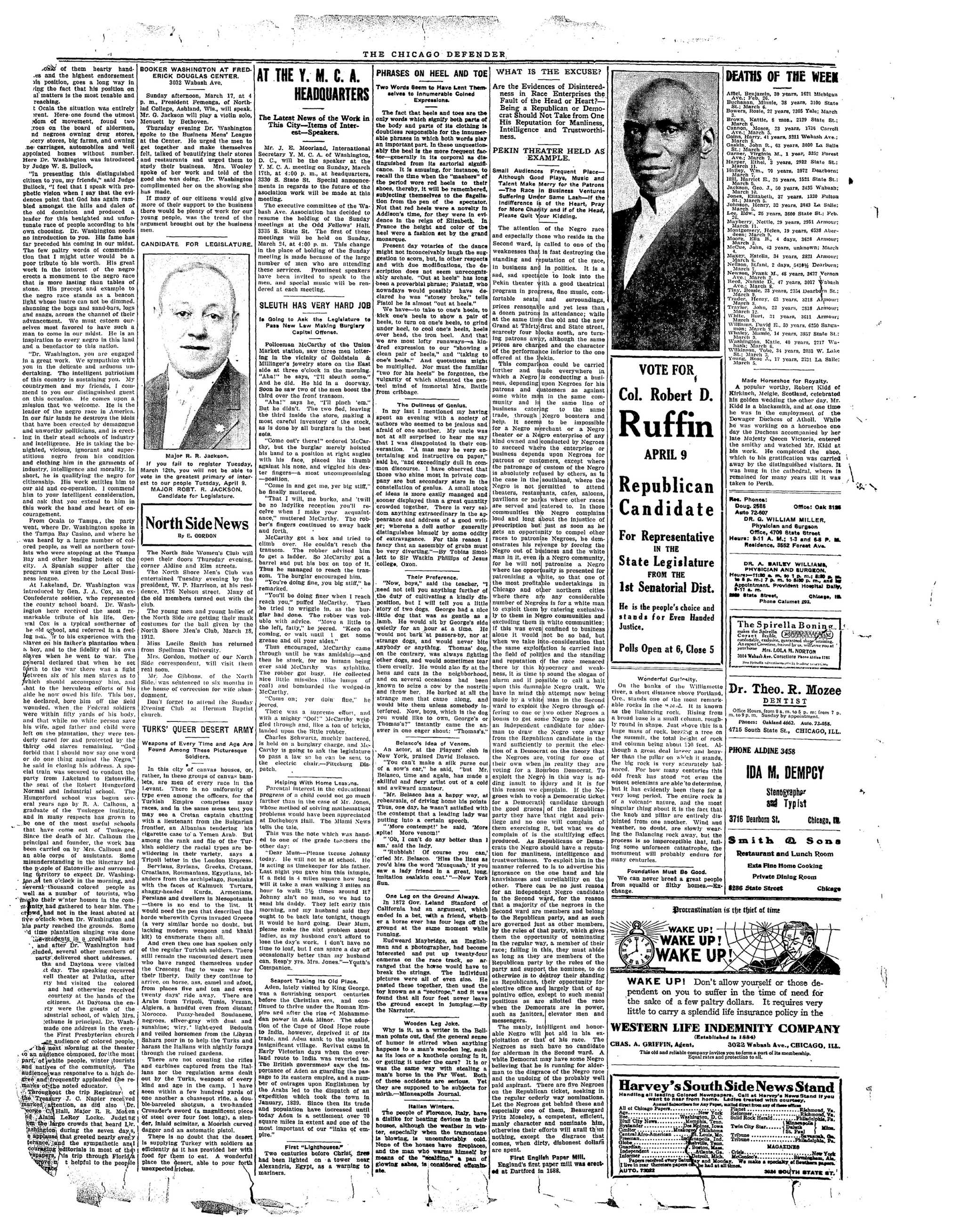
CANDIDATE FOR LEGISLATURE.
ito ‘
#
Z ,
wah gr 7}
SOF Beye,
; iy
— ae
& ae
es | Cee
i fee
il
are | eer Ay
fey
se oe
Li - gee
Major R. R. Jackson,
If you fail to register Tuesday,
March 12th, you will not be able to
vote In the greatest primary of inter.
est to our people Tuesday, April 9.
MAJOR ROBT. R. JACKSON,
Candidate ter Leclelatire.
North Side News
the old members turned out with the
‘The young men and young ladies of
the North Side are getting their mask
costumes for the ball given by the
Mrs, Gordon, mother of our North
TURKS’ QUEER DESERT ARMY
In this city of canvas houses, or,
“rather, In these groups of canvas ham:
lets, are men of every race in the
‘Levant. ‘There is no uniformity of
type even aniong the officers, for the
‘Turkish Empire comprises many
‘races, and fn the same miess tent you
‘may see @ Cretan captain chatting
with a Heutenant from the Bulgarian
frontier, an Albanian tendering his
cigarette case toa Yemen Arab. But
among the rank and Mle of the Tur-
Idsh soldlery the racial types are be-
wildering in their vatlety, says a
‘Tripoll letter in the London Express,
Servians, Syrians, Greeks, Cretans,
Croatians, Roumantans, Egyptians, 1s)
anders from the archipelago, Bosniaks
with the faces of Kalmuck Tartarg,
shaggy-hended Kurds, Armenians,
Persians and dwellers In Mesopotamia
<there is no end to the list. It
Would need the pen that described the
horde wherewith Cyrus invaded Greece
(a very similar horde no doubt, but
lacking modern weapons and hak
Kit) to enumerate them all.
And even then one has spoken only
of the regnlar Turkish soldiers. ‘There
still remain the counted desert men
who have ranged themselves under
the Crescent flag to wage war for
thelr liberty. Daily they continue to
arrive, on horse, ass, camel and afoot,
from places five and ten and even
twenty days’ ride away. ‘There are
Arabs from Tripoli, Tunis, Fezzan,
Algiers, a handful even from distant
Moroceo. Puxny-headed Soudanese,
negroes, llver-gray with dust and
sunshine; wiry,’ lighteyed Bedouin
and veiled horsemen from the Libyan
Sahara pour in to help.the Turks and
harass the Italians with nightly forays
through the ruined gardens.
‘There are not counting the rifles
and carbines captured from the Ttal-
Jans nor the regulation arms dealt
‘out by the Turks, weapons of overy
Xind and age in the camp. 1 have
seen within a few hundred yards of
one another a chassepot rifle, a dou-
Dle-barreled shotgun, a two-handed
Crusader’s sword (a magnificent piece
of steel over four feet long), a slen-
der, inlaid scimitar, a Moorish curved
dagger and an automatic pistol,
‘There is no doubt that the desert
1s supplying Turkey with soldiers as
emiciently as it has provided her with
food for them to eat. A wonderful
place the desert, able to pour forth
‘unexpected [riches.
The Latest News of the Worle in
‘This City—Items of Inter-
est—Speakers,
Mr. J. E. Moorland, International
Secretary ¥. M. C. A. of Washington,
D.C, WIN be the speaker at the
¥. afc. A. meoting on Sunday, March
ith, at 4:00 p.m, at headquarters
3330 3. State St. Special announce-
‘ments in regards to the future of the
jasociation work will be made at this
meeting.
| ‘The executive committee of the Wa-
jbash Ave. Association has decided to
resume the holding of tue Sunday
[meetings at the Odd Fellows’ Hall
3385 8. State St. The Srst of these
meetings will bo held on Sunday.
Maroh 24, at 4:00 p.m, This change
in the place of bolding of the Sunday
meeting is made because of the Inrge
mumber of men who are attending
these services. Prontinent speakers
have been invited to. speak to. the
men, and special music ‘will be. ren:
deved at each meeting.
SLEUTH HAS VERY HARD JOB
fe Going to Atk the Legislature to
Pass New Law Making Burglary
Gigital Ooeaaa.
Policemen MeCarthy of the Union
“Market station, saw three men loiter
ing In the vicinity of Goldstein &
Millinger’s jewelry store on the East
‘side at three o'clock in the morning
“Ahat” he says, “Til sleuth some.”
And he did, He hid in a doorway.
Soon be saw tivo of the men boost the
‘third over the front transom.
“Aha!” says he, “Til pinch ‘em."
But he didn't. ‘The two fied, leaving
‘the third inside the store, making a
most careful Inventory of the stock,
as 1s done by all burglars in the beat
‘aota,
“Come out'r theret" ordered McCar:
thy, but the burglar merely hoisted
hfs band to a position at right angles
with his face, placed his thumb
against his nose, and wiggled his dex
ter fingers—a most uncompromising
position,
| “Come in and get me, yer big stitt”
ho nally muttered,
“That I will, me bucko, and ‘twill
bo no ladylike reception’ you'll re
‘celve when I make your acquaint
ance,” muttered McCarthy. The rob:
ber's fingers continued to sway back
and forth, ‘
MeCarthy gota Vox and tried tc
climb over. He couldn't reach the
transom. The robber advised bim
to get a Indder, So MeCarthy got a
barrel and put his box on top of It
‘Thus he managed to reach the tran:
fom, ‘The burglar encouraged him,
“You're doing fine, you big stiff,” he
remarked,
“You'll be doing finer when I reach
Feach you," puffed McCarthy. ‘Then
ho tried to wriggle in, as the bur
glar bad done. Tho robber was vol
‘uble with advice. “Move a little to
‘tho left, fatty," be jeered. “Keep on
coming, or wait until 1 get some
‘greage and oil your sides."
‘Thus encouraged, MeCarthy came
through until he was amidslip—and
then he stnek, for no human being
ever sald MeCarthy was syloblike
The robber got busy. He collected
‘nice little missites (like lumps of
coal) and bombarded the wedged.in
McCarthy.
"Come on; yer doin fue.” he
Jered.
“hele was a supreme effort, and
with & mighty “of!” McCarthy’ wrig
sled through and, Ike a ton of bricks
Tanded upon the tittle robber.
Charles Schwartz, muchly battered,
is held on & burglary charge, and Me
Carthy 18 going to ask the legislature
to pass a law so he vat be sent to
Ue electric chai:—Pitsburg Die
nite.
Helping With Home Lessuns.
Parental interest in the educational
rogrens of a child could not yo much
farther than in the case of Mr. Jones,
Whose method of solving mathematical
problems would have been appreciated
fat Dotheboys flail, The Mami News
telts the tale,
‘This was the note which was hand:
ed to one of the grade terohers the
other day:
“Dear Mum-—Please ixeuse Johnny
today. He will not be at school, He
is ucting ax timekeeper for his father.
Last night you gave him this ixtmpte,
{€ @ field fs 4 miles square how tong
will it take a man walking 3 miles an
hour to walk 2% times around 1t?
Jobnny ain't no man, so we had to
send bls daddy. Thoy left early this
morning, and my husband said they
ought to be back late tonight, though
st would be hard going. Dear Mum,
plese make the nixt problem about
ladies, as my husband can't afford to
lose the day's work. I don’t have no
time to loaf, but I ean spare a day of
oceasionally’ better than my husband
can, Resp'y yrs. Mrs, Jones.”"—Yuth's
Companion.
thine reens Sean boa ihe Fir iho:
Aden, lately visited by King George.
was a flourishing seaport centurles
before the Christian era, and con
tinued to thrive under the Roman Em
pire ard ntter the rise “t Mohamme.
dan power in Asia Minor. ‘The adop
tion of the Cape of Good Hone route
to India, however, deprived it of its
trade, and Aden sank to the squalid,
insignificant village. Revival came fn
Early Victorian days when the over
Jand route to India was reverted to
‘The British government caw the im
portance of Aden as guarding the pas
‘sage to its eastern empire, and a num
ber of outrages upon Englishmen by
the Arabs led to the dispatch of an
expedition which took the town in
January, 1829, Since then Its trade
‘and population have increased until
today Adon ts a settlement over 70
square miles in extent and one of the
most important of our “links of em
pire.”
Firet “Lighthouses.”
‘Two centuries before Obrist, free
had been lighted on -a tower’ near
Alexandria, Bgypt, as a warning to
‘mariners. ala
THE CHICAGO DEFENDER
ee
PHRASES ON HEEL AND TOE} WE
‘Two Words Seem to Have Lent Them | Are
Ss ‘selves to Innumerable Colned ne
Expressions. Fa
‘The fact that heels and toes are the
only words which signify both parts of
the body and parts of its clothing is
doubtless responsible for the innumer
able phrases in which both words play
an important part. In these unquestiom
ably the heel fe the more frequent fac-
tor—generally in ita corporal as dis
inguished from {te sartorial algnif
cance. It Je amusing, for instanoe, to
recall the time when the “machers" of
‘the period wore red hecls to theft
shoes, thereby, it will be remembered,
‘subjecting themselves to the fagella
ton from the pen of the spectator.
Not that red heels were # novelty {n
Addison's time, for they were in evt
denco in the relgn of Bilzabeth, In
France the height and color of the
heel wero a fashion set by the grand
/-monarque.
Present day votaries of the dance
‘might not inconcelvably Jaugh the sug
gestion to scorn, but, in other respects
‘and with due modifications, the de
scription does not seem unrecogniz
ably archale, “Out at heols” has long
‘Deon a proverbial phrase; Fatstaft, wha
nowadays would possibly have de
elared he was “stoney broke,” tells
Pistol he 1s almost “out at heels.”
‘We have~—to take to one's heals, to
Kick one’s heels to show a pair of
heels, to turn on one’s heels, to grind
under heel, to cool one’s heels, heels
‘over head, the fron heel. And that
we are most lofty runaways—a kia.
red expression to our “showing
jelean pair of heels,” and “taking tc
one’s heols.” And quotations might
be muitiplied. Nor must the familiar
“two for his heels” be forgotten, the
vulgarity of which allenated the gen
‘tel mind of immortal Bra. Battle
from cribbage.
‘The Ouliness of Genius,
In my last I mentioned my’ having
‘spent an evening with a eoclety of
‘authors who seemed to be jealous and
afrald of one another. My uncle was
‘not at alt surprised to hear me sa)
that I was disappointed in thelr con.
versation. “A man may be very ep
tertalning and instructive on paper,’
‘aald he, “and exceodingly dull in com
‘mon digcourse. I have observed that
those who shine most in private com
pany are but secondary stars In the
‘constellation of genlus. A small stook
‘of ideas is more easily managed and
sooner displayed than a great quantlty
“crowded together. ‘Thero Is very sel
dom anything extraordinary in the ap
‘pearance and address of @ good writ
£F; whereas a doll author generally
dlstingulabos bimselt by some oddlty
‘of extravagance. For this reason |
fancy that an assombly of grubs must
be very diverting."—By Toblas Smo!
Jott to Sir Watkin Phillips of Jesu
‘college, Oxon,
teaiahis eickinee
“Now, boys," said the teacher, “I
;need not tell you anythivg further of
‘tho duty of cultivating a kindly dle
‘posttion, but I will tet! you a little
“story of two dogs. George had a nice
‘Mttle dog that was as gontlo as a
jamb. He would sit by George's side
‘quletiy for an pour at a ume. He
“would not Dark'at passers-by, nor at
strange dogs, and would never bite
anybody or anything. Thomas’ dog,
‘on the contrary, was always fighting
‘other dogs, and would sometimes tear
them erueliy. He would also fy at the
‘liens and cats in the neighborhood,
and on several occasions bad beet
known to seize a cow by the nostri
“and throw her. He barked at all the
‘strange men that came wlong, and
would bite them unless somebody tn-
terfered. Now, boys, which ts the dog
‘you would Ike to own, George's or
Thomas's?" instantly came the an
“wer in one eager shout: “Thomas's.”
Silipos Ste ab Ake:
» An actor, at the Players’ club in
New York, praised David Bolasco.
“You can't make a silk purse ou!
of @ sow's ear,” he said, “but Mr
Belasco, time and again, ‘has made 1
skillful and flery artist out of a cold
and awkward amateur,
“Mr. Belasco bas a happy way, al
rehearsels, of driving home hfs pointa
‘Thus, one day, he wasn't satisfled witt
the contempt that a leading Indy was
putting Into a certain speech,
“‘More contempt!” he said, ‘More
spite! More venom!"
“Ob, I can't do any better than }
am,’ sald tho Indy.
“Rubbish! Of course you can,
‘erfed Mr. Belasco. ‘Hiss the lines as
you'd hiss the word ‘Musquash,’ If you
saw a lady friend in a great, long.
imitation saalskin coat*"—Now York
Sun.
‘Cae Kan on the hema Abed.
In 1872 Gov. Leland Stanford of
Callfornla had an argument, which
ended in a bet, with a friend, wheth
‘er a horse ever has four legs off the
ground at the same moment while
Tuning.
Eudweard Maybridge, an English
man and a photographer, had become
snterested and put up. twenty-four
cameras on the race track, 80 ar
Tanged that the horse would have to
break the strings, ‘The Individual
pletures were all of even size. He
pasted theso together, then used the
toy known aa a “zeotrope.” and it was
found that all four feet never leave
the ground except in Jumping.—By
the Narrator.
Wooden Leg Joke.
‘Why 16 it, 08 0 writer in the Bell
‘man points out, that the general sense
of humor {6 stirred when anything
happens to a man’s wooden leg, auch
as its loss or a knothole coming tn tt,
or getting {t under tho cars? It Is or
was the same way with stealing
man’s horse in the Far West. Both
of these accidents are serious. Yet
they are supposed to be subjects tor
mirth—Minneapolis Journal.
: Italian Winters.
‘The people of Florence, Italy, have
8 Gislike for heating devices in thetr
houses, although the weather in win-
ter, especially when the tramuontane
1s blowing, is uncomfortabix cold.
None of the houses have _froplaces,
and the man who warms himeel? by
means of the “sealdino.” © pan of
glowing sahes, 18 conaléered etfemtn
ped +
WHAT IS THE EXCUSE?
Are the Evidences of Disintered-
ness in Race Enterprises the
Fault of the Head or Heart?—
Being a Republican or Demo-
crat Should Not Take from One
His Reputation for Manliness,
Intélligence and Trystworthi-
ness.
PEKIN THEATER HELD AS
EXAMPLE.
‘Small Audiences Frequent Place—
Although Good Plays, Music and
Talent Make Merry for the Patrons
<The Race in Business Ventures
Suffering Under Same Lash—if the
Indifference Ip of the Heart, Pray
for More Chasity and if of the Head,
Pieces Golt Voor Weide
Sad, sad spectdcle to look into the
Pekin theater ith a good theatrical
Program in progress, no music, com-
fortable seats| and gurroundings,
prices reasonalile and yet less than
a dozen patrong in attendance; while
at the same Unk dhe old andthe new
Grand at Thirtyfirst and State street,
seareely four Blocks south, are. turn
ing patrons away, although the same
prices are charged and the character
of the performahce inferior to the one
offered at the Iekin.
‘This comparlgon could ve carried
further and thade everywhere in
whieh a Negro|is conducting a busi-
ness, depending] upon Negroes for his
patrons and qustomers as against
some white man in the same com.
munity and i the same line of
business catering to. the same
trade, through | Negro. boosters and
hep.” It seemb to be impossible
for a Negto merchant or a Negro
theater or a Negro enterprise of any
kind owned and |eondueted by Negroes
to succeed whero the enterprise or
‘business depends upon Negroes for
patrons or customers, except where
the patronage of custom of the Negro
is absolutely refused by others, as 1s
the case in the|southland, where the
Negro is not Hermitted ‘to attend
theaters, restaufants, cafes, saloons,
pavilions or parks where other races
are served and leatered to, In those
communities the Negro | complains
loud and long dbout the injustice of
prescription but! just as soon as he
gets an opportunity to compel other
races to patronize Negroes, he dem-
onstrates his revenge by foreing the
Negro out of business and the white
man in it, even ih a Negro communtty,
for he will not] patronize a Negro
where tue opporjunity is presented for
patronizing a white, go that one of
the most profitable ‘undertakings im
Chicago aud other northern cities
Where there are any considerable
number of Negroes is for a white man
to exploit them by catering exclusive.
ly to them in Negro communities and
excluding them iy white communities;
{f this was even) confined to business
alone it Would |not be so bad, but
when we take into.consideration that
the same exploitation is carried into
the fleld of polities and the standing
and reputation qf the race menaced
there by this hypocracy and weak.
ness, it is time tp sound the slogan of
alarm and if pogsibte to call a hait
jon hs damnable Negro tral, We
have in mind the attempt now being
made by a hit man in the Second
ward to exploit the Negro through of-
fering to one or (wo other Negroes a
Vous to get some Negro to pose as
an Independent candidate for alder
man to draw the Negro vote away
from the Republican candidate in the
Ward sufficiently to permit the elec-
tion of a Democrat on the theory that
the Negroes are, voting for one of
their own when {in reality they are
voting for a Botrbon Democrat. To
exploit the Negr in this way is ad-
ding insult to ihjury and it is for
this reason we cbmplain. If the Ne-
Broes wish to vote a Democratic ticket
for a Democratlt candidate through
the good graces] of the Republican
party they have that right and priv:
jlege and no one will complain of
them exercising it, but what we do
complain of is the stultifying effect
produced. As Republicans or Demo-
crats the Negto should have a reputa-
tion for manliness, intelligence and
trustworthiness, ‘To exploit him in the
manner referred to Is to advertise his
ignorance on the one hand and his
Knavishness and unreliability on the
other. There can be no just reasoa
for an independent Negro candidate
J the Second ward, for the reason
that a majority of the negroes in the
Second ward are members and belong
to the Republican party, and as such
aro governed just as other members,
by the rules of that party, which gives
them the opportunity of nominating
in the regular way, & member of their
race; failing in this, they must abide
as long as they are members of the
Republican party by the rules of the
party and support the nominee, to do
otherwise is to destroy their standing
as Republicans, thelr opportunity for
elective office and largely that of ap-
pointive office, extept to such menial
positions as ‘are allotted the race
when the Democrats are in power,
such as janitors,| elevator men and
messengers.
‘The maniy, Intflligent and_honor-
able Negro will hot aid in bis ex.
ploitation or that of his race. The
‘Negroes as such bave no candidate
for alderman in the Second ward. A
white Democrat may have some Negro
believing that he is running for alder-
man to the disgrace of the Negro race
and the undoing of the probably well
paid aspirant, ‘There are five Negroes
on the Republican ticket, soeking in
the regular orderly way nominations,
Let the Negroes get behind these and
especially one of them, Beauregard
Fritz Moseley, a competent, efficient,
manly character and nominate him,
otherwise thelr efforts will avail thm
nothing, except the disgrace that
comes, when dirty, dishonest dollars
are spent,
Firet English Paper Mill,
England's ficst paper mill was erect
joa at Dartford in 1688,
,
| Procrastination is the thiet of time
SSEH wane up: tOSK RS
SAS 1 NASAL A
| okey WAKE UP! | seas [ey
~GLOWAKE UPR Dg
ie Xe2SHeEe
WAKE UP! Don't allow yourself or those de-
| pendent on you to suffer in the time of need for
the sake of a few paltry dollars. It requires very
little to carry a splendid life insurance policy in the
WESTERN LIFE INDEMNITY COMPANY
GEstabliaked tm 1884)
| CHAS, A. GRIFFIN, Agent, 3022 Wabash Ave., CHICAGO, ILL.
ie ee
Haze ee ea
Harvey’s South Side News Stand
Manatee eo 8S ee ROPE SM acres mn
All of Chicago Popereerserrreriierr ee BSE ee Rieknoad, Vo,
Beige yaa Wgiiagen Bee SSMTRece Heald. “pumas Ye
Boater veresssse ut Bee tow Princ Sr. {REY
Sets AeA La a. Feee Jimmunaitggsth
| Bebeceeas ccc eee pa MacazneEs
Elegie ence cneg Spark Sieeeiaois sc peasant
| ueanaetn SL MeRiny lt * AS & wey ot Sruters pepe
uTo. raoez 308 90UTH stare st,’
| Se eae
| rr
ae
ye
, Jo
st 2, eee a
ae ee ae
aes eee
VOTE FOR,
Col. Robert D.
eo
Ruffin
APRIL 9
Republican
Candidate
For Representative
IN THE
State Legislature
FROM THE
Ist Senatorial Dist.
He is the people's choice and
stands for Even Handed
Sustice,
Polls Open at 6, Close 5
Wondertut Curiosity,
On the banks of the Williamette
river, a short distance above Portland,
Ore., stands one of the most remark:
able vocks in the “ord. It ts known
88 the Valancing rock. Rising from
broad vase is a small column, rough-
ly round in shape. Just above thie Isa
huge mass of rock. bessing a tree on
the summit, the total beight of rock
and coinmn being about 230 feet. AL
though a great deal lareer and heay-
fer than (he pillar on whch it stands,
the big rock is very accurately hal:
anced. For how many centuries this
oud freak has stood vot even the
wisest scientists are able'ta determine,
but it has evidently beon there for a
Very long perio. The entire rock 18
of @ voleante nature, and the most
‘singular thing about {t is the fact that
the knob and pillar are entirely dis-
Jointed from one another. Wind and
Weather, no doubt, are slowly wear-
ing the Balancing rock away, but the
Process 1s so imperceptible that, fafl-
ing some unforseen catastrophe, the
monument will probably endure for
many centurles,
Foundation Must Be Good.
‘We can never breed a great people
from squalid or filthy homes.—Hx-
chenge.
DEATHS OF THE WEEK
A Peat: 2 veers, TAF ABcheay,
aes. seeae 3 *
nthe dia at yom tm see
Bowers, Rosle, 27 years, 1305 Yale; March
Brown, Kattle, § mos, 2129 State St:
cannon, ‘Stonen, 23 years, 1126. Carron,
CARE ABS sco st Wabash se
CHEE! Bs so por sta San
dee
obec r,t yn, Se roe
Harper Ethel, ‘2 yenro, 2922 State St;
HAIG Wn, 10 years, 29 Deactores
Hil Harriet ©, 25 yeare, 1521 State St;
WEES Gu. ye. 8 Wun
ae
See, ar yam Dn
Jonniten. Hens, 32 years, 3843 La Salle:
Lee. ‘Edw. 2 years, 3600 State St.; Feb.
Muyberry. Nettle, 29 years, 2951 Armour;
sre Se 2
WARES in am 694 er
‘Moore, Ella B., 4 days, 3628 Armour;
ie
EES" Sm serena Beh
‘Muxer, Estella, 34 ye 821 Armour:
ie. 29am
SELEY fin eye, oun Denn
Newson, Krank Mf, 48 years, 927 Vern
TAC SHRI Se yarn ant Your
Tati u ean att usin
hn, sven Sr
EEE tens. c sere ate afpour
a
TREY Sonn, at gare cet arr
White, mart, 31 years, 3611 Armour;
While Pavid R50 years, e860 Saneca-
Wanles. humle, 14 years, 3857 State St:
Washington. Katte, 40 years, 2717 Wa-
HELE 2 para a8 Ws La
SERRE fe #1 vera tw, tae
FEET tiger taste sue
Made Horseshoe for Royalty.
A popular worthy, Robert Kidd of
Kirkinch, Meigle, Scotland, celebrated
his golden wedding the other day. Mr.
Kidd is a blacksmith, and at one time
he was In the employment of the
Dowager Dirchoss of Atholl. While
he was working on a horseshoe one
day the Duchess accompanied by her
Iate Majesty Queen Victoria, entered
the smithy and watched Mr. ICidd at
bis work. He completed the shop,
which to his gratification was carried
away by the distinguished visitors. It
was hung in the cathedral, whero 18
Femained for many years Ull it was
taken to Perth.
Res. Phones:
Doug. 2808 Omcot Oak ata
‘Auto 72-607
DR. G. WILLIAM MILLER,
Physician and 6urgeon
Office, 4708 State Street
Moura: 110. Mis 13 and 68. ak
Teatdence, 3682 Forest Ave
DR. A BAILEY wittiams,
PrveiciAN Ano SURGEON
Heorereteae im
Pa etl]
Fepsetmert. Prevent Hows Bai
sats etre otrene, cheage,
Aouma ae
The Spirella Boni Pal
etecestiaie Ganmenngam
Soran, eae, CIID
‘Anespert Contere, arved by wx. willerse yosat *
yourheme "Mrs. LOLA M, NORTON
diet Wadad he Conte eee tr
Se
Dr. Theo. R. Mozee
DENTIST
nto pea seedy By sod Bi om 7 D-
hones Gobeed iss” ate rahe
4716 South State St., CHICAGO, ILL.
PHONE ALDINE 3458
IDA M, DEMPCY
Stenographor
amd Typist
3716 Dearborn St, Chicago, f&,
Smith @ Sons
Restaurant and Lunch Room
Exta Fine Home Cooking
Private Dining Room
(8286 State Street Chicage
City Churches—Religious News
WAYMAN CHAPEL.
The seven songs of revelations, a series of sermons, are being preached every Sunday night at Wayman Chapel. The subject next Sunday night will be "The Sixth Song" the song of victory. The congregation has increased at both services. The Sunday morning sermon will be "Mountain Messages." The officers and members of Wayman Chapel are preparing for a special meeting beginning March the 27th, and continuing until April the 8th.
The third quarterly meeting will take place on Palm Sunday, March the 31st. The Rev. W. D. Cook will act as presiding elder at the afternoon quarterly communion services.
Wave service will be a special feature of the morning service, March the 31st, and at the evening service, in addition to special selections by the choir consisting of solos and duets, the pastor will give another illustrated sermon; theme, "Jesus Christ the Great Physician."
The views will all be of dissolving character and will appear as real as life, changing night scenes into day, and making the characters act and apparently speak. In order that the entire evening may be given to this special service announcements will be made on the canvas. An illustrated song will be another special feature of the service. The Holy Week services will be held at the church every-night with Bible readers and singers for each evening.
WALTERS A. M. E. ZION CHURCH
Corner 38th and Dearborn Streets,
Rev. H. J. Callis, D. D., Pastor.
The Third Quarterly meeting closed
with a good attendance at the Love
Peast on last Monday night. On Sunday
Dr. Carey was with us, but at his
request Dr. Fenrick preached the
sermon. It was a good one and
greatly enjoyed by all. Dr. Tipton,
the presiding elder, was present, but
owing to his ill health Rev. Callis
officiated for him. He was well
pleased with the reports—something
over $90 was raised at this quarterly
meeting.
The annual fair will open next
Monday night the 18th, with a grand
concert by the Hudson 'Orphans'
Home Brass Band with jubilee songs.
On Thursday the Tyree Circle of
Quinn Chapel will give the Country
Wedding. The Fair will run two
weeks.
At the services on Sunday the pastor will preach morning and evening at 3:00 p. m. The pastor will preach a special sermon to the Stewardess Boards.
GRACE PRESBYTERIAN CHURCH
3409, Dearborn, Street
Services: Morning service, 10:45 a. m.; Sunday School, 12:45 p. m.; Christian Endeavor Society, 6:30 p. m.; Evening service, 7:45 p. m.; Prayer meeting Wednesday evening, 8 p. m.
A large morning congregation was out on last Sunday and listened to a very inspiring sermon by the pastor. Brother Jas. A. Saxton, a member of Radelife Presbyterian Church of Atlanta, Ga., met the session of the church and will be acknowledged by letter on next Sunday.
The Ways and Means Society met at the home of Mrs. H. E. Franklin, 2631 Vernon Ave., on last Monday evening. Several reports were made by the members covering the work that the society is doing in the interest of the church. Light refreshment was served.
Work Tells Nationality
Work Tells Nationality.
Mrs. Henry White, wife of the well-known American diplomat, who served in almost every court in Europe, is the authority for the statement that the nationality of a woman may be easily betrayed by the kind of fancy work in which she engages as she sits on hotel verandas in famous resorts of Europe. The American has her frame with gay colored silk, and stitches away on flowers, fruits or quaint figures for the decoration of her dining table, her boudoir or her own comely person. The British woman never seems happy unless she is fashioning Battenberg lace sewed on indigo blue paper, where the pattern is traced. The French woman works into fine white cambric those lovely clusters of vine and flowers in the best cotton floss, known as "French embroidery." The Italian woman delights in the fine lace that has made the nation illustrous, and many a woman bearing a title that dates back several hundred years can make lace which rivals the best which the looms of Venice can produce.
1.4
Pots of Glass.
A process has recently been invented in France to produce glass flower pots at very low cost. The pots are like ordinary flower pots, both in size and shape. They are said to be more substantial and have proved to restest the pressure of ice or frozen earth better. Being handsome in appearance, they are fine for potted safe coverings that soon get soiled. When sunk into the earth they remain clean, as neither dirt nor moss adheres. The inside walls being smooth, plants can easily be slipped out, and they are, therefore, excellent for potting plants with many roots. The thickness of the glass, with the consequent lack of porosity, is also said to be an advantage, for the air remains sweet longer in a glass pot than in an ordinary pot, and there is less danger of drying out. While the initial cost of glass pots is somewhat higher, they are really cheaper in the end, because more durable.
When Friendship is Most Dear.
As the years succeed each other we begin to find that there is nothing in life go valuable as friendship.
Addition to Ireland's Wealth.
A recent discovery in Ireland indicates the presence of a large area rich copper, sulphur and arsenic.
The Missionary Society held a meeting in the church on Thursday afternoon and outlined the work that the society will do in the future. The society at the last meeting elected the same officers and a vote of confidence was extended to the officers for their efficient and self-sacrificing work they did during their last term of office.
The officers and scholars of the Sunday School will give a complimentary concert on Thursday evening, March 21, at the church for the baseball team. An entertainment will will be held after the concert, at which the members of the team will be pleased to meet the "rooters" for the 1912 season.
A very impressive service was held at the Sunday School on last Sunday during the closing period of the Sunday School hour. Following the teaching of the lesson by the teachers, the superintendent of the school spoke to the scholars of the reasons for the holding of the special service that was about to take place. It was announced by him that the day was set apart as Decision Day, and the exercises and songs pertained to it. Mr. David Mitchell sang the "Sinner and the Song," and the Sunday School joined in the singing of "Jesus, Lover of My Soul." Mr. Frank R. Stark, who was visiting the Sunday School pleaded with the unconverted to give their hearts and service to God, and was followed by remarks from a missionary and the pastor. Over a score of the unconverted members of the school stood for prayers and expressed a desire to begin a Christian life. Mrs. W. W. Allen, former superintendent of the school, remained with the superintendent, and Mr. Frank R. Stark, and were happy to find the boys and girls pledging their lives and hearts to God.
PHYLLIS WHEATLEY NOTES.
The regular meeting at the Home, 3530 Forest Ave., Wednesday, March 20. See how many feet of pennies you can bring in by the first meeting in April. A prize for the greatest number of the miles.
We are pleased to see a few of our members take hold of all the different enterprises for the benefit of the home. That is the right spirit. A good program at our next meeting. The bazaar to be held at Douglas Centre the 5th, 9th, 10th and 11th of April promises to be a grand affair. The ladies are working hard and expect to realize a nice little sum. The 9th is Phyllis Wheatley night. An excellent program will be given. Mrs. A. E. Hunter is on the sick list. Members call and see her.
The Volunteer Workers held their weekly meeting at the home of Mrs. Nina Tives, 6440 Vincentnes Ave., Wednesday, March 13, 1912. The meeting was very well attended Mrs. Anna Howard reports several needy cases, which received prompt attention. Mesdames M. Fisher, N. Lee, of the Phyllis Wheatley Club; and I. Stewart, visited the club. In the future the Volunteer Workers will hold its meetings at the Douglas Center, 2032 Wabash Ave., where they will be glad to welcome their friends. Mrs. Clara Porter will be hostess Wednesday, March 20, 1912. Mrs. C. Johnson, president; Mrs. L. H. W., secretary.
The Good Shopper
Some women are naturally good shoppers; they have the instinct for making a good bargain, and the determination to get for their money the thing they know they want. Other women are naturally nervous and timid, but they should enjoy, favor to shake this off and to gain confidence. When a shopman says, "Madam, I assure you this is just the very thing you want, everybody's using it," do not forget that every shopman's business is to sell whatever he has in stock, not necessarily to sell just what you want. If you have made up your mind to use a particular custard, or a particular brand of cocoa, or to buy a dress of a particular style and shade, have it, or you will suffer disappointment, and be annoyed with yourself afterwards. Always remember that the A. B. C. of good shopping is to stick out for what you have made up your mind to buy.
Vanderbilt Gets a TIP
There are a lot of stories told of that famous amateur whip, Alfred Vanderbilt, who has once again taken to himself a wife. On one occasion he had an amusing experience while driving his coach between London and Brighton. At one stopping place an American approached him and handed him a substantial "tip." "I touched my hat in customary style," said Mr. Vanderbilt afterwards, "took the money and put it in my pocket, and I think I had the better of him. I don't know whether this particular American intended it as a snub because I was a coachman or because he didn't know me; let us give him the benefit of the doubt—either way it's good enough." Mr. Vanderbilt, by the way, inherited $20,000,000 from his father, the late Cornellus Vanderbilt. He owns over 100 prize horses and considers coaching "the finest sport in the world."—London Tattler.
Possibly the Day May Come
To possess more than you can enjoy should be regarded as being as vicious and vulgar as to eat more than you can digest or drink more than you can carry—Exchange.
In London.
"The policeman says there were fifteen of us, but there were only nine; the rest were nom de plumes, what-a-ter-names," said a defendant at Northampton Police Court—London Mall.
(Copyright, 1911, by Associated Literary Press)
Carruthers jammed his note book into his pocket; lit his big calabash pipe, took up his walking stick and soft hat and whistled to his dog, Mike. A moment later he was swinging off across the fields surrounding the aviation club.
Carruthers could not tell the dog that he had written a story in which an alrship figured and that his knowledge of bird men and their craft was lamentably meager.
"We will stroll about the fields, Mikey, in the hope that some conqueror of the air will chance to pass over our ignorant heads. In that way we may glean a sufficient atmosphere to make our story real."
Half an hour later Carruthers was lying full length in the long grass. Mike, more or less disgusted that the walk had turned out as it usually did, nosed about for venturesome snakes and moles.
Suddenly he pricked up his ears. A buzzing as of many bees disturbed the silence. The noise grew louder, nearer. Mike circled about like mad until he caught sight of the great flying thing that was approaching nearer and nearer.
Mike, completely disgusted at his master's lack of enthusiasm, put his nose to the sky and yelped frantically at the flying monster.
His efforts were successful. Carruthers awoke from his dreaming and sat bolt upright.
Steady and smooth as a bark on a calm sea the b-plane sailed majestically through the air.
"By Jove. Mike!" Carruthers exclaimed in his enthusiasm, "I would give the whole of my last cheque for the sensation of gliding through space like that!"
As if in direct answer to his desire a missive came hurling down from the airship.
Carruthers picked up the missive and read:
"Whoever finds this note of mine
Can fly with me at any time."
Can fly with me at any time.
Call at hangar number nine.
"N. QUILLER."
We will have to wait until tomorrow for our sensation," he told Mike as they made their way back to the lonely bungalow on the hill.
But the next day rain came down in torrents and the wind blew. Carruthers had a vague notion that bird men did not make flights in rainy weather.
The following day he and Mike set out for the aviation grounds.
Carruthers slackened his pace but when he drew near to the hangar that bore the name of N. Quiller.
Within, voices were heard and outside lay the great bi-plane.
Carruthers knocked at the green door and Mike barked imperiously.
A small man came from within and through the smoky goggles of his leather bonnet looked at the author. With a hesitating gesture Carruthers held out the square of lead with its bit of paper. "I am looking for a man by the name of N. Quiller—the man who dropped this—" A silvery laugh came from behind the goggles. Carruthers started back. "So you picked up my note." The laugh came again and Carruthers found himself making music of it. "I hoped it would be found and if you are ready we will go up immediately." Carruthers had drawn away in his embarrassment. "I—I— had not expected to find a—lady," he said hesitatingly and twirling his cap in a vague, undecided manner. The voice from behind the goggles was slightly mocking. "You are not afraid, are you?"
"I might be if I could see your face," Carruthers told her with his whimsical amule.
Natalia Quiller colored swiftly beneath the leather bonnet, "Then you can not see my face until we reach terra firma," she cried laughingly.
"Come—I will take you up as my note promised."
"Don't you want to know the name of your passenger in case—"
"In case we come down quicker than we expect?" she laughed. "Yes," she said with sudden softness, "yes—I would like to know your name."
"John Carruthers—and that is my dog, Mike."
"Is my passenger then, the John Carruthers of short story fame?" "I was seeking sensations for a story when my missive nearly took my ear off," the author said. "I hope you find—sensations." Natella said with a wicked light in the eyes behind the goggles. And Carruthers found more than a story—he found a wife in the air.
Tactful Request
Dobblebleh was a confirmed borrower, and, what was worse, he seldom returned the borrowed articles. He had held on to Whibley's umbrella, for instance, for nearly a year. "And I'm blest if I know how I am ever going to get it back," said Whibley. "Easy," said Hickenlooper. "Call a messenger and send Dobblebleh this note." And he scribbled off the following: "Dear Dobblebleh: If you can spare it I'd like to borrow that umbrella of mine for a couple of days. Can you oblige me?"—Harper's Weekly.
The Unhappy Jester
"I bear poor Dobbs, the humorist, has gone to a sanitarium," said Blinks. "Yes," said Higgins; "he's worked himself into a state of nervous prostration that I fear is incurable." "That's too bad," said Blinks. "How did he come to do that?" "Why, six weeks ago he got an answer to a riddle, one's a chau-fur and the other's a fur show, and he says he'll never be able to sleep until he finds the question it will make a good answer to," said Higgins—Harper's Weekly.
GUESS WHO?
THE CHICAGO DEFENDER
GUEST WHISKER
The musician is that is never on time. Oh, you J. E. T. The musician is that is said "H" was on the notes on the piano. T. B. The H. P. gent is who cannot hear or see at times. C. R. Who is to be the H. P. benedict soon. J. R. W. is right. Cuba struck is. Says, I love my Chicago, but, oh, you Canada. The P. O. dudes are who sure feel big since they have had a raise of $4.00 a year. The dolls are who were seen entering the Auditorium on Monday night and had to sweep open capes. That's all right, S. and J. W. we will work up to you some day. The gents are who said they thought they would like to be baptized, but after
CLASSIFIED ADVERTISEMENTS
FURNISHED ROOMS.
For Rent
1714 FULTON ST.—To rent, a neatly furnished room, all modern conveniences and appliances, and wife or gentleman, with board, convenient to AVE. western "L" road.
INDIANA AVE., 4016, 2nd flat—Neatly furnished room to rent, steam heated, near express "L" trains and Indiana Ave. car line. Phone 6243 Dreskel. 16
1510 SO. WARAH SAVE.-Neatly furnished rooms, all modern conveniences, $1.50 up.
3760 RHOES AVE.-Neatly furnished rooms to rent, steam heat, hot water year around. Phone Aldine 578. 9-16
3402% FOREST AVE.-To rent, neatly furnished steam heated rooms, single or 9-16
3823 STATE ST.-Neatly furnished bedroom, well lighted rooms, hot and cold water year around, on car line, 3rd flat.
NEATLY FURNISHED rooms, modest convenience. Phone Douglas 4714. 3125 Vernon Ave. 2nd flat.
3424 VERNON AVE—First class large front rooms to rent, modern conventions, or man-made kitchen privileges. Phone 2088 Doug. And Auto. 77-307.
CALUMET AVE, 3525—Large, beautiful steam, heat, modern improvements, hear 55th St. car line. Call or write.
CALUMET AVE, 3516—Neatly furnished rooms, furnace heat, hot water. Automatic phone 71-745.
STORE TO RENT
STORE TO RENT
One-half of store space with modern conveniences. 3223 St. State. Call or write Mine. Winchester, phone Douglas 2411.
NOTION STORE FOR SALE.
CONNECTIONERY AND Notion Store for sale. 15 W. 30th St., between State and Deerborn Sts. Mrs. J. H. Lewis. 2-9
FLAT BUILDING FOR SALE.
FOR SALE-2-flat brick building, 6550 Evans Ave., from 5-6 rooms, separate furnaces, hardwood finish, stationary wires, rent $600.00 year. $6,600 will make term. Phone 5665 Normal. 2-9-16-23
Walking for Heart Allment
Walking for Heart Amnition.
The chief statistician of the health department of New York says overcoating, lack of exercise and the constant use of automobiles have increased the deaths from heart disease 150 per cent, in the past 40 years. Between the ages of 35 and 45 the increase has been only 61 per cent, but between 55 and 65 the increase has been 240 per cent.
The doctor says the automobile is, in part, to blame for this, because it keeps men from walking. He thinks walking is the best preventive of heart trouble.
"The legs and arms were made to use," he says, and especially after a meal. The habit of most men who do not work to lie down after eating, or take a big chair and lounge. Resting makes them lazy. The stomach and the heart are closely related, and a full stomach strikes directly at the heart, especially if the person is running along the three-score line some where.
So the lesson is, walk; walk cour
ageously; walk a great deal, and do a
little deep breathing, while you are at
it, and then, if heart trouble comes,
you can't help it; you have done your
best to treat the heart kindly.—Ohio
State Journal.
Pure Air In London Tubes
The objection to underground travel in London—that the air is impure and often stifling—will soon be overcome if the plans and promises of the Central Railway company are carried out. These plans include a system of ventilation capable of pumping daily 80; 000,000 cubic feet of ozonized air into the tubes and tunnels of the company. One plant is already in operation and an official of the company states that it will pump 400,000 cubic feet of pure air per hour into the station, or at the rate of 900 cubic feet per person.
The air is drawn from outside through a filter screen, which removes dust and dirt and impure gases. A part of the air is then highly ozonized by being passed over highly electrified plates, the proportion of ozone in the whole being one part in 10,000, 000. The air is driven by fans to the level of the bottom of the station, and two-thirds of it is distributed over the platforms by ducts, with outlets at a height of seven feet above the platform. The remainder is driven into the tunnel.
Intoxicants From Many Sources.
Intoxicating liquors have been made from the sap of the birch, the willow, the poplar and the sycamore.
For Defiance of Criticism.
The best armor against criticism is a thick hide and a philosophical temperament.
---
one of them was pushed under a house where water was dripping, he decided that they would be one less. "Shanks" is. The "Brown Man" is.
The Wentworth and flst St. doll is who says she certainly has got enough to the longer high school and wishes she could change and go to Wendell Phillips. Too old, Gladys.
**GUESS WHO-EVANSTON.**
Had cherry pie Sunday. Left church because they had to sit in the gallery.
Did not recognize their friends Sunday. Is quaking in their boots. The millionaire matron is that is doing with landings. "Rumple Water" is.
The champion "Rex" player is Patiently waiting for a message.
MADE A THING OF THE PAST
Physical Culture In Schools Has Done Away With the Old-time Shoulder Braces.
Some things of common necessity have been passing away without notice of their leave taking. Not infrequently, a few years ago, at the breakfast table, the mother of the family, addressing the putative head of the household, would say: "John, I'm really disturbed about Jane. She's growing right up. I have to take two tucks out of her dress." "Humph! I suppose girls must grow." "Yes, John, but that's not what I mean to call attention to. She stoops awfully. In spite of everything I say she won't stand up straight. And there's Billy, too. He bends over like an old woman. Those children need shoulder braces. The sooner they have them the better. It mustn't be put off another day."
In that yesterday every drug store had a supply of shoulder braces. They were advertised in the newspapers in liberal space and there was an active demand for them. Very little is heard about shoulder braces today, and boys and girls seem to be growing up straight enough without such appliances.
The reason for the passing of the shoulder brace for children will be recognized as soon as mentioned.
The lack of demand is almost wholly due to the fact that more attention is now paid to physical training in our public schools than was the case a few years ago. The girls are greatly improved thereby. They walk better and carry themselves better. As for the boys, they are encouraged to engage in athletic exercises which tend to better them physically and carry out the old Roman snying of "a sound mind in a sound body."
For the advance that has been made praise is due to the gymnastic training advocated by a large German element here for years before, it was given a tardy recognition. When the girls get a little older they will slip into corsets, probably, but even then, no matter how tight fitting, they have been so built up physically that they will not be transformed into hourglass patterns quite as readily as if their bodies had not been given proper care when young. As for the boys, they will grow into husty young manhood, with bodies fitted to enjoy to the utmost the keenest outdoor sports and athletic exercises.—Indianapolis News.
In Mr. Balfour's Early Days:
Apparently Mr. Balfour's powers as a politician did not impress those with whom he came into contact during his early days. According to that famous veteran parliamentarian, Sir John Eldon Gorst, who wds a prominent member of the famous "fourth party" to which Mr. Balfour first attached himself, no one expected that Arthur Balfour would one day be a leading statesman and premier. Says Sir John, "He was a good speaker when others inspired him, but we did not take him very seriously. His aesthetic tastes and love of music were something of a joke among us. So much in, so fact, that Lord Randolph Churchill) would say: "Go and take my wife to a concert, Balfour, while I stay at home and talk real business."
Cats Scratch a Table Leg to Pieces
A table has been in the possession of a Dulwich, England, family for over eighty years, and during this time the various cats they have possessed have scratched one leg, and one leg only, till at last they so wore it away that it became useless and had to be replaced with a new leg. The old leg is still in existence and kept as a curiosity.
Stature of Britons.
On an average the Scotch are the tallest men in Great Britain, the Irish next, the English third and the Welsh last.
A. B.
Funeral Director
New Grand
Vaudeville and Moving Pictures
Program Monday and Thursday
ST THEATRE IN AMERICA
State St., Chicago, Ill.
Former Send in Your Open Time
The New
Continuous Vaudeville and
Change of Program Monda
FINEST THEATRE IN
3110-12 State St..
Performers Send in Your
The New Grand
Continuous Vaudeville and Moving Pictures Change of Program Monday and Thursday FINEST THEATRE IN AMERICA 3110-12 State St.. Chicago, Ill. Performers Send in Your Open Time
The LaVerdo Cafe
(Cafe Newly Open)
3100-2 South St.
Chicago, IL
Chinese and American Restaurant in Connection
HARRY J. KELLY, P
..Star..
Employment Office
Verdo Cafe and Buffet
(Cafe Newly Opened)
0-2 South State Street
Chicago, Ill.
Restaurant In Connection. High Class Entertainers
HARRY J. KELLY, Proprietors
Chinese and American Restaurant in Connection High Class Entertainers HARRY J. KELLY, Proprietors
Wanted!
Men and Women for All Kinds of Laboring Work.
Butlers, Porters, Waiters and Cooks.
General House Work for Women Cooks, Maids, Laundresses.
IN AND OUT OF THE CITY
---
Mr.Cain Wanted Better Light in the Eisendrath Glove Factory
We induced him to try ten of our newest Arc Gas Lights.
The following week he order a short time 30 more and finally 101 in all.
Now the Eisendrath Co. has a factory in the city—a factory full in color—a volume of light and it helps them make 10,000 pairs of
For, each one of these big brilliant 400 candle power strong—and of equal less than 1½ cents worth of gas per hour
ing week he ordered 15 more, then in 200 more and finally 46 more—making sendrath Co. has the best lighted glove city—a factory full of light, pure white slume of light and a color of light which make 10,000 pairs of gloves a day.
Of these big brilliant Gas Arcs actually measures strong—and of equal importance, each one burns worth of gas per hour.
The obvious economy of so much light for so little they has made this new Are the most popular light we have ever handled.
Ready we have filled 3,000 orders from factories alone—counting stores.
Our very liberal plan of renting these lights and maintaining ourselves has made our proposition doubly attractive.
The following week he ordered 15 more, then in a short time 30 more and finally 46 more—making 101 in all.
Now the Eisendrath Co. has the best lighted glove factory in the city—a factory full of light, pure white in color—a volume of light and a color of light which helps them make 10,000 pairs of gloves a day.
For, each one of these big brilliant Gas Arcs actually measures 400 candle power strong—and of equal importance, each one burns less than $1\frac{1}{2}$ cents worth of gas per hour.
The obvious economy of so much light for so little money has made this new Arc the most popular factory light we have ever handled.
Already we have filled 3,000 orders from factories alone—not counting stores.
Our very liberal plan of renting these lights and maintaining them ourselves has made our proposition doubly attractive.
A new booklet with full details all about Rented Gas Arcs for Factories will be sent on request
WE data it contains will surprise any man operating a factory.
Post address a postal to the Peoples Gas Light & Coke
Company, Peoples Gas Building, Michigan Boulevard.
Phone Aldine 2242.
WALLACE, Hair Expert
made and Turkish Oil Manufacturer
great offerings in popular and medium-priced switches
it is no store that will give you bigger and better bargains
at this time. We carry a full stock of French pomade,
growth of the hair and removes dandruff and cures any
so carry a line of Turkish Oil, manufactured and sold by
New Inverted Type Company, Peoples Gas Building
3448 Indiana Ave. Phone Aldine 2242.
MRS. J. WALLACE
French Pomade and Turkish
Come and see our great offerings in popu
and hair goods. There is no store that will giv
than we are offering at this time. We carry
which promotes the growth of the hair and a
scalp trouble. And also carry, a line of Turkis
Mrs. J. Wallace.
MRS.J.WALLACE,Hair Expert
French Pomade and Turkish Oil Manufacturer
Come and see our great offerings in popular and medium-padded switches and hair goods. There is no store that will give you bigger and better bargains and is attending at this time. We carry a full stock of French pomade, which promotes the health of the hair and removes dandruff and cures any scalp trouble. And also carry a line of Turkish Oil, manufactured and sold by Mrs. J. Wallace.
EDWARD I
ICE CREAM
PHONE DOUGLAS
Milk, Cream, Stationery, Confection
Newspapers, Bread, Cakes and Pies
We give Fish and Weber Stamps with
and Sodas, A First-Class Laundry
EDWARD FELIX :: ::
Mrs. Edw. Felix's Hair
Stands open for all kinds of Hair
EDWARD FELIX
CREAM PARLOR
PHONE DOUGLAS 2928
In, Stationery, Confectionery, Tobacco, Cigare,
Bread, Cakes and Pies. Before buying CMs.
and Weber Stamps with Cresories, Ice Cream
A First-Class Laundry Agency in Connection.
FELIX :: :: 52 W. 30th ST.
Felix's Hairdressing Parlor
EDWARD FELIX
ICE CREAM PARLOR
PHONE DOUGLAS 2928
Milk, Cream, Stationery, Confectionery, Tobacco, Cigars,
Newspapers, Bread, Cakes and Pies. Before buying C.M.
We give Fish and Weber Stamps with Groseries, Ice Cream
and Sodas. A First-Class Laundry Agency in Connection.
EDWARD FELIX :: :: 52 W. 30th ST.
Mrs. Edw. Felix's Hairdressing Parlor
Stands open for all kinds of Hairdressing, Scalp Treatment, Hair Goods to order. Special care taken of the hands and nails. A complete line of toilet articles.
Tel. Douglas 2928
General Mail Order Business to all parts of the country. 52 W. 30th St.
Phase Douglas 4482
Private Wating Parlor for Ladies
Lounging Room for Men
M. WINCHESTER
3223 STATE ST.
Phone Douglas 2411
LAMP
Phone Aldine 1080
R. W. GREE
3832 STATE STREET
CHICAGO
Phone Douglas 5766
Automatic Phone 71001
MILITARY FACTORY
3247 State St., Chicago, Ill
DEFENDER CO., PUBLISHERS.
R. S. ABBOTT, LL. D.
Founder and Editor.
Weekly by Chicago Defender Pub-
lishing and Printing Company.
Founded May 6, 1905.
JBSCRIPTION RATES IN ADVANCE.
no Year.....$1.50
Months.....$1.00
three Months.....$0.75
DISPLAY ADVERTISMENT.
no Inch one time.....$1.50
Special rules given on large or long
tanding ads.
Julius N. Avendorph, Society Editor,
Fon, Holly, Cartoonist.
Interested as second-class matter, February 1, 1906, at the Postoffice in Chicago, Ill., under act of March 3, 1879.
*Larger Circulation than all the other weekdays combined.
**RATES OF ADVERTISING.**
Births, Betrothals, Marriages and 14.56 Complimentary and Obituary Reso. Jutions, each 5.00 Reading Notices, per line. 45 Rates for Display Advertisements fur-
on application.
China is often -Pleasant -give both
the old and new address; and in writing
to the paper always be careful to give
the name of the Post and Postal, as well as
sign name.
SATURDAY, MARCH 16, 1912.
COURT GENERAL ROBERT BLIOTT
No. 2325, Ancient Order of Foresters
Monday night in each month at Old Fellow's Hall, 3237 State street.
Lodge Officers.
Chief Banger, F. Babb, 6245 Dearborn street, 3237 State street.
Fin, Seys, F. W. Taylor, 3422 Dearborn street, phone 1810 Aldine.
Farmer, F. W. Taylor, 2414 Dearborn street, phone 3219 Calumet.
But sweetly said. "Suppose you try."
Do you suppose the weather man has anything to do with it?
If this keeps up your winter clothes will be right in style Easter.
Money is certainly elusive. It is not only hard to get but hard to hold.
The man who wrote "Beautiful Snow" is sojourning in lower California.
Getting a kiss over the telephone reminds one of a straw hat—it isn't felt.
Chicago consumes $30,000,000 worth of milk a year and still you will hear people say it isn't a temperance town.
Bryan said he wouldn't be a candidate and his party took him at his word. Roosevelt said—but everybody knows what he said.
Why all this hubbub about big feet?
Chicago has the reputation of having a monopoly on all big things, including pedal extremeties.
Spring, according to schedule, is due here on the 21st. From present indications it looks like winter would be sitting in it's lap.
King George of England has taken out a patent on a coal saving kitchen range. If it pans out alright he might give up the King business and go into the manufacture of stoves.
A policeman arrested a chauffeur and ordered him to drive to the station. He refused unless the policeman would first pay his fare. This he refused to do, so they both went via a patrol wagon. Some people are not particular how they travel.
It is whispered around that a number of prominent business men are going to form a company, lease the Pekin Theatre and put on a first class stock company, producing only plays of merit by our own authors. This would be an ideal way of resurrecting this famous playhouse.
Madero is of the opinion that it takes something more than talk to quell the little unpleasantness in Mexico. Perhaps some of those bad boys down there need a good old fashioned 'spanking before they can see the necessity of behaving.
In Louisiana the Supreme Court held that the colored people are entitled to any vacant seat in a street car provided the portiof set aside for them. This is in the right direction, and we trust it will be taken advantage of at every opportunity. A half loaf is better than no loaf at all.
We are inclined to discredit the statement that the South Pole has been discovered, owing to the fact that we had no representative on the ground to verify it. Henson stood as a living proof for the North Pole, and in every other great movement we have been so closely identified, that we really cannot be blamed in this instance for being incredulous.
There is every indication that we are going to have warm times during the coming election, and if we are not a big factor in it we have no one to blame in it, and we appear to be a great deal in Chicago and it should be given only when we are fully convinced that we as a race are to be benefited by so doing. Promises will not pay house rent, neither will they food or clothing. We have been as if cat's paws long enough, to quote Bert Williams, "Give it to me I MY hand."
We are indebted to Winifred Black r the statement that wives are in great measure, responsible for theaking or breaking of a good hus- d. She likens them to puppies,
good natured but mischievous, always getting wet and shaking the water all over people with perfectly fresh clothes on, and getting into fights with dogs that can whip them and eating things that make them slick. The woman who isn't strong enough to boss them, or who can't stay away from the church on the wedding day. My, what a slam for the "Lords of Creation."
Dr. Booker T. Washington has been here and has made good as usual. We know of no other man in the country who has built by his own efforts such a colossal monument to himself and his people. He is truly the man of the hour, loved alike by rich and poor. To know him, to know the vast amount of work he crowds into each twenty-four hours that is allotted to us, make one consider him more than marvelous. And it is not only his own race he's teaching and elevating. The entire school system of these United States has been modeled in a measure after Tuskegee. May he live to see his dreams realized.
That there should be some concerted effort on the part of our churches to better care for the strangers in their midst is evidenced by the letters received at this office, complaining of the lack of hospitality. It is true one goes to church to hear a good sermon and to hear elevating music, but the surroundings have a great deal to do with the impressions one forms and is after all a little social strain, or rather, link that birds have to a congregation. If a stranger be met at the door and made welcome, let him meet those most interested in the work, give him some part in the upbuilding of the church and in so doing his own life will be molded.
We wouldn't advise managers of outlying theatres to get into the habit of refusing colored patrons seats they have paid for, as it might prove an expensive policy. This happens to be Illinois, the home of Abraham Lincoln, and fortunately there are laws giving equal rights to all. The rules are that a side a few days ago, was unfortunate, insusmach as the lady allowed them to give her a seat in the balcony when her ticket called for a main floor seat. We have long since come to the conclusion that there is nothing in this world that is worth having, that we must not fight for and after having possession fight to retain. We are looked upon as a peaceful race, a submission race, when the other cheek is also turned the other way that it may be awakened. There is awakening due somebody and the time is not far distant. That we can and will strike blow for blow our enemies will discover.
One of the most brilliant affairs of the season occurred last Wednesday evening at the residence of Mr. and Mrs. Jas. Batt, 643 Vincennes avenue. The occasion was a birthday celebration for Mr. Batt. Cards, mousse and the dance obtained until the small hours, when a delicious repast was served. A more ideal host and hostess than Mr. and Mrs. Batt can not be found in Woodlawn. Among the friends present were: Mr. and Mrs. Wm. Carroll, Mr. and Mrs. H. H. Horsley, Mr. and Mrs. Mont. Ferguson, Mr. and Mrs. Moses P. Samuels, Mr. and Mrs. Isaac Dunlap, Mr. and Mrs. Geo. Hawk, Mr. and Mrs. Neal Caruthers, Mr. and Mrs. Norris Bell, Mr. and Mrs. H. Bunch, Mr. and Mrs. George Levington, Evanston, Mr. and Le Bue, Mrs. Wm. Clark, Ayl Felgren, Morris Bell, Jr., Mrs. Manie Worthington, Mrs. Warren Dobbin, Mr. Carving Jackson, Mr. Lewis Fields, Mrs. Sadie Paulding, Mr. Chas. Jordan, Mrs. Trice.
THE SOUTHERN WORKMAN.
A Book That Should Be in Every
Room. That It Is that It is Placed
On Your Neck.
The current number of the Southern Workman (published by the Hampton Institute Press) contains the fifth paper on the study of the British West Indian Negro by Dr. Samuel B. Jones of the Greensboro, N. C., Agricultural School. He treats of the West Indian as an immigrant and makes an interesting comparison between him and the American Negro. In an article entitled, "A Notable Missionary Anniversary" are described achievements of the natives of South Africa and some notable results of recent efforts for cooperation in that mission field. The growth of the industrial idea in education is shown by well-illustrated accounts of the industrial school for Negro girls at Daytona, Florida, and of the system of public school education in the Philippine Islands. Reminiscences of Samuel Chapman Arstrong, the pioneer of industrial education, and a poem in his honor, are among the contributions in this number of the Southern Workman. Other of Cuba's Six Provinces, one of the quaint of the Mendin' My Faith" and—the Indian Snake Dance. Editorials treat of Indian leadership and the closing of their trust by the Peabody Education Board.
The Defender recommends this magazine to its readers and subscribers to take by the year, as it is one of the most healthy periodicals published in the interest of the race anyway. It is the number and sample copy. If you like it send 90 cents more and get it for the year.
Far-Reaching Influence
"It is not possible to know how far the influence of any amable, honest-hearted, duty-duty man flows out into the world."—Great Expectations.
Acquired Significance
"You disapprove of my theory," said the excited agitator. "Therefore you refuse to attach any importance to it." "Of course," replied Senator Sorghum, "why should I? The only importance most unpleasant theories have is what thoughtless people rush in and attach to them."
IN CHICAGO AND ITS SUBURBS
Our Local Department—Personal Mention—Religious—Social and other short paragraphs—Read it over carefully, somewhere you will find a line or two about yourself or your friends.
MARCH 22, MASONIC
HALL 3956 STATE
Wilson's Orchestra
The ladies of Tyree Circle of Quinn Chapel church gave a lea year party Monday evening, Feb. 26 at the home of Mrs. Charles Wright, 450 E. 37th street, which was a success financially and socially.
A grand musical will be given by Grace Presbyterian Sunday school for the benefit of Grace Presbyterian baseball team, champions 1915, Thursday evening, March 21, 1912, at 8 p.m., at the church 34th street and Dearborn. Admission 15c.
The W. A. Wakeley Bakery Co. make the "Kentucky Rolls" and "Wallace Rolls."
T. Bailley, chief of True Reformers, who returned to Chicago this week after officiating at the funeral of Mrs. Annie Drummore, a deceased True Reformer of Lake Forest, Ile, left for Bivdlow today and other points in the state where he will pay several death claims for the True Reformers order.
Invitations are out for the marriage of Miss Corrine, the daughter of Mrs. Nannie Elizabeth Hale, to Mr. Samuel E. White, Wednesday evening, March 27, at 8 o'clock, from the residence, 3437 Wabash avenue.
Mrs. A. E. Hunter, 3616 Calumet avenue, underwent an operation at Provident Hospital. Dr. Dan Williams attended.
The way to get good bread, ask for the "Kentucky Loaf."
Miss Adelaine Gregory, of Indianapolis, Ind., is visiting her uncle in Los Angeles, Cal. Later on she will accompany her uncle to his ranch in Baskota, where they will be joined by Mrs. Rosa A. and George P. George.
Mr. Williams of 6550 Morgan street, an old resident of this city, passed away after a few weeks illness. The funeral was held Tilloh Baptist church Sunday afternoon, March 10, at 3 o'clock.
The R. D. Tillman gave a bazaar at the Hope Presbyterian church on Thursday and Friday night. A fine program was rendered each evening. Miss Kitty Askins and Mr. Dally took dinner with Mrs. L. Jordan, 6043 Loomis street.
Guess why Mr. Howard Cornwell is spending so much time in the vicinity of the Musical college.
The Defender reporter is very glad to see Mrs. Bertie Bell out among her friends again.
Mrs. W. M. Ross, who has been visiting her daughters, Mrs. J. W. Allen, Mrs. M. Aldgott and Mrs. Kita Ross, since August, returned to her home in Tuscumbia, Ala., last week.
Mrs. Louise Beard, of 1716 W. Warren street, entertained at luncheon in honor of Mrs. Jamaica A. Free ticket to the Chicago Amateur Minstrel Easter Monday night at the Oakland hall will be given for the correct answer.
Miss Elizabeth Shaughter, one of Chicago's milliners on route from Florida was seen on the streets of Lexington, Ky., this week by one of our reporters.
Miss Cora E. Pride, 451 E. 32nd street, returned home this week after a three weeks' visit with her grandmother and grandfather, of Creston, Foxborough.
The musicale given by the Ideal Woman's Club last Thursday night at the residence of Mrs. Lyles, 5522 Aberdeen street, was a financial success.
Mr. Opal Cooper, who was a grand surprise last year at the amateur mini-street show, will be heard again Easter Monday night, Oakland Music hall. Hear Mr. Cooper, and help The Old Folks' Home.
Mrs. G. W. Cranshaw, of 6209 Marshfield avenue, entertained the Ideal Woman's Club Friday afternoon.
The social given by the Ladies Auxiliary of the Corin-Saint-frey Drill Corps, at the residence of Mrs. T. Smith, 6022 Aberdeen street, was nicely attended.
Miss Montgomery, of 65th and Aberdeen street, died Saturday after a few months' illness. Was buried Tuesday morning.
Miss Carrie Roberts, 6350 St. Lawrence avenue, entertained Friday, March 8, in honor of Mr. J. Sheutt Anderson, of this city, the blind evangelist singer, has returned to his home, 5407 Dearborn street, from an extended trip throughout the East.
Mrs. Charles S. Jackson has returned home after a month's visit in Pittsburgh, where she was called by the illness of her mother.
See Maj. R. R. Jackson in the great舞力 entitled "66" at The Old Folks' Benefit, April 5, by the amateur minstrels.
Mrs. John H. Thompson, of 3635 Prairie avenue, left the city Wednesday for Springfield, Ill., to be the guest of her mother, Mrs. Susan C. Anderson, who wears a veil and will join her husband in French Lick, Ind., where they expect to remain until June.
Mr. Schmid, of 6515 Aberdeen street
the hotel, the hotel
Mr. Fisher, West 61st
THE CHICAGO DEFENDER
street, who has been on the sick list is able to be around the house again. Sunday is confirmation day at the Hope Presbyterian church. There are twenty or more persons to be confirmed.
Mrs. Brumfield, of $209 Loomis street, is still very sick at her residence. No change in her condition.
Mr. and Mrs. A. L. Jackson, $645 Champlain avenue, left for Centralia, ill. to visit his father for a fortnight or so.
It is better than laughing gas—the new quartet at the amateur minster show Easter night night; Carroll, any tone; Chas. S. W.ington, no tone; Mr. Howard Cornwell, few tone; R. R. Jackson, only tone. Cabbages excepted. N. B.—Omit eggs.
Mr. and Mrs. T. Banks, 5220 Lake avenue, entertained Wednesday night in honor of Mr. J. R. Watkins, and his flancee, Miss Ruth Raines. Those present were Misses Elizabeth Byman, Emma Harris, Cora Page, Mrs. E. Raymore, Mary P. Parham and Mrs. Victoria Johnson, of St. Louis; Messrs. Clarence Reed, J. Elw. Turner, Mrs. Victoria Johnson, St. Louis, Mo. is visiting her niece and nephew, Mr. and Mrs. T. Banks, of 5220 Lake avenue.
The Grandamus Charity Club hold its weekly meeting March 11, at the home of Mrs. A. Brown, 3272 Rhodes avenue. Mrs. J. R. Jimmison, hostess. Next meeting March 18 at the home of Mrs. George Allen, 2422 Wabash avenue.
Do you want good plain Rolls? Ask for Wallace's. Mrs. R. Garner has as her guest Mrs. A. Linke Bell, of Kewanne, IL, and entertained a box party in honor of Mrs. Bell last Thursday night at the Ziegfeld theater.
Miss Alice M. Young and Mr. Jefferson J. M. McKinney will be married April 25th.
Invitations are out for the wedding of Miss Edythe Bowman, of 6033 Loomis boulevard.
For that down-hearted feeling—go to Old Folske' Home Benefit given by the Minstrel club, Oakland hall, April 8.
The Young People's Improvement Club of Quinn Chapel will meet at the home of Mrs. Jas. Fisher, 6446 St. Lawrence avenue, next Tuesday night.
The world is full of people like the party who criticised the Social Editor of the Defender, anxious to dictate the policy of an institution on account of being a subscriber. Don't worry about being a subscriber. Keep the grass under your own own feet; then you will possibly be as much of a puzzle as the Editor is—Social Editor.
Mr. and Mrs. Alex. Manning, of 5135 Lake avenue, after spending a month in Mobile, Al., as the guest of Mrs. Manning's slater, will leave for Huntsville, Ala., where they will spend several days en route home. They will arrive Saturday.
Mr. A. A. Wells, who is spending the winter in Los Angeles, Cal., writes interestingly of the progress of the Negroes of that section of the country. Mr. Wells will return home some time next month.
Mr. Peter P. Jones is the man for an older man.
Dr. Bryant, formerly of Provident Hospital Staff, is now located in Birmingham, Ala., associated with Dr. Mason, of the leading physicians of the South.
The rumor which was circulated to the effect that Willis Stoggard was dead, was a mistake. Mr. Stoggard was seen on Sunday morning walking out on Grand boulevard by one of our editors. When approached he laughed and said, yes. I know I am supposed to be dead, but I am the livest corps around town.
When the Negroes get an alderman in Chicago without fighting for him—plans will be played without keys.
Luther Pollard was very badly burned during the fire in the old Quincy Building, which started in his office, several weeks ago, but he is himself now. He says he will not attempt to serve as an emergency fireman again.
David Burris, the quiet unassuming little fellow they claim will leave the ranks of bachelorhood during the coming summer. He evidently has been noisy somewhere.
There is a reward offered for the whereabouts of Roy French. His mysterious disappearance from the South Side cannot be accounted for. Some one said he was taking lessons in domestic science along with his prof.
Mr. Jones, our new alderman, made an address to 1,500 young men in the Second Ward on Wednesday night, at Walker's hall.
William Harsh, since his trip to St. Louis during the winter has grown so nervous that he carries weights in his pockets to keep him on his feet as he goes up in the air so quickly. Charley M. Washington, after six months membership in the Ananias Club, has been elected president. His friends claim he has earned the job. Mr. and Mrs. Theodore Jones, Jr. are now residing with Mrs. and Mrs. Albert Hampton, 3506 Forest avenue. The young men who have just arrived at their majority have formed a Peter P. Jones Aldermanic Club in order that they may have a representative among the city fathers. It is said navigation on Rhodes avenue between 38th and 39th streets is fine even after the hardest kind of a snow storm. Mellvie Mitchell, they claim, does so much walking in that he keeps the snow packed down quite easily. Anderson Brodie is spending a few days in the city among his old friends.
Mr. C. E. Hammond, 3200 Michigan avenue, returned from Florida on Thursday morning. He says he had a fine trip. He was taken back to see so much snow. He says he want in his shirt sleeves in Florida.
Julius N. Avendorph was the guest of F. X. Combs, of Benton Harbor, Mich., at luncheon at the Auditorium, Annex Wednesday and at the Clay Show during the evening.
The Junior Trust Company of Jones and Bond has been reorganized so anything of an exciting nature can be expected in the near future.
Miss Jessie Coates, of Mobile, Ala., who was making her home with her cousin, Mrs. Davis, of 18 E. 33rd street died Tuesday night very suddenly at Wesley Hospital. The remains were shipped by Mr. Charley Jackson to her sister, Mrs. Richard Pratt, Wednesday night.
The young Negroes swear by the gods that made them that if they are not given an alderman they will give the democrats their votes.
Mr. and Mrs. John Smith, of 314 N. Leavitt street, spent two weeks visiting friends in New Orleans, La. They returned home last week.
Joseph Shecraft, the foremost amateur comedian of Chicago, will be the feature at the Amateur Minstrel Show on April 8th. Don't fall to see him.
A noted politician in addressing an audience of colored gentlemen said, are you going to stick by the party? When asked why, didn't the party stick by Mr. Wright, he said it was not time—was it right for the Americas to hold that Boston tea party as early as they did. Mr. J. Hookey Smiley took suddenly ill at his uncle's funeral in Philadelphia this week. He is now in the Fred Douglas Hospital in that city.
THE EDITOR'S MAIL
Battle Creek, Mich., March 15, 1912.
R. S. Abbott, Editor: —
I get your good paper regular; and
amphibious pleased with H. Included you
and I for 50 years of one year's subscription.
Mrs. James H. Lewis, Battle
Creek, Mich.
The Latest News About Your Friendship and Acquaintances Who Are Under the Physicians Care.
Mrs. Adolphus Harris is sick at her residence, 4807 Langley avenue.
Mrs. Nellie Walker, 3150 Dearborn street, is slowly improving after a severe stroke.
Mrs. Adolph Harris was attacked with a nervous headache on Tuesday evening on the street cars and had to be taken home. A reporter for The Defender was on the car at the time and saw her home.
Mrs. Vena, 3822 Dearborn street, was seen sitting at the window on Friday with her seal skin coat on. When a reporter called and asked the cause she said her doctor allowed her to sit up, so she thought she would put on a coat and not been able to wear it this season.
The sick list is open to all, both suburbs and readers as well as friends of The Defender mail them in not later than Thursday morning the same as the other news.
STIRRING OF YOUNG MANHOOD
Father's idea of Teaching Little Son
a Lesson to Turn
On to Turn
On Just Right
The little three-year-old son of a proud North side father and mother became so greatly interested in a photograph belonging to one of the neighbors that he quite forgot to go home at his accustomed bedtime.
"Tell you what we'll do," said his father to his mother. "We'll put on the lights and pretend we've gone to bed. That will teach Master Bennie a lesson."
When the little chap hurried home, about eight o'clock, he stopped in consternation at the gate on noticing that the place bore a dark and gloomy aspiration.
He called several times before his mother, too kind-hearted to keep him waiting any longer, answered him in make-believe sleepy tones.
"What is it, my child?" asked the mother.
With trumbling voice the youngster replied:
"Mother, will you please tell Benjamin's father that his son is out here and wants to come in?"
Next morning at breakfast the parents, who were prepared to hear their little son excuse his conduct of the evening before, were astonished to hear him exclaim: "Papa, don't you think it's time I was having a night key?"—Youngstown Telegram.
SAW HIS DUTY POINTED OUT
Advertisement of John Ware Gave
Valuable Idea to the Traveling
Salesman
"While working through Pennsylvania recently I saw an advertisement that ought to bring relief to a few distressed souls," said the traveling salesman, "it headed the personal column and said:
"Be it hereby known to all my correspondents that I have this day destroyed all letters they would wish to be destroyed.
JOHN WARE."
"That notice was so extraordinary that I stopped over for a late train and called on John Ware. He was a genial old man and willing to talk. He said he was a person to whom people voluntarily confided secrets; that many persons in bursts of confidence had written letters to him which they no doubt afterward regretted having written.
"Sometimes they said, 'Destroy this; sometimes they didn't. Anyhow, John Ware had kept most of those incriminating letters. But now that he was getting old he had seen what harm might result from those letters falling into strange and unscrupulous and had he had burned them and had taken that novel way of notifying his correspondents that they were safe.
"That talk with John Ware set me thinking. The first thing I did when I got back to New York was to burn a batch of letters."
Can You See The Point?
OUR WOMEN
By SABINE
Down in Georgia, near Covington, there is a haven for unwanted black babies, a place where they are welcomed and cuddled and taught until they are ready to return to the world, equipped to fight life's battles. It is "The Reed Home and Industrial School"; but the neighbors know the place simply as "Aunt Dinah's." For nearly thirty years, Aunt Dinah has mothered unwanted, unloved babies. Some two hundred of them have come to her open arms and have been welcomed and cared for. Thirty years ago, when Aunt Dinah came to Covington, it was to teach school. But she found that school-teaching time was pitifully short, for there were to be hood and cotton to be picked. She discovered two little homeless babies. There was no reason why she a young girl with a school teacher's salary of one hundred and fifty dollars—hardly enough to meet her own wants. She shouldered the responsibility of those two little unfortunates; but she adopted them legally and set up home-keeping for them in a one-room log cabin.
She had a bed, and packing boxes did nicely for seats. One neighbor contributed a plate, another a cup and sancer, another a skillet and a fourth a quilt. Between school times she worked in the fields and at the washub and somehow managed to keep herself and the two babies fed and clothed. Are long the young woman found a third baby left upon her door perplexedly, the took at it a moment perplexely, the took at it. But the hospitable door two shirts she wore babies. In two years there were eleven, and the one-room cabin had been abandoned for a larger one to meet the needs of the rapidly growing family. And then there were sixteen and the problem of their support had become a serious one indeed. The cabin was old and the rains poured in, and sixteen little mouths devoured so much food that Aunt Dinah was dismayed. But help shortly the form of a check from a northern town, Reed, who was interested in charities, Aunt Dinah named the forlorn little cabin "The Reed Home and Industrial School" and christened all the little foundlings with the surname "Reed."
ALFRED ANDERSON AND JOE
JORDAN WRITE SONG HIT
IN 30 MINUTES ON A WAGER
Last Thursday afternoon while a party of gentlemen were dining at Lett's Cafe, the conversation drifted to songs and their composers. Mr. George Garner, Jr., deprived the fact that a large percentage of the late popular songs lack originality. The time the average composer spends on his composition should produce better results. he asserted. "I don't know so much about the time they spend you chirped up Frank P. George, " it then more than an hour on some I've heard in the past about thirty minutes. I do know however, of several good songs being completed in a day." A groan from the bunched up to believe they were not quite with him. Little Joy Sheocharp piped up with "Frank's got omgain, but on the square fellows, I believe this big noise thinks he could write one himself in half an hour. Come out of it Pal and start the waiter on his merry." "Frank, you know I'm always with you, but isn't Charley that stalk a little steep?" said business, "put in Paley's photography is my business." I'd like to make a picture of anybody doing that." The rest of the party took a film at the "Danabagh," who sat sipping his glass of milk (2) in silence. "Well," he finally said, "you
FRANTIC SEARCH FOR WOOD
Superstitious Customer In Modern
Barber Shop. Note to
the Object Designed.
"Well, how's the neuralgia?" queried the barber, sympathetically, as he poised the razor over Thompson's lathered face in a tonsorial emerium. "Haven't had any since last"—and then the barber was dumfounded to see his customer raid hard on the arm of the chair. He was further astonished when Thompson sat up, jumped to the floor and ran to the marble wash bowl, where another customer was in process of being shampooed.
Thompson reached under the stool on which the customer was sitting, and rapped it. Then, with a look of dismay he turned wildly and made a sprint to the cigar counter at the far end of the room. There he rapped his knuckles on the wooden frame, while barbers and customers, in various stages of barbering and hair cutting, stopped and stared.
"It's all right," he grinned from behind his coat of lather. "Had to touch wood, you know, after making that statement about not having had neuralgia. I sure don't want it again." "You surely don't have much wood in these places," he observed as the barber somewhat gingerly began the shaving operation anew. "This chair some enamel, glass, nickel and leather, the cool seat is made of some kind of leather composition, and I do know the only thing in your shop made of wood is that cigar counter frame." Then Thompson's barber and the other barbers went on shaving.
Bison Practically Wined Out
How effectually the blison has been exterminated may be seen from the fact that a fine head lent by Idaho people for the land show at St. Paul is insure for $2,000. One used to buy gallop and a ball from a big plato.
Young and Old—Light and Serious Verse and Prose—History—Personal—In a Word Their Every Interest.
Then Aunt Dinah married. It took a brave man to accept the brave little woman and her brood—but Jim Pace accepted them all and became "Uncle" to the skteen. With the five hundred dollars sent by Mrs. Reed and another five hundred which came afterwards from the same source, Aunt Dinah bought the cabin and a few acres of ground, and managed to build a frame house. The children began to grow up and could help a little. The girls worked in the cotton holds with Aunt Dinah, while she worked with Uncle Jim. So successful were the workers that Aunt Dinah detained, have her own plantation. She made a payment on one hundred and sixty and she and the children began to work for themselves. The children still grew in numbers as well as size. There were forty when Uncle Jim died and the brave little woman was left to continue to struggle alone. It is not all paid for even yet; but the plantation is prospering and it will be.
When the right kind of work is found for them, the children go out into the world. One hundred and fifty have gone thus far and many of them are making good records. One of the girls is a trained nurse; another is studying chicken farming at Tuskegee, and nine of the girls are at school at Atlanta.
She is a little woman, this courageous soul who has started this great work—a tiny woman of light color and bright eyes. Her frail, slender body seems hardly strong enough to bear the demands made upon her; but her spirit is unconquerable.
Forty is a large family to be mothered; but it is Aunt Dinah who watches by the sick beds, who bandages cuts and bruises and wipes away tears. Aunt Dinah who hears the nightly prayers, Aunt Dinah who listens to shy confidencees of youthful ambitions and who in the night schemes to help to have them realized. The hunger for great things for her people possesses this woman with a genius for motherhood. And she has helped her mite in this practical way, in the slow, patient upbuilding of the next generation, rather than in the indulgence of personal ambition, confident that her boys and girls will go on to paths which she may never reach.—Ladies' Home Journal.
can kid all you like, but I never make a spiel I can't back up. I'm just game enough to bet you I know two fellows who can write a song, and a good one, in an hour, yes, in half an hour pushed to it." "Let your conscience be your limit," said Joe, handling one of the men his Diamond stick pin. Frank's diamond ring went the same way. Just then Joe Jordan sauntered in, "There's one of my men now," said Frank. Alfred Anderson, the writer, was soon on the wire and the副副 adjourn to Dr. Leonard Lewis's doctor gave them the his piano, two composers, though watched, were left alone the allotted half hour. Right on the dot the party, who had been joined by Miss Fannie Wise and two music publishers, were invited into the music room to listen to what undoubtedly will be the coming season's biggest hit. The public will be given an opportunity of hearing this 30 minute wager number, sung by Miss Fannie Wise at one of the State theatre this coming week. The song being dedicated to the one candidate will be the same, as no name has as yet been selected. It is needless to say Mr. Frank P. George, the "Black Belasco," is wearing a beautiful diamond stick pin. The Defender always anxious to promote talent, will in a subsequent issue give the name to its readers that has been chosen.
---
Valuable Find of Manuscript
A very interesting and remarkable discovery of illuminated manuscripts and early printed books, ranging as far back as 1480, has just been made in the library at Oxton Hall, says the Nottingham (Eng.) Guardian. It came about in this way: The vicar of the parish, Rev. W. Laycock, obtained permission to go through the books in the library at his litle. While so doing his curiosity was aroused by a locked and forgotten cupboard therein, which he proceeded to investigate. Its contents proved to be between two and fifty volumes, which confirmed the impudence conveyed by the antiquity of their appearance that they belonged to the very earliest stage of the art of printing, which was introduced into this country in 1847.
The majority of them are follo volumes, and with one exception they are all in their original bindings. The covers are carefully planed boards of solid oak, and the books are bound with stout leather laces, the backing and living be fragments of illuminated manuscripts of a much earlier date, cut up as waste with a ruthless indifference.
Unreasonable Request
"Come now, Hemina," says the Whitechapel bridegroom, "you're goin' to s' oy'bey when you come to it in th' service, ain't you?" "Wot, me" cries the bride, "Me s'y 'obey to you! Why, bilme me, 'Emery, you ain't 'urf me size!"—Cleveland Plain Dealer.
Only Two Courses Possible.
Only Two Courses Possible.
Those who do not welcome you for
what you are, simply tolerate you for
what you have. - Herbert Kaufman.
Take a Look at Yourself.
Though the world may contain
a goodly number of unjust men, as the
pessimists aver, every well-conducted
person should know where to find one
honest, upright heart.
MUSICAL AND DRAMATIC "ALL PASSES, ART ALONE ENDURES"
The Past Week at the Chicago Theatres—Notes of the Profession
All Around the World—By Minnie Adams,
The Grand.
An excellent line of acts are being put on at this house, and have been the order of things for several weeks. The last half of week beginning Thursday, March 7th, contained Marshall and Walker, who have been seen as a team before, but never to so good an advantage as now. Leona is one of the prettiest, as well as one of the most modest of soubrettes, she does all the dances, such as monkey, turkey trot and bear, but all are done in an unassuming manner that none offends her. And Earl Walker is a dandy, closely assembling the great George Walker in style of dress and manner. The act is well dressed and in good taste. Opal Cooper, one of Chicago's young tenors of much local fame, thoroughly entertained the patrons with his sweet voice. His experience in breathing is one of the causes for a slight deviation in quantity of his upper tones. But time will improve this fault. Other acts bear an excellent criticism, as was proven by the applause given them. The first half of week beginning Monday, March 11th, contained four Gypsy players, who gave to the audiences popular as well as classic selections on trombone, saxophone, piano, French horn and clarinet, to the people's utmost satisfaction
The Paul Durand Quartette, consisting of two ladies and two gentlemen, is very good. Their work is splendidly arranged and worked out for quality, and not quantity, which in every way bespeaks their artists. One of the ladies possesses the most beautiful head of Titian hair ever seen on the stage, and creates a furor when she loosens a sense and poses. Barbell and Murphy, in their funny acrobatic feats of "Bumps and Falls," gave a most entertaining act. Hoseley and Nicholas, in a novelty musical, were the headillers and well deserve the precedence; as a musical comedian Nicholas is the candy, with all his funnyies he is readily seen to be a musician of intelligence, who knows how to get the public. Houseley is well known to the theatrical world. He is one of the trio of famous Brothers, who have held their own in the musical world for many years. As a performer, ally known as Matt, we will with mild permission, speak of him so. Now here goes: Matt is in the vernacular of today, "A good looker," but in polite speech one must own he is most handsome to gaze upon. His delightful manners are not only for the stage, but are the same when he is a private citizen. Much of this team's success is due to the matinee idol beauty o. Matt and his exquisite military costume of white broadcloth and gold braid trimmings. Their musical part of the act is done with all intelligence, and is displayed in a thorough mastery of the violin, trombone, saxophone and cornet, which last instrument Mr. Houseley plays with much beauty of tone. Managers should feel themselves proud of the opportunity to have this team on their bill. Duffy and Dyso, who close the bill, have some queer novelties to offer, and they do so with much art, making very good. Some excellent pictures were shown to conclude the perform-
The Monogram.
This house of ever enjoyable vaudeville, has a hummer this week. The Arutes are in their second week, and are simply "cleaning up." The lady carries off the palm though, one must admit. She is a surprise in every way. Her dance is a little strong, but not so much to be at all harmful. It is just a bit spicy. Carr and Tobias, two little women who look like illuminants, and are just as shapely, make a pair of the daintiest little soubettes in vaudeville. Their singing is fine and their dancing full of grace and modesty. Robinson and Robinson are not slow by any means, and in their boxing exhibition, as well as in their skating stunt, they get the laughs. And the seeming stiffness of the lady is completely obliterated when she goes on a run, and is very good. Winn and Nugent bring to the front a fine line of talk, good singing and some extraordinary dancing by Miss Nugent. The lady is a fancy and buck and wing dancer of the first magnitude. She is elasticity personified and makes the act an excellent headliner.
Particular Points in Playdoms
A moving picture show in a real theatre is what attracts the attention and impresses itself on one's mind when entering the Orpheum Photo Play house on State Street, near Monroe Street. The pictures are of the highest order, excellent films are used, and the house boasts of two singers, Miss Maa O'Malley; Contralto, and Van Higgins, Baritone. Both singers have most beautiful voices, which they use to a good advantage. The house is a very pretty one and the management and ushers are courtesy itself. Brown and Navarro, on of the most artistic of acts, are making more than good in Manitoba. They are at the Orpheum in Winnipeg. The "Hottest Coon in Dixie," private car was struck by a box car in the Lake Shore yards at Goslen, Ind., and several of the company were seriously injured. The "Pumpkin Colored Trio," will be at the Prisella Theatre, Cleveland, Ohio, the week of Monday, March 18. They are making a big hit.
It is most befitting the promoters of the new theatre, now being erected in New York City, for the pleasure of the race, to accept for same a name which will immortalize and stand as a monument to the three greatest members of the theatrical world. We commend their preference in selecting names who are well known, and to all who knew the possessors of same. May the name—Walker-Hogan-Cole Theatre—mean not only an immortalization of these great men
as actors, but may it bespeak to all the characteristics of each man reading thus: Intelligence, Fidelity, Equality and Commercial Tact.
Assisted by R. Henri Strange, who will appear in the title role, Miss Henrietta Vinton Davis will make her bow in New York before going abroad again in the Haytan drama by W. Edgar Easton, entitled "Christophe." The Era Comedy Four, the pride quartette of quartettes, have the soft spot on the bill at the Majestic Theatre in Dubuque, Iowa, this week. "They have got all the figures." Opal Cooper, one of Chicago's progressive young aspirants for musical honors as a tenor, is preparing himself for a song recital on April 1. Mr. Cooper has a delightful voice, which is being well trained and we expect much in his coming appearance on recital platform.
The wonderful Kratons are adding more laurels to those already so honorably won in England. The week of March 18 they will be at the Empire in Birmingham, England.
Will Rossiter has shown himself to be a man of much tact and penetration in his wise choice of the great Jerry Mills as dancing master for his music publishing house.
"Tell Your Wife," this highly amusing comedy with a dialogue that is clean and snappy, was presented to a select and appreciative audience at Masonic Hall, Thursday evening, March 7.
Mr. A. Brown as Putsifer, and Mrs. Eliza August as Mrs. Ellis, did well. Mr.ike Duhap as the ardent lover, Mr.ike elenom as the element. When it comes to being the lover, Duhap is at his Dr. J. H. Plummer as Dr. Joyce, was simply transferred from his office to the stage. Mrs. A. Brown and Miss G. Carter as the two girl friends, seemed too real to be only play-acting. Mrs. P. Calloway as the jealous actor's wife, was exceptionally good.
There wasn't a dull moment in the play. It gripped the audience from the first curtain until the final scene.
MY SAVIOUR'S FACE.
"We shall see him," I John iii:2.
When time is passed, and we his
saints
Have run life's weary race.
We'll meet up there in heaven fair
And see our Saviour's face.
In all that land of lovely scenes
In every sacred place
No lovelier sight will greet our eyes,
Than Jeans' precious face.
That face while here was stained with
care
Till life's toils all were done:
Just once it shows on Hermon's
brow,
As brightly as the Sun.
While on the way dark to the cross
His face was spit upon.
His cheek was stained with dripping blood
Forced by the cruel thorn.
The cross is passed, no more his face
Will feel its pangs—no never;
In heaven his face will glow in peace
And love and rest forever.
BEAUTY NO LONGER A MARVEL
Time Has Gone By When World Stopped to Wonder at Lovelliness of Women.
Within the last week two well-known, beautiful, rich society girls, both young, both popular, with all doors to which society has the key flung open before them, have elected to go into an East End hospital and scrub floors for the nurses. In shops they will not stick to it; the important thing is that they want to try it.
The fact is that we are no longer sufficiently satisfied with beauty to think a woman has justified herself by being good to look at. Thirty or forty years ago people came from every part of the world to see Georgiana Lady Dudley, Mrs. Langray and Mrs. Cornwallis-West walk in the park. At an earlier date the beautiful Gunnings caused rlots, so great was the anxiety to see them. Anne of Austria drew people from the most inaccessible corners of what was then a very inaccessible world, who made their way with year-long journeys to Paris, caught a glimpse of her entering her carriage seen love again saying they had seen love again. Today see woman would not cross the road to see a pretty woman, possibly because there are so many of them. Indeed, beautiful women of today are more admired by women than by men. But in any case beauty as a profession is dead.—London Truth.
Evidently a Diplomat
A courter taking leave of Louis XIV, who was sending him as an ambassador to a foreign court, was told by the king: "My most important instruction for you is to pursue a policy entirely different from that of your predecessor." "Sire," said the diplomatist, "I will endeavor to do so, that your majesty may not repeat the advice to my successor."
Nietzsche's Philosophy
Aphorism and the sentence, in which I, as the foremost among the Germans, am master, are the forms of eternity.—Nietzsche.
"What on earth ever put such a thought as that into your dear head, darling?"
"Cause over there they think all fat women are beautiful."
"Harry! If you dare to open your mouth again this evening you will be sent to bed with nothing to eat."
IN THE SPORTING WOLRD
YOUNG JACK JOHNSON
FLOORS KID MITCHELL
Bout for Championship of the South
not Satisfactory to Our Special
Correspondent.
By Jas. D. Harris.
Illa Vincent is very anxious to have a match with Cutler and just as soon as the Pekin Theatre opens he will take him on for a finish match.
Last Thursday Vincent went to the West Side trying to get a match with Smegikal. Smegikal says that he can pin Vincent in thirty minutes, but he refuses to put up a five hundred dollar purse for a side bet.
There is a young Langford from Cuba, who weighs 185 pounds, and on the 23d of March he will wrestle with Young Zbysco at Union Theatre.
Bob Adams is all O. K. now. His hand is well. He went six fast, hard rounds with Feather, who is a middle-weight. Adams is open to meet any of the 133 pound men. Address 2819 State St.
Rube Foster is busy getting his team ready for Easter Sunday.
TO TELL FUNNY STORY
PROPER METHOD IS REVEALED BY THEOPHILUS SMIF.
Take Joke by the Hand and Lead It
About Until Thoroughly Acquainted, Then Assume Air of Under-
taker and Spring It.
Ever since Cain slew Abel for calling one of his pet jokes a "chestnut," the world has been taking lessons in the art of being funny. The desire to be funny lurks in every human breast. There have been men who have lived it down, and these have invariably become great statesmen. The Morning Telegraph has called upon Theophilus Smiff, the great expert and scientist, who is said to have been the first man who ever made a theater box office man smile, but he kept his secret well and became famous. Prof. Smiff said: "Humor is anything that is funny. It is in everything and in everybody. Extracted humor is followed by laughter, for it is by striking the responsive humor chord in the human breast that we get our only true effects. "Therefore, no matter how good the joke, unless it be told in a manner to strike that cord, it falls of its own dead weight and furnishes us with one of the saddest sights in life.
"Select from any well known joke book a story. It should not be too new, as it is likely not to go so well as an old reliable joke that has been through several campaigns. Then cut from it all unnecessary adjectives, descriptions and apologies.
"Never apologize for a joke.
"Take your joke by the hand, and after having led it about until you know all of its family history, assume the air of a funeral director telling the relatives from which side of the casket they are to view the late lamented, and then give utterance to you.
"The best way is to get the point of the story well in mind and then put it away entirely until you need it. Nothing so interferences with the success of a joke as to have the point hanging around in plain sight before the story is well started.
"Remember above all things that the face should be solemn, and the voice low and modulated, with just a suspicion of sadness in it.
"Learn to pause at the right place, and if you are in doubt at all, the best place to pause is just before you start. This has been known to save a man. He is also friends that he otherwise might have lost." - New York Morning Telegraph
Goethe's Birthday.
An amusing story, taken from Bode's book on Goethe, appears in a Paris contemporary. In August, 1818, Goethe went to Carlsbad for the cure, and placed himself under the care of Dr. Rehbein. One morning when he rose he requested Charles, his domestic, to place a bottle of red wine and a glass in each of the two windows in the room.
Then the poet walked round and round the apartment, stopping at each window to drink a glass of wine. When he had nearly emptied the bottles the doctor arrived. "Ah," said Goethe, "you are come. Do you know it is my birthday?" "No," said the doctor, "it is not your birthday. It falls tomorrow."
Only the production of the almanac could convince Goethe that he was a day out in his reckoning. When he discovered his mistake he gave vent to a strong expression which Scott puts in the mouth of Capt. Nanny Ewart, and, after a long pause, turning to the doctor, said: "Then I have got drunk for nothing."
Oranges Once a Prohibited Ecult
Oranges once a Prohibited Fruit.
Oranges were for some years a prohibited fruit in Holland. \n\non the Batavian republic was established the badge and color of the stadtholder's family became so hateful to the popular party that, not satisfied with expelling their prince, they passed a law forbidding the sale of oranges and carrots, and ordering all persons who grew lilies or martgolds in their gardens to pluck up the plants and destroy them. This prohibition remained in force until 1806, when Napoleon made his brother Louis king of Holland.
LOOKING UP
"Yes," replied Miss Cayenne; "but I don't object to him. He never says anything sufficiently interesting to me and off what I was thinking about."
THE CHICAGO DEFENDER
WOMEN FOLLOW THE HOUNDS
In No Country in the Sport So Well
Beloved you as it is
In Ireland
Hunting absorbs keen sportswomen in Ireland, and it is seldom that a frost drives the Irish follower to bounds from the countryside. Irish women are renowned for their fearless prowess in the hunting field, where the terrible obstacles to be negotiated call for nerves of steel, and it is neck or nothing in the distressful country, says the London Daily Graphic.
The fearsome stone walls, sometimes overgrown with turf and masking a brook, appall all but the stoutest hearts, and even the most hardened sportswoman is known to quail at the commencement of the hunting season, experiencing the sensation of the heart in the mouth when called upon to face the stiff going. She finds her nerve returning, however, after a day or so in the saddle. The late empress of Austria used to hunt regularly in Ireland, where her reckless and brilliant horsemanship is still spoken of. With the late Bay Middleton to give her a lead, she was always in the first fight and stuck in the ring. The famous happily-go lucky hospitilies that marks the Irish temperament is exemplified in matters sporting, and soon he is kept by those having accommodation in a good hunting district.
The Irish colleen will dance all night at a hunt ball and turn up at a distant meet as fresh as paint without going to bed at all, full of life and spirit, with wit and repartee bubling like a font. The Irish country brings out all the dare devil Irish nature, and there is little searching for gaps or gates when the blood of Irish horse and rider is up. Ireland is not overrepresented in the matter of hunting, and Irish paks are not by any means numerous, but are reckoned to number a couple of dozes. Some only possess quite a restricted number of couples, and but few hunt four or five a week, though an occasional by-day may bring the total up. The Meath hunts five days a week and is one of the famous hunts of the United Kingdom, and the County Galway, the Blazers, has four days a week.
Dickens' Care for His Guests
Dickens' Care for His Guests.
If Dickens was particular regarding the equipment of his own bedroom he was equally careful for the comfort of his guests. Charles Dolby, in "Charles Dickens as I Knew Him," says of the bedrooms at Gad's Hill: "Each of these rooms contained the most comfortable of beds, a sofa, an easy chair, cane-bottomed chairs—in which Mr. Dickens himself had a great belief, always preferring to use one himself—a large-sized writing table, profusely supplied with paper and envelopes of every conceivable size and description, and an almost dally change of neon quill pens. There was a more than 100 books in each room, a comfortable kitchen in winter, with a shining copper kettle in each fireplace; and, on a side table, cups, saucers, tea caddy, teapot, sugar and milk."
A peculiarity of the household, adds Mr. Dolby, was the fact that, except at table, no servant was ever seen about.
His Dreams Come True
A number of interesting stories are told of F. F. Nicola, Pittsburg's most dazzling operator, by Isaac F. Marcoson in his article, "The Millionaire Yield of Pittsburg," in Munsey. One of them deals with the erection of his famous hostelry, says the writer, "About 12 years ago Nicola built a million-dollar hotel in an out-of-the-way corn-field. People thought he was insane. Now he has reared about it a whole civic center, which includes a memorial hall, an armory, and fine clubs, and will in time embrace the new University of Pittsburg. It was Mr. Nicola who vivified a string of decrepit railroad properties, and sold them to George J. Gould as the nucleus of the Pittsburg division of the "Wabash system. He is a dreamer of indomitable will, and he has seen some of his big dreams come true."
How Life Appears
To Pessimists.
Keep out.
Dangerous.
No smoking.
No admission.
Beware of the dog.
Keep off the grass.
Elevator not running.
Don't feed the animals.
Trespassers will be prosecuted.
Not responsible for hats and coats.
To Optimists.
Come in.
Take one.
No collection.
Admission free.
You are invited.
Strangers welcome.
Ask for free sample.
No trouble to show goods.
Money back if not satisfied.
Sailor 8wam Fifteen Miles
Alfred Schurman, a sailor on the British steamship Bytmore, made a remarkable record by swimming fifteen miles through the Gulf of Mexico to shore.
The Bentmore steamed from Port Arthur and was out fifteen miles in the gulf when Schurman, who was engaged at work on the railing, was pitched overboard by a lurch of the ship and was not missed by his shipmates. He struck out and after nearly seven hours in the water finally made shore.
It was a turbulent sea and Schurman was exhausted when picked up on the beach five miles from Port Arthur and sent to a hospital.
As a Man la Known.
"And by his not always going when
"and he'd been robbed of her beauty sleep,
"who'd been robbed of her beauty sleep,
THE BINGA BLOCK, 4712-4752 State street (Inclusive). The longest tenement row in Chicago; desirable flat, low rents, newly decorated. Boulevard, electric lights the entire premises—without cost. JESSE BINGA, Banker.
EASTER
Monday Night
EASTER
Monday Night
The Chicago Amateur Minstrel Club
Will Give Its Annual Show for Benefit of The
Old Folks' Home
April 8,'12
OAKLAND HALL
Cottage Grove Avenue
and 40th St.
Tickets, 50 Cents
RABIES IS NOT DELUSION
Three Hundred Die Each Year From
Dread Disease—Experts Answer
the Doubters.
Is there such a disease as rabies? This question, prompted by doubts as to its existence expressed by dog breeders in the New York Times recently, finds an emphatic affirmative answer in Circular 129 of the Bureau of Animal Industry of the United States Department of Agriculture. It consists of a report by George H. Hart, M. V. M. D., assistant in pathology and bacteriology of the pathological division of the bureau, entitled "Rabies and Its Increasing Prevalence," and declares that from one hundred to three hundred persons die of it each year in this country.
The division of pathology began investigating rabies in 1895, following the death of a woman in the District of Columbia, and since that time it has investigated nearly 360 cases in dogs, twenty-five in cows, six in cats and a dozen or more among sheep, hogs, horses, wolves, foxes, dingoes and several in human beings. At least 75 per cent of the cases have been in the city of Washington, the others having been forwarded to the division from such widely separated states as the California, Wisconsin, New Jersey and Virginia and Indian Territory. "The disease says Doctor Hart, "it constantly spreading, and there is abundant evidence to warrant the statement that not a single state is free from it." Discussing the doubt as to the existence of the disease in human beings, Doctor Hart writes:
"Many educated men, including some physicians, claim that all cases of hydrophobia in the human family are the result of wrought up, nervous excitement, due to fear on the part of the patient. While at times these symptoms, termed lysophobia, do occur in neurotic individuals who have been bitten by healthy dogs, they are always hysterical in nature, cause no organic lesions, and universally terminate in recovery. Thus, lysophobia is entirely distinct from the real disease, which is universally fatal, when not treated, to the human being."
Truth Comes Hard
The experiment of Hugo Munsterberg on the heartbeat of perjurers may be all right in its way, but some people have palpitation of the heart under the unusual strain of telling the truth.
Mr. Benote Lee, 3159 State street, celebrated his twenty-first birthday on Wednesday evening at 8:02. During the day he received thirty-five letters and six telegrams. His aunt, Mrs. Jennie Lewis, gave him $21. He also received a gold watch charm. His mother gave him a beautiful gold watch and $21. One of them were given him the night of his birth by his father who died, a few months after. His sister, Mrs. Ed Wimp, sent him a full dress suit and silk hat. Mr. Lee says that he is just dying to vote and he will vote for Mr. Taff, because he recognizes a man for his ability and not for his color. I hope to be a man of good qualities and of thrift. When a boy I had always had a job. I have never loafed a week in my life and I will keep this record up. I help my mother even now. Saturday I will scrub and clean for her, and two-thirds of my wages is hers. I am proud of her and I hope I will never cause her to shed a tear.
After Mr. Lee got through looking over his many presents and reading his many letters and telegrams he sat down at the call of dinner and began eating. While he said grace and just as he held up his head, his aunt had candles on a 21-point cake and presented it to him he could stand. He arose, kissed his mother and aunt, and said, "I know I am some man."
CHANGES IN FLOWERS
MODERN TASTE AS COMPARED WITH OTHER YEARS.
Gardens of Today Would Be Things of Wonder to Our Ancestors—All Countries Called on for Beauty of Color.
It is a truly astonishing thing to reflect that Shakespeare, for all his love of flowers, would have been able to name scarcely a single bloom in a twentieth century garden, says the Strand. He would hardly have been able to distinguish the queen of flowers itself, so greatly has the rose changed in the last three centuries.
As for the begonias, the chrysanthemum, the dahlias, the geranium, the fuchsia and carnations; these were unknown even to our great-grandfathers. Many of our most beautiful flowers are purely modern productions.
Three centuries ago there were no flower gardens in England. What were then thought of as gardens were herbaria, places where rosemary, mint, rue, thyme and sage grew, and perhaps a few primitive blooms, such as violets and primroses, were suffered to exist, much as poppies and cornflowers do today.
Many well known plants have been developed from specimens discovered in various parts of the world, and there is no doubt that a number of charming novelties are still lurking undiscovered in remote spots. The chances of valuing new trees, however, becoming unfortunately less every year, small army of collectors is always at work in every corner of the world searching for new treasures to enrich our floral store.
From South America came many years ago the recently unfashionable fuscia; from the hills of northern India and Tibet have been brought many useful varieties; from China we have had among other things many new primulas; Japan has yielded wonderful irises; Africa many varied plants, usually of most brilliant and gorgeous coloring; while numerous charming members of the narcissus family have been discovered in the Pyrenees.
But this cannot continue indefinitely, and even in the realm of orchids, for which perhaps the most systematic search of all is made, there is not much left to be explored. For our future novelties we shall have to rely then chiefly on the skill of our hybridists, who are constantly engaged in mating different species of the same family of plants, and our cross fertilizers, who are doing similar work with different varieties of the same species.
The flowers of today are the result of cross-breeding, stimulated by electricity, drugs and hot water baths.
GREAT
Summer Excursion
TO THE
COAST and the
NORTHWEST
Here is the trip of your life. A chance to send your vacation among the
ALLEY OF AMERICA
See for yourself what it is in nature. So join
White's personally conducted
Excursion From Chicago, Ill.
JULY 14, 1912
to the Pacific Coast. Stops will be made
going as follows:
Three Days at St. Paul, Minn.
to attend the
National Negro Educational Congress
which convenes July 15, 1912
And in the Canadian National Park, the Great Gleiches of the Selkirk Mountain,
the Great Gleiches of the Selkirk Mountain,
one done by daylight. A day sail down the Squamish
(Vancouver-Seattle) on one of the Canadian
Spending one day each Seattle and
Tacoma, Wash, and Portland, Ore.
Over the Baska route to San
Francisco, Cal., where
STOP OF 60 HOURS WILL BE MADE
Return with Derry and River Grande RP, passing
River Canyon, over the Tonneuse Pass and
through the Royal Goose. Stone will be made
in Kansas City, Missouri. For races and par-
culture, write
C. T. WHITE
1050 Burrany St., Vaccorce, B. C.
Songwriters and Composers
We need and must have more original song poems, complete songs and instrumental compositions, for immediate publication. Send us yours for examination. Our catalogue goes to press very soon.
ROSS BROS.
Music Publishers
717 T Street, N. W.
WASHINGTON, D. C.
HATS
After Inventory Sale of
Trimmed and Untrimmed Hats.
For Two Weeks Only
Trimmed Hats for $1.00 and $1.50
Untrimmed Shapes 25c and 50c
including some good white felt
hats. Don't miss sale! If you want
something good for little money.
MISS M. MATTHEWS
Phone Aldine 2852
6 EAST 383D ST.
The Overton-Hygienic Mfg. Co.
PRESENTS TO CHICAGO
High Brown De Laure Face Powder
Made especially for you - 50c
RO ZOL
The face bleach that will bleach 25c
ADA POMADE
The perfect hair dressing - 25c
PU-RE
To destroy perspiration odors 25c
For sale at all first-class drug stores Agent
wanted everywhere.
WE MANUFACTURE ALL OUR GOODS
Phone Normal 6114
5252-54 STATE ST. CHICAGO, ILLINOIS
THE CHICAGO DEFENDER
A WEEK WITH "THE WOLVERINES"
Michigan in the Limelight, by Our Special Correspondents—Detroit, Kalamazoo, Dowagiac and Benton Harbor.
THE RACE MAKING GOOD.
The Race Making Progress—Personal and Pertinent Paragraphs About the People—What They Are Doing in Religious, Business and Social Circles.
DOWAGJAC NEWS.
Little Kenneth Bass, the infant son of Mr. and Mrs. Bert Bass, who has been ill for a few days, is reported better.
Mr. and Mrs. Clayton Brown and son Max Edward, of Vandalia, are visiting the latter's parents, Mr. and Mrs. Ed. Allen.
Rev. G. W. Carr, who was suddenly called to Louisville, Ky., has returned home, and to his church in Benton Harbor.
Mrs. Ernest Conner underwent an operation last Sunday. It is reported she is doing as well as can be expected.
Baby Leroy, the infant son of Mr. and Mrs. Roy Michel, died at their home in Michigan City. The funeral took place in Niles, Mich. Rev. Hill of this city officiated.
A fish supper will be given at the Second Baptist Church Friday night. Everybody welcome. H. D. Bryant, chairman.
Second Baptist Church morning services at 10:30. Subject, "A Beam of Sunshine." Sunday School at 12:15. B. Y. P. U. at 6:30. Bro. Fred Steele. Pres. Preaching services at 7:30; subject, "Receiving the Word." Rev. G. W. H. Hill, pastor. The infant daughter of Mr. and Mrs. Elmer Archer is reported better.
KALAMAZOO ITEMS
Kalamazoo, Mich., March 15, 1912.—Rev. Pettiford was in the pulpit at grand Chapel last Sunday morning. ext. Sixth Chapter of the 1st Corinthians. In the evening a miscellaneous discussion. Rev. Simpson, of Jackson, Mich., was guest of his daughter, Mrs. Orrin White, and many friends, Sunday, March 10. Miss Myrtle Sheperd, of Cassopolis, was the guest of her aunt, Mrs. Augusta Tillman, last week. Miss Etta Hill of "Quinn Dara," Kansas City, Kan., is doing excellent as a school teacher.
Mr. A. L. Thurman entertained the "Midnight Sons" at a "Stag" Wednesday evening at his home on North Edward St. A fine time was reported. Mr. C. L. Prior, formerly of Kansas City, expects to enroute for Chicago about April 14th. Kalamazoo friends wish him a safe journey. Madames Lester Bolen, John Butler, Eleanor Snelling and Miss Vivian Stafford are all on the sick list.
The funeral of Mr. Edward Bass was held at Goodale's Chapel, and burial at Decatur, Mich.
Odd Fellows held their anniversary at their hall, E. Main St., last Sunday afternoon.
A nurse girl wanted by Mrs. John Butler, at 224 John Street Court.
A wife wanted by a young man. She must be of a mahogany brown, with good education. He can shovel coal, work hard every Sunday and attends lodge seven nights in the week. Address C. M., 429 E. Kal Ave.
Mr. George Burnett entertained a few friends last Sunday, informally, at his home at N. Rose St.
Mrs. Simmonds is ill at her home in Krem Ave.
Humer in a Court's Documents.
Not more frequently than once in the span of a man's life does the court of claims at Washington contribute anything to add to the gayety of nations, but there is something of the light of humor stowed away in one of the documents which accompany the court's findings in the matter of the claim of Edward Cruselle, heir-at-law of Thomas Cruselle, deceased, against Uncle Sam.
Mr. Cruselle made a claim for payment for certain supplies furnished to the United States by the testator "for use for the suppression of the 'rebellion.'" as the legal documents stated it. The goods which Mr. Cruselle owned and which were seized by the government and subsequently used by the Union troops as a means of crushing their Confederate brethren were "sixty-seven boxes of fine chewing tobacco." The specific brands of ammunition were "Early Dow," "Choice Gem" and "Peach Leaf." The members of the court rather dodged the tobacco issue. They simply found that Mr. Cruselle was loyal to the United States and that the "Early Dew," "Peach Leaf" and the rest were seized under General Sherman's famous "forage liberally on the country" order.
In Practice.
Probably one the heartiest laughs which the duke of Connaught, now governor general of Canada, ever enjoys, says the Tattler, was that occasioned by the remark of an Irish peasant, who one day while the duke was driving in Dublin with the duchess ran alongside the carriage and kept up with it in an astonishing fashion. So persistent was the man in his endeavors to keep pace with the carriage that at length the duchess had the vehicle stopped and asked the man what he wanted. He said that he was anxious to get a good look at their royal highnesses. The duchess was much flattered and asked him how he managed to keep up with them. "Oh," he said, "shure, haven't I been chasing pigs all me loffe?"
GOODS
IRELAND'S
SONG OF
HOPE
BY EH.
DE QUINCEY
Above the lairrys's dark cloud parts
And tyrant foes abashed retire!
Land of the strong and brave,
Land of the tried and true;
Thy spreading plains
"North and South rains rains,
Again are shining, fresh and new,
And singing tides thy fair shores have
Thy hopes shall soon be ripened, too!
Free shall thy pure veins flow—
Thy dormant pains leap,
The scalding tear
Shall disappear
From thy wan cheek, and humbled
creep
The hydra-headed wrong which low
Plunged thy fair brow in Sorrow's deep!
Thy brooks and bounding streams,
Grim war no more shall dye—
The call to arms,
The strifo's narms,
The flame sheets, shrouding earth and sky.
Shall burst no more upon thy dreams,
But gentle slumbers seal thine eye!
Famine and plague no more
Upon thy loved shall feed;
The vampire maws
Of bloody laws,
Shall their insultate greed,
And o'er thy rock-enriched shore
The scapre Fence all blessings lead!
And through the wide Earth's every part.
Resounding notes of triumph sweet
Shall tell the joy that—free thou art!
WORTHY OF HONOR BY ALL
One Need Not Be of Irish Blood to Take Pride in the Work of St. Patrick.
In Strangford Lough, County Down, Ireland, nearly 1,500 years ago, a missionary established a church, from which Christianity gradually radiated through the four provinces until it reached every Irish clan and Ireland became noted as the land of saintship.
Authorities differ as to the birthplace and early history of Saint Patrick, but, after all, what does it matter whether he was Gaul or Briton? His deep plety, great learning and gentle persuasion brought all Ireland under the influence of Christ.
No nation can be permanent without religion. Ireland is the world's great example of what a nation can endure through faith. All these long years of cruel oppression she has been true to the teachings of Saint Patrick and she has clung to the cross.
Who would not join the chorus of solemn praise in honor of the patron saint of Erin?
Aspiration of the Irish People.
On the national day of the Irish people, when their patron saint is venerated and thanks are given for the faith he brought, what are the aspirations of this people? This national consciousness looks to a future in which Ireland, as a separate nation, will take its place in the staterhood of independent nations. This people will be satisfied with nothing less than political autonomy like that of Australia and Canada, under which Ireland will be governed by its own people, under its own laws, left to develop the material resources of a wonderfully fertile country without bindrance from the dominant power, free to work out its own racial destiny.
A Flustered Bird.
The dove of peace
Men like to boost,
But won't give her
A place to roost.
"No," said the disconsolate girl. "I am sure Algernon does not love me. His mind is not on me as it should be." "How do you know?" "I played bridge at the same table with him and he could remember what the trump was all the time."
The saint was born about 372; was a captive and a slave of the king of Dalaradia, in Ireland, from 388 to 395; went to Gaul and was there ordained priest; was consecrated bishop and sent to Ireland as missionary in 432, and died at Saul, near Strangford Lough, County Down, Ulster, where many years before he had founded his church, March 17, 466, the day now sacred to his memory.
Ireland was then occupied by a great number of petty tribes, most of whom were evangelized by Patrick. So well was the work accomplished that Ireland was known in subsequent centuries as the "island of saints and scholars."
The method employed was that of dealing cautiously and gently with the old paganism of the people. The chieftains were first won over and then through their clans.
Of St. Patrick himself much that has been related is fabulous, but his autobiographical confession and his epistle to Corotius, both of which are unquestionably genuine, reveal a devout, simple minded man, and a most discreet and energetic missionary.
In his epistle he states that he was of noble birth and that his father, Calphurnicus, was a Roman decuiro. His Mother, Conchessa, or Conceis, was the sister of St. Martin of Tours.
The family of the saint is affirmed by the earliest authoriles to have belonged to Britain, but.whether the term refers to Great Britain or Brittany or other parts of France is not ascertained.
Some of the quaint stories told in Ireland about St. Patrick would make the traveler imagine that the saint visited the island for the benefit of witty guides, or to promote mirth in wet weather. It is not remarkable that the subject of these stories for 16 centuries, at countless hearths, has been regarded and is today honored as the greatest man and the greatest benefactor that ever trod the Irish soil, and considering the versatility of the Irish character, it is not strange that there remains respecting the saint a vast cycle of legends—serious, pathetic and profound.
It could not be otherwise. Such a people could not have forgotten the heroic figure who led them forth in the exodus from the bondage of pagan darkness. In many instances doubtless the tale become a tradition, the foliage of an ever active popular imagination, gathered around the central stem of fact; but the fact remained.
A large tract of Irish history is dark; but the time of St. Patrick and the three centuries which succeeded it is clearly, as depicted by history, a time of joy. The chronicle is a song of gratitude and of hope, as befits the story of a nation's conversion to Christianity.
The higher legends, which, however, do not profess to keep close to the original sources, except as regards their spirit and the manners of the time, are found in some ancient lives of St. Patrick, the most valuable of which is the "Tripartite Life," ascribed by Colgen to the century after the saint's death. The work was lost for many centuries, but two copies of it were rediscovered, one of which has been recently translated by an eminent Irish scholar, Mr. Hennessy.
The Nutmeg State By Carl B. Culley.
Interesting Weekly Letters From Hartford, New Haven, and Other Cultured Points, Special Correspondence of the Chicago Defender
Hartford, Conn., March 15.—Bishop Watters was the honored guest at the banquet given by the ladies of the A. M. E. Zion Church, Monday evening, March 11th. Easter exercises by the children of Pearl Street S. S. as usual, under the direction of the able superintendent, Mrs. R. W. Dixon.
An apron sale will be given Easter Monday night, April 5th, 1912, at Elks' Hall, 9 Morgan St., for the benefit of the Harriet Beecher Stowe Land Fund. All aprons will be well made and of good material. No apron will cost over 50 cents. There will be good music furnished during the evening. Refreshments on sale. Committee: Mrs. M. J. Holden, Mrs. I. Cromwell, Mrs. A. R. Moore, Mrs. M. Hamilton, Mrs. Fannie Carroll, Mrs. Mary Smith, Mrs. Lillian Wilson, Mrs. Daisy Hill. Admission, 25 cents.
Chas. Wesley Custis and Chas. Bonaparte (colored) have been elected delegates to the city convention from the Third ward, Republican, as there are two vacancies in the councilmen board. There seems a chance for one of our race to fill one vacancy. Awake and boost your man. It is quite likely that C. W. Custis will be indorsed for alderman at the Negro Republican rally at the Elks' Hall, Wednesday night, March 12th. Mrs. Jas. H. Bowman died in Wilmington, N. C. His body was brought to Hartford. Funeral services at Union Baptist Church. Rev. Kimball Warren officiated. The lodge of Elks had charge. Mr. Bowman's sisters have been in the city a week, guests of Mrs. Browton Hill, 18 Brook St. Mrs. Hill has returned from Boston. Her sister, Mrs. Andrews, is better.
Mrs. Wm. D. Gurley died at her home, 25 Huntley Ph., Sunday morning. Prayers will be said at the undertaking rooms of Hills & Marchant. Monday evening at 8 o'clock. The body will be taken to Mullens, S. C. Messrs. Jos, Abbott, Wm. Johnson, Benj. Williams of Poughkeepsie, N. Y. are in the city, employed here. Mrs. Foster, of Parmington, is the guest of Mrs. Haskins, 351g Chestnut St. The Epsilon Sigma met at the residence of Mrs. Jos. Morehead, 455 Garden St. Wednesday afternoon. Supper was served in the honor of Miss Rhoda Phillip's birthday. Those present were: Mrs. A. Clinton, Miss Lebanon Hill, Mrs. Louis Peterson, Miss Peterson, Miss Philips, Miss Lucy Patterson and Mrs. Jos. Morehead. Miss Clara Williams, President of Associated Women's Clubs, was the guest of Mrs. J. W. Wheeler, Bellevue St., last week.
Mr. Edward Smith, better known as "Pop Smith," quite an aged man, who has been cared for four years by the Summer Club at their Old Folk's Home on Mather St, is now at Cedar Mountain, Tuberculosis Hospital. To go and see him should be a pleasure. Mrs. Robt. Jones is able to be out again.
The correspondent is slowly recovering from the effects of the injury he received ten days ago. His paper friends, are hoping to see him out again soon.
LEARN OF OSPREYS' HABITS
Ornithologists Gather Knowledge From Visits of Birds to islands Near New York.
A great colony of ospreys, or fah-hawks, built their nests at one time upon the property of various owners of land on an island near New York, a circumstance that enabled ornithologists to gather some interesting data with respect to the breeding habits of this bird.
One ospreys' nest was built upon a pile of old fence rails, only seven or eight feet from the ground. It had been added to annually until its bulk of sticks, sods, decayed wood, seaweed and the like amounted to something like three cartoons. Two other nests were built in cedar trees. These, too, had been occupied every year for many seasons, and had been increased by the addition of fresh material, until they filled the whole upper parts of the trees.
In the wooded parts of the island the nests were very numerous. The larger trees in the interior of the wood were all occupied, and on the edge of the wood every tree, large or small, had at least one nest, and some of them two or three. On the sandy plain beyond the woods a hundred or more nests were built on the ground, and on the north shore, where the beach was strewn with boulders, almost every one of the larger rocks had a nest on it.
When one investigator approached some of the nests, the older birds flew silently away and did not return until all was quiet. In other cases the hawks were noisy, and even showed fight, darting down at the visitor's head and striking out with their talons.
These birds, however, would return to their eggs when the caller remained quiet, though he might be only fifty feet away.
One nest was seen to contain an old broken ax, a bootjack and a straw hat. Of the variety of materials wrought into the different structures the following is a brief list: Barrel staves, barrel heads and hoops, the tiller of a boat, a small rudder and parts of life preservers, brooms, an old plane), a feather duster, a blackishing brush, part of a hay rake, a rubber boot, several pairs of shoes, a pair of trousers, a long fishing line with hooks and slikers wound on a board, bottles, tin cans, a door mat and a rug doll.
In the interests of many of the larger structures smaller birds had built their nests, well protected from the weather. The grackles were especially given to doing this, and were very bold in collecting fragments from the fishhawks' tables.—Harper's Weekly.
BRIGHTLY
figure thy shimmer upon history's pages.
Where names dear to fame and to science long known
Like unsetting stars thro' the lapse of long ages
From the sea-girded isle of Hibernia have shores
Fair Island! thy vales are embalmed in the story
Which history telleth of ages gone by,
When Ossian's proud hee-rose strode onward to glory
And ocean's wave answered their loud battle cry.
The tale line is creeping—the shamrock in closing
Its foliage o'er many a dimly seen pile—Where entombed on the fields of their fame are reposing
The proud peerless chiefs of the Emer-
```markdown
```
And in far later years, with the purest devotion,
To the high cause of freedom full many of the green shores of Erin, the gem of the ocean,
Fair evergreen laurels of glory has won.
The martyred O'Neal and the gallant Pius gerald
On the bright list of glory forever shall stand.
And fame circle Emmet, the eloquent herald,
Who witnessed the spirit and pride of his hand.
They are gone! they are gone! but their memories that linger
On the shores where they perished no wretch shall revile.
No scorn at a tyrant shall dare point the finger.
Of scorn at those sons of the Emerald Isle.
-John Greenleaf Whittler,
So Well Accomplished, Ireland Was Known for Centuries as the "Land of Saints"
T. PATRICK says of his self in his confession that he was born at "Bannave Taberniae", which is e tremely hard to identify
T. PATRICK says of himself in his confession that he was born at "bannan Tabernaise," which is extremely hard to identify. Some, however, claim that rick, near Glasgow, in Scotland name from St. Patrick.
and he, however, claim that
Kirk-Patrick, or Garth Grimley,
land, took its name from St. Patrick.
EVERY FRIDAY NIGHT
Prof. Garfield Wilson
Manager
GOOD MUSIC
Beginners Given Individual Atten-
tion
A
PORO Hair Grower
Pie a Don. We extra out of city
Treatment $1.50
3439 Dearborn St. Chicago
Phone Oakland 2459
Madeline R. McFarland
FINE MILLINERY
Feathers Cleaned, Dyed and
Curled
HATS BLOCKED
4746 State St. CHICAGO
Free List Suspended
THE DEFENDER
begs to an-
nounce the sus-
THE DEFENDER begs to an-
nounce the susp-
pension of the free list
for all notices that come
under the head of
advertisement. All
subscriptions for papers
must be paid for in
advance.
"Beautiful view here from the veranda."
"Beautiful!"
"This is a most picturesque old resort."
"Oh, very!"
"And the autumn foliage is beautiful."
"Beautiful!"
"You have been here before, I presume?"
"We come up every year."
"There must be some legends connected with this delightfully quaint old place."
"There are."
"Won't you tell us the stories of some of them?"
"Well, that fat woman yonder says her husband is a rich broker; that tall woman says she comes here because she's tired of London and Paris; and that thin girl, the one with the undecided nose, says she's worried to death because her parents want her to marry a dissipated and impecunious duke."
Scaling the Peak.
Knicker—Is that Boston girl frigid? Bocker—I should say so. When fellows call on her they tie themselves together with ropes.—Harper's Bazar.
A.
"House of
Establishment
We Have the Most
Chicago—Most of the
as our par
A good funeral appeal
fitting memorial of re
I furnish a complete fun
tion, for $65.00, or
also have the finest goods
are manufactured for the
to an eternal bronze
hundreds.
I am in no way connected with the
am not interested in the organized vicious
persons and firms engaged in the burial of
in Chicago and the manner and way my b
for building up for co-operation between
advertising that I alone do right, but happ
smallest pay of any place in America t
statement at any time.
EMANUEL
DAN'L M. JACKSON
ERNEST H. WILLIAM
Only Place of Business
2959 and 2961
Phone 727 Douglas—
NOW OPEN FOR
WRIGHT &
TAILOR
House of Quality
Established 1865
are the Most Select T
—Most of the best
as our patrons.
General appeals to the L
memorial of respect to
a complete funeral—or
65.00, or money re-
fine finest goods and furni-
tured for the undertak-
inal bronze casket co-
nnected with the Casket and Uni-
tion the organized vicious attempt to slay
agged in the burial of our dead. My m
nner and way my business is conduc-
co-operation between honest busi-
ne one do right, but happy to say that we
place in America today. I stand
NIEL JACKSON
M. JACKSON, Expert H.
EST H. WILLIAMSON, Ass
only Place of Business in Chicago
and 2961 States
1727 Douglas—Automation
OPEN FOR BUS
RIGHT & BLACK
TAILORS
"House of Quality"
We Have the Most Select Trade in Chicago-Most of the best families as our patrons.
A good funeral appeals to the living as a fitting memorial of respect to the dead
I furnish a complete funeral-one of satisfaction, for $65.00, or money refunded. We also have the finest goods and furnishings that are manufactured for the undertaking business, to an eternal bronze casket costing many hundreds.
I am in no way connected with the Casket and Undertaking Trust and I am not interested in the organized vicious attempt to slander and vilify other persons and firms engaged in the burial of our dead. My many years in business in Chicago and the manner and way my business is conducted proves that I am for building up for co-operation between honest business and the public, not advertising that I alone do right, but happy to say that we give the best for the smallest pay of any place in America today. I stand ready to prove this statement at any time.
2959 and 2961 State Street Phone 727 Douglas—Automatic,71-629
NOW OPEN FOR BUSINESS WRIGHT & BLACK TAILORS
3142 STATE STREET
```markdown
```
Our Willow Plume
SPECIAL RATES TO MILLE
3115 Prairie Ave.
MURRAY - ANDER
REAL ESTATE
Insurance in All
RENTS
SALARY AND PERSONAL
LOW PLUME
NES TO MILLINERS AND
Ave. Phos
- ANDERSON -
REAL ESTATE BROKEN
Insurance in All Its Branch
RENTING
RY AND PERSONAL PROPERTY
MURRAY - ANDERSON - TERRELL
REAL ESTATE BROKERS
Insurance in All Its Branches
RENTING
SALARY AND PERSONAL PROPERTY LOANS
Southeast Corner State and 31st St.
Phones Aldine 3592
Auto. 75811
Chicago, Ill.
WM. H. HACKNEY, Tenor,
a pupil of America's most eminent vocal teachers will take a limited
number of pupils in voice beginning October 1. Call or write today.
STUDIO 514 E. 33rd St. Telephone Aldine 54.
STUDIO OF MUSIC
MRS. MARTHA BROADUS-ANDERSON
TEACHER OF VOCAL AND PIANO
FALL TERM BEGINS SEPTEMBER 1ST
RESIDENCE, 6450 CHAMPLAIN AVE., CHICAGO, ILL.
PHONE NORMAL 3316
Will accept pupils wishing a thorough knowledge of vocal and dramatic art. Call mornings at studio, 3752 Rhodes Ave., 3rd Flat. Phone Douglas 1058.
DON'T HESITATE!
The columns of THIS PAPER are filled with advertisements of satisfied customers—our clients for years. It pays them; it will pay you. --- ---
SEND IN A TRIAL "ADV"
and delivered. Phone Aldine 8
G. W. Lambert
Press,
B. J. Lambert
Secy.
Guarantee Feather Co.
Willow and French
Plumes
and all Styles of Feathers,
Cleaning, Curling, Bleaching and Dyeing.
All Kinds of Feathers
for Sale.
a ss a an a ae:
THE CITY OF EVANSTOR
FFF
DEFENDER’S BRANCH OFFICE, 621 GROVE ST. Phone 3499R. EVANSTO
Miss Florence A. White, Reporter. - Mr. R. G. Bruce, Editor.
served,
Mr. W. J. Prince, a student at
Champaign, stopped in Evanston a
few hours, en route to his home in
Coin, Ja,, having been called home on
Account of the illness of his father,
‘Mrs. T. F. Richardson is getting
along nicely at Provident hospital,
‘Mr. Geo. Cannon, Forest avenue, en-
tertained the Shanty club Saturday
evening. Mr. J. Johnson was host
last week. Mr. W. A. Hann says “It
is the finest ever.”
Mr. E. B. Burns of Escanaba, Mich.,
4s spending a few days with friends
in Evanston.
‘Mr. Bert Pickett, 1721 Benson ave.
nut, has demonstrated his ability as
@ cake and bread maker. He is fine.
Mr. W. Chew Williams, 1310 Foster
street, who bas been ill for the past
ten days ts improving, but is not able
fp bo out.
‘Mrs, Josoph Prather, 2018 Colfax
street, had as her guests Sunday Mrs.
Upton and Mrs. Jenkins of Chicago,
‘Mr. James Witt fs still quite sick
at bis home in Clark strect. He /}
under the care of Dr. Belle Garnet.
and a trained nurse.
All Masons in good standipg are in-
vited to attond the lecture on Tues-
day night, March 19, at Masonic hall.
Refreshments will be served,
Mrs, George Gash, 2020 Colfax
street, entered Provident hospital
‘Thursday for an operation.
Mr. A. H. Jones, 2317 Praivle ave-
nue, is suffering with lageippe.
Mrs, Louis H. Owens, Jr., of Chi-
cago spent Tuesday visiting relatives
and friends.
‘Mrs, Joseph Prather, 2018 Colfax
street, entertained Mr. and Mrs. B.
Hancock of Chicago and Mr. and Mrs.
A. L. Jones at dinner last Friday
night.
Miss Evelyn Mosely is the guest of
Miss Artic Pollard, Rogers Park,
Mr. and Mrs. B. F. Rainey, 2914
Railroad avenue, are the proud par-
ents of twins—a boy and girl.
Mrs, James Hill, 1822 Darrow ave-
nue, entertained the Friday afternoon
‘Whist club at her home Friday. A
pleasant time fs reported. Refresh
ments were served.
‘Mr. Calvin Cullars, 905 Grove street,
who has been quite il, fs better at
this writing,
‘Mrs. Frances Lash was hostess to
‘The Doreas Guild on Thursday after-
noon. A dainty repast was served.
Mt. Zion Baptist Church.
‘There was a large attendance Sun-
day at all services, ‘The revival meet-
ings are. progressing. There were
“seven accessions to the church. Rev.
©. M, ‘Thomas will be with us over
Sunday. All are invited to attend
these meetings.
Services for Sunday—Preaching, 11
&. mz Bible school, 12:30, Prot, Stew-
art will address the Men's club at
3:30 at Second Raptist ehureh. B. Y.
P.U., 6:20 p. m.; preaching, 8 p.m.
Mr. and Mrs. W. HT. Gill, Washington
street, entertained Rey. G. M.
‘Thomas and Rev. and Mrs. E,W.
Fletcher at dinner Sunday,
Mrs. G. W. Stringfellow, 1810 Dar-
row avenue, is quite itl,
Mrs. Geo. Eaton entertained at din-
ner at the home of Mrs, Grace Young,
‘S14 Cuureh street, Rev. C. A. ‘Thomas
and Rev. and Mrs. E. H. Fletcher on
‘Thursday evening.
Ebenezer A. M. E, Church.
Sunday was a glorious day at Eben-
ezer. It being quarterly meeting the
church was crowded at all services.
Presiding Elder B. G. Jackson deliy-
ered an eloquent sermon in the morn-
ing, Rev. W. Grifin of Hyde Park
preached an excellent sacramental
sermon at 3 o'clock, the largest nuni-
ber of persons communed Sunday
that has ever communed at Ebenezer.
Rev. H. EB. Stewart of Wayman
chapel, Rev. S. L. Birt of Englewood,
Rev. Merrit of Glencoe, and Presiding
Elder f, N. Dantels of the Keokuk dis-
trict were present and assisted in the
services. Rey. Jackson preached an
interesting and impressive sermon in
the evening. Tho choir rendered ex.
cellent music throughout the day.
Ebenezer is making great prepara-
tons for the W. A. Hann Jubilee re-
cital and banquet at the church next
‘Thursday night. Have you ordered
your new gown? Every one will be
there. Do not miss it. The F. E.
‘White band will be there too.
Quarterly conference was held on
Wednesday evening instead of Tues-
day on account of the Golden Jubilee
at Quinn chapel.
The Guess Who social proved a very
novel affair on Thursday night. All
report a pleasant time,
Although Sunday school was held at
two o'clock instead of the regular
hour, 2:20, there was a large attend.
ance and much interest shown. We
hope to see as many again Sunday
and bring some one with you, Classes
for all; pleasant, courteous teachers
and officers. Come and spend an hour
with us. Do not forget the Current
‘Topic class at four o'clock.
“Don'ts for the Choir.
Don't sleep in choir, looks bad.
Don't frown at your neighbor.
Don’t think everything is true that
you hear.
Don't’tell tales on your neighbors,
when you sanction them,
Don’t miss rehearsal.
Don't be late, start early.
‘Mr. and Mrs.’ William Cannon, 914
‘Siiaaabdan pitas. cutaRiiated thnks chet
B. T. WASHINGTON KID-
NAPED.
| (Continued from Page 1.)
i of such a fine set of men. I am
proud that Iam a member of the race
\to which you belong. 1 question
whether the world, in auy other period
of its history, could find a people only
forty-eight years after freedom who
could present such an encouraging set
of men as I see before me this atter-
Boon; and, in my opinion, there could
be no better thing accomplished than
‘the bullding of a Young Men's Chris-
tlan Association for these and other
young men of our race in a great city
ke Chicago.
In a very large degree you have a
population of young men here who
have come from varlous parts of the
country; mostly, no doubt, from our
Southern states. In fact, 1 can look
into your faces and can almost tell
the very state from which you eatie
Caughter and applause). So you sce,
my friends, that to a great extent we
are not strangers to each other,
Sometime ago, through some means
or the other, the news was spread
through the South that all a colored
‘man has to do is to get enough money
together to reach Chicago, and when
he arrives here he will not be very
far away from heaven. How this
news traveled through some of our
Southern states I do not know, but I
do Know that it has bronght a good
many of you here and wit Uring
others. Now, in view of this fact, it
is very Important that there should
be held out to these young men when
they come to your elty a friendly and
helpful hand through an agency such
as the Young Men's Christian Asso-
ciation. ‘They come here as strangers,
they come here different in habits of
industry, strangers to your climate,
strangers to your housing conditions,
and strangers to the temptations that
are ruinous to them in a city such as
this. Many of them come liere from
good homes and from the churches of
the South, but fail to attach them-
selves to any church or Christian in-
stitution after they arrive here; and,
my friends, in a city like this the
Young Men's Christian Association
ean do valiant work not only in sav-
ing of a people after they are down,
Dut in Keeping them from going into
the ditch. When I was in London
some time ago I discovered that they
were spending $50,600,000 in getting
men and women out of the ditch.
Now, on the other hand, how much
wiser it is, in a city like this, to save
people from getting into a aitch than
it is to wait until they have fatien
into one and then try to eave them.
Now it is a great thing that there
is to be such an organization as the
Young Men’s Christian Association in
this city which will be able to accom-
plish such good results for our young
men who come here in such large
numbers and, as I said, strangers to
the customs of a large city. In the
South they live a great deal out of
doors and in places where they have
plenty of room, while up here they
have to get into smaller quarters. In
the South they live in a climate that
Is suitable to their condition, white in
Chicago the thermometer sometimes
registers below zero; and, my’ friends,
it there is anything I like to sce in
the winter time it is fire (laughter).
It is all right to talk about the mod
em ways of heating—to hear the
steam buzz, ete., but for myself { 1ike
to see the fire (laughter and ap
plause). Now you know that down
South, where a great many of you
came from, you had in March the old
hickory log that would sometimes
burn for two weeks, and you could
set back and enjoy it. There are no
hickory logs up here, my friends,
(Long applause and much laughter.)
Many of the young men com:
ing here from the South are from
the smaller towns and rural dis
tricts, and it is vitally important
that they should at once come
in contact with an organization
‘such as this, one that will hold them
up and save them before they have a
chance to go down.
I am glad that you appreciate the
efforts that are being made to help
our young men respect themselves, to
help them to adjust themselves to
new activities, to new conditions of
Mfe, and I am glad that this institu-
tion will teach to these young men
those vital principles that are funda-
mental to our people, and 1 am glad,
my friends, that this Association will
encourage our people to keep strong
bodies, strong minds, clean bodies,
bodies whose strength will be in sup.
port of anything that will keep our
young men from staying out until two
and three o'clock in the morning at
the gambling table and in the dance
hall. My friends, no race of people
can stand a strain like this and sur-
vive, especially in a great city ike
Chicago.
Here, you are in the midst of a
great competition—the greatest the
world has seen—and no race, in my
opinion, without lots of strength in
both body and mind can successfully
Meet that competition; and there is
no other organization that fit a people
for this work so effectively as the
Youag Men's Christian Association.
Now this movement cannot go for-
ward without money, and as I look
into your faces this afternoon I want
to ask you as men to prove to Dr.
Hall, Dr. Mooreland, and our other
friends that you are not only inter-
a aN gee ee ae Sone caer
do, Mr. Chairman, is to read off the
names of all persons who have sub-
seribed and not paid up—laughter.)
‘You can see, my friends, that we
cannot put up this bullding without
money. Don't wait for these good
people to dun you. It costs money to
write letters, it costs money for paper
and stamps, for ink, and for secretary
and clerk hire, and my suggestion to
you 1s to send in your subscription
tomorrow morning just after you have
sald your prayers. Get yourselves
square with the men in charge of
this work. We want to show Mr. Ros-
enwald and others that you can not
only make your promises good, but
that you are going to put up this
building aud do it in recora time,
Now to do this you have got to cut
out something. You will have to cut
out some of your cigars, perhaps.
Sometimes you get in touch with a
white man and smell the aroma of
his cigar, Now this clgar may have
cost fifteen cents each and you some-
times yleld to the temptation and get
the same kind of a cigar for yourself.
‘Now what I want you to remember Js
this, that while this white man is to-
day smoking fifteen cent cigars, 2u0
years ago he smoked three for five.
He stinted himself, he saved and de-
nied himself of this luxury and that
luxury in order that he might put
Something into the building of
churches and schools of that day and
‘generation; and this stinting and sav-
ing has made him great today. Now,
my friends, you, too, must deny your-
selves some of these Iusuries in order
that you can build in your day and
generation such an institution as the
Young Men's Christian Association,
Dr. Hall has been with me through
Florida and he has spoken to as many
‘as 6,000 people at one time—black and
white. He always referred with great
pride to what you are doing here, to
your generosity in making subscrip-
tion for this building, and I want
every man here this afternoon, and
those who are not here, to back Dr.
HaMl up in this work, and don't let it
be sald, as it was told of a white man
once traveling in tho South. This
white man, in his travels, came to a
river, and seeing an old colored man
along the bank asked him for the
Joan of three cents in order that he
might ferry across the river. “How
much have you?” asked the old col-
ored man. “I haven't anything,” was
the answer. “Well, boss," said the old
fellow, “a man without money Is just
as Well off on one side of the river
as the other.” (Laughter and ap-
plause.) Now, my friends, you have
set the pace for all of the other cities,
and don’t let it be sald of the negro
of Chicago that he is just as good on
one side of the river as the other.
Put your money into this work and
see it grow into usefulness and serv-
Mr. Julius Rosenwald.
I am compelied to take Dr. Wash-
ington away from you, He has disap-
pointed one audience already today,
but that, of course, he could not help.
Your thousand people waited to hear
him this morning at Sinai Temple,
Forty-sixth street and Grand boule-
yard. So, although he las to go you
have the’ satisfaction of seeing and
hearing him which those 4,000 people
aid not get.
Tonly want to say to you that I am
more anxious than anything else to
get this Young Men's Christian Asso-
ciation building erected as soon as
possible, because Chicago is going to
be the example for other cities, and
if we can start the work here it won't
be long before every large city in
‘this country will have some kind of a
Y¥. M. ©. A. building. What we want
to do is to get this building com-
pleted, and T sincerely hope that each
one of you will do everything in your
‘nower to induce every man who lias
subseribed to pay what he can in
order that this important work can go
Balfour Bluffs a Constable.
As ts well known, Mr. Balfour ts an
enthusiastic motorist, and here Is the
story on an Incident’ which happened
during one of bis recent journeys.
With him was a friend formerly in
the house of commons and now te-
corder of a certain clty. ‘The chaul-
four was signaled by a Surrey con-
stable to stop. Mr. Balfour was nis
own chauffeur. ‘The constable Insist
ed that the speed was over the limit,
‘Mr. Balfour was sure {t was not.
“Well, look at your indleator.” “r—
well, I haven't an tndteator,” said Mfr.
Balfour sweetly, “but,” with emphasis,
“I've a recorder.” As the policeman
aid not know what that might be and
fearing to show his own ignorance 1
2 prosecution should follow, he with:
@rew his hand, and Mr, Balfour and
the recorder, all smiles, continued
thelr drive. The constable heard them
laugh, and scratched his head in doubt,
but {t was too late to do anything —
London Tattler,
Mtenty River Amazon.
It has been stated in official consu-
Jar reports that the aggregate navi
gable waters of the Amazon and tribu-
taries for all sort of craft are estlmat-
ed to exceed 45,000 miles. ‘The aver
age depth ts from 40 to 150 feet and
the average width from 6 to 40 miles.
‘At the mouth near Para the river fs
198 miles wide, including the Island of
Marajo and the northern and south-
ern outlets. The tmmense volume of
water discharged marks a path of
yellow water in the blue of the Atlan-
Wo easily distinguishable for 160
miles at sea, creating a fresh wator
‘ea while out of sight of land. This
yellow or old gold colored water unt
ing with the equatorial current trends
to the north at the rate of six miles
an hour, and entering the Caribbean
sea forms what Is recognized as the
Gat tan, So
WASHINGTON
‘Speaker’s Wife a Strenuous Teacher
How Senator Williams Fought a Duel
Big Senator’s “Special for Three”
Society Will Dress for the Cardinal
se
wire .
gy J
| a
WASHINGTON 6. A. Tooreyson
who calls -adonia bis home and
travels for a St. Louis wholesale
grocery-house, was talking of school-
day exporlences. Charlle was one of
"Peck’s bad boys,” one of the unter-
rifled village cut-ups, when he went
to school, in the "70s, Ho admits that
ho and most of his companions were
pretty hard to handle,
“I went to school in Martinsburg in
1878," ho sald. “Miss Bennett of Cal-
laway county, now the wife of Speak-
er Clark, was my teacher, and, bellevo
me, sho knew her business. She was
tho assistant teacher in the school.
“Thero were four boys in Miss Ben-
nott's class who Were looked upon ai
really tough. As they used to say in
those days, they were hard nuts to
crack, but there wasn’t ono of us that
ever frightened Miss Bennett. Charite
Clark, Tom Roach, Will Powell and
myself constituted this quartet of bad
ones, and what meanness ono couldn't
think of the other could.
€ Seow thatcola Sonn tres wanton
Amow that old John Sharp Williams
once fought a duel.
It was when John Sharp was over
in Germany attending Heidelberg unt
versity. He and a German student
sassed each other, and the German
challenged him to co-operate with bim
in determining which one should dtc
@ premature death. John Sharp Wil
Hams, being tho challenged party,
had the choice of weapons. His op
ponent, forgotting all about bis belng
an American, supposed he would pick
sabers, just as any German would;
but thero was where John Sharp came
along with a neat Ittle joko, He
said they would fight with United
States army revolvers.
‘The idea of shooting at a man witt
a Colt’s revolver two fect long was
new to German duellng, and the na
tive student was a wreck when the
morning arrived for them to, kill of
‘one another. Jobn Sharp, on the other
hand, ate heartily of bam and ergs
‘as the saying fs, and seemed perfect
ly composed when they toed them
selves up for the opening shot. The
German, with vibrant hand, fred of
south by southeast of John Sharp
who purposely shot up toward a spot
about elght degrees to the left of the
zenith.
‘And having thus speedily completed
the ‘morning's entertainment, the prin
cipais shook hands and went their
§
BO EL sg y
Ea sae aa
Pity, Prepttor ot, one of nos
“Seeing Washington” outtits could
take tourists to seo Ollle James eat
inner he would make a great bit.
James, who 18 representative and
senator-elect from Kentucky, is the
Jargest man in public life, ana to see
him dredge into @ beefsteak ts an in-
spiration, ‘The other day James drop
ped into a Penpeylvania avenue res
taurant and ordered a bite to eat,
which he had a perfect right to do
‘Ho ordered without ostentation, pomp
or pretense, and had no thought of at
tracting attention to his gastronomic
prowess. But little groups of diners
began to collect near James’ table ta
feo what would happen.
‘The ever present newspaper report
er was included in the anxious party,
‘whose curiosity to learn what the big
‘one consumed in the way of food and
Ce svasniasta Je comune
visit to Washington {s causing no
end of trouble in the social world.
‘Tho edict recently issued by Pope
Plus thet cardinals and high church-
‘men should not attend dinner parties
where low cut gowns are worn, which
edict was taken up and circulated by
Cardinal Farley and Cardinal Bourne,
of London, is, it 1s sald, causing
women in society to seek thelr dress-
makers in haste.
Cardinal Gtbbons {s a great favorito
in Washington, and fs annually enter-
tained here by Mrs. Stephen B. Hiking,
‘Mrs. William F. Draper, Miss Patten,
the Chtet Justice and Mrs. Edward D.
‘White, Mrs, Henry C. Corbin and
others, His first vielt was with Mrs.
‘William F. Draper, Who gave a dinner
fo bis honor. Mrs. Corbin, Miss Pat-
ten, Mra, Elkins and others will en-
tertain the cardinal, but nono of them,
80 far as is kno. a, has followed Car-
dinal Bourne's example, when he is-
sued invitations to a large reception
‘and asked the women invited to wear
“In epelling we always occupied po-
sitions at the foot of te einer, Dut 1
Famember that on one ‘occasion Wwe
spelled every word that came to us,
and when the lesson was over we
stood one, two, three, four, right at
the head,
“Then came the expose. Bil Fick
lin told flag Bennett wo had stealth
Sly looked at the book each time we
had to spell a word, ana that was why
we made such a high average. :
“The fun began when school was
dismissed. We set on Ficklin and
gave him © good licking. The noxt
day we were brought before the court,
with Miss Bennett as the presiaing
Judge. told her that we licked Fick
iim beoauso he tattled” on us, and. to
give me the whipping and’ Yet. the
Gther bors go. "(Ths was not apecta
herolem on my part, I got-« Woking
every day, anyway.)
“The other boys, with the exception
ot BI Powell, pit up a good tall
Powell refused to tay a word, Ths
obstinacy aroused the simdn-pure
fighting spirit in Miss Bennet, who
turned the rest of us loose and start-
fd on Bil, ‘She gave him one of the
Best ‘whalings' ho had ever hed fn his
Ife. "Ho aldn't awo het a bit. ‘She
bad her dander up, and Bill got the
ee ae eee
‘ yh Be ©
Te
7
respective way apparently undisturbed.
Senator "John | Sharp, Wiliams,
‘whose absent-mingedness is notorious,
Is also a Keen student of practical
sokes. i
‘They were having a houso party at
tho Willams’ homo here, recently, and
some of the yous people asked tho
senator to coopérate with thom tn
playing a merry tHck on bis soo. The
plan was to squift a quantity of fee
water over the trénsom on young Wit
ems after he Had retired for the
night. As father|and son were shar
ing the same bedroom during the
house party, the senator would get to
‘witness the result of the experiment,
and ho entered fto the spirit of the
Prank with much|zoat,” Ho tndleatd
the bed occupied by his son and with
his own hands helped to rig up the
ico water apparatiss.
About one o'elobie that night a wild
snort ot dismay |from Senator Wil
ams echoed and reechoed through
the house,
He had absentmindedly gone to
sleep in his son’s|bed.
drink, led them to become eavesdrop-
pera, |
‘Tho giant senator apparently took
no notice of the [assembled “rubber.
necks,” neither dif be look at the Dill
of fare.
“*Bring me a steak,” James told the
walter, and that Was all the plang oF
Specifications for) the steak ‘hat. he
furnished. The waiter seemed to un.
derstand. Presently he returned with
an amplitudinous leviathan of a steak
that appeared on the scorecard as
“special for three.”
That's the kind of a steak that Ollfe
| James can masticate with much glee,
provided there are enough alde dishes
‘to whet bis appetite.
«nD, Bot et the Impression, elther,
that the colossal statesman from Ken.
tucky 1s a glutton, ‘The kind of
jsteak he eats ts no more adequate
food supply for hiin than a couple of
Jamb chops would be for the average
fivefoot-ten workaday citizens.
‘A million years or so from now
sclentists with side whiskera will get
hold of the skeleton of Ollle James
and try to learn whether he lived be
fore or after the mound bullders, But
they Will never tnd cet,
he / ap
bodices with high collars. It is Prob-
able that Mra. Drapet, wio to ote 0
the stanchest admirers of the cardinal,
‘will intimate to her women guests
that At will bo In. good taste to wear
afternoon gowns, whether they are
Catholles or Protestants,
Te has loog been the custom of
women when attending @ dinner or
Feeoption In honor of Cardinal lb
bons to wear their most costly gowns
and jewels, and it will require some
change in the fashion of dtaner gowns
to contorm to the new rule. ‘There
ate so, many. prominent. Catholl
women here, however, that there 1s
mo fear but that every care will be
taken not to offend the churchmen.
Fifty Thousand Dollars Saved
CHARLES S. JACKSON
Funeral Director
3249-51 STATE STREET ‘
mee ecaiae 3998 7 Pee
Calls enewered promptly any hour ofthe ee night.
‘Astemabile Livery tf desired. .
My Lady’s
Limousine
(Covscisht, sor1, by Associated Litecary Press
‘The taxt in which Jimmy Rogers
was belng rushed uptown from the
Pennsylvania station came to an ab-
Tupt stop. It was only Fifty-ointh
Street and when the chauffeur returned
from ® quick examination to tell Rog-
ers that he could not take him no far-
ther Jimmy swore softly under bis
breath,
“Great Scott, man! I haye to be
up at Seventy-eighth street in tive
minutes!”
“Sorry, boss, but this here machine
‘won't run another block tonight.”
Jimmy looked from the chauffeur's
imperturbable face to his own large
suitense and the threefoot box of
American Beauties that he was tak-
ing to his hostess. No! The thing
was Impossible! Ho simply must
have a taxi.
In desperation Jimmy put bis herd
out the window and hailed the first
machine that passed. It was a great
Wmousine and it came to a stop be-
side the taxl.
“I'l give you a fiver it you take mo
up to Seventy-cighth street,” Jimmy
Promised the chauffeur.
“Jump in quick!” came the ready
response,
‘Rogers lost no time. Within the
luxurious car Jimmy ‘stretched his
long legs atid sulted the scented air.
“My lady's Ilmousine,” thought Rog-
era and glanced at the fur-lined car-
riage slippers on tho floor and tho
wilted pink roses that drooped from
the vase by the mirror. “My lady's
chauffeur is @ very wise man—me-
thinks he {s fn the habit of making
money while he waits for his mistress
to come from the opera.”
Suddenly an {dea struck Jimmy.
Why not show a little appreciation for
tho timely use of her car? He would
leave one great American Beauty in
the vase by the mirror.
‘The rose was scarcely in its place
before the machine came to a stop.
Jimmy sprang out lightly and for
the chautfeur’s sake, quickly.
“Here you are, old man,” he gave
the man ils money; “you've done me
@ good service.”
“Mum's the word,” grinned tho
chauffeur, and went swiftly off to call
for bis mistress at the opera.
It Amy Wade counted only eleven
American Beauties in the box Jimmy
Bave her she did not mention the fact.
“We thought you were lost,”" she told
him later, when he entered the draw.
ing room. “I hope nothing happened?”
“Nothing but a broken-down taxi,”
Taughed Jimmy.
“Well see that you don't lose your
heart to any of the pretty towa girls
tonight and break that.”
Dick Wade added: “There'll be a
bunch of them there.”
“Wade did not exaggerate,” decided
Jimmy, when an hour later his eyes
traveled from one’ beautiful face to an-
other. Blondes, brunettes and even
titian-erowned ‘heads were there
among that throng of the Iowa society.
Stmmy drew a sharp breath,
‘Mrs. Wade was approaching him,
and with her was a vision in yellow.
At least Jimmy thought she was a
vision untl] he found that he Was nold-
ing @ very warm tingling hand within
his own.
“I have told you all about Jimmy
Rogers, Faith, so be g00d to him—ne
URING the past year and a
D half as a eee of my fight
for lower prices and against
extravagance in funeral services,
I have saved the colored people
of Chicago thousands of dollars.
| Before my advent into this war,
widows and bereaved relatives
were burdened with enormous
exorbitant funeral bills. To rem-
edy this condition I have waged
}a Jone fight with great success.
‘I have been encouraged by the
support and co-operation of many
of our best people, besides earn-
ing the thanks and good-will of
gtief-stricken relatives, to whom
I have given service at a reason-
able price. I have been censured
and criticized by some misin-
formed persons for my attitude
and position, but I have done
“The greatest good for the great-
est number,” with regard to the
“Other Fellow.”
Excellence in Service
Ihave strived to make my serv-
ice perfect in every detail. Up to
date livery with courteous drivers,
capable and experienced assist-
ants and personal attention to
every part of the funeral service,
Je all alone in this big city.” Amy
Wade cast a laughing glance at her
two frlends and went in search of her
husband.
“So I must be good to you,” Faith
Carter looked at Rogers trom under
hor lashes and decided the task would
not be difficult.
“Certainly.” Skmmy Rogers’ tone
was such as to bring a allght flush
into Faith's cheeks, “And since you
have orders to be good to me 1 am
going to trespass and ank you an sm-
Dertinent question.”
Faith's startled eyes met his.
“Why have you absolutely ruined a
mont beautiful costume and color ef
fect by wearing that American Beauty
rose? 1 watched you coming toward
mo and thought you—perfect, save for
that one jarring note.”
| "Faith Carter laughed s qulck, nerv-
one mits Iaagh G28 glsncea gown ec
tho one thick stemmed rose that she
had thrust among the soft tea roses
Jot her coreage bouquet.
Rogers realized tlmt he was walt
Ing with great expectancy for her an-
awer. ‘The rose seomed suddenly to
have assumed enormous proportions
in his eyes,
| “eThis rose,” sald Falth when he bad
sented himself beside her on the wide
ivan, “found {te way very myoterk
ously'snto my llmousine while 1 was
Hatentng to Caruso in Rigoletto this
afterneon. So you see,” she laughed,
| mockinely, “there ts hope that | have
an unknown adrotrer.”
“1 doubt ff he remains long un
known,” Jimmy Rogers said.
“Oh! “Heré you two are!” Amy
Wade and her husband came up to
break the silence.
| “+t say, Jimmy,” put in Dick Wade
by way of making conversation, “tho
| next time you buy roses for my wife
fee that you get full measure. ‘There
was one shy In the box and American
Beauties count. That one Faith is
| toying with just reminded me.”
Faith turned her eyes so suddenly
and forcefully on Jimmy Rogers that
he felt Ike @ small and very guilty
schoolboy. “You look guilty, Mr. Rog
ers; I believe the twelfth roso bas
} gone astray.”
“T will confess,” Jimmy told her un-
der his breath, “that T myself would
‘stray a thousand times if, in the ond,
T might find so wondrous ‘a nest”
Faith glanced at him trom beneath
Vier tenes
“Perhaps one straying, in yowr caso,
would do," she remarked.
- PIN-POINT, VIEW.POINT.
“"T notice that the club women of
New York have begun a otusnde
against long hatpins,” sald the tall
man in the crowded alse.
“Absurd,” growled the dark strane
ger next to him.
“Bh?” ‘The tail man. looked -xvound
4n somo surprise. “Don't you consider
the Jong hatpin'a dangerous men
ace?”
“Stull and nonsense!” sported the
stranger.
/ ‘The tall man spoke with much de-
Mberatton.
“Don't you know.” he demanded,
| “that batpins are dangerous the way
‘they are made?”
“T know nothing of the sort,” the
| dark man spluttered. “I make ‘em.”
‘Chaos Wasn't There,
“Pirst thing you do,” says the em-
ployer to the new young man who bas
Deen engaged as a city salesman, “you
go into the back office and take’ that
desk tho other man used, and seo if
you can get some order out of chaos.”
‘An hour later the enthusiastic young
san appears and difidently reports:
“Mr. Kimphlet, I am sorry, but ¥
have looked all through the card in-
dex and the telephone directory, and I
can’t find the address of Mr. Chaos
from the embalmment to the Saal
disposition at the cemetery.
Chapel and Show-Room
I boast of the most complete
and elegantly appointed establish-
ment for pleted Roope in the
country. A large ct
150 persons, ith organ and
other conveniences which is at
the disposal of our patrons free
of charge. A large and most com-
plete show-room, siowisg all
grades of caskets and funeral fur-
nishings.
One Price to All
All goods are plainly marked
with price, thus eliminating the
padding of the price of caskets to
suit the pocketbook of the pesr-
chaser. x
Your attention is respectful
called to my prices and I ‘awe
a comparison of the quality ef
‘our goods.
Black caskets, cloth covered,
gar price, $15; other undertaker,
$50; colored plush caskets, our
price $50; tect undertakers,
5 cour ets, our price, $60;
other undertakers, $125. =
I make no extra or unnecessary
charges.
SHERMAN WOULD BE SENATOR.
Former Speaker of the Illinois House and ex-Leutenant Governor Aspires to Succeed Cullom in the Senate.
One of the candidates in this campaign which is of more than ordinary concern to the people of the state is that of Lawrence Y. Sherman for the office of United States Senator.
The announcement that Mr. Sherman was an avowed aspirant for the seat that has been held and occupied, in the upper branch of Congress, by Shelby M. Cullom for nearly a third of a century, has attracted more attention than the candidacy of any other citizen seeking an office of any kind at this time.
It is the strongest evidence, as yet produced, that sentiment is largely in favor of Mr. Cullom retiring at the close of his present term and spending the remainder of his life in dignified ease. He has had all of the honors that can be bestowed upon him; he has reached an age long past the maximum allotted to man and the general belief is that the changed and changing conditions require the services of a much younger and more active man, and the meanwhile of Illinois is to hold its place in the front rank of progressive Republican states.
It would be difficult to supplant Mr. Cullom with any man so nearly of his own type, as Lawrence Y. Sherman.
DISTRICT
or one who is as well equipped in every way to receive the toga and wear it with as much distinction and honor as he has done. Sherman's record is as clean and honorable as any man can point to. He carried the legislature through two terms as a speaker. No scandals resulted. No good legislation was suppressed, and no bad legislation was passed under Sherman's guidance of the house of representatives.
It is our belief that Mr. Sherman is the most available man in the state for Cullom's seat. That he measures up to the highest standard of efficiency must be admitted. He is well known to all of the people. Out through the state his name is a household word and everywhere the substantial men of affairs swear by him. They know that he has the ability to represent them safely and wisely in any legislative body this country affords. He is the right age to take up the work where Senator Cullom leaves it, and carry it forward to successful conclusions. His health is of the very best; he is physically strong and vigorous and his mind is clear and well balanced. He is capable of rightly interpreting any great proposition and would quickly take rank as one of the foremost members of the senate, a leader in that august body of statesmen.
Mr. Sherman is an eloquent speaker, a convincing debater and would hold his own with the notable orators of the senate. It would be a fine thing for Illinois to have an able representative in the greatest legislative body in the world at this time.
Senator Culom is too old and feeble to longer carry the burden and discharge the duties of the office. He ought to retire and rest on his laurels. He has had more from the people than any living man; after more than fifty years in office he should be willing to give some one else a chance.
Mr. Sherman has campaign headquarters at Hotel LaSalle. He opened his speaking canvass of the state at Springfield last Tuesday night. He let it be understood that personalities would not enter into the contest. No reference was made to his antagonist. He dealt entirely with national questions.
Mr. Sherman first attracted attention as a representative in the lower house of the legislature. For two terms he was speaker. He chose to be the first governor of the administration of Governor Deneen, he held the office of lieutenant governor.
He is a sincere friend of the colored people and entitled to their support.
As He Saw It.
Senator John Sharp Williams tells of an aged preacher in Mississippi who was asked what he thought of his two sons, both preachers, too.
"Well, sir," replied the old man, "George has a better show in his shop winder dan John; but den John he's got a larger stock in his warehouse."
Beginning Life.
It is a sad thing to begin life with low conceptions of it. It may not be possible for a young man to measure life; but it is possible to say: 'I am resolved to put life to its noblest and beat use'—T. T. Muncer.
That Is Natural.
Mrs. Townsley—So Hiram Sharp's girl Eiffle has become a music teacher. Hepizibah—Yes; we call her Eff Sharp.
VOTE FOR THE FATHER OF
THE 8TH REGIMENT ARMORY.
State Senator Samuel A. Ettleson.
Independent Republican candidate for State's Attorney. Vote for blim at
for State's Attorney. Vote for him at
the primary April 9, 1912. A word
Hon. Samuel A. Ettelson is a native of
the city of Chicago and was born on
November 19, 1874, having resided
in said city since his birth. He was
graduated from the West Division high
school in 1892 and attended Harvard
college for one year. For three years,
commencing in January, 1894, he was
employed during the day in the city
public library, and being of a studious
nature, taught school at night and
studied law.
He was graduated from the Chicago
College of Law in 1897, and has
achieved success in his profession,
having been connected with some noteworthy litigation. He is a member of the law firm of Schuyler, Ettelson & Welnfeld.
Mr. Ettelson is a Republican, having cast his first vote for William McKinley for president. He became interested in politics in 1904, and was elected a precinct captain. As the nominee of the Republican party in 1906, he was elected state senator from the third district.
In the forty-fifth general assembly he was made chairman of the committee on parks and boulevards, and also a member of many of the important committees during that session of the legislature.
In 1910 he was an independent candidate for re-election to the Senate at the primaries, and succeeded in that campaign in defeating the party candidate against him. In both the Forty-sixth and Forty-seventh General Assemblies he was appointed to the most important committees in the Senate, chief of which was the steering committee. Mr. Eutelson was one of those who reorganized the Senate, and succeeded in overthrowing the autocratic "Senate combine." He fathered many important state measures in the interests of the people, among which was a bill that compelled the State Treasurer to pay all interest money into the State Treasury, thereby securing for the state an actual income of $200,000 a year. He was author of the state text book law, which materially reduced the price of school books, and which affected every family in the state of Illinois, whose children attended the public schools.
He was the author of a bill which authorized the Park Commissioners to acquire submerged lands, and made possible the recent contract between the South Park Commission and the Illinois Central Railroad to beautify the lake front and the building of the Field Museum in Grant Park.
He succeeded in having a referendum clause attached to the bill which provided for bond issues in the city of Chicago, thus giving the people the right to vote on the propriety and necessity of the issuance of bonds.
He was an ardent advocate of the women's sole law, the anti-white slave law, the occupational disease law, the direct primary act.
He procured the passage of the law which gave to the Seventh and Eighth regiments in the city of Chicago appropriations for the construction of armories.
He was the author of a law which procured increased allowance for dependent girls in industrial schools; and also of a law which increased the assistants to the state factory inspector for the benefit of inspection into the sanitation and public health of all places of employment. He passed the act which increased the number of judges in the Superior Court of Cook county. He introduced the bill which provided for the construction of subways in Chicago; and also for a separate bailor for the judiciary. He was the author of the bill to create a Public Service Commission.
Mr. Ettelson is a member of the
Hamilton, the new Illinois Athletic
Council, the Republican and the
Players' Club, and director of the
Chicago Home for Jewish Orphans.
Hiding Treasures Her Mania
The extraordinary story of a wealthy lady "Magpie," was told in Dublin Chancery courts the other day, when it was mentioned that the residue of the great fortune of Miss Magan available for charities would be about £20,000. The Master of the Rolls, in making orders in the case, said that some day a Thackeray or a Dickens would write a novel around the extraordinary life of the testatrix. The old lady had a manta for accumulating treasure and placing it in the most unexpected places. Searches had been made and treasures found in flower pots and vases and waste paper baskets, underneath stairs, carpets and other places.
A Lower Bid.
"By Gorry," said Pat, as he read the morning paper. "Here's Larry Doolan failed for half a million."
"The graspin' omadhaun!" cried Mike. "Sure an' ol'd ut fer tini!"—Harper's Weekly.
HON. PETER P. JONES, ET. AL.
Independent Candidate for Alderman of Second Ward a Successful Photographer and All-Round Business Man—A Man the People Should Have in the Aldermanic Chair—He Will Represent the Interests of All the People.
RACE MUST SUPPORT THIS MAN.
This Man Is No Politician—He B
Not Have to Graft—He Is a
Will Do as He Says—He Ha
You Can—A Man That Earns
Gave It Up for His Own B
Other Men of the Race Wh
Crib.
This Man Is No Politician—He Has His Own Business He Does Not Have to Graft—He Is a Man with a Great Big Heart—He Will Do as He Says—He Has a Clean Record—Assail Him if You Can—A Man That Earns $50.00 Per Week at His Trade—Gave It Up for His Own Business; Therefore, Unlike Most Other Men of the Race Who Aspire for a Cup at the Public Crib. GIVE HIM YOUR VOTE.
This is the first time in the history of Chicago where a race man came forward and asked for office where the candidate was entirely dependent upon the public crib for his support; then, too, he comes with a clean record, a refined gentleman and a man whose business integrity is away above par. Mr. Ed Wright fell from the political tree and our gallant soldier Pete rushes up and takes his sword and, waving it, says to his fellow citizens, Jew and Gentile, come follow me; mine is a campaign of brotherly love in this land of one flag, one country and one God. Listen! Any one living within the bounds south of 26th street, north of 39th street, east from Stewart avenue to Lake Michigan can vote for Mr. Jones, regardless of your politics or as you voted in the primary
Peter P. Jones, independent candidate for alderman of the Second ward, is one of the most prominent citizens on the South side. He has lived in the ward for the past ten years, and is a successful business man. He has been a member of the board of the photographer, having won several prizes in various exhibitions conducted by the
IN THE RAIL-
ROAD CENTER
By J. R. Winston.
Silk Hat (Harry) of Minneapolis, Minn., is on a cafe parlor car between Minneapolis and East Stockton, Illinois, in service of the Chicago Great Western R. R. Co.
Mr. Samuel La Force, 3221 Wabash Ave., who is in the service of the Chicago Great Western R. R. Co., between Minneapolis and Oelwien, Ia., is in Chicago on his relief. Mr. La Force holds the position of chef, waiter and porter on a cafe car.
Mr. Bert Gordon, 5434 Dearborn St., who is in the service of the C. G. W. R. Co., is on a cafe car, is in Chicago on his relief.
Mr. Frank Brady, of Chicago, is now back on his car between Chicago and Oelwien, as a waiter and porter, in service of the C. G. W. R. Co.
Mr. Lewis Taylor, 508 West 54th Pl., still holds down Car 163 as head chef on a cafe parlor car in service of the Chicago Great Western R. R. Co., between Chicago and Oelwien, Ia.
Mr. Samuel Thompson, 2705 La Salle St., is holding a position as trainer between Chicago and Oedwel La., in the service of the C. G. W. R. R. Co.
Mr. Harry B. Harrington is running to Centralia, Ill., as a trainporter in the service of the I. C. R. R. Co.
Mr. Henry Hayes, 4752 Dearborn St. (colored), is running for precinct committeeman in 20th ward, against James Cross, and everything looks favorable for Mr. Hayes. He is of the young blood, and has the promise of the young voters, and let us hope to see the young men and railroad men in the 21st precinct give Mr. Hayes their support. He is a hustling young man and merits your support.
Mr. R. B. J. 215 Henderson St. Jersey City, N. J. in Chicago, March 10th in service of the Erie R. R. Co. as its head chef, between New York and Chicago and he reports C. H. Robinson of Jersey City, now in charge of a kitchen in the service of the Erie R. R. Co.
Mr. W. Smith, 6009 Ada st., is in the service of the Pullman Co., over the Great Western R. R. Co. lines, to Minneapolis, Minn.
Mr. S. C. Worthington, 5326 Dearborn st., is in the service of the Pullman Co. to Omaha, Nebr., over the C. G. W. R. R. Co. lines.
Mr. G. I. Jackson is on line 308 to Denver, Colo., in Pullman service, over Chicago North Western R. R. Co. lines.
Mr. E. Jackson, 3126 Armour Ave., is in Pullman service to Jacksonville, Fl. over the C. E. R. R. Co. lines, known as the Frisco.
Mr. Wm. J. Smith, 3961 Langley Ave., is the chief拭帅 at Drexel State Bank, Cottage Grove Ave. and Oakwood Bldg.
Hard Suggestion.
"I have all the respect in the world for science," said the patient man, but—
"Well, go ahead and finish your kick."
"I can't keep from thinking that what this country needs is fewer criminologists and more good policemen."
How It Turned Out.
"I told that dub he was foolish to be courting so many girls."
"How did it turn out?
"As you might expect. His expenses were so heavy that he got behind with his board and had to marry his landlady."
The Logic of It.
"Do man dat looks out exclusive foh number one," said Uncle Eben, "mustn't be surprised if he finds his self cuttin' a purty small figger."
P. JONES, ET. AL.
Olderman of Second Ward a Successful
ound Business Man—A Man the People
ermanic Chair—He Will Represent the
le.
SUPPORT THIS MAN.
He Has His Own Business He Does
Is a Man with a Great Big Heart—He
He Has a Clean Record—Assail Him if
Earns $50.00 Per Week at His Trade—
own Business; Therefore, Unlike Most
Who Aspire for a Cup at the Public
National Association of Photographers, of which he is a member. He also holds membership in the Illinois State Association of Photographers, is prominently identified with the Y. M. C. A. movement on the South side, and is a member and supporter of most of the progressive organizations of this city and county. The platform upon which Mr. Jones seeks election is simple but broad. In it he declares: "For equal rights to all, special privileges for none."
"Better street lights and plenty of them."
"Better system of ash and garbage removal."
"Better streets and alley cleaning."
"Reduce telephone rates."
"Seventy-cent gas or lower."
"Better schools than them."
"Better raid school teachers."
"A fair chance for every child, without regard to race, creed or color."
A committee of one hundred business men was organized on Thursday with J. Gray Lucas, attorney at law, as chairman, and Thomas McCain, secretary. Headquarters in the ward have opened at 3519 South State street and a vigorous campaign will be promoted.
CHARLES KRUTCKOFF THE MAN.
Candidate for the Republican Nomination for the Office of Member of the Board of Assessors of Cook County, Illinois.
M. B.
Hon. Charles Krutckoff.
Has been employed in the office of the Board of Assessors since the present assessment law went into effect in 1899. Has made steady advance since that time from a minor position to that of Chief Clerk of the Board. Mr. Krutckoff is undoubtedly well qualified for the position. His continuous employment and advancement due the several administrations of the Assessors conclusively shows his ability. Mr. Krutckoff was born in Chicago November 1st, 1871. Was educated in the public schools of Chicago. Has lived in the South Town of Chicago all his life—40 years—and in the same neighborhood. Is married and the father of a family of two children.
The Lady's Leisure.
"The truth about the leisure of the lady is this: It was her r, in women of our race, a leisure of the hands; it was, pre-eminently, a leisure of the mind. Aside from her first and most obvious function, the lady was sheltered, petted and adored that she might have a mind at leisure from itself, and therefore at the service of others. According to her temperament, whether a Martha or a Mary, she performed this service in a more active or more passive fashion. She was the Listener; she inspired, pacified, comforted. She bound up the wounds life made, poured in the oil and wine. Her heart was the home of homeless causes; she cherished I calls as well as individuals. It is a priceless service, and cannot be overlaid. Her loving performance of it was the glory of the type whose loss we are deploring.
To be worth her salt in our national life, the lady must be either Martha or Mary—There is no other honest life for her."—Cornelia A. P. Comer, in Atlantic.
As a Precaution
h to
nceses with hand-
his.
When the boy appeared Tomlin re-
proved him for oversleeping, a charge
which the boy tearfully refuted.
"It's this way, sir," he said. "My
uncle was hung at the Old Bailey this
morning, and, although we weren't on
speaking terms with him, I thought,
as one of the family, I ought to be
there."
"Quite right," said Tomlin; "never
neglect your family duties; but when
another of your relations is to be
hanged, please to leave the office key
under the mat."
Fashionable California Inn Scene of Fight Between Proprietor's Wife and Guest.
Battle Is Refereed by Young Son of One of the Contestants Who Afterward Remarked That "Ma Was Some Boxer and Got In Some Good Ones."
Oakland, Cal.-Over the quivering body of a dying butterfly Mrs. Henry Barker and Mrs. Ada D. Clement, both well known matrons in Oakland social circles, engaged in a hand to hand tussle in a room and hallway at the Key Route inn the other day, which created a sensation among the guests and resulted in the police being called. The trouble arose when Mrs. Barker, wife of the proprietor of the hostelry, insisted upon her right to impale an unusual specimen of genus lepidoptera with a pin, to the distress of the man. Clement "Oh, that is cruel, cruel!" exclaimed Mrs. Clement. "Let us chloroform the little creature if you must have him for a collection."
"That is monsense," responded Mrs. Barker, and without further comment she drew a long pln and skewered the rainbow winged flutterer and pinned him on the edge of a waste paper basket to meet his fate. There was a scream, and Mrs. Clement made a dash for the basket, calling to Mrs. Barker to free the butterfly. Mrs. Barker retreated with her prize to the linen room of the hotel, followed by Mrs. Clement, who entered the two women continued, Mrs. Clement asserting that Mrs. Barker had no right to pursue ruthlessly a butterfly into the room of a hotel guest and there impale its oculvering body. Mrs. Clement demanded that the insect be
A
A Struggle Ensued.
freed, and when this was refused she is said by Mrs. Barker to have attempted to rescue the winged victim by force of arms.
A struggle ensued in which Mrs. Clement grasped Mrs. Barker by the shoulder and shook the forebice. According to Cedil Clement the seven-year-old son of one of the companions his mother showed cleverness and good staying powers in the encounter, boxing gracefully. The youth acted as referee and told of the experience with unquenchable glee afterwards.
"You're sure some boxer, ma," he said after the fray was over. "You got in several good ones. Go on and tell about it."
Mrs. Clement preserved a discreet silence, contenting herself with commenting upon Mrs. Barker's cruelty.
"She stuck the pin right through its body," she said. "It was a cruel act. I shall consult District Attorney Donohue about it, as he is my lawyer. There ought to be some law against such cruelty. I asked the police about it and Captain Lynch sent Patrolman Book to the hotel with me that I might have no trouble in getting my trunk and other belongings. I am glad Mrs. Barker was reprimanded and I shall leave the place."
Oven Prove Poor Safe
Vineland, N. J.—Mrs. M. McKeague, keeper of a boarding-house, put her pocketbook, containing more than $20, a new fountain pen, new gold locket and chain, four gold rings that had been left as security for board, insurance, and other trinkets into the gas stove over other keeps. After preparing dinner she opened the door to find all her treasures in ashes and molten ruins.
Long Lost Brother Found
La Crosse, Wis.—After 22 years spent in mourning a brother thought to be dead, Mrs. F. Doeer learned that Joseph Fayout, a wealthy miner of Golconda, Nov., is the long lost brother.
Sold Valuable Pictures
Brussels, Belgium.—A poor citizen of Brussels, pressed for money, sold two pictures for $20, that had been in his family for years. They proved to be two Reubens each-worth an immense fortune.
Born in Bob Sled.
Fargo, N. D.—Mrs. Christ Lleah gave birth to a son in a bob sled in zero weather. Mother and child are doing nicely.
A Winter Snake Story.
Moorhead, Minn.—A live 15-foot boat constrictor was pulled out of a straw stack near here. It is thought to have escaped from a circus last summer.
PUT THE RIGHT MAN AHEAD!
A Representative, One Above the Petty Intrigues of Politics and Not Afraid to Give Blow for Blow, Standing for the People and by the People, Is What We want in the State's Legislature—A Man Who Stands for Everything That the Words Honor and Aggressiveness Can Mean.
WHO IS THE MAN?
Hon. Edward D. Green is a Race Man
Pure and Simple—His Smashing of
the Resolution Providing for a
Direct Vote for United States Sen-
tor and Causing the Repeal of
Fourteenth Amendment, Defeating
the Initiative as Well as the Full
T in Crew Bill and His Successful
Effort Gained the $100,000
Appropriation to Build the Eighth
an Armory.
The Honorable Edward D. Green is
a candidate for renomination, subject
to the will of the people at the prima-
[Name]
72
72
Hon. Edward D. Green.
aries, Tuesday, April 9. He is a man who has done things and should be renominated and elected. His brilliant record as a legislator speaks eloquently in his behalf. He deserves the support of every voter in his district.
The campaign of vituperation, fakehoods and abuse waged by his enemies proves the desperate straits they are in, for they certainly cannot advance the interest of their candidate by making misleading statements, and urging Mr. Green's success as a reason why he should be defeated.
We want him. We want him is a successful man to represent us, who has not made a success himself certainly cannot represent the race.
We want a man in the legislature who is not poverty stricken and is far removed from temptation or death. One who will work and hustle for the race at Springfield and not for himself. That he holds a position, is successful and works honestly for a living is all the more to his credit.
The office as a member of the legislature is in a great measure honorary as everybody knows. What our contemporary failed to state, perhaps You Can
an't Beat It
You Can't Beat It
Hot Home-Made Bread served all day with those delicious home cooked meals that are served at
The Model Cafe
12 WEST 31ST STREET, Near State St.
Columbia Hotel Building
Moderate Prices Quick Service
Phones—Aldine 3368—Automatic 73-174
Phone Aldine 3596
RY AND DELICATESSEN
W.L. HARRISON, Prop.
Phone A
HOME BAKERY A
Fresh Bread and
FINE CAKES
S. B. B
9 "a" West 36th
PETER H.
with malicious intent. Out of the small sum paid members of the house they must pay their incidental travel-eling expenses, living both at Springfield and here, to say nothing of campaign expenses. It is common report if a member who is honest at the end of his term saves the price of a neck tie he has done well. In most cases they run behind. That our legislators are underpaid everybody knows. If a man is honest and we would preserve his usefulness, we must keep him beyond temptation. It is folly to advance the theory, because a man is a member of the House of Representatives, we cannot cease his activities. Let him work, prepare his profession, or conduct his business. What we are interested in is not what he honestly works for, but has Mr. Green made a good working member of the house? Has he been loyal to the race? If he has he deserves to be renominated and elected.
We as a race at this time cannot afford to send an inexperienced man to represent us at Springfield. We desire briefly to call attention to Mr. Green's work at the last session. He succeeded in holding up a resolution on a direct vote for United States senator, indorsing a pending amendment to the constitution that would have repealed the fourteenth amendment. He led the fight against the recall and forced a compromise.
He worked, voted against, and helped defeat the initiative and referendum. The full train crew bill that would have caused the removal of chair car porters, running on trains in this state.
He passed a bill preventing discrimination in the price of burial lots and graves in cemeteries, thus enabling us to bury at Oakwoods and other grave yards, and at the closing hours of the session worked through the house an appropriation of one hundred thousand dollars for the Eighth regiment to build an armory, to say nothing of his anti-mob law that caused the removal of a sheriff at Cairo, passed during his first term, thus reaching the high water mark of race legislation in this state.
This is his record, can you beat it, Mr. Voter?
Not at All Entertained.
"Prisoner, are you guilty or not guilty?"
"I can't answer that question," replied the man accused of fluffy finance. "There were so many counts in the indictment and its literary style was so involved that I couldn't stay awake."