Chicago Defender
Saturday, May 4, 1912
Chicago, Illinois
Page text (machine-generated)
VOLUME VII. NUMBER 18.
Mr. Rubinow, Dr. C. E. Bentle gentleman most prominent is B scenes of conferences at the West Many wealthy white friends in WEST IN PLEA
As we go to press the ministers, delegates and friends intending attendance upon the general conference of the A. M. E. church, which convenes in Kansas City from May 6 to 28, have either arrived there or are en route.
As usual, Chicago was represented by a large delegation.
The ministerial delegates from the Iowa conference, which includes Chicago, were: Rev. D. P. Roberts, Rev. H. S. Graves of Evanston, Rev. A. J. Carey. The lay delegates were: Mr. Charles A. Griffin and Mr. Eugene Green of Davenport, Iowa.
Rev. Roberts left Thursday night to attend a meeting of the auditing committee of the financial board, which convenes today. The Reverend carries with him the best of wishes of the entire city in its hope that he will be one of the new bishops to be elected at this general conference. Considerable significance was given to the remarks of Bishop Lee when he preached at Bethel church last Sunday morning when that diplomatic church head spoke of Rev. Roberts as splendid timber for that high office.
A number of quarterly conferences throughout this district have sent petitions appealing to the general conference to take into consideration the strength, both spiritually and financially, which this section has contrib-
---
Morris Bloom, Gentleman and Square Dealer, Proprietor Illinois Buffet, Northeast Corner State and Thirty-Seventh Streets.
Our old friend Morris Bloom, who for a number of years has held forth at the southwest corner of State (3700) and 37th street, is today greeting his old and new friends in his new quarters just across the street on the northeast corner of State and 37th, to be known as the Illinois buffet. The many friends of Morris—and all colored gentlemen within a radius of many blocks are his friends—will be glad to know he is to remain in the neighborhood, and that his new place is to receive his personal attention. It is fitted up on a scale of quiet elegance that will compare with the finest Loop buffets and is stocked with goods fit to set before the most particular. THE DEFENDER BELIEVES IN A SQUARE DEAL AND FAIR PLAY FOR ALL MEN, AND DOES NOT BY ANY MEANS INDORSE THE UNFAIR METHODS AND UNTRUTHFUL PROMISES THAT IT IS SAID WERE USED TO ROOT MR. BLOOM FROM HIS OLD STAND ACROSS THE STREET.
Mr. Bloom may rest easy; his colored patrons, including his hundreds of friends of the gallant Eighth, know of how he was treated and will not forget it. They admire clean, square dealing men. Morris has the "NIGHT WATCH," his smile is always on tap, and his welcome is genuine and sincere.
The Home Edition
TEACHERS TO SPEED VACATION IN ALPS OF
Many Hundred to Avail Themselves of Mr. C. T. White's Personally Conducted Excursion to the Coast and Northwest—Alps of America—A Three-Days' Visit to St. Paul, Where the National Negro Educational Congress Meets July 15—See the Canadian National Park—The Great Glaciers of the Selkirk Mountains.
SAIL DOWN PUGET SOUND
—RETURN BY THE RIO GRANDE.
Splendid Daylight Ride on the Pacific. Coast Steamers—A Visit to Seattle and Tacoma, Washington—Over the Great Mountain Shasti Route to San Francisco—The Wonders of Our Own Country Explained by a Noted Traveler—Reservations Now Being Made—Defender Answers Inquiry.
Mr. C. T. White of Vancouver, B. C., is expected in the city during the week to make final arrangements for the summer excursion to the coast and northwest that is attracting so much attention. For many months the Chicago Defender has carried the advertisement of the wonderful trip, but so persistent have been the inquiries that Mr. White has found it necessary to have a personal conference with Editor Abbott, the Chicago manager. This delightful trip can be made the trip of your life, and many of our teachers will avail themselves of an opportunity to see the beauties of their own country through this personally conducted tour.
National Educational Congress.
Starting July 14 this wonderful excursion is so arranged that a three days' stop can be made at St. Paul to attend the National Negro Educational Congress which convenes July 15.
Then up to the Canadian National Park, the great glaciers of the Selkirk mountains. Traveling in the mountains will be done by daylight. A day sail down the Puget Sound (Vancouver-Seattle) on one of the Canadian Pacific coast steamers, surpassed by none. Spending one day each at Seattle and Tacoma, Wash., and Portland, Ore. Over the great Mt. Shasti route to San Francisco, Cal., where a stop of sixty hours will be made.
Down by the Rio Grande.
Return via Denver and Rio Grande railway, passing through the canyon of the Grand river, Eagle river, canyon, over the Tennessee Pass and through the Royal Gorge. Stops will be made also at Salt Lake City, Denver, Colorado Springs, Kansas City and St. Louis. For rates and particulars write R. S. Abbott, Chicago manager.
The Chicago Defender.
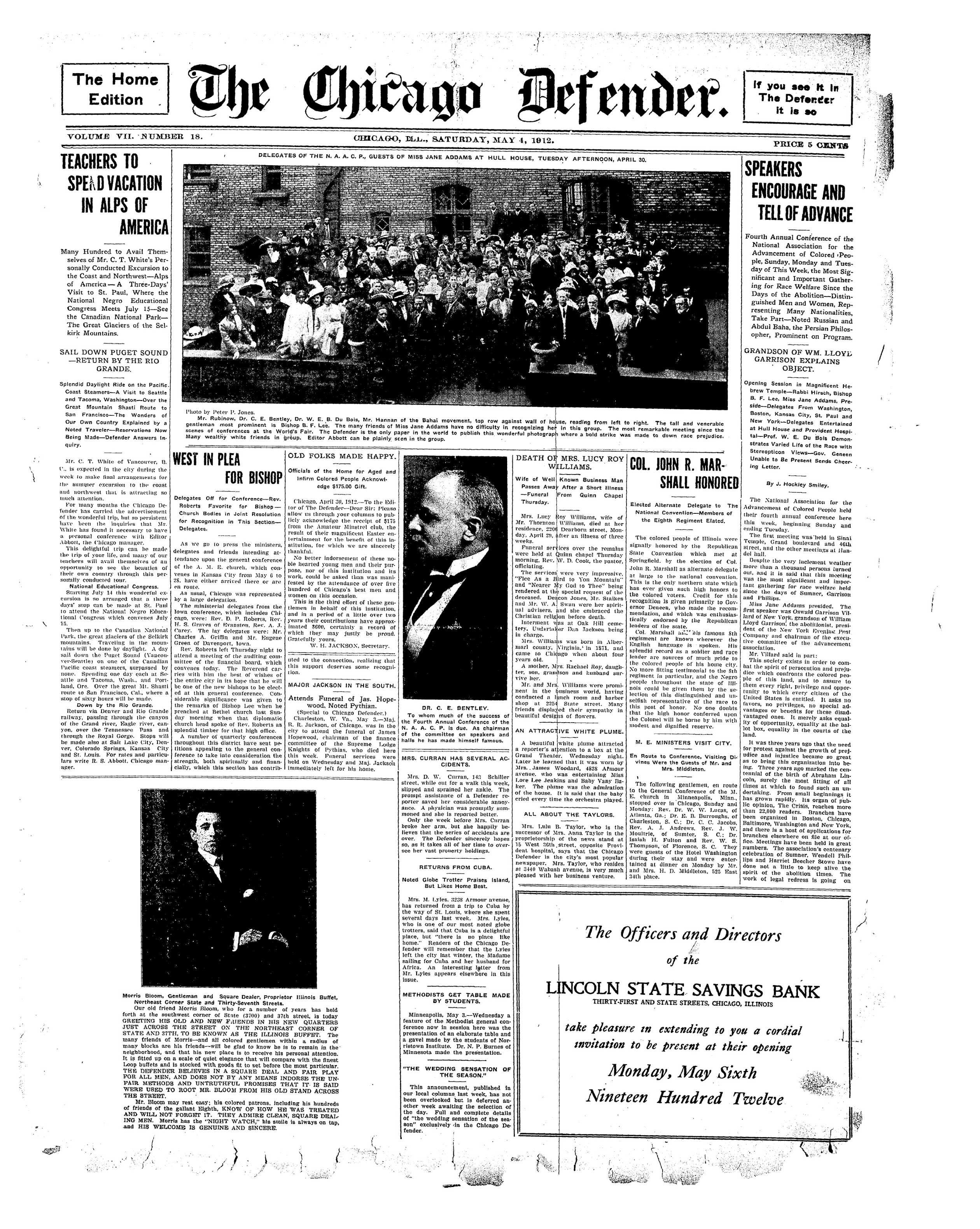
DELEGATES OF THE N. A. A. C. P., GUESTS OF MISS JANE ADDAMS AT HULL HOUSE, TUESDAY AFTERNOON, APRIL 30.
THE WEDDING OF THE MARRIAGE OF JOHN AND MARY BURTON AT THE MARRIAGE HALL OF THE MARY BURTON MUSEUM.
Mr. Rubinow, Dr. C. E. Bentley, Dr. W. E. B. Du Bois, Mr. Hannan of the Bahai movement, top row against wall of house, reading from left to right. The tall and venerable gentleman most prominent is Bishop B. F. Lee. The many friends of Miss Jane Addams have no difficulty in recognizing her in this group. The most remarkable meeting since the scenes of conferences at the World's Fair. The Defender is the only paper in the world to publish this wonderful photograph where a bold strike was made to down race prejudice. Many wealthy white friends in group. Editor Abbott can be plainly seen in the group.
Photo by Peter P. Jones.
FOR BISHOP
Delegates Off for Conference—Rev. Roberts Favorite for Bishop—Church Bodies in Joint Resolution for Recognition in This Section—Delegates.
CHICAGO, DLL., SATURDAY, MAY 4, 1912.
OLD FOLKS MADE HAPPY.
Officials of the Home for Aged and Infirm Colored People Acknowledge $175.00 Gift.
Chicago, April 30, 1912.—To the Editor of The Defender—Dear Sir; Please allow us through your columns to publicly acknowledge the receipt of $175 from the Amateur Minstrel club, the result of their magnificent Easter entertainment for the benefit of this institution, for which we are sincerely thankful.
No better endorsement of these noble hearted young men and their purpose, nor of this institution and its work, could be asked than was manifested by the attendance of over five hundred of Chicago's best men and women on this occasion.
This is the third effort of these gentlemen in behalf of this institution, and in a period of a little over two years their contributions have approximated $600, certainly a record of which they may justly be proud. Gratefully yours.
W. H. JACKSON, Secretary.
uted to the connection, realizing that this support deserves some recognition.
MAJOR JACKSON IN THE SOUTH.
Attends Funeral of Jas. Hopewood, Noted Pythian.
(Special to Chicago Defender.)
Charleston, W. Va., May 3.—Maj.
R. R. Jackson, of Chicago, was in the city to attend the funeral of James Hopewood, chairman of the finance committee of the Supreme Lodge Knights of Pythias, who died here this week. Funeral services were held on Wednesday and Maj. Jackson immediately left for his home.
1
To whom much of the success of the Fourth Annual Conference of the N. A. A. C. P. is due. As chairman of the committee on speakers and halls he has made himself famous.
MRS. CURRAN HAS SEVERAL ACCIDENTS.
Mrs. D. W. Curran, 143 Schiller street, while out for a walk this week, slipped and sprained her ankle. The prompt assistance of a Defender reporter saved her considerable annoyance. A physician was promptly summoned and she is reported better. Only the week before Mrs. Curran broke her arm, but she happily believes that the series of accidents are over. The Defender sincerely hopes so, as it takes all of her time to oversee her vast property holdings.
RETURNS FROM CUBA.
Noted Globe Trotter Praises Island, But Likes Home Best,
Mrs. M. Lyles. 3238 Armour avenue, has returned from a trip to Cuba by the way of St. Louis, where she spent several days last week. Mrs. Lyles, who is one of our most noted globe trotters, said that Cuba is a delightful place, but "there is no place like home." Readers of the Chicago Defender will remember that the Lyles left the city last winter, the Madame sailing for Cuba and her husband for Africa. An interesting latter from Mr. Lyles appears elsewhere in this issue.
Minneapolis, May 3.—Wednesday a feature of the Methodist general conference now in session here was the presentation of an elaborate table and a gavel made by the students of Norristown Institute. Dr. N. P. Burnes of Minnesota made the presentation.
This announcement, published in our local columns last week, has not been overlooked but is deferred another week awaiting the selection of the day. Full and complete details of "the wedding sensation of the season" exclusively in the Chicago Defender.
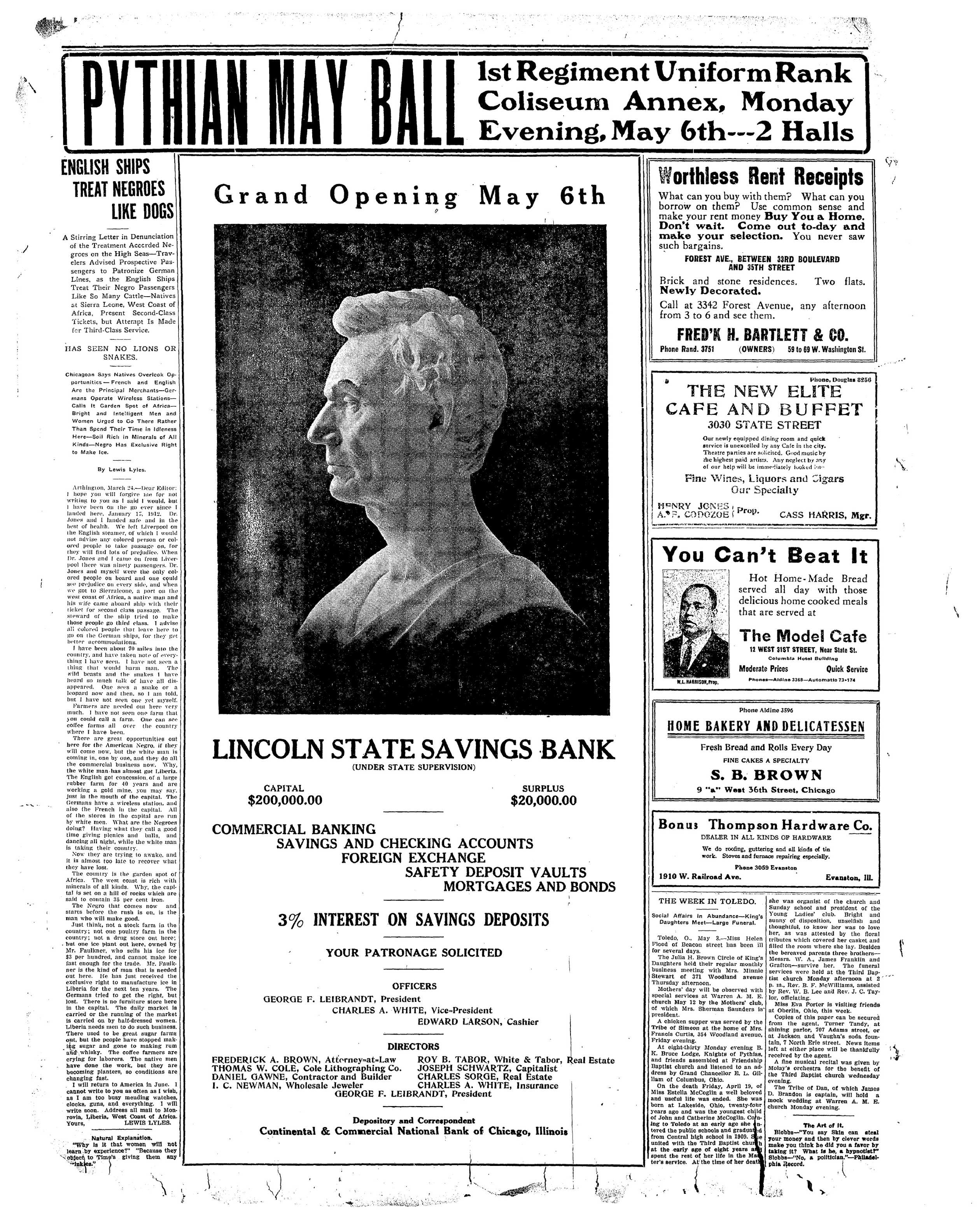
The Officers and Directors
of the
LINCOLN STATE SAVINGS BANK
THIRTY-FIRST AND STATE STREETS, CHICAGO, ILLINOIS
take pleasure in extending to you a cordial
invitation to be present at their opening
Monday, May Sixth
Nineteen Hundred Twelve
DEATH OF MRS. LUCY ROY WILLIAMS.
Wife of Well Known Business Man Passes Away After a Short Illness —Funeral From Quinn Chapel Thursday.
Mrs. Lucy Roy Williams, wife of Mr. Thornton Williams, died at her residence, 2200 Dearborn street, Monday, April 29, after an illness of three weeks.
Funeral services over the remains were held at Quinn chapel Thursday morning, Rev. W. D. Cook, the pastor, officiating.
The services were very impressive, "Flee As a Bird to Yon Mountain" and "Nearer My God to Thee" being rendered at the special request of the deceased. Deacon Jones, Mr. Stakes and Mr. W. A Swan were her spiritual advisers, and she embraced the Christian religion before death.
Interment was at Oak Hill cemetery, Undertailler Dan Jackson being in charge.
Mrs. Williams was born in Albermarl county, Virginia, in 1871, and came to Chicago when about four years old.
A mother, Mrs. Rachael Roy, daughter, son, grandson and husband survive her.
Mr. and Mrs. Williams were prominent in the business world, having conducted a lunch room and barber shop at 2254 State street. Many friends displayed their sympathy in beautiful designs of flowers.
AN ATTRACTIVE WHITE PLUME.
A beautiful white plume attracted a reporter's attention to a box at the Grand Theater, Wednesday night. Later he learned that it was worn by Mrs. James Woodard, 4828 Afmour avenue, who was entertaining Miss Lore Lee Jenkins and Baby Vany Baker. The plume was the admiration of the house. It is said that the baby cried every time the orchestra played.
ALL ABOUT THE TAYLORS.
Mrs. Luhu B. Taylor, who is the successor of Mrs. Anna Taylor in the proprietorship of the news stand at 15 West 36th street, opposite Provident hospital, says that the Chicago Defender is the city's most popular newspaper. Mrs. Taylor, who resides at 3440 Wabash avenue, is very much pleased with her business venture.
COL. JOHN R. MARSHALL HONORED
COL. JOHN R. MARSHALL HONORED
Elected Alternate Delegate to The National Convention—Members of the Eighth Regiment Elated.
The colored people of Illinois were signally honored by the Republican State Convention which met at Springfield, by the election of Col. John R. Marshall as alternate delegate at large to the national convention. This is the only northern state which has ever given such high honors to the colored voters. Credit for this recognition is given primarily to Governor Deneen, who made the recommendation, and which was enthusiastically endorsed by the Republican leaders of the state.
Col. Marshall also his famous 8th regiment are known wherever the English language is spoken. His splendid record as a soldier and race leader are sources of much pride to the colored people of his home city. No more fitting testimonial to the 8th regiment in particular, and the Negro people throughout the state of Illinois could be given them by the selection of this distinguished and unselfish representative of the race to this post of honor. No one doubts that the high honor conferred upon the Colonel will be borne by him with modest and dignified reserve.
M. E. MINISTERS VISIT CITY.
En Route to Conference, Visiting Divines Were the Guests of Mr. and Mrs. Middleton.
The following gentlemen, en route to the General Conference of the M. E. church in Minneapolis, Minn., stopped over in Chicago, Sunday and Monday; Rev. Dr. W. W. Lucas, of Atlanta, Ga.; Dr. E. B. Burroughs, of Charleston, S. C.; Dr. C. C. Jacobs, Rev. A. J. Andrews, Rev. J. W. Moultrie, of Sumter, S. C.; Dr. Isaiah H. Fulton and Rev. W. S. Thompson, of Florence, S. C. They were guests of the Hotel Washington during their stay and were entertained at dinner on Monday by Mr. and Mrs. H. D. Middleton, 525 East 341th place.
If you see it in The Defender it is so
```markdown
```
PRICE 5 CENTS
SPEAKERS ENCOURAGE AND TELLOF ADVANCE
Fourth Annual Conference of the National Association for the Advancement of Colored People, Sunday, Monday and Tuesday of This Week, the Most Significant and Important Gathering for Race Welfare Since the Days of the Abolition—Distinguished Men and Women, Representing Many Nationalities, Take Part—Noted Russian and Abdul Baha, the Persian Philosopher, Prominent on Program.
GRANDSON OF WM. LLOYD GARRISON EXPLAINS OBJECT.
Opening Session in Magnificent Hebrew Temple—Rabbi Hirsch, Bishop B. F. Lee, Miss Jane Addams, Preside—Delegates From Washington, Boston, Kansas City, St. Paul and New York—Delegates Entertained at Hull House and Provident Hospital—Prof. W. E. Du Bols Demonstrates Varied Life of the Race with Stereopticon Views—Gov. Geneen Unable to Be Present Sends Cheering Letter.
By J. Hockley Smiley
The National Association for the Advancement of Colored People held their fourth annual conference here this week, beginning Sunday and ending Tuesday.
The first meeting was held in Sinai Temple, Grand boulevard and 46th street, and the other meetings at Handel hall.
Despite the very inclement weather more than a thousand persons turned out, and it is said that this meeting was the most significant and important gathering for race welfare held since the days of Sumner, Garrison and Phillips.
Miss Jane Addams presided. The first speaker was Oswald Garrison Villard of New York, grandson of William Lloyd Garrison, the abolitionist, president of the New York Evening Post Company and chairman of the executive committee of the advancement association.
This society exists in order to combat the spirit of persecution and prejudice which confronts the colored people of this land, and to assure to them every right, privilege and opportunity to which every citizen of the United States is entitled. It asks no favors, no privileges, no special advantages or benefits for these disadvantaged ones. It merely asks equality of opportunity, equality at the ballot box, equality in the courts of the land.
It was three years ago that the need for protest against the growth of prejudice and injustice became so great as to bring this organization into being. Three years ago marked the centennial of the birth of Abraham Lincoln, surely the most fitting of all times at which to found such an undertaking. From small beginnings it has grown rapidly. Its organ of public opinion, The Crisis, reaches more than 22,000 readers. Branches have been organized in Boston, Chicago, Baltimore, Washington and New York, and there is a host of applications for branches elsewhere on file at our office. Meetings have been held in great numbers. The association's centenary celebration of Sumner, Wendell Phillips and Harriet Beecher Stowe have done not a little to keep alive the spirit of the abolition times. The work of legal redress is going on
apace; there is being undertaken at the present time a careful investigation of one of the most terrible lynchings—one of more than a hundred which took place during the year 1911
```markdown
```
Judge Hook Gets the Hook.
Looking back on the thirteen months that have elapsed since the last annual conference of this association, it can not be said that the cause of the colored people has done anything else than advance rapidly, both from the political and the material point of view.
Politically we have reason to be grateful for the Root-Borah debate in the Senate on disfranchisement; for the fight for Negro suffrage in Oklahoma; for the winning of civil rights suits in New York, New Jersey, Massachusetts, and elsewhere, and for another and overwhelming defeat for disfranchisement in Maryland. The blow at peonage in Alabama, struck by the Supreme Court in 1811, is a cause for widespread relocating.
On the material side is the remarkable increase of Negro wealth in land and homes that continues unabated year by year. In the census report that the Negro population has grown from 1,770,808 in 1810 to 9,828,294 in 1910, the Negro can take unbounded satisfaction, since with his increasing numbers comes increasing power and increased strength with which to fight his battles.
The efforts to draw the color line at Cornell university have failed; the appointment of a colored Assistant United States Attorney-General in Washington and the election of the first colored legislator in Pennsylvania are auspicious omen of the future, and but two of many that might be presented.
But most significant and striking of all the evidence has been the defeat for the Supreme court of the United States of Judge William C. Hook of Kansas.
Awakening to Power:
There can be no question that Judge Hook would be today upon the Supreme bench of the land after his intolerable "Jim Crow Car" decision but that the so-called "Black Cabinet" of Mr. Taft waited upon the President and notified him that if this wrong were done to colored Americans no colored man would speak in his behalf in the presidential campaign and that he could count upon the certain hostility of the intelligent colored people of the country. Besides this association, many other bodies interested in the welfare of the colored people and prominent white judges and leaders of public opinion protested to Mr. Taft—and Judge Hook is not upon the Supreme bench of the United States.
We hear much about the lack of solidarity among the colored people. It is an indictment, the truth of which we can not wholly deny if we would. The nine, millions of colored citizens do not yet realize that a tremendous power will be theirs when they but stand together, utilize the political influence which remains to them and take advantage of that right to voice their discontent, to express their bitter feeling of wronged citizenship of which no legislation can deprive them. The Hook case is chiefly significant as showing a changed attitude; a new tone among the colored people, it is to be welcomed thrice over and written down as a notable political event in their history if it means, as we believe, an awakening to the power which is theirs.
Prof. Pickens Heard.
Prof. Wm. Pickens of Talladega, Ala., was the next speaker. Mr. Pickens mers with a very cordial reception and said in part:
"The upward movement for the American Negro is an achievement of civilization, showing that the American heart is better than the American politics or theology. Now 10,000,000 Negroes own a large part of the nation's property.
"The American Negro, emulous of his Creator (for each began with nothing), is now paying taxes on $60,000,000 worth of property and may be said to be worth more than a billion, for the American Negro, in matters of taxes, has absorbed some of the modesty of the whites. The class that didn't own a mule fifty years ago now has $500,000,000 invested in farm lands. And any man will tell you that one dollar earned by sweat and sacrifice of a Negro is worth many dollars saved by a white."
Pres. Spingarm, president of the New York branch, also spoke.
The Ninibrian Glee club rendered several selections, and the following letter was read from Gov. Deneen: STATE OF HUNGUS
EXPERIENCE IN IMPORTANCE
Springfield, April 26, 1912,
M. C. T. Hallman,
Chicago, IA.
My Dear Sister will receive of your letter of the 20th in reference to the coming conference of the National association for the Advancement of Colored People, to have extended to you my invitations to be present and deliver an address on that occasion, and to have extended to you my invitations upon the good work which has been accomplished in the colored race, not only in promoting their present material and moral well-being, but in encouraging them to seek and better opportunities in the future.
The progress which has been made in the education of the colored years has been remarkable. Homes schools, churches, industries and many kinds of social, educational, religious and cultural activities through which the race has joined with the other citizens of our state and nation. Nevertheless, much remains to be done, and I am sure that a well organized association such as yours cannot fail to contribute to the success of those whose interests it is your special concern to promote and protect but to society at large. These are essentially the same as their
To foster high ideals of citizenship, its training and brain meet the train the band and brain meet the train the industrial life, and to cultivate stability of character and purpose. I look upon as a teacher in the work with societies such as yours could engage.
Assuring you of my deep interest in the work of your students, I am.
Very truly, courteous.
(Signaled) C. D. SENEEN.
Monday.
At 12 o'clock many of the delegates were guests at a luncheon at Provident hospital. In the afternoon the second meeting was held at Handel ball. Prof. W. E. B. Du Bois and Judge Edward O. Brown of the Appellate court were the speakers.
Prof. Du Bois injected a new idea into the work of the association by a series of stereoptic views showing the life of a colored boy from babyhood to his final resting place in a southern cemetery, illustrating the in-
suits, the persecutions and the injustice with which the Negro is treated. Judge Brown's toque was race discrimination. Among other things he said: "It is a duty every American of the white race owes to himself as much as he does to the Negro to see to it that the color of a man's skin shall not subject him to insult, oppression and injustice in a country boasting of its democracy, its liberty and the political equality of its citizens," said the judge. "The people of the United States, more than any other people of the earth, should recognize the obligation to prevent racial partisanship and prejudice from influencing our conduct to the Negro. Yet a dominant portion of our fellow citizens and neighbors today go beyond the people of any other country in the world in unjust discrimination against him.
"In the civil war we accepted every where the assistance of the Negroes, to whom we promised liberty and advancement. We used freedmen in the North as soldiers, freedmen in the South as scouts, fort builders, foragers and commissaries. We were successful and we took no end of glory to ourselves for the redemption and emancipation of a race.
"Now when a state or civic community has undertaken a duty like that there is no way for it in honor to retreat or withdraw. Every step we opened to these people made any political inequality, any social injustice, any ostracism, oppression or insult more bitter to them than it had been before.
"But the Negroes have come fairly up in all the things dependent on their own exertions; they have in one generation become planters, business men, professional men, teachers, bankers, artists, musicians and authors. They have reared theaters and established schools and colleges of their own, built churches and hospitals and orphan asylums."
Night Session.
At the night session of the conference Charles Edward Russell, magazine writer, declared that the United States is attempting to avoid the Negro question.
"Are we a nation of cowards?" asked Mr. Russell, "and are we making for universal chaos which may be accompanied by bloodshed?"
In addition to Mr. Russell, I. M. Rubinow of New York, H. T. Kealing, president of the Western university, Quindarrow, Kans., and Miss Julia Luthrop spoke. Bishop B. F. Lee presided.
Mrs. George Cone's jubilee club sang.
Tuesday.
The morning session was devoted to reading of reports by the delegates. Mr. Moorlidstory of Boston presided. In the afternoon the delegates were guests at a reception by Miss Jane Addams at Hull House. Mrs. Cella Parker Wooly was the principal speaker. In the evening Rabbi Hirsch presided. Mr. John H. Walker, president of the United Mine Workers of Illinois; Mrs. Ida B. Wells Barnett, Dr. B. F. Riley of Birmingham, Ala., author of "The White Man's Burdens," and Mrs. Anna Jones of Kansas City were the speakers. Abdul Baha of Persia also spoke.
Notes of the Conference.
An important idea was the introduction of a resolution by Mr. Charles Edward Russell of New York. The resolution is as follows: "Resolved, That the Board of Directors of the National Association for the Advancement of Colored People is requested to undertake as soon as may be practicable proceedings that will bring before the United States Supreme Court the so-called 'grandfather clause,' by which millions of owners are disfranchised in the southern states."
Among the delegates were Mrs. Eva Monroe of Springfield, Ill.; Mrs. Clara Clifford of Washington, D. C.; Mrs. Montgomery of Milwaukee, and Miss Anna Jones of Kansas City.
Dr. N. F. Mossell, well known Philadelphia and Medical Director of the Douglass Memorial Hospital, was among the early arrivals. In company with Dr. George C. Hall, he enjoyed a number of festivities and participated in medical work to his heart's content.
The reception at Hull House Tuesday, was an enjoyable occasion. Not the least among the treasurers of the conference will be the photo of that gathering.
ECHOES OF THE N. A. A. C'S
FOURTH ANNUAL CON-
FERENCE.
By Mildred Miller
No greater meeting has ever been held in the later history of this country. From the brilliant opening at Sinai temple Sunday evening through to the closing Tuesday night in Handel hall, every session was marked with an intense earnestness of purpose, and the addresses were of an unusually high order and teaming with information and human interest. It may come slowly, but such meetings cannot but bring about finally "the uplift of colored people of this country by securing to them the full enjoyment of their rights as citizens, justice in all courts and equal opportunity everywhere." Every young colored boy and girl in Chicago should have seen and heard Mr. William Pickens, of Talladega, Ala.; Mr. H. T. Kealing, of Quindamon, Kan.; and Mr. W. E. B. DuBois, author, cochal and editor of "The Crisis."
The reception at Hull House was a very delightful and interesting affair. That wonderful teacher of peace and the brotherhood of man, Abdul Baha, of Persia, made his first appearance at the Hull House.
In both of his addresses at Hull House and Handel hall, Abdul Baha very eloquently showed the folly of discrimination on the account of the only point of difference between men, that of the color of the skin.
A garden of flowers, all of one color, would be monotonous and by no means beautiful.
The local committee deserves much credit, of course, for the arrangements for the comfort, etc., of the guests and attendants upon the N. A. A. C. conference, but yet when
one looked at the ushers for the evenings at Handel hall one could not but think ol Abdul Baha's garden with the one color and variety of flower.
If we are hoping for a time when we shall not be measured by the color of our skin, had we not better begin by "cutting out" these nice little discriminations among ourselves?
The young ladies who acted as ushers were lovely and this word is no criticism upon them at all; but the scheme of having young girls for ushers might have been carried just a little farther, and instead of married and maiden ladies such high school girls as Misses Esther Webster, Helen Perry and Bertha Mosely might have been added with credit to the list.
THE SICK.
The Latest News About Your Friends and Acquaintances Who Are Under the Physician Care.
James McDowell, of 4537 Champlain avenue, is still sick, but on the road to recovery, we are glad to announce.
Miss Naomi Jackson, 435 East 37th street, is reported better as we go to press.
Miss Martha Plummer, 3227 Denborn street, still continues to improve.
Mr. James Newsome, who is ill at Provident hospital, is improving. Mrs. Newsome accidentally upset a kettle of hot water at her residence, 214 West 30th street on Thursday and was painfully scalded.
Mrs. D. W. Reed, of 5309 Dearborn street, who has been ill for the past two or three weeks, is fast improving.
Mrs. Charlie Mackey, 3159 State street, who has been sick for the past week, is able to sit up a little.
GO TO GOSSIN'S.
The people living in the neighborhood of 10 East 28th street are pleased with the courteous treatment accorded them there. Mrs. Randolph Gossin who succeeded "Jackson," is noted for her excellent home made pies cakes, relishes and cold meats. Lunches are served at all times Gossin's delicatessen store is easily the most beautiful store in the neighborhood. Automatic telephone connection T3-075.
INFORMATION WANTED.
Anyone knowing the whereabouts of Maude Jones (Mrs. Rodgers Jones), formerly of Milwaukee, please notify the Chicago Defender office. She has a son by the name of Harold Parks. Mrs. Jones is portly and of a dark brown complexion. A brother also resides here by the name of Sherman Peyton.—11.
HOTEL NEWS
All Up-to-date Hotel News and News of Bell Hops.
NEW HOTEL WILL HAVE UNDERGROUND STORES.
Five Floors Below Street Level Feature of New York Hostelry; Vanderbiltls Behind It.
CONGRESS HOTEL CO. PROFITS BY LEASE.
The Congress Hotel Company of Chicago in the exercise of an option in connection with a long-term lease of the twenty-six feet on Michigan avenue north and adjoining the Blair holding and forming a part of the site of the Congress Hotel, has purchased the same from E. Burton Holmes and his grandmother, Mrs. Ann W. Burton, the latter conveying a life interest in one-third of the property. The piece was leased in 1902 to the Congress Hotel Company at an annual rental of $4,000, which is 4 per cent on $100,000. The lease contained an option to purchase for $115,000 prior to July. 1912. The land was leased from Mrs. Virginia B. Holmes and Mrs. Ann W. Burton.
The transaction is interesting because of the handsome profit which it netted the Congress Hotel Company, according to the valuation recently placed upon the Blair holdings at an appraisal made early during the present year. It will be recalled that appraisal placed the value of $11,000 a foot on the Blair property, on which basis the Holmes property is worth $288,000. This means a profit of $171,000 to the Congress Hotel Company.
The Reporter of this date contained a lengthy obituary notice of Edward B. Bright, for thirty years steward of the Russell House, Detroit, Mich., who died in his apartment at that hotel aged 70 years.
The new Victoria Hotel (completely rebuilt and formerly known as the Royal) at Lincoln, Neb., will be opened to the public about May 1. The building has been completely remodeled at a cost, with the handsome new furnishings, of about $25,000. I. W. Bradt, a well-known Lincoln hotel man, is lessee and will have active management of the business. The remodeling of the interior of the hotel is complete. The hollow interior of old Royal has been changed to an outside court with every room in the building an outside one. A new elevator has been installed; the rooms occupied by the culinary department are of cement, and a handsome new front has been put in. Mr. Bradt was formerly manager of the Capitol Hotel in Lincoln, later going west and having until a short time ago successfully operated a hotel in Los Angeles. Jerome P. Merrill, of Chicago, was appointed steward of the Oakland Hotel, St. Clair Springs, Mich.
Probably Not.
"The doctor says I mustn't read anything exciting."
"I've brought you a nice book entitled 'How to Know the Wild Flowers.' I don't think that will increase your heart action very much."
THE CHICAGC DEFENDER
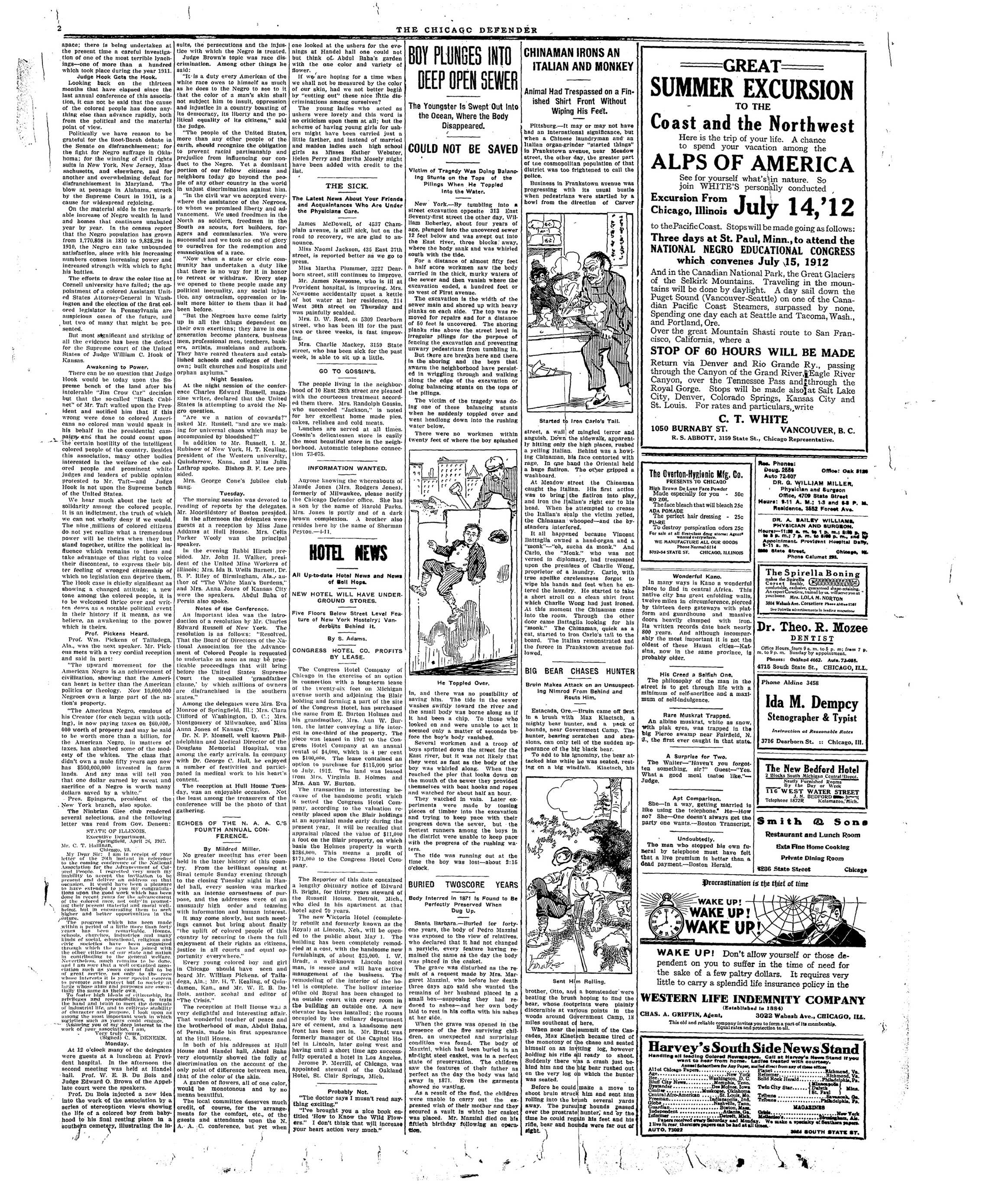
BOY PLUNGES INTO DEEP OPEN SEWER
The Youngster Is Swept Out Into the Ocean, Where the Body Disappeared.
COULD NOT BE SAVED
Victim of Tragedy Was Doing Balano
Ing Stunts on the Tops of the
Pillings When He Tornled
New York.—By tumbling into a street excavation opposite 313 East Seventy-first street the other day, William Boherley, about four years of age, plunged into the uncovered sewer 12 feet below and was swept out into the East river, three blocks away, where the body sank and was whirled south with the tide.
For a distance of almost fifty feet a half score workmen saw the body carried in the thick, murky waters of the sewer and then vanish where the excavation ended, a hundred feet or so west of First avenue.
The excavation is the width of the sewer main and shored up with heavy planks on each side. The top was removed for repairs and for a distance of 50 feet is uncovered. The shoring planks rise above the street level in irregular pilings for the purpose of fencing the excavation and preventing unwary pedestrians from tumbling in.
But there are breaks here and there in the shoring and the boys that swarm the neighborhood have persisted in wriggling through and walking along the edge of the exevaluation or doing balancing stunts on the tops of the pillings.
The victim of the tragedy was doing one of these balancing stunts when he suddenly toppled over and went headlong down into the rushing water below.
There were no workmen within twenty feet of where the boy splashed
A man falls off a wall. A man shoves him down.
He Toppled Over.
in, and there was no possibility of saving him. The tide in the sewer washes swiftly toward the river and the small body was borne along as if it had been a chip. To those who looked on and were unable to act it seemed only a matter of seconds before the boy's body vanished. Several workmen and a troop of boys sprinted down the street for the East river, but it was not likely that they went as fast as the body of the boy was whirled along. When they reached the pler that looks down on the mouth of the sewer they provided themselves with boat hooks and ropes and watched for about half an hour. They watched in vain. Later experiments were made by tossing pieces of timber into the excavation and trying to keep pace with their progress down the sewer, but the fleetest runners among the boys in the district were unable to keep pace with the progress of the rushing waters.
The tide was running out at the time the boy was lost—about 2:15 o'clock.
Body Interred in 1871 Is Found to Be Perfectly Preserved When Dug Up.
Santa Barbara—Buried for forty one years, the body of Pedro Mazzini was exposed to the view of relatives, who declared that it had not changed a particle, every feature having remained the same as the day the body was placed in the casket.
The grave was disturbed as the result of a request made by Mrs. Margaret Mazzini, before her death three days ago said she wanted the remains of her husband placed in a small box—supposing they had reduced to ashes—and her own body laid to rest in his coffin with his ashes at her side.
When the grave was opened in the presence of the five surviving children, an unexpected and surprising condition was found. The body of Mazzini, which had been buried in an air-tight steel casket, was in a perfect state of preservation. The children saw the features of their father as perfect as the day the body was laid away in 1871. Even the garments showed no wasting. As a result of the find, the children were unable to carry out the expressed wish of their mother and they secured a vault in which her casket was placed. Mr. Mazzini died on his fifteenth birthday following an operation.
CHINAMAN IRONS AN ITALIAN AND MONKEY
CHINAMAN IRONS AN ITALIAN AND MONKEY
Animal Had Trespassed on a Finished Shirt Front Without Wiping His Feet.
Pittsburgh—it may or may not have had an international significance, but when a Chinese laundryman and an Italian organ-grinder "started things" in Frankstown avenue, near Meadow street, the other day, the greater part of use cosmopolitan population of that district was too frightened to call the police. Business in Frankstown avenue was progressing with its usual bustle when pedestrians were started by a howl from the direction of Carver
火災の危険を知る。
Started to iron Carlo's Tail.
street, a wall of mingled terror and anguish. Down the sidewalk, apparently hitting only the high places, rushed a yelling Italian. Behind was a howling Chinaman, his face contorted with rage. In que hand the Oriental held a huge flation. The other gripped a washboard.
At Meadow street the Chinaman caught the Italian. His first action was to bring the flation into play, and iron the Italian's right ear to his head. When he attempted to crease the Italian's scalp the victim yelled, the Chinaman whooped—and the bystanders interfered.
It all happened because Vincent Battaglia owned a hand-organ and a "monk"—"oh, sucha da monk." And Carlo, the "Monk," who was not versed in diplomacy, had trespassed upon the premises of Charlie Wong, proprietor of a laundry. Carlo, with true apellite carelessness forgot to wipe his hands and feet when he entered the laundry. He started to take a short stroll on a clean shirt front which Charlie Wong had just froned. At this moment the Chinaman came into the room. Through the other door came Battaglia looking for his "monk." The Chinaman, quick as a cat, started to iron Carlo's tail to the board. The Italian remonstrated and the furore in Frankstown avenue followed.
BIG BEAR CHASES HUNTER
Bruin Makes Attack on an Unsuspecting Nimrod From Behind and Routes Him,
Estacada, Ore.—Bruin came off first in a brush with Max Klautsch, a mighty bear hunter, and a pack of hounds, near Government Camp. The hunter, bearing scratches and abrasions, can only tell of the sudden appearance of the big black bear.
To add to his ignominy, the bear attacked him while he was seated, resting on a big windfall. Klautsch, his
\(C_{1}\)
\(C_{2}\)
\(C_{3}\)
\(C_{4}\)
\(C_{5}\)
\(C_{6}\)
\(C_{7}\)
\(C_{8}\)
\(C_{9}\)
\(C_{10}\)
\(C_{11}\)
\(C_{12}\)
\(C_{13}\)
\(C_{14}\)
\(C_{15}\)
\(C_{16}\)
\(C_{17}\)
\(C_{18}\)
\(C_{19}\)
\(C_{20}\)
\(C_{21}\)
\(C_{22}\)
\(C_{23}\)
\(C_{24}\)
\(C_{25}\)
\(C_{26}\)
\(C_{27}\)
\(C_{28}\)
\(C_{29}\)
\(C_{30}\)
\(C_{31}\)
\(C_{32}\)
\(C_{33}\)
\(C_{34}\)
\(C_{35}\)
\(C_{36}\)
\(C_{37}\)
\(C_{38}\)
\(C_{39}\)
\(C_{40}\)
\(C_{41}\)
\(C_{42}\)
\(C_{43}\)
\(C_{44}\)
\(C_{45}\)
\(C_{46}\)
\(C_{47}\)
\(C_{48}\)
\(C_{49}\)
\(C_{50}\)
\(C_{51}\)
\(C_{52}\)
\(C_{53}\)
\(C_{54}\)
\(C_{55}\)
\(C_{56}\)
\(C_{57}\)
\(C_{58}\)
\(C_{59}\)
\(C_{60}\)
\(C_{61}\)
\(C_{62}\)
\(C_{63}\)
\(C_{64}\)
\(C_{65}\)
\(C_{66}\)
\(C_{67}\)
\(C_{68}\)
\(C_{69}\)
\(C_{70}\)
\(C_{71}\)
\(C_{72}\)
\(C_{73}\)
\(C_{74}\)
\(C_{75}\)
\(C_{76}\)
\(C_{77}\)
\(C_{78}\)
\(C_{79}\)
\(C_{80}\)
\(C_{81}\)
\(C_{82}\)
\(C_{83}\)
\(C_{84}\)
\(C_{85}\)
\(C_{86}\)
\(C_{87}\)
\(C_{88}\)
\(C_{89}\)
\(C_{90}\)
\(C_{91}\)
\(C_{92}\)
\(C_{93}\)
\(C_{94}\)
\(C_{95}\)
\(C_{96}\)
\(C_{97}\)
\(C_{98}\)
\(C_{99}\)
\(C_{100}\)
\(C_{101}\)
\(C_{102}\)
\(C_{103}\)
\(C_{104}\)
\(C_{105}\)
\(C_{106}\)
\(C_{107}\)
\(C_{108}\)
\(C_{109}\)
\(C_{110}\)
\(C_{111}\)
\(C_{112}\)
\(C_{113}\)
\(C_{114}\)
\(C_{115}\)
\(C_{116}\)
\(C_{117}\)
\(C_{118}\)
\(C_{119}\)
\(C_{120}\)
\(C_{121}\)
\(C_{122}\)
\(C_{123}\)
\(C_{124}\)
\(C_{125}\)
\(C_{126}\
brother, Otto, and a homemaker were beating the brush hoping to find the bear, whose footprints were plainly discernible at various points in the woods around Government Camp, 18 miles southeast of here.
When near the summit of the Cascades, Max Klaetsch became tired of the monotony of the chase and seated himself on an inviting log, however holding his rifle all ready to shoot. Suddenly there was a crash just behind him and the big bear rushed out on the very log on which the hunter was seated.
Before he could make a move to shoot bruin struck him and sent him rolling into the brush several yards away. The pursuing hounds passed over the prostrate hunter, and by the time he could regain his feet and his rifle, bear and hounds were far out of sight.
GREAT SUMMER EXCURSION TO THE
Coast and the Northwest Here is the trip of your life. A chance to spend your vacation among the
See for yourself what's in nature. So join WHITE'S personally conducted Excursion From July 14,'12 to the Pacific Coast. Stops will be made going as follows: Three days at St. Paul, Minn., to attend the NATIONAL NEGRO EDUCATIONAL CONGRESS which convenes July 15, 1912 And in the Canadian National Park, the Great Glaciers of the Selkirk Mountains. Traveling in the mountains will be done by daylight. A day sail down the Puget Sound (Vancouver-Seattle) on one of the Canadian Pacific Coast Steamers, surpassed by none. Spending one day each at Seattle and Tacoma, Wash., and Portland, Ore. Over the great Mountain Shasti route to San Francisco, California, where a
Return via Denver and Rio Grande Ry., passing through the Canyon of the Grand River. Eagle River Canyon, over the Tennessee Pass and through the Royal Gorge. Stops will be made also at Salt Lake City, Denver, Colorado Springs, Kansas City and St. Louis. For rates and particulars, write
C. T. WHITE
1050 BURNABY ST.
R. S. ABBOTT, 3159 State S
1050 BURNABY ST. VANCOUVER, B. C.
R. S. ABBOTT, 3159 State St., Chicago Representative.
The Overton-Hygienic Mfg. Co.
PRESENTS TO CHICAGO
High Brown De Luxe Face Powder
Made especially for you - 50c
ROZIL
The face bleach that will bleach 25c
ADA POMADE
The perfect hair dressing - 25c
PLARE
To destroy perspiration odors 25c
For sale at all first-class drug stores Agent* wanted everywhere.
WE MANUFACTURE ALL OUR GOODS
912-548-STE. SCHIAGO, IL INDUS
In many ways is Kano a wonderful place to find in central Africa. This native city has great enfolding walls, twelve miles in circumference, pierced by thirteen deep gateways with platform and guardhouse and massive doors heavily clamped with iron. Its written records date back nearly 800 years. And although incomparably the most important it is not the oldest of these Hausa cities—Katina, now in the same province, is probably older.
His Creed a Selfish One.
The philosophy of the man in the street is to get through life with a minimum of self-sacrifice and a maximum of self-indulgence.
Rare Muskrat Trapped.
An albino muskrat, white as snow, with pink eyes, was trapped in the big Pierce swamp near Fairfield, N. J., the first ever caught in that state.
**Supprise for** Two.
The Waiter "Haven't you forgotten something, sir?" Guest—"Yes.
What a good meal tastes like." Judge.
She—In a way, getting married is like using the telephone." He—How so? She—One doesn't always get the party one wants—Boston Transcript.
The man who stopped his own funeral by telephone must have felt that a live premium is better than a dead payment.—Boston Herald.
Procrastination
WAKE UP!
WAKE UP!
WAKE UP
WAKE UP! WAKE UP! WAKE UP!
WAKE UP! Don't allow yourself or those dependent on you to suffer in the time of need for the sake of a few paltry dollars. It requires very little to carry a splendid life insurance policy in the
CHAS. A. GRIFFIN, Agent, 3022 Wabash Ave., CHICAGO, ILL.
This old and reliable company invites you to form a part of its membership.
Equal rates and protection to all.
Wonderful Kang
Undoubtedly.
DR. G. WILLIAM MILLER,
Physician and Surgeon
Office, 4709 State Street
Heights: 8-11 A. M.; 1-3 and 8-8 P. M.
Residence, 3552 Forest Ave.
DR. A. BAILEY WILLIAMS,
PHYSICIAN AND BURGON.
Heights: 11-383 a. m. to 1 p. m.; 8183 p. m.
to 5 p. m.; 7 p. m. to 8889 p. m., and
by Appointment. Provident Hospital Daily,
8-11 a. m.
The Spirella Boning
makes the Spirella
shape, a beautiful
comfortable, exclusive, guaranteed shape retaining.
An expert Corrette, trained by us, will serve you at your bone. MRS. LOLA M. NORTON
3804 Wahain Ave. Corrette Photo Aliso 1781
See Spirella in articles in leading magazines.
Dr. Theo. R. Mozee DENTIST
Office Hours, from 9 a.m. to 5 p. m; from 7 p.
m, to 9 p. m. Sunday by appointment.
Phones: Oakland 4602. Auto. 73-056.
4715 South State St., CHICAGO, ILL.
Phone Aldine 3458
Ida M. Dempcy
Stenographer & Typist
Instruction at Reasonable Rates
3716 Dearborn St. :: Chicago, Ill.
The New Bedford Hotel
2 Blocks South Michigan Central Depot.
Needs Furnished Rooms
By the Day or Week
116 WEST WATER STREET
BEDFORD BEDFORD
Telephone 1872R
Kalamazoo, Mich.
Exta Fine Home Cooking
Private Dining Room
4286 State Street Chicago
is the thief of time
City Churches—Religious News
FREDERICK DOUGLASS CENTER.
The service on Sunday, May 5, will be in charge of the Fisk Endowment Club. Speakers: Rev. J. E. Crowther and L. O. Blake, of the Congregational Missionary Board.
The Douglass Center Woman's Club will meet Tuesday afternoon. Mrs. Waller and Mrs. Robinson will render some musical selections. The discussion will be a symposium on the late national conference. All invited.
TO BREAK THE COLOR LINE.
Abdul Baha, the Great Persian Philosopher and Teacher, Aims to Unite, the Peoples of All 'Races and Creeds in One Great Bond of Brotherhood.
Washington. D. C., May 3.—Abdul Baha (the servant of God), the great Persian philosopher and teacher, head of the Balaists, will reach Chicago next Monday. He comes to bring hope to the colored people.
His visit to Washington has been a triumphal march. He has met and conquered Southern prejudices. He made addresses at Metropolitan A. M. E. church, at Howard University and at many of the white churches and halls and was listened to by many thousands of people of both races, who applauded his propaganda of the fatherhood of God and the brotherhood of man.
He was the guest of one of Washington's wealthiest women, one who moves in the most exclusive social circles at the capital, and yet her house has been thrown open to rich and poor and black and white. Southern people whose hearts were once filled with the most bitter prejudices against their brothers in black, have publicly acknowledged their change of heart and now they treat the colored people as brother indeed.
OUT IN ENGLEWOOD.
Weekly Letter from This Thriving Section of the City—All the News.
Mr. Sidney Gay, of Cincinnati, O., made a flying visit to the city to visit his niece, Mrs. Beard, of 1352 West 61st street.
The Ideal Woman's Club held its annual meeting at the Old Folks' home Friday. Quite a number were present. After a fine program ice cream and cake were served.
Mrs. Will Hill, of 6045 Loomis street, who has been very sick, is able to be up and around the house again.
Mr. Hood passed away Tuesday, after several months' illness. The funeral was held at Shiloh Baptist church Sunday morning.
The death angel visited Mr. and Mrs. Thomason, of 634 Englewood avenue, and took away their son.
Mr. Archer, of 6147 Loomis street, is still confined to the house.
Mrs. Jiles, of Morgan Park, after an illness of a year, passed away and was buried from the Baptist church in Morgan Park, Sunday at 12 o'clock. Mrs. Richards wishes to thank the friends for their kindness toward Mrs. Jiles and her daughter Gladys during the hours of trouble.
Shiloh Baptist church holds regular services every Sunday at 11 a. m. and 8 p. m. Sunday school at 1 o'clock. B. Y. P. U. meets at 7 p. m. Everybody is invited. A good program is rendered every evening at 7 p. m. by the young folks. Rev. Harris, pastor.
The Hope Presbyterian church holds regular services every Sunday at 10:30 a. m. and Sunday school 12:30, and evening services at 8 o'clock. Rev. Jefferson, pastor.
THE C. R. LEWIS CONSTRUCTION COMPANY
Makes Great Offer to Chicago's Home Buying Public.
Just think of it, the only firm in Chicago with such a proposition. Will sell you property anywhere in the city.
Residences and flat buildings of all descriptions, in and out of the city, from $1,500 to $150,000, located on Wabash avenue, Forest avenue, Michigan avenue, Drexel boulevard and other prominent avenues and boulevards.
Beautiful brick houses with stone fronts at $3,750 on Forest avenue. All on easy payments, same as renting, with the difference of getting a home for the money you pay instead of paper.
C. R. Lewis Construction Co., dealer in real estate, insurance, loans; public stenographing, public accounting; 3449 Street street; phones: Automatic 71-561, Douglas 2540.
A CHANCE OF A LIFETIME
Prominent Real Estate Firm Offers Exceptional Opportunity to Secure a Home.
Every young person should investigate Frederick H. Bartletts & Co.'s remarkable inducements to purchase a home of your own on their easy payment plan. The wise will hasten to secure "free rent for old age." Owning a home gives one prestige. The general office of the company is at 69 West Washington street, but first read their advertisement on another page.
MR. ABBOTT TO THE PUBLIC.
Acting upon the advice of the Post Office Department we will not carry delinquent subscribers on our list after Saturday, May 11. There will be no further notice.
R. S. ABBOTT, Editor.
"Not Worth a Rap" Is Irish.
"Not worth a rap," an expression frequently heard to indicate something as being valueless, originated in Ireland. The rap was a counterfeit coin current in Ireland for a halfpenny in the time of George I.
Fowl Hides Under a Street Car and the Boy Crawls
After H.
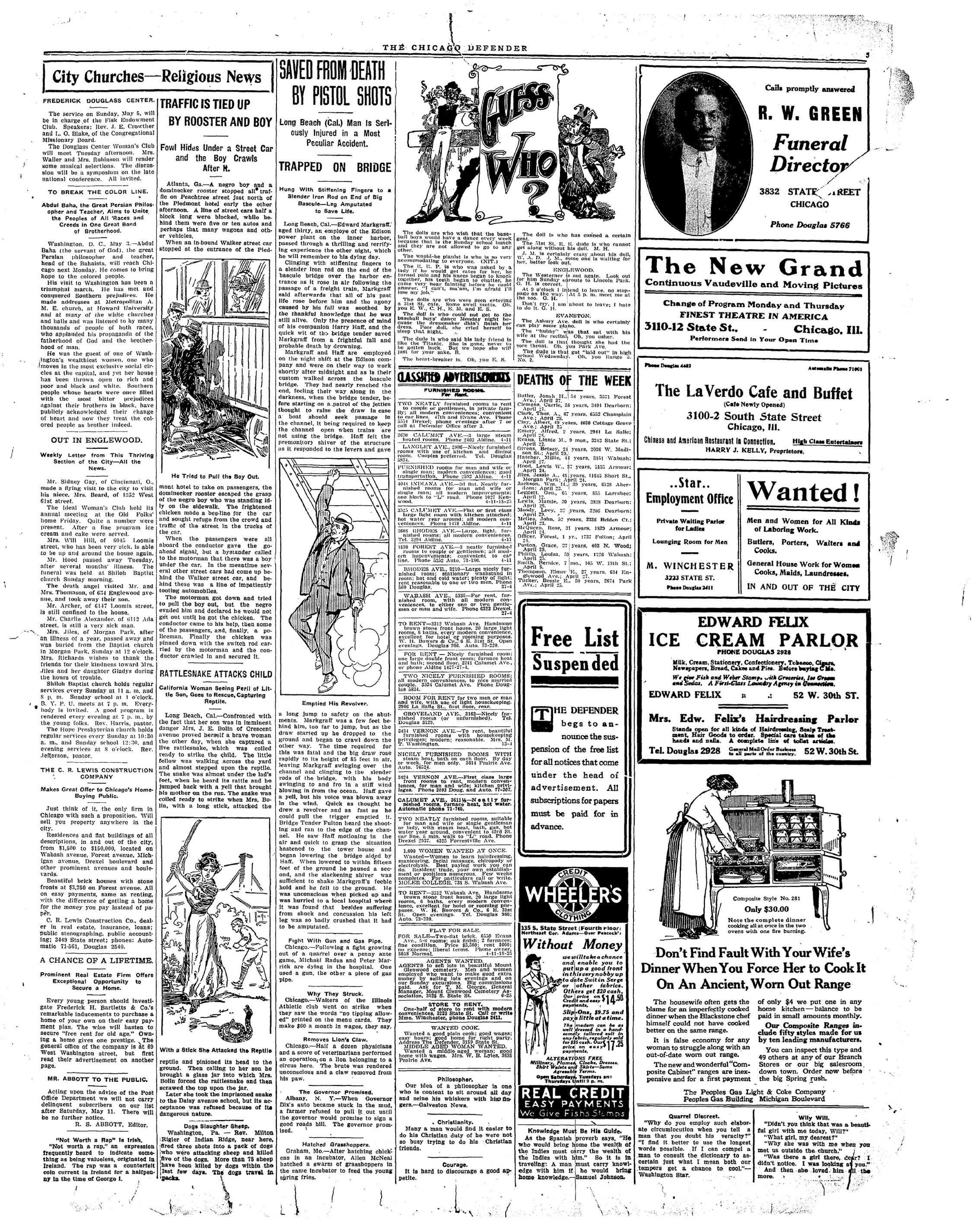
Atlanta, Ga.—A negro boy and a dominecker rooster stopped all traffic on Peachtree street just north of the Pledmont hotel early the other afternoon. A line of street cars half a block long were blocked, while behind them were five or ten autos and perhaps that many wagons and other vehicles.
When an in-bound Walker street car stopped at the entrance of the Pled-
A man is falling down a railway track. Two men are watching him.
He Tried to Pull the Boy Out.
mont hotel to take on passengers, the domineer rooster escaped the grasp of the negro boy who was standing idly on the sidewalk. The frightened chicken made a bee-line for the car and sought refuge from the crowd and traffic of the street in the trucks of the car.
When the passengers were all aboard the conductor gave the goahead signal, but a bystander called to the motorman that there was a boy under the car. In the meantime several other street cars had come up behind the Walker street car, and behind these was a line of impatiently tooting automobiles.
The motorman got down and tried to pull the boy out, but the negro evaded him and declared he would not get out until he got the chicken. The conductor came to his help, then some of the passengers, and, finally, a policeman. Finally the chicken was pinned down with the switch rod carried by the motorman and the conductor crawled in and secured it.
RATTLESNAKE ATTACKS CHILD
California Woman Seeing Peril of Little Son, Goes to Rescue, Capturing Reptile.
Long Beach, Cal.—Confronted with the fact that her son was in imminent danger Mrs. J. E. Bolin of Crescent avenue proved herself a brave woman the other day, when she captured a live rattlesnake, which was coiled ready to strike the child. The little fellow was walking across the yard and almost stepped upon the reptile. The snake was almost under the lad's feet, when he heard its rattle and he jumped back with a yell that brought his mother on the run. The snake was coiled ready to strike when Mrs. Bolin, with a long stick, attacked the
A Woman Holding a Sword in Front of a Boy Running Away from a Snake on the Ground
reptile and pinioned its head to the ground. Then calling to her son he brought a glass jar into which Mrs. Bolin forced the rattlesnake and then scrawled the top upon the jar. Later she took the imprisoned snake to the Daisy avenue school, but its acceptance was refused because of its dangerous nature.
Dogs Slaughter Sheep
Washington, Pa. — Rev. Milton
Rigler of Indian Ridge, near here,
fired three shots into a pack of dogs
who were attacking sheep and killed
five of the dogs. More than 75 sheep
have been killed by dogs within the
last few days. The dogs travel in
nearby.
SAVED FROM DEATH BY PISTOL SHOTS
Long Beach (Cal.) Man Is Seriously Injured in a Most Peculiar Accident.
TRAPPED ON BRIDGE
Hung With Stiffening Fingers to a Slender Iron Rod on End of Big Bascule—Leg Amputated to Save Life.
Long Beach, Cal.—Edward Markgraff, aged thirty, an employee of the Edison power plant on the inner harbor, passed through a thrilling and terrifying experience the other night, which he will remember to his dying day.
Clinging with stiffening fingers to a slender iron rod on the end of the bascule bridge over the harbor entrance as it rose in air following the passage of a freight train, Markgraff said afterwards that all of his past life rose before him and the agony caused by his fall was soothed by the thankful knowledge that he was still alive. Only the presence of mind of his companion Harry Haff, and the quick wit of the bridge tender saved Markgraff from a frightful fall and probable death by drowning.
Markgraff and Haff are employed on the night shift at the Edison company and were on their way to work shortly after midnight and as is their custom walked across the bascule bridge. They had nearly reached the end, feeling their way along in the darkness, when the bridge tender, before starting on a patrol of the jetties thought to raise the draw in case a boat should seek passage in the channel, it being required to keep the channel open when trains are not using the bridge. Haff felt the premonitory shiver of the structure as it responded to the levers and gave
A man in a suit and hat raises his fist as he stands on a railing, surrounded by smoke.
Emptied His Revolver.
a long jump to safety on the abutments. Markgraff was a few feet behind him, too far to jump, but as the drawn started up he dropped to the ground and began to crawl down the other way. The time required for this was fatal and the big draw rose rapidly to its height of 85 feet in air, leaving Markgraff swinging over the channel and clinging to the slender rods of the bridge, with his body swinging to and fro in a stiff wind blowing in from the ocean. Haff gave a yell, but his voice was blown away in the wind. Quick as thought he drew a revolver and as fast as he could pull the trigger emptied it. Bridge Tender Fulton heard the shooting and ran to the edge of the channel. He saw Haff motioning in the air and quick to grasp the situation hastened to the tower house and began lowering the bridge aided by Haff. When lowered to within fifteen feet of the ground he paused a second, and the slackening shiver was sufficient to shake Markgraff's feeble hold and he fell to the ground. He was unconscious when picked up and was hurried to a local hospital where it was found that besides suffering from shock and concussion his left leg was so badly crushed that it had to be amputated.
Chicago.—Following a fight growing out of a quarrel over a penny antie game, Michael Radus and Peter Marrick are dying in the hospital. One used a gun, the other a piece of gas pipe.
Why They Struck
Chicago.—Walters of the Illinois Athletic club went on strike when they saw the words "no tipping allowed" printed on the menu cards. They make $60 a month in wages, they say.
Removes Lion's Claw
Chicago.—Half a dozen physicians and a score of veterinarians performed an operation, on a lion belonging to a circus here. The brute was rendered unconscious and a claw removed from his paw.
The Governor Promised.
Albany, N. N.—When Governor Dix's auto became stuck in the mud, a farmer refused to pull it out until the governor would promise to sign a good roads bill. The governor promised.
Hatched Grasshoppers
Graham, Mo.—After hatching chickens in an incubator, Allen McNeal hatched a swarm of grasshoppers in the same incubator to feed the young spring fries.
GUESS WHO?
THE CHICAGO DEFENDER
H
TS
erl-
GE
raff.
The dolls are who wish that the baseball boys would have a dance every week because that is the Sunday school bunch and they are not allowed to go to any other.
The would-be pianist is who is so very accommodating to everyone. (NIT.)
I, t. t. P, is who was asked by a lady if she would dance. The turned pale and his knees began to knuckle together, his teeth began to chatter, he ear fainting before he could answer. I can't, maam, I'm afraid I lose my job.
The dolls are who were seen entering a 11st St. cafe. Some swell mutts. Oh, you look, C. H., M. E. and S. E. to the dolls could not jump night because the dressmaker didn't finish her dress. Poor doll, she cried herself to sleep that night.
The dude is who said his lady friend is like a cat. Never, never, never to get back taken. But we hope she will just for your sake, B.
The heart-breaker is. Oh, you E. S.
CLASSIFIED ADVERTISING
TWO NEATLY furnished rooms to rent to couple or gentlemen, in private family; all modern conveniences; convenient to couple or gentlemen. Phone 5554 Drexel; phone evenings after 7 or call at Defender Office after 3.
3620 CALUMET AVE—3 large heated rooms. Phone 2403 Aldine. 4-11
LANGLEY AVE. 3806—Nicely furnished rooms with use of kitchen and dining room. Couples preferred. Tel. Douglas 5934.
FURNISHED rooms for man and wife or single man; modern conveniences; good transportation. Phone 5552 Aldine. 4-11
4048 INDIANA AVE—3d flat. Nearly furnished single man; all modern improvements; one block to "L" road. Phone 1027 Kenwood. 4-11-18-25
3525 CALUMET AVE—Flat or first class large light room with kitchen attached; hot water around; all modern conveniences. Phone 1478 Aldine. 4-11
3608 RHODES AVE—Large, light, furnished rooms; all modern conveniences.
3130 FOREST AVE—3 neatly furnished rooms to couple or gentlemen; all modern improvements; convenient to carline. Phone 5552 Auto. 73-180. 4-11
RHODES AVE. 3210—Large nicely furnished room; stationary washstand in the second old water, plenty of light; rent reasonable to one or two men. Phone 569 Douglas.
WABASH AVE., 5335—For rent, furnished room, with all modern conveniences, to either one or two gentlemen or man and wife. Phone 6323 Drexel.
TO RENT—3312 Wabash Ave. Handsome brown stone front house, 20 large light fixtures, excellent for hotel or rooming purposes. W. H. Bowers & Cu., 6 E. 1st St. Open evenings. Douglas 596. Auto. 72-220.
FOR RENT—Nicely furnished room; one large double front room; furnace heat and light. Calmet Ave. or phone 1427-27-24.
TWO NICELY FURNISHED ROOMS; all modern conveniences, to nice married couple. 3524 Calmet Ave. Phone Douglas 5834.
ROOM FOR RENT for two men or man and wife, with use of light houskeeping. 2966 La Salle St., first door, rear.
GROVELAND AVE., 3162—Nicely furnished (or unfurnished). Tel. Douglas 3129.
3434 VERNON AVE.—To rent, beautiful furnished rooms with housekeeping privileges; modern; reasonable. Mrs. M. T. Washington. 15-4
NICELY FURNISHED ROOMS WITH steam heat, bath on each floor. By day or for men only. 3614 Prairie Ave. Auto. 65242
3424 VERNON AVE.—First large front rooms to rent, modern classrooms, for man and wife; kitchen privileges. Phone 2093 Doug. and Auto. 77-307.
CALUMET AVENUE. 3611/4.—Neatly furnished rooms, furnace heat, hot water. Automatic phone 71-745.
TWO NEATLY furnished rooms, suitable for man and wife or single gentleman or lady, with steam heat, bath, gas, hot water. Furniture, appliances, car line, 5 min. walk to 'L' road. Phone Drexel 2537. 4325 Forrestville Ave.
1,000 WOMEN WANTED AT ONCE. Wanted—Women to learn hairdressing, manicuring, facial massage, chlropody or electrolysis. Best paying work you can do in the workplace. Position or position numerous. Few weeks complete. For particular call or write. MOLER COLLEGE. 373 S. Wabash Ave.
TO RENT -3312 Wabash Ave. Handsome brown stone front house. 3 large light windows. Excellent experience, excellent for hotel or rooming purposes. W. H. Bowers & Co., 6 E. 31st St. Open evenings. Tel. Douglas 386; Auto. 73-220.
FLAT FOR SALE.
FOR SALE - Two-flat flat. 6550 Ave. 5-1-6 rooms; oak finish; 2 furnaces; fine condition. Price $5,500; rent $600; 5058 Normal. General terms. Phone: 4-11-18-25.
AGENTS WANTED.
AGENTS to sell lots in beautiful Mount Glenwood cemetery. Men and women interested. Money by selling lots evenings and on our Sunday excursions. Big commissions paid. Ask for F. M. George, General Manager, F. M. George Cemetery Association. 3212 S. Street. 6-25
STORE TO RENT.
One-half of store to rent with modern conveniences. 3223 State St. Call or write Mme. Winchester, phone 2441.
WANTED COOK
Wanted a good plain cook; good wages;
easy hours; good home for right party.
Address The Defender, 3159 State St.
Washington, D.C. Wanted a middle aged woman; good
home with wages. Mrs. W. B. Lyles, 3635
Prairie Ave.
Philosopher.
Our idea of a philosopher is one who is content to sit around all day and seine his whiskers with his fingers—Galveston News.
Christianity.
Many a man would find it easier to do his Christian duty of he were not so busy trying to do his Christian friends.
Courage.
bung It is hard to discourage a good ap- petite. edf hon
The doll is who has canned a certain gen.
The 1st St. R. R. dude is who cannot
get along without his doll. M. H.
J. M. is certainly crazy about his doll.
W. A. D. J. M. some one is waiting for
her, better look out.
ENGLEWOOD.
The Westerner is out again. Look out for him. Jim enroute to Lincoln Park.
G. H. is correct.
At 9 o'clock I intend to leave, no stoppage on the way. At 5 p. m. meet me at the zoo. G. H.
Don't cry. I am about to leave; I hate to do it. G. H.
EVANSTON.
The Ashbury or doll is who certainly can play some plane.
The "hubby" was that sat with his wife at the recital. Oh, you usher.
The doll is that thought she had the sore throat. Oh, you Park Ave.
The dude is that got "hald out" in high school Wednesday. Oh, you range 5. No.
DEATHS OF THE WEEK
DEATHS OF THE WEEK
Butler, Jonah H. 14, 54 years, 3571 Forest Ave; April 27.
Burrell, Carrie C. 38 years, 3404 Dearborn; April 27.
Chark, Thos. A., 67 years, 6522 Champlain April 28.
Clay, Alphonis E., 4030 Cottage Grove Ave; April 27.
Emery, Alfred, 2 years, 2944 La Salle; Evans, Linnie M. 9 mos., 3343 State St.; April 22.
Gleason, Betsey, 24 years, 2036 W. Madison Hatcher, Millie, 44 years, 3151 Wabash; April 27.
Hackett, W. 27 years, 5135 Armour; April 24.
Jiles, Jessie A., 48 years, 1185 Short St.; Morgan Park; April 24.
Jackson H. 39 years, 6138 Aberdeen; April 23.
Leggatt, Geo., 65 years, 85 Larsrabe; April 26.
Lewis, Mimie, 30 years, 3038 Dearborn; April 26.
Moody, Lucy, 57 years, 2206 Dearborn; April 26.
McGee, John, 52 years, 2338 Belden Ct.; April 23.
McGee, Rose, 31 years, 1829 Armour; April 24.
Officer, Forest, 1 yr., 1737 Fulton; April 24.
Poston, Grace, 27 years, 402 N. Wood; April 29.
Philip, Louisa, 50 years, 1726 Wabash; Smith, Bernice, 7 mos., 105 W. 18th St.; April 8.
Thompson, Elmer B., 27 years, 634 En-
Tucker, Bessie E., 50 years, 2674 Park Ave.; April 23.
Free List Suspended
THE DEFENDER
begs to an-
nounce the sus-
THE DEFENDER begs to an-
nounce the susp-
pension of the free list
for all notices that come
under the head of
advertisement. All
subscriptions for papers
must be paid for in
advance.
CREDIT
WHEELER'S
CLOTHING
135 S. State Street (Fourth Floor)
Northeast Cor. Adams—Over Peacock's
Without Money
we will take a chance
and enable you to
put up a good front
in this very nobby up
to date Suit in Serge
or other fabrics.
Others get $20 cash,
with Credit and easy
payments.
Slip-Ons, $9.75 and
pay a little at a time.
The madam can be as
well dressed in a hand-
made suit with any fabrics, regularly sold for $25 cash. Our
price on any
payments.
ALTERATIONS FREE
Military, Plumet, Clocks, Dresses,
Shirt Waist and Skirt—Same
Agreeable Terms.
Open Saturday Tuesdays and
Thursdays until 9 p.m.
REAL CREDIT EASY PAYMENTS We Give Fishs Stumps
As the Spanish proverb says, "He who would bring home the wealth of the Indies must carry the wealth of the Indies with him." So it is in travelling: A man must carry knowledge with him if he would bring home knowledge.—Samuel Johnson.
[Picture of a man in a suit with a white shirt and a black tie].
The New
Continuous Vaudeville
Change of Program M
FINEST THEATRE
3110-12 State St..
Performers Send in
The New Grant
Famous Vaudeville and Moving Pieces
Range of Program Monday and Thursday
FINEST THEATRE IN AMERICA
2 State St.. Chicago
Performers Send in Your Open Time
LaVerdo Cafe and Butler
(Cafe Newly Opened)
3100-2 South State Street
Chicago, Ill.
American Restaurant In Connection.
High Class E.
HARRY J. KELLY, Proprietors.
The New Grand
Continuous Vaudeville and Moving Pictures Change of Program Monday and Thursday FINEST THEATRE IN AMERICA 3110-12 State St. Chicago, Ill. Performers Send in Your Open Time
The LaVerdo C
(Cafe New
3100-2 South
Chicago
Chinese and American Restaurant In Con
HARRY J. KE
The LaVerdo Cafe and Buffet
(Cafe Newly Opened)
3100-2 South State Street
Chicago, Ill.
Chinese and American Restaurant in Connection. High Class Entertainers
HARRY J. KELLY, Proprietors.
..Star..
Employment Office
Private Waiting Parlor
for Ladies
Lounging Room for Men
M. WINCHESTER
3223 STATE ST.
Phone Douglas 2411
EDWARD ICE CREAM PHONE DO
Milk, Cream, Stationery, Con Newspapers, Bread, Cake as We give Fish and Weber Stars and Sodas. A First-Class L
EDWARD FELIX
Mrs. Edw. Felix's
Stands open for all kinds of ment, Hair Goods to order hands and nails. A comp
Tel. Douglas 2928 General M to all part
Compos
On
Note the cooking a ovens with
Don't Find Fault W Dinner When You F On An Ancient,
EDWARD FELIX
CREAM PARL
PHONE DOUGLAS 2928
Bak, Cream, Stationery, Confectionery, Tobacco, Cigarettes, newspapers, Bread, Cakes and Pies. Before buying CM superior Fish and Weber Stamp, with Groceries, Ice Cream Sodas, A First-Class Laundry Agency in Connecticut.
RD FELIX :: :: 52 W. 30
Edw. Felix's Hairdressing Lounge
bands open for all kinds of Hairdressing, Scalp Treatment, Hair Goods to order. Special care taken of the bands and nails. A complete line of toilet articles.
Englas 2928
General Mail Order Business to all parts of the country.
Composite Style No. 281
Only $30.00
Note the complete dinner cooking all at once in the two ovens with one fire burning.
It Find Fault With Your Wife
When You Force Her to Catch An Ancient, Worn Out Raise
Milk, Cream, Stationery, Confectionery, Tobacco, Cigare, Newspapers, Bread, Cakes and Pies. Before buying CMs.
We give Fish and Weber Stamps, With Groceries, Ice Cream and Sodas. A First-Glass Laundry Agency in Connection.
EDWARD FELIX :: 52 W. 30th St.
Mrs. Edw. Felix's Hairdressing Parlor
Stands open for all kinds of Hairdressing, Scalp Treatment, Hair Goods to order. Special care taken of the hands and nails. A complete line of toilet articles.
Tel. Douglas 2928 General Mail Order Business 52 W. 30th St.
Composite Style No. 281
Only $30.00
Note the complete dinner
cooking all at once in the two
ovens with one fire burning.
Don't Find Fault With Your Wife's Dinner When You Force Her to Cook It On An Ancient, Worn Out Range
The housewife often gets the blame for an imperfectly cooked dinner when the Blackstone chef himself could not have cooked better on the same range.
It is false economy for any woman to struggle along with an out-of-date worn out range.
The new and wonderful "Composite Cabinet" ranges are inexpensive and for a first payment
The Peoples Gas Light & Coke Company Peoples Gas Building Michigan Boulevard
Quarrel Discreet
"Why do you employ such elaborate circumlocution when you tell a man that you doubt his veracity?" "I find it better to use the longest words possible. If I can compel a man to consult the dictionary to ascertain just what I mean both our tempers get a chance to cool."—Washington Star.
---
Phone Douglas 4482
Cails promptly answered
R. W. GREEN
Funeral
Director
3832 STATE STREET
CHICAGO
Phone Douglas 5766
w Grand
ville and Moving Pictures
Monday and Thursday
TRE IN AMERICA
Chicago, Ill.
in Your Open Time
Cafe and Buffet
(Newly Opened)
South State Street
Chicago, Ill.
Connection. High Class Entertainers
KELLY, Proprietors.
Wanted!
Men and Women for All Kinds
of Laboring Work.
Butlers, Porters, Walters and Cooks.
General House Work for Women Cooks, Maids, Laundresses.
IN AND OUT OF THE CITY
RD FELIX
PARLOR
DOUGLAS 2928
Confectionery, Tobacco, Cigars,
Cake and Pies. Before buying CMs.
Citamp, With Groceries, Ice Cream
Laundry Agency in Connection.
52 W. 30th St.
Hairdressing Parlor
of Hairdressing, Scalp Treat-
der. Special care taken of the
complete line of toilet articles.
Mail Order Business
parts of the country.
52 W. 30th St.
Composite Style No. 281
Only $30.00
the complete dinner
g all at once in the two
with one fire burning.
It With Your Wife's
Force Her to Cook It
, Worn Out Range
of only $4 we put one in any home kitchen—balance to be paid in small amounts monthly. Our Composite Ranges include fifty styles made for us by ten leading manufacturers. You can inspect this type and 49 others at any of our Branch Stores or our big salesroom down town. Order now before the big Spring rush.
Wily Will.
"Didn't you think that was a beautiful girl with me today, Will?"
"What girl, my dearest?"
"Why she was with me when you met us outside the church."
"Was there a girl there, dear? I didn't notice. I was looking at you."
And then she loved him all the more.
Automatic Phone 71001
```markdown
```
The Defender
THE DEFENDER CO., PUBLISHERS.
R. S. ABBOTT, LL. D.,
Founder and Editor.
Issued Weekly by Chicago Defender Pub-
lishing and Printing Company.
Founded May 6, 1905.
SUBSCRIPTION RATES IN ADVANCE.
One Year . . . $1.50
Six Months . . . 1.00
Three Months . . . 0.75
DISPLAY ADVERTISEMENT.
One Inch, one time . . . $1.50
Specialties given on large or long
standing ads.
Julius N. Avendorgh, Society Editor,
Fon, Holly, Cartoonist.
Received the second-class matter, February 1, 1897, of the Postoffice in Chicago, Ill., unde' March 3, 1879.
© Larger Circulation than all the other weeklies combined.
RATES OF ADVERTISING.
Births, Betrothals, Marriages and Baptisms, 11.56 Complimentary and Obituary Reso- lutions, each 5.00 Widows and Marriages, 10.00 Reading Notices, per line. 25 Rates for Display Advertisements fur-
Change of Address.—Please give both the old and new address; and in writing the paper always be careful to give both the name and Postoffice, as well as the sign name.
Saturday, MAY 4, 1912.
COURT GENERAL ROBERT ELLOTT,
No. 7395. Ancient Order of Foresters,
who have been in the business of a
mighty day in each month at Odd Fellows' Hall, 3337 State street.
Lodge Officers.
Chief Ranger, F. W. Babb, 5345 Dearborn street, F. W. Babb, F. W. Taylor, 4423 Dearborn street, phone 1810 Aldine.
Praesurer, Frank L. Crittenden, 2416 Dearborn street, phone 3119 Calumet.
THE OLD ARM CHAIR.
"Now I don't think it's fair for you
to let me take your chair
'for such a little while,' cried Willie Taft.
"I can't help it," Ted replied; "it's the people who decide."
Then he slowly turned away and loffed and laffed.
Isn't it perfectly horrid that after President Taft has gone to the expense of buying a steam roller, he can't make Col. Roosevelt he still long enough for it to roll over him.
There is a great deal of discussion going on about the ill-fated Titanic. Almost anybody can tell you how it could have been avoided; how reckless they were, etc. It is simply wonderful the hindsight mankind has in such matters.
One of our morning papers seemed to think it rather wonderful that no difference in dress and decorum could be noticed between the white and colored members of the audience. Truly "the sun do move."
If there was ever any doubt in your mind that the National Association for the Advancement of Colored People was doing nothing to relieve the situation, the splendid meetings held here this last week must have convinced you to the contrary.
This moving time spring vacation doesn't mean much of a vacation for the tired mothers who have to contend with the children during their busiest hours. The fact that we were all once children does not help matters much.
"Rube" Foster and his American Giants give promise in their initial games of making a better showing this season than ever before. "Rube" has gathered around him the pick of the ball players in the states and no one can gainisay the fact that he plays some ball himself. Chicago is justly proud of our team and will see that it gets the support that it deserves.
It is always the small and insignificant places that attempt to draw the color line. In a report just received by one of the hospitals east of State street we find "No colored patients accepted." It is the first instance we have noticed where it has been put in print. If it were not for the fact that it is a private institution more would be said and done about it. Too much space we have already given it.
The wisdom with which the late Dr. D. K. Pearson's gifts were bestowed cannot be too highly commended. His entire fortune of many millions of dollars he gave personally to the smaller colleges, believing that the earnest, sincere young men and women who really have a thirst for knowledge and the joy of sports, are attracted to the most interesting terior schools of higher learning. Unlike most rich men, Dr. Pearson saw the fruits of his generosity. He gave while he lived. It would be well for others to follow his example. After all, you can take nothing away with you, so why not enjoy it here?
George W. Ellis, formerly American charge d'affaires and secretary of the American legation to the Republic of Liberia, has come out boldly and says President Taft's policy toward the Negro race in the South has been so unjust that the high Negro officials at Washington recently in a conference with him, called his attention to the fact his policy in removing the colored office holder from the South was extremely detrimental to the race—that no contest was ever won by abandoning the fight, and no people ever came into possession of their own by deserting those who stood for them. The Defender believes in sticking on the ground, where possible, and fighting it out to a finish. The man on the inside always has the advantage and can strike while the iron is hot.
Now that the warm days are coming on, see if it isn't possible to for the habit of making Street state
a strolling place. The city provides boulevards and beautiful parks for the purpose and more advantage should be taken of them. We say this not as a matter of threat, but of friendly advice. If you would avoid any unpleasantness with the powers that be, do not be found loitering on the corners of this thoroughfare during the coming summer.
Jack Johnson, champion pugilist, has made the federal government an offer of $4,000 to compromise the suit brought against him. He was charged with smuggling jewelry valued at $6,000 into this country. The sum that has been demanded in complete settlement is $5,000. The champion does not deny the charges, but urges the government to accept the $4,000 in payment, declaring it is consistent with other settlements the customs department have accepted. There is little doubt but what the matter will be unicably adjusted. The government is no respecter of persons—one and a half million, unlike what any consolation in that thought, Jack is not the first person to attempt such things, but luckily for some they are not caught.
The Louisville News, in a lengthy editorial, attempts to make capital out of the fact that upon the ill-fated Titanic, colored people were conspicuous by their absence. They say in part: "It is a grim incident upon which to levy recompenses from the inexorable law of compensation, but there is cause for racial congratulation that there were no Negroes aboard the ill-fated Titanic when she dived to her doom. In the matter of life and death we have always argued that "a man is a man for a that." Being Americans we feel the loss as keenly as our white brother. We do not want to adjust our differences in such a manner. The Union soldier helped the Confederate soldier to bury the Confederate dead, we see. "The News will possibly see things a little differently when it grows older.
Both the Opinion-Enterprise, of Marinina, Ark., and the Plain Dealer, of Indianapolis, Ind., should be generous enough to give The Chicago Defender credit when they reprint entire articles of ours.
THE FIRST STEP FOR EQUALITY OF MAN.
Not since the remarkable series of conferences at the World's Fair has Chicago seen such a significant and successful convention as that of the N. A. A. C. P., which was held in this city during the current week. It is safe to go even further than this and say that never in this country has a conference concerning the welfare of the American Negro been attended by such brilliant results or been participated in by people of such power and attainment. All lines of creed, race and class seemed forgotten and men and women as such before the world; and that an amount of enthusiasm has been aroused in the people of Chicago and vicinity which far exceeds the hopes of the most optimistic.
Too much praise cannot be given the local committee whose magnificent work has brought about these fine results. To Jane Addams, that noble woman whose Hull House was the gracious spot of welcome and good cheer; to Mr. Hallian, whose fine work made the press service the best the association has had in the whole course of its existence; to Mr. Allison, who, as secretary and treasurer, did yeoman's service; to Mrs. Barnett, whose clear head and fine race loyalty pulled together for a desired end. There were Russell and Dubois, workers and sociologists; Dr. Hirsch, Bishop Lee and Abdul Baha—Jew, Negro and Persian. Labor was represented in the person of John Walker, president of the United Mine Workers of illinois, and on the same platform capital took the form of a Rosenthal, McCormick and Emerson Blaine.
No better material could have been brought together, and with such workers it is no wonder that the convention has attained a wonderful success. That the purposes and objects and achievements of the National Association for the Advancement of Colored People have been clearly put, made it possible for the folk song of the Negro to be heard, and to Miss Breckenridge, that tireless worker in many good causes. But most of all the man who made that strong, comprehensive program, and who was able to gather together from all parts of the country such men and women, whose commendation of his fellow Chicagoans held the respect and friendship of the best in both races could have had the influence necessary for this work, and in Dr. C. E. Bentley, the N. A. A. C. P. could have made no better choice.
The success of the convention has taken very tangible shape. Not only were the meetings crowded to overflowing from the first night in beautiful Shai temple, when, in spite of wind and rain, more than 1,500 were present; through every session in Handel hall, where nightly crowds were turned away and the doors closed before S o'clock. But the membership of the association has been increased by hundreds and a goodly sum has been gathered for the help of the propaganda. The local committee will shortly take steps to make a strong state organization in Illinois.
NOTICE
Mr. Henry N. Cary, 906 Tribune Building, is calling for young men to learn the Web press trade. We trust that our young men may take advantage of this and go in. The Tribune will not draw the color line on you. All they require is that you be an American. Mothers and fathers, send your boys to get a chance at a trade. It is important that you do.
Modern Childhood.
"I guess the good old days are gone forever."
"Spring your plaint."
"I asked my young niece if she knew who Cinderella was. She said Cinderella was a character in a musical that it wasn't fit for old people to see."
THE EDITOR'S MAIL
THE COLOR LINE?
"The National Association for the Advancement of Colored People having just closed its session with its widespread influence has wrought a great benefit to all mankind; and while each of us are eagerly on the alert for "echoes" from this conference, we hear ringing in our cars the stogain, as it were, of this meeting: "Give the Black Man a Chance."
For this same chance we wish to make a plea. Not, however, to the white race; not to the race that can boast of ancestry and wealth; not, not to them, but to our own—the Negro race. To those amongst us who could lose their race identity, who would raise a color line. This is a growing condition that cannot, must not exist, if we would dare hope for changed conditions between the opposite races. How can we ask other races to abolish prejudice when it is the most prevalent evil within our own? Since we are Negroes, and the darker hued are as qualified to cope with the deprivations of the day, let all share alike the opportunities, the advantages, the honors. When race representation is required, represent the variety and not a kind. We do not pressure to set a standard for one's personal tastes, etc., a purely individual matter. Our theory is, allow the boy, the girl, the man, the woman a place in the sphere merited by his moral, intellectual worth and not by color tests. An equal chance is all the black man asks.
MAYME CLINKSCALE
From Our Exchanges
AN ODD NAME.
Santa Monica, Cal., April 28—Major Robert Dollar, 70 years old, promine in Grand Army circles, died here in his home in Oakland. General of Dakota Territory, Rx.
READY FOR THE CONFERENCE.
The people of Kansas City who have been waiting and working looking forward to the setting of the general conference are now in readiness to receive and entertain the thousands of visitors which the coming gathering will attract to this city. Hotels, boarding houses and private residences will be thrown open to the people of this city will strive to make the stay of all visitors a pleasant one while in our midst.
Again we are painfully prompted to remind our patrons that it is a suspicious matter to run a newspaper of any sort, and the cost is the real cause why we have so very few newspapers in this country, and those we have are so very limited in the essentials which go to make up a respectable newspaper.
It takes money, and right smart of it, and if you want the paper to do its duty you must do your duty. If your duty is but one course left and that is but our business relations to terminate. Do you see?
Do you understand? Then do your duty.
WEALTHY LAWYER DEAD.
(Amsterdam News.)
Seattle, Wash. April 24-Edward Hawkins, attorney, reputed to be the wealthiest man of his race in the Pacific Northwest, is dead at 48.
He was successively jockey, barber, miner and lawyer, and in his professional work had many white elephant as head of the grand lodge of colored men in Boston and a member of the I. B. P. E. W. He owned a beautiful home, a large ranch and other real estate and carried $20,000 life insurance.
COLONEL READY WITH BLUFF
Writer of Detective Stories Found
Himself at Home in Somewhat
Trying Situation.
The late Col. H. K. Shakelford, who was a prolific writer of detective stories, had as much presence of mind on one occasion as was ever shown by any of his heroes. He was visiting in a western city, and, having spent the evening with some friends, did not start back to his hotel until after midnight. As he was passing through a dark and desolate street, a footpad stepped out from behind a tree, leveled a revolver at the colonel, and told him to hand over his money. But the authority on detective law was equal to the demand of the moment. He said afterward he thought he had stolped some of his own stuff in extricating him from that trouble.
"What are you doing on Em avenue?" he asked the officer, in threatening tone. "Confound you, I am working this street, and I want you to understand I'll have no other crooks biting in!"—The Popular Magazine.
Child's First Years Important
Child First Years Important.
A happy and healthy childhood, full of sunshine and merriment, and kindness and understanding, means successful and helpful maturity. A great deal of failure is fear, and a great deal of sin is stupidity. And nothing so increases fear and begets stupidity as a disorderly and inconsequent environment in the first few years—Anon.
Marrying for Money
"Why do you prefer Mr. Jombat to Mr. Wipfiddle? Mr. Wipfiddle has the most money."
"But Mr. Jombat has only one lung."
Manifest Swindle.
First City Man—"How are you coming along with your poultry venture?" Second Ditte—"I've been swindled. I bought three incubators of different makes and not one of them has laid an egg yet!"—Lliphcott's Magazine.
IN CHICAGO AND ITS SUBURBS
IN CHICAGO AND ITS SUBURBS
Our Local Department—Personal Mention—Religious Social and other short paragraphs—Read it over carefully, somewhere you will find a line or two about yourself or your friends.
THE CHICAGO DEFENDER
The Juvenile Trust Company of Bond & Jones is now in the hands of receivers. Bond chalms since Jones had a dress suit and he had none, they could not protect the business. Mr. C. E. Washington has moved from 3732 Calumet to 53 Bremen avenue. The sixth annual May party and dance of the Lady Elliott Circle C. O. F. No. 190, on Wednesday evening, May 8, at Masonic hall, 3563 State street. Tickets, 35 cents. Boarman's orchestra. Photographs of the large cut of the first page can be had from Jones' studio, 3519 State street, giving in full detail the delegates and the many notable personages who were Miss Addams' guests at Hull house.
Dr. J. W. E. Bowen, of Gammon Theological Seminary, will deliver a lecture under the auspices of the Mount Glenwood Chautauqua Association, Sunday evening, May 5, 1912, at institutional church. Admission free. Dr. Bowen delivered the principal address at the Lincoln Centennial Celebration in 1909. He is one of the greatest scholars and orators of the race. Everyone should hear him. They who column are for you. They are free. You can postcard or in a letter and help to make mirth on Saturday morning for us all. Mrs. L. A. Brown, 4735 Evans avenue, is in Milwaukee, WI, at the bedside of her mother, Mrs. S. A. Weaver, 421 4th street, who is ill. G. L. Lindsay, 5356 Dearborn street, has moved to 5341 Dearborn street.
F. L. McGhee and Dr. Valdo Turner, of St. Paul, Minn., who were in Chicago to attend the National Association for the Advancement of Colored People, returned home Tuesday evening.
Mrs. William Marshall, wife of Dr. Marshall, left for California last Saturday to visit her parents.
Mrs. E. Brown, formerly of 5323 Derrborn*, is now at 5513 Grove avenue.
Miss Anna H. Jones, Kansas City, Mo., is the guest of Mr. and Mrs. S. Evans, 417 East 42nd place
The University Club will render the following program "Tuesday evening; May 7, at Berean Baptist church, under the auspices of the Chicago Union Charity club, admission 25 cents; piano solo, Miss Leonora Curtis; reading, Miss Estelle Williams; contrata solo, Miss Phoebe Jones Whitley; reading from Dunbar, Miss Irene McCoy; vocal solo, Miss Katie Williams; oration, "Brutus at the Death of Caesar," Mr. Y. L. M. Mcee; vocal solo, Mr. John R. Felton; reading of the "Newsboy in the Church," Miss BettiMr. George R. Garner; cornet solo,ola Forston; piano solo, Miss Emma Kincen.
The officers and members of Great Lakes Lodge No. 43 invite you to Central hall Monday evening, May 20, the occasion of their tenth annual ball.
Mrs. Brooks, formerly of 6605 Vincennes avenue, is now located at 4760 Evans avenue.
The best furnished rooms are advertised in the Chicago Defender.
Mr. and Mrs. Chas. Scott entertained this week at whist at their residence, 4953 State street. Among those present were: Mr. and Mrs. Del Matthews. Mr. and Mrs. Edward Banks, Mrs. Sims and Mrs. Simpson.
Mrs. Clara Clifford, Washington, D.C., representing that branch of the National Association for the advancement of Colored People, is the guest of Dr. and Mrs. Claude C. D. Bell, 5037 State street. If you want a first class furnished room read our classified columns.
Great Lakes Lodge No. 43 will give their tenth annual ball May 20 at Central hall.
The Chicago Defender kindly asks its subscribers who are in arrears to please pay up.
The members of the Choral Study Club are carnyestly requested to attend the rehearsals on Sunday afternoons and Monday evenings during the preparations for their concert which is advertised elsewhere in this edition.
The way to get good bread, ask for the "Kentucky Loaf."
Mrs. Geneva Smith, 5363 Dearborn street, left for Chattanooga, Tenn., to the death of her brother, Mr. Wm. Fowler, also a brother of Miss Katie Fowler. The remains were taken to their home in Atlanta, Ga., where the real was held on Monday of this week.
Lady Elliott circle, C. O. F. No. 199, expects you to be one of their guests at Masonic hall, May 8. The admission is only 35 cents.
Full reports of the A. M. E. conference every week in the Defender.
Mrs. Hattie Jenkins, 5746 Fifth avenue, sister of Mrs. G. Smith, also left last Saturday morning for Atlanta, Ga., on account of the death of her brother, Wm. Fowler.
Mr. Harrison Emanuel, violin soloist, will appear with the Federal Gler Club, May 6. Wilson's Orchestra will furnish the concluding divertissement.
Tickets fifty cents. James Allyn Mundy, musical director and manager.
Mrs. Eva Monroe, of Springfield, Ill., is a guest of Miss Lucile Peyton, 3630 Dearborn.
To Edward D. Wimp has returned to his home in Buffalo, N. Y., after several days' visit here.
You are invited to the opening of the Lincoln State Bank on Monday. Everybody will be there.
Mrs. Henry Jones, 65 Evans avenue, who has been ill for the past three weeks, was able to sit up on Tuesday for a few minutes. Wednesday a slight relapse set in. On Thursday she was able to take solid food and walk around her room. As we go to press she told a reporter who called that she thought she would be able to take a taxi ride through the park
Mrs. Martil B. Anderson-Soprano
Mrs. Virginia Greene-Soprano
Mrs. Antonio Contralto
Mr. George L. Johnson-Tarantino
Mr. T. Thelorelle-Tarantino
if the weather would permit, but she was sure, by the last of next week, to take a little health trip to Milwaukee.
The greatest musical organization among United States government employees will sing grand opera, ballads, plantation, Spanish and Mexican music at Oakland Music Hall, May 6.
Why don't you surprise yourself and please the publisher by paying your subscription.
The latest news is always in the Chicago Defender.
Mr. and Mrs. Hayes, 5015 Dearborn street, celebrated their thirty-first wedding anniversary Wednesday night by entertaining a few friends.
Don't fail to hear the Federal Glee Club of 20 voices at Oakland Music Hall, Monday night, May 6, from 8 until 1.
The Choral Study Club in its May Festival performance at Quinn Chapel church Monday, May 27, presented Coleridge Taylor's "Blind Girl of Castle Caille", which is unquestionably one of the most important choral compositions of the present time. It has received only two performances in America, and at both times rendered by the Choral Study Club. The second work to be performed is Cowen's "St. John's Eve." This work was given in 1909 and made a profound impression, which will be repeated 4-11-18.
The W. A. Wallace Bakery Co. make the "Kentucky Rolls" and "Wallace Rolls." Keep smiling and attend the 10th annual ball of Great Lakes Lodge No. 43 at Central hall, May 20th.
Do you want good plain Rolls? Ask for Wallace's.
The annual sacred services of Court General Robert Elliott, 7806, Ancient Order of Foresters held in Bethel A. M. E, church Sunday evening. Rev. D. P. Roberts delivered the sermon.
The social event of the season will be the May parly and dance at Masonville hall, May S. If this is not so ask any member of Lady Elliot Circle, C. O. F. No. 199.
Mrs. C. W. Smith, formerly at 3637 Prairie, has moved to 3838 Prairie avenue, and is cozily domiciled in the upper flat.
Read the death list published exclusively in the Chicago Defender.
Mrs. Jessie Fishback, of Hinsdale, III, formerly of 3431 Dearborn street, Chicago, after undergoing a serious operation, is now convalescing at the Hahnemann hospital, 2814 Groveland avenue, city.
Salt is your personalons of your friends. It is free. Drop it on a post-card.
Can't you afford to spend a penny on your friends?
Mrs. Sallie Cousin, of Louisville, Ky., is in the city, visiting her daughter, Mrs. Fishback, who is sick at Hahnemann hospital.
Mrs. Mary White Ovington, of Brooklyn, N. Y., secretary of the National Association for the Advancement of Colored People, will speak for the Negro Fellowship League Sunday, May 5, at 4 o'clock at 2830 State street. This is Ladies' Day, as well as Anniversary Day.
Suiting the Question
The damage suit was on, and Billad's chauffeur was testifying for the plaintiff.
"Now, you say," said the pompous lawyer for the defendant, "that at this point the two cars, traveling at the rate of 30 miles an hour, came together head on! Then what did you do?"
The witness gazed wearily at his questioner.
"Why?" he said, "I turned to my wife, who was brushing the baby's halter the tomeau, and I said that I thought the dumplings must be done by this time."
"Bang!" interrupted the judge's gavel. "Stenographer," said his honor, "strike that fool answer from the record."
"And doesn't the question go with it, judge?" asked the witness meekly. "Sure!" said his honor, forgetting the dignity of his calling for the moment—Harper's Weekly.
Why We Say "Bad Letters Down"
"Say 'Red Letter Days.'"
The phrase "Red letter day," which means a day that is out in our life as a happy and delightful one, originated several hundred years. In almanacs, sahins' days and holidays used to be printed in red ink to mark them off from other days. From this custom came the expression.
The Hefress (in tears)—"My husband was so ardent in his love-making. I thought he added me." Her Friend—"My dear, a man can put considera- bler fervor into his wooing when it's a case of marriage or work."
Can You See The Point?
OUR WOMEN
By SABINE
THE ANNIE WALKER CONSCIENCE
CLUB.
Dear, Editor:—
Please allow me space in your column to express our heartfelt gratitude to the wide-awake Mrs. Anna Johnson, of Englewood, for the interest she has taken in our home. She has taken the most important part of our work and she has assigned herself to the grand and noble work which we will know more of in the future. She has very brilliant ideas in this work—The Annie Walker Conscience Club
PHYLLIS WHEATLEY CLUB.
A very interesting meeting was held at the home, 3520 Forest avenue, Wednesday, May 1. Many prominent visitors were present. Delegates were elected to the national convention to be held in Hampton, Virginia, and also
Hurry and worry will help you to an early grave.
Do not go through life with the pop valve blowing off all the time. It pays to reduce the pressure whenever you can. In other words, after a period of severe mental and physical tension, take a little rest.
You will be surprised to find the benefits you will get from even a few minutes of complete relaxation. The trouble is that so few people really know how to rest.
In order to rest when you are very tired, it is not enough that you stop working you must also stop thinking about your work. Ten minutes spent tying down with the eyes closed, thinking of nothing, if that be possible, will do wonders. Try it and see.
Three hundred and fifty years ago, about the middle of the fifteenth century, Louis Cornaro, an Italian nobleman, was told by his physicians that he had but a short time to live. Cor-
PLAYED CARDS IN GRAVEYARD
Old-Time Practice Was Until Recently Induged in at Least One Place in the United Kingdom.
There is a churchyard in the Borough of St. Marylebone, London, in which a tombstone is pointed out to visitors as the one on which Hogarth's "idle apprentice" threw dice. Attention has just been called to the fact that this practice of gambling on tombstones has come down to the present day in at least one graveyard in the United Kingdom.
A lawsuit just decided has stopped the practice in the churchyard of Dungarvan, an Irish village, where some of the inhabitants were in the habit of playing cards on the slabs placed over graves and of dancing to the music of an accordion. The representative church body was the complainant in the case. I sought and obtained an injunction against sixteen persons, restraining them from trespassing upon the burial-ground and premises adjacent to the Church of St. Mary's Church of St. Mary, the case, held that the private was one of permission, and not a right, and that a churchyard was dedicated to the service of God, and not to the recreation of man.
In the days before the Reformation authorities say, the parish churchyard was used as a public playground. Games and revels were commonly held there on Sundays and holidays. At Whitestuntide there was a sort of church fair, held in graveyards, at which ale brewed by the church wardens was served, while disc-throwing, card-playing and bowls were permitted. Cock-fighting in churchyards did not cease until the eighteenth century. There is a story told that a wealthy man in Hurstbourne Tarrant, a village of Hampshire, ordered that a flat tombstone, large enough to enable the boys to play marbles on it, should be placed over his grave.
Hats and the Man.
Why must women bear most of the burden for slavery to dress when man certainly has no more freedom than she? This could be illustrated in a number of different ways, including collars that choke and are too easily soiled, but what is really in our mind is the hair-and-brain-and-comfort-destroying derby. It makes the head look like a peanut. It is worn in the spring long after the owner longs for the straw hat, and in the autumn when he wishes to continue with the straw, and in the winter when he degrades a comfortable, pleasant, soft, warm hat, perhaps the cap is gaining a little in popularity, and also the soft felt, but the progress is not enough to be noticeable. For what progress there is we can thank thank thank the automobile. We certainly cannot thank the intelligence of men. —Collier's.
Horse Came Back
A. H. Whitman, a Los Angeles (Cal.) jeweler, says that a cat may come back, also a horse. Witman owned a horse for several years, and recently deciding that the animal had outlived its usefulness, he gave a young man $5 to take the equine into the country and shoot it.
He then decided that he must have a new steed, so inserted an advertisement in the newspapers. Among several answers, one especially appealed to him.
It stated that the writer possessed a gentle family horse, and gave a description which sounded good to the jeweler.
Accordingly, he journeyed to China, from which town the letter came, looked over the horse, and bought it. When he had the culprit home he noticed something familiar in its actions, and upon closely examining the animal, found it to be the one he had paid to have shot.
Young and Old—Light and Serious Verse and Prose—History—Personal—In a Word Their Every Interest.
for the state federation in Rock Island, Ill.
Excellent talks were made by Mrs. Era Monroe, of Springfield, Ill.; Mrs. Clifford, of Washington, D. C.; Mrs. Montgomery, of Milwaukee, and Mrs. Theresa Macre, of our own city.
Mrs. Eva Jenifer brought in a splendid report of the work assigned to her by the executive board. Everything being shaped for our coming election of governors in June.
"The mile of pamphlets grows shorter each meeting. We would like to see the members and friends active in putting out these gleaners. $4.8 from that source at this meeting. Mrs. Emeline Garnett and Mrs. Mary Gale served an elegant luncheon.
It was with sad hearts that we learned at the close of our meeting that death had claimed another one of our beloved and earnest workers, Mrs. Thos. Thomas, who had been our faithful financial secretary for a number of years.
naro decided that he would see what could be done. He cut out all the rich and fancy cooked foods and wines, let the fresh air into his sleeping rooms, and spend all the time possible out of doors. He soon grew well and strong and when 95 years of age he wrote a book telling what plain food, pure air and right living had done for him. He died at the age of 98, having lived just 58 years beyond the time fixed for his death by his doctors.
Here is an excellent breathing exercise that should be indulged in at least twice a day: Stand before an open window, or, better, in the open air, and raise the arms above the head, stretching up as far as possible. Take a long, deep breath while raising the arms; now bend forward, letting the breath out while doing so, without bending the knees, grasp the ankles. Then straighten out and repeat the operation, say ten times at each performance.
Hoof Prints Near Newmarket That Mark Jumps of the Legendary Blind Horse.
Near Newmarket, in Lincolnshire, England, there are three marks of a horse's hoofs, and each mark is seven yards distant from the other. Every man who farms the field is careful to keep these marks from being grass-grown or plowed up. For they are the famous marks of Byard's leap, which is recounted in the following story:
There was once a witch of Newmarket who bewitched the cattle and crops of her neighbors and did all sorts of mischief, and at last one farmer went to a wise man and asked him what to do to overcome the witch.
"Tie a naked dagger around your waist," said the wise man. "Then drive your horses into a pond at night and throw a stone into the pond. Mount the horse that lifts his head up first and gallop off to the witch's hut and bid her out to ride with you."
Byard, a blind horse, was the first to raise his head when the farmer threw the stone, so the farmer mounted ed him and galloped to the witch's hut.
"Out and ride with me! Out and ride with me!"
And out came the witch. She jumped at the horse, and Byard made his first leap, and got away. She jumped again, and Byard made his second leap and got away. At the third leap she sprang behind the farmer and wound her skinny arms about his waist. But the dagger cut her left arm, and she lost all her power, and was never able to trouble anybody again.
Herodotus a Muckraker
Such as believe the tales of the Egyptians credible are free to accept them for history. For my own part, I propose to myself throughout my whole work faithfully to record the traditions of the several nations, the Egyptians maintain that Ceres and Bacchus preside in the realms below. They were also the first to broach the opinion that the soul of man is immortal, and that when the body dies it enters into the form of an animal which is born at the moment, thence passing on from one animal into another until it has circled through the forms of all the creatures which tenant the earth, the water and the air; after which it enters again a human frame, and is born anew. The whole period of the immigration is (they say) three thousand years. There are Greek writers—sometimes of an earlier, some of a later date—who are borrowed this doctrine from the Egyptians and put it forward as their own. I could mention their names, but I abstain from doing so—Herodotus.
PAID WELL FOR HIS BOAST
Probably in the Future Dubbleleigh WILL First Find Out Identity of His Listener.
"Thet's a derned fine-looking' car o' younn, mister," said the old man with a chin whisker, as he inspected Dubbleleigh's motor standing in front of the Eagle House at Togus.
"You bet it be'," said Dubbleleigh. "I came over here from Watkins Corners this morning in just fifty-five minutes. Going some, eh?"
"Ya-ans," said the old gentleman, stroking his whisker thoughtfully. "Kin ye prove it?"
"I have witnesses in my guests," said Dubbleleigh.
"Wal-al, I'll take yer word for it." said the stranger. "Jest fork over twenty-five, and we'll call it square. I'm Justice o' the Peace round here, and it'll save time to settle this here vlation right now."—Harper's Week-
The Chicago Defender One Year 50 Cents
MUSICAL AND DRAMATIC "ALL PASSES, ART ALONE ENDURES"
The Past Week at the Chicago Theatres—Notes of the Profession
All Around the World—By Minnie Adams.
THE CONDUCTOR
Mr. James A. Mundy, Director of Music.
After having observed a large number of talented men among the post office clerks and mail carriers, Mr. Mundy organized the Federal Glee club in 1910. The following progressive firms have singing societies: Marshall Field Co., Siegel Cooper Co., John Wannmaker Co., and the National Cash Register Co. The Federal Glee club holds a similar place among the grov
MISS CONSTANTIA BROWN AND W. H. HACKNEY IN JOINT RECITAL.
On Friday evening, May 24, at $15,
at Bethel church, 30th and Dearborn
streets, the Criterion club will
present Miss Constantia Brown, contralto,
and W. H. Hackney, tenor, in
joint recital. Miss Brown is the most
artistic contralto we have and the
club feels complimented in securing
so worthy a singer for this recital.
Watch later for program. Admission
35 cents.
GREAT LAKES LODGE 43.
Tenth Annual Ball May 20.
Great Lakes Lodge No. 43 will give their tenth annual ball Monday evening, May 20, at Central hall, 222 street and Wabash avenue. The committee on arrangements having found it impossible to secure any other hall with the conveniences that the patrons require for this ball, they wish to assure the public that the same uniform, courteous attention to details and the comfort of their patrons which has characterized their previous entertainments will, if anything be surpassed at this time. 418
GRADUATES ENTERTAIN.
Raymond School Class Delightfully Entertain Friends Wednesday Night.
The graduating class of Raymond school gave a spread Wednesday, April 24, 1912, at the residence of Master Murrell Webb, $322 Dearborn street. Miss H. E. Webb was the chaperon. The table was abundantly spread with all the delicacies of the season. Among those present were the misses Christine Hargrow, Mattie Davenport, Marguerite Polk, Edith Hardin, Garnetta Hagan, Warnetta Crossby, Bessie Swan; Masters Lemuel Pease, Wilber Peyton, Madison Davis, Carey Murrell, Meredith Conley, George Kidd, John Graves and Frank Lewis. The Misses Geraldine Cardwell, Josephine Thompson, Alene Rhodes and Master Pascal Webster and Charlie Smith were invited guests.
OAK PARK LODGE
WILL GIVE MAY BALL
Delightful Night Promised for the Evening of May 16 at Phoenix Hall.
Don't miss the event of the season but attend the grand May ball given by Oak Park Lodge, No. 40, K, of P., at Phoenix hall, Sedgwick and Division streets, Thursday evening, May 16. How to reach the hall: Take Northwestern "L" and get off at Division street, or any surface car and transfer on Division street. Persons on the South Side take car marked 77th and Division streets direct to Sedgwick street. Music by the 8th Regiment band. Refreshments of all kinds will be served to the gentlemen as well as to the ladies. Admission 35 cents. The following gentlemen will be present to see that you have a real good time: R. B. Shaffer, chairman; W. M. Davis, treasurer; Richard Cox, secretary. 4-11
Hae to Scratch.
The early bird doesn't get the worm merely by being early.
ernment employees. The Federal Glee club has sung at Quinn chapel and Olivet Baptist church and has been given a high rank in the musical world. Hear them sing Monday night, May 6, at Oakland Music hall, 40th street and Cottage Grove avenue. Come and hear Harrison Emanuel, violin soloist. Come and dance until 1 a. m. Wilson's orchestra. Admission 50 cents.
DRAMATIC CLUB GIVES
MASQUERADE.
The Philamathean Club's Initial Affair
a Success—Prizes.
The Philamathean Dramatic Club
gave its first masquerade party Friday
evening, April 26, at the residence
of Miss Catherine Douring. 5412½
Dearborn street.
The officers present were; Pascal Barber, president; Sophin Smith, vicepresident; Helen Hughes, secretary; Catherine Douring, corresponding secretary; George Smith, treasurer; Francis Beard, critic; Mrs. G. W. Moody, chaperon. Others present were; Rutherford Richard, Wyatt Houston, Pascal Barber, George Smith, Julian Black, Deshon Jones, theodore Robinson, Randolph Robinson, Herman Dixon, Thiese Allen, John Bailey, Helen Hughes, Sophia Smith, Gertrude Harris, Catherine Harris, Francis Beard, Nellie Beard, Gladys Johnson, Louise Sunnyville, Catherine Dowing. Misses Myle Hughes, Clara Anderson, Maude Carper, Charlotte Tervalon and Messrs. Vandora Barber, Murphy Wilbert, Harold Houston, Morris Rice, Maceo Tervalon, Clarence Moore, Ernest Turine, Andrew Johnson, Robert Johnson.
The prizes were awarded to Miss Helen Hughes, first prize. She represented Priscilla. Mr. Herman Dixon, second prize, comical.
BOASTING A POOR EXERCISE
It Loosens the Fiber of the Brain and Makes Men Soft and Flabby.
Boasting is a poor intellectual exercise. It seems to loosen the fibers of the brain and make them soft and flabby. When we read in the New York Medical Journal that card-playing is injurious to the mind, we remember what Dr. Edward Everett Hale said about it: "The bragging of a people used to playing cards," and then coupling the two observations, we get a standpoint from which to view the discrepancies of society.
The Medical Journal treats the matter scientifically and learns from psychology that the keeping the mind on exciting uncertainties renders it inefficient in the consideration of serious things afterward. Go, for instance, from an exciting game of baseball and pick up your Emerson, Ruskin, Sartor Restartus or Progress and Poverty, and see where you are. Stuck in the mud, that's certain. You cannot budge a barley corn. Now, keep that up, day after day, with any sort of sport and then take account of your mental condition.
We suspect the Medical Journal is right, and Dr. Hale's illustration is pat. And if you want to make an effective thinker of yourself, it would be well not to get daft on any game. Take hold of it as an Incidental, if you bother with it at all.—Ohio State Journal.
"Swallowed a Word."
Little Mary was telling what she thought was an exciting story about a dream. She stuttered in her effort, gulped and paused hopelessly without completing the sentence.
"Why, child, what is the matter?" her mother asked.
The little girl amled ruefully, and replied, "I swallowed a word."
THE CHICAGO DEFENDER.
One Year 50 C
In the PUBLI
CAPTAIN ROSTRO
50 Cents In order to its subscrib offer is only compete.Jus
PUBLIC EYE
OSTRON'S REPORT
In the PUBLIC EYE
CAPTAIN ROSTRON'S REPORT
ously had lookouts doubled, knowing that that took every care and precaution. We soon for large and small, and had to alter our cours "We stopped at 4:00 a. m., thus doing half, picking up the first boat at 4:10 a. m., reported that Titanic had foundered. At 8:30 survivors aboard and all boats accounted for. "At 8:00 a. m. the Leyland steamship C the principal news and asked him to search York; at 8:50 proceeded full speed while raster."
WOMAN HEADS CH
ously had lookouts doubled, knowing that Titanic had struck ice and so took every care and precaution. We soon found ourselves in a field of bergs, large and small, and had to alter our course several times to clear bergs.
knowing that Titanic had struck ice and so on. We soon found ourselves in a field of bergs, alter our course several times to clear bergs. m., thus doing distance in three hours and a at 4:10 a. m., boat in charge of officer, and he ordered. At 8:30 a. m., last boat picked up. All accounted for. And steamship California came up. I gave him him to search and I would proceed to New speed while researching over vicinity of dis-
ADS CHILD BUREAU
"We stopped at 4:00 a. m., thus doing distance in three hours and a half, picking up the first boat at 4:10 a. m., boat in charge of officer, and he reported that Titanic had foundered. At 8:30 a. m., last boat picked up. All survivors aboard and all boats accounted for.
"At 8:00 a. m., the Leyland steamship California came up. I gave him the principal news and asked him to search and I would proceed to New York; at 8:50 proceeded full speed while researching over vicinity of disaster."
WOMAN HEADS CHILD BUREAU
by so-
nely in Chicago but in other parts of the coun-
ne has made a specialty of the study of child
connection with settlement work and that she
movement which resulted in the enactment of
is which indorsed Miss Lathrop brought about the
au by congress.
GELMULLER ANGRY
cial reform organizations not only in Chicago try. He was informed that she has made a life and its amelioration in connection with has been prominent in the movement which child labor legislation in Illinois. The same organizations which indorsed creation of the children's bureau by congress
BARON HENGELMU
cial reform organizations not only in Chicago but in other parts of the country. He was informed that she has made a specialty of the study of child life and its amelioration in connection with settlement work and that she has been prominent in the movement which resulted in the enactment of child labor legislation in Illinois.
The same organizations which indorsed Miss Lathrop brought about the creation of the children's bureau by congress.
BARON HENGELMULLER ANGRY
lag the passage money from his own pocket.
Then with all speed he drove to the St. Regis.
The baroness, the daughter and the m baron.
He stepped to the chauffeur and asked
"How much?"
"Six dollars and fifty cents. The fifty of Volkman.
The baron's face grew red, his eyes were and he gasped:
paying the passage money from his own pocket, crossed over to Manhattan. Then with all speed he drove to the St. Regis.
his own pocket, crossed over to Manhattan. to the St. Regis, utter and the maid alighted. Then came the chauffeur and asked brusely:
Is. The fifty cents is for ferriage," answered, his eyes were fixed hard on the chauffeur "I'll not pay it."
than New York police, Volkman turned the or collection.
PAT IS AN ARTIST
The baroness, the daughter and the maid alighted. Then came the baron. He stepped to the chauffeur and asked brusely:
"How much?"
"Six dollars and fifty cents. The fifty cents is for ferriage," answered Volkman.
The baron's face grew red, his eyes were fixed hard on the chauffeur and he gasped:
"Six dollars and a half? I'll not pay it." Ambassadors being bigger than New Yo account over to the company for collection. PRINCESS PAT IS
Ambassadors being bigger than New York police, Volkman turned the account over to the company for collection.
PRINCESS PAT IS AN ARTIST
marriage she did not desire. Certain it is, if she has not been able to marry the man of her choice, she has at least remained free.
---
---
[Image of a man in a naval uniform with a cap and badge. The background is decorated with ornamental patterns.]]
Miss Julia C. Lathrop of Chicago, now and for many years a colleague of Jane Addams in the work of Hull house, has been appointed chief of the recently created children's bureau of the national government. The nomination was sent to the senate the other day by President Taft.
Miss Lathrop is the first woman ever selected to direct a bureau of the federal government. Moreover, to her will be committed the foundation and development of the activities which the national government is about to undertake to further the welfare of children.
It is expected she will build up an institution which will be an important branch of the government service in the investigation of conditions of child life and in correlating and accelerating the activities of individual states in bettering such conditions.
The appointment of Miss Lathrop was urged upon President Taft by so
PETER H.
New Yorkers are enjoying the opportunity of viewing some of the artistic handwork of Princess Patricia of Connaught, who recently won so much popularity there.
Six of her paintings were selected from those shown at the Montreal art exhibition, and are now on exhibition in New York. As a water color painter she has few rivals in Europe, certainly none in its royal houses.
A picture, reputed to be one of the cleverest works of the princess shows King Edward, smiling in perfect content, leaving the dinner table.
"I Was Hungry" is the title of this whimsical concoct.
King Edward dearly loved his niece, Patricia, and did his best to spoil her. He used to urge her to give imitations of their kin and roared with laughter at her skill at mimicry. As she grew older it is said she exacted a promise from him that he would never use his royal prerogative to force her into a
A Rascal.
"What sort of fellow is Squillick?"
"Very unscrupulous."
"Indeed?"
"Yes. He'd steal an umbrella when
it wasn't raining."
In order to increase our circulation at least 30,000 The Chicago Defender will be delivered to any of its subscribers for 50c. year, who will secure 10 new subscribers at the rate of $1.00 per year. This offer is only available to Bonafide Subscribers. No office orders taken. Positively no agents can compete. Just think THE WORLD'S GREATEST WEEKLY a whole year FOR 50 CENTS.
Capt. A. H. Rostron was in command of the Cunard line steamship Carpathia, which rescued the survivors of the Titanic disaster. His ship was east bound on its regular trip when the distress signal was picked up by the vessel's wireless operator. In his official report to the general manager of the company, the captain said, in part:
"I beg leave to report that at 12:35 a. m. Monday, 15th inst., I was informed of urgent message from Titanic with its position. I immediately ordered ship turned around and put it in course for that position, we being then fifty-eight miles away. Had heads of all departments called and issued what I considered the necessary orders to be in preparation for any emergency.
"At 2:40 a. m. saw flare half a point on port bow. Taking this for granted to be a ship, shortly after we sigured our first iceberg. I had previ-
M. B.
Baron Ladislais Hengelmuller von Hengervar, Austrian-Hungarian Ambassador to this country, journeyed to the Hamburg-American line docks in Hoboken the other afternoon to meet the baroness and their daughter, who were passengers on the steamship Amerika.
Outside the docks were scores of taxicabs on which were taimeters which registered distances and the amount of change due from passengers. But the Baron passed these by and his eye lighted on a limousine car owned by Hexamer's garage and driven by Fred Volkman, one of its chauffeurs. There was no taximeter on this car, but in his pocket Volkman carries a schedule of prices.
"We'll take this," said the baron to the baroness, and he assisted his wife and daughter and the maid into the vehicle, and to Volkman remarked:
"The Hotel St. Regis, New York."
Volkman drove to the ferry and pay
A.
Plans for Adjustment.
"How can you build character on a broad foundation—"
"Well?"
"And then expect it to walk in the narrow path?"
THE BINBA BLOCK 47124752 State street (inclusive). The largest apartment complex in Chicago, desirable.
AT BIRTHPLACE OF- DICKENS
Almost a Shrine, Where Many of the Hurrying Crowds Pause to Do Reverence.
A great signboard partly covers the little house where Charles Dickens was born. "Charles Dickens' Birthplace," it says, and all the hurrying world entering old Portsmouth pauses to look at it. The street, Commercial road, might be a street in any large city, and the house is no alien edifice in the vista of ogiliness. A hundred years ago the traffic may have been quieter and the flowers in the front gardens not quite so dusty—a century leads us back such a very long road. In the spring of 1812 we picture Amsr John Dickens, wife of the humble clerk in the navy pay office, bringing her baby boy—her first son—to the small windows for a glimpse of the London stage coach bound for the Portsmouth dockyard. Little did the tired mother think as she held him there that his life would one day affect some of the passengers on the coach, the people who walked or rode in the street, the thousands going about their business in Portsmouth and the tens of thousands upon thousands all over the country. Whoever made so many men laugh and weep as Dickens? What pen has opened the doors into as many lives? No heart has every been closer to the facts of human life than that of the beardless boy who shyly winked in his Sam Weller and sent him forth with laughter that was to blow into a gale. On Weller's rootsteps they come, those common and yet uncommon types he drew forth from the bone and shew of Great Britain. The boy born in Commercial road was to be the apostle of everyday people, and the multitude of tradesmen he wrote of would make a trades' directory—The Ladies' World.
NEVER LACKED FOR SOLDIERS
How Japanese Forethought Supplemented Military Skill in the Great Struggle With Russia,
Brig. Gen. Robert K. Evans, says the Army and Navy Journal, told of meeting, just after the Russo-Japanese war, a friend who had been a military attack with Oyama's army in the Manchurian campaign, and asked him what had been the most striking and noteworthy incident that came to his notice during the war. His reply was: "Without doubt it was thils; In the battle of Mukden I noticed a large body of troops on the field whose presence I could not account for from any information in my possession. I code over and inquired who they were. I was told, 'These are the reserves sent from Japan to take the places of the men who will be killed and wounded in the next great battle.' And there they were on the field while the battle was going on.' 'This is a most instructive incident, thought General Evans. Here Oyama lost in a great battle a certain number of thousands of men. The next day they were all replaced by an equal number of trained, instructed and disciplined men. The army was as strong numerically as before the fight. It had probably gained in efficiency by the practical experience of the officers and men who had been under fire and still remained in ranks.
Man and the Mammoth.
The skeleton of a mammoth discovered in the department of Pas de Calais, France, measures 49½ feet in length. The head is well preserved, with finely enameled molars of the true Siberian type, thus furnishing one more proof that the whole country was once a land of ice and snow. At a dinner given recently on a sand-har in the Danube an attempt was made to convey an idea of the food consumed by man in the time of the mammoth. Cabbage soup cooked over hot stones, horse ham, roast pork with boiled millet, and turnips cooked in hot ashes composed the bill of fare. The dessert was dried pears and honey.—Harper's Weekly.
ALONG THE INDIAN FRONTIER
Kachins Are a Wild and Warlike People, but Are Most Hospitable to Travelers.
"Hidden in the mountains on both side of the frontier road are villages of Kachins, a wild and warlike race which causes much anxiety to the Chinese and to the peaceful Shans inhabiting the neighboring valleys," writes Archibald Rose, British consul at Yunan, China, in an article describing the "Chinese Frontier of India." "The men are keen looking fellows, who spend their days in sharpening their dhus, or long two handed swords, their nights in drinking and in harrying the marches. The burdens of life are literally borne by their women folk, long trains of whom are met along the roads, carrying on their backs great baskets of grain depending from a strap across their foreheads, while their hands are busy spinning strands of cotton yarn, or weaving a straw bracelet for their sweethearts, as they toil up the mountain slopes. They wear a short kilt, supported by numbers of loose rattan girdles, the lobes of their ears are pierced and distended to carry long tubes of silver or rolls of red cloth, and their faces are coarsened by hard times.
"They are hospitable to people, these Kachins, offering a welcome to any passing traveler without question or hope of reward. This spirit of hospitality, indeed, is carried to a point which almost be considered extravagance. I remember a case at a recent frontier meeting in which a transfrontier Kachin appeared as the complainant. He had accepted an invitation to dinner, dined not wisely, but too well, and fallen down a precipe on his way home.
"The result was a broken leg, and, in consequence, he now appeared in court to sue his host for damages. The erring host paid up quite cheerfully, and the international incident was thus amicably settled over the body of a sacrificial pig."
The Solder Cheat
Many species of spiders are interesting on account of their physical construction or their habits, but the most curious specimens are probably to be found in the woods of Sumatra; and these naturalists call, not without reason, "spider cheats." This insect, in order to trap the files, etc., on which it feeds, bites on a leaf and spins a web of neutral color, making an illusion so perfect that the prey not only does not fly, but seems attracted by the peculiar termination of the web on the edge of the leaf. This is a perfect knot in appearance and gives to the trap the general shape of a miniature palm-leaf fan with indented handle.-Harper's Weekly.
Footpaths on Road to Bus
be blessed on Road to Peace.
To be glad of life, because it gives you the chance to love and to work and to play and to look up at the stars; to be satisfied with your possessions, but not contented with yourself until you have made the best of them; to despise nothing in the world except falsehood and meanness, and to fear nothing except cowardice; to be governed by your admirations rather than by your disgusts; to covet nothing that is your neighbor's except his kindness of heart and gentleness of manners; to think seldom of your enemies, often of your friends and every day of Christ; and to spend as much time as you can with body and with spirit. In God's out-of-doors—these are little guideposts on the footpath of peace.—Henry Van Dyke
Appropriate Course
"So we're short on space? What shall I do with this appendix story?"
"Cut it out."
"And this story of the man who hanged himself?"
"Cut him down."
Character the Great Requisite.
Character, as an element of success in life, tells more than knowledge.
SNAKE CHARMERS OF OLD
Homer and Virgil Mention Them and Ancient Tablets Show the Tamed Sergents.
Snake taming is mentioned by Virgil, and Homer refers to the snake owned and specially favored by Ajax. That the Macedonians were on intimate terms with reptiles is shown by tablets bearing images of women feeding serpents. Other tablets show serpents twining around columns in the temple of Hercules, where they were placed by people in token of gratitude to the god.
The charlots of Minerva and Ceres were drawn by snakes and snakes guarded the altars of many of the gods. On a fragment of a Pompeian fresco a serpent is depleted coiled in a tree on a stretcher borne by two slaves.
The guardian serpent was the good fairy of the antique home and the watchful guard of the family honor. Even at the present time the Mexican peasants flock to Cocula from all the country round about to keep the feast day of St. Dominic, the saint who conferred on man the power to tame serpents. On St. Dominic's day snake-charmers appear in Cocula bearing adders and other reptiles. In Umbria the snake is supposed to possess the power of working miracles.—Harper's Weekly.
FIRST SCORE FOR THE MAJOR
Man of Law Wasted Time in Contemplation, but His Opponent Was Quick to Act.
There lived at one time, in the fashionable quarter of Dublin an eminent lawyer who afterwards came to occupy a position on the judicial bench. He was a man of high professional attachments but of testy and irritable temper. His next door neighbor was a retired major, noted for the eccentricity of his habits. Between the two there was anything but a friendly feeling and they did all in their power to annoy and harass each other. One night, memorable in Ireland as "the night of the great storm," the major's chimneys were blown down. Crash they went through the roof of the lawyer's house and thence down through floor after floor, carrying havoc in their course. The man of law was in no good humor as he contemplated the destruction, and what made matters worse was that it was the major's chimney that had occasioned the wreck. His mind was actively engaged in devising some process by which he could get satisfaction from his arch enemy, when this missive arrived from the major:
"Send me back my bricks immediately or I will put the matter in the hands of an attorney."
Strenuous Exercise
They were talking about the value of regular physical exercise, and one of the group, noticing that Meredith Nicholson, the author, seemed pretty fit, asked him what he did to keep in condition.
"Who, me?" he exclaimed. "Why, I don't need any callisthenics or things of that sort. I live in a house on the sunset side of the street, and I get all the exercise my system needs in building the fire every morning."
"That doesn't seem to offer much chance for exercise." remarked a friend. "What kind of fire is it you build, wood or coal?"
"Neither," replied Nicholson. "We use gas, and I have to scratch a match every time I light the fire."
mother of the Species.
"Is this little boy or a little girl"
a teacher asked when the new scholar,
a boy with curis, came in.
"He ain't none of 'em. He's a slasy"
one of the class volunteered—St.
Louis Republic.
"Eavesdropping!" exclaimed Adam,
as his wife tumbled out of the big tree.
A WEEK WITH "THE WOLVERINES"
```markdown
```
Michigan in the Limelight, by Our Special Correspondents—Detroit, Kalamazoo, Dowagiac and Benton Harbor.
THE RACE MAKING GOOD.
The Race Making Progress—Personal and Pertinent Paragraph About the People—What They Are Doing in Religious, Business and Social Circles.
KALAMAZOO ITEMS
Kahamazo, Mich., May 3.—Rev. Pettiford filled the pulpit at Grand Chapel all day Sunday.
Mae Minnie Adams was with us on April 30 at Grand Chapel, to give us a vocal entertainment.
Miss Lucille Harris entertained Miss Anna Harris, of Battle Creek, Sunday.
Mr. Allen leaves this week to accept a position, appointed to him by Bishop Sheffer. His wife will join him later.
The "Smart Set" had an engagement at the Fulmer Theater, April 26, which was largely attended. After the play Mr. and Mrs. Lester Bolden entertained the entire company and many friends at their apartments on East Kahamazo avenue.
"Mr. Ben Fox, of Fort Wayne, Ind.," and "Mrs. Beatrice Bradley Johnson," of this city, were quietly united in holy matrimony by Judge Faling, of that city.
A leap year May ball will be given at the "new armory" on North Burdick street, May 2.
Great revivals are being conducted at the Second Baptist church.
Mr. Judd Graine has returned to the city from Arizona. His health is very much improved.
Messrs. Herman Tyler, of Jackson, and Joe Simmonds, of Vicksburg, visited friends in this city last week.
Do not ask your agents to see the Defender, but buy a paper and take it home and read it. Get the good out of the paper.
A most excellent dramatic recital was given by Madame Minnie Adams of Chicago, who was assisted by local talent.
Madame Minnie appeared in the first selection in the Spring Song.
Little Seleta Pettiford rendered "Anemone," by Tarantelle.
Mr. Ruben Smith, of Grand Rapids, rendered a number of select solos.
Madame Adams had a number of classical selections. Mrs. Estella Duncan recited sweetly. Mrs. Joseph Small presided at the organ. Mrs. Adams is stopping with Mrs. Williams on Parker street. Mrs. Williams will give a reception for her guest.
Emotions and the Senses
Pleasurable sensations arouse pleasant emotions. The sunshine is always enlivening to some people, and the gloom always depressing—men have despaired in darkness and taken their lives because of an oppression due to the dark. We can to a degree choose what our sensations shall be, and so to some extent determine our emotions, but the mere gratification of sense is nearly always followed by depressing emotions.
Man's Actions
In a recent case in which the question of affection was an important issue, a judge spoke wisely as a philosopher. "A man's affection for a woman," said the modern Solomon, "is shown by his willingness to take trouble in her behalf, to do little services for her, to do with a willing hand that which a man not in love would deem tiresome, troublesome and disquieting."
Biddle of the Sphinx
The Sphinx—some sort of fabled monster—proposed a riddle to the people of Thebes, it is said, and murdered all who could not answer it. Oedipus finally solved it and in chagrin the Sphinx put herself to death. The riddle was as follows: "What goes on four feet in the morning, two feet in the afternoon and three at night?" The answer given by Oedipus was this: "Man; because he crawls as a child, walks upright in his full strength and walks with a staff when an old man."
What a Man Is Made Of
The average man has "ingredients" to make fat for seven bars of soap, iron for a medium-sized nail, sugar to fill a small bowl, salt to fill a shaker, lime to whitewash a chicken coop, phosphorus to make 2,200 match tips, magnesium for a dose of magnesia, sodium to neutralize a pint and a half of water, potassium to explode a toy cannon, sulphur to rid a dog of feas, and albuminols to make a case of eggs—Leslie's Weekly.
If you want to get at the real strength and character of a person's face, study the right side of it—the ugly side, as portrait painters sometimes call it. There you will find the lines bold and harsh, with every defect accentuated. On the left side, however, everything is softened down, and the face is at its best. Whenever you suspect a man of trickery or deceit—and this rule applies equally to the fair sex—stand on his right and watch his expression closely.
Would Encourage Marriage
Citizens from Aculco, state of Mexico, have come to this city, says the Mexican Herald, to complain against the action of the parish priest who recommends that all men of marriageable age should marry because if they do not they are liable to be enlisted by means of a lottery and made to serve in the army.
Not Exactly a Proposal
By John Philip Orth
(Copyright, 1912, by Associated Literary Press.)
"And I want you to bring your gun along and shoot a crow."
"And as this is leap year you may get a proposal!"
"And it's almost time for rhubarb ple."
"And baby has got over the measles, and won't annoy you."
"And the flowers and leeks and mandrakes are coming up in the woods."
"And perhaps you can shoot a woodpecker and a blue-jay."
Mrs. Cather, living down in the country, wanted to get her brother Bob Taylor away from the life insurance office for a few days' rest, and the above are saunp inducements contained in her letter.
Bob got away and appeared with a clean shirt and a shotgun warranted to kill any old crow at a distance of half a mile. He was told to "just loaf," and he proceeded to do so. When he had loafed a couple of days, and as he smoked his pipe on the veranda, the sister asked:
"Don't you hear it?"
"The pig grunting?—yes."
"No, sir. I mean that infernal old crow cawing and shrieking. He has kept it up for months, and I want him killed."
"A crow," replied Bob, as he leaned back and puffed at his pipe, "is a work of Nature."
"So are you."
"Then comes the question, have I a right to destroy him? As I take it, the worst thing about him is his voice. That, my dear sister, can be said of three-fifths of humanity. We may be just as much of a nuisance to that old crow as he is to us. I don't think I want to shoot him. I am in the life insurance business, you know, and it is our duty to prolong life. If the crow must be killed let it be by your own hand. Some bread soaked in poisoned water will do the trick."
"I have rifted that and other things in vain. If you have become a crow champion at least go out and give him warning to go far and never return."
Brother Bob knocked the ashes from his pipe and 'shouldered his gun and set forth. The old crow gave him every chance to fire a fatal shot, but when it came it was a miss by many feet, and the man gave it up with the one shot and proceeded to stroll through the woods. By and by he reached a mass of rocks piled in confusion along the banks of a brook, and there he sat down for more loafing and smoking. He was listening to the bubble of the water he could not see, and watching the squirrels in the beeches, when he heard the voices of girls approaching.
A life insurance man must study voices as well as statistics. Mr. Bob Taylor wasn't two minutes deciding that the voices belonged to two good-looking girls about twenty years-old each, and that they were making for a spot below him. The owner of one voice would have golden hair and the other dark chestnut. Both would be good insurance risks. He heard them cross the brawling stream on a log, and he knew when they took a seat on a flat rock 20 feet below him. By parting the bushes at his elbow he could have gotten a fair sight of both, but he didn't do this. He didn't quite think it his duty to stand up and announce: "Oh, girls, I am here and you'd better move on," but he didn't intend to listen to a single word they said.
"Well, you've seen him, at a distance, anyhow, and what do you think of him?"
"About twenty-four years old?"
"Yep."
"Good looking?"
"Good figure?"
"Fine."
"Thinks well of himself?"
"All young men do that, papa says."
"Probably engaged to some girl in town."
"Probably, and she thinks he's just the loveliest thing out."
"No chance for either of us?"
"None for you, my dear, but as for me—"
"Sue Moreton, what do you mean!" was exclaimed.
"You are too scared to take a chance, but I'm going to propose to him. It's lean year, you know. Yes, ma'am, I'm going to ask for his hand and heart."
There were merry peals of laughter.
There were merry peaks of laughter, and then the question was asked:
"How are you going to get an introduction? That must come first, you know. You can't walk up to him on the highway and ask him to be yours." Romance will bring it about somehow. Yes, she, if that young man remains here for a week longer he will be mine, or I shall be a jilted malden.
"You are just in fun."
"Watch me and see. No use of having leap year if our sex doesn't take advantage of it. Let's go home now, I'm in a hurry to plan my campaign and be engaged."
Bob Taylor heard every word of the conversation, and he wasn't a bit conscience-stricken, either. He had taken chances of hearing himself criticized instead of praised. He had noticed leap year on the calendar, and had read newspaper squibs about it, but until this hour he had given no particular thought to it. It was the girl with the golden hair that was going to propose to him. He had not seen her, but some sort of instinct made him sure of this. They were wrong in saying that he had a girl in the city. He had given little or no thought to matrimony. It would come some day, like all other things, but up to this hour he had been in no hurry. Now that a golden-haired girl had struck his trail and was going to do all the heavy work he found himself a bit impatient. How was she going to manage it?
The question was answered almost as soon as asked. When the girls got up to go they cautioned each other to use care in crossing the creek by the log. The one with the chestnut hair went first. After many "ah's" and oh's" she was safely over. Then came the turn of the one who had said that
romance would bring about the conventional introduction. She was two or three pounds heavier than her chum—just enough heavier to cause the log to crack and creak and finally break under her when she was in midstream. There were yells and screams as she went with a kerplop into water two feet deep, and Bob Taylor was on hand to do the right thing. He did it by getting wet and pulling a still wetter malen out on the bank and helping to conduct her half a mile to her home.
There wasn't much conversation on the way. What there was was naturally damp. Mr. Taylor didn't seek to explain, the came to be on the spot and the first thing the golden-haired waterwitch had to say in the privacy of her room was:
"I'll bet that man was right around there somewhere as we talked!"
"And if he was he must have heard what I said about leap year."
"And what are you going to do about it?"
"Nothing." Perhaps Bob had heard the conversation, and perhaps not. At any rate, the girls figured, he would not dare let it be known that he had. As he reached his sister's in a diprion, the woman cried out. "Bob Taylor," he said, "I went out to shoot that old crow." "But you didn't shoot him?"
"No; I missed the crow and shot a girl."
"Oh, Bob, if you would only marry Sue Moreton."
"I will! I'm just waiting for her to pop the question. That is, she has popped, and if she plans to jilt me there'll be the awful尽 row you ever heard of. See her and tell her what a
A woman walking along a river.
After Many "Ah's" and "Oh's" She Was Safety Over.
determined man your brother is."
Six months later, as the engaged lovers walked the moonlight, Miss Sue shyly asked:
"I know you were at the creek that day and heard what I said, but you don't call it proposing, do you?"
"Oh, no, no. no. You simply busted that log and fell into the water that I might pull you out and marry you."
HOW BOGUS MONEY IS PASSED
Counterfeit Coin Is Put In Circulation Unconsciously by Makers
"That's no good," said a Broadway car conductor, handing to a passenger on the platform with him a dime. "There are thousands of them affloat." he continued, as he made change for another coin. "I'll keep it as a reminder to look out for that kind." said the man, and put it in his pocket. The incident was not thought of again until the next morning, when the dime victim wanted to show the spurious coin to his wife and found that it was not in his pocket. He then wrote to a friend with whom he had played bridge the night before and asked: "Did I give you a bad dime last night? If so, keep it for redemption." In answer he received a note saying: "Did you? Well rather! The elevated man spotted it. I lost my train. I intended to return it, but forgot, and when your note came I looked and found that I also had passed it unwittingly on some one, and that's the way 'phony money circulates.'"—New York 'Truthune.
Filled Icehouse With Hose
Friar ice house with Hose.
According to an account included in a letter received here from the northern part of the state, the farmers up there are not going to be bothered about ice prices this year. The letter was accounting the conditions of the exceptionally cold winter. "We filled our icehouse easler this winter than ever before," the letter said. "When the cold was at its height we attached the garden hose to the gasoline force pump, and turned the water into the icehouse, which had previously been lined with frozen cakes of sawdust. One night was sufficient. Next morning the icehouse was filled with a solid cake of ice, frozen to an unusual degree of hardness. We merely nalled up the door, and have ice enough to last all summer."—Indianaapolis News.
French Recruit a Giant.
Eugene Arceau, belonging to the Fourth battery of the Fourth regiment of foot artillery, a native of the Ile de Re, has the distinction of being the biggest soldier among the conscripts of France. He weighs about 242 pounds, and is nearly six feet nine inches in height. The authorities are less puzzled about his uniform than they are about his bed, for the beds are said to be made of regulation length.
---
Virtue in Compulsory Work.
Thank God every morning when you get up that you have something to do that da, which must be done, because you have been forced to work, and forced to do your best will breed in you temperament, self-control, diligence and strength of will, cheerfulness and content, and a hundred virtues which the idle never knew.—Charles Kingsley.
THE CHICAGO DEFENDER
BOUND BY ROBBER HER HAIR CUT OFF
Woman Let in Bogus Gas Ips spector, With Gun, Who Gagged and Tied Her.
TURNED ON ALL GAS
Bold Intruder Sneered at $18 She Gave Him, Slipped Her Tresses and Left Them Behind in a Package, She Says.
New York.-Mrs. Geltel Charloff, who came to this country from Odessa with her husband, Joseph, and their four children less than a year ago, was found on the floor of the living-room of her home on the second floor of the tenement at 1759 Prospect place, Brownsville, the other day by a neighbor. Her hands and feet were bound and her hair had been cut off short. The gas was turned on in the room.
She said that a man had come and robbed her of all the money she had, $18, and then, disgusted with the smallness of the amount, had cut off her hair.
Charloff is a shoe cutter. He got off at noon, and in the afternoon took their youngest child, Shunle, four years old, to Manhattan with him to see an oculist and then to visit a sister of his wife's.
About four o'clock, Mrs. Charloff said, a man rapped at the door. Her husband had told her not to let any one in unless she knew him. She peeked out at the man and he said he was from the gas company, so she let him in. The man looked at the gas meter, she said, and then in the kitchen demanded money and pointed a revolver at her. Mrs. Charloff attempted to get away and says that the man grabbed by the throat. Then she gave him $18, the rent money, which was all she had.
"I didn't come for such a small job," she says the man said. She threw her in a chair, she says, stuffed a towel
CW6'25
He Began Cutting Her Hair.
In her mouth and bound her hands with another towel and her feet with a piece of cord he had in his pocket. Then, with a pair of scissors, also taken from his pocket, he began cutting her hair, remarking that he could get something out of that. Mrs. Charloff gave her age as fifty-three, but she looks much younger than that and had fine long hair of a dark brown color. When the man had finished clipping her hair, she says, he turned on all the gas jets in the room, closed and locked the window and then went out, locking the door on the outside and taking the key with him.
He left the hair in the room, tied up in a package.
"Terror of Bridgeport" Goes Down in Defeat at Hands of Mrs. Bridget McGuire.
Chicago—Thomas Young, a youth with a police record, and known as the "Terror of Bridgeport," has met his match.
He went down in ignominious defeat, felt by him to be more of a disgrace because it was not administered by a hardy veteran of the ring. Not without a battle was he conquered. Twice he was put to the mat, in this case the cold, hard ground, and twice he came back for more punishment. The third time he took the count. He was vanquished.
The "Terror" met defeat at the hands, or rather the doubled fists of Mrs. Bridget McGuire, a good-natured matron, with no reputation as a "scraper." But she was protecting her Sunday dinner and she fought with determination.
Mrs. McGuire was returning to her home, 835 West Forty-first street, with meat for Sunday dinner for her four children tucked securely under her arm.
The erstwhile "Terror" stepped from the shadow of a building and demanded the meat. Her reply was short, but to the point—of his jaw. When he rose to his feet he had a receiver in his hand and a bad look in his eye, but, nothing daunted, the peace-loving Mrs. McGuire planted another blow where the first had gone. Down went the bad man, and again he bounded to his feet, this time to rush the wondan off her feet. But Mrs. McGuire was not taken unawares. She landed again, this time with a "haymaker," and to show how she felt on the matter promptly sat down on Young and screamed for help. When a policeman arrived Mrs. McGuire had the revolver, the meat and a prisoner. Young was taken to the police station.
DOUGLAS DANCING SCHOOL
EVERY FRIDAY NIGHT
Prof. Garfield Wilson
Manager
GOOD MUSIC
Beginners Given Individual Atten-
tion
A.
PORO Hair Grower
50s a Day, 10s entire out of city
Treatment $1.50
$420 Dearborn St. Chicago
Phone Oakland 2439
Madeline R. McFarland
FINE MILLINERY
Feathers Cleaned, Dyed and Curled
HATS BLOCKED
4746 State St. CHICAGO
ALL FOND OF FINE APPAREL
Soberness of Costume Not a Marked Trait With the Men Who Helped Make Nation.
John Hancock, thin in person, six feet in stature, was very fond of ornamental dress. He wore a wlg when abroad, and a cap when at home. A man who visited Hancock one day at noon, in June, 1782, describes him as dressed in a red velvet cap lined with fine white linen, which was turned up two or three inches over the lower edge of the velvet; a blue damask gown lined with silk; a white silk stock; a white satin embroidered waistcoat, black satin small clothes, white silk stockings and red morocco slippers.
Washington, at his reception in Philadelphia, was dressed in black velvet; his hair was powdered and gathered behind in a large silk bag. His hands were incased in yellow gloves; he held a cocked hat with a cockade on its edges adorned with a black feather; he wore knee and shoe buckles, and up appeared a long sword in a polished leather seagull, with a polished head.
John Adams, on the day of his inauguration, was dressed in suit of pearl-covered broadcloth, and his hair was powdered. Chief Justice Dana of Massachusetts used to wear in winter a white corduroy surtout, lined with fur, and held his hands in a large muff. The justices of the supreme court of Massachusetts wore, until the year 1793, of scarlet, faced with black velvet in winter, and black silk gowns in summer. At the beginning of the last century powder for the hair became unfashionable, tying up the hair was abandoned, colored garments went out of use, buckles disappeared and knee breeches gave place to trousers—New York Press.
Pecullar Patents.
Among the recent patents which attract attention by reason of their novelty are one for making sausages without casings (a searing process) and one for an illuminated flat iron. The latter contrivance is described as containing incandescent light bulbs which serve at the same time to heat the iron and to illuminate the work which is being ironed.
Got Through.
Among other startling statements in her composition on "A Railway Journey" the following was made by a little Baltimore girl: "You must get a ticket, which is a piece of paper, and you give it to a man, who cuts a hole in it and lets you pass through."
"House of Quality"
We Have the Most Select Trade in Chicago—Most of the best families as our patrons.
A good funeral appeals to the living as a fitting memorial of respect to the dead
I furnish a complete funeral—one of satisfaction, for $65.00, or money refunded. We also have the finest goods and furnishings that are manufactured for the undertaking business, to an eternal bronze casket costing many hundreds.
I am in no way connected with the Casket and Undertaking Trust and I am not interested in the organized vicious attempt to slander and vilify other persons and firms engaged in the burial of our dead. My many years in business in Chicago and the manner and way my business is conducted proves that I am for building up for cooperation between honest business and the public not advertising that I alone do right, but happy to say that we give the best for the smallest pay of any place in America today. I stand ready to prove this statement at any time.
2959 and 2961 State Street Phone 727 Douglas-Automatic,71-629
FOREMAN'S IDEAL KITCHEN
OPEN DAY AND NIGHT
We Promise and Give a Good Home Cooked Meal
PRICES, 20c., 25c. and 30c.
LUNOH COUNTER IN CONNECTION
We Cater to Dinner Parties and serve all kinds of Salads. Try our Corn,
Wheat Cakes, Hot Biscuits and Home-made Country Sausage.
13 E. 35th STREET,
CHICAGO, ILL.
SPECIAL RATES TO MILLINERS AND THE TRADE
3115 Prairie Ave. Phone Aldine 1926
MURRAY - ANDERSON - TERRELL
REAL ESTATE BROKERS
Insurance in All Its Branches
RENTING
SALARY AND PERSONAL PROPERTY LOANS
Southeast Corner State and 31st St.
Phones Aldine, 3692
Auto. 76811
Chicago, Ill.
WM. H. HACKNEY, Tenor,
a pupil of America's most eminent vocal teachers will take a limited
number of pupils in voice beginning October 1. Call or write today.
STUDIO 514 E. 33rd St. Telephone Aldias 54.
STUDIO OF MUSIC
MRS. MARTHA BROADUS-ANDERSON
TEACHER OF VOCAL AND PIANO
FALL TERM BEGINS SEPTEMBER 1ST
PHONE NORMAL 3316
RESIDENCE, 6450 CHAMPLAIN AVE., CHICAGO, ILL
Will accept pupils wishing a thorough knowledge of vocal and dramatic art. Call mornings at studio, 3752 Rhodes Ave., 3rd Flat. Phone Douglas 1058.
DON'T HESITATE!
The contents of THIS PAPER are filled with advertisements of unattended customers—our clients for years. It pays them; it will pay you. :: :: ::
SEND IN A TRIAL "ADV"
PETER J. BROWN
"House of
Establishment
We Have the Most
Chicago—Most of the
as our par
A good funeral appeal
fitting memorial of re
I furnish a complete fun
tion, for $65.00, or
also have the finest goods
are manufactured for the
to an eternal bronze
hundreds.
I am in no way connected with the
am not interested in the organized vicious
persons and firms engaged in the burial of
in Chicago and the manner and way my b
for building up for co-operation between
advertising that I alone do right, but happ
smallest pay of any place in America t
statement at any time.
EMANUEL
DAN'L M. JACKSON
ERNEST H. WILLIAM
Only Place of Business
2959 and 2961
Phone 727 Douglas—
FOREMAN'S IDE
OPEN DAY A
We Promise and Give a Good
PRICES, 20c., 1
LUNCH COUNTER
We Cater to Dinner Parties and serve a
Wheat Cakes, Hot Biscuits and
13 E. 35th STREET,
---
Our Willow Plume
SPECIAL RATES TO MILL
3115 Prairie Ave.
MURRAY - ANDER
REAL ESTATE
Insurance in All
RENTS
SALARY AND PERSONA
A Trial is the Best Reference.
Geo. V. A. Brown
Specialist in
Electrical, Gas,
Steam Fitting and Plumbing Work
1311 West 61st Street
Phone Aldine 1877 Phone Normal 3083
of Quality"
finished 1865
Most Select Trade in
of the best families
patrons.
Repeals to the living as a
of respect to the dead
The funeral—one of satisfac-
tor money refunded. We
goods and furnishings that
the undertaking business,
the casket costing many
With the Casket and Undertaking Trust and I
cious attempt to slander and vilify other
of our dead. My many years in business
my business is conducted proves that I am
honest business and the public, not
happy to say that we give the best for the
ca today. I stand ready to prove this
J. JACKSON
TON, Expert Embalmer
WILLIAMSON, Assistant
Business in Chicago
961 State Street
Las—Automatic.71-629
IDEAL KITCHEN
RY AND NIGHT
A Good Home Cooked Meal
c., 25c. and 30c.
ER IN CONNECTION
serve all kinds of Salads. Try our Corn,
and Home-made Country Sausage.
CHICAGO, ILL.
G. W. Lambert
Pres.
B. J. Lambert
Seey.
Guarantee Feather Co.
Willow and French
Plumes
and all Styles of Feathers,
Cleaning, Curling, Bleaching and Dyeing.
All Kinds of Feathers
for Sale.
ILLINERS AND THE TRADE
Phone Aldine 1926
PERSON - TERRELL
ATE BROKERS
All Its Branches
ENTING
Evanston, Ill., May 3.—Word received this morning by A. H. Edmunds from the executive council of the Boy Scouts of America, stated that the application for membership made by the troop of local colored boys had been accepted.
The taking of the local lads into the country-wide movement is a big honor and the troop will have the distinction of being the first company of colored boys admitted to the Boy Scouts.
?
For four months Mr. Edmunds and his company of boys have been anxiously awaiting the decision of the council on the application for membership to the organization. It was that long ago that Mr. Edmunds filed the papers for admittance with those in charge and the word this morning was received with great joy by the members of the troop.
Nearly seven months ago Mr. Edmunds organized a company of boys, but they were not connected with any organization. The lads were taught drills similar to those of the Boy Scout patrols. They had uniforms and were under the supervision of A. H. Edmunds.
During the holidays the lads wanted to join the Boy Scouts and the application was made. The scout commission since that time has had the matter under advisement and after investigating the local troop of boys decided to give them membership.
The colored patrol will be known as Troop No. 3, as there were two other troops in this city at the time the application was made. Being well drilled before entering the Boy Scout movement they will have to do very little work until they are acquainted with the workings of the organization. They will learn the rules, scout work and signals.
H. W. Carlisle, member of the executive board of the general council of the Boy Scouts of America, notified Mr. Edmunds this morning of the success of the boys. Mr. Edmunds has been made scoutmaster for his troop. With the admitting of Mr. Edmunds' troop to the large organization, Evanson has gained another distinction in Boy Scout circles. At the time of the review of the troops in Chicago two months ago by General Baden-Powell the local troops were said to be the best drilled of any taking part in the exhibition.
SCOUT NOTES.
The Boy Scouts of America Troop 3 wish to extend a card of thanks to the ladies who so kindly assisted them at the refreshment table last Thursday evening. April 25, and also to Mr. A. P. Perry and W. M. Mason, who favored them—A. H. Edunonds, Scout Master; George Pressley, sec. Mr. N. H. Edunonds:
Dear Sir: The two letters, one your commission, I have read, and it gives great pleasure to extend to you my congratulation, and wish you success.
Yours very truly,
DR. WM. F. GARNETT.
PERSONAL AND OTHERWISE.
Mrs. Charles Dunn entertained Miss Florence White at dinner Monday evening.
Mrs. Austin, 1003 Hinman avenue, will leave next week for a visit in Elgin, Ill.
Mrs. Belle Bryant, 909 Foster street, was taken to St. Frances hospital last Friday.
Sunday, May 5, the R. B. Elliott Lodge K. of P. Evanston, will turn out in full force with its uniform rank for the annual sermon. They will be escorted by the K. P. hand also the Court of Calanthe.
Mrs. Walter Wills, who has returned from Ohio, where she has been visiting her mother, is to make her home at 1810 Emerson street.
Mrs. Eliza Flint, 647 Chicago avenue, returned home Thursday, April 25. She had been visiting in Chicago for some time.
Mrs. Wilson, 611 Chicago avenue, has been ill for the past week.
Mr. and Mrs. W. Cherry, 611 Chicago avenue, returned home from Aurora, Ill. Thursday, April 25.
Lajeune Jones, 607 Chicago avenue, has been ill for the past three weeks.
Miss Florence White, 621 Grove street, left Tuesday, April 30, for Muscatine, Iowa, where she will spend the summer.
Master Oscar Foster, 615 Chicago avenue, has been ill for three weeks.
EBENEZER A. M. E. CHURCH.
Rev. Horace S. Graves will leave for the General Conference, Tuesday night, which meets in Kansas City, Mo. He will be gone over three Sundays. Rev. D. J. Beaven will occupy the pulpit this Sunday. Rev. Jessie Woods, of Aurora, the second, and Rev. B. W. Arnett, D. D. of Philadelphia, the third Sunday of his absence.
The choir assisted by members of the Midland Jubilee and the Dixie Jubilee Companies, will furnish special music at each service.
C. M. F. CHURCH
Despite the continuous downpour of rain on last Sunday, at 4 o'clock a fair-sized crowd was present at Komer's hall, 1950 West Railroad avenue, where the Colored Methodist Episcopal church was organized.
The organization was preceded by general talks among the Christians in the form of class-meeting.
Rev. Scott, pastor of the C. M. E. church of Chicago, and Rev. Parker, pastor of the C. M. E. church of Englewood, gave a brief history of the church, and proceeded with the organization, which resulted in the following officers being appointed: P. A. Bryson, steward; Miss Anna Miller, class leader; Robt. Cartwell, trustee; Mrs. Miller, stewardess; J. D. Smith, trustee.
Beginning with Sunday, May 5, services will be held all day. Rev. Carter, of Chicago, will preach at 3 p. m. Class meeting and preaching every Friday night.
Modesty was only made for those who have no beauty—Exchange.
---
Reliable and Experienced First Baseman Aids St. Louis.
Stovall's Presence Expected to Inspire Other Players With Confidence to Make Them 20 Per Cent. Better in Fielding.
Ask any member of the Browns to give one reason why Wallace's club should not finish last and he will answer: "Stovall."
Not that the Browns figure Stovall, single-handed, will lead the club out of the depths of the sub-cellar, but the players to a man believe that the presence of Stovall on first will give each member of the infield sufficient confidence to make him a 20 per cent better ball player.
Since Tom Jones was traded to Detroit for Claude Rossman there has been a big hole around the initial sack at Sportsman's Park. The players have had no one to "throw to." True, there has been no less than twenty men tried out at first, but they all failed, and many of them were so putrid that the Browns' infelders lost confidence.
Such is not the case this season. Stovall is a great fielder, and his presence will inspire Laporte, Hallinan and Austin with sufficient confidence to make them much better players.
"I heaved a sigh of relief when I heard Stovall was to join our club," declares Jimmy Austin. "It's so encouraging to know that we have a real first baseman after having had so many goats dancing around that bag.
"Why, do you know I have seen game after game lost when the players were afraid to take any chances with their throws because of crude work of whatever particular man we happened to have on first.
"We had so many of them that frequently I didn't know who the first baseman was. Then in a close game it often happened that a fast man hit a slow one to me. I had to rush in.
C
First Baseman Stovall.
glove the pill, steady myself and shoot
as straight as I could or else the first
baseman would let it roll to the fence
"I didn't have confidence in the man at first and consequently my work suffered. This year I know what Stovall can do. I can take more chances with my throws. I have more confidence, and consequently more dash, and I'll head off a lot of fast men who last year got hits on slow grounders towards third.
"There's nothing so good to a ball club as one man's confidence in the others' ability. If you know the man on first or second or third is playing the game all the time, you can take more chances, throw faster and work with that recklessness which wins ball games. I think we'll win a lot of games this season with Stovall, not because he's a goot hitter and a good fielder, but because the other infielders have confidence in him and their game will be better as a consequence."
WHY BALL GAMES ARE LONGER
Umpire Billy Evans Tells Why Contests Nowadays Require More Time Than Previously.
"Why are games longer? In the first place, the lively ball makes more hitting," vouchsafes Umpire Billy Evans. "In the second place, I have noticed that in batting against this liveller ball almost double the number of fouls have been hit, either of the long, raising variety or those which carom off the bat against the stands.
"In addition to this, there has been another vital change in the game. Instead of walking up and slamming away at the first good ball pitched, the average batsman of this season makes each pitcher work to the limit. Unless they are over the plate they pass them along. I have never before noticed so many individual cases where the batsman stood up with three balls and two strikes called."
Olson of the Naps was the first player to register five hits in a game this season.
In Los Angeles a course in manners has been made a part of the curriculum of the high school. We suppose Los Angeles boys and girls are being taught to give their seats in street cars to tired old people, even if they do not happen to wear jewelry.
AT THE Y. M. C. A. HEADQUARTERS
---
The Latest News of the Work in This City—Items of Interest—Speakers.
Notwithstanding the very inclement weather on last Sunday a large number of men were present at the Odd Fellows hall to hear Dr. R. E. Jones of New Orleans, La., editor of the Southwestern Christian Advocate, lecture to the Y. M. C. A. meeting. Dr. Jones was accompanied by the distinguished educator, Dr. M. C. B. Mason of Cincinnati, O., and several laymen delegates en route to the general conference at Minneapolis, Minn. Our collectors continue to bring in the cash and encouraging reports from the different districts in which they are working. Among those who have made very excellent reports may be mentioned Messrs. M. E. Wimes, D. M. Mitehell, A. C. Diggs, Ch. H. Davis, R. B. Sims, F. B. Gee, Thomas E. Gray, D. S. Johnson, Albert George, Lloyd Smith, J. M. Higginbotham and H. E. Dawson.
The ground breaking for the Wabash Avenue Department Y. M. C. A. building, together with appropriate services, will be held on the site at the corner of Wabash avenue and 38th street, Sunday, May 5, at 2:30 p. m. The following are serving on the various committees for the meeting: Publicity committee: George Arthur, Morris Lewis and Wm. H. Graham; Committee on Music: R. C. Kelly, A. M. Johnson and M. E. Wimes; Program committee: Chas. H. Davis, R. H. McGavock and N. E. Caldwell; Committee on Arrangements: R. B. Towers, D. S. Johnson, R. B. Ellington, A. J. Ealton, R. M. Bell and Thos. E. Gray; Reception committee: Dr. George C. Hall, J. M. Higginbotham, R. E. Moore, B. H. Johnson, R. M. Bell, Chas. C. Taylor, Thos. H. Smith, R. Finn, Jackson Gordon, A. D. Brown, V. B. Miles, E. A. Lightfoot, E. H. Higgins and F. V. Babb.
Don't fail to let the Y. M. C. A know of your change of address in order that the collectors may not be put to the necessity of paying extra carfare in collecting your subscriptions. Remember that they are paying their own fares in order to collect the money you promised to pay. Mr. James H. Tilghman, our contributor, who has paid the one thousand dollars promised to 'the Y. M. C. A. building, will have the opportunity of turning over the first soil in the ground breaking. Come early in order to see and hear everything.
We are expecting to have all of the pastors out with us on next Sunday. Many of the men are so anxious for the building that they are coming into the office and speaking in advance for the renting of rooms in the building. Were the building up we could rent every room in the next thirty days.
Don't forget that pledge you made to the building when you come next Sunday to the ground breaking. Arrangements have been made to have the collectors present with proper credentials and receipts for those wishing to contribute something on their pledges or to make donations to the building fund.
Mr. William Adams, a very prominent business man, who operates a tailor shop at 2939 State street, sent in his check for the very generous pledge he made to our building.
Mr. Frank E. Dawson, of Dawson and Crim, broom manufacturers, brought in the final payments on the subscriptions made by employees in his factory. The payments were in full.
Mr. Albert George is still doing excellent work as collector in district five.
Mr. Frank A. Denison made quite a contribution to our fund. Dr. E. S. Miller remembered us again by sending us the balance of his pledge.
Yourself and friends are invited and urged to be present at the ground breaking for the Wabash Avenue Department Y. M. C. A. building on Sunday, May 5, at 2:30 p. m. Don't fall to come. It will be a day long to be remembered.
The meeting is announced for ladies as well as for gentlemen.
The executive committee has accepted the plans as received from the architect, Robert V. Berlin, and have made arrangements for the completion of the building.
Practical Query:
My little boy stood open-mouthed, while a friend elaborated the details of a sudden death. The patient had not been considered very seriously ill, and his nurse entered, bringing a baked potato for which the sick man had expressed a wish. "But," said my friend, "before he had tasted it, he died." I deprecated the sadness of such recital before the child, but I need not have feared. His baby voice piped out: "And what became of the potato?"—Harper's Weekly.
To Preserve Old Photographs.
One way to preserve old photographs is as follows: Put the photographs into clean, hot water; very soon the pictures loosen and may be easily removed from the cards. When dry, either trim down to economize space, or carefully cut away the background entirely. Mount them in a scrap book or a book made especially for kodak pictures. You will then have a book with which you can spend many happy moments looking over familiar scenes and faces.
Too Shabby for a Servan
Coleridge was one day riding in Regent's park in an unusually strange, shabby dress, when a number of his friends rode up and met him. Coleridge ordered to fall behind and pass as one of the party's servants. "No," one of them said, "I am proud of you as a friend; but, I must say, I should be ashamed of you as a servant."
Not Many.
The man who is always crossing bridges before he reaches them doesn't get over many streams. Chicago Record-Herald.
THE CHICAGO DEFENDER
Girls and Rabbits
Mr. Clarence Donald had come down to The Birches to do a little winter rabbit hunting. He was twenty-three years old, and was thinking about the law, medicine, insurance, banking and landscape painting. Also he was thinking about girls and rabbits. Thus far in life he had made up his mind to only one thing—to fall in love with the first good-looking girl he met.
It was his brother who was master at The Birches, and it was his cousin Clara who welcomed him with a sort of Indian warwoo, danced a jig, and then exclaimed:
"Never since Columbus discovered America!"
"What?"
"Have there been so many rabbits. Down at the edge of the woods yesterday I counted over a million."
"And there were millions more I didn't see. We shall shoot and ship enough to the city to buy a new auto." "That will be so nice!"
"And you are to meet Mollie Parker. She lives just half a mile away. She is the sweetest, nicest girl you ever saw. She doesn't believe in killing rabbits, because they are so innocent, but oh, my she is fierce on chicken thieves! When she talks about them her eyes fairly glare. She's had chickens stolen three times, and she says if she could catch the thief in the act she'd show him no mercy. She's got a shotgun all ready for him."
There was rabbit hunting, and there was an introduction to Miss Mollie Parker. Both events were quite satisfactory to young Donald. All the rabbits escaped, and he at once fell in love with the girl.
At the end of a fortnight Miss Clara began to giggle. She giggled all one day and wouldn't explain why.
Next day she chuckled. She wasn't going to explain that, either, but Clarence took her out to a snowdrift five feet deep and threatened her death by suffocation, and she agreed to be good.
"Well, you know, I want to play a joke on Mollie," she said.
"Well, why don't you?" was asked.
"I want your help. It's a chicken joke."
"Is it something to make the hems laugh?"
"It surely is. You and I will steal four or five of her chickens and bring them home here. Why, when she's mad she's the loveliest thing you ever saw!"
"So that's what you've been chuckling and giggling over! Well, I won't go into it!"
"Why, Clarence Donald! You won't pretend to steal chickens to please me!"
"I didn't say I wouldn't go. I was just making a few inquiries, you know. You don't think Mollie will be mad at me if we take the chickens?" "Mad? Why, she'll just love you for it! She'll see at once that you are not Scotch and can take a joke. Why, it will surely bring about a marriage between you!"
"If you think that way?"
"Of course I do."
Yes, Miss Mollie Parker had chickens. A mile alive lived a hard-working, honest colored man, who had been helping himself to potpie at intervals and escaping suspicion. Miss Mollie also had a shotgun, and knew how to use it. She strung a wire from her chamber window to the hennery and attached a bell. Then, with the shotgun within reach, and waiting to take the law into its own hands, she jumped into bed.
Up at The Birches at midnight's solemn hour—s-s-sh!
A door is cautiously opened—two doors. Two muffled figures steal down stairs. One of them giggles. Out of the front door and down the road! No moon! An ideal night. Two muffled figures climb a fence. They wade through snow up to their knees. They peek—they peer—they crouch! The hennery is reached at last. Its guardian sleeps. The hens within are unconscious of peril. They think the hired man has come to give them an extra feed for being good. One muffled figure carefully opens the door. Two hundred feet away a bell rings and a girl hops out of bed, seizes the shotgun and raises the sash.
The alarm reaches the bennery.
There is a gasp and an "Oh, my!" and one of the figures flees. The other seems to be confused, and it is while he is bumping against a pear tree and getting up again that he hears the report of gun and feels forty bird-shot enter his anatomy. He utters a long-drawn yell, and there is blood on the snow.
Two households are aroused. In one a girl exclaims:
"Father—mother—I've shot that chicken thief!"
In the other it is:
"Father—mother—cook—everybody, Clarence has been shot to death and is lying a cold corpse!"
If forty birdshot had been fired into a man by a girl and picked out by a doctor—if he had been carried into that girl's house—if she had shed tears over him—if she had vowed she never took him for a Scotchman—if chicken soup had been made for him from one of the hens he had come to steal—he would have done just what young Mr. Donald did, and the girl would have blushed and hung her head and whispered "Y-yes!" the same as Miss Mollie Parker did.
Truly Considerate.
Marie—"Is your husband considerate?" Alice—"So much so he doesn't come home at night for fear he'll wake me up."—The Sphinx.
Only Two Courses Possible.
Those who do not welcome you for what you are, simply tolerate you for what you have.—Herbert Kaufman.
---
No Two Players Handle Themselves Alike at Plate.
Hat Chase Assumes Seeming Attitude of Indifference and Carelessness Swings Bat With Good Deal of Snap, but Not Hard.
Similar results in batting—good results that is, are obtained from many different styles. Good form, poor form and no form at all get there with the bat, and each contributes its quota to the .300 division. This thing of "form" at the bat is largely a shibboleth based on nothing. In other sports "form" may be more or less of a necessity, at any rate certain branches of sport lay much stress on "form," possibly laying more on the pleeties of physical pulse than there is occasion for. Maybe there is "form" in baseball, but if many different exponents of hard hitting go about getting good results in quite different ways as to adjustment of body, feat, arms and so forth it is not clear just where any regulation form comes in.
No two batters handle themselves exactly allike at the plate, of course, but methods differ so widely as to make each man's "form" his own. Styles can be corrected to advantage; that is, faults overcome and changes made suitable to the individual, but even then there is no approach to a standard. A few cases will serve to show how different batters maintain a away among the batting elect, the .300 class with a wide dissimilarity of method.
Take Hal Chase, for instance. Many is the spectator who says he doesn't see how Chase hits the ball. Yet he does hit it, keeps on hitting it and always has been a first-class batter. The batter who steps away from the plate is notoriously a poor hitter, but while Chase doesn't step or pull away he is fidgety with his feet and suggests that he is about to step away.
Seemingly careless and indifferent, he really is watching the pitcher's every movement as well as the whole layout, and no man can hit better with a base runner. His attitude is anything but menacing, indeed contains a hint of imidity, which really doesn't exist, but with loose wrist and arm action he can adapt himself to any sort of a pitched ball hittable. He
J
Hal Chase.
used to be weak on a low curve outside the plate, but got over that and now is a free hitter. If he wants to hit he'll hit at anything, like Lajole and Wagner, and he's liable to hit anything. He doesn't swing hard in the sense of having a long swing, but swings with a good deal of snap. His eye and arm do the work without much use of the body in adding force to the drive.
FLAG WON BY EIGHT LEADERS
Struggle for Pennant in American Association Already Landed by Various Managers.
The struggle in the American association for the championship pennant is already over according to the claims of the various managers, as given below:
Hugh Duffy: It's a clown.
Joe Cantillon: The flag is already pinned to my piano.
Jack Tighe: Really, it's a shame to take it.
Jimmy Burke: After deep thought and careful consideration I can freely predict that the A. A. championship banner will float in Indianapolis next fall.
Charles Carr: There's nothing to it but the Bues. The flag has already been ordered, from my sporting goods house.
Topsy Hartselt: My Mack style of battle will con for sure.
Mike Kelley: Ditto, only more emphatic.
Bill Friel: The same
Rival in Points.
Certain cities overshadow all rivals in certain departments of play. Greater New York, as a starter, is well fixed for first basemen, with Chase, Daubert and Merkle. Boston can boast of two stanch outfields in Speaker, Hooper and Lewis of the Red Sox, with Miller, Campbell and Jackson of the Braves. Chicago has always stood high with outfitters in Sullivan and Archer. And Philadelphia has the Athletics.
Sight印摩伽 Restored.
Latrobe, Pa.-Praying for 17 years
that her sight be restored and declaring
she would then be ready to die,
Mrs. Mary Werner, ninety-three,
is dead. Her sight was miraculously
restored three weeks ago.
More Often Than Once
Maud—The idea! That pawnbroker stared at me as though he knew me.
Alice—Oh, you mustn't mind that.
He's probably seen your picture in Jack's watch.
WILLOW PLUMES ON CREDIT The Sensation of Chicago
ALSO FURS IN ALL STYLES AND GRADES!
TELEPHONE FOR A SALESMAN TODAY.
PARISIAN FEATHER COMPANY, (Inc.)
Telephone Central 3624—Automatic 42244 Masonic Temple, 159 North State Street
Short Orders All Day Rogers' Resturant Caterers to the Elite Select Meats.
All Meals 25c. Table D'Hote 4 to 8 p. m.
Ala Carte Lunch, 11:30 to 2 p. m.
Breakfast, 7 a. m. to 10 a. m.
21 E. 33rd Street, Near & Station CHIC
Open from 7 a. m. to 10 p. m.
```markdown
```
If it suits you to make a purchase here
HOUSE. NO COLLECTORS IF
OUR PLUMES ARE GUARANTEED
Easy-You Wear
ALSO FURS IN ALL ST
TELEPHONE FOR A
PARISIAN FEATHE
Telephone Central 3824—Automatic 42244
Short Order
Rogers' L
Caterers
Select
All Meals 25c.
A la Carte Lunch,
Breakfast, 7 a
21 E. 33rd Street, Near L.
Open from 7 a
IN THE RAIL-
ROAD CENTER
By J. R. Winston.
Mr. W. Hamilton is in the service of the Pullman Company over the Chicago Great Western Railroad Company's lines to Des Moines, Ia., in Porter Brooks' place, who is laying off on account of a cinder in his eye.
Mr. Bert Gordon, 5434 Dearborn street, who is in the service of the Chicago Great Western Railroad Company, on cafe parlor car No. 163, between Chicago and Oelwein, Ia., as waiter and porter, is now on his four-day relief at home in Chicago with his family.
Be sure and leave your order for the Chicago Defender at Mrs. E. J. Woods', 219 West $4 \frac{1}{2}$ street, Oelwein, Ia., Mr. Winston's headquarters every day. This applies to all porters on the southwestern division of the Chicago Great Western Railroad, also the men on the north end from Minneapolis to Oelwein, Ia.
Mr. Robt. E. Anderson, 5200 Dearborn street, is in the Pullman service between Chicago and Mattoon, Ill., over the Illinois Central Railroad Company's lines.
Mr. Albert H. Miller, 4809 Langley avenue, is in the service of the Illinois Central Railroad Company, as train and chair car porter, between Chicago and St. Louis.
Mr. L. Farrington, 3515 Wabash avenue, is in the service of the C. & E. I. Railway Company on trains 25 and 26 to St. Louis, Mo., as train porter.
Mr. G. S. Jones, 4838 Wabash avenue, is in the service of the C. G. W. R. R. Company as train porter between Chicago and Minneapolis on trains No. 1 and 2. He is better known as Deacon Jones.
Turned Joke on Inspector
This curious incident comes from Suhr, Switzerland: An inspector of schools, without any previous warning, visited the village school and found the elderly teacher sleep at his desk and the children departed, having apparently taken French leave. To give the teacher a great surprise and a bad quarter of an hour, the inspector decided to wait until he awoke, and seated himself on a bench in front of the culprit. The hours passed and the inspector himself went to sleep. The teacher, on awakening and seeing who was sleeping before him, quietly left the school for home. Without entering the school room the concerge locked up the school and the slumbering inspector. Several hours later the concerge heard a great noise and, arming himself, opened the door, and was greatly surprised to find the angry inspector before him.
Newsboy Bulled His Board
If Frank Carlo, who has been described as the loudest mouthed newsboy in New York, had only stopped to reason that it is not the usual thing for a person to return to have his beard pulled a second time after once suffering that indignity, the newsboy might not be serving a 10-day sentence in the workhouse. Simon Marks, whose long, flowing beard Carlo had pulled, returned, but not unattended, for a short distance away stood Detective Keller, who witnessed the second pulling.—New York Evening Telegram.
Temperament.
The poet says that we live by admiration, hope and love. Strong feelings not only affect our bodily processes, but they react upon the mind and make life worth living or death desirable. Feeling or emotion is what makes that desirable thing, temperament, which is but another word for interesting character.
Basis of Good Manners.
The formation of good manners is unquestionably tact. And the foundation of tact is consideration. To train your child therefore, into the highest culture of good manners begin early to teach him consideration for others. This will develop later into the very finest kind of tact.
Your Credit is Good arfi we will sell you Willow Plumes, French Plumes, Paradise Birds and Aigrettes on easy payments. Everything with us is Strictly Confidential You telephone for a Sa esman to call at your house, and he brings with him the best selection of Plumes in the City.
You are Under No Obligation to Buy
we will close the sale in YOUR OWN
YOU DON'T WANT THEM.
PAID. Pay a Little Each Week—It's
a Year While Paying.
STYLES AND GRADES!
A SALESMAN TODAY.
ER COMPANY, (Inc.)
Pasonic Temple, 159 North State Street
ers All Day
Resturant
into the Elite
Meats.
Table D'Hote 4 to 8 p. m.
11:30 to 2 p. m.
a. m. to 10 a. m.
CHICAGO
FATHER COURTS FOR HIS SON
Odd Way of Mating Couple' in Servia—Bridegroom Sees Wife on Wedding Day.
Bosnia, Servia.—A humorous plaint often goes up on behalf of the bridegroom, whose presence at a modern wedding seems merely to be tolerated. But the bridegroom's case is sometimes even worse, for in certain parts of the globe he may not be present even at his own betrothal. The following passage is from Chedo Mila-tovich's interesting account of the customs of his countrymen, in "Servia of the Servians."
It is the duty and privilege of every Servian to choose a wife for his son. As soon as the boy has reached his eighteenth year, the Servian peasant asks his friends, confidentially, to help him find a proper wife. He himself visits assiduously all the fairs in his own and neighboring districts—dressing better than usual—and watches the girls dancing. He makes careful inquiries about the families that have marriageable daughters.
In some parts of Servia the young unmarried women carry a special mark in their headgear—generally a red feather—to indicate that they are open to proposals.
When the father has chosen a promising girl, he ascertains, through a friend, whether the parents would consent to give her to his son. If he receives an encouraging answer, he invites relatives or friends to go with him on the "requesting errand." They start out, dressed as well as can be. The father carries a flat wheat cake and a bunch of flowers. One of the company must carry a pistol, for it is customary in Servin to announce every joyous event by firing rifles or pistols. They arrive at the girl's house before supper.
After eating and drinking—in which the men alone of the two houses participate—and some preliminary conversation, the father of the prospective bridegroom draws from his bag the wheaten cake, puts the flowers upon it, and places the whole upon the table. He then takes from his money-bag some gold or silver coins and places those, too, upon the cake.
"Brother, let us not precipitate the matter," the girl's father will then say. "Let me first find out what my daughter says."
He then goes out to consult his wife. This is only for appearance, as the matter was practically setfed when the father was encouraged to come to "beg" the girl.
After more or less suspense, the door opens and a male relative brings
On Road Near Belgrade.
the girl in. He leads her to the father of her prospective husband, before whom she bends deeply and kisses his right hand.
The ring is finally brought to the engaged girl on the appointed day by a company of the bridegroom's male friends and female relatives. It is chiefly a pretext for the bridegroom's relatives to make the girl's acquaintance. The bridegroom is not present even on that occasion.—Youth's Companion.
France for Peace
Cannes.—France's attitude in world politics was outlined by Premier Poincare at the dedication of the statue of King Edward, unveiled here. He declared France would adhere to the policy of peace King Edward had laid down.
ENGLISH SHIPS TREAT NEGROES LIKE DOGS
ENGLISH SHIPS TREAT NEGROES LIKE DOGS
A Stirring Letter in Denunciation of the Treatment Accorded Negres on the High Seas—Travelers Advised Prospective Passengers to Patronize German Lines, as the English Ships Treat Their Negro Passengers Like So Many Cattle—Natives at Sierra Leone, West Coast of Africa, Present Second-Class Tickets, but Attempt Is Made for Third-Class Service.
HAS SEEN NO LIONS OR SNAKES.
Chicagoan Says Natives Overlook Opportunities—French and English Are the Principal Merchants—Germans Operate Wireless Stations—Calls It Garden Spot of Africa—Bright and Intelligent Men and Women Urged to Go There Rather Than Spend Their Time in Idleness Here—Soil Rich in Minerals of All Kinds—Negro Has Exclusive Right to Make Ice.
By Lewis Lyles.
Arthington, March 24.—Dear Editor: I hope you will forgive me for not writing to you as I said I would, but I have been on the go ever since I landed here, January 17, 1912. Dr. Jones and I landed safe and in the best of health. We left Liverpool on the English steamer, of which I would not advise any colored person or colored people to take passage on, for they will find lots of prejudice. When Dr. Jones and I came on from Liverpool there was ninety passengers. Dr. Jones and myself were the only colored people on board and one could see prejudice on every side, and when we got to Sierraleone, a port on the west coast of Africa, a native man and his wife came aboard ship with their ticket for second class passage. The steward of the ship tried to make those people go third class. I advise all colored people that leave here to go on the German ships, for they get better accommodations.
I have been about 70 miles into the country, and have taken note of everything I have seen. I have not seen a thing that would harm man. The wild beasts and the snakes I have heard so much talk of have all disappeared. One sees a snake or a leopard now and then, so I am told, but I have not seen one yet myself. Farmers are needed out here very much. I have not seen one farm that you could call a farm. One can see coffee farms all over the country where I have been.
There are great opportunities out here for the American Negro, if they will come now, but the white man is coming in, one by one, and they do all the commercial business now. Why, the white man has almost got Liberia. The English got concession of a large rubber farm for 40 years and are working a gold mine, you may say, just in the mouth of the capital. The Germans have a wireless station, and also the French in the capital. All of the stores in the capital are run by white men. What are the Negroes doing? Having what they call a good time giving picnics and balls, and dancing all night, while the white man is taking their country. Now they are trying to awake, and it is almost too late to recover what they have lost.
The country is the garden spot of Africa. The west coast is rich with minerals of all kinds. Why, the capital is set on a hill of rocks which are said to contain 35 per cent iron. The Negro that comes now and starts before the rush is on, is the man who will make good.
Just think, not a stock farm in the country; not one poultry farm in the country; not a drug store out here; but one ice plant out here, owned by Mr. Faulkner, who sells his ice for $3 per hundred, and cannot make ice fast enough for the trade. Mr. Faulkner is the kind of man that is needed out here. He has just received the exclusive right to manufacture ice in Liberia for the next ten years. The Germans tried to get the right, but lost. There is no furniture store here in the capital. The daily market is carried or the running of the market is carried on by half-dressed women. Liberia needs men to do such business. There used to be great sugar farms out, but the people have stopped making sugar and gone to making rum and whisky. The coffee farmers are crying for laborers. The native men have done the work, but they are becoming planters, so conditions are changing fast.
I will return to America in June. I cannot write to you as often as I wish, as I am too busy mending watches, clocks, guns, and everything. I will write soon. Address all mail to Monrovia, Liberia, West Coast of Africa. Yours, LEWIS LYLES.
Natural Explanation.
"Why is it that women will not learn by experience?" "Because they object to Time's giving them any inkles."
Grand Opening May 6th
[A bust of a man in profile, wearing a draped garment, with a serene expression.]
LINCOLN STATE SAVINGS BANK (UNDER STATE SUPERVISION)
COMMERCIAL BANKING SAVINGS AND CHECKING ACCOUNTS FOREIGN EXCHANGE SAFETY DEPOSIT VAULTS MORTGAGES AND BONDS
3% INTEREST ON SAVINGS DEPOSITS
OFFICERS
GEORGE F. LEIBRANDT, President
CHARLES A. WHITE, Vice-President
EDWARD LARSON, Cashier
FREDERICK A. BROWN, Attorney=at=Law ROY B. TABOR, White & Tabor, Real Estate
THOMAS W. COLE, Cole Lithographing Co. JOSEPH SCHWARTZ, Capitalist
DANIEL GAWNE, Contractor and Builder CHARLES SORGE, Real Estate
I. C. NEWMAN, Wholesale Jeweler CHARLES A. WHITE, Insurance
GEORGE F. LEIBRANDT, President
Depository and Correspondent Continental & Commercial National Bank of Chicago, Illinois
CAPITAL
$200,000.00
DIRECTORS
1st Regiment Uniform Rank Coliseum Annex, Monday Evening, May 6th---2 Halls
SURPLUS
$20,000.00
Worthless Rent Receipts
What can you buy with them? What can you borrow on them? Use common sense and make your rent money Buy You a Home. Don't wait. Come out to-day and make your selection. You never saw such bargains.
FOREST AVE., BETWEEN 33RD BOULEVARD AND 35TH STREET
Brick and stone residences. Two flats. Newly Decorated.
Call at 3342 Forest Avenue, any afternoon from 3 to 6 and see them.
FRED'K H. BARTLETT & CO.
Our newly equipped dining room and quick service is unexcelled by any Cafe in the city. Theatre parties are solicited. Good music by the highest paid artists. Any neglect by any of our help will be immediately looked into.
Fine Wines, Liquors and Cigars
Our Specialty
HENRY JONES | Prop.
A. F. CODOZOE | CASS HARRIS
You Can't Beat
an't Beat It
You Can't Beat It
M. H. B. BROWN
Hot Home-Made Bread served all day with those delicious home cooked meals that are served at
The Model Cafe
12 WEST 31ST STREET, Near State St.
Columbia Hotel Building
Moderate Prices Quick Service
Phones—Aldine 3368—Automatio 73*174
W. L. HARRISON, Prop.
Phone A
HOME BAKERY A
Phone Aldine 3596
Fresh Bread and Rolls Every Day
FINE CAKES A SPECIALTY
S. B. BROWN
9 "a" West 36th Street, Chicago
Bonus Thompson Hardware
DEALER IN ALL KINDS OF HARDWARE
S. B. BROWN
9 "a" West 36th Street, Chicago
Bonus Thompson Hardware Co.
DEALER IN ALL KINDS OF HARDWARE
We do roofing, guttering and all kinds of tin
work. Stoves and furnace repairing especially.
Phone 3059 Evanston
1910 W. Railroad Ave. Evanston, Ill.
THE WEEK IN TOLEDO. she was organist of the church and
Sunday school and president of the
Social Affairs in Abundance—King's Daughters Meet—Large Funeral.
Toledo, O., May 3.—Miss Helen Flood of Beacon street has been ill for several days.
The Julia H. Brown Circle of King's Daughters held their regular monthly business meeting with Mrs. Minnie Stewart of 371 Woodland avenue Thursday afternoon.
Mothers' day will be observed with special services at Warren A. M. E. church May 12 by the Mothers' club, of which Mrs. Sherman Saunders is president.
A chicken supper was served by the Tribe of Simeon at the home of Mrs. Francis Curtis, 354 Woodland avenue, Friday evening.
At eight-thirty Monday evening B. K. Bruce Lodge, Knights of Pythias, and friends assembled at Friendship Baptist church and listened to an address by Grand Chancellor E. L. Gilliam of Columbus, Ohio.
On the death Friday, April 19, of Miss Estella McCoglin a well beloved and useful life was ended. She was born at Lakeside, Ohio, twenty-four years ago and was the youngest child of John and Catherine McCoglin. Coling to Toledo at an early age she entered the public schools and graduated from Central high school in 1909. She united with the Third Baptist church at the early age of eight years and spent the rest of her life in the Master's service. At the time of her death
---
---
CASS HARRIS, Mgr.
she was organist of the church and Sunday school and president of the Young Ladies' club. Bright and sunny of disposition, unselfish and thoughtful, to know her was to love her, as was attested by the floral tributes which covered her casket and filled the room where she lay. Besides the bereaved parents three brothers—Messrs. W. A., James Franklin and Grafton—survive her. The funeral services were held at the Third Baptist church Monday afternoon at 2 p. m., Rev. B. F. McWilliams, assisted by Rev. W. B. Lee and Rev. J. C. Taylor, officiating.
Miss Eva Porter is visiting friends at Oberlin, Ohio, this week.
Copies of this paper can be secured from the agent, Turner Tandy, at shining parlor, 707 Adams street, or at Jackson and Vaughn's soda fountain, 7 North Erle street. News items left at either place will be thankfully received by the agent.
A fine musical recital was given by Molay's orchestra for the benefit of the Third Baptist church Wednesday evening.
The Tribe of Dan, of which James D. Brandon is captain, will hold a mock wedding at Warren A. M. E. church Monday evening.
The Art of It.
Blobbs —"You say Skin can steal your money and then by clever words make you think he did you a favor by taking it? What is he, a hypnotist?" Slobbs —"No, a politician."—Philadelphia Record.
Evanston, Ill.