Chicago Defender
Saturday, May 11, 1912
Chicago, Illinois
Page text (machine-generated)
VOLUME VII. NUMBER 19.
WILL THE NEWSPIE
TAKE CALL
WHO H
WILL THE NEWSPAPERS TAKE CARE OF NEGROES WHO HELP THEM IN STRIKE?
GENERAL LAND OF-
Washington, D. C., May 10.—The formal observance of the one hundredth anniversary of the establishment of the General Land Office, a highly important bureau of the Department of the Interior, brings it conspicuously into popular notice, not only because of its valued functions as the "real estate director" of the United States Government, but because of the good things its chief official and his sponsors have done for the uplift of the worthy Negroes sheltered beneath its wing. The sky under which colored men live is often so dark and lowering, and the rewards of merit are so meager, that many of the race have come to believe that justice to them from members of another race is not to be expected. As an antidote to this frame of mind, it is pleasant to relate the record of Hon. Fred Dennett, Commissioner of the General Land Office, in Washington. There are seventeen classified employees of the colored race in the Land Office, and during the four years of Mr. Dennett's incumbency, ten of these have received promotions.
Charles E. Cheatham, of North Carolina, an expert stenographer, who entered the service in 1908, has been promoted through all the grades from $000 to $1,600, and is now in the office of the Secretary of the Interior at a salary of $1,620 per annum; L. M. Hershaw, of Georgia, who had been a file clerk for a number of years at $1,400, has been promoted to $1,600 and assigned to examine desert land claims. Other notable promotions are: W. W. Cohran, of Mississippi, $1,000 to $1,200; James A. Davis, of Tennessee, $1,000 to $1,200; David W. Utz, of Alabam, $000 to $1,000; Charles L. Webb, of Illinois, $900 to $1,000; Samuel H. Webb, of Virginia, $720 to $000; Charles N. Barker, of Kansas, $720 to $000; Benjamin S. Stewart, of the District of Columbia, $720 to $840, and Gabriel Fletcher, of Maryland, $600 to $720.
In addition to these promotions, Edward H. Hunter, of North Carolina, who resigned to enter the ministry, and is a candidate for one of the general offices of the A. M. E. church, was given the position of law examiner at $1,600, the first colored man who ever held such a position in the classified service; and Sampson H. Brent was classified as a skilled laborer at $600. While this is not a promotion in salary, it is a promotion in grade and tenure.
A "Merit System" That Means What Term Implies.
Commissioner Dennett makes the merit system of promotions mean what the term implies, namely: that those who show capacity for and performance of assigned tasks are rewarded according to ability and performance. The pigmentation of the skin and ethnological alignment are
TAFT SHAKES RANDOLPH ABBEY ADVOCATES HIGH
Addressing the Faculty and Students of the at Savannah, Georgia, Mr. Taft Says R Learned Professions as Well as Indu
TAFT SHAKES RANDOLPH ABBOTT'S HAND ADVOCATES HIGHER EDUCATION
Addressing the Faculty and Students of the State Industrial School at Savannah, Georgia, Mr. Taft Says Race Needs Men in Learned Professions as Well as Industrial Training.
(Special to The Chicago Defender.)
Savannah, Ga., May 10.—On May 1 President Taft, accompanied by a party of prominent citizens of Savannah, visited the State Industrial College for Colored Youth, near Savannah, Georgia. The President and his party remained for more than an hour on the college campus and grounds and visited and inspected the various departments of the school and was well pleased with what he saw.
After the inspection of the school, the faculty, students and friends of the college assembled the Meldrim auditorium, where the President made an address full of expressions of his belief in a great future for the race, judged by its progress in the past.
The President's speech was in part follows:
"I am greatly affected by this company and these surroundings and it seems to me as if I were looking in the face of the solution of the Negro problem.
"In the last twenty-five years the South has made greater progress than the North, and you have taken a part in it. I am not depreciating and I will be one of the last ones to deprecate the schools for higher education for your race. You must have your leaders, ministers, doctors, teachers and other professional men, and those who fear money may be lost in doing so
need not worry, for the wealth of the country is not being wasted.
"The general character of the schools to uplift you are the industrial schools. Such schools as those have been organized and helped by the beneficence of the South's best citizens. I take Gen. Meldrim as an example.
"The truth is, and it is curious, that the American people should be introduced to the benefits of industrial education largely to help the Indian and the Negro, and in the South it may be said that the Negro has led the race in getting the benefits from industrial education.
"This is the best world we have, but my friend who is sitting here (referring to Rev. M. Ashby Jones, D.D., of Augusta) will tell you of another world. But I don't see any of us flinching to get there.
"It is well to have that in the future, but to be certain that we have assured us a place there, it were best to make good here. Make the effort to resist temptation, keep your hearts up, and trust in those who are now helping you."
Among the enthusiastic throng that greeted the President was Mr. Randolph Abbott, cochair of Mr. R. S. Abbott, editor of The Chicago Defender.
Mr. Abbott reports farming conditions splendid in this section and the residents enjoying a normal state of prosperity.
---
A Fearless, HONEST CHAMPION of the Negro
1
Pending the Settlement of the Pressmen, Drivers and Stereotypers That Have Tied Up the Big Chicago Dailies, the Question Being Asked, Will the Newspapers Reward Those Loyal Negroes Who Have Helped Them Out?
SHOULD BE GIVEN CHOICE DOWNTOWN CORNERS AND PERMANENT POSITIONS IN EVERY OFFICE.
Only Ones to Stick, But the Most Abused—The Tribune, Record-Herald, Inter Ocean, Examiner and American Can Never Again Doubt the Loyalty of the Negro.
None among the many thousand inhabitants of the city of Chicago have felt more keenly the disadvantages of the present triumph of the Chicago daily newspapers owing to the strike of the pressmen and drivers than has the Negro.
Every angle of the controversy has been watched with interest and the majority of the people have sacrificed time and women have risked injury and insult to secure their favorite paper.
A paramount interest to them has been the unselfish part played by members of this race when partial circulation was resumed. It is a common topic throughout the city of the pluck and determination—even under police protection—that the Negro distributors have displayed in the present fight.
Unjustly accused in radical newspapers and scoffed at by former companions and invariably made the under dog in every scrap, the wonder is what their reward will be.
Citizens Want Loyal Men Rewarded.
Impartial citizens of every sex and color daily discuss this question. For above all the average man wants his newspaper at any cost.
This strike has demonstrated that under any condition and at whatever cost, the Negro is always loyal. Among newspaper men one of the most coveted things is prominent street corners downforthe for the sale of papers.
Heretofore, with probably one exception, the Negro has been unable either by love or money to secure one of these profitable corners. Now things should be changed, no matter whether these hustling distributors have herefore been wagon men for the delivery contractors they, should be given the best at the hands of these mighty publishers, who admit themselves that they have been badly crippled.
We Want Mechanics, Too.
The present controversy should open the doors of the large newspaper offices to the Negro mechanics.
The lame excuse of the past is of no avail; they have been tried and found true; nor is it the first time.
Perhaps a new construction will be placed upon the story of San Jinn hill. No matter where, either behind the gun in battle or in the auto with newspapers, the Negro can be depended upon.
There have been many reports of brutal assaults upon these faithful men and it has only been in the last few days that the anger of the populace has abated to any extent.
---
---
(Special to The Chicago Defender.)
Savannah, Ga., May 10—On May 1 President Taft, accompanied by a party of prominent citizens of Savannah, visited the State Industrial College for Colored Youth, near Savannah, Georgia. The President and his party remalned for more than an hour on the college campus and grounds and visited and inspected the various departments of the school and was well pleased with what he saw.
After the inspection of the school, the faculty, students and friends of the college assembled in Meldrum auditorium, where the President made an address full of expressions of his belief in a great future for the race, judged by its progress in the past.
The President's speech was in part follows:
"I am greatly affected by this company and these surroundings and it seems to me as if I were looking in the face of the solution of the Negro problem.
"In the last twenty-five years the South has made greater progress than the North, and you have taken a part in it. I am not depreciating and I will be one of the last ones to deprecate the schools for higher education for your race. You must have your leaders, ministers, doctors, teachers and other professional men, and those who fear money may be lost in doing so
```markdown
```
The Chicago Defender.
No Color Line in Merit—General Land Office an Eldorado for Worthy Colored Workers—News Notes of the Nation's Capital.
Commissioner Dennett's "Roll of Honor."
CHICAGO, DLL., SATURDAY, MAY 11, 1912.
not factors which enter into the estimate of qualifications for advancement. He has a fixed, unvarying standard of justice, and applies it to all, having no thought as to race, position or substance. He is calm and undemonstrative, indulging in neither professions nor flatterings nor patronizing when dealing with members of the colored race. A colored clerk who had been promoted to a high grade went to Mr. Dennett to thank him for his promotion. The commissioner's reply to the clerk's expression of gratitude was to owe me no thanks. I had your assigned job of work that would show what you could do. You made good, and that's all there is of it." It is well that the race's ould know and keep track of the white people in places of authority who are deers of the work of justice, and not sayers only. Of this number, standing high in the galaxy of "nature's nobleman," is the Hon. Fred Dennett, Commissioner of the General Land Office.
MR. NOAH THOMPSON
PURCHASES BUILDING.
Former Chicagou and Mr. Thomas O. Kinard Open Bakery and Fancy Grocery.
(Special to The Chicago Defender.)
Los Angeles, Calif., May 10.—Another business enterprise has been added to the credit of the race in the form of a bakery and fancy grocery at the northeast corner of 55th and Long Beach avenue where Messrs. Thomas O. Kinard and Noah D. Thompson have recently located. Mr. Kinard, at one time a baker on a United States man of war and in the United States army, for two years did a successful business in the same trade at 1125 Sentous street, has joined in partnership with Mr. Noah D. Thompson, who was recently connected with Tuskegee institute assistant to the treasurer and circulation manager of the school's several publications. The building in which the business will be carried on is a handsome stone front structure which has been purchased by Mr. Thompson and specially renovated and beautified for the purpose of carrying on a sanitary and successful business. These gentlemen, being eminently fitted by experience and ability to do good and satisfactory service for the community in which they are located deserve the patronage of all.
CAPT. LOUIS B. ANDERSON.
Appointed Adjutant of the Famous Eighth Regiment.
As predicted in the Defender, Saturday, Jan. 27, the appointment of Capt. Louis B. Anderson to the position of adjutant in the Eighth regiment to fill the position vacated by Capt. Ratellife has pleased the entire community.
Capt. Anderson, a native of Virginia and one of Chicago's most brainy men, has achieved many things in his eighteen years residence in Chicago. Like most southern boys he is an ardent worker and in his profession he has accomplished a great deal as well as politically. He is and has been for the past fourteen years one of Chicago's most able Assistant County Attorneys and our race is proud of him. He has been entirely unselfish at all times and has made many efforts to help those of his race.
Colonel Marshall should be complimented in his good judgment for selecting such a worthy gentleman as his adjutant. Much success to Louis.
CHICAGOANS IN KENTUCKY.
(Special to The Chicago Defender.)
Lexington, Ky., May 10- Chivalry and beauty—such a commingling—was the scene at the magnificent home of Mr. Lucius Smith on short street Friday evening. The occasion was the fortnightly meeting of the R. R. O. club, and Miss Elizabeth Smith was hostess, assisted by Miss Iona and Laura Smith. Whist, dancing and a delightful supper held the guests until early morning hours and the affair was one long to be remembered by those favored with cards. Among the guests noted from out of town were Dr. Brock, Mr. Cassius Smith, Dr. Evans of Louisville, who came for the occasion, and Dr. Leonard Lewis of Chicago.
Mr. Julius F. Taylor, 5027 Armour avenue, is still confined to his home by illness but is reported better. Mr. Taylor, who has been under the care of his physician for the past two weeks, has been greatly missed by his business and professional friends, who, together with the "Press Gang," wish him a speedy recovery.
MR. ABBOTT TO THE PUBLIC.
Acting upon the advice of the Post Office Department we will not carry delinquent subscribers on our list after Saturday, May 11. There will be no further notice.
R. S. ABBOTT, Editor
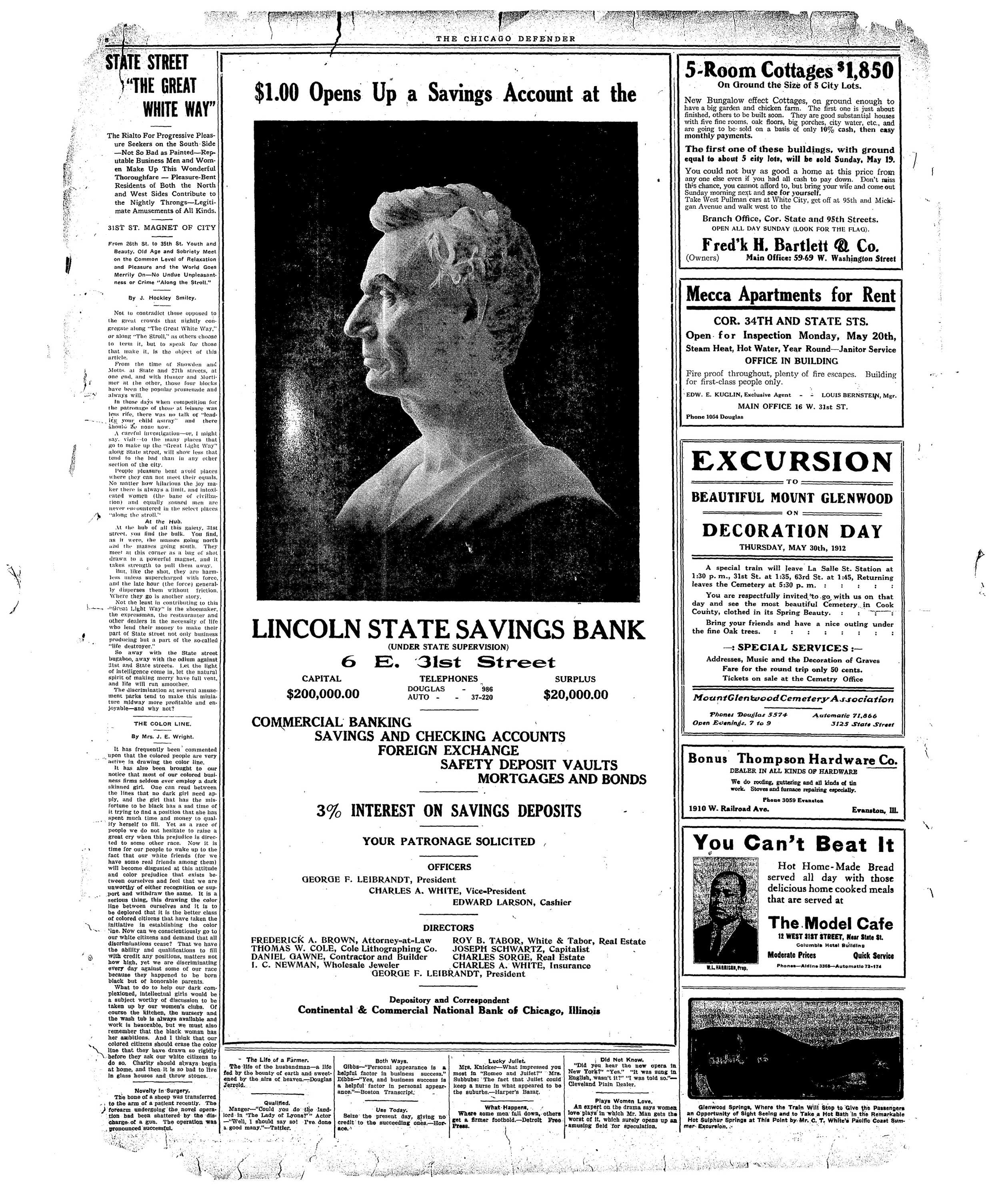
LINCOLN STATE
SAVINGS BANK
IS OPENED.
New Banking Institution at 31st and State Streets Throws Open Doors—Many Thousands Deposited—Friends Send Flowers and Officers Are Pleased—Gold Watch for President.
The Lincoln State Savings Bank, Thirty-first and State streets, opened Monday under the most auspicious circumstances.
Situated as it is in the heart of the most thickly populated district on the South Side, it is evidently filling long needed want, for the first day's deposits aggregated many thousands of dollars, and the business people of the neighborhood to a large extent transferred their accounts from other banks to the Lincoln.
All day friends of the new institution called, some on business, while others only came to cheer and congratulate the officers and directors. The officials present throughout the day were encouraged by the confidence displayed but in an interview with a Chicago Defender reporter they attributed "the wonderful business of the day to the fact that people doing business with a new bank had confidence when said bank was under state supervision."
"Add to this," said Director Frederick A. Brown, "the knowledge that the downtown depository and correspondent of this institution is the great Continental & Commercial National Bank, and there is added a sense of security. You can say that we feel encouraged far beyond our expectations."
Stockholders and Friends filled the place with flowers. Ebb Hinkle, trusted and bonded messenger, was the only member of the race in evidence. The list of stockholders showed no names of Negroes but among the depositors were several hundred. The officers of the bank are: George F. Liebrand, president; Charles A. White, vice-president; Harry E. Hobbs, second vice-president; Edward Larson, cashier. Directors: Frederick A. Brown, attorney-at-law; Thomas W. Cole, Cole Lithographing Co.; Daniel Gawne, contractor and builder; I. C. Newman, whole-jeweler; Roy B. Tabor, White and Taber Jeweler; Joseph Schwartz, capitalist; Charles Sorge, real estate; Charles A. White, insurance; George F. Liebrand, president.
Mr. George F. Liebrand was the happiest man around the institution. Aside from being the youngest bank president in the city he proudly displayed a handsome gold watch, the gift of his fellow officers and directors. The inscription inside the case reads: "Presented to George F. Liebrand, president of Lincoln State Savings Bank, May 6, 1912, by officers and board of directors."
An advertising feature of the bank will be a moving picture display in front of the bank every Saturday night.
MASS MEETING TO DRIVE
OUT PREJUDICE.
Lawyers Meet at Appomattox Club to Protest Rights President Cowan Presides.
The lawyers of the race have gotten together at last and not for more fees, but to protect our race from further insult from Southern and other white gentlemen (?) who come north and feel that they can put their hands on whom they please and be protected by law as well as race discriminations in all public places. Major Franklin A. Dennison, who was made president of the organization, said: "You men had better get in the trenches and fight; if you don't your home will not mean any more to you than a colored man's home in the south." The meeting was held at the Appomattox Club Thursday evening. The men were brought to their senses by the fact that Mrs. W. H. Hayes 224 224 Wabash avenue, and Mrs. R. C. Davis, 6542 Vineeties avenue, were so roughly treated at the drug store, southwest corner Randolph street and Wabash avenue, both property owners, when they were refused soda water by the drug clerk, who abused them in such a manner that several white gentlemen resented it who were in the store at the time. The insulting clerk told these ladies what he did to "nigger" women in the South. The ladies told several gentlemen about it and they held a big meeting on Thursday night and have decided to fight all such cases free of charge. One of the white gentlemen, a La Salle street broker, gave $1,000 to help fight the case and run race prejudice out of Chicago.
D R. A. L. SMITH RETURNS.
Dr. A. L. Smith, popular physician and former resident here, and his wife and son have returned to Chicago. For a year or more the doctor and his family have been residing in Ashville, N. C., where they went for his health. We trust the invigorating influence of the sunshine of the south has completely reshaped him to health and that he has returned to resume his practice here.
IMPORTANT NOTICE.
All death notices, notices of meetings, club entertainments, resolutions, etc., must be paid for, and in advance. This rule is imperative. Readers of The Defender will find the rates for advertising at the head of the editorial column.
THE Y.M.C.A. BREAKS GROUND FOR BUILDING
A Large Crowd Gathers to Witness the Turning of the First Shovel of Earth on the Site Purchased for the Y. M. C. A. Building—An Epoch Making Event—Men in Every Walk of Life Identified With the Work and Take Part in Ceremony—A Mighty Chorus Sings Familiar Hymns.
DR. GEO. C. HALL PRE- SIDES—MR. TILLMAN THE HONOR MAN
The Man Who Paid the First $1,000
Turns the First Shovel of Earth—
Association Presents Spade to Him
—He in Turn Presents Same to
Association — General Secretary
Messer, Major J. C. Buckner, Rev.
Martin, Adelbert Roberts and Many
of the Earnest Workers Make
Speeches.
By J. Hockley Smiley.
Chicago is happy in the prospect of the early completion of its Young Men's Christian Association building. Sunday, with simple but impressive ceremonies, the first shovel of earth was turned on the site at 38th street and Wabash avenue, and a mighty cheer went up from hundreds of throats, for in it it was seen another step towards the consummation of a movement that has interested the entire city for more than a year. No other idea has ever stirred Chicago as has the Y, M. C. A., and, according to the officials, the sum pledged by the people to meet Mr. Julius Rosenwald's magnificent 500,000 nucleus is being paid in in a most surprising and prompt way.
Large Crowd Attends Ceremony. Notwithstanding the burning rays of the sun a large crowd of men, women and children to witness the epoch making services. It was remarked that "never before in the city's history had so many men, young and old, rich and poor, been assembled in a move for the religious and moral uplift of their fellow men."
With the opening hymn the crowd was scattered but after the prayer by Rev. Jefferson the assemblage was brought closer together, and it was a mighty chorus that sang "Onward Christian Soldiers."
Upon a small platform sat the officials, friends and speakers. Upon a small table below was the "Cash Register" that had played such an important part in the work.
Dr. George C. Hall, chairman of the executive committee, presided. In opening the services he told of the origin of the idea for the Wabash Avenue Branch, of the early struggle to organize for effective work. He outlined the objects of the association, told of the plans for the building, and made an earnest appeal to everyone to finish paying their pledges. Considerable stress was laid upon the present opportunity and the ever ready "Cash Register," and the response was generous.
The Speakers
The Doctor announced as the topic of the afternoon, "How the Y. M. C. A. Appeals to Me," and in turn introduced the following speakers: Rev. Martin, pastor of Ebenzer Baptist church; Mr. Adelbert Roberts, Major J. C. Buckner, and General Secretary of the Y. M. C. A., Mr. J. William Messer.
The other speakers the chairman called "the workers." They were: Mr. Jackson Gordon, Mr. Morris Lewis, Mr. Cowan, Mr. R. E. Moore and Mr. Finn.
Mr. Tillman Uses Spade.
Then followed the event of the day, the turning of the earth. Mr. J. H. Tillman was the man honored. "This honor," said Dr. Hall, "goes to the man who paid the first $1,000. He has overfilled the spade with dollars, and he is the pride of the entire association."
As Mr. Tillman turned the soil another mighty cheer went up. The spade was then presented to him by the association, but he in turn returned it to them.
Mr. R. J. B. Ellington, an active worker in the association from the beginning, presented the spade. He relates the following incident: In his enthusiasm to procure and decorate the shovel he often talked with his little grandson, Charles W. Ellington, Jr., who was anxious to be present. The young man was late, however, and did not arrive until the exercises were over. His first thought was the spade and the hole it had dug, but when shown the small dent it had made the youngster disastrously said, "Well!"
Last week when Mr. T. F. Ryson was seen purchase a grip, no sign-fiance was placed on the fact. However, the announcement of a visit to Buffalo, N. X., tonight has caused his friends to remark, "We wonder why."
REV. J. W. E. BOWEN
ON CHURCH POLICY
Well Known Orator and Educator Talks About the Methodist Episcopal Church—Their Need of a Negro Bishop.
By Woodlee.
The Rev. J. W. E. Bowen, D. D. Ph. D., widely known as an orator, educator and publicist, and former president of Gammon Theological seminar in Atlanta, Ga., in an interview with a Defender reporter, declared himself a favor of the election of a Negro bishop in the Methodist Episcopal church, even if such election meant the split of the church on the color line and the withdrawal of the colored element from the church.
BOOY.
Dr. Bowen discussed freely the situation and appeared to be slightly distressed when the Defender man pointed out to him that a Negro bishop would not be allowed to preside over white conferences, and such a bishop would be called a "kitchen bishop."
"Kitchen or no kitchen," said he, "the younger element of the church is clamoring for a Negro general superintendent and they are going to one, even if it is necessary to withdraw, and I for one will gladly welcome you open door where we can march out and form of all the colored Methodists, the great church under leadership of our own."
Dr. Bowen was asked if the report was true that in recent years the white bishops are neglecting their colored conferences. He replied to certain extent and that is the reason for the clamor among the younger and more progressive element to which he had previously referred.
In answer to another question he said there is no difference in the manner of worship, doctrine or creed between the Methodist Episcopal church and the African Methouist Episcopal church and the two if united would strengthen the spiritual ties that bind race and accelerate its spiritual, moral and financial progress. He did not say how, however. Dr. Bowen then, by request, dictated the following:
"The colored membership has been neglected by the white general superintendents to a large extent, and that is the reason there is a clamor for a Negro general superintendent.
"The election of one is absolutely necessary for the enlargement of the work among the colored people. Of course, white men have done splendidly by us in times past, but the conditions have changed and our people feel that they need their own leaders to co-operate with the white general superintendents."
Eight years ago Dr. Bowen received a large complimentary vote for the general superintendency at the Los Angeles General Conference.
When asked who was slated as the colored man to be elected he mentioned the name of the Rev. Robert E. Jones, D. D., editor of the Southwestern Christian Advocate. Dr. Jones will be remembered by the local Y. M. C. A. workers for his brilliant address during their campaign.
Dr. Bowen left the city Tuesday for Minneapolis.
MASTER- MALLETT AGAIN IN
HOSPITAL.
Master John Mallett is recovering in room 204. Provident hospital, from the effects of an operation early this week. Master Mallett was a patient there before, but was compelled to return after a few days at home. He is one of the most popular patients in the institution and it is said his daily mail numbers from ten to a dozen letters.
PROF. G. W. COOK BOOMED FOR PRESIDENT OF HOWARD UNIVERSITY
Testimonial in Honor of the Energetic Secretary—Life Worked Lauded—Honorable W. H. Lewis Toastmaster—Congressman Kendall Speaks.
By R. W. Thompson.
(Special to The Chicago Defender.)
Washington, D. C., May 10.—The testimonial banquet in honor of Prof. George William Cook, held last Friday evening in Miner hall on the campus of Howard university, was the largest function of its kind ever known in the District of Columbia. Covers were laid for over two hundred guests, and the dining hall was crowded to its utmost capacity with appreciative friends of the energetic secretary of Howard university, representing the best brain and culture of the Negro race in the world. Prof. Cook has been identified with the institution for thirty-nine years, and a more fitting recognition of his valuable service, efficiency and the esteem in which he is held by the people of the community could not be conceived.
Carter, of the bar of Harrisburg, Pa., "Howard As She Is," Prof. Kell Miller.
"Our Guest as an Educator," Prof. Dwight O. W. Holmes, of Baltimore. To all of the many expressions of commendation of his efforts to place Howard in the front rank of educational centers and to exert his influence toward the advancement of civil righteousness, Prof. Cook feelingly responded, taking for his theme, "The Two Seals," relating the story of how the university came to have two seals and describing the sublime spirit of human and national uplift for which they stood. His outline of the work that Howard has done since its forty-five years of existence was intensely interesting, and the larger portion of the historical data presented at first hand was new to many of the guests.
Hon. William H. Lewis, assistant attorney-general of the United States, was toastmaster, and his speeches, abounding in rich witticisms and flights of real eloquence by turns, justified the wisdom of the promoters in selecting him for this arduous task. The Toasts, Toasts that sparkled with humor and carried information of much value, eulogizing in felicitous and sincere fashion the central figure of the occasion, were responded to as follows: "Howard As She Was," Rev. Logan Johnson. "Our Guest as a Citizen." Mr. Justin
THE WORLD'S GREATEST WEEKLY NEWSPAPER
WASHINGTON LAUDS CARNEGIE HERO FUND
Dr. Booker T. Washington, Principal Tuskegee Normal and Industrial Institute, Reviews Report of the Hero Fund Commission—Terms It "Carnegie Heroes and the Race Problem"—Commission Rewards 583 Persons—Heroes of All Kinds—Many in Humble Life, Others Prominent in Business and Social Life—One a Woman 70 Years Old.
HEROISM IN EVERY MAN
AND WOMAN.
Nine Cases Credited to Negroes—The Cases in Detail—Deeds of Heroism Not Confined to Any Class or Any Race—Noted Educator; Declares "When Ordinary Men and Women Meet and Recognize Human Need it Makes: Little Difference in What Form or Color That Need Presents itself.
By Dr. Booker T. Washington
(Special to The Chicago Defender.)
Tuskegee, Ala, May 11—One of the most interesting little books which I have read in recent years is the report of the Carnegie Hero Fund. I think it will do any one good to read records printed in this book of the 583 persons who have been sought out and given recognition, since the commission was founded, because they risked their lives in the effort to save others from injury and death. Most of these heroes, as appears from the report, are men and women from the humbler walks of life. They were sailors, miners, railwaymen, and often common laborers, men, for the most part, employed in the dangerous trades, who in their work come daily in contact with unusual perils.
I observed, however, among this list of heroes an assistant secretary of the New York Stock Exchange, a school superintendent in Kansas, an insurance agent and a bank clerk. A considerable number of heroes whose deeds have gained the recognition of the commission are boys and girls; as students. But among others I noticed the name of a woman, an author and an educator, who is 70 years of age. It is evident, therefore, that herism, physical herism of the kind to which Mr. Carnegie has tried to give recognition, is not confined to any particular age or class. It would, perhaps, be nearer the truth to say that there is a certain amount of herism in every man and woman which simply needs an opportunity and an
The last report of the Hero Fund Commission, was made in January, 1912, and there are, as I have said, 583 deeds of heroism recognized and recorded out of 6,607 cases examined and passed on by the Commission since the fund was established in 1904. In each case, in addition to the name of the person who performed the heroic deed, a brief record has been kept of the particular act of heroism rewarded and the circum- (Continued on Page 2.)
HOMED FOR OF HOWARD UNIVERSITY
Energetic Secretary—Life Work Lewis Toastmaster—Condall Speaks.
Thompson.
Carter, of the bar of Harrisburg, Pa.
"Howard As She Is," Prof. Kelly Miller.
"Our Guest as an Educator," Prof. Dwight O. W. Holmes, of Baltimore. To all of the many expressions of commendation of his efforts to place Howard in the front rank of educational centers and to exert his influence toward the advancement of civic righteousness, Prof. Cook feelingly responded, taking for his theme, "The Two Seals," relating the story of how the university came to have two seals and describing the sublime spirit of human and national uplift for which they stood. His outline of the work that Howard has done since its forty-five years of existence was intensely interesting, and the larger portion of the historical data presented at first hand was new to many of the guests. His happy tributes to such eminent founders of Howard as Gen. O. O. Howard, John M. Langston, Dr. Robert Reyburn and others evoked hearty praise. Prof. Cook's address is voted by his admirers to have been the most comprehensive study of the university yet given to the public, and it marks the high-water mark in formal quality. At the close of Prof. Cook's speech he was presented with a beautiful bouquet of American Beauty roses, a gift of the ladies of Howard university. Just before he spoke the audience was keyed up to
(Continued on Page 3.)
---
PRICE 5 CENTS
---
stances under which it was performed. There are, however, in this new book of heroes, which Mr. Carnegie through the commission he has estab lished, is gradually bringing together two classes of incidents which are called heroes. The first are cases, the first in which a black man or woman has risked his or her life to save a white man or woman; second, in which a white man or woman an has performed a similar, act for the sake of a black man or woman.
There are nine cases of heroism credited to Negroes in the report issued a year ago, and since that time I have learned by inquiry, three other cases of heroism by Negroes have been investigated and recognized by the commission. Following is the account of these particular instances of Negro heroism as recorded in the Report of the Hero Fund Commission: John B. Hill, aged 35, cochman, rescued Thomas S. Prescott (white), aged 6, Florence Williams (white), aged 21, Florence Williams (white), aged 6, September 1, 1966. By grabbing the bridle of a runaway team bitten to a landlady, the team being dugged some distance, threw the horse. It fell upon him, breaking the stitches in a wound due to a recent op-
1.
Bronze Medal and $500 to reimburse him for pecuniary loss sustained on account of his service.
George A. Grant, aged 23, teamster, sustained fatal injury on August 1, aged 46, president American Printing & Decorating Co., and Charles A. Whipple (white), aged 40, construction from a runaway, Groton, Connecticut, June 23, 1908. Grant grasped the bible and unable to control the other horse because its bible was off, he throw the one he had run over and run over by the vehicle. He died the second day after, and received $25 a month for the support of widow or until she remarries with $5 a month additional for each of four children, until each reaches the age of 18. Theodore H. Homer, aged 23, writer, rescued Fredlea Berger (white), aged 8, guardian of a young boy, guarding Bberger, and grasping its bible stopped it within eighty feet. He received $500 for conventional purposes as needed.
Harley Tomlinson, aged 34, farmer, died assisting in an attempt to save Oscar Norwood, North Carolina, August 3, 1999. During a flood of the Yadkin River, Tomlinson and another man in a bateau paddled through the water, and was chasing to a flat boat, and had gotten Colson aboard when the bateau caped Tomlinson and Colson were drowned.
Bronze Medal and $20 a month for support of widow during her life, or until marriage, with $2 a month additional for each child until each reaches the age of sixteen.
Boyce Lindsay, aged 16, delivery boy, save E. teynall Smith (wife), aged 17, delivery boy, save J. burgess, South Carolina, May 28, 1910. Stooping over one rail in the face of a car, Smith found himself in the car were but four feet distant, Lindsay lunged Smith off the middle of the track, Smith himself being struck on the right shoulder and whirled around against the side or a car as he was straightening up to the track from the track. Nelther was injured.
Bronze Medul and $2,000 for educational purposes as needed.
Bronze Medal and $200 toward the purchase of Bronze A. Smith, aged 31, laborer, attempted to save Theodore Dilhoff (white), natio, Italy, November 26, 1810. Disregarding warnings to take precautions for his wife, Dilhoff was a 12-foot manhole of a sewer, where Dilhoff lay unconscious from carbonic acid above Dilhoff's body and as he was reachable above Dilhoff's body and as he was reachable across Dilhoff's body. Smith fell unconscious when gotten out.
Bronze Medal and $1,000 towards the purchase of a home.
Mack Stallworm, aged 33, oil tank cleaner, died saving Squire Bradford, aged 28, oil tank cleaner, from suffocation, died saving Bradford, aged 151. Bradford was overcome in a tank gas which had formed in it. Stallworm, aged 18, was 15 inches in diameter, and grasped Bradford, lifted him up so that two men on it were sucked in. Bradford was gotten out, but Stallworm was overcome by the gas and was suffocated. He could be rescued. Bradford revived.
port of widow during her life or until she remarries, with $5 a month additional, son until he reaches the age of sixteen. In three of the cases I have quoted, it is evident that the widow was formed by Negroes in behalf of Negroes. in every other instance when a colored man was formed by Negroes in behalf of some member of the white race. There are eleven instances recorded in the Carnegie Book of Heroes in which the widow was formed by or attempted to be rescued, was colored, following are the accounts of these heroes: Lochlin, M. Winn (white), aged 20 physician, saved William Miller, aged 45 watchman, saved William Miller, aged 25, watchman, and James E. Smith (white), aged 36, cotton buyer, from James E. Smith, aged 25, watchman, and James E. Smith, aged 16, 1966. The three men were thrown into a pond at night, 300 feet from the shore who tried to swim to the shore was be-
Ocean Boulevard at Golden Gate Park. One of the Many Interesting Points to Be Visited While In San Francisco, a Stopover Point of Mr. C. T. White's Pacific Coast Summer Excursion.
coming bunched by the cold, when Winn swam about sixty feet and helped Winn to shore. This greatly fatigued Winn, and he had little distance to the other two and helped them to shore, although the second rescue him almost exhausted him. Shyler Clark. Clifford V. Graves (white), aged 50 farmer, saved Merritt L. Brown, aged 42 Kentucky, March 7, 1967. Graves attacked the animal with a pocket knife, trampling Brown to the ground. He was knocked down and sustained a fractured rib and bruises all over his body, before bull was chased away by Graves's dog.
Bronze Medal and $700 to be applied to the libation of his debts.
Silver Medal and $25 a month for support in her medical care until until she remarries, and $2 a month additional for each of six children until each reaches the age of sixteen. (age 37, foreman, died saving John Bevin, aged 35, laborer, from suffocation. New Orleans, when she was 11, she was the bottom of an 11-foot sewer manhole and fastened a rope around Bevin. The owner was removed to recover, but when Owner was removed to Silver Medi to wilde and $2,000 to laquate mortgage on her property and $2,000 to pay her rent, remarries, with $2 a month additional for each of two children until each reaches the age of sixteen. (age 61, housewife, attempted to save Evalina Smith, burned by fire, May, 2014, Florida, May, 2014, burning cottage, through dense smoke, to the second room from the outside door, her Mrs. May, burned by fire, abby her, Mrs. Cone rolled the lumber from blazing bed into the front of her gingham skirt and carried it outside, sustaining burns on the hands. The baby died.
William M. Edwards (white), aged 25, longshoreman, rescued Lucie Hubbard, Lichfield, England, died dephin, Ft. June 20, 1908. Edwards still down a rope through a hatchway of a ship, which was in lanes due to an explosion, and secured Hubbard, fastened him to a boat, and assisted him up, Hubbard died. Silver Medal and $1,000 toward purchase. E. Adams (white), aged 15, school boy, helped to save Ary V. Magee, aged 13, and died assisting in an attack on a boat. G. Bray, aged 11, from drowning, Decembr, Michigan, December 7, 1904. Lying fat on the ice of Lake of the Woods, he assisted other boy holding to his ankles, Adams came his way to a hole in which Magee dragged Mahoney from the water; He and his companions were approaching the ice broke; all three were drowned. Bronze Medal. Rescued in St. Petersburg (white) aged 38, chief of police, rescued卢格 Long, aged 26, laborer, from a cave-in in a well.
Temple Square, Salt Lake City, assembly Hall, Where This Excursion of Interest and to Attend the Spec in World) in the Mormon Tabernacle C. T. White's Pacific Coast Summer B
THE RAIN
---
Silver Medal.
Leland jumped from a river boat into Jermye Creek and in water fifteen feet below. The boat had fallen overboard. Leland caught Simpson's hands, the latters head apace momentarily, and the surface of the water were drowned.
Bronze Medal and $250 to father as needed.
On the leaflet of the commission's report the Carnegie Book of Heroes, the following statement of Mr. Carnegie in regard to the purpose for which the Hero Fund was established, is quoted:
"I do not expect to stimulate or create heroism by this fund, knowing well that heroic action is impulsive but I do believe that if the hero is injured in his bold attempt to serve
or save his fellows, he and those dependent upon him should not suffer pecuniarily thereby."
Now the interesting thing about this report is not so much the individual heroism it reveals, as what it shows of good in the ordinary man of both races. The majority of heroes whose names are recorded in this book are the common men whom we meet working in the streets, on ships, in mines; men who are doing for us the hard, rough work of the world. But deeds of heroism are not confined to any class or to any race. More than that, this report shows that when the ordinary man or woman meets and recognizes human need, it makes little difference in what form or color that needs presents itself.
Sometimes, in discussing the relation of the race, certain persons have made the assertion that the thing which made the problem peculiarly difficult was that the races were divided by an instinctive distrust and hatred, the one for the other. Whether or not that is true in just the sense which the people who made the assertion mean, I shall not discuss here. It seems to me more important to call attention to the fact that there is in the average man a disposition to help the man who is next to him, his neighbor, whether he be white or black. In fact, the records of the Hero Fund not only show that the average man is, under normal conditions, interested in the welfare of his neighbor, he is even willing to sacrifice himself, even to give his own life, in order to protect him from injury and preserve him from evil.
The real trouble is that the white man and the black man do not have an opportunity to get next to each other, or rather they too often meet each other in such a way that each sees the worst, and fails to recognize the best that is in the other.
I find that in most cases where white men abuse the Negro, or where the Negro complains about the white man, each is talking not about the individual white man or the individual Negro, whom he knows, but about a class of individuals which he has constructed out of general impression of persons he did not know intimately and well. Where, as frequently happens in the South, black men and white men get to know each other and where the races understand each other, there is very little difficulty between them.
It is in their individual relationship where men get to know each other by working together that we must look for a solution of the race problem in the South and elsewhere.
Let me add in conclusion, that if does not seem to me that there is any reason for despair as long as there remain individuals among the masses of each race who are willing to risk their lives to serve and save individuals of the other.
INFORMATION WANTED.
Anyone knowing the whereabouts of
Showing Temple, Tabernacle and Ascension Will Stop to Visit the Different Pointsally Arranged Organ Concert (Biggestile, to be Heard by the Guests of Mr. Excursion.
Maude Jones (Mrs. Rodgers Jones), formerly of Milwaukee, please notify the Chicago Defender office. She has a son by the name of Harold Parks. Mrs. Jones is portly and of a dark brown complexion. A brother also resides here by the name of Sherman Peyton-4-11.
Only a Little Worse. The fellow that does you a good tism and then brags about it is like the cow that gives a big bucket of milk and then kicks it over.
THE CHICAGO DEFENDER
The North Shore Men's club rendered a musical and literary program Monday evening, April 29, at the Hermann Baptist church, for the benefit of the missionary society, under the management of Dr. Carl G. Roberts. The program was as follows:
Song, congregation; prayer, Rev. J. Chavis; opening remarks, Dr. C. G. Roberts, master of ceremonies; vocal solo, Mr. P. Stevens; address of welcome, W. P. Harrison, president; response, Mrs. H. Chavis; instrumental solo, Miss Lenora Curtis; novelty number, Mr. E. Gordon; reading, Miss Hazel Robinson; novelty number, Mr. Walter Kinbrough; paper, "The Temple of Service," Mrs. Mattye Anderson; vocal solo, Mrs. Beatrice Bell; reading, Miss Carita Robinson; paper, "North Side Woman's Club," Mrs. J. Guy; vocal solo, Mrs. J. Weathers; reading, Miss Jesse Richardson; benediction, Rev. J. Chavis.
A crowded church enjoyed this in
teresting program.
The Wayman Junior Industrial club's monthly meeting was held Thursday evening, May 2, at Mrs. S. E. Cooper's residence, 212 West Schlerr street, at which time four new sections were added to the adult department. The following newly elected officers were installed by Mrs. Ida B. Lewis, state organizer; Mrs. S. E. Cooper, president; Mrs. Cora Couch vice president; Miss Beatrice Watts, recording secretary; Bertha Carrol, assistant recording secretary; C. R. Williams, corresponding secretary; Mrs. Kate Lewis, treasurer; national delegates to Hampton, Va.; Mrs. Cora Couch, Mrs. Mary Payton, Mrs. C. R. Williams, Mrs. Beatrice Watts; alternates—Mrs. Minnie Smith, Mrs. Minnie Lloyd. The visitors at this meeting were: Mrs. Ida B. Lewis, state organizer; Mrs. Horton, president of the Ladies' Improvement club of Milwaukee, Wils.; Mrs. C. Wooten, Mrs. Cransby, Miss Mary Bonsley. The regular business meeting, first Thursday of each month; the study of race history, the third Thursday of each month; Mrs. Lydia Stewart, instructor; monthly social meeting at Mrs. Cora Couch's residence, 941 Franklin street, May 23. All are invited to these meetings; refreshments served—Mrs. S. E. Cooper, president; C. R. Williams, corresponding secretary.
Dr. Wilberforce Williams will preach Sunday evening at Wayman chapel in absence of Rev. Stewart. A large audience is expected to hear Dr. Williams. Prof. B. E. Johnson, who has charge of the choir, is planning a splendid singing service.
Mr. and Mrs. William Holliday entertained at a six o'clock dinner Sunday Mr. and Mrs. Edward McCoo and two children of Englewood and Mr. Gibbons of the west side.
Mrs. Snowden entertains the North Side Woman's club at her residence, 7024 Ravenswood avenue, Thursday evening. A special program is being arranged for the occasion.
Mr. and Mrs. Harry Chandler entertained the Jolly Twenty Thursday evening at their home, 54 East Oak street.
Mrs. Clifton Fagel is convalescent after undergoing an operation.
Mr. and Mrs. George Johnson, 20 Delaware place, gave a dinner party in honor of Mr. and Mrs. Crawford. Those present were: Mr. and Mrs. Crawford, Mr. and Mrs. John Guy, Mr. and Mrs. William Carter, Mr. William Mitchell and Mrs. Charles Clemens. Mr. and Mrs. Crawford, who were recently married, will make their home in Centralia, Ill, where Mr. Crawford owns property. Mrs. William Carter leaves shortly for Iowa, where she will visit friends.
THE SICK.
The Latest News About Your Friends and Acquaintances Who Are Under the Physicians Care.
Mr. Wvatt Gibson, 6638 Stewart avenue, is still confined to bed. His daughter, Miss Virgie, is reported better.
So improved in condition is Miss Martha Plummer, 3227 Dearborn street, that her friends expect to see her out on the porch, if the pleasant weather continues.
Mr. Joseph Tobannah, 444 W. 56th street, has recovered somewhat from a severe attack of blood poisoning.
At Provident hospital Mr. James Newsome is reported greatly improved.
Mrs. Harry Boger is a patient at St. Luke hospital where she was operated upon by Dr. Daniel H. Williams.
Mr. George Smith, an old resident of Chicago, who suffered a second paralytic stroke recently, is reported "resting and improving" at Provident Hospital.
Mrs. Moore, wife of Mr. Joseph Moore, still holds her own in a long and severe illness. Mr. Julius F. Taylor, 5027 Armour avenue, editor of The Broad Ax, although still confined to the house, is much better.
MAJOR JACKSON GAINS.
Final Canvass of Votes in the Third Senatorial District.
The final canvass of the votes in the Third Senatorial district shows Major Jackson an additional 600 votes. His lead over all other candidates is now 1.639.
Ward Precincts Votes
1st ..... 2 25
2d ..... 33 5,529
3d ..... 19 855
4th ..... 18 99
5th ..... 1 20
YOUNG-M'KINNEY.
Nuptials of Popular Couple a Pretty Affair—Bride Second One From Same House Within the Year.
The marriage of Miss Alice Young to Mr. Jefferson J. McKinney Thursday, April 25, was one of the prettiest nuptials of the season. The ceremony took place at the residence of the bride's parents, Mr. and Mrs. Edward Young, 3333 State street, Rev. W. D. Cook, pastor of Quinn chapel, officiated.
The wedding party was as follows: Miss Evelyn Whitman, Miss Bennie Stoval, Miss Ruth Young the bride's sister, and Messrs. Le Bobin, Frank P. George, George Fielding. The bride's gown was of crepe de media, dropped hand-made lace and aplique trimmingss, carrying a huge bunch of sweet peas. Miss Bennie Stoval wore pink silk poplin, trimmed in shawwood lace and white satin. She carried a large bunch of sweet peas. Miss Evelyn Whitman wore white satin with pammy rose. Miss Ruth Young wore pink satin trimmed in lace over pink volle. She carried a huge bunch of sweet peas. Mr. Will Kelly, a life long friend of the groom, acted as master of ceremonies. Mr. Charles Elger, violinist, and Mr. James Brown, pianist, played the wedding march. Refreshments were served and the happy couple received many presents. Many of the bride's friends remarked that she was the second one from the same house within the year, it being remembered that Mrs. Charles Reece (nee Edwards) also resided at that number.
THE NEGRO AS THE "CAT'S PAW."
By D. W. Johnson.
With the war between capital and labor raging with all the fury and intense feeling of class hatred characteristic of strikes, with no medium of compulsory arbitration to settle the difference between the contending parties, the city with its millions of peaceable and disinterested citizens, is placed in a most precarious condition. There should be a law compelling both employer and employee to abide by their contracts until the difference of their grievances are settled. As it is unions strike when they feel disposed or the employers lock out their help when they please. Such conditions are intolerable and 'entail a great burden upon the public with all of its consequence of danger and inconvenience.
The worst feature of it is, that the uninviting, inoffensive Negro, by importation, is injected into the situation and used as the "cat's paw" to pull the nuts out of the fire while the war is raging, and as soon as the trouble is settled he is cast aside by the employer, left without any means of support, probably arrested for vagrancy, and bears all theodium heaped upon him by those whose places he takes. When all the trouble between the warring parties is forgotten and they are cooling together like young doves, the hatred and malicious feeling engendered have to be borne by the peaceable and disinterested colored citizen.
Such conditions ought to be stopped.
There is no reason that the colored people of Chicago should be held responsible, through maltreatment and race prejudice, for the acts of unscrupulous and designing employers.
REAL ESTATE NOTICE.
To those who may contemplate making a real estate purchase, and are looking for bargains and a square deal, it would be well to consult with our prominent real estate dealer, A. C. Harris, 3331 South State street, at once; so say the following persons who have made purchases during the month of April, and the same was negotiated through A. C. Harris: Mr. and Mrs. Walter Potter, three-story apartment building, 4741 Evans avenue; Mr. George S. Bundy, three-story electric lighted and steam heated apartment building, 4629 Langley avenue; Mrs. George Hancock, two-story apartment building, 5528 Engleside avenue, Mr. BenJ. Smith, two-story apartment building, 3756 Indiana avenue; Mrs. Amanda Mitchell, residence 3149 Prairie avenue, and Mr. Russell Bryan, residence, 3421 Vernon avenue.
OPPORTUNITY FOR A YOUNG MAN.
Examination for Superintendent of Small Parks Offers Chance for a Good Job.
In its endeavor to keep the young men of the race posted on good opportunities for employment the Defender prints the following announcement: An examination has been arranged for the position of superintendent of small parks, a position made vacant by the recent discharge of John Algots. The position carries with it a salary, of $2,500 and during much of his incumbency Algots lived rent free on the city farm at Riverside. The exact date for the examination has not been set, but it will be held within a month.
Mr. Proctor Chisholm, the decorator and designer, is receiving praise on all sides this week for his splendid work in decorating the interior of the Lincoln State bank, which opened on Monday. There is nothing to equal it south of Van Suren street is the verdict. The officers and directors have all complimented him in the highest terms.
Your home could be done in the same manner. A call by telephone will bring him to your door where he will give you an estimate, which will please you as well as he pleased the banking firm.
Safe With Him.
"I'm going to tell you a great secret." "Yes?" "And I wouldn't have you tell anybody I told you for all the world." "You can trust me. I never told a secret yet. I've got such a poor friend that I never remember who told me what."
SUMMER EXCURSION TO THE
to the Pacific Coast. Stops will be made going as follows: Three days at St. Paul, Minn., to attend the NATIONAL NEGRO EDUCATIONAL CONGRESS which convenes July 15, 1912
First Class Sleeper $228.75
Tourist Sleeper $195.85
And in the Canadian National Park, the Great Glaciers of the Selkirk Mountains. Traveling in the mountains will be done by daylight. A day sail down the Puget Sound (Vancouver-Seattle) on one of the Canadian Pacific Coast Steamers, surpassed by none. Spending one day each at Seattle and Tacoma, Wash.,
and Portland, Ore.
Over the great Mountain Shasti route to San Francisco, California, where a
STOP OF 60 HOURS WILL BE MADE
Return via Denver and Rio Grande Ry, passing through the Canyon of the Grand River, Eagle River Canyon, over the Tennessee Pass and through the Royal Gorge. Stops will be made also at Salt Lake City, Denver, Colorado Springs, Kansas City and St. Louis. For rates and particulars, write
C. T. WHITE
C. T. WHITE
1050 BURNABY ST. VANCOUVER, B. C.
R. S. ABBOTT, 3159 State St., Chicago Representative.
1050 BURNABY ST.
R. S. ABBOTT, 3159 State S
The Overton-Hygienic Mfg. Co.
PRESENTS TO CHICAGO
High Brown De Luxe Face Powder
Made especially for you - 50c
RO ZOL
The face bleach that will bleach 25c
ADA POMADE
The perfect hair dressing - 25c
PU-RE
To destroy perspiration odors 25c
For sale at all first-class drug stores; Agent
wanted everywhere.
WE MANUFACTURE ALL OUR GOODS
Phone Normal 6114
5752-54 STATE ST. CHICAGO, ILINOIS
Harm Done by London Smoke.
A blackish incrustation, in some places four inches thick, on the underside of the cornice of St. Paul's Cathedral and due to the action of sulphuric acid upon the stone, testifies to the effects of the smoke evil in London.
A little boy who went to the same school I did was reading a story about witches. When he finished the teacher asked him if he knew whether witches still existed. "Oh, yes," he said, "only they call them old maids now."—Exchange
Lesson All Should Learn
Lesson An Should Learn.
Plutarch said to the Emperor Trojan:
"Let your government commence on your own breast, and lay the foundation of it in the command of your temper and passions." Here come in the words, self-control, duty, and conscience.—S. Smiles.
True Measure of Success
I have learned that success is to be measured not so much by the position that one has reached in life as by the obstacles which he has overcome while trying to succeed.—Booker T. Washington.
A Plato! By His Lopic.
"What will the woman of tomorrow be?" sighed the pensive person. "Oh, a year or two younger than she is today," replied the one who had reasoned such things out.
A man ought to live in such a way that it won't take a brass band to get out a crowd to his funeral.-Puck.
Procrastination is the thief of time
WAKE UP!
WAKE UP!
WAKE UP
WAKE UP! Don't a
WAKE UP! WAKE UP! WAKE UP!
WAKE UP! Don't allow yourself or those dependent on you to suffer in the time of need for the sake of a few paltry dollars. It requires very little to carry a splendid life insurance policy in the
WESTERN LIFE INDEMNITY COMPANY
(Established in 1854)
CHAS. A. GRIFFIN, Agent, 3022 Wabash Ave., CHICAGO, ILL. This old and reliable company invites you to form a part of its membership. Equal rates and protection to all.
Modern Witches
Doug. 2586 Office: Oak 511
Auto 72-607
DR. G. WILLIAM MILLER,
Physician and Surgeon
Office, 4709 State Street
Hours: 9-11 A. M.; 1-3 and 6-8 P.
Residence, 3582 Forest Ave.
DR. A. BAILEY WILLIAMS,
PHYSICIAN AND BURGON.
Hours: 1-15 p. m. to 1 p. m.; 1-18
to 11 p. m.; 7 p. m. to 11 p. m. and
Appointment. Provident Hospital Daffy,
5108 State Street Chicago
The Spirella Boning
makes the Spirella
Corset Bake, the
comfortable, exquisite, guaranteed shape-retaining.
An expert Concierge, trained by us, will serve you at your home
MISS. LOLA M. NORTON
3084 Wabash Ave. Corsetiere Phone Address 511
Spiraella Advertise in leading media
Dr. Theo. R. Mozee
Office Hours, from 9 a.m. to 6 p.m; from 7 p.
m. to 9 p.m. Sunday by appointment.
Phones: Oakland 4662. Auto. 73-458.
4715 South State St., CHICAGO, ILL.
Phone Aldine 3458
Ida M. Dempcy
Stenographer & Typist
Instruction at Reasonable Rates
3716 Dearborn St. :: Chicago, Ill.
The New Bedford Hotel
2 Blocks South Michigan Central Depot.
Nearly Furnished Rooms
By The Day or Week
116 WEST WATER STREET
J. N. BEDFORD
Telephone 1872R Kalamazoo, Mich.
Smith O'Sons
Restaurant and Lunch Room
Extra Fine Home Cooking
Private Dining Room
8286 State Street Chicago
!
City Churches—Religious News
Royal Gorge In the Grand Canon of the Arkansas, on the Main Line of the Denver & Rio Grande Railroad. Height of Wall 2,627 Feet Above the Track. At One Point, Hanging Bridge, the Width Is But Ten Yards, and the Road Bed has Been Built Out Over the Water, to be Seen by Mr. C. T. White's Pacific Coast Summer Excursion.
Every church is invited to contribute to this column each week. The only condition is that said letters reach this office by Wednesday noon.—Ed. Rev. Thomas inaugurated a new idea at Ebenzeret last Sunday by administering communion in the afternoon. The innovation seemingly pleased his large congregation. Rev. D. E. Johnson of Hot Springs, Ark., prescheduled at Batho A. M. E., christened Sunday morning, a large audience greeted the visiting clergyman and his efforts were rewarded by a special collection for his benefit.
FREDERICK DOUGLASS CENTER.
the meeting of the Fisk Endowment club last Sunday drew a large audience. Rev. J. E. Cranter and D. L. O. Baerd each made an enthusiastic plea for Fisk. The music was excellent. A pleasant surprise was enjoyed in the late arrival of Dr. Bowen who also paid a friendly tribute to Fisk. The symposium at the Woman's club on the late conference was very interesting. The list of speakers was too long to be inserted in this report. Maurice S. Kuhn, dramatic leader of Lincoln Center, will read a play next Sunday. All cordially invited.
ST. MARY'S A. M. E. CHURCH.
The third quarterly meeting will be Sunday, May 12. Presiding Elder T. Reeves will preach morning and evening.
Rev. W. H. Griffin of Hyde Park will preach the sacramental sermon at 3 o'clock Monday evening, Love Feast. Wednesday evening, quarterly conference. The ministers and their congregations are invited to worship with us. Monday evening the Lewis Carnation club will give an entertainment for Mrs. Arms club. Tuesday evening, May 14 drama, "Burley's Ranch," for M52 Higgins club. Wednesday evening, Lewis Carnation club will give an entertainment at Korners hall, Evansston.
OUT IN ENGLEWOOD.
Weekly Letter from This Thriving
Section of the City—All the
News.
The Ideal Woman's club met at
the home of Mrs. H. Smith, May 10.
Little Charles Steward of 6225
Morgan street, is able to be out after
a week's illness.
The young folks of Englewood gave
a surprise party on Clarence Moors,
6540 Aberdeen street Friday. The
evening was spent in games of all
sorts until a late hour, then each boy
and girl departed for their different
homes happy.
Look out for the June weddings in
Englewood.
Sunday is "family day" at Shiloh
Baptist church. Rev. Harris has pre-
pared a sermon for the families and
in the evening at 7 p. m. a fine pro-
gram will be rendered by the young
folks. The cantata was a success.
The church was crowded both nights.
Sunday is "Mothers' Day" at Hope Presbyterian church. At 3 p. m. a special program will be rendered and in the evening the choir will render good music.
Mr. Charlie Alexander of 6112 Ada died after several months' illness. The body was shipped to central Kentucky to his parents, accompanied by Mrs. Melton.
The Ideal Woman's club held their meeting at the Old Folks' Home May 4. A delightful afternoon was passed. Rev. Johnson, Arkansas, was the guest of honor and made a few remarks, also Mrs. Barnett, our past president, made a fine talk to the inmates. After the program refreshments were served.
A CHANCE OF A LIFETIME
Prominent Real Estate Firm Offers Exceptional Opportunity to Secure a Home.
Every young person should investigate Frederick H. Bartletts & Co.'s remarkable inducements to purchase a home of your own on their easy payment plan. The wise will hasten to secure "free rent for old age." Owning a home gives one prestige. The general office of the company is at 69 West Washington street, but first read their advertisement on another page.
Paper From Cotton Stalks
Cotton stalks, it is thought, may be used for the manufacture of paper. A machine has been, patented which will separate the brown bark from the inner pith, and it is claimed that excellent paper pulp may be made from the latter. From the bark a substitute for excelsior is manufactured.
Seldom.
A man seldom has the courage of his wife's convictions.
PROF. COOK LAUDED.
(Continued from Page 1.)
the spirit of the hour by the petition of a song, "Heard I See Old Howard," by the Howard Academy quartet, Messra. Charles Howard, Charles W. Preston, Gonzalo James and Linwood G. Koger.
Congressman Kendall Speaks. One of the truly delightful treats of the evening was the graceful and encouraging address of the Hon. N. E. Kendall, member of Congress from the "Buxton District of Iowa," who was present as a special guest, coming at the direct request of his friends and alumnus of Howard's law department, Mr. G. H. Woodson, now a practicing attorney in the state of Iowa. Mr. Kendall saw in this gathering a promise of great things for the Negro race in the future. He believed that color prejudice is gradually disappearing as the black man gives continued evidence of his ability to cope with the best brain and brawn of America and is getting hold of the elements that make for the most advanced civilization. He said he would not have missed this occasion for anything, as it was a distinct "eye-operate" to him, well acquainted as he was with the colored people in many sections of the country. It was his final suggestion that the young men and women who come to Washington to secure advantages in education not obtainable elsewhere go out into the West and South and carry their cultivated talents to those of their cultivated who stand in the greatest need of their illuminating touch. Congressman Kendall struck a popular chord and was cheered to the echo.
The closing feature of the program was an original skit, "Facts and Figments," by Messrs. Robert A. Pelham and Shelby J. Davidson, assisted by Mr. Herbert D. Myers, who operated the lantern and slides used to illustrate the points brought out by the humorists. Many familiar scenes with which Prof. Cook was connected in his life work at Howard university were shown to a decided advantage, including portraits of the university workers. The portraits of Dr. W. P. Thirkield, Hon. J. C. Napier, Dr. W. C. McNeill, Dr. C. Summer Wormley, Dr. W. A. Warfield, following those of Gen. Howard and Prof. Cook, were given a hearty greeting.
The decorations consisted of American flags, the white and blue colors of the university, electric lights, palms and ferns. The menu was gotten up in Caterer W. W. Martin's best style and was unusually toothsome and varied. The executive committee, to whose intelligent, painstaking and indefatigable efforts the success of this remarkable function is due, was made up of W. A. Madden, chairman; Andrew F. Hilyer, secretary; Shelby J. Davidson, financial secretary; Prof. G. M. Lightfoot, treasurer; Robert A. Pelham, C. F. M. Browne, Dr. J. H. N. Waring and C. B. Lee.
A Word About the Guest of Honor. Prof. Cook, besides his connections as pupil, tutor, teacher, principal of the normal and commercial departments of the university, has also found time in his continuous service to take a deep interest in civic affairs and to contribute to the uplift of his people in a decidedly oratorical fashion. For some years he has been a member of the District Board of Charities and is now serving on the President's Homes Commission. His splendid work at the Industrial Home School, Blue Plains, D. C., where, during a brief severance of his relations with the university, at the request of the commissioners, he established this school, marks an epoch in the industrial opportunities of the race. It is regarded as an open secret that in the event Dr. W. P. Thirkield is elected to the bishopric of the M. E. Conference now in session at Minneapolis, Prof. Cook is likely to be a formidable candidate for the presidency of Howard university, a position for which his friends claim he is eminently fitted by temperament, experience and capacity, and which he has fairly earned by long and productive service.
THE STRIKE AND THE DEFENDER.
Saturday morning last many of the agents and friends were anxious as to the delivery of The Chicago Defender, as the trouble between the daily newspapers and the labor unions was at its height at that time.
Many made inquiry by telephone, while several came to the office in person, but there was no cause for alarm, as The Defender was delivered promptly at the usual time.
The demand was unusual and many newdealers were soon sold out. The many attractive departments of The Defender and its special features make it "the World's Greatest Woolly."
The Defender's pictures and stories of the fourth annual conference of the N. A. A. C. P. was favorably commented upon everywhere and we are still endeavoring to supply the demand for that issue. News and interesting features every week. So be wise and order your paper in advance.
WILD TIMES IN HONDURAS
Bandit Crew From Guatemala Ralda a Village and Carries Off All the Women.
Parallelling the robbery of the Sabine women in early Roman history, a bandit crew from Guatemala dashed across the border recently and carried off the women of a tiny village. Excitement runs high, both here and throughout the colony, the announcement that no troops could be to run the thieves to earth. That plans the private invasion of Guatemala are in progress there is no doubt. A posse is expected to have in a day or two well provided with arms and ammunition, to accompany the men of the village to the mountain lair where, it is thought, the brigands hold their captives.
The border near the point where the Mexican, Guatemala and British Honduran laws join is infested with outlaws, who, by jumping from one country to the other, avoid the rather lax vigilance which is maintained by the police departments in this vast and sparsely settled region. Near the line, in British territory, is the village of Bullet Tree Bank, one of the chicle stations on the Upper Bellize river. At present only ten families are making their homes in the place.
It was during the day that the robbers descended on the village and carried away the women, when the men went to the woods tapping the zapote trees and collecting the chicle. Five young women, accompanied by the chicle gatherers, accompanied by an older woman, who was the wife of one of the workmen, were washing clothing on the banks of the river. The other women, who were in the houses, heard screams and ran out to see their friends and relatives being driven before a band of no less than 12 men.
The alarm was given as soon as possible, but as the men of the village were several miles away and widely scattered in the forests, it was night before all were summoned home. Their lack of sufficient firearms made pursuit impossible until arms and ammunition had been secured. Loading their effects into canoes and bringing the remaining women and children with them, the chicle gatherers came down stream as rapidly as the current and sturdily piled paddles could bring them. On arrival here their story was soon circulated throughout the city. First the authorities were consulted, but it soon was apparent that the red tape surrounding legal procedure would bar any effective action. Many men volunteered to join the "chilcerous," and while the expedition is being conducted as secretly as possible, there is little danger of police interference, as they are thought to sympathize with the movement.—Belize (British Honduras) Dispatch New Orleans Times-Democrat.
Man Power and Coal Power
Does any one realize the power or coal as a worker? A man was set to work to pump as hard as he could all day, and at the end of ten hours it was found that he had done just as much work as a little less than two ounces of coal could do.
Taking all the energy put forth by a hard-working man during one whole year, the same amount of force would be furnished by 36 pounds of good coal, or say 40 pounds of average coal.
We produce six tons a head of population, and this contains the energy of 336 men working for a whole year. Of course, even in our big energy the greater part of the working energy of coal is wasted. But even if only one-tenth is turned to account one and a half hundred weight of coal is equal to a man working for 200 days of the year.
A horse can do as much work as ten men, but one and a quarter pounds of coal has as much working force as a horse expends in one day. So that a horse can do as much work as a horse force, would do as much work as six horses working for a whole year.
Captain's Specific Orders
Capt. John I. Lewis, an official of the Arundel Sand and Gravel company of Baltimore, has toured the world. Captain Lewis in recalling some of his trips said that he met a friend one time, and they talked of the dangers of icebergs.
He remembered that his friend, also a tourist, said: '
"One night while returning from Europe I came out on deck. It was so forgive that nothing could be seen. The captain of the ship was walking the deck and I approached him and said:
"How fast are we going?"
"The master replied, 'Twenty-two miles an hour.'"
"Is not that a violation of the law?"
I asked. The captain admitted that it was.
"Then I asked, 'Why do you run so fast through a fog?'
The captain replied, 'My official standing orders are 'Heaven, hell or New York in five days.'"
The Weak Boom.
Medill McCormick was talking in Washington about one of many feeble booms.
"That boom is as feeble," he said—"as feeble as—well. I can only illustrate its feebleness by means of a story.
"A drummer was waiting at Nola Clocky for the Southern Cannonball Limited. The train crawled in at last, nine hours late—a ramshackle, clattering thing, as ridiculous as an old-fashioned highwheeled bicycle.
"The drummer got aboard. There seemed to be only one other passenger. The locomotive hooted, the boll clanged, the wheels spun around, and steam hissed, but the train failed to move. Then there were more hoots, more puffs and hisses, and still the train didn't budget. Finally, after a third vain effort, the engineer got down and shouted to the passengers, whose heads stuck anxiously out of their respective windows:
"Say, I'll have to ask you two gents to climb off till I get her started."
Suppressed.
Little, Clarence (who has an inquiring mind)—Papa, the Forty Thieves—Mr. Callipers—Now, my son, you are too young to talk politics—Pock.
GUESS WHO?
Nothing Charged For Credit
CREDIT
WHEELER'S
CLOTHING
Cash Not Required
35 South Side Street (Fourth Floor
northeast Cor. Adams—over Peacock)
Without Ready Money
At Less Than Cash Prices
You buy this hand-
some model Ladies'
Suit in any fabric on
credit for
$17.25
Alternations Free. Others
get $25 for same suit.
Men's Suits in serge
and other fabrics,
made in latest styles
on credit for
$14.50
Regular $20 cash values.
Slip-Ons, $9.75 and up.
Beautiful Millinery, Plumes, Dresses, Shirt-
paist, Skirts and Cloaks, same terms.
OPEN SATURDAYS, TUESDAYS AND
THURSDAYS UNTIL 9 P. M.
$17.25
For This
Woman's
Suit
REAL CREDIT
EASY PAYMENTS
We Give Fish Stamps
$14.50
For This
Man's
Suit
THE CHICAGO DEFENDER
The gent is who said if E. don't give up J. he will quit her. W. Z. is he.
He is very busy, doubt, was certainly the belle of Wisconsin at least G. K. thinks so, and he still does.
The dudes and dudettes are who said instead of going to the Peerless "full dress" "motorcycle" "motorcycle" "Oh, you full dress bunch.
Be careful I. P.
The Beemesters are who are going to a pickle, mustard and pork sandwiches.
Who is the doll I. P. who visited Wisconsin last week, and who loves to dance to pickles, mustard and pork sandwiches.
The Englewood ladies are who attended Sinalte Temple last Sunday morning.
Who is the doll who G. G. Wils. told me was greater than all the stars in the sky?
CLASSIFIED ADVERTISEMENT
FURNISHED ROOMS.
For Rent
2728 WABASH—(New American)—Furnished room, plenty of light, suite 766,
elevator and telephone service. II
3206 INDIANA AVE. Flat 2- Furnished rooms for gentlemen; all modern conveniences. Telephone 3859 Douglas. 11-13
3620 CALUMET AVE. Nearly furnished rooms to rent, steam heat. Phone 2424 Alpine. 11
3620 GROVELAND AVE. Two neatly furnished rooms to rent, one to double rooms, all modern conveniences. Phone 71-265 Auto. 11-18
3426 DEARBORN, 1st Flat- Nearly furnished rooms, with modern conveniences. Phone 71-265 Auto. water year around; near 50th St. Phone 6842 Drexel. 11-13
3426 VERONA AVE.-Nicely furnished rooms, near car line; modern, reason able. 11-13
3533 VERNON AVE—Two front rooms furnished, modern, reasonable; 2d flat.
GROVELAND 3182—Nicely furnished rooms. All modern conveniences. Telephone Douglas 3125.
NEATLY FURNISHED ROOMS with modern improvements; rooms well lighted, air-conditioned. 3642 Forest ave. or phone Douglas 3146.
LANGLEY AVE. 3862—Nicely furnished rooms with use of kitchen and dining room. Couples preferred. Tel. Douglas 3934.
FURNISHED rooms for man and wife or single man; all modern improvements; clock to "L" road. Phone 2982 Aldine. 4-11
4018 INDIANA AVE. 3d flat. Nearly furnished rooms for man and wife or single man; all modern improvements; clock to "L" road. Phone 2982 Aldine. 4-11
3608 RHODES AVE—Large, light, furnished rooms; all modern conveniences. Tel. 2324 Aldine. 4-11
3130 FOREST AVE. 3 neatly furnished rooms; all modern improvements; convenient to modern line. Phone 3532 Auto. 73-180. 4-11
TO RENT - 3312 Wahaseh Ave, Handsome brown stone front house, 20 large light fixtures, large windows excellent for hotel or rooming purposes, W. H. Bowers & Co. 6 E. 31st St, Open evenings, Dugging 996. Auto. 75-220.
3434 VERON AVE—To rent, beautiful privateleges, modern, reasona. Mrs. M. T. Washington.
CALUMET AVE., 36111 - Nostaly furnished rooms, furnace heat, hot water. Automatic phone 71-745.
1,000 WOMEN WANTED AT ONCE.
Wanted - Women to learn hairdressing, electrolysis. Best paying work you can do. Resident trade, your own establishment, complete. For particular calls or write. MOLER COLLEGE, 3283 S. Wabash Ave.
TO BENT 3283 Wabash Ave. Handsome brown stone front house, 20 large light fixtures, excellent for hotel or rooming purposes. W. H. Bowers & Co. 6 E. 31st, Auto. 72-320, Evenings. Tel. Douglas 83-220.
FLAT FOR SALE.
FOR SALLE - Two-flat brick, 5650 Evans Ave. 24, six-flat brick, 2 furnaces, fine condition. Price $5,600; rent $600; no expense; liberal terms. Phone owner, 6058 Norman. 11-18-25.
AGENTS WANTED.
AGENTS to sell lots in beautiful Mount Glenwood cemetery. Men and women in business. Big commissions money by selling lots evenings and on our Sunday excursions. Price $1,000. Manager, Mount Glenwood Cemetery Association, 3125 S. State St. 6-25
STORE TO RENT.
Ona-half price to rent with, modern conveniences, 3223 State St. Call or write Mme. Winchester, phone Douglas 2411.
Nothing Charged For Credit
WHEE
CLOSE
35 South State St.
northeast Cor. Ada
Without Re
At Less Than
Guess who the young dentist is on 32nd Street, near Vashah Ave. who is in California and good cooking for a wife.
I. P. thought G. C. was kidding about his love for her.
The doll is who was to go out in an amusement park when the auto came she had hurried who she shirt and could not step high enough to get in Poor doll.
The tall, sensitive guy is. she has a mouth that says no more restaurant cooking for him. He intends getting himself a frau.
The Guess Who editor is who is go
The Guess Who editor is who is so very wise. Oh, you M. U.
EVANSTON.
Played the piano with great alacrity last week. Oh, you M. B.
Birthday was last Wednesday. Oh, you faded.
DEATHS OF THE WEEK
Armstrong, Jeanneette, 56 years, 4953 Dearborn; April 30.
Brown, Lily B., 60 years, 3564 Browne Ave.; May 6.
Brown, Emmy, 4 mos, 29. W. 11th St.; Brown, Gurtee May, 1 year, 1617 Fulton; May 5.
Brown, Gurtee May, 1 year, 1617 Fulton; May 5.
Coleman, Lilia S., 43 years, 3741 La Verne; Evely, Geo, 43 years, 3522 Armour; April 26.
Ifderson, Wm., 41 years, 2123 State St.; April 18.
Harris, Queen, 65 years, 4735 Armour; May 2.
Henderson, Wm., 59 years, 107 W. 29th St.; May 1.
Henderson, Eimer R., 14 years, 4253 Bernard; May 2.
Hudson, Cooper, 5 mos, 3404 Wabash; May 2.
Johnson, Alexander, 55 years, 2018 State St.; May 4.
Larsson, Joseph, 20 years, 2721 Dearborn; April 30.
Lindsey, Sam V., 28 years, 5130 Calumph; April 27.
Martin, Chas., 1 year, 3822 La Salle; May 6.
Moss, Linnie, 54 years, 3233 Vernon Ave.; April 29.
Mitchell, Stephen, 18 years, 2317 Prairie; Mouton, David, 59 years, 642 W. 32d St.; April 29.
Pearson, Charlotte E., 53 years, 3600 Wanamus; Sanuels, Clarence, 5 years, 2732 State St.; May 5.
Saint Martha, 27 years, 43 W. 53d St.; May 5.
Seward, Emma, 56 years, 3414 Wabash; Simons, Anthony, 23 years, 3446 Wabash; April 30.
Wallace, Maxine, 9 mos, 6728 State St.; May 2.
Wallace, Fannie B., 17 years, 4518 Dearborn; May 2.
Watts, Bertha, 1 year, 1826 W. Lake St.; May 2.
Watts, Andrew, 44 years, 2831 Dearborn; April 21.
Free List Suspended
THE DEFENDER begs to an-
nounce the sus-
pension of the free list for all notices that come under the head of advertisement. All subscriptions for papers must be paid for in advance.
Degrees of Freedom
Freedom and progress are not the same thing. Freedom is the necessary means to the highest progress, but it may also be used as the means to the lowest degradation. Let us hold fast to our freedom, but let us hold it by the hilt, not by the blade—The Christian Register.
Cash Not Required
Cady Money
Cash Prices
A. B.
The New
Continuous Vaudeville
Change of Program M
FINEST THEATRE
3110-12 State St.,
Performers Send 10
New Grove
bus Vaudeville and Moving
of Program Monday and T
NEST THEATRE IN AMERICA
State St., Chicago
Performers Send in Your Open Time
La Verdo Cafe and
(Cafe Newly Opened)
100-2 South State St
Chicago, Ill.
Ean Restaurant in Connection.
High
HARRY J. KELLY, Proprietors
The New Grand
Continuous Vaudeville and Moving Pictures
The LaVerdo C
(Cafe New
3100-2 South
Chicago
Chinese and American Restaurant in Con
HARRY J. KE
..Star..
Employment Office
The LaVerdo Cafe and Buffet
(Cafe Newly Opened)
3100-2 South State Street
Chicago, Ill.
Chinese and American Restaurant in Connection.
High Class Entertainment
HARRY J. KELLY, Proprietors
Private Waiting Parlor
for Ladies
Lounging Room for Men
M. WINCHESTER
3223 STATE ST.
Phone Douglas 2411
EDWARD FELIX
ICE CREAM
PHONE DO
Milk, Cream, Stationery, Co.
Newspapers, Bread, Cakes as
We give Fish and Weber Stair
and Sardas. A First-Class Lau
EDWARD FELIX
Mrs. Edw. Felix's
Stands open for all kinds o
ment, Hair Goods to order,
hands and nails. A compi
Tel. Douglas 2928
General M
to all parts
Housewives—Study
CREAM PAPER
PHONE DOUGLAS 2928
Steam, Stationery, Confectionery, Tobacco
Papers, Bread, Cakes and Pies. Before buying
Fish and Weber Stamps with Grecorise, Buis-
s. A First-Class Laundry Agency in Guildford.
FELIX :: :: 52 W.
New. Felix's Hairdressing
open for all kinds of Hairdressing. Bea-
fair Goods to order. Special care tak-
tion and nails. A complete line of toilet-
ries 2928
General Mail Order Business
to all parts of the country.
Milk, Cream, Stationery, Confectionery, Tobacco, Glaze,
Newspapers, Bread, Cakes and Pies. Before buying CMs.
We give Fish and Weber Stamps with Groceries, Ice Cream
and Sodas. A First-Class Laundry Agreement in Guatemala.
Mrs. Edw. Felix's Hairdressing Parlor
Stands open for all kinds of Hairdressing, Scalp Treatment, Hair Goods to order. Special care takes of the hands and nails. A complete line of toilet articles.
Tel. Douglas 2928 General Mail Office Building 52 W. 30th St.
A woman in a polka-dotted dress is pointing at a large, ornate kitchen stove with multiple pots and dishes on its shelves. The stove has a large oven and a large cooktop. The woman is standing on a wooden floor with a striped pattern.
Housewives—Study This Illustration
Note the plates and dish of vegetables warming in the upper oven—the bread baking in the middle oven—the roast in the lower oven—and consider these three oven settings at once with one and the same fire.
Also note the little economy oven low down on the left—an oven in which small dishes can be cooked with a very small amount of gas.
Note too the various sized top burners for special work and the handy warming shelf up above.
With a complete range like this you can cook a meal with much less gas than the usual range, to say nothing of the great saving of time and labor.
This very economical "oven-system" of cooking is made possible by our re-
Great Heeler Needed.
A shoemaker in this city heads his advertisement as follows: "Hell in all its glory! Everything now ready for a rush of condemned soles."—Middletown (N. Y.) Cor. New York World.
The Hunter.
The man who loses hope is not likely to find appreciation—Chicago Record-Herald.
---
Phone Douglas 4482
Calls promptly answered
R. W. GREEN
Funeral
Director
3832 STATE STREET
CHICAGO
Phone Douglas 5766
New Grand
ville and Moving Pictures
Monday and Thursday
TRE IN AMERICA
Chicago, Ill.
d in Your Open Time
Cafe and Buffet
(newly Opened)
North State Street
Chicago, Ill.
Connection. High Class Entertainers
KELLY, Proprietors
Wanted!
Men and Women for All Kinds of Laboring Work.
Butlers, Porters, Walters and Cooks.
General House Work for Women Cooks, Malds, Laundresses.
IN AND OUT OF THE CITY
FAM PARLOR
DOUGLAS 2928
Confectionery, Tobacco, Cigars,
and Pies. Before buying CMs.
Damage with Greases, Ice Grass
Laundry Agency in Conventon.
: : 52 W. 30th ST.
Hairdressing Parler
of Hairdressing, Soap Treat-
der. Special care taken of the
complete line of toilet articles.
Mall Order Business
parts of the country.
52 W. 30th St.
Dy This Illustration
cently perfected "Composite Ranges" —Ranges in which we have had incorporated most of the noteworthy inventions patented by the ten leading manufacturers during the past twenty years.
Make your selection now before the hot weather rush—at our branch stores or at our big show room down-town. You can have a choice of any "Convenience with ovens either right or left hand side, our new price list catalog, full of pictures and descriptions, will be sent on request.
Write to The People's Gas Light & Coke Company, Peoples Gas Building, Michigan Booleverley.
Fighting and struggling for your own head is a bad game if played by men, but an abominable game if played by women—Exchange.
Some Mosquitoes Don't Sting
It is the female mosquito that does all the biting. Those that have the feathery, plume-like antennae are the males and they are males.
Automatic Phone 71801
---
```markdown
```
The Defender
THE DEFENDER CO., PUBLISHERS.
R. S. ABBOTT, LL. D.,
Pounder and Editor.
Issued Weekly by Chicago Defender Pub-
lishing and Printing Company.
Founded May 6, 1905.
SUBSCRIPTION RATES IN ADVANCE.
One Year. $1.50
Six Months. 1.00
Three Months. 0.75
DISPLAY ADVERTISEMENT.
One Inch, one time. $1.50
Spatial rates given on large or long
standing ads.
Julius N. Avendorph, Society Editor,
Fon, Holly, Cartoonist.
OFFICE.
3159 State Street
CHICAGO, ILL.
Telephone Douglas 3339.
Enclosed as second-class matter. February
1, 1904, at the Postoffice in Chicago,
Ill. undo. Letter of March 3, 1879.
*Larger Circulation than all the other weeklies combined.*
**RATES OF ADVERTISING.**
Births, Betrothals, Marriages and Deaths
Consultancy and Obituary Keeps
Folios, each
Reading Notices, per line.
Rates for Display Advertisements fur-
Change of Address.-Please give both the old and new address; and in writing inform the owner always the careful to give both the State and Postoffice, as well as sign name.
SATURDAY, MAY 11, 1912.
COURT GENERAL ROBERT BELLOTT.
No. 7396, Ancient Order of Foresters,
every second and fourth Monday
day play in the Odd Fellows' Hall.
Bellot, 3347 Street, street
Chief Ranger, V. Hahn, 5140 Dearborn street, phone 5010 Drex.
B. W. Brow, F. W. Drayton, 3422 Dearborn street, phone 1810 Adline.
Treasurer, Frank L. Crittenden, 3416 Dearborn street, phone 2219 Calumet.
Wives of rich men all remind us
We can make our wives divine
And departing leave behind us
Wildows who will brightly shine.
(Apologies to Longfellow.)
"The Chicago Dally Defender" doesn't sound bad, does it?
We never miss the papers till the men go on a strike.
Have you noticed how elusive spring is?
Champ Clark says he will be delighted if they really want him.
If you can't find what you want just give it up and remember you moved recently.
Home is a real good place for girls under the age of twenty—and over sometimes.
Don't forget the slogan of the National Association for the Advancement of Colored People. "If you don't get what you want fight for it."
In free (?) America even the Japanese are restricted from occupying certain residence districts. What next can the lords of creation legislate on.
There is one thing certain if we can't get a newspaper, we can forget for a while the Lorimer unpleasantness, and likewise the debate between President Taft and Mr. Theodore Roosevelt.
Five hundred saloonkeepers went out of business here the first of May, so the records in the license department show. We have not heard of anyone dying from thirst up to the present writing.
Just to let your friends know where you are the "Defender" will publish a list of new addresses in a following issue, and if you care to have your name on the list drop us a postal to that effect, there will be no charge.
The movement which is spreading in the east against the term Negro making us distinctive every way in the commonwealth finds ardent supporters here in the west. If America is the melting pot of this age and we be boiled there why should we not also emerge as Americans?
That the proposed exposition only be a plea for justice and fair play, not for segregation and isolation. We hope this will be the last one necessary to demonstrate our fitness for all the rights of citizenship. If they are from Missouri we will show them.
We cannot be resigned to the idea that President Taft is our friend when he stands for segregation in any form, whether in the workshop or politically, we can best progress as a part of all the people and shall always feel that isolation anywhere is against our best welfare. A defense which is not virile and active against any wrong is useless. Let us be militant righteously.
Gov. Blease of South Carolina must have had his nerves shattered quite a little when he was elected legislature voted against his wishes, given egro school a new heating plant they were much in need of. It is just such contemptibly prejudiced men as he who make life what it is for the poor unfortunate in the south. Were it not for the good staunch friends who every now and then come to his rescue, the condition would be intolerable.
Chicago, true to its reputation, gave the National Association for the Advancement of Colored People an impetus such as it has not had since its inception. Things here are always done on a big scale. Chicagoans think big, act big and do big things, owing to prevailing conditions. Such a distinguished gathering as was seen here would be invisible in any other city in the
union. Time alone can only measure the good that will follow from it. It is a movement for our betterment and as such we should do everything in our power to help it along, both by putting ourselves into the work and with our means. If you haven't joined it today.
Mr. Carnegie's attention has been called to the need of libraries in some of the southern districts and in all probability will establish a number of small calculating libraries, in this way, expecting to reach the ones. There is much that can be done along this line and the south is the one place that is sorely in need of it, while they have many large institutions of learning, this plan would enable the youth seeking for knowledge an opportunity to stay at home and gather it. Let us hope nothing deters Mr. Carnegie from carrying out his plans.
The strike in the print shops has grown more serious than most people suppose, tying up such daily papers as Chicago boasts of, cripples business in every walk of life. The smoke of battle reacts, around the world. The labor army on the one side and the newspapers on the other. That they both have rights no one can gainst, but is there no way of adjusting them without making the public the scapegoat? True, capital crushes labor in many instances and means must be taken to protect them, but as yet no one has offered a workable solution of the problem. Both capital and labor have their respective places in our little world and we long for the halicion days when they can meet on some common ground, a ground that permit them to live and let live.
Without bands, pomp or show of any kind, ground was broken last Sunday for the new Y. M. C. A., 38th and Wabash avenue. In spite of the counter attractions a goodly number of people gathered at this spot and listened to a few short addresses by speakers interested in the work, interspersed by gospel hymns sung by those present, and the dream that we have all had so long is about to become a reality. Chicago, the second city in importance in the United States, has felt the need of such an institution for a great many years, hundreds of young boys come to this city annually in search of employment, and though they may have excellent home training, finding no place of this character to spend their leisure time, drift into other channels and are lost. No one can estimate how many people will find this lifesaving station, for that is truly what our Y. M. C. A. will be, if you have not subscribed do it now, funds are needed to carry on the work. Let everyone give according to their means and we will have a building second to none in the country.
President Taft has finally made a declaration against lynching, in a speech to the alumni of Howard University he said in part: "It is not any less a murder because 400 men take part in it than because one man does. Ordinarily it is accompanied by a good deal more, cowardice because 400 men are in it instead of one. The only way by which it can be suppressed is that sometime we shall have men as sheriffs and as governors and as prosecutors and as jurors who will see to it that the men who are engaged in pulling the rope under those conditions shall themselves swing by the rope." Somewhere down deep in every man's bosom is a sense of justice and right, it may be a long time coming to the surface, but it eventually gets there. Some people are good and do good because they believe in fair play and justice, others are prompted by some selfish motive. We should like to believe President Taft is not in the latter class, but to say the least we would have appreciated it a great deal more if he not only made that statement but saw to it that it was enforced at the beginning of his term.
1913 EXPOSITION.
The senate of the United States has passed a bill providing for a Negro exposition in 1913 to show the achievement of the race since slavery. We trust the exposition will be along the lines of advancement and that the heads of the departments must be men and women who are really doing something in uplift and onward movements. We have sympathy for those who give advice and dream dreams, but this affair must be characterized by doers as well as thinkers. We must again remind our gentle readers who enlist under the banners of the suffragette movement that the rights of colored women should be expressly guaranteed in legislation, not implied. It seems in these days of advanced civilization such should not be, but it is really necessary in times of peace to prepare for war. Altruism is yet in the dim future.
CAPITAL OR LABOR—WHICH?
Let us render unto Caesar the things that are Caesar's and unto God the things that are God's. Labor soon must open the door to the black man.
Whenever a great strike is called its backbone is finally broken only with the help of the colored laborers whom Capital calls and commands. We regret to say, however, that when the strike is settled the colored brother is then generally shut out the door, but we maintain even then it is by Labor, which refuses him a square deal and fair chance to earn his bread by the sweat of his brow.
We wonder when Labor will awake to its need of the colored man in times of peace to prevent his being such an effective weapon against it in times of war. The colored man is patiently awaiting, with his half-loaf better than no loaf at all.
Neither Labor nor Capital can thrive shutting the door of hope in the faces our millions of American city.
YOUR OWN FAULT.
With this issue we cease mailing The Defender to delinquent subscribers. Since Jan. 1 we have tried every persuasive means to have You pay up. Carefully worded items have been placed in our local columns, attractive display ads and even frequent appeals have appeared in our editorial pages following the same tale. Later we follow the same up by personal call by collectors but to no avail. Those failing to receive The Defender from this date will know that their names have been taken off of our mailing list.
All subscriptions to The Defender must be paid for in advance. Money can be sent by mail in the usual forms. Those desiring to renew a subscription, and who desire it, can notify the Circulation Department and a collector will call. Telephone connection, Douglas 3339.
THE EDITOR'S MAIL
AN INSPIRING OPTIMIST.
To the Editor: Before me I have your issues of Apr. 13 and 20. In one I read an article from the pen of my friend Merryweather on the "Destiny of the Negro." In the other I see a very worthy comment from Mr. H. F. Carroll. Both contain matter that is at once interesting and instructive. In commenting on Mr. Merryweather's article it is not my desire to enter into any discussion as to the relative merit of all it contains, but rather to state the facts as I see them.
It is quite true that a few years ago the Negro was considered the best servant for a number of positions named and has since given way to his white brothers; it is also true that one of the chief avenues of our present employment is with the railroads. All are mental positions requiring little tact or energy, and with little room for advancement. But, Mr. Editor, is not that a natural sequence to the fact that nearly half a century ago we started as servants in our wild scramble for existence, and is it at all necessary that we should confine ourselves to those lines if we ever expect to become a factor in the great nation of which we form a part.
Is it not true, as a progressive people, we should by one eliminate the position of servitude and aspire to higher things?
I realize we have been handicapped, I realize we have been restrained, I realize we have limited opportunities, but do we make the best of them? I dare say no.
I can cite many instances where individual ambition has placed many of our men in such elevated positions that they have helped make history. They started out, not complaining of the many doors that were closed against them, but with a determination to succeed, and with the one thought uppermost in their minds "perseverance achieves many victories." As to their success we can see evidences everywhere.
For our boys and girls just out of school, ambition is their only barrier to success, for opportunity presents many possibilities. Aside from the field of professionalism our civil service opens many avenues, the only requirement of which is fitness and citizenship and in the fulfillment of which the government recognizes neither race, creed nor color. Abundant are the opportunities for farming, gardening, poultry raising and many other things I might mention; for it is a well known fact when one produces a needed commodity there is always a market. For many of us that failed to improve past opportunities there are numberless mental positions that are still good; but for the coming generation it is our duty to teach him to look to other fields.
Let us teach the young mind that which he can do, not that which he can not do. Let us endeavor to swerve him from the beaten path of his forefathers and we will find instead of our case being hopeless that hope is just beginning to dawn. Let us not discourage the young mind about the future, but teach him somewhere the door of opportunity is open. He must seek it—it will not seek him. Inasmuch as indulence requires jittle encouragement and energy, much we must impress upon his mind that there is always room at the top, and that the penalty of idleness and frivolity is severe. Thus by remedying the cause the effect will eventually take care of itself. Who can reasonably doubt that with the elevation of our positions, will naturally ensue an elevation of our ideals and with the elevation of our ideals will come a desire to put forth greater energy to accumulate and become more worthy citizens.
By doing these things we will eventually find ourselves not only a unit but an important factor in the affairs of a great nation of which we are all worthy representatives.
Yours for our ultimate salvation.
MORAL N. NEELAN.
2610 Welton St., Denver, Colo.
Wouldn't Try It On Himself.
"And you didn't know it was loaded?" "No, judge. I swear I didn't."
"But before pointing it at the deceased, why did you not look into the barrel to see whether or not it was loaded?" "Why, Judge, that would have been a fool thing to do! It might have exploded and killed me."—Houston Post.
A Mean Man.
A popular local belle and her bea
had a quarrel.
"Kindly return my lock of hair."
"All right. Do you mean the dark
lock or the one you gave me when
you were a blonde?"
High Price for Rare Etching.
Collectors of etchings and engra-
ings must occasionally pay high
prices for their treasures. A Rem-
brandt print, Jan Sylving, signed by
the artist, dated 1646, brought at
auction recently $1,625.
IN CHICAGO AND ITS SUBURBS
IN CHICAGO AND ITS SUBURBS
Our Local Department—Personal Mention—Religious—Social and other short paragraphs—Read it over carefully, somewhere you will find a line or two about yourself or your friends.
THE CHICAGO DEFENDER
The Appomotox club wishes the addresses of the following gentlemen who are applicants for membership: Messrs. J. W. Anderson, De Armond, Dr. D. J' Dinwiddie, W. F. Fowler, R. P. Johnson, W. T. Johnson and L. W. Jones.
Thursday evening Martha Brodus Anderson gave a delightful recital at Bethesda Baptist church, assisted by Modames Cordella Yarbrough and Estella Bonds Majors.
The guess-who columns are for you. They are free. Put them on a postcard or in a letter and help to make mirth a morning for us all. Master "Ton" will meet Mr. and Mrs. Thomas Marshall, 13 W. 50th, was slightly injured in a cab accident near his home on Wednesday. Dr. Claude Bell, the attending physician, says that there were no internal injuries and that his patient will be fully recovered in ten days or more.
The officers and members of Great Lakes Lodge No. 43 invite you to Central hall Monday evening, May 20, the occasion of their tenth annual ball.
Mr. and Mrs. J. W. Womach have moved from 6048 So. Park avenue to 6058 Calumet avenue.
Mrs. Mary Saunders of Selma, Ala., arrived in the city on Tuesday last to attend the bedside of her daughter Mrs. H. G. Davis at St. Luke's hospital.
The best furnished rooms are advertised in the Chicago Defender.
Mr. James Turner and family, lately from Phoenix, Ariz., are now residing in our city and are located on Veronica avenue.
Mr. Kris, Shoecraft and family have moved from 3318 to 3436 Vernon avenue.
Miss Jessie F. Gillespie, one of Chicago's most respected and charming young women, will be married in the early part of June to Mr. Herndon of Atlanta, Ga., and will go immediately to Europe on the honeymoon.
Mr. H. McDougal, 3400 Wabash, who spent a few days at home, returned to his work in Colorado. Subscribers and friends of the Chicago Defender will please bear in mind that no advertisements of any kind whatsoever will be inserted in our columns unless they are paid for in advance. So please don't telephone. Mrs. James Parker of 6015 Vernon avenue, presented Mr. Parker with a fine son last week. Mother and son doing nicely at St. Luke hospital. Mrs. T. J. Johnson, proprietor of the "Chicago Flower Shop," 144½ W. 31st street, announces her removal to 3137 State street, telephone 355. Cut flowers, plants, designs, etc., wholesale and retail. Mr. J. H. DeBrulh, clerk at the Armour station, Chicago post office department, left Saturday for Galveston, Texas, to visit relatives and friends. If you want a first class furnished room read our classified columns.
Mme. Minnie Adams, 3752 Rhodes avenue, editor of our musical and dramatic department, returned this week from Kalamazoo, Michigan, where she was the soprano soloist at two large concerts.
Mr. and Mrs. Walter E. Potter, formerly of 5342 Dearborn street, second apartment, have moved to their new home, 4741 Evans avenue, which was purchased some time ago. Great Lakes Lodge No. 43 will give their teeth annual ball May 20 at Central hall.
The Century Whist club met at the residence of Mrs. George C. Hall, 2249 Wabash avenue, on Saturday last and a most delightful afternoon was spent. Mrs. Hall's guests of honor were Mrs. Carrie Clifford of Washington, D. C., and Miss Jessie F. Gillespie.
Mrs. Richard Campbell, Escanaba, Mich., is in the city visiting her daughters Misses Estelle and Minnie Campbell.
The Chicago Defender kindly asks its subscribers who are in arrears to please pay up.
Please announce the meeting of the Ways and Means society at the home of Mrs. Jennie Edwards, 3602 State street, Monday evening, May 13, 1912, at 8 p. m. Clara Studyuire, president; Martha B. Mitchell, secretary.
The members of the Choral Study Club are earnestly requested to attend the rehearsals on Sunday afternoons and Monday evenings during the preparations for their concert which is advertised elsewhere in this edition.
The Droxel Whist club met at residence of Mr. and Mrs. E. Walden, 5534 Droxel avenue, on May 7, 1912. Prizes were warded to Miss Colea Duncan, hand-painted hair receiver and powder dish; Mr. T. G. Nap勒, two handsome ties; Miss Krow, booby prize, pin tray.
Mr. Albert D late of Detroit, Mich., is stopping with Mr. J. H. De Bruhl, 3629 Forest avenue.
The way to get good bread, ask for the "Kentucky Loaf."
Mr. Charles J. Martin and Mrs. Delia B. Martin, were reunited in marriage, April 23, at Milwaukee, Wis., at the home of Mrs. Martin.
Mrs. Julius N. Avendorph and sons returned home Saturday night last, after a most delightful stay of three months in Mobile, Ala., and New Orleans. Mrs. Avendorph was entertained by both cities' best families and came home with many pleasant memories of the south and those west.
Send in personales of your friends. It is free. Drop it on a post-card. Can't you afford to spend a penny on your friend?
M. T. Bailey, chief of the Chicago division of the Grand Fountain, U. O. T. R., who is president of the Alumni Association of the V. N. & I. I. at Petersburg, Va., is now in Petersburg and Richmond on important business pertaining to both organizations. He stated to the reporter of the Defender that he expected a great meeting and that much good will be accomplished both for the organization and for the Alumni asso-
Mrs. Martina B. Anderson-Soprano
Mrs. Virginia Green-Greene-Soprano
Mrs. Clara K. Williams-Controllo
Mrs. George L. Johnson-Tenor
Mr. T. Theodore Taylor-Barritone
The Choral Study Club Orchestra
Mrs. Palagia Ilair
Miss Gertrude Jackson
ADMISSION 500 No reserved seats
ciation during his stay in the east. The True Reformers are very busy in Chicago now getting ready for the many meetings which they will hold here during the summer. Read the death list published exclusively in the Chicago Defender. Mrs. Elizabeth Tobannah, 444 W. 56th street, has returned from an extensive trip south.
Do you want good plain Rolls? Ask for Wallace's.
M. Cary B. Lewis, the popular editor of the Chronicle, has been active around the city this week as one of the takers of the school census.
The W. A. Wallee Bakery Co. make the "Kentucky Rolls" and "Wallace Rolls."
Mrs. Lizzie Robinson has returned from a visit to Louisville, Ky., and is residing with her cousin, Mrs. H. C. Prentiss, 3457 Dearborn street.
The Choral Study Club in its May Festival performance at Quinn Chapel church Monday, May 27, presented Coleridge Taylor's "Blind Girl of Castle Caille," which is unquestionably one of the most important choral compositions of the present time. It has received only two performances in America, and at both times rendered by the Choral Study Club. The second work to be performed is Cowen's "St. John's Eve." This work was given in 1903 and made a profound impression, which will be repeated 4-11-18.
Mrs. M. E. Bowman wishes to announce that she will continue the business of the Bowman Hair company. Please address all communication to: E. Bowman, manager, 2959 Vahak avenue. Telephone Douglas 3015. The latest news is always in the Chicago Defender.
Mr. Richard B. Harrison, the dramatic reader, is filling engagements this week at Tuskegee institute.
Why don't you surprise yourself and please the publisher by paying your subscription.
Miss Daisy McDonald of Indianapolis, who finished the Moler system of hairdressing, has returned home. While in the city she resided at the home of Mrs. Reeves, 4721 Evans avenue.
Mrs. Henrietta Lee, 3159 State street, who went to Buffalo, N. Y., a month ago to attend her daughter, who was ill at that time, will return to the city May 29th.
The G. U. O. F. and the Households of Ruth have their annual sermon tomorrow at Quinn Chapel church.
Don't forget to water your horses. They get thirsty as often as you do. Can you see the point?
In Thankfulness
Notwithstanding all that I have suffered, notwithstanding all the pain and weariness and anxiety and sorrow that necessarily enter into life, and the inward errings that are worse than all, I would end my record with a devout thanksgiving to the great author my being. For more and more am I unwilling to make any gratitude to him what is commonly called "a thanksgiving for mercles,"—for any benefits or blessings that are peculiar to any man or for any friends, or indeed to any man. In my opinion, I would have it to be gratitude for all that longs to my life and being—for joy and sorrow, for health and slackness, for success and disappointment, for virtue and for temptation, for life and death; because I believe that all is meant for good.—Orrville Dewey,
Nervous Children.
The nervous child has in him the making of the brilliant man, but he is generally spoiled in the making. You must be patient and long-suffering with the boy or girl of nervous temperament, else you will do your child great injury. Never scald or tease Never hold the little one to ridicule. Above all never use the whip. It is only by the greatest means that the best can be brought out of the highly strung child, but when the proper course is taken such children are wonderfully responsive.
Witty to the Last.
The poet Pope was on his deathbed, a friend by his side. The doctor, a confirmed optimist, came in, examined the patient and said he was getting along finely. His pulse was better, the fever reduced, etc. "Here I lie," said Pope to his friend, "dying of a hundred favorable symptoms."
America's First Library
There is reason to believe that the first library in America supported by the public and intended for the use of the community at large, as distinguished from a college library, was the one founded at Charleston S. C., in 1693.
---
HERE AND THERE.
Mrs. Mollie Taylor, 3822 State street, entertained the Ida B. Wells Club last Thursday. Mrs. Eva Monroe, past state president, was the guest of honor. Refreshments were served at the social hour.
The Hyde Park Woman's Club No. 2 held their regular meeting at the home of Mrs. J. Tucker, 5512 Ingleside avenue. Definite plans and arrangements were made for the May party, which is to be held at the home of Mrs. Laura Williams, Tuesday, May 14. Mrs. H. Clay Brooks, president; Ophelia Anderson, editor. The Spartan Literary and Musical Club will hold their regular meeting at the home of Miss Anderson, Friday evening, May 10, 1912. Arrangements are being made for a May party and informal whist party on the evening of May 23. Ophelia Anderson, president; Bessie Connyton, secretary.
PHYLLIS WHEATLEY CLUB.
We hope to have a large attendance at the regular meeting, Wednesday, May 15th. Dr. May Waring will be on our program with something very interesting. Mrs. Alice Greene will be hostess at the social hour.
From Our Exchanges
Don't knock; boost. Don't make excuses; make good. — Forester's Magazine.
LEASES DIAMOND MINE.
(Opinion Enterprise, Marianna, Ark.)
Nashville, Ark., May 2—M. M. Murray has leased his diamond mine in Pike county to a Chicago syndicate who are under contract to begin mining operations within thirty days. The mine has the diamond properties in Pike county and the development of it is expected to result in the beginning of work by other companies in the district.
STEELE GIRLS CLOSE SEASON
(The Dayton (Ohio) Record.)
The Colored Girl's Basketball team of Steele High school have just closed a very successful season. The girls, under the leadership of Coach Clarence Moore, have, considering the time in which the Coach started them, done splendid. He will start the season of 1912-13 with all the old team except Misses Ethel Stewart and Georgian Stevenson. Many new additions will come from Parker. He will have a very fine schedule for the next season, booking games with Wilberforce, Xenia, Springfield and others.
SHOULD BACHELORS BE SHOT?
(Detroit Informer)
In order that married men should be distinguished from single ones when away from home, movements have been started both in England and in this country to set the fashion of having all married men wear a wedding ring just as their wives do. It might prove a good thing, but when away from home when the occasion came, wouldn't they slip it off, and put it in their pocket. Yes, let them wear a wedding ring. But the one who watched, and what would you do with him, is the bachelor, the one who shakes the responsibilities of complete citizenship the Hamilton Times says, should be shot we believe he should be taxed according to his income. The same thing should be done with the old maids.
NGEROES OUGHT TO DRIVE
PLOWS, NOT AUTOS, SAYS
(Washington Bee.)
Macon, Ga.—"If Negroes will stick to their plows instead of learning to operate autos, they and the South will be better off," declared Judge W. H. Felton, of the Bibb Superior court in refusing to dismiss a warrant against George McDonald, a Negro chauffeur, who was charged with having used his employer's machine without permission. "It depreciates the general efficiency of the Negro race for some of them to be employed as chauffeurs," added the judge.
Well, all of the Georgia crackers are not dead as yet. Yes, the faster the Southern black man rises the more the Southern crackers dislike it. Of course, every Southern white man is not envious of the Negro. There are some good ones among all nationalities. Not only is the Negro going to ride in autos, but they will build air ships and everything the white man has. The Georgia cracker belongs to the last decade.
Growth of Checks.
The check has become, by the evolution of events, a document having a clearly defined legal status; its form is protected, like the bank note and the bond, against counterfeiting and alteration, and it is charged with the function of carrying on the world's exchanges with a convenience and safety and to an extent which give to it in many respects predominance over coin and bank notes.—Bankers' Magazine.
Just as He Wanted Him
Just as he Wanted Him.
Visitor-"Can I see that motorist who has here an hour ago?" Nurse-"He has here some names yet." Visitor-"Ob, that's all right. I only want to sell him another car."-Judge.
Effect of Heat on Opaque
Opals expand with heat to a greater degree than any other precious stones. They are frequently lost because the expansion forces open the gold bands in which they are set.
Young and Old—Light and
Serious Verse and Prose—
History—Personal—In a
Word Their Every Interest.
The housecleaning has begun and we hope our friends will not forget to contribute to this part of the work. Donations may be sent to Mrs. Jessie Johnson, 3026 Vernon avenue.
Those who did not send in their money for the taxes are expected to do so at this meeting. We want to give every one credit for all they do for the home.
THE VOLUNTEER WORKERS'
CLUB.
The Volunteer Workers held its weekly meeting at Douglas Center Wednesday, May S. Dr. Colbert S. Davis of Northwestern University gave a very interesting and instructive lecture on "Circulation." Mrs. Eva Monroe, ex-president of State Federation, was a visitor and made very encouraging remarks. Mrs. Jesse Johnson and Mrs. Colbert S. Davis also spoke. Mrs. Cordella West responded to the visitors and Mrs. Lucy H. Webster of the Educational Committee, thanked the doctor in behalf of the club. Mrs. L. Keith was hostess and served an appetizing luncheon.
The Volunteer Workers are preparing for their May entertainment "A Drama Kleentmaniac."
PSYCHOLOGY OF DRESSING UP
Fancy Dress Balls Supply Cravings of Ignorance According to 10 Observers
The extraordinary vogue of the fancy dress ball of late years—especially when it is one of monster dimensions—is one of the straws which show which way the wind of national character is blowing. For it is not only the young and curly who throng these gay scenes, but serious people of middle age, of exalted position, and even of advanced years.
I fancy this rage for "dressing up" appeals to something profound and instinctive in human nature. If you look with observant eyes at the travestied figures around you, you will discover that the dress chosen is symbolical of a secret aspiration, a thwarted desire, an unacknowledged ambition.
Thus, the young man who must 'e'en sit on an office stool year in, your out, will brazen it as a pirate, or in the sauciest of cavalry uniforms.
The British matron will put on the flouces and languors of the Travilata, or the striped stockings and mobcap of a soubrette.
So, also, you shall see indices of high degree scantily attired as Bacchantes, and leading Dionysian dances, while the soldier or lawyer will impersonate Plerror, and girls of flighty manners in private life appear, with downcast lids, as Puritan or nuns.
Perhaps some such outlet for poor human nature, which is squeezed into spaces for which it is often fitted, in a kind of valve which ought to be encouraged.
Nature is said to take terrible revenges on those who steadily ignore her. The putting on of motley is an innocent form of occasionally obeying her behests—London Sketch.
WHY THEY LEAVE THE FARM
Story Indicates That the Remuneration Some Agriculturists Allow Their Sons Is Not Adequate.
"Just the other day I met a stairwinter young fellow whose every appearance would indicate he was a 'son of the soil,'" says a writer in Farm and Fireside. "Six years ago he left the old home. At that time he had very little education, but by steady, industrious labor he has 'won out,' and today he is working young lawyer. He told me that the first year he left the farm he obtained a machine shop at what seemed to his mind a large sum of money, $12 a week. He worked hard for nearly three months, when one day he received a telegram from his father, asking him to return at once.
"Having left a delicate little mother, he rushed home with all his haste, rearing to find some great trouble at the end of his journey. His father met him at the station and calmly explained that his hired man had left and he could not get his hay in alone. My young hero, not daunted in the least, informed his father that he had given up his job to return home and asked what pay he was to receive for his work. The father promised a certain small sum. After two months' hard work the son asked for money to buy a suit of clothes and received it. At the end of the season, when the young man wanted a final settlement he was put off from time to time, and at last went away to the city with an empty pocket and a heartful of resentment."
Primrose Day.
Primrose day (in England), the anniversary of the death of Benjamin Disraeli, Lord Beaconsfield, had its origin in the lord, a modest wreath of primroses, sent by Queen Victoria for the funeral of Beaconsfield. The general impression that the primrose was Beaconsfield's "favorite" flower came from a misunderstanding of the words attached to the queen's tribute: "F. Victoria. His favorite flower." The public thought the queen meant that the primrose was Beaconsfield's favorite flower, when in truth she meant that it was the favorite flower of the prince consort.
Speak Kindly.
If in our speech we would only consider how our words will affect those to whom they are spoken—If we would try to hear them with their ears and consider how they affect hearts, there would not be much passionate or unadvised speech; certainly there would be few spirits wounded or lives embittered by the words of our lips.—W. G. Horder.
The Chicago Defender One Year 50 Cents
MUSICAL AND DRAMATIC "ALL PASSES, ART ALONE ENDURES"
The Past Week at the Chicago Theatres—Notes of the Profession
Around the World.—By Minnie Adams.
The last half of the week beginning Friday, April 27, presented to the public Grace Thompson, who sang some very good songs in a style and voice to please every one. Sandios and Brothers, the marine, acrobats, were fine; Lottie Grady, a comedienne, well liked by the theatergoers, covered herself with fresh laurels, especially was she clever in her rendition of "On Circus Day." Emily Greene and company in "The Homesteader," gave a most excellent sketch, every member of the cast being a person of considerable dramatic ability. Williams and Wolf in a musical comedy sketch were very entertaining. Mr. Williams showed the public that besides being a clown at the piano, he was also an artist as well. Harry C. Lyons and his Stanley Girls were fairly well well began Monday, May 6, contained the Alpha Sextette, who entirely pleased the patrons with a repertoire of songs which included operatic, balad and ragtime music. Their voices well developed and of excellent quality. Mabel Elaine, a most eccentric singer and dancer, was one of the hits of the bill. She is funny, clever and an AI dancer. Ned Burton and company in a comedy farce entitled "A Commercial Traveler" were great. A moment was dull. Renolds and King put several good songs and some fair dancing on. But the gentleman who impersonated Bert Williams forgot to that his impersonation of that famous comedian was a burlesque. I am certain he forgot to mention the fact, however, he need not grieve about it as the audience could readily see that his work was but a parody and it will take him at least a life time before he will be able to do or give a correct imitation of one of the foremost comedians of today. Frantz-Caesar and company presents many tricks of mystic which though often seen are still unsolved. His greatest trick is one of much mystery. In the twinkling of an eye he is in a trunk which a few moments previous contained one of his associates, and said trunk is locked and strapped as when it held the other occupant and seemingly had never been opened to allow him to enter.
THE MONOGRAM.
If you don't believe he is good, go and see him. Who? The "Great Leon." He is a sleight of hand performer who can make the older heads sit up and take notice. The Campers Trio are fairly good, but their act loses considerable of prominence through not being properly dressed. The lady in the act sings the character song "They Always Pick on Me," which she sings well, but her dress is really vulgar. This column is not a knocker but a column for justice, and common decency. It is not necessary to wear nothing else but long dresses on the stage. We all like to see the kid costumes, but for the sake of future generations we will ask the lady in the above sketch to lengthen her dress so it will be at least a little more than a frill around her waist. Ada Banks is using some new songs with good effect and putting it over with a medley which is a review of all the popular songs of the day. The Golden Gate Trio went fairly well when they got down to real work, and paid attention to the fact that it is not enough to look the part but you must work, work, work.
FEDERAL GLEE CLUB'S DEBUT.
FEDERAL GLEE CLUB'S DEBUT.
Oakland hall on Monday evening, May 6, was the scene of a very good program given by the Federal Glee club under the direction of Prof. James A. Mundy. This is the first, strictly speaking, recital this club has given and for the time the present body of singers have been together their recital was decidedly meritorious. The voices as yet are not as yet kept within the limits of ensemble and some of them stand out too prominently; especially is this fact notable in the tenor section. The other sections were very good, being round and mellow in quality, "Drink to Me Only With Thine Eyes," in quartette form, was well rendered by Messrs. Pierce, Thomas, Bryant and Fisher, members of the Glee club. Benjamin Boyd, a basso with an excellent voice, sang "Bedoul's Love Song" in very good style. Several of the numbers sang by the club gave promise of much success along musical lines in the future. The battle hymn from Don Munio, by Dudley Buck, was well used, as was "Love Song, Mah Honey," a composition by C. T. Howell, the pianist so work showing up to a nicety, "Leonor," a Mexican novelty, by Stevenson, was delightful, but it would have been more effective without the tambourines and castanets as both were out of rhythm at times which did not add to the beauty of the melody and the idea of marching up and down the stage was more childish than otherwise. Mr. Harrison Emanuel, violinist, assisted the club on this occasion and did so with all the skill and more than when he was heard in recital at Kimball hall. He is a wonderful young musician and will be famous in future years. A feature of the program which was out of place was the attempt (and we say attempt in all good faith) of the musical director, Prof. Mundy, to sing "The Toreadon Song," from Carmen. In the first place the gentleman is a director, not a singer, "Tis true he has a voice, but one in bad condition and the pliny is Mr. Mundy does not seem dignizant of the fact. He directs
In a calm, dignified manner which is a pleasure to see and it is to be regretted that he does anything to offset his good work. The professor has been for at least two years planning and organizing the Glee club and has succeeded at last in placing a nucleus before the lovers of good music in Chicago, and he proposes to make of this number, with others whom he will secure, the greatest glee club the city has ever heard among the race. As a whole the recital was fine and thoroughly enjoyed by all. And all success is wished for Prof. Mundy and the Glee club boys.
The Hugo minstrels sailed Wednesday, May 8, at noon, on their tour of Australia. Their first appearance will be made in Honolulu, May 17, where they will play for six weeks. Good luck to you, boys. Many of the jubilee companies are now in for the summer season, but are looking forward to heavy work next winter.
CHICAGO UMBRIAN GLEE CLUB.
Pedro T. Tinsley, Director.
The soloist for the annual concert of the Umbrian Glee club, to be given June 5 (Wednesday evening), will be Madame Anita Patti Brown. She is well known to the Chicago public. She has sung in the east, west, British West Indies and many southern cities and received flattering press notices. Also for her singing at Handel hall recently the critics as well as the audience were highly enthusiastic over her wonderful versatile art. Her voice is described as a high dramatic soprano, big and yet flexible, and rich in color.
OAK PARK LODGE
WILL GIVE MAY BALL
Delightful Night Promised for the Evening of May at Phoenix Hall.
Don't miss the event of the season but attend the grand May ball given by Oak Park Lodge, No. 40, K. of P. at Phoenix Hall, Sedgwick and Division streets, Thursday evening, May 16. How to reach the hall: Take Northwestern "L" and get off at Division street, or any surface car and transfer on Division street. Persons on the South Side take car marked 77th and Division streets direct to Sedgwick street. Music by the 8th Regiment band. Refreshments of all kidns will be served to the gentlemen as well as to the ladies. Admission, 35 cents. The following gentlemen will be present to see that you have a real good time: R. B. Shaffer, chairman; W. M. Davis, treasurer; Richard Cox, secretary. 4-11
MISS CONSTANTIA BROWN AND W. H. HACKNEY IN JOINT RECITAL.
On Fridayevening, May 24, at 8:15, at Bethel church, 30th and Dearborn streets, the Criterion club will present Miss Constantia Brown, contralto, and W. H. Hackney, tenor, in joint recital. Miss Brown is the most artistic contralto we have and the club feels complimented in securing so worthy a singer for this recital. Watch later for program. Admission 35 cents.
JERRY MILLS IN A NEW ROLE.
Mr. Jerry Mills, the actor and authority on things theatrical, is now instructor of dancing for Will Rossiter, the publisher and promoter. It is said that Mr. Mills' success in this work has been phenominal and that he daily instructs fifty or more pupils. Again has a young man come to the front and taking advantage of his opportunity is making money and a name outside of the beaten paths. The Defender wishes him continued success.
PHALANX CLUB ELECTS OF FICERS.
The Phalaxn club held its regular election of officers on May 5 and the following gentlemen were named: C. L. Jamison, president; B. H. E. Crocket, first vice-president; A. I. Jones, second vice-president; I. F. Yarbrough, third vice-president; A. L. Weaver, secretary; Z. F. Rasson, treasurer; board of directors, D. P. Webster, F. E. Clinks, Cole P. Ash, J. F. Foster.
WITH THE LADY ELLIOTT
CIRCLE.
An enjoyable affair Wednesday evening was the May party by the Lady Elliott Circle, number 199, C. O. F., at Masonic hall. Bowman's select orchestra furnished delightful music throughout the splendid card of dancing as arranged by Floor Manager Robt H. Hardin. One of the extra numbers was a Mexican fandango arranged especially for the benefit of Mrs. Harry Brown who has recently returned from that section of the country. The committee in charge of the affair were D. borcen, chairman; M. Mitchen, M. Wilder, F. Davis, L. Terry, M. Hieser, R. C. Hardin, V. Dresden, A. Oliver, M. Wiggins, B. Bryant, O. Carson, M. Sims, R. H. Hardin, E. B. Brown, M. Samuel, L. Nelson, L. Larner and W. Bowles.
KNIGHTS AND LADIES DANCE.
The Pythian May ball, of the First Regiment, Uniform Ranks, at the Collisse annex Monday night was
an occasion long to be remembered. The large crowds that generally attend this function was small in comparison with those in attendance upon this occasion. It is estimated that two thousand was upon the floor at one time. Financially it was evidently a success, for it was known shortly before 11 o'clock the refreshments were sold out.
SCRAWL NO ONE COULD READ
Valuable Manuscript Left by Colonel Burnaby Defied the Efforts of Experts.
It was stated at the time of Colonel Burny's death that he had left behind him the manuscript of a novel, for which there was considerable competition among the publishers. This is quite true. The manuscript, a bulky parcel, was handed to me with discretionary power either to publish it myself or to use it in connection with the proposed biography. Here a singular and, as it finally proved, a fatal obstacle presented itself. Familiar for many years with Burny's handwriting, I could not after diligent endeavor make out more than a sentence here and there on the crowded page of manuscript. Burny's writing was, possibly with the exception of Dean Stanley's, the worst I ever saw. It looked as if bef ee slitting down to write a letter he had pulled a twig out of the hedge, mixed a little blacking and then gone ahead.
He wrote the whole of his "Ride to Khiva" and his "Ride on Horseback Through Asia Minor" with his own hand. But before they reached the printer they were fairly written out by a copyist.
The hapless man used to make out as much as he could, then leave blanks, for filling up which he had to assist the assistance of the author. Sometimes he were more blanks in a page than words.
Despairing of making anything of the manuscript of the novel, it was submitted to a publisher, who turned upon it his most skillful declipherer. Neither head nor tail could be made of the manuscript and the intention of publishing the novel was consequently abandoned.—Sir H. W. Lucey, in Cornhill Magazine.
SEEK EVER TO KEEP FRIEND
Worth Careful Nurturing, Since Nothing on Earth Can Be More Beautiful,
In an article in the Woman's Home Companion on the compensations that come to those who live away from great centers of population there appeared the following sound advice: "We are idly inclined to think that a real friendship, once begun, ought to survive of its own vitality; but, alas! all beauty in this world, from a rose-ship to a human soul, needs nurture. Nietzsche speaks very scornfully of those who fancy they dare show themselves as they are to their friends. 'For your friends,' he advised, 'wear every adornment.' It is well worth while to save the highest cheer, the brightest thoughts, the gentlest attentions, for the friends. One should always keep some impersonal topics of conversation ready, so that your thoughts together should not huddle down to the sordid atmosphere of narrow spaces. Be not only the sunshine to your friend, but be a broad outlook and a wide view! Love must have space and air to thrive in.
"Human life offers us nothing else so beautiful as real friendship; not love, not prosperity, not fame, are so fair, so precious. So foster it! Let no distrust, no absence, no difference of environment, dim its luster. Let death itself be powerless to rob you of its sweetness! Never break it; never lose it; it is the sweetest touch of mortal life."
---
DICTIONARY MAKERS AT FAULT
Some Notable Blunders, With Elephantine Efforts at Wit, Have Been Put on Record.
Dr. Johnson perpetrated many jokes in his dictionary, but among his most famous blunders was his definition of "pastern" as "the knee of a horse."
The dictionary makers often took occasion to make their definitions hit their enemies. Wesley defined "Methodist" as "one that liveth according to the method laid down in the Bible."
Dr. Johnson defined oats as "a grain which in England is generally given to horses, but in Scotland supports the people." He defined "pensioner" as "a slave of state, hired by a stipend to obey his master," which definition was made much of by the doctor's enemies when he himself was awarded a pension.
Bailey's dictionary defined the Loriot or Golden Oriole as "a bird that, being looked upon by one who has the yellow jaundice, cures the person and dies himself" Fenning, who was the next dictionary maker, was afraid of this, and merely said "Loriot, a kind of bird." But one of the best bits of misinformation was given in the dictionary of Edward Phillips, who in one place declared that "a gallon is a measure containing two quarts" and in another place declared "a quaver is a measure of time in music, being the half of a crochet, as a crochet is the half of a quaver," which leaves the subject as clear as mud
Couldn't Stand for Beetle.
A young lion-tamer of Jassy, Roumania, fainted the other day in the cage at a moment when the animals were perfectly quiet. She was removed before they did more than show signs of restlessness, and on recovering consciousness exclaimed: "Until the beetle crawling on one of the bars is taken off I am not going in again!"
In order to increase our circulation at least 30,000 The Chicago Defender will be delivered to any of its subscribers for 50c. year, who will secure 10 new subscribers at the rate of $1.00 per year. This offer is only available to Bonafide Subscribers. No office orders taken. Positively no agents can compete. Just think THE WORLD'S GREATEST WEEKLY a whole year FOR 50 CENTS.
THE CHICAGO DEFENDER
WHEN MUIR REJOICED
NATURALIST WRITES ABOUT A
"NOBLE EARTHQUAKE."
Impressive Description of Shocks in Yosemite Valley Which Gave Birth to a New Mountain Avalanche Talus While He Looked.
"A noble earthquake! A noble earthquake!" exclaimed John Muir, when he was awakened at half-past two o'clock of a morning in the Yosemite valley. For one he believed that the many great avalanche talues leaning against the walls of the valley at intervals of a mile or two, had been caused by an earthquake at least three centuries before, and here was his chance to make some observations. Never before had he enjoyed a storm of this sort, but the strange, thrilling motion could not be mistaken, and so he ran out of his cabin, both glad and frightened as he made his exclamation.
"The shocks were so violent and varied, and succeeded on another so closely," he writes in the Century, "that I had to balance myself carefully in walking, as if on the deck of a ship among waves, and it seemed impossible that the high cliffs of the valley could escape being shattered. In particular I feared that the sheer snow-Scimitar rock, towering above my cabin, would collapse. And I took shelter back of a large yellow pine, hoping that it might protect me from at least the smaller outbound boulders."
The most impressive part of his description is of the sounds. "It was a calm, moonlight night," he says, "and no sound was heard for the first minute or so save low, muffled, bubbling underground rumblings, and the whispering and rustling of the agitated trees, as if Nature were holding her breath. Then suddenly out of the strange silence and strange motion there came a tremendous roar. The Eagle rock, on the south wall about half a mile up the valley, gave way, and I saw it falling in thousands of the great boulders that had so long been studying, pouring to the valley floor in a free curve luminous from friction, making a terribly sublime spectacle—an are of glowing, passionate fire, fifteen hundred feet span, as true in form and as scene in beauty as a rainbow in the midst of the stupendous rock storm. The sound was tremendously deep and broad and earnest that the whole earth, like a living creature, seemed at last to have found voice, and to be calling to her sister planets. In trying to tell something of the size of this awful sound, it seems to me that if all the thunder of all the storms I had ever heard were condensed into one roar, it would not equal the rock roar at the birth of a mountain talus. Think, then, of the roar that arose to heaven at the simultaneous birth of the ancient canyon talues throughout the length and breadth of the range!"
The Indians and many of the white men left the valley in terror of this earthquake, the final rumblings of which were not over for two months, but Muir remained to study its effects. Among other things, he kept a bucket of water in his cabin table to learn what he could of the movements.
Pedigree Was Fine. But—.
Though nepotism has been known to get good railroad jobs for young men, there is one passenger official in Kansas City with whom family connections do not go very far.
A few days ago the official in question was in quest of an additional man for his office.
A friend, learning of his desire, took occasion to write a letter indorsing a young man of his acquaintance.
The letter contained some glowing testimonials of some of the things accomplished by the young man's ancestors and relatives. But it didn't get very far with the passenger official, when sent the following laconic deputy to the young man's indorser:
"Judging from your letter, the young man you recommend must have a good pedigree. However, I merely desire a clerk now, but if I conclude to start a stock farm later, I will let you know and will be glad to give the young man a chance."—Kansas City Journal.
Planting the Popples
When the daffodils are in flower the garden begins to regain the attractions which it lost in winter, and the tasks which the spring imposes are entered on with zest. Among the most important is the sowing of annuals. Two very common mistakes should be avoided. One is sowing too thickly and the other sowing too deeply. An annual such as a Shirley poppy, when well grown, will occupy a square foot of ground at least, yet in that space dozens, if not scores, of seeds are often sown. The result is a tremendous waste, not only of seeds, but also of plants, for all that do grow must be spolit, unless they are thinned quickly and severely.
Hint to Consumptives:
Consumptives may be cured without drugs (they are never cured by them) while remaining at their own homes, in their own climes, by laying hold of the blessings that God has placed within reach of all his creatures. Higher altitudes mean rareed air; rareed air means an increase of lung expansion; increase of lung activity results in supplying the blood with more oxygen, and that means healthy lung tissue, healthy body and active mind, and a happier and more optimistic view of life. All of these benefits may be had anywhere. The blood is the life, the breath is the life of the blood; therefore breathe, breathe, breathe freely of the sunmagnetized air and years will be added unto you.
Crossing the Feather River in the Feather River Canon, on the Line of the Western Pacific Railway, One of the Many Interesting Sights to be Seen While Enroute on Mr. C. T. White's Pacific Coast Summer Excursion
The Gorge in Feather River Canon on the Line of the Western Pacific Railway to be Seen by Mr. C. T. White's Pacific Coast Summer Excursion.
THE BINGA BLOCK, 4712-4752 State street (inclusive). The longest tenement row in Chicago; desirable flats, low rents, newly decorated. Boulevard, electric lights the entire premises—without cost.
JESSE BINGA, Banker.
Main Office—
S. E. Cor. State and 36th Place.
Telephone—Douglas 1865.
Branch Office—
4732 8, State Street.
Telephone—Drenel Stw.
Milk Mills
There is a tradition of a little slum boy from London who was very disappointed with the country, where he went for a short holiday, because he saw them "pump milk from a dirty old cow." The boy's idea of artificial milk is within realization, for, according to "LOpinion," after manufactured butter we are to have artificial milk. It is already consumed extensively in China, and a mill is to be set up in France. The Chinese drop a few grains of powder into water, stir it, and it becomes milk. The powder is the soja bean crushed, and the French mill is to treat the bean so as to enable the milk powder to be sold in packets. It is said that an excellent cheese is obtained by the same process.—London Globe.
The Gorge in Feather River Canoe
The Sliding Seat.
A sliding stroke was adopted by English oarsmen long before movable seats, but upon what the Americans called the "buckskin and butter" plan. Newcastle scullers used to slide on a long, highly polished thwart by the free use of grease or soap, their rowing trousers being strapped at the seat with wash heather. This device was introduced to the Thames by Robert Chambers when he sculled a match with Harry Kelly in 1865, and was used by the Tyne crew when they rowed St. John, New Brunswick, in 1870. In 1871 the Tyne crew, who had gained a knowledge of the movable seat during their visit to America, used sliding seats at Newcastle; and they were fitted to the coxswainless four in which the London Rowing club beat the Atlanta crew, of New York, in 1872. After the success of the new arrangement at Henley, sliding seats were adopted by both universities for the varsity boat race of 1873.
Somewhat Incomplete.
Besides prophesying "warres, revolutions and the death of kynges," an almanac of the fifteenth century told you the proper day to take medicine. Monday was the day for alliments of the legs, Tuesday for affections of the head. But what the sufferer was to do who had a pain on the wrong day it does not state.
Sense of Smell.
The tenth part of a grain of musk will continue for years to fill a room with its odoriferous particles, and at the end of that time it will not be appreciably diminished in weight. A cubic inch of air arising from the flame of a Bunsen burner has been found to contain no fewer than four hundred and eighty-nine million dust particles. A drop of blood that might be suspended from the point of a needle contains about a million of red corpuscles. Yet, although matter is so marvelously divisible, the olfactory nerves are infinitely more sensitive. Much yet remains to be investigated with reference to these nerves which discriminate with such apparently miraculous accuracy.-Harper's Weekly.
on on the Line of the Western Pacific R
Pacific Coast Summer Excursion.
Mind and Muscle
As the volume of controllable muscular and mechanical energy at his command has increased, man has found it necessary to use his own muscular energy for purposes of the control thereof, and even to supplement it for this purpose rather than to use it in the actu. performance of the tasks themselves. Hence we have the large number of officials in the armies, organized both for warlike and peaceful purposes. In all of these, however, the dominating idea, so far, has been that of increasing the amount of muscular and mechanical energy controlled by one master mind. It is true that many individuals are employed in transmitting directions, in recording operations, etc.; but the central idea permeating everything is that the controlling individual is, or should be, able of himself to initiate every movement and make every decision relating thereto. It has always been a problem of supplementing muscle rather than of supplementing mind.—Casseler's Magazine.
When a Woman's an Optimist. The woman who believes she can make a man think her drug store complexion is the real thing may be expected to believe the man is telling the truth when he says she is the only one he ever loved.—Chicago Record-Herald.
The Drunken Parliament
The Drunken Parliament.
There was a Scotch parliament once which would not have cast a second glance at the Temperance (Scotch) bill which has just made its third appearance in the house of commons. The Drunken parliament which met in Scotland and the restoration of Charles II, had not been hankerings after temperance reform. It acquired the name of "the Drunken parliament", in fact, and lived up to its reputation. Scott in his "Tales of a Grandfather" gives evidence: "When the Scottish parliament met the members were in many instances under the influence of wine, and they were more than once obliged to adjourn because the royal commissioner (Middleton) was too intoxicated to be properly in the chair."
ilway to be Seen by Mr. C. T. White's
Illiteracy in Foreign Armies.
The returns showing the educational attainments in the Swiss army are less pleasing than those of Germany, the illiterates in the land of philosophy Living only .02 per cent. In Switzerland a little more than one per thousand were unable to read, and one in a hundred read with such difficulty that they could not comprehend what they had read. Still this is better than investments made in France show. The Temps concludes that the insufficiently instructed amounted to 16.5 per cent and the illiterates to 8.6, so roughly we have 25 per cent of the French army illiterate. On on the other hand 37.2 per cent held diplomas or certificates and those whose instruction was considered sufficient amounted to 32.7 per cent.
He'd Have to Pay.
A story was told the other day in Washington, apropos of a very artificial and self-conducted boy.
"Blank, you know, was to visit his state last week. Well, a friend sald to him, just before he set off:
"I suppose they will give you a magnificent ovation, Mr. Blank?
"Blank frowned, twisted his mustache, and answered in a nervous absentminded way:
"Well, I don't know. My bank account has sunk terribly low of late."
A WEEK WITH "THE WOLVERINES"
Michigan in the Limelight, by Our Special Correspondents—Detroit, Kalamazoo, Dowagiac and Benton Harbor.
THE RACE MAKING GOOD
The Race Making Progress—Personal and Pertinent Paragraphs About the People—What They Are Doing in Religious, Business and Social Circles.
KALAMAZOO ITEMS
Kalamazoo, Mich., May 10—Rev. Petitford filled the pulpit at Grand chapel all day Sunday. Mrs. Ada Newsome is quite ill at her home on Michigan avenue. Mr. and Mrs. Stokes, accompanied by Mr. Jesse Glenco, Chicago, attended the ball at the Armory last week. Mrs. Marylett of Paw Paw, Mich., is the guest of her daughter, Sarah Jean. Mr. Louis Young is in his new home at 524 Johnson street court. Rev. Williams, who assisted Rev. Edwards during the revivals last week, left for his home in Springfield, Ill., this week. Baptism took place in the Kalamazoo river on last Sunday. It will be repeated again Sunday at 11:30. Mr. Robert Weaver was called to the sick bed of his brother in South Bend, Ind. Mr. Bruce Thorton has accepted a position with Mr. George Burnett. Mr. Frederick K. Dungill has accepted a position with Mr. Robert Weaver.
Mr. Charles Evans is doing nicely after a severe attack of paralysis of his entire right side. Miss Wallace of St. Paul is the guest of her aunt, Miss Della Stafford, and her grandma, Mrs. Philapi. Mr. Ora Russell took a trip to Allegan last Sunday in his touring car. Miss Myrtle Chandler of Allegan was the guest of friends in the city last Sunday. The ball given at the auditorium in Battle Creek last Tuesday was a great success. Solomon's orchestra of Kalamazoo furnished the music. Do not ask your agent to see the Defender, but buy a paper and take it home and get the good out of it. Mr. Samuel Adams and Miss Janet Goins, agents. Mrs. Maud Churchman of Niles was the guest of her husband and friends in the city last week.
LAGRANGE NEWS.
The La Grange Lyceum Culture club met at Mrs. Charles Saunders last week with a special program. Rev. Kinney of Chicago gave a paper. The title was "The Efficientous Woman." Mrs. Payne of 225 Hayne avenue entertained Rev. Kinney at dinner. The Ladies' Mite Missionary society met at the mission on Burlington avenue last Wednesday evening and had a nice program and an elaborate lunch was served under the following ladies: Miss Tillie Campbell, Miss Nettles and Mrs Joe Koeho. Mr. Arthur Hammond and Miss Grastly spent Sunday in Chicago. Mr. Harry Hammond spent Sunday in Chicago. Mrs. William Dennis of Hayes avenue had a successful operation in Chicago last Monday. Mrs. Hart, residing near the La Grange stone quarry is reported rapidly improving. Mr. Wright of Hinsdale spent Sunday night in the La Grange jail for disorderly conduct.
Mr. Davenport of Evanston spent Sunday with his wife and Mr. and Mrs. Taylor of North Kensington avenue. Mr. Fred Greene of North Kensington avenue is very ill at his home.
FUNERAL OF MRS. PEARSON.
The funeral of Mrs. Charlotte Pearson, beloved wife of Lawyer Thomas Pearson, took place last Friday afternoon from the Seventh Day Adventist church. The pastor, Rev. Ford, officiated, assisted by Revs. Stewart and Duncan. The following resolutions from the Phyllis Wheatley club were read:
Resolutions.
Whereas, Our All Wise Father has always been the earthly garden one of the finest flowers that bloomed therein; therefore, be it Resolved, That in the passing of our beloved husband, we pay this tribute of respect; Her devoted husband has lost a loving companion who has been such a source of joy over among their long life together. Her devoted husband has lost a faithful member, whose earnest Christian zeal is worthy of simulation.
The community has lost a citizen who was the only one who was not a Phyllis Wheatley Club has lost a faithful officer and member whose interest was unfulfilling, whose enthusiasm never ceased, and whose words of encouragement to strengthen those who were discouraged. Even when those failed, she worked and planned the success of the Phyllis Wheatley Home.
Resolved. That we extend our tenderest respect to our dear friends and other relatives in this hour of sorrow and point them to that loving Father that things well, and chastens only in mercy. Resolved. That a copy of these resolutions be sent to the minister, spread upon the minutes of our club—Mary E. Fisher, Friend; Araminta Thomas, Mrs. E. Fisher; Jesse Taylor Johnson, Financial Sec.
Who Is the Best Patriot?
Is it not just that what belongs to the people should be shared by the people? Is a man with no capacity for fighting more useful to his country than a soldier? Is a citizen inferior to a slave? Is an alman, or one who owns some of his country's soil, the best patriot? -Tiberius Gacchus.
Retain Their Malden Names. In China, married women preserve their own name after marriage, the name of a person being regarded as very important in that country.
There Are Times When Logo and Devotion tell you That You Should Be Dead
The Dominie had another observation or two to make in the line of his usual thoughtfulness. "Did it ever occur to you," he asked, "that one of the hardest tasks a man may have to perform, sometimes, is to explain why he is alive? The necessity has arisen after certain battles, and it may arise after shipwrecks. Several of these men whom we are awaiting may find it awkward tomorrow to explain their continued existence. The world requires a certain adherence to the logical necessities of things, and when all logic, human and divine, has demanded that a man should die, and he is nevertheless alive and well, the anomaly of his healthy presence is something that he cannot account for, with all his explanations.
"I was an army chaplain once, and I saw a captain, whose duty as the personal aide of a general in battle, was to stand by that general's side when the bullets flew. It happened that a bullet—two bullets—three bullets—struck the general, and none struck the captain. The general fell dead; and an hour afterward, when the captain was back at headquarters explaining that there was urgent need of reinforcements at the front, and that the general had fallen, that captain had great trouble in explaining why he was not shot, too. In fact, the mystery has never been cleared up yet. The fact that reinforcements were not needed at all has always clouded the captain's story, though there was no positive proof of cowardice against him.
"No; when logic and all the laws of human devotion require that you should be dead, you had much better be dead than alive, for all the rest of your life will be but a living death."
A Birthday Toast.
There is no modern instance for which a wise saw may not be found in Shakespeare, apt and to the point; the move we reckon on his wondrous works, the more we are lost in astonishment at the depths of that unfathomable mind that has given a volume to the world containing passages quotable in relation to every occurrence of life, and poetry of such excellence as may challenge the combined talent of men to produce its equal. Without Shakespeare our dramatic literature would have taken a respectable station in modern Europe; with Shakespeare it is supreme—invincible; our drama challenges all the world as tasteless and sem-barbular as it was, he converted it into a feast of reason for men of education and refinement. (Cheers.) The age of Elizabeth may well, indeed, be called the golden age of literature when it could boast a Shakespeare. A contemporary, who flourished with him—Ben Jonson—has said that a man could not be a poet without being a good man. Of our bard he has also said that he was of an honest, good, an open nature. For myself, I can only say that I love the man and honor his memory in the fullest sense of the words on this side of idolatry. (Cheers.) I give now "The immortal memory of William Shakespeare."—From a speech made by Benjamin Webster, London comedian and actor-manager, at a Shakespeare festival dinner given at the Town Hall, Stratford-on-Avon, April 26. 1853.
The Best Woman:
Miss Susan B. Anthony, the social reformer, had no more bitter opponent that Horace Greeley, the famous editor and journalist. It was for a long time his custom to wind up all debates with the conclusive remark: "The best women I know do not want to vote."
When the New York constitution was being altered in 1857 Miss Anthony laid a trap for him, says a biographer. She wrote to Mrs. Greeley and persuaded her not only to sign a petition herself, but to circulate the paper and get 300 signatures among her acquaintances.
In committee Mr. Greeley, who was chairman, had listened to the debate and was prepared to introduce to the convention an adverse report. He was just about to utter his usual "settler" when George William Curtls rose.
"Mr. Chairman," said he, "I hold in my hand a petition for suffrage signed by 300 women of Westchester, headed by Mrs. Horace Greeley."
The chairman's embarrassment could hardly be controlled. He had found that one of the "best women I know" wanted to vote.
All Fund of Walking
Quite the whole Supreme court can be seen walking in Washington. Chief Justice Fuller was too old to walk, and he rode, but Chief Justice White dearly loves to walk, and is usually seen in company with some of his Associate Justices, Holmes, McKenna, Lamar, and now Pitney, who promises to use the streets of Washington as often as his distinguished predecessor, Justice Harlan. And since he requires some coaching from the Chief Justice, it is natural to see him in Justice White's company. Justice Hughes is also often seen walking on the streets of Washington.
The diplomats like to walk. Ambassador Bryce, as typical of the Englishman he is, never misses his daily walk. The cabinet men are also fond of walking, and especially Secretary Nagel and Postmaster-General Hitchcock. The Italian ambassador is frequently met with his daughter, the Donna Beatrice Cusanl. The Turkish ambassador likes to promenade Connecticut avenue with his daughter, Mile. Zia.
Not the System's Fault.
"I used to think I would know just how to manage my wife when I got her."
"Has your system proved to be a failure?"
"No; the system may be all right, as far as I know. She has never let me try it."
Where the Danger Lay.
Poorman—When you call on Miss Applegate, beware of the bulldog, or you'll get nabbed.
Richman—That's all right; the bulldog and I are good friends. It's Miss Applegate I'll look out for.
LOSER PAID GUINEA A DAY FOR
THREE YEARS.
Made Wager with Clergyman Based on Expectation of Napoleon's Death and Finally Was Released From it by a Jury.
"One of the most curious bets I ever heard of was made in England a hundred years ago," said Angus McGregor, an attorney of Edinburgh, Scotland, at the Belvedere.
"The wager was between a knight, who was also a member of parliament, and a clergyman, for in that day it was not considered scandalous for dominies to put up their money on sporting propositions. It is but fair to the preacher, however, to say that the other man did the banter, and this was the knight's singular offer: That if anyone of a crowd present would put up 100 guineas (something over $500) he would give to such person one guinea a day during the remainder of the lifetime of Napoleon Bonaparte.
"In making such an extraordinary offer he evidently thought the great Corsican had but a few days to live. Before the others in the company could recover from the shock of the strange proposal, the clergyman shouted out that he would accept the terms and then and there the wager or deal was consummated, there being witnesses to the act of the minister in putting 100 guineas into the challenger's hands.
"A splendid bet it was for the reverend gentleman, but a miserably poor one for the other, who had to surrender a gulena every day and this he continued to do for the better part of three years. Along toward the close of 1814 the knight weared of his losing game. As you American say, he began to have cold feet. At first he tried to beg off, but the parson would not listen to his entreaties. A bet was a bet he contended, and the fact that he was ahead to the tune of some 900 guinea made him not in the least compassionate. Boney might live a good while longer, and that daily revenue was very sweet.
"As a last resort the knight refused to pay any longer, and the parson brought suit before a judge. Eloquent and learned counsel spoke on both sides, but it must have been that the advocate for the defendant knight produced the most convincing argument in telling the jury why his client should not be made to pay any longer,
"In the first place," said the lawyer, his client had not in the beginning made the bet seriously; it was a sort of jocular proposal, but once being made the proponent was too game to back out. Secondly, it was contrary to public policy to give legal sanction to such a bet. Napoleon was Britain's most dreaded foe and for a British subject to have a procuring interest in prolonging the enemy's life was a horrid and untenable thought. The jury took the same view and freed the knight from further payments."—Baltimore American
Young Financier.
It appears that there is more or less humbug about the traditional slowness of the messenger, the fabulous laziness of the office boy—and all that sort of stuff. At any rate, there is a young fellow in Cleveland who may be said to be abreast of the age in which he lives. He works in a downtown office building, but he has a rapidly growing account in a savings bank.
The other day our young hero went to his bank to make a deposit of 50 cents. The teller, with more than his customary haughtiness, informed the boy that the bank would not receive deposits of less than $1. The kid didn't waste any time arguing about it. He walked over to the desk, wrote a check for $1 and presented it at the paying teller's window. It was honored, of course. Then the little financier said:
"I wish to deposit $1.50."
And that deposit was accepted. And the teller ground his teeth.
Haec fabula docet—that you can deposit a cent if you have an account.—Cleveland Plain Dealer.
Got Right One That Time
"Crack" went the baseball bat, and "crash" went the big windowpane of a kosher butcher in East Eighty-sixth street as the ball found its mark, says the New York Daily Mail. Like a flash, out darted the butcher and with multitudinous outcries started in pursuit of half a dozen small boys, who were legging it for dear life in the direction of Carl Schurz Park.
His chase would have fruitedless had not a policeman, by one of those miracles that occasionally happen, come around a corner just ahead of the fugitives and proved nible enough to grab one of them.
The knuckles, knuckles in eyes, protections that the hight "done neither" and there was growing a doubt as to the value of the capture until a powerful female voice descended from an upper window across the street, saying:
"Do's de boy! Do's de boy! I harl him myself seen from my upstairs window down."
Just for Recreation
Dolph B. Atherton, secretary of the League of Republicans Clubs, is a politician and an authority on good stories. He tells this one:
During a coal strike in Scranton, Pa., many miners were idle, and the city authorities, taking advantage of the fact, had a lot of work done putting in sewers, paving streets, and laying wires underground. An old Irishman by the name of Mike Dooley had been employed in the mines, but took a temporary job digging ditches in the streets. One morning his friend, Pat Hooligan, say Mike at work, and exclaimed:
"Hello, Mike! What in the civil are you doing there?"
Mike leaned on his pick, looked up, and said smilingly:
"Oh, I thought I would work while I was idle."—The Popular Magazine.
THE CHICAGO DEFENDER
What She Really Meant
"I can't see," began the girl who likes to talk, "why the business of being an interpreter doesn't flourish nowadays. I'm thinking of starting out in it myself and I'm sure I'd make a large income. I don't mean interpreting foreign languages, but just plain English!
"I have learned through painful years of bumping my cranium against stone walls and I yearn to take under my wing all the poor, bewildered mortals who still think the words people use express what they mean. I want to pat them on the back soothingly and murmur 'There! There!' and then explain to them that 'Do you like pink chickens? really means. 'We came on the 10 o'clock train.'
"For instance, Mrs. Gamboge calls you up over the phone some morning and says, 'My dear, we're having a few people in to cards tonight and want you to come. I just got it up on the spur of the moment—it's only a little informal affair. Oh, most informal, my dear, I assure you! Just a few friends! So glad you can come! Go-o-d-by!"
"I've seen the time when I'd have dismissed the matter until just before time to dress, when I would not have even glanced at the shelf carrying my party gowns in boxes, but would have picked out some high necked thing. Probably I have just worn my hair as I ordinarily do and would have taken a street car to get to the scene of the festivities. But not now!"
"I have grown wiser. I know that the English language does not mean what it is made to say. So I spend all my time after lunchun preparing to go to Mrs. Gamboge's informal little affair. I have my hair dressed and my face massaged, and I get an extra manicure, and I have all my clothes under inspection, and I pick out almost my very best gown. Then I borrow mother's Paris evening wrap and phone for a taxi and walt five minutes in the crush at the door before I can even get in. There will be a Hungarian hand playing under the stairs and the whole place will be simply broken out with caterer's men. who pass you along from one to the other solemnly, trying to act as though they had buttered and footmaned in that one spot for several decakes, as had their fathers before them.
"By this time I wish I had borrowed mother's diamond tiara, because I begin to feel kind of plain in only a satin and crystal gown and a string of pearls. There will be a four course supper and American beauty roses bursting out from all corners.
"It is really maddening to think what unlimited money and a telephone will do nowadays. It seems to me that they take away all the fun of giving a party, all the worry being removed. These rich women do not have to count their napkins and say, 'My goodness! I will have to borrow Cousin Nell's best ones to fill out!' They do not discover that they haven't enough forks and that the spare room hasn't been dusted. All they do is phone a caterer and a florist and tell Mary to be sure to see that she dusts extra well down-stairs. Then they can go to a luncheon and two teas and make a few calls and when they arrive home at dinner time they say, 'Dear me! I almost forgotten that I have a card party tonight!'
"The only difference when it is considered a formal affair is that you get an engraved old English card ten days in advance.
"Then when you drop in to see a friend and she keeps you waiting half an hour before she comes down, and you say, 'I hope I didn't disturb or interrupt,' and she murmurs sweetly, 'Not at all, my dear!' I was just hooking my collar, and I am so slow about doing things!' you would realize, if you had an interpreter at hand, that she meant that she was up in the third floor sewing room working like mad with a seamstress making over clothes and hadn't brushed her hair since she had twisted it into a knob on arling, and had on a klimono thing and old slippers. Also that she said when your card came up, 'Now, what on earth did she come today of all days for, I'd like to know! Isn't it provoking!'
"My helping hand would be of benefit also to prosy and boresome and spoiled old bachelors when a sweet young thing of 20 leans over and looks into their eyes and beseaches. 'Do tell me all about how you make iron beams! I am so-o-o interested! It must be such a fascinating business!' What she really means is, 'If I can keep you talking to me as though your life depended on it I can get Harry stirred into a perfect frazzle of jealousy. He needs to be taken down a peg or two, the way he's acting of late with that Jenkins girl!'
"I'm quite charmed with the possibilities of my plan for a new profession!" concluded the girl who likes to talk. "Don't you want to employ me?"
"I do not," emphatically said the man to whom she was talking. "I've already had lesson No. 1—and now please point out which one of those fellows is your Harry!"—Chicago Daily News.
Curious Lore.
It has been remarked as a curious circumstance that Bonaparte and Wellington were born in the same year, and that Burns and Hogg, the Scotch poets, were both born on Jan. 25; but it is more remarkable that the two greatest dramatic poets of modern Europe, Shakespeare and Cervantes, both died on the same day in the same year, April 23, 1516. It is further reiterated that the Shakespeare the great Raphael and Sobleski, died the analversity of his birth—From Fennell's Shakespeare Repository, 1858
EVERY FRIDAY NIGHT
Prof. Garfield Wilson
Manager
GOOD MUSIC
Beginners Given Individual Atten-
A.
PORO Hair Grower
Me a Buzz, Its extra out of city
Treatment $1.50
6400 Bearborn St. Chicago
Phone Oakland 2469
Madeline R. McFarland
FINE MILLINERY
Feathers Cleaned, Dyed and Curled
HATS BLOCKED
4746 State St. CHICAGO
KIND DEED IS NEVER LOST
Though Perhaps Not Immediately, its Good Results Are Certain to Be Recorded.
Sometimes we become restless and impatient because we do not immediately see the result of our generosity. We seem to think that whatever aid we are able to give should miracles before our eyes, and we are not content to believe that somewhere and somehow somebody's burden has been lightened because of our faith and generosity.
Sooner or later, often when we least expect it, our deeds of kindness come back to us a thousandfold. They may not be repaid in substantial coin, they may not even bear the stamp of our generosity, but they pour their blessings into our lives with rich interest and help us to understand the readjustment of our natures. It is a fine thing to be in a position to give freely and generously of those riches which, after all, are only ours during our stewardship, but it is just as gratifying and just as enabling to give 'proportionately' of the more modest means which some of us command. We are not judged by what we give so much as by the manner in which we give it, and happy, indeed, is he who is not afraid to give generously even of his small means. Our charities may not sound around the world, but they are heard by some poor sufferer close at hand, and what greater blessing and what richer recompense can we ask?
Needed at Home
A southern lady was drinking tea with a New York friend, and the following talk ensued: "The fgo's are all hand wood and—" "You say the noo house is decorated in gold and wite" "Yes, but mo' like copper than real gole, and the do's—" "Wen did you buy your machine, and wat make is it?" "Oh, the cyah is a little daling! Have it?" "I saw it in the avenoo. The wheels were wizzing like lightening. Shall we call Ugh on the wire, or would you prefer visiting that East side school and hearing how they teach the foreign children English? It's a splendid work."
Revolutionary.
"Kate is a perfect crank on woman's rights." "Belleves that women are equal to men, eh?" "Superior! Why, do you know, she never plays cards without insisting that the queen shall take the king."
"House of Quality"
We Have the Most Select Trade in Chicago—Most of the best families as our patrons.
A good funeral appeals to the living as a fitting memorial of respect to the dead
I furnish a complete funeral—one of satisfaction, for $65.00, or money refunded. We also have the finest goods and furnishings that are manufactured for the undertaking business, to an eternal bronze casket costing many hundreds.—
I am in no way connected with the Casket and Undertaking Trust and I am not interested in the organized vicious attempt to slander and vilify other persons and firms engaged in the burial of our dead. My many years in business in Chicago and the manner and way my business is conducted proves that I am for building up for cooperation between honest business and the public not advertising that I alone do right, but happy to say that we give the best for the smallest pay of any place in America today. I stand ready to prove this statement at any time.
EMANUEL JACKSON
DAN'L M. JACKSON, Expert Embalmer
ERNEST H. WILLIAMSON, Assistant
Only Place of Business in Chicago
2959 and 2961 State Street
Phone 727 Douglas—Automaticj71-629
FOREMAN'S IDEAL KITCHEN
OPEN DAY AND NIGHT
We Promise and Give a Good Home Cooked Meal
PRICES, 20c., 25c. and 30c.
LUNOH COUNTER IN OONNEOTION
We Cater to Dinner Parties and serve all kinds of Salads. Try our Corn,
Wheat Cakes, Hot Biscuits and Home-made Country Sausage.
13 E. 35th STREET,
CHICAGO, ILL.
SPECIAL RATES TO MILLINERS AND THE TRADE
3115 Prairie Ave. Phone Aldine 1926
MURRAY - ANDERSON - TERRELL
REAL ESTATE BROKERS
Insurance in All Its Branches
RENTING
SALARY AND PERSONAL PROPERTY LOANS
Southeast Corner State and 31st St,
Phones Alding, 3092
Auto. 75811
Chicago, Ill.
a pupil of America's most elegant vocal teachers will take a limited number of pupils in voice beginning October 1. Call or write today. STUDIO 814 E. 33rd St. Telephone Aldna 84.
STUDIO OF MUSIC
MRS. MARTHA BROADUS-ANDERSON
TEACHER OF VOCAL AND PIANO
FALL TERM BEGINS SEPTEMBER 1ST
PHONE NORMAL 3316
RESIDENCE, 6450 CHAMPLAIN AVE., CHICAGO, ILL.
Madam Minnie Adams SOPRANO Will accept pupils wishing a thorough knowledge of vocal and dramatic art. Call mornings at studio, 3752 Rhodes Ave., 3rd Flat. Phone Douglas 1058.
DON'T HESITATE!
The contents of THIS PAPER are filled with advertisements of entitled customers our clients for years. It page them; it will pay you. SEND IN A TRIAL "ADV"
PETER J.
"House of
Established
We Have the Most
Chicago—Most of the
as our pat
A good funeral appeal
fitting memorial of re
I furnish a complete fun
tion, for $65.00, or it
also have the finest goods
are manufactured for the
to an eternal bronze
hundreds.—
I am in no way connected with the
am not interested in the organized vicious
persons and irons engaged in the burial of
in Chicago and the manner and may be
for building up for co-operation between
advertising that I alone do right, but happy
smallest pay of any place in America to
statement at any time.
EMANUEL
DAN'L M. JACKSON,
ERNEST H. WILLIAM
Only Place of Business
2959 and 2961
Phone 727 Douglas—
FOREMAN'S IDEA
OPEN DAY A
We Promise and Give a Go
PRICES, 20c., 2
LUNOH COUNTER
We Cater to Dinner Parties and serve a
Wheat Cakes, Hot Biscuits and
13 E. 35th STREET,
```markdown
```
Our Willow Plume
SPECIAL RATES TO MILLE
3115 Prairie Ave.
MURRAY - ANDER
REAL ESTATE
Insurance in All
RENTS
SALARY AND PERSONAL
A Trial is the Best Reference.
Geo. V. A. Brown
Specialist in
Electrical, Gas,
Steam Fitting and Plumbing Work
1311 West 61st Street
Phone Aldine 1877 Phone Normal 3083
Of Quality"
Finished 1865
Most Select Trade in
of the best families
patrons.
Reals to the living as a
of respect to the dead
The funeral—one of satisfac-
tor money refunded. We
foods and furnishings that
the undertaking business,
the casket costing many
With the Casket and Undertaking Trust and I
vious attempt to slander and vilify other
of our dead. My many years in business
my business is conducted proves that I am
happy to say that we give the best for the
ca today. I stand ready to prove this
J. JACKSON
DON, Expert Embalmer
WILLIAMSON, Assistant
Business in Chicago
661 State Street
—Automatic;71-629
IDEAL KITCHEN
RY AND NIGHT
A Good Home Cooked Meal
c., 25c. and 30c.
ER IN OONNEOTION
serve all kinds of Salads. Try our Corn,
and Home-made Country Sausage.
CHICAGO, ILL.
G. W. Lambert
Press.
B. J. Lambert
Serve.
Guarantee Feather Co.
Willow and French
Plumes
and all Styles of Feathers,
Cleaning, Curling, Bleaching
and Dyeing.
All Kinds of Feathers
for Sale.
ILLINERS AND THE TRADE
Phone Aldine 1926
ERSON - TERRELL
ATE BROKERS
All Its Branches
UNTING
City of Evanston
Evanston, Ill., May 14.—Mr. and Mrs. Geo. Williams have moved from 1906 Asbury avenue to 2018 W. R. R. avenue. Mr. Miller Perrin has moved with them.
Mr. Robert Cardwell has moved to 1502 Elmwood avenue.
Mrs. Seana Tobles, sister of Mr. Geo. Williams, has returned to Evanston, after a long visit to Albany, N. Y.
Mrs. Mary Lyons and Mrs. Bessie Johnson entertained at a 6 o'clock dinner given Saturday at their residence, 2320 Prairie Avenue. Those present were Mrs. Belle Graves, Mrs. Baker Depugh, Mrs. W. A. Kincaid, Mrs. Wm. Grouse, Mrs. Mayne Wilson and Master Horace Graves. The table was beautifully decorated with cut flowers and forms and all the good things that go to make a swell affair.
Second Baptist Church.
There will be a grand brick rally May 26, at the Second Baptist church, 1717 Benson avenue, for the building of a new $25,000 church. The church is divided into two divisions, English and American. Mr. James T. Gordon and Mr. James II. Blackwell are the generals, each having twenty-five captains under them. Each captain must raise $25. They are asking everybody to enlist in one of these companies. The pastor will speak on "The Christian Soldier."
Mt. Zion Baptist Church
Services for Sunday, May 19—11 a.m., sermon by pastor; 12:30 p.m., Bible school; 6:45 p.m., B. Y. P. U., subject "Why and How to Please Christ," 1 Tim., 2: 1-13; 8:00 p.m., Mr. P. E. Hanada from Japan will lecture, subject, "Protecting our Possibilities."
Mr. Henry Scott of Terre Haute, Ind., is visiting his aunt, Mrs. E. H. Fletcher, 1719 Benson avenue.
The First Baptist church of Glencoe will give a musical and literary entertainment at Mt. Zion Baptist church Friday, May 17.
The Young People of Mt. Zion Baptist church will give a concert at the church Tuesday evening, May 21.
Ebenezer A. M. E. Church.
The Sunday school will convene after a vacation of three Sundays on account of the prevalence of measles. There will be special exercises under the auspices of the Ten Minute (current Topic class.
C. M. E. Church.
Rev. T. L. Scott, pastor; 1950 W. Railroad avenue. Services. 3 p. m.; 7:30 p. m. Despite the inability of Rev. W. H. Parker, pastor of the C. M. E. church of Englewood to be on out last Friday night there was a large crowd present that awaited him. The officers of the church took advantage of the occasion, and quickly turned it into a general class meeting and great results were obtained. Rain on last Sunday blocked the attendance with the exception of a few officers who braved the rain, and had prayer meeting just the same. Rev. Talley of Second Baptist church will preach next Sunday at 3 p. m.
THE LAST CHANCE STORE.
Mr. A. Gaines With the Assistance of His Wife and Son Have Marvelous Success in Business.
Among Chicago's business enterprises none stand out more prominently than Mr. A. Gaines, confectionery, ice cream parlor and home bakery at 3000 Dearborn street. Here the residents of the neighborhood not only find delicious refreshments but a large and select stock of tobacco, cigars, vegetables and all kinds of canned goods, smoked and dried meats. The Chicago Defender and other weekly papers are also on sale there.
Speaking of his establishment to a reporter Mr. Gaines said "This is the last chance store; after going to all of the other stores in the neighborhood, and not finding what they want the people should come to us. We are always open, our regular business hours are from 5 a. m. until 1 p. m."
With the able assistance of his wife Mr. Gaines has made one of the most marvelous successes in business that has been seen on the South Side. The reporter was pleased to learn that the efficient clerk behind the counter was his son, Mr. Clyde B. Gaines.
The Chicago Defender is proud of this splendid evidence of progress and urges its readers to visit "the last chance store," and by placing an order find out what splendid business people the Gaines are. Their telephone is Automatic 77-216.
Paid Good Price for His Cutlet
Paid Good Price for His Cutlet.
The Brazilian nabob, Baron Fereon, was as miserly in trifles as he was extravagant in other directions. It was one of his peculiarities never to fee servants, and the waiters of the various hotels at which he sojourned were, for that reason, not partial to him. One morning, while staying at the magnificent Maux hotel, in Rio de Janeiro, he came down to breakfast and ordered a cutlet. After he had eaten it he ordered a second, "Baron," said the head waiter, malticously, "It's a custom with us never to serve the same course twice at a meal." "Is that so?" said Fereon, and rising from his seat he left the room. In ten minutes he came back into the dining room. "Walter," said he, "I have just bought this hotel and am master here now. As you will not be able to get accustomed to my plan of serving guests according to their wishes, you are dismissed at once." Thereupon he took up his napkin again and called to another waiter: "Now, bring me another cutlet!"
Joy In Serving
One has made a genuine discovery when one has grasped the fact that joy is a thing that is fast linked to service. Then one will cease indulging in idle, feverish dreams of millions and prominence. For the man who is not somehow serving humanity invariably gets a dark brown taste in his soul.
QUAINT HOUSES IN BERNE
Wilson Town Famous for its Old Baz
Pila—British Keeper to Enter-
nance
Berne, Switzerland.—Switzerland is the land where the hotelkeeping art has been cultivated assidiously. Everywhere one finds such houses as the Palace hotel and the Grand at St. Moritz, the Seller hotels at Zermatt; the Eden, Monney, Brener and Sulse at Montreux; the Victoria, at Beatenberg; the Beau Rivage and Hotel de Paix at Geneva; the Cecil, the Mirabeau and the Savoy at Lausanne; the Jungfraublick at Interlaken; the Cattan at Engelberg; the Hof Ragaz at Ragaz and the Bernerhof at Berne. Berne, by the way, is the most Swiss of all Swiss towns and one that has preserved its picturesqueness more than most of the rapidly modernized cities of Europe. The old part is full of quaint old houses, forming arcades called "lauben." At regular intervals there are beautiful fountains with statues, some serious, some humorous. But the most comical corner of the town is the famous bear pit. This is probably the oldest bear pit in the
Great Rock Gallery of the Axenstrasse
world and has harbored bruins innumerable in the course of the centuries it has been in existence. The arms of the town originated from the bear guests, who were kept for the entertainment of the citizens. Probably no other fragment of a zoo receives visitors from half as many countries as go to see and feed the bears of Berne.
As famous as these "Johnny bears",
though in another way, is Lake Leman,
whose waters are so blue that they keep the scientists busy making up theories to account for the phenomenon. Territre-Montreux, on the shores of the lake, is a heavenly place to rest and dream after one has cavorted through a month or so of energetic sightseeing. Sunny and sheltered, with beautiful walks, an eighteen hole golf course and good hotels like the Brand, the Excelsior and the Hotel des Alpes, it is a delightful place to loaf and invite one's soul. Also there are Mont Fleuri in a green nest 800 feet above the lake and Glion, still higher up, and Caux, loftier than either, and with the chain of Alps in a white glory before one's eyes. Here in the exhilarating air one might even forget what the New York subway feels, sounds and smells like on a hot July day.
RAPID GROWTH OF BOMBAY
Country Was Sold to East India Company by Charles II. for Annual Payment of Ten Pounds.
London.—Bombay was a gift horse, which Englishmen at first looked very discontentedly, in the mouth. Mr. Kiplings pictures her now as a "queen fronting thy (England's) richest sea with richer hands," and George Stevens called her "a beautiful queen in silver armor and a girdle of gold." But for some considerable time the general view was that of Pepys when he "did inform myself well in things relating to the East Indies" September 5, 1663. He was impressed by "the inconsiderableness of the place of Bombaim * * * it being, if we had it, but a poor place, and not really so as was described to our king in the draft of it, but a poor little island." His decided view was that "the king and lord chancellor and other learned men about the king" had been grossly deceived in the matter.
Bombay was one of the earliest Portuguese settlements in India. The British, recognizing its strategic importance, attempted to seize the place in 1626. They failed, but Bombay became British in 1661 as part of the dowry of Catherine of Braganza on her marriage to Charles II. In 1688 Charles ceded it to the East India Company in consideration of an annual payment of £10. The real foundations of the city's prosperity were laid by Gerald Angier, governor of Surat while Bombay was still regarded as a portion of that province. He drained and fortified the town, and so reorganized the whole of its life and trade that within eight years the population rose from 10,000 to 60,000. The East India Company made Bombay an independent settlement and the center of administrative power in 1685.
He Got It.
"My nephew," says the bespectacled man, "entertained me most generously while I was in New York. He took me almost every evening to one restaurant or another and I heard several most lively songs."
"What were they?" asks the other. "I do not remember them definitely but one of them had a refrain which began by stating 'Everybody Is Engaged in a Similar Occupation at the Present Time.'"
An Appropriate Testimonial
An Appropriate Testimonial.
"I see somebody has suggested the possibility of erecting a statue to the inventor of rubber tires," said Whittleberry.
"Good!" said Gummiton. "I suppose from the general behavior of the tires it'll be a bust."-Harper's Weekly.
ODD CHINA SCENE
Celestial Fishermen and Their Crude Homes.
Most of the Houses Are One Room
Shanties Built Without Windows
—Men Start for Fishing
Grounds at 2 A.M.
Canton, China—Did you ever visit a Chinese fishing village? Next to rice, you know, the Chinaman delights in fish, and so, on the big rivers running into the interior, these villages around. You find these Celestials friendly, even to the stranger. Do not interfere with them and they'll not bother you is a safe motto. You will and the fisherman standing in the doorway of their one-room shanties, curious-looking structures these, absolutely without visible window. Houses of the sort are all about, all of them unpainted, but best for the weathering of the frame. Some few will have a second room to them—but this also without window except in the very top of the roof. The door is extremely narrow and as it stands open, permits a peep inside. Some of these houses have aspired to cheap wall paper. Almost all have a low cot or bunk, with blankets unfolded, against one wall, and a few chairs stand about. General disorder characterizes the interior.
Soft-pedaled men go about, in loose black trousers, of seersucker, and sometimes coats of the same goods, but light blue. They wear a rather ministerial-looking vest, and the hair is set into a queue, which is often curled about the head.
Women, too, hobble by, barefooted, but the sole of the foot resting upon clogs. Among these very poorest women one doesn't find the tiny foot one so often reads about. Some few
```markdown
```
Chinese Family Fishing Party. of them have earrings in their ears, circles of gold from which queer green stones hang pendant. Yonder you remark an old man, washing dishes, out on the tumbly veranda to his house. Then, too, you note how several of the homes have on their exterior, just next the door, a little shelf, with some old tin cans. In these they burn the joss sticks, even as you pass a fat old woman is fixing such. It is the heart of Cathay here and she pays no heed to you. Cross the rocks of the beach as you come to this now. Their shiffs are drawn up. Those punts are square set at each end. From the middle a low mast rises up, across which then is an iron bar, at an angle. From the upper end of that there 'hangs what appears to be an iron net. As a matter of fact this device is arranged for holding pieces of wood which are light, to attract the fish at night.
You pause, just a moment, to drink in the typical 'Chinese' life here, to survey houses, boats and all.
The fishermen, you tear, are wont to go out as early as two in the morning for the fish, and return perhaps at two in the afternoon. Usually two men go out to a boat and these take no lunch along. For the work they employ either hook and line, or net, and the fishing ground will lie some 60 fathoms from shore.
INJURED CHILD WALKS A MILE
With Her Hand Nearly Severed, Girl Makes Tourniquet and Seeks Ald.
Ellendale, Del.-With her hand nearly cut off as the result of an accident, Mary Corkhill, a seven-year-old child, displayed remarkable fortitude when she walked over a mile from a woods where the accident took place and then calmly held her hand while a physician amputated four of the fingers.
The little girl and a younger brother were playing in the woods, when the boy picked up an ax and accidentally cut the girl so that two fingers were severed at the wrist.
The child bound a string around the arm to keep it from bleeding, walked to her home with her brother and then submitted to the amputation.
SHOES FOR LEGLESS MEN
John Burke, Arrested in Minneapolis,
Tells Strange Story to Judge;
Falls to Make an Impression.
Minneapolis.—John Burke's strange story of one-legged men, and how he had taken it upon himself to provide such men with shoes, failed to get him his freedom today, when he was charged in the Municipal court with stealing eight right shoes from a store. Instead Burke got thirty days in the workhouse.
"The reason I got those shoes, all for the right foot, is that I buy them from the city hospital from men who have had their legs amputated," he told the court.
"The last eight men at the hospital to have their legs amputated have had their' right legs cut off."
Little Girl Blows Cigarette Rings
Little Girl Blows Cigarette Rings
Uncle Sam Is the Biggest Publisher
Capital City Has a Museum of Styles
THE CHICAGO DEFENDER
POWER OF THE SPEAKER
WASHINGTON.—It is hard for old-time politicians, who have lived their days in Washington, to realize that the speaker of the house of representatives is no longer an autocrat. Any one desiring to be an autocrat in the house is now advised to be the speaker and Leader Underwood. They are the two head men of the Democratic branch of the Sixty-second congress. Neither of them can do things as completely and summarily as could the autocratic speakers of old, but when both of them undertake to get something done a good start has been made.
This status does not work as much to a speaker's disadvantage as one might suppose. As far as there is satisfaction in the exercise of authority, a speaker of the house is not as contented a man as his predecessors have been. But he also has an excuse for not complying with a great variety of insistent demands. And when the house carries through a policy or a program, the speaker has the right to claim credit therefor, just as the president has the recognized right to appropriate credit for the achievements of his administration, even though the
"SHE smokes cigarettes, your Hon- or," so spoke Miss Elizabeth McMasters, probation officer to Judge De Lacy in the juvenile court, as she pointed to a little flaxen-haired girl who was busy stretching a piece of gum to its limit.
"Why, that can't be possible," exclaimed Judge De Lacy in astonishment. "She doesn't appear to be more than ten years of age."
"She is twelve now and has been smoking for three years," continued the probation officer. "Just as soon as school is dismissed she roams the streets of Georgetown in search of butts and then retries to a wooded in the rear of her home and consumes what she has gathered. She never smokes less than two cigarettes a day, and when the pickling is good no one knows how many more."
"Yes, sir," plied the child, smiling at the judge, "I smoke, but I haven't had any today. Yesterday I got two cigarettes. The picking was poor." "You don't mean to tell me that you pick up cigarette stumps from the gutter?" "No, I never touch the stumps, but I take the half-burned ones." "How long have you been addicted to this vile habit?"
"Three years now. I started when I was nine," and the girl pulled from
I'M SOME PRINTER - I AM
THE government printing office at Washington, the biggest printing plant in the world, is busily engaged upon the publication of Uncle Sam's largest sets of books. These sets will comprise more than one hundred volumes, says Popular Mechanics, all of large size and costly binding.
First comes the report of the immigration commission, a body which devoted several years to investigating this subject in all parts of the world. This will comprise fifty-six volumes of from 600 to 1,200 pages each, a grand total of upward of 40,000 printed pages.
The report of the national monetary commission, which is now virtually complete, comprises 24 volumes, averaging 300 pages to the volume. Despite the cost of getting out such a reference work, the government is getting out a "first edition" of about 5,000 sets.
MRS. CLEVELAND has announced that she will present to the nation her wedding gown. This will indeed be historical. Mrs. Cleveland, formerly Miss Frances Folsom, was a ward of President Cleveland, and married him during the second year of his administration. The wedding took place in the famous blue room of the White House, and was the first wedding to have been solemnized in that room so far as history has made any note. Also Mrs. Cleveland was the first woman to marry a president in the White House.
Mrs. Taft will present the magnificent gown which she wore at the inaugural ball.
Martha Washington is represented in the collection by a satin gown, once white, but now yellowed by time. She wore it on occasions of state in Philadelphia and New York. The satin is brocade in garland design, and the slipper which accompany the dress are of the same pattern. These have been in the museum for many years. Mrs. Taft's gown is of white satin, embroidered in silver, in a graceful design of golden rod. The gown that belonged to Mrs. Andrew Jackson has been contributed by her great-great-grand niece, Mary Wilcox, of Washington.
* Mrs. Alexander Sharp, widow of Captain Sharp. U. S. N., who was a
CAPITAL
work and the responsibility were im-
mensely shouldered by the subordi-
RMS$
As the prerogatives of the speaker have diminished in the present house, those of the chairman of ways and means have increased. This is not altogether due to the fact that this has been a tariff revision congress and that the ways and means committee has been busy with these revision bills. As chairman of the committee that selected the committees of the house (a task previously falling to the speaker), Mr. Underwood has also been recognized as the floor leader of the majority to an extent not noted before in many years. He has been the floor leader also in the party caucus. As the present house is governed virtually by the party caucus, it has been Mr. Underwood's duty to prepare and perfect party policies, make sure of having a majority on his side and to compose factional differences. Consequently, exceptionally large duties have fallen to him, and the chairman of ways and means has become an exceptionally important man.
While Lender Underwood has had numerous loyal associates and has not hesitated to take advice and counsel, he has had to face several serious problems alone and virtually unaided and to work out the solution himself. Thus there has fallen to him many of the worries and vexations, which in the times agone have fallen to the speaker.
OF ALL THINGS !!
her mouth a thin ribbon of gum which she wound about her finger.
"Let's look at your finger," said the court.
"This is the hand I hold the cigarettes in," said the defendant as she thrust five fingers into the air.
"You must use a holder, for your fingers are only slightly discolored," said the judge.
"I wash them every day, that's why they aren't yellow."
"How did you come to acquire such a terrible habit?" asked the court.
"I saw lots of boys smoking and they were sending up into the air all kinds of pretty circles and wreathes. So I just picked up a cigarette from street when nobody was looking, lit it, and there were several puffs. I could make just as thick a smoke."
The mother of the little girl told Judge De Lacy that she had never seen her daughter smoke, but had often noticed the fragrance of cigarettes on her breath. The child was placed on probation for six months.
The findings of the governmental commission that recently investigated child labor, etc., in the United States are being printed in a set of 19 volumes, ranging from 600 to 1,200 pages each.
Twelve volumes are required to tell the story of the doings of the North Atlantic coast fisheries arbitration commission, and the disclosures of the recent governmental investigation of the iron and steel industry will require a four volume set.
Some of these contracts, for instance the one for the set chronelling the investigations of the immigration commission, cannot be completed before the close of the year 1912. The work could not be turned out so expeditiously were it not for the recent invention of machines which enable 1,000 employees in the book blindery to do work that would otherwise require the services of 4,000 employees.
Incidentally it may be noted that in getting out these big sets of books, Uncle Sam's book bindery is using 10,000 sheets of gold leaf per day for titling the volumes in gold letters, etc. In addition to the big sets work is progressing on Uncle Sam's "best seller"—the Year Book of the Department of Agriculture, a volume of 800 pages, of which an edition of 650,000 is printed.
THEY ARE JUST B-E-A-U T-I-FUI nephew of Mrs. Grant, has given a gown once worn by Mrs. Grant in the White House. Mrs. Samuel L. Gouverneur of New York, whose husband was the grandson of James Monroe, has given a suit of the clothes worn by Mr. Monroe at the French court when he was American minister there. She has contributed a fancy dress worn by Mrs. Winfield Scott, wife of General Scott, at a costume ball in Paris in 1830. Mrs. Scott represented Pocahontas. The wonderful color of the feather and tinsel-trimmed costume are almost as vivid today as they were 80 years ago.
Mrs John Hay has placed in the collection a court dress worn by Mrs. John Hay at the coronation of King Edward of England.
The purpose of the National Museum in collecting the gowns is to preserve to future generations these mementos of famous women. A permanent organization to perpetuate the work will be formed.
BEAUTIFUL MOUNT GLENWOOD CEMETERY
```markdown
```
A Cemetery that has never discriminated against the Colored People.
A Cemetery said to be the most beautiful in Cook County.
A Cemetery with native Oak trees and a beautiful stream of water.
A Cemetery where funeral cars stop in the center of the grounds.
A Cemetery whose growth has been phenomenal.
A Cemetery where lots in the first section "D" has advanced 400 per cent.
A Cemetery where lots in the new sections 'E' and 'F' will have greater advance.
A Cemetery where payments are only $2.00 cash and $2.00 per month.
A Cemetery where the poorest families can buy lots.
A Cemetery that offers the best real estate investment.
A Cemetery that invites you all to go out and see for yourself.
Mount Glenwood Cemetery Association
Phones Douglas 5574 Automatic 71-886
Open Evenings, 7 to 9 3125 State Street
that has never discrimin-
ted the Colored People.
and to be the most be-
tiful native. Oak trees
stream of water.
where funeral cars stop
of the grounds.
whose growth has be-
tened lots in the first s-
tanced 400 per cent.
where lots in the new s-
tance will have greater adve-
nence payments are o-
und $2.00 per month.
where the poorest fami-
lies
that offers the best re-
ment.
that invites you all to
for yourself.
Wood Cemetery
Douglas 5574 Automat
7 to 9
PLUMES ON
Sensation of Chi
WILLOW PLUMES ON CREDIT The Sensation of Chicago
```markdown
```
If it suits you to make a purchase he will close the sale in YOUR OWN HOUSE. NO COLLECTORS IF YOU DON'T WANT THEM.
If it suits you to make a purchase here
HOUSE. NO COLLECTORS IF
OUR PLUMES ARE GUARANTEED
Easy—You Wear
ALSO FURS IN ALL ST
TELEPHONE FOR A
PARISIAN FEATHE
Telephone Central 3824—Automatic 42244
Short Order
Rogers' L
You are Ourselves
a purchase he will close the
ELECTORS IF YOU DON'T
GUARANTEED. Pay a Lifetime-
YOU Wear While Paying
IN ALL STYLES AND
PHONE FOR A SALESMAN TO
FEATHER COMM
Lt 4224 Masonic Temple, L
Orders A
gers' Restur
ALSO FURS IN ALL STYLES AND GRADES!
TELEPHONE FOR A SALESMAN TODAY.
PARISIAN FEATHER COMPANY, (Inc.)
Telephone Central 13824—Automatic 42244 Masonic Temple, 159 North State Street
Short Orders All Day Rogers' Resturant
Caterers to the Elite Select Meats.
All Meals 25c.
A la Carte Lunch,
Breakfast, 7 a
21 E. 33rd Street, Near L.
Open from 7 a
Bathers in Saltair Beach, to be
C. T. White's Pacific Coast Summer
Table D'Hete
Marte Lunch, 11:30 to 2
breakfast, 7 a. m. to 10 a.
let, Near L Station
open from 7 a. m. to 10 p. m.
Beach, to be Visited While
oast Summer Excursion.
All Meals 25c. Table D'Hete 4 to 8 p. m.
Ala Carte Lunch, 11;30 to 2 p. m.
Breakfast, 7 a. m. to 10 a. m.
21 E. 33rd Street, Near L Station CHICAGO
Open from 7 a. m. to 10 p. m.
Bathere in Saltair Beach, to be Visited While In Salt Lake City on Mr. C. T. White's Pacific Coast Summer Excursion.
Her Kitchen Alarm.
A New York man was startled last Sunday to hear an alarm clock in action, for the hour was precisely 1 p.m. "I thought the alarm clock was up stairs," he said to his wife.
Economy In Epitaphs.
In a certain town of Nebraska lives a man who has been so unfortunate as to lose three wives, who were buried side by side. For a long time the
Without replying, she hurried to the kitchen. Soon returning, she explained her haste. "I made a suet pudding this morning," she said, "and put it into the oven at nine o'clock. The recipe I used stated that it should steam four hours and no longer. I was afraid I might forget it, so I brought down the alarm clock and set it to go off at one. The plan worked beautifully, for the pudding is done just right."
Cheerfully Subscribed,
Mrs. Noopop—"Charlie, what do you think? Dad just sent us a $1,000 check for our new baby! Wasn't that good of him?" Mr. Noopop—"I should say so! I'll write at once and thank him for his contribution to the Fresh Heir Fund."—Judge
---
ned by the Mormons in the
One of the Many Reliefs of
Castle Gate. So Named by the Mormons in the Olden Days—"Entrance to the Promised Land," One of the Many Points of Interest Passed While Enroute on the Denver & Rio Grande Railroad, Between Salt Lake City and Denver, by Mr. C. T. White's Pacific Coast Summer Excursion.
Cheerfully Subscribed
Your Credit is Go and we will sell you Willow Plum French Plumes, Paradise Birds and Algrettes on easy payments. Everything with us is Strictly Confidential You telephone for a Sa esman to call at your house, and he brings with him the best selection of Plumes in the City.
You are Under No Obligation to Buy
we will close the sale in YOUR OWN
YOU DON'T WANT THEM.
NEED. Pay a Little Each Week—It's
a Car While Paying.
TYLES AND GRADES!
A SALESMAN TODAY.
ER COMPANY, (Inc.)
Psonic Temple, 159 North State Street
ers All Day
Resturant
Table D'Hete 4 to 8 p. m.
11:30 to 2 p. m.
a. m. to 10 a. m.
Station
CHICAGO
a. m. to 10 p. m.
Visited While In Salt Lake City on Mr. Excursion.
Economy In Epitaphs.
In a certain town of Nebraska lives a man who has been so unfortunate as to lose three wives, who were buried side by side. For a long time the economical Nebraskan deliberated as to whether he should erect a separate headstone for each, commemorate her virtues, but the expense deterred him. Finally a happy solution of the difficulty presented itself.
He had the Christian name of each engraved on a small stone—"Mary," "Elizabeth," "Matilda"—a hand cut on each stone pointing to a large stone in the center of the lot, and under each hand the words:
"For epitaph see large stone."—Lipincott's.
Where Collars and Clocks Come From.
New York state makes ninety-nine out of every hundred collars and cuffs worn in this country. Connecticut makes about sixty-five out of every hundred collars used.
$1.00 Opens Up a Savings Account at the
_—
a
Pe Chan
. Soe ae SS I
, Bo are ee Ng ae. :
ee ee oy ao a
hae ok Pls oe
ose oe ot Wee A
F bap : oS ees oe a ie ee oo
oe Me oe Coe rae
aie Pe a a
a eg 3 a, rio 9 3
Beer So eo ee oe ot, a
et oe =e 3
Eee Pe .& ao De ag : a
2 pe ics ReneS os Ros 2S es ee es | ' fe
Sys ve whe aan Je — a ee
. eae Se cae oe oe ae a F a
ee rea pee Ca ve ) a
f oie en: a ee ‘er ma
ao Be SS oo oN as
ee eae ot Co oo ae cee ;
a 2 ee Sa
ae on ene oF eo 8
Cs cn —f a 2. NX
Se os 4 8 a < |
RRB Ae cae oy See = . ee :
Gee ee — a po aa a :
4 Cee oo oe
Ct ew oo. oe ee 7 a
hye: ig ai. E a rae Pee :
ee en See
ese og ae
* ee Ae oe
eae i
(UNDER STATE SUPERVISION)
6 E. 3ist Street
CAPITAL TELEPHONES | SURPLUS
$200,000.00 AUTO = = arta0 $20,000.00.
COMMERCIAL BANKING
SAVINGS AND CHECKING ACCOUNTS
FOREIGN EXCHANGE
SAFETY DEPOSIT VAULTS
. MORTGAGES AND BONDS
3% INTEREST ON SAVINGS DEPOSITS -
YOUR PATRONAGE SOLICITED ,
OFFICERS
GEORGE F. LEIBRANDT, President
CHARLES A. WHITE, Vice-President
EDWARD LARSON, Cashier
DIRECTORS °
FREDERICK A. BROWN, Attorney-at-Law ROY B. TABOR, White & Tabor, Real Estate
THOMAS W. COLE, Cole Lithographing Co. JOSEPH SCHWARTZ, Capitalist :
DANIEL GAWNE, Contractor and Builder CHARLES SORGE, Real Estate
I. C. NEWMAN, Wholesale Jeweler .CHARLES A. WHITE, Insurance
GEORGE F. LEIBRANDT, President
Depository and Correspondent
Continental & Commercial National Bank of Chicago, Illinois
or GREAT
’
WHITE WAY”
The Rialto For Progressive Pleas- |
ure Seekers on the South: Side
—Not So Bad as Painted—Rep-
utable Business Men and Wom-
en Make Up This Wonderful
Thoroughfare — Pleasure-Bent
Residents of Both the North
and West Sides Contribute to
the Nightly Throngs—Legiti-
mate Amusements of All Kinds.
31ST ST. MAGNET OF CITY
From 26th St. to 35th St. Youth and
Beauty, Old Age and Sobriety Meet
on the Common Level of Relaxation
and Pleasure and the World Goes
Merrily On—No Undue Unpleasant-
ness or Crime “Along the Stroll.”
By J. Hockley Smiley.
Not to contradict Utose opposed to
the great crowds that nightly eon-
gregatte along “The Great White Way,”
or along “The Stroll,” as others: choose
to term it, but to speak for those
that make it, Is the object of this
article.
From the time of Snowden and
Motts. ai State and 27th streets, at
one end, and with Humer and Morti-
mer at the other, those four blocks
have been the popular promenade and
always will,
In those days when competition for
the patronage of those itt leisure was
less rife, there wits no GITk of “lead-
ing your child astray” and there
Should Se none now.
A careful investigation—or, 1 might
say. Visit--to the iany plies that
0 to make up the “Great Light Way"
along State street, will show less that
tend to the bad than in any other
section of the city,
People pleasure bent avoid places
where they can not meet their equals.
No matter how hilarious the joy ma-
ker there is always a Limit. and intoxi-
cated women (the bane of civiliz-
tion) and equally sonsed men are
hever encomntered in the select places
“along the strotl.”*
At the Hub.
At the hub of all this gaiety, 1st
street, you find the bulk.” You find,
as it were, the masses Koln north
aad the masses yoing south. They
meet at this corner as a bay of shot
drawi to a powerful magnet, and it
takes strength to pull them away.
Bur, like the shot, they are harm.
less unless supercharged with force,
and the late hour (the force) general
ly disperses them without friction,
Where they go is another story,
Not the least in contributing to this
"Great Light Way” is the shoemaker,
the expressman, the restaurauter and
other deilers in the necessity of life
who lend their money to make their
bart of State street not only business
producing but a part of the so-called
“life destroyer.”
So away with the State street
bugaboo, away with the odium against
Bist and State streets. Let the light
of intelligence come in, let the natural
spirit of making merry have full vent,
and life will run smoother.
‘The discrimination at several amuse-
ment parks tend to make this mtinia-
ture midway more profitable and en-
joyable—and why not?
dt
THE COLOR LINE.
By Mrs. J. E. Wright.
It has frequently been commented
upon that the colored people are very
active in drawing the color line.
It has also been brought to our
notice that most of our colored busi-
ness firms seldom ever employ a dark
skinned girl. One can read between
the lines that no dark girl need ap-
ply, and the girl that has the mis-
fortune to be black has a sad time of
it trying to find a position that she has
spent much time and money to qual-
ify herself to fill. Yet as a race of
people we do not hesitate to raise a
great ery when this prejudice is direc-
ted to some other race, Now it is
time for our people to wake up to the
fact that our white friends (for we
have some real friends among them)
will become disgusted at this attitude
and color prejudice that exists be-
tween ourselves and feel that we are
unworthy of either recognition or sup-
port and withdraw the same. It is a
serlous thing, this drawing the color
Hine between’ ourselves and it is to
be deplored that it is the better class
of colored citizens that have taken the
initlative in establishing the color
tine. Now can We conscientiously go to
our white citizens and demand that all
discriminations cease? That we have
the ability and qualifications to fill
with credit any positions, matters not
how high, yet we are discriminating
every day against some of our race
because they happened to be born
black but of honorable parents.
What to do to help our dark com-
plexioned, intellectual girls would be
a subject worthy of discussion to be
taken up by our women’s clubs. Of
courso the kitchen, the nursery and
the Wash tub is always available and
work is honorable, but we must also
remember that the black woman has
her ambitions. And I think that our
colored citizens should erase the color
Une that they have drawn so rigtdly
-before they ask our white citizens to
do so. Charity should always. begin
at home, and then-it 1s so bad to live
in glass houses and throw stones.
Novelty in-Surgery.
‘The bone of # sheep was transferred
, to the arm of @ patient recently. The
} forearm. undergoing the. novel opera-
ton bad beon shattered: by the -dis-
charge.of a gun. The operation was
- pronounced ‘successful. :
~ The Life of a Farmer.
The life of the husbandman—a life
fod by tho bounty of earth and sweet
ened by the airs of heaven.—Douglas
Jerrold.
Qualified,
. Manger—"Could you do“ tie Jand-
lord:tn “The Lady of Lyons?” Actor
—“Well, 1 should say so! I’ve. done
a, good many.”—Tattler. .
Both Ways.
Gibbs—"Personal appearance is 3
helpful factor in business success.”
Dibbs—“Yes, and business success is
helpful’ factor in personal appear-
ance,”—Boston Transcript;
Use Today.
Selze’ the ‘present day, giving no
credit’ to the succeeding ones—Hor-
ace, :
THE CHICAGO DEFENDER
Lucky Jutlet.
‘Mrs, Knicker—What Impressed you
most in “Romeo and Jullet?" Mra.
Subbubs: ‘The fact that Jullet could
keep @ nurse in what appeared to be
the suburbs—Harper’s Bazar,
What-Haonens_ ”
‘Where some men fall down, others
get a firmer foothold.—Detrolt Free
| Press. 7 1
5-Room Cottages *1,850
On Ground the Size of 5 City Lots.
New Bungalow effect Cottages, on ground enough to
have a big garden and chicken farm. The first one is just about
finished, others to be built soon. They are good substantial houses
with five fine rooms, oak floors, big porches, city water, etc., and
are going to be: sold on a basis of only 10% cash, then easy
monthly payments.
The first one of these buildings, with ground
equal to about 5 eiiy lots, will be sold Sunday, May 19,
You could not buy as good a home at this price from
any one else even if you had all cash to pay down. Don't miss
this chance, you cannot afford to, but bring your wife and come out
Sunday morning next and see for yourself.
Take West Pullman cars at White City, get off at 95th and Michi- |
gan Avenue and walk west to the
Branch Office, Cor. State and 95th Streets.
OPEN ALL DAY SUNDAY (LOOK FOR THE FLAG).
‘ .
Fred’k H. Bartlett @ Co.
(Owners) Main Office: 59-69 W. Washington Street
Mecca Apartments for Rent
LATS TEE EE SAE A EN ET
COR. 34TH AND STATE STS.
Open. for Inspection Monday, May 20th,
| Steam Heat, Hot Water, Year Round—Janitor Service
OFFICE IN BUILDING
Fire proof throughout, plenty of fire escapes. Building
for first-class people only.
* EDW. E. KUGLIN, Exclusive Agent - = LOUIS BERNSTEIN, Mgr.
MAIN OFFICE 16 W. 31st ST.
Phone 1064 Douglas
ee TO
————S SS ON
THURSDAY, MAY 30th, 1912
———————
=e
A special train will leave La Salle St. Station at
1:30 p. m., 31st St. at 1:35, 63rd St. at 1:45, Returning
leaves the Cemetery at 5:30 p.m. : : : bor
You are respectfully invited.*to.ga with us on that
day and see the most beautiful Cemetery..in Cook
County, clothed in its Spring Beauty. =: is te
Bring your friends and have a nice outing under
the fine Oak trees. = z : 3 3 : : :
—: SPECIAL SERVICES :—
Addresses, Music and the Decoration of Graves a
Fare for the round trip only 50 cents.
Tickets on sale at the Cemetry Office
—_—_—_—_—_—————
Ee
MountGlenwoodCemetery Association
Phones Douglas 5574 Automatic 71,866
Open Evanings. 7 to 9 S125 State Street
Bonus Thompson Hardware Co.
DEALER IN ALL KINDS OF HARDWARE
We do roofing, guttering and all kinds of tin
work. Stoves and furnace repairing especially.
Phone 3059 Evaneton
1910 W. Railroad Ave. Evanston, Ill.
3
You Can’t Beat It
v a
URE
- 2 od Hot Home-Made Bread
coat i served all day with those
Ras ae i4| delicious home cooked meals
he co ‘ e that are served at
Law a The.Model Cafe
PR == 12 WEST 87 STREET, Near State $1
; i } Columbia Hotel Bultding
j eo | Moderate Prices Quick Service
— WL HARRISON, Prop, Phones—Aldine 3368—Automatto 72-174
Fe big sik] Saat Meno ene see eek aE ST oN ee ore ena ee a ea
bate ae ee EC gienen
SGA RIGS OIL A UREA ete en Se OPN em hr ea
= i ee
r cy Si a
Be a
Ee fete
A ee |
(a: ek es
j Did Not Know.
“Did you hear the new opera in
New York?” “Yes.” “It was sung in
English, wasn’t it?” “T was told 20,"—
| Cleveland Piain Deater,
en
; iia Wena tae
Glenwood Springs, Where the Train Wili Stop to Give the Passengers
an Opportunity of Sight Seeing and to Take a Hot Bath in the Remarkable
Hot Sulphur Springs at Thia Point by-Mr..C. T, White's Pacific Coast Sum-
mer- Excursion, << * m
An expert on the drama says women
Jove plays’ in-which Mr. Man gets the
worst of it, which surely opens up an
‘amusing field ‘for speculation.