Chicago Defender
Saturday, September 21, 1912
Chicago, Illinois
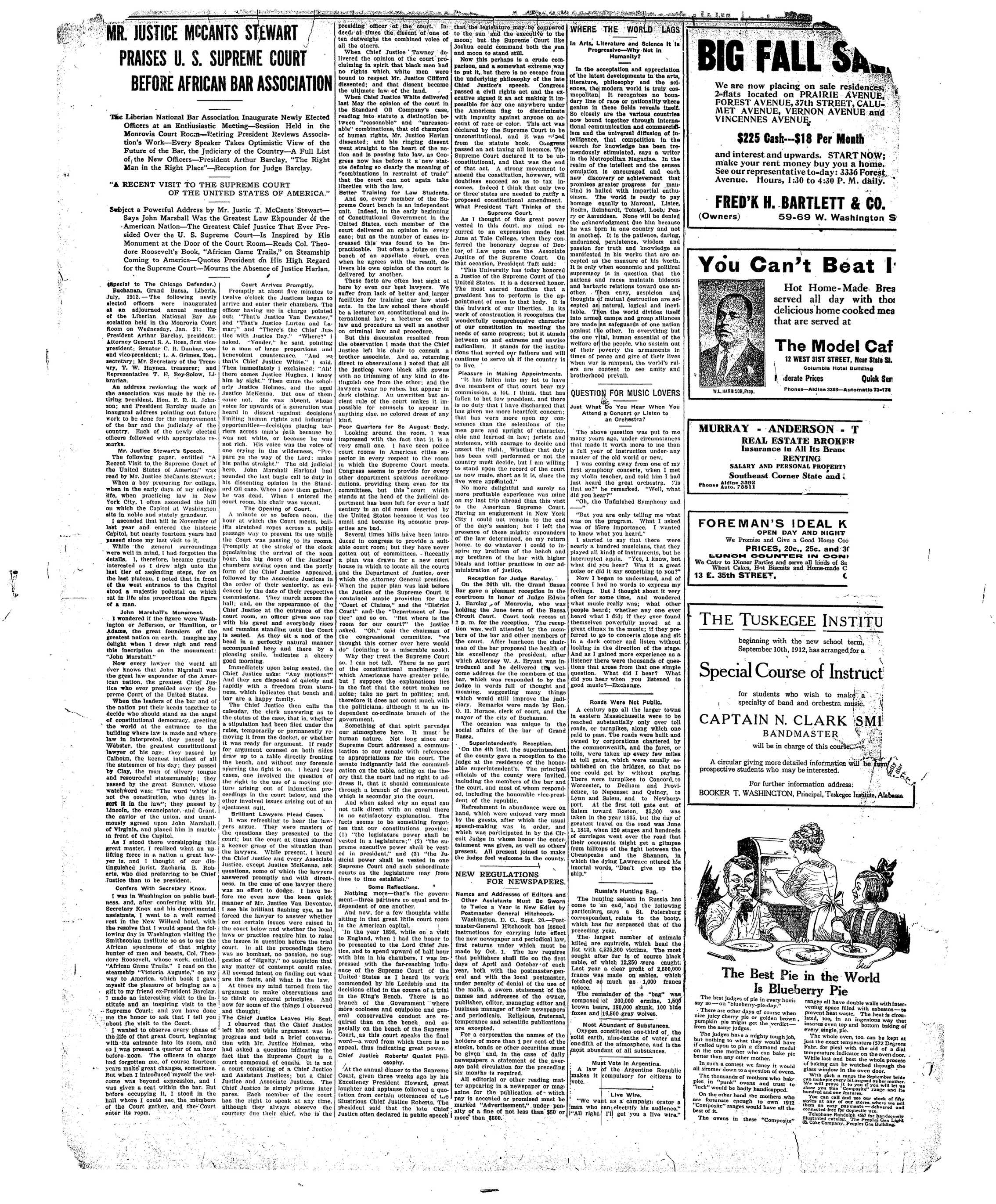
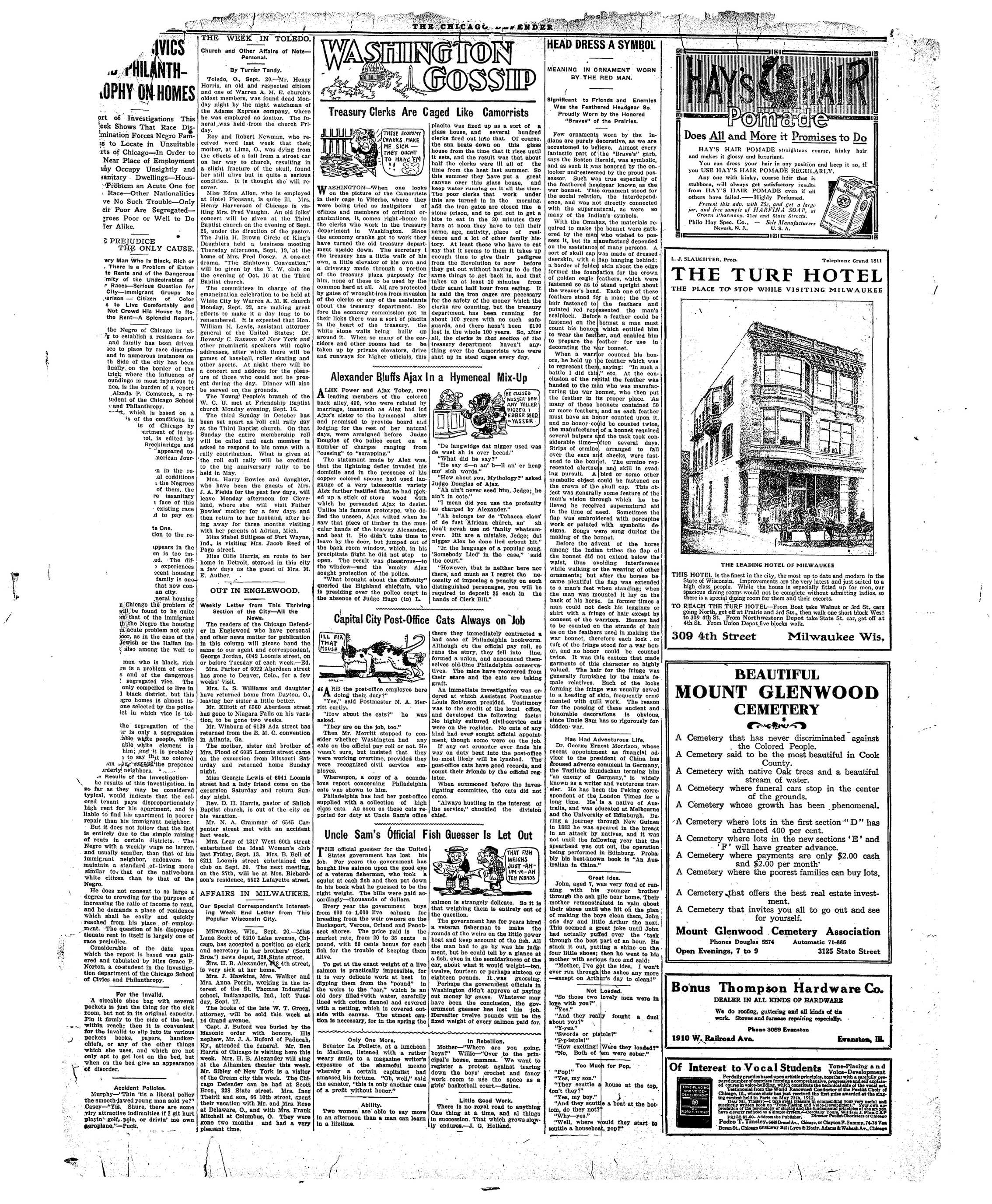
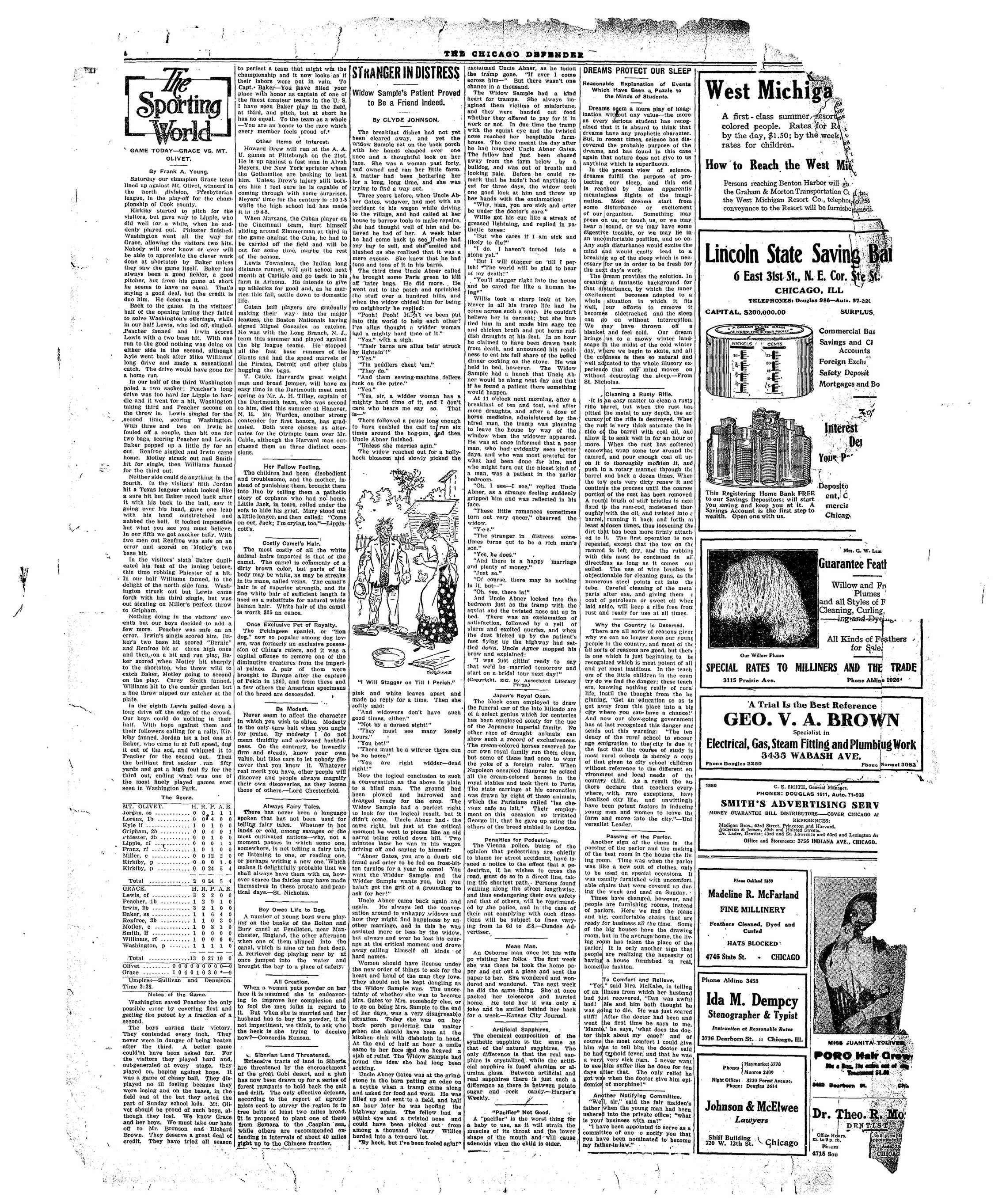
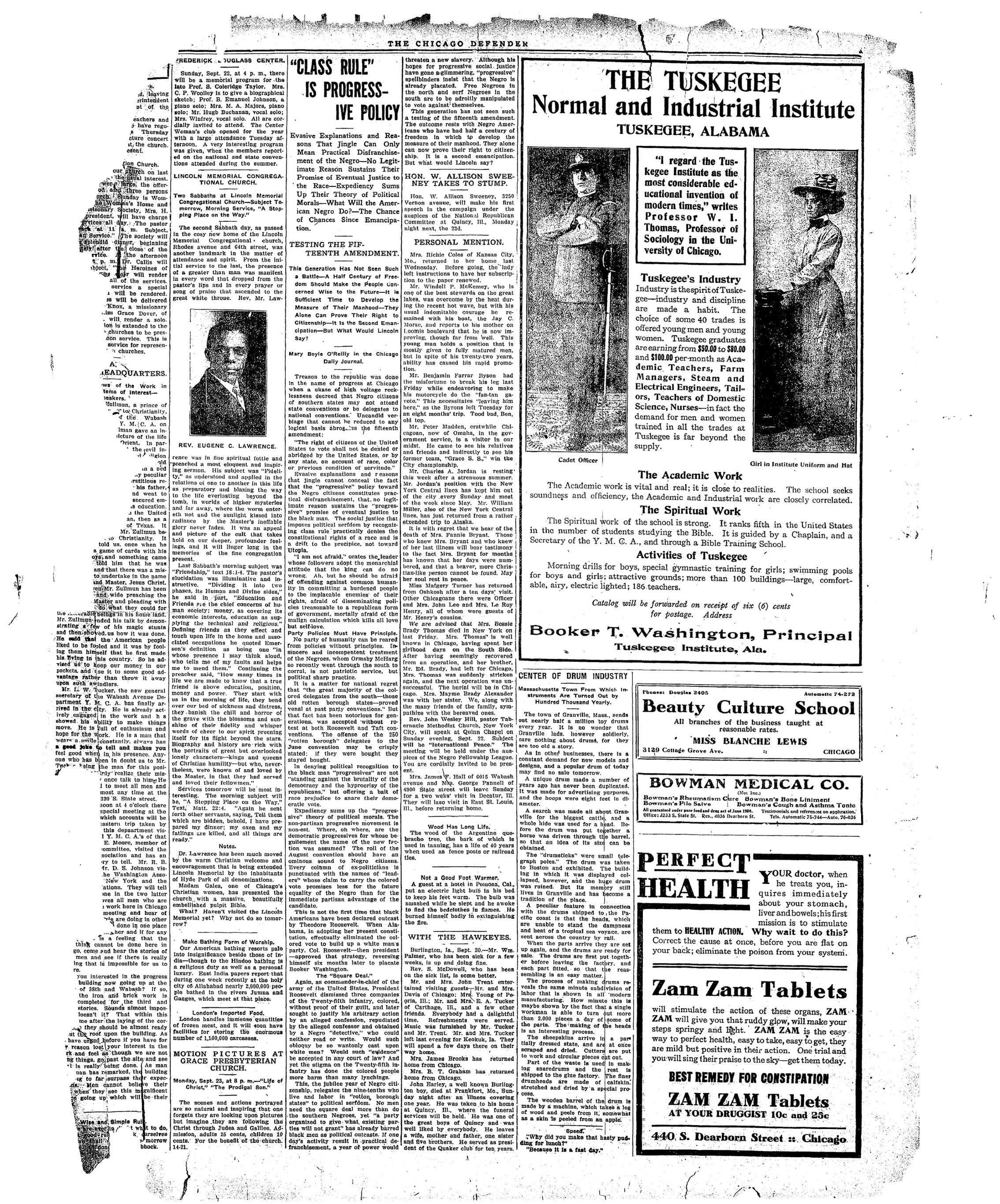
Page text (machine-generated)
VOLUME VII. NUMBER 38.
MRS. JACK JOHN
LAID TO R
THOUS
Ad Rites Over the Remains of the Champion Pugilist Fill the Streets With and the Morbid Curious—Besiege the Hear Where His Wife's Remains Lay in Stair Coroner's Inquest Until They Were Born Church for the Final Services—Ten Thive Estimate of the People That Gather "The Wabash Avenue Mansion."
LARGEST AUTO FUNERAL—CHAMPION PANIES MOTHER-IN-LAW A
Scenes at the Church—50th St., from Ave., Thronged With an Impassable C Races—Aristocratic Sightseers in Auto Add to the Jam—Police Have Hard Throng—Three Automobiles of Flow Hearse—Eighteen Cars for Mourners-quent Religious Sermon—The Choir Rive Hymns—Interment at Graceland C
MOUNTED POLICE IN SERVICE FOR FIRST DISTRICT.
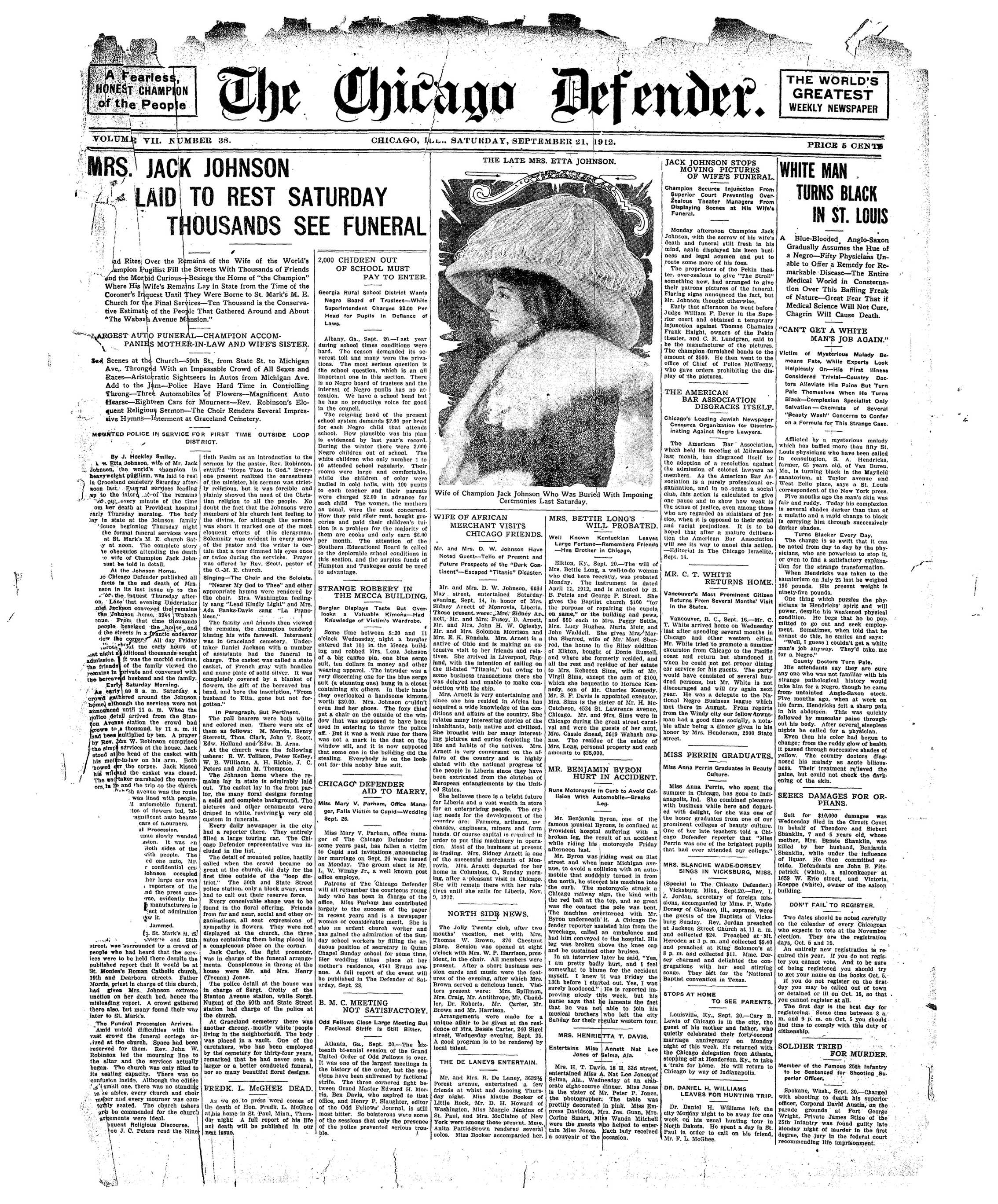
MRS. JACK JOHNSON LAID TO REST SATURDAY THOUSANDS SEE FUNERAL
ad Rites Over the Remains of the Wife of the World's Champion Pugilist Fill the Streets With Thousands of Friends and the Morbid Curious—Besiege the Home of "the Champion" Where His Wife's Remains Lay in State from the Time of the Coroner's Inquest Until They Were Borne to St. Mark's M. E. Church for the Final Services—Ten Thousand is the Conservative Estimate of the People That Gathered Around and About "The Wabash Avenue Mansion."
PANIES MOTHER-IN-LAW AND WIFE'S SISTER.
Sad Scenes at the Church—50th St., from State St. to Michigan Ave., Thronged With an Impassable Crowd of All Sexes and Races—Aristocratic Sightseers in Autos from Michigan Ave. Add to the Jam "Piece Have Hard Time in Controlling Throng—Three Automobiles of Flowers—Magnificent Auto Hearse—Eighteen Cars for Mourners—Rev. Robinson's Eloquent Religious Sermon—The Choir Renders Several Impressive Hymns—Interment at Graceland Cemetery.
MOUNTED PLEASURE IN SERVICE FOR FIRST TIME OUTSIDE LOOP DISTRICT.
By J. Hockley Smiley.
A. M. Etta Johnson, wife of Mr. Jack Johnson, the world's champion in heavyweight pugilism, was laid to rest in Graceland cemetery Saturday afternoon last. Funeral services leading up to the interment of the remains put every minute of the time on her death at Provident hospital early Thursday morning. The body lay in state at the Johnson family Justice beginning Thursday night the formal funeral services were at St. Mark's M. E. church Saturday at noon. The complete story he obsoides attending the death wife of Champion Jack John-sust be told in detail.
At the Johnson Home.
thist Psalm as an introduction to the sermon by the pastor, Rev. Robinson, entitled "Hope Thou in God." Everyone present realized the earnestness of the minister, his sermon was strictly religious, but it was forcible and plainly showed the need of the Christian religion to all the people. No doubt the fact that the Johnson sons were members of his church lent feeling to the divine, for although the sermon was short it marked one of the most eloquent efforts of this clergyman. Solemnity was evident in every move of the pastor and the writer is certain that a tear dimmed his eyes once or twice during the services. Prayer was offered by Rev. Scott, pastor of the C. M. E. church.
Singing—The Choir and the Solisters.
"Nearer My God to Thee" and other appropriate hymns were rendered by the choir. Mrs. Washington feelingly sang "Lead Kindly Light" and Mrs. Ada Banks-Davis sang "La Pranolless."
The family and friends then viewed the remains, the champion tenderly kissing his wife farewell. Interment was in Graceland cemetery. Understater Daniel Jackson with a number of assistants had the funeral in charge. The casket was called a state casket, of French gray with handles and name plate of solid silver. It was completely covered by a blanket of flowers, the gift of the bereaved husband, and bore the inscription, "From husband to Etta, gone but not forgotten."
In Paragraph, But Pertinent.
The pall bearers were both white and colored men. There were six of them as follows: M. Mervin, Henry Sterrett, Thos. Clark, John T. Scott, Edw. Holland and Edw. B. Arns.
At the church were the following ushers: R. W. Tollison, Peter Kelley, W. B. Williams, A. H. Richie, J. C. Peters and John M. Thompson.
The Johnson home where the remains lay in state is admirably laid out. The casket lay in the front parlor, the many floral designs forming a solid and complete background. The pictures and other ornaments were draped in white, reviving a very old custom in funerals.
Every daily newspaper in the city had a reporter there. They entirely filled a large touring car. The Chicago Defender representative was included in the list.
The detail of mounted police, hastily called when the crowd became so great at the church, did duty for the first time outside of the "loop district." The 50th and State Street police station, only a block away, even had to call out their reserve force.
Every conceivable shape was to be found in the floral offering. Friends from far and near, social and other organizations, all sent expressions of sympathy in flowers. They were not displayed at the church, the three autos containing them being placed in a conspicuous place on the corner.
Jack Curley, the fight promoter, was in charge of the funeral arrangements. Conspicuous in throng at the house were Mr. and Mrs. Henry (Teenan) Jones.
The police detail at the house was in charge of Sergt. Crotty of the Stanton Avenue station, while Sergt. Nugent of the 50th and State Street station had charge of the police at the church.
At Graceland cemetery there was another strong, mostly white people living in the neighborhood. The body was placed in a vault. One of the caretakers, who has been employed by the cemetery for thirty-four years, remarked that he had never seen a larger or a better conducted funeral, nor so many beautiful floral designs.
As we go to press' word comes of the death of Hon. Fredk. L. McGhee at his home in St. Paul, Minn., Thursday night. A full report of his life and death will be published in our next issue.
---
By J. Hockley Smiley.
A. M. E. Johnson, wife of Mr. Jack Johnson, the world's champion in heavyweight pugilism, was laid to rest in Graceland cemetery Saturday afternoon last. Formal services leading up to the interment of the remains led out every minute of the time on her death at Provident hospital early Thursday morning. The body lay in state at the Johnson familycience beginning Thursday night the formal funeral services were at St. Mark's M. E. church Satay at noon. The complete story the obsequies attending the death wife of Champion Jack Johnsuset be told in detail.
At the Johnson Home.
The Chicago Defender published all facts in the sad death of Mrs. Johnson in its last issue up to the end of the inquest Thursday afternoon. Later that evening Underaker mild Jackson conveyed the remains the Johnson home, 3344 Wabash Avenue. From that time thousands people besieged the house and the streets in a foetic endeavor view the corpse. All day Friday morning but the early hours of at night additional thousands sought admission. It was the morbid curious, the friends of the family viewed the remains in private and conversed with the bereaved husband and the family.
Early Saturday Morning.
As early as 8 a.m. Saturday, a crowd gathered around the Johnson home although the services were not announced until 11 a.m. When the police detail arrived from the Stanton Avenue station the crowd had grown to a thousand, by 11 a.m. it had been multiplied by ten. A prayer by Rev. Jan W. Robinson comprised the simple services at the house. Jack stood at the head of the casket with his mother-in-law on his arm. Both bowed to the corpse. Jack kissed his wrist and the casket was closed. The and taker marshaled the mourners in 11 a.m. and the trip to the church on the avenue was the route was lined with people, all automobile funeral, tos of flowers led, to significant auto hearse cars of mourners.
Al Procession.venue slowly wended session. It was on both sides of the with people. The fed one auto, Mr. r confidential em Johnson occupied her large car was the reporters of the and the press assourse, evidently the manufacturers in sect of admiration saw it.
Jammed.
12. St. Mark's M. S. avenue, and 50th
50th street, was surrounded by a crowd of people who had heard that the services were to be held there despite the published report that it would be at St. Monica's Roman Catholic church, 36th and Dearborn streets. Father Morris, priest in charge of this church, had given Mrs. Johnson extreme unction on her death bed, hence the misleading report. A crowd gathered there also, but many found their way later to St. Mark's.
The Fundal Procession Arrives. Amid untold difficulties with the vast crowd the funeral cortege arrived at the church. Space had been reserved for them. Rev. John W. Robinson led the mourning line to the altar and the services actually began. The church was only filled to its seating capacity. There was no confusion inside. Although the edifice is small one, there was no standing in its atles, every church and choir member and every mourner was comforably seated. The church ushers are commended for the church arrangements were ideal.
Consequent Religious Discourse. Jon J. C. Peters read the Nine
The Chicago Defender.
FREDK. L. McGHEE DEAD.
CHICAGO, ILL.. SATURDAY, SEPTEMBER 21, 1912.
2,000 CHIDREN OUT
OF SCHOOL MUST
PAY TO ENTER.
Georgia Rural School District Wants
Negro Board of Trustees—White
Superintendent Charges $2.00 Per
Head for Pupils in Defiance of
Laws.
Albany, Ga., Sept. 20.—Last year
during school times conditions were
hard. The season demanded its severest toll and many were the privations. The most serious question is the school question, which is an all important one in this section. There is no Negro board of trustees and the interest of Negro pupils has no attention. We have a school head but he has no productive voice for good in the council.
The reigning head of the present school system demands $2.00 per head for each Negro child that attends school. How plausible was his plan is evidenced by last year's record. During the winter there were 2.000 Negro children out of school. The white children who only number 1 to 10 attended school regularly. Their rooms were large and comfortable, while the children of color were hudled in cold halls, with 100 pupils to each teacher and their parents were charged $2.00 in advance for each child. The women, the mothers as usual, were the most concerned. How they paid their rent, bought groceries and paid their children's tuition is a problem for the majority of them are cooks and only earn $6.00 per month. The attention of the Southern Educational Board is called to the deplorable school conditions in this section, and the surplus funds of Hampton and Tuskegee could be used to advantage.
STRANGE ROBBER IN
THE MECCA BUILDING.
Burglar Displays Taste But Overlook a Valuable Kimona-Had Knowledge of Victim's Wardrobe.
Some time between 8:30 and 11 o'clock Wednesday, night a burglar entered flat 101 the Mecca building and robbed Mrs. Lena Johnson of a big cane pin, one blue serge suit, ten dollars in money and other wearing apparel. The intruder was a very discerning one for the blue serge suit (a stunning one) hung in a closet containing six others. In their haste they overlooked a handsome kimona worth $30.00. Mrs. Johnson culdn't even find her shoes. The foxy thief put a chair on the outside of the window that was supposed to have been used in entering to throw the police off. But it was a weak ruse for there was not a mark in the dust on the window sill, and it is now supposed that some one in the building did the stealing. Everybody is on the lookout for this nobby blue suit.
CHICAGO DEFENDER
AID TO MARRY.
Miss Mary V. Parham, Office Manager, Falls Victim to Cupid—Wedding Sept. 26.
Miss Mary V. Parham, office manager of The Chicago Defender for some years past, has fallen a victim to Cupid and invitations announcing her marriage on Sept. 26 were issued on Monday. The groom elect is Mr. L. W. Winiby Jr., a well known post office employee.
Patrons of The Chicago Defender will all remember the courteous young lady who has been in charge of the office. Miss Parham has contributed largely to the success of the paper in recent years and is a newspaper woman of considerable merit. She is also an ardent church worker and has gained the admiration of the Sunday school workers by filling the uoious position of secretary in Quinn Chapel Sunday school for some time. Her wedding takes place at her mother's residence, 4741 Evans avenue. A full report of the event will be published in The Defender of Saturday, Sept. 28.
B. M. C. MEETING
NOT SATISFACTORY.
Odd Fellows Close Large Meeting But Factional Strife Is Still Bitter.
Atlanta, Ga., Sept. 20.—The sixteenth biennial session of the Grand United Order of Odd Fellows is over. It was one of the largest meetings in the history of the order, but the sessions have been enlivened by factional strife. The three cornered fight between Grand Master Edward H. Morris, Ben Davis, who aspired to that office, and Henry P. Slaughter, editor of the Odd Fellows' Journal, is still most bitter. So boisterous were some of the sessions that only the presence of the police prevented serious trouble.
THE LATE MRS. ETTA JOHNSON.
Wife of Champion Jack Johnson
Ceremonies L
THE FASHION WEEKLY
Wife of Champion Jack Johnson Who Was Buried With Imposing Ceremonies Last Saturday.
WIFE OF AFRICAN
MERCHANT VISITS
CHICAGO FRIENDS.
Mr. and Mrs. D. W. Johnson Have Noted Guest—Tells of Present and Future Prospects of the "Dark Continent"—Escaped "Titanic" Disaster.
Mr. and Mrs. D. W. Johnson, 6034 May street, entertained Saturday evening, Sept. 14, in honor of Mrs. Sidney Arnett of Monrovia, Liberia. Those present were: Mrs. Sidney Arnett, Mr. and Mrs. Pusey, D. Arnett, Mr. and Mrs. John H. W. Ogleys, Mr. and Mrs. Solomon Morrison and Mrs. E. K. Randals. Mrs. Arnett is a native of Ohio and is making an extensive visit to her friends and relatives. She arrived in Liverpool, England, with the intention of sailing on the ill-fated "Titanic," but owing to some business transactions there she was delayed and unable to make connection with the ship.
Mrs. Arnett is very entertaining and since she has resided in Africa has acquired a wide knowledge of the conditions and affairs of the country. She relates many interesting stories of the inhabitants, both native and civilized. She brought with her many interesting pictures and curios depicting the life and habits of the natives. Mrs. Arnett is very conversant on the affairs of the country and is highly elated with the national progress of the people in Liberia since they have been extricated from the clutches of European entanglements by the United States.
She believes there is a bright future for Liberia and a vast wealth in stores for an enterprising people. The crying needs for the development of the country are: Farmers, artisans, mechanics, engineers, miners and farm hands. Of course capital is required in order to put this machinery in operation. Most of the business at present is trading. Mrs. Sidney Arnett is one of the successful merchants of Monrovia. Mrs. Arnett departed for her home in Columbus, O. Sunday morning, after a pleasant visit in Chicago. She will remain there with her relatives until she sails for Liberia, Nov. 9, 1912.
NORTH SIDE NEWS
The Jolly Twenty club, after two months' vacation, met with Mrs. Thomas W. Brown, 376 Chestnut place. Session was opened at eight o'clock with Mrs. W. P. Harrison, president, in the chair. All members were present. After a short business session cards and music were the features of the evening, after which Mrs. Brown served a delicious lunch. Visitors present were: Mrs. Spillman, Mrs. Craig, Mr. Antitrope, Mr. Chandler, Dr. Roberts, Mr. Carter, Mr. Brown and Mr. Harrison. Arrangements were made for a unique affair to be given at the residence of Mrs. Bessie Carter, 240 Siegel street, Wednesday evening, Sept. 25. A good program is to be rendered by local talent.
THE DE LANEYS ENTERTAIN.
Mr. and Mrs. R. De Laney, 36522% Forest avenue, entertained a few friends at whist and dancing Thursday night. Miss Mattie Booker of Little Rock, Mr. D. H. Howard of Washington, Miss Maggie Jenkins of St. Paul, and Mrs. McClaine of New York were among those present. Mme. Anita Pattie-Brown rendered several solos. Miss Booker accompanied her.
Who Was Buried With Imposing last Saturday.
MRS. BETTIE LONG'S
WILL PROBATED
Well Known Kentuckian Leaves Large Fortune—Remembers Friends—Hag Brother in Chicago,
Elkton, Ky. Sept. 20.—The will of Mrs. Bettie Long, a well-to-do woman who died here recently, was probated Monday. The instrument is dated April 11, 1912, and is attested by B. B. Petrie and George P. Street. She gives the Baptist church $100 "for the purpose of repairing the cupola on same," or to the building and pews, and $50 each to Mrs. Peggy Settle, Mrs. Luce Hughes, Maria Mur, and John Waddell. She gives Mrs. Martha Sherrod, wife of Mr. Mart Sherrod, the house in the Riley addition of Elkton, bought of Donie Russell, and where she formerly resided, and all the rest and residue of her estate to Mrs. Rebecca Sims, wife of Mr. Virgil Sims, except the sum of $100, which she bequeaths to Horace Kennedy, son of Mr. Charles Kennedy. Mr. S. F. Davis is appointed executor. Mrs. Sims is the sister of Mr. H. McCutcheon, 4524 St. Lawrence avenue, Chicago. Mr. and Mrs. Sims were in Chicago during the great street carnival and were the guests of her aunt, Mrs. Cassie Snead, 2619 Wabash avenue. The residue of the estate of Mrs. Long, personal property and cash amounts to $25,000.
MR. BENJAMIN BYRON
HURT IN ACCIDENT.
Runs Motorcycle in Curb to Avoid Collision With Automobile—Breaks Leg.
Mr. Benjamin Byron, one of the famous musical Byrons, is confined at Provident hospital suffering with a broken leg, the result of an accident while riding his motorcycle Friday afternoon last.
Mr. Byron was riding west on 31st street and when near Michigan avenue, to avoid a collision with an automobile that suddenly turned in from the north, he steered his machine into the curb. The motorcycle struck a Chicago railway sign, the kind with the red ball at the top, and so great was the contact the pole was bent. The machine overturned with Mr. Byron underneath it. A Chicago Defender reporter assisted him from the wreckage, called an ambulance and had him conveyed to the hospital. His leg was broken above the knee cap and he sustained other bruises.
In an interview later he said, "Yes, I am pretty badly hurt, and I feel somewhat to blame for the accident myself. I knew it was Friday the 13th before I started out. Yes, I was surely hoodooed." He is reported improving nicely this week, but his nurse says that he lambents the fact that he was not able to join his musical brothers who left the city Sunday for their regular western tour.
Entertains Miss Annett Nat Lee Jones of Selma, Ala.
Mrs. H. T. Davis, 18 E. 33d street, entertained Miss A. Nat Lee Jones of Selma, Ala. Wednesday at an elaborate eight-course dinner. Miss Jones is the sister of Mr. Peter P. Jones, the photographer; The table was prettily decorated in pink. Miss Empress Davidson, Mrs. Jos. Guan, Mrs. Corline Smart, Miss Wanda Mitchell were the guests who helped to entertain Miss Jones. Each lady received a souvenir of the occasion.
JACK JOHNSON STOPS
MOVING PICTURES
OF WIFE'S FUNERAL.
Champion Secures Injunction From
Superior Court Preventing Over-
zealous Theater Managers From
Displaying Scenes at His Wife's
Funeral.
Monday afternoon Champion Jack
Johnson, with the sorrow of his wife's
death and funeral still fresh in his
mind, again displayed his keen business
and acumen and put to route some more of his foes.
The proprietors of the Pekin theater,
over-zealous to give "The Stroll"
something new, had arranged to give
their patrons pictures of the funeral.
Flaring signs announced the fact, but
Mr. Johnson thought otherwise.
Early that afternoon he went before Judge William F. Dever in the Superior court and obtained a temporary injunction against Thomas Chamales Frank Halgnt, owners of the Pekin theater, and C. R. Lundgren, said to be the manufacturer of the pictures. The champion furnished bonds to the amount of $500. He then went to the office of Chief of Police McWeeny, who gave orders prohibiting the display of the pictures.
THE AMERICAN
BAR ASSOCIATION
DISGRACES ITSELF
Chicago's Leading Jewish Newspaper Censures Organization for Discriminating Against Negro Lawyers.
The American Bar Association, which held its meeting at Milwaukee last month, has disgraced itself by the adoption of a resolution against the admission of colored lawyers as members. As the American Bar Association is a purely professional organization, and in no sense a social club, this action is calculated to give one pause and to show how weak is the sense of justice, even among those who are regarded as ministers of justice, when it is opposed to their social and racial prejudices. It is to be hoped that after a mature deliberation the American Bar Association will see its way to annul this action.
—Editorial In The Chicago Israelite, Sept. 14.
MR. C. T. WHITE
RETURNS HOME
Vancouver's Most Prominent Citizen
Returns From Several Months' Visit
in the States.
Vancouver, B. C., Sept. 16.—Mr. C.
T. White arrived home on Wednesday
last after spending several months in
Chicago and other western cities.
Mr. White tried to promote a summer
excursion from Chicago to the Pacific
coast and return but abandoned it
when he could not get proper dining
car service for his guests. The party
would have consisted of several hundred
persons, but Mr. White is not
discouraged and will try again next
year. He was a delegate to the National Negro Business league which
met there in August. From reports
from the Windy city our fellow Towns-
man had a good time socially, a notable
affair being a dinner given in his
honor by Mrs. Henderson, 2900 State
street.
MISS PERRIN GRADUATES
Miss Anna Perrin Graduates in Beauty
Culture.
Miss Anna Perrin, who spent the summer in Chicago, has gone to Indianapolis, Ind. She combined pleasure with business while here and departed with delight, for she was one of the honor graduates from one of our prominent colleges of beauty culture. One of her late teachers told a Chicago Defender reporter that "Miss Perrin was one of the brightest pupils that had ever attended our college."
MRS. BLANCHE WADE-DORSEY.
SINGS IN VICKSBURG, MISS
(Special to The Chicago Defender).
Vickersburg, Miss., Sept.20—Rev. I. J. Jordan, secretary of foreign missions, accompanied by Mme. P. Wade, Dorssey of Chicago, Ill., soprano, were the guests of the Baptists of Vickersburg Sunday. Rev. Jordan preached at Jackson Street Church at 11 a.m. and collected $24. Preached at Mt. Heroden at 3 p.m. and collected $40 and preached at King Solomon's at 8 p.m. and collected $11. Mme. Dorssey charmed and delighted the congregations with her soul stirring songs. They left for the 'National Baptist convention in Texas.
Louisville, Ky., Sept. 20.—Cary B. Lewis of Chicago is in the city, the guest of his mother and father, who quietly celebrated their forty-second marriage anniversary on Monday night of this week. He returned with the Chicago delegation from Atlanta, stopping off at Henderson, Ky., to take a train for home. He will return to Chicago by way of Indianapolis.
DR. DANIEL H. WILLIAMS
LEAVES FOR HUNTING TRIP
Dr. Daniel H. Williams left the city Monday night to be away for one week on his usual hunting tour in North Dakota. He spent a day in St. Paul in order to call on his friend, Mr. F. L. McGhee.
THE WORLD'S GREATEST WEEKLY NEWSPAPER
PRICE 5 CENTS
WHITE MAN TURNS BLACK IN ST. LOUIS
A Blue-Blooded Anglo-Saxon Gradually Assumes the Hue of a Negro—Fifty Physicians Unable to Offer a Remedy for Remarkable Disease—The Entire Medical World in Consternation Over This Baffling Freak of Nature—Great Fear That if Medical Science Will Not Cure, Chagrin Will Cause Death.
"CAN'T GET A WHITE MAN'S JOB AGAIN."
Victim of Mysterious Malady Bemoans Fate, While Experts Look Helplessly On—His First illness Considered Trivial—Country Doctors Alleviate His Pains But Turn Pale Themselves When He Turns Black—Complexion Specialist Only Salvation—Chemists of Several "Beauty Wash" Concerns to Confer on a Formula for This Strange Cae.
Afflicted by a mysterious malady which has baffled more than fifty St. Louis physicians who have been called in consultation, S. A. Hendricks, farmer, 65 years old, of Van Buren, Mo, is turning black at Taylor avenue and West Bello place, says a St. Louis correspondent of the New York press. Five months ago the man's skin was fair and ruddy. Today his complexion is several shades darker than that of a malatto and a rapid change to black is carrying him through successively darker shades.
Turns Blacker Every Day. The change is so swift that it can be noted from day to day by the physicians, who are powerless to stop it, or even to find a satisfactory explanation for the strange transformation. When Hendricks was taken to the sanatorium on July 25 last he weighed 100 pounds. His present weight is ninety-five pounds.
One thing which puzzles the physicians is Hendricks' spirit and will power, despite his weakened physical condition. He hegs that he be permitted to go out and seek employment. Sometimes, when told that he cannot do this, he smiles and says: "Well, I guess I couldn't get a white man's job anyway. They'd take me for a Negro."
County Doctors Turn Pale. His attendants say they are sure any one who was not familiar with his strange pathological history would take him for a Negro, though he came from untainted Anglo-Saxon stock. Five months ago, when at work on his farm, Hendricks felt a sharp pain in his abdomen. This was quickly followed by muscular pains throughout his body. After several sleepless nights he called for a physician.
Even then his color had begun to change; from the ruddy glow of health it passed through successive shades of yellow. The country doctors diagnosed his malady as acute billiousness. Their treatment relied the palms, but could not check the darkening of the skin.
SEEKS DAMAGES FOR OR PHANS
Suit for $10,000 damages was Wednesday filed in the Circuit Court in behalf of Theodore and Siebert Shanklin, 7 and 5 years old, whose mother, Mrs. Bpessie Shanklin, was killed by her husband, Benjamin Shanklin, while under the influence of liquor. He then committed suicide. Defendants are John B. Fitzpatrick (white), a saloonkeeper at 1659 W. Erie street, and Victoria Kopepe (white), owner of the saloon building.
DON'T FAIL TO REGISTER.
Two dates should be noted carefully on the calendar of every Chicagoan who expects to vote at the November election. They are the registration days, Oct. 5 and 15.
An entirely new registration is required this year. If you do not register you cannot vote. And to be sure of being registered you should try to get your name on the books Oct. 5. If you do not register on the first day you may be called out of town or detained or ill on Oct. 15, so that you cannot register at all.
The first day is the best day for registering. Some time between 8 a. m. and 9 p. m. on Oct. 5 you should find time to comply with this duty of citizenship.
SOLDIER TRIED
FOR MURDER
Member of the Famous 25th Infantry to be Sentenced for Shooting Superior Officer.
Spokane, Wash., Sept. 20.—Charged with shooting to death his superior officer, Corporal David Austin, on the parade grounds at Fort George Wright, Private James Stine of the 25th Infantry was found guilty late Monday night of murder in the first degree, the jury in the federal court recommending life imprisonment.
---
World's Champion Fighter Thinks
That a Change of Scenes Will Do
Him Good—Shows Interviewer Re-
cent Letter from Hugh D. Mcintosh.
A reporter for The Chicago Defender
found Champion Jack, Johnson at
his famous "Cafe de Champion",
Thursday night, and his quest for
information brought forth the fact "that
tired, and after the strain caused by
the death and burial of his wife, a
change of scenes would be welcome
to him."
"Have no definite plans at present,
but again today I read a recent letter
from my friend Mr. Hugh D. Mcintosh,
of Sydney, Australia, which appeals
strongly to me at this time."
Of course, the reporter was inter-
ested and the letter is printed in full:
August 9th, 1912.
John Johnson / University
Dear Jack:—I am arranging today to post the money, £2000, as requested with the First National Bank of Chicago. I am glad indeed to see you are coming back to Australia, as under the conditions we are boxing here, with a clean break, there is nobody in the world that can put a glove on you.
There is no doubt that you will draw tremendous houses, equal I believe to the Burns-Johnson. I am sending you herewith a photo of the Sydney Stadium roofed over, which will give you some idea of the magnity of the place. It rained cats and dogs the light we opened, and it was the third contest between MeVean and Langford, but they drew a very big house indeed. The seating capacity of the stadium, is as you know, 20,000 people, and now that it is roofed, is the largest and best equipped arena in the world.
The moment you sail I will engage a furnished house for you, near the sea, and tell Mrs. Johnson that I am making every arrangement for her social reception. As you know Jack, there are no social restrictions here and Mrs. Johnson will be well received by all the leading people, with whom I feel sure, she will make a great hit.
Everybody is talking of the wonderfully easy manner in which you defecated Flynn, and all your old friends of Tattersall's Club are organizing a Tug to meet you on your arrival. You need have no fear about the police interference as everything is satisfactorily arranged, and they are all very anxious to see you. For the love of heaven do not miss this boat as
you have already cost me some thousands of pounds by your last non-arrival, and I want to see you arrive and box your two last matches here with me. I think you can make enough money in these two fights to retire the only undefeated Heavyweight Champion of the World. Give my kindest regards to Mrs. Johnson, and believe me to be.
Your true friend.
HUGH D. McINTOSH.
P. S.—Bring all your cars.
ROSS-CROSS NUPTIAL
AT HIGH NOON
A Beautifulij Wedding at the Home of Mr, and Mrs, G. D. Seames, Sept. 11.
A beautiful home wedding was solemnized at the residence of Mr. and Mrs. C. D. Seames, 3249 Forest avenue, Wednesday, Sept. 11, at high noon, when Miss Rachel E. Ross of Natzhec, Miss., and Mr. James H. Cross, formerly of Bluedck, W. Va., but now of this city, were made man and wife. The double parlors were thrown wide and to the' strains of Mendelssohn's wedding march, played by Mrs. A. Black, the bridal party entered. First came Mrs. Charles Banks of Mound Bayou, Miss., a lifelong friend of the bride, who acted as matron of honor, and Mr. C. O. Scames, who acted as best man, when the bride, beautifully attired in white not and Irish point lace gown over white satin, carrying a bouquet of bridal roses and ferns, entered, leaning on the arm of Mr. C. P. Booze, and who was given to the groom, who entered from the hallway into the front parlor and stood awaiting the bride.
The ceremony was performed by Dr. D. P. Roberts, pastor of Bethel church. The bride is one of the leading lights of Natchez, Miss., being a teacher in the Union Public school for some time, and a young woman of sterling qualities, who has a host of friends and acquaintances who will miss her genial presence. The marriage was a surprise to most of their friends. The groom is a man of excellent qualities, coming from one of the first families of Bluefield, W. Va. A few friends witnessed the affair, among the number being Mr. and Mrs. C. O. Seames, Mr. and Mrs. John Lynch Johnston, Mr. and Mrs. Victor Boyd, Misses C. Ryan and Emmie McLeary, Mesdames R. J. Hine, John Oglesby, J. E. White and L. T. Miller of Yazoo City, Miss.; Messrs. A. B. and C. Whitlock, J. Hutchings, A. L. Turner, B. J. Boll and Maj. John R. Lynch. Mr. and Mrs. Cross are at 3249 Forest avenue.
WITH THE YOUNGER SET.
Lee Tobin, the ambitious young man who held the position of Past Grand Master of the Sons of Rest for so many months, has resigned. Lee says there was no salary attached to the position, which accounts for his giving it up.
Farrell Jones, who spent the summer at one of the leading resorts for his health, said while he was greatly benefited he did not leave for home until all the other guests had left as he thought some one might take exceptions.
Will Kelly says his collection of rag time music, which he collected during the summer months, will surpass any similar collection ever collected. Instead of Rag Time Willie, he will be known as Willie, the King of Rag Time—Reno.
OBJECTED TO THE "PEALING"
Two Hours of Music of Bells Too Much for the Citizens of Stald Old Boston
Boston—When every Sunday morning we hear the bells calling from the church towers of the city an invitation to worship God according to the Biblical mandate, "forsake not the assembling of yourselves together," very few people know that those brazen tongues are not only reminding men of their religious obligations, but of the survival of an instrument of music the origin of which is lost in antiquity.
Walking down one of Boston's fashionable streets on a Sunday morning the wayfarer, listening to the clanging from various quarters, some sweet and clear, others harsh and discordant or decidedly out of tune, will wonder
THE CHURCH
Old English Type of Bell Tower.
when they will stop going and why people don't go to church without being "rung in" in this noisy fashion.
As a matter of fact, however, a full ring of peals has never been rung in America but once—in Philadelphia in 1855—and a quarter peal only has been rung from the old Christ church tower in Salem street, and from the belly of the Church of the Advent. These two churches are the only ones in Boston possessing a full set of change-ringing bells, as they are called, and these are from English foundries.
The full number of peals is 5,040, and when rung for evening service at the old church of Paul Revere fame in Salem street and from the Advent turrets, the neighbors in the districts, who were not antiquarian in their tastes, after two hours of "pealing," sent vehement protests to the sextons of these respective houses of worship that they must stop the noise, for they cannot get the children to bed and the wreathed were threatened to break their windows. Such was the popular feeling in regard to resuscitating a custom that still obtains in England and on the continent—Boston Herald.
"PIRATE" HALTED BY LAW
Sails Forth With Comrade and Pilfered Provisions, but Unromantic Father Interferes.
Centreport, L. I.—The crime of attempted piracy on the high seas led Owen Dennis, twelve years old, commodore of a fleet of three "long, rakish craft"—commonly called rowboats,—to be taken before Justice Laundes here recently. William Dennis, prosperous resident of this township, was complainant against his son. The elder Dennis evidently regards piracy as a profession behind the times and wholly unsuitable to his son. Hence the persistence of the youthful Captain Kildd in sailing that portion of the Spanish Mad lying in Huntington bay is highly displeasing to him.
In the unromantic eyes of the law young Dennis is charged with juvenile delinquency, and with being an incorrigible. He confessed his chief aim in life is to lead a career of prudential adventure. With the Jolly Roger, theoretically speaking, flying from the masthead of his flagship, Commodore Dennis and Master Jacob Wheeler, another pirate of tender years, set out in the troubled waters of the bay on Monday last. One of them sat at the oars of the swift vessel, the other rowed the second. A third craft, laden with provisions pilfered from the youngsters' respective homes, was at the end of a towline.
No definite plan of campaign had been formulated, Dennis confessed. They simple meant to cruise about until, with cutlass and dirk—or their jackknives—they could board some peaceful merchantman and force her crew to walk the well-known and justly famous plank. No such ship, however, crossed their path, and on Tuesday night, their provisions gone, they found themselves back home. On Thursday, however, Owen again dashed forth in pursuit of the rover's will-o-the-wisp, with the result he faced the law. He will be examined further next week, and may be sent to a reformatory.
Wreaths on a Dog's Coffin
Paris, France.—M. Aubert, a chemist in the Rue de Canon at Toulon, closed his shop on the occasion of the funeral of his Newfoundland dog. A notice affixed to the door stated that business was suspended for the day "on account of the death of Phoebus, killed by a brute." The coffin was covered by eight beautiful white wreaths with sympathetic inscriptions. The hearse was drawn by two white horses and M. Aubert sat beside the driver. The interment took place on some private property M. Aubert owns near the city gates and was attended by many of his friends, speeches eulogistic of the dog (famous for many lifesaving exploits in the harbor) being delivered over the grae. M. Aubert says the dog was poisoned and has appealed to the police to find the guilty party.
MEN OF THE FIRST REPUBLIC
Type of the Soldiers With Whom the Great Napoleon -Swept All Europe.
Another contribution to "Napoleoniana" is the collection of memoirs and letters of the army surgeon, Baron Desgnettes, who was with the Egyptian expedition. One day he found Eugene Benauharnas asleep in the sand in the desert of Ramanich. "Wake up, Eugene, wake up! This repose does not suit either your name or profession. A man of war must be without rest and without pity." Qn another occasion Napoleon had condemned several of his pet Grenadiers to death for looting and murder. His reflections, made to Desgnettes, are worth quoting:
"My sentence on the Grenadiers of the Thirty-second regiment coat/me dear, but I was obliged to do it. A commander-in-chief must have a tremendous power. How can you reasonably question the right of a man to whom the state sometimes entrusts the lives of a hundred thousand troops to punish such serious offenses the Grenadiers fit? I convicted these Grenadiers by being when I seized Antone by the collar and said to him: 'Come, miserable wretch, and let me confront you with your accomplice,' he was confounded.
"But what men!—fellowes to win a battle by themselves! Perhaps the corporal has won some. You did not see how they die? Like Caesars, showing their affection for me. One of their comrades went to drink with them in prison, and remarked: 'Perhaps there was some truth in the charge, else Bonaparte would not have condemned you.' Be silent, was the answer; you do not know what you are saying; he was deceived again, as he often has been before, but no matter—let us drink to his health.' And when the time came for the execution, they marched steadily out and stood calmly before the firing party, saying: 'This is how the Grenadiers of the Thirty-second die.' Afterward the officers came to see me, but, faith! I pity those upon whom the Thirty-second may fall on the first occasion that presents itself for them to wipe out the remembrance of all this."
Macaroni Fakes.
"They even fake macaroni," said a pure food man. "Nothing is cheaper than macaroni, thanks to which Italian bank clerks can live on $4 a week, but in this heightened, money-mad land of ours the food trust millionaires insist on faking it.
"But you can tell fake macaroni—it is perfectly straight. The real has bent ends, for it has been dried in hairpin in shape, slung over a rail, and, when it is broken for boxing, the bent ends show.
"The real macaroni is made of a semi-transparent wheat from southern Europe and Algeria, a hard wheat extraordinarily rich in gluten and other nitrogenous matter. Real macaroni is tender, yellowish, elastic, rough in texture. It bolls without become sticky or losing its tubular shape.
"But the fake stuff, made of cheap domestic wheat, is very tender. Hence it must be dried flat; slung over a rail to dry, it would fall to pieces, and hence its straight shape, its lack of the characteristic curved ends. It is an ugly white, tog, instead of a rich yellow in color. Boll, it is apt to break up and collapse. Eaten, there is little nourishment and less taste to it."
Lely the Painter
Sir William Lely had agreed for the price of a portrait he was to draw for a rich London alderman, who was not indebted to nature either for shape or face. The picture being finished, the alderman endeavored to beat down the price, saying that if he did not purchase it it would remain on the painter's hands.
"That's a mistake," said Sir William, "for I can sell it at double the price I demand."
"How can that be?" says the alderman, "for it is like no one but me."
but like.
"True," replied Sir William, "but I will draw a tail to it and then it will be a capital monkey."
The alderman at once paid down the money demanded and carried off the picture.
Automobile Artillery
Efforts are being made by the powers toward the adaptation of the automobile to the transportation of field artillery. It has been pointed out that the idea of a self-moving gun carriage for field guns was suggested as early as the year 1769 by the engineer, Cugnot. At present efforts are principally directed to the perfection of a form of automobile suitable to take the place of horses in drawing the artillery wagons. Many different forms of ironclad automobiles, carrying light guns, have already been invented and tested, with more or less success, but it is said, the main problem is to adapt the automobile to the transportation of guns mounted, as at present, on their own carriages.
Interviewing an Actress
The beautiful actress was taking her morning lounge. The maid entered and approached the presence.
"Miss Footfiles."
"What is it, Lucile?"
"A reporter wants to know if it is true that you are engaged to the duke of Centerheld."
"Tell him I don't know the duke and give him a photo of myself in street costume. State that I have never met the duke and give him a photo of myself on horseback. State also that I wouldn't marry the duke if I did know him, and give the reporter a photo of myself holding Fido. And this, above all, Lucile."
"Yes, miss."
"Tell him I am wedded to my art."
If you have raccoons in your home, keep a watchful eye on all articles within reach of the animals. They will steal anything from a pocket knife to a diamond ring. Notwithstanding the trouble necessitated by guarding against the mischievous habits of the creatures, they are members of many households. They are fond of milk, and will resort to all sorts of tricks and subterfuge to obtain it.
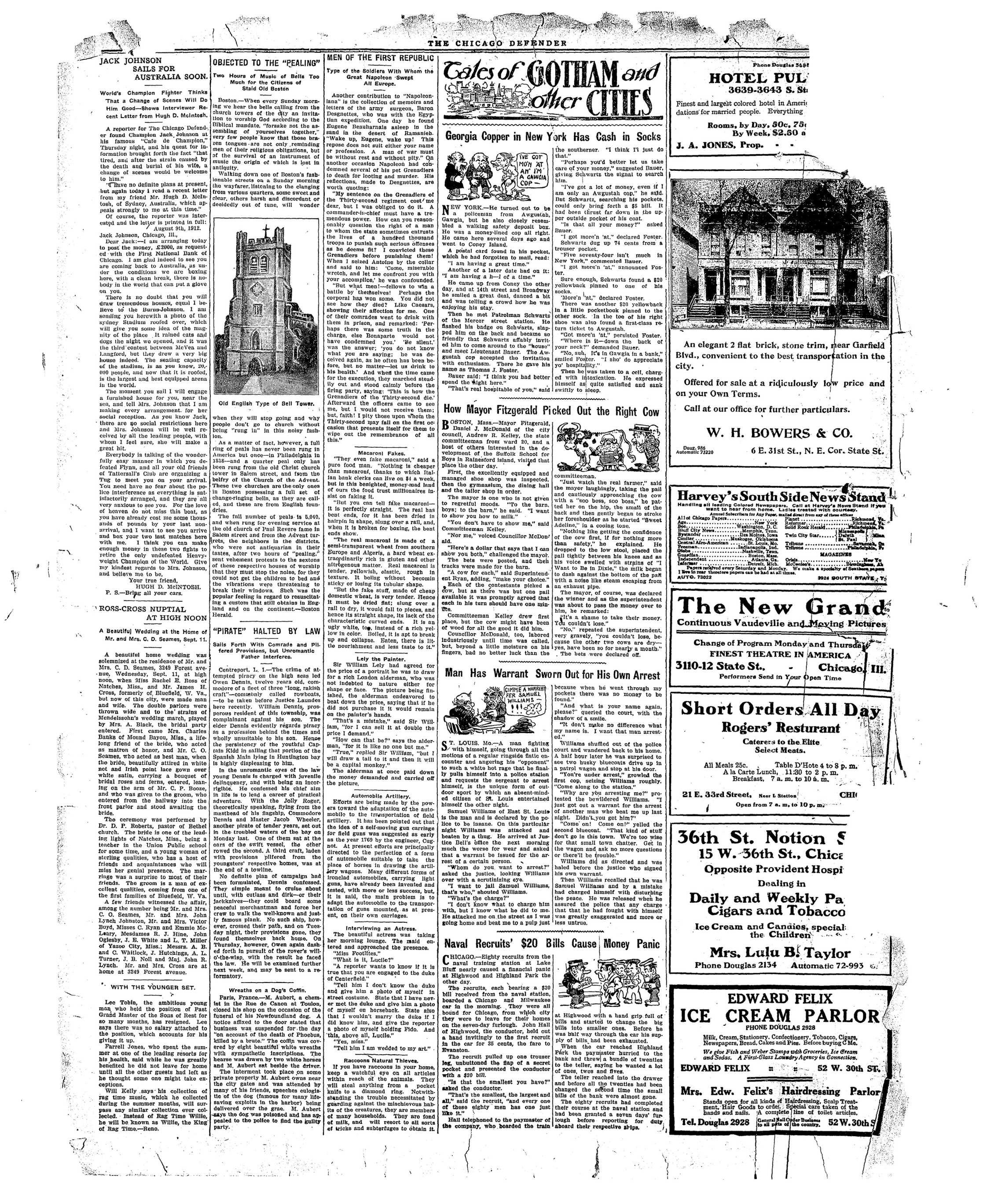
Tales of GOTHAM and other CITIES
How Mayor Fitzgerald Picked Out the Right Cow
Man Has Warrant Sworn Out for His Own Arrest
Naval Recruits' $20 Bills Cause Money Panic
THE CHICAGO DEFENDER
Tales of GOT
other
Georgia Copper in New York
IVE GOT
MON AT
AN' IM'
A GANGGIA
COP
NEW YORK.—He turned out to be a policeman from Augusta, Gawgia, but he also closely resembled a walking safety deposit box. He was a money-lined cop all right. He came here several days ago and went to Coney Island.
A postal card found in his pocket, which he had forgotten to mail, read: "I am having a great time."
Another of a later date had on it: "I am having a h-1 of a time."
He came up from Coney the other day, and at 14th street and Broadway he smiled a great deal, danced a bit and was telling a crowd how he was enjoying his stay.
Then he met Patrolman Schwartz of the Mercer street station. He flashed his badge on Schwartz, slapped him on the back and became so friendly that Schwartz affably invited him to come around to the "house" and meet Lieutenant Bauer. The Augusta cop accepted the invitation with enthusiasm. There he gave his name as Thomas J. Foster.
Bauer said: "I think you had better spend the Night here."
BOSTON, Mass.—Mayer Fitzgerald, Daniel J. McDonald of the city council, Andrew R. Kelley, the state committeeman from ward 20, and a host of others interested in the development of the Suffolk School for Boys in Rainesford island, visited that place the other day.
First, the excellently equipped and managed shoe shop was inspected, then the gymnasium, the dining hall and the tailor shop in order.
The mayor is one who is not given to regretful moods. "To the barn, boys; to the barn," he said. "I want to show you how to milk."
"You don't have to show me," said Committeeman Kelley.
"Nor me," voiced Councillor McDonald.
"Here's a dollar that says that I can show you show you," challenged the mayor. The bets were posted, and then tracks were made for the barn.
"A cow for each," said Superintendent Ryan, adding, "make your choice."
Each of the contestants picked a cow, but as there was but one pair available it was promptly agreed that each in his turn should have one minute.
Committeeman Kelley drew first place, but the cow might have been of wood for all the good it did him.
Councillor McDonald, too, labored industriously until time was called, but, beyond a little moisture on his fingers, had no better luck than the
GIMME A WARREN
FER SAMUEL
WILLIAMS
S. T. LOUIS. Mo.—A man fighting
with himself, going through all the
motions of a regular ringside static enc
counter and angering his "opponent"
to such a white hot rage that he
pulls himself into a police station
and requests the sergeant to arrest
himself, is the unique form of out
door sport by which an absent-minded
citizen of S. Louis entertained
himself the other night.
Samuel Williams of East St. Louis is the man and is declared by the police to be insane. On this particular night, Williams was attacked and beaten by a thug. He arrived at Justice Bell's office the next morning much the worse for wear and asked that a warrant be issued for the arrest of a certain person.
"Whom do you want to arrest?" asked the justice, looking Williams over with a scrutinizing eye.
"I want to jail Samuel Williams, that's who," shouted Williams.
"What's the charge?"
"I don't know what to charge him with, but I know what he did to me. He attacked me on the street as I was going home and beat me to a pulp just
CHIGAGO.—Eighty recruits from the naval training station at Lake Bluff nearly caused a financial panic at highwood and Highland Park the other day.
The recruits, each bearing a $20 bill received from the naval station, boarded a Chicago and Milwaukee car in the morning. They were all bound for Chicago, from which city they were to leave for their homes on the seven-day furough. John Hall of Highwood, the conductor, held out a hand invitingly to the first recruit in the car for 35 cents, the fare to Evanston.
The recruit pulled up one trouser leg, unbuttoned the flap of a secret pocket and presented the conductor with a $20 bill.
"Is that the smallest you have?" asked the conductor.
"That's the smallest, the largest and all," said the recruit, "and every one of these eighty men has one just like it."
Hall telephoned to the paymaster of loughe the company, who boarded the train abos it.
the southerner. "I think I just do that."
"Perhaps you'd better let us take care of your money," suggested Bauer, giving Schwartz the signal to search him.
"I've got a lot of money, even if I am only an Awgustah cop," he said. But Schwartz, searching his pockets, could only bring forth a $5 bill. It had been thrust far down in the upper outside pocket of his coat.
"Is that all your money?" asked Bauer.
"I got more 'n' at," declared Foster. Schwartz dug up 74 cents from a trouser pocket. "I've seventy-four isn't much in New York." commented Bauer.
"I got more 'n' at," announced Foster.
Sure enough, Schwartz found a $20 yellowhawk plinned to one of his socks.
"More 'n' at," declared Foster.
There was another $20 yellowback in a little pocketbook pinned to the other sock. In the toe of his right shoe was also found a first-class return ticket to Awgustah.
"Got more'n 'at," persisted Foster. "Where is it—down the back of your neck?" demanded Bauer.
No, suh. It's in Gawgia in a bank," smiled. "I 'sho' do appreciate yo' hospitality."
Then he was taken to a cell, charged with intoxication. He expressed himself as quite satisfied and sank swiftly to sleep.
committeeman.
"Just watch the real farmer," said the mayor laughingly, taking the pail and cautiously approaching the cow with a "soo boss, soo boss," he patted her on the hip, the small of the back and then gently began to stroke her foreshoulder as he started "Sweet Adeline," in a cooling tone.
"Nothing like getting the confidence of the cow first, if for nothing more than safety," he explained. He dropped to the low stool, placed the pall tightly between his knees and his voice swelled with strains of "I Want to Be In Dixie," the milk began to dash against the bottom of the pail with a noise like steam escaping from an exhaust pipe.
The mayor, of course, was declared the winner and as the superintendent was about to pass the money over to him, he remarked:
"It's a shame to take their money. You couldn't lose."
"No," repeated the superintendent, very gravely, "you couldn't lose, because the other two cows are dry—have them eaten a month." The bets were declared off.
because when he went through my pockets there was no money to be found."
"And what is your name again, please?" queried the court, with the shadow of a smile.
"It don't make no difference what my name is. I want that man arrested."
Williams shuffled out of the police court and wandered back to his home. A half hour later he was surprised to see two husky bluecoats drive up in a patrol wagon and stop at his door.
"You're under arrest," growled the first cop, seizing Williams roughly. "Come along to the station."
"Why are you arresting me?" protested the bewildered Williams. "I just got out a warrant for the arrest of another man who beat me up last night. Didn't you get him?"
"Come on! Come on!" yelled the second bluecoat. "That kind of stuff don't go in this town. We're too wise for that small town chatter. Get in the wagon and ask no more questions or there'll be trouble."
Williams did as directed and was hailed before the justice who signed his own warrant.
Then Williams recalled that he was Samuel Williams and by a mistake had charged himself with disturbing the peace. He was released when he asked for the charge by the judge that that he had fought with himself was greatly exaggerated and more or less untrue.
at Highwood with a hand grip full of bills and started to change the big bills into smaller ones. Before he was half way through the car his supply of bills had been exhausted. When the car reached Highland Park the paymaster hurried to the bank and threw a bundle of twenties to the teller, saying he wanted a lot of ones, twos and fives. The teller reached into the drawer and before all the twenties had been changed the second time the small bills of the bank were almost gone.
The eighty recruits had completed their course at the naval station and had been granted a seven days' furlough before reporting for duty, aboard their respective ships.
Finest and largest colored hotel in Ameri dations for married people. Everything Rooms, by Day, 50c, 75c By Week, $2.50 a
THE MIDDLE FARMHOUSE
An elegant 2 flat brick, stone trim, near Garfield Blvd., convenient to the best transportation in the city.
Offered for sale at a ridiculously low price and on your Own Terms.
Call at our office for further particulars.
W. H. BOWERS & CO.
Doug, 986
Automatic 73220
6 E. 31st St., N. E. Cor. State St.
The New Grand
Continuous Vaudeville and Moving Pictures
Change of Program Monday and Thursday
FINEST THEATRE IN AMERICA
3110-12 State St.. Chicago, Ill.
Performers Send in Your Open Time
Ice Cream and Candies, special
the Children
Mrs. Lulu B. Taylor
Phone Douglas 2134 Automatic 72-993
EDWARD FELIX
ICE CREAM PARLOR
PHONE DOUGLAS 2928
Milk, Cream, Stationery, Confectionery, Tobacco, Cigars,
Newspapers, Bread, Cakes and Pies. Before buying C Me.
We give Fish and Weber Stamps with Groceries, Ice Cream
and Sodas. A First-Class Laundry Agency in Connection.
EDWARD FELIX :: 52 W. 30th ST.
Mrs. Edw. Felix's Hairdressing Parlor
Stands open for all kinds of Hairdressing, Scalp Treatment, Hair Goods to order. Special care taken of the hands and nails. A complete line of toilet articles.
Tel. Douglas 2928 General Mail Order Business to all pets of the country. 52 W. 30th S
RKS FROM THE RAIL
on's Spicy Gossip of Men and
ents in the Railroad World.
William C. Smith, 5755 Lafay-
venue, whose position is usher
I. C. R. R. station, 12th street
Park Row, was sent out on the
on a parlor car to Waterloo, Ia.
week.
Samuel H. Harris, 27 East 36th
who holds a position as usher
I. C. R. R. station, departed
Vilberforce, O., with his two sons
tter them at Wilberforce univer-
Emmit Jordon, 37 West 45th
usher at the I. C. R. R. station,
returned from a month's vacation
on east."
J. John R. Winston, who is in the office of the Chicago Great Western road as trainporter between Chicago and Oelwein, Ia., now resides at 120 Frederick street. He has the码 safener for sale on the train all times at 5 cents per copy. R. G. S. Jones, trainporter in the office of the Chicago Great West Railroad, who has been indisposed a month with the hay fever, has arned to his post of duty between cage and Minneapolis on trains 1, 2, "the Corn Belt Limited."
Mr. C. H. Martin is still in the servi-
tor of the C. N. W. R. R. as a buffet
ter.
Mr. William Patton is in the servi-
t of the Pullman company to St.-
t. Paul, Mo., over the Chicago and
stern Illinois Railroad on trains 23
d 24.
Mr. E. L. Christopher, 851 Rice
reet, St. Paul, Minnesota, formerly
of New York City, is running out of St.
al district west on the G. N. R. R.
Messrs. J. W. Johnson, 1028 Wear
ith street, Des Moines, Ia., and C.
King, 120 South 11th street, Des
foines, Ia., are holding positions as
painter on the southwestern division
of the Chicago Great Western
railroad.
Colewine, Ia., is increasing its Negro
population. Two families have moved
o the city recently and a white con-
tractor has about fifty colored men
working on the streets.
Messrs. Charley Smith, Claude Draven and S. W. Springer are on safe parlor car 164 on the southwestern division of the C. G. W. R. R. between Kansas City, Des Moines and Minneapolis.
Messrs. Oscar Woods and John Campbell of Chicago are on cafe parlor car 160 on the southwestern division of the C. G. W. R. R. between Kansas City and Oelwain, Ia.
Mr. Albert H. Miller, 4809 Langley avenue, is running to St. Louis, Mo., in service of the I. C. R. K. as train porter on trains 17, 18, 19 and 20, the Daylight and Diamond special.
Mr. E. W. Weaver of the American hotel is in Pullman service to Minneapolis over the C. G. W. R. R.
Mr. W. B. Dixon, Maynard, Ia., a wealthy stock man, was seen in Oelwein, Ia., recently by the Chicago Defender railroad news reporter. The reporter gave him a copy of the Defender and learned that Mr. Dixon owned over 600 acres of land in Iowa and furnished milk for many of the towns in the state. He wanted to
```markdown
```
know what kind of a city Chicago was for the colored people and their rights. He was informed that Chicago was a city of liberty, and what is liberty but the enjoyment of your rights, free from outrage or danger? He wanted to know what security we have for such; he was told nothing but impartial administration of justice. Life, liberty, reputation, property and domestic happiness are all under its peculiar protection. He departed with a smile and remarked that he would become a subscriber to the Chicago Defender.
Deaths of the Week
Coffe, George, 59 years, 3524 State St.; Sept. 4.
Coffe, Orlis, 15 years, 3203 State St.; Aug. 8.
Ellison, Wm., 29 years, 5536 Lake Ave.; Sept. 11.
Fenman, Walter, 24 years, 153 W. 18th St.; Sept. 8.
Ferguson, Thos., 36 years; Sept. 11.
Johnson, Henry, 50 years; 522 Maxwell
Maxwell, John, 522 Maxwell
Jackson, Allen, 46 years; 914 State St.;
McQueen, John, 38 years; 910 Franklin
St.; Sept. 11.
McQueen, John, 33 years; 2731 La Salte
St.; Sept. 11.
McCurdy, 58 years; 4546 Evans Ave.;
Sept. 11.
Thapar, Jack, 30 years; Harvey, Ill.;
Sept. 12.
Stone, James, 35 years; 2827 State St.;
Whitney, Reuben, 45 years; 1726 Austin
Ave.; Sept. 11.
TWO WELL KNOWN
CHARACTERS DIE
Mrs. Jake Smith, known to thousands of theater goers as "Old Mother Jakie" in her nineteen years' service as maid at the Chicago opera house, dropped dead Monday afternoon at her home, 5148 South State street. Death is believed to have been due to heart trouble. She was born into slavery in the far south and came to Chicago shortly after the close of the civil war.
Johnson Carter, ex-slave and long time resident of Chicago, is dead. He was born as a slave in Virginia on the farm of a Mr. Smith, and became the property of Mr. Smith's daughter when she married Capt. Alexander M. Hamilton, a brother of Mrs. Leander J. McCormick. He was freed from slavery by the emancipation proclamation and came to Chicago at the close of the war in 1865 and entered the service of Mr. and Mrs. Leander J. McCormick, with whose family he remained until the time of his death. He was well known among residents of the north side.
"He was a man of high character, exemplary in his conduct and highly esteemed by all that knew him," R. Hall McCormick, trustee of the estate of Leander J. McCormick, said.
"He was greatly interested in all that concerned the colored race and bequeathed $2,000 to endow a bed at the Provident hospital."
WILLIAM H. JACKSON DEAD.
We are just in receipt of a report announcing the death of William H.
Jackson, professor of commercial law in Tucson, Institute for Studies in
in Tuskegee Institute, Tuskegee, Ala.
Mr. Jackson was well known here.
He was a graduate of the University of Michigan law school. He was married soon after and after coming to Chicago entered the post office department of the government service, where he remained until a few months ago, when he was called to his present position at Tuskegee.
Mr. Jackson suffered from acute appendicitis and had an operation. Blood poison set in, it is said, and he died last Monday morning. His body was shipped to Anderson, Ind., where his relatives are, for interment. Many relatives and friends will mourn his loss.
Card of Thanks.
We wish to extend our heartfelt thanks to the many friends who were so kind to us during the illness and death of our father, Mr. Frank Bronson.
Mrs. Isabella Bronson Simpson.
Mr. James E. Simpson.
GEO. W. ELLIS
Opens Headquarters This Week in the Hotel LaSalle—A. N. Fields in Charge of Publicity Department-
The Colored National Western Progressive Bureau was opened Tuesday morning last in Room 439, Hotel La-Salle, with George W. Ellis as director and A. N. Fields, a local newspaper man in charge of publicity department. The selection of Mr. Ellis as director by Senator Dixon is evidence of the high appreciation felt by the powers that be for one who has rendered valuable service to the progressive cause. The director is a man of international reputation and enjoys high and deserving connections with a number of learned societies. Having received his mental awakening in such institutions as the University of Kansas, Howard University, and Gunton's Institute of Economics and Sociology of New York, he was for years American charge and secretary of the American legation at Monrovia, Liberia, and as a result of his studies in Africa he was elected a member of the African Society of London for the Study of Native Institutions, Fellow of the Royal Geographical Society of London, American Political Science Association, American Sociological Society, American Society of International Law, contributing editor of the Journal of Race Development of Clark University, Worcester, Mass., and occupies a place in Successful Americans and Who's Who in America for 1912-13.
There will be an interstate conference of colored Progressives at the LaSalle Hotel today at noon, at which representatives from Ohio, Indiana, Illinois, Michigan, Missouri, Kansas and Oklahoma will be present to dispose of matters affecting the ensuing campaign.
NEGRO BUSINESS MEN
AND WOMEN.
Where They Are Located, Title of Little Book on Local Business Interest Compiled by L. W. Washington.
Under the above title L. W. Washington has published a handy pocket business directory which is full of useful information. Every profession and business is listed under an appropriate head. There is a list of property owners and a list of churches. There is a splendid introductory entitled "The Negro Business and What It Means to the Negro Race." The directory is a happy idea and should be a great help to our business men and women.
VOTE FOR MRS. CARTER
Chicago Defender Readers Who Read the Examiner Are Urged to Vote for a Well Known Chicago Lady in the Popularity Contest Running in That Paper.
The Chicago Examiner is conducting a "popularity contest" and among the contestants is Mrs. Maud Carter. Friends of Mrs. Carter are asked to clip the coupon from the issue of the Examiner Sunday, Sept. 15, which counts for a hundred votes. Mrs. Carter is the wife of Attorney C. C. Carter and the votes should be sent to Bishop's newsstand, 8 West 27th street. The Chicago Defender again asks its readers to vote for Mrs. Carter.
LOOK WHAT HOTEL WASHINGTON HAS DONE.
Mrs. J. N. Washington of 3252 Washah avenue will continue her management of Hotel Washington at the above address. Mrs. Washington has made some notable changes in the establishment and has arranged a large office and hall lobby. She is prepared to accommodate several good families, aside from traveling guests. Hotel Washington caters only to first-class patronage.
21-28-5-12
LOST RELATIVE.
Wanted—To know the whereabouts of Joseph A. Robbs, who left Minneapolis, Minn., in 1892 for Chicago, Ill., and has not been heard from since. He is a tall, brown skim man, about 50 years of age. Has one sister living in Lupus, Cooper county, Mo., who will kindly reward anybody for information concerning his whereabouts. All colored papers please copy—Mrs. A. M. Reid, 511 7th avenue, Birmingham, Ala.
Friendship Suffers Much
Whoever looks for a friend without imperfections will never find what he seeks. We love ourselves with all our faults, and we ought to love our friends in like manner.
Friendship. Insipid Beside Love.
What causes the majority of women to be so little touched by friendship is, that it is insipid when they have once tasted of love. -La Roche-foucauld
GUESS WHO?
M., Jr., is of W. P. H. S. Some keen little freshman. Got a senior upper classman going. You have the deep figures, my boy, so Miss H. J. says.
The spreaders are of W. P. H. S. L.
P. P. H. B. P. O. P. M. E. V. F. and
H. J.
The two pretty chums, the 44th L. B. H., are causing some sensation. LH, AH, are causing some sensation.
The doll is who is weeping over her
head. She is her older up M. C,
he will soon be all the right.
The doll is who never knows who she loves, and you may find that there is no one like P. B. The doll had "Off to College" on her invitations, but if truth was known, the doll would have grade examinations. Don't try, G. B. The 35th St. M. D. D.has found that loving E. B. is not so much against her mother's will as she cared.
Peggy, are you satisfied at last? If not, perhaps P. B. will help you.
not, perhaps P. B. will help you.
Guest is who fell out with K. W. because B. W. Poor K., you are going to love C. L. yet.
The doll is who tells that J. W. is better than C. L., but you will never know who a good fellow you was until you lose him.
The merry bunch of widows are who will change their names before Christmas. Old and young.
P. H. S. dolls are who have decided to take French, invowing as they do that they can't speak their State St. language. Go, dolls, and learn your French.
The gent is who had better keep away from Raymond school or C. T. will certainly get after him, R. R., as you don't hurt him.
The young lady who sent in the Guess Who's under three different names and addresses will kindly not repeat the offense again, as we will gladly publish all the guesses Who's coming under her own name.
CLASSIFIED ADVERTISEMENTS
CLASSIFIED ADVERTISEMENTS
FURNISHED ROOMS
For Rent
21 E. 33TH ST.—3 rooms to rent, 1 large,
2 small, all modern improvements.
Phone Auto. 75-883. 21-23
3638 WABASH—Nicely furnished room
with running water; for two gentle-
men or man and wife. Phone Aldine 182
182
3311 RHODES AVE—Nicely furnished
rooms, all light, all modern conven-
lences; near car line; prices reasonable.
Telephone Aldine 2239. 21-28
FURNISHED ROOM FOR RENT—Large,
two persons, steam heat, one block to
two car lines and express elevated service;
very reasonable. 834 East 64th St.
1 block east of Cottage Grove Ave. 21-28
ONE LARGE and two medium sized
rooms to rent; very reasonable. 3359
Forest Ave. Tel. Auto. 76-159. 31-29
3325 CALUMET AVE—Flat or rooms
rent for light housekeeping; private
kitchen, steam heat and bath. Telephone
Aldine 1478. tf
FOR RENT—Nice furnished room, steam
hot water, railroad general
ware. 3443 Road Ave., Apt. F.
dline 3303. 14-21
FURNISHED ROOM to rent, steam heat
and hot water; near car line; at 3646
Forest Ave. tf
Might Be the Fact.
Burglaries who broke into a Paris flat recently removed all the fashionable pannier dresses belonging to the mistress of the house and left a number of old skirts. "The police," says a Paris correspondent, "suspect a fashion expert." We, on the other hand, are inclined to wonder if the burglary was not committed by the lady's husband, who may easily have been a simple-hearted fellow who wished to see his wife becoming dressed for a week or two—Bystander.
Spoiling Children.
Little children give their mother the headache; but if she lets them have their own way, when they grow up to be great children they will give her the heartache. Fondness spills many, and letting little fruits alone spills more. Gardens that are never weeded will grow very little worth gathering. All watering and no heeding will make a very bad crop. A child may have too much of its mother's love and in the long run it may turn out that it had too little—C. H. Spurgeon.
Careless Burglar
An absent-minded burglar, having gained entrance to a Philadelphia residence and gathered all the family jewelry, slipped everything into his pockets. Then, discovering a brand new suit of clothes, he changed his raiment and left the house, forgetting to empty the pockets of his old suit. It is difficult for the careless man to attain a very high degree of efficiency in any line of endeavor.—Boston Globe.
Food for Thought Here
A southerner, who has his own way of stating things, inquires whether the world is fair "in dealing with God's services." "We will criticise a long sermon," he says, "a lengthy prayer, or any lengthy religious services, but sit quietly through a two-hour political speech, a funny lecture or even a monkey show."
Scientific Melon Raising
Spanish farmers who raise melons plant only the seeds of those specimens which at the family table were found particularly sweet, fragrant and pulpy. By this process of selection they bring it about that sometimes there is a whole plantation without a single flavorless melon in the crop.
Warfare Against Rats.
Cochin China is trying to find an objective method to destroy the rats that do great damage to the rice crops.
THE CHICAGO DEFEER
It's too bad, P. B. fell out with his
scholar, but perhaps there's another
other.
P. R. r. says: "There is no one like C. T."
It's good that A. H. and Peggy didn't fall out over M. T.
Too bad, M, T, that A, H loves ....
and more words than words.
May he P, loves you yet.
The La Grange doll, H. W., and the 37th St. dule, C. H., will soon be on the table. W. gives him the lecture she intends to. The 35th St. dule, L. S., thinks he is going to lose his doll, H. W., but not for some time.
The little bird is. Ask R. S., he will tell you.
The gay Indiana dudes are some more dudes. All poets.
MILWAUKEE.
Does R. E. and I. P. still dwell in Chicago? G. G. of Wisconsin is anxious to know.
R. D. have his tintalizing brown skin, but I. P. high yellow, be careful, C. S.
A. is anxious to know how M. M. of Englewood high school is getting along. Be careful, G. G.
Why all the Milwaukee gents go to Chicago to get married. Oh you G. G. and the 634 St. dolls are who go out with P. B. and M. W., but here to be in before daddy gets home. Were on to you, M. W. and R. S.
The gent, M. W., is who certainly believes in his brown skin.
The doll is who sure cleaned up at dad's Christmas School Friday. Was that so, P. R.?
The gents are who have a clue to P. A. Keep up the chase, F. G. and O. G. be on the right track.
The dude is who to help M. G. building doll, C. G. if she would insist on giving her affections to R. G. he would bring her strong medicine. E. W. is that nervy dude.
FLATS FOR RENT
3549 STATE ST 3-5-room fats, with bath
furniture, range, refrigerator, refrigerator
shades, screens, shades, class room
class rooms only; rent $25.00 to $35.00
Indiana Ave. Telephone Doughs 553.
BUSINESS CHANCES
WANKTED — A JANITOR. TO TAKE
the job. Must be both
otherwise employed. Must understata-
ce bean and be handy with tools.
Recreate bean and be handy with tools.
Daniel Hardin. 3129 Indiana Ave.
Daniel Hardin. 3129 Indiana Ave.
Highest and Lowest Points
The highest point in the United States is the summit of Mount Whitney, California, 14,501 feet above the sea level. From this spot one may look down upon the lowest point in the United States, only ninety-two miles distant, but 276 feet below the sea level, a difference in altitude of 14,000 feet. This lowest point is in Death Valley.
Women's Fineness of Touch.
Electrical engineers number young women among their workers, and Edison is said to prefer women machinists for their fineness of touch. Mrs. Ira Tott of Long Beach, Cal., founded and managed an entire electrical plant successfully. Being an expert engineer, she superintended the building of her plant and bought and installed the machinery.
Money From Waste Materia
There are harvests of the streets as well as the fields. The experience of the corporation of London is that "many a mickle makes a muckle". Last year more than $2,365 was realized by the sale of waste paper found in the streets, $695 by the sale of old tins found among the refuse, and $1,900 from the disposal of the refuse from orderly bins.
It has been computed that for every ten messages sent by first-class mall fifteen go by telephone.
Madam G. A. Parker
Specialist on Scalp Treatment,
Shampooing and Straightening the
Hair. Your combings made up in
Switches, Puffs and
Braids. Hair on sale at low price.
MADAM PARKER'S HAIR POMADE
Will Grow Your Hair.
The New Bedford Hotel
2 Blocks South Michigan Central Depot,
Nearly Furnished Rooms
By the Day or Week
116 WEST WATER STREET
Telephone 1872R Kalaramz, Mich.
---
PURSUED CLOSELY BY A
GREAT BIG UGLY FISH
don't know how to rally declared the oleks in a bank, bring some day if you are real fun. If she it won't be half so will be all the more how to fish your-elastic young man in his proposition. 's said he, 'got our enwood lake last any idea what we see when we got seem to care, only a good time. asked the conduct we were likely to sort of round out fun mixed up withance?' said he. did I. said he.适ively. 's said he. and was kind of queer conductor seemed to talking about, and
A Nashville, Tenn., Moulder of Public.Old Newspaper Was Accidently (?) Over Says Champion Jack Johnson's Marri-All the White Women in the World—Name Kept Out of New Orleans Stays in Office—Can't See Local Con
WHAT ABOUT THE SOUTHERN WI WITH THEIR TWO FAMILIES OF I
The World's Pugilistic Champion Was Thousands of Children Are Born in the of Wedlock With Negro Blood in The They Mature Are Taken for White, Mulattos—Who Does This Condition Peculiar Editor Read the Latest Cen the Negro.
"If your girl doesn't know how to fish," enthusiastically declared the young fellow who clerks in a bank, "take her out fishing some day if you want to have some real fun. If she knows how to fish it won't be half so much fun, and it will be all the more fun if you don't know how to fish yourself."
Then the enthusiastic young man proceeded to explain his proposition, "A friend and I," said he, "got our girls to go to Greenwood lake last Sunday. We hadn't any idea what we were going to do or see when we got there, and we didn't seem to care, only so we run against a good time.
"On the way up I asked the conductor of the train what we were likely to find at the lake to sort of round out a day with some fun mixed up with it.
"Do you folks dance?" said he.
"Sure, jibbly," said I.
"Then go fishin'," said he, and passed on.
"We thought it was kind of queer advice, but the conductor seemed to know what he was talking about, and we made up our minds to take his advice and go fishing. When we got to the lake we found a man who had boats and fishing things to hire, got a couple of boats, a fish pole a piece and some bait, and prepared to go fishing.
"Where's the best place to fish?' I asked the man we hired the outfit from.
"Know much about fishing?' he asked.
"I told him we didn't know a thing about fishing.
"Don't make no difference, then
said he, 'where you fish.'
said me, where you had.
"This seemed to bear out the advice the conductor had handed us, and I considered that we were following the right path to overhaul fun, so after the man had told us how to bait our hooks we rowed out on the lake and went to fishing. Our boats drifted about for a while, and as the situation was all to the restful and dreamy I was passing quite a few over to Sue in the line of soft nothings, and Sue was taking 'em for all they were worth and now and then murmuring one or two back to me, the fishing stunt kind o' slipped my mind and hers, too. Then all of a sudden she gave a scream that almost lifted my hat and hollered:
"Oh, Charlie, something is trying to take my fishpole away from me!"
"I looked, and sure enough, her fishpole was being jerked down in the water and she was trying to keep it up."
"Hold on to it, Sue! I shouted. 'Maybe it is a bite.'
"Just then about twenty feet from one side of the boat a big fish jumped out of the water with Sue's book in its mouth. It shook itself like a dog shaking a rat and glared at us the maddest kind. Sue screamed louder than ever and hollered:
"It's jumping at me, Charlie; why don't you kill the horrid thing?
"I put my pole on the seat and sat on it while I rowed fast to the spot where the fish had jumped out, intending to slaughter it with an anar if it sprang out again, but when I got there the ugly critter had moved and came leaping out twenty feet in another direction and madder than ever."
Jumped out, intend
with an oar if
but when I got there
d moved and came
feet in another di-
r than ever."
g us, Charlie!' she
shore and call for
Ladies, Learn to Make Y
Why Pay $25 for a hat wh
one at hour
MRS. EDNA KING M
Experienced Millinery T
Late with the Douglas School, Cintins
just what I would
work at doing if
again right on
just yell:
reading us off, Chan
Latest designs in Millinery taught in six weeks'
Oct. 1. Start early. 'Terms reasonable.
"Oh, it's chasing us, Charlie!' she hollered. "Pull for shore and call for help!"
"I don't know just what I would have set myself to work at doing if Sue hadn't screamed again right on the heels of her last yell:
"Oh, now it's heading us off, Charlie!' she hollered.
"I turned and looked in that direction just in time to see the big fish glaring at us off our bow and shaking itself in the air till everything rattled.
At least I thought it was that big fish until out of the water astern of us it came again and then I discovered that two fish were after us, the one on Sue's line and now one on mine.
THE
Western Life Indemn
(ESTABLISHED 1884
Is one of the few life insurance
does not discriminate against co
of policies or premium rates.
offices in several large cities for
agency managers medical exam
"Then I certainly did yell for my friend to get in there on the double quick with that gun of his. Seems to me that those two big and ugly fish must have caught on to the meaning of that hurry call, for while my friend was on his way in answer to it the fish on my line gave one other great jump in the air and with a tremendous lunge to lose from the hook and didn't come for us again. Following its example, Sue's fish did the same act. Sue gave one shriek of joy and exclaimed:
"Oh, thank goodness, Charlie. He's gone at last!
"When my friend came up and we told him our adventure he didn't seem to have words to make any commant on it for a while, then he said:
"Wonder why it wouldn't have been the proper thing to yank them fish in and land 'em in your boat?
"Why of course it would, Charlie! said Sue reproachfully. 'Why in the world didn't you think of that? The very ideal!'
"I wondered a little at it myself and declared that we would try for 'em again. We did, and it wasn't long before Sue yelled that the fish was after her pole again. Whether it was the same one or not I don't know, but it looked exactly like it when it jumped and we got it in the boat and killed it with an car. A lot more fish tackled us before the day was over and most of 'em we didn't yank in and land, but we had heaps of fun seeing 'em get away.
"That conductor sure did know what he was talking about. Yes, yes. There's a heap more fun if you don't know how to fish and if your girl don't know how than there is in knowing how."
Proud of Title of "Bulldog."
It has been said of Prince Leopold
ot Anhalt-Dessau, one of Frederick the
Great's most able generals. "In every-
thing a soldier and an oddity, he was a prince in nothing, save in his
love of power." His soldiers called
him the "bulldog." He liked the
name, for it set forth the traits on
which he prided himself—tenacity,
courage and toughness.
Defect of Human Nature.
It is human nature to want to
profit by the mistakes of others
rather than by our own.
"Sure thing," said I.
"Can you fish?" said he.
---
SOUTHERN EDITOR HAS
AMAZING BRAIN STORM
n., Moulder of Public. Opinion. Whose Name and Was Accidently (?) Overlooked in the Dispatches on Jack Johnson's Marriage Was an Affront to Women in the World—Tries to Have Champion's Out of New Orleans Publications—Evidently—Can't See Local Conditions.
THE SOUTHERN WHITE GENTLEMEN TWO FAMILIES OF DIFFERENT COLORS?
Historic Champion Was Legally Married—Many Children Are Born in the South Every Year Out With Negro Blood in Their Veins and Who When Are Taken for White, But the South Calls Them Who Does This Condition Affront?—Let This or Read the Latest Census Reports Concerning
A Nashville, Tenn., Moulder of Public. Opinion. Whose Name and Newspaper Was Accidently (?) Overlooked in the Dispatches Says Champion Jack Johnson's Marriage Was an Affront to All the White Women in the World—Tries to Have Champion's Name Kept Out of New Orleans Publications—Evidently Stays in Office—Can't See Local Conditions.
WHAT ABOUT THE SOUTHERN WHITE GENTLEMEN WITH THEIR TWO FAMILIES OF DIFFERENT COLORS?
The World's Pugilistic Champion Was Legally Married—Many Thousands of Children Are Born in the South Every Year Out of Wedlock With Negro Blood in Their Veins and Who When They Mature Are Taken for White, But the South Calls Them Mulattos—Who Does This Condition Affront?—Let This Peculiar Editor Read the Latest Census Reports Concerning the Negro.
New Orleans, L.A., Sept. 20—Newspaper circles here were amused this week when on Thursday a Nashville, Tenn., editor (name and paper unknown) tried to make the local papers join a movement to bar the name of Jack Johnson, champion heavyweight pugilist of the world, from southern newspapers. Every editor in this city received a long typewritten letter urging their aid in the movement.
The remarkable part of this letter is where the Nashville editor declares, "that in 'marrying a white woman Champion Johnson offered an affront
In a Hammock With Browning.
The Spring Hill New Era tells of a young lady down there who was visiting with her aunt in the country. She came in late in the afternoon and her aunt asked her where she had been.
"In the hammock all the afternoon," she responded, "with my beloved Robert Browning." The aunt eyed her steadily. Then she said: "If I hear of any more such scandalous proceedings I shall write to your mother."-Topeka Capital.
Not a Good Foot Warmer
Not a Good Poet Warmer.
a guest at a hotel in Pomona, Cal., put an electric light bulb in his bed to keep his feet warm. The bulb was smashed while he slept and he awoke to find the bedclothes in flames. He buried himself badly in extinguishing the fire.
It is often a difficult matter to remove the unpleasant odor from the hands after having peeled onions. If salt is rubbed over the hands and they are washed in cold water, the odor will disappear.
learn to Make Your Own Hats
May $25 for a hat when you can make
one at home for less?
CDNA KING MAXWELL
Experienced Millinery Teacher
ate with the Douglas School, Cincinnati, Ohio.
Millinery taught in six weeks' course. Fall Classes begin
cart early. Terms reasonable. Call or address
Ladies, Learn to Make Your Own Hats
Why Pay $25 for a hat when you can make one at home for less?
MRS. EDNA KING MAXWELL
Experienced Millinery Teacher
Late with the Douglas School, Cincinnati, Ohio.
Latest designs in Millinery taught in six weeks' course. Fall Classes begin Oct. 1. Start early. Terms reasonable. Call or address
MRS. E. K. MAXWELL :: 3128 VERNON AVENUE
— THE —
Western Life Indemnity Company
(ESTABLISHED 1884)
Is one of the few life insurance companies that does not discriminate against color, either in class of policies or premium rates. It also maintains offices in several large cities for colored district agency managers, medical examiners and agents.
Western Life Indemnity Company
Is one of the few life insurance companies that does not discriminate against color, either in class of policies or premium rates. It also maintains offices in several large cities for colored district agency managers, medical examiners and agents.
It's to your advantage financially to carry a policy in the old and reliable company.
CHAS. A. GRIFFIN, District Agency Manager
Office: 3022 Wabash Ave. Chicago, Illinois
(Agents With Reference Wanted)
Calls promptly answered
R. W. GREEN
Funeral Director
3832 STATE STREET
CHICAGO
Phone Douglas 5766
Automatic 71-679.
Chinese and American Restaurant In Connection. High Class Entertainers
HARRY J. KELLY, Propletors
When Reeling Onlone
MRS. E. K. MAXWELL
Phone Douglas 4482
to every white woman in the land." Peculiar Brain Storm. This editor is either suffering from a peculiar kind of brain storm or is looking for a little cheap notorily. If serious his attention is called to the thousands of "Southern white gentlemen" who live in open adultery with Negro women. There is apparently no affront in this. Jack Johnson was legally married. The report of the last census shows that the mulattoes are on the increase. Perhaps the Nashville editor can see the point.
Children Taught Cobbling.
Cobbling is recognized as a trade in the vocational schools of Buffalo. Several schools are set aside for teaching trades to young boys and girls, and the latest addition to the course is one in cobbling. A competent instructor has been engaged to teach the young men how to repair shoes. There are a number taking up the course, and it is certain that the trade will not become extinct with the young generation studying the principles of rejuvenating old shoes.
Inventions by Women
It is believed that silk weaving was invented by the wife of the fourth Chinese emperor; bronze work by a Japanese lady; cashmere shawls by the women of an East Indian harem, and Venetian point lace by some Italian ladies.
Evil in the Betel Nut
About one-tenth of the human race are betel nut chewers. The nut stains the lips and saliva a bright red, colors the teeth black and in the end destroys them.
3128 VERNON AVENUE
in World's Greatest Weekly.
THE DEFENDER CO., PUBLISHERS.
R. S. ABBOTT, LL. B.,
Founder and Editor.
Issued Weekly by Chicago Defender Pub-
lishing and Printing Company.
Founded May 6, 1905.
SUBSCRIPTION RATES IN ADVANCE.
One cent. $1.50
Six Months. 1.50
Three Months. 0.75
Julius N. Avendorgh, Society Editor.
Fon. Holly, Cartoonist.
OFFICE,
3159 State Street
CHICAGO, ILL.
TELEPHONE DOUGLAS 3339.
Entered as second-class matter, February 1, 1966, at the Postoffice in Chicago, ill, under of March 3, 1879.
Larger Circulation than all the other weeklies combined.
RATES OF ADVERTISING.
Births, Bethrothals, Marriages and Deaths $1.50
Complimentary and Obituary Inclusions, each $5.00
DISPLAY ADVERTISMENT.
Overall rates $1.50
Special rates given on large or long standing ads.
Front Page Advertisements, per inch 3.00
Front Page each, per inch 6.00
Reading Notices, per line .25
Rates for Display Advertisements furnished on application.
Change of Address—Please give both the old and new address; and in writing give both the State and Postoffice, as well as sign name.
IF YOU SEE IT IN THE DEFENDER,
IT IS 80.
SATURDAY, SEPTEMBER 21, 1912.
COURT GENERAL ROBERT ELIOTT
No. 7959, Ancient Order of Foresters;
meets every second and fourth Monday
of the year. Odd Fellows' Hall,
3337 State street.
Chief Ranger, F. V. Babb, 5345 Dearborn street, phone 5010 Drew, 5321 Grove avenue, phone Normal 7592, 5321 Ottenbett, 2414 Dearborn street, phone 3219 Calumet.
CHURCH DIRECTORY.
Quinn Chapel, 21th street and Wabash avenue.
Christian Church, 3621 Armour avenue.
St. John Baptist, Ada and Lake streets.
Feminine Baptist, Walnut and Learette
streets.
Tabernacle Baptist, Robey street and
Grand avenue.
C. M. E. Church, 48th and Dearborn
streets.
St. Mark M. E., 50th street and Wail-
gate.
Hope Presbyterian Church, 61st street
and Loomis Boulevard.
Shiton Baptist Church, 62nd and May
Streets.
Frost, smell it?
Did you go down home, too?
Jack Frost peeped in this week.
Better see your uncle about your greatcoat.
Jack should cry because he is news-paperly dead in the South.
The battle cry of November has not been written yet.
Now that everybody is flying for the lake front the aviator has nothing on Chicago folks.
Don't get insulted if any one hands you a lemon now-a-days. They are worth a dime apiece.
Messrs. Roosevelt and Wilson have decided not to run after Oct. 15, as they are doing it now.
Jack Johnson's name must not be printed in the South again. Even if he dies no white gentleman's paper will print it.
Chicago citizens should teach their children that they are men and women and not let foreigners take bread out of their mouths.
Quite a few postal card photo houses along State street could stand a little paint, water and general decoration: Get busy and clean your places.
The Atlanta police entered the Old Fellows' convention without the password. How strangely their secret orders do. If that were another kind of policeman there would have been a battle before he could have entered.
We give it up. Can't tell the difference between the African shot-dodger and the women and men along State street, with their heads and bodies hanging out the window. We suggest vendors selling baseballs at a three-for-a-nickel clip and see how many they can hit for a cigar a hit.
---
Washington folks are bent on tokens of Chicago. One young lady took her hostess' mail box key, but she returned it after she got a letter stating that she was seen with it by a Defender reporter. She stated in her reply that she wished those reporters would attend to their business.
It seems such a pity that in this Christian America, and people under one flag, men who when they fight die as quickly as the black man from the
---
epenises' bullet, should try to teach the coming generation that both the white and black are so ignorant that they must have separate schools. The United States government should consider it a crime, punishable by imprisonment, for any class of people to try to establish caste schools on her soil. If there is no caste in war then there should be none in time of peace. Teach our children about the Stars and Stripes, teach them the unity of the race and let this nation be welded and heal the breach between the races. Let us use the money to greater advantage by leasing all our children in the one picture of knowledge.
PARAGRAPHS WITH POINTS
By Waldo L. Batson.
The man who lies to his wife is an ordinary man.
There is a million times more love for money than there is money.
A politician never goes after his job with rubber heels.
Many people who are said to be doing well ought to be doing time.
A man cannot be led contrary to his appetite.
Courtship is the springtime of love; a honeymoon is the summertime; marriage is the fall, and divorce the winter.
A new hat helps the looks of a woman's face but spoils the looks of her husband's.
That kind of man who is mean around the house and good around the corner is common.
It is hard to make a man believe that cold love doesn't go along with cold biscuits.
Johnny—Mamma, did you say some of our greatest drunkards have been poets?
Housewife—Can't you fellows find any work?
Tramp—O, yes. I can find plenty of work.
Housemaid—Then why do you go around begging?
Tramp—Because it is easier.
Wife—If I had known you drank before I married you I wouldn't have had you.
Husband—I wish you had known it.
Teacher—You forgot to wash your face this morning, didn't you, Willie?
Willie—No'am; mamma forgot it.
THE PRESS AND THE PULPIT.
Chicago, Ill., Sept. 16.—Hon. R. S. Abbott, LL. B., Editor The Chicago Defender—Dear Sir: Enclosed please find "order" for $1.50, for which please mail to my, address the Defender for one year.
I have deeply appreciated—and I am sure my congregation joins me—your kind and generous references to Lincoln Memorial Congregational church in its efforts to establish itself as a factor in the service of the Master in the daily life of the millions of this great city. This is as it should be, always, and everywhere. Hand in hand, shoulder to shoulder, the press and the pulpit should stand together, pull together, push together in the labor of love, and for the uplift of men and women.
But it should not be forget—as I fear it too often is—that "the laborer is worthy of his hire"; that the editor no less than the preacher, whose work has no respite, and who burns the midnight oil three hundred and sixty-five times a year in the service of his people, cannot pay rent or his printers on an occasional "complimentary" dinner or pretty well spoken speeches on the "line paper" he is "getting out." What he earns he is entitled to, without going down upon his knees to receive it, or wearing out shoe leather trotting after it. You will understand, Mr. Editor, I am not writing this for publication.
Fraternally yours,
LUGENE C. LAWRENCE.
6542 Vincennes avenue.
From Our Exchanges
CAN THEY SEE THE POINT?
As time goes on we are more and more impressed with the idea that the element of colored talk who refuse to patronize their own race in business are a positive evil in the community. We have weak and teable business everywhere scattered over the country which should be strong and vigorous if our leading people would patronize it. It would mean much if they would. Our children could get work, such of them as are worthy.—The Dallas Express.
NO RACE SUICIDE THERE.
News comes from Seattle, Wash., that what is believed to be the world's record for child bearing was recorded there when Mrs. Phillip L. Webster recently gave birth to her twenty-eighth child, an eight pound boy. She is 44 years old, was married when 16, and of her children there were three pairs of twins and two sets of triplets. Eight of the 28 are living. Mrs. Webster is colored—The (Marianna, O.) Opinion-Enterprise.
UNCLE SAM'S INGRATITUDE.
While the Negro assists in all the wars of the United States against foreign countries and has never been known to fight against this dear old country, the foreigners come here and receive the fruits of the land while the Negro is not simply being given
the mental jobs but ... intend and
even surpass his foreign neighbor
in ability or else he gets nothing—The
Natzche (Miss.) Weekly Reporter.
Our Women
THE GAUDEAMUS CHARITY CLUB.
The Gaudeamus Charity club met on Sept. 16 at the home of Mrs. Ed. August, 28 East 37th place. The next meeting will be held Sept. 23 at the home of Mrs. Fannie Calloway, 2832 Wabash avenue. Several of the members of the club visited Mrs. Railley at 2830 State street and made her a donation of groceries. Mrs. Railley is a stranger in the city and is in need of anything any one can give her and her two small children.
PANAMA HAT OF COMMERCE
Prized Headgear Made From Palm Leaves Grown In Central and South America.
Panama hats are made from a palm of the "chandler-tree" family, which grows wild in enormous quantities in the northern parts of South America and in Central America. The greater number of highest grade Panamans are made in Ecuador, with Peru a good second. The best of these sell for $150 each.
The young, tender leaves of the plant are gathered before they unfold; all the ribs and coarse veins are removed, and the rest is reduced to shreds without being separated from a stem. The shredded leaves are placed in large earthware jars filled with water and the juice of lemons and left to soak for from six to ten days. After this they are spread out to dry and bleach in the sun.
The fibers are woven upon a block held upon the knees. The coarse hats are finished in two or three days; the finest take as many months. The best times for weaving are in the early morning and in the rainy season, when the air is moist. In the middle of the day and in the dry season the fiber is apt to break.
Where He Got Them
Mickey and Pat had been at school, together, but had drifted apart in after life. They met one day, and the conversation turned on athletics. "Did you ever meet my brother Dennis?" asked Pat. "He has just won a gold medal in a Marathon race." "That's fine," said Mike. "But did I ever tell you about my uncle at Ballythomas?" Pat agreed that he could not call him to mind. "Well," continued Mike, "he's got a gold medal for five miles and one for ten miles, a silver medal for swimming, two cups for wrestling, and a lot of badges for boxing and cycling." "He must be a great athlete, indade," said Pat. "You're wrong, crieled Mike. "He keeps a pawnbishop!"
Rope Horseshoes.
Horseshoes of rope are largely made use of in Germany and some other foreign countries, and it is said that there should be some demand in this country, on account of the character of the paving which largely prevails in this country and which is hard on the feet of the animals. The rope is sometimes reinforced with wire and sometimes it is tarred and after being cut and shaped is secured to an iron shoe which is secured to the animal's hoof. While its appearance is not as neat and elegant as a shoe of metal, the soft cushion of rope is very grateful on the animal's feet, and from a humane standpoint it should be more generously made use of.
Device to Protect Sheep.
A device to protect sheep from the inroads of wolves, coyotes and other animals has been invented by E. C. Winchester of Thermopolis. Wyo. The machine consists of an automatic, un which will shoot a blank cartridge every thirty, forty or sixty minutes, as arranged, while a bull's eye lantern is so adjusted as to revolve and flash light in every direction. It makes more than one revolution a minute, operating by means of a coiled spring and cog wheels, a sort of clockwork, n fact. The mechanism is enclosed in a storm and dust proof metal case and mounted on four adjustable legs. It has a weight of twenty-five pounds, so that it can be carried with the sheepman's outfit with no difficulty.
Rock-a-Bye-Baby
Diggs—My wife is a wonderful vocalist. Why, I have known her to hold her audience for hours——
Diggs—Get out!
Diggs—After which she would lay it in the cradle and rock it to sleep.—Atlantic Advocate.
Surpassed Them All.
A near race rlot happened in a southern town. The negroes gathered in one crowd and the whites in another. The whites fired their revolvers into the air, and the negroes took to their heels. Next day a plantation owner said to one of his men: "Sam, were you in that crowd that gathered last night?" "Yassir." "Did you run like the wind, Sam?" "No snr. I didn't run like the wind, 'deed I didn't. But I passed two niggers that was running like the wind."—Pennsylvania Grit.
---
How to Remove iodine Stain.
Mix cold starch with water and put your material or garment in it to soak.
Let it remain in this mixture until the stain has entirely disappeared.—
Ladies' Home Journal
Diver Seized by Octopus
A naval serized by Octopus.
A naval at Toulon was suddenly attacked by a giant octopus while under water in the harbor. He gave the holating signal and was hauled to the surface, together with the octopus, whose tentacles, said to be 25 feet long, were wrapped around him. The diver was unconscious. The octopus held fast to the diver until it was stabbed to death. It weighed 135 pounds, and the suckers on its tentacles were as big as half-dollar pieces.
-London Mall.
IN CHICAGO AND ITS SUBURBS
Our Local Department—Personal Mention—Religious—Social and other short paragraphs—Read it over carefully, somewhere you will find a line or two about yourself or your friends.
Mr. and Mrs. Dudley Goodwin are spending their honeymoon in Vandalia, Mich., as the guest of Mrs. Galloway. Mr. and Mrs. Goodwin is expected to return during the coming week.
Mrs. Ward of Galesburg, Ill., spent several weeks in the city as the guest of Mr. and Mrs. Joseph Shoecraft. Mrs. Ward returned home Tuesday. Hotel Washington arrivals: A. W. Wilson, Tacona, Wash.; F. McGregory, Decatur, Ill.; Mrs.' Baylor, Milwaukee, Wis.; W. A. Attoway, Greenville, Miss.; Rev. Heard, Philadelphia, Pa.; Mrs. E. C. Kinck, Asbury Park, N. J.
New Orleans, La., who are visit Mrs. Lyons of 6148 Aberdeen bay were entertained at luncheon by A. D. Washington, 3144 Forest ave. Among those present were Miss' comb of South Carolina, Mrs. Lippo of Chicago and Mrs. A. W. Wash. Hall for Entertainments, La. Room and Offices For Rent; 518-22 Heat and Electric Light; 318-22 Street; Terms Reasonable; Telephon Douglas 3288. 21-28-5-12. Grace vs. Mt. Olivet at Star Park Saturday, Sept. 21. Second championship series. Take Beim 79th street car on Wentworth
Mr. and Mrs. J. T. Fletcher are anticipating making an extensive visit to Fairfax county, Virginia, the old home of Mr. Fletcher. Their daughter, Mrs. Collins, of Waukesha, Wis., will take charge of their home until their return. Look at the change in Hotel Washington. Don't go home without taking the children some of Brown's home-made ice cream, 99 West Third-ixth street.
Sunday last marked the fifteenth wedding anniversary of Mr. and Mrs. William De Moss, 2645 Armour avenue. In celebration of that event entertained at dinner Mrs. Eliza Jackson and Mrs. James McCall.
Mr. R. J. B. Ellington, 4945 State street, has returned from a six weeks' trip through Washington, Baltimore Boston and Philadelphia. Mr. Ellington is a collector of war relics and on this trip he visited many historical places and has added many interesting articles to his already large collection.
Lest you forget, we say it yet—Brown's ice cream, 99 West Thirty-sixth street.
Dr. Carrie Golden has just returned from a visit to her old home in Ohio. To a Defender reporter she said that she spent a delightful time with dear old friends.
Miss Minnie King, who has spent the summer at Ottawa Beach, has returned to Chicago and is again residing with Mrs. H. C. Prentiss at 3457 Dearborn street.
Mrs. John Victor of 4742 5th avenue and Mrs. Carrie Harris of Galveston, Tex., spent several very pleasant days in Milwaukee, the guests of Mrs. Alfred W. Wilson of 599 3d street.
Mrs. G. W. Miller, 3552 Forest avenue, who had been visiting in Union, S. C. will return to the city this week.
The W. A. Wallace Bakery Co. make the "Kentucky Rolls" and "Wallace Rolls."
Mrs. Charles J. Martin of 2062 Wabash avenue, reports a very pleasant visit among friends in Louisville, Ky.
Miss Katherine C. Williams, who has spent three weeks in Kansas City visiting friends, will arrive in the city on Sunday.
Mrs. W. H. Eaves and children returned from their summer home in Green Lake Wils. They left a few days later on a visit to Milwaukee.
Mrs. John M. Thompson, 1546 East 33d street, is visiting her mother in Louisville, Ky.
A complete account of the funeral of Mrs. Jack Johnson is printed on the first page of this issue. Be sure and read it.
Subscribers and friends of the Chicago Defender will please bear in mind that no advertisements of any kind whatsoever will be inserted in our columns until they are paid for in advance. So please don't telephone. Mr. Harry Brown, 3246 Calumet avenue, returned home last week after a stay of several months in Montreal and other Canadian points.
Every voter must register this year. Read announcement of the dates for voter registration.
registration in another column.
Mr. and Mrs. G. H. Fagan, 3540
Dearborn street, left on an extended
trip through southern states and will
join Mrs. Fagan's mother, Mrs. M.
Toles Mitchell, who is a delegate to
the Baptist convention at Houston.
Texas.
Invitations are out for the wedding
of Mr. Melville E. Mitchell and Miss
Mabel Wright for October 2.
Mr. and Mrs. Roy Rickman of Cincinnati,
O., are residing with Mr. and
Mrs. Harry Brown, 3246 Calumet
avenue, while selecting a suitable home
for a permanent residence in this
city.
Mr. Robert Bellio, the well known
head waiter, has returned from a trip
to Circleville, O., where he went
to visit his children, who are in the care
of relatives there.
Mr. Thomas Calloway of Washington, D. C., who spent six weeks in our city interesting some of our citizens in buying lots in Lincoln, Maryland, a suburb six miles out of Washington, D. C., left for his home Thursday afternoon accompanied by Col. John R. Marshall, who was selected by the purchasers to go to Washington as their representative to look the land over. Mr. Julius N. Avendorph was the choice of several but as it was impossible for him to get away he was elected alternate in case a second trip was necessary next spring. Mr. Calloway will return to Chicago in a few weeks in order to interest others.
.Ask for Thomas' Purity Home Made bread and rolls, for sale at all grocers. C. M. Washington spent several weeks in Springfield, O., during the latter part of August, visiting his mother and friends of boyhood days.
Mr. and Mrs. M. H. Bell entertained a few friends Thursday evening in honor of Mrs. Wade Williams of Oakland, Cal., at the residence of Mrs. P. Symms, 3216 Wabash avenue. 'Mr. Thomas Calloway of Washington, D. C., and John R. Trott were the guests of Mr. and Mrs. Julius N. Avendorph at dinner Sunday. Mrs. Fergus Rose and Ellen Rose of
Mrs. Emma Rose and Ella Rose of
Now Orleans, La., who are visiting Mrs. Lyons of 6148 Aberdeen street, were entertained at luncheon by Mrs. A. D. Washington, 3144 Forest avenue. Among those present were Miss Lippcomb of South Carolina, Mrs. Lippcomb of Chicago and Mrs. A. W. Washington.
Hall for Entertainments, Lodge Room and Offices For Rent; Steam Heat and Electric Light; 3518-22 State Street; Terms Reasonable; Telephone Douglas 3288.—21-28-5-12.
Grace vs. Mt. Olivet at Stanton Park Saturday, Sept. 21. Second game, championship series. Take Belmont-79th street car on Wentworth avenue, get off at Larrabe and Reese street, then walk one-half block to park.
Send in personales of your friends. It is free. Drop it on a post-card. Can't you afford to spend a penny on your friends?
Mr. and Mrs. Alonzo Thompson and niece, Miss-Blanche Connors, returned home Tuesday evening after ten days' visit in Berlhamont, Mich., as the guest of Mr. Thompson's mother.
Miss M. Hannah Henry of Louisville, Ky., who has been the guest of Mrs. S. Clair Beard, will return home on Wednesday.
Miss Helen Thompson left the city last week for New York City, where she joined Aida Overton Walker for rehearsals for the fall tour.
Mr. James E. French, a prominent attorney of Sandusky, O., was a visitor in the city last week. Mr. French came to attend the Wilson-Ballor wedding.
Mrs. D. Peter French of 3366 Calumet avenue returnel home last Saturday after a delightful visit in Stillwater, Minn. Mrs. French also spent several hours in St. Paul.
Mr. and Mrs. St. Clair Beirud of 3756 Rhodes avenue have moved to St. Joseph, Mo., where they expect to make their home in the future.
Mrs. Ida Weaver of St. Louis, who is spending a vacation in Chicago, the guest of Mrs. I. P. Thaddeus, is very much interested and delighted with her stay here.
If you want a first-class furnished room read our classified columns.
After a two month's visit in Chicago Mrs. Martet Dobbins will leave for her home in Kansas City, Mo., Saturday, very much pleased with her stay in the Windy city.
Mr. Peter Madden, who was located in Omaha, Nebr., the larger part of the winter and all summer, has returned to his first love, Chicago, where he will remain.
Miss Ruth Bradley of Kansas City was the guest of Miss Jessie Moore and Miss Grace Morris on a horseback tramp through Washington Park last week. All three proved to be excellent. horsewomen, not one being thrown over three times. The Parisian Feather Co. are now occupying their new quarters in suite 420 North American Building, State and Monroe streets.
Mrs. L. W. Haney, 3846 Dearborn street, after spending several months in the far west in the beautiful city of Los Angeles, Cal., will complete her joyous trip by spending the winter and early spring in Vancouver. Quite a change from sunshine and flowers.
Mr. and Mrs. Robert W. Wright of 3760 Rhodes avenue have issued invitations to the marriage of their daughter, Mabel, to Mr. Melville Earl Mitchell, on October 2.
Mrs. Benj. G. Johnson is visiting relatives at her home in Xenia, O. She will be away for at least a month.
The way to get good bread, ask for the "Kentucky Loaf."
Miss Madeline R. McFarland of 4746 State street begs to announce to her many friends and the public that on Thursday, Sept. 26, she will have her fall and winter millinery opening. Everybody welcome.
Mrs. J. E. Whyte, 4314 Forest avenue, entertained at whist this week in honor of her sister, Mrs. L. T. Miller of Yazoo City, Miss.
Mrs. T. V. Johnson of Detroit, Mich., who has been the guest of Mrs. M. L. Simmons during her illness, has returned to her home. Mrs. Simmons is improving.
Mr. and Mrs. W. T. Francis of St. Paul, Minn., are the guests of Mr. and Mrs. Adolphus C. Harris, 4708 Langley avenue. Mrs. Francis has returned from a visit to her home in Nashville and Mr. Francis from attending the sessions of the B. M. C. in Atlanta, Ga.
Why don't you Surprise yourself and the publisher by paying your subscription?
Mrs. Jeanneette Fite. 3606 Wabnsh avenue, entertained at whist on Thursday. There were twelve present.
A national apron bazaar will be held at Jackson's hall, 2959. South State street, Sept. 26-27, under the auspices of the Chicago Union Charity club. An excellent program will be rendered by the Tuskegee Glee club. The second night will be devoted to various clubs. A hot dinner will be served each day—Mrs. E. Chandler, president; Miss A. Nelson.
Mrs. Jeanneette Jackson has just returned from a trip to California and is now preparing to tour New York.
Among the delegates who went on a special train to attend the National convention of B. M. C. and U. O. of O. F. at Atlanta, Ga., was Mrs. L. O. Dean of 3616 Calumet avenue. While in the south Mrs. Dean had a very pleasant visit with her sister-in-law, Mrs. John Washington of Tuskegee, Ala.
All advertisements for furnished rooms or flats must be paid for in advance. We have no collectors for this kind of work.
Mrs. Julius. N. Avendorph left the city Friday for St. Paul, Minn., to attend the funeral of Hon. Fredk. L. McHee.
THE SICK
The Latest News About Your Friends and Acquaintances Who Are Under the Physicians Care.
Mrs. Lulu Eddington, 3256 State street, who fell down stairs last week and sustained severe injuries, is reported better.
Sunday Mr. Ben Carter, 427 West 56th street, was hurt in a street car accident so severely that he is still under the care of a physician.
Mrs. Reba Green, 6017 Shields avenue, who has been ill for the past three weeks, is improving nicely.
Mr. J. B. Street, 3726 Wabash avenue, who has been seriously ill for some months, is now able to go about on crutches. "I am worth a half a dozen dead men yet," he told the writer one day this week.
Mr. Joseph Bowles, 3642 Prairie avenue, who was hurt in the Lemon creek wreck in Wisconsin some weeks ago, is improving nicely.
Miss Lora T. Johnson, 3742 State street, has been ill for the past three weeks, but when seen by a Defender reporter Thursday, she was able to sit up.
Mrs. J. T. Fletcher of 5619 Wabash avenue is recovering from an illness of several weeks.
Drummer's Record Showing How He Was Always the Loser In the Proceedings.
"Arrived at Manselon house 6:45 o'clock. House full. Drew back room over kitchen. Only one chair and one window. Bum bed. Bellhop moved chair twice, opened, then closed window as hint for tip. Next asked if I wanted anything else. Felt like kicking him out of the window, but gave him a dime. He didn't even say thank you." runs comment in the Commercial Travelers' Magazine. "Washed and went down to office. Nother bellhop jumped for me with whisk broom. Chased me clear across office. Gave up a nickel. Hiked for hotel cafe. Supper slip. 95 cents. Got two halves and nickel back from $2 bill. Left half and cussed myself for it. Hat rack boy outside brushed hat. Got nickel.
"Got shaved next. Barber glared at me; tipped him a dime. Brush boy grabbed my hat. Brushed it some more. Nickel again. Wrote orders and wifey. Got chased with whisk broom hornet again. Stung for 'mother nick. Played pool two hours. Pool keeper kept glaring till I tipped him. 'Nother sting. Back to the office. Fresh whisk broom hornet got after me. Give up 'mother nick.
"Went to bed. Got woke up 5:00 a.m. by rattle of garbage cans. Rang for hot water, boy who brought it asked twice if that was all I wanted. Got mad and told him no. I wanted to see him get kicked down seven flights of stairs, then up again, to cure his tipworker. Breakfast bill just 75 cents. Got quarter back only from door. Let it for tip. Pald bill $2.50. "When hack for depot came three bellhops made my things. One get grip, one same and third my coat. 'Nother chased me' but with whisk broom. Was so mad by why didn't tip any of 'em. Heard 'em mutter 'tightwad' and 'darn skin' when I shut back the door myself. Footed up amount of tips for that one inning on way to depot. Just $1.60! Darn this tip game, anyhow!"
SHE HAD MADE A MISTAKE
Questionable Commercial Transaction,
However, in No Way Abashed
the Old Lady.
Wherever buying and selling go on,
there are those who do not serupte to
take a little extra profit if it can be
done secretly. The deed is not always
carried off so boldly as in this amusing
adventure related in Mrs. Phillimore's book of travel, "In the Carpathians."
The yellow horse—the Phillimore's journey was made in a peasant's cart drawn by a horse whose "skin was the color of honey when the sun shines on it," and driven by a romantic and elegant Pole, whose name was Milak—the yellow horse was preparing to shake the dust of Josliska from his heels when an elderly Jewess detached herself from an excited crowd in the market-place and hurried toward the cart.
"My weight!" she demanded in a loud voice,
"What weight?" inquired Mr. Phillimore.
"In the sugar," replied the old lady,
"What sugar?" queried Mr. Phillimore.
Milak came to the rescue. "I bought loft sugar," he explained.
"The weight is. in the sugar. I made a mistake," volunteered the aggressive lady with much wrath and no embarrassment. "Am I to wait all day?" she continued, impatient at the stupidity of these foreigners.
Gullelessly, Milak produced the bag of sugar. A more knowing villager offered a bowl, into which the old lady hastily dumped the sugar, disclosing in the bottom a brass weight of three or four ounces.
"That's it," she said, unbushingly. "I forgot to take it out," and hastily restoring the sugar to her customers, she turned and marched back to the market-place.—Youth's Companion.
Wifey—There go the Browns in their new monoplane!
Hubby—Are you sure it's the Browns?
Wifey—Of course I am. I'd know the top of her hat anywhere.
Many Patent Documents
If all the documents stored in the patent office at Washington could be placed end to end they would form a strip that would reach around the earth three times.
1.
Odd Position of French Woman
Is Neither Spinster, Wife, Not
Divorced Person.
According to French law, hus and wife who have been once dive and who, after due reflection, found out that they can do no b for themselves, and have married other a second time, cannot be dived again. Sixteen years ago a go man who could not put up with freaks of his wife sought and obtal a divorce, but after a years' refect he forgehe her, and they went at before the mayor. It was not k however, before madame broke to again, and tried the patience of husband beyond endurance. He pled to the court for a remand. I was told that all it could do for I was to pronounce a separation, though he would be always obli to pay her almamy. He agreed, s years went on, and the lady also w on disgircing the name she still bo The man again repaired to the tril w and married me: "My wife, who is rated from me, who is still my wife, and whose husband I still am, othens dishonoring I still am, am to do" to which the magistrates piled: "You must go on paying her allowance, because she evidently he need of it, but we will forbid her use your name." The woman now in a position that has never been prived for by legislation. She is no divorced, and never can, and no ther she nor her husband can evem marry again. Yet she is more the separated, because she cannot use his husband's name. She comes and no category, being neither spinste wife, nor divorced, and she stands a class that may be termed the "sen divorced."
NAMES OF VARIOUS CLOTHS
Chiefly Derived From Their Place of Manufacture, Though Not In All Cases.
Muslin is named from Mosul, a city on the banks of the Tigrisi Cambric from Cambria, a town of France. Gauze is probably derived from Gaza in Syria, although some authorities hold to the Hindu "gazl," meaning tibn cloth. Dalze, which is commonly thought of as being of green hue, was named from its original color, a reddish brown. The word is really the plural of "bay," and the color is that of the horse which is known as "bay." A form of the word is common in many tongues. Damask, quite obviously, is derived from Damascus.
Silk and serge are both derived from the Latin Seres, meaning the Chinese. These fabrics were first imported from that portion of Asia which is now southern China. Velvet is from the Italian vellute, meaning woolly, this from the Latin vellus, a fleece. Velium is a derivative of the same root—a pelit or hide. Bandanna is from the Indian word meaning to "bind or tie," and has reference to the manner of tying knots in the fabric to prevent the dye from reaching every part thereof. In this way spots are left white and a rude pattern remains in the cloth. Alpaca comes from the animal of the same name in Peru. It is of the llama species and its wool is used to manufacture the fabric employed in the making of summer garments. Calico got its name from Calcuta, a town in India, once celebrated for its cotton cloth.
The Code Feminine
As soon as Mrs. Granger was fairly past, Mr. Compton heard an Irritated "There! I knew it!" from his wife, and turned to see what was the matter.
"She's just as provoked as she can be to think that Mrs. Lombard and I didn't ask her to go out with us to see the Williams baby!" said Mrs. Compton. "She thinks that it was on account of her having said that she didn't find three weeks' old babies very interesting, when of course she'd make an exception of Lena Williams' baby. But that wasn't the reason we ever say it was because we decided all in a hurry, and we was just time to catch the train. She's made up her mind she won't propose our names for the book club!"
"How do you know she thinks all these things?" inquired Mr. Compton. "My dear, didn't you see the way she bowed?" asked his wife in a pitying tone.
"Why, yes," said Mr. Compton. "I thought she gave a rather more pronounced bow than most women do, and smiled quite brilliantly." "You dear thing," and Mrs. Compton patted his contelieve, "of course she didn't how I knew exactly what she was thinking." "Youth's Companion."
Index to Intoxication
The late George B. Chuett beloved profoundly in temperance.
Mr. Cluett, at a temperance dinner once, said:
"In moonshine districts, where the whisky looks like water and is drunk like water, strange ideas prevail as to what intoxication really is.
"In a moonshine village, one Saturday afternoon, a man lay in the broiling, sun in the middle of the road with an empty bottle by his side.
"He's drunk; lock him up, the sheriff said.
But a woman interposed hastily.
"No he haint's drunk, she said. I jest seen his fingers move."—Philadelphia Bulletin.
Love Letters In Tomb.
Wilmington, Del—Mrs. Elizabeth Sheppard, sixty-nine, a widow, was found dead from gas here. On a pile of letters was a note reading: "To whom it may concern: These are love letters from my late husband. Please have them buried in my casket."
Berry Appetite Deadly
York, Pa—Turned loose in a strawberry patch, Maurice Hull, a Hanover boy, ate so much of the delicious fruit that he was sent to York hospital) is a critical condition.
MR. JUSTICE MCCANTS STEWART PRAISES U. S. SUPREME COURT BEFORE AFRICAN BAR ASSOCIATION
The Liberian National Bar Association Inaugurate Newly Elected Officers at an Enthusiastic Meeting—Session Held in the Monrovia Court Room—Retiring President Reviews Association's Work—Every Speaker Takes Optimistic View of the Future of the Bar, the Judiciary of the Country—A Full List of the New Officers—President Arthur Barclay, "The Right Man in the Right Place"—Reception for Judge Barclay.
"A RECENT VISIT TO THE SUPREME COURT OF THE UNITED STATES OF AMERICA."
Subject a Powerful Address by Mr. Justic T. McCants Stewart—Says John Marshall Was the Greatest Law Expounder of the American Nation—The Greatest Chief Justice That Ever Presided Over the U. S. Supreme Court—Is Inspired by His Monument at the Door of the Court Room—Reads Col. Theodore Roosevelt's Book, "African Game Trails," on Steamship Coming to America—Quotes President on His High Regard for the Supreme Court—Mourns the Absence of Justice Harlan.
95
Special to The Chicago Defender.)
Buchanan, Grand Bassa, Liberia,
July, 1912.—The following newly
elected officers were inaugurated
at an adjourned annual meeting
of the Liberian National Bar
Association held in the Monrovia Court
Room on Wednesday, Jan. 21: Ex-
President Arthur Barclay, president;
Attorney General S. A. Ross, first vice-
president; Senator C. B. Dunbar, second
vice-president; L. A. Grimes, Esq.
secretary; Mr. Secretary of the Trea-
ury, T. W. Haynes, treasurer; and
Representative T. E. Bey-Solow, Librarian.
An address reviewing the work of
the association was made by the retiring president, Hon. F. E. R. Johnson; and President Barclay made an inaugural address pointing out future
work to be done for the improvement
of the bar and the judiciary of the
country. Each of the newly elected
officials followed with appropriate remarks.
Mr. Justice Stewart's Speech. The following paper, entitled "A Recent Visit to the Supreme Court of the United States of America" was read by Mr. Justice McCants Stewart;
When a boy preparing for college, when in the early days of my college life, when practicing law in New York City, I often ascended the hill on which the Capitol at Washington sits in noble and stately grandeur. I ascended that hill in November of last year and entered the historic Capitol, but nearly fourteen years had passed since my last visit to it.
While the general surroundings were well in mind, I had forgotten the details, I, therefore, became greatly interested as I drew nigh unto the last tier of ascending steps, for on the last plateau, I noted that in front of the west entrance to the Capitol stood a majestic pedestal on which sat in life size proportions the figure of a man.
John Marshall's Monument.
I wondered if the figure were Washington or Jefferson, or Hamilton, or Adams, the great founders of the greatest nation on earth. Imagine my delight when I drew nigh and read this Inscription on the monument: "John Marshall."
Now every lawyer the world all over knows that John Marshall was the great law expounder of the American nation, the greatest Chief Justice who ever presided over the Supreme Court of the United States.
When the leaders of the bar and of the nation put their heads together to decide who should stand as the angel of constitutional democracy, greeting the world at the entrance to the building where law is made and where law in interpreted, they passed by Webster, the greatest constitutional lawyer of his age; they passed by Calhoun, the keenest intellect of all the statesmen of his day; they passed by Clay, the man of silvery tongue and resourceful statesmanship; they passed by the great Sumner, whose watchword was: "The word 'white' is not the constitution, who dares insert it in the law"; they passed by Lincoln, the emancipator, and Grant, the savior of the union, and unanimously agreed upon John Marshall, of Virginia, and placed him in marble in front of the Capitol.
As I stood there worshipping this great master, I realized what an uplifting force in a nation a great lawyer is, and I thought of our distinguished jurist, Zacharia B. Roberts, who died preferring to be Chief Justice than to be president.
Confers With Secretary Knox.
Others With Secretary Knox.
I was in Washington on public business, and, after conferring with Mr. Secretary Knox and his departmental assistants, I went to a well earned rest in the New Willard hotel, with the resolve that I would spend the following day in Washington visiting the Smithsonian Institute so as to see the African specimens of that mighty hunter of men and beasts, Col. Theodore Roosevelt, whose work, entitled, "African Game Trails." I read on the steamship "Victoria Auguste," on my way to America, which book I gave myself the pleasure of bringing as a gift to my friend ex-President Barclay. I made an interesting visit to the Institute and an inspiring visit to the Supreme Court; and you have done me the honor to ask that I tell you about the visit to the Court.
I wanted to observe every phase of the life of that great Court, beginning with its entrance into its room, and so I was present a quarter of an hour before noon. The officers in charge had forgotten me, of course fourteen years make great changes, sometimes. But when I introduced myself the welcome was beyond expression, and I was given a seat within the bar. But before occupying it, I stood in the hall where I could see, the members of the Court gather, and the Court enter its room.
Court Arrives Promptly.
Promptly at about five minutes to twelve o'clock the Justices began to arrive and enter their chambers. The officer having me in charge pointed out: "That's Justice Van Dewater," and "That's Justice Lurton and Lamar;" and "There's the Chief Justice with Justice Day." "Where?" I asked. "Wonder," he said, pointing to a man of large proportions and benevolent countenance. "And so that's Chief Justice White." I said. Then immediately I exclaimed: "All there comes Justice Hughes, I know him by sight." Then came the scholarly Justice Holmes, and the aged Justice McKenna. But one of them came not. He was absent, whose voice for upwards of a generation was heard in dissent against decisions limiting human rights and industrial opportunities—decisions placing barriers across man's path because he was not white, or because he was not rich. His voice was the voice of one crying in the wilderness, "Prepare ye the way of the Lord: make his paths straight." The old judicial hero. John Marshall Harland had sounded the last bugle call to duty in his dissenting opinion in the Standard Oil case. When I saw them gather, he was dead. When I entered the court room, his chair was vacant.
A minute or so before noon, the hour at which the Court meets, ballists stretched ropes across a public passage way to prevent its use while the Court was passing to its rooms. Promptly at the stroke of the clock proclaiming the arrival of the noon hour, the big doors of the Justice's chambers swung open and the portly form of the Chief Justice appeared, followed by the Associate Justices in the order of their seniority, as evidenced by the date of their respective commissions. They march across the hall; and, on the appearance of the Chief Justice at the entrance of the court room, an officer gives one rap with his gavel and everybody rises and remains standing until the Court is seated. As they sit a nod of the head in a perfectly natural manner accompanied here and there by a pleasing smile, indicates a cheery good morning.
Immediately upon being seated, the Chief Justice asks: "Any motions?" And they are disposed of quietly and rapidly with a freedom from sternness, which indicates that bench and bar are a happy family.
The Chief Justice then calls the calendar, the clerk answering as to the status of the case, that is, whether a stipulation had been filed under the rules, temporarily or permanently removing it from the docket, or whether it was ready for argument. If ready for argument counsel on both sides draw up to a table directly fronting the bench, and without any forensic sparring the fight is on. I heard two cases, one involved the question of the right to the use of a moving picture arising out of injunction proceedings in the court below, and the other involved issues arising out of an ejectment suit.
Brilliant Lawyers Plead Cases.
It was refreshing to hear the lawyers argue. They were masters of the questions they presented to the court; but the court at times showed a keener grasp of the situation than the lawyers. While present, I heard the Chief Justice and every Associate Justice, except Justice McKenna, ask questions, some of which the lawyers answered promptly and with directness. In the case of one lawyer there was an effort to dodge. I have before me even now the keen quick manner of Mr. Justice Van Deventer, I see his brilliant flashing eye, as he forced the lawyer to answer whether or not certain issues were raised in the court below and whether the local laws or practice require him to raise the issues in question before the trial court. In all the proceedings there was no bomast, no passion, no suggestion of "dignity," no suspicion that any matter of contempt could raise. All seemed intent on finding out what are the facts, and what is the law. At times my mind turned from the argument to make observations and to think on general principles. And now for some of the things I observed and thought:
The Chief Justice Leaves His Seat
I observed that the Chief Justice left his seat while argument was in progress and held a brief conversation with Mr. Justice Holmes, who had asked a question indicating the fact that the Supreme Court is a court compound of equals. It is not a court consisting of a Chief Justice and Assistant Justices; but a Chief Justice and Associate Justices. The Chief Justice is simply primus inter pares. Each member of the court has the right to speak at any time, although they always observe the courtesy due their chief, who is the
presiding officer of the court. Indeed, at times the dissent of one of ten outweighs the combined voice of all the others.
When Chief Justice Tawney delivered the opinion of the court proclaiming in spirit that black men had no rights which white men were bound to respect Mr. Justice Clifford dissented; and that dissent became the ultimate law of the land.
When Chief Justice White delivered last May the opinion of the court in the Standard Oil Company's case, reading into statute a distinction between "reasonable" and "unreasonable" combinations, that old champion of human rights, Mr. Justice Harlan dissented; and his ringing dissent went straight to the heart of the nation and is passing into law, as Congress now has before it a new statute defining so clearly the meaning of "combinations in restraint of trade" that the court can not again take liberties with the law.
Better Training for Law Students.
And so, every member of the Supreme Court bench is an independent unit. Indeed, in the early beginning of Constitutional Government in the United States, each member of the court delivered an opinion in every case; but as the number of cases increased this was found to be impracticable. But often a judge on the bench of an appellate court, even when he agrees with the result, delivers his own opinion of the court is delivered by another.
These facts are often lost sight of here by even our best lawyers. We suffer from lack of better and larger facilities for training our law students. In the law school there should be a lecturer on constitutional and international law; a lecturer on civil law and procedure as well as another on criminal law and procedure.
But this discussion resulted from the observation I made that the Chief Justice left his chair to consult a brother associate. And so, returning direct to observations I noted that all the justice were black silk gowns with no trimming of any kind to distinguish one from the other; and the lawyers wear no robes, but appear in dark clothing. An unwritten but ancient rule of the court makes it impossible for counsels to appear in anything else, no colored dress of any kind.
Poor Quarters for So August Body. Looking around the room, I was impressed with the fact that it is a very small one. I have seen police court rooms in American cities superior in every respect to the room in which the Supreme Court meets. Congress seems to provide for every other department spacious accommodations, providing them even for its committees, but this $^4$ court which stands at the head of the judicial department has been left for over a half century in an old room deserted by the United States because it was too small and because its acoustic properties are bad.
Several times hills have been introduced in congress to provide a suitable court room; but they have never gotten out of committees. Recently a plan was drawn for a new court house in which to locate all the courts and the Department of Justice, over which the Attorney General presides. When the paper plan was laid before the Justice of the Supreme Court it contained ample provision for the "Court of Claims," and the "District Court" and the "Department of Justice" and so on. "But where is the room for our court?" the justice asked. "Oh," said the chairman of the congressional committee, "we thought this corner over here would do" (pointing to a miserable nook). Why they treat the Supreme Court so, I can not tell. There is no part of the constitutional machinery in which Americans have greater pride, but I suppose the explanations lies in the fact that the court makes no noise; take no part in politics; and, therefore it does not count much with the politicians, although it is an independent co-ordinate branch of the government.
Something of that spirit pervades our atmosphere here. It must be human nature. Not long since our Supreme Court addressed a communication to our senate with reference to appropriations for the court. The senate indignantly laid the communication on the table, acting on the theory that the court had no right to address it, that it should communicate through a branch of the government, which is secondary yt the court. And when asked why an equal can not talk direct with an equal there is no satisfactory explanation. The facts seem to be something forgotten that our constitutions provide: (1) "the legislature power shall be vested in a legislature"; (2) "the supreme executive power shall be vested in president," and (3) "the judicial power shall be vested in one Supreme Court and such subordinate courts as the legislature may from time to time establish."
Some Reflections.
Nothing more—that's the government—three partners co equal and independent of one another.
And now, for a few thoughts while sitting in that great little court room in the American capital.
In the year 1898, while on a visit to England, when I had the honor to be presented to the Lord Chief Justice, and to spend upward of half hour with him in his chambers, I was impressed with the far-reaching influence of the Supreme Court of the United States as I heard its work commended by his Lordship and its decisions cited in the course of a trial in the King's Bench. There is no branch of the Government where more coolness and equipoise and general conservative conduct are required than on the bench and especially on the bench of the Supreme Court, as this court speaks the final word—a word from which there is no appeal, thus indicating great power.
Chief Justice Roberte Quaint Philosophy.
'At the annual dinner to the Supreme Court, given three weeks ago by his Excellency President Howard, great laughter and applause followed a quotation from certain utterances of the illustrious Chief Justice Roberts. The president said that the late Chief Justice often declared in public speech
1. 2. 3. 4. 5. 6. 7. 8. 9. 10. 11. 12. 13. 14. 15. 16. 17. 18. 19. 20. 21. 22. 23. 24. 25. 26. 27. 28. 29. 30. 31. 32. 33. 34. 35. 36. 37. 38. 39. 40. 41. 42. 43. 44. 45. 46. 47. 48. 49. 50. 51. 52. 53. 54. 55. 56. 57. 58. 59. 60. 61. 62. 63. 64. 65. 66. 67. 68. 69. 70. 71. 72. 73. 74. 75. 76. 77. 78. 79. 80. 81. 82. 83. 84. 85. 86. 87. 88. 89. 90. 91. 92. 93. 94. 95. 96. 97. 98. 99. 100.
that the legislature may be compared to the sun and the executive to the moon; but the Supreme Court like Joshua could command both the sun and moon to stand still.
Now this perhaps is a crude comparison, and a somewhat extreme way to put it, but there is no escape from the underlying philosophy of the late Chief Justice's speech. Congress passed a civil rights act and the executive signed it an act making it impossible for any one anywhere under the American flag to discriminate with impunity against anyone on account of race or color. This act was declared by the Supreme Court to be unconstitutional, and it was ¬from the statute book. Congress passed an act taxing all incomes. The Supreme Court declared it to be unconstitutional, and that was the end of that act. A strong movement to amend the constitution, however, will doubtless succeed so as to tax incomes. Indeed I think that only two or three states are needed to ratify a proposed constitutional amendment. What President Taft Thinks of the
As I thought of this great power vested in this court, my mind recurred to an expression made last June at Yale College, when they conferred the honorary degree of Doctor, of Law upon one the Associate Justice of the Supreme Court. On that occasion, President Taft said: "This University has today honored a Justice of the Supreme Court of the United States. It is a deserved honor. The most sacred function that a president has to perform is the appointment of men to that body. It is the bulwark of our liberties. In its work of construction it recognizes the wonderfully comprehensive character of our constitution in meeting the needs of same progress; but it stands between us and extreme and unwise radicalism. It stands for the institutions that served our fathers and will continue to serve us if the country is to live.
Pleasure in Making Appointments.
"It has fallen into my lot to have five members of that court bear my commission, a lot. I think, that has fallen to but few president, and there is no duty that I have discharged that has given me more heartfelt concern; that has worn more upon my conscience than the selections of the men pure and upright of character, able and learned in law; jurists and statemen, with courage to decide and assert the right. Whether that duty has been well performed or not the country must decide, but I am willing to stand upon the record of the court as now made, short as it is, since the five were appointed."
No more delightful and surely no more profitable experience was mine on my last trip abroad than this visit to the American Supreme Court. Having an engagement in New York City I could not remain to the end of the day's session; but I left the presence of these mighty expounders of the law determined, on my return home, to do whatever I could to inspire my brethren of the bench and my brethren of the bar with higher ideals and loftier practices in our administration of justice.
Reception for Judge Barclay.
On the 26th ult. the Grand Bassa Bar gave a pleasant reception in the courtroom in honor of Judge Edwin J. Barclay of Monrovia, who was holding the June term of the Bassa Circuit Court. Court took recess at 2 p.m. for the reception. The reception was, well attended by the members of the bar and other members of the court. After lunchon the chairman of the bar proposed the health of his excellency the president, after which Attorney W. A. Bryant was introduced and he delivered the welcome address for the members of the bar, which was responded to by the judge in words full of thought and meaning, suggesting many things which would still improve the judiciary. Remarks were made by Hon. O. H. Horace, clerk of court, and the mayor of the city of Buchanan.
The occasion was unique in the social affairs of the bar of Grand Bassa.
Superintendent's Reception.
'On the 4th inst. the superintendent of the county gave a reception to the judge at the residence of the honorable superintendent's. The principal officials of the county were invited, including the members of the bar and the court, and most of whom responded, including the honorable vice-president of the republic.
Refreshment in abundance were on hand, which were enjoyed very much by the guests, after which the usual speech-making was in order, and which was participated in by the Circuit Judge in whose honor the entertainment was given, as well as others present. All present joined to make the judge feel welcome in the county.
NEW REGULATIONS
FOR NEWSPAPERS
Names and Addresses of Editors and Other Assistants Must Be Sworn to Twice a Year is New Edict by Postmaster General Hitchcock
Washington, D. C., Sept. 20.—Postmaster-General Hitchcock has issued instructions for carrying into effect the new newspaper and periodical law, first returns under which must be made by Oct. 1. The law requires that publishers shall file on the first days of April and October-of each year, both with the postmaster-general and with the local postmaster, under penalty of denial of the use of the malls, a sworn statement of the names and addresses of the owner, publisher, editor, managing editor and business manager of their newspapers and periodicals. Religious, fraternal, temperance and scientific publications are excepted.
For a corporation the names of the holders of more than 1 per cent of the stocks, bonds or other securities must be given and, in the case of daily newspapers a statement of the average paid circulation for the preceding six months is required.
All editorial or other reading matter appearing in a newspaper or magazine for the publication of- which pay is accented or promised must be marked "Advertisement," under penalty of a fine of not less than $50 or more than $500.
In Arts, Literature and Science It Is Progressive—Why Not In Humanity?
In the acceptance and appreciation of the latest developments in the arts, literature, philosophy and the sciences, the modern world is truly cosmopolitan. It recognizes no boundary line of race or nationality where genius in these fields reveals itself. So closely are the various countries now bound together through international communication and commercialism and the universal diffusion of intelligence, that competition in the search for knowledge has been tremendously stimulated, says a writer in the Metropolitan Magazine. In the realm of the intellect and the senses emulation is encouraged and each new discovery or achievement that promises greater progress for mankind is halted with impartial enthusiasm. The world is ready to pay homage equally to Marconi, Lister, Rodin, Reinhardt, Tolstol, Loeh, Peary or Amnardt. None will be denied the acknowledgment due him because he was born in one country and not in another. It is the patience, daring, endurance, persistence, wisdom and passion for truth and knowledge as manifested in his works that are accepted as the measure of his worth. It is only when economic and political supremacy is in question that the nations and races maintain bideous and barbaric relations toward one another. Then envy, suspicion and thoughts of mutual destruction are accepted as natural, logical and inevitable. Then the world divides itself into armed camps and group alliances are made as safeguards of one nation against the other. In everything but the one vital, human essential of the welfare of the people, who sustain out of their poverty the armaments in times of peace and give of their lives when war is rampant, the world's rulers are content to see amity and brotherhood prevail.
QUESTION FOR MUSIC LOVERS
Just What Do You Hear When You Attend a Concert or Listen to an Orchestra?
The above question was put to me many years ago, under circumstances that made it worth more to me than a full year of instruction under any master of the old world or new.
I was coming away from one of my first symphony concerts, when I met my violin teacher, and told him I had just heard the great orchestra. "Is that so?" he remarked. "Well, what did you hear?"
"Oh, the Unfinished Symphony and"
"But you are only telling me what was on the program. What I asked was of more importance. I wanted to know what you heard."
I started to say that there were nearly a hundred musicians, that they played all kinds of instruments, but he interrupted again. "Yes, I know, but what did you hear? Was it a great noise or did it say something to you?" Now I began to understand, and of course I had no words to express my feelings. But I thought about it very often for some time, and wondered what music really was; what other people heard; whether any one ever heard what I did; if they ever found themselves powerfully moved at a great climax in the music; if they preferred to go to concerts alone and sit in a dark corner and listen without looking in the direction of the stage. And as I gained more experience as a listener there were thousands of questions that arose from that one simple question. What did I hear? What did you hear when you listened to good music?—Exchange.
Roads Were Not Public.
A century ago all the larger towns in eastern Massachusetts were to be reached substantially only over toll roads, or turnipkes, along which one paid to pass. The roads were built and owned by corporations chartered by the commonwealth, and the fares, or tolls, were taken up every few miles at toll gates, which were usually established on the bridges, so that no one could get by without paying. There were turnipkes to Concord, to Worcester, to Dedham and Providence, to Neponset and Quincy, to Lymn and Salem, and to Newburyport. At the first toll gate out of Salem toward Boston, $5,300 was taken in the year 1855, but the day of greatest travel on the road was June 1, 1813, when 120 stages and hundreds of carriages went over the road that their occupants might get a glimpse from hilltops of the fight between the Chesapeake and the Shannon, in which the dying Lawrence uttered his immortal words, "Don't give up the ship."
Russia's Hunting Bag.
The hunting season in Russia has come to an end, and the following particulars, says a St. Petersburg correspondent, relate to the booty, which has far surpassed that of the preceding year.
The largest number of animals killed are squirrels, which head the list with 4,525,300 victims. The most sought after fur is of course black sable, of which 12,250 were caught. Last year a clear profit of 2,500,000 francs was made on sables, which fetched as much as 1,000 francs aplace.
The remainder of the "bag" was composed of 200,000 rime, 1,600 brown bears, 180,000 skunk, 100 blide foxes and 16,500 gray wolves.
Most Abundant of Substances.
Oxygen constitutes one-third of the solid earth, nine-tenth of water and one-fifth of the atmosphere, and is the most abundant of all substances.
Must Vote in Argentina.
A law of the Argentine Republic makes it compulsory for citizens to vote.
Live Wire.
"We want as a campaign orator a man who can electrify his audience." "All right. I'll get you a live wire."
We are now placing on sale residences, 2-flats located on PRAIRIE AVENUE, FOREST AVENUE, 37th STREET, CALUMET AVENUE, VERNON AVENUE and VINCENNES AVENUE.
and interest and upwards. START NOW; make your rent money buy you a home. See our representative to-day: 3336 Forest Avenue. Hours, 1:30 to 4:30 P. M. daily.
You Can't Beat I
Hot Home-Made Brea served all day with those delicious home cooked mea that are served at
12 WEST 31ST STREET, Near State St.
Columbia Hotel Building
Moderate Prices
Quick Sem
Phones - Aidline 3368 - Automatica 71-174
ANDERSON - T
ESTATE BROKER
Service in All Its Bran
RENTING
PERSONAL PROPERTY
Corner State and
S IDEAL K
IN DAY AND NIGHT
Give a Good Home Coo
S, 20c., 25c. and 30
ENTER IN CON
e and serve all kinds of Sa
biscuits and Home-made C
KEGEE INSTITU
with the new school term,
10th, 1912, has arranged for a
course of Instruct
ents who wish to make a
of band and orchestra music.
N. CLARK SMI
ANDMASTER
in charge of this course.
more detailed information will be fum
who may be interested.
other information address:
BGTON, Principal, Tuskegee Institute, Alabama
t Pie in the World
Blueberry Pie
MURRAY - ANDERSON - T
REAL ESTATE BROKER
Insurance in All Its Brand
RENTING
SALARY AND PERSONAL PROPERTY
Southeast Corner State and 5
Phones Aline 3592
Auto. 75811
FOREMAN'S IDEAL K
OPEN DAY AND NIGHT
We Promise and Give a Good Home Coo
PRICES, 20c., 25c. and 30
LUNCH COUNTER IN OONI
We Cater to Dinner Parties and serve all kinds of Sa
Wheat Cakes, Hot Biscuits and Home-made C
13 E. 35th STREET.
A man and a woman sit at a table with plates of food. The woman is in the oven, and the man is in the kitchen.
The Best Pie in the World Is Blueberry Pie
---
M.
MURRAY - ANDRE
REAL ESTATE
Insurance in A
REM
SALARY AND PERSON
Southeast Corner
Phones Aldine 3592
Auto. 75811
FOREMAN'S I
OPEN DAY
We Promise and Give a
PRICES, 20c
LUNCH COUNTER
We Cater to Dinner Parties and serve
Wheat Cakes, Hot Biscuits and
13 E. 35th STREET.
THE TUSKEGEE
beginning with the
September 10th, 19
Special Courses
for students who
specialty of band
CAPTAIN N. C.
BANDM
will be in charm
A circular giving more detail
prospective students who may
For further info
BOOKER T. WASHINGTON,
The Best Pie
Is Blueb
The best judges of pie in every home say so—on "blueberry-nice-day."
There are other days of course when nice juicy cherry pie or golden brown pumpkin pie might get the verdict—from the same judges.
The judges have a mighty tough job, but nothing to what they would have if called upon to pin a diamond medal on the one mother who can bake pie better than any other mother.
In such a contest we fancy it would all simmer down to a question of ovens.
The thousands of mothers who bake pies in "punk" ovens and trust to "buck" would be badly handicapped.
On the other hand the mothers who are fortunate enough to own 1912 "Composite" ranges would have all the best of it.
The ovens in these "Composite"
---
ranges all have double walls with intervening space filled with asbestos—to prevent heat waste. The heat is circulated, too, in an ingenious way that insures even top and bottom baking of every single, pie.
The whole oven, too, can be kept at just the exact temperature (572 Degrees Fahren, for pies) with the aid of a dial temperature indicator on the oven door. When warm and best the whole process of baking is matched through the glass window in the oven door.
With such a range the September baker can make pie every bit as good as her mother, and prove it to you if you will let us show you the "pie range" range and its hundred and one features.
You can call and see our stock of fifty styles at any of our stores, where we sell them on easy payments — delivered and connected free for domestic use.
Telephone Randolph 4587 for handsetomy
licenses & for phone lights
& Coke Company. Peoples Phone
Limited.
THE CHICAGO SENDER
ort of Investigations This
week Shows That Race Dismination Forces Negro Fam-
is to Locate in Unsuitable
arts of Chicago—In Order to
Near Place of Employment
only Occupy Unsightly and
sanitary Dwellings—Hous-
Problem an Acute One for
Race—Other Nationalities
ve No Such Trouble—Only
eir Poor Are Segregated—
groes Poor or Well to Do
Fer Allike.
very Man Who Is Black, Rich or
There is a Problem of Extorte
Rents and of the Dangerous
unity of the Undesirables of
Races—Serious Question for
City—Immigrant Groups No
Jarison—Citizen of Colors
to Live Comfortably and
Not Crowd His House to Re-
tle the Rent—A Splendid Report.
the Negro of Chicago in at-
tig to establish a residence for
and family has been driven
ace to place by race discrimi-
and in numerous instances on
th Side of the city has been
finally, on the border of the
trick, where the influence of
oundings is most injurious to
nce, is the burden of a report
Alzada P. Comstock, a retu-
dent of the Chicago School
and Philanthropy.
KING
which is based on a
is of the conditions in
ts of Chicago by
bartment of invest-
pol, is edited by
Breckinridge and
appeared to
american Jour-
n in the rea
al conditions
the Negroes
of them, the
re insanitary
face of this
existing race
d to pay ex
te One.
tion to the re
appears in the im is too im- ed. The dif- erences excent housing family is one that now con- an city.
---
1
dent housing
in Chicago the problem of
will be found to be quite
im that of the immigrant
in the Negro the housing
in acute problem not only
loor, as in the case of the
Jewish or the Italian im-
also among the well to
man who is black, rich
re is a problem of extors
s and of the dangerous
segregated vice. The
only compelled to live in
1 black district, but this
gro homes is almost in-
one selected by the police
let in which vice is tol-
the segregation of the
er is only a segregation
able white people, while
able white element
is him; and it is probably
can you extend the presence orderly neighbors.
The Results of the investigation—the results of this investigation, in so far as they may be considered typical, would indicate that the colored tenant pays disproportionately high rent for his apartment, and is liable to find his apartment in poorer repair than his immigrant neighbor. But it does not follow that the fact is entirely due to the simple raising of rents in certain districts. The Negro with a weekly wage no larger, and usually smaller, than that of his immigrant neighbor, endeavors to maintain a standard of living more similar to that of the native-born white citizen than to that of the Negro.
He does not consent to so large a degree to crowding for the purpose of increasing the ratio of income to rent, and he demands a place of residence which shall be easily and quickly reached from his place of employment. The question of his disproportionate rent in itself is largely one of race prejudice. Considerable of the data upon which the report is based was gathered and tabulated by Miss Grace P. Norton, a co-student in the investigation department of the Chicago School of Civics and Philanthropy.
For the Invalid.
A sizeable shoe bag with several pockets is just the thing for the slick room, but not in its original capacity. Pin it firmly to the side of the bed, within reach; then it is convenient for the invalid to slip into its various pockets books, papers, handkerchiefs, or any of the other things which she uses, and which are not only apt to get lost on the bed, but when on the bed give an appearance of disorder.
Accident Policies
Murphy—Thin 'tis a liberal policy the smooth-jawed young man sold ye?" Casey—Yis. Shure, there are some vry attractive indimities if I git hurt playin' golf, polo, or drivin' me own aeroplane."—Puck.
Church and Other Affairs of Note— Personal.
By Turner Tandy.
Toledo, O., Sept. 20.—Mr. Henry Harris, an old and respected citizen and one of Warren A. M. E. church's oldest members, was found dead Monday night by the night watchman of the Adams Express company, where he was employed as janitor. The funeral_was held from the church Friday.
Roy and Robert Newman, who received word last week that their mother, at Lima, O., was dying from the effects of a fall from a street car on her way to church, resulting in a slight fracture of the skull, found her still alive but in quite a serious condition. It is thought she will recover.
Miss Edna Allen, who is employed at Hotel Pleasant, is quite ill. Mrs. Henry Harverson of Chicago is visiting Mrs. Fred Vaughn. An old folks' concert will be given at the Third Baptist church on the evening of Sept. 25, under the direction of the pastor. The Julia H. Brown Circle of King's Daughters held a business meeting Thursday afternoon, Sept. 19, at the home of Mrs. Fred Dosey. A one-act drama, "The Shabtown Convention," will be given by the Y. W. club on the evening of Oct. 16 at the Third Baptist church.
The committees in charge of the emancipation celebration to be held at White City by Warren A. M. E. church Monday, Sept. 23, are making great efforts to make it a day long to be remembered. It is expected that Hon. William H. Lewis, assistant attorney general of the United States; Dr. Reverdy C. Ransom of New York and other prominent speakers will make addresses, after which there will be games of baseball, roller skating and other sports. At night there will be a concert and address for the pleasure of those who could not be present during the day. Dinner will also be served on the grounds.
The Young' People's branch of the W. C. U. met at Friendship Baptist church Monday evening, Sept. 16.
The third Sunday in October has been set apart as roll call rally day at the Third Baptist church. On that Sunday the entire membership roll will be called and each member is asked to respond to his name with a rally contribution. What is given at the roll call rally will be credited to the big anniversary rally to be held in May.
Mrs. Harry Bowles and daughter, who have been the guests of Mrs. J. A. Fields for the past few days, will leave Monday afternoon for Cleveland, where she will visit Father Bowles' mother for a few days and then return to her husband, after being away for three months visiting with her parents at Adrian, Mich.
Miss Mabel Stillgess of Fort Wayne, Ind., is visiting Mrs. Jacob Reed of Page street.
Miss Olive Harris, en route to her home in Detroit, stopped in this city a few days as the guest of Mrs. M. E. Auther.
OUT IN ENGLEWOOD.
Weekly Letter from This Thriving Section of the City—All the News.
The readers of the Chicago Defender in Englewood who have personal and other news matter for publication in this column will please hand the same to our agent and correspondent, George Jordan, 6042 Loomis street, on or before Tuesday of each week—Ed. Mrs. Parker of 6022 Aberdeen street has gone to Denver, Colo., for a few weeks' visit.
Mrs. L. S. Williams and daughter have returned home from Dayton, O., leaving her sister a little better.
Mr. Elliott of 6560 Aberdeen street has gone to Niagara Falls on his vacation, to be gone two weeks.
Mr. Winburn of 6139 Ada street has returned from the B. M. C. convention in Atlanta, Ga.
The mother, sister and brother of Mrs. Flood of 6035 Loomis street came on the excursion from Missouri Saturday and returned home Sunday night.
Miss Georgie Lewis of 6041 Loomis street had a lady friend come on the excursion Saturday and return Sunday night.
Rev. D. H. Harris, pastor of Shiloh Baptist church, is out of the city on his vacation.
Mr. N. A. Grammar of 6545 Carpenter street met with an accident last week.
Mrs. Lear of 1317 West 60th street entertained the Ideal Woman's club last Friday, Sept. 13. Mrs. B. Bell of 6211 Loomis street entertained the club on Sept. 20. The next meeting, on the 27th, will be at Mrs. Richardson's residence, 5512 Lafayette street
AFFAIRS IN MILWAUKEE
Our Special Correspondent's Interesting Week End Letter from This Popular Wisconsin City.
Milwaukee, Wis., Sept. 20.—Miss Luna Scott of 5210 Lake avenue, Chicago, has accepted a position as clerk and secretary in her brothers' (Scott Bros.) news depot, 328.State street.
Mrs. H. B. Alexander, 168 4th street, is very sick at her home.
Mrs. J. Hawkins, Mrs. Walker and Mrs. Anna Perrin, working in the interest of the St. Thomas Industrial school, Indianapolis, Ind., left Tuesday, Sept. 17.
The books of the late W. T. Green, attorney, will be sold this week at 14 Grand avenue.
Capt. J. Buford was buried by the Masonic order with honors. His nephew, Mr. J. A. Buford of Paducah, Ky., attended the funeral. Mr. Ben Harris of Chicago is visiting here this week. Mrs. H. B. Alexander will sing at the Alhambra theater this week. Mr. Sibley of New York is a visitor of the Cream city this week. The Chicago Defender can be had at Scott Bros., 328 State street. Mrs. Inez Theilr and son, 66 10th street, spent their vacation with Mr. and Mrs. Rose at Delaware, O., and with Mrs. Frank Mitchell at Columbus, O. They were gone two months and had a very pleasant time.
WASHINGTON GOSSIP
Treasury Clerks Are Caged Like Camorrists
Treasury Clerks Are Caged Like Camorrists
Alexander Bluffs Ajax In a Hymeneal Mix-Up
Alexander Bluffs Ajax In a Hymeneal Mix-Up
Capital City Post-Office Cats Always on Job
Uncle Sam's Official Fish Guesser Is Let Out
THESE ECONOMY
CRANKS. MAKE
ME. SICK
THEY OUCNT
TO HANG 'EM
!!
WASHINGTON—When one looks on the picture of the Camorristas in their cage in Viterbo, where they were being tried as instigators of crimes and members of criminal organizations, it, comes right-home to the clerks who work in the treasury department in Washington. Since the economy cranks got to work they have turned the old treasury department upside down. The secretary I the treasury has a little walk of his own, a little elevator of his own and a driveway made through a portion of the treasury plaza purposely for him, none of these to be used by the common herd at all. All are protected by gates of wrought-iron from invasion of the clerks or any of the assistants about the treasury department. Before the economy commission got in their licks there was a sort of placa in the heart of the treasury, the white stone walls being built up around it. When so many of the corridors and other rooms had to be taken up by private elevators, drive and runways for higher officials, this
ALEX Power and Alex Tobey, two leading members of the colored back alley, 400, who were related by marriage, inasmuch as Alex had led Alax's sister to the hymeneal altar and promised to provide board and lodging for the rest of her natural days, were arraigned before Judge Douglas of the police court on a number of charges ranging from "cussing" to "scraping."
The statement made by Alex was, that the lightning defier invaded his domicile and in the presence of his copper colored spouse had used language of a very tabacolic variety Alex further testified that he had picked up a stick of stone wood with which he persuaded Ajax to desist. Unlike his famous prototype, who defied the unseen, Ajax wilted when he saw that piece of timber in the muscular hands of the brawny Alexander, and beat it. He didn't take time to leave by the door, but jumped out of the back room window, which, in his precipitate flight he did not stop to open. The result was disastrous to the window—and the smoky Ajax sought protection of the police.
"What brought about the difficulty" queried the Highland chieftain, who is presiding over the police court in the absence of Judge Hugo (to)
ILL FIX
THAT
MOUSE
"A RE the post-office employees here
doing their duty?"
"Yes," said Postmaster N. A. Mer-
ritt curly.
"How about the cats?" he was
asked.
"They are on the job, too." Then Mr. Merritt stopped to consider whether Washington had any cats on the official pay roll or not. He wasn't sure, but insisted that they were working overtime, provided they were recognized civil service employees. Whereupon, a copy of a scandalous report concerning Philadelphia cats was shown to him. Philadelphia has had her post-office supplied with a collection of high class cats. As soon as these cats are reported for duty at Uncle Sam's office
THE official guesser for the United States government has lost his job. For years the government has bought live salmon upon the good eye of a veteran fisherman, who took a squint at each fish and then put down in his book what he guessed to be the right weight. The bills were paid accordingly—thousands of dollars. Every year the government buys from 600 to 1,000 live salmon for breeding from the weir owners on the Buckskport, Verona, Orland and Penobscot shores. The price paid is the market rate, from 20 to 35 cents a pound, with 60 cents bonus for each fish for the trouble of keeping them alive.
To get at the exact weight of a live salmon is practically impossible, for it is very delicate work at best in dipping them from the "pound" in the weirs to the "car," which is an old dory filled with water, carefully lined with cotton fannel and covered with a netting, which is covered outside with canvas. The utmost caution is necessary, for in the spring the
Only One More.
Senator La Follette, at a luncheon in Madison, listened to a rather weary smile to a magazine writer's exposure of the shameful means whereby a certain capitalist had amassed his fortune. "Oh, well," said the senator, "this is only another case of a profit without honor."
Two women are able to say more in an afternoon than a man can learn in a lifetime.
placita was fixed up as a sort of a glass house, and several hundred clerks fired out into that. Of course, the sun heats down on this glass house from the time that it rises until it sets, and the result was that about half the clerks were ill all of the time from the heat last summer. So this summer they have put a great canvas over this glass house, and keep water running on it all the time. The poor clerks that work under this are turned in in the morning, and the iron gates are closed like a stone prison, and to get out to get a bite to eat in the 30 minutes they have at noon they have to tell their name, age, nativity, place of residence and a lot of other family history. At least those who have to eat say that it seems to them it takes up enough time to give their pedigree from the Revolution to now before they get out without having to do the same things to get back in, and that takes up at least 10 minutes from their scant half hour from eating. It is said the iron cages are necessary for the safety of the money which the clerks are counting, but the treasury department has been running for about 100 years with no such safeguards, and there hasn't been $100 lost in the whole 100 years. So, after all, the clerks in that section of the treasury department haven't anything over the Camorrists who were shut up in steel cages every day.
HE CUSSED
HUSSER DEN
ANY YALLER
NIGGER I
EBBER SEED,
-YASSER
"De langwidge dat nigger used was
de wust ah is ever head."
"What did he say?"
"He say d—n an' h—ll an' er heap
mo' sch words."
"How about you, Mythology?" asked Judge Douglas of Alax.
"Ah ain't never seed Him, Jedge; he ain't in cote."
"I mean did you use the profanity as charged by Alexander."
"Ah belongs ter de 'Tobacca class' of de fust 'African church, an' aah don't nevah use no 'fancy whatsumever. Hit are a mistake, Judge; dat nigger Alex he done lled erbout hit."
"In the language of a popular song, 'Somebody Lied' in the case," said the court."
"However, that is neither here nor there, and much as I regret the necessity of imposing a penalty on such distinguished personages, you will be required to deposit $5 each in the hands of Clerk Bill."
there they immediately contracted a bad case of Philadelphia hookworm. Although on the official pay roll, so runs the story, they fell into line, formed a union, and announced themselves old-time Philadelphia conservatives. The mice have recovered from their scare and the cats are taking graft.
An immediate investigation was ordered at which Assistant Postmaster Louis Robinson presided. Testimony was to the credit of the local office, and developed the following facts: No highly cultured civil-service cats were on the register. No cats of any kind had ever sought official appointment, though some were on the job. If any cat crusader ever finds his way on duty bent into the post-office he most likely will be lynched. The post-office cats have good records, and count their friends by the official register.
When summoned before the investigating committee, the cats did not come.
"Always hustling in the interest of the service," chuckled the division chief.
THAT FISH WEIGHS JUST-AH-UM-M-AH TEN ROUNDS
salmon is strangely delicate. So it is that weighing them is entirely out of the question.
The government has for years hired a veteran fisherman to make the rounds of the weirs on the little power boat and keep account of the fish. All the man had to go by was his judgment, but he could tell by a glance at a fish, even in the semidarkness of the car, about what it would weight—ten, twelve, fourteen or perhaps sixteen or eighteen pounds. It was guessing. Perhaps the government officials in Washington didn't approve of paying out money by guess. Whatever may have been the conclusion, the government guesser has lost his job. Hereafter twelve pounds will be the fixed weight of every salmon paid for
In Rebellion.
Mother—"Where are you going, boys?" Willie—"Over to the principal's house, mamma. We want to register a protest against tearing down the boys' crochet and fancy work room to use the space as a girl's basketball court—Satire.
There is no royal road to anything
One thing at a time, and al things
in succession. That which grows slowly
endures.-J. G. Holland.
MEANING IN ORNAMENT WORN
BY THE RED MAN.
Significant to Friends and Enemies Was the Feathered Headgear So Proudly Worn by the Honored "Braves" of the Prallels.
Few ornaments worn by the Indians are purely decorative, as we are accustomed to believe. Almost every fantastic part of the "Braves" garb, says the Boston Herald, was symbolic, and as such it was honored by the onlooker and esteemed by the proud possessor. Such was true especially of the feathered headgear known as the war bonnet. This ornament stood for the social relation, the interdependence, and was not directly connected with the supernatural, as were so many of the Indian's symbols.
With the Omahas, the materialls required to make the bonnet were gathered by the man who wished to possess it, but its manufacture depended on the assistance of many persons. A sort of skull cap was made of dressed deerskin, with a flap hanging behind; a border of folded skin about the edge formed the foundation for the crown of golden eagle feathers, which were fastened so as to stand upright about the weaver's head. Each one of these feathers stood for a man; the tip of hair fastened to the feathers and painted red represented the man's scalplock. Before a feather could be fastened on the bonnet a man must count his honors which entitled him to wear the feather, and enabled him to prepare the feather for use in decorating the war bonnet.
When a warrior counted his honors, he held up the feather which was to represent them, saying: "In such a battle I did this," etc. At the conclusion of the regiment the feather was handed to the man who was manufacturing the war bonnet, who then put the feather in its proper place. As many of these bonnets contained 50 or more feathers, and as each feather must have an honor counted upon it, and no honor could be counted twice, the manufactures of a bonnet required several helpers and the task took considerable time—often several days. Strips of ermine, arranged to fall over the ears and cheeks, were fastened to the bonnet. The ermine represented alertness and skill in evading pursuit. A bird or some other symbolic object could be fastened on the crown of the skull cap. This object was generally some feature of the man's vision through which he believed he received supernatural aid in the time of need. Sometimes the flap was embroidered with porcupine work or painted with symbolic designs. Songs were sung during the mating of the bonnet.
Before the advent of the horse among the Indian tribes the flap of the bonnet did not extend below the waist, thus avoiding interference while walking or the wearing of other ornaments; but after the horses became plentiful the flap was extended to a man's feet when standing; when the man was mounted it lay on the back of his horse. In former times a man could not deck his leggings or shirt with a fringe of hair except by consent of the warriors. Honors had to be counted on the strands of hair as on the feathers used in making the war bonnet, therefore each lock, or tuff of the fringe stood for a war honor, and no honor could be counted twice. It was this custom that made garments of this character so highly valued. The hair for the fringe was generally furnished by the man's female relatives. Each of the locks forming the fringe was usually sewed in a heading of skin, frequently ornamented with quill work. The reason for the passing of these ancient and honorable decorations is obvious, since Uncle Sam has so rigorously forbidden war.
Has Had Adventurous Life
Dr. George Ernest Morrison, whose recent appointment as financial adviser to the president of China has droused adverse comment in Germany, the Tagliche Rundschau terming him "an enemy of Germany," is widely known as a writer and venturous traveler. He has been the Peking correspondent of the London Times for a long time. He' is a native of Australia, and was educated at Melbourne and the University of Edinburgh. During a journey through New Guinea in 1883 he was speared in the breast in an attack by natives, and it was not until the following year that the spearhead was cut out, the operation being performed in Edinburg. Probably his best-known book is "An Australian in China."
Great Idea.
John, aged 7, was very fond of running with his younger brother through the ash pile near home. Their mother remonstrated in vain about their shoes until she hit on the plan of making the boys clean them, John one day and little Arthur the next. This seemed a great joke until John had actually puffed over the 'task through the best part of an hour. He stuck it out, putting a shine on the four little shoes; then he went to his mother with serious face and said: "Mother, I've got the idea. I won't ever run through the ashes any more—except on Arthur's day to clean!"
Not Loaded.
"So those two lovely men were in love with you?"
"Yes"
"And they really fought a dual about you?"
"Yes"
"Swords or pistols?"
"P-pistols!"
"How exciting! Were they loaded?"
"No, Both of them were sober."
"And they scuttle a boat at the bottom, do they not?"
"Why—yes."
"Well, where would they start to scuttle a houseboat, pop?"
HAY'S HAIR
Pomade
Does All and More it Promises to Do
HAY'S HAIR POMADE straightens course, kinky hair and makes it glossy and luxuriant. You can dress your hair in any position and keep it so, if you USE HAY'S HAIR POMADE REGULARLY. Any one with kinky, coarse hair that is stubborn, will always get satisfactory results from HAY'S HAIR POMADE even if all others have failed.—Highly Perfumed. Present this adv. with 25c, and get a large jar, and free sample of HARFINA SOAP, at Grown Pharmacy, 31st and State Streets. Philo Hay Spec. Co.,—Sole Manufacturers Newark, N. J., U.S.A.
L. J. SLAUGHTER, Prop.
THE TU
THE PLACE TO STOP
THE TURF HOTEL
THE PLACE TO STOP WHILE VISITING MIDL
THE TURF HOTEL
THE PLACE TO STOP WHILE VISITING MILWAUKEE
HOTEL
THE LEADING HOTEL OF MILWAUKEE
THIS HOTEL is the finest in the State of Wisconsin. Improve high class people. While dining rooms would there is a special dining room TO REACH THE TURF HOTEL Not get off at Prairie to 309 4th St. From North 4th St. From Union Depot
S HOTEL is the finest in the city, the most up to date and State of Wisconsin. Improvements are the very latest and a high class people. While the house is especially fitted up, high class dining rooms would not be complete without admir there is a special dining room for them and their escorts.
REACH THE TURF HOTEL—From Boat take Walnut to Going North, get off at Prairie and 3rd St., then walk one shi to 90 4th St. From Northwestern Depot take State St. 9th St. From Union Depot five walks.
THIS HOTEL is the finest in the city, the most up to date and modern in the State of Wisconsin. Improvements are the very latest and just suited to a high class people. While the house is especially fitted up for men, our spacious dining rooms would not be complete without admitting ladies, so there is a special dining room for them and their escorts.
TO REACH THE TURF HOTEL—From Boat take Walnut or 3rd St. cars going North, get off at Prairie and 3rd Sts, then walk one short block West to 309 4th St. From Northwestern Depot take State St. car, get off at 4th St. From Union Depot five blocks walk.
309 4th Street Milwaukee Wis.
BELOW MOUNT MOUNT CEMETERY
A Cemetery that has the Cemetery said to be
A Cemetery with nasty strife
A Cemetery where off of
A Cemetery whose
A Cemetery where lo advance
A Cemetery where l 'F' will h
A Cemetery where e and $
A Cemetery where t
A Cemetery that of
A Cemetery that in
Mount Glenwood
Phones Douglas
Open Evenings, 7 to 9
Bonus Thomas
DEALER IN A
BEAUTIFUL MOUNT GLENWOOD CEMETERY
Cemetery that has never discriminated the Colored People.
Cemetery said to be the most beautiful County.
Cemetery with native Oak trees and a stream of water.
Cemetery where funeral cars stop in the of the grounds.
Cemetery whose growth has been phe.
Cemetery where lots in the first section advanced 400 per cent.
Cemetery where lots in the new sections 'F' will have greater advance.
Cemetery where payments are only $2 and $2.00 per month.
Cemetery where the poorest families can.
Cemetery that offers the best real estate.
Cemetery that invites you all to go out for yourself.
Mount Glenwood Cemetery Assn.
Phones Douglas 5574 Automatic 71-880
Open Evenings, 7 to 9 3125 St
Bonus Thompson Hardware
DEALER IN ALL KINDS OF HARDWARE
BEAUTIFUL MOUNT GLENWOOD CEMETERY
A Cemetery with native Oak trees and a beautiful stream of water.
A Cemetery where funeral cars stop in the center of the grounds.
A Cemetery whose growth has been phenomenal.
A Cemetery that offers the best real estate investment.
A Cemetery that invites you all to go out and see for yourself.
Mount Glenwood Cemetery Association
Phones Douglas 5574 Automatic 71-886
Open Evenings, 7 to 9 3125 State Street
We do roofing, guttering and all kinds of tie
stoves. Stoves and furnace repairing specialy
1910 W. Railroad Ave.
Of Interest to Vocal Students Tone of Voice
TONE-PLACING VOICE DEVELOPMENT
PEDRO T. TINLEY
For daily practice based upon artistic principles, each course pared number of exercises forming a comprehensive, progressed course in voice-building, which constitute the technical testimony from the World Renowned Confederate of Chicago, IL, whose choir has just received the first prize in contest held in Paris on May 25th, 1912.
Dax M. Tinley, "I am a great pleaser in commending愈ently written book on "Tone-Placing and Voice-Development" predication of the psychology of singing and the fundamental presentation of the psychology of singing." have clearly reduced to a simple system—Cordially Yours, W.
PRICE $1.00. Address the Publisher,
Pedro T. Tinley, 6448 Dras Ave., Chicago, or Clayton B. Boren St., Chicago Gilden Way EJ; Lyon & Healy, Adams & W.
Of Interest to Vocal Students Tone-Placing and Voice-Development
For daily practice based upon artistic principles, together with a carefully prepared number of exercises forming a comprehensive, progressive and self explanated curriculum, the Paulillier Chole of Chicago, III, whose choice has just received the first prize awarded at the singing contest held in Paris on May 25th, 1912. Paulillier Chole is commending your very useful and succinctly written book on "Tone-Placing and Voice-Development". Your own apprehension of the material will be greatly improved by a simple system—Cordially Yours, William F. Fitzgerald, PRICE $1.00. Address the Publisher, Director Paulillier Chole of Chicago Pedro T. Tinley (6148 DrazelAv, Chicago, or Healy, Adams or WahabAv, Chicago
---
TONE-PLACING
AND VOICE-
DEVELOPMENT
BY
DIORO T. TINNLEY
HOTEL
VISITING MILWAUKEE
most up to date and modern in the
the very latest and just suited to a
is especially fitted up for men, our
complete without admitting ladies, so
and their escorts.
In boat take Walnut or 3rd St. cars
Sts., then walk one short block West.
Depot take State St. car, get off at
walk.
Milwaukee Wis.
MILFUL
GREENWOOD
MORTERY
or discriminated against
People.
most beautiful in Cook
trees and a beautiful
water.
cars stop in the center
grounds.
has been phenomenal.
the first section "D" has
per cent.
the new sections 'E' and
water advance.
lets are only $2.00 cash
per month.
best families can buy lots.
best real estate invest-
you all to go out and see
yourself.
Cemetery Association
Automatic 71-886
3125 State Street
Hardware Co.
OS OP HARDWARE
Students Tone-Placing and Voice-Development
artistic principles, together with a carefully pre-
gning a comprehensive, progressive and self-explain-
tish constitute the technical side of the vocal art.
P. Renowned Coordinator of the Fasler Child of
last received the first prize awarded at the sing-
ay 25b, 1912.
We place it in commending your very useful and
artistic Placing and Voice-Development*. Your own ap-
plication for the International Open Art sym-
pany is cordially yours, William J. Pimlack, A-
director Paulist Choristers of Chicago
publisher.
selAv., Chicago, or Clayton P. Summy, 74-70 Van
Lyon & Healy, Adams & Wabash Av., Chicago
Phone 3059 Evanston
HAY'S
HAIR PRIMER
HAY'S
HAIR PRIMER
Telephone Grand 1811
1
Evanston, Ill
nk a th : e ‘ ve ) of ee G8 eo t j hb ARR se
Ty
\
Vaeeey
Sprig
be Athen ett d
Saturday our champion Grace team
lined up against Mt. Olivet, winners In
the north division, — P¥esbytorian
Teague, in the play-off for the cham.
pionship of Cook county.
Kirkiby started to pitch for the
visitors, but gave way to Lipple, who
aid well for a while, when he sud-
denly played out, Phiester finished.
Washington went all the way for
Grace, allowing the visitors two hits.
Nobody will ever know or ever will
be able to appreeiate the clever work
done at shortstop by Baker unless
they saw the game itself. Baker has
always been a good fielder, a good
pitcher, but from his game at. short
he seems to lave no equal. That's
saying a good deal, but the credit is
duo him. “He deserves it,
Back to the game. In the visitors
half of the opening inning they failed
to solve Washington's offerings, while
in our half Lewis, who led off, singled.
Peacher fanned’ and Irwin éeored
Lewis with a two base hit, With one
run to the good nothing was doing on
either side in the second, although
Kyle went back after Mike Williams’
Jong drive and made a sensational
catch. ‘The drive would have gone for
home run.
In our half of the third Washington
poled a two sucker; Peacher’s long
drive was too hard for Lipple to han-
die and it went for a hit, Washington
taking third and Peacher second on
the throw in, Lewis singled for the
wsecond time, scoring Washington.
‘With three and two on Irwin he
fouled off a couple, then bit one for
two bags, scoring Peacher and Lewis.
Baker popped up a little fly for an
out. Renfroe singled and Irwin came
home. Motley struck out and Smith
hit for single, then Williams fanned
for the third out.
Neither side could do anything m the
fourth. {1 the visitors’ Afth Jordan
hit a Texas leaguer which looked like
a sure hit but Baker raced back after
it with his back to the ball, saw it
going over his head, gave one leap
with’ his hand ontstretehed and
nabbed the ball. It looked impossible
but what you see you must. believe,
Jn our fifth we got another tally. With
two men out Renfroe was safe on an
error and scoréd on “Motley's two
‘ase hit.
Tn the visitors’ sixth’ Baker dupli:
cated his feat of the inning before,
this time robbing Phiester of a hit!
In onr half Williams fanned, to the
delight of the north side fans. Wash-
ington struck out but Lewis came
forth with his third single, but was
‘out stealing on Miller's perfect throw
to Gripham.
Nothing doing in the visitors’ sev-
venth but our boys decided -to add a
few more. Peacher was safe on an
error. Irwin's single scored him. Da.
Ker’s two base hit scored “Bernie”
and Renfroo bit at three high ones
and then,on a hit and run play, Ba-
ker scored when Motley hit. sharply
to the shortstop, who threw wild to
catch Baker, Motley going to second
on the play. Carey Smith fanned.
Williams bit to the contér garden but
a fine throw nipped our eateher at the
Plate.
In the eighth Lewis pulled down a
long drive off the edge of the erowd.
Our boys could do nothing in their
half. With hope against them and
their followers calling for a rally, Kir-
kiby fanned. Jordan hit a hot one at
Baker, wno came in at full speed, due
it out of the sod, and whipped it to
Peacher for the second out. Then
the briltiont first sacker van fifty
yards and got a high foul fy for the
Third out, ending what was one of
the most’ finely played games ever
seen in Washington Park.
‘The Score. -
WT. OLIVET. LRP AE
Forgan, 65 e.eeeeeveee 0 Opt 1 1
Lorenz, We... 0 OFS 0 0
Kylo lf... 1 0 10 0
Gripham, 260000000 0 4 0 8
whiester, 3b 0100210 0 10 0
Lipple, ef .ycccsl 0 0 0 1 8
Franz, rt cS 1 0 1 0 0
Miller, ¢ sesecsccssss 0 012 20
Kirkiby, poe 0 0 0 1.0
Kirkiby, pl 0 024 5 4
Total essen 9 OR 6 4
GRACE. HRP, ACE.
Lewis, Cf vse 8 2 20 0
Peacher, 1b s...0...1 29 1 0
Irwin, 2b... B21 OO
Baker, 88 eevee 1 1 6 4 0
Renfroe, 8b... 10 8 0
Motloy,'¢ ...cccecs 2 0 8:10
Smith, I 1 0 0 0 0
Williams, rf 20000000210 0 0 0,
Washington, pes... 2 2 12 0
Total .eeeeeesevee1B 9.2710 0
Olivet. OO TT TTT O05
Grace sieve 1040103049
‘Umpires—Sullivan and Dennison.
‘Time 2:28.
Notes of the Game.
Washington saved Peacher the only
possible error by covering first and
getting the putout by a fraction of a
second.
The boys earned their ‘victory.
‘They contended every inch, They
never were in danger of being beaten
after the third. A better game
could'nt have beon asked for. For
tho visitors they played bard and,
outgeneraled at every stage, thoy
Played on, hoping agalnst hope. It
‘was a game of classy ball, They dis-
played no ill feeling because they
were losing and on tho bases, in the
field and at the bat they acted the
part of Sunday school lads. Mt. Olt
Yet should be proud of such boys, al-
though they lost. We know Grace
and her boys. We must take our hats
off to Mr. Bronson and. Richard
Brown, They deserve a great deal of
credit. They have tried all season
to perfect a team that might win the
championship and it now looks as’ if
their labors were not in vain, To
‘Capt.e Baker—You fhave filled’ your
place with honor as captain of one of
the nest amateur teams in the U.’S.
T have seen Baker play in the fletd,
at third, and piteh, but at short he
has no equal. To the team as a whole
You aro an honor to the race which
every member feels proud of.*
Other Items of Interest.
Howard Drew will run at the A. A.
U. games at Pittsburgh on the 21st.
He is up against a fast man in Alvah
Meyers, the New York sprinter whom
the Gothamites are backing to beat
him. Untess Drew's injury still both-
ers him I feel sure he is capable of
coming through with some surprises.
Meyers’ time for the century is :10.25
while the high school lad has made
it in 2945.
When Marsans, the Cuban player on
the Cincinnati ‘team, burt himself
sliding around Zimmerman at third {n
the game against the Cubs, he had to
be carried off the field and will be
out for some time, maybe the rest
of the season,
Lewis Tewanima, the Indian long
distance runner, will quit school next
montl at Carlisle and go back to his
farm in Arizona. He intends to give
up athletics for good and, as he mar-
ries this fall, settle down to domestic
Me,
Cuban batt playors are gradually
making their way: into the major
Jeagues, the Boston Nationals having
‘signed Miguel Gonzales as catcher.
/He was with tho Long Branch, N. J.
team this summer and played against
the big league teams. He: stopped
‘ull the fast base runners of the
Giants and had the speed marvels of
‘the Pirates, Detroit and other clubs
hugging the bags. S
‘7. Cable, Harvard's great weight
man and broad jumper, will have an
easy time in the Dartmouth meet next
spring as Mr. A. H, Tilley, eaptain of
the Dartmouth team, who was second
to him, died this summer at Hanover,
N. H.’ Mx, Warden, another strong
contender for first honors, bas grad-
unted. Both were chosen as alter
nates for the Olympic team over Mr.
Cable, although the Harvard man out:
classed them on three distinct occa:
‘apie.
Her Fellow Feeling.
The children had been disobedient
and troublesome, and the mother, in
stoad of punishing them, brought ther
into lino by telling them a pathetle
story of orphans’ who had no! home
Little Jack, in tears, rolled under the
sofa to hide his grief. Mary stood out
alittle longer, and then called: “Come
on out, Jack; I'm erying, too.”—Lippin
cott's.
Costly Camel's Halr.
‘The most costly of all the white
antmal haire imported ts that of the
camel. The camel is cofamonly of a
dirty brown color, but parts of its
body may be white, as may be streaks
in its mane, called veins, ‘The camel's
hair is of superior strength, and ite
fine white hair of sufficient length is
used a3 a substitute for natural white
human hair. White hair of the camel
is worth $25 an ounce.
Once Exciusive Pet of Royalty,
The Pekingese spaniel, or “tion
dog.” now so popular among dog lov-
ers, was formerly an exclusive posses-
sion of China's rulers, and it was a
capital offense to remove one of the
diminutive creatures from the imperi-
al palace. A pair of thom were
brought to Europe after the capture
of Pekin in 1860, and from these and
@ few others the American specimens
of the breed are descended.
Be Modest.
Never seom to affect the character
in which you wish to shine. Modesty
4s the only-spre bait when you angle
for praise. By modesty I do not
mean timidity and awlward bashfal-
ness. On the contrary, bo inwardly
firm and steady, know your own
value, but take care to let nobody dis-
cover that you know it. ‘Whatever
real merit you have, other people will
discover and people always magnify
their own discoveries, as they lessen
those of others—Lord Chesterfield,
ai
‘There has never been a language
Spoken that has not been used for
telling fairy tales. Whetner in hot
lands or cold, among savages or the
most cultivated nations—why, not a
moment passes in which some one,
somewhere, is not telling a fairy tale,
or listening to one, or reading one,
or perhaps writing a new one.’ Which
makes it delightfully probable that we
shall always have them with us, how-
ever scarce the fairies may have made
themselves In theso prosaic and prac-
tleal days—St, Nicholas,
Boy Owes Life to Dog.
A number of young boys were play-
ing on the banks of the Bolton and
Bury canal at Pendleton, near Man-
chester, England, the other afternoon
when one of them slipped into the
canal, which is nine or ten feet deep.
A retriever dog playing near by at
once jumped into the water and
brought the boy to a place of safety.
All Creation,
When a woman puts powder on her
face it is assumed she is endoavor-
ing to improve her complexion and
to fool the men folks in regard to
it. But when she is married and her
‘husband has to buy the powder, it is
not impertinent, we think, to ask who
the heck is she trying to deceive
now?—Coneordia Kansan,
\ Siberian Land Threatened,
Extensive tracts of land in Siberia
Bre threatened by the encroachment
of the great Gobl desert, and a plan
has now been drawn up for a series of
forest ramparts to hold back the salt
and drift. ‘Tho oply eifective defense,
according to the report of agrono-
mists sent to survey the region is in
tree belts at least two miles broad.
{tis proposed to plant one of these
from Samara to the .Caspian ‘sea,
while others are recommended ex
tending in intervals of about 40 miles
‘sight up to the Chinese frontier,
STRANGER IN DISTRESS
Widow Sample’s Patient Proved
to Be a Friend Indeed.
By GUNUK JOHNGON,
‘The breakfast dishes had not yet
been cleared away, and yet the
Widow Sample sat on the back poreh
with her hands clasped over one
knee and a thoughtful look on ber
face. She was a woman past forty,
and owned and ran her iittle farm.
‘A matter had been bothering her
for a tong, long time, and she was
trying to find a way out.
‘Three years before, when Uncle Ab-
ner Gates, widower, had met with an
accldent to his wagon while driving
to the village, and had called at her
house to borrow tools to make repairs,
she had thought well of him and be-
lleved he had of her. A week later
he had come back to sea,tf-she had
any hay to sell, and shé“smiled and
blushed as she realized that ft was a
mere excuse. She knew that he bad
tons and tons of ft n his barns.
| "he third time Uncle Abner called
he brought some Parls green to kil
off ‘tater bugs. He did more. . He
went out to the patch and sprinkled
tho stuf over a hundred hills, and
when the widow chided him for being
so neighborly he replied:
“Pooh! Pooh! Hith't we been put
Into this world to help each other?
Tye allus thought a wider woman
hada mighty hard time of It”
“Vos.” with a sigh.
“Their barns are allus bein’ struck
by lightnin'!”
yen
“Tin peddlers cheat ’em.”
“They do.”
“And them sewing-machine, follers
tuck on the price.” :
You”
“Yes, sir, a wldder woman has a
mighty hard time of tt, and 1 don't
care. who hears me say so. That
is—” ‘
There followed @ pause long enough
to have enabled the calf tofrun six
times around the hog-pen, gd then
Uncle Abner finished.
“Unless she marries agin.”
The widow reached out for a holly-
hock blossom and slowly picked the
nae,
: |
ra e
was oe
pink and white leaves apart and
made no reply for a time. ‘Then she
softly said:
“And widowers don't have such
good times, elthor.”
“Not by a darned sight!"
“They must seo many lonely
hours." +
“You bet!”
“There must be a wife'or there can
be no home.”
“You are right —widder—dead
right!”
‘Now the logical conclusion to such
a conversation as the above is plain
to a blind man, ‘The ground had
been plowed and harrowed and
dragged ready for the crop. The
Widow Sample had a perfect right
to look for the logical result, but it
atdn’t come. Uncle Abner had- the
same right, but just at the eritical
moment he went to pieces like an old
varrel belng rolled down hill. - Two
minutes later he was in his wagon
ariving off and saying to, himselt:
“Abner Gates, you are a dumb old
fraud and orter to be fed on frost-bit-
ten turnips for a year to come! You
want the Widder Sample and the
Widder Sample wants you, but you
hain't got the grit of a groundhog to
ask for her!”
Unele Abner came back again and
again, He always led the conver
sation around to unhappy widows and
how thoy might find happiness by ai
other marriage, and in this he was
asslated more or less by the widow,
but always and ever he lost bis cour.
age at the critical moment and drove
away calling himself all kinds - of
hard names.
‘Women should have Ilcense under
the new order of things to ask for the
heart and hand of the man they love
‘They should not be kept dangling as
the Widow Sample was. The uncer
tainty of whether she was to become
Mra. Gates ‘or Mrs. somebody else, or
to go on being Mrs. Sample to the end
of her days, was 4 very disagreeable
situation. ‘Today she was on her
back porch pondering this matter
phen she should have been at the
Idtehen sink with disholoth tn. hand,
At the end of halt an hour a smile
came to her free ghd sto heaved
sjeh of reliet. Tho Widow Sample ha¢
found the idea she had long been
secking,
Uncle Abner Gates was at the gring
stone in the barn putting an edge ox
a seythe when a tramp came along
and asited for food and work. He was
filled up and sent’to a field, and hall
an hour later he was hoofing the
highway again. ‘The fellow had ¢
squint eye and a twisted nose and
could bave been picked out from
among a thousand Weary Willies
herded into a ten-acré lot,
“By heck, but I've been fooled agiti!”
TRE CHICAGO DBFENDER
the trdmp gone. “If ever I come
across him—" But there wasn't one
chance in a thousand.
The Widow Sample had a idnd
heart for tramps. She always {m-
agined them victims of misfortune,
and they were handed out food
whether they offered to pay for it In
work or not. In due thme the tramp
with the squint eye and the twisted
nose reached her hospitable farm
house. The time meant the day after
he had buncoed Uncle Abner Gates.
‘The fellow had just been chased
away from the farm below .by a
bulldog, and was out of breath and
looking’ pale, Before te could re-
mark that he hadn't had anything. to
eat for three days, the widow took
fone good look at him and threw up
her hands with the exclamation:
“Why, man, you are sick and orter
be under the doctor's care.”
Willie got his cue like a streak of
greased lightning, and replied in pa-
thetic tones:
“But who cares it I am lek and
Uxely to die?
“I do. T haven't turned into
stone yet.”
“But 1 will stagger on ‘till I per-
{sh! “The world will be glad to hear
of my death!”
“You'll stagger right into the house
and be cared for like a human be-
ing?”
Willie took a sharp look at her.
Never in all his tramp life had he
come across such a snap. He couldn't
believe Her In earnest; but she hus-
led him In and made him sage tes
and chicken broth and put horse rad-
dish draughts at his feet. In ap hour
ho clalmed to Have been drawn back
from death, and announced his readt-
ness to eat his full share of the botled
dinner cooking on the stove. He was
held in bed, however. The Widow
Sample had a hunch that Uncle Ab-
ner would be along néxt day and that
if he found a patient there something
‘would happen.
At 11 o'clock next morning, after a
breakfast of tea and tost, and after
more draughts, and after a dose of
horse medicine, administered by the
hired man, the tramp was planning
to leave the house by way of the
window when the widower appeared.
He was at once informed that a poor
man, who had-evidently seen better
days, and who was most grateful for
what had been dono for him, and
who might turn out the nicest kind of
a man, was a patlent in the parlor
bedroom.
“Oh, I see—I see,” replied Uncle
Abner, as a strange feeling suddenly
gripped him and was reflected in his
face.
“These ttle romances sometimes
turn out very queer,” observed the
widow,
"Yea."
“The stranger in distress some
times turns out to be a rich man's
son."
“Yes, he does."
“And there {s @ happy ‘marrage
and plenty of money.”
“Tust 50."
"OF course, there may be nothing
In it, but—”
“Oh, ves, there ts!"
And Uncle Abner looked into the
bedroom just as the tramp with the
squint and the twisted nose sat up fn
bed. ‘There was an exclamation of
sutlefaction, followed by a yell of
alarm and excited querles, and when
the dust Kicked up by the patient's
feet flying up the highway had set.
tled down, Uncle Agner mopped his
brow and explained:
“T was just gittin’ ready to say
that we'd be married tomorrow and
start on a bridal tour next day!”
(Copyright, 1912, hy Assoclated Literary
Press)
Japan's Royal Oxen.
‘The black oxen employed to draw
the funeral car of the Inte Mikado are
of a select genlus which for centuries
has been employed solely for the use
of the Japanese Imperial family, No
other race of draught animals can
show such a record of exclusiveness.
‘The cream-colored horses reserved for
our own royal family run them close,
but some of these had once to wear
the yoke of a foreign ruler. When
Napoleon occupied Hanover he scized
all the cream-colored horses in the
royal stables and took them to Paris.
‘The state carriage at his coronation
was drawn by eight of these animals,
which the Parisians called “les che
vaux cafe au lait." ‘Their employ.
ment on this occasion so Irritated
George III, that he gave up using the
others of the breed stabled in London.
Penalties for Pedestrians.
‘The Vienna police, being of the
opinion that pedestrians are chiefly
to blame for street accidents, have ts-
sued a notice to the effect that a pe
destrian, if he wishes to cross the
road, yaust do so in a direct line, tak-
Ing the shortest path.. Persons found
walking along the street lengthwise,
and thus endangering their own safety
and that of others, will be reprimand-
ed by .the police, and in the case of
their not complying with such direc-
tions will be subject to fines vary-
ing from 1s 6d to £8—Dundee Ad-
vertiser., :
‘Miele Men
An Osborne man once let his wife
go visiting her folks: The first weok
she was there he took the home pa-
per and cut out a piece and sent the
paper to her. Ste wondered and won-
dered and wondered. The next week
he did the same thing, She'at once
packed her telescope and hurried
home. He told her it was. only a
joko aid he smiled behind her back
Tor a week—Kaneas City Journal.
. Artificial Sapphires,
‘The chemical composition’ of the
synthetic sapphire is the same as
that of the! natural sapphires, ‘The
only difference {s that the real sap-
phire 1s crystalized, while the artitt
cial sapphire is fused alumina or al-
umina. glass. Botweon artificial, and
real sapphires there {s Just such a
difference as there is between potato
sugat and -rock candy.—Harper's
‘Weekly. y :
“Pacifier” Not Good.
A “pacifier” is the worst thing for
‘@ baby to use, as {t will strain the
mules of its throat and {he lower
shape of the mouth and “Will cause
‘adenoids when the child is older,
| DREAMS PROTECT OUR SLEEP
Reasonable Explanation of Events
Which Have Been a, Puzzle to
the Midi oF Beco
Dreams sgem a mere play of imag-
ination witout tay vattewthe more
a8 every serious student has recog-
nized that it {s abaurd to think that
dreams have any prophetic character.
But, in recent times, science has dis-
covered the probable purpose of the
dreams, and has found in this case
again that nature does not give to us
anything which is superfluous.
Tn tle present view of sclenco,
dreams fulfill the purpose of pro-
tecting our sleep, and this end
4s reached by those apparently
meaningless flights of the imagl-
nation. Most dreams start from
some disturbances or _exeltement
of our|organism. Something may
Press oh us, or touch us, or we may
hear alsound, or we may have some
digestiye trouble, or we may He in
an unepmfortable position, and so on.
Any suph disturbanoe would excite the
mind nd would easily lead to a
breaktqg up of the sleep which is nec-
essary |for us in order to be fresh for
the next day's work.
‘The (ream provides the solution. In
creating a fantastle background for
that dipturbance, by which the Inner
excitement becomes adapted to &
whole j situation In which it fits
well, [our efforts to remove it
becomes sidetracked and the sleep
can go on without — interruption,
We say have thrown off a
blanket and feel cold, Our dream
brings |us to a snowy winter land.
seape tn the midst of the cold winter
day, where we begin to skate, and all
the coldness is then so natural and
well adjusted to the whole Illusory ex-
periende that odf mind moves on
without destroying the sleep—From
St. Nicholas,
ICieanine a Rusty Rifle.
Tt is an easy matter to clean a rusty
rifle barrel, but when the rust ha
pitted the metal to any depth, the ac
curacy|of the riffe ts destroyed. Wher
the rugt fs very thick saturate the in
side of the barrel with coal oll, ani
aliow if to soak well In for an hour o:
more. | When the rust has softeneé
somewhat wrap some tow around the
ramrod, and pour enough coal oll up
on It to thorouglily mofsten st, anc
push In a rotary manner through the
barrel und back a dozen times, Wher
the tow gets very dirty renew it an
contine the process until the coarse
Portion of the rust has been removed
A round brush of stiff bristles 1s nex
fixed th the ram-rod, moistened thor
oughly|with the oll, and twisted Into
bartel,| running {t back and forth a
Teast ajdozen times, thus loosening the
dirt thht has been more firmly attach
ed to lt. ‘The first operation Is nov
Fepeated, except that tho tow on th
ramrod is left dry, and the rubbing
with this must be’ continued inal
Girectfons as long as ft comes on
soiled. ‘The use of wire brushes {
objectionable for cleaning guns, as th
numerous steel points cut into th
tube. Careful'cleaning of the meta
parts after use, and giving them
coat of petroleum or sweet oll wher
laid aside, will Keep a rifle free fron
Tust and ready for uso at all times.
‘Whi tha Seaiee te bike.
‘There are all sorts of reasons giver
why we can no longer keep our yount
People In the country, and most of th
‘ill sorts of reasons are good, but ther
fs one which {s Just beginning to. b
recognized which is most potont of all
and yet most insidious. In the teach
ers of the little children in the coun
try do we find the danger; these teach
ers, knowing nothing really of rura
life, instil the thought from the be
ginning, “Get an‘education so as te
Bet away from this place into a bi
elty where you can-have a chance!
And now our slow-going governmen
has at last recognized this danger an
sends out this warning: “The ten
dency of the rural school to encour
age emigration to the(elty Is due t
the fact that the course of study fr
most rural schools is merely a cop;
of that given to city schoo! children
without reference to the different on
vironment and local needs of the
country child. As a result the ay
thors declare that teachers every
where, with rare exceptions, hav
idealized clty Ife, and unwitting!
have been potent factors In inducing
young men and women to leave the
farm ‘and move into the clty."—Uni
versalist Leader.
Seisaliieis': anes Wass daca
Another sign of the times is the
passing of the parlor and the making
of the best room in the house the liv.
ing room. Time was when the parlor
was like « mew suit of clothes, only
to be used on special occasions. I
was usually furnished with uncomfort
able chairs that were covered up dur
ing the week and used on Sunday.
‘Thwes have changed, however, anc
people are furnishing rooms, instead
of parlors. Here we find the pianc
and big, comfortable chalrs that are
ready for business all the time. Some
of the big houses have the drawing
room, but in the averagerhome, the liv.
ing room has taken the place of the
parlor] It 4s only another sign that
people are realizing the necessity of
having a house furnished in reat,
homel{ke fashion.
ae
hes “Gareth nied Maitre:
“Yes,” said Mrs, McKabe, in telling
of an fitness from which her husband
had just recovered, “Dan was awful
bad!” |e and. him both thought he
was gging to die. He was just scared
stiff! [After the doctor had been and
wont fhe first time he says to me,
“Mamio,' he says, ‘what does the doe.
tor think about my case?” and of
course| the most comfort 1 could give
him wes to tell him the doctor sald
he had typhoid fever; and that he was
a very} very sick man. 1 never want
to sco|tim suffer ke he done for ten
days after that. The only rellet he
got was when the doctor give him epi.
fis of morphine!”
Another Notifying Committee,
“Well, air,” said tho falr malden's
father (when the young man had been
usherefi Into the private office; “what
fo your business with me?”
“Thave been appointed to serve'as a
committee of one -o notity you that
you have been nominated to become
my father-in-law.” . Re
West M ichiga
¥ f Se
A first - class summer -eso1 ise
colored people. Rates. for RQ,
by the day, $1.50; by the week)»
rates for children. Ye
A +
How ‘to Reach the West Mik
Persons reaching Benton Harbor will go.-
the Graham & Morton Transportation Cc (te,
the West Michigan Resort Co., telephor, os
conveyance to the Resort will be fumishelnmédt
Liricoln State Saving: Be
incoln State Savin b
6 East 3ist-St., N. E. Cor. $te'St:
CHICAGO, ILL ~
‘TELEPHONES: Douglas 986—Auto. 57-22(
‘CAPITAL, $200,000.00 SURPLUS.
Gitomer) Commercial Bar
is foKeLS.’ 1 GENTS 4 Savings and Ct
Sg ecoins
i iE "Ee Foreign Exch:
li ee TE. |i Safety Deposit
Ul 4 oe \ j) Mortgages and Bo
Bee
perry ¥ ae
oy bepyera._ code
iri Se aa Inner
Pee fs
feet de
= SS" Heposito
(Sour Sanne Bepotna wil sare ent, C.
Sovings A€sount wees first step to. Mercia
wealth. Open one with us, Chicag
verre * Me. G. We base
ieee an Guarantee Featt
lee rN | Willow and Fr
ees Ke Arh a Plumes *
a i ry tad) HR MAS jjand all Styles of F
eed. fois NMiaa(Cleaning, Curling,
5 i pate Bi thm j= —ingrand-Dy pine
eee aad an wad thers»
HSE cies memes for Sale!
Our Witow Plume ed
SPECIAL RATES TO MILLINERS AND THE TRADE
3115 Prairie Ave. Phone Aldine 19264 *
‘A Trial Is the Best Reference
GEO. V. A. BROWN
Specialist in t
| Electrical, Gas, Steam Fitting and Plumbiug Work
seccemsciassae VADASH AV de noaae’
1880 ©. B. SMITH, Genezal Maiager.
PHONES: DOUGLAS 1611, auto, 71-938,
SMITH’S ADVERTISING SERV
MONEY GUARANTEE BILL DISTRIBUTORS —COVER CHICAGO At
REFERENCES:
Mafignn Bros, cid Stet, Prnston and Harvard.
Ber Enders Bests shrd aod Se LSisesee dnd gard and Lexlogton Ax
Office and Storeroom: 3756 INDIANA AVE., CHICAGO.
Plane Onkand 2189
Madeline R, McFarland
FINE MILLINERY
Feathers Cleaned, Dyed snd
. 7 Curled
HATS BLOCKED*
4746 State St. > CHICAGO
Phone Aldine 3458
Ida M. Dempcy
Stenographer & Typist
Instruction ot Rectonable Rates
3716 Dearborn St. 32 Chicago, Il.
Haymarket 378
agg
Nes tes. 2230 Foret Areas,
hoses Dewes See
Johnson & McElwee
Lawyers
Shiff Buildi :
720 W. Iath st, “ Ghicago
fe am
| RS
fp Bo
ee
Gu Fe
a
mies SuANITA TORIES
| PORO Halt Ore
me 100 exiva cut ot! aly:
"Paco 58 oe
f 7 Hoes
Dr. Fheo. R. Mo:
Nee DRURISE |
Offce Hears, "Peep
4715 Sou | SCHICAG
and leaving
printentient
nt of the
teachers and
s have regu-
sure Thursday
cure concert
at the church.
essent.
our Church. our church on last the usual interest. were large the offer- od, and three per- sons church. Sunday is Wom- he Woman's Home and asonary Society, Mrs. H. president, will have charge services all day. The pastor at 11 a. m. Subject, in Service." The society will be childless dinner, beginning only after the close of the rite. At the afternoon s. p. m. Dr. Callis will object, "the Heroines of s. p. will render all of the services. service a special will be rendered. ss will be delivered Knox, a missionary iss Grace Dover, of will render a solo ion is extended to the churches to be pres- on service. This is service for represen- churches.
---
1.EADQUARTERS.
ws of the Work in
teens of Interest—
speakers.
Bullman, a prince of
to Christianity,
of the Wabash
Y. M. C. A. on
man gave an
in picture of the life
Orient. In par-
the evil in-
digion
old
in a peac-
pular
restitious re-
his father,
and went to
secured em-
s education.
in the United
an, then as a
of Texas. It
Mr. Zullman be-
to Christianity. It told us, once when he a game of cards with his oys, and something came told him that he was and that there was a mis to undertake in the name and Master, Jesus Christ. then Mr. Zullum has been and wide preaching the Master and pleading with do what they could for the amenable beings in his home land. Mr. Zullum indied his talk by demonstrating a few of his magic stunts and then showed us how it was done. He said that the American people liked to be fooled and it was by fooling them himself that he first made his living in this country. So he advised us to keep our money in our pockets, and use it to some good advantage rather than throw it away upon such swindlers.
Mr. L. W. Tucker, the new general secretary of the Wabash Avenue Department M. Y. C. A. has finally arrived in the city. He is already actively engaged in the work and he showed his ability to make things move. He is full of enthusiasm and hope for the work. He is a man that wears a smile constantly, always has a good joke to tell and makes you feel good when in his presence. Anyone who has been in doubt as to Mr. Tucker being the man for this posi-
only realize their mis- once talk to him. He I to meet all men and most any time at the 320 S. State street.
soon at 4 o'clock there special meeting at the which accounts will be eastern trip taken by this department visit I Y. M. C. A's of that E. Moore, member of committee, visited the association and has an ery to tell. Mr. R. B. fr. D. S. Johnson visi the Washington Assoc. New York and the ations. They will tell one in the two latter lives all men who are work here in Chicago meeting and hear of we are doing in other done in one place her and if for any be a feeling that the thing cannot be done here in go, come and hear the stories of men and see if there is really ing that is impossible for us to re.
you interested in the progress building now going up at the of 38th and Wabash? If so, the iron and brick work is completed for the third and stories. Sounds almost imposes isn't it? That within this me after the laying of the cor- they should be almost ready at the roof upon the building. As have urged before if you have for reason lost your interest in the rk and feel as though we are not ng things, go past the site and see it is really being done. As man man has remarked, the building up to far surpass their expecta- Mon cannot believe their when they see this magnificent going up which will be their
Wise and Simple Rule.
we are moving / 't what to do,
good rule
we shall w
un done
k ourselves
morrow
bbock.
FREDERICK LOUGLASS CENTER.
Sunday, Sept. 22, at 4 p. m., there will be a memorial program for the late Prof. S. Coleridge Taylor. Mrs. C. P. Woolley is to give a biographical sketch; Prof. B. Emanuel Johnson, a piano solo; Mrs. M. A. Majors, piano solo; Mr. Hugb Buchanan, vocal solo; Mrs. Wlnref, vocal solo. All are cordially invited to attend. The Center Woman's club opened for the year with a large attendance Tuesday afternoon. A very interesting program was given, when the members reported on the national and state conventions attended during the summer.
LINCOLN MEMORIAL CONGREGA-
TIONAL CHURCH.
Two Sabbaths at Lincoln Memorial Congregational Church—Subject Tomorrow, Morning Service, "A Stopping Place on the Way."
The second Sabbath day, as passed in the cosy new home of the Lincoln Memorial Congregational • church, Rhodes avenue and 64th street, was another landmark in the matter of attendance and spirit. From the initial service to the last, the presence of a greater than man was manifest in every word that dropped from the pastor's lips and in every prayer or song of praise that ascended to the great white throne. Rev. Mr. Law-
REV. EUGENE C. LAWRENCE.
rence was in fine spiritual fettle and preached a most eloquent and inspiring sermon. His subject was "Fidelity" as understood and applied in the relations of one to another in this life as preparatory and blazing the way to the life everlasting beyond the tomb, in worlds of higher mysteries and far away, where the worm enteenth not and the sunlight kissed into radiance by the Master's ineffable glory never fades. It was an appeal and picture of the cult that takes hold on our deeper, profounder feelings, and it will linger long in the memories of the fine congregation present.
Last Sabbath's morning subject was "Friendship," text 18:14. The pastor's elucidation was illuminative and instructive. "Dividing it into two phases, its Human and Divine sides," he said in part, "Education and Friends pie the chief concerns of human society; money, as covering its economic interests, education as supplying the technical and religious." Defining friends as they effect and touch upon life in the home and associated occupations he quoted Emerson's definition as being one "in whose presence I may think aloud, who tells me of my faults and helps me to mend them." Continuing the preacher said, "How many times in life we are made to know that a true friend is above education, position, money and power. They start with us in the morning of life, they bend over our bed of sickness and distress, they banish the chill and horror of the grave with the blossoms and sunshine of their fidelity and whisper words of cheer to our spirit preening itself for its flight beyond the stars. Biography and history are rich with the portraits of great but overlooked lonely characters—kings and queens of Christian humility—but who, nevertheless, were known of and loved by the Master, in that they had served and loved their fellowmen."
Services tomorrow will be most interesting. The morning subject will be, "A Stopping Place on the Way," Text; Matt. 22:4. "Again he sent forth other servants, saying, Tell them which are bidden, behold, I have prepared my dinner; my oxen and my fatlings are killed, and all things are ready."
Notes.
Dr. Lawrence has been much moved by the warm Christian welcome and encouragement that is being extended Lincoln Memorial by the inhabitants of Hyde Park of all denominations. Madam Gales, one of Chicago's Christian women, has presented the church, with a massive, beautifully embellished pulpit Bible. What? Haven't visited the Lincoln Memorial yet? Why not do so tomorrow?
Make Bathing Form of Worship
Our American bathing resorts pale into insignificance beside those of India—though to the Hindoo bathing is a religious duty as well as a personal luxury. East India papers report that during one week recently at the holy city of Allahabad nearly 2,000,000 people bathed in the rivers Jumna and Ganges, which meet at that place.
London's Imported Food.
London handles immense quantities of frozen meat, and it will soon have facilities for storing the enormous number of 1,100,000 carcasses.
MOTION PICTURES AT GRACE PRESBYTERIAN CHURCH.
Monday, Sept. 23, at 8 p. m.—"Life of Christ," "The Prodigal Son."
The scenes and actions portrayed are so natural and inspiring that one forgets they are looking upon pictures but imagine they are following the Christ through Judea and Galilee. Admission, adults 15 cents, children 10 cents. For the benefit of the church. 14-21.
"CLASS RULE" IS PROGRESSIVE POLICY
Evasive Explanations and Reasons That Jingle Can Only Mean Practical Disfranchisement of the Negro—No Legitimate Reason Sustains Their Promise of Eventual Justice to the Race—Expediency Sums Up Their Theory of Political Morals—What Will the American Negro Do?—The Chance of Chances Since Emancipation.
TESTING THE FIF-
This Generation Has Not Seen Such a Battle—A Half Century of Freedom Should Make the People Concerned Wise to the Future—it is Sufficient Time to Develop the Measure of Their Manhood—They Alone Can Prove Their Right to Citizenship—It Is the Second Emancipation—But What Would Lincoln Say?
Mary Boyle O'Reilly in the Chicago Daily Journal.
Treason to the republic was done in the name of progress at Chicago when a ukase of high voltage recklessness decreed that Negro citizens of southern states may not attend state conventions or be delegates to national conventions. Uncaddid verbage that cannot be reduced to any logical basis abrogas the fifteenth amendment:
"The right of citizens of the United States to vote shall not be denied or abridged by the United States, or by any state, on account of race, color or previous condition of servitude."
Evasive explanations and reasons that jingle cannot conceal the fact that the "progressive" policy toward the Negro citizens constitutes practical disfranchisement, that, no legitimate reason sustains the "progressive" promise of eventual justice to the black man. The social justice that imposes political serfdom by recognizing class rule practically denies the constitutional rights of a race and is a drift to the precipice, not toward Utopia.
"I am not afraid," orates the leader whose followers adopt the monarchial attitude that the king can do no wrong. Ah, but he should be afraid of offending against common humanity in committing a burdened people to the implacable enemies of their rights, afraid of disseminating policies reasonable to a republican form of government, mortally afraid of the malign calculation which kills all love but selflove.
Party Policies Must Have Principles.
No party of humanity can be reared from policies without principles. In sincere and incompetent treatment of the Negroes, whom Ormsby McHargo so recently went through the south to corral, is not patriotic service, but political sharp practice.
It is a matter for national regret that "the great majority of the colored delegates from the south—those old rotten borough states—proved venal at past party conventions." But that fact has been notorious for generations, was accepted without rotest at both Roosevelt and Taft conventions. The offense of the 250 "rotten borough" delegates to the June convention may be crisply stated: if they were bought they staved bought.
In denying political recognition to the black man "progressives" are not "standing against the brutality of the democracy and the hypocrisy of the republicans," but offering a bait of race prejudice to snare their democratic vote.
Expediency sums up the "progressive" theory of political morals. The non-partisan progressive movement is non-est. Where, oh where, are the democratic progressives for whose beguilement the name of the new faction was assumed? The roll of the August convention should have an ominous sound to Negro citizens. Every column of ex-politicians is punctuated with the names of "leaders" whose claim to carry the colored vote promises less for the future equality of the Negro than for the immediate partisan advantage of the candidate.
This is not the first time that black Americans have been declared outcast by Theodore Roosevelt. When Alabama, in adopting her present constitution, effectually eliminated the colored vote to build up a white man's party, Col. Roosevelt—then president—approved that strategy, reversing himself six months later to placate Booker Washington.
The "Square Deal."
Again, as commander-in-chief of the army of the United States, President Roosevelt dismissed three companies of the Twenty-fifth infantry, colored, without proof of their guilt, and later sought to justify his arbitrary action by an alleged confession, repudiated by the alleged confessor and obtained by a Negro "detective," who could neither read or write. Would such obloquy be so wantonly cast upon white men? Would such "evidence" be accepted in any court of law? And yet the stigma on the Twenty-fifth infantry has done the colored people more harm than many lynchings. This, the jubilee year of Negro citizenship, relegates the nine-tenths who live and labor in "rotten, borough states" to political serfdom. No men need the square deal more than do the southern Negroes, yet "a party organized to give-what, existing parties will not grant" has already barred black men as political outcasts. If one day's activity result in practical defrenchishment, a year of power would
threaten a new slavery. Although his hopes for progressive social justice have gone a glimmering, "progressive" spellbinders insist that the Negro is already placated. Free Negroes in the north and serf Negroes in the south are to be adroitly manipulated to vote against themselves.
This generation has not seen such a testing of the fifteenth amendment. The outcome rests with Negro Americans who have had half a century of freedom in which to develop the measure of their manhood. They alone can now prove their right to citizenship. It is a second emancipation. But what would Lincoln say?
HON. W. ALLISON SWEENEY TAKES TO STUMP.
Hon. W. Allison Sweeney, 3250
Vernon avenue, will make his first speech in the campaign under the auspices of the National Republican Committee at Quincy, Ill., Monday night next, the 23d.
PERSONAL MENTION.
Mrs. Richie Coles of Kansas City, Mo., returned to her home last Wednesday. Before going, the lady left instructions to have her subscription to the paper renewed.
Mr. Windell P. McKemey, who is one of the best stewards on the great lakes, was overcome by the heat during the recent hot wave, but with his usual indomitable courage he remained with his boat, the Jay C. Morse, and reports to his mother on Loomis boulevard that he is now improving, though far from well. This young man holds a position that is mostly given to fully matured men, but in spite of his twenty-two years, ability has caused his rapid promotion.
Mr. Benjamin Farrar Byson had the misfortune to break his leg last Friday while endeavoring to make his motorcycle do the "fan-tan gavote." This necessitates "leaving him here," as the Byrons left Tuesday for an eight months' trip. Tood bad, Ben, old top.
Mr. Peter Madden, erstwhile Chicagoan, now of Omaha, in the government service, is a visitor in our midst. He came to see his relatives and friends and indirectly to see his former team, "Grace S. S," win the City championship.
Mr. Charles A. Jordan is resting this week after a strenuous summer. Mr. Jordan's position with the New York Central lines has kept him out of the city every Sunday and most of the week since May. Mr. William Miller, also of the New York Central lines, has just returned from a rather extended trip to Alaska.
It is with regret that we hear of the death of Mrs. Fannie Bryant. Those who knew Mrs. Bryant and who knew of her last illness will bear testimony to the fact Mrs. Bryant for months has known that her days were numbered, and that a braver, more Christian-like person cannot be found. May her soul rest in peace.
Miss Magery Turner has returned from Oshkosh after a ten days' visit. Other Chicagans there were Officer and Mrs. John Lee and Mrs. Le Roy Henry, all of whom were guests of Mr. Henry's cousins.
We are advised that Mrs. Bessie Brady Thomas died in New York on last Friday. Mrs. Thomas' is well known in Chicago, having spent her girlhood days on the South Side. After having seemingly recovered from an operation, and her brother, Mr. Ed. Brady, had left Chicago, Mrs. Thomas was suddenly stricken again, and the next operation was unsuccessful. The burial will be in Chicago. Mrs. Mayme Brady Alexander was with her sister. We, along with the many friends of the family, sympathize with the bereaved ones.
Rev. John Wesley Hill, pastor Tabernacle Methodist Church, New York City, will speak at Quinn Chapel on Sunday evening, Sept. 22. Subject will be "International Peace." The meeting will be held under the auspices of the Negro Fellowship League. You are cordially invited to be present. Mrs. James F. Hall of 6015 Wabash avenue and Mrs. George Pannell of 4900 State street will leave Sunday for a two weeks' visit in Decatur, Ill. They will laso visit in East St. Louis, Ill., before returning home.
Wood Has Long Life
The wood of the Argentine quebracho tree, the bark of which is used in tanning, has a life of 40 years when used as fence posts or railroad ties.
Not a Good Foot Warmer.
Not a Good Foot Warmer.
A guest at a hotel in Pomona, Cal., put an electric light bulb in his bed to keep his feet warm. The bulb was smashed while he slept and he awoke to find the bedclothes in flames. He burned himself badly in extinguishing the fire.
WITH THE HAWKEYES.
Burlington, la., Sept. 20.—Mr. Wm. Palmer, who has been sick for a few weeks, is up and doing fine.
Rev. S. McDowell, who has been on the sick list, is some better.
Mr. and Mrs. John Trent entertained visiting guests—Mr. and Mrs. Davis of Chicago; Mrs. Young of Peris, Ill.; Mr. and Mrs. E. A. Tucker of Carthage, Ill., and a few other friends. Everybody had a delightful time. Refreshments were served. Music was furnished by Mr. Tucker and Mr. Trent. Mr. and Mrs. Tucker left last evening for Keokuk, Ia. They will spend a few days there on their way home.
Mrs. James Brooks has returned home from Chicago.
Mrs. B. T. Graham has returned home from Chicago.
John Earle, a well known Burlington boy, died at Frankfort, Mo., Sunday night after an illness covering one year. He was taken to his home at Quincy, Ill., where the funeral services will be held. He was one of the great boys of Quincy and was well liked by everybody. He leaves a wife, mother and father, one sister and five brothers. He served as president of the Quaker club for ten years.
THE TUSKEGEE Normal and Industrial Institute TUSKEGEE, ALABAMA
The Academic work is vital and real; it is close to realities. The school seeks soundness and efficiency, the Academic and Industrial work are closely correlated.
The Spiritual Work
The Spiritual work of the school is strong. It ranks fifth in the United States in the number of students studying the Bible. It is guided by a Chaplain, and a Secretary of the Y. M. C. A., and through a Bible Training School.
Morning drills for boys, special gymnastic training for girls; swimming pools for boys and girls; attractive grounds; more than 100 buildings—large, comfortable, airy, electric lighted; 186 teachers.
Catalog will be forwarded on receipt of six (6) cents for postage. Address
Booker T. Washington, Principal Tuskegee Institute, Ala.
SIR JOHN HENRY HARRISON
Cadet Officer
The Academic work is soundness and efficiency,
The Spiritual work of in the number of students Secretary of the Y. M. C.
Morning drills for boys for boys and girls; attractive, airy, electric lighted;
Catalog will
Booker T.
CENTER OF DRUM INDUSTRY
Massachusetts Town From Which Instruments Are Turned Out by Hundred Thousand Yearly.
The town of Granville, Mass., sends out nearly half a million toy drums every year. It is no wonder that Granville lads, however soldierly, care nothing about drums, for they are too old a story.
As in other businesses, there is a constant demand for new models and designs, and a popular drum of today may find no sale tomorrow.
A unique drum made a number of years ago has never been duplicated. It was made for advertising purposes, and the hoops were eight feet in diameter.
A search was made all about Granville for the biggest cattle, and a whole hide was used for a head. Before the drum was put together a horse was driven through the barrel, so that an idea of its size can be obtained.
The "drumsticks" were small telegraph poles." The drum was taken to Boston and exhibited. The building in which it was displayed collapsed, however, and the huge drum was ruined. But its memory still lives in Granville and has become a tradition of the place. |
A peculiar feature in connection with the drums shipped to, the Pacific coast is that the heads, which are unable to stand the dampness and heat of a tropical sea voyage, are sent across the country by rail. When the parts arrive they are set up again, and the drums are ready for sale. The drums are first put together before leaving the factory, and each part fitted, so that the reassembling is an easy matter. |
The process of making drums reveals the same minute subdivision of labor that is shown in all 'modern manufacturing'. How minute this is maybe shown by the fact that a single workman is able to turn out more than 2,000 pieces a day of some of the parts. The making of the heads is an interesting process.
The sheepakpins arrive in a partially dressed state, and are at once scraped and dried. Cutters are put to work and circular pieces cut out.
Part of the waste is used in making snaredrums and the rest is shipped to the glue factory. The finer drumheads are made of calfskin, stretched and dried by a special process.
The wooden barrel of the drum is made by a machine, which takes a log of wood and peels from it, somewhat as a skin is peeled from an apple.
Speed
"Why did you make that hasty pudding for lunch?"
"Because it is a fast day."
Because it is a fast day.
All branches of the business taught at reasonable rates.
Bowman's Rheumatism Cure Bowman's Bone Liniment Bowman's Pile Salve Bowman's Cough and Asthma Tonito All guaranteed under pure food and drug act of June 1986. Testimonial and references on application. Office: 3233 S. State St. Res., 4036 Dearborn St. Tels. Automatic 75-244 - Auto: 76-036
them to HEALTHY ACTION. Why wait to do this? Correct the cause at once, before you are flat on your back; eliminate the poison from your system.
Zam Zam Tablets
will stimulate the action of these organs, ZAM ZAM will give you that ruddy glow, will make your steps springy and light. ZAM ZAM is the easy way to perfect health, easy to take, easy to get, they are mild but positive in their action. One trial and you will sing their praise to the sky—get them today.
ZAM ZAM Tablets AT YOUR DRUGGIST 10c and 25c 440 S. Dearborn Street :: Chicago
"I regard the Tuskegee Institute as the most considerable educational invention of modern times," writes Professor W. I. Thomas, Professor of Sociology in the University of Chicago.
Tuskegee's Industry
Industry is the spirit of Tuskegee-industry and discipline are made a habit. The choice of some 40 trades is offered young men and young women. Tuskegee graduates are earning from $50.00 to $80.00 and $100.00 per month as Academic Teachers, Farm Managers, Steam and Electrical Engineers, Tailors, Teachers of Domestic Science, Nurses—in fact the demand for men and women trained in all the trades at Tuskegee is far beyond the supply.
The Academic Work
The Spiritual Work
Activities of Tuskegee
s, special gymnastic training
live grounds; more than 100
186 teachers.
I will be forwarded on receipt of size
for postage. Address
Washington
Skegee Institute, A
Phones: Douglas 2405
Beauty Culture
All branches of the
reasonable
MISS BLANC
3129 Cottage Grove Ave.
BOWMAN MED
(Not
Bowman's Rheumatism Cure B
Bowman's Pile Salve
Bowman
All guaranteed under pare food and drug act of June 1986
Office: 3233 S. State St. Res., 4036 Dearborn S.
PERFECT HEALTH
them to HEALTHY ACTION. Correct the cause at once your back; eliminate the p Zam Zam will stimulate the action
THE WOMEN'S WEEKLY
Girl in Institute Uniform and Hat
realities. The school seeks work are closely correlated.
is fifth in the United States guided by a Chaplain, and a long School.
for girls; swimming pools buildings—large, comfort-
(6) cents
, Principal Ma.
Automatic 74-272
ture School
business taught at low rates.
CHE LEWIS
: CHICAGO
MEDICAL CO.
Inc. J.
Howman's Bone Liniment
Howman's Cough and Asthma Tonic
6. Testimonials and references on application.
St. Telts. Automatic 75-744—Auto. 76-036
YOUR doctor, when he treats you, inquires immediately about your stomach, liver and bowels; his first mission is to stimulate Why wait to do this? e, before you are flat on poison from your system.
Tablets
in of these organs, ZAM buddy glow, will make your ZAM ZAM is the easy way to take, easy to get, they