Chicago Defender
Saturday, November 30, 1912
Chicago, Illinois
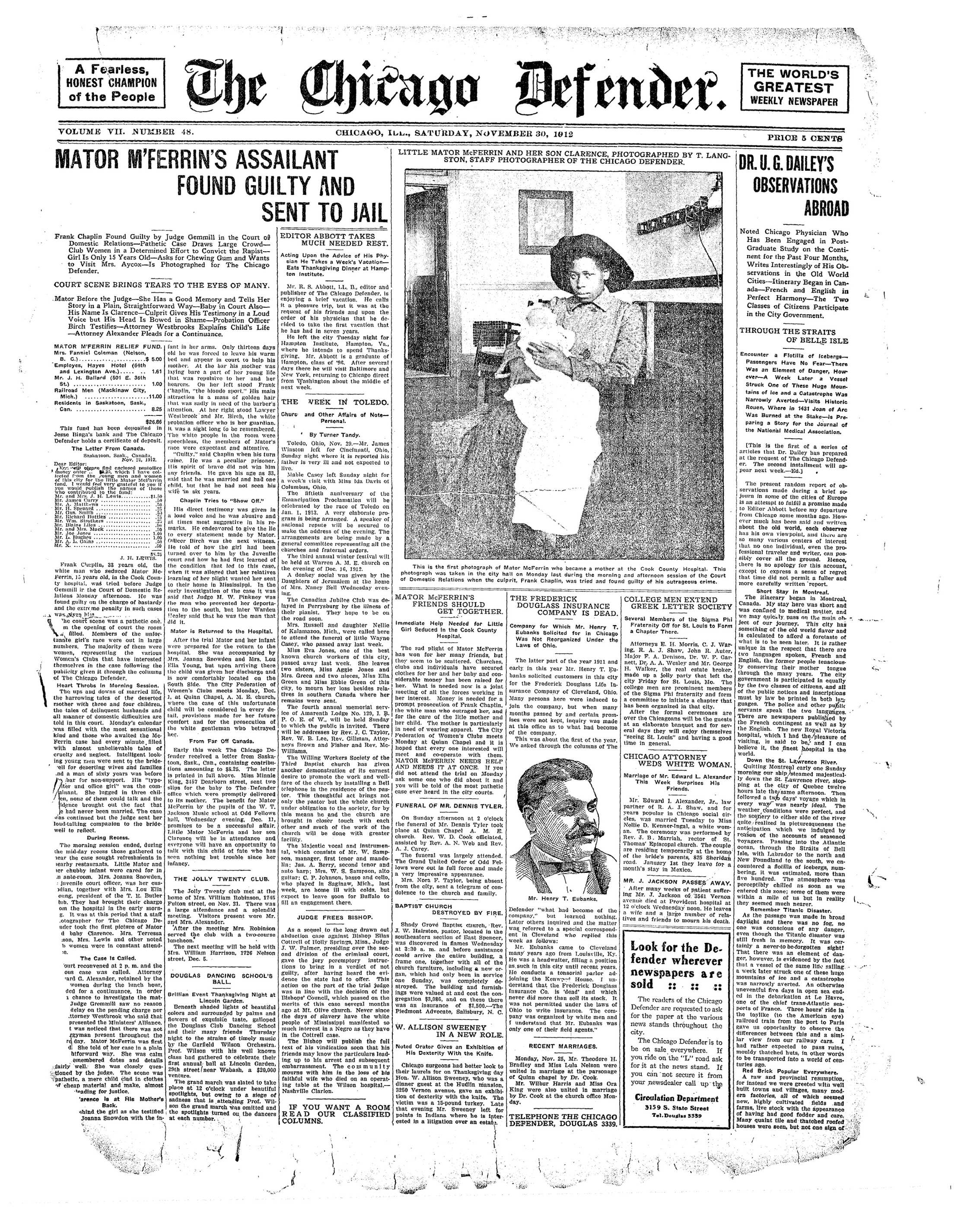
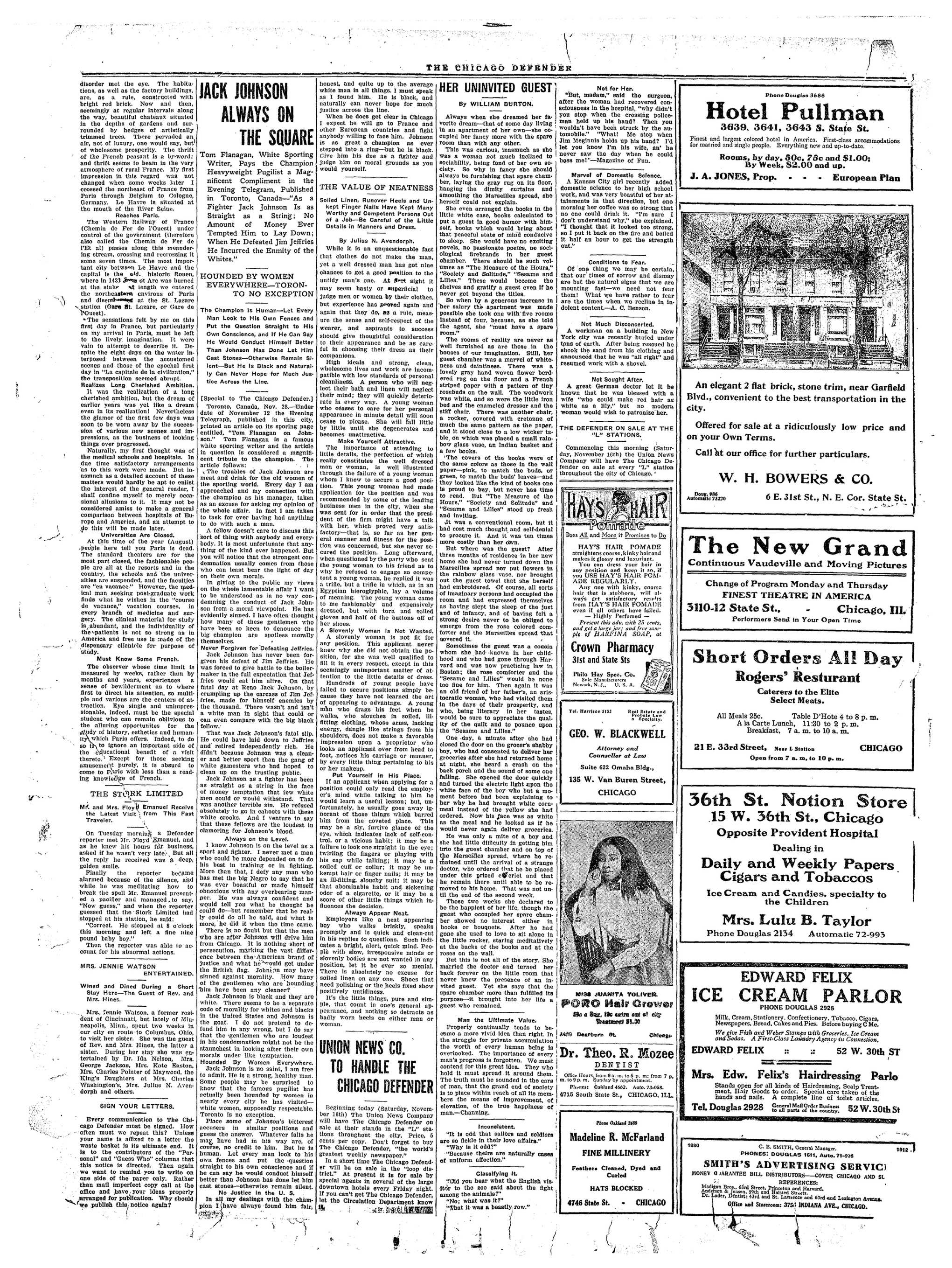
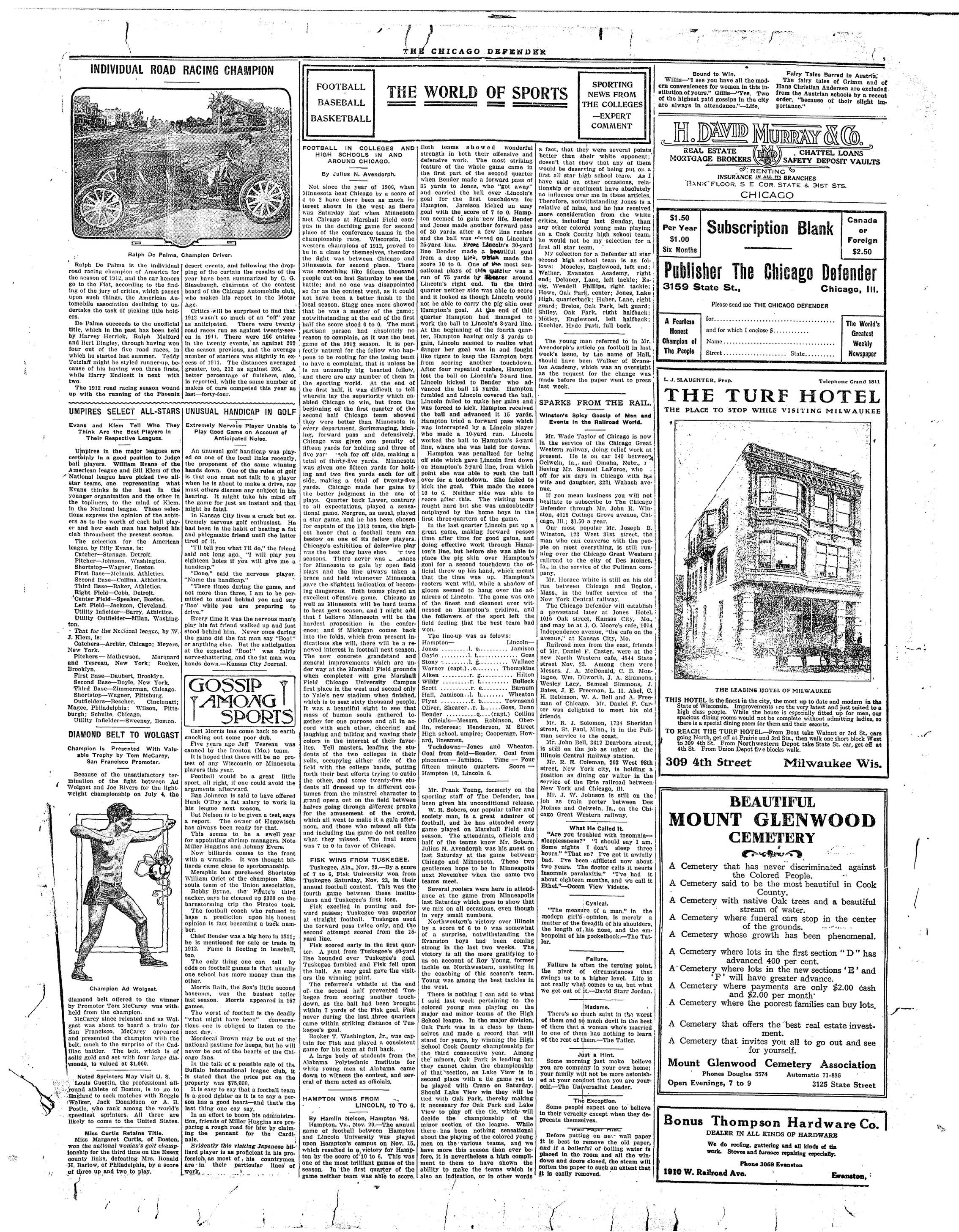
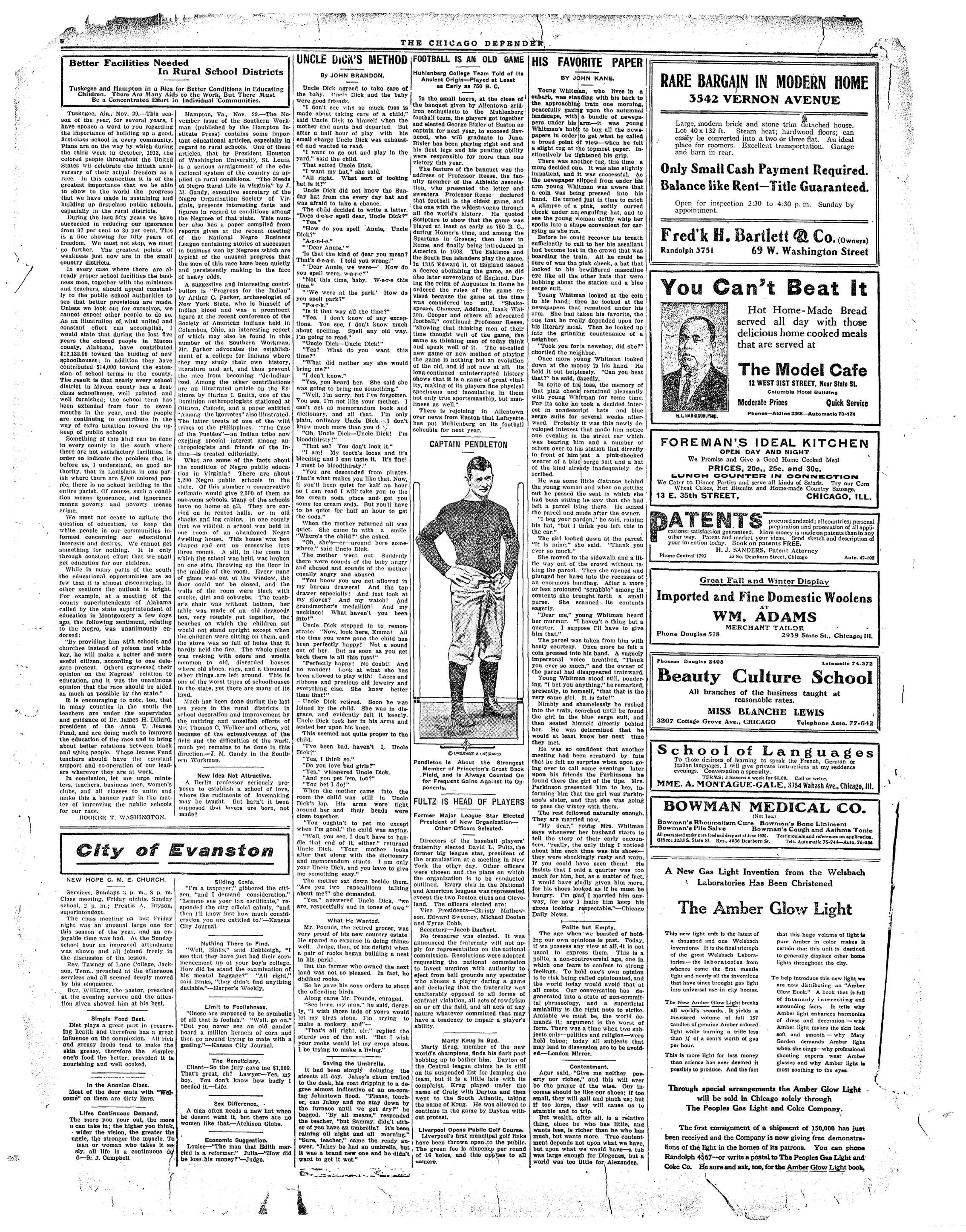
Page text (machine-generated)
VOLUME VII. NUMBER 48.
MATOR M'FERRI
FO
Frank Chaplin Found Guilty by Judge G.
Domestic Relations—Pathetic Case I.
Club Women in a Determined Effort to
Girl Is Only 15 Years Old—Asks for Ch
to Visit Mrs. Aycox—Is Photograph
Defender.
COURT SCENE BRINGS TEARS TO THE
Mator Before the Judge—She Has a Good
Story in a Plain, Straightforward Way.
His Name Is Clarence—Culprit Gives H
Voice but His Head Is Bowed in Sha
Birch Testifies—Attorney Westbrooks
—Attorney Alexander Pleads for a Con
MATOR M'FERRIN'S ASSAILANT FOUND GUILTY AND SENT TO JAIL
Frank Chaplin Found Guilty by Judge Gemmill in the Court of Domestic Relations—Pathetic Case Draws Large Crowd—Club Women in a Determined Effort to Convict the Rapist—Girl Is Only 15 Years Old—Asks for Chewing Gum and Wants to Visit Mrs. Aycox—Is Photographed for The Chicago Defender.
COURT SCENE BRINGS TEARS TO THE EYES OF MANY.
Mator Before the Judge—She Has a Good Memory and Tells Her Story in a Plain, Straightforward Way—Baby in Court Also—His Name Is Clarence—Culprit Gives His Testimony in a Loud Voice but His Head Is Bowed in Shame—Probation Officer Birch Testifies—Attorney Westbrooks Explains Child's Life—Attorney Alexander Pleads for a Continuance.
After the trial Mator and her infant were prepared for the return to the hospital. She was accompanied by Mrs. Joanna Snowden and Mrs. Lou Pella Young, but upon arriving there the child was given her discharge and is now comfortably located on the South Side. The City Federation of Women's Clubs meets Monday, Dec. 1, at Quinn Chapel, A. M. E. church, where the case of this unfortunate child will be considered in every detail, provisions made for her future comfort and for the prosecution of the white gentleman who betrayed her.
From Far Off Canada.
Early this week The Chicago Defender received a letter from Saskatoon, Sask., Can, containing contributions amounting to $2.25. The letter is printed in full above. Miss Minnie King, 3157 Dearborn street, sent two slips for the baby to The Defender office which were promptly delivered to its mother. The benefit for Mator McFerrin by the pupils of the W. T. Jackson Music school at Odd Fellows hall, Wednesday evening, Dec. 11, promises to be a successful affair. Little Mator McFerrin and her son Clarence will be in attendance and everyone will have an opportunity to talk with this child of fate who has seen nothing but trouble since her infancy.
The Jolly Twenty club met at the home of Mrs. William Robinson, 1745 Fulton street, on Nov. 21. There was a large attendance and a splendid meeting. Visitors present wore Mr. and Mrs. Alexander.
Some observations with the aid of these
A Fearless HONEST CHAMPION of the People
MATOR M'FERRIN RELIEF FUND
Mrs. Fanniel Coleman (Nelson,
B. C.)..... $ 5.00
Employees, Hayes Hotel (64th
and Lexington Ave.)..... 1.61
Mr. J. H. Ballard (501 E. 36th
St.)..... 1.00
Railroad Men (Mackinaw City,
Mich.)..... 11.00
Residents in Saskatoon, Sask.
Can..... 8.25
```markdown
```
This fund has been deposited in Jesse Binga's bank and The Chicago Defender holds a certificate of deposit.
Dear Editor:
I believe final enclosed postage
money order #25, which I have collected from the young men and women
of this city, will make Mater McFerrin
toucher, would feel very grateful to you,
you would publish the names of those
who contributed to the fund:
Mr. H. Lewis. $1.00
Mr. James Curry. .50
Mr. H. Stephens. .50
Mr. Gus. Smith. .55
Mr. Richard Battles. .55
Mr. Stuart Hussels. .55
Mr. Blaine Liles. .50
Mr. and Mrs. Muck. .50
Mr. L. Johns. .50
Mr. L. Hughes. .1.00
Mr. A. L. Gains. .50
Mr. X. .50
J. H. LEWIS.
Frank Campilu, 33 years old, the
white man who seduced Mater McFerrin,
15 years old, in the Cook County
hospital, was tried before Judge
Gemmilu in the Court of Domestic Relations Monday afternoon. He was
found guilty on the charge of bastardy
and the extreme penalty in such cases
was given him.
The court scene was a pathetic one, in the opening of court the room filled. Members of the unfortunate girl's race were out in large numbers. The majority of them were women, representing the various Women's Clubs that have interested themselves in the case following the publicity given it through the columns of The Chicago Defender.
Heart Throbs in Morning Session. The ups and downs of married life, the harrowing tales of the deserted mother with three and four children, the tales of delinquent husbands and all manner of domestic difficulties are told in this court. Monday's calendar was filled with the most sensational kind and those who awaited the McFerrin case had every minute filled with almost unbelievable tales of cruelty and neglect. Intelligent looking young men were sent to the bridewell for deserting wives and families and a man of sixty years was before he bar for non-support. His "typewriter and office girl" was the commandant. She lugged in three chilien, none of them could talk and the evidence brought out the fact that he had never been married. The case was continued but the judge sent her loud-talking companion to the bridewell to reflect.
During Recess.
The morning session ended, during the mid-day recess those gathered to hear the case sought refreshments in nearby restaurants. Little Mator and chubby infant were cared for in an ante-room. Mrs. Joanna Snowden, juvenile court officer, was her custodian, together with Mrs. Lou Ella young, president of the T. E. Butler tub. They had brought their charge on the hospital in the early morning. It was at this period that a staff photographer for The Chicago Dealer took the first picture of Mator and baby Clarence. Mrs. Terresson, Mrs. Lewis and other noted b women were in constant attend-
The Case Is Called.
ourt reconvened at 2 p. m. and the ous case was called. Attorney ward G. Alexander, retained by the women during the lunch hour, ded for a continuance, in order a chance to investigate the mat Judge Gremmill saw no reason delay on the pending charge nor attorney Westbrook who said that presented the Ministers' Alliance. it was noticed that there was not regyman present throughout the reday. Mator McFerrin was first d. She told of her case in a plain htfforward way. She was calm remembered dates and details fairly well. She was closely questioned by the judge. The scene was pathetic, a mere child clad in clothes of cheap material and make, almost heading for justice. *arence is at His Mother's Back.* behind the girl as she testified Joanna Snowdon with the in
The Chicago Defender.
fant in her arms. Only thirteen days old he was forced to leave his warm bed and appear in court to help his mother. At the bar his mother was having bared a part of her young life that was repulsive to her and her hearers. On her left stood Frank Chapin, "the blonde sport." His main attraction is a mass of golden hair that was sadly in need of the barber's attention. At her right stood Lawyer Westbrook and Mr. Birch, the white probation officer who is her guardian. It was a sight long to be remembered. The white people in the room were speechless, the members of Mator's race were expectant and attentive.
"Guilty," said Chaplin when his turn came. He was a peculiar prisoner. His spirit of bravo did not win him any friends. He gave his age as 33, said that he was married and had one child, but that he had not seen his wife in six years.
Chaplin Tries to "Show Off."
His direct testimony was given in a loud voice and he was abusive and at times most suggestive in his remarks. He endeavored to give the lie to every statement made by Mator. Officer Birch was the next witness. He told of how the girl had been turned over to him by the Juvenile court and how he had first learned of the condition that led to this case, when it was alleged that her relatives learning of her plight wanted her sent to their home in Mississippi. In the early investigation of the case it was said that Judge M. W. Pinkney was the man who prevented her deportation to the south, but later Warden Healey said that he was the man that did it.
Mator is Returned to the Hospital.
From Far Off Canada.
THE JOLLY TWENTY CLUB
After the meeting Mrs. Robinson served the club with a two-course luncheon. The next meeting will be held with Mrs. William Harrison, 1726 Nelson street. Dec. 5.
DOUGLAS DANCING SCHOOL'S BALL
Brillian Event Thanksgiving Night at Lincoln Garden.
Beneath shaded lights of beautiful colors and surrounded by palms and flowers of exquisite taste, galloped the Douglass Club Dancing School and their many friends Thursday night to the strains of timely music by the Garfield Wilson Orchestra. Prof. Wilson with his well known class had gathered to celebrate their first annual ball at Lincoln Garden, 29th street / near Wabash, a $20,000 venture.
The grand march was slated to take place at 12 o'clock under beautiful spotlights, but owing to a siege of sadness that is attending Prof. Wilson the grand march was omitted and the spotlights turned on the dancers at each number.
CHICAGO, ILL., SATURDAY, NOVEMBER 30, 1912
EDITOR ABBOTT TAKES MUCH NEEDED REST.
Acting Upon the Advice of His Physiian He Takes a Week's Vacation—Eats Thanksgiving Dinner at Hampton Institute.
Mr. R. S. Abbott, L.L. B., editor and publisher of The Chicago Defender, is enjoying a brief vacation. He calls it a pleasure trip, but it was at the request of his friends and upon the order of his physician that he decided to take the first vacation that he has had in seven years.
He left the city Tuesday night for Hampton Institute, Hampton, Va., where he intends to spend Thanksgiving. Mr. Abbott is a graduate of Hampton, class of '66. After several days there he will visit Baltimore and New York, returning to Chicago direct from Washington about the middle of next week.
' By Turner Tandy.
Toledo, Ohio, Nov. 29.—Mr. James Winston left for Cincinnati, Ohio, Sunday night where it is reported his father is very ill and not expected to live.
Mable Casey left Sunday night for a week's visit with Miss Ida Davis of Columbus, Ohio.
The fifteenth anniversary of the Emancipation Proclamation will be celebrated by the race of Toledo on Jun. 1, 1913. A very elaborate program is being arranged. A speaker of national repute will be secured to make the address of the evening. The arrangements are being made by a general committee representing all the churches and fraternal orders.
The third annual winter festival will be held at Warren A. M. E. church on the evening of Dec. 16, 1912.
A donkey social was given by the Daughters of Jerusalem at the home of Mrs. Nancy Bell Wednesday evening.
The Canadian Jubilee Club was delayed in Perrybush by the illness of their pianist. They hope to be on the road soon.
Mrs. Russell and daughter Nellie of Kalamazoo, Mich., were called here to attend the funeral of little Wayne Casey, who passed away last week.
Miss Eva Jones, one of the best known church workers of this city, passed away last week. She leaves two sisters, Miss Aggie Jones and Mrs. Green and two nieces, Miss Elsa Green and Miss Ebbie Green of this city, to mourn her loss besides relatives in southern Canada where her remains were sent.
The fourth annual memorial service of Amarenth Lodge No. 129, I. B. P. O. E. of W., will be held Sunday to which the public is invited. There will be addresses by Rev. J. C. Taylor, Rev. W. B. Lee, Rev. Gillman, Attorneys Brown and Fisher and Rev. McWilliams.
The Willing Workers Society of the Third Baptist church has given another demonstration of its earnest desire to promote the work and welfare of the church by installing a Bell telephone in the residence of the pastor. This thoughtful act brings not only the pastor but the whole church under obligation to the society, for by this means he and the church are brought in closer touch with each other and much of the work of the church will be done with greater facility.
The Majestic vocal and instrumental, which consists of Mr. W. Sampson, manager, first tenor and mandolin; Jas. A. Berry, second tenor and auto harp; Mrs. W. S. Sampson, alto guitar; C. P. Johnson, basso and cello, who played in Saginaw, Mich., last week, are home ill with colds, but expect to leave soon for Buffalo to fill an engagement there.
JUDGE FREES BISHOP.
As a sequel to the long drawn out abduction case against Bishop Ellas Cottrell of Holly Springs, Miss., Judge J. W. Palmer, presiding over the second division of the criminal court, gave the jury poremptory instructions to bring in a verdict of not guilty, after having heard the evidence the state had to offer. This action on the part of the trial judge was in line with the decision of the Bishops' Council, which passed on the merits of this case several months ago at Mt. Olive church. Never since the days of slavery have the white people of Mississippi manifested so much interest in a Negro as they have in the Cottrell case.
The Bishop will publish the full
text of his vindication soon that his
friends may know the particulars leading
up to his arrest and subsequent
embarrassment. The community
mourns with him in the loss of his
fateful wife who died on an operating
table at the Wilson hospital.—
Nashville Clarion.
IF YOU WANT A ROOM
READ OUR CLASSIFIED
COLUMNS.
LITTLE MATOR McFERRIN AND HER SON CLARENCE, PHOTOGRAPHED BY T. LANG-
STON, STAFF PHOTOGRAPHER OF THE CHICAGO DEFENDER.
MARY S.
MATOR McFERRIN'S FRIENDS SHOULD GET TOGETHER.
Immediate Help Needed for Little Girl Seduced In the Cook County Hospital.
The sad plight of Mator McFerrin has won for her many friends, but they seem to be scattered. Churches, clubs and individuals have secured clothes for her and her baby and considerable money has been raised for her. What is needed now is a joint meeting of all the forces working in her interest. Money is needed for a prompt prosecution of Frank Chaplin, the white man who outraged her, and for the care of the little mother and her child. The mother is particularly in need of wearable apparel. The City Federation of Women's Clubs meets Monday at Quinn Chapel and it is hoped that every one interested will meet and co-operate with them. MATOR McFERRIN NEEDS HELP AND NEEDS IT AT ONCE. If you did not attend the trial on Monday ask some one who did about it and you will be told of the most pathetic case ever heard in the city courts.
THE FREDERICK DOUGLASS INSURANCE COMPANY IS DEAD.
Company for Which Mr. Henry T. Eubanks solicited for in Chicago Was Not Reorganized Under the Laws of Ohio.
The latter part of the year 1911 and early in this year Mr. Henry T. Eubanks solicited customers in this city for the Frederick Douglass Life Insurance Company of Cleveland, Ohio. Many persons here were induced to join the company, but when many months passed by and certain promises were not kept, inquiry was made at this office as to what had become of the company.
This was about the first of the year. We asked through the columns of The COLLEGE MEN EXTEND GREEK LETTER SOCIETY.
Several Members of the Sigma P. Fraternity Off for St. Louis to Form a Chapter There.
Attorneys E. H. Morris, C. J. Wating, R. A. J. Shaw, John R. Auto Major F. A. Denison, Dr. W. F. Ganett, Dr. A. A. Wesley and Mr. George H. Walker, the real estate broke made up a jolly party that left the city Friday for St. Louis, Mo. The college men are prominent members of the Sigma Phi fraternity and for a committee to initiate a chapter that has been organized in that city.
After the formal ceremonies and over the Chicagoans will be the guests at an elaborate banquet and for several days they will enjoy themselves "seeing St. Louis" and having a good time in general.
CHICAGO ATTORNEY WEDS WHITE WOMAN
Marriage of Mr. Edward L. Alexander. This Week Surprises His Friends.
FUNERAL OF MR. DENNIS TYLER
On Sunday afternoon at 2 o'clock the funeral of Mr. Dennis Tyler took place at Quinn Chapel A. M. E. church. Rev. W. D. Cook officinated, assisted by Rev. A. N. Web and Rev. A. J. Carey.
The funeral was largely attended. The Grand United Order of Odd Fellows were out in full force and made a very impressive appearance.
Mrs. Nora F. Taylor, being absent from the city, sent a telegram of condolence to the church and family.
Shady Grove Baptist church, Rev. J. W. Hairston, pastor, located in the southeastern section of East Spencer, was discovered in flames Wednesday at 3:30 a. m. and before assistance could arrive the entire building, a frame one, together with all of the church furniture, including a new organ, which had only been in service one Sunday, was completely destroyed. The building and furnishings were valued at and cost the congregation $3,086, and on these there was an insurance of $1,500—The Piedmont Advocate, Salisbury, N. C.
W. ALLISON SWEENEY
IN A NEW ROLE
Noted Orator Gives an Exhibition of His Dexterity With the Knife.
Chicago surgeons had better look to their laurels for on Thanksgiving day Hon. W. Allison Sweeney, who was a dinner guest at the Hudlin mansion, 3250 Vernon avenue, gave an exhibition of dexterity with the knife. The victim was a 15-pound turkey. Lata that evening Mr. Sweeney left for points in Indiana where he is interested in a litigation over an estate.
THE FREDERICK DOUGLASS INSURANCE COMPANY IS DEAD.
Company for Which Mr. Henry T. Eubanks Solicited for in Chicago Was Not Reorganized Under the Laws of Ohio.
The latter part of the year 1911 and early in this year Mr. Henry T. Eubanks solicited customers in this city for the Frederick Douglass Life Insurance Company of Cleveland, Ohio. Many persons here were induced to join the company, but when many months passed by and certain promises were not kept, inquiry was made at this office as to what had become of the company.
This was about the first of the year. We asked through the columns of The
J. B.
Mr. Henry T. Eubanks.
Defender "what had become of the company," but learned nothing. Later others inquired and the matter wag referred to a special correspondent in Cleveland who replied this week as follows:
Mr. Eubanks came to Cleveland many years ago from Louisville, Ky. He was a headwaiter, filling a position as such in this city until recent years. He conducts a tonsorial parlor adjoining the Kenwood House. I understand that the Frederick Douglass Insurance Co. is 'dead' and which never did more than sell its stock. It was not permitted under the laws of Ohio to write insurance. The company was organized by white men and I understand that Mr. Eubanks was only one of their field agents."
RECENT MARRIAGES
Monday, Nov. 25, Mr. Theodore H.
Bradley and Miss Lula Nelson were
united in marriage at the parsonage
of Quinn chapel by Dr. Cook.
Mr. Wilbur Harris and Miss Ora
King were also united in marriage
by Dr. Cook at the church office
Monday.
TELEPHONE THE CHICAGO
DEFENDER, DOUGLAS 3339.
COLLEGE MEN EXTEND
GREEK LETTER SOCIETY
Several Members of the Sigma Phi
Fraternity Off for St. Louis to form
a Chapter There.
Attorneys E. H. Morris, C. J. Waring, R. A. J. Shaw, John R. Auter,
Major F. A. Denison, Dr. W. F. Garnett, Dr. A. W. Alesley and Mr. George H. Walker, the real estate broker,
made up a jolly party that left the city Friday for St. Louis, Mo. The college men are prominent members of the Sigma Phi fraternity and form a committee to initiate a chapter that has been organized in that city.
After the formal ceremonies are over the Chicagoans will be the guests at an elaborate banquet and for several days they will enjoy themselves "seeing St. Louis" and having a good time in general.
CHICAGO ATTORNEY
WEDS WHITE WOMAN.
Marriage of Mr. Edward L. Alexander
This Week Surprises His
Friends.
Mr. Edward I. Alexander, Jr., law partner of R. A. J. Shaw, and for years popular in Chicago social circles, was married Tuesday to Miss Nellie D. Kenner-Ingal, a white woman. The ceremony was performed by Rev. J. B. Marriah, rector of St. Thomas Episcopal church. The couple are residing temporarily at the home of the bride's parents, 825 Sheridan road. January 1st they leave for a month's stay in Mexico.
MR. J. JACKSON PASSES AWAY.
After many weeks of patient suffering Mr. J. Jackson of 3561 Vernon avenue died at Provident hospital at 12 o'clock Wednesday noon. He leaves a wife and a large number of relatives and friends to mourn his death.
Look for the Defender wherever newspapers are sold :: :: ::
The readers of the Chicago Defender are requested to ask for the paper at the various news stands throughout the city.
The Chicago Defender is to be on sale everywhere. If you ride on the "L" road ask for it at the news stand. If you can not secure it from your newsdealer call up the Circulation Department
3159 S. State Street
Tel. Douglas 5359
THE WORLD'S GREATEST WEEKLY NEWSPAPER
PRICE 5 CENTS
DR. U. G. DAILEY'S OBSERVATIONS ABROAD
Noted Chicago Physician Who Has Been Engaged in Post-Graduate Study on the Continent for the Past Four Months, Writes Interestingly of His Observations in the Old World Cities—Itinerary Began in Canada—French and English in Perfect Harmony—The Two Classes of Citizens Participate in the City Government.
THROUGH THE STRAITS OF BELLE ISLE
Encounter a Flotilla of Icebergs—Passengers Have No Fear—There Was an Element of Danger, However—A Week Later a Vessel Struck One of These Huge Mountains of Ice and a Catastrophe Was Narrowly Averted—Visits Historic Rouen, Where in 1431 Joan of Arc Was Burned at the Stake—Is Preparing a Story for the Journal of the National Medical Association.
[This is the first of a series of articles that Dr. Dailey has prepared at the request of The Chicago Defender. The second installment will appear next week.—Ed.]
The present random report of observations made during a brief sojourn in some of the cities of Europe is an attempt to fulfill a promise made to Editor Abbott before my departure from Chicago some months ago. However much has been said and written about the old world, each observer has his own viewpoint, and there are so many various centers of interest that no one individual, even the professional traveler and writer, can possibly cover all the ground. Hence, there is no apology for this account, except to express a sense of regret that time did not permit a fuller and more carefully written report.
Short Stay In Montreal
The linen began in Montreal, Canada. My stay here was short and was confined to medical matter, and we may quickly pass on the main object of our journey. This city has something of the old world flavor and is calculated to afford a foretaste of what is to be seen later. It is rather unique in the respect that there are two languages spoken, French and English, the former people tenaciously conserving their mother tongue through the many years. The city government is participated in equally by the two classes of citizens, and all of the public notices and inscriptions must by law be printed in both languages. The police and other public servants speak the two languages. There are newspapers published by the French contingent as well as by the English. The new Royal Victoria hospital, which I had the pleasure of visiting, is said to be, and I can believe it, the finest hospital in the world.
Down the St. Lawrence River. Quitting Montreal early one Sunday morning our ship steamed majestically down the St. Lawrence river, stopping at the city of Quebec twelve hours late the same afternoon. Then followed a two days' voyage which in every way was nearly ideal. The weather, conditions were perfect, and the seepery to either side of the river quite realized in picturesqueness the anticipation which we indulged by reason of the accounts of seasoned voyagers. Passing into the Atlantic ocean, through the Straits of Bell Isle, with Labrador to the north and New Foundland to the south, we encountered a floatilla of icebergs, numbering, it was estimated, more than five hundred. The atmosphere was perceptibly chilled as soon as we entered this zone; some of them were within a mile of us but in reality they seemed much nearer.
Remember Titanic Disaster.
As the passage was made in broad daylight and there was no fog, one no one was conscious of any danger, even though the Titanic disaster was still fresh in memory. It was certainly a never-to-be-forgotten sight! That there was an element of danger, however, is evidenced by the fact that a vessel of the same life sailing a week later struck one of these huge mountains of ice and a catastrophe was narrowly averted. An otherwise uneventful five days in open sea ended in the debarkation at Le Haver, one of the chief trans-Atlantic seaports of France. Three hours' ride in the toylike (to the American eye) railroad train from the port to Paris gave us opportunity to observe the differences between this and a similar view from our railway cars. I had rather expected to pass ruins, mould that hatched huts, in other words to be transported into a world of centuries ago.
Red Brick Popular Everywhere.
A raw and provincial resumption, for instead we were greeted with well built towns and villages, many modern factories, all of which seemed new, highly cultivated and farms, live stock with the appearance of having had good fodder and care. Many quaint tile and thatched roofed houses were seen, but not one sign of
disorder met the eye. The habitations, as well as the factory buildings, are, as a rule, constructed with bright red brick. Now and then, seemingly at regular intervals along the way, beautiful chateaux situated in the depths of gardens and surrounded by hedges of artistically trimmed trees. There pervaded an air, not of luxury, one would say, but of wholesome prosperity. The thrift of the French peasant is a by-word; and thrift seems to beam in the very atmosphere of rural France. My first impression in this regard was not changed when some weeks later I crossed the northeast of France from Paris through Belgium to Cologne, Germany. Le Havre is situated at the mouth of the River Seine.
Beaches Parls.
The Western Railway of France (Chemin de For de l'Quest) under control of the government (therefore also called the Cholin de Per de l'Et al) passes along this meandering stream, crossing and recrossing it some seven times. The most important city between Le Havre and the capital is the old historic Rouen, where in 1431 it at Arc was burned at the stake and length we entered the northeastern environs of Paris and disembark at the St. Lazare station (Gare St. Lazare, or Gare de l'Ouest).
The sensations felt by me on this first day in France, but particularly on my arrival in Paris, must be left to the lively imagination. It were vain to attempt to describe it. Despite the eight days on the water interposed between the accustomed scenes and those of the epochal first day in "La capitale de la civilization," the transposition seemed abrupt.
```markdown
```
Realizes Long Cherished Ambition.
It was the realization of a long cherished ambition, but the dream of earlier years was yet like a dream even in its realization! Nevertheless the glamor of the first few days was soon to be worn away by the successes and impressions, as the business of looking things over progressed.
Naturally, my first thought was of the medical schools and hospitals. In due time satisfactory arrangements as to this work were made. But insumuch as a detailed account of these matters would hardly be apt to enlist the interest of the general reader, I shall confine myself to merely occasional allusions to it. It may not be considered amiss to make a general comparison between hospitals of Europe and America, and an attempt to do this will be made later.
Universities Are Closed.
Universities Are Closed.
At this time of the year (August) people here tell you Paris is dead.
The standard theaters are for the most part closed, the fashionable people all at the resorts and in the country, the schools and the universities are suspended, and the faculties are "en vacance." However, the medical man seeking postgraduate work finds what he wishes in the "course de vacance," vacation courses, in every branch of medicine and surgery. The clinical material for study is abundant, and the individuality of the "patients is not so strong as in America and free use is made of the dispensary clientele for purpose of study.
Must Know Some French.
The observer whose time limit is measured by weeks, rather than by months and years, experiences a sense of bewilderment as to where first to direct his attention, so multiple and various are the centers of attraction. Eye single and unimpressionable, indeed, must be the special student who can remain oblivious to the alluring opportunities for the study of history, esthetics and humanity which Paris offers. Indeed, to do so is to ignore an important side of the educational benefit of a visit thereto. Except for those seeking amusement purely, it is absurd to come to Paris with less than a reading knowledge of French.
THE STORK LIMITED
Mr. and Mrs. Floyd Emanuel Receive the Latest Visit from This Fast Traveler.
On Tuesday morning a Defender reporter met Mr. Floyd Emanuel, and as he knew his hours for business, asked if he wasn't very late. But all the reply he received was a deep, golden smile.
Finally the reporter became alarmed because of the silence, and while he was meditating how to break the spell Mr. Emanuel presented a pacifier and managed, to say, "Now guess," and when the reporter guessed that the Stork Limited had stopped at his station, he said:
"Correct. He stopped at 8 o'clock this morning and left a fine nine pound baby boy."
Then the reporter was able to account for his abnormal actions.
MRS. JENNIE WATSON
Wined and Dined During a Short Stay Here—The Guest of Rev. and Mrs. Hines.
Mrs. Jennie Watson, a former resident of Cincinnati, but lately of Minneapolis, Minn., spent two weeks in our city en route to Columbus, Ohio, to visit her sister. She was the guest of Rev. and Mrs. Hines, the latter a sister. During her stay she was entertained by Dr. Ida Nelson, Mrs. George Jackson, Mrs. Kate Euston, Mrs. Charles Pointer of Maywood, the King's Daughters at Mrs. Charles Washington's, Mrs. Julius N. Avendorph and others.
SIGN YOUR LETTERS.
Every communication to The Chicago Defender must be signed. How often must we repeat this? Unless your name is affixed to a letter the waste basket is its ultimate end. It is to the contributors of the "Personal" and "Guess Who" columns that this notice is directed. Then again we want to remind you to write on one side of the paper only. Rather than mail imperfect copy call at the office and have, your ideas properly arranged for publication. Why should we publish this notice again?
JACK JOHNSON ALWAYS ON THE SQUARE
Tom Flanagan, White Sporting Writer, Pays the Champion Heavyweight Pugilist a Magnificent Compliment in the Evening Telegram, Published in Toronto, Canada—"As a Fighter Jack Johnson Is as Straight as a String; No Amount of Money Ever Tempted Him to Lay Down; When He Defeated Jim Jeffries He Incurred the Enmity of the Whites."
HOUNDED BY WOMEN
EVERYWHERE—TORON-
TO NO EXCEPTION
The Champion Is Human—Let Every Man Look to His Own Fences and Put the Question Straight to His Own Conscience, and If He Can Say He Would Conduct Himself Better than Johnson Has Done Let Him Cast Stones—Otherwise Remain Silent—But He Is Black and Naturally Can Never Hope for Much Justice Across the Line.
[Special to the Chicago Defender, Toronto, Canada, Nov. 28.—Under date of November 12 the Evening Telegraph published in this city, printed an article in a sporing page entitled "Tom Flanagan on Johnson." Tom Flanagan is a famous white sporting writer and the article in question is considered a magnificent tribute to the champion. The article follows:
The troubles of Jack Johnson are meat and drink for the old women of the sporting world. Every day I am approached and my connection with the champion as his manager, taken as an excuse for asking my opinion of the whole affair. In fact I am taken to task for ever having had anything to do with such a man.
A fellow doesn't care to discuss this sort of thing with anybody and everybody. It is most unfortunate that anything of the kind ever happened. But you will notice that the strongest condemnation usually comes from those who can least bear the light of day on their own morals.
In giving to the public my views on the whole lamentable affair I want to be understood as in no way condemning the conduct of Jack Johnson from a moral viewpoint. He has evidently sinned. I have often thought how many of these gentlemen who have been so keen to denounce the big champion are spotless morally themselves.
Never Forgiven for Defeating Jeffries.
Jack Johnson has never been forgiven his defeat of Jim Jeffries. He was forced to give battle to the boilermaker in the full expectation that Jeffries would eat him alive. On that fatal day at Reno Jack Johnson, by crumpling up the carcass of Jim Jeffries, made for himself enemies by the thousand. There wasn't and isn't a white man in sight that could or can even compare with the big black fellow.
That was Jack Johnson's fatal slip. He could have laid down to Jeffries and retired independently rich. He didn't because Johnson was a cleaner and better sport than the gang of white gamesters who had hoped to clean up on the trusting public.
Jack Johnson as a fighter has been as straight as a string in the face of money temptation that few white men could or would withstand. That was another terrible sin. He refused to so in cactus with these white crooks. I don't say that these fellows are the loudest in clamoring for Johnson's blood.
Always on the Level.
I know Johnson is on the level as a sport and fighter. I never met a man who could be more depended on to do his best in training or in fighting. More than that, I defy any man who has met the big Negro to say that he was ever boastful or made himself obnoxious with any overbearing manner. He was always confident and would tell you what he thought he could do—but remember that he really could do all he said, and what is more, he did it when the time came.
There is no doubt but that the men who are after Johnson will drive him from Chicago. It is nothing short of persecution, marking the vast difference between the American brand of justice and what he would get under the British flag. Johnson may have sinned against morality. How many of the gentlemen who are hounding him have been any cleaner? Jack Johnson is black and they are white. There seems to be a separate code of morality for whites and blacks in the United States and Johnson is the goat. I do not pretend to defend him in any wrong, but I do say that the gentlemen who are loudest in his condemnation might not be the stanchest in looking after their own morals under like temptation.
Hounded By Women Everywhere
Jack Johnson is no saint, I am free to admit. He is a strong, healthy man. Some people may be surprised to know that the famous pugilist has actually been hounded by women in nearly every city he has visited—white women, supposedly respectable. Toronto is no exception.
Place some of Johnson's bitterest accusers in similar positions and guess the answer. Whatever falls he may have had in his way are, of course, no credit to him. But he is human. Let every man look to his own fences and put the question straight to his own conscience and if he can say he would conduct himself than Johnson has done let him cast stones—otherwise remain silent.
No Justice in the U. S.
In all my dealings with the champion I have always found him fair,
honest, and quite up to the average white man in all things. I must speak as I found him. He is black, and naturally can never hope for much justice across the line.
When he does get clear in Chicago I expect he will go to France and other European countries and fight anybody willing to face him. Johnson is as great a champion as ever stepped into a ring—but he is black. Give him his due as a fighter and judge him on moral grounds as you would yourself.
THE VALUE OF NEATNESS
Soiled Linen, Runover Heels and Unkept Finger Nails Have Kept Many Worthy and Competent Persons Out of the Badway—Barely a Little Details in Manners and Drama.
By Julius N. Avendorph.
While it is an unquestionable fact that clothes do not make the man, yet a well dressed man has got nine chances to get a good position to the untidy man's one. At first sight it may seem hasty or imperficial to judge men or women by their clothes, but experience has proved again and again that they do, as a rule, measure the sense and self-respect of the wearer, and aspirants to success should give thoughtful consideration to their appearance and be as careful in choosing their dress as their companions.
High ideals and strong, clean, wholesome lives and work are incompatible with low standards of personal cleanliness. A person who will neglect their bath and linen will neglect their mind; they will quickly deteriorate in every way. A young woman who ceases to care for her personal appearance in minute detail will soon cease to please. She will fall little by little until she degenerates and becomes unattractive.
The importance of attending to little details, the perfection of which really constitutes the well dressed man or woman, is well illustrated through the failure of a woman whom I knew to secure a good position. This young woman had made application for the position and was recommended by some of the leading business men in the city, when she was sent for in order that the president of the firm might have a talk with her, which proved very satisfactory—that is, so far as her general manner and fitness for the position was concerned, but she never secured the position. Long afterward, when questioned by the party who sent the young woman to his friend as to why he refused to engage so competent a young woman, he replied it was a trifle, but a trifle in which, as in an Egyptian hieroglyphic, lay a volume of meaning. The young woman came to me fashionably and expensively dressed, with but torn and soiled gloves and half of the buttons off of her shoes.
A Slovenly Woman Is Not Wanted.
A slovenly woman is not fit for any position. This applicant never knew why she did not obtain the position, for she was well qualified to fill it in every respect, except in this seemingly unimportant matter of attention to the little details of dress.
Hundreds of young people have failed to secure positions simply because they have not learned the art of appearing to advantage. A young man who drags his feet when he walks, who slouches in soiled, ill-fitting clothing, whose arms, lacking energy, dangle like strings from his shoulders, does not make a favorable impression upon a proprietor who looks an applicant over from head to foot, notices his carriage or manner, by every little thing pertaining to his or her makeup.
Put Yourself in His Place. If an applicant when applying for a position could only read the employer's mind while talking to him he would learn a useful lesson; but, unfortunately, he usually goes away ignorant of those things which barred him from the coveted place. This may be a sly, furtive glance of the employer, or a vicious lack of self-control, or a vicious failure of may be a failure to look one straight in the eye; twirling the fingers or playing his cap while talking; it may be a soiled cuff or collar; it may be unkempt hair or finger nails; it may be an ill-fitting, slouchy suit; it may be that abominable habit and sickening odor of a cigarette, or it may be a score of other little things which influences the decision.
Always Appear Neat.
Employers like a neat appearing boy who walks briskly, speaks promptly and is quick and clean-cut in his replies to questions. Such indicates a bright, alert, quick mind. People with slow, irresponsive minds or slovenly bodies are not wanted in any position, let it be ever so menial. There is absolutely no excuse for solldining on any one. Shoes that need polishing or the heels fixed show positively untidiness. It's the little things, pure and simple, that count in one's general appearance, and nothing so detracts as badly worn heels on either man or woman.
UNION NEWS CO.
TO HANDLE THE
CHICAGO DEFENDER
Beginning today (Saturday, November 16th) The Union News Company will have The Chicago Defender on sale at their stands in the "L" stations throughout the city, Price, 5 cents per copy. Don't forget to buy The Chicago Defender, "the world's greatest weekly newspaper." In a short time The Chicago Defender will be on sale in the "loop district." At present it is for sale by special agents in several of the large downtown hotels every Friday night. If you can't get The Chicago Defender, let the Circulation Department know
---
THE CHICAGO DEFENDER
HER UNINVITED GUEST
By WILLIAM BURTON.
Always when she dreamed her favorite dream—that of some day living in an apartment of her own—she occupied her fancy more with the spare room than with any other.
This was curious, inasmuch as she was a woman not much inclined to sociability, being fond of her own society. So why in fancy she should always be furnishing that spare chamber, laying the gray rug on its floor, hanging the dimity curtains and smoothing the Marseilles spread, she herself could not explain.
She even arranged the books in the little white case, books calculated to put a guest in good humor with himself, books which would bring about that peaceful state of mind conducive to sleep. She would have no exciting novels, no passionate poems, no sociological frebrands in her guest chamber. There should be such volumes as "The Measure of the Hours" "Society and Solitude" "Sesame and Lillies." These would become the shelves and gratify a guest even if he never got beyond the titles.
So when by a generous increase in her salary the apartment was made possible she took one with five rooms instead of four, because, as she told the agent, she "must have a spare room."
The rooms of reality are never as well furnished as are those in the houses of our imagination. Still, her guest chamber was a marvel of whiteness and daintiness. There was a lovely gray hand woven flower bordered rug on the floor and a French striped paper with a pattern of thy rosebuds on the wall. The woodwork was white, and so were the little iron bed and the enameled dresser and the stiff chair. There was another chair, a rocker, covered with cretonne of much the same pattern as the paper, and it stood close to a low wicker table, on which was placed a small rainbow glass vase, an Indian basket and a few books.
'The covers of the books were of the same colors as those in the wall paper—pink, to match the buds, or green, to match the buds' leaves—and they looked like the kind of books one is proud to buy, but never has time to read. But "The Measure of the Hours" "Society and Solitude" and "Sesame and Lilies" stood up fresh and inviting. It was a conventional room, but it had cost much thought and self-delian to procure it. And it was ten times more costly than her own.
But where was the guest? After three months of residence in her new home she had never turned down the Marseilles spread nor put flowers in the rainbow glass vase, nor brought out the guest towl that she herself had embroidered. Of course, all sorts of imaginary persons had occupied the room and expressed themselves as having slept and eased the sigh and of infancy, and of having felt a strong desire never to be obliged to emerge from the rose colored comforter and the Marseilles spread that covered it.
Sometimes the guest was a cousin whom she had known in her childhood and who had gone through Harvard and was now practicing law in Boston; the rose comforter and the "Sesame and Lilies" would be none too fine for him. Then again it was an old friend of her father's, an aristocratic woman, who had visited them in the days of their prosperity, and who, being literary in her tastes, would be sure to appreciate the quality of the quilt and to pounce upon the "Sesame and Lilies."
One day, a minute after she had closed the door on the grocer's shabby boy, who had consented to deliver her groceries after she had returned home at night, she heard a crash on the back porch and the sound of some one falling. She opened the door quickly and turned the electric light upon the white face of the boy who but a moment before had been explaining to her why he had brought white cornmeal instead of the yellow she had ordered. Now his face was as white as the meal and he looked as if he would never again deliver groceries. He was only a mite of a boy and she had little difficulty in getting him into the guest chamber and on top of the Marseilles spread, where he remained until the arrival of a strange doctor, who ordered that he be placed under this prized ceretel and that he remain there until able to be removed to his home. That was not until the end of the second week.
Those two weeks she declared to be the happiest of her life, though the guest who occupied her spare chamber showed no interest either in books or bouquets. After he had gone she used to love to sit alone in the little rocker, staring meditatively at the backs of the books and at the roses on the wall. She was full of the story. She married the doctor and turned her back forever on the little room that never knew the presence of an invited guest. Yet she says that the spare chamber more than fulfilled its purpose—it brought into her life a guest who remained.
Man the Ultimate Value.
Property continually tends to become a more vivid idea than right. In the struggle for private accumulation the worth of every human being is overlooked. The importance of every man's progress is forgotten. We must content for this great idea. They who hold it must spread it around them. The truth must be sounded in the ears of man, that the grand end of society is to place within reach of all its members the means of improvement, of elevation, of the true happiness of man—Channing.
Inconalstent.
"It is odd that sailors and soldiers are so fickle in their love affairs."
"Why is it odd?"
"Because theirs are naturally cases of uniform affection."
Classifying It.
"Did you hear what the English visitor to the zoo said about the fight among the animals?"
"No; what was it?"
Not for Her.
"But, madam," said the surgeon, after the woman had recovered consciousness in the hospital, "why didn't you stop when the crossing policeman held up his hand? Then you wouldn't have been struck by the automobile." "What! Me stop when Jim Meginni holds up his hand? I'd let you know I'm his wife, an' he never saw the day when he could boss me!"—Magazine of Fun.
Marvel of Domestic Science
Marvel of Domestic Science.
A Kansas City girl recently added domestic science to her high school work, and was very boastful of her attalments in that direction, but one morning her coffee was so strong that no one could drink it. "I'm sure I don't understand why," she explained.
"I thought that it looked too strong, so I put it back on the fire and boiled it half an hour to get the strength out."
Conditions to Fear:
Of one thing we may be certain, that our times of sorrow and dismay are but the natural signs that we are mounting fast—we need not fear them! What we have rather to fear are the times when we recline in indolent content.—A. C. Benson.
Not Much Disconcerted.
A workman on a building in New York city was recently buried under tons of earth. After being rescued he shook the sand from his clothing and announced that he was "all right" and resumed work with a shovel.
Not Sought After.
A great German doctor let it be known that he was blessed with a wife "who could make red hair as white as a lily," but no modern woman would wish to patronize her.
THE DEFENDER ON SALE AT THE "L" STATIONS.
Commencing this morning (Saturday, November 16th) the Union News Company will have The Chicago Defender on sale at every "L" station throughout the city of Chicago.'
HAY'S HAIR
Pointrade
Does All and More it Promises to Do
HAY'S HAIR POMADE
straightens knits, coarse, kinky hair and
makes it glossy and luxurious.
You can dress your hair in
and when you want it so, if
you USE HAY'S HAIR POMADE
REGULARLY.
Any one with kinky, coarse
hair that is stubborn, will always get satisfactory results from HAY'S HAIR POMADE
even if you failed.
— Highly Performed
Present this aduv, with 25 cents,
and get a large jersey, and free sample of HARFINE SOAP, at
THE
MUSEUM
OF
ART
AND
SCIENCE
IN
NEW
YORK
Philo Hay Spec. Co.
Sole Manufacturers
Newark, N. J., U. S. A.
Tel. Harrison $153 Real Estate and
Probate Law
n Specialty.
GEO. W. BLACKWELL
Attorney and
Counsellor at Law
Suite 622 Omaha Bldg.,
135 W. Van Buren Street,
CHICAGO
A
MISS JUANITA TOLIVER
PORO Hair Grower
Do a Baz, like extra cut of hair
Western $3.90
Dr. Theo. R. Mozee
DENTIST
Office Hours, from 9 a.m. to 5 p. m.; from 7 p.
m, to 9 p. m. Sunday by appointment.
Phone: Oakland 4662. Auto. 73-058.
4715 South St. St., CHICAGO, ILL.
Pheno Oakland 2489
Madeline R. McFarland
FINE MILLINERY
Feathers Cleaned, Dyed and
Curled
HATS BLOCKED
4746 State St. - CHICAGO
Hotel Pullman
3639, 3641, 3643 S. State St.
Finest and largest colored hotel in America. First-class accommodations for married and single people. Everything new and up-to-date.
J. A. JONES, Prop. - - - European Plan
THE MUSEUM OF THE AMERICAN REPUBLIC
An elegant 2 flat brick, stone trim, near Garfield Blvd., convenient to the best transportation in the city.
Offered for sale at a ridiculously low price and on your Own Terms.
Call at our office for further particulars.
Doug. 986
Automatic 73220
6 E. 31st St., N. E. Cor. State St.
Continuous Vaudeville and Moving Pictures Change of Program Monday and Thursday FINEST THEATRE IN AMERICA 3110-12 State St., Chicago, Ill. Performers Send in Your Open Time
All Meals 25c. Table D'Hote 4 to 8 p. m.
A la Carte Lunch, 11:30 to 2 p. m.
Breakfast, 7 a. m. to 10 a. m.
CHICAGO
36th St. Notion Store
15 W. 36th St., Chicago
Opposite Provident Hospital
Dealing in
Daily and Weekly Papers
Cigars and Tobaccos
Ice Cream and Candies, specialty to
the Children
Mrs. Lulu B. Taylor
Phone Douglas 2134 Automatic 72-993
EDWARD FELIX
Milk, Cream, Stationery, Confectionery, Tobacco, Cigars, Newspapers, Bread, Cakes and Pies. Before buying C Me. We give Fish and Weber Stamps with Groceries, Ice Cream and Sodas. A First-Class Laundry Agency in Connection,
Mrs. Edw. Felix's Hairdressing Parlo
Stands open for all kinds of Hairdressing, Scalp Treatment, Hair Goods to order. Special care taken of the hands and nails. A complete line of toilet articles.
Tel. Douglas 2928 General Mail Order Business to all parts of the country. 52 W.30th St
SMITH'S ADVERTISING SERVICE
MONEY G JARANTEE BILL DISTRIBUTORS—COVER CHICAGO AND SL
REFERENCES:
Madigan Bros., 63rd Street, Princeton and Harvard,
Anderson & Jensen, 39th and Halsted Streets.
Dr. Lader, Dentist; 43rd and St. Lawrence and 63rd and Lexington Avenue.
Office and Storeroom: 3751 INDIANA AVE., CHICAGO.
```markdown
```
Ralph De Palma, Champion Driver.
Ralph De Palma is the individual road racing champion of America for the season of 1912, and the car honors go to the Flat, according to the finding of the jury of critics, which passes upon such things, the American Automobile association declining to undertake the task of picking title holders.
De Palma succeeds to the unofficial title, which in the past has been held by Harvey Herrick, Ralph Mulford and Bert Dingley, through having won four out of the five road races, in which he started last summer. Teddy Tetzlaff might be styled runner-up, because of his having won three firsts, while Harry Endicott is next with two.
The 1912 road racing season wound up with the running of the Phoenix
desert events, and following the dropping of the curtain the results of the year have been summarized by C. G. Sinsebaugh, chairman of the contest board of the Chicago Automobile club, who makes his report in the Motor Age.
Critics will be surprised to find that 1912 wasn't so much of an "off" year as anticipated. There were twenty road races run as against twenty-seven in 1911. There were 156 entries in the twenty events, as against 202 the season previous, and the average number of starters was slightly in excess of 1911. The distances averaged greater, too, 232 as against 206. A better percentage of finishers, also, is reported, while the same number of makes of cars competed this year as last—forty-four.
UMPIRES SELECT ALL-STARS UNUSUAL HANDICAP IN GOLF
Evans and Klem Tell Who They Think Are the Best Players in Their Respective Leagues.
Umpires in the major leagues are certainly in a good position to judge ball players. William Evans of the American league and Bill Klem of the National league have picked two all-star teams, one representing what Evans thinks is the best in the younger organization and the other in the topliness, to the mind of Klem. In the National league. These selections express the opinion of the arbiters as to the worth of each ball player and how each man has helped his club throughout the present season.
The selection for the American league, by Billy Evans, is:
Catcher—Stanage, Detroit.
Pitcher—Johnson, Washington.
Shortstop—Wagner, Boston.
First Base—McInnis, Athletics.
Second Base—Collins, Athletics.
Third Base—Baker, Athletics.
Right Field—Cobb, Detroit.
Center Field—Speaker, Boston.
Left Field—Jackson, Cleveland.
Utility Infielder—Barry, Athletics.
Utility Outfielder—Milan, Washington.
That for the National league, by W.
J. Klem, is:
Catchers—Archer, Chicago; Meyers, New York.
Pitchers—Mathewson, Marquard and Tesreau, New York; Rucker, Brooklyn.
First Base—Daubert, Brooklyn.
Second Base—Doyle, New York.
Third Base—Zimmerman, Chicago.
Shortstop—Wagner, Pittsburg.
Outfielders—Bescher, Cincinnati;
Magee, Philadelphia; Wilson, Pittsburgh;
burgh; Schulte, Chicago.
Utility Infielder—Sweeney, Boston.
DIAMOND BELT TO WOLGAST
Champion Is Presented With Valuable Trophy by Tom McCarey, San Francisco Promoter.
Because of the unsatisfactory termination of the fight between Ad Wolgast and Joe Rivers for the lightweight championship on July 4, the
A
Champion Ad Wolgast
diamond belt offered to the winner by Promoter Tom McCarey was withheld from the champion.
McCarey since relented and as Wolgast was about to board a train for San Francisco, McCarey appeared and presented the champion with the belt, much to the surprise of the Cadillac battler. The belt, which is of gold gold and set with four large diamonds, is valued at $1,000.
Noted Sprinters May Visit U. S.
Louis Guertin, the professional all-round athlete of Boston, is to go to England to seek matches with Reggie Walker, Jack Donaldson or A. B. Postle, who rank among the world's speediest sprinters. All three are likely to come to the United States.
Miss Curtis Retains Title.
Miss Margaret Curtis, of Boston, won the national woman's golf championship for the third time on the Essex county links, defeating Mrs. Ronald H. Barlow, of Philadelphia, by a score of three up and two to play.
```markdown
```
desert events, and following the dropping of the curtain the results of the year have been summarized by C. G. Sinsebaugh, chairman of the contest board of the Chicago Automobile club, who makes his report in the Motor Age.
Critics will be surprised to find that 1912 wasn't so much of an "off" year as anticipated. There were twenty rond races run as against twenty-seven in 1911. There were 156 entries in the twenty events, as against 202 the season previous, and the average number of starters was slightly in excess of 1911. The distances averaged greater, too, 232 as against 206. A better percentage of finishers, also, is reported, while the same number of makes of cars competed this year as last—forty-four.
Extremely Nervous Player Unable to Play Good Game on Account of Anticipated Noise.
An unusual golf handicap was played on one of the local links recently, the proponent of the same winning hands down. One of the rules of golf is that one must not talk to a player when he is about to make a drive, nor must others discuss any subject in his hearing. It might take his mind off the game for just an instant and that might be fatal.
In Kansas City lives a crack but extremely nervous golf enthusiast. He had been in the habit of beating a fat and phlegmatic friend until the latter tired of it.
"I'll tell you what I'll do," the friend said not long ago, "I will play you eighteen holes if you will give me a handicap."
"Done," said the nervous player. "Name the handicap."
"There times during the game, and not more than three, I am to be permitted to stand behind you and say 'Boo' while you are preparing to drive."
Every time it was the nervous man's play his fat friend walked up and just stood behind him. Never once during the game did the fat man say "Boo!" or anything else. But the anticipation at the expected "Boo!" was fairly nerve-shattering, and the fat man won hands down.—Kansas City Journal.
GOSSIP AMONG SPORTS
Carl Morris has come back to earth knocking out some poor dub.
Five years ago Jeff Tesreau was canned by the Ironton (Mo.) team. It is hoped that there will be no protest of any Wisconsin or Minnesota players this year. Football would be a great little sport, all right, if one could avoid the arguments afterward. Dan Johnson is said to have offered Hank O'Day a fat salary to work in his league next season. Dat Nelson is to be given a test, says a report. The owner of Hgewishus has always been ready for that. This seems to be a swell year for appointing shrimp managers. Note Miller Huggins and Johnny Evers. Now billiards comes to the front with a wrangle. It was thought billiards came close to sportsmanship. Memphis has purchased Shortstop William Oriet of the champion Missoula team of the Union association.
Chief Bender was a big hero in 1811; he is mentioned for sale or trade in 1912. Fame is fleeting in baseball, too.
The only thing one can tell by odds on football games is that usually one school has more money than the other.
Morris Rath, the Sox's little second baseman, was the busiest toller last season. Morris appeared in 157 games.
The worst of football is the deadly "what might have been" conversations one is obliged to listen to the next day.
Mordecai Brown may be out of the national pastime for keeps, but he will never be out of the hearts of the Chicago fans.
In the talk of a possible sale of the Buffalo International league club, it is stated that the price put on the property was $75,000.
It is easy to say that a football team is a good fighter as it is to say a person has a good heart—and that's the last thing one can say.
In an effort to boom his administration, friends of Miller Huggins are preparing a rough road for him by claiming the pennant for the Cardinals.
Evidently this visiting Japanese billiard player is as proficient in his profession as most of his countrymen are in their particular lines of work.
THE WORLD OF SPORTS
FOOTBALL
BASEBALL
BASKETBALL
FOOTBALL IN COLLEGES AN HIGH SCHOOLS IN AND AROUND CHICAGO.
By Julius N. Avendorph.
Not since the year of 1905, when Minnesota beat Chicago by a score of 4 to 2 have there been as much interest shown in the west as there was Saturday last when Minnesota met Chicago at Marshall Field campus in the deciding game for second place of the conference teams in the championship race. Wisconsin, the western champions of 1912, proved to be in a class by themselves, therefore the fight was between Chicago and Minnesota for second place. There was something like fifteen thousand people out on last Saturday to see the battle; and no one was disappointed so far as the contest went, as it could not have been a better finish to the local season. Stagg once more showed that he was a master of the game; notwithstanding at the end of the first half the score stood 0 to 0. The most partisan person had absolutely no reason to complain, as it was the best game of the 1912 season. It is perfectly natural for the fellow who happens to be rooting for the losing team to have a complaint, that is unless he is an unusually big hearted fellow, and there are any number of them in the sporting world. At the end of the first half, it was difficult to tell wherein lay the superiority which enabled Chicago to win, but from the beginning of the first quarter of the second half Chicago team showed they were better than Minnesota in every department. Scremmaging, kicking, forward pass and defensively, Chicago was given one penalty of fifteen yards for holding and three of five yards, each for off side, making a total of thirty-five yards. Minnesota was given one fifteen yards for holding and two five yards each for off side, making a total of twenty-five yards. Chicago made her gains by the better judgment in the use of plays. Quarter back Lawer, contrary to all expectations, played a sensational game. Norgren, as usual, played a star game, and he has been chosen for captain of the 1913 team, the highest honor that a football team can bestow on one of its fellow players. Chicago's exhibition of defensive play was the best they have shown two seasons. There never was a chance for Minnesota to gain by open field plays and the line always taken a brace and held whenever Minnesota gave the slightest indication of becoming dangerous. Both teams played an excellent offensive game. Chicago as well as Minnesota will be hard teams to beat next season, and I might add that I believe Minnesota will be the hardest proposition in the conference; and if Michigan comes back into the folds, which from present indications she will, there will be a renewed interest in football next season. The new concrete grandstand and general improvements which are under way at the Marshall Field ground when completed will give Marshall Field Chicago University Campus first place in the west and second only to Yale's new stadium when finished, which is to seat sixty thousand people. It was a beautiful sight to see that mass of human souls gathered together for one purpose and all in accord with each other, cheering and laughing and talking and waving their colors in the interest of their favorites. Yell masters, leading the students of the two colleges in their yells, occupying either side of the field with the college bands, putting forth their best efforts trying to outdo the other, and some twenty-five students all dressed up in different costumes from the minstrel character to grand opera out on the field between halves going through different pranks for the amusement of the crowd, which all went to make it a gala afternoon, and those who missed all this and including the game do not realize what they missed. The final score was 7 to 0 in favor of Chicago.
FISK WINS FROM TUSKEGEE.
Tuskegee, Ala, Nov. 29.—By a score of 7 to 6, Fisk University won from Tuskegee Saturday, Nov. 23, in their annual football contest. This was the fourth game between these institutions and Tuskegee's first loss.
Fisk excelled in punting and forward passes; Tuskegee was superior at straight football. Tuskegee used the forward pass twice only, and the second attempt scored from the 15-yard line.
Fisk scored early in the first quarter. A punt from Tuskegee's 40-yard line bounded over Tuskegee's goal. Tuskegee fumbled and Fisk fell upon the ball. An easy goal gave the visitors the winning point.
The referee's whistle at the end of the second half prevented Tuskegee from scoring another touchdown, as the ball had been brought within 7 yards of the Fisk goal. Fisk never during the last three quarters came within striking distance of Tuskegee's goal.
Booker T. Washington, Jr., was captain for Fisk and played a consistent game for his team at full back. A large body of students from the Alabama Polytechnic Institute for white young men at Alabama came down to witness the contest, and several of them acted as officials.
HAMPTON WINS FROM
LINCOLN, 10 TO 6.
By Hamlin Nelson, Hampton '98,
Hampton, Va., Nov. 29. "The annual
game of football between Hampton
and Lincoln University was played
upon Hampton's campus on Nov. 15,
which resulted in a victory for Hampton
by the score of 10 to 6. This was
one of the most brilliant games of the
season. In the first quarter of the
game neither team was able to score.
THE CHICAGO DEFENDER
Both teams showed wonderful strength in both their offensive and defensive work. The most striking feature of the whole game came in the first part of the second quarter when Bender made a forward pass of 35 yards to Jones, who "got away" and carried the ball over Lincoln's goal for the first touchdown for Hampton. Jamison kicked an easy goal with the score of 7 to 0. Hampton seemed to gain new life. Bender and Jones made another forward pass of 30 yards after a few line rushes and the ball was placed on Lincoln's 25-yard line. From Lincoln's 30-yard line Bender made a beautiful goal from a drop kick, when made the score 10 to 0. One of the most sensational plays of this quarter was a run of 75 yards by Shearer around Lincoln's right end. In the third quarter neither side was able to score and it looked as though Lincoln would not be able to carry the pig skin over Hampton's goal. At the end of this quarter Hampton had managed to work the ball to Lincoln's 8-yard line. At the beginning of the fourth quarter, Hampton having only 8 yards to gain, Lincoln seemed to realize what danger her goal was in and fought like tigers to keep the Hampton boys from scoring another touchdown. After four repeated rushes, Hampton lost the ball on Lincoln's 2-yard line. Lincoln kicked to Bender who advanced the ball 15 yards. Hampton fumbled and Lincoln covered the ball, Lincoln failed to make her gains and was forced to kick. Hampton received the ball and advanced it 15 yards. Hampton tried a forward pass which was interrupted by a Lincoln player who made a 10-yard run. Lincoln worked the ball to Hampton's 5-yard line, where she was held for downs. Hampton was penalized for being off side which gave Lincoln first down on Hampton's 2-yard line, from which point she was able to rush the ball over for a touchdown. She failed to kick the goal. This made the score 10 to 6. Neither side was able to score after this. The visiting team fought hard but she was undoubtedly outplayed by the home boys in the first three quarters of the game.
In the last quarter Lincoln put up a great game, making forward passes time after time for good gains, and doing effective work through Hampton's line, but before she was able to place the pig skin over Hampton's goal for a second touchdown the official threw up his hand, which meant that the time was up. Hampton's rooters went wild, while a shadow of gloom seemed to hang over the admirers of Lincoln. The game was one of the finest and cleanest ever witnessed on Hampton's gridiron, and the followers of the sport left the field feeling that the best team had won.
The line-up was as folows:
Hampton— Lincoln—
Jones ... l. e. Jamison
Gayle ... l. t. Goss
Stony ... l. g. Wallace
Warner (capt.) c. Thompkins
Alken ... r. g. Hilton
Wildy ... r. t. Bullock
Scott ... r. e. Barnum
Hall, Jamison. l. h. Wheaton
Flynt ... f. b. Townsend
Oliver, Shearer. r. h. Goss, Dunn
Bender ... q. (capt.) Collins
Officials—Messrs. Robinson, Oberlin, referees; Henderson, M Street High school, umpire; Cooperage, Howard, linesmen.
Tuchdowns—Jones and Wheaton. Goal from field—Bender. Goal from placemen—Jamison. Time — Four fifteen minute quarters. Score — Hampton 10, Lincoln 6.
Mr. Frank Young, formerly on the sporting staff of The Defender, has been given his unconditional release.
W. R. Sobers, our popular tailor and society man, is a great admirer of football, and he has attended every game played on Marshall Field this season. The attendants, officials and half of the teams know Mr. Sobers. Julius N. Avendorph was his guest on last Saturday at the game between Chicago and Minnesota. These two gentlemen hope to be in Minneapolis next November when the same two teams meet.
Several rooters were here in attendance at the game from Minneapolis last Saturday which goes to show that we mix on all occasions, even though in very small numbers.
Northwestern's victory over Illinois by a score of 6 to 0 was somewhat of a surprise, notwithstanding the Evanston boys had been coming strong in the last two weeks. The victory is all the more gratifying to us on account of Roy Young, former tackle on Northwestern, assisting in the coaching of this season's team. Young was among the best tackles in the west.
There is nothing I can add to what I said last week pertaining to the colored young men playing on the major and minor teams of the High School league. In the major division, Oak Park was in a class by themselves and made a record that will stand for years, by winning the High School Cook County championship for the third consecutive year. Among the minors, Oak Park is leading but they cannot claim the championship of that section, as Lake View is in second place with a tie game yet to be played with Crane on Saturday. Should Lake View win they will be tied with Oak Park, thereby making it necessary for Oak Park and Lake View to play off the tie, which will decide the championship of the minor section of the league. While there has been nothing sensational about the playing of the colored young men on the various teams, and we have more this season than ever before, it is nevertheless a high compliment to them to have shown the ability to make the teams which is also an indication, or in other words
SPORTING NEWS FROM THE COLLEGES —EXPERT COMMENT
a fact, that they were several points better than their white opponent; doesn't that show that any of them would be deserving of being put on a first all star high school team. As I have said on other occasions, relationship or sentiment have absolutely no influence over me in these articles. Therefore, notwithstanding Jones is a relative of mine, and he has received more consideration from the white critics, including last Sunday, than any other colored young man playing on a Cook County high school team, he would not be my selection for a first all star team.
My selection for a Defender all star second high school team is as follows: Moseley, Englewood, left end; Walter, Evanston Academy, right end; Delaney, Lane, left tackle; Essig, Wendell Phillips, right tackle; Howe, Oak Park, center; Jones, Lake High, quartback; Huber, Lane, right guard; Brelos, Oak Park, left guard; Shiley, Oak Park, right halfback; Motley, Englewood, left halfback; Koehler, Hyde Park, full back.
The young man referred to in Mr. Avendorph's article on football in last week's issue, by tae name of Hall, should have been Walker of Evanston Academy, which was an oversight as the request for the change was made before the paper went to press last week.
SPARKS FROM THE RAIL.
Winston's Spicy Gossip of Men and Events in the Railroad World.
Mr. Wade Taylor of Chicago is now in the service of the Chicago Great Western railway, doing relief work at present. He is on car 140 between Oelwein, Ia., and Omaha, Nebr., r hewing Mr. Samuel LaForce, who off for six days in Chicago with his wife and daughter, 3221 Wabash avenue.
If you mean business you will not hesitate to subscribe to The Chicago Defender through Mr. John R. Winston, 4015 Cottage Grove avenue, Chicago, Ill.; $1.50 a year.
Our most popular Mr. Joseph B. Winston, 123 West 31st street, the man who can converse with the people on most everything, is still running over the Chicago Great Western railroad to the city of Des Moines, Ia., in the service of the Pullman company.
Mr. Horace White is still on his old run between Chicago and Boston, Mass., in the buffet service of the New York Central railway.
The Chicago Defender will establish a pewsstand later at Jones Hotel, 1015 Oak street, Kansas City, Mo., and may be at J. O. Moore's cafe, 1014 Independence avenue, "the cafe on the avenue," at Kansas City, Mo.
Railroad men from the east, friends of Mr. Daniel F. Caster, were at the new North Western cafe, 4544 State street Nov. 23. Among them were Messrs. J. A. McDonald, C. B. Montague, Wm. Dilworth, J. A. Simmons, Wesley Lacy, Samuel Simmons, J. Bates, J. E. Freeman, L. H. Abel, C. H. Robinson, W. A. Bell and A. Freeman of Chicago. Mr. Daniel F. Carter was delighted to meet his old friends.
Mr. R. J. Solomon, 1734 Sheridan street, St. Paul, Minn., is in the Pullman service to the const.
Mr. John Bell, 3617 Dearborn street, is still on the job as usher at the Illinois Central Railway station.
Mr. R. E. Coleman, 203 West 98th street, New York city, is holding a position as dining car waiter in the service of the Erie railroad between New York and Chicago, Ill.
Mr. J. W. Johnson is still on the job as train porter between Des Moines and Oelwine, Ia., on the Chicago Great Western railway.
What He Called It.
"Are you troubled with insomnia—sleeplessness?" "I should say I am. Some nights I don't sleep three hours." "That so? I've got it awfully bad. I've been afflicted now about two years. The doctor calls it neuris insomnis paralaxitis." "I've had it about eighteen months, and we call it Ethel."—Ocean View Vidette
Cynical
"The measure of a man," in the modern girl's opinion, is merely a matter of the breadth of his shoulders, the length of his nose, and the embonpoint of his pocketbook—The Tatler.
Failure.
Failure is often the turning point, the pivot of circumstances that swings us to a higher level. Life is not really what comes to us, but what we get out of it. -David Starr Jordan.
Madame.
There's so much saint in the worst of them and so much devil in the best of them that a woman who's married to one of them has nothing to learn of the rest of them.-The Tatler.
Just a Hint.
Some morning just make believe you are company in your own home; your family will not be more astonished at your conduct than you are yourself—The Universalist Leader.
The Exception.
Some people expect one to believe in their veracity except when they deprecate themselves.
Wall Paper Mint.
Before putting on nee: wall paper it is best to remove the old paper, and it a boilerful of boiling water is placed in the room and all the windows and doors closed, the steam will soften the paper to such an extent that it is easily removed.
Willis—"I see you have all the modern conveniences for women in this institution of yours." Gillis—"Yes. Two of the highest paid gossips in the city are always in attendance."—Life.
H. DAVID M.
REAL ESTATE
MORTGAGE BROKERS
RENT
INSURANCE IN ALL
BANK FLOOR, S E CO.
CHIC
$1.50
Per Year
$1.00
Six Months
Subscript
Publisher The C
3159 State St..
Please send me THE C
A Fearless
Honest
Champion of
The People
for... and for which I enclose
Name... Street...
L. J. SLAUGHTER, Prop.
THE TUR
THE PLACE TO STOP WHI
DAVID MURRAY &
STATE BROKERS CHATTEN SAFETY DEPARTMENT
RENTING
INSURANCE IN ALL ITS BRANCHES
FLOOR, S E COR. STATE & 31ST
CHICAGO
Subscription Blank
For The Chicago De
e St.,
Please send me THE CHICAGO DEFENDER
I for which I enclose $.
name
sect
State.
Prop.
Telec
TURF HOUSE
TO STOP WHILE VISITING M
$1.50
Per Year
$1.00
Six Months
Subscription Blank
Canada
or
Foreign
$2.50
Publisher The Chicago Defender
3159 State St., Chicago, Ill.
Please send me THE CHICAGO DEFENDER
A Fearless
Honest
Champion of
The People
for... and for which I enclose $... Name... Street... State...
The World's
Greatest
Weekly
Newspaper
THE BROADWAY
THE LEADING HOTEL OF MILWAUKEE
THIS HOTEL is the finest in the city
State of Wisconsin. Improvement
high class people. While the hot
spacious dimp room wud it
there is a special dining room for t
TO REACH THE TURF HOTEL
going North, get off at Prairie and
to 309 4th St. From Northwest
4th St. From Union Depot five b
the finest in the city, the most up to date in a busin. Improvements are the very latest at people. But the house is especially fitted rooms or a complete without a dual dining room for them and their escorts. 3 TURF HOTEL—From Boat take Waltz get off at Pinnie and 3rd Sts., then walk one to Northwestern Depot take State to Union Depot five blocks walk.
THIS HOTEL is the finest in the city, the most up to date and modern in the State of Wisconsin. Improvements are the very latest and just suited to a high class people. While the house is especially fitted up for men, our spacious dining rooms would not be complete without admitting ladies, so there is a special dining room for them and their escorts.
TO REACH THE TURF HOTEL—From Boat take Walnut or 3rd St. cars going North, get off at Prairie and 3rd St., then walk one short block West to 309 4th St. From Northwestern Depot take State St. car, get off at 4th St. From Union Depot five blocks walk.
309 4th Street Milwaukee Wis.
BEAU MOUNT G CEME A Cemetery that has no
BEAUTIFUL
INT GLENWO
CEMETERY
y that has never discrimina
BEAUTIFUL MOUNT GLENWOOD CEMETERY
A Cemetery said to be the most beautiful in Cook County.
A Cemetery where funeral cars stop in the center of the grounds.
A Cemetery where lots in the first section "D" has advanced 400 per cent. A Cemetery where lots in the new sections 'E' and 'F' will have greater advance.
A Cemetery where the poorest families can buy lots.
A Cemetery that invites you all to go out and see for yourself.
Mount Glenwood Cemetery Association
Phones Douglas 5574 Automatic 71-886
Open Evenings, 7 to 9 3125 State Street
Falry Tales Barred in Austria; The fairy tales of Grimm and of Hans Christian Andersen are excluded from the Austrian schools by a recent order, "because of their slight importance."
URRAY & CO.
CHATTEL LOANS
SAFETY DEPOSIT VAULTS
NG
LIFTS BRANCHES
STATE & 31ST STS.
AGO
on Blank
Canada
or
Foreign
$2.50
Chicago Defender
Chicago, Ill.
CHICAGO DEFENDER
The World's
Greatest
Weekly
Newspaper
State.
Telephone Grand 1811
F HOTEL
VISITING MILWAUKEE
the most up to date and modern in the
care the very latest and just suited to a
use is especially fitted up for men, our
complete without admitting ladies, so
com and their escorts.
from Boat take Walnut or 3rd St. cars
3rd St., then walk one short block West
in Depot take State St. car, get off at
locks walk.
Milwaukee Wis.
FITIFUL
LENWOOD
TERY
---
Better Facilities Needed In Rural School Districts
Tuskegee and Hampton in a Plea for Better Conditions in Educating Children. There Are Many Aids to the Work, But There Must Be a Concentrated Effort in Individual Communities.
City of Evanston
```markdown
```
Tuskogee, Ala., Nov. 29.—This season of the year, for several years, I have spoken a word to you regarding the importance of building up a good, first-class school in every community. Plans are on the way by which during the third week in October, 1913, the colored people throughout the United States will celebrate the fiftieth anniversary of their actual freedom as a race. In this connection it is of the greatest importance that we be able to show to the world the progress that we have made in sustaining and building up first-class public schools, especially in the rural districts.
During the last fifty years we have succeeded in reducing our ignorance from 97 per cent to 30 per cent. This is a fine showing for fifty years of freedom. We must not stop, we must go further. The greatest points of weakness just now are in the small country districts.
In every case where there are already proper school facilities the business men, together with the ministers and teachers, should appeal constantly to the public school authorities to see that better provisions are made. Unless we look out for ourselves, we cannot expect other people to do so. As an illustration of what united and constant effort can accomplish, I would state that during the last five years the colored people in Macon county, Alabama, have contributed $12,133.05 toward the building of new schoolhouses; in addition they have contributed $14,000 toward the extension of school terms in the county. The result is that nearly every school district in Macon county has a first-class schoolhouse, well painted and well furnished; the school term has been extended from four to seven months in the year, and the people are continuing to contribute in the way of extra taxation toward the upkeep of public schools.
Something of this kind can be done in every county in the south where there are not satisfactory facilities. In order to indicate the problem that is before us, I understand, on good authority, that in Louisiana in one parish where there are 8,000 colored people, there is no school building in the entire parish. Of course, such a condition means ignorance, and ignorance means poverty and poverty means crime.
We must not cease to agitate the question of education, to keep the white people in our communities informed concerning our educational interests and desires. We cannot get something for nothing. It is only through constant effort that we shall get education for our children.
While in many parts of the south the educational opportunities are so few that it is almost discouraging, in other sections the outlook is bright. For example, at a meeting of the county superintendents of Alabama called by the state superintendent of education in Montgomery a few days ago, the following sentiment, relating to the Negro, was unanimously endorsed: "By providing him with schools and churches instead of polson and whiskey, he will make a better and more useful citizen, according to one delegate present. Others expressed their opinion on the Negroes' relation to education, and it was the unanimous opinion that the race should be aided as much as possible by the state."
It is encouraging to note, too, that in many counties in the south the teachers are under the supervision and guidance of Dr. James H. Dillard, president of the Anna T. Jeanes Fund, and are doing much to improve the education of the race and to bring about better relations between black and white people. These Jeanes Fund teachers should have the constant support and co-operation of our leaders wherever they are at work.
In conclusion, let me urge ministers, teachers, business men, women's clubs, and all classes to unite and make this a banner year in the matter of improving the public schools for our race.
BOOKER T. WASHINGTON.
NEW HOPE C. M. E. CHURCH.
Services, Sundays 3 p. m., 8 p. m.
Class meeting, Friday nights, Sunday
school, 2 p. m.; Prentis A. Bryson,
superintendent.
The class meeting on last Friday
night was an unusual large one for
this season of the year, and an
enjoyable time was had. At the Sunday
school hour an improved attendance
was shown and all joined freely in
the discussion of the lesson.
Rev. Tawney of Lane College, Jackson,
Tenn., preached at the afternoon
services and all seemed deeply moved
by his eloquence.
Rev. Williams, the pastor, preached
at the evening service and the attention
given showed him at his best.
Simple Food Best
Diet plays a great part in preserving health and therefore has a great influence on the complexion. All rich and greasy foods tend to make the skin greasy, therefore the simpler one's food the better, provided it is nourishing and well cooked.
In the Ananias Class.
Most of the door mats with "Welcome" on them are dirty hairs.
Lifes Continuous Demand.
The more you pour out, the more u can take in; the higher you think, wider the vision, the greater theuggle, the stronger the muscle. To man or woman who takes it sely, all life is a continuous do d.-R: J. Campbell.
Hampton, Va., Nov. 29.—The November issue of the Southern Workman (published by the Hampton Institute Press) contains some important educational articles, especially in regard to rural schools. One of these articles, that by President Houston of Washington University, St. Louis, is a serious arraignment of the educational system of the country as applied to rural conditions. "The Needs of Negro Rural Life in Virginia" by J. M. Gandy, executive secretary of the Negro Organization Society of Virginia, presents interesting facts and figures in regard to conditions among the Negroes of that state. This number also has a paper compiled from reports given at the recent meeting of the National Negro Business League containing stories of successes in business won by Negroes which are typical of the unusual progress that the men of this race have been quietly and persistently making in the face of heavy odds.
A suggestive and interesting contribution is "Progress for the Indian" by Arthur C. Parker, archaeologist of New York State, who is himself of Indian blood and was a prominent figure at the recent conference of the Society of American Indians held in Columbus, Ohio, an interesting report of which may also be found in this number of the Southern Workman. Mr. Parker advocates the establishment of a college for Indians where they may study their own history, literature and art, and thus prevent the race from becoming "de-Indianized. Among the other contributions are an illustrated article on the Eskimos by Harlan I. Smith, one of the Dominion anthropologists stationed at Ottawa, Canada, and a paper entitled "Among the Igorrotes" also illustrated. The latter treats of one of the wild tribes of the Philippines. "The Case of the Pueblos"—an Indian tribe now execling special interest among anthropologists and friends of the Indian—is treated editorially.
What are some of the facts about the condition of Negro public education in Virginia? There are about 2,200 Negro public schools in the state. Of this number a conservative estimate would give 2,000 of them as one-room schools. Many of the schools have no home at all. They are carried on in rented halls, or in old shacks and log cabins. In one county that we visited, a school was held in one room of an abandoned Negro dwelling house. This house was box shaped and cut up crosswise into three rooms. A sill, in the room in which the school was held, was broken on one side, throwing up the floor in the middle of the room. Every pane of glass was out of the window, the door could not be closed, and the walls of the room were black with smoke, dirt and cobwebs. The teacher's chair was without bottom, her table was made of an old drygoods box, very roughly put together, the benches on which the children sat would not stand upright except when the children were sitting on them, and the stove was so full of holes that it hardly held the fire. The whole place was reeking with odors and smells common to old, discarded houses where old shoes, rags, and a thousand other things are left around. This is one of the worst types of schoolhouses in the state, yet there are many of its kind.
Much has been done during the last ten years in the rural districts in school decoration and improvement by the untiring and unselfish efforts of Mr. Thomas C. Walker and others, yet because of the extensiveness of the field and the difficulties of the work, much yet remains to be done in this direction.-J. M. Gandy in the Southern Workman.
New Idea Not Attractive
A Berlin professor seriously proposes to establish a school of love, where the rudiments of lovemaking may be taught. But harmlit it been supposed that lovers are born, not made?
Sliding Scale.
"I'm a taxpayer," gibbored the citizen, "and I demand consideration." "Lemme see your tax certificate," responded the city official calmly, "and then I'll know just how much consideration you are entitled to."—Kansas City Journal.
Nothing There to Find
"Well, Binks," said Dobbleigh, "I see that they have just had their commencement up at your boy's college. How did he stand the examination of his mental baggage?" "All right," said Binks, "they didn't find anything durable."—Harper's Weekly.
Limit to Foolishness
"Geese are supposed to be symbolic of all that is foolish." "Well, go on." "But you never see an old gander hoard a million kernels of corn and then go around trying to mate with a gosling."—Kansas City Journal.
The Beneficiary.
Client—So the jury gave me $1,000.
That's great, eh? Lawyer—Yes, my boy.
You don't know how badly I needed it.—Life.
Sex Difference.
A man often needs a new hat when he doesn't want it, but there are no women like that.—Atchison Globa.
Economic Suggestion.
Louise "The man that Edith married is a reformer." Julia "How did he lose his money?" Judge.
By JOHN BRANDON.
Uncle Dick agreed to take care of the baby. Uncle Dick and the baby were good friends.
"I don't see why so much fuss is made about taking care of a child," said Uncle Dick to himself when the mother and aunts had departed. But after a half hour of play with his small charge Uncle Dick was exhausted and wanted to read.
"I want to go out and play in the yard," said the child.
That suited Uncle Dick.
"I want my hat," she said.
"All right. What sort of looking hat is it?"
Uncle Dick did not know the Sunday hat from the every day hat and was afraid to take a chance.
The child decided to write a letter. "Does de-e-r spell dear, Uncle Dick?"
"Yes."
"How do you spell Annie, Uncle Dick?"
"A-n-n-e."
"Dear Annie."
'Is that the kind of dear you mean? That's d-e-a-r. I told you wrong.'
"Dear Annie, we were—" How do you spell were, w-a-r-e?"
"Not this time, baby. W-e-r-e this time."
"We were at the park.' How do you spell park?"
"P-a-r-k."
"Is it that way all the time?"
"Yes. I don't know of any exceptions. You see, I don't know much about spelling. Spell any old way. I'm going to read."
"Uick Dick—Uick Dick!"
"Yes? What do you want this time?"
"What did mother say she would bring me?"
"I don't know."
"Yes, you heard her. She said she was going to bring me something."
"Well, I'm sorry, but I've forgotten. You see, I'm not like your mother. I can't act as memorandum book and dictionary, and all that. I'm only plain, ordinary Uncle Dick. I don't know much more than you do."
"Oh, Uncle Dick—Uncle Dick! I'm bloodthirsty!"
"That so? You don't look it."
That so? You don't look it.
"I am! My tooth's loose and it's bleeding and I can taste it. It's fine! I must be bloodthirsty."
"You are descended from pirates. That's what makes you like that. Now, if you'll keep quiet for half an hour so I can read I will take you to the ice cream soda place and get you some ice cream soda. But you'll have to be quiet for half an hour to get the soda."
When the mother returned all was quiet. She came in with a smile. "Where's the child?" she asked.
"Oh, she's—er—around here somewhere," said Uncle Dick.
The mother went out. Suddenly there were sounds of the baby angry and abused and sounds of the mother equally angry and abused.
"You know you are not allowed in my bureau drawers! And the top drawer especially! And just look at my gloves? And my watch! And grandmother's medaillon! And my necklace! What haven't you been into!"
Uncle Dick stepped in to remonstrate. "Now, look here, Emma! All the time you were gone the child has been perfectly happy! Not a sound out of her. But as soon as you get back there is all this fuss!"
"Perfectly happy! No doubt! And no wonder! Look at what she has been allowed to play with! Laces and ribbons and precious old jewelry and everything else. She knew better than that!"
Uncle Dick retired. Soon he was joined by the child. She was in disgrace, and evidently felt it keenly. Uncle Dick took her in his arms and seated her upon his knee.
This seemed not quite proper to the child.
"I've been bad, haven't I, Uncle Dick?"
"Yes, I think so."
"Do you love bad girls?"
"You bet I do!"
When the mother came into the room the child was still in Uncle Dick's lap. His arms were tight around her and their heads were close together.
"You oughtn't to pet me except when I'm good," the child was saying.
"Well, you see, I don't have to handle that end of it, either," returned Uncle Dick. "Your mother looks after that along with the dictionary and memorandum stunts. I am only your Uncle Dick, and you have to give me something easy."
The mother sat down beside them. "Are you two rapscallions talking about me?" she demanded.
"Yes," answered Uncle Dick, "we are, respectfully and in tones of awe."
What He Wanted
Mr. Pounds, the retired grocer, was very proud of his new country estate. He spared no expense in doing things well. Judge, then, of his delight when a pair of rooks began building a nest in his park!
But the farmer who owned the next land was not so pleased. In fact, he disliked rooks.
So he gave his sons orders to shoot the offending birds.
Along came Mr. Pounds, enraged. "See here, my man," he said, fiercely. "I wish those lads of yours would let my birds alone. I'm trying to make a rookery, and."—"That's all right, sir," replied the sturdy son of the soil. "But I wish your rooks would let my crops alone. I be trying to make a living."
Saving the Umbrella.
It had been simply deluging the streets all day. Jakey's chum trailed to the desk, his coat dripping to a degree almost indicative of an on-coming Johnstown flood. "Please, teacher, can Jakey and me stay down by the furnace until we get dry" he begged. "By all means" responded the teacher, "but Sammy, didn't either of you have an umbrella! It's been raining all night and all morning." "Sure, teacher," came the ready answer, "Jakey he had an umbrella, but it was a brand new one and he didn't want to get it wet."
THE CHICAGO DEFENDER
Huhlenberg College Team Told of Its Ancient Origin—Played at Least as Early as 750 B. C.
In the small hours, at the close of the banquet given by Allentown gridiron enthusiasts to the Muhlenberg football team, the players got together and elected George Bixler of Easton as captain for next year, to succeed Savacol, who will graduate in June. Bixler has been playing right end and his fleet legs and his punting ability were responsible for more than one victory this year.
The feature of the banquet was the address of Professor Reese, the faculty member of the Athletic association, who presented the letter and sweaters. Professor Reese declared that football is the oldest game, and the one with the widest-vogue through all the world's history. He quoted Scripture to show that the game was played at least as early as 750 B. C., during Homer's time, and among the Spartans in Greece; then later in Rome, and finally being introduced in America in 1608. The Eskimos and the South Sea islanders play the game. In 1315 Edward II, of England issued a decree abolishing the game, as did also later sovereigns of England. During the reign of Augustus in Rome he ordered the rules of the game revised because the game at the time was considered too mild. "Shakespeare, Chaucer, Addison, Izaak Walton, Cooper and others all advocated football," continued Professor Reese, "showing that thinking men of their time thought well of the game, the same as thinking men of today think and speak well of it. The so-called new game or new method of playing the game is nothing but an evolution of the old, and is not new at all. Its long-continued uninterrupted history shows that it is a game of great vitality, making of its players fine physical specimens and inoculating in them not only true sportsmanship, but manliness as well."
There is rejoicing in Allentown over news from Easton that Lafayette has put Muhlenberg on its football schedule for next year.
CAPTAIN PENDLETON
THE FOOTBALL TEAM
Pendleton Is About the Strongest Member of Princeton's Great Back Field, and Is Always Counted On for Frequent Gains Against Its Opponents.
FULTZ IS HEAD OF PLAYERS
Former Major League Star Elected President of New Organization—Other Officers Selected.
Directors of the baseball players' fraternity elected David L. Fultz, the former big league star, president of the organization at a meeting in New York the other day. Other officers were chosen and the plans on which the organization is to be conducted outlined. Every club in the National and American leagues was represented except the two Boston clubs and Cleveland. The officers elected are:
Vice Presidents—Christy Mathewson, Edward Sweeney, Michael Doolan and Tyrus Cobb.
Secretary—Jacob Daubert.
No treasurer was elected. It was announced the fraternity will not apply for representation on the national commission. Resolutions were adopted requesting the national commission to invest umpires with authority to effect from ball grounds any spectator who abuses a player during a game and declaring that the fraternity was unalterably opposed to all forms of contract violation, all acts of rowdism on or off the field, and all acts of any nature whatever committed that may have a tendency to impair a player's ability.
Marty Krug In Bad.
Marty Krug, member of the new world's champions, finds his dark past bobbing up to bother him. Dayton of the Central league claims he is still on its suspended list for jumping the team, but it is a little late with its complaet. Krug played under the name of Craig with Dayton and then went to the South Atlantic, taking the name of Krug. He was allowed to continue in the game by Dayton without protest.
Liverpool Opens Public Golf
Liverpool Opens Public Golf Course. Liverpool's first municipal golf links have been thrown open, to the public. The green fee is sixpence per round of 16 holes, and this applies to all corners.
BY JOHN KANE.
Young Whitman, who lives in a suburb, was standing with his back to the approaching train one morning, peacefully gazing upon the autumnal landscape, with a bundle of newspapers under his arm—it was young Whitman's habit to buy all the newspapers in order to get what he called a broad point of view—when he felt a slight tug at the topmost paper. Instinctively he tightened his grip.
There was another tug, this time a more decided one. It was also slightly impatient, and it was successful. As the newspaper slipped from under his arm young Whitman was aware that a coin was being pressed into his hand. He turned just in time to catch a glimpse of a pink, softly curved cheek under an engulfing hat, and to see the young woman defy whip her spoils into a shape convenient for carrying as she ran.
Before he could recover his breath sufficiently to call to her his assailant had become lost in the crowd that was boarding the train. All he could be sure of was the plink cheek, a hat that looked to his bewildered masculine eye like all the other hats that were bobbing about the station and a blue serge suit.
Young Whitman looked at the coin in his hand; then he looked at the newspapers that remained under his arm. She had taken his favorite, the one that he really depended upon for his literary meal. Then he looked up into the grinning countenance of a neighbor.
"Took you for a newsboy, did she?" chorted the neighbor.
Once more young Whitman looked down at the money in his hand. He held it out helplessly. "Can you beat that?" he said dazedly.
In spite of his loss, the memory of that pink check remained pleasantly with young Whitman for some time. For its sake he took a decided interest in nondescript hats and blue serge suits for several weeks afterward. Probably it was this newly developed interest that made him notice one evening in the street car which was bearing him and a number of others over to his station that directly in front of him sat a pink-cheeked wearer of a blue serge suit and a hat of the kind already inadequately described.
He was some little distance behind the young woman and when on getting out he passed the seat in which she had been sitting he saw that she had left a parcel lying there. He seized the parcel and made after the owner. "I beg your pardon," he said, raising his hat, "but I think you left this in the car."
The girl looked down at the parcel. "It is mine," she said. "Thank you ever so much."
She moved to the sidewalk and a little way out of the crowd without taking the parcel. Then she opened and plunged her hand into the recesses of an enormous handhug. After a more or less prolonged "scrabble" among its contents she brought forth a small purse. She scanned its contents eagerly.
"Dear me," young Whitman heard her murmur. "I haven't a thing but a quarter. I suppose I'll have to give him that."
The parcel was taken from him with hasty courtesy. Once more he felt a coin pressed into his hand. A vaguely impersonal voice breathed. "Thank you ever so much," and the owner of the parcel had disappeared trainward. Young Whitman stood still, pondering. "I bet you anything," he remarked, presently, to himself, "that that is the very same girl. It is fate!"
Nimbly and shamelessly he rushed into the train, searched until he found the girl in the blue serge suit, and then seated himself directly behind her. He was determined that he would at least know her next time they met.
He was so confident that another meeting had been arranged by fate that he felt no surprise when upon going over to call some evenings later upon his friends the Parkinsons he found there the girl of the tips. Mrs. Parkinson presented him to her, informing him that the girl was Parkinsons's sister, and that she was going to pass the winter with them.
The rest followed naturally enough. They are married now.
"My dear," young Mrs. Whitman says whenever her husband starts to tell the story of their early encounters, "really, the only thing I noticed about him each time was his shoes—they were shockingly rusty and worn. If you could have seen them! He insists that I said a quarter was too much for him, but, as a matter of fact, I would have gladly given him more, for his shoes looked as if he must be hungry. I'm glad I married him anyway, for now I make him keep his shoes looking respectable."—Chicago Dally News.
Pollte but Empty.
The age when we boasted of holding our own opinions is past. Today, if we possess any view at all, it is not usual to express them. This is a polite, a non-controversial age, one in which one fears to confess to strong feelings. To hold one's own opinion is to risk being called opionated, and the world today would avoid that at all costs. Our conversation has degenerated into a state of non-committal phraseology, and a superficial amblability is the right note to strike. Amitable we must be, the world demands it; argument is the worst of form. There was a time when two subjects only—politics and religion—were held taboo; today all subjects that may lead to dissension are to be avoided.—London Mirror.
Contentment.
Agar sald, "Give me neither poverty nor riches," and this will ever be the prayer of the wise. Our incomes should be like our shoes; if too small, they will gall and pinch us; but if too large, they will cause us to stumble and to trip.
But wealth, after all, is a relative thing, since he who has little, and wants less, is richer than he who has much, but wants more. True contentment depends not upon what we have, but upon what we would have—a tub was large enough for Diogenes, but a world was too little for Alexander.
RARE BARGAIN IN MODERN HOME 3542 VERNON AVENUE
Large, modern brick and stone trim detached house. Lot 40 x 132 ft. Steam heat; hardwood floors; can easily be converted into a two or three flat. An ideal place for roomers. Excellent transportation. Garage and barn in rear.
Only Small Cash Payment Required. Balance like Rent-Title Guaranteed.
Open for inspection 2:30 to 4:30 p. m. Sunday by appointment.
Fred'k H. Bartlett @ Co. (Owners)
Randolph 3751 69 W. Washington Street
You Can't Beat It
Hot Home-Made Bread served all day with those delicious home cooked meals that are served at
The Model Cafe
12 WEST 31ST STREET, Near State St.
Columbia Hotel Building
Moderate Prices Quick Service
Phones-Aldine 3368-Automatic T3-174
ITS IDEAL KITCHEN
ON DAY AND NIGHT
And Give a Good Home Cooked Meal
S, 20c., 25c. and 30c.
WINTER IN CONNECTION
Ties and serve all kinds of Salads. Try our Corn-
Biscuits and Home-made Country Sausage.
T.
CHICAGO, IL.
ITS
procured and sold; all countries; persona-
preparation and prosecution of all appl-
quired. More money is made on patents than in an
market your ideas. Send sketch and description
of book on patents FREE.
SANDERS, Patent Attorney
So. Dearborn Street, Chicago
Auto. 47-10
Call and Winter Display
A Fine Domestic Woolens
AT
M. ADAMS
MERCHANT TAILOR
2939 State St., Chicago; III
Culture School
Issues of the business taught at
reasonable rates.
BLANCHE LEWIS
e., CHICAGO
Telephone Auto. 77-64
Of Languages
Learning to speak the French, German or
will give private instructions at my residence
on a specialty.
Lessons a week for $1.00. Call or write.
GUE-GALE, 3354 Wabash Ave., Chicago, II
N MEDICAL CO.
(Not Inc.)
In Cure, Bowman's Bone Liniment
Bowman's Cough and Asthma Tonite
Act of June 1906.
Testimonials and references on application
363 Dearborn St.
Tels. Automatic 75-744—Auto. 76-02
Art Invention from the Welsbach
Series Has Been Christened
Member Glow Light
FOREMAN'S IDEAL KITCHEN
OPEN DAY AND NIGHT
We Promise and Give a Good Home Cooked Meal
PRICES, 20c., 25c. and 30c.
LUNCH COUNTER IN CONNECTION
We Cater to Dinner Parties and serve all kinds of Salads. Try our Corn
Wheat Cakes, Hot Biscuits and Home-made Country Sausage.
13 E. 35th STREET,
CHICAGO, ILL.
Great Fall and Winter Display Imported and Fine Domestic Woolens AT WM. ADAMS MERCHANT TAILOR Phone Douglas 518 2939 State St., Chicago; Ill.
All branches of the business taught at reasonable rates.
School of Languages
To those desirous of learning to speak the French, German or
Italian languages, I will give private instructions at my residence
evenings. Conversation a specialty.
TERMS; 3 lessons a week for $1.00. Call or write.
MME. A. MONTAGUE-GALE, 3354 Wabash Ave., Chicago, Ill.
Bowman's Rheumatism Cure Bowman's Bone Liniment Bowman's Pile Salve Bowman's Cough and Asthma Tonic All guaranteed under pure food drug act of June 1906 Testimonials and references on application. Office: 3233 S. State St. food, 4304 Dearborn St. Tels. Automatic 75-744 Auto. 76-024
A New Gas Light Invention from the Welsbach Laboratories Has Been Christened
The Amber Glow Light
arrangements the Amber Glow Light and in Chicago solely through Gas Light and Coke Company.
ment of a shipment of 150,000 has just Company is now giving free demonstrat- homes of its patrons. You can phone write a postal to The Peoples Gas Light and ask, too, for the Amber Glow Light book,
Through special arrangements the Amber Glow Light will be sold in Chicago solely through The Peoples Gas Light and Coke Company.
The first consignment of a shipment of 150,000 has just been received and the Company is now giving free demonstrations of the light in the homes of its patrons. You can phone Randolph 4567—or write a postal to The Peoples Gas Light and Coke Co. He sure and ask, too, for the Amber Glow Light book,
PETER M.
FOREMAN'S I
OPEN DAY
We Promise and Give a
PRICES, 20c
LUNCH COUNTER
We Cater to Dinner Parties and serve
Wheat Cakes, Hot Biscuits at
13 E. 35th STREET,
DATENTS
cations: satisfaction guaranteed.
other way. Patent and market your invention today. Book on
H. J. SANDER
Phone Central 1793
35 So. Durbury
Great Fall and
Imported and Fine
WM. A
MERCHA
Phone Douglas 518
Phones: Douglas 2408
Beauty Cure
All branches of the reasona
MISS BLAN
3207 Cottage Grove Ave., CHIC
School of
To those desirous of learning
Italian languages, I will give p
evenings. Conversation a specia
TERMS; 3 lessons a week
MME. A. MONTAGUE-G
BOWMAN M
(North)
Bowman's Rheumatism Cure
Bowman's Pile Salve
Bo
All guaranteed under pure food and drug act of June 1
Office: 3233 S. State St. Res., 4036 Dearborn
A New Gas Light Invent
Laboratories Ha
The Amber
This new light unit is the latest of a thousand and one Welsbach inventions. It is the final triumph of the great Welsbach Laboratories—the laboratories from whence came the first mantle light and nearly all the inventions that have since brought gas light into universal use in city homes.
The New Amber Glow Light breaks all world's records. It yields a measured volume of full 157 candles of genuine Amber colored light while burning a trifle less than $ \frac{1}{4} $ of a cent's worth of gas per hour.
This is more light for less money than science has ever deemed it possible to produce. And the fact
Through special arrangement will be sold in Ch The Peoples Gas Light
The first consignment of been received and the Compar tions of the light in the homes Randolph 4567—or write a post Coke Co. He sure and ask, tos
that this huge volume of light is pure Amber in color makes it certain that this unit is destined to generally displace other home lights throughout the city.
To help introduce this new light we are now distributing an "Amber Glow Book." A book that is full of intensely interesting and astounding facts. It tells why Amber light enhances harmonies of dress and decoration - why Amber light makes the skin look soft and smooth - why Mary Garden demands Amber light when she sings - why professional shooting experts wear Amber glasses and why Amber light is most soothing to the eyes.
MUSICAL AND DRAMATIC
মিল মিল মিল
THE GRAND.
Last Half—Thursday, Nov. 21.
The above named half was as a whole good but lacked the usual laudable numbers given by the noteworthy Grand management. But such things will happen in the best regulated ventures.
First Half—Monday, Nov. 25.
Fink's Comedy Circus was fine. Each animal having been educated to perform tricks most laughable, Prince and Deerie, singers and dancers, were very good and their telephone song was quite unique. Helen Pingree and company gave a splendid comedy force entitled "The Girl and the Coach." Stanley and Ward were most amusing in their song, dance and talking skiff. Howard Brothers did some clever manipulating on banjos.
THE MONOGRAM.
The Henderson's make things lively for the time they hold the stage, Billy Cunby is on his second week and is as clever as ever making good, GUY and Rex are worth the price of admission. If the managers had no other attraction this one would be sufficient, as both parties are former members of the great WILLIAMS and WALKER aggregation. The MOORES are the best comedy work on this week and when we say best it means something in this case, for Mrs. Moore dresses the act and they are very clever. Look for "STRING BEANS" next week.
DR. BEANS FROM BOSTON.
DR. BEANS FROM BOSTON.
S. H. Dudley and his "Smart Set"
filled a most moritorious four days at
the Globe theater this week to pack
pouses and as everything good improves with age, so it was with the
blood of a boy by this scandal
died comedian and his comedian
new faces have been added to
the "Personnel" faces which are new
in the company but not unknown to
theatergoers. Brilliant, dainty
and gracious, Lottie Grady is the leading
lady this season and one need not
fear for any work that is placed in
hands. As Susie Lee, Miss Grady
cultivates her audience.
One of the best numbers sang in the play was "Dixie's Sandy Shore." The singer of the above named piece was Miss Bessie K. Payne, a contralto whose splendid voice has been cultivated with every care for the beauty of voice. Miss Payne possesses a remarkable degree of sweetness in her deliverance and made one of th sincere hits of the evening. Classy James Burris, dignified Henry Troy, Pretty Alberta Ormus, musical William Ramsey and many others of an equally clear scintillation surrounds Mr. Dudley in his first-class musical "Dr. Beans from Boston."
BOLLIN HAYES, TENOR
A brilliant, large and intelligent audience gathered Wednesday evening, Nov. 27th, at Institutional church and listened to a singer who is one of the finest that has graced the platform of institutional church in ages. Mr. Rollin Hayes, tenor, formerly a student of Fisk University, was the star of the occasion and the credentials which heralded his coming concert were modest in his praise. Mr. Hayes is wonderfully well deserving of praise far more glowing than he has received. A dignity of bearing does not conceal his enthusiastic music and disposition. You can observe the theatricalness he feels in the joy of living in the success which his art has brought him. Mr. Hayes' voice is a robust tenor of wide range and unusual brilliance. His technique is above criticism. In the planissimo passages a marked appreciation of the beauty, pure articulation, was clearly demonstrated.
"Celeste Aida," from Aida, sang in Italian by the artist, was splendidly given, his Italian pronunciation being pure and musical. Two numbers by Harry Burleigh, "Just Because" and "Because I Love, You So," gave an opportunity for the audience to listen to a delightful style of legato work. "Onaway, Awake!" from Hiawatha, by our beloved deceased Coleridge Taylor, whose memory and work are immortal was given by Mr. Hayes and his uncle, John Coleridge, beauty of tone. Mr. Hayes has a wide range of voice and every tone is properly focussed and given its true worth.
As assistants on the program the recitalist had Mrs. Martha B. Anderson, Miss Townson, Messrs. Gossette and Taylor in the "Schubert Serenade," quartette form, which was excellently rendered, each voice being round, sweet and well modulated. Mr. Harrison Emanuel in his violin selections was indeed fine and demonstrated as heretofore his wonderful ability and right to be called one of Chicago's leading violinists. As companionists, Miss Gertrude Jackson and Theodore T. Taylor gave but a repetition of their former triumphs as artists along said line. The program was a dream of musical beauty throughout and all who assisted in making it a success as well as those who were fortunate enough to be present can well feel proud of the event.
50 YEARS OF PROGRESS.
Semi-Centennial Jubilee of the Race to be Celebrated in a Feast of Song.
The Semi-Centennial Jubilee chorus rehearses each Sunday afternoon from 3:30 p. m. to 5:30 p. m. and each Tuesday evening at 8 p. m. at Grace Presbyterian church, 34th and Dearborn streets. You should identify yourself with fifty years of Negro progress by joining this chorus which is to ing for the Emancipation celebration.
Orchestra Hall New Year's afternoon. The chorus will render the (mffammatus) by Rossini, "Hall fight Abode" by Wagner, and "Ethel Shall Soon Stretch Out Her Hands" by Jas. A. Monday, Jas. A.ly, musical director; Cornellus, assistant director.
GRAND MASQUE BALL.
Attend the Second Annual Jollification of the North Shore Men's Club at Phoenix Hall, Sedgwick and Division Street.
Don't fail to attend the second annual masque ball given by the North Shore Men's Club at Phoenix Hall, Sedgwick and Division street, Wednesday evening, Dec. 11, 1912. Music by Garfield Wilson's orchestra.
One hundred dollars in prizes will be given away. First prize, complete set of Roger's silver for most complete comical masque; second prize, two silk umbrellas for best masque couple; third prize, lady's leather purse for best male impersonator; fourth prize, silver cigarette case for best female impersonator.
AS OTHERS HEAR US
By IDA PATTERSON.
The dictagraph, you know, is a machine which records every word you say, omitting nothing, excusing nothing, softening nothing. It is the world's great repeater, a professional eavesdropper, realizing in part Robert Burns' wish, except that instead of seeing, it makes us hear ourselves as others hear us. I was swinging along on top of a Fifth avenue stage on a moonlight night. Wedged between the bus rallying at the left and a stout man asleep on the right, more bus rallying in front and an absorbed-in-themselves couple behind me. I could not avail playing the dictagraph.
A woman's sweet, rather plaintive voice poured this into the ear of the man who sat beside the owner of the voice.
"Yes. I don't know what will become of me, a weak woman all alone in the world."
"She'll get him," I thought. "That kind of talk always goes with men if the woman's pretty."
"I was not brought up to do anything. I've always had some one to lean on."
"Great," thought I. "She's a widow. I'll warrant he's bursting with a proposal this minute."
"When I found myself alone and with very little money I didn't know what to do," the stream of stickily, sweet voice went on.
"He'll know," I tried to send a thought wave to her.
"I went to a hospital and was there six months."
"Bad move," I started a warning thought wave toward her. "Men are economical for every one but themselves. Tack your conversational ship."
The thought wave missed, for she went on. "I had such a fine nurse, a big, strong woman who used to lift me about as I thought I were a baby. She used to say: 'You poor little thing. You're just barely alive. You might almost as well be dead.'"
"Tack, tack," I mentally shouted to her. "Men hate invalids, you know. While one man will turn nurse ninety-nine will leave home when there's sickness in it." "They made a mistake when they discharged me from the hospital. I wasn't out two weeks when I had a relapse and had to go back. This time I had to take a more expensive room and had to have two nurses instead of one. The doctor said I would never be strong again."
"Oh, woman, woman." I thought waved.
"When I left the hospital I took a nurse home with me. I was so weak I could hardly walk. I kept her with me a year when I got a little better from the heart and developed a case of uric acid. The nurse used to say to me: 'My dear, you have enough uric acid in you to float a ship.' I had to take Turkish baths every day and massage with salt and I had to go south for two winters." "Stop," I wiggled, but in vain. "Then my nerves gave way. They've not been right since."
I stifled a groan. Every one knows that men are more afraid of nerves in a woman than of a grizzly bear in polar shows.
"Yes. There was a time when I wasn't quite responsible for what I said or did."
"You're not now." I tried another despairing thought wave. It was lost at sea.
"I had frightful pains in my head and was so irritable. I haven't gotten over it yet. About that time my liver got out of order."
"We're here." The man's voice, hearty, vibrating with health and vigor, interrupted. He offered her his hand and guided her down the steps winding from the top of the stage. The vehicle obligingly waited for some panting, waving, hallong would-be passengers hurrying toward us from the side street. During that pause the man guided his still talking companion up the steps to an apartment house around the corner, lifted his hat and hurried away as though something were pursuing him. She stood in the doorway looking after him, but he did not look back. At the next turning he was lost from forever, I doubt not, to that woman. Pity is not akin to love if the pity is for bodily ills. Cupid hails at medical records. No man wants to marry a walking hospital. No proposal ever followed a recital of amics and palms except Robert Browning's, and Robert Brownning was of another age and country. Moreover, he was a poet and poets are different. Moreover, still, this one was rich.
Away From Hunt or Airports
The increase of motoring and the consequent increase of dust have, to some considerable extent, changed the value of villa and hotel sites in visitors' resorts. The choice, especially in the south of France and Italy, is now much in favor of houses well away from the main road, and even well outside towns.
SHOPPERS MANY WOES|IN MEMORY OF A BABY
By BARBARA BOYD.
Sh appached the floorwalker, as being to man of knowledge, and asked pleasantly: "Can you tell me where I can find knitted sleeping caps?" He looked slightly puzzled. "Knitted sleeping caps" he responded dulously. "Yes. For outdoor sleeping. One needs something to protect the head, you know." "Yes, to be sure. They are in the muslin underwear department." "But they aren't underwear." "No. But the flannelette night-gowns are there, and—"
"But these aren't flannectette," she objected.
"I understand," he said soothingly, "But all such things are together. Fourth floor; take the elevator."
So she took the elevator, though she thought whimically that more correctly, it took her, and journeyed to the fourth floor.
"I am looking for knitted sleeping caps," she explained to a saleswoman in the muslin underwear department, something to wear on the head for sleeping outdoors.
"The saleswoman flung out a flannel nightgown with a hood.
"No, that isn't what I want. I just want a cap for the head. It is made purpose for sleeping outdoors. It is knitted."
"You'll find the knitted things in the Art Noedlework," said the saleswoman, gathering up her nightgown.
"But this isn't exactly art needlework—"
"All the knitted goods are there," replied the saleswoman, putting the nightgown in a drawer, and turning away.
So to the Art Needlework fared the searcher for a night cap, and once more told the tale of her needs.
"We have these knitted motor toques," said the saleswoman.
"No, they are not what I want. These sleeping caps are made purposefully for sleeping outdoors. They are knitted to fit over the head and come well down over the forehead—"
The saleswoman's face showed a gleam of intelligence. "I know," she said. "You'll find them in the Hosley Department."
"Hosley!"
"Yes. All the knitted things are there. Is it the Subway Gallery in the basement."
So to the basement the woman journeyed and interviewed the stocking counter.
The saleswoman shook her head. "You should have gone to the knit underwear counter," she said with a nod of mild reproof in her voice. And as the searcher turned away she heard the saleswoman say to a fellow clerk: "They'll be coming here for washtubs next."
Wearly she leaned against the knit underwear counter. "Have you knitted sleeping caps?" she asked a salesman.
"Notion counter," he said briskly.
He spoke so confidently hope revived, and she tugged her footsteps toward the notion counter.
"You'll find them," said the saleswoman in reply to her inquiry.
"No, I won't," replied the woman firmly. "They are not in house furnishings, nor in harness supplies, nor yet in photographic goods nor jewelry. The shoe department hasn't got them, nor gloves. In fact, I don't think they are in the store."
At this the saleswoman woke up. "Why don't you try the office of the manufacturer?" she asked. "It's right down Main street. I'll look up the number in the phone book."
This she did, and confident the quest was now at an end, the worm and weary searcher set forth down Main street. But at the number given there was no knit goods office, and nobody in the neighborhood knew of any. For a moment she looked at a department store across the street. But her watch told her the morning was gone, her feet told her she was dead tired, and her common sense told her to go home and sleep indoors like ordinary mortals. And when her husband asked her that night if she had been shopping she said, "No. Hunting." Whereat he made some sarcastic remarks about the time women waste fooling around in the shops. But she was too tired to open up an argument.
Change In Modern Life
The old tradition that woman's work was in the home, and only in the home, is dying, and dying with swifitness; slaughtered unmercifully by the modern industrial system which has sucked away from the home all those industries that once were carried on there—the pickling, the weaving, the baking, the brewing, the spinning. All these were once home trades at which women of almost all ranks earned their daily bread; they may not, as housewives, have been actually paid for their toll in money—as a matter of fact. I do not imagine that they often were—but they certainly earned the keep, the board, lodging and allowance dealt out to them by the husbands who were at the same time their employers. It was their labor which helped to make of the average home a self-supporting institution, a place of business as well as a place to dwell in.—London Mall.
Bird's Fatal Mistake
While the guests of the Central hotel were enjoying their breakfast the other morning they were surprised to hear a crash against the plate glass window. Thinking that it was a stone from a blast they ran to the door, to discover on the sidewalk a great big blue grouse, which, misstaking plants and flowers in the hangings for the forests, had killed itself in trying to fly through the window.—Vancouver Sun.
Cigarette Variety.
Aunt Nancy—Pehaw! Whatever put that into your head, Eben?
Uncle Eben—The way people was bawling. The way I was to New York. Every little kid I met yelled: 'Hey, mistral! Get any pictures.'—Puck.
THE CHICAGO DEVENDER
By CARL MAYER.
It was in the late autumn, yet a summer day, when all the air was soft with a scarcely perceptible haze which gives October that pensiveness which is not sadness, and yet which tempers joy.
Miriam sat on the porch crooning a lullaby to her baby as she gently rocked back and forth and contemplated the quietude of the country as it lay before her in a glory of crimson and gold.
A woman came slowly up the street and paused as she caught sight of mother and babe. A woman, haggard, faded, dust-stained, young in years, but with youth's bloom gone from the pale cheeks and wretched eyes, flashing suddenly with a wild light as she held out her arms in supplication.
Miriam shrank back in her chair and hold her baby closer, thinking the woman insane; but seeing her mistake, leaned forward a bit, inquiring if the woman was ill or needed help.
"No, madam, not ill, but it has been so long sinc. I've seen a baby! You are good, you are so happy, you have not seen sin; you don't know what it is to have lost your baby and go about the world with empty arms and despairing heart. My baby is gone! If you will only let me kiss your baby, let me hold it just once—I would be more fit to die." Intuitively, Miriam saw that this woman had suffered much; wronged her household, perhaps; but suffered. Pity tears into her eyes; sin shocked her heart; could not send a follow-creature away perhaps to death, without giving what help she could. Hesitating but a moment, she said: "Come, sit here beside me; baby is almost asleep," and rising, she laid the little bundle of warmth and fragrance in the stranger's arms.
With a stifled cry the woman sank into a chair, while tears coursed down her wan cheeks. She wept—wept with grief unspeakable—with that agony of an overcharged spirit, until in the fullness of her tears she put her arm around the shaking shoulders and tried in her gentle may to sympathize.
The baby slept.
Mirlam brought light refreshment, dainty sandwiches and cool, rich milk. Refreshed, the woman, now calm, softly whispered: "If you knew what I have been you will despise me. You would not let me touch your pure, sweet baby. You have been so good, now let me go." But Mirlam gently detained her. "If it will help you to tell me your trouble, I may be able to aid you," she said.
Then the woman wept again, but tenderness prevailed, and bit by bit the story of a young girl, born and brought up on a farm far from the city's whirl, lured away from home on promise of marriage, then deserted, came. How her baby had been born in a charity hospital; how she had searched and searched for her faithless lover, only to find him emerging from a great church with a radiant bride on his arm; how she had walked the streets night and day searching for work no one would give; how reason had left her when her baby died in her arms; how she was nursed back to puny health by others who had suffered, who gave her a home and certain rough but tender care; how she was led on to a life of shame because she could find no other means to earn bread, and how, sickened by the revolting life, she had cast aside her gaudy raiment and was on her way to join her dead baby.
Miriam felt the truth of her story; felt that she could not turn away a soul so sorely distressed.
"I think you were more sinned against than sinning, and God has brought you to me. Will you stay with me and help me care for baby? I have great need of some one who will put love into this work, and perhaps, after a white, my baby will comfort you as your own."
"You will take me; you will keep me; you will let me tend your baby? Oh. It is too much, too much!"
"I will do more, by giving you love and a great trust. You can help or harm me much; if you are loyal and faithful to baby and me you will give me a super confidence in all humanity, but if you fall me, I shall never dare to listen to the voice of my own soul again. It is a trial for us both!"
When the woman lifted her bowed head there was a new light in her eyes; a rested look.
"I thought there was nothing for me to live for, no work for me to do, but I will live sine you think me worthy of such a trust. I will prove to you that there is something true in me still. I will be faithful."
The next spring in a far away city over a little mound in the churchyard a white stone was placed which bore the inscription: "In Memory of a Baby," and the tiny grave was blue with myrtle and violets.
The woman lived all her long years with Miriam and the baby. She came to be like one of the family, respected, trusted, loved, looked up to. She tended them in sickness and in health; relied in their joys, sorrowed with their sorrows, and the next generation never knew but what she had always been one of them.
But never in all the days of her life did Miriam breathe to any one the woman's secret of her baby's grave.
Sad State of Affairs
The bishop of a western diocese wrote to a bookseller in New York for a book called "New and Contrite hearts."
After a time he received a postal from the bookseller, saying, "We have no 'New and Contrite Hearts' in the store; neither are there any to be found in New York."
The western prelate took great delight in sending the postal to the bishop of New York, and calling attention to the lamentable state of his diocese. - Youth's Companion.
Too Much of It.
"I want to get off, sir, to go to my grandmother's funeral."
"Tommy this thing of your grandmother is getting to be a grave matter."
AMUSEMENTS.
Are You Going
to the
ANNUAL DANCE
Given by
Grace
Base Ball
Boys
at
UNION MASONIC HALL
3956 State Street
Monday Evening,
Dec. 9th, 1912
ADMISSION 35c
Music by
PROF. GARFIELD WILSON
Champions Seasons 1911-1912
Music Students ATTENTION
Pupils are now being enrolled for the classes in the Study of Opera. For further information, inquire at the Studio of MRS. M. B. ANDERSON, Room 14, 3522 South State St., any afternoon.
Mator McFarren Benefit
by pupils of W. T. Jackson's Music School at Odd Fellows Hall, Wednesday Evening, Dec. 11,
343 State Street, New York.
Entire proceeds to be turned over to the Chicago Defender which has sanctioned this movement. Every one should buy a ticket and help this cause. The program will consist of classic and popular instrumental and vocal solos. Popular numbers by the ensemble class of 15.
Tickets on sale at W. L. Jackson's
Music Center
ADULTS 12, 14, 16, 18, 19
ADULTS 12, 14, 16, 18, 19
Economy, Indeed!
Cautious Investor—"But it is the management of the P. D. & Q. R. R. economical?" Broker—"I should say so! Why, they buy all their rails in winter, when summer, when the heat expands them about a quarter of an inch." Bazar.
Sapitary Carefulness
A commercial traveler says that he can identify members of his profession in the hotel dining rooms by their habit of drinking their coffee "left-handed." He says that many travelmen have adopted this habit because when they drink "left-handed" they drink from the side of the cup generally used. This is one of those habits the traveler will lessen as it becomes more general—or as dishwashing becomes more of a fine art.
Foresight.
Edith—Seems to me that you are buying an awful lot of clothes even for your marriage. Marie—Well, you see, papa is liberal when he thinks that he is getting me off his hands, and there's no telling what he'll do when he finds that he has Fred on his hands.
Evident.
"This car," said the demonstrator, "is almost human. Perhaps you have noticed—" "Yes, I have," said Binks, dryly. "It reminds me of several men I know—been smoking ever since we left the garage, and the last hill we climbed it puffed like a porpoise. Haven't you something less human and more generally satisfactory?"—Harper's Weekly.
Makes Good Road
In the "gumbo" regions of the lower Mississippi valley, where the roads have been the worst in the world, progressive citizens have taken to burning the clay of the soil and spreading this material over the highways. The "gumbo" is so changed by the heat that it presents a fairly hard and mudless surface, even after a heavy rain.
Peace.
Nothing in the world is worth the loss of thy peace; even the faults which thou hast committed should only humble and not disuntuit thee. God is full of joy and peace and happiness. Endeavor then to obtain a continually joyful and peaceful spirit. —J. Tersteegen.
Success and Failure
It is sometimes hard to find out just how the man who is successful has managed to succeed, but it is always why the failure comes to those who fail.
The Saddle and the Storm
It is good to keep hoping for better things, but hope is merely a saddle that is to be placed upon the steed which is known as Effort.
BUY
THE CHICAGO DEFENDER AT ALL "L" STATIONS.
Chinese and American Restaurant In Connection. High Class Entertainers HARRY J. K. KELLY, Prolectors
A DOLLAR SIZE DANK
25 WORTH TWO IN YOUR ROCKET
NICKELS CENTS
51 25
20
15
10
5
This Registering Home Bank FREE to our Savings Depositors; will start you saving and keep you at it. A free account is required to wealth. Open one with us.
Phone Douglas 4482
The LaVerdo C
(Cafe Newly
3100-2 South
Chicago
Chinese and American Restaurant In Connec
HARRY J. KELLI
Musical Family.
Stiggins—"Are there any musicians in your family?" Wiggins—"Ra-ther! Why, my father is an adept at blowing his own horn, and mother is equally expert at harping on one string; main-law has to play second fiddle, and Aunt Tabitha leads a humdum existence; grandpa gives a solo on his night, wetting the stops; uncle pees, wetting his whistle; Harry is fond of his pipe, and Gerty is forever ringing the changes on her admirers."
Bear Balting Popular Sport
Few sports have had such a great and extended popularity as bear baiting. The Romans imported their bears from Britain, and the sport can be traced in England to the Conquest or beyond. Queen Elizabeth was so fond of the sport that, by an order in council, she prohibited "plays to be performed on Thursdays because bear baiting and such pastimes had usually been practiced."
To Keep Ferns Fresh
Use a soil of about half leaf mold or smooth earth and half fine sand. Give abundant drainage and then plenty of water. About once a month put them in the washut or bathatub and give a thorough washing, not sparing soap; rinse well, and slightly loosen the soil before returning them to the stand. A bit of fresh beef buried in the soil occasionally helps.
Makes All the Difference.
Before marriage the shape, the figure and complexion carry all before them; after marriage, the mind and character unexpectedly claim their share—and that the largest—of importance—Lord Melbourne.
Obliging Clerk.
An out-of-town man walked into a Fort Scott store and asked if the "boss" was in. A clerk who sat lazily gazing into space blinked several times, muttered his lips, and lapsed back into his former stage. "I say, is the boss in?" inquired the man in not a very mild tone. "No, he's gone out," returned the clerk, without taking his eyes off the space. "Will he be back after dinner?" inquired the man. "Nope," yawned the clerk, "that's what he went out for."—Kansas City Star.
Crude Art In Europe
Americans sometimes think that it is only our country that is troubled with crude art in the form of graffeless statues of public men. But occasionally, at least, Europeans are moved to protest against similar afflictions. The statues of Bjornson and Ibsen in Christiana have evoked strong protest, and a movement has been started for their removal. Bjornson's son declares that the statues "look like cheesemongers who have climbed up on a pile of their wares."
Gheap Roofing
To cover any wooden roof, such as dog kennels, summer houses, etc., got a large piece of strong brown paper and tack it down. Make sure there are no holes in it for the wet to get under. Then give it two coats of paint. This will last several years, and is almost as good as tarpaulin, and much cheaper.
One of His Stuck-Up City Ways.
"Since Joe Doe's got back here again, after Ivin' a year in Kansas City, he's too blame' swell-headed for any use!" hypercritically remarked Pip Maudlin of Skeede. "Why, when he's at work and the fire bell rings he says he's too busy to go, and just lets 'er ring. Something mighty queer about such actions; nobody is ever too busy to go to a fire!"
BUY THE CHICAGO DEFEND
Commercial Banking Savings and Checking Accounts Foreign Exchange Safety Deposit Vaults Mortgages and Bonds
3% Interest on Savings Deposits Your Patronage Solicited
Depository and Correspondent, Continental & Commercial National Bank of Chicago, Ill.
Cafe and Buffet
(Only Opened)
State Street
ogo, Ill.
Connection, High Class Entertainmen
LLY, Proprietors
Give Bright Thoughts a Chance.
Just try, by taking a few minutes a day—if you cannot take more—to live upon the helmets, to give heed to that noble and beautiful thing within you which is the real you, which wants to grow and develop. Give it a chance.
Dwell with infinite things for a little while every 24 hours. And "soon the cares that infest the day will fold their tents like Arabs and silently steal away," and life will become very happy, very beautiful. Try it.—Barbara Boyd in Chicago Post
Punctuality.
Lord Nelson said: "I owe all my success in life to having been a quarter of an hour before my time." "Punctuality is the politeness of kings, the duty of gentlemen, the necessity of business gron."-Orson-Jett Marden
Hawson Resorts Residences
Five years in prison and a fine of 15,000 marks was the punishment inflicted in Munich on a man convicted of usury. He roated houses, and exacted up to 250 per cent a year of his victims.
As Is a Peach.
The Maryland baked peach is a peach and no mistake, and it is enough to have made the mouths of the gods water, to have made Jove pawn his thunder and Neptune his tricolor for a second helping—Baltimore Sun.
All Concurred.
Belle—How silly men are when they propose! Why, my husband acted like a perfect fool. Kell—That's just everybody thought. London Opinion.
Getting Down to Facts
Henry Ward Beecher was once called upon to visit a family, all of whom were ill. The good sister said: "Brother Beecher, I suppose it is the will of him who knoweth best." Scarcely ever did he prosecute her she met with the just repfrom of her pastor: "It's no such thing; it's that stifling cabbage in your cellar."
Bird Sanctuaries.
Bird sanctuaries recently have been established in England and in Australia. An attempt is now being made to protect the herons of Egypt, from which country the birds rapidly are disappearing before the guns of the war. The bird-protective work is becoming more manifestation. All countries, finally are becoming to realize the service which the birds render to man.
Newspaper Errors
Newspaper readers are sometimes astonished by mistakes on the part of reporters. Consider, for instance, the surprise of the readers of a certain staid daily some years ago when they learned that a public man had the night before solemnly announced he will reform in this country have been right about by Prussia. The word the man was "pressure" not "prussia". So too considerable astonishment was caused when "curates" instead of "pew rates" were reported to be "the greatest er emiles of the church."
"Home-Grown" Jardiniere
A gourd vine of the sugar-trough wriety growing on our garden fence produced a goodly number of large gourds. I was puzzled about utilizing them until I tried cutting the top off one and making it into a jardiniere. The effect is quite satisfactory. The big, round, bulbous-shaped gourd is of a dark brown color and takes a good polish. It has a pretty rustic appearance with its pot of ferns standing inside of it—Suburban Life.
DER AT ALL "L" ST. ONS.
```markdown
```
```markdown
```
QUINN CHAPEL, A. M. E.
The services at Quinn Chapel was full of interest and enthusiasm last Sunday. The music by the choir was unusually good at each service. The pastor, Dr. Cook, spoke both morning and evening. His subject in the morning was "The Good Soldier of Jesus Christ."
At the night service Dr. Cook spoke again. Subject, "Heaven a Prepared Place for a Prepared People."
The pastor of Quinn was the happy recipient of a fine large turkey sent to him as the compliments of Dr. J. W. Parker of Pine Bluff, Ark.
WALTERS A. M. E. ZION CHURCH.
Last Sunday's services marked a new epoch in the history of Walters A. M. E. Zion. It was our rally day for the mortgage debt. The weather was not so pleasant and our audiences were not as large as usual, our collection in the morning was only $20.
```markdown
```
At 3:30 p. m. Dr. D. P. Roberts of Bethel A. M. E. church preached us an excellent sermon to a very small audience, and Rev. T. L. Scott of the C. M. E. church rendered us valuable service at the same hour and we raised a little over $25.00.
Our evening service was not as large as usus; but when the roll call of captains was ended and the battle-scared warriors of Zion had made their last self sacrificing rush to the table it was found that the enemy was in full retreat and $1,072.67 had been raised. The first time in the history of the church that over a thousand dollars was raised in a single effort. The mark set and which we must reach is $1,500. We wish our friends to know that we are continuing the fight and hope to reach the mark by the close of Sunday services.
Bishop G. L. Blackwell, S. T. D., our presiding bishop, will preach for us morning and evening! Dr. W. D. Cook of Quinn Chapel will preach for us at 3 p. m.
FREDERICK DOUGLASS CENTER.
Sunday afternoon, Dec. 1, at 4 p. m.
Dr. Burnham Foster of the College
University will speak, subject to be
announced Sunday. Mrs. Gripp, formerly Miss Boyd, will give a vocal solo.
EBENEZER BAPTIST CHURCH.
Dr. Buck made an interesting talk to the young folks last Sunday and ended up by telling them if they would succeed they must kick and keep kicking until they kicked out or to the top.
Next Sunday the boys of Bro. Ferguson's class will take charge of the program in memory of John Brown. Come out and hear some of our boys' papers. You will be surprised to know what they can do, not one over 16 years of age.
Bro. A. T. Howard celebrated his 25th wedding anniversary Monday evening. Everyone had an enjoyable time. He got quite a few beautiful presents, silver and cut glass.
Watch for the report of Teachers' Institute next week.
Hurrah for our young folks quartet, they are coming! They sang "O Lord, Most Merciful!" Inst Sunday morning in Sunday school. All enjoyed the singing and appreciated them very much, being our own children.
Little Hardaway played and sang "The Lost Chord." She is a natural born musician playing since she was two years of age. She played with the art of one who had studied. She is about 12 years old.
Miss Berry, our journalist of the young men's literary society, read an editorial on something I hope all our young folks will be interested in and help put a ban on same—that the use of profane language and slang he stopped in the streets and public places.
LINGOLN MEMORIAL CONGREGA
TIONAL CHURCH,
COLLEGE OF
SOCIAL SCIENCE
During the livelong day at Lincoln Memorial last Sunday there was subdued, restful sense of spirituality pervading that cosy house of the Master. It was a day of relaxation and soothing reflection, immediately superduced and emphasized by the striking discourses of the ablest young divine gracing Chicago's pulps today. Naming his subject "The Counteracting Forces," and finding his text in this beautiful thought, "And seeing them distressed in rowing, for the
REV. EUGENE C. LAWRENCE.
wind was contrary unto them, about the fourth watch of the night he cometh unto them, walking on the sea; * * * But he straightway spake with them, and saith unto them, Be of good cheer: it is I; be not atraid." found in Mark 6:47-50, he said in the main:
"According to Mark and Luke's account, this incident followed two very important events, the return of the seventy, and the feeding of the five thousand.
"The disciples had just returned from their first missionary tour, and although full of joy, jubilant over the results which had followed the proclamation of the doctrine of their new teacher. Jesus knew that physically they used up; and mentally they
needed relaxation. He was careful for their health, for a great future lay before them, the establishment of the Christian religion.
"At this stage in the life and teachings of Jesus he had attracted much attention; great multitudes followed him to witness the manifestations of his power and to see and hear the disciples of this teacher of a new and startling creed.
"In the effort upon the part of the disciples to elude the multitude and secure quiet, one of those squalls which, travelers tell us, is still common to that region, rushed down upon the little crew in the boat; their vision was obscured, the waves grew boisterous, their lives were in danger.
"There were no wrecking crews at hand, no rescue boats were rent out in those days. But Jesus went to their relief. He spoke to the sen and it became quiet. He understands the physiological and psychological basis of fear. He is master over body and mind. Above all, he is, to us, Redeemer and Lord. He frees us, not only from physical and mental distress, but He saves any frees us from the penalties of sin, and moral inconsistencies, which I believe result largely from physical madadjustments.
"These disturbances in these modern days are frequently felt most keenly within the home.
"Men and women render their best service to humanity under marital relationships. There are, to be sure, exceptions, but I think we are all agreed that this is the general rule. But, a sad truth, too often, the present tendency seems to be in the other direction. Partly, I think, because we seek to dodge responsibility, and partly because our animal instincts have not been subdued to the extent that we are willing to resolve that the pure and divine in us shall control instead of the animal.
"In many instances when friction arises between men and women, out of the delicacy or abuse of these relationships, they seem sadly unprepared to meet them, and by the surrender of self, attain to the victory which Christ, our Lord, came to impart.
"But if through our selfishness we may succeed in avoiding the responsibilities of husband and wife, of mother and father, we cannot ignore the demand which the community life makes upon us.
"Figuratively, the word is the sea, the family the boat, and its members the rowers, and if there is to be quiet, if fears are to be calmed, suspicious dismissed, and perfect confidence restored, the great Friend of man, the world's Redeemer. He who mastered the counteracting forces which are without, shall he not help you to master those that are within? Again, the world is the seat, the Christian community is the boat, and its responsible men and women are the toilers. "Seeing them distressed in rowing," He came to their rescue: seeing you and me distressed in the act of service, at our post of duty, will He not come and clarify our visions, quicken our thoughts, and inspire new hope within us?
"The world is the sea, but the church is the boat of safety, and with Christ as the captain, what is there to fear? Come, then, all ye who are distressed in rowing and have your fears calmed; come, then, all ye that labor and are heavy laden and enjoy the haven of quiet, of security, of rest and peace which God in Christ has prepared for us all."
THE Y. M. C. A.
HEADQUARTERS.
"If smoking does you any good physically or intellectually, why don't you recommend it to your wives?" This question was put to the men by Mr. Smith Damron in an address on "Christ, the Master Potter," last Sunday afternoon at the Y. M. C. A. meeting. A very large audience of men were present. Mr. Smith lectured while dressed in rolled up sleeves and a potter's apron. At the conclusion of the lecture four men proposed to begin their Christian lives from the hour, and two of them promised to get in touch with churches of their choice and tie themselves down to their work.
Dr. George Bradfield, A. M. Ph. D., who has charge of the Teachers' Training Department work, at the Armour Mission, for the Cook County Sunday School Association, has volunteered to teach a Bible class for the Wabash Avenue Department Y. M. C. A. The class will meet from 9 to 10 each Friday evening, and plan to study the entire Bible systematically. All men who desire to study with the class should meet promptly at 9 p. m. at Y. M. C. A. headquarters. No fee is required for enrollment, and all men are invited.
A Japanese lecture highly entertaining and instructive entitled "The Manners and Customs of Japan" will be given at the Y. M. C. A. meeting next Sunday at Old Fellows Hall, Mr. Sumio Uesugi, a Japanese missionary from Tokio, Japan, will speak at the Y. M. C. A. meeting on next Sunday on the "Peoples and Customs of Japan." Mr. Uesugi has spoken before some of the largest churches and Y. M. C. A.'s of the east and his lecture has proven inspiring and interesting.
The following extracts are taken from his press and personal notices: "He speaks with great acceptance and satisfaction to those who listen to him."—Rev. C. J. Rose, corresponding secretary of missions of the Ohio connections, "I personally regard Mr. Uesugi as a true Christian gentleman and a warm hearted follower of Jesus and heartily recommend him to you as a lecturer."—Rev. Wm. Appel of Detroit. "A rare treat was enjoyed last Sunday evening when Mr. Uesugi, a Japanese student from Denmark University, delivered a lecture on missionary work in Japan. Mr. Uesugi's experience has been truly wonderful. He has endured banishment from home, desertion by friends and persecution for Jesus' sake." His simple but strong trust in Jesus cannot fail to be an inspiration to any Christian who hears him."—The Journal and Messenger, Cincinnati, Ohio.
Of St. Thomas' Church
Tuesday evening, November 26th, at 8:30 o'clock. After a delicious menu of roast turkey, cranberry sauce, celery, Persian potatoes, green peas, buttered rolls, ice cream, assorted cakes and coffee, which was accompanied by an orchestra making heavenly effect, Rev. Massiah made a short speech. Rev. Massiah, after making his speech, introduced ex-Congressman John R. Lynch, who made a brilliant and eloquent speech on "The Church's Mission to the Colored People." His speech was very pleasing to the audience as he was often applauded.
The Rt. Rev. C. P. Anderson. D. D. bishop of Chicago, gave an address suitable to the occasion, his subject being "The Mission of St. Thomas' Congregation to the Colored People of Chicago."
Doxology followed and the audience was dismissed, all saying they had never had a better time.
The Guild room where the banquet was held was decorated with waves of yellow and white ribbon. The tables had candles with many different colored shades. The effect of the colors was very beautiful. The Defender reporter upon entering was of the opinion that he had wandered into Heaven by mistake.
Proper Pride.
Pride is one of the seven deadly sins; but it cannot be the pride of a mother in her children, for that is a compound of two cardinal virtues—faith and hope—Dickens.
Almost the Limit:
A minister in the middle west has described a bachelor as "a parasitical dodder, a solitary satellite around his own ego, and a sluggish human of exuberant exotism."
Killed by Klok of Ootrisk
An ostrich attacked a shepherd of Stoltslake, Orange River Colony, a few days ago, and kicked him so severely that he died a few hours later. Netties Made Into Fiber.
Nettles by a new German process are converted into a fiber which can be combed, carded and spun like other textile threads.
Must Be Pretty Bad
Guayquil is one of the vilest pest holes in the world, surpassing even Suez, which Kipling has invested with a hideous immortality.—New York Commercial.
What She Saw in Him
"You must have seen some trait in me to admire," said Mr. Mecklen, "or you wouldn't have married me." "I did," replied his wife; "your sublime nerve in wanting to be my husband."
Fine for Two.
"Did you ever tell that young man that late hours were bad for one?" asked father at the breakfast table. "Well, father," replied the wise daughter, "late hours may be bad for one, but they're all right for two."
Skeleton of Ancient Warrior
A skeleton, believed to be that of a Viking, has been discovered in a sandbank at Reay, in the county of Caithean, Scotland. Close beside the skeleton lay the ancient bridle of a warhorse.
Old Saw Reset.
Be sure you are wrong, then apologize.—Woman's Home Companion.
Energy That Counts
The friction of men in action is the energy that sends the world spinning. Disagreements are like flint and steel, they strike the new sparks. Contrary opinions flail the chaff out of locas.—Herbert Kaufman.
RELIGIOUS NOTICE.
The Pekin theater, 2700 State street, will be the house of Biblical sermon and lecture and also Biblical illustrated moving pictures, such pictures as Jesus, Solomon, Moses, Daniel and also Solomon, Moses, all shown as black men and women. Elder J. M. Webb of Seattle, Wash., the great race lecture Biblical defender, has arranged with the Pekin theater manager, Mr. Art C. Harris, for such meetings during the winter. Elder Webb will, by the help of God, preach Biblical Gospel sermons every Sun-
ELDER J. M. WEBB.
day; lecture, also Biblical moving pictures during the week nights. Sunday night's sermon Dec. 1st will be "The Whale Did Swallow Jonah." Admission free. Collection taken up. For lecture and moving picture admission will be 10, 15 and 20 cents during the week nights. Subject for the following lecturing nights beginning Tuesday night, Dec. 3rd, at 8 p.m.: Tuesday night, "The Black Man was the Father of Stillization"; Wednesday night, "Moses was Found by a Black Woman and also Named by a Black Woman; God is a Witness"; Thursday night, Dec. 5th, "Solomon was Black by Blood and Color."-Adv.
BUY THE CHICAGO DEFENDER AT ALL "L" STATIONS.
NATIONAL CAPITAL
ATTIRS
Odd Callings Are Found in Uncle Sam's Census
Another man seems to be in a class by himself. In Kansas City he bottles the smoke of hickory logs. He says that when it is let loose in an alr-tight compartment where meat has been hung it will produce the same results as though the meat had been cured in an old-fashioned smokehouse.
There is a man out Seattle way whose business it is to secure the mustaches from walrus killed in Bering Strait. These stout bristles are plucked from the nose of the walrus by Indians, tied into small bundles and sold by the Seattle citizen (who made $1,000 by this traffic in 1911) to agents on the Pacific coast. The agents ship them to China, where they are in demand as toothpicks. In an aged bull walrus the bristles are about a foot long and nearly as thick as a lead pencil. They are tough, and when made into picks can be pushed between the teeth without injury to the enamel.
Then there are also the whitler and the pouncer in a hat factory; a dock walloper is a kind of longshoreman; a.vibrator works in a clock factory; a tonger wqrks in connection with oysters; a teaser works in a glass factory.
the cord of one of the two that had died.
Dr. Anderson and Dr. Frost sought to repeat the conditions of Dr. Roanau's experiments.
Their report made public the other day states that on October 3 monkey No. 242 was inoculated with an emulsion of the cord of the monkey which died of infantile paralysis. Until its death from the disease on October 7, the animal was exposed for two hours daily to the bites of 200 stable flies, collected in Washington. Another monkey similarly inoculated on October 5 was, beginning October 7, exposed daily to the bites of the same flies.
Beginning October 4 two other monkeys were exposed daily for about two hours to the bites of these same flies, and, beginning October 5, a third new monkey was similarly exposed. All three subsequently developed symptoms of infantile paralysis.
Fair Sex Drinks More Than Men in the Capital
listing laws it was impossible to secure the conviction of those who sold liquor to minors. Insanity seizes upon the bachelor with greater ease than upon the benedict, despite the worry the latter is supposed to undergo, according to the report of the government hospital for the insane, just submitted to Secretary of the Interior Fisher. Another fact brought out by the report is that out of nearly 3,000 patients in the institution only three are being treated for insanity brought on by the use of alcohol. This is contrary to the generally accepted theory, which contributes to alcoholism a large proportion of the unfortunates.
A significant feature of the report lies in the statement that there are a far greater proportion of foreign insane patients than American, and that of the foreigners the majority are Germans. That insanity, in a large measure, is hereditary, is evidenced by the statement that the asylum scientists have discovered one family in West Virginia whose pedigree has been traced back through 675 individuals, of whom 54 were mentally defective.
---
Capital Society Girls Abandon Sports for Art
then come to the school. But she is doing fine work. Miss Meyer and Miss Townsend are doing well also. Miss Townsend already has gone into the 'life class.'" Miss Townsend is the daughter of a former minister to Portugal. As a child she played with the deposed King Manuel. Several years ago the former playmates met in London, and it was reported that the king had asked her to marry him.
Miss Hildegarde Nagel is the oldest daughter of the secretary of commerce and labor, and Miss Meyer is the daughter of the secretary of the navy. There are about a dozen altogether in the class who were recruited from Washington's smart set.
Don't attend banquets, dinners, or "hops."
Don't report late for football practice.
Big Money for Baseball.
The money made by each player of the New York team for about a week's work amounts to more than the average man's yearly income. Each man got about $2,500, which shows why the various teams in the two leagues are so anxious to land on top at the end of the season.
---
THE CHICAGO DEFENDER
SKAKE BUSINESS IS A FINE BUSINESS
- ONE DOESN'T HAVE TO WORRY
- ABOUT BURGLARS
WASHINGTON.—Oftentimes a man doesn't do as well at his own occupation as he ought to—thinks he has made a misfit and believes he can better himself. Here are a few suggestions for anyone thus dissatisfied from the thirteenth United States census:
There is a snake merchant who has a ranch out in Texas and has for more than seven years made a business of handling snakes. In one year he sold over 150,000 rattlers and blacksnakes, getting from a quarter to two dollars each.
Formerly all the parts of a shoe were made by a shoemaker; today this industry employs judges, fakirs, plowers, sluggers, busters out, cripple chasers and pancake-makers—all engaged one way or another in the making of shoes or parts of them.
SURGEON JOHN F. ANDERSON and Past Assistant Surgeon Wade H. Frost of the United States public health service have completed experiments which confirm the contention of Dr. Milton J. Roseneau of the Harvard Medical school, that infantile paralysis is communicated by the stable fly. At the International Congress of Hygiene and Demography here recently Dr. Rosenau described his experiments. He infected several monkeys with infantile paralysis, and exposed them daily from the time of inoculation till death to the bites of several hundred stable flies.
Twelve other monkeys were then exposed to the bites of these files. At the time that Dr. Rosenau made his announcement six of the twelve had developed symptoms characteristic of infantile paralysis. Of the six, two died, three were paralyzed and one recovered. In the cord of one of the monkeys were found the characteristic lesion of infantile paralysis. The cord of the other dead monkey showed changes less characteristic of the disease. At the time of the announcement a sufficient interval had not elapsed to determine the result of the attempt to transmit the infection of other monkeys by inoculation with
BROTHER DOE THINKS IT AWAKIL THAT I DRINK
WOMEN, especially young girls, are rapidly becoming more and more audited to intoxicating liquor in the national capitol, while the men are rapidly growing more abstemious, according to Albert E. Shoemaker, attorney for the Anti-Saloon league of the District of Columbia. His accusation has aroused women generally here, and it is a subject of agitated discussion.
Mr. Shoemaker made his charge before the Women's Christian Temperance union, attributing the increasing thirst among women to the heavy competition among proprietors of handsomely furnished cafes and their willingness to "take a chance" in permitting women and young girls to drink.
He also declared that under the ex-
A GROUP of Washington society girls have forsaken outdoor sports for the fine arts. In previous years most of the members of the smart set could be found almost any morning taking a "beauty ride" in the parts or on the speedway.
Three mornings each week the daughters of cabinet ministers, soldiers and diplomats may be found leasing over caskets, with brushes, studying oil painting under the tutelage of E. C. Messer, head of the art school of the Corcoran art gallery.
The embryo artists do not seem to get any special attention from their professor just because they happen to be daughters of notables.
When Professor Messer was asked what progress the members of his class were making he replied that they were all showing some talent, although he did not seem to realize that there was anything unusual in the late additions to his class role.
"Miss Nagel, the daughter of a cabinet officer?" he asked. "Why, it never occurred to me to ask who her father is. Girls are just girls when
Football "Don'ts."
Coach Juneau of the Wisconsin football team has issued the following peremptory "don'ts" for the guidance of his players:
Don't go "fussing."
Don't smoke.
Don't stay out late nights.
Don't indulge in strong drinks.
Don't eat ple.
Don't get less than eight hours of sleep a night.
Don't spend Sunday morning sleeping.
COLLECTION OF CURIOS BARTERING OF BETTY
By EARBARA BOYD.
They had just returned from Europe; and like all returning tourists, they had a lot of what their friends privately called junk, but which they enthusiastically referred to as a valuable collection of rare curios.
"Aren't these the quaintest things?" said Anne, exhibiting some brass hooks picked up in Holland.
"She would have brought a whole hardware shop of them, if I hadn't stopped her," laughed her husband.
"But just imagine how stunning they'll look on the hall to hang hats on, or—or—in the bathroom for towels."
"I don't believe the flat owner will let you put up hooks," objected a friend.
"Goodness! I never thought of that," replied Anne. She put the hooks away thoughtfully. Then she dived into another box.
"Did you ever see anything so horridly charming as these?" she rapturously exclaimed, producing several specimens of leering gargoyles. "They are so ugly they are fascinating."
"What are you going to do with them?" asked a friend.
"Well, of course, they aren't intended so much for houses. That is, I don't think so. Are they?" she asked her husband.
"Oh, I don't know. They'll look alf-fired quer, no matter where you put them."
"Tom really hasn't much taste for quiet things," explained Anne. "But I thought they would look delightful sort of peeping over the eaves of the house, like they do at the tops of churches; or maybe—sort of sitting up alongside the water spout."
"But there aren't any caves to a flat," objected the practical friend.
"I never thought of that," replied Anne still more thoughtfully. "But I just couldn't resist getting them." "If you only had a chicken house," said a cynical friend, "you might set them up there. I think they would be right on the job of keeping thieves away."
Anne ignored such irrelevance, and very carefully brought out a huge box which she opened and tenderly drew forth therefrom one by one some door hinges, knockers, mitches, locks and bolts, nail heads and a bunch of enormous keys.
"Aren't they just dear?" she said, looking at them with kindly eyes.
"But what in the world will you do with a lot of scrap iron like that?" obtruded the practical friend.
"Fix up the doors and make them look old-tim. Just imagine how distinguished a door will look with a latch like that." she said, picking up a piece of bent and rusty iron. "Most of these are Spanish. Some are German. But aren't they delicious?"
"But if you are taking the hardware, off the doors of your apartment," chorused her friends, "you'll get a call-down from the janitor." "I suppose I would," admitted Anne, "I guess the only thing for us to do is to build." So now, she and her husband are hunting a location that will be a proper setting for a house sufficiently medieval in design to bear up under French gargoyles, Spanish locks, German latches, Florentine nail heads and Dutch hooks. They feel there must be a deep, dark ravine, and embattled crags, and some melancholy trees such as artists put in Italian landscapes, and a church with chimes. And snuggled out of sight, so as not to interfere with this artistic harmony, they would like a well-oiled stone road, a good trolley and a town with a good show or two
And while they are hunting this location an architect is having brainstorms trying to lesign a house that will be harmoniously French, Spanish, German, Florentine and Dutch, all at one and the same time.
Analysis of Hallstones.
The infrequency of their occurrence and the difficulty of keeping them for examination, have stood in the way of any careful investigation of the character of halstones, but Prof. Boris Weinberg of Tomsk, Siberia, has just perfected an apparatus which is expected to obviate these difficulties. He will gather the halstones as opportunity offers and preserve them by plunging them in a liquid of about the same density contained in a double-walled receptacle like a superior ice cream freezer, but "packed" with a mixture of ice and sulphate of copper. As needed for study the stones can be removed, sliced in extremely thin sections and photographed by a polarizing microscope or autochromatic plates, as is done with anatomical preparations.
Rather Give Herself Away
Parson White's precautionary measure of protecting his chicken coops with chilled steel bars was futile, for that very night four more of his choice Leghorns disappeared, leaving the severed bars as the only visible evidence of the theft. However, his suspicions pointed toward his next-door neighbor, whom he had seen prowling around his yard that day, and accordingly he had this suspect up in the police court next morning. "If the prisoner can file an alibi I'll let him off with a suspended sentence," announced the judge at the end of the evidence. "Can you file an alibi, Ham?"
"I guess I can," eagerly replied the suspect, "if it aln't any harder den Pahson White's chicken coop bars."—San Francisco Star.
Valuable Elk Tooth Dress
An elk tooth dress, estimated to be worth $3,000, was one of the oddities recently exhibited in the new "dress and ornament" exhibit at the Museum of Anthropology at the Affiliated Colleges in San Francisco. The elk tooth dress was decorated with more than 500 teeth, and was worn by an Indian woman.
Fairy Tales Barred In Austale
The fairy tales of Grimm and of Hans Christian Andersen are excluded from the Austrian schools by a recent order, "because of their slight importance."
By ANITA CAVENAUGH.
"Just why," queried Billy as meekly as his 175 pounds would permit, "are you jilling me? Here is your ring. I bought it today." He tossed the jeweled circle on the table before them.
"Oh, Billy, what a beauty? May I try it on for a minute?"
"For as long as you like. No other woman will ever wear a ring of mine." There was bitterness in his young heart.
"I wish you could put it on, Billy, just as if nothing had happened."
He saw the tears glittering on her lashe and suddenly caught her hands in his own.
"What is it, Betty dear? What's gone wrong since last night? Be honest with me, girl!"
Betty glanced about her apprehensively. "Somebody will heat."
"I took great care to bring you straight to my den."
"For heaven's sake, Botty, why this suspense? Let the ax fall. Have you discovered that you don't care for me, after all?"
"No, Billy. I love you better than anything else in this world."
"That settles it," said Billy, slipping the circle of big diamonds on her finger. "Neither man nor devil can take you away from me now."
Betty looked down at the auburn head bent over her hand. "Don't, Billy!" she cried sharply. "Don't make love to me. If you do, I never can give you up, and father says—"
"So—your father objects."
"Only on principle, Billy."
She took the ring from his finger and handed it to him solemnly.
"He says that I am keeping you from getting a good business start, that you have no head for figures."
"In other words, he thinks I'm no man, just a plain book."
"No, he believes that you are clever, but he says you never take anything seriously, that you are only in love with me temporarily. You won't want me after you get me," sighed Betty.
Billy looked at her, and his pulse throbbed as he caught her and held her close to him. "I am going to show father a thing or two," he said. Hearing footsteps, he released her.
A man supported himself, swaying by the curtains in the doorway. "I beg pardon," he said "thickly. "Didn't mean to disturb you and the lady. I—I was just looking about, you know—"
As he spoke, Billy covered him with the little pistol he had taken from the table drawer.
"Up with your hands! Quick about it!"
The stranger's expression changed perceptibly.
"I've had a little too much. That's all. Don't make a row. I'll go now."
"Not with the property of my mother's guests in your pockets. Your drunken ruse does not work with me, Betty, please touch that bell by the window."
When the servants had answered the summons, and the thief lay bound on the floor, Billy proceeded to search him.
"There's father's watch," screamed Betty. "The one grandfather gave him. And mother's horseshoe of diamonds! What a bold thief!"
The police made a quiet entrance to take their prisoner. Billy and Betty went downstairs to return the spoils. Everybody was busy playing bridge. Not one of them had discovered any loss.
"What time have you, daddy dear?" asked Betty stopping by her father's chair.
There was consternation on his face when he felt in an empty pocket.
"Why, I-I," he fouled miserably, not caring to announce a loss in his friends' house.
Billy held up his valuable old watch,
"How many of you have lost jewelry
tonight?" He opened a box full of
pins, trinkets and a string of pearls
worth a king's ransom.
"My pearls!" shrieked Mrs. Stanley
Weyland.
"My horseshoe pin!" cried Betty's
mother.
"My emerald bracelet," moaned Kitty
Melears. "It's the one you gave me,
Dick."
"Quiet," ordered Billy. "I have
everything. There's the thief!"
He pointed to the stairway where
two policemen could be seen leading
away their prisoner.
"How did this happen, young man?"
Betty's father was perturbed. He was
annoyed that any man could take his
watch without his knowledge. He had
prided himself all his life on his ability
to read character. "The fellow
did not look like a thief."
"People, like things, are not always what they appear," suggested Billy meaningly. "I may not look like a business man myself but I am going to make you look to your laurels in that Snyder-Mynatt suit tomorrow. And I suppose I might as well tell you since you'll have to know it anyway, I am going to marry Betty."
"Upon my soul, you astonish me, sir!"
"My dear girl," whispered Betty's father to her, "don't tell Billy what I said about him. I can't afford to have him for an enemy. Tell him that I will be proud to welcome him into my family. Tell him anything you like. So he's the young scoundrel who is about to beat me out of that fifty thousand in the Snyder-Mynatt case. I won't put up with it. He ought to leave business for us older lawyers and have a good time. He's too young to take life seriously yet."
Invented Half-Tone Process
George Melsenbach, the inventor of a "half-tone" process by which photographs are transferred to printing blocks, died a few days ago in Germany, at the age of 71. The invention of the "half-tone" process over 30 years ago made possible the reproduction of photographs, paintings and drawings in full detail, as in mod newspapers, instead of in lines.
Sex: Difference
A man often needs a new hat w
he doesn't want it, but there a
women like that—Athleon Glr
---
The World's Greatest Weekly.
SUBSCRIPTION RATES IN ADVANCE.
One Year $11.50
Two Year $11.00
Three Months 0.75
Foreign 2.50
3159 State Street
CHICAGO, IL
Entered as second-class matter, February 1, 1906, at the Postoffice in Chicago, Ill., under act of March 3, 1879.
RATES OF ADVERTISING.
Births, Betrothal, Marriages and Deaths ..... $1.60
Complimentary and Oblitary Resolutions, each ..... 5.00
L'SPLAY ADVERTISEMENT.
One Inc. one time ..... $1.60
Special rates given on large or
# Advertisements
For large Advertisements, per inch 3.00
Want Ads, each .300
For large Posters per line .600
Rates for Display Advertisements furnished on application.
Change of Address.—Please give both the old and new address; and in writing both the State and Tortoise, as well as sign name.
IF YOU SEE IT IN THE DEFENDER, IT IS 80.
COURT GENERAL ROBERT ELLIOTT
No. 7295. Ancient Order of Forerers:
meets every second and fourth Monday night each month at Odd Fellows Hall. $217 Calumet. Lodge Officers.
Chief Ranger, F. V. Babb, $526 Dearborn street, phone 6010 Drex.
Fin. Seey, F. W. Taylor, $521 Grove at Dearborn Street. $217 Calumet. Treasurer, Frank L. Crittenden, $245 Dearborn street, phone 6219 Calumet.
CHURCH DIRECTORY.
Quinn Chapel, 25th street and Wabash
avenue.
Avenue
Beasl, 20th and Dearborn streets.
Wayman, Franklin and Whiting streets.
St. Stephen, Austin and Robey streets.
Institutions, 29th and Dearborn streets.
St. John's, 20th and Deirton Streets.
St. John, 62nd and Elizabeth streets.
Hyde Park, 50th street and Lake ave
sue.
Psalters A. M. E. Zion, 58th and Dearborn streets.
Ebenezer Baptist, 25th and Dearborn streets.
Christmas Baptist, 27th and Deorborn streets.
Bethesda Baptist, 38th street and Wabash Avenue.
Hobson, 1754 North Clark street, near Menominee.
St. Thomas Episcopal, 28th street and Wabash Avenue.
Grace Presbyterian, 34th and Deorborn streets.
St. Monica Catholic, 36th and Deorborn streets.
St. Carmel C. M. E. Church, 62nd and Ada Streets.
Lincoln Memorial Congregation's Church, Fred's Douglas Center, 3022 1-1-7
Ash avenue.
St. John A. M. E., Evanston, D.L.
St. John A. M. E., Aurora, Ill.
A. M. E. Church, Gary, Ind.
Scotts Chapel M. E., 1742 Fulton street, M. F.
St. John Epilat, 2501 Lake avenue.
Trinity Mission, 18th street and Armour Avenue.
Berson Baptist, 49th and Dearborn
street.
Christian Church, 3621 Armour avenue.
St. John Baptist, Ada and Lake streets.
Provident Baptist, Walnut and Leastree
street.
Tahnereach Baptist, Robey street and
Grand avenue.
C. A. E. Church, 48th and Dearborn
street.
St. Mark E. M., 50th street and Wes-
bash avenue.
Bishop Christian Church, 51st street
and Loomis Boulevard.
Shiho Baptist Church, 2nd and May
street.
AFTER AND BEFORE
They talked of Miss Margaret Sylvia Brown.
For her Pa was a millionaire.
Directly from Paris she got every gown.
And they raved o'er her golden-like hair.
He came to Chicago and happened to meet
This maid who had captured the town.
And recognized her, from the size of her feet,
As his schoolmate, red head Maggie Brown.
He was miserable indeed who had nothing to be thankful for.
The poor turkey not only got it in the neck, but everywhere else.
Col. Roosevelt says the colored voter fought nobly. He did. Ask Wilson.
Jack Johnson was thankful that he could eat his Thanksgiving dinner at home.
Just enough snow fell the first part of the week to warn you of what's coming.
Every once in a while some nationality other than our own moves in the restricted district bounded by 21st, 30th and State streets and Cottage Grove avenue. What are we going to do about it?
The committee who has charge of the Colridge-Taylor memorial fund should have little difficulty in raising a goodly fund for that purpose. We should take pride in honoring and holding up to the world men and women of our race who have done something. It inspires our own and shows to the other race the heights we can attain when given the chance.
It isn't a bad plan to join the Sane Christmas association, especially if you are financially embarrassed. Each member is pledged not to give costly presents. This annual barter is becoming a nuisance and the real spirit of the occasion is lost in the cost mark. Give what you can afford; a card with an appropriate sentiment on will let your friends know they are not forgotten, and that is all that is necessary.
The Y. M. C. A. of Indianapolis is doing a land office business in the way of getting new members. They have gone way beyond their expectations in the campaign that is now being waged and will soon outrival Atlanta, Ga., which holds the record as having the largest association. It isn't just the thing the brag—but wait until the doors of our new building have been opened a few months and see where the laurels will fall.
Could anything be more pathetic than the announcement by the Rev.
---
S. L. Corrothers, president of the National Independent Civil and Political league, that this league, composed of Negroes, has decided to establish permanent headquarters in Washington to take up the work of reorganizing the Negro vote, which stands for Taft, and to oppose the spread of Bull Mooseism? The old G. O. P. has been laid out so nicely, why not let it rest in peace?
Our professional men, merchants, and all who depend upon the public for their business will be glad to learn that there is a movement on foot to form a protective association, the object being to deal only with one another whenever possible, in that way encouraging our young men and women to strike out for themselves. Those in business must realize that in order to secure the trade they must give value received. This is not a sympathetic movement, but a movement to help others to help themselves.
The cheerful news comes from the St. Louis Globe-Democrat that the prospective office holders are already considering plans for the disfranchisement of the Negro in that state. The same old "grandfather" bill may be presented to the legislature, with the usual proviso to save the ignorant whites. That is, they will not come under the ruling if their ancestors could vote in 1865. Missouri has a great many fearless and intelligent Negroes who will not submit to having their rights taken from them as some in states farther South have, the whites, if they are not careful, will reap a whirlwind some of these days. Even a worm will turn.
Prof. Edward A. Steiner of Grinnell college in delivering an address before the Sunday Evening club in Orchestra hall called America "God's crucible," in which the nations of the earth were melted and the test of civilization is, Can you work? Applied to the black man it gave him the credit of producing some of the material wealth of the country; he did not say whether during slavery or after they were freed. He spoke at length upon the treatment immigrants should be accorded and admitted the white race paid the unrequited wages of the black man in the blood of the nation, and that justice must be given the immigrant wage earner if he were to be saved from like peril.
A great many people seem to be surprised to learn that Dr. Booker T. Washington is beginning to express himself boldly in favor of higher education; not for everybody, mind you, but for those who are fitted for it. The only new thing about the situation is the fact that he is making his views public. He has always had them but fauceted the time was not rite to give them voice. As his school grows larger and his influence greater or he is becoming more understood. Even his enemies are forced to admit that it is not a selfish motive which prompts him. He is broad and big enough to glory in the success of any member of his race. We have but one Booker T. Washington. Let us do him honor while we may.
According to Rev. John W. Powell, spiritual director of the Minnesota University Y. M. C. A., the Negro in some parts of the country soon will be reduced to a state of serfdom; especially is this so in the South, and pronounces the church and school as the only medium by which the colored race can be lifted. This is a very startling statement, nor does it apply any more to the Negro than it does to other races. Ignorance is almost synonymous with serfdom. The man who is not capable of using his brain to think for himself must have others to think for him, and he is always at the mercy of the other fellow. The Negro race is becoming educated as fast as they are permitted to be. The South does not want the educated Negro because the average southern is so densely ignorant to see that it is to his advantage to have him so. That the Negro is rising even with the enormous odds against him is evidenced on every hand.
There is much to be said in favor of and against buying property by paying a small amount down and the rest in monthly payments. Unless it is possible to pay at least one-third it seems rather risky business, there are so many things liable to happen that would make it a risk. Flats very often stay vacant for months at a time, but the interest, taxes and various other expenses still go on. Buy a house and live in it, and the amount you pay (as the real estate dealers tell you) as rent will go toward buying it. This sounds good, but many a man has figured—only after he is bitten—that what he pays barely keeps up the interest and at the rate he is going it will not only take his life-time but that of his children to get out of debt. Put your money in a bank where you will be drawing 3 per cent interest instead of paying 7 per cent until you can get enough ahead to make a substantial payment and preclude the possibility of losing your property on account of not being able to meet the payments. Many beautiful homes in this city have gone just that way. Buy property, but buy it intelligently.
No doubt it will come as quite a surprise to most readers to learn that the founder, publisher and editor of this paper has found the time (to say nothing of the money) to take a week's respite from the daily grind. After an absence of fifteen years he will visit his alma mater, Hampton university; from there he will go to New York, Baltimore and Washington. That he will have a roaring good time goes without saying, for he is as popular in those places as he is in the Windy city. We have a sneaking idea why he is going to Washington, for we made a mistake one morning in opening the usual batch of mail and opened a perfumeladen note bearing that postmark. We are free to confess when we saw that it began "Darling Robert" we should have blue penclled it and gone on with our work, but curiosity is an awful thing, now, 'nast it Speaking of blue penciling, this art-
cle would, get it if he were on the job, but he's out of town and we're running things. If we're still with the paper after he reads this we will let you know if he brings her back with him.
The sentiments of Judge Pinkney, as will be found in another part of this paper, relative to the segregation of Negro children who are dependent or delinquent, expressed before the Board of County Visitors and others who were invited, was very strenuously objected to by Mrs. Cella Parker Wooley and Messrs. Rosenwald, Barnett and Hall. Such meetings as these show the absolute necessity of the race's need of Negro representatives who have the courage to say and do the right thing at the right time, who will challenge wrongs against their race under all circumstances, and will particularly correct the misguided efforts of their friends who through partial information due to one sided development are attempting to benefit them. The meeting was called in the friendly interest of the race and the statement of the Judge was an error of judgment and not of the heart. Dr. Hall's point was the moment we agree that there are not two interests, but one, the whole question is solved. His plea was not for Negro or white dependents or delinquents but for all, that the subject be treated on the basis of human unity. Mr. Cole, chairman of the committee, declared he was in sympathy with Dr. Hall. With champions such as these the Negroes may take hope.
Our Women
THE GAUDEAMUS CHARITY CLUB.
The Gaudecamus Charity Club met Nov. 15, 1912, at the home of Mrs. Nannie Offutt, 3433 Armour avenue. The next meeting will be held at the home of Mrs. Georgia Allen, 2422 Washah avenue, first flat, on December 2 at 8 p. m. All members are requested to attend. Visitors are welcome.
THE EDITOR'S MAIL.
A VOICE FROM AFAR.
Mr. John Hedge, who is assisting Banner and Madison with Leon Morris and his wrestling ponies, writes that he is doing well and sends regards to all theatrical friends from the Liberty theater, Honolulu, Hawaii. Mr. Hedge writes for copies of The Defender, he not having seen the paper for two years.
Its Real Value.
"This poem was written by a prominent lawyer of this city. Has it an value or the value "as much value" said the editor, "that is much value" written by a poet."—Washington, Herald.
Puzzled the Small Mind
Little Margaret noticed her mother measuring cloth by holding it up to her nose with one hand and reaching out her arm's length with the other. She looked thoughtful for a moment, then asked: "How can you measure cloth that way? Can you smell a yard?"
THE SICK
The Latest News About Your Friends and Acquaintances Who Are Under the Physicians Care.
Friday last Mr. Nelson Hayes, 5015 Dearborn street, who has been ill for the past six weeks, was taken to Wesley hospital. Since that time his condition has gradually improved.
Mr. Ruben Elam is gradually improving, but is not yet quite strong enough to be removed from the Post Graduate hospital.
Mrs. Lawrence of 3724 Forest avenue, who has been confined to her home for several weeks because of illness, is now much improved.
Mrs. Floyd Emanuel of 5646 Dearborn street, to whom a son was born on Tuesday, is in a very precarious condition. Reports received at this office on Thursday showed Mrs. Emanuel in a condition hovering between life and death.
The New Hat
"I am afraid that girl has cerebrospinal trouble," said the near-sighted man. "No, she hasn't." answered his wife. "She is merely trying to walk in such a way as to keep her large hat at precisely the proper angle."
By Trying.
It's by trying that you make your character. A man's character is the sum of his intentions and his choices. —E. F. Benson.
Valuable Stamp Collection.
How stamp collecting has become specialized is instanced by the sale in Paris some time ago of a collection of Swiss stamps for about $10,000.
Novel Plan to Fatten Geese.
To fatten geese some breeders keep the birds in a dark room, and by letting in daylight every few hours persuade them to take six or seven breakfasts a day.
Errors of Eloquence
Some men can get a reputation for wisdom in an hour's speech that they can't live up to in a lifetime.—Washington Star.
Does Delicate Work
Photographically to measure and record the vibrations of a machine or building is the purpose of a simple apparatus invented in England.
Nettles Made Into Fiber.
Nettles by a new German process are converted into a fiber which can be combed, carded and spun like other textile threads.
Know the Monkey Language.
An African explorer, just returned from the wilds of the Dark Continent is sure that the natives know the monkey language.
WHY THEY GAVE THANKS
Chicago Defender Reporters Mingle
With the People on Thanksgiving
Day and Give Their Ideas of Why
Their Friends Were Thankful.
William Randolph Cowan—For his
host of loyal friends.
John L. Fry—For "Frances Louise," the ruler of his kingdom.
Samuel Evans—For people having to use mops.
Julius N. Avendorph—For the fire sale on carnations.
L. B. Anderson—For the civil service law.
George Bonds—For a traveling position.
Lee Tobin—For a father-in-law.
Dave Burris—For being able to still take nourishment.
Melville E. Mitchell—For his turkey and the jersey season being over.
William Kelly—For the President.
Dr. Thomas Boga—For being able to make the trips on the south side.
Walter Young—For getting off the limb before it broke.
H. S. Anderson—For the finest depot in the northwest.
A.ff. Anderson—For the telephones,
"nuff sed," and the song writing
hunch.
Frank Hamilton—For the nomination
for president of the Appomattox
club.
W. F. Childs—For Mayor Carter
Harrison, and many of them.
Dr. Mozee—For Cupid's dart.
Dr. H. B. Anderson—For being one
of the big guns in the Democratic
party (?).
S. A. T. Watkins—For his job, and
may it be everlasting.
B. F. Moseley—For the Bull Moose party.
A. A. Wells—For not making a bet on the election.
Col. J. R. Marshall—For the Eigbth new armory.
Major F. A. Denison—For not having to worry about keeping his job.
Dr. G. C. Hall—For taking an active part in the Y. M. C. A.
William H. Clark—For what he has received from the party.
R. A. J. Shaw—For R. A. J., Jr., the coming orator.
Jesse Blinga—For being responsible for Chicago having a King and Queen.
John R. Trott—Because he brought the little red drum.
Adam Perry—For living in Evanson instead of Chicago.
Louis Thompson—For the kids being in school.
Alonzo Malone—For being under the age limit (?).
Samuel Fielding—For not falling asleep at the switch.
Ralph McKinley—For not getting sentenced for murdering that song.
William Carroll—For becoming a bucedict.
Frank B. Waring—For his first law case.
Joseph Shoecraft—For what's in store after the first of the year.
Joseph B. Crum—For being alive,
but—
D. G. Smith-For having a friend who can do something.
Harry G. Hudson-For his years of experience, but still a young man.
A. C. Harris-For starting in business when he did.
When
When.
When a doctor's bill is smaller than it was expected to be the man who gets it begins to feel that there is some joy in living after all.
Objected to Chastisement
A young man named Dubois is bringing an action against his sweetheart Maruelleilles, France, because she has been being late to take her to the theater.
Keep Vigilant.
He trespasses against his duty who sleeps upon his watch, as well as he that goes over to the enemy—Edmund Burke.
Little, Doubt, About, First
We may admit, with a prominent judge, that snoring is no crime, but we positively reserve the right to think it in questionable taste.
Seldon.
People who talk merely for the purpose of attracting attention to themselves seldom get the kind of attention that is worth anything.
Husbandly Trait
"When does your husband find time to do all his reading?" "Usually when I want to tell him something important."
Beyond His Power
James I, being requested by his old nurse to make her son "a gentleman," answered emphatically; "I'll mak' him a baronet, gin ye like, juckle, but the od' el himse' couldna' mak' him a gentleman."
Explained.
"My husband is always cracking up the virtues of his first wife," said Mrs Hinkley, with a sigh. "Though as a matter of fact they got on very badly." "Perhaps he understands her better now that she has been translated," said Mrs. Wiggs-"Harper's Weekly.
Almost the Limit!
A Boston girl who had just returned from her first trip abroad was asked if she had been seasick. "Seasick!" she replied. "Why. I went into the stateroom and sat down on my best hat—and I didn't care!"
ANOTHER COLLECTOR
less canner
edent the
The Chicago Defender has added another collector to its staff. Our new collector, Mr. W. T. Ball has already made the acquaintance of some of our delinquent subscribers and advertisers and expects to meet the rest before the dawn of the New Year. If you are indebted to The Chicago Defender don't be surprised if Mr. Ball or Master Clarence Lee unexpectedly calls on you.
IN CHICAGO AND ITS SUBURBS
Our Local Department—Personal Mention—Religious—Social and other short paragraphs—Read it over carefully, somewhere you will find a line or two about yourself or your friends.
Mr. Charles Floss, employed by the Illinois Terminal Company, had his hand cut off while coupling cars. He is now confined to the county hospital.
From the use of Hindu Rheumatic Oil you will find the pain disappears like magic. It is the greatest remedy for sore throat, sore feet, etc. See their ad.
Dr. and Mrs. H. H. Boger received informally on Sunday afternoon in honor of Mrs. Lizzie Hall Dyer, who is their house guest, of Sacramento, Cal.
Mrs. J. H. De Bruhl, 439 Forest avenue, and Mrs. Mamie Megahy, 465 East 32d street, were initiated last Tuesday night in the Elizabeth Elliott Circle A. O. F. M. M. D.
LIGHT OF OTHER DAY
By O. V. NETTLESHIP.
"I don't see what in the world shall ever do with all our thin sighed Mrs. Hemming when she her husband decided, after much custon, to move from their ho home to Jonesomely big that the children had all a room to homes of their own. Our argument won't begin to hold our ture, to say nothing of all the we have stored in the attic."
"Pick out the furniture you and then turn a second-hand loose in the house."
Col. W. R. Cowan, after two years' successful administration as president of the Appomattox club, refused the third term. Frank Hamilton is the present nominee.
Prof. Garfield Wilson will introduce at the Grace Baseball Boys' Dance his latest dance, the G. B. B. B. twostep, and others.
Mrs. Robert De Larrey, $3632\frac12$ Forest avenue, arrived Tuesday from St. Louis over the Illinois Central railroad on the Daylight Special, in company with her husband. She spent a delightful week while in St. Louis.
The Hindu Rhematic Oil is introduced into America for those who have long suffered in this country and have been denied the opportunity of knowing of this wonderful oil. See their display ad.
City Federation of Women's Club will hold its third quarterly meeting of the year at Quinn Chapel church Monday, Dec. 2, 10 a. m. to 5 p. m. Mrs. Esther Faulkenstein of the Faulkenstein settlement will address the meeting.
Mr. and Mrs. Fred Anderson have issued invitations for the marriage of their daughter Willa Mae to Mr. Franklin Babb.
Try Hindu Rheumatic Oil for the positive cure of acute and chronic rheumatism, lumbago, sciatica, backache, stiff and swollen joints, poor circulation of blood and numbness. See ad on another page.
.Ask for Thomas' Purity Home Mac bread and rolls, for sale at all prices.
Mr. and Mrs. Samuel Thompson entertained at luncheon this week in honor of Mrs. J. Wallace of Hot Springs, Ark.
Mr. George Bailey's Juvenile band gave a concert on Nov. 27 at the Odd Fellows hall on West Lake street near Robey street.
The Biggest Event of the Season will be the Chicago Patriche Ball, given at Brand's Remodeled Hall, Monday evening, Nov. 25.
Warden Temple No. 16, I. B. P. O. E. of W., assembled last Sunday at 8 o'clock at Bethel church to hear their sixth anniversary sermon by Rev. D. P. Roberts, M. D., the pastor.
The way to get good bread, ask for the "Kentucky Loaf."
The young physicians will give a dancing party on Tuesday evening, Dec. 10, at Oakland Music hall. Every attention will be given to their patients so don't fail to attend. Garfield Wilson's select orchestra will be on hand to issue the bandages by note. Thomas Boga, M. D., is president—adv.
The W. A. Wallace Bakery Co. make the "Kentucky Rolls" and "Wallace Rolls."
Don't miss the physicians' dancing party Tuesday evening Dec. 10. Old and young are guaranteed a good time. With Wilson's orchestra playing, everybody is compelled to spend an enjoyable evening—adv.
If you want to find an evening of real pleasure attend the Grace Baseball Boys' Annual Dance Dec. 9 at Union Masonic Hall.
The Chicago Fisk Club entertained Miss Yoemans of Fisk University Tuesday evening at the Douglass Center. There was a large number of former Fiskites present and all spent a most enjoyable evening.
All advertisements for furnished rooms or flats must be paid for in advance. We have no collectors for this kind of work.
When in doubt or trouble telephone to The Chicago Defender, Douglass 3339.
Send in personals of your friends. It is free. Drop it on a post-card. Can't you afford to spend a penny on your friends?
Subscribers and friends of the Chicago Defender will please bear in mind that no advertisements of any kind whatsoever will be inserted in our columns until they are paid for in advance. So please don't telephone.
When in doubt or trouble telephone to The Chicago Defender, Douglass 3339.
Why don't you Surprise yourself and please the publisher by paying your subscription?
...If you want a first-claas furnished room read our classified columns.
The novelty party given by the H. P. W. Club No. 2 last Thursday evening at the home of Mrs. H. S. Claybrook was a complete success. The house was filled to its utmost capacity and the ladies feel very grateful to their friends for their kind patronage. On Nov. 23rd the Stork Limited stopped at the residence of Mr. and Mrs. Paul E. Johnson and a fine baby boy. Mother and baby are doing nicely. Mrs. Mabel Chappin of 4869 Princeton avenue has just returned to her home from one of the city hospitals where she was operated on successfully. Mrs. Herbert J. Sanders of 4869 Princeton avenue was called to Frankfort, Ky., to nurse her grandmother, who is seriously ill.
Mrs. Easher Washington, one of Chicago's first music teachers of color, and an organist for Quinn Chapel's Sunday school for years, died on Saturday, Nov. 24th, and was buried on Thursday morning from Park's mortuary chapel, 3157 State street.
LIGHT OF OTHER DAYS
BY O. V. NETTLESHIP.
"I don't see what in the world we shall ever do with all our things," sighed Mrs. Hemming when she and her husband decided, after much discussion, to move from their house, which was too lonely big now that the children had all gone away to homes of their own. "Our apartment won't begin to hold our furniture, to say nothing of all the things we have stored in the attic."
"Pick out the furniture you need and then turn a second-hand man loose in the house," suggested Hemming.
"But, Charles, you wouldn't want me to sell all our old keepsakes, would you?
"Most assuredly, What earthly use to any one are a lot of old books, vases and pictures that no one ever looks at except at house cleaning time. Do they do anybody any good?" "No, I don't suppose they do," reluctantly admitted Mrs. Hemming, "but I hate to part with some of them."
"That's just sentiment, my dear. The fact is, it will be a relief to you when you are rid of all that old lumber." "Perhaps I could select just a few of the oldest things and we could put them in the storeroom of the apartment. You know there's a nice big storeroom, Charles." "Yes, I know it, Harriet, and I'm planning to keep my golf clubs there and my fishing tackle. So if you please, we won't fill up that storeroom with a lot of useless trash." After the second-hand dealer's visit Hemming said to his wife: "I hope you were sufficiently strong-minded to let everything in the attic go?" "Well, nearly everything," answered Mrs. Hemming. "There are a few little articles that it seems a shame to sell, such as——" "Never mind enumerating them, Harriet. I shouldn't be interested in a list of crippled furniture or ancient photograph albums." "But what I thought of keeping was the two old——"
"Now, Harriet, we decided to get rid of all our old stuff. Don't let Hankins leave a thing tomorrow when he comes with his wagons."
When the wagons drove away loaded with furniture and brice-a-brace, mostly of a peculiarly inartistic period, Mrs. Hommings laughed away her regrets. "Charles was right," she said, "he would have been silly to keep that not properly. About a fortnight after they were settled in their apartment, Hommings came home one afternoon carrying a large box.
"I have a little present for you, Harriet," he said with boyish pleasure. "You'll be surprised when you see what it is. I was passing Devilh's antique shop this morning when some things in the windows caught my eye and took me back about 40 years to the time when I was courting a certain pretty girl in her grandmother's best parlor, which was lighted with green glass lamps. There, my dear, what do you think of these?" He triumphantly drew from the box two large green glass lamps of old-fashioned shape and decoration. "Do they make you think of anything, Harriet?"
"Yes, they do—they make me think of a lot of things" she answered. "How much did you pay for them?"
"Devilin let me have them cheap. You see, one of his collectors picked them up for little or nothing in an old, out-of-the-way Vermont farmhouse where antiques aren't appreciated, so he sold me the pair for $20. Really, Harriet, I'd have given $30 if he'd asked it."
"Well, I'm glad he didn't ask it," replied Mrs. Hemming, "for I sold these lamps to Hankins three weeks ago for $1 aplce."
"Great Scott! Are you sure they're the same lamps?"
"Of course I'm sure. I'd know them if you bought them in Egypt. I was brought up under those lamps."
"A dollar aplce! And I snapped them up for $20 the pair!" mused Hemming, trying not to look sheepish.
"Yes, and I'm glad you did," responded Mrs. Hemming. "For they were what I hated to part with most. I wanted to keep them and I'm awfully glad to have them back."
Turk With Wife Would Be Safe
Montenegro is the only country in Europe where a wife may be regarded as a perambulating life insurance policy. The Montenegro is intensely chivalrous. Respect for women is carried to such a pitch that although the very word Turk affects the native as a red rag does a bull, yet a Turkish traveler finding himself in the wilds of Montenegro would be absolutely safe if he were accompanied by his wife. Life is patrilarchal. There are no towns, only villages. There are villages of half a dozen houses, in each of which three and sometimes four generations of a family live together. Travels, in spite of this patrilarchal life, find the men gloomy and taciturn, with their eyes open for treachery and their right hand on their revolver.—London Daily Mirror.
Make Living by "Poking Fires."
One occupation by which a score of Britons are said to earn their livelihood is that of "poking fires." By the rabbinical law no Jew is allowed to kindle or mend any fire on the Sabath, and in certain places in England where Jews are very numerous this prohibition makes it necessary that persons shall be employed from sunset on Friday to the same hour on Saturday in going from house to house lighting fires and lamps and attending them.
THE CHICAGO DEFENDER AT ALL "L" STATIONS.
TELEPHONE THE CHICAGO DEFENDER. DOUGLAS 3339.
By J. J. MCARTNEY.
All Tuesday morning young Plunkett was tormented by some vague idea in the back of his brain of something left undone. Struggle as he might, he could not get it into concrete form. Yet trying to forget it only irritated him the more.
In the midst of his luncheon a lightning flash cleared his head and with a sickening chill he knew what he hadn't done. He had forgotten to go to the dinner party which Celia Bell had given the evening before.
He had not the ghost of an excuse, because he had not been dead at the time, which would have been the only valid excuse in the eyes of a hostess. He had simply absented himself from the affair because of an inexplicable lapse of memory. For an instant he wished that he dared telephone the explanation that he had been knocked down and rendered unconscious by an automobile and had just come. Manifestly it was totally impossible to call up Cella and ally say; "Excuse me for thinking so little of your invitation that it slipped my mind!" The fact was that he thought a lot of Cella's invitation. Indeed, he was beginning to realize that he was going to think a lot of Cella. He had scarcely begun to do so as yet, because their acquaintance had hardly advanced beyond the formal stages, but he realized that his captivity was inevitable and he was more than resigned to the prospect. This made the scrape in which he now found himself all the more tragic.
```markdown
```
He had heard of men who had forgotten dinner parties and had been restored to human society and toleration only after weary years of contition. This tedious process did not appeal to him. He was afraid that in the meantime some one else would run away with Cella. He racked his brain for a more speedy solution of the difficulty. Cella was no weak, gentle, doormat variety of girl. He could imagine just how her wonder at his nonappearance had grown to surprise, then to wrath, and how her wrath was growing hour by hour. It was without doubt a most difficult situation.
The average man would have hated to placate the injured hostess by a bushel of roses or ten pounds of candy, a contrite note or a desperate call in person. Young Plunkett showed his really superior intellect by the fact that he did not do any of these things. For a few days he did absolutely nothing. This required self-restraint, for every hour that Celia hated him was a blight. But when the next Monday evening came around he attired himself carefully in the prescribed society raliment and sallied/forth. On his way he ran into Smith. "Hello," said Smith, "are we going out among them tonight?" "Yes," said young Plunkett, cheerfully. "I am going to a dinner party at Celia Bell's." "Oh," said Smith, "is she entertaining again? I went to a dinner at her home last Monday night—" "Did you?" murmured young Plunkett, interestedly, and passed on.
With a firm step he mounted 12 steps to the home of Seam and the vigorous peal of the bell sounded not like the summons of one in terror. Admitted to the reception hall, he waited in all his immaculate splendor. After a white Cella came in. She advanced with the outraged dignity of an offended stage princess and when she said "Good evening" in a questioning tone young Plunkett felt like an unwelcome book agent. Yet he clung grimly to the purpose with which he had started out.
"Am I the first one?" he asked, she诜er.
Miss Bell was puzzled enough to relax her frown a bit. "First one for what? I don't understand!" she said.
Young Plunkett's face was a picture of ingenuous amazement. "Why, aren't you giving a dinner party this evening?" he demanded.
Miss Bell sat down Imply. "I am not! she informed him. "I gave one last Monday night, however—and I don't believe you have seen fit to explain why you were not present." "Last Monday night!" cried young Plunkett. "Why, you've made an awful mistake of some sort. When you invited me you said distinctly 'a week from next Monday night!' Do you think for an instant I could have misunderstood an invitation from you? Why, I've counted on this evening for days—and now you tell me that you had party week ago! I don't understand it." For a moment Cella stared at him if ever there was a disappointed and reproachful individual on earth it was young Plunkett at that moment. Cella wavered—then she
"I—I never did such a thing before in my life!" she cried. "And here I've been blaming you! Oh, I'm so sorry Mr. Plunkett! Now, you simply have got to stay and dine with us informal tonight. How I ever came to mal such a slip of the tongue I can't ingine! You'll stay"
"Why, thank you," said young Plunkett with noble forgiveness. "You you mustn't worry about this annot instant. It's all right, I assure you."
Washn't She a Woman?
"Dat man ober dar say dat wou
needs to be helped into kerrie
and titted oditches. Nobody of
helps me ober ditches nur into
ridges. And ain't I a 'oman? I
ploughed and planted and geth
into barns, and no man could head
And ain't I a 'oman? I could wou
much and eat as much—whist I
git it—as a man, and bear de la
well. And ain't I a 'oman?"—Soer
Truth. \
"What!" Was His Name.
A gull of godparents to save children from incongruous names is being suggested. The late Canon Bardley, author of *book on English names*, told the story of what was probably the most idiotic name ever bestowed upon an unfortunate A woman had her son baptized What, for no other reason than to cause amusement in future years when, being asked his name, he should reply "What."
CHICAGO WANTS NO "JIM CROW" INSTITUTIONS
Judge M. W. Pinckney of the Juvenile Court Advocates the Separation of Dependent Children—Well Known Jurist, Renowned for Years for His Fairness to All Races, Surprises His Friends at a Recent Meeting When He Pleads for the Segregation of the Races in the Charitable Institutions of Chicago—"We Are Not Giving the Colored Race a Square Deal," Said He, But—
HIS IDEA, HOWEVER,
IS NO REMEDY
The "Jim Crow" Section in the County Jail is a Nasty Slap in the Faces of Chicago's Splendid Negro Population—Although in a Penal Institution It is to Be Abolished, and Any Attempt to "Jim Crow" the Race in This City in Any Way, Shape or Form is Contrary to Law—"Justice to All" is the Slogan Throughout Illinois.
---
By Cary B. Lewis.
"We are not giving the colored race a square deal. The North freed the Negro on the general principle of the injustice of slavery, but it does not understand the colored man. The Southern whites know much better how to treat the Negro than do Northerners." This was the statement made by Judge Merrett W. Pinkney on Saturday at a junction in the Hotel Siles, as attended by the men and women closely associated with the problems of the care of the Negro dependent children. The meeting was called by the county board of visitors. The purpose was to plan ways and means for advancing the condition and opportunities of the juvenile Negro.
To Select Committee.
Among those present were Julius Rosenwald and Dr. Emil G. Hirsch. The chairman was authorized to appoint a committee of nine to make investigation of conditions relative to delinquent Negro children and report at a meeting to be called in the next few weeks.
"We have never treated the Negro right, nor his children," said Judge Pinckney. "It is up to the Northern people to give the Negro children more attention. We have no good place to send delinquent children. We send them to institutions where most of the inmates are whites, but that is
I
o place for them. Colored children should be with colored children. The Negro living among whites hears all about equality before the law, but he finds it is not what it's reputed to be. Then he becomes discouraged and goes down. During all the time I was in the Criminal court the juries never gave the colored man an even break. I had to set aside the verdict of one colored man for murder in the first degree because I knew that if he had been a white man he would have been liberated. The colored man was granted a new tril, sent to Joliet, and released in one year, and is now working on a railroad and is making good."
The Judge Is Wrong.
Judge Pinckney is correct in his judgment when says they are not giving a "square deal" to the Negro and the delinquent children, but when he states that the race be separated on basis of color, he is making a bad pattern worse, as distinctions based on color and race are un-American, contrary to the letter and spirit of the American constitution and its institutions and inimical to the welfare and progress of the American people. The real remedy is more honest in public education and the development of public sentiment in our different communities which will demand and insist that the laws shall be impartially enforced and that public officials and the servants of all people have no right and will not be tolerated to discriminate and show favors between patrons and the public whose business brings them from time to time in contact with their respective offices.
Square Deal.
The colored citizens of Chicago ask o favors but they demand and will not accept anything less than a square deal" which must involve an impartial administration of public offices and public institutions without hard to race or color. The "Jim paw" or white section for white priests and black section for black priests in the county jail has no foundation in law, morals or good governance, and those officials and that submittent which supports it which makes it possible for such lawless un-American exercise of power in lying with those who are brought in the clutches of the law, each all are weakening the administra- justice, sapping the founda- of democratic institutions and in a most convincing manner hability of the white race to govern themselves in accord with their laws.
Justice to All.
extend such discrimination
in the juvenile court or the
institutions for competent children or
public schools in the state of Illinois
is to still further weaken the stability
of law and order and good government
in this state and must some day
rebound to the great injury of all the
people. The test of any government
or race is its ability to do justice to
the weak and defenseless. One receives
no credit for respecting the strong, for they are able to protect themselves.
NIAGARA'S MIGHTY STRENGTH
Hard to Estimate Power That Haa Been Wasted Since Hennepin First Described the Falls.
In the autumn of 1678 a Franciscan friar, Hennepin, set out alone—the first solitary figure of the expedition, a gray priest—from the gray rock of Quebec, in a birch canoe, carrying with him the "furniture of a portable altar." Along the way up the St. Lawrence he stopped to minister to the habitants, too few and too poor to support a priest, saying mass, exhorting and baptizing. Early in November he arrived at the mission at Fort Frontenac, which he had two or three years before helped La Salle to establish in the wilds. Soon La Salle's leutenants appeared, with most of the men, and while some were dispatched in canoes to Lake Michigan to gather the buffalo fleeces against the coming of the ship whose keel had not yet been laid, the rest (La Motte, Hennepin and sixteen men) embarked in canoes into lake Ontario and the St. Lawrence, that is, the Niagara. To this priest, Hennepin, we owe the first description and picture of Niagara, probably now more familiar to the world, than any other natural feature of this continent. He has somewhat magnified the height of these falls, but they are impressive enough to acquit him of falsification and powerful enough to run virtually all the manufacturing plants in the United States, if they could be gathered within reach. As it is, less than four per cent. of the water that overflows from the four upper Great Lakes into the lower lake once known as Lake Frontenac and now as Ontario, is diverted for utilitarian purposes, and yet it supplies the American and the Canadian almost equally between the two shores over 300,000 horsepower. What the conversion of the strength of this Titan, for ages entirely wasted and for a century after Hennepin only a scene wonder, means or may mean to industry in the future is intimated in some statistics furnished by a recent writer on the Great Lakes showing the relative cost per month of a certain unit of power in a number of representative American cities.—John Finley, in Scribner's.
Uses of Uranium
There is considerable popular interest in uranium in the United States on account of its connection with radium. Very little uranium is mined in this country, except as it is incidentally taken out in mining carnotite for vanadium, according to the United States geological survey. In 1911 the uranium mined amounted to twenty-one and two-tenths tons. A few hundred pounds of pitchblende was mined from the German mine, at Central City, Colo., but this material was not sold, as it was said to have been used in experimental work. The extraction of radium has been attempted in the United States by several persons and firms. Some of these have given up their efforts, but others are still at work. Uranium is employed principally for making yellow glass, for yellow glazes on pottery, and in a less degree as a chemical reagent. Yellow glass made with uranium oxide is known as "opalcescent." Direct light shining through it gives a yellow color and indirect light a greenish yellow. Some of the firms which have attempted to use uranium in the manufacture of steel have abandoned such experiments, the claim being made that it apparently imparts about the same properties as tungsten, and is very much more expensive.
Fiddle With a Brain.
The latest invention is a violin that plays itself. People who have heard it say that it possesses the delicacy of touch and sweetness 60 tone of a finished player. Pearson's Weekly states.
Really the mechanical violin consists of three instruments. The bow is a circular hoop of horsehair which travels around continually. Standing on end inside the hoop are three violins.
Along the neck of the instruments stretch a row of uncanny fingers that run up and down the strings just like real fingers. The violins stand back about an inch from the moving hoop of horsehair, against which they are pushed at the right moment when the note is struck.
The hardest tunes to play present no difficulties to this marvelous fiddle. It is not likely to replace the human player in the orchestra for some time, at least, as the cheapest kind costs $2,000.
Like most machines, however, it lacks one thing: it cannot tune itself. When any of the notes get that the strings have to be tightened by more man in almost the same way as an ordinary violin.
True Charity in Denmark
The Danish postmaster general has devised an ingenious method of providing money for the education of the blind. A copper coin, a luck-penny, is to be made in the royal mint, and is to be sold to the parents of every new-born child who has the gift of sight by the nurse attending the mother. Parents are to pay whatever sum they think fit for the luck-penny, which is worth only a halfpenny and bears the device. "The child seeing the light for the first time presents a tribute to the child who will never see."
Still There.
Robert had just received a whipping from his mother, who afterward angrily burst in upon his father as he was quietly reading the evening paper.
"I don't know where that child got his vile temper from," she exclaimed, throwing down a book, "not from me, I'm sure."
Her husband looked sadly and responded:
"No, my dear, you certainly haven't lost any of yours."—Harper's Bazar.
Thing to Remember
Don't let the satisfaction of knowing you're a good fellow keep you from that persistent effort is the only thing which gets results worth while.
THE CHICAGO DEFENDER
GUESS
WHO
?
GUESS WHO?
The young ladies, T. D. and M. T., who were so worried over M. E. Don't worry, W. P. doll is who certainly is just wild. Don't a certain young agent. You girls, A. W. doesn't want him.
The W. P. doll is who certainly is just wild. Don't a certain young agent. You girls, A. W. doesn't want him.
these days. What is the matter, M. T.? The young lady who has forgotten her henna, the matter, D. H.? It is who is afraid to the Woodland dolls alone hereafter.
The fair doll is whose mamma said, "You can attend the dance but be a modest and good little girl and not accept every dance. Mother is right, M. C."
The political boss is who he says he is. Mr. B. L. is St. James, but Mr. C. B. L. no gentleman of color is permitted to enter those classes. The gents, M. W. and P. B., are who have quit dealing with the kindergarten class. It is certainly time, young man. The gents are who certainly holds him with S. M. T.
The gents are who were seen going down the aisle to up, P. B. and M. W. for L. is all right.
Who the fair pink doll is who was unable to attend the Oakland Music Hall affair on the 19th. Poor girl. Oh, you
The young man is who thinks that he
is a boy. Please stay in your class.
I will.
CLASSIFIED ADVERTISEMENTS
CLASSIFIED ADVERTISEMENTS
FURNISHED ROOMS FOR RENT.
3561 PRAIRIE AVE.—Two nicely furnished rooms; furnace heat, bath, gas and all other modern conveniences; single gentleman or married couple preferred. Phone Auto. 73643.
3562 IHODES AVE.—2d flat. Nicely furnished rooms; steam heat, telephone service, bath, gas and all other modern conveniences; near car line. Phone Dow. 3078.
3563 FOIREST AVE.—Nicely furnished rooms; steam heat, bath, gas, telephone service and all other modern conveniences. Phone Doug. 3095.
3564 LARGE FURNISHED AVE.—Corner 38th St.
3565 LARGE FURNISHED AND COMFORTY HATED rooms for men, $1.25 to $2.00. Phone Doug. 9506.
3566 LARGE FURNISHED AVE.—Nicely furnished, large, light, alny room; strictly private family, no other roomers; comfortably heated; bath, gas, telephone service and all other modern conveniences; two gen-
tlemen preferred.
3567 STATE ST.—Top flat. Two neatly furnished light housekeeping rooms, large and light; each room has closet and stove; use of kitchen. Price $10 and $1 per month. Phone Auto. 79545.
3429 VERON AVE--Nicely furnished
front room, bath, gas, telephone service,
phone card, cell phone, Phone Auto. 72471 or Douglas 7246. 25-30
COLUMBIA AVENUE--Nicely furnished
3622 FOREST AVE—Nicely furnished front room, steam heat and all other modern conveniences. Gent friendly; preferred; state reasonable.
3622 STATE EAT—Nicely furnished room, steam heat, electric lights and all other modern conveniences. Phone Calumet 1219, Auto. 75111.
3622 CALUMET AVE—Two rooms furnished or unfurnished. steam heat and bath. Telephone Aidine 1478. tf
FURNISHED ROOMS to rent, steam car line; at 3646 Forest Ave.
BUSINESS CHANCES
LADIES' TAILORED SUITS AND dresses, sizes 35; slightly worn; also tucked and tuckedmings, cheap. Phone Ravenswood 335.
FOR RENT-SPACE IN A BEAUTY shop; window for display; all convenences. Apply 4229 State St.
LARGE, LIGHT, well ventilated lodge hall for rent at 3101 State St.; steam hot. Apply to Dr. E. S. Miller, in building.
SALESMAN WANTED.
WANTED-First-class salesman to sell in Mount Glenwood Cemetery; commission. Call 7400, ha. to 5:30 p. m. Flats, Gen Agent. Office 3125 State St.
IF YOU WANT A ROQM READ OUR CLASSIFIED COLUMNS.
---
The W. P. doll is who certainly is just your sister, and well might quit M. C. You just as well might quit M. C. The doll is who is trying to get a certain young man back again by flirting with her. The doll is thinking about what you are thinking about, K. The doll is who does right when she lets the W. P. roughneck bunch alone. Keep it up, W. W. The doll is who certainly isn't anything she entered high school. Oh, you K. W.
The doll is who is so popular all at once. Oh, you M. P.
The dude is who had better stay stayed
something under the hatch, Why didn't you
under the hatch, Why didn't you
The sudden attraction is who drew the
cocktail. A., to Hampton so mysteriously.
The doll is who was seen on her way to the Phoenix Wednesday. Your mother will get on to you yet, M. C.
The doll is who hnd to tell M. C. that a certain young gent was not bothered by You. You a true Friend, H. M. C is still young.
The Defender reporter is who tried to outchase Dumbar in poetry. Oh, you W. B.
FLATS FOR RENT
M. W. PONDER,
FOR RENT—4-room flat, with heat,
$20.00; also an unfurnished front room.
Telephone Mr. Pouder, 2535 Calumet
Ave. Telephone Douglas 7616.
3-STORY STONE FRONT home for rent.
Room at the rear, heat and cold
guest burgau. Great burgau. 509 Wabash Ave.
FOR RENT—Large, light outside rooms,
them at once a bed, heat and cold
cold room, decorated, service,
etc. 325-232 East 73th St, overlooking
Grand Bldw. 7 rooms, $40 to $45.
4519 Evans Ave. 5-8 rooms, $22.50 to
STOVE HEAT
5210 Lake Ave. 2-flat, 6 rooms. $22.50
5210 Lake St. 4, 5 rooms. $12.50
$14.00.
461-67. WABASH AVE. -5 and 6 rooms.
$2.25 to $2.00. HOUSES.
2723 Vernon Ave. 5-room cottage. $12.00.
3723 Vincennes Ave. 9 rooms, furnace
3723 Vincennes Ave. 9 rooms, furnace
7333 Vincennes Ave., $ 9 rooms, furnace
7334-452 GROVELAND AVE.—$ 9 rooms,
furnace heat, $30.00.
7334-152 GROVELAND AVE.—$ 9 rooms,
furnace heat, $20.00.
4813-33 State St. Big barn. $10.00.
CHICAGO WASHINGTON VIEWING CO.,
60 Washington St.
4749 DEARBORN ST-3-room cottage for rent; all modern improvements; all recoordinated and remodeled. Call at 7 W. 17th St. for key.
FOR SALE
FOUR YEARS' established business on
State St. for sale to right party on
carmine; gown and ten monthly
payment; Selling on occasion of
illness. Health at Defender's Office.
28-16
$201 PRINCETON AT AUCTION — 1 cottage,
block; 4 rooms and store; 4 rooms in
rear.
GOWN FOR SALE—Handsome velvet
gown and black crope de chine. Call at
Bridges Ave. 3d. Mrs. W. A. Cothran.
FOR RENT
3652 Calumet Ave., cor. 37th st, bea-
tiful 7-room flat, newly decorated, Ai jn-
terior service, etc.; rooms large and light
Only $75.00
Room 6: 6 rooms $75.00
STOVE HEAT.
5210 Lake Ave., 2 flats, 6 rooms, janitor service. $22.50.
4431-33 State St., 4 and 5-room flats $12.50 to $14.00.
HOUSES
Liberal concessions to good tenants.
8290 Vernor Ave. 6-room cottage. $12.
8290 Vernor Ave. 8-room cottage. $12.
7353 Vincennes Ave. 9-rooms, armure
heat. $30.00.
8300 Island Ave. 8 rooms, furnace
heat. $20.00.
CHICAGO REALTY & RENTING CO,
$33, $9 Washington St.
Rand. $237, $4954.
Parls Supplied With Vehicles
Cowardly.
A man may praise a woman's plo,
but that's no sign he will eat it!
Buffalo New
Madam G. A. Parker
Specialist on Scalp Treatment,
Shampooing and Straightening
the Hair. Your combings made
up in Switches, Puffs and
Braids. Hair on Sale at low price.
MADAM PARKER'S HAIR POMADE
Will Grow Your Hair.
3521 State Street Flat D
AT ALL "L" STATIONS
Deaths of the Week
Allen, Junius, 25 years, 2133 S. Clark St.; Nov. 23.
Brank, Frank, 46 years, 45 W. 30th St.; Nov. 17.
Carter, Estell, 2 years, 447 N. Robey St.; Foster, Jimmie, 31 years, 15 N. Carpenter St.; Grace, Harriet, 58 years, 3829 La Salle St.; Nov. 23.
Harding, George, 25 years, 3348 State St.; Harvey, John M., 24 years, 5760 Lafayette St.; Harvey, John N., 19.
Harvey, John N., — — — — — — 1419 State St.; Nov. 24.
Harrison, Samuel, 45 years, 3338 Forest Ave.; Nov. 23.
Johnson, Estella, 38 years, 2721 Wabash Morrison, William E., 47 years, 3554 Armour Ave.; Nov. 17.
Marmon, William E., 27 years, 3242 Forest Ave.; Nov. 19.
Neal, William, 33 years, 45 W. 22d St.; Overton, John A., 33 years, 2234 Dearborn St.; Nov. 23.
Peter, Willie, 24, 1923 Fulton St.; Nov. 19.
Robinson, Laylin, 29 years, 6001 Dearborn T., Tennyson, 61 years, 1347 W. 61st St.; Thomas, Loretta B., 17 years, Geneva, Ill.; Nov. 20.
IN MEMORIAM.
In sad but loving remembrance of our dear husband and father Albert Fletcher, who died one year ago today, Nov. 30, 1911.
He is gone but not forgotten,
His memory shall never fade;
Loving hearts shall ever wander around the grave
Where our dear husband and father is laid.
MRS. SARAH FLETCHER,
MRS. NELSON CLARK,
MRS. FRANK FOSTER.
A CARD OF THANKS.
Mrs. Elma Taylor and daughter wish to thank their many friends and acquaintances for their kindness and sympathy shown to them during their bereavement. Many thanks for beautiful floral contributions.
A CARD OF THANKS.
We beg leave to express our appreciation for the kindly and freely given spiritual comfort given by Father Massiah. We also extend our thanks for the sympathy and comforting acts of true friendship and Christian fellowship in our sad bereavement.
MR. AND MRS. R. A. SMITH,
MR. AND MRS. FRED HARDIN,
MR. M. S. BARKER,
45 West 30th street.
JOHN A. OVERTEN LAID TO REST.
John A. Overton, familiarly called "Chip," formerly of St. Louis, Mo., died on last Saturday morning at 12:15. Although he had been an invalid for years, he was confined to his bed prior to his death but nine days. His funeral was held from the home of his sister, Mrs. Josie Lockhart, 2234 Dearborn street, on Monday morning, Nov. 25. Rev. Roberts of Bethel church officiated. Interment was at Mt. Glenwood in the family lot. He leaves a father, mother, brother, sister and a host of friends to mourn his loss.
Liberty
We know the austere condition of
Liberty—that it must be recognized
over and over again; yea, day by day;
it is a staf of war; that it is always
alighting from those who boast it
to those who fight for it—Ralph Wal-
Demerson.
Proofreader in Embryo.
A primary grade boy in Fredonia was told to write a sentence containing the word "chicken." He was not quite sure how to spell the word, as he wrote: "A jiken is a small hen. (I can spell hen.)"
Generally.
Generally people pay a good deal more for experience that it turns out to be worth to them.
Matter for the Defender must be sent addressed as such and not in the name of individuals connected with this paper. Sometimes matters of importance may be left out.
CLUBS AND SOCIETIES.
The secretaries or press agents of every organization, religious, social, secret or otherwise, are hereby notified that past events are always considered as "news matter" and is published free. Coming events (no matter if there is an entrance price or not is an advertisement) and must be paid for. Kindly remember, bear the point in mind and act in accordance. —Ed.
Why not let Mother, Father, Sister, Brother or friend get away from the ACHES and PAINS, caused from RREMATISM. Poor Circulation of the Blood, and SWOLLEN JOINTS, SORE THROAT, FEET, etc.
**Hindu Rheumatism Oil** does not irritate the skin. Applied on the parts affected, invigorates new life in Whole System. It causes a new wave of his suffering. Months find his displeasure. BOTTLE BRIEFSJOY to EVERY HOME. Its quite sure is the cause for its Enormous Sale. Why suffer long hours?
The People of India have long shice rid them of Rheumatism, because it is the only country which causes Chronic Rheumatism, Schiten, Stiff and Swollen joints. Poor Circulation of the Blood. Our guests are Chronic Rheumatism, Schiten, Stiff and Swollen. Mailed on receipt of price, $1.00. Address
**Hindu Rheumatism Oil**
3369 Rheumatics Ave., Chicago, Ill.
Phone Aldine 3458
Ida M. Dempcy
Stenographer & Typist
Instruction at Reasonable Rates
3716 Dearborn St. :: Chicago, Ill.
The New Bedford Hotel
2 Blocks South Michigan Central Depot.
Nearly Furnished Rooms
By the Day or Week.
116 WEST WATER STREET
J. N. BEDFORD
Telephone 1872R Kalamazoo, Mich.
Bargain
E Lots and Half
week or two, hence
anything.
Half-Acre on 95th
and other well kn
developing district
payments—No
on this sale very s
at such low prices
on prices for real est
to further out and pa
day or Sunday, with
mer while you have su
ears at White City, g
with St. and walk west
H. BARTLEY
59-1
Penteed Feath
Man
Special Bargain Prices
On LILYDALE Lots and Half Acres. All must be sold in the next week or two, hence BIG REDUCTIONS on everything. Lots and Half-Acre on 95th Street, Perry, LaFayette and other well known streets in this rapidly developing district.
Small Payments—No Interest
We expect to close this sale very soon, then this great chance to get property at such low prices and on easy terms will have passed. Next season prices for real estate will be much higher, and you will have to go further out and pay more. Be wise and buy now. Come Saturday or Sunday, without fail and make your start as a property owner while you have such a great chance. Take West Pullman cars at White City, get off at the corner of Michigan Ave. and 95th St. and walk west two blocks to our office.
FRED'K H. BARTLETT & CO.
Follow the Crowd
We absolutely guarantee our hair to stand
and crimp.
Wigs, Plaits, Braids, Transforma-
tion all shades, not
Straightening Combs and Toilet Ar-
mail Orders receive prompt attention.
THE OLD RELIABLE MM.
486 8th Avenue,
11-16-2-16
Between 34th a
A Trial Is the
GEO. V. A
Special
Electrical, Gas, Steam Fi
3435 WA
for Real Estate
to stand combing and to
transformations and Pup-
shades, none too diffie-
dent and Toilet Articles. Send the
attention.
TABLE MME, BAUM'S
Between 34th and 35th Streets.
Is the Best Rea-
tion to stand combing and to
transformations and Pup-
shades, none too diffie-
dent and Toilet Articles. Send the
attention.
TABLE MME, BAUM'S
Between 34th and 35th Streets.
EMMA MEA
in All Kinds of Hair
Ling Cream Co. All good-
law, June 30th, 1906. Or
completely filled. 500 agent
15 West 29th St.
to Make You
$25 for a hat when
one at home
INA KING MEA
Admired Millinery Tec-
t with the Douglas School, Cincinnati
ly taught in six weeks'
early. Terms reasonable.
LL : 312
For Real Colored People's Hair
We absolutely guarantee our hair to stand combing and washing and to retain its color and crimp.
Wigs, Plaits, Braids, Transformations and Puffs in stock or to order;
all shades, none too difficult.
Straightening Combs and Toilet Articles. Send two-cent stamp for Price List.
Mail Orders receive prompt attention.
THE OLD RELIABLE MME. BAUM'S HAIR EMPORIUM
486 8th Avenue,
Between 34th and 35th Streets
NEW YORK CITY
Electrical, Gas, Steam Fitting and Plumbiug Work 3435 WABASH AVE.
MADAM EX
Expert in All Kinds
Sole agent for Always Young Cream Cream
anteed under pure food law, June 30th
without it. Mail orders promptly fillec
to this city.
Ladies, Learn to M
Why Pay $25 for one
MRS. EDNA K
Experienced M
Late with the Douglas
Latest designs in Millinery laught in
Oct. 1. Start early. Terms
MRS. E. K. MAXWELL
— THE
Western Life Ind
(ESTABLISH)
Is one of the few life in
does not discriminate agen
of policies or premium
offices in several large o
agency managers, medic
It’s to your advantage fin
in the old and reliable co
CHAS. A. GRIFF
Office: 3022 Wabash Ave.
(Agents With R
Sole agent for Always Young Cream Co. All goods handled by her are guaranteed under pure food law, June 30th, 1906. Once used you will never be without it. Mail orders promptly filled. 500 agents wanted. Send all money to this city. 15 West 29th Street, CHICAGO, ILL.
Ladies, Learn to Make Your Own Hats
Why Pay $25 for a hat when you can make one at home for less?
MRS. EDNA KING MAXWELL
Experienced Millinery Teacher
Late with the Douglas School, Cincinnati, Ohio.
Latest designs in Millinery taught in six weeks' course. Fall Classes begin
Oct. 1. Start early. Terms reasonable. Call or address
-THE-
Western Life Indemnity Company
(ESTABLISHED 1884)
new life insurance
estate against color
premium rates. I
lal large cities for
s, medical examin
vantage financially
reliable company.
GRIFFIN, District
Ave.
Regents With Reference Want
Is one of the few life insurance companies that does not discriminate against color, either in class of policies or premium rates. It also maintains offices in several large cities for colored district agency managers, medical examiners and agents. It's to your advantage financially to carry a policy in the old and reliable company.
District Agency Manager
Office: 3022 Wabash Ave.
(Ages With Reference Wanted)
[Portrait of a man in formal attire].
Other things being equal, the woman who sleeps with wide opened windows and spends several hours each day in the open air will stand a far better chance of being able to digest and assimilate a normal ration than she, whose close room obliges her to breathe the same air over and over.
GUARANTEED
Phone Douglas 2250
---
Bargain Prices
Lots and Half Acres. All must be
k or two, hence BIG REDUC-
ing.
Acres on 95th Street, Perry,
other well known streets in
developing district.
ments—No Interest
this sale very soon, then this great
such low prices and on easy terms will
prices for real estate will be much higher,
rather out and pay more. Be wise and
by Sunday, without fail and make your
while you have such a great chance.
at White City, get off at the corner of
t. and walk west two blocks to our office.
BARTLETT & CO.
59-69 W. Washington Street
Red Feather Company
Manufacturers of
French Plumes And All
Classes of Fancy Feathers
Guaranteed Willow Plumes Our Specialty
Washable—They Do Not Lose Fibre
MME. LAMBERT, Prop.
3115 Prairie Avenue CHICAGO
Phone Douglas 7926
for Real Colored People's Hail
to stand combing and washing and to retain its color
transformations and Puffs in stock or to order;
ades, none too difficult.
Oilot Articles. Send two-cent stamp for Price List.
E MME, BAUM'S HAIR EMPORIUM
on 34th and 35th Streets
NEW YORK CITY
is the Best Reference
W. A. BROWN
Specialist in
Fitting and Plumbiug Work
WABASH AVE.
Phone Normal 3083
EMMA ROSS
All Kinds of Hair Work
Cream Co. All goods handled by her are guard-
June 30th, 1906. Once used you will never be
fully filled. 800 agents wanted. Send all money
15 West 29th Street, CHICAGO, ILL.
Two Make Your Own Hats
25 for a hat when you can make
one at home for less?
A KING MAXWELL
Faceted Millinery Teacher
Douglas School, Cincinnati, Ohio.
Bought in six weeks' course. Fall Classes begin
Terms reasonable. Call or address
life insurance companies that rate against color, either in class or premium rates. It also maintains large cities for colored district medical examiners and agents. Itage financially to carry a policyable company.
RIFFIN, District Agency Manager
Chicago, Illinois
(With Reference Wanted)
Calls promptly answered
R. W. GREEN
Funeral
Director
3832 STATE STREET
CHICAGO
Phone Douglas 5766
Automatic 71-679.
The simplest way of charping solissors is to take a knife and cut away at the back of it, as if you wished to cut the blade of the knife in two with the solissors. Do this ten or twelve times. The effect is marvelous. The poker can take the place of a knife.
3128 VERNON AVENUE
Sharpening Sclesora.