Chicago Defender
Saturday, April 5, 1913
Chicago, Illinois
Page text (machine-generated)
VOLUME VIII. NUMBER 14.
LA SALLE HOTEL TO
Manager Stevens Upholds Race-Hating W
Serve Women of the Race Who Were
County League of Women's Clubs—Pr
Betts Promptly Rescinds Order.
PROMINENT WOMEN STAND
Only Ignorant White People Show Race R
Rebelled Were Unintelligent—Entire
This Outrageous Act in a City Co
for Fair Play—What Mrs. Betts and M
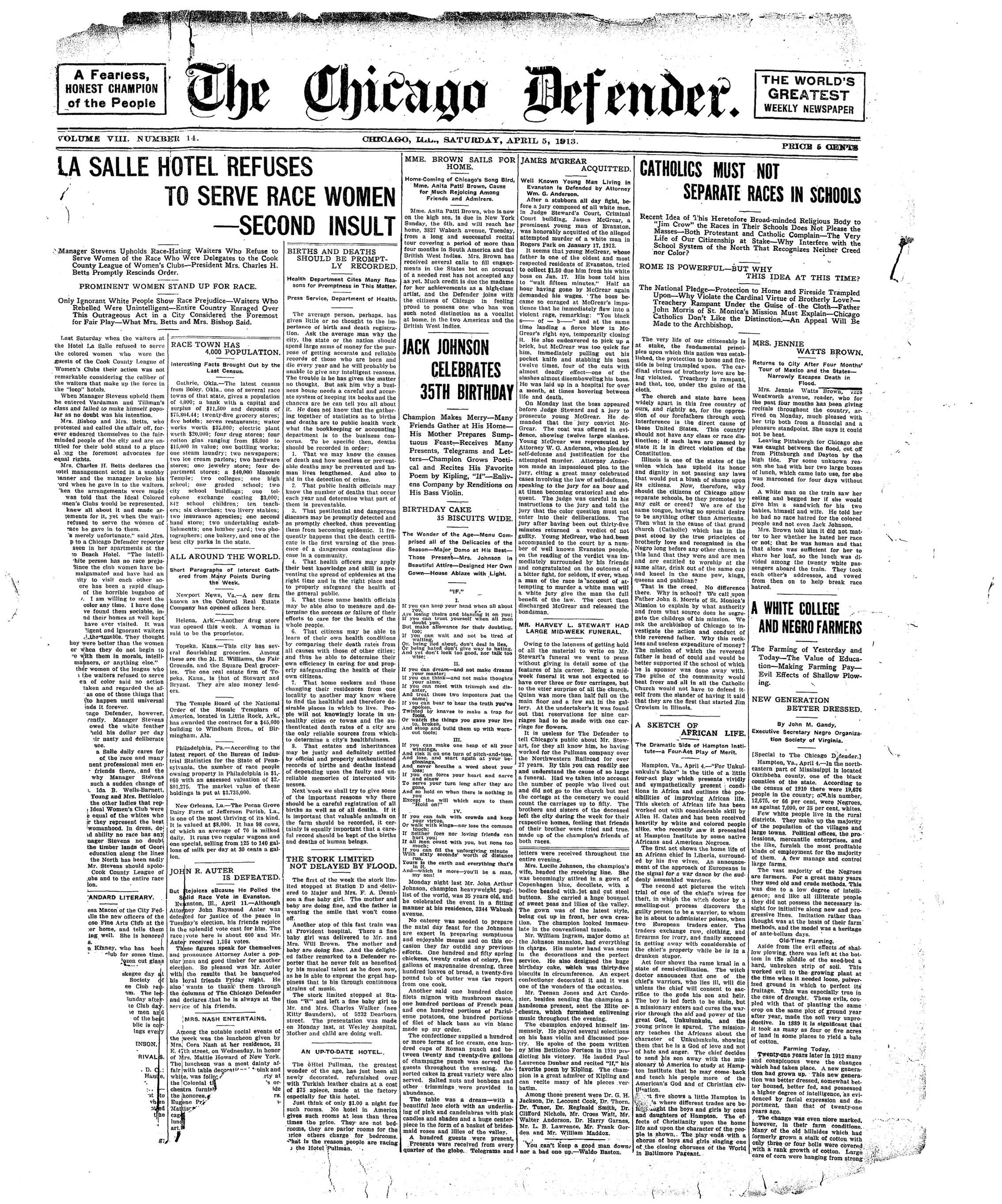
LA SALLE HOTEL REFUSES TO SERVE RACE WOMEN SECOND INSULT
Manager Stevens Upholds Race-Hating Waiters Who Refuse to Serve Women of the Race Who Were Delegates to the Cook County League of Women's Clubs—President Mrs. Charles H. Betts Promptly Rescinds Order.
PROMINENT WOMEN STAND UP FOR RACE.
Only Ignorant White People Show Race Prejudice—Waiters Who Rebellled Were Unintelligent—Entire Country Enraged Over This Outrageous Act in a City Considered the Foremost for Fair Play—What Mrs. Betts and Mrs. Bishop Said.
Guthrie, Okla.—The latest census from Boley, Okla. one of several race towns of that state, gives a population of 4,000; a bank with a capital and surplus of $11,500 and deposits of $75,804.44; twenty-five grocery stores; five hotels; seven restaurants; water works worth $35,000; electric plant worth $20,000; four drug stores; four cotton gins ranging from $8,000 to $15,000 in value; one bottling works; one steam laundry; two newspapers; two ice cream partors; two hardware stores; one jewelry store; four department stores; a $40,000 Masonic Temple; two colleges; one high school; one graded school; two city school buildings; one telephone exchange costing $3,000; 842 school children; ten teachers; six churches; two livery stables; two insurance agencies; one second hand store; two undertaking establishments; one lumber yard; two photographers; one bakery, and one of the best city parks in the state.
ALL AROUND THE WORLD
Short Paragraphs of Interest Gathered from Many Points During the Week.
Newport News, Va.—A new firm known as the Colored Real Estate Company has opened offices here.
Helena, Ark.—Another drug store was opened this week. A woman is said to be the proprietor.
Topeka, Kans.—This city has several flourishing groceries. Among these are the M. E. Williams, the Fair Grounds, and the Square Deal groceries. The one real estate firm of Topeka, Kans., is that of Stewart and Bryant. They are also money lenders.
The Temple Board of the National Order of the Mosaic Templars of America, located in Little Rock, Ark., has awarded the contract for a $45,000 building to Windham Bros., of Birmingham, Ala.
Philadelphia, Pa.—According to the latest report of the Bureau of Industrial Statistics for the State of Pennsylvania, the number of race people owning property in Philadelphia is $1,080 with an assessed valuation of $2,801,275. The market value of these holdings is put at $3,735,000.
New Orleans, La.—The Pecan Grove Dairy Farm of Jefferson Parish, La., is one of the most thriving of its kind. It is valued at $8,000. It has 98 cows, of which an average of 70 is milked daily. It runs two regular wagons and one special, selling from 125 to 140 gallons of milk per day at 30 cents a gallon.
But Rejoices e because He Polled the Solid Race Vote in Evanston. Evanston, Ill., April 11.—Although Attorney John Raymond Anter was detected for justice of the peace in Tuesday's election, his friends rejoice in the splendid vote cast for him. The race vote here is about 600 and Mr. Anter received 1,164 votes. These figures speak for themselves and pronounce Attorney Anter a popular man and good timber for another election. So pleased was Mr. Anter with the results that he banqueted his loyal friends Friday night. He also wants to thank them through the columns of The Chicago Defender and declares that he is always at the service of his friends.
n Khney, who has been club for some time, lozen cut glass skegee day at Society of ee Club remem. The lee Sunday aftere Club day men and of the best blie is corngs every INSON. RIVALS. D. C. These f and pron ular man election. with the his loyal also want the colum and decla service of MRS. Among the week Mrs. Cora E.47th str of Mrs.M The lunch fair with
Among the notable social events of the week was the luncheon given by Mrs. Cora Nash at her residence, 21 E. 47th street, on Wednesday, in honor of Mrs. Mattie Howard of New York. The luncheon was a most dainty affair with table decorations and white, was followed by a rity at the Colonial th orchestra furnish tde the honoree rs. Fengen, Prk.
A Fearless, HONEST CHAMPION of the People
Last Saturday when the waiters at the Hotel La Salle refused to serve the colored women who were the guests of the Cook County League of Women's Clubs their action was not remarkable considering the caliber of the waiters that make up the force in the "loop" hotels.
When Manager Stevens upheld them he entered Vardaman and Tillman's class and failed to make himself popular as no doubt was his intention.
Mrs. Bishop and Mrs. Betts, who protested and called the affair off, forever endeared themselves to the fair-minded people of the city and are entitled for their bold stand to a place along the foremost advocates for equal rights.
Mrs. Charles H. Betts declares the hotel management acted in a snobly manner and the manager broke his ord when he gave in to the waiters, when the arrangements were made was told that the Ideal Colored men's Clubs would be represented, knew all about it and made arguments for it, yet when the wait-refused to serve the women of race he gave in to them.
s merely unfortunate." said Mrs.arp to a Chicago Defender seen in her apartments at the to Beach Hotel. "The intell- white person has no race preju- Since the club women have be- malgamated and have had an ity to visit each other so ere has been a rapid disap- of the horrible bugaboo of. I am willing to meet the color any time. I have done we found them sociable, ind their homes as well kept have ever visited. It was ligent and ignorant walters the trouble. They thought they were better than the women or when they do not begin to be with them in morals, intell- manners, or anything else." ther women of the league who the waiters refused to serve en of color said no action taken and regarded the af- as one of those things that to happen until universalinds it forever. cago Defender, however, cently. Manager Stevens owed the white feather held his dollar per day air nasty and deliberate ace.
a Salle daily cares for of the race and many nent professional men en-n friends there, and the why Manager Stevens such a sudden change of Ida B. Wells-Barnett, Young and Mrs. Bettiolo the other ladies that rep-ideal Women's Club were equal of the whites who r they represent the best womanhood. In dress, deed ability no race has any nager Stevens no doubt the timber lands of Geori education along the lines the North has been sadly Mr. Stevens should apolo-Cook County League ofubs and to the entire race ion.
'ANDARD LITERARY.
esa Macon of the City Fed
dons the new officers of the
ose Fine Arts Club at the
er home, and tells them
ing well. She is honored
s.
The Chicago Defender.
RACE TOWN HAS 4,000 POPULATION. Interesting Facts Brought Out by the Last Census.
MRS. NASH ENTERTAINS.
CHICAGO,LLL.,SATURDAY,APRIL 5,1913.
BIRTHS AND DEATHS
SHOULD BE PROMPTLY RECORDED
Health Department Cites Many Reasons for Promptness in This Matter.
Press Service, Department of Health.
The average person, perhaps, has given little or no thought to the importance of birth and death registration. Ask the average man why the city, the state or the nation should spend large sums of money for the purpose of getting accurate and reliable records of those who are born and die every year and he will probably be unable to give any intelligent reasons. The trouble is he has given the matter no thought. But ask him why a business house needs a careful and accurate system of keeping its books and the chances are he can tell you all about it. He does not know that the gathering together of statistics as to births and deaths are to public health work what the bookkeeping or accounting department is to the business concerns. To be specific then, deaths should be recorded in order:
1. That we may know the causes of death and how needless or preventable deaths may be prevented and human lives lengthened. And also to aid in the detection of crime.
2. That public health officials may know the number of deaths that occur each year and determine what part of them is preventable.
3. That pestential and dangerous diseases may be promptly detected and as promptly checked, thus preventing them from becoming epidemic. It frequently happens that the death certificate is the first warning of the presence of a dangerous contagious disease in a community.
4. That health officers may apply their best knowledge and skill in preventing the spread of epidemics at the right time and in the right place and to properly safeguard the health of the general public.
5. That these same health officials may be able also to measure and determine the success or failure of their efforts to care for the health of the whole people.
6. That citizens may be able to learn of their own health conditions by comparing their death rates from all causes with those of other cities; and thus be able to determine their own efficiency in caring for and properly safeguarding the health of their own citizens.
7. That home seekers and those changing their residences from one locality to another may know where to find the healthful and therefore desirable places in which to live. People will not knowingly locate in unhealthy cities or towns and the authenticated death rates of a city are the only reliable sources from which to determine a city's healthfulness.
S. That estates and inheritances may be justly and definitely settled by official and properly authenticated records of births and deaths instead of depending upon the faulty and unreliable memories of interested witnesses.
Next week we shall try to give some of the important reasons why there should be a careful registration of all births as well as of all deaths. If it is important that valuable animals on the farm should be recorded, it certainly is equally important that a careful record should be kept of the births and deaths of human beings.
THE STORK LIMITED
NOT DELAYED BY FLOOD
The first of the week the stork limited stopped at Station D and delivered to Major and Mrs. F. A. Dennison a fine baby girl. The mother and baby are doing fine, and the father is wearing the smile that won't come off.
Another stop of this fast train was at Provident hospital. There a fine baby girl was delivered to Mr. and Mrs. Will Brown. The mother and baby are doing fine. And the delighted father remarked to a Defender reporter that he never felt as benefited by his musical talent as he does now, as he is able to express the great happiness that is his through continuous strains of music.
The stork limited stopped at Station "W" and left a fine baby girl to Mr. and Mrs. Charles Walker (nee Kitty Saunders), of 5322 Dearborn street. The presentation was made on Monday last, at Wesley hospital. Mother and child are doing well.
AN UP-TO-DATE HOTEL.
The o'Htel Pullman, the greatest wonder of the age, has just been all newly decorated, refinished over with Turkish leather chairs at a cost of $75 aplece, made at the factory especially for this hotel. Just think of only $1.00 a night for such rooms. No hotel in America gives such rooms at less than three times the price. They are not bedrooms, they are parlor rooms for the price others charge for bedrooms. That is the reason people are racing to the Hotel Pullman.
MME. BROWN SAILS FOR HOME.
Home-Coming of Chicago's Song Bird,
Mme. Anita Pattl Brown, Cause
for Much Rejoicing Among
Friends and Admirers.
Mme. Anita Pattl Brown, who is now
on the high sea, is due in New York
Sunday, the 6th, and will reach her
home, 3827 Wabash avenue, Tuesday,
from a long and successful recital
tour covering a period of more than
four months in South America and the
British West Indies. Mrs. Brown has
received several calls to fill engagements
in the States but on account of
a needed rest has not accepted any
as yet. Much credit is due the madame
for her achievements as a high-class
artist, and the Defender joins with
the citizens of Chicago in feeling
proud to possess one who has won
such noted distinction as a vocalist
at home, in the two Americas and the
British West Indies.
JACK JOHNSON
CELEBRATES
35TH BIRTHDAY
Champion Makes Merry—Many Friends Gather at His Home—His Mother Prepares Sumptuous Feast—Receives Many Presents, Telegrams and Letters—Champion Grows Poetical and Recites His Favorite Poem by Kipling, "If"—Enlives Company by Renditions on His Bass Violin.
The Wonder of the Age—Menu Comprised all of the Delicacies of the Season—Major Domo at His Best—Those Present—Mrs. Johnson in Beautiful Attire—Designed Her Own Gown—House Ablaze with Light.
"IF."
I.
If you can keep your head when all about you, lose theirs and blaming it on you; If you can trust yourself when all men doubt you. But make allowance for their doubting, too. If you can wait and not be tired of Or, being fed about, don't deal in lies, or being hated don't give way to hating. And yet don't look too good, nor talk too wise;
II.
If you can dream—and not make dreams your master; If you can think—and not make thoughts you can meet with triumph and disaster. And treat those two imposters just the same; If you can bear to hear the truth you've spoken. Twisted by knaves to make a trap for fools. Or watch the things you gave your live to, to broken. And stoop and build them up with worn-out tools;
III.
If you can make one heap of all your winnings, make one heap of all your risk and risk it on one turn of pitch-and-toss. And lose, and start again at your beings. And never breathe a word about your loss.
If you can force your heart and nerve and sleep!
To serve your turn long after they are gone,
And hold on when there is nothing in Except the will which says to them "Hold on!"
IV.
If you can talk with crowds and keep your virtue,
Or walk with kings—nor lose the common If neither loses nor loving friends can hurt you;
If all man count with you, but none too much; If you can fill the unforgiving minute With sixty seconds' worth of distance Yours is the earth and everything that's And—which is more—you'll be a man, my son!
Monday night last Mr. John Arthur Johnson, champion heavyweight pugilist of the world, was 35 years old, and he celebrated the event in a fitting manner at his residence, 3344 Wabash avenue.
No caterer was needed to prepare the natal day feast for the Johnsons are expert in preparing sumptuous and enjoyable menus and on this occasion they far outidd any previous efforts. One hundred and fifty spring chickens, twenty crates of cery, five gallons of mayonnaise dressing, three hundred leaves of bread, a twenty-five pound tub of butter was the report from one cook.
Another said one hundred choice filets mignon with mushroom sauce, one hundred portions of French peas and one hundred portions of Parisienne potatoes, one hundred portions of fillet of black bass au vin blanc made up my order.
The confectioner supplied a hundred or more forms of ice cream, one hundred cups of Roman punch and between twenty and twenty-five gallons of champagne punch was served the guests throughout the evening. Assorted cakes in great variety were also served. Salted nuts and bonbons and other trimmings were provided in abundance.
The table was a dream—with a beautiful lace cloth with an underlining of pink and candelabras with pink candles and shades and a huge centerpiece in the form of a basket of bridesmaid roses and lilies of the valley.
A hundred guests were present. Presents were received from every quarter of the globe. Telegrams and
Well Known Young Man Living In Evanston Is Defended by Attorney Wm. G. Anderson.
After a stubborn all day fight, before a jury composed of all white men, in Judge Steward's Court, Criminal Court building, James McGrear, a prominent young man of Evanston, was honorably acquitted of the alleged attempted murder of a white man in Rogers Park on January 17, 1912. It seems that young McGrear, whose father is one of the oldest and most respected residents of Evanston, tried to collect $1.50 due him from his white boss on Jan. 17. His boss told him to "wait fifteen minutes." Half an hour having gone by McGrear again demanded his wages. The boss became so enraged at McGrear's impatience that he immediately flew into a violent rage, remarking: "You black s—— of — b——" and at the same time landing a fierce blow in McGrear's right eye, temporarily closing it. He also endeavored to pick up a brick, but McGrear was too quick for him, immediately pulling out his pocket knife and stabbing his boss twelve times, four of the cuts with almost deadly effect—one of the shakes almost disembowling his boss. He was laid up in a hospital for over a month, at times hovering between life and death.
On Monday last the boss appeared before Judge Steward and a jury to prosecute young McGrear. He demanded that the jury convict McGrear. The coat was offered in evidence, showing twelve large slashes. Young McGrear was represented by Attorney W. G. Anderson, who pleaded self-defense and justification for the attempted murder. Attorney Anderson made an impassioned plea to the jury, citing a great many celebrated cases involving the law of self-defense, speaking to the jury for an hour and at times becoming oratorical and eloquent. The judge was careful in his instructions to the jury and told the jury that the color question must not enter into their deliberations. The jury after having been out thirty-five minutes returned a verdict of not guilty. Young McGrear, who had been accompanied to the court by a number of well known Evanston people, on the reading of the verdict was immediately surrounded by his friends and congratulated on the outcome of a bitter fight, for seldom, if ever, when a man of the race is accused of attempting to murder a white man will a white jury give the man the full benefit of the law. The court then discharged McGrear and released the bondman.
MR. HARVEY L. STEWART HAD
LARGE MID-WEEK FUNERAL.
Owing to the lateness of getting hold of all the material to write on Mr. Stewart's funeral we went to press without giving in detail some of the features of his career. Being a mid-week funeral it was not expected to have over three or four carriages, but to the utter surprise of all the church, Quinn was more than half full on the main floor and a few sat in the gallery. At the undertaker's it was found out that reservations for nine carriages had to be made with one carriage for flowers.
It is useless for The Defender to tell Chicago's public about Mr. Stewart, for they all know him, he having worked for the Pullman company over the Northwestern Railroad for over 27 years. By this you can readily see and understand the cause of so large a funeral. Had we taken into account the number of people who lived out and did not go to the church but met the cortege at the cemetery we could count the carriages up to fifty. The brothers and sisters of the deceased left the city during the week for their respective homes, feeling that friends of their brother were tried and true, made up of the champion's friends of both races.
letters were received throughout the entire evening.
Mrs. Lucile Johnson, the champion's wife, headed the receiving line. She was becoming attired in a gown of Copenhagen blue, decollete, with a bodice beaded with jet and cut steel buttons. She carried a huge bouquet of sweet peas and lilies of the valley. The gown was of the latest style, being cut up in front, her own creation. The champion looked immaculate in the conventional tuxedo.
Mr. William Ingram, major dome at the Johnson mansion, had everything in charge. His master hand was seen in the decorations and the perfect service. He also designed the huge birthday cake, which was thirty-five biscuits in circumference. An expert confectioner decorated it and it was one of the wonders of the occasion.
Mr. Teenan Jones and Art Cardozier, besides sending the champion a handsome present, sent the Elite orchestra, which furnished enlivening music throughout the evening.
The champion enjoyed himself immensely. He played several selections on his bass violin and discussed poetry. He spoke of the poem written by Miss Bettiolo Forton in 1910 predicting his victory. He lauded Paul Laurence Dunbar and recited "If," his favorite poem by Kipling. The champion is a great admirer of Kipling and can recite many of his pieces verbatim.
Among those present were Dr. G. H. Jackson, Dr. Lecount Cook, Dr. Thorn, Dr. Tuner, Dr. Reginald Smith, Dr. Clifford Nichols, Mr. Cross Walt, Mr. Walter Anderson, Dr. Harry Garnes, Mr. L. B. Lawrence, Mr. Frank Gordon and Mr. William Maddox.
You can't keep a good man down nor a bad one up.-Waldo Baston.
CATHOLICS MUST NOT SEPARATE RACES IN SCHOOLS
CATHOLICS MUST NOT SEPARATE RACES IN SCHOOLS
Recent Idea of This Heretotore Broad-minded Religious Body to "Jim Crow" the Races in Their Schools Does Not Please the Masses—Both Protestant and Catholic Complain—The Very Life of Our Citizenship at Stake—Why Interfere with the School System of the North That Recognizes Neither Creed nor Color?
ROME IS POWERFUL—BUT WHY THIS IDEA AT THIS TIME?
The National Pledge—Protection to Home and Fireside Trampled Upon—Why Violate the Cardinal Virtue of Brotherly Love?—Treachery Rampant Under the Guise of the Cloth—Father John Morris of St. Monica's Mission Must Explain—Chicago Catholics Don't Like the Distinction—An Appeal Will Be Made to the Archbishop.
The very life of our citizenship is at stake, the fundamental principles upon which this nation was established, the protection to home and fireside is being trampled upon. The cardinal virtues of brotherly love are being violated. Treachery is rampant, and that, too, under the guise of the cloth.
The church and state have been widely apart in this free country of ours, and rightly so, for the oppression of our forefathers through such interference is the direct cause of these United States. This country should not have any class or race distinction; if such laws are passed by state it is in direct violation of the Constitution.
MRS. JENNIE WATTS BROWN
Returns to City After Four Months Tour of Mexico and the States—Narrowly Escapes Death in Flood.
Mrs. Jennie Watts Brown, 1222 Wentworth avenue, reader, who for the past four months has been giving recitals throughout the country, are rived on Monday, much pleased with her trip both from a financial and a pleasure standpoint. She says it could not be beat.
Leaving Pittsburgh for Chicago she was caught between the flood, cut off from Pittsburgh and Dayton by the
Illinois is one of the states of the union which has upheld its honor and dignity in not passing any laws that would put a blush of shame upon its citizens. Now, therefore, why should the citizens of Chicago allow separate schools, be they promoted by any cult or creed? We are of the same tongue, having no special desire to be anything other than Americans. Then what is the cause of that grand church (Catholic) which has in the past stood by the true principles of brotherly love and recognized in the Negro long before any other church in this land that they were and are men and are entitled to worship at the same altar, drink out of the same cup and kneel in the same pew, kings, queens and publican?
That is the creed. No difference there. Why in school? We call upon Father John S. Morris of St. Monica's Mission to explain by what authority and from what source does he segregate the children of his mission. We ask the archbishop of Chicago to investigate the action and conduct of his reverend father. Why this reckless and useless expenditure of money? The mission of which the reverend father is head of could and would be better supported if the school of which he is sponsor was done away with. The pulse of the community would beat freer and all in all the Catholic Church would not have to defend itself from the slander of having it said that they are the first that started Jim Crowism in Illinois.
A SKETCH OF AFRICAN LIFE.
The Dramatic Side of Hampton Institute—a Four-Act Play of Merit.
Hampton, Va., April 4.—"For Unkulukulu's Sake" is the title of a little four-act play which presents vividly and sympathetically present conditions in Africa and outlines the possibilities of improving African life. This sketch of African life has been worked out with considerable skill by Allen H. Gates and has been received heartily by white and colored people alike, who recently saw it presented at Hampton Institute by some native Africans and American Negroes.
The first act shows the home life of an African chief in Liberia, surrounded by his five wives. An announcement of the approach of Europeans is the signal for a war dance by the suddenly assembled warriors.
The second act pictures the witch trial of one of the chief's wives for theft, in which the witch doctor by a smelling-out process discovers the guilty person to be a warrior, to whom he is about to administer poison, when two European traders enter. The traders exchange rum, clothing, and firearms for ivory, and finally succeed in getting away with considerable of the chief's property while he is in a drunken stupor.
Act four shows the same kraal in a state of semi-civilization. The witch doctor announces that one of the chief's warriors, who lies ill, will die unless the chief will consent to sacrifice to the gods his son and heir. The boy is led forth to be slain, but a missionary enters and cures the warrior through the aid and power of the great God, Uunkulunkulu, and the young prince is spared. The missionary teaches the Africans about the character of Uunkulunkulu, showing them that he is a God of love and not of hate and anger. The chief decides to send his son away with the missionary to America to study at Hampion Institute that he may come back and teach his people more of the American's God and of Christian civilization.
At five shows a little Hampton in a where different trades are being taught the boys and girls by sons and daughters of Hampton. The effects of Christianity upon the home life and upon the character of the people is shown. The play ends with a chorus of boys and girls singing one of the closing choruses of the World in Baltimore Pageant.
THE WORLD'S GREATEST WEEKLY NEWSPAPER
NOT
BRACES IN SCHOOLS
Broad-minded Religious Body to
their Schools Does Not Please the
and Catholic Complain—The Very
Stake—Why Interfere with the
in That Recognizes Neither Creed
WHY
THIS IDEA AT THIS TIME?
to Home and Fireside Trampled
dinal Virtue of Brotherly Love?—
the Guise of the Cloth—Father
Mission Must Explain—Chicago
Distinction:—An Appeal Will Be
MRS. JENNIE
WATTS BROWN.
Returns to City After Four Months'
Tour of Mexico and the States—
Narrowly Escapes Death in
Mrs. Jennie Watta Brown, 7225 Wentworth avenue, reader, who for the past four months has been giving recitals throughout the country, arrived on Monday, much pleased with her trip both from a financial and a pleasure standpoint. She says it could not be heat.
Leaving Pittsburgh for Chicago she was caught between the flood, cut off from Pittsburgh and Dayton by the high tide. For some unknown reason she had with her two large boxes of lunch, which came into use, for she was marooned for four days without food.
A white man on the train saw her eating and begged her if she would give him a sandwich for his two babies, himself and wife. He told her he had no race hatred for the colored people and not even Jack Johnson.
Mrs. Brown told him it did not matter to her whether he hated her race or not; that he was human and that that alone was sufficient for her to share her loaf, so the lunch was divided among the twenty white passengers aboard the train. They took each other's addresses, and vowed from then on to help break race hatred.
A WHITE COLLEGE AND NEGRO FARMERS
The Farming of Yesterday and Today—The Value of Education—Making Farming Pay—Evil Effects of Shallow Plowing.
By John M. Gandy,
Executive Secretary Negro Organization
Society of Virginia.
[Special to The Chicago Defender.]
Hampton, Va., April 4—In the northeastern part of Mississippi is located Oktibbeha county, one of the black counties of the state. According to the census of 1910 there were 19,676 people in the county; 60, his number, 12,675, or 66 per cent, were Negroes, as against 7,000, or 35 per cent whites.
Few white people live in the rural districts. They make up the majority of the population of the villages and large towns. Political offices, the professions, mercantile enterprises, and the like, furnish the most profitable kinds of employment for the majority of them. A few manage and control large farms.
The vast majority of the Negroes are farmers. For a great many years they used old and crude methods. This was due to a low degree of intelligence; and like all illiterate people they did not possess the necessary insight for initiative along new and progressive lines. Imitation rather than thought was at the basis of their farm methods, and the model was a heritage of ante-bellum days.
Old-Time Farming.
Aside from the evil effects of shallow plowing, there was left at the bottom in the middle of the seed-bed a hard, unbroken strip of soil. This worked evil to the growing plant at the time when it needed loose, pulverized ground in which to perfect its fruiture. This was especially true in the case of drought. These evils, coupled with that of planting the same crop on the same plot of ground year after year, made the soil very unproductive. In 1889 it is significant that it took as many as four or five acres of land in some places to yield a bale of cotton.
Farming Today.
Twenty-one years later in 1912 many and conspicuous were the changes which had taken place. A new generation had grown up. This new generation was better dressed, somewhat better housed, better fed, and possessed a higher degree of intelligence, as evidenced by facial expression and deportment, than that of twenty-one years ago.
The change was even more marked, however, in their farm conditions. Many of the old hillsides which had formerly grown a stalk of cotton with only three or four bolls were covered with a rank growth of cotton. Large ears of corn were hanging from strong
---
healthy cottontails. Here and there a large acreage was green with a rich growth of hay-grass. Colts and calves sported in spacious pastures and hogs lay grunting in their wallow in the cool shade of swampy pastures. Good gardens and diversified crops were also noticeable.
The Mississippi Agricultural College at Starkville was the cause of this upward trend. The college employs a number of Negroes to work on the college farm. Working as they must under the direction of a trained agriculturist, these men learn, through going, many vital principles of effective farming. They eventually start up farms of their own and thus carry with them the experience gained under trained oversight. Their success in the community where they live becomes an object lesson to the neighbors around. Again, the college experiments in taxing the productive capacity under certain conditions of an acre of cotton or corn in full view of the pedestrians to and from town. This experiment is watched with the keenest interest by those who are aware of what is being done, and this has proven to be a very effective kind of object lesson.
The college further sends out men to hold farmers' institutes for Negroes in various parts of the county. Such questions as deep plowing, crop rotation, green manuring, diversity of crops, stock raising with reference to the breeding and care of stock, have been presented at different times. These institutes furnish experiences to the illiterate Negroes for the intelligent observation of work done on the college farm.
These influences have the effect of teaching the Negro farmers, first of all, how to prepare the seed-bed. One farmer said that he never uses any commercial fertilizer, for with the proper plowing he is able to get satisfactory results.
Making Farming Pay.
All progressive Negroes have learned from this college the value and the method of raising their own work-animals, cows and hogs. One Negro farmer makes a specialty of raising fast horses, blooded cattle and a fine breed of hogs. He ships Poland-China pigs to all parts of the South at a handsome price. His horses bring higher prices than most others in the county. He also raises and sells in small quantities and by the carload alfalfa and Johnson hay-grass and fine varieties of seed corn.
Another farmer has two hundred acres of land fenced off into pastures devoted to the raising of beef cattle. On the other hand, there are many Negroes still clinging to the past and assuming an indifferent attitude towards progress.
A college for white boys has inspired and positively helped this county. A spirit of sympathy and good will has shown itself in conduct. Who can foretell the good that would result from similar efforts by the majority of the Southern colleges for white boys? Let us hope that this will come about through the recent beginning of the social study of the Negro by two of our greatest Southern universities and through the zealous efforts of men like Dr. Weatherford to awaken the consciousness of the Southern white students to the needs of the Negro. This would hasten the moral, social, economic and physical regeneration of the masses of Negroes, to the advantage of both races.
SOCIETIES AND CLUBS
CHRYSANTHEMUM CLUB.
Mr. D. W. Johnson, special writer for the Chicago Defender, spoke on "Current Events" at St. Mark's Literary Association Sunday afternoon last.
The Progressive Literary Club will celebrate their first anniversary by giving a party at the Annie Walker Parlors, 3811 Wabash avenue. Wednesday evening, April 2nd, from 8:30 p. m. to 1 a. m.
APPAMATTOX CLUB
The Appamattatto Club will celebrate Appamattatto Day on Sunday afternoon, April 6, 1913, at 3 o'clock. On this occasion the club has been fortunate in securing the speakers, Judge Edward C. Brown, of the Appellate Court. First Illinois District, and Honorable Albert H. Roberts. A special musical program has been arranged. Seats reserved for ladies.
CHRYSANTHEMUM WHIST CLUBA
The chrysanthemum whist club met Thursday afternoon at Mrs. B. Hardy's home, 3644 Forest avenue, from 2 to 5. After the meeting refreshments were served. The club adjourned to meet at the home of Mrs. Osborn, 3540 Calumet avenue, Thursday afternoon, April 3rd. Mrs. Woodruff and Mrs. Hatcher were not at the last meeting, owing to illness in their homes. The club missed them very much.
The Nonpareil Club met Thursday, March 20, at the home of Mr. Lee Stevenson, 4903 Dearborn street. All officers and eight members were present. Mr. John Jones and Mr. Joseph Thomas honored the club with their presence as visitors. The next meeting will take place at the home of Mr. Franklin Collins, 6323 Champlain avenue, Friday, April 4.
N. JACKSON, Pres.
B. DAWSON, Secy.
THE GUARANTEED FEATHER CO
We find upon the editor's desk a beautiful announcement card, stating that Madam Lambert, the proprietor of The Guaranteed Feather Company, has moved the office to 3149 Indiana avenue, where the company is doing everything in its power to please their old and new customers. Mme. Lambert is an expert in the feather making and millinery arts, having had many years' experience. We are indeed pleased to see a woman of the race doing such creditable work.
Daily Thought.
Comradeship is one of the finest facts, and one of the strongest forces in life—Hugh Black.
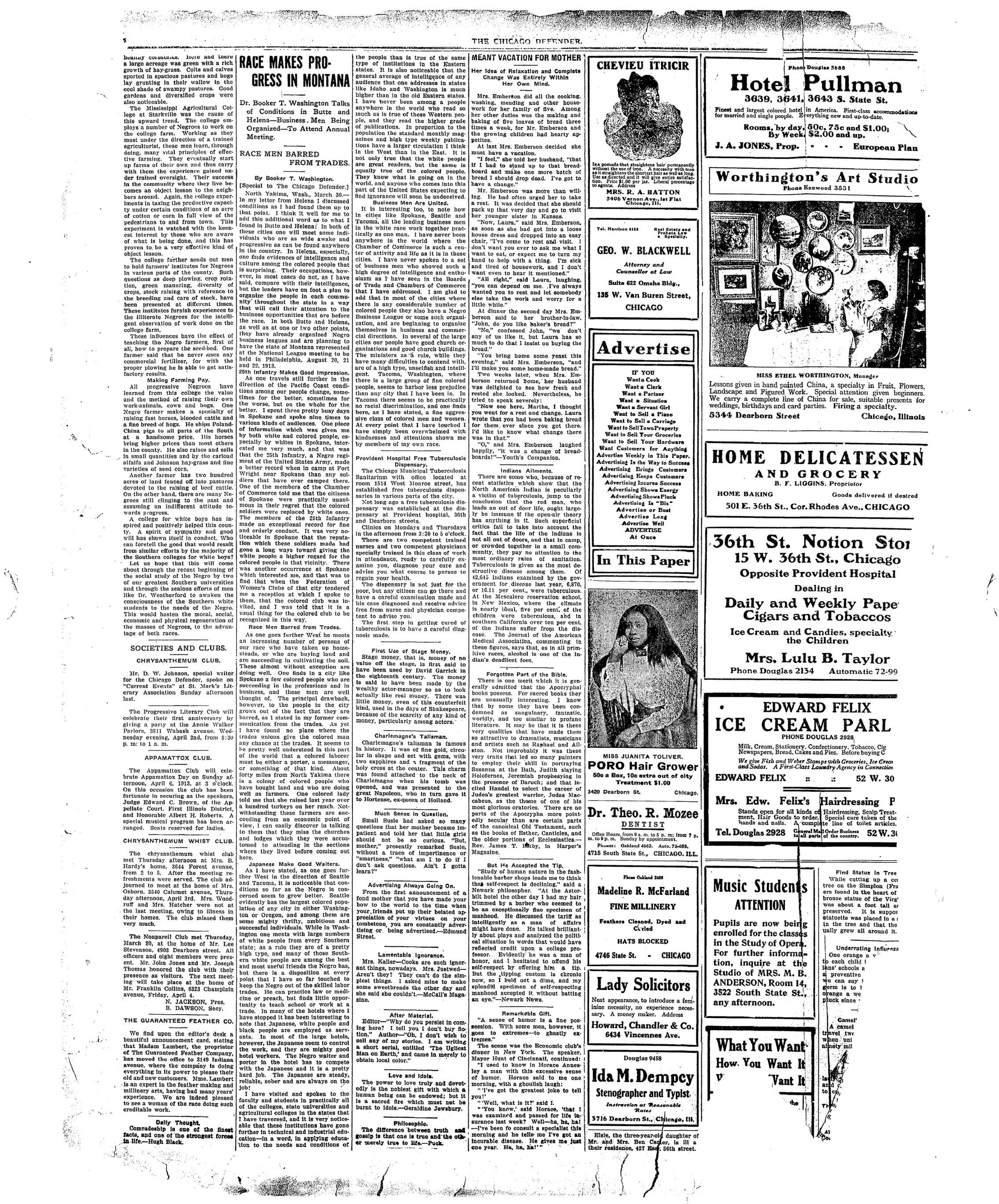
RACE MAKES PROGRESS IN MONTANA
Dr. Booker T. Washington Talks of Conditions in Butte and Helena—Business. Men Being Organized—To Attend Annual Meeting.
RACE MEN BARRED FROM TRADES.
By Booker T. Washington.
[Special to The Chicago Defender.]
North Yakima, Wash., March 30.
In my letter from Helena I discussed conditions as I had found them up to that point. I think it well for me to add this additional word as to what I found in Butte and Helena. In both of these cities one will meet some individuals who are as wide awake and progressive as can be found anywhere in the country. In Helena, especially, one finds evidences of intelligence and culture among the colored people that is surprising. Their occupations, however, in most cases do not, as I have said, compare with their intelligence, but the leaders have on foot a plan to organize the people in each community throughout the state in a way that will call their attention to the business opportunities that are before the race. In both Butte and Helena, as well as at one or two other points, they have already organized Negro business leagues and are planning to have the state of Montana represented at the National League meeting to be held in Philadelphia, August 20, 21 and 22, 1913.
25th Infantry Makes Good Impression. As one travels still further in the direction of the Pacific Coast conditions among our people change, sometimes for the better, sometimes for the worse, but on the whole for the better. I spent three pretty busy days in Spokane and spoke nine times to various kinds of audiences. One piece of information which was given me by both white and colored people, especially by whites in Spokane, interested me very much, and that was that the 25th Infantry, a Negro regiment of the United States Army, made a better record when in camp at Fort Wright near Spokane than any soldiers that have ever camped there. One of the members of the Chamber of Commerce told me that the citizens of Spokane were practically unmilious in their regret that the colored soldiers were replaced by white ones. The members of the 25th Infantry made an exceptional record for fine and orderly conduct. It was very noticeable in Spokane that the reputation which these soldiers made had gone a long ways toward giving the white people a higher regard for the colored people in that vicinity. There was another occurrence at Spokane which interested me, and that was to find that when the Federation of Women's Clubs of that city tendered me a reception at which I spoke to them, that the colored club was invited, and I was told that it is a usual thing for the colored club to be recognized in this way.
Race Men Barred from Trades.
As one goes further West he meets an increasing number of persons of our race who have taken up homesteads, or who are buying land and are succeeding in cultivating the soil. These almost without exception are doing well. One finds in a city like Spukane a few colored people who are succeeding in the professions and in business, and these men are well thought of. The principal drawback, however, to the people in the city grows out of the fact that they are barred, as I stated in my former communication from the trades. As yet I have found no place where the trades unions give the colored man any chance at the trades. It seems to be pretty well understood in this part of the world that a colored laborer must be either a porter, a messenger, or something of that kind. About forty miles from North Yakima there is a colony of colored people who have bought land and who are doing well as farmers. One colored lady told me that she raised last year over a hundred turkeys on her ranch. Notwithstanding these farmers are succeeding from an economic point of view, I can easily discover in talking to them that they miss the churches and lodges which they were accustomed to attending in the sections where they lived before coming out here.
Japanese Make Good Waiters. As I have stated, as one goes further West in the direction of Seattle and Tacoma, it is noticeable that conditions so far as the Negro is concerned seem to grow better. Seattle evidently has the largest colored population of any city in either Washington or Oregon, and among them are some mighty thrifty, ambitious and successful individuals. While in Washington one meets with large numbers of white people from every Southern state; as a rule they are of a pretty high type, and many of those Southern white people are among the best and most useful friends the Negro has, but there is a disposition at every point that I have so far touched to keep the Negro out of the skilled labor trades. He can practice law or medicine or preach, but finds little opportunity to teach school or work at a trade. In many of the hotels where I have stopped it has been interesting to note that Japanese, white people and black people are employed as servants. In most of the large hotels, however, the Japanese seem to control the work, and they are mighty good hotel workers. The Negro waiter and porter in the hotel has to compete with the Japanese and it is a pretty hard job. The Japanese are steady, reliable, sober and are always on the job!
I have visited and spoken to the faculty and students in practically all of the colleges, state universities and agricultural colleges in the states that I have traversed, and it is very noticeable that these institutions have gone further in technical and industrial education—in a word, in applying education to the needs and conditions of
the people than is true of the same type of institutions in the Eastern states. It is also noticeable that the general average of intelligence of any audience that one addresses in states like Idaho and Washington is much higher than in the old Eastern states. I have never been among a people anywhere in the world who read so much as is true of these Western people, and they read the higher grade of publications. In proportion to the population the standard monthly magazines and high type weekly publications have a larger circulation I think in the West than in the East. It is not only true that the white people are great readers, but the same is equally true of the colored people. They know what is going on in the world, and anyone who comes into this part of the United States expecting to find ignorance will soon be deceived.
Business Men Are United.
It is interesting too, to note how in cities like Spokane, Seattle and Tacoma, all the leading business men in the white race work together practically as one man. I have never been anywhere in the world where the Chamber of Commerce is such a center of activity and life as it is in these cities. I have never spoken to a set of business men who showed such a high degree of intelligence and enthusiasm as I have seen in the Boards of Trade and Chambers of Commerce that I have addressed. I am glad to add that in most of the cities where there is any considerable number of colored people they also have a Negro Business League or some such organization, and are beginning to organize themselves in business and commercial directions. In several of the large cities our people have good church organizations and good church buildings. The ministers as a rule, while they have many difficulties to contend with, are of a high type, unseifish and intelligent. Tacoma, Washington, where there is a large group of fine colored people, seems to harbor less prejudice than any city that I have been in. In Tacoma there seems to be practically no racial discrimination, and one finds here, as I have stated, a fine aggressive class of colored men and women. At every point that I have touched I have simply been overwhelmed with kindness and attentions shown me by members of my own race.
Provident Hospital Free Tuberculosis Disinfectant
The Chicago Municipal Tuberculosis Sanitarium with office located at room 1514 West Monroe street, has established free tuberculosis dispensaries in various parts of the city.
Not long ago a free tuberculosis dispensary was established at the dispensary at Provident hospital, 36th and Dearborn streets.
Clinics on Mondays and Thursdays in the afternoon from 3:30 to 5 o'clock.
There are two competent trained nurses and two competent physicians specially trained in this class of work in attendance, ready to carefully examine you, diagnose your case and advise you what course to pursue to regain your health.
The dispensary is not just for the poor, but any citizen can go there and have a careful examination made and his case diagnosed and receive advice free from nurse and physician competent to advise you.
The first step in getting cured of tuberculosis is to have a careful diagnosis made.
First Use of Stage Money
Stage money, that is, money of no value off the stage, is first said to have been used by David Garrick in the eighteenth century. The money is said to have been made by the wealthy actor-manager so as to look actually like real money. There was little money, even of this counterfeit kind, used in the days of Shakespeare, because of the scarcity of any kind of money, particularly among actors.
Charlemagne's Tallisman.
Charlemagne's talisman is famous in history. It was of fine gold, circular in shape and set with gems, with two sapphires and a fragment of the holy cross at the center. This charm was found attached to the neck of Charlemagne when his tomb was opened, and was presented to the great Napoleon, who in turn gave it to Hortense, ex-quen of Holland.
Much Sense In Question.
Small Susie had asked so many questions that her mother became impatient and told her that little girls should not be so curious. "But, mother," presently remarked Susie, without a trace of impertinence or "smartness," "what am I to do if I don't ask questions. Ain't I gotta learn?"
Advertising Always Going On
From the first announcement of a fond mother that you have made your how to the world to the time when your friends put up their belated appreciation of your virtues on your tombstone, you are constantly advertising or being advertised—Edmund Street.
Lamentable Ignorance.
Mrs. Kaller—Cooks are such ignorant things, nowadays. Mrs. Justwed—Aren't they? They can't do the simplest things. I asked mine to make some sweetbreads the other day and she said she couldn't—McCall's Magazine.
After Material.
Editor—"Why do you persist in coming here? I tell you I don't buy fiction." Author—"Oh, I don't wish to sell any of my stories. I am writing a short serial, entitled 'The Ugliest Man on Earth,' and came in merely to obtain local color."
Love and Idols.
The power to love truly and devotedly is the noblest gift with which a human being can be endowed; but it is a sacred fire which must not be burnt to idols—Geraldine Jewahury.
Philosophia.
The difference between truth and gossip is that one is true and the other merely true to life.—Puck.
THE CHICAGO DEFENDER
MEANT VACATION FOR MOTHER
Her Idea of Relaxation and Complete Change Was Entirely Within Her Own Mind.
Mrs. Emberson did all the cooking, washing, mending and other housework for her family of five. Among her other duties was the making and baking of five loaves of bread three times a week, for Mr. Emberson and the growing children had hearty appetites.
At last Mrs. Emberson decided she must have a vacation.
"I feel," she told her husband, "that if I had to stand up to that breadboard and make one more batch of bread I should drop dead. I've got to have a change."
Mr. Emberson was more than willing. He had often urged her to take a rest. It was decided that she should pack up that very day and go to visit her younger sister in Kansas.
"Now, Laura," said Mrs. Emberson, as soon as she had got into a loose house dress and dropped into an easy chair, "I've come to rest and visit. I don't want you ever to ask me what I want to eat, or expect me to turn my hand to help with a thing. I'm sick and tired of housework, and I don't want even to hear it mentioned."
"All right," said Laura, laughing, "you can depend on me. I've always wanted you to rest and let somebody else take the work and worry for a little while."
At dinner the second day Mrs. Emberson said to her brother-in-law, "John, do you like baker's bread?"
"No," confessed John, "we don't any of us like it, but Laura has so much to do that I insist on buying the bread."
"You bring home some yeast this evening," said Mrs. Emberson, "and I'll make you some home-made bread." Two weeks later, when Mrs. Emberson returned home, her husband was delighted to see how fresh and rested she looked. Nevertheless, he tried to speak severely:
"Now see here, Martha, I thought you went for a rest and change. Laura wrote that you had been baking bread for them, ever since you got there. I'd like to know what change there was in that."
"O," and Mrs. Emberson laughed happily, "it was a change of breadboards!"—Youth's Companion.
Indians Allments
There are some who, because of recent statistics which show that the North American Indian is peculiarly a victim of tuberculosis, jump to the conclusion that the red man, who leads an of door life, ought largely be immune if the open-air theory has anything in it. Such superficial critics fail to take into account the fact that the life of the Indians is not all out of doors, and that in camp, or crowded together in a small community, they pay no attention to the most ordinary rates of sanitation. Tuberculosis is given as the most destructive disease among them. Of 42,645 Indians examined by the government for disease last year, 6,870, or 16.11 per cent, were tuberculous. At the Mescalero reservation school, in New Mexico, where the climate is nearly ideal, five per cent, of the children were tuberculous, and in southern California over ten per cent, of the Indians suffer from the disease. The Journal of the American Medical Association, commenting in these figures, says that, as in all primitive races, alcohol is one of the Indian's deadliest foes.
Forgotten Part of the Bible
There is one merit which it is generally admitted that the Apocryphal books possess. For sacred books they are unusually interesting. I know that by some they have been condemned as sanguinary, fantastic, worldly, and too similar to profane literature. It may be that it is these very qualities that have made them so attractive to dramatists, musicians and artists such as Raphael and Allston. Not improbably it was these very traits that led so many painters to employ their skill in portraying Susanna at the Bath, Judith slaying Holofernes, Jeremiah prophesying in the presence of Baruch; and that incited Handel to select the career of Judea's greatest warrior, Judas Macabeus, as the thome of one of his most glorious oratories. There are no parts of the Apocrypha more pointedly secular than are certain parts of the canonical Old Testament, such as the books of Esther, Canticles, and the older portions of Ecclesiastes.—Rev. James T. Maby, in Harper's Magazine.
But He Accepted the Tlp
"Study of human nature in the fashionable barber shops leads me to think that self-respect is declining," said a Newark philosopher. "At the Actor-bilt hotel the other day I had my hair trimmed by a barber who seemed to be an exceptionally fine specimen of manhood. He discussed the tariff as intelligently as a man of affairs might have done. He talked brilliantly about plays and analyzed the political situation in words that would have reflected credit upon a college professor. Evidently he was a man of honor, and I hesitated to offend his self-respect by offering him a tip. But the tipping custom is chronic now, so I held out a dime, and my splendid specimen of self-respecting manhood accepted it without batting an eye."—Newark News.
Remarkable Gift.
"A sense of humor is a fine possession. With some men, however, it goes to extremes—to ghastly extremes."
The scene was the Economic club's dinner in New York. The speaker, Mayor Hunt of Cincinnati, continued: "I used to know in Horace Annesley a man with this excessive sense of humor. Horace said to me one morning, with a ghoulish laugh: "I've got the greatest joke to tell
"I've got the greatest joke to tell you!"
"Well, what is it?" said I.
"You know," said Horace, 'that I was examined and passed for life insurance last week? Well—ha, ha, ha!—I've been to consult a specialist this morning and he tell me I've got an incurable disease. He gives me just one year. Ha, ha, ha!"
Isa pomade that straightens hair permanently without the use of iron. A necessity with man as it straightens the shortest hair as well as long. Is as directed and it will give entire satisfaction. Price $1.00 per jar. Liberal percentage to agents. Address
MRS. R. A. HATTON
3406 Vernon Ave., 1st Flat Chicago, Ill.
Tel. Harrison 8153 Real Estate and Probate Law a Specialty.
GEO. W. BLACKWELL
Attorney and Counsellor at Law
Suite 622 Omaha Bldg.,
135 W. Van Buren Street,
CHICAGO
Advertise
IF YOU
Want a Cook
Want a Clerk
Want a Partner
Want a Situation
Want a Servant Girl
Want to Sell a Piano
Want to Sell a Carriage
Want to Sell TownProperty
Want to Sell Your Groceries
Want to Sell Your Hardware
Want Customers for Anything
Advertise Weekly in This Paper.
Advertising Is the Way to Success
Advertising Brings Customers
Advertising Keeps Customers
Advertising Insures Success
Advertising Shows Energy
Advertising Shows Pluck
Advertising Is "Bix"
Advertise or Bust
Advertise Long
Advertise Well
ADVERTISE
At Ocea
In This Paper
A.
MISS JUANITA TOLIVER.
PORO Hair Grower
50c a Box, 10c extra out of city
Treatment $1.00
3420 Dearborn St. Chicago.
Dr. Theo. R. Mozee
DENTIST
Office Hours, from 9 a.m. to 5 p. m.; from 7 p.
m. to 9 p. m. Sunday by appointment.
Phones: Oakland 4662. Auto. 73-058.
4715 South State St., CHICAGO. ILL.
Phone Oakland 2489
Madeline R. McFarland
FINE MILLINERY
Feathers Cleaned, Dyed and
Curled
HATS BLOCKED
4746 State St. - CHICAGO
Lady Solicitors
Neat appearance, to introduce a feminine necessity, no experience necessary. A money maker. Address
Howard, Chandler & Co.
6434 Vincennes Ave.
Douglas 9458
Ida M. Dempcy
Stenographer and Typist
Instruction at Reasonable Rates
3716 Dearborn St., Chicago, Ill.
Elsie, the three-year-old daughter of
Mr. and Mrs. Ben Carter, is ill a
their residence, 427 East, 56th street.
```markdown
```
Worthington's Art Studio Phone Kenwood 3531
THE WORKSHOP
MISS ETHEL WORTHINGTON, Mangader
Lessons given in hand painted Landscape and Figured Work. We carry a complete line of C weddings, birthdays and card pa 5344 Dearborn Street
HOME DEP AND G B. F. LIGE
HOME BAKING
501 E. 36th St., Cor.
36th St. N.
15 W. 36th St.
Opposite Pro
De
Daily and W
Cigars and
Ice Cream and C
the C
Mrs. Lulu
Phone Douglas 213
EDWARD ICE CREAM
PHONE D
Milk, Cream, Stationery, Newspapers, Bread, Cake
We give Fish and Weber S and Sodas. A First-Class
EDWARD FELIX
Mrs. Edw. Felix's
Stands open for all kind ment, Hair Goods to or hands and nails. A co
Tel. Douglas 2928
In hand painted China, a specialty in Figured Work. Special attention given complete line of China for sale, suitable days and card parties. Firing a specimen on Birch Street Chicago
THE DELICATE CREAM AND GROCERY
B. F. LIGGINS, Proprietor
BKING Goods delivery
36th St., Cor. Rhodes Ave., CHICAGO
St. Notion St.
W. 36th St., Chicago
opposite Provident Hospital
Dealing in Dry and Weekly Papers, cigars and Tobacco
Cream and Candies, special the Children
Mrs. Lulu B. Taylor
e Douglas 2134 Automatic 7
EDWARD FELIX CREAM PARTY
PHONE DOUGLAS 2928
Cream, Stationery, Confectionery, Tobacco, Papers, Bread, Cakes and Pies. Before buying live Fish and Weber Stamps with Groceries, Ice Cream, A First-Class Laundry Agency in Conway
FELIX :: :: 52 W
dw. Felix's Hairdressing
is open for all kinds of Hairdressing, Scalp, Hair Goods to order. Special care taken and nails. A complete line of toilet aisles 2928
General Mail Order Business to all parts of the country. 52
Lessons given in hand painted China, a specialty in Fruit, Flowers, Landscape and Figured Work. Special attention given beginners. We carry a complete line of China for sale, suitable presents for weddings, birthdays and card parties. Firing a specialty. 5344 Dearborn Street
HOME DELICATESSEN
HOME BAKING Goods delivered if desired 501 E. 36th St., Cor. Rhodes Ave., CHICAGO
36th St. Notion Store
15 W. 36th St., Chicago
Opposite Provident Hospital
Dealing in
Daily and Weekly Pape
Cigars and Tobaccos
Ice Cream and Candies, specialty
the Children
Mrs. Lulu B. Taylor
Phone Douglas 2134 Automatic 72-99
Milk, Cream, Stationery, Confectionery, Tobacco, Cig
Newspapers, Bread, Bakes and Pies. Before buying C
We give Fish and Weber Stamps with Groceries, Ice Cream
and Sodas. A First-Class Laundry Agency in Connection
EDWARD FELIX :: :: 52 W. 30
Mrs. Edw. Felix's Hairdressing P
Stands open for all kinds of Hairdressing, Scalp Treatment, Hair Goods to order. Special care taken of the hands and nails. A complete line of toilet articles.
Tel. Douglas 2928 General Mall Order Business to all parts of the country. 52 W. 30
Music Students ATTENTION
Pupils are now being enrolled for the classes in the Study of Opera. For further information, inquire at the Studio of MRS. M. B. ANDERSON, Room 14, 3522 South State St., any afternoon.
What You Want How. You Want It V Want It
Camel'
A camel
travel, two
when, uni-
nimety mil
You Want
u Want It
Vant It
Chicago, Illinois
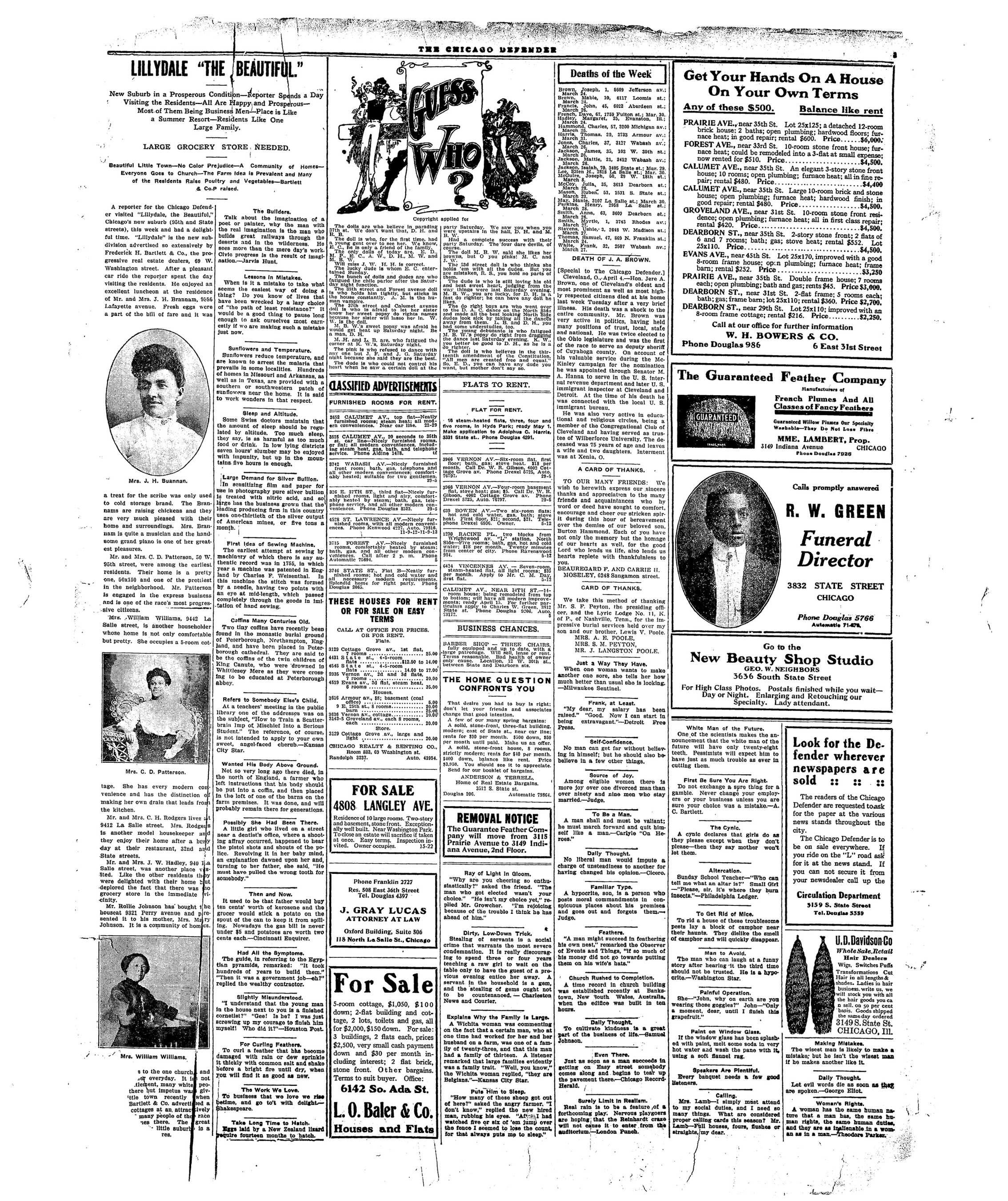
New Suburb in a Prosperous Condition—Reporter Spends a Day Visiting the Residents—All Are Happy and Prosperous Most of Them Being Business Men—Place is Like a Summer Resort—Residents Like One Large Family.
Beautiful Little Town—No Color Prejudice—A Community of Homes
Everyone Goes to Church—The Farm Idea is Prevalent and Many
of the Residents Raise Poultry and Vegetables—Bartlett
A reporter for the Chicago Defender visited "Lillydale, the Beautiful," Chicago's new suburb (95th and State streets), this week and had a delightful time. "Lillydale" is the new subdivision advertised so extensively by Frederick H. Bartlett & Co., the progressive real estate dealers, 69 W. Washington street. After a pleasant car ride the reporter spent the day visiting the residents. He enjoyed an excellent luncheon at the residence of Mr. and Mrs. J. H. Brannam, 9556 Lafayette avenue. Fresh eggs were a part of the bill of fare and it was
Mrs. J. H. Buannan.
a treat for the scribe was only used to cold storage brand. The Brannams are raising chickens and they are very much pleased with their home and surroundings. Mrs. Brannam is quite a musician and the handsome grand piano is one of her greatest pleasures.
Mr. and Mrs. C. D. Patterson, 50 W. 95th street, were among the earliest residents. Their home is a pretty one, 50x150 and one of the prettiest in the neighborhood. Mr. Patterson is engaged in the express business and is one of the race's most progressive citizens.
Mr. William Williams, 9442 La Salle street, is another householder whose home is not only comfortable but pretty. She occupies a 5-room cot-
Mrs. C. D. Patterson.
tage. She has every modern convenience and has the distinction of making her own drain that leads from the kitchen.
Mr. and Mrs. C. H. Rodgers lives at 9412 La Salle street. Mrs. Rodgers is another model housekeeper and they enjoy their home after a busy day at their restaurant, 32nd and State streets.
Mr. and Mrs. J. W. Hadley, 940 La Salle street, was another place visited. Like the other residents they were delighted with their home but deplored the fact that there was no grocery store in the immediate vicinity.
Mr. Rolle Johnson has bought the houseat 9321 Perry avenue and presented it to his mother, Mrs. Mary Johnson. It is a community of homes.
THE MUSICIAN
to the one church, and
for everyday. It is not
element, many white peo-
there but impetus was giv-
tle town recently when
Bartlett & Co. advertised
cottages at an attractively
many people of the race
nees there. The great
little suburb is a
The Builders.
Talk about the imagination of a poet or painter, why the man with the real imagination is the man who builds great railways through the deserts and in the wilderness. He sees more than the mere day's work Civic progress is the result of imagination—Jarvis Hunt.
Lessons In Mistakes
When is it a mistake to take what seems the easiest way of doing a thing? Do you know of lives that have been wrecked by a lazy choice of least resistance? It would be a good thing to pause long enough to ask ourselves most earnestly if we are making such a mistake just now.
Sunflowera and Temperature
Sunflowers reduce temperature, and are known to arrest the malaria that prevails in some localities. Hundreds of homes in Missouri and Arkansas, as well as in Texas, are provided with southern or southwestern patch of sunflowers near the home. It is said to work wonders in that resent
Sleep and Altitude
Some Swiss doctors maintain that the amount of sleep should be regulated by altitude. Too much sleep, they say, is as harmful as too much food or drink. In low lying districts seven hours' slumber may be enjoyed with impunity, but up in the mountains five hours is enough.
Large Demand for Silver Bullion. In sensitizing film and paper for use in photography pure silver bullion is treated with nitric acid, and so large has the business grown that the leading producing firm in this country uses one-thirtieth of the silver output of American mines, or five tons a month.
First Idea of Sewing Machine
First idea of Sewing Machine. The earliest attempt at sewing by machinery of which there is any authentic record was in 1755, in which year a machine was patented in Englehart by Charles F. Weisenthal. In this machine the needle is passed by a needle, having two points with an eye at mid-length, which passed completely through the goods in imitation of hand sewing.
Coffing Many Centuries Old
Two tiny coffins have recently been found in the monastic burial ground of Peterborough, Northampton, Engs Jand, and have been placed in Peterborough cathedral. They are said to be the coffins of the twin children of King Canute, who were drowned in Whittlesey Mere as they were crossing to be educated at Peterborough abbey.
Refers to Somebody Else's Child
At a teachers' meeting in the public library one of the addresses was on the subject, "How to Train a Scatterbrain Imp of Mischief Into a Serious Student." The reference, of course, is not intended to apply to your own sweet, angel-faced cherub—Kansas City Star.
Wanted His Body Above Ground.
Not so very long ago there died, in the north of England, a farmer who left instructions that his body should be put into a coffin, and then placed in the loft of one of the barns on the farm premises. It was done, and will probably remain there for generations.
Possibly She Had Been There.
A little girl who lived on a street near a dentist's office, where a shooting affray occurred, happened to hear the pistol shots and shouts of the police. Revolting it in her baby mind, an explanation dawned upon her and, turning to her father, she said, "He must have pulled the wrong tooth for somebody."
Then and Now.
It used to be that father would buy ten cents' worth of kerosene and the grocer would stick a potato on the spout of the can to keep it from spillage. The grocer would buy $5 under $5 and potatoes are worth two cents each—Cincinnati Enquirer.
Had All the Symptoms
The guide, in referring to the Egyptian pyramids, remarked: "It took hundreds of years to build them—"he" replied the wealthy contractor.
Slightly Misunderstood
"I understand that the young man in the house next to you is a finished cornetist?" "Gee! Is he? I was just screwing up my courage to finish him myself! Who did it?" "Houston Post."
For Curling Feathers
To curl a feather that hba become damaged with rain or dew sprinkle it thickly with common salt and shake before a bright fire until dry, when you will find it as good as new.
The Work We Love.
To business that we love we rise betime, and go to't with delight—Shakespeare.
Take Long Time to Hatch.
Eggs laid by a New Zealand lizard require fourteen months to hatch.
GUESS WHO?
Copyright applied for
The dolls are who believe in parading party Saturday. We saw you when you 37th st. We don't want that, D. H. and A. R. were upstairs in the hall, D. H. and A. R.
The doll is who, for the first time, had a young gent over to see her. We know, E. C., he is only a friend of the family.
The only dolls of today are, E. D., M. P., E. C., A. W., D. H., M. W. and M. B. W.
Will miss J. W. H. H. is correct.
The lucky dude is whom E. C. entertained Sunday.
The bunch of dolls and dudes are who
forguessed the chile parlor after the Saturd-
ay party.
The 33th street and Forest avenue doll is who holds him tightly, but sticks in the house constantly. A. M. is the human vampire.
The 37th street and Calumet avenue
the street to the droll to let her sister
know her sweet heart will be afraid
because her sister will lass her in. W.
Is the doll.
M. He sweet penny was afraid he
would get heat up Saturday night. Be
a man, D. H.
M. H. and L. B. are, who fatigued the corner at K. W.'s, Saturday night.
The pink is who refused to dance with any one but J. B. and J. G. Saturday night because she said they are the best. The blue is who could control his heart WHEN he is shouting.
CLASSIFIED ADVERTISEMENTS
FURNISHED ROOMS FOR RENT.
3652 CALUMET AV., top flat—Nearly furnished rooms; steam heat; all modern convenences. Near car line. 22-29
3552 CALUMET AV., 20 seconds to st. st. car line—Nicely furnished rooms; or flat; all modern convenences, including steam heat, gas, bath, and telephone service. Phone Adkins 1476. 49
3742 WABASH AV.-Nicely furnished room; all other modern convenences; comfortably heated; suitable for two gentlemen. 29-5
325 E. 37TH ST., third flat—Nicely furnished rooms, light and air; comfortably heated; phone service, and all other modern convenences. Phone Douglas 3523. 29-5
4528 ST. LAWRENCE AV.-Nicely furnished rooms, with all modern convenences. Phone Kenwood 4227. Auto. 78918. 11-9-12-11-9-13
3715 FOREST AV.-Nicely furnished rooms, comfortably heated by steam; bath, gas, and all other modern convenences. After 2 p. m. Phone Automatic 75694.
3714 STATE ST, Flat B—Nearly furnished rooms; hot and cold water and air conditioning; unobop requirement. Splendid home for right party. Phone Douglas 2065.
THESE HOUSES FOR RENT OR FOR SALE ON EASY TERMS
CALL AT OFFICE FOR PRICES.
OR FOR RENT.
Flats.
3129 Cottage Grove av., 1st flat,
7 rooms ..... 25.00
4431 State st., 4-5-room
flats ..... 412.50 to 14.00
4545 State st., 4-5-room
flats ..... 14.00 to 17.00
2935 Vernon av., 2d and 3d flats,
7 rooms ..... 20.00
4519 Evans av., 3d flat, steam heat,
6 rooms ..... 35.00
Houses.
3016 Armour av., $8; basement (coal
office) ..... 5.00
9 E, 25th st., 8 rooms ..... 25.00
3636 Vernon av., cottage ..... 10.00
3143-5 Groveland av., each 8 rooms,
each ..... 20.00
Store.
3129 Cottage Grove av., large and
light ..... 20.00
CHICAGO REALTY & RENTING CO.,
Room 803, 69 Washington st.
Randolph 3237. Auto, 43954.
FOR SALE
4808 LANGLEY AVE.
Residence of 10 large rooms. Two-story and basement, stone front. Exceptionally well built. Near Washington Park. To close an estate will sacrifice if taken at once. Easy terms. Inspection owner. Owner occupies. 15-22
J. GRAY LUCAS
ATTORNEY AT LAW
Oxford Building, Suite 506
118 North La Salle St., Chicago
For Sale
5-room cottage, $1,050, $100 down; 2-flat building and cottage, 2 lots, toilets and gas, all for $2,000, $150 down. For sale: 3 buildings, 2 flats each, prices $2,500, very small cash payment down and $30 per month including interest; 2 flat brick, stone front. Other bargains. Terms to suit buyer. Office: 6142 So. Ada St. L. O. Baler & Co. Houses and Flats
---
Phone Franklin 2727
Res. 508 East 36th Street
Tel. Douglas 4397
THE CHICAGO DEPENDER
GUESS
Who
?
party Saturday. We saw you when you
upstairs in the hall, D. H. and M.
B. W.
The 53d street doll is who thinks she holds 'em with all the dudes. But you must mistaken. R. S., you hold no parts of them. The dude is who is still loving his old wife. The dude is who is the way things were last Saturday from home. M. B., W. you are lucky, for D. H., is a no righter; he can have any doll he likes. The do right boys are who went over the fence on the beach on the North Slope and made all the best out of the dudes look sick by taking all the dances away from them. B. and D. H., you have no doubt that B. and D. H., you young doubtante is who failed M. B. W.'s penny do right from dragging you better be good to D. H., as he is a do righter. The young doubtante is who failed M. B. W.'s penny do right from dragging you better be good to D. H., as he is a do righter. The is who believes in the thirteenth amendment of the Constitution. "All men are created free and equal." But you want, but mother don't say so.
16 steam-heated flats, three, four and five rooms, in Hyde Park; ready May 1 Make application to Adolphus C. Harris 3331 State. et. phone 4021. 4291
3966 VERON AV.-Six-room flat, first floor; bath, gas stove at heat; $13 per room. Call Dr. W. R. Gibson. Grove av. Phone Drexel 5725, Auto. 76977. 29-5
3966 VERON AV.-Four-room basement flat, stove heat; gas; $5. Call Dr. W. R. Gibson. 4002 Cottage Grove av. Phone Drexel 5725, Auto. 76977. 29-5
3605 BOVEN AV.-Two six-room flats; hot and cold water, gas, bath; stove first floor; $21; second, $21. Telephone Drexel 6806. Owner. 5-12
1230 RACINE PL. two blocks from rightwood av. "L" station, North Slope; will have 120 minutes of water; $18 per month. Twenty minutes from center of city, Phone Ravenswood 894. 5-12
1230 VINCENES AV.- Seven-room, steam-heated flat, all light rooms; $35 per month. Apply to Mr. C. M. Day first. 5-12
CALUMET AV. NEAR 30TH ST.-10th room house be remodeled from top to bottom; will have 140 minutes of ready April 15. For further parners apply to Charles W. Green. 3812 Stat. street. Phone Douglas 9200, Auto. 73172.
BUSINESS CHANCES
BARBER SHOP — THREE CHAIRS,
equipped and up to date, with a
large patio, Terms reasonable. Bad health of owner
Terms reasonable. Bad health of owner
st. between State and Dearborn st.
THE HOME QUESTION
CONFRONTS YOU
That desire you had to buy is right; don't let your friends and associates change that good intention.
A few of our many spring bargains:
A solid, stone-front, three-flat building; modern; east of State st.], near car line; rents for $50 per month. $500 down, $50 per month until paid. Make us an offer.
A house, 8 rooms, strictly modern; rents for 400 month, $400 down, balance like rent. Price $3,850. You should see you to appreciate.
Send for our booklet of bargains.
REMOVAL NOTICE
The Guarantee Feather Company will move from 3115
Prairie Avenue to 3149 Indiana
Avenue, 2nd Floor.
"Why are you cheering so enthusiastically?" asked the friend. "The man who got elected wasn't your choice." "He isn't my choice yet," replied Mr. Growcher. "I'm rejoicing because of the trouble I think he has ahead of him."
Dirty, Low-Down Trick.
Stapling of servants is a social crime that warrants the most severe condemnation. It is really discouraging to spend three or four teaching a raw girl to wait on the table only to have the guest of a previous evening entice her away. A servant in the household is a gem, and the stealing of gems ought not to be countenanced. — Charleston News and Courler.
Explains Why the Family is Large.
A Wichita woman was commenting on the fact that a certain man, who at one time had worked for her and her husband on a farm, was one of a family of twenty-three, and that this man had a family of thirteen. A listener remarked that large families evidently was a family trait. "Well, you know," the Wichita woman replied, "they are Belgians."—Kansas City Star.
Puts Him to Sleep.
"How many of these sheep got out of here?" asked the angry farmer. "I don't know," replied the hired man, rubbing his eyes. "Afternoon, I had watched five or six of 'em jump over the fence I seemed to lose the count, for that always puts me to sleep."
FLATS TO RENT.
Ray of Light In Gloom.
Dirty LowDown Trick
Puts Him to Sleep.
Deaths of the Week
Brown, Joseph, 1, 5609 Jefferson av.;
March 24.
Brown, Bable, 10, 6117 Loomis st.;
March 24.
Francis, John, 45, 6022 Aberdeen st.;
March 24.
French, Dave, 67, 1759 Fulton st.; Mar. 30.
Hall, Margaret, 25, Evanston, 11;
March 24.
Hammond, Charles, 57, 3200 Michigan av.;
March 24.
Harris, Thomas, 29, 2733 Armour av.;
March 24.
Harris, Charles, 37, 3127 Wabash av.;
March 26.
Jackson, James, 35, 102 W. 30th st.;
March 26.
Jackson, Mattie, 21, 2412 Wabash av.;
March 26.
Jacobson, Hawk, 79, 3405 State st.; Mar. 29.
Lee, Elen H., 281 La Salle st.; Mar. 30.
Mason, Joseph, 50, 29 W. 18th st.;
March 24.
McCoy, Julia, 35, 3613 Dearborn st.;
March 24.
Mason, Ruben, 33, 1531 S. State st.;
March 24.
Mason, Ruben, 33, 1531 S. State st.;
March 24.
Perkins, Henry, 2968 La Salle st.;
March 28.
Smith, Myrtle, 1, 3743 Rhodes av.;
March 26.
Stevens, Ushile, 3, 2648 W. Madison st.;
March 24.
Thomas, Samuel, 47, 869 N. Franklin st.;
March 24.
Wash. Frank, 32, 2507 Wabash av.;
March 27.
DEATH OF J. A. BROWN
[Special to The Chicago Defender.]
Cleveland, O., April 4—Hon. Jere A. Brown, one of Cleveland's oldest and most prominent as well as most highly respected citizens died at his home last week Tuesday after a very brief illness. His death was a shock to the entire community. Mr. Brown was very active in politics, having held many positions of trust, local, state and national. He was twice elected to the Ohio legislature and was the first of the race to serve as deputy sheriff of Cuyahoga county. On account of his valuable service during the McKinley campaign for the nomination he was appointed through Senator M. A. Hanna to serve in the U. S. internal revenue department and later U. S. immigrant inspector at Cleveland and Detroit. At the time of his death he was connected with the local U. S. immigrant bureau.
He was also very active in educational and religious circles, being a member of the Congregational Club of Cleveland and having served as trustee of Wilberforce University. The deceased was 75 years of age and leaves a wife and two daughters. Interment was at Xenia, O.
A CARD OF THANKS.
TO OUR MANY FRIENDS: We wish to herewish express our sincere thanks and appreciation to the many friends and acquaintances who by word or deed have sought to comfort, encourage and cheer our stricken spirit during this hour of bereavement over the demise of our beloved son, Burton Hammond. Each of you have not only the memory but the homage of our hearts as well, for the good Lord who lends us life, also lends us hearts replete with thankfulness to you.
BEAUERGARD F. AND CARRIE H. MOSELEY. 6248 Sangameng street.
CARD OF THANKS!
We take this method of thanking Mr. S. F. Peyton, the presiding officer, and the Lyric Lodge No. 11, K. of P., of Nashville, Tenn., for the impressive burial services held over my son and our brother, Lewis V. Poole.
MRS. A. E. POLE, MRS. S. M. PEYTON, MR. J. LANGSTON POLE.
Just a Way They Have.
When one woman wants to make another one sore, she tells her how much better than usual she is looking.
—Milwaukee Sentinel.
Frank, at Least.
"My dear, my salary has been raised." "Good. Now I can start in being extravagant."—Detroit Free Press.
Self-Confdence
No man can get far without believing in himself; but he should also be believe in a few other things.
Source of Joy.
Among eligible women there is more joy over one divorced man than over ninety and nine men who stay married.—Judge.
To Be a Man.
A man shall and must be valiant; he must march forward and quit himself like a man.—Carlyle "On Heroes."
Dally Thought.
No liberal man would impute a charge of unsteadiness to another for having changed his opinion.—Clero.
Familiar Type.
A hypocrite, son, is a person who posts moral commandments in conspicuous places about his premises and goes out and forgets them.—Judge.
Feathers.
"A man might succeed in feathering his own nest," remarked the Observer of Events and Things, "if so much of his money did not go towards putting them on his wife's hats."
Church Rushed to Completion.
A time record in church building was established recently at Bankstown, New South Wales, Australia, when the edifice was built in ten hours.
Daily Thought
To cultivate kindness is a great part of the business of life.-Gamuel Johnson.
Even There.
Just as soon as a man succeeds in getting on Easy street somebody comes along and begins to tear up the pavement there.-Chicago Record-Herald.
Surely Limit In Realism
Safety Limit in Resident.
Real rain is to be a feature of a forthcoming play. Norvous playgoers are hoping that the Retnhardt crase will not cause it to enter from the auditorium—London Punch.
Get Your Hands On A House On Your Own Terms
PRAIRIE AVE., near 35th St. Lot 25x125; a detached 12-room brick house; 2 baths; open plumbing; hardwood floors; furnace heat; in good repair; rental $600. Price.....$6,000.
FOREST AVE., near 33rd St. 10-room stone front house; furnace heat; could be remodeled into a 3-flat at small expense; now rented for $510. Price.....$4,500.
CALUMET AVE., near 35th St. An elegant 3-story stone front house; 10 rooms; open plumbing; furnace heat; all in fine repair; rental $480. Price.....$4,400.
CALUMET AVE., near 35th St. Large 10-room brick and stone house; open plumbing; furnace heat; hardwood finish; in good repair; rental $480. Price.....$4,500.
GROVELAND AVE., near 31st St. 10-room stone front residence; open plumbing; furnace heat; all in first class repair; rental $420. Price.....$4,500.
DEARBORN ST., near 35th St. 2-story stone front; 2 flats of 6 and 7 rooms; bath; gas; stove heat; rental $552. Lot 25x110. Price.....$4,500.
EVANS AVE., near 45th St. Lot 25x170, improved with a good 8-room frame house; opn plumbing; furnace heat; frame barn; rental $252. Price.....$3,250
PRAIRIE AVE., near 35th St. Double frame house; 7 rooms each; open plumbing; bath and gas; rents $45. Price $3,000.
DEARBORN ST., near 31st St. 2-flat frame; 5 rooms each; bath; gas; frame barn; lot 25x110; rental $360. Price $2,700.
DEARBORN ST., near 29th St. Lot 25x110, improved with an 8-room frame cottage; rental $216. Price.....$2,250.
The Guaranteed Feather Company
For High Class Photos. Postals finished while you wait Day or Night. Enlarging and Retouching our Specialty. Lady attendant.
Any of these $500.
PRAIRIE AVE., near 35th St.
brick house; 2 baths; open
nace heat; in good repair; r
FOREST AVE., near 33rd St.
nace heat; could be remode-
nated now rented for $510. Price
CALUMET AVE., near 35th St.
house; 10 rooms; open plum-
pair; rental $480. Price
CALUMET AVE., near 35th St.
house; open plumbing; fun-
good repair; rental $480.
GROVELAND AVE., near 31st
dence; open plumbing; furni-
rent $420. Price
DEARBORN ST., near 35th St.
6 and 7 rooms; bath; gas
25x110. Price
EVANS AVE., near 45th St. I.
8-room frame house; opn-
barn; rental $252. Price
PRAIRIE AVE., near 35th St.
each; open plumbing; bath
DEARBORN ST., near 31st S.
bath; gas; frame barn; lot 2.
DEARBORN ST., near 29th St.
8-room frame cottage; rent
Call at our office for
W. H. BOW
Phone Douglas 986
The Guaranteed
GUARANTEED
TRADING MARK
A. B.
Go to
New Beauty
GEO. W. N.
3636 South
For High Class Photos. Post
Day or Night. Enlarge
Specialty. La
White Man of the Future.
One, of the scientists makes the announcement that the white man of the future will have only twenty-eight teeth. Pessimists will expect him to have just as much trouble as ever in cutting them.
First Be Sure You Are Right.
Do not exchange a sire thing for a
gamble. Never change your employers
or your business unless you are
sure your choice was a mistake.—A.
C. Bartlett.
A cynic declares that girls do as they please except when they don't please—then they say mother won't let them.
Sunday School Teacher—"Who can tell me what an altar is?" Small Girl—"Please, sir, it's where they burn insects."-Philadelphia Ledger.
To rid a house of these troublesome pests lay a block of camphor near their haunts. They dislike the smell of camphor and will quickly disappear.
Man to Avoid.
The man who can laugh at a funny story after hearing it the third time should not be trusted. He is a hypocrite.—Washington Star.
Painful Operation.
She—"John, why on earth are you wearing those goggles?" John—"Only a moment, dear, until I finish this grapefruit."
Paint on Window Glass.
If the window glass has been splashed with paint, melt some soda in very hot water and wash the pane with it, using a soft fannel rag.
Speakers Are Plentiful.
Every banquet needs a few good listeners.
Mrs. Lamb—I simply must attend to my social duties, and I need so many things. What are considered proper calling cards this season? Mr. Lamb—Full houses, fours, flushes or straights, my dear.
Red Feather Company
Manufacturers of
French Plumes And All
Classes of Fancy Feathers
Guaranteed Willow Plumes Our Specialty
Washable-They Do Not Lose Fibre
MME. LAMBERT, Prop.
3149 Indiana Avenue CHICAGO
Phone Douglas 7926
Calls promptly answered
R. W. GREEN Funeral Director
3832 STATE STREET
CHICAGO
Phone Douglas 5766
Automatic 71-879
Go to the
Duty Shop Studio
D. W. NEIGHBORS
South State Street
Postals finished while you wait—
enlarging and Retouching our
city. Lady attendant.
Look for the Defender wherever newspapers are sold :: :: ::
The readers of the Chicago Defender are requested toask for the paper at the various news stands throughout the city.
The Chicago Defender is to be on sale everywhere. If you ride on the "L" road ask for it at the news stand. If you can not secure it from your newsdealer call up the
Circulation Department
5159 S. State Street
Tel. Douglas 5359
2
Hair Deniers
Wigs, Switches Puffs
Transformations Cut
Hair in all kinds of
shades. Ladies in hair
business, write us, we
will stock you with all
the hair goods you can
n sell, on 50 per cent
basis. Joeds shipped
the same day ordered
3149 S. State St.
CHICAGO, Ill.
Making Mistakes.
The wisest man is likely to make a
mistake; but he isn't the wisest man
if he makes another like it.
Daily Thought.
Let evil words die as soon as they
are spoken.—George Ellot.
used so
considered
n? Mr.
shes or
A woman has the same human nature that a man has, the same human rights, the same human duties, and they are as inileable in a woman as in a man.—Theodore Parker.
4
“The World's Greatest Weekly.
ee Te Woritie Grontens Went
. & ABBOTT, LL. B,
Eee ane Publtahor.
a
Founded May 6, 1608.
SuRUCRIPTION RATES IN ADVANGE.
ong cosas ies satscavssestersHWEaS
Wage acsureneiss eee
on aimtgey
3159 State Street
CHICAGO, ILL.
TRLEPHONE DOUGLAS 3339.
earlobe sat! the vostomiee i Chloas,
HI, Under act of March 1, 1879.
RATES OF ADVERTIGING.
wiggae,Betothaln, Marriages, and
Detain guituasy was"
Ongena Ane CHIT Tees 60
——piaPLAY ADVERTISEMENT.
Mpa Se ssa “tatee a
wrest Eage Aavarliscinente, per inch 3.09
Lat pal perermenmenteregas “|
Reshing Nevin, bors SS
Fettae Ne play Aaveriisnents’ Cor
whedon application.
Guanes ef Address —Pleane give both
ano aad na caraon en, rite
RTRs pepor ‘civare. be guretul Lets
Sak taPtelee ane bestotton un well ax
Sen seme
w vou ee IT IN THE DEFENDER,
You SEE iT IN THE DEFENDE!
ee
SATURDAY, APRIL 5, 1913.
GOURT GENERAL ROBERT ELLIOTT,
Ne. 7395, Anctont Order, ot Foresters:
Beets every second and fourth Monday
Bleht in each month at Odd. Fellows
Bini, 3387 Beato streat.
Ledge Omcers.
Chiet Ranger, F. V. Babb, $146 Dear-
opm Streets phone wold, Drexel,
"Financial Becreinry, F. W, ‘Taylor, 6631
Greve avenue; phone Normal 7652,
Fressuret, Prank L. Crittenden, 2414
Dearborn (rect; phone 3319 Calumet.
ee ES
CHURCH DIRECTORY.
Quinn Chapel, Mth street and Wabash
“Bethsl, 30th and Dearborn atreste,
‘Bethel, 30th nt PE hing troote
Sema, EeD tna obey etteets
Huagstesnt Sinead Boarbra stants
BUR tua ead "Beatborn tress
Be MANY: GOUr SRS RACER directs
Bede sehMicest and Lake ave:
Walters A. M. B. Zion, 3ith and Dear-
wetted
egos” waptint, 18th and Deartorn
isete’
RGftke maptit, em and Dearors
Beant anti, 8m strut and Wa-
armen. Baptist, 3764 North Clark
arfett tar Bibactinoae
etre escopal, MBth atroot and
weber a
Trae Breabterian, atth and Dearborn
EE Sinica catnotic, seth and Dearborn
itMourmel C. A. B, Church, #ind and
ade Caras
WS ECV, acemoril _ Consregational
Rita Glog" Botinad Chater 20H
Mbenezer AAC B., Bvanston,
Bregeret fA Sora nt
Bote Matt de dan tag
Reetln Cape STZ Hulton trot
Seen Pat abet “Lave avgaue
Beni elon ith trot and Ares
S78UHSin mapa, «2th and Dearborn
Seifvian Church, 2401, Armour avenue,
St'Sohm Daptist, Adu and Lake streets.
epee Beotlc Walnut hie zat
FEeitraacle Daptlet, Red and
"Atenas apie, Robey atret
See tauren, 48th and Dearborn
sora
Be Seark ME, goth street and We-
“Hope Presbyterian Church, ¢iat at
and’Eoomis boulevard. rons
STUUR, en one
etic o1n_aemorial Congregations
coi $8 udlaPatt Ceara
ot cats ¥
: u Seah ti
SPRING,
You can sing of the spring,
Of the song Virds on the wing,
Of the brook and the babble of its
water,
Of the trees, fragrant breeze,
And the humming of the bees,
But I'll sing of the farmer's pretty
daughter.
If Lake Michigan should get ob-
streperous—but let's not think of it.
Nearly time for our baseball clubs
to be waking up.
‘And the police say there will ve no
loitering on State street as in former
years,
‘The cadets at Tuskegee ought to be
able to keep time now that they have
a ten thousand dollar tower clock,
Pardon us for mentioning it each
week but our southern exchanges
chronicle the death of another “old-
est Mammy," age 104 years. ,
That time worn expression, “It is
cheaper to move than pay rent,” has
come into vogue again; it is one of
the joys of springtime.
In introducing Dr. Booker T, Wash-
ington at Orchestra Hall the other,
evening, the Chauncey Depew of our
fase Gh
The citizens of Pennsylvania can
breathe easier now that the Senate
has killed the “Jim Crow" bill. ‘The
“Full Crew” ill, which was. advo-
eated by the Railroad Trainmen’s As-
sociation, received the same fate by
a vote of 13 yeas to 4 nays, Here is
an Instance where 12 prove | to be a
lucky number.
Bishop Alexander Walters thought
it about time the colored Democrats
were getting in on the pie cutting, 80
waited upon President Wilson and set
forth their claims, They not only
asked for all they had under the Re-
publicans but a little bit more. Mr.
‘Tumulty heard what the delegation
had to say, and told them their ro-
quests would “recelve careful consid-
eration.” There $s nothing Mke ask-
ing for what you want whether you
get it or not.
Something lke a thousand people
witnessed the lynching of a Negro on
a street corner in Union City, ‘Fenn,
It didn’t seem to,matter much’ wheth-
er he was guilty or not, he was “sus-
pected” of a crime and that's enough,
It is hard to have any patlence with
such brutes, but their time will come
and {t will be an eye for an eye, and
a tooth for a tooth.
: BLUFFING MOBS, :
‘That.one man with pluck and nerve
‘can’stave off a whole mob was proven
the other day as it has been many
times before, by determined and
armed peace officers. There is a law
on the statute books of Ilinois auto-
matically removing from office a sher-
iff or jailer who permits lynching.
Mobs, contrary to what we usually
elleve, seldom 3 ever have a leader.
They are a headless, frenzied agere-
gation, the brute in thom predominat-
ing, and an automatic pistol in the
hands of one determined man will
put to fight a thousand mongrels
such as would engage in such a dis-
graceful affair. It might he a good
idea for other states to copy this law
and perhaps they would not bring die:
grace on the Union,
FOR SHAME,
"With ten million colored people
struggling with might and_ main
against segregation and drawing of
the color line, which means being
practically isolated from civilization
and all the benefits which the age of
fords, it seems almost incredible that
various people of supposed intelli.
gence amongst us constantly appeal
to the Board of Education for sepa
rate schools here. We have in our
possession names of such men und
Women who certainly have been
guilty of this folly. They are willing
to trade the inestimable benefits
which, come to us by contact with
people who have ages of civilization
behind them, for the benefit of glv-
ing employment to a handful of ped.
ayogues. For shame!
COLORED REGIMENTS.
ST SAS Mm ee. URN Where
there are any great number of col
‘ored people should have a regiment
jof their own, for many reasons, chief
ly among which military discipline Is
tho best school in which to learn obe
dience, self-control, punctuality, neat-
ness and the ability to control others,
One of the main qualities lacking
amongst our people is efficient organ
ization, and the army represents the
highest type of the same possible in
human affairs. A soldierly bearing is
synonymous with courteous bearing,
politeness being the ear rharks of a
‘gentleman. The qualities above men-
tioned hayg been exemplified in our
Sth Rosi perhaps more. than tn
any other organization amongst us-tn
America, We are glad to sce that a
bill has been introduced in the Pean-
sylvania legislature to create a col:
ored regiment. Let other states fol:
low.
EQUAL SUFFRAGE.
The Missouri Equal “Surrage
League preferred to go down in de-
feat rather than have Negro women
eliminated from the privilege of vot-
ing. The Senate leaders while the
suffrage bill was in committee tried
to have the white women insert a
poll tax or educational test clause so
as (o climinate the Negro women,
The Democrats claiming that the col-
ored women would undoubtedly vote
the Republican ticket were they given
an opportunity, their fears were
heightened by the support given the
suffragettes by the Republicans. It
was a loop hole and they slipped
through it. ‘The women have not giv-
en up hope and will fight their cause
to the bitter end, The colored women
are very much in the publie’s eye fust
at present and should be very careful
to make no step that will in any way
invite criticism,
RETRIBUTION.
‘There seems to be a disposition on
the part of the colored people of
Cairo, NL, to situn labor in protecting
the city against the Ohio flood. On
the face of it it looks like they feel
no responsibility in protecting the
homes and business industries of
others. We thint that a careful anal
ysis of the situation will show that
the blame must be put upon the city
officials, and white citizens there are
who give colored people scant pro-
tection from daily insult, and allow
them no protection in government,
certainly not a chance in the commer.
cial life. ‘The black man is realizing
more fully daily that he is wanted in
this country only when he is needed
in a crisis. He is denied the small-
est amount of justice possible every
day.’ What can the white man expect
with race prejudice so rank at Cairo?
ABOLISHING oOFFiIcES.
_, It doesn’t seeny a hard matter to
devise ways to get rid of some of the
prominent colored office holders, The
latest one to come under the ban is
the office of the Assistant to the At-
torney General, held until recently by,
W. H. Lewis, of Massachusetts, one
of the brainiest young men of our
race. The office was created by Con-
gress in the second administration of
Grover Cleveland for the purpose of
handling the Indian depredation
claims. While there has been noth-
ing practically to do along that line
since 1898 the office has been re-
tained and the Assistant has found
plenty of work planned out for him
to do. Attorney General McReynolds
immediately upon taking office set
about to remove the objectionable (2)
colored man, with the result as above
stated. There is nothing to do but
grin and bear it. But it does look
like a small piece of work for a man
the caliber of McReynolds to do.” We
will wait and see if he finds another
place in his office for a member of
our race, .
VICE COMMISSION.
| The Hlinois Vice Commission has
‘been, requested to investigate the con-
dition of the colored working women
of this state. Though the shops and
factories are closed to them, there aro
thousands, in domestic service whose
moral condition is as important and
as much menaced by low wages as
those in the socalled industries of
the state, In fact in many instances
they are far worse off, being in the
camp of the enemy. ‘And yet what
are they to do? A living must be
made at any cost, they are barred
from the stores, factories, mills, etc,
fon account of thelr color, and ft
seems the bars are being built higher
and higher each day. Is it to be won-
dered at that they constitute an ever
increasing class from whose ranks
the vice centers of the state: are con:
stantly recruiting thelr victimes? We
trust the Commalsaion” will sift the
matter to the bettom and devise’ ways
and means for ‘lifting the women ‘of
our race to a higher plane.
* CANAL ZONE:
Bxeellent accounts come of the
thousands of Negroes employed, at
the Canal Zone, Those in authority
say they have shown extraordinary
capacity for Improvement, are trust:
worthy and give very little trouble.
They receive a high wage, have good
food and their surroundings are as
labltable as can be made under the
prevailing conditions. Many should
return to their families with a sub-
stantial bank roll, as there are few
places to spend money save at the
gambling table, and the hard work
tends to make them think twlee be
fore parting with thelr cash 0 easily.
‘There are a few young men in Chi
cago that find their earnings gone
over the gambling table the morning
after pay day, and it would seem to a
casual observer that they would wake
up some day. ‘There is nothing in
being a sport, it is only another way
of being a fool. It is not hard tc
mako money, but to save it 1s on
other thing.
encanto
We are told that in the army of Al-
exander the Great every soldier was
80 trained that In the event of death
among his comrades that each could
MI the place of the other and in this
way the fighting machine of the Gre-
clan Battalion became invincible.
‘This same spirit and principle is
needed in preparing and disciplining
our advance guards and leaders
among Negroes. We who desire to
raise ourselves above the common
class must for mutual protection or-
ganize our forces and present a solid
phalanx against those who may at-
‘tempt to force themselves into our
ranks. Such a working battalion
stimulated by moral and intellectual
growth and development will force its
way into the fields of commercialism.
scale the heights, storm the walls of
Prejudice, dethrone and consign it to
oblivion, carving for ourselves a glo-
rious name among the nations of the
world, ‘To meet the issues and to be
enabled to cope and master them we
must stand upon high and lofty prin-
ciples. We must admire and. cheer
Booker T. Washington for the place
he has made and occupies among the
civilized nations of the world. To
Professor W. E. DuBois, the Glad-
stone of the race, we are also greatly
indebted. Both are absolutely neces-
sary to our success; one may rank as
commander of the army, the other as
commander of the navy, and both for
@ common cause. After all we are
but one big family, so tet us not have
for our guiding watchword, “5 pluri-
bus unum,” or one in many, but adopt
the more substantial and subtle mot-
to, “One for all and all for one.”
THE NEAR EASTERN QUES.
TION.
By Elder W. D. Forde,
‘The history of nations has been a
history of reverses; sometimes mov.
ing forward in the golden path of
conquest; at other times retreating
amidst the confused noise of defeat.
Turkey 1s no exception to this general
tule, As states and provinces were
forced to bow before the allconquer
ing arms of the Turk, so has the ‘Turk
been forced to relinquish territories
which he onee conquered, untfl gradu-
ally all European Turkey is slipping
out of the sultan's possession,
This disintegration has been going
on since the carly part of the nine.
teenth century, and has continued up
to the present time.
Near the middle of this century,
Turkey lost her independence, which
has never been and never will be re-
gained. Just as clearly as other por-
tions of Turkey’s history is outlined
in Miblé prophecy, so is the very year
marking the loss of Turkey's independ-
ence accurately predicted.
In 1838 Josiah Liteh, a diligent stu-
dent of the prophecies, boldly an-
nounced to the world that, Turkish in-
dependence would end in’ 1840, ‘Thou-
sands anxiously watehed for the ful
{Aillment or the failure of this bold pre-
diction. ‘This calculation was founded
on Rey. 9:13-16, whick prophecy has
been referred to in a previous article,
Tt rends thus: “And the sixth angel
sounded and T heard a voice from the
four horns of the golden altar which
is before God.
“Saying to the sixth angel which
had the trumpet, Loose the four angels
which are bound in the great River
‘Buphrates.
“And the four angels were loosed,
which were prepared for an hour, and
a day, and a month, and a year, for
to slay the third part of men.”
As has been already explained in
another article the language here used
is symbolic and must be so under-
stood. The four angels bound in the
River Euphrates refer to the four prin-
clpal ‘sultantes of which the Ottoman
empire was composed, located in the
district watered by the Euphrates—
Aleppo, Iconium, Damascus and Bag-
dad, ‘These were bound until 1449
when the independence of Greece was
voluntarily surrendered to Turkey by
Constantine the XIII refusing to
ascend the throne without the con-
sent of Amurath, sultan of Turkey,
“This supremacy was to continue for
a limited period, “an hour, and a day,
and a month, and a year,” which it
erally 1s 391 years and 15 days. Thus:
@ prophetic day is 3 literal year; a
prophetic month is 30 prophetic days,
80 Mteral years; a prophetic year ts
360 days, 360 years; a prophetic hour
is the twenty-fourth part of a prophetic
day which is the twenty-fourth part of
a literal year or 15 days.
Commencing from July 27, 1449,
when Greek Independence was lost
and Turkish supremacy began the 391
years aud 15 days, as worked out
above, would bring. us to August 11,
1840, ‘According to the prophecy, there-
fore, Turkish independence should end
on this date. Let us search the ar
chives of Turkish history for an an-
swer to this definite prophetic fore-
cast,
In 1806 Mehemet Alt of Albanian
origin, who was distinguished for his
bravery and martial skill, was ap-
polnted as governor of Egypt by the
Porte, and was elevated to the rank
of a pacha of three ‘ails. The sultan
later found in Mehemet All a strong
and hostile foe. For some time provi-
ous to 1840 the sultan and Mehemet
Alt were in conflict with. each other
Through the influence of the foreign:
THE CHICAGO DEFENDER.
Smbashadors the trouble -betweon
them was restrained. Hostilities were
renewed in 1839, and a fierce battle
ensued between the armies of the sul-
tan and his Egyptian vassal. ‘Tho
fierce affray ended in victory for Me-
hemet Ali, The Turkish army was
entirely destroyed, and the fleet taken
and carried into Egypt by Mehemet.
The once powerful fleet of the sultan
was reduced to two first rates and
three frigates. Mehemet positively re-
fused to give up this fleet, threaten-
ing that if the powers attempted to
take It from him he would burn it
The powers became alarmed. at the
situation and feared that should they
refuse to intervene. at this critical
point, Mehemet would soon “become
master of the sultan’s throne.”
England, Russia, Prussia and Aw.
stria, therefore, interposed in 1840 to
settle the difficulty. ‘The sultan volun.
tarily surrendered the settlement of
the question into the hands of these
powers.
‘Accordingly, a conference was held
in London, and an ultimatum was
drawn up to be presented to Mchemet
All, whereby he was to evacuate all
the dominions of the sultan which he
then occupied, except “'the hereditary
government of Hgypt, and all that part
of Syria extending from the Gulf of
Suez to the Lake of ‘Tiberias togeth-
er with the province of Acre, for lite.”
Mehemet was also to return’ the Otto:
man fleet. In cage of refusal, the four
powers were to take matters into thelr
hands and use such means as they
saw fit to enforee the demands,
It is quite evident that the affairs
of Turkey were now entirely in the
hands of the powers, and that just so
soon as that ultimatum should be put
into the hands of Mehemet Ali, the
matter would be irretrievably beyond
the sultan’s control, and supremely in
the hands of the powers. Rifat Bey
was dispatehed to Alexandria by the
sultan to communteate the ultimatum
to the pasha; thus the sultan was act-
ing as servant to the powers, ‘The
ultimatum was put into the hands of
Mehemet on August 11, 1840. On that
same date the sultan addressed a note
to the ambassadors of the four pow-
ers, making Inquiry as to the plan
that should be adopted if compliance
to the ultimatum should be refused by
the pasha of Egypt, to which they re-
plied that “there was no necessity of
his alarming himself about any’ cor:
tingency that might arise.”
Where, now. was the sultan’s inde.
pendence? Where was Ottoman su-
Premacy? Passed into the hands of
the four great powers. In the same
manner that Ottoman supremacy was
gained, in a similar manner was its
Independence lost. Supremacy was
gained by a voluntary surrender of
the Greek empire into the ‘hands of
‘Turkey; Ottoman Independence was
lost by a voluntary surrender on the
part of the sultan to the four great
‘powers,
From 1840 until the present time
the Turkish empire has existed only
‘by the sufference of the great powers.
At any time since that period they
[might sax, “et us end Ottoman rule
in Europe,” and’ were It not for their
mutual Jealousies over the occupancy
of Constantinople, and the completion
of the world’s evangelization, Turkey
would a long time ago have been driv.
‘en from Europe.
Germs Might Be Worse.
Germs are bad, of courso, but they
could be worse, Suppose they sang
at their work!—Galveston News.
That Proverbial Beam.
Something s the matter with our
eyes when we see plainly the mote in
another's eye and don't even notice
the beam in our own.
Bi eines
“I think old fellow,” began Mr.
Famblyman, “It is time you were be-
ginning to hunt for a wife.” “To hunt
for one?" replied the highly eligible
bachelor. “You mean it is time I gave
up avoiding one and allowed myself
to be captured.”
fEeunen: ‘for invatida::
Separate the yolk from the white of
an egg, beat the yolk thoroughly and
then beat the white to a froth, add a
heaping teaspoonful of sugar, a trifle
of salt. Stir these into the yolk and
then add the white. Add enough milk
to fill the glass and stir. Add either
one or one-half spoonful of sherry.
The salt offsets the flavor of the egg.
Available Womanhood,
“The American nation will have lost
considerably by having utilized In the
production a mere material wealth
tho best years of a great part of its
available womanhood, when the na-
tion itself 1s 80 much in need of sons
and daughters born under the flag and
seared in the traditions of all that has
made the United States progressive,
powerful and enduring."—Sir Thomas
Oliver,
Wholesale Bathing.
At Kumbakonam, the Indian Oxford,
the biggest religious festival in Hindo-
stan takes place every 12 years. On
the last occaston 460,000 people bathed
in the tank, or pond, attached to the
principal temple. As among the pil-
grims there were those who had wash-
ed but seldom since the previous oc-
casion, what the water looked like at
the finish, says the Railway Magazine,
may be imagined.
Chinese Paper Money.
Paper money 1s said to have had its
origin in China in the year 806; when
the government issued It to relleve-a
fmancial stringency, recelying coin
in retura, whtch enabled it to pay off
outstanding obligations. In the mu-
seum of St, John’s college in Shanghal
is paper bill worth 1,000 cash, the
equivalent of 60 cents American
money, which was {esued by the first
Ming Emperor (Hung-wu A. D. 1368-
1399). It ts nearly two feet long and
one foot wide, printed on mulberry
dark paper, and is a dark slate color.
Argonaut. oN
CULTIVATION.
= We develop our faults very highly;
our yirtues very’ slowly.—Waldo Bas-
‘jae -
THE EDITOR'S MAIL.
Some weeks ago the writer was the
Feeipient of an anonymous article,
evidently clipped from one of the
Southern Negro papers, postmarked
Montgomery, Ala.
I would that space and time would
Permit the publication of said article,
but as it is customary to ignore anon.
ymous communications, sufice it to
say that it will serve to make us at
least think over the matter. —
‘The author of that article stated
that “The Negro of the North consid.
ers himself better than his brother
who is south of the Mason and Dixon
Nine, That he (his northern brother)
has clothed himself with the castof
garments of hatred and prejudice of
the white man and looks upon bis
southern brother with derision and
scorn.”
‘fo my mind, this brother is labor.
ing under the wrong impression, It
1s to be regretted, that he entertains
such thoughts, and it is hoped that
such thoughts are confined to him
alone.
Believing as I do that such agita:
tion tends to impede our progress, 1
do not hesitate to say that we should
attempt to discourage any stich ideas
and stamp out any unfriendly feeling
that may exist.
Our concern should be of things of
broader scope than mere geographical
division,
Ag the whole is equal to the sum of
its parts, and as effect is the result ol
cause, s0 is the ultimate suceess of
the™race dependent upon the life o!
each individual,
In this advanced age we don't have
time to waste stirring strife among
ourselves. But ever remembering
that every day in our life ie a page in
our history, we must endeavor to lift
our brothers as we climb.—Alexander
R. Motley.
. THE GAUDEAMUS CLUB,
The Gaudeamus Club met at -Mrs,
Jimison's home on March 31, 1919, ‘The
members were enthusiastic and made
many good suggestions for the welfare
of the club. ‘The embroidery class
will meet at Mrs. Sadic¢ Adams’, 4110
Dearborn street, on April 7, 1913, at
1pm.
fo
The Necessity Club met Priday att.
ernoon at the home of Mrs. J. H,
Johnson, 3650 Prairie avenue, Work
for the ensuing month was qutlined:
program will consist of a study of
the works of Paul Lawrence Dunbar,
meeting the eleventh of Aprilf at Mrs.
Mitchim’s, 3629 Prairie avenfe. Mary
F. Waring, president; M. Lf Thomp-
son, secretary.
All clubs having money Ro report
for tickets for benef of Gifis’ Home,
April 7, at Masonic hall, will please
send to Mrs. Andrew Foster of the
Woman's Culture Club:or Mrs, F. B.
Waring of the Necessity Ciub,
THE JOLLY TWENTY cLUB.
Chicago, 1, April 3.
The Jolly Twenty Club met at the
home of Mrs. Wm. Robinson, 1745
Fulton street, March 26, Visitors were
Mr. and Mrs. Brown, Mrs. Alexander.
Mrs, Carter read a paper on hats after
the meeting adjourned.: Mrs. Robin-
son served the club with a delicious
repast. The néxi meeting ts to be
with Miss Bertha Lowry at the resi.
dence of Mrs, Earl Roberts, 1130 Wells
street, April 9, 1973, Mre. Bessie Car-
ter, corresponding secretary.
There is no trade or | employment
but the young man following it may
become 2 hero.—Walt Whitman,
“He eagerly swallowed every word
she bestowed on him, he fed upon
‘her very look, he lived upon the smiles
she gave him.” “That's what I call an
all-consuming passion!"—Judge,
There are no oysters on the const
of New England, north of Cape Cod,
but they are numerous in certain
parts of the Gulf of St. Lawrence
and adjacent Canadian waters. Ef.
forts are being made by the Dominion
government to develop the oyster
industry to much larger proportions
than ite present comparatively small
size,
Savona, Italy, Is probably the only
town in the world where policemen
‘Wear top hats. One cannot help won-
dering what the policemen's “toppers”
look like after the officers have had
8 Tough and tumble with hooligans.
Perhaps, however, Savona Ives up
to the level of respectability indi-
cated by the silk hats and does not
Dossess hooligans—Wide World Mag-
wim ¥
‘When rust has eaten a hole in an
agate or enameled ware foot tub or
other vessel of similar ware, that is
not used onthe stove, the hole may
be covered by dropping in melted
sealing wax; hot water does not af
fect the wax and when eventually it
falls off, it may easily be renewed —
Home Derartnient, National Magazine,
“extravagance Wasted.
“What's doing?” asked the tall
plumber. “You're all dolled up.” “Had
@ date with my best’ girl,” explained
the short bricklayer. “But aren't you
going to keep it?” “I showed up all
right, but stie wasn't there.”’ “That
‘was pretty tough.” “I wouldn't care,”
sald the short bricklayer, “only I
went and had my shoes shined all for
nothing.”"—Youngstown Telegram,
Ajman generally gets the big head
before he gets anything in t—Waldo
‘Seaton itr
Our Women
‘THE NECESSITY cLUB,
Each May Be a Hero.
Reoular Meal.
‘Canada’s Ovater Industry.
Policemen In Silk Hate.
To Mend Acate Ware.
Extravagance Wasted.
WHY HE GETS IT.
of (RENIN ec
IN CHICAGO. AND ITS SUBURBS
Bah a ala ns tl
Our Local i Departmen yeaa Mention—Religious—Social
and gther ort paragraphs—] it over carefully, somewhere
you ‘will find a line of twolabout yourself or Sone howe
Mrs. Mabel Neuman, 3727 Jia Salle
street, entortatied at whist on Mon:
day‘afternoon. An elaborate luncheon
was served.
Mrs, G,.N. Johnson, formerly Miss
Nellie’ Atkinson, of 2235 Forest ave-
nue, has just returned trom a trip to
Omaha, Neb. Mrs, Jomeon was one
of the active relict workers for the
sufferers of the tornado. While there,
she was the guest of tl: Rev, Fathor
and Mrs. J. A. Williams and Mr. and
Mrs, Singelton,
‘When in doubt or trouble, telephone
to The Chicago Defender, Douglas
3339,
‘Mrs, J. C. Stubbs is visiting rela-
tives in Vicksburg, Miss, and expects
to be gone several weeks
Don't forget the charity dance April
3, Monday night, at Masonic hall.
Mrs. Wm. Heiser, whe formerly
lived on Wabash avenue, has moved
to 3344 Forest avenue,
Don't forget the gre:t mast meot-
ing at the institutional churen Sunday
night on Jim Crow bills xt Springfleld,
Mr. and Mrs. Jefferso: Walker, who
hhad the misfortune to Ive their home
through fire at 6041 Champlain ‘ave
nue, will rebuild. ‘The’ have taken
up their homestead here again and are
at present living with tetr daughter,
Mrs. Herrolds, at 4744 ‘stove avenue
Send In personals of ycur filends
It Ip free. Drop It on a postcard.
Can't you afford to sperd a penny on
your friends?
Rev. 1, F. Dupee, a nuted divine of
Evansville, Ind., died in that city on
Sunday last, from the effects of appen
dicitis. The news of his demise was
@ shock to many persons in our elty
who were former residents of Evans
ville.
On April 1 a few friends of Mr
Green's, 3761 Vincennes avenue, sut
prised him with a party, as that wa:
his birthday, ‘The affair was an en:
\ire surprise to his wife as well a:
himself, but after they got over the
shock they all joined in to make merry
this ovent, and departed at a wee
hour, leaving their blessings and bes!
wishes that he might live long and he
happy.
‘The home for Colored girls on For
est, near 35th street, has a mortgage
of $1,600 on it. All’ persons who de
sire to help raise this will kindly send
contributions to Mrs, Frank 1. War
ing. A benefit will be given on the
‘7th at Masonic hall, Garfield Wilson's
band. Your presence will be helpful
Mrs. R. V, Wire of Detroit, Mich,
fs expected in the city in a few days
Mrs. G. Forman is going to spend «
few months with friends out of the
city.
All advertisements tor tuvnished
rooms or fats must be paid for in ad
vance. We have no collectors for thi
kind of work.
Mrs. P. Britton, 9346 Forest avenue
who is employed’ at one of the down
town department stores. slipped anc
fell on the ico, but her injuries were
not severe and she was able to returi
to her post of duty the next day.
Those Suspicious People.
Politeness is wasted on some peo
ple. “They always seem to think we
have a gold brick to sell them,
Sez Ole Cliff Fox.
> “My idee o' wasted effort is tryin’
¥ dorry @ dollar from your landlady.”
Milwaukee Sentinel, $ 5
‘Wanted a New -Sentatien.
“Dropped a little at roulette while I
was abroad,” remarked the fee man.
“Can't beat that game,” said the coal
man, “Wasn't trying to. I just want-
ed to see how it feels to lose money.”
Better Word.
Banks (who has invited his friend
home)—“Well, what do you think of
my cozy little apartment?” Banks—
“Apartment, old chap? I should call
it & compartment.”
Noticed Improvement.
A commercial traveler on arriving
at a wayside station between Sligo
and Enniskillen, remarked to the chiet
Official: “I observe your service has
improved latterly.” “Can't see it,”
replied the stationmaster stoically.
“Oh, I can,” said the “commercial,”
“your trains are able to whistle with-
‘out stopping now.”
Butcher Shop for Cats.
‘There is a butcher shop in New
‘York city that fs untque in one way at
Teast. It haa been there more than :10
years. From the very beginning 1s
Proprietor, in addition to his reguler
Dusiness, has made a specialty of fue
nishing appetizing meals for cats. Ev.
ery morning there is set forth on
Jong counter about 100 trays of cats’
‘meat. ¢
Clty’s Charter Centuries Old.
A 600-year old charter granted by
King Edward I. to Aberystwyth, (Car
digan), Wales, has been discovered
by Dr. Lewis of the University Col-
lege of Wales, in a search for docu-
ments for the town councll. It was
granted to Lianbadarn, the name of
the anclent church and parish, In
consequence of the direction in the
charter that markets should be held
on Monday, Aberystwyth keeps bank
holidays on Tuesdays.”
THE BOX CAR ROUTE.
A tramp can get over the world bet-
ten than he can get through the world.
—Waldo Baston.
Mrs, Hattie Wooldridge, 3548 Dear- |
born street, who went to Hot Springs
two weeks ago to recover her; healti,
has returned to her home feeling so
well that she has dispensed with the
services of her physician.
Mr. and Mrs. Browne, Sr, and Jr,
Mr. and Mrs, R. H, Brown, Mrs, Mary
‘McKenney, Mr. Wendell McKenney
and Miss Isabelle B. Simpson are now
residing at 3563 Rhodes avenue.
Mrs, Pearl C. Stewart returned to
Kansas City this week after a visit of
two weeks with Miss 1. V. Doughtry
in Vincennes. Ore.
Mrs, Lou Ella Young, president of
the T. B. Butler Club, who spent sev-
eral days last week in Springfield, Il,,
on important committees, who were
contesting against the Jim Crow reg-
ulations, has returned, highly pleased
with the result,
Subscribers and friends of the Chi-
€ago Defender will please bear in
mind that no advertisements of any
kind whatsoever will be inserted in
our columns until they are pald for
in advance, So please don’t telephone.
Mrs, Mary Bowman of Chicago is
spending a few days with her sister,
Mrs. William Melntyre, of the East
End.
My, Walter S, Buchanan, president
of the A. and M. College, Normal, Ala.,
is vislting the city and is the guest of
Dr. W, H, Davis, 3226 Prairie avenue.
Court Gen. Robi. Elliott, No. 7895,
A. O. F,, will give a stag, smoker and
athletic entertainment tonight at 8 p.
m,, at Masonic hall, 3956 S. State
street.
Miss, Ruth’ Boger of. Aurora has
arrived ‘in our city to take a regular
position. Miss Boger is a general fa-
Yorite and we wish her much success.
Garden City Chapter 0. 1. T, gave
a beautiful bazaar and dance last
‘Tuesday and Wednesday evening at
‘the residence of Mrs. Estelle Williams,
1687 Prairie avenue. ‘The bazaar was
jell attended by members and friends.
Many sales were made of useful ar-
ticles from the various booths, and re-
ireshments were abundant. | Master
James Hell was the violinist, and Mrs.
Beatrlee Childress was pianist, AIL
present were highly pleased,
If you want a first-class furnished
room read oyr classified columns,
Mr. W. H. Holtyclaw, principal of
the Utiea Normal and Industrial
school, Utica, Miss, was a visitor in
the elty this week.
The members comprising the adult
class, conducted by Elder Martin, at
Bethesda Baptist S. S., tendered him
@ genuine surprise last Monday even-
ing at the parsonage. A large num
ber were present, and after greetings,
delicious refreshments were ‘served?
and Rey, Martin was presented with
a handsome pair of gold eye glasses.
‘The gitt was greatly appreciated by
the recipient.
‘Mrs. Willette Cobb of Dallas, Texas,
was summoned to the city to attend
the Hedsido of her daughter, Mrs, Bes-
sie Samuels, of No. 58 West’ 35th
street. Ars. Cobb is twin sister of
Mre, Mary Taylor, 5428 Wabash ave-
cn
SICK LIST.
Mrs. Chalmers, 5229 Wabash ave-
‘nue has been quite ill for about three
wedus, but fs now slowly convalescing.
Thi week she is strong enough to
walle about the house.
iss Elizabeth Smith, 3701 State
strebt, has been ill of pneumonia for
Several weeks, but is now convalesc-
ing. :
Mis, Sarali Smith, 2966 Vernon ave-
nue,{a member of Unique Temple No.
15, iB guite il.
Mi, Harry Shelton, 3022 State street,
has jbeen compelled for the past ten
days|-to give up his run out of Chi-
cago|on one of the large rallroads be-
caus of a very severe cold. Having
eartifd out to a letter the strict or-
ders for his family physician he is now
much| improved and will resume work
next | week.
Mriz, Clara Anderson, who has been
i ai} her residence, ‘5012 Dearborn
stréetl, is reported better.
Mrs}. M. Woods, 3227 Dearborn
street), is now slowly convalescing aft-
er a rfelapse of an illness that she suf-
fered |trom the greater portion of the
winter}, :
Mrs} D. W. johnson, 6034 S. May
street,] who has beon a vietim of pneu
monta for the past two weeks, hae sut-
ficient:}y recovered to be able to sit up
a little each day.
Miss Maude Pellam was reported
ill early this week at her mother's
Tesider ice, 2946 Prairie avenue.
Whe n contributing to this column,
writers} must positively sign’ their
names, .
Mrs. }Riskets, 3850 Armour avenue,
& popular member ot Elmira Temple
No. 21} and of the Good Samaritans
is at\her residence.
Mrs. fannie Gates, 3922 State’ street,
is repo'kted quite ill. Mrs. Gates is
a membler of Queen Esther Temple 22
3. M. OF.
Miss ile A. Edie is confined to
ner bed | because of a very severe cold.
‘Mrs.:.f4. Young of 8228 State street
Se reported quite ill.
|, Mite, 1Begbie’ Samuels, the eptim=
Wife of |r: Scott Samuels,
36th stre}et, ts:very {ll at the
‘dress. y
i \MORBID TENACITY.
People cenerally gat awfully
if they ake forced to quit a ba
fore they quit themselve
laston.
moon, April 6, at 4 p. be a musical recital in
be a musical recital in
stage of Mrs. Joe Pearl Park,
contralto, and Miss Clears, pianist. Tues
day afternoon a large number of clu
women came to hear Mrs. Eva Jen-
fer's report of the trip to Springfield
in the interest of the defeating of
anti-Negro bills. She brought much
encouragement when it was stated
that they will not be passed. Mrs.
Fannie Barrier Williams voiced the
same sentiment.
Tuesday evening, April 8, at 8 p.m., the monthly meeting of the Mothers' Club, in charge of Mrs. G. L. Cone, Mrs. Thomas G. Maxwell will speak on "Child Culture." Saturday morning the girls of the domestic science classes gave an entertainment to the mothers and friends. Dr. and Mrs. Callis gave interesting and instructive talks to the children. This is the third monthly social given by them since they were organized by Mrs. Cone into a culture club. They are a self-governed body and conduct their meetings in a very creditable manner.
WALTERS A. M. E. ZION CHURCH
The attendance at our church last Sunday morning was exceptionally large. The sermon on "Humility" was a good one and much enjoyed by all present. The interest in the Sunday school and Christian Endeavor is on the increase. The Endeavor will elect new officers this Sunday. Owing to the threatened storm, our Sunday evening audience was small. Two persons united with the church during the day; our offering was about $50. $10.12 was raised for the flood sufferers.
Services for Sunday will be as usual. Rev. Callis, our pastor, will begin a series of Sunday evening sermons on, "God's Message to Men." There will be nine sermons in this series. You will do well to hear them. There will be two rehearsals for the "Millionaire Wedding" Monday and Wednesday nights. The wedding will take place on Thursday evening. April 10. Admission 25c. The Woman's Home and Foreign Missionary Society will give a Ministerial Oratical contest Thursday, April 24. Several of the pastors have agreed to take part. A gold medal will be awarded the successful orator. The University Club and the Tuskegee Club will hold a debate in our church Tuesday, April 29. The Woman's Home and Foreign Missionary Society, was delightfully entertained
at the Manse by Messrs. C. J. Jackson and H. B. Craddock, honorary members of the society, Wednesday, 26th alt. The society will meet on the 9th with Mr. and Mrs. A. H. Thomas, 3615 Prairie avenue. Mrs. Susle Davis entertained the No. 2 Stewardess Board with a pleasing April Fool surprise at her new and attractive home, 3510 Prairie avenue, on last Tuesday evening. It was a very pleasant affair and much enjoyed by all present.
INSTITUTIONAL A. M. E. CHURCH
"The wind bloweth where it listeth and thou hearest the sound thereof out—" was the text from which our pastor preached a profound and helpful sermon last Sabbath morning on The Ministry of Mystery and Mercy the Dayton Disaster." Because Dr. Carey so frequently仕 with current events and recent openings in his discourses an unusually large and expectant audience in attendance. None were dispatched, for in his own earnest, eloquent and forceful manner, Dr. Carey only set forth the causes of earth's nities, showed a gracious divinity of them all, and demonstrated science, philosophy and religion astening toward the bright and us realization of John's "Holy he new Jerusalem coming down lod out of heaven."
Another exceptionally large audience was present in the evening to listen to Mrs. Ryder of the Chicago Day Nursery Association, who spoke most interestingly to wives and mothers one "The Benefits of a Day Nursery to the Community." Tomorrow evening a special meeting will be held to consider "Springfield Legislation." Hon. G. W. Ellis, J. Gray Lucas, W. G. Anderson, Mrs. Ida Wells Barnett, T. W. Swain and others who visited Springfield on "Jim Crow Legislation" will speak on "What Happened at Springfield."
come restless and irritable. Others becoming distrustful of self, of their fellow men, and of God, and assume an unfriendly attitude towards the world. Life has lost all of its sweetness for these. But still others there are who, though often disappointed in their expectations, made to grind at the wheel, year in and year out, keep bright, cheerful and hopeful. This class is the one to which the character represented in our text belonged. This man had lain a cripple for thirty eight years, being carried about on a couch, yet he remained hopeful, not understanding how, but believing that there was a way to be cured of his physical infirmities. Christ saw in the unfortunate character the hope and expectation of usefulness, and responding to the inner call of the man, he gave to him the strength, physical strength to carry out his hopes and ambitions.
"Do not ask me how this was done; nor how He turned water to wine, made the blind to see, the deaf to hear, the dumb to speak, or called back the soul from the spirit world and bid it resume its abode in a temple that had boon wrecked by death, I do not know; I cannot know. I do not know how the grass springs up, or the trees bud.
"I said in the beginning that the individual and the whole social group stand ever in a state of expectancy, awaiting experiences new and more striking. To the Jews the discovery of a fountain of healing water was a wonderful experience. Like many springs and geysers of today, it would seem that that spring, or pool as they then called it, was subject to periodic outbursts, which the people explained as an angel troubling the water.
"This poor cripple lay there hopeful; he had lain there many times thinking that some who were well would have compassion on him and put him at the first signs of disturb-
JOHN H. BURKE
ance in the water. But no one was thinking of him. Those who were sick were seeking the first chance for themselves; and those who were well, were more concerned about the mystery of the phenomena than they were about the fact that the sick and suffering among them were waiting to be healed.
"But Christ was neither too busy thinking of his own needs, or seeking to satisfy what was, to others, a strange curiosity, to recognize the fact that someone was near him who was in greater need, and that he could minister to that need.
"This, then, is one thought which we may get from the discussion of the subject, that while we have needs, grave needs as they may be in many cases, there are others whom we can help; that while we are curiously, and even to the point of excitement, trying to have new sensations come to us through new experiences, there are some about us who are far more destitute of the legitimate pleasure which we already enjoy. As Christians, let us see our opportunity and duty to minister to the needs of these.
"Another lesson which we may get from the subject is that of hope and patience. If there is anything that the society of our days needs to exercise it is the spirit of hopefulness and patience. Are there those here who have developed these virtues to the extent that they could, if called to do so, suffer as an invalid for forty years, and remain bright and cheerful?
"Many have failed. Many who were called to experience a long period of confinement and physical suffering, rather than endure it committed suicide. Many who rather than endure the mental stress and anguish which often follows financial embarrassments or social disgrace, have sought relief through death. There have been at least a few who on account of remorse of conscience preferred to enter the unknown than endure the torments of the known. Some call these brave souls. But I like to think that that soul is bravest which is strong enough to be bright and buoyant when confined in a body partially wrecked disease; to me, that soul is strongest when challenged by the moral of adversities; that soul is most courageous which though many times beaten in the moral fight, many times made to feel the sting of the consciousness of failure, resolves yet again to renew the fight and push the battle on to its final consummation. This man was hopeful and patient, and he found relief.
"Many are who have grown impatient, discouraged and gloomy: Be still, sad heart, and cease repining, and the cloud the sun is still shining."
"The last thought which I would like to have you carry with you is that the impotent man was so charmed by the personality with which he had come in contact, that it made him a new man spiritually. For that was what Jesus was most concerned about; but he had to find his way to the spiritual through the physical. 'Behold, thou art made whole: sin no more.' That is what we need to hear most; not in an audible voice, but in the still small voice of God as he speaks to the conscience. 'Thou art made whole, thou art made clear.' We need money, thou art all the comfort that money can buy, clothes, food, shelter, schools, churches, recreation and pleasure, above all these we need God in our lives. His presence will keep us in the best frame of mind, and physical condition, to obtain the other things which will add to our comfort and happiness.
"For our common good then, may we say, let us be pathetic and hopeful. If there are those here who are suffering physically, let me encourage you to make use of the means for relief that God has put within your reach. If there are those who are distressed mentally because of material loss, social ostracism, bereavement of friends and loved ones, let me encourage you to try as a solace the companionship of the spirit of God.
"O Master, let me walk with Thee
in lowly paths of service free;
Tell me Thy secret; help me bear
the strain of toll, the toll of care."
THE SEVENTH DAY ADVENTIST.
The S. D. A. church lost last week one of its most active members in the person of Mrs. Jennie Andrews. She possessed a most beautiful and congenial nature, and lived an exemplary Christian life. Her personal activity as a church worker was very pronounced, always ready to respond to any missionary enterprise that came from her band leader, Mrs. Elizabeth Harvey.
The funeral service was conducted at the church, 4802 Dearborn street, where a large number of her brethren, sisters and friends assembled to participate in the funeral rite. Among her relatives present was Mr. D. D. Ball, one of her brothers from Memphis, Tenn. Elder W. D. Forde, the pastor, officiated. A duet was beautifully rendered by Mrs. Berta Bacon Helam and Mrs. Bessie Bacon White. Mrs. Andrews was born in Louisville, Kentucky, May 15, 1862. She came to Chicago in 1892, and was united in holy matrimony to Mr. Edwin Andrews December 22, 1896. In 1897 she united with the S. D. A. church, where she proved a faithful worker. After a short illness she passed from the realm of life to the portal of death on March 23, 1913. Peacefully she lived, peacefully she died, now awaiting the resurrection of the just. Her devoted husband, a son, three brothers, a sister and a large number of friends are left to mourn her loss. Interment was at the Mount Glenwood cemetery.
AT THE Y. M. C. A. HEADOUARTERS.
An immense audience of men and boys were present on last Sunday at the Y. M. C. A. meeting, held at the Odd Fellows hall, to greet Mr. L. Wilbur Messer, the general secretary of the Young Men's Christian Association of Chicago, and to hear his famous lecture on the "Safeguards and Perils of Young Men." Every available seat in the large hall was taken and the overflow audience stood around the walls of the building and listened to the interesting program of the day. The boy choir of St. Thomas' Episcopal church, with Mr. T. Theodore Taylor as director, sang several beautiful anthems. So well did they sing these numbers that the speaker, Mr. Messer, referred to the creditable manner in which they were rendered and the great educational advantage received by these boys while performing this service in their church. The full Twelfth Regimental Patriciarle band of the Grand United Order of Odd Fellows, directed by Mr. George Duff, gave several musical numbers at the opening of the program.
Dr. Geo, C. Hall, chairman of the executive committee, made a few temporary remarks, calling the audience's attention to the fact that a large amount of the money had been subscribed by the colored people of Chicago towards the erection of the Y. M. C. A. building at 38th and Wabash avenue. He stated that the white contributors to the fund had made good their pledges; that the board of trustees of the Chicago association had shown their faith in the pledges of the colored people by allowing the work to continue at the building, and that it was up to the colored subscribers to make good their pledges. We must get the pace for the other cities who are working for the erection of their Y. M. C. A. buildings.
Mr. Messer was then introduced to the audience and spoke a full hour on the "Perils and Safeguards of Young Men." The first series of pictures showed the perils that young men face in a large city by agencies, such as the dance halls, wine rooms, the pool rooms and the disreputable saloons. He stated that the Young Men's Christian Association was a foe to these perils, particularly the saloon. A prison scene from a large penitentiary showed an army of young criminals in dress parade. Mr. Messer stated that the young men are the ones that are filling the penitentiaries and that the average age of men in them is only 26 years.
The second section portrayed the brighter side of the subject, which was. "The Safeguards." Pictures of the church, school, Y. M. C. A. and the Christian home were used to illustrate the safeguards. Jim Burwick, a reformed locomotive engineer was shown with Bible in hand. He gives this testimony of the value of the Y. M. C. A.: "I used to start my train with an oath and a cork-screw, but now I start it with prayer."
Mr. Messer closed his lecture with an appeal to the men present. He asked the men to be serious and quiet for a few minutes and consider with him some vital questions. "How many men present are willing to say, I haven't been the man I ought to be, but by the Grace of God I am going to cut out those things which keep me from following Christ?" There are things in my life that I ought to give up. Forty-five men in the audience arose to this appeal. Fifteen more decided to be more active in their religious lives and nine rose for prayers.
The Wabash avenue Y. M. C. A. has moved to their new home in temporary quarters provided in the boys' department on the ground floor of the building at 388 and Wabash avenue. The lease on the headquarters at 3330 State street expired and it was fortunate that temporary quarters could be placed in the finished section of the building. The department is better enabled to show visitors and friends the other parts of their new home which is nearing completion. Dr. S. C. Dickerson will give a series of illustrated lectures on "Eugenice" at the Sunday meetings, to be
held at the new building at 38th and Wabash avenue. The first of these lectures will be held on Sunday, April 6, at 4 p. m. The Bible classes will meet on Friday evenings from 9 to 10. All men are invited to these meetings. Mr. L. Wilbur Messer was very highly pleased with the large appreciative audience of men and boys which greeted him on last Sunday at the Y. M. C. meeting. It is quite a coincidence that Mr. Messer should open the meetings which were held in the Odd Fellows hall and these them with his famous lecture, "Safeguards and Perils of Young Men." In the lecture the picture of the campaign meeting was projected on the screen and many of the faithful, persistent workers saw their faces in the picture.
THE PEERLESS CLUB
The Peerless Club held their regular meeting Thursday, March 27, at the residence of Mr. Benjamin Cornelius, 5439 Dearborn street. Mr. John Jeffrey and Mr. Clarence Miller were elected to membership in the club and will be initiated at the next meeting. Most of the evening was devoted to the discussion of the problems concerning the Negro. Mr. Harris B. Gaines, who is a law student, read and commented on the Jim Crow bills and bills relating to the intermarriage of members of the white race and the Negro, which are now before the State Legislature. The next meeting will be at the residence of Mr. Harry Greenlee, 5742 Lafayette avenue.
The club entertained its members and friends at a smoker Saturday evening, March 29, at the residence of their president, Mr. Geo. Ganaway, 5818 Lafayette avenue. The evening was devoted to whist and there were many interesting games. There were plenty of cigars and a fine lunch was prepared, and all present spent an enjoyable evening.
THE CHICAGO UNION CHARITY CLUB.
The Chicago Union Charity Club held their meeting Thursday, March 27, at the home of Mrs. E. Chandler, 6504 St. Lawrence avenue. The meeting was largely attended and as interesting as usual.
Mrs. Sharp and Mrs. Washington of 4504 State street, who have relatives that were sufferers in the flood at Dayton, Ohio, left last Tuesday, April 1, to do what they can for them and others. Ten dollars and two trunks of clothing were given them by the club to distribute among the sufferers.
The membership was increased by three. Mrs. Mary Addrick, accompanied by Mrs. Estella Harrison, sang, "He is Risen," which was heavenly. Mrs. Mary Gaines of 5140 Wentworth avenue, whose birthday was on Easter Sunday, was presented with a linen centerpiece by the club with heartiest congratulations.
The club adjourned and a dainty luncheon was served. A large vote of thanks was extended to the hostess. The next meeting will be Thursday. April 10, at 2:30 p. m., at the home of Miss Clara Brown, 3635 State street, hat 10. Mrs. E. Chandler, president; C. M. W. Powell, secretary; Mrs. O. D. Cooper, one of Chicago's prominent music tenors, has just returned to the city for a successful concert tour of the east. Mr. Cooper reports that he finds the race doing better in Chicago than any of the eastern cities.
WITH THE TRUE REFORMERS.
Chicago division is making every effort to be dictators in the convention of the True Reformers, which will convene in East St. Louis, Ill. June 25, 26 and 27. In this convention, will be delegates from thirteen Western states, as well as general officers from Richmond, Washington, Norfolk, Raleigh and Greensboro, N. C. Chief M. T. Bailley visited Morgan Park, Evanton, Lake Forest and Waukee within the last few days and spoke in the interest of this convention. In Waukee he made the following statement in his speech:
"No other organization, originated and controlled by colored people, gives employment to as many men and women and provides for the needs of so many beneficiaries in as many states as the Grand Fountain U. O. T. R. As proof of this, for example, since August 22, 1911, the Griffin Ross administration has paid $67,000 on old death claims, $107,000 on new claims, accruing since that time, $1,166.66 on the Old Foke' Home and cleared it of debt and placed $10,000 to its credit in three different banks in Richmond; paid off thousands of dollars on other debts, left by the former administration; kept up the current expenses of the Grand Fountain, organized 117 new fountains, added over 25,000 benefited members, and raised the membership from 12,000 to which it had fallen to over 36,000 benefited members. Practically all of this has been accomplished under the wise and matchless leadership of the Grand Worthy. Master, Mr Floyd Ross, c. "Missouri."
Australian Justice.
Recently after hearing his first case an Australian justice of the peace delivered himself thus: "There's been a lot of lies told in this case, and I don't know who's been tellin' 'em. So I'm gon' to fine you £2. If yer guilty yer kettin' off very light, an' if yer not guilty it'll teach yer to be more pertickler about the company yeh keep."
Daily Thought.
Of all human things, nothing is more honorable or more excellent th to deserve well of one's country.—Cicero.
Habitual Thought Counts.
It is the habitual thought that frames itself into our life. It affects us even more than our intimate social relations do—Scottish Reformer.
Easier.
It is usually those who strain at other people's grats who swallow their own camels with case.
Famous Estate in Ireland Is Rehabilitated by U. S. Woman.
San Francisco Man Bought Home
From Lord Ardillae for His
Daughter—Place Rebuilt at a
Cost of $2,500,000.
London.—Muckross Abbey, the picturequee house of Colonel and Mrs.
Vilencin, has become the headquarters of a particularly lively hunting season in Ireland. You perhaps will remember that Mrs. Vincent's father, W. B. Brown of San Francisco, bought this famous place from Lord Ardillae, and gave it to his daughter as a wedding present. Of all the picturequee-ruins that rich American-wives have had to work on, this was probably 'the
THE HALL
Showing Architecture of Muckross Abbey.
most dilapidated, and it speaks wonders for the tremendous hold it must have taken on her not to have daunted her when she saw its tumble-down condition. It had not been inhabited for years, and the whole of the interior was literally in ruins. But the ancient outside walls were good, and the views were so exquisite all around that Mrs. Vincent fell in love with it and said she must have it. Fortunately, too, she hadn't to consider cost at all; the whole thing from start to finish, besides what her father paid for it, is said to have cost her $2,500,000 to make it habitable, and now Muckross Abbey, still as picturesque as ever, is one of the most luxuriously and comfortably appointed houses in the British Isles.
There was another thing, too, which attracted her strongly in Muckross, and that was the opportunities she saw it would give her of indulging her love of all outdoor pursuits. She is passionately attached to all animals, particularly dogs and horses, and very soon after her marriage she made up her mind to restore the almost extinct breed of Irish wolf hounds. She built kennels for between 50 and 60 dogs and had the whole of Ireland scoured for good specimens of the breed.
HUBBY SOLVES OLD PROBLEM
Puts Frogs in Mother-in-Law's Bed—Now Wife Sues for Divorce From Cruel Man.
New York—Francis Colgate Dale has found the solution of the mother-in-law problem. That he has lost his wife in the process doesn't dim his enthusiasm.
At the trial of the divorce proceedings, commenced by Mrs. Dale, her mother, Mrs. Frank N. Patterson, testified that when she visited her daughter, the husband put big, wet, wiggly bull frogs in her bed.
On another occasion she said Dale put tin cans under her bed and attached a string to them which ran out of the window. He pulled the string through the night. Dale was an amateur violinist, the mother-in-law testified, and when dinner was announced he would play for at least a half hour and order that the meal be not served until he was ready. He also made it a rule to feed the cat first before his mother-in-law could have her "eats," she said.
It was also testified that when the mother-in-law visited him, Dale invited an amateur orchestra to his houses to practice, which often kept up until the early hours of the morning.
Mrs. Dale said that after one of her mother's visits, Dale presented for her signature a paper declaring that her mother "had an ungovernable temper and was the cause of any misunderstanding between them; that it was impossible to get along with her; and that she should never enter their home again." Mrs. Dale refused to sign it.
Mrs. Patterson persuaded her daughter that she should not live with a man who has such mean ways, and the divorce suit resulted.
Modern Children Criticised
London.—The modern child was criticized at a meeting of the Lancashire county council. "There is not the same parental control over children as formerly, lamented Sir Henry Hibbert. "There is an inordinate love of pleasure amongst young people which did not characterize previous generations," he continued, "while night lessons are taboo and children do not get anything like the sleep they formerly did."
News Notes of the Nation's Capital
By R. W. THOMPSON
[Special to The Chicago Defender]
Washington, D. C., April 1—Chairman A. H. Underdown, the very capable and painstaking head of the special sub-committee designated to look after the welfare of the colored visitors to the inauguration of Wilson and Marshall, together with his loyal and efficient aids, have been presented with large and unusually handsome bronze medals, in recognition of their timely services. The medal is heavy, of ornate design, bearing on one side a profile portrait of the President and on the other names of Messrs. Wilson and Marshall and the date of their installation in office. It is uniform in design with the medals presented to the President and Vice President, except that theirs is gold plated. It is a souvenir that the recipients will value and retain for a lifetime.
Mr. "Sam" Gordon, for many years the doorkeeper at the Governor's office at Trenton, N. J., and who trimmed in expert fashion the hirsute appendage of the various chief executives of the state, has declined the proffer of the job of official hair-cutter at the White House. Without intending to be an imitator, Mr. Gordon has followed the declination habit started by such illustrious Americans as Messrs. Olney, Eliot, McCombs and Mott, and it cannot be denied that his post calls for as much diplomacy, all things considered, as is demanded of a foreign minister.
Mr. Gordon is the one man who can trim Mr. Wilson's hair to his satisfaction, and the President desired to have the Trenton artist come to the White House to continue the admirable service rendered at the New Jersey capital. Mr. Gordon has been compelled to say him "nay," as he does not see it to his advantage to move over to this high-price "burg" and leave a lifelong position among old friends and who would private business in antique furniture there. Therefore, Mr. Gordon's skill as a manipulator of the art torsorial will not be displayed at the big mansion at 1600 Pennsylvania avenue.
Mr. N. B. Dodson of Brooklyn, N. Y., passed through the city a few days ago en route to Boydton, Va., to attend the funeral of his father, Mr. Armistead W. Dodson, who died Friday of last week at that place. The senior Mr. Dodson was about seventy-five years of age, and was one of the most successful farmers in his neighborhood, being noted for his industry, public spirit and open-handed hospitality. During the civil war he was body-guard for his master, Ben Dodson, a line officer in the Confederate army, and who was wounded at the mine explosion at Petersburg. The younger Mr. Dodson is editor of the Afro-American page published as a plate service for race journals by the American Press Association of New York City, and he is regarded as one of the most competent news gatherers of the race, a pioneer in the line he has undertaken. He is a prominent worker in the Sunday school in Brooklyn and is also chairman of the executive committee of the National Negro Press Association.
It is practically conceded that the office of assistant register of the treasury, now vacant, will go to Dr. Peter J. Smith of Massachusetts. He is a man of ability and has rendered valuable service to the Democratic party. He is endorsed by the leaders, both white and colored, and is the choice of the National Democratic League for this particular place. It is said that name will be sent to the Senate to upon the convening of Congress in early session. Daniel Briles, father of Mrs. Thos. L. Jones, is dead, after a brief illness. He left considerable property, with Mrs. Jones as the principal legatee. He was a Virginian and a man of strong force of character. Bishop Alexander Walters will deliver an address descriptive of the rise and achievements of the True Reformers in Richmond April 14.
Register and Mrs. J. C. Napier were the only guests of the race at the recent reception tendered by Secretary of the Treasury and Mrs. Franklin MacVeagh in honor of the chieftains of the Treasury Department. The presence of such a representative couple went far to display the bright side
Chats with the Doctor, $ \therefore \therefore $ By A. Wilberforce Williams, M. D.
Have Tonsils Removed.
Mrs. Anna L. writes: I have suf-
fered with chronic quinny sore throat
for many years. I have two to three
attacks every year. I have to stay
home from my sewing. Will peroxide
gargle cure my throat, should I have
my throat burn out, would it ruin my
voice to have my tonsils removed?
What would you advise me to do?
Tonsils and Tonsilitis.
Quinisy sore throat or quinisy is that form of sore throat in which an abscess forms in the tonsils. Chronically enlarged tonsils on each side of the throat are useless and harmful. These tonsils are as harmful in many ways, in both children and adults as the adenoids are to children. Healthy tonsils may serve to keep out the germs from entering the system by way of the mouth and throat. But when tonsils have gone through several attacks as mentioned by Mrs. Anna L. they are no longer useful, but on the other hand become hot-beds for disease microbes and the portal or gateway for many disease germs.
Best medical authority tell us that there is no doubt but that rheumatism, rheumatic fever, some forms of heart disease in young boys and girls, are due directly to diseased tonsils. Bronchitis, pneumonia and tuberculosis are much favored by chronically enlarged diseased tonsils as germ-spreading agents.
of the race's life and character, something which the flower of the Caucasian society see much too seldom. Mr. Francis H. Warren, Detroit's popular attorney-at-law, was recently admitted to practice in the Supreme Court of the United States. Mr. Warren is prominently mentioned for the post of minister to Liberia, and is said to be well thought of by President Wilson. An informal conference was held by the president of the National Democratic Party afternoon at 1309 R sitt. W. The meeting was presided over by Bishop Walter A. the political situation was gone over in a candid vein. It is believed that the race will be given honorable recognition by the Wilson administration, and that appointments will be announced just as soon as the President can get to the matter.
The Washington annual conference of the M. E. church opened its fiftieth session April 2 at the Shapp Street M. E. Church in Baltimore. All of the local pastors of that denomination are in attendance. Dr. Lewis B. Moore, dean of the Teachers' College, Howard University, has accepted an invitation to deliver the commencement address at the A. and M. College of Tallahassee, Ala., of which Prof. N. B. Young is president. This institution will be admirably served by the eloquent and scholarly Dr. Moore. The Armstrong Manual Training School has organized an alumni association. Dr. W. Bruce Evans may accept the presidency of a finely-equipped college in the South, if present negotiations reach a satisfactory conclusion. Dr. Evans is largely responsible for the development of the Armstrong Manual Training School into the foremost institution of its kind in America.
President Wilson has been asked by Rev. James L. White to recommend to Congress the enactment of legislation providing payment of the balance due the depositors of the Freedmen's Trust and Savings Company. President Taft recommended such legislation in two messages to Congress, but the measure was lost in the bustle of adjournment in both cases, after a favorable report had been made by the committees. When the "Freedmen's Bank" failed in 1874 there were 61,131 depositors, to whom there was due $2.8 million in funds amounting to 62 per cent of the paid. The legislation desired would provide payment of the 38 per cent unpaid. The moral obligation of the government to pay this money has long been admitted by the authorities.
Teachers in the public schools have received souvenir cards as a memorial to the late George F. T. Cook, who was for thirty-one years superintendent of the public schools of the race in the District of Columbia. He was born in 1835, became superintendent in 1888 and died in 1912. During his administration the Normal School was established and it is proposed that the new $250,000 building now in course of erection for the normal school shall bear his name. Richard C. Bundy, secretary of legislation at Monrovia, is mentioned as fit material for the post of minister, in case a change is made. Mr. Bundy hails from Cincinnati, O., and is a Republican.
At the next meeting of the trustees of Howard University the proposition to name Dr. J. H. N. Waring, a member of the board, as medical inspector, will be inquired into. That there will be strong opposition to the appointment is not doubted by those in a position to know the facts.
Dr. W. E. B. Du Bois delivered two lectures last week at Howard University on "The History of the Negro Race."
Lieut. R. E. S. Toomey, the talented poet, is giving dramatic readings in Palm Beach, Florida.
Jerome B. Peterson of New York has been promoted to deputy collector of internal revenue in charge of the office at San Juan, Porto Rico. His salary has been increased from $1,300 to $2,500 per annum. It is significant that the promotion was approved by Mr. W. G. McAdoo, the Democratic secretary of the treasury.
The healthy tonsil is about the size of a lima bean. All intelligent people do not hesitate to have a chronically diseased tonsil removed the same as they would have a diseased appendix or a gall bladder filled with stones removed. You should not hesitate to have the diseased tonsils removed by a good, competent surgeon, any more than you would to have your appendix removed or your gall bladder opened and drained. The diseased tonsils prevent free intake of air into the lungs, they often cause sore throat, frequent colds, much suffering and loss of time.
REPLY TO QUESTIONS:
(1) Peroxide will not cure your tonsilitis.
(2) Burning out your throat will not cure chronically enlarged tonsils.
(3) It would not ruin your voice to have them removed, but on the other hand in all likelihood, would serve to much improve your voice.
(4) Would advise that you first see your physician and have an examination made.
If he finds your tonsils chronically diseased and enlarged and advises you to have them removed, see a good, competent surgeon and have a complete removal, not just lanced or clipped.
All enlarged diseased adenoids in children should be removed.
All enlarged chronically diseased tonsils in adults and children should be completely removed.
See your throat surgeon specialist and have a diagnosis made.
MUSICAL AND DRAMATIC "All Passes, Art Alone Endures"
THE NEW GRAND
The New Grand this week presents to its patrons a very fresh and spicy program. The photo plays were very interesting and instructive. Ed. Winchester, the famous comedian, by his comical sayings, caused one to forget his trouble. Morenette & Lewis, the up-to-date society singers, and Attaway & Green, in their comedy sketch "Bill's Friend," and Williams & Wolfs and Hayes & Mosher were all able to hold the attention of their audience through the entire performance.
The second half of the weeks was as follows:
Overture.
Photo plays.
Three Dancing Mitchells, 15 minutes of nonsense.
Conway & Wagner, duo-song-talk
jug-o-logue.
Joseph E. Bernard and Hazel Har-
rington in a comedy playlet, "The
Newly Married Man."
Klein, Abe & Nicholson, bright
breezy, musical offering.
Seven California Popples, featuring
Will Mastin and Ruth Brown with
fastest dancing finish in vaudville.
The Monogram
The Monogram is one of the oldest playhouses on the South Side, and its management has not grown careless because of the fact that they have es tablished a good reputation, but instead, continue to present a good program to its patrons. This week Perrin & Crosley, Lorince Johnson, Cumley & Letcher, Jines & Hill were the accomplished performers.
The Lux.
The Lux is one of the most popular movies of the day. It is located at 35th and Michigan avenue, which is one of the intersections of the popular stroll. They have a splendid orchestra that endeavors to give high-class and up-to-date music to its patrons. The pictures are so non-sensational and so instructive that parents may feel perfectly safe in permitting their children to witness them.
The Washington.
The residents in the vicinity of 35th street find it very convenient to go for an hour of diversion from business or domestic duties to this splendid playhouse and be entertained by their interesting pictures and soothing strains from their splendid orchestra. In a recent conversation with a Defender reporter the manager said that because of the recent increase in the patronage of his house he was planning to enlarge it.
The Merit
The Merit is not as old as the most of our movies up and down the stroll, but shows signs of coming up to the standard required for first-class patronage. Their pictures are not of the type that cause a child after seeing them to want to engage in pranks that would render him desperate; but
A
Mme. Anita Patti Brown, Chicago's Famous Song Bird.
Instead, they are all instructive as well as interesting. Their orchestra is made up of several skilled musicians, who render nothing but up-to-date music.
The Pekin Hippodrome.
The Pekin has awakened once more and we trust that her slumber will not return again soon. We are glad to say that she has taken up where she left off, for every one who is a frequenter of such places of attraction knows what the reputation of this house is. This week their pictures are exceptionally good and the vaudeville performance and orchestra was so interesting that many of its patrons remained from one show until the other.
Carter's Carolinian Concert Co. will pass through the city next Sunday after making a very successful tour through the West. They are en route East.
"Yankee Doodle" a Billy Song.
Of the original words of "Wankee Doodie" it is impossible to say one good thing. They are to be seen in the British Museum on a single sheet, quarto, printed about 1825, and sold at the time by L. Denning, Hanover street, Boston. There are 15 stanzas, and each succeeding one from the beginning grows more idiotic. And yet what a sensation the melody has made in the world!—Fitzgerald Stories of Famous Songs.
VIOLIN RECITAL
GIVEN BY
HARRISON EMANUEL
Direction of Frank P. Mandy
THEODORE TAYLOR, Accompanist
KIMBALL HALL, Wabash Ave. & Jackson Boul.
Monday-Friday 10am, at 6:15
ADMISSION 21 CENT
TICKETS ON SALE AT
Rankin & White's, 35st and State Street;
Faulkner's News Agency, Staten and State Street.
THE PASSING SHOW IN WASH- INGTON.
Washington, D. C., April 4—The Southern Smart Set, with Salem Tutt Whitney, Homer Tutt, Blanche Thompson, Ethel Marshall, Nettie Taylor and a host of Washington favorites, is packing the Howard Theater this week from plt to dome. Mr. Whitney is using his own musical comedy, "The Mayor of New Town," and it is being put on in better style than ever.
Lyllyn Brown and Prof. William Demont, after playing a successful engagement here, have gone to Richmond, Va., and will complete the Dudley circuit before returning home. They have permanent headquarters in this city at 524 T street northwest. Miss Brown charmingly entertained a party of friends at whist last Saturday night.
Frank Fowler Brown, the eminent Hoosier tenor, closes this week with "The White Slave" in Philadelphia and comes to the Howard in vaudeville week of April 7. He spent Sunday in New York City, rejoining his company in the Quaker city Monday. Fannie Wise, than whom there is no better singer on the contemporaneous stage, is scoring heavily with a pathetic love song, entitled "The Twilight, the Roses and You." Wherever she goes, she's compelled to render her old "Red Moon" success, "Bleeding Moon."
The Whitman Sisters have pur-
chased a handsome summer home at
Asbury Park, N. J. They are thrifty
and have amassed a neat portion of
this world's goods. There are three
of the girls—Essie, Mae and Alberta
—and they are daughters of the late
Alberta A. Whitman, well-known
as an eloquent divine and a poet of
rare quality. The family has lived in
Ohio, Kansas, Georgia and the three
sisters have their birthplaces distribu-
ted among these states.
Mme. Anita Patti Brown is drawing
fine audiences in Bermuda and has
been shown especial courtesies by
the Lord Mayor of St. George's and Hm-
ilton. The British people are carried
away with the classic singing of Mme.
Brown, who is admitted to be the
race's greatest coloratura soprano.
She will probably return to "the
States" in May.
S. H. Dudley will make Washington his headquarters for the summer. At the close of his present season, he will go South, in the interest of his theatrical enterprises. He is in Baltimore this week in "Dr. Beans." Miss Henrietta Vinton Davis is preparing for a long tour of the South, where she is immensely popular. She has been filling some successful engagements at the Manassas Industrial School, Alexandria and other points in Virginia. The Griffin Sisters are to go to Europe this summer, under the management of S. H. Dudley. They will have a brand-new outfit of pretty clothes—and a new art, written especially for the display of their peculiar talents. Charles Johnson and Dora Dean, transatlantic stars, have reunited and will go across "the pond" again.
Will A. Cooke, James Vaughn and T. Spencer Finley are to collaborate in the writing of a new musical comedy, which is to be put on next season in fine style by either Hurtig & Seaman or Cohan & Harris. Mr. Cooke is in the limelight just now as the author of Black Patti's most notable vehicle, "Captain Jasper." He will be here in May for an extended stay.
Salem Tutt Whitney is the "literary man" of the theatrical profession. He is a descriptive writer of excellent judgment and is a poet of no mean ability.
Sam Lucas, the veteran comedian, has been granted a pension by "Ucle Sam." in recognition of his gentle service in a number of the most important battles in the civil war.
Little Gee and Effie King, one of the stage's best "sister acts," are "cleaning up" on the Love circuit. The critics speak in the highest praise of their original and catchy work, and their new costumes are marvels of the modiste's art.
Madane Marie Sollick, once a leader in the world of vocalism, is now teaching music in New York City. Richmond's new theater is nearing completion. It is modern in every particular and will seat about 800 persons.
The Howard Theater at Washington is the finest playhouse in the country. It is under a lease for ten years to Andrew J. Thomas, who has demonstrated that he is a "warm member" as a showman. The house is estimated to be worth $125,000.
Washington, Chicago and New York are the acknowledged centers of stage life and success for the race performers, and Philadelphia and Richmond are making strong bids for a "place" in the race, with Norfolk "nosing in." Miss Gertrude Ryan, a well-known society belle of this city, is officiating as house treasurer for S. H. Dudley's theater at Newport News, Va. "Taking one consideration with another," R. G. Doggett, after writing a caustic review of the Howard Dramatic Company's production of "The Lady of Lyons" and the Washington Choral Club's rendition of "The Mlkado," is convinced that "a critic's life is not a happy one."
Cordelia McClain and Hattie McIntosh have formed a stock company in Atlanta. Maud Frisby, of this city, is a member of the organization. Miss Josephine N. Matthews, of Philadelphia, has returned to the stage, after a serious illness, with a clear soprano voice, in no wise impaired by her indisposition. She is now being billed as "Madame Du Bois," and is in great demand by the best playhouses.
At the Davill's Gate.
Some people knock so hard at the devil's gate that one could suppose they were afraid he might be inclined to admit them.
AN EVENING WITH THE POETS IS INDEED SOME- THING UNIQUE
THING UNIQUE
Now that the race is welcoming into the world of literature and poetical art Emory Elrage Scott the youth who caused such a furore in literary circles by his "Woman of Wiles" and who has been declared by one of the greatest critics of the age as "The
A. B.
Mr. Scott: the Post
ablest exponent of poetical art that the twentieth century has produced." His appearance at Bethel A. M. Echurch Monday evening, April 14, with Fannie Hall-Clint, Chicago's well known elocutionist, and Mr. Hugh Buchanan, soloist, will be well worth attending. Below we insert one stanza of "The Woman of Wiles," and the "Death Song," which appear in his new book, "Lyrics of The Southland.
The Woman of Wiles.
But tears e'er swee the wake of grief,
'For strife exacts her toll;
And sorrow's outburst seeks relief
In tempest of the soul
And the yearning years,
With frights and fears,
Engulfing us in its tide of tears,
All lie on the lane of jeers and
sneers—
The lane that leads us downward.
—E. E. Scott.
The Death Song.
In reverent silence be woe head.
In silent presence of the dead,
Few tongues e'er tell their story.
Dank is their couch of clay,
Their bones in bleaching lay
In armor of their glory.
III.
Few save the willows bow and weep
The tears of grief e'er where they
sleep
Their endless sleep unbroken.
Lulled by their honor's lyre
Naught save their funeral pyre
Reared as their ghastly token
HAVE A LAUGH WITH ME.
She—I am so glad you draw a pension.
He—Why?
She—So when you die I can draw it.
Don't you hate to see women go into saloons?
Yes, but they do worse things than that.
What, for instance?
They drink.
Mrs. Himms—Isn't it a lot of trouble to keep your dog so white and clean?
Mrs. Bimms—Yes, because he plays with the children and I have to keep them clean.
Girl—Will there be any gentlemen at the picnic?
Chum—Not unless their mothers reared them gentlemen.
That Lost Balance
A young lady while out boat riding one day in a park, attempted to change seats, and fell overboard. When she was brought up gasping and struggling, the usual crowd gathered around and asked how it happened. "Oh, I just lost my balance," she be gan, when a little Jewish boy, who had been listening open-mouthed, sald: "Youse loose your balance, lad, I vill find it for yououse."
Painting Window Shades
Window shades that have become cracked and broken can be renovated by laying them flat on the floor and painting them with ordinary oil paint bought at any hardware store in small cans. Paint one side, let dry thoroughly before touching the other side. This treatment preserves the shades and makes them last years.
The Voice a Pearl.
Ellihu Burritt says of the voice: "Watch it day by day as a pearl of great price, for it will be worth more to you in the days to come than the best pearl hid in the sea. A kind voice in joy, like a lark's song, to a hearth at home. Train it to sweet tones now and it will keep in tune through life."
Eye Photographs.
Nearly everybody knows that we see objects as pictures on the retins of the eye. Out of this fact, doubt less, there sprang up the popular be lief, amounting in some quarters to superstition, that "pictures" may be seen in the eyes of dead men—Harper's Weekly.
Uses Horses to Drag Nets
In the lower part of the Columbia river, between Oregon and Washington, men are often seen on horseback, wading about in what appears to be an aimless manner. They are really fishing for salmon with huge dragnet, which are so heavy as to make the assistance of horses imperative.
Ita Route.
"Why don't you get some labels on your suit case, to show where it's been?" "The pawnbrokers don't furnish !!"
THE CHICAGO DEFENDER
ANNOUNCEMENTS OF THE LOCAL CHURCHES
In giving free notices to the churches we should not be expected to advertise concerts and other entertainments. All notices of this character must be paid for.
BETHEL A. M. E. CHURCH.
The seating capacity of Bethel was taxed again on Sunday morning, standing room being at a premium. The pastor, Rev. D. P. Roberts, took his text from St. John 20:27, confining his remarks mainly to the last clause and so convincingly did he present the cause of Christ that there were eight accessions' to the church. At this service there were five baptisms of infants. In the afternoon the funeral service of Mr. R. Mason, a member of the Knight Templars, was held and like the morning services the church was crowded. Dr. Roberts preached in a simple and plain manner, reminding his hearers that the regalia of no order could save one from the result of an unconverted life and warning that life everlasting could only be found through Christ Jesus. Two more additions were made to the church at the evening services.
Last Sunday was missionary day at the A. C. E. League and a very interesting and instructive blackboard talk was given by Miss Cecil Armstrong. This Sunday is consecration. Bethel Literary Society was addressed by Mr. Charles Griffin, a young man full of good ideas.
This Sunday, April 6, is quarterly meeting and Rev. Adams, the evangelist, who has been conducting successful revival services at Quinn church, will preach at the 3 o'clock service. You are invited to worship with us.
GRACE PRESBYTERIAN CHURCH.
The annual business meeting will be held Thursday evening, April 10. All members are urged to attend.
The Woman's Home Missionary Society met at the church Thursday afternoon at two o'clock. The entertainment given by them was quite a success although the attendance was not large.
Mr. McKinney, director of the Sunday school orchestra, died of pneumonia last Monday.
It was impossible to obtain the slides for "Ben Hur" last week so the lecture on China was given instead and "Ben Hur" will be given next Sunday evening.
Election of teachers and officers to take place soon.
Morning service, 10:45 a. m.; Sunday school, 12:30; evening service, 7:45 p. m.; weekly prayer meeting, Wednesday, 5 p. m.
ST. JOHN'S A. M. E. CHURCH.
Rev. R. E. Wilson, D. D., pastor
Sunday morning service, 10:45 a.m.
Sunday school, 1:15 p.m.; Intermediate
C. E., 6 p.m.; Senior C. E. prayer
meeting, 7 p.m.; evening service, 8
p.m.
Those who were prevented from being present at the Easter morning
services because of weather conditions turned out in flowing numbers
last Sunday morning. And their smiling and happy faces seemed to
express hearts of profound joy and thanksgiving to Almighty God for sparing
their lives through the past week of destruction and giving them the
opportunity and privilege of worshiping under their own vine and fig tree on
this blessed day.
Words of hope, comfort and encouragement were delivered by Dr. Wilson, who preached at both services. While the sudden change in the weather caused a decrease in the attendance at the evening service, the same spirit as prevailed throughout the morning service was warmly felt at this evening hour of worship.
The Sunday school and the Intermediates' prayer meeting were both alive with enthusiasm and proved to have very profitable sessions. The Intermediates especially had a real model C. E. prayer meeting last Sunday evening and all departed feeling highly elated over their success.
The main question before the annual mock conference May 19 and 20 will be "Have we the $1,600?" Now is the time to raise the question. Come, let us get busy.
The Allen C. E. League convention will be held at St. Mary's Church, 52d and Dearborn streets, July 22 and 23.
Inculcating Right Views
Some people hold that children should hear and things to cultivate their sympathy. Might it not be just as effective to teach them to sympathize with gladness? Is it not much easier to weep with those that weep than it is to really rejoice with those who do rejoice? It is a very hardened heart that is not softened at the sight of pain and distress, while it requires something higher and nobler to be glad when another has some pleasure or happiness greater than we possess.
LIESEHN & VIVI
We like to think that we are much wiser, much more sensible and much further advanced than our ancestors, and so we are perhaps in many ways. Yet almost a hundred and forty years ago John Adams, who was working for his country like many other men and who had no idea that he would one day be president, and that his sayings would be worth quoting, prescribed the most modern sort of treatment for a cold—plenty of fresh air.
It's Dangerous. Being a Songstro
It's a Dangerous, Being a "songster."
sales, said Mrs. Pozzelle, "that a choice, a choice, broke an artery while singing a high note. I never heard of an accident such as that before, but I have often feared Mr. Pozzelle might rupture himself singing the low notes in "Rocked in the Cradle of the Deep."
Almost the Limit.
"Is he lazy?" "He is. He'll go into a revolving door and then wait for somebody to come along and turn it around."—Kansas City Journal.
BOY BRAVES COLD NIGHTS
Sixty Degrees Below, With Wet Feet, and No Blanket, He Pulls Through.
Dawson.—Old time mushers, hunters and trappers up the Klondike river are taking their hats off to Kid Cox, the tough young bundle of muscle and sneew, who has been taking an outing in that region.
All through the coldest period of the late cold snap, when it was more than 60 degrees below zero, Cox was out all night without even a blanket, a robe, a scrap of canvas or other material for protection or shelter. He did not even wear a parayk. The story is brought by S. A. Ringle, who runs Ringle's roadhouse above the north fork of the Klondike.
Leaving Dawson in December Kid Cox mushed up the Klondike river, drawing a Yukon sleigh by hand.
As the kid made his way up the Klondike he expected to find an unoccupied country for trapping, but in each was surprised to find a line of traps out and some one busily covering each locality, so he turned back. When getting toward the upper stations on the way out he finally grew tired of his sleigh, and took a little pack of food on his back. Arrailed in a black suit, with black fur cap, moosacins and mitts he defied the cold. With only currants, a little tea, tea and a frying pan he made up his daily fare, melting snow to drink.
Now and then Cox would knock over a rabbit with a little 22 rifle which he carried, and into his handful of four would go Mr. Bunny, to vary the fare for the wayfarer in the way of a stew. On getting back to his sleigh Cox dragged it steadily through the deep snow until within four miles of Chishelm's. There he stepped into a little water, and slightly wet his feet. Realizing his great danger should he get badly frozen, and feeling a sharp touch of cold, he dropped the sleigh and hotfooted it the four miles to camp. Staying there a day or two, he went back, got the sleigh and mushed again to camp. Finally he got to Ringlo, put in four days resting and then came on another stage, feeling fine and anxious for adventure. Cox is a short man, but muscled like a giant.
Cox, when in Dawson, was an enthusiastic bowler. Those not acquainted with him would not suspect his physical prowess and endurance. Most men would have frozen to death on the trip up the Klondike had they attempted to go in his tracks at the same time with the same scant provisions and clothing.
U. S. MAY GET FAMOUS BARN
Most Treasured Building in London is Offered for Sale and American Offers Big Price for it.
London.—It is scarcely conceivable that Maidstone and Kent will allow the Tithe barn, which is one of the most treasured possessions of the county capital, to be pulled down, and it is quite unthinkable that, having been pulled down, its fragments should be exported to America.
The Tithe barn, a long range of buildings in Mill street, belongs to the decorated period, and is probably older than the archibshob's palace, a
THE HISTORY OF THE HALL
Famous Old Tithe Barn.
stately galled building of perpendicular and Elizabethan date, standing on the north side of All Saints' church.
That was begun by Archbishop Courtenay in 1395, and it was completed by his successor, Archbishop Arundel.
The barn is no longer a part of the ecclesiastical buildings and is now for sale. American has offered 1,600 pounds for it, and proposes to transfer it to the United States, where it would be re-elected.
In the circumstances an appeal for the necessary funds to buy the freehold of this 600-year-old building ought to be responded to at once.
THIEF USES WAGON TO ROB
Robber Who Has New Method of Fighting High Cost of Living Takes 600 Pounds of Ham.
Alexandria, Va.—The man who solved the high cost of living a short time ago by stealing several hundred pounds of meat from a local storehouse, and for whom the police have been searching ever since, renewed his operations and raided a smokehouse, taking with him 600 pounds of smoked ham. The fact that the smoke-house was part of the poor farm establishment did not deter the thief.
The daring of the marauder has caused astonishment. In all of his depredations he has used a horse and wagon, and although the smoke-house was only a few feet from the main building at the poor farm, he evidently drove up boldly and took what he wanted.
The police were called, within a short time and followed the tracks of the wagon up to the main road, where all trace was lost.
HOTEL DALE Cape May N. J.
Located in the heart of the most beautiful seashore resort in the world with all modern improvements. Send for booklets.
E. W. DALE, Owner.
Short Orders All Day
Rogers' Resturant
Caterers to the Elite
Select Meats.
All Meals 25c. Table D'Hote 4 to 8 p.m.
A la Carte Lunch, 11:30 to 2 p.m.
Breakfast, 7 a.m. to 10 a.m.
21 E. 33rd Street, Near L Station CHICAGO
Open from 7 a.m. to 10 p.m.
Lincoln State Savings Bank
UNDER STATE SUPERVISION.
6 East 31st St., N. E. Cor. State St.
CHICAGO, ILL
TELEPHONES: Douglas 986—Auto. 57-220
CAPITAL, $200,000.00 SURPLUS, $20,000.00
Commercial Banking
Savings and Checking
Accounts
Foreign Exchange
Safety Deposit Vaults
Mortgages and Bonds
3% Interest on Savings Deposits
Your Patronage Solicited
This Registering Home Bank FREE to our Savings Depositors; will start you saving and keep you at it. A Savings Account is the first step to wealth. Open one with us.
Depository and Correspent, Continental & mercial National J Chicago, Ill.
BUY THE CHICAGO DEFENDER AT ALL "L" S
Paris "One Hundred" Club
The newly formed "One Hundred club" in Paris accepts only persons who, in addition to having traveled at least 40,000 miles by motor car, are well-known gourmets. One of the conditions of membership is that every initiate, in order to pay homage to the noble art of cooking, is pledged to reveal to his fellow members the name of the most humble tavern in which he has received an enjoyable repast.
Opportunities.
"There is a tide in the affairs of men," admits a wise writer, "but there is no gulf stream setting forever in one direction." The man who grows careless and self-confident because of success will soon find that no current of prosperity will take the place of thought and effort, and no one need think "luck" is so persistently against him that he is destined to failure whatever he does. There are opportunities and there are misfortunes, but there is no gulf stream of luck, good or bad.
Old Treasures Found in India
Old Treasures Found in India. Images of Hindu gods and Buddha have been discovered at Dhalagon near Rampal, India, formerly the capital of King Ballal Sen. Two months back, an astrologer of Panchashar, Munshigan, is said to have predicted that there lay hidden treasures in a pucca building underneath a tank. With the permission of the owner and the government, the tank is being balled out by him. As a result, the images were recovered and traces of buildings found.
5
Choir Invisible Has a Recruit.
A Kansas man who has lately been abroad reports that this inscription actually appears on an old tombstone in a cemetery at Saragossa, Spain: "Here lies John Cabeca, preconcer of my lord the king. When he is admitted to the choir of angels, whose society he will embellish, and where he will distinguish himself by his powers of song, God shall say to his angels, 'Cease, ye calves! and let me hear John Cabeca, a preconcer to the king of Spain!'"
Her One Great Desire
Actress (who had returned from an extended tour, to cook)—"You have really kept house very well, Mary, What do you wish as a reward?" Cook (who is a member of an amateur dramatic society)—"Oh, nothing at all—only show me how to cast up the eyes as you recently did it in the role of Gretchen. If you could teach me that!" Flikende Blaetter.
Sedentary Sorrows
First Hen—What a ridiculously giddy creature that young Miss Dorking is! Second Hen—Oh, she's young yet. Wait till she has known the sorrow of sitting for three weeks on a china egg and two door knobs—she'll sober down then.
Lived Up As the Author
Lived Up to the injunction.
Pedestrian—"Here, why did you strike that boy?" Urchin—"He hit me first." Pedestrian—"Suppose he did; don't you know you should return good for evil!" Urchin—"Well, an' didn't I soak him good?"
Zones of silence such covered in the Alps have to scientists for a long years ago a committee series of experiments in channel with the loud car piercing sirens, whi ers they could procure. that sometimes on the clearest, quietest day a sound was unaccountably inaudible at a short distance. This demonstrated conclusively the existence of soundless zones and incidentally suggested an explanation of certain ocean disasters.
Glory of Life.
I look on these sentiments which make the glory of the human being, love, humility, faith, as being also the intimacy of divinity in the atoms; and that as soon as the man is right, assurances and previsions emanate from the interior of his body and his mind; as, when flowers reach their ripeness, incense exhales from them, and as a beautiful atmosphere is generated from the planet by the averaged emanations from all its rocks and soils.—Emerson.
Encourage Kindness in Children. Kindness is one of the habits that is latent in every normal child. It must be encouraged, and you may be sure that the child that is kind to animals and birds will be considerate in his treatment of persons. There is always something interesting in animals. Children love anything with life, and if taught to care for birds, fish or animals there will be a certain strength of responsibility that makes for good character.
Slippery.
"The 'Banana Baby' is the latest!"
"What's the banana baby?" "An eastern physician has reared a marvelous child on a diet of bananas." "Marvelous in what way?" "In mentality. Why, the little fellow can answer an almost incredible number of difficult questions." "Wonderful, indeed! One would naturally suppose that a banana baby would be apt to slip up once in a while."
Pencil Case for Travelers
When one is travelling and puts a pencil into the travelling bag it is so apt to slip into unhady crevices, that a small flat pencil case, well filled, is a convenience not to be deposed on a trip. Red leatherette cases may be had, filled. They contain three pencils, a small case of pen points, a rubber and a penholder, each fastened in place.
Oldest Flower.
The rose is the oldest flower of which there is any record. So great is the antiquity of the rose that all account of its origin has been lost. In Egypt the rose is depicted on a number of monuments believed to date from 3000 to 3500 B. C.
something All Have Not Load
"One er der great troubles 'bont some er de folks dat tries reform de human race," said Uncle Eben, "is det dy doon waan doft nun' but stan 'roun' an boss de job while udder people do all de whike."
Its People, Customs, Organizations and Government. Hayti is an Indian word meaning "Mountainous Country." Aborigines were copper colored with smooth black hair waved about their shoulders. Spaniards invaded the island shortly after its discovery by Columbus and treated inhabitants cruelly. Try to enslave them. They fought stubbornly but were finally overpowered. Gold was the object.
W.C. DEWENDT
Second Instrument Hayti is situated between North and South America, and is one among the largest Antilles. It is between 17° latitude and between 70° 88° 61° longitude west of the meridian of Paris. From West to East it is in length about 700 miles, and from North to South its greatest width is 250 miles. Its territorial area is seventy-one thousand two hundred and fifty square miles. Compared with certain European countries, it is larger than France, Switzerland or Belgium and many others. Of the West Indian Islands themselves, it is next in size to Cuba (which is one hundred and eighty square miles in area). To the North and East, Hayti is bounded by the Atlantic ocean; on the South and West, by the Carabbean sea. It is divided into two republics, Hayti proper on the West, and Santo Domingo on the East. Its population is about four million, i.e. that of the two republics. Port au Prince is the capital of the Western republic.
The main situation of this island with reference to temperature, is in the Torid Zone, near the entrance of the Gulf of Mexico. One would naturally expect it to be extremely hot, but to the contrary, of the West Indian Islands, its climate is the most favorable. The many mountains, countless springs, dense forests, and wealth of vegetation in general, kept fresh by the almost perpetual rains, with these large, dense accounts for the mild temperature. In Hayt, the foreigner becomes acclimated very quickly, and if he observes the rules of hygiene, is blessed with many years.
Sir Spencer John, an Englishman who has lived in Hayti for twenty years, wrote: "I have traveled all over the globe, and I can say, there is no other island so beautiful as Santo Domingo. No other country possesses such a power of production, and a higher variety in the soil and climate, in geographical position; none offers the panoramic views of such picturequeen mountains." This statement is instructive, and shows to what extent travelers are impressed with the beauty of Hayti.
The island is not a Nigro country, as they call it, various mixtures of bloods make up its people. The Aborigines (first natives) and white, the (Mits) Indians, the Spanish Negro (from Cuba), the real Negro from Senegal, now a French possession in Africa, and the Islanders, from Corea on the coast of Dohomey (South Africa).
Hayti is an independent republic, and has a regular representative form of government, with its three main functions of administration, Legislative, Executive and Judicial. Each body is independent of the other.
```markdown
```
The Legislative Body.
This body is known as the House of Commons and the Senate; the two form the National Assembly. The power of this assembly is limited, and cannot look into any matters of business except those which are especially delegated to them by the Constitution: First, the election of the president and the reception of his constitutional oath. Second, the declaration of war on the basis of the report of the Executive.body. Third, the approval or rejection of terms of peace. Fourth, the revision of the Constitution when necessary. Fifth, the opening and closing of each annual session.
The House of Commons is composed of ninety-eight members, elected directly by popular vote, to represent their respective districts and parishes, for a term of three years. Constitutionally, they represent the people and are Constitutionally re-elected if their service is satisfactory.
During the Legislative session, each member receives from the Treasury the sum of three hundred gourde Haytian currency, value in gold about two hundred and fifty dollars. The Senate is composed of thirty-nine members, eleven for the Western division, nine for the Northern, nine for the Southern, six for the Artibonite, and six for the Southwest. Artibonite is a river that crosses that division of the state. The term for Senatorship is six years, renewal or re-election being made every two years. As salary, each senator receives monthly, one hundred and fifty gourdes in gold (one hundred and twenty-five dollars). Their duties are sharply separated from other public services.
When the Senate adjourns, a committee of seven is left. This committee meets whenever it becomes necessary to convoke the assembly. The Senate is constituted a High Court of Justice, to judge the president, the Cabinet, the members of court, and other high officials. This is the Recall.
The Legislative body meets the first Monday in April, of each year. The session is three months, but in cases of necessity, may be prolonged to four, either by the Executive body, or by power delegated to itself.
The president is elected for a term of seven years. In order to become eligible for the presidency, one must be able to subscribe to the following: First, he must be a native of the country; at least born of Haytian parents, and having never renounced his nativity. Second, he must partake of the civil and political rights. And in the third place, he must not be less than forty years old.
The president is assisted by six ministers (secretaries). These are chos-
By W. C. DeWendt.
en by the president and are directly responsible for his transactions, as well as for their own departments.
The six secretaries are: Secretary of War and Marine, Secretary of Interior and Police, Secretary of Finance and Commerce, and Secretary of Foreign Relations.
The above officials are responsible for Public Instruction, Public Works, Agriculture, Justice and Cult.
The Department of Cult was created after the Concorda was signed with Rome, in which agreement the sisters of priests were to be upon the government payroll, and paid by it. Their stipulated monthly salary being $17.50 more or less, according to their capacity and grade. The Concorda was signed for seventy-five years, dating from 1859.
The other important branches are: Office of Accountant, Office of Recorders, Postoffice Administration, Office of Receivers, Office of Terrestrial Telegraphers, Custom House and the Office of School Board.
The Constitution recognizes as Haytian, those born in Haytian, or abroad of a Haytian father; also all illegitimate children, all individuals born of a foreign father and mother, of Negro blood. The Haytian loses his nationality by becoming naturalized by another government, by abandoning the country in the time of war, or by accepting a foreign political position without the consent of his own government. The law is one for all. Individual liberty is guaranteed, and no one can be detained unless the offense is punishable by law. A citizen resident is inviolable except foreseen by the law. The penalty of death in political matters has been abolished. And the citizens of the country enjoy the privileges of a free press. The republic is divided into (Arrondissements) Districts, (Communes) Parishes, (Quartiers) and Sub-Parishes.
There are five Departments of the State, twenty-seven Districts, ninety Parishes, twenty Sub-Parishes, and thirty-nine Military Posts. Each department is governed by a delegate appointed by the president, for his special department. At the head of each district there is a superior officer, who receives his orders from the delegates. The head officer of each parish communicates with the superior officer of the district to which he belongs. In each parish a council is elected by popular vote of its people, for a term of three years. This council chooses by vote a magistrate whose business it is to preside at the sessions of the council, maintaining law and order.
The principal branches of this Department of Administration are as follows: The Board of Health, the Water Works, the lighting of the city by gas, Internal Revenues, Public and Agricultural Works, and Police Administrations.
There are two Justices of Peace in each Parish, Civil and Correctional. Two Counte in each district, Civil and Correctional. A High Court in each department, a Supreme High Court at the Capital.
As noticed, Hayti is on a military basis mainly. They inherited the system from the beginning of their history, having gradually modified it during the vicissitudes of political life, and especially at the close of Civil wars and the conciliations of peace. They will eventually establish a civil form of government. The Progressive Party is already working toward that idea.
The departments which constitute the Republic of Hayti are: The Western (State) principal city, Port au Prince, the Capital. The Northern (State) principal city, Cape Hayti. (Lartibonite) principal city, Gonaives. Southern (State) principal city, Cayes. Northwestern (State) principal city, Port de Paix.
Port au Prince, the Capital of Haiti, principal city of the Western State, and first city of the District of Port au Prince, was founded in the year 1799. Its name is derived from the first boat that entered that harbor, The Prince, an English man-of-war (Port of the Prince). The vessel was anchored for nearly three months in that port.
The Houses: In general, they are frame buildings, some however are of stone and brick. In the fashionable neighborhoods, the houses are very elegant, modern in style, built from ten to fifteen feet from the streets, with beautiful yards.
The population of Port au Prince is 101,130. The principal dises treated in the hospitals are: Tr. crucosis, fever, dysentery (Hemorrhage), Old Age, Apoplexy, Rheumatism, Leprosy, Typhoid, Malaria.
The principal monuments are: The National Palace (exploded Aug. 1911), but now in process of reconstruction. The Palace of the Secretaries, the House of Commons, Polycinique Pean, Saint Alexis Hospital (for soldiers and marines). Saint Francis de Salle Asylum, Central Hall, National Bank of Hayti, Valliere Market, Slater House, Secondary School Building (city administration), The Lyceum (T. dem); Saint Marcel Seminary (College). Saint Lans of Conzage
THE CHICAGO DEFENDER
(College), Saint Rose of Lima (College for women), Private Immaculate Conception (T. dem), City Hall, Custom House, Postoffice, Champ de Mars (Lyceum field), where the Hatue of Jean Jacques, Dessailines' foundation of Hayt is erected; Cable Office, Nord Alexis Square (Garden), with his monument; Petition Square, with his monument; Elle, Du Bois Square (Garden), the race track, the Telephone Bureau, Port Alexander, constructed by the English in 1794, and the Exposition Building, erected in 1882. (To be Continued.)
SPARKS FROM THE RAIL
Winston's Spicy Gossip of Men and Events In the Railroad World.
Mr. O. F. Magee, 64 99th street, New York City, N. Y., is in Pullman service over the Wabash R. R. Co. lines to Chicago.
Mr. G. J. Jackson is in Pullman service to Denver, Colo., over the Chicago North Western R. R. Co. lines is the latest report.
Mr. R. C. Portlock, 2952 Dearborn street, is in Pullman service to Denver, Colo., over the Chicago, Rock Island and Pacific R. R. Co. lines.
Mr. O. S. Woodward, 2438 Dearborn street, is in Pullman service to Minneapolis, Minn., over the Chicago Great Western Ry. Co. lines.
Mr. Norman J. Booker, 2360 Dearborn street, who has been indisposed for the past 60 days, is up and around and will return to his post of duty April 1 in parlor car service of the Chicago North Western Ry. Co. Mr. Booker is a life long friend of Mr. Geo. W. Holt, 3004 State street.
Mr. Oscar Woods, formerly of the Chicago Great Western Ry. Co., is now in the service of the Soo line Ry. Co. as general relief man in dining car service.
Mr. E. L. Booker, 3350 Wabash avenue, who is in the service of the Pullman company over the Penn. Ry. Co. lines, returned to Chicago, Sunday, March 30. He can relate the horrors of the flood at Dayton, Ohio, and he further states that Dayton has a "Jim Crow" relief fund.
Mr. D. Bonds, who was extra train porter for the Chicago Great Western Ry. Co. for the past nine months, is now running regular on trains 4 and 5 to Oelwein, Ia. Mr. Samuel Thompson of 2705 La Salle street, is reported resigned.
Brother C. B. Butlar is on buffet car 121 between Oelwein, Ia., and the city of Omaha, Nebr., giving up-to-date service to the traveling public and the company, the Chicago Great Western B. R.
Mr. J. O. Freeman, 139 West 46th place, is on the Omaha run in Pullman service over the Chicago Great Western lines.
All up-to-date people read the Chicago Defender because you get the news just as it is. It does not matter where you live it is mailed to you for $1.50 a year in advance.
Mr. Joseph B. Winston, 123 West 31st street, is still on trains 1 and 2 in Pullman service to Des Moines, Ia., over the Chicago Great Western lines.
Mr. Wm. Dodd, a man of class, is in the service of the Chicago Great Western Ry. Co. on the southeastern side of each parlor car service between Kansas City and Minneapolis.
Mr. Dodd is a resident of Chicago and a regular reader of The Chicago Defender
Mr. H. A. Topkins, 350 West 34th street, New York City, N. Y., is in service of the Erie R. R. Co. between New York and Cleveland, O., as chef. Mr. Samuel Simmons, 435 West 52th street, New York City, is in service of the Erie R. R. Co. between New York and Chicago as head chef. Mr. Samuel Peirce, 438 Williams street, Madison, Wis., is in parlor car service of the Chicago North Western Ry. Co. to Milwaukee and Chicago. Mr. R. E. Coleman, 203 West 98th street, New York City, is in dining car service between New York and Chicago in service of the Erie R. R. Co. Mr. Luther Farrington, 3515 Wabash avenue, is holding a position as train porter in service of the Chicago & Eastern Illinois Ra<sup>11</sup> between Chicago and St. Louis. on trains 25 and 26. Mr. W. O. Cockrell, 720 Bryant avenue north, Minneapolis, Min., is in Pullman service to Kansas City, Mo., over the Chicago Great Western Railway.
If he is a railroader you will find him in The Chicago Defender.
OUT IN ENGLEWOOD.
Weekly Letter from This Thriving Section of the City-All the News.
Mrs. Nellie Stafford of 6218 Aberdeen street is very sick.
Mrs. T. H. Smith of 6022 Aberdeen street is on the mend.
Mr. Francie of 6022 Aberdeen street died last Wednesday after a few days' illness. He leaves a wife and two children to mourn his loss.
Mrs. Fanny Turner of 6012 Aberdeen street entertained the Ideal Woman's Club.
/Regular services at Shiloh Baptist church, 11 a. m. and 8 p. m. B. Y. u. at 7 p. m. The Sunday school at 1 p. m. Shiloh is looking forward to a rally on the fourth Sunday. All members and friends are asked to give something toward the new building on that day. Rev. Harris is preaching a series of sermons which are very interesting.
HOPE PRESBYTERIAN CHURCH.
Hope Presbyterian Church, at the corner of 61st street and Louis boulevard, is enjoying a season of unusual prosperity, both financially and spiritually. It is a new church, having been dedicated a little more than a year ago, virtually free of debt. The reports for the year show the finances to be in a splendid condition and many additions to the membership roll during the year. In the absence of the pastor, Dr. C. Lee Jefferson, Mr. Linni preached in the morning and the pastor delivered the sixth in a series of sermons on Christology at night. Received Mr. and Mrs. D. Martin into church membership. The Sabbath school was well attended and much interest shown by off-
cers, teachers and scholars. The pastor and his chair conducted, a service at the Negro Fellowship League in the afternoon. The funeral services of the oldest son of Mr. and Mrs. B. F. Mosely were held in Grace Presbyterian Church on Saturday. Dr. C. Lee Jefferson was assisted by Dr. M. H. Jackson in conducting the services. Solos were rendered by Mrs. Hiram, Miss M. G. Jefferson and Harrison Emanuel. Mrs. Johnson was the funeral director. Mr. John Harris gave an interesting address before the Englewood Lyceum Friday night. Mrs. Spencer gave several excellent readings, which were greatly enjoyed: Mr. M. M. Jeffries of May street, who went to St. Louis, Mich., owing to ill health, is reported well and will soon take up his work in the post office as mail clerk.
WITH THE "BADGERS."
The Latest News From Milwaukee—
Oshkosh—Racine and Other Points
in Wisconsin.
By Luna M. Scott.
Milwaukee, WI., April 4.—Mr. John N. Freeman, the oldest porter on the Chicago and Northwestern Railway, has just rounded out 50 years in the employ of the company. He worked for several years in the paint shops at Fond du Lac and later had charge of the baggage room at Milwaukee. For 35 years he has been in charge of a parlor car between Chicago, Milwaukee and Appleton. Last Saturday the officials of the road called him in their offices, thanked him for their service, rendered the company and presented him with $50 and an annual pass for himself and family. Added to this 25 of the porters engaged with Mr. Freeman on the road also presented him with $50 and on next Sunday will banquet him in a fitting manner.
The parade on Sunday led by the K. of P's band of Chicago was one of the most ostentatious arrays that citizens of Milwaukee have witnessed in quite a while. It was the day for the annual sermon of the local Knights of Pythias and with representatives from the Chicago order the display of the lodge was a credit to the race. Rev. Geo. Fox preached the sermon and Major R. R. Jackson of Chicago delivered an address that was eloquent and concise.
The pride of Milwaukee Lodge Number One K. of P. held their annual Thanksgiving services at St. Mark's Church, which services were most ably expounded by Rev. Fox, pastor of the Calvary Baptist Church, the courtesy of the pulpit being tendered him by Rev. Woods of the St. Mark's Church. The members of the lodge assembled in their Castle Hall on Chestnut street and there awaited the arrival of the Palestine Company Number One Uniform Rank K. of P. and the Regimental K. P. Band of Chicago to proceed on their line of march and thence to the church.
The line of march was a long one, the parade the most brilliant affair of its kind ever participated in by the people of Milwaukee. The parade was marshalled by Col. G. H. Brown, Past Commanding Colonel of the State of Wisconsin, followed immediately by Major General R. R. Jackson and staff from Chicago, among whom were Brig. Gen'l Lawrence, C. Biggs, Col. Page, Major Bonds, and Adglt, Isom. Then came the Pythian Band from Chicago followed by a visiting company of K. P. and the Palestine Company Number One and the Subordinate Lodge (pride of Milwaukee) Number One, in whose honor the services and display was tendered.
After being assembled in the grand old edifice the Chancellor Commander gave the usual signal for all to be seated. The reading of the Supreme Chancellor's proclamation by the Keeper of Record and Seal. The Chancellor Commander gave instructions to admit friends and members without ceremony as the lodge was about to convene in special session. A short though most eloquent address on the doings of the Pythians was delivered by Col. A. L. Herron. A like address with the progress and financial standing of the Pythian Order was delivered by Major General R. R. Jackson of Chicago. Active Commander of the Uniform Division throughout the entire Pythian World and also Supreme Deputy Chancellor Commander of all the Pythians. The object lesson of Major General Jackson was beautifully and logically rendered with an ever present reminder to be up and doing and above all things to acquire an education to meet the demands of this progressive age, the age in which machinery and immigration have supplanted the laborious efforts of the man of color. Brig. Gen. Lawrence's discourse on the strength of unity was to be remembered. The musical program was beautifully rendered by the Weaver Brothers Orchestra.
The Rev. Fox's text was from St John, 15th chapter, 13th verse, "Greater love hath no man than this, that a man lay down his life for his friends." He compared the love of Damon and Pythias with this and beautifully illustrated how Pythias had offered his life for the one of his friend Damon. He in conclusion said this love was only surpassed by the love of Jesus Christ, who laid down his life for not alone his immediate friends but for the whole world.
The ladies' industrial club of the Benedict Catholic Mission, 311 9th street, is making steady progress in the art of embroidery and fancy sewing. The mission has opened a kindergarten and has a number of scholars. Miss Nellie Smith, 572 Marshal street, entertained in honor of Mrs. Hugh Johnson, president of the Phyllis Wheatley Art Club, on Monday. Covers were laid for four.
Mrs. Peterson, 572 Marshal street, was hostess at a birthday (?) party in honor of Mrs. Owens.
Get the Chicago Defender at Scott Bros. news depot, 228 State street, phone Grand 3882.
Oshkosh.
The Ladies' Mutual Improvement Club of the A. M. E. Zion Church meets every Tuesday. After the legal business is transacted a literary program is rendered. The ladies alternate in serving and Mrs. G. Mont
gomery is hostess for this week. Mrs. G. N. Claughton, president; Mrs. G. Montgomery, secretary; Mrs. G. Mitchell, treasurer; and Miss Emma Rayney, corresponding secretary.
When in Oshkosh you are invited to attend the A. M. E. Zilon Church. Morning services at 10:45; Sunday school at 3:00, and evening services at 7:00. Rev. G. N. Claughton, pastor.
Racine.
Mr. Wm. Miller, who has been confined to his rooms for two weeks, is now able to return his to his work.
Mr. Herbert Jackson sustained a sprained ankle in a wrestling bout, but is able to return to his work at Mitchell-Lewis Motor Co.
Rev. A. J. Cary of the Institutional Church, Chicago, preached in Racine Thursday night, filling Bishop Lee's appointment.
Mrs. C. C. James and daughter Lucile are visiting in Chicago this week. Mr. T. J. Weaver went to Chicago today to be present at the twelfth birthday of his daughter, Ruth. "The Fatal Wedding," given by the "Dunbar Musical Club" at Wayman A. M. E. Church for the benefit of the pastor, was a great success. The church was very prettily decorated with palms, pink and white roses. Mrs. M. B. Taylor and Mrs. C. James had charge of the decoration. Those roses were Meedames Clara James, Minnie B. Taylor, Marie Bass (nee) Taylor, and Josephine Bock. Misses Haze Stewart, Messrs. Edward and Wilson Murritt, Thaddeus Turner, John Miller, Walter Elby, Herbert Jackson, Alvin Hannan, Herbert Cobb and Joseph Bass. Little Lucile and Olivia Merritt acted as flower girls.
Announcement is made of the marriage of Miss Marie Taylor, daughter of Mrs. Marion Taylor of 1723 Racine street, to Mrs. Joseph Bass of Racine, which took place on Wednesday afternoon, March 26, at 4:30 o'clock. Only immediate members of the families were present. The bride is a talented young lady, a favorite in Racine and Chicago society. The groom is an industrious young man and well liked by all who know him. Although the wedding was a very quiet affair the bride and groom received many useful and beautiful gifts.
THE. STEADY PROGRESS OF WOMEN.
There are four facts that had their early existence in a race of people to whom much credit through the careful and steady progress that is being successfully accomplished by the steady progress of woman. The American Negro woman stands today in a field of labor that has awakened the spirit of the civilized world to give her that assistance that will in future be a credit to the race throughout the world. In her lies all the renown powers of truth and morality, and by associating and unifying with the women of the white race to the extent of bringing about those very needed changes to human mankind, that shall be the inning card of racial different as the stand in America today.
There are many cuts of note in Chicago that stand for the moral support of hot white and black women and are doing all in their power to foster a cause that will develop much good by the fact they come in close contact with eac hother in their organization and by so doing have begun an avenue to the lessening of racial evils. During the eraly part of January an article, published by the Examiner, had its severe effects on many to whom these clubs meant much. T'e matter in fact was printed causing the false action instead of the truth, the matter lately being given our careful attention was known to come fro ma lady who frem early childhood has stood for the good she could do in helping Negro people—Mrs. L. B. eBst. The subject is one that has touched the hearts of many as stated. A motion was seconded by the lady for the admitting of Negro women in the organization, with the statement that unless they are made members in full, giving them the entire right as a member it was useless to have them.
Therefore we hope that the public will assist us in doing all that shall be the developing of such matters that will mean much to the wiping out of racial differences.
WITH THE BOYS AT THE PALMER HOUSE.
The Palmer House Rise and Fly Cheicker Club has decided to play a review tournament beginning Monday, April 3. The tournament will open with a contest between Mr. J. Green and R. D. Wiley. Mr. J. Scott has recovered from his recent illness and the club expects him to give a good account of his prowess. Mr. Sutton, the president, has great hopes of being able to defeat the contest. Many of the club contend that the honors are seriously threatened by the new member, Mr. E. L. Ellis. A standing challenge to any amateur draught club is extended by the Palmer House Rise and Fly Club and will be promptly recognized by their secretary, A. Sutton, president; Er. L. Ellis, secretary, 15 27th street. Mr. Wm. H. Wells is confined to his home, 3825 State street, on account of illness.
ALEXANDER STEWART
THE SUCCESSFUL CLEANER.
Mr. Alexander Stewart, proprietor of the Chicago Carpet Cleaning Co., 1236 East 47th street, has more than doubled his business since advertising In The Chicago Defender. For the past two weeks he has been compelled to double his working force and another machine wagon like the one shown in his ad has been installed.
Thankful Dray Horse
"Whew!" snifted the dray horse, as a smoking motor car rushed by. "I have some faults, I know, but, thank goodness, I never learned to smoke!" —Judge.
WHERE HE SUCCEEDS
If a man has a bad reputation he lives up to it; if he has a bad one, he generally falls.-Waldo Baston.
Why not move into a EWL DECORATED cottage, house or flat? We will start your monthly payments in 30 to 60 days. How much money have you spent for rent during the last year, or the last five or ten years? What have you to show for years of rent paying? Why be a slave for your landlord any longer? Why not move into your own home?
The road to independence is through ownership. Why not be a "HOME ESTATE" is given you credit and standing in the community. "REAL ESTATE IS THE BASIS OF ALL WEALTH." Look at the fortunes that have been made on the increase in value of Chicago South Side Real Estate.
Don't be a victim of the "tomorrow habit" any longer. Remember that it is possible our old age to be out of work or to be sick for a "LONG TIME" before death or to be every home. Is it not better for you to start now and make your rent money home and have FREE RENT FOR OLD AGE? Because you have small amounts is no reason for hesitation, since we make it possible for you to own a home on our EASY PAYMENT PLAN.
When you buy from Bartlett's you are doing business direct with the owners. We are not brokers and make no commission charges, and our law and conveyancing departments effect another saving in the way of fees for the examination of titles, etc. No danger of their springing up in later years is the property that you may have purchased up from us. WE GUARANTEE THE TRUE VALUE of ten thousand Chicagoans have bought their homes and other property up and not one has ever suffered the loss of a dollar through defective title or any other reason.
Now it is up to you to make a start, and you can do so by coming out to see what we are offering on Vernon Avenue, between 35th and 38th Streets. Opportunity is knocking at your door. Investigate today. It will cost you nothing. If you ever intend to buy, do it now.
Call on our MR. THOMAS at 3542 VERNON AVE., BETWEEN THE HOURS of 2:30 and 4:00 P.M. Or phone Randolph 3751, or Automatic 42-562, between the hours of 10 and 12, and arrange for special appointment.
Mr. Working Man!!! Mr. Investor!
Don't buy property until you see my bargains. I have houses and flats of all kinds which I am selling as low as $200 to $500 cash, the balance same as rent, with liberal concessions in case of sickness.
Guaranteed title with each piece sold.
CHAS. W. GREEN - 3812 S. State St.
Phones—Doug. 9206 Aut. 73-172
PORO HAIR GROWER
Matinees Saturday and Sunday 2:30 to 5:00 P.M.
Latest Features and Amusements of Lux Standard for This Week
Continuous Vaudeville and Moving Pictures Change of Program Monday and Thursday FINEST THEATRE IN AMERICA 3110-12 State St. Chicago, Ill. Performers Send in Your Open Time
Chinese and American Restaurant in Connection. High Class Entertainers HARRY J. KELLY, Proplectors
You Can't Beat It
H. DAVID MURRAY & CO.
REAL ESTATE
MORTGAGE BROKERS
CHATTEL LOANS
SAFETY DEPOSIT VAULTS
RENTING
INSURANCE IN ALL ITS BRANCHES
BANK FLOOR. S E COR. STATE & 31ST STS.
CHICAGO
BUY THE CHICAGO DEFENDER
AT ALL "L" STATION
A.
Mme. Leora Smith one year after the use of
Poro Hair Grower
LUX T
35th and
800 Seats—All
Matinees Saturday and
Latest Feature
of Lux St
The New
Continuous Vaude
Change of Prog
FINEST TH
3110-12 State St
Performers S
Phone Douglas 4482
The La Verde
(Ca
3100-2 S
Chinese and American Restaurant
HARRY
You Can
HARRISON CARE
H. DAVID
REAL ESTATE
MORTGAGE BROKERS
INSURANCE
BANK FLOOR. S.
-FREE RENT
payments in 30 to 60 days. How much money
lost the last year, or the last five or ten years?
years of rent paying? Why be a slave for your
not move into your own home?
ance is through ownership. Why not be a "HOME
credit and standing in the community. "REAL
FALL WEALTH." Look at the fortunes that
case in value of Chicago South Side Real Estate.
the "tomorrow habit" any longer. Remember
age to be out of work or to be sick for a "LONG
old age knocks at every door. Is it not better
make your rent money buy a home and have FREE
Because you have small means is no reason for
possible for you to own a home on our EASY
Bartlett's you are doing business direct with the
and make no commission charges, and our law
ents effect another saving in the way of fees for
No danger of hairs springing up in late years.
erty that you may have purchased from us. WE
More than ten thousand Chicagoans have
her property from us, and not one has ever suffered
defective title or any other reason.
to make a start, and you can do so by coming out
on Vernon Avenue, between 35th and 38th Streets.
your door. Investigate today. It will cost you
to buy, do it now.
HOMAS at 3542 VERNON AVE., BETWEEN
000 P.M. or Phone Randolph 3751, or Automatic
10 and 12, and arrange for special appointment.
BARTLETT @ CO.
Margent Real Estate Dealers
59-69 W. WASHINGTON ST.
Working Man!!!
Investor!
erty until you see my bargains. I
flats of all kinds which I am selling
to $500 cash, the balance same as
concessions in case of sickness.
title with each piece sold.
EN 3812 S. State St.
—Doug. 9206 Aut. 73-172
HAIR GROWER
MME. Leora Smith treatment of the scalp with the wonderful Poro Hair Grower will absolutely grow your hair and keep the scalp clean and healthy. Thousands know of its value. This treatment destroys the germs that cause falling hair and baldness. With a thorough course of treatment I provide satisfaction. Both women and men treat it also do Dyeing, Hair Dressing, Bleaching and Drying. I also teach what I do. Poro Hair System is $35.00 alone. Diploma issued on completion of course.
$1.00 for Treatment, 50c for Box of Poro.
Telephone Automatic 74-641 Phone Dres7.467
5209 Wabash Avenue, Chicago, Ill.
THEATRE
Grand MICHIGAN
All 5 Cents—Sundays 10 Cents
and Sunday 2:30 to 5:00 P.M.
Pictures and Amusements
standard for This Week
New Grand
Deville and Moving Pictures
Program Monday and Thursday
THEATRE IN AMERICA
St., Chicago, Ill.
Is Send in Your Open Time
Rido Cafe and Buffet
(Cafe Newly Opened)
South State Street
Chicago, Ill.
grant in Connection. High Class Entertainers
RY J. KELLY, Proprietors
can't Beat It
Hot Home-Made Bread
served all day with those
delicious home cooked meals
that are served at
The Model Cafe
12 WEST 31ST STREET, Near State St.
Columbia Hotel Building
Moderate Prices Quick Service
Phones—Aidine 3308—Automotive 72-174
P. MURRAY & CO.
CHATTEL LOANS
SAFETY DEPOSIT VAULTS
RENTING
IN ALL ITS BRANCHES
E COR. STATE & 31ST STS.
CHICAGO
GO DEFENDER
AT ALL! "L" STATION
---
RUBE FOSTER AND
HIS AMERICAN GIANTS
Win Pennant in Winter League
Create Sensation on the Pa-
cific Coast.
By Julius N. Avendouph.
Never before in the history of baseball have a colored baseball team accomplished what the American Giants, under the leadership and management of Andrew (Rube) Foster, have accomplished on their present trip on the Pacific coast. They have won the highest praise from the fans and citizens everywhere they have played; not only for their high-class baseball playing, but also for their gentlemanly conduct on the ball field. Had anyone of the semi-pro managers of a few years ago of either a white or colored team been told the time would come when a colored semi-pro team would make the trip to the coast, it would have been considered a big joke, but the joke has proved a realization, not only if you please in going to the coast, but as a member of a winter league which necessitated competition against America's idols, such as Chief Meyers, Snodgrass, Merkle and Shafer of the North American Giants, Hall of the Boston "Red Sox," Walker of Washington, Schultz of Philadelphia Nationals and Downey of the Chicago "Cubs," but it was the same old story, they proved their masters and won the California Winter League pennant. After the league closed its season the Giants met the Portland Pacific League team in a series of games at Visalia, CA, in which they defeated them. The San Francisco daily papers had this to say concerning the Giants: "In a snappy, exciting game that required only fifty-three minutes of playing time, the American Giants defeated the Portland Coast Leaguers again this afternoon, this time applying the kalmite brush, 5 to 0. This gives the brunettes four games in the series of five games. The Invincible Lindsey had the leaguers thoroughly tamed. Another report says, don't think for a moment that the American Giants of Chicago do not understand the grand old American game of baseball and, what is more to the point, understand how to play it. The Giants gave the Portlands a beating yesterday by a score of 8 to 7, and they earned their victory." What the Lemoore News says: "The Giants have been doing their training on the local diamond during the week and have made many friends by the way they have conducted themselves. They are an example that lots of white clubs can take pattern from, as during the time they have been in Lemoore they have not entered a saloon, and are never seen upon the street only when going to and from the park. If they go to the post office or a harbor shop they pay strictly to their own business and many of the business men and others have nothing but praise for them. They are gentlemen both on and off the diamond and all the time. The boys are all well and have their batting eye sharpened for the coming season. They began their homeward trip on the 21st of March, stopping at Lemoore, playing there the 22nd and 23rd, Hanford 24th, Santa Rosa 25th, Fresno, 26th, Oakland 27 and 28th, San Francisco 29th and 30th, Sacramento 31st, Stockton April 1st, Great Pass 2nd, Medford 3rd, Seattle, Wash., champions of the Northwestern League, 4th, 5th and 6th, Vancouver 7th and 8th, Victoria 9th and 10th, Tacoma 11th, Washington 12th and 13th, Portland 14th, Spokane 15th, Butte 16th, Denver 17th and 18th, St. Louis 20th, 21st and 22nd. The boys will arrive home April 23rd. They have played sixty-two games and lost ten. A record to be proud of.
Wednesday the Giants defeated Great Pass, Ore., 3-0.
On March 26 in Brooklyn the Smart Set A. C. of New York held their games before a large crowd of both races. Howard Drew of the Springfield High was winner in the 75-yard dash, also in the trial heat of the 100, but failed to run in the semi-final and the final went to H. M. Martin of Howard, although he was set back a yard. Merideth (white) of Pennsylvania, won the J. B. Taylor Memorial Quarter, but I. T. Howe of the Boston English High pulled up second. Granger, the Dartmouth star, started in the 1,000-yard race and led for a while but the pace was a little too strong and he failed as a point winner.
Word comes from Boston that two men of color, John A. Shelburne and Henry O. Lewis, are candidates for the rowing team of the English High.
And He Got the Bardon
The Judge (to the accused)—The lady whom you kissed against her will is ready not to press for a conviction if you ask her pardon and express your regret. Accused (to the pretty prosecutor)—Yes, I humbly ask your pardon, but as a truthful man I cannot honestly express my regret.
For Cane Seats.
When cane bottomed seats sag, sponge both sides of the cane with hot soapsuds in which a handful of salt has been dissolved, then stand the chair in the open air. Treated like this, the seats will become as firm as when new, shrinking into place.
Reflection on the Law
Lawyer—I must know the whole truth before I can successfully defend you and establish your innocence. Have you told me everything? Prisoner—Except where I hid the money. I want that for myself.
ED WEDDING DOWRY
OPEAN YOUTHS NOT SEEK
ING PORTIONLESS GIRLS.
Necessity for Certain "Dot" Is an Accompaniment of Marriage Ceremony, and Its Absence Means a Life of Cellibacy.
A well known woman artist in Copenhagen evolved a shrewd idea for the foundation of an insurance company for the exclusive benefit of women, writes M. Winifred Jones in the London Express. A reasonable premium was to be paid to insure against the possibility of finding no husband. Ladies who marry before forty lose all the money they have paid, which goes to the benefit of those who reach the age limit unmarried and who receive an income for the rest of their lives.
In France, to which we look as the home of the dowry, we have it on the authority of M. Brieux, "La Femme Seule," that "there are about 2,000,000 single women in France today," and that many of these do not marry,—because they have no "dot." The daughter of workingmen who are too well educated to marry a workman and the workman does not want to marry them, because the girls are too poor.
At the same time the system of the "dot" obtains in France where the "parents put by a certain sum every week" for a girl's dowry when she grows up. The fate of the dowerless girl in France is much worse, from the matrimonial point of view, than that of her similarly undowered sister in England, where marriages would indeed be few and far between in any class were a dowry an indispensable adjunct to "tying the knot."
In Germany there is the Stift (charitable institution), described by Mrs. Alfred Sidwick. "There are Stifte from which a woman may absent herself for the greater part of the year, and yet draw an income from its funds and have a room or rooms appointed to her use; there are others where residence is compulsory. Some are open only to descendants of the founders; some will sell vacancies. "A woman may have to wait year after year for a chance of getting in or she may belong to one that will admit her at a certain age. Some are just sets of rooms with certain privileges of light and firing attached. But you cannot be much among the Germans without seeing women who have been educated, endowed, helped in distress or supported in old age by one of these organizations.
"In Greece it is considered wrong for brothers to marry until their sisters have been wed. Again girls must marry in order of seniority. It would not be right for a girl to be married while she had an elder sister who remained single. The men of a family are thus naturally anxious to see their sisters settled, and as a dowry is indispensable, its provision is often a matter of serious anxiety and the fruit of great self-denial on the part of the brothers if the parents are head.
"There are cases in which brothers have remained unmarried and devoted all their hard earned savings to the dowries of their sisters. Among the poorer classes emigration is resorted to, not infrequently solely with this object, and many a dowry comes to a Greek maiden from across the Atlantic.
"The average young woman living in luxury in her father's house," says a famous novelist, "is between the devil and the deep sea," on account of the English system of—in the case—pilling the money on the oldest son. There is a happy medium, and though it takes a good deal to remove hidebound prejudice and custom, once the Englishman is convinced of the justice of a plea, he is rarely deft to it, and "money is a greater necessity to the woman than to the man, because any man who is a real man can work, but many a woman brought up in sheltered idleness can't work; that is, can't work to gain an income and independence, and so, sooner or later, without money or without courage, she sinks submerged."
Gribbling.
They have coined a new word in England, and that word is "gribbling." The word has taken its rise from the writings of Francis Gribble, an English author, who spends most of his time in writing up the love affairs of distinguished persons, and especially of those love affairs that were more or less sordid, or ended unhappy. Mr. Gribble is, indeed, an expert at this sort of thing. He does it much better than anybody else; much better, by far, than Richard Le Gallienne even did it. For one thing, Mr. Gribble has a passion, or what appears to be a passion, for the truth in these matters, and if we must have love episodes written up, it is far better that they should be written up truthfully than that they should be written up falsely. But we cannot avoid feeling that gribling is a mistake when it becomes the main passion of a man's life, as it is' in the case of Francis Gribble.
Cause of Malaria.
The discovery that malaria is not due to miasma or to poisonous air of any sort, but is transmitted from one person to another by a mosquito of the Anopheles variety, was made by Mal. Ronald Ross, a surgeon of the British army, formerly in the India service and now connected with the Liverpool School of Tropical Medicine. He had been a careful student of the problem for several years when in a series of experiments in 1898 he succeeded in infecting birds with malaria from the bites of mosquitoes. Later in the same year and in 1899 three Italian physicians, A. Bignam, G. Bastianelli and B. Grassi, applying the methods of Ross, succeeded in infecting human beings. Major Ross and the same physicians had proved, in previous experiments, that men could not be infected with malaria with air or water brought from malarious localities—Joseph Buckin Bishop in Scribner's Magazine.
RHEINGOLD
CAFE
THE CHICAGO DEFENDER
3159 STATE ST.
A REAL WEEKLY PAPER
25000 READERS IN CHICAGO
THE MOST WANTED
NEWS AND ALL OVER THE WORLD
PRICE 5¢ PER COPY
ONE OF THE DEFENDER'S DELIVERY WAGONS.
The only race paper delivery wagon in America is in the city of Chicago, and is operated by the greatest race paper in the country. The citizens of Chicago, both white and black, have rallied to the support of this journal in such a manner that we have been forced to keep our wagon steadily on the go. This is the wagon the "Guess Who" fans and readers have put on the street by their fine and continual support. "Where we will (not I) there is a way." This move alone has demonstrated to our readers what we can do if we center our monies and if those with whom you center your monies will use it to further their business and encourage their customers to continue their efforts.
The places below are a few of the many news depots we have in the city. Look out for Wagon No. 2. Tell the man with whom you deal that you want him to advertise in your home paper. Tell the department store with whom you deal that you want to see their ad in your home paper. In this way you will aid The Defender to be a world beater:
SOME OF THE PLACES WHERE THE CHICAGO DEFENDER MAY BE BOUGHT EVERY FRIDAY EVENING.
Ailwool, 3230 State st. Shoe shining; periodicals, etc.
Afford & Bell 2121 State st. Temporary toilet articles, etc.
Afford & Bell 2121 State st. W242 State st. Paper articles, etc.
Apin, 4730 State st. Cleaning, pressing, shoe shining, etc.
Bailey, 2100 State st. Pool, cigars, etc.
Brown, 2100 State st. Laundry, etc.
Brown, 10 W, 29th st. Cigars, notions, etc.
Bull, 452 E, 34th st. Candy, toys, notions, etc.
Bull, 452 E, 34th st. Cigars, notions, etc.
Bullard, 555 E, 39th st. Barber shop.
Buckner, Palmer House.
Carp, E, 3230 State st. Shoe shining, cigars, etc.
Cohen, W, S, 41st st. Candy, cigars, etc.
Coleman & Glanton, 3342 State st. Candy, cigars, periodicals, etc.
Chayco Defender Office, 3158 State st.
Cohen, P, 20 W, 47th st. Candy, ice cream, etc.
Davis, 3530 State st. Restaurant.
Dunham, 46 W, 35th st. Notions, etc.
Dunham, 46 W, 35th st. Cigars, cigarettes, periodicals, etc.
Felix, 380 Armour av. Notions, light groceries, etc.
Felix, 380 Armour av. Notions, light groceries, etc.
Gaugham, 2656 State st. Periodicals, cigars, etc.
Guess, 4833 State st. Candy, light groceries, etc.
Groom, 5261 State st. Barber shop, pool, cigars, papers.
Groom, 5261 State st. Barber shop, pool, cigars, papers.
Harris, 2845 State st. Papers, candy, etc.
Hall, 11 W, 29th st. Laundry, candy, notions, cigars, etc.
Hayes, 3640 State st. Cigars, candy, periodicals, etc.
RIVERSIDE AND
LA GRANGE
"What Is What" and "Who Is Who"
In these Progressive Suburbs.
By Edwin H. Green.
Riverside, April 4—The Ladies Lyceum Culture Club met on March 13th at the home of Mrs. Helen Payne in Hinsdale. It was reception night and four silver souvenir spoons were presented to as many officers of the club. Mrs. Helen Green, vice president, Mrs. Ridda Davis, chaplain, Mrs. Clara Green, treasurer, and Mrs. Emma Green, chairman of the investigating committee. The president, Mrs. Charles Saunders, made the presentation speech. Among other good things she said that it was not the intrinsic value of the spoons that the members should appreciate, but the true, lovable and unselfish spirit in which they were given. Each of the four officers responded in words of love and allegiance to the president and members.
Refreshments consisting of salads, sandwiches, cocoa, cream, cake and after dinner mints. Parlor games and music were engaged in. Miss Amira Curry, pianist, Master Roy Curry with his mandolin and Master Calie Smith, violinist, furnished excellent music. A beautiful solo was rendered by the president, while Mrs. Helen Green and Mrs. Payne rendered beautiful selections on the piano. Those present, Mr. and Mrs. Gaines, Mr. and Mrs. Green, and Miss Alice Woodard from Riverside; Mr. and Mrs. Hug Anderson, Mrs. Cisco, Mrs. Cobb, Mrs. Watson, Mrs. Davis, Mr. George Williams, Mrs. Saunders, Mrs. Will Green, Mrs. Ben Green, Mrs. Will Dennis, Miss Corine Wilson, Miss Edna Lewis, Miss McCushen from La Grange; Mr. and Mrs. Claybrooks, Mrs. Elliza Nelson, Mrs. Helen Payne, and Miss Alice Harris from Hinsdale.
Services at both churches on last Sunday were well attended. Rev. Cobb in the evening selected as his text the 11th verse of the seventh Psalm, "God judgeth the righteous, and God is angry with the wicked every day," his subject being the great catastrophe of the past. He preached a most wonderful sermon. The result was that three young men and one young lady asked the prayers of the church.
The children under the tutelage of Mrs. W. H. Roberts rendered an excellent program, consisting of Scripture reading by Lorane Cobb, solo by little Naoma McFarland, piano solo
THE CHICAGO DEFENDLR.
THE DEFENDER'S DELIVERY
A wagon in America is in the city of Cincinnati, the citizens of Chicago, both white and black, have been forced to keep our way, and readers have put on the street by the way." This move alone has demonstrated that those with whom you center your numbers to continue their efforts.
If the many news depots we have in the city, that you want him to advertise in your newspaper, you want to see their ad in your home beater:
THE CHICAGO DEFENDER MAY BE EVENING.
periodicals, etc.
toilet articles, etc.
victories, etc.
shoe shining, etc.
handy, etc.
etc.
etc.
etc.
cars, etc.
cars.
etc.
city, etc.
cigars, periodicals
cigars, etc.
ham, etc.
cigarettes, periodicals
cities, etc.
cars, etc.
cars, etc.
cars, etc.
pool, cigars, papers
pool, cigars, papers
cigarettes, cigars, etc.
periodicals, etc.
Handlton, 756 E. 40th st.
Holland, 518 Dearborn st.
Huntington, 518 Dearborn st.
Liggons, 368 Rhodes st.
Martin, 18 W. 31st st.
Mary, 18 W. 31st st.
Miller, 39 W. 37th st.
McClain, Mrs., 30 W. 39th st.
McClain, Mrs., 30 W. 39th st.
Maxwell, 2946 State st.
Nuan, 7 E. 30th st.
Corton, 4500 Dearborn st.
Preston, 5000 Lafayette st.
Pratt, 23 E. 30th st.
Peckerman, 43 W. 47th st.
Pleasant, 504 W. 47th st.
Roberts, 3808'54 State st.
Ruston, 3742 State st.
Ruy, 244 W. 51st st.
Swee, 5358 State st.
Gr Taylor, 15 W. 36th st.
Travis, Mrs., 23 E. 43th st.
Tervalon, 5004 State st.
Tervalon, 5004 State st.
Walker, 10 E. 26th st.
All elevated stations.
Clarborn, 2108 Mallory, C. P., 2609 W. 51st st.
Sherwood, 1732 Fulton st.
by Miss Almira Curry, select reading Miss Elizabeth McFarland, reclamation little Dorothy Cobb, violin solo Lottie Bell Pole, accompanied on the piano by Mrs. Will Green, reading Mildred Smith. Remarks of encouragement were made to the children by Miss Thornton and Drew. Mr. Frank Quigley of La Grange met with a very painful accident Sunday evening while alighting from a moving street car in La Grange. Mr. Quigley was thrown and received injuries, which may be serious. He resides at 638 N. Catherine avenue, is an old resident of La Grange and past 70 years of age.
Mrs. Julia McCoy of Chicago, formerly of Mobile, Ala., departed this life on last Friday morning. She was a member of Grace M. E. Church. Mr. Richards, her son, left Sunday afternoon with the body for Mobile, Ala., where interment will take place. Mr. Richards is a member of the progressive Sunday Club, a model young man of sterling qualities and a host of friends whose sympathy is extended to him in this his hour of sad bereavement.
Mr. Richard Gaines attended the Follies at the Colonial last week. Mr. and Mrs. Kemper, Mr. and Mrs. Lewis and Mr. and Mrs. E. H. Green had a box at the Globe on last Saturday eve, where they witnessed the performances of Black Pattie. Mr. and Mrs. Will Green, Mr. and Mrs. Ben Green attended the Grand. Mr. and Mrs. Thomas Parish were among their friends in La Grange last Sunday. After spending a pleasant day they returned to their home in River Forest. Mrs. W. H. Roberts is expecting to meet you on next Thursday, evening, April 10th, at the mid-get wedding. Refreshments will be served. Admission 15 cents. You cannot afford to miss this charming entertainment. Come and bring your friends.
The Chicago Defender is the only paper that publishes all the news from Riverside, La Grange and Hinsdale. See Mr. E. H. Green and have the paper sent to your home direct for $1.60 per year.
Principle.
To go with the tide of another's thinking is easy. To stand outwardly but, more important yet, inwardly by the higher Christian ideal may cost you something; but it pays.—Mary Stanhope.
On every man there is a seed of success, but in a very few is the seed successful.—Waldo Baston.
TELEPHONES
GO CARPET CLE
aving ALEXANDER T. STEWART
THE MOTOR CAR
Good Form.
Ellen is rounding out her sixteenth year, but she has never learned to read or write. When she was a girl, schools in Ireland were almost as scarce as snakes, and so the duty of telling the old folks at home that Ellen is still alive devolves upon her mistress. The task is carried out faithfully each month, and at Ellen's dictation the letters always end with: "Please excuse the writing."—Harper's Weekly.
Alfalfa Reduces Temperatu
Arfana Reduces temperature.
It has been learned by actual experience that alfalfa planted on the south and southwest of the homes of those western farmers will reduce the temperature from six to fifteen degrees on one of those hot, sultry days. There is a cool breath from the alfalfa field all the time. The difference in temperature from the south to the north side of a large field of alfalfa is shown by actual tests.
Worth of Man of Force
There is always room for a man of force, and he, in turn, makes room for many. Society is a troop of thinkers, and the best heads among them take the best places. A feeble man can see the farms that are fenced and tiled and the houses that are built. A strong man sees the possible houses and farms. His clear eye makes estates as fast as the sun breeds clouds.—Emerson.
About of Equal Worth.
The Son (proudly)—I am going to have my college diploma framed. Where would you advise me to hang it? The Father (grimly)—Put it alongside that beautifully embossed mining-stock certificate of mine—Puck.
Cause of Pink Eyes
Albinos have pink eyes, because in their case the cornea is absolutely free of all pigment as well as the iris, and as all is absolutely transparent the blood-vessels make their color shine through.
EnlightenIng.
"Can't you remember the piece I mean, Mary? Miss What's Her-Name played it that night at the Thingerings. It begins at the bottom of the piano and goes lam-tum-tumty-tum-tah." - Judge.
Some men earn just enough to keep them up, while others earn just enough to keep them down.—Waldo Baston.
"My Greatest Trouble is to Get White Men to Work; Colored Men Willing and Are Doing All They Can; the Colored Man Who Refused to Work is Now Sick with Pneumonia—Daily Papers Doing Negroes Great Injustice in this Grave Situation.
YOU ARE ALL MEN?
Said the Col. and Laughed at the White Ministers and Business Men We They Went to Him to Save All the White Men and Women Should the Dykes Give Way—Defender Readers to Give Diamon Medal to Col. Moriarty for Bravery of Giving All Citizens a Show.
and Laughed at the White Ministers and Business it to Him to Save All the White Men and Women Bykes Give Way—Defender Readers to Give Dedal to Col. Moriarty for Bravery of Giving. A Citizens a Show.
Said the Col. and Laughed at the White Ministers and Business Men When They Went to Him to Save All the White Men and Women Should the Dykes Give Way—Defender Readers to Give Diamon Medal to Col. Moriarty for Bravery of Giving All Citizens a Show.
Cairo, Ill., April 4.—In answer to your special will say that the newspaper accounts of the colored men not doing their duty is an infamous lie. Col. Moriarty with his 7th are the best friends we have here and they treat us all alike. A few citizens are trying to pick fusses with us in the jaws of death but we pay no attention. We are doing our duty as men and the Col. and all the 7th boys are with us. Treat the boys right when they return to their home which would likely prove a memorable one in their lives.
"Women first," was the order given out in case the levees break tonight. Some of the white men and the negroes in case of a rush for the boats.
"You are all men," said Col. Moriarty. "Some of those black fellows have been saving this city for you. The order is women and children first and the men, white or black, afterward."
"Women First" Color No Bar
When the Second and Third battalion of the fighting Seventh were drawn up in front of regimental headquarters tonight deep concern was written on the faces of the officers as the night details for patrol duty were given out. The exact condition of affairs was shown to the men by Col. Moriarty in a brief address. He told them they were starting out on a night watch
THE NEW YORK TIMES
JACK JOHNSON I
From a Photograph Taken Monday—and It Wor
WACK JOHNSON IS 35 YEARS OLD.agraph Taken Monday-This is the Champion's and It Won't Wear Off.
SURPRISE YOURSELF
AND
AND THE
EDITOR BY PAYING
YOUR SUBSCRIPTION
A Heating Plant for
Costs B
Eating Plant for Spring Require
Costs But $3.50
A Heating Plant for Spring Requirements Costs But $3.50
```markdown
```
Furnishes Heat on Tap
Drives out the chill and dampen
In a few minutes. From now until
in the evening or an hour in the
ideal for the purpose. For Spring
much more economical than a coal
You can run one of these $3.50
ing for less than two cents.
s out the chill and dampness and makes a room warmer minutes. From now until summer you want heat at evening or an hour in the morning. This $3.50 is the purpose. For Spring requirements it is more priceless economical than a coal-cating stove or furnace. Can run one of these $3.50 gas heaters for an hour faster than two cents.
Drives out the chill and dampness and makes a room warm and cory in a few minutes. From now until summer you want heat only an hour the evening or an hour in the morning. This $3.50 heater is ideal for the kitchen. This is more practical and much more economical than a coal-casting stove or furnace.
You can run one of these $3.50 gas heaters for an hour in the morning for less than two cents.
$3.50 Gas Heaters
have put thousands of furnaces out or order yours today. Telephone Ra-
Department—or better still, call an and styles at our salesroom—or any
The Peoples Gas Ll
Peoples Gr
thousands of furnaces out of commission since March
ers today. Telephone Randolph 4567—ask for the
nt-or better still, call and inspect our big assortm
at our saleroom—or any of our district stores.
The Peoples Gas Light & Coke Company
Peoples Gas Building
have put thousands of furnaces out of commission since March First. Better order yours today. Telephone Randolph 4557—akk for the Gas Haze Department—or better still, call and inspect our big assortment of sizes and styles at our salesroom—or any of our district stores.
the Ministers and Business Men When
the White Men and Women Should
Her Readers to Give Diamon
or Bravery of Giving All
a Show.
which would likely prove a memorable
one in their lives.
"Women first," was the order given
out in case the levees break tonight.
Some of the twospeck people have
that some distinction be made in the
precedence of the white men and the
negroes in case of a rush for the
boats.
"You are all men," said Col. Moriarty.
"Some of those black fellows have
been saving this city for you. The
order is 'Women and children first',
and the men, white or black, afterward."
Defender readers asked to contribute for diamond medal for Col. Mortary, Mr. Mason, the painter, 36th and Forest avenue, Banker Blinga and Champion Jack Johnson were a few of the first to be approached and they express their willingness to help the movement. All get busy and show our appreciation for the work of rescue, as well as the battle of race prejudice the Colonel has in Cairo. Send funds to the Defender office.
35 YEARS OLD.
This is the Champion's Birthday Smile
t Wear Off.
THE
Spring Requirements
but $3.50
and makes a room warm and cory
summer you want heat only an hour
the morning. This $350 heater is
requirements it is more practical and
heating stove or furnace.
gas heaters for an hour in the morn-
s Heaters
commission since March First. Better
dolph 4557—ask for the Gas Heater
inspect our big assortment of signs
of our district stores.
ht © Coke Company
Building