Chicago Defender
Saturday, May 3, 1913
Chicago, Illinois

Page text (machine-generated)
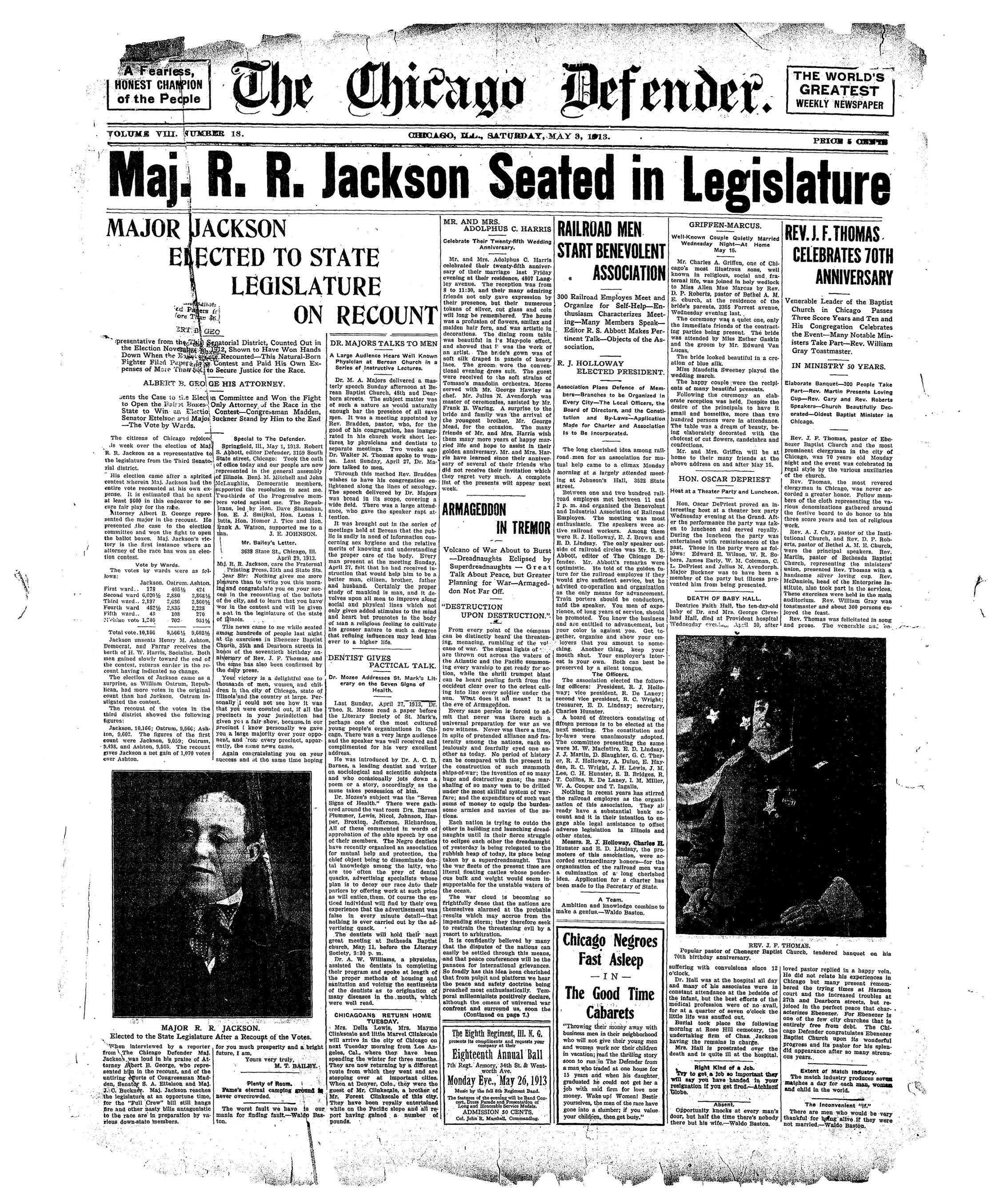
Maj. R. R. Jackson Seated in Legislature
VOLUME VIII. NUMBER 18.
Maj. R.
MAJOR JACK
ELECTED
ERT B. GEO
representative from the Third Senatorial B
the Election November Boxes 12, Show
Down When the Election Recount
Fighter Filed Papers in Contest a
penses of More Than 500 to Secure J
ALBERT B. GEO GE HIS A
sents the Case to the Election Commit
to Open the Ballot Boxes-Only Atto
State to Win an Election Contest—
Senator Ettelson and Major Buckner S
—The Vote by Wards.
MAJOR JACKSON ELECTED TO STATE LEGISLATURE ON RECOUNT
representative from the Third Segatorial District, Counted Out in the Election November 2012, Shown to Have Won Hands Down When the Election Recounted—This Natural-Born Fighter Filed Paperwork Contest and Paid His Own Expenses of More Than $10 to Secure Justice for the Race.
ALBERT B. GEO GE HIS ATTORNEY.
sents the Case to the Elective Committee and Won the Fight to Open the Ballot Boxes. Only Attorney of the Race in the State to Win an Election Contest—Congressman Madden, Senator Ettelson and Major Buckner Stand by Him to the End—The Vote by Wards.
The citizens of Chicago rejoiced this week over the election of Mall R. R. Jackson as a representative to the legislature from the Third Senateral district.
Special to The Defender.
Springfield, Ill., May 1, 1913. Robert S. Abbott, editor Defender, 3159 South State street, Chicago: Took the oath of office today and our people are now
Springfield, Ill. May 1, 1913. Robert S. Abbott, editor Defender, 2159 South State street, Chicago: Took the oath of office today and our people are now represented in the general assembly of Illinois. BenJ. M. Mitchell and John McLaughlin, Democratic members, supported the resolution to seat me. Two-thirds of the Progressive members voted against me. The Republicans, led by Hon. Dave Shanahan, Hon. E. J. Smijital, Hon. Lucas I.uts, Hon. Homer J. Tice and Hon. Frank A. Watson, supported me to a man. J. E. JOHNSON.
His election came after a spirited contest wherein Maj. Jackson had the entire vote recounted at his own expense. It is estimated that he spent at least $600 in this endeavor to secure fair play for the rule. Attorney Albert B. George represented the major in the recount. He presented the case to the election committee and won the fight to open the ballot boxes. Maj. Jackson's victory is the first instance where an attorney of the race has won an election contest.
M.J. R. K. Jackson, care the Fraternal Printing Press, 25th and State Sts. Dear Sir: Nothing gives me more pleasure than to write you this morning and congratulate you on your success in the recounting of the ballots of the city, and to learn that you have wor in the contest and will be given a sat in the legislature of the state of Illinois.
The votes by wards were as follows:
Jackson. Ostrum. Ashton.
First ward.. 178 405% 124
Second ward. 6,020% 2,850 1268
Third ward.. 2,197 2,636 2,860
Fourth ward. 482% 2,835 2,228
Fifth ward.. 48 108 720
Nedicue vote. 1,246 702 951%
Total vote. 10,166 9,566% 9,602%
This news came to me while seated among hundreds of people last night at the exercises in Ebenezer Baptist Church, 35th and Dearborn streets in honor of the seventieth birthday anniversary of Rev. J. F. Thomas, and the same has also been confirmed by the daily press.
Jackson unseated Henry M. Ashton, Democrat, and Farrar receives the berth of H. W. Harris, Socialist. Both men gained slowly toward the end of the contest, returns earlier in the recount having indicated no change.
Your victory is a delightful one to thousands of men, women, and children in the city of Chicago, state of Illinois and the country at large. Personally I could not see how it was that you were counted out, if all the precincts in your jurisdiction had given you a fair show, because in our precinct I know personally we gave you a large majority over your opponent, and from every precinct, apparently, the same news came.
The election of Jackson came as a surprise, as William Ostrum, Republican, had more votes in the original count than had Jackson. Ostrum instigated the contest.
The recount of the votes in the third district showed the following figures:
Jackson, 10,166; Ostrum, 9,566; Ashton, 9,602. The figures of the first count were Jackson, 9,059; Ostrum, 9,498, and Ashton, 9,655. The recount gives Jackson a net gain of 1,070 votes over Ashton.
Again congratulating you on your success and at the same time hoping
MAJOR R. R. JACKSON
Elected to the State Legislature After a
JACKSON.
After a Recount of the Votes.
J. A. M.
for you much prosperity and a bright future, I am.
When interviewed by a reporter from The Chicago Defender Maj. Jackson, was loud in his praise of Attorney Albert B. George, who represented him in the recount, and of the untiring efforts of Congressman Madden, Senator S. A. Ettelson and Maj. Robert B. McCormick, the legislature at an opportune time, for the "Full Crew" bill still hangs fire and other nasty bills antagonistic to the race are in preparation by various down-state members.
The worst fault we have is our mania for finding fault.—Waldo Baston.
---
The Chicago Defender.
Special to The Defender.
Mr. Bailey's Letter.
3638 State St., Chicago, Ill.
April 29, 1913.
Plenty of Room. Fame's eternal camping ground never overcrowded.
CHICAGO, IL., SATURDAY, MAY 3, 1913.
DR. MAJORS TALKS TO MEN
A Large Audience Hears Well Known Physician at Berean Church in a Series of Instructive Lectures.
Dr. M. A. Majors delivered a masterly speech Sunday afternoon at Berean Baptist Church, 48th and Dearborn streets. The subject matter was of such a nature as would naturally enough bar the presence of all save men. It was a meeting appointed by Rev. Bradden, pastor, who, for the good of his congregation, has inaugurated in his church work short lectures by physicians and dentists to separate meetings. Two weeks ago Dr. Walter N. Thomas spoke to women. Last Sunday, April 27, Dr. Majors talked to men.
Through this method Rev. Bradden wishes to have his congregation enlightened along the lines of sexology. The speech delivered by Dr. Majors was broad in its scope, covering a wide field. There was a large attendance, who gave the speaker rapt attention.
It was brought out in the series of meetings held at Berean that the public is sadly in need of information concerning sex hygiene and the relative merits of knowing and understanding the proper care of the body. Every man present at the meeting Sunday, April 27, felt that he had received instruction that would help him to be a better man, citizen, brother, father and husband. Certainly the proper study of mankind is man, and it devolves upon all men to improve along social and physical lines which not only gives added stimulus to the mind and heart but promotes in the body of man a religious feeling to cultivate his grosser nature to such a degree that refining influences may lead him ever to a higher life.
DENTIST GIVES
PACTICAL TALK
Dr. Mozee Addresses St. Mark's Literary on the Seven Signs of Health.
Last Sunday, April 27, 1913, Dr. Theo, R. Mozee read a paper before the Literary Society of St. Mark's, perhaps one of the most cultured young people's organizations in Chicago. There was a very large audience and the speaker was well received and complimented for his very excellent address.
He was introduced by Dr. A. C. D. Barnes, a leading dentist and writer on sociological and scientific subjects and who occasionally jots down a poem or a story, accordingly as the muse takes possession of him.
Dr. Mozee's subject was the "Seven Signs of Health." There were gathered around the vast room Drs. Barnes Plummer, Lewis, Nicol, Johnson, Harper, Broxton, Jefferson, Richardson. All of these commented in words of approbation of the able speech by one of their members. The Negro dentists have recently organized an association for mutual help and protection, the chief object being to disseminate dental knowledge among the lazy, who are too often the prey of dental quacks, advertising specialists whose plan is to decoy our race into their parlers by offering work at such price as will entice, them. Of course the enticed individual will find by their own experience that the advertisement was false in every minute detail—that nothing is ever carried out by the advertising quack.
The dentists will hold their next great meeting at Bethesda Baptist church, May, 11, before the Literary Society, 3:30 p. m.
Dr. A. W. Williams, a physician, assisted the dentists in completing their program and spoke at length of the proper methods of housing and sanitation and voicing the sentiments of the dentists as to origination of many diseases in the mouth, which were well read.
CHICAGOANS RETURN HOME
TUESDAY.
Mrs. Della Lewis, Mrs. Mayne Clinkscale and little Marvel Clinkscale will arrive in the city of Chicago on next Tuesday morning from Los Angeles, Cal., where they have been spending the winter for three months. They are now returning by a different route from which they went and are stopping over at important cities. When at Denver, Colo., they were the guest of Mr. Clinkscale, a brother of Mr. Forest Clinkscale of this city. They have been royally entertained while on the Pacific slope and all report having gained a number of pounds.
MR. AND MRS.
ADOLPHUS C. HARRIS
Celebrate Their Twenty-fifth Wedding
Anniversary.
Mr. and Mrs. Adolphus C. Harris celebrated their twenty-fifth anniversary of their marriage last Friday evening at their residence, 4807 Lange ley avenue. The reception was from 8 to 11:30, and their many admiring friends not only gave expression by their presence, but their numerous tokens of silver, cut glass and coin will long be remembered. The house was a profusion of flowers, smilax and malden hair fern, and was artistic in decorations. The dining room table was beautiful in its May-pole effect, and showed that I was the work of an artist. The br.de's gown was of soft silk draped in panels of heavy lace. The groom wore the conventional evening dress suit. The guest were received to the soft strains of Tomaso's mandolin orchestra. Morse served with Mr. George Hawley as chef. Mr. Julius N. Avendorph was master of ceremonies, assisted by Mr. Frank B. Waring. A surprise to the bride and family was the arrival of the youngest brother, Mr. George Mead, for the occasion. The many friends of Mr. and Mrs. Harris wish them many more years of happy married life and hope to assist in their golden anniversary, and Mrs. Harris have learned since their anniversary of several of their friends who did not receive their invitation which they regret very much. A complete list of the presents will appear next week.
Volcano of War About to Burst —Dreadnaughts Eclipsed by Superdreadnaughts —Great Talk About Peace, but Greater Planning for War—Armageddon Not Far Off.
From every point of the compass can be distinctly heard the threatening, menacing, rumbling of the volcano of war. The signal lights of are thrown out across the waters of the Atlantic and the Pacific summoning every warship to get ready for action, while the shrill trumpet blast can be heard pealing forth from the occident clear over to the orient calling into line every soldier under the sun. What does it all mean? It is the eve of Armageddon. Every sane person is forced to admit that never was there such a universal preparation for war as we now witness. Never was there a time, in spite of pretended alliance and fraternity among the nations, each so jealously and fearfully eyed one another as today. No period of history can be compared with the present in the construction of such mammoth ships-of-war; the invention of so many huge and destructive guns; the marshaling of so many men to be drilled under the most skillful system of warfare; and the expenditure of such vast sums of money to equip the burdensome armies and navies of the nations.
Each nation is trying to outdo the other in building and launching dreadnaughts until in their fierce struggle to eclipse each other the dreadnaught of yesterday is being relegated to the rubbish heap of today, its place being taken by a superdreadnaught. Thus the war fleets of the present time are literal floating castles whose ponderous bulk and weight would seem insupportable for the unstable waters of the ocean.
The war cloud is becoming so frightfully dense that the nations are themselves alarmed at the probable results which may accrue from the impending storm; they therefore seek to restrain the threatening evil by a resort to arbitration.
It is confidently believed by many that the disputes of the nations can easily be settled through this means, and that peace conferences will be the panacea for international grievances. So fondly has this idea been cherished that from pulpit and platform we hear the peace and safety doctrine being preached most enthusiastically. Temporal millennials positively declare, although the omens of universal war confront and surround us, soon the (Continued on page 7.)
The Eighth Regiment, III. N. G.
presents its compliments and requests your
company at their
Eighteenth Annual Ball
7th Regt. Armory, 34th St. & Went-
worth Ave.
Monday Eve., May 26, 1913
Music by the full 8th Regiment Band.
The features of the evening will be Band Con-
cert, Dress Pamela and Presentation of
Long and Honorable Service Modals.
ADMISSION 50 CENTS.
Col. John R. Marshall, Commanding.
RAILROAD MEN START BENEVOLENT ASSOCIATION
300 Railroad Employes Meet and Organize for Self-Help—Enthusiasm Characterizes Meeting—Many Members Speak—Editor R. S. Abbott Makes Pertinent Talk—Objects of the Association.
Association Plans Defence of Members—Branches to be Organized in Every City—The Local Officers, the Board of Directors, and the Constitution and By-Laws—Application Made for Charter and Association Is to Be Incorporated.
The long cherished idea among railroad men for an association for mutual help came to a climax Monday morning at a largely attended meeting at Johnson's Hall, 3522 State street.
Between one and two hundred railroad employees met between 11 and 2 p. m. and organized the Benevolent and Industrial Association of Railroad Employees. The meeting was most enthusiastic. The speakers were active railroad workers. Among them were R. J. Holloway, E. J. Brown and E. D. Lindsay. The only speaker outside of railroad circles was Mr. R. S. Abbott, editor of The Chicago Defender. Mr. Abbott's remarks were optimistic. He told of the golden future for the railroad employees if they would give sufficient service, but he advised co-operation and organization as the only means for advancement. Train porters should be conductors, said the speaker. You men of experience, of long years of service, should be promoted. You know the business and are entitled to advancement, but your color is against you. Get together, organize and show your employees that you amount to something. Another thing, keep your mouth shut. Your employer's interest is your own. Both can best be preserved by a silent tongue.
The Officers.
The association elected the following officers: President, R. J. Holloway; vice president, R. D Laney; second vice president, R. C. Wright; treasurer, E. D. Lindsay; secretary, Charles Hunter.
A board of directors consisting of fifteen persons is to be elected at the next meeting. The constitution and by-laws were unanimously adopted. The committee presenting the same were M. W. Macintire, E. D. Lindsay, J. J. Martin, D. Slaughter, G. C. Theyer, R. J. Holloway, A. Duluc, E. Hayden, R. C. Wright, J. H. Lewis, J. M. Lee, R. C. Hunster, B. Bridges, T. Collins, R. De Laney, I. M. Miller, W. A. Cooper and T. Ingalls.
Nothing in recent years has stirred the railroad employees as the organization of this association. They already have a substantial bank account and it is their intention to engage able legal assistance to offset adverse legislation in Illinois and other states.
Messrs. R. J. Holloway, Charles H. Hunster and E. D. Lindsay, the promoters of this association, were accorded extraordinary honors—for the organization of the railroad men was a culmination of a long cherished idea. Application for a charter has been made to the Secretary of State.
A Team.
Ambition and knowledge combine to make a genius—Waldo Baston.
Chicago Negroes Fast Asleep IN The Good Time Cabarets
"Throwing their money away with business men in their neighborhood who will not give their young men and women work nor their children in vacation; read the thrilling story soon to run in The Defender from a man who traded at one house for 15 years and when his daughter graduated he could not get her a job with said firm for love nor money. Wake up! Women Bestir yourselves, the men of the race have gone into a slumber; if you value your children, then get busy."
I
Popular pastor of Cheneger Baptist Church, tendered banquet on his 70th birthday anniversary.
Well-Known Couple Quietly Married
Wednesday Night—At Home
May 15.
Mr. Charles A. Griffen, one of Chicago's most illustrous sons, well known in religious, social and fraternal life, was joined in holy wedlock to Miss Allen Marcus by Rev. D. P. Roberts, pastor of Bethel A. M. E. church, at the residence of the bride's parents, 3355 Forrest avenue, Wednesday evening last.
The ceremony was a quiet one, only the immediate friends of the contracting parties being present. The bride was attended by Miss Esther Gaskin and the groom by Mr. Edward Van Lucas.
The bride looked beautiful in a creation of blue silk.
Miss Maudela Sweeney played the wedding march.
The happy couple were the recipients of many beautiful presents. Following the ceremony an elaborate reception was held. Despite the desire of the principals to have it small and homelike, more than two hundred persons were in attendance. The table was a dream of beauty, being elaborately decorated with the choicest of cut flowers, candelabra and confections. Mr. and Mrs. Griffen will be at home to their many friends at the above address on and after May 15.
HON. OSCAR DEPRIEST
Hon. Oscar DePriest proved an interesting host at a theater box party Wednesday evening at the Grand. After the performance the party was taken to luncheon and served royally. During the luncheon the party was entertained with reminiscences of the past. Those in the party were as follows: Edward E. Wilson, W. R. Sobers, James Early, W. M. Coleman, L.D. DePriest and Julius N. Avendorph, Major Buckner was to have been a member of the party but illness prevented him from being presented.
DEATH OF BABY HALL.
Bentrice Fay Hall, the ten-day-old baby of Dr. and Mrs. George Cleveland Hall, died at Provident hospital Wednesday evening, April 30, after
REV. J. F.
Popular pastor of Cheneger Baptist
70th birthday anniversary.
suffering with convulsions since 12 o'clock.
Dr. Hall was at the hospital all day and many of his associates were in constant attendance at the bedside of the infant, but the best efforts of the medical profession were of no avail, for at a quarter of seven o'clock the little life was snuffed out.
Burial took place the following morning at Rose Hill cemetery, the undertaking firm of Chas, Jackson having the remains in charge.
Mrs. Hall is prostrated over the death and is quite ill at the hospital.
Right Kind of a Job.
Try to get a Job so important they will say you have handed in your resignation if you get fired.—Atchison Globe.
Absent.
Opportunity knocks at every man's door, but half the time there's nobody there but his wife.—Waldo Baston.
THE WORLD'S GREATEST WEEKLY NEWSPAPER
lature
REV.J.F.THOMAS CELEBRATES 70TH ANNIVERSARY
REV.J.F.THOMAS CELEBRATES 70TH ANNIVERSARY
Venerable Leader of the Baptist Church in Chicago Passes Three Score Years and Ten and His Congregation Celebrates the Event—Many Notable Ministers Take Part—Rev. William Gray Toastmaster.
IN MINISTRY 50 YEARS
Elaborate Banquet—300 People Take Part—Rev. Martin Presents Loving Cup—Rev. Cary and Rev. Roberta Speakers—Church Beautifully Decorated—Oldest Baptist Minister in Chicago.
Rev. J. F. Thomas, pastor of Ebenezer Baptist Church and the most prominent clergyman in the city of Chicago, was 70 years old Monday night and the event was celebrated in regal style by the various auxiliaries of the church.
Rev. Thomas, the most revered clergyman in Chicago, was never accorded a greater honor. Fellow members of the cloth representing the various denominations gathered around the festive board to do honor to his three score years and ten of religious work.
Rev. A. J. Cary, pastor of the Institutional Church, and Rev. D. P. Roberts, pastor of Bethel A. M. E. Church, were the principal speakers. Rev. Martin, pastor of Bethesda Baptist Church, representing the ministers' union, presented Rev. Thomas with a handsome silver loving cup. Rev. McDaniels, head of the Enterprise Institute, also took part in the services. These exercises were held in the main auditorium. Rev. William Gray was toastmaster and about 300 persons enjoyed the feast.
Rev. Thomas was felicited in song and prose. The venerable cane
THOMAS.
At Church, tendered banquet on his
loved pastor replied in a happy vein.
He did not relate his experiences in Chicago but many present remembered the trying times at Harmon court and the increased troubles at 27th and Dearborn streets, but rejoiced in the perfect peace that characterizes Ebenezer. For Ebenezer is one of the few city churches that is entirely free from debt. The Chicago Defender congratulates Ebenezer Baptist Church upon its wonderful progress and its pastor for his splendid appearance after so many strenuous years.
Extent of Match industry.
The match industry produces seven matches a day for each man, woman and child in the world.
The Inconvenient "if."
There are men who would be very thankful for being alive if they were not married.—Waldo Baston.
---
SUBSCRIPTION RATES IN ADVANCE.
October.....$1.50
Six months.....1.00
Three months.....0.75
Foreign.....2.50
OFFICE,
3159 State Street
CHICAGO, ILL.
TELEPHONE DOUGLAS 3339.
Entered as second-class matter, February 1, 1906, at the Postoffice in Chicago, Ill., under act of March 3, 1879.
RATES OF ADVERTISING.
Birth, betrothals, marriages and deaths.....$1.50
Complimentary and obituary resolutions, each.....5.00
```markdown
```
DISPLAY ADVERTISEMENTS.
One inch, one time.....$1.50
Special rates given on large or long-
standing ads.
Special advertisements, per inch 3.00
Want ads, each.....0.50
Reading notices, per line.....0.25
Rates for display advertisements
furnished on application.
Change of address.—Please give both
the old and new address; and in writing
to the paper always be careful to give
the state and postoffice, as well as
name.
COURT GENERAL ROBERT ELIOTT
No. 2303, Ancient Order of Forerers
meets every second and fourth Monday
night in each month at Odd Fellows
Hall, 3337 Church Street
Lodge Officers.
Chief Ranger, F. V. Babb, 5345 Dear-
born street; phone Dexel 5101
Grove avenue; phone Normal 7592
Treasurer, Frank L. Crittenden, 2415
Dearborn street; phone Calumet 3219
ADVERTISING PAYS.
Smith opened a store, kept the best to be had
In coffee and spices and teas.
Of clerk he had four and a young errand lad,
Who did all they knew how to please.
But Jones o'er the way got the business somehow,
Till finally Smithy got wise.
And now every day he turns people away.
Advertise, advertise, advertise.
N. B.—And there is no better medium than the "Defender."
—All of the amusement parks open this month. Get your dimes ready.
—A great many people found that it wasn't as cheap to move as to pay rent.
—We sometimes wonder whether California is the United States or simply a part of it.
- Solving the race problem is a favorite pastime with a certain class of notoriety seekers.
- Not being mind readers, we would appreciate it if those who have moved would send the Defender their new address.
- A million white men in California afraid of fifty thousand yellow men. What about the vaunted white supremacy?
- There seems to be a great demand for steam heated flats; it looks like the weather man and the coal man were in cahoots.
- There is a slight difference between trampling on the Japanese and trampling on the Negroes, with the difference in favor of the former.
—There is an appalling dearth of marriage notices in Chicago this spring, amongst all classes of people. We wonder if the cafe life of our "best" young men is a reason to be.
—The matter of race prejudice in California against the Japanese, we predict will be too hard a nut to crack for both President Wilson and Secretary Eryan. California may be the golden state, but they overlook the golden rule.
—the friends of Col. John R. Marshall are all wondering why an opportunity was not given him to verify his statements, as it is a fact he has a double duty to perform, and they are almost similar, and if the days and dates do not or did not correspond, once should have been given.
f the belief if such be the
case the colonel will make good. Meanwhile, all his friends and fellow citizens are standing as firm as Gibrattar with the man that led the 8th across the briny deep and brought back laurels for the fair state of old Illinois. Let us now not bind him down in chains as did Columbus' enemies, but give him the glad band and stand by him until the end.
— Merchants and other business men on the "Stroll" are wise enough to employ colored help, knowing their incomes depends on the race. When it affects the pocketbook, prejudice is lost sight of—at least till in the parlance of the street, they have got theirs.
A little two-year-old abandoned baby in Kansas City, Mo., is causing quite a stir in that otherwise tranquil burg. No one seems to be able to tell whether the child is white or colored, so a commission of physicians have been delegated to settle the question. Just how they are going to determine is problematical; the hair is straight, the features Anglo-Saxon, though a little swarthy, the skin is no darker than the average brunette. We hate to think of what would happen should the doctors disagree.
GRAVEN IMAGES.
—Moving day again presented the pittilace spectacle of hundreds of poor laboring people trying to imitate people of abundant means and incomes, by moving into one-room flats over East, for which they pay from $12 to $20 monthly, and are denied all comforts and privileges of home life. The "For Rent" sign is displayed in countless small apartments west of State street, where these same people have resided, and many of them had comfortable homes, needing not the baneful influences of the "star boarder" to enable them to meet the daily expenses of respectable living. We wonder at the folly of such and can find no reason for it, save the false idea of trying to seem rather than of trying to be. Certainly it is a false pride which induces poor families to aim at the luxuries of the rich in appearance, and neglect to provide themselves with the basic and actual necessities of happiness. It involves a problem both economic and moral, and strikes at the very root of respectability and honesty. Why should we be like ostriches who, hiding their heads in the sand obscuring their visions, thinking by so doing to conceal their bodies from the hunter. It is the quality of our people that they strive to imitate, but their imitations are not genuine in character or living any more than they are in colons. They are as easily recognized and as hard to pass. Let us give more attention to a status which our means justify and which insures growth and honesty and forget baneful strivings after graven images of pretense and luxuries, which only keep us in the mire of debt and indecency.
VACATION TIME.
—Vacation time is not so many moons off, and wise ones are making their plans now. Where to go and what will be the expense, are two very important questions. To Chicagoans who get so much the year round, of the giddy whirl, there is no more restful spot than our own summer outing place. "West Michigan Resort." A delightful three-hour lake trip costing fifty-cents, lands you in Benton Harbor. Here you are met by a good old-fashioned country lad with a team of bays hitched to a three-seated wagon. You pile in, bag and baggage, and after passing through two miles of the prettiest scenery in the state, you land at the "Big House." Here you register and are assigned to one of the cozy shacks bordering on the lake. By this time you are as hungry as a wolf, the dinner bell rings and, like kids, everybody scrambles for the spacious dining room. To mention the good things there to eat would make you want to go before the place opens, which will be in early June. Mr. William R. Cowan, the man who has the reputation of making everything he is connected with a success, will have full charge of affairs, having been elected president of the company at the last annual meeting. Those who have visited the place will be surprised at the wonderful improvements that are being made. Here will be found every pleasure and convenience to be had at other similar resorts. Let us never lose sight of the fact that it is not a money-making scheme, but a place run for the sole purpose of giving a breathing spot to our people. All during the season the "Defender" will have a branch office there and a live reporter will gather the happenings. The "West Michigan Resort" needs your support, and you need the "West Michigan Resort."
THE PULLMAN CO. GIFT.
—Those interested in the building of our new Y. M. C. A. are wreathed in smiles, the Pulman Company having just sent them their check for ten thousand dollars to aid in the work. This coming from a corporation is a splendid testimonial of the faith they have in such an institution. Employing, as they do, hundreds of our young men, they cannot fail to be benefited by the establishment of this Christian assembly place. Environment means everything, and the right road may seem a little more hilly, but it is always the shortest cut to real and lasting success. Those who have pledged financial support and have failed to make good for any reason, should rally now to the call and pay up so the doors may be thrown open. To Mr. L. Wilbur Messer, general secretary, and to Mr. J. Parker, business manager, too much praise cannot be given for their untiming efforts. To the Pulman Company we extend the thanks of our people, and to our people the Defender extends congratulations.
Buy a Home.
—There are many pretty homes that can be purchased reasonably in the suburbs of any large city, and there is little excuse for paying high rents in some pitched up flat, when the transportation fare is practically the same, the only difference being a few minutes in time. And oh, the comforts of your own home, with sun porches, a yard where the children
can romp and play, a little garden either of vegetables or flowers, a spot away from the noisy hundrum of city life, in fact a home like you had when you were a child. If you have no time through the week take a trolley ride out in God's country on a Sunday; find what you want and bargain for it the next day; it will repay you two-fold, in comfort and in increased value. Till then you will never appreciate the motto, "Home, Sweet Home."
BLAZING THE WAY.
BLAZING THE WAY.
—According to Prof. G. R. Richings there will be 50,000,000 Negroes in the country by 1950, and the problem of their development is becoming greater every year. Industrial education alone for the masses seems to be the one line of work that will provide an outlet for the knowledge that they have attained. We have in the race approximately 38,000 educators, 3,000 doctors, 600 editors, and thousands of lawyers, dentists and ministers. All of whom are necessary for the uplift work that is being carried on. The world marvels at our progress in fifty years. Does it not behoove us to make special efforts during the coming half century? We are not wards of the nation like the Indian, we receive nothing we do not work and fight for. Our whining, cringing days are over, meet the issues as they come face to face, and as you climb the ladder remember you are blazing the way for your friend and brother.
BOOMERANG.
As there are more ways than one of killing a cat, so there are more ways than one of discouraging the practice of lynching, not that the brutes who engage in this pastime are getting less brutal, but the unsavory notoriety which a town now immediately attains all over the country has probably as much to do with discouraging the practice as any other one thing. The Southern cities who were wont to boast of their lynchings are now rather ashamed of them, and try to hush the matter up, just waking up to the fact that every one of these crimes does a positive injury to the place where it is committed. This is one of the many good things that can be attributed to newspaper publicity.
---
MAJ. B. B. JACKSON.
—Perhaps not in the columns of this paper before has appeared a fact more welcome to colored people than the election of Maj. R. R. Jackson to the Legislature. He is capable, honest and fearless, and stands as a champion for the rights of a quarter of a million citizens of the state. His fight for a seat after having been counted out by the "powers" is sufficient a monument to his gameness. We must give credit also to the voters of his district, both white and black, who elected him, and hope they will continue in office such a capable citizen, for the betterment of all classes and all public legislation.
WELCOME NEWS
—The vice commission is to give attention to the high rent of flats and houses in Chicago. The discrimination against colored people in charging them 25 to 50 per cent more for living places should be thoroughly looked into. We hope the intelligent members of the race will volunteer their services as to the cause of the evil. Publicity and expression are always aids to a cause.
THE EDITOR'S MAIL.
A Case of Persecution
A Case of Persecution.
Mr. Editor: As I have been a close observer as well as a careful reader of the movements of Mr. J. Arthur Johnson, ever since he traveled half around the world, seeking an opportunity to prove his right to the title he now holds, down until the present time, I wish to write through the columns of your paper what I am now firmly convinced to be a case of persecution. Although I have not agreed with him at all times, still I know he has done nothing to cause so much hatred except to win and successfully defend the title of heavyweight champion of the world. You can scarcely pick up a paper but what you read of some officer who is merely seeking notoriety in arresting him. I feel that the time has come when all fair-minded Negroes should demand not only for Mr. Johnson, but also for the whole race, at least justice. I have said that I have not agreed with him at all times, neither have I at all times agreed with the doings of the other races. Women and men have been murdered, women have been assaulted and even the presidents of our country have been shot down, yet all of those assassins have been given a fair trial. The officers of our city have been shot down, yet the murders have been allowed to go into open court and defend themselves. My people have not been guilty of many of those things and yet they seem to be a target for any and all kinds of attacks, and through it they have kept silent and some have even joined in the unjust attacks upon Mr. Johnson and others.
We have been loyal citizens from 1775 to 1913, answering the country's call at all times. Our people have not only been persecuted but bain without cause. I feel that the time has come when every member of the race should protest against these unjust attacks.
As long as you keep silent, just so long will this persecution continue. We have helped more than any other nationality to make this country what it is today, and it is nothing but fair that we be allowed to enjoy the fruits of our labor without being hindered. Trusting that this will not only be taken up by your peerless paper, but also by every Negro newspaper in America, and by your tireless and united efforts the national as well as the local authorities will be compelled to take notice of the crusade against hypocrisy and persecution. The call is earnest.
Very respectfully, ALBERT PRINCE.
Worth Considering.
We get more out of life. Why shouldn't we, put more into it?
THE CHICAGO DEFENDER.
Keep Healthy
A Weekly Talk on Preventative Measures, First Aid Remedies, Hygienics, Sanitation. No Cases will be Diagnosed and No Prescriptions will be Given in This Column.
Bad Air in Lodge Halls.
A great many male and female readers of these hints belong to or are members of some one or more fraternal organizations, societies or clubs of a social nature. Many of the members of these various organizations here come to me complaining of the bad air in the lodge halls.
It Is Up to You!
Now, Mr. Lodge Member, it is up to you to demand of your presiding officer (the major domo), to see that you have good fresh air. You know that all places of public assembly should be well ventilated. A few persons in a poorly ventilated room soon poison the air and make it unfit and dangerous to breathe. You had just as well go into the alley and drink the swill out of the swill barrels and cans as to breathe and rebreath the dirty foul air emanating from yourself and other persons with the hope of being well.
Janitors of Lodge Halls.
The janitors of our lodge halls should see to it that the lodge rooms are cleaned and thoroughly aired out before and after each meeting. Don't close the doors and windows after the meeting and open them just in time for the next meeting—trying, as some say—to save coal and thus make it possible to give bad colds.
One member said: "We are compelled to keep all doors and windows closed for fear some one that is not a member will hear and learn of the secret workings of his lodge, especially on initiation nights." Here comes in, Mr. Member, the question of values or Emerson's law of compensation—the secrets of your lodge with bad air, bad colds, pneumonia, consumption, headaches, indigestion, bad liver and bad temper in general, or insist on having windows lowered a little from the top and raised a little from the bottom during the lodge session, so you can have a supply of fresh air, avoid headaches and the various above named diseases that are produced directly from the breathing of bad air, such as you complain of in your lodge rooms.
Get Rid of Dirty Air.
Get rid of dirty air, dangerous air;
all human beings are entitled to the
fresh air and sunlight and plenty of it.
Sitting Up with Slick Members
Mrs. Sally complains of being compelled to sit up with Sister A, who was dying of a cancer, in a foul room. If she did not sit up all night in the foul room the lodge would fine her one dollar for refusing to do so. Now, Mrs. Sally, this compelling of members to sit up with sick members having catching diseases or some silinking disease is a bad practice. Your health is worth more to you than any lodge that will compel you to sit up all night in a hot, foul, poorly ventilated room with a dear sick member who has some disease that will endanger your life. This way of compelling people who are not trained nurses and physicians to sit up and care for those who are dangerously sick is a bad business. You are not obliged to do anything that will endanger your life. You should refuse to endanger your life and that of your family and friends by sitting up all night in a poorly ventilated, sick room, exposing yourself to dangerous diseases, which you do not know how to protect yourself against. No one should be required to do so except trained nurses and physicians; no one should remain in contact and have constant care to such persons as are afflicted with pneumonia, tuberculosis, diphtheria, scarlet fever, smallpox, syphilis, typhoid fever and erysipelas.
The Health Department will assist you in finding a remedy for your complaint if you are fined for your expelled from your lodge for refusing to sit with any member who is so unfortunate as to have any of the above named catching diseases.
Question: "Does cold cause consumption?"
Reply: "No; consumption is caused by a very small germ or microbe visible only by the microscope. The germs, microbes, or bugs, are found in the spittle coughed up by persons who have the disease in the lungs; the name of the germ is the tubercle bacilli. Bad colds often render the system a good soil for the growth and development in the system of the tubercle bacilli germ."
Bloating Stomach.
Mrs. P. writes: "What causes bloating stomach?"
Reply: "There are many things that will cause this condition; certain kinds of food will cause it; too much starches and sweets will cause fermentation and generation of gas in the stomach and bowels, acid digestion, constipation, lack of motor activity of the digestive organs, laziness, lack of proper exercise. You should consult your physician and perhaps he would give you a good digestive tonic.
Keep Clean
DR.A. WILDERFORCE
Secrets Get Out
Top Healthy
A. Wilberforce Williams
y Talk on Preventative
s, First Aid Remedies,
s, Sanitation. No Cases
Diagnosed and No Pre-
s will be Given in This
dentist, nurse, barber, cook or waiter who may come in close contact with you, with a foul smelling breath and offensive personality.
Press Service, Department of Health. It is the neighborhood that counts most as a factor in the safety of the home for the reason that, as the Department of Health has often urged, it is community or neighborhood cooperation that makes for individual safety. Therefore none of us can afford to overlook bad neighborhood conditions or be indifferent to those things that make a neighborhood a dangerous and undesirable place to live in. If you are changing your place of residence, that is, moving from one part of the city to another, it is always wise to take notice of these important things:
Dirty surroundings, vacant lots in filthy condition, alleys unpaved and strewn with garbage and decaying refuse of every kind; stables unscreened and neglected manure piles; privy vaults; evidence of contagious sickness as shown by the houses carded for diphtheria, scarlet fever, measles, etc., the presence of trades or industries that are offensive in residence communities and which are a menace to both your health and comfort. Now, having found a locality where the objections noted are not present, then your next duty is the selection of the house or apartment in which you are to live and which, as nearly as possible, should meet these modern sanitary requirements. Good ventilation, which means that there must be plenty of windows through which you can get your rightful share of air and sun; abundance of windows will also cover the equally important matter of ample natural light; sunny, well ventilated sleeping rooms; basement clean and dry and having concrete floor; open, up-to-date plumbing; no evidences of vermin; finally consult the Department of Health as to its records, if any, for contagious diseases; with all these matters carefully looked after both as to the neighborhood and the house you select, you will have done about all that could be done to insure you a safe and comfortable abiding place. Then comes your own duty of keeping your premises clean and tidy and in co-operating with your neighbors in community welfare work of every kind.
All In a Bunch.
Mary, aged 6, was intently watching a very stout woman, a fellow passenger in a street car. The child whispered: "Do you know, grandmother, I think she was meant for twins and never was divided."
Few Complete Education
Pew Complete Education.
In the country, as a whole, less than half the children finish the first six school grades, only about one in four ever enters high school and less than five in one hundred go to college.
"You used to want to hold my hand before we were married," she complained. "I'd like to now," said he, easily, "but it would keep you from your housework, my dear."
Young America.
"Oh, dear!" sighed five-year-old Gladys, seeing her father hurry down to breakfast, while she was still undergoing the agonies of the coiffure, "how soon it takes a man to dress himself!"
The Better Method
"De man dat tries to please every body," said Uncle Eben, "ain't gine to git along nigh so well as de man who squares up to de world an' gits everybody try'in' to please him."
On the Toboggan.
No man ever discovers his true powers of locomotion until he starts on the moral and financial down grade.-Puck.
To Take Strings From 11
To Take Stains From Hands.
To take stains from hands, use half cupful of coarse cornmeal and one cupful of strong vinegar. Wash and rub the hands well in this; rinse if warm water.
Daily Thought.
The foundation of that steadfastness and constancy which we seek in friendship is sincerity. For nothing steadfast which is insincere—Clercero.
Daily Thought
At whatever value a man set on himself, at that value he should be estimated by his friends.—Cicero.
Cynic.
Many a girl would go through fire and water for a man, or even through his bank account.
Never judge a woman's temper by her "telephone voice," nor a man's income by the nonchalance with which he foots the wine bill.
Superlative Wisdom
Centuries have not improved upon the wisdom of man who built his house upon a rock, the highest he could find.
Thoughtful.
No Test.
Our Local Department—Personal Mention—Religious—Social and other short paragraphs—Read it over carefully, somewhere you will find a line or two about yourself or your friends.
Recently Dr. and Mrs. E. S. Miller rented their residence, 3642 Wabash avenue, and have taken apartments with Mrs. Beatrice Smith at 3247 Wabash avenue.
The Lady Elliott Circle No. 199 will open the summer season of entertainments with their May party at the Masonic hall, 40th and State street on May 12. Don't fail to patronize this splendid organization.
The Moseby sisters, 5211 Grove avenue served a very delicious dinner on Sunday afternoon to a few friends. Mr. W. W. Talley was the guest of honor.
were entertained at the residence Mrs. Agnes Pindell, 1526 N. Park avenue. Chief M. T. Bailey was proclaimed and explained the progress of the Grand Fountain and spoke of the N. St. Louis convention.
Miss E. C. Patrick, 6017 Morr avenue, recently moved to Champaign Ill., and one of our reporters in little town writes that Miss Patricia being royally entertained by her m friends; card parties, theater engagements, and horse back riding in her been chief indulgences, but as as the weather moderates she is go to give them all up in order that
Mr. Breivient of New York and Mr. A. Taylor of Cleveland, Ohio, gave a musical on Monday evening at 3632 Dearborn street. Mrs. Pearl Wilson Pleasant and Miss Zena Johres were among the many friends who assembled to enjoy the splendid program. Dr. C. H. Knight has given up his office at 3158 State street and has gone to England to take a post graduate course. He expects to be gone a year.
Wait for the 8th Inf. 18th annual entertainment, given at the 7th Regiment armory, Monday evening, May 26. Presentation of badges for rifle practice and long and honorable service.
Mrs. Robert Oakley, Louisville, Ky., sister of Mr. Will Dorsey, the well-known music writer, 3160 Wabash avenue, is in the city because of the illness of her mother and sister-in-law. Mrs. Lizzie Heart Dorsey. She will remain here until her relatives are better.
Subscribers and friends of the Chicago Defender will please bear in mind that no advertisements of any kind whatsoever will be inserted in our columns until they are paid for in advance. So please don't telephone.
Miss Frances Atkinson, Mrs. M. E. Henderson, Miss E. Henderson, F. A. Henderson, and Mr. and Mrs. George N. Johnson have recently moved to 3334 Vernon avenue.
Mrs. Chas. Mackey, 3159 State street, left the city a few days ago for a visit of several weeks in Kentucky. Mrs. Mackey's first visit was in Louisville, where she only remained two hours and was the guest of Mrs. Guey Smith. From there she went to Lexington, where she joined her husband, who is in business there. Then Mr. and Mrs. Mackey will to Richmond, Ky., where she will remain for some time the guest of Mr. Mackey's relatives.
Mrs. J. C. Gallagher, of 3333 Wabash avenue, entertained a few friends at cards April 21, in honor of Miss Roxie Smith of Atlanta, Ga.
Dr. A. A. Marquess, an alumnus of Fisk, also of Northwestern University dental department, is the guest of Dr. C. Thos. Nichol.
Send in personales of your friends. It is free. Drop it on a post-card. Can't you afford to spend a penny on your friends?
Joseph B. Crum, our little friend whose love for Chicago is above the average fellow, is again in the employment of his former employer, Harry Stevens. We congratulate Joseph and extend our best wishes.
Sidney W. Connors, the popular private car steward, had a birthday celebration-last Sunday, but he failed to deceive anyone by his youthful actions and the few friends who called to pay their respects left with their own opinion, as to his age.
Mrs. Edward D. Wimp and her three children will arrive in the city tomorrow to spend several weeks with her mother, Mrs. H. P. Lee, 3159 State street.
Master Raymond Black, Bethel's
Sunday school boy soprano, will sing,
"Alone with Jesus," on Sunday morning,
accompanied by Miss M. Sweeney.
Mr. George Tolbert and wife have
recently returned from Harlingen,
Texas, where they have been all winter. They are now residing at 3306
Vernon avenue.
Lawyer and Mrs. John Trabue, 5338
Monroe avenue, gave a luncheon Tuesday
in honor of Mr. and Mrs. Taylor
Saunders. Mrs. John Merrilweather
and Mr. J. Langston Poole were also
present.
Mr. and Mrs. J. B. Harrison, Sr., of
2325 Wabash avenue, have moved to
5250 Dearborn street.
If you want a first-class furnished
room read our classified columns.
Rev. D. P. Roberts addressed the Chicago Colored Business Men's Association at 38th and Wabash avenue this week. His subject was, "Business and Its Relation to Church, State and Society," and the reverend gentleman waxed eloquent in his splendid remarks on this subject.
Mrs. George R. Garner and family are now living at 5229 Wabash avenue.
Mme. Marie Burton Hyram and family are domiciled at 3663 Wabash avenue.
Mrs. Wm. Carl Clenna and Mrs. Lawton have moved to 5418 Prairie avenue.
The officers and members of the Chicago Leading Light Fountain of the Grand Fountain U. O. T. R. No. 2844.
were entertained at the residence of Mrs. Agnes Pindell, 1526 N. Park avenue. Chief M. T. Bailley was present and explained the progress of the Grand Fountain and spoke of the East St. Louis convention.
---
Miss E. C. P. Patrick, 6017 Monroe avenue, recently moved to Champaign, IL, and one of our reporters in this little town writes that Miss Patrick is being royally entertained by her many friends; card parties, theater engagements, and horse back riding have been her chief indulgences, but as soon as the weather moderates she is going to give them all in order that she might devote all of her time to fishing.
When in doubt or trouble, telephone to The Chicago Defender, Douglas 3339.
Chief M. T. Bailey visited Waukegan this week and held a conference with Rev. Harry E. Johnson, relative to the True Reformers' work on the north shore.
The Pandora Club with their many friends spent a very pleasant evening at Johnson hall last Tuesday evening. Dancing was enjoyed until a late hour.
The debate between the Tuskegee Club and University Club on Tuesday evening last, was a very interesting affair. The decision of the judges was announced at 12 o'clock, in favor of the University Club.
All advertisements for furnished rooms or flats must be paid for in advance. We have no collectors for this kind of work.
George Mead of New York, youngest brother of Mrs. A. C. Harris, Mrs. Littleton Jones and Edward Mead, gave his sisters and brother and father quite a surprise last Friday night by appearing at the wedding anniversary of Mrs. Harris without any knowledge of his coming. He will return home this coming week.
Mrs. Maggie L. Walker of Richmond, Va., arrived in the city Wednesday evening and has taken quarters at Hotel Washington, where she will organize a lodge of the Order of St. Luke, on the evening of May 1.
CLUBS AND SOCIETIES
The Perless Pleasure Club No. 2
met at Mrs. Charles B. Childres, 3700
State street, April 25. As usual all
members were present. Business of
the club was transacted, after which
the evening was spent very pleasantly
playing whist. At 11:30 lunchon
was announced. The guests filed into
the beautiful dining room and a dainty
repeat was served. The next meeting
will be held at Mrs. Young's, 2960
Armour avenue.—Lucy Shepherd,
president; J. C. Gallagher, vice president.
CHICAGO UNION CHARITY CLUB.
The Chicago Union Charity Club
met Thursday, April 24. at the home
of Mrs. K. Johnson, 5137 Dearborn
street. The meeting was of great
interest and a good attendance.
Mrs. Sharp of 4842 State street; chairman of the committee that went to Dayton, gave a report of the sufferers in the flood. Two visitors from Dayton, O., were present, Mrs. Clark and Mrs. Jefferson, who are stopping with Mrs. Sharp. They told of the distress of the people in Dayton and how they lost everything they had. Two letters of thanks were sent to the club by those who had received the trunks of clothing. One was from the W. C. T. U. and the other from a Mrs. Avery. Mrs. Edna Bryant Nowby visited the club and also became a member. A delightful luncheon was served by the hostess and a rising one of thanks was given. The next meeting will be held at Mrs. Evans', 5116 La Salle street, Thursday, May 8, at 2:30 p. m.-Mrs. E. Chandler, president; Mrs. C. W. Powell, corresponding secretary.
```markdown
```
THE UNIVERSITY SOCIETY.
The University Society will render its next monthly program before the Bethesda Standard Literary Society at Bethesda Church, 38th street and Wabash avenue, Sunday, April 4, at 3:30 p. m. On this occasion Mr. Frank W. Henry will read his essay that won him first place in the annual essay contest of the Bethel Literary Club. Mr. Opal D. Cooper, Mr. John W. Felton and Miss Leonora Curtis and others will render musical numbers. Mr. James E. Mitchem will read selections from Paul Laurence Dunbar. The society respectfully requests the presence of all its friends on this occasion. -Bettoli Fortson, acting president.
The Gaudeamus Club
The Gaudeamus club met at Mrs. Aline Roberts' on April 28, 1913. A very pleasant evening was spent by the members. Many topics of the day was discussed after business was over. The next meeting to be held at Mrs. August's home, 28 E. 37th place, on Monday, April 28, 1913, at 1 p. m.
Volunteer Workers' Club
The Volunteer Workers' Charity Club met at Mrs. Carrie Meek's, 2038 Dearborn street, April 30, at 2:30 p.m. The meeting was interesting and well attended. An item of special interest was the report of the whist party, given for charity, April 28, at the home of Mrs. L. W. Cornelius, which was financially very successful. Other questions of vital importance to the club were discussed. The club feels very much encouraged over the outlook of being able to do more good. A very delicious lunch was served by the hostess. Mrs. Cordella West, president; Mrs. Bessie Ray, Secretary.
GUESS WHO?
The dude is who gets all of the girls that H. P. casts off. F. H. is the gully out.
The two popular South Side dolls are whose bluff was called by two dudes, — the dolls; J. P. and K. B. — the dolls.
The funmaker of the Colonial Club is, the doll is who says D. H. still has a warm heart. M. B. W. is correct.
The dude W. P. is who says he wished the dude of the D. H. still has a warm heart. M. B. W. is correct.
The dude W. P. is who says he wished the dude of the D. H. still has a warm heart. M. B. W. is correct.
The dude going. Sunday.
The dude going. Sunday.
The dude going. Sunday.
The Coleman School young lady is who thinks she is very popular with all of the girls. Don't get excited. Miss P. You are wrong.
The Do Right chap is who loves to see
themselves in class. The Right School dot is who
thinks.
Little Cleo Templeton Scott, daughter of Mr. and Mrs. Matthew Scott, died on April 20th of pneumonia, at the home of her parents, 4628 State street. She was 11 months and 14 days old.
Mrs. Callie McCray, wife of Henry McCray, 5430 Dearborn street, died April 23, 1913, after a serious illness. Funeral Sunday, May 4th, at St Mark's M. E. Church, at 12 noon. Interment at Mt. Glenwood.
In loving memory of Mrs. Eliza J. Moore, who died May 2d, 1893, and Claude C. Moore, who died May 4th, 1907. This is a tribute of father and sisters, whose hope is to meet their loved ones in "the great beyond."
JOSEPH W. MOORE,
MRS. GERTRUDE BOLAY,
MRS. MARION E. BELL.
In loving memory of our beloved son and brother, William B. Lewis, who departed this life May 3th, 1912.
"To live in hearts we leave behind is not to die."
MR. AND MRS. B. LEWIS,
MRS. MAYME CLINKSALE.
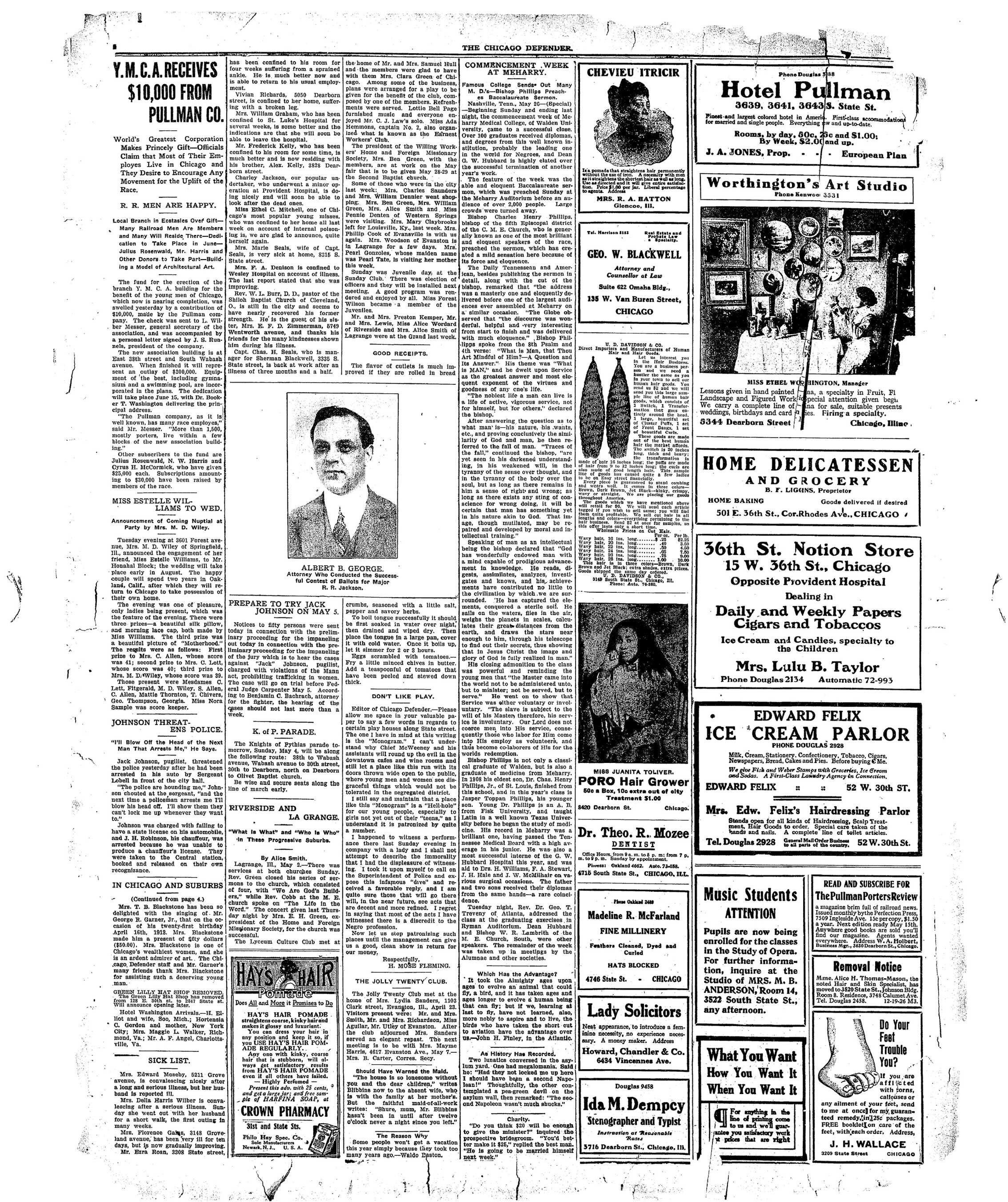
TRAGIC DEATH OF HENRY EVANS
Many persons were greatly shocked to learn of the shooting that occurred last Thursday afternoon, the 24th inst, at the Lexington hotel, resulting in the death of a favorite and promising young man named Henry Evans by one Thomas Kelley. Mr. Evans was employed as bellman at the hotel and Kelley was an employee also. Some words in reference to opening a window took place, causing a quarrel that was soon over without thought of harm. Kelley returned the next afternoon with a revolver and went directly to Evans and fired, wounding him in the stomach and received a shot in his own hand. Mr. Evans was conveyed to People's hospital where he died on Friday morning. The inquest was postponed and the remains were conveyed to Chas. Jackson's undertaking establishment. The funeral took place Sunday morning, attended by a large number of friends.
Rev. Carrol, from the west side A. M. E. church, tended a beautiful tribute to the deceased. Many floral designs were presented. One brother, Lee Evans, and a slater at Brook haven, Miss, where Mr. Evans formerly resided, survive him. The deceased was twenty-one years old.
Some excitement was caused in Wexford (Ireland) the other day, by the vagaries of a bullock, which ran amuck. The animal took refuge in the house of a man named Murphy and climbed the stairs and entered a bedroom. It demolished a large bed and other articles, and then took a "header" into the street twelve or fourteen feet below, bringing with it the window frame and sashes. It escaped into the harbor, and swam about for a considerable time before it was captured by means of boats.
Deaths of the Week
IN MEMORIAM.
---
Bullock Ban Amuck
```markdown
```
she is getting in with a certain gent, but he doesn't want to be there. The G. P. S. gent is who has such a 'swell head' that he can't play in the game. The G. P. C. L. you want to come out of that.
The gent is who thought, once upon a time, he was a girl. C. not be, but J. F. is the rish C. not be trying to get her back. J. is no swell head. The doll is who tell out with poor eyes. C. not be, but J. F. seems as though you are unlucky of late. C. is also sure. The doll was heard saying she was going with A. D. is that so, G. J. The Do Right gent is who puts in G. H. himself, Mc. anybody can be popular. The doll is who has more pretty cubs that her return from Washington, E. H., that her return from Washington, M. H. is. He took the part of the little boy in "The Dust of the Earth." L. H. J. is. He was all right, but your age won't do.
HAMPTON INSTITUTE ANNIVERSARY
Forty-fifth Celebration of Organization—Practical Demonstration in Industrial Work—Students Show Ability—Mortar and Bricks.
SOMETHING OUT
Hampton, Va., May 2.—The forty-fifth anniversary of the Hampton Institute came to a close on Friday afternoon in the school gymnasium with striking demonstrations in framing a hip roof, making a bed, brick laying, and cooking. Hundreds of distinguished and enthusiastic visitors joined with the people of the vicinity in celebrating the school's anniversary.
Interesting addresses were delivered by Dr. Wallace Buttrick, secretary of the General Education Board of New York City; Rev. Dr. Wilton Merle-Smith, Mrs. Walter C. Roe of Colony, Okla.; Starr J. Murphy, New York, and Job E. Hedges, New York.
The second day of the Hampton anniversary program included an inspection by the special Hampton party of the Whitter School, the school farm, barn, and trade school; a review of the battalion, the girls and Whittier children; luncheon at the Mansion House, and procession to the gymnasium.
John C. Fisher of Lynchburg, Va., who is a candidate for a Hampton academic diploma, assisted by Benjamin F. Jones of Danville, Ky., another candidate, gave an excellent demonstration of the framing of a hip roof. Fisher and Jones worked with unusual dexterity in putting together the miniature ratters in their hip roof. These Hampton students showed clearly that they knew the how and why of their work. In simplest language Fisher explained to the audience each step in the process of construction. At the close of the demonstration the two well-built Hampton carpenters tested the strength of their model roof by standing on it and exerting all possible downward pressure. The roof stood the test.
Kate W. Ruff of Ruff, Va., used a plain iron bed to demonstrate the proper methods of airing the bed clothes and of making a bed that would be comfortable and attractive in appearance. She showed very cleverly how simple beds and furnishings could be managed so as to provide a sanitary and comfortable resting place. Here again reasons were given for each step in the demonstration.
Hugh C. Smith of King William, Va., with the aid of mortar, bricks, and simple tools, outlined his first step in brick laying and related the simple operations a green boy encounters when he attaches his to the simple operations required in beginning his trade course. He related that on one occasion when he had received a little encouragement from his instructor, he was so proud of brick laying that he wore his shoes to the dining hall so that everybody should know he was a coming bricklayer.
Louisa M. R. Reynolds of Wilmington, Del, outlined the principles which must underlie the making of a well-balanced menu, and indicated with the aid of a chart how the proper kind of food could be supplied for a family of two adults and two children at $1 a day. Then she gave a demonstration in the preparation of oatmeal.
Something Out of Nothing.
Frank J. Stoney of Sumter, S. C., said: "When I was a small boy growing up I had many wrong desires. I did few things that were right and everything that was wrong. I had heard men speak of how easily money was made by gambling, and as I loved money more than anything else at that time my highest ambition was to be a gambler.
"My life at home was a failure because I would not study or behave myself when I was in school." Then Stoney told the story of his new life in Charleston and the realization that came to him that he must study if he would become a skillful mechanic. When he told his parents and friends that he planned to come to Hampton, they expressed their doubts as to his remaining in school.
In 1966 Stoney entered Hampton and has worked hard ever since. He
OF NOTHING
By Wm. A. Aery.
Demonstrations.
THE CHICAGO DEFENDER
---
has paid his own board and has not gambled for the money. In 1910 he received a trade certificate. Now he is a candidate for an academic diploma.
Farm Demonstration Work.
Griffin E. Oliver of Crowe, Va., a graduate of the Hampton Institute class of 1883, told the vivid story of better living in the country which has come through the introduction of farm-demonstration work. He showed clearly that as men have secured better crop returns they have improved their homes, their front and back yards, their stock, their supply of farm implements and machinery. Men who were once unable to make a living on large farms are now able to make a good living on a smaller acreage. "We see," he said, "better homes, better farms, more corn, more pork, better dressed men and women, more contented in the farm, a gradual uplifting of the country, a more higher and better life, and men helping to bring Christ's kingdom here on earth."
What Hampton Means.
"Every time I think of Hampton I get a new definition of education and a new ideal for human training," said Dr. Buttrick. "I believe that this is, after all, the real American university. I believe that this institution comes nearer having found the clew to the maze in this great process of training people for life, in and by life, than any other institution in the world." Dr. Buttrick, in his address to the Hampton students, declared that Hampton Institute has been doing an important work in teaching people to work six days in the week and to do this work for consecutive weeks and months and years. He said that the graduating class represents the fine art of living together. He declared that the Hampton students had learned to live together by doing together. In closing he assured his bearers that the Hampton idea of training for life is cultural in the highest degree.
Tribute to Mr. Ogden.
Dr. Merle-Smith read the following telegram from Robert C. Ogden, president of the Hampton Institute board of trustees: "I send one hundred and sixteen thanks for your breezy and encouraging messages. Absent in the body, I am with you in spirit. I hope you will have a jolly time throughout. In giving endowment to Hampton you help the institution that is doing the best work for peace in the country. There is vitality in its spirit and wisdom in its methods."
This was in reply to a telegram sent by the special Hampton party: "Recalling the sweet fellowship of bygone years and rejoicing in your gorious work here. Hampton pilgrims send affectionate greetings."
Dr. Smith referred to Mr. Ogden as a man big in heart, big in brain, with inspired and philanthropic purposes. He urged the Hampton students to cultivate persistent, undying, steadfast human will and courage. He pointed out clearly that the Hampton students who have received great gifts have great responsibilities placed upon them.
Plea for the Indians.
Mrs. Roe, who went to Oklahoma in 1897 under the auspices of the Women's Board of Domestic Missions of the Reformed Church in America, made an eloquent plea for the education of the Indian at Hampton Institute.
Mrs. Roe referred to the pitiful reduction in the number of Indians at Hampton, which is due to the withdrawal of the government support for Indian students. She said: "If it is not utterly wrong, it is pitifully premature.
"I believe in the Indian race. I speak in behalf of the Indian boys and girls out on the Western prairies, many of whom I have held in my arms. I wish to plead with you, the trustees and faculty of this institution, that the doors of Hampton may never be closed against the Indian. I assure you that there is coming now out in the West a generation of Indian boys and girls born in Christian homes.
"I wish to testify that the Hampton education stands the severe test of reservation life. God has given to the Indian people the gift of art, the dextrous hand, the vivid and poetical imagination, the love for truth. With the help of God they shall rise from the position in which they now are into a position of economic independence.
"I believe that the principle upon which the government support was withdrawn from Hampton was based upon a wrong notion that we cannot learn as races one from another.
Job Hedges Speaks.
Job E. Hedges of New York, who truthfully says of himself that he has had some experience in the mix-up of life, is always a welcome visitor at Hampton Institute. His epigrammatic remarks on the give and take of life are always enthusiastically received. A few of his remarks follow:
I am always very glad and very uncomfortable to be here. Hampton is the only place that can make me happy and unhappy at the same time. Don't feel sorry for all the rest; just feel sympathy. When you give advice, don't give it by brute force. Don't be afraid to be natural. Don't feel sorry for the other fellow when you are trying to help him. Avoid the slightest trace of hypocrisy. Think we when you say we."
Walt for Permission of Goddess
A peculiar custom prevailst amongst the Lewa Kunbl caste of Gujrat, India. They celebrate weddings only once in ten or twelve years, as their goddess permits. This year no less than 400 weddings were celebrated in the castle, a few days ago. The goddess had pronounced the day to be an auspicious one for marriages.
Surely Impossible
A wag the other day denied that John Bunyan was the author of "The Pilgrim's Progress." Being vehemently contradicted, "Nay," said he, "I question even if he contributed to the work; for it is impossible that a bounter could contribute to any pilgrim's progress."
FAMILY RESCUED AFTER FIVE
WEEKS BENEATH DRIFTS.
Authentic Record of Almost Miraculous Escape From Death in an Avalanche in the Euro-
It seems incredible that any human being could survive for five weeks under a snow-drift; yet in the year 1755 three-inhabitants of the hamlet of Bergololet, in the valley of the Upper Stura, at the foot of the Alps, did just that.
During the winter of that year the fall of snow was unusually heavy. On March 19, the parish priest, on his way to church, heard a terrifying roar from the mountain top. Casting up eyes, he saw two avalanches descent toward the village. He gave the alarm, and then ran back into his own house.
The avalanches buried over thirty houses. Twenty-two persons were missing, including the parish priest who had given the alarm. The mass of snow that lay over the ruined dwellings was about forty-two feet deep.
When the surviving peasants had shaken off their terror, they set about trying to save whatever life or property they could. Peasants from neighboring villages came to their assistance. But they could do little; the depth of the avalanche was so great, and the snow continued to fall in such quantity, that they had to wait for the warm April winds to melt the gigantic snow piles.
On April 18 the villagers returned to their melancholy task. They had no hope of finding any human being alive. One of them, named Rocca, whose entire family was beneath the avalanche, was most active in the search. By April 24 he had got so far that, after breaking through six feet of ice snow, he could touch the ground with a long pole. Three friends worked with him.
The four worked vigorously, and made their way at length into Roccia's house, but no one, dead or living, was there. As it was probable that the victims had sought shelter in the stable, about a hundred feet from the house, Roccia and his companions began to dig in that direction. After they had burrowed for some time, they reached the stable. One of the men thrust a pole through a hole in the wall, and on withdrawing it, heard a hoarse, faint cry for help.
The workers now toiled with red-doubled activity, and soon they had made a large opening. And there, to his joy, Roccia found his wife, his daughter, and a sister-in-law. The three sufferers could not move, and were shrunken almost to skeletons. The men carefully carried them to a near-by house, and took measures for reviving them. In a few days they had pretty well recovered.
They owed their lives to these circumstances: They had taken refuge in the manger, which, being strong, had withstood the weight of the snow, although the roof fell in. Fortunately, two goats were near them, and these animals supplied them with milk enough to keep them alive.
They had, of course, to feed the goats. Over the manger was a hole into the hay-loft. Through this hole one of the women was able to pull down fodder into the rack; and when the women no longer reach the hay, the sagacious animals climbed upon her shoulders and helped themselves.
Through the manger their five weeks' imprisonment they felt darkness. After the first five or six days, they suffered little from hunger, although a quart of goats' milk had to suffice for the three. They suffered far more from the chill of the melted snow-water that trickled over them, and from the cramped positions in which they had to sit and lie.—Youth's Companion.
Making the Nation's Mone
Making the Nation's Money.
The government of the United States last year made money at the rate of $4,812,734 a day, the total of bills printed amounting to the neat little sum of $442,820,320. There were just 348,129,172 separate bills, ranging from the lowly $1 to the mighty $10,000 note, few however, of the latter—perhaps a course of dray loads. If these notes were wired and to end they would reach nearly twice around the globe; or, should the government choose to spread them on the ground, they would cover an area of 5,550 acres. But should stacking be ferred, the last note, when placed, would be something like 27 miles from the earth. The cubic contents of the pile of notes printed in a year are about 17,000 cubic feet. It costs the government $2.25 a thousand to print these notes, the cost for the yearly issue being $3,690,000—Harper's Weekly.
Warship Funnels to Have Ll
Warship Funnels to Have Lids.
A lid to place over the mouths of battleship funnels, which, while in no way interfering with the emission of smoke, will prevent the airman of the future from dropping bombs into smokestacks and thus destroying the most vital part of the vessels—the motor sections—is what the navy wants.
The airmen of today are being trained to drop bombs from fairly great heights upon targets of what may be called inconceivably small sizes, and the airmen may in a few years be so adept in the art of dropping explosives from airships that they will be able to deposit bomb after bomb in the mouths of the funnels on battleships.
Something is wanted to make such a thing impossible, for an exploding bomb dropped into a smokestack can do more damage to the vessel than if it hits any other part of the ship.
Telephone used to Catch Fish.
Claiming that fish make swimming noises that can be heard by telephone, a French inventor has designed an apparatus consisting of a receiver and a detonator for fishing process.
When fish in any number pass the receiver a sound is heard by the watcher, a button is pressed, which explodes the detonator, and the stunned and dead fish rise to the surface.
CLASSIFIED ADVERTISING
FURNISHED ROOMS FOR RENT.
FLATS TO RENT.
4822 EVANS AV., second flat—Seven rooms; hot-water heat; all improvements; modern. Phone Douglas 366. 26-3
6529 ABERDEEN ST.—Six-room cottage, 6529 ABERDEEN ST.—Six-room cottage, also front and back yard; $18 per month. 26-3
SMALL APARTMENTS—TWO, THREE, and four rooms; private baths; hot heat; hot water, etc. Possessor, Mr. Walter Fergerson, 3415 Vernon av. VERNON AV., near 35th st.—Suite of three rooms, suitable for light housekeeping, for rent to desirable tenants; newly decorated. Phone Douglas 366. 3-10
BUSINESS CHANCES
WANTED - MIDDLE-AGE WOMAN,
w白色 or colored, to take care of houses,
farm or backyard. Apply at: MATT
Hattie Fry, 900 S. State at, Appl
or phone Automatic 68513. N - 3-10-17
BEDROOM 68513. IN - ENH-
Room cottage; steam heat; Rhodes
Apply at 300 Indiana av. No agent.
THESE HOUSES FOR RENT OR FOR SALE ON EASY TERMS
CALL AT OFFICE FOR PRICES.
OR FOR RENT.
FLATS.
561 E. 31, 2nd flat, $12.
20 W. Superior St., 2 rear flats, ea. $16.
29-35 Vernon Ave., 1st flat, $15.
4523 Evans ave., 6 rooms, steam heat.
$35.00.
34 E. 31st at, 7 large light rooms overlooking Grand blvd., $28.00.
4431 State at, 4-5-room flats ..... $12.50 to 14.00.
2935 Vernon av., 2d and 3d flats,
7 rooms ..... 20.00.
Houses.
3616 Armour av. $8; basement (coal office) ..... 5.00.
4202 Langly Ave., Cottage $20.
'9 E. 26th at, 8 rooms. Store.
3129 Cottage Grove av. large and light ..... 20.00
CHICAGO REALITY & RENTING CO.
Room 803, 69 Washington at.
Randolph 3237. Auto. 4954.
Phone Franklin 2727
Res. 508 East 36th Street
Tel. Douglas 4397
J. GRAY LUCAS
ATTORNEY AT LAW
Oxford, Building, Suite 506
118 North La Salle St., Chicago
SITUATIONS WANTED
MR. EMPLOYER—CAN YOU USE A
reliable, energetic young lady as a
basketball bystander? Also know-
edge of bookkeeping. Phone Karen
4227, Auto. 79316. 26-M. 3
Then Friendship Ended
Chollie had decided to give up the sporting life and settle down to farming, and was now buying a cow. "Now here's a cow," the agent, "that I can highly recommend to you. She has won several prizes at our county fair, and—" "Reshily?" said Chollie, looking the animal over admiringly, "Er—tretting or steelechase?"
Christian Model.
Calvin—"I have my opinion of your rector. The idea of his preaching on humility! Why, he never goes to church excepting in an automobile!" Martin—"I know he doesn't; but he uses a 1910 machine."—Judge.
Must Be Done By Hand
Must Be Done By Hand.
So far no machine has been found to give satisfaction in sewing the covers on baseballs. Hundreds of thousands of balls' are used every year, and they are all hand-sewed. A man working his best can not finish more than three dozen a day.
About All
(When a young lawyer gets his first case his fancee recalls all she has read about $50,000 fees. But the first case usually nets about 5 plunks.)
Wrong.
"Do you keep coffee in the bean?"
"No, madam, brains."—Boston Transcript.
Rewards of the Hustlers.
More things come sooner to those who are not content to wait.
Get Your Hands On A House On Your Own Terms
PRAIRIE AVE., near 35th St. Lot. 25x125; a detached 12-room brick house; 2 baths; open plumbing; hardwood floors; furnace heat; in good repair; rental $600. Price ..... $6,000.
FOREST AVE., near 33rd St. 10-room stone front house; furnace heat; could be remodeled into a 3-flat at small expense; now rented for $510. Price ..... $4,500.
CALUMET AVE., near 35th St. An elegant 3-story stone front house; 10 rooms; open plumbing; furnace heat; all in fine repair; rental $480. Price ..... $4,490
CALUMET AVE., near 35th St. Large 10-room brick and stone house; open plumbing; furnace heat; hardwood finish; in good repair; rental $480. Price ..... $4,580.
GROVELAND AVE., near 31st St. 10-room stone front residence; open plumbing; furnace heat; all in first class repair; rental $420. Price ..... $4,500.
DEARBORN ST., near 35th St. 2-story stone front; 2 flats of 6 and 7 rooms; bath; gas; stone heat; rental $552. Lot. 25x110. Price ..... $4,500.
EVANS AVE., near 45th St. Lot. 25x170, improved with a good 8-room frame house; open plumbing; furnace heat; frame barn; rental $252. Price ..... $3,250
PRAIRIE AVE., near 35th St. Double frame house; 7 rooms each; open plumbing; bath and gas; rents $45. Price $3,060.
DEARBORN ST., near 31st St. 2-flat frame; 5 rooms each; bath; gas; frame barn; lot 25x110; rental $360. Price $2,700.
DEARBORN ST., near 29th St. Lot. 25x110, improved with an 8-room frame cottage; rental $216. Price ..... $2,250.
Call at our office for further information
W. H. BOWERS & CO.
Phone Douglas 986
The Guaranteed Feather Company
For High Class Photos. Postals finished while you wait Day or Night. Enlarging and Retouching our Specialty. Lady attendant.
Improved Vacuum Clothes Washer
WASHES TUB OF CLOTHES IN FIVE MINUTES
Price $3.50. Easy Payments. Demonstration Every Night.
ARTHUR BONNER, Agent
3420 STATE STREET Phone Douglas 4132
Any of these $500.
PRAIRIE AVE., near 35th St.
brick house; 2 baths; open
nace heat; in good repair; ro
FOREST AVE., near 33rd St.
nace heat; could be remode-
ned now rented for $510. Price
CALUMET AVE., near 35th St.
house; 10 rooms; open plum-
pair; rental $480. Price...
CALUMET AVE., near 35th St.
house; open plumbing; fun-
good repair; rental $480. B
GROVELAND AVE., near 31st
dence; open plumbing; furn-
rental $420. Price....
DEARBORN ST., near 35th St.
6 and 7 rooms; bath; gas;
25x110. Price....
EVANS AVE., near 45th St. L.
8-room frame house; open
barn; rental $252. Price....
PRAIRIE AVE., near 35th St.
each; open plumbing; bath
DEARBORN ST., near 31st 8
bath; gas; frame barn; lot 25
DEARBORN ST., near 29th St.
8-room frame cottage; rent
Call at our office for
W. H. BOW
Phone Douglas 986
The Guaranteed
GUARANTEED
TRUST ME
Go to
New Beauty
GEO. W. N.
3636 South
For High Class Photos. Post
Day or Night. Enlarge
Specialty.
Office Phones Douglas 8203 Automatic 71-719
DR. F. J. BRAXTON
DENTIST
Office Hours: 3255 STATE STEET
10 a.m., to 5 p.m.
Saturday, 7 to 9 p.m.
Sundays by Appointment CHICAOA
OAKLAND {5101
2664
3100}
Chicago Carpet
Cleaning Co.
House Cleaning—Attic to Base-
ment, Home of Vacuum
Cleaning.
Alex. T. Stewart, Mgr.,
20 YRS. EXPERIENCE
1236 E. 47th St., CHICAGO
Improved Vacuum
WASHES TUB OF CLOT
Price $3.50. Easy Payments.
ARTHUR BO
3420 STATE STREET
Might Do His Best.
An old reprobate of seventy protested, with outstretched hands, to Justice Hawkins against a sentence of 20 years' penal servitude, or "slavery," as his severe, upright, lordship loved to call it. "Oh, my lord, my lord, I can never do it." "Never mind," came the answer. "Never mind, do as much as you can."
Wordal
"Here's where my friend and I are going to have a few words over nothing," said the wireless operator as he ordered to manipulate his instrument.
Happiness.
Happiness is peace after strife, the overcoming of difficulties, the feeling of security and well-being. The only way to do this is to educate women and single men.—Smart Bet.
Generous.
For pure unselfishness the hen should bear the palm, for she clucks joyfully over the egg that is to furnish some one else with an omelette.
Not Unwilling.
Wife (pouting)—"You never kiss me good-by any more." Husband—Well, I can assure you, my dear, it isn't because I don't want to"—Smart Set.
Every man wants an easy telephone number, and an automobile number as complicated as they come.
Balance like rent
Lot 25x125; a detached 12-room plumbing; hardwood floors; fur-mental $600. Price ... $6,900.
10-room stone front house; fur-mented into a 3-flat at small expense; ... $4,500.
An elegant 3-story stone front boeing; furnace heat; all in fine re-mentation ... $4,400.
Large 10-room brick and stone heat; hardwood finish; in price ... $4,500.
St. 10-room stone front resi-ce heat; all in first class repair; ... $4,500.
2-story stone front; 2 flats of stove heat; rental $552. Lot ... $4,500.
Lot 25x170, improved with a good plumbing; furnace heat; frame ... $3,250.
Double frame house; 7 rooms and gas; rents $45. Price $3,000.
T. 2-flat frame; 5 rooms each; x110; rental $360. Price $2,700.
Lot 25x110, improved with an $216. Price ... $2,250.
further information
ERS & CO.
6 East 31st Street
Feather Company
Manufacturer of French Plumes And All masses of Fancy Feathers
Professed Willow Plumes Our Specialty Suitable-They Do Not Lose Fibre
ME. LAMBERT, Prop.
Indiana Avenue CHICAGO
Phone Douglas 7926
to the Shop Studio
CIGHBORS
State Street
falls finished while you wait—
ing and Retouching our
body attendant.
Look for the Defender wherever newspapers are sold :: :: ::
The readers of the Chicago Defender are requested to ask for the paper at the various news stands throughout the city.
The Chicago Defender is to be on sale everywhere. If you ride on the "L" road ask for it at the news stand. If you can not secure it from your newsdealer call up the
Circulation Department
5159 S. State Street
Tel. Douglas 3559
In Clothes Washer
THES IN FIVE MINUTES
Demonstration Every Night.
NNER, Agent
Phone Douglas 4332
Innocent.
A New York man who tried to see a woman in a hobble skirt ascend a stairway fell in front of a train. It is always the innocent bystander who is hurt—University Missouri.
Too Fond of Giving Advice.
He gave advice and never quit. He tossed it round both far and night, and was annoyed when some of it flew back and hit him in the eye.
One Kind of Declarations:
"I love you, Estelle," he continued, "star of my soul. I loved you through opera-glasses at the opera . . . and I shall love no one else." "Women I Have Loved," by Henry Drane.
Your Friends.
Treat your friends for what you know them to be. Regard 'no surfaces. Consider not what they did, but what they intended—Thoreau.
Time Saven
When you undo a parcel fold the paper and tie the string around it-there will always be string to fit a bundle without looking for it.
New York City Growned.
In. the densest parts of Bombay there are 740 persons to the area.
New York has 1,000 in the same area.
Enemies.
Knicker-"Jones says he is an impressionist." Bocker-"Then I see a suppressionist."
---
HOPE PRESBYTERIAN CHURCH
At Hope Presbyterian Church the day was filled with six public services of unusual interest. The pastor, Dr. C. Lee Jefferson, preached a strong, practical sermon in the morning upon the subject, "Home-Spun Excuses." He well attended and several new scholars and visitors were present. The Englewood Lyceum program at 4 o'clock was rendered to a full and apreciative audience. After a brief discourse, the pastor ordained and installed Brothers E. S. Brantley and P. Daw as rulers at 8 o'clock, and the congregation. This service was followed by a prayer service in the lecture room, led by Elder Brantley. The church is making commendable progress and all are greatly encouraged. The board of trustees organized and elected Mr. J. G. Brumfield president; H. A. Midget, treasurer; T. Winburn, recording secretary, and J. M. Brumfield, property committee, and Miss Marla G. Jefferson, organist, and W. Lewis, sexton.
The Unity Club met at the home of Mrs. James Price on Tuesday night with Mrs. H. H. Midgett, president, presiding. After completing plans for holding her concert June 20, she brought remembrance to Mrs. Messrs. J. A. Price and H. A. Midgett, after which refreshments were served. The recital of Miss Maria Jefferson's music school was a grand success and the pupils gave evidence of their enthusiasm. Jefferson wishes to thank the friends and parents for their hearty support.
```markdown
```
The Mat Lee club met at the home of Mrs. A. Clark on Monday evening and transacted regular business. Mrs. D. Smith, president, presided.
BETHEL A. M. E. CHURCH.
Last Sunday Dr. Roberts occupied the pulpit morning and evening and his message was received with joy and thanksgiving. The Sunday school felt out of place in the auditorium of the school where Moore and his husband of teachers Mr. and Mrs. welcome the scholars just the same. The Bethel Literary Society had quite an interesting discussion on "The Young Negro in Business." Missionary day at the Allen C. E. Society was quite a success; the attendance was large, many young men being present. The officers of this society always had to meet any visitors or strangers who attend the services.
The week past has been hazaz week at the church and it will end this Sunday with a grand baby rally at 3 o'clock. One grand effort is to be made to raise $3,000 in June to pay off the entire debt. This church ought to be out of debt and will be if Bettel's members and friends will do their duty. No greater honor, excepting the bishopess, be conferred upon Dr. Roberts than to him to the next conference in September with a church entirely free from debt. Help us to render unto Caesar the things that are Caesar's and let us give to God the things that are God's.
QUINN CHAPEL A. M. E. CHURCH
Monday night will be love feast.
Each and every member of the church is urgently requested to sub-
serve. Sunday, May 18, and Sunday, May 25, are rally days.
The trustees will pay $1,000 on the debt June I.
ST. MARY'S A. M. E. CHURCH
Services: 10:45 m. n. and 7:45 p. m.
Sunday school, 1:45 p. m. Christian
Endeavor, 6:45 p. m.
Last Sunday morning the pastor
preached at Evanston. Rev. Newton
of Montreal, Canada, preached to an
appreciative audience. He preached a
great sermon. Sunday, May 4, is the
first Sunday in the month, at which
the members to be present. In the
memorial services will be held for
Bishop Derrick. Addresses will be
made by the pastor and others. Special
music by the choir. The class
leaders are anxious to meet all their
members Sunday.
General class, Friday night, May 9.
The third quarterly meeting, Sunday,
May 11. Dr. A. J. Carey of the
Church Church will preach at 3
clock. Dr. R. Treese, P. E., will
preach, morning and evening.
The evangelists of the city have
their regular meeting at St. Mary's
every Wednesday evening.
ST. JOHN A. M. E. CHURCH.
Sunday morning service, 10:45 a.m; Sunday school, 1:15 a.m; Intermediate C. E, 6 p.m; Senior C. E. prayer meeting, 7 p.m; evening service, 8 p.m. We are now on the approaching rally and through the mist of toll and difficulties can be seen the light of success. The rally takes place on May 19 and 20 and from start to finish promises to furnish rich enjoyment
for all, as it will be featured with a mock annual conference, conducted by Bishop Wilson.
The next great entertainment to be given for the benefit of the rally will take place at St. John May 13. Elaboza will be the manager by the managers of the affair to give who attend the full worth of their money. "Twilight and "The Setting of the Sun" are the two dramas which the Eaglewood Dramatic Club will present on that evening, together with splendid musical selections by the Chef Quatuor. Souventrs will be given the opportunity to watch. Your present at the church by $ 6 o'clock. Your presence on the 13th will be highly appreciated.
On the 18th this club will appear at St. Stephen's Church, corner of Robey and Austin avenue.
All of the services of last Sunday are handled. Everything looked bright and propagated, because of the enthusiasm which the pastor and members put into the services.
The Intermediate and Junior rally will be held at Bethel Church, 30th and Dearborn streets, Saturday afternoon, May 10, at 3 o'clock. Talk about it. The Senior Union rally of the Chicago District of the Allen C. E. League will be held at Quinn Chapel Thursday evening, May 22, at 7:30 p.m. The Junior Union rally will be held at St. Mary's Church, 52d and Dearborn streets, July 22 and 23.
FREDERICK DOUGLASS CENTER
Sunday afternoon, May 4, at 4 p.m., there will be a musical recital in charge of Mr. George Jones and Mr. Hilbert Stewart Tuesday afternoon, center for Center for the Club meets. Program change of the president, Mrs. Ryn Jennifer.
ST. PAUL BAPTIST CHURCH.
The two weeks' revival meeting has brought a spiritual awakening among the members and friends, many souls being blessed. This is the starting point for future work, when it is hoped that many will improve the opportunity of developing each department. The pastor, Rev. V. S. Cooper, will continue services in the revival Pilgrim well equipped for efficient service. Treaching each Sunday at 11 a. m. and 8 p. m. Sunday school, 9:30 a. m.
M. Zion Baptist Church.
The services were as usual well attended Sunday, April 27.
The Bible school was quite interesting. Mrs. Hattie Chiles conducted the review.
The Missionary Society held a prayer meeting at 7 p. m.
The pastor preached at 11 a. m. and 8 p. m.
Chile M. T. Bailey dropped in on Sunday school last Sunday.
Sunday services for May 4: 11 a. m. sermon; subject, "Symbolic Rite of Baptism."
12:30-Bible school.
2:30 - Baptism at First Baptist church, corner Lake street and Chi cape avenue.
INSTITUTIONAL A. M. E. CHURCH
As it was stated in our columns last week, last Sabbath was "a day of great things" at the Institutional Church. Rev. T. Reeves, the presiding elder, preached a forceful sermon at 11 o'clock from the text, "If ye abide in me and my works abide in you, ye shall ask what ye will." The sermon was strong, convincing and delivered in an earnest, and effectual manner, not undoubtedly meeting at 3 o'clock was undoubtedly ever held in the history of this church. The sermon preached by Dr. Callis was truly an inspired one. Every man, woman and child felt the presence of the Holy Spirit. Drs. W. D. Cook, D. P. Roberts, James Higgins, L. T. Scott, J. R. Robinson, W. H. Grillin, J. Brewer, et al., were present with members of their congregations. Tomorrow the pastor, continuing his series sermons on the "Parables," will be preaching a moment on "The Dragnet and the Taree" and the evening on "The Great Sinner." These sermons are proving wonderfully instructive and are drawing larger and larger crowds of interested listeners who enjoy and are benefited by the clear, helpful and thorough manner in which Dr. Carey is setting forth "The Christ's idea of the Kingdom" as seen through the parables He uttered. Thursday evening a comedy play was presented from each of the Methodist Chicago will meet in the Arnett Hall of the church for the purpose of perfecting plans for a home for dependent children.
GRACE PRSBYTERIAN CHURCH.
Inaugural exercises were held at the church service Sunday morning. There was a splendid program, each department of the Sunday school being represented. There was also an addition to the choir. There was a rally held at the Sunday school hour in order to help defray the expenses of the cleaning. The adult department contributed $28.81, the intermediate $7.11 and the primary department $1.14. Of the $38.30 which is only a partial report. Mr. Engleen Ronfroe is now the director of the Sunday school orchestra. Mrs. Carrie Brown is still on the slick list.
Sunday morning service, 10:45
Sunday school, 12:30; Christian Deaver, 6:30; evening service, 7:45; prayer meeting Wednesday, 8 p.m.
WALTERS A. M. E. ZION CHURCH
It is pleasing to note the increased attendance of young people at our services both morning and evening. The new officers in the Young People's Society of Christian Endeavor are creating some enthusiasm in the Sunday evening study of the Bible. The endeavor is the service of both young and old people of the Christian Endeavor last Sunday. Our Sunday school is to be congratulated upon the advancement it is making at this time. The school will
THE CHICAGO DEFENDER
The board of mongers of the Young Men's Christian Association of Chicago has published a history of the work in Chicago with the title "Fifty-five Years." The history includes important events from 1858 to 1913. The history is produced) illustrated with pictures of the public and official associations buildings and the present buildings and general officers and employed officers of the association. The history is divided into four general periods: 1858 to 1888; 1888 to 1898; 1898 to 1908; 1908-1913. Dr. George Bradfield will be the speaker on next Sunday at the Y. M. O. A. meeting. All men are invited. Bradfield closed the regular Bible class and has conducted on Friday evenings with the lesson on Friday, April 2. The class held twenty-two sessions.
SALUTE! SALUTE! SALUTE!
Greeting:
Agreeable to the invitation extended by Occidental Consistory, Valley of Chicago, and the same, having been accepted by the S. P. Grassman and Inspector Generals of the Supreme Council of the Northern Jurisdiction of the United States, with great pleasure we announce the thirty-second annual meeting of the Supreme Council will be held in the Valley of Chicago May 5th and 9th, 1912.
This will be the first meeting of this distinguished body of the thirty-third and last degree of Freemasonry had outside of the Grand See of Philadelphia during its thirty-two years of existence. The S. P. of Occidental Consistory and all Scottish Rite Masons feel honored in having the pleasure of meeting the members of the Supreme Council of the Masonic extends a cordial invitation to all Scottish Rite Masons in harmony with us to be present and assist in doing honors to the illustrious brethren who will be here from the state of Maine to the state of California, a number of whom will speak at the several public functions given in their honor.
Thursday, May 8.
During the day receiving and locating members and visitors at Masonic Temple, 3932 South State street.
Clock-Down of the Supreme Council, in the annual allocation by James Francis Rickords, S. P. G. Commander.
S: 30 o'clock—Conferring Thirty-second degree on a ciai of candidates.
10 o'clock—Tenebrae Reflection in five courses, served in the main hall of the Temple, at which time a number of visiting brethren will respond to toasts. What what? "We won't go home till morning."
S o'clock—Public reception and introduction of members of the Supreme Council and visitors at Lincoln Garden, 22th street, between State street and Wabash avenue. In the march Occidental Consistory and guests undereflecting colored lights. During the evening several flashlight pictures will be taken of all present. After the grand march, what then? Remain, enjoy yourself as long as the splendid orchestra can furnish inspiring music. Beautifully decorated and has all necessary conveniences for comfort.
begin the preparation for children's day, which will occur the second Sunday in June.
The debate given by the Tuskegue and University Clubs on Ist Tues day evening was a very enjoyable affair. The church was well filled and both of the organizations were well represented in the debate. The decision, however, was given in favor of the University Club. We congratulate these young people on this splendid day and invite them to come and see us again.
The Sunbeam Club rally will be held at 3 p. m., May 11th. The sermon will be preached by the pastor. This will be a special discourse to church auxiliaries. A cordial invitation is extended to auxiliaries of all churches.
The Woman's Home and Foreign Missionary Society was entertained by Mr. and Mrs. Fred Carter of 4040 Dearborn and April 22. A large number present. A pleasing collation was served, and all reported an enjoyable evening.
The Holy Communion will be celebrated at our church Sunday at 11 a.m. Sunday school and Christian Endeavor at the usual hours.
The fifth sermon in the series, "God's Message to Men," will be delivered by our pastor at the Sunday service. Service Subject, "The Message Meeting Man's Needs in All Ages."
Rev. Calls spent two days in Springfield. He reports the full crew bill as dying with the committee. The prospects, however, are that another full crew bill may be introduced. Sentiment in favor of the appropriation for the statewide celebration of the fifteenth anniversary of the crew bill may be presented. He advises, however, that influence be brought to bear upon the members of each house in its favor.
ST. MARK M. E. CHURCH.
Services were well attended all day Sunday. The pastor preached at both services. Good attendance at the Sunday school. The Lycum at 4 p.m. continues to draw large crowds; the programs are interesting and the discussions helpful.
The Devotional League meets at 6:45.
The social given by the Willing Workers' Club at the home of Mrs. James was an enjoyable affair socially and financially.
The regular monthly communion will be celebrated in the evening on account of the special of Yps. Caille McCray, which will be held Sunday at 12 o'clock, from the church.
Don't forget the lecture by Dr. M. C. B. Mason, Thursday evening, May S. Subject, "Sour Grapes." On the sick list: \Mrs. Ann Flovd, Mrs. Irene Lee and Mr. James Cook.
AT THE Y. M. C. A. HEAD
QUARTERS.
At the Sunday meeting of the Y. M. C. A., held in the boys' department of the new building, Mr. Frederick R. Clark, superintendent of Rothschild & Company, gave an interesting inspirational address to a large audience of men. Mr. Clark by the masterful dress, held the audience's undivided attention and was interrupted several times during the discourse with hearty and enthusiastic applause. He Principles of Success" and gave many helpful suggestions to the men. He stated that perfect health was a very necessary element that each individual must possess who covets success in any business. Integrity is a very necessary element that each business man to acquire. All business must be done on the square. A business man should have the power of concentration and should endeavor to put every bit of his ability in his work. It is the quality of goods that he has to deliver that counts. He has but one thing to sell and that is his entering business I would make you to make thorough preparation. Too many men fail in business for the lack of preparation. Prepare yourself to hold a position of the man above you. You should acquire the principle of "stick-to-tolerance." Too many men give up too soon. You cannot succeed in business without possess the principle of courage in your proposition. If you fail faith in your proposition, you had better get out of it and find another in which you can. Know the business that you are in from the ground up. Make it impossible for anyone to know more about your business than yourself and you cannot help but understand the principle of courage in your business—the courage of your conviction. If you have this principle you may go ahead and you will sell the world because you have sold yourself. Have self-control. Cultivate patience and forbearance. If you possess these qualities no one can penetrate your armour because you have no weak armor. You must be built that are strong enough to stop a man who possesses these qualities. Mr. Clark in closing his address remarked that he was surprised not to find any dry goods stores, herbardies, shoes stores and other businesses that should be controlled by the race man in our neighborhood. Men of your race should control these businesses that the other merchants to come into the neighborhoods and build themselves up at your sacrifice.
The May number of the Official Bulletin, the monthly magazine of the Y. M. C. A. of Chicago, is called the anniversary number. The Bulletin contains a report of the twenty-five years of service of Mr. L. Wilbur Messer, the general secretary, as an officer of the Chicago association, and the fifty-fifth anniversary of the founding of the Y. M. C. A. of Chicago. A limited number of copies of the Bulletin are at headquarters and may be obtained from Mr. Y. S. Moorland, International secretary of Washington, D. C., spent Monday in the city. Mr. Moorland has held conferences in Denver, Cincinnati and Buxton, Ia., since passing through the city the latter part of last
week. He left in the evening for his headquarters in Washington. The Employment Bureau was called upon to fill several positions with desirable men and boys during the past week. One of the positions filled was that of engineer and fireman in a large business association in the city. The orchestra from the Grace Presbyterian Sunday school, under the leadership of Mr. Eugene E. Renfro, was present at the meeting last Sunday and rendered several musical selections for the concert of Mr. Clark. The music added much to the program as well as to the life and spirit of the praise service.
THIRTY-THIRD DEGREE MASONS TO MEET
THIRTY-THIRD DEGREE MASONS TO MEET
To All Illustrious and Sublime Princes of the Honorable Fraternity of Ancient and Accepted Scottish Rite of Freemasonry.
Thursday, May 8.
Friday, May 9.
During the day business sessions of
the Supreme Council. Reports of dept.
officers.
Music for the public reception at Lincoln Garden will be furnished by a first class orchestra. The floor in the garden is one of the best in the city. Refreshments will be served by a select committee of ladies.
Grand Reception.
A special invitation is extended to you and your friends to attend the grand reception at Lincoln Garden, 29th street near Wabash avenue, on Friday evening, May 9. We desire to make the short visit of the distinguished brethren to our city from the East and West strictly a "Chicago reminder" for the remainder of their lives; "that our citizens rejoice in making visitors happy and know how much" so." Cards of admission, 50 cents.
R. E. MOORE. 33°.
Chairman.
R. J. B. ELLINGTON, 33°,
Secretary.
Announcement.
The Tenebrae Reflection (banquet)
Thursday evening will be served by
M. Marshall Ponder, caterer. Tickets.
$1.50 per plate, which must be secured
not later than Wednesday morning
of the banquet. Guests will be needed 10
p. m. Speakers: The following will
respond to toasts—I. Henry A. Spencer.
III. William F. Powell, III. William
R. Morris, III. Allen E. Smith, III. Joseph
J. Payne, James E. Bish, III. Joseph
Payne II. James E. Bish, III. H. Miller,
II. James E. White—Adv.
Why Hurry?
Did you ever stop to think that our pallbearers are waiting for us and that we are getting ready as fast as can? Take life easy—Waldo Baston.
News Notes of the Nation's Capital
By R. W. THOMPSON
[Special to The Chicago Defender]
Washington, D. C., May 2—The grand supreme governor, L. Melendez King, and the grand supreme leutenant Davis, of the Miss Henrietta Vinton Davis, of the Malachites of the World, sailed last Saturday from New York for Panama on the well known and palatial steamship "Tivles." Before leaving the national metropolis Governor King and Leut-Gov. Davis made an ode to Elizabeth Lodge, No. 4 of Malachites, a prosperous lodge organized some time ago by Brother Holmes.
En route to Panama they will stop at Kingston, Jamaica, where they will be the guests of Venus Lodge, No. 1, of which Brother Waldo Killis governor and Mrs. Milbourn is secretary. This lodge is in a flourishing condition and is the fraternal life of the people of the island. The visitors will call in person upon Kingston's mayor, the Hon. H. L. Simpson, who is an enterprising colored man, and who has recently joined hands with the Malachites. Pausing two days at Colon, Panama, the Malachites have a lodge there and then go on to their destination, Bocas del Toro, one of Panama's most thriving communities. Awaiting the arrival of the tourists at this place will be two clubs of Malachites, the Rising Star and Minerva, comprising about three hundred members, who will come into the secrets of this great order. to the last degree, as the news of their coming has been heralded far and wide among the industrious and intelligent denizens of this section of the island, with Mr. King and Miss Davis are with Mr. King and attractive personality they will and difficulty in making a favorable impression upon their entertainers.
The political outlook is good or bad, according to the spectacles through which it is viewed. Assistant Attorney General Lewis is gone and a successor to Auditor Ralph W. Tyler has been named. No one can tell whether any of the changes are contemplated soon or not. The department lay goes out automatically July 1. Register Napier and Recorder Johnson are attending to business as usual, prepared for whatever may happen. The rift in the cloud, as far as the race Democrats are concerned, lies in the fact that there are vacancies in the office of assistant register of the treasury and in the Liberian mission, and it is the expectation that these vacancies shall shortly and by race Democrats. The candidates are all "sitting tight" and the candidates are "gold feet" because of a few reverses as offices which they have not looked for very seriously anyhow.
The wise ones are not confining their attention solely to the places now held by Republicans. It is remembered that Santo Domingo has C. C. Astwood and the persons of H. C. C. Astwood and the Smith went to Santos, Brazil, under Cleveland, and McKinley sent Dr. H. W. Furniss to Bahia, Brazil, and J. N. Runyah to Ascundion, Paraguay. R. T. Greener has been to Vladivostok, Russia, and C. H. J. Taylor was once nominated for minister to Bolivia, and he was also named as consul to Chile France.
The question is is it for race men have held these positions, or been considered for them in the past, why may they not be considered again? There are those who think it worth while to try for them, and in the near future it is likely that applications for some or all of these places placed on file with Mr. Bryau's state department, where there is a belief, they will be given kind treatment.
Several of the candidates are still here on the firing line and it is hoped that within the fewest of days the candidates will be on the highways and byways added to expressed in President Wilson and it is felt that he will grant the promised "square den" to the race when he gets around to the matter of patron-
The News in a Nutshell.
Mme. E. Azalia Hackley, the race's favorite prima donna, comes to the Metropolitan A. M. E. Church Friday evening, May 9, for a lecture-recital, and the advance subscription for scats indicates already that she will be greeted by an immense audience of Washington's music loving people. She is spending this week at Hampton Institute, giving demonstrations in voice culture to the students and artists of the citizens of Tidewater Virginia.
Rev. L. C. Moore, described as "the race's oldest living Democrat," has shed his castor on the ring for the office of recorder of the state. He is the president of the local Woman's Marshall Club and was once a member of the legislature of the state of Mississippi.
The teachers of the district have received a neat card bearing the portrait of the late Prof. George F. T. Cook and the inscription: "Thirty-one years superintendent of the colored public schools of Washington, District of Columbia. Born 1835; became superintendent 1835; became superintendent 1835; there is a strong movement in have the new Normal School No. 2 named the Prof. Cook as it was under his efficient administration the normal school was established.
The graduating exercises of the class of 1913 of the Training School for Nurses of Freedmen's Hospital will take place Thursday evening, May 8, in Andrew Rankin Memorial Chapel, Howard University campus. The class embraces seventeen bright and progressive young women.
The Industrial Savings Bank, with stock in taken, and the capital all paid in, opened on April 1 and U streets at Thursday morning, May 10, John W. Lewis, president of the Laborer's Building and Loan Association, is the head of the institution. He is experienced in handling finance and
enjoys the confidence of all classes of our people. The bank starts out under the most favorable auspices. Prominent capitalists of Washington and vicinity in Maryland and Virginia are talking of establishing a bank on a large scale in the city, not as a competitor of the new Industrial Savings Bank, to handle a different class of commercial bonded investments, etc. . In the event Register J. C. Napler retires at any early date from the federal service, it is said that the wealthy Tennessee may be urged to accept the presidency of the organization. The project is said to be taking on serious shape and an announcement may be made soon. The Metropolitan Baptist Church has marked on the celebration of its forty-ninth anniversary, and of the eight anniversary, the pastorate of Rev. M. W. D. Norman, who is conceded to be one of the ablest pulpteers in the country.
The recent resignation of H. G. Knowles as minister to Bolivia recalls the fact that President Cleveland in 1833 nominated the late C. H. J. Taylor for this very desirable post, but the Senate refused to confirm him. The Senate, in turn, hired a lawyer, who saw military service in the American war, and who has won a national reputation as a poet, is giving readings from his own works at Palm Beach, Fla. He was a personal friend of the late Paul Laurence Dunbar and some of the best authorites declare that he has inherited the man who had inducted in the race. Levent. Toenemer Dunbar are the only two poets have been invited to read their poems in the Library of Congress. W. D. Johnson, special agent of the Department of Agriculture, has been spending some time at Tuskegee Institute, assisting the farm specialists there in inaugurating a new process in eradication of ticks from cattle.
There is absolutely nothing in the rumor that the administration contemplates the disbandment of the four colored regiments in the United States Army. Rumor these days is getting to be a liar of immense proportions. A. E. Manning, courier of the Democratic National Committee, has resided to his home in Indianapolis, Ind., a pleasant visit here, during which he managed to meet several commissions of importance to his constituents out in the Hoosier state. Mr. Manning desires it stated that he is not a candidate for any federal position. Dr. C. W. Childs, an active force in all matters pertaining to the racial uplift, is mentioned very favorably for member of the board of education to succeed Lawer R. R. Horner, who retires June 30.
Mrs. Mary Church Terrell has gone to work, Teen, on the team. Her Henrietta Viktor Dawley the well known cloctonist, has been giving a series of dramatic recitals in Maryland and Delaware.
The local branch of the National Negro Business League, as a part of its campaign to "carry the league to the people," is holding its meeting in Ingleside and Ancochea. President Diana Franklin J. P. H. Coleman and Corresponding Secretary B. T. Montgomery, assisted always by Chairman of the National Executive Committee J. C. Napier, are vigorously pushing this important work, and will have a fine conference in Philadelphia convention in August. The bank plan is growing in favor. Aaron Russell, for several years president of the Banneker Relief Association, was presented with a beautiful and expensive silver service of pieces at the last meeting of the association in recognition of his long and faithful in service in behalf of the organization.
Plans are approaching completion for the S. Coleridge-Taylor testimonial concert at the Metropolitan A. M. E. Church, May 16. The solists will be Mme. Katie Skinke-Mitchell of Cleveland, O. and Dr. C. Summer Wormley, L. and Dr. T. Mary L. Europe and Mr. Roy W. Tibbey, M. and accompanists. The proceeds will be entirely toward the $2,200 necessary to save the home of the family of the late composer from being sold under the hammer in London. The S. Coleridge-Taylor Choral Society, which is taking the lead in this movement, introduced Mr. Taylor to the public in this country some years ago. Ziegfeld's "Folles of 1912," with the prolific comedian, Bert Williams, the new National Theater week of May 12, is usual. Mr. Williams will be royally entertained by his host of friends in Washington.
The Washington Times, in a recent editorial, highly commends the effort of Dr. Booker T. Washington to improve the schooling facilities of the race in the rural districts of Alabama and the entire south. "It is the work of a liberal educational genius," says the Times.
A memorial meeting in honor of the late Senator John Brooks Henderson is being planned. Senator Henderson was a sincere friend of the Negro, and wrote and pushed to passage the 13th amendment to the Constitution, which abolished slavery in this country.
Senator Vardaman places the race question before the tariff, cursements and trusts, and insists that he will shortly inaugurate a campaign for the repeal of the 14th and 15th amendments, which grant citizenship and suffrage to the Negro people. He says this must be done to preserve the supremacy of the white race in the United States. This is news to a grand jury petition, white and colored, who have not been able to that the "supremacy of the white race" has been endangered. Senator Vardaman is pursuing a cold trail.
Mr. Charles S. Darden of the California Supreme Court, practicing in Boston, and Mr. Charles P. Ford, of the Southern Boston, Mass., and connected, with the
United States Bureau of Immigration, were admitted to practice before the United States Supreme Court. The next sitting of the Court on April 7. The case was presented by Prof. W. H. H. Hart of the Howard University Law School. Dr. C. B. Coone, a medical missionary, writes from Monrovia that Liberia and West Africa is the land of commercial opportunity for the Negro people, teaching. Crops are abundant and American ideas will bring profitable results.
MUSEUM OF RECORD OFFICE
Doomday Book is Chief Treasure of
Place Which Attracts Many
American Visitors.
The little museum which parts form
of the record office which Chancery lane
is a British institution which
attaches to Americans than to the thousands of
Londoners who daily pass its doors.
Of course, the most treasured of
the museum's exhibits is the Doomday
book, but hardly less interesting;
the gunpowder plot papers, the
Wellington papers, the log of the
Victory, the last letter which Nelson
wrote to his right hand, and the
first he "scribbled" his left hand
after losing the right one, the treasure
of peace—strongly reminiscent of the
Field of the Cloth of Gold—between
Henry VIII and Francis I. Illuminated
books worth a monarch's ransom and
royal charters galore.
All these things, however, do not
seem to interest the Londoner, and
therefore one find more than a dozen
people in the museum and of
these the majority will not be Britishers.
"This museum," said an official, "is better known to Americans than it is to Englishmen. Americans are not only interested in the Doomsday book, royal charters and exhuequer records, but naturally in things pertaining to their own country.
"They like to see William Penn's sonairo appended to a petition to King King William III, the difference between Lord Baltimore himself may soon be heard by the lords of the plantations, 'the delay being very rulous'; that of George Washington to a letter to his 'great and good friend' King George III., concerning the exchange of ratification of a treaty of amity, commerce and navigation concluded in November, 1794, as well as the signatures of John Adams, Stephen Hopkins, Benjamin Pennies and Thomas Jefferson on various documents."—Pall Mall Gazette
QUEER PLANT THAT COUGHS
Works itself into a Rage When Dust is Deposited on Its Leaves.
All have read of carnivorous plants, of laughing plants and of plants that weep, who has heard of a plant that coughs?
There is the authority of a French botanist, however, for the statement that a plant in various tropical regions actually possesses the power to cough in the most approved manner. The fruit of this plant resembles the common broad bean.
It appears that the coughing plant is something of a crank, that it easily works itself into dust and that it has a curious horror of all its forms.
As soon as a few grains of dust are deposited on its leaves, the air chambers that cover their faces and are respiratory organs of the plant become filled with gas, swell and end by driving out the gas with a slight explosion and a sound that resembles so much the cough of a child sufferment from a cold as to carry a most unsettlement to the one beholding the phenomenon.—Philadelphia Telegraph.
Aid to Memory.
Sally Sweeney was accustomed to visit Galway twice every week in order to get anything needed by the family. Though she could neither read nor write she never forgot any of the messages with which the family in her memory had no, however, her memory failed her. She had ordered by one of the family to buy a yard of some color of satin. The accustomed word slipped her mind. But she was not to be baffled by that little word. She walked into a dry goods store near at hand, still thinking hard. She asked of the clerks: "Say, mister, what is it you call de l'armor when it aln't driivy you say to it" "Can you be meaning Satan?" asked the astonished clerk. "Fer sho! Fer sho! Do we want!" cried Sally. "Can you go 'me' a yard?"
Author Who Can't Be Tagged
I agreed.
The writer of Fiction, who looks for steady success, must never by any chance get himself labeled. As soon as he finds his critics saying: "This man writes sensation," or "This man writes sentiment," as the case may be, that is the moment when he must instantly switch off to something else. Likewise, he must be in an experiment. In my own life, frequently resorted to it, and in nine cases out of ten it has proved a success. Furthermore, the novelist must ever remember that the public taste is constantly changing I myself would; never dream of writing today the story that I penned ten years ago—because I may say were by no means unsuccessful—Ton Gallon, in the Daily Citizen.
That Kind.
"And do you want to employ a lawyer?" asked the jail-keeper. "Yes," replied the prisoner in the cell. "Till send one in to you." "But will he want to come in here "Oh, yes; the one I'll send you often been in jail!"
Competent Opinion
Competent Opinion.
"You've a big, healthy-looking n to be better for food," said the is at the back door.
"A man's got it be big and ma'am, to get away with the 'n's nowadays, believe me!"
JOTTINGS THEATRICAL AND
OTHERWISE.
The Grand.
Remember when you were a kid and had one of those octagonal affairs called a kaleidoscope? You kept turning it while you looked through and saw a lot of funny things? That's how the "Thantographs" the electric novelty the Brahms presented this week at the Grand. They opened the show and got the audience warmed up for the other good acts to follow. Vincent and Raymond tried to convince each other and Likewise their hearers that "Names don't count." It was an old act with a new dressing but made good. Morris and Beasley, presenting "In a Manicure Shop," sprung a few fresh ones, danced a bit and sang above the average. The many friends of Fiddler and Shelton were "suffaced with delightfulness" to see them on the bill. The world and Englewood gives it to Fiddler as the best Impersonator of a Chinaman on the stage, and with the eccentric piano playing of Shelton, they make a team hard to beat. The Nichols-Nelson troupe did so many marvelous feats with hoops that it made you dizzy to watch them. The bill promised for next week will be a hummer, so get seats early and avoid the rush.
The Washington.
The Washington, the newest and prettiest picture house on State street, has become so popular that the owner, Mr. Frank Prarie, is contemplating enlarging it. He believes in giving the best to be had. For a limited engagement Miss Abbie Mitchell, the singer with a world wide reputation, has been secured. Of course there are crowds but keep on trying, you will get in, and you will be amply repaid.
The Monogram
The heat didn't seem to affect the crowds that gathered night at the Monogram, but it was rather hard on the artists. Sadie Crockett was down for a song and dance specialty and waded through it the best she could; she seemed, however, to please and responded to several encores. "The Windy City Trio" didn't seem to have a very hard time in making good; they sang and danced well and put over a few live jokes that reached home. Johnnie Wood is by far the best ventriloquist that has been at this playhouse; he has a big time act. Lizzie Wallace and Cora Green always find a warm spot in the hearts of their audiences and score wherever they are billed.
The Lux.
We told you about the Lux many times before; told you they presented the finest pictures nightly on the south side; told you the entertainers were of the highest class, and told you the theater was the prettiest and most comfortable one you were ever in—of course, if you haven't been—but really you must have been there; all your friends have been and a few others; the house holds some eight hundred and is filled twice nightly. The price has been reduced to five cents, within the reach of all. Special features Saturdays and Sundays.
HAVE A LAUGH
WITH ME.
By Waldo Baston.
Mike—Jones is always discussing some idle subject.
Trite—What has he been talking about now?
Mike—Himself.
* * *
John—Who has been going with that girl since you quit her?
Bill—I have.
* * *
Sibb—What is your son going to do after he gets out of college.
Sibb—The same thing.
Sibb—And what is that?
Sibb—Me.
* * *
Mrs. Jikes—My first husband was a man of much intelligence.
Mr. Jikes—Yes, that’s what I’ve been linking ever since I married you.
STEWART. THE CLEANER
What He Does—A Few of His Customers—A Handy Man at This Time of the Year.
Reporters for The Chicago Defender find that Mr. Alex Stewart, 1236 E. 47th street has, among others, the following customers: Mrs. George R. Thorne, Lake Forest; Mrs. R. B. Book, 4744 Kimbark avenue, Kenwood; Mrs. Rosenheim, 4714 Kimbark avenue, Kenwood; Mrs. Dr. Wilberforce Williams, 3408 Vernon avenue; Mrs. Sutty Park; Miss Kate Williams, 1131 47th street, Kenwood; Mrs. Owens, 1355 47th street, Kenwood; Mrs. Mosg, 3809 Wabash avenue; Mrs. Johnson, 3809 Wabash avenue; Mrs. Coombs, 5108 Madison avenue, Kenwood; Mrs. Holden, 5111 Madison avenue, Kenwood; Mrs. Seely, 5124 Ellis avenue; Miss Seely, French Shop, Congress street; Mrs. A. A. Brown, our nightingale, 3827 Wabash avenue; Mrs. Claborn, 3827 Wabash avenue (by the kindness of Mrs. Brown); Mr. A. Munson's Hat Shop, 435 Wabash avenue; Mrs. A. E. Strauss, 4725 Kimbark avenue, Kenwood
Mr. Toren of the firm of Toren Brothers, native experts in rug and carpet cleaning.
If you have electricity in your house, says Mr. Stewart, I can clean everything right on the floor, while you sit and look on, if not you can have them on away, or, if the job is big enough ill bring a twenty horse power per to your door. If you wish your asked I have the most expert to do that for me, with a quze on every piece I handle. If ing is not right, why I stand into make it so.
Fry one now can have vacuuming. Just call Stewart, the师.
---
Blow on Head Causes Man to Forget That He Was Married.
By H. M. EGBERT.
John Drumfield yawned and stretched ed himself; then he looked across the room at his watch and sprang out of bed in astonishment. It was nearly ten minutes to ten! This was his wedding morning and he had nearly forgotten! There was just time to be at the church in Brooklyn by half past eleven.
It was to be a quiet wedding. Lucy and he had loved each other for years, despite the objections of her father, one of the leaders of the bar, who wanted her to make a brilliant marriage. But he had become reconfiled at last, and, with his backing, Drumfield's own law practice had improved sufficiently to warrant his taking out the wedding license.
Drumfield paused in irresolution, for his mind was as hazy as though he had overstept for five years instead of one night. These were not his rooms; this was a hotel. A placard, announcing that one ring would bring the bell-boy and two the chambermaid stood over the faucet. Above the mantel was a notification that smoking was not permitted and that the management would not be responsible for valuables unless left in the safe. Drumfield's head was aching badly. As he passed the mirror he caught sight of his face. He had gone to bed a young man and now his hair was turning gray, and there were lines in his face that had not been there when he retired to bed.
Thoroughly alarmed, he dressed himself and hastened down. At the hotel desk a young clerk looked up and smiled. "Hurt your head?" he asked. Drumfield put up his hand and found that his scalp was gashed. It must have bled freely during the night, to judge from the evidences. Drumfield muttered something and walked away. At the door he bought a newspaper. The next moment he was clutching at space and starling in terror at the date on it. He had gone to sleep in his rooms in August, 1905; and he had awakened in a cheap hotel in February, 1913. He had slept eight years!
He then hurriedly took the subway to Brooklyn. It seemed to him that the subway had not run to Brooklyn when he was last awake, but this was only a minor problem now. He got out at the Borough Hall and stood looking round him uncertainly. "Want a cab?" asked a taxi driver. Drumfield put his hand into his pocket mechanically and found a pocket-book containing a five-dollar bill and two of the value of a dollar each. He nodded and leaped in. Then, glancing into the side glass, he saw that his head was swollen and that a mass of blood had matted his hair.
Five minutes later the cab stopped opposite a deep excavation and the cabman descended and opened the door.
"Here's the church you asked for, Boss," he said, pointing to the hole in the ground.
Drumfield jumped out. "What do you mean?" he shouted in bewilderment.
"You said the DeKalb Avenue church," answered the driver with a grin. "It was pulled down two months ago. I can't help it if you've overstept yourself, Mister. Two dollars, please."
Drumfield fung him the two bills and strode away, while the driver looked after him uncertainly. The guy seemed crazy; perhaps he had escaped from a sanitarian. Should he go after him? His attention was attracted, however, by a fare, and reluctantly he sacrificed a possibility to a probability. By this time Drumfield was lost in the crowd.
His mind was whirling. He knew that Lucy would not have waited seven years for him—besides, he could not remember her address, or her father's. Who was he? Was he a rising young lawyer with a happy marriage before him, or a crazy man? He must go cautiously. He must not betray himself. In his pocket he found a key and the pocket-book, and inside the latter a printed card bearing the name Henry. Patterson. The name seemed to awaken vague remembrances in his mind and gave him his clue. The address was Nassau street. He would go to Patterson. But who was Patterson?
Then the probable solution burst upon him. He must be Fatterson. He had heard of cases of double personality, in which the afflicted subject assumed another name and carried on his business without recollection of his previous life, until he awakened to resume that where he had left it off. He reached the building and was shot up in the elevator for eleven stories. Upon the door of a room at the end of the passage he saw his name. He opened it and entered. A woman and a girl sat at two desks and as he approached they looked up at him curiously. The woman's face was hard and devoid of any expression. Drumfield moved toward the inner door, and suddenly the woman spring to her feet.
"Mr. Patterson!" she exclaimed. "I knew you from your face at once. Are you going into your office?"
"Yes," answered Drumfield curtly.
"It's dangerous, sir. I shouldn't have thought you would have come at this time, with the investigation on and the district attorney hunting for you. Why, Mr. Patterson, I've been here ten months and you never showed up until now when you're wanted."
Luclid.
This is the notice which the mistress of the house, returning home at a brief absence, found posted up on the front door by the English maid, "Wrap. Do not wring. This halle is out of border."
FEAR THE MANCHINEEL
POISONOUS TREE IS DREADED
BY AFRICAN NATIVES.
Its Sap Deadly to Humanity, and People of the Country Take Precautions When They Seek Shelter Beneath It.
Everywhere the manchinel bears the reputation of being a most dangerous tree, in the shade where it is never safe to rest. This evil reputation has its origin in the poliousous qualities of the sap and fruit of a tree of this kind found in Africa—the arborosecent euphorbia. This tree has a magnificent but most peculiar appearance, and the thickness of its foliage, which wholly excludes the sun, seems to invite the traveler to rest beneath its branches. The negroes have a way of taking advantage of the delightfully cool shade, and at the same time avoiding the danger from the poliousous droppings of the tree. They erect a thatched roof below the lowest branches, and then repose in peace and security.
Tremaux, the French explorer; has perhaps given the best account of these aborescent euphorbias. While taking a view of Cacane, he asked one of his negroes who stood near him to "seat himself under a great euphorbia that stood in the foreground. At first the native hesitated; then after a while he decided to yield; but not without raising his eyes many times in apprehension toward the branches of the tree.
The Frenchman was about to climb upon a rock to break off a branch, but the negro seeing him approach fled in terror from the shade of the deadly tree, gesticulating wildly and giving utterance to terms the foreigner could not understand. The man's gestures, however, and a few Arab words uttered by one of the bystanders. "Do you mean to die?" made the explorer understand that in touching the tree he was running a serious risk.
But the thing was done, and the broken branch in the Frenchman's hand. Immediately a milky fluid flowed forth, in much greater quantity than he could have imagined from what he knew of these plants in other countries, covering his clothes and penetrating even to his skin.
The features and gestures of the negroes expressed their fear. They made the traveler understand that if the white juice touched one of the numerous wounds which he at that time had on his body he would die, and that it was dangerous even to let it touch the skin.
It is with this juice that certain of the African tribes poison their weapons in order to make the wounds inflicted thereby mortal. They first thicken it until it acquires the consistency of paste. Then they dip in it the points or blades of the weapons they wish to poison.
Trees of this kind are often 24 feet in diameter and 70 feet in circumference. The greatest height is 24 feet. The trunk and large branches are of hard wood; the smaller branches consist mostly of pith and parenchyma, sustained by a slender woody fiber.
Gypsy Prophecy Fulfilled
Gypsy Prophecy Fulfilled.
There is a singular incident related of Charles I. of England. It is traditional at Hampton Court. He was one day standing at a window of his palace surrounded by his children, the gypsy came up and asked for charity. Her appearance excited ridicule and perhaps threats. This so enraged her and she took out of her basket a small locking-glass and presented it to the king. He saw in it his own head chained off from the body. With a natural whim propiliate so prophetic a beggar, some more was given her. She then said that the death of a dog in that very room would precede the restoration of the crown to his family, which the king was about to lose. Olive Cromwell is supposed to have slept in that room afterward, and he was always attended by a faithful dog. On awakening one morning he found the dog dead, on which he exclaimed, in allusion to the gypsy's prophecy: "The kingdom is departed from me." This shows a superstitious trait in Cromwell, and, strange to say, he died soon after.
Japan Using Modern Fire Engines.
Japan, long the victim of holocausts that left people homeless by the thousands and destroyed miles of filmam bamboo houses, is trying to check demon fire by the introduction of fire engines. The "fire flend," even more than tidal waves and famines, has devastated the larger cities at various periods for many years. For centuries fires were so common in Tokyo as to be called "The Flowers of Yedo." The abandonment of primitive firefighting apparatus and the substitution of modern engines and chemical carts has reduced the loss greatly. There are six fire stations and 40 branch offices in Tokyo. These house 11 steam pumps and are operated by 1,703 professional firemen. There are 19 fire towers and 85 fire ladder lookouts. Every year there is a review of fire brigades in Tokyo and it is made a gala occasion. Still, the appalling loss by fire keeps on, due largely to the structural make-up of business houses and residences. Last year 5,911 houses and institutions were completely ruined.
Rich Land Owned by Indiana
Rich Land Owned by Indians.
Land which was absolutely forced on the Snake Indians in the Creek country, Oklahoma. Is proving the source of inestimable riches, owing to the discoveries in that section by oil prospectors. So far not a dry hole has been found in this marvelous field, and on the land of the Snakes are scores of rigs engaged in drilling. About nine years ago the government decided to allot arbitrarily to the Snakes. All the good land was gone, and they gave them allotments in a section of the Creek nation where the land was considered worthless. The federal government set aside 160 acres for each Snake, the land being classified at $2 an acre. Since oil was struck the rights of the Indians have been carefully guarded by the department of the interior.
THE CHICAGO DEFENDER
PRETTY PAIR OF TWINS
BY DON MARK LEMON.
Ed. Burns and Tim Smith married as pretty a pair of twin sisters as you'd see in a picture gallery, and then settled down in the same town long side of one another. For a year everything went as smooth and easy, and then a change came over the spirits of Ed. Burns and Tim Smith. Ed. got to looking at Tim's wife, and Tim got to looking at Ed's wife, and they concluded they had married the wrong sister. It was amusing when you come to reason it out, for the girls were as much alike as the same letter out of the same identical printer's box. But Ed. remarked to his wife, what a fine housekeeper his sister was, and Time remarks to his wife, what a fine cook her sister was. Ed. says to Jenny—that's his wife: "Why don't you dress yourself up pretty, like your sister does? She's got style, she has." And Tim says to Mary—that's his wife: "Why don't you look stylish, like your sister does? She's got a backbone like a wax figure in a Fifth avenue store."
It run on this way most a year, and Ed. and Tim got more and more careles of their wives' feelings, and the two women folks got more and more miserable and unhappy.
Well, it went on this way till the rift in the fiddle was big enough to swallow a meeting house, and then one day something curious happened, Ed. and Tim kissed their wives and made up, and acted prettier than they did in their courting days, and everybody in town was glad to see it but me.
You see, Tim had taunted Mary about how much nicer her sister was, till Mary you trade up and says: "Why don't you trade me for Jenny, and be done?"
Tim could hardly believe his cars for a moment, then he grabs Mary and shouts: "You mean it?"
"Yes," says Mray, with her lip a trembling.
Just then who should come in but Ed. and Jenny, and I'll be eternally demoralized if Ed and Tim didn't go at it on the spot and swap wives without any compunction or boot.
"Nobody will know we've done it," said Ed. "You couldn't tell 'em apart till we've lived with one of 'em a year."
"Nobody but us will know it," says Tim, looking at Jenny like a boy with a dime in his pocket looks in a candy store window.
Then Jenny and Mary went upstairs together and changed clothes, and came down, and Tim grabs Ed's wife and Ed. grabs Tim's wife, and everything looked as rosy and comfortable as the big gold seal on a divorce certificate.
Ed goes home with Mary and Tim stays with Jenny, and the two men folks were as frolicksome and affectionate as two bull-pups with their first muzzles taken off.
Ed. acted as if nothing was too good for Mary, and Tim thinks there wasn't anything half good enough for Jenny, and the two women folks got to laughing and growing fat from pure joy, and as nobody but them and me knew anything about the deception, and me laying low and saying nothing, why, things went on from good to better and from better to best.
But what sort of surprised me was the way that the sisters took to it. Their consciences didn't seem to be troubling them at all, and they grew fat and saucy on the love they were getting. I concluded that Ed. and Tim hadn't wanted to swap wives any better than Mary and Jenny had wanted to swap husbands. But I couldn't blame the women folks much, for they were now being treated like human angels.
Well, it went on for most a year this way, with Ed. and Tim treating the sister they had swapped for like knights in old story books treated their beautiful lady loves, then one day, I discovered something that'll make me turn over and laugh in my grave.
I've said before that Jenny and Mary being twins and born of the same mother looked just alike, and I'll be eternally shanghailed if they hadn't fooled their own husbands. They had gone upstairs and changed dresses, and then came down and pretended Mary was Jenny an Jenny was Mary, and Ed. had gone on home with his own wife, thinking her Mary, and Tim had stayed where he was with his own wife, thinking her Jenny, and by treating their wives like they were some other fellow's wife, I'll be hanged if they didn't love 'em like they were.
When I discovered the truth I went home and fed my bull-pup on liver till he begged me to quit it, and then I sat down and wondered about how long it would be before Ed. and Tim would find out the truth, and the truth would make 'em ashamed.
(Copyright by Daily Story Publishing Co.)
"And what experience have you had as an actress?"
"Well, I testified in the Wombat trial, and again in the great trunk mystery case."
The Instrument:
"I heard the young couple we passed say they wanted to drink in the starry night. How could they do it?"
"Ma, are eyes the windows of the soul?"
"They say so, dear."
"Then is that why sometimes they look glassy?"
Of Two Llars.
"How did you choose between the two?"
"The one I rejected said I would be an angel when I die, and the one I accepted says I am an angel now."
MAKE A HOBBY OF TOBACCO
London Dealer Has Customers Who Spend $10,000 a Year—One Titled Lady Spends $30 a Week.
Millionaires are fine customers for the tobaccoconsists whom they patronize. I have a customer, a well-known millionaire, who spends $10,000 a year with me. I import a special brand of cigars for him which costs him about $2.50 apiece, and he takes eight boxes of these in the year, containing 250 each.
I believe he gives most of them away to his friends, for he is not a heavy cigar smoker by any means. He chiefly smokes a pipe, and some of the pipes he has purchased are worth a good deal of money.
I had a pipe made for him last year which cost him $4,000. It was a long hookah, with a pure amber bowl encased in gold, beautifully ornamented with embossed figures.
I have another enormously rich customer who collects tobacco jars; he has often paid me $4,000 for an old tobacco jar. But this customer is not a very heavy smoker, and his tobacco bill in the year is not more than that of any ordinary individual.
I have the custom of a well-known banker, who uses a new cigar holder every day. Each costs him $10; they are made of pure amber and are gold mounted.
The late King Edward was a very god customer to the tobacco merchants who were honored with his custom, but I did not think he ever paid more than five dollars for a special cigar, and, of course, he frequently smoked cigars that cost far less.
Of late years several wealthy ladies have become rather good customers of the tobacco merchant. I have the custom of a titled lady, who is one of the best known hostesses in society, who buys a couple of hundred cigarettes from me every week, which cost her $30. They are especially made for her from a very expensive brand of Turkish tobacco, and with each box of cigarettes she has 100 little gold paper holders.
The lady is not by any means a heavy cigarette smoker, and buys the cigarettes for her guests, but I know of several ladies in society who smoke 40 or 50 cigarettes a day. I have the custom of a very wealthy elderly lady who took to cigarette smoking a year or so ago, and she now consumes 300 cigarettes a week. -Tit-Bits, London.
Home of Juliet ☐ Guarded
You read the following words on a tablet by the side of a tall and slender gray house in a quiet street in Verona:
"This was the home of Capulets, from whom descended Juliet, for whom so many kind hearts have wept and of whom poets have sung."
A few steps farther on the busy life of the old city is centered in the market place, and in the one or two streets that lead from it. You stand in front of the lightly-built dwelling and you look at the slim balcony of wood from which bent forward the form of the radiant girl whose undying love story has echoed down the ages.
In order that future generations may keep looking at this balcony, the council of Verona has decided that a ralling shall be placed around the house and a watchman stationed there day and night to keep an eye on too admiring tourists.
It is almost a case of locking the stable door after the steed has been stolen, because most of the original woodwork was carried off last summer. The Shakespeare-leaving Americans, who bowered keepakes from Juliet's bower.
No Substitute for the Opior
"Kill the onion and you leave a gap in the universe," says a medical authority, and he continues, "kill anything else and there is a substitute for it. The potato is akin to the cereal; cabbages, turnips and cauliflower are of the same family; beans are elongated peas; the lemon is a pessimistic orange; watermelon the survivor of the cucumber, and so on.
"But the onion is alone sui generis, alone, unique, triumphant. It is a special creation to tempt the palate of a weary world. Man in his wisdom might have guessed everything else under the sun, but he never would have guessed an onion.
"Science may deduce a new star before it becomes visible, or radium before its discovery, but the onion would have gone on uninvented forever had not its own insinuating yet not hashtable quality forced itself into tear-filled eyes and upon liquescent anticipatory lips.
"With what mixture of gratitude and awe should we view the spectacle of nature turning her energy to the transmuting of mere clay into a vegetable with an artistic temperament."
Best Method of Cleansing Hands.
Every automobilist who has had to repair his machine has longed for some way to wash his hands, ordinary soap and water being almost useless as a means of removing the many and enacious varieties of dirt that gather upon them on such occasions. So chauffeurs and men who drive their own cars will welcome the directions given by that authoritative French scientific magazine, Les Annales. This paper directs that the hands be rubbed with gasoline, the operation being twice repeated; then they are to be washed in sweet oil or butter, after which a thorough washing with soap and water will remove the last vestiges of dirt. The nails, however, require special attention, and it will repay the automobilist to keep a mixture of benzine and alcohol expressly for his hands.
Possible Contingency
When James B. Reynolds was assistant secretary of the treasury Senator Root sent for Mr. Reynolds one day to discuss with him some matters concerning a trade conference in Paris, which Mr. Reynolds had been selected to attend. "I suppose," said Mr. Root, "you speak French?" "Well, yes," responded Mr. Reynolds. "I know a little French. I have no trouble to make the watters and the cab drivers understand me." "I see," said Mr. Root. "But, Mr. Reynolds, suppose there should be no watters and cab drivers-in the conference?"
City of Evanston
Lincoln State Savings Bank
UNDER STATE SUPERVISION.
6 East 31st St., N. E. Cor. State St.
CHICAGO, ILL
TELEPHONES: Douglas 986—Auto. 57-220
CAPITAL, $200,000.00
SURPLUS, $20,000.00
Commercial Banking
Savings and Checking Accounts
Foreign Exchange
Safety Deposit Vaults
Mortgages and Bonds
3% Interest on Savings Deposits
Your Patronage Solicited
This Registering Home Bank FREE to our Savings Depositions; will start you saving and keep you at it. A Savings Account is the first step to wealth. Open one with us.
Depository and Correspondent, Continental & Commercial National Bank of Chicago, Ill.
Evanston, Ill., May 2.—R. B. Elliott
Lodge No. 36 and J. E. Lash Uniform
Rank No. 19 will join with Chicago
lodges in their annual sermon at O. Killver
Baptist church Sunday. The K of P.
P. band will accompany the lodge which
will leave Castle Hall at 9 o'clock.
Mrs. Dala Templeton, 50 years old,
a cook employed in the home of L. C.
Noble, 1880 Asbury avenue, died last
week in St. Francis hospital. According
to the verdict of the coroner's jury
following an inquest held Wednesday
morning, death was caused by a
cerebral hemorrhage. The woman was
found ill shortly after the noon hour
Wednesday, suffering supposedly from
an over dose of an opiate. She was
taken to the hospital where she died
at 4 o'clock.
Ebernzer A. M. E. Church Inc.
Mrs. Beele Graves returned Saturday
from her trip South with her sick
husband. While in Arkansas they
were the guests of Bishop and Mrs. J.
M. Conner, and in St. Louis, Dr. and
Mrs. S. Brooks.
Dr. Graves left for Atlantic City, accompanied by Dr. Miller of Texas. He hopes to return June 1.
The ladies have a very successful Fair, under the management of Mrs. W. H. Twiggs. The following ladies are presiding over the booths; Mrs. Mary De Pugh, fancy; Mrs. Mary White, rummage; Mrs. W. H. Mason, refreshments; Mrs. Celia Webb, bakey; Mrs. Mamie Pollard, ice cream; Mrs. W. H. Twiggs, aprons; Mrs. Wills Brown, odd and ends; Miss Emley Smith, candy; Miss Katherine Twiggs, soft drinks.
Rev. James Higgins of St. Mary's church and Rev. Allen, filled the pulpit Sunday. Rev. H. E. Stewart preached the funeral sermon of Mrs. Della Templeton at 10 o'clock.
The Wise and Foolish Virgins of the One More Effort are making great success for that club. The mock conference will be May 21. The May queen will be crowned May 29.
New Hope C. M. E. Church.
Service Sunday 3 p. m. and 8 p.
m. Sunday school, 1:30 p. m. The
recital given by W. W. Eugen Goséette, of Ebenezer A. M. E. church,
Friday evening, April 25, was the
greatest entertainment of its kind ever
given in the history of the church.
A packed house greeted the talented
musical artist, which was a symbol
of his popularity along the north
shore.
Other numbers on the program that brought many bursts of applause were Mr. J. Allen Spencer, who electrified his audience with his Dunbar readings, and Miss Emily Smith, whose sweet voice caught the attention of the audience at large.
Sunday at 3 o'clock an appreciative audience awaited the coming of Rev. Blackshire, of Mt. Carmel C. M. E. church, Englewood. Falling to keep his appointment, Rev. J. G. Williams, the earnest pastor, filled the pulpit and preached an interesting sermon.
The service at night was up to standard in attendance. Bro. P. A. Bryson filled the pulpit.
At the Sunday school hour an increased attendance was present and with attentive cars listened to the teaching of the lesson.
GLENCOE
Mr. William Rankins, Sr., who has been very ill with the typhoid fever for the past six weeks is able to be out again on a steady improvement. Mr. Wm. Jackson has returned home. He was called by telegram to Louisville, Ky., on account of the death of his brother, also the serious illness of his mother.
Mrs. James A. McRoberts has returned home after spending several weeks in Florida and the South.
There was a business meeting held all day and evening Wednesday, April 23, at the Mount Marian Baptist church, 142 W. 47th street, Chicago, by Rev. Buck, for the interest of the race, and his work of which I have mentioned. Speakers of the evening: Rev. Homer Wilson, Glencoe; Rev. Stokes of Lake Forest. Each one's remarks were timely and interesting, heartily indorsing the work of Rev.
Buck, also a welcome address from pastor of pasted church, and Mr. Samuel Plerson of Glence. The sum of $3 received by public collection. Mr. and Mrs. Elmer Baker are bolt sick. Their friends will find them living on Jackson avenue, between Vernon and Greenwood avenues. All are invited to call and see them. There will be a call meeting by the willing workers of the A. M. E. church Friday evening, May 2, at the home of Mr. Wm. Jackson, Washington and Vernon avenues. All are invited.
Mrs. Horace S. Graves is back from Little Rock, Ark., where she has been attending her sick husband. She reports, he is doing well, improving in health. He will visit Washington, D.C., and then for short session take the salt water and air of Atlantic City, N.J.
The Emerson street branch Y. M. C. A. will not have their regular meeting next Sunday, May 4, it being Pythian Day in Illinois. An invitation is extended to all interested to visit, Central Y. M. C. A., Orrington avenue, and examine the plans and specifications of the new building. We expect to begin operations soon and work will be pushed to completion as fast as possible. Look at them for yourself and see if your assistance will help the cause and advance the erection of the building.
Rev. Mr. Buck passed through Glencoe this week. He is a representative of history of the Negro as a slave, also as a citizen of America and the foreign lands. He is worthy of consideration by Negroes everywhere. To help him we are helping ourselves.
Mrs. Marguerite Guthrie is still improving after several weeks' illness.
Mrs. McIntyre, mother of Mrs. Turner, is still sick. She has been ill ever since the death of her husband the early part of this winter.
Mrs. Emma Jones has returned home after spending five weeks at Hot Springs, Ark., to improve her health.
Mr. Geo. Gray who was very sick this past week is able to be out again. Heading column on first page you will note the name of Rev. Mr. Buck. The object of his work is to place the history of the Negro in the various universities and colleges and schools of the white people so the youth, girls and boys may see what the Negro has done for himself and his country as a slave, a free man and citizen. He is recommended by leading professors, ministers and business men of all classes.
Hia Wav.
"Major Hornboggle, over there," said the landlord of the Pruntytown tavern, with an indicator jerk of this thumb toward a passer-by, "is the most dignified man in town. When his hat blows off, he never takes the trouble to chase it, but lets the spectators do it for him. He won't lose anywhere but in the National bank and actually struts while he is sitting down."—Judge
"I want an engagement ring—something cheap that looks good." "Don't you want it solid?" "No. Something for about 75 cents." "Certainly. We have them." "That's what I want. You see it's like this—seven girls have thrown me over in the last six months, and I've lost a perfectly good ring each time."
To Remove Ink Stains
When you desire to remove an ink stain from colored gingham or linen, dip the spot in hot tallow. Allow this to cool before washing. The ink will come out with the grease when the dress is laundered, and it will not injure the fabric.
Perlis of Cookery
"Leezie, wumman," the old Highlander complained to his wife at breakfast, "the eggs are michty hard-bolled again." "Nae wonder, John, dear," replied his wife, triumphantly, "when the laaste bolled them by the kitchen clock, and forgot it was five meenis slows"—"Youth's Companion.