The Gazette
Saturday, October 20, 1900
Cleveland, Ohio
Page text (machine-generated)
THE GAZETTE.
One Year. 81 50
Six Months. 1 00
Three Months. 50
Subscribers are requested to remit by post
office money order or registered letter.
Entered at the post office in Cleveland, Ohio,
as second-class matter.
All communications should be addressed:
H. C. SMITH.
Editor and Proprietor THE GAZETTE,
Case Library Building, Cleveland, Ohio.
Member Ohio Legislature, } 1894 to 1898
} 1890 to 1902.
CLEVELAND, OHIO, OCT. 20. 1900.
THE GAZETTE is the oldest, and has the largest bona fide circulation, double that of any newspaper in the interest of Afro-Americans, published in the state of Ohio, and comparison with any will immediately establish its rank as one of the NEWSIEST AND BEST in the country.
Our friend, the Hon. Edmund H. Deas, of South Carolina, will please accept our earnest congratulations on his election to the chairmanship of the state republican committee of South Carolina. He earned and should have received the honor many years ago.
A FALLEN CHAMPION.
It seems hardly possible to realize that the versatile writer and able champion of the race, R. C. O. Benjamin, esq., editor of the Lexington (Ky.) Standard, has fallen in death at the hand of an assassin. For twenty years or more we have known him as the gallant defender of his people, ready and willing at all times to espouse their cause. A grand man has passed from life and the race has lost one of its most valued advocates at a time when our leaders are most needed. Active, zealous, fearless and unfaltering in his convictions of right, he placed duty before every other consideration and ventured in paths where danger hindered not. He was a man of pure and unsullied worth and nothing daunted, he surrendered no brave principle upon the slightest compromise. He sought not to ascertain the current and drift of public sentiment and accommodate himself to it. But nerved with an innate love of right and justice, he formed his own opinions and acted upon them. Were he of the more favored race, he would be accounted a remarkable man, a national benefactor. Then for his patriotism, his devotion to the principles of liberty and equality, and his unswerving fidelity to trusts which he so faithfully preserved, we accord him the title which he so justly merits, "Well done, tried and trusted leader." Let us long revere the excellencies of his distinguished character, cherish his memory and point with pride to his manly life dedicated as an example for ourselves and our posterity.
WM. J. BRYAN AND OUR PEOPLE
In one place during the present campaign, Mr. Bryan ignores the wisdom of the Fifteenth amendment to the Federal constitution. But when that committee of colored men in the city of St. Paul presented him with a copy of the life of Abraham Lincoln, the distinguished gentleman grew most felicitous, eulogized the martyred Lincoln, thanked the committee for the compliment done him and pledged himself that in case he is elected president of the United States he will devote his best powers to the protection of the Negro from mob violence. Mr. Bryan never before committed himself so wholly to the cause of the Afro-American as at that time, and it seems one night wonder why this committal in the face of a long stubborn silence. The question is: "Will he and can he carry out this pledge in the face of his ill-favor to the Fifteenth amendment?" This double attitude or "straddling the fence," leaves one to believe that Mr. Bryan has been talking too much, and like the parrot that cried out to the dog: "Sie, sie," and the dog, seeing no one to pursue, turned upon Polly and made the feathers fly. Polly, recovering from her unhappy plight, cried out again. The trouble is, poor "Polly" has been talking too much. So anxious is Mr. Bryan to win in this contest that he even ventures so far as to oppose a second term, thus assuring his countrymen that if they will only come to his rescue now, he will never call on them again. But if Mr. Bryan is elected next November, it remains yet to be seen.
DEMAND RESPECT DUE.
The Reformer, an ably edited journal published in Richmond, Va., asks editorially, "Why not demand respect?" We heartily sanction the putting of the above question. In the face of every exertion on our part to secure to ourselves that respect which we should rightly claim, yet we are too derelect in respect to that which we would demand and overzealous about that which avails us little. It is the part of every Afro-American citizen to demand those rights and that respect which belong to the family and the home, and, if need be, surrender life in the maintenance of them. But to demand for ourselves the ordinary civilities so commonly denied us does not necessarily endanger life. The denial of that respect justly due men is an encroachment upon human nature, an invasion of man's inalienable rights and an outrage upon common decency. Hence it is not only in keeping with reason that the Afro-American should in prudence and wisdom demand the respect which is due him, but he should scorn and repel insult in a manner that shall teach those whose patrons we are that we are not insensible of any attempt to humiliate and degrade us. The Reformer has well said that in a thousand
ways we extend our patronage to those whom we enrich and receive only their contempt and abuse. In many instances the white man receives his largest customers from the colored people. Year in and year out they do their trading with the white man, spend their money and invest all their interest with him, expecting, of course, a reciprocity of feeling and good will. By a common law of nature we are all and everywhere mutually dependent upon each other, and, as such, we should help those who help ourselves, and he who would ignore this principle must seem less than human. There should be a kindred feeling of sympathy and interest with those who share our support. The disposition to encourage and respect our patrons should be a foremost motive in the breast of the merchant dealer, and if he would be wise and foster a proper care for his customer, he would remember to accord to the Afro-American customer the same amenities and courtesies which he pays to his white patron. The colored man has not only a right to demand, but to expect an intelligent respect of the white man to whom he gives patronage and the greater duty devolves upon his dealer to give that respect. Nothing can seem so ridiculous and foolish than that a colored man showing such loyalty must be treated with littleness and meanness, simply because he is black, and nothing betrays a deeper loathsomeness of soul than he who shows himself an ingrate to his benefactor. Now we contend that the merchant dealer who fails to respect his Negro patrons should at once be left to serve those whom he would respect. We have seen and we know it to be a fact that many a poor Negro customer has been abused, kicked about and beaten by dealers who depended solely upon the colored man for his trade. A thousand cities, north and south, bear evidence of this truth, that though the Negro's trade has been the main support to the business, yet Negroes are not appreciated and respected because of their own neglect to stand on their manhood and to demand in a becoming way the respect which they might claim. We ourselves need not be rash nor impolite in rebuking the mean and insulting treatment so often shown us when dealing, but we can show our disapproval of the same by dealing with those who would find pleasure in treating us politely. In many southern cities colored people oftimes invite insult and abuse by making themselves too familiar. They demean themselves in a way as to show themselves undesirous of kind treatment. But this is no excuse for the coarse and ugly treatment shown colored customers. The dealer should demand becoming demeanor and insist upon having it, and depart not from the rule of according full respect to all, and when the merchant fails in this then let us demand it or go where we will be respected.
Rev. Joseph Spells.
London, O.—Rev, Joseph Spells, formerly pastor of the First Baptist church at Wilmington, N. C., who built one of the finest churches in that state, has been in Ohio nearly three years. He was first called to the Baptist church at Wadsworth, where he served nearly two years, and while there built a parsonage and a hall for entertainments. He served at Wocster once a month and also paid the indebtedness that was on the church there. On July 19 he was called to the pastorate of the First Baptist church of this city, taking charge in August. On Sunday, September 23, he preached the ordination sermon to four deacons, being assisted by Rev. R. A. Jones, of Akron. After prayer meeting Wednesday night a supper was given at the parsonage in his honor by the following: Mr. Samuel Lewis, Mrs. John Cain, Mr. Clarence Wicker, Mrs. Carrie Holloway, Mrs. Lillie Jackson, Mrs. Reed, Mrs. Winslow, Mrs. Rosa Smith, Miss Edith Cain, Mr. Frank Jackson, Mr. and Mrs. Wicker, Miss Jessie Manlay, Mr. John Washington, Misses Susan and Linda Goode, Mrs. Porter, Mr. Campbell and Mrs. Nellie Price.
Prisby-Stewart.
Ravenna. O.—Invitations were out announcing the marriage of Mr. E. Stewart and Miss Lizzie Prisby on the 17th.—Messrs. J. Kelly, T. B. Byrd and W. Proctor attended the Alliance fair Thursday.—Mrs. J. Patterson is better.—C. Alexander, of Akron, visited his sister, Mrs. W. C. LaCount, last week.—Mrs. F. S. Johnson has returned from a two months' visit with her daughter, Mrs. R. Brooks, of Orrville.—J. Cox was in Cleveland Thursday.—Mr. and Mrs. W. C. LaCount and Miss Lulu Coleman attended the Randolph fair Saturday.—T. B. Byrd was in Cleveland Saturday and Sunday.—I. Prisby and family, of Randolph, and Mrs. C. Grant, of Canton, visited J. Prisby Sunday.—Misses Daisy Proctor and Riddle attended the dance at Warren on the 10th.—George Johnson was the guest of the former Sunday.—J. Robinson was in Salem last week.—Miss Ida Morris, of Limaville, is here.—H. Bibbs, of Garretttsville, visited here Sunday.
Wheeling, W. Va., Items.
The trustees of Simpson M. E. church will hold their rally the third Sunday of this month. They desire to pay off the debt on the church. The Epworth league meets every Friday evening. There is talk of some of our young men getting up a democratic club. The Wheeling cornet band will give a banquet. The following is the bill of fare: Turkey, chicken, tongue, ham, chicken salad olives, cheese, coffee, crackers and ice cream. The members will have things nicely arranged.
She Was the First
Washington, D. C.-Sophia Holmes, the first colored woman who was ever appointed to a government position in the United States, and who has labored in the corridors of the treasury building since her appointment as char woman, early in Lincoln's administration, died here October 10, aged 70. In 1865, she found $500,000 in a waste basket in the treasury and returned the sheets of notes to Treasurer Spinner, for which act of honesty she was rewarded with a promotion and life tenure of office.
THE GAZETTE, CLEVELAND, O., SATURDAY, OCTOBER 20, 1900.
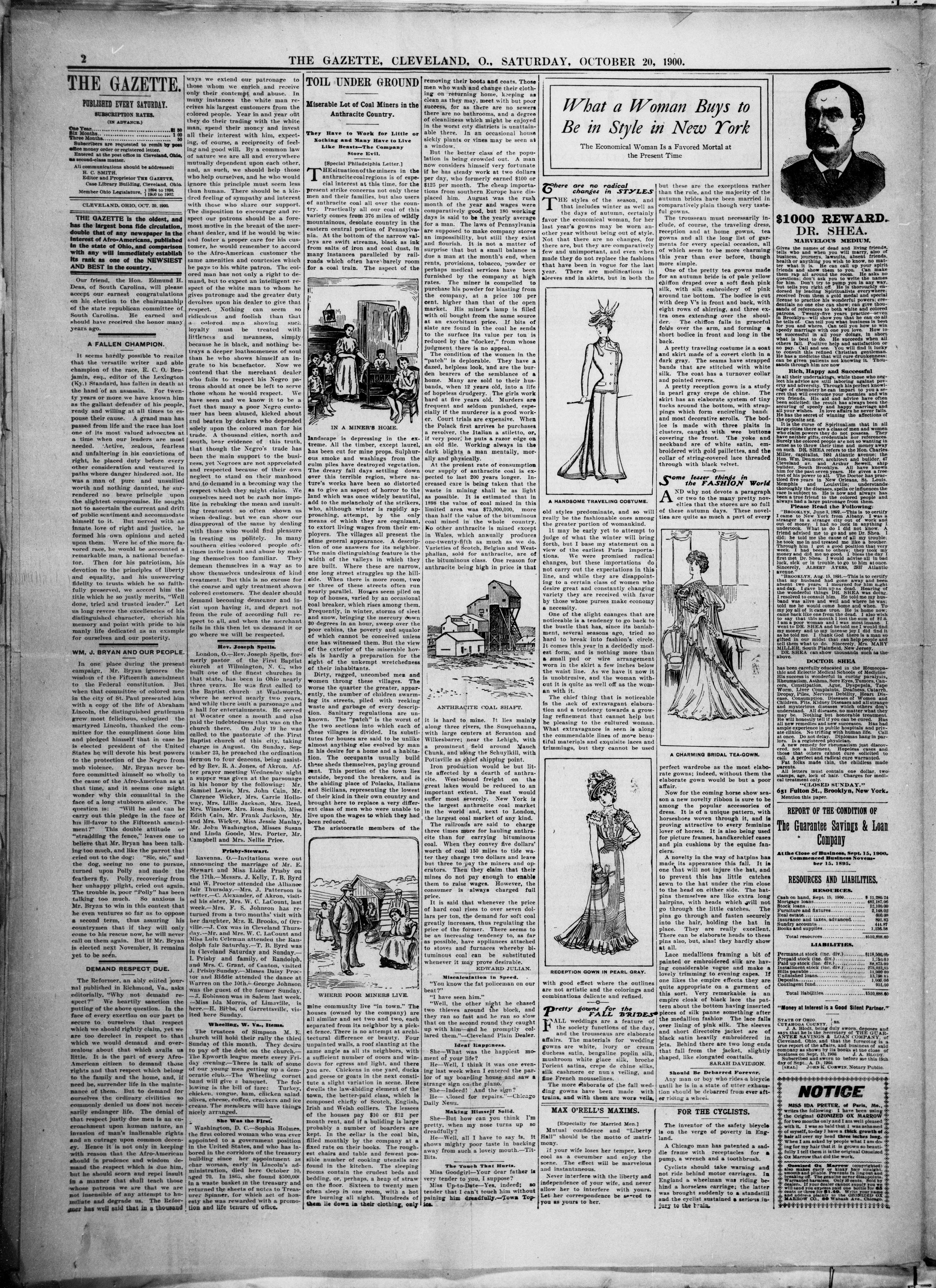
TOIL UNDER GROUND
Miserable Lot of Coal Miners in the Anthracite Country.
They Have to Work for Little or Nothing and Many Have to Live Like Beasts-The Company Store Evil.
[Special Philadelphia Letter.]
THEsituation of the miners in the anthracite coal regions is of espe-
Anthracite coal regions is of especial interest at this time, for the present strike concerns not only these men and their families, but also users of anthracite coal all over the country. Practically all our coal of this variety comes from 376 miles of wildly mountainous, desolate country in the eastern central portion of Pennsylvania. At the bottom of the narrow valleys are swift streams, black as ink from salts of iron and coal dust, in many instances paralleled by railroads which often have barely room for a coal train. The aspect of the
A teacher stands in front of a crib, holding a book and pointing to a child in the crib. Other children sit in chairs, watching the teacher.
IN A MINER'S HOME.
landscape is depressing in the extreme. All the timber, except laurel, has been cut for mine props. Sulphurous smoke and washings from the culm piles have destroyed vegetation. The dreary fall days settling down over this terrible region, where nature's works have been so distorted as to give an aspect of horror to the land which was once widely beautiful, add to the melancholy of the strikers, who, although winter is rapidly approaching, attempt, by the only means of which they are cognizant, to extort living wages from their employers. The villages all present the same general appearance. A description of one answers for its neighbor. The main distinguishing feature is the width of the valleys in which they are built. Where these are narrow, one long street straggles up the hillside. When there is more room, two or three of these streets often run nearly parallel. Houses seem piled on top of houses, varied by an occasional coal breaker, which rises among them. Frequently, in winter, storms of sleet and snow, bringing the mercury down 30 degrees in an hour, sweep over the poor cabins, the poverty and squalor of which cannot be conceived unless one has witnessed them. But the view of the exterior of the miserable hovels is hardly a preparation for the sight of the unkempt wretchedness of their inhabitants.
Dirty, ragged, uncombed men and women throng these villages. The worse the quarter the greater, apparently, the number of children swarming its streets, piled with reeking waste and garbage of every description. Sanitary regulations are unknown. The "patch" is the worst of the two sections into which each of these villages is divided. Its substitutes for houses are said to be unlike almost anything else evolved by man in his desire for a home and a habitation. The occupants usually build these sheds themselves, paying ground rent. This portion of the town lies outside, beyond the breakers, and is the abiding place of Polacks, Italians and Sicilians, representing the lowest of their kind in their own country and brought here to replace a very different class of men who were unable to live upon the wages to which they had been reduced.
The aristocratic members of the
A man in a suit stands in front of a wooden shed, talking to a woman sitting on the ground. In the background, a man and a woman are standing near the shed.
WHERE POOR MINERS LIVE.
mine community live "in town." The houses (owned by the company) are all similar and set two and two, each separated from its neighbor by a picket fence. There is no attempt at architectural difference or beauty. Four unpainted walls, a roof slanting at the same angle as all its neighbors, with a sufficient number of ooors and windows for egress and light, and there you are. Chickens in one yard, ducks and geese or goats in the next constitute a slight variation in scene. Here dwells the law-abiding element of the town, the better-paid class, which is composed chiefly of Scotch, English, Irish and Welsh colliers. The lessees of the houses pay $10 or $12 per month rent, and if a bullding is large probably a number of boarders are kept. In the cellar is the coal bin, filled monthly by the company at a fixed rate on their books. The roughest chairs and table and fewest possible number of cooking utensils are found in the kitchen. The sleeping rooms contain the crudest beds and bedding, or, perhaps, a heap of straw on the floor. Sixteen to twenty men often sleep in one room, with a hot fire burning all night. Hundreds of them lie down in their clothing, only
removing their boots and coats. Those men who wash and change their clothing on returning home, keeping as clean as they may, meet with but poor success, for as there are no sewers there are no bathrooms, and a degree of cleanliness which might be enjoyed in the worst city districts is unattainable there. In an occasional house sickly plants or vines may be seen at a window.
But the better class of the population is being crowded out. A man now considers himself very fortunate if he has steady work at two dollars per day, who formerly earned $100 or $125 per month. The cheap importations from southern Europe have displaced him. August was the rush month of the year and wages were comparatively good, but 180 working days is said to be the yearly average for a man. The laws of Pennsylvania are supposed to make company stores an impossibility, but still they exist and flourish. It is not a matter of surprise that but a small balance is due a man at the month's end, when rents, provisions, tobacco, powder or perhaps medical services have been furnished by the company at high rates. The miner is compelled to purchase his powder for blasting from the company, at a price 100 per cent. higher than that of the open market. His miner's lamp is filled with oil bought from the same source at an exorbitant price. If bits of slate are found in the coal he sends to the surface its value per ton is reduced by the "docker," from whose judgment there is no appeal.
The condition of the women in the "patch" is deplorable. They have a dazed, helpless look, and are the burden bearers of the semblance of a home. Many are sold to their husbands, when 12 years old, into a life of hopeless drudgery. The girls work hard at five years old. Murders are frequent and seldom punished, especially if the murderer is a good worker. Court trials are expensive. When the Polack first arrives he purchases a revolver, the Italian a stiletto, or, if very poor, he puts a razor edge on an old file. Working always in the dark blights a man mentally, morally and physically.
At the present rate of consumption our supply of anthracite coal is expected to last 200 years longer. Increased care is being taken that the waste in mining shall be as light as possible. It is estimated that in 1898 the value of coal mined in this limited area was $75,000,000, more than half the value of the bituminous coal mined in the whole country. No other anthracite is mined except in Wales, which annually produces one-twenty-fifth as much as we do. Varieties of Scotch, Belgian and Westphalian, sold for anthracite, are of the bituminous class. One reason for anthracite being high in price is that
ANTHRACITE COAL SHAFT.
it is hard to mine. It lies mainly along three rivers, the Susquehanna, with large centers at Scranton and Wilkesbarre; near the Lehigh, with a prominent field around Mauch Chunk, and along the Schuylkill, with Pottsville as chief shipping point.
Iron production would be but little affected by a dearth of anthracite. West-bound freight on the great lakes would be reduced to an important extent. The east would suffer most severely. New York is the largest anthracite coal market in the world and, next to London, the largest coal market of any kind. The railroads are said to charge three times more for hauling anthracite than for carrying bituminous coal. When they convey five dollars' worth of coal 150 miles to tide water they charge two dollars and leave but three to pay the miners and operators. Then they claim that their mines do not pay enough to enable them to raise wages. However, the consumer is always charged full price.
It is said that whenever the price of hard coal rises to over seven dollars per ton, the demand for soft coal greatly increases, thus regulating the price of the former. There seems to be an increasing tendency to, as far as possible, have appliances attached to stoves and furnaces whereby bituminous coal can be substituted whenever it may prove desirable.
EDWARD JULIAN.
Miscalculation in Speed.
"You know the fat policeman on our beat?"
"I have seen him."
"Well, the other night he chased two thieves around the block, and they ran so fast and he ran so slow that on the second round they caught up with him—and he promptly collared them."—Cleveland Plain Dealer.
Ideal happiness.
She—What was the happiest moment of your life?
He—Well, I think it was one evening last week when I entered the parlor of my boarding house and saw a strange sign on the piano.
She—Indeed! And the sign?
He—Closed for repairs."—Chicago Daily News.
Making Himself Solid.
She—But how can you think I'm pretty, when my nose turns up so dreadfully?
He—Well, all I have to say is, It shows mighty poor taste in backing away from such a lovely mouth."—Tit-Bits.
The Touch That Hurts.
Miss Goodgirl—Your dear father in very tender to you. I suppose?
Miss Up-to-Date—Yes, indeed; so tender that I can't touch him without paining him dreadfully.—Town Topics
What a Woman Buys to Be in Style in New York
The Economical Woman Is a Favored Mortal at the Present Time
There are no radical changes in STYLES
THE styles of the season, and that includes winter, as well as
that includes winter as well as the days of autumn, certainly favor the economical woman, for her last year's gowns may be worn another year without being out of style. Not that there are no changes, for there are, but they are comparatively few and unimportant, and even when made they do not replace the fashions that have been in vogue for the last year. There are modifications in sleeves and in skirts, but in both the
A
A HANDSOME TRAVELING COSTUME.
old styles predominate, and so will really be the fashionable ones among the greater portion of womankind.
It may be early yet to attempt to judge of what the winter will bring forth, but I base my statement on a view of the earliest Paris importations. We were promised radical changes, but these importations do not carry out the expectations in this line, and while they are disappointing to a certain class of women who desire great and constantly changing variety they are received with favor by those whose purses make economy a necessity.
One of the slight enanges that are noticeable is a tendency to go back to the bustle that has, since its banishment, several seasons ago, tried so hard to break into fashion's circle. It comes this year in a decidedly modest form, and is nothing more than a small pad or wire arrangement worn in the skirt a few inches below the waist line. As we have it now it is unobtrusive, and the woman without it is quite as well off as the woman with it.
The chief thing that is noticeable is the lack of extravagant elaboration and a tendency towards a growing refinement that cannot help but be pleasing to the cultured woman. What extravagance is seen is along the commendable lines of move beautiful materials and exquisite laces and trimmings, but they cannot be used
10
RECEPTION GOWN IN PEARL GRAY.
with good effect where the outlines are not artistic and the colorings and combinations delicate and refined.
Pretty gowns for the
ALL weddings are a feature of the society functions of the day.
and the trousseaus are elaborate affairs. The materials for wedding gowns are white, ivory or cream duchess satin, bengaline poplin silk, mushroom white glace silk, broche l'orient satins, crepe de chine silks, silk cashmere or nun's veiling, and fine French mousselines.
The more elaborate of the fall wedding gowns have been made with trains, and with them are wore veils,
MAX O'RELL'S MAXIMS
[Especially for Married Men.]
Mutual confidence and "Liberty Hall" should be the motto of matrimony.
If your wife loses her temper, keep cool as a cucumber and enjoy the scene. The effect will be marvelous and instantaneous.
Never interfere with the liberty and independence of your wife, and never allow her to interfere with yours.
Let her correspondence be served to you as yours to her.
but these are the exceptions rather than the rule, and the majority of the autumn brides have been married in comparatively plain though very tasteful gowns.
The trousseau must necessarily include, of course, the traveling dress, reception and at home gowns, tea gowns and all the long list of garments for every special occasion, all of which seem to be more charming this year than ever before, though more simple.
One of the pretty tea gowns made for an autumn bride is of pale yellow chiffon draped over a soft flesh pink silk, with silk embroidery of pink around the bottom. The bodice is cut with deep V's in front and back, with eight rows of shirring, and three extra ones extending over the shoulder. The chiffon falls in graceful folds over the arm, and forming a short bodice in front and long in the back.
A pretty traveling costume is a coat and skirt made of a covert cloth in a dark gray. The seams have strapped bands that are stitched with white silk. The coat has a turnover collar and pointed revers.
A pretty reception gown is a study in pearl gray crepe de chine. The skirt has an elaborate system of tiny tucks around the bottom, with strappings which form encircling bands and most decorative scrolls. The bodice is made with three plaits in clusters, caught with wee buttons covering the front. The yoke and neckband are of white satin, embroidered with gold paillettes, and the collar of string-covered lace threaded through with black velvet.
Some lesser things in the FASHION World
AND why not devote a paragraph or two to the many pretty novelties that the stores are so full of these autumn days. These novelties are quite as much a part of every
A
A CHARMING BRIDAL TEA-GOWN. perfect wardrobe as the most elaborate gowns; indeed, without them the elaborate gown would be but a poor affair. Now for the coming horse show season a new novelty ribbon is sure to be among the popular accessories of dress. It is of a unique pattern, with horseshoes woven through it, and is proving attractive to every feminine lover of horses. It is also being used for picture frames, handkerchief cases and pin cushions by the equine fanciers.
A novelty in the way of hatpins has made its appearance this fall. It is one that will not injure the hat, and to prevent this has little catches sewn to the hat under the rim close to the head on either side. The hatpins themselves are like extra long hairpins, with heads which will not go through the little catches. The pins go through and fasten securely into the hair, holding the hat in place. They are really excellent. There can be elaborate heads to these pins also, but, alas! they hardly show at all.
Lace medallions framing a bit of painted or embroidered silk are having considerable vogue and make a lovely trimming to evening capes. If one likes the empire effects they are quite appropriate on a garment of this sort. Very remarkable is an empire cloak of black lace the pattern about the bottom having inserted pieces of silk panne something after the medallion fashion The lace falls over lining of pink silk. The sleeves and short directoire jacket are of black satin heavily embroidered in jets. Behind there are two long ends that fall from the jacket, slightly shaped, like elongated coattails.
Should Be Debarred Forever.
Any man or boy who rides a bicycle until he is in a state of utter exhaustion should be debarred from ever after riding a wheel.
FOR THE CYGLISTS
The inventor of the safety bicycle is on the verge of poverty in England.
A Chicago man has patented a saddle frame with receptacles for a pump, a wrench and a toothbrush.
Cyclists should take warning and not ride behind motor carriages. In England a wheelman was riding behind a horseless carriage; the latter was brought suddenly to a standstill and the cyclist sustained serious injury to the brain.
M.
Gives the names of dead and living friends, tells who and when you will marry, also of business, journeys, lawsuits, absent friends, health or anything you wish to know, no matter what it is. He can call up your spirit friends and show them to you. Can make them rap all around the room. He asks no questions; don't ask you to write the names for him. Don't try to pump you in any way, but tells you right off. He is thoroughly enforced from reading Spirited Wings, received from reading The Old Medal and special license to practice his wonderful powers; credentials no one else can show; can give thousands of references to both white and colored patrons. Twenty-five years practice—seven in Brooklyn—will show you that he can do all he tells of. Can tell you what business is best for you and where. Can tell you how to win speedy marriage with one you love. How to be successful in all your doings, in short what is best to do. He succeeds when all others fall. Positive help and satisfaction lick at his heart. He will do it to consult this refined Christian gentleman. He has a medicine that will cure drunkenness: can be given patients not knowing it. Thousands through him are now
Rich, Happy and Successful in all their undertakings, while those who neglect his advice are still laboring against poverty and adversity. Through his perfect knowledge of chemistry he can impart to you a secret that will overcome your enemies and win you friends. His aid and advice have often been solicited: the result has always been the securing of speedy and happy marriage and all your wishes. In love affairs he never fails. He has the secret of winning the affections of the opposite sex.
It is the curse of Spiritualism that in all large cities there are a class of men and women who claim powers they do not possess. They have neither gifts, credentials nor references. Surely the colored people are not so wanting in sense as to throw their time and money away on such. DR. SHEA refers to the Hon. Charles Miller, capitalist, 2481 Atlantic avenue; the Hon. Wm. Denmore, architect and builder, 47. William Arthur Sewell, builder, Snoop Brooklyn. All known him for the past seven years. The Doctor has a free test of his power to all. The Doctor has practiced five years in New Orleans, St. Louis, Memphis and Louisville; understands thoroughly the diseases, spells or influences the race is subject to. He is now and always has been a true friend to the colored people and always had a large patronage from them.
Please Read the Following:
"BROOKLYN, June 3, 1892.—This is to certify I came to New York from Albany. I was a stranger in a strange city out of work and in a strange town and that I had undertook. What to do I did not know. A friend advised me to go and see Dr. Shea. I did; he told me the cause of all my trouble: he took me in and treated me like a brother. Through him I got a good position that very week. I had been to others; they took my money and did me no good. I bless the day I was born, in the city, in the town, luck, sick or in trouble, to go to him at once. Sinceerely, ALBERT AYERS, 2937 Atlantic avenue."
"BROOKLYN, Aug. 15, 1891.—This is to certify that my husband had gone away and been absent two years. I mourned away for him night and day. I gave him up as dead. Hearing of the wonderful things DR. SHEA was doing, I resolved to consult him. He told me my husband was alive and well and where he was; told me he would come home and when. To my joy all of it came true. He is home now; came back like one from the dead. I also wish to say that this month I lost the sum of $2.0. I am a poor woman and I was most insane. I went to DR. SHEA and he told me I would find my money and to my intense joy I did find it. I was very happy and I was gifted in our midst, that can help people and tell them what to do. Sincerely MARY MILLER, South Plainfield, New Jersey. DR. SHEA, can show thousands, such as the
DOCTOR SHEA
has been carefully educated in the Homeopathic and Eclectic Medical Schools of Medicine His success is wonderful in curing paralysis, Rheumatism, Asthma, Sore Eyes, Tumors, Cancers, Constipation, Ague, Dyspepsia, Tape Worm, Liver Complaints, Deafness, Catarr, Dropsy, Piles, Nervous Debility, Heart Disease, Consumption, Diseases of Women and Children, Fits, Kidney Diseases and all strange and mysterious diseases which others don't understand. All diseases, no matter what they may be. Nothing but honorable treatment. He will honestly tell you can be cured. Has all new remedies and new successes. Has had expert medical public hospitals and private clinic. No trifling with human life. Call at once. Do not delay. Diplomas hang in parors. Is a registered physician. A new remedy for rheumatism just discovered, not a liniment. Hopeless cases and those that others cannot cure solicited to call. A perfect and radical cure warranted. Fat folks made thin, the childless made parents. All letters must contain one dollar, two stamps, age, lock of hair. Charges for medical treatment only.
651 Fulton St., Brooklyn, New York. Mention this paper.
REPORT OF THE CONDITION OF The Guarantee Savings & Loan Company
At the Close of Business, Sept. 15, 1900. Commenced Business November 15, 1895.
RESOURCES AND LIABILITIES.
Cash on hand, Sept. 15, 1900. $ 11,280.24
Mortgage loans. 482,187.06
Stock loans. 12,100.00
Furniture and fixtures. 2,148.02
Real estate. 600.00
Insurance and taxes, advanced. 891.83
Sundry accounts. 444.87
Books and supplies. 1,236.58
Permanent stock (inc. div.) 8118,500.00
Prepaid stock (inc. div.) 1,750.03
Paid up stock (inc. div.) 88,875.00
Installment stock (inc. div.) 275,013.05
Bills payable 11,000.00
Unfinished loans 13,798.85
Deposits 1,000.00
Contingent fund 691.00
STATE OF OHIO. 88.
CUYAHOGA COUNTY. 88.
J. A. Blodt, being duly sworn, deposes and says that he is the Secretary of THE GUAR-ANTEE SAVINGS & LOAN COMPANY, of Cleveland, Ohio, and that the foregoing is a true report of the affairs, and business of sald company as shown by its books at the close of business on Sept. 15, 1900. 88.
J. A. BLODT.
Subscribed and sworn to before me this 15th day of Sept., A. D., 1901.
[SEAL] JOHN K. CORWIN. Notary Public.
MISS IDA PRETER, of Paris, Mo., writes the following: I have been using the Original OZONIZED OX MARROW for two months only and I am well pleased with it. I was so bald that I was ashamed of myself, to-day I have a thick growth of hair all over my head three inches long. When I am asked by people what I am doing for my hair that it is grown so beautifully I tell them it is the original Ozonized Ox Marrow that did the work.
Ozonized Ox Marrow (copyrighted) also makes early or kinky hair straight, and is a great breakup off. The genuine never disappoints. Warranted harmless. Only 50 cents. Sold by dealers. If your dealer cannot supply you we can make it for you. We sell 50 cents or three for $1.44. Write your name and address plainly to the OZONIZED OX MARROW CO., 80 Wabash Ave., Chicago.
LOCAL DEPARTMENT.
ee
Noric® 70 Susscnrsens.—Subseribers aot
receiving Tae GazeTTs regulurly sbould notify:
Us AT ONCE. We desire every copy delivered
Promptly.
‘We advise our patrons to carefully examine
‘THE Gazerre’s advertisements before making
Purchases. Business men who advertise in this
Paper should have the patronage of Afro-amert-
cans. The fact thet they ndvertise is assurance
‘Ghat they want it.
‘Local reading notices (advertisements) sen
cents 2 live.
————————————————
CLEVELAND, SATURDAY. OCT. 20, 1900,
—————————————
WHERE “THE GAZETTE” IS SOLD.
PUSHAW's News Store, Cuyahoga Building
‘Opposite the Post Office Open Sunday.
N. Hexrer’s News Depot, City Hall Build-
ing, cor. Wood and Superior streets Open
Sunday.
S. H Moopr's News Store, No. 387 Superior
street, second west of Bond street Open Sun-
days also.
GoopManN's News Depot, No. 585 Centra
Avenue, cor. Sterling avenue Open Sunday.
P. JouNson TARRER's Restaurant, No. 6%
Central Ave Open Sundays also.
a a ce ee eee ee
Mr. and Mrs. J. W. Crawford moved
into their own home on Newton
street, the first of the week, having
sold out their restaurant on Central
avenne.
Mrs. John McGuinn, of S8 East Col-
lins avenue, Collinwood, is visiting in
Altoona and Hollidaysburg, Pa.
The grand rally at Cory, chapel
Sunday was a success. Rev. Brookins,
of Antioch church, preached at 5 p.
m., and his choir sang. ev. Dand-
ridge and many of his congregation
also were present. The total amount
raised was $259.54. Kev. Langford,
pastor, desires to thank through The
Gazette all who assisted him. ‘The
Epworth league convention and Sun-
day senool institute will convene here
vhe 24th and 2th. Quarterly meet-
ing will be hela on the 27th, Rev.
Ferguson will be here during the
convention. _
A son was born to Mr. and Mrs.
Walter Martin, of Central avenue.
Miss Gatewood is very sick at her
howe or Linden strect.
Mrs. Ollie G. Jones-Laster, former-
ly of this city, now a resident of New
York City, will spend the winter here.
The editor of The Gazette was se-
lected by the republican county exec-
utive committee as one of the vice
presidents of the “Roosevelt-Foraker”
meeting held at the Central armory
Wednesday evening.
There were only about 50 Afro-
Americans in attendance upon the
Congressnan White political meeting
at Germania hall on Monday evening
--a result of poor management.
Capt. Jobn Silberg (white) has re-
signed ecmmand of the Cleveland City
Guards in favor of Capt. Wm. Hare,
who has been re-elected and now has
charge of the company.
Miss Sadie Cisco, who had appendi-
citis, is slowly recovering. Mrs, Ollie
Jones-Laster was untiring in her at-
tention throughovt Miss Sadie’s ill-
ness.
Haye you seen the extra fine crayon
portraits Mr. B. K. Smith, of No. 236
Superior street, makes and frames at
$3.49? See the one at The Gazette
office.
St. Andrew's mission, Rev. Edward
8. Doan, priest-in-charge. | Morning
prayer conducted by Mr. Chas, Fisk,
at 10:15. Sunday school at 11:30,
Evening prayer and sermon by the
_Fector at 3p. im. "
Mrs. J. E. Reed, of Giddings avenue.
has been seriously ill the past week.
d ofh-MON y w'W, . nd-oc ooi m
Mr. Henry Taylor, of No. 703 Ster-
ling avenue, was tendered a pleasant
birthday surprise last. week Monday
evening by his wife and a number of
friends. Quite a number of valuable
and preity presents were received.
The Centennial Social ciub will give
@ grand carnation ball on Thursday
evening, November 22d, at Forest
Street rink. Bowman & Me fee's
full-voiced orchestra will be in at-
tendance and refreshments will be
served by P. Johnson Tarrer, caterer,
Admission, $1 per couple. The grand
mnarch starts at 8:30 p, m. The rink is
ove of the best places in the city for
bails, and the club has the best
denee music to be secured in Bow-
man & MeAfee’s orchestra. This will
undonbtedly be the event of the sea-
son. and everybody should attend.
Among the Afro-American . vice-
presidents of the Bryan meeting
were: Attorneys Alexander H. Mar-
tin and John M. Anderson, Dr. FE. H.
Anderson and Edward W. Burrell.
‘The editor of The Gazette was se-
lected by the Republican executive
¢ommittee as one of the reception
committee to meet Senator Foraker
Oetober 17th. No .Afro-American
was on the committee to receive
. Gov. Roosevelt. A very proper con-
dition,
Mr. and Mrs. William Collins, of
Lowellville, visited their sister, Mrs.
L. S. Jones, of Hamburg street, the
past week. Master L. Vanghn ac-
companied them home.
Dr. Taylor gives specig) attention
to crown and bridge work. office
No. 155 Central avenue.
Wanted—A lady roomer. A young
lady wishing a pleasant front room
in a family of two in a very desirable
part of the East End, where plenty
of employment can be secured. « Cail
at No. 56 Maine street, after 5 p. m.
Rey. ‘Alex. Moore has disposed of
Ris business and is now at liberty to
engage in ministerial labor, His
present address is No. 3u Newton
street.
New Brighton, Pa., Brevities.
‘The persons from this city attend-
ing general conference were Mr. and
Mrs. Porter and son, Mrs. Amelia
Jackson and daughter, Frank, Char-
ley and Harry Webster, George Wal-
don, Ralph Jackson, Mrs. Matthews
and son, Donald Leland, Mr. Johnson,
Miss Della Francis, L. Caliman, Mrs.
Bertha Obey, of Beaver, Mrs. A. W.
‘Tanner, of Rochester, and Mrs. J. H.
Lee and daughter.—Rev. Grant was
returned to this city—Rev. Brown
was assigned to Titusville.—Rev.Weirs
preached here Sunday evening.
Am Advertiser's Testimonial.
Richmond, Va., Sept. 28, 1900.
‘A. C, Smith, Cleveland Ohio.
Dear Sir: Please continue our ad-
vertisement. Your paper brings us
splendid results and we are very
highty satisfied with our investment
with you, Yours truly,
THE HARTONA REMEDY CO.
excursions to Columbus via Pennsyl-
wante Liees
October 23 aad 24, for the Ohio Bap-
tist. convention, low rate excursion
ae a sold to Columbus via
1 lines; good returning
paul ie Octobex 26,
THE GAZETTE, CLEVELAND, O., SATURDAY, OCTOBER 20, 1900.
A Guy-Simpson.
| Zanesville, 0.--Mrs, Jos. Mitchell
died at her mother’s home Sunday,
leaving a husband and five children.—
Mr. Wartield is better.—N. D. Caven-
Ger is sick.—Dr. Jones, president of
Wilberforce university, and Hon. 6.
H. White, cf North Carolina, spoke
fn the Opera house Friday evening.
| — the ladies of St. Paul’s chureh gave
|a reception in honor of Rev. Maxwell
Thursday eveniug.—Mrs. Phillip Tol-
ives, of Cambridge, is visiting here.
-~The Y, P. S. M. I. held an interest-
ing meeting Monday evening.—Miss
Vandalia Guy and Mr. James Simp-
son were married last week -—St.
Paul’s chureh was cleaned by the
stewardesses recently.—The young
people of Union church have reorgan-
lized the choir.
|counecE CLUB’S WEIRD WAY.
The Candidate Must Resign Himself
to the Will of Another
for a Week.
lege,” says Frederick Gittings, of Phila-
delphia, according to the New York
Tribune, “a prerequisite to becoming
la member of which compels the candi-
date to resign himself absolutely to
the will of another for a week. During
that period of time he may not speak
to other people without permission of
his guardian, and during his week's
probation he must do any and all things
that his temporary keeper may order.
Amusing ineidents by the score have
been the result of this method of pro-
cedure. A young chap froma western
city landed at the college with a couple
lof servants in livery, for he was very
rich. His fellow-students regarded him
with open suspicion, for they looked
upon the presence of those servants as
‘side’ of the worst description.
“The westerner, however, in spite of
his horses and ‘men,’ was a very good
chap, and, this fact being discovered,
in due course of time he was elected
la member of the club. He knew noth-
ing of the election until he received
the notice, and upon its heels followed
the inevitable week's probation. His
sister and a number of her girl friends
had arranged to put in a week in the
college town, and he had prepared to
entertain them lavishly, an elegant
lawn party at a wayside inn being
among the entertainments laid out.
The visit and his period of probation
fell at the same time, and as with-
out permission he could communicate
with no one, he was unable to write
and ask his sister to delay her coming,
Then his mentor discovered how the
jand lay and made his plans according-
ly. The visiting party was met at the
train and dinners and theater parties,
teas at college roome and all that sort
of thing followed each other. The
miserable probationer was supposed to
be away on business—at least the
letter he had been forced to write to
his sister gave that as an excuse for
his absence, and also advised her of the
lawn party.
“That fete came off in due time, and
was a great success. About the middle
of the al fresco luncheon, one of the
prettiest of the sister's friends sud-
denly looked keenly at one of the liv-
eried servants. ‘How much that man
looks like Jack, doesn’t he?’ she said,
turning to Jack's friend and pro tem.
master. ‘Yes,’ replied the man ad-
dressed, the does rather, except he’s
rather better looking, and, by. the way,
speaking of Jack,’ and then he launched
into a new, fallacious and wholly undig-
nified explanation of Jack’s continued
absence, the explanation being deliv-
ered in an unnecessarily audible voice.
The man in the livery grew steadily a
deeper purple as the explanation un-
rolled itself. Murder looked from, his
surcharged eyes. But, to his honor
be it said, he controlled himself. Of
course, he was ‘Jack,’ and a few days
later, his week being up, he was able to
give a satisfactory explanation of his
absence.
“At another time a representative of
the most aristocratic family in the col-
lege town was forced, clad in overalls,
to earry a trunk down the main street
just as his friends and retatives were
returning from church. Men posted
at intervals along the street kindly
called their attention to the blushing
man with the trunk, explaining his ac-
tion to be the result of a wager on a
prize fight. The pranks that have Been
played by this society have been at
times amusing and have seldom been
harmful. Of course, now and again a
‘bounder’ will creep in, and when he
takes his turn at initiation he is like-
ly to make his victim suffer unneces-
sarily. There is such a case on record
where finally the mentor went too far,
and the candidate rebelled, and, care-
fully removing his coat, said: ‘Of
course, I want to belong, and know
what it means if I don’t; but, all the
same, I want to keep my self-respect,
and to that end I’m going to give you
the tallest licking you ever got in your
life’ And then he sailed in and did.
When, however, the facts were laid be-
fore the other members it did not stand
in the way of his election.”
BUDDHA’S BIRTHDAY.
It Is Celebrated ip Singular Fash-
jon by Mothers and
Children.
A correspondent of the Indianapolis
Press writes from Yokohama, Japan:
“April 8, Buddha's birthday, is cele-
brated in all the temples by bringing
out the images of the infant Buddha,
placing them in a large’ bowl. and pour-
ing over them licorice tea with a ladle.
On this day, 1900, a great multitude
of women and children flocked to what
corresponds to the parish house of the
Episcopal church, which can be en-
tered without removing the shoes.
Each child had a bamboo cup, and
when this was filled with the precious
fluid it walked away sipping it with
great satisfaction, for it is believed to
be a remedy for worms and other in-
ternal disorders. The mothers had bot-
tles of the same, which they wrapped
up to take home, to place near the
pillar of the house to keep away ants
and other insect pests. The crowd was
most good natured, pushing and jost-
ling to get near the boy priests that
filled their cups and took their money.
The temples, like American churches,
are most frequented by women.”
aay
Mrs. Jobnson—What I said to Mrs.
Simpkins was @at I didn’t b’leeb yo’
husband ebbah robbed a henroos’ in
his life.
Mrs. Black—Yo" done mean to insin-
niwate he ain’} «ot de perve?--Puck.
| aKING OF ALL HAIR DR ~
fa BSSINGS.«
Ly a
i) T a y
y O § Poe oO Ff
| a) fe
A Zz de x Oe RASS Zz F
; oO oer (Gam O 5
RB fe K RR A
H ow eth CS cI
( RES BOS NG
y Oo er +72 SG oO FI
i ft BEFORE _ -* AFTER ._-
4
An Honest Guaranteed Remedy—Money Refunded if You are Dissatisfied.
N a y
Positively biesome, Refractory BE
Hf] Corce Reldaeee Dante Teh Tefal ranula whiny and humiliating Balp 4
Fy Diseases. Causes the hair to grow long and straight, soft and fine, and beautiful as an v
ra re ea ark Hames. # BOE. Four boxes does the work. Ozone cannot fail. Ey
OUR ?—Cut out this advertisement and send us with One Dollar,
Rj and we will iomediately send you four bexes of Ozone and one bottle Skin Refiner,
4) Shich cures all Shir Distaaes, removes Wiistles, Prechios, Moth Patches, am Liter i
‘Spote, and all Facia. Blemishes; also one package Anti-Oder, removes all odors arisiog
py from the human bod: ,cures Womb Diseases, Chilblains, &c. Ali the above, worth $3.50, a
if] we will sond for $1.00, ‘This grand offer is unprecedented. Parties sending $3.00 will {kt
jj Tecstvefourlots, — @OSTON CHEMICAL £O., 310 E. Broad St, Richmond,Va. |
Se ae ae ae FL IT TT IT TCT TTY
| ee fT er a hen a eek
DISCOVERY OF KHAKI.
First Production of the Cloth Which
Clothes English and Amer-
‘a fean Soldiers.
The London Daily News, to illus
trate the part played by lucky acei-
dent in the discovery of inventions,
told the other day a story about
khaki, the olive-colored canvas cloth
worn by the English and American
soldiers in hot countries.
This cotton stuff has been worn in
India by British troops for many
years. Its tint was a greenish brown,
but it always faded when it wag
washed with soap.
A business man from Manchester,
while traveling in India, happened to
fall into conversation with an Eng-
lish officer, who remarked, carelessly,
that the first manufacturer who could
produce a cotton drill that would not
fade would make his fortune.
The young Englishman never for-
got this hint. He came home, found a
skillful dyer, and with him began the
search for an olive dye which, when
used on cotton cloth, would not yield
to soap or soda. ‘They spent years in
these experiments, all of which proved
fruitless.
One day they found among several
seraps of dyed cloth one which re-
tained its color under the most severe
tests. The puzzling fact was that it
had been cut from the same piece of
cloth, and subjected #0 the same proc-
esses as the other scraps, all of which
faded.
The two experimenters were great-
ly puzzled, and for months tried in
vain to solve the riddle. The one lit-
tle fragment of khaki was the only
one which kept its color against all
attacks,
By chance one day they found that
the dye in which this serap had been
dipped had remained for a time in a
metal dish of a peculiar kind. The
secret was found. The metal of the
dish, in combination with the chemi-
cals of the dye, had furnighed the one
thing needful. ‘They tried the expert-
ment with other pieces. The dye held,
and their fortunes were made,
It was not chance which gave them
their success, but the indomitable pa-
tience and persistence which pursued
the chance, and the intelligence which
seized it.
Woman's Walk on a Wager.
Mme. Alma xeldseth, widow of a
journalist, has for a wager just trav-
eled from Christiania to Paris on foot
end started without either food or
money. On the way she crossed Swe-
den, Denmark, Germany and part of
France. She walked 12 hours a day
and at night would call at a farm and
offer to work for her board and lodg-
ing. Directly she had earned a little
money she started again, and in turn
she mended clothes, did washing and
acted as governess.
S a week can be
made by you at
4 your home.
Enclose Stamps for ALL, particulars.
Address SCOTT REMEDY CO., toutsvitio, Ky.
¥ 1B FAL
“While you Sleep.”
UNPARALLELED NIGHTSERVICE, NEW STEAMERS
“CITY OF BUFFALO”
ano
“ City oF Ene,”
both together being without doubt, tn all
respects, the finest and fastest that are run
in the interest of the traveling public in
the United States. @
TIME CARD,
DAILY incLUDING SUNDAY,
Leave Cleveland 8 P.M. Arrive Buffalo 6 A.M.
“~ Buffalo 8 + “Cleveland 6
CENTRAL STANDARD TIME.
Connections made at Buffalo with trains
for all Eastern and Canadian points. Ask
ticket agent for tickets via és B. Line,
Bend four enter y BUFFALO AND Pinca
SRECIAL LOW RATES To BUFFALO AND NIAGARA
FALLS EVERY SATURDAY WIGHT. a
W. F, MERMAN,
(Genana Paseenenn Acer,
‘CLEVELAND, G
5 G Tue
DISCOVERY
FOR MAKING
or FURY Hh Sy
py -goy ~ rN
ey 2
WEE oy) -4
fh Yo Ag I
il Nea a
INS games Ky
Ga Ar emol NY’
SSSR \Y
» Cteope srer YP
TRAIOHTINE is no experiment, but a thor-
ugly reliable preparation,” 1¢ has been
fuccessfully used by thousands in all por.
{tions of the country, We have hundreds of
letters speaking in the highest terms of its
merit, and, every mail brings us fresh test.
monlils, (Straighting is a highly perfumed
Pomade; itnot only Stralghtc :s the Hair,
it removes Dandruff, Keeps tue Hair from
Falling Out, cures Itching, Irritating Sealp|
Diseases, giving a rich, tong and luxurious
head of hair—so much’to bedesired. Guar-|
fanteed perfectly harmless. Price, 25 Cents
@can atall drug stores, or sont by mail to
any address on receipt of 30 Conts in stamps:
lor silver, @ Address, NELSON M'F'G CO.,
Richmond, Va. #a-Big Money for Agents.
‘Write for Terms, t
Curly Hair Made Straight By
(esac 4
fi os a
a Na a4
. | ee
—aee Ow
LA Oy, AS WA ry
Psi OR
TAKEN FROM LIFE.
BEFORE AND AFTER TREATMENT.
7
OZONIZED OX MARROW
‘THE ORIGINAL—COPYRIGHTED.
This wonderful hair,pomnde ts the only gate
preparation inthe worl that maxes Kinky Nutr
Reraight as shown above, ‘lenourishes the cenip,
Erevan renal gino, tauiip gut and taken tt
Warranted pened ‘Testimonials free on re:
Straightening kinky halr. Beware of finitations |
Ger the Original Ozonized Ox Marrow,
Aethn genuine never falis to Keep tae hase pUebls
Soa eautiil, X Wollet necesalty for ladles and
jemen. Hiegantly perfumed) ‘The «reat ad-
Fantage of this wondergat pomade fs that by its
se you can straighten your own heir at home,
Owing to fia superior andinsting quailty stip the
fo produce a preparation equel to st. Pull airec-
Hons with crdey Bottie, ‘Only GO conte, Hold by
Geniorsor vend we Bi,40° Postal "or Express
Money Order for 3. bottles, express paid. Write
your name and address plainly’ to ‘
OZONIZED OX MARROW CO.,
76 Wabash Ave., Chicago, ill.
Please mention this paper (THE Gazerre)
when writing.
HALF RATES
ce ak
TO
. i
Springfield,O.
and Return,
VIA
ON ACCOUNT OF 1
Grand Lodge Session Free and
Accepted Masons of Ohio,
October 24 and 25, 1900.
Round trip tickets will be on sale
from all “Big Four” points in Ohio at
rate of one fare for round trip (ex-
cept no rate less than 25 cents), on
October 22 to 25, inclusive.
Tickets good for return to and includ-
ing October 26, 1900.
For full information and-partien-
lars as to rates, tickets, limits, ete..
call on Agents “Big Four Route,” or
address the undersigned.
WARREN J. LYNCH, W. P. Depre,
Gen. Pass. & Mkt Agt. Asst. G. P. &T. A.
D. Jay CoLiveEn, C. P. T. A.,
16 Euclid Ave., Cleveland, O.
4
Where to Locate?
WHY, IN THE TERRITORY
TRAVERSED BY THE
ee
Louisville
:
ana Nashville
Railroad,
‘The Great Central Southern Trunkline
tT
Kentucky, Tennessee,
Alabama,
Mississippi, Florida,
WHERE
Farmers, Fruit Growers,
| Stock Raisers, Manufacturers,
| Investors, Speculators
and Money Lenders
wit find the greatest chances in the United
States to make “big money” by reason of the
abundance and cheapness of
| Land and Farms,
Timber and Stone,
Iron and Coal,
Labor—Everything!
Free sites, financial assistance, and freedom
from taxation, for the manufacturer,
“Yiand and farms st $1.00 per acre and up-
‘wards, and 500,000 seres in West Florida that
ean be taken gratis under U, S, Homestead
laws.
Stockraising in the Gulf Coast District wil}
make enormous profits.
HALF PARE EXCURSIONS THE FIRST AND
‘TUESDAYS OF EACH MONTH.
Let us know what you want, and we will
tell you where and how to get it—but don't
delay, as the country is filling up rapidly.
Printed matter, maps and all information
free, Address,
R. J. WEMYSS,
General Imraigration and Industrial Agent,
LOUISVILLE, KY.
3
‘ ; ol
What Newspaper Do You Read?
ARE YOU A SUBSCRIBER OF
THE GAZETTE?
@ NOT, SEND IN YOUR SUBSCRIPTION AT ONCE
(ESTABLISHED IN 1883),
And has the largest bona fide circulation, double
that of any journal in the interest of Afro-
Americans, published in the State of Ohio.
Comparison with any will immediately
establish its rank as ene of tho
IN THE COUNTRY.
Read what a Leading Minister, Rev. J. W. Gasaway of”
Pittsburg, Pa., says:
THH GASHTTSE.
The most healthful signs of life sad ‘sefal carver are indicated tr
oe Sonar aca ieee a eee
eommuniocations from the wisest and best minds of our race. It is a pape”
FOR THE PEOPLE it represents. and oan be relied upon as a friend of
colored man, though his face may be of ebony hue. Tum Gazerrs isa pension
demonstration of what can be done the men of our race. The:
editor is a young man who, by dias of Tepustar faa ECONOMY and FAIR:
DEALING, has succeeded in girias to the colored poeple of Ohio and the-
faded’ of. Tun Gaseven thoes’ ints epesaraion san kag emcmehiee
| course, I feel that ta justice to the paper, the editer and the race Hf abou Rd
| Heatuled withise COLORED people’ and fe In hersrony with the interesta and
bucoess of all without regard to Songtexte: 3. W. GAZAWAY.
ael ed
. Sa
4 \ sama ttc
WW AWA N \
CLAIRVOYANT.
MRS. MARTH, the world-renowned and
highly celebrated business and test TRANCE
CLAIRVOYANT, reveals everything. No im-
Position. Can bé consulted on all ‘affairs, of
ife. Business, Love and Marriage a specialty.
Every mystery revealed, also, of absent, de-
ceased and living friends.’ Removes all
frouble and estrangements, unites the sep:
arated and causes speedy ‘marriages. 1.
challenge to any medium who can exceed her
in her startling revelations of the past, pres-
ent and future events of one’s life. Remem-
der, she will not for any price flatter you; you
may rest assured you will gain facts without
nonsense. She can be consulted upon all
Mffairs of Life, Love, Courtship, Marriage,
Friends, ete.. with description of future com:
panion.' She 1s very accurate in describing
missing friends, enemies, ete. Her advice
upon sickness, change in ‘business, journeys,
lawsuits, contested wills, divoree and specu-
lation is valuable and reliable. She reads your
destiny good or bad: she withholds nothing.
M IARTH, born with a double veil, {s
seventh daughter, tells your entire life—past
present and future—in u DEAD TRANCE; has
the power of any two clairvoyants you ever
met. She tells whether your present sweet~
heart will be true to you and if he will
marry you; if you have no sweetheart,
she will tell you when you, will have,
and his name, business and date of ac-
gunntance, Clairvoyantly ALL YOUR FU-
RE will be written in an honest, clear
and plain manner, and in a dead trance.
Mothers should know the success of their
husbands and children; young ladies should
know everything about their sweethearts and
intended husband. | Do not Keep cempant,
marry or go into business until you know all!
do not let silly religious scruples prevent your
consulting.
Macume 1s the only one in the world who
can tell you the FULL NAME of your future
husband, with age and date of marriage. and
tells whether the one you love is true or false.
Reader, do you ever notice that some people
‘seem to have good luck all the time, and no mat~
ter what they do they seem to prosper, whire
others, yourself may-be, have such a hard
time to get along,and no matter how hard they,
try, they find at the end of the year they are
no better off than when they started. This is
because they have not consulted the right
Medium, while the successful people, in all
Probabilities: have been to one of the genuine
fediums and obtained advice.
If you are unsuccessful in business, have bad
Iuek, things go wrong with you. then you should
consult Mrs. Marth, She will tell you what
your trouble is, as she understands the spells
‘and evil influences. She has spent years help-
ing distressed persons and has brought thou-
sands to success. For advice by letter $1.00
Allletters must contain stamps.
MRS. M. B. MARTH,
246 West 31st. Street,
TRAVELERS’ REGISTER
‘Trains on all roads run on Standard Time
which is the same as
BALL'S CITY TIME.
Abide ire te acl Dsl esse
THAT NEW TRAIN
“THE ST. LOUIS. LIMITED”
VIA
“Big-4 Route.”
ig-4 Route.
Leaves—CLEVELAND, §:00 A. M. (Daily).
Arrives—INDIANAPOLIS, 8:09 P. M.
Arrives—ST. LOUIS, 9:49 B. M., same night
Arrives—KANSAS CITY. Tnext morning
With Fine Vestibule Coaches, Drawing
Room and Dining Cars to Indianapolis and St
Louls, also Coach and Parlor Cars to Columbus
and Cincinnath One of the fastest and finest
traing in the country.
5 Fast Trains to Columbus, 4 to Cins
cinnati,with Sleeping and Dining Cars,
‘Trains from Cleveland to Leave. _ Arrive,
*Coly Cin.. Ine. & St Louls..8:35 am. 1:50 a.m.
*Gallon & Intermediate......7:00 am 7:3) pm.
#St Louls Ltd. Ind.,Col. Cin. 8:00 a.m. 9:59 pu.
#Col., Spring!’d, Day. Cin, «12:38 pum. 2:8 p.m.
“Indianapolis & St. Louls.. 1:00 pim. 2:80 p.m.
Galion to Cleveland. c-sss-. seccreses 9249 Sette
Gallon and Columbus... 4:60 pam oes
*Col.. Spring, Day., Cin...) 880 pm. 6:45 a.m.
*Daliy.
Get Tickets at COLLVER'S, 116 EUCLID
"AVE. Phone Main910.
THE GAZETTE
IS AOKNOWLEDGED TO BE
Devoted to the Interests of the Race,
fT ADVOCATES AN IMPROVEMENT IN OUR
EDUCATIONAL,
MORAL AND
FINANCIAL CONDITIONS,
And is neutral in nothing that advances er impedes
: the Progress of the Race.
Besides Correspondence from All Parts of the
Country, Portraits and Biographical Sketches, In-
teresting Serials, Editorials, ODD FELLOW, MASONIC’
and other Lodge News, it gives from week te week.
« General News Summary of
THE RACE’S DOINGS, ~~
Which alene is worth the price of the paper,
s
Sample Copies Sent Free
To any addross, upon application,
SUBSCRIPTION RATES;
lk Poe ae ®| DRT Se
Write for Our Extraordinary Induce
ments to Agents.
dine EX. C. SMITE,
“THE GAZETTE,”
| GLEVELAND. OHIO,
iY Cleveland Union Station.
Foot of Bank Street.
‘Ticker Orrices at Union Station, Euclid Av. and
‘Wootland Av. Beations.
low City Ticket Office, No. 1 Euclid Av., Cor. Public Sq.
Eehovau Suate ney as routows ey Oewenay Kass
eee Dally. sDaliy except Sunday,
“From Cleveland to Leave’ Arrive
Pittsburg & Bellaire......... +7 00am +11 15am
Salem & Pittsburg.......... % 00am *8 30pm
Pittsburg, Bellaire & East.. t3 10pm +6 2pm
Pittsburg & Philadelphia... +1 40pm +6 2.pm
Baltimore & Washington.... +3 10pm #6 25)m
Salem & Pittxburg.......... 2 lupm “11 30am
N. Y., Balt, & Wash.......111 9pm *) 3am
Ravenna & Alliance..........% 15pm *8 1 am
Wellsville & Pittsburg......*11 10pm #4 0am
Philadelphia & New York... *2 10pm *1! 30am
Baltimore & Washington eee -t#2 10pm. “11 3am
“From Cleveland to Leave. Arrive:
Biron Columbus & Cincinnati, *8 Ham *3 40pm
Indianapolis & St Tous, 8 Seam #8 0m
Mi lersburg & Columbus...... tl 49pm +1 05pm
Col., Cin.. Ind. & St. L..... . 7 pm 7 30am
All trains stop at Euclid avenue, Broadway
and Pearl street. City ticket office 189 Supe-
rior street. ‘Tel. Main 2is, All trains arrive and
depart from Van Buren St., Union Passenyer
Station, Chicago.
Eastward | Arrive. | Depart
No 6, Standard Sxproas... | 9 55am) 10 am
No. 4, Eastern Express....../ 2 06am| 2 16am
No. 2 Nickel Plate Ex./!| 812 pm\_§ 2: pm
—__Westwara. | Arrive. | Depart
No, Western Express...) 4 s0am| 4 56am
No 3, Suundard Express. ..| 7 dupm) 7 20pm
No. 3 Nickel Plate Ex...-!) U1 tam) 11 0am
/ Lowal Freight... ..........:| #8 50pm! *6 40am
| $Daily. except Sunday. All express daily.
| ‘Through sleepers on ali trains, Chicago, Buf-
-falo, New York, and Boston. Unexcelied din-
ing cars and depot restaurants operated by the
company.
THE GLEVELAND, TERMINAL & VALLEY R. RCO,
(B. & O. SYSTEM)
Depot foot of South Water street. City office,
241 Superior street.
____| Arrive. | Depart.
Valley Je. & Way Stations..| % 45 pmj 73am
Wheeling & Chicago........| 9 25pm, t7 22am.
Akrou, Canton & Chicago..| *8 05am + 4pm
Akron; Canton & Wheeling *10 2) am) #2 35pm
Akron’ Canton & Cileago..| *8 05 am) * 35pm
Akron. Canton. Marietta) 2:10pm'ti! vam
Wash Balto and Phila.../*10 5am) *3 “3pm
“pDaily except Sunday. *Daily.
Pullman palace vestibule sleeping cars be-
tween Cleveland and Chicago also vetween
Cleveland and Philadelphia,
J. E. GALBRAITH. Trafic Manager
Oh
Cleveland, Lorain & Wheeling R’y.
WELEV bo Ee
VALLEY DEPOT. | Depart. | Arrive,
Cleve. & Wheeling Ex... [7 20am! 12 00m
Cleve. & Wheeling Bx... impel toon
Cleve’, Unrichsville Ae..":| 5 1¢ pm|_& 50.um
Sundsy trains between Cleveland aod
Ubrichsville arrive at 9:50am. and ¢:00p mm
Depart>* 7:2) m and 6:09) m
THE GAZETTE, CLEVELAND, 0,, SATURDAY. OCTOBER 20, 1900.
4
"wens et net ns create
rn een
‘WHO ARE ALWAYS TIRED.
- ree ey, we 2 am so
tired all the time. I do not know what
is the matter with me.”
You hear these words e' day; as
often as you meet your trons just so
often are these words repeated.. More
than likely you speak the same signifi-
Siler and no doubt you
do feel far well most of the time.
Mrs. Ella Rice, of Chelsea, Wis.,
be kcen} ak ignd we publish, writes that
she tor tro years with bear-
bres rst pe peine, he, backache,
hadall kindsof miserable feelings,
all of which was caused by falling and
inflammation of the “tee ea after
with physicians numer-
ee h ph wae ‘entirely cured by
13,
‘Lydia E. Pinkham’s Vegetable Com-
pound.
If. you are troubled with pains,
fainting spells, depression of es
reluctance to go anywhere, headache,
‘backache, and always tired, please re-
member eg Saas ae an eee
remedy w! relieve you of your
sutedag as it did Mrs. Rice. Broot
is monumental that Lydia E. Pink-
ham's Vegetable Compound is the
greatest medicine for suffering women.
io other medicine has made the cures
that it has, and no other woman has
helped so many women by direct advice
as has Mrs. Pinkham; her experience
is greater than that of any living, per
son. If you are sick, write and get
cher advice ; her address is Lynn, Masa
Giieie 3
price ue
ne Rie
filet: Fai tt
; a rie t cy
Es :
ae
sashes sea fenienieet
i mre eae
TDR Fi
os bhp
Tapa SLY
fee :
e i Beiter vel
APEe bealdere
HOlnnmmn ae
Hella aca
ofei: sige E cay
a BEgEE
Pein alae
naa
se
PELE TT
Wee
$3% QUGLAS
De... $532.
UNION MADE.
m been
Ingstte actor toce| ff
atrialof W. L. Doug- = re
Yas 83 or 83.50 shoes eT
‘will convince you that ¥ . 4
‘they are just as good >» y
im every way and ‘cost a
from $1 to 81.50 less. a
‘Over 1,000,000wearers. Ree” 4
. Sm
Use —*
WL. Oe
FAST COLON oc Skt deel
R EYELETS Q prise pals cforanary
EP Raia WN ° G3 or $3.50
eT ET
and $5.50 Shoe En tine worlds, We mas
and sell more $3 and 83.50 shoes than an;
Luther ae mumetsamtars ta tee Uso
‘The reputa' of W. 1.|
BEST jouer Soins BEST
phere throughout the world.
‘They haveto better satisfac-|
$3.50) fe ese. Sh Se] $3.00
SHOE, | Based os heh, tetthe went] CHO,
agg a
onan Gecnpiaia tote ceuky
feet a a "Your dealer should
we give one exclusive sale in each town.
peeesecp eee cere
MerrGake ail neg tees fe rented Geis
SRS
F Pog will mech, Zee anywhere Catslovns Free,
CHICAGO™ OMAHA
NS CB Double
Lier Daily
ae <g> Service
Ys Newline via Rock»
7 EES
“Satis asa Beunterszied for fe
Zo neoe ey Stee
Bs yiion rome
ROOFING { Cent a Square Ft.
tad! caps and nails. |
ast)
DROPSY wre eS |
Bree “sritieumane sik Mafpra cane
RE FOR
eee
The Way That Trath Crept In
By Charles Pe Jones.
mere tre tre trate tretretetetety
Ly ing the western circuit, I acted
on occasions as junior to Sergt. Saun-
ders, a man notorious for taking more
work than he could perform, and then
getting through with it brilliantly.
On going into court one morning
he hurriedly besought me to take u
ease of his, “a very simple affair,” he
said. I yielded, and within two min-
utes found myself charged with one
of the most difficult defenses that ever
harrister attempted:
The facts were simple, terribly
simple. fy client—awkward, good
looking, but not very intelligent-
was the son of a farmer. He had left
his home, and now stood arraigned
for burglariously entering his father’s
house, while that father was away in
London, and attempting to open an
iron safe, which was kept, of all queer
places in the world, in the pantry.
But the great, the strongest fact
against us was that the testimony of
my client's own mother was to be
given against her son.
And, indeed, it was a pathetic sit-
uation, To see the little old woman,
ashen gray and tottering, not daring
to meet the prisoner's mild glance,
not daring even to raise her head, it
was the eruelest sight I have ever
witnessed.
She told in her hushed voice and
gasping tones how she had been
aroused during the night by a serv-
ant; how, hearing a noise below, she
had gone down along—the girl being
too frigntened to accompany her—
how she had then seen her boy, the
darling of her heart, fumbling at the
door of the safe, and how, seeing her,
he had turned and fled through the
open window.
Now it struck me as being curious
that a woman who had given evidence
with such obvious reluctance against
her son should have done so volun-
tarily, Something, some fact or some
person, it seemed to me, must have
compelled her to say it was her son
she saw.
Aecordingly, though not cross-ex-
amining the mother, I requested leave
to reserve my right to ask her a few
questions later and obtained a re-
luctant consent from the judge.
This fact, and the contents of the
safe being still a mystery, bade me
hope; the two first gleams of light in
a terribly black case.
The next witness was a business-
like girl, who gave her evidence with-
out the least reluctance. She stated
that on hearing a noise she had
aroused her mistress and allowed her
to descend alone. As her mistress did
not return, however, she summoned
another servant, and together they
went downstairs to find their mistress
in a swoon. Then, just as the crown
counsel was sitting down, she added,
in an unhappy burst of self-import-
ance:
“And next day I gave information
to the police.”
“Indeed,” said I, rising quickly,
and what did you tell them?”
“I told them that missis had gone
down during the night and found
Master Rupert (the prisoner) trying
to open the safe.”
Immediately I shot the question at
her: “And where did you get your
information?” and, at once, her man-
ner changed. She hesitated, red-
dened, stammered; then, with a sud-
den instinct, she pointed to where the
prisoner's mother was sitting.
“She told me,” said the girl.
Then a striking scene followed. The
prisoner's mother rose slowly, and
said:
“I never told her, my lord. What
the girl says is not true. I would
have told no one unless I had been
compelled.”
“When do you say your mistress
told you this?” I asked.
“About 11 o'clock next morning,”
the girl answered.
“And at what time did you com-
municate with the police?”
“About two.”
“Whom did you tell meanwhile?”,
“No one.”
“What! You went about knowing
the guilty party, and never speaking.
At least you told your fellow serv-
ants?”
“We knew it,” she said.
“Knew it,” I shouted, ironically;
“knew it was the prisoner who had
tried to open the safe. Pray how did
you know it if you did not see the
act committed?”
“I mean we guessed it,” she an-
swered.
“In fact,” I said, sneering, “you
expected it?”
“Y—e—s,” said the girl.
“Will you kindly tell us why?" I
asked.
| ‘Then the real character of the girl
‘revealed itself, Easy and confident
‘when first she went into the box, now
a difficulty had to be faeed she broke
down. She burst into tears, her sobs
resounding through the court. When
she had regained her composure I
repeated my question, and this time
got an answer.
“I mean that when we heard that
there had been a burglary we though?
that Master Rupert had done it.”
“Why?” I asked.
“Because”—she faltered—“Master
Rupert had ran away from home and
I did not trust him.”
“In fact,” I said, “you did not like
him?”
“No,” said the girl, chen stopped
and bit her lip.
Again I asked her why.
“He came between me and _ his
“Which son?" she said. “I have
two.”
“I mean the prisoner.”
“Three days before I saw him at the
safe,” she replied.
“And the other?”
“A month.”
“Have you seen him during that
time?”
aoe
“Now as to this safe. What were
its contents?”
“It had my husband's savings. Four
hundred pounds in notes. He would
not trust a bank.”
“And how much of this was miss-
ing?”
The crown counsel stopped me.
“My lord,” he said, “this is quite im-
material, It is not necessary to our
case that the prisoner stole anything.
What we suggest is that he was about
to open the safe when frightened by
the appearance of his mother, and he
turned and fled.”
“But.” 1 objected, “it was his fa-
ther’s house, He had only been ab-
sent from it two days. Surely he
had a right to return, ‘To sustain this
charge you must show evil intent.”
1 waited eagerly for the next wit-
ness.
It was one the prosecution ought
never to have called.
He was a farm lad, who slept in an
outhouse, and had been disturbed by
a noise during the night in question.
He had seen the retreating figure of
a man he took to be the prisoner.
In explaining this he made a curious
statement. “I tried to sleep lightly
because after Master Dick's visit I
thought it best to be wakeful with
master away.”
“Master Dick” was the prisoner's
brother.
“When did the visit of the prison-
er's brother take place?” and noticed,
as I did so, the start of surprise with
which the prisoner’s mother heard
the question.
“Two days’ before the burglary,”
he said.
“And who saw him?”
“I saw him, and Margaret spoke to
him.”
Margaret was the girl who had pre-
viously given evidence.
“No one else?”
“No,” said the boy. “You see it
was in the middle of the night.”
“Can you tell us anything more
about this night visit of the prisoner's
brother?”
The boy related how he had heard
a noise, How he had got up,.dressed
and walked toward the farmhouse.
How he had waited and watched a
thin streak of light move steadily
around from room to room till it
reached the pantry, where it stayed
some time. How he had still waited,
and after remaining outside for near-
ly half an hour had seen the girl Mar-
garet let out Master Dick through
the side door.
“Did you tell any cne this?” I
asked.
Yes, he had told the prisoner, but
ha not told his mistress for fear of
alarming her. I could see daylight
now.
But I still anticipated a tough fight.
I did not realize what a valuable ally
a little truth may be.
The next witness, the other maid
servant at the farmhouse, entered the
box. No sooner had she taken the
oath than she electrified the court by
saying:
“Please, I want to speak the truth.”
My learned friend could not dis-
guise the astonishment with which he
heard this strange desire. But the
judge encouraged her kindly.
| She had, sie said, known all about
‘it from the first, and had promised
/Margaret not to tell, but when she
had seen Mr. Rupert in the dock and
[had noticed how near we got to the
truth she felt compelled to speak.
The prisoner's brother had been
turned out by his father a month ago,
but had remained hiding in the neigh-
borhood. He had arranged, she said,
to run away with Margaret. The diffi-
culty of money had presented itself.
Apparently this charming pair had
determined to get over this in an easy
if not original manner. When the
father had been summoned to town
on law business they planned and car-
ried out the real burglary at the
farmhouse, ‘The prisoner's brother
had a key of his father’s safe, and
according to his version was morally
entitled to some of the money—he
said £100, His father, displeased at
his conduct, refused to give it him.
Accordingly he had entered the
farmhouse late at night, and with
‘the assistance of Margaret removed
‘his share, or what he claimed was his
‘share, of the family savings. He and
Margaret were to be married within
two days, but something happened to
prevent it. Mr. Rupert disappeared,
and later Margaret made a startling
discovery about him.
He had gone to his brother first,
remonstrated with him, and then find-
ing this useless, had uséd force.
‘There had been a struggle, Dick had
been left senseless on. the ground,
and Rupert had taken from him the
key of the safe and ‘the £100 note.
‘This Margaret learned late at night,
and her mother-wit enabled her to
deduce the fact that Rupert would
place back the note before his father
returned on the morrow.
To accomplish this she knew that
he would probably imitate his guilty
brother, and break in, and she con-
| Mike Found It Dad Walking.
| In the course of the terrible march of the
‘Irish fusileers from Dundee to Ladysmith
the men were much fatigued owing to the
‘Fough journey. One man in Particular
stumbled along as if walking in his sleep.
An officer passed. “Sir,” said Michael,
“what country is this we're marching over?”
“The Natal tableland, my man,” was the re-
‘ply. {Bedad, sir,” said Michael, “I think
the table’s turned upside down and we're
walking over the legs of it.”—London Tit-
Bits.
The Baby Was Healthy.
Two Irishmen who had not seen each oth-
er for a long time met at a fair. They had
a lot of things to tell each other. “Shure,
it's, married I am,” said O'Brien. “You
don’t tell me so!” said Blake. ‘Faith, yer,”
said O’Brien, “an’ I’ve got a fine, healthy
Dhoy which the neighbors say is the very
picter of me.” Blake looked for a moment
at O’Brien, who was not, to say the least,
remarkable for his good looks, and then
said: “Och, well, what's the harrum so
long as the’ child’s healthy?” — Chicago
Chronicle.
He Had a Check.
Mamma May, your father doesn’t ap-
prove of Mr. Kraft’s attentions to you. He
considers him what he calls “a very smooth
fellow.”
Mary—So he is, generally, but once or
twice when he called he hadn’t time to get
shaved.—Philadelphia Press.
Does Coffee Agree With You?
If not, drink Grain-O—made from pure
grains. A lady writes: “The first time I
made Grain-O I did not like it, but after us-
ing it one week nothing would induce me to
go back to coffee.” It nourishes and feeds the
system. Children can drink it freely with
great benefit. It is the strengthening sub-
stance of pure grains. Geta package to-day
from your grocer, follow directions in mak-
ing, and you will have a delicious and
healthful table beverage for old and young,
Use and 25e.
Not Pleasing.
Sandy Pikes—Did de funny old chap in de
wayside cottage tell yer a side-splittin’
story, Billy?
Billy Coaigate—Naw! He told me a wood-
splittin’ story, an’ I moved on—Chicago
aily News.
Business Opportunities on the line of the
Chicago Great Western Ry in Illinois, Iowa.
Minnesota and Missouri. First class open:
ings in growing towns for all kinds of busi-
ness and for manufacturing. Our list in-
cludes locations for Blacksmiths, Doctors,
Dressmakers, Furniture, Grain and _ Live
Stock Buyers, General Merchandise, Hard-
ware, Harness, Tailors, Cold Storage,
Creameries and Canning Factories. Write
fully in regard to your requirements so that
we may advise you intelligently. Address
W. J. Reed, Industrial Agent, C. G. W. Ry.,
601 Endicott Blg., St. Paul, Minn.
According to the women, it costs as much
to get a girl up to look like a simple, wild
field flower as to dress her gorgeously.—
Atchison Globe.
To Care a Cold in One Day
Take Destiive Bromo Quinine Tablets. All
druggists refund money if itfails tocure. 2c.
After a woman finally decides where to
Jlsce, her bureau she begins to long for next
house cleaning time, when she can change
it,—Atchison Globe.
Drugs have their uses, but don’t, store
them in your stomach. Beeman’s Pepsin
Gum aids the natural forces to perform their
functions. :
es gia Ee
The girl who turns up her nose at sight
of broom is always glad enough to sweep
| down the aisle when she’s married —Phila-
delphia Record.
Carter’s Ink has the endorsement of the
United Pistia govermiene and of all the
| leading railroads. Want any more evidence?
| When patronizing a Boston hotel don’t
forget that “culinary symposium” on the
Bill of fare means hash—Chicago Daily
| News.
Piso’s Cure for Consumption is an infalli-
ble medicine for coughs and colds—N. W.
Samuel, Ocean Grove, N. J., Feb. 17, 1900.
Minnie—“Carrie says that Fred thinks the
| world of her. He actually loves her faults,
| she says.” Hattie—“‘And she has so many
of them! What a wealth of love he must
bestow upon her.”—Boston Transcript.
We refund We for exery package of
Purvam Fapeniss Dyes that fails to give
satisfaction. Monroe Drug Co., Unionville,
| Mo. Sold by all druggists.
A boarding house keeper who buys the
best. butter never gets credit for anything
but butterine.—Atchison Globe.
Tow My Throat Hurte!—Why don’t you
use Hale’s Honey of Horehound and ‘Tar?
Pike’s Toothache Drops Cure in one minute.
‘Mixed ale causes many serious ailments.—
Chicago Daily News.
: = :
A suitable dower for a widow is a wi-
dower.—Chicago Daily News.
The self-male man generally shows
wretched taste in his selection of pattern. —
Town Topics.
Wren a rich man suddenly becomes poor,
or a poor man suddenly becomes rich, his
“eue character crops out—Chicago Daily
News.
Occasionally, when a girl has rigged her-
telf up to look like a pusture, she accom
oe the desired effect, for she looks
ike a poster.—Atchison Glove.
If we could keep ourselves from feeling
flattered when people ask our advice, we
probably shouldn’t feel offended when they
didn’t take it.—Puck.
“What are you buying all those traps for?”
“Doctor's orders:, He tells me I need a
little recreation and insists that I should
go duck-hunting with him.” “Huh! Seems
to me that’s a sort of quack remedy.”—
Philadelphia Press.
‘The great moral force is nature itself.
Violate one of its rules, and see how you
are whipped. If you persist in breaking the
law, you are finally condemned to death,
and no petitions will save you—Atchison
Globe.
McJigger—“It should be cool enough on
top of some of there big office buildings.”
Thingumbob—“Fact. Take the Tintopper,
for instance. Now, in one of its elevators
there’s a thermometer, and—” McJigger—
“Really shows the difference between the
upper and lower temperatures, eh?” ‘Thing-
umbob—‘Well, you'd be surprised the wer
that thing goes up and down.”—Philadel-
phia Press,
Edith—“Did you ever hear of such a
thing?” Bertha—"‘Such -a thing as what?”
Edith—“As Mame Tatting and Mr. Stroll-
ers courtship. They met at the shore, you
know, and he was awfully attractive to her
—or, rather, she was awfully attentive to
him—and the upshot was he proposed and
was eet He supposed she was an
heiress, don’t you know, and she thought
he was a professor of something or other
in one of the colleges. It turned out that he
was floor walker in the same store where
Mame is saleslady.” Bertha—“How ro
mantic!” —Boston Transcript.
What Shall We
Have for Dessert?
This question arises in the family
every day. Let us answer it to-day. Try
J ef f oo O gy
adelicious and healthful dessert. Pre-
pn intwo minutes. No boiling! no
ing! add boiling water and set to
cool. Flavors:—Lemon, Orange, Rasp-
berry and Strawberry. Get a package
at your grocers to-day. 10 cts.
A Quick Dessert.
Get a paekage of Burnbam’s Hasty Jelly-
eon at your grocer's, dissolve it in a pint of
boiling water aud let it cool. The result is
@ delicious and healthful dessert. ‘The
flavors are: lemon, orange, raspberry,
strawberry, peach, wild cherry and the
unflavored “‘calfsfoot” for wine and coffee
jelly. All grocers sell it.
. SOM
je
Fselsiro.
Maeror Saves
mn s
5 (alam en ives
IN Norn TORS >
RR EN: Ness ne,
A ay we == Se :
Botan) Sat HEE
ny oe See ee!
ie SS
= SS eS
aa Ga Wy, C4
oo SN ELS OA hie
PIN SVE Gah ss
= ¥ ASS 6S
NS VF? x
—\ i ==) \
ED, i _) i
bP oN \
a » Mi AN
ee y i fp A’: f
e-ya FP P= IPS
I S By, Ca ae
Nx Y 2
Ba — oy OSS
ZV\G hk, a= i
2 N Mrs. Col. E. J. Gresham, Treas-
we fae Y urer Daughters of the Confederacy,
aH
By) ~ aud President Hernden Village Im-
c Lp, Dy y, provement Society, writes the fol-
ns i LEY” owing letter from’ Hernden, Fair-
WS mop Tm fax county, Va.: iq
a OW AY Hernden, Va.
Cy iJ ‘The Peruna Medicine Co., Colum-
Cs ey bus, O.:
Zhul 5 wy Gentlemen—‘‘ I cannot speak too
AES PES SS highly of the value of Peruna. I
a Ze heclieve that I owe my life to its
wonderful merits, I suffered with
catarrh of the head and lungs in its worst form, until the doctors
fairly gave me up, and I despaired of ever getting well again.
“T noticed your advertisement and the splendid testimonials given
by people who had been cured by Peruna, and determined to try a
bottle, I felt but little better, but used a second and a third bottle
and kept on improving slowly.
“It took six bottles to cure me, but they were worth a
King’s ransom to me. I taiic Peruna to all my friends and
am a true believer inits worth.’’ Mrs. Col. E. J.Grasham.
Thousands of women owe their lives to Peruna. Tens of thousands
owe their health to Peruna. Hundreds of thousands are praising Pe-
runa in every state in the Union. We have on file a great multitude
of letters with written permission for use in public print, which can
never be used for want of space.
Address The Peruna Medicine Co., Columbus, O,, for a book written
especially for women, instructively illustrated, entitled ‘‘ Health and
Beauty.’’ Sent free to women.
He Wasted Fifteen Years.
Mr. J. H. Chassanig, of Saint Louis, Mis-
souri, wrote: “I most cheerfully recom.
mend Palmer's Lotion. It has cured me of
Eezema of fifteen years’ standing, and for
the past year I have not had the slightest
return of the affliction.” In such cases as
this Palmer's Lotion Soap, which possesses
all the medicinal properti’s of the Lotion,
should be used in connection with it im
preference to any other soap, making the
cure quick and permanent. Your druggist
can get these remedies in any quantity. as
they have been before the public over fifty
years. If he hasn't them, send his name to
Solon Palmer, 374 Pearl Street, New York,
and receive free pamphlet of ‘testimonials
and sample of Lotion or Lotion Soap.
Righteous Indignation.
Mr. Nurox (with blood | in his eve)—
Lookee here! I left an order with you yis-
tid’y fur ardozen bottles of the best Made’ry
wine in yer old shop.
‘Wine Merchant-Yes, sir, weren't they
delivered?
“Say, the stuff you sent me was so stale
the bottles had dust on ’em an inch thick.
You can’t work no shop-worn truck off on
me.”—Philadelphia Press.
EXCURSION TO CALIFORNIA.
i a ea a
Dor pecries Jeers Srey Mccneron oom
both Chicago and St. Louis, joining at Den-
ver. ‘Then past the grandest scenery in the
world, over the Rio Grande Railroads. A
few hours’ stop to see Salt Lake City, and on
via Ogden to the coast. A special agent is
in charge of each party, and the tourist
sleeping cars are comfortable and exquisite
ly clean. Let me give you full particulars,
Write and inclose 6 cents in postage for our
beautifully illustrated 72-page book on Cal-
ifornia, F. E. Bell, City Passenger Agent,
C, B. & QR-R., 21) Clark street, Chicago.
Sad Fate of Ancestors,
‘7 tell you, golf is going to be the salva-
tion of the nation. It is going to make ath-
letie men and women out of our puny off-
springs and lengthen our days by decades.”
“But our ancestors didn’t go in for golf.”
“And where are they now? Dead! All
dead!”—Boston Journal.
Brave o#-Onio, Cres ov Totano. i.
Frank J. Cheney makes oath that he is the
senior partner of the firm of F. J. Cheney
& Cow doing business in the city of Toledo
County and State aforesaid, and that said
firm will pay the sum of One Hundred Dol-
lars for each and every case of catarrh that
cannot be cured by the use of Hall’s Catarrh
Cure, FRANK J. CHENEY.
Sworn to before me and subscribed in my
preence) this 6th day of December, A. D.
886, A. W. GLEASON,
eal Notary Public.
Hall’s Catarrh Cure is taken internally and
acts directly on the blood and mucous sur-
faces of the system. Send for testimonials,
free. F. J. CHENEY & CO., Toledo, O.
Sold, by druggists, 75¢.
Hall's Family Pills are the best.
Right Up with His Game,
“I am striving for the peace of the
world,” said the first wily diplomat.
“Which particular piece da you refer to
as the piece?” the other diplomat, who
was just as wily, inquired.—Chicago Times-
Herald.
Have You a Good Windmill?
No farm is complete without a wind power
mill, It pope water, saws wood, grinds
feed, chops todder and works gladly and
freely every day in the year. Attention is
called to the advertisement in another col-
umn of The Aermotor Co., Chicago, Ill.
Readers are advised to write this great con-
cern for catalogue and: full particuiars.
‘A blind man never sees anything he wants,
—Chicago Daily News.
Lane’s Family Medicine.
Moves the bowels each day. In order to
ve healthy this is necessary. “Acts gently on
she liver and kidneys. Cures sick head:
‘acke, Petes it and Bee:
ee
e There is no end of e
: Ce eg wa
s Old Virginia Cheroots¢
@ i @
to waste, as there is no finished end to Hl
@ e
i cut off and throw away. When you m
© buy three Old Virginia Cheroots for &
= five cents, you have more to smoke, .
s and of better quality, than you have =
s when you pay fifteen cents for three @
: ; a“
@ Five Cent cigars. e
ID Three hundred million Old Virgin Cheroots smoked thi =
~ yest. Ask your own dealer. Price, 3 for 5 cents, « a
_ OHOHOROROHOROCHOHOROHOHO
Beams rie | RAT Se ee oopane
ee ma ue) MAAN belies aes
Ee caee| a 1e85
andItehingof theprivate| WHEN WHITING TO ADVERTISERS
Bia aESIBL OF caries. SO gente and 81-00. | - Pen ete capers nw one Advertion
; Sudden and Severe
: attacks of
; é |
| Neuralgia —
|
> |
ae.
ieee
la St.
{Sy Jacobs
> b) °
@ i \ Oil
, ha eterna
; 4 promptly
> \ 8 soothes and
: aieaniuene
Ae Se
3,000,000 neres new lands to open to settlement
Sibecnbe tor SHE KIOWA CHIEF, devoted to infor:
imation about these Tanda, One year, 61.00, Single
‘Sony ide: Subscribers receive free iilustrated book on
‘Wiahomia. Morgan's Manual (io pareejsiers Guide)
with fine-sectional: map, #0 Map. ‘cents. All
ee leg sayy por oN a
| Ne, When a man gets one, he becomes a slave
we to his bowels. Every person ought to have
is control over the different parts of the body,
NG and it is the easiest thing in the world to
| QYB, pie the bowels, make them do their duty
Ras naturally and regularly, and — them from
j V4, been + Soniye aan a deformity
A «8 =
Z “6 lucate your bowels!
Zy pi" sppomneslet the slightest sign of iregularity but
6 wvisr Pils ais ond aiedonae ae eames
iy SS they sein tod etn ee ee
A you want is a mild but sure laxative, that tones and
, strengthens the bowels and stimulates their movements.
4 Such a laxative is CASCARETS, and when you
f : by hey 0 we ee
; io e and keep your bowels clean and
; ' regular, oe en Be sure you get the
— . ie Lego SO cas te
e lor ‘ade-mar! tailed box.
a By keeping the bowels clean, all serious disorders are
> snus aa eorne Lea meat rosa, Table rot bec wih tho kngeaaed "Co" Loe
for the trade~mark—the C with a long tail—on the lid!
0 METAL
coe DRUGGISTS
(eee) This isthe To any needy mortal, suffering from bowel we a
(Cot) Bae wearers atest occ ent