The Gazette
Saturday, October 27, 1900
Cleveland, Ohio
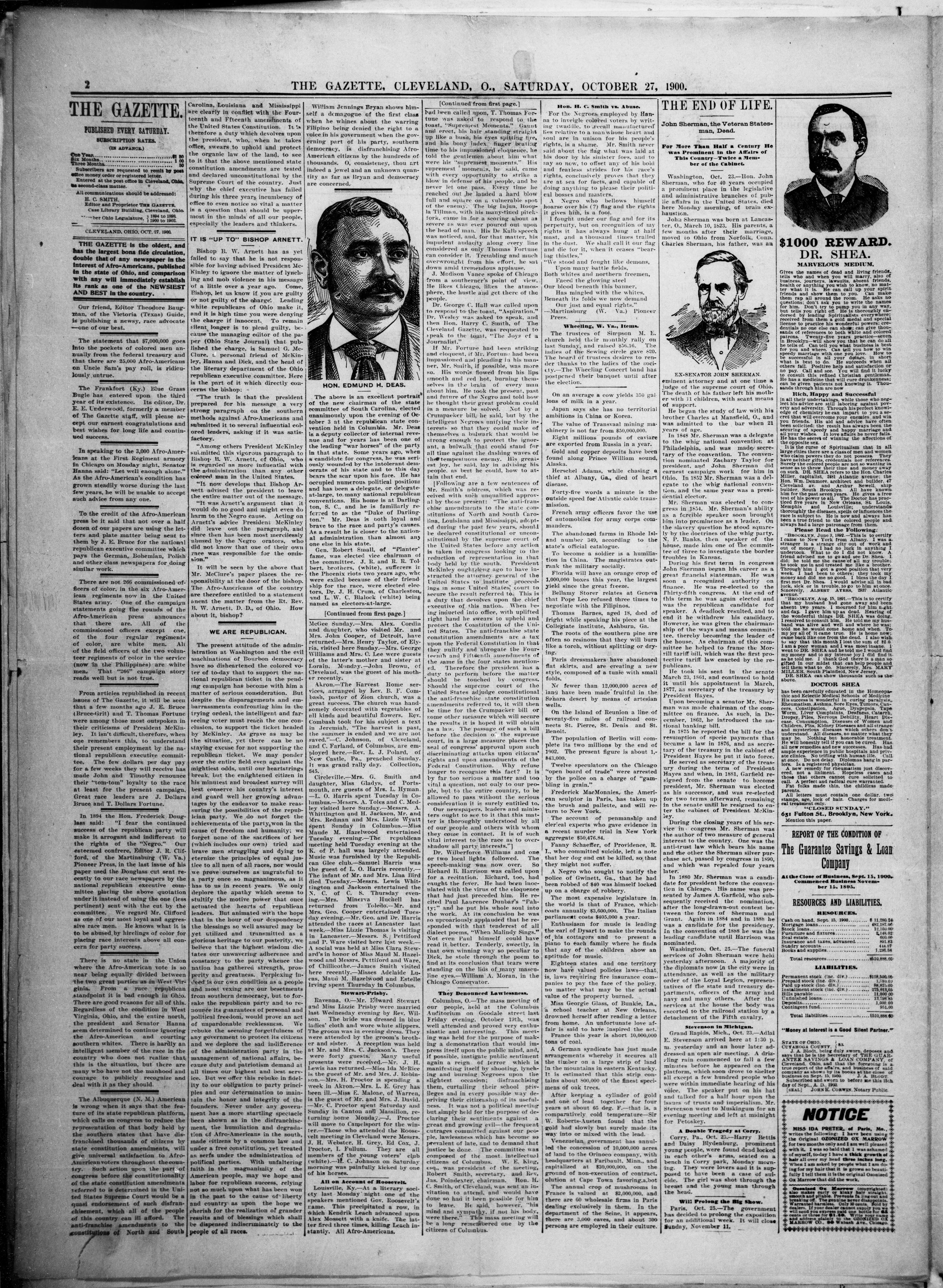
Page text (machine-generated)
2
THE GAZETTE.
(IN ADVANCE.)
One Year. $1 50.
Six Months. 1 00.
Three Months. 50.
Subscribers are requested to remit by post
office money order or registered letter.
Entered at the post office in Cleveland, Ohio,
the second-class matter.
All communications should be addressed:
H. C. SMITH.
Editor and Proprietor THE GAZETTE.
Case Library Building, Cleveland, Ohio
Number Ohio Legislature, } 1894 to 1898.
} 1900 to 1902.
CLEVELAND, OHIO, OCT. 27. 1900.
THE GAZETTE is the oldest, and has the largest bona fide circulation, double that of any newspaper in the interest of Afro-Americans, published in the state of Ohio, and comparison with any will immediately establish its rank as one of the NEWSIEST AND BEST in the country.
Our friend, Editor Theodore Baugman, of the Victoria (Texas) Guide, is publishing a newsy, race advocate—one of our best.
The statement that $7,000,000 goes into the pockets of colored men annually from the federal treasury and that there are 25,000 Afro-Americans on Uncle Sam's pay roll, is ridiculously untrue.
The Frankfort (Ky.) Blue Grass Bugle has entered upon the third year of its existence. Its editor, Dr. E. E. Underwood, formerly a member of The Gazette staff, will please accept our earnest congratulations and best wishes for long life and continued success.
In speaking to the 3,000 Afro-Americans at the First Regiment armory in Chicago on Monday night, Senator Hanna said: "Let well enough alone." As the Afro-American's condition has grown steadily worse during the last few years, he will be unable to accept such advice from any one.
To the credit of the Afro-American press be it said that not over a half dozen of our papers are using the letters and plate matter being sent to them by J. E. Bruce for the national republican executive committee which pays the German, Bohemian, Polish and other class newspapers for doing similar work.
There are not 266 commissioned officers of color, in the six Afro-American regiments now in the United States army. One of the campaign statements going the rounds of the Afro-American press announces that there are. All of the commissioned officers except one, of the four regular regiments of color, are white men. All of the field officers of the two volunteer regiments of color in the service (now in the Philippines) are white men. That "266" campaign story reads well but is not true.
From articles republished in recent issues of The Gazette, it will be seen that a few months ago J. E. Bruce (Bruce-Grit) and T. Thomas Fortune were among those most outspoken in their criticisms of President McKinley. It isn't difficult, therefore, when one remembers this, to understand their present employment by the national republican executive committee. The few dollars per day pay for a few weeks they will receive has made John and Timothy renounce their "tom-tom" loyalty to the race at least for the present campaign. Great race leaders are J. Dollars Bruce and T. Dollars Fortune.
In 1894 the Hon. Frederick Douglass said: "I fear the continued success of the republican party will make it arrogant and indifferent to the rights of the "Negro." Our esteemed confere, Editor J. R. Clifford, of the Martinsburg (W. Va.) Pioneer Press, in the last issue of his paper used the Douglass cut sent recently to our race newspapers by the national republican executive committee placing the above quotation under it instead of using the one (less pertinent) sent with the cut by the committee. We regard Mr. Clifford as one of our most loyal and aggressive race men. He knows what it is to be abused, by hirelings of color for placing race interests above all concern for party success.
There is no state in the Union where the Afro-American vote is so near being equally divided between the two great parties as in West Virginia. From a race republican standpoint it is bad enough in Ohio. There are good reasons for all of this. Regardless of the condition in West Virginia, Ohio, and the entire north, the president and Senator Hanna seem determined to continue ignoring the Afro-American and courting southern whites. There is hardly an intelligent member of the race in the country who does not realize that this is the situation, but there are many who have not the manhood and courage to publicly recognize and deal with it as they should.
The Albuquerque (N. M.) American is wrong when it says that the feature of its state republican platform, which calls on congress to reduce the representation of that body held by the southern states that have disfranchised thousands of citizens by state constitution amendments, will give universal satisfaction to Afro-American voters throughout the country. Such action upon the part of congress before the constitutionality of the state constitution amendments referred to is determined in the United States Supreme Court would be a quasi endorsement of such disfranchisement, which all of the people of this country can ill afford. The anti-franchise amendments to the constitutions of North and South
Carolina, Louisiana and Mississippi are clearly in conflict with the Fourteenth and Ffteenth amendments of the United States Constitution. It is therefore a duty which devolves upon the president, who, when he takes office, swears to uphold and protect the organic law of the land, to see to it that the above mentioned state constitution amendments are tested and declared unconstitutional by the Supreme Court of the country. Just why the chief executive has failed during his three years incumbency of office to even notice so vital a matter is a question that should be uppermost in the minds of all our people, especially the leaders and thinkers.
IT IS "UP TO" BISHOP ARNETT.
Bishop B. W. Arnett has as yet failed to say that he is not responsible for having advised President McKinley to ignore the matter of lynching and mob violence in his message of a little over a year ago. Come, Bishop, let us know if you are guilty or not guilty of the charge. Leading white republicans of Ohio make it, and it is high time you were denying the charge if innocent. To remain silent longer is to plead guilty, because the managing editor of the paper (Ohio State Journal) that published the charge, is Samuel G. McClure. a personal friend of McKinley, Hanna and Dick, and the head of the literary department of the Ohio republican executive committee. Here is the part of it which directly concerns the bishop:
"The truth is that the president prepared for his message a very strong paragraph on the southern methods against Afro-Americans and submitted it to several influential colored leaders, asking if it was satisfactory.
"Among others President McKinley submitted this vigorous paragraph to Bishop B. W. Arnett, of Ohio, who is regarded as more influential with the administration than any other colored man in the United States.
"It now develops that Bishop Arnett advised the president to leave the entire matter out of the message. "It was Arnett's argument that it would do no good and might even do harm to the Negro cause. Acting on Arnett's advice President McKinley did leave out the paragraph, and since then has been most mercilessly abused by the Negro orators, who did not know that one of their own race was responsible for the omission."
It will be seen by the above that Mr. McClure's paper places the responsibility at the door of the bishop. The Afro-Americans of the country are therefore entitled to a statement anent the matter from the Rt. Rev. B. W. Arnett, D. D., of Ohio. How about it, bishop?
WE ARE REPUBLICAN.
The present attitude of the administration at Washington and the evil machinations of Bourbon democracy have so disheartened the colored voter of to-day that to support the national republican ticket in the pending campaign has become with him a matter of serious consideration. But despite the disparagements and embarrassments confronting him in the trying ordain, the intelligent and farseeing voter must reach the one conclusion, to support the ticket headed by McKinley. As grave as may be the situation, yet there can be no staying excuse for not supporting the republican ticket. We may ponder over the entire field even against the mightiest odds, until our heartstrings break, but the enlightened citizen in his minutest and broadest survey will best conserve his country's interest and guard well her growing advantages by the endeavor to make reassuring the possibilities of the republican party. We do not forget the achievements of the party, won in the cause of freedom and humanity; we forget none of the sacrifices of her (which includes our own) tried and brave men struggling and dying to eternize the principles of equal justice to all men of all races, nor would we prove ourselves as ungrateful to a party once so magnanimous, as it has to us in recent years. We only deplore the apathy which seems to stultify the motive power that once actuated the hearts of republican leaders. But animated with the hope that in the hour of our despondency the blessings so well assured may be yet utilized and transmitted as a glorious heritage to our posterity, we believe that the highest wisdom dictates our unwavering adherence and constancy to the party whence the nation has gathered strength, prosperity and greatness. Perplexing indeed is our own condition as a people and most vexing are our besetments from southern democracy, but to forsake the republican party and to renounce its guarantees of personal and political freedom, would prove an act of unpardonable recklessness. We rebuke the seeming forgetfulness of any government to protect its citizens and we deplore the sad indifference of the administration party in the management of national affairs, because duty and patriotism demand at all times our highest and best service. But we offer this rebuke in fidelity to our obligation to party principles and our determination to maintain the honor and integrity of the founders. Never under any government has a more startling spectacle been shown as in the disfranchisement, the humiliation and degradation of Afro-Americans in the south, made citizens by a common law and under a free constitution, yet treated as serfs under the administration of political parties. With unfaltering faith in the magnanimity of the American people, may we hope and labor for republican success, relying not so much upon what has been won in the past to the cause of liberty and country as upon the hope we cherish for the realization of grander results and of blessings which shall be dispensed indiscriminately to the people of all races.
THE GAZETTE, CLEVELAND, O., SATURDAY, OCTOBER 27, 1900.
William Jennings Bryan shows himself a demagogue of the first class when he whines about the warring Filipino being denied the right to a voice in his government when the governing part of his party, southern democracy, is disfranchising Afro-American citizens by the hundreds of thousands. O, consistency, thou art indeed a jewel and an unknown quantity as far as lryan and democracy are concerned.
M.
HON. EDMUND H. DEAS.
The above is an excellent portrait of the new chairman of the state committee of South Carolina, elected unanimously upon the evening of October 3 at the republican state convention held in Columbia. Mr. Deas is a deputy collector of internal revenue and for years has been one of the leading "war horses" of the party in that state. Some years ago, when a candidate for congress, he was seriously wounded by the intolerant democrats of his state and to this day bears the scar upon his face. He has occupied numerous political positions and has been a delegate, or delegate-at-large, to many national republican conventions. His home is at Darlington, S. C., and he is familiarly referred to as the "Duke of Darlington." Mr. Deas is both loyal and brave to the race and party's causes. As a result he is closer to the national administration than almost any one else in his state.
Gen. Robert Small, of "Planter" fame, was elected vice chairman of the committee. J. R. and R. R. Tolbert, brothers, (white), sufferers in the Phoenix riots two years ago, who were exiled because of their friendship for the race, were elected electors, Dr. J. H. Crum, of Charleston, and L. W. C. Blalock (white) being named as electors-at-large.
[Continued from first page.]
McGee Sunday.—Mrs. Alex. Cordin and daughter, who visited Mr. and Mrs. John Cooper, of Detroit, have returned.—Mrs. Henry Taylor, of Elyria, visited here Sunday.—Mrs. George Williams and Mrs. C. Lee were guests of the latter's mother and sister at Lorain. Monday.—John Brown, of Cleveland, was the guest of his mother recently.
Akron.—The Harvest Home services, arranged by Kev. B. F. Combash, pastor of Zion church, was a great success. The church was handsomely decorated with vegetables of all kinds and beautiful flowers. Rev. Combash took for his subject a text in Jeremiah, "The harvest is past, the summer is ended and we are not saved."—C. Johnson, of Cleveland, and C. Farland, of Columbus, are employed here.—Rev. L. J. Polard, of New Castle, Pa., preached Sunday. It was grand rally day. Collection, $45.
Circleville.—Mrs. G. Smith and daughter, Miss Gladys, of Portsmouth, are guests of Mrs. L. Hyman.—L. O. Harris spent Tuesday in Columbus.—Messrs. A. Toles and C. Medley visited here Sunday.—Messrs. A. Whittington and H. Jackson, Mr. and Mrs. Redman and Mrs. Lizzie Wyatt spent Sunday in Columbus.—Miss Maude M. Hazelwood entertained Tuesday evening.—The republican meeting held Tuesday evening at the K. of P. hall was largely attended. Music was furnished by the Republican Glee club.—Samuel Harris was the guest of L. O. Harris recently.—The infant of Mr. and Mrs. Lina Bird died Tuesday.—Messrs. Lewis Whittington and Jackson entertained the N. C. of C. S. Thursday evening.—Mrs. Minerva Huchell has returned from Toledo.—Mr. and Mrs. Geo. Cooper entertained Tuesday evening.—Mr. Geo. and Dr. Harris attended the races at Lancaster last week.—Miss Lizzie Thomas is visiting in Lancaster.—Messrs. S. Pettiford and P. Ware visited here last week.—A social was held at Miss Clara Steward's in honor of Miss Maud M. Hazelwood and Messrs. Pettiford and Ware, of Chillicothe.—James Smith visited here recently.—Misses Adelaide Lucas, Maud M. Hazelwood and Estelle Irving spent Thursday in Columbus.
Stewart-Prisby.
Ravenna, O.—Mr. Edward Stewart and Miss Lizzie Prisby were married last Wednesday evening by Rev. Wilson. The bride was dressed in blue ladies' cloth and wore white slippers. The groom was in evening dress. They were attended by the groom's brother and sister. A reception was held at Mr. and Mrs. C. Jackson's. There were forty guests. Many useful presents were received.—Mr. J. H. Lewis has returned.—Miss Ida McRice is the guest of Mr. and Mrs. J. Robinson.—Mrs. H. Proctor is spending a week in Akron.—Mrs. L. E. Grey has been ill.—Miss E. Malone, of Warren, is the guest of Mr. and Mrs. J. David.—Mr. C. Proctor spent Saturday and Sunday in Canton and Massillon, returning home Monday.—J. Proctor will move to Camelsport for the winter.—Those who attended the Roosevelt meeting in Cleveland were Messrs. J. H. Webster. H. Grey, Ed Cox, J. Proctor, I. Fullum. They are all members of the young voters' club (white).—H. C. Johnson on Saturday morning was painfully kicked by one of his horses.
All on Account of Receivals
Louisville, Ky.-At a literary society last Monday night one of the speakers mentioned Gov. Roosevelt's name. This precipitated a row, in which Kendrik Leach advanced upon Alex Mossett with a knife. The latter fired three times, killing Leach instantly. All Afro-Americans.
bad been called upon, T. Thomas Fortune was asked to respond to the toast, "Supremest Moments." Gaunt and erect, his hair standing straight up like a bush, his eyes spitting fire, and his bony index, finger beating time to his impassioned eloquence, he told the gentlemen about him what were his "supremest moments." His supremest moments, he said, came with every opportunity to strike a blow in defense of his people, and he never let one pass. Every time he reached out he landed a hard blow full and square on a vulnerable spot of the enemy. The big Injun, Hoopla Tillman, with his many-tined pitchfork, came in for a scoring about as severe as was ever poured out upon the head of man. His De Kalb speech was noticed, and, for that matter, his impudent audacity along every line considered as only Thomas Fortune can consider it. Tremling and much overwrought from his effort, he sat down amid tremendous applause.
J. Madison Vance spoke of Chicago from a southerner's point of view. He likes Chicago, likes the atmosphere, the hustle and get there of the people. Dr. George C. Hall was called upon to respond to the toast, "Aspiration." Dr. Wesley was asked to speak, and then Hon. Harry C. Smith, of The Cleveland Gazette, was requested to speak to the toast, "The Joys of a Journalist."
If Mr. Fortune had been striking and eloquent, if Mr. Fortune had been impassioned and pleading in his manner, Mr. Smith, if possible, was more so. His words flowed from his lips smooth and red hot, burning themselves in the brain of every man about him. He took the present, past and future of the Negro and told how he thought their great problem could in a measure be solved. Not by a Crumpaeker bill, he said, but by the intelligent Negroes unifying their interests so that they could make of themselves a bulwark that would be strong enough to protect the ignorant, a bulwalk that could stand for all time against the dashing waves of the tempestuous enemy. His greatest joy, he said, lay in advising his people, as best he could, how to attain that end.
[Following are a few sentences of Mr. Smith's address, which was received with such unqualified approval by those present: "The anti-franchise amendments to the state constitutions of North and South Carolina, Louisiana and Mississippi, adopted during the past few years, should be declared constitutional or unconstitutional by the supreme court of the United States before any action is taken in congress looking to the reduction of representation in that body held by the south. President McKinley ought long ago to have instructed the attorney general of the United States to institute proceedings in some United States court to secure the result referred to. This is a duty that devolves upon the chief executive of this nation. When being inducted into office, with uplifted right hand he swears to uphold and protect the Constitution of the United States. The anti-franchise state constitution amendments are a tax upon the Federal Constitution in that they nullify and abrogate the Fourteenth and Fifteenth amendments of the same in the four states mentioned. Therefore the president has a duty to perform before the matter should be touched by congress. Should the supreme court of the United States adjudge constitutional the anti-franchise state constitution amendments referred to, it will then be time for the Crumpacker bill or some other measure which will secure the results it is hoped it will obtain as a law. The passage of such a bill before the decision of the supreme court, in a large measure places the seal of congress' approval upon such discriminating attacks upon citizens' rights and upon amendments of the Federal Constitution. Why refuse longer to recognize this fact? It is by far too serious a matter and too vital a question, not only to our people, but to the entire country, to be allowed to pass without the serious consideration it is surely entitled to.
Our newspapers, leaders and ministers ought to see to it that this matter is thoroughly understood by all of our people and others with whom they come in contact. It is of such vital interest to the race as to overshadow all party interests."]
Dr. Wilberforce Williams and one or two local lights followed. The speech-making was now over. So Richard B. Harrison was called upon for a recitation. Richard, too, had caught the fever. He had been inoculated with the virus of the eloquence that had just preceded him. He recited Paul Laurence Dunbar's "Pahty;" and he put his whole soul into the work. At its conclusion he was so unprociously applauded that he responded with that tenderest of all dialect poems, "When Malindy Sings." Not even Paul himself could have read it better. Tenderly, sweetly, in that own winning way so peculiar to Dick, he stole through the poem to find at its conclusion that tears were standing on the lids of many masculine eyes.—William A. Moran, in the Chicago Conservator.
They Denounced Lawlessness
Columbus, O.—The mass meeting of our people, held at the Columbus Auditorium on Goodale street last Friday evening. October 19th, was well attended and proved very enthusiastic and interesting. This meeting was held for the purpose of making a demonstration that would impress itself upon the public mind, and, if possible, instigate public sentiment again a reign of terror which is manifesting itself by shooting, lynching and burning Negroes upon the slightest occasion; disfranchising them, curtailing their school privileges and in every possible way depriving their citizenship of its usefulness. It was not a political meeting but simply held for the purpose of declaring their sentiments against a great and growing evil—the frequent outrages committed against our people, lawlessness which has become so prevalent of late, and to demand that justice be done. The committee was composed of the most intellectual citizens of Columbus. W. E. King, esq., was president of the meeting, Robert Smith, secretary, and Rev. Jas. Poindexter, chairman. Hon. H. C. Smith, of Cleveland, was sent an invitation to attend, and would have done so had it been possible for him to leave. He said, however, "his mind and sympathy, if not his body, were there." This mass meeting will be a long remembered one by the citizens of Columbus.
For the Negroes employed by Hanna to inveigle colored voters by writing twaddle, to recall manufactured lies relative to a man whose heart and soul are in unison for his people's rights, is a shame. Mr. Smith never said about the flag what was laid at his door by his sinister foes, and to say so now, to offset any of his bold and fearless strides for his race's rights, conclusively proves that they are at sea for facts, and capable of doing anything to please their political bosses and masters.
A Negro who bellows himself hoarse over his (?) flag and the rights it gives him, is a fool.
I fought under our flag and for its perpetuity, but on recognition of my rights it has always hung at half mast, and a thousand times trailed in the dust. We shall call it our flag and die for it, when it ceases "bearing thistles." "We stood and fought like demons, Upon many battle fields,
Both whites and northern freemen,
Faced the glowing steel
Our blood beneath this banner,
Has mingled with the whites.
Beneath its folds we now demand
Our just and equal rights."
—Martinsburg (W. Va.) Pioneer
Press.
Wheeling, W. Va., Items.
The trustees of Simpson M. E. church held their monthly rally on last Sunday, and raised $56.16. The ladies of the Sewing circle gave $20. The board of trustees desires to render thanks to the ladies of the society.—The Wheeling Concert band has postpened their banquet until after the election.
On an average a cow yields 350 gallons of milk in a year.
Japan says she has no territorial ambitions in China or Korea.
The value of Transvaal mining machinery is not far from $50,000,000.
Eight millions pounds of caviare are exported from Russia in a year.
Gold and copper deposits have been found along Prince William sound, Alaska.
Herschel Adams, while chasing a thief at Albany, Ga., died of heart disease.
Forty-five words a minute is the outside speed for Atlantic cable transmission.
French army officers favor the use of automobiles for army corps commanders.
The abandoned farms in Rhode Island number 349, according to the state's official catalogue.
To become a soldier is a humiliation in China. The magistrates outrank the military socially.
Florida will have an orange crop of 1,000,000 boxes this year, the largest yield since the great freeze.
Bellamy Storer relates at Geneva that Pope Leo refused three times to negotiate with the Filipinos.
Thomas Barnes, aged 18, died of fright while speaking his piece at the Collegiate institute, Ashburn, Ga.
The roots of the southern pine are often so resinous that they will burn like a torch, without splitting or drying.
Paris dressmakers have abandoned flat skirts, and are creating a new style, composed of a tunic with small folds.
No fewer than 12,000,000 acres of iana have been made fruitful in the Sahara desert by means of artesian wells.
On the Island of Reunion a line of seventy-five miles of railroad connects St. Pierre, St. Denis and St. Benoit.
The population of Berlin will complete its two millions by the end of 1902. The present figure is about 1,843,000.
Twelve speculators on the Chicago "open board of trade" were arrested by the police on a charge of "gambling in grain."
Frederick MacMonnies, the American sculptor in Paris, has taken up the brush and pallette, and will return to New York.
The account of penmanship and clerical experts who gave evidence in a recent murder trial in New York aggregate $50,476.84.
Fanny Schaeffer, of Providence, R. I., who committed suicide, left a note that her dog and cat be killed, so that they might not suffer.
A Negro who sought to notify the police of Gwinett, Ga., that he had been robbed of $40 was himself locked up on a charge of robbery.
The most expensive legislature in the world is that of France, which costs annually $3,600,000. The Italian parliament costs $405,000 a year.
Enthusiasm for music is leading the earl of Dysart to make the rounds of his cottagers and to present a piano to each family where he finds that any of the children show an aptitude for music.
Eighteen states and one territory now have valued policies laws—that is, laws requiring fire insurance companies to pay the face of the policy, no matter what may be the actual value of the property burned.
Miss Georgie Glass, of Bunkie, La., a school teacher at New Orleans, drowned herself after reading a letter from home. An unfortunate love affair is said to have inspired the act.
France this year is short 10,000,000 tons of coal.
A German syndicate has just made arrangements whereby it secures all the timber on a large strip of land in the mountains in eastern Kentucky. It is estimated that this strip contains about 800,000 of the finest specimens of oak trees. After keeping a cylinder of gold and one of lead together for four years at about 65 deg. F.—that is, a comparatively cold temperature—Sir W. Roberts-Austen found that the gold had slowly but surely made its way into or mixed with the lead.
Venezuelan government has annulled the concession of 10,000,000 acres of land to the Orinoco company, with headquarters at Faribault, Minn., and capitalized at $30,000,000, on the ground of non-execution of contract, olution at Cape Town favoring,a.bot The annual crop of mushrooms in France is valued at $2,000,000, and there are 60 wholesale firms in Paris dealing exclusively in them. In the department of the Seine, it appears, there are 3,000 caves, and about 300 persons are employed in their culture.
THE END OF LIFE.
THE END OF LIFE.
John Sherman, the Veteran Statesman, Dead.
For More Than Half a Century He was Prominent in the Affairs of This Country—Twice a Member of the Cabinet.
Washington, Oct. 23.—Hon. John Sherman, who for 40 years occupied a prominent place in the legislative and administrative branches of public affairs in the United States, died here Monday morning, of brain exhaustion.
John Sherman was born at Lancaster, O., March 10, 1823. His parents, a few months after their marriage, moved to Ohio from Norfolk, Conn. Charles Sherman, his father, was an
EX-SENATOR JOHN SHERMAN.
eminent attorney and at one time a judge of the supreme court of Ohio. The death of his father left his mother with 11 children, with scant means of support. He began the study of law with his brother Charles at Mansfield, O., and was admitted to the bar when 21 years of age. In 1848 Mr. Sherman was a delegate to the whig national convention at Philadelphia, and was made secretary of the convention. The convention nominated Zachary Taylor for president, and John Sherman did earnest campaign work for him in Ohio. In 1852 Mr. Sherman was a delegate to the whig national convention, and the same year was a presidential elector.
Mr. Sherman was elected to congress in 1854. Mr. Sherman's ability as a forcible speaker soon brought him into prominence as a leader. On the slavery question he stood squarely by the doctrines of the whig party. N. P. Banks, then speaker of the house, made him one of the committee of three to investigate the border troubles in Kansas.
During his first term in congress John Sherman began his career as a great financial statesman. He was soon a recognized authority on finance. He was re-elected to the Thirty-fifth congress. At the end of this term he was again elected and was the republican candidate for speaker. A deadlock resulted, and to end it he withdrew his candidacy. However, he was given the chairmanship of the ways and means committee, thereby becoming the leader of the house. As chairman of this committee he helped to frame the Morrill tariff bill, which was the first protective tariff law enacted by the republicans.
He took his seat in the senate March 23, 1861, and continued to hold it until his appointment in March, 1877, as secretary of the treasury by President Hayes.
Upon becoming a senator Mr. Sherman was made chairman of the committee on finance. As such, in December, 1862, he introduced the national banking bill.
In 1875 he reported the bill for the resumption of specie payments that became a law in 1876, and as secretary of the treasury in the cabinet of President Hayes he put it into force.
He served as secretary of the treasury during the term of President Hayes and when, in 1881, Garfield resigned from the senate to become president, Mr. Sherman was elected as his successor, and was re-elected for two terms afterward, remaining in the senate until he resigned to enter the cabinet of President McKinley.
During the closing years of his service in congress Mr. Sherman was the author of two measure of general interest to the country. One was the anti-trust law which bears his name and the other the Sherman silver purchase act, passed by congress in 1890, and which was repealed four years later.
In 1880 Mr. Sherman was a candidate for president before the convention in Chicago. His name was presented by James A. Garfield, who subsequently received the nomination, after the long-drawn-out contest between the forces of Sherman and Grant. Again in 1884 and in 1888 he was a candidate for the presidency. In the convention of 1888 he was the leading candidate until Harrison was nominated.
Washington, Oct. 25.—The funeral services of John Sherman were held yesterday afternoon. A majority of the diplomats now in the city were in attendance, as well as the military order of the Loyal Legion, representatives of the state and treasury departments, officers of the army and navy and many others. After the services at the house the body was escorted to the railroad station by a detachment of the Fifth cavalry.
Stevenson in Michigan.
Grand Rapids, Mich., Oct. 23.—Adlai E. Stevenson arrived here at 1:30 p.m. yesterday and an hour later addressed an open air meeting. A drizzling rain commenced to fall a few minutes before he appeared on the platform, which soon drove to shelter all except a few hundred people who were within immediate hearing of his voice. The speaker put on his hat and talked for a half hour upon the issues of trusts and imperialism. Mr. Stevenson went to Muskingum for an evening meeting and left at midnight for Petoskey.
A Double Tragedy at Corr
Corry, Pa., Oct. 23.—Harry Bettis and Daisy Blydenburg, prominent young people, were found dead locked in each other's arms, seated on a bench in Corry park, Monday morning. They were lovers and it is supposed to have been a case of suicide. The girl was shot through the breast and the young man through the head.
Will Prelang the Big Show
Paris, Oct. 25.—The government has decided to prolong the exposition for an additional week. It will close Sunday, November 11.
M.
$1000 REWARD. DR. SHEA.
MARVELOUS MEDIUM.
Gives the names of dead and living friends, tells who and when you will marry, also of business, journeys, lawsuits, absent friends, health or anything you wish to know, no matter what it is. He can call up your spirit friends and show them to you. Can make them rap all around the room. He asks no questions; don't ask you to write the most on your mind, but you can in any way, but tells you right off. He is thoroughly endorsed by leading Spiritualists everywhere; received from them a gold medal and special license to practice his wonderful powers; credentials no one else can show; can give thousands of references to both white and colored patrons. Twenty-five years practice—seven in Brooklyn—will show you that he can do all he tells of. Can tell you what business is best for you and where. Can tell you how to win speedy marriage with one you love. How to be successful in all your duties. What is best to do. He succeeds when all others fail. Positive help and satisfaction or no pay. Call and see. You will find it lucky to consult this refined Christian gentleman. He has a medicine that will cure drunkenness; can be given patients not knowing it. Thousands through him are now
Rich, Happy and Successful in all their undertakings, while those who neglect his advice are still laboring against poverty and adversity. Through his perfect knowledge of chemistry he can impart to you a secret that will overcome your enemies and win you friends. His aid and advice have often been solicited; the result has always been the securing of speedy and happy marriage and all your wishes. In love affairs he never fails. He has the secret of winning the affections of the opposite sex.
It is the curse of Spiritualism that in all large cities there are a class of men and women who claim powers they do not possess. They have neither gifts, credentials nor references. Surely the colored people are not so wanting in sense as to throw their time and money away on such. DR. SHEA refers to the Hon. Charles Miller, capitalist, 2481 Atlantic avenue; the Hon. William Demomarch architect and builder, 47 Cleveland av. and 380 Sowell, ship builder, South Brooklyn. All have known him for the past seven years. He gives a free test of his power to all. The Doctor has practiced five years in New Orleans, St Louis, Memphis and Louisville; understands thoroughly the diseases, spells or influences the race is subject to. He is now and always has been a true friend to the colored people and always had a large patronage from them.
Please Read the Following:
"BROOKLYN, June 3, 1892.—This is to certify I came to New York from Albany. I was a stranger in a strange city out of work and out of money. I had no luck in anything I did. I was a stranger in a strange city out of work and friend advised me to go and see Dr. Shea. I did; he told me the cause of all my trouble: he took me in and treated me like a brother. Through him I got a good position that very week. I had been to others; they took my money and did me no good. I bless the day I first met Dr. Shea. I would advise all in bad health in trouble, to go to him advance. Sincerely, ALBERT AYERS, 2857 Atlantic avenue."
"BROOKLYN, Aug. 15, 1891.--This is to certify that my husband had gone away and been absent two years. I mourned for him night and day. I gave him up as dead. Hearing of the wonderful things DR. SHEA was doing, I resolved to consult him. He told me my husband was alive and well and where he was; told me he would come home and when. To my joy all of it came true. He is home now; came back like one from the dead. I also wish to say that this month I lost the sum of $2.00. I went to DR. SHEA and he told me I would find my money and to my intense joy I did find it as he told me. I thank God there is a man gifted in our midst that can help people and tell them what to do. Sincerely, MARY MILLER. South Plainfield, New Jersey. DR. SHEA can show thousands such as the
DOCTOR SHEA
has been carefully educated in the Homeopathic and Eclectic Medical Schools of Medicine His success is wonderful in curing paralysis, Rheumatism, Asthma, Sore Eyes, Tumors, Cancers, Constipation, Ague, Dyspepsia, Tape Worm, Liver Complaints, Deafness, Catarr, Dropsy, Piles, Nervous Debility, Card Disease, Piles, Digestive Disease, Women and Children, Fits, Kidney Diseases and all strange and mysterious diseases which others don't understand. All diseases, no matter what they may be. Nothing but honorable treatment. He will honestly tell if you can be cured. Has all new remedies and new successes. Has had ample experience in public hospitals and private clinics. No trivial with human life. Call at once. No notation. Diplomans hang in parlor. Is a registered physician.
A new remedy for rheumatism just discovered, not a liniment. Hopeless cases and those that others cannot cure solicited to call. A perfect and radical cure warranted.
Fat folks made thin, the childless made parents.
All letters must contain one dollar, two stamps, age, lock of hair. Charges for medical treatment only.
"CLOSED SUNDAY."
651 Fulton St., Brooklyn, New York.
Mention this paper.
REPORT OF THE CONDITION OF The Guarantee Savings & Loan Company
At the Close of Business, Sept. 15, 1900. Commenced Business November 15, 1895.
RESOURCES AND LIABILITIES.
Cash on hand, Sept. 15, 1900. $ 11,280.24
Mortgage loans. 482,187.96
Stock loans. 12,100.00
Furniture and fixtures. 2,148.02
Real estate. 600.00
Insurance and taxes, advanced. 891.83
Sundry accounts. 444.87
Hooks and supplies. 1,236.58
LIABILITIES.
Permanent stock (inc. div.) ..... $118,500.00
Prepaid stock (inc. div.) ..... 1,750.00
Paid up stock (inc. div.) ..... 88,875.00
Installment stock (inc. div.) ..... 275,013.05
Bills payable ..... 11,000.00
Unfinished loans ..... 13,788.85
Deposits ..... 1,000.00
Contingent fund ..... 951.00
STATE OF OHIO.
CUYAHOGA COUNTY.
J. A. Blodt, being duly sworn, deposes and says that he is the Secretary of THE GUAR-ANTEE SAVINGS & LOAN COMPANY of Cleveland, Ohio, and that the foregoing is a true report of the affairs, and business of said company as shown by its books at the close of business on Sept. 13, 1900.
J. A. BLODT.
Subscribed and sworn to before me this 15th day of Sept. A. D., 1900.
[SEAL] JOHN K. CORWIN. Notary Public.
MISS IDA PRETER, of Paris, Mo.,
writes the following: I have been using
the Original OZONIZED OX MARROW
for two months only and I am well pleased
with it. I was so bald that I was ashamed
of myself, to-day I have a thick growth of
hair all over my head three inches long.
When I am asked by people what I am do-
ing for my hair that it is grown so beauti-
fully I tell them it is the original Ozonized
Ox Marrow that did the work.
Organized OX Marrow (copyrighted)
also makes curly or silky hair
smooth and pliable. Prevents flaing out and
breaking off. The genuine never disappoints.
Warranted harmless. Only 10 cents. Sold by
dealers. If your dealer cannot supply you we
will send you express paid one bottle for $5
and address pliably to the OZONIZED OX
MARROW CO. $O Wabash Ave. Chicago.