The Gazette
Saturday, December 19, 1903
Cleveland, Ohio
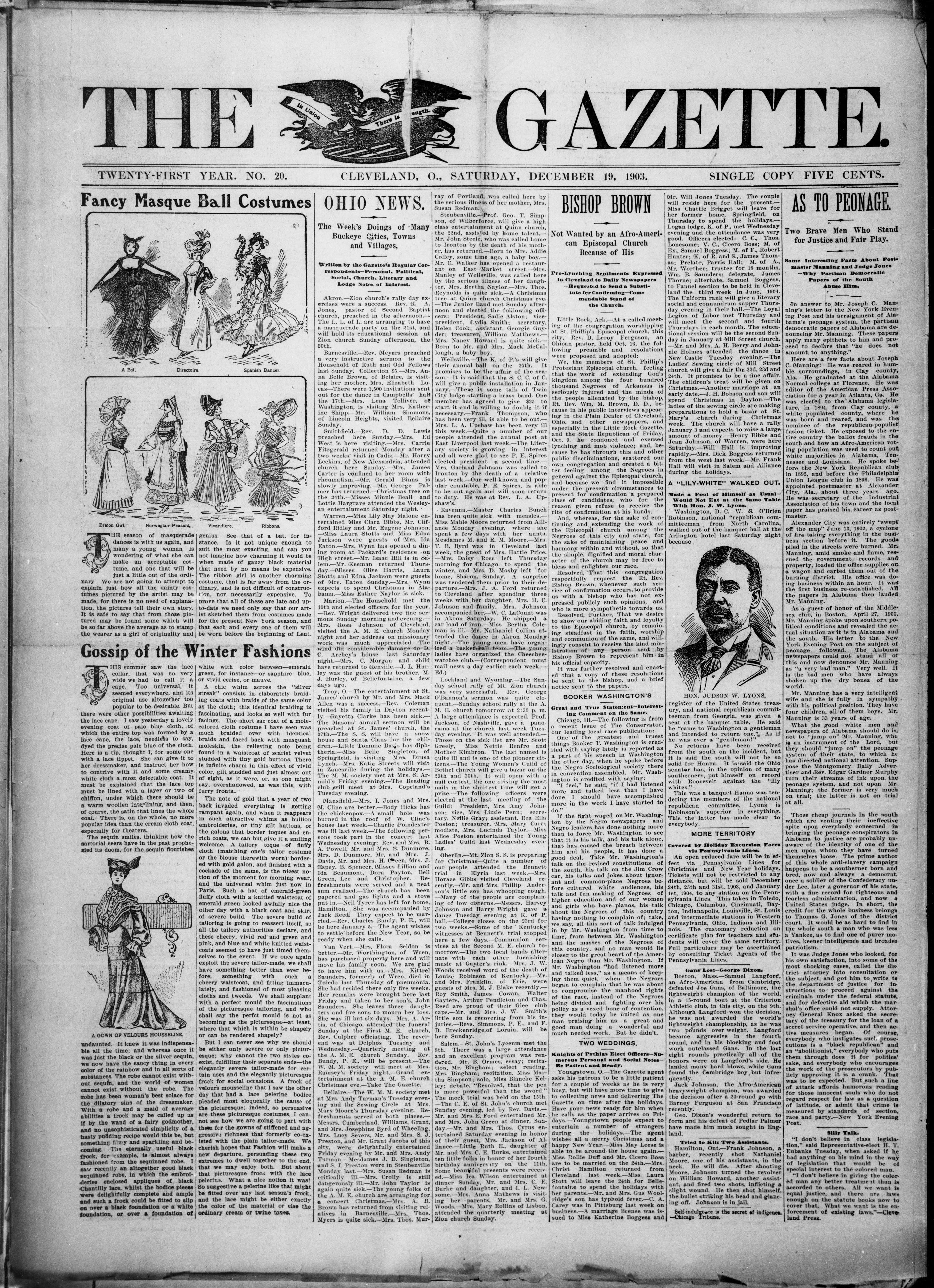
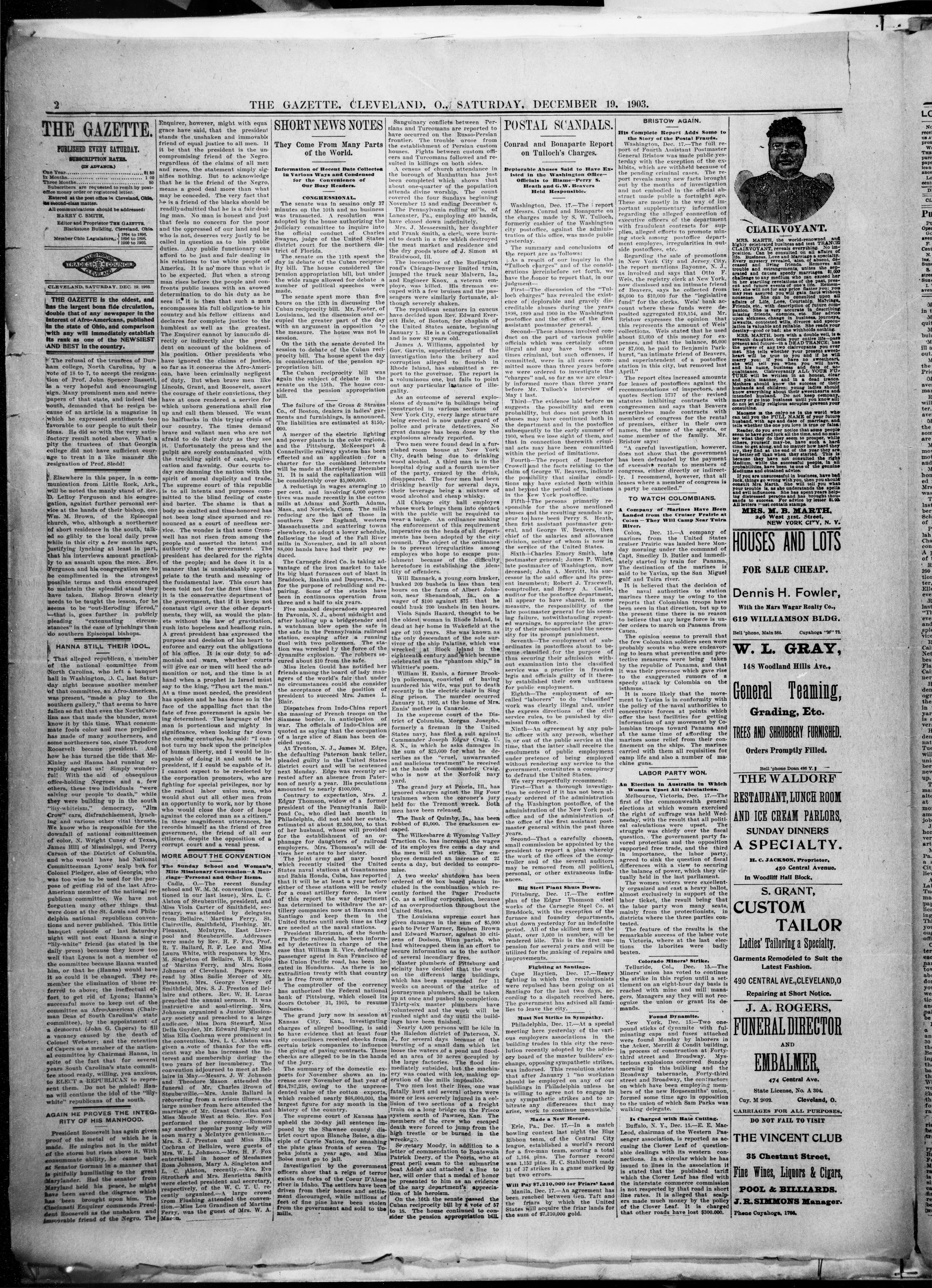
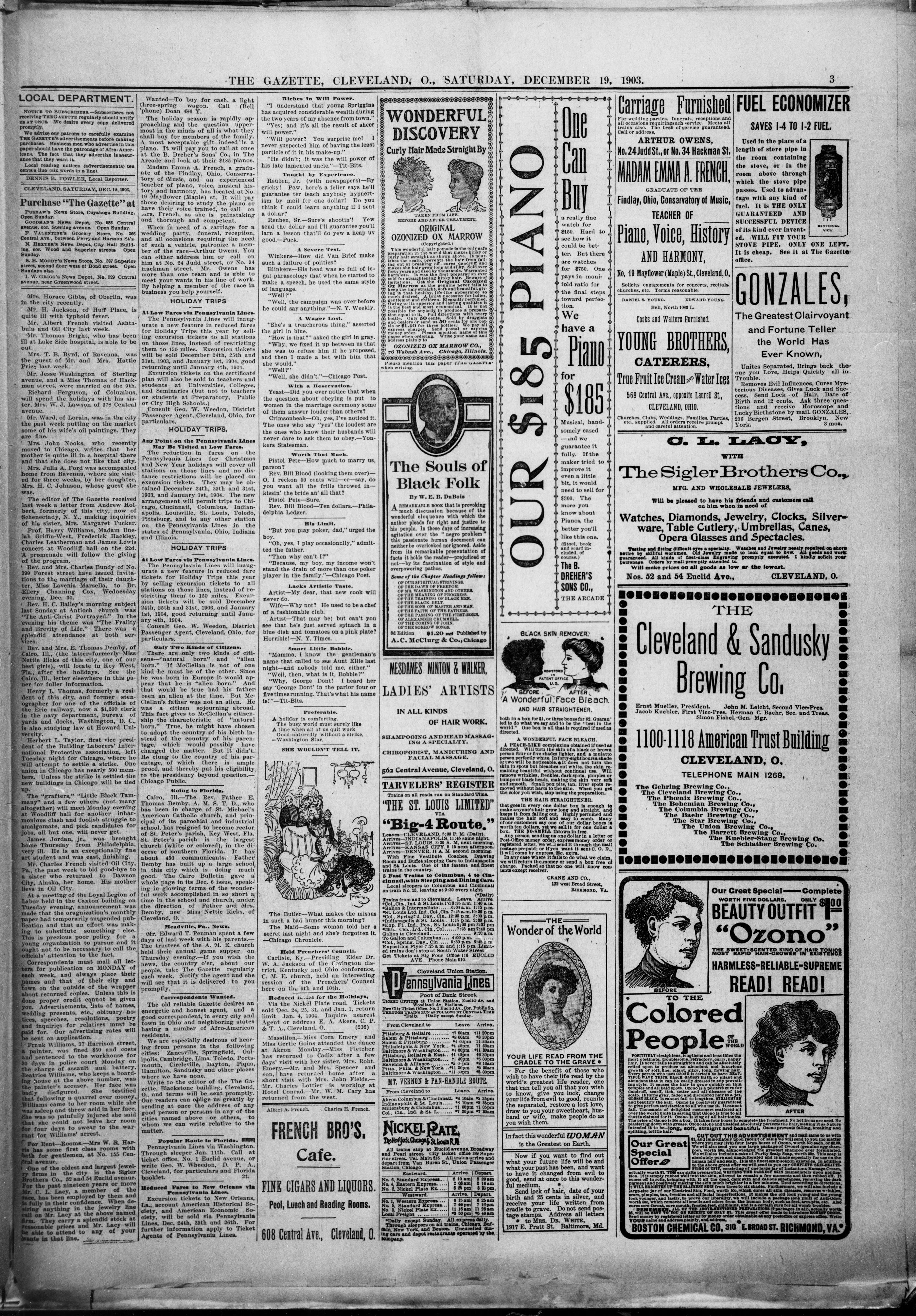
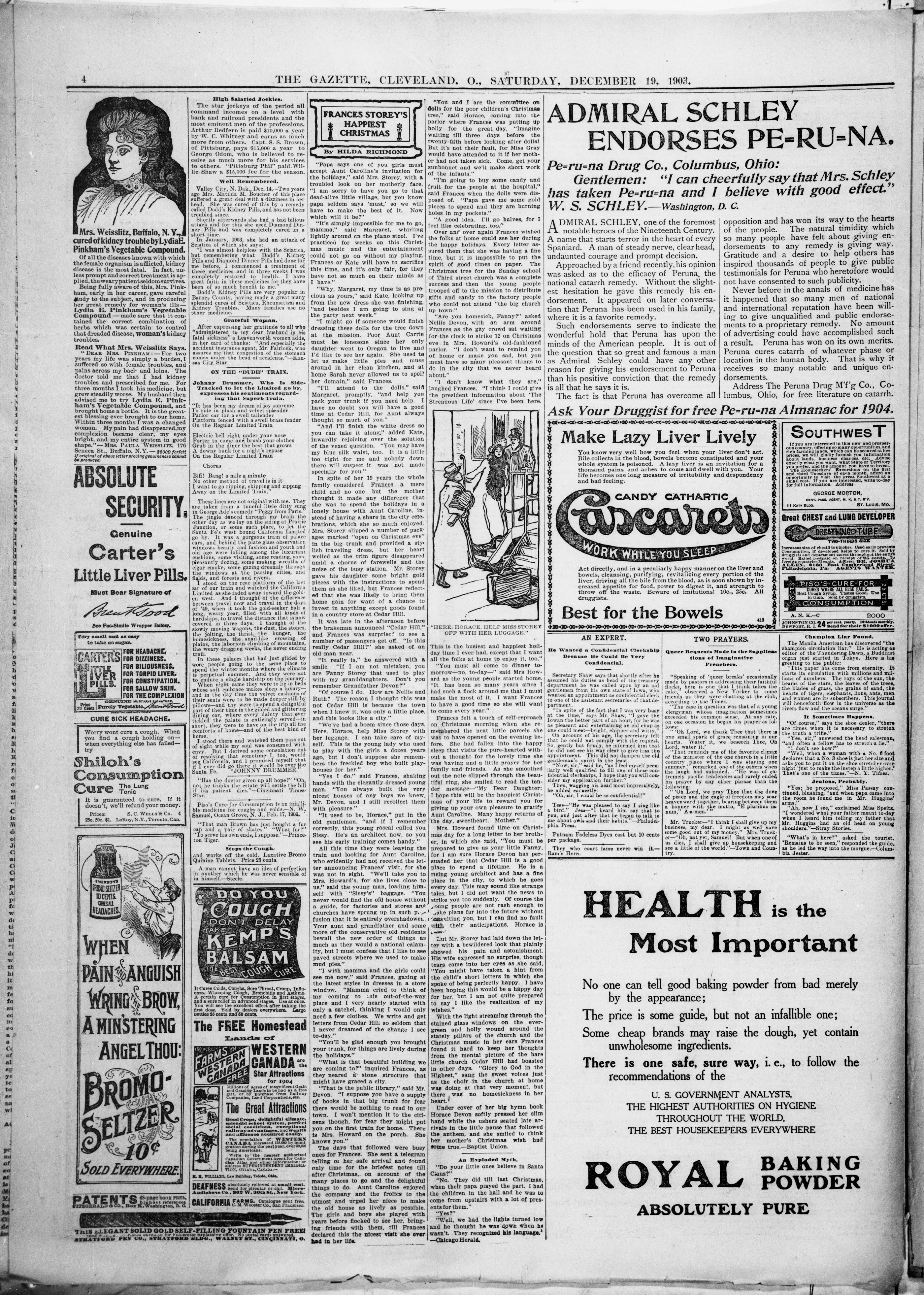
Page text (machine-generated)
One Year ..... 81 50
Ix Months ..... 1 00
Three Months ..... 50
Subscribers are requested to remit by post-
office money order or registered letter.
Entered at the post office in Cleveland, Ohio
Entered at the post office in Cleveland, Ohio, the second-class matter.
All communications should be addressed:
HARRY C. SMITH.
Editor and Proprietor THE GAZETTE.
Blackstone Building, Cleveland, Ohio
Member Ohio Legislature.
1894 to 1896.
1896 to 1898.
1900 to 1902.
ALLIED PRINTING
TRADE'S COUNCIL
CLEVELAND
THE GAZETTE is the oldest, and has the largest bona fide circulation, double that of any newspaper in the interest of Afro-Americans, published in the state of Ohio, and comparison with any will immediately establish its rank as one of the NEWSIEST and BEST in the country.
The refusal of the trustees of Durham college, North Carolina, by a vote of 18 to 7, to accept the resignation of Prof. John Spencer Bassett, is a very hopeful and encouraging sign. Many prominent men and newspapers of that state, and indeed the south, demanded that he resign because of an article in a magazine in which he expressed sentiments too favorable to our people to suit their ideas. He did so with the very satisfactory result noted above. What a pity the trustees of that Georgia college did not have sufficient courage to treat in a like manner the resignation of Prof. Sledd!
Elsewhere in this paper, in a communication from Little Rock, Ark., will be noted the manly stand of Rev. D. LeRoy Ferguson and his congregation, against further personal service at the hands of their bishop, one Wm. M. Brown, of the Episcopal church, who, although a northerner of short residence in the south, talked so glibly to the local daily press while in this city a few months ago, justifying lynching at least in part, that his interviews amount practically to an assault upon the race. Rev. Ferguson and his congregation are to be complimented in the strongest possible terms and thus encouraged to maintain the splendid stand they have taken. Bishop Brown clearly needs to be taught the lesson, for he seems to be "out-Heroding Herod," that is, goes further in publicly pleading "extenuating circumstances" in the case of lynchings than do southern Episcopal bishops.
HANNA STILL THEIR IDOL,
That alleged republican, a member of the national committee from North Carolina, who left a banquet hall in Washington, D. C., last Saturday night because another member of that committee, an Afro-American, was present, "made a play to the southern gallery," that seems to have fallen so flat that even the North Carolina ass that made the blunder, must know it by this time. What consummate fools color and race prejudice has made of many southerners, and some northerners too, since Theodore Roosevelt became president. And how he has turned the tide that McKinley and Hanna had running so rapidly against us! Simply wonderful! With the aid of obsequious office-holding Negroes and a, few others, these two individuals "were salving our people to death," while they were building up in the south "lily-whiteism," democracy, "Jim Crow" cars, disfranchisement, lynching and various other vital threats. We know who is responsible for the downfall of national committeemen of color, N. Wright Cuney of Texas, James Hill of Mississippi, and Perry Carson of the District of Columbia, and who would have had National Committeemen Lyons' scalp but for Conlon Pledger, also of Georgia, who was too wise to be used for the purpose of getting rid of the last Afro-American member of the national republican committee. We have not forgotten many other things that were done at the St. Louis and Philadelphia national republican conventions and never published. This little banquet episode of last Saturday night will not cost Hanna a single "lily-white" friend (as stated in the daily press) because they know too well that Lyons is not a member of the committee because Hanna wanted him, or that he (Hanna) would have it so could it be changed. They remember the elimination of those referred to above; the ineffectual effort to get rid of Lyons; Hanna's successful move to keep out of the committee an Afro-American (Chairman Deas of South Carolina's state committee), by the appointment of a democrat (John G. Capers) to fill a vacancy caused by the death of Colonel Webster; and the retention of Capers as a member of the national committee by Chairman Hanna, in spite of the fact that for several years South Carolina's state committee stood ready, willing, yea anxious, to ELECT a REPUBLICAN to represent them. Do not be misled! Hanna will continue the idol of the "lily-white" republicans of the south.
AGAIN HE PROVES THE INTEGRITY OF HIS MANHOOD.
President Roosevelt has again given proof of the metal of which he is made. He mingles not in the midst of the storm but rises above it. With consummate ability, he came back at Senator Gorman in a manner that is pitifully humiliating to the great Marylander. Had the senator from Maryland held his peace, he might have been saved the disgrace which has been brought upon him. The Cincinnati Enquirer commends President Roosevelt as the unshaken and immovable friend of the Negro. The
THE GAZETTE, CLEVELAND, O., SATURDAY, DECEMBER 19, 1903.
Enquirer, however, might with equa grace have said, that the president stands the unshaken and immovable friend of equal justice to all men. If it be that the president is the uncompromising friend of the Negro, regardless of the claims of all men and races, the statement simply signifies nothing. But to acknowledge that he is the friend of the Negro, means a good deal more than what may be conceded. The very fact that he is a friend of the blacks should be readily admitted that he is a fair dealing man. No man is honest and just that feels no concern for the poor and the oppressed of our land and he who is not, deserves very justly to be called in question as to his public duties. Any public functionary can afford to be just and fair dealing in his relations to the white people of America. It is no more than what is to be expected. But when a strong man rises before the people and confronts public issues with an avowed determination to do his duty as he sees it, it is then that such a man encompasses his full obligation to his country and his fellow citizens and declares for complete justice to the humblest as well as the greatest. The Enquirer cannot by innucendo directly or indirectly slur the president on account of the boldness of his position. Other presidents who have ignored the claims of justice, so far as it concerns the Afro-American, have been criminally negligent of duty. But when brave men like Lincoln, Grant, and Roosevelt, assert the courage of their convictions, they have at once rendered a service for which unborn generations shall rise up and call them blessed. We want no halfbacks in this trying crisis of our country. The times demand brave and valiant men who are not afraid to do their duty as they see it. Unfortunately the press and the pulpit are sorely contaminated with the truckling spirit of cant, equivocation and fawning. Our courts today are damning the nation with the spirit of moral duplicity and trade. The supreme court of this republic is to all intents and purposes committed to the blind feeling of caste and barter. The shame is that a body so exalted and time-honored has not been long since spurned and renounced as a court of needless service. The wonder is that some Cromwell has not risen from among the people and asserted the intent and authority of the government. The president has declared for the rights of the people; and he does it in a manner that is unmistakably appropriate to the truth and meaning of the fundamental law. This court has been told not for the first time that it is the conservative department of the government, that if it keeps not constant vigil over the other departments, they will, as would the planets without the law of gravitation, rush into hopeless and headlong ruin. A great president has expressed the purpose and decision of his heart to enforce and carry out the obligations of his office. It is our duty to admonish and warn, whether will give ear or men will heed the admonition or not, and the time is at hand when a prophet in Israel must say to the king, "Thou art the man." At a time most needed, the president has spoken and he has done so in the face of the appalling fact that the fate of free government is again being determined. The language of the man is portentious and mighty in significance, when looking far down the coming centuries, he said: "I cannot turn my back upon the principles of human liberty, and I would be incapable of doing it and unfit to be president, if I could be capable of it. I cannot expect to be re-elected by the corporation promoters, who are fighting for special privileges, nor by the radical labor union men, who would shut out all other men from an opportunity to work, nor by those who would close the door of hope against the colored man as a citizen." In these magnificent utterances, he records himself as the friend of free government, the friend of all our citizens, despite the opposition of a corrupt court and a venal press.
MORE ABOUT THE CONVENTION
The Sunday School and Woman's Mite Missionary Convention-A Marriage-Personal and Other Items.
Cadiz, O.—The recent Sunday school and W. M. M. convention (mentioned in our last issue), Mrs. L. C. Alston of Steubenville, president, and Miss Viola Carter of Smithfield, secretary, was attended by delegates from Bellaire, Martins Ferry, St. Clairsville, Smithfield, Flushing, Mt. Pleasant, McIntyre, East Liverpool and Steubenville. Addresses were made by Rev. H. F. Fox, Prof. R. T. Ballard, B. F. Lee and Miss Laura White, with responses by Mrs. M. Singleton of Bellaire, W. H. Scipio of Martins Ferry, and Mrs. Rosa Johnson of Cleveland. Papers were read by Miss Sadie Mercer of Mt. Pleasant, Mrs. George Veney of Smithfield, Mrs. S. J. Preston of Bellaire and others. Rev. W. H. Lucas preached the annual sermon. It was instructive and soul-stirring. Mrs. Johnson organized a Junior Missionary society and preached to a large audience. Miss Dora Stewart, Miss Della Guyder, Mr. Edward Bigsby and Miss Ella Cochran were prominent in the convention. Mrs. L. C. Alston was given a vote of thanks for the efficient way she has increased the interest and membership during the two years of her incumbency. The convention adjourned to meet at Bellaire in May.—Messrs. J. W. Johnson and Theodore Mason attended the funeral of Mr. Charles Brown of Steubenville.—Mrs. Annie Ballard is recovering from a serious illness.—A large number from here attended the marriage of Mr. Grant Christian and Miss Maude West at Scio. Rev. Fox performed the ceremony.—Rumors say another popular young lady will soon marry a McIntyre gentleman.—Mrs. S. J. Preston and Miss Ella Cochran of Bellaire, were guests of Mrs. W. L. Johnson.—Mrs. H. F. Fox entertained in honor of Mesdames Ross Johnson, Mary A. Singleton and L. C. Alston, recently.—Mrs. Eva Strothers and Mrs. Henrietta Smith were elected president and secretary, respectively, of the W. C. T. U. recently organized.—A large crowd from Flushing attended the convention.—Miss Lou Grandison of Martins Ferry, was the guest of Mrs. W. A. Mason.
They Come From Many Parts of the World.
Information of Recent Date Collected in Various Ways and Condensed for the Convenience of Our Busy Readers.
CONGRESSIONAL.
The senate was in sessino only 37 minutes on the 10th and no business was transacted. A resolution was adopted by the house authorizing the judiciary committee to inquire into the official conduct of Charles Swayne, judge of the United States district court for the northern district of Florida. The senate on the 11th spent the day in debate of the Cuban reciprocity bill. The house considered the pension appropriation bill, but under the wide range allowed for debate a number of political speeches were made.
The senate spent more than five hours on the 12th in discussing the Cuban reciprocity bill. Mr. Foster, of Louisiana, led the discussion and occupied the greater part of the day with an argument in opposition to the measure. The house was not in session.
On the 14th the senate devoted its session to debate of the Cuban reciprocity bill. The house spent the day in consideration of the pension appropriation bill.
The Cuban reciprocity bill was again the subject of debate in the senate on the 15th. The house considered the pension appropriation bill.
The failure of the Gross & Strauss Co., of Boston, dealers in ladies' garments and furnishings, is announced. The liabilities are estimated at $150,000.
A merger of the electric lighting and power plants in the coke regions, and the Pittsburg, McKeesport & Connellsville railway system has been effected and an application for a charter for the combined interests will be made at Harrisburg December 31. It is said the capitalization will be considerably over $5,000,000.
A reduction in wages averaging 10 per cent. and involving 6,000 operatives was made recently in the cotton mills at Adams and North Adams, Mass., and Norwich, Conn. The mills reducing are the last of those in southern New England, western Massachusetts and scattering towns elsewhere, to adopt a lower schedule, following the lead of the Fall River mills in November, and in all about 88,000 hands have had their pay reduced.
The Carnegie Steel Co. is taking advantage of the iron market to take its big blast furnaces out of blast in Braddock, Rankin and Duquesne, Pa. for the purpose of rebuilding and repairing. Some of the stacks have been in continuous operation from three and a half to six years.
Five masked desperadoes appeared in Pavonia, N. J., about midnight and after holding up a bridgetender and a watchman blew open the safe in the safe in the Pennsylvania railroad station, escaping after a running duel with two policemen. The station was wrecked by the force of the dynamite explosion. The robbers secured about $10 from the safe.
Miss Helen Gould has notified her friends among the board of lady managers of the world's fair that under no circumstances could she consider the acceptance of the position of president to succeed Mrs. James L. Blair.
Dispatches from Indo-China report the massing of French troops on the Siamese border, in anticipation of war. The officials of Indo-China are quoted as saying that the occupation of a large slice of Siam has been decided upon. At Trenton, N. J., James M. Edge, the defaulting Paterson bank teller, pleaded guilty in the United States district court and will be sentenced next Monday. Edge was recently arrested after an absence from Paterson of nearly a year. His peculations amounted to nearly $100,000.
Contrary to expectation, Mrs. J. Edgar Thomson, widow of a former president of the Pennsylvania Railroad Co., who died last month in Philadelphia, did not add her estate, estimated at about $2,500,000, to that of her husband, whose will provided for the establishment of an orphanage for daughters of railroad employers. Mrs. Thomson's will devises her estate to her sister.
The joint army and navy board which recently visited the United States naval stations at Guantanamo and Bahia Honda, Cuba, has reported that it will be at least a year before either of these stations will be ready for a coast artillery force. In view of this report the war department has determined to withdraw the artillery companies now at Havana and Santiago and keep them in the United States until such time as they are needed at the naval stations.
President Harriman, of the Southern Pacific railroad, has been informed by detectives in charge of the case that William R. Vice, defaulting passenger agent in San Francisco of the Union Pacific road, has been located in Honduras. As there is no extradition treaty with that country he is free from arrest.
The comptroller of the currency has authorized the Federal national bank of Pittsburg, which closed its doors October 31, 1903, to resume business. The grand jury now in session at Kansas City, Kan., investigating charges of alleged boodling, is said to have evidence that at least four city councilmen received checks from certain brick companies to influence the giving of paving contracts. These checks are alleged to be in the hands of the jury. The summary of the domestic exports for November shows an increase over November of last year of $34,787,238, owing to the unprecedented value of the cotton exports, which reached nearly $68,000,000, the largest figure for any month in the history of the country.
The supreme court of Kansas has upheld the 30-day jail sentence imposed by the Shawnee county district court upon Blanche Boise, a disciple of Carrie Nation, for smashing the plate glass fronts of seven Topeka joints a year ago, and Miss Boise must go to jail.
Investigation by the government officers show that a reign of terror exists on forks of the Coeur D'Alene river in Idaho. The settlers have been driven from their homes and settlement discouraged, while millions of feet of fine pine have been stolen from the government and sold to the mills.
Sanguinary conflicts between Persians and Turcomans are reported to have occurred on the Russo-Persian frontier. The trouble arose from the establishment of Persian custom houses. Fights between custom officers and Turcomans followed and resulted in killings on both sides. A census of church attendance in the borough of Manhattan has just been completed which shows that about one-quarter of the population attends divine worship. The count covered the four Sundays beginning November 15 and ending December 6. The Penusylvania rolling mi'ls, of Lancaster, Pa., employing 400 hands, have closed down indefinitely.
Mrs. J. Messersmith, her daughter and Frank Smith, a clerk, were burned to death in a fire which destroyed the meat market and residence and the dry goods store of J. Simon at Braidwood, Ill.
The locomotive of the Burlington road's Chicago-Denver limited train, jumped the track near Malvern, Ia., and Engineer Knox, a veteran employee, was killed. His fireman escaped with a few bruises and the passengers were similarly fortunate, although severely shaken.
The republican senators in caucus have decided upon Rev. Edward Everett Hale, of Boston, for chaplain of the United States senate, beginning January 1. He is a Congregationalist and is now 83 years old.
James A. Williams, appointed by Gov. Garvin, superintendent of the investigation into the bribery and corruption alleged to flourish in Rhode Island, has submitted a report to the governor. The report is a voluminous one, but fails to point out any particular instance of illegality.
As an outcome of several explosions of dynamite in buildings being constructed in various sections of New York City, every large structure being erected is now under guard of police and private detectives. No great damage has been done by the explosions already reported.
Two men were found dead in a furnished room house at New York City, death being due to drinking wood alcohol. A third man is in the hospital dying and a fourth member of the party, crazed by the drink, disappeared. The four men had been drinking heavily for several days, their beverage being a mixture of wood alcohol and cheap whisky. All Chicago city hall employees whose work brings them into contact with the public will be required to wear a badge. An ordinance making the enforcement of this requirement imperative on the heads of all departments has been adopted by the city council. The object of the ordinance is to prevent irregularities among employees who hope to escape punishment because of the difficulty heretofore in establishing the identity of offenders.
Will Rannack, a young corn husker, husked 209 bushels in less than ten hours on the farm of Albert Johnson, near Shenandoh, Ia., on a wager of $100 against $75 that he husk 200 bushels in ten hours. Viola Sands Hazard, thought to be the oldest woman in Rhode Island, is dead at her home in Wakefield at the age of 105 years. She was known as the only descendant of the sole survivor of the ship Palatine, which was wrecked at Block Island in the eighteenth century and which became celebrated as the "phantom ship," in Whittier's poem.
William H. Ennis, a former Brooklyn policeman, convicted of having murdered his wife, was put to death recently in the electric chair in Sing Sing prison. The murder occurred January 14, 1902, at the home of Mrs. Ennis' mother in Canarsie.
In the supreme court of the District of Columbia, Morgan Josephs, formerly a fireman in the United States navy, has filed a suit against Commander Joseph Edgar Craig, U. S. N., in which he asks damages in the sum of $25,000 for what he describes as the "cruel, unwarranted and malicious treatment" he received at the hands of Commander Craig, who is now at the Norfolk navy yard.
The grand jury at Peoria, Ill., has ignored charges against the Big Four trainmen whom the coroner's jury held for the Tremont wreck. Both men have been released.
The Bank of Quimby, Ia., has been robbed of $3,000. The cracksmen escaped.
The Wilkesbarre & Wyoming Valley Traction Co. has increased the wages of its employees five cents a day and the men will not strike. The employees demanded an increase of 25 cents a day, but decided to compromise.
A two weeks' shutdown has been ordered of 60 box board plants included in the combination which recently formed the Paper Products Co. as a selling corporation, because of an overproduction throughout the United States.
The Louisiana supreme court has given damages in the sum of $5,000 each to Peter Warner, Reuben Brown and Edward Warner, against 30 citizens of Dodson, Winn parish, who had whitecapped them in an effort to secure information as to the author of several incendiary fires. Master plumbers of Pittsburg and vicinity have decided that the work on the different large buildings, which has been suspended for 11 weeks on account of the strike of journeymen plumbers, shall be taken up at once and pushed to completion. Thirty-six master plumbers have volunteered and the work will be rushed night and day until the buildings have been finished.
Nearly 4,000 persons will be idle in the Haledon district of Paterson, N. J., for several days because of the bursting of a small dam which let loose the waters of a pond and flooded an area of 30 acres occupied by the large factories. The flood immediately subsided, but the machinery was coated with ice, making operation of the mills impossible.
from on a long bridge on the Frisco system south of Pawnee, Kan. The members of the crew who escaped death were forced to jump from the high trestle or be burned in the wreckage. Secretary Moody, in addition to a letter of commendation to Boatswain Patrick Deery, of the Peoria, who at great peril swam to the submarine boat Adder and attached a line to her, will order that a medal of honor be presented to him as an evidence of the navy department's appreciation of his heroism. On the 16th the senate passed the Cuban reciprocity bill by a vote of 57 to 18. The house continued to consider the pension appropriation bill.
Conrad and Bonaparte Report on Tulloch's Charges.
Deplorable Abuses Said to Have Existed in the Washington Office—Officials to Blame—Perry S. Heath and G.W. Beavers Held Responsible.
Washington, Dec. 17.—The report of Messrs. Conrad and Bonaparte on the charges made by S. W. Tulloch, formerly cashier of the Washington city postoffice, against the administration of this office, was made public yesterday.
The summary and conclusions of the report are as follows:
As a result of our inquiry in the "Tulloch charges" and of the considerations hereinbefore set forth, we have the honor to report that, in our judgment—
First—The discussion of the "Tulloch charges" has revealed the existence of deplorable and gravely discreditable abuses during the years 1898, 1899 and 1900 in the Washington postoffice and the office of the first assistant postmaster general.
Second—These abuses involved conduct on the part of various public officials which was certainly often illegal and may have been some times criminal, but such offenses, if committed, were in all cases committed more than three years before we were ordered to investigate the "charges" and, so far as we are clearly informed more than three years before Mr. Tulloch's interview of May 1 last.
Third—The evidence laid before us suggests the possibility and even probability, but does not prove that abuses may have continued both in the department and in the postoffice subsequently to the early summer of 1900, when we lose sight of them, and that in connection therewith criminal acts may have been committed within the period of limitations.
Fourth—The report of Inspector Crowell and the facts relating to the claim of George W. Beavers, indicate the possibility that similar conditions may have existed both within and beyond the period of limitations in the New York postoffice.
Fifth-The persons primarily responsible for the above mentioned abuses and the resulting scandals appear to have been Perry S. Heath, then first assistant postmaster general, and George W. Beavers, then chief of the salaries and allowance division, neither of whom is now in the service of the United States.
Sixth-Charles Emory Smith, late postmaster general; James P. Willet, late postmaster of Washington, now deceased; John A. Merritt, his successor in the said office and its present incumbent; Robert J. Tracewell, comptroller, and Henry A. Castle, auditor for the postoffice department, all appear to have shared, in some measure, the responsibility of the late postmaster general for his seeming failure, notwithstanding repeated warnings, to appreciate the gravity of their misconduct and the necessity for its prompt punishment.
Seventh—The employment of subordinates in postoffices about to become classified for the purpose of thus securing their admission without examination into the classified service was a practice in frauden legis and officials guilty of it thereby established their own unfitness for public employment. Eighth—The employment of so-called "laborers" to do "classified" work was clearly illegal and, under the express directions of the civil service rules, to be punished by dismissal from office.
Ninth—An agreement by any public officer with any person, whether in or out of the public service at the time, that the latter shall receive the emoluments of public employment under pretence of being employed without rendering any service to the government, constitutes a conspiracy to defraud the United States.
We very respectfully recommend:
First—That a thorough investigation be ordered if it has not been already ordered of the administration of the Washington postoffice, of the administration of the New York postoffice and of the administration of the office of the first assistant postmaster general within the past three years.
Second-That a carefully chosen, small commission be appointed by the president to report a plan whereby the work of the offices of the comptroller and of the several auditors may be removed from all political, personal, or other extraneous influences.
Big Steel Plant Shuts Down.
Pittsburg, Dec. 17. The entire plan of the Edgar Thomson steel works of the Carnegie Steel Co. at Braddock, with the exception of the furnace and foundry departments, shut down yesterday for an indefinite period. All of the skilled men of the plant, over 3,000 in number, will be rendered idle. This is the first suspension for several years and will be utilized for the making of repairs and improvements.
Fighting at Santiago.
Cape Haytien, Dec. 17.—Heavy fighting in which the revolutionists were repulsed has been going on at Santiago for the last two days, according to a dispatch received here. The government has advised all families to leave the city.
Must Not Strike in Sympathy. Philadelphia, Dec. 17.—At a special meeting here yesterday of the various employers associations in the building trades in this city the resolution recently adopted by the advisory board of the master builders' exchange, opposing sympathetic strikes, was indorsed. This resolution states that after January 1 "no workman should be employed on any of our buildings in Philadelphia unless he is willing to agree not to engage in any sympathetic strikes and to arbitrate any differences that may arise, work to continue meanwhile."
Made a New Record.
Erie, Pa., Dec. 17.—In a match bowling contest last night the Blue Ribbon team, of the Central City league, established a world's record for a five-man team, scoring a total of 1,164 pins. The former record was 1,152 pins. H. C. Stahlbordt made 11 of 37 strikes in a game marked by but two errors.
Will Pay 87,210,000 for Friars' Land
Manila, Dec. 17.—An agreement has been reached between Gen. Taft and the friars by which the United States will acquire the friar lands for the sum of 7,210,000 gold.
BRISTOW AGAIN
His Complete Report Adds Some to
the Story of the Postal Frauds. Washington, Dec. 17.—The full report of Fourth Assistant Postmaster General Bristow was made public yesterday with the exception of the exhibits, which are withheld because of the pending criminal cases. The report reveals many new facts brought out by the months of investigation and not embodied in the official abstract made public a fortnight ago. These are mostly in the way of important supplementary information regarding the alleged connection of executive officers of the department with fraudulent contracts for supplies, alleged efforts to promote mining stock among postoffice department employees, irregularities in outside postoffices, etc.
Regarding the sale of promotions in New York City and Jersey City, the report mentions Bayonne, N. J., as involved and says that Otto F. Weis, the registry clerk at New York, now dismissed and an intimate friend of Beavers, says he collected from $8,000 to $10,000 for the "legislative fund" for the clerks. Weis' bank account where these funds were deposited aggregated $19,154, and Mr. Bristow expresses the opinion that this represents the amount of Weis' collections. Weis stated that he used about $3,000 of this money for expenses, and that the balance, $6,000 or $7,000, he paid to Benjamin Parkhurst, "an intimate friend of Beavers, and superintendent of a postoffice station in this city, but removed last April."
The report cites increased amounts for leases of postoffices against the recommendations of inspectors, and quotes Section 3737 of the revised statutes inhibiting contracts with congressmen and says that Beavers nevertheless made contracts with members of congress for the rental of premises, either in their own names, the name of the agents, or some member of the family. Mr. Bristow says:
"A careful investigation, however, does not show that the government has been defrauded by the payment of excessive rentals to members of congress, either directly or indirectly. I recommend, however, that all leases where a member of congress is a party be cancelled."
TO WATCH COLOMBIANS.
A Company of Marines Have Been Landed from the Cruiser Prairie at Colon - They Will Camp Near Tulra River.
Colon, Dec. 15.—A company of marines from the United States cruiser Prairie was landed here Monday morning under the command of Capt. Smedley D. Butler and immediately started by train for Panama. The destination of the marines is said to be Yaviza, up the San Miguel gulf and Tuira river.
It is believed that the decision of the naval authorities to station marines there may be owing to the reports that Colombian troops have been seen in that direction, but up to the present time there is no reason to believe that any large force is under orders to march on Panama from Cauca.
The opinion seems to prevail that the few Colombian soldiers seen were probably scouts who were endeavoring to learn what preventive and protective measures were being taken by the republic of Panama, and that it was their presence which gave rise to the exaggerated rumors of a speedy attack by Colombia on the isthmus. It is more likely that the movement to Yaviza is in conformity with the policy of the naval authorities to concentrate forces at points which offer the best facilities for getting information of any movement by Colombian troops toward Panama and at the same time of affording the marines some relief from their confinement on the ships. The marines carried with them all requisities for camp life and also a number of machine guns.
LABOR PARTY WON.
An Election in Australia in Which Women Upset All Calculations. Melbourne, Victoria, Dec. 17.—The first of the commonwealth general elections at which women exercised the right of suffrage was held Wednesday, with the result that all political calculations were upset. The struggle was chiefly over the fiscal question. The government party favored protection and the opposition supported free trade, and the third in importance, the labor party, agreed to sink the question of fiscal differences with a view to securing the balance of power, which they virtually held in the last parliament.
The women voters were excellently organized and cast a heavy ballot, almost exclusively in support of the labor ticket, the result being that the labor party won many seats, mainly from the protectionists, in districts where the three parties contested. The feature of the results is the remarkable success of the labor vote in Victoria, where at the last elections the laborites were badly beaten.
Colorado Miners' Strike.
Telluride, Col., Dec. 15.—The Miners' union has voted to continue the strike in this region until a settlement on an eight-hour day basis is reached with mine and mill managers. Managers say they will not recognize the union or grant its demands.
Found Dynamite.
New York, Dec. 15.—Two one-pound sticks of dynamite with fulminating caps and fuses attached were found Monday by laborers in the Acker, Merrill & Condit building, in process of construction at Forty-third street and Broadway. Mysterious explosions occurred Sunday morning in this building and the Broadway tabernacle. Forty-third street and Broadway, the contractors on which have been employing members of the new Housesmiths' union, formed some time ago in opposition to the union of which Sam Parks was walking delegate.
Is Charged with Rale Cutting.
Buffalo, N. Y., Dec. 15.—E. E. MacLeod, chairman of the Western Passenger association, is reported as accusing the Clover Leaf of questionable dealings with its western connections. In a circular which he has issued to lines in the association it is stated that the published tariff which the Clover Leaf has filed with the interstate commerce commission is not respected by that road in short line rates. It is alleged that scalpers made much money by the policy of the Clover Leaf. It is charged that other roads have lost $300,000.
NO
rece
us A
prom
W
THE
pure
pap
ica
ance
Loc
centre
D
CL
Pu
Pu
Open
Go
avene
F.
Cent
N.
ing.
S.
s.
Sun
I.
avene
M
in
M
quit
M
bula
M ill a
out.
M
the
Price
M
aver
man
R
will
ter,
aver
M
the
some
are
M
motor
motor
and
M
home
ed
Mrs
was
T
last
ber
of
P
lah
Cha
con
A
of
R
399
tion
ter,
Elle
ever
R
last
"The
ever
and
sple
vice
R
Cai
Net
best
Flat
Cai
ner
H
dem
ogr
the
in
yard
is a
vers
H
dem
nati
Tue
will
uni
ber
new
up.
T
ma
alt
at
mor
am
job
J
hom
ver
art
M
Pa.
a
Cit
liev
A
Lai
Tue
ma
pap
lica
ing
This
you
ou
off
C
ter
eac
nan
fow
ab
dor
you
we
tic
and
pa
be
H
a
and
30
th
Be
ing
th
ba
th
W
wa
Sh
th
fo
ra
rie
br
tr
ry
Bri
Fe
M
ra
is
si
ca
hn
re
be
w
CLAIRVOYANT.
MRS. MARTH, the world-renowned and highly celebrated business and test TRANCE CLAIRVOYANT, reveals everything. No imposition. Can be consulted on all affairs of life. Business. Love and Marriage a specialty. Every mystery revealed, also, or absent, deceased and living friends. Removes all trouble and estrangements, unites the sepulchral and marriages. $1,000 challenge to any medium who can exceed her in her startling revelations of the past, present and future events of one's life. Remember, she will not for any price flatter you, you may rest assured you will be treated with respect and consulted upon all affairs of Life, Love, Courtship, Marriage, Friends, etc., with description of future companion. She is very accurate in describing missing friends, enemies, etc. Her advice upon sickness, change in business, journeys, lawsuits, contested cases, and reliable. She reads your destiny - good or bad; she withholds nothing.
MRS. MARTH, born with a double veil, is a seventh daughter, tells your entire life—past present and future—in a DEAD TRANCE; has the power of any two clairvoyants you ever met. She tells whether your present sweetheart will be written by you or will marry you; if you have no sweetheart, she will tell you when you will have, and his name, business and date of acquaintance, clairvoyantly ALL CLARVEYANTS will be written in homes clear and plain manner, and in a dead trance. Mothers should know the success of their husbands and children; young ladies should know everything about their sweethearts and intended husband; and you should know business until you know all; do not let silly religious scruples prevent your consulting.
Macamie is the only one in the world who can tell you the FULL NAME of your future husband, with age and date of marriage, and tells whether the one you love is true or false. Reader, do you ever notice that some people seem to have good luck all the time, and no matter what happens, you yourself may be, have such a hard time to get along, and no matter how hard they try, they find at the end of the year they are no better off than when they started. This is because they have not consulted the right Medium, while the successful people, the best of the genuine Mediums and obtained advice. If you are unsuccessful in business, have bad luck, things go wrong with you, then you should consult Mrs. Marth. She will tell you what your trouble is, as she understands the spells and evil influences. She has spent years helping distressed persons and has brought thousand of letters and letter 8.66 All letters must contain stamps.
MRS. M. B. MARTH,
246 West 31st. Street,
NEW YORK CITY, N. Y.
HOUSES AND LOTS
FOR SALE CHEAP.
Dennis H. Fowler,
With the Mars Wagar Realty Co.,
619 WILLIAMSON BLDG.
Bell 'phone, Main 584. Cuyahoga "M" 73.
W. L. GRAY,
148 Woodland Hills Ave..
General Teaming,
Grading, Etc.
TREES AND SHRUBBERY FURNISHED.
Orders Promptly Filled.
Bell 'phone Doan 486 Y.
THE WALDORF RESTAURANT, LUNCH ROOM AND ICE CREAM PARLORS,
SUNDAY DINNERS
A SPECIALTY.
H. C. JACKSON, Proprietor,
450 Central Avenue.
In Woodliff Hall Block.
S. GRANT,
CUSTOM
TAILOR
Ladies' Tailoring a Specialty.
Garments Remodeled to Suit the
Latest Fashion.
490 CENTRAL AVE.,CLEVELAND,O Repairing at Short Notice. J. A. ROGERS, FUNERAL DIRECTOR AND EMBALMER,
474 Central Ave.
State License, No. A 304.
Cuy. M 2092. Cleveland, O.
CARRIAGES FOR ALL PURPOSES.
DO NOT FAIL TO VISIT
THE VINCENT CLUB
35 Chestnut Street,
Fine Wines, Liquors & Cigars,
POOL & BILLIARDS.
J. R. SIMMONS Manager.
Phone Cuyahoga, 1766.
Mary
Mrs. Weisslitz, Buffalo, N. V. cured of kidney trouble by Lydia E. Pinkham's Vegetable Compound. Of all the diseases known with which the female organism is afflicted, kidney disease is the most fatal. In fact, unless prompt and correct treatment is applied, the weary patient seldom survives. Being fully aware of this, Mrs. Pinkham, early in her career, gave careful study to the subject, and in producing her great remedy for woman's ills — Lydia E. Pinkham's Vegetable Compound — made sure that it contained the correct combination of herbs which was certain to control that dreaded disease, woman's kidney troubles.
Read What Mrs. Weisslitz Says.
"DEAR Mrs. PINKHAM:—For two years my life was simply a burden, I suffered so with female troubles, and pains across my bacl- and loins. The doctor told me that I had kidney troubles and prescribed for me. For three months I took his medicine, but grew steadily worse. My husband then advised me to try Lydia E. Pinkham's Vegetable Compound, and brought home a bottle. It is the greatest blessing ever brought to our home. Within three months I was a changed woman. My pain had disappeared, my complexion became clear, my eyes bright, and my entire system in good shape."—MRS. PAULA WEISSLITZ, 176 Seneca St., Buffalo, N.Y. — $5000 forfeit if original of above letter proiling gentulness cannot
ABSOLUTE
SECURITY.
Genuine
Carter's
Little Liver Pills.
Must Bear Signature of
See Pac-Simile Wrapper Below.
Very small and as easy
to take as sugar.
CARTER'S
LITTLE
LIVER
PILLS.
FOR HEADACHE.
FOR DIZINESS.
FOR BILIOUSNESS.
FOR TORPID LIVER.
FOR CONSTIPATION.
FOR SALLOW SKIN.
FOR THE COMPLEXION
GENUINE MUST HAVE SIGNATURE.
Price
25 Cents
Purely Vegetable.
CURE SICK HEADACHE.
Worry wont cure a cough. When you find a cough holding on—when everything else has failed—try
Shiloh's Consumption Cure The Lung Tonic
It is guaranteed to cure. If it doesn't, we'll refund your money.
Prices: S. C. WELLS & Co. 4
25c. 50c. $1. LeRoy, N.Y., Toronto, Can.
POETER
10 CENTS.
EMERSON'S
BROMO-SELTZER
10 CENTS.
CURES ALL
HEADACHES.
WHEN
PAIN AND ANGUISH
WRING THE BROW,
A MINSTERING
ANGEL THOU:
BROMO-
SELTZER
10¢
SOLD EVERYWHERE.
PATENTS 48-page book FREE, highest references. FITZGERALD & CO., Box K, Washington, D. C.
THIS ELEGANT SOLID GOLD SEED
send Stainless and Presence enclosure for Pollen
STRATFORD PEN CO., STRATFORD
THE GAZETTE, CLEVELAND, O., SATURDAY, DECEMBER 19. 1903.
High Salaried Jockies.
The star jockeys of the period all command incomes on a level with bank and railroad presidents and the most eminent men of the professions. Arthur Redfern is paid $10,000 a year by W. C. Whitney and earns as much more from others. Capt. S. S. Brown, of Pittsburg, pays $15,000 a year to George Odom, who is believed to receive as much more for his services to others. "Pittsburg Phil" paid Willie Shaw a $15,000 fee for the season.
Well Remembered.
Valley City, N. Dak. Dec. 14.-Two years ago Mrs. Matilda M. Boucher of this place suffered a great deal with a dizziness in her head. She was cured of this by a remedy called Dodd's Kidney Pills, and has not been troubled since. Shortly afterwards she had a bad bilious attack and for this she used Diamond Dinner Pills and was completely cured in a short time. In January, 1903, she had an attack of Sciatica of which she says: "I was almost helpless with the Sciatica, but remembering what Dodd's Kidney Pills and Diamond Dinner Pills had done for me before, I commenced a treatment of these medicines and in three weeks I was completely restored to health. I have great faith in these medicines for they have been of so much benefit to me." Dodd's Kidney Pills are very popular in Barnes County, having made a great many splendid cures of Sciatica, Rheumatism and Kidney Troubles. Many families use no other medicine.
Grateful Woman.
After expressing her gratitude to all who "administered to my dear husband in his fatal sickness" a Leavenworth women adds, in her card of thanks: "And especially the accident insurance agent, Mr. Fairlock, who assures me that congestion of the stomach comes under the head of accidents."—Kansas City Star.
ON THE "DUDE" TRAIN.
Johnny Drummer, Who Is Side Tracked to let the Limited go by, expresses his sentiments regarding that Superb Train.
"It has been my dream of joy supreme
To ride in plush and velvet spendor
Parlor car for a swell tailender
Platform fenced with a swell brass fender
On the Regular Limited Train
Electric bell right under your nose
Porter to come and brush your clothes
Grub in the diner the best that grows
A downy bunk for a night's repose
On the Regular Limited Train
Biff! Bang! a mile a minute
No other method of travel is in it
I want to go ripping, skipping and zipping
Away on the Limited Train."
These lines are not original with me. They are taken from a tuneful little ditty song in George Ade's comedy "Peggy from Paris."
The jingle danced through my brain the other day as we lay on the siding at Prairie Junction, or some such place, to let the Santa Fe's west bound California Limited go by. It was a gorgeous train of palace cars, and behind the plate glass observation windows beauty and fashion and youth and old age were lolling among the luxuriant cushions, some visiting, some reading, some pleasantly dozing, some making wreaths of cigar smoke, some gazing dreamily through the windows at the passing cities, and fields, and forests and rivers.
I stood on the rear platform of the last car of our train and watched the California Limited as she faded away toward the golden west. And I thought of the difference between travel now and travel in the days of '49, when it took the gold-seeker half a long, weary year, filled with all kinds of hardships, to travel the distance that is now covered in three days. I thought of the slowly moving wagons, the dust, the stones, the jolting, the thrist, the hunger, the homesickness, the snail-like crossing of plains, the laborious climbing of mountains, the weary dragging weeks, the never ending trail.
In these palaces that had just glided by were people going to the same place to spend the winter months where the climate is perpetual summer. And they were not to endure a single hardship on the journey. When night came they were to lie in beds whose soft embrace makes sleep a luxury—and in the day time the velvet cushions of their seats were to be made deeper still by pillows—and thy were to spend a delightful part of their time in the gilded and glittering dining car, where every dainty that ever tickled the palate is enticingly served—in short, they were to have on the trip all the comforts of home—and of the best kind of home.
I stood there and watched them pass out of sight while my soul was consumed with envy. But I derived some consolation out of resolving that sometime I, too, would see California, and I promised myself that if I ever did go there it would be over the Santa Fe. "JOHNNY DRUMMER."
"Has the doctor given up all hope?" "Oh, no; he thinks the estate will settle the bill if his patient dies."—Cincinnati Times-Star.
Piso's Cure for Consumption is an infallible medicine for coughs and colds.—N. W. Samuel, Ocean Grove, N. J., Feb. 17, 1900.
"That man Brown has just bought a fur cap and a pair of skates." "What for?"
"To serve his own ends, I suppose."—Prince-ton Tiger.
Stops the Cough and works off the cold. Laxative Bromo Quinine Tablets. Price 25 cents.
A man cannot have an idea of perfection in another which he was never sensible of in himself—Steele.
DO YOU COUGH DON'T DELAY TAKE KEMP'S BALSAM THE BEST COUGH CURE It Cures Colds, Coughs, Sore Throat, Croup, Influenza, Whooping Cough, Bronchitis and Asthma. A certain cure for Consumption in first stages, and a sure relief in advanced stages. Use at once. You will see the excellent effect after taking the first dose. Sold by dealers everywhere. Large bottles 25 cents and 60 cents.
FRANCES STOREY'S HAPPIEST CHRISTMAS
By HILDA RICHMOND
"Papa says one of you girls must accept Aunt Caroline's invitation for the holidays," said Mrs. Storey, with a troubled look on her motherly face. "I am sorry to have you go to that dead-alive little village, but you know papa seldom says 'must,' so we will have to make the best of it. Now which will it be?"
"It's simply impossible for me to go, mamma," said Margaret, whirling lightly around on the piano stool. I've practiced for weeks on this Christmas music and the entertainment could not go on without my playing. Frances or Kate will have to sacrifice this time, and it's only fair, for they have not so much on their minds as I have."
"Why, Margaret, my time is as precious as yours," said Kate, looking up from the new dress she was finishing, "and besides I am going to sing at the party next week."
"I might go if someone would finish dressing these dolls for the tree down at the mission. Poor Aunt Carrie must be lonesome since her only daughter went to Oregon to live and I'd like to see her again. She used to let us make little pies and muss around in her clean kitchen, and at home Sarah never allowed us to spoil her domain," said Frances.
"I'll attend to the dolls," said Margaret, promptly, "and help you pack your trunk if you need help. I have no doubt you will have a good time at Cedar Hill, for Aunt always thought so much of you."
"And I'll finish the white dress so you can take it along," added Kate, inwardly rejoicing over the solution of the vexed question. "You may have my blue silk waist, too. It is a little too tight for me and nobody down there will suspect it was not made specially for you."
In spite of her 19 years the whole family considered Frances a mere child and no one but the mother thought it made any difference that she was to spend the holidays in a lonely house with Aunt Caroline, instead of having a share in the city celebrations, which she so much enjoyed. Mrs. Storey slipped a number of packages marked "open on Christmas eve" in the big trunk and provided a stylish traveling dress, but her heart welled as the trim figure disappeared amid a chorus of farewells and the noise of the busy station. Mr. Storey gave his daughter some bright gold pieces with the instructions to spend them as she liked, but Frances reflected that she was likely to bring them home gain for want of a chance to invest in anything except goods found in a country store at Cedar Hill.
It was late in the afternoon before the brakeman announced "Cedar Hill," and Frances was surprised to see a number of passengers get off. "Is this really Cedar Hill?" she asked of an old man near.
"It really is," he answered with a smile. "If I am not mistaken, you are Fanny Storey that used to play with my granddaughters. Don't you remember Grandfather Devon?"
"Of course I do. How are Nellie and Ruth? The reason I thought this was not Cedar Hill is because the town when I knew it, was only a little place, and this looks like a city."
"We've had a boom since those days. Here, Horace, help Miss Storey with her luggage. I can take care of myself. This is the young lady who used to play with the girls a dozen years ago, but I don't suppose she remembers the freckled boy who built playhouses for her."
"Yes I do," said Frances, shaking hands with the elegantly dressed young man. "You always built the very nicest houses of any boys we knew, Mr. Devon, and I still recollect them with pleasure."
"It used to be, Horace," put in the old gentleman, "and if I remember correctly, this young rascal called you Sissy. He's an architect now, so you see his early training comes handy."
All this time they were leaving the train and looking for Aunt Caroline, who evidently had not received the letter announcing Frances' visit, for she was not in sight. "We'll take you to Mrs. Howard's, for she lives close to us," said the young man, loading himself with "Sissy's" baggage. "You never would find the old house without a guide, for factories and churches have sprung up in such fusion that it is entirely overshadowed. Your aunt and grandfather and some more of the conservative old residents bewail the new order of things as much as they would a national calamity, but I must confess that I like to see paved streets where we used to make mud pies."
"I wish mamma and the girls could see me now," said Frances, gazing at the latest styles in dresses in a store window. "Mamma cried to think of my coming to this out-of-the-way place and I very nearly started with only a satchel, thinking I would only need a few clothes. We write and get letters from Cedar Hill so seldom that I never dreamed of the change I see to-day."
"You'll be glad enough you brought your trunk, for things are lively during the holidays."
"What is that beautiful building we are coming to?" inquired Frances, as they neared a stone structure that might have graced a city.
"That is the public library," said Mr. Devon. "I suppose you have a supply of books in that big trunk for fear there would be nothing to read in our town. I won't mention it to the citizens though, for fear they might put you on the first train for home. There is Mrs. Howard on the porch. She knows you."
The days that followed were busy ones for Frances. She sent a telegram telling of her safe arrival and found only time for the briefest notes till after Christmas, on account of the many places to go and the delightful things to do. Aunt Caroline enjoyed the company and the frolics to the utmost and urged her niece to make the old house as lively as possible. The girls and boys she played with years before flocked to see her, bringing friends with them, till Frances declared this the nicest visit she ever had in her life.
"You and I are the committee on dolls for the poor children's Christmas tree," said Horace, coming into the parlor where Frances was putting up holly for the great day. "Imagine waiting till three days before the twenty-fifth before looking after dolls! But it's not their fault, for Miss Gray would have attended to it if her mother had not taken sick. Come, get your sunbonnet and we'll make short work of the infants."
"I'm going to buy some candy and fruit for the people at the hospital," said Frances when the dolls were disposed of. "Papa gave me some gold pieces to spend and they are burning holes in my pockets."
"A good idea. I'll go halves, for I feel like celebrating too."
feel like celebrating, too. Over and over again Frances wished the folks at home could see her during the happy holidays. Every letter assured them that she was having a fine time, but it is impossible to put the spirit of good times on paper. The Christmas tree for the Sunday school of Third street church was a complete success and then the young people trooped off to the mission to distribute gifts and candy to the factory people who could not attend "the big church up town."
"Are you homesick, Fanny?" asked Nellie Devon, with an arm around Frances as the gay crowd sat waiting for the clock to strike 12 on Christmas eve in Mrs. Howard's old-fashioned parlor. "I don't want to remind you of home or make you sad, but you must have so many pleasant things to do in the city that we never heard about."
"I don't know what they are," laughed Frances. "I think I could give the president information about 'The Strenuous Life' since I've been here.
A woman is being pushed up the stairs by a man carrying a suitcase. Another man is standing behind her, holding a bag.
"HERE, HORACE, HELP MISS STOREY OFF WITH HER LUGGAGE."
This is the busiest and happiest holiday time I ever had, except that I want all the folks at home to enjoy it, too."
"You must all come to dinner tomorrow—no, to-day—" said Mrs Howard as the young people started home.
"It has been so many years since I had such a flock around me that I must make the most of it. I want Frances to have a good time so she will want to come every year."
Frances felt a touch of self-reproach on Christmas morning when she remembered the neat little parcels she was to have opened on the evening before. She had fallen into the happy sleep that visits the pure-hearted without a thought for the lovely time she was having and a little prayer for her family and friends. As she smoothed out the note slipped through the beautiful ring, she smiled to read the tender message—"My Dear Daughter: I hope this will be the happiest Christmas of your life to reward you for giving up your own pleasure to gratify Aunt Caroline. Many happy returns of the day, sweetheart. Mother."
Mrs. Howard found time on Christmas day for a long letter to her brother, in which she said, "You must be prepared to give us your little Fanny, for I am sure Horace Devon has persuaded her that Cedar Hill is a good place to spend a lifetime. He is a rising young architect and has a fine place in the city, to which he goes every day. This may sound like strange tales, but I did not want the news to strike you too suddenly. Of course the young people are not rash enough to make plans far into the future without resulting you, but I can find no fault with their anticipations. Horace is
Eut Mr. Storey had laid down the letter with a bewildered look that plainly showed his pain and astonishment. His wife expressed no surprise, though tears came into her eyes as she said, "You might have taken a hint from the child's short letters in which she spoke of being perfectly happy. I have been hoping this would be a happy day for her, but I am not quite prepared to say I like the realization of my wishes."
With the light streaming through the stained glass windows on the evergreen and holly wound around the stately pillars of the church and the Christmas music in her ears Frances found it hard to keep her thoughts from the mental picture of the bare little church Cedar Hill had boasted in other days. "Glory to God in the Highest," sang the sweet voices just as the choir in the church at home was doing at that very moment, but there was no homesickness in her heart.
Under cover of her big hymn book Horace Devon softly pressed her slim hand while the ushers seated late arrivals in the little pause that followed the anthem, and she smiled to think her mother's Christmas wish had come true.—Baptist Union.
An Exploded Myth.
"Do your little ones believe in Santa Claus?"
"No. They did till last Christmas, when their papa played the part. I had the children in the hall and he was to come from upstairs with a lot of presents for them."
"Yes?"
"Well, we had the lights turned low and he thought he was down when he wasn't. They recognized his language."
—Chicago Herald.
ADMIRAL SCHLEY ENDORSES PE=RU=NA.
Pe-ru-na Drug Co., Columbus, Ohio:
Gentlemen: "I can cheerfully say that Mrs. Schley has taken Pe=ru=na and I believe with good effect." W. S. SCHLEY.—Washington, D. C.
ADMIRAL SCHLEY, one of the foremost notable heroes of the Nineteenth Century. A name that starts terror in the heart of every Spaniard. A man of steady nerve, clear head, undaunted courage and prompt decision. opposition and has won its way to the hearts of the people. The natural timidity which so many people have felt about giving endorsements to any remedy is giving way. Gratitude and a desire to help others has
Approached by a friend recently, his opinion was asked as to the efficacy of Peruna, the national catarrh remedy. Without the slightest hesitation he gave this remedy his endorsement. It appeared on later conversation that Peruna has been used in his family, where it is a favorite remedy. Such endorsements serve to indicate the wonderful hold that Peruna has upon the minds of the American people. It is out of the question that so great and famous a man as Admiral Schley could have any other reason for giving his endorsement to Peruna than his positive conviction that the remedy is all that he says it is.
The fact is that Peruna has overcome all
Make Lazy Liver Lively
You know very well how you feel when your liver don't act. Bile collects in the blood, bowels become constipated and your whole system is poisoned. A lazy liver is an invitation for a thousand pains and aches to come and dwell with you. Your life becomes one long measure of irritability and despondency and bad feeling.
CANDY CATHARTIC
Cancarets
WORK WHILE YOU SLEEP
Act directly, and in a peculiarly happy manner on the liver and bowels, cleansing, purifying, revitalizing every portion of the liver, driving all the bile from the blood, as is soon shown by increased appetite for food, power to digest it, and strength to throw off the waste. Beware of imitations! 10c., 25c. All druggists.
Best for the Bowels
HEALTH is the Most Important
No one can tell good baking powder from bad merely by the appearance;
The price is some guide, but not an infallible one;
Some cheap brands may raise the dough, yet contain unwholesome ingredients.
U. S. GOVERNMENT ANALYSTS THE HIGHEST AUTHORITIES ON HYGIENE THROUGHOUT THE WORLD THE BEST HOUSEKEEPERS EVERYWHERE
He Wanted a Confidential Clerkship Because He Could Be Very Confidential
Secretary Shaw says that shortly after he assumed his duties as head of the treasury department he was called upon by an old gentleman from his own state of Iowa, who wanted an appointment as confidential clerk to one of the assistant secretaries of that department.
"In spite of the fact that I was very busy at the time," says Mr. Shaw, "I gave the Iowan the better part of an hour, for he was as pleasant and entertaining an old chap as one could meet—bright, chipper and witty."
On account of his age, the secretary felt that he could not comply with the request. So, gently but firmly, he informed him that he did not see his way clear to give him the appointment. This did not dampen the old gentleman's spirit in the least.
"Now, sir," said he, "as I feel myself peculiarly well qualified to fill one of these confidential clerkships. I hope that you will consider my application further."
Then, wagging his head most impressively, he added earnestly:
"Oh, sir, I could be so confidential!"
Tess—"He was pleased to say I sing like a bird." Jess—"I heard him say that to you, and just after that he began to talk to me about owls and their habits."—Philadelphia Press.
Putnam Fadeless Dyes cost but 10 cents per package.
They who court fame never win it.—Ram's Horn.
opposition and has won its way to the hearts of the people. The natural timidity which so many people have felt about giving endorsements to any remedy is giving way. Gratitude and a desire to help others has inspired thousands of people to give public testimonials for Peruna who heretofore would not have consented to such publicity.
Never before in the annals of medicine has it happened that so many men of national and international reputation have been willing to give unqualified and public endorsements to a proprietary remedy. No amount of advertising could have accomplished such a result. Peruna has won on its own merits. Peruna cures catarrh of whatever phase or location in the human body. That is why it receives so many notable and unique endorsements. Address The Peruna Drug M'f'g Co., Columbus. Ohio. for free literature on catarrh.
TWO PRAYERS.
Queer Requests Made in the Supplications of Imaginative Prenachers.
"Speaking of 'queer breaks' occasionally made by pastors in addressing their faithful flocks, here is one that I think takes the cake," observed a New Yorker to some friends as they were chatting at the club, according to the Times.
"The case in question was that of a young clergyman whose imagination sometimes exceeded his common sense. At any rate, on one occasion he began his prayer as follows:
"'Oh Lord, we thank Thee that there is one small spark of grace remaining in our hearts. Water it, we beseech Thee, Oh Lord, water it.'"
"That reminds me of the favorite climax of the minister of the one church in a little country place where I was staying one summer," remarked one of the others when the laugh had subsided. "He was of extremely pacific tendencies and rarely ended his prayer by any other phrase than the following:
"Oh Lord, we pray Thee that the dove of peace and the eagle of freedom may soar heavenward together, bearing between them a banner with the motto, "E pluribus innum, "A-a-men.""
Mr. Trucker—"I think I shall give up my business, my dear. I might as well have some good out of my money." Mrs. Trucker—"Oh, not yet, Samuel! But when one of us dies, I shall give up housekeeping and see a little of the world."—Town and Country.
SOUTHWEST
If you are interested in this new and prosperous city, oftentimes so many opportunities, and rich farming lands, which can be secured at low prices, we will gladly furnish you information about lands, business chances, etc. Advise exactly what you want, what State or Territory you prefer, and the amount you have to invest. The Homeseekers' Excursions on the first and third Tuesdays of each month, afford an opportunity to visit the great Southwest at a small cost. If you are interested, write to-day for full information. Address
GEORGE MORTON,
GENL PASS, AGENT, M.K. & T.R.Y.
11 KATY BLOG.
ST. LOUIS, MO.
Great CHEST and LUNG DEVELOPER
BREATHING TUBE
TWO-THIRD SIZE
Increases size of chest to 4 inches. Used early prevents Consumption. If developed helps to cure it. Sold by druggists and department stores throughout the entire world. Mailed postpaid on receipt of 25 cents. To foreign countries, cents. Admits U.S.A. NJN, 2168 East Cumberland Street, Philadelphia, Pa. AGENTS WANTED.
PISO'S CURE FOR
GURES WHERE ALL ELSE FAILS.
Best Cough Syrup. Tastes Good. Use in time. Sold by druggists.
CONSUMPTION
A. N. K.—O
2000
JOHNSTON CO.
PER cent. yearly. Dividends monthly.
NEWPORT, R. I. Send for their $1000 offer.
Champion Liar Found.
The Manila American has discovered "the champion circulation har." He is acting as editor of the Thundering Dawn, a Buddhist organ just started in Tokyo. Here is his greeting to the public:
"This paper has come from eternity. It starts its circulation with millions and millions of numbers. The rays of the sun, the beams of the stars, the leaves of the trees, the blades of grass, the grains of sand, the hearts of tigers, elephants, lions, ants, men and women are its subscribers. This journal will henceforth flow in the universe as the rivers flow and the oceans surge."
It Sometimes Happens.
"Of course," says the shoe dealer, "there are times when it is necessary to stretch the truth a trifle."
"Yes, sir," answered the head salesman, "and often a fellow has to stretch a lie."
"I don't see how?"
"Weil, when a woman with a No. 6 foot declares that a No. 3 shoe is just her size and asks you to put it on the shoe stretcher over night" just to make the instep a little higher.
That's one of the times." - N. Y. Tines.
Jealous, Probably.
"Yes; he proposed," Miss Passay continued, blushing, "and when papa came into the room he found me in Mr. Huggins' arms."
"Ah, now I see," exclaimed Miss Speitz. "I wondered what your father meant to-day when I heard him telling my father that Mr. Huggins had an old head on young shoulders."—Stray Stories.
"What's in here?" asked the tourist. "Remains to be seen," responded the guide, as he led the way into the morgue.—Columbia Jester.