The Gazette
Saturday, November 26, 1904
Cleveland, Ohio
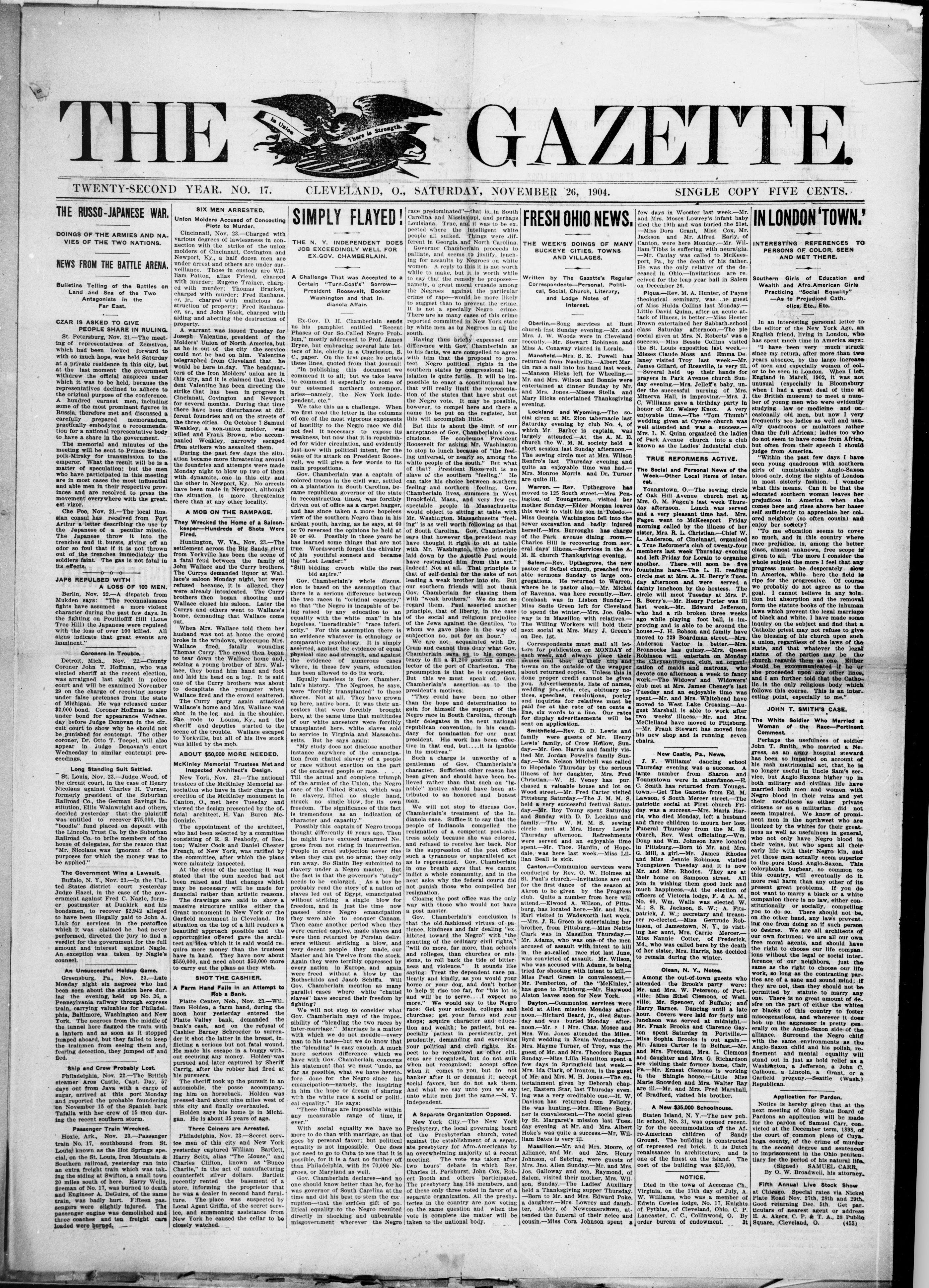
Page text (machine-generated)
2
One Year ..... $1 50
Six Months ..... 1 00
Three Months ..... 50
Subscribers are requested to remit by post-
office money order or registered letter
Entered at the postoffice in Cleveland, Ohio
as second-class matter.
All communications should be addressed:
HARRY C. SMITH.
Editor and Proprietor THE GAZETTE.
Blackstone Building, Cleveland, Ohio.
LEADING COUNCIL
LONDON
THE GAZETTE is the oldest, and has the largest bona fide circulation, double that of any newspaper in the interest of Afro-Americans, published In the state of Ohio, and comparison with any will immediately establish Its rank as one of the NEWSIEST AND BEST in the country.
The recent anniversary number of the Nashville (Tenn.) Monitor, organ of the A. M. E. Church Sunday-school union, was a fine one, profusely illustrated and full of interesting reading. Rev. W. D. Chappeile, its editor, and the entire church, have every reason to feel proud of it.
UNMITIGATED STUPIDITY.
We have no word of apology to offer for those unfortunate Afro-Americans who foolishly threw away their votes on election day. Neither individuals nor democracy have any more respect for the Afro-American who voted the democratic ticket than they have for a young bull pup. Especially in the crisis just passed, it shows the most wanton stupidity that a black man in the excercise of his five senses, should betray such criminal apostasy. Afro-Americans, the least of all other voters, share no part in the emoluments of American democracy. It has set the seal of condemnation upon the Negro and has waged a ceaseless and uncompromising war against every right and privilege, guaranteed under the constitution. It has declared more than once, and in a thousand political conventions, that they want no affiliation in anything in which the Negro is to be a party. That Afro-American is an object of commiseration and scorn, who tampers with democracy or gives his vote in exchange for a price. That man is a hopeless fool and one of whom his wife and children may feel themselves ashamed. Empty-headed and cracked-brained, he can give not the seintilla of a reason why he voted for his crucifixion. The democrat himself can never give an honorable reason why he voted this ticket, for the man who did so, voted against himself; nay more, voted for the degradation of his family and his country. Like a blind horse rushing into battle, the democracy blindly ignored its own best interest in its endeavor to supplant republicanism, only to be known as the administration party. But bourbon democracy is at sea, wrecked, cast down and wrap in sack-cloth and ashes. Can the Afro-American give one honest reason why he voted the democratic ticket? All over the south, democracy has been planning and scheming to reduce the Negro to the condition of a serf, in case its party had won. What stupidity then, that any Afro-American should throw away his-vote with a party that stands ready to forge his chains and fix the shackles upon his limbs? It is the policy of American democracy to deprive the Afro-American of his manhood rights, to restrain him in the pursuit of the blessings of life, liberty and happiness. Then should not all such Afro-Americans who voted with democracy feel ashamed of themselves indeed, and should they not, like Cataline, be banished into exile?
THE DEVIL STILL AT IT.
General Thomas H. Barry recently recommended that Afro-Americans be enlisted for the artillery and stationed in the south. In this action he recommended our men as citizens in common with all others, and in recognition of a constitutional right, which admits them upon equal terms irrespective of race or color. He knew that it was not necessary for him to inquire into the law to determine any right already exercised by an American citizen. Gen. Barry was too honest and too honorable a man to attempt to deny any citizen a right guaranteed by the national constitution. Indeed the man was absolutely conscientious and could have no scruples in regard to a plain and prescribed duty. He had only one thing to determine and that was to know that our men are citizens to all intents and purposes. He becomes fully sensible from what he knows of the amendments, that he is only to make his recommendation. This he did, and then comes Judge Advocate General Davis, of the army, giving an opinion to the chief of staff, differing from Gen. Barry, and denying that there is any authority of law for the enlistment of Afro-Americans for the artillery. But common sense forbids any other conclusion save that of Gen. Barry. An intelligent public fully justifies the position taken by him; but the war department is opposed to his recommendation. It stands opposed upon the ground that it was unwilling, in the time of a
THE GAZETTE, CLEVELAND, O., SATURDAY, NOVEMBER 26, 1904.
heated campaign, to commit itself to any measure or proposition calculated to arouse public feeling. The war department very well knew that Gen. Barry had only to make the recommendation, and that was the end of it. To defeat this recommendation, an easy tool is found in the person of Judge Advocate Gen. Davis, who would enter a contrary opinion. But in the face of equal law, equal rights, and equal citizenship, the whole affair becomes a ridiculous farce, so far as Gen. Davis is concerned. Gen. Barry did not mean that the matter should be tested. He knew that the provision by law already existed and he advised that Afro-Americans be called into this special service. He needed nothing further. He simply acted under the authority of law and it was not designed that what he did should be brought in question. The right to recommend existed, and he acted upon it. In the absence of law he could not have acted. He could, with equal propriety, have advised or recommended that our men be allowed to enlist as soldiers in the American army, in case none had served, and because of which some designing person might find a Davis to enter an opinion to the contrary. But that opinion would simply be as in this, at variance with the rights guaranteed to the Afro-American; at variance with the laws and constitution by which we are all governed as American citizens; and such an opinion only serves as an invasion against the rights of the people, and a travesty upon common justice.
SOME AFRICAN EDITORIAL OPINIONS.
It is certain that the spirit of brutal inhumanity and cruelty exhibited by supposed Christian and civilized Americans and Belgians are availing to place European Christianity and civilization at a discount with the so-called "uncivilized" peoples of the world, and whether it be Asia or Africa, scepticism is growing and growing fast, fostered by the present rapid means of communication, which enable the doings of Christian and civilized people to be known all over the world. And the European missionary who undertakes to teach Christianity and civilization must not be surprised if he finds his subject obdurate and resentful. The adage has it that "an ounce of practice is worth a ton of precept;" and the practices of so-called Christian and civilized people are exerting a much more powerful influence than any precept can exert, and will eventually lead to European civilization and Christian teaching being wholly disbelieved and discarded and their would-be teachers advised in a spirit resentful with distrust and unbelief: "Physician, heal thyself."—Lagos (West Africa) Weekly Record.
It is not improbable that the predisposing cause of the rather sudden reversal of policy on the part. of the Australian Commonwealth toward the "Yellow Man" may be connected with the repeated successes of Japanese arms in Manchuria. It was only yesterday that after the manner of their compatriots on the Rand much bluster was made over the question of a "White Australia," and the attempt to run the earth on an exclusively monopolistic business basis went so far as to threaten the steamship companies carrying the mails with penalties for employing Asiatic sailors. A heavy poll tax has always been placed upon any individual of the colored race seeking to enter Australia's sacred portals. True, the earth is the Lord's and the fullness thereof, but it has always been a controversy with the Almighty and the landlords and Randlords every where as to the class or color of those who should be allowed to inhabit it. Reuter does not publish the results, but reading between the lines there is no doubt that all over the universe the case for the landlords does not appear to be particularly rosy at the present time. Things are beginning to look blue for the "blue bloods." What with the Japs slogging into the Gogs, the Magogs are getting nervous and suffering from spasmodic twitchings during their discussions of the probabilities and possibilities of those two little chickens, "Christian civilization" and "benevolent assimilation," coming home to roost together right in the "grinning teeth of things," to use a metaphor of Kipling.—Izwi Labantu (South Africa.)
NEGRO THE ISSUE
And What Has Always Happened— Carry the News to Tillman and Vardaman.
When Lincoln first ran for president the democratic party, both north and south, selected as their chief issue for the campaign the Negro race question, and as a result the party met defeat. It was repeated in 1860, and the victory was no less decisive. The race question came to the front again in the 1876 campaign, and once more the democrats went down to defeat. The race question was permitted to sleep until 1904, when the democrats made an issue of it again with the hope that it would defeat Roosevelt, and once more the Negro has seen Mr. Democrat's undoing. So thoroughly disgusted have the American people become of this Negro bugbear that whenever the southern folk periodically make a campaign issue of it every northern state almost unanimously voted for the man, who makes bold to announce, 'as president of the United States no man will be known by his color' and even one "border state" voted for him, that the elimination of this question may be relegated completely to a state of innocuous desuude. The Tillman-Vardaman agitators find themselves right where the Calhoun-Davis disturbers found themselves in 1860, and unless they are real good they will hear something drop, and that, too, just as hard as it did when Lincoln dropped that something forty odd years ago.—Seattle (Wash.) Republican.
It's now or never that the World's Greatest Exposition may be seen, at greatly reduced fares. Worth inquiring about at Pennsylvania Lines ticket office. Geo. W. Weedon, D. P. A., Cleveland. O is the person to see about it.
INTERESTING NEWS NOTES.
HAPPENINGS IN THE BUSY WORLD BOILED DOWN.
AT HOME AND IN FOREIGN LANDS.
Recent Events that Contain the Pith of the General News for the Perusal of Our Readers.
Although lacking official confirmation, it is reported that wire products have been advanced $2 a ton by the larger manufacturers. Sheet steel has advanced $2 a ton and tin plate $3.
Ambassador Storer has cabled the state department from Vienna that the Austro-Hungarian government is willing to participate in the second Hague peace conference called by President Roosevelt. This is believed to be the first official acceptance of the invitation.
John B. Brownlow, of Tennessee, who was dismissed from the postal service by order of the president, denies that he refused to furnish the department with a detailed statement of his receipts and disbursements while acting as disbursing officer of the department at the St. Louis exposition. A car of Italian miners being taken into Zeigler, Ill., Joseph Leiter's mining town, was fired into from ambush, one man being killed. It was a Baltimore & Ohio car from the east. About 25 shots were fired. W. S. Lang, superintendent of the coal mines of the Tennessee Coal, Iron and Railroad Co. at Blocton, Ala., who was shot from ambush recently, is dead.
Jewels valued at $3,000 have been stolen from the New York apartments of Miss Eva Lorraine-Beatty, a well known society woman of Pittsburg and New York. Simultaneously with the theft of the jewels the butler disappeared. His wife, who was employed as housekeeper, was arrested and confessed that her husband was guilty; that he had disposed of the plunder and intended sailing for Europe.
Frank J. Hecker has resigned as a member of the Panama canal commission, owing to ill health.
The government of the Netherlands has advised Secretary Hay that it gladly accepts the suggestion that the peace conference be reconvened at The Hague.
A revival of business on the railroads entering New York City has resulted within the last six weeks in the re-employment of more than 20,000 men who were dropped from the pay rolls during a few months ending with June 1 last.
The Central Vermont railway's freight steamer Mohawk was burned off Horton's Point, Long Island. The Mohawk's crew with the exception of the watchman were taken off by the steamship Boston and taken to Fall River, Mass.
With a capital stock of $25,000,000 a company has been incorporated for the purpose of building a model Oriental city on the bay shore at South San Francisco and moving the Chinese quarters to that place and to transform the present district known as Chinatown into a residence neighborhood.
Rt. Rev. P. J. Donahue, Roman Catholic bishop of Wheeling, W. Va., will receive the major portion of the estate of Sarah C. Tracy, valued at more than $250,000, under the terms of the will filed in the surrogate's office at New York City. The money is to be used to found a school and orphan asylum.
The Chicago & Northwestern Railroad Co. has determined to build two more extensions into the upper peninsula of Michigan.
The malt house of the Frank Jones Brewing Co.'s immense plant at Portsmouth, N. H., was ruined by fire, entailing a loss of $150,000.
Eight of the principal business houses of De Witt, Mo., burned with their contents. Loss $50,000, partly insured.
The naval estimates for the fiscal year ending June 30, 1906, aggregate $114,530,638, an increase of $17,372,448 over the last appropriation.
More than a score of passengers were injured in a collision between two fast passenger trains on the Wabash road near Betten, Ill.
A dispatch from Victoria, B. C., says that the American bark Makawell has been wrecked off the west coast of Vancouver Island and that her crew is lost.
Jack Brown, a barber, of Houghton, Mich., has been shot in the head and killed. His wife is accused of the killing. Jealousy is the alleged cause. Reuben Loree, aged 55, and his son Fred Loree, aged 30 years, were suffocated to death in the lockup at Columbiaville, Mich. They were intoxicated when locked up for beating their horse and during the night they set fire to their bedding, which was entirely consumed and the smoke suffocated them to death.
Thomas Shepardson, Peter Miller and Michael Dowd, election officers, of Denver, Col., have been adjudged guilty by the supreme court of substituting ballots and swearing in an election clerk wrongfully at the recent election. Shepardson and Miller were fined $1,000 each and sentenced to jail for one year. Dowd was fined $250 and sentenced to jail for 60 days.
The strike of the furniture teamsters at Chicago is ended. The men went on strike because the employers refused to sign an agreement with them. This the employers finally agreed to do. The question of the "open shop" was compromised.
There has been no rainfall of consequence in Kentucky for more than two months. Only .27 of an inch fell during October, which was the dryest month on record, and barely a trace of rain has fallen during the present month.
Six thousand garment workers have struck in 20 factories of Chicago, following a walkout of 450 cutters.
Alexander Freeman, a negro 90 years old, has brought suit at New York City against an express company for $300 damages alleged to have been caused by the loss of an overcoat that once belonged to Abraham Lincoln.
An ordinance which, if it becomes law will effectually put a stop to the six days' bicycling races and many other sports in New York City, has been presented to the board of aldermen. One man is dead and three others are seriously injured as a result of a fire which destroyed the tar plant of the Denver Gas and Electric Co. The property loss is estimated at $25,000.
Henry Meldrum, formerly United States surveyor at Portland, Ore., has been found guilty of forgery on 21 counts by a jury in the United States district court. This is the first conviction in the so-called land fraud cases now pending before Judge Belling.
Dell Darling, the once famous baseball player, is dead at his home in Erie, Pa., aged 43 years.
It is announced at the White House that Attorney General Moody has decided to remain in President Roosevelt's new cabinet.
The Japanese navy department reports the capture of the German steamer Batelan while attempting to run the Port Arthur blockade.
Gen. Louis Palma Di Cesnola, director of the Metropolitan Museum of Art, New York City, died from an attack of acute indigestion. He was 72 years old.
At the unusual age of 107 years, Mrs. Julia Zounski, probably the oldest white person on the Pacific coast, is dead at St. Joseph's hospital, Tacoma, Wash.
A movement is on foot to get President Roosevelt to arbitrate the difference between Panama and the corporation of foreign bondholders in regard to the Colombia debt.
Staunton military academy at Staunton, Va., was almost entirely destroyed by fire recently. Many of the boys lost all their belongings. Damages $15,000, insurance $13,000.
A sub-committee of the house judiciary committee has resumed the investigation of the impeachment charges against Judge Charles Swayne, of the northern district of Florida. Property lying unguarded in the public street, whether it be in front of an express office or a department store, has been declared "lost" within the meaning of the law by Magistrate Whitman, of New York City. The Talaubee islands, northeast of Celebes, Malay archipelago, have been visited by a disastrous hurricane, causing the sea to rise to such an extent that it flooded the islands and left 30,000 persons destitute, their homes, boats and plantations being destroyed.
The Pennsylvania supreme court has decided that the national judiciary of the Junior Order American Mechanics has the right after a trial and conviction to expel from membership any one who is affiliated with what is known as the "insurgent" faction of the organization.
Detectives have left Bluefield, W. Va., for New York, having in charge Prof. Popp, who will be turned over to the Austrian consul, charged with complicity in the robbery of the post-office at Buda Pest. Popp, it is said, was preparing to open a bank in Stinega, W. Va., when arrested.
Harry Whitney and a chauffeur narrowly escaped serious injury on Long Island in a collision between the millionaire's automobile and a road roller. They suffered some severe bruises and left behind a badly wrecked machine.
In an encounter with a negro robber, Hyman Isaacs, a Chicago pawnbroker, was beaten over the head with a hatchet and probably fatally injured. The robber looted the cash drawer. He was arrested later.
The Foster furniture store at Lafayette, Ind., was completely destroyed by fire. The loss is estimated at $100,000, with $50,000 insurance. Benjamin O'Connor, a fireman, was fatally injured by a fall from a ladder.
William S. Steedle, aged 17 years, of Riverton, N. J., was killed in a football game played at Beverly, N. J., between the Riverton and Beverly teams.
Fire which started from the explosion of a boiler in the basement of the Arcade building at Decatur, Ill., gutted that building and the Decatur hotel. Loss $150,000.
In a head-on collision on the Rapid Transit electric street car line at Chattanooga, Tenn., due to a heavy fog, five persons were injured, two probably fatally.
On the report of Immigration Inspector Dunn, at St. Louis, the department of commerce and labor has ordered the deportation of 14 Geish girls and six Chinese who have been employed in a concession at the Louisiana Purchase exposition.
Three women were probably fatally hurt and five firemen were injured severely in a blaze that destroyed two buildings in Brooklyn, N. Y.
Miss Sadie Waite, aged 16, was instantly killed and her brother, aged 12, was fatally hurt by a train which struck their buggy at Wartrace, Tenn.
By a dust explosion in a mine at Cayuga, Ind., Lester Jones and William Ottinger were fatally injured and property was damaged several thousand dollars.
The official canvass of the Florida vote for president shows the following result: Total vote 39,307. Democratic vote 27,046, republican 8,314, socialist 2,337, populist 1,605, prohibition 5. The American-German arbitration treaty has been signed at the state department by Secretary Hay and Baron Sternburg, the German ambassador. It is identical with the American-French treaty. The directors of the Calumet and Hecla Mining Co. have declared a regular quarterly dividend of $10 per share. In 1904 the company paid $40 per share in dividends, as compared with $35 last year.
At Mexico City, Mo., Thomas Spurs shot and fatally wounded Janie Burks in a quarrel over loaded dice and was killed by two of the woman's brothers, who with stones beat him to death, pounding his head to a pulp.
The home of Elmer E. Thomas, a prominent lawyer of Omaha, Neb., was wrecked by a bomb placed on the front porch. Mr. Thomas and his family were in the house at the time and he considers it marvelous that none of them was injured.
C. F. Moore, aged 25, is under arrest at Birmingham, Ala., charged with raising United States money orders. It is claimed that he attempted to pass a money order which had been raised from 25 cents to $80. Moore denies the charges.
With the exception of the government building, which has hardly more than begun, and the forestry building, which will be under roof within a week, the principal buildings of the Lewis and Clark fair at Portland, Ore., are to all intents and purposes completed.
Collector of Customs Stranahan at the port of New York has assumed the aggressive for the government in its attitude towards the enforcement of the pure food law, with especial reference to the labeling of all imported products with a formula noting the use of coloring or preserving substances of whatever kind.
NAN PATTERSON'S TRIAL
HUGE CROWD PRESENT IN THE COURT ROOM.
NUMBER OF WITNESSES TESTIFY.
District Attorney Rand Said in His Opening Speech that the State's Witnesses Would Prove that the Accused Killed Young.
New York, Nov. 22.—The trial of Nan Patterson for the murder of Bookmaker "Caesar" Young was fairly begun before Justice Davis in the supreme court Monday.
The stories that there would be further delays in the trial were early disposed of by the announcement from the court that Foreman Hendricks, of the jury, who had asked to be relieved, would not be excused.
Then came Mr. Rand's opening speech in which he said the state's witnesses would prove that Nan Patterson killed Young, and that the killing was planned several hours before the morning on which Young met his death.
William J. Junior, the policeman who was first to reach the cab after the shooting, testified that Miss Patterson was hysterical and crying: "Oh, Caesar, why did you do it."
There was other interesting testimony, particularly that of Detective Edward Quinn, who took Miss Patterson from the hospital where Young died to the police station.
He said the woman said to him: "I don't want to live now. Why should he have killed himself." The officer said she fainted several times in the station house and that several times she asked him to kill her, as she had nothing to live for, now that "Caesar" was dend.
There was not an unusually large crowd in the court room in the morning, but when the doors were opened for the afternoon session there was a rush to gain admittance which swept the squad of officers off their feet.
New York, Nov. 23.—Several unusual features were presented in the supreme court yesterday in the trial of Nan Patterson for the alleged murder of Caesar Young, Frederick D. Michaels, the cabman, described the cab in which Young met his death. During the day a skeleton and two pieces of skin from Young's second finger were produced in court by the prosecution. The skeleton was shown in order that the course of the bullet that killed Young might be traced.
The Chicago Subway Co. Will Have a Capital Stock of $50,000,000.
Chicago, Nov. 22.—The Chicago Subway Co., with a capital stock of $50,000,000 and composed of men who represent 90 per cent. of the railroads having Chicago terminals, was organized Monday and took over the $30,000,000 company here which has built 15 miles of freight tunnels under the city's streets. The vast tonnage of the railroads represented by the financiers in the new corporation will be diverted into the company's tunnels, which are already under every street in the business district of Chicago. Apparently in connection with the mammoth deal, Sir Ernest Cassel, the financial adviser of the king of England, was in Chicago yesterday with Jacob Schiff.
Men who will enter the directory of the new corporation are Edward H. Harriman, the principal factor in the Union Pacific and the Southern Pacific, and a big factoir in the Alton and Illinois Central railroads; James Stillman, president of the National City bank, of New York, and a factor in the control of a large number of great eastern and western systems, notably the Chicago & Northwestern and the Chicago, Milwaukee & St. Paul railroads, and Jacob Schiff, of New York, member of the Wall street firm of Kuhn, Loeb & Co., and a big factor in the Pennsylvania system.
The subway company has taken over, it is announced officially, the entire stock of the Illinois Telephone Construction Co., 66 2-3 per cent. of the stock of the $30,000,000 Illinois Tunnel Co.
The Official Count in Nebraska.
Lincoln, Neb., Nov. 22.—The count of votes for governor of Nebraska was officially completed Monday. Gov. Mickey has a plurality of 9,153 over G. W. Berge, fusion candidate, and a majority over all candidates of 1,211. Dr. Swander, prohibition candidate, received 5,277 votes; Vail, socialist, 5,078, making the total vote for governor 224,633. The official count for president is not completed. With two counties missing Roosevelt's plurality is 84,553.
Gave Roosevelt 124,000 Plurality.
Topeka, Kan., Nov. 22.—Official figures on the result of the election in Kansas were given out last night. Roosevelt receives a plurality of 124,582. Hoch (rep.) is elected governor over Dale (dem.) by a plurality of 68,815.
Jefferson City, Mo., Nov. 22.—Official returns of the election give Joseph W. Folk, democrat, for governor a plurality of 30,000. The total vote was: Folk 326,652, Walbridge 296,552. The total vote is 44,746 short of that cast for governor in 1900.
Killed at a Crossing.
Waterbury, Conn., Nov. 22.—While crossing the tracks of the New York, New Haven & Hartford railroad last evening, the automobile of Frank B. Bristol, a prominent manufacturer of this city, was struck by a passenger train. Mr. Bristol was thrown down an embankment and killed.
Was Robbed of $4,500.
Seattle, Wash., Nov. 22.—George Rosenberg, cashier of the Pacific Coast Steamship Co.'s office at Skagway, was recently assaulted and robbed of $4,500 when alone in the office.
Coal Barges Adrift.
Highland Light, Mass., Nov. 22. Two Lehigh Valley railroad barges, the Buffalo and Burden, are adrift somewhere outside of Cape Cod. They broke away from the tug Lehigh in Massachusetts Bay Sunday night and have not been seen since, although two tugs searched diligently for them.
Struck for Higher Wages.
Huntington, W. Va., Nov. 22.—Two hundred and seventy-five glass workers at the Huntington tumbler works and Union glass plant struck yesterday for a 10 per cent. increase of wages.
CURRENT CURIOS
In the Stonewall mine, San Diego county, California, an earthquake so twisted the shaft that the timbers were pulled around to the opposite sides of the shaft from their original position.
Residents of Paonia, Col., claim that the largest apple in the world was raised in that district this year. It is of the Wolf river variety and weighs $31\frac{1}{4}$ ounces. Fine large strawberries were picked in Paonia the third week in October.
The keeper of the lighthouse near Crescent City, Cal., reports a battle between a sea lion and an octopus. The octopus wound its tentacles around the lion's body, but the lion bit off one of them after the other and ate them. Others then helped to dispose of the sea lion's carcass.
A telegraph operator at Prairie du Chien. Wis., was ordered to stop a train because there was trouble on the tracks ahead. He did not have time to set his signals, so threw a lantern through the window of the cab and the engineer took the hint, stopped and averted a bad accident.
The biggest beehive in the world is a natural one, in Kentucky, known as the "Mammoth Beehive." It is in reaosity a huge cave, the main compartment of which is 150 feet high, the floor covering ten acres in extent. The beehive is of solid rock, the roof having been entirely honeycombed by bees.
Just as a chimney was about to fall on the head of Gen. F. C. Prescott, as he walked along a street in San Bernardino, Cal., R. Kennedy, his rival in candidacy for the assembly, rushed up, dragged him away and saved his life. Prescott wanted to withdraw at once from the canvass in favor of Kennedy, but Kennedy would not have it so.
The University of Washington is investigating the discovery—testified to by "dozens of miners"—that a live toad was found on October 10 in the coal mines at Newton, six miles from Seattle, in a solid stratum of coal, 300 feet below the surface. It was carried to the surface and lived several hours. It is said to have been of unusual size.
"WHACKS"
And What They Mean
When Old Mother Nature gives you a "whack," remember "there's a reason," so try and say "thank you," then set about finding what you have done to demand the rebuke, and try and get back into line, for that's the happy place after all.
Curious how many highly organized people fail to appreciate and heed the first little, gentle "whacks" of the good old Dame, but go right along with the habit, whatever it may be, that causes her disapproval. Whisky, Tobacco, Coffee, Tea or other unnatural treatment of the body, until serious illness sets in or some chronic disease.
Some people seem to get on very well with those things for awhile, and Mother Nature apparently cares but little what they do.
Perhaps she has no particular plans for them and thinks it little use to waste time in their training.
There are people, however, who seem to be selected by Nature to "do things." The old Mother expects them to carry out some department of her great work. A portion of these selected ones oft and again seek to stimulate and then deaden the tool (the body) by some one or more of the drugs—Whisky, Tobacco, Coffee, Tea, Morphine, etc.
You know all of these throw down the same class of alkaloids in Chemical analysis. They stimulate and then depress. They take from man or woman the power to do his or her best work.
After these people have drugged for a time, they get a hint, or mild "whack," to remind them that they have work to do, a mission to perform, and should be about the business, but are loafing along the wayside and become unfitted for the fame and fortune that waits for them if they but stick to the course and keep the body clear of obstructions so it can carry out the behests of the mind.
Sickness is a call to "come up higher." These hints come in various forms. It may be stomach trouble or bowels, heart, eyes, kidneys or general nervous prostration. You may depend upon it when a "whack" comes it's a warning to quit some abuse and do the right and fair thing with the body. Perhaps it is coffee drinking that offends. That is one of the greatest causes of human disorder among Americans.
Now, then, if Mother Nature is gentle with you and only gives light little "whacks" at first to attract attention, don't abuse her consideration, or she will soon hit you harder, sure. And you may also be sure she will hit you very, very hard if you insist on following the way you have been going. It seems hard work to give up a habit, and we try all sorts of plans to charge our ill feelings to some other cause than the real one.
Coffee drinkers when ill will attribute the trouble to bad food, malaria, overwork and what not, but they keep on being sick and gradually getting worse, until they are finally forced to quit entirely, even the "only one cup a day." Then they begin to get better, and unless they have gone long enough to set up some fixed organic disease, they generally get entirely well.
It is easy to quit coffee at once and for all, by having well made Postum, with its rich, deep, seal brown-color which comes to the beautiful golden brown when good cream is added, and the crisp snap of good, mild Java is there if the Postum has been boiled long enough to bring it out.
It pays to be well and happy for good old Mother Nature then sends us her blessings of many and various kinds and helps us to gain fame and fortune.
Strip off the handicaps, leave out the deadening habits, heed Mother Nature's hints, quit being a loser and become a winner. She will help you sure if you cut out the things that keep you back.
"There's a reason," and a profound one.
Look in each package for a copy of the famous little book, "The Road to Wellyville."
CLAIE VOYANT.
MRS. MARTH, the world-renowned and highly celebrated business and test TRANSFER CLAIRVOYANT, reveals everything. No imposition. Can be consulted on all affairs of life. Business. Love and Marriage a specialty. Every mystery revealed, also, of absent, deceased and living friends. Removes all trouble and estrangements, unites the separated and causes speedy marriages. $1,000 challenge to any medium who can exceed her in her startling revelations of the past, present and future events of one's life. Remember, she will not for any price flatter you; you may rest assured you will gain face value.ENSEANCE will be coveted upon all affaith of Life. Love, Courtship, Marriage, Friends etc., with description of future companion. She is very accurate in describing missing friends, enemies, etc. Her advice upon sickness, change in business, journeys, lawsuits, contested wills, divorce and speculation is valuable and reliable. She reads your destiny—good or bad; she withholds nothing.
MRS. MARTH, born with a double veil, is a seventh daughter, tells your entire life—pass present and future—in a DEAD TRANCE; has a mess; tells you what you must meet. She tells whether your present sweetheart will be true to you and if he will marry you; if you have no sweetheart, she will tell you when you will have, and his name, business and date of acquaintance, clarivoyanty ALL YOUR SURELY will be in all her cleav and plain manner, and in a dead trance. Mothers should know the success of their husbands and children; young ladies should know everything about their sweethearts and intended husband. Do not keep company, manage into business until you know and not let still religious scruples prevent your consulting.
Macamie is the only one in the world who can tell you the FULL NAME of your future husband, with age and date of marriage, and tells whether the one you love is true or false. Reader, do you ever notice that some people seem to have good luck all the time, and no matter what they do they seem to prosper, while others, yourself may be, have such a hard time to get along, and no matter how hard they try, they find at the end of the year they are no better off than when they started. This is because they have not consulted the right Medium, while the successful people, in all probabilities, have been to one of the genuine Mediums and obtained advice. If you are unsuccessful in business, have bad luck, things go wrong with you, you should your troubles. She will tell you what your trouble is, as she understands the spells and evil influences. She has spent years helping distressed persons and has brought thousands to success. For advice by letter 61.08 All letters that contain stamps.
CHICKASHA,
Box 958. Indian Territory.
Frank W. King,
UNDERTAKER
....AND....
ARTERIAL EMBALMER,
Illinois License, No. 1229; Ohio State License,
No. 573 Class A.
W. W. GEE, ASSISTANT.
OFFICE AND RESIDENCE,
662 CENTRAL AVE.
Carriages Furnished for All Occasions.
'Phone, Cuy. Central 3732 W.
PATRONIZE
THE
"Gem" Restaurant,
No. 91 Sheriff St.
James W. Crawford, Proprietor.
SPLENDID MEALS SERVED!
One Meal, 20c.; Seven Meals, $1.
TRAVELERS' REGISTER
Trains on all roads run on Standard Time.
NICKEL PLATE
The New York, Chicago, St. Louis R.R.
TICKET OFFICES: 28 Public Sq., 534 Pearl
St. and Stations
Eastbound. Daily. 2 4 6
Pearl St. Station...8 15pm 1 50am 7 55am
Broadway Station...8 30pm 2 05am 8 29am
Euclid Av. Station...8 47pm 2 18am 8 36am
Westbound. Daily. 1 3 5
Euclid Av. Station...6 01am 11 05am 7 29pm
Broadway Station...6 25am 11 26am 7 59pm
Pearl St. Station...6 30am 11 31am 7 55pm
Cleveland Union Station.
Pennsylvania Lines
Foot of Bank Street.
TICKET OFFICES at Union Station, Euclid Av. and
Woodland Av. Stations.
New City Ticket Office, 11 Euclid Av. Cor. Public 8q.
THROUGH TRAINS RUN AS FOLLOWS BY CENTRAL TIME
Daily. Daily except Sunday.
From Cleveland to Leave. Arrive.
Pittsburg & Bellaire..* 70 am *11 20 am
Salem & Pittsburg..* 80 am *8 30 am
Salem & Pittsburg..* 50 pm *11 30 am
Philadelphia & New York..* 50 pm *11 30 am
Baltimore & Washington..* 50 pm *11 30 am
Pittsburg, Bellaire & East..* 11 40 am *40 30 am
Baltimore & Washington..* 11 40 am *40 30 am
Alliance Accommodation..* 50 pm *8 00 am
Pitts, Phila, & New York..* 11 30 pm *5 00 am
Baltimore & Washington..* 11 30 pm *5 00 am
Akron, Columbus & Clin..* 8 10 am *6 00 am
Indianapolis & St. Louis..* 8 10 am *6 00 am
Milersburg & Columbus..* 12 05 pm *1 20 am
Col, Clin., Ind. & St. Louis..* 8 00 pm *7 30 am
"THE ST. LOUIS LIMITED"
VIA
"Big-4 Route."
Leaves—CLEVELAND, 5:00 P. M. (Daily).
Arrives—INDIANAPOLIS, 11:45 same night.
Arrives—ST. LOUIS, 3:30 A. M. next morning.
Arrives—KANSAS CITY, 5 15 next afternoon.
Arrives—DENVER, 11 A. M. second morning.
With Fine Vestibule Coaches, Drawing Room and Buffet sleeping Cars to Indianapolis and St. Louis. One of the fastest and finest trains in the country.
5 Fast Trains to Columbus, 4 to Cincinnati, with Sleeping and Dining Cars.
Local sweepers to Columbus and Cincinnati on train No. 25, leaving at 9:30 every night.
(*Daily*)
Trains from and to Cleveland. Leave Arrive.
*Col.* Cn. Ind. & St. Louis, 1:3d 3:1m a. m. 1:40 a. m.
*Gallion & Intermediate.* ... 6:00 a. m. 1:15 a. m.
*St. Louis Ltd. Ind. Col.* Cn. 12:35 a. m. 10:30 a. m.
*Col. Springf'd. Day.* Cn. 12:35 a. m. 9:30 a. m.
*Indianapolis' & St. Louis.* 1:15 a. m. 9:30 a. m.
*Exp. Fl.* Ind. Poe. St. Louis 5:00 a. m. 3:00 a. m.
*30th. Cn. L'd. Col.* Cn. ... 7:25 a. m. 4:00 a. m.
Galion to Cleveland. ... 9:20 a. m.
To Galion and Columbus. ... 4:00 p. m.
*Col.* Spring, Day. Cn. ... 9:30 p. m. 6:45 a. m.
Exposition Flyer 7:25 a. m. and 1:15 p. m. Limited trains don't stop at South Water Street.
Get Tickets at Big Four Office. 116 EULID
AVE. Phone Main 910
900 DROPS
CASTORIA
A Vegetable Preparation for Assimilating the Food and Regulating the Stomachs and Bowels of
INFANTS / CHILDREN
Promotes Digestion, Cheerfulness and Rest. Contains neither Opium, Morphine nor Mineral.
NOT NARCOTIC.
Recipe of Old Dr. SAMUEL PITCHER
Pumpkin Seed
Alc. Sweet
Rockelle Salad
Anise Seed
Peppermint
Bitterburite Salad
Worms Seed
Clarified Sugar
Watergreen Flavor
A perfect Remedy for Constipation, Sour Stomach, Diarrhoea Worms, Convulsions, Feverishness and LOSS OF SLEEP.
Fac Simile Signature of
Charles H. Fletcher.
NEW YORK.
A 16 Months old
35 DOSES - 35 CENTS
EXACT COPY OF WRAPPER.
CASTORIA
For Infants and Children.
The Kind You Have Always Bought
Bears the Signature of
Charles H. Fletcher.
In Use
For Over Thirty Years
CASTORIA
THE GENTAUR COMPANY. NEW YORK CITY.
4
THE PILLS THAT CURE RHEUMATISM
Mrs. Henry Story, of No. 532 Muskingdum Ave., Zanesville, Ohio, sayst "My husband suffered from rheumatism so that he could hardly stand. His back hurt and he had such pain in his left arm that he could not rest night or day. The doctor did him no good and it was not until he tried Dr. Williams' Pink Pills that he was helped. Six boxes cured him completely and he has not had an ache or a pain since. We think the pills are the best medicine in the world."
Dr.Williams' Pink Pills for PalePeople
cure rheumatism because they make new blood. It would be folly not to try a remedy with such a convincing record of cures.
SOLD BY ALL DRUGGISTS.
DO YOU COUGH DON'T DELAY TAKE KEMP'S BALSAM THE BEST COUGH CURE. It Cures Colds, Coughs, Sore Throat, Croup, Influenza, Whoooping Cough, Bronchitis and Asthma. A certain cure for Consumption in first stages, and a sure relief in advanced stages. Use at once. You will see the excellent effect after taking the first dose. Sold by dealers everywhere. Large bottles 25 cents and 50 cents.
The harder you cough, the worse the cough gets.
Shiloh's Consumption Cure The Lung Tonic
is guaranteed to cure. If it doesn't benefit you, the druggist will give you your money back.
Prices: S. C. WELLS & Co. 2
25c. 50c. $1 LeRoy, N. Y., Toronto, Can.
Misconstrued Motive.
Calvert, Jr.—I want to commend you for your loyalty to a friend.
Balty Moore—Come again. What do
a friend.
Balty Moore—Come again. What do you refer to?
"I understand that when Yabsley criticised Blabsley's banquet speech you promptly knocked Yabsley down."
"Yes, but that wasn't through loyalty to Blassley. It was because I had written the speech."—Baltimore American.
Time to Move.
"I was moved once by the notes of a little bird," said the romantic young man.
"So was I," spoke his friend.
"Canary bird?"
"No, cuckoo. I was calling on my girl and when the cuckoo called 11 times I knew it was my move."—Chicago Daily News.
Hats for gentlemen are now worn larger. They must be a size larger than formerly, so as to come down farther on the back of the head of the wearer. That is the latest authorized dispensation. On the whole, it is better than the old style of wearing a head too big for one's hat, as the saying goes. It dispenses with the implied swelling.—Boston Herald.
The man who thinks he is the boss of the house because he is the bread-winner should be taught that he has not half the dough of the bread baker.—Chicago Journal.
The less tenderness a man has in his nature the more he requires of others.— Rahel.
900 DROPS
CASTORIA
AVegetable Preparation for As-
THE GAZETTE, CLEVELAND, O., SATURDAY, NOVEMBER 26. 1904.
There is absolutely no season of the year, nor time of the day, when blouses are not admissible—indeed, blouses are worn as much as ever—and a very welcome addition they are to one's wardrobe.
For morning use there are no end of pretty blouses in flannel, with and without yokes—box-pleated, tucked, insertioned, and made more or less fussy as fancy may dictate, and embroidered and embellished as time and taste may allow. Some of the new flannels and such-like fabrics, including Viyella, are manufactured in such delightful colorings and designs as to
CIRCUMSTANTIAL EVIDENCE.
Remarkable Coincidence Which Would Have Made a Bad Case for Innocent Man.
"Several years ago I took a late train from Boston to New York," said a man in business in Kansas City, according to the Star. "In the morning I was awakened earlier than usual by the porter, who said that a robbery had been committed on the sleeper during the night and that all the passengers would have to get up. Some one had taken six $100 bills from the clothing of a gentleman who occupied a berth in the middle of the car. Every section had been taken before he left Boston, and as the train had been almost constantly in motion it seemed certain that the person who had committed the theft was still on the car. The porter said no one had been aboard but the passengers and that none of them had left. It was proposed to search everybody. A man who had a berth directly opposite from the one who had been robbed objected. He told his name and said anyone might easily find that he was a man of good reputation. In the meantime some officers boarded the car and after a little sweating got the money from the colored porter, who was the guilty one. Then the passenger who had refused to be searched asked the officers to examine his pockets. This seemed strange, but he insisted. In an inside pocket they found six $100 bills. It was merely a coincidence that he should have the same amount of money as the other passenger had lost, and in exactly the same denominations, but he knew that under the circumstances he could hardly establish his innocence. How was that for a case of circumstantial evidence?
WITH DUKES AND THINGS.
Title.
Mrs. Porkdollars has not as yet got over the novelty of riches. At the same time she is not inclined to admit this, and it is her great desire, relates London Answers, that the society with which she is now entitled to mix by virtue of her husband's wealth shall think she was born in the purple.
Recently she was at a big dinner party, and as she was being piloted from drawing-room to dining-room, she noticed a marble bust on one of the pillars in the hall.
"Do you know who that is?" she inquired of her cavalier.
"That is Marcus Aurelius," was the answer.
"Oh, is it, now?" ejaculated the lady. "But can you tell me," she added promptly, "whether it is the present markis or the late markis? I do get so mixed up with your dukes and things!"
To Suit Herself
how old he is to grow, isn't it?
She—Oh, I don't know. I've managed to regulate my age to suit myself for some years.—Detroit Free Press.
When the quiz master asked the medical student to name the different bones of the skull the answer was given: "For the life of me I can't remember a single one—yet I have them all—in my head."—Chicago Tribune.
Why should rainbow-chasing be so frowned on? It fills the hearts of the chasers with a joy keen enough while it lasts and it doesn't fade the colors on the rainbow in the least.—Baltimore American.
Good News for All
Bradford, Tenn., Nov. 21 (Special)—Scientific research shows Kidney Trouble to be the father of so many diseases that news of a discovery of a sure cure for it cannot fail to be welcomed all over the country. And according to Mr. J. A. Davis of this place just such a cure is found in Dodd's Kidney Pills. Mr. Davis says:
"Dodd's Kidney Pills are all that is claimed them. They have done me more good than anything I have ever taken. I had Kidney Trouble very bad and after taking a few boxes of Dodd's Kidney Pills I am completely cured. I cannot praise them too much."
Kidney Complaint develops into Bright's Disease, Dropsy, Diabetes, Rheumatism, and other painful and fatal diseases. The safeguard is to cure your kidneys with Dodd's Kidney Pills when they show the first symptom of disease.
An English writer tells of a poor woman of London who wondered why the Lord permitted her worthless husband to live. "I suppose," she said, "the Lord has an idea that he'll repent, but I know better."
Lowest Rates Ever Made to Florida,
For Midwinter Exposition and South Florida Fair, Tampa, Fla. Tickets will be sold beginning November 15th, 1904, with final limit of 21 days. See that your ticket reads via Seaboard Air Line Railway, the shortest and best route to and through Florida.
The secret of happiness is not to let your troubles bother you any more than they bother your friends.—Puck.
Piso's Cure cannot be too highly spoken of as a cough cure.—J. W. O'Brien, 322 Third Ave., N., Minneapolis, Minn., Jan. 6, 1900.
The man with a grievance is a grievance to others.-Chicago Daily News.
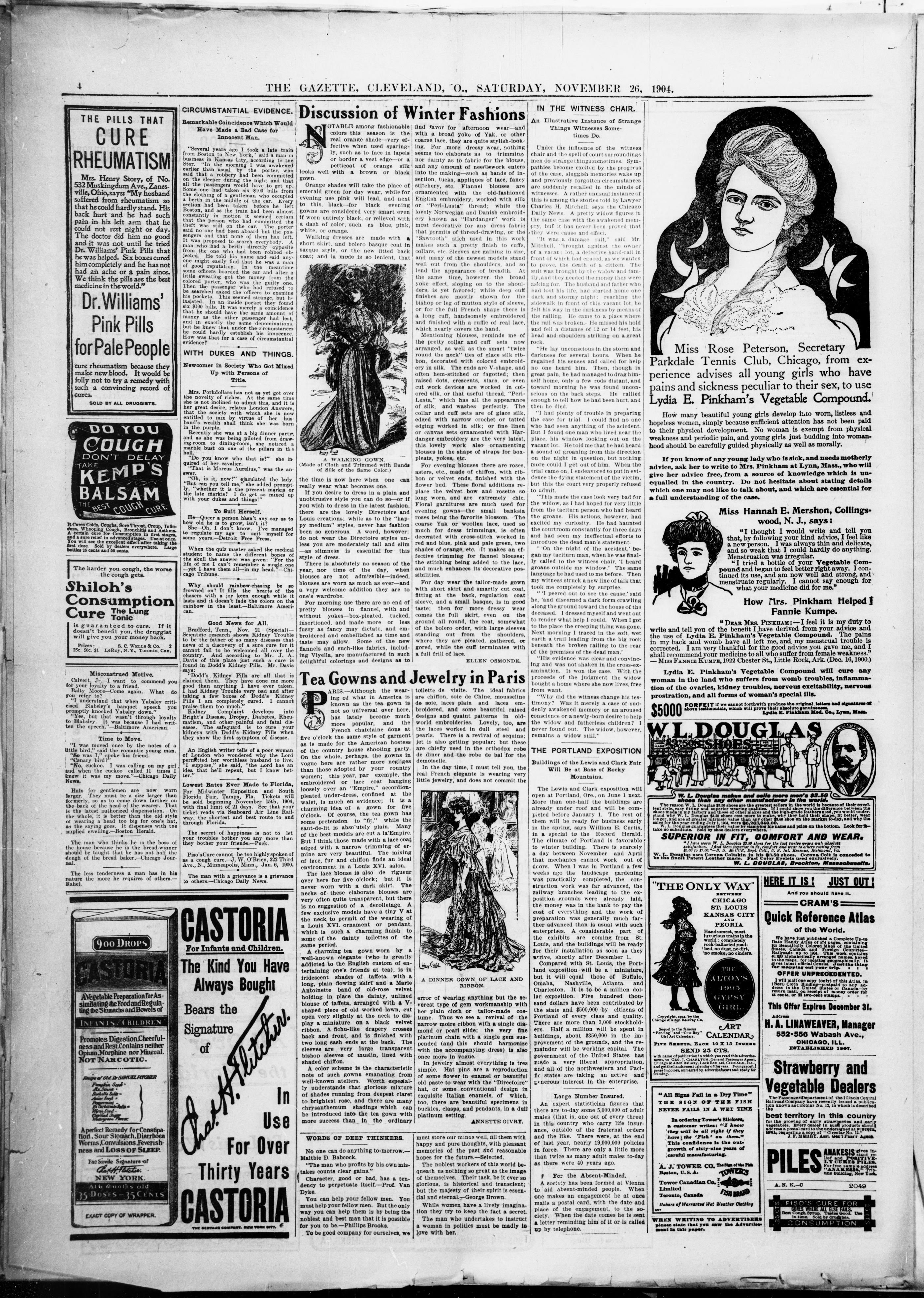
Discussion of Winter Fashions
Discussion of Winter Fashions
Tea Gowns and Jewelry in Paris
N
NOTABLE among fashionable colors this season is the real orange shade—very effective when used sparingly, such as to face in lapeis or border a vest edge—or a petticoat of orange silk looks well with a brown or black gown. Orange shades will take the place of emerald green for day wear, while for evening use pink will lead, and next to this, black—for black evening gowns are considered very smart even if worn entirely black, or relieved with a dash of color, such as blue, pink, white, or orange.
Walking dresses are made with short skirt, and bolero basque coat in sacque style, or the new fitted back coat; and la mode is so lenient, that
Karry Eich
A WALKING GOWN.
(Made of Cloth and Trimmed with Bands of Silk of the Same Color.)
the time is now here when one can really wear what becomes one.
If you desire to dress in a plain and unobtrusive style you can do so—or if you wish to dress in the latest fashion, there are the lovely Directoire and Louis creations; while as to the "happy medium" styles, never has fashion been so generous. A word, however: do not wear the Directoire styles unless you are moderately tall and slim—as slimness is essential for this style of dress.
ARIS.—Although the wearing of what in America is known as the tea gown is not so universal over here, has lately become much more popular, and the French chatelaine dons at
P
five o'clock the same style of garment as is made for the American hostess of the country house shooting party. On the whole, perhaps, the gowns in vogue here are rather more negliges than those adopted by your country women; this year, par exemple, the embroidered or lace coat hanging loosely over an "Empire," accordionpleated under-dress, confined at the waist, is much en evidence; it is a charming idea of a gown for five o'clock. Of course, the tea gown has some pretension to "fit," while the saut-de-lit is absolutely plain. Many of the best models are cut a la'Empire. But I think those made with a lace coat edged with a narrow trimming of ermine are very beautiful. The mixing of lace, fur and chiffon finds an ideal environment in a Louis XVI. salon.
The lace blouse is also de rigueur over here for five o'clock; but it is never worn with a dark skirt. The necks of these elaborate blouses are very often quite transparent, but there is no suggestion of a decolletage. A few exclusive models have a tiny V at the neck to permit of the wearing of a Louis XVI. ornament or pendant, which is such a charming finish to some of the dainty toilettes of the same period.
A charming tea gown worn by a well-known elegante (who is greatly addicted to the English custom of entertaining one's friends at tea), is in iridescent shades of taffeta with a long, plain flowing skirt and a Marle Antoinette band of old-rose velvet holding in place the dainty, unlined blouse of taffeta, arranged with a V-shaped piece of old worked lawn, cut open very slightly at the neck to display a miniature on a black velvet ribbon. A fichu-like drapery crosses back and front, and is finished with two long sash ends at the back. The sleeves are very large transparent bishop sleeves of muslin, lined with shaded chiffon.
A color scheme is the characteristic note of such gowns emanating from well-known atellers. Worth especially understands that glorious mixture of shades running from deepest claret to brightest rose, and there are many chrysanthemum shadings which can be introduced into the tea gown with more success than in the ordinary
WORDS OF DEEP THINKERS
No one can do anything to-morrow.—Maltbie D. Babcock.
"The man who profits by his own mistakes counts clear gains."
Character, good or bad, has a tendency to perpetuate itself.—Prof. Van Dyke.
You can help your fellow men. You must help your fellow men. But the only way you can help them is by being the noblest and best man that it is possible for you to be.—Phillips Brooks.
To be good company for ourselves, we
find favor for afternoon wear—and with a broad yoke of Yak, or other coarse lace, they are quite stylish-looking. For more dressy wear, nothing seems too elaborate as to trimming, nor dainty as to fabric for the blouse, and any amount of needlework enters into the making—such as bands of insertion, tucks, appliques of lace, fancy stitchery, etc. Flannel blouses are ornamented with the old-fashioned English embroidery, worked with silk or "Peri-Lusta" thread; while the lovely Norwegian and Danish embroidery known as "Hardanger" work is most decorative for any dress fabric that permits of thread-drawing, or the "Sawtooth" stich used in this work makes such a pretty finish to cuffs, collars, etc. Sleeves are gaining in size, and many of the newest models stand well out from the shoulders, and so lend the appearance of breadth. At the same time, however, the broad yoke effect, sloping on to the shoulders, is yet favored; while deep cuff finishes are mostly shown for the bishop or leg of mutton style of sleeve, or for the full French shape there is a long cuff, handsomely embroidered and finished with a ruffle of real lace, which nearly covers the hand.
Mentioning blouses, reminds me of the pretty collar and cuff sets now arranged, as well as the smart "twice round the neck" ties of glace silk ribbon, decorated with colored embroidery in silk. The ends are V-shape, and often hem-stitched or fagotched; then raised dots, crescents, stars, or even cut work devices are worked in colored silk, or that useful thread, "Peri-Lusta," which has all the appearance of silk, and washes perfectly. The collar and cuff sets are of glace silk, edged with narrow crochet or tatted edging worked in silk; or fine linen or canvas sets ornamented with Hardanger embroidery are the very latest, this lovely work also ornamenting blouses in the shape of straps for box-pleats, yokes, etc.
For evening blouses there are roses, asters, etc., made of chiffon, with ribbon or velvet ends, finished with the flower bud. These floral additions replace the velvet bow and rosette so long worn, and are extremely chic. Floral garnitures are much used for evening gowns—the small banksia roses being the favorite blossom. The coarse Yak or woollen lace, used so much for dress trimmings, is often decorated with cross-stitch worked in red and blue, pink and pale green, two shades of orange, etc. It makes an effective trimming for flannel blouses; the stitching being added to the lace, and much enhances its decorative possibilities.
For day wear the tailor-made gown with short skirt and smartly cut coat, fitting at the back, regulation coat sleeve, and a small basque, is in good taste; then for more dressy wear comes the full skirt, even on the ground all round, the coat, somewhat of the bolero order, with large sleeves standing out from the shoulders, where they are pleated, gathered, on gored, while the cuff terminates with a full frill of lace.
ELLEN OSMONDE.
toilette de visite. The ideal fabrics are chiffon, soie de Chine, mousseline de soie, laces plain and laces embroidered, and some beautiful raised designs and quaint patterns in oldworld embroideries. Lovely, too, are the laces worked in dull steel and pearls. There is a revival of sequins; jet is also getting popular; but these are chiefly used in the orthodox robe de diner and the robe de bal for the demoissele.
In the day time, I must tell you, the real French elegante is wearing very little jewelry, and does not commit the
Mary Ciffald
A DINNER GOWN OF LACE AND RIBBON.
error of wearing anything but the severest type of gem workmanship with her plain cloth or tailor-made costume. Thus we see a revival of the narrow moire ribbon with a single diamond or pearl slide; the very fine platinum chain with a single gem suspended (and this should harmonize with the accompanying dress) is also once more in vogue.
In jewelry almost everything is tress simple. Hat pins are a reproduction of some flower in enamel or beautiful old paste to wear with the "Directoire" hat, or some conventional design in exquisite Italian enamels, of which, too, there are beautiful specimens in buckles, clasps, and pendants, in a dull platinum setting.
ANNETTE GIVRY.
must store our minos well, nil them with happy and pure thoughts, with pleasant memories of the past and reasonable hopes for the future.—Selected.
The noblest workers of this world bequeath us nothing so great as the image of themselves. Their task, be it ever so glorious, is historical and transcient; but the majesty of their spirit is essential and eternal.—George Brown.
While women have a lively imagination they try to keep the fact a secret.
The man who undertakes to instruct a woman in politics must be madly in love with her.
IN THE WITNESS CHAIR.
An Illustrative Instance of Strange Things Witnesses Sometimes Do.
Under the influence of the witness chair and the spell of court surroundings men do strange things sometimes. Sympathies become excited by the progress of the case, sluggish memories wake up and previously forgotten circumstances are suddenly recalled in the minds of witnesses. A rather unusual instance of this is among the stories told by Lawyer Charles H. Mitchell, says the Chicago Daily News. A pretty widow figures in the same case with the awakened memory, but it has never been proved that they were cause and effect.
"It was a damage suit," said Mr. Mitchel, "brought against the owner of a vacant lot, a defective hand-rail in front of which had caused, as we wanted to prove, the death of a citizen. The suit was brought by the widow and family, and they needed the money they were asking for. The husband and father who had lost his life, had started home one dark and stormy night; reaching the sidewalk in front of this vacant lot, he felt his way in the darkness by means of the railing. He came to a place where the rail was broken. He missed his hold and fell a distance of 12 or 14 feet, his head and shoulders striking on a great rock.
"He lay unconscious in the storm and darkness for several hours. When he regained his senses and called for help no one heard him. Then, though in great pain, he had managed to drag himself home, only a few rods distant, and toward morning he was found unconscious on the back steps. He rallied enough to tell how he had been hurt, and then he died.
"I had plenty of trouble in preparing the case for trial. I could find no one who had seen anything of the acident. But I found one man who lived near the place, his window looking out on the vacant lot. He told me that he had heard a sound of groaning from this direction on the night in question, but nothing more could I get out of him. When the trial came on, I endeavored to put in evidence the dying statement of the victim, but this the court very properly refused to admit.
"This made the case look very bad for the widow, as I had hoped for very little from the taciturn person who had heard the groans. His actions, however, had excited my curiosity. He had haunted the courtroom constantly for three days and had seen my ineffectual efforts to introduce the dead man's statement.
"On the night of the accident,' began my taciturn man, when he was finally called to the witness chair, 'I heard groans outside my window.' The same language he had used to me before. Then my witness struck a new line of talk that took me completely by surprise.
"'I peered out to see the cause,' said he, 'and discerned a dark form crawling along the ground toward the house of the deceased. I dressed myself and went out to render what help I could. When I got to the place the creeping thing was gone. Next morning I traced in the soft, wet earth a trail leading from the big rock beneath the broken railing to the rear of the premises of the dead man.' "His evidence was clear and convincing and was not shaken in the cross-examination. It won the case. With the proceeds of the judgment the widow bought a home where she now lives, free from want.
"Why did the witness change his testimony? Was it merely a case of suddenly awakened memory or an aroused conscience or a newly-born desire to help the widow and fatherless children? I never found out. The widow, however, remains a widow still."
THE PORTLAND EXPOSITION
Buildings of the Lewis and Clark Fair Will Be at Base of Rocky Mountains.
The Lewis and Clark exposition will open at Portland, Ore., on June 1 next. More than one-half the buildings are already under roof and will be completed before January 1. The rest of them will be ready for business early in the spring, says William E. Curtis, in a special to the Record Herald. The climate of Portland is favorable to winter building. There is scarcely a day between November and April that mechanics cannot work out of doors. When I was in Portland a few weeks ago the landscape gardening was practically completed, the construction work was far advanced, the railway branches leading to the exposition grounds were already laid, the money was in the bank to pay the cost of everything and the work of preparation was generally much farther advanced than is usual with such enterprises. A considerable part of the exhibits are coming from St. Louis, and the buildings will be ready for their installation as soon as they arrive, shortly after December 1.
Compared with St. Louis, the Portland exposition will be a miniature, but it will equal those of Buffalo, Omaha, Nashville, Atlanta and Charleston. It is to be a million dollar exposition. Five hundred thousand dollars have been contributed by the state and $500,000 by citizens of Portland of every class and quality. There are more than 3,000 stockholders. Half a million will be spent in buildings, about $350,000 in the improvement of the grounds, and the remainder will be working capital. The government of the United States has made a very liberal appropriation, and all of the northwestern and Pacific states are taking an active and generous interest in the enterprise.
Large Number Insured.
An expert statistician figures that there are to-day some 5,000,000 of adult males (that is, one out of every three) in this country who carry life insurance, outside of the fraternal orders and the like. There were, at the end of last year, nearly 19,000,000 policies in force. There are only a little more than twice as many adult males to-day as there were 40 years ago.
Fc: the Absent-Minded.
A society has been formed at Vienna to aid absent-minded people. When one makes an engagement he at once mails a postal card, with the date and place of the engagement, to the society. When the date comes he is sent a letter reminding him of it or is called up by telephone.
Miss Rose Peterson Secretary
Miss Rose Peterson, Secretary Parkdale Tennis Club, Chicago, from experience advises all young girls who have pains and sickness peculiar to their sex, to use Lydia E. Pinkham's Vegetable Compound.
How many beautiful young girls develop into worn, listless and hopeless women, simply because sufficient attention has not been paid to their physical development. No woman is exempt from physical weakness and periodic pain, and young girls just budding into womanhood should be carefully guided physically as well as morally.
If you know of any young lady who is sick, and needs motherly advice, ask her to write to Mrs. Pinkham at Lynn, Mass., who will give her advice free, from a source of knowledge which is unequalled in the country. Do not hesitate about stating details which one may not like to talk about, and which are essential for a full understanding of the case.
Miss Hannah E. Mershon, Collingswood, N. J., says:
"I thought I would write and tell you that, by following your kind advice, I feel like a new person. I was always thin and delicate, and so weak that I could hardly do anything. Menstruation was irregular. "I tried a bottle of your Vegetable Compound and began to feel better right away. I continued its use, and am now well and strong, and menstruate regularly. I cannot say enough for what your medicine did for me."
"DEAR MRS. PINKHAM:—I feel it is my duty to write and tell you of the benefit I have derived from your advice and the use of Lydia E. Pinkham's Vegetable Compound. The pains in my back and womb have all left me, and my menstrual trouble is corrected. I am very thankful for the good advice you gave me, and I shall recommend your medicine to all who suffer from female weakness." — Miss FANNIE KUMPE, 1922 Chester St., Little Rock, Ark. (Dec. 16, 1900.)
Lydia E. Pinkham's Vegetable Compound will cure any woman in the land who suffers from womb troubles, inflammation of the ovaries, kidney troubles, nervous excitability, nervous prostration, and all forms of woman's special ills.
$5000 FORFEIT if we cannot forthwith produce the original letters and signatures of above testimonials, which will prove their absolute genuineness.
Lydia E. Pinkham Med. Co., Lynn, Mass.
W. L. DOUGLAS
$3.50 SHOES
MEN
W. L. Douglas makes and sells more men's $3.50 shoes than any other manufacturer in the world.
The reason W. L. Douglas $3.50 shoes are the greatest sellers in the world is because of their excellent style, easy fitting and superior wearing qualities. If I could show you the difference between the shoes suitable for my factory and those of other makes and the high-grade retailers used, you would understand why W. L. Douglas $3.50 shoes cost more to make, why they hold their shape, fit better, wear longer, and are of greater intrinsic value than any other $3.50 shoe on the market to-day, and why the sales for the year ending July 1, 1904, were $4,963,040.00.
W. L. Douglas guarantees their value by stamping his name and price on the bottom. Look for it—
SUPERIOR IN FIT, COMFORT AND WEAR.
"I have worn W. L. Douglas $3.50 shoes for the last twelve years with absolute satisfaction. I and them superior in fit, comfort and wear to others cutting from $3.00 to $7.00." B. S. Mc CUE, Dept. Colli, U. S. Int. Revenue, Richmond, Va.
W. L. Douglas uses Corona Coltakin in his $3.50 shoes. Corona Colt is conceded to be the finest Patent Leather made. Fast Color Eyellets used exclusively.
p
ti
m
"DEAR MRS. write and tell you of the benefit I have the use of Lydia E. Pinkham's Woman in my back and womb have all left corrected. I am very thankful for the shall recommend your medicine to all—Miss Fannie Kumpe, 1922 Chester.
Lydia E. Pinkham's Vegetable woman in the land who suffers tion of the ovaries, kidney trouble, prostration, and all forms of worm.
$5000 FORFEIT if we cannot forthwear above testimonials, which will proclaim W. L. DOUGH $2,500 SHOES.
W. L. Douglas makes and sells shoes than any other man.
The reason W. L. Douglas $3.50 shoes are the great lent style, easy fitting and superior wearing quality shoes made in Italy, factory and those of them make stand why W. L. Douglas $3.50 shoes cost more to longer, and are of greater intrinsic value than any sales for the year ending July 1, 1904, were $6,263. W. L. Douglas guarantees their value by stamp take no substitute. Sold by shoe dealers everywhere.
SUPERIOR IN FIT, C.
"I have worn W. L. Douglas $3.50 shoes satisfaction. I and them superior in fit, $0.00 to $7.00."—B. S. McCUE, Dept. W. L. Douglas uses Corona Coltakin in his be the finest Patent Leather made. Fast.
W. L. DOU
"THE ONLY WAY"
BETWEEN CHICAGO ST. LOUIS KANSAS CITY AND PEORIA
Handsomest, most luxurious trains in the world; completely rock-ballasted roadbed, no dust, no dirt, no smoke; no cinders.
THE ALTON'S 1905 GYPSY GIRL.
Copyright, 1904, by the Chicago & Alton Railway Co.
Sequel to the famous "Fencing" and "Cow-Boy" Girl Art Calendars.
FIVE SHEETS, EACH 10 X 15 INCHES SEND 25 CTS.
with name of publication in which you read this advertisement, to GEO. J. CHARLTON, General Passenger Agent, Glacier, Alton Railway, Lockwood, GI. CHICAGO, IL., and get the handsomest calendar of the year. Four graceful poses in colors, unmarred by advertisements and ready for framing.
"All Signs Fail in a Dry Time"
THE SIGN OF THE FISH
NEVER FAILS IN A WET TIME
In ordering Tower's Slickers,
a customer writes: "I know
they will be all right if they
have the 'Fish' on them."
This confidence is the out-
growth of sixty-nine years of
careful manufacturing.
A. J. TOWER CO. The Sign of the Fish
Boston, U.S.A.
Tower Canadian Co.
Limited
Toronto, Canada
Makers of Warranted Wet Weather Clothing
837
WHEN WRITING TO ADVERTISER please state that you saw the Advertiser ment in this paper.
How Mrs. Pinkham Helped Fannie Kumpe.
MRS. PINKHAM:—I feel it is my duty to benefit I have derived from your advice and Ram's Vegetable Compound. The pains all left me, and my menstrual trouble is ful for the good advice you gave me, and I come to all who suffer from female weakness." Chester St., Little Rock, Ark. (Dec. 16, 1900.)
Vegetable Compound will cure any suffers from womb troubles, inflammation troubles, nervous excitability, nervous of woman's special ills.
It forthwith produce the original letters and signatures of will prove their absolute genuineness.
Lydia E. Pinkham Med. Co., Lynn, Mass.
and sells more men's $3.50 for manufacturer in the world.
Are the greatest sellers in the world because of their excellent qualities. If I could show you the difference between the best makes and the highest features used, you would under more to make, why they hold their shape, fit better, wear than any other $3.50 shoe on the market to-day, and why the $6,263,040.00. By stamping his name and price on the bottom. Look for it everywhere.
IT, COMFORT AND WEAR.
$3.50 shoes for the last twelve years with absolute interior in fit, comfort and wear to others coating from E. Dept. Coll., U.S. Int. Revenue, Richmond, Va.
In in his $3.50 shoes. Corona Cott is conceded to. Fast Color Eyellets used exclusively.
L. DOUGLAS, Brockton, Massachusetts.
HERE IT IS! JUST OUT!
And you should have it.
CRAM'S
Quick Reference Atlas of the World.
We have just published a Complete Up-to Date Handy Atlas of 574 pages, containing 105 Beautifully Colored Maps of the United States, Canada and Foreign Countries—up to 104. This work contains 40,000 alpha maps, keyed to the maps, for locating geographical it gives latest official Census. Just the thing for mapping out your trip.
OFFER UNPREOEDENTED.
I will mail one copy (only) of this Atlas, in (Brown Cloth Binding—postpaid to any address in the United States or Canada—by return mail, on receipt of money order for 44 cents, or 22 two-cent stamps.
This Offer Expires December 31.
Address
H. A. LINAWEAVER, Manager
552-556 Wabash Ave.,
CHICAGO, ILL.
ESTABLISHED 1807.
Strawberry and Vegetable Dealers
The Passenger Department of the Illinois Central Railroad Company have recently issued a publication known as Circular No. 12, in which is described the best territory in this country for the growing of early strawberries and early vegetables. Every dealer in such products should address a postal card to the undersigned at BUQUCK, IOWA, requesting the of "Circular No. 12."
J. F. MERRY, Assn. Gon'l Passer Agents
PILES ANAKESIS gives in-stant relief and POSITIVE LY CURES PILES.
Free free sample address "ANAKESIS" Tribune building, New York
A. N. K.—C
2049
PISO'S CURE FOR
GURES WHERE ALL ELSE FAILS.
Best Cough Syrup. Tastes Good. Use
in time. Sold by drugrists.
CONSUMPTION