The Gazette
Saturday, February 25, 1905
Cleveland, Ohio
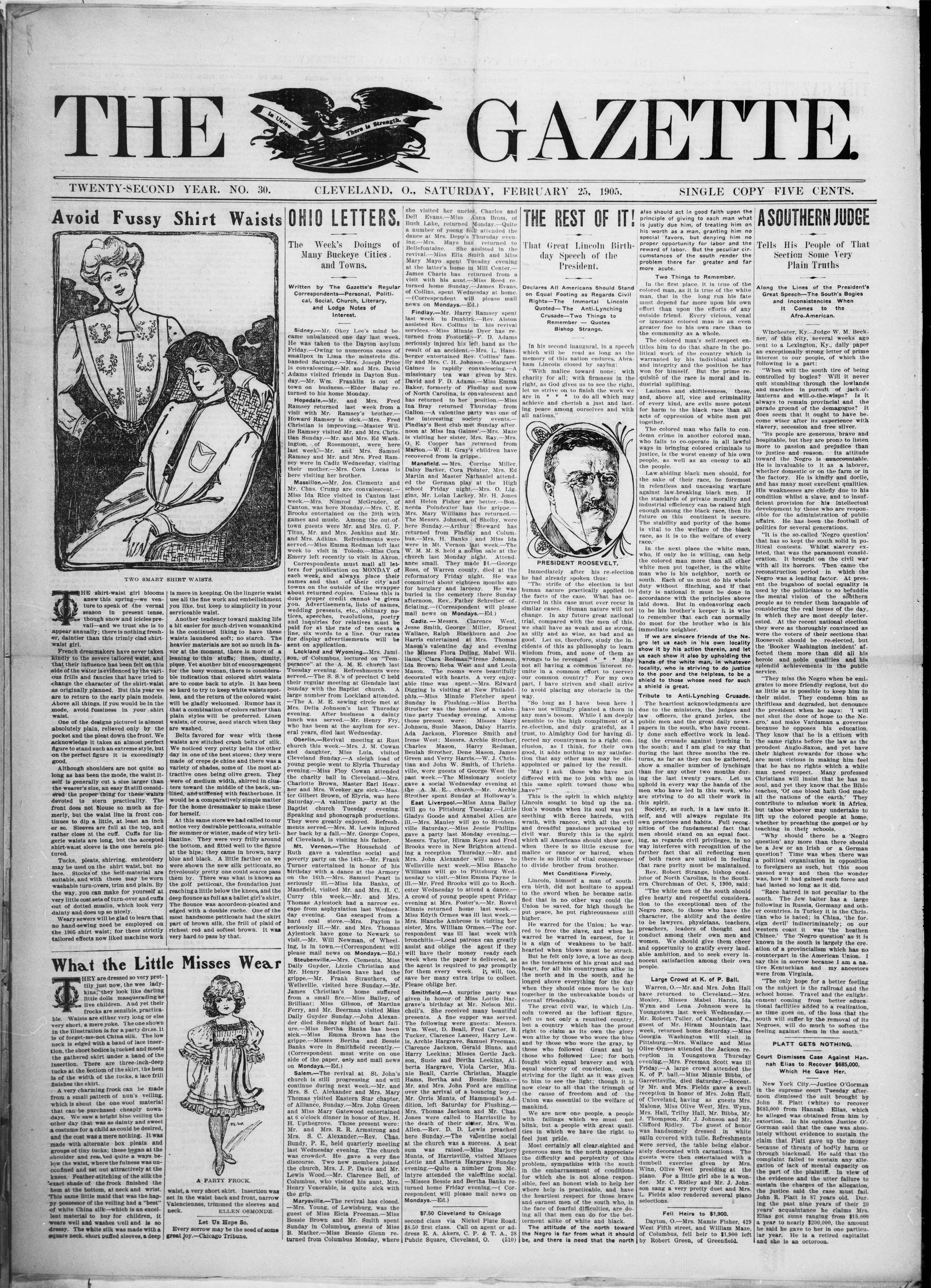
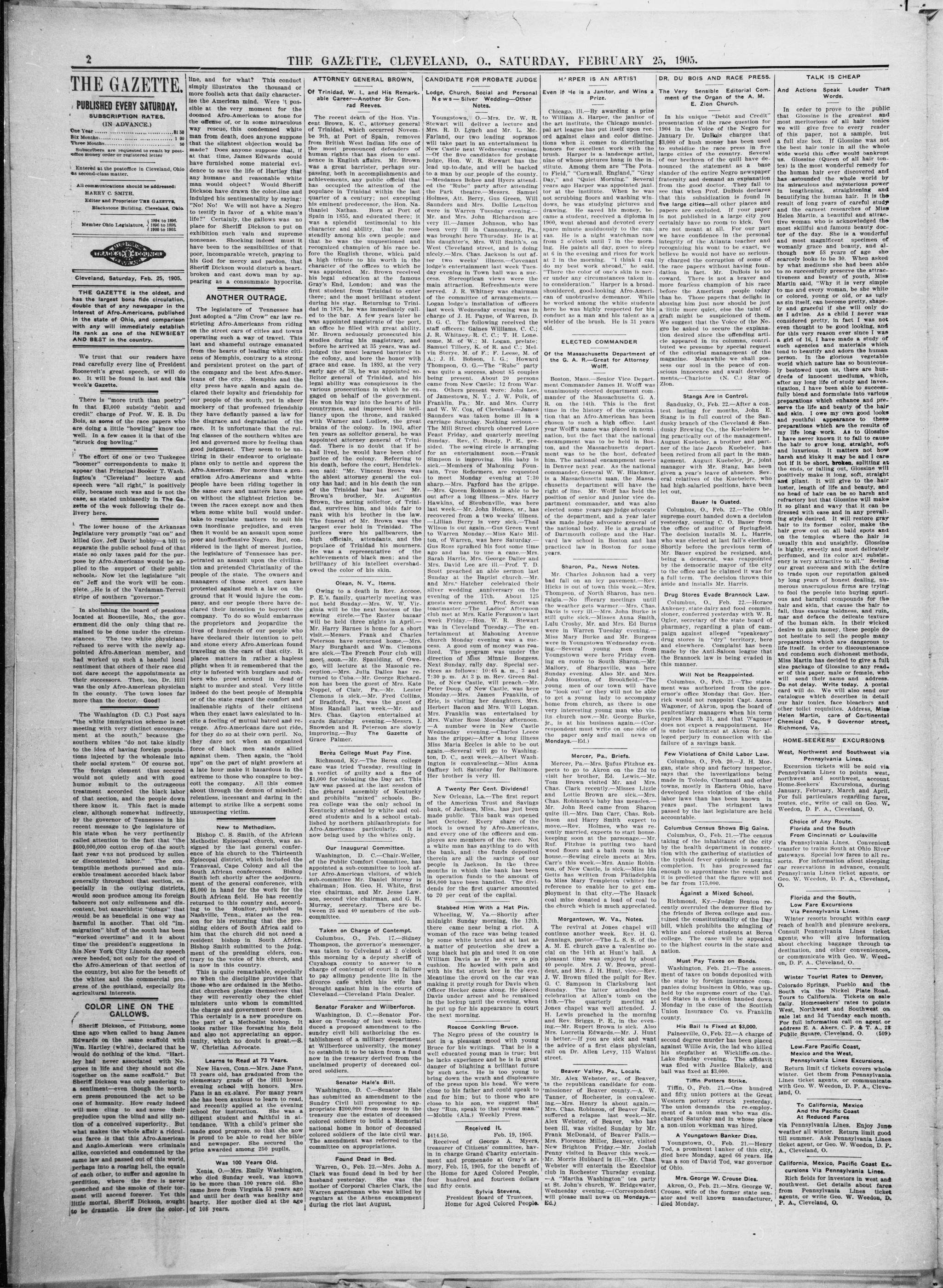
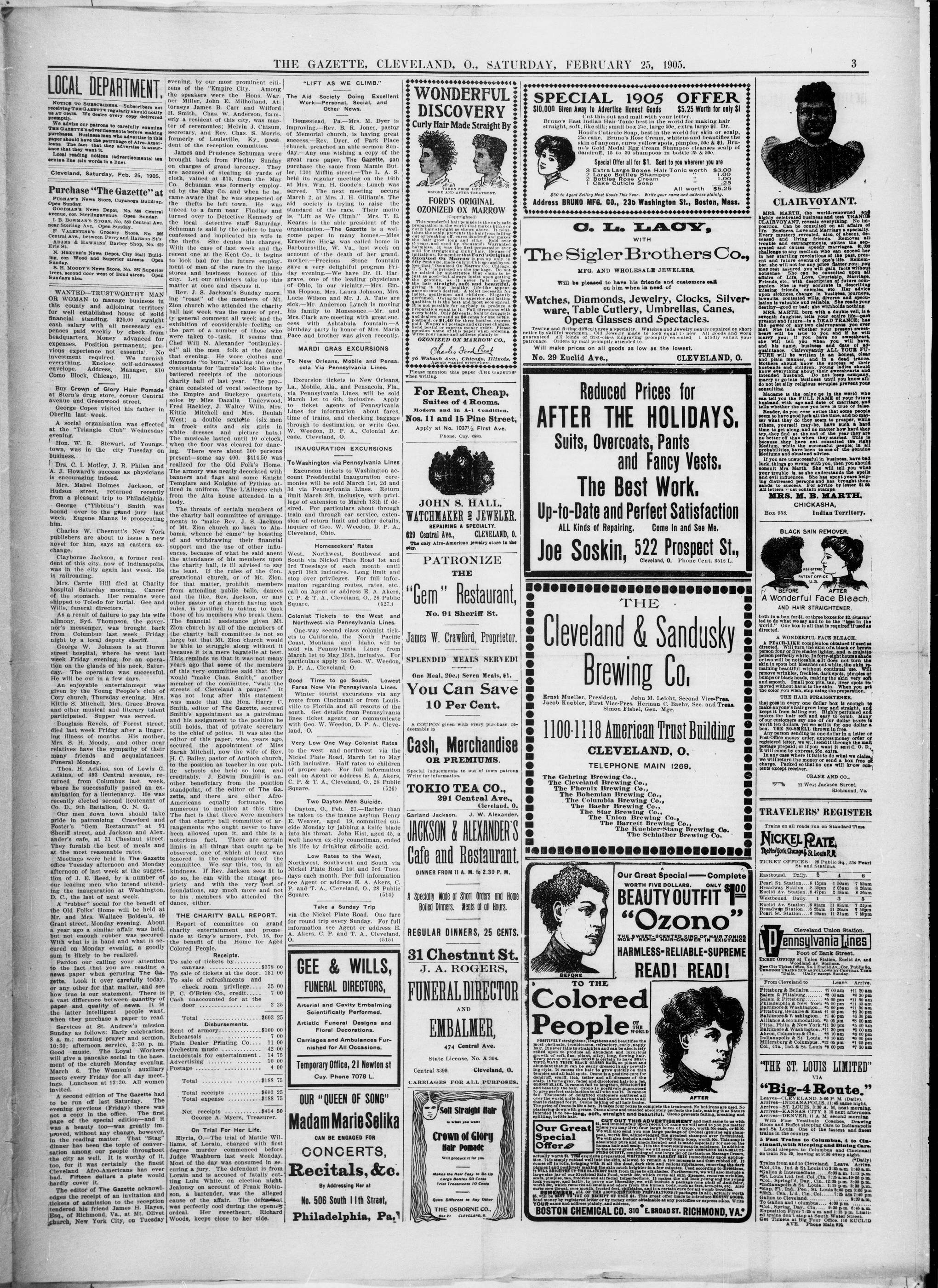
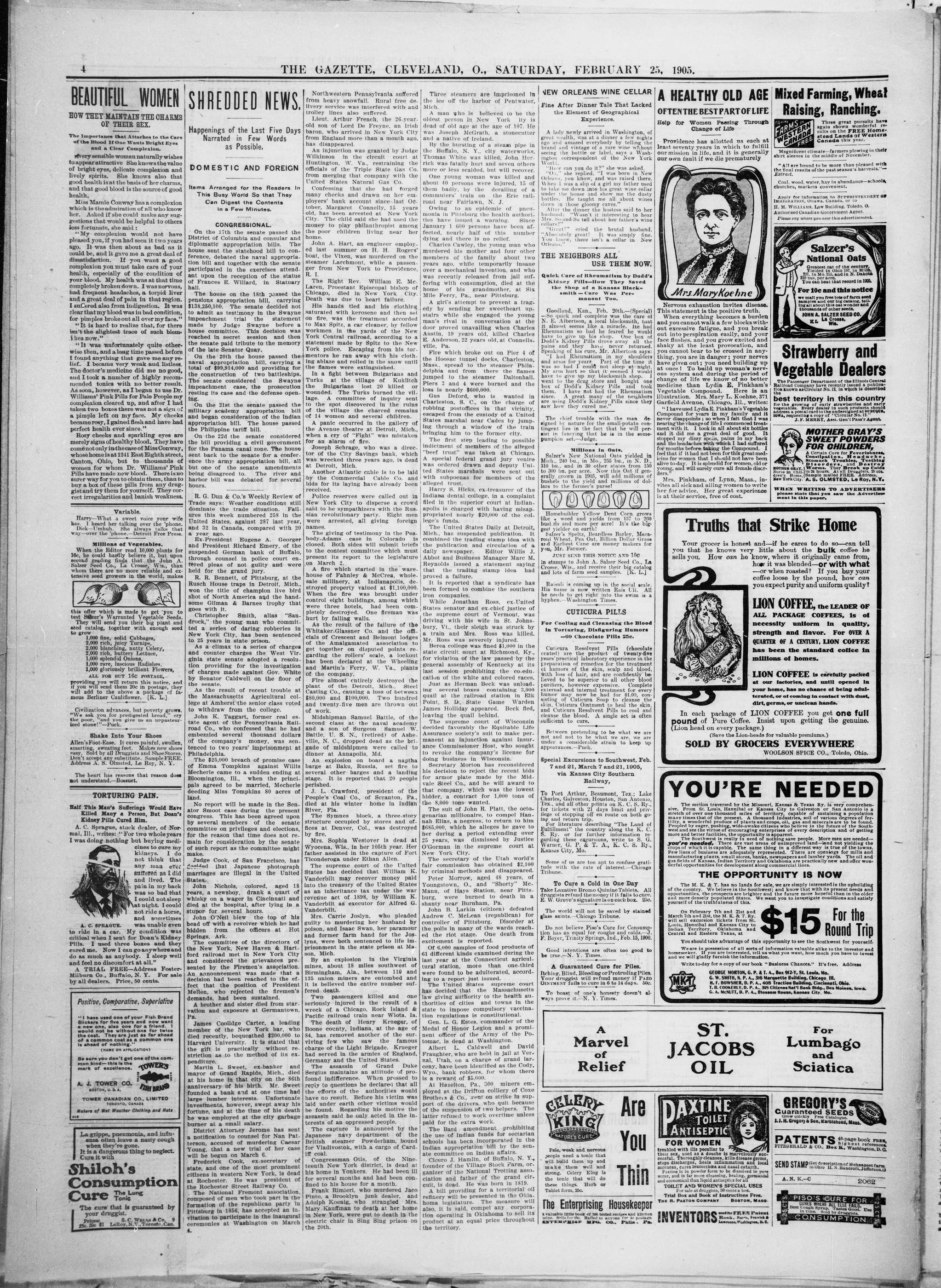
Page text (machine-generated)
THE GAZETTE.
TWENTY-SECOND YEAR. NO. 30.
Avoid Fussy Shirt Waists OHIO LETTERS.
Avoid Fussy Shirt Waists OHIO LETTERS.
A
What the Little Misses Wear
HE shirt-waist girl blooms
anew this spring—we venture to speak of the vernal
season in present tense,
though snow and jiccles pleural—and we trust she is to
HE shirt-waist girl blooms anew this spring—we venture to speak of the vernal season in present tense, though snow and icicles prevail—and we trust she is to appear annually; there is nothing fresher, daintier than this trimly clad shirt-waist girl.
French dressmakers have never taken kindly to the severe tailored waist, and that their influence has been felt on this side of the water is evidenced by the various frills and fancies that have tried to change the character of the shirt-waist as originally planned. But this year we are to return to the early plain models. Above all things, if you would be in the mode, avoid fussiness in your shirt waist.
One of the designs pictured is almost absolutely plain, relieved only by the pocket and the pleat down the front. We acknowledge it takes an almost perfect figure to stand such an extreme style, but on the perfect figure it is exceedingly good.
Although shoulders are not quite so long as has been the mode, the waist itself is generally cut a size larger than the weaker's size, an easy fit still considered the proper thing for these waists devoted to stern practicality. The front does not blouse so much as formerly, but the waist line in front continues to dip a little, at least an inch or so. Sleeves are full at the top, and rather close at the cuff. Cuffs for lingerie waists are long, but the accepted shirt-waist sleeve is the one herein pictured.
Tucks, pleats, shirring, embroidery may be used on the shirt waist, but no lace. Stocks of the self-material are suitable, and with these may be worn washable turn-overs, trim and plain. By the way, you can make for yourself at very little cost sets of turn-over and cuffs out of dotted muslin, which look very dainty and does up so nicely. Weary sewers will be glad to learn that no hand-sewing need be employed on the 1905 shirt waist; for these strictly tailored sews now liked machine work
HEY are dressed so very pretty just now, the wee ladykins' they look like darling little dolls masquerading as live children. And yet their frocks are sensible, practica-
HEY I are dressed so very tjly just now, the wee lady-kins; they look like darling little dolls masquerading as live children. And yet their frocks are sensible, yet practical. Waists are either very long or else very short, a mere yoke. The one shown in the illustration is for a party dress. It is of forget-me-not China silk. The low neck is edged with a band of lace insertion, the short bodice is tucked and meets the gathered skirt under a band of the insertion. There are three-inch-deep tucks at the bottom of the skirt, the hem is of the width of the tucks, a lace flinches the skirt.
A very charming frock can be made from a small pattern of nun's velling, which is about the one wool material that can be purchased cheaply nowadays. We saw a bright blue velling the other day that was as dainty and sweet a costume for a child as could be desired, and the cost was a mere nothing. It was made with alternate box pleats and groups of tiny tucks; these began at the shoulder and reed quite a ways below the walst, where thefulness was unconfined and set out attractively at the knees. Feather-stitching of the silk the exact shade of the frock finished the hem at the bottom, at neck and wrist. This same little maid that was the happy possessor of the velling had a "best" of white China silk—which is an excellent material to buy for children, it wears well and washes well and is so dressy. The white silk was made with a square neck, short puffed sleeves, a deep
is more in keeping. On the linigerie waist use all the fine work and embellishment you like, but keep to simplicity in your serviceable waist.
Another tendency toward making life a bit easier for much-driven womankind is the continued liking to have these waists laundered soft; no starch. The heavier materials are not so much in favor at the moment, there is more of a leaning to thin stuff; linen, dimity, pique. Yet another bit of encouragement for the busy woman, there is considerable indication that colored shirt waists are to come back to style. It has been so hard to try to keep white waists so hard, and the return of the colored waist will be gladly welcomed. Rumor has it that a combination of colors rather than plain styles will be preferred. Linen waists, of course, need starch when they are washed.
Belts for wear with these waists are stitched crush belts of silk. We noticed very pretty belts the other day in one of the best stores; they were made of crepe de chine and there was a variety of shades, some of the most attractive ones being olive green. They were of medium width, shirred in clusters toward the middle of the back, unlined, and stiffened with featherbone. It would be a comparatively simple matter for the home dressmaker to make these for herself.
At this same store we had called to our notice very desirable petticoats, suitable for summer or winter, made of wirr brillantine. They were very frilly around the bottom, and fitted well to the figure at the hips; they came in brown, navy blue and black. A little farther on we were shown the new silk petticoats, so frivolously pretty one could scarce pass them by. There was what is known as the golf petticoat, the foundation just reaching a little below the knees, and the deep flounce as full as a ballet girl's skirt. The flounce was accordeon-pleated and edged with a double ruche. One of the most handsome petticoats had the skirt part of brown silk, the frill of plaid of richest red and softest brown. It was very hard to pass by that.
P. W.
A PARTY FROCK.
waist, a very short skirt. Insertion was set in the waist back and front, narrow Valenciennes, trimmed the sleeves and neck.
ELLEN OSMONDE.
Let Us Hope So.
Every sorrow may be the seed of some great joy.-Chicago Tribune.
CLEVELAND, O., SATURDAY, FEBRUARY 25. 1905.
Written by The Gazette's Regular Correspondents—Personal, Political, Social, Church, Literary, and Lodge Notes of Interest.
Sidney—Mr. Okey Lee's mind became unbalanced one day last week. He was taken to the Dayton asylum Friday—Owing to numerous cases of smallpox in Lima the minstrels disbanded Saturday—Mrs. Joseph Price is convalescing—Mr. and Mrs. David Adams visited friends in Dayton Sunday—Mr. Wm. Franklin is out of town on business—Elder Balay returned to his home Monday.
Hopedale—Mr. and Mrs. Fred Ramsey returned last week from a visit with Mr. Ramsey's brother—World Ramsey is slick—Mrs. Fred Christian is improving—Master Willie Ramsey is Mr. and Mrs. Christian Sunday—Mr. Ed Washington, of Rosemount, were here last week—Mr. and Mrs. Samuel Ramsey and Mr. and Mrs. Fred Ramsey were in Cadiz Wednesday, visiting their mother—Mrs. Cora Lucas is here visiting her brother.
Massillon.—Mr. Jos. Clementz and Mr. Chas. Crus are convalescent.—Miss Ida Rice visited in Canton last week.—Mrs. Nimrod McGruder, of Canton, was here Monday.—Mrs. C. E. Brooks entertained on the 20th with games and music. Among the out-of-town guests were Mr. and Mrs. G. P. Titus, Mr. and Mrs. Jenkins and Mr. and Mrs. Adkins. Refreshments were served.—Miss Emma Redman left last week to visit in Toledo.—Miss Cora Emery left recently to visit in Akron. Correspondents must mall all letters for publication on MONDAY of each week, and always place their names and that of their city and towns on the cover of the wrapper of the magazine chosen. Customers must do proper credit cannot be given you. Advertisements, lists of names, wedding presents, etc., obituary notices, speeches, resolutions, poetry and inquiries for relatives must be paid for at the rate of ten cents a line, six words to a line. Our rates for display advertisements will be sent on application.
Lockland and Wyoming.—Mrs. Jamison, of Columbus, lectured on "Temple" at the A. M. E. church last Tuesday for refreshments were served.—The S. S.'s were held their regular meeting at Glendale last Sunday with the Baptist church. A large number from Lockland attended.—The A. M. E. sewing circle met at Mrs. Della Johnson's last Thursday evening. After business a dainty lunch was served.—Mr. Henry Fry, who has been at the asylum for several years, died last Wednesday.
Oberlin—Revival meeting at Rust church this week—Mrs. J. M. Cowan and daughter, Miss Lula, visited Cleveland Sunday. A sleigh load of young people went to Elyria Thursday evening. Miss Floy Cowan attended the charity ball in Cleveland. Mrs. Charlotte Brown, Master Earl Heaver and Mrs. Weaker are sick. Mrs. Gilbert Brown, of Elyria, was here day after. A valentine party at the Baptist church Tuesday evening. Speaking and monograph productions. They were greatly impressed. Measures served. Mrs. M. Lewis injured her back by a fall. Mr. George Copes of Cleveland is visiting his father.
Mt. Vernon—The Household of Ruth gave a valentine social and poverty party on the 14th. Mr. Frank Turner entertained in honor of his birthday with a dance at the Armory on the 16th. Mrs. Samuel Pearl is seriously ill. Miss Ida Banks, of Mansfield, visited Mr. and Mrs. H. C. Curry this week. Mr. and Mrs. Thomas Aylestock had a narrow escape from asphyxiation last Wednesday evening. Gas escaped from a hard coal stove. Mrs. Payton is seriously ill. Mr. and Mrs. Thomas Aylestock have gone to Newark to visit. Mr. Will Newman, of Wheeling, is in town. (Correspondent will please mail news on Mondays. Ed.) Steubenville. Mrs. Clements, Miss Daily Guyder, Lizzie Christian and Mr. Henry Madison have had the gripe. Mr. Frank Strauthers, of Wellsville, visited here Sunday. Mr. James Christian's home suffered from a small fire. Miss Bailey, of Brilliant; Miss Gibson, of Martins Ferry, and Mr. Beerman visited Miss Daily Guyder Sunday. John Alexander died Sunday night of heart failure. Miss Bertha Banks has been sick. Miss Emma Brown has the gripe. Miss Bertha and Bessie Banks were in Smithfield recently. (Correspondent must write on one side of the paper, only and mail news on Mondays. Ed.)
Salem—The revival at. St. John's church is still progressing and will continue during next week—Mr. and Mrs. S. C. Alexander and R. Mary Thomas visited Eastern Star chapter of Alliance, Sunday—Mrs. John Green and Miss Mary Gatewood entertained at 6 o'clock dinner in honor of Rev. H. H. Uphegrove. Those present were: Mr. and Mrs. R. R. Armstrong and Mrs. S. C. Alexander—Rev. Chas. Bundy, P. E., held quarterly meeting last Wednesday evening. The church was crowded. He gave a very fine discourse. He gave new members joined by Mrs. P. Davis and Mr. Lewis Wood—Mr. Clancee Bell, of Columbus, who visited his aunt, Mrs. Henry Venener, is quite sick with the grip.
Maryville—The revival has closed.—Mrs. Young, of Lewisburg, was the guest of Miss Elicia Freeman.—Miss Bessie Brown and Mr. Smith spent Sunday in Columbus, guests of Miss B. Mather.—Miss Bessie Glenn returned from Columbus Monday, where
she visited her nieces, Charles and Dell Evans—Miss Aunna Brom, of Bush Lake, returned Monday—Quite a number of young folk attended the dance at Mrs. Demp's Thursday evening—Mrs. Mays has returned, Bellefontaine. She assisted in the revival—Miss Ella Smith and Miss Mary Mayo spent Tuesday evening at the latter's home in Mill Center. James Charis has returned from a visit with his aunt. Miss Reed returned home Sunday—James Evans, of Collins, spent Wednesday at home. (Correspondent will please mail news on Mondays. Ed.)
Findlay.—Mr. Harry Ramsey spent last week in Dunblair, Rev. Alston assisted Rev. Collins in his revival services. Miss Minnie Dyer has returned from Fostoria. F. D. Adams seriously injured his left hand as the result of an accident. Mrs. L. Hansberger entertained Rev. Collins, family and Mrs. C. H. Johnson. Margaret Gaines is rapidly convalescing. A missionary tea was given by Mrs. David and F. D. Adams. Miss Emma Baker, formerly of Findlay and now of North Carolina, is convalescent and has returned to her position. Miss Ina Bray returned Thursday from Gallon.—A valentine party was one of the interesting society events. Findlay's Best club met Sunday after noon at Miss Ina Gaines.—Miss Maze is visiting her sister, Mrs. Ray.—Mrs. O. E. Cooper has returned from Marion.—W. H. Gray's children have recovered from the grieve.
Mansfield.—Mrs. Corrine Miller, Daisy Barker, Cora Polinter, Mrs. Ed Martin and Master Nathaniel attended the German play at the High school Friday night.—Mrs. O. Liggins, Mr. Lolan Lackey, Mr. H. Jones and Helen Fisher are better.—Bonnerda Poindexter has the gripe.—Mrs. Mary Williams has returned.—The Messrs. Johnson, of Shelby, were here Sunday.—Arthur Steward has returned from Findlay and Columbus.—Mrs. H. Banks and Miss Idae were in Mt. Vernon last week.—The W. M. M. S. held a nollon sale at the March last Monday night. Attendance.—The they made $4 George Ross, of Wardham and died the reformatory Friday night. He was committed about eighteen months ago for burglary and larceny. He was buried in the cemetery there Sunday afternoon, Rev. Father Schreiber officiating.—(Correspondent will please mail news on Mondays.—Ed.)
Cadiz. — Messrs. Clarence West, Jesse Smith, George Miller, Ernest Wallace, Ralph Blackburn and Joe Harris entertained at Mrs. Thomas Mason's valentine day and evening the Misses Flora Duling, Mabel Williams, Clara Reban Irene Johnson, Ida Brown, Reba West and Leola Mason. The rooms were beautifully decorated with hearts. A very enjoyable time was spent. Mrs. Edward Digging is visiting at New Philadelphia.—Miss Minnie Fletcher spent Sunday in Flushing.—Miss Bertha Strother was the hostess of a valentine party Tuesday evening. Among those present were: Misses Mary Johnson, Susie Mansy, Dalsy Harris. Ada Jackson, Florence Smith and the rest: Misses, Arlene Smith, Charles Mason, Hery Reden Beulah Strother, Dene Mason, James Green and Verry Harris. W. J. Christian and John W. Smith, of Uhrichville, were guests of George West the past week. The Missionary society gave a social Wednesday evening at the A. M. E. church—Mr. Archie Strother spent Sunday at Holloway's.
East Liverpool—Miss Anna Bailey will go to Pittsburgh Tuesday—Little Gladys Goode and Annabel Allen are ill—Mrs. Manley will go to Steubenville Saturday—Miss Jessie Phillips gave a party last Monday evening—Messrs. Taylor, Hiram Keys and Fred Brooks were in New Brighton attending a reception Thursday—Mr. and Mrs. John Alexander will move to Wellsville next week—Miss Blanche Williams will go to Pittsburgh Wednesday to visit—Miss Emma Payne is ill—Mr. Fred Brooks will go to Rochester Wednesday to attend a dance—A crowd of young people spent Friday evening at Mrs. Foster's. Mr. Rowel Minnis returned home last week. Miss Edyth Ormes was ill last week. Mrs. Blanche Ambrose is visiting her sister, Mrs. William Ormes. The correspondent was ill last week with bronchitis. Local patrons can greatly assist and oblige the agent if they will have their money ready each week when the paper is delivered, as the agent is required to pay promptly for them every week. I; will, too, save her many extra trips to collect. Please oblige her.
Smithfield.—A surprise party was given in honor of Miss Lottie Hargrave's birthday at Mr. Nelson Mitchell's. She received many beautiful presents. A fine supper was served. The following were guests: Messrs Wm. West, D. Beall, Fred Carter, B Tucker, Clarence Lanee, Harry Lewis, Archie Hargrave, Samuel Freeman Clarence Jackson, Gerald Blins, and Harry Leekins; Misses Gertle Jackson, Susie and Bertha Leekins, Alberta Hargrave, Viola Carter, Minnie Beall, Carrie Christian, Maggie Hams, Bertha and Bessie Banks.—Mr. and Mrs. John Ford are smiling over the a bouncing boy.—Mr. Orris Munts, of Hammond's Addition, left Saturday for Flushing.—Mrs. Thomas Jackson and Mr. Chas Jones were called to Harrisville by the death of their sister, Mrs. Wm Allen.—Rev. D. D. Lewis preached here Sunday.—The valentine social at the church was a success. A neat sum was raised.—Miss Marjory Munts, of Harrisville, visited Misses Lottie and Alberta Hargrave Sunday evening.—Quite a number from McIntyre attended the valentine social.—Misses Bessie and Bertha Banks returned home Friday evening.—(Correspondent will please mail news on Mondays.-Ed.)
$7.50 Cleveland to Chicago
second class via Nickel Plate Road,
$8.50 first class. Call on agent or
address E. A. Akers, C. P. & T. A., 28
Public Square, Cleveland. O. (610)
THE REST OF IT!
THE REST OF IT!
Declares All Americans Should Stand on Equal Footing as Regards Civil Rights—The Immortal Lincoln Quoted—The Anti-Lynching Crusade—Two Things to Remember — Quotes Bishop Strange.
In his second inaugural, in a speech which will be read as long as the memory of this nation endures, Abraham Lincoln closed by saying:
"With malice toward none; with charity for all; with firmness in the right, as God gives us to see the right, let us strive on to finish the work we are in * * * to do all which may achieve and cherish a just and lasting peace among ourselves and with all nations."
PRESIDENT ROOSEVELT.
Immediately after his re-election
he had already spoken thus:
"The strife of the election is but human nature practically applied to the facts of the case. What has occurred in this case must ever recur in similar cases. Human nature will not change. In any future great national trial, compared with the men of this, we shall have as weak and as strong, as silly and as wise, as bad and as good. Let us, therefore, study the incidents of this as philosophy to learn wisdom from, and none of them as wrongs to be revengeed * * * May not all having a common interest reunite in a common effort to (serve our common country)? For my own part, I have striven and shall strive to avoid placing any obstacle in the way.
"So long as I have been here I have not willingly planted a thorn in any man's bosom. While I am deeply sensible to the high compliment of a re-election, and duly grateful, as I trust, to Almighty God for having directed my countrymen to a right conclusion, as I think, for their own good, it adds nothing to my satisfaction that any other man may be disappointed or pained by the result.
"May I ask those who have not differed with me to join with me in this same spirit toward those who have?"
This is the spirit in which mighty Lincoln sought to bind up the nation's wounds when its soul was yet seething with fierce hatreds, with wrath, with rancor, with all the evil and dreadful passions provoked by civil war. Surely this is the spirit which all Americans should show now, when there is so little excuse for malice or rancor or hatred, when there is so little of vital consequence to divide brother from brother.
Met Conditions Firmly.
Lincoln, himself a man of southern birth, did not hesitate to appeal to the sword when he became satisfied that in no other way could the Union be saved, for high though he put peace, he put righteousness still higher.
He warred for the Union; he warred to free the slave, and when he warred he warred in earnest, for it is a sign of weakness to be half-hearted when blows must be struck.
But he felt only love, a love as deep as the tenderness of his great and sad heart, for he was able to alike in the north and in the south, and he longed above everything for the day when they should once be knitted in the unbreakable bonds of eternal friendship.
The great civil war, in which Lincoln towered as the loftiest figure, left us not only a reunited country, but a country which has the proud right to claim as its own the glory won alike by those who wore the blue and by those who wore the gray, by those who followed Grant and by those who followed Lee; for both fought with equal bravery and with equal sincerity of conviction, each striving for the light as it was given to him to see the light; though it is the cause or all that the triumph of the freedom and the Union was essential to the welfare of mankind.
We are now one people, a people with failings which we must not blink, but a people with great qualities in which we have the right to feel just pride.
Most certainly all clear-sighted and generous men in the north appreciate the difficulty and perplexity of this problem, sympathize with the south in the embarrassment of conditions for which she is not alone responsible, feel an honest wish to help her where help is practicable, and have the heartiest respect for those brave and earnest men of the south who, in the face of fearful difficulties, are doing all that men can do for the betterment alike of white and black.
The attitude of the north toward the Negro is far from what it should be, and there is need that the north
also should act in good faith upon the principle of giving to each man what is justly due him, of treating him on his worth as a man, granting him no special favors, but denying him no proper opportunity for labor and the reward of labor. But the peculiar circumstances of the south render the problem there far greater and far more acute.
A SOUTHERN JUDGE
Tells His People of the Section Some Very Plain Truths
Two Things to Remember.
Two Things to Remember.
In the first place, it is true of the colored man, as it is true of the white man, that in the long run his fate must depend far more upon his own effort than upon the efforts of any outside friend. Every vicious, venal or ignorant colored man is an even greater foe to his own race than to the community as a whole.
The colored man's self-respect entitles him to do that share in the political work of the country which is warranted by his individual ability and intelligence, and the honor he has won for himself. But the prime requisite of the race is moral and industrial uplifting.
Laziness and slightsness, these, and, above all, vice and criminality of every kind, are evils more potent for harm to the black race than all acts of oppression of white men put together.
The colored man who fails to condemn crime in another colored man, who fails to co-operate in all lawful ways in bringing colored criminals to justice, is the worst enemy of his own people, as well as an enemy to all the people.
Law abiding black men should, for the sake of their race, be foremost in relentless and unceasing warfare against law-breaking black men. If the standards of private morality and industrial efficiency can be raised high enough among the black race, then its future on this continent is secure.
The stability and purity of the home is vital to the welfare of the black race, as it is to the welfare of every race.
In the next place the white man, who, if only he is willing, can help the colored man more than all other white men put together, is the white man who is his neighbor, north or south. Each of us must do his whole duty without filching, and if that duty is national it must be done in accordance with the principles above laid down. But in endearing each to be his brother's keeper it is wise to remember that each can normally be the mother who is his immediate neighbor.
If we are sincere friends of the Ne-gro let us each in his own locality show it by his action therein, and let us each show it also by upholding the hands of the white man, in whatever locality, who is striving to do justice to the poor and the helpless, to be a shield to those whose need for such a shield is great.
Tribute to Anti-Lynching Crusade.
Society, as such, is a law unto itself, and will always regulate its own practices and habits. Full recognition of the fundamental fact that men should stand on an equal footing, as regards civil privileges, in no way interferes with recognition of the further fact that all reflecting men of both races are united in feeling that race purity must be maintained. Rev. Robert Strange, bishop coadjutor of North Carolina, in the Southern Churchman of Oct. 8, 1900, said: "The white men of the south should give hearty and respectful consideration to the exceptional men of the Negro race, to those who have the character, the ability and the desire to be lawyers, physicians, teachers, preachers, leaders of thought and conduct among their own men and women. We should give them cheer and opportunity to gratify every laudable ambition, and to seek every innocent satisfaction among their own people.
Large Crowd at K. of P. Ball.
Large Crowd at K. of P. Ball.
Warren, O.—Mr. and Mrs. John Hall have returned to Cleveland.—Mrs. Moxley, Misses Mabel Harris, Idia Inmount and Johnson were in Youngstown last week. Weary, Mr. Robert Tuller last week. Warry, Mr. Robert Tuller last week. Miss Georgia Washington will visit in Pittsburg.—Mrs. Wallace and Miss Olive Ormes attended the Jackson reception in Youngstown Thursday evening.—Mrs. Freeman Scott was ill Friday. A large crowd attended the K. of P. ball.—Miss Minnie Bibbs, of Garrettsville, died Saturday.—Recently Mr. and Mrs. Fields gave a swell reception in honor of Mrs. John Hall, of Cleveland, having as guests Mrs. Malone, Miss Olive West, Mrs. Wynn, Mrs. Hall, Trilby Hall, Mr. Bibbs, Mr. J. Thompson, Mr. J. Johnson and Mr. Finkley. The guest of honor was handsomely dressed in white satin covered with tulle. Refreshments were served, the table being elaborately decorated with carnations. guests were then entertained with a dumbell exercise given by Mrs. Winn, Olive West, presiding at the piano. For a little girl she is a wonder. Mr. C. Ridley and Mr. J. Johnson sang a very pretty duet and Mrs. L. Fields also rendered several piano selections.
Fell Heirs to $1,900
Dayton, O.-Mrs. Mamie Fisher, 429
West Fifth street, and William Maze,
of Columbus, fell heir to $1,900 left
by Robert Green, of Greenfield.
ASOUTHERN JUDGE
ASOUTHERN JUDGE
Tells His People of That Section Some Very Plain Truths
Along the Lines of the President's Great Speech—The South's Bogies and Inconsistencies When It Comes to the Afro-American.
Winchester, Ky.-Judge W. M. Beckner, of this city, several weeks ago sent to a Lexington, Ky., daily paper an exceptionally strong letter of prime interest to our people, of which the following is a part:
"When will the south tire of being controlled by bogies? Will it never quit stumbling through the lowlands and marshes in pursuit of jack-o'-lanterns and will-o-the-wisps? Is it always to remain provincial and the parade ground of the demagogue? It does seem that it ought to have become wiser after its experience with slavery, secession and free silver.
"Its people are generous, brave and hospitable, but they are prone to listen more to passion and prejudice than to justice and reason. Its attitude toward the Negro is unaccountable. He is invaluable to it as a laborer, whether domestic or on the farm or in the factory. He is kindly and docile, and has many most excellent qualities. His weaknesses are chiefly due to his condition whilst a slave, and to insufficient provision for his intellectual development by those who are responsible for the administration of public affairs. He has been the football of politics for several generations.
"It is the so-called 'Negro question' that has so kept the south solid in political contests. Whilst slavery existed, that was the paramount consideration. It brought on the civil war with all its horrors. Then came the reconstruction period in which the Negro was a leading factor. At present the bugaboo of social equality is the policlinists to so unfold the mental vision of the southern people as to render them incapable of considering the real issues of the day, in which they are most deeply interested. At the recent national election they were as thoroughly convinced as were the voters of their sections that Roosevelt should be re-elected, but the 'Booker Washington incident' affected them more than did all his heroic and noble qualities and his splendid achievements in the public service.
"They miss the Negro when he emigrates to more friendly regions, but do as little as is possible to keep him in their midst. They condemn him as thriftless and degraded, but denounce the president when he says: 'I will not shut the door of hope to the Negro,' and make Vardaman a governor because he opposes his education. They know that he is a citizen with the same rights before the law as the proudest Anglo-Saxon, and yet have their highest rewards for those who are most vicious in making him feel that he has no rights which a white man need respect. Many professed Christians will insist that he has no soul, and yet they know that the Bible teaches, 'Of one blood hath God made all the nations of the earth.' They contribute to mission work in Africa, but taboo whoever may undertake to lift up the colored people at home, whether by preaching the gospel or by teaching in their schools.
"Why should there be a 'Negro question' any more than there should be a Jew or an Irish or a German question? Time was when there was a political organization in opposition to foreigners as such, but this soon passed away and, then the wonder was, how it had gained such force and had lasted so long as it did.
"Race hatred is not peculiar to the south. The Jew baiter has a large following in Russia, Germany and other countries. In Turkey it is the Christian who is hated; in China, the foreign devil 'indiscriminately; on our western coast it was 'the heathen Chiece.' The 'Negro question' as it is known in the south is largely the creation of a provincialism which has no counterpart in the American Union. I say this in sorrow because I am a anacristal and my ancestors were from Virginia.
"The only hope for a better feeling on the subject is the railroad and the school house. Travel and the sunlight-enment coming from better national facilities added to a realization, as time goes on, of the loss that the south will suffer by the removal of its Negroes, will do much to soften the feelings against them in the south."
PLATT GETS NOTHING.
Court Dismisses Case Against Hannah Elias to Recover $685,000,
Which He Gave Her.
New York City.—Justice O'Gorman in the supreme court Tuesday afternoon dismissed the suit brought by John R. Platt (white) to recover $85,000 from Hannah Elias, which he alleged was obtained from him by extortion. In his opinion Justice O'Gorman said that the case was absolutely without evidence to sustain the claim that Platt gave up the money because of threats of bodily harm or through blackmail. He said that the complaint failed to sustain any allegation of lack of mental capacity on the part of the plaintiff. In view of the evidence and the utter failure to sustain the charges of the allegation, the justice said the case must fail John R. Platt is 87 years old. During the past nine years of their 20 years' acquaintance he claims Mrs. Elias got sums ranging from $15,000 a year to nearly $200,000, the amount he said he gave to her in one particular year. He is a retired capitalist and she is an octoroon.
2
One Year ..... $15.00
Eix Months ..... 1.00
Three Months ..... 5.00
Subscribers are requested to remit by post-
office money order or registered letter
Entered at the postoffice in Cleveland, Ohio
as second-class matter.
All communications should be addressed:
HARRY C. SMITH.
Editor and Proprietor THE GAZETTE.
Cleveland, Saturday, Feb. 25, 1905.
THE GAZETTE is the oldest, and has the largest bona fide circulation, double that of any newspaper in the Interest of Afro-Americans, published in the state of Ohio, and comparison with any will immediately establish its rank as one of the NEWSIEST AND BEST in the country.
We trust that our readers have read carefully every line of President Roosevelt's great speech, or will do so. It will be found in last and this week's Gazette.
There is "more truth than poetry" in that $3,000 subsidy "debit and credit" charge of Prof. W. E. B. Du Bols, as some of the race papers who are doing a little "howling" know too well. In a few cases it is that of the "struck dog howling."
The effort of one or two Tuskegee "boomer" correspondents to make it appear that Principal Booker T. Washington's "Cleveland" lecture and speech were "all right," is positively silly, because such was and is not the case, as stated unbiasedly in The Gazette of the week following their delivery here.
The lower house of the Arkansas legislature very promptly "sat on" and killed Gov. Jeff Davis' hobby—a bill to separate the public school fund of that state so only taxes paid for the purpose by Afro-Americans would be applied to the support of their public schools. Now let the legislature "sit on" Jeff and the work will be complete. He is of the Vardaman-Terrell stripe of southern the "governor."
In abolishing the board of pensions located at Booneville, Mo., the government did the only thing that remained to be done under the circumstances. The two white physicians refused to serve with the newly appointed Afro-American member, and had worked up such a baneful local sentiment that others of their race did not dare accept the appointments as their successors. Then, too, Dr. Hill was the only Afro-American physician in the county. The town loses far more than the doctor. Good!
The Washington (D. C.) Post says "the white immigration scheme is not meeting with very distinct encouragement at the south," because the southern whites "do not take kindly to the idea of having foreign populations injected by the wholesale into their social system." Of course not. The foreign element thus secured would not quietly and with good humor submit to the outrageous treatment accorded the black labor of that section, and the people down there know it. This fact is made clear, although somewhat indirectly, by the governor of Tennessee in his recent message to the legislature of his state when he very pertinently called attention to the fact that "the $600,000,000 cotton crop of the south last year was not produced by sulphur or discontented labor." The contemptible methods pursued and miserable treatment accorded black labor generally throughout that section, especially in the outlying districts, would soon produce among its foreign laborers not only sullenness and discontent, but anarchistic "doings" that would be as beneficial in one way as harmful in another. That old "immigration" bluff of the south has been "worked overtime" and it is about time the president's suggestions in his New York City Lincoln day speech were heeded, not only for the good of the Afro-American of that section of the country, but also for the benefit of the whites and the commercial progress of the southland, especially its agricultural interests.
COLOR LINE ON THE GALLOWS.
Sheriff Dickson, of Pittsburg, some time ago when called to hang James Edwards on the same scaffold with Wm. Hartley (white), declared that he would do nothing of the kind. "Hartley had never associated with Negroes in life and they should not die together on the same scaffold." But Sheriff Dickson was only pandering to a sentiment—even though the northern press pronounced the act to be one of humanity. How ready indeed will men cling to and nurse their prejudice upon the blind and silly notion of a conceived superiority. But what makes the whole affair a ridiculous force is that this Afro-American and Anglo-American were criminals alike, convicted and condemned by the same law and passed out of this world, perhaps into a roaring hell, the equals of each other, to suffer and agonize in perdition, where the fire is never quenched and the smoke of their torment will ascend forever. Yet this little mortal, Sheriff Dickson, sought to be dramatic. He drew the color-
line, and for what? This conduct simply illustrates the thousand or more foolish acts that daily characterize the American mind. Were it possible at the very moment for the doomed Afro-American to atone for the offense of, or in some miraculous way rescue, this condemned white man from death, does anyone suppose that the slightest objection would be made? Does anyone suppose that, if at that time, James Edwards could have furnished some material evidence to save the life of Hartley that any humane and reasonable white man would object? Would Sheriff Dickson have drawn the color-line and indulged his sentimentality by saying: "No! No! We will not have a Negro to testify in favor of a white man's life?" Certainly, the gallows was no place for Sheriff Dickson to put on exhibition such vain and supreme nonsense. Shocking indeed must it have been to the sensibilities of that poor, incomparable wretch, praying to his God for mercy and pardon, that Sheriff Dickson would disturb a heartbroken and cast down man by appearing as a consumate hypocrite.
ANOTHER OUTRAGE
New to Methodism.
Bishop C. S. Smith, of the African Methodist Episcopal church, was assigned by the last general conference of his church to the Thirteenth Episcopal district, which included the Transvaal, Cape Colony and all the South African conferences. Bishop Smith left shortly after the aodjournment of the general conference, with $5,000 in hand for the work for the South African field. He has recently returned to this country and, according to the Monitor, published in Nashville, Tenn., states as the reason for his returning that the presiding elders of South Africa said to him that the church did not need a resident bishop in South Africa. Bishop Smith submitted to the judgment of the presiding elders, contrary to the voice of his church, and is now in this country.
This is quite remarkable, especially so when the discipline provides that those who are ordained in the Methodist churches pledge themselves that they will reverently obey the chief ministers unto whom is committed the charge and government over them. This certainly is a new procedure on which the church should looks rather like forsaking his field and also not appreciating an opportunity, which no doubt is great.—S. W. Christian Advocate.
Learns to Read at 73 Years.
New Haven, Conn.—Mrs. Jane Fans, 73 years old, has graduated from the elementary grade of the Hill house evening school with honors. Mrs. Fans is an ex-slave. For many years she has been anxious to learn to read, and recently applied at the evening school for instruction. She was a diligent student and faithful in attendance. With a child's primer she made good progress, so that she now is proud to be able to read her bible and newspaper. She secured the prize awarded among 250 pupils.
Was 100 Years Old.
Xenia, O.-Mrs. Emily Washington, who died Sunday week, was known to be more than 100 years old. She came here from Virginia 53 years ago and until her death was healthy and hearty. Her mother died at the age of 108 years.
THE GAZETTE, CLEVELAND, O., SATURDAY, FEBRUARY 25, 1905.
ATTORNEY GENERAL BROWN,
Of Trinidad, W. I., and His Remark able Career—Another Sir Conrad Reeves.
The recent death of the Hon. Vincent Brown, K. C., attorney general of Trinidad, which occurred November 9th, at Port of Spain, removes from British West Indian life one of the most pronounced defenders of human rights that has risen to eminence in English affairs. Mr. Brown was a great barrister, perhaps surpassing, both in accomplishments and achievements, any public official that has occupied the attention of the populace in Trinidad within the last quarter of a century; not excepting his eminent predecessor, the Hon. Nathaniel Nathan. Born at Port of Spain in 1855, and educated there; it was a splendid testimonial to his character and ability, that he rose steadily among his own people; and that he was the unquestioned and recognized champion of his race before the English throne, which paid a high tribute to his worth in the character of the offices to which he was appointed. Mr. Brown received his legal education at the famous Guildford and London, and was the first student from Trinidad there; and the most brilliant student during his stay. Returning to Trinidad in 1878, he was immediately called to the bar. A few years later he was appointed magistrate of the port, an office he filled with great ability. Mr. Brown seduously prosecuted his studies during his magistracy, and before he arrived at 35 years, was adjudged the most learned barrister in the colony, and bore the honor with grace and ease. In 1893, at the very early age of 38, he was appointed and his legal ability was conspicuous in the various prosecutions in which he engaged on behalf of the government. He won his way into the hearts of his countrymen, and impressed his brilliancy upon the throne, and ranked with Warner and Ludlow, the great brains of the colony. In 1903, after ten years as solicitor general, he was appointed attorney general of Trinidad. There is no doubt that if he had lived, he would have been chief justice of the colony. Referring to his death, before the court, Hendrickson said: "Mr. Vincent Brown was the ablest attorney general the colony has had; and in his death the sun the ablest barrister has seen. Mr. Brown was August Brown, the acting solicitor, of Trinidad, survives him, and bids fair to rank with his brother in the law. The funeral of Mr. Brown was the largest ever held in Trinidad. The justices were his palibearers, the high officials, attendants, and the populace of Trinidad his mourners. He was a representative of the achievements of black men; and the brilliancy of his intellect overshadowed the color of his skin.
Olean, N. Y., Items.
Owing to a death in Rev. Accoee, P. E.'s family, quarterly meeting was not held Sunday.—Mrs. W. W. Virginia will be the next hostess of the sewing circle.—The Easter bazaar will be held three nights in April.—Mr. Harry Barnes is home for a short visit.—Messrs. Frank and Charles Peterson have returned home.—Mrs. Mary Burghardt and Wm. Clemons are sick.—The French Four club will meet soon.—Mr. Spaulding, of Owego, will lecture at the Masonic reception.—Mrs. Julia Dalles has returned to Cuba.—Mr. George Richard.—Mr. George Guggenheim, of Noppel, of Clair, Pa.—Mr. Lester Clemons is sick.—Mr. Fred Collins, of Bradford, Pa., was the guest of Miss Randall last week.—Mr. and Mrs. Chas. Gayton entertained at cards Saturday evening.—Messrs. I. Snowden and R. Peterson are slowly improving.—Buy The Gazette of Grace Palmer.
Berea College Must Pay Fine.
Richmond, Ky.-The Berea college case was tried Tuesday, resulting in a verdict of guilty and a fine of $1,000 for violating the Day act. This law was passed at the last session of the general assembly of Kentucky and prohibits "mixed" schools. Berea college was the only school in Kentucky that offered oed students and is a school established by northern philanthropists for Afro-Americans particularly. It is now being used by the whites only.
Our Inaugural Committee.
Washington, D. C.-Chair-Weller, of the Public comfort Committee, has appointed a sub-committee to look after Afro-American visitors, of which sub-committee Mr. Daniel Murray is chairman; Hon. Geo. H. White, first vice chairman, and Mr. Jesse Law, of the Public comfort Committee, Murray, secretary. There are between 25 and 40 members of the sub-committee.
Taken on Charge of Contempt
Columbus, O., Feb. 17.—Sidney Thompson, the governor's messenger, was taken to Celveland at 2 o'clock this morning by a deputy sheriff of Cuyahoga county to answer to a charge of contempt of court in failure to pay allmany pendente lite in the divorce case which his wife has brought against him in the courts of Cleveland.—Cleveland Plain Dealer.
Senator Foraker and Wilberforce.
Washington, D. C.—Senator Foraker on Tuesday of last week introduced a proposed amendment to the sundry civil bill authorizing the establishment of a military department at Wilberforce university, the money to establish it to be taken from a fund now in the treasury derived from the unclaimed property of deceased colored soldiers.
Senator Hale's Bill
Washington, D. C.—Senator Hale has submitted an amendment to the Sunday Civil bill proposing to appropriate $200,000 from money in the treasury due the estates of deceased colored soldiers to build a Memorial national home in honor of deceased colored soldiers of the late civil war. The amendment was referred to the committee on appropriations.
Found Dead in Bed.
Warren, O., Feb. 22.—Mrs. John A. Clark was found dead in bed by her husband yesterday. She was the mother of Corporal Charles Clark, the Warren guardman who was killed by regulars at the Athens encampment during the riot last August.
CANDIDATE FOR PROBATE JUDGE
Lodge, Church, Social and Personal News—Silver Wedding—Other Notes.
A Twenty Per Cent, Dividend!
New Orleans, La.—The first report of the American Trust and Savings bank, of Jackson, Miss, has just been made public. This bank was opened last October. Every share of the stock is owned by Afro-Americans, and every one of the officers and employees are members of the race. Not a white man has anything to do with the bank, and the funds deposited therein are all the savings of our people in Jackson. In the three banks, the bank has deposited in operation funds to the amount of $64,000 have been handled. The dividends for the first quarter amounted to 20 per cent of the capital.
Stabbed Him With a Hat Pin.
Stabbed Him With a Hat Pin.
Wheeling, W. Va.—Shortly after midnight Sunday morning, the 12th, there came near by a riot. A woman of the race was being teased by some white brutes and at last as a matter of protection she drew a long black hat pin and used it on one William Davis as if he were a pin cushion. He howled with pain and with his fist struck her in the eye. Meantime the crowd on the car was making it pretty rough for Davis when Officer Hecker came along. He placed Davis under arrest and he remained in the lockup until the evening, when he put up for his appearance in court the next morning.
Boscoe Conkling Bruce.
The Negro press of the country is not in a pleasant mood with young Bruce for his writings. That he is a well educated young man is true; but he lacks experience and he is in great danger of blighting a brilliant future by such acts. He is too young to bring down the wrath and displeasure of the press upon his head. We were close to his father and could speak to and for him; but to those who are close to his son, we suggest that they "Run, speak to that young man." -Mobile (Ala.) Weekly Press.
Received It.
$414.50. Feb. 19, 1905.
Received of George A. Myers,
treasurer of Citizens' committee, havin
in charge Grand Charity entertainment
and promenade at Gray's armory, Feb. 15, 1905, for the benefit of
the Home for Aged Colored People,
four hundred and fourteen dollars
and fifty cents.
Sylvia Stevens,
President Board of Trustees,
Home for Aged Colored People.
H'RPER IS AN ARTIST
Chicago, Ill.—By awarding a prize to William A. Harper, the janitor of the art institute, the Chicago municipal art league has put itself upon record against class and color distinctions when it comes to distributing honors for excellent work with the brush. Harper is a landscape artist, nine of whose pictures hang in the institute. Among them are "The Potato Field," "Cornwall, England," "Gray Day," and "Quiet Morning." Several years ago Harper was appointed janitor of the school, not scrubbing floors and washing windows, he was studying pictures and drawing. He saved his money, became a student, received a diploma in 1900, went abroad and devoted every spare minute assiduously to the canvas. He is a night watchman now from 2 o'clock until 7 in the morning. He paints all days, goes to sleep at 6 in the evening and rises for work at 2 in the morning. "I think I can do my best work abroad," he said. "There the color of one's skin is never under any circumstances taken in by insiderism." Harper is shouldered, good-looking Afro-American of unobtrusive demeanor. While he worked among the white students here he was highly respected for his conduct as a man and his talent as a wielder of the brush. He is 31 years old.
ELECTED COMMANDER
Of the Massachusetts Department of the G. A. R.-Great for Attorney Wolff.
Boston, Mass.—Senior Vice Department Commander James H. Wolff was unanimously elected department commander of the Massachusetts G. A. R. on the 14th. This is the first time in the history of the organization that an Afro-American has been chosen to such a high office. Last year Wolff's name was placed in nomination, but the fact that the national encampment was to be held in Boston, and the Massachusetts department was to be the host, defeated him. The national encampment meets in Denver next year. As the national commander, General W. W. Blackmer is a Massachusetts man, the Massachusetts department will have the right of line. Mr. Wolff has held the position of vice department commander, and was also elected some years ago judge advocate of the department, and a year later was made judge advocate general of the national body. He is a graduate of Dartmouth college and the Harvard law school in Boston and has practiced law in Boston for some years.
Sharon, Pa., News Notes
Mr. Charles Johnson had a very bad fall on an ice pavement. -Rev Hicks is out of town this week.-Mrs Thompson, of North Shore, has neuralgia.-No literary meeting this weather gets warmed up. Chas Davis is very ill.-Mrs. John Burke is still quite sick.-Misses Anna Smith Lulu Crosby, Mr. and Mrs. Ed Burns were in Warren Tuesday evening.-Miss Mary Burke and Mr. Burgess were in Youngstown Wednesday evening.-Several young men from Youngstown were here Friday evening. en route to South Sharon.-Mr Mallory, of Sharpville, was here Sunday evening. Also Mr. and Mrs John Houston, of Brookfield.-The young men of our town will have to "look out" or they will not be able to get a young lady to accompany home from church, as there is one very interesting young man who visits church now.-Mr. George Burke jr., is at his business again.-(Correspondent must write on one side of the paper only) and mail news on Mondays.-Ed.)
Mercer, Pa., Briefs.
Mercer, Pa.—Mrs. Rufus Fitzhuez expects to go to Akron on the 22d to visit her brother, Ed. Lewis.—Mr Tom Brown visited Mr. and Mrs Chas. Clark recently.—Misses Lizzie and Lottie Brown are sick.—Mrs Chas. Robinson's baby has measles.—Mr. John Reed came from Sharon quite ill.—Mrs. Dan Carr, Chas. Robinson and Harry Smith expect to move.—Rev. Holmes, who was recently married, expects to start house, keeping soon at the parsonage.—Mr Ruf. Fitzhuez is putting two hard wood floors and a bath room in his house.—Sewing circle meets at Mrs Carr's this week.—Annie Robinson, of New Castle, is sick.—Miss Ida Getts has written from Philadelphia to Miss Mary Temple (white) for reference to enable to get employment in that city.—The Hasack coal mine donated a load of coal to the church which is much appreciated
Morgantown, W. Va., Notes
The revival at Jones chapel will continue another week. Rev. H. G. Jennings, pastor—The L. S. S. of the A. M. E. church gave a valentine social on the 14th at Hunt's hall. A pleasant time was enjoyed by about 40 people. Mrs. J. W. Brown, president, and Mrs. J. H. vice, Rep. J. W. Brown filled the pulpit for Rev. G. C. Sampson in Clarksburg last Sunday. The latter attended the celebration at Allen's tomb on the 14th—The quarterly meeting at Jones chapel was well attended. J. H. Lewis preached in the morning and Rev. Briggs, P. E., in the evening. Mr. Rupert Brown is sick. Also Mrs. Lucretia Edwards—Mr. J. Hunt is better. If you are sick and want the advice of a first class physician, call on Dr. Allen Levy, 115 Walnut street.
Beaver Valley, Pa., Locals.
Mr. Alex Webster, sr., of Beaver is the republican candidate for commissioner of Beaver county—a A.W. Tanner of Beaver county—and filing—Mrs. Henry is about again—Mrs. Chas. Robinson, of Beaver Falls suffered a relapse last week—Mr. Alex Webster, of Beaver, who has been ill, was visited Sunday by Mr. Frank McDonald, of Beaver Falls—Mrs. Florence Miller, Beaver, visited New Brighton Friday—Mr. Josiah Penny visited in Beaver this week—Mr. Morris Hubbard is ill—Mr. Chas Webster will entertain the Excelsior club in Rochester Thursday evening—Mr. Martha Washington" tea party at St. John's Church Wednesday evening.—(Correspondent will please mail news on Mondays-Ed.)
DR. DU BOIS AND RACE PRESS.
The Very Sensible Editorial Comment of the Organ of the A. M. E. Zion Church.
In his unique "Debit and Credit" presentation of the race question for 1904 in the Voice of the Negro for January Dr. DuBois charges that $3,000 of hush money has been used to subsidize the race press in five large cities of the country. Several of our brethren of the quill have denounced the statement as a base slander of the entire Negro newspaper fraternity and demand an explanation from the good doctor. They fail to see that when Prof. DuBois declares that this subsidization is found in five large cities—all other places and papers are excluded. If your paper is not published in a large city, you may already be at room to tick. You are not held at all. For our part we have confidence in the personal integrity of the Atlanta teacher and recognizing his wont to be exact, we believe he would not have so seriously charged the corruption of some of the race papers without having foundation in fact. Mr. DuBois is no coward. There is not a braver and more fearless champion of his race before the American people today than he. Those papers that delight in abusing him just now should be a little more quiet, else the taint of graft might be suspicioned of them. We suggest that the Voice of the Negro be asked to secure the Negro desire since the offending antithesis appeared in the newspaper. We presume by special request of the editorial management of the magazine. Meanwhile we shall possess our soul in the peace of conscious innocence and awake developments.—Charlotte (N. C.) Star of Zion.
Stangs Are in Control.
Sandusky, O., Feb. 22—After a contest lasting for months, John E. Stang is in full control of the Sandusky branch of the Cleveland & Sandusky Brewing Co., the Kuebelers being practically out of the management. August Kuebeler, a brother and partner of the late Jacob Kuebeler, has been retired from all part in the management. August Kuebeler, Jr., joint manager with Mr. Stang, has been yearlong in residence. Several relatives of the Kuebeler, who had high-salaried positions, have been let out.
Bauer Is Ousted.
Columbus, O., Feb. 22—The Ohio supreme court handed down a decision yesterday, ousting C. O. Bauer from the office of auditor of Springfield. The decision installs M. L. Harris, who was elected at last fall's election. Shortly before the previous term of Mr. Bauer expired he resigned, and, being a democrat, was reappointed by the democratic mayor of the city to the office and he claimed it was for a full term. The decision throws this aside and installs Mr. Harris.
Drug Stores Evade Brannock Law.
Columbus, O., Feb. 22—Horace Ankney, state dairy and food commissioner, conferred yesterday with W. R. Ogier, secretary of the state board of pharmacy, regarding a plan of campaign against alleged "speakeasy" drug stores in "dry" territory, here and elsewhere. Complaint has been made by the Anti-Saloon league that the Brannock law is being evaded in this manner.
Will Not be Reappointed.
Columbus, O., Feb. 21.—The statement was authorized from the governor's office Monday that Gov. Herick would not reappoint Capt. Aaron Wagoner, of Akron, upon the board of penitentiary managers when his term expires March 31, and that Wagoner does not expect a reappointment. He is under indictment at Akron for alleged perjury in connection with the failure of a savings bank.
Few Violations of Child Labor Law.
Columbus, O., Feb. 20.—J. H. Morgan, state state and factory inspector, says investigations being made in Toledo, Clinton and other towns, mostly in Eastern Ohio, have developed less violation of the child labor laws than has been known in years past. The stringent laws passed by the last legislature are held accountable.
Columbus Census Shows Big Gains.
Columbus, O., Feb. 21. The census taking of the inhabitants of the city by the health department in connection with the gathering of statistics of the typhoid fever epidemic is nearing completion. It has progressed far enough to approximate the result and it is predicted that the figure will not be far from 175,000.
Against a Mixed School.
Richmond, Ky.-Judge Benton recently overruled the demurrier filed by the friends of Berea college and sustained the constitutionality of the Day bill, which prohibits the mingling of students and colored students at Berea college. The case will be appealed to the highest courts in the state and nation.
Must Pay Taxes on Bonds
Washington, Feb. 21.—The assessment of taxes on bonds deposited with the state by foreign insurance companies doing business in Ohio, was upheld by the supreme court of the United States in a decision handed down in the case of the Scottish Union Insurance Co. vs. Franklin county.
His Bail Is Fixed at $3,000
Palmenville, O., Feb. 22.—A charge of second degree murder has been placed against Willie Avis, the lad who killed his stepfather at Wickliffe-on-the-Lake Sunday evening. The affidavit was filed with Justice Blakely, and ball was fixed at $3,000.
Tiffin Potters Strike
Tiffin, O., Feb. 21—One hundred and fifty union potters at the Great Western堡堡, struck yesterday. The union demands the re-employ-ment of the workers who was discharged Saturday and in which place a non-union workman was hired
A Youngstown Banker Dies
Youngstown, . Feb. 21.—Henry Tod, a prominent lanker of this city, met here Monday, aged 66 years. He was a son of David Tod, war governor of Ohio.
Mrs. George W. Crouse Dies
Akron, O., Feb. 21.—Mrs. George W. Crouse, wife of the former state senator and well known manufacturer, died Monday.
TALK IS CHEAP
And Actions Speak Louder Than Words.
In order to prove to the public that Glossine is the greatest and most merritorious of all hair tonics we will give free of every reader of this paper, not a sample, but a full size box. If Glossine was not the best hair tonic in all the whole wide world this offer would bankrupt us. Glossine (Queen of all hair tonics) is the most wonderful remedy for the human hair ever discovered and has astounded the whole world by its miraculous and mysterious power in lengthening, straightening and beautifying the human hair. It is the result of long years of careful study and the earnest researches of Miss Helen Martin, a beautiful and attractive woman who is acknowledged the most skillful and famous beauty doctor of the day. She is a wonderful and most magnificent specimen of womanly grace and beauty, and although now 55 years of age she scarcely looks to be 30. When asked by what lengths she had been able to successfully preserve the attractiveness and beauty of youth, Miss Martin said, "Why it is very simple to me and every woman, be she white or colored, young or old, or as ugly as itself, can become pretty, shapey and graceful if she is not as I advise. As did I never was considered pretty, in fact I was not even though it is good looking, and for all ages the reason ever since I was kind of 16. I have made a study of such agencies and materials which tend to beautify and adorn the human person. In the glorious vegetable world which nature has so bountifully bestowed upon us, there are hundreds of innocent mediums, which, after my long life of study and investigation, I have been able to successfully blend and formulate into various preparations which enhance and preserve the life and beauty of the hair and skin. I owe my own good looks and youthful appearance to these preparations which are the results of my life long work. As to Glossine I have never known it to fail to cause the hair to grow long, straight, soft and luxurious. It matters not how harsh and kinky it may be and I care not if it be short, broken, splitting at the ends, or falling out, Glossine will positively make it long, soft, straight and pliant. It will give to the hair luster, length and curl of the hair and care it so harsh and refractory that Glossine will make it so plant and wavy that it can be dressed with ease and in any prevailing style desired. It will restore gray hair to its former color, make the hair grow out on all bald spots and on the temples where the hair is usually thin and unlightly. Glossine is highly, sweetly and most delicately perfumed, and its color are subsistency is very attractive to all." Seeing our great success and with the desire to trade upon our reputation gained by long years of honest dealing, numerous unscrupulous firms are trying to fool the people into buying spurious and harmful compounds for the hair and skin, that cause the hair to fall, thus causing baldness, and mar, and deface the delicate texture of the human skin. In their wicked desire to gain money, these people do not hesitate to sell the people many preparations which are dangerous to life itself. In order to discountenance and condone such idiotic methods, we have such honestly designed package of Glossine to any reader of this paper, male or female, who will send their name and address. Do not delay. Write today. A postal card will do. We will also send our catalogue which describes in detail our hair tonics, face bleachers and other toilet requisites. Address, Miss Helen Martin, care of Continental Chemical Co., 9 Governor street, Richmond, Va.
HOME-SEEKERS' EXCURSIONS
West, Northwest and Southwest via Pennsylvania Lines.
Excursion tickets will be sold via Pennsylvania Lines to points west, northwest and southwest, account Home-Seekers' Excursions, during January, February, March and April. For full particiulars regarding fares, routes, etc., write or call on Geo. W. Weedon, D. P. A., Cleveland, O.
From Cincinnati or Louisville
From Cincinnati or Louisville
via Pennsylvania Lines. Convenient
transfer to trains South at Ohio River
gateway. Special low fares to all
resorts. For information about sleeping
penalties in advance, consult
pennsylvania Lines ticket agents, or
Geo. W. Weedon, D. P. A., Cleveland,
O.
Florida and the South.
Winter resorts brought within easy reach of health and pleasure seekers. Consult Pennsylvania Lines ticket agents, who will give information about checking baggage through to destination, and other conveniences, or communicate with Geo. W. Weedon, D. P. A. Cleveland, O.
Winter Tourist Rates to Denver.
Colorado Springs, Pueblo and the South via the Nickel Plate Road. Tours to California. Tickets on sale daily. Homeseekers' rates to points West, Northwest and southwest on sale 1st and 3rd Tuesday each month. For full information call on agent or address E. A. Akers, C. P. & T. A., 28 Public Square, Cleveland, O. (509)
Pennsylvania Lines Excursions.
Return limit c tickets covers whole winter. Get them from Pennsylvania Lines ticket agents, or communicate with Geo. W. Weedon, D. P. A., Cleveland, O.
via Pennsylvania Lines. Enjoy June weather all winter. Return limit good till summer. Ask Pennsylvania Lines ticket agent, or Geo. W. Weedon, D. P. A., Cleveland, O.
California, Mexico, Pacific Coast Exc
cursions via Peninsula Coast
currencies Via Pennsylvania Lines.
Rich fields for investors in west and southwest. Get details about fares from Pennsylvania Lines ticket agents, or write Geo. W. Weedon, D. P. A., Cleveland, O.
NOTICE TO SUBSCRIBERS -- Subscribers not receiving THE GATEWAY regularly should notify us. We desire every copy delivered promptly.
We advise our patrons to carefully examine THE GATEWAY's advertisements before making purchases. Business men who advertise to this group have the patronage of Afro-Americans. The group also advertise is assurance that they want it.
Local reading notes (advertisements) sexta line (six words in a line).
Cleveland, Saturday, Feb. 25, 1905.
PUSAHAN News Store, Cuyanoga Building, Orlando, Goodman's News Depot. No. 968 Central avenue, cor. Sterlingavenue, Open Sunday. I. B. BOWMAN's Store, No. 968 Central Avenue, near Sterling Ave., Open Sunday. F. VALENTINE's Grocery Store, No. 968 Central Ave., between Perry and Harmon St. Erie St. H. NEXTER's News Depot, City Hall Building, cor. Wood and Superior streets, Open Sunday. S. H. MOODY's News Store, No. 967 Superior street, second door west of Bond Street, Open Sundays also.
WANTED—TRUSTWORTHY MAN OR WOMAN to manage business in this county and adjoining territory for well established house of solid financial standing. $20.00 straight cash salary with all necessary expenses paid weekly by check from headquarters. Money advanced for expenses. Position permanent; previous experience not essential. No investment required. We furnish everything. Enclose self-addressed envelope. Address, Manager, $10 Como Block, Chicago, Ill.
Buy Crown of Glory Hair Pomade at Stern's drug store, corner Central avenue and Greenwood street.
George Copes visited his father in Oberlin last week.
A social organization was effected at the "Triangle Club" Wednesday evening.
Hon. W. R. Stewart, of Youngstown, was in the city Tuesday on business.
Drs. C. I. Motley, J. R. Phillen and A. J. Howard's success as physicians is encouraging indeed.
Mrs. Mabel Holmes Jackson, of Hudson street, returned recently from a pleasant trip to Philadelphia.
George ("Tibbitts") Smith was bound over to the grand jury last week. Eugene Manns is prosecuting him.
Charles W. Chesnutt's New York publishers are about to issue a new novel for him, says an eastern exchange.
Clayborne Jackson, a former resident of this city, now of Indianapolis, was in the city again last week. He is railroading.
Mrs. Carrie Hill died at Charity hospital Saturday morning. Cancer of the stomach. Her remains were shipped to Toledo for burial. Gee and Wills, funeral directors.
As a result of failure to pay his wife alimony, Syd. Thompson, the governor's messenger, was brought back from Columbus last week Friday night by a local deputy sheriff.
George W. Johnson is at Huron street hospital, where he went last week Friday evening, for an operation on the glands of his neck. Saturday. The operation was successful. He will be out in a few days.
An enjoyable entertainment was given by the Young People's club of Cory church, Thursday evening. Mrs. Kittle S. Mitchell, Mrs. Grace Brown and other musical and literary talent participated. Supper was served.
Douglass Revels, of Forest street, died last week Friday after a lingering illness of months. His mother, Mrs. S. H. Moody, and other near relatives have the sympathy of their many friends and acquaintances. Funeral Monday. Thos. H. Adkins, son of Lewis G. Adkins, of 493 Central avenue, returned from Columbus last week, where he successfully passed an examination for a lieutenant. He was recently elected second lieutenant of Co. D. 9, Battalion, O. N. G. Our men down town should take pride in patronizing Crawford and Foster's "Gem Restaurant" at 91 Sheriff street, and Jackson and Alexander's cafe, at 31 Chestnut street. They furnish the best of meals and at the most reasonable rates. Meetings were held in The Gazette office Tuesday afternoon and Monday afternoon of last week at the suggestion of J. E. Reed, by a number of our leading men who intend attending the inauguration at Washington, D. C., the last of next week.
A "rubber" social for the benefit of the Old Folks' Home will be held at Mr. and Mrs. Wallace Bolden's, 49 Grant street, Monday evening. About a year ago a similar affair was held, but not enough rubber was secured. With what is in hand and what is secured on Monday evening, a goodly sum is likely to be realized. Pardon our calling your attention to the fact that you are reading a news paper when presenting The Gazette. Look at carefully today, or any other for that matter, and see that our statement. There is a vast difference between quantity of paper and quality of news. It is the latter intelligent people want, when they purchase a paper to read.
Services at St. Andrew's mission Sunday as follows: Early celebration, 8 a. m.; morning prayer and sermon, 10:30; afternoon service, 3:30 p. m. Good music. The Loyal Workers will give a pancake social in the basement of the church Monday evening, March 6. The Women's auxiliary meets every Friday for all day meetings. Luncheon at 12:30. All women invited.
A second edition of The Gazette had to be run off last Saturday. The evening previous (Friday) there was not a copy in the office. The first page of the special edition—and it was a beauty too—was greatly improved, without any change, however, in the reading matter. That "Stag" dinner has been the topic of conversation among our people throughout the city as well. It is worthy of it, too, for it was certainly the finest Cleveland Afro-Americans has ever had. Fifteen dollars a plate would hardly cover it.
The editor of The Gazette acknowledges the receipt of an invitation and tickets of admission to the reception tendered his friend James H. Hayes, Esq, of Richmond, Ma, at Mt. Olivet church. New York City, on Tuesday
evening, by our most prominent citizens of the "Empire City." Among the speakers were the Hons. Warner Miller, John E. Melliland, Attorneys James B. Carr and Wilford H. Smith. Chas. W. Anderson, formerly a resident of this city, was massthe Chisum, secretary, and Rev. Chas. S. Morris, formerly of Louisville, Ky., president of the reception committee.
James and Prudence Schuman were brought back from Findlay Sunday on charges of grand larcency. They are accused of stealing 60 yards of cloth, valued at $75, from the May Co. Schuman was formerly employed by the May Co. and when he became aware that he was suspected of the thefts he left town. He was traced to a farm near Findlay and turned over to Detective Kennedy of the local detective staff Saturday. Schuman is said by the police to have confessed and implicated his wife in the thefts. She denies his charges. With the case of last week and the recent one at the Kent Co., it begins to look bad for the future employment of men of the race in the large stores and business houses of this city. Let our ministers take up this matter at once and discuss it.
Rev. J. S. Jackson's Sunday morning "roast" of the members of Mt. Zion church who attended the charity ball last week was the cause of pretty general comment all week and the exhibition of considerable feeling on the part of a number of those who were taken to task. It seems that Chef N. N. Alexander "outunleyed" all the men folk at the dance that evening. He wore clothes and diamonds "to burn," making the other contestants for "laurels" look like the battered receipts of the notorious charity ball of last year. The program consisted of vocal selections by the Empire and Buckeye quartets, solos by Miss Dazalla Underwood, Fred Hackley, J. Walter Wills, Mrs. Kittle Mitchell and Mrs. Beulah West; a double sextette (six men in frock suits and six girls in white dresses and picture hats). The music lasted until 10 o'clock, when the floor was cleared for dancing. There were about 300 persons present—some say 400. $414.50 was realized for the Old Folk's Home. The armory was neatly decorated with banners and flags and some Knight Templars and Knights of Pythias attired in uniform. The L'Allegro club from the Alta house attended in a body.
THE CHARITY BALL REPORT.
Report of committee on grand
charity entertainment and promen-
ade at Gray's armory, Feb. 15, for
the benefit of the Home for Aged
Colored People.
Receipts.
To sale of tickets by..... $378 00
canvass.....
To sale of tickets at the door. 181 00
To sale of refreshments and
check room privilege..... 35 00
P. C. O'Brien Co., credit..... 7 00
Cash unaccounted for at the
cash account..... 2 25
Net receipts ..... $414 50
George A. Myers, Treasurer.
On Trial For Her Life
Elyria, O.—The trial of Mattie Williams, of Lorain, charged with first degree murder commenced before Judge Washburn last week Monday. Most of the day was consumed in securing a jury. The defendant is from Lorain and is accused of fatally cutting Lulu White, on election night. Jealousy on account of Frank Robinson, a bartender, was the alleged cause of the affair. The defendant was perfectly cool during the opening ordeal. Her sweetheart, Richard Woods, keeps close to her side.
THE GAZETTE, CLEVELAND, O., SATURDAY, FEBRUARY 25, 1905. "LIFT AS WE CLIMB."
The Aid Society Doing Excellent Work—Personal, Social, and Other News.
Homestead, Pa.—Mrs. B. M. Dyer is improving.—Rev. B. R. Jones, pastor of Memorial church, is having great success.—Rev. Dyer, of Park Place church, preached an able sermon Sunday.—Any one wishing a copy of the great race paper, The Gazette, can purchase the same from Mamie Butler, 1301 Mifflin street.—The L. A. S. held its regular meeting on the 16th at Mrs. Wm. H. Goode's. Lunch was served. The next meeting occurs March 2, at Mrs. J. H. Gilliam's. The ald society is trying to raise the standard of the race. Their motto is, "Lift as We Climb." Mrs. T. E. Kearns is the able president of the organization. The Gazette is a welcome paper in many homes.—Miss Ernestine Hicks was called home in Barboursville, W. Va., last week on account of the death of her grandmother.—Precious. Stone fountain in Dayton, Ohio, was Dr. H. Hargrave, one of the leading physicians of Ohio, in our vicinity.—Mrs. Emma Hopson, Mrs. Laura Johnson, Mrs. Lucie Wilson and Mr. J. A. Tate are sick.—Mr. Anderson Lynch is moving his family to Monessue.—Mr. and Mrs. Clark are meeting with great success with Ashtabula fountain.—A birthday party in honor of Mrs. Maria Pace and brother was given recently.
MARDI GRAS EXCURSIONS
To New Orleans, Mobile and Pensacola Via Pennsylvania Lines.
Excursion tickets to New Orleans, La., Mobile, Ala., and Pensacola, Fla., via Pennsylvania Lines. will be sold March 1st to 6th, inclusive. Apply to ticket agents of Pennsylvania Lines for information about fares, time of trains, and checking baggage through to destination, or write Geo. W. Weedon, D. P. A., Colonial Arcade, Cleveland, O.
INAUGURATION EXCURSIONS
To Washington via Pennsylvania Lines
Excursion tickets to Washington account Presidential Inauguration ceremonies will be sold March 1st, 2d and 3d via Pennsylvania Lines. Return limit March 8th, inclusive, with privilege of extension to March 18th if desired. For particulars about through train and through car service, extension of return limit and other details, inquire of Geo. W. Weedon, D. P. A., Cleveland, Ohio.
Homeseekers' Rates
West, Northwest, Southwest and South via Nickel Plate Road 1st and 3rd Tuesdays of each month until April 18th inclusive. Long limit and stop over privileges. For full information regarding routes, rates, etc. call on Agent or address E. A. Akers, C. P. & T. A., Cleveland, O., 28 Public Square. (527).
Colonist Tickets to the West and Northwest via Pennsylvania Lines. One-way second class colonist tickets to California, the North Pacific Coast, Montana and Idaho, will be sold via Pennsylvania Lines from March 1st to May 15th, inclusive. For particulars apply to Geo. W. Weedon, D. P. A., Cleveland, O.
Good Time to go South. Lowest Fares Now Via Pennsylvania Lines.
Winter tourist excursions via any route from Cincinnati or from Louisville to Florida and all resorts of the south. Get details from Pennsylvania lines ticket agents, or communicate with Geo. W. Weedon, D. P. A., Cleveland, O.
Very Low One Way Colonist Rates to the west and northwest via the Nickel Plate Road, March 1st to May 15th inclusive. Half rates to children of proper age. For full information call on Agent or address E. A. Akers, C. P. & T. A., Cleveland, O., 28 Public Square. (526)
Two Dayton Men Suicide.
Dayton, O., Feb. 21—Rather than be taken to the insane asylum Henry E. Weaver, aged 19, committed suicide Monday by jabbing a knife blade into his throat. John Kist, aged 45, a well known ex-city councilman, ended his life by drinking carbolic acid.
Low Rates to the West.
Low Rates to the West,
Northwest, Southwest and South via
Nickel Plate Road 1st and 3rd Tuesdays each month. For full information see Agent or address E. A. Akers, C. P. and T. A., Cleveland, O., 28 Public Square. (514)
Take a Sunday Trip
via the Nickel Plate Road. One fare for round trip every Sunday. For full information see Agent or address E. A. Akers, C. P. and T. A., Cleveland, O. (515)
GEE & WILLS,
FUNERAL DIRECTORS,
Arterial and Cavity Embalming Scientifically Performed.
Artistic Funeral Designs and Floral Decorations.
Carriages and Ambulances Furnished for All Occasions.
Temporary Office, 21 Newton st
Cuy. Phone 7078 L.
OUR "QUEEN OF SONG"
Madam Marie Selika
CAN BE ENGAGED FOR
CONCERTS,
Recitals, &c.
By Addressing Her at
No. 506 South 11th Street,
Philadelphia, Pa.
WONDERFUL DISCOVERY Curly Hair Made Straight By
TAKEN FROM LIFE
BEFORE AFTER TREATMENT
(Copyright)
This wonderful to pomade is the only one
preparing in the world has made it so
curly hair straight as shown above. It
is a very small size, and the hair from falling
that or breaking off, and the soft soft
the hair grow long and alky. Sold over
and a few thousand pounds of
harmless. It was the first to be
sold for straightening kinky hair. Beware
of the number of the old and
Ozonized OX MARROW CO., LTD.
fifty cent. size, made only in Chicago and by us.
So that, the price of Oxyproco, Co., Chicago,
U.S. is printed on the back of the
he mailed by substitutes that claim to be
made as good, but always has lost upon getting
the genline. It is never for sale.
The hair straight, soft and beautiful,
are so much desired. A toilet necessary for
ladies, gentlemen and children. Elegantly
of the size of the hair and the
quality it is the best and most economic
It is not possible for anybody to produce a
preparing one only one to be sold by
and dealers or send us 50 cents for one bottle.
Poppy and 40 for three bottles, express
Send. We may all be in the same order. Please
Send postal or express money order. Please
Write your name and address plainly to
OZONIZED OX MARROW CO.,
Charles Ford Boat
76 Wabash Ave., Chicago, Illinois.
For Rent, Cheap,
Suites of 4 Rooms.
Modern and in A-1 Condition.
Nos. 11 and 15 Pine Street,
Apply at No. 1037'2 First Ave.
Phone, Cuy. 8880.
JOHN S. HALL,
WATCHMAKER & JEWELER.
REPAIRING A SPECIALTY.
629 Central Ave., CLEVELAND, 0.
The only Afro-American jewelry store in the city.
"Gem" Restaurant,
No. 91 Sheriff St.
James W. Crawford, Proprietor.
SPLENDID MEALS SERVED!
One Meal, 20c.; Seven Meals, $1.
You Can Save
10 Per Cent.
A COUPON given with every purchase. re-
deemable in.
Special inducements to out of town patrons
Write for information.
TOKIO TEA CO.,
291 Central Ave.,
Cleveland, 0.
Garland Jackson. J. W. Alexander.
JACKSON & ALEXANDER'S
Cafe and Restaurant.
DINNER FROM 11 A. M. to 2.30 P. M.
A Specially Made of Short Orders and Home
Bolled Dinners. Meals at all Hours.
REGULAR DINNERS, 25 CENTS.
31 Chestnut St.
J. A. ROGERS,
FUNERAL DIRECTOR
AND
EMBALMER,
474 Central Ave.
State License, No. A 304.
Central 3399. Cleveland, O.
CARRIAGES FOR ALL PURPOSES.
Soft Straight Hair
is what you want
Crown of Glory
Hair Pomade
Will produce it for you
Makes the Hair Easy to Do Up
Large Bottles 50 Cups
Trial Treatments 10 Cups
Quite Different to Any Other
THE OSBORNE CO.,
Bue 21 CLEVELAND, O.
---
A this soft and mail with your letter.
East Indian Hair Toolkits in the world for making hair
soft, like silk, small box 25c, large 50c, extra large $1. Dr.
Hood's Cuticule Soap, best in the world for skin or scalp,
25c cake. Bruno's Rose Cream, whitens and beautifies the
skin of anyone, cures yellow spots, pimples, 50c & $1. Bruno's Gold Medal Egg Cream Shampoo cleanses scalp of dandruff, 15 to 30 shampoos in bottle 25 & 50c.
Special Offer all for $1. Send to you wherever you are
3 Extra Large Boxes Hair Tonic worth $3.00
2 Large Bottles Shampoo " 1.00
2 Bottles Rose Cream " 1.25
1 Cake Cuticule Soap All worth $5.25
gent Selling Most Goods This Year. Write your name and address plainly.
C. L. LAOY,
WITH
Sigler Brothers Co
$50 to Agent Selling Most Goods This Year. W
Address BRUNO MFG. CO., 235 Wa
C. L. L.
WITH
The Sigler Br
$50 to Agent Selling Most Goods This Year. Write your name and address plainly.
Address BRUNO MFG. CO., 235 Washington St., Boston, Mass.
MFG. AND WHOLESALE JEWELERS,
Will be pleased to have his friend on him when in
Watches, Diamonds, Jewelry, Table Cutlery, Opera Glasses and Testing and fitting difficult eyes especially. W notice by skillful workmen. Old Jewelry made to guarantee. All kinds of first-class Engraving and atrument. Order by mail promptly attended to. Will make prices on all goods as low as No. 29 Euclid Ave.
Reduced Price
AFTER THE
Suits, Overcoats and
The Best
Up-to-Date and Perf
ALL Kinds of Repairing.
Joe Soskin, 52
THE
Cleveland &
Brewing
Ernst Mueller, President. John
Jacob Kuebler, First Vice-Pres. He
Simon Fishel, C
1100-1118 American
CLEVELAND
TELEPHONE M
The Gehring Brewing Co.,
The Cleveland Brewing Co.,
The Phoenix Brewing Co.,
The Bohemian Brewing Co.,
The Columbia Brewing Co.,
The Baehr Brewing Co.,
The Star Brewing Co.,
The Union Brewing Co.,
The Barrett Co.,
The Kuebler Co.,
The S
is pleased to have his friends and customers call
on him when in need of
Diamonds, Jewelry, Clocks, Silv
Table Cutlery, Umbrellas, Canes
Obera Glasses and Spectacles.
difficult eyes a specialty. Watches and Jewelry neatly repaired
men. Old Jewelry made to look equal to new. All goods are
of high quality, promptly excused. I kindly solicit
mails promptly attended to
ces on all goods as low as the lowest.
Will be pleased to have his friends and customers call on him when in need of Watches, Diamonds, Jewelry, Clocks, Silverware, Table Cutlery, Umbrellas, Canes, Opera Glasses and Spectacles.
Reduced Prices for
OVER THE HOLIDAYS
Pants, Overcoats, Pants
and Fancy Vests.
The Best Work.
Date and Perfect Satisfaction
Kinds of Repairing. Come In and See Me.
Soskin, 522 Prospect St.
Cleveland, O. Phone Cent. 3512 L.
THE
Cleveland & Sandusky
Brewing Co.
Miller, President. John M. Leicht, Second Vice-Pres.
Baker, First Vice-Pres. Herman C. Bachr, Sec. and Treas.
Simon Fishel, Gen. Mgr.
1118 American Trust Building
CLEVELAND, O.
TELEPHONE MAIN 1269.
Brewing Co.,
Cleveland Brewing Co.,
Phoenix Brewing Co.,
Bohomian Brewing Co.,
Columbia Brewing Co.,
The Baehr Brewing Co.,
The Star Brewing Co.,
The Union Brewing Co.,
The Barrett Brewing Co.,
The Kuebler-Stang Brewing Co.
The Schlather Brewing Co.
Our Great Special — Complain
WORTH FIVE DOLLARS. ONLY S
BEAUTY OUTFIT
"Ozono"
THE SWEET-SCENTED KIND OF HAIR TO
MOST RAPID HAIR-GROWER IN EXISTE
HARMLESS-RELIABLE-SUPRE
READ! READ!
Reduced Prices for
AFTER THE HOLIDAYS.
Suits, Overcoats, Pants
and Fancy Vests.
The Best Work.
Up-to-Date and Perfect Satisfaction
ALL Kinds of Repairing. Come In and See Me.
Joe Soskin, 522 Prospect St.,
Cleveland, O. Phone Cent. 8512 L.
Cleveland & Sandusky Brewing Co.
Ernst Mueller, President. John M. Leicht, Second Vice-Pres.
Jacob Kuebler, First Vice-Pres. Herman C. Baehr, Sec. and Treas.
Simon Fishel, Gen. Mgr.
The Gehring Brewing Co.,
The Cleveland Brewing Co.,
The Phoenix Brewing Co.,
The Bohemian Brewing Co.,
The Columbia Brewing Co.,
The Baehr Brewing Co.,
The Star Brewing Co.,
The Union Brewing Co.,
The Barrett Brewing Co.,
The Kuebler-Stang Brewing Co.
The Schlather Brewing Co.
Our Great
WORTHY
BEAU
“C
THE SWEET
MOST RAW
HARMLY
RE
BEFORE
TO THE
Colored
People
OF THE WORLD
POSITIVELY straightens, longths and beaides the most obstinate, troublesome, refractory, curly, nappy hair. It never falls to straighten and can be absolutely relied upon to produce an abundant and luxurious growth of soft, flase, plant, silky, long, flowing hair. Every person who uses OZONO is certain, so he can be a TIFUL WAVY THICK BLACK GLOSSY HAIR, so pilant and abundant that it can be easily dressed in any prevailing style. It causes the hair to grow quickly on thin temples and all bald spots. OZONO is a positive cure for dandruff, scurrb, iteh, tetter and all diseases of the scalp. It turns gray, faded and discolored hair to a jet, GLORY BLACK. It cannot fall to lengthen, STRAIGHTEN and beautify the hair. OZONO is positively guaranteed to give perfect satisfaction to all who use it. It cannot fall. Thousands of delighted customers scattered all over the world unite in saying that OZONO is true to all that is claimed for it. OZONO is king of all hair tonics. The price of OZONO is 500 a box. It takes four boxes to ecc plastering down with grease. OZONO alone and unnaided
CUT OUT THIS ADVERTISEMENT and mail same to us with $1, and immediately upon receipt of same we will send to you (no matter where you may live) four large boxes of Ozone, worth 500 each, or $2.00. We will also send you one large package of Ovonal (genuine egg shampoo), worth 500, acknowledged the greatest shampoo ever formulated. We will also include a cake of Purity Scalp Soap, worth $50. This soap is absolutely pure and unadulterated and is made especially for use on the human hair and scalp. It is the finest scalp soap in existence. In addition to the above great offer we will send to you our COMPLETE SKIN-BEAUTY PING OUTFIT, consisting of one large jar of Instantona Massage Cream.
PING OUTFIT, consisting actually worth $1. The exquisite preparation WRITTEN option. It is simply rubbed well into the skin, allowed to come off in rolls, bringing with it all the dead, dark pigment and positively making the skin much brighter if it will brighten the CP THE BLACKES SKIN from three to large-size jar of our Electrical Skin Food, worth $6c, will scars, pimples, tan, freckles and all facial imperfection look younger and lastly, to prove our liberality, we will worth $6c, which removes all smells and odors from the cures sore throat, sore mouth, frosted feet, chibaldness and REMEMBER. ALL OF THE ABOVE-JUSTIFIED PRICE will be SENT TO YOU ON RECIPIET OF ONLY $1. This feast money by registered letter or by money order obta vending name and address piscally, and address,
BOSTON CHEMICAL CO. 310 E.BROAD ST.RICHMOND.VA.
```markdown
```
Our Great
Special
Offer
your name and address plainly.
Washington St., Boston, Mass.
MAY,
Mothers Co.,
THE JEWELERS,
bands and customers call
need of
Jewelry, Clocks, Silver-
Jumbrellas, Canes,
and Spectacles.
Caches and Jewelry neatly repaired on show
look equal to new. All goods and wore
comply executed. I kindly solicit you
as the lowest.
CLEVELAND, O.
places for HOLIDAYS.
Pants
Fancy Vests.
Work.
Direct Satisfaction
Come In and See Me.
2 Prospect St.,
Ireland, O. Phone Cent. 3512 L.
Sandusky Co.
J. Leicht, Second Vice-Pres.
Man C. Baehr, Sec. and Treas.
n. Mgr.
Trust Building
LND, O.
MAIN 1269.
Co.,
Co.,
Co.,
Brewing Co.,
Brewing Co.,
Ter-Stang Brewing Co.
Whather Brewing Co.
Special — Complete
IVE DOLLARS. ONLY $100
CITY OUTFIT
Ozono"
SCENTED KIND OF HAIR TONICS
AND HAIR-GROWER IN EXISTENCE
SS-RELIABLE-SUPREME
READ! READ!
AFTER
plete the treatment. No hot lions are used. No olutely perfects the hair, making it as Nature tiful. Osmo prevents failing, breaking and
VERTISEMENT and mail same to us with accept of same we will send to you (no matter large both of Osmo, worth $60 each, or $2.00. The package of Osmos) geminute of the small
ed of the greatest shampoo ever formulated.
of Purity Scalp Soap, worth $60. This soap is
The finest scalp soap in existence. In addition to
will send to you our COMPLETE SEIN-BEATIT-
one large jar of Instantons Massage Cream
THE DAREST SEIS Immediately upon application
The new monequins and then rubbed off. It
can call on the substance, removing the dark
a few minutes. Used according to directions
shades. Furthermore, we will also include a
curves all skin diseases, removes wrinkles,
It makes all the old look young, and the young
include a package (one pith) of Anti-Odor,
human body, such as feet, arm-pits, etc. Also
includes a more more for all womb troubles.
PARATIONS (Packages in all), actually worth
great offer made to introduce NORST GOODS.
able at any postoffice or express also. Write
BROAD ST. RICHMOND, VA.
3
CLAIRVOYANT.
MRS. MARTH the world-renowned and highly celebrated business and test TRANOM CLAIRVOYANT, reveals everything. No imposition. Can be consulted on all affairs of life. Business, Love and Marriage as a specialty. Every mystery revealed, also, of absent, deceased and living friends. Removes all trouble and estrangements, unites the separated and causes speedy marriages. $1,000 challenge to any medium who can exceed her in her startling revelations of the past, present and future events of one's life. Remember, she will not for any price flatter you: you may rest assured you will gain facts without nonsense. She can be consulted upon all affairs of Life, Love, Courtship, Marriage, Friends, etc., with description of future companion. She is very accurate in describing missing friends, enemies, etc. Her advice upon sickness, change in business, journeys, lawsuits, contested wills, divorce and speculation is valuable and reliable. She reads your destiny—good or bad; she withholds nothing.
MRS. MARTH, born with a double cell, is a seventh daughter, tella of DEAD TRANSA, has the power of two any two clairvoyants you ever met. She tells whether your parents will marry you, if you have no sweetheart, and your name, business and date of acquaintance. Clairvoyantly ALL YOUR FUCKING and plain manner, and in a dead trance. Mother should know the success of their marriage, know everything about their sweetheart and intended husband. Do not keep company, and let not lest religious scrapes prevent your consulting. You are the colloq as in the world who make you the FULL NAME of your future husband, with age and date of marriage, and read your one notice that some people seem to have good luck all the time, and no matter what they do they seem to prosper, and they seem to hard time to get along, and no matter how hard they try, they find at the end of the year they are because they have not consulted the right probabilities, have been one of the genuine Mediums and obtained advice. If you are unsuccessful in business, have had trouble with your parents, you should consult Mrs. Marth. She will tell you what your trouble is, as she understands the spells and distressed personalities and has brought thousands to success. For advice by letter 810.
MRS. M. B. MARTH,
CHICKASHA,
Indian Territory.
Box 958.
BLACK SKIN REMOVER.
REGISTERED
IN
PATENT OFFICE
U.S.
BEFORE
AFTER
both in a box for $1, or three boxes for $2. Guruan "do it do what you want and be the 'lost in the city' one. One box is all that is required if suited directed."
A WONDERFUL FACE BLEACH.
A PEACH-Like complexion obtained if used as a face mask. It is applied to person four of two shades lighter, and a mulitto person perfectly white. In forty-shade houses shades skin in spots but bleaches out white, the skin remaining beautiful without continual use. Will bumps or black heads, making the skin very soft and smooth. Small pox pits, tan. liver spots preparation. Color you wish, stop the preparation.
THE HAIR STRAIGHTENER
that goes in every one dollar box is enough to give it a grow long and straight, and keeps it from falling apart. It makes the hair soft and easy to comb. Many of our customers say, yet we sell it for one dollar a box. THE NO-SMELL thrown in free. A letter or Post-Office money order, express money order or registered letter, we will. I send it through the mail. It will come by express, 20s. exc. In any case where it fails to do what we claim, we will return the money or send a box free of charge, that no one will grow contents except receiver.
CRANE AND CO.
11 West Jackson Street,
Richmond, Va.
TRAVELERS' REGISTER
Trains on all roads run on Standard Time.
NICKEL RATE
The New York, Chicago & St. Louis R.R.
TICKET OFFICES: 28 Public Sq. 534 Pearl
St. and Stations
Eastbound. Daily. 5 4 9
Pearl St. Station. 8 15pm 1 50am 7 5am
Broadway Station. 8 30pm 2 05am 8 30am
Euclid Av. Station. 8 47pm 2 18am 8 36am
Westbound. Daily. 1 3 5
Euclid Av. Station. 6 01am 11 03am 7 22pm
Broadway Station. 6 24am 11 36am 7 59pm
Pearl St. Station. 6 06am 11 31am 7 84pm
Cleveland Union Station.
Pennsylvania Lines
Foot of Bank Street.
TICKET OFFICES at Union Station, Euclid Av. and
New City Ticket Office, No. 1 Euclid Av. Cor. Public Sq.
THROUGH HUNDREAS HUNDREAS TIME.
Daily. Accept Sunday.
From Cleveland to
Pittsburgh & Bellarre ... 7:00 p.m. Arrive.
Salem & Pittsburgh ... 8:00 p.m. Arrive.
Salem & Pittsburgh ... 8:00 p.m. Arrive.
Baltimore & Washington ... 9:00 p.m. Arrive.
Baltimore & Washington ... 9:00 p.m. Arrive.
Baltimore & Washington ... 9:00 p.m. Arrive.
Baltimore & Washington ... 9:00 p.m. Arrive.
Alliance Accommodation ... 5:00 p.m. Arrive.
Pitts, Pitts & New York ... 11:30 p.m. Arrive.
Philadelphia & New York ... 11:30 p.m. Arrive.
Akron, Columbus & St. Louis ... 8:10 p.m. Arrive.
Indianapolis & St. Louis ... 8:10 p.m. Arrive.
Milwaukee & Columbus ... 12:05 p.m. Arrive.
Col. Gin, Ind. & St. Louis ... 8:00 p.m. Arrive.
"THE ST. LOUIS LIMITED"
VIA
"Big-4 Route."
Leaves—CLEVELAND. 5:00 P. M. (Dalty).
Arrives—INDIANA POLISI. 11:45 same night.
Arrives—INDIANA POLISI. 11:45 same night.
Arrives—KANSAS CITY. 5:15 next morning.
Arrives—DENVER. 11 A. M. second morning.
With Fine Vestibule Coaches, Drawing
Rails and the fastest and fastest
trains in the country.
5 Past Trains to Columbus and Clu-
sas.
Past Trains to Columbus and Clu-
sas.
Local sleepers to Columbus and Clu-
sas on train No. 12, leaving at 9:30 e.m.
Trains from to Cleveland. Leave Arrive.
*Col. Cin. Ind. & St. Louis' D. 1:40 m. 1:40 m.
*Col. Cin. Ind. & St. Louis' D. 1:40 m. 1:40 m.
*Col. St. Louis' D. Ind. Col. Cin. 7:30 m. 1:15 m.
*Col. Spring'd. D. Day. Col. Cin. 7:30 m. 1:15 m.
*Col. Spring'd. D. Day. Col. Cin. 7:30 m. 1:15 m.
*Exp. Fl. Ind. Pec. Col. 7:30 m. 2:30 m.
*Exp. Fl. Ind. Pec. Col. 7:30 m. 2:30 m.
*30th. Cin. L.d. Col. 7:30 m. 7:40 m.
Galion to Cleveland. 9:30 m.
Galion and o'culums. 4:00 m. 4:00 m.
Galion and o'culums. 4:00 m. 4:00 m.
Exposition Flyer 7:20 m. and 1:15 m. Limite-
tions train don't stop at South Water Street.
GEL TREATMENT FOR YOUR OFFICE. THE EUCLID
AVE. Phone Main 918
BEAUTIFUL WOMEN
HOW THEY MAINTAIN THE CHARMS OF THEIR SEX.
The Importance that Attaches to the Care of the Blood If One Wants Bright Eyes and a Clear Complexion.
Every sensible woman naturally wishes to appear attractive. She knows the value of bright eyes, delicate complexion and lively spirits. She knows also that good health is at the basis of her charms, and that good blood is the source of good health.
Miss Mamie Conway has a complexion which is the admiration of all who know her. Asked if she could make any suggestions that would be helpful to others less fortunate, she said :
"My complexion would not have pleased you, if you had seen it two years ago. It was then about as bad as it could be, and it gave me a great deal of dissatisfaction. If you want a good complexion you must take care of your health, especially of the condition of your blood. My health was at that time completely broken down. I was nowons, had frequent headaches, a torpid liver and a great deal of pain in that region. I suffered also from indigestion. It was clear that my blood was in bad condition, for pimples broke out all over my face."
1
"It is hard to realize that, for there isn't the slightest trace of such blem-hes now."
"It was unfortunately quite otherwise then, and a long time passed before I found anything that gave me any relief. I became very weak and listless. The doctor's medicine did me no good, and I took a number of highly recommended tonics with no better result. As soon, however, as I began to use Dr. Williams' Pink Pills for Pale People my complexion cleared up, and after I had taken two boxes there was not a sign of a pimple left on my face. My cheeks became rosy, I gained flesh and have had perfect health ever since."
Rosy cheeks and sparkling eyes are merely signs of healthy blood. They have come not only in the case of Miss Conway, whose home is at 1241 East Eighth street, Canton, Ohio, but to thousands of women for whom, Dr. Williams' Pink Pills can surer way for you to obtain them, than to buy a box of these pills from any drugrist and try them for yourself. They correct irregularities and banish weakness.
Variable
Harry-What a sweet voice your wife has. I heard her talking over the 'phone. Dick-Uhmh. She always talks that way—over the 'phone.-Detroit Free Press.
Millions of Vegetables.
When the Editor read 10,000 plants for 16c, he could hardly believe it, but upon second reading finds that the John A. Kellner of La Crosse, whom there are no more reliable and extensive seed growers in the world, makes this offer which is made to get you to test Seller's Warmated Vegetable Seeds. They will send you their big plant and seed catalog, together with enough seed to grow. 1,000 fine, solid Cabbages, 2,000 rich, jiny Tumans, 2,000 blanching, nutty Celery, 2,000 rich, buttery Lettuce, 2,000 splendid Onions, 1,000 rare, luscious Radishes, 1,000 glorious brilliant Flowers, ALL FOR BUT 16c POSTAGE, provided you send them twice, and if you will send them 20c in postage, they will add to the above a package of famous Berliner Culiflower, [K. L.]
Civilization advances, but poverty grows. "We ask you for predigested bread, cry the pest, and you return us in an upraised stone!"—Puck.
Shake Into Your Shoes
Allen's Foot-Ease. It cures pain, swollen smarting, sweating feet. Makes new shoes don't accept any substitute. Sample FREE Address A. S. Olmsted, Le Roy, N. Y.
The heart has reasons that reason does not understand. Boasuet.
TORTURING PAIN.
Half This Man's Sufferings Would Have Killed Many a Person, But Doan's Kidney Pills Cured Him.
A. C. Sprague, stock dealer, of Normal, Ill., writes: "For two whole years I was doing nothing but buying medicines to cure my kidneys. I do not think that any man ever suffered as I did and lived. The pain in my back was to bad that I could not sleep at night. I could not ride a horse, and come."
cines to cure my kidneys. I do not think that any man ever suffered as I did and lived. The pain in my back was so bad that I could not sleep at night. I could not ride a horse, and sometimes
A. C. SPRAUGUE. was unable even to ride in a car. My condition was critical when I sent for Doan's Kidney Pills. I used three boxes and they cured me. Now I can go anywhere and do as much as anybody. I sleep well and feel no discomfort at all.
A TRIAL FREE-Address Foster-Milburn Co. Buffalo, N. Y. For sale by all dealers. Price, 50 cents.
Positive, Comparative, Superlative
"I have used one of your Fish Brand Slickers for the five years and now want a new one not without a friend. I would not be without one for twice the cost. They are just as far ahead of a common cost as a common one is ahead of nothing."
(NAME ON APPLICATION)
Be sure you don't get one of the common kind—this is the mark of excellence.
A. J. TOWER CO.
BOSTON, U.S.A.
TOWER CANADIAN CO., LIMITED
TORONTO, CANADA
Makers of Wet Weather Clothing and Hats
La gripe, pneumonia, and influenza often leave a nasty cough when you're gone. It is a dangerous thing to neglect.
Cure it with
Shiloh's Consumption Cure The Lung Tonic
The cure that is guaranteed by your druggist.
Prices
9 C. WELLS & Co. 9
Ec. Sbc $1 LeRoy, N.Y., Toronto, Can.
SHREDDED NEWS
Happenings of the Last Five Days Narrated in Few Words as Possible.
DOMESTIC AND FOREIGN
Items Arranged for the Readers In
This Busy World So that They
Can Digest the Contents
in a Few Minutes.
CONGRESSIONAL
On the 17th the senate passed the District of Columbia and consular and diplomatic appropriation bills. The house sent the statehood bill to conference, debated the naval appropriation bill and together with the senate participated in the exercises attendant upon the reception of the statue of Frances E. Willard, in Statuary hall. The house on the 18th passed the pensions appropriation bill, carrying $138,250,100. The senate decided not to admit as testimony in the Swayne impeachment trial the statement made by Judge Swayne before a house committee. This decision was reached in secret session and then the senate paid tribute to the memory of the late Senator Quay. On the 20th the house passed the naval appropriation bill, carrying a total of $89,914,000 and providing for the construction of two battleships. The senate considered the Swayne impeachment case, the prosecution resting its case and the defense opening.
On the 21st the senate passed the military academy appropriation bill and began consideration of the Indian appropriation bill. The house passed the Philippine tariff bill.
On the 22d the senate considered the bill providing a civil government for the Panama canal zone. The house sent back to the senate for a conference the army appropriation bill, all but one of the senate amendments being disagreed to. The river and harbor bill was debated for several hours.
R. G. Dun & Co.'s Weekly Review of Trade says: Weather conditions still dominate the trade situation. Failures this week numbered 258 in the United States, against 287 last year, and 32 in Canada, compared with 20 a year ago.
Ex-President Eugene A. Georger and President Richard Emery, of the suspended German bank of Buffalo, through counsel in police court entered pleas of not guilty and were held for the grand jury.
R. R. Bennett, of Pittsburgh, at the Rusch House traps in Detroit, Mich., won the title of champion live bird shot of North America and the hand-some Gilman & Barnes trophy that goes with it. Christopher Smith, alias "Sandrock," the young man who committed a series of daring robberies in New York City, has been sentenced to 25 years in state prison. As a climax to a series of charges and counter charges the West Virginia state senate adopted a resolution providing for the investigation of charges made against Gov. White by Senator Caldwell on the floor of the senate. As a result of recent trouble at the Massachusetts Agricultural college at Amherst the senior class voted to withdraw from the college. John K. Taggart, former real estate agent of the Pennsylvania Railroad Co., who confessed that he had embezzled several thousand dollars of the company's money, was sentenced to two years' imprisonment at Philadelphia.
The $25,000 breach of promise case of Emma Tompkins against Willis Mecherle came to a sudden ending at Bloomington, Ill., when the principals agreed to be married, Mecherle deeding Miss Tompkins 80 acres of land.
No report will be made in the Senator Smoot case during the present congress. This has been agreed upon by several members of the senate committee on privileges and elections, for the reason that time does not remain for consideration by the senate of such report as the committee might make.
Jane Cook, of San Francisco, has declared that Japanese photograph marriages are illegal in the United States.
Jane Nichols, colored, aged 18 years, a newsboy, drank a quart of whisky on a wager in Cincinnati and died at the hospital, after lying in a stupor for several hours.
John O'Neill blew the top of his head off with a revolver which he had hidden from the officers at Hot Springs, Ark.
The committee of the directors of the New York, New Haven & Hartford railroad met in New York City and considered the grievances presented by the Firemen's association. An announcement was made that a decision had been reached to the effect that the position of President Mellen, who rejected the firemen's demands, had been sustained. A brother and sister died from starvation and exposure at Germantown, Pa. James Coolidge Carter, a leading member of the New York bar, who died recently, bequeathed $200,000 to Harvard University. It is stated that the gift is practically without restriction as to the method of its expenditure.
Martin L. Sweet, ex-banker and mayor of Grand Rapids, Mich., died at his home in that city on the $68 anniversary of his birth. Mr. Sweet founded a bank and at one time had large lumber interests. Unfortunate investments, however, swept away his fortune, and at the time of his death he was employed at the city garbage burner at a small salary.
District Attorney Jerome has sent a notification to counsel for Nan Patterson, accused of murdering Caesar Young, that a new trial of her case will be begun on March 6.
Frederick Cook, ex-secretary of state, and one of the most prominent citizens in western New York, is dead at Rochester. He was president of the Rochester Street Railway Co.
The National Fremont association, composed of the town took part in the formation of the republican party in Pittsburgh in 1856, has accepted an invitation to participate in the inaugural ceremonies at Washington on March
THE GAZETTE, CLEVELAND, O., SATURDAY, FEBRUARY 25, 1905.
Northwestern Pennsylvania suffered from heavy snowfall. Rural free delivery service was interfered with and trolley lines also suffered. Lieut. Arthur French, the 26-year old son of Lord De Freyne, an Irish baron, who arrived in New York City from England more than a month ago, has disappeared.
An injunction was granted by Judge Wilkinson in the circuit court at Huntington, W. Va., restraining the officials of the Triple State Gas Co. from merging that company with the United States Natural Gas Co.
Confessing that she had forged many checks and drawn on her employees' bank account since last October, Margaret Connell, 15 years old, has been arrested at New York City. The child said she had used the money to play philanthropist among the poor children living near her home.
John A. Hart, an engineer employed last summer on H. H. Rogers' boat, the Vlxen, was murdered on the steamer Larchmont, while a passenger from New York to Providence R. I.
The Right Rev. William E. McLaren, Proestant Episcopal bishop of Chicago, died in New York City. Death was due to heart failure.
His hands tied and his clothing saturated with kerosene and then set on fire, was the treatment accorded to Max Spitz, a car cleaner, by fellow workmen in the yards of the New York Central railroad, according to a statement made by Spitz to the New York police. Escaping from his tormentors he ran away with his clothing ablaze and rolled in the snow until the flames were extinguished.
In a fight between Bulgarians and Turks at the village of Kulchik the Bulgarians were 20 killed the Turks. The Turks burned the village. A committee of inquiry sent to the spot discovered in the ruins of the village the charred remains of 14 women and several children.
A panic occurred in the gallery of the Avenue theatre at Detroit, Mich., when a cry of "Fight" was mistaken for an alarm of fire.
Joseph Schrage, who was a director of the City Savings bank, which wrecked three years ago, is dead at Detroit, Mich.
Another Atlantic cable is to be laid by Commercial Cable Co. and bids for its laying have already been received.
Police reserves were called out in New York City to disperse a crowd said to be sympathizers with the Russian revolutionary party. Eight men were arrested, all giving foreign names.
The giving of testimony in the Peabody-Adams case in Colorado is elbowed, the willful order to the contest committee which must present its report to the legislature on March 2.
A fire which started in the warehouse of Fahney & McCrea, wholesale millinery, at Indianapolis, destroyed property valued at $1,100,000. When the fire was brought under control eight buildings, among which were three hotels, had been com-pleted. The fireman was hurt by falling walls.
As the result of the failure of the Whitaker-Glassner Co. and the officials of Crescent and Belmont lodges of the Amalgamated association to get together on disputed points regarding the rollers' scale, a lockout has been declared at the Wheeling and Martin's Ferry, W. Va., plants of the company.
Fire almost entirely destroyed the building at Detroit, Steel Casting Co., causing a loss of between $80,000 and $100,000. Two hundred and twenty-five men are thrown out of work.
Midshipman Samuel Battle, of the second class at the naval academy and a son of Surgeon Samuel W. Battle, U. S. N., (retired) of Asheville, N. C., dropped dead as the brigade of midshipmen were called to dinner at Annapolis. Md. of midshipmen barge at Baku, Russia, set fire to several other barges and a landing stage. It is reported that 20 people perished. J. L. Crawford, president of the People's Coal Co., of Scranton, Pa., died at his winter home in Indian River, Fla.
The Symmes block, a three-story structure occupied by stores and offices at Denver, Col., was destroyed by Mrs. Sophia Westover is dead at Wyocena, Wis., in her 105th year. Her father assisted in the capture of Fort Tlonderoga under Ethan Allen.
The supreme court of the United States has decided that William K. Vanderbilt may recover money paid into the treasury of the United States as an inheritance tax under the war revenue act of 1898, by William K. Vanderbilt as executor for Alfred G. Vanderbilt.
Mrs. Carrie Joslyn, who pleaded guilty to murdering her husband by poison, and Isaac Swan, her paramour and former farm hand for the Joslyn's, were both sentenced to life imprisonment in the state prison at Mason, Mich.
By an explosion in the Virginia mines, there are 18 miles southwest of Birmingham, Ala., between 110 and 135 miners are entombed and it is believed the entire number suffered death.
Two passengers killed and one seriously injured is the result of a wreck of a Chicago, Rock Island & Pacific railroad train near Wolfa, Ia. The death of Henry Krueger, of Boone county, Indiana, at the age of 84, has removed another of the surviving few who saw the famous charge of the Light Brigade. Krueger had served in the armies of England, Germany and the United States. The assassin of Grand Duke Sergius maintains an attitude of profound indifference. When pressed to reply to questions he declared that all the efforts of the authorities would have no result. Before his victim was laid under earth other victims would be found. Regarding his motive the assassin said he only acted in the interests of an oppressed people. The capture is announced by the Japanese navy department of the British steamer Powderham, bound for Vladivostok, with a cargo of Cardiff coal.
Congressman Otis, of the Nineteenth New York district, is dead at his home in Yonkers. He had been ill for several months and had been confined to his house for a month.
Frank Rimieri, who murdered Jaco Plinto, a Brooklyn junk dealer, and Adolph Koenig, who strangled Mrs. Mary Kauffman to death at her home in New York, were put to death in the electric chair in Sing Sing prison on the 20th.
Three steamers are imprisoned in the ice off the harbor of Pentwater, Mich.
A man who is believed to be the oldest person in New York is dead of old age at the age of 197. He was Joseph McGrath, a stonecutter and a native of Ireland.
By the bursting of a steam pipe in the Buffalo, N. Y., city waterworks, Thomas White was killed, John Herrick was fatally hurt and seven others more or less scalded, but will recover.
One young woman was killed and about 40 persons were injured, 15 of them badly, by the derailing of a commuters' train on the Erie railroad near Fairlawn, N. J.
Owing to an epidemic of pneumonia in Pittsburgh the health authorities have issued a warning. Since January 1, 600 persons have been affected, nearly half of this number dying and there is no relief.
Charles Cawley, the young man who murdered his mother and four other members of the family about two years ago, white temporarily insane over a mechanical invention, and who was recently released from jail suffering with consumption, died at the home of his grandmother, at Six Mile Ferry, Pa., near Pittsburg. A girl's attempt to prevent a tragedy by sending her sweetheart upstairs while she engaged the young man's rival in conversation at the door proved unavailing when Charles Austin, 19 years old, killed Charles E. Anderson, 22 years old, at Connellsville, Pa. Fire which broke out on Pier 4 of the Hoosac tunnel docks, Charleston, Mass., spread to the steamer Philadelphia and from there the flames jumped to the steamer Daltonhall, Pliers 3 and 4 were burned and the loss is nearly $600,000.
Gus Deford, who is wanted in Charleston, S. C., on the charge of robbing postoffice in that vicinity, escaped from the custody of a United States marshal near Cades by jumping through a window of the train bringing him to the former city. The first step leading to possible indictment of members of the alleged "beef trust" was taken at Chicago. A special federal grand jury venire was ordered drawn and deputed United States marshals were sent out with subpoenas for members of the attorney Harry Hicks, ex-treasurer of the Indiana dental college, in a complaint filed in the superior court at Indianapolis is charged with having misappropriated nearly $20,000 of the college's funds.
The United States Daily at Detroit, Mich., has suspended publication. It combined the trading stamp idea with the publication and circulation of a daily newspaper. Editor Willis J. Abbot and Business Manager Marc M. Reynolds issued a statement saying that the trading stamp idea had proved a failure. It is reported that a syndicate has been formed to combine the southern iron companies.
While Jonathan Ross, ex-United States senator and ex-chief justice of the supreme court of Vermont, was driven out of his wife in St. Johnsbury, Vt., their sleigh was struck by a train and Mrs. Ross was killed. Mr. Ross was severely injured.
Berea college was fined $1,000 in the state court court at Richmond, Ky., for violation of the law passed by the general assembly of Kentucky at its last session prohibiting the co-education of the white and colored races.
Just as Herman Beck was unloading several boxes containing 3,000 quail at the railroad station in Elk Point, S. D., State Game Warden James Holliday appeared. Beck fed, leaving the quail behind. The supreme court of Wisconsin decided favorably the Equitable Life Annuity's suit to perform an injunction against Insurance Commissioner Host, who sought to revoke the company's license for doing business in Wisconsin. Secretary Morton has reconsidered his decision to reject the recent bids for armor plate made by the Midvale Steel Co., and he will award to that company, which was the lowest bidder, a contract for 1,000 tons of the 8,000 tons wanted. The suit of John R. Platt, the octogenarian millionaire, to compel Hannah Elias, a negress, to return to him $68,000, which he paid period extending over 25 years, was dismissed by Justice O'Gorman in the supreme court at New York City.
The secretary of the Utah world's fair commission has obtained $2,100 by criminal methods and disappeared. Peter Morrow, aged 48 years, of Youngstown, O., and "Shorty" McMann, of Hays Station, near Pittsburg, were burned to death in a shanty near Burnham, Pa. John B. Larkin (citizen) defeated Andrew C. McLean (republican) for controller of Pittsburg. Disorder at the polls in many of the wards reached the riot stage. One death from excitement is reported. Of 6,000 samples of food products of 61 different kinds examined during the last year at the Connecticut agricultural station, more than one-third were found to be adulterated, according to a report just issued. The United States supreme court has decided that the Massachusetts law giving authority to the health authorities of cities and towns in the state to impose compulsory vaccination, regulations is constitutional.
Gen. L. G. Estes, commander of the Medal of Honor Legion and a prominent officer of the Army of the Potomac, is dead at Washington.
Albert L. Caldwell and David Fraughther, who are held in jail at Vernal, Utah, on a charge of grand larceny, have been identified as the Cody, Wyo., bank robbers, for whom there is a reward of $5,000.
At Hazelton, Pa., 300 miners employed at the Drifton colliery of Coxe Brothers & Co., went on strike in support of the drivers, who quit because of the suspension of two helpers. The latter refused to work overtime unless paid for the extra work.
The Bard amendment prohibiting the use of Indian labor for sectarian schools has been incorporated in the Indian appropriation bill by the senate and the Indian affairs.
Cleo罗 J. Hamil, of Buffalo, N. Y., founder of the Village Stock Farm, organizer of the National Trotting association and father of the grand circuit is dead. He was born in 1819.
A bill providing for a territorial oil refinery will be presented in the Oklahoma legislature. The measure will also, it is said, allow oil operation in Oklahoma to sell its products at an equal price throughout the territory.
NEW ORLEANS WINE CELLAR
Fine After Dinner Tale That Lacked the Element of Geographical Experience.
A lady newly arrived in Washington, of great wealth, was at a dinner a few nights ago and amazed everybody by telling the brand and vintage of a rare wine without knowing the origin. Theington correspondent of the New York World, can you do it?" she was asked. "Oh," she replied. "I was born in New Orleans, you know, and was raised there. When I was a slip of a girl my father used to take me down into his great wine cellar under the house and show me the dusty shelves. I was told about wines down in those gloomy caves." After the dinner the hostess said to her hatress "Wasn't it interesting to hear Ms. Sound. So tell about her father's wine cellars?" "Great!" cried the brutal husband, "So absolutely great." It was simply fine. You know, there isn't a cellar in New Orleans.
THE NEIGHBORS ALL
USE THEM NOW.
Quick Cure of Rheumatism by Dodd's
Kidney Pills—How They Save
the Shop of a Kansas Black-
smith—Sure Was Permanent Too.
Goodland, Kan., Feb. 20th—(Special)
—So quick and complete was the cure of
N. E. Albertson, a local blacksmith, that
it almost seems like a miracle. He had
Rheumatism so bad he feared he would
have to go to a doctor. But Dodd's Kidney Pills drove away all the
pains and they have never returned.
Speaking of his cure, Mr. Albertson says
have to give him bigleses, also
and arms for years. Part of the time he
was so bad I could not sleep at night.
My arm hurt so that it seemed I would
have to give him bigleses, also
went to the drug store and bought one
box of Dodd's Kidney Pills and took
them. I have not had the Rheumatism
since. I great many of the neighbors
have given me Kidney Pills since they
saw how they cured me."
The chief trouble with the man
designed by nature for the small-potato contingent lies in the fact that he will perforate the skin he is in the some-
pumpin set—judge.
Millions in Oats.
Salzer's New National Oats yielded in Mich. 240 bu., in Mo., 250 bu., in N. D., 310 bu., and in 30 other states from 150 to 300 on per acre. Now This Oat if generally grown in Mich. and add millions of oats in the yield and millions of dollars to the farmer's purse!
Homebuilder Yellow Dent Corn grows like .weed and yields from 157 to 200 bustals and more per acre! It's the biggest yielder on earth!
Salzer's Spelt, Beardless Barley, Mecaroni Wheat, Pea Oat, Billion Dairy Grass and Earliest Cane are money makers for you, Mr. Farmer.
JUST SEND THIS NOTICE AND 10C in stamps to John A. Salzer Co. La, Crosse. Wis. and receive their big catalog and lots of farm seed samples. [K. L.]
Raisini is coming up in the social scale. His name is now written Rais Uli. All he needs to get right into the swim is a hyphen. Washington Times.
CUTICURA PILLS
For Cooling and Cleansing the Blood
In Torturing, Disgusting Humors
—60 Chocolate Pills 25c.
Cuticura Resolvent Pills (chocolate coated) are the product of twenty-five years practical laboratory experience in the treatment of skin, scalp, and blood, with loss of hair, and are confidently believed to be superior to all other blood purifiers, however expensive. Complete and internal instruments for corium may be least for $1.00, consisting of Cuticura Ointment to clean the skin, Cuticura Ointment to heal the skin, and Cuticura Resolvent Pills to cool and cleanse the blood. A single set is often sufficient to cure.
Between pretending to be what we are not and not to be what we are, we are under a considerable strain to keep up appearances—Puck.
Special Excursions to Southwest, Feb. 7 and 21, March 7 and 21, 1905,
Railway.
To Port Arthur, Beaumont, Tex.; Lake Charles, Galveston, Houston, San Antonio, Tex., and all other points on K. C. S. Ry. for tickets with 21 days limit and privately offered off an route on both going and return trip.
For literature describing "The Land of Fulfillment" the country along the K. C. S. Ry. for free, information regarding these exclosures, write to S. C. G. Warner, G. P. & T. A. K. C. S. Ry., Kansas City, Mo.
Some of us are too apt to confuse gratitude with the rate of interest—Chicago Tribune.
To Cure a Cold in One Day
Take Laxative Bromo Quinine Tablets. All drugs refund the money if it fails to cure E. W. Grow's signature is on each box. 20c.
The world will not be saved by stained glass saints—Chicago Tribune.
Do not believe Piso's Cure for Consumption has an equal for coughs and colds. F. Boyer, Trinity Springs, Ind., Feb. 15, 1900.
Good intentions are often too good to be true. N. Y. Times.
A Guaranteed Cure for Piles.
Iching, Blind, Bleeding or Protruding Piles.
Your druggist will refund money if Pazo
OINTMENT fails to cure in 6 to 14 days. 50.
To boast of one's honesty doesn't always prove it—N. Y. Times.
CELERY
KING
NATURE'S CURE
Are You Thin
Pale, weak and nervous people need a tonic that will build them up and make them well and strong. Celery King is the tonic that will do these things. Herb or Tablet form, 25c.
The Enterprising Housekeeper
A valuable little book of the tested recipes and kitchen
practices used by the cooks and cooks.
TEXTENGER
O'Fallon
O'Fallon
A HEALTHY OLD AGE Mixed Farming, Wheal OFTENTHE BESTPART OFLIFE Raising, Ranching.
Help for Women Passing Through Change of Life
Providence has allotted us each at least seventy years in which to fulfill our mission in life, and it is generally our own fault if we die prematurely
Mrs Mary Koehne
Nervous exhaustion invites disease.
This statement is the positive truth.
When everything becomes a burden and you cannot walk a few blocks without excessive fatigue, and you break out into perspiration easily, and your face flushes, and you grow excited and shaky at the least provocation, and you cannot bear to be crossed in, and you have given out; you need building up at once! To build up woman's nervous system and during the period of change of life we know of no better medicine than Lydia E. Pinkham's Vegetable Compound. Here is an illustration. Mrs. Mary L. Koehle, 371 Garfield Avenue, Chicago, Ill., writes: "I have used Lydia E. Pinkham's Vegetable Compound for years in my family and it has made a difference in the nearing change of life I commenced treatment with it. I took in all about six bottles and it did me a great deal of good. It stopped my dizzy spells, pains in my back and in my joints, and I spent months for months before taking the Compound. I feel that if it had not been for this great medicine for women that I should not have been alive to day. It is splendid for women, old or young, and will surely cure all female disorders."
Mrs. Pinkham, of Lynn, Mass., invites all sick and ailts women to write her for advice. Her great experience is at their service, free of cost.
Truths that
Your grocer is honest and you that he knows very litt sells you. How can he know
Truths that Strike Home
Your grocer is honest and—if he cares to do so—can tell you that he knows very little about the bulk coffee he sells you. How can he know, where it originally came from, how it was blended—or with what—or when roasted? If you buy your coffee loose by the pound, how can you expect purity and uniform quality?
LION COFFEE, the LEADER OF ALL PACKAGE COFFEES, is of necessity uniform in quality, strength and flavor. For OVER A QUARTER OF A CENTURY, LION COFFEE has been the standard coffee in millions of homes.
LION COFFEE is carefully packed at our factories, and until opened in your home, has no chance of being adulterated, or of coming in contact with dust, dirt, germs, or unclean hands.
In each package of LION
pound of Pure Coffee. Insi
(Lion head on every package.)
(Save the Lion-heads for
SOLD BY GROCER
YOU'RE
The section traversed by the Missouri
sive. From St. Louis, Hannibal or Kansas, a section of over a thousand miles of a many times that of the present. A thouddy tility, a wonderful produce of plants and cattle of Kansas, Indiana, and west and see the virtue of encouraging entree and better facilities, the opportunity is the lowest we live. If you're needed. There are vast areas crops of which it is capable. The same the Few lines of business are adequately repro manufacturing plants, small stores, banks, gas pumps of Kansas, Indiana and farder opportunities for development along
In each package of LION COFFEE you get one full pound of Pure Coffee. Insist upon getting the genuine. (Lion head on every package.)
(Save the Lion-heads for valuable premiums.)
SOLD BY GROCERS EVERYWHERE
WOOLSON SPICE CO., Toledo, Ohio.
YOU'RE NEEDED
The section traversed by the Missouri, Kansas & Texas Ry. is very comprehensive. From St. Louis, Hannibal or Kansas City to Galveston or San Antonio is a journey that takes you through the state and many times that of the present. A thousand industries, soil of various degrees of fertility, a wonderful produce of plants and crops, oil, gas and minerals are to be found. The soil of Missouri is rich in minerals, fertile west and see the virtue of encouraging enterprises of every description and of getting more and better facilities, the opportunity is apparent. People more are needed—you're needed. There are vast areas of unimproved land—land not yielding the crops of which it is capable. The same thing in a different way is true of the towns, manufacturing plants, small stores, banks, newspapers and lumber yards. The oil and gas fields of Kansas, Indiana Territory and Oklahoma are practically and offer wonderful
THE OPPORTUNITY IS NOW
The M. K. & T. has no lands for sale, we are simply interested in the upbuilding of the country. We believe in the Southwest; and know that with its present needs and opportunities, the prospects are brighter and the future more hopeful than in the older and more remote areas of the country. We want you to investigate conditions and satisfy yourself of the truthfulness of this.
On February 7th and 21st and March 7th and 21st the M. K. & T. Ry. will take possession of the land in Louis, Hannibal and Kansas City to Indian Territory, Oklahoma and Central and Eastern Texas, at
You should take advantage of this opportunity to see the Southwest for yourself.
We are in possession of all sorts of information valuable alike to the investor and homeseeker.
We are interested in tell us what you want, how much you have to invest and we will gladly furnish the information.
Write to-day for a copy of our book "Business Chances." It's free. Address
GEORGE MORTON, G. P. & T. A., Box 912-Y, St. Louis, Mo.
G. W. SMITH, N. P. A., 316 Marquette Building, Chicago, Mo.
M. F. POWDERER, D. P. A., 408 Fraction Building, Cleveland, Ohio.
T. B. COOKERY, Y. P. A., 385 Citizens Nat Bank Bldg, Des Moines, Iowa.
G. A. COOKERY, D. P. A., Blossom House, Kansas City, Mo.
You should take advantage of this opportunity to see the Southwest for yourself.
Weare in possession of all sorts of information valuable alike to the investor and
homee in possession of what you want, much you have to invest and we will gladly furnish the information.
Write to day for a copy of our "Book Business Chances." It's free. Address
GEORGE MORTON, G. P, & T. A., Box 912-Y, St. Louis, Mo.
G. W. SMITH, N. P, A. 316 Margaret Building, Chicago, Ill.
H. F. BOWSHER, D. P. A., 408 Fraction Building, Cincinnati, Ohio.
T. B. COOKERY, D. P. A., 915 Citizens Bank Bldg, Des Moines, Iowa.
ST.
JACOBS
OIL
DAXTINE
TOILET
ANTISEPTIC
FOR WOMEN
troubled with lilies peculiar to
their sex, used as a douche to marvelously succeed.
Thoroughly cleanses, kills disease germs,
stops discharges, heals infiltration and local
soreness, curbs taciturnia and malaise.
Fatine is far more cleaning, healing, germicidal
and economical than liquid antiseptics for all.
TOILET AND WOMEN'S SPECIAL USES
For sale at druggists, 60 cents a box.
For sale at druggists, 60 cents a box.
THE R. PAXTON COMPANY BOSTON, MAGG.
INVENTORS
Book, Rare, Furnished &
Lawrence, Washington, D.C.
MKT
Three great pursuits have again shown us the best of the Free Homestead Lands of Western Canada this year.
FARMS
WESTERN
CANADA
FREE
Magnificent climate—farmers plowing in their shirt sleeves in the middle of November.
"All are bound to be more than pleased with the final results of the past season's harvests."—Extract.
Coal, wood, water, hay in abundance—schools, churches, markets convenient.
Apply for information to SUPERINTENDENT OF IMMIGRATION, Omaha, Canada, or to H. M. WILLIAMS, Law Building, Toledo, O. Authorized Canadian Government Agent.
Salzer's
National Oats
Greatest cut of the century.
Vieled in Ohio 1st, in Mich.
Minnesota, and in N. Dakota
38 bus. per acre.
You can beat that record in 1905.
For 10c and this notice
we mail you free lots of farm seed
samples and our big catalog, tell-
ing all about this wonder and
thoughts of other seeds.
JOHN A. SALZER SEED CO.
KL
La Crosse.
Wis.
Strawberry and Vegetable Dealers
The Passenger Department of the Illinois Central Railroad Company have recently issued a publication that describes the best territory in this country for the growing of early strawberries and early vegetables. Every dealer in such products should address a postal card to the undersigned at URUQ, 100th Avenue, New York, N.Y. J. F. MERRY, Ast. Gen'l Fax'r Agent
MOTHER GRAY'S SWEET POWDERS FOR CHILDREN,
A Certain Care for Feverishness,
Kansas City, Missouri
MOTHER GRAY'S SWEET POWDERS FOR CHILDREN,
A Certain Care for Feverishness,
Coughing, Stomach Troubles, Teething
Stomach Troubles, Teething
MOTHER GRAY, Worms. They Break up Coats
Nurse in Child, In 24 hours. At all Drugs, 25 coats.
Nurse in Child, In 24 hours. At all Drugs, 25 coats.
New York City, A. S. OLMSTED, Le Roy, N.Y.
WHEN WRITING TO ADVERTISERS
please state that you saw the Advertiser
ment in this paper.
h it was blamed — or when roasted? If you buy your coffee loose by the pound, how can you expect purity and uniform quality?
LION COFFEE, the LEADER OF ALL PACKAGE COFFEES, is of necessity uniform in quality, strength and flavor. For OVER A QUARTER OF A CENTURY, LION COFFEE has been the standard coffee in millions of homes.
LION COFFEE is carefully packed at our factories, and until opened in your home, has no chance of being adulterated, or of coming in contact with dust, dirt, germs, or unclean hands.
$15 For the Round Trip
For Lumbago and Sciatica
25 CTS
PISO'S CURE FOR
CURS WHEN ALL ELSE FAILS.
Best for Syrups. Use
in time, not by drugs.
CONSUMPTION