The Gazette
Saturday, March 18, 1905
Cleveland, Ohio
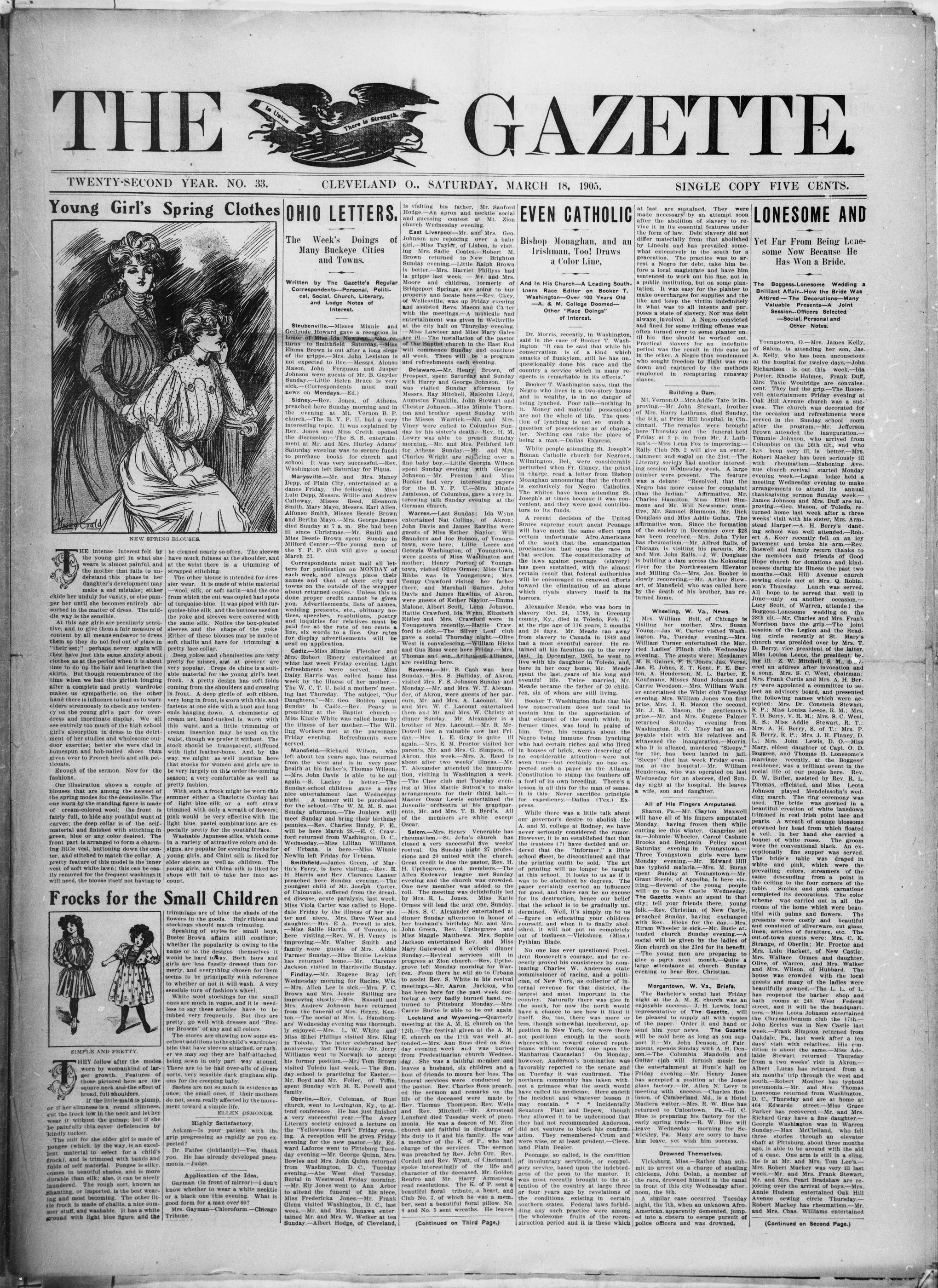
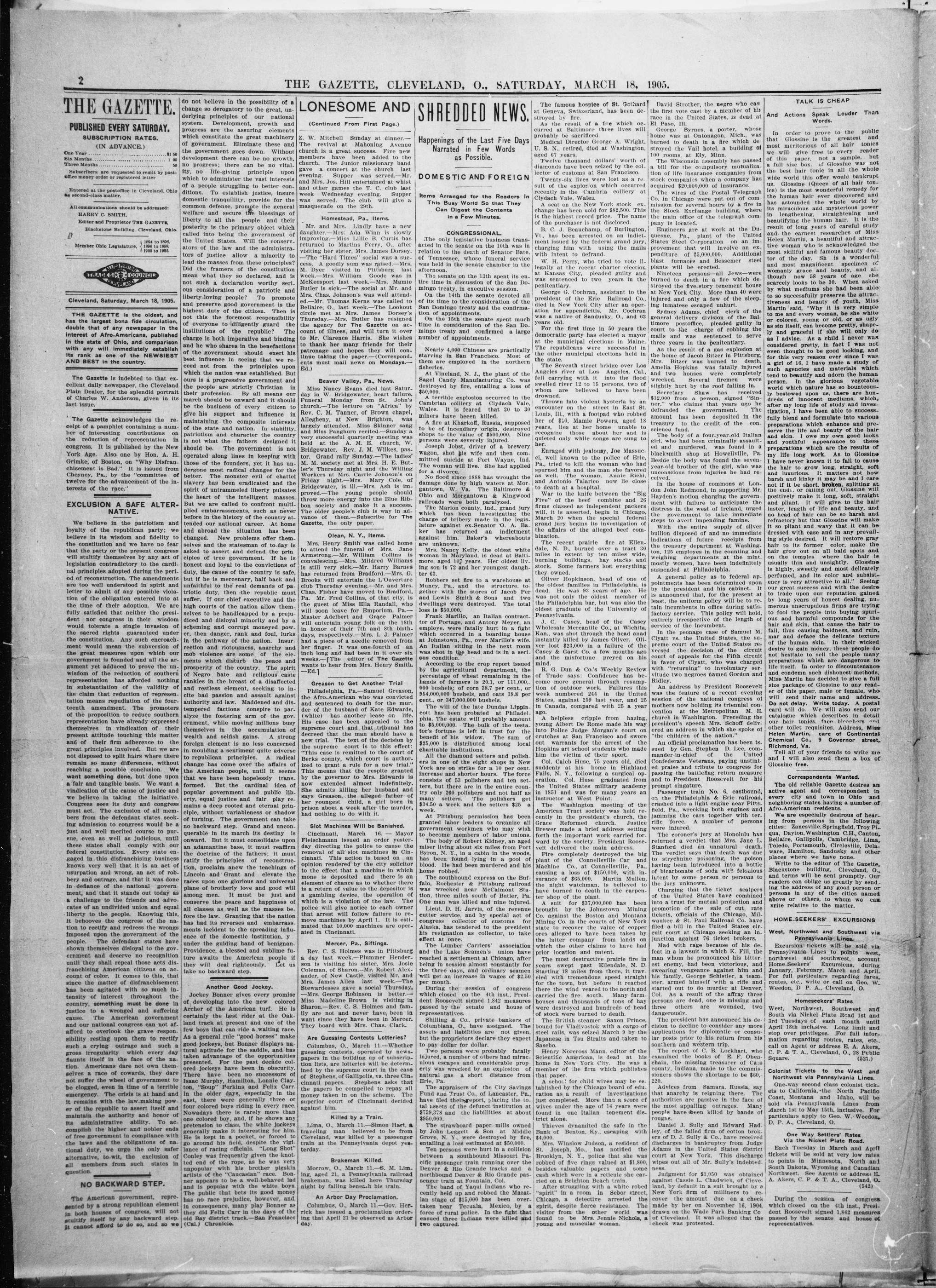
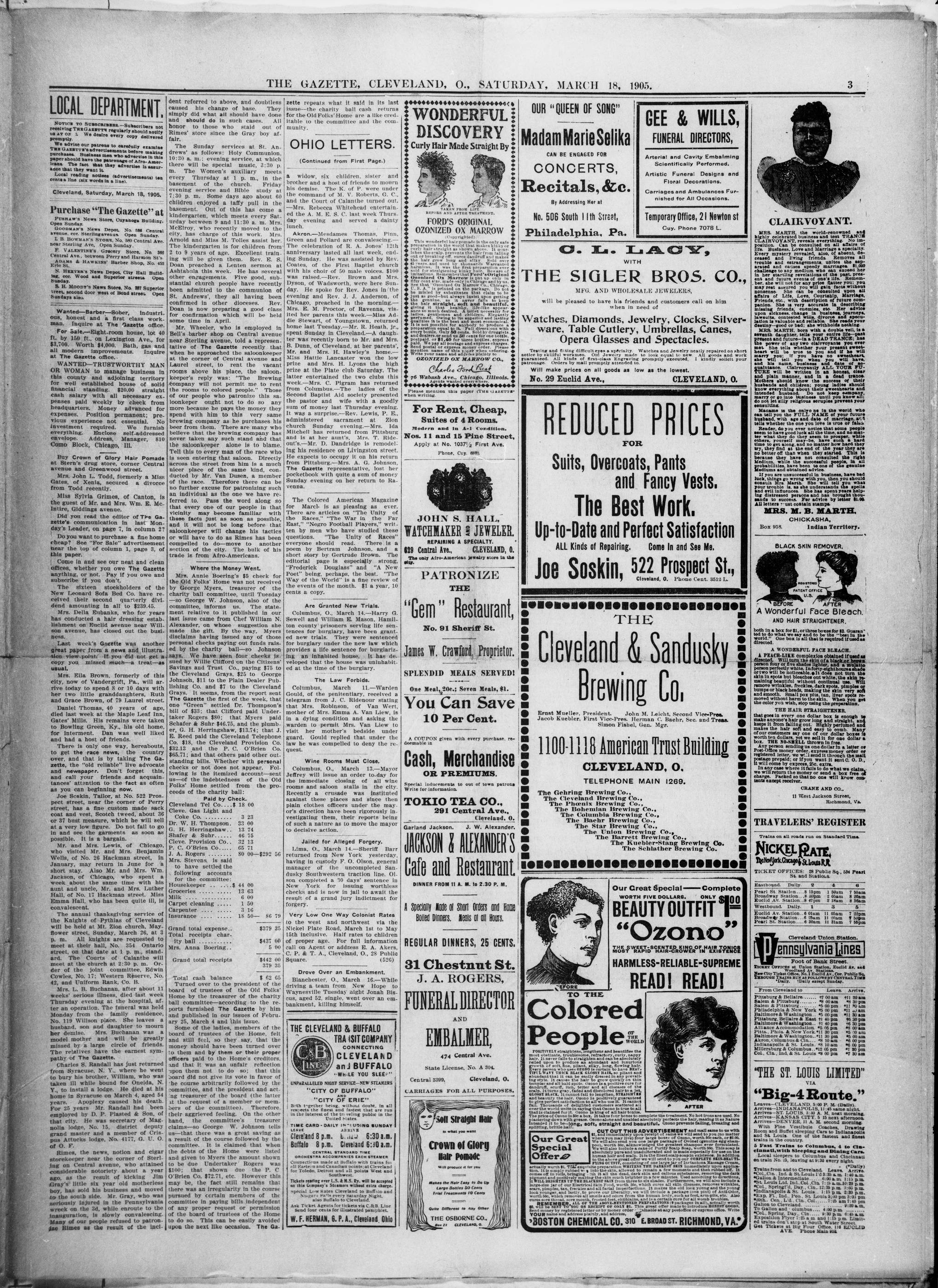
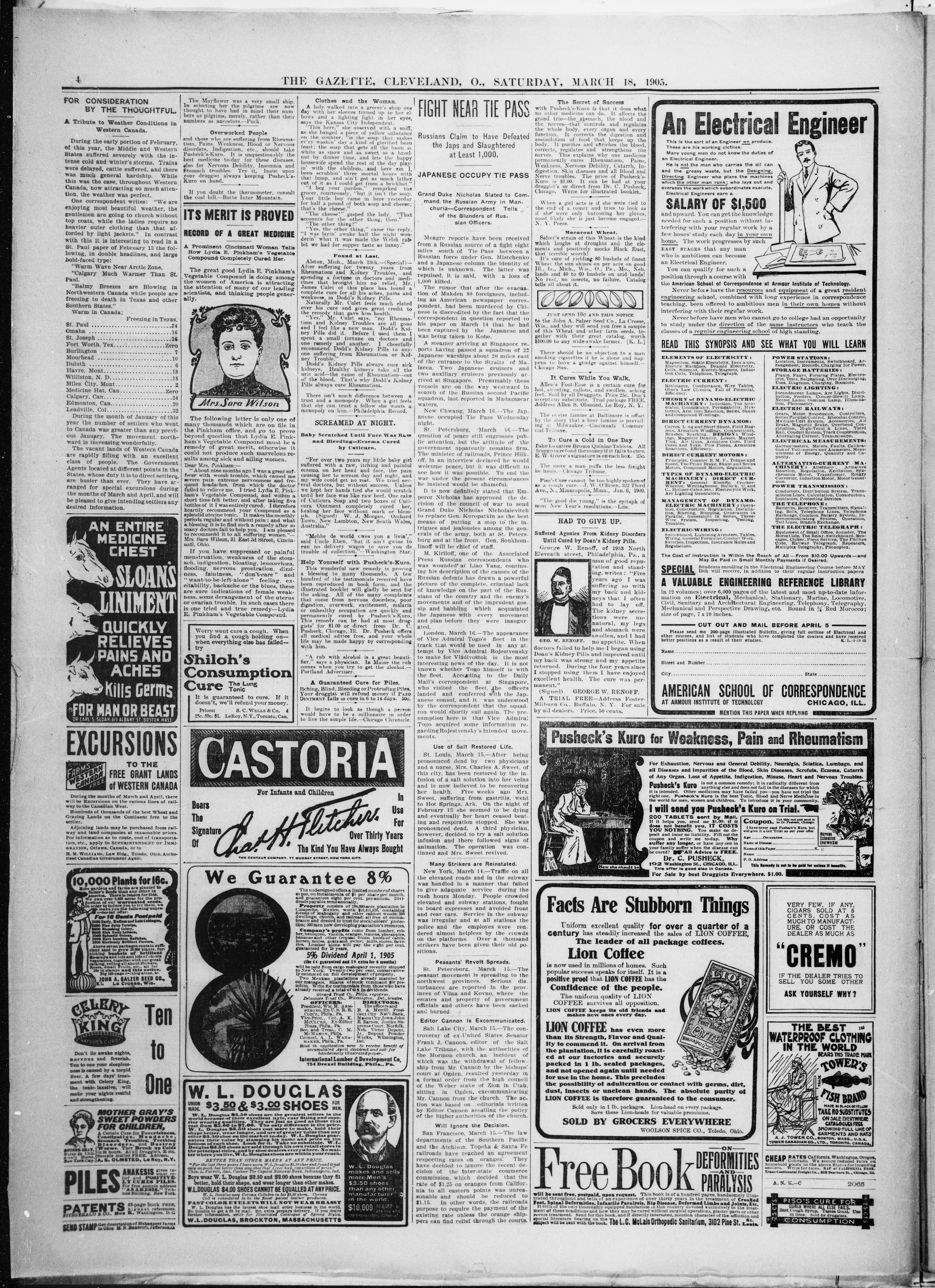
Page text (machine-generated)
THE
TWENTY-SECOND YEAR. NO. 33.
Hussey Could
NEW SPRING BLOUSES.
THE intense interest felt by the young girl in what she wears is almost painful, and the mother that fails to understand this phase in her daughter's development may make a sad mistake; either chide her unduly for vanity, or else pamper her until she becomes entirely absorbed in the matter of dress. The middle way is the sensible. At this age girls are peculiarly sensitive, and to give them a fair measure of content by all means endeavor to dress them so they do not feel out of place in "their set," perhaps never again will they have this same anxiety about clothes as at the period when it is about time to do up the hair and lengthen the skirts. But though remembrance of the time when we had this girlish longing after a complete and pretty wardrobe makes us sympathetic, on the other hand there is influence to lead us to warn elders strenuously to check any tendency on the young girl's part for overdress and inordinate display. We all see entirely too much of the high school girl's absorption in dress to the detriment of her studies and wholesome outdoor exercise; better she were clad in homespun and hob-nailed shoes than given over to French heels and silk peticoats. Enough of the sermon. Now for the fashions.
Our illustration shows a couple of blouses that are among the newest of the spring modes for the demoiselle. The one worn by the standing figure is made of cream-colored wool; the front is fairly full, to hide any youthful want of curves; the deep collar is of the self-material and finished with stitching in green, blue or any color desired. The front part is arranged to form a charming little vest, buttoning down the center, and stitched to match the collar. A pretty feature of this model is the inner vest of soft white lawn; this can be easily removed for the frequent washings it will need, the blouse itself not having to
Frocks for the Small Children
SIMPLE AND PRETTY.
THEY follow after the modes worn by womankind of larger growth. Features of those pictured here are the square neck and the effect of broad, full shoulders.
If the little maid is plump, or if her slimness is a round slimness, cut the frock low in the neck and let her wear it without the guimp; but if she be painfully thin cover deficiencies by kindly incker.
The suit for the older girl is made of pongee (which, by the way, is an excellent material to select for a child's frock), and is trimmed with hands and folds of self material. Pongee is silky, comes in beautiful shades, and is more durable than silk; also, it can be nicely laundered. The rough sort, known as Shanting, or imported, is the best wearing and most becoming. The other little frock is made of challis, a nice summer stuff, and washable. It has a white ground with light blue figure and the
SIMPLE AND PRETTY
T
be cleaned nearly so often. The sleeves have much fulness at the shoulder, and at the wrist there is a trimming of strapped stitching. The other blouse is intended for dresser wear. It is made of white material—wool, silk, or soft satin—and the one from which the cut was copied had spots of turquoise-blue. It was piped with turquoise-blue silk, and the buttons used on the yoke and sleeves were covered with the same silk. Notice the box-placed sleeves, and the shape of the yoke. Either of these blouses may be made of soft chalis and have for trimming a pretty lace collar. Deep yokes and chemisettes are very pretty for misses, and at present are very popular. Crepe de chine is a suitable material for the young girl's best frock. A pretty design has soft folds coming from the shoulders and crossing in front. A deep girdle of soft ribbon, very long in front, is worn with this and fastens at one side with a knot and long ends hanging down. A chemisette of cream net, hand-tucked, is worn with this waist, and a little trimming of cream insertion may be used on the waist, though we prefer it without. The stock should be transparent, stiffened with light feather-bone. And, by the way, we might as well mention here that stocks for women and girls are to be very largely on this order the coming season; a very comfortable as well as pretty fashion.
With such a frock might be worn this summer either a Charlotte Corday hat or light blue silk, or a soft straw trimmed with only a wreath of flowers; pink would be very effective with the light blue, pastel combinations are especially pretty for the youthful. Washable Japanese silks, which come in a variety of attractive colors and designs, are popular for evening frocks for young girls, and Chint silk is liked for elder sisters as well as children. The French silk and China silk is liked for shops will fail to take her into account.
trimmings are of blue the shade of the flowers in the goods. Hair ribbon and stockings should match trimming.
Speaking of styles for small boys, Buster Brown affairs still continue; whether the popularity is owing to the name or to the designs themselves it would be hard to touch. Both boys and girls are less fussily dressed than formerly, and everything chosen for them seems to be principally with reference to whether or not it will wash. A very sensible turn of fashion's wheel.
White wool stockings for the small ones are much in vogue, and it is needless to say these articles have to be tubbed very frequently. But they are pretty, go well with dresses and "Buster Browns" of any and all colors.
The stores are showing now some excellent additions to the child's wardrobe; bibs that have sleeves attached, or rather we may say they are half-attached, being sewn in only part way around. There are to be had over-alls of divers sorts, very sensible dark gingham slips for the creeping baby.
Sashes are not so much in evidence as once; the small ones, if their mothers do not, seem really affected by the movement toward a simple life.
Askum—Is your patient with the grip progressing as rapidly as you expected?
Dr. Fatfee (jubilantly)—Yes, thank you. He has already developed pneumonia.—Judge.
Application of the Idea
Gayman (in front of mirror)—I don't know whether to wear a white necktie or a black one this evening. What is good form for a man over 60? Mrs. Gayman—Chloroform—Chicago Tribune.
Highly Satisfactory
CLEVELAND O., SATURDAY, MARCH 18, 1905.
OHIO LETTERS.
Written by The Gazette's Regular Correspondents—Personal, Political, Social, Church, Literary, and Lodge Notes of Interest.
Steubenville.—Misses Minnie and Gertrude Howard gave a reception in honor of Miss Ida Newman, who returns to Smithfield Saturday. Miss Emma Brown is out after a long siege of the grippe. Mrs. John Leviston is not expected to live. Messrs. Alonso Mason, John Ferguson and Jasper Johnstone have served Mr. B. Gudyer Sunday. Little Hugh Bruce is very slick. (Correspondents must mail news on Mondays—Ed.)
Sidney.—Rev. Jones of Athens, preached here Sunday morning and in the evening at Mt. Vernon B. P. church. The B. Y. P. U. had a very interesting topic. It was explained by Rev. Jones and Miss Creith opened the discussion. The S. S. entertainment at Mr. and Mrs. Hurley Adams' Saturday evening was to secure funds to purchase books for church and school. It was very successful.—Rev. Washington left Saturday for Plaus.
Marysville—Mr. and Mrs. Manley Depp, of Plain City, entertained at a dance Friday, the following: Miss Luu Depp, Messrs. Willie and Andrew Callaway, Misses Reed, Eleanora Smith, Mary Mayo, Messrs. Earl Allen, Alfonso Smith, Misses Bessie Brown and Bertha Mayo—Mrs. George James died Sunday at 7 a.m. She had been ill since Christmas. Mr. Smith and Miss Bessie Brown spent Sunday in Mford Center—The young men of Mord P. club will give a social March 23.
Correspondents must mail all letters for publication on MONDAY of each week, and always place their names and that of their city and towns on the outside of the wrapper about returned copies. Unless this is done proper credit cannot be given you. Advertisements, lists of names, wedding presents, etc., obituary notices, speeches, resolutions, poetry paid for at the rate of ten cents a line, six words to a line. Our rates for display advertisements will be sent on application.
Cadiz—Miss Minnie Fleetcher and Mrs. Robert Emery entertained at whist last week Friday evening. Light refreshments were served. Miss Daisy Harris was called home last week by the illness of her mother. The W. C. T. U. held a mothers' meeting last Thursday. The subject, "Our daughters for relatives," Bolden spent Sunday in Cado. Poppy is preaching at the Baptist church. Miss Kizie White was called home by the illness of her mother. The Willing Workers met at the parsonage Friday evening. Refreshments were served.
Mansfield.—Richard Wilson, who left about ten years ago, has returned from the west and is in very poor health at his father's, Thomas Wilson.—Mrs. John Davis is able to be out again.—S. Lackey is better.—The Sunday-school children gave a very nice entertainment last Wednesday night. A banner will be purchased for the school.—The W. M. M. S. meet Sunday afternoon. The Juniors will meet Sunday and bring their birthday pennels.—Rev. Charles Bundy, P. E. Harris, Rev. Clarence Lanceen, ford returned from Washington, D. C. Wednesday.—Miss Lillian Williams, of Urbana, is here. Miss Winnie Newlin left Friday for Urbana.
Smithfield.—James Green, of Martin's Ferry, is here visiting.—Rev. E. H. Harris and Rev. Clarence Lanceen preached here Sunday evening.—The youngest child of Mr. Joseph Carter, of Unionvale, suffered from the dreaded disease, acute paralysis, last week. Miss Viola Carter was called to Hoppedale Friday by the illness of her sister and niece, Mrs. Dave West and daughter.—Mrs. E. A. Powell is sick, misses school.—Mrs. Toronto is here visiting.—W. H. Harris is improving.—Mr. Walter Smith and family were guests of Mrs. Abbie Parmer Sunday.—Miss Bird Leckins has returned home.—Mr. Clarence Jackson visited in Harriwell Sunday.
Findlay.—Mr. Eugene Bray left Wednesday morning for Racine, Wis.—Mrs. Allen Lee is sick.—Mrs. F. C. Brown and Mrs. Jessie Skilling are improving slowly.—Mrs. Russell and Mrs. Andrew Johnson have returned from the funeral of Mrs. Henry, Kenton.—The social at Mrs. L. Hansburg's Wednesday evening was thoroughly enjoyed.—Mrs. L. W. White and Miss Ethel Phillips visited Mrs. King in Toledo. The latter celebrated her anniversary last Thursday.—Mr. Jerry Williams went to Norwalk to accept his former position.—Mr. Tom Brown visited Toledo last week.—The Sunday school is practicing for Easter.—Mr. Boyd and Mr. Foller, of Tiffin, spent Sunday with M. R. Powell and family.
Oberlin.—Rev. Coleman, of Rust church, went to Lexington, Ky., to attend conference. He has just finished a very successful year.—The Avery Literary society enjoyed a lecture on the literary stone Park Friday evening. reception will be given Friday evening for a party in Pittsburgh. Mr. Edward Lafarge went to Pittsburgh. Tuesday evening.—Mr. George Quinn, Mrs. Bowley and Mrs. John Quinn returned from Washington, D. C. Tuesday evening.—Earle West died Tuesday. Burial in Westwood Friday morning.—Mr. Ely Jones went to Ann Arbor to attend the funeral of his niece, Mrs Frederickla Jones.—Mr. Frank Glenn visited Washington, D. C., last week.—Mr. and Mrs. Dunawa entertained Mr. and Mrs. W. Welker at tea Sunday.—Albert Hodge, of Cleveland.
GAZETTE.
is visiting his father, Mr. Sanford Hodge.—An apron and necktie social and guessing contest at Mt. Zion church Wednesday evening.
East Liverpool* Mr. and Gee, Johnson are rejoicing over a baby girl* Miss Taylor, of Lishon, is visiting Mrs. Sadie Cotes, Robert M. Brown returned to New Brighton Sunday evening.—Little Kalp Brown is better* Mrs. Harriet Phillyss had a grippe last week.—Mrs. and Mrs. Moore and children, formerly of Bridgeport Springs, are going to buy property and locate here.—Rev. Ckey, of Wellesville, was up day evening and assisted Revs. Mason and Cater with the meetings.—A musical and entertainment was given in Wellesville at the city hall on Thursday evening.—Miss Lawteer and Miss Mary Gales are ill.—The installation of the pastor of the Baptist church in the East End will commence Sunday and continue all week. There will be a program and refreshments each evening.
Delaware.-Mr. Henry Brown, of Prospect, spent Saturday and Sunday with Harry and George Johnson. He was visited Sunday afternoon by Messrs. Ray Mitchell, Malcolm Lloyd, Augustus Franklin, John Stewart and Chester Johnson.-Miss Minnie Thornton and brother spent Sunday with the Misses Warrick.-Mr. and Mrs. Viney were called to Columbus Sunday by his sister's death.-Rev. H. M. Lowry was able to preach Sunday morning.-Mr. and Mrs. Pethford left for Athens Sunday.-Mr. and Mrs. Charles Wright are refiling over a book titled Little Georgia Wilson spent Sunday evening with George Johnson.-Mr. Preston and Miss Booker had very interesting papers for the B. Y. P. U.-Mrs. Minnie Jamieson, of Columbus, gave a very interesting talk Sunday evening at the German church.
Warren.—Last Sunday; Ida Wymm entertained Nat Collins, of Akron; John Davis and James Rawlins were guests of Miss Esther Naylor; Will Saunders and Joe Bobson, of Youngstown, were here; Lillie Leece and Georgia Washington, of Youngstown, were guests of Miss Washington and mother; Henry Porter of Youngstown, visited Olive Moresis; Miss Clara Bibbs was in Youngstown; Mrs. Tempy Crawford visited her father there, and Marshall Garnes, John Davis and James Rawlins, of Akron, were guests of Esther Naylor.—Emma Malone, Albert Scott, Lena Johnson, William Wise, Elizabeth Ridley and Mrs. Crawford were in Youngstown recently.—Hattie Crawford is sick.—The Silver Leaf club gave a social Thursday night.—Olive West is convalescing.—William Hicks and Gus Ross were here Friday.—Mrs. Thomas ani son, Arthur of Alliance, are residing here.
Ravenna—Mr. B. Cash was here Sunday, Mrs. S. Halliday, of Akron, visited Mrs. F. S. Johnson Sunday and Monday, Mrs. W. M. T. Alexander, of Akron, were guests of her parents, Mr. and Mrs. A. Lacount, Mr. and Mrs. W. C. Lacount entertained them and Mrs. W. W. Christy at an afternoon tea, brother of Mrs. Lacount, Mr. R. McDowell lost a valuable cow last Friday, L. E. Gray is quite ill again, Mrs. E. M. Proctor visited her parents, Mr. and Mrs. G. Simpson, of Akron, this week, Mrs. A. Reed is about after two weeks' illness, Mr. T. Alexander attended the inauguration, visiting in Washington a week, The Chee club met Tuesday evening at Miss Mattie Sutton's to make arrangements for their third ball, Mrs. E. M. Proctor attended the Juvenile orchestra at his grandparents, Mr. and Mrs. T. B. Byrd's. All of the memiers are white except Oscar.
Salem.—Mrs. Henry Venerable has rheumatism. St. John's church has closed a very successful five weeks revival. On Sunday night 27 professions and 20 united with the church. Great credit is due the pastor, Rev. H. H.uphegrove, and members. The Allen Endeavor league met Sunday evening and the church was crowded. One new member was added to the roll. The meeting was delightfully led by Mrs. R. L. Jones. Miss Katie Ormes will lead the next one, Sunday.—Mrs. S. C. Alexander entertained at dinner Sunday afternoon in honor of the deceased. On Sunday John Green's Rev. Uphegrove and Miss Maggie Matthews, Mrs. Sophie Jackson entertained Rev. and Miss Mary Gatewood at 6 o'clock dinner Sunday.—Revival services still in progress at Zion church. Rev. Uphegrove left Monday morning for Warren. From there he will go to Urbana to assist Rev. S. White in his revival meetings. Mr. Aaron Jackson, who has been here for the past week doctoring a very badly burned hand, returned to Pittsburg Monday.—Mrs Carrie Burke is able to be out again. Lockland and wyto be on quarterly meeting at the A. M. e church on the 12th. A church on the 11th was well attended.—Mrs. Ann Ross died on Sunday day evening and was buried from Predestinarian church Wednesday. She was a faithful member and a hostess a husband, six children and a host of friends to mourn her loss. The funeral services were conducted by the pastor. Rev. Charles Ross preached the sermon and remarks on the life of the deceased were mentioned. Rev. Thomas Moore Rev. Wella and Mitchell, Mr. Armstead fordied Tuesday week of pnemonia. He was a deacon of Mt. Zion church and faithful in discharge of his duty to it and his family. He was a member of the K. of P., who had charge of the services. The sermon was preached by Rev. John Orr. Rev. Cordell and Rev. Wyatt, of Cincinnati, spoke interestingly of the life and character of the deceased. Mr. Golden Renfo and Mr. Harry Armstrong read resolutions. The K. of P. sent a beautiful floral tribute, a heart, and Club No. 3, of which he was a member, sent a beautiful floral pillow. No. 4 and No. 5 sweats. He leaves
(Continued on Third Page.)
EVEN CATHOLIC
Bishop Monaghan, and an Irishman, Too! Draws a Color Line.
And In His Church—A Leading South-
tnern Race Editor on Booker T.
Washington—Over 100 Years Old
-A. & M. College Doomed—
Other "Race Doings"
of Interest.
Dr. Morris, recently, in Washington,
said in the case of Booker T. W.
washington: "It can be said that while his
conservatism is of a kind which
smacks of flunkyism, still he has un-
questionably done his race and the
country a service which in many re-
sponses is remarkable in its effects."
Booker T. Washington says, that the
Negro who lives in a two-story house
and is wealthy, is in no danger of
being lynched. Poor talk—nothing in
it. Money and material possessions
are not the whole of life. The ques-
tion of lynching is not so much a
question of possessions as of character.
Nothing can take the place of
being a man—Dallas Express.
White people attending St. Joseph's
Roman Catholic church for Negroes,
Wilmington, Del., were considerably
perturbed when Fr. Glance, the priest
in charge, read a letter from Bishop
Moachaan announcing that the church
is exclusively for Negroes.
The whites have been attending St.
Joseph's at times because it was
convenient, and they were good contribu-
tors to its funds.
A recent decision of the United States supreme court ante Peonage will have much the same effect upon certain unfortunate Afro-Americans of the south that the emancipation proclamation had upon the race in that section. The constitutionality of the laws against peonage (slavery) has been sustained, with the almost certain result that federal authorities will be encouraged to renewed efforts toward the elimination of an abuse which rivals slavery itself in its horrors.
Alexander Meade, who was born in slavery Oct. 24, 1789, in Greenup county, Ky., died in Toledo, Feb. 17, at the ripe age of 116 years, 3 months and 24 days. Mr. Meade ran away from slavery to Canada in 1849 and had a most eventful career. He re-entered his familial life, the last. In December, 1903, he went to live with his daughter in Toledo, and, in her cozy home, Mr. Meade spent the last years of his long and eventful life. Twice married. Mr. Meade became the father of 20 children, six of whom are still living.
Booker T. Washington finds that his low conservatism does not tend to sustain him in the appreciation of that element of the south which, in former times, was loud in praise of him. True, his remarks about the Negro being immune from lynching who had certain riches and who Lived in houses of brick, were deserving of no considerable attention—were not even true—but certainly no one expected such a paper as the Atlanta Constitution to stamp the feathers off in his face of breeding. There is a lesson in all this the man of sense. It is this: Never sacrifice principle for expediency.—Dallas (Tex.) Express.
While there was a little talk about our governor's desire to abolish the A. and M. college at Rodney, we have never seriously considered the rumor. However, it is an established fact that the trustees (?) have decided and ordered that the "Informer," a little school sheet, be discontinued and that the printing outfit be sold. The art of printing will no longer be taught at this school. It looks to us as if it was to be abolished by degrees. The paper certainly exerted an influence for good, and there is no excuse for destruction, hence our belief that the school is to be gradually undermined. Well, it's simply—figure on educating your children yourself, and when it is finally abolished, it will not put us completely out of business.—Vicksbury (Miss.) Pythian Blade.
No one has ever questioned President Roosevelt's courage, and he recently proved his consistency by nominating Charles W. Anderson state commissioner of racing, and a politician, of New York, as collector of internal revenue for that district, the largest and most important in the country. Naturally there was glee in the south, for now the north would have a chance to see how it liked it itself. So, too, there was more or less, though somewhat incoherent, opposition in New York, for were there not positions enough in the south wherewith to reward colored republicans without forcing one upon the Manhattan Caucasian? On Monday, however, Anderson's nomination was favorably reported to the senate and on Tuesday it was confirmed. The northern commission has taken what he perceives what he would have called its medicine. Here endeth the incident and whatever lesson it may contain. * * * Incidentally Senators Platt and Depew, though they allowed it to be understood that they had not recommended Anderson, did not venture to block his confirmation. They remembered Crum and were wise, or at least prudent.—Cleveland Plain Dealer.
Peonage, so called, is the condition of involuntary servitude, or compulsory service, based upon the indebtedness of the peon to the master. It was most recently brought to the attention of the country at large three or four years ago by revelations of the conditions existing in certain southern states. Federal laws forbidding any such practice were among the wholesome fruits of the reconstruction period and it is these which
at last are sustained. They were made necessary by an attempt soon after the abolition of slavery to revive it in its essential features under the form of law. Debt slavery did not differ materially from that abolished by Lincoln and has prevailed somewhat extensively in the south for a generation. The practice was to arrest a Negro for debt, take him before a local magistrate and have him sentenced to work out his fine, not in a public institution, but on some plantation. It was easy for the planter to make overcharges for supplies and the like and keep the victim indefinitely in what was to intents and purposes a state of slavery. Nor was debt always involved. A Negro convicted and fined for some trifling offense was often turned over to some planter until his fine should be worked out. Practical slavery for an indefinite period was the result in this case as in the other. A Negro thus condemned who sought freedom by flight was run down and captured by the methods employed in recapturing runaway slaves.
LONESOME AVE.
Yet Far From Being Lonesome Now Because He Has Won a Bride.
The Boggess-Lonesome Wedding Brilliant Affair--How the Bride Attired—The Decorations—Mr. Valuable Presents—A Join Session--Officers Selected—Social, Personal and Other Notes.
Youngstown, O.—Mrs. James H. of Salem, is attending her son, A. Kelly, who has been unconscious at the hospital for twelve days. Richardson is out this week. Porter, Rhode Holmes, Frank Mrs. Terry Workman.
Building a Dam.
Mt. Vernon, O.—Mrs. Addie Tate is im-proving. Mr. John Stewart, brother of Mrs. Harry Lathrans, died Sunday the 5th, at Price Hill hospital, in Cincinnati. The remains were brought here Thursday and the funeral held Friday at 2 p. m. from Mr. J. Lathran's. Miss Lena Fox is improving—Rally Club No. 2 will give an entertainment and social on the 21st. The Literary society had another interesting session Wednesday week. A large number were present. The feature was a debate: "Resolved, that the Negro has more cause for complaint than the Indian." Affirmative, Mr. Charles Hamilton, Miss Ethel Simmons and Mr. Will Newsome; negative, Samuel Simmons, Mr. Dick Douglas and Addie Golls. The affirmative won. Since the formation of the society in December over $28 has been received. Mrs. John Tley has rheumatism. Mr. Alfred Ralls of Chicago, is visiting his parents, Mr. and Mrs. John Ralls, J. W. Douglas is building a dam across the Kokosong river for the Northwestern Elevator and Milling Co.—Mrs. Jos. Booker is slowly recovering. Mr. Arthur Stewart, of Mansfield, was called here by the death of his brother, has returned home.
Wheeling, W. Va., News.
Mrs. William Bell, of Chicago is visiting her mother, Mrs. Washington, Jas. W. Carter visited Washington, Pa. Tuesday evening—Mrs. William Turner entertained the Married Ladies' Filinch club Wednesday evening. The guests were: Mesdames M. B. Gaines, F. B. Jones, Jas. Verse Jas. E. Johns, Z. T. Kent, F. E. Barton, A. Henderson, M. L. Barber, E Kaufmann, Misses Maud Johnson and Carried Woodson. Mrs. William Walker entertained the Whist club Tuesday evening. Mrs. William Jones won first prize, Mrs. J. R. Mason the second, Mr. J. R. Mason, the gentlemen's Mr. and Mrs. Eugene Palmer returned Mrs. William Jones evening from Washington, D. C. The joyful visit with his relatives and witnessed the inauguration,—Morris, who it is alleged, murdered "Sleepy," for 15c, has been landed in jail "Sleepy" died last week Friday evening at the hospital. Mr. William Henderson, who was operated on last Wednesday for an abscess, died Sunday night at the hospital. He leaves a wife, son and daughter.
All of His Fingers Amputated.
All of his Fingers Amputated.
Sharon, Pa. - Mr. Clayton Maxwell will have all of his fingers amputated Monday, having frozen them while cutting ice this winter. Gangrine set Brooks and Benjamin Pellin Saturday evening in Youngstown—Three youngstown girls were here Monday evening—Mr. Edward Hill has typhoid malaria. Mrs. M. Burns spent Sunday at Youngstown—Mr. Grant Steele, of Appolba, is here visiting—Several of the young people will go to New Castle Wednesday. The Gazette wants an agent in that city; tell your friends there, young folk.—Rev. Christian, of New Castle, preached Sunday, having exchanged Hicks for the day. Mrs. Hiram Wheeler attended church Sunday evening—A social will be given by the ladies of Zion church on the 23rd for its benefit.—The young men are preparing to give a party next month—Quite a large attendance at church Sunday evening to hear Rev. Christian.
Morgantown, W. Va., Briefs.
Morganhill, W. Va., Brieks
The Bachelor's social last Friday night, the church was an enjoyable success.—R. W. Blue, representative of The Gazette, will be pleased to supply all with copies of the paper. Order it and hand or send him your news. The Gazette will be sold here as long as you support it.—Mr. John Denson, of Fairmount, spends Sunday with A. H. Denson.—The Columbia Mandolin and Guitar club will furnish music for the entertainment at Hunt's hall on Friday evening.—Mr. Henry Jones has accepted a position at the Jones glass factory.—Dr. Allen N. Levy is the manager of the Jonesinson of Cumberland, Md., is a Hotel Madiera waiter.—Mrs. R. W. Blue has returned to Uniontown, Pa.—H. C. Blue is preparing his factory for the early spring trade.—R. W. Blue will leave Wednesday morning for Sewickley, Pa. Many are sorry to have him leave, yet wish him success.
Drowned Themselves.
Vicksburg, Miss.—Rather than submit to arrest on a charge of stealing chickens, John Dolan, a member of the race, drowned himself in the canal in front of this city Wednesday afternoon, the 8th. The case occurred Tuesday night, the 7th, when an unknown Afo American, apparently drowned, jumped into a clistern to escape pursuit of police officers and was drowned.
LONESOME AND
Yet Far From Being Leonesome Now Because He Has Won a Bride.
The Boggess-Lonesome Wedding a Brilliant Affair--How the Bride Was Attired — The Decorations—Many Valuable Presents—A Joint Session--Officers Selected —Social, Personal and Other Notes.
(Continued on Second Page.)
(IN ADVANCE.)
One Year. $150
Six Months. 1 00
Three Months. 50
Subscribers are requested to remit by post-
office money order or registerable letter
Entered at the postoffice in Cleveland, Ohio
as second-class matter.
All communications should be addressed:
HARRY C. SMITH.
Editor and Proprietor THE GAZETTE.
Blackstone Building, Cleveland, Ohio.
Member Ohio Legislature,
1984 to 1986.
1986 to 1988.
1900 to 1992.
Cleveland, Saturday, March 18, 1905.
THE GAZETTE is the oldest, and has the largest bona fide circulation, double that of any newspaper in the interest of Afro-Americans, published in the state of Ohio, and comparison with any will immediately establish its rank as one of the NEWSIEST AND BEST in the country.
The Gazette is indebted to that excellent daily newspaper, the Cleveland Plain Dealer, for the splendid portrait of Charles W. Anderson, given in its last issue.
The Gazette acknowledges the receipt of a pamphlet containing a number of interesting contributions on the reduction of representation in congress. It is published by the New York Age. Also one by Hon. A. H. Grimke, of Boston, on "Why Disfranchisement is Bad." It is issued from Cheyney, Pa., by the "committee of twelve for the advancement of the interests of the race."
EXCLUSION A SAFE ALTER-
NATIVE.
We believe in the patriotism and loyalty of the republican party; we believe in its wisdom and fidelity to the constitution and we have no fear that the party or the present congress will stultify themselves by any act of legislation contradictory to the cardinal principles adopted during the period of reconstruction. The amendments are too well understood in spirit and letter to admit of any possible violation of the obligation entered into at the time of their adoption. We are fully satisfied that neither the president nor congress in their wisdom would tolerate a single invasion of the sacred rights guaranteed under the constitution. Any such encroachment would mean the subversion of the great measures upon which our government is founded and all the argument yet adduced to prove the unwisdom of the reduction of southern in substantiation of the validity of the claim that reduction of representation means repudiation of the fourteenth amendment. The promoters of the proposition to reduce southern representation have already expressed themselves in vindication of their present attitude touching this matter and of their firm adherence to the great principles involved. But we are not disposed to split hairs where there remain so many differences, without reaching a possible conclusion. We want something done, but done upon a fair and tangible basis. We want a vindication of the cause of justice and we believe in taking the initiative, Congress sees its duty and congress must act. The exclusion of all members from the defendant states seeking admission to congress would be a just and well merited course to pursue, even as well as judicious, until these states shall comply with our federal constitution. Every state engaged in this disfranchising business knows very well that it is an act of usurpation and wrong, an act of robbery and outrage, and that it was done in defiance of the national government, and that it stands out today as a challenge to the friends and advocates of an undivided union and equal liberty to the people. Knowing this, it behooves the congress of the nation to rectify and redress the wrongs imposed upon the government of the people. The defendant states have shown themselves disloyal to the government and deserve no recognition until they shall repeal those acts disfranchising American citizens on account of color. It comes to this, that since the matter of disfranchisement has been agitated with so much intensity of interest throughout the country, something must be done in justice to a wronged and suffering cause. The American government and our national congress can not afford to overlook the grave responsibility resting upon them to rectify such a crying outrage and such a gross irregularity which every day flaunts itself in the face of the nation. Americans dare not own themselves a race of cowards, they dare not suffer the wheel of government to be clogged, even in time of a terrible emergency. The crisis is at hand and it remains with the law-making power of the republic to assert itself and maintain the authority and honor of its administrative ability. To accomplish the higher and nobler ends of free government in compliance with the laws and the obligations of national duty, we urge the only safer alternative, to-wit, the exclusion of all members from such states in question.
NO BACKWARD STEP.
The American government, represented by a strong republican element in both houses of congress, will not stifly itself by any backward step. It cannot afford to do so, and so we
do not believe in the possibility of a change so derogatory to the great, underlying principles of our national system. Development, growth and progress are the assuring elements which constitute the great machinery of government. Eliminate these and the government goes down. Without development there can be no growth, no progress; there can be no vitality, no life-giving principle upon which to administer the vast interests of a people struggling to better conditions. To establish justice, insure domestic tranquility, provide for the common defense, promote the general welfare and secure the blessings of liberty to all the people and their posterity is the primary object which called into being the government of the United States. Will the conservators of the law and the administrators of justice allow a minority to lead the masses from these principles? Did the framers of the constitution mean what they so declared, and is not such a declaration worthy serious consideration of a patriotic and liberty-loving people? To promote and preserve good government is the highest duty of the citizen. Then is not this the foremost responsibility of everyone to diligently guard the institutions of the republic? The charge is both imperative and binding and he who shares in the benefactions of the government should exert his best influence in seeing that we receive not from the principles upon the nation was established. But ours is a progressive government and the people are stricly Christian in their profession. By all means our march should be onward and it should be the business of every citizen to give his support and influence in maintaining the composite interests of the state and nation. In stability, patriotism and character the country is not what the fathers designed it should be. The government is not operated along lines in keeping with those of the founders, yet it has undergone most radical changes for the better. The monster evil of chattel slavery has been eradicated and the spirit of untrammeled liberty pulsates the heart of the intelligent masses. But we are called to confront multiplied embarrassments, such as never before in the history of the country attended our national career. At home and abroad the situation has been changed. New problems offer themselves and the statesman of to-day is asked to assert and defend the principles of true government. If he is honest and loyal to the convictions of duty, the cause of the country is safe, but if he is mercenary, half back and unfathable to the real demands of patriotic duty, then the republic must suffer. If our chief executive and the high courts of the nation allow themselves to be handicapped by a prejudiced and disloyal minority and by a scheming and corrupt moneyed power, then danger, rank and foul, lurks in the pathway of the nation. Insurrection and riotousness, anarchy and mob violence are some of the elements which disturb the peace and prosperity of the country. The spirit of Negro hate and religious caste rankles in the breast of a disaffected and restless element, seeking to incite bad passion and assault against authority and law. Maddened and distempered factions conspire to paralyze the fostering arm of the government, while moving millions busy themselves in the accumulation of wealth and selfish gains. A strong foreign element is no less concerned in moulding a sentiment quite adverse to republican principles. A radical change has come over the affairs of the American people, until it seems that we have been hopelessly transformed. But the cardinal idea of government and public liberty, equal a deep root and eternal principle, without variability or shadow of turning. The government can take no backward step. Grand and unconquerable in its march its destiny is onward. But it must consolidate upon an adamantine base, it must reaffirm the doctrine of the fathers; it must ratify the principles of reconstruction, proclaim anew the teachings of Lincoln and Grant and elevate the races upon one glorious and universal plane of brotherly love and good will among men. It must be just and conserve the peace and happiness of all classes as well as the masses before the law. Granting that the nation has had its reverses and embarrassments incident to the spreading influence of the domestic institution, y under the guiding hand of benignan. Providence, a blessed and sublime future awaits the American people if they will deal righteously. Let us take no backward step.
Another Good Jockey.
Jockey Bonner gives every promise of developing into the new colored Archer of the American turf. He is certainly the best rider at the Oakland track at present and one of the few boys that can ride a waiting race. As a general rule "good horses" make good jockeys, but Bonner displays natural aptitude for the saddle, and has taken advantage of the opportunities presented. For the past decade colored jockeys have been in obscurity. There have been no obsessions with Mary Jane, Jonah Clayton, "Soup" Perkins and Felix Carr. In the older days, especially in the east, there were generally three or four colored boys riding in every race. Nowadays there is rarely more than one colored boy, and, if he shows any pretension to class, the white jockeys generally make it interesting for him. He is kept in a pocket, or forced to go around his field, despite the vigilance of racing officials. "Long Shot" Conley was frequently given the knotted end of the rope, as he was very unpopular with his brother piknik artists of the "Caucasian" race. Bonner appears to be a well-behaved and is popular with the white boys. The public that bets its good money, in consequence, many play Bonner as they did Felix Carr in the days of the old Bay district track—San Francisco (Cal.) Chronicle.
THE GAZETTE, CLEVELAND, O., SATURDAY, MARCH 18, 1905.
LONESOME AND
(Continued From First Page.)
Z. W. Mitchell Sunday at dinner. The revival at Mahoning Avenue church is a great success. Five new members have been added to the church. The Junior missionary band gave a concert at the church last evening. Supper was served—Mr. and Mrs. Jos. Hill entertained at whist and other games the T. C. club last week Wednesday evening. Supper was served. The club will give a masquerade on the 29th.
Homestead, Pa., Items.
Mr. and Mrs. Lindly have a new daughter.-Mrs. Ada Winn is slowly improving.-Miss Lillie B. Curtis has returned to Martiney Ferry, O., after visiting her sister, Mrs. James Dorsey.-The "Hard Times" social was a success. A goodly sum was raised.-Mrs. M. Dyer visited in Pittsburgh last week.-Mrs. William Goode was in McKeesport last week.-Mrs. Mamie Butler is sick.-The social at Mr. and Mrs. Chas. Johnson's was well attended.-Mr. Thomas Kerns was called to Belleaire, O., last week.-The Lookout circle met at Mrs. James Dorsey's Thursday.-Ms. Butler has resigned the agency for The Gazette on account of illness, and will turn it over to Mr. Clarence Harris. She wishes to thank her many friends for their patronage and hopes they will continue taking the paper.-(Correspondents must mail news on Mondays.-Ed.)
Beaver Valley, Pa.. News.
Miss Nancy Evans died last Saturday in W. Bridgwater, heart failure, Funeral Monday from St. John's church. The lecture on "Africa" by Rev. C. M. Tanner, of Brown chapel, Allegheyn, at New Brighton, was largely attended. Miss Skinner sang and Miss Pangburn recited. Sunday a very successful quarterly meeting was held at the A. M. E. church, W. Bridgwater. Rev. J. M. Wilkes, pastor. Grand rally Sunday. The ladies M. M. society met at Mrs. H. E. Butler's Thursday night and the Willing Workers at Mrs. Carrie Johnson's on bridge night. Mrs. Carrie Johnson's funeral is ill-Mrs. Ash is im-proved. The young people should throw more energy into the Blue Ribbon society and make it a success. The older people's club is way in advance of them. Subscribe for The Gazette, the only paper.
Olean, N. Y., Items.
Mrs. Henry Smith was called home to attend the funeral of Mrs. Jane Armstrong.—Mr. William Collins is convalescing.—Mrs. Mildred Williams is still very sick.—Mr. Harry Barnes has returned from Bradford.—Mrs. G. Brooks will entertain the L'Ouverture club Thursday evening.—Mr. and Mrs. Chas. Fisher have moved to Bradford, Pa. Mr. Fred Collins, of that city, is the guest of Missella Randall, who will soon leave for Emporium, Pa.—Master Adelbert and Grace Palmer will entertain young folk on the 18th in honor of their 7th and 8th birthdays, respectively.—Mrs. I. J. Palmer had a piece of a needle removed from her finger. It was one-fourth of an inch long and had been in it over six weeks.—[The editor of The Gazette wants to hear from Mrs. Henry Smith,—Ed.]
Greason to Get Another
Greason to Get Another Trial
Philadelphia, Pa.—Samuel Greason, the Afro-American who was convicted and sentenced to death for the murder of the husband of Kate Edwards, (white) has another lease on life. His case has been appealed to the supreme court and, that, tribunal has decreed that the man should have a new trial. The text of the decision by the supreme court is to this effect: "This case is remitted to the court of Berks county, which court is authorized to grant a rule for a new trial." This means that the respite granted by the governor to Mrs. Edwards is now extended almost indefinitely. She admits killing her husband and says Greason, the alleged father of her youngest child, a girl born in prison about a week after the murder, had nothing to do with it.
Slot Machines Will be Banished
Cincinnati, March 16. — Mayor Fleischmann issued an order yesterday directing the police to cause the removal of all slot machines in Cincinnati. This action is based on an opinion rendered by the city solicitor to the effect that a machine in which mone is deposited and there is an element of chance as to whether there is a return of value to the depositor is a gambling device, the operation of a slot machine of the law. The police will give notice to each owner that arrest will follow failure to remove machines by April 1. It is estimated that 10,000 machines are operated in Cincinnati.
Mercer, Pa., Siftings.
Rev. C. S. Holmes was in Pittsburgh a day last week—Plummer Henderson is visiting his sister, Mrs. Josie Coleman, of Sharon, Mr. Robert Alexander, of New Castle, visited Mr. and Mrs. James Allen last week—The Stewardesses gave a social Thursday, Miss Madeline Brown is Miss Madeline Brown is visiting Sharon.—Rev. C. S. Holmes and family are not and never have, been in want since they have been in Mercer, They board with Mrs. Chas. Clark.
Are Guessing Contests Lotteries?
Columbus, O., March 11.—Whether guessing contests, operated by newspapers in the building up of subscription lists, are lotteries will be determined by the supreme court in the case of Stephens, of Gallipoli, vs. three Cincinnati papers. Stephens is compelled to repay all money taken in on the scheme. The superior court of Cincinnati decided against him.
Killed by a Train.
Lima, O., March 11—Simon Hart, a traveling man believed to be from Cleveland, was killed by a passenger from the Pennsylvania vapt yearday.
Brakeman Killed.
Morrow, O., March 11.—G. M. Lim-
ling, aged 21, a Pennsylvania railroad
brakeman, was killed here Thursday
night by falling benefit, his train.
An Arbor Day Proclamation.
Columbus, O., March 11—Gov. Herrick has issued a proclamation ordering that April 21 be observed as Arbor day.
SHREDDED NEWS
Happenings of the Last Five Days Narrated in Few Words as Possible.
DOMESTIC AND FOREIGN
Items Arranged for the Readers In This Busy World So that They Can Digest the Contents in a Few Minutes.
CONGRESSIONAL
The only legislative business transacted in the senate on the 10th was in relation to the death of Senator Bate, of Tennessee, whose funeral service was held in the senate chamber in the afternoon.
The senate on the 13th spent its entire time in discussion of the San Domingo treaty, in executive session.
On the 14th the senate devoted all of its time to the consideration of the San Domingo treaty and the confirmation appointments.
On the 15th the senate spent much time in consideration of the San Domingo treaty and confirmed a large number of appointments.
Nearly 4,000 Chinese are practically starving in San Francisco. Most of them are employed in the northern fisheries.
At Vineland, N. J., the plant of the Sagel Candy Manufacturing Co. was destroyed by fire, entailing a loss of $40,000.
A terrible explosion occurred in the Cambrian colliery at Clydach Vale, Wales. It is feared that 20 to 30 miners have been killed.
A fire at Kharkoff, Russia, supposed to be of incendiary origin, destroyed shops to the value of $500,000. Nine persons were severely injured.
Joseph Jobst, driver of a brewery wagon, shot his wife and then committed suicide at Fort Wayne, Ind. The woman will live. She had applied for a job. No flood since 1888 has wrought the damage done by high waters at Morgantown, W. Va. The Baltimore & Ohio and Morgantown & Kingwood railroads were both paralyzed.
The Marion county, Ind., grand jury which has been investigating the charge of bribery made in the legislature against ex-Senator O. A. Baker has returned an indictment against him. Baker's whereabouts are unknown.
Kelly, the oldest white woman in Maryland, is dead at Balti, more, aged 107 years. Her oldest living son is 72 and her youngest daughter 63.
Robbers set fire to a warehouse at Muncy, Pa., and the structure, together with the stores of Jacob Per and Lewis Smith & Sons and two dwellings were destroyed. The total loss is $50,000.
Frank Marillo, an Italian contractor of Portage, and Antony Meyer, an employee, were fatally hurt in a fight which occurred in a boarding house at Johnstown, Pa., over Marillo's wife. An Italian siting in the next room was shot in the head and is in a serious condition. He was taken to the crop report issued by the agricultural department, the percentage of wheat remaining in the hands of farmers is 20.1, or 111,000,000 bushels; of corn 38.7 per cent, or $54,000,000 bushels, and oats 38.8 per cent, or 347,000,000 bushels.
The will of the late Dundas Lippincott has been probated at Philadelphia. The estate will probably amount to $5,000,000. The bulk of the testator's fortune is left in trust for the benefit of his widow. The sum of $25,000 is distributed among local charitable institutions.
All the diamond setters and polishers in one of the eight shops in New York are on strike for a 10 per cent, increase and shorter hours. The force consists of 53 polishers and ten setters, but there are in the entire country only 260 polishers and not half as many setters. The polishers get $34.50 a week and the setters $25 a week.
At Pittsburg permission has been granted labor leaders to organize all government workmen who may wish to become members of labor unions. The body of Robert Kidney, an aged mother living about six miles from Port Byrne, is in a cabin in the woods, has been found lying in a pool of blood. He had been murdered and his home robbed.
The southbound express on the Buffalo, Rochester & Pittsburgh railroad was wrecked near McCalmont Station, three miles south of Butler, Pa. One man was killed and nine injured.
Lieut. D. H. Jarvis, of the revenue cutter service, and by special act of congress collector of customs for Alaska, has tendered to the president his resignation as collector, to take effect at once.
The Lumber Carriers' association and the Lake Seamen's union have reached a settlement at Chicago, after being in session almost constantly for the three days, and ordinary seamen will get an increase in wages of $2.50 per month.
During the session of congress which closed on the 4th inst., President Roosevelt signed 1,842 measures passed by the senate and house of representatives.
Shilling & Co., private bankers of Columbia, O., have assigned. The assets and liabilities are not given, but the proprietors declare they expect to pay dollar for dollar.
The seamen were probably fatally injured, a number of others had miraculous escapes and considerable property was wrecked by an explosion of natural gas a short distance from Erie, Pa.
The appraisers of the City Savings Fund and Trust Co., of Lancaster, Pa., have filed their report, placing the total assets of the defunct institution at $759,378 and the liabilities at about $500,000.
The strawboard paper mills owned by John Leggett & Son at Middle Grove, N. Y., were destroyed by fire, entailing a loss estimated at $50,000.
Ten persons were hurt in a collision between a southbound Missouri Pacific passenger train running over the Denver & Rio Grande tracks and a northbound Denver & Rio Grande pass. Mountain, Col.
The band of Yaqui Indians who recently held up and robbed the Mazatlan stage of $15,000 has been overtaken near Teccuala, Mexico, by a force of rural police. In the fight that ensued three Indians were killed and two captured.
The famous hospice of St. Gethard at Geneva, Switzerland, has been destroyed by fire.
As the result of a fire which occurred at Baltimore three lives will probably be sacrificed.
Medical Director George A. Wright, U. S. N., retired, died at Washington, aged 67 years.
Twelve thousand dollars' worth of diamonds have been seized by the collector of customs at San Francisco.
Twenty-six lives were lost as a result of the explosion which occurred recently in the Cambria colliery at Oakville.
A contract on the New York stock exchange has been sold for $2,500. This is the highest record price. The name of the purchaser is not disclosed.
B. C. J. Beauchamp, of Burlington, Vt., has been arrested on an indictment issued by the federal grand jury, charging him with using the mails with intent to defraud.
W. H. Perry, who tried to vote illegally at the recent charter election, at Kansas City, pleaded guilty and was sentenced to two years in the penitentiary.
George G. Cochran, assistant to the president of the Erie Railroad Co., died in New York City after an operation for appendicitis. Mr. Cochran was a native of Sandusky, O., and 62 years old.
For the first time in 50 years the democratic party has elected a mayor at the municipal elections in Maine. The republicans were successful in the other municipal elections held in the state.
The Seventh street bridge over Los Angeles river at Los Angeles, Cal., fell carrying with it into the flood swelled river 12 to 15 persons, two of whom are believed to have been drowned.
Thrown into violent hysteria by an encounter on the street in East St. Louis, Ill., with a footpad who robbed her of $10, Mamie Powers, aged 18 years, lies at her home unable to recognize those about her and is quieted only while songs are sung to her.
Enraged with jealousy, Joe Massucci, well known to the police of Erie, Pa., tried to kill the woman who had spurned him and the man she favored as well. The woman, Annie Richi, and Antonio Talarico now lie close to death at a hospital.
War to the knife between the "Big Five" of the beef combine and 26 firms classed as independent packers will, it is asserted, begin in Chicago, and Antonio Talarico will grand jury begins its investigation of the affairs of the alleged beef combination.
The recent prairie fire at Ellendale, N. D., burned over a tract 30 miles in extent by ten miles wide, burning buildings, hay stacks and stock. Some farmers lost everything they owned.
Oliver Hopkinson, head of one of the oldest families in Philadelphia, is dead. He was 93 years of age. He was not only the oldest member of the Philadelphia bar, but was also the oldest graduate of the University of Pennsylvania.
J. C. Casey, head of the Casey Wolesley Mercantile Co. at Wichita, Kan. was short through the head and instantly killed by James Oliver. Oliver lost $23,000 in a failure of the Casey & Garst Co. a few months ago and the mistrust preyed on his mind.
R. G. Dun & Co.'s Weekly Review of Trade says: Confidence has become more general through resumption of outdoor work. Failures this week numbered 244 in the United States, against 259 last year, and 25 in Canada, compared with 25 a year ago.
A helpless cripple from hazing, young Albert De Rome made his way into Police Judge Morgan's court on crutches at San Francisco and swore out warrants for the arrest of the Hopkins art school students who made him the victim of their sport.
Col. Caleb Huse, 75 years old, died suddenly at his home in Highland Falls, N. Y., following a surgical operation. Col. Huse graduated from the United States military academy in 1851 and was for many years an instructor at West Point. The Washington meeting of the American Tract society was held recently in the president's church, the Grace Reformed church. Justice Brewer made a brief address setting forth the important work carried forward by the society. President Roosevelt delivered the main address. Fire completely destroyed the big plant of the Connellsville Car and Machine Co. at Connellsville, Pa, causing a loss of $150,000 in the inventory of $65,000. Martin Muller the night watchman, is believed to have burned to death in the carpenter shop of the plant.
A suit for $37,000,000 has been brought by the Johnstown Mining Co. against the Boston and Montana Mining Co. in the courts of New York state to recover the value of copper ores alleged to have been taken by the latter company from lands on which the other claims to have had prior location and patent.
The most destructive prairie fire in years swept past Ellendale, N. D. Starting 18 miles from there, it traveled with tremendous speed straight for the town, but before it reached there the wind veared to the north and carried the fire south. Many farm-houses and thousands of tons of hay were destroyed and hundreds of head of stock were burned to death.
The British steamer Saxon Prince, bound for Vladivostok with a cargo of steel rails, was seized March 9 by the Japanese in Tsu Stralis and taken to Sasebo.
Norcross Mann, editor of the Scientific American, is dead at his home in New York City. He was a member of the firm which publishes that paper.
A school for child wives may be established by the Chicago board of education as a result of investigations just completed. More than a score of wives under the age of 14 years were found in one Italian tenement district alone.
Thieves dynamited the safe in the Bank of Benton, Ky., escaping with $4,000.
Mrs. Winslow Judson, a resident of St. Joseph, Mo., has notified the Brooklyn, N. Y., police that she was robbed of five rings valued at $1,800, besides valuable papers and some cash which were in a reticule she carried on a Brighton Beach train.
After struggling with a white robed "spirit" in a room in Sebor street, Chicago, a detective arrested the spirit, despite fierce resistance. The visitor from the other world was the Mrs. M. Richmond Nichola, a young and muscular woman.
David Strother, the negro who casc the first vote cast by a member of his race in the United States, is dead at El Paso, Ill.
George Byrnes, a porter, whose home was at Ontonagon, Mich., was burned to death in a fire which destroyed the Vail hotel, a building of 100 rooms, at Ely, Minn.
The Wisconsin assembly has passed a bill for the compulsory mutualization of life insurance companies from stock companies when a company has acquired $20,000,000 of insurance.
The wires of the Postal Telegraph Co. in Chicago were put out of commission for several hours by a fire in the Stock Exchange building, where the main office of the telegraph company is located.
Engines are at work at the Duquesne, Pa. plant of the United Steel Corporation on an improvement that will involve an expenditure of $5,000,000. Additional blast furnaces and Bessemer steel plants will be erected.
Nineteen persons—all Jews—were burned to death in a fire which destroyed the five-story tenement house at New York City. More than 40 were injured and only a few of the sleeping inmates escaped unhurt. Sydney Adams, chief clerk of the general delivery division of the Baltimore postoffice, pleaded guilty to robbing the malls and was sentenced to serve three years in the penitentiary.
As the result of a gas explosion at the home of Jacob Bitzer in Pittsburgh, Mrs. Bitzer was burned to death, Amelia Hopkins was fatally injured and two houses were completely wrecked. Several firemen were slightly hurt by the roof falling in. Secretary Shaw has received $12,000 from a person, signed "Sinner, who claims that years ago he was the governor of the amount has been deposited in the treasury to the credit of the conscience fund
The body of a four-year-old Italian girl, who had been criminally assaulted and murdered, was found in a blacksmith shop at Howellville, Pa. Beside the body was found the seven-year-old brother of the girl, who was unconscious from injuries he had received.
In the house of commons at London John Redmond, in supporting Mr. Hayden's motion charging the government with failure to anticipate the distress in the west of Ireland, urged the government to take immediate steps to avert impending famine. With the impatient supply of silver bollion disposed of and no immediate indications of future receipts from the treasury department at Washington, 125 employees in the counting and weighing departments at the mint, mostly women, have been indefinitely suspended at Philadelphia.
A general policy as to federal appointments has been determined upon by the president and his cabinet. It is announced that, for the present at least, the uniform policy will be to retain incumbents in office during satisfactory service. This policy will hold, entirely irrespective of the length of service of the incumbent.
In the peonage case of Samuel M. Clyatt vs. the United States, the supreme court of the United States reversed the decision of the circuit court of appeals for the Fifth circuit in favor of Clyatt, who was charged with "returning" to involuntary servitude two negroes named Gordon and Ridley.
The address by President Roosevelt was the feature of a recent evening session of the national congress of mothers now holding their triennial convention at the Metropolitan M. E. Church in Washington. Preceding the president's speech Mrs. Schoff delivered an address in which she spoke of "the children of the nation."
An official proclamation has been issued by Gen. Stephen D. Lee, commander-in-chief of the United Confederate Veterans, paying unstinted praise and tribute to congress for passing the battleflag return measure and to President Roosevelt for his prompt singature. In prison No. 6, castbound, on the Philadelphia & Erie railroad, crashed into a light engine near Pittfield. Pa., wrecking both engines and jamming the cars together with terrific force. A number of persons were injured. The coroner's jury at Honolulu has returned a verdict that Mrs. Jane L. Stanford died an unnatural death. The verdict says that death was due to having been introduced into a bottle of bicarbonate of soda with fecalous intent by some person or persons to the jury unknown.
Charging that the ticket scalpers of the United States have combined into a trust for mutual protection and promotion of the sale of cut, rate tickets, officials of the Chicago, Milwaukee & St. Paul Railroad Co. have filed a bill in the United States cir- lation against the Chicago railway injunction against 76 ticket brokers.
Mad with rage because of his defeat in a lawsuit in which K. Fill, the man whom he pronounced his bitterest enemy, had been victorious, and swearing vengeance against him and his family, George Schistler, a teamster, armed himself with a rifle and started out to do murder at Denver, Col. As a result of the affray three persons are dead, one is missing and three others are wounded, two dead. The president has announced his decision to decline to consider any more applications for diplomatic or consular posts prior to his return from his southern and western trib.
The report of C. B. Lockhart, who examined the books of E. F. Obenchain, the missing treasurer of Cass county, Indiana, made to the commissioners shows the shortage to be $00.220.
Advices from Samara, Russia, say that anarchy is reigning there. The authorities are passive in the face of the most appalling outrages. Many people have been killed by bands of rougans.
Daniel J. Sully and Edward Hadley, of the failed firm of cotton brokers of D. J. Sully & Co., have received discharges in bankruptcy from Judge Adams in the United States district court at New York. This discharge wipes out all of Mr. Sully's indebtedness.
Adjudgment for $1,050 was obtained against Cassie L. Chadwick, of Cleveland, by default in a suit brought by a New York firm of milliners to recover the amount due on a check made by her on November 16, 1904 drawn on the Wake Park Banking Co. of Cleveland. It was alleged that the check was protested.
TALK IS CHEAP
And Actions Speak Louder Than Words.
Tell all of your friends to write me and I will also send them a box of Glossine free.
Correspondents Wanted.
The old reliable Gazette desires an active agent and correspondent in every city and town in Ohio and neighboring states having a number of Afro-American residents.
We are especially desirous of hearing from persons in the following cities: Zanesville, Springfield, Troy Plaio, Dayton, Washington C.H., Canton, Bellaire, Gallipoli, Cambridge, Lima, Toledo, Portsmouth, Circleville, Delaware, Hamilton, Sandusky and other places where we have none. We are excited by the Gazette, Blackstone building, Cleveland, O., and terms will be sent promptly. Our readers can oblige us greatly by sending the address of any good person or persons in any of the cities named above or others, to whom we can write relative to the matter.
HOME-SEEKERS' EXCURSIONS
West, Northwest and Southwest via Pennsylvania Lines.
Excursion tickets will be sold via Pennsylvania Lines to points west, northwest and southwest, account Home-Seekers' Excursions, during January, February, March and April. For full particulars regarding fares, routes, etc., write or call on Geo. W. Weedon, D. P. A., Cleveland, O.
Homeseekers' Rates
West, Northwest, Southwest and South via Nickel Plate Road 1st and 3rd Tuesdays of each month until April 18th inclusive. Long limit and stop over privileges. For full information regarding routes, rates, etc., call on Agent or address E. A. Akers, C. P. & T. A. Cleveland, O. 28 Public Square. (527.)
Colonist Tickets to the West and northwest via Pennsylvania Lines. One-way second class colonist tickets California, the North Pacific Coast, Montana and the Ohio sold via Pennsylvania Lines from March 1st to May 15th, inclusive. For particulars apply to Geo. W. Weedon, D. P. A., Cleveland, O.
One Way Settlera' Rates
Via the Nickel, Plate Road
Each Tuesday in March and April tickets will be sold at very low rates to points in Minnesota, North and South Dakota, Wyoming and Canadian Northwest. See Agents or address E. A. Kers, C. P. & T. A., Cleveland, O. (542)
During the session of congress which closed on the 1st inst., President Roosevelt signed the 1,842 measures passed by the senate and house of representatives.
NOTICE TO SUBSCRIBERS.-Subscribers not receiving THE GAZETTE regularly should notify us at 2. We desire every copy delivered properly.
We advise our patrons to carefully examine THE GAZETTE advertisements before making purchase. Business men who advertise in this paper should have the patronage of Afro-America. The fact that they advertise is assurance that they want it.
Local reading notices (advertisements) ten centa line (six words in a line).
Cleveland, Saturday, March 18, 1905.
Purchase "The Gazette" at PURCHAIM'S News Store, Cuyanaga Building, Open Sunday. COURTAMAX News Depot. No. 568 Central avenue, cor. Sterlingavenus. Open Sunday. L B. BOWMAN'S Store, No. 880 Central avenue, near Sterling Avenue. Open Sunday.
F. VALENTINE'S Grecery Store. No. 450
Central Ave., between Perry and Hank Ss.
ADAMS & HAWKINS' Barber Shop. No. 452
Eric St.
N. HEKTRER's News Depot, City Hall Bufal-
nment, Wood and Superior streets, Open
Square.
S. H. MOODY's News Store. No. 387 Superior street, second door west of Bond street. Open Sundays alm.
Wanted—Barber—Sober, industrious, honest and a first class workman. Inquire at The Gazette office.
For Sale—Eight-room house, lot 40 ft. by 159 ft. on Lexington Ave., for $3,700. Worth $8,000. Bath, gas and all modern improvements. Inquire at The Gazette office.
WANTED—TRUSTWORTHY MAN OR WOMAN to manage business in this county and adjoining territory for well established house of solid financial standing. $20.00 straight cash salary with all necessary expenses paid weekly by check from headquarters. Money advanced for expenses. Position permanent; previous experience not essential. No investment required. We furnish everything. Enclose self-addressed envelope. Address, Manager, 810 Como Block, Chicago, Ill.
Buy Crown of Glory Hair Pomade
Central Avenue and Greenwood street.
Mrs. John L. Todd, formerly a Miss Gates, of Xenia, secured a divorce from Todd recently.
Miss Syllia Grimes, of Canton, is the guest of Mr. and Mrs. Wm. E. McIntire, Giddings avenue.
Did you read the editor of The Gazette's communication in last Monday's Leader, on page 7, in column 2?
Do you want to purchase a fine home cheap? See "For Sale" advertisement near the top of column 1, page 3, of this paper.
Come in and see our neat and clean offices, whether you owe The Gazette anything, or not. Pay if you owe and subscribe if you don't.
The sixteen stockholders of the New Leonard Sofa Bed Co. have received their second quarterly dividend amounting in all to $233.45.
Mrs. Della Eubanks, who for years has conducted a hair dressing establishment on Euclid avenue near Willson avenue, has closed out the business.
Last week's Gazette was another great paper from a news and illustration view point. If you did not get a copy you missed much—a treat—as usual.
Mrs. Ella Brown, formerly of this city, now of Vandergrift, Pa., will arrive today to spend 8 or 10 days with her two little granddaughters, Ruth and Grace Brown, of 79 Laurel street.
Daniel Thomas, 40 years of age, died last week at the Maple Leaf Inn, Gates' Mills. His remains were taken to Bowling Green, Ky, his old home, for interment. Dan was well liked and had a host of friends.
There is only one way, hereabouts, to get the race news, the country over, and that is by taking The Gazette, the "old reliable" live advocate and newspaper. Don't forget this, and call your friends and acquaintances' attention to the fact as often as you can beginning now.
Joe Soskin, Tailor, at No. 522 Prospect street, near the corner of Perry street, has a fine custom made sack coat and vest, Scotch tweed, about 36 or 37 bust measure, which he will sell at a very low figure. Do not fail to go in and see the garments as soon as possible. It is a bargain.
Mr. and Mrs. Lewis, of Chicago, who visited Mr. and Mrs. Benjamin Wells, of No. 26 Hackman street, in January, may return in June for a short stay. Also Mr. and Mrs. Winn of Chicago, who spent week about the same time with his aunt and uncle, Mr. and Mrs. Luther Hall, of No. 17 Hackman street. Miss Emma Hall, who has been quite ill, is convalescent.
The annual thanksgiving service of the Knights of Pythias of Cleveland will be held at Mt. Zion church, May. flower street, Sunday, March 26, at 3 p. m. All knights are requested to meet at their hall, No. 354 Ontario street, on that date at 1 p. m., standard. The Courts of Calanthe will meet at the church at 2:30 p. m. Order of the joint committee, Edwin Cowles, No. 17; Western Reserve, No. 42, and Uniform Rank, Co. B.
Mrs. L. B. Buchanan, after about 11 weeks' serious illness, died last week Thursday evening at the hospital, after an operation. The funeral was held Monday from the family residence No. 119 Willson place. She leaves a husband, son and daughter to mourn her demise. Mrs. Buchanan was a model mother and will be greatly missed by a large circle of friends. The relatives have the earnest sympathy of The Gazette.
Charles S. Randall has just returned from Syracuse, N. Y., where he went to bury his brother, William, who was taken ill while bound for Oneida, N. Y., to install a lodge. He died at N. Y. in Syracuse on March 4, aged 54 years. Apoplexy caused his death For 25 years Mr. Randall had been employed by D. P. Plasted & Son, of that city. He was secretary of Magnolia lodge, No. 15, district deputy grand master and a member of Crispus Attucks lodge, No. 4177, G. U. O. of O. F. Rimes, the news, notion and cigar storekeeper near the corner of Sterling on Central avenue, who attained considerate regard about a year ago, of the result of kicking Jim Grue's little six year old motherless boy, has sold his business and moved to the south side. Mr. Gray, who was seriously injured in the Pennsylvania wreck on the 3d, while enroute to the inauguration, is slowly convalescing. Many of our people refused to patronize Rimes as the result of the incl-
dent referred to above, and doubtless caused his change of base. They simply did what all should have done and should do in such cases. All door to those who staid out of Rimes' store since the Gray boy afalr.
The Sunday services at St. Andrews' as follows: Holy Communion, 10:30 a. m.; evening service, at which there will be special music, 3:30 p. m. The Women's auxiliary meets every Thursday at 1 p. m., in the basement of the church. Friday evening service and Bible study at 7:30 p. m. Some days ago about 60 children enjoyed a taffy pull in the basement. Out of this has come a kindergarten, which meets every Saturday between 9 and 11:30 a. m. Mrs. McEllroy, who recently moved to the city, has charge of this work. Mrs. Arnold and Miss M. Tolles assist her. The kindergarten is for children from 2 to 9 years of age. Excellent training will be given them. Rev. E. S. Daupin, a Lenten sermon at Asbulta this week will be held in other engagements. Five good, substantial church people have recently been admitted to the communion of St. Andrews', they all having been confirmed in other dioceses. Rev. Doan is now preparing a good class for confirmation which will be held some time in April.
Mr. Wheeler, who is employed in Bell's barber shop on Central avenue near Sterling avenue, told a representative of The Gazette recently that when he approached the saloonkeeper at the corner of Central avenue and Laurel street, to rent the vacant rooms above his place, the saloonkeeper's reply was: "The Brewing company will not permit me to rent the rooms to colored people." Those of our people who patronize this saloonkeeper ought not to do so any more because he pays the money they spend with him to this very same brewing company as he purchases his equipment. We believe that the brewing company has never taken any such stand and that the saloonkeeper alone is to blame. Tell this to every man of the race who is seen entering that saloon. Directly across the street from him is a much nicer place of the same kind, conducted by Mr. Van Dusen, a member of the race. Therefore there can be no further excuse for patronizing such an individual as the one we have referred to. Pass the word along so that every one of our people in that city may become familiar with their business, and it will not be long before that saloonkeeper will change his tactics or will have to do as Rimes has been compelled to do—move to another section of the city. The bulk of his trade is from Afro-Americans.
Where the Money Went.
Mrs. Annie Boering's $5 check for the Old Folks' Hall was not received by George Myers, treasurer of the charity ball committee, until Tuesday —so George W. Johnson, also of the committee, informs us. The state attorney general last issue came from Chef William N. Alexander, on whose suggestion she made the gift. By the way, Myers disclaims having issued any of those personal checks paying out funds raised by the charity ball—so Johnson says. We have seen four checks issued by Willie Clifford on the Citizens' Savings and Trust Co., paying $75 to the Cleveland Grays, $25 to George Johnson, $11 to the Plain Dealer Publishing Co. and $7 to the Cleveland Grays. It seems, from the report sent The Gazette the first of the week, that one "Green" settled Dr. Thompson's bill of $33; that Clifford paid Undertake Regers $8; that Myers paid Undertake Regers $4.575 and the plumber, G. H. Herringham, $13.74 E. Reed paid the Cleveland Telephone Co. $18, the Cleveland Provision Co. $22.13 and the P. C. O'Brien Co. $65.71; and that others paid other outstanding bills. Whether with personal checks or not does not appear. Following is the itemized account—sent us of the indebtedness of the Old Folks' Home settled from the proceeds of the charity ball:
Cleveland Tel Co....
Cleve. Gas Light and Coke Co.....
Dr. W. H. Thompson.
G. H. Herringshaw...
Shafer & Suhr.....
Cleve. Provision Co...
P. C. O'Brien Co.....
J. A. Rogers .....
Mrs. Stevens is said to have settled the following accounts for the committee: Housekeeper ..... Groceries ..... Milk ..... Carpet cleaning ..... Carpenter Insurance .....
Grand total expense.. Total receipts charity ball ..... Mrs. Anna Boering..
Grand total receipts
Total cash balance $ 62 65
Turned over to the president of the board of trustees of the Old Folks' Home by the treasurer of the charity ball committee—according to the reports furnished The Gazette by him and published in our issues of February 25. March 4 and this issue.
Some of the ladies, members of the board of trustees of the Home, felt and still feel, so they say, that the money should have been turned over to them and by them or their proper officers paid to the Home's creditors, and that it was an unfair reflection upon them not to do so; that this board did not give its vote in favor of the course arbitrarily followed by the committee, and the president and acting treasurer of the board (the latter at the request of a member or members of the committee). Therefore their aggrieved feeling. On the other hand, the committee's treasurer claims—so George W. Johnson tells us—that there was a欠钱 saving as the result of the first follow-up committee is claimed that when the debts of the Home were listed and given to Myers the amount shown to be due Undertaker Rogers was $100; that shown due the P. C O'Brien Co. $72,71, etc. However this may be, the fact still remains that there was an irregularity in the course pursued by certain members of the committee in paying bills independent of any proper request or permission of the board of trustees of the Home to do so. This can be easily avoided upon the next like occasion. The Ga-
THE GAZETTE, CLEVELAND, O., SATURDAY, MARCH 18, 1905.
btless They done All out of
zette repeats what it said in its last issue—the charity ball cash returns for the Old Folks' Home are a like creditable to the committee and the community.
WONDERFUL DISCOVERY
OUR "QUEEN OF SONG"
OHIO LETTERS.
(Continued from First Page.)
a widow, six children, sister and brother and a host of friends to mourn his demise. The K. of P. were under the command of M. V. Roberts, G. C. and the Court of Calanthe turned out.—Mrs. Rebecca Whitehead entertained the A. M. E. S. C. last week Thursday evening and served a dainty lunch.
Akron.—Mesdames Thomas, Pinn Green and Pollard are convalescing.—The celebration of R. A. Jones' 12th anniversary lasted all last week, ending Sunday. He was assisted by Rev Coates, of the First Baptist church with his chair of 50 male voices. $100 was raised. Rev. Brown and Mrs Dyson, of Wadsworth, were here Sunday. He spoke for Rev. Jones in the evening and Rev. J. I. Anderson, of Chicago, preached in the morning.—Mrs. E. M. Proctor, of Ravenna, visited her parents this week.—Miss Ada Stewart, of Youngstown, returned last Tuesday.—Mr. R. Heath, Jr. spent Sunday in Ocala, and her daughter was recently born to Mr. and Mrs B. Dunn, of Cleveland, at her parents' Mr. and Mrs H. Hawley's home.—Miss Hattie Lancaster won the low prize and Mrs H. Lyons the high prize at the Plate club Saturday. The latter entertained the two clubs this week.—Mrs. C. Pigram has returned from Columbus.—The ladies of the Second Baptist Aid society presented the pastor and wife with a goodly sum of money last Thursday evening. It was a surprise.—Rev. Lewis, P. E. administered sacrament at Zion church Sunday evening.—Mrs. Id Mitchell has returned from Pittsburg.—Mrs. Ann's son's T. Rideau's.—Mr. D. D. Rideau is remoted his residence on Livingston street. He expects to occupy it his return from Pittsburg.—Mrs. A. G. Johnson, The Gazette representative, lost her pocketbook with a quite a sum of money Sunday evening on her return to Ravenna.
The Colored American Magazine for March is as pleasing as ever. There are articles on "The Unity of the Races," "The War in the Far East," "Negro Football Players," written by men who have studied these questions. "The Unity of Races" everyone should read. There is a poem by Bertram Johnson, and a short story by Gertrude Brown. The editorial page is especially strong, "Frederick Douglass" and "A New Poet" being, perhaps, the best. "The Way of the World" is a fine review of the events of the month. $1 a year, 10 cents a copy.
Are Granted New Trials.
Columbus, O., March 14—Harry G Sewell and William E. M. Eason, Hamill county prisoners serving life sentences for burglary, have been granted new trials. They were sentenced for burglary under the new law which provides a life sentence for burglarizing an inhabited house. It has developed that the house was uninhabited, ed at the time of the burglary.
The Law Forbids.
Columbus, March 11.—Warden Gould, of the penitentiary, received a telegram from J. C. Ridenour sent that Mrs. Robinson, of Van Wert mother of Mrs. Emma A. Van Liew, in a dying condition and asking the warden to permit Mrs. Van Liew to be taken home. Both were guard. Gould replied that under the law he was compelled to deny the request.
Wine Rooms Must Close.
Columbus, O., March 13—Mayer Jeffrey will issue an order to-day for the immediate closing of all wine rooms and saloon stalls in the city. Recently a crusade was instituted against these places and since then plain clothes officers under the mayor have been investigating them, their reports being of such a nature as to move the mayor to decisive action.
Jailed for Alleged Forgery.
Lima, O., March 14.—Sheriff Barr returned from New York yesterday, having in custody F. O. Ollen, general manager of the uncompleted Sandusky Southwestern traction line. Ollen completed a 30 days' sentence in New York for issuing worthless checks and is now in jail to await the result of a grand jury indictment for forgery.
Very Low One Way Colonist Rates to the west and northwest via the Nickel Plate Road, March 1st to May 15th inclusive. Half rates to children of proper age. For full information call on Agent or address E. A. Akers, C. P. & T. A., Cleveland, O., 28 Public Square. (526)
Drove Over an Embankment
Blanchester, O., March 16—While driving a team from New Hope to Waynesville Tuesday night Jonah Bish驾驶一个车队从新 Hope到一个 embankment, killing himself,
C & B
LINE
CITY OF ERIE
Both together being, without doubt, in all respects the finest and fastest that are run in the interest of the public in the United States.
Tickets reading over L.S. & M.S. RY, will be accepted on this Company's Stemmers without extra charge, special Low Rates Cleveland to Buffalo and Niagara will be every Saturday Night.
FROM THE
BEFORE AND AFTER TREATMENT.
FORD'S ORIGINAL
OZONIZED OX MARROW
(Copyrighted)
This wonderful hair pomade is the only safe
prescription hair product available. It is
curly hair straight as shown above. It nails
the lace cap, prevents the hair from tailing
and curls. It is also very durable. Sold over
harmfuls. It was the first preparation ever
imitated. Remember that Ford's Original
Ozonized Ox Marrow is put only in the
hair. See that "Ozonized Ox Marrow Co., Chicago,
Illinois" on the back cover. It must be
mixed by substitutes that claim to be
that as good-buddy always insist upon putting
the hair straight, soft and beautiful.
The hair straight, soft and beautiful,
also so much desired. A toilet necessity for
the home. It is not possible for anybody to
perform. Owing to the superior and lasting
preparation it is not possible for anybody to
perform. Only 20 cents. In order with
and dealers, or send us 50 cents for one bottle,
and pay. We pay all postage and express charges.
Send post or express money order. Please
mention your name and address plainly to:
OZONIZED OX MARROW CO.,
Charles Ford Great
76 Wabash Ave., Chicago, Illinois.
Agents wanted everywhere.
Please mention this paper (THE GAZETT)
when writing.
For Rent, Cheap,
Suites of 4 Rooms.
Modern and in A-1 Condition.
Nos. 11 and 15 Pine Street,
Apply at No. 1037'2 First Ave.
Phone, Cuy. 8691
JOHN S. HALL.
WATCHMAKER & JEWELER.
REPAIRING A SPECIALTY.
629 Central Ave., CLEVELAND, O.
The only Afro-American jewelry store in the city.
PATRONIZE
THE
"Gem" Restaurant,
No. 91 Sheriff St.
James W. Crawford, Proprietor.
SPLENDID MEALS SERVED!
One Meal, 20c.; Seven Meals, $1.
You Can Save
10 Per Cent.
A COUPON given with every purchase, redeemable in
Cash, Merchandise
OR PREMIUMS.
Special inducements to out of town patrons
Write for information.
TOKIO TEA CO.,
291 Central Ave.,
Cleveland, 0.
Garland Jackson. J. W. Alexander.
JACKSON & ALEXANDER'S
Cafe and Restaurant.
DINNER FROM 11 A. M. to 2.30 P. M.
A Specialty Made of Short Orders and Home Boiled Dinners. Meals at all Hours.
31 Chestnut St.
J. A. ROGERS,
FUNERAL DIRECTOR
AND
EMBALMER,
474 Central Ave.
State License, No. A 304.
Central 3399, Cleveland, O.
CARRIAGES FOR ALL PURPOSES.
Soft Straight Hair
is what you want
Crown of Glory
Hair Pomade
Will produce it for you
Makes the Hair Easy to Do Up
Large Bottles 50 Cents
Frial Treatments 10 Cents
Quite Different to Any Other
THE OSBORNE CO.,
Box 21
CLEVELAND, O.
CAN BE ENGAGED FOR
CONCERTS,
Recitals, &c.
By Addressing Her at
No. 506 South 11th Street,
Philadelphia, Pa.
O. L. L.
WITH
THE SIGLER
MFG. AND WHOLESA
will be pleased to have his friend
when in need.
Watches, Diamonds, Jew
ware, Table Cutlery,
Opera Glasses and
Testing and fitting difficulties a speciality. W
notice by skillful workmen. Old Jewelry made
ruminated with kinds of herbs and ingrang
patronage. Orders by mail promptly attended to.
Will make prices on all goods as low
No. 29 Euclid Ave.,
REDUCED
FOR
Suits, Overcoats
and
The Best
Up-to-Date and Perf
ALL Kinds of Repairing.
Joe Soskin, 52
THE
Cleveland &
Brewing
Ernst Mueller, President. John
Jacob Kuebler, First Vice-Pres. Her
Simon Fishel, C
1100-1118 America
CLEVELA
TELEPHONE M
The Gehring Brewing Co.,
The Cleveland Brewing Co.,
The Phoenix Brewing Co.,
The Bohemian Brewing
The Columbia Brewing
The Bachr Brewing
The Star Brewing
The Union Brew
The Barrett
The Kueb
The S
E. LACY,
WITH
LER BROS. CO.
WHOLESALE JEWELERS,
his friends and customers call on him
when in need of
Jewels, Jewelry, Clocks, Silvers
Utility, Umbrellas, Canes,
Lesses and Spectacles.
especially. Watches and Jewelry neatly repaired on show.
Made to look equal to new. All goods and work
Engraving promptly executed. I kindly solicit you
attended to.
goods as low as the lowest.
will be pleased to have his friends and customers call on him when in need of
Watches, Diamonds, Jewelry, Clocks, Silverware, Table Cutlery, Umbrellas, Canes, Opera Glasses and Spectacles.
Testing and fitting difficult eyes a speciality. Watches and Jewelry neatly repaired on short scale by skilled workmen. Our Jewelry is to look equal to new. All goods and work guaranteed. All Rights of stock. Jewelry Engraving promptly executed. I kindly solicit your patronage. Orders by mail promptly attended to.
ED PRICES
FOR
Barcoats, Pants
and Fancy Vests.
Best Work.
and Perfect Satisfaction
Hairing. Come In and See Me.
n, 522 Prospect St.,
Cleveland, O. Phone Cent. 3512 L.
THE
d & Sandusky
Brewing Co.
John M. Leicht, Second Vice-Pres.
-Pres. Herman C. Baehr, Sec. and Trns.
on Fishel, Gen. Mgr.
American Trust Building
VELAND, O.
PHONE MAIN 1269.
Brewing Co.,
Brewing Co.,
Brewing Co.,
Brewing Co.,
Brewing Co.,
Brewing Co.,
Burrett Brewing Co.,
The Kuebler-Stang Brewing Co.
The Schlather Brewing Co.
Cleveland & Sandusky Brewing Co.
Ernst Mueller, President. John M. Leicht, Second Vice-Pres. Jacob Kuebler, First-President, Sec. and Treas. Simon Filsen, Gen. Mgr.
The Gehring Brewing Co.,
The Cleveland Brewing Co.,
The Phoenix Brewing Co.,
The Bohemian Brewing Co.,
The Columbia Brewing Co.,
The Bachr Brewing Co.,
The Star Brewing Co.,
The Union Brewing Co.,
The Barrett Brewing Co.,
The Kuebler-Stang Brewing Co.,
The Schlather Brewing Co.
```markdown
```
Our Great Special — Complete
WORTH FIVE DOLLARS. ONLY $1.00
BEAUTY OUTFIT
"Ozono"
THE SWEET-SCENTED KIND OF HAIR TONICS
MOST RAPID HAIR-CROWER IN EXISTENCE
HARMLESS-RELIABLE-SUPREME
READ! READ!
Colored
People OF THE WORLD
TO THE LARGEST, longevity and beautifulness most obstinate, troublesome, refractory curly, nappy hair. It never falls to straighten and can be absolutely redied upon to produce an abundant and luxurious growth of soft, fine, plant, silky, long, flowing hair. Every person who uses OZORO GLOSSY HAIR, so plant and TIFTL WAY THICK BLACK GLOSSY HAIR, so plant and abundant that it can be easily dressed in any overalling style. It causes the hair to grow quickly on thin temples and all bald spots. O2no is a positive cure for dandruff, scurf, iteh, tetter and all diseases of the reap. It turns gray, feded and discolored hair to an, GLOSSY BLACK. It cannot fall to lengthen, STRAIGHTEN and beautify the hair. O2no is positively guaranteed to give perfect satisfaction to all who use it. It cannot fall. Thousands of delighted customers recovered all over the world unite in saying that O2no is true to all that is claimed for it. O2no is king of all hair tonions.
all hair tonlos.
Four boxes to complete the treatment. No hot irons are used. No light and beautiful. Ozone prevents falling, breaking and
OUT THIS ADVERTISEMENT and mail same to us with
mediated upon receipt of same we will send to you no matter
may live your large boxes of Ozone, worth $60 each, or $2.00
and send you one large package of Ozone (gargage) to the share
with both�� who added the greatest shampoo ever formulated
also include a cake of Purity Soap, worth $60. This soap is
pure and unèultered and is made especially for use on the
other hand. It is the finest soap rospin existence. In addition
more great offer we will send to you our COMPLETE SKIN-BEAT-TIT,
PAST-BEAT-TIT, consisting of one large jar of Irantons Massage Cream,
also given to the new package of Ozone (gargage) upon application
with WHITES THE DARLES SKIN immediately upon application
the dead, dark skin and callous substances, removing the dark
skin from three to six blades. Furthermore, we will also include a
d, worth $60, which cures all skin diseases, removes wrinkles,
as imperfections, makes the old lock young and young
and is a good way to make the old skin and the old Ant-O
tators from the human body, such as feet, arm-pits, etc. Also
see chibblains, and is a certain cure for all womb troubles.
With the same method, we will also provide a new way to
check the condition of the skin and the other of the body.
ONLY $1. This great offer made to introduce HOWEST GOODS
money order, available at any postoffice or express office. Write
address.
CO. 310 E BROAD ST. RICHMOND, VA.
The price of Ovenis is $60 a box. It takes four boxes to complete the treatment. No hot irons are used. We bring down oven with a grease. Ovenons and ovenpans are available in long, soft, trangle and beautiful. Ovenons prevent falling, breathing and spitting, brittle hair.
Our Great Special Offer
CUT OUT THIS ADVERTISement and mail to us with us
and immediately upon receipt of same we will send you no matter
the size of your oven. We will send you one large package of Ovenis (genuine egr
poison), worth $10, acknowledges the greatest poison ever formulated.
We absolutely pure and unaltered and is made especially for use on the
above great offer we will send to your COMPLETE SKIN-BEATI
to the above great offer we will send to your COMPLETE SKIN-BEATI
FYING OUTFIT, consisting
actually worth $1. This exquisite preparation WHITENS
tion. It is supply rubbed w 4 into the skin, allowed to
comes off in rolls, bringing -th it all the dead, dark
pigment and positively making the skin much brighter
it WILL BRIGHTEN UP THE BLACKEST SKIS from three to
large-size jar of our Electrical skin Food, worth $0c, w
soare, pinpler, tan, freckies and all facial imperfection
look younger, and lastly, to prove our liberality, we
worth $0c, which removes all smells and odors from the
cures sore throat. Sore mouth, frosted feet, chibbitans,
REMEMBER ALL OF THE ABOVE-MENTIONED P
$0$ will be SEST TO YOU ON RECEIPT OF ONLY $1. Thi
Send money by registered letter or by money order
YOUR name and address plainly, and address,
BOSTON CHEMICAL CO. 310
OUR "QUEEN OF SONG"
Madam Marie Selika
EFORE
Our Great
Special
Offer $ \circ $
Temporary Office, 21 Newton st
Cuy. Phone 7078 L.
CLEVELAND, O.
AFTER
3
CLAIRVOYANT.
MRS. MARTH, the world-renowned and highly celebrated business and test TRANC CHAIRY OYAN'S revenue, has been a position of the office of the巍巍的 at all affairs of life. Business, Love and Marriage is specialty. Every mystery revealed, also, of absent, deceased and living friends. It is the most common event in the present, until the separated and causes speedy marriages. $1,000 challenge to any medium who can exceed her in her startling revelations of the life of the world. It is not a question of life. Remember, she will not for any price flatter you; you may rest assured you will gain facts without nonsense. She can be consulted and tell her of the true life of you. Marriage, Friends, etc., with description of future companion. She is very accurate in describing missing friends, enemies, etc. Her advice is not as quick as possible. Her lawsuits contested will, divorce and speculation is valuable and reliable. She reads your destiny—good or bad; she withholds nothing.
MRS. MARTH, born with a noble life, is a second-in-law of the country and a family of past present and future—in a DEAD TRANCE; has the power of any two clairvoyants you ever met. She tells whether your present sweets are with her, they are not in the same way. If you have no sweetheart, she will tell you when you will have a quality of name business and a quaintance. Clairvoyantly ALL YOUR FUTURE will be written in an honest, clear and plain manner, and in a dead trance. Mothers should know the success of their children, they should be able to know everything about their sweethearts and intended husband. Do not keep emmpany. Do not or to inte business until you know you do not still religious souples preven your consulting.
Macamme is the only one in the world who knows husband, with age and date of marriage, and tells whether the one you love is true or false. Reader, do you ever notice that some people what they do they seem to propose, while others time to get along, and no matter how hard they try, they find at the end of the year they are because they have not consulted the right Medium, while the successful people, in the genuine Mediums and obtained advice.
If you are unsuccessful in business, have bad
willingness to write, but you will then you should
consult $30.00. She will, you will
your trouble in, as she understands the spoils
and evil infiltration. She has spoiled was-
hiding distressed persons and has brought
thousands to success. For advice by letter $1.00.
All letters must contain stamps.
MRS. M. B. MARTH.
CHICKASHA,
Box 958.
Indian Territory.
BLACK SKIN REMOVER.
REGISTERED
PATENT OFFICE
U.S.
BEFORE AFTER
A Wonderful Face Bleach.
AND HAIR STRAIGHTENER.
both in a box for $1, or three boxes for $2. Guaran-
t to do what we say and to be the "best in the
one box all that is required ifused as
directed.
A WONDERFUL FACE BLEACH.
A PEACH-Like completion obtained if used as a base to turn the skin of a black or brown person four times. Person four times is person perfectly white. In forty-eighth-shade dress or two will be noticeable. It does not turn the skin of a black person, making the skin maintained beautiful without continual use. Will remove wrinkles, freckles, dark spots, plumps or bumps or black heads, making the skin very notch. Wrinkles and dark spots removed without harm to the skin. When used the color you wish, stop using the preparation.
THE HAIR STRAIGHTENER
that goes in every one dollar box is enough to keep it from growing long and straight, and keeps it from getting too hot. It makes the hair soft and easy to comb. Many of our customers love the dollar box is money box. yet we sell it for a dollar box. The NO-NELL thrown in free. a letter or Post-Office money order, express money order or letter we, w. i send it through the mail postal service. G. O. D. it will come by express, $2. extra.
where if fails to do what we claim,
we will return the money or send a box of free
weill receive. Packed so that no one will Erow contents except receiver.
CRANE AND CO.
11 West Jackson Street,
Richmond, Va.
TRAVELERS' REGISTER
Trains on all roads run on Standard Time.
NICKEL RATE
New York, Chicago & St. Louis RR.
TICKET OFFICES: 28 Public St., 584 Pearl St. and Squares.
Eastbound. Daily. 2 4 6
Pearl St. Station... 8 15pm 1 50am 7 55am
Broadway Station... 8 30pm 2 05am 8 20am
Euclid Ave. Station... 8 47pm 2 18am 8 30am
Westbound. Daily. 1 3 5
Euclid Av. Station... 6 01am 11 05am 7 23pm
Pearl St. Station... 6 30am 11 31am 7 55pm
Cleveland Union Station.
Pennsylvania Lines.
Foot of Bank Street.
TICKET OFFICES at Union Station, Euclid Av. and
New City Ticket Office, No. Euclid Av. Cor. Public Sq.
TOUCHBREAK TIME
Daily. Daily except Sundays.
From Cleveland to Leave Arrive.
Pittsburg & Bellaire ..... 700 am
Salem & Pittsburg ..... 900 am
Salem & Pittsburg ..... 900 pm
Philadelphia & New York ..... 100 pm
Baltimore & Washington ..... 100 pm
Pittsburg, Bellaire & East ..... 40 pm
Baltimore & Washington ..... 40 pm
Alliance Accommodation ..... 40 pm
Pitts, Philadelphia & New York ..... 40 pm
Baltimore & Washington ..... 41 pm
Akron, Columbus & Cin..... 48 pm
Indianapolis & St. Louis ..... 48 pm
Millersburg & Columbus ..... 48 pm
Col. Chen. Ind. & St. Louis ..... 48 pm
The St Louis Limited
VIA
"Big-4 Route"
Leaves—CLEVELAND, 5:00 P.M. (Daily).
Arrives—INDIANAPOLIS, 11:48 same night.
Arrives—ST. LOUIS, 3:30 A.M. next morning.
Arrives—KANSAS CITY, 5.15 next afternoon.
Arrives—DENVER, 11 A.M. second morning.
With Pine Vestubule Coaches, Drawing Room and Buffet sleeping Care to Indianapolis and St. Louis. One of the fastest and finest trains in the country.
5 East Trains to Columbus, 4 to Columbus, with Sleeping and Dining Cara.
Local sleeper to Columbus and Chincinnati on train No. 3, leaving at 9:30 every night.
(Delay)
Trains from and to Cleveland. Leave (Arrive).
Col. Can. Ind. Louis Ld. Col. 1:25 a.m. 1:40 a.m.
Calon & Intermediate. 6:00 a.m.
*St. Louis Ld. Ind. Col. Cn. 7:25 a.m. 10:20 p.m.
*St. Louis Ld. Ind. Col. Cn. 12:25 a.m. 3:00 p.m.
*Indianapolis Ld. Col. 11:25 a.m.
*Exp. Fl. Ind. Peo. St. Louis 5:00 p.m. 3:00 p.m.
*Hon. Cn. Ld. Col. Cn. ... 7:25 a.m. 7:40 p.m.
*Gallon and columbus. ... 4:00 p.m.
*Col. Spring, Dl. Col. ... 6:00 p.m.
*Col. Spring, Dl. Col. ... 9:00 p.m.
*Limited trains don't stop at South Water Street.
Get Tickets at Big Four Office. 108 EULUID
AVE. Phone Main 914
A Tribute to Weather Conditions in Western Canada.
During the early portion of February, of this year, the Middle and Western States suffered severely with the intense cold and winter's storms. Trains were delayed, cattle suffered, and there was much general hardship. While this was the case, throughout Western Canada, now attracting so much attention, the weather was perfect.
One correspondent writes: "We are enjoying most beautiful weather, the gentlemen are going to church without top coats, while the ladies require no heavier outer clothing than that afforded by light jackets." In contrast with this it is interesting to read in a St. Paul paper of February 13 the following, in double headlines, and large bold-faced type:
"Warm Wave Near Arctic Zone,
'Calgary Much Warmer Than St. Paul.
'Balmy Breezes are Blowing in Northwestern Canada while people are freezing to death in Texas and other Southern States.'
Warm in Canada:
Freezing in Texas.
St. Paul ..... 24
Omaha ..... 16
St. Joseph ..... 16
Fort Worth, Tex ..... Zero
Burlington ..... 7
Moorhead ..... 10
Duluth ..... 6
Havre, Mont ..... 18
Williston, N. D ..... 18
Miles City, Mont ..... 2
Medicine Hat, Can ..... Zero
Calgary, Can ..... 24
Edmonton, Can ..... 20
Leadville, Col ..... 22
During the month of January of this year the number of settlers who went to Canada was greater than any previous January. The movement northward is increasing wonderfully.
The vacant lands of Western Canada are rapidly filling with an excellent class of people. The Government Agents located at different points in the States, whose duty it is to direct settlers, are busier than ever. They have arranged for special excursions during the months of March and April, and will be pleased to give intending settlers any desired information.
AN ENTIRE MEDICINE CHEST
SLOAN'S
LINIMENT
QUICKLY
RELIEVES
PAINS AND
ACHES
Kills Germs
FOR MAN OR BEAST
DR. EARL S. SLOAN, 615 ALBANY ST. BOSTON, MASS
EXCURSIONS
TO THE FREE GRANT LANDS of WESTERN CANADA
FARMS
WESTERN
CANADA
FREE
TO THE
FREE GRANT LANDS
of WESTERN CANADA
During the months of March and April, there will be Excursions on the various lines of railway to the Canadian West.
Hundreds of thousands of the best Wheat and Grazing Lands on the Continent free to the settler.
Adjoining lands may be purchased from railway and land companies at reasonable prices.
For information as to route, cost of transportation, etc., apply to SUPERVENTION OF IMMIGRATION BILL.
M. WILLIAM LANE Bldg. Chicago, Illinois
H. M. WILLIAMS, Law Bldg., Toledo, Ohio. Authorised Canadian Government Agent.
10,000 Plants for 16c.
More gardens and farms are planted to salter's beeds than any other in merries. There is reason for this. We own over 5,000 acres for the production of our wavered seedbeds in order to produce to try them. We make you the following unprovident offer:
For 10 Qentle Postpaid
1000 Early, T. and Late Cabbages,
1000 Fie July Turpeils,
2000 Shanking Colery,
2000 Fish Nuts, Stiches,
1000 Spheres, Poles,
1000 Rars Lustions,
1000 Gieriously Brilliant Flowers.
Above several sum of all sentinels all client seed to grow 10,000 plants, fur-
nishing bushels of brilliant
Flowers and lots and lots of choice vegetables, together with our great
analog, telling all about Flowers,
Roses, smallட்டு's etc., all for
He in stamps and the notice.
Big 10-page one-log one, so
JOHN A. SALZER SEED CO.,
IL La Crosse, Wis.
CELERY KING
NATURE'S CURE
Don't lie awake nights,
nervous and feverish.
Ten to one your sleeplessness is caused by a torpid liver. A few days' treatment with Celery King, the tonic-invasive, will make your nights restful and strengthening.
MOTHER SWEET FOR CH
A Certain Curse Comes Stomach To Stomach
BOTHER GIRL, Worms. The Borne in Child-19 in Room 100 in the same building. Borne York, A.J. S. OLMST
A Certain Cure for Feverless,
Constipation, or Heavy
Exertion. Use with Care.
Seeking
Bladder, and Digestive
Bloods, and Digestive
Bloods, for 24 hours. As all drugs, 25 cts.
for 24 hours. As all drugs, 25 cts.
A.S. OLMSTED, Le Roy, N.V.
ANAKESIS given in
THE CURES PILES.
For free sample address
in Building, New York
CASTORIA
For Infants and Children
Bears In
The Use
Signature For
Of Chas. H. Hitchens.
Over Thirty Years
The Kind You Have Always Bought
We Guarantee 8%
W. L. DOUGLAS
UNION MADE $3.50 & $3.60 SHOES FOR MEN
W. L. Douglas $3.50 shoes are the greatest sellers in the world because of their excellent style, easy fitting superb results, and the most excellent size of the most most cost from $3.00 to $7.00. The only difference is the price. W. L. Douglas $3.50 shoes cost more to make, hold their shape better, wear longer than the market today. W. L. Douglas guarantees their value by stamping his name and price on the bottom of each shoe. Look for it. Take no subside that any other store has to pay for the price of the best. It will be the principal cities, and by shoe dealers everywhere. No matter where you live, W. L. Douglas shoes are within your reach.
BETTER THAN OTHER MAKES AT ANY PRICE.
For the last three years I have seen W. L. Douglas $5.50 shoes and found it not only as good, but better than any other than any other. I have been so广大,and I have not yet been a good. Chots L. Farrell Last. Collier The Capital National Bond, Indianapolis, Ind. Boys wear W. L. Douglas $2.50 and $2.00 shoes because they fit better, hold their shape, and wear longer than other makes.
W.L.DOUGLAS $4.00 SHOES CANNOT BE EQUALLED AT ANY PRICE.
W.L. Douglas uses Corona Coltin in his $5.00 shoes. Corona Coltin is considered to be the finest patent leather produced.
FAST COLOR EYELETS WILL NOT WEAR BEAST
No trouble to get a fit by mail. So, extra prepays delivery. If you desire further information, write for Illustrated Catalogue of Spring Styles.
W.L.DOUGLAS, BROCKTON, MASSACHUSETTS
The Mayflower was a very small ship. In selecting her the pilgrims are now taught to fly and in mind their numbers the pilgrims, most likely than their numbers as ancestors. - Puck
Overworked People
and those who are suffering from Rheumatism, Pains, Weakness, Blood or Nervous disorders, ingestion, etc., should take these. Kruse, I impressively, the best medicine to-day for these diseases, also for Nervous Debtility, Insomnia and Stomach troubles. Try it. Insist upon your druggist always keeping Pushecka-ku on hand.
If you doubt the thermometer, consult the coal bill. Butte Inter Mountain.
ITS MERIT IS PROVED
RECORD OF A GREAT MEDICINE
A Prominent Cincinnati Woman Tells How Lydia E. Pinkham's Vegetable Compound Completely Cured Her.
The great good Lydia E. Pinkham's Vegetable Compound is doing among the women of America is attracting the attention of many of our leading scientists, and thinking people generally.
Mrs. Sara Wilson
The following letter is only one of many thousands which are on file in the Pinkham office, and go to prove beyond question that Lydia E. Pinkham's Vegetable Compound must be a sufferer with womb brouble, which caused me to request a competent headaches, from which the doctor failed to relieve me. I tried Lydia E. Pinkham's Vegetable Compound, and within a month of receiving the bottles of it I was entirely cured. I therefore heartily recommend your Compound as a splendid delicacy once it. it makes the monthly expenses of your life a blessing it is to find such a remedy after so many doctors fail to help you. I am pleased to recommend it to all suffering women." Michigan, Milton, 31 East 3d Street, Cincinnati, Ohio.
If you have suppressed or painful menstruation, weakness of the stomach, indigestion, bloating, leucorrhea, flooding, nervous prostration, dizziness, faintness, "don't care" and want-to-be-left alone feeling, excitability, backache or the blues, there are sure indications of female weakness, some derangement of the uterus or ovarian trouble. In such cases there is one tried and true remedy -Lydia E. Pinkham's Vegetable Compound.
Worry wont cure a cough. When you find a cough holding on—when everything else has failed—try
Shiloh's Consumption Cure The Lung Tonic
It is guaranteed to cure. If it doesn't, we'll refund your money.
Prices:
S. C. WELLS & Co.
25c. Svc. $1. LeRoy, N.Y., Toronto. Can.
CAST
For Infants
Bears
The
Signature
Of
Cha H.
THE CENTAUR COMPANY. 77
We Guar
SUNSHINE
W. L. DOUGL
UNION MADE
$3.50 & $3.00 SH
W. L. Douglas $3.50 shoes are the great
wearer of quality. They are just as
easy to wear from the comfort of your
douglas $3.50 shoes can cost more to
shape better, wear longer, and are of great
quality. They are also the best choice
because their value by stamping his name
on them. Douglas $3.50 shoes are sold through his
principal ettie, and by shoe dealer we
were here to help you.
BETTER THAN OTHER MAKES AT
W. L. Douglas $4.00 shoes cannot be
authorized for the last three years I have worn. W. L. Douglas $4.00 shoes are
chase. Chase. Aasl. Cashier The Capital National Bank
Boise. Boise. Cashier The Capital National Bank
better, hold their shape, and wear longer
W. L. DOUGLAS $4.00 shoes CANNOT BE
W. L. Douglas use Crown Collation in the
FAST COLOR LEFTY WILL NOT
W. L. Douglas has the largest shoe mail order
further information, write for Illustrated Catalog
THE GAZETTE, CLEVERAND, O., SATURDAY, MARCH 18, 1905.
ship, now num their
Clothes and the Woman.
A lady walked into a grocer's shop one day with her sleeves turned up to her elbows and a fighting light in her eyes, says the Kansas City independent.
"This here," she observed with a sniff, as she banged a piece of yellow substance on the counter. "Is the soap that makes every show day, and kind of glorified bean feast; the soap that gets all the chocolates white as snow and sweet as a hazel but by dinner time, and lets the happy housewife spend the rest of the day play in with the children, and here am I, been scrabbin' three mortal hours with that lump, and ain't got as much lather out of it as I could get from a brickbat."
"The other thing," she remarked, the grocer, courteous, "but it isn't so good. Your little boy came in here yesterday for half a pound of both soap and cheese; that's the cheese."
"The cheese," gasped the lady. "That accounts for the other thing, then."
"The other thing?" came the reply. "Yes, the other thing is the right."
"I was lying," awake half the night, I was a day with her sleeves turned up to her elbows and a fighting light in her eyes, says the Kansas City independent.
Clothes and the Woman.
FIGHT NEAR TIE PASS
Russians Claim to Have Defeated the Japs and Slaughtered at least 1,000.
JAPANESE OCCUPY TIE PASS
Grand Duke Nicholas Slated to Com-
mand the Russian Army in Man-
churia—Correspondent Tells
of the Blunders of Rus-
sian Officers.
The Secret of Success
with Pushock's Kuro is that it does what no other medicine can do. It affects the grand trio—the stemach, the blood and the nerves—that controls and regulates the whole body, every organ and every function. It corrects the digestion and assimilation of food that keeps up the body. It purifies and exriches the blood, corrects, regulates and strengthens the nerves. This explains one medicine permanently cures. Rheumatism. Pains. Weakness. Nervous Debility. Catarrh. In-digestion. Skin diseases and all blood and Nerve troubles. The price of Pushock's Kuro is $1.00. I can't be half at your druggrist's or direct from Dr. C. Pushock, "I am a man."
When a girl acts is if she were tied to the end of a comet. Red tries to look as if she were only buttoning her gloves, most likely she is just become engaged.
N. Y. Press.
The Secret of Success
with Pushock's Kuro is that it does what no other medicine can do. It affects the grand trio—the stemach, the blood and the nerves—that controls and regulates the whole body, every organ and every function. It corrects the digestion and assimilation of food that keeps up the body. It purifies and exriches the blood, corrects, regulates and strengthens the nerves. This explains one medicine permanently cures. Rheumatism. Pains. Weakness. Nervous Debility. Catarrh. In-digestion. Skin diseases and all blood and Nerve troubles. The price of Pushock's Kuro is $1.00. I can't be half at your druggrist's or direct from Dr. C. Pushock, "I am a man."
When a girl acts is if she were tied to the end of a comet. Red tries to look as if she were only buttoning her gloves, most likely she is just become engaged.
N. Y. Press.
Macaroni Wheat.
Salzer's strain of this Wheat is the kind which laughs at droughts and the ele-
Found at Last.
Alston, Mich., March 13th.—(Special) After suffering for twenty years from Rheumatism and Kidney Troubles, and spared treatment for four months that brought him no relief, Mr. James Culet of this place has found a complete cure for all his aches, pains and weakness in Dodd's Kidney Pills. He has also elated over his cure and gives great credit to the remedy that gave him health. "It says, 'my Rheumatism and Kidney Troubles and I feel like a new man, Dodd's Kidney Pills did it. Before I used them I spent a small fortune on doctors and one rameedy and another. I cheerfully Dodd's Kidney Pills to any one suffering from Rheumatism or Kidney Trouble." Dodd's Kidney Pills always cure sick kidneys. Healthy kidneys take all the prize because of Rheumatism—out of the blood of the kidneys. All kids always cure Rheumatism.
There isn't much difference between a true and a monopoly. When a girl feels monopoly on him, Philadelphia Records.
SCREAMED AT NIGHT.
Baby Scratched Until Face Was Raw and Bleeding—Eczema Cured by Cicuturn.
"For over two years my little baby girl suffered with a raw, itching and painful eczema on her head and face, the pain caused by the infection my wife could get no rest. We tried several doctors, but without success. Unless we kept her hands tied she would scratch until her face was like raw beef. One cake cut of her face would cure her cura Ointment completely cured her, healing her face without mark or blemish. (Signed) W. J. M. Morgan, Orchard Town, New Lambton, New South Wales, Australia."
"Mebbe de world cewes you a livin'" said Uncle Eben, "but it ain't gwine to run no delivery wagon to save you de trouble of collection." Washington Star.
Help Yourself with Pusheck's-Kuro.
This wonderful new remedy is proving a blessing to many thousands. A few of the testimonials record that have been reproduced and have been illustrated booklet will gladly be sent for the asking. All of the many complaints that come from nervous disorders, poor digestion, overwork, excitement, malaria and other ailments can be quietly cured by Pusheck's-Kuro. This remedy can be had at most drugists' for $1.00 or direct from Dr. C. Pusheck, Chicago, Ill. Dr. Pusheck offers all medical advice free, and your whole experience can be made happy by corresponding with him.
"A rub with alcohol is a great beautifier says a physician. In Maine the rub comes from the alcohol—Portland Advertiser.
A. Guaranteed Cure for Piles
Itching, Blind, Bleeding or Protruding Piles. Your drummagist will refund money if Pazo OINMENT fails to cure in 6 to 14 days. 50c.
It begins to look as though a person would have to be a millionaire in order to live the simple life — Chicago's droplets.
TORIA
and Children
In Use
For
Over Thirty Years
The Kind You Have Always Bought
MURRAY STREET, NEW YORK CITY.
grantee 8%
The undersigned offers a limited number of shares at par on instalments of $ per share per month, and a guarantee right to rent, per annum. Dividend payable semi-annually.
**Property** consists of 288,000-acre plantation in the area, with 48,414 acres containing forests of malacogyne and willow, 20,000 acres dwelling schools and railroad; all free of encumbrance. **Company's profits** come from lumber, rubber, hequeen, vanilla, orange, lemons, pinnapple, apples, grapes, cherries, pine nuts, horses, mules, goats and sheep, mills, stores, and timber. Lumber alone will pay the eight per cent.
5% Dividend April 1. 1905
(the 4s guaranteed and 1s extra for 6 months)
will be paid from cargo mahogany recently shipped to New York. Twenty-two per cent, conservatively estimated on full development of property.
Two Mexican plantations already matured by our managers, Shares of stock command $60 premium. Write for testimonials from those who have already received a total of 45 in dividends.
Girard Trust Co., Phila. registrar.
Delaware Trust Co., Wilmington, Del., Trustee. OFFICERS: DIRECTORS: President, W.H. ARM. R.A. Merrill. President, Ex.U.S. R.R. Comr., Phila. Pa.
Vice-Presl., Col. A. K. Mason City, Iowa, John B. Barnes, Justice Supreme Court, Northolk, Sec. and Treas., C. M. Neb. Victor Dupont, Jr., Dupont Power Works, Wilmington, Del.
Send in application now to receive benefit of
accessory for hardcover illustrated paper
handmade by illustrated paper
International Lumber & Development Co.
274 Dorner Rd. Bldg. 790, Phila, PA 15261
W. L. Douglas
makes and sells
more Men's
$3.50 shoes
than any other,
manufacturer
in the world.
$10,000 FRAGRANCE
bags, any one who
lends them a hand.
---
FIGHT NEAR TIE PASS
Russians Claim to Have Defeated the Japs and Slaughtered at Least 1,000.
JAPANESE OCCUPY TIE PASS
Meagre reports have been received from a Russian source of a fight eight miles south of Tie Pass between a Russian force under Gen. Mistchenko and a Japanese column the identity of which is unknown. The latter was repulsed, it is said, with a loss of 1,000 killed.
The rumor that after the evacuation of Mukden 80 foreigners, including an American newspaper correspondent, an enemy ordered by Chinese is discredited by the correspondent in question reported to his paper on March 14 that he had been captured by the Japanese and was being taken to Kobe.
A steamer arriving at Singapore reports having passed a squadron of 22 Japanese warships about 20 miles east of the entrance to the Straits of Malacca. Two Japanese cruisers and two auxiliary cruisers previously arrived at Singapore. Presumably these vessels are on the *ay westward* in both of the Russian second Pacific squadron, last reported in Madagascar waters.
New Chwang, March 16.—The Japanese occupied Tie Pass Wednesday night.
St. Petersburg, March 16.—The question of peace still engrosses public attention, but the attitude of the government apparently remains firm. The minister of railroads, Prince Hilkoff, in an interview declared he would welcome peace, but it was difficult to see how it was possible. To end the war under the present circumstances he insisted would be shameful.
It is now definitely stated that Emperor Nicholas has approved the decision of the council of war to send Grand Duke Nicholas Nicholalevitch the means of putting a bullet in the trigues and jealousies among the generals of the army, both at St. Petersburg and at the front. Gen. Soukhomlinoff will be chief of staff.
M. Kirkloff, one of the Associated Press Russian correspondents who was wounded at Liao Yang, continuing his description of the causes of the Russian defends has drawn a powerful picture of the complete, criminal lack of knowledge on the part of the Russians of the country and the enemy's movements and of the imprudent gossip and babbling which acquainted Japanese with every movement and before they were inaugurated.
London, March 16.—The appearance of Vice Admiral Togo's fleet in the track that would be used in any attempt by Vice Admiral Rojestvensky to make for Vladivostok is the most interesting news of the day. It is not known whether Togo himself is with the fleet. According to the Daily Mail's correspondent at Singapore who visited the fleet, the officers landed and conferred with the Japaneese consul, and it was understood by the correspondent that the squadron would shortly sail again. The presumption here is that Vice Admiral Togo acquired some information regarding Rojestvensky's intended movements.
Use of Salt Restored Life
St. Louis, March 15. After being pronounced dead by two physicians and a nurse, Mrs. Charles A. Sweet, of this city, has been restored by the infusion of a salt solution into her veins and is now believed to be recovering her health. Five weeks ago Mrs. Sweet, suffering from gastritis, went to Hot Springs, Ark. On the night of February 13 she seemed to be dying and eventually her heart ceased beating. She was pronounced dead. A third physician, however, decided to try a salt solution infusion and there followed signs of animation. The operation was continued and Mrs. Sweet revived.
Many Strikers are Reinstated.
New York, March 14.—Traffic on all the elevated roads and in the subway was handled in a manner that failed to give adequate service during the rush hours Monday. People crowded elevated and subway stations, fought to board expresses and avoided front and rear cars. Service in the subway was irregular and at all stations the police and the employees were rendered almost helpless by the crowds on the platforms. Over a thousand strikers have been given their old positions.
Peasants' Revolt Spreads.
St. Petersburg, March 15.—The peasant movement is spreading to the northwest provinces. Serious disturbances are reported in the provinces of Vilna and Kovno, where the estates and property of government officials and others have been sacked and burned
Editor Cannon is Excommunicated.
Salt Lake City, March 15.—The controversy of ex-United States Senator Frank J. Cannon, editor of the Salt Lake Tribune, with the authorities of the Mormon church, an incident of which was the withdrawal of fellowship from Mr. Cannon by the bishops' court at Ogden, resulting in a day in formal order by the high council of the Weber stake of Zion in Utah, sitting in Ogden, excommunicating Mr. Cannon from the church. The action was based on editorials written by Editor Cannon assailing the policy of the higher authorities of the church.
Will Ignore the Decision.
San Francisco, March 15.—The law departments of the Southern Pacific and the Atchison, Topeka & Santa Fe railroads have reached an agreement respecting rates on oranges. They have decided to ignore the recent decision of the inter-state commerce commission, which decided that the rate of $1.25 on oranges from California to all eastern points was unreasonable and should be avoided, in other words, the railroads purpose to require the payment of the existing rate unless the orange shippers can find relief through the courts.
Facts Are Stubborn Things
Uniform excellent quality for over a quarter of a century has steadily increased the sales of LION COFFEE. The leader of all package coffees.
the possibility of adulteration or contact with germs, dirt,
dust, insects or unclean hands. The absolute purity of
LION COFFEE is therefore guaranteed to the consumer.
Sold only in 1 lb. packages. Lion-head on every package.
Save these Lion-heads for valuable premiums.
SOLD BY GROCERS EVERYWHERE
WOOLSON SPICE CO., Toledo, Ohio.
FreeBook DEFORMITIES AND PARALYSIS
will be sent free, postpaid, upon request. This book is of a hundred pages, handsomely illustrated throughout and tells of an experience of over thirty years in the treatment of Crooked teeth. It tells of the only thoroughly equipped saitarium in this country devoted *s exclusively to the treatment of these conditions and how they may be cured without surgical operations, plaster paris or other severe treatment. Send for this book, and if directly intended, mention character of the adjection and subject will be sent with the book. The L. G. L. McLain Orthopedic Saitarium. 3012 Pine St. Lawton.
The Secret of Success
with Pushek's Kuro is that it affects what no other medicine can do. It affects the grand trio—the stigmach, the blood and the nerves—that controls and regulates the whole body, every organ and every tissue. This explains why one medicine assimilation of food that keeps up the body, it purifies and eradicates the blood, corrects, regulates and strengthens the nerves. This explains why one medicine administers the stigmach, Pain, Weakness, Nervous Debility, Catarh, Indigestion, Skin diseases and all Blood and Nerve troubles. The price of Pushek's Kuro is $1.00. It can be at your门前 or directly from Dr. C. Pielau, Chicago, Write for illustrated booklet.
When a girl acts is if she were tied to the end of a comet and tries to look as if she were to stumble in toting her gloves, most likely she is just engaged—N. Y. Press.
**Mecaronti Wheat.**
Salzer's strain of this Wheat is the kind which laughs at droughts and the elements and positively mocks Black Rust, that terrible scent. Sending 80 bushels of finest Wheat the sun shines on per acre on good Ill., la., Mich., Wis., O., Pa., Meb., lands and 40 to 60 bushels on arid lands! Catalog tells all about.
JUST SEND 10C AND THIS NOTICE
to the John A. Salzer Seed Co., La Crosse,
Wis., and they will send you free a sample
of this Wheat and other farm seeds, together
with their great catalog, worth $100.00 to any wide-awake farmer. [K. L.].
There should be no objection to a man smoking cigarettes if he is alone and happens to have a grudge against himself.—
It Cures While You Walk
Allen's Foot-Ease is a certain cure for hot, sweating, callous, and swollen, aching feet. Sold by all Druggists. Price 256. Don't access a bulk purchase full package FREE. Address Allen S. Olmstead, Le Roy, N. Y.
The oyster farm at Baltimore is offset by the story that a beer famine is prevailing at Milwaukee—Cincinnati Commercial Tribune.
To Cure a Cold in One Day
To cure love, Bromo Quinine Tablets. All brugeset them to faint its fats. cure Gwroe's signature is on each box. 256.
The more a man puffs the less freight he hauls—Chicago Tribune.
Piso's Cure cannot be too highly spoken of a cough cure—J. W. O'Brien, 322 Third Ave., N. Minnesota, Minn., J. 6, 1900.
"The good die young," is the epitaph of most New Year's resolutions—Lite.
HAD TO GIVE UP
George W. Renoff, of 1853 North
Eleventh street, Philadelphia, Pa. a
man of good reputation and standing writes: "Five years ago I was suffering so with my back and kidneys that I often had to lay off. The kidney secretions were unnatural, my legs and stomach were swollen, and I had
man of good reputation and standing, writes: "Five years ago I was so suffering so with my back and kidneys that had to lay off. The kidney secretions were natural, my legs and stomach were swollen, and I had doctors failed to help me I began using Donan's Kidney Pills and improved until my back was strong and my appetite returned. During the four years since I stopped using them I have enjoyed excellent health. The cure was permanent."
(Signed) GEORGE W. RENOFF.
A TRIAL FREE-Address Foster-Milburn Co. Buffalo, N. Y. For sale by all dealers. Price. 50 cents.
Pusheck's Kuro
A VISION OF WHAT
SHE CAN BE
How she should be
Lion Coffee
is now used in millions of homes. Such popular success speaks for itself. It is a positive proof that LION COFFEE has the Confidence of the people.
The uniform quality of LION COFFEE survives all opposition.
LION COFFEE keeps its old friends and
LION COFFEE
LION COFFEE has even more than its Strength, Flavor and Quality to commend it. On arrival from the plantation, it is carefully roasted at our factories and securely packed in 1 lb sealed packages, and not opened again until needed for use in the home. This precludes
An Electrical Engineer
This is the sort of an Engineer who produce. These are his working clothes. Many young men do not know the duties of an Electrical Engineer. They often carry the oil can and the greasy waste, but the Designing, Directing Engineer who plans the machines which the other man runs; who lays out and oversees the work which subordinates execute.
and upward. You can get the knowledge needed for such a position without interfering with your regular work by a few hours' study each day in your own home. The work progresses by such EASY STAGES that any man who is ambitions can become an Electrical Engineer.
conidence at Armour Institute of Technology.
resources and equipment of a great resident
with long experience in correspondence
ambitious men in their own homes without
or work.
who cannot go to college had an opportunity
of the same instructors who teach the
ing school of high standing.
AND SEE WHAT YOU WILL LEARN
the American School of Correspondence at
Never before have the resources an
engineering school, combined with long
teaching, been offered to ambitious m
interfering with their regular work.
Never before have men who cannot
to study under the direction of the s
classes of a regular engineering school
READ THIS SYNOPSIS AND SEE
the American School of Correspondence at Armour Institute of Technology.
Never before have the resources and equipment of a great resident engineering school, combined with long experience in correspondence teaching, been offered to ambitious men in their own homes without interfering with their regular work.
Never before have men who cannot go to college had an opportunity to study under the direction of the same instructors who teach the classes of a regular engineering school of high standing.
READ THIS SYNOPSIS AND SEE WHAT YOU WILL LEARN
READ THIS SYNOPSIS AND SEE WHAT YOU WILL LEARN
The Cost of Instruction is Within the Reach
May Be Paid in Small Monthly
Students enrolling in the Elec-
tic Bath will receive, in addition to
A VALUABLE ENGINEERING
in 12 volumes; over 6,000 pages of the l
mation on Electrical, Mechanical, Mea-
cial, Sanitary and Architectural Engi
Mechanical and Perspective Drawing, o
size of page, 7 x 10 inches.
CUT OUT AND MAIL
Please send me 200-page illustrated Bullet
other courses, and list of students who have
better positions as a result of their studies.
Name.
Street and Number.
City.
AMERICAN SCHOOL OF
AT ARMOUR INSTITUTE OF TECHNOLOGY
MENTION THIS PAPER W
for Weakness, Pain a
For Exhaustion, Nervous and General Debility,
all Diseases and Impurities of the Blood, Skin
of Any Organ, Loss of Appetite, Indigestion, Mi
Mushock's Kuro is not a common remedy; it is rai
anything else and does not fall in
it is intended. Other medicines may have failed you
right one. Mushock's Kuro is the best Tonic, Blood
the world for men, women and children. To introduce it
I will send you Pushock's Kuro
in the Reach of All—From $10.00 Upwards—and
Small Monthly Payments if Desired.
in the Electrical Engineering Course before MAY
in addition to their regular instruction papers
MEERING REFERENCE LIBRARY
pages of the latest and most up-to-date inform-
mechanical, Stationary, Marine, Locomotive,
Natural Engineering, Telephony, Telegraphy,
Drawing, etc. Bound in ¼ Red Morocco;
D MAIL BEFORE APRIL 5
Instructed Bulletin, giving full outline of Electrical and
us who have completed the courses and received
studies.
K L. 3-18 05
STATE
DOL OF CORRESPONDENCE
TECHNOLOGY
CHICAGO, ILL.
THIS PAPER WHEN REPLYING
Pain and Rheumatism
Aral Debility, Neuralgia, Sciatica, Lumbago, and
Blood, Skin Diseases, Scrofula, Eczema, Catarrh
digestion, Misuse, Heart and Nervous Troubles.
medically; it is radically different from
does not fail in the diseases for which
failed failure, we thank you to the
Tonic, Blood and Nerve Medicine in
To introduce it in your community,
s Kuro on Trial.
The Cost of Instruction is Within the Reach of All—From $10.00 Upwards—and May Be Paid in Small Monthly Payments if Desired.
A VALUABLE ENGINEERING REFERENCE LIBRARY
in 12 volumes; over 6,000 pages of the latest and most up-to-date information on Electrical, Mechanical, Stationary, Marine, Locomotive, Civil, Sanitary and Architectural Engineering, Telephony, Telegraphy, Mechanical and Perspective Drawing, etc. Bound in ¼ Red Morocco; size of page, 7 x 10 inches.
CUT OUT AND MAIL BEFORE APRIL 5
Please send me 200-page illustrated Bulletin, giving full outline of Electrical and other courses, and list of students who have completed the courses and have received better grades.
For Exhaustion, Nervous and General Debility, Neuralgia, Sciatica, Lumbago, and all Diseases and Impurities of the Blood, Skin Diseases, Scrofula, Eczema, Catarrh of Any Organ. Loss of Appetite, Indigestion, Muisse, Heart and Nervous Troubles. Pushhek's Kuro is not a common remedy; it is radically different from anything else and does not fall in the diseases for which it is intended. Pushhek's Kuro is the best Tonic, Blood and Nerve Medicine in the right one. Pushhek's Kuro is the best Tonic, Blood and Nerve Medicine in the right one.
I will send you Pusheck's Kuro on Trial.
Coupon. Cut this out and send it to Dr. Pushback, Chicago.
I have never used Pushback's Kuro, but will give it a fair Trial as per your offer.
Age Occupation
Name of Disease
Name of this Paper
Name
bborn Things for over a quarter of a the sales of LION COFFEE, package coffees.
INCLUDES
or contact with germs, dirt,
duds. The absolute purity of
granted to the consumer.
Lion-head on every package.
for valuable premiums.
ERS EVERYWHERE
DOLSON SPICE CO., Toledo, Ohio.
ON
DEFORMITIES
AND
PARALYSIS
This book is of a hundred pages, handsomely illus-
tated, a thirty year, the treatment of Crooked
Hip Disease, Deformed Lips, Joints Exc.
in this country devoted exclusively to the treat-
ment without surgical operations, plaster parts or other
therapeutic, medical characters of the affliction.
---
SALARY OF $1,500
You can qualify for such a position through a course with
ELEMENTS OF ELECTRICITY:
Magnetism, Static Electricity, Instators, Machines, Dynamic Electricity, Cells, Sensor Networks, Induction Coils, Telephone, Telegraph
ELECTRIC CURRENT:
Resistance, Conductance, Wire Tables, Cells, Resistance, Potential of Potential, Enceyency
THE ELEMENTS OF DYNAMO-ELECTRIC MACHINEI: Induction, The Generator, Commutator, Permuability, Hysteresis, Armature Reaction, Shunt, Armature, Sparking, Designing, Magnetic Density, Losses, Magnet Cores and Yoke, Pole Faces, Armature
DIRECT CURRENT MOTORS:
Principles, Counter E. M. F. Torque and Speed, The Proxy Brake, Shunt and Series
Snoeel, The Proxy Brake, Shunt and Series Motors, Compound Motors, Regulation.
TYPES OF DYNAMO-ELECTRIC MOTORS: General Electric, Croaker-Wheeler, Westinghouse, Bullock, C, and C. Holmes-Carbot etc., Electrical Work, Automation.
MANAGEMENT OF DYNAMO-ELECTRIC MACHINERY: Operation, Construction, Regulation, Installation, Starting, Stopping, Generators in Power System, Inspecting, Testing, Troubleshooting.
ELECTRIC-WIRING:
Switchboard, Lighting Arrestor, Tables,
Wiring, General Formules, Conduit Work,
Swiches, Inspection, Insurance Rules and
Regulations.
200 TABLETS sent by Mail.
If it helps you, send me $1.00; if I
doesn't, send me $0.00.
YOU NOTHING. You make no depo
saint and incur no liability. Fill out the
suffer any longer, or have any one in
your family suffer when the disease can
be cured? All Advice is FREE.
Dr. C. PUSHEK,
122 Kingston St., A400, IL.
This offer only applies to:
For Sale by best Drugservs Ew
LION
LION
FIRST WEST
COFFEE
MOOLSON MILK CO
WWW.LIONCOFFEE.COM
produce.
duties of
oil can
designing.
machines
out and
execute.
knowledge
out in-
ck by a
your own
such
POWER STATIONS:
Switchboard, Arrangement, Records, Charging for Power.
STORAGE BATTERIES:
Piano, Fans, Forming Piles, Electrodes, Records, Charging, Discharging, Uses, Diagrams, Charging, Boosters.
ELECTRIC INDICATORS:
Indecent Lamps, Are Lights, Distribution, Feeders, Courier-Hewitt Lamp, Neutral Lamp, Humination, Photometry.
ELECTRIC RAILWAYS:
Controllers, Parallel Control, Rheostat Control, Parallel Control, Brake, Magnetic Brake, Overhead Construction, High-Tensile nines, Construction, High-Tensile nines, Alternating Current, Transmission.
ELECTRICAL MEASUREMENTS:
Galvariometers, Meters, Faults, Calibration, Measurement of Energy, Quantity and Capacity.
ALTERNATING-CURRENT MACHINES:
Alternation, Reaction, Excitation, Synchronous Motor, Transformer, Rotary Converter, Induction Motor, Moor Generation.
POWER TRANSMISSION:
Conductance, Transmission, Transmission, Calibration, Construction, Insulators, Protecting Devices.
TREATMENT:
Batteries, Receiver, Transmitters, Signal-Exchange, Exchange, Common Battery System, Intercommunicating System, Operation, Maintenance.
THE ELECTRIC TELEGRAPH:
Museum of Science of New York,
Museum of Natural History, Messages,
Clipper, Press Service, The Philharmonic,
Multiplier, Multiplier, Multiplier,
Multiplier, Multiplier
VERY FEW. IF ANY.
CIGARS SOLD AT 5
CENTS. COST AS
MUCH TO MANUFACTURE,
OR COST THE
DEALER AS MUCH AS
"CREMO"
IF THE DEALER TRIES TO
SELL YOU SOME OTHER
ASK YOURSELF WHY?
THE BEST
WATERPROOF CLOTHING
IN THE WORLD
BEARS THIS TRADE MARK
TOWER'S
FISH BRAND
MADE IN BLACK OR YELLOW
TAKE NO SUBSTITUTES
ON SALE EVERWHERE
CATALOGUES FREE
SMOOTHING YOUR LINE OF
GARMENTS AND HATS
A. J. TOWER CO., BOSTON, MASS. U.S.A.
TOWER CANADIAN CO., LTD., TORONTO, CANADA.
CHEAP RATES California. Washington, Oregon, Colorado. We secure rates on buses to woods to airport. Statewide bus services. Seats in buses to the BART STATION in Chicago. Trans-confidential freight & Co. (383) 808-3160, Chicago, Ill.
PISO'S CURE FOR
CURSES WHERE ALL ELSE FAILS.
Best Cough Syrup. Tastes Good. Use
In Inse. Sold by drugrists.
CONSUMPTION