The Gazette
Saturday, September 15, 1906
Cleveland, Ohio
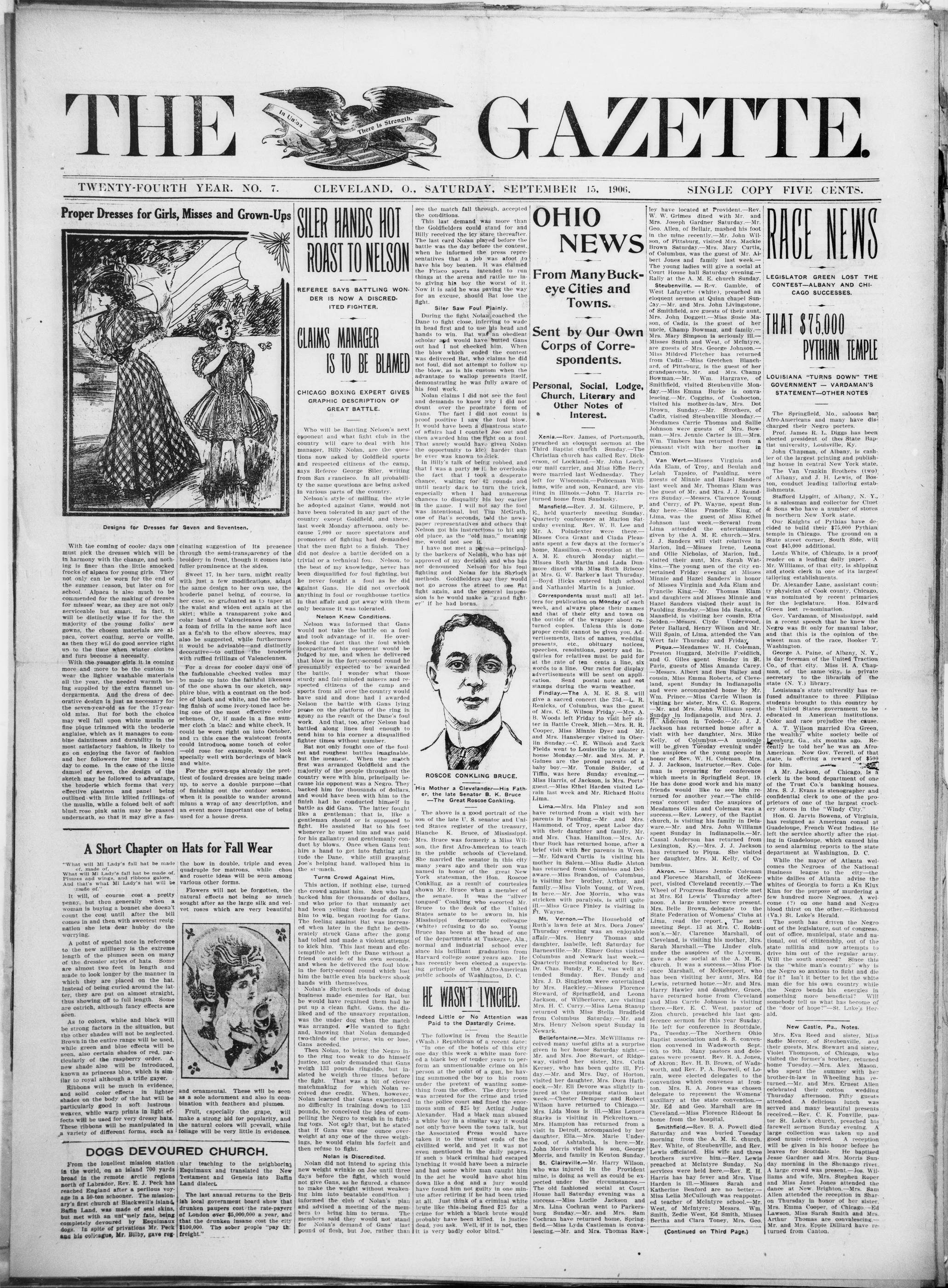
Page text (machine-generated)
THE
Proper Dresses for Girls, Misses and Grown-Ups
MARY
Designs for Dresses for Seven and Sventeen.
With the coming of cooler days one must pick the dresses which will be in harmony with the change, and nothing is finer than the little smocked frocks of alpaca for young girls. They not only can be worn for the end of the summer season, but later on for school. Alpaca is also much to be commended for the making of dresses for misses' wear, as they are not only serviceable but smart. In fact, it will be distracting if for the majority of the young folks' new gowns, the chosen materials are alpaca, covert coat, serve or volle, as then they will do good service right up to the time when winter clothes and furs become a necessity.
cinating suggestion of through the semi-trans brodery in the front, though fuller prominence at the Sweet 17, in her turn with just a few modif the same design to her broderie panel being, her case, so graduated the waist and widen on skirt; while a transpa color band of Valencie a foam of frills in the as a fanish to the elbow also be suggested, whil it would be advisable decorative—to outline
With the younger girls it is coming more and more to be the custom to wear the lighter washable materials all the year, the needed warmth being supplied by the extra flannel undergarments. And the dress of decorative design is just as necessary for the seven-year-old as for the 17-year-old miss. But for both the choice may well fall upon white muslin or fine pique trimmed with the broderie anglaise, which as it manages to combine daintiness and durability in the most satisfactory fashion, is likely to go on enjoying the favor of fashion and her followers or many, long while not being worn. The damsel of seven, the design of the sketch may be followed to advantage, the broderie which forms that very effective plastron and panel being outlined with little kilted frillings of the muslin, while a folDED belt of soft blush rose pink satin may be passed underneath so that it may give a fas-
A Short Chapter on Hats for Fall Wear
"What will MI Lady's fall hat be made
of, made of."
What will Mi Lady's fall hat be made of, plumes and wings, and ribbons galore. And that's what Mi Lady's hat will be made of."
It will, of course cost a pretty penny, but then generally when a woman is buying a bonnet she doesn't count the cost until after the bill comes in and then with sweetest resignation she lets dear hubby do the worrying.
A point of special note in reference to the new millinery is the extreme length of the plumes seen on many of the dressier styles of hats. Some are almost two feet in length and made to look longer by the manner in which they are placed on the hat. Instead of being curled around the latter, they are put on almost straight, thus showing off to full length. Some are ostrich, although fancy effects are seen.
As to colors, white and black will be strong factors in the situation, but the other shades will not be neglected. Brown in the entire range will be used, while green and blue effects will be seen, also certain shades of red, particularly of the raspberry order. A new shade also will be introduced, known as princess blue, which is similar to royal although a trifle gray.
Ribbons will be much in evidence, and solid color effects in lighter shades on the body of the hat will be particularly good in soft lustrous weaves, while warp prints in light effects will be used for very dressy hats. These ribbons will be manipulated in a variety of different forms, such as
DOGS DEVOURED CHURCH.
From the lonelest mission station in the world, on an island 700 yards broad in the remote arctic regions north of Labrador, Rev. E. J. Peck has reached England after a perilous voyage in a 50-ton schooner. The missionary's first church at Blackwell's island, Baffin Land, was made of seal skins, but met with an untunely fate, being completely devoured by Esquimaux dogs. In spite of privations Mr. Peck and his collarie, Mr. Bilby, gave reg-
clinating suggestion of its presence through the semi-transparency of the brodery in front, though it comes into fuller prominence at the sides.
Sweet 17, in her turn, might really with just a few modifications, adapt the same design to her own use, the broderie panel being, of course, in her case, so graduated as to taper at the waist and widen out again at the skirt; while a transparent yoke and color band of Valenciennes lace and a foam of frills in the same soft lace as a finish to the elbow sleeves, may also be suggested, while furthermore it would be advisable—and distinctly decorative—to outline the broderie with ruffled frillings of Valenciennes.
For a dress for cooler days one of the fashionable checked volles may be made up into the faithful likeness of the one shown in our sketch, saphire blue, with a contrast on the bodice of black and white, and the softening finish of some ivory-toned lace one of the most effective color schemes. Or, if made in a fine summer cloth 'n black; and white check, it could be worn right on into October, and in this case the waistcoat fronts could introduce some touch of color—old rose for example, would look specially well with borderings of black and white.
For the grown-ups already the prettiest of foulard dresses are being made up, to serve a double purpose—that of finishing out the outdoor season, when it is possible to wander around minus a wrap of any description, and an event more important one of being used for a house dress.
Hats for Fall Wear
the bow in double, triple and even quadruple for matrons, while chou and rosette ideas will be seen among various other forms.
Flowers will not be forgotten, the natural effects not being so much sought after as the large silk and velvet roses which are very beautiful
and ornamental. These will be seen as a sole adornment and also in combination with feathers and plumes. Fruit, especially the grape, will make a strong bid for popularity, and the natural colors will prevail, while foliage will be very little in evidence.
ular teaching to the neighboring Esquimaux and translated the New Testament and Genesis into Baffin Land dialect.
The last annual returns to the British local government board show that drunken paupers cost the rate-payers of London over $5,000,000 a year, and that the drunken insane cost the city $100,000. The sober people "pay the freight."
In Union There is Strength. GAZ . 7. CLEVELAND, O., SATURDAY, SEPTEMBER 15, 1906.
SILER HANDS HOT ROAST TO NELSON
REFEREE SAYS BATTLING WON
DER IS NOW A DISCRED-
ITED FIGHTER.
CLAIMS MANAGER IS TO BE BLAMED
CHICAGO BOXING EXPERT GIVES GRAPHIC DESCRIPTION OF GREAT BATTLE.
Who will be Battling Nelson's next opponent and what fight club in the country will care to deal with his manager, Billy Nolan, are the questions now asked by Goldfield sports and respected citizens of the camp, says Referee George Siler, writing from San Francisco. In all probability the same questions are being asked in various parts of the country.
Nelson's style of milling, the style he adopted against Gans, would not have been tolerated in any part of the country except Goldfield, and there, last week Monday afternoon, only because 7,000 or more spectators and promoters of fighting had demanded that the men fight to a finish. They did not desire a battle decided on a trivial or a technical fou. Nelson, to the best of my knowledge, never has been disqualified for foul fighting, but he never fought a foul as he did against Gans. He did not overlook anything in foul or roughhouse tactics in that affair and got away with them only because it was tolerated.
Nelson Knew Conditions.
Nelson was informed that Gans would not take the battle on a foul and took advantage of it. He overlooked the fact that the foul which incapacitated his opponent would be judged by me, and when he delivered that blow in the forty-second round he presumably expected to be awarded the battle. I wonder what those sturdy and fair-minded miners and respected citizens of the camp and sports from all over the country would have said and done had I awarded Nelson the battle with Gans lying prone on the platform of the ring in agony as the result of the Dane's foul work. And that, too, after Nelson had battled along lines foul enough to send him to his corner a disqualified fighter times without number. Bat not only fought one of the foulsest and roughest battles imaginable, but the meanest. When the match first was arranged Goldfield and the majority of the people throughout the country were with him, principally because his opponent was a Negro. They backed him for thousands of dollars, and would have been with him to the point had he conducted himself in battle Gans. The latter fought like a gentleman; the gentleman was supposed to fight. He assisted Bat to his feet whenever he upset him and was paid for his gallantry and gentlemanly conduct by blows. Once when Gans lent him a hand to get into fighting attitude the Dane, while still grasping Joe's helping hand, walloped him in the stomach.
Turns Crowd Against Him.
This action, if nothing else, turned the crowd against him. Men who had backed him for thousands of dollars, and who prior to that unmany act had been yelling their heads off for him to win, began rooting for Gans. The feeling against Bat was increased when later in the fight he deliberately struck Gans after the gong had tolled and made a violent attempt to kick him. This last mean and contemptible act left the Dane without a friend outside of his own seconds, and when he delivered the foul blow in the forty-second round which lost him, he even his backers shook hands with him. Nolan's Shylock methods of doing business made enemies for Bat, but he would have regained them had he put up a clean fight. Gans, the disliked and of the unsavory reputation, was the under dog when the match was arranged. He wanted to fight and, knowing that Nolan demanded two-thirds of the purse, win or lose, Gans acceded. Then Nolan, to bring the Negro into the ring too weak to do himself justice, not only demanded that Gans weigh 133 pounds ringside, but insisted he weigh three times before the fight. That was a bit of clever matchmaking for which Nolan relied on it. When, however, Nolan learned that Gans experienced no difficulty in training down to 133 pounds, he conceived the idea of compelling the Negro to weigh in in fighting togs. Not oply that, but he stated that if Gans was one ounce overweight at any one of the three weighings, he would claim his forfeit and then refuse to fight.
Nolan is Discredited.
Nolan did not intend to spring this new weight wrinkle on Joe until three days before the fight, which would not give Gans, as he figured, a chance to make the weight without weakening him into beatable condition. I informed the club of Nolan's plan and advised a meeting of the members to bring him to terms. The members said they would not stand for Nolan's demand of Gans' last pound of flesh, but Joe, rather than
GAZETTE.
see the match fall through, accepted the conditions.
This last demand was more than the Goldfielders could stand for and Billy received the ice stare thereafter. The last card Nolan played before the battle was the day before the contest, when he informed the press representatives that a job was afoot to have his boy beaten. It was claimed the Frisco sports intended to run things at the arena and rattle me in giving his boy the worst of it. Now it is said he was paving the way for an excuse, should Bat lose the fight.
Siler Saw Foul Plainly
Siler Saw Foul Plainly.
During the fight Nolan coached the Dane to fight close, inferring to wade in head first and to use his head and hands to win. Bat was an obedient scholar and would have buried Gans out had I not checkered him. When the fawn I not checked on the was delivered Bat, who claims he did not foul, did not attempt to follow up the blow, as is his custom when the advantage to wallop presents itself, demonstrating he was fully aware of his foul work.
Nolan claims I did not see the foul and demands to know why I did not count over the prostrate form of Gans. The fact I did not count is proof positive I saw the foul blow, it would have been a disastrous state the fawn I not checked on. Joe out and then awarded him the foul. That surely would have given Nolan the opportunity to kick harder than he ever was known to kick.
In Billy's talk of being robbed, and that I was a party to it he overlocks the fact that I took a desperate chance, waiting for 42 rounds and until nearly dark to turn the trick, especially when I had numerous chances to disqualify his boy earlier in the game. I will not say the foul was intentional, but Tim McGraath, the paper representatives and others that Nelson got his instructions to hit any old place, as the "old man," meaning me, would not see it.
I have not met a person—principally the backers of Nelson, who has not approved of my decision and who has not denounced Nelson for his four fighting and Nolan for his Shylock methods. Goldfielders say they would not go across the street to see Bat fight again, and the general impression is he would make a "grand fight er" if he had horns.
ROSCOE CONKLING BRUCE.
His Mother a Cleveland—His Father, the late Senator B. K. Bruce—The Great Roscoe Conkling.
The above is a good portrait of the son of the late U. S. senator and United States register of the treasury, Blanche K. Bruce, of Mississippi, Mrs. Bruce was formerly a Miss Wilson, the first Afro-American to teach in the public schools of Cleveland. She married the senator in this city many years ago and their son was named in honor of the great New York statesman, the Hon. Roscoe Conkling, as a result of courtesies shown Mr. Bruce when a member of the senate. It was the "silver tongued" Conkling who escorted Mr. Bruce to the desk of the United States senate to be sworn in, his Mississippi democratic colleague (white) refusing to do so. Young boys have been one of one of the departments at The College in normal and industrial school even since his brilliant graduation from Harvard college some years ago. He has recently been elected a supervising principle of the Afro-American public schools of Washington, D. C.
HE WASN'T LYNCHED.
HE WASN'T LYNCHED.
Indeed Little or No Attention was Paid to the Dastardly Crime.
The following is from the Seattle (Wash). Republican of a recent date: "In one of the hotels of this city one day this week a white man forced a black boy of tender years to perform an unmentionable crime on his person at the point of a gun, he having summoned the boy to his room under the pretext of wanting some money for the crime. The boy was arrested for the crime and tried in the police court and fined the enormous sum of $25 by Acting Judge Alexander. Had a black man abused a white boy in a similar way it would not only have been the town talk, but the Associated Press would have taken it to the utmost ends of the civilized world, and yet it was not even mentioned in the daily papers. If such a black criminal had escaped lynching it would have been a miracle and had some white man caught him in the act he would have shot him down like a dog and a jury would have found him not guilty in one minute after retiring if he had been tried at last. I think of a criminal white crime for which a black brute would probably have been killed. Is justice dead, you ask. Well, if it is not, then it is very badly color blind."
Xenia—Rev. J, James of Portsmouth, preached an eloquent sermon at the Third Baptist church Sunday—The Christian church has called Rev. Dickerson, of Lockland—Mr. John Lee, our mail carrier, and Miss Ellie Berry were married last Wednesday. They left for Wisconsin—Policeman Williams, wife and son, Kennard, are visiting in Illinois—John T. Harris returned home from Sandusky.
Mansfield—Rev. J. M. Gilmere, E, pearl held meeting Sunday. Quarterly conference at Marion Saturday evening. Rev. W. B. Lee and Mr. A. Polindexe were there. Miss Cora Grant and Chla Pleasants spent a few days at the former's home. Massillon—A reception at the A. M. E. Church Monday night. Misses Ruth Martin, Lennie Dorn dined with Miss Ruth Briscoe at Mrs. G. W. Barker's last Thursday. Boyd Hicks entered high school and Nathaniel Martin is a junior.
Correspondents must mail all letters for publication on Monday of each week, and always place their names and that of their city and town on the outside of the wrapper about returned copies. Unless this is done proper credit cannot be given you. Advertisements, lists of names, wedding presents, etc., obituary notices, speeches, resolutions, poetry and inquiries for relatives must be paid for at the rate of ten cents a line, six cents for an envelope for display advertisements will be applicable. Send postal note and not stamps during the warm weather.
Findlay—The A. M. E. S. S. will give a sacred concert the 23d.—L. R. Renicks, of Columbus, was the guest of Mrs. C. E. Wilson Friday.—Mrs. A. B. Woods left Friday to visit her sister in Battle Creek, Mich.—Mrs. R. R. Cooper, Miss Minnie Dyer and Mr. and Mrs. Hansberger visited Obernin Sunday.—C. E. Wilson and Zack Fields went to Louisville to plaster a house Monday.—Mr. and Mrs. M. P. Gaines are the proud parents of a baby boy.—Mr. Tonnie Snider, of Tiffin, was here Sunday evening.—Miss Harris, of Jackson, is Mrs. Ports' guest. Of Ethel Harden visited Lorain last week and Mr. Richard Holtz Lima.
Lima—Mrs. Ida Finley and son have returned from a visit with her parents in Paulding.—Mr. and Mrs. Hammond, of Troy, spent labor day with their daughter and family, Mr. and Mrs. Chas. Hamilton—Mrs. Arthur Buck has returned home, after a brief visit with her parents in Wren.—Mr. Edward Curtis is visiting his mother in Salem.—Miss Sadie Alston has returned from Columbus and Delaware.—Miss Brandon, of Columbus, is visiting her brother, Arthur, and family.—Miss Viola Young, of Wren, is stricken with paralysis, is still quite ill.—Miss Grace Finley is visiting in Ft. Wayne.
Mt. Vernon.—The Household of Ruth's lawn kite fairs at Mrs. Dora Jones' Thursday evening was an enjoyable affair.—Mrs. Henry Thomas and daughter, Isabelle, left Saturday for Barnesville.—Mr. Elmer Gohn visited Columbus and Newark last week.—Quarterly meeting conducted by Rev. Dr. Chas. Bundy, P. E., was well attended Sunday. Rev. Bundy and Mrs. J. D. Singleton were entertained by Mrs. Hackley.—Misses Florence Steward, of Springfield, and Leona Jackson, of Wilberforce, are visiting Mrs. H. C. Curry.—Miss Lena Stanup returned with Miss Stella Bradfield from Columbus Saturday. Mr. and Mrs. Henry Nelson spent Sunday in Newark.
Bellefontaine.—Mrs. McWilliams received many useful gifts at a surprise given in her honor Saturday night.—Mrs. Helen Bradfield, of Reway, visited her sister Mrs. Kelsey, who has been quite ill. Friday.—Mr. and Mrs. Day, of Horton, visited her daughter, Mrs. Dora Hathcock.—Mr. Eli Devore was slightly injured at the pumping station last week.—Chester Dempsey and Robert Wilson have returned to Chicago.—Mrs. Lida Moss is ill.—Miss Lenora Starks is visiting in Pickrelltown.—Mrs. Hampton has returned from a visit in Detroit, accompanied by a daughter, Ella.—Mrs. Marie Underwood, of Ashtabula, is here.—Mr. John Morris visited his son, George Morris, and family in Kenton Sunday.
St. Clairsville.—Mr. Harry Wilson, who was injured in the Provident mine, is doing as well as could be expected under the circumstances.—The old fashioned social at Court House hall Saturday evening was a success.—Miss Lucie Jackson and Mrs. Lina Cochran had to Parkersburg Sunday.—Mr. and Mrs. Sam Cochran have returned home, Spring-field.—Miss Lyda Castleman is convalescing.—Mr. and Mrs. Thomas Raw-
ley have located at Provident.—Rev. W. W. Grimes dined with Mr. and Mrs. Joseph Gardner Saturday.—Mr. Geo. Allen, of Bellair, mashed his foot in the mine recently.—Mr. John Wilson, of Pittsburg, visited Mrs. Mackle Brown Saturday.—Mrs. Mary Curtis, of Columbus, was the guest of Mr. Albert Jones and family last week.—The young ladies will give a social at Court House hall Saturday evening.—Rally at the A. M. E. church Sunday. Steubenville.—Rev. Gamble, of West Lafayette (white), preached an eloquent sermon at Quinn chapel Sunday.—Mr. and Mrs. John Livingstone, of Smithfield, are guests of their aunt, Mrs. John Doggett.—Miss Susie Mason, of Cadiz, is the guest of her uncle, Champ Bowman, and family.—Mrs. Mary Simpson is seriously Ill.—Misses Smith and West, of McIntyre, are guests of Mrs. George Johnson.—Miss Mildred Fletcher has returned from Cadiz.—Miss Gretchen Blanchard, of Pittsburg, is the guest of her grandparents, Mr. and Mrs. Champ Bowman.—Mr. Wm. Hargrave, of Smithfield, visited Steubenville Monday.—Missama Carrie Thomas and Sallie Johnson were guests of Mrs. Bowman.—Mrs. Jennie Carter is ill.—Mrs. Wm. Timbers has returned from a pleasant visit with her mother in Canton.
RACE NEWS
LEGISLATOR GREEN LOST TO CONTEST—ALBANY AND CAGO SUCCESSSES.
THAT $75,000 PYTHIAN TEMPERATURE
LOUISIANA "TURNS DOWN" GOVERNMENT—VARDAMAN STATEMENT—OTHER NOTES
The Springfield, Mo., saloons Afro-Americans and many have charged their Negro porters. Prof. James R. L. Diggs has elected president of the State tist university, Louisville, Ky. John Chapman, of Albany, is
Van Wert—Misses Virginia and Ada Elam, of Troy, and Beulah and Lelah Tapsico, of Paulding, were guests of Minnie and Sanders Sanders last week and Mr. Thomas Elam was the guest of Mr. and Mrs. J. J. Sanders Sunday—Messrs. Clarence Young and Curry, of Ft. Wayne, spent Sunday here—Miss Francie King, of Lima, was the guest of Miss Ethel Johnson last week—Sorrel from Littleton last week—Coronel given by the A. M. E. church—Mrs. J. J. Sanders will visit relatives in Marion, Ind—Misses Irene, Leona and Ollie Nicholas, of Marion, Ind., visited their aunt, Mrs. Sarah Watkins—The young men of the city entertained Friday evening at Misses Minnie and Hazel Sanders’ in honor of Misses Virginia and Ada Elam and Francie King—Mr. Thomas Elam and daughters and Misses Minnie and Hazel Sanders visited their aunt in Paulding Sundays—Miss Ida Banks, of Minnie, and Misses Minnie and Hazel Selden—Messrs. Clyde Underwood, Peter Ballard, Henry Wilson and Mr. Will Spain, of Lima, attended the Van Wert fair Thursday and Friday.
Piqua.—Mesdames W. H. Coleman, Preston Huggard, Melville Freidell, and G. Giles spent Sunday in St. Paris, guests of Miss Amanda Carey. —Messrs. Albert and Ben Bailey and cousin, Miss Emma Roberts, of Cleveland, spent Sunday in Indianapolis and were accompanied home by Mr. Wm. Prince.—Miss Carrie Wilson is visiting her sister, Mrs. C. G. Rogers. —Mr. and Mrs. John Coleman spent Saturdays, and Mrs. J. Anderson in Toledo.—Mr. J. J. Jackson has returned home after a visit with her daughter, Mrs. Mike Kelly, of Columbus.—A musical will be given Tuesday evening under the auspices of the young people in honor of Rev. W. H. Coleman, Mrs. J. J. Jackson, instructor.—Rev. Coleman is preparing for conference which meets in Springfield Sept. 19. He has done good work and his many friends would like to see him returned for another year.—The children's concert under the auspices of Mesdames Giles and Coleman was a success. Rev. Lowery, of the Baptist church, visited Saturdays in Doole. —Mr. and Mrs. John Williams spent Sunday in Indianapolis.—Mr. Cassal Anderson has returned from Lexington, Ky.—Mrs. J. J. Jackson has returned to Piqua. She visited her daughter, Mrs. M. Kelly, of Columbus.
Akron. — Misses Jennie Coleman and Florence Marshall, of McKeesport, visited Cleveland recently. — The Wheel of Progress Reading circle meet at Mrs. Ed Lewis' Thursday afternoon. A large number were present, Mrs. Belle Brown, delegate to the State Federation of Womens' Clubs at Lima, read the report. The next meeting Sept. 13 at Mrs. C. Robinson's. — Mr. Clarence Marshall, of Cleveland, is visiting his mother, Mrs. Sarah Marshall. — The Linder club under the auspices of the Lyceum, gave a shoe social at the A. M. E. church. It was a success. — Miss Florence Marshall, of McKeesport, who has been visiting her aunt, Mrs. Ed Lewis, returned home. — Mr. and Mrs. Harry Hawley and daughter, Grace have returned home from Cleveland and Miss Carrie Johnson is visiting there. — Rev. E. C. West, pastor of Zion church, preached his last conference sermon for this year Sunday. He left for conference in Scottdale, Pa. — Tuesday. The Northern Ohio Baptist association sent a congratulation to Wadsworth. Sept. 6th to 9th. pastors and delegates were present. Rev. R. A. Jones of Akron; Rev. H. B. Brown, of Wadsworth, and Rev. P. A. Boswell, of Lorain, were elected delegates to the convention which convenes at Ironton. Mrs. R. A. Jones was chosen delegate to represent the Womens' auxiliary at the state convention. — Mr. Ed and Geo. Marshall are in Cleveland. — Miss Florence Rideout is home from the hospital.
Smithfield—Rev. B. A. Powell died Saturday and was buried Tuesday morning from the A. M. E. church, Rev. White, of Steubenville, and Rev. Lewis officiated. His wife and three brothers survive him—Rev. Lewis preached at McIntyre Sunday. No services were held here—Rev. E. H. Harris has hay fever and Mrs. Vine Harden is ill—Misses Sarah and Katherine Benford are no better. Miss Lilia McCullough was reappointed teacher of McIntyre school—Mr. West, of McIntyre; Messrs. Wm. Smith, Zedie West, Ed Smith, Misses Bertha and Clara Toney, Mrs. Geo.
(Continued on Page.)
LEGISLATOR GREEN LOST THE
CONTEST—ALBANY AND CHI-
CAGO SUCCESSES.
LOUISIANA "TURNS DOWN" THE GOVERNMENT — VARDAMAN'S STATEMENT—OTHER NOTES
The Springfield, Mo. saloons bar Afro-Americans and many have discharged their Negro porters.
Prof. James R. L. Diggs has been elected president of the State Baptist university, Louisville, Ky.
John Chapman, of Albany, is cashier of the largest printing and publishing house in central New York state.
The Van Krankin Brothers (two) of Albany, and J. H. Lewis, of Boston, conduct leading tailoring establishments.
Stafford Lippitt, of Albany, N. Y., is a salesman and collector for Cluet & Sons who have a number of stores in northern New York state.
Our Knights of Pythias have developed a stock clerk ($4,000) Pythean temple in Chicago. The ground on a State street corner, South Side, will cost $45,000 additional.
Louis White, of Chicago, is a proof reader on a leading daily paper. A Mr. Williams, of that city, is shipping and stock clerk in one of its largest tailoring establishments.
Dr. Alexander Lane, assistant county physician of Cook county, Chicago, was nominated by recent primaries for the legislature. Hon. Edward Green lost re-nomination.
Gov. Vardaman, of Mississippi, said in a recent speech that he knew the Negro was fit only for manual labor, and that this is the opinion of the wisest man of the race, Booker T. Washington.
George A. Paine, of Albany, N. Y., is day foreman of the United Trucking Co. of the city. H. M. A. Chapman, of the same city, is private secretary to the librarian of the state (N. Y.) library.
Louisiana's state university has refused admittance to three Filipino students brought to this country by the United States government to be educated in American institutions. Color and race prejudice the cause. A. T. Wilson married Eva Green, the wealthy white society belle of greesburg, Ga., six months ago. Recently he told her he was an Afro-American. Now Gov. Terrell, of that state, is offering a reward of $500 for him. A. Mr. Jackson, of Chicago, is a clerk in the bond department of one of the Trust Co.'s banking houses. Mrs. S. J. Evans is stenographer and confidential clerk to one of the proprietors of one of the largest crockery stores in the "Windy City." Hon. G. Jarvis Bowens, of Virginia, has resigned as American consul at Guadeloupe, French West Indies. He is in service shortly after the rioting police caused him to send alarming reports to the state department at Washington, D. C. While the mayor of Atlanta welcomes the Negroes of the National Bureau of the city—the white dailies Atlanta the whitees of Georgia to form a Ku Kluan for the purpose of murdering a few hundred more Negroes. A welcome (?) on one hand and Negro blood thirst on the other—Richmond (VA.) St. Luke's Herald.
The south has driven the Negro out of the legislature, out of congress, out of office, municipal, state and national, out of citizenship, out of the state militia and now attempts to drive him out of the regular army. Will the south succeed? Since this is the "white man's country" why is the Negro so anxious to fight and die for it? Isn't it better to let the white man die for his own country while the Negro bends his energies in something more beneficial? Will somebody tell us what has become of the "door of hope"—St. Luke's Herald.
New Castle, Pa.. Notes.
Mrs. Eva Reed and sister, Miss Sadie Mercer, of Steubenville, and their guests, Mrs. Stewart and sister, Violet Thompson, of Chicago, who visited the former's brother, returned home Tuesday—Mrs. Alex Mason, who spent the summer with her brother-in-law in Wheeling has returned—Mr. and Mrs. Ernest Allen celebrated their cotton wedding Thursday afternoon. Fifty guests attended. A delicious lunch was served and many beautiful presents received—Rev. C. K. Fonville, pastor St. Luke's church, preached his farewell sermon Sunday evening. A large collection was taken up and good music rendered. A reception will be given in his honor before he leaves for Scottsdale. He baptised Jesse Gardner and Mrs. Morris Sunday morning in the Shenango river. A large crowd was present—Jos. Williams and wife, Mrs. Stephen Roper and Miss Anet Jones attended the Sam Allen attended the reception in Sharon Thursday in honor of her sister Mrs. Emma Cooper, of Chicago. Ed Lawson, Miss Sarah Smith and Mrs. Arthur Thomas are convalescing. Mr. and Mrs. Eppie Dillard have returned from Canton.
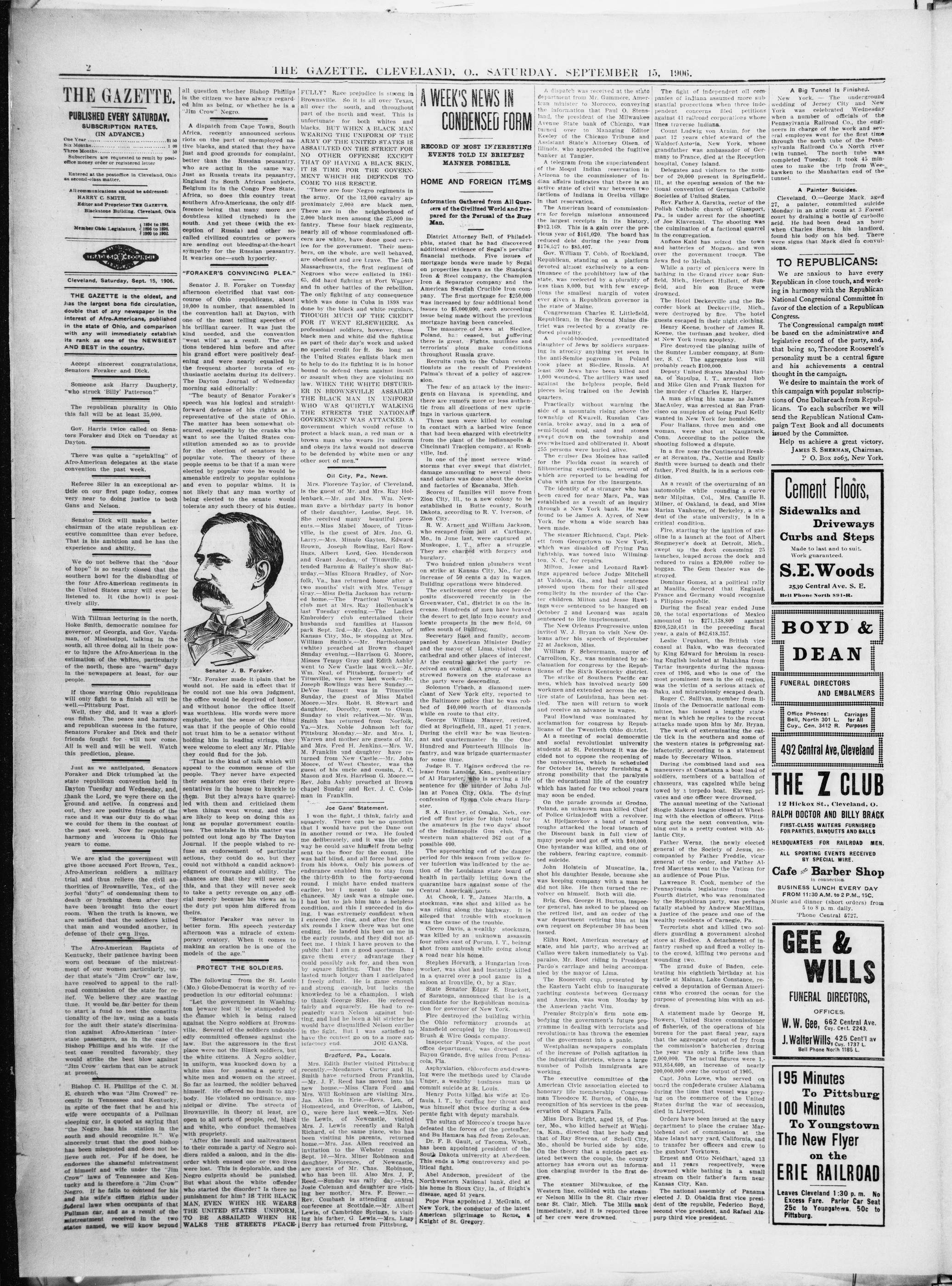
2
THE GAZETTE.
One Year. $1.50
Six Months. 1.00
Three Months.
Subscribers are requested to remit by post-
office money order or registered letter
Entered at the postoffice in Cleveland, Ohio
as second-class matter.
All communications should be addressed:
HARRY C. SMITH.
Editor and Protetor THE GAZETTE.
Editor and Proprietor THE GAZETTE.
Blackstone Building, Cleveland, Ohio
Member Ohio Legislature, 1894 to 1898.
1896 to 1898.
1900 to 1902.
Cleveland, Saturday, Sept. 15, 1906.
THE GAZETTE is the oldest, and
has the largest bona fide circulation,
double that of any newspaper in the
interest of Afro-Americans, published
in the state of Ohio, and comparison
with any will immediately establish
its rank as one of the NEWSIEST
AND BEST in the country.
Accept sincerest congratulations
Senators Foraker and Dick.
Someone ask Harry Daugherty, "who struck 'Billy' Patterson?" The republican plurality in Ohio this fall will be at least 35,000. Gov. Harris twice called on Senators Foraker and Dick on Tuesday at Dayton. There was quite a "sprinkling" of Afro-American delegates at the state convention the past week. Referee Siler in an exceptional article on our first page today, comes very near to doing justice to both Gans and Nelson. Senator Dick will make a better chairman of the state republican executive committee than ever before. That is his ambition and he has the experience and ability.
We do not believe that the "door of hope" is so nearly closed that the southern howl for the disbanding of the four Afro-American regiments in the United States army will ever be listened to. It (the howl) is positively silly.
With Tillman lecturing in the north, Hoke Smith, democratic nominee for governor, of Georgia, and Gov. Vardaman, of Mississippi, talking in the south, all three doing all in their power to injure the Afro-American in the estimation of the whites, particularly of the north, these are "warm" days in the newspapers at least, for our people.
If those warring Ohio republicans will only fight to a finish all will be well—Pittsburg Post.
Well, they did, and it was a glorious finish. The peace and harmony and republican success in the future, Senators Foraker and Dick and their friends fought for will now come. All is well and will be well. Watch this prediction, please.
Just as we anticipated, Senators Foraker and Dick triumphed at the state republican convention held in Dayton Tuesday and Wednesday, and, thank the Lord, we were there on the ground and active. In congress and out, they are positive friends of the race and it was our duty to do what we could for them in the contest of the past week. Now for republican harmony and success in Ohio for years to come.
We are glad the government will give those accused Fort Brown, Tex., Afro-American soldiers a military trial and thus relieve the civil authorities of Brownville, Tex., of the joyful "duty" of condemning them to death or lynching them after they have been brought into the court room. When the truth is known, we are satisfied that the soldiers killed that man and wounded another, in defense of their own lives.
The Afro-American Baptists of Kentucky, their patience having been worn out because of the mistreatment of our women particularly, under that state's "Jim Crow" car law, have resolved to appeal to the railroad commission of the state for relief. We believe they are wasting time. It would be far better for them to start a fund to test the constitutionality of the law, using as a basis for the suit their state's discrimination against Afro-American 'interstate passengers, as in the case of Bishop Phillips and his wife. If the test case resulted favorably, they would strike the best blow against "Jim Crow" carism that can be struck at present.
Bishop C. H. Phillips of the C. M. E. church who was "Jim Crowed" recently in Tennessee and Kentucky, in spite of the fact that he and his wife were occupants of a Pullman sleeping car, is quoted as saying that "the Negro has his station in the south and should recognize it." We sincerely trust that the good bishop has been misquoted and does not believe such rot. For if he does, he endorses the shameful mistreatment of himself and wife under the "Jim Crow" laws of Tennessee and Kentucky and is therefore a "Jim Crow" Negro. If he fails to contend for his and his wife's citizen rights under federal laws when occupants of that Pullman car, and as a result of the mistreatment received in the two states named, we will know beyond
THE GAZETTE, CLEVELAND, O., SATURDAY, SEPTEMBER 15, 1906.
all question whether Bishop Phillips is the citizen we have always regarded him as being, or whether he is a "Jim Crow" Negro.
A dispatch from Cape Town, South Africa, recently announced serious riots on the part of unemployed native blacks, and stated that they have just and good grounds for complaint, better than the Russian peasantry, who are acting in the same way. Just as Russia treats its peasantry, England its South African subjects, Belgium its in the Congo Free State, Africa, so does this country treat southern Afro-Americans, the only difference being that many more are doubtless killed (lynched) in the south. And yet these (with the exception of Russia) and other so-called civilized countries or powers are sending out bleeding-at-the-heart sympathy for the Russian peasantry. It wearies one—such hypocrisy.
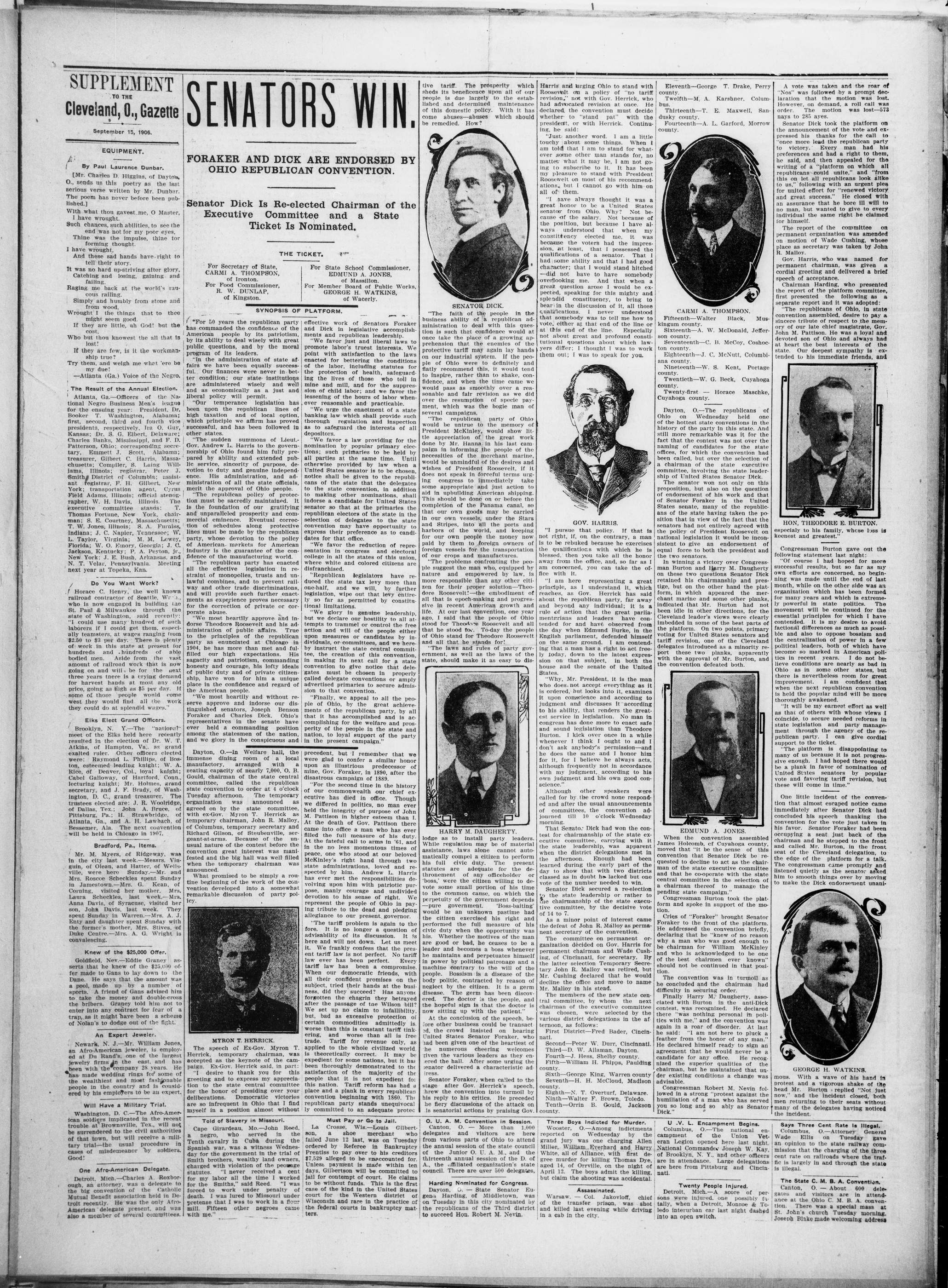
"FORAKER'S CONVINCING PLEA."
Senator J. B. Foraker on Tuesday afternoon electrified that vast concourse of Ohio republicans, about 10,000 in number, that assembled in the convention hall at Dayton, with one of the most telling speeches of his brilliant career. It was just the kind needed, and the convention "went wild" as a result. The ovations tendered him before and after his grand effort were positively deafening and were nearly equalled by the frequent shorter bursts of enthusiastic acclaim during its delivery. The Dayton Journal of Wednesday morning said editorially:
"The beauty of Senator Foraker's speech was his logical and straight-forward defense of his rights as a representative of the state of Ohio. The matter has been somewhat obscured, especially by the cranks who want to see the United States constitution amended so as to provide for the election of senators by a popular vote. The theory of these people seems to be that if a man were elected by popular vote he would be amenable entirely to popular opinions and even to popular whims. It is not likely that any man worthy of being elected to the senate would tolerate any such theory of his duties.
M.
Senator J. B. Foraker.
"Mr. Foraker made it plain that he would not. He said in effect that if he could not use his own judgment, the office would be deprived of honor, and without honor the office itself was worthless. His words were more emphatic, the sense of the thing was that if the people of Ohio could not trust him to be a senator without holding him in leading strings, they were welcome to elect any Mr. Pitable they could find for the job.
"That is the kind of talk which will appeal to the common sense of the people. They never have expected their senators nor even their representatives in the house to knuckle to them. But they always have quarreled with them and criticized them when things went wrong, and they are likely to keep on doing this as long as popular government continues. The mistake in this matter was pointed out long ago by The Dayton Journal. If the people wished to refuse an endorsement of particular actions, they could do so, but they could not withhold a candid acknowledgment of courage and ability. The chances are that they will never do this, and that they will never seek to take a petty revenge on any official merely because his views as to the duty put upon him differed from theirs.
"Senator Feraker was never in better form. His speech yesterday afternoon was a miracle of extemporary oratory. When it comes to making an oration he is one of the models of the age."
PROTECT THE SOLDIERS.
The following from the St. Louis (Mo.) "Globe-Democrat is worthy of reproduction in our editorial columns: "Let the government in Washington beware lest it be stamped by the clamor which is being raised against the Negro soldiers at Brownsville. Several of the soldiers undoubtedly committed offenses against the law. But the aggressors in the first place were not the Black soldiers, but the white citizens. A Negro soldier, in uniform, was knocked down by a white man for passing a party of white men and women on the street. So far as learned, the soldier behaved himself. He offered no insult to anybody. He violated no ordinance, municipal or divine. The streets of Brownsville, in theory at least, are open to all sorts of people, red, black and white, who conduct themselves with propriety.
"After the insult and maltreatment to their comrade a party of Negro soldiers raided a saloon, and in the disorder which ensued one or two lives were lost. This is deplorable, and the Negro culprits should be punished. But what about the white offender who started the disorder? Is there no punishment for him? IS THE BLACK MAN, EVEN WHEN HE WEARS THE UNITED STATES UNIFORM, TO BE ASSAILED WHEN HE WALKS THE STREETS PEACE-
FULLY? Race prejudice is strong in Brownsville. So it is all over Texas, all over the south, and throughout part of the north and west. This is unfortunate for both whites and blacks. BUT WHEN A BLACK MAN WEARING THE UNIFORM OF THE ARMY OF THE UNITED STATES IS ASSAULTED ON THE STREET FOR NO OTHER OFFENSE EXCEPT THAT OF HAVING A BLACK SKIN, IT IS TIME FOR THE GOVERNMENT WHICH HE DEFENDS TO COME TO HIS RESCUE.
"There are four Negro regiments in the army. Of the 13,000 cavalry approximately 2,000 are black men. There are in the neighborhood of 2,000 black men among the 25,000 infantry. These four black regiments, nearly all of whose commissioned officers are white, have done good service for the government. Their members, on the whole, are well behaved, are obedient and are brave. The 54th Massachusetts, the first regiment of Negroes who were enlisted in 1861-65, did hard fighting at Fort Wagner and in other battles of the rebellion. The only fighting of any consequence which was done in Cuba in 1898 was done by the black and white regulars, THOUGH MUCH OF THE CREDIT FOR IT WENT ELEWHERE. As professional soldiers, however, these black men and white did the fighting as part of their day's work and asked no special credit for ft. So long as the United States enlists black men to help to do its fighting it is in honor bound to defend them against insult or assault when they are violating no law. WHEN THE WHITE DISTURBER IN BROWNSVILLE ASAILED THE BLACK MAN IN UNIFORM WHO WAS QUIETLY WALKING THE STREETS THE NATIONAL GOVERNMENT WAS ATTACKED. A government which would refuse to protect a black man, a red man or a brown man who wears its uniform and obeys its laws would not deserve to be defended by white men or any other sort of men."
Oil City, Pa., News.
Mrs. Florence Taylor, of Cleveland, is the guest of Mr. and Mrs. Ray Hollenback—Mr. and Mrs. Wm. Newman gave a birthday party in honor of their daughter, Louise, Sept. 10. She received many beautiful presents—Miss Mabel Moore, of Titusville, is the guest of Mrs. Jno. G. Larry—Mrs. Minnie Gayton, Edward Brown, Joseph Rowling, Earl Rowlings, Albert Lord, Geo. Henderson and Grant Jordan, of Titusville, attended Barnum & Bailey's show Saturday—Miss Ehora Bradley, of Norfolk, Va. has returned home after a two months' visit with Mrs. Tempy Gray—Miss Della Jackson has returned home. The Practical Woman's club met at Mrs. Ray Hollenback's last Tuesday evening. The Ladies Embroidery club entertained their husbands and families at Hasson park Sept. 3rd. Mr. Geo. Ambre, of Kansas City, Mo. is stopping at Mrs. William Smith's. Mr. Bartholomay (white) preached at Brown chapel Sunday evening.—Harrison G. Moore, Miss Tempy Gray and Edith Ashby went to New Castle last week—Mr. Wm. Neal, of Pittsburg, formerly of Titusville, was here last week—Mr. Joseph Rowlings was here Sunday—DeVoe Bassett was in Titusville Sunday, the guest of Miss Mabel Hollenback, Mrs. B. Stewart and daughter, Dorothy,老夫. Sunday to visit relatives.—Mr. Wm. Smith has returned from Norfolk, Va.—Mrs. Noble Johnson left for Pittsburgh Monday.—Mr. and Mrs. L. Warren and mother are guests of Mrs. Fred H. Jenkins.—Mr. W. M. Franklin and daughter have returned from New Castle.—Mr. John Moore, of West Chester, was the guest of his uncle and cousin, J. C. Mason and Mrs. Harrison G. Moore.—Rev. John Ashby preached at Brown chapel Sunday and Rev. J. C. Coleman in Franklin.
Joe Gans' Statement.
I won the fight, I think, fairly and squarely. There can be no question that I would have put the Dane out in another round or two. He fouled me deliberately, and it was the only way he could save himself from being sent to the floor for the count. He was half blind, and all force had gone from his blows. Only his powers of endurance enabled him to stay from the thirty-fifth to the forty-second round. I might have ended matters earlier, but I meant to take no chances. My task was a simple one, had it not been a bad condition, and this I succeeded in doing. I was extremely confident when I entered the ring, and after the first six rounds I knew there was but one ending. He landed his best on me in the early rounds, and they did not affect me. I think I have proven to the public that I am a good sportsman. I gave them every advantage they could possibly ask for, and then won by square fighting. That the Dane lasted much longer than I anticipated I freely admit. He is game enough and strong enough, but lacks the knowledge champion with. I wish George Silver he refereed fairly and squarely. He had to repeatedly warn Nelson against butting, and had he been a bit stricter he would have disqualified Nelson earlier in the fight. But I was satisfied to have the contest go on to a more satistactory end. JOE GANS.
Bradford, Pa., Locals.
Mrs. Edith Butler visited Pittsburgh recently—Mesdames Carter and H. Smith have returned from Franklin, Mr. J. F. Reed has moved into his new house—Miss Clara Ford and Mrs. Will Robinson are visiting Mrs. Jas. Allen in Erie—Revs. Len, of Homestead, and Overlton, of Lisbon, O., were here last week—Mrs. Nettle Lewis, of Newcastle, visited Mrs. J. Lewis recently and Ralph Richard, of the same place, who has been visiting his parents, returned home, Mrs. Jas. Allen received an invitation to the Webster reunion Sept. 10—Mrs. Miner Robinson and daughter, Mrs. Owen, Newcastle, who has been ill Also Mrs. Jas. Robinson who has been ill Also Mrs. J. F. Reed—Sunday was rally day—Mrs. Josie Coleman and daughter are visiting her mother, Mrs. F. Brown—Rev. Combash is attending annual conference at Scottsdale—Mr. Albert Lewis, of Cambridge Springs, is visiting his father, G. Lewis—Mrs. Lucy Berry has returned from Pittsburg.
A WEEK'S NEWS IN CONDENSED FORM
RECORD OF MOST INTERESTING
EVENTS TOLD IN BRIEFEST
MANNER POSSIBLE.
HOME AND FOREIGN ITEMS
Information Gathered from All Quarers of the Civilized World and Prepared for the Perusal of the Busy Man.
District Attorney Bell, of Philadelphia, stated that he had discovered additional evidence of Segal's peculiar financial methods. Five issues of mortgage bonds were made by Segal on properties known as the Standard Iron & Steel company, the Champion Iron & Separator company and the American Swedish Crucible Iron company. The first mortgage for $250,000 was increased by four additional bond issues to $5,000,000, each succeeding issue being made without the previous mortgage having been canceled. The massacre of Jews at Siedle, Poland, has ceased, but suffering there is great. Fights, mutinies and terrorists' plots make conditions throughout Russia grave.
Recruits rush to the Cuban revolutionists as the result of President Palma's threat of a policy of aggression.
The fear of an attack by the insurgents on Havana is spreading, and there are rumors more or less authentic from all directions of new uprisings in various quarters.
Three men were killed by coming in contact with a barbed wire fence that had been charged with electricity from the plant of the Indianapolis & Cincinnati Traction company, at Rushville, Ind.
In one of the most severe windstorms that ever swept that district, damage amounting to several thousand dollars was done about the docks and factories of Escanaba, Mich.
Scores of families will move from Zion City, Ill., to a new colony to be established in Butte County, South Dakota, according to R. V. Iverson, of Zion City.
R. W. Arnett and William Jackson, who escaped from jail at Carthage, Mo., in June last, were captured at Muskegee, I. T., after a struggle. They are charged with forgery and burglary.
Two hundred union plumbers went on strike at Kansas City, Mo., for an increase of 50 cents a day in wages. Building operations were hindered.
The excitement over the copper deposits discovered recently in the Greenwater, Cal., district is on the increase. Hundreds of men have braved the desert to get into Inyo county and locate prospects in the new field, 60 miles south of Bullfrog.
Secretary Root and family, accompanied by American Minister Dudley and the mayor of Lima, visited the cathedral and other places of interest. At the central market the party received an ovation. A group of women strewed flowers on the staircase as the party were descending.
Solomon Urbach, a diamond merchant of New York city, reported to the Baltimore police that he was robbed of $40,000 worth of diamonds while en route to that city.
George William Maurer, retired, died at Springfield, Ill., aged 71 years. During the civil war he was lutenant and quartermaster In the One Hundred and Fourteenth Illinois infantry, and was brigade quartermaster for some time.
Judge B. J. Haines ordered the release from Lansing, Kan., penitentiary of Al Harpster, who is serving a life sentence for the murder of John Julian at Ponca City, Okla. The dying confession of Byron Cole clears Harpster.
S. A. Huntley, of Omaha, Neb., carried off first prize for high total for the amateurs in the two days' shoot of the Indianapolis Gun club. The western man shattered 362 out of a possible 400.
The approaching end of the danger period for this season from yellow fever infection was indicated by the action of the Louisiana state board of health in partially letting down the quarantine bars against some of the Central American ports.
At Chook, I. T., James Martin, a stockman, was shot and killed as he was riding along the highway. It is alleged that trouble with stockmen was the cause of the trouble.
Cleero Davis, a wealthy stockman, was killed by an unknown assassin four miles east of Porum, I. T., being shot from ambush while going along a road near his home.
Stephen Horvath, a Hungarian ironworker, was shot and instantly killed in a quarrel over a pool game in a saloon at Ironville, O., by a Slav.
State Senator Edgar E. Brackett, of Saratoga, announced that he is a candidate for the Republican nomination for governor of New York.
Fire destroyed the building within the Ohio reformatory grounds at Mansfield occupied by the Bromwell Brush & Wire Goods company.
Inspector Frank Voges, of the post office department, was drowned at Bayon Grande, five miles from Pensacola, Fla.
Asphyxiation, chloroform and drowning were the methods used by Claude Unger, a wealthy business man to commit suicide at St. Louis.
Henry Potts killed his wife at Eufaula, I. T., by cutting her throat and was himself shot twice during a desperate fight with deputy marshals.
The sultan of Morocco's troops have defeated the forces of the pretender, and Bu Hamara has died from Zelouan.
Dr. F. B. Gault, of Tacoma, Wash., has been appointed president of the South Dakota university at Aberdeen. This ends a long controversy and political fight.
Abel Anderson, president of the Northwestern National bank, died at his home in Sioux City, Ia., of Bright's disease, aged 51 years. Pope Pius appointed J. McGrain, of New York, the conductor of the latest American pilgrimage to Rome, a Knight of St. Gregory.
A dispatch was received at the state department from Mr. Gummere, American minister to Morocco, conveying the information that Paul O. Stensland, the president of the Milwaukee Avenue State bank of Chicago, was turned over to Managing Editor Keeley of the Chicago Tribune and Assistant State's Attorney Olsen of Illinois, who apprehended the fugitive banker at Tangier.
A telegram from the superintendent of the Moqul Indian reservation in Arizona to the commissioner of Indian affairs indicates that there is an active state of civil war between two factions of Indians in Oreira village in that reservation.
The American board of commissioners for foreign missions announced the largest receipts in its history, $12,169. This is a gain over the previous year of $161,020. The board has reduced debt during the year from $176,527 to $85,407.
Gov. William T. Cobb, of Rockland, Republican, standing on a platform devoted almost exclusively to a continuance of the prohibitory law of the state, was reelected by a plurality of less than 8,000, but with few exceptions the smallest margin of votes ever given a Republican governor in the state of Maine.
Congressman Charles E. Littlefield, Republican, in the Second Maine district was reelected by a greatly reduced plurality.
A cold-blooded, premeditated slaughter of Jews by soldiers surpassing in atrocity anything yet seen in the anti-Semitic pogroms in Poland took place at Siedlce, Russia. At least 300 Jews have been killed and 1,000 wounded. The artillery was used against the helpless people, field pieces being trained on the Jewish quarters.
Practically without warning the side of a mountain rising above the township of Kwareeli, Russian Caucasia, broke away, and in a sea of semi-liquid mud, sand and stones swept down on the township and over-whelmed and obliterated it. About 255 persons were buried alive.
The cruiser Des Moines has sailed for the Florida coast in search of filibustering expeditions, several of which are reported to be heading for Cuba with arms for the Insurgents.
The identity of a stranger who has been cared for near Mars, Pa., was established as a result of an inquiry through a New York bank. He was found to be James A. Ayres, of New York, for whom a wide search has been made.
The steamer Richmond, Capt. Pickett from Georgetown to New York, which was disabled off Frying Pam lightship, was towed into Wilmington, N. C., for repairs.
Milton, Jesse and Leonard Rawlings appeared before Judge Mitchell at Valdosta, Ga., and had sentence passed upon them for their all-gled complicity in the murder of the Carter children. Milton and Jesse Rawlings were sentenced to be hanged on October 2 and Leonard was again sentenced to life imprisonment. The New Orleans Progressive union invited W. J. Bryan to visit New Orleans after his speech of September 22 at Jackson, Miss. William F. Scheurmann, mayor of Carrollton, Ky., was nominated by acclamation for congress by the Republicans of the Sixth Kentucky district. The strike of Southern Pacific car men, which has involved nearly 500 workmen and extended across the entire state of Louisiana, has been settled. The men will return to work and receive an advance in wages.
Paul Howland was nominated by acclamation for congress by Republicans of the Twentieth Ohio district. At a meeting of social democratic and social revolutionist university students at St. Petersburg it was decided not to oppose the reopening of the universities, which is scheduled for October 14, thereby furnishing a strong possibility that the paralysis of the educational life of the country which has lasted for two school years may soon be ended.
On the parade grounds at Grodno, Poland, an unknown man killed Chief of Police Grizajedoff with a revolver. At Bieljazerkov a band of armed roughs attacked the local branch of the Discount bank in full view of many people and got off with $40,000. One bystander was killed, and one of the robbers, fearing capture, committed suicide.
John Holstein of Muscatine, la., shot his daughter Bessie, because she was keeping company with a man he did not like. He then turned the revolver on himself. Both will die.
Brig. Gen. George H. Burton, inspector general, has asked to be placed on the retired list, and an order of the war department retiring him at his own request on September 30 has been issued.
Elihu Root, American secretary of state, and his party, who arrived at Callao were taken immediately to Valparaiso, Mr. Root riding in President Pardo's carriage and being accompanied by the mayor of Lima.
The Roosevelt cup, presented by the Eastern Yacht club to inaugurate yachting contests between Germany and America, was won Monday by the American yacht Vim.
Premier Stolylpin's firm note embodying the government's future programme in dealing with terrorists and revolutionists has thrown the enemies of the government into a panic.
Westphalian newspapers complain of the increase of Polish agitation in the industrial districts, where a large number of Polish immigrants are working.
The executive committee of the American Civic association elected to honorary life membership Congressman Theodore E. Burton, of Ohio, in recognition of his services in the preservation of Niagara Falls. Miss Dora Bright, aged 18, of Foster, Mo., who killed herself at Wichita, Kan., directed that her body and that of Ray Stevens, of Schell City, Mo., should be buried side by side. On the theory that a suicide pact existed between the couple, the county attorney has sworn out an information charging murder in the first degree. The steamer Milwaukee, of the Western line, collided with the steamer Nelson Mills in the St. Clair river near St. Clair, Mich. The Mills sank immediately, and it is reported three of her crew were drowned.
The fight of independent oil companies of Indiana assumed more sub stantial proportions when three inde pendent concerns filed petitions against 41 railroad corporations whose lines traverse Indiana.
Count Ludwig von Arnim, for the past 12 years chief steward of the Waldorf-Astoria, New York, whose grandfather was ambassador of Germany to France, died at the Reception hospital, Coney Island.
Delegates and visitors to the number of 20,000 present in Springfield, Ill., at the opening session of the national convention of German Catholic Societies of United States.
Rev. Father A. Garstka, rector of the Polish Catholic church of Glassport, Pa., is under arrest for the shooting of Joe Klavenski. The shooting was the culmination of a factional quarrel in the congregation.
Anfoes Kaid has seized the town and batteries of Mogado, and won over the government troops. The Jews fled to Mellah.
While a party of pioncers were in bathing in the Grand River near Sunfield, Mich., Herbert Hullett, of Sunfield, and his son Bruce were drowned.
The Hotel Deckerville and the Recorder block at Deckerville, Mich., were destroyed by fire. The hotel guests escaped in their night clothing. Henry Keene, brother of James R. Keene, the turfman and broker, died at New York from apoplexy.
Fire destroyed the planing mills of the Sumter Lumber company, at Sumter, S. C. The aggregate loss will probably reach $100,000.
Deputy United States Marshal Hanna, of Sapulpa, L. T., arrested Bob and Mike Glen and Frank Buxton for the murder of Charles E. Harper.
A man giving his name as James MacAuley, was arrested at San Francisco on suspicion of being Paul Kelly wanted in New York for homicide.
Four Italians, three men and one woman, were shot at Naugatuck, Conn. According to the police the shooting followed a dispute.
In a fire near the Continental Breaker at Scranton, Pa., Nettie and Emily Smith were burned to death and their father, Fred Smith, is in a serious condition.
As a result of the overturning of an automobile while rounding a curve near Milpitas, Col., Mrs. Camille B. Milner, of Oakland, is dead, and Miss Marian Vanhorne, of Berkeley, a student of the state university, is in a critical condition.
Fire, starting by the ignition of gasoline in a launch at the foot of Albert Stegmeyer's dock at Detroit, Mich., swept up the dock consuming 25 launches, leaped across the dock and reduced to ruins a $20,000 roller tooggan. The Gem theater was destroyed.
Dominar Gomez, at a political rally at Manilla, declared that England, France and Germany would recognize a Filipino republic.
During the fiscal year ended June 30, the total exportations of Mexico amounted to $271,138,809 against $208,520,451 in the preceding fiscal year, a gain of $62,618,357. Leslie Urquhart, the British vice consul at Baku, who was decorated by King Edward for heroism in rescuing English isolated at Balakhna from Tartar insurgents during the massacres of 1905, and who is one of the most prominent men in the oil region, was the victim of a serious attack of Baku, and miraculously escaped death. Roger C. Sullivan, member from Illinois of the Democratic national committee, has issued a lengthy statement in which he replies to the recent attacks made upon him by Mr. Bryan. The work of exterminating the cattle tick in the southern and some of the western states is progressing satisfactorily, according to a statement made by Secretary Wilson.
During the combined land and sea maneuvers at Constanza a boat load of soldiers, members of a battalion of chasseurs, was capsized while being towed by a torpedo boat. Eleven privates and one officer were drowned. The annual meeting of the National Stogie Makers league closed at Wheeling with the election of officers. Pittsburg gets the next convention, winning out in a pretty contest with Atlantic City. Father Wernz, the newly elected general of the Society of Jesus, accompanied by Father Freddie, vicar general of the order, and Father Alfred Maertens went to the Vatican for an audience of Poue Pius. Lawrence B. Cook, member of the Pennsylvania legislature from the Fourth district, who was renominated by the Republican party, was perhaps fatally stabbed by Andrew MacMillan, a justice of the peace and one of the wealthy residents of Carnegie, Pa.
Terrorists shot and killed two soldiers guarding a government alcohol store at Sledge. A detachment of infantry rushed up and fired a volley into the crowd, killing two persons and wounding two.
The grand duke of Baden, celebrating his eightieth birthday at his castle at Mainau, Lake Constance, received a deputation of German Americans who crossed the ocean for the purpose of presenting him with an address.
A statement made by George H. Bowers, United States commissioner of fisheries, of the operations of his bureau for the past fiscal year, says that the aggregate output of fry from the commission's hatcheries during the year was only a trifle less than 2,000,000. The actual figures were 1,931,854,609, an increase of nearly 200,000,000 over the output of 1905.
Capt. John Lowe, who served on board the confederate cruiser Alabama during the time that vessel was preying on the commerce of the United States during the war of secession, died in Liverpool. Orders have been issued at the navy department to place the cruiser Marblehead out of commission at the Mare Island navy yard, California, and to transfer her officers and crew to the gunbout Yorktown. Ernest and Otto Neldhart, aged 13 and 11 years respectively, were drowned while bathing in a small stream on their father's farm near Kansas City, Kan. The national assembly of Panama elected J. D. Obaliad first vice president of the republic, Federico Boyd, second vice president, and Rafael Alzpurp third vice president.
A Big Tunnel Is Finished.
New York. — The underground wedding of Jersey City and New York was celebrated Wednesday when a number of officials of the Pennsylvania Railroad Co., the engineers in charge of the work and several employees went for the first time to the north tube of the Pennsylvania Railroad Co.'s North river twin tunnel. The north tube was completed Tuesday. It took 45 minutes to make the trip from Weehawkent to the Manhattan end of the tunnel.
A. Painter Suicides.
Cleveland, O.-George Mack, aged 27, a painter, committed suicide Monday in an attic room at 3 Forest court by draining a bottle of carbolic acid. He had been dead an hour when Charles Burns died in his body on his bed. There were signs that Mack died in convulsions.
TO REPUBLICANS:
We are anxious to have every Republican in close touch, and working in harmony with the Republican National Congressional Committee in favor of the election of a Republican Congress.
The Congressional campaign must be based on the administrative and legislative record of the party, and, that being so, Theodore Roosevelt's personality must be a central figure and his achievements a central thought in the campaign.
We desire to maintain the work of this campaign with popular subscriptions of One Dollar each from Republicans. To each subscriber we will send the Republican National Campaign Text Book and all documents issued by the Committee.
Help us achieve a great victory.
JAMES S. SHERMAN, Chairman.
P. O. Box 2063, New York.
Cement Floors,
Sidewalks and
Driveways
Curbs and Steps
Made to last and to suit.
Work guaranteed.
S.E. Woods
2539 Central Ave. S. E.
Bell Phone North 891-H
BOYD & DEAN
FUNERAL DIRECTORS
AND EMBALMERS
Office Phones: Carriages
Bell, North 301 L. for All
Cuy., Cen. 3412 R. Purposes
492 Central Ave, Cleveland
THE Z CLUB
12 Hickox St., Cleveland, O.
RALPH DOCTOR AND BILLY BRACK
FIRST-CLASS WAITERS FURNISHED
FOR PARTIES, BANQUETS AND BALLS
HEADQUARTERS FOR RAILROAD MEN.
ALL SPORTING EVENTS RECEIVED
BY SPECIAL WIRE.
BUSINESS LUNCH EVERY DAY
FROM 11:30 A.M. to 2 P.M., 15C.
Music and dinner (short orders) from
5 to 8 p. m. daily.
'Phone Central 5727.
GEE & WILLS
FUNERAL DIRECTORS,
OFFICES:
W. W. Gee, 662 Central Ave.
Cuy. Cent. 2243.
J. Walter Wills, 425 Cent'l av
Cuy. 1737 L.
Bell Phone North 1185 L.
195 Minutes
To Pittsburg
100 Minutes
To Youngstown
The New Flyer
on the
ERIE RAILROAD
Leaves Cleveland 1:30 p.m. No
Excess Fare. Parlor Car Seat
25c to Youngstown. 50c to
Pittsburg.
---
Notice to Subscribers. — Subscribers not receiving The Gazette regularly should notify us at once. We desire every copy delivered promptly.
We advise our patrons to carefully examine The Gazette's advertisements before making purchases. Business men who advertise in this paper should have the patronage of Afro-Americans. The fact that they advertise is assurance that they want it. Local reading notices (advertisements) ten cents a line (six words in a line.)
Charles S. Sutton, Collector.
Cleveland, Saturday, Sept. 15, 1906.
PURCHASE "THE GAZETTE" AT
Pushaw's News Store, Cuyahoga Bldg.
Open Sunday.
Thompson's News Depot, No. 581
Central Ave., near cor. Sterling Ave.
Open Sunday.
F. Valentine's Grocery Store, No. 366
Central Ave., between Perry and
Harmon Sts.
N. Hexter's News Store, No. 362
Bond St., between Euclid and Superior
Aves. Open Sunday.
Mr. Geo. W. Johnson left for Pittsburg Tuesday.
Mr. F. Johnson, of Caledonia, N. Y.
is in the city and may locate.
Mr. and Mrs. Charles Stewart, of
Youngstown, were in the city Sunday.
E. W. Burrell and Miss Sterye, of
Youngstown, were in the city recently.
The editor of The Gazette left Monday
night for Springfield and Dayton
on a business trip.
It is said that Willie Green was refused
service in one of Clark's restaurants some time ago.
The Onward Foraker club will meet next week Wednesday evening. Members will please take notice. Prof. Moore, financial representative of Livingstone college, Salisbury, N. C., called on the *The Gazette* Monday. The editor of *The Gazette* will speak in Wheeling on the 21st and in Pennsylvania on the 26th or 27th. J. W. Crawford has opened a neat restaurant and Mr. Sutton, of Newburg, a meat market on Central avenue. Mrs. J. A. Ford, of 186 Osborn street, returned home the first of the week from Canada, Michigan and Tiffin, O. Messrs. Alex Martin and Tom Fleming were delegates to the state convention at Dayton Tuesday and Wednesday. Mr. Charles Johnson and Mr. Wm Hinch, of Ann Arbor, Mich., visited the former's brother, Geo. W. Johnson, Sunday. In recent weeks Mr. Arthur Thomas and "Jim" Conway, "old Clevelanders," died—the former here and the latter at Oakland, Cal.
Willoughbeach will close Sept. 15, so J. W. Butler, P. A. of the C. P., & E. R. R. Co., informed The Gazette the first of the week.
Mrs. R. A. Ball and daughter, Sophie, returned to London recently. She visited her daughters, Mrs. Seelig and Misses Edna and Minnie Ball.
Mr. Benjamn Ricks, of Cory avenue, was pretty badly bruised about the body and limbs by a kicking horse last week Tuesday. He is convalescing slowly.
Miss L. H. Hopkins is serving a spendid 15 cent business lunch from 11:30 to 2 p. m. and a 25 cent regular dinner from 5 to S. p. m. daily upstairs over the Z club, 12 Hickox street. Try them and be convinced.
The Gazette acknowledges the receipt last week of an invitation to attend the unveiling, Friday, September 14, of the memorial to President William McKinley erected on Capitol Square by the state and citizens of Columbus.
Mr W. Carmack, of Central avenue, who came here from Pittsburgh and Philadelphia to conduct a restaurant business, died the first of the week, after quite a lengthy illness. He leaves a wife and other relatives to mourn his demise.
Mr. Jefferson Coe, of Grant street, returned recently from a delightful trip up the lakes on the gunbout Hawk, and Mrs. Coe from an extended visit which included Annapolis and Baltimore, Md., Washington, D.C. and Atlantic City, N. J.
Hon. W. R. Stewart and wife, Dr. Consuela Clark Stewart, of Youngstown, and niece, Miss Nesbitt, of St. Louis, Mo., and Miss Johnson, a stenographer and school teacher, of former representatives of The Gazette at Norwalk, O. were in the city Sunday and dined with the editor of The Gazette
M. Haven Baptist church will have its opening exercises Sunday at 3 p.m. at 63 Linden street. Our local pastors will make short addresses and Rev. E. D. Dandridge, the pastor, will preside. The editor of The Gazette acknowledges receipt of an invitation from church clerk, I. A. Lawson, to attend.
Rev. A. J. Jackson of Covington, K. P. E. of district of the A. M. E. church, as such made his visit to Lane Memorial church on Sunday. Mr. Jackson preached eloquently each of the services to large and appreciative congregations. He has made a splendid presiding elder and will be sorely missed by the churches in his district.
Ed Dunjill, Gus Eubanks and Sidney Jones, of Detroit, went into Stein's cafe, just off the southwest corner of the Public Square, one day last week, and were "turned down" flat. After waiting about half an hour and seeing others waited upon, they got up and left the restaurant. Dunjill and Eubanks were a few weeks ago admitted to the bar and will surely enter suit against Stein. Ask them about it.
The Y. M. C. A., of Buxton, Iowa, of which Lewis E. Johnson, formerly of this city, is general secretary, opened a boy's department on the 6th with LeRoy W. Tucker, another Clevelander, in charge. Secretary Johnson writes the editor of The Gazette: "This was a great night in Buxton" and that "everything went as per program." How could it have been otherwise with "Lewie" and "Roy" in charge? They are always successes. Good! More power and success to you, young gentlemen!
H. H, of Ruth, N. 7, extends a cordial invitation to Ohio and Chas. Summer lodges, H. H, No. 1375, all visiting Doll Fellows, Queen Eliza-
THE GAZETTE, CLEVELAND, O., SATURDAY, SEPTEMBER 15, 1906.
beth chapter, No. 9, O. E. S., the Hiawata club, the pastors and their congregations, to the reception tendered in honor of Mrs. B. F. Douglass, W. D. M. N. G. of D. H. H. No. 4, state of Ohio, at Clayton hall, Sept. 19. Emma Williams, M. N. G.; Flora Fields, W. R.
Mrs. S. T. Robert, of Edwards avenue, entertained last week Monday noon at a delightful luncheon, Mrs. Florence Clark, of Washington, D. C.; Miss Lizey Yancey, of Richmond, Va.; Miss Manley, of Pittsburg; Miss Lawrence, of Erie; the Misses Shook, Mrs. R. W. Bagnall, Mrs. Edward Daw, Miss Addie Sabb, Mrs. J. S. Jackson, Mrs. Hattie Dale, Mrs. Cornella Evans, Mrs. Walter B. Wright and Mrs. T. W. St. John.
Delegates Alex Martin and Tom Fleming of this city voted for the Holcomb motion requesting Senator Dick to decline the chairmanship of the state central committee and cooperate with the organization in the selection of a new chairman. This was the insult tendered on Wednesday at the state republican convention held in Dayton. Senators Foraker and Dick will hardly forget them because they have a right to expect better treatment from members of the race they have stood out boldly for in congress and out of it.
A gentleman from Washington, visiting in the city last week, went into the Palm (beer) garden at Luna Park for refreshments for himself and company (lady). They were permitted to sit at the table for quite a while—indeed, until he had several times hunted up the proprietor, who hid, and approached several waiters. Finally after persons were served who came in later, the gentleman and lady in question still insisting, were served with refreshments, the normal or twenty cents at greatest, or fifteen or twenty cents at greatest, charge was made for waiter service, as is sometimes the case in some places. He handed the fellow who served them one dollar, from which payment was to be taken for the drinks (one beer and one pop). That worthy disappeared never to return. After waiting a long time the gentleman again hunted up the proprietor, and after a hot war of words and being told that he was charged fifty cents a drink, he secured his change, again sat down at the table with his many and many for quite an hour. There is plenty and good law in the state which will enable our people to put an end to all this mistreatment, whenever they have mistreatment, whenever they have had enough of it and have manhood and womanhood enough to use the law.
OHIO NEWS.
OHIO NEWS.
(Continued From First Page.)
Freeman and others were here last week.—Miss Maggie West and brother, Charles, visited Hopedale last Saturday and Sunday.—Ray West is here visiting his grandmother and aunt.—Mrs. Fred Freeman returned to Wheeling.—Mr. Wm. Hargrave went to Steubenville for a day.—Mrs. Ida Smith and family left last Wednesday to Cleveland, her home, and Miss Nina Cleveland, her sister, at Saturday.—Mr. and Mrs. Henry Leis and Mrs. Harper visited Brilliant recently.—Mr. Mercer, of Mt. Pleasant, passed through here last Friday enroute to Steubenville.—Mrs. Lee Walters was the guest of Mesdames Ed Smith. Hettie Lewis and Ed West last week.—Mesdames Carrie Hargrave, E. A. Powell, Miss Anna Cabell and Archile Hargrave were entertained Thursday by Mrs. George Harris.—Mrs. Ella Beall and Mrs. Luckette, of Bradford, have fine daughters, each weighing ten pounds, and the little daughter, Virginia, accompanied by mother returned home.—Mr. and Mrs. C. W. Parks, of Fernwood, were guests of her mother Saturday, and Mrs. Walter Smith, of the same place, visited her mother.
MAKE MONEY!
The old reliable Gazette desires an active agent and correspondent in every city and town in Ohio and neighboring states having a number of Afro-American residents.
We are especially desirous of hearing from persons in the following cities: Springfield, Dayton, Zanesville, E. Liverpool, Wellsville, Urbana, London, Ravenna, Bellaire, Sldney, Gallipoli, Cambridge, Delaware, Lorain, Portmouth, Chillicothe, Lancaster, Kenton, Hamilton and Toledo, O. Pittsburg, Allegheny, Sewickley and Sharon, Pa.: Wheeling, Wellsburg and Parkersburg, W. Va., and other places where we have none.
Note to the editor of the Gazette Blacker, Belling, Cleveland, O., and terms will be great promptly. Our readers can oblige us greatly by sending the address of any good person or persons in any of the cities named above or others, to whom we can write relative to the
Elks Elect Grand Officers.
Columbus, O.—The seventh annual session of the L. B. P. O. E. W. convened in Columbus, O., August 28-30. The opening session was held at the Board of Trade. Addresses of welcome by the governor and mayor. Responses by Graham Dewell, of this city, and Rev. P. A. Nicholas, of Covington, Ky., after which the convention adjourned to meet at Odd Fellows' hall and proceeded to transact business. On the 30th the grand street parade, and grand officers were elected for the ensuing year. G. E. L. K., D. T. Cole, of Wheeling, W. V.; G. E. L. K., Dr. W. H. Ferguson; R. P. A. G. S., Dr. J. T. Ames, of Detroit; G. W. T. I. W., of Newport News, Va.; G. E. L. L., J. A. Jones, of Dallas, Tex.; G. E. L. L., H. H. Griffin, of Philadelphia; G. O., Dr. J. A. Mills, of Norfolk, Va.; T. Sandy Daugherty, of Portsmouth, Va. The next place of meeting Reading, Pa.
Meridian, Miss.—A body of enterprising Afro-Americans here, known as the Globe Supply Co. have been ganted a charter and will establish a department store. The company has a capital stock of $10,000.
west via Nickel Plate Road
Aug. 1st, 31st include,
information of amount or address City
Ticket office, 28 Public Square, Cleveland,
102. (931)
STREET RAILWAY TALKS
The Forest City Railway Co. is asking for a franchise to operate cars in your street, and is offering to pay three dollars per foot for your consent "as rebate on pavement."
1. The proposed grant is subject to Ordinance No. 42846 (the Denison avenue grant) which provides that The Forest City Co. shall not be required to pay any rebate on pavement.
2. The person entitled to a rebate is he who paid the tax or cost originally, or his successor in the title. The pavement on which The Forest City Railway Co. offers to pay rebates was laid and paid for by The Cleveland Electric Railway Co.
3. The Cleveland Electric Railway Co. claims that its right to operate cars in Central avenue does not expire before 1913. It is asserting this right in a suit now before the supreme court of the United States. This case will probably be decided within a few months. If the case shall be decided in our favor, as we confidently believe it will, the grant to the Forest City Railway Co. will be void.
If, under these circumstances, you want to sell your consent, get near enough to the money to see its color.
If The Forest City Railway Co. obtains the right to operate the Central avenue line, you will lose your chance to transfer to East 55th street, (Willson avenue) to Broadway, to Union street, to West 14th street, (Jennings avenue) to West 25th street, (Pearl street) to Scranton avenue, to Fairfield street, to Woodland avenue, to Payne avenue, to Superior avenue, to St. Clair avenue, to Detroit avenue, to Madison avenue, to Lorain avenue, to Clifton Boulevard, to Scovill avenue, and to the Union depot.
But larger and higher than your interest in your lot, or in your particular line of railway, is your interest in the city of Cleveland. You and your children may not always live on Central avenue. Larger, too, is the interest of all the people of Cleveland in the street railway system of the city. We have made the best proposition to the people ever made by a street railway company anywhere for a renewal of our right to operate, at a reduced rate of fare, not only our Central avenue line, but all our other lines, and to give free transfers from line to line, and double transfers on the cross-town lines. We invite you to consider it. We ask you to find fault with it, if you can. We are trying to get the city council to give you a chance to vote on it. The promises and obligations of our contract with the city will be definite. You will know what you are to get for your fare. You will know what we are to do in return for it. Will you, for the bare possibility of enforcing a promise to pay to nobody in particular, at an indefinite time, three dollars per foot "as rebate on pavement," throw away this opportunity that has come to all the people of Cleveland to make a desirable contract for the continued operation of the present street railway system? Although you are only one of nearly 500,000 people interested in this contract, will not your interest in it be worth more to you and your family in 20 years than $3.00 per foot front, even if the $3.00 were paid you now in cash?
Won't you read our proposition?
Ask the conductor for a copy of it,
or drop a postal card in the nearest
letter box and ask us to mail you one.
Yours very truly.
Starlight's Buffet.
A. D. BOYD, Prop.
The Best Wines, Liquors,
Cigars, Ales, Beer, Cordials
and Champaigns. Billiards
and Poel. Barber Shop
166 Brownell St.
Byron Burrell and John Crockett,
Mixologists.
Bell, North 237. Cuy., Cen. 2853 R
JOHN S. HALL,
WATCHMAKER = JEWELER.
REPAIRING A SPECIALTY.
Bell-North 1053 X.
¢29 Central Ave., CLEVELAND, Q.
The only Afro-American jewelry store in the
SEPTEMBER 11TH TO 15TH, 1906
This is the Greatest Colored Fair in America, and everybody attends it. Many New Attractions have been secured. The Premium List has been revised and Enlarged. Greater than Ever. Reduced Rates on All Railroads. Come early and bring your family. J. Andrew Scott, Pres. A. L. Harden, Sec.
TRAVELERS' REGISTER
Trains on all roads run on Standard Trains.
NICKEL RATE.
The New York, Chicago & St. Louis R.R.
TICKET OFFICES: 28 Public Sq., 531 Pearl St. and Stations.
Eastbound. Daily. 2 14 6
Pearl St. Station. 8 19pm 15am 7 5am
Broadway St. Station. 8 30pm 21am 8 30am
Euclid A. Station. 8 47pm 21am 8 30am
Westbound. Daily. 1 5 5
Euclid A. Station. 6 01am 11 04am 7 1pm
Broadway A. Station. 6 25am 11 99am 7 1pm
Pearl St. Station. 6 30am 11 31am 7 5pm
"THE ST. LOUIS LIMITED
VIA
"Big-4 Route."
Leaves - CLEVELAND 5:00 P.M. (Daily).
Arrives - INDIANAPOLIS, I. 44 same night.
Arrives - ST. LOUIS, 3:30 A.M. M. next morning.
Arrives - DENVER, II. A.M. M. second afternoon.
Arrives - DENVER, II. A.M. M. second afternoon.
With Fine Vestibule Coaches, Drawing Carries Sleeping Cars to Indianapolis and St. Louis. One of the fastest and finest trains in the country.
5 Fast Trains to Columbus, 4 to Columbus Carriage & Coach Carriage, 1 to Columbus Carriage & Coach Carriage. Local sleepers to Columbus and Columbus train No. 15, leaving at 3:00 every night. (*Daily*)
Trains from and to Cleveland. Leave. *Col.* Clin. Int & St. Louis 1d 3:35 a.m. 1:40 a.m. *Col.* Clin. Int & St. Louis 1d 3:35 a.m. 1:15 a.m. *Col.* St. Louis Ld. Clin. Col. 7:25 a.m. 7:25 a.m. *Col.* Springg'd. Day, Clin. 12:35 a.m. 3:00 a.m. *Col.* Springg'd. Day, Clin. 12:35 a.m. 3:00 a.m. *Col.* napolis & St. Louis. 1:15 a.m. 2:35 a.m. *Col.* napolis & St. Louis. 1:15 a.m. 2:35 a.m. *Col.* St. Louis Ld. Clin. Col. 7:25 a.m. 7:25 a.m. *Col.* Cen. Ld. d. Clin. Col. ..... 7:25 a.m. 7:40 a.m. *Col.* to Cleveland. *Col.* Clin. Col. ..... 7:25 a.m. 7:40 a.m. *Col.* to Cleveland. *Col.* Clin. Col. ..... 7:25 a.m. 7:40 a.m. *Col.* Springg'd. Day, Clin. ..... 9:30 a.m. 6:45 a.m. *Col.* Exposition Flyer 7:25 a.m. and 1:55 a.m. Limited trains don't stop at South Water Street. *Col.* Taken by Phone 910 EUCLID AVE Phone Main 910
EARTHQUAKES
THE COMPLETE STORY OF THE SAN FRANCISCO EARTHQUAKE
VESUVIUS MARTINIQUE AND OTHER GREAT UPHEAVALS.
Illustrated
A COPY OF THIS BOOK AND ONE YEAR'S Subscription TO THE GAZETTE ONLY Two Dollars $2
NEARLY 400 EXTRA LARGE PAGES. BY MARSHALL EVERETT. STARTLING PICTURES. SIZE WHEN OPEN, 10 x 14 INCHES. BOUND IN EXTRA RED SILK CLOTH.
Herculean Club
Pleasant Club Rooms and Cafe
Open to members day and evening. Visitors admitted on recommendation.
470 Central Ave.
JEFFERSON D. STEWART, Prop't.
Cuy. phone 7562 W.
DAVID ROSENZWEIG
FINE
Custom Tailor
Suits made to order
from $15.00 up.
SCOURING, DYEING,
CLEANING, REPAIRING.
702 CENTRAL AVENUE,
Centr.1 3378L
Cleveland, Ohio
DAINTY ICE
CREAM PARLOR
HARRY W. ERVIN,
Proprietor.
580 CENTRAL AVE.
High Grade Candy and Nice Lines of 5c and 10c Cigars. Station for All Race Papers.
TRANSIT COMPANY
CONNECTING
CLEVELAND
and BUFFALO
"WHILE YOU SLEEP"
UNPARALLELLED NIGHT SERVICE--NEW STEAMERS
"CITY OF BUFFALO"
AND
"CITY OF ERIE"
Both together being, without doubt, in all respects the finest and fastest that are run in the interest of the traveling public in the
TIME CARD--DAILY INCLUDING BUNDAY LEAVE
ARRIVE
Cleveland 8 p.m. Buffalo 6:30 a.m.
Buffalo 8 p.m. Cleveland 6:30 a.m.
CRITICAL STANDARD TIME
ORCHESTRA ACCOMPANIES EACH STEAMER
Connections made at Buffalo with trains for all Eastern and Canadian points, at Cleveland for Toledo, Detroit, at all points West and Southwest.
Tickets reading over L.S. & M.S. Ry. will be accepted on this Company's Steamers without extra charge.
Special offers include Night and Niagara Falls every Saturday Night, also Buffalo to Cleveland.
Ask Ticket Agents for tickets via C.B. Line.
Send four cents for illustrated pamphlet.
Everybody Reads The
Howard University Medical Dept.
Thirty-ninth Annual Session
WILL BEGIN OCT. 1, 1906, AND CONTINUE EIGHT MONTHS
Students Matriculated for Day Instruction Only.
Cleveland & Sandusky Brewing Co.
Ernest: Mueller, President. John M. Lelch. First Vice-Pres.
John E. Stang. Second Vice-Pres. Bacharach and Treas.
John E. Schroeder, Assistant Sec. & Sec.
THE GEHRING BREWING CO.,
THE CLEVELAND BREWING CO.,
THE PHOENIX BREWING CO.,
THE BOHEMIAN BREWING,
THE COLUMBIA BREWING,
THE BAEHR BREWING,
THE STAR BREW,
THE KUEBLER,
THE SCH
1 CENT IS ALLOW
to write for
showing the
BICYCLES,
BELOW any other manufacture
DO NOT BUY A
or on any kind of terms, until you ha
logues illustrating and describing a
bicycle, adds useful medica
PRICES and wonderful new offer
direct to dealer with suitable enclosure.
WE SHIP ON APPROVAL with
allow 10 Days Free Trial and ma
house in the world will do. You will
able information by simply writing
we need a Rideon Agent in every
to make money to suitable young men
$8.50 PUNCTURE-PRO
THE GEHRING BREWING CO.,
THE CLEVELAND BREWING CO.,
THE PHOENIX BREWING CO.,
THE BOHEMIAN BREWING CO.,
THE COQUINA BREWING CO.,
THE BAEHR BREWING CO.,
THE STAR BREWING CO.,
THE KUEBLER-STANG BREWING CO.,
THE SCHLATHER BREWING CO.
Regular Price $8.50 per pair.
To Introduce
We Will Sell
You a Sample
Pallet
(CASH WITH ORDER $4.56)
NO MORE TROUBLE FROM PUNCTURES.
Result of 15 years experience in tire
making.
No danger from THORNS, CAC-TUS, PINS, NAILS, TACKS or GLASS.
Serious punctures, like intentional knife cuts, can be vulcanized like any other tire.
Two Hundred Thousand pairs now in actual use. Over Twenty-five Thousand pairs sold last year.
**DESCRIPTION:** Made in all sizes. It is lively and easy to use, and is available without allowing the air to escape. We have hundreds of that their tires have only been pumped up once or twice in an ordinary tire, the puncture reinforced, being given a gritty coating. The "Black Back" or soft roads in overcome by the patent "Basket Weave" we are using is $5 per pair, but for advertising purposes we are m
DESIGNITION, Made in all sizes. It is lively and easy riding, very durable and lined inside with a speeding围栏, and rubber-like, and a point-to-point, which closes up small punctures without allowing the air to escape. We have hundred of letters for the first time, and that their tires have only been pumped upon once or twice in a whole season. They weigh no more than an ordinary tire, the puncture resisting qualities being given by several layers of thin, specially or soft roads, and the air is very sound. We have long on asphalt, so soft roads in overcome by the patent "lasket Weave" tread which prevents all air and other air-squeered out between the tire and the road thus overcoming all suction. The regular price of these is $10 per ton, but, all the time, the cost of the� is $10 per pair. All orders shipped same day letter is resulting as a special, as the risk of only $40 per pair in all orders have examined and found them strictly as represented. We will allow each discount of $ per cent (thereby making the price $4.5 per pair) if you send the price $10 per ton, and the cost of $10 per pair is $10 per ton, and the cost of $10 per pair is $10 per ton. We want to be used as a small product of the one nickel puncture closers to be used in case of intentional knife cuts or heavy gashes. Tires to be returned are $10 per ton, and $10 per ton are $10 per ton. We are perfectly reliable and money sent to us is safe for us. Your Postmaster, Bankers Express or Freight Agent or the Editor of this paper about us. If your order a pair of these tires, you will find that they will ride easier, run faster, wear better, last longer and look well. We will find that you will be so well pleased that when you want a bicycle you will give us your order. We want you to send us a small trial order at once, hence this remarkable tire offer.
GOASTER-BRAKES built-up-wheels, saddles, pedals, parts and repairs, and prices charged by dealers and repair man. Write for our big SUNNYDOG catalogue.
TELEPHONE MAIN 1269.
BREWING CO.,
BELAND BREWING CO.,
HOENIX BREWING CO.,
THE BOHEMIAN BREWING CO.,
THE COLUMBIA BREWING CO.,
THE BAEHR BREWING CO.,
THE STAR BREWING CO.,
THE KUEBLER-STANG,
THE SCHLATHER
CENT IS ALL IT WILL write for our log. We show the most common illustrations and describing every kind of bicycle, tires and beLOW any other manufacturer or dealer.
DO NOT BUY A BIC on any kind of term, until you have received HUGS and wonderful new offers made to other lovers to ride with no additional fees. SHIP ON APPROVAL without a cent down 10 Days Free Trial and make other information by simply writing us a postal.
We need a Rider Agent in every town and make money to suitable young men who apply.
PUNCTURE-PROOF TITLE
$4.80
NAILS, TACKS ON LADES WONT OUT THE AIR
DER $4.50
NON-PUNCTURES.
in time
DO NOT BUY A BICYCLE from anyone, or at any price, or on any kind of terms, until you have received our complete Free Catalogues illustrating and describing every kind of high-grade and low-grade bicycles, old patterns and latest models, and learn of our remarkable LOW PRICES and wonderful new offers made possible by selling from factory direct to rider with no middlemen's profits.
WE SHIP ON APPROVAL without a cent deposit, Pay the Freight and allow 10 Days Free Trial and make other liberal terms which no other company can offer. We will give everything and get much valuable information by simply writing us a postal. We need a *Rider Agent* in every town and can offer an opportunity
de in all sizes. It is lively and easy riding, w ubber, which never becomes porous and whoo escape. We have hundreds of letters from seen pumped up once or twice in a whole season; ture resisting qualities being given by seved. That "Holding Back" sensation commonly by the patent "Basket Weave" tread which tire and the road thus overcoming all suction or advertising purposes we are making a sp
3
Notice the thick rubber tread
in the bottom of the "D", and
"D<sub>2</sub>", also rim strip "R<sub>2</sub>".
The rubber will wilt out with any other
ELASTIC and EASY RIDING.
4
Constant Backache, Dropsy and Serve Bladder Trouble.
Fred W. Harris, of Chestnut St., Jefferson, Ohio, says, "For over text
years I suffered from kidney disease. The third year my feet and hands would swell and remain puffed up for days at a time. I seemed to have a constant backache. Finally I got so bad that I was laid up in bed with several doctors
years I suffered from kidney disease. The third year my feet and hands would swell and remain puffed up for days at a time. I seemed to have a constant backache. Finally I got so bad that I was laid up in bed in attendance. I thought surely I would die. I changed medicine and began using Doan's Kidney Pills when I was still in bed. The relief I found was so great that I kept on until I had taken about ten boxes. The kidney secretions became natural and after years of misery I was cured. I have increased in weight, and show no symptoms of my former trouble." Sold by all dealers. 50 cents a box. Foster-Milburn Co., Buffalo, N. Y.
Patience true is typifying, but it is also empowering. It does a work in us—a perfect worth.-Dr. McElveen.
Don't Get Footseal! Get Foot-Ease!
A wonderful powder that cures hot, hot,
fetting feet and makes new feet feel
good. The Foot-Ease
Accept no substitute. Trial package FREE
Address A. S. Olmsted, Le Roy, N. Y.
WHEN THE BED GOES 'ROUND'
But Smith Was Too Wise to Wait on the Procession.
"That was an amusing story about the congressman who caught his bed the fourth time it came around. It reminded me," continued the narrator of the first time I heard the bed phrase. It happened in Harrisburg, where I was then stationed, and it happened to a legislator whom I shall call Smith.
"At the first session Smith became famous for his ability to comfortably carry more liquor than any other man in the legislature. At the opening of the second session some Philadelphians got together and put up a job on Smith. They arranged relays, so that when one party had enough another should take hold, and thus keep going until they had Smith down and out. Well, they began with Smith one evening, and after two relays had succumbed their successors noted with much satisfaction that Smith was mixing his beverages—they didn't know that was his custom, and he fooled them all. The bout continued all night and all of the next day, and when the second evening came Smith was the only man able to get away unaided.
"Several days later I asked Smith how he got along after he reached his hotel. "When I got into my room," he replied, "I saw a procession of beds coming in my direction. I grabbed the first one, fell into it, and woke up the next afternoon."—Pittsburg Chronicle-Telegraph.
The natives of the Malay peninsula have in use the smallest current coin in the world. It is a sort of wafer, made from the resinous juice of a tree, and is worth about one-twenty-thousandth of a cent.
Lord Milner, the former high commissioner for South Africa, has received through the duke of Somerset an address expressing appreciation of his services in South Africa signed by 370,000 persons.
Hasty Nervous Chewing of Food the Cause of Dyspepsia
If your teeth are fit, chew, chew, chew, until the food is liquid and insists on being swallowed.
If teeth are faulty, soften Grape-Nuts with hot milk or cream, or allow to stand a minute soaking in cold cream.
"There's a reason," as follows: Grape-Nuts food is in the form of hard and brittle granules, intended to be ground up by the teeth; that work not only preserves the teeth but brings down the saliva from the gums so necessary in the primary work of digestion.
Many people say (and it is true) that when they eat Grape-Nuts they seem able to digest not only that food but other kinds which formerly made trouble when eaten without Grape-Nuts.
Chew!!
"There's a reason" for
Grape= Nuts
THE GAZETTE, CLEVELAND, O., SATURDAY, SEPTEMBER 15. 1906.
Our Pattern Department
LADIES SHIRT-WAIST.
5514.
Pattern No. 5514.—Cream colored albatross developed this smart shirt-waist, small buttons providing the decoration. Tucks are laid in front and back, and a novel trimming band and shoulder strap combined, conceals the shoulder seam and extends down the front. The sleeve is of the very newest shaping, being moderately full and finished by a deep cuff. Linen, madras, mohair, flannel and cashmere are all suitable for the mode. The medium size will require two and three-eighths yards of 44-inch material. Sizes for 32, 34, 36, 38, 40 and 42 inches bust measure. This pattern will be sent to you on receipt of 10 cents. Address all orders to: Pattern Development, 1234 Avenue of the Americas. Be sure to give size and number of pattern wanted. For convenience, write your order on the following coupon:
No. 5514.
SIZE .....
NAME .....
ADDRESS .....
5486
Pattern No. 5486—Nainsook and Swiss insertion are combined in making this dainty little dress. The skirt is in one piece, gathered to a narrow square neck yoke. The lower edge is finished by a band of insertion above a deep hem. The sleeve is in elbow length, trimmed with insertion. Dimity, lawn, India linen and French cambric are all suggested for the making. The medium size will require one and one-half yards of 36-inch material. Sizes for 1/2, 1, 2, 3, 4 and 5 years.
This pattern will be sent to you on receipt of 10 cents. Address all orders to the Pattern Department of this paper. Be sure to give size and number of pattern wanted. For convenience, write your order on the following coupon:
No. 5486.
SIZE
NAME
ADDRESS
RESENTED EVEN WISE ADIVCE.
Legend Illustrating Superstition of
Russian Peasant.
An almost superstitious value is attached to the possession of land by the poor Russian peasant. There is a parallel in the old eastern story of Nasr Eddin Hodga. He met a peasant one day with a donkey, over whose back hung two sacks, one filled with stones, the other with wheat, the stones having been added to balance the wheat. "Why not divide the wheat into two parts instead?" Suggested Nasr Eddin Hodga. Delighted with the idea, the peasant did as he was advised, and hung the two sacks of wheat over the donkey's back. "And where are your lands, O wise stranger?" he asked, humbly. "I have no lands', answered the other. 'Your estates, then, and your palaces?' inquired the peasant. "I have none', said the other. "Then your houses, your gardens, your orchards?" persisted the man, amazed. "What?' cried the outraged peasant. "Do you, who have no lands and no possessions, presume to give advice to me?' and he unloaded the donkey, rearranged the wheat and tones as before, and proceeded on his way.
Sentiment Dying Out
There is little sentiment with the young to-day; it is an age, as we are continually crying, of commercialism, of loss and loss, of hurt, less, and less.—Exchange
Greatness of Australia
New South Wales is just two and a half times the size of the British isles. Queensland is equal to three times the German empire and Belgium put together.
First Arctic Expedition.
The first arctic expedition was made by Corte Real, a Portuguese, in the year 1500. This was 53 years before that under Sir Hugh Willoughby.
We are weat to speak of this era as the "age of iron," and there is no gainaying that, industrially speaking, iron is a "precious metal."
Nevertheless, tew people realize how useful, if not absolutely necessary, to modern civilization, is that other metal, lead. Soft, yielding, pliable, it is not much like its sister metal, but those distinguishing qualities are what give it such a prominent place in the arts and industries.
Modern plumbing, requiring many turnings and twistings, but with tight joints, would be almost impossible without lead pipe. The greatest civilizing agent in the world—the printing art—is absolutely dependent on lead. Hand-set type, linotype "slugs," monotype type—all are made of compositions of which lead is the chief component—to say nothing of the bearings in the presses as well as all other kinds of machinery in which "babbitt" metal is used.
Solder is another lead product—what a field of usefulness that one form opens up.
Then there is the most important use of all to which lead is put—paint, that necessary material which keeps our houses looking pretty—inside and out—and preserves them from decay.
How many of us thank metallic lead for the comforts of paint? Yet the best house paint is nothing but metallic lead corroded by acid to a white powder known as "white lead." Of course, there are many imitations of "white lead," some of which are sold as white lead and some which are offered by the name of ready-prepared paint under the familiar pretense that they are "just as good" as white lead. But all good paint is made of the metal, lead, corroded and ground to a fine white powder and mixed with linseed oil.
White lead is also used in the coating of fine oil cloths and for many purposes besides paint.
"Red lead" is another product of metallic lead and is what is known as an oxide of lead, being produced by burning the metal. Red lead is the best paint known to preserve iron, steel or tin, and is used largely in painting metal structures, such as skyscraper skeletons, mills and bridges.
There are many other products of the metal lead, such as litharge, orange mineral, etc., which are essential to many of the arts in which we never imagine that lead would be of the least use.
Verily, we live in an age of lead as well as of iron.
When Woman isn't Young
When Woman isn't Young.
The report is that a local religious institution which is for "young women" has drawn the deadline of youth at 25. Every woman over that age will be marked 23 and requested to skiddoo. This is painful. It is unkind. What is worse, it is impracticable. We are glad the task is to be performed by women. No man nor set of men are armed tackle such a problem—not they. This is simply another example of woman's humanity to woman.
We have been told for many ages that a woman is as old as she looks and a man is as old as he feels. Just now, we say it with regret, most women look like 60 and most men feel like Methuselah. But the general rule seems a good one. It is a plain, unpalatable fact that women will deceive as to their age as long as possible and then openly lie about it. There are many women who were born during the ravages of the civil war who still claim sweetly to be in the thirties.
Rather Rough.
Above the stairway there flickered a candle and then a deep voice called from the shadows:
"Katherine, Katherine. Who is that sandpapering the wall this hour of the night?"
A long stillness and then:
"No one down here, father, dear. I guess it must be next door."
The candle vanished and then from the gloom of the parlor:
"George, you big goose, I told you never to call on me unless you had been shaved."
Anything but Friendly.
"You astomish me. Your engagement with Miss Welloph is broken, is it? Are the relations between you still friendly?"
"I should say not! The relations between us are her relations, and they're my bitter enemies."—Chicago Tribune.
"Don't you think her face too thin?" "Well, I don't know. I can't see any place where it's worn through. Can you?"—Puck.
HOW MANY OF US?
Fall to Select Food Nature Demands to Ward Off Ailments.
A Ky. lady, speaking about food, says: "I was accustomed to eating all kinds of ordinary food until, for some reason, indigestion and nervous prostration set in.
"After I had run down seriously my attention was called to the necessity of some change in my diet, and I discontinued my ordinary breakfast and began using Grape-Nuts with a good quantity of rich cream.
"In a few days my condition changed in a remarkable way, and I began to have a strength that I had never been possessed of before, a vigor of body and a poise of mind that amazed me. It was entirely new in my experience.
"My former attacks of indigestion had been accompanied by heat flashes, and many times my condition was distressing, with blind spells of dizziness, rush of blood to the head and neuralgic pains in the chest.
"Since using Grape-Nuts alone for breakfast I have been free from these troubles, except at times when I have indulged in rich, greasy foods in quantity, then I would be warned by a pain under the left shoulder blade, and unless I heeded the warning the old trouble would come back, but when I finally got to know where these troubles originated I returned to my Grape-Nuts and cream and the pain and disturbance left very quickly. "I am now in prime health as a result of my use of Grape-Nuts." Name given by Postum Co., Battle Creek, Mich.
A leader of the Lincoln party told the other day in Philadelphia a story of the astuteness of Lincoln as a lawyer.
"When Lincoln was practising law," he said, "he had a case involving a disputed will. The opposition claimed the will was genuine and for several hours adduced proof of this. For Lincoln, who had to prove the will a forgery, things looked black.
"Lincoln, however, only called one witness, a retired paper manufacturer, renowned the country over for his wealth and probity.
"Mr. Dash,' Lincoln said to this witness, handing him the disputed will, 'please hold that paper up to the light and tell us what is the water mark on it."
"The water mark of my own firm, Blank & Co.,' the witness answered.
"When did your firm begin to manufacture paper?"
"In 1841."
"And what's the date of the document in your hands?"
"That is enough. Gentlemen of the jury our case is closed."
New York, Aug. 30.—The preliminary statement of the Erie Railroad for the fiscal year ended June 30th, 1906, made public today, shows gross earnings of over $50,000,000, an increase over the previous year of $4,277,000, and an increase in net of $1,547,000.
Of the increase in working expenses, $2,730,000, an expenditure of more than one million dollars was in maintenance of the roadway, which was given an unusually liberal allowance of new steel rail and ties. Operating expenses during the same period had an additional charge of $1,000,000, in rehabilitating the equipment, the result being that the power has been placed in an excellent condition for increased business. The additional expenditures in the improvement of the roadway and equipment are manifestly in the right direction and are a direct addition to the assets of the Company.
Not the least interesting showing is that the Company incurred an additional expense of only $100,000, in conducting the transportation of over $4,000,000, additional gross earnings. This is a further indication that the improvements which have been completed are producing the desired results in lessening the cost of transportation. About $2,000,000 of the Company's income was used for further improvements of the property during the year, an increase of $566,000 over the previous year. The Company is now better prepared to handle a largely increased business than ever before in its history.
His Scheme Worked
It is related that a certain man was recently very sad because his wife had gone out of town on a visit, which she would not shorten in spite of his appeals to her to come home. He finally hit upon a plan to induce her to return. He sent her a copy of each of the local papers with one item clipped out, and when she wrote to find out what it was he had clipped out he refused to tell her.
The scheme worked admirably! In less than a week she was home to find out what it was that had been going on that her husband didn't want her to know about—Pittsburg Press.
Arrangements were made to take a sunlight photograph at the bottom of the shaft of a mine 2,000 feet deep at Somberebre, in Mexico, on June 21, the only day in the year when the sun shines there. Even then its rays touch the bottom of the mine for only three minutes.
There is nothing truer than a sister's love—for some other chap.
DODD'S
KIDNEY
PILLS
FOR ALL KIDNEY DISEASES
CURES RHEUMATISM
BRIGHT'S DISEASE
DIABETES BACKAGNE
The drug discontinued the use of our
drug. The public may rely
on the drug of imitations. Sold only in daisies.
160 ACRE
FARMS IN
WESTERN
CANADA
FREE
THAT'S THE WHEAT
CROP IN WESTERN
CANADA THIS YEAR
This with nearly 80,
000,000 bushels of oats
and 17,000,000 bushels of barley means a
continuation of good times for the farmers of Western
Canada. Free farms, big crops, low taxes, healthy
climate, good churches and schools, splendid
institutions. The Canadian Government offers 160 acres of
land free to every willing and able to
comply with the Homestead Act.
Advises and information may be obtained free from
the Government Agent=H. M. Williams
Law Building, Polecob, O.
YOU CANNOT
CURE
all inflamed, ulcerated and catarrhal conditions of the mucous membrane such as nasal catarrh, uterine catarrh caused by feminine lits, sore throat, sore mouth or inflamed eyes by simply dosing the stomach.
But you surely can cure these stubborn affections by local treatment with
Paxtine Toilet Antiseptic
which destroys the disease germs, checks discharges, stops pain, and heals the inflammation and soreness.
Paxtine represents the most successful local treatment for feminine lits ever produced. Thousands of women testify to this fact. 50 cents at druggists.
Send for Free Trial Box
THE R. PAXTON CO., Boston, Mass.
Physicians Recommend Castoria
Physicians Recommend Castoria
CASTORIA has met with pronounced favor on the part of physicians, pharmaceutical societies and medical authorities. It is used by physicians with results most gratifying. The extended use of Castoria is unquestionably the result of three facts: First—The indisputable evidence that it is harmless: Second—That it not only allays stomach pains and quiets the nerves, but assimilates the food: Third—It is an agreeable and perfect substitute for Castor Oil. It is absolutely safe. It does not contain any Opium, Morphine, or other narcotic and does not stupefy. It is unlike Soothing Syrups, Bateman's Drops, Godfrey's Cordial, etc. This is a good deal for a Medical Journal to say. Our duty, however, is to expose danger and record the means of advancing health. The day for poisoning innocent children through greed or ignorance ought to end. To our knowledge, Castoria is a remedy which produces composure and health, by regulating the system—not by stupefying it—and our readers are entitled to the information.—Hall's Journal of Health.
900 DROPS
CASTORIA
AVegetable Preparation for Assimilating the Food and Regulating the Stomachs and Bowels of
INFANTS & CHILDREN
Promotes Digestion, Cheerfulness and Rest. Contains neither Opium, Morphine nor Mineral.
NOT NARCOTIC.
Recipe of Old Dr. SMUEL PITCHER
Pumpkin Seed -
Alk. Sanna -
Rohelle Salts -
Anne Seed -
Papermint -
Hib Carbonicum Salve -
Worm Seed -
Certified Sugar -
Watergreen Flavor
A perfect Remedy for Constipation, Sour Stomach, Diarrhoea Worms, Convulsions, Feverishness and Loss of SLEEP.
Fac Simile Signature of
Charles Hatcher
NEW YORK.
At 6 months old
35 DOSES - 35 CENTS
EXACT COPY OF WRAPPER.
MAKE EVERY DAY
COUNT-
no matter how
bad the weather.
You cannot
afford to be
without a
TOWER'S
WATERPROOF
OILED SUIT
OR SLICKER
When you buy
look for the
SIGN OF THE FISH
TOWER'S
TOWER CANADA CO. U.S.A.
TOWER CANADA CO. U.S.A. TO TORONTO CAN.
A. N. K.—C (1906—37) 2143.
A. N. K.—C (1906—37) 2143.
$33
From Chicago, every one
1906, inclusive. On
San Francisco, Los
Seattle, Tacoma, and
on the Pacific Coast.
$30, to Ogden, Sal
Helena and Great F
rates to hundreds of o
of routes if you selec
Chicago, M
& St. Pa
Tickets good in tourist
for double berth, Chic
points, only $7. Thi
California leave Union
10:25 p. m. daily.
excursions at 10:25
Thursdays. For o
(free) about rates,
reservations write to
To the 33 Pacific Coast
from Chicago, every day until October 10, inclusive. Only $33, Chicago, in Francisco, Los Angeles, Portland,attle, Tacoma, and many other points of the Pacific Coast. $30.50, to Spokane, to Ogden, Salt Lake City, Burlena and Great Falls, Montana. Lines to hundreds of other points. Choose routes if you select the
Chicago, Milwaukee & St. Paul Railway
kets good in tourist sleeping cars. For double berth, Chicago to Pacific Counts, only $7. Through tourist cars, California leave Union Station, Chicago 25 p. m. daily. Personally conduct tours at 10:25 p. m. Tuesdays or saturdays. For complete information (e) about rates, routes, tickets, reservations write today to
$33 Pacific Coast
From Chicago, every day until October 31, 1906, inclusive. Only $33, Chicago to San Francisco, Los Angeles, Portland, Seattle, Tacoma, and many other points on the Pacific Coast. $30.50, to Spokane, $30, to Ogden, Salt Lake City, Butte, Helena and Great Falls, Montana. Low rates to hundreds of other points. Choice of routes if you select the
Chicago, Milwaukee & St. Paul Railway
Tickets good in tourist sleeping cars. Rate for double berth, Chicago to Pacific Coast points, only $7. Through tourist cars to California leave Union Station, Chicago, at 10:25 p. m. daily. Personally conducted excursions at 10:25 p. m. Tuesdays and Thursdays. For complete information (free) about rates, routes, tickets and reservations write today to
F. A. MILLER
General Passenger Agent
Chicago
---
---
Letters from Prominent Physicians addressed to Chas. H. Fletcher.
Dr. B. Halstead Scott, of Chicago, Ill., says: "I have prescribed your Castoria often for infants during my practice, and find it very satisfactory." Dr. William Belmont, of Cleveland, Ohio, says: "Your Castoria stands first in its class. In my thirty years of practice I can say I never have found anything that so filled the place." Dr. J. H. Tatt, of Brooklyn, N. Y., says: "I have used your Castoria and found it an excellent remedy in my household and private practice for many years. The formula is excellent." Dr. R. J. Hamlen, of Detroit, Mich., says: "I prescribe your Castoria extensively, as I have never found anything to equal it for children's troubles. I am aware that there are imitations in the field, but I always see that my patients get Fletcher's." Dr. Wm. J. McCann, of Omaha, Neb., says: "As the father of thirteen children I certainly know something about your great medicine, and aside from my own family experience I have in my years of practice found Castoria a popular and efficient remedy in almost every home." Dr. J. R. Clausen, of Philadelphia, Pa., says: "The name that your Castoria has made for itself in the tens of thousands of homes blessed by the presence of children, scarcely needs to be supplemented by the endorsement of the medical profession, but I, for one, most heartily endorse it and believe it an excellent remedy."
Dr. R. M. Ward, of Kansas City, Mo., says: "Physicians generally do not prescribe proprietary preparations, but in the case of Castoria my experience, like that of many other physicians, has taught me to make an exception. I prescribe your Castoria in my practice because I have found it to be a thoroughly remedy for children's complaints. Any physician who has raised a family, as I have, will join me in heartiest recommendation of Castoria."
GENUINE CASTORIA ALWAYS
Bears the Signature of
Charles H. Hitchter.
The Kind You Have Always Bought
In Use For Over 30 Years.
THE CENTAUR COMPANY, 77 BUMMAY STREET, NEW YORK CITY.
HWOOPING COUGH
DUNHAM'S SPECIFIC Shortens and Lightens
Eru Disease, Warranted to use. Used in the Cleveland
Oral Asphyxia队. Endorsed by Physicians. Sold by
diamond Lakes Drug Co., Mrs. CLEVELAND, O.
WINTER
Wheat, 60 bushels per acre
Catalogue and Stock Number
Salter Seed (to B. W. L. Welcome).
OHIO FARM A fine farm of 115 acres in Brown Co., O. All under cultivation. Good orchard. Near R.R. & traction lines. Pienty of good water. New 2-story house 6 rooms. Barn and other out-buildings. Good fences. 15 minutes from school and church. On R.F.D. Title good. Price, $5175.00. Terms to suit purchaser. This is a first-class farm, all level and very fertile. Lay well. If this does not suit you tell us about what you want and we will send you description of others.
OHIO LAND AGENCY, Blanchester, O.
VIRGINIA FARMS 5 to 5,000 acres at $4 acre up. Catalog free: large map 100.
To the Pacific Coast
day until October 31,
only $33, Chicago to
Angeles, Portland,
and many other points
$30.50, to Spokane,
Balt Lake City, Butte,
Falls, Montana. Low
other points. Choice
act the
Milwaukee
Paul Railway
st sleeping cars. Rate
cago to Pacific Coast
through tourist cars to
on Station, Chicago, at
Personally conducted
p. m. Tuesdays and
complete information
routes, tickets and
day to
---
Cheap Rates to California and Mexico
Daily until October 31st. Colonists' tickets will be on sale to California and Mexico points at exceptionally low rates:
To From San Francisco Los Angeles Mexico City Gaudalajara
Chicago St. Louis Kansas City Omaha $33 $39 $25 $25 $24
Through tourist sleepers from St. Louis and Kansas City on Tuesday of each week. You step into the cars at St. Louis or Kansas City and do not leave them until you reach San Francisco. Ask your nearest railroad agent for rates or address
W. S. ST. GEORGE
General Passenger Agent
580 Wainwright Building St. Louis, Mo.
H. F. BOWSHEIER 48 Traffic St. Cincinnati
THE
MKT
MOTOR
MACHINE
TECHNOLOGY
MOTOR
MACHINE
TECHNOLOGY
W. L. DOUGLAS
$3.50 & $3.00 Shoes
BEST IN THE WORLD
W.L. Douglas $4 Gift Edge lino
cannot be equalled at any price
To Shoe Dealers:
W. L. Douglas' Job-
bing Shoes are the most
complete in this country
Send for Catalog
SHOES
ESTABLISHED
1876
CARRY
2,500,000
SHOES FOR EVERYBODY AT ALL PRICES
Men's shoes, $5 to $1.50. Boy's shoes, $3
to $5.50.
Misses® & Children's Shoes, $2.39 to $10.00
Try W. L. Douglas Women's, Misses and
Children's shoes; for style, fit and wear
they excel other makes.
If I could take you into my large factories at Brockton, Mass., and show you how carefully W.L. Douglas shoes are made, you would then understand why they hold their shape, fit better, wear longer, and are of greater value than any other mkze.
Wherever you live, you can obtain W. L. Douglas shoes. His work is on the bottom, which protects you against high prices and interior shoes. Take *no subtiles* to ask your dealer. L. Douglas shoes insist on using *them*. Fast Color Eyelens use; they will not wear brass. Write for Illustrated Catalog of Fall Styles. W. L. DOUGLAS, Dept. 12, Brockton, Mass.
WANTED Capable young man of good business and toughness and manliness. For basis of compensation and particular address see DOC. 221.
SUPPLEMENT TO THE Cleveland, O., Gazette
September 15, 1906.
EQUIPMENT.
[Mr. Charles D. Higgins, of Dayton
O., sends us this poetry as the last
serious verse written by Mr. Dunbar.
The poem has never before been pub-
lished.]
With what thou gavest me, O Master,
I have wrought.
Such chances, such abilities, to see the
end was not for my poor eyes,
Thine was the impulse, thine for
forming thought.
I have wrought,
And these sad hands have, right to
tell their story.
It was no hard up-sriving after glory,
Caterpillar and losing, gaining and
falling.
Ragging me back at the world's raucous railing. Simply and humbly from stone and from wood.
Wrought I the things that to thee
might seem good.
If they are little, ah God! but the cost,
Who but thou knowest the all that is lost!
If they are few, is it the workman-
ship true?
Try them, and weigh me what 'ere be my due!
hy due?
—Atlanta (Ga.) Voice of the Negro.
The Result of the Annual Election.
Atlanta, Ga.—Officers of the National Negro Business Men's league for the ensuing year: President, Dr. Booker T. Washington, Alabama; President, second year, Vice President, president, recently Ira O. Guy, Kansas; Dr. S. G. Elbert, Delaware; Charles Banks, Mississippi; and F. D. Patterson, Ohio; corresponding secretary, Emmett J. Scott, Alabama; treasurer, Gilbert C. Harris, Massachusetts; Compiler, S. Laing Williams, Illinois; registrar, Peter J. Smith District of Columbia; assistant registrar, F. H. Gilbert, New York; transportation agent, Cyrus Field Adams, Illinois; officcal stenographer, W. H. Davis, Illinois. The executive committee stands: T. Thomas Fortune, New York, chairman; S. E. Courtney, Massachusetts; T. W. Jones, Illinois; S. A. Furiais, Indiana; J. C. Napier, Tennessee; W. L. Taylor, Virginia; M. M. Lewey, Florida; W. O. Emory, Georgia; J. C. Jackson, Kentucky; P. A. Peyton, Jr. New York; J. E. Bush, Arkansas, and N. T. Velar, Pennsylvania. Meeting next year at Topeka, Kan.
Do You Want Work?
/ Horace C. Henry, the well known railroad contractor of Seattle, W. I., who is now engaged in building the St. Paul & Milwaukee through the state of Washington, said recently: "I could use many hundred of such laborers if I could get them, especially teamsters, at wages ranging from $2.50 to $3 per day. There is plenty of work in this state at present for hundreds and hundreds of able bodied men. Aside from the vast amount of railroad work that is now going on and will be for the next three years there is a crying demand for harvest hands at most any old price, going as ligh as $5 per day. If some of those people would come west they would find all the work they could do at splendid wages."
Elks Elect Grand Officers
Brooklyn, N. Y.-The "national" meet of the Elks held here recently resulted in the election of Dr. W. T. Atkins, of Hampton, Va., as grand exalted ruler. Other officers elected were: Raymond L. Phillips, of Boston, esteemed leading knight; W. A. Rice, of Denver, Col, loyal knight; Cabel Galloway, of Hartford, Conn., lecturing knight; Mr. Holmes, grand secretary, and J. F. Brady, of Washington, D. C., grand treasurer. The trustees elected are: J. R. Woolridge, of Dallas, Tex.; John A. Bruce, of Pittsburg, Pa.; H. Strawbridge, of Atlanta, Ga., and A. H. Lawbach, of Bessemer, Ala. The next convention will be held in Chicago in 1907.
Bradford, Pa., Items.
Mr. M. Myers, of Ridgeway, was in the city last week—Messrs. Vrinuin, of Olean, and Hatter, of Wellville, were here Sunday—Mr. and Mrs. Roscoe Scheckles spent Sunday in Jamestown—Mrs. G. Kean, of Corning, visited her mother, Mrs. Laura Scheckles, last week—Mrs. Anna Davis of Syracuse visited her brother, John, last week. They spent Sunday in Warren—Mrs. A. J. Enty and daughter spent Sunday with the former's mother, Mrs. Stives, of Duke Centre—Mrs. A. G. Wright is convalescing.
Knew of the $25,000 Offer
Goldfield. New—Eddie Graney asserts that he knew of the $25,000 offer made to Gans to lay down to the Dane. He says that the amount was a pool, made up by a number of sports. A friend of Gans advised him to take the money and double-cross the bribers. Graney told him not to enter into any contract for fear of a trap, as it might have been a scheme of Nolan's to dodge out of the fight.
An Expert Jeweler.
Newark, N. J.—Mr. William Jones, an Afro-American jeweler, is employed at Du Rand's, one of the largest jewelry firms in the east, and has been with the company for some time. He is the wealthiest and most fashionable people in the country and is considered by his employers to be an expert.
Will Have a Military Trial.
Washington, D. C.—The Afro-American soldiers implicated in the recent trouble at Brownsville, Tex., will not be surrendered to the civil authorities of that town, but will receive a military trial—the usual procedure in cases of misdemeanor by soldiers. Good!
One Afro-American Delegate
Detroit, Mich.—Charles A. Roxborough, an attorney, was a delegate to the big convention of the Catholic Mutual Benefit association held in Detroit recently. The organization delegates present, and was also a member of several committees.
SENATORS WIN.
FORAKER AND DICK ARE ENDORSED BY OHIO REPUBLICAN CONVENTION.
Senator Dick Is Re-elected Chairman of the Executive Committee and a State Ticket Is Nominated.
For Secretary of State,
CARMI A. THOMPSON,
of Ironton.
For Food Commissioner,
R. W. DUNLAP,
of Kingston.
SYNOPSIS OF PLATFORM
For 50 years the republican party has commanded the confidence of the American people by its patriotism, by its ability to deal wisely with great public questions, and by the moral program of its leaders.
"In the administration of state affairs we have been equally successful. Our finances were never in better condition; our state institutions are administered wisely and well and as economically as a just and liberal policy will permit.
Our emergency legislation has been upon the republican lines of high taxation and of local option, which principle we affirm has proved successful, and has been followed in other states.
effective work and Dick immei-
nents and re-
"We favor promote labo-
point with re-
enacted for or of the labo-
the protecting the livi-
mine and mine and child
lessening of child
ever reasons.
We large banking thorough re-
as to safeguess depositors.
"The sudden summons of Leutem. Gov. Andrew L. Harris to the governorship of Ohio found him fully prepared by ability and extended public service, sincerity of purpose, deference to the people, independence. His administration, ministration of all the state officials, merit the approval of Ohio people.
"The republican policy of protection must be sacredly maintained. It is the foundation of our gratifying and unparalleled prosperity and commercial eminence. Eventual correction of schedules along protective lines must be made by the republican party, whose devotion to the policy of American-markets for American industry is the guarantee of the confidence of the manufacturing world.
"The republican party has enacted all the effective legislation in restraint of monopolies, trusts and unlawful combines, and to prevent railway and other trade discriminations, and will provide such further enactments as experience proves necessary for the correction of private or corporate abuse.
"We most heartily approve and indorse Theodore Roosevelt and his administration of public affairs. True to the principles of the republican party as enunciated at Chicago in 1904, he has more than met and fulfilled our high expectations. His sagacity and patriotism, commanding honesty and courage, his lofty ideals of public duty and of private citizenship, have won for him a unique position in the defense and regard of the American people.
"We most heartily and without reserve approve and indorse our distinguished senators, Joseph Benson Foraker and Charles Dick. Ohio's representatives in the senate have ever held a commanding position among the statesmen of the nation, and we glory in the conspicuous and
Dayton, O.-In Welfare hall, the immense dining room of a local manufactory, arranged with a seating capacity of nearly 7,000, O. B. Gould, chairman of the state central committee, called the republican state convention to order at 4 o'clock Tuesday afternoon. The temporary organization was announced as agreed on by the state committee, with ex-Gov. Myron T. Herrick as temporary chairman, John R. Malloy, of Columbus, temporary secretary and Richard Gilson, of Steubenville, sergeant-at-arms. Because of the unusual nature of the contest before the convention great interest was manifested and the big hall was well filled when the temporary chairman was announced. Promised to be simply a routine beginning of the work of the convention developed into a somewhat remarkable discussion of party policy.
MYRON T. HERRICK.
The speech of Ex-Gov. Myron T. Herrick, temporary chairman, was accepted as the keynote of the campaign. Ex-Gov. Herrick said, in part:
"I desire to thank you for this greeting and to express my appreciation to the state central committee that offered me the opportunity for deliberations. Democratic victories are so infrequent in Ohio that I find myself in a position almost without
Told of Slavery in Missouri
Cape Girardeau, Mo.-John Reed, a negro, who served in the Tenth cavalry in Cuba during the Spanish war, was a witness Wednesday for the government in the trial of Smith brothers, wealthy land owners, charged with violation of the peonage statutes. "I never received a cent for my labor all the time I worked for the Smiths," said Reed. "I was forced to work under the authority of the war under Missouri pretense that I was to work in a four mill. Fifteen other negroes came with me."
For State School Commissioner,
EDMUND A. JONES,
of Massillon.
For Member Board of Public Works
GEORGE H. WATKINS,
of Wacery.
effective work of Senators Foraker and Dick in legislative accomplishments and republican leadership. "We favor just and liberal laws to promote labor's truest interests. We point with satisfaction to the laws enacted for bettering the conditions of the labor, including statutes for the protection of health, safeguarding the lives of those who toll in mine and mill, and for the suppression of child labor; and we favor the lessening of the hours of labor whenever reasonable and practicable. We urge the enactment of a state banking regulation, such thorough regulation and inspection as to safeguard the interests of all depositors.
"We favor a law providing for the nomination by popular primary elections; such primaries to be held by all parties at the same time. Until otherwise provided by law when a United States senator is to be chosen, notice shall be given to the republicans of the state that the delegates to the convention may be added to making other nominations, shall indorse a candidate for United States senator so that at the primaries the republican electors of the state in the selection of delegates to the state convention may have opportunity to express their preference as to candidates for that office.
"We favor the reduction of representation in congress and electoral college in all the states of this union, where white and colored citizens are distranchised.
Republican legislators have reduced the state tax love more than one-half, and we will, by further legislation, wipe out that key entirely so far as permitted by constitutional limitations.
"We glory in genuine leadership, but we declare our hostility to all attempts to trammel or control the free action and will of the people either upon measures or candidates by individuals, or committees, and we hereby instruct the state central committee of this convention, in making its needs for a statute convention to give notice that delegates must be chosen in properly called delegate conventions or amply advertised primaries to secure admission to that convention.
"Finally, we appeal to all the people of Ohio, by the great achievements of the republican party, by all that it has accomplished and is accomplishing for the welfare and prosperity of the people in the state and nation, to loyal support of the party in the present campaign."
precedent, but I remember that we were glad to confer a similar honor upon an illustrious predecessor of mine, Gov. Foraker, in 1890, after the disastrous campaign of 1889
"For the second time in the history of our commonwealth our chief executive has died in office. Though we differed in politics, no man ever held the integrity of purpose of John M. Pattison in higher esteem than L. At the death of Gov. Pattison there came into office a man who has ever filled the full measure of his duty. At the fateful call to arms in '61, and in the no less momentous times of peace, one who stood at our beloved McKinley's right hand through two state administrations, loved and respected by him. Andrew L. Harris has ever met the responsibilities devolving upon him with patriotic purpose, manly courage and undivided devotion to his sense of right. We represent the people of Ohio in paying tribute to the dead and pledging allegiance to our present governor.
"The tariff problem is again to the fore. It is no longer a question of advisability of its discussion. It is here and will not down. Let us meet it. We frankly confess that the present tariff law is not perfect. No tariff law ever has been perfect. Every tariff law has been a compromise. When our democratic friends, with all their confident promises on the subject, tried their hands at the business, did they succeed? Has anyone forbidden the chagrin they betrayed after the passage of the Wilson bill? We set up no claim to infallibility, but, bad as excessive protection of certain commodities admittedly is worse than this is constant tariff tinkering, and worse than all is free commodities for revenue only, as applied to the whole civilized world is theoretically correct, may be expedient for some nations, but that been thoroughly demonstrated to the satisfaction of the majority of the people that it is not expedient for this nation. Tariff reform has had a place and a plank in every republican convention beginning with 1860. The republican party stands unequivocally committed to an adequate protec
Must Pay or Go to Jail.
Must Pay or Go to Jail.
La Crosse, Wis.-Louis Gilbertson, a shoe merchant who failed June 12 last, was on Tuesday ordered by Referee in Bankruptcy Prentiss to pay over to his creditors $7,529 alleged to be unaccounted for. Unless payment is made within ten days, Gilbertson will be committed to jail for contempt of court. He claims to be without funds. This is the first case of the kind in the United States court for the Western district of Wisconsin and rare in the practice of the federal courts in bankruptcy matters.
---
tive tariff. The prosperity which sheds its beneficence upon all of our people is due largely to the established and determined maintenance of this domestic policy. With it has come abuses—abuses which should be remedied. How?
SENATOR DICK.
"The faith of the people in the business ability of a republican administration to deal with this question is such that confidence would at once take the place of a growing apprehension that the enemies of the protective tariff may again lay hands on our industrial system. If the people of Ohio were to definitely and flatly recommend this, it would tend to inspire, rather than to shake, confidence, and when the time came we would have a reasonable and fair revision as we did over the resumption of specie payment, which was the bogie man of several campaigns.
"The republican party of Ohio would be untrue to the memory of President McKinley, would show little appreciation of the great work done by Mr. Hanna in his last campaign in informing the people of the necessities of the merchant marine, would be unmindful of the desires and wishes of President Roosevelt, if it does not speak in forceful terms urging congress to immediately take some appropriate and just action to aid in upbuilding American shipping. This should be done on or before the completion of the Panama canal, so that our own goods may be carried in our own ships, in ships and Stripes, into all the ports harbors of the world, and keeping for our own people the money now paid by them to foreign owners of foreign vessels for the transportation of our crops and manufactures.
"The problems confronting the people suggest the man who, equipped by nature and empowered by law, is more responsible than any other citizen for their proper solution—Theodore Roosevelt!—the embodiment of all that is epoch-making and progressive in recent American growth and life. At our last convention, one year ago, I said that the people of Ohio stood for Theo Awe Roosevelt and all people of Ohio stand for Theodore Roosevelt and all that he stands for!"
"The laws and rules of party government, as well as the laws of the state, should make it as easy to dis
HARRY M. DAUGHERTY
lodge as to install a chief leaders. While regulation may be of material assistance, laws alone cannot automatically compel a citizen to perform his full civic duty. The present statutes are adequate for the destruction of any officeholder or 'boss', were the citizen willing to devote some small portion of his time to the common cause, on which the perpetuity of the government depends—pure government. "Boss-baiting" would be an unknown pastime had the citizen exercised his right and performed the full measure of his civic duty when the opportunity was his. Whether the motives of the man groomed the he ceases to be a leader and becomes a boss, he maintains and perpetuates himself in power by political patronage and a machine contrary to the will of the people. Bossism is a disease of the body politic, contracted by reason of neglect by the citizen. It is a germ disease. The germ has been discovered. The doctor is the people, and the hopeful sign is that the doctor is now sitting up with the patient."
At the conclusion of the speech, before other business could be transacted, the crowd insisted on hearing United States Senator Foraker, who had been given one of the heartiest of the numerous cheering welcomes given the various leaders as they entered the hall. After some urging the Senator delivered a characteristic address.
Senator Foraker, when called to the stage after Gov. Herrick's speech, threw the convention into turmoil by his reply to his critics. He preceded the fiery discussions of the attack on its senatorial actions by praising Gov.
O. U. A. M. Convention in Session.
Canton, O. — More than 1,000 delegates and visitors are here from various parts of Ohio to attend the annual session of the state council of the Junior O. U. A. M., and the thirteenth annual session of the D. of A., the affiliated organization's state council. There are over 500 delegates.
Harding Nominated for Congress.
Dayton, G. — State Senator Eugena Harding, of Middletown, was on Tuesday in this city nominated by the Republican caucus to succeed, Hon. Robert M. Newin.
Harris and urging Ohio to stand with Roosevelt on a policy of "no tariff revision," not with Gov. Herrick, who had advocated revision at once. He declared the convention must decide whether to "stand pat" with the president, or with Herrick. Continuing, he said:
"Just another word. I am a little touchy about some things. When I am told that I am to stand for whatever other man stands for, no matter what it may be, I am not going to subscribe to it. It has been my pleasure to stand with President Roosevelt on most of his recommendations, but I cannot go with him on all of them.
"I have always thought it was a great honor to be a United States senator from Ohio. Why? Not because of the salary. Not because of the position, but because I have always understood that when my constituency elected me, it was because the voters had the impression, at least, that I possessed the qualifications of a senator. That I had some ability and that I had good character; that I would stand hitched—did not have to have somebody overlooking me. And that when a great question arose I would be expected, speaking for this mighty and splendid constituency, to bring to bear in the discussion of it, all those qualifications. I never understood that somebody was to tell me how to vote, either at that end of the line or at this end of the line. Especially not about great and profound constitutional questions about which lawyers differ; I thought I was to work them out; I was to speak for you.
GOV. HARRIS
"I pursue that policy. If that is not right, if, on the contrary, a man is to be rebuked because he exercises the qualifications with which he is blessed, then you take all the honor away from the office, and, so far as I am concerned, you can take the office with it.
"I am here representing a great principle, as I understand it, which reaches, as Gov. Herrick has said about the republican party, far away and beyond any individual; it is a rule of action that the great parliamentarians and leaders have contended for and have observed from the day when Edmund Burke, in the English parliament, defended himself on the same ground. I am contending that a man has a right to act freely today, down to the latest expression on that subject, in both the house and the senate of the United States.
"Why, Mr. President, it is the man who does, not accept everything as it is ordered, but looks into it, examines it upon conscience and according to judgment and discusses it according to his ability, that renders the greatest service in legislation. No man in congress has done more to enact safe and sound legislation than Theodore Burton. I kick over once in a while whenever I think I ought to and I don't ask anybody's permission—and he does the same and I honor him for it, for I believe he always acts, although frequently not in accordance with my judgment, according to his own judgment and his own good conscience."
Although other speakers were called for by the crowd none responded and after the usual announcements of committees, the convention adjourned till 10 o'clock Wednesday morning.
That Senator: Dick had won the contest for chairmanship of the state executive committee, carrying with it the state leadership, was apparent when the district delegations met in the afternoon. Enough had been learned during the early part of the day to show that with two districts classed as in doubt lacked but one vote of the number needed to win.
Senator Dick secured a re-election to the state leadership or rather to the chairmanship of the state executive committee, by the decisive vote of 7.
As a minor point of interest came the defeat of John R. Malloy as permanent secretary of the convention.
The committee on permanent organization decided on Gov. Harris for permanent chairman and Wade Cushing, of Cinchnati, for secretary. By the latter selection Temporary Secretary John R. Malloy was retired, but Mr. Cushing declared that he would decline the office and move to name Mr. Malloy in his stead.
The members of the new state central committee, by whom the next chairman of the executive committee was chosen, were selected by the various district delegations in the afternoon, as follows:
First District—Fred Bader, Cincinnati
Second—Peter W. Durr, Cincinnati
Third—D. W. Allaman, Dayton.
Fourth—J. Hess, Shelby county.
Fifth—William H. Phipps, Paulding county.
Sixth—George King, Warren county
Seventh—H. H. McCloud, Madison county.
Sixth—N. T. Overturf, Delaware.
Ninth—Walter F. Brown, Toledo.
Tenth—Orrin B. Gould, Jackson county.
Three Boys Indicted for Murder.
Wooster, O—Among indictments reported on Wednesday by the grand jury was one charging Allen Miller, William Everhard and Harry White, all of Alliance, with first degree murder for killing Thomas Dye, aged 14, of Orville, on the night of April 12. The boys admit the killing, but claim the shooting was accidental.
Assassinated.
Warsaw. — Col. Jakovlov, chief of the transfer prison, was shot and killed last evening while driving in a cab in the city.
Eleventh—George T. Drake, Perry county.
Twelfth—M. A. Karshner, Columbus
Thirteenth—T. E. Maxwell, Sandusky county.
Fourteenth—A. L. Garford, Morrow county.
CARMI A. THOMPSON.
Sixteenth—A. W. McDonald, Jefferson county.
Seventeenth—C. B. McCoy, Coshootton county.
Eighteenth—J. C, McNutt, Columbia
ana county.
Nineteenth—W. S. Kent, Portage
county.
Twentieth—W. G. Beck, Cuyahoga
county.
Twenty-first — Horace Maschke,
Cuyahoga county.
Dayton, O.—The republicans of
Ohio on Wednesday held one of
the hottest state conventions in the
history of the party in this state. And
still more remarkable was it for the
fact that the contest was not over the
naming of candidates for the state
offices, for which the convention had
offered, but over the selection of a
chairman of the state executive
committee, involving the state leadership
of United States Senator Dick
The senator won not only on this proposition, but also on the question of endorsement of his work and that of Senator Foraker in the United States senate, many of the republicans of the state having taken the position that in view of the fact that the senators had not entirely agreed with the policy of President Roosevelt on the issue of inconsistent to give in endorsement of equal force to both the president and the two senators.
In winning a victory over Congressman Burton and Harry M. Daugherty on these two questions Senator Dick retained his chairmanship and prestige, but on the other hand the platform, in which appeared the merger of the two plans indicated that Mr. Burton had not been idle in other directions, for the Cleveland leader's views were clearly imbedded in some of the best parts of the platform. On two points, primary voting for United States senators and tariff revision, one of the Cleveland leaders, under minority report these two planks, jointly with the approval of Mr. Burton, and the convention defeated both.
EDMUND A. JONES
When the convention assembled James Holcomb, of Cuyahoga county, moved that "it be the sense of this convention that Senator Dick be requested to decline to act as the chairman of the state executive committee and that he co-operate with the state council in the selection of a chairman thereof to manage the pending state campaign."
Congressman Burton took the platform and spoke in support of the motion.
Cries of "Foraker" brought Senator Foraker to the front of the platform. He addressed the convention briefly, declaring that he "knew of no reason why a man who was good enough to be a chairman for William Kinley and who is acknowledged to be one of the best chairmen ever known" could not be continued in that position.
The convention was in turmoil as he concluded and the chairman had difficulty in securing order.
Finally Harry M. Daugherty, associated with Burton in the anti-Dick contest, was recognized. He declared there "was nothing personal in politics with me," and the convention was again in a roar of disorder. At last he said: "I am not here to pluck a feather from the honor of any man." He declared himself ready to sign an agreement that he would never be a candidate for any office. He recognized the superior qualities of the chairman, but he maintained that under existing conditions a change was advisable.
Congressman Robert M. Nevin followed in a strong "protest against the humiliation of a man who has served you so long and so ably as Senator Dick."
U. V. L. Encampment Begins.
Columbus, O—The national encampment of the Union Veteran Legion opened here last night. National Commande* Joseph W. Kay* of Brooklyn, N. Y., and other officers are in attendance. Large delegations are here from Pittsburgh and Cincinnati.
Twenty People Injured
Detroit, Mich.—A score of persons were injured, one possibly tally, when a Detroit, Monroe & Toledo crash last night dashed into an open switch.
A vote was taken and the roar of "Nos" was followed by a prompt declaration that the motion was lost. However, on demand, a roll call was order. The motion was lost-573 nays to 285 ayes.
Senator Dick took the platform on the announcement of the vote and expressed his thanks for the call to "once more lead the republican party in the fight against the preferences and had a right to them, he said, and then appealed for the writing of a "platform on which all republicans could unite," and "from this on let all republicans look alike to us," following with an urgent plea for united effort for "renewed victory and great success." He closed with an assurance that he bore ill will to no man, but wanted to give to every individual the same right he claimed for himself.
The motion of the committee on permanent organization was amended on motion of Wade Cushing, whose place as secretary was taken by John R. Mallow.
Gov. Harris, who was named for permanent chairman, was given a cordial greeting and delivered a brief speech of acceptance. Chairman Harding, who presented the report of the platform committee, first presented the following as a separate report and it was adopted: "The republicans of Ohio, in state convention assembled, desire to pay a sincere tribute of respect to the memorial of Mr. M. Pattison. He was a loyal and devoted son of Ohio and always had at heart the best interests of the state. Our deepest sympathy is extended to his immediate friends, and
HON, THEODORE E. BURTON. especially to his family, whose loss is keenest and greatest."
Congressman Burton gave out the following statement last night: "Of course I had hoped for more successful results, but so far as my own efforts are concerned, no beginning was made until the end of last month, while on the other side was an organization which has been formed for many years and which is extremely powerful in state politics. The House of Representatives will for or essential principles for which I have contended. It is my desire to avoid factional differences as much as possible and also to oppose bossism and the centralization of power in a few political leaders, both of which have become so marked in American politics in recent years. I do not believe conditions are nearly as bad in Ohio as in some other states, but the House of Representatives must improve. I am confident that when the next republican convention is held the popular mind will be more thoroughly awakened.
"It will be my earnest effort as well as that of others with whose views I coinide, to secure needed reforms in state legislation and party management through the agency of the republican party. I can give cordial support to the ticket.
"The platform is disappointing to many of us because it is not progressive enough. I think there would be plank in favor of nomination of United States senators by popular vote and favoring tariff revision, but these will come in time."
One little incident of the convention that almost escaped notice came immediately after Senator Dick had concluded his speech thanking the convention for the vote just taken in his favor. Senator Foraker had been occupying a seat just back of the chairman and he stepped to the front and called Mr. Burton, in the front seat of the Cleveland delegation, to speak on the platform for a talk. The congressman listened quietly as the senator asked him to smooth things over by moving to make the Dick endorsement unpaid.
GEORGE H. WATKINS
mous. With a wave of his hand in protest and a vigorous shake of the head Mr. Burton replied "Not just now," and the incident closed, both men returning to their seats without many of the delegates having noticed the incident.
Says Three Cent Rate Is Illegal.
Columbus, O.—Attorney General Wade Ellis on Tuesday gave an opinion to the state railway commission that the charging of the three cent rate on railroads where the traffic is largely in and through the state is illegal.
The State C. M. B. A. Convention.
Canton, O.—About 600 delegates and visitors are in attendance at the Ohio C. M. B. A. convention. There was a special mass at St. John's church Tuesday morning. Joseph Blake made welcoming address
"Having used Peruna for catarh and hay fever, I can recommend it to all who are suffering with the above diseases. I am happy to be able to say it has helped me wonderfully." —Mayme E. Smith,
MIRE MAXHR SMITH
E. Mound Street, Columbus, Ohio.
HAY Fever is endemic catarrh.
HAY FEVER is endemic catarrh. It is caused by some irritating substance in the atmosphere during the later months of life, generally thought that the pollen of certain weeds and flowers is the cause of it. Change of locality seems to be the only rational cure. The use of Peruna, however, stimulates the nervous system to resist the effect of the poisonous dust carried by her sweat. She carries the victim through the hay fever season without an attack of the disease. A large number of people rely upon Peruna for this purpose. Those who do not find it convenient to change their location to avoid Hay Fever, when they give Peruna a trial. It has proven of priceless value to many people.
Tact.
He had crossed her and she was in a dangerous mood.
"See!" she hissed, pointing her finger at him. "see how you have worked up my feelings. Why. I am purple with rage."
But the young man only smiled.
"So becoming," he mused, softly.
"What is becoming."
"Why, the purple. It just matches that purple waist you have on."
And the next moment she was all smiles and telling her girl friends that George was the cleverest chap in the world.
It costs the devil little trouble to catch a lazy man.—From the German.
STOMACH PAINS
Dr. Williams' Pink Pills Brought Relief, and Cure for Splitting Headaches as Well.
Dr. Williams' Pink Pills, a remedy which has been before the American people for a generation, is still accomplishing wonderful results as is evidenced by the following interview with Mrs. Rachael Gardner, of Wilsey, Kans.
"It was very strange," she says, "I never could tell what caused it and neither could anybody else. For a long time I had bad spells with my stomach. The pain would commence about my heart and was so deadly agonizing that I would have to scream aloud. Sometimes it would last several hours and I would have to laudanum to stop it. Besides this I had a headache almost constantly, day and night, that nearly crazed me, so you see I suffered a great deal. And when I think of the agony I endured it still makes me shudder.
"Doctors,' did you say? Their medicine made me sick. I couldn't take it and I kept growing worse until a friend advised me to take Dr. Williams' Pink Pills, and I did. I began to feel better and was soon wholly converted to this wonderful medicine. It did me more good than I had ever hoped for. I kept on with the pills and now I recommend them to all who suffer."
Dr. Williams' Pink Pills have cured severe cases of indigestion, bloodlessness, influenza, headaches, backaches, lumbago, sciatica, neuralgia, nervousness and spinal weakness. The genuine Dr. Williams' Pink Pills are guaranteed to be free from opiates or any harmful drugs and cannot injure the delicate system. At all drugists, or from the Dr. Williams Medicine Co., Schecteny, N.Y., postpaid to account of price, 50 cents per box, six boxes for $2.50.
MAKES BEAUTY
Among the ladies no other medicine has ever had so strong a following, because, excepting pure air and exercise, it is the source of more beautiful complexions than any other agency, as
Lane's Family Medicine
the tonic-laxative. It puts pure blood in the veins, and no woman can be homely when the rich, red blood of health courses in her veins.
Sold by all dealers at 25c, and 50c.
SICK HEADACHE
CARTER'S LITTLE IVER PILLS.
Positively cured by these Little Pills.
They also relieve Dizziness from Dyspersea, Indigestion and Too Heavy Eating. A perfect remedy for Dizziness, Nausea, Drowsiness, Bad Taste in the Bouth, Cooted Togee, Pain in the Site, TORPID LIVER. They regulate the Bowels. Purely Vegetable.
SMALL PILL. SMALL DOSE. SMALL PRICE.
CARTER'S LITTLE IVER PILLS.
Genuine Must Bear
Fac-Simile Signature
REFUSE SUBSTITUTES.
ONE OF GOD'S INNOCENTS
By MARY A. DICKERSON
(Copyright, by Joseph B. Bowles)
Paxley was very fond of children. Everybody knew that, from the scrub woman, who invariably did him out of sundry dollars when there was an extra cold spell in winter or a particularly unhealthy spell in summer, to the chief himself, who always showed him the latest pictures of his own small flock and let Flossie, the smallest, go to the big outer office to kiss "her Paxley whenever she came downtown to visit.
there was some pittiful about it over joking him done, and nobo affairs, especially suggested that and only Jam should be put Paxley glare turned the sun unhappy sort nobody menti
At the same time, Paxley abhorred women, and insisted that he would never marry. People said it was too bad, for Paxley made a good, comfortable salary, was well enough to look at, and as steady a chap as one would care to meet. Paxley himself always declared that he was going to devote himself to an orphan asylum, and actually haunted two or three until scared off from each by a succession of wily and designing nurses, who made his life a burden. Then he fell back on newsbogs and stray acquaintances of the parks and street cars, until one morning he electrified the office with the news that he had acquired a baby.
"I really suppose I ought to feel mournful," said he, as he explained matters to the interested but bewildered crowd that gathered about him; "but I'm not—I'm gleeful." You see it's this way. The baby's my cousin's. You remember, maybe, that I had a cousin who died last spring? Well, this kid was only about a month old at the time. Now, eight months later, the mother dies, too. She had no parents. My cousin didn't any. There's no one for that blessed baby to fall back on but me! And I've got him!" Paxley went systematically to work to enjoy his new blessing. He left his comfortable bachelor apartments, where he had been en-
A
Wheeled Around and Nearly Knocked Haines Down.
scenced for years, and set up a small house in the suburbs because he said that city air was bad for children.
He imported an aged relative of the feminine persuasion to look after the baby, and hired a waiter with whom he had grown familiar at his restaurant, to go out and do the cooking and first cooking.
Most of the people in the office felt rather sorry for Paxley, in spite of his evident joy. But he bore the hurried rush for his suburban cars, the long rides, and the lack of many of his old amusements with a smile, and, if he minded, he never told. In some ways Paxley was a hero.
When the baby first arrived upon the scene he had remarked to his cronies, inside the office and of it, that as soon as the youngster became interesting they should come out.
It was Jenkins who first noticed the change in Paxley. Jenkins was too busy, both at home and at work, to see much of the other fellows, so when he did happen to wake up and look at them he was the more apt to notice slight changes. And in July he announced that Paxley was looking tired. When Jenkins spoke of it, the rest realized that it was true.
"I don't think very much of that kid of yours, Pax," announced Haines one day with a sounding thwack on Paxley's shoulder. "He can't be very bright."
Paxley, red as a turkey gobble, wheeled round, and nearly knocked Haines down before that astonished gentleman could conclude—"or he'd be saving of the strength of his guardian angel."
When Paxley heard that he calmed down and apologized to Haines, and took the whole crowd out to dinner. The boys told him his outlandish nervousness was only another proof that he was worn out and needed a rest. Paxley said he guessed they were jolly near right, and the next day he asked for his vacation. He got it in August and went away. But every one groaned when they heard that he had not gone to the country, but to New York, and that he had taken the ancient relative and the baby along with him.
"Most foolish thing I ever heard off!" stormed Haines one night, as a crowd of Paxley's friends hung about the cock club library. "Of all them to take a kid along on your vacation. And then, to go to a hot, jammed up city! What'd you let him do it for. Doc?" But Dr. Donald McArthur, Pax's chum for 20 years and family physician for seven months, only shook his head.
"Don't ask me," he remarked brokenly, as he ate the ice from the bottom of a tall, cool glass, "the movements of Paxley, and of young James Chesterley Braden are quite beyond my authority. But I tell you what," and the doctor rose and stared across the table at the rest impressively. "Pax knows what he's about. Don't meddle." And he stalked away. When Paxley came back, it was easy to see that the vacation had done him not the least particle of good. He was not only tired—he was thin, and
there was something fierce, and yet pitiful about his eyes. The boys got over joking with him as they had done, and nobody spoke of his private affairs, especially after little Cummins suggested that it was time the great and only James Chesterley Braden should be put on exhibition.
Paxley glared at him so darkly, and turned the subject in such a queer, unhappy sort of way, that after that nobody mentioned the child again, till Paxley himself began to do it.
It was after Jenkins had been telling of some of the funny sayings of his little brood.
"Jim gets off a good thing occasionally, now he's beginning to talk," said Paxley, and every one felt better. It was so unusual not to be able to talk about anything and everything with Paxley.
The next day he had some bright saying to retail, that made the boys laugh heartily and honestly—not the conventional giggle that is generally reserved for such accounts of juvenile wit.
Paxley smiled. In fact, Haines, still resentful, asserted that he smirked like a self-satisfied woman. But things were easier at any rate, and from that time on, Paxley talked of the boy freely, and told a store of funny things that became famous throughout the office.
The respect for "Paxley's kid" grew. That he was an exceptionally bright and clever little fellow everybody admitted, and Cummins, who went out with Pax and the doctor one Sunday night and saw the boy in his crib, gave an enthusiastic account of his beauty. The crash came one stormy December night, when Paxley had been a parent-in-law, as the boys expressed it, for about a year.
A number of his friends, Haines, one or two more from the office, and others who were members of his club, were gathered again in the library as they had been the summer before.
As usual, Haines started the conversation. "Paxley's clean daffy over that kid of his, isn't he? Can't hire him to go out this winter, and he's thin as a wire fence." The others grunted. Then little Cummins, rather red and altogether embarrassed, spoke. "Well," sputtered Cummins, "you know that story he told about the boy's asking if the clouds were God's dust cloths?" There was a grunt of assent. "Too preocious--too preocious by far," muttered Jenkins, who had got a night off, and was enjoying the society of adults unmixed with children. "I don't know about that." went on Cummins, "for I don't know anything about children. But I do know that that's an old story. I read it myself in a magazine last night. And the magazine was dated more than a year ago."
There was an odd, strained silence. "Yes," said another man, "I—I've had my suspicions myself. I told two or three of Pax's stories at a dinner not long ago, and the people just howled—said they were every one of them gray-bearded with age." "I've done that, too," remarked Haines, "but I thought maybe two kids could say the same funny things—they're capable of anything, you know." The doctor rose and walked undecidedly up and down the room a few time. Then he stopped by the table, leaning forward, with his long fingers resting lightly on the polished wood. "Boys," he said, and there was something solemn in his voice which made the others lay down their cigars and look expectantly at him. "Boys, I am going to do something I've never done before—I'm going to betray the confidence of a friend." The men sat very silent, gazing up at him.
"If you would stop and think," the doctor went on slowly, as though choosing his words, "I would not have to tell. You would understand. But you have not seen, and you must—for your own good, and Paxley's and little Jim's. Do you remember when he flew at Haines when he said, jokingly he didn't think much of the boy? The strange trip to New York? The anxiety and the sorrow in his face for months now? And these stolen stories? For they are stolen, every one. He's stolen them for Jim. He's been learning them for months. They've been his last weapons in the hardest fight he's ever fought. For he's been fighting against God this year. And he has not won. Oh, don't you understand?" For the first time the doctor raised his hands and threw them out as though asking help and strength from the men before him. "Don't you see? Little Jim will never say any bright things of his own. Because"—and unconsciously the doctor "padded into the Scottish tongue of his boyhood days—"because, lad's Paxley's found his wee lamb is one of God's poor incensors."
And only the waiter, who had just come in, noticed how blindly the doctor walked across the room. For all the other men were strangely blinded, too.
Jinks—Has a husband a right to open his wife's letters?
Blinks (a lawyer)—Certainly, sir; certainly; open all you please.
"Well, here is a letter my wife has written to your wife, and handed me to deliver. I feel pretty sure there's something unpleasant in it about me. I wish you'd open it, and if there is, just burn it."
"Humph! Does my wife know your wife is going to write to her?"
"Yes."
"And if my wife doesn't get this letter she'll soon find it out, won't she?" "Of course."
"On second thoughts, I believe there is a new law which makes it a penitentiary offense to open a wife's letters. I couldn't take the risk, sir; indeed. I couldn't."—N. Y. Weekly.
Too Great a Risk.
DELIGHTS OF RAILWAY TRAVEL
THROUGH HONDURAS.
The vicissitudes of a trip over the Inter- Oceanic railway are numerous and harrowing, says a writer in the New Orleans Times-Democrat, dating his letter from San Pedro Suu, Honduras, which he reached after a journey of 37 miles in 18 hours.
Our leaving time was six o'clock, says the writer, but we didn't pull out of Puerto Cortes until ten in the morning. The nondescript affair which they call a train down here, consisted of a wood-burning engine, four flat cars and a passenger coach. Our crew was composed of an engineer, a half dozen firemen, one brakeman and the conductor.
There was an extra man, but in the whole vocabulary of railroads I find no name for him. His position, however, was a commanding one, and as important one. He perched himself on the front of the engine, above where the cowcatcher should be, and upon occasion industriously ladled sand from a box beside him to the rails in front.
Our numerous firemen passed the wood from the cars to the engine, and at various points along the road turned into a bucket brigade and supplied water from nearby streams to the engine. The engineer was a Jamaican imbued with an extraordinary pride for the land of his nativity and given upon occasion to declaring that he was not a native of Honduras—he was a British "object." Jerry, I fear, is something of a gay Lothario, and on his frequent trips over the road has worked sad havoc in the hearts of dusky maidens all along the line. He invariably announced our approach to a village by putting the hard pedal on the whistle, and the entire population turned out to greet us.
Jerry's strenuous musical efforts came near causing a catastrophe at one point where we encountered a very heavy grade. Just before we reached the top of the hill Jerry thoughtlessly pulled the whistle cord, and in the screaming blast that followed the steam gave out and the train began to slip back. Although the cars were without brakes of any kind, the company had prepared for such emergencies by providing a mahogany log on the rear platform, to be dropped under the rear wheels. Unfortunately the rear brakeman was asleep on a flat car in front, and before he awakened the momentum of the train was so great as to render our remedy unavailing. We ran so fast and so far in the next 15 minutes that it took us four hours to get back.
Leaving Laguna, the train plunged into a tropical swamp and forest. The foliage was indescribably luxuriant and beautiful. Mile after mile we passed through archways of bending palms, gigantic in size, and through groves of corozo trees. To my mind the latter is the most perfect representation of the picturesque in tropical vegetation. Its trunk is clad in the richest attire of parasitic life; its wonderful feathery leaves, often 30 or 40 feet in length, bend in elegant and graceful curves under the weight of their own luxuriance or the burden of ornamental vines, while beneath all this mass of tropical richness may be seen clusters of those delicious cahorn nuts hanging like immense cornucopias and containing two or more bushels.
For a distance we passed beside a deep, swift stream, which flows for miles through a wild jungle, in the eternal shadow of the gigantic celabar and rubber trees, between whose moss and vineclad trunks grow palm trees of every description. Nature, all giving and bountiful, is here revealed. Precious woods are so common that rosewood is often used for telegraph poles, and the ties are of mahogany.
Emerging from the jungle, we came to the banana plantations, and here I learned that this remarkable railroad transports to the steamers 60 per cent of the bananas which enter New Orleans. Practically all of the bananas consumed west of the Ohio river are carried on the railroad to the sea coast.
Novel Invention Is Out
A. M. Cleland, general passenger agent of the Northern Pacific, has perfected a novelty for the use of women travelers on sleeping cars which is pleasing the passengers. It is a tough paper bag, with "puckering strings," for holding hats, gloves, veils and other light articles of wear which are not in use on the car. The bag can be bung on one of the coat hooks and be entirely out of the way.
Orders Thirty-Two Oil Burners.
The Mexican Central railroad has ordered 32 consolidated engines, equipped with oil burners, delivery to be made in November, December and January. The engines will be built by the American Locomotive company.
Native "Doctoring" a Failure.
In a telegram from Natal it is said that the rebellious natives are losing heart because the "doctoring" of the medicine men has had no effect against the bullets of the whites. This "doctoring" is still one of the surest signs of disturbances. A British officer reports: "Faku (one of the chiefs) is reported to have doctored his tribe for war, but when I taxed him on the subject, he denied it. However, I had information that he himself had two small scars on his forehead, which were hidden by his headdress, which on removal exposed two small marks. He then admitted having doctored himself, but explained that it was on account of the illness of his child."
Their Reason.
"I wonder why the members of the douma went to Finland and then came back to St. Petersburg."
"Perhaps because they hadn't been long at the business of representing the people and thought they had to have something to show to collect their mileage."
Speculative Days Have Gone By for All Time.
The railroad business, as it was developed in its earlier stages, was largely speculative, declares the Review of Reviews. A great part of the railroad mileage of the country was built in advance of actual needs, and the population and wealth of regions traversed by the new lines had to grow up to give solid value to the transportation properties. Thus, the railroad trafficked in lands, promoted manufacturing by special rate concessions, made bargains with grain companies and elevator lines, and entangled themselves with all sorts of side enterprises for the exploitation of the country. It was customary to look upon railroads not merely as private enterprises, but as of a highly speculative and hazardous nature. Most of the railroads at one time or another went into bankruptcy, and several of them went through more than one period of receivership and reorganization. As the country matured railroad property became more stable, until finally the great systems were well beyond the danger of seriour financial reverse. Business interests all along the lines became diversified, and it was no longer necessary for the railroads to secure traffic by endeavoring to locate and build up particular interests.
The time came when there emerged the clear conception of the railroads as a great necessary public servant, with all the obligations of a common carrier, and with no right, therefore, to discriminate for or against any of those business required them to make use of the public highway. The whole thing has come about by evolution from transient, speculative, immature conditions to those of a riper period of industrial life and civilization. Yet abuses even when naturally outgrown are often hard to destroy. For even as the tree grows great, so, also, will the entwining parasite often have the stronger clutch. And many of the privileged industries built up on special transportation favors have been in a position powerful enough to make it difficult for particular railroad corporations to relinquish the rebates or the other forms of favoritism. It is probably true, however, that even if there had been no interstate commerce legislation the very growth of business conditions would have compelled the railroads to cease discrimination and treat all comers fairly.
$10,000,000 to Save Half Mile
The Atchison, Topeka & Santa Fe railroad is spending $10,000,000 to save six and seven-tenths miles. An army of men and machinery are working day and night to complete the new Belen cut-off between "Texico, N. M., on the Pecos Valley line of the Santa Fe, and Rio Puerco, 30 miles east of Albuquerque, N. M. The length of the main line to Emporia is 124 miles, while by the cut off it will be 109.9 miles.
It is asked why this vast expenditure of money if the distance saved is only 6.7 miles? As a matter of fact, the Santa Fe is really spending this money for the purpose of avoiding half a mile between Albuquerque, N. M, and La Junta, Col. The other 6.2 miles saved is not material. It is the 2,000 feet difference in altitude between the Raton Mountain, the highest point on the present line, and the Abo Pass, the highest point on the proposed cut-off, that is really material.
But Men Must Work.
In the tunnels in New York some bad accidents have occurred. In the locks used on these tunnels the compressed air escapes through the soft mud of the river as the heading is pushed forward. Every now and then an airhole is found and a "blowout" follows. This instantly reduces the pressure of the air in the chamber, and a fresh supply of air has to be introduced at great speed to catch up with the escape. During this short time the pressure may reach 40 pounds or more, and the effects of the violent fluctuation tell terribly upon the workmen. But the task must go on. As some men are borne off to a hospital others are ready to take their places. Every expedient that science has suggested is being adopted by the contractors, but victims continue to perish as a sacrifice to progress.
Bailway with 728 Bridges:
Archduke Franz Ferdinand opened the new Wocheiner railway from Assling to Trieste, which is one of the most remarkable engineering feats in the world, says a dispatch from Vienna.
It is the first section in a new route through the Alps by which southern Germany will be connected directly with Trieste and traverses a beautiful but exceedingly difficult mountain country, which has necessitated the excavation of 47 tunnels and the building of 679 small and 49 large bridges.
The bridge on the Isonzo river is the largest stone arched railway bridge in the world. Its span is more than 270 feet.
Seagulls Attack a Man.
A Danish sailor has had a narrow escape from meeting death from a flock of seagulls. His ship, the Flandria, from Cronstadt to Copenhagen, was within 50 miles of her destination when he was washed overboard by a heavy sea. He was a powerful swimmer, and divesting himself of his clothing, prepared to make a stout battle for life. No sooner, however, had the man got clear of his garments than a great flock of seagulls gathered around and began a fierce attack upon the intruder into their quiet domain, whom they peeled at remorselessly with their beaks. For six hours the man contrived to keep himself afloat, warding off his persecutors as best he could, one or two ships passing without noticing him. When at last a Russian steamer, the Elisa, took him on board his strength was utterly exhausted.
Belgium will soon send a mission to Abyssinia in order to negotiate a treaty of commerce. The envoys will carry as presents to Emperor Menelk arms and ammunition of Belgian make, various scents and a silver toilet set.
STOP, W
AND CONSIDER THE
ALL-IMPORTANT
FACT
STOP, WOMAN!
Many women suffer in silence and drift along from bad to worse, knowing full well that they ought to have immediate assistance, but a natural modesty impels them to shrink from exposing the selves to the questions and probable examinatio of even their family physician. It is unnecessa Without money or price you can consult a wom whose knowledge from actual experience is gree
Many women suffer in silence and drift along from bad to worse, knowing full well that they ought to have immediate assistance, but a natural modesty impels them to shrink from exposing themselves to the questions and probable examinations of even their family physician. It is unnecessary. Without money or price you can consult a woman whose knowledge from actual experience is great.
Mrs. Pinkham's Standing Invitation:
Women suffering from any form of female weakness are invited to promptly communicate with M. Pinkham at Lynn, Mass. All letters are receive opened, read and answered by women only. woman can freely talk of her private illness to woman; thus has been established the eterna confidence between Mrs. Pinkham and the women of America which has never been broken. Out of the vast volume of experience which she has to draw from, it is more than possible that she has gained the very knowledge that will help your case. She asks nothing in return except your good-will, and her advice has relieved thousands. Surely any woman, rich or poor, is very foolish if she does not take advantage of this generous offer of assistance. —Lydia E. Pinkham Medicine Co., Lynn, Mass.
Women suffering from any form of female weakness are invited to promptly communicate with Mrs. Pinkham at Lynn, Mass. All letters are received, opened, read and answered by women only. A woman can freely talk of her private illness to a doctor, and she is expected the external confidence between Mrs. Pinkham and the women of America which has never been broken. Out of the vast volume of experience which she has to draw from, it is more than possible that she has gained the very knowledge that will help your case. She asks nothing in return except your good-will, and her advice has relieved thousands of her women. Any women who do not foolish if she does not take advantage of this generous offer of assistance -Lycia E. Pinkham Medicine Co., Lynn, Mass.
---
TERRIBLE SCALY ECZEMA.
Eruptions Appeared on Chest, and Face and Neck Were All Broken Out—Cured by Cuticura.
"I had an eruption appear on my chest and body and extend upwards and downwards, so that my neck and face were all broken out; also my arms and the lower limbs as far as the knees. I at first thought it was prickly heat. But soon scales or crusts formed where the breaking out was. Instead of going to a physician I purchased a complete treatment of the Cuticura Remedies, in which I had great faith, and all was satisfactory. A year or two later the eruption appeared again, only a little lower; but before it had time to spread I procured another supply of the Cuticura Remedies, and continued their use until the cure was complete. It is now five years since the last attack, and have not seen any signs of a return. I have more faith in Cuticura Remedies for skin diseases than anything I know of. Emma E. Wilson, Liscomb, Iowa, Oct. 1, 1905."
Some musicians are able to borrow real money on their notes.
PUJANU FADLELESS DYES color
fast, beautiful colors, 10c per package
Seeking Only Bare Justice
Creditor—So you've come around at last to pay me what you owe me, have you?
Debtor—Not at all—just the contrary. You made a statement at the club last night that I owed you 600 marks. As a matter of fact the accounts show I only owe you 560. I've come around to collect that balance of 40.
"Cut out hot cream of tartar biscuit" used to be a common, every-day remark among physicians when discussing items of diet for their patients. But alum baking powder biscuits are never mentioned in this respect. Why? Because it is the cream of tartar that is objectionable and injurious, and yet there are some people who to-day continue to use the old cream of tartar baking powder, and wonder why they are always ailing.
Subject for Another Lecture.
"Oh, dear," exclaimed Mrs. Slapdash, when they were finally seated in the carriage, "I've only got one of my earrings on. I left the other on my dressing table."
"Huh!" grunted her husband, "just like my lectures on your carelessness—in one ear and out the other."
Low Rates to the Northwest
Low Rates to the Northwest.
Every day until Oct. 31st the Great Northern Railway will sell one way Colonists' Tickets from Chicago at the following low rates:
To Seattle, Portland and Western Washington, $33.00. Spokane, $30.50. Equally low rates to Montana, Idaho, Oregon and British Columbia.
For further information address MAX BASS, General Immigration Agent, 220 So. Clark St., Chicago, Ill.
Parasols for Parisian Horses
The Paris jehu, not noted for the mercy he shows his horse, is of the opinion that the sunbonnet is too hot for the beast. Therefore, some of the drivers have provided their animals with parasols, strapped to their heads.
Just because a man gives up a dollar to hear a lecture downtown it doesn't signify that he cares for free lectures at home.
Army Quickly Mobilized.
In the Franco-German war Germany mobilized an army of 500,000 men in a fortnight.
That in addressing Mrs. Pinkham you are confiding your private ills to a woman — a woman whose experience with women's disease
The present Mrs. Pinkham is the daughter-in-law of Lydia E. Pinkham, and for many years under her direction, her voice has been freely given to slick women.
Following we publish two letters from a woman who accepts his invitation. Note the result:
First letter.
Deer Mm. Pinkham
"For eight years I have suffered something terrible every month. The pains are excruciating and I can hardly stand them. My mother is a former female troublemaker and I must go through an operation if I want to get well. I do not want to submit to it if I can possibly help it. Please tell me what I should do. I will be Mary Dinnick, 50th and E. Capitol Street, Washington, D.C.
Dear Mrs. Pinkham:
"After following carefully your advice, and taking Lydia E. Pinkham's Vegetable Compound, curious to send you a thank you than other than their value and what you have done for me.
SECOND HAND MAIL BOXES.
Why a Little Village May Have Big Numbers in Its Post Office.
The man who was spending his summer vacation in the country was looking quizzically at the mail boxes in the rural post office.
"I did not know this was such a large place," he said. "I thought it had a population of only about 4,000, but the mail box numbers run much higher than that, and I don't suppose every one in town rents a box either."
The postmaster peered out of his little barred window.
"I can explain that," he said. "You see the country post offices never get new boxes, but we have those left over when the city establishes make over their offices and get new boxes. So you see lots of country places are bound to have high number boxes.
"Although our numbers run over 4,000, you won't find any less than 1,000, some other country post office drew the lower ones. I myself would rather get the big numbers, for it makes us seem like a bustling little city."
Nothing Succeeds Like "EGG-O-SEE."
The man who preaches the best sermon; the man who tells the funniest stories; the man who keeps the best store, or the man who makes the best goods, soon finds that people come to him. Merit is the best advertisement in the world. People speak well of things they know are good. They pass the good word along.
The best breakfast food is "EGG-O-SEE, for it contains all the life-giving properties of nature's best food, which is Wheat.
EGG-O-SEE is deeply in debt to the thousands of wives and mothers who use it in their homes, for these good women tell their neighbors about this great food.
Children and aged persons alike are friends of EGG-O-SEE.
Merit and common sense are things that advertise EGG-O-SEE most. EGG-O-SEE is cheap. A 10-cent package contains ten liberal breakfasts. EGG-O-SEE is sold everywhere. Grocers must keep it if they want to keep their good customers, for good customers insist on buying EGG-O-SEE.
The fact that no preparation, no cooking, is required, makes EGG-O-SEE very popular. Open the package; put in as much as you like in a dish; pour on milk or oream and eat. It is delicious. It is wholesome. It makes you strong.
A lot of interesting facts about EGG-O-SEE have been published in book form entitled, "—back to nature." This book also has a course of physical culture—fully illustrated. Anyone wishing this book will receive it free by addressing EGG-O-SEE Company, 10 First St., Stuquell, Ill.
Differences
"You haven't the old buildings nor the development of the drama that we have," said the European. "No," answered the American. "I suppose it's due to the fact that our building inspectors and police look at things differently."
* War on Liquor and Tobacco
The Kansas Anti-Liquor Society has adopted a new plan to fight the liquor traffic, is mailing a free recipe for the cured fish or is secretly in coffee or food. Also one for the tobacco habit that can be given secretly. The only request they make is to do not sell the presses, but free copies to friends. Their address is Room 19, Gray Blvd., Kansas City, Mo.
Many a man who asserts that he is not a hypocrite is so disagreeable that his acquaintances may wish he was.
WOMAN!
on
un
o-
s.
se
n,
n,
n,
n
lifts along
what they
are natural
posing them-
examinations
unnecessary.
but a woman
face is great.
ditation:
male weak-
te with Mrs.
are received,
en only. A
wellness to a
eternal
women
en. Out
which she
possible
gee
and
only
if
n-
k-
"As you know, I wrote you that my doctor said I must have an operation or I could not live. I then wrote you, telling you my all-ments. I followed your advice and am entirely well. I can walk miles without an ache or a pain, and I owe my life to you and to Lydia E. Pinkham's Vegetable Compound, I wish every suffering woman would read this testimonial and realize the value of writing to you and your remedy." — Mrs. Mary Dimmick, 59th and E. Capitol Streets, Washington, D.C.
When a medicine has been successful in restoring to health so many women whose testimony is so unquestionable, you cannot well say, without trying it, "I do not believe it will help me." If you are ill, don't hesitate to get a bottle of Lydia E. Pinkham's Vegetable Compound at once, and write Mrs. Pinkham, Lynn. Mass., for special advice... it is free and always helpful.
---