The Gazette
Saturday, January 29, 1910
Cleveland, Ohio
Page text (machine-generated)
TWENTY-SEVENTH YEAR. NO. 27.
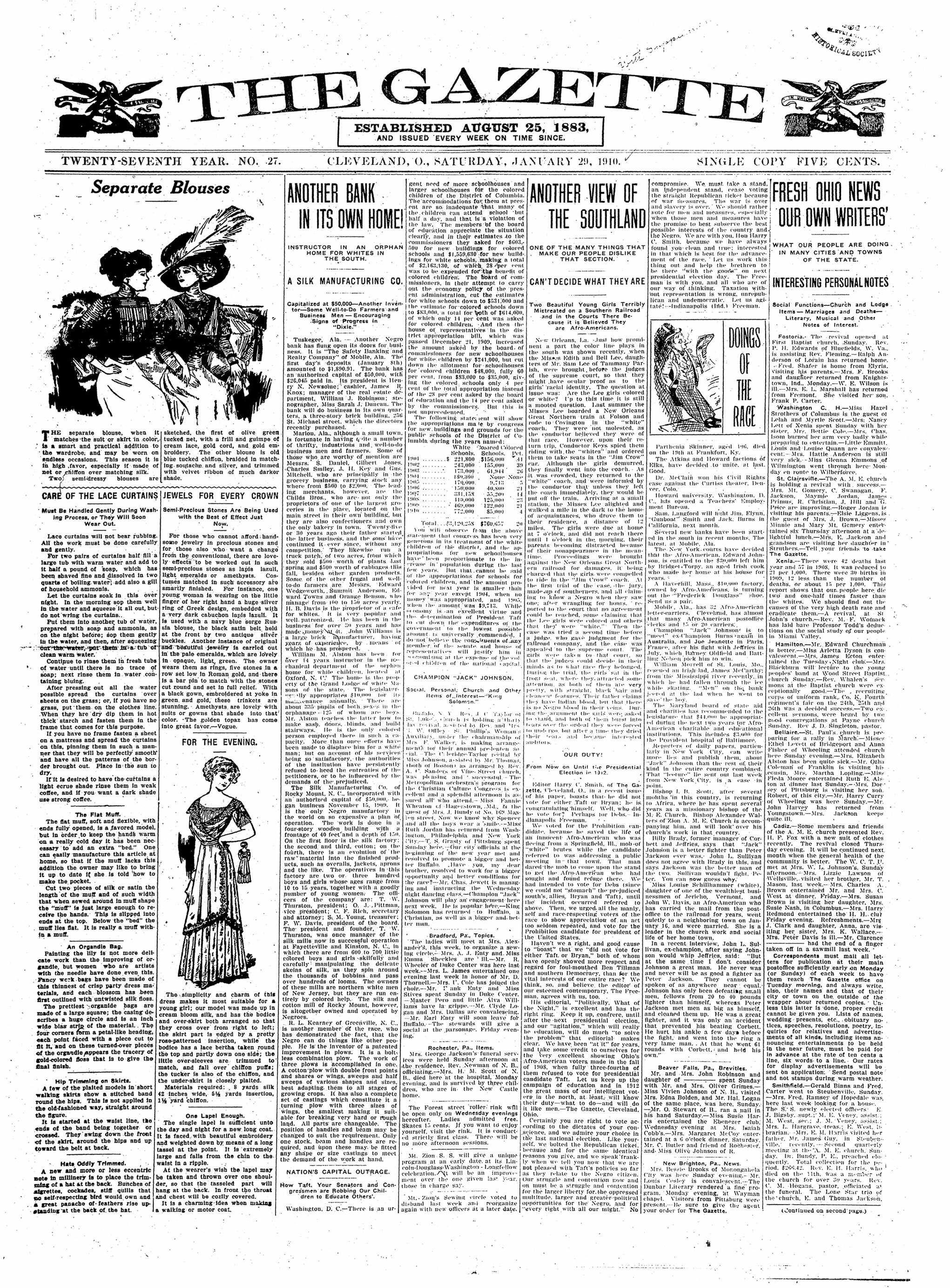
Separate Blouses
CORNER
THE separate blouse, when it matches the suit or skirt in color, is a smart and practical addition to the wardrobe, and may be worn on endless occasions. This season it is in high favor, especially if made of net or crinkton over matching silk. Two semi-dressy blouses are
CARE OF THE LACE CURTAINS
Must Be Handled Gently During Washing Process, or They Will Soon Wear Out.
Lace curtains will not bear rubbing. All the work must be done carefully and gently.
For two pairs of curtains half fill a large tub with warm water and add to it half a pound of soap, which has been shaved fine and dissolved in two quarts of boiling water; add also a gill of household ammonia.
Let the curtains soak in this over night. In the morning soak them well in the water and squeeze it all out, but do not wring the curtains.
Put them into another tub of water, prepared with soap and ammonia, as on the night before; sop them gently in the water, and then, after squeezing out the water, put them in a tub of clean warm water.
Continue to rinse them in fresh tubs of water until there is no trace of soap; next rinse them in water containing bluing.
After pressing out all the water possible spread the curtains over sheets on the grass; or, if you have no grass, put them on the clothes line. When they are dry dip them in hot thick starch and fasten them in the frame that comes for this purpose. If you have no frame fasten a sheet on a mattress and spread the curtains on this, pinning them in such a manner that they will be perfectly smooth and have all the patterns of the border brought out. Place in the sun to dry. If it is desired to have the curtains a light erase shade rinse them in weak coffee, and if you want a dark shade use strong coffee.
The Flat Muff.
The fat muff, soft and flexible, with ends fully opened, is a favored model, but in order to keep the hands warm on a really cold day it has been necessary to add an extra "bed." One can easily manufacture this article at home, so that if the muff lacks this addition the owner may like to bring it up to date if she is told how to make the pocket.
Cut two pieces of silk or satin the length of the muff and of such width that when sewed around in muff shape the "muff" is just large enough to receive the hands. This is slipped into ends at the top. Below the "bed" the muff lies flat. It is really a muff within a muff.
An Organdle Bag.
Painting the lily is not more delicate work than the improving of organdie, but women who are artists with the needle have done even this. Fancy work bags have been made of this thinness of crisp party dress materials, and each blossom has been first outlined with untwisted silk floss. The prettiest organide bags are made of a large square; the casing describes a huge circle and is an inch wide blas strip of the material. The four corners form a petal-like heading, each point faced with a piece cut to fit it, and on these turned-over pieces of the organdie appears the tracery of gold-colored floss that is to give the final finish.
Hip Trimming on Skirts.
A few of the plaited models in short walking skirts show a stitched band round the hips. This is not applied in the old-fashioned way, straight around the figure.
It is started at the waist line, the ends of the band being together or crossed. They swing down the front of the skirt, around the hips and up toward the belt at back.
Hate Oddly Trimmed.
A new and more or less eccentric note in millinery is to place the trimming of a hat at the back. Bunches of algrettes, cockades, stiff quills that no self-respecting bird would own and a great panache of feathers rise upstanding at the back of the hat.
THE GAZETTE
A
sketched, the first of olive green tucked net, with a frill and gulpe of cream lace, gold cord, and gold embroidery. The other blouse is old blue tucked chiffon, bralded in matching, soutache and silver, and trimmed with velvet ribbon of much darkor shade.
JEWELS FOR EVERY CROWN
For those who cannot afford handsome jewelry in precious stones and for those also who want a change from the conventional, there are lovely effects to be worked out in such precious stones as lapis lazuli, light emeralds or amethysts. Costumes matched in such accessory are smartly finished. For instance, one young woman is wearing on the little finger of her right hand a huge silver ring of Greek design, embedded with a very dark cabuchon lapis lazuli. It is used with a navy blue sergeur glass blouse, the black satin belt held at the front by two antique silver buckles. Another instance of original and beautiful jewelry is carried out in the pale emeralds, which are lovely in opaque, light green. The owner wears them as rings, five stones in a row set in Roman gold, and there is a bar pin to match with the stones cut round and set in full relief. With a black gown, embroidered at yoke in green and gold, these trinkets are stunning. Amethysts are lovely with suits or gowns that shade into that color. The golden topaz has come into great favor—Vogue.
FOR THE EVENING.
The simplicity and charm of this dress makes it most suitable for a young girl; our model was made up in cream bloom silk, and has the bodice and over-skirt both arranged so that they cross over from right to left; the skirt part is edged by a pretty rose-patterned insertion, while the bodice has a lace bertha taken round the top and partly down one side; the little over-sleeves are trimmed to match, and fall over chiffon puffs; the tucker is also of the chiffon, and the under-skirt is closely plaited. Materials required: 8 yards silk 42 inches wide, 5½ yards insertion, 1½ yard chiffon.
One Lapel Enough.
The single lapel is sufficient unto the day and night for a new long coat. It is faced with beautiful embroidery and weighted down by means of a long tassel at the point. It is extremely large and falls from the chin to the waist in a ripple.
At the wearer's wish the lapel may be taken and thrown over one shoulder, so that the tassel part will hang at the back. In front the throat and chest will be cozily covered.
It is a charming idea when making a walking or motor coat.
ESTABLISHED AUGUST 25, 1883,
AND ISSUED EVERY WEEK ON TIME SINCE.
CLEVELAND, O., SATURDAY, JANUARY 29, 1910.
ANOTHER BANK IN ITS OWN HOME!
INSTRUCTOR IN AN ORPHAN
HOME FOR WIVES IN
THE SOUTH
A SILK MANUFACTURING CO.
Capitalized at $50,000—Another Inventor—Some Well-to-Do Farmers and Business Men — Encouraging Signs of Progress in "Dixie."
Tuskegee, Ala. — Another Negro bank has flung open its doors for business in the city. Bannit Realty Company of Mobile, Ala. The first day's deposits (January 4th) amounted to $1,809. The bank has an authorized capital of $50,000, with $26,045 paid in. Its president is Henry N. Newoine; cashier, James R. Knox; manager of the real estate department, William J. Robinson; stenographer, Miss Sarah J. Duncan. The bank will do business in its own matters, a three-story brick building, 256 St. Michael street, which the directors recently purchased.
Marlon, Ala., although a small town is fortunate in having a number of thrifty, industrious, and well-do business men and farmers. Some of those who are worthy of mention are Messrs. S. Daniel, Gilbert Jones, Charles Smiley, J. H. Key and Gus Mitchell, who are chief businessmen, business, carrying stock any where from $500 to $2,000. The leading merchants, however, are the Childs Bros., who are not only the proprietors of one of the largest groceries in the place, located on the main street in their own building, but they are also confectioners and own the only bakery in town. Twenty-five percent of the latter business, and the sons have continued it ever since, without any competition. They likewise run a truck patch, of two acres, from which they sold $500 worth of plants last spring and $500 worth of cabbages this fall, besides other garden products. Some of the other frugal and well-do businessmen, including Wedgeworth, Summit Anderson, Edward Towns and Orange Benson, who manage from 160 to 150 acres yearly. H. B. Davis is the proprietor of a cafe for whites. It is very popular and patronized. He has been in the business for over 30 years and has made money at it. John Williams is a large businessman, a father, having a great of experience, by means of which he has prospered.
William M. Alston has been for over 14 years instructor in the mechanical department of the orphan home for while children, located at Oxford, N. C. "The home is the property of the Grand Lodge of white Manors, and the orphan home appropriately appropriates $1000 for its maintenance annually. There are about 225 pips of both sexes in the orphanage -125 of whom are boys. Mr. Alston teaches the latter how to make soap, doors, blinds, and build a house. He is also the person employed there in such a capacity. More than once efforts have been made to displace him for a white man; but on account of his services being so satisfactory, the authorities of the institution have persistently requested that the petitioners, or to be influenced by the demands of the prejudice.
The Silk Manufacturing Co. of Rocky Mount, N. C., incorporated with an authorized capital of $50,000, began business November 15, 1999. It is the only Negro manufacturer in the world on so expensive a plan of operation, the work building with a frontage of 40 feet and a depth of 150. On the first floor is the silk factory; the second and third, cotton; on the fourth, there is an evolution of the raw' material into the finished products, such as overalls, jackets, aprons and the like. The operatives in this factory are two or three hundred boys and girls age seven and eight years, together with a goodly number of young women. The officers of the company are: T. W. Thurston, president; O. J. Pittman, vice president; C. F. Rich, secretary and attorney; S. M. Young, treasurer; F. W. Davies, president of the board. The president and founder, T. W. Thurston, was once manager of the silk mills now in successful operation of the company, which there are from 600 to 700 little colored boys and girls skilfully and carefully' manipulating the delicate skins of silk, as they spin around the thousands of bobblins and pass over hundreds of looms. The owners of these mills are northern men of New Jersey, but they are run on behalf of the Negro community. The cotton mill of Rocky Mount, however, is altogether owned and operated by Negroes.
R. L. Kearney of Greenville, N. C. is another member of the race, who has demonstrated the fact, that the Negro can do things like other people. He is the inventor of a patented improvement in plows. It is a boltless combination plow. The work of three plows is accomplished in one, two, and three stages and shares or wings, sweeps and half sweeps of various shapes and sizes, best adapting them to all stages of growing crops. It has also a complete set of castings which constitute it a turning plow with three sizes of wings, the smallest making it suitable for breaking very hard or rough land. All parts are changeable. The position of handles and beam may be changed to suit the requirement. Only the handles are required, and upon these may be fitted any shape or size castings to meet the demand of the work at hand.
NATION'S CAPITAL OUTRAGE.
How Taft, Your Senators and Congressmen are Robbing Our Children to Educate Others'....
Washington, D. C.—There is an ur-
gent need of more schoolhouses and larger schoolhouses for the colored children of the District of Columbia. The accommodations for them at present are so inadequate that many of the children can attend school but half a day, and that is a violation of the laws of education appreciate the situation clearly, and in their estimates to the commissioners they asked for $603,500 for new buildings for colored schools and $1,559,630 for new buildings for white schools, making a total of $2,163,130, of which 28 per cent to be expended for the board of colored schools and 20 per cent of missioners, in their attempt to carry out the economy policy of the present administration, cut the estimates for white schools down to $331,000 and the estimate for colored schools down to $83,000, a total for both of $141,000, of which only 14 per cent was asked for children. And then the house of representation, in their attempt to tripple appropriation, which was passed December 21, 1900, increased the amount asked by the board of commissioners for new schoolhouses for white children by $241,000, but cut down the allotment for schoolhouses for colored children $48,000, fully 60 per cent of the total appropriation, but reducing the colored schools only 4 per cent of the total appropriation instead of the 28 per cent asked by the board of education and the 14 per cent asked by the commissioners. But this is not unprecedented.
The following state cent will show the appropriations made by congress for new schools and the 14 per cent asked by the public schools of the District of Columbia during the years named:
White Seated Colored
Schools, Schools, Pet.
$ 221,800 $156,000 41
1901 ... 242,000 155,000 39
1902 ... 147,000 61,944 28
1903 ... 159,000 61,944 28
1904 ... 170,000 61,944 28
1905 ... 150,000 40,800 21
1906 ... 150,000 40,800 21
1907 ... 321,158 55,200 14
1908 ... 419,000 125,000 22
1909 ... 469,000 122,000 21
1910 ... 772,000 85,000 4
Total ... 35,129,578 $760,657 20
You will receive from the above
statement that money has been
general in its treatment of the white
children of the district, and the app-
ropriations for new schoolhouses
have been proportionate to the increase
in population during the last
few years. But that cannot be said
of the appropriations for schools for
children, and the amount provided
for them may not be sufficient for
any year except 1904, when
money was appropriated, and 1905,
when the amount ($7,713. White
economy is an excellent virtue and the
determination of President Taft
cut out down the expenditures of the
government to the lowest possible
level. It is universally commended.
I do not believe that the Senate and
member of the Senate and house of
representatives will justify him in
investing at the expense of the co-
ncluded children of the national capital.
CHAMPION "JACK" JOHNSON
Social, Personal, Church and Other
Items of Interest—"King
Selena"
Buffalo, N. Y. Res. J. C. Taylor of St. Luke's church is holding a thirty day festival assisted by Roy and Mrs. J. W. Otley St. Phillip's Woman's Anxiary, under the chairmanship of Mrs. F. W. Walker, is making arrangements for their annual prelent occasion. The C. Berkshire Taylor posted by Miss Johnson, assisted by Mr. Thomas, is making arrangements by Rev. A. C. Sanders of Vine Street was plasing and successful - The Metropolitan orchestra's program for the Christian Culture Congress is excellent and a splendid afternoon is assured all who attend. - Ms. Fannie Wheaton of Hagerstown, Md., is the guest of Mrs. J. Bundy of No. 162 Mason street. Now we know why Spencer Ruth Jordan has received the Washington, Philadelphia and New York City - T. S. Grassy of Pittsburgh spent Sunday here. Our city officials at the beginning of the new year met and resolved to promote a bigger and better Buffalo. Have you, my dear brother, resolved to work for a bigger opportunity and better conditions for the race? - Mr. Chas, Jewett is managing and running class - Champion Johnson will play an engagement here next week. He is popular hope - King Solomon has returned to Buffalo, a Christian, as well as a bigger and better man.
Fradford, Pa., Topics.
The ladies will meet at Mrs. Alex ander's, this week, to organize a sewing circle…Mrs. A. J. Enty and. Miss Emma Sheckles are 'I'll-Mr. R. Wheeler of Duke Center was here last week…Mrs. L. James entertained one evening last week in honor of Mr. D. Thornell…Mrs. U. Cole has joined the choir…Mr. P.ANK Enty and. Mrs Stives apes some time in Duke Center pastor Pero and little Alva Williams have in gripe…Mr. Clyde Logan and Mrs. Dallas are convalescing., Mr. Earl Enty will soon leave for Buffalo. The stewards will give a social at the parsonage. Friday evening.
Rochester, Pa., Items.
Mrs. George Jackson's funeral services were held Sunday afternoon at the residence, Rev. Newman of N. B. officiating.-Mrs. H. M. Scott of N. B. died here at the hospital, Monday evening, and is survived by three children, who are in the New Castle home.
The quick brown fox jumps over the lazy dog.
The Forest street roller rink will be open only on Wednesday evenings hereafter. Ladies admitted free Skates 15 cents. If you want to enjoy yourself, visit the rink. It is conducted strictly first class. There will be no more afternoon sessions.
Mt. Zion S. S. will give a unique program at an early date, at its Lincoln-bourgass-Washington-Longfellow celebration. \t will be an improvement over the one given last year, those in charge say.
Mt. Zion's Sewing circle voted to disband last week and reorganize again with new officers at a later date.
ANOTHER VIEW OF THE SOUTHLAND
ONE OF THE MANY THINGS THAT
MAKE ME LIKE
THAT BECAUSE
CAN'T DECIDE WHAT THEY ARE
Two Beautiful Young Girls Terribly Mistreated on a Southern Railroad and in the Courts there Because is its weakness they are Afro-Americans.
New Orleans, La. Just how prominent a part the color line plays in the south was shown recently, when the Misses Edith and Bell Lee, daughters of Mr. Sam Lee of Tannany Parish, were brought before the judges of the supreme court, so that they might have ocular proof as to the girls' rachial identity. The question at issue was: Are the Lee girls colored or white? Up to this time it is still a mooted question. Last summer the Misses Lee boarded the train at Folson and coached to Covington in the "white" coach. They were not molested, as the conductor believed they were of that race. However, upon their return trip, Conductor Spies spied them riding with the "whites" and ordered them to take seats in the "Jim Crow" car. Although the girls demurred, they finally went into the coach. As they arrived, the coach and were informed by the conductor that unless they left the coach immediately, they would be put off the train. Arriving at a small station, the Misses Lee alighted and walked a mile in the dark to the home of acquaintances, who drove them to their residence, a distance of 12 miles. The girls were due at home at 7 o'clock. The girls were distracted because parents become nonappearanceed because of their nonappearanceed in the meantime. Proceedings were brought against the New Orleans Great Northern railroad for damages, it being charged that the Jim Crow" coach, at the first trial of the case, the jury made up of southerners, and all claimants, after wringing for hours, reported to the court that no agreement could be reached, some claiming that the Lee girls were colored and others that they were "white." Then the case was tried a second time before a judge, who gave judgment for the railroad company, and the case was appealed to the supreme court. The judge said that the judges could decide in their minds as to what race they belonged. During the trial, the girls sat in the front seat, where they attracted some attention, as both of them are very pretty, with straight, black hair and cleaner features. Their father claims they have Indian blood, but that there is no Negro blood in their veins. During the trial, both the girls were asked to stand, and both the girls were told over the orded they were forced to undress, but after a time they dried their "cats" and became interested auditors.
OUR DUTY!
From Now on Until the Presidential Election in 1912.
Editor Harry C. Smith, of The Gazette, Cleveland, O., in a recent issue of his paper, boasts that he did not vote for either Taft or Bryan; he is not an innocent Afro-American who was fleeing from a Springfield, Ill., mob-of "white" brutes while the candidate referred to was addressing a public meeting in that town. That man the mob tore up upon the road to get the Afro-American who had sought and found refuge there. We had intended to vote for Debs (since we could not "stomach" the prejudiced south's allies, Bryan and Taft), until the incident occurred referred to above. Then, we urged all the manly, self and race-respecting voters of the city to apprehend the appreciation of an act so soddem reprehensible that for the Prohibition candidate for president of the United States.
Haven't we a right, and good cause to "boast" that we "did not vote for either Taft or Bryan," both of whom have openly showed more respect and regard for four-moulted Bill Tennan and southern Democracy, than for the vital interests of our entire race? We have no editor of our esteemed contemporary, the Freeman, agrees with us, too.
His editorial, "Politically. What of the Night," is excellent and has the right ring. Keep it up, confere, until after the next presidential election, and our "agitation," which will really education, will do much to solve the problem. "It" that ignores makes clear. We have been "at it" for years and take some credit to ourselves for the very excellent showing Ohio's Afro-American voters made in the fall of 1988, when fully three-fourths of them refused to vote for presidential candidate Taft. Let us keep up the campaign, and in 1912 the mass of our citizens in the north, at least, will know their duty—what to do—and will do it like men.—The Gazette, Cleveland, Ohio.
Certainly you are right to vote according to the dictates of your conscience, and we admire your choice in yourself, we bullied you in election. Like yourself, we bullied you because and for the same identical reasons you give, and we speak frankly when we tell you now that we are not pleased with Taft's policies so far as they relate to the Negro citizen. Our struggle and contention now and on must be a struggle and contention that will be for the oppressed multitude, larger and more opportunities for the Negro, and for "every right with all our might." No
compromise. We must take a stand, an independent stand, cease voting the straight Republican ticket because of war measures. The war is over and slavery is over. We should rather vote for men and measures, especially when those men and measures have the presidency observe the most possible interests of the country and the Negro. We are with you, Hoo Harry C. Smith, because we have always found you clean and true; interested in that which is best for the advancement of the race. Let us work this thing out and help the brethren to be there "with the goods" on next presidential election day. The Freeman is with you, and all who are of our way of thinking. Taxation without representation is wrong, unrepublican and undemocratic. Let us agitate!-Indianapolis (Ind.) Freeman.
DOINGS OF THE RAGE
Parthenia Skinner, aged 196, died on the 19th at Frankfort, Ky.
The Atkins and Howard factions of Elkins, have decided to unite, at last, Good. Dr. McClain won his Civil Rights case against the Curtiss theater, Denver, Colo. Howard university, Washington, D.C., has opened a Teachers' Employment Bureau. Sam. Langford will fight Jim. Elynn, "Gambod" Smith and Jack. Burns in Georgia now has job. Post pockets have been started in the south in recent months. The latest, at Mobile, Ala. The New York courts have decided that the Afro-American, Edward Johnson, is entitled to the $20,000 left him by Bridget Torpry, an aged Irish cook who made her home at his house for years. Evelyn Hill, Mass., $10,000 factory, owned by Afro-Americans, is turning out the "Frederick Douglass" shoe, Send us a pair. Mobile, Ala., has 52 Afro-American letter-carriers. Cleveland, has almost that many Afro-American postoffice clerks and 15 or 20 carriers. Champion "Jack" Johnson' is to challenge Burrs in Australia, and Joo Jeanne in Paris, France, after his fight with Jeffries in July, which Barney Oldfield and Battling Nelson pick him to win. William Morrell of St. Louis, Mo., rescued an Irish lad, James McCarthy; from the Mississippi river recently, in which he had fallen through the ice boarded "Moon" on the bank jeopardized at the lad when he wont to save the boy.
The Maryland board of state aid and charities has recommended to the legislature that $41,000 be appropriated during the next two years for Afro-American institutions. This includes $3,000 for the Provident hospital of Baltimore. Reporters of daily papers, particularly in New York City, can write more lies and publish them, about "Jack Johnson" than the rest of their kind in the entire country combined. "The house" he sent our last week from New York City, is a case in point.
Bishop L. B. Scott, after several months 'in this country, is returning to Africa, where he has spent several years as a missionary bishop of the Mt. Church. Bishop Alexander Walters of the company companying him, and will look over his church's work in that country.
Billy Brady, former manager of Corbett and Jeffries, says that "Jack Johnson is a better fighter than Peter Jackson ever was. John L. Sullyan does not agree with Brady in this, and says Jackson is the better man of the company companying him. Peter, You can now guess why.
Miss Louise Schillhammer (white), daughter of one of the wealthiest businessmen of Jericho, Vermont, and John W. Davis, an Afro-American who has carried the mail from the postoffice to the railroad for years, went to New York on January 16, and were married. She leader in the church work and social life of her home town.
In a recent interview, John L. Sullivan, ex-champion, after saying Johnson would whip Jeffries, said: "But at the same time I don't consider Johnson a great man. He never was and never will be as good a fighter as he could be. The cannot be spoken of as anywhere then. Johnson has only been defeating small men, follows from 20 to 40 pounds lighter than himself, whereas Peter Jackson met men as big as himself, and cleaned them up. He was a great fighter, and it was only an accident that prevented his beating Corbett. He hurt his ankle a few days before and went into the ring a very long man. At that he went 64 rounds with Corbett, and hold his own."
2023
Beaver Falls, Pa. Brevities.
Mr. and Mrs. John Robinson and daughter of _____ spent Sunday with Mr. and Mrs. Oliver Grimes. Miss Vijlv Johnson of N. B., visited Mrs. Edna Bolden, and Mr. Hal. Logan of the same place, was here. Sunday, Mrs. Edna Bolden, a nail in his hand Saturday. Miss Susan Harris entertained the Ebenezer club Wednesday evening at Mrs. Isaiah Cobb's. Mrs. Margaret McCoy entertained at a 9 o'clock dinner, Saturday, Mr. C. Butler and friend of Robbester, and Miss Olive Johnson of R.
New Brighton, Pa. News
Mrs. Bessie Brooks of Monongabella City was here Sunday evening. Mr. Louis Cosley is convalecent. The Dunbar Literature rendered a fine program. Monday evening, at Wayman chapel. Visitors from Pittsburgh were present. He sure to give the agent your order for The Gazette.
HISTORICAL SOCIETY
IN UNION
HONESTY
LOVE
FRESH OHIO NEWS OUR OWN WRITERS'
WHAT OUR PEOPLE ARE DOING IN MANY CITIES AND TOWNS OF THE STATE.
INTERESTING PERSONAL NOTES
Social Functions—Church and Lodge
Itema—Mariages and Deatha—
Literary, Musical and Other
Notes of Interest.
Fostoria: The revival opened at
First Baptist church, Sunday, Rev.
P. H. Edwards of Bluehields, W. Va.
is assisting Rev. Fleming—Ralph
Anderson of Lorain has returned home.
Fred. Shafer is home from Elyria,
visiting his parents. Mrs. F. Brooks
and daughter returned from Knight-
swood and Monday—W. E. Wilson is
mrs. M. E. Marshall has returned
from Fremont. She visited her son,
Frank P. Carter.
Washington G. C. H.-Miss Hazel
Strothers of Columbus is the guest of
Lelah and Myrtle Scott—Mrs. Nancy
Lett of Xenia spent Sunday with her
sister, Mrs. Bottie Cole. Mrs. Chas
lison burned her arm very badly while
preparing to entertain—Little Emmitt,
Louis and Louse Quann are convales-
cent. Mrs. Hutte Anderson is still
missing. Mrs. Issa Emmons of
Wilmington was thrown here on
Nonday en route to Wilberforce
St. Clajsville—The A. M. E. church
is holding a revival with success.—Mrs.
Mt. Gomery, C. Swanagan, J.
Jackson, Maymey Jordan, James
Primus, R. Christian, J. Hill and G.
Peice are improving—Roger Jordan is
visiting his parents. Elsie Liggens, is
guest of Mrs. J. Brown.—Misses
Minnie and Mary Mt. Gemery ente-
nished xx Thursday afternoon at a
Little Grandson is visiting her daughter in
Struthers.—Tell your friends to take
The Gazette.
Xenia.—There were 42 deaths last year and 57 in 1908. It was reduced to 21 per 1,000. There were 30 births in 1908, 12 less than the number of deaths, or about 15 per 1,000. This number was two and one half times faster than the whites. We should find out the causes of the very high death rate and eradicate them. A revival, at St John's church. Rev. M. F. Wonnack has laid bare Professor Todd's deductions on the social study of our people in Miami Valley.
Hamilton.—Mr. Edward Churchman is better. Miss Arletta Dyson is confined to the James Hall, which contained the Tuesday, Night club. Mrs. Blackburn will lecture to the young people' band at Wood Street Baptist church Sunday.—Rev. Whalen's seminars at the Baptist church were exceptionally good.—The recruiting corps of uniform rank, Co. K. Fourth regiment's fare on the 24th, 25th and 26th Saturday, the colleent sermons, were heard by two good congregations at Payne church Sunday. Rev J. D. Singleton, pastor.
Bellaire.—St. Paul's church is preparing for a rally in March.—Miss Ethel Levett of Bridgeport and Anna Fisher of Wheeling attended church Sunday evening.—Mrs. Elizabeth Alston of Franklin is visiting his cousin, Mrs. Martha Lopling.—Miss Flaida Moore entertained Ruth E. Alston at dinner last Sunday.—Mrs. Dorson of Pittsburg is visiting her son, Robert, of this city.—Mr. Harry Curry of New York is visiting his son, John Harvey has returned from Youngstown.—Mrs. Jackson keeps ill.
Cadiz.—Some members and friends of the A. M. E. church presented Rev. H. F. Fox with a new suit of clothes recently. The revival closed Thursday day evening. It will be continued next month when the general health of the town is improved, and met at Mrs. W. L. Johnson's Sunday afternoon. Mrs. Lizzie Lawson of Wellsville, visited her brother, Mr. T. Mason, last week.—Mrs. Charles A. Brown entertained Mr. and Mrs. C. West at dinner, Friday.—Mrs. Susan Brown is visiting her daughter, Mrs. Susie Nash, in Columbus.—Mrs. Harry Redmond entertained the H. H. clu. Mrs. J. Clark and daughter, Ann, are visiting her sister, Mrs. K. Wallace.—Mrs. Peter Davis is ill.—Mr. Clarence had the end of a finger taken in a sawmill last week.
Correspondents must mail all letters for publication at their main postoffice sufficiently early on Monday (or Sunday) of each week to have them reach The Gazette office on the street, or also their names and that the city or town on the outside of the wrapper about returned copies. Unless this latter is done, proper credit cannot be given you. Lists of names, wedding presents, etc., obituary notices, speeches, resolutions, poetry, inquiries for relatives and advertisements, items and nouncing entertainments in the near future, must be paid for in advance at the rate of ten cents a line, six words to a line. Our rates for display advertisements will be sent on application. Send postnote and not stamps during warm weather.
Smithfield.-Gerald Binns and Fred
Carter went to Steubenville, Sunday.
-Mrs. Fred. Ramsey of Hopedale was
here last week looking for a house.
-Mrs. Fred. Ramsey of Hopedale was
E. J. Bigsy, sup. M. E. Veney, assist.
M. West, sec.; J. M. Veney, assist.
Mrs. L. Hargray, treas.; E. West,
brianarian. -Mrs. E. M. Harris visited her
father, Mr. James Guy, in Steubenville,
recently. -Second quarterly
meeting at the "A" M. E. church, Sunday.
Dr. R. M. E. preached on Thursday.
To celebrate. To celebrate. To celebrate.
$264.42. Rev. E. H. Harris, who died on the 10th, was a member of the church for over 30 years. Rev. C. M. Hogans, pastor, officiated at the funeral. The Lone Star trio of the church. E. and Thomas Jackson.
```markdown
```
THE GAZETTE
PUBLISHED EVERY SATURDAY
One Year.....$1.50
Six Months.....1.00
Three-Months.....50
Subscribers are requested to remit by postoffice money or ger or registered letter.
Entored at the postoffice in Cleveland, Ohio, as second-class matter
Address all communications to HARRY C. SMITH
Editor and proprietor,
THE GAZETTE,
Blackstone Building, Cleveland, O.
Member Ohio Legislature: 1894 to 1896; 1896 to 1898; 1900 to 1902
Cleveland, O., January 29, 1910.
THE GAZETTE is the oldest, and has the largest bona fide circulation, double that of any newspaper in the Interest of Afro-Americans, published in the state of Ohio, and comparison with any will immediately establish its rank as one of the NEWSIEST AND BEST in the country.
The out-of-state newspaper talk of Senator Foraker as the next Republican candidate for Governor, is silly. He has always gone forward; not backward.
Almost next day, after a recent visit of a large delegation of Virginia Afro-Americans to the White House to meet with President Obama, to office, of white men noted for their unreasonable antagonism to Afro-Americans, President Taft appointed C. J. Smithers, a well-known "lily-white" demopub, United States marshal for one of the districts of that state. They ought to have had better sense than to go to him. Wait, what square accounts with "the big mush of concession," as the Hon. Frank Sainborn of Massachusetts, terms President Taft.
---
Speaking of a little "till" of words anent the army, Taft and Tillman had at a banquet recently, John Tenplem Graves of Georgia, now an employee of the W. R. Hearst papers in New York, Chicago and San Francisco, said recently in Washington, D. C., letter to the Chicago Examiner:
"Near Tillman miller are my nephews, I have the tilt, not have they lost anything of mutual regard for each other."
Loving the South with all of its silly, foolish prejudices as both do, how could it be otherwise? Of course Taft and Tillman miller are not the "nag" and lack of the Negro or "nag" and (better) Afro-American. The two T's make a fine (2) pair, don't they?
AN INHARMONIOUS DUET.
After the recent meeting of Governors at the White House, Gov. Anselm of South Carolina said: "Centralization and State's rights, that for a century or more have been singing solos, mostly in discord, will now in a new form of congruency. Soon women should cable this to Roosevelt. It would make him quite as unhappy as Taft did soon after his nomination in 1908. Whenever "centralization" and "states' rights" sing Ansel's "harmonious duet" the South's victory over the north will indeed be complete, as also will be the elimination of the Afro-American as a citizen-factor of this great country, if indeed President Taft does not finish this last job before the end of his term of office. He has gone so far in his handling of it, that the outlook on the future does not depend on a realization of the fact that there is "more truth than poetry" in the South Carolina Governor's remark.
And our four or five alleged "national" organizations go on "sleeping the sleep" of the criminally negligent! Likewise, the great mass of the members of the race. How long, O. Lord, how long!
The local tax board held dispute over the hiring of men in general Wednesday, and decided that no Negroes at all are to be hired as measuring men. Two had applied. Next week the board will take on about 150 men to measure the buildings of the city inside and that. These men will cost $2.50 to $4 per day. The job ought to be good until May 1. Our people have no chance to get any of these places and can thank one Bates for the loss of this opportunity.
Theo. M. Bates, the public representative of the board, spoke as follows:
"Her job has appointed two colored men as deputy building inspectors, and I think he made a big mistake," he said. "Whatever may be our personal feelings about the race question, we are appraisalists, and prejudice here in Cleveland. These building inspectors have to enter homes, and many people do not like the idea of having Negro officers going through their buildings as appraisalists, and therefore men would not have to enter houses at all."
"What are you going to have them do?" demanded Democratic Member John A. Zangerle. "Stop at the doors and ask what's inside. You'd get a mighty job. That is what the卫星 is to be carried on." Theodore Bates is an East End Republican whom our people have helped to elect to county offices several times, the last being in November last when he was elected to his present position on the tax board. Thank God! we did not vote for him. O. Bates, just run for public office again, please!
JOBEPH BENSON FORAKER.
A Chicago daily paper said last week: "Mr. Foraker's call on the president at the White House to address climate events in the last presidential campaign, and it called attention to another campaign in the coming autumn." 1666, and we may again be prominent
THE GAZETTE, CLEVELAND, O., SATURDAY, JANUARY 29, 1910.
Senator Foraker will always "be prominent." He is too big a man, mentally, to live in this country and be otherwise. It is not necessary that he be actively engaged in politics to "be prominent," as he is a constitutional lawyer, a jurist who has no superior, as well as a STATESMAN almost without a peer in American life. The average Ohioian has only to recall this state's representation in the upper and lower branch of congress, to fully appreciate the above facts. Senator Foraker ought to be returned to the United States Senate. He is not a senator, but a senator is felt greatly. It is (at least in our judgment) this that caused President Foraker, who owes his first public position, as Judge of the Superior Court of Cincinnati, to Governor Foraker, that caused the President to send for him, last week. If it means his return to the Senate, the entire country (and our people particularly) have every reason to congratulate itself. There is nothing that Taft can do that will come nearer to making our people "forgive and forget" in his life. He is the greatest of our great and good friend, the Senator, to his own, a seat in the United States Senate. It is, too, about the only thing, except death, that will keep him from being the next President of these United States.
"FLIM-FLAMMED GOOD AND A PLENTY."
AGENTS! READ!
When your Gazettes are not delivered on time, please contact at your Central Postoffice General Delivery, Window for them in the afternoon of the same day.
—Editor.
Call your lady friends' and acquaintances' attention to our up-to-date fashion and pattern department. Ask them to subscribe or take The Gazette regularly. Oblige the Editor.
1
Dissatisfied mankind.
"If every fellow who was sick of his bargain would go out and hunt another," says the Philosopher of Foliay, "there'd either be no sales at all, or there'd be twice as many."
Psychological.
it is curious that when a good
man says, the double is
also very, very bad.
FRESH NEWS
(Continued from First Page.)
jr. and R. Hargrave, rendered excel-
lent Miss Viola Curtis, the services, Sunda-
gate to the district conference at Sandusky in April. Rev. R. D. Davis is ill.
Cincinnati. We are certainly glad of the opportunity to again get copies of the "old reliable" Gazette, because we can hear from our friends, and acquaintances all over the state particu-
larly in the area in any other race publication), get all the general race news of interest, and keep up to date in all race matters. Tell your friends and acquaintance readers are here in Cincinnati, that you can get the letter of request to H. B. Brooks, No. 526 West Sixth street, or to any of his agencies, and a copy of The Gazette will be delivered promptly. Give prompt payment when the paper is delivered. Watch for our interesting local newsletter, to appear next week. Send Mr. Brooks your items for this week. We will be given prompt and proper attention.
Dayton—Revival services at Zion and Wesleyan churches. The trustees helpers of Allen church gave an entertainment evening at Wesleyan Church, Chester Wingdon, Wingdon, Mich. are spending the winter with Mrs. Mary Goodher, her mother. Mrs. Mary Stewart, her mother. H. Stewart was the last Thursday afternoon. The house was beautifully decorated with cut flowers. Those assisting were: Mrs. James Brown in his office, Mrs. James Brown in punch-bowl, Mrs. Nannie Hattie in the dining room, Mrs. C, W. Dickens and Miss M. E. Banks will enter-train Mr. and Mrs. Casse, Mr. and Mrs. Casse, tea Sabbath, evening. Rev. Bass and congregation, and Dr. W. O. Harper and congregation will worship at Peckham afternoon. Bass will deliver a message to the Gazette and help make Dayton the leader in selling the "old reliable" Miss M. E. Banks is the local representative and wishes 100 new patrons for next week.
Sandusky — Mr. George Taylor and,
"Mother" Taylor are ill — Mrs. M. N.
Washington entertained Mrs. A.
Washington entertained Mrs. A.
lionnies, Rev. G. D. Smith, wife and
son, Tuesday — Rev. Dodds
preached a fine sermon, Sunday, at
the A. M. E. church, both churches
were well attended and the S. A. are
well attended. Mrs. A. W. Smith, the
church, is the banner class. Rev.
Goines is contemplating a revival in
Norwalk. A delightful sleighing party to
mrs. Victory Jones was given Mion
Gilsson. Mrs. A. W. Smith was given
45 in the party. It was a financial and
social success. The masked
social, Friday evening, at mr. and
mr. Goines, presented very enjoyable Miss
Emma Wallace, pres.; Miss Emma
Gilkerson, see. Mrs. Alexander won
the prize. The K. P. are doing good
work, and our young men should
have their minds engaged. Have your money ready when the
agents call with the Gazette
Steubenville.—The venerable George Snowden fell in his yard and sustained serious injuries, recently.—Mr. Chester White is here from Dayton helping his brother, who, with Samuel Thomas, has opened a first-class barber shop in the City building, succeeding Bart, J. Guyder, who has become janitor of the building.—Mrs. C. Bowman's little grandson is dead. Pneumonia and whooping cough.—Mr. and Mrs. J. P. Guy are convalescent.—Revival meetings at Simpson chapel in charge of Rev. Collett, are largely attended.—The song service, Sunday evening, followed by an instructive sermon by the pastor; Rev. J. S. Jackson, was certainly worth hearing.—Revival ends Monday evening.—Give the agent your order for The Gazette, the "old reliable" newspaper and race advocate. That is the only way you can keep up to date in the matter of race news.—Mrs. Jerry Carter has opened a restaurant and lodging house for our people and ought to receive their patronage. She makes a specialty of sandwiches, oysters, ice cream and cake on Sundays. All are welcome.
Ironton.—The funeral of little Naomi Petters, daughter of Mr. and Mrs. J, G. Peters, who died Thursday at the Deaconess' hospital, was held in Woodland cemetery.—The funeral is directed by the pastor, Rev. John Irwin, and Rev. C. S. Gee, P. E. The services were very impressive and there were many floral offerings. Interment at Woodland cemetery.—The funeral is in Quinn Hall.—The Allen is quite ill.—Ullysse Green was in Ashland, Ky., Sunday.—Rev. Gee delivered two excellent sermons and administered community Quinn Hall attendance large. Collection. $24.40. Revival meetings will continue next week. The revival meetings at Tried Stone Baptist church are still growing in interest. They are being held in Quinn Hall.—B. P. Boswell, and there have been quite a number of converts. Rev. Boswell has our best wishes. The attendance was large Sunday. Collection. $14.50. The numbers are growing.—B. P. Boswell,—Revival meetings will begin at Fourth Street Baptist church Sunday and will be conducted by the pastor. Rev. O. P. Wright.—Mrs. Merlite Black is quite ill.—The Men's Forum Sunday afternoon at Quinn church.
Youngstown—Mrs. Thomas Payne visited her mother in Pittsburgh, recently. Mr. Payne is in the real estate business of Freeman and certain Mrs. Anna Hudson and Mrs. Julia Thompson, at dinner. Sunday—Mrs.ella Jackson and grandson, Samuel Wilson, of St. Louis. Mr. Wilson is in Jackson of Struthers—Dullies Collins, George Jobson and C. Fife were in Cleveland, last week—Mrs. W. H. Smith gave a sleighing party to Mrs. Wilson. Refreshments—R. U. K. P. regular session. Saturday evening in Foster's hall. The Unique and Alpha clubs reception in S. Sharon, Thursday. Refreshments—R. U. K. P. regular session. From here—Miss Bess Struthers and Mr. John Haines were quietly married Wednesday—Mrs. W. Watson was married to Engel P. Plympton R. Berry, Jr. died in Manchester, Eng. on the 18th. He located in that country in 1891 and was en route to the stromet to attend the wedding when stricken. He leaves a wife (English) and one child in Manchester. Besides them, he leaves a father, three brothers, and the same number of sisters, all living in Tower, Ninth. Plympton was a good musician and composer, and was a member of the composer, and was a member of the orchestra here. Burial in Manchester attended the cafe opening. Tuesday evening, at 22 Chestnut street; Harris Martin, proprietor.—Oak Hill Avenue Sewing circle, at
I's meeting at Mrs. W. Robinson's
Thursday afternoon, decided to give
an Easter concert. Next meeting at
the concert, Mrs. W. Robinson will
Grant and Abe Kennedy are ill, and
Cal. Bumster and Mrs. James Heatha
are contemptuous. Can you not
ask Mrs. Heatha where the "old reliable" Gazette. Give the
local agent your order. If you wish it
regularly and promptly every week,
you will be ready when the
paper is delivered.
SAM WOODS' EXCORIATION
By Bishop W. D. Derrick at St. John's Church Three Sundays Ago—Republished by Benquest.
SALARY RAISES AT THE CITY
HAI!
To the Editor
---
Don't throw away your copy of The Gazette when you have a friend who is appreciative, person whom you feel would be likely to subscribe or take it regularly if they had a friend who loves and read carefully. Oblige the
Foundation.
Foundation.
Nothing is produced out of nothing—Diogenes.
Says, *nowawan*.
"Some man is moral duty on behalf of their enemies 'ill all die frogs'—Cleveland News.
HIRSTIUS GUILTY SAY BOTH OF THEM
CITY CLERK WITT AND DIRECTOR
SPRINGBORN GIVE INSIDE
INFORMATION.
WHY STREET WAS NOT OPENED
The Gazette Was Right in Its Content as Usual—Our Refusal to Support Hirstus and Others Fully Justified—Some Interesting Letters.
As is well-known The Gazette was bitterly opposed to the election of Sheriff Gur Hirstus, because when a member of the council (from the 11th ward) Hirstus refused to perform his duty, he was sent from Central avenue to Cedar avenue, between Perry street and Greenwood street, because a few prejudiced Cedar avenue residents asked him not to perform his duty, so he would come through "the street from Cedar avenue and "peer into their windows." He withdrew an ordinance which he introduced in the council (authorizing the proper city authority to perform its duties) of the above mentioned rights.
died Cedar avenue residents. When he was rescued to the connect, Hirshus, a second time, promised to have the street cut through, but steadily refused to keep his promise. The following is petition and self-explanatory. Read the letters carefully and thoughtfully:
Office of The Gazette.
Cleveland, Nov. 19, 1908
Mr. Peter Witt, City Clerk Dear
Sir, Justice Hirschmute a statement in a political meeting to the effect that he had passed an ordinance, resolution or something in the city council, provided by the city government, Central avenue to Cedar avenue, between East Twenty-second and East Twenty-eighth streets, opposite Sked street, or in that vicinity, which he passed, provided by the city government in July last the work of cutting the street through has been held up ever since by Director Springham or someone else connected with the city government. How much, if any, truth is there in his claim?
Last year or the year before the one individual introduced an ordinance, provided by the city council, providing for cutting a street through in the same vicinity. Will you tell me whether or not the request referred to was ever passed by the council, and why the street was not cut through at that time? By compiling with the above requests at your office, you will greatly oblige me. Your truth.
Nov. 22, 1998
Hon. H. Y. Smith, November 2, 1988
Dear Sir: On July 9, 1986, resolution No. 5268 by Mr. Hirstus provided for the opening of East Twenty-fifth place to Cedar avenue. it passed the amendment that the provement was not made for the reason that Mr. Hirstus did not want it. His reasons for not wanting it, I have explained, are that the people in the immediate vicinity of the proposed opening did not want people of your race to come through. Only of the present year there was a resolution introduced, and passed in June, looking for the making of a new street between Central Avenue and opposite Shod Street. This improvement never made for the reason that the money in possession of the city through the sale of homes was for the making of new streets, and not the making of new streets. It is the custom of the administration to defer to the wishes of councillors in the city to make the decision feel sure that the only reason the improvement at East Twenty-fifth place was not made was because of race prejudice which Mr. Hirstus listened
Would suggest that you call up her Springbrook and get from him a confirmation of what I have given to you as a camerar. Very truly yours.
H. H. C. Smith, Editor Gazette.
Dear Sir:
At, swelling your favor of the 25th inst., with reference to the enclosed letter from Mr. Witt, who said that the facts are as Mr. Witt states, and had Mr. Hirstius desired to have "East Twenty-fifth place opened through to Cedar Avenue, it would have been done long ago. At the time it was proposed to make this opening Mr. Hirstius invited me to meet with him a committee at the close of one of the council meetings. The committee represented the property owners and residents on Cedar Avenue, where the improvement was intended to be made. They protested against its opening, and the result was that Mr. Hirstius finally agreed not to have it made, AND ASKED ME TO HAVE NO FURTHER STEP TAKEN IN THE MATTER. It was not until recently that the case which we had started in court to condemn the property was dismissed. We have always made it a rule to act in accordance with the wishes of the councilman representing the ward in which improvements of this kind are to be made. It therefore seems that Mr. HIRSTIUS ALONE IS TO BLAME FOR NOT HAVING THE STREET OPENED. Yours very truly,
Old Embalming Secret.
Having preserved and kept for about 40 years the body of an adult man, prepared for burial, Underkatter T. J. Hummell of Minerva, Pa., thinks he has rediscovered the old Egyptian enbalming process.
GARRISON'S LAST WORDS
A Letter Written to the National Conference on Our Status, Held in New York Last Spring.
Boston, May 29, 1909.
Mr. William Kendall Walling, Sec'y,
Nate, New York City.
Dear Sir, I regret my inability to attend at the conference and record my protest against the rising title of race prejudice and caste bias. I am not endlessly met, regardless of the inherent respectability that now lends condescension to this resurgent spirit of slavery. As former days, I have been a slave, and down comes from its professed friends. The Vardilman and Tillmans are harmless in comparison. Their brutal awaful of a purpose to remove the slave from his vassalage, through evasion, or defiance of constitution and law, repels humane souls and makes for justice. It is men of socialized, social problems, arguing to themselves the character of friendly advisers of the colored people, yet viewing the question from the sum of race pride and birth, who are most
From these come easy acquiescence in the abrogation of the fifteenth amendment, the approval of separate schools based on completion, and an agreement of white deterioration—while contemplating without disturbance the unabated illicit connections so flagrantly in evidence. The erred leads to the unanticipated complication of people liberated by lynchings proclamation; compassing by force or fraud the end for which the southern conederacy fought and failed. Now, as democracy is in the process of whether soft government can survive in a land where material interests long overshadow the principles and enthusiasm of liberty. It is the fair weather southwesternity and weaker resistance to privilege.
I trust that the conference will utter no unacquainted sound on any point affecting the vital subject. No part of it is unacquainted with the question. Requirement an experiment is at stake, every tolerated wrong to the Negro reacting with double force upon white citizens guilty of rathlessness to their brothers. The rampant antipathy to the Oriental races is part and parcel of the problem. An absolute refusal to differentiate the rights of human beings. Each has equal claim to life, liberty and the pursuit of happiness — no outworn institution in the fashion of the majority to decide.
I put political rights before educational. Universities have no difficulty in rearing despots, and the wicked laws of all nations are the handwoven fabric of ignorance blunder and bad laws result. Under impartial self-government the blunderers reap the punishment and learn wisdom and self-restraint. No school of civilization in educating a people. Learning never yet guaranteed rights; rights universally secured are the sure guarantee of learning. Let the unanimous voice of the common people be the opportunity to all race, color and sex without distinction, in face of the consistency all-abounding in this dark day. Years for a united humanity. WILLIAM CARRISON
Meat Man Fights Trust
Canton, O. Petitions circulated here in stores and shops against eating meat are having their effect. At the office of the Canton Provision Co. it was stated that marked decline in meat consumption in the imputed effort would bring the prices of meat down. Cold storage dealers say that eggs will be reduced soon. One of the 200 petitions put in circulation was placed in the meatshop of E. E. Board, who recently accused representatives of buying houses with informing him that the market prices must be paid or that the goods will be taken elsewhere.
Gets $500,000 of Kimberly Estate
Chicago, Ill. Attorneys connected with the case made public the details of a settlement of the claims of Mrs. Elizabeth V. Asay of this city against the estate of Peter V. Kimberly, the Sharon, Pa., steel and mining magnate, who died in her apartments in this city on June 1, 1905. Mrs. Asay, whose relations with the rich man for several years preceding his death, the knowledge, was paid $500,000. Kimberly was known as more or less of a rounder.
Coon Causes His Death.
Johnstown, Pa.-Laying on a large raconte, the capture of which had contributed to the cause of his death, the body of Russell Bowman, 27, a widely known Somerset county farmer, was found by friends who had instituted a searching party after he had been found in the town. The body of the man and the raconte were pinned to the ground by the trunk of a tree in the mountains. The man's back had been broken. Beside the body, when found, lay Bowman's ax, gun, hat and coat.
Blast Shakes Pittsburg
Pittsburgh, Pa.—One man was consumed by the flames and six are in hospitals suffering with burns received when a huge gasoline tank exploded on the bridge over the brothers on Herrs island, a few miles from this city in the Allegheny river. The tank was 29 by ten feet and was almost full of the explosive. The explosion was heard and the concussion felt for miles about the city. The fire was followed by chefs and the ambulances of two hospitals were on the scene in a hurry.
Edison Dooms Trolleys
New York City.—The obituary of the overhead electric wire with its attendant trolley pole and the underground slot system of supplying current to electric cars has been written by the author, Edison and traction experts who witnessed a demonstration of his new storage battery car at Orange, N.J. The car, specially constructed for the new battery, is 24 feet long and carries 250 pounds of an ordinary car the same size it takes on a single tank.
Girlish.
Girl friends can't be very thick
through each oth
c-New York Times
RAGING ELEMENTS ENDANGER FRANCE
CITIZENS AND SOLDIERS FIGHT FOR LIVES AND PROPERTY AGAINST RISING WATERS.
Rain Falling White Rising 'Seine Undermines City and Destroys Human Life and Property—Many Villages Cut Off
Paris, France. Fighting against the elements let loose seemingly for the destruction of portions of Paris and for a large portion of the city. Every known building is being taken by soldiers and citizens to save property from the turbulent Seine. With rain falling and sky overcast with threatening clouds the river continues to rise at nearly an inch an hour. Every minute brings greater destruction. Reports of drownings are being received from all sides. Great fissures in the ground indicate how the flood is undermining the city. Streets are giving way under the strain and thousands of buildings are threatened with collapse. Every way under the already given failure of the gas and electric lighting plants, Paris is confronted with an off-fatine.
The walls of the d'orsay railway station have given way under the enormous pressure and a vast volume of water has poured under the roadway, lifting it bodily and washing blocks of wood along like straws. The whole quarter is now flooded to a depth of two feet.
Death Roll Is Growing.
Reports received here from Rouen say that the quays and fields for many miles are under water. Half the town of Laisanne, in the department of the submerged and hundreds of refuges of refuge in the city of Paris, Extensive floods have occurred in Gironde, where the rivers continue to rise at an alarming rate. The snowstorm has ceased and the weather is moderating, but the Seine is still rising and Paris, like a doomed city, is holding its breath in terror, half the city is in darkness. In the instructions which cannot longer be sent by telephone, the army of police, firemen and soldiers give the appearance of a city fighting for its life. Every minute brings graver dangers. New areas are being inundated, quays are collapsing, yawning clams appear the water of the Seine has invaded the active labyrinth of underground Paris.
What new disaster will come to the waterlogged city before the Seine begins to fall no one can predict. Already the damage is officially announced, it will be four hours additions more. The flood promises to exceed the limits of a national disaster and become international. The death roll also is growing at a frightful rate, and when the epidemic, which now appears inevitable, breaks out it will run into thousands, appeared among the refugees at tux.
Quays Are Under Water.
The extent of the floods in Paris may be judged by the fact that about half the length of the quays within the city are under the waters which are pouring into the streets and thousands of laborers and soldiers are working like mad to build cement walls to hold back the current. The foreign office and the Hotel Palais have been abandoned as the cellars of the Gare St. Lazare were in continental hotel and many residences in the aristocratic quarter are rapidly being evacuated. There is ten feet of water in the subway station in front of the Gare St. Lazare, and the sinking of the square threatens to carry down the adjacent buildings. Great sections of the French capital are under flooded square miles of the historic tote de douloure being submerged.
Bakers Thrown Into River. The Seine touched the keystone of the arch of the Alma bridge. The back water overflowed the Cours la Rive to a depth of nearly five feet, and the basins of basements of the city cont residence there. The collar at the home of United States Ambassador Bacon was filled and its furnace fire drowned out. The ambassador is now left without heat or light in his home. In the fashionable Avenue Pierre-Charbon a great rent extending 100 feet opened, enquiring a cab and a carriage. The subway at several points has been avaded by the sewerage from the overflowing drains. Paris is beginning to feel the pich of hunger. Details of the flooded regions of the provinces are harrowing in their monarchy of broken dykes in the canals and the inundate of villages, and in the in southwest were rising rapidly. The swollen Lore has caused heavy damage in the province of Touraine.
Italy Is Storm Swent.
Rome, Italy—The weather has been stormy throughout Italy for several days, causing considirab- damage. The storm here was especially intense, causing the country, while many trees and walls were blown down, a number of persons being injured. Along the Mediterranean coast the damage is even more serious. Several boats were driven ashore. In the south there were enormous floods and numerous earth shocks have occurred in that section.
Professor at Yale Dies
New York City—Pullo, Edward, Villette Rappolds of the Yale university law school died from injuries at the Hotel Belmont hotel he was born in Grand Rapids. He died of years and years of ill health. He should be remembered for his law skills in Columbia and for the laws at Columbia and for the laws at Grand Rapids practiced for a year. Later he was made instructed by municipal law at Yale Law school and at the time of his death held the chair of comparative law.
Local News
Notice to Subscribers.—Subscribers not receiving The Gazette regularly should notify us at once. We desire every copy delivered promptly.
We advise our patrons to carefully examine The Gazette's advertisements before making purchases. Business men who advertise in this paper should have the patronage of Afro-Americans. The fact that they advertise is assurance that they want it.
Cleveland, O., January 29, 1910.
PURCHASE "THE GAZETTE" AT
PUSHAW'S NEWS STORE. Chipman Building. Open Sunday.
SCHWARTZ'S NEWS DEPOT. No. 2821 Central Ave. Open Sunday.
C. C. JOHNSON. 3315 Central Avenue. Open Sunday.
F. WALLEY STORE. No. 2130 Central Avenue.
J. S. HALL'S JEWELRY STORE. No. 2130 Central Avenue.
ELMER F. BOYD'S NEWS-STAND. No. 2604 Central Avenue.
Red Cross commendary held its monthly meeting Monday evening.
Mr. Joseph Ricks, one of our oldest citizens, is critically ill at his home on E. 43d street.
Tell your friends to subscribe for The Gazette and do so yourself. That's the way to help.
If you want all the race news you must take The Gazette. There is no other way to get it hereabouts.
How about that meat inspector, Afro-American, Mayor Baehr appointed, and then withheld his job from him, also?
If you owe The Gazette call at the office at once and pay, and save the collector the trouble of calling on you, it is pleasanter all around.
No use talking; brother and sister, if you want the news you surely got to take the "old reliable" Gazette. Ain't it so? Why of course it is.
Prof. W. S. Scarborough, president of Wilberforce university, was in the city Wednesday and paid The Gazette's editor a pleasant visit.
"Aristides" Taylor has changed his name to "C. W. Shinn." it seems. Why so sudden a change, "Aris?" "Brer" Shinn has taken his "Aris" name. Strange doings these days, "somewhores," (in the Cleveland "Toilet-paper.") Cory chapel has an interesting church meeting and trial Monday evening over which the presiding elder presided. A church official by the name of Brown, tax-money, etc. were the basis of the meeting according to current rumor.
An Afro-American known as "Slim" who was charged with the murder of another member of the race at Youngstown recently, in a quarrel over five cents, was arrested Tuesday in the rear of a house at the corner of E. 9th street and Bolivar road.
Miss A. R. Upghrove of Loyrain, The Gazette's representative there, was in the city last week to attend a matinee at the Lyceum theatre. She and a Mrs. Cole of this city, formerly a resident of New York, City, called at The Gazette "sanctum gantorum."
When the special election comes on the 17th of next month (February) he prepared to vote NO on that $2,000, 900 bond issue unless you want your rent raised or your taxes made higher. Explain this to your friends and acquaintances. Don't it cost you enough to live now?
We presume our readers noticed that a line was left out after "North Ohio," in the long Bishop Derrick Sam. Woods local item in our last issue. It should have read: "North Ohio conference in St. John's church last fall." The omission did not harm the article materially, fortunately. Here, O. W. Childers, pastor of B.O. Church, Akron, was ordained at St. John's church recently by Bishop Derrick Mr. Childers' home is in Kenton, and he is an intelligent, energetic, Christian gentleman. He is doing splendid work in Akron, going there from "The Settlement" charge of the A. M. E. church near Greenfield.
Mr. Henry Thomas, a stemographer in the government bureau of docks and yards, Washington, D. C. former Cleveland, was in the city last week en route home from Columbus, where he was admitted to the bar. He passed the examination last year. Congratulations and best wishes, Henry.
Mrs. Edna Anderson. Gregory and two children will arrive in the city this Saturday from her home in Pennsylvania to visit her mother. Mrs. Conley Burdine, at the old home on Lincoln avenue (E. 84th street). Mrs. Gregory is a Cleveland girl with many local friends and acquaintances. For years she was one of our local public school teachers.
It is certainly strange, to say the least, that more of our intelligent music-loving people do not attend the Cleveland Symphony orchestra's conference afternoons (3 p. m.) at the Grays' armory, near E. 14th (Brownell) street on Bollar road. Those who pretend to some culture and refinement do not prove their cases by a failure to attend them.
Thirteenth ward Afro-American Baehrites hold an anti-Tom Fleming meeting Monday evening. They are disgusted with him and the few petty jobs (and some of the appointees) given our people by the Baehr-Maschke administration. They claim that one of the Afro-American appointees helped to rob a man last year and that some of the others are little better.
The annual election of officers of the Association of Afro-Americans was held recently: Pres. Will Green; vice. Ed. Smith; sec., Harry Davis; assistant. S. T. Boyd; treas. Dr. Ellis Dale; sergeant-at-arms, Duffy Smith; executive committee, George Myers. Will Hunley, Tom, Fleming, S. T. Boyd, George Jones, Henry "Shinn" Taylor and Theodore Green. A social session will be held February 7 and the officers installed.
Antloch's Missionary society entertained last Thursday evening at Mrs. Dora Anderson's, Cedar avenue, in honor of W. G. Thurston, who left on the 24th for Richmond, Va. The monthly S. S. teachers' meeting of all departments meets Friday evening. This is the first meeting of all the teachers since the "graded work" has been taken up in the school this year. The school meets at 9 a. m. Sundays.
Two entremising members of the race, George Washington Evans and Ulysses Grant Evans, have grocery stores on Central avenue that would be a credit to any one. One is near E. 36th street and the other near E. 34th street, and both ought to be patronized far better than they are by our people. We frequently see them
going into grocery stores in that vicinity, other than the Evans, and cannot help decrying such action. Our ministers could help, if they would. The circuit court sustained the decision of Judge Phillips of the court of common pleas in the injunction suit brought by Alex. Martin, attorney for Rev. Hamilton of Delaware, against the North Ohio Conference of the A.M. E. church. The decision was that as Rev. Hamilton had not exhausted his right of appeal in the church itself, the civil courts had no jurisdiction. So he and Martin lost. It is said Attorney W. H. Boyd's fee for representing the church conference was $250.
Prof. Henderson Smith, one of our leading connectors and directors, who has been at home in Chicago three weeks critically ill, is convalescing slowly. Last week his life was despaired of as a result of a complication of diseases. Mr. Smith was here at the Hippodrome some weeks ago at the head of his company of musicians and comedians, known as the "Ten Dark Knights," who gave a fine vaudeville act. They toured England and the European continent last year and the year previous.
Mrs. Mary E. Lewis of Washington, D.C. for many years a resident of this city, died there recently, and the remains were brought here on Wednesday for interment in the family cemetery lot where Mr. Lewis, a son and other children are buried: Years ago Mrs. Lewis kept a store where there is now a barber shop on Central avenue (Garden street) just east of E 30th street (Stirling avenue) on the north side of Central. The house and store building belong to the Lewis estate, the latter for years being the family residence also. Mr. John Kelogg was been agent for the property for years. This older resident all member Mrs. Lewis and her daughter. She was an intelligent, thrifty and energetic woman, a grand mother. Her daughters have the earnest sympathy of many friends here and in Washington.
That Maschke-Bachr "outfit" is bad, very bad, especially when it comes to giving Afro-Americans decent appointments. They have certainly "film-flammed" the black "Baehritcs" of last fall, "a good and a plenty." Poor things; it serves them right. For seven long years County Recorder Bachr refused to keep the promise he made us to appoint an Afro-American clerk and a copyist in that office. His successor, Recorder Maschke, refuses, also, to give us the clerkkab in that office, again faithfully promised during the administration of the last year, wondered at that the Bachr-Maschke city administration "film-flamme" our people so? We should say not. Some day local Afro-Americans will wake up, and all follow the lead of the "old reliable" Gazette which has always told you the truth about men and things in time.
"A forcible hit," as termed by one of her teachers, was made by Cleota F. Collins, daughter of Rev. Ira A. Collins last Monday at the grand assembly of Technical High School. She, the first colored girl to appear in the "Tech. auditorium, sang "A May Morning." It was received with such hearty appreciation that she responded with "A Japanese Love Song," which was delivered with such force and spirit that it captivated the students. A roaring, and so lengthy an applause, rang through the school that the president of the senior class arose to restore order. This brought another peal, and he failed to restore order until she positively refused to sing again. She received more applause and praise than any one who has ever taken part in any of the exercises there. Teachers and pupils crowded to congratulate her and they say she must sing again.
James E. Perkins, who died a little over a year and a half ago, held a policy in the Travelers' Insurance Co. of Hartford, Conn., for $2,000. He was a railroad employee, and his was an accident policy. In April, 1908, he was hurt in a wreck in this city at the Central viaduct, and died as a result of the injuries thus received. While suffering from them pneumonia developed and the attending physician signed the death certificate simply, "pneumonia," and that is what made it necessary for Mrs. Jna Strain Press to sue her husband for the death of her husband resulted from the injuries received in the railroad wreck referred to above, was so strong that the insurance company decided to compromise for one-half of the original amount of the policy, $2,000. This was done on the 7th of last month. Mrs. Perkins has also entered suit against the Erle Railroad Co. for $10,000, for the death of her husband.
Of the eighteen alleged appointments of Afro-Americans to jobs under the Baehr-Maschke administration claimed by the black "Bachrites," at least seven ("Noonday" Brashes, Fairah, Stewart, Griffin, Drake, Harris, Kyle and others) have not been allowed to fill the places it was said they were named for. More and worse still, the most of them will not get the places or any others, it seems. Less than a dozen Negroes have been given places—spittoon cleaning and broom-rustling jobs in the main—all below clerkships. This number is less than one-fifth the number of the same kind of places Mayor Johnson and Mayor McKlisson gave our people and these two latter-named officials gave several Afro-Americans first-class and good-paying clerkships also. In the language of Bishop Derrick, when he exorcated Sam. Woods for his bad political "break" in St. John's church three Sundays ago: "Why make so much noise about such little, petty jobs." -AIN'T IT SO! Read all the good bishop said republished elsewhere in this paper by request.
THE GAZETTE, CLEVELAND, O., SATURDAY, JANUARY 29, 1910.
Fifty years of success have proved the merits of this preparation.
What is more attractive than a beautiful head of hair? It has been the ambition of women in all ages. The use of Ford's Hair pomade is much easier, lighter or curly hair, softer, more pliable and glossy, easy to comb and arrange in any style desired consistent with its length, as long as the Pomade remains in the hair. This result may be obtained by one thorough application according to directions. Two to four applications a month will keep the hair in satisfactory condition, and two to four bottles, regular size, are usually sufficient for a year. Directions with every bottle.
removes and prevents dandruff, invigorates the scalp and keeps it from getting hair and dry, stops itching and prevents the hair from falling out or breaking off and gives it new life and vigor. Absolutely harmless. Used with splendid results even on children and infants. Delicately perfumed, its use is a constant pleasure. A most satisfactory toilet preparation for ladies, gentlemen and children.
Don't buy anything else alleged to be "just as good": if you want the best results buy Ford's Hair Pomade. "Look for this name—" Charles Ford, Prost. "on every package. If your druggist or local dealer cannot supply you with the genuine, we will send you
One bottle, regular axe, for ... $ .50
Three "
Six "
One "
small "
.25
We pay postage and express charges to all points in U. S. A. When ordering send Postal or Express Money Order. All orders shipped promptly on receipt of price. Address
The Ozonized Ox Marrow Co.
118 West Kinzie St.
Chicago, Ill.
FOURS HAIR POMADE is made only in Chicago by the above firm.
Agents Wasted Everywhere.
CUT RATE DRUG STORE
PRESCRIPTIONS
CAREFULLY COMPOUNDED
Soda Water, Cigars, &c.
"NOOraligia" Headache Powders
We Give Eagle Trading Stamps.
NOTARY PUBLIC
THE KNOPF PHARMACY
J. J. MACK, Manager.
3132 CENTRAL AVENUE, S. E.
JONES & RICKO
Merchant Tailors
Ladies' and Gentlemen's Suits
Made to Order
CLEANING, DYEING and PRESSING
FURS REMODELED
Satisfaction Guaranteed in All
Branches of Tailoring
3122 Central Ave. S. E., Cleveland
MADAM PATTERSON
LISTERINE FOR THE HAIR
KEEPS THE HAIR SOFT, GLOSSY
AND STRAIGHT, THICKENS THE
GROWTH. THE WOMAN WHO
WISHES TO RETAIN HER YOUTH
MUST LOOK AFTER HER HAIR.
The Woman with Scant, Unattractive
Hair is Never Admired
TWENTY-FIVE CENTS PER BOX
No. $325 CENTRAL AVENUE
CLEVELAND; O.
The old reliable Gazette desires an active agent and correspondent in every city and town in Ohio and neighboring states having a number of Afro-American residents.
We are especially desirous of hearing from persons in the following cities: Mt. Vernon, Zanesville, Newark, Lancaster, Findlay, Luna, Oberlin, Chillicothe, Toledo, Urbana, Troy, Akron, Springfield, Plaqu, Columbus, Cambridge, Martins Ferry, Wellsville, Bellefontaine, Wilmington, Portsmouth, Sabina, Gallipolis, Delaware, Dayton and Middletown, O., and other places where we have none.
Write to the editor of The Gazette, Blackstone building, Cleveland, O., and terms will be sent promptly. Our readers will oblige us greatly by sending the address of any good person or persons in any of the cities named above or others, to whom, we can write relative to the matter.
Notice.
The State of Ohio, Cuyahoga County. 85
Notice is hereby given that the St. James African Methodist Episcopal Church has filed in the Common Pleas Court of Cuyahoga County: State of Ohio, cause No. 116412, praying for authority to mortgage its real estate in said County, located on Hudson avenue, in the City of Cleveland, said County, said State, being a vacant lot which was conveyed to it by the trustees of the Seventh Day Adventist Church Society, by deed on the 5th day of July, A. D. 1908, recorded in Volume 1158, page 398, of the Cuyahoga County Sales Loan to be either straight or constructive, and bearing interest at six or seven per cent, respectively. The sum so borrowed to be evidenced by a mortgage on said real estate. The same will be for hearing on or after the first day of March, A. D. 1910.
Madam LeRoy's Message
Your fortune toll from cradle to grave. Madam LeRoy reveals every thing, reunites the separated, settles lover's quarrels, removes evil influences immediately and tells how to be successful in business. What I tell you comes true. Send date of birth with 25 cents in stamps, and get a dollar-reading. Send stamps to Madam LeRoy, 215 W. 42nd St., New York City. Also the Art of Palmistry and Psychic reading taught by correspondence. (5t)
Located in Greene County, three and one-quarter miles from Xenia, O. Healthful surroundings. Refined community. Faculty of 32 members. Expenses low. Classical and Scientific, Theological, Preparatory Music, Military, Normal and Business Departments. Ten Industries taught. Great opportunities for High School Graduates entering College or Professional Courses. OHIO STUDENTS desiring to enter Normal, Business or Industrial Departments can obtain certificate from State Senator or Representative entitling them to Free Tuition, Room Rent and Incidentals.
Catalogue and special information furnished. Address
W. 8. SCARBOROUGH, President, or OF THE UNIVERSITY HORACE BALTERT, Secretary
Every lady can have a beautiful and hourglass head of hair if she uses a MAGIC. After a shamrock or both the Magic dries the hair, removing the duddruff; and it will straighten the curliest head of hair.
The Magic will not burn or injure the half, because the comb is severed over the steel insert. The Aluminum Comb is easily detached from the heating bar, then after the bar is heated the comb goes back into place and is held by a turn of the handle. The Magic Hatcher is also suitable for curling irons have cover and can be carried in a handbag.
the hair, because the combs need to be put into the frame of the alcohol or gas heater, detached from the heating bar, then, after the bar is heated and is held by a turn of the handle, able for curling irons, has a cover and can be carried in a Magic Alcohol Heater is 100. Linear terms to agents. Write Co., Minneapolis, Minnesota.
Hair Beautiful
Soft, Silky and Long?
Does it comb easily without breaking?
Is it straight?
Does it smooth out nicely?
Can you do it up in any of the charm-ing styles, so it will stay, and make you proud of it?
Is it long and full of life?
If you cannot say YES to all of the above questions, then you need
Nelson's
Hair Dressing
Fill with alcohol and light fire. MAGIC TOP
Is Your Hair Beautiful
Nelson's Hair Dressing and you'll never have dandruff. and will keep clean. The roots of your hair will have the necessary scalp diseases. You will be delighted with its delicate perfume. Dressing is put up in handsome four-couple square tin boxes, like the lady holds in her hand. Druggists and a box. If you can't get it, send us 30 cents and we will mail you it now, or sit right down and write us. Address ACTURING CO., Richmond, Va. Intended. Write Quick for Terms.
New Shampoo Dryer Straightener! Just in the World! and the use of a Lacreuse Hair Pomade, will bring the most dry at every stroke and cause a rapid growth of the hair, and $1.00 today and get the Combo by return mail.
Nelson's Hair Dressing is put up in handmade four-ounce square t boxes, like the lady holds in her hand. Druggists and agents everywhere self at 25 cents a box. If you can't get it, send us 30, cents and we will mail you a full size box postpaid. Go and buy it now, or all right down and write us. Address
The Best in the World!
This comb, properly heated, and the use of Lacrobe Hair Fomade will bring the most crimpy hair straight and silky at every stroke and cause a rapid growth of the hair.
Don't put it off but send $1.00 today and get the Comb by return mail.
Price of Hair Straightener and Alcohol Heater complete $1.50.
HOL HEATER is the handiest and most convenient method closed up so that you can put it in your hand-bag. Price 80c is Hair Pomade. It not only meets every requirements of ties a Juxurian growth of the hair. Price 25c.
ALOGUE illustrating the Largest and Most Complete Lines colored people, such as Bangs, Wigs, Puffs, Switches, Pomes, etc.
T. W. TAYLOR, Howell, Mich. Writing please mention this paper.
TAYLOR'S SPECIAL ALCOHOL HEATER in the handiest and most convenient method of heading the Comb, and can be closed up so that you can put it in your hand-bag. Price 80c. For best results use LaCrete Hair Pomade. It not only meets every requirements of the Comb Straightener, but promotes a luxurious growth of the hair. Price 25c. SEND FOR MY FREE CATALOG illustrating the Largest and Most Complete Line of Comb Straighteners, people such as Bangs, Wigs, Puffs, Switches, Pomades, Hair Filters, Comb, Brushes, etc.
JOHN S. HALL,
WATCHMAKER = JEWELER
REPAIRING A SPECIALTY.
Bell North, N.Y.
8121 CENTRAL AV., CLEVELAND, O.
city's only Afro-American jewelry store
AMERICAN RESTAURANT
Lucian Armstrong's
CAFE
Choice Wines, Liquors and Cigars
2900 Central Avenue
Cleveland, Ohio
Bell Phone. North 1082.7
GO TO'
---
CHOICE, WINES, LIQUORS
AND CIGARS
3002 Central Avenue, Cleveland, O.
A DAINTY LUNCHEON AND
CONFECTIONARIES
TOBACCO, CIGARS AND
ICE CREAM
FRANK WARLES
No. 2905 Central Av., near E. 30th
NELSON'S HAIR DRESSING is the finest hair pomade on the face of the earth for colored people. It makes your hair grow fast it makes stubborn, kinky and tangled hair as soft and supple as it. It makes it healthy. It keeps it from splitting or breaking off. It makes it rich and gives it that charm long for by all true ladies.
Large, heavy. Strong and durable. Made of appropriate metal. The inside of some solid piece; highly polished and fully nickle plated; steel bolt which goes through the metal. The outside of end comb to prevent the handle from getting loops or coming off. Remember it’s all in one piece. Metal will last a lifetime, will last a lifetime.
```markdown
```
U. Grant Evans
FOR STAPLE AND FANCY
GROCERIES
FRUITS AND VEGETABLES
No 3344 CENTRAL AVENUE
CLEVELAND, O.
Forest St. Roller Rink
is now open under the management of Fred. Berry & Raleigh M. Randolph and will be open
Admission, Gentlemen 15c; Skates 15c LA IES ADMITTED FREE, Skates 15c There Will Be No Dancing.
GOOD MUSIC
MUSIC Increased Floor
The
Hair
We Gre
Now L
You
POPE. | MRS. L. L. ROBERTS.
MRS. A. M. POPE.
4 years ago my hair was only a finger-length, and my temples were bald half way up my head.
MRS. L. L. ROBERTS.
4 years ago my hair just covered my shoulders.
my head. I first began our wonderful work of growing lengths, and all conditions of hair, even to the places of the head, many persons scorned the possible; but we have grown the hair, for our success. The proof of the value of our work is and largely by persons whose own hair we the further fact that they have very frequently to sell their goods (saying that "theirs is the referred to "PORO." We advise you to use (the oldest and best of its kind.) See that the box, not genuine without it. Prepared only.
ware of Imitation
Call, or Address Mail to
M. POPE-TURNBO 3100 PINE
NF. LOU
When we first began our wonderful work of growing all kinds, all qualities, all lengths, and all conditions of hair, even to the growing of hair on bald places of the head, many persons scorned the idea that such a thing was possible; but we have grown the hair for hundreds, rapidly cultivated success. The proof of the value of our work is that we are being imitated and largely by persons whose own hair we have actually grown and the further fact that they have very frequently mentioned us when trying to sell their goods (saying that "theirs is the same" or "just as good") or referred to "PORO." We advise you to use only "PORO Hair Grower, (the oldest and best of its kind). See that the name "PORO" is on every box, not genuine without it. Prepared only by MRS. A. M. POPE.
When we first began
qualities, all lengths, an
hair on bald places of t
a thing was possible; be
achieving success. The
ing imitated and largely
grown and the further
when trying to sell the
as good') or referred to
Hair Grower, (the oldes
is on every box, not
POPE.
Bewar
Cal
MRS. A. M. POP
Beware of Imitations
MRS. A. M. POPE-TURNBO 3100 PINE STREET
ST. LOUIS, MO.
BELL PHONE BOMONT 3109
SPLITS
SPLITS
CARLING LONDON ALE
A palatable drink for the
winter season, furnishing
sfrength and nourishment
TWO DOZEN IN A CASE.
Delivered to Any Part of the City.
THE CLEVELAND & SANDUSKY
BREWING COMPANY
TELEPHONES:
BELL, WEST 113 CUY., CENTRAL 3933
WOULD YOU LIKE YOUR FACE LIGHTER COLORED FOR EVERY IMPORTANT OCCASION? YOUR SKIN CLEAR, SMOOTH, FINE! YOUR HAIR LONG, THICK, DRESSY! YOUR PERSONALITY MORE ATTRACTIVE! SEND 10c FOR SAMPLE OF WONDER HAIR GROW ANOTHER 10c FOR-2 SAMPLES OF COMPLEXION WONDER
These samples and our information book and the private letters we will write to you will show you how to have all these improvements. We cannot overcome nature, but as far as your individual characteristics will permit, we can make you prepossessing, presentable and attractive. The editors of colored newspapers will tell you we are responsible. We are doing more for colored people than any business in this country. Our mission is not a lofty one like that of Di. Becker Washington, but in our way, we are trying to do for their bodies, what he is doing for their minds.
We Represent The Chemical Wonder
That Company enables people, who are colored, to improve their appearance. People, who have good appearance and who are prepossessing and presentable, secure better positions commercially and socially and get along better every way.
WONDER
Company of
New York
WE WILL BE GLAD TO CORRESPOND, WITH OUT CHARGE,
WITH COLORED MEN AND COLORED WOMEN WHO TANK,
PRIVATE JEWELRY,
BEINFORMED OF DISCOVERIES WHICH WILL BENEFIT THEM
SEND 20c FOR THE THREE SAMPLES IMMEDIATELY
4 years ago my hair just covered my shoulders.
Floor Space
The Original
Hair Growers
We Grew Our Hair
Now Let Us Grow
Yours With
"PORO"
TRADE MARK
Registered
growing all kinds, all
even to the growing of
orned the idea that such
for hundreds, rapidly
work is that we are be-
hair we have actually
frequently mentioned us
is the same" or "just
to use only "PORO"
that the name "PORO
red only" by MRS. A. M.
ations
to
PINE STREET
NE. LOUIS, MO.
---
If ever you wished for a home in California for free information about the greatest irrigation successes in irrating 400,000 acres in the Twin Falls County, Idaho, the Kunns are irrating 200,000 acres in the Sacramento Valley. Send names of friends. Easy terms to settlers. We want books in color. H. L. Hollister, Dept. K. 205 Laule St., Chicago, Ill.
$125,000 net from 1200 acres grapes. $15,000 from 22 acres peaches. $3,200 from 20 acres raisins, in the San Joaquin Valley, California
A cow and an acre of alfalfa will earn a year in the San Joaquin Valley. Grapes will yield from $100 to $300 per acre; peaches and apricots, $150 to $500; while oranges will produce from $250 to $500, and in many instances more than $1000 an acre. There are ten million arable and irrigable acres here. You still may buy fruit. Ten acres are enough to comfortably support a small family. Twenty acres afford fine living, with money in the bank. Forty acres should make you rich.
H. M. WILLIAMS
Law Building
Toledo, Ohio
(The address nearest you.) (1)
DR. BURKHART'S WANDERFUL OFFER
30 DAYS TREATMENT.
25 cents.
Dr. BurkHart's
VEGETABLE
GOMPOUND.
If you are unfamiliar with any of the following
symptoms: palus in side, back, under shoulder
blades, sick sore bloated stomach, headache,
coccyx, diarrhea, rash, rash of the chest,
chestumatism, neuralgia, palpation of heart,
bad blood, go to to your drug store and get a
prescription of Dr. BurkHart's vegetable Com-
bined and be cured.
For months I had great trouble with my stomach and used all kinds of medicines. My tongue has been actually as green as grass, my breath having a bad color. Two weeks ago a friend recommended Cascares and after using them I can willingly and cheerfully say that they have entirely cured me. I therefore let you know that I shall recommend them to any one suffering from such troubles. "Chas. H. Halpern, 114 E. 7th St., New York, N. Y.
CUT THIS OUT, mail it with your address to Sterling Remedy Company, Chicago, Illinois, and receive a handsome souvenir gold Bon Bon FREE. 928
Shoe Boils, Capped Hook, Bursitis ARE HARD TO CURE, yet
ABSORBINE
I will remove them and leave on Bollings. Does not biller or remove the hair. Cures any pain of swelling. Horse can be period. 100 per bottle. Book 6 E free. ABSORBINE, JR. (man kind, and 2 per bottle). For Boils, Brown, Old Book, Newling, Gout, Varticose Veins. Varticosis. Allays Pain. Four degres of supply and give reference. Will tell you how you write. Manufactured only 7.5. V. 10030. P. D. 10. T.S. T.e.v.c.g.
DR. J. D. KELLOGG'S
ASTHMA
Grammy for the prompt relief of
Asthma and Hay Fever. Ask your
drugstriber for it. Write for FREE SAMPLE
NORTHROP & LYMAN CO. LTD., BUFFALO, N.Y.
FOR SALE
First mortgage notes netting good interest, on
approved Texas estate. Also 5,000 acres
approved Texas estate. Also 5,000 acres
Branorita County, 815.50 per acre. 200 acres,
400 acres improved to Houston. 150.00 per acre,
400 acres improved to Oklahoma. 150.00 per acre.
Okay, Texas, $2,000. Write us for reliable informa-
tion concerning Texas investments.
BANKERS TRUST CO. Houston, Texas.
CALIFORNIA
Is the land of 12 months of June weather,
harshest month in the year. The GATEWAY
price $15.00 per year. The GATEWAY
price $15.00 per year. Four months trial
discount only. Twenty-five cents.
GATEWAY GATEWAY. Beaumont, Calif.
W. N. U., CLEVELAND, NO. 5-1910.
"Califor
If ever you wished for a home in California send
colonizing and home-making enterprise,
acces in irrigating 400,000 acres in the Twin
20,000 acres in the Sacramento Valley. Send na-
ture. Send 100 for $125,000 book in colors. H. L. Hollister, De
$125,000 net from
$15,000 from 22 a
$3,200 from 20 a
San Joaquin
A cow and an acre of alfalfa will earn
Grapes will yield from $100 to $500 p
white oranges will produce from $250 to $5
acre. There are ten million arable an
improved land for $50 an acre.
Ten acres are enough to comfortably s
fine living, with money in the bank. Fort
You pay from one-fourth to one-
third down, balance, easily can be paid
out of the crops.
They can be raised in the
dun. Joaquin country—oranges and
wheat, figs and apples, delicate grapes
and hardy potatoes. Products of the
temperate and semi-tropical zones flour-
Flatly of water for irrigation drawn from the near-by Sierra snows. It is easy for one to make a storm and, or orchard is fine, seeded, while orchard is young, for many profitable crops. The point is to make every square foot bear something. Frank Thomas, of Freno, Cal., bought twenty acres of land five years ago. He had but $300 to start on. Today his place has cost $2,000.
M. F. Tarpey, of Presno, owned
yard of 1,200 acres from which he
dakes an annual proft of $125,000.
On the Harold state two two
acres of penches yielded a $15,000 crop.
THE GAZETTE, CLEVELAND, O., SATURDAY, JANUARY 29, 1910.
JUST THE SAME.
Jones-I love you.
Miss. Heiress Tottle-But I am worth millions!!
Jones-I love you for all that!
Wisdom of a Cook
Mr. Honeyman looked hopefully at the pleasant, rosy-faced Norwegian girl with whom the manager of the employment bureau had accorded him an interview. "Can you wash and iron?" he asked.
"Yaas, I do dose," responded the cheerful Minna.
"And you can wait on the table—I mean will you—and answer the doorbell?" Mr. Honeyman faltered. "My wife is quite determined on these points."
"Yaas, I do dose," and Minna continued to beam benevolently.
"And you can cook, of course," said Mr. Honeyman.
"Yaas," said Minna for the third time. "I do dart fine ven you keep her busy so she do not help me."—Youth's Companion.
A. Real Catastrophic
Philip, aged four, is in the habit of going across the street to a neighbor's house for milk. One day in December he returned home with an empty bucket and a grave face. "We can't get any more milk," he announced in a tone weighty with the importance of his message. "The cow's dried up." And, as we started in surprise at him, he suddenly elicited the matter with an observation, evidently of his own: "They don't think that she'll thaw out till spring."—Dellene-
Awful Thought
"When I leave here I shall have to depend on my brains for a living." "Don't take such a pessimistic view of things."—Cornell Widow.
MORE PINKHAM CURES
Orongo, Mo. was a bit a ter-
tous wreck. I could not wa-
the floor without my heart fluttering
and I could not even
receive a letter.
Every month I had
such a bearing down
sensation, as if the lower part
fall. Lydia E. Pinkham's Vegetable Compound has done my nerves a great deal of good
and has also relieved
the bearing down. I recommended it
to some friends and two of them have
been badly beaten — Mrs.
Mary McKennton, Orongo, Mo.
Another Grateful Woman.
St. Louis, Mo. — "I was bothered
terribly with a female weakness and
had backache, bearing down pains and
pains in lower parts. I began taking
Lydia E. Pinkham's Vegetable Compound regularly and used the Sanative
Wash and now I am feeling that way" — Mrs. Al. HERZ00 5722
Priscott Ave. St. Louis, Mo.
Because your case is a difficult one, doctors having done you no good, do not continue to suffer without giving Lydia E. Pinkham's Vegetable Garden. You have many cases of female lils, such as inflammation, ulceration, displacements, fibrom tumors, irregularities, periodic pains, backache, that bearing-down feeling, indigestion, dizziness, and nervous prostration, to try to relieve the result is worth millions to many suffering women.
MAKE HEN LAY more eggs every day this winter. I'll tell you free by sending my own successful poultry method, Write to MRE. L. ALLEY, NEW MADRID, MO.
PATENT Book and Advice FREES, Mase. DG.C. 67r & 19r. References
Carnia Now or Never!"
For free information about the greatest irrigation ever undertaken, visit www.carnia.org. Great Falls Country, Idaho, the Kuhna are irrigating names of friends. Easy terms to settlers. We want to accept. K. 205 LaSalle St., Chicago, Ill.
In 1200 acres grapes.
acres peaches.
acres raisins, in the Valley, California
$120 a year in the San Joaquin Valley,
per acre; peaches and apricots, $150 to $500;
and in many instances more than $1000
and irrigable acres here. You still may buy
support a small family. Twenty acres afford
acres should make you rich.
Carson Reed, Reedley, Cal. from a twenty-acre crop of Sultana raisins nettoyed in Iowa. I know this valley from end to end. I have seen crops planted and harvested in every area of the farmers, ranchers and merchants. I have collated the testimony of crop experts. The valuable information is contained in the San Joquin Valley land folder issued by the Santa Fe Railway. Write for me if you would like to will also send you our immigration journal, The Earth, six months free. the Santa Fe employs me to help settle up its Southwest lines. The Company has no land to sell, but I will gladly refer your inquiry to reliable Low fares are offered by the Santa Fe daily. Comfortable tourist sleepers can be made at other times for a reasonable cost. Santa Fe tourist service to San Francisco is quickest.
C. L. SEACRAVES, General Colonization Agent
A. T. S. F. R.y. System
1150 Railway Exchange Chicago, Ill.
Practical Fashions
10
Paris Pattern No. 1624. All Scams Allowed. - A splendid all-cover apron, which thoroughly protects the dress, is here portrayed. It may be developed to advantage in plain or striped gingham, chambray, linen or duck. The model is made with a high neck, finished with a turn-down collar, edged with embroidery or cut in square Dutch outline, according to taste. A patch pocket ornaments each side of the front, and the full length sleeves are gathered into cuffs of the material. The pattern is in four sizes—32, 36, 40 and 44 inches bust measure. For 36 bust the apron requires 73¼ yards of material 27 inches wide, or 5¼ yards 36 inches wide; 1¼ yards of edging to trim. To procure this pattern send 19 cents to the pattern maker and write name and address plainly, and be sure to give size and number of pattern.
NO. 1624. SIZE.....
NAME.....
TOWN.....
STREET AND NO.....
STATE....
1
Paris Pattern No. 2242, All Seams Allowed. -Thehe can never be enough of variety in these Russian suits, and the one here is a pretty model, simple in construction and becoming when worn. The blouse closes at the right side of the front, and may be made with high neck and rolling collar, or with a sailor collar, and a removable shield, as illustrated. The knickerbockers are very full and are gathered about the knees by an elastic run through the narrow hem. The model is adaptable to all materials and is particularly suitable for mohair or serge. The pattern is in four sizes —2 to 5 years. For a boy of 4 years the suit requires $3\frac{1}{2}$ yards of material 27 inches wide, or $2\frac{1}{2}$ yards of material 38 inches wide, or $1\frac{1}{2}$ yards 54 inches wide; with $2\frac{1}{2}$ yards of braid to trim.
To procure this pattern send 10 cents to the manufacturer of the suit. Write name and address plainly, and be sure to give size and number of pattern.
Women of Brussels.
The length of life of an average woman, in Brussels at least, is superior to man. Statistics show that during the last two years the feminine element has predominated in the Brussels population. In *'908* there only 7,848 boys in the Belgian capital between the ages of 10 and 15 and 7,903 girls of the same age. After 20 years the difference increases in favor of the woman and while Brussels only possessed 9,383 males of 20 to 25 years and 9,181 of 25 to 30 the fairest half of the human race was represented by 11,701 and 11,899 respectively.
This supremacy of the feminine element keeps positively to the end, at least as far as Brussels is concerned. We learn further that while Brussels has only 65 men of 85 to 90 years and 10 nonagenarians only, she can count 184 women between the ages of 85 and 90, 35 of 90 to 95 years, and six of more than 95 years.
A. Rude Insulation.
She—Are you good at guessing wom-
en ages, Gry. Garmovle?
en's ages, sir, Mr. Gromyko.
He—Dear me, no. Why, I couldn't
hit them a bit nearer than you do
yourselfs—Boston Transcript.
AND A NEW SCHOOL EVERY SCHOOL DAY.
The above caption about represent the growth of Central Canada. The statement was made not long since by a railroad man who claimed to have made the remarkable discovery that such was the case. There is not a district of a fair amount of settlement in any of the three Provinces of Manitoba, Saskatchewan and Alberta, but has its school, and the railways have stations every seven or eight miles apart, around which group the towns, some large and some small, but each important to its own district. Schools are largely maintained by public funds and the expense of tuition is but a nominal sum.
The final returns of the grain production for Central Canada for 1909 is now in; and the figures show that the value of the crops to the farmers of that country is about 195 million dollars, as compared with 120 million last year. American farmers or those who have gone from the United States, will participate largely in these splendid returns, and these comprise those who have gone from nearly every State in the Union.
One of the many proofs that might be put forward showing the immense wealth that comes to the farmers of Central Canada is seen in the sum that has been spent during the past two or three months by the farmers who have for the time being ceased worrying over the reaper and the thresher, and are taking to enjoying themselves for two or three months. It is said that fifty thousand people of these Western Provinces spent the holiday season visiting their old homes. Most of these passengers paid forty and some forty-five dollars for the round trip. Some went to Great Britain, some to the Continent, others to their old homes in Eastern Canada, and many thousands went, to visit their friends in the States. The amount paid alone in transportation would be upward of two million dollars. Some make the trip every year. It need not be asked, "Can they afford it?" With crops yielding then a profit of $20 to $25 acre, and some having as much as twelve hundred or more acres, the question is answered. The Canadian Government Agents at different points in the States report that they have interviewed a great many of those who are now visiting friends in the different states, and they all express themselves as well satisfied, and promise to take some of their friends back with them. There is still a lot of free homestead land in splendid districts, and other lands can be purchased at a reasonable price from railway and land companies.
AND TOMMY GOT BIFF.
Tommy—I say, sis, Mr. Gotsplosb wanted to know what you had in your stocking this morning. Sis—indeed; and what did you say? Tommy—I said the usual things you know.
BREAKS A COLD IN A DAY
And Cures any Cough that is Curable. Noted Phycheolan's Formula
This is said to be the most effective remedy for coughs and colds known to science. "Two ounces Glycerine; half ounce Concentrated Pine; Put these into half a pint of good whiskey and use in doses of tequail poisonful to a table-spoonful every four hours. Shake bottle well each time." Any druggist has these ingredients in stock or will quickly get them from his wholesale house. The Concentrated Pine is a special pine product and comes only in half ounce vials enclosed in an air tight case: But be sure it is labeled "Concentrated." This formula cured hundreds here last winter.
A. Modest Doctor.
While on his vacation, a city doctor attended the Sunday morning service at a little country church. When the congregation was dismissed several of the members shook hands with him, and one, wishing to learn if he were a Methodist, inquired: "Are you a professor, brother?" "Oh, no, indeed," answered the physician, modestly; "just an ordinary doctor."—Lippincott's.
He Asked Too Much. They had been engaged for exactly 17 seconds by the cuckoo clock.
"Clara, dear" queried the happy youth, who had a streak of romance running up and down his person, "will you promise to love me forever?" "I'd like to, George" replied the practical maid, "but I really don't expect to live so long."
Important to Mothers
Important to mothers.
Examine carefully every bottle of CASTORIA, a safe and sure remedy for infants and children, and see that it Bears the Signature of Castorita In Use For Over 30 Years. The Kind You Have Always Bought
Uses of Oddity.
"Isn't your hat rather curious in shape?" asked the uninformed man.
"Certainly," answered his wife. "It has to be. Any hat that wasn't curious in elapse would look queer."
Rheumatism Cured in a Day.
Dr. Dectonch's Relief for Rheumatism radically cures in 1 to 3 days. Its action is important. It improves the course of the disease quickly disappears. First dose greatly benefits. 750 Drugstiffs.
Many a man's morality doesn't begin to work until he discovers that he is in being shadowed by a detective.
PILES CURED IN 6 TO 14 DAYS.
PAZZI CURED IN 6 TO 14 DAYS.
Cases of licking, Billling, Bleeding or Protruding Piles in 6 to 14 days or money refunded. 500.
One fisherman ought to believe the stories of another, but he seldom does.
FOR MEN
AND
WOMEN
GRAND PRIZE CONTEST
Can you copy this drawing? Then win a valuable prize! Do you want the only magazine published entirely devoted to Illustrating, Designing and Cartooning? Each edition costs ten thousand dollars to acquire. Make a freestand drawing of this picture with pen or pencil and mail it to us STATING YOUR AGE AND WHAT YOU ARE WORKING AT. If your drawing is 40 per cent. as good as the original we will send you the most fascinating Art Journal in existence. The draft issue allows the 15 PICTURES most of them by WORLD-FAMOUS ILLUSTRATORS.
COPY THIS PICTURE AND GET A MAGAZINE SUBSCRIPTION
Hundreds have talent for drawing but do not know it. This contest will please a thousand and stimulate an interest in Illustrating. Keep an hour copying this sketch may win this splendid Art magazine. It is worth trying for. Send in your sketch, and you must state your age. IT COSTS YOU NOTHING. If you do not bask from our Art Directors within 10 days it means your sketch is not 40 per cent. as good as the original.
We wish to know those who have a talent for drawing; our world famous Art Course will appeal to them.
Correspondence Institute of America
DEPT. 563, SCRANTON, PA.
DO IT TONIGHT
5¢ BLOOMBROSE
ISLANDHILL MAP
TOBACCO
CHEW. AND SMOKE
MAILPOUCH
TOBACCO
COUPON IN
EACH PACKAGE
Once Try, Always Buy
WHY PEOPLE SUFFER.
Too often the kidneys are the cause and the sufferer is not aware of it. Sick kidneys bring backache and sore pains, lameness and stiffness, dizzy
kidneys are the cause
it is not aware of it,
ing backache and side
and stiffness, dizzy-
tired feeling, urinary
troubles. Dean's kidney.
Pills cure the
cause, Mrs. N. E.
Graves, Villasa,
Iowa, says: "I suffered
from kidney
trouble for years.
The secretions were
disordered. there
troubles. Doan's kidney, cure the cause. Mrs. N. E. Grays, Villisera, Iowa, says: "I suffered from kidney trouble for years. The secretions were disordered, there were pains. In my back and swellings of the ankles. Often I had smothering spells. I had to be helped about. Doan's Kidney. Pills cured me five years ago and I have been well since. They saved my life." Remember the name—Doan's. For sale by all dealers. 50 cents a box. Foster-Milburn Co., Buffalo, N. Y.
President Taft on Discontent.
President Taft, in one of his addresses to the farmers of Florence, N. C., told a story about discontent.
"No man," he said, "can really understand chronic discontent after having eaten one of those famous pine stews of North Carolina. Chronic discontent does, however, exist. Now and then we find a case or two among farmers when the weather goes wrong. "Ah, yes, Joseph, you have cause to complain," a lawyer said to a farmer. "The harvest has been very bad, no doubt of that. But you should remember that providence cares for all, and even the birds of the air are provided for." "Yes," said the discontented farmer, so they are—off my potatoes." — Washington Post.
What Resinol Accompanies is Truly Wonderful
I frequently have patients who are troubled with skin eruptions, and have taken occasion to recommend Resinol, and in some cases the cures have seemed miraculous, and had I not seen them both before and after, would scarcely have believed them true. One lady told me that she had spent over $100 in various remedies, and was cured with one 500 jar of Resinol. It is truly a wonderful cure for eczema and other itching troubles.
F. M. Stevens, D. D. S., Dover, N. H.
How it Struck Him
"Behold the wondrous beauties of yon sunset sky," exclaimed the poet. "How prodigial nature is with its replendent glories." "Yes," answered the publisher, "In an absent-minded tone, "it is going some to throw in a colored supplement every day."
Free to Our Readers.
Write Murine Eye Remedy Co., Chicago, for 4-page Illustrated Eye Book Free. Write all about Your Eye Trouble and they will advise us to the Proper Application of the Murine Eye Remedies in Your Special Case. Your Drugist will tell you that Murine Relieves Sore Eyes, Strengthens Weak Eyes, Doesn't Smart, Soothes Eye Pain, and sells for 9e. Try It in Your Eyes and in Baby's Eyes for Scaly Eyelids and Granulation.
Staging a Trial.
"Now, your conduct during the trial may have considerable effect on the jury."
"Ah, quite so," responded the ultraswell defendant. "And should I appear interested, or just mildly bored?"
Enough Said.
"Do you ever dress in a cold room?" "Well, I married a Boston girl."
DAVIS PAINTKILLER should be wearing a thick chest and tickling warm woven that an annoying cold threatens. At all droughts like those, ice and boots.
Low shoes and high heels may be fashionable extremes.
TO CURE A COLD IN ONE DAY
Take LAXATIVE HUMO Tablets. Tablets lingerefound money if it fails to cure. K. W. GROVES signifies it on each back. See.
Occasionally the human race is run over the course of true love.
Stops Neuralgia Pains
The shooting, tearing pains of neuralgia are caused by excitement of the nerves. Sciatica is also a nerve pain.
Sloan's Liniment, a soothing external application, stops neuralgia pains at once, quiets the nerves, relieves that feeling of numbness which is often a warning of paralysis, and by its tonic effect on the nervous and muscular tissues, gives permanent as well as immediate relief.
One Application Relieved the Pain.
Mr. J. C. LEE, of 1900 Ninth St. S. E., Washington, D. C., writes: "I advised a lady who was a great sufferer from neuralgia to try Sloan's Liniment. After one application the pain left her and she has not been troubled with it since."
Sloan's Liniment
is the best remedy for Rheumatism, Stiff Joints and Sprains and all Pains.
THE HOT SPRINGS OF ARKANSAS
More than a mountain resort, more than a fashionable playground—these wonderful springs, with their mysterious health-giving waters, have become world famous as
NATURE'S GREATEST SANITARIUM
set apart by the United States government for the benefit of humanity.
Where modern medical science joins hands with the ancient curative agencies of nature—a retreat for the carewarm or suffering in the great, beautiful out-of-doors.
Water is the greatest eliminator of human ills and the Hot Springs of Arkansas are the greatest waters known to mankind.
Patronized every year by more than 159,803 people from every part of the world—the incarcerated, the homeless, the world’s greatest athletes, the assembling place of masters and the rendevous of society.
There is no Substitute for the Hot Springs Baths
The marvelous cures cannot be exaggerated.
No two people have hung in the quiet rest, the exhilarating joy and the wonderful toiling-up that comes from a course of these baths, coupled with the rehabilitating influences of the mountain orchid and woodland landscape.
Medium-priced hotels and high class boarding houses with every modern convenience.
by the
MISSOURI PACIFIC
IRON MOUNTAIN
Let us tell you more about it and help you plan
your trip.
For train time and railroad rates, address
B. H. PAYNE,
General Passenger Agent,
St. Louis, Mo.
KLOAN &
LINIMENT
MILTON ZAIN
Broadway
SPRINGS
SAS
enable playground—these wonderful
we become world famous as
SANITARIUM
it of humanity.
the wonderful curative agencies of
cat, beautiful out-of-doors.
of human ills and
the greatest
ankind.
from every part of the world—the
ground of the world's greatest
persona of society.
Hot Springs Baths
rest, the elaborating boy and the
baths, coupled with the rehabilit-
scape.
class boarding houses with every
MISSQURI
PACIFIC
IRON
MOUNTAIN
FOR MEN
AND
WOMEN
SUPPLEMENT
THE CLEVELAND (O.) GAZETTE
Saturday, January 29, 1910.
SURELY SHOULD HAVE KNOWN
Senator Pettus, at the age of 85, Believed He Had Attained Years of Discretion.
Senator James B. Frazier of Tennessee tells a story of the delight which the late Senator Pettus of Ala bama took in a card game. Senator Frazier, when governor of Tennessee, had gone to Hot Springs, Ark. There he met Senator Pettus, ard, knowing him well, determined to warn him that three men with whom he had been playing cards were sharpers from Nashville.
After hesitating some time he approached the aged senator, and after engaging him in conversation apologized for warning Senator Pettus that his card partners were crooked.
"You don't say!" smiled Senator Pettus. "Do you know I suspected it?"
"Well, I advise you not to play with them any more," said Senator Frazier. "But there's nobody else here to play with." querulously returned the aged senator.
Older senators repeat an anecdote of Senator Pettus in which he is represented as returning home after a night at cards just as the morning light was breaking. He was at the time of the story 85 years old, and Mrs. Pettus was but little younger. They never addressed each other except as "Mr: Pettus" and "Mrs. Pettus."
"Mr. Pettus," said Mrs. Pettus sternly, rising up in bed, "do you think it is good for your health to stay out as late as this at night?"
"Mrs. Pettus," returned her husband, "don't you think I am old enough to know what is good for me?"
Anndal to a Thief
The other evening M. Alfred Edwards lost a pocketbook-containing a sum of £444 as he was leaving the theater. This morning a letter from him appears in the Figaro addressed to the presumed thief, who must be bound to the seemingly one indeed if he does not answer it at once. The letter says:
"In leaving the Attoine theater last night after the 'Papillon' had been given some very deft hand abstraced my pocketbook, containing ten bank notes of 1,000 francs each and 12 others of 100 francs, with some photographs and papers that are important to me. If the person who has appropriated my property is so well inspired as to read the Figaro I beg him to send me back the pocketbook and the papers, which are of no use to him. To hope that he would also send back the bank notes in exchange for a good reward would be exceeding the limits of optimism, and I do not dare to expect it. But my papers—what use can they be to him?"—Paris Correspondence, London Telegraph.
Homage to Noah
In a lecture before the Royal Geographical society Capt. Bertram Dickson said there is a large sanctuary at the top of Jebel Judl, where every year in August is held a great fete, attended by thousands of energetic Moslems, Christians and Yezidis, "who climb the steepest of trails for 7,000 feet, in the terrific summer heat, to do homage to Noah. This mountain seems to have been held sacred at all times, and certainly it has a wonderfully awesome fascination about it, with its huge precipices and jagged crags watching over the vast Mesopotamian plain. The local villagers can see the exact spot where Noah descended from the ocean where Hassan, they showed his greetings, and the vineyard where he is reputed to have indulged over-freeely in the juice of the grape." The owner of this declared that the vines had been passed from father to son ever since.—London Evening Standard.
Origin of Life.
Nothing new is to be reported under this head. The status of the ancient problem remains the same. The whence and what of life remain the same impenetrable mystery. Where life comes from, and what it is after it comes no man can tell. This much, however, seems to be generally accepted, that life can come only from life. Huxley declared, just before his departure, that the idea of creating life from nonvital matter was the dream of a fool, and nothing that has happened since Huxley's death has served to disprove the soundness of his statement.
Finding New Ending
"I suppose you will end your book as usual, 'and they lived happy ever after?'"
"Not a bit of it. I will say: 'They are now happily married, but no man knows what a day may bring forth. The author, however, hopes for the best.'"
Mixing Metaphors.
"Did you hear what that manager said about his new play?"
"No, what was it?"
"That there would be the devil to pay if he couldn't get an angel."—Baltimore American.
Hia Toll Ended.
"So Jack has captured the rich Miss Young and is now off on his honey-moon."
"I really don't know whether one should call It Jack's honeymoon or his harvest moon."—Boston Transcript.
"After the Ball Was Over."
Mr. Rabbit—What's the matter,
Porkey, did the banquet break up in a riot?
Porcupine—No, there wasn't any
riot; only the lion neglected to provide toothpaste for the guests.—Judge.
Consolation of a Sailor. Noah chuckled.
"Thank goodness there is nobody to recall a worse storm in unpety-seven," he cried. Hereweth he felt the worst was spared him
Reclaiming the Wilderness
move on, to other free grass. Perhaps they looked him over a bit, more carefully then, and noticed the peculiarity of his nose and his eyes and the handy and casual way he had of picking off the holds of rattlesnakes and such things with a six-shooter while he talked. In a neighborhood where cattle thieves were beginning to be troublesome a man like that would be handy to have around. They were to have an example presently of his willingness and ability to defend the rights of ownership—a small example, but convincing.
It was no easy matter to keep a herd intact in those days. The outlaw pure and simple was bad enough, but to the newspaper with a small bunch of "cows" (cattle, regardless of gender) the vast, roaming herd guarded by a veritable army of punchers, whose respect for any law was small enough, as an even greater menace. McDonald knew of these conditions and, when soon after his arrival some of his cattle strayed away he set out to inspect the surrounding herds. After riding some distance he came upon a large drove, evidently on its way to market. It was about noon and the men were "rounding-up" for dinner. McDonald started to address a herder when the man turned abruptly and started off McDonald immediately began looking through the cattle, when the herder wheeled and roughly asked him what he wanted.
"I was looking for hobbled horses," was the easy reply, whereupon the puncher made some surly comment and rode away.
McDonald, presently satisfied that his stray cattle were not with that portion of the drove, continued his search further along and came up with the "chuck wagon," where dinner was being prepared. Cow-men are hospitable and the foreman invited him to dismount and join them. He did so and a little later the surly pumcher came in, giving the camp guest anything but a friendly look. In the course of the meal the visitor was asked where he was from.
"Mineola," he said, "Wood county."
The aurly herder spoke up,
"These d—d sand lappers (east Texuns) are getting too thick out here."
McDonald set down his coffee.
"The d—d skunks and prairie dogs are already too thick," he said.
An instant later the puncher had out his pistol, but the sand-lapper was still quicker. The puncher was covered before he could bring his weapon to bear. McDonald said:
"Turn it loose! Drop it."
The herder still clutched the weapon which he was afraid to raise.
The sand lapper stopped hearer to him and with a sudden movement rapped his smartly on the head with the heavy barrel of his six-shotter. It was a thing that as a deputy he had done often and it was always effective. The puncher-dropped his gun. One of his comrades sprang to his assistance, but was covered and disarmed with amazing suddenness. The foreman interfered now, and the beginner of the disturbance was led away to a brook to have his head bathed and bandaged, whereupon the sand lapper quietly finished his dinner, his neck continued for his missing stock and when the found them set out for home. Meeting a group of punchers among which was his surly friend with a now bandaged head, he expected further trouble. Nothing happened. The sand lapper and his missing cows had the right of way.
Commercial Venture and Adventure.
The inclination to commercial enterprise still survived. At the end of a year McDonald sold his cattle and invested in the lumber business at Wichita Falls.
There was a merchant in Baylor county, Texas, to whom Humberman McDonald sold a good bill, on time. The account, ran until one day the county judge of Baylor, one Melvin, dropped in and stated that he had called to settle the amount for his neighbor. He gave his own check for it and McDonald supposed the matter had ended. A few days later the bank returned Melvin's check as worthless. Evidently the quiet, unobtrusive life which Bill Jess had been living as a humber merchant had given the impression that he was an inoffensive person, who would pocket a loss rather than make trouble, especially with a county judge, who added to his official prestige the reputation of being a bad
BARBERS WHO BECAME TOTED
Edward Sugden, afterward made Baron Saint Leonard's, the son of a baccharine in a shop in Lincoln's Inn, London. A story is told to the effect that oococ when Sugden was addressing a crowd in the interest of his candidacy to parliament, a man called out to know what soap cost and how he was made. "I am particularly obliged to that gentleman." Sir Edward is re
ARD times came on in Mineola. Railroad building was at an end; crops failed; men who had bought goods on long credit could not pay, "Bill" McDonald, as he was now usually called, had been one to carry long lines of credit for his customers and he was accordingly. He gave
ARD times came on in Minneola. Railroad building was at an end; crops failed; men who had bought goods on long credit could not pay. "Bill" McDonald, as he was now usually called, had been one to carry long lines of credit for his customers and he was hurt accordingly. He gave up business at last and in 1883 invested whatever remained to him in cattle and set his step further westward, where there was free grass. He headed toward Wichita county, which was almost an unknown land in that day, driving his cattle before him, his young wife at his side, both eager to begin a new life in a new land.
To drive cattle across the wild Texas prairies 25 years ago was an experience worth while. The grass was free, but there were always those who wanted to form a trust of its vast areas and make treadjassiers of the smaller men. McDonald had scarcely located his hard and pitched his tent when two of these magnates notified him that he had better move. He asked in that quiet way of his to let him have a look at their tilt, and when they could not produce them he added that he thought he stay where he was. He began to tell him of some of the things that were likely to happen if he did that, but he did not seem impressed by the information. He repeated that he would stay where he was and that anyone who did not wish to be in his neighborhood had his perseverance.
"Mineola," he said, "Wood county."
McDonald set down his coffee.
"Turn it loose! Drop it!"
Commercial Venture and Adventure.
Not a Few Wilders of the Razor Have Risen to Positions of Eminence.
Perhaps the best known of all barbers who have attained fame were Arkright, the barber of the jockey, who is said to have turned to mechanics when the wigman making trade fell off, and Jeremy Taylor, who was brought up in his father's shaving
THE RODEO
HE WAS DISARMED WITH SMALLING. SUPPENDENTS
man from "very far up the creek." However, this was a mistake. McDonald asserted that his customer had neatly sent the money by Melvin to pay his bill, and considered what he ought to do. Merally, perhaps legally, he could have demanded payment a second time, on the ground that the said customer, being acquainted with Melvin, should have selected a more reliable messenger. But that was not the Bill McDonald way. What he did was to write to Melvin, demanding an explanation, adding in pretty positive terms that he expected immediate settlement. No reply came, and a second and a third letter followed, each getting more defiance as to phrase. Then one day Melvin and certain henchmen from Baylor appeared on the streets of Wichita Falls. McDonald, who had heard of their arrival, suddenly confronted Melvin and delivered himself in such terms and with what emphasis as he had on hand at the moment. Melvin withdrew, gathered his chats and had for McDonald in front of a saloon where the latter had to pass. Though previously warned of the ambush, McDonald did pass, with the result that next morning Melvin settled did bill in full, paid the money, and then opened and a fine and costs amounting to $5, for the concealed weapons. What really happened to Melvin is best told in Bill Jess's own testimony, when that same morning he himself been summoned to answer a charge for carrying concealed weapons, disturbing the peace and for action—said action being the result of Melvin's judicial pull. Arriving at the courtroom, the prosecuting attorney asked McDonald if he had a lawyer.
"No," he said, "I don't need anybody to defend me for knocking a secondound over. I'll attend to my own case, whatever is necessary."
The attorney then stated the charge to the court. Bill Jess waited until he was through and then permission to speak.
"Your honor," he said, rising, "I'm a buoy man, with no time to be fooling around this way with men who give bogus checks and steal horses and such like, but if your honor will spare 'about a minute' I'll tell what happened." He then gave a history of the lumber transaction and added the sequel as follows:
"When I wrote him as strong a letter as I could frame up and as would go through the mail he come down with, a crowd of what he thought was fighting men and I met him and tried like a gentleman to persuade him to settle up and to equivince him what a dadblamed rascal he was, which he plead guilty and didn't doeny. Then he gathers his feeble bunch of fighters together, arms up with sixshooters and corrals them in Bill Holly's saloon, that I had to pass, going home. I met John Hammond, who tried to persuade me not to take that street—said those fellows were up there and I'd better go in some other direction. I said I wasn't in the habit of going out of my way for such cattle and proceeded on up the street. "When I got in front of Bill Holly's, Melvin and his warriors stepped out. Melvin wanted an explanation of my former remarks and I gave it to him and added some more which I would not like to mention in the presence of, this court. Then he pulled out a big, white-handled forty-five sixshooter, but gave a little show with it, I grabbed it by the barrel and hit him with my first two or three times, which kinder garred him house from his gun. Then I gave him a rap on the head with it and knocked him through Bill Holly's glass front door, into the saloon. His pal pulled their guns, but I covered them with the one I took away from Melvin and they nearly broke the furniture to pieces getting out of there. I didn't see any more of any of them until next morning. Then I looked up the bunch and got a check in full, with interest, from Melvin and made pay Bill Holly $5 for his glass door. So far as a carry gun is concerned, I had one, and I got another from this fellow here, who had pulled it on me. I took it away from him and hit him with it and I have the same here in my possession now, to turn over to the court."
Bill Jess reached down somewhere and, drawing Forth "the big, white-handed six-shooter laid it down in front of the court. Then suddenly turning upon Melvin, who was patiently waiting for him, struck "All's all I have said, so" he demanded. Melvin found himself unable to tell any-
ported to have said, "for reminding me of my lowly origin. It is true that I am a barber's son and that I myself was once a barber. If the gentleman who so politely reminded me of those facts had been a barber, he would have continued to remain one till the end of his life."
Charles Abbott, Baron Tenterden, was also a barber's son, and it is related how when he was made a peer, Uniard he took his own son to a little Weistmacher shop and bade him remember it was there that his grand-
locked in a room in the hotel. He broke a window before morning and promptly paid for it by McBmond's request.
Removing t) Hardman county was the only thing that saved Bill McBmond from being drafted into official service where he was in the counties bordering on Indian territory and up through the Panhandle a man had to "stand pat" whatever his hand and hold his own by strength of arm and quickness of trigger. Cow thieves and cutthroats abounded. Officials often worked in accord with them or were afraid to prosecute. The man who would prefer cooperate with outlaws nor condone their offenses was already on the ground and would presently be in the field.
Hardeman county had lately been organized and the settlers were cowmen, cowboys and gamblers—lawless, enough themselves—and another element, which pretended to be these things, but in reality were outlaws, pure and simple. The latter lived chiefly off the heds, driving off horses and cattle and hiding them in remote and inaccessible places. Often the cattle were butchered, their hides, which were marked with brand and carmarks, destroyed to avoid identification and the meat sold. Men who did these things were known to be butchered and purchased for the reasons named. In certain sections of the territory itself and in No-man's Land (a piece of disputed ground living to the north of the Panhandle, now a part of Oklahoma) matters were even worse. In these places there was hardly a semblance of law.
It was in 1855 that Bill McDonald disposed of his humber interests in Wichita Falls, re-invested in cattle and set out once more for the still farther west. He had filed some school land on Wanderee's creek in Hardman county, about four miles from where the town of Quanah now stands, the heart of what was then the wilderness. He did not go there immediately, however; he conducted for a brief time a humber business at Harrod, Willbarger county—a circumstance hardly worth mentioning save for an incident of another sort which occurred at this place and period. McDonald, whose reputation as a man of nerve had traveled to Harrod, was one night called upon by Ranger Leue. Sam Platt to assist him in handling a gang of outlaws, known as the Brooken band, that infested that neighborhood. The Brookenes had ridden into Harrod and were running things pretty much in their own way. Platt and McDonald promptly borne upon them and a running fight ensued as the Brookenes retreated. About 100 shots were fired altogether, but it was dark and the range too great for accuracy. Nothing was accomplished, but the event marked the beginning of a warfare between Bill McDonald and a band of euthroats, the end of which would be history. It was soon after this first skirmish that McDonald sold out his business in Harrod and set out for his Hardman county ranch. As on his former migration, he drove his cattle to the new land and after the first hard day's drive camped at nightfall in a pleasant spot where grass was plentiful and water was handy.
The next morning, when preparations for an early start were under headway, it was suddenly discovered that four of the best horses and a fine Newfoundland dog were missing. Two of the horses were found astray, evidently having broken loose from their captors. It was further discovered that the Broken hand had a rendezvous in what was known as the Cedar Brakes, a stretch of rough country, densely covered with serrably cod, located about 12 miles to the southwestward. McDonald naturally felt that it was now his turn to move again in the Broken game, but it did not seem expedient to stop the journey then, so bidding his time to be pushed on to his land on Wanderer's time, he lished his ranch. Fenced his property built a habitation for himself and the wife who was always ready to follow him into the wilderness, then promptly he rode over to Margaret, at that time the county seat, and asked Sheriff Jim Alley—a good man with his hands overfit—to appoint him deputy, that he might begin the work which clearly must be done in that country before it could become a proper habitation for "white men." The commission was readily granted and from that appoint-
MCDONALD OF TEXAS
BY
JOHN H. HARRIS
1900
thing but the truth just then.
McDonald was discharged and Melvin paid a fine as before noted. Following this incident came another, which solidified the Bill McDonald reputation for nerve in Wichita Falls, Bill Holly, the aforementioned—whose name in another part of the state had been Buck Holly—becoming Bill after a mix-up during which the other man died—one day absorbed an overdose of his own stock. In trade and set forth to build up and town, Bill was involved in things generally, impinging the streets and bringing business to a standstill. The city marshal was organizing a pose to take him and commended McDonald, who said:
"Give me the key to the calabash and the 'won't be no need of a possess." He took the key in one hand and a skishooter in the other and marched up to where Holly was practicing on front doors and hardware signs, stuck the gun close up under the nose of the disturber and with his quick magic disarmed him and set out with him for the look up. Holly begged and philodid and was finally
father had been accustomed to shave others for a penny. William Falconer, the poet, was a poor barber in Edinburgh until his poem "The Shipwreck," brought him renown and, incidentally, a commission in the royal navy.
Cling to Old Customs.
The Chinese government purposes to adopt the metric system and coord in these that it will be many years before the "wildering" Chinese
ment dates "that tired feeling" which the bad men of Texas began to have when they heard the sound of Bill McDonald's name. With his commission in his pocket Bill Jess was not long in getting down to his favorite employment, that of man hunting. He began quietly, for he wanted to identify some of the men nearest to hand.
who were in one way or another connected with the Cedar Brakes gang. Boll Broken, a notorious outlaw, was the head of the band and his brother Bood was one of its chief members. The Brokenens were wanted not only for cattle stealing, but for train robbing and murder as well. A certain Bull Turner was one of their vultures. Turner was said to have been one of the Brokenens gang at an earlier time, but had abandoned that way of life and made an effort to become a decent citizen. The gang believed he had given information and somewhat later, when he was driving across the country with a prominent stockman—a Jew named Lazarus—the Brokenens and half-a dozen of their followers suddenly dashed out of roadside concealment and began firing. Turner was instantly killed and Lazarus fell over the dashboard in a wild effort to get behind something. The frightened horses, one of them wounded in the foot, ran madly all the way to town with Lazarus still clinging to the whiffletrees.
With the assistance of Sheriff Alley—also short a horse, through the industries of the Broken gang—and one Pat Wolforth, who was acquainted with certain of the silent partners of the outlaws and stood ready to give information—several arrests were made presently and troubled the air.
Threatening letters now began to come to the new deputy, warning him against further procedure—promising him death and torture of many varieties if he did not suspend operations. Such letters always stimulated Bill McDonald to renew enterprise.
Meantime the railroad had reached Hardeman and the town of Quanah—named for Chief Quanah Parker, son of the historic Cynthia Ann Parker—had sprung up. It was the typical tough place and certain had men still at large came there to proclaim vengeance and to "lay" for the men who were making them trouble. Among these disturbers was one John Davidson of Willibrarger county, on the borders of which the Cedar Brakes gang was located.
Davidson appeared presently on the streets of Quanah, flourishing his firearms and making his bonks. Bill McDonald suddenly arrived on the scene and without any parley whatever stepped quickly up to Davidson and disarmed him so suddenly that the terror of his gun not recover himself until he was halt way to the office of justice, where he paid a fine.
The trick it again the next week, with the same result. He kept on trying it and each time settled for his amusement with a fine. The Davidson crowd was still in town and far from satisfied. Davidson felt that he had support enough now to tackle even that hardwood McDonald, and he enlisted a big butcher knife Williams to stir up the mess. The gang themselves with long butcher knives from Williams' shop and started out to hunt up their victim, and located him in a saloon where troubles of vanquished likely to originate and the presence of an officer was desirable. Big Bill Williams, the butcher, entered first, and coming near to McDonald slightly bumped against him. Not wishing trouble, McDonald walked away, followed by Williams, who bumped against him. Deputy Bill then walked to the other side of the room, which was unoccupied and when Williams and his crowd started to follow he warned them not to come any closer. At this a number of cowmen who were present saw the trouble and being friendly to McDonald stepped. In, pushing Williams and his crowd toward the door. Outside, the disturbers gave vent to their animosity for McDonald in violent language and opprobrious names. Suddenly McDonald himself stepped out among them and seeing a piece of scantling about four feet long lying by the door he seized it and as Williams started toward him he gave the big butcher a Hek across the faces with it that flattened his features and put a habitual crook in his nose. The crowd thought Williams was killed and his supporters began to get out of the way of that scantling. But McDonald dropped it and had out his guns in a moment.
"Halt!" he said, "every one of you. I'll kill the first man that runs." Then to the Rangers, who at that moment appeared on the scene, "Search those men for weapons." Search was made and long butcher knives intended for McDonald came to light. A knife of the same kind was found on Williams. Somewhat later word was brought to Pepuity. Bill that what was left of the Davidson and Williams crowd had collected in Tip McDowell's saloon; where a brother of Williams tended, and were declaring war to the death. McDowell went down there and entered, with a revolver, each hand. The crowd of would-be assassins, about a dozen or so, took one look and made a break for the back window and fled.
McDonald now resolved to hunt on his own hook. As deputy sheriff he was restricted to his own county; but this handcap was removed through Ranger Captain S. A. McMurray, who had him appointed by Governor Ross as special ranger, with sheriff's rights in any county in the state. One day he received a letter from Capt. George A. Knight of Dallas, Texas, U. S. marshal of the northern district of Texas, asking him to come to Dallas and be made U. S. deputy marshal, with authority to operate in southern Indian Territory and Nomans Land. McDonald went down without delay and reported at Knight's office.
"I have heard about you and your work up in Hardeman," said Capt. Knight, "and I want you for a deputy. But first tell me what are your politices."
McDonald did not hesitate. McDonald was a Republican.
"Capt. Knight," he said, "I am the damnedest, hell-daringest, all-firedest Democrat you ever saw. If politices has anything to do with this appointment I'd just as well go back."
"Well," said Knight, "you're pretty emphatic, but I guess you'll do. Your kind of politics seem to suit your job pretty well."
It was only a little while after this that Bill McDonald was made also Deputy U. S. marshal of the southern district of Kansas. He brought in Bood Brooken last, got him sentenced for five years and broke up the gang utterly. Bill Brooken himself escaped to Mexico, was captured there, brought back and sentenced for 177 years.
to shave weights and measures are abandoned, the London Chronicle thinks. It adds, "Turn your eyes to Europe. A hundred years and more have not induced right him commits France to abandon the old forms. 'Sons' are more frequent than centuries, and France—the country France—is in lists on the names of the old measures. Wine is sold in barrels and bottles, the beer in canes, milk in plums and firewood in cakes, in which the smaller shops the lively city are the kilo-
---
ALL WORTH NOTICE
DAINTIES FOR THE LUNCHEON
OR SUPPER.
Mother's Ginger Bread—Five tablespoonful of water in a coffee cup one teaspoonful of soda in the water; fill the cup with molasses; two tablespoonful of malted butter; one teaspoonful of sugar; flour to make a thin paste; bake in hot oven.
Apple Sauce—One inch good sized apples. Pare and cut into eights. Put in sagepan with water enough to half cover. Stew until soft. Put through wire sleeve. Add one-half cup of sugar, a little nutmeg, and butter the size of a walnut.
Baked Apples—Wash and dig out the core. Place in a granite baking dish. Fill apples with sugar and a pinch of nutmeg. Fill gull's half full of water and bake apples until soft. Serve with milk or cream.
Feather Cake--A very good cake is made from the following recipe:
Two cups flour, one cup milk, one egg, one cup sugar, one third cup butter, one rounding teaspoon cream tartar, one level teaspoon soda, desired flavor. Put together and bake in usual way. English Plum. Pudding--This is very good and does not cost much. It is to be steamed four hours. One pint of milk, four eggs, one cup sugar or one cup molasses, one half pound sweet, chopped fine, a 5 cent. loaf of bread grated, one pound raisins and currants mixed, nutmeg and cinnamon to taste, one rounding teaspoon soda and a little salt. One fourth cup melted butter, one cup of sugar, one cup of milk, two cups of selfraising flour, and flavoring to stale.
Sponge Cake—Sponge cake is always a much desired cake, but in many instances not affordable on account of the eggs. Here is a recipe using only three eggs: One cup sugar, three eggs, one half cup cold water, two cups flour, one heaping teaspoon baking powder. Here is another recipe which uses more eggs and is very good. It is called hot water sponge cake. Six eggs, two cups sugar, two eggs, one half cup boiling water grated rind of one half lemon and one teaspoonful of water. Beat the yolks and sugar to a froth; also beat the whites to a stiff froth. Add the lemon to the yolks and sugar, then add the flour. Bake in a moderate oven one half hour.
Chicken Shortcake
Here is a good way to convert the remnants of a chicken stew or fricassee into a tempting and savory dish: Free the chicken from skin and bones and cut into small slicers. Put the meat on heat in enough gravy to make it quite moist. Sift two teaspoonfuls of baking powder and one-half teaspoonful of salt with one plum of flour. Sift one teaspoonful of lard and butter into the flour. Sift in three quarters of a cup of milk. Sift the dough into a small ball and roll into a cake about an inch thick. Bake in a quick oven about fifteen minutes. When done open the edge with a knife and tear the cake in two. After spreading the hot chicken on the lower half rupture the upper half. Overse the whole pour a generous amount of hot chicken gravy and serve at once.
Coffee Bread. Without Eggs.
Sift one teaspoonful each of salt, cinnamon and cloves with 1½ cupfuls of flour. Cream one cupful of sugar with one-half cupful of butter; add one-half cupful of molasses, beat well, then add alternately flour and one cupful of cold strong coffee in which one teaspoonful of soda has been dissolved. Lastly, add the floured raisins, and beat thoroughly before turning into a paperlined pan. Fake in a quick oven, and lee when cold. For extra occasions decorate with a bunch of grapes formed of raisins, the stems and leaves of citron. Cook all in a little wasser for five minutes, then dry in cloth before using.
Pickled Bump Roast
Take four pounds young rump, tard it with salt pork, rub both sides with salt and pepper, then put it in a stone crock oven, cover with heat vinegar. Let stand in the pickle for three days, take out, wipe on a clean cloth dredge lightly with flour, rinse brown in butter, then add one table spoonful sugar, three cloves, one key leaf, and lastly add the vinegar in which it was pickled; also an onion sliced finely. Let it simmer until tender. After removing the meat, thicken the gravy with flour as usual. This is excellent and a decided improvement on the ordinary way of serving a rump roast.
Cherry Bread
This dish is as delicious when made from dried cherries from the fresh or canned truffles, and is often excellent emergency dessert. Arrange white cherries in battered brown bread on the bottom of a glass serving dish. Over the slices you serve cherries, sweetened to taste. Then cut into another layer of bread and serve with the trout. Containment in this way until sufficient quantity has been prepared. Serve with sweetened cream.
Apple Soup.
This is not a very generally known soup, but it becomes a favorite when once tried. Take five pints of mutton or beef stock, and when it boils add one and a half points of cooking apples, period, cooked and set in pots. When the stock is cooked, this mixture is cooked with that stock and a small amount of butter or oil. Salt and pepper it and serve with a dollop of cream and very gently beaten it by a drizzle of hot oil.
Broiled Scallops.
In bread with melted butter or olive oil and bread with five flakes of oats or under the pastry crust. Serve with lemon, watered, and brown bread and butter. Or perforated thin pastry on skewers, air-filling with sheets of bacon, bread and serve with a patty of butter sauce, mayonnaise, and lemon juice with a little chopped onion.
NEW NEWS OF YESTERDAY BY E.J.EDWARDS
Vigil of Love Killed Savant
"Fillmore's was a romantic career," said Mr. Clarke to me one day. "Beginning as a wool carder in a town near Buffalo, he became president of the United States. He had many remarkable adventures, and the story of his life, if told in popular style, would furnish almost as fascinating
Caruso of the Last Century
loved and laughed like others of his family. He would have had something for his old age. He would not now be walking the streets in the night, thinking this: 'Not any longer are you Brignoll'. Because he learns this—when you have a voice and sing so that they clap and shout, then you are an idol. They point the finger at you on the street and say, "That's Brignoll." But wher, the voice is gone, then you are nothing. They forget you. They don't remember that they ever knew you. They have forgotten Brignoll, and he once had the world at his feet. Ah, it was all bad, a very bad mistake. I would be happy now in Italy, if only I had been just Brignoll, without a voice."
What could I say? - in silence we reached the door of my hotel. Across the way beckoned a well-lighted bar. I saw Brignoll's eyes wander in its direction. "Ah, if I could only buy a drink of brandy!" he appealed. He—the Brignoll who had been—great who had received the worship of the great—was stranded in a great city without a cent of money in his pocket! A few minutes later he passed out into the night, and the next I heard of him was that he had died in poverty in New York City.
Sherry is a wine that has almost disappeared from the table of Edward VII. The king some years ago sold a large quantity of sherry that had been laid down in the royal cellars many, years before his accession, and since the sale of sherry has quite fallen out from the list of fashionable wines in England. His majesty knew what he was about. He had reached the age when light wines are advisable, for health's sake, and he neither wished to oblige himself nor his guests to partake of even the smoothest, mellow sherry. Among some facts concerning the wines served at his sovereign's table, recently related by the head butler in charge of the department at Buckingham palace, he says visitors often go over the cellars, and on one occasion after he had told the history of a certain almost priceless claret to a foreign royalty who was inspecting the wines, the latter exclaimed with a laugh: "Why, wine like that ought to be in a museum."
Uncle Sile—That's one thing I can't understand, Mandy.
Aunt Mandy—What's that, Sila? Uncle Sile—Why, how kin these tony city fellers keep their swell parapsils up-to-date when they cover the walls with paintin' by the old masters.
Seemingly a Long List of Their Sufferings—Limit Reached in One Case.
They suffer long, and are kind; they vaunt themselves only in comparison with those of their own sex whom they consider their inferiors; they envy not (so they say); in short, they are charity incarnate, and yet they are made to suffer, suffer, suffer the consistent and wanton cruelty of men. This must be so, for the well-nigh innumerable caravan which wends to the divorce court can only be recruited through such brutish and indefensible means.
It may not be discreet to rehearse the long, harrowing list of detailed cruelties to women which have made us all shudder during the recent actions for divorce in local courts. Too many thorny details cling in our lacated memories in spite of all our attempts to forget. But it has remained for a Cincinnati husband—monster of
How Affection of Lord Kelvin, the Famous British Physician, for His Wife Really Led to His Death.
Two years ago in December, the cable brought the news to this country, where he was widely known and loved, that Lord Kelvin, the great British physicist, had died after a brief illness. A day or so later the cabled accounts of his funeral told that the only flowers on his casket at the funeral was a wreath from Lady Kelvin. How Lord Kelvin's great love for his wife really led to his death is here told for the first time, and the story is vouchered for by Mr. George Westinghouse of Pittsburgh, who was one of Lord Kelvin's most intimate friends.
"When Lady Kelvin accompanied Lord Kelvin to America," said Mr. Westinghouse, "everybody who met the two were invariably impressed with their deep devotion to each other. It was easily apparent that Lady Kelvin was not only a sharer in her husband's interests. In mechanics, physics, industrial development, and all science, in fact—of which he was in so great degree a master—but also that their domestic relations were ideal, she constantly looking to his comfort and, ministering to him, and he responding with gentle carresses. "During Lord Kelvin's last visit to this country, his friends here learned that he was deeply solicitious regarding the state of Lady Kelvin's health. Some time after his return to England, was received that Lady Kelvin had, in fact, become a hope-
Pitiful Talk of the Once Great Singer
Not Long Before His Death in
Poverty at New
York.
Brignoll—what a wealth of musical
memories the name awakens in those
life-long lovers of operatic music
whose heads are now gray. For Brignoll,
coming to this country in 1855,
for a quarter of a century thereafter
was probably this country's most popular
operatic tenor—a vertable Caruso
of yesterday. He sang with Patti
at her debut, with Nilsson, La Grange,
Parepa-Rosa, Tietens—all the great
singers of his time. He had the country
at his feet.
Many are the memories that come to me of poor Brignoll, whom I met several times, at last to know quite well. But most vivid of all my recollections of him is that of our last meeting, which occurred but a few months before he died in poverty—he who for years received what were then unprecedented sums for singing, excepting, possibly, those paid to Patti and Nilsson.
Returning to my hotel about midnight of the second day of the Republican national convention which was held in Chicago in 1884, I heard some one call my name as I passed the entrance of another hotel. Turning about, I discovered that it was Brignoll, *whom I had not seen for about a year, and then in Washington.
We 'shock hands. "If you please," he said, with the grace and politeness and courtesy that were inbred in him, "I would walk with you back to your hotel." Then he added, by way of explanation as we started off, "I have walked much by myself this evening, and it seems happy to me to meet some man that I used to know, to talk a little with him."
"Are you singing here; Brignoll?" I asked.
"Ah, no, not much," he said wellily. "I came here to sing a little, but Brignoll's voice—what is it? Puff—and here he snapped his fingers with a disdainful gesture, 'it is gone. It is no longer Brignoll's voice."
"What is the trouble?" I asked. "Have you been ill?"
He touched his breast. "Sick here."
For a moment he was silent. Then his heart spoke.
"What is Brignoll now? Nothing. He might as well be dead. It would be better, perhaps. Ab, it would surely have been better, perhaps. Ah, it would surely have been better for Brignoll if he had never had a voice. Then he would have stayed in Naples. He would have had a good trade. He would have lived and worked and
Make Him Out a Has-Been.
At the Franklin Inn, a literary club of Philadelphia, a sonneteer discussed Winston Churchill, the novelist.
"Churchill," he said, "is not liked abroad. I mean he is not liked by the so-called elect, the Bernard Shaws, George Moores, Max Beerbohmus and so forth.
"At a vegetarian luncheon at Bernard Shaw's fat in Bloomsbury, the talk turned to literary things, and Max Beerbohm praised Joe Conrad—actually called him a genius.
"I interrupted the young man rather impatiently, and, remembering Winston Churchill's enormous editions, I said:
"But, sir, what do you think of Winston Churchill, America's pride?"
"Beerbohm affected to frown, he pressed his hand to his brow.
"Let me see, he murmured, 'who was Winston Churchill?'
Next to Impossible.
"It would be a hard thing," says the Philomel of Polly, "to persuade the average working man that Saturday night comes as often as Monday morn-
How Fillmore Tricked State
less invalid. Then came the report that Lord Kelvin himself was seriously ill, and within a week or two the announcement of his death followed.
"It was his solicitude for the comfort of his invalid wife—his helpmeet of a life time—that really killed him. Though he was a man of advanced years, and had need to husband his strength, from the day that Lord Kelvin became an invalid he was in constant attendance upon her. He could scarcely be prevailed upon to leave her for a few minutes, even; he seemed to feel that that time was wasted which he could not devote to the care of his wife. He was convinced that her illness was mortal,
His Crafty Methods, When, as Comp troller of New. York, He Wished to Be Absent from His
Office.
Probably no man now living knew Millard Fillmore so well as did Charles C. Clarke, who, prior to his retirement from active life some years ago, was long the treasurer of the New York Central railroad.
(Copyright, 1909, by E. J. Edwards.)
Wines for Royalty
Not Up-to-Date
and to those endeavored to persuade him to rest now and then, he replied that during the time left to him and to Lady Kelvin to be together, he felt that he ought to give his constant attention. And so, hour after hour, he sat by his wife's bedside, holding her hand and talking with her.
At last there happened what Lord Kelvin's friends had feared all along—the strain of his constant vigil of love broke him down completely, and having no surplus vitality to rely on for recuperation, he passed away.
"To-day Lady Kelvin lingers on, a hopeless invalid—and I doubt not that all her thoughts in all her waking hours are of the man whose whole married life was dominated by the one thought of her comfort and happiness."
(Copyright, 1909, by E. J. Edwards.)
reading as does the early life of Abraham Lincoln.
"It was my good fortune to know Fillmore well. He became comptroller of the state of New York in 1847, and not until the following year was he nominated for vice president on the Wiltig ticket with Gen. Taylor. During that period I was deputy treasurer of the state, Mr. Fillmore frequently dropped into my office to chat with me, and in this manner I came to know him intimately.
"But of all the things he told me confidently of the great politicians of the day, and of all the fittings he did to my own personal knowledge, nothing threw for me so interesting a light on the man's character as did his methods of tricking the state whenever he wanted to be absent from his office. It is a story that illustrates perfectly the crafty side of his nature. His other and nighter side was that which any great man and true patriot possesses.
"Soon after he became comptroller, Fillmore brought to the treasurer's office some blank warrants and asked me whether, if he signed them in blank, they could be utilized in case he were absent from his office, for he expected to go pretty often to Buffalo and other points in the state. I answered that this could not be done, but added that if he were out of the state at any time, then his deputy would have authority to sign warrants, which the treasurer would be obliged to honor.
"Well," said Fillmore, "if I should go to New York and take the House's railroad, which runs between Connecticut, it would take me out of the state for a few hours; then my deputy would be authorized to sign, and it would not make any difference if I got to New York City that way."
"If you notify us that you are going into Massachusetts and Connecticut, I replied, 'then your deputy would be authorized to sign the warrants until you notified us of your return to the state.'"
"That was all the assurance that Mr. Fillmore wanted, and after that, for several months, whenever he went to New York City, he took the Housatonic railroad instead of going to steamboat down the Hudson, as almost everybody else did. But first he always notified us that he was leaving the state and took equal care not to notify us of his return to it until he was back in Albany.
"But I think that without question, the strongest of all his subterrutes to trick the state of his time, and so give himself more time, he employed at the time the suspension 'bridge over the Niagara river was under construction
"There was to be some sort of ceremony at Niagara" in which he wanted to take part, and it was to occur at a time when some important warrants would have to be signed by the controller. Nevertheless, he went on to Buffalo, had himself taken across the river in a basket in which the bridge workmen were conveyed across the chasm, and then sent us word that he was in Canada, so that we would be compelled to recognize this deputy's signature on those important warrants and all others until such time as he notified us that he had returned to the state.
"Think of it—the man who was to be vice president in two years, and president in three years and a half later, being the party to a subterfuge like that. For he was actually out of the state less than an hour, though officially he did not return to it for some days.
(Copyright, 1908, by E. J. Edwards.)
monsters—to devise the most ingenuous species of cruelty with which to tear the heart strings and the purse strings of a devoted partner, who has been lashed beyond endurance by the systematic abuse to which she has been subjected. She, therefore, applied to the court for relief, and a degree of divorce has just been granted to her. But the single specification of cruelty made in her petition for divorce on that ground (according to the correspondent) was the diabolical habit of her husband to buy real estate and expect her to pay for it. She endured some minor transactions in dutiful silence, but when this merciless brute bought a hotel for $6,000, knowing (as she alleged) nothing of the hotel business, and asked her to pay for it, then she brought her action.
Real estate lawyers take notice—New York Sun
```markdown
```
By Polly's Aid
(Copyright, by Short Stories Co., Ltd.)
The schoolroom was very quiet. The master sat at the desk, wearily leaning his head on his hand, his eyes fixed on a boyish scrawl decorating the blackboard across the room. "This world is all a fleeting show for man's delusion given," he read with a mild wonder as to how lobby Green chanced to express so pessimistic a doctrine. His inquisition, as it stood, was certainly accorded with his own ideas, but that was no reason why the children should learn the truth this early in life.
Scott Fairfield, the new master of the district school at the Corners, had the name of being a "powerful hand for grammar and composition," but today he had, outdone himself. After a lengthy and painstaking explanation of the word "biography" he had startled the children by requesting each one to write the biography of some friend or relative; and it was with many laborious sharpings of pencils and much rattling of paper that the youthful writers had begun their task.
At the Deans' supper table that night, during a momentary fall in the conversation, came Polly's opportunity.
"Manma, what's a biography?"
"Illess the child—what is she up to now?" exclaimed Mrs. Dean in gentle surprise.
"It's writing a whole lot of nice things about somebody—praising him way to the skies, when it isn't true at all!" snapped Aunt Muddy, who just been reading the catalog of a man she cordially disliked.
"It's telling of everyone a person did do, and a few things he didn't, declared brother Nel with a chap of his shoulders. It was a tall tell of an open life which one would be a resuscitate one's own" and for father to be
A
Now and Then She Stole an Upward Glance at His Face.
pushed back his chair; and in the general laugh that followed, Polly slipped away.
The biographies were to be read on Friday afternoon. When the appointed time arrived, the youthful authors betrayed some excitement and perversity as they rose one after another to offer their contributions.
The master looked down very kindly at Polly's flushed cheeks and shining eyes, but he started slightly as she announced in a shrill trattle:
THE BIOGRAPHY OF MY ACNT MAJOR
This beautiful lady was born, oh, I don't know how many years ago, but ever so many—much as 29, maybe. She isn't dead yet, so I don't know when she died. She isn't shiny gold hair piled way up on top of her head, and she is the prettiest lady I ever saw. I love her very, very much. She is pretty pussy, and never says, "Hunny don't say, "Run away" sometimes. But this beautiful lady is very sad. Sometimes I look at her I want to cry, once a time, and I look. Once upon a time she had a lover. I know this because she has got his picture apart in her room. I don't think he is as pretty as she is, and I told her one so day, I bought her fancy, and took the picture away quick. Like my teacher, only my teacher has got whiskers, and he hasnt. This lovely lady has not been here very long, but I wish he hadn't been forever. That is all I know about her.
SCOTT Fairfield's face was white and his voice was very low and husky as he called on Tommy Brown for the next biography.
When Polly started for home that night, she found the 'master beside her.
"May I walk with you, dear?" he asked, with a wonderfully sweet smile. Polly was raised at once to the seventh heaven of delight. She blushed and hung her head, but she looked sideways out of her eyes to see if Mary Ellen and Susie were watching—the master was not wont to be so gracious. "Do you think your Aunt Madge is at home to tonight?" questioned Fairfield again, with a strange diffidence. Polly nodded. "Perhaps you will take me to see her," he suggested, almost deferentially, and then he was strangely silent. "It must be Madge." he was thinking. "It is just like her own pround self to make no sign. Pride? What was pride worth, anyhow?" He was sure he would throw bis to the winds.
His blood was coursing mainly through his veins and he was tingling to his finger-tips when Polly opened the gate before a pretty white cottage; but he contrived to walk with proper sedatness behind his small guide, who was fairly guiding with the delightful importance of his casion. He was peering intensely up and down the parlor. However, when Polly disappeared in quest of Aunt Madge. Scott Fairfield started quickly forward as the door opened, but his impassioned "Madge" died on his tips, and his constructed hand dropped to his side. Polly was leading a small,
dark-haired, bright-eyed woman up to him and saying: "This is my Aunt Madge, Mr. Fairfield."
Every vestige of self-possession left the master of the village school, and he stumbled and blundered in hopeless confusion, while his face wont from white to red, and red to white.
"I—er—oh—there is some mistake—er—I'm delighted, I'm sure—" then to Polly with wrathful recklessness—"Why, child, you said she was tall and—" he stopped short with a sudden realization of the vivid color that was staining scarlet the face of the pretty little woman at his side.
"Apparently my niece has been favoring you with my personal description—and the reality disappoints you," she began trigly, but with the suggestion of a twinkle in her eyes—there was something wonderfully ludicrous in the picture of confusion before her.
The poor man opened his mouth to speak, but Polly came to his rescue. "Papa said you wouldn't recognize it!" said she, gleefully. "Recognize what?" questioned Aunt Madge, turning to Polly in surprise. "Your biography, of course, and you said it was praising 'em way to the skies when it wasn't true, too!" Aunt Madge colored and bit her lip, and the ghost of a smile flickered for an instant across the distressed-faced of the man; then he gathered all his scattered wits and made a mighty effort.
"I am very big your pardon. The fault was all my own. I was led by what this little maid said in her biography, to think that in her Aunt Madge I had discovered a long lost tribute I only hope you will kindly excuse my awkward stability when you realize how great must have been my surprise as I saw, not my friend, but an entire stranger, enter the room. Then he turned to Polly with a taint smile, but a deep pain far down in his eyes. I fear, my dear, that my meaning was not quite clear to you about the biography I did not interest that you should imagine it all."
"I did not!" asserted Polly, instantly, "I was telling all the time about a beautiful lady that I love very dearly, and it is all true, every bit of a mess." It was Miss Weston, over a Cousin Mabe's. I just wrote about her for Aunt Madge's biography—that's all! added Polly with a sigh in her voice.
the means Madre Weston who is visiting my brother's family across the street; the young lady has suddenly become Polly's ideal" explained Aunt Madre hastily, marveling at the great gift which transformed the face of the woman before her as the name passed her lip. Five minutes later he had mingled hasty adjectives and adjectives and had turned quick steps toward the house across the way. Aunt Madre, with a sympathetic little thrill for that other woman's coming joy, saw through the window the door of the opposite house, open and close on Fairfield's stalwart form; then Polly was surprised, with a spasmode hug and a fervent kiss from her usually undemonstrative aunt.
Women as Inventors
A writer in Cassier's Magazine celebrates the inventive skill of women. He notes in the long list of mechanical devices "springing from the fertile brain of American womanhood" a machine for driving barrel hoops, a steam generator, a balling press, a steam and fume box, an automatic floor for elevator shafts, a rail for street railways, an electric apparatus, packing for piston rods, locomotive wheels, a railway tie, a stock car, a boring machine for drilling gun stocks, etc. That is all very well, but no woman has ever invented a machine that will button her up the back. She has to marry a man to get that done with neatness and dispatch.
Future Living Conditions
M. Jules Bois, the distinguished French writer, who has discovered much concerning ancient civilization, predicts that in a hundred years' time the great cities of Europe will be practically uninhabited except for business purposes during the daytime. All classes will live in the country or in garden cities, to which access will be cheap and extremely rapid, owing to the development of pneumatic railways or flying cars. The motor car will have gone completely out of fashion, but the bicycle will come again in favor, for a sort of flying, bicycle will be invented, which will enable the rider to soar in midair.
Korean Mining Industry
The mining industry in Korea gives employment, directly and indirectly, to some 8,900 Koreans. As regards copper deposits the Kapsan mine, in the northeast of Korea, which is now held by an American company, has for centuries been worked by Koreans, and preliminary surveys of the property revealed the possibilities of rich deposits of the metal. Coal and iron are widely diffused, but difficulties of transport render the working of these deposits, even where rich, impossible at present except in the case of the anthracite coal mines near Pyong-Yang, which are under the control of the Korean government.
Pictures Future for Rabbit
A theorist on the rabbit problem suggests that 'some day the rabbits will actually be cultivated and improved in Australia, as the sheep was, his far longered and the value of his ginis improved, both as clothing in cold climates and as the basis for lattes. He pictures possible future rabbit sales. But that is a dream of the future. At present the rabbit in Australia is a declared public enemy to which no man can give harassment without incurring the recompense of the law.
TO. CURE RHEUMATISM
Prescription that Cured Hundreds Since Published Here.
"One ounce syrup of Sarsaparilla compound; one ounce Toris compound; Add these to a half pint of good whiskey; Take a tablespoonful before each meal and at god time; Shake the bottle well each time." Any drugstreet has these ingredients in stock or will quickly get them from his wholesale house. Good results are felt from this treatment after the first few doses but it should be continued until enured. This also acts as a system builder, eventually restoring strength and vitality.
GOING UP!
"You haven't any work now?"
"No, I'm just waiting. I began by opening cab doors. Then I opened the doors of motor cars. Now I'm waiting till the aeroplanes are ready."
EPIDEMIC OF•ITCH IN WELSH
VILLAGE
"In Dowlais, South Wales, about fifteen years ago, families were stricken on wholesale by a disease known as the itch. Believe me, it is the most terrible disease of its kind that I know of, as it itches all through your body and makes your life an inferno. Sleep is out of the question and you feel as if a million mosquitoes were attacking you at the same time. I knew a dozen families that were so affected.
"The doctors did their host, but their remedies were of no avail whatever. Then the families tried a drugstriber who was noted far and wide for his remarkable cures. People came tolia from all parts of the country for treatment, but his medicine made matters still worse, as a last resort they were advised by a friend to use the Cottonia Remedies. I am glad to tell you that after a few days' treatment with Cottonia Soap, Ointment and Resolvent, the effect was wonderful and the result was a perfect cure in all cases.
"I may add that my three brothers, three sisters, myself and all our families have been users of the Cutcurea Remedies for fifteen years. Thomas Hugh, 1630 West Huron St., Chicago, Ill. June 29, 1993."
Saxing Time
The family was to leave on the two week train from Broad street station, so the mother was all in a hurry as she hurried the children in a certain West Philadelphia home.
Now, children get everything ready before lunch," she said. "Don't leave everything until the last minute."
And the children said they wouldn't lunchoon ended, they hurried into their wraps and started. In the hall the mother said:
"Edward; you didn't brush your teeth."
"Yes, makam, I did."
"But you couldn't," she said, "you didn't have time. Why you just got up from the table."
"I know that," said Edward; "but we were in such a hurry I brushed them before I ate." - Philadelphia Times.
Real Early Rising.
Farmer Brown and Farmer Jones were near neighbors, and many a dispute took place as to who was the carier riser. Both maintained that each excelled the other.
One day Farmer Brown determined to put the subject to test. Rising very early one morning, at two o'clock he proceeded to visit his friend. Great was his astonishment when he saw Mrs. Jones hanging out the clothes in the garden.
"Farmer Jones about?" he asked. "Well," replied the lady, "he was the first part of the mornin', but I dumno where he be now."
The Ruling Passion.
An old Irish woman, in describing a "gone but not forgotten," said: "Mike was the toine man entouriely and hed he living now, if it wasn't for the shrink. He had a dog and sure that baste would bring him home from the saloon when he was so blind wid liquor he couldn't see a shtep before him. And when he died—tis the truth I shpaking—his ghost walked at night, both back and footh, bethe saloon and his house—and bedd "twas so drunk his dog knew him!"
INSOMNIA
Leads to Madness. if not Remedied in Time.
"I experiments satisfied me, some 4 years ago" writes a Tonka woman, that coffee was the direct cause of the insomnia from which I suffered terribly, as well as the extreme nervousness and acute dyspepsia which made life a most painful thing for me.
"I had been a coffee drinker since childhood, and did not like to think that the beverage was doing me all this harm, but it was, and the time came when I had to face the fact, and protect myself, I therefore gave up coffee abruptly and absolutely, and adopted Postum as my hot drink at meals.
"I began to note improvement in my condition very soon after I took on Postum. The charge proceeded gradually, but surely, and it was a matter of only a few weeks before I found myself entirely relieved—the nervousness passed away, my digestive apparatus was restored to normal efficiency, and I began to sleep, restfully and peacefully.
"These happy conditions have continued during all of the 5 years, and I am safe in saying that I owe them entirely to Postum, for when I began to drink it I ceased to use medicine." Read the little book, "The Road to Welville," in pkgs, "There's a Reason." Ever read the above letters. A new one appears from time to time. They are true and full of human interest.
Why does Great Britain buy its oatmeal of us?
Certainly it seems like carrying costs to Newcastle to speak of exporting oatmeal to Scotland and yet, every year the Quaker, Oats Company sends hundreds of thousands of cases of Quaker Oats to Great Britain and Europe.
The reason is simple: while the English and Scots have for centuries eaten oatmeal in quantities and with a regularity that has made them the most rugged physically, and active mentally of all people, the American has been eating oatmeal and trying all the time to improve the methods of manufacture so that he might get that desirable foreign trade.
How well he has succeeded would be seen at a glance at the export reports of Quaker Oats. This brand is recognized as without a rival in cleanliness and delicious flavor. 51
Whiskers.
A Roman poet told of the pride one of the late Caesars took in his great whiskers. On some of the wildwood Hill Billies I have seen beards some feet long, a switch of the loose ends hanging out from under the waistcoat. Others braided the growth, and tied it around the neck, while still others braided it around, the waist, thing it behind like apron strings. One told me he combed and plaited his every night, and put it away, into a long linen bag or night-soggown, so as to keep it from getting all tangled up with his wife and his foot—New York Press.
Professional Conduct
One of the best stories told about Mr. Birrell concerns a poor client, whose case he took up for nothing. When the case had been won, the client gratefully sent him the sum of 15s, which he accepted in order not to give offense. A colleague reproached him, however, for this "unimpressive conduct" in taking less than gold. "But I took all the poor beggar had," said Mr Birrell, "and I consider that is not unimpressive." M. A. P.
$100 Reward, $100.
The readers of this paper will be pleased to learn that there is at least one drained tissue that appears in the ear. Hail's *cairn* cure is the only positive cure not known to the medical fraternity. A starch cure is the only temporary treatment. Hail's *cairn* cure is taken internally, as the ear can be deeply distroying. Hail's *cairn* cure is taken internally, as the ear can be deeply distroying. The foundation of the disease, and giving the patient the patience to do the work. The program must be much faith in its curative powers that they offer. The cure is used for that reason that it fails to cure. It is sold for list of remedies. Take Hail's *Family* Pills for constipation.
A Change at Least.
A change of donors had been made in the church choir. Eight-year-old Joel, returning from the morning service, was anxious to tell the news. "Oh, mother," she explained, "we have a new terror in the choir." "Woman's Home Companion."
We are not to blame because you suffer from Elmumatum. or Neumalia, but you are not to blame. It quickly soothes and allows all pain, soreness and inflammation.
The world delights in sunny people. The old are hungering for love more than for bread. Drummond.
FOR DEEP-SEATED COLDS and cogs, when another person needs to move his foot for the exercise of restlessness. All others.
Occasionally a girl discovers that the young man after her own heart isn't after it at all.
Mrs. Winslow's Snowball Syrup.
For children learning, suffer the gums, connect the nerves, pain, pain, wind, sweat, a lot of it.
Men who have advice to give are never stingy with it.
DODD'S
KIDNEY
PILLS
FOR ALL KIDNEY DISEASES
FOR RHEUMATISM
BRIGHT'S DISEASE
DIABETES.BACKAGE
HK 375 "Guaranteed"
HOW TO COOK
RICE
In True Southern Style
Among foods it is the cereal
easiest to DIGEST and
the most nutritious
but the heat value, therefore
excellent in cold climates.
Write for booklet "Creole
Marmay Rite Recipe"
FREE.
RICE ASSOCIATION OF AMERICA
CROWLEY, LA.
DYOLA DYES
16 fast, beautiful colors. 10 per package at dealers.
If in stock, work with will sell. Will be colored.
ONE DYE FOR ALL GOODS
Color card and book of directions free by writing
Dyola, Burlington, Vermont.
DYOLA - DYES
Don't Cough!—Use
PISO'S
CURE
THE BEST MEDKINE FOR COUGHS AND COLDs
Will instantly relieve your aching
throat. There is nothing like it for
Asthma, Bronchitis and lung
troubles. Contains no opiates.
Very pleasant to use. All Dyolas com
---