The Gazette
Saturday, July 16, 1910
Cleveland, Ohio
Page text (machine-generated)
TWENTY-SEVENTH YEAR. NO. 50.
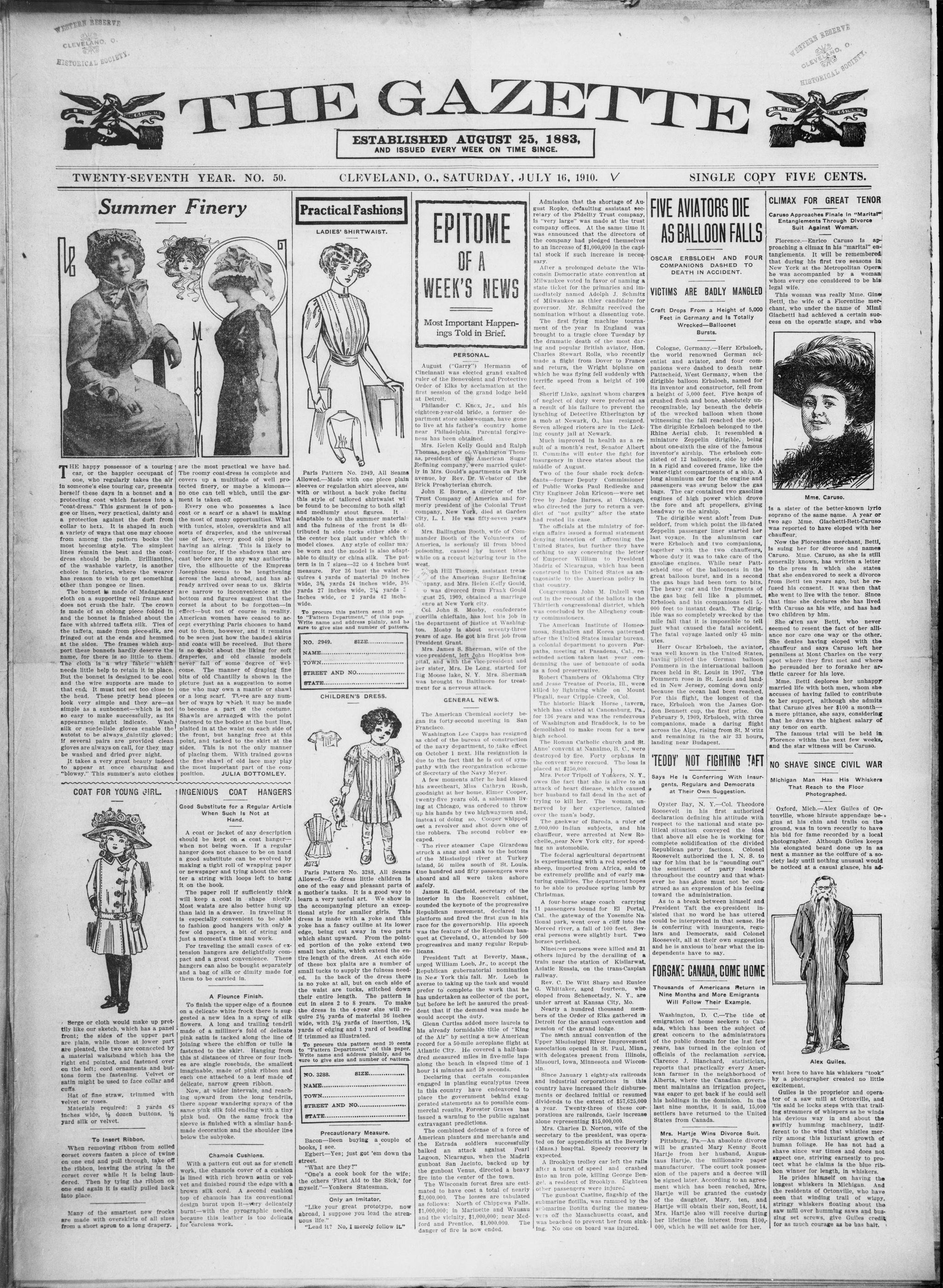
Summer Finery
MOMMY
WESTERN RESERVE
CLEVELAND, O.
HISTORICAL SOCIETY.
THE LEGION
IN ASSISTANCE
TWENTY-SEVENTH
Summer
HE happy possessor of a touring car or the hammier occupant of
car, or the happier occupant of one, who regularly takes the air in someone's else touring car, presents herself these days in a bonnet and a protecting coat which fastens into a "coat-dress." This garment is of a pongee or linen, very practical, dainty and a protection against the dust from collar to heel. It is shaped in such a variety of ways that one may choose from among the pattern books the most becoming style. The simplest lines remain the best and the coat dress should be plain. Brilliantine, of the washable variety, is another choice in fabrics, where the wearer has reason to wish to get something other than pongee or linen.
The bonnet is made of Madagascar cloth on a supporting veil frame and does not crush the hair. The crown is made of an oblong piece folded in and the bonnet is finished about the face with shirred tafeta silk. Ties of the taffeta, made from piece-silk, are fringed out at the ends and hemmed at the sides. The frames which support these bonnets hardly deserve the name, for there is so little to them. The cloth is a wiry fabric which needs little help to retain it in place. But the bonnet is designed to be cool and the wire supports are made to that end. It must not set too close to the head. These pretty head pieces look very simple and they are—as simple as a sunbonnet—which is not so easy to make successfully, as its appearance might indicate. Wash silk or suede-lise gloves enable the autolist to be always daintily gloved; if several pairs are provided clean gloves are always on call, for they may be washed and dried over night. It takes a very great beauty indeed to appear at once charming and "blowsy." This summer's auto clothes
—
Serge or cloth would make up pretty like our sketch, which has a panel front; the sides of the upper part are plain, while those at lower part are pleated, the two are connected by a material waistband which has the right end pointed, and fastened over on the left; cord ornaments and buttons form the fastening. Velvet or satin might be used to face collar and cuffs.
Hat of fine straw, trimmed with velvet or roses.
Materials required: 3 yards 48 inches wide, $ \frac{1}{2} $ dozen buttons, $ \frac{1}{2} $ yard silk or velvet.
To Insert Ribbon.
When removing ribbon from solled corset covers fasten a piece of twine on one end and pull through, take off the ribbon, leaving the string in the corset cover while it is being lau- dered. Then by tying the ribbon on one end again it is easily pulled back into place.
Many of the smartest new frocks are made with overskirts of all sizes from a short apron to a long drapery.
THE GAZETTE
are the most practical we have had
the roomy coat-dress is complete and
covers up a multitude of well pro
protected finery, or maybe a kimona—
no one can tell which, until the gar
ment is taken off.
Every one who possesses a lace coat or a scarf or a shawl is making the most of many opportunities. What with tunics, stoles, overskirts and all sorts of draperies, and the universal use of lace, every good old piece is having an airing. This is likely to continue for, if the shadows that are cast before are in any way authoritative, the silhouette of the Empress Josephine seems to be lengthening across the land abroad, and has already arrived over seas to us. Skirts are narrow to inconvenience at the bottom and figures suggest that the corset is about to be forgotten—in effect—but not of course in reality. American women have ceased to accept everything Paris chooses to hand out to them, however, and it remains to be seen just how the handed skirts and coats will be received. But there is no doubt about the liking for soft draperies, and old classic models never fall of some degree of welcome. The manner of draping fine bits of old Chantilly is shown in the picture just as a suggestion to some one who may own a mantle or shawl or a long scarf. There are any number of ways by which it may be made to become a part of the costume. Shawls are arranged with the point fastened to the bodice at the bust line, plaited in at the waist on each side of the front, but hanging free at this point, and tacked to the skirt at the sides. This is not the only manner of placing them. With trained gowns the fine shawl of old lace may play the most important part of the composition.
JULIA BOTTOMLEY.
Good Substitute for a Regular Article When Such Is Not at Hand.
A coat or jacket of any description should be kept on a coat hanger—when not being worn. If a regular hanger does not chance to be on hand a good substitute can be evolved by making a tight roll of wrapping paper or newspaper and tying about the center a string with loops left to hang it on the hook.
The paper roll if sufficiently thick will keep a coat in shape nicely. Most waistails are also better hung up than laid in a drawer. In traveling it is especially convenient to be able to fashion good hangers with only a few old papers, a bit of string and just a moment's time and work.
For traveling the small cases of extension hangers are delightfully compact and a great convenience. These hangers can also be bought separately and a bag of silk or dimity made for them to be carried in.
A Flounce Finish.
To finish the upper edge of a flounce on a delicate white frock there is suggested a new idea in a spray of silk flowers. A long and trailing tendril made of a milliner's fold of delicate pink satin is tacked along the line of joining where the chiffon or tulle is fastened to the skirt. Hanging from this at distances of three or four inches are single rosebuds, the smallest imaginable, made of pink ribbon and each one attached to a leaf made of delicate, narrow green ribbon.
Now, at wider intervals, and reaching upward from the long tendrils, there appear wandering sprays of the same pink silk fold ending with a tiny pink bud. On the same frock the sleeve is finished with a similar handmade decoration and the shoulder line below the subyoke.
Chamois Cushions.
With a pattern cut out as for stencil work, the chamois cover of a cushion is lined with rich brown satin or velvet and finished round the edge with a brown silk cord. A second cushion top of chamois has its conventional design burnt upon it—very delicately burnt with the pyrographic needle, because this leather is too delicate for carcass work.
ESTABLISHED AUGUST 25, 1883 AND ISSUED EVERY WEEK ON TIME SINCE.
CLEVELAND, O., SATURDAY, JULY 16, 1910.
Practical Fashions
LADIES' SHIRTWAIST.
Parls Pattern No. 2949, All Seams Allowed.—Made with one piece plain sleeves or regulation shirt sleeves, and with or without a back yoke facing this style of tailored shirtwai will be found to be becoming to both slight and mediumly stout figures. It adaptable to all the summer material and the fulness of the front is distributed in side tucks either side of the center box plait under which the model closes. Any style of collar may be worn and the model is also adaptable to dimity or china silk. The pattern is in 7 sizes—32 to 4 inches bust measure. For 36 bust the waist requires 4 yards of material 20 inches wide, 3% yards 24 inches wide, 3% yards 27 inches wide, 2% yards 5 inches wide, or 2 yards 42 inches wide.
To procure this pattern send 10 cents to Pattern Department" of this paper. Write name and address plainly, and be sure to give size and number of pattern.
NO. 2949. SIZE.....
NAME.....
TOWN.....
STREET AND NO.....
STATE....
40731
Paris Pattern No. 3288, All Seams Allowed.—To dress little children is one of the easy and pleasant parts of a mother's tasks. It is a good way to learn a very useful art. We show in the accompanying picture an exceptional style for smaller girls. This dress is made with a yoke and this yoke has a fancy outline at its lower edge, being cut out in two parts which slant upward. From the pointed portion of the yoke extend two small box plaits, which extend the entire length of the dress. At each side of these box plaits are a number of small tucks to supply the fulness needed. In the back of the dress there is no yoke at all, but on each side of the waist are tucks, stitched down their entire length. The pattern is cut in sizes 2 to 8 years. To make the dress in the 4-year size will require $2\frac{1}{2}$ yards of material 36 inches wide, with $2\frac{1}{2}$ yards of insertion, $1\frac{3}{4}$ yards of edging and 1 yard of beading if trimmed as illustrated.
To procure this pattern send 10 cents to "Pattern Department," of this paper, Write name and address plainly, and be sure to give size and number of pattern.
Precautionary Measure.
Bacon—Been buying a couple of books, I see.
Egbert—Yes; just got 'em down the street.
"What are they?"
"One's a cook book for the wife,
the others 'First Aid to the Sick,' for
myself."--Yonkers Statesman.
Only an Imitator.
"Like your great prototype, now abroad, I suppose you lead the strenuous life." "Lead it? No, I merely follow it."
EPITOME OF A WEEK'S NEWS
Most Important Happenings Told in Brief.
PERSONAL
August ("Garry") Hermann of Cincinnati was elected grand exalted ruler of the Benevolent and Protective Order of Elks by acclamation at the first session of the grand lodge held at Detroit.
Philander C. Knex, Jr., and his eighteen-year-old bride, a former department store saleswoman, have gone to live at his father's country home near Philadelphia. Parental forgiveness has been obtained.
Mrs. Helen Kelly Gould and Ralph Thomas, nephew of Washington Thomas, president of the American Sugar Refining company, were married quietly in Mrs. Gould's apartments on Park avenue, by Rev. Dr. Webster of the Brick Presbyterian church.
John E. Borne, a director of the Trust Company of America and former president of the Colonial Trust company, New York, died at Garden City, L. I. He was fifty-seven years old.
Mrs. Ballington Booth, wife of Commander Booth of the Volunteers of America, is seriously ill from blood poisoning, caused by insect bites while on a recent featuring tour in the west.
Philip Hill Thomas, assistant treasurer of the American Sugar Refining company, and Mrs. Helen Kelly Gould, o was divorced from Frank Gould August 25, 1999, obtained a marriage estate at New York city.
Col John S. Mosby, confederate guerrilla chieftain, has lost his job in the department of justice at Washington. Mosby is about seventy-three years of age. He got his first job from President Grant.
Mrs. James S. Sherman, wife of the vice president, left John Hopkins hospital, and with the vice-president and her sister, Mrs. De Long, started for Big Moose lake, N. Y. Mrs. Sherman was brought to Baltimore for treatment for a nervous attack.
GENERAL NEWS.
The American Chemical society began its forty-second meeting in San Francisco.
Washington Lee Capps has resigned as chief of the bureau of construction of the navy department, to take effect on October 1 next. His resignation is due to the fact that he is out of sympathy with the reorganization scheme of Secretary of the Navy Meyer.
A few moments after he had kissed his sweetheart, Miss Cathryn Rush, goodnight at her home, Elmer Cooper, twenty-five years old, a salesman living at Chicago, was ordered to throw up his hands by two highwaymen and, instead of doing so, Cooper whipped out a revolver and shot down one of the robbers. The second robber escaped.
The river steamer Cape Girardeau struck a snag and sank to the bottom of the Mississippi river at Turkey island, 50 miles south of St. Louis. One hundred and fifty passengers were aboard and all were taken ashore safely.
James R. Garfield, secretary of the interior in the Roosevelt cabinet, sounded the keynote of the progressive Republican movement, declared its platform and fired the first gun in his race for the governorship. His speech was the feature of the Republican banquet at Cleveland, O., attended by 500 progressives and many regular Republics.
President Taft at Beverly, Mass. urged William Loeb, Jr., to accept the Republican gubernatorial nomination in New York this fall. Mr. Loeb is averse to taking up the task and would prefer to complete the work that he has undertaken as collector of the port, but before he left he assured the president that if the demand was made he would accept the duty.
Glenn Curtiss added more laurels to his already formidable title of "King of the Air" by setting a new American record for a 50-mile airplane flight at Atlantic City. He covered a half-hundred measured miles in five-mile laps along the beach in elapsed time of 1 hour 14 minutes and 59 seconds.
Declaring that certain companies engaged in planting eucalyptus trees in this country have endeavored to place the government behind exaggerated statements as to possible commercial results, Forester Graves has issued a warning to the public against extravagant predictions.
The combined defense of a force of American planters and merchants and the Estrada soldiers successfully balked an attack against Pearl Lagoon, Nicaragua, when the Madriz gunboat Nacar Jacinto, backed up by the gunboat Venus, directed a heavy fire into the center of the town.
The Wisconsin forest fires are estimated to have cost a total of nearly $3,000,000. The losses are tabulated as follows: North of Chippewa Falls, $1,000,000; in Marinette and Wausau and the vicinity, $1,000,000; near Medford and Prentice, $1,000,000. The danger of fire is now ended.
Admission that the shortage of August Ropke, defaulting assistant secretary of the Fidelity Trust company, is "very large" was made at the trust company offices. At the same time it was announced that the directors of the company had pledged themselves to an increase of $1,000,000 in the capital stock if such increase is necessary.
After a prolonged debate the Wisconsin Democratic state convention at Milwaukee voted in favor of naming a state ticket for the primaries and immediately named Adolph J. Schmitz of Milwaukee as ther candidate for governor. Mr. Schmitz received the nomination without a dissenting vote.
The first flying machine tournament of the year in England was brought to a tragic close Tuesday by the dramatic death of the most daring and popular British aviator, Hon. Charles Stewart Rolls, who recently made a flight from Dover to France and return, the Wright biplane on which he was flying fell suddenly with terrific speed from a height of 100 feet.
Sheriff Linke, against whom charges of neglect of duty were preferred as a result of his failure to prevent the lynching of Detective Etherington by a mob at Newark, O., has resigned. Seven alleged rioters are in the Licking county jail at Newark.
Much improved in health as a result of a month's rest, Senator Albert B. Cummins will enter the fight for insurgency in three states about the middle of August.
Two of the four shale rock defendants—former Deputy Commissioner of Public Works Paul Redieske and City Engineer John Ericson—were set free by Judge Barnes, at Chicago, who directed the jury to return a verdict of "not guilty" after the state had rested its case.
The officials at the ministry of foreign affairs issued a formal statement denying intention of affronting the United States, but further they have nothing to say concerning the letter of Emperor William to President Madriz of Nicaragua, which has been construed in the United States as antagonistic to the American policy in that country.
Congressman John M. Dulzell won out in the recount of the ballots in the Thirtieth congressional district, which was concluded by the Allegheny county commissioners.
The American Institute of Homemosa, Shagallen and Korea patterned after the United States insular bureau, a colonial department to govern Forpaths, meeting at Pasadena, Cal., rescinded action taken last year condemning the use of benzoate of soda as a food preservative.
Robert Chambers of Oklahoma City and Jesse Treatse of Peoria, Ill., were killed by lightning while on Mount Pisgail, near Cripple-Creek, Col.
The historic Black Horse, tavern, which has existed at Canonsburg, Pa., for 136 years and was the rendezvous of Washington and Braddock, is to be demolished to make room for a new high school.
The Roman Catholic church and St. Anne' convent at Nanalmo, B. C., were destroyed by fire. Forty orphans in the convent were rescued. The loss is placed at $250,000.
Mrs. Peter Tripoll of Yonkers, N. Y., owes the fact that she is alive to an attack of heart disease, which caused her husband to fall dead in the act of trying to kill her. The woman, unnerved by her experience, fainted over the man's body.
The gaekwar of Baroda, a ruler of 2,000,000 Indian subjects, and his chauffeur, were arrested at New Rochelle, near New York city, for speeding an automobile.
The federal agricultural department is experimenting with a red species of sheep, imported from Africa, said to be extremely prolific and of early maturing qualities. The department hopes to be able to produce spring lamb by Christmas.
A four-horse stage coach carrying 11 passengers bound for El Portal, Cal., the gateway of the Yosemite National park, went over a cliff into the Merced river, a fall of 100 feet. Several persons were slightly hurt. Two horses perished.
Nineteen persons were killed and 31 others injured by the derailing of a train near the station of Kislaraw, Asiatic Russia, on the trans-Caspian railway.
Rev. C. De Witt Sharp and Eunice G. Whittaker, aged fourteen, who eloped from Schenectady, N. Y., are under arrest at Kansas City, Mo.
Nearly a hundred thousand members of the Order of Elks gathered in Detroit for the annual convention and session of the grand lodge. The ninth annual convention of the Upper Mississippi River Improvement association opened in St. Paul, Minn., with delegates present from Illinois, Missouri, Iowa, Minnesota and Wisconsin.
Since January 1 eighty-stx railroads and industrial corporations in this country have increased their disbursements or declared initial or resumed dividends to the extent of $57,625,000 a year. Twenty-three of these corporations are railroads, their increase alone representing $15,000,000.
Mrs. Charles D. Norton, wife of the secretary to the president, was operated on for appendicitis at the Beverly (Mass.) hospital. Speedy recovery is expected.
A Brooklyn trolley car left the rails after a burst of speed and crashed into an iron pole, killing George Bengel, a resident of Brooklyn. Eleventh other passengers were injured.
The gunboat Castine, flagship of the submarine flotilla, was rammed by the submarine Bonita during the maneuvers of the Massachusetts coast, and was beached to prevent her from sinking. No one on board was injured.
SINGLE COPY FIVE CENTS.
FIVE AVIATORS DIE AS BALLOON FALLS
OSCAR ERBSLOEH AND FOUR
COMPANIONS DASHED TO
DEATH IN ACCIDENT.
Craft Drops From a Height of 5,000
Feet in Germany and Is Totally
Wrecked—Balloonet
Cologne, Germany—Herr Erbsloeh, the world renowned German scientist and aviator, and four companions were dashed to death near Pattscheid, West Germany, when the dirigible balloon Erbsloeh, named for its inventor and constructor, fell from a height of 5,000 feet. Five heaps of crushed flesh and bone, absolutely unrecognizable, lay beneath the debris of the wrecked balloon when those witnessing the fall reached the spot. The dirigible Erbsloeh belonged to the Rhine Aerial club. It resembled a miniature Zeppelin dirigible, being about one-sixth the size of the famous inventor's airship. The erbsloeh consisted of 12 balloonets, side by side in a rigid and covered frame, like the water-tight compartments of a ship. A long aluminum car for the engine and passengers was swung below the gas bags. The car contained two gasoline engines of high power which drove the fore and aft propellers, giving headway to the airship.
The dirigible went aloft from Dusseldorf, from which point the ill-fated Zeppelin passenger liner started her last voyage. In the aluminum car were Erbsloeh and two companions, together with the two chauffeurs, whose duty it was to take care of the gasoline engines. While near Pattscheid one of the balloonets in the great balloon burst, and in a second the gas bags had been torn to bits. The heavy car and the fragments of the gas bag fell like a plummet, Erbsloeh and his companions fell 5,000 feet to instant death. The dirigible was so completely wrecked by the mile fall that it is impossible to tell just what caused the fatal accident. The fatal voyage lasted only 45 minutes.
Herr Oscar Erbsloeh, the aviator, was well known in the United States, having plotted the German balloon Pommern in the international balloon races held in St. Louis in 1907. The Pommern rose in St. Louis and landed in New Jersey, coming down only because the ocean had been reached. For this flight, the longest of the race, Erbsloeh won the James Gordon Bennett cup, the first prize. On February 9, 1909, Erbsloeh, with three companions, made a daring flight across the Alps, rising from St. Moritz and remaining in the air 33 hours, landing near Budapest.
'TEDDY' NOT FIGHTING TAFT
Says He Is Conferring With Insurgents, Regulators and Democrats at Their Own Suggestion.
Oyster Bay, N. Y.—Col. Theodore Roosevelt in his first authorized declaration defining his attitude with respect to the national and state political situation conveyed the idea that above all else he is working for complete solidification of the divided Republican party factions. Colonel Roosevelt authorized the I. N. S. to say for him that he is "sounding out" the sentiment of party leaders throughout the country and that whatever he has done must not be construed as an expression of his feeling toward the administration.
As to a break between himself and President Taft the ex-president insisted that no word he has uttered could be interpreted in that sense. He is conferring with insurgents, regulars and Democrats, said Colonel Roosevelt, all at their own suggestion and he is anxious to hear what the independents have to say.
FORSAKE CANADA. COME HOME
Thousands of Americans Return in Nine Months and More Emigrants Will Follow Their Example.
Washington, D. C.—The tide of emigration of home seekers to Canada, which has been the subject of great concern to the administrators of the public domain for the last few years, has turned in the opinion of officials of the reclamation service. Clarence J. Blanchard, statistician, reports that practically every American farmer in the neighborhood of Alberta, where the Canadian government maintains an irrigation project, was eager to get back if he could sell his holdings in the dominion. In the last nine months, it is said, 15,000 settlers have returned to the United States from Canada.
Mrs. Hartje Wins Divorce Suit. Pittsburg, Pa.—An absolute divorce will be granted Mary Kenny Scott Hartje from her husband, Augustus Hartje, the millionaire paper manufacturer. The court took possession of the papers and a decree will be signed later. According to an agreement which has been reached, Mrs. Hartje will be granted the custody of the daughter, Mary, ten, and Hartje will obtain their son, Scott, 14. Mrs. Hartje also will receive during her lifetime the interest from $100,000, which he will set aside for her.
WESTERN RESERVE
CLEVELAND, O.
HISTORICAL SOCIETY.
CLIMAX FOR GREAT TENOR
Caruset Approaches Finale in "Marital"
Entanglements Through Divorce
Suit Against Woman.
Florence—Enrico Caruset is
approaching a climax in his "marital"
entanglements. It will be remembered,
that during his first two seasons in
New York at the Metropolitan Opera
he was accompanied by a woman
whom every one considered to be his
legal wife.
This woman was really Mme. Gine
Bettel, the wife of a Florentine merchant,
who under the name of Mimi
Glachetti had achieved a certain success
on the operatic stage, and who
Mme. Caruso.
Is a sister of the better-known lyric soprano of the same name. A year or two ago Mme. Glachetti-Bett-Caruso was reported to have eloped with her chauffeur.
Now the Florentine merchant, Betti, is suing her for divorce and names Caruso. Mme. Caruso, as she is still generally known, has written a letter to the press in which she states that she endeavored to seek a divorce from Betti ten years ago, but he refused his consent. It was then that she went to live with the tenor. Since that time she declares she has lived with Caruso as his wife, and has had two children by him.
She often saw Betti, who never seemed to resent the fact of her alliance nor care one way or the other. She denies having eloped with the chaufeur and says Caruso left her pennille at Mont Charles on the very spot where they first met and where he persuaded her to forsake her artistic career for his love.
Mme. Betti deplores her unhappy married life with both men, whom she accuses of having failed to contribute to her support, although she admits that Caruso gives her $100 a month—a mere pittance, she says, considering that he draws the highest salary of any tenor on earth.
The famous trial will be held in Florence within the next few weeks, and the star witness will be Caruso.
NO SHAVE SINCE CIVIL WAR
Michigan Man Has His Whiskers
That Reach to the Floor
Photographed.
Oxford, Mich.—Alex Guilles of Ortonville, whose hirsute appendage begins at his chin and trails on the ground, was in town recently to have his bid for fame recorded by a local photographer. Although Guilles keeps his elongated beard done up in as neat a manner as the coiffure of a society lady until nothing unusual would be noticed at a casual glance, his ad-
Alex Guiles.
vent here to have his whiskers "took" by a photographer created no little excitement.
Gulles is the proprietor and operator of a saw mill at Ortonville, and 'tis said he locks steps with that trailing streamers of whispers as he winds his devious way in and about the swiftly humming machinery, indifferent to the wind that whistles merrily among this luxuriant growth of human foliage. He has not had a shave since war times and does not expect one, striving earnestly to protect what he claims is the blue ribbon winner for length, in whiskers. He prides himself on having the longest whiskers in Michigan. And the residents of Ortonville, who have seen that winding trail of wispy, stringy whiskers floating about the saw mill over humming saws and buzzing set screws, give Gulles credit for as much courage as he has hair.
2
One Year.....$1.50
Six Months.....1.00
Three Months......50
Subscribers are requested to re-
mit by postoffice money or-
der or registered letter.
Entered at the postoffice in Cleveland
Ohio, as second-class matter
Address all communications to
HARRY C. SMITH
Editor and proprietor,
THE GAZETTE,
Blackstone Building, Cleveland, O.
Member Ohio Legislature: 1894
to 1896: 1896 to 1898: 1900 to 1902
THE GAZETTE is the oldest, and has the largest bona fide circulation, double that of any newspaper in the Interest of Afro-Americans, published in the state of Ohio, and comparison with any will immediately establish its rank, as one of the NEWSIEST AND BEST in the country.
If President Taft or his administration is to be the issue in the Ohio campaign, this fall, as Cairman Wade Ellis is quoted as saying, goodbye to Republican success and the candidacy of James R. Garfield.
We want to call the attention of our readers to all of our advertisements and we want them to oblige us by calling their friends' and acquaintances' attention to them because they represent reliable persons and be cause our advertisers are asking particularly, for your trade through the columns of The Gazette. Patronize them as often as you can. It will pay you to do so.
One of the oldest and best firms of the kind in the state of Ohio, is that of C. R. Patterson & Sons, whose advertisement will be found on page three of The Gazette. It is composed of members of the race, too. Hundreds of our people in and out of Ohio are purchasing their vehicles and are always pleased with them. Tell everybody you can of this firm's great success because it is a matter that should make us all proud and willing to do all in our power to give and send them all the business we can. We must help one another. Every such success helps the race most.
There are hundreds of our girls here in Ohio who ought to grasp the splendid opportunity being offered by the Xenia Stemmery of the American Cigar Co., in the advertisement on page three of this paper. This is the vacation season and thousands are unemployed who would be far better off at work. The editor of The Gazette is personally acquainted with W. S. Rogers, foreman of the stemming department of this Xenia business enterprise. He is a member of the race. We have no hesitancy in recommending him and the Xenia community of our people, to all. None should have the least hesitancy in accepting the employment offered in the advertisement referred to. There is absolutely nothing in Xenia to serve as a drawback to your doing so.
THOSE MOVING PICTURES, PRIZE
FIGHTS AND LYNCHING.
The Christian Endeavors are greatly agitated about the immoral effect of prize-fights, and that of the production of the last one, in moving pictures. They are exerting themselves to have such shows prohibited and the movement set on foot by them for this purpose, is assuming an international scope. England and even "Judea's coral strand" being affected by the agitation. For ought we care, prize-fights may be put on the ban; but what strikes us who remember the excitement in this country, running high, when the American Henan beat the Englishman Sayers—the issue was then national pride—as strange, is that the ministers and Christian Endeavors ("white") should come to see the matter in the light they present it in "just now"—and so late! There is a psychological element in this agitation that looks like a "case of bad conscience." There lurks in the affair "the fear of race-riots and the increase of lynch-murder in the Republic." We do not object in the least to any attempt to avert either; but take this occasion to ask the ministers of Jesus Christ's religion, the Rabbis of Mosaic faith, and all other heart in a fight and others have so far waged alone and therefore we merit. It is the agitation against what is euphemistically called lynch-law, termed correctly lynch-murder and designated as "the murder crime." If a minor affair in morality can be abolished by concerted efforts through the instrumentality of law, why not the major one? It may not become possible immediately, to abolish lynchings, but it certainly is possible to punish them where they occur; more and more so, until it becomes evident to those partaking of such crimes that the law not only has a strong arm but that it will execute its function by using that strong arm. This, coupled with moral education, through pulpit and press, will surely effect the result so desirable from every point of view and becoming an absolute necessity, if this nation is to endure. If the anti-prize-fight Endeavors wish to prove that they are in earnest, intent to go to the root of matters, they will have to dig deeper than the mere surface; they will have to unroot the weed of race-prijudice and race-hatred; else they, too, are of those our Lord condemned, when He spoke of "straining at gnats and swallowing camels."
"CHICKENS COMING HOME TO BOOST."
Not to be outdone by Ohio mobo crats who last week furnished the lynching of a young "white" Kentuckian, at Newark, who in turn had shot to death a bar-tender also "white" "distinguished and chival
rous" residents (mobocats) of Rayville, La., also battered down jail-doors (Sunday) and took out another of their own people and lynched him on the spot where he had recently slain the marshal of the town. Thus does the lynch-murder disease grow in the class or race that inaugurated and has carried on until now the mob must have victims from among its own. This is just as we predicted many years ago. We said that Negro victims only could hardlv "Le expected to satiate the mob's desire for blood as time went on and the mob-spirit grew stronger and bolder. Within a week we have had a northern and a southern demonstration of the correctness of this statement, our prediction.
No law entirely wipes out crime of any kind and never will do so, but all laws should have a greater or less restrictive influence and power. That is all that can be expected and it is all that can be secured as a result of their enaction. The laws against murder and all other crimes for instance! They do not stump out crimes, but that their restrictive influence lessens the number very materially, there can be absolutely no doubt. Without such laws, and their proper enforcement of course, the world would be a howling wilderness of crime. Even with, and in spite, of such laws, the weaknesses of trail humanity are often quietly encouraged under cover and consequently crime encouraged, as they and it were at Newark, until the culmination in the shape of some such dastardly deed as disgraced all Ohio last week.
This is the fourth lynching since the editor of The Gazette secured the enactment of Ohio's Anti-Lynching or Mob Violence law, nearly fifteen years ago (1896) when a member of the Legislature, a second time. This law makes the county liable to a relative or legal representative of a person lynched by a mob, in the sum of $8,000. In case of serious injury or injury (not death), a sum less than the amount stated can be recovered. In the three years alone preceding the year of 1896, there were many more lynchings and mob violence attempts than there have been since nearly fifteen years! This fact alone to say nothing of the law's punishment of Champaign, Logan, Clarke Cuyahoga and other counties permitting the crime of lynching, or lesser degrees of mob violence as in the case of at least two of the counties just mentioned, proves its splendid restrictive influence and that it is unqualifiedly an execuational success.
Last winter Hon. Henry T. Eubanks of this city, a member of the race and a member of the Legislature that adjourned some weeks ago, secured the enaction of a supplemental law that gave the Governor power to remove the Sheriff of any county in the state who failed to properly protect a prisoner sought by a mob, and to appoint his successor pending the filling of said position in accordance with the regular custom of the county. Illinois and other states have the same law and it is a good one, although the Sheriff at Newark did promptly resign before Gov. Harmon ousted him from office. Somewhat he certainly intended to do.
The Governor has promised to bring to justice some if not all of the leaders of that Newark mob and we sincerely trust that he will be successful in doing so. Both the Mayor and Sheriff addressed it and must know some if not all of its members. Thus far they have refused to give the required information. This is the problem of Ohio's Chief Executive, a great jurist, and the law-abiding officials of Licking County, face. If they can in any way solve it, the example necessary favoring law and order, can be made, and justice, at least in some measure, meted out.
The great state of Ohio has been disgraced four times, as we have said, in the last fifteen years by lynch-murders and while this is but one-fifth of the mob demonstrations Ohio furnished in the three years, 1893, 4, and 5, it is more than the next fifteen years will afford if the Governor is successful in his efforts to punish some of the lynch-murders of that Newark mob, and our Ohio Anti Lynching law continues to be inforced.
Gutta Percha.
Gutta percha is the dried milky juice of the trees of the genus Sapotaceae, chiefly of the species Palanquium and Payena, the habitat of which is the Malay Aflchipelago, more particularly Borneo, Sumatra and Malacca.
Outclassed.
Hewitt—"Can you believe what he says?" Jewett—"If he and Ananias had been contemporaries, Ananias would have felt that it was necessary for him to go out and get a reputation."
The Philosopher of Folly.
"In one of these tight-fitting riding gowns the ladies wear," says the Philosopher of Folly, "I suppose the buttons fly off from force of habit."
Time Lost Through Illness.
For every person who dies in a year, there are two people constantly fill Each person loses, on an average, 13 days a year by illness.
This Age Too Busy to Remember.
The first mayor of New York, Thomas Willett, sleeps in the Little Neck (R. I.) cemetery and his grave is neglected.
"Are Boston children usually precocious?" "I have known of one who was only three years old who could get into a reminiscent vein."
"Yes," observed the puppy as he shivered in the shade of the sausage factory, "I, too, am going through in three years."-Harvard Lampoon.
Each Requires Sustenance
A house is no home unless it con tain food and fire for the mind as well as for the body.-Margaret Fuller Osoll.
THE GAZETTE, CLEVELAND, O., SATURDAY, JULY 16, 1910.
THAT RENO FIGHT,
SANE COMMENT
WHINING LIKE A LOT OF WHIPPED POODLES ARE MANY OF THOSE SORE OVER THE OUTCOME.
IT WAS A GLORIOUS VICTORY!
Jeffries Feinted—Composite Anglo-Saxon Mobs—Prof. Hamilton on the Race's Rapid Strides—Race Prejudice—A German Paper's and a Cleveland Minister's Comment.
The following five paragraphs are from the St. Louis (Mo.) Weslische Post of June 6, and were translated into English for "The Gazette" by our occasional correspondent, Mr. Jacob Egbert of Chicago:
1. "What wrong have the Negroes in our country committed that the 'whites' should wish to take revenge on them for Jeffries' defeat?
2. "The Negro Johnson battled not only against his 'white' opponent Jeffries, but also against the open enmity of fully 20,000 spectators.
3. "In the 'race riots', which must be considered the immediate consequences of the prize fight, the aggressors were mostly the 'whites' Poor aportant, who cannot accept a defeat with dignity!"
4. "All those who bet their good money on Jeffries to recover from the 'white' sportsmen, who blinded by race prejudice, played the confidence game on them by asserting that the 'white' man must win.
5. "If our Negroes have an exaggerated idea regarding the victory of the Negroes, they have evidently obtained this view only by the perusal of papers, great papers, edited and published by 'whites': the so-called 'world's papers.'"
6. "the Caucasian race" that seeks to prove its supremacy over the Negro by gathering in mobs and assaulting defenseless black men is fortunately a small part of the white population. Such brutal and cowardly change if they were real representative, would by their actions indicate the error of their own blatant claim. Cleveland Plain Dealer.
The prize fight was bulleted at the Oakwood links by rounds. The report of the first round included the important information that Johnson led with a right, while Jeffries feinted with the left. The foursome just starting out was in time for this bit of news and heard nothing further until the return, when the result was announced, Mrs. Herman August, who was the foursome winner, was measured. "How can you expect Mr. Jeffries to win," she argued, "when he fainted in the first round?"—Cleveland Press.
Professor W. L. Hamilton of the University of California, lecturing before a class in sociology at Northwestern university at Evanston, Ill. last week, pointed out the rapid strides the race has made in the past 50 years. "The Negro no longer can be called the white man's inferior," he said, "in art, music, literature, in history, in society, in development he has made phenomenal strides. The recent prize fight proves to some extent the truthfulness of the theory that the Negro is not an inferior race. There is no scientific proof to show that the Negro sprang from a distinct root, according to the view of Professor Halle, the German savant, but all evidence tends to support the theory that he is simply a branch of the Caucasus. He was the Egger of the Moor and the Hindoo. I believe that within 300 years the Negro will become extinct in America, through the effects of intermarriage and climatic conditions."
Having read the editorial, "More About the White Race," in the Chicago Daily News (republished in The Gazette last week), I feel impelled to congratulate the newspaper for its wisdom and for its giving of inspiration to all people regardless of color or race. I personally cannot approve of prize fighting. The wormout sub-committee of contests "should be dropped out of respect for the intelligent public. I want to point out the far-reaching effect of American color prejudice Mayors of many cities and many authorities controlling theatrical entertainments have tabooed the fight pictures. This is pure race prejudice mayors of one city or hamlet worth showing them in would have barred them. To show that the white American is usually the cause of race conflicts in this country, I wish to say that I happened to be in the "black belt" when the wires flashed "Johnson wins!" and heard the vociferous cheering of colored people. No injury or harm was done anybody, especially the white American, in a highly safe in the heart of the "black belt." Yet inoffensive colored persons have been beaten and assaulted in strictly white neighborhoods. When the American public learns and practices that Christiek belief, "the fatherhood of God and the brotherhood of man," race wars, anarchy, prize fighting and political graffiti will be allowed. Witcraft is in "intellectual New England." Mother Nature knows no race, but merit can be produced in any race of God's great family.
Chicago. DANIEL JACKSON.
In the midst of much aimless or prejudiced discussion regarding the exhibition of the Jeffries-Johnson prize fight pictures in Cleveland and elsewhere, comes a calm and sane letter from a Cleveland minister. He is a white man, and as such he harms the attitude of his fellow Caucasians, to his own controversy—an attitude which, he insists, is unworthy of the race.
"While I depreciate the prize fight," this minister writes, "and the display of the brutal in these moving pictures, I believe there is in this matter an issue more serious than the fight itself. It is the race prejudice that it causes men to be tended to arouse the brute in man, but why should the matter be treated differently when a Negro participates? Race prejudice is a contemptible passion, and is only aggravated by the present discussion. Reports show that white men have been the great offenders in the post-fight disturbances—men who are not sportsmanlike enough to wish to see the better boxer in the ring. White men who are white men would have exulted, the Negro would have borne defeat, and
the pictures would have been shown.
The disgrace is to the white man whose mean intolerance belies his boasted superiority. Isn't it possible that a higher service might be rendered to humanity if the pictures should be shown and every white child who chewed on the picture should be delivered by the Negro without an outburst of race hatred should be treated by the law as an unsafe citizen? And the quiet witnessing of a fair contest throughout the north might be a wholesome object lesson to the prejudice inflamed south. It is a pity to degenerate into lovers of the prize to the extent that some self-confessional shaves of an intolerance that is bigoted and fanatical. Let every white man prove his worth by bearing defeat as a 'white man should'.—Cleveland Plain Dealer.
The silly stories being published in the daily papers of the country, these days, 'n a foolish effort to explain away Jeffries' defeat, are on a par with the barring of the fight pictures, and are really too ridiculous for any sane person to pay any attention to. But it certainly is amusing to see them wiggle, whine and "carry on" like a whipped and spoiled child, both of whom out of old friends and all this because Jack Johnson "liked" Jeffries "fair and square", good and plenty, and showed unmistakably while doing so that he is the world's greatest heavyweight pusilist that has ever lived, lives, or will live for some time to come. The only thing the matter with Jeffries at Reno was that he was not, nor never was, the equal of Jack Johnson as a fighter. And all this does not justify sensible Afro Americans getting "chesty" over the outcome of the fight. Get all the sat and intelligent way and with due regard for the feelings of others. That is the conduct of a lady or gentleman, and we all wish to be that, and nothing less.
DOINGS OF THE RAGE
Prof. W. E. B. DuBois of Atlanta Ga. says our "public" schools in the South are worse than they were ten years ago.
Nebhemiah Henry was elected councillor recently at Cambridge. Md. on a fusion ticket opposed by the Republican organization.
According to Walter H. Eckersall, a newspaper reporter on a Chicago daily newspaper, Jack Johnson and his former manager, George Lille, fell out' because the latter was the fight for Jeffries for a large sum of money. One of the largest clothing manufacturing firms in the south, located in Baltimore, Md., will shortly open there, a factory in which all the operatives will be colored. The firm will begin with two hundred hands and will add more as business demands. The law admitting Arizona and New Mexico to statehood expressly prohibits disfranchisement on account of race, color or previous condition of servitude. The constitutions which these states will adopt will provide with this provision in every particular.
In Oklahoma there is a thrifty and intelligent colored populace. In Boley, one of the six towns wholly managed by Negroes, they have electric lights and a telephone service. The telegraph operator is a colored man, as well as the station agent, who seems to be a hotbed of anti-Negro sentiment.—Prof. W. E. B. DuBois. Prof W. E. B. DuBois, the foremost Afro-American sociologist, and for some years professor of history and sociology at Atlanta, Ga. University, has accepted the position of director of publicity and research for the National Association for the Advancement of the Colored People. In 2014 a year. Headquarters in New York City. A dispatch to the Atlanta Georgian from Vienna, under date July 8, says: "The Russian authorities are hunting down Jews with bloodhounds. The expulsion of Hebrews from the cities and country outside of the pale is being pushed to the accompaniment of horrors unknown since the days of the Holocaust. Fresh secret advices received today by the Semitic leaders here."
Bishop J. S. Flipper of Georgia has rebelled against the Bishop's Council of the A. M. E. church and refuses to attend any more of its meetings "because it has no authority," he says, "to settle differences between members of the church; because he considers money paid out for traveling expenses to the Bishops' Council too exorbitant for value received by the church, and because the council has no fixed order of business that should characterize such a body." Bishop Flipper further says, in his letter to the governor, in June at Wilberforce, that he "will exercise his authority as bishop or general superintendent in any part of the church" vineyard. It is hardly necessary to add that his manifesto has caused a sensation in the church.
A. Hospitality Hint
When I expect a guest from a distance, I purchase a number of souvenir post cards of our home town, and after stamping them place them on the desk in the guest room where they can be addressed and sent back without any shopping being done by my guest.—From Woman's Home Company
Sermons at All Prices
"Bretheren," said the visiting preacher, "Tse got a eight-dollar sarmon, an 'Ise got a six-dollar one, an 'a three-dollar one, an 'den Ise got one I kin let you have fur jes' one dollar. Now, I want you fur to take up the kerlection right now, an' see which one uv these sarmons you wants."
Laws as They Should Be.
Laws should be clear, uniform, precise; to interpret them is nearly always to corrupt them—Voltaine.
Unconscious of Genius.
The men and the nations who have real genius and talent are always the last to be conscious of it.
FRESH OHIO NEWS OUR OWN WRITERS'
WHAT OUR PEOPLE ARE DOING IN MANY CITIES AND TOWNS OF THE STATE.
INTERESTING PERSONAL NOTES
Social Functions—Church and Lodge
Items—Mariages and Deaths—
Literary, Musical and Other
Notes of Interest.
Xenia—All of The Gazette's readers should be sure to read the "Wanted" display advertisement on page 3.
Sandusky—Miss Rosella Garrett is visiting in Tiffin—Madam Dunn of Dayton is visiting her sister, Mrs. S. Wallace of the Second Baptist church W. Mall picnic R. Rach Basch the 88th. Mr. Luther Jones has located in Detroit.
Xenia—Our musicians went to Waynesville recently to play and had to walk the streets, being refused a bed for the night. An echo of the Johnson-Jeffries fight. Dr. W. F. Darnell of Cairo, Ill., has located here. Also Veterinary Shaw of Chicago. Rev. J. G. Ross has taken charge of Zion Church. It is indeed an acquisition to the city.
Sandusky.—The A. M. E. choir was reorganized the last M. T.酵on, Sopranos, Ella Wahls, Arlana Weston; altos, Beatrice Shackelford, Mozella Watson, Clarence Howard; tenor, Mr. Moses and Fred. Thomson, the launa named is chorister and Miss Blanche Shackelford, organist. — Misses Marion and Evelyn Evans of Akron are guests of Mrs. Those, Pathe. —The picnic Tuesday was a success, Wellsville.—Ed. Woolward, matcher of Mrs. Those, Pathe. —The Thursday.—Mrs. Edna Curtis and daughters are guests of Mrs. Irene Johnson and Mrs. Eva Jones.—Mrs. I Williams and Miss L. Croones have returned from Palmsville.—Mr. Kenney and family of New Brisbane.—Mr. Kenney and Congo was here Tuesday.—Special services the 24th. Church rally.
Cadiz—Dr. Charles Bundy, P. E. preached an excellent sermon at the A. M. E. church Sunday morning and administered communion in the afternoon. Mrs. Marie Duling entertained him and Elder Fox at dinner Monday evening. Alpham Olustead has returned from Belhare. Mr. Lucas accrued his salary. Smithfield, Mr. Austin Wallace, sr. Paul, Ida and Clarenza Harris, and Evai Clayton were in Georgetown Sunday.
East Liverpool—Mrs. A. R. Webb and granddaughter attended the Sunday school convention at N. B. last week. Mrs. K. Flenoy of N. B. visited her sister Monday. Grant Street church rally has netted $45.50 to date. Excellent. Mrs. Annie McPherson has returned to Mononghela City. She visited her mother, Mrs. S. Ormes—Mrs. Baird of Sharon is returned from Pittsburg. She visited her daughter, Mrs. Glenn—Mrs. J. A. Goode is ill. Mrs. Lillian Tailed died Tuesday. Pneumonia. Funeral Thursday from Second Baptist church.
Smithfield—Mr. and Mrs. A. J. Guy and family spent the Fourth here—Mr. Thomas Jackson visited in Steuart, M. Hogans have returned, Mr. M. Hogans have returned, He preached Sunday morning and Rev. E. R. Gains in the evening. While in Connellsville, Pa. Rev. and Mrs. Hogans assisted in the services of both churches. He preached and she sang in Connellsville. They then a reception which was attended by 50 guests—Mr. and Mrs. Scott of Columbus are visiting her grandmother, Mrs. Pearl. Miss Alice and Mrs. Ross Faintful of Harrisville were here on the 4th and 9th—Mrs. Lola and children have returned from Cadiz.
Mt. Vernon—Miss Payne of Columbus and Miss Jackson of Akron are visiting Miss Stella Bradfield—Rev. and Mrs. Hamilton of Columbus visited Mr. and Mrs. Charles Hamilton the Fourth—Miss Johnson of Newark has visited Mrs. Hamilton of her daughter, Mary, here a day last week. The latter is visiting Mrs. Stewart of Mansfield—Miss Vola Symons is ill—Mrs. H. Judy is better. Mrs. Curry is visiting her sister, Mrs. L. O. Harris, Xenia, Mrs. J. Richardson entertained last Friday evening—Miss Ella Hamilton and Mr. George Newsom were married Saturday evening to housekeeping on W. Chestnut street.
Washington C. H.—Mrs. Cole and Miss Helen and Mrs. Garnes are at Maplegrove.—Mr. H. Stewart has returned from Columbus.—Miss Ethel Hurley of Hillsboro, sister of Mrs. J. Manns, has returned home.—We are all looking forward to the home-computer parents Sunday from Columbus, Dr. and Mrs. Stokes left Monday after a two weeks' stay with her parents, Mrs. and Mrs. J. Jackson. They will visit his parents two weeks before returning to Cheyenne, S. D.—Miss Helen Jones has returned from Chillicotte, Mr. Charles Isom also attended the Miss Netta Taylor and Mr. Harry Jones are ill.
Hamilton.—Mr. and Mrs. C. S. Dyson have gone to Louisville, Ky., where she will be operated upon.—Mr. Henry Murphy, sr., is seriously ill.—Rev. J. D. Singleton was in Urbana last week.—The Wood Street church is open socially at social Mrs. Katie Hogan's was well attended.—Quarterly meeting services were poorly attended. Collection fair.
—Mr. Patsy Clarke has returned from Reno. He had a good time. —Mr. and Mrs. W. Watson spent the Fourth in Cincinnati. Mr. and Mrs. E. Gayter have returned there. —T. B. Page will soon issue another song, "True Blue," his best. —Mr. Jean Jackson has lost his mother. Mr. Jackson's infant boy was buried Monday.
Correspondents must mail all letters for publication at their main postoffice sufficiently early on Monday (or Sunday) of each week to have them reach The Gazette office on Tuesday morning, and always write, also, their names and that of their city, state, and country of birth. The apperent return copies, Unless this latter is done, proper credit cannot be given you. Lists of names, wedding presents, etc., obituary notices, speeches, resolutions, poetry, inquiries for relatives and advertisements of all kinds, including items announcing entertainments to be held in the near future, must be paid for by the applicant. For advice on line texts to a line. Our rates for display advertisements will be sent on application. Send postal note and not stamp during warm weather.
Bellaire.-Mr. and Mrs. T. Myers and daughter attended his uncle's funeral at Cambridge.-Mr. Virgil Brown remains ill.-Miss Octavia Dollinger of Bridgeport was here Sunday.-Mr. R. Irvin is convalescent.-Misses Sadie and Ruth Alston were entertained at dinner by Mrs. J. Stoll and at dinner by M. C. Alston attended our State Federation of Women's Clubs at Springfield last week. She also represented The Gazette there.-Miss E. Davis entertained Monday and Tuesday Mr. Earl Linder and Mr. C. Davis of Cadiz.-The O. V. M. A. met Monday at St. Paul's church.-Mrs. Cora Hopkins and five children and Mrs. Bertha Mfield and two children and Mrs. D. Davis are visiting their mothers. Mrs. D. Davis and Mrs. C. Briggs, respectively.
Steubenville. —Mr. Al. Johnson has purchased a fine house on Adam street. —Mr. Frank Gillespie stopped here on route to Canton. —W. M. Viney of Indianapolis was the guest of J. Guy. —Thomas & White have remodeled their barber shop. —Miss Mary Guyder, who was overcome by the heat, is convalescing. —Miss Nannie Harris of Wheeling was here Sunday. —Misses Daily and Wilma Guyder and Mrs. E. Franklin enjoyed the day. —Miss Nina Banks and Mrs. Miss Nina Banks and Mrs. Harry Bowman were married in Cumberland, Md. —Miss Martha Winston visited in Bridgeport Sunday. —Mrs. Page of Dublin, Va., is visiting her daughter, Mrs. D. Smith. —Quinn church trustee's lawn fete Monday evening was a success. —Master Arnett White is visiting his uncle, Mr. Elmer White. —Miss Cordella Brayton and Mr.
Charles Davis were married recently, Youngstown—Mrs. Lizzie Cheney spent a week in Emienton, Pa.—Miss Jenny McCarthy was married recently—Mrs. Lizzie Botts and daughter returned to Yellow Springs last Friday—Mr. John Moore, Dr. Petttiford, Mrs. Sadie Morrison and Mrs. J. H. Bobson are ill—Buckeye lodge's second annual outing will be held on the 21st at Southern Park. The Elks will attend the annual session at Washington, D. C., July 26 to 28. A special car is being arranged for—Mrs. Canada and Mrs. C. Charlton entertained in honor of Rev. and Mrs. Jordan Friar from the University of Pennsylvania guests left Monday to locate in Philadelphia—B. Y. P. U. was well attended at Mahoning Avenue Church Sunday evening. All joined in the discussion of the topic—Rev. F. B. Leese and Daniel Donald officiated at St. Mary's church Sunday. The pass will be home on the 17th. The Coleridge-Taylor Choral society met at Mrs. R. D. Lynch's Tuesday even at St. Mary's church. The violin-picked at Idora Park Tuesday—Mr. W. Thompson of Minneapolis, Mrs. S Thompson's father, is still here and ill—Mrs. Thomas Lonesome repented the Chrysanthemum club at the state meet of our Women's Federation in Springfield last week.
Lockland. —Rev. W. L. Brown of Washington, Pa., spent several days with Rev. F. G. Snelson, Rev. J. M. Gilmore, P. E. held quarterly meeting Sunday at Bethel and heard excellent reports. Miss Lula Booker is visiting the University of Kentucky, F. G. Snelson, Mrs. M. C. Mason and others left Sunday for Louisville, Ky., to attend the N. A. of C. W. The Elmwood lawn fete Wednesday evening was enjoyed in spite of the rain. —The Curry concert and lecture Tues. at the Elmwood lawn fete attended —The Glendale S. S. Basket picnic at Clay Banks last Thursday had a fine time. —The Cincinnati Baptist churches' union picnic at Woodsdale Island the 14th. —Miss Edith Whitehead is convalescing. Mrs. Delia Lowry is visiting Mrs. Lois Smith has returned to St. Louis. Miss Alice Poston has gone to Michigan for the summer. —Mess dames Duncan and Allen open their millinery and dressmaking parlors in Elmwood this week. —Mr. William and Miss Francis Callman attended the Elmwood Christmas week. —Misses Carrie Williams and Orpha Johnson of College Corners were in Cincinnati last week.
W. G. CRITCHLOW
The Dayton (O.) Citizen, a race paper, of a recent date, evidently at the request of the above-named, published nearly a column editorial (a little more than half of the original matter in the entire paper) trying to rehabilitate one W. G. Critchlow of Dayton, and charging The Gazette with something it is not guilty of. In the first place, the man Critchlow wrote The Gazette repeatedly last year for advertising space-rates and we replied at that time. This was last year, many months prior to the publication of the following, which we clipped from the Richmond (Va.) Planet and republished in The Gazette of May 28, 1910 (this year), and which the Planet had evidently secured from the Dayton (O.) Daily Journal of May 11, 1910, according to the proper credit appended:
Former Dayton Man and Ex-Convice Is Denounced as Faker by Virginia Authorities.
(Richmond Va. Planet)
Richmond, V.K. Pandler. According to information which reached the University of Richmond, Va., Walter G. Critchlow, former president of the International Labor union, of which he was the founder and to which colored people chiefly belong, and who, about a year ago completed a term in the Ohio penitentiary, having been convicted on the change of using the mails to promote a fraudulent scheme, has been convicted of using the mails to colonel Joseph Button of the Virginia insurance department has set about to frustrate the efforts of Critchlow, who has been again inserting advertisements in certain Negro papers of the state, asking for agents. Critchlow was stopped by the department last winter after he had swindled many Negroes in the cities of Virginia, and the Insurance missioners of Ohio wrote the department in Virginia, denouncing Critchlow as a "bold fake." As a result of this communication, Colonel Button has made the statement that Critchlow is a swindler and declared that his concern had no right to do business in that state. He also warned that he would have been convicted of using the mails fraudulently. He was sentenced by the late Judge Thompson of the United States court at Cincinnati after assignments that had ever been administered convicted in his court. During his incarceration Critchlow repudiated his wife, refusing to allow her to visit
him, and after his release married his stenographer. He again resumed his former tactics, tendering quite an elaborate banquet to the members of the International Labor union and other employees. Subsequently he left Dayton and nothing had been heard of him until his present escapade in Virginia—Dayton Journal, May 17, 1810."
What the editor of the Dayton Citizen seems to overlook and Critchlow ignore, is the fact that a Dayton daily paper first published the expose this year, and not last year, when we wrote him in answer to his request for rates on advertising space in The Gazette. Had we seen, last year prior to the receipt of Critchlow's letter asking for rates, any such publication as the above from the Planet and Journal, in any reputable newspaper like either of the two mentioned, Critchlow would never have received any reply from us to his communication until he had disproved the charges. We have not learned as yet that he has or can do this, although he has written us one threatening letter since May 28 in which he made no effort to disprove the same. The Citizen and Critchlow are wasting time. If the latter is innocent of the charges the Dayton Journal has sent broadcast throughout the country, why doesn't he have that paper retract them and state the facts? It is, however, a bad sign, and a waste of time, we repeat, to attempt to buildoze the time, we repeat, to attempt it now after standing uncontradicted nearly two months, and, originally made in days, the Critchlow's headquarters as well as the home of the Journal), we and all others are justified, legally and morally, in not only believing the charges, but also in spreading the news they contain, for the protection of our people, north and south, particularly in the latter, where the greatest efforts in behalf of Critchlow's various schemes have been made as far as we have been able to learn. It is perhaps meet that the Dayton Citizen has stirred up this matter again, as it enables us to again call the attention of the Indianapolis Freeman, the Chicago Chronicle, the Odd Fellows' Journal, the Denver (Col.) Statesman and one or two other race publications that persist in continuing Critchlow's ad vertisements, to the Dayton Journal notice republished above and to the following editorial note which aped in The Gazette of May 28 1910:
Every one of our contemporaries, particularly those published in the Southland, should republish the article-expose on that man Critchlow, white, to be found elsewhere in this paper. We are indebted to the Richmond (Va.) Planet for it, and it, in turn, is indebted for it to the Dayton (O.) Journal, a daily publication in the city which the man has made his headquarters for several years. This expose has been a little late coming, but as it is timely, though late, spread the news and help protect our working people, particularly, from whom he has reaped a rich harvest of coin for some years with his various organized labor and insurance organization schemes. Those of our contemporaries that are carrying his advertisements, and a number of them are doing so, should drop them from their columns at once.
We can but confess to considerable surprise as a result of the course Rev. J. G. Robinson, pastor of Eaker Street A. M. E. church, and editor of the Dayton Citizen, is pursuing in this matter.
Since writing the above we have received from the managing editor of the Dayton Journal the following letter, which was sent in response to communications from us which in turn were written because of a Critchlow statement we saw in the Richmond (Va.) Planet last week in which the man said the Dayton Journal had "retracted" its statement republished earlier in this leader:
Editor Beard's Letter.
Dayton, O, June 29, 1910.
Hon Harry C. Smith.
Hon Harry C. Smith,
Cleveland, Ohio.
Dear Sir: I am sorry to have been the means of prolonging your uncertainty regarding the story you republished concerning W. G. Critchlow, in order that there be no doubt left in my regard, great action in the matter, I referred to the files. With considerable difficulty and perhaps too much time, I found the item to which you referred.
We made no retraction and do not think we will. We are pretty familiar with Critchlow's history here and are convinced that it would be no easy matter to libel a man whose character is so vulnerable as is his. Every word published in our story is true and the half was not told. The character is pretty smooth crook and no doubt is creating great bluster about your office, threatening libel suit and otherwise trying to intimidate you. You might make inquiry at the state prison as to his record there if you desire further assurance as to who and what he is.
Trusting that our delay may not have been great inconvenience to you, I have
If Rev. Robinson, editor of the Dayton Citizen, had been as anxious to show loyalty to his own people and the race press as he evidenced was to sustain Critchlow, he would have cured the information contained in the Journal editor's communication, easier and quicker than The Gazette has, living as he does in the same town. We cannot, for the life of us, understand the disposition he has shown in this matter, nor do we understand the persistence in continuing the publication of the Critchlow advertisements that the Indianapolis Freeman, the Odd Fellows' Journal and other race papers show. Stop it, conferees! Show proper consideration for the financial interests of hundreds and thousands of our poor people, mainly in the south, who not only need your protection but are entitled to it. Republish the Dayton Journal article, and its managing editor's letter to The Gazette, if you cannot republish this entire editorial. DO YOUR CLEAR DUTY! in this matter, at once.
Local News
J. S. HALL'S, No. 3121 Central Avenue.
F. VALENTINE'S, No. 2130 Central Avenue.
ELMER F. BOYD'S, No. 2604 Central Avenue.
PUSHAW'S, Cuyahoga Building. Open Sunday.
L. SCHWARTZ'S, No. 2921 Central Ave. Open Sunday.
C. C. JOHNSON'S, No. 3135 Central Ave. Open Sunday.
NOTICE TO SUBSCRIBERS:--Subscribers not receiving The Gazette regularly should notify us at once. We desire every copy delivered promptly. We advise our patrons to carefully examine The Gazette's advertisements before making purchases. Business's men who advertise in this paper are American men. The fact that they advertise is assurance that they want it. Local reading notices (advertisements) ten cents a line (six words in a line.)
PURCHASE
THE
"GAZETTE" AT
Mr. and Mrs. Goff of Adrian, Mich., parents of Mrs. Harry Bowles, were guests of Mr. and Mrs. Peter Hill last week.
The Knights of Pleasure will hold their mid-summer outing at Bedford Glens August 22. Watch The Gazette for further notice.
Mr. and Mrs. L. J. Price, Miss Clemence and Harry Green, niece and nephew, left Tuesday night for a six weeks' visit in Richmond, Va., and Washington, D. C.
The fourteenth annual convention of the W. M. M. S. of the North Ohio conference of the A. M. E. church will be held at S. John's church next week, from the 21st to the 25th. Mrs. Ella White is president.
Dr. E. T. Beck of Ann Arbor, Mich., was relieved of $7.50 while a guest of Mosby's hotel one evening last week. The management made it good, so the doctor and George W. Johnson told a representative of The Gazette.
July 21 will open Shiloh's greatest financial struggle and rally. On the 24th it will close with special exercises, to which the public is cordially invited. Everybody is asked to help and The Gazette hopes its readers will do so.
Southern "whites" inaugurated and carried on lynching in far the largest city in the country, a number of their own miserable medicine. One man was lynched in the South Sunday and another at Newark last week. The Lord works in mysterious ways. The Johnson-Jeffries fight, for instance. Thank the Lord! The daily papers in this "burge" are happy because they have a monopoly of the fight-picture business. That is all they wanted. Funny "the church people" do not "protest against their religion" or "don't it." It is good for the goose ought to be good for the gander. Don't you think so? And there are a whole lot of "white" geese and ganders these days.
Do not forget to vote against the bond issues on the 22d, unless you wish your rent raised or your taxes increased. There is absolutely no doubt of this. So do not be misled by political henchmen or others who will endeavor to make you believe or what they will try to do, and as a rule it is the job they hold or one promised.
Do not forget that it was Maceh-Baehr-Maschke who brought about the barring of the Johnson-Jeffries fight pictures. That gang of "one-horse" politicians will be begging us for votes this and next fall. Then our time to retaliate will come. Pay them back with compound interest. One good way is by staying in the city. There are also other ways of doing this. Do not forget! If Jeffries had won, they would not have dared to bar the pictures.
The Dorcas club's social at Mrs Louis Dearn's recently was a success. Miss Carter of Oberlin and Miss David of Ravenna gave pleasing numbers and an excellent program was rendered. The lawn party given at Mrs Dearn's was also a great Organ Fund club, also of Mt. Zion church, was one of the most successful affairs of the season. The program participants' efforts were unusually good. Miss Genevieve Davis, a young and very promising elocationist, received a hearty encore and responded to the lawn party with its decorated refreshment table and numerous Japanese lanterns.
Jack Johnson deposited one hundred thousand dollars in a Chicago bank last Saturday, and had nearly as much there before that day. He made nearly $200,000 on that Reno fight, lying daily papers to the contrary notwithstanding. He is getting $750,000 in garden theater, New York City, beginning Monday last. Mrs. Tina Johnson, Jacks' mother, certainly must have taught him the value of a bank. Good! Comedian Bert Williams is also down in "little old New York" getting $1,200 a week at another roof garden theater at the head of "Folles of 1991" a "white" company that will kill time if this sort of thing is kept up, won't they? Well, a little good fortune is long overdue, anyway, as far as our people are concerned. And O, that Reno fight!
Whole Church Arrested!
Chicago, Illinois Police of the south side escorted the Holy Nazarene church of the Apostolic Faith, Dearborn and West Thirtieth streets, last Sunday night and arrested the entire congregation, composed of more than 100 men and women. Among those arrested were a "bishop" and three preachers. All of those arrested were placed in cells at police stations. Lieutenant Reed, who headed the police raid, said the members of the congregation had made a nuisance of them through their religious tenure. Their day's religious meeting," said Lieutenant Reed, "began at 4 o'clock Sunday morning. The shouting, yelling, crying and singing continued hour after hour without abatement. Last last night I sent word to the church that the raid would be made unless the meeting disbanded. The members paid no attention to my warning."
A Great Frenchman on the Fight. Paris, France.—Under the caption of "Civilized Savages," Henri Rochefort, the noted political writer and satirist, in La Patrie blames the "white" race in America for the riots following the Reno fight. In ironical vein, Rochefort suggests that, "Since the fight was made-largely a race question, nations henceforth adopt the prize fight method of settling their disputes." It is said, on good authority, that Monsieur Rochefort, like the great French General Fodds, is a mulatto.
OHIO'S MOB VIOLENCE LAW CONSTITUTIONAL.
Cleveland, O., July 12, 1910.
Editor the News.
Dear Sir: "Columbus dispatches" were right and Attorney Albert Talcott Holmes whom you quote is certainly wrong in all of his conclusions anent Ohio's "riot damage law," which makes Licking county liable to the Etherington family for $5,000 and which prevents Licking in 1860 I secured the enaction of that law, and have noted its effectiveness throughout all the succeeding years with a great deal of satisfaction. It has more than "twice" been held constitutional by the state supreme court. The Mitchell lynching at Tribune, the Browne lynching at Bristol, too, the Brown Hoist strike cases which were settled, with cash payments amounting to more than $2,000, by our county commissioners) and other mob violence cases in Ohio, all cost the counties in which they were held thousands of dollars under Ohio's anti-lynching or mob violence law. Mr. Talcott lynching, notwithstanding, Licking county, too, will have its cash penalty to pay "before the end of the chapter," as it ought to.
Yours truly.
HARRY C. SMITH. Editor "The Gazette."
The Compensation of Endeavor
The Compensation of Endeavor.
He whose mind is engaged by the acquisition or improvement of a fortune not only escapes the insipidity of indifference and the tediousness of inactivity, but gains enjoyments wholly unknown to those who live lazily on the toils of others. - Johnson.
Telephone Nerve.
"Telephone nerve" is a new complaint. Those who run in to a neighbor's to call up somebody without expense are the real cases, though the doctors don't include them.
Navigation.
The Peking Visitor says, according to Judge: "Coming home a few mornings since, we met a man attempting to walk on both sides of the street. By a skillful maneuver we passed between him."
Cultivate Philosophy
This would be a lovely world if everyone were kind hearted and unselfish. Never mind what buffets fortune gives you. The sunshine remains and if some folks are rude others are kind.
Mental Introspection
In the morning fix thy purpose; and at night examine thyself, what thou hast done, how thou has been used, how he used and thought—Thomas a Kempis.
Wrong Impression.
"Some sudden an' excitable people," said Uncle Eben, "seems to think de law of de survival of de fittest gives a special advantage to de pusson dat has fits."
Woman's Summing Up of Sex.
Woman in every age has lived for the admiration of man. She has never admitted it, and never will.—Lady Gordon.
Well. Do It!
Of course, you know just what you would do in another man's place, but why don't you do the right thing in your own place?
Not a Questioner.
"I never ask impertinent questions." "Judging by the general intelligence you display you never ask any other kind, either."
Use of the Flea.
Do not regard the flea with great contempt; it is about the only creature which gets any work out of a dog—Atchison Globe.
Eskimo Baby Talk
With the ordinary Eskimo language consisting of such words as igloo, ahwe-llah, and ka-loo-ka one can but wonder what their real baby talk sounds like.
Intuition.
"Henry, how do you like my new hat?" "Well, dear, to tell you the truth—" "Stop right there! If you're going to talk that way about it, Henry, I don't want to know!"
Worth Trying.
"Can you tell me how to prevent the water coming in?" "I'm not a plumber, but I should say, don't pay the water rate."—Stray Stories.
Uncle Eben's Wisdom.
"Wif some folks," said Uncle Eben,
"optimism is de day befo' pay day,
a pessimism is de day after."
Strange Phenomenon.
It is no isolated phenomenon to find together the highest ideals and the most contemptible meanness.
THE GAZETTE, CLEVELAND, O., SATURDAY, JULY 16, 1910.
CORRESPONDENTS WANTED!
The old reliable Gazette desires an every city and town in Ohio and neighboring states having a number of Afro-American residents.
We are especially desirous of hearing from persons in the following cities: Lakewood, Lake Park, Lancaster, Findlay, Lima, Oberlin, Chilificio, Toledo, Urbana, Troy Akron, Springfield, Piqua, Columbus, Cambridge, Martins Ferry, St. Clairsville, Bellefontaine, Wilmington, Portsmouth, Salina, Gallipoli, Delaware, and other places where we have none.
Write to the editor of The Gazette, Blackstone building, Cleveland, O., and terms will be sent promptly. Our readers will oblige us greatly by sending the address of any good person to us, and we will name above or others, to whom we can write relative to the matter.
Do You Want Work?
Xenla, O.—The William Stroop Tobacco Co. has a splendidly equipped stemmery here with all modern conveniences, and is making a special appeal for colored help. This is because of our natural adaptation to the handling of tobacco. Many of our people are already at work here making good wages. While Xenla has a large colored population this is insufficient to supply the needs of this population. The country is invited to send her unemployed who wish to earn a good living. W. S. Rogers, one of the race, is foreman of the stemming department, and will furnish all applicants with work. This is another and further evidence of Mr. Stroop's well known friendship and interest in the race. Xenla is a beautiful city with as intellectual a colored population as any city in the United States, accustomed to people about 6 years of age,anted particularly. Address W. S. Rogers, care William Stroop Tobacco Co., Xenla, O. 4
When your Gazettes are not delivered on Friday mornings, call at your Central Postoffice General Delivery Window for them in the afternoon of the same day. —Editor.
Don't throw away your copy of The Gazette when you have done with it, but give it to some appreciative person whom you feel would be likely to subscribe or take it regularly, if they had a copy to look over and read carefully. Oblige the
Call your lady friends' and acquaintances' attention to our up-to-date fashion and pattern departments and thus encourage them to subscribe or take The Gazette regularly. Oblige the Editor.
FORD'S
HAIR POMADE
THE OLD RELIABLE DRESSING FOR
KINKY OR CURLY HAIR. IT USE MAKES
STUBBORN, HARSH HAIR SOFTER, MORE
PLIABLE AND GLOSSY, EASY TO COME AND
PUT UP IN ANY STYLE THE LENGTH WILL
PERMIT. WRITE FOR TESTIMONES, TELLING
HOW THIS REMARKABLE REMEDY MAKES
SHORT, KINNY HAIR GROW LONG AND
WAVY. BEST POPOON ON THE MARKET
FOR DANDRUFF, ITCHING OF THE SCALP
AND FALLING OUT OF THE HAIR.
BEWARE OF INITATIONS, GET THE
GENUINE, PUT IN 25S AND 50* BOTTLES
WITH CHARLES FORD'S
NAME ON EVERY PACKAGE.
SOLD BY DRUGGISTS.
IF YOUR DRUGGIST CANNOT SUPPLY
YOU WILL SEND IT TO YOU DIRECT
AT THE FOLLOWING PRICES, SMALL SIZED
BOTTLE,25* LARGE SIZED BOTTLE,50*
THE OZONIZED OX MARROW CO.
216 LAKE ST. DEPT. 62 CHCAGO, ILL.
AGENTS WANTED.
Ladies! Save Money and Keep in Style by Reading McCall's Magazine and Using McCall Patterns
McCall's Magazine will help you dress stylishly and expense by keeping you posted on the latest fashions in the New Fashion Designs in each issue. Also valuable information includes a list of special mates. Only 60c a year, including a free pattern. Submit your free sample for free sample copy.
MCCALL'S MAGAZINE
help you dress stylishly at a moderate expense by keeping your wardrobe latest fashions in clothes and hats. 60 New Fashion Designs in fashion. Valuable information on all home and personal items. 600 a year, including a free pattern. Subscriptions. Catalogue for free sample copy.
McCall Patterns will enable you to make in your own home, with your own hands, clothing for a friend. Which is perfect in style and gl. Free—buy him/her 10 cents. Send for free Pattern Catalogue.
We Will Give You Fine Presents for getting subscriptions among your friends. Send for free pattern. THE MCCALL COMPANY, 239 to 249 W 37th S., New York
2900 Central Avenue
Cleveland, Ohio
HOWARD UNIVERSITY
Washington, D. C.
Wilbur P. Thirkield, LL. D., Pres.
Located in Capital of the Nation, Campus of Modern Science Hall. Faculty of over one hundred two students from 35 states and 11 other support. No young man or woman of advantages.
THE COLLEGE OF ARTS AND SCIENCE in English, Mathematics, Latin, Greek, History, Philosophy, and the Social Science proved colleges. Sixteen professors. Robb TEACHERS' COLLEGE—Education courses in Psychology, Pedagogy, courses in Hospicing, Lit. If incipient Music, Manual Arts, and Domestic Science B. Moore, A. M. Ph. D. Dean,
THE ACADEMY—Faculty of E. The preparatory school. George J. Cummings
THE COMMERCIAL COLLEGE—Counselial Law, History, Clydes, etc. Business biased. George W. Cook, A. M. Dean,
HOOL OF MANUAL ARTS AND ENGINEering.
PROFESSION,
THE SCHOOL OF THEOLOGY—Intro and thorough courses. Advantages of course. Low expenses. Igacre Clark, D. D.
THE SCHOOL OF MEDICINE—Medical professors. Modern laborer Freedom's House, housing, costing half million in America. Post-graduate School and Post Fifth and W. Streets, W. C. McNeil
THE SCHOOL OF LAW—Faculty of knowledge of theory and practice the court house. Benjamin F. Leighton, I.
For catalog and special information, a
Is Your Hair
Breaking Off, Thin?
Have you Tetter Eczema? Does More than a Normal Amount of It?
If so write for MME. C. J. W. GROWER which Postively cures Hair from Falling out and Starts These Remedies are Manufactured.
MFG. CO. 638 N. WEST ST. IND.
A Six Weeks' Trial Treatment $1.70 Make all Money Orders P.Send Stamps for Replies. AGEN to Agents.
No. 4 Special Buggy on HIGHEST GRADES
A Value Unsequated. Sold on $1.00 FROM FACTORY TO US.
Write for prices and other styles. Send
C. R. PATTERSON & GREENFIELD, OHIO.
LARGEST NEGRO CARRIAGE CO.
Daily == Between Cleveland
Don't Fail to take a ride on the all-street on the Great Lake.
Capital of the Nation. Campus of over twenty acres. Modern scientific and general equipment. New Carriage of over twelve thousand. Two main facilities of over twelve thousand. Main states and 11 other countries. Unusual opportunity in man or woman of energy or capacity need be.
BOOK OF ARTS AND SCIENCES—Devoted to liberal arts, chemical, Latin, Greek, French, German, Physics, Chemistry, and the Social Sciences, such as given in the Sixteen professors. Kohli Miller, A. M. Dean.
HERS’ COLLEGE—Special opportunities for teacher Psychology, Pedagogy, Education, etc., with degrees to B. B. Jurgen, High-grade courses in N Arts, and Domestic Sciences. Graduates in to P. H. Dean.
EMY—Faculty of B. 13 courses of four years in Geography, J. C. Cummings, A. M. Dean.
MANUAL ARTS AND APPLIED SCIENCES—Fair instructors. Offer two-year limited courses in Medical.
MOL OF THEOLOGY—Interdenominational. Five courses. Advantages of connection with a great university. Isaac Clark, D. D., Dean.
MOL OF MEDICINE—Medical, Dental, Pharmacist. Modern laboratories and equipment. Consulting, coating, half millions dollars. Clinical facilities. Graduate School and Polyclinic. Edward A. Ballou. Nees, N. C. McNeill, M. D. Secretary. 301 R. OL OF LAW—Faculty of eight. Corruses of three all Money Orders Payable to Mme. C. for Replies. AGENTS WANTED. Write.
Special Buggy only $65.00
HIGHEST GRADE
Unequaled. $1.00 Profit Margin.
FROM FACTORY TO USER prices and other styles. Send for Catalogue.
PATTerson & Sons,
GREENFIELD, OHIO.
BEST NEGRO CARRIAGE CONCERN IN THE UNITED STATES
between Cleveland and Cedar Point
take a ride on the all-steel contracted, fleetest, safest two-
Located in Capital of the Nation. Campus of over twenty acres. Advantages unsurpassed. Modern scientific and general equipment. New Carnegie Library. New School Hall. The most well-known and the most high-end, two students from 35 states and 11 other countries. Unusual opportunities for self-support. No young man or woman of energy or capacity need be deprived of its advantages.
THE COLLEGE OF ARTS AND SCIENCES—Devoted to liberal studies. Courses in English Mathematics, Latin, Greek, French, German, Physics, Chemistry, Biology, History, Philosophy, and the Social Sciences, such as are given in the best-approved colleges. Sixteen professors. Kelly Miller, A. M., Dean.
THE TEACHERS' COLLEGE—Special opportunities for teachers. Regular college courses in biology, pedagogy, Education, etc., with degrees of A. J., Geological, English, and Physics. High-grade courses in Normal Training Music, Manual Arts, and Domestic Sciences. Graduates helped to positions. Lewis B. Moore, A. M., Ph. D., Dean.
THE ACADEMY—Faculty of 12. Three courses of four years each. High-grade preparatory school. George J. Cummings, A. M., Dean.
THE COMMERCIAL COLLEGE—Courses in Bookkeeping, Stenorgra, Commercial Law, Public Law, Civil Law, Business and English high school education combined. George W. Cook, A. M., Dean.
SCHOOL OF MANUAL ARTS AND APPLIED SCIENCES—Furnished through courses. Six instructors. Offers two year limited courses in Mechanical and Civil Engineering.
PROFESSIONAL SCHOOLS
THE SCHOOL OF THEOLOGY—Interdenominational. Five professors. Broad and thorough courses. Advantages of connection with a great university. Students' A.M. and B.A. degrees. W. W. 300, F. S. 11, N. W.
THE SCHOOL OF MEDICINE—Medical, Dental and Pharmaceutical Colleges—Forty-nine professors. Modern laboratories and equipment. Connected with new Freedman's Hospital, coating half million dollars. Clinical facilities not surpassed in America. Post-graduate School and Polyclinic. Edward A. Ballch, M. D., Dean, W. W. 300, F. S. 11, N. W.
THE SCHOOL OF LAW—Faculty of eight. Courses of three years, giving a thorough knowledge of theory and practice of law. Occupies own building opposite the court house. Benjamin F. Leighton, LL. B., Dean, 420 Fifth street, N. W.
BEFORE USING
Is Your Hair Short?
Have you Tetter Eczema ? Does your Scalp Itch ? Have you More than a Normal Amount of Dandruff ?
If so write for MME. C. J. WALKER'S WONDERFUL HAIR GROWER which Postively cures all Scalp Diseases, Stops the Hair from Falling out and Starts it at once to Growing.
These Remedies are Manufactured only by THE WALKER MFG. CO. 638 N. WEST ST. INDIANAPOLIS, IND.
A Six Weeks' Trial Treatment sent to any Address by Mail for $1.70 Make all Money Orders Payable to Mme. C. J. Walker. Send Stamps for Replies. ' AGENTS WANTED. Write for Terms to Agents.
No. 4 Special Buggy only $65.00
HIGHEST GRADE
A Value Unequaled. Sold on $1.00 Profit Margin.
FROM FACTORY TO USER
Write for prices and other styles. Send for Catalogue.
C. R. PATTERSON & SONS,
GREENFIELD, OHIO.
LARGEST NEGRO CARRIAGE CONCERN IN THE UNITED STATES.
STEAMER EASTLAND
FARE
$1
FOR
ROUND
TRIP
The EASTLAND, being of the "ocean type" of
in any kind of weather than any other
SEASON OPENS JUNE
Leave Cleveland - 8:30 A. M.
Arrive Cedar Point - 11:45 A. M.
Leave Cedar Point - 4:30 P. M.
Arrive Cleveland - 7:45 P. M.
THE ORIOLE
THEATRE
being of the "ocean type" of passenger steamer, moves fast
kind of weather than any other steamer of its class on La
SEASON OPENS JUNE 18. CLOSES SEPT. 7.
THE EASTLAND, being of the "ocean type" of passenger stern, moves faster and smoother in
in any weather than in the "land" type. In winter, it is Erie.
IN AYERSUN, JUNE 18., CLOBES SEPT. 7.
THE ORIOLE
THEATRE
THE ONLY ONE IN THE CITY
OWNED AND CONDUCTED
BY OUR PEOPLE
First-Class in every Respect
CUT RATE DRE
PRESCRIPTIONS / CAR
POUNDER
SODA WATER, CIG
"NOORALGIA" HEADA
25 Cashmere Bouquet Tau
$1.00 Mother's Friend...
10, 25 50 Omega Oil...
25 Rubberfoam
50 Durable Rubber Glove
BE LOYAL AND PATRONIZE
THE ORIOLE
3223 CENTRAL AVE.
Page & Harris, Proprs.
Wanted
300 Colored Females over
18 years of age to stem
tobacco. No labor troubles. Steady employment
and good wages. Address
Xenia Stemmery,
American Cigar Co.,
Xenia, Ohio
---
Hair Short?
What or Falling Out?
Is your Scalp Itch? Have you Dandruff?
WALKER'S WONDERFUL HAIR
All Scalp Diseases, Stops the it at once to Growing.
Featured only by THE WALKER DIANAPOLIS, IND.
Is sent to any Address by Mail for Payable to Mme. C. J. Walker.
NTS WANTED. Write for Terms
Daily $65.00
Profit Margin.
Risk for Catalogue.
SONS,
CONCERN IN THE UNITED STATES.
and Cedar Point == Daily
constructed, feectes, safest twin-screw steamer
FIVE
HOURS
AT
THE
POINT
passenger steamer, moves faster and smoother
or steamer of its class on Lake Erie.
8. CLOSE SEPT. 7.
Free Dancing on Board. CONNECTIONS
made and THROUGH TICKETS SOLD to all
points, Rail or Water.
The Easiland Navigation Co. Cleveland, O.
CUT RATE DRUG STORE:
PRESCRIPTIONS / CAREFULLY COM-
POUNDED.
SODA WATER, CIGARS, ETC.
"NOORALGIA" HEADACHE POWDERS.
25 Cashmere Bouquet Talcum ..... 16d
1.00 Mother's Friend ..... 83d
10. 25. 50 Omega Oil ..... 10, 19. 39
25 Rubifoam ..... 19d
25 Violet Talcum.....15c
Mennan Talcum.....15c
All Fountain Syringes and Hot Water
Bottles guaranteed. Something every
family absolutely needs. Prices 47c and
up.
My superior Douche Powder is sure in all
cases, a box.....25, 50c
Kilmer's Swamp Root.....39c, 73c
And Many others.
Notary Public. Free Library Ballot Box.
KNOPF PHARMACY
J. J. MACK, Manager.
3132 CENTRAL AVENUE, S. E.
Merchant Tailors
Ladies' and Gentlemen's Suits,
Knights Templar, Consistories, and
Knights of Pythias Uniforms (com-
plete), Made to Order.
Satisfaction Guaranteed in all
Branches of Tailoring.
2840 CENTRAL AV. CLEVELAND
The Magic will not burn or injure the hair, because the comb is never heated. The steel heating bar which irons the hair, is alone, put into the flame of the alcohol or gas heater. The Aluminum Comb is easily detached from the heating bar, then, after the bar is heated the comb is into place and is held by a turn of the handle. The Magic Heater is also suitable for curling irons, has a cover and can be carried in a handbag.
Fill with alcohol and light here
Magic Shampoo Drier $1.00. Magic Alcohol Heater $0.50. Liberal terms to agents. Write for literature today.
Magic Shampoo Drier Co. Minneapolis, Minnesota.
MRS. A. M. POPE.
4 years ago my hair was only a finger-length, and my temples were bald half way up my head.
MRS. L. L. ROBERTS.
4 years ago my hair just covered my shoulders.
first began our wonderful work of growing
lengths, and all conditions of hair, even to
places of the head, many persons scorned the
possible; but we have grown the hair for hu-
cess. The proof of the value of our work is
and large by persons whose own hair we
further fact that they have very frequently
to sell their goods (saying that "theirs is the
referred to "PORO." We advise you to use
(the oldest and best of its kind). See that the
box, not genuine with out it. Prepared only
ware of Imitation
Call, or Address Mail to
M. POPE-TURNBO 3100 PINE
ST. LOUIS
When we first bega
qualities, all lengths, at
hair on bald places of
a thing was possible; b
achieving success. The
ing imitated and largel
grown and the further
when trying to sell the
as good") or referred to
Hair Grower, (the oides
is on every box, not
POPE.
Bewar
Cal
MRS. A. M. POP
When we first began our wonderful work of growing all kinds, all qualities, all lengths, and all conditions of hair, even to the growing of hair on bald places of the head, many persons scorned the idea that a thing was possible; but we have grown the hair for hundreds, achieving success. The proof of the value of our work is that we are reliably fitted and largely by persons whose own hair, we have actually grown and the further fact that they have very frequently mentioned us when trying to sell their goods (saying that "theirs is the same" or "just as good") or referred to "PORO." We advise you to use only "PORO" Hair Grower, (the oldest and best of its kind). See that the name "PORO" is on every box, not genuine without it. Prepared only by MRS. A. M. POPE.
MRS. A. M. POPE-TURNBO 3100 PINE STREET ST. LOUIS, MO. BELL PHONE BOMONT 3109
BRLING CREAM
SPLITS
Freshing
Purifying
Strengthen
CLEVELAND & SANDU
BREWING COMPANY
TELEPHONES:
LL, WEST 113
CUY., CENTRAL 3
VELAND AND BUFF
of Erie" On the Palatial Twin
Flyers of the Lakes
$800 P. E.
6150 A. H.
CENTRAL STANDARD TIME
Lve. Buffalo
Arr. Cleveland
made at Buffalo with trains for all Eastern and Canadian point
land for Toledo, Detroit and all points West and southwest.
Ling over L. S. & M. S. Pp. or N. Y. C. & Bs. L. R.R. will be
this Company's Steamer without extra charge.
VELAND & BUFFALO TRANSIT CO., W. F. Herman, G. P. A.,
lor's New Shampoo
on Hair Straightener!
The Best in the World
properly heated and the use of LaCreole Bair Pomade, wi
h straight and silky at every stroke and cause a rapid growt
it put it off but send $1.00 today and get the Comb by return
CARLING CREAM ALE SPLITS
C&B
LINE
FARE
$250
DAILY
BETWEEN
CLEVELAND AND BUFFALO
"City of Erie" On the Palatial Twin Flyers of the Lakes
Lve. Cleveland $100 P. M.
Arr. Buffalo $610 A. M.
CENTRAL STANDARD TIME
Lve. Buffalo $100 P. M.
Arr. Cleveland $610 A. M.
Connections made at Buffalo with trains for all Eastern and Canadian points; as Cleveland and for Tulsa, Detroit and all points West and Southwest.
Tickets reading over L. S. & M. S. Ry. or N. Y. C. & St. L. R. R. will be accepted on this Company's Steamer without extra charge.
Ask Ticket Agent for tickets via C. & B. Line. Send 40 for handmade illustrated cooklet
THE CLEVELAND & BUFFALO TRANSIT CO., W. F. Hermann, G. P. A. Cleveland, O.
Taylor's New Shampoo Dryer and Hair Straightener!
The Best in the World!
This Comb, properly heated, and the use of Lacrolein Hair Pomade, will bring the most crimpy hair straight and silky at every stroke and cause a rapid growth of the hair.
Don't put it off but attend the today and get the Comb by return mail.
SPECIAL ALCOHOL HEATER is the handiest and most
comb, and can be closed up so that you can put it in your hairdresser, but promotes a manicured growth of the hair. PRICE
RM FREE CATALOGUE illustrating the largest and most in this country for colored people, such as Bangs, Wigs, Putts,
ed.
T. W. TAYLOR, How
When writing please mention this paper
TAYLOR'S SPECIAL ALCOHOL HEATER is the handiest and most convenient method of heating the Comb, and can be closed up so that you can put it in your hand-bag. Price 50c. For best results use LaCrete Hair Pomade. It not only meets every requirements of the Comb Straightener, but promotes a luxurious growth of the hair. Price 25c.
SEND FOR MY FREE CATALOGUE Illustrating the Largest and Most Complete Line of Comb Straighteners, people such as Bangs, Wigs, Pufts, Swatches, Pompadours, Hair Plims, Comb, Brushes, etc.
4 years ago my hair just
covered my shoulders.
TRADE MARK
Registered
Your wonderful work of growing all kinds, all
all conditions of hair, even to the growing
of the head, many persons scorned the idea that such
we have grown the hair for hundreds, rapidly
proof of the value of our work is we be able
by persons whose own hair we have actually
that they have very frequently mentioned us
goods (saying that "theirs is the same" or "just
PORO"). We advise you to use only "PORO"
and best of its kind.) See that the name "PORO"
enquire with out it. Prepared only by MRS. A. M.
e of Imitations
or Address Mail to
E-TURNBO 3100 PINE STREET
ST. LOUIS, MO.
CREAM ALE
LITS
ing
strengthening
D & SANDUSKY
COMPANY
PHONES:
CUY., CENTRAL 3963
FARE
$250
DAILY
BETWEEN
AND BUFFALO
Twin
Lakes
"City of Buffalo"
all Eastern and Canadian points; at Cleveland, Y. C. & B. L.R.R. will be accepted on war without extra charge.
me. Send 4c for handsome illustrated cooklet
CO., W. F. Herman, G. P. A., Cleveland, O.
Shampoo Dryer
Lightener!
in the World!
In Lacrosse Hair Pomade, will bring the most strokes and cause a rapid growth of the hair.
May and get the Comb by return mail.
Large, Heavy, Strong and Durable. Made of
one solid piece; highly polished and fully
nickle plated; steel bolt which goes through
one solid piece; steel bolt which goes through
end of cumb to prevent the handle from get-
ting loose or coming off. Remember it if
in one piece. Nothing else of order,
except a lifetime.
Price of Hair Straightener and Alcohol Heater complete $1.50.
ER is the handlest and most convenient method that you can put it in your hand-bag. Price 50c made. It not only meets every requirements of hair growth of the hair. Peter 35c, illustrating the Largest and Most Complete Line tape, such as Bangs, Wigs, Puffs, Switches, Fom.
TAYLOR, Howell, Mich.
se mention this paper.
3
We Grew Our Hair
New Let Us Grow
Yours With
A PACKAGE MAILED FREE ON REQUEST OF MUNYON'S PAW-PAW PILLS
The best Stomach and Liver Pills known and a positive and consistent stipation, Indigestion, Jaunceid, Billiousness, Sour Stomach, Headache, and all alliments arising from a disordered stomach or sluggish liver. Liver pills concentrated
The best Stomach and Liver Pills known and a positive and speedy cure for Constipation, Indigestion, Jaundice, Bliosiness, Sore throat, Sore throat, and all ailments arising from a disordered stomach or sluggish liver. They contain in concentrated form all the virtues and values of Munyon's Paw-Paw Tonic and are made from the juice of the Paw-Paw fruit. I unhesitatingly recommend these pills as being the best laxative and cathartic ever compound. Send us a postal or letter requesting a dose of Munyon's Colored Paw-Paw Laxative Pills, and we will moll same free of charge. MUNYON'S HOMOEOPATHIC HOME REMEDY CO. 53d and Jefferson Sts. Philadelphia, PA.
SEA SHELLS 25 shells, each a different by mail, by mail or by phone. Reine Pink Coral Coral with spring clasp, by mail, mall, one for 47 cts, or three for $1.00. Shell Scarf Pin one 10 cents or three for 25 cents. Zucky Old Shoe Pin, two shoes on a pin, two pints 10 cents, one dozen, 45 cents, stamps for fairs, church bazaars, for fairs, church bazaars, on commission. J. F. POWELL, Waukegan, Ill. U. S.A.
PATENT YOUR IDEAS. They may bring you result. 45-page Book Free. Est. 1890. Stigaterd and Co. F.A. Kathy. Box K. Washington. D.C.
PATENTS Watsa E. Coleman, Wash. State University. Best references. Best results.
An Exception.
Caller—Is Mrs. Brown at home?
Artless Parlor Mald (smiling confidently)—No. ma'am—she really is out this afternoon.
Annie Telford, "Queen's Nurse," of Ballyantral, Ayrshire, England, Writes as Follows:
I have not yet tried in testifying what a valuable remedy in various Skin Troubles I have found Resinol Ointment to be. I have used it in extremely bad cases of Eczema and in poisoned wounds, and always with most satisfactory results. I have the highest opinion of its curative value.
Household Consternation
"Charley, dear!" exclaimed young Mrs. Torkins, "the baby has swallowed a gold dollar!"
"Great heavens! Something must be done. There will be no end to the cost of living if he gets habits like that!"
Those Awful Roaches
They sneak out on the kitchen sink and look at you saucally sometimes. Don't fret your life away dusting powders in the crevices and buying insect-cides. Make a hot suds with Easy Task soap and go after that sink. Mr. Roach and his family thrive where things are not clean, and it is hard to clean the cracks and crevices with ordinary yellow soaps—it is impossible! Easy Task soap makes roaches hunt other quarters. It keeps moths out of woolens, too, if you use it in your laundry.
Trying to Satisfy Him.
Squeamish Guest (as waiter places water before him)—Waiter, are you sure this is boiled distilled water?
Waiter—I am positive, srl.
Squeamish Guest (putting it to his lips)—But it seems to taste pretty hard for distilled water.
Waiter—That's because it's hard-boiled distilled water, sir.
The Miser of Sag Harbor
The Miser of Sag Harbor.
"Economy," said Daniel W. Field, the millionaire shoe manufacturer of Boston, who at the age of forty-five has entered Harvard, "economy is essential to wealth, but by economy I don't mean niggardiness.
"Too many men fail to attain to wealth because they practise a cheeseparing and mean economy that gets everybody down on them.
"They practise, in fact, an economy like that of old William Brewster of Sag Harbor. William, you know, would never buy cysts because he couldn't eat shells and all."
Unflattering Truth
A Chicago physician gleefully tells a child story at his own expense. The five children of some faithful patients had measles, and during their rather long stay in the improvised home hospital they never failed to greet his daily visit with pleased acclamation. The good doctor felt duly flattered, but rashly pressed the children, in the days of convalescence, for the reason of this sudden affection. At last the youngest and most indiscreet let slip the better truth.
"We felt so sick that we wanted awfully to do something naughty, but we were afraid to be bad for fear you and the nurse would give us more horrid medicine. So we were awfully glad to see you, always, 'cause you made us stick out our tongues. We stuck 'em out awful far!"
and many other pleasing dishes can be made with
With fruits or berries it is delicious.
A little book—"Good Things
Made with Toasties"—in packages,
tells how.
Sold by Grocers—pkgs. 10c and 15c.
POSTUM CEREAL CO., LTD.
Battle Creek, Mich.
Double the Wheat Yield of Your Land
Crop rotation and good tillage will not do it all. You need fertilizer—need Armour's. In order to secure p proper return on the investment in your land you MUST increase the yield per acre.
Armour's Fertilizers
for wheat have a record of always producing the heaviest yield. Use them this Fall—Grow more wheat—Make more money. Ask your dealer. Armour Fertilizer Works, Chicago
Controlled-Newspapers.
The Atchison Globe says that no advertiser has ever tried to control its editorial policy, the remark being occasioned by the charge often made nowadays, that the big advertisers direct the editorial policy of newspapers.
The experience of the Globe is the experience of most newspapers. The merchant who does a great deal of advertising is more interested in the circulation department of a newspaper than in the editorial department. If a daily paper goes to the homes of the people, and is read by them, he is satisfied, and it may chase after any theory or fad, for all he cares. He has troubles of his own, and he isn't trying to shoulder those of the editorial brethren.
There are newspapers controlled by people outside of the editorial rooms, and a good many of them, more the pity; but the people exercising that control are not the business men who pay their money for advertising space. The newspapers which are established for political purposes are often controlled by chronic officeseekers, whose first concern is their own interests. There are newspapers controlled by great corporations, and the voice of such newspapers is always raised in protest against any genuine reform.
The average western newspaper usually is controlled by its owner, and he is supposed to be in duty bound to make all sorts of sacrifices at all sorts of times; there are people who consider it his duty to insult his advertisers, just to show that he is free and independent. If he shows a decent respect for his patrons, who pay him their money, and make it possible for him to carry on the business, he is "subsidized" or "controlled." The newspaper owner is a business man, like the dry goods man or the grocer. The merchants are expected to have consideration for their customers, and they are not supposed to be subsidized by the man who spends five dollars with them, but the publisher is expected to demonstrate his courage by showing that he is ungrateful for the patronage of his friends. It is a funny combination when you think it over.—Emorna Gassette
Midas.
Midas had come to that point in his career where everything he touched turned to gold.
"What shall you ever do with the stuff?" asked his entourage in visible alarm.
Midas affected not to be uneasy.
"Just wait till the boys begin to touch me!" quoth he, displaying an acquaintance with economic tendencies far in advance of his age—Puck.
It Is a Mistake
Many have the idea that anything will sell if advertised strong enough. This is a great mistake. True, a few sales might be made by advertising an absolutely worthless article but it is only the article that is bought again and again that pays. An example of the big success of a worthy article is the enormous sale that has grown up for Cascarets Candy Cathartic. This wonderful record is the result of great merit successfully made known through persistent advertising and the mouth-to-mouth recommendation given Cascarets by its friends and users. Like all great successes, trade plates prey on the unsuspecting public, by marketing fake tablets similar in appearance to Cascarets. Care should always be exercised in purchasing well advertised goods, especially an article that has a national sale like Cascarets. Do not allow a substitute to be palmed off on you.
The Lost Chords.
The village concert was to be a great affair. They had the singers, they had the program sellers, they had the doorkeepers and they would doubtless have the audience. All they needed was the piano, but that they lacked. Nor could they procure one anywhere.
At last the village organist learned that one was possessed by Farmer Hayseed, who lived "at the top o' the" Fortwith he withdrew with two men and a van.
"Take it, an' welcome," said Hayseed cordially "I've no objections' slong as ye put 'Pynerner by Hayseed' on the program."
They carted it away.
"An' I wish 'em joy of it," murmured Mrs. Hayseed, as the van disappeared from sight.
"Wish 'em joy of it," repeated Hayseed.
"What 'dye mean?"
"Well, I mean I only 'ope they'll find all the notes they want," replied the good woman. "Cos, ye see, when I wanted a bit o' wire I allus went to the old planner for it."
Foxy Hiram.
"Well, now, if that isn't surprising!" ejaculated Mrs. Ryetop, as she shaded her eyes with her hand. "There goes old Hiram Skinfint, and rather than step on a poor black ant he picked it up, and I bet he is going to drop it somewhere out of the reach of danger."
Her husband laughed knowingly. "Not Hiram Skinfint, Mandel. He go down to Jed Weatherby's general store and order a pound of granulated sugar. Then while Jed is looking another way he'll drop the ant among the grains and tell Jed as long as his sugar has an ants in it he ought to sell it at half price. Like as not he'll try to get Jed to throw in two or three raisins and a yeast cake. You don't know Hiram Skinfint."
THE GAZETTE, CLEVELAND, O. SATURDAY, JULY 16, 1910.
WHY, OF COURSE.
Knicker—How do you figure out that the St. Louis exposition was better than the Paris exposition?
Bcker—It didn't cost so much to get there.
A BURNING ERUPTION FROM HEAD TO FEET
"Four years ago I suffered severely with a terrible ecma, being a mass of sores from head to feet and for six weeks confined to my bed. During that time I suffered continual torture from itching and burning. After being given up by my doctor I was advised to try Cuticura Remedies. After the first bath with Cuticura Soap and application of Cuticura Ointment I enjoyed the first good sleep during my entire illness. I also used Cuticura Resolvent and the treatment was continued for about three weeks. At the end of that time I was able to be about the house, entirely cured, and have felt no ill effects since. I would advise any person suffering from any form of skin trouble to try the Cuticura Remedies, as I know what they did for me. Mrs. Edward Nenling, 1112 Salina St., Watertown, N. Y., Apr. 11, 1909."
Heard Many a One
The Judge—Madam, do you understand the nature of an oath?
The Witness—You seem to forget your honor, that I've been married for over 20 years.
Well, Wasn't He, Right?
The minister was addressing the Sunday school. "Children, I want to talk to you for a few moments about one of the most wonderful, one of the most important organs in the whole world," he said. "What is that that throws away, beats away, never stopping, never ceasing, whether you wake or sleep, night or day, week in and week out, month in and month out, year in and year out, without any volition on your part, hidden away in the depths, as it were, unseen by you, throbbing, throbbing rhythmically all your life long?" During this pause for oratorial effect a small voice was heard: "I know. It's the gas meter."
What's the Answer?
We're ready to quit! After sending two perfectly rhymed, carefully scanned, pleasurable sentimental pieces of poetic funk to seventeen magazines and having them returned seventeen times, we turn to the current issue of a new monthly and find a "pome" modeled after Kipling's "Vampire", and in which home is supposed to rhyme with alone, run on page eleven with all the swell curlycues ordinarily surrounding a piece of real art. If poetizing is a gift we are convinced that this poet's must have been. As for us, we are on our way to the woodshed to study the psychology of the ax or any other old thing that hasn't to do with selling poetry to magazines
Interest
comes to life when the body feels the delicious glow of health, vigor and energy.
That Certain Sense
of vigor in the brain and easy poise of the nerves comes when the improper foods are cut out and predigested
Grape=Nuts
take their place.
If it has taken you years to run down don't expect one mouthful of this great food to bring you back (for it is not a stimulant but a rebuilder.)
Ten days trial shows such big results that one sticks to it.
"There's a Reason"
Get the little book, "The Road to Wellville," in pkgs.
POSTUM CEREAL CO., LTD.
Battle Creek, Mich.
DIAZ' GLOSE CALLS
Mexico's President Has Had Many Thrilling Escapes.
Near Death on Battlefield Many Times—Swims Through Shark- Infested Water to Safety on American Steamer.
Mexico City—The career of Sir Porfirio Díaz, who has just been reelected president of Mexico, forms a veritable romance of adventure and thrilling escapes from death.
Perhaps his narrowest escape from his enemies, however, was in 1875, after he had led a futile insurrection against the government. At that time Díaz was running for the presidency against Juarez. The people wanted Díaz, the politicians Juarez, and Díaz finally took the field with his supporters, determined to fight it out. He was defeated, driven from Mexico, and took refuge in New Orleans. He then communicated with his friends, and decided to return and continue the fight.
With this end in view he took passage secretly on the City of Havana under the name of "Dr. de la Doza." Unfortunately, when the vessel reached Tampico a large body of troops were taken on board. As it happened, the very man who had recently 'defected Diaz and his men was among them. It is assumed that Diaz thought he was about to be captured. At all events, he slipped off his clothes, rushed from his stateroom and plunged overboard, beginning a plucky swim, through bad, sharky water, for some American vessels lying in the distance. A boat was lowered, and the unfortunate general was rescued and brought back to the steamer. He was a striking figure, and as he stepped on the gangway some of the
JOSÉ MAYORAL
men thought they recognized Diaz and shouted his name. But luckily a woman who was a friend of the general's saw the situation and, seizing a sheet from the stateroom, rushed down the gangway and threw the sheet over his head, so that he passed through the crowd and so reached his stateroom.
Capture seemed almost certain. The soldiers who had seen Diaz come aboard had reported to the colonel, who prompted looked into the matter, and found that the supposed Diaz had come aboard as "Dr. de la Boza." He at once went to the captain and demanded the surrender of Diaz. The colonel could not speak English, and the captain could not speak Spanish, so Mr. Coney, the purser, was sent for.
Now, Mr. Coney, who, for the important part he played in this exciting episode, was afterward rewarded by the grateful Diaz with the post of consul general of Mexico at San Francisco, had seen Diaz in the stateroom, and, in response to a Masonic signal of distress which Diaz made, had decided to aid the fugitive to his utmost—Coney himself being a Mason. Therefore, when, having translated the colonel's demand to the captain, the latter said he could not deliver up the supposed Diaz, but if the colonel liked he could place sentries at the door so that Diaz could not escape.
Then as the sentry went reeling to leeward, Coney suddenly opened the door of the stateroom, and Diaz walked swiftly forward and safely reached Coney's storeroom. Here he was at once put in a clothes room.
Each night Coney took Diaz out of his wardrobe in order that he might exercise his cramped limbs, putting him in his own bed and locking him up in the wardrobe again early in the morning. Thus did Diaz elude the suspicious colonel and he was still in the clothes press when the vessel reached Vera Cruz. Here Coney communicated with General Enriquez, and Diaz, with his face besmeared with coal dust and disguised as a laborer, was smuggled ashore.
Diaz was obliged to skulk through the forests from Vera Cruz until he had rallied his forces, which he did with such success that the next battle placed him in the Mexican "white house."
One Sort of Tourist
"His recollections of Europe are not very edifying."
"No?"
"No. Naples, for instance, is the place where he lost his umbrella, and Pisa is where he got his pocket picked."
Walfs of Fortune
"How are things in Plunkville?" "Not very good. It is a race between the two teams of the local hotel to see which can undergo the most changes of management."
YOUNT UNIFORMITY BILL IS HIT BY EDUCATORS
Ohio Teachers' Association Adopts Strong Resolution Against State Uniformity of School Books.
Cedar Point, O., — — Educators of Ohio to the number of 2,000 attended the annual meeting of the Ohio State Teachers' Association here. The session was marked by two important incidents—the teachers refused to listen to an address on equal suffrage and they took unanimous action against state uniformity of school books.
During the last session of the legislature the Yount uniformity bill was passed by the senate and was lost in the house. The educators of Ohio do not want uniformity considered again and they voice their protest in the following strong resolution:
"We believe that the educational value of school processes and practices should be paramount to every other consideration. We are therefore opposed to all efforts which would aim to establish a system of State Uniformity in the selection of text-books, because we believe that such a system would be a hindrance to the present progress of our schools."
DOING THE THING RIGHT.
Mr. Parvenue—Going to church this morning?
Mrs. Parvenue—No, I've got a headache.
Mr. Parvenue—Then call the butter and send him. The family should be represented.
A BAD THING TO NEGLECT.
Don't neglect the kidneys when you notice lack of control over the secretions. Passages become too frequent or scanty; urine is discolored and sediment appears. No medicine for such
troubles like Doan's
Kidney Pills. They
quickly remove kidn
ney disorders.
Every Picture Tells A Story
Mrs. A. E. Fulton,
311 Skidmore St.
Portland, Ore. says,
My limbs swelled
terribly and I was
bloated over the
mountain. I puff
spots beneath
the eyes. My kidneys
were very unhealthy and the secretions much disordered. The droplets swelled begins to abate after I began using Doan's Kidney Pills and soon I was cured." Remember the name—Doan's. For sale by all dealers. 50 cents a box. Foster-Milburn Co., Buffalo, N. Y.
Looked Like a Pattern:
"My dear," asks the thoughtful husband, "did you notice a large sheet of paper with a lot of diagrams on it about my desk?"
"You mean that big piece with dots and curves and diagonals and things all over it?"
"Yes. It was my map of the path of Hallley's comet. I wanted to—"
"My goodness! I thought it was that pattern I asked you to get, and the dressmaker is cutting out my new shirtwaist by it!"—Chicago Evening Post.
A Protection Against the
A Protection Against the Heat.
When you begin to think it's a personal matter between you and the sun to see which is the hotter, buy yourself a glass or a bottle of Coca-Cola. It is cooling—relieves fatigue and quenches the thirst. Wholesome as the purest water and lots nicer to drink, Coca-Cola is a natural carbonated in bottles—5c everywhere. Send 2c stamp for booklet "The Truth About Coca-Cola" and the Coca-Cola Baseball Record Book for 1910. The latter contains the famous poem "Casey At The Bat," records, schedules for both leagues, and other valuable baseball information compiled by authorities. Address The Coca-Cola Co, Atlanta, Ga.
He Rose to It.
"Do you know," said a little boy of five to a companion the other day, "my father and I know everything. What I don't know my father knows, and what my father don't know I know."
"All right! Let's see, then," replied the older child, skeptically. "Whore's Asla?"
It was a stiff one, but the youngster never faltered.
"Well, that," he answered coolly, "is one of the things my father knows."—Harper's Bazaar.
Watch Your Refrigerator.
You'll save many a doctor's bill by watching your refrigerator. Keep it absolutely clean all the time. The best way to clean it is to take clean hot water, make a suds with Easy Task soap and wash every nook and corner in the ice box or refrigerator. Then the food doesn't get smelly and carry disease germs to the table. Easy Task soap, being made of pure coconut oil, borax, naphtha and clean tallow, is antiseptic as well as cleansing. It is a wonderful soap—and a nickel a cake.
Hot-Headed if You Mention It.
Scott—Jones is a cool-headed chap.
Mott—Naturally! He's as bald as a door knob.
A widow may have words of praise for her late husband. But a sleepy wife, never!
Mrs. Winslow's Soothing Syrup.
For children teething, soothes the gums. Reduces inflammation in children, curbs wounds call. Soothes a bottle.
The morning after is responsible for many good resolutions
ROOSEVELT RETURNS AND IS GIVEN AN OVATION SELDOM EQUALED
The Mighty Traveler Goes Buoyantly Through a Long and Trying Reception-Parade, Showing Lively Interest in Everything American
The White Company Receives Unique Compliment for the Sturdy Reliability of Its Steam Car From Mr. Roosevelt and Family
Theodore Roosevelt and Party In White Steamer.)
After fifteen months absence, exactly as scheduled, Colonel Theodore Roosevelt disembarked from the Kaiser-inaugue Victoria, Saturday morning, June 18, at 11 a.m. To the keen disappointment of a large group of newspaper correspondents, Mr. Roosevelt absolutely refused, as heretofore, to be interviewed or to talk on political subjects, but his rapid fire of questions showed the same virile interest in public affairs as before.
If the welcome tendered by the vast throng may be considered a criterion upon which to base a "return from Elba," surely there was no discordant note in the immense reception-parade, nor in the wildly clamorous crowd which cheered at every glimpse and hung on his very word.
The incidents of the day in New York were many, but perhaps none better illustrated the nervous energy and vitality of the man, the near-mania to be up-and-doing, which he has brought back to us, than the discarding of horses and carriages for the swiffer and more reliable automobiles. The moment the Roosevelt family and
Cost of Spontaneity.
"I want the office, of course," said the aspiring statesman, "but not unless I am the people's choice."
"We can fix that, too," said his campaign manager; "only you know it's a good deal more expensive to be the people's choice than it is to go in as the compromise candidate."
TAKE A FOOT-BATH TO-NIGHT
After dissolving one or two Allen's FootTabs (Antiseptic tablets for the foot-bath) in the water, it will take out all soreness, smartening and tenderness, remove foot odors and freshen the feet. Allen's FootTabs instantly relieve weariness and sweating or inflamed feet and hot nervousness of the feet at night. Then for comfort throughout the day shake Allen's Foot-Ease the antiseptic powder into your shoes. Sold everywhere 25c. Avoid substitutes. Samples of Allen's Foot-Tabmailed FREE or our regular size sent by mall for 25c. Address Allen S. Olmsted, LeRoy, N.Y.
“FootTabs for FootTubs.”
An Answer in Kind.
“How did the trouble in the family start?”
“The wife, it seems, got tired of her husband's heavy wit.”
"Why didn't she simply make a
light retort?"
"She did. She threw the lamp at
hm."
Important to Mothers
Examine carefully every bottle of
CASTORIA, a safe and sure remedy for
infants and children, and see that it
Bears the
Signature of
In Use For Over 30 Years.
The Kind You Have Always Bought.
Coming Down to Earth
"Happiness," declaimed the philosopher, "is in the pursuit of something, not in the catching of it." "Have you ever," interrupted the plain citizen, "chased the last car on a rainy night?"
For Red, Itching Eyelids, Cynts, Styes Falling Eyelashes and All Eyes That Capture the Tubes—Trial Size—Zc. Ask Your Drugist or Write Murine Eye Remedy Co., Chicago.
Theatrical expense accounts come under the head of play bills.
DODD'S
KIDNEY
PILLS
FOR ALL KIDNEY DISEASES
FOR RHEUMATISM
BRIGHT'S DISEASE
DIABETES, BACKLE
MAILER 375 "Guaranteed
should heed such warnings as headache, nervousness, backache, depression and weariness and fortify the system with the aid of
Beecham's
Pills
Sold Everywhere. In boxes 10c. and 25c.
immediate party landed, they were whisked away in White Steamers to the home of Mrs. Douglas Robinson at 433 Fifth avenue. A little later, when the procession reached the corner of Fifty-ninth street and Fifth avenue, Colonel Roosevelt again showed his preference for the motor car in general and the White cars in particular, when he, Cornellus Vanderbilt and Collector Loeb transferred from their carriage to White Steamers, which were in waiting for them.
After luncheon at Mr. Robinson's house, the entire party, including Colonel Roosevelt, again entered White cars and were driven to Long Island City, where they were to take a special train to the ex-President's home at Oyster Bay.
The supremacy of the White cars with the Roosevelt party was again demonstrated on Sunday, when the party was driven to church in the White Steamers, and a group of some forty prominent Rough Riders were taken in a White Gasoline Truck to a clambake at the Travers island clubhouse of the New York Athletic Club
Relieves the PAIN of a BURN Instantly
and takes out all inflammation in one day. The most serious Burns and Scalds instantly relieved and quickly healed by Dr.Porter's
A soothing antiseptic discovered by an Old Railroad Surgeon. All Druggists re-fund money if it fails to cure. 25c, 50c & $1.
Paris Medicine Co
Beng, N. C
Beng, N. C
Beng, N. C
We applied DR. PORTER'S ANTISEPTIC HEALING OIL, and in tea minutes her burens were relieved. We can strongly recommend it to heal the worst burens and bore.
(Signed) J. W, Church, Notary Publie.
Made by
E H Gron
Maker of
Laxative Bromo Quinine
Your Liver
is Clogged up
That's Why You're Tired—Out of
Sorts—Have No Appetite.
CARTER'S LITTLE
LIVER PILLS
will put your right
in a bew days.
They do
their duty.
Cure
Constipa-
tion, Bili-
ousness, Indigestion, and Sick Headache.
SMALL PILL, SMALL DOSE, SMALL PRICE
GENUINE must bear signature:
Anew Good
STOCKERS & FEEDERS
Choice quality; reds and roans,
white faces or anguish on
owers, Tails of thousands to
select from. Satisfaction Guarantee
Complimentary service.
Come and see for yourself.
National Live Stock Com. Co.
At either
Kannas City, Mo., St. Joseph, Mo., S. Omaha, Neh.
DAISY FLY KILLER
placed anywhere
places a Halls all season.
Kannas City, Mo., St. Joseph, Mo., S. Omaha, Neh.
Late All Season.
Places a Halls all season.
Places a Halls all season.
Gauranteed de
feature of all desired
thing.
Gauranteed de
feature of all desired
thing.
HAROLD SCHERS
150 Delahayne Ave
Boston, MA 02116
Gift
Up-Set Sick Feeling
that follows taking a dose of castor oil, salts or calomel, is about the worst you can endure—Ugh—it gives one the creeps. You don't have to have it—CASCARETS move the bowels—tone up the liver—without these bad feelings. Try them.
CASCARETS poe a box for a week's treatment, all drugs. Biggest seller in the world. Millions box a month.
FLORIDA LAWS. Investigate Prosper Colony (Orange Co., Florida). Heart of the orange and turtle skin. High, beautiful, fertile, beautiful. Excellent market, increase your income and enjoy life. Few farm sizes. Wide terms. Regulations soon, very low rates. Write W. Y. Orr, Toluedo, Ohio.
W. N. U., CLEVELAND, NO. 29-1910.