The Gazette
Saturday, December 17, 1910
Cleveland, Ohio
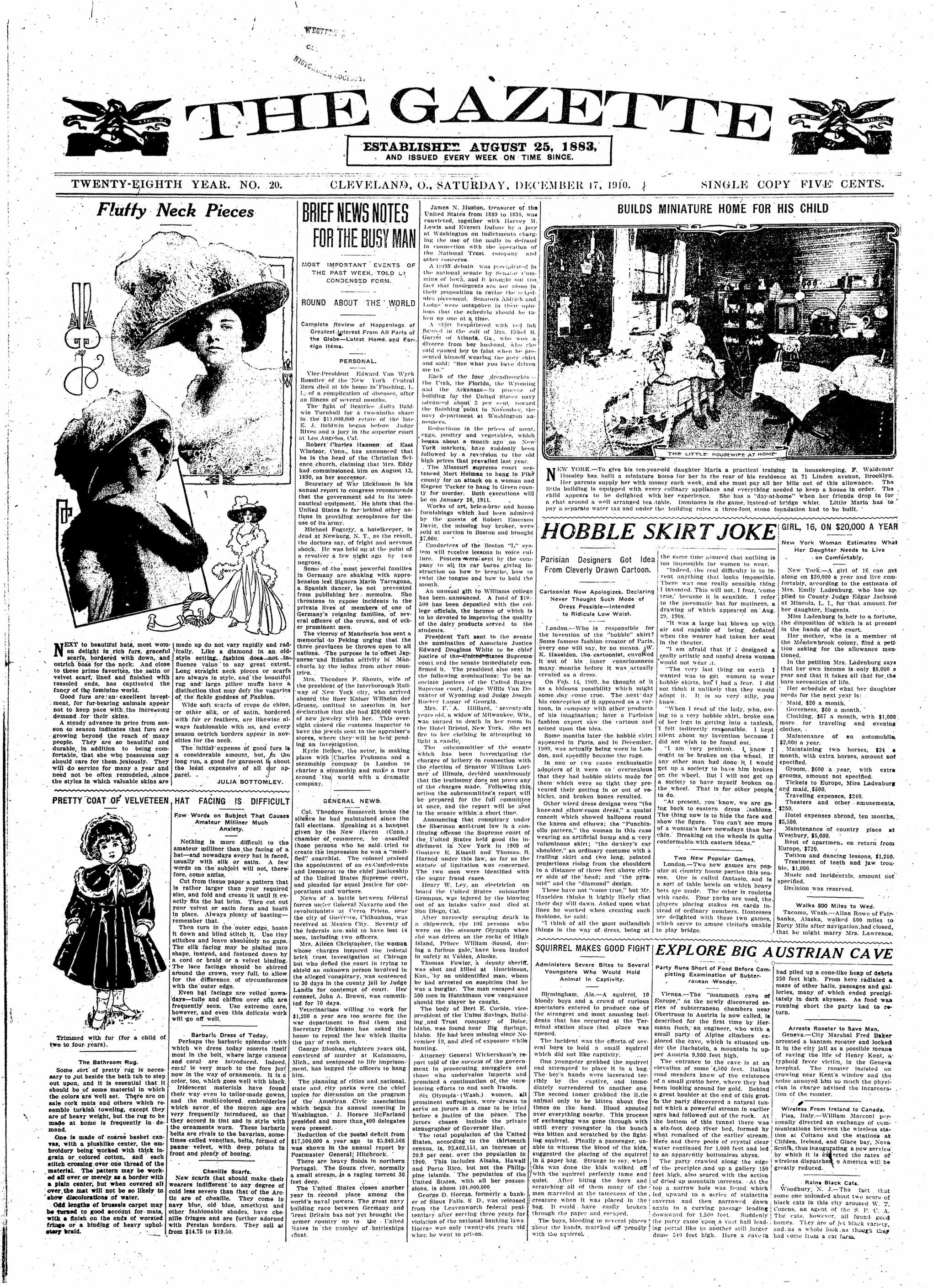

Page text (machine-generated)
TWENTY-EIGHTH YEAR. NO. 20.
Fluffy Neck Pieces
NEXT to beautiful hats, most women delight in rich furs, graceful scarfs, bordered with down, and ostrich boas for the neck. And close to these prime favorites, the satin or velvet scarf, lined and finished with tassoled ends, has captivated the fancy of the feminine world.
Good furs are: an excellent investment, for fur-bearing animals appear not to keep pace with the increasing demand for their skins.
A steady advance in price from season to season indicates that furs are growing beyond the reach of many people. They are so beautiful and durable, in addition to being comfortable, that she who possesses any should care for them jealously. They will do service for many a year and need not be often remodeled, since the styles in which valuable skins are
Trimmed with fur (for a child of two to four years).
The Bathroom Rug.
Some sort of pretty rug is necessary to put beside the bath tub to step out upon, and it is essential that it should be of some material in which the colors are well set. There are on sale cork mats and others which resemble turkish toweling, except they are of heavy weight, but the rug to be made at home is frequently in demand.
One is made of coarse basket canvas, with a plushlike center, the embroidery being worked with thick ingrain or colored cotton, and each stitch crossing over one thread of the material. The pattern may be worked all over, or merely as a border with a plain center, but when covered all over, the mat will not be so likely to show discolorations of water.
Odd lengths of brussels carpet may be turned to good account for mats, with a finish on the ends of worsted fringe or a binding of heavy upholstery braid.
mado up do not vary rapidly and radically. Like a diamond in an old-style setting, fashion does not influence value to any great extent. Long straight neck pieces or scars are always in style, and the beautiful rug and large pillow muffs have a distinction that may defy the vagaries of the fickle goddess of Fashion.
Wide soft scarfs of crepe de chine, or other silk, or of satin, bordered with fur or feathers, are likewise always fashionable with us, and every season ostrich borders appear in novelties for the neck.
The initial expense of good furs is a considerable amount, but, in the long run, a good fur garment is about the least expensive of all our apparel.
JULIA BOTTOMLEY.
Few Words on Subject That Causes Amateur Milliner Much Anxiety.
Nothing is more difficult to the amateur milliner than the facing of a hat—and nowadays every hat is faced, usually with silk or satin. A few words on the subject will not, therefore, come aniss.
Cut from tissue paper a pattern that is rather larger than your required size, and fold and crease it until it exactly fits the hat brim. Then cut out your velvet or satin form and baste in place. Always plenty of basting—remember that.
Then turn in the outer edge, haste it down and blind it stitch. Use tiny stitches and leave absolutely no gaps. The silk facing may be plaited into shape, instead, and fastened down by a cord or braid or a velvet blinding. The lace facings should be shirred around the crown, very full, to allow for the difference of circumference with the outer edge.
Even hat facings are velled nowadays—tulle and chiffon over silk are frequently seen. Use extreme care, however, and even this delicate work will go off well.
Barbaric Dress of Today
Perhaps the barbaric splendor with which we dress today asserts itself most in the belt, where large cames and coral are introduced. Indeed, coral is very much to the fore just now in the way of ornaments. It is a color, too, which goes well with black. Fridesse materiales have found their way even to tailor-made gowns, and the multi-colored, embroideries which savor of the moyen age are very frequently introduced, so that they accord in tint and in style with the ornaments worn. These barbaric belts are rivals to the bavarian, sometimes called venetian, belts, formed of pane velvet, with deep points in front and plenty of boning.
Chenille Scarfe.
New scarfs that should make their wearers indifferent to any degree of cold less severe than that of the Arctic are of chenille. They come in navy blue, old blue, amethyst and other fashionable shades, have chenille fringes and are further adorned with Persian borders. They sell at from $14.75 to $19.50.
BRIEF NEWS NOTES FOR THE BUSY MAN
BRIEF NEWS NOTES FOR THE BUSY MAN
MOST IMPORTANT EVENTS OF
THE PAST WEEK, TOLD LY
CONDENSED FORM.
ROUND ABOUT THE WORLD
Complete Review of Happenings
of Greatest Interest From All Parts of
the Globe—Latest Home. and
Foreign Items.
PERSONAL.
Vice-President Edward Van Wyk Rosseri of the New York Central lines died at his home in Flushing, L. L. of a complication of diseases, after an illness of several months.
The fight of Beatrice Anita Baldwin turnbull for a two-month share in the $11,000,000 estate of the late E. J. Baldwin began before Judge Rives and a jury in the superior court at Los Angeles, Cal.
Robert Charles Hannon of East Windson, Conn., has announced that he is the head of the Christian Science church, claiming that Mrs. Eddy had commissioned him on August 13, 1890, as her successor.
Secretary of War Dickinson in his annual report to congress recommends that the government add to its aeronautical equipment. He hints that the United States is far behind other nations in providing aeroplanes for the use of its army.
Michael Fogarty, a hotelkeeper, is dead at Newburg, N. Y., as the result, the doctors say, of fright and nervous shock. He was held up at the point of a revolver a few night ago by two negroes.
Some of the most powerful families in Germany are shaking with apprehension lest Signora Marin Tarragona, a Spanish dancer, be not prevented from publishing her memoirs. She threatens to expose incidents in the private lives of members of one of Germany's reigning families, of several officers of the crown, and of other prominent men.
The viceroy of Manchuria has sent a memorial to Pekin urging that the three proviles be thrown open to all nations. The purpose is to offset Japanese and Russian activity in Manchuria by the influx from other countries.
Mrs. Thecodore P. Shonts, wife of the president of the Interborough Railway of New York city, who arrived aboard the liner Kaiser Wilhelm der Grosse, omitted to mention in her declaration that she had $2,000,000 of new jewelry with her. This oversight caused the customs inspector to have the jewels sent to the appriser's stores, where they will be held pending an investigation.
Kyrie Bellew, the actor, is making plans with Charles Frohman and a steamship company in London to charter a steamship and make a tour around the world with a dramatic company.
GENERAL NEWS.
Col. Theodore Roosevelt broke the silence he had maintained since the fall elections. Speaking at a banquet given by the New Haven (Conn.) chamber of commerce, he assailed those persons who he said tried to create the impression he was a "modified" anarchist. The colonel praised the appointment of an ex-Confederate and Democrat to the chief justiceship of the United States Supreme court, and pleaded for equal justice for corporations and workers.
News of a battle between federal forces under General Navarro and the revolutionists at Cerro Prieto, near the city of Guerrero, Chihuahua, was received at Mexico City. Seventy of the federalers are said to have lost 14 men, including two officers.
Mrs. Aileen Christopher, the woman whose charges inspired the federal brick trust investigation at Chicago but who defied the court in trying to shield an unknown person involved in the alleged conspiracy, was sentenced to 30 days in the county jail by Judge Landis for contempt of court. Her counsel, John A. Brown, was committed for 70 days.
Veterinarians willing to work for $1,200 a year are too scarcity for the war department to find them and Secretary Dickinson has asked the house to repeal the law which limits the pay of such men.
George Bloohas, eighteen years old, convicted of murder at Kalamazoo, Mich., and sentenced to life imprisonment, has begged the officers to hang him.
The planning of cities and national state and city parks were the chief topics for discussion on the program of the American Civic association which began its annual meeting in Washington. J. Horace McFarland presided and more than 400 delegates were present.
Reduction of the postal deficit from $17,500,000 a year ago to $5,845,566 was shown in the annual report by Postmaster General Hitchcock.
There are heavy floods in northern Portugal. The Souza river, normally a small stream, is a raging torrent 30 feet deep.
The United States closes another year in second place among the world's naval powers. The great navy building race between Germany and Great Britain has not yet brought the former country up to the United States in the number of battleships threat.
James N. Huston, treasurer of the United States from 1893 to 1894, was convicted, together with Harvey M. Lewis and Everett Dufour by a jury at Washington on indictments charging the use of the mails to defraud in connection with the inception of the National Trust, company, and other concerns.
A staff debate was precipitated in the national senate by Senator Cummins of Iowa, and it brought out the fact that insurgents are not alone in their proposition to revise the schedules piecemeal. Senator Addich and Lodge were outspoken in their opinions that the schedule should be taken up one at a time.
A shirt bespattered with red ink figured in the suit of Mrs. Ehid H. Garret of Atlanta, Ga., who won a divorce from her husband. Who said caused her to falter when he presented himself wearing the gird shirt and said: "See what you have driven me to."
Each of the four droughts—the Utah, the Florida, the Wyoming and the Arkansas—in process of building for the United States may advanced about 3 per cent toward the finishing point in November, the navy department at Washington announces.
Reductions in the prices of meat, eggs, poultry and vegetables, which began about a month ago on New York markets, have suddenly been followed by a revision to the old high prices that prevailed last year.
The Missouri supreme court sent Mort Holman to hang in Pike county for an attack on a woman and Eugene Tucker to hang in Green county for murder. Both executions will be on January 26, 1911.
Works of art, bribe-brace and house furnishings which had been admired by the guests of Robert Emerson Davie, the missing boy broker, were sold at auction in Boston and brought $7,000.
Conductors of the Boston "L." system will receive lessons in voice culture. Posters were sent by the company to all its car bars giving instruction on how to breathe, how to twist the tongue and how to hold the mouth.
An unusual gift to Williams college has been announced. A fund of $10,500 has been deposited with the college officials, the income of which is to be devoted to improving the quality of the dairy products served to the students.
President Taft sent to the senate the nomination of Associate Justice Edward Douglas White to be chief justice of the United States Supreme court and the senate immediately confirmed it. The president also sent in the following nominations: To be associate justices of the United States Supreme court, Judge Willis Van Devanter of Wyoming and Judge Joseph Rucker Lamar of Georgia.
Mrs. F. A. Hillard, seventy-six years old, a widow of Milwaukee, was nurmed to death in her room in the Hotel Bristol, New York. She set fire to her clothing in attempting to light a candle.
The subcommittee of the senate which has been investigating the charges of bribery in connection with the election of Senator William Lormer of Illinois, decided unanimously that the testimony does not prove any of the charges made. Following this action the subcommittee's report will be prepared for the full committee at once, and the report will be sent to the senate within a short time.
Announcing that conspiracy under the Sherman anti-trust law is a continuing offense the Supreme court of the United States held good the indictment in New York in 1909 of Eave E. Kissell and Thomas B. Harned under this law, as far as the statute of limitation was concerned. The two men were identified with the sugar fraud cases.
Henry W. Ley, an electrician on board the United States submarine Grampus, was injured by the blowing out of an intake valve and died at Sun Diego, Cal.
After narrowly escaping death in a shipwreck, the 106 persons who were on the steamer Olympia when she was driven on the rocks of Bighl Island, Prince William Sound, during a furious gale, have been landed in safety at Valdez, Alaska.
Thomas Fowler, a deputy sheriff, was shot and killed at Hutchinson, Kan., by an unidentified man, whom he had arrested on suspicion that he was a burglar. The man escaped and 500 men in Hutchinson vow vengeance should the slayer be caught.
The body of Bert E. Corbin, vice-president of the Union Savings, Building, and Trust company of Boloe, Idaho, was found near Big Springs, Idaho. He had been missing since November 19, and died of exposure while hunting.
Attorney General Wickersham's report told of the success of the government in prosecuting smugglers and those who undervalue imports and promised a continuation of the unrelenting efforts to end such frauds.
Six Olympia (Wash.) women, all prominent suffragists, were drawn to serve as jurors in a case to be tried before a justice of the peace.
The jurors chosen include the private stenographer of Governor Hay.
The total population of the United States, according to the thirteenth census, is, 93,402,151, an increase of 20.9 per cent. over the population in 1900. This includes Alsaka, Hawaii and Porto Rico, but not the Philippine islands. The population of the United States, with all her possessions, is about 101,000,000
George D. Horras, formerly a banker of Sioux Falls, S. D., was released from the Leavenworth federal penitentiary after serving three years for violation of the national banking laws. Horras was only twenty-six years old when he went to prison.
BUILDS MINIATURE HOME FOR HIS CHILD
THE LITTLE HOUSEWIFE AT HOME
NEW YORK.—To give his ten-year-old daughter Maria a practical training in housekeeping. F. Waldemar Hoosleap has built a miniature home for her in the rear of his residence at 71 Linden avenue, Brooklyn. Her parents supply her with money each week, and she must pay all her bills out of this allowance. The little building is equipped with every culinary appliance and everything needed to keep a house in order. The child appears to be delighted with her experience. She has a "day-at-home" when her friends drop in for a chat around a well arranged tea table. Dominino is the game, instead-of bridge whist. Little Maria has to pay a separate water tax and under the building rules a three-foot stone foundation had to be built.
HOBBLE SKIRT JOKE
SQUIRREL MAKES GOOD FIGHT EXPLORE BIG AUSTRIAN CAVE
Parisian Designers Got Idea From Cleverly Drawn Cartoon.
Cartoonist Now Apologizes, Declaring Never Thought Such Mode of Dress Possible—Intended to Ridicule Low Waist.
London—Who is responsible for the invention of the "hobble" skirt? Some famous fashion creator of Paris, every one will say, by no means, W.K. Haselden, the cartoonist, envoiled it out of his inner consciousness many months before it was actually created as a dress.
On Feb. 14, 1909, he thought of it as a hideous possibility which might some day come true. The next day his conception of it appeared as a cartoon, in company with other products of his imagination; later a Parisian fashion expert saw the cartoon and seized upon the idea.
Some months later the hobble skirt appeared in Paris, and in December, 1909, was actually being worn in London, and speedily became the rage.
In one or two cases enthusiastic adoptors of it were so overzealous that they had hobble skirts made for them which were so tight they prevented their getting in or out of vehicles, and broken bones resulted.
Other wierd dress designs were "the knee and elbow room dress," a qualit concet which showed balloons round the knees and elbows; and the "Punchinello pattern," the woman in this case wearing an artificial bump and a very volumilous skirt; "the doxyck's ear shoulder," an ordinary costume with a trailing skirt and two long, pointed projections rising from the shoulders to a distance of three feet above either side of the head; and "the pyramid" and the "diamond" design.
Those have not "come true," but Mr. Haselden thinks it highly likely that their day will dawn. Asked upon what lines he worked when creating such fashions, he said:
"I think of all the most outlandish things in the way of dress, being at
Administrators Severe Bites to Several Youngsters Who Would Hold Animal In Captivity.
Birmingham, Ala.—A squirrel, 10 bloody boys and a crowd of curious spectators entered to produce one of the strangest and most amusing incidents that has occurred at the Terminal station since that place was opened.
The incident was the efforts of several boys to hold a small squirrel which did not like captivity.
One youngster grabbed the squirrel and attempted to place it in a bag. The boy's hands were lacerated terribly by the captive, and immediately surrendered to another one. The second tamer grabbed the lt. the animal only to be bitten about five times on the hand. Blood spouted over everything nearby. This process of exchanging was gone through with until the youngster in the bunch was bitten and scratched by the fighting squirrel. Finally a passenger, unable to witness the blood of the kids, suggested the placing of the squirrel in a paper bag. Strange to say, when this was done the kids walked off with the squirrel perfectly tame and quiet. After biting the boys and scratching all of them many of the men marveled at the tameness of the creature when it was placed in the bag. It could have easily broken through the paper and escaped.
The boys, bleeding in several places about the hands, marched off proudly with the squirrel.
the same time assured that nothing is too impossible for women to wear.
"Indeed, the real difficulty is to invent anything that looks impossible. There was one really sensible thing I invented. This will not, I fear, 'come true', because it is sensible. I refer to the pneumatic hat for matinees, a drawing of which appeared on Aug. 29, 1908.
"It was a large hat blown up with air and capable of being, deflated when the wearer had taken her seat in the theater.
"I am afraid that if I designed a really artistic and useful dress women would not wear it.
"The very last thing on earth I wanted was to get women to wear hobble skirts, but I had a fear. I did not think it unlikely that they would adopt it. It is so very silly, you know.
"When I read of the lady, who, owing to a very hobble skirt, broke one of her legs in getting into a taxcab, I felt indirectly responsible. I kept silent about my invention because I did not wish to be found out.
"I am very penitent. I know I ought to be broken on the wheel. If any other man had done it I would get up a society to have him broken on the wheel. But I will not get up a society to have myself broken on the wheel. That is for other people to do.
"At present, you know, we are going back to eastern dress fashions. The thing now is to hide the face and show the figure. You can't see more of a woman's face nowadays than her chin. Breaking on the wheels is quite conformable, with eastern ideas."
Two New Popular Games.
London.—Two new games are popular at country house parties this season. One is called fantasio, and is a sort of table bowls on which heavy bells are made. The other is roulette with cards. Four packs are used, the players placing stakes on cards instead of ordinary numbers. Hotnesses are delighted with these two games, which serve to amuse visitors unable to play bridge.
Party Runs Short of Food Before Completing Examination of Subterranean Wonder.
Vienna.—The "mammoth cave of Europe," as the newly discovered series of subterranean chambers near Obertrau in Austria is now called, is described for the first time by Hermann boch, an engineer, who with a small party of Alpine climbers explored the cave, which is situated under the Dachstein, a mountain in upper Austria 9,800 feet high.
The entrance to the cave is at an elevation of some 4,500 feet. Italian road menders knew of the existence of a small grotto here, where they had been looking around for gold. Behind a great boulder at the end of this grotto the party discovered a natural tunnel which a powerful stream in earlier ages had followed out of the rock. At the bottom of this tunnel there was a six-foot deep river bed, formed by what remained of the earlier stream. Here and there pools of crystal clear water continued for 1,000 feet and led to an apparently bottomless abyss.
The party crawled along the edge of the precipice, and up a gallery 150 feet high, also seared with the action of dried up mountain torrents. At the top a narrow hole was found which upward to a series of stalactite caverns and then narrowed down again to a curving passage leading downward for 1,500 feet. Suddenly the party came into a vast hall leading portal like to another still larger done 349 feet high. Here a cave in
New York Woman Estimates What Her Daughter Needs to Live on Comfortably.
New York.—A girl of 16 can get along on $20,000 a year and live comfortably, according to the estimate of Mrs. Emily Ladenburg, who has applied to County Judge Edgar Jackson at Mineola, L. I., for that amount for her daughter, Eugenia.
Miss Ladenburg is heir to a fortune, the disposition of which is at present in the hands of the court.
Her mother, who is a member of the Meadowbrook colony, filed a petition asking for the allowance mentioned.
In the petition Mrs. Ladenburg says that her own income is only $8,000 a year and that it takes all that for, the baro necessities of life.
Her schedule of what her daughter needs for the next year is:
Maid, $20 a month.
Governance, $60 a month.
Clothing, $67 a month, with $1,000 more for traveling and evening clothes.
Maintenance of an automobile, $2,000 a year.
Maintaining two horses, $34 a month, with extra horses, amount not specified.
Groom, $600 a year, with extra grooms, amount not specified.
Tickets to Europe, Miss Ladenburg and maid, $500.
Travelling expenses, $240.
Theaters, expenses, $40.
Theaters and other amusements,
$250.
Hotel expenses abroad, ten months,
$5,500.
Maintenance of country place at
Westbury, $5,000.
Rent of apartement on return from
Europe, $720.
Tuition and dancing lessons, $1,250.
Treatment of teeth and jaw trouble,
$1,000.
Music and incidentals, amount not
specified.
Decision was reserved.
Tacoma, Wash.—Allan Rowe of Falee banks, Alaska, walked 500 miles to Forty Mile after navigation, had closed, that he might marry Mrs. Lawrence,
had piled up a cone-like heap of debris 250 feet high. From here radiated a maze of other halls, passages and galleries, many of which ended precipitately in dark abysses. As food was running short the party had to return.
Arrests Rooster to Save Man
Geneva.—City Marshal Fred Baker arrested a bantam rooster and locked it in the city jail as a possible means of saving the life of Henry Kent, a typhoid fever victim, in the Geneva hospital. The rooster insisted on crowing near Kent's window and the nose annoyed him so much the physician in charge advised the incarceration of the rooster.
Wireless From Ireland to Canada.
Pisa, Italy.—William Marconi personally directed an exchange of communications between the wireless station at Caltano and the stations at Clifden, Ireland, and Glace bay, Nova Scotia, thus inaugurating a new service by which it is expected the rates of wireless dispatches to America will be greatly reduced.
Ralns Black Cats.
Woodbury, N. J.-The fact that some one unloaded about two score of black cats in this city aroused W. T. Cozens, an agent of the S. P. C. A. The cats, however, all found good homes. They are of jet black variety, and as a whole look as though they had come from a cat farm.
SUBSCRIPTION, RATES
(In Advance)
One Year. $1.50
Six Months. 1.00
Three Months. .50
Subscribers are requested to remit by postoffice money order or registered letter.
Entered at the postoffice In Cleveland Ohio, as second-class matter
Address all communications to HARRY C. SMITH
Editor and proprietor,
THE GAZETTE,
Blackstone Building, Cleveland, O.
Member Ohio Legislature: 1894 to 1896; 1896 to 1898; 1900 to 1902
THE GAZETTE is the oldest, and has the largest bona fide circulation, double that of any newspaper in the Interest of Afro-American, published in the state of Ohio, and comparison with any will immediately establish his rank as one of the NEWSIEST AND BEST in the country.
Invidious comment and abuse of Dr. W. E. B. Du Bols and Mr. John E. Milholland of N. Y. City, will not efface the truths (and there are many of them) in their articles to the English and other foreign peoples, published some weeks ago, and which are just now greatly agitating the Dr. Booker T. Washington satellites the country over.
Did you notice the "all-up-ups" in the T-p's "editorial" on "Du Bois," last week—referring to him "as a teacher in a modest university," etc.? Dr. Du Bois has not been connected with any university for months. It was doubtless months ago when the "Du Bois" article was written by one of Dr. Booker T. Washington's many press agents or newspaper correspondents, presumably at Washington, D. C. Most of them hold government jobs, you know, and are also devout followers of President Taft.
The Negro Taft shouters must have cast-iron political stomachs to longer stove of the Taft-nauca, etc., in the face of the President's appointment of three southern Democrats, (at least two of whom are ex-rebels), out of four persons appointed to the U. S. Supreme Court bench, in recent months, one of the trio, being elevated from an Associate Justiceship to the Supreme Judgeship, Good Lord! These will make good company for Taft's Secretary of War (Dickinson), another southern Democrat and ex-rebel.
Mayor Herman Beahr-Maschke of this city, among other glaring disabilities (as Mayor), has been most inconsistent in barring from Cleveland the Jack Johnson-Jim Jeffries fight pictures and then permitting last week's indoor circus to pull off what at least one local daily paper seemed pleased to refer to as an imitation lynching in the most up to date style. This last miserable exhibition should have provoked a storm of protest, but it didn't. The roughs and toughs of Cleveland and others, need not be taught how to conduct a lynching. It will not promote the welfare of this community. And even, local Negroes said not a word, in protest.
THE SOUTH'S HANDICAP
The Charleston News and Courier, with a frankness not too common among newspapers and public speakers of the southern states, declares that lynching is a definite and explicable reason for lack of southern growth and progress.
Kentucky's poor census showing is taken by the News and Courier as its text. Night riding, lynching, feuds, cowardly murders are so common in the state of the blue grass that the old. Indian name of "the dark and bloody ground" has taken a new and emphasized significance. Most. Kentuckians, undoubtedly, are gentle and inoffensive persons, but there are enough of the other kind to give the state a bad name. Home seekers are not attracted to the state of feuds, murders and violence. Immigration, not necessarily from foreign countries, but also, from other parts of the United States, is necessary to maintain the normal and healthy growth of a state that, like Kentucky, is almost devoid of large cities. The Kentucky reputation is sufficient to keep away this class of newcomers.
What applies to Kentucky applies in less degree to the more southern states where mob violence and lawlessness is usually limited to the lynching of Negroes. As the News and Courier remarks: "There is never a lynching bee in South Carolina that does not do material injury to the entire state. Home seers value safety of life and assurance of the full protection of property more than they value opportunities to make money and it is impossible to convince them that they and their property will be safe in a state even a portion of whose citizens habitually show their distrust of their courts by taking the law into their own hands." —Cleveland Plain Dealer.
"The more southern states" make up in the lynching of Negroes what they may lack in night riding, feuds, etc. So what applies to Kentucky (and West Virginia) applies with even greater force to the entire south.
THAT CUTLER LECTURE.
Two weeks ago in commenting on Prof. J. E. Cutter's lecture at Mt. Zion church; this city, the Sunday previous on "Lynching as a National Crime." The Gazette took occasion to say certain things as the result of the daily newspaper accounts of the lecture and the statements of intelligent members of the race, both male and female, who heard it. Our comment did not seem to please the professor and some of the Cleveland Association of Afro-Americans under whose auspices the lecture was held, as the following, published in our last issue, will indicate: Harry E. Davis, Esq., secretary,
writes the editor of The Gazette as follows: "At the last meeting of the Association I was directed to call your attention to the apparent error in The Gazette of Dec. 5 in the report of a lecture of Prof. Cutler, delivered November 27. The report does not state that Prof. Cutler mentioned your Ohio Anti-Lynching Law. As a matter of fact, the speaker referred Volunteerly and directly to the Mob Violence of Ohio, and纵火(a copy of Ohio's). In commendation manner, and also the acts empowering the governors of these states to remove a sheriff for dereliction of duty during a root."
Mr. Davis and his Association is in error. We did not say that Prof. Cutler did not mention our Ohio Anti-Lynching law. What we did say, in our local columns, was that the professor did not seem to know that Ohio had an effective Anti-Lynching law, and that Illinois had copied that law, and that before our Ohio Mob Violence law was enacted (in the three years preceding 1896), there were more lynchings and mob violence attempts than there have been, all told. In the sixteen years following 1896—to date; and that lynching in this state had been stopped to the minimum. And, editorially, in the same issue of The Gazette, we published substantially the following:
Prof. Cutler apparently had little or no definite knowledge of what had been accomplished under the Anti-Lynching laws in the North, or elsewhere for that matter, and seemed to care less. As for Ohio, what he said was wrong in the main, and so wrong as to be almost inexcusable coming from a man of his acknowledged education and ability.
Later conferences with some of the most intelligent of our people in attendance upon the Cutler lecture, develops nothing that tends to show that The Gazette was in error when it said that Prof. Cutler did not seem to know that Ohio had an effective Anti-Lynching law. Mr. Davis and his Association evidently overlooked the all important word, "effective."
JUST BECAUSE MAN PROPOSES
It Remains Only for Woman to Prove Herself Adaptable to Circumstances.
If a woman could have the same liberty of choice in the acquiring of a husband as a man has in the selection of a wife, consider the change it would make in the marriage problem and in the divorce court. It by no means follows that because a man loves a woman she loves him. But he may be the only man who loves her, or he may be the only man who is eligible, or the only man her people want her to marry, or any one of 100 onles you can easily think of for yourself. And what then? There may be some unattainable man the woman really does love, but what can she do? Almost nothing! She is bound to choose from the men who come to her. True, she can stay single, and many women do so, and on this very account—that they never have happened to love the men who loved them. But to stay single is not a solution of the question, and it does not appeal to the majority of women.
Nine times out of ten the woman locks up in her heart the ideal of a husband she has formed, or the preferences she has inherited or acquired, or the thought of the other man, and takes the man who wants to marry her, whether or not he is the man she wants to marry. If she is a woman of character she persuades herself and others that he is the man she wants to marry. She lends herself to whatever form his wooing may take.
If he is blond and bearded, though she prefer dark eyes and shaven face, yet you would never guess it from word of hers. She may have assured herself, every day that she will marry only a man of dignity, but she will recant when her suitor proves a clown. She may adore spontaneous merriment and not only marry a straight-laced pride but swear that it is the only kind of a man she can endure. Margareta M. Tuttle in Collier's.
Population of Australia.
An advance estimate of the population of the commonwealth of Australia places the total number of people in the six states as 4,474,000, reports Consul General John P. Bray, Sldney Allowing for what may be styled a normal increase during the months which must elapse before April 1, 1911, when the ten-year census will be taken, there should be at that date a total of 4,500,000. That would represent an increase during the decade of about 725,000,000 or 19 per cent. Taking the nine and three-fourths years to December 31, next, the federal statistician estimates that New South Wales will show an increase of 305,000. Victoria an increase of 127,000. West Australia of 97,000. Queensland of 94,000. South Australia of 61,000 and Tasmania of only 15,500. The estimates follow: New South Wales, 1,661,000; Victoria, 1,328,000; Queensland, 592,000; South Australia, 426,000; West Australia, 280,000; Tasmania, 188,000. It is calculated that West Australia has relatively gained 1.41 per cent. and Queensland 0.03 per cent, but that Victoria had relatively lost 2.14 per cent. Tasmania 0.38 per cent, and South Australia 0.14 per cent.
What Will He Do With It?
A ause wandered into a downtown barber's shop and after being shaved sat down in the bootblack's chair.
"How do you get paid? Wages?" he asked.
"No, suh." answered the bootblack.
"I work on a puhcentage—60 purcent's mine."
"Shickshty p'cent. yours," said the souse, deliberately. "Shickshty p'cent."
"Yes, suh."
"Fyou take in hundred dollars you keep shickshty?"
"Yes, suh."
"Fyou take in thousand, you keep shicksh hundred."
"An hundred thousand, you keep shickshty thousand?"
"Yes, suh."
"My, my," said the souse in puzzled manner, "whatre you gonn' do with so much money?"—Cleveland Press
THE GAZETTE, CLEVELAND, O., SATURDAY, DECEMBER 17, 1910
FRESH OHIO NEWS OUR OWN WRITERS
WHAT OUR PEOPLE ARE DOING IN MANY CITIES AND TOWN8 OF THE STATE.
INTERESTING PERSONAL NOTES
Bocal Functions—Church and Lodge Items—Marrigues and Deathe—Literary, Musical and Other Notes of Interest.
Sandusky—Mr. Noali Williams is very sick—Mr. Stephen Wallace is convalescent; Mrs. Gee, Taylor is much improved. Also Mrs. M. N. Washington—Miss Mary Williamson has returned from Columbus and other southern Ohio cities. The B. Y. P. U. of the Second Baptist church is doing nicely under the leadership of Miss L. Gikkesson and Miss R. Garrett. The latter made an excellent talk to the hoye—his year's subscription to The Gazette is a sensible Christmas gift. Try it and see.
Washington C. H.-Mr. Harry James spent Sunday in Jamestown, and was in Xenia last week—Mrs. Marie Eaton, who visited her brother in Hillsboro, has returned—Willie Anderson Cole and Chris Mason, at a six o'clock dinner—Fred. Clark of Mt. Sterling, Leroy Wadkins of Sabina and Clarence Anderson of Bloomingburg, were here 'the first of the week.' Rev. Woodson is convalescent. Lambago, Mrs. John Mann, Mamie Woodson to the grave are ill—Send The Gazette to a friend for a year as a Christmas gift.
Smithfield—Miss Mary Cooper's entertainment, Saturday evening, was h success. The S. S. superintendent and teachers are arranging a program and supper for Xmas eve—A. L. Grayson who visited his uncle, Mr. E. West, of Pittsburgh, and his sister, Martha, Pittsburgh, Wednesday, on route home.—Mrs. G. Beall and daughter, Jess Minnie, spent Saturday in Steubenville—J. W. Munce, F. Carter and G. D. Binns attended the first named grand daughter's funeral Sunday.—Rev. W. H. H. has a two-story building on three lots on West St. in Steubenville—Sendy to your friends. That is a Christmas gift that will please and benefit.
Cadiz.-Mrs. E. Jackson was dined Sunday by Mrs. Geo. Alexander.-Mr. and Mrs. Doubt will move into the house that Rev. Fox vacated.-Edgar Brown who was seriously injured Saturday, is improving.-Mr. Geo. Newbie who spelled the summer in N. Boston, is rejoicing over a nice fat baby.-Miss Alma White is convalessing.-Mrs. Susie Brown of _____, was the guest of Mrs. Laura Banks.-A fureture will be given at the opera house on the 19th, to raise funds for a piano for Dunbar school.-Rev. Fox has moved into the parsonage.-as a Christmas gift, year's of your friends. The Gazette. Any of your friends will be pleased with so sensible a present.
Correspondents must mail all letters for publication at their main postoffice sufficiently early on Monday (or Sunday) of each week to have them reach The Gazette office on Tuesday morning, and always write also, their names and that of the wrapper, outside of the wrapper about returned copies. Unless this latter is done, proper credit cannot be given you. Lists of names, wedding presents, etc., obituary notices, speeches, resolutions, poetry, inquiries for relatives and advertisements, memorials, etc., must be furnished entertainment to be held in the near future, must be paid for in advance at the rate of ten cents a line, six words to a line. Our rates for display advertisements will be sent on application. Send postnote and not stamps during warm weather.
Bellaire.-Mr. and Mrs. Lewis Murray moved to Steubenville, recently.—Mr. and Mrs. Wheeling last Tuesday evening.—Wm Rideout of Youngstown, was here recently.—The Duke's pavilion dance, last Friday, was a success. The Imperial orchestra rendered fine music.—Geo. Kerns is convalescing.—Dr. Snelson preached to large congregations, Sunday.—Our Ohio race advocate and newspaper. The Gazette is the best. Send It to a friend for a year as a Christmas gift. It will be received by the Trigle and Miss Addie Randolph of Glencoe have been ill.—The Second M. E. church supper was a grand success. All the churches are preparing for Xmas. Also Elmer Harvey's S. S. class, which will give a program.—Lizzle Davis will be home. Christmas.—Melvin Lloyd has a very bad eye. St. Paul's supper, Monday evening, was well attended.—Mrs. Sue White is out of the city.—Jimmie" Jackson visited in Kirkwood, Saturday evening.—Mr. and Mrs. W. Foster have returned to work.—Mrs. Sue able to return to work. He had a hand mashed.—The A. M. E. choir needs a good leader and more male members.
Mt. Pleasant. — A Xmas entertainment at the A. M. E. church, the $6th. — Rey, and Mrs. Bruce, Mrs. Mary A Moore, and Miss Sadie Mercatt attended the funeral of Prof. D. Bruce, in Stenbrenley, Sunday. — Mrs. J. W. White and Miss Alma Bottles are invited to the funeral of Mrs. William visited Mr. Moses Brooks, Monday afternoon. — Clifford Neuby spent "Tuesday in Wheeling and left Friday for Indianapolis." — Invitations are out for the party to be given by the Misses Blanche Becks and Alice Faithful, the 17th. — and Mrs. Logan Jackson spent Tuesday in Bellaire. — Mr. Wilbur Freeman, Mr. Fred Faithful and Lice. Alice, were in town Saturday at Miss Becks, at Miss Becks, Wednesday afternoon. — Mr. and Mrs. K. Freeman were in Dillonale, Saturday. — The A. M. E. church social, Saturday evening, was a success. — Miss Cora Randolph had the lucky number and won the prize. guilt. The W. W. society raised $10 on the quilt. — Mr. C. Neuby was Miss Lizzie Klocke's guest in Emerson, Christmas evening, and Mrs. Field. Field, Mrs. W. W. Sunday. — Try a year's subscription to The Gazette as a Christmas present. Your friends will appreciate It.
Lima.—C. H. Boyd and sister, Mrs. I. Shaughter, of Urbana, were here last week to see their sick brother, Mr. Mose Redman. Mr. B. Black has been very ill.—Miss Maybelle Crockett spent last week in Columbus and Springfield.—Miss Washington C. H., last week, by the death of Mr. Law's agent—Baptist S. S. Xmas tree and exercises, the 24th. Mrs. Mirec Patterson returned
from Detroit, last week—Mrs. Walter Byrd returned, Sunday, from Wron—T. W. Freeman spent last week in Piqua—Reyguson was in the city, last week—Mrs. Emma Williams of Piqua, lectured for women at the University, last week—Mrs. C. H. Young walked out last Monday for the first time in nearly six weeks. She sustained a serious operation at the hospital. Our popular physician, Dr. S. S. Balley, is attending her.—Mrs. Horin is directing the A. M. B. S. S. Xmás music, the W. Webb, violinist, and D. W. Day, superintendent. The choir concerts, Jan. 2.—The Second Baptist church was also largely attended Sunday. Likewise the S. S. and B. P. V. The S. B. S. S. is preparing for a big entertainment, the 24th.—One of the very best Christmas presents is a subscription to The Gazette. Treu
Dayton.—The "Gem City" is blessed with a large number of talented young musicians. Among them are the Misses Stevenson of Gold St. They are fine—Mr. Brown Arnold for 22 years a steward of Eaker St. A. M. E. church, became a steward of St. Mary's Church, and Sunday—The church aid at Mr. and Mrs. S. Washington's Thursday, was a record-breaker. Watch for Mrs. Jane Warmack's, Mr. Geo. Warmack, is expected from Detroit, in a few days.—Rev. C. M. Hoxans, Mrs. Bibbs, Mrs. Hague, Mr. H. Hatcher and "Mother" of umber St. Mrs. Flood of umber St. W. 24 St. of our most talented young ladies and a member of Enelid Av. church, accepted the local agency of The Gazette and is prepared to furnish copies of the paper. Notify her by letter, card or in person if you wish The Gazette delivered at your home. Mrs. Scott of 24 St. was Rev. and Mrs. Flood of 24 St. was Rev. and Mrs. Primus Alston will be at home to their friends for a Postcard shower in honor of their Pearl wedding anniversary, December 30. Their address is 116 Pulsalk St., this city. Elder Alston is pastor of Eaker St. church. Let the shower be a heavy one over Christmas, present a yearly subscription to The Gazette. Try it!
Belfeiontaine, Dr. E. A. White, P. E. of the M. E. church, and Dr. J. M. Gilmore, P. E. of the A. M. E. church, were guests of Rev. and Mrs. J. G. Robinson, last Friday. Mrs. Alexander, mother of Mrs. E. W. Kinechen of Stephenville, died on the 9th, and was buried from Grace A. M. E. church, Sunday, of which Rev. and Mrs. J. G. Gilmore, Rev. and Mrs. chen attended the funeral. The latter will remain until after Christmas. The former is pastor of an M. E. church.
—Mrs. Altn Nelson and husband of Springfield, assisted in the rally, Sunday, at Grace church. The following was reported: Mrs. W. E. and Mrs. Sarah Stewart $75.75); Mrs. A. Burry $18.50); Mrs. A. Burry $18.50); Mrs. Thos. Lewis and committee $20; Mrs. S. Vincent $19.50; Mrs. A. Nelson $12; Miss F. Orlosby $2; Mrs. C. Mays and committee $5.50; Mr. J. Preston and committee $1.50; public collection and by members $19.55; grand total, $232.45, Rev. G. Robinson will go to Philadelphia Jan. 1 to conduct a revival in the church. —Douglass Robinson will assist in Dayton during the holidays. Little-Lester Clark, Irene Hues, Mrs. M. Newson, Mrs. F. L. Archie and others will be convalescing. —The W. M. society held a pleasant meeting at Mrs. E. Harper's, and the Juvenile brauch met at the Misses Jackson S. Detroit St. — (Correspondent must mail newsletter earlier on Mondays. —Ed.) Tell your friends and acquaintances with the Gascette as a Christmas present, Nothing better, and it will be thoroughly appreciated, too.
Youngstown—Buckeyeodge added new members at a special meeting Thursday evening, Mr. and Mrs. Will Rideout visited Mrs. Jas, Pryor of Bellaire, and also in Wheeling and Steubenville, two weeks—Mrs. Josephine Finner was the guest of Mrs. Minnie Saunders in 'Homestead,' Mr. and Mrs. Julius Roberts left Sunday to check on husbands in his house, Marsh塞尔—Mr. Joe Davis of Pulaski, Va., is here to locate—Good Hope church gave a successful oyster-supplier at Mr. and Mrs. E. Norris in Hubbard, Monday evening—Buckeye lodge's memorial services, Sunday afternoon, at Oak Hill Ave. A. M. E. church, was certainly a conspicuous success, and the members have every reason to feel pleased. A fine, long program of events, the eulogies were very good. The collection; Lodge, $15.40; congregation, $10.20, Total, $25.70. This was given the church, Rev. Jesse Smith, the pastor, and Dr. J. H. Jones, P. E. delivered splendid addresses, Dr. C. A. Petiford, Archie Thomas and J. H. Bobson, committee of arrangements, Officers: G. M. Fagan, exalted ruler; Burke, esteemed leading Knight; William Hicks, esteemed knight; C. M. Murray, esteemed lecture knight; J. H. Bobson, secretary; Dr. Petiford, treasurer; John Clark, esquire; Harry Hicks, inner guard; William R. Saunders, tyler; W. H. Milton, chaplain—Mrs. A. E. Loverute of Cincinnati, G. W. C. of the C. of, who returned to the city from several eastern Ohio cities, has gone to Columbus and Springfield. While here she was Mrs. Gaines 'Guest,' hundreds of those threw through Ohio, and especially Ohio, send The Gazette for a year to friends as a Christmas gift, and it is always thoroughly appreciated. Remember your friends in the same way.
Steubenville—The old saying that "the proof of the pudding is in the eating" is singularly exemplified in the reading of The Gazette and any other race paper that circulates in this city. As a matter of fact, the "old reliable" Gazette has more real good race news (and all the truth) than any of the others and this is easily proven by a careful reading. One does not have to take the statement of any person because they can easily ascertain this fact for themselves.—Prof. D. Bruce, who died in Virginia, aged 78, was impressively-buried Sunday afternoon from Quinn church. He was pleased to have a pointless memoir Frederick Mathews to the chair of science and mathematics at Freedman's College, Tallahassee, Fla. He was the only Afro-American who ever completed a four years' classical and commercial course in
ATTENTION, READERS!
Don't throw away your copy of The Gazette when you have done with it, but give it to some appreciative person whom you feel would be likely to subscribe or take it regularly. If they had a copy to look over and read carefully. Oblige the Editor.
three years at the local High School, Prof. Stewart Bruce and wife of Mr. Peasant, attended his mack's funeral. Also Mr. Brooks of E. L., who was here with the ledge, Miss Will will soon be in Bainville. Mr. Robinson was the guest of Mrs. Robinson. She also attended the funeral of Prof. Bruce, who was her uncle—Ernest Jackson is attending college in Springfield—Mr. Clarence Linear of Smithfield, is visiting his sister, Mrs. G. Johnston—Mrs. Eliza Mercer entertained the W. R. C. last Tuesday evening—Walter Gosset, son of Mrs. Green, now of Chicagoland, gave invitations in Europe this winter—The 20th Century Literary society of Quinn church, will reorganize after the holidays—While in Canton, Rev. E. W. Kinchen was an ex-Mayor's guest and was royally entertained by him and his family—Mrs. L. Robinson is convulsive—Keep up to date and read the Gazette, our best race advocate and newspaper. Give the local newspaper a week, and send it to your friends for a year as a Christmas gift. They will appreciate so sensible a present.
MAKE SOME MONEY.
The old reliable Gazette desires an active agent, and correspondent in every city and town in Ohio and neighboring states having a number of Afro-American residents. Only a little time on Fridays or Saturdays is required. We are especially desirous of hearing from persons in the following cities: Zaneville, Newark, Lancaster, Lebanon, Chillicothe, Tebulo, Urbana, Columbus, Cambridge, Martins Ferry, St. Clairsville, Wilmington, Portsmouth, Canton, Oxford, Sabina, Gallipolis, Delaware, M. Vermon, East Liverpool, Wellsville, Hamilton, Middleport, Lorain, O., and other places where we have none.
Write to the editor of The Gazette, Blackstone building, Cleveland, O., and terms will be sent promptly. On request, please contact the address of any good person or persons in any of the titles named above or others, to whom we can write relative to the matter.
She Starts Mob Suit.
Worster, O. The boss. Common pleas court. Tuesday, started to hear the suit of Mrs. Alice Jennings as administrator of Ward E. Boley to recover $5,000 damages from the county for the killing of Boley. A year ago Boley, who was insane, opened from the Massillon hospital and after an eviting chase of three days was killed by a member of a posse. Mrs. Jennings claims that the county was responsible for Boley's death, in that Boley was hunted down and killed by a mob. The suit is under Hort. Harry C. Smith's Ohio Mhc Violence law. Mrs. Jennings is "white." So was Boley.
Maryland Securigation!
Baltimore, Md. An ordinance, the purpose of which is to bring about the segregation of Negro residents of this city, has passed the second branch of the city council. It had already been favorably acted upon by the first branch. Mayor Mahod may sign it as soon as he has satisfied himself that it is legal. The ordinance will early find its way into the courts, as many doubt its constitutionality.
That Newark Lynching!
Newark, O. "The trial of Montella Watha, a Haitian Negro, for first degree murder in connection with the recent lynching of Carl Etherington, dry detective, was resumed Monday. Six witnesses, among them Mrs. Bessle Hoppt of Columbus, either said that man that exhorted the mob to lynch the detective or that they saw a "Negro" speaking to the crowd.
Thirty New Species of Fish.
The wilds of Africa are just beginning to be accessible to the naturalist. The country is sufficiently broken in the interior now to allow a man to study at his leisure without the constant horror of the unknown hanging over him. The latest expedition into the Anfofa country of West Africa has brought forth 20 new species of fish hitherto entirely unknown to the scientific world. Dr. W. J. Anorges brought back to the British museum more than 1,000 specimens of all, and, of course, the vast lithological world still unexplored lies as a tempting bait to other students since the possibilities of the dark continent are just beginning to be appreciated.
When it becomes possible to explore methodically every corner of the great interior the biologists, mineralogists, and all the others in the field of science will doubtless make finds that will supply material for volumes.
Another Theory Knocked Out
"You say there's nothing in environment?"
"Yes, sir. I insist that it's the individual, and not his surroundings. If a man is going to be great he'll be great in spite of everything."
"Well, now, wait a minute. You used to be considered quite an important figure down in the little old home town, didn't you?"
"I am proud to say that everybody thought well of me there."
"You're just as great now as you were then, aren't you?"
"I hope I am a good deal, greater than I was then."
"Well, you see it all depends on environment, as I said. There you were somebody; here you have to get some one to identify you when you want to cash a check for $5."
"Now, there's where you're dead wrong, old man. I know a bartender who always cashes my checks without a kick."
Wanted Epitaph to Endure.
Edmond de Goncourt, the French novelist, admitted that he worked with an eye to his epitaph, and he wanted the epitaph to endure for a long time. He records in his journal that "the thought that the world may perish, may not last forever, is one which occasionally fills my mind with gloom. I should be defrauded by the destruction of this planet, for I have written only in the hope of eternal fame. A reputation lasting 100 years, even two thousand years, would be a poor return for the pain I have taken, the privations I have suffered. Under these conditions it would have been better to lounge simultaneously through life, draping and smoking my time away."
"DRAWING LONG BOW"
STORIES THAT STRAIN ONE'S
POWER OF BELIEF.
Baron Munchausen Beaten to it by Some of the Ancients—Remarkable Bow-and-Arrow Story of Virgil.
Many "long bow" stories are to be found in the world's literature long before the time of the celebrated Baron Munchausen. Indeed, by far the greatest part of them had their origin in the remote past.
Virgil, in the Acneid, tells of four archers who were shooting for a prize, the mark being a pigeon tied by a cord to the mast of a chip. The first man lifts the mast, the second cut the cord and the third shot the pigeon as it flew away. The fourth archer, having nothing left as which to shoot, drew his bow and sent his arrow flying toward the sky with such speed that the friction of the air set the feathers on fire and it swept on like a meteor, to disappear in the sky.
That's a bow and arrow story to test the strongest credulity.
The stories of Robin Hood's archery, Illustrated by his wonderful performance at Locksley in Scott's "Vanhoe" are also a decided strain on one's power of belief.
The famous legend of William Tell is believed by some authorities to have a foundation in fact. There was a Dane named Fok of whom the same story was told, and William of Clousley, an Englishman, is said to have shot an apple from his son's head merely to show his skill.
The majority of bow and arrow stories relate to the accurate aim of the archers, but a Frenchman, Blaise de Vigere, tells one in which the main point is the tremendous force with which an arrow may be propelled if the bow is strong and long enough. According to his own account of the matter, he saw Barbarossa, a Turk, admiral of a ship called the Grand Solyman, send an arrow from his bow through a cannon ball. Whether the cannon ball had a hole in it or not he neglects to inform us.
Perhaps the most astounding of all stories about arrow shooting' is that of the Indians who used to inhibit Florida. It is said that a group of them would form a circle, one would throw an car of Indian corn into the air, the rest would shoot at it and shell it of every grain before it fell to the ground. Sometimes the arrows would strike the car of corn so hard and fast that it would remain suspended in the air for several minutes and the cob never fell until the last grain had been shot away.
Story of George Eliot.
Mrs. Walford, the English novelist, has been publishing her recollections. Among her amusing stories is this of George Eliot: "The famous authoress was being fed at Cambridge, and a few enthusiastic and very youthful admirers were permitted to join a luncheon party given in her honor, though accommodation could only be found for them at a side table. They could, however, look and listen, and as there was not much to look at they listened the more. The large, full lips seemed to be emitting words of wisdom; then craned their necks, they stretched their ears. Suddenly the tension was relieved; they leaned back in their chairs and laughed as only boys ever laugh. What had they board? The deep voice that should have pronounced judgment" on a Cleo or a Sophocles had exclaimed for fervid protest: "But, surely, Mr. Sound-So, you do not mean to say you really like that bitter Bairisch beer?"
Bird That Depends on Mate for Life.
Bird That Depends on Mate for Life.
A final attempt is being made by the New Zealand government to obtain specimens of the hula, a bird which has been practically exterminated by the vogue for its feathers which obtained among the Maoris.
The hula is a jet black bird, with a white band at the extreme end of its tall feathers. The birds are hatched in pairs. The mule has a short strong beak and the female a long, slender, incurved beak; the male breaks the bark off dead trees and the female then dips her beak into the holes of the big grubs which attack dead timber. She presents one grub to her spouse and then has one herself, alternating most consciously.
The Maoris say that when one dies the other must necessarily die of starvation, because nature has so arranged that each is dependent on the other.
A Woman's Living Wage.
The New York board of education's salary commission has been making an investigation and says that $600 a year is not enough for a woman to live independently of others. She must make at least $15 a week, the report says. With $600 a year only, she must get her own breakfasts, pay 15 cents for lunchroom and no more than 25 cents for dinner. Her room rent must not exceed four dollars a week. Then during illness or summer vacation she must live on her relatives.
Trouble in the Head.
Bacon—Where has he gone for a weekend?
Egbert—To the doctor's.
Bacon—Where?
Egbert—To the doctor's. Didn't you save for a weak end?—Yonkers Statesman.
One of the Real D. A. R.
Mrs. Mary Briggs Mitchell of North Scotium, Mass., is now ninety-seven years of age and is one of the few surviving real Daughters of the Revolution. She has 14 great-grandchildren, which shows pretty conclusively that she has seen a great deal of life.
A Temporary Truce
"Still agitating for the suffrage, my dear."
"Well, just at present I'm trying to get my husband to buy me a pony."
DOINGS
OF
THE
RACE
"Cuban" players who are beating
big league teams in Havana are most
in Ariz. Americans
Gilbert Holkins, of Wilmington, N.C. is one of the largest rice farmers in the country. His business each year amounts to thousands of dollars. Arthur McCanley, of Phoenix, Ariz. employed as porter in a bank, has perfected a floor oiler and waxer on which he has been granted letters of patent. President Tart is too busy appointing soiling excretes and Democrats to U.S. Supreme Court to ever think of appointing Lewis and Coirtrill or any other Afro-American to office. Samuel McDord, of Hestle, Wilcox County, Aha, is making a good living off two acres of ground. He raises a variety of crops and has for years been harvesting two bales of cotton from it, also. Steven Bundy, after 27 years of service as porter on the New York Central lines, has retired. During his own purchases property in Philadelphia, Jersey City and N. Y. City that is estimated at $160,000.
Champion Jack Johnson, in pursuance of his purpose to invest his ring earnings in Chicago real estate, has secured an option on the property in State St., near 11st St., known as the South Side Turner hall, at a price said to be $60,600.
There is not a reader of The Gazette, "the old reliable," but who will agree that the Doings of the Race provide alone in worth several times the price of the paper. Subscribe at once and advise your friends and acquaintances to do likewise. That is the way to help improve the paper as we are always desirous of doing.
Rev. Isaac Abbrey of Castleberry, Ala., made $4,000 off of 20 acres of strawberries, last season. He owns 190 acres of land, runs a large store and rents several houses of his own in the town. Daniel Cunningham, of the same plan, also owns 100 acres of cotton sweet potatoes, peas, peanuts, etc. Last season he gathered and shipped $550 worth of strawberries.
Sam' Langford whipped another "white" pugilist (Harris) in N. Y. City last week, in two rounds, and will leave for England, next month, for some more battles. Sam has whipped about all the American fighters, Colored and, in his class, except Jack Johnson and is undoubtedly the second best fighter in the world. Then come Joe Jeannette, and Sam, Mei All Aro-American. Under the auspices of the National Association for the Advancement of Colored People a lecture-cecital was given Dec. 7 in the Berkley theater. N. Y. City, Mrs. Mary Church Terrell, a member of the Board of Education at Washington, D. C., talked on the social and economic progress of the women and Mme. E. Azalta Hackley spoke of the development of musical ability among members of the race. She also sang, "Who shall be the publicity of the association's on that organization's aims. The association developed from a movement begun on the Lincoln century to help eliminate the so-called "Negro problem."
FEARING A DISTRUSTFUL MA.
Bunyan's Fine Description of Individual Who Had No Confidence
In Himself.
Why, he was always afraid that he should come short of whither he had a desire to go. Everything frightened him that he heard anybody speak of that had but the laust appearance of opposition in it. I hear that he lay roaring at the Slough of Despond for about a month altogether; nor durst he, for all he saw several go over before him, venture, though they, many of them, offered to lend him their hand. He would not go back again neither. The Celestial City, he said, he should die if he came not to it; and yet was dejected at every difficulty and stumbled at every straw that anybody cast in his way.
Well, after he had lain in the Slough of Despond a great while, as I have told you, one sunshine morning, I do not know how, he ventured, and so got over; but when he was over he would scarcely believe it.
He had, I think, a Sleugh of Despond in his mind; a slough that he carried everywhere with him, or else he could never have been as he was—From Bunyan's "Pilgrim Progress."
Country of Small Fortunes.
Equal distribution, liberty of work, the responsibility which springs from it, the taste for thrift, which it engenders, the consciousness that each individual is the architect of his own fortune, have made France the country of small, but numerous fortunes, a writer in Moody's Magazine. At the beginning of the last century the dividing up of landed property was the chief manifestation of this division of wealth. The number of successions declarations has continued to grow. In 1906 there were declared 70 successions per 160 deaths of persons over twenty years of age; 75 per 100 deceased persons over thirty years of age; 84 per 100 deaths of persons over forty years. In 1945 there were 1,346,000 licensed persons and 1,842,500 in 1905. The latter figure includes the liberal professions. The number of licensed traders for commerce and industry amounted in 1905 to 1,720,000; that is to say, license for every 23 inhabitants.
---
Call your lady friends' and acquire their information to our up-to-date list and pattern department and to ensure are these to purchase or use The Gazette regularly. Oversee the Editor.
LOCAL NEWS
NOTICE TO SUBSCRIBERS:—Subscribers not receiving The Gazette regularly should notify us at once. We desire every copy delivered promptly. We advise our patrons to carefully examine The Gazette's advertisements before making purchases. Business men who advertise in this paper should have the patronage of Afro-Americans. The fact that they advertise is assurance that they want it. Local reading notices (advertisements) ten cents a line (six words in a line.)
For Rent—Furnished room, suitable for man and wife, or two gentlemen. No. 2244 E. 40th St., near Central Ave.
For Rent—Cottage; five nice rooms, including two bed rooms, large cellar, and an attic (the entire length of the cottage) that has a good, high ceiling and a good floor. All in excellent condition. For a small family of two or three. Rent, $15 per month. Apply at The Gazette office.
Miss Addie Hackley is able to attend to her school duties again but it is one of the hardest things to be learned by many that a newspaper has space to rent and must rent to live. To give anything for less than living rates is as fatal to a newspaper as for the landlord to furnish rent free—Ex.
Some one in Washington, D. C. evidently wrote the T—p's "editorial" on "Du Mois," last week. The car marks are so glaring and numerous.
Last Friday the building owned by the Metropolitan Mercantile and Realty Company, located at 40th St. and 5th Ave., was sold at a mortgage force.
Send The Gazette for a year to a friend. It will be a Christmas gift that will be thoroughly appreciated.
The Hiawatha club met at Mrs. Wm. McIntyre's, E. 71st St., Tuesday afternoon, and held a very interesting meeting.
The lyeum sacred musicale will be held Sunday afternoon at St. John's church, Mrs. Kittie S. Mitchell will direct it.
If you owe The Gazette call at the office and pay, please, promptly, and don't wait for the collector. It is pleasanter, all around.
When you want the real thing—a good, clean and wholesome home-cooked dinner, go to Mrs. Anita Lee's restaurant, 3663 Central Ave., corner E. 37th St., about 6 p. m.
The editor of The Gazette acknowledges the receipt of an invitation to attend the wedding of Carrie A. Stokes and Mr. Johnson Maddie, Dec. 24 at & p. m., at her home, No. 9614 Quechee
Dr. A. J. M. Howard of 2336 E. 31st St. is one of our most energetic and tireless professional men. That accounts in a large degree for his success. Of course the doctor is thoroughly proficient.
The "card party" given as a testimonial to Mrs. Georgia Evans, E. 40th St. at Mrs. J. W. Wills, Tuesday evening, proved a success. Mrs. Evans who is seriously ill, will be taken to her parents' home in Buffalo.
The "old reliable" Gazette is in its twenty-eighth year. Subscribe and tell your friends and acquaintances, to do likewise, and keep up to date in a knowledge of what the race is doing that is creditable and encouraging.
Wm. B. Direys of 7918 Quincy avenue does all kinds of mason work and plastering, lays cement sidewalks, drives and cellar bottoms, contracting and jobbing. All work guaranteed. Bell E. 1995-X.
Go to the Korner & Wood Co., 737 Euclid Ave., just west of E. 9th St. and purpurea copies of "Scenes in Real Life" by Geo. E. Stone. They will make beautiful Christmas presents and are cheap—three for a quarter. Dr. C. Latrobe Mottley, our veteran physician and one of the very best in the city, has moved from 110s to 2112 Central Ave. Many of his patients in that section of the city will be greatly pleased, as will also the general public. St. John's church was well-filled Sunday evening to hear the address of the editor, "The Gazette on "The Moral and Social Uplift of Our People of this Community." Dr. Bundy introduced the speaker and at the conclusion, nearly all of the large congregation came forward to the altar to congratulate him, many, including the pastor, asking him "to come again, soon."
Some man and his wife by the name of Anderson, the former claiming to be an attorney, who came here from Steubenville recently, and who claimed to have been forced to flee from Jackson, Miss., as the result of defending an Afro-American in a peronage (slavery) case, coopted a goodly sum of money from the Cleveland association of Afro-Americans, several ministers and other local individuals. We claimed to be en route to Canada.
The editor of The Gazette went to Lorain from Oberlin after the Du Bois lecture Wednesday night, as the guest of Mr. and Mrs. D. C. Fisher and Miss Ruth Fisher. Our people of Lorain chartered a suburban car to take them to Oberlin to hear Dr. Du Bois' lecture, that evening, and the filled the car, too. Du Bois was a guest at the Fisher's in Lorain, and arriving in Cleveland just in time for his lecture at St. John's church in the evening.
The "New Site" Club, which held its first meeting at Mrs. Arthur T. Abbott's, on the first, will meet at Mrs. Burbridge's, E. 101st St., on the 14th, Mrs. Blanche A. Gilmere was elected president and Mrs. May Evans, vice president, and excellent results are confidently looked forward to. The club starts off most encouragingly. It is greatly interested in the drama, "East Lynne," which will be given in Perry Theater on the 26th. Help the club make it a great success.
Men who want to be janitors in the new federal building must be able to lift, shoulder and carry with ease a mail sack with contents weighing 125 pounds. The applicants need not be able to write and don't have to stand an educational test. The prospective janitors must be between 20 and 60 years of age, but there is no age limit for honorably discharged civil war veterans. Examinations will be held for janitors and for charwomen for the new building on December 23. The pay of janitors is $600 a year and that of charwomen $300.
Every line in a newspaper costs the proprietor something. If it is for the benefit of the individual alone, it should be paid for. If the grocer was asked to contribute groceries to one abundantly able to pay for them, he would refuse. The proprietor of a newspaper must pay for the free advertising, if the beneficiary does not;
but it is one of the hardest things to be learned by many that a newspaper has space to rent and must rent to live. To give anything for less than living rates is as fatal to a newspaper as for the landlord to furnish rent free.—Ex.
Some one in Washington, D. C., evidently wrote the T—p's "editorial" on Du Mois' last week. The ear-marks are so glaring and numerous.
Last Friday the building owned by the Metropolitan Mercantile and Realty Company, located at 46th St. and 8th Ave., was sold at a mortgage foreclosure to Albert C. Bachman for $45,000. The company was unable to meet the first mortgage, amounting to $26,553.30. Back taxes amounting to $4,186.22 were also held against the property. The sale was brought about only after a desperate but unsuccessful attempt on the part of the officers of the realty company to secure sufficient money to satisfy some of the clamoring creditors, several of whom have been threatening to take drastic action for a number of months. N. Y. Age. There are a number of Cleveland Afro-Americans who are financially interested in the Metropolitan M. & R. Co. They are stockholders, etc.
There was no good reason why Antioch church's trouble last week should have been made so much of by the local daily papers. They do not do so as a rule in the case of their own church troubles. Another thing, there was really no good reason for the newspaper and Justice Court "turmoil," either, that was thrust upon the church, as its explanation in the local papers of the past week makes clear. Antioch is not only able but willing to pay what it owes and is doing so as rapidly as any reasonable person who worked on the church-building, has any right to expect from one of our churches. The trouble seems to have originated in the jealousy or other ill feeling of former members of the church's board of trustees. Antioch's affairs and congregation are in excellent condition. There may be a title "pruning" but that sometimes necessary to make the "plant" grow even better. In the annual meeting of the church which will take place on the 29th, the financial-report will show that Antioch has raised more money without outside help the past year than ever before in its history.
F. Mitchell, butler at the Chagrin Valley Hunt club, who ran amuck with a loaded revolver at the clubhouse Monday and narrowly escaped wounding Susie Oyala, a maid, was sentenced to 20 days in the workhouse by Squire Brown, Tuesday. Two members of the club will pay his salary while he is in the works. Mitchell was advised by Attorney John Green, at the request of Capt. Otto Miller of Troop A and Attorney R. Hitchcock, club members, who represented Miss Oyala, to plead guilty to assault and battery. Green wanted assurance of a fee before appearing for Mitchell. Miller retained him and later wrote out a check for $25 for services. Miller and Hitchcock will pay Mitchell's wife, who lives at 901 Blaine Ave, the butler's regular salary while he is in the works. "We must protect the women servants at the club," Miller said in court. "The club is in an out-of-the-way place and it is hard to call in assistance." Mitchell was drunk when he shot. The Wonder where he got the liquor? If at the club, "Mitch" must have gotten hold of the wrong bottle, and this would be a strange thing for so old and good a butler, to do.
The Christmas spirit is still apparent in the Delineator for January. There are beautiful Christmas illustrations in vivid color by Blanche Greer, Howard Chandler Christy, B. J. Rosseumner and James Moore Preston. The frontpiece is an illustration by Paul Meylan, for "Sarolta" and the cover design is a pretty girl in various shades of green. In "Conversazione," Erman J. Ridwaypled for the understanding and happiness of little children. The fiction marks the beginning of "Sarolta," a new serial by Agnes and Egerton Castle. There is a rollicking story of a proposal by Emery Potle, and a sweet Christmas story by Miriam Cruikshank. The fourth story is by Mary Heaton Vorse, and a new series of "Letters From a Worldly Godmother" is begun. The article this month tell what "Mr. Edison Says" about the marvels of electricity, the experiences of the wife of an American diplomat at the court of Germany, and what is being done for convicts in Colorado under the influence and example of Judge Ben Lindsey and his Children's Court. In "Seven Times a Servant" Anne Forsyth tells of her experiences with an unreasonable mistress, and Mabel Potter Dagget contributes a powerful and convincing article on "The Library's Part in Making Americans."
Prof. W. E. B. DuBois' lecture, Thursday evening, at St. John's church, under the auspices of the Knights of St. John, Jas. A. Rogers, captain, was all that it was expected to be and more. He is a fluent speaker, a splendidly equipped reasoner and made an excellent impression upon his large and intelligent audience, many of whom are still discussing, and most favorably indeed, the lecture. The editor of The Gazette presided and introduced Dr. Du Bois, supplementing the latter's splendid address with a short talk. Then followed three fine musical numbers: V. Wallace's selections for corner from the beautiful opera, "Maritana." by Master Oscar Howard; Verdí's concert "Ave Maria" by Mrs. Grace W. Thompson; and Ovid Musin's concert "Mazurka" for violin and Schumann's
DR. DU BOIS' LECTURE
A Grand Success—Brilliant Attendance—Large Crowd—Personal.
Oberlin, O.—A fine, large audience filled the Presbyterian (white) church last week Wednesday evening, to hear Prof. W. E. B. Du Bois' lecture. About half of those in attendance were of both races and included President King and college professors, male and female, and students. The lecture was under the auspices of the Colored Political Association of Lorain County, of which Mr. D. C. Fisher of Lorain is President and Mr. John Williams of Oberlin, secretary, and was a perfect success. The editor of The Gazette introduced the speaker, who for one hour held, the undivided attention of
M. B.
his audience: It was one of the finest and very best lectures ever heard here and all were strong in their praise of it and the Association for bringing Dr. Du Bois to the city. During the day and the one following he addressed the college students and various classes, several times. Last Thursday afternoon, Dr. Du Bois spent in Lorain, a guest of Mr. and Mrs. D. Fisher and Miss Ruth Fisher, and met a number of the leading ladies and gentlemen of both races of that city. He Jeffs late in , the afternoon for Cleveland, where he lectured to a large audience in St. John's church in the evening, which was also presided over by the editor of The Gazette, who also followed Prof. Du Bois as a speaker.
"Trainererei" (encore selection) by Master Louisa Jones. The two ladies were given excellent piano) accompaniment by Master Lionel Jones, while Mrs. Genera Lucas presided at the organ for the soprano solo. Like the lecture, the music was of a high order, and too, thoroughly enjoyed. The three boys have exceptional control of their instruments for persons of their tender years, and Mesdames Thompson and Muster are so very well known for their uniformly excellent work, that further comment in their case would be superfluous. Dr. Bundy, the energetic pastor of St. John's church, who insists upon keeping pace with the times in everything and is certainly up to date in all matters of racial interest, is entitled to the thanks of our people of this community for bringing here the most distinguished and best educated Afro-American on the public rostrum today. Du Bois is pleading the race's cause as no other man in public life is doing and in the right way. That is what cannot be said of Dr. Booker T. Washington, whose preaching of his "doctrine of surrender" is doing the race incalculable harm and helping no one and nothing except Dr. Washington and his school at Tuskegee. Ten thousand times more harm is done the race generally than the school and its principal do it good, is the natural result of Dr. Washington's "doctrine of surrender" of our rights and privileges to members of the other class "in order that peace may prevail." Our local energy was much in evidence at the lecture. Thursday evening. Seated where they could see and hear best, we noticed Revs. Forte, Bundy, Clark, Webster and Lowrey, H. iv. C. Ellies was kept away by illness but sent a daughter to represent him.
Individuality
Every life is a profession of faith, and exercises an inevitable and silent propaganda. As far as lies in its power, it ends to transform the universe and humanity into its own image. Thus we have, all a cure of souls. Every man is the center of perpetual radiation like a luminous body; he is as it were; a beacon which entices a ship upon the rocks; if it does not guide it into port. Every man is a priest, even involuntarily; his conduct is an unspoken sermon, which is forever preaching to others; but there are priests of Israel, of Moloch, and of all the false gods. Such is the high importance of example.—Aniel's Journal.
Helping Farmer's Wife.
The New York State College of Agriculture at Cornell appropriated money some time ago to the work of a domestic science course, a reading course for farmers' wives being the first thing established. There are now 15,000, farmers' wives taking the course of home study. Questions may be sent to the department and these are answered by specialists. A housekeeper's conference has been organized, which meets during the farmers' convention each year.
Drugstore Removal
Prescriptions Carefully Compounded
Soda Water, Ice Cream, Cigars, Ett.
"NOORAL CITY" Headache
Powders.
Father
Mother
HOIMS
BOOK
MARVELOUS
RACE ASSIMILATION, or
THE FADING LEOPARD'S SPOTS
A complete scientific exposition. The real Eddie Tons' Colin
Albion 20th Century Fox Movie, featured on Quiet in Every Collision
Two Roses. The Crime of the Agen Used by The Station, 50 pages,
pretty 100 mink illustrations by the author. Hickey Alex Waller, James
E. McGinty, Bullock J. Warner, Max E. Kirkpatrick, Negrus, with a revenge.
Only $1.50. Beautiful Agents Outline, 21st
Millions will be sold. Big money for Agents
J. L. NICHOLS & CO., NAPERVILLE, ILLINOIS
No. 4 Special Buggy only $65.00
HIGHEST ORADE
A Value Unqueled. Sold on $1.00 Profit Margin.
FROM FACTORY TO USER
Write for price and other styles. Send for Catalogue.
C. R. PATTERSON & SONS,
GREENFIELD, OHIO.
LARGEST NEWOR CARRIAGE CONCERN IN THE UNITED STATES
WHEN WILL YOU SEND IN YOUR ORDER FOR A
Negro Doll?
Do not wait until ten days before Christmas; send it now; take time by the forelock, for during the holiday season lots of orders are delayed on account of the express companies not being able to handle the enormous lot of goods given to them—order now.
Five cents will get you an illustrated book.
National Negro Doll @.
R. H. ROYD, Press.
H. A. 30 YD. Mgr.
NASHVILLE, TENNESSEE
FORD'S
HAIR POMADE
THE OLD RELIABLE DRESSING FOR
KINNY OR CURLY HAIR. IT'S USE MAKES
STUBBORN, HARSH HAIR SOFTER, MORE
PLIABLE AND GLOSSY, EASY TO CMB AND
PUT UP IN ANY STYLE THE LENGTH WILL
PERMIT, WRITE FOR TESTIMONIES, TELLING
HOW THIS REMARKABLE REMEDY MAKES
SHORT, KINNY HAIR GROW LONG AND
WAVY. BEST POMADE ON THE MARKET
FOR DANDRUFF, ICHING OF THE SCALP
AND FALLING OUT OF THE HAIR.
BEWARE OF IMITATIONS, GET THE
GENUINE, PUT UP IN 25S AND 50S BOTTLES
WITH CHARLES FORD'S
NAME ON EVERY PACKAGE.
SOLD BY DRUGGISTS.
IF YOUR DRUGGIST CANNOT SUPPLY
YOU,WE WILL SEND IT TO YOU DIRECT
AT THE FOLLOWING PRICES,SMALL SIZED
BOTTLE,25* LARGE SIZED BOTTLE,50*
THE OZONIZED OX MARROW CO.
216 LAKE ST.,DEPT. 62 (CHICAGO,ILL.
AGENTS WANTED.
Mrs. Florence Warren,
Teacher of Elocution and
Dramatic Art.
From the
ELIZA WARREN SCHOOL.
NOW FORMING CLASSES
For the Year's Work.
Address, 355 Collamer St.,
Collinwood, Ohio.
Father
Mother
HO
RAC
THE FA
A complete set
of the 20th Century
Two Roses. The
price is 100 pence.
E. McGill, Dublin.
Nerges write in a
Millions.
J. L. NICHOL
No. 4 Special Buggy on
HIGHEST GRADES
A Value Unquoted. Sold on $100.
FROM FACTORY TO US.
Write for price and other styles.
C. R. PATTERSON &
GREENFIELD, OHIO.
LARGEST NEORO CARRIAH C
WHEN WILL YOU
IN YOUR ORDER FOR
Ne
Do
Do not wait until
before Christmas
now, take the
forclock, for
holiday season
dress any deli-
count of the c
parties not be
handle the c
of goods give
—order now.
Negro Doll As It
Appears Dressed.
Nation
R. H. BOYD
AGENTS! READ!
When your Gazettes are not delivered on Friday mornings, call at your Central Postoffice General Delivery Window for them in the afternoon of the same day. —Editor.
Pleasant Speech.
Musketan (after much pressing)—Well, all right, since you insist; what shall I play? Host—Anything you like; it's only to annoy our neighbors.—Rire.
THE ONLY ONE IN THE CITY
OWNED AND CONDUCTED
BY OUR PEOPLE
First-Class in every Resect
Vaudeville and Illustrated Songs
PICTURES CHANGED DAILY
BE LOYAL AND PATRONIZE
THE ORIOLE
3223 CENTRAL AVE.
Page & Harris, Proprs.
Ladies! Save Money and Keep in
Style by Reading McCall's
Magazine and Using McCall Patterns
McCall Patterns will accommodate all children of every age with your own, at all times, by yourself and children which will be perfect in style and fit. Proven to be higher than 14 years old. We Will Give You Fine Presents for your satisfaction among your friends. Premium Catalogue and Presents. THE McCall COMPANY, 239 to 240 West 374 St., NEW YORK
AMERICAN AND EUROPEAN
RESTAURANT
M. L. Hill's
CAFE
Choice Wines, Liquors and Cigars
200C Central Avenue
Cleveland, Ohio
MARVELOUS BOOK
THE ASSIMILATION, or
READING LEOPARD'S SPOTS
Scientific exposition. The real Uncle Tom's Cabin
by Alex Trennell at Oyster in Liverpool,
time of the Ages Loved by the S. Simon. 34 pages.
Illustrations by the author. Helping Alex Walter. James
W. Smith Paull. Illustrated by other noted
authors. Only $4.50. Beautiful Agent Outfit. 25c.
will be sold. Big money for Agents.
SEND
FOR A
Negro
Doll?
Until ten days
may send it
by the
including the
lots of or-
gled on ac-
press com-
ing able to
morphous be-
tain to them.
Will get you an
good book.
National Negro Doll Co.
Press.
H.A. 300 D.Mc.
NASHVILLE, TENNESSEE
The Home Bakery
2905 CENTRAL AV.
Only Afro-American Bakery in the city. Bread, Cake and Pies.
NICHOLAS DAVIS, Prop.
The Magic will not burn or injure the hair because the comb is never heated. The steel heating bar which irons the hair, is alone, put into the flame of the alcohol or water, and a minimum weight easily detached from the heated bar, then, offer the bar is heated the comb into place and is held by turn of the handle. The Magic Heater is also suitable for curling irons, has a cover and can be carried in handbag.
Fill with alcohol and light oil.
Magic Shampoo Drier $1.00. Magic Alcohol Heater $0.50. Liberal terms to agents. Write for Literature today.
Magic Shampoo Drier Co., Minneapolis, Minnesota.
MRS. A. M. POPE.
4 years ago my hair was only a finger-length, and my temples were bald half way up my head.
MRS. L. L. ROBERTS.
4 years ago my hair just covered my shoulders.
When we first began our wonderful work of growing all kinds, all qualities, all lengths, and all conditions of hair, even to the growing of hair on bald places of the head, many persons scorned the idea that such a thing was possible; but we have grown the hair for hundreds, rapidly aching success. The proof of the value of our work is that we are being imitated and largely by persons whose own hair we have actually grown and the further fact that they have very frequently mentoned us when trying to sell their goods (saying that "theirs is the same" or "just as good") or referred to "PORO." We advise you to use only "PORO" hair Grower, (the oldest and best of its kind). See that the name "PORO" is on every box, not genuine without it. Prepared only by MRS. A. M. POPE.
When we first began
qualities, all lengths, an
airh on bald places of
a thing was possible; by
achieving success. The
ing imitated and larger
grown and the further
when sell the
as good') or referred to
tair. Grower. (the oldes
is on every box. not
POPE.
Bewar
Cal
MRS. A. M. POP
Beware of Imitations
BELL PHONE BOMONT 3109
Pure Beer Bottled at the Brewery
Order a Case of
Gold Bond
Bottled Beer
THE CLEVELAND & SANDUSKY
BREWING COMPANY
Delivered at the Home. Both Phones.
TAYLOR'S SPECIAL ALCOHOL HEATER is the handiest and most convenient method of heating the combo, and can be closed up so that you can put it in your handbag. Price $150. For best results use a LaCrente Hair Pomade. It not only meets your requirements of the heat, but also provides a shiny finish. SEND FOR MY FREE CATALOGUE Illustrating the Largest and Most Complete List of Hair Products in this country for colored people, such as Bangs, Wigs, Puffs, Sweatshirts, Pantigloves, Hair Pins, Combs, Brushes, etc.
Don't Ruin Your Hair
with poisonous pomades -- hot irons --
hot combs and other harmful hair lotions.
Use ZOTINA
FOR THE-HAIR
Original and Only Scientific Remedy
Guaranteed to Straighten the Hair
Make it soft and pliable, easy to comb, glossy and beautiful
Used by the Entire Profession
Price, $0c. and $1.00 by mail
Manufactured only by the
AGENTS WANTED
ZOTINA REMEDY COMPANY
Tampa, Fla. Dept. 22
We Grew Our Hair Now Let Us Grow Yours With
"PORO"
TRADE MARK
Registered
growing all kinds, al-
ven to the growing of
orned the idea that such
for hundreds, rapidly
work is that we are be-
hair we have actually
frequently mentioned us
is the same" or "PORO"
to use only "PORO"
that the name "PORO"
red only by MRS. A. S.
nations
to
PINE STREET
T. LOUIS, MO.
BIRD EATS SNAKES
The Secretary Likes a Live Reptile for His Morning Meal.
In South Africa the Bird Is of Economic Value in Ridding Community of Pests—How He Attacks His Victim.
New York—Two creatures entirely cow to the eyes of the New York public are the fine pair of secretary birds, male and female, just acquired by Director W. T. Hornady for the Zoological Garden. These stately, long-legged bipeds, with ashy gray plumage and tall feathers two feet long, are the champion snake killers of the world. The secretary is really a hawk, adapted especially for ground hunting. The male stands four feet high, the greater part of this being made up of legs and neck.
The bird gets its odd name from a crest of long, dark plumes rising from the back of the head, which gives him a faintive resemblance to a clerk having a bunch of quill pens stuck behind his cars. The naked skin of the face is yellow. The fine gray eyes have heavy long lashes. In South Africa the birds are said to be of a considerable economic use to the community as a destroyer of venomous pests, for they kill and eat cobras, vipers and other poisonous reptiles. All its food must be alive, and as garter snakes selt at ten cents each there is likely to be a good market for youthful snake hunters in the Bronx. A garter snake was thrown some distance from the male secretary bird on the ground in the run. Unlike a hawk or vulture, he did not fly upon the prey at once, but cautiously approached the snake with wings partly outspread so as to be ready to escape any sudden lunge of the enemy. Still watching its movements, the secretary slowly circled around his an-
The Secretary Bird.
ragonist, looking for an opening, but keeping well out of danger. Suddenly, like a flash, the bird raised and shot out one of his powerful feet, with sharp talons, and struck the snake fairly on the head. This was quickly followed by another crushing blow, which proved a knockout.
Another 3-foot snake given to the bird proved more active than the first, and showed a disposition to fight, making several angry lunges at the secretary, which dodged them in prize ring style. In avoiding these the bird put out its widespread foot to protect the abdomen. The secretary fainted and dodged for a minute or more, watching for a good opening. Suddenly, up shot the heavy foot, and a shodge hammer blow, surely aimed, struck the snake on the head, stunning and putting the reptile out of action. The talons were drawn together when the blow started, straightened out while in the air, and were brought together slightly at the instant of impact with the snake, so that the victim received not only the force of the blow, but the piercing of the sharp claws.
When the snake lay quiet after the blows the bird eyed it carefully, for a moment to see if it were quite harmless, and then, lowering his head slowly for a bit he suddenly shot out his beak like an arrow and transfixed the snake just behind the head like a sauna on a spit. After that the trepile was eaten with as little ceremony as a chicken swallows a worm.
As a rule only two eggs are laid. Incubation takes six weeks. The young leave to remain in the nest five or six months before they can walk on their long, slender legs, which are very brittle and easily break if the birds are forced to run before they are old enough.
The Way They Build in Japan.
Tokio, Japan.—A Japanese house is built quite differently from an American or English one. The roof, which with us is the last important part of the outward structure to be completed, as with the Japanese the first thing to be finished. All the tools used by the carpenters and joiners have a reversed action. The Japanese carpenter does not push it toward him.
The gates are threaded in the opposite way to ours; the saws are made as to cut on the upward pull and not on the downward thrust; screws have their threads reversed, and key keys are always made upside down and the keys turned backward. In the house if the clock is an old one it will have stationary hands, with the face revolving backward, and the hours marked 8, 7, 6, 5, 4, 3 and so on, backspacing onward from noon.
THE POLICEMAN OF LONDON
Derisively Called "Bobby" After Baptismal Name of Man Instrumental in Founding the Force.
London.—The American tourist in London finds the dark blue uniformed guardian of the peace an interesting figure. His black English helmet covers a stern visaged man who is slow in movement but, keen in vision and who never plays to the gallery by fantastic stepping or posturing. He is a plain, unpretending man willing to give out information while not always sure of it being followed.
He is really a constable but he is known as a bobby. Robert Peel, who passed the act in parliament author-
A London Bobby.
living the London force, incurred considerable opposition, and this found vent in derivative use of his name. Peelers, the officers were originally dubbed, and later Bobby. So by using both the baptismal and family name of the English statesman and twisting it to suit their purpose the nickname was evolved. The bobby is so good in his line that every large city in the civilized world has adopted his methods and some his dress. The traffic regulation of streets in New York is fashioned after that in London. Indeed the former was slow in picking it up and then only after half a century had demonstrated its need in the English capital. Up to recently there were some 21,000 men comprising this force in the English metropolis. But in order to give the bobby one day off in seven it was found necessary to add 7,500 more to his strength, so that the force as constituted today numbers nearly 29,000 men.
The pay is moderate. The beginner receives 26 skillings or $6.50 a week. In addition he is furnished a home free in the district to which he is assigned. He does not fear the landlord. His remuneration is gradually increased until he receives, after 20 years' service, about $14 a week. His New York brother is paid fully three times as much. And the London guardian is not a grafter. If he should be found guilty of accepting bribes he would be dismissed from the force and sent to prison besides.
FIRST SCHOOL FOR GIRLS
Where Many of the Colonial Belles of America Began Their Public School Life.
Boston.—It was in the building situated on the corner of Pleasant and Hancock streets, Dorchester, that the girls of America began their public school life.
Although public schools had been in evidence in the state ever since 1640 girls had not been permitted to attend them except once a year on a certain afternoon when the general catechism was administered.
The girls were then compelled to go to the school and correctly answer two questions. There were a few "dame schools" where, for pay, female children were taught to read and sew and make samplers, many of the latter
1
being treasured by their descendants today.
It was in 1784 that the first step toward the education of the women of America was taken when the town of Dorchester voted that "such girls as can read in a Psalter be allowed to go to school from the first day of June to the first day of October." It was to this schoolhouse, now used as a dwelling house, that these girls went. The building was erected in 1771 and stood on the west side of Meeting House hill when it was used for school purposes.
Wearing Spectacles.
Washington.—The number of young people who are wearing spectacles is increasing every year. No one can tell just what the reason is. The schools cannot be wholly at fault, as they are provided with better facilities for securing good light than ever before. Astigmatism is an ocular defect that is very prevalent, yet fewer people know what that is than you would suppose. When you see a man cast his head to one side while reading a sign, or close one eye in order to see an object more clearly, that person is astigmatic, although he may know nothing about it. Astigmatism is not troublesome, as a rule, but in many cases it is very annoying, and the defects in the curvatures of the pupils should be corrected with lenses ground specially to fit each individual case.
BENEATH BIG BEECH
Rural Dominie Ties Nuptial Knots
Divorce Courts Do Not Sever.
Liberty Church Neighborhood Not
Only Marriage Center, but Its People
Consider It a Youthful Mis-
fortune to Die Under Seventy.
Gosport, Ind.—There has been dis-
covered a remedy for the divorce evil.
It is a simple but sure cure. Let the
Rev, Josiah Burton, a rural dominie,
living four miles east of Gosport, tie
the matrimonial knot beneath the
bough of "Curid's Beech." Then, if
his record holds, all divorce laws may
be eliminated, from the statutes and
no one need go singing: "I'm On My
Way to Reno." It is the Rev, Josiah
Durton's proud bond that no divorce
court has ever severed a tie he bound.
The Rev. Josiah Burton has three altars of marriagethis little church across the fields, his home and—most romantic of all—a grand old beech tree that has been popularly christened "Cupid's beech" because of the marriage ceremonies performed beacath its boughs. The tree stands at the corner of the fence that surrounds the old minister's home and no marriage ever solemnized in its shade has ever been shattered, by a divorce court.
The Rev. Josiah Burton is an interesting man in an interesting locality. Not only do his matrimonial knots stay tied, but there seems to be some good angel hovering over the hills in which he dwells whose mission is to grant happy old age to all who find a home there. To die under 80 in the vicinity of "Cupid's beech" is looked upon as passing away in infancy.
In the early part of the last century there moved into the hills of Owen and Monroe counties many men and women of a sturdy type from Kentucky, Virginia, Tennessee and
```markdown
```
the Carolinas. Among those, who came was John Burton, the father of Josiah. In the year 1818 he settled on a tract of ground four miles east of Gosport in a section now known as Liberty Church neighborhood. The country was then sparsely settled and there were only mere bridle paths leading to 6 of the few settlements. By 1830 the country had become a little more populous and there was talk of establishing a church. There were many denominations in the neighborhood, and it was finally decided to build a church that should be non-dominational, but with leanings toward the Methodist Protestant creed. John Burton gave enough ground for the building of a church, and another member of the new organization donated ground for a cemetery adjoining the church.
On the morning of September 23, 1831, a company of neighbors gathered at the spot given by John Burton as a church site. Each carried a broadax. The men were divided into two squads. They then went into the forest in search of yellow poplar trees. The giants of the wilderness began to fall and soon the brethren were hewing the trees with that expert swing known only to the pioneers.
When dinner time came the church builders sat down to a meal such as only old-fashioned cooks could cook. All of the food and the dishes were carried to the place by a 10-year-old boy. That boy was Josiah flurton, and the church was started on his tent birthday.
Liberty Church is an interesting type of the old-fashioned meeting house. It is a plain room with plain, old-fashioned pews. The pulpit was made by a local carpenter and the choir and organ have a slightly elevated platform to the left of the minister.
If there is one thing that makes the aged minister who presides at Liberty Church happy it is a wedding. He doesn't know how many couples he has united in marriage, but he has yet to hear of one of them being broken by a divorce degree. Uncle Josiah takes supreme delight in having some couple drive up to the door and call him out to tie the nuptial knot. It is then that he dons his Prince Albert and white gravat and puts on his most responsible air. In recent years he has had numerous calls for weddings in the shade of "Cupid's Beech." "Providence seems to favor all who are married" beneath that tree, says the minister. "So come ye!"
Guiloting for China
Paris.—China has received from France its first guillotine. It will be set up inside the new prison, as, according to recent regulations, executions will no longer be public. The penalty of death, as laid down in the old code, had six degrees—death by torture, immediate decapitation and exhibition of the head, immediate decapitation without exhibition of the head, decapitation after some months, immediate hanging and hanging after some months. According to the new code, the death penalty is four degrees—immediate decapitation, deferred decapitation, immediate hanging and deferred hanging.
Residence Erected in Philadelphia In the Year 1692 Is Still Standing.
Philadelphia. - Although Philadelphia is known as the "City of Homes" and contains many public buildings of historic renown, the number of residences of the seventeenth century now standing are comparatively few. One of the reasons for the disappearance of the old landmarks is the fact that many of the old residential sections of the city have been transformed into business localities and the old structures have given place to modern office buildings and business houses. It is a curious fact that the oldest house in Philadelphia, and the only residence of size in the city with public ends facing on the street, stands at American and Ionic streets, in the
Philadelphia's Oldest House.
very heart of the business and wholesale section bounded by Gistnut and Walnut, and Second and Third streets. While this house is generally recognized as the oldest dwelling in the city, the exact date of its construction is not known. There are two brick in the walls which are scratched with dates. One of them is inscribed "1701," while the other is indistinctly marked "1702." It is the last figure that the claim of intimacy is based and the various historical societies of the city are convinced that the belief is correct.
Although no effort has been made by the various historical societies or the city to preserve it, the old building is in good condition, and from present indications, it looks as though it could withstand the buffetings of another century. The walls bear no cracks, and the plaster which holds the bricks together hardly shows its two centuries of wear. The joists of the two floors are solid and must have been of exceptionally well seasoned timber originally. In only two rooms has the flooring been renewed, and this was done when they were combined to make more room for the present tenant.
From all that can be learned the house has been in constant use since its construction, and its various tenants have from time to time brought the interior of the house up to modern ideas excludes the possibility of divulging any idea of the interior decorations of the colonial days. Very little is known of its former tenants, except that it was once the residence of Samuel Mickel, in 1735. He was the man who talked so discouragingly to Benjamin Franklin when he advanced the project of setting up a printing office in the city.
FAMOUS WAR ARTIST IS DEAD
Melton, Prior Represented the Illustrated London News In 24 Campaigns and Revolutions.
London, Eng.-Melton, Prior, who died recently, held the remarkable record of having served his paper, the Illustrated London News, as correspondent and artist in 24 campaigns and revolutions. There was no part of the world, civilized or savage, that was not familiar to him. He was acquainted with the prairies of the west, the pampas of South America, the jungles of Africa, the steppes of Russia, the rugged
Melton Prior.
sternness of Central Asian plateau,
and he knew Corea and Japan as well
as the country of Kent or Devonshire.
He began his experiences as a war
artist and correspondent in the Asbane
campaign of 1873. He was in
the Russo-Turkish war, the desperate
struggle between Russia and Japan
and the Hoer fight for freedom in
South Africa. He was an artist of
ability and faithful in his delicateness
of characters and scence.
A Few Fad Warnings.
Chicago.—Drink Water and get, typhoid fever. Dring milk and get tuberculosis. Drink whisky and get jim-jams. Eat meat and encourage applexyle and appendicitis. Eat oysters and absorb typhoid gastric poison germs. Eat vegetables and give the system Aslatic thin-blooded weakness. Eat dessert and die with parsis or something else. Smoke cigarettes and die too soon. Drink coffee and fall into insomnia and nervous prostration. Drink drink and get weak heart. Drink wine and so drink gout. Blame it all, if you want to keep well, quit eating and drinking, smoking and loving, and before breathing or touching anything see that the air and everything is perfectly sterilized. Some scientific cranks or madmen think every man should so live, while another set of cranks think all modern science is nonsense. There is a scientific moderation in living that almost surely insures long life, no matter what the different kinds of cranks
To Bed Unwashed.
His little hands preyed on me now
And peeled in his bed.
There was a curd on his beard.
His mother's lips were pressed.
Twisted a little with joy!
That he was still playful!
And was it I that pretended
About the noses he made?
How suddenly, powerfully he lied,
Not knowing I am near!
The lid are closed upon his eyes.
My smile he does not hear.
His little hands also shook!
He on the bedless spread!
And, oh, but they are sullen and black!
He went unwashed to bed.
Chicago Record-Herald.
In the
Haunted
Homestead
By
DOROTHY BLACKMORE
The old Stanislaw honeysuckle that stood on a hill in the outskirts of the Darapils was known as the jumaled house. It never had been inhabited within the remembrance of the rising generation of the town through the pioneers and older citizens reached the good old family that had once lived and died there.
The house was low and rambling and the two great wings on both sides that reached far out among the ancient beech and chestnut trees were quite hidden from the view of passersby by in the late below. The faded green shutters were always closed; the paint had long since faded into colorless nothing; the rain pipes were rusted and bent with age and the once-beautiful home was a sorry wreck.
The place was listed with the estate agents of the town but before an unsuspecting stranger could be induced to buy it, the story of its long vacancy and its supernatural occupancy reached his ears and unsuperstitious though he might be, he passed it by.
As in the tales of all haunted houses, there was in this one a veneration that only added interest, especially to the young people of the town. The unearthy mystery of it all and the very care that their parents and others could—or would so they believed—tell them an little of the history of the place added to the situation.
Every year as the weed season of Halloween approached a club of young people discussed the prospect of raiding the haunted house and making merry within its walls on the night when, tradition says, ghosts and fairies walk. But each year there had been a weakening of the forces in favor of the "Hunt" party as one of the southern boys called the prosperous function, and the club had cog-tented itself with a make-bake ghost party in the house of one of its members.
This year, as usual, the subject arose.
"It's getting to be too much of a good thing—this haunted house story," said John Shaun, a young lawyer in the town. "The place is so creepy and dilapidated that it is a blot on the landscape."
"And all because it is said to be haunted," added Claire Haman.
"Yes; because 20 years ago some of the good sisters living near saw a white-clad figure scrambling about the roof of the veranda. It's ridiculous."
"Oh, that isn't all," cried Helen Ware, a pretty, delicate little person who believed firmly in the haunting proclivities of the old Stanislaw place.
"My Aunt Mary Ann told me herself that, night after night, when old Mr. Stanislaw was so ill and his two old sisters almost as bad, she saw a ghost —yes, a gas—ghost! walk around the yard and climb up the porch columns and disappear into that little south window there—the only one that has no shutters to this day."
The members of the club were in various stages of emotion as they listened. Some laughed; others tried to, and still others had earnest, curdulous faces.
"Then," the little lady continued, "when, a year afterwards, old Mr. Stanslaw and his aged sister followed each other so closely in leaving this world—"
"But they were old enough—they were all in the 70s and had suffered from mere sensitility for years," interrupted the lawyer. "It was not unnatural that they should die."
"That's all right, John Sloan, but my Aunt Mary Ann, with her own eyes saw this ghost and the night the last Stanjianlaw sister died she saw it as plainly as she can say me now—"
"Which isn't very plainly—excuse me," laughed John Sloan. "If I remember rightly your Aunt Mary Ann is somewhat sensible herself now and not so keen as to eyesight as she once might have been."
The girl gave him a withering look and continued:
"And their—the very next day—the young woman whom they had adopted and who had lived with them as their own child—even if she did nurse them and do a great deal of the work—disappeared and has never been heard of since. Now—if that doesn't indicate ghosts and haunts, as you call them, I'd like to know what does."
"It's queer," admitted some.
"It's probably fancy, whetted by a realistic telling of the time-worn tale by such as your Aunt Mary Ann," insisted John Sloan. "And consequently the good old homestead is an unstightly landmark in an otherwise beautiful town."
"All of which doesn't get us any nearer to the issue of this evening," suggested a club member who had seemed not at all interested in the review.
"True," admitted Helen.
"I'm for having the party this year in the so-called haunted house," said John Sloan. "It will be a novelty—the atmosphere will be spooky enough for any of you and it might tend to
dispel the idea that it is haunted and do a civic good."
"Suppose we decide that way" are quiesced the young man who was not interested in ghosts, and impose a penalty on any murder who becomes to come. He does not join the crowd at the Halloween party at the haunted house in a second" declared the youth, washing dogpens."
"Here, here!" aboutted the crowd.
But the followup party was planned and the night rolled around when one and all, the members assembled at the foot of the lit in sheds and pillow cases to mount to the old home stood beneath the trees. The mean shone brightly and the lights carried灯tern on their heads,灯terns tasked of rumblings.
The white-collared cockerel took their way slowly, silently up the narrow pathway that had once been a driveway to the house. Now it was over grown with brush and woods and tangles of wild vines. Katyids and trees chirped and all the night noises sounded to toll near as the lit base laid step by step closer to the house they had known all their life to be buried. If fearful he's beat beneath the white agnies, no one said so. The spirit of Halloween was upon them.
Arrived at the old gardens, they stood and gazed at the amount rain, for that it looked, indeed, in the queer light that fitted through the heavy trees.
I see no spooks but ourselves" laughed the girl, indistinguishable in her enveloping white robe.
"If your Aunt Mary could look up here new she might see ghosts," said John Sloan to the little lady near him.
He believed it to be true. Warre
Whether it was or not, the did not
say.
One by one the little group found
courage to seek the old vardanas and
explore the premises. And, at last,
when they had made merry in the old
fashioned manner at Hallowen's
sports, they assembled for the plenic
supper they had carried with them.
With the world faces of the pumkins
to light their way, they climbed
through the only unlocked window and
spread their feast on the floor. Then
they seated themselves in a circle
around the food and proceeded to make
merry in the long silent halls.
When the last nut had been cracked
there tell over the group, so oddly
assembled, a silence. "Then, some one
asked for a story—a ghost story.
'Tell tell you one,' said a girl, the
voice of whom few of the young people
recognized. That it belonged to none
of the members of the club they were
certain; but there were several guests
present at the gathering.
Adjusting her pillow case the more easily to speak, the strange voice went on:
"This is a true story—though a ghost story to some," she said.
"When my mother was an infant, her parents died and left her entirely alone in the world; but some kindly people, having known her parents, took her into the house and treated her like a member of their own family. As she grew up she learned to love them, but she had been told that she was an orphan, and that it had been the pleasure of these friends to adopt her. The man and his two sisters—it was not a man and wife who had taken her into their home—were growing old when my mother fell in love with a young man who lived in the town.
"The old people never married themselves, and they always discouraged any much idea my mother might put forth. She did not want to hurt them—they had grown very old by the time she was 25—so she said nothing to them of the man she loved and who loved her in return. Night after night she climbed out of her little bedroom window after the old people had gone to host, and met her lover. Then, in an hour or two, she climbed back, and the good old people never knew she had been gone.
"My mother knew it was deceitful, but she knew, too, that the views of life that these old people had tried to install into her were not altogether the accepted ones, and she loved the young man very dearly. She thought it would do the old people more harm to know this than it would do her harm to deceive them, and she chose the latter evil.
"In time, her adopted relatives died, and my mother was left all alone in the world again. She had led a quiet life, for there never had been guilty in the house. The night the last sister died her lover legged her to run away and marry him. He explained that she was alone and that he was anxious to go to a foreign land and engage in a business he had long wanted to enter. Would she go with him?
"Stroken with grief and with the prospect of losing her love if she did not go with him, my mother that night climbed from the window and married her lover. Before she left the town she made all arrangements to cover her sweep, and she was never heard of again in the little town. The relatives, so she heard later, believed she had been stolen, and when the old house was closed after the burial of the aged sister she was mourned as dead with the others. My mother loved romance and she glided this story with it as she told it to me as a little girl."
The young woman paused, and there was silence, while the cheesecups dropped now and then on the porch without. The candles in the jack-standers were growing short. "On go, urged the little circle. "Well, she began, "there I am—I Hope Stanislaw Strange—back in the
very house from which my mother escaped to be married."
The history of wedding came from all sides.
"Let me finish," said the girl, holding up the world white arm beneath the shirt. "I did not know when I accepted Claire's invitation to visit her that it was the former home of my mother and father. I met Claire at college five years ago, and we have been friends ever since. After my after I lost mother and father I came to the States and educated myself with what money they had left me, and now I am a successful business woman in a big city. This is my vacation, and it is as strange to me as it is to you that I should have come to this very town, the very home from which my mother disappeared, a mystery to everyone. I knew when I first heard of the party tonight, and was told of the haunted house and its history that—that it had been my mother's own story."
When the little party broke up and the girl wore dresses had been lifted from the heels, John Sloun looked at the girl who had told the real ghost story.
"And your mother was the ghost Helen's Aunt Mary Ann saw?" beaked.
He had become strangely impressed with the sweetness of the girl's voice.
She studied
"And, under your own business-like exterior, have you not, perhaps, a trace of the romance that was in your mother"
"I might have," she laughed.
And to himself John Sloan vowed, then and there, to find out.
He did find out. Before Hope Strange returned to the city she had promised the young lawyer to forsake business and marry him. She also promised that she would live In the old Stainless house to prove to the community in general that her tale was true and that it was haunted by nothing but memories of the happy night when she not John Sloan.
HE THOUGHT OF ANOTHER
Prisoner Accused of Kissing Plaintiff
Had Excellent Appeal to Make
to Jury.
Gentlemen of the Jury:
"The prisoner has been accused of kissing the plaintiff. Let me tell you how it happened, so that you will have a fuller understanding of the case. The prisoner is a promising young man and a great social favorite in his set. He accomplishes his knows a number of very interesting parlor tricks.
A
fort,
terti,
terti
Suc
and
and
arom
M
mim
lis,
lis,
gif
gif
ros
ros
the
the
Ar
ros
~
A1
"He can draw rabbits from hats, eggs from ears and he can invariably produce the queen of spades from a full deck of cards. While performing some of his most difficult tricks he asks for the help of an assistant to hold his hands and to look him in the eye. In this way he proves that there is no deception, no mechanical device, nothing in his hands and nothing in his sleeves.
"One night when the prisoner called upon the plaintiff she asked him to teach her one of these tricks.
"I must get an assistant,' he said, 'to hold my hands and look me in the eye'.
"I will be your assistant,' she answered, 'and I will hold your hands and look you in the eye'.
"In a moment of weakness my client consented. She held his hands and she looked him in the eye. What happened? Gentelem of the jairy, what happened? He forgot his tricks; he couldn't think of a single, solitary one."
"What's the matter?" she asked.
"I have forgotten the trick I was going to show you."
"She looked at him in a very cow manner."
"Well," she said, "can't you think of some other suitable trick?"
"Gentlemen of the jury. It is then that he kissed her and that is the case upon which we await your verdict—gilty or not guilty."—New York Evening Sun.
LAMENTED LOSS OF FREEDOM
Bailiff in Superior Court Reports Pessimistic Conversation Between Two Clerks.
Are there any free privileges nowadays? Will there ever be free air much longer?
William C. Phipps, the young-old man who is a bailiff in superior court, heard a pessimistic conversation between two court house clerks the other day and he reports it about as follows:
"Darn it. I wish things were like they used to be when you could go out in the woods anywhere and enjoy an outing."
"Well, you can't do that nowadays, ly thunder. If you go out into the country for a little fresh air you have to stay in the road. If you get over the fence, the first thing you see is, 'No trespassing on these grounds,' and if you don't get out, you will soon be told to 'get out here,' and maybe kicked out. When you do get over the barred wire fence, just as likely as not your coat will be split or your pants torn."
"You're right. There's no liberty in the woods and fields any more."
Then you move on to the banks of the creek or river for a fish or a swamp. What is the first thing that moves your gaze? Why, it is a sign saying, "Private grounds. Stay out. No fishing or hunting on these grounds." What's a fellow to do, anyway?
"Nothing I know of except stay, at home."
"The fact is, everything on earth is stalked out and claimed. The air above isn't exactly ours any more, with all these airships and flying machines taking up the space. Doggeded I believe a fellow can die and go to the great beyond without trespassing on something before he gets there." -Indiana's News.
Utilization.
Bobbster—What did Stripples do the morning he discovered burghars had taken all his trousers?
Davenportly—He came down town wearing a couple of his wife's hobbies skirts.