The Gazette
Saturday, March 18, 1911
Cleveland, Ohio
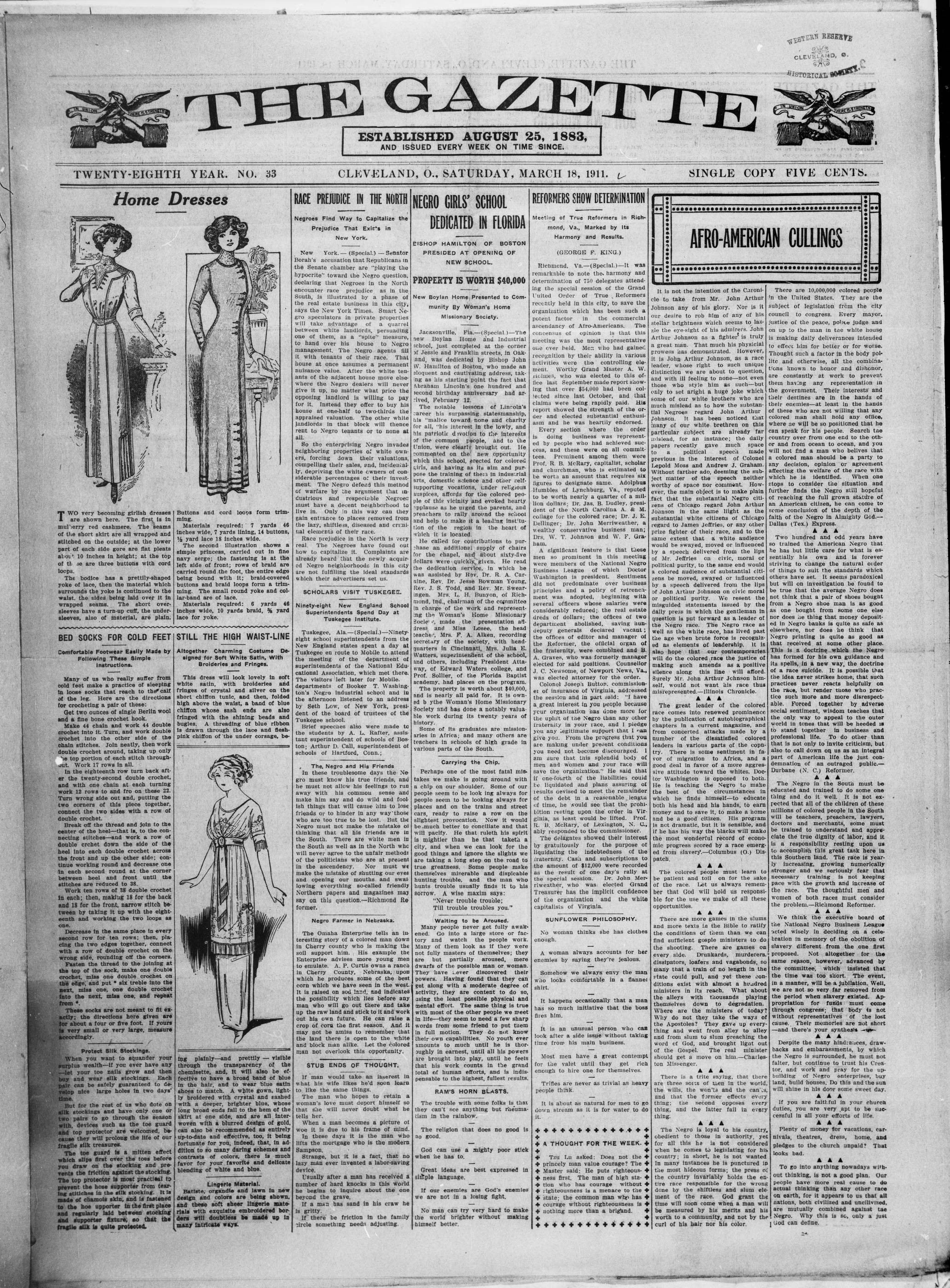
Page text (machine-generated)
IN UNION HERE SINGERS
TWENTY-EIGHT
TWENTY-EIGHTH YEAR. NO. 33
Home Dresses
7
THE FASHION OF THE TWENTIETH CENTURY
TWO very becoming girlish dresses are shown here. The first is in mulberry red cashmere. The seams of the short skirt are all wrapped and stitched on the outside; at the lower part of each side gore are flat pleats about 10 inches in height; at the top of these are three buttons with cord loops.
The bodice has a prettily-shaped yoke of lace, then the material which surrounds the yoke is continued to the waist, the sides being laid over it in wrapped seams. The short over-sleeves have a turn-up cuff, the under-sleeves, also of material, are plain.
Comfortable Footwear Easily Made by Following These Simple Instructions.
Many of us who really suffer from cold feet make a practice of sleeping in loose socks that reach to the calf of the leg. Here are the directions for crocheting a pair of these:
Get two ounces of single Berlin wool and a fine bone crochet hook.
Make 44 chain and work 44 double crochet into it. Turn, and work double crochet into the other side of the chain stitches. Join neatly, then work double crochet around, taking up only the top portion of each stitch throughout. Work 17 rows in all.
In the eighteenth row turn back after the twenty-second double crochet, and with one chain at each turning work 12 rows to and fro on these 22. Turn wrong side out and, putting the two corners of this piece together, connect the two sides with a row of double crochet.
Break off the thread and join to the center of the heel—that is, to the connecting stitches—and work a row of double crochet down the side of the heel into each double crochet across the front and up the other side; continue working round and decrease one in each second round at the corner between heel and front until the stitches are reduced to 28.
Work ten rows of 38 double crochet in each; then, making 18 for the back and 18 for the front, narrow stitch between by taking it up with the eighteenth and working the two loops as one.
Decrease in the same place in every second row for ten rows; then, placing the two edges together, connect with a row of double crochet on the wrong side, rounding off the corners.
Fasten the thread to the joining at the top of the sock, make one double crochet, miss one double crochet on the edge, and put * six treble into the next, miss one, one double crochet into the next, miss one, and repeat from *.
These socks are not meant to fit exactly; the directions here given are for about a four or five foot. If yours is very small or very large, measure accordingly.
Protect Bik Stockings.
When you want to squander your surplus wealth—if you ever have any—let your toe nails grow and then buy and wear silk stockings. Each pair can be safely guaranteed to develop nice large holes in two days' time.
But for the rest of us who dote on silk stockings and have only one or two pairs to go through the season with, devices such as the toe guard and top protector are welcomed, because they will prolong the life of our fragile silk treasures.
The toe guard is a mitten effect which slips first over the toes before you draw on the stocking and prevents the friction against the stocking. The top protector is most practical to prevent the hose supporter from tearing stitches in the silk stocking. It is made of chamois skin, and is fastened to the hose upporter in the first place and regularly laid between stocking and supporter fixture, so that the fragile silk is quite protected.
THE GAZETTE
THE LADY'S DRESS
Buttons and cord loops form trimming.
Materials required: 7 yards 46 inches wide, 7 yards lining, 14 buttons, ½ yard lace 18 inches wide.
The second illustration shows a simple princess, carried out in fine navy serge; the fastening is at the left side of front; rows of braid are carried round the foot, the entire edge being bound with it; braid-covered buttons and braid loops form a trimming. The small round yoke and collar-band are of lace.
Materials required: 6 yards 46 inches wide, 10 yards braid, % yard lace for yoke.
Altogether Charming Costume Designed for Soft White Satin, With Broderies and Fringes.
This dress will look lovely in soft white satin, with broderies and fringes of crystal and silver on the short chiffon tunic, and then, folded high above the waist, a band of blue chiffon whose sash ends are also fringed with the shining beads and bugles. A threading of blue ribbon is drawn through the lace and flesh-pink chiffon of the under corsage, be-
1
ing plainly—and prettily—visible through the transparency of the chemisette, and, it will also be effective to have a broad band of blue in the hair, and to wear blue satin shoes to match. A white gown, lightly broidered with crystal and cashed with a deeper, brighter blue, whose long broad ends fall to the hem of the skirt at one side, and are all interwoven with a blurred design of gold, can also be recommended as entirely up-to-date and effective, too, it being fortunate for you, indeed, that, in addition to so many daring schemes and contrasts of colors, there is much favor for your favorite and delicate blending of white and blue.
Lingerie Material
Lingerie material.
Batiste, organdie and lawn in new design and colors are being shown, and these soft sheer lingerie materials with exquisite embroidered borders will doubtless be made up in many intricate ways.
ESTABLISHED AUGUST 25, 1883, AND ISSUED EVERY WEEK ON TIME SINCE.
CLEVELAND, O., SATURDAY, MARCH 18, 1911.
RACE PREJUDICE IN THE NORTH
Negroes Find Way to Capitalize the Prejudice That Exit's in New York.
New York. — (Special.) — Senator Borah's accusation that Republicans in the Senate chamber are "playing the hypocrite" toward the Negro question, declaring that Negroes in the North encounter race prejudice as in the South, is illustrated by a phase of the real estate business in this city, says the New York Times. Smart Negro speculators in private properties will take advantage of a quarrel between white landlords, persuading one of them, as a "spite" measure, to hand over his house to Negro management. The Negro agents fill it with tenants of their race. That house at once assumes a permanent nuisance value. After the white tenants of the adjacent house move elsewhere the Negro dealers will never give it up, no matter what price the opposing landlord is willing to pay for it. Instead they offer to buy his house at one-half to two-thirds the appraised valuation. The other white landlords in that block will thence rent to Negro tenants or to none at all.
So the enterprising Negro invades neighboring properties of white owners, forcing down their valuations, compelling their sales, and, incidentally, depriving the white owners of considerable percentages of their investment. The Negro defend this method of warfare by the argument that industrious and respectable Negroes must have a decent neighborhood to live in. Only in this way can they gain entrance to places removed from the lazy, shiftless, diseased and criminal elements of their race.
Race prejudice in the North is very real. The Negroes have found out how to capitalize it. Complaints are already heard that the newly acquired Negro neighborhood in this city are not fulfilling the ideal standards which their advertisers set us.
SCHOLARS VISIT TUSKEGEE.
Ninety-eight New England School Superintendents Spend Day at Tuskegee Institute.
Tuskegee, Ala.—(Special.)—Ninety-eight school superintendents from the New England states spent a day at Tuskegee en route to Mobile to attend the meeting of the department of superintendents of the National Educational Association, which met there. The visitors left later for Mobile. departments of Booker T. Washington's Negro industrial school and in the afternoon listened to an address by Seth Low, of New York, president of the board of trustees of the Tuskegee school.
Brief speeches also were made to the students by A. L. Rafter, assistant superintendent of schools of Boston; Arthur D. Call, superintendent of schools of Hartford, Conn.;
The Negro and His Friends
The, Negro and His Friends
In these troublesome days the Negro must know his true friends, and he must not allow his feelings to run away with his common sense and make him say and do wild and foolish things that will cause him to lose friends or to hinder in any way those who are too true to be lost. But the Negro must not make the mistake of thinking that all his friends are in the South. There are white men in the South as well as in the North who will never agree to the unfair methods of the politicians who are at present in the ascendency. Nor must we make the mistake of shouting our eyes and opening our mouths and swallowing everything so-called friendly Northern papers and magazines may say on this question—Richmond Reformer.
Negro Farmer in Nebraska
The Omaha Enterprise tells an interesting story of a colored man down in Cherry county who is making the soil support him. His example the Enterprise advises more young men to emulate. A, P. Curtis owns a ranca in Cherry County, Nebraska, upon which he produces some of the best corn which we have seen in the west. It is raised on sod land, and indicates the possibility which lies before any man who will go out there and take up the raw land and stick to it and work out his own future. He can raise a crop of corn the first season. And it may not be amiss to remember that the land there is open to the white and block man allike. Let the colored man not overlook this opportunity.
STUB ENDS OF THOUGHT.
If man would take an interest in what his wife likes he'd soon learn to like the same things.
The man who hopes to retain a woman's love must deport himself so that she can never doubt what he tells her.
When a man becomes a picture of woe it is due to his frame of mind.
In these days it is the man who lifts the mortgage who is the modern Sampson.
Strange, but it is a fact, that no lazy man ever invented a labor-saving device.
Usually after a man has received a number of hard knocks in this world he begins to inquire about the one beyond the grave.
If a man has sand in his craw he is gritty.
If there be friction in the family circle something needs adjusting.
NEGRO GIRLS' SCHOOL
DEDICATED IN FLORIDA
EISHOP HAMILTON OF BOSTON
PRESIDED AT OPENING OF
NEW SCHOOL.
PROPERTY IS WORTH $40,000
New Boylan Home, Presented to Community By Woman's Home Missionary Society.
Jacksonville, Fla.—(Special.)—The new Boylan Home and Industrial school, just completed at the corner of Jessie and Franklin streets, in Oakland, was dedicated by Bishop John W. Hamilton of Boston, who made an eloquent and cautivating address, taking as his starting point the fact that Abraham Lincoln's one hundred and second birthday anniversary had arrived, February 12.
The notable lessons of Lincoln's career his surpassing statesmanship, his "malice toward none and charity for all," his interest in the lowly, and his patriotic devotion to the interests of the common people, and to the Union, were clearly brought out. He commented on the new opportunity which this school, erected for colored girls, and having as its aim and purpose the training of them in industrial arts, domestic science and other self-supporting vocations, under religious auspices, affords for the colored people of this vicinity and evoked hearty applause as he urged the parents, and preachers to rally around the school and help to make it a leading institution of the region in the heart of which it is located.
He called for contributions to purchase an additional supply of chairs for the chapel, and about sixty-five dollars were quickly given. He read the dedication service, in which he was assisted by Rev. Dr. R. A. Carrine, Rev. Dr. Jesse Bowman Young, Rev. J. S. Todd, and Rev. M. Swearingen. Mrs. L. H. Bunyon, of Richmond, Ind, chairman of the committee in charge of the work and representing the Woman's Home Missionary Society, made the presentation address and Miss Losee, the head teacher; Mrs. F. A. Alken, recording secretary of the society, with headquarters in Cincinnati, Mrs. Julia E. Watters, superintendent of the school, and others, including President Attaway, of Edward Waters college, and Prof. Sollier, of the Florida Baptist academy, had places on the program. The property is worth about $40,000, and is nearly all paid for. It is owned by b ythe Woman's Home Missionary Society and has done a notably valuable work during its twenty years of history. Some of its graduates are missionaries in Africa; and many others are teachers in schools of high grade in various parts of the South.
Carrying the Chip.
Perhaps one of the most fatal mistakes we make is going around with a chip on our shoulder. Some of our people seem to be looking always for people seem to be looking always for places and on the trains and street cars, ready to raise a row on the slightest provocation. Now it would be much better to conciliate and that will pacify. He that ruleth his spirit is mightier than he that taketa a city, and when we can look for the good things and ignore the slights we are taking a long step on the road to true greatness. Some people make themselves miserable and displeible hunting trouble, and the man who hunts trouble usually it to his sorrow. A wise maxim says:
Waiting to be Aroused.
Waiting to be Aroused.
Many people never get fully awakened. Go into a large store or factory and watch the people work. Many of them look as if they were not fully masters of themselves; they are but partially aroused, mere dwarfs of the possible man or woman. They have never discovered their powers. Having found that they can get along with a moderate degree of activity, they are content to do so, using the least possible physical and mental effort. The same thing is true with most of the other people we meet in life—they seem to need a few sharp words from some friend to put them in full motion. They do not know their own capabilities. No youth ever amounts to much until he is thoroughly in earnest, until all his powers are brought into play, until he feels that his work counts in the total of human efforts, and is indispensable to the highest, fullest results.
RAM'S HORN BLASTS.
The trouble with some folks is that they can't see anything but rheumatism in the rainbow.
The religion that does no good is no good.
God can use a mighty poor stick when he has to.
Great ideas are best expressed in simple language.
If our enemies are God's enemies we are not in a losing fight.
No man can try very hard to make the world brighter without making himself better.
REFORMERS SHOW DETERMINATION
Meeting of True Reformers in Richmond, Va., Marked by Its Harmony and Results.
Richmond, Va.—(Special.)—It was remarkable to note the harmony and determination of 750 delegates attending the special session of the Grand United Order of True Reformers recently held in this city, to save the organization which has been such a potent factor in the commercial ascendancy of Afro-Americans. The consensus of opinion is that this meeting was the most representative one ever held. Men who had gained recognition by their ability in various activities were the controlling element. Worthy Grand Master A. W. Richins, who was elected to this office last September made report snowing that over $54,000 had been collected since last October, and that claims were being rapidly paid. His report showed the strength of the order and elected substantial enthusiasm and he was heartily endorsed.
Every section where the order is doing business was represented by people who had achieved success, and these were on all committees. Prominent among them were Prof. R. B. McRary, capitalist, scholar and churchman, who is estimated to be worth an amount that requires six figures to designate same. Adolphus Humbles of Lynchburg, Va., reputed to be worth nearly a quarter of a million dollars; Dr. Jas. B. Dudley, president of the North Carolina A. & M. collage for the colored race; Dr. J. E. Dellinger; Dr. John Merriweather, a wealthy conservative business man; Drs. W. T. Johnson and W. F. Graham.
A significant feature is that these men so prominent in this meeting were members of the National Negro Business League of which Doctor Washington is president. Sentiment did not predominate over business principles and a policy of retrenchment was adopted, beginning with several officers whose salaries were considerably reduced; the real estate dreds of dollars; the offices of two department abolished, saving undeputy generals declared vacant; the offices of editor and manager of the Reformer, the official organ of the fraternity, were combined and B. A. Graves, who was formerly manager elected for said positions. Counselor J. C. Newsome, of Newport News, Va., was elected attorney for the order.
Colonel Joseph Button, commissioner of insurance of Virginia, addressed the session and in part said: "I have a great interest in you people because your organization has done more for the uplift of the Negro than any other fraternity in your race, and I piedge you any legitimate support that I can give you. From the progress that you are making under present conditions you need not become discouraged. I am sure that this splendid body of men and women and your race will save the organization." He said that if one-fourth of the liabilities could be liquidated and plans assuring of results devised to meet the remainder of the debt in a reasonable length of time, he would see that the prohibition resting upon the order in Virginia, as least would be lifted. Prof. R. B. McRary, of Lexington, N. C., ably responded to the commissioner.
The delagates showed their interest by gratuitously for the purpose of liquidating the indebtedness of the fraternity. Cash and subscriptions to the amount of $12,000 were recorded as the result of one day's rally at the special session. Dr. John Merriweather, who was elected Grand Treasurer has the implicit confidence of the organization and the white capitalists of Virginia.
SUNFLOWER PHILOSOPHY.
No woman thinks she has clothes enough.
A woman always accounts for her enemies by saying they're jealous.
Somehow we always envy the man who looks comfortable in a flannel shirt.
It happens occasionally that a man has so much initiative that the boss fires him.
It is an unusual person who can look after a side issue without taking time from his main business.
Most men have a great contempt for the valet until they get rich enough to hire one for themselves.
Trifles are never as trivial as heavy people think.
It is about as natural for men to go down stream as it is for water to do it.
A THOUGHT FOR THE WEEK.
Tzu Lu asked: Does not the
princely man value courage? The
Master said: He puts righteous-
ness first. The man of high站
station who has courage without
righteousness is a menace to the
state; the common man who has
courage without righteousness is
nothing more than a brigand.
AFRO-AMERICAN CULLINGS
It is not the intention of the Caronicle to take from Mr. John Arthur Johnson any of his glory. Nor is it our desire to rob him of any of his stellar brightness which seems to lazzie the eye-sight of his admirers. John Arthur Johnson as a fighter is truly a great man. That much his physical prowess has demonstrated. However, it is John Arthur Johnson, as a race leader, whose right to such unique distinction we are about to question, and with ill feeling to none—not even those who style him as such—but only to set aright a huge joke which some of our white brothers who are much mislead as to how the substantial Negroes regard John Arthur Johnson. It has been noticed that many of our white brethren on this particular subject are already far mislead, for an instance; the daily papers recently gave much space to a political speecha made previous in the interest of Colonel Lepold Moss and Andrew J. Graham. Without farther ado, deeming the neither worthy of space nor comment. However, the main object is to make plain fact that the substantial Negro citizens of Chicago regard John Arthur Johnson in the same light as the substantial white citizens of Chicago regard to James Jeffries, or any other prize fighter of their race, and to the same extent that a white audience would be swayed, moved or influenced by a speech delivered from the lips of Mr. Jeffries on civic, moral or political purity, to the same end would a colored audience of substantial citizens be moved, swayed or influenced by a speech delivered from the lips of John Arthur Johnson on civic moral or political purity. We resent the misguided statements issued by the daily press in which the gentleman in question is put forward as a leader of the Negro race. The Negro race as well as the white race, has lived past the age when brute force is recognized as elements of leadership. It is also hope that our contemporaries will do the colored race the justice of making such amends as a positive silence along this line will afford Surely Mr. John Arthur Johnson himself, would not want his race thus misrepresented—Illinois Chronicle.
```markdown
```
The great leader of the colored race comes into renewed prominence by the publication of autobiographical chapters in a current magazine, and from concerted attacks made by a number of the dissatisfied colored leaders in various parts of the country. There is some sentiment in favor of migration to Africa, and a good deal in favor of a more aggressive attitude toward the whites. Doctor Washington is opposed to both. He is teaching the Negro to make the best of the circumstances in which he finds himself—to educate both his head and his hands, to earn money and to save it, to make a home and be a good citizen. His program is not dramatic, but it is sensible, and if he has his way the blacks will make the most wonderful record of economic progress scored by a race emerged from slavery.—Columbus (O.) Dispatch.
```markdown
```
The colored people must learn to be patient and toil on for the sake of the race. Let us always remember that God will hold us responsible for the use we make of all these opportunities.
▲▲▲
There are more games in the slums and more texts in the Bible to ratify the conditions of them than we can find sufficient gospe ministers to do the shooting. There are games on every side. Drunkards, murderers, dissipators, loafers and vagabonds, so many that a train of no length in the state could pull, and yet these conditions exist with almost a hundred ministers in its reach. What about the alleys with thousands playing themselves down to degradation. Where are the ministers of today? Why do not they take the ways of the Apostoles? They gave up everything and went from alley to alley and from slum to slum preaching the word of God, and brought lign out of the Gospel. The real minister should get a move on him—Charleston Missenger.
There is a tite saying, that there are three sorts of men in the world, the wills, the wonts and the cann's, and that the former effects every thing; the second opposes every thing, and the latter fail in every thing.
```markdown
```
The Negro is loyal to his country, obedient to those in authority, yet for all this he is not considered when he comes to legislating for his country; in short, he is not wanted. In many instances he is punctured in the most hideous forms; the press of the country invariably holds the entire race responsible for the wrong done by the shiftless and slum element of the race. God grant the time will soon come when a man will be measured by his merits and his worth to a community, and not by the curl of his hair nor his color.
WESTERN RESERVE
CLEVELAND, O.
HISTORICAL SOCIETY.
IN UNION
THERE IS STRONGER
There are 10,000,000 colored people in the United States. They are the subject of legislation from the city council to congress. Every mayor, justice of the peace, police judge and on up to the man in tae white house is making daily deliverances intended to effect him for better or for worse. Thought such a factor in the body politic and otherwise, all the combinations known to honor and dishonor, are constantly at work to prevent them having any representation in the government. Their interests and their destinies are in the hands of their enemies—at least in the hands of these who are not willing that any colored man shall hold any office, where we will be so positioned that he can speak for his people. Search tae country over from one end to the other and from ocean to ocean, and you will not find a man who belives that a colored man should be a party to any decision, opinion or agreement affecting the welfare of the race with which he is identified. When one stops to consider the situation and further finds the Negro still hopeful of reaching the full grown stature of an American citizen, he can come to some conclusion of the depth of the faith of the Negro in Almighty God.—Dallas (Tex.) Express.
```markdown
```
Two hundred and odd years have so trained the American Negro that he has but little care for what is essentially his own and is forever striving to change the natural order of things to suit the standards which others have set. It seems paradoxical but will on investigation be found to be true that the average Negro does not think that a pair of shoes bought from a Negro shoe man is as good as one bought from some one else nor does he thing that money deposited in Negro banks is quite as safe as elsewhere, nor does he think that Negro printing is quite as good as that received at some other place. This is a doctrine which the Negro has formed for his own guidance and its spells, in a new way, the doctrine of a race suicide. It is possible that the idea never strikes him, that such practices never reacts helpfully on the race, but render those who practice such more and more disrespectable. Forced together by adverse social sentiment, wisdom teaches that the only way to appeal to the outer world in tones that will be heeded is to stand together in business and professional life. To do other than that is not only to invite criticism, but also to call down on us as an integral part of American life the just condemnation of an outraged public.—Durbane (N. C.) Reformer.
▲▲▲
The Negro in the South must be educated and trained to do some one thing and do it well. It is not expected that all of the children of these millions of colored people in the South will be teachers, preachers, lawyers, doctors and merchants, some must be trained to understand and appreciate the true dignity of labor, and it is a responsibility resting upon us to accomplish this great task here in this Southern land. The race is yearly increasing, growing numerically stronger and we seriously fear that necessary training is not keeping pace with the growth and increase of the race. The thoughtful men and women of both races must consider the problem—Richmond Reformer.
We think the executive board of the National Negro Business League acted wisely in deciding on a celebration in memory of the oblation of slavery different from the one first proposed. Not altogether for the same reason, however, advanced the committee, which insisted that the time was too short. The event, in a manner, will be a jubilation. Well, we are not so very far removed from the period when slavery existed. Appropriate congress; that body is not without representatives of the lost cause. Their memories are not short—and there's your synthesis
▲▲▲
Despite the many hindrances, drawbacks and embarrassments, by which the Negro is surrounded, he must not falter, but continue to trust his Creator, and work and pray for the upbuilding of Negro enterprises, buy land, build houses. Do this and the sun will shine in his door some sweet day.
If you are faithful in your church duties, you are very apt to be successful in all your efforts of life.
Plenty of money for vacations, carnivals, theatres, dress, home, and pledges to the church unpaid? That looks bad.
```markdown
```
To go into anything nowadays without thinking, is not a good plan. Our people have more real cause to do actual thinking than any other race on earth, for it appears to us that all nations, both civilized and uncivilized, are mutually combined against tae Negro. Why this is sc, only a just god can define.
One Year.....$1.50
Six Months.....1.00
Three Months......50
Subscribers are requested to
mit by postoffice money or
order or registered letter.
Entered at the postoffice in Cleveland
Ohio, as second-class matter
Address all communications to
HARRY C. SMITH
Editor and proprietor,
THE GAZETTE,
Blackstone Building, Cleveland, O.
Member Ohio Legislature: 1894
to 1896; 1896 to 1898; 1900 to 1902
THE GAZETTE is the oldest, and has the largest bona fide circulation, double that of any newspaper in the Interest of Afro-Americans, published in the state of Ohio, and comparison with any will immediately establish its rank as one of the NEWSIEST AND BEST In the country.
An Atlanta, Ga., Afro-American headwaiter says our waiters are losing their places in many hotels because headwaiters exact money from them. May be much in this, after all. How ever, we have always heretofore heard the waiters blamed for the loss of their positions.
I honor the man who in the conscientious discharge of his duty dares to stand alone; the world, with ignorant, intolerant judgment, may condemn, the countenances of relatives may be averted, and the hearts of friends grow cold, but the sense of duty done shall be sweeter than the applause of the world, the countenances of relatives or the hearts of friends.—Charles Summer.
Certain members of the race, and also Senator Rayner of Maryland and Mr. Julius Rosenwald of Chicago, particularly, will better understand Baltimore's attempted segregation of Afro-American, and Chicago's encouragement of Y. M. C. A. segregation of our people through the north, after reading the Cincinnati letter elsewhere in The Gazette today. All segregation, of the kinds referred to, are WRONG!
I am convinced myself that there is no more evil thing in this present world than race prejudice; none at all. I write deliberately—it is the worst single thing in life now. It justifies and holds together more baseness, cruelty and abomination than any other sort of error in the world. Through its body runs the black blood of coarse lust, suspicion, jealousy and persecution and all the darkest poisons of the human soul.—G. Wells in the New York Independent.
When Hugh McLmithos, "the fight promoter," made Jack Johnson fight Tommy Burns (white) in Australia for $5,000 in order to win the heavyweight championship of the world, and paid the latter $20,000, though defeated, he made a very proper impression on the champion who now demands of McLmithos the same terms for a fight in England with Sam Langford who is very popular there since his recent defeat of the Australian champion, Bill Lang (white). We hope Johnson will not recode "one inch" from the position he has taken in this matter because it is a very proper one indeed under the circumstances.
The editor of the Chicago Defender fatters himself when he states that we tried to give him advice on the matter of a "jimcrow" Y. M. C. A. an institution founded and supported by the charitably inclined "of all the people alike." No Christian organization anywhere has any RIGHT to separate its members on account of color, "nationality," etc., if it is really Christian. If any alleged Christian organization should attempt such a thing, the best thinkers of the Negro race" in that community would undoubtedly refuse to become "putty" in its hands, and would establish what they felt they so greatly needed, independent of the so-called Christian (color-line) organization. They certainly would not allow themselves to become a "jimcrow" "tail" of an alleged Christian white "kite."
Anent the recent appointment by President Tatt of J. C. Napier of Nashville, Tenn. to succeed W. T. Vernon, Register of the Treasury, the Philadelphia (Pa.) Weekly Tribune said, editorially, last week:
It puts in position at Washington a colored man of ripe experience, of independent fortune, of polished manners, who is not afraid to look a white man, although he be president, in the eye and tell him what he thinks about a given thing affecting himself or his people. Mr. Napier will be the only colored man of that kind at Washington Hon. John Merce Langson was the only one before him.
Mr. Napier married Mr. Langston's only daughter. We sincerely trust that all that Editor Perry says of Mr. Napier is true. There seems to be too few of that kind, these days.
Assistant U. S. District Attorney W. H. Lewis of Boston, Mass., appointed an Assistant U. S. Attorney General by President Taft on Feb. 28, four days before the adjournment of Congress, was not confirmed by that ugly body, and therefore cannot take office until named again by the President. Had Lewis' appointment been made after the recent adjournment, he could have taken office once and held it until he failed of confirmation in the next session of Congress. If Mr. Lewis is to take office before the special session which the President recently called, the latter will have to formally him again for the place before that date, April 15. If this is not done, it will be necessary to appoint Mr. Lewis again (either during the session or after it.) Will the President do it? is a question of our people who
have little confidence in him, are asking these days. We are free to confess that we too, have our doubts.
SHALL WE BEGIN TO DISSOLVE THE UNION?
Senator Lodge's recent argument before the United States Senate against the "direct" election of Senators did not receive the general attention it deserved. It was delivered amid the uproars of the Lorimer contest and few paused to read it. Yet it was so eloquent, clear and that it merited universal attention. What really was the proposal for "direct" election of Senators? The average man will say that it was merely to substitute for the present method election by the people as members of the House are elected. It was that, but it was more. It proposed to strike out of the Constitution the words capitalized in the following clause:
The times, places and manner of holding elections for Senators and Representatives shall be prescribed in each state by the Legislature thereof; BUT THE CONGRESS MAY AT ANY TIME BY LAW MAKE OR ALTER SUCH REGULATIONS, except as to the places of choosing Senators.
Now, the fourteen words capitalized in the above have a very definite reason for being there. That reason is found in the unbearable situation which the Constitution was adopted to end, as the Founders of the Republic saw its causes, and as Mr. Lodge thus accurately describes it and them:
The makers of the Constitution * * * also dealt with certain questions in regard to which they had a peculiar and expert knowledge. This was emphatically so with the question now before us for consideration. * * * They had seen the Continental congress, which had declared independence, raised armies and made alliances, decline into helplessness and defeat, into burden to Washington than the enemy in his front. They had seen the Confederation which the Continental Congress had established come into being, into a sickly life and finally sink into imbecility, while the states quarreled among themselves and domestic disorder began to rear its ugly head. And by all these disasters and misfortunes they became convinced that the fundamental cause of the American Continental Congress and of the Confederation alike schemes of government was that the central government had relations only with the states and was absolutely at their mercy.
The states were discordant and with them their people. The central government had no contract with the people and no claims on their loyalty. There was no Nation, there was only a group of jarring states. The makers of the Constitution met the difficulty and made a Nation by "an arrangement at once bold and simple, scientifically sound and eminently practical," as Senator Lodge well says, and which he thus describes: They established a contract which dealt not with the states, but directly with the people of the states. They brought the central government into immediate contact with the individual man. They created a real citizenship of the United States. * It is not too much to say that among all the great solutions which these men presented for the difficult problems they were called upon to meet certainly was the most vital. It breathed the breath of life into the government of the Constitution.
In accordance with that policy the fourteen words emphasized above were inserted in the Constitution. It is true that the power thus reserved to the central government has not at all times nor fully been exercised. But as Senator Lodge truly says:
That the United States should have this power in reserve as fundamental. NO GOVERNMENT CAN HOPE TO LIVE IF IT CANNOT PROVIDE THE MEANS BY WHICH IT LIVES. IF IT CANNOT PROTECT ITS OWN EXISTENCE.
Senator Lodge holds that a mere change from indirect to direct election of Senators would, of and by itself, have been immaterial—a mere "change in the mechanism," which "does not touch the principles upon which the government rests." We disagree with him, for it is obvious that such a change would have impaired the entity of the state, as the change actually proposed would have destroyed the sovereignty of the Nation. And that would have been the effect of the revolutionary proposal happily defeated by the votes of patriotic Senators acting without respect to party affiliations. For it was proposed by change in the Constitution, as Mr. Lodge says:
To put the United States government, so far as the election of Senators is concerned, at the mercy of the states—to take from the United States any power to protect its citizens in the exercise of their rights, no matter how great the need for such protection. * * * * TWENTY-THREE STATES, THOUGH INCLUDING OLATION MORTALITY OF THE POPULATION, COULD AT ANY TIME REST THE MOVEMENT OF THE NATIONAL GOVERNMENT AND STOP ALL OPERATIONS.
How a moiety of states, with a minority of population, having plenary power to choose Senators in any manner and to bind Senators, as a condition of election, in any manner that local whim, interest or prejudice might suggest, could tie the Nation's hands is self-evident. The power reserved to Congress to "make or alter such regulations" is an essential power, without which the national government cannot "provide the means by which it lives—cannot protect its own existence."
"To call such a scheme as this progressive," as Senator Lodge well and truly says, "is mockery; it is retrogression and reaction of an extreme kind. If adopted it would carry the government back to the controversies and the struggles out of which its Constitution was born, and which beset and endangered the infancy of the United States." It would be, in very deed and truth, a step toward the dissolution of the Union by making it as unworkable.—Chicago Daily Inter-Ocean.
The Chicago daily Record-Herald very pertinently asks:
Senator Stone of Missouri recently shook his fist at Vice President Sherman. Is Senator Stone getting in training to whip another waiter?
It would seem so.
THE GAZETTE, CLEVELAND, O., SATURDAY, MARCH 18, 1911
FRESH OHIO NEWS OUR OWN WRITERS
WHAT OUR PEOPLE ARE DOING IN MANY CITIES AND TOWNS OF THE STATE.
INTERESTING PERSONAL NOTES
Social Functions—Church and Lodge
Items—Mariages and Deaths—
Literary, Musical and Other
Notes of Interest.
Sandusky.—A number attended Ada
Barker's funeral at Norwalk, Tuesday
afternoon.—Mrs. Watson is ill.—Rev.
Geo. D. Smith's mother, 110 years of
age, died in Paris, ill., on March 4,
and was buried at Indianapolis. He
attended the funeral. He and Mrs.
Johnson are still the social at the
church when she was success and Mrs.
E. Smith made a record.
Martins Ferry.—Rev. and Miss Harris of Bridgeport were guests of Mr. Richardson, Friday and Saturday. He and Rev. Burton are assisting Rev. Randall in the revival. The latter and Rev. Upghegre dined with Rev. W. H. uncas, Saturday. Mrs. Randall and Rev. H. uncas, Saturday. Mrs. Randall and Rev. B. Allen. Other members of the O. V. M. A. and Rev. Shaffer (white) and congregation assisted in the revival this week.—Mr. Rivers of Actenville, has returned from New York, where he was employed in a steel mill—Mrs. Frances Worthington of Flushing, is visiting her sister, Mrs. Randall, and the supper will be given at Fifth St. church Monday evening under the auspices of the Ladies' Aid Society.
Smithfield.—Miss Minnie Beall attended the Teachers' Institute there Saturday. Miss Sarah Beall visited Mrs. E. Smith and family Saturday and Sunday.—Mrs. G. Harris, Mr. N. Mitchell and little M. Lewis are ill.—Mrs. E. West spent several days in Steubenville last week.—Mrs. Lola Ramsey and family are visiting relatives in Hopedale.—The entertainment Saturday evening for the trustees was quite a success. A social will be given this Saturday evening.—Mrs. A. Guillem and Jame, and Ellsworth, Mrs. Guyder and Mr. Dan Bolden of Steubenville, were here Sunday. The latter was Mrs. E. H. Harris' guest and the others were Mr. and Mrs. W. H. Veney's.—(Correspondent will please mail letter earlier on MONDAYS—Ed.)
Correspondents must mail all letters for publication at their main postoffice sufficiently early on Monday (or Sunday) of each week to have them reach The Gazette office on Tuesday morning, and always write, also, their names and that of their city or town on the outside of the wrapper about returned copies. Unauthorized copies cannot be given you. Lists of names, wedding presents, etc, obliterate notices, speeches, resolutions, poetry, inquiries for relatives and advertisements of all kinds, including items announcing entertainments to be held in the near future, must be paid for in advance at the rate of ten cents a line, six words to a line. Our rates for display advertisements may be lowered postal notices and not stamps during warm weather.
Mt. Pleasant—Mr. Henry Goins is the guest of Mr. and Mrs. John Jackson—Mrs. Delia Jackson, daughter, and Mr. D. Spottswood spent Friday in Steubenville—Rev. White preached here Sunday—Mrs. Ann Allsup is Mrs. M. Brooks' guest—Miss Florence Lockard has returned home—Mrs. L. Fields and daughter spent Friday with her mother. The Fancy Work club met at Mrs. M. Brooks' Friday evening at Prof. W. R. Moore's. The entertainment will be given at Clark's chapel on the 25th, for the pastor's benefit. Two Cadiz young men were here Sunday. A social at the A. M. E. church, on the 19th, Arminta Bets is visiting her parents, Mr. and Mrs. Lindsay. Ainton, Edward and Mrs. Edith Moore attended Mrs. Lillie Davis' funeral at Washington, Pa.-Cora Rudolph spent last week in Wheeling. Mrs. Mrs. visited Mrs. Geo. White the Whale and the seekers. Miss Alma Betts and Mr. David Spottswood were married by Rev. Lewis of Emerson at her home, Saturday evening. A number were present and many useful presents were received.
Cadiz.-Jno. and A. Simpson were here Saturday and Sunday.-Walter Carey of M. Pleasant spent Sunday here.-The C. I. C. Club was entertained by Chairman R. F. Ballard. Table set for twelve. The new officers were installed by Rev. W. N. Fox.-Mrs. Samuel Brown has returned from Zanzville. -Miss Kizzie White has returned. Steuben-Boyle has returned. Manilla-Lerat at dinner. Sunday.-Mr. Ira Wallace is visiting in Pittsburg.-Lillian Veney and Neota Williams are visiting in Cannonsburg. -Mr. Westly Dulling was in Carrollton. Saturday.-Mrs. Frederick M. Lawson will locate in Kalamazoo.-Mr. Olen White of Washington, is visiting Mrs. Samuel Tyler.-Mesdames Howard, Epps, Tervence and Rev. W. J. Johnson are sick.-Mr. Clarence. West has returned from Wheeling.-Rev. H. F. Fox preached two excellent sediments, Sunday.-Miss Ruby Pettiford, dramatic reader and impersonator, will give a talk. Prof. W. H. Hass given the first a series of lectures on "Women of the Bible," Sunday evening, at the young people's meeting. "Eve" being the subject.
Youngstown—Mrs. Tally of Massillon attended Mrs. Edward Norris' funeral. She died in Hubbard—Mrs. BenJ. Brown, born in N. Y. state 41 years ago, died last Thursday. She leaves a husband—The Women's H. BenJ. Brown, born in N. Y. state 41 years ago, died last Thursday. She met at Mrs. I. Porter's last Thursday afternoon and were entertained by Miss Almyra Sampson. Lunch—Mrs. Emily Lewis, 65 years of age, died last Thursday in Orange Co. Va. She was Mrs. C. Sharpe's grandmother and a cousin of Mr. Frank Conway. The former attended the funeral—Oak Hill Av. sewing circle Mrs. C. Sharpe's Thursday afternoon. Lunch—Buckeye lodge's sixth annual ball in Excelsior parlors last Wednesday evening was attended by about 150 couples. Hon. J. Frank Wheaton of New York City, G. E. R. of the Elks, and ex-member of the Minnesota Legislature, was the guest of honor. His speech was, exceptionally, the Thursdays of ceremonies with Miss M. Smith of Carnegie, Pa. led the grand march. The committee which entertained Mr. Wheaton consisted of Messrs. A. Thomas, Geo.
Donnelly, Thos. Robinson, Dr. Pettiford and Geo. Rideout—Mrs. Harvey and Miss Taylor gave a surprise party in honor of Mrs. Mildred Churchville on Wednesday evening. She received a number of presents. Launch games and music.
Bellefontaine—Dr. J. M. Gilmere, P., preached twice at Pickrelltown, Sunday, and at Grace church in the evening. Splendid congregations enjoyed the able and masterly sermons. Misses Georgia Kersey and Flora Starkes visited Pickrelltown, that day.—Mrs. E Burgy and Mrs. C. Harper.—Mr. Robinson is conducting a revival in Pickrelltown.—Grace church's reports at quarterly ence, Monday evening, were excellent, Rev. H. L. Marque, pastor of the Baptist church for two years, joined the A. M. E. church, Sunday, and will join the conference next fall. Mrs. Lee, county president of the W. C. T. U. lectured at Grace church, last Tuesday evening.—The Southern Christian Recorder an annotated copy of G. W. Porter of Tenem. In its last issue complimenting A. M. E. laymen of Ohio for refusing to endorse an Episcopal candidate at their electoral college at Akron, recently. Rev. Porter is one of the ablest men in the A. M. E. church. Among the other things he said was: "The Ohio laymen have set the pace for the entire church for honesty in church life and the integrity of the office of bishop." We take pride in this, for Mr. Clarence Clark of this city was an important member of the electoral college.
DOINGS OF THE RACE
The Massachusetts Assembly killed its anti-intermarriage bill.
More than one third of the population of Richmond, Va., are Afro-Americans. There 47,222.
The anger and about the last Negro office-holder in the South is Hon. Joseph E. Lee, collector of the port at Jacksonville, Fla. President Taft has "fired" all the others.
Canada does not bar desirable Afro-American immigrants as recently wired American newspapers by a prejudiced American correspondent in that country (Canada).
Alexander Bankhead of Evanston, Ill., has obtained a patent right on a new plow attachment which is the greatest improvement of the age to the farmer. Its estimated value is placed at $50,000.
A number of leading citizens have protested against "jim-cow" cars on the Baltimore & Ohio railroad between Baltimore and Philadelphia, and the road has concluded to discontinue them.
B. N. Duke, the wealthy tobacco merchant of Durham, N. C., has sent his check for $500 to Kittrell College. The sum is to be applied on the building now being constructed on the grounds of the institution, which will be known as Duke Memorial Building. The sole reason why the Negro is so everlastingly poking himself in front of every national discussion is because a dominant white oligarchy is trying to hold him unjustly in subjection in certain states. In other states where the Negro is politically just like the white man, he does not bother us.—N. Y. Independent. At the joint session of the Negro Bishops of the A. M. E., A. M. E. Zion and C. M. E. Churches of America, held recently at Mobile, Ala., a resolution was presented to organize a United Negro Episcopal Church in Africa." Why not organize a United Negro Methodist Church in the United States first as an example to the Africans. The work ought to begin at home.—St. Louis Advance.
Hon. Walter L. Cohen of New Orleans, whom President Taft recently deposed as U. S. Receiver of Public Moneys, appointing a white democrat to the Treasury, on May 15, presented a beautiful and valuable loving cup by the Economy and Mutual Aid Society of which he has been president for the past fifteen years. An elaborate banquet followed the presentation.
If Booker T. Washington would do it a chooselike has been constrained to do so, he would down, the colored people might make some headway against proscription. It is that eternal mouthing of his advising the Negro to "lay low and keep dark" that encourages white men to say that the Negro has no objection to these oppressive measures. Let him use them and stay there. - St Louis Advocate
Robert Cleveland, indicted for first degree murder in the Newark, O. Etherington lynching, was permitted to plead guilty to manslaughter and was sentenced to an indefinite term in the Mansfield reformatory. He is the fourth lyncher found guilty. The three others are serving long terms in the Penitentiary. The next trial, that of Lewis Bolton, charged with first degree murder, was set for Mar. 15, 2014. The Warranty's City Solicitor, Frank A. Bolton. The Crisis for March, makes a feature of "African Civilization," by M. D. Maclean. The poem "Ballades des Belles Milatras," by Rosala Jones, concerning old New Orleans days, is very good reading. The two page cartoon, "Social Equality," by John Henry Adams, is an artistic piece of work. But the old black man should have had a Bible in his right hand instead of a package of plug smoking tobacco to rebuke the use of whiskey from front of the white man and brother—Philla (Pa.) Weekly Tribune.
Don't go into ecstasies about the appointment of Lewis and Napier. They have never fought any battles for the race. Their battles are for personal aggrandizement. Let us rather stand with our fearless champions. Men who strike body blows at proscription and outrage wherever they appear. We are not crying for offices, but we are crying aloud for our rights. It is such men as Councilman Harry S. Cummings of Baltimore and John Nichols of Richmond who are against the free trade against the race segregation measures of these cities that we need commend and support, and not the Negro sycophant who is jinketing about the country advising Negroes to keep quiet and submit. We need "valiant hearted men who are not afraid to die" in a good cause—St. Louis Advance.
"home purity." Realizing all the outrages heaped upon our people here and the many disadvantages they are subjected to, and remembering, too, that they have seen above, I truly believe that the priest is most of the people here in the saloon. I have always been an ardent advocate of temperance, but since seeing the bad effects of the saloon here I am now doubly so, and I believe that the greatest service that the whites can receive is New York and is a abolition of that great desire of morality, of Christianity, and of humanity—the saloon.
Cincinnati, O.—A race war which threatens the life of the Cincinnati Symphony Orchestra sprung up last week. When Director Leopold Stokovski went to the headquarters Saturday he found on his table a letter signed by fifteen of the Jewish members of the orchestra protesting against their segregation on the trains. This letter said that on the train which brought them from Buffalo all the Jewish men were placed in a rear sleeper and that other members of the orchestra then walked through their sleeper singing offensive songs. They say that unless motion is remedied they will resign. The剧院 is important to the orchestra, and if they leave that organization it may be compelled to temporarily cease its tour and until other men come to fill the places. Director Stokovski says he will try to remedy the matter and that if he finds the charges made are true he will see to it that there is a shaking up in the orchestra.
THE LAST "POP" CONCERT.
At the earnest solicitation of many patrons of the Sunday "Pop" concerts, the Orchestra and Symphony Orchestra will give an experimental testimonial to the orchestra, Sunday afternoon, at Grays' Armory. As a
DREHERT
200 New Upright
$19
Terms: $1.25 w
B. DREHERT
502-4 E. Superior Ave.
Great World
TO YOUR HOME
Address on the coupon below—that
on as your name and address is rec
will be sent to you prepaid.
Never offered—an oppor
at less than half price
and from large new type,
every cent of it, but we
have of only 500 after ex-
s. It is impossible to hit less than half the
out the few remaining
To examine this work in
only free of charge, and
information we will have
children and friends see it.
It is the hands of children
and people in a company
the greatest World History
"Most histories of the
work, however, is clear,
complete record of the
Library."
University of Nebraska,
sure to be very great.
Mays: "These volumes
g history study in our
NEVER BEFORE
have to recommend this offi
believe every family know how other
better knowledge and
government and make.
We will be glad to
and make to us and
simply ask any a one anything
send the books back to
the price of $3.50 for this
has been made of failures.
Book Company, thus
receive a price which barely
cost the cost of the paper
and binding.
MAIL THE
COUPON
DREHER'S
200 New $350
Upright Pianos
$195
Terms: $5 down;
$1.25 weekly.
B. DREHER'S SONS CO.
502-4 E. Superior Ave. 29 Arcade
This Great W
SENT TO YOU
Just send your name and address on the
not cost one penny and as soon as your na-
Library of Universal History will be sent
HERE is the greatest opportunity ever offered—an o
unity for our readers to secure at less than half
these fifteen beautiful albums all printed from large new
embellished 1000 visible page maps and plains, 700 null
illustrations, many of which are in close and over 5,000 pages
reading matter.
This offer is made possible by the failure of the publishers
Union Book Co. of Chicago. Hundreds of sets of this work
bonus sold an $60.00 each and they earn every cent. If you
now name you a rock-bottom bankrupt price of only 500 offer
amination and $2.00 per month for 14 months. It is impossible
name a lower price for cash in full, as this is less than half
the publisher's price and is made only to close out the few rema-
ses quickly.
before you decide to buy we invite you to examine this wo-
your own home for an entire week absolutely free of charge
shown on our website. After examination we will
returned as our expense. We certainly request you
amine this library: let your wife and children and friends see
No better set of books could be placed in the hands of chil-
dren and it should be connected History of every country, nation and people from
beginning of time to the present year; the greatest World His-
tory ever written and enclosed by solicits.
Prof. George Fellows, of Indiana, says: "Most histories of world are dreary compilations. This work, however, is o
interesting and accurate."
Ex Vito-Pres. Stevenson says: "It is a complete record of
human race and should find a place in every Library."
E. Benjamin Andrews, Chancellor of the University of Nebraska says: "its educational value in the home is to be very great.
For writers and enclosed by solicits. These voices will be of immense service in stimulating history study in
country. It is a work of real genius."
This Great World History SENT TO YOUR HOME FREE
Just send your name and address on the coupon on the need to do. It does not cost one penny and as soon as your name and address is received a set of the world famous Library of Universal History will be sent to you prepaid.
HEVE is the greatest opportunity ever offered—an opportunity for our readers to secure at least less price these fifteen beautiful volumes all printed from large new type, embellished with over 100 double page maps and plans, 700 full page listings, many of which are in colors, and over 5,000 pages of reading categories.
This offer is made possible by the failure of the publisher, the Union Book Co. of Chicago. Hundreds of sets of this work have been sold at $60,000 each and they are worth every cent of it, but we now name you a book—bottom bankrupt price of only 500 after example. In the first month for the months, it is impossible to name a lower price for cash in full, and this is less than half the publisher's price and is made only to close out the few remaining sets quickly.
Before you decide to buy the book you are to examine this work in your own home for an entire week absolutely free of charge, and then you may see them, you will have them returned at our expense. We earnestly request you to have them the Library; let your wife and children and friends see it. No books could be placed in the hands of children than this; it reads like a thrilling novel, and is in fact a complete connected History of every country, nation and people from the beginning of time to the present year; the greatest World History ever written and endorsed by a scholar every where.
Prof. Gord Fellows, who says: "Most histories of the world are dreary compilations. This work, however, is clear, interesting and accurate."
Ex Vice-Pres. Stevenson says: "It is a complete record of the human race and should find it place in every Library."
NEVER BEFORE IN the emalls of the publishing business have we seen such a bargain. We do not hesitate to recommend this offer to every reader of this paper; indeed we believe every family should own a standard World History, for by knowing how other countries than ours are governed it gives us a better service and higher appreciation of our own system of government and makes us better citizens.
We will be glad of you on opportunity to see for yourself and make your own decision after you have seen the beautiful binding, the magnificent illustrations and have read parts of this great History of man on earth. Then you can decide. Should you not wish to keep the work you will notify us and we will have it returned at our expense.
The illustration of the books given here does not do them justice; you may see them, you realize what they are. You assume no obligation to us or any one else by making this rule because simply ask for a free examination in your own home without paying any one anything, and remember you can send the books back at our expense, and remember, too, this bankrupt-book-bottom price of $25.50 for this $500.00 Library is made possible only on account of the failure of the Union Book Company, thus necessitating a receiver's sale at a price which is not the cost of servers the costs of the paper and binding.
MAIL THE
Prof. Dabney, of Virginia, says: "Southern readers will be surprised by the fact that in which the war for Southern independence is treated."
UNIVERSITY
HISTORY
UNIVERSITY
HISTORY
UNIVERSITY
HISTORY
UNIVERSITY
HISTORY
15 Massive Volumes
Each volume 7 inches wide
and 10 inches high;
weight, boxed.
nearly
75 lbs.
A VOICE FROM THE SOUTH.
Something as to the Real Condition
as It Exists today, Among our
People There.
The St. Louis Globe Democrat says: "This work
will help the History of Waco charm
that will be felled by the war and odd.
NEVER BEFORE in the annals of the publishing business we have seen such a bargain. We do not hesitate to recommend this offer to every reader of this paper; indeed we believe every fair reader will know how other countries than ours are given it gives us a better knowledge and higher appreciation of our own system of government and makes us better citizens.
We will be glad to give you an opportunity to see for yourself and make your own decision after you have seen the beautiful magnificent illustrations and have read parts of this Great History and can now decide. Should you not wish to keep the work you will modify us and we will have it returned at our expense.
The illustration of the books given here does not do the justice; you must see them to realize what they are. You assume no obligation to us or any one else by making this request, you simply ask for a free examination in your own home without any charge. You can send the books back at our expense, and
A. D. MALE
Jews Segregated.
special attraction the soloist for the occasion will be the noted pianist, Madam Herma Menth-Stochr. The guest of Mrs. Ashbrook is a Viennese, twenty-two years of age, who has had phenomenal success in her concert work. A special pupil of Budapest, she has been honored by the honors of the Imperial Conservatory of Music in Vienna, her training has been rigid. Though a new-corner to this country her appearances in New York, San Francisco, San Antonio, Philadelphia and other cities have aroused the greatest enthusiasm and Cleveland will enjoy a great treat in listening to her. She has had wonderful success in Europe. Mrs. Herbert Gray Ashbrook, a splendid soprano soloist, will also appear, thus guaranteeing one of the most interesting and enjoyable concerts offered the Cleveland public during the season.
Seats on sale Saturday at Burrows Bros. Co. We trust the music-loving public will attest their approval of the splendid work done by the Cleveland Symphony Orchestra this season by turning out liberally upon this occa-
The Program.
1. Overture 1812 (by request) ..... P. Tschakowsky
2. Prayer from "La Tosca" G. Puccini
3. Inner Harbor Gray Ashburn
4. Symphonic Poem F. Liszt
5. Faust Valse G. Gounod-Liszt
6. Madame, Herma, Meirh-Stohr
request) .....R. Wagner
6. (a) Le Tasse .....B. Godard
(b) Zu Eignung.....R. Strauss
Mrs. Herbert Gray Ashbrook.
7. Norwegian Folk Song (for string instruments).....Joh. Svendsen
8. Legende .....Fr. Liszt
Madame Herma Menth-Stoehr.
9. March from Boabdil, M. Moszkowski
Local News
PURCHASE
THE
"GAZETTE" AT
J. S. HALL'S, No. 3121 Central Avenue.
F. VALENTINE'S, No. 2130 Central Avenue.
ELMER F. BOYD'S, No. 2604 Central Avenue.
PUSHAW'S, Cuyahoga Building. Open Sunday.
L. SCHWARTZ'S, No. 2921 Central Ave. Open Sunday.
C. C. JOHNSON'S, 3215 Central Avenue. Open Sunday.
NOTICE TO SUBSCRIBERS: -Subscribers not receiving The Gazette regularly should notify us at once. We desire every copy delivered promptly. We advise our patrons to carefully examine The Gazette's advertisements before making purchases. Business men who advertise in this paper should have the patronage of Afro-Americans. The fact that they advertise is assurance that they want it. Local reading notices (advertisements) ten cents a line (six words in a line.)
PURCHASE
THE
"GAZETTE" AT
For Rent—Houses and rooms. The Standard Rental Agency, 2404 Central Ave.
For Rent—At 2417 E, 82d St, near Quincy Ave., five nice rooms (down stairs), with bath, gas, large cellar and yard; all in excellent condition. Take Scovill Ave. car. Splendid location and near to three car lines, Scovil, Central and Woodland Ave.
FOR SALE—Brand new, Imperial Encyclopedia and Dictionary, 40 volumes, finely illustrated, handy to handle. Unexcelled for reference purposes. A library in itself—one that will last a life-time. Contains everything you may wish to know. Call or address, The Gazette, Blackstone Building, 1422 W 3d St, Cleveland, O., near Superior Av. This is an opportunity of a life-time for those who love good books.
Miss Georgia Fields is still quite ill. Miss Georgia Fields, who has been so very ill, is slowly convalescing. Typhoid fever.
Harvey Armstrong, Earl Parker and Sam Pentecost left, Tuesday evening, for Los Angeles, Cal., to locate.
Mrs. Emma Lewis of E. 37th St., who was on the program last Monday night for the reception held at Mt. Zion Church, was unable to deliver her adoptions of audition illness.
Wm. B. Direys of 7918 Quincy avenue does all kinds of mason work and plastering, lays cement sidewalks, drives and cellar bottoms, contracting and jobbing. All work guaranteed. Bell E. 1955-X.
Homes are wanted for a bright, healthy, attractive, light-colored baby boy and an adult girl, with our four years old. For particulars write to The Cleveland Protestant Orphan Asylum, No. 5000 St. Clair Ave., Cleveland, O.
Be sure to read and call your friend's and acquaintances' attention to our advertisements. It will pay you and them to patronize those who ask for your patronage in The
The Elks have purchased the Busy (brick) block on Central Ave. between E. 30th and E. 31st Sts, for $6,500, payable $3,500 down. They will remodel it for lodge rooms, etc. The $3,000 balance is to be paid in monthly payments of $50 each. They will attend the Old Folks' Home benefit, Friday evening, Mar. 24, at the Oriole Theater. Manager and Mrs. O. L. Harris have been very kind to the Home in the matter of these benefits and should be encouraged by an unusually large attendance this time.
Persons having given lunches for the benefit of St. James church's "New Site" club are requested to re-enter the same to Rev. E. Porte, Mrs. J. M. Gilmurge, or to one of the lunch committee, Medames Evans, Abbott and Brooks. "Please do this at your earliest convenience."
There is an important communication at The Gazette office for B. Cobb, a former resident of E. 31st St. Persons knowing his address and a favor he has given to Gazette at once. Tell his friends and acquaintances, if you know any of them.
At 2417 E. 82d St., near Quincy Ave., there are five nice rooms (down stairs), with bath, gas, etc.; for rent; large cellar and yard; all in excellent condition; $18 per month. Take Scovill Ave. car. Splendid location and central and Woodland Ave. Councillman Thomas W. Fleming was sued for divorce by his wife, Mary I. Fleming, in common pleas court Monday afternoon. They were married in July, 1895. Mrs. Fleming charges gross neglect. He lives at 2173 E. 51th St. They have children and Mrs. Fleming has been ill for months. The Elks had a great time last week Wednesday; Thursday and Friday evening; lodge meeting, entertainment and "smoker," respectively, in Grand Exalted Ruler Frank Wheaton's honor. He is visiting lodges in Ohio this week also. It is said that Tom Fleming invited Geo. W. Johnson to "smoker" and "things hapened."
Judge U. L. Marvin will be the speaker at the Cleveland Association of Afro-Americans' closing lyeum at St. John's church, Sunday afternoon. His subject will be "The Outlook for the Afro-American." Judge Marvin belongs to the "old school" of friends who have been involved of abolition days, friends indeed, and is a fine speaker. It will pay you to hear him.
The Ladies' Aid Society served very elaborate dinners at Mrs. John Fairfax's, last Wednesday afternoon and evening. A good program was furnished. The affair was very successful. Week before last the pro-Christian announcements Hon. John P. John P. Cleveland's first citizen of color" and then promptly laid down and died.
The Hlawatha club held an interesting meeting at Mrs. Smith's, Blaine Av.; March 7. Mrs. T. W. H. St. John and Mrs. Alberta Willis were elected members of the organization. The parliamentary drill was conducted by Mrs. P. J. Tarrer. After a delightful luncheon, served by the hostess, the club adjourned to meet at Mrs. Tarrer's March 21.
The funeral services of Miss Lizzie Blackwell were held at the First Congregational Church at Collinwood last Thursday afternoon. Rev. G. V. Clark conducted the services, assisted by Rev. Royce. The music was furnished by a quartette formed by Mrs. Edwina Seellg, Mrs. Hattle Hughes, Messrs. J. Kellogg and Harry Burnham. The church was well filled with
friends, both white and colored, which gave strong evidence of the deceased's popularity.
Rev. J. M. Gilmere, P. E., will leave in a day or two for Kansas City, Mo. to meet the A. M. E. General Conference Commission, March 22, which will convene there for the purpose of arranging for entertaining the conference which will meet there in 1912. This is a most representative position and signal honor conferred upon the students. The position is held four years and makes its members quite important at the meeting of the conference. Dr. Gilmere will address St. James church's "New Site" club March 30 at 8 p. m., "Woman's Right and Place."
The editor of The Gazette acknowledges the receipt of an invitation from Prof. W. E. B. DuBois, one of the American secretaries of the first Universal Races Congress to convene in New York on July 26-29, to be one of a special delegation to attend the Congress. Among the many distinguished speakers of many countries to deliver addresses are Dr. DuBois of this country and Prof. Edward Wilmot Blyden of Africa. The Gazette acknowledges the receipt of copies of speeches, delivered at the recent session of Congress by T. H. Carter, Jonathan H. Bourne and Congressman W. S. Bennett.
Mrs. Anna Brewer secured a judgment of $500 last week in Common Pleas court, against Lewis Black, a huckster, for striking her repeatedly with a whip. Ex-Senator W. T. Clark was her attorney and ex-Senator John P. Green was her attorney. Clark "made the plea of his life" in this case and won "hands down." It is said also that Black had previously pleaded guilty in Police Court when the "whipping" case came up there some months ago. Attorney Clark also won the Shy's plea against him week ago. The most one Benj. Friedman, securing a judgment for $123, the full amount of Shy's claim against him.
Some weeks ago a woman of the race who lives in E. 36th St., but whose name we have forgotten, came to The Gazette with a complaint of discrimination (against herself) by a demonstrator at The May Co. whom she said had refused to serve her coffee or chocolate when asked to do so. Having been assured by Superintendent S. M. Gross of that company many months ago that he would not tolerate such discrimination in their stores, we wrote him relative to the case mentioned above. Tuesday he sent the editor of The Gazette the following letter, in reply: "Kindly accept apologies for not answering our communication. The 22nd inst. will advise you in connection with this matter that we have taken this case up with our demonstrator and believe that cause for complaint will not occur again." Our local Women's clubs will please note the above, particularly. Mr. Gross is disposed to do the right and proper thing, we feel sure.
The testimonial concert which is to be tendered the Cleveland Symphony Orchestra will prove a most interesting affair. It is a supplemental concert and will be given Sunday afternoon at Grays' armory. Both of the conductors who have alternated during the series ended last Sunday, will join in conducting the program. Dual soloists have been engaged as the 'feature de resistance'. These are Mr Herbert Menth-Stohr, the bass clarinet, and Madam dramatic soprano, and Madam Herma Menth-Stohr, a viennese pianist. Mrs. Ashbrook has been abroad the past year, where she studied under the best vocal masters and coaches. Prior to returning to Cleveland she spent some time in study in New York. Little need be said of Mrs. Ashbrook's work here, as her appearance earlier in the season proved that she possesses a voice of great volume and warmth. Madam Menth-Stohr is a pianist of rare skill and charm and her intermission will be carefully noted by local pianists. Mrs. Ashbrook has made arrangements with Madam Menth-Stohr to concertize through Europe during the coming summer. Both conductors will have an opportunity of interpreting some excellent selections.
The english members of that London, England, Lyceum club for women writers and professionals, can now see, as a result of the prejudice-demonstration of its American members, how very narrow indeed is the latter's "education or learning." None of them can be Dr. Du Bois' intellectual equal. Their silly attitude is proof of that fact.
ALWAYS "RUNG TRUE."
Richmond, Va., Feb. 16, 1911.
Editor Gazette, My Dear Mr. Smith:
I am much impressed with your self-sacrificing devotion to great principles, and though I may have at times disagreed with you upon questions of expediency and good judgment, I have always found out that you have "rung true."
The policy of The Gazette has always been the same—unsurviving devotion to great principles and to the race with which it is identified. With sincere regard, I am.
Very truly yours,
JOHN MITCHELL, JR.
(Editor of "The Richmond Planet" and President of the Mechanics' Savings Bank.)
THE GAZETTE, CLEVELAND, O. SATURDAY. MARCH 18. 1911
OUR GREAT SENATOR!
Foraker, Taft, Roosevelt and Borah as a Friend of the Race in the Northwest Sees Them.
WHO MAKES YOU
Grass Valley, Oregon.
Editor Gazette, Dear Shr: Let me assure you that the loyal Afro-Americans of dear old Ohio are not the only ones of dear old Ohio who are well as an insult to the great Senator (Foraker) to mention his name with that of our President. One of the leading Republicans of Oregon, and I believe one of the most popular men in the State, told me over a year ago, that he did not like Taft; he did not believe he could be trusted any further than his self-interest was served, and as for "Teddy," well, "did I know that _____, a former Senator from Oregon, had given him a cursing once? I imitated that I did not. He did him, and I did not gentleman, but neither is Teddy a gentleman." But, when I mentioned the great Senator's name, he said: "An able man! A great man, a splendid fighter!" "Teddy" is coming out to Oregon in April and there will be banquets and an abundance of wine, and some of the men who will attend are at heart his bitter enemies, and I think we may be sure that when he goes he will leave ten enemies where he has now. The cup of humiliation and the treasure to be tried for Foraker, and tried to pour of Crane of Massachusetts, littlefield of Maine, and one else who would not yield to his bullying, will yet be returned to his own hand. Already he has met with utter repudiation by his own State, and he is turning to the Pacific Coast for that endorsement that his own State refused him. But the Coast will prove a broken reed in his hand or he will mistaken in an old man and he will hang himself." The west may furnish the rope. I am glad you are fighting a "jim-crow" Y. M. C. A. If Booker Washington and his followers must yield their manhood, they must lay south of the "Mason and Dixon line" and not curse the north with their false humility. I see Senator Borah, of Idaho, is making more breaks on the race question. If our great Foraker had only been in the Senate when Borah made his last speech: Would he vote or bill him? He would not be Afro-Americans? He voted against Foraker's Brownville bill, defended "Teddy, the Terror," and abused the black soldiers. Some of us have good memories, and I, for one, like to see a man consistent. With all good wishes. Yours sincerely.
MRS. PATRICIA ROBISON.
American Prejudice Abroad.
London, England. The
Brown book club, the headquarters of the English
women's doctors and suffragers,
has a weekly banquet at which
P. H.
some "bigiwig" is the guest of the evening. For the dinner March 27 the club selected as principal guest Prof. William Edward Burghardt Dubois, former professor of sociology in Atlanta university. The club took high ground, holding that Dr. Dubois was a distinguished educator worthy to sit with the cultured elect, no matter what their color. But the American members threatened to resign in a body if Dr. Dubois were employed. The committee informed that an unexpected hitch had arisen and that the banquet has been unavoidably postponed. The foregoing may be a "story" written by a prejudiced American correspondent in London. Wait and see.
DRAWING A COLOR LINE IN ENG LAND.
Americans show a growing disposition to draw the color line abroad. Two recent examples are reported from England. A banquet at Oxford for the American Rhodes scholars was marred because several of them refused to sit at table with a fellow student who was a Negro. In London the American members of the Lyceum Club for women have threatened to resign in a body because a colored ex-professor of an American college was invited to address the organization.
Full recognition must be given to the tendencies of the time, yet quarrels and prejudices founded on differences in race and blood show still less advantageously abroad than at home. The man of color is considerably treated by the English and the people of the continent; and these are entitled to the exercise of their own views in their own countries. If we wish to realize the difference referred to must affect the Europeans who are entertaining us we have but to consider how we ourselves are affected by the assertion of racial animosities which different elements in our varied population have transplanted to the new world from the old.
Again, an American Negro who has made himself favorably felt outside of his own country is likely to have done so on his merits. In such circumstances he is entitled to consideration by reason of his character and abilities as an individual. And in such circumstances should Americans of another color themselves sojourners and guests, insist on putting a spoke in his wheel?—Chicago Record-Herald.
The scientists now assert that the earth is going to dry up. But it is very apparent that the scientists never will.
Office.....Main 176
Residence.....East 1030-L
CLEVELAND - - OHIO
THE ORIOLE THEATRE
NELSON'S HAIR DRESSING is the finest hair soft on the face of the earth for colored people. It makes your hair grow fast; it makes stubborn, kinky and tangled hair as soft and supply as silk. It makes it healthy. It keeps it from splitting or breaking off. It makes it rich and gives it that charm so longed for by all true ladies.
Nelson's Hair Dressing is put up in handsome four-ounce square tux boxes, like the lady holds in her hand. Druglate and agents everywhere sit at 25 cents a box. If you can't get it, send us 30 cents and we will mail you a full size box postpaid. Go and buy it now, or sit right down and write us. Address
NELSON MANUFACTURING CO., Richmond, Va.
Live Agents Wanted. Write Quick for Terms.
No. 4 Special Buggy only $65.00
HIGHEST GRADE
A Value Unsquared. Sold on $1.00 Profit Margin.
FROM FACTORY TO USER
Write for prices and other styles. Send for Catalogue.
C. R. PATTERSON & SONS,
GREENFIELD, OHIO.
LARGEST NEGRO CARRIAGE CONCERN IN THE UNITED STATES
THE ORIOLE DANCING ACADEMY
Regular Dancing Class every Wednesday night. Other nights to rent for private parties, balls, banquets, etc.
WATCH FOR OUR WEDNESDAY NIGHT SPECIAL
O. J. HARRIS, Manager.
FORD'S
HAIR POMADE
THE OLD RELIABLE DRESSING FOR
KINKY OR CURLY HAIR. IT'S USE MAKES
STUBBORN, HARSH HAIR SOFTER, MORE
PLIABLE AND GLOSSY, EASY TO COMB AND
PUT UP IN ANY STYLE THE LENGTH WILL
PERMIT. WRITE FOR TESTIMONIES, TELLING
HOW THIS REMARKABLE REMEDY MAKES
SHORT, KINKY HAIR GROW LONG AND
WAVY. BEST POMADE ON THE MARKET
FOR DANDRUFF, ITCHING OF THE SCALP
AND FALLING OUT OF THE HAIR.
BEWARE OF INITATIONS, GET THE
GENUINE, PUT UP IN 25* AND 50* BOTTLES
WITH CHARLES FORD'S
NAME ON EVERY PACKAGE.
*SOLD BY DRUGGISTS.
IF YOUR DRUGGIST CANNOT SUPPLY
YOU, WE WILL SEND IT TO YOU DIRECT
AT THE FOLLOWING PRICES, SMALL SIZED
BOTTLE, 25* LARGE SIZED BOTTLE, 50*
THE OZONIZED OX MARROW CO.
216 LAKE ST. DEPT. 62 CHICAGO, ILL.
AGENTS WANTED.
THE IDEAL BARBER SHOP
WHO MAKES YOUR CLOTHES?
4316 Central Avenue,
Fine Custom Tailoring, Cleaning, Dye
inq. Repairing and Pressing.
All work guaranteed.
AMERICAN AND EUROPEAN
RESTAURANT
M. L. Hill's
CAFE
Choice Wines, Liquors and Cigars
2800 Central Avenue
Cleveland, Ohio
Purchase Your
WALL-PAPER, PAINTS, OILS, VAR-
NISH, BRUSHES and ALL
WATER-COLORS
at
JOHN T. TUCK & CO.,
3325 Central Av.
Cleveland, O.
'Phone, North 1153 and Cent. 6661-R.
Only Afro-American Paint and Pa-
per Store in the City.
Call your lady friends' and
acquaintances' attention to our
up-to-date fashion and pattern
departments and thus encourage
them to subscribe.
The Gazette regularly. Oblige
the Editor.
THEATRE
Central Ave
and Moving Pictures
* This coupon and 5c will admit *
* two to the theater any day except *
* Sundays and holidays.
S, Manager.
Beautiful
, Silky and Long?
Does it comb easily without breaking?
Is it straight?
Does it smooth up nicely?
Can you do it up in any of the charm-
ing styles, so it will stay, and
make you proud of it?
Is it long and full of life?
If you cannot say YES to all of the
above questions, you need
Nelson's Hair Dressing
NELSON'S HAIR DRESSING is the finest hair
made on the face of the earth for colored people.
Your hair grow fast; it makes stubborn, kinky and
as soft and peau as silk. It makes it healthy-
from pollutants by breaking off. Make it stiff
that it clams so longed for by all真理. It
's Hair Dressing and you'll never
can. The roots of your hair will have the necessary
You will be delighted with its delicate perfume.
Put up in handsome four-ounce square tins,
or the lady holds in her hand. Druggists and
The Magic will not burn or injure the hair, because the comb is never heated. The steel heat mat is also easily detached from the heating bar, then, after the bar is heated the comb goes back into place and is held by a turn of the handle. The Magic Heater is also suitable for curing irons, has a cover and can be carried in a hand.
Fill with alcohol and light here
Magic Shampoo Drier $1.00. Magic Alcohol Heater $0.50. Liberal terms to agents. Write for literature today.
Magic Shampoo Drier Co..
Minneapolis, Minnesota.
THE WOMEN'S HAIR CARE
ROBERTS.
my hair just
my shoulders.
TRADE MARK
Registered
ful work of growing all kinds, all
ons of hair, even to the growing of
my persons scorned the idea that such
rown the hair for hundreds, rapidly
value of our work is that we are be-
whose own hair we have actually
have very frequently mentioned us
ing that "theirs is the same" or "just
e advise you to use only "PORO"
(its kind) See that the name "PORO"
out it. Prepared only by MRS. A. M.
Imitations
press Mail to
80 3100 PINE STREET
ST. LOUIS, MO.
When we first began our wonderful work of growing all kinds, all qualities, all lengths, and all conditions of hair, even to the growing of hair on bald places of the head, many persons scorned the idea that such a thing was possible; but we have grown the hair for hundreds, rapidly achieving success. The proof of the value of our work is that we are being imitated and largely by persons whose own hair we have actually grown and the further fact that they have very frequently mentioned us when trying to sell their goods (saying that "theirs is the same" or "just as good") or referred to "PORO." We advise you to use only "PORO" Hair Grower, (the oldest and best of its kind.) See that the name "PORO" is on every box, not genuine without it. Prepared only by MRS. A. M. POPE.
BELL PHONE BOMONT 3109
Pure Beer Bottled at the Brew Order a Case of Gold Bone Bottled Beer
THE CLEVELAND & SANDU BREWING COMPANY
Delivered at the Home. Both P
Taylor's New Shampoo Hair and Hair Straightener! The Best in the World
This Comb, properly heated, and the use of LaCreole Hair Pomade, will crimpy hair straight and silky at every stroke and cause a rapid growth. Don't put it off but send $1.00 today and get the Comb by return. Later, Heavy, Strong and Doe copper and brass associated to into one solid piece; highly poric nickle plated, rated bolt with the large wood handle and end of it;umb to prevent the bending loops or coming off. Rece in one piece. Nobling to, will last a
PRICE OF COMB $1.
Here is the top.
Price of Hair and Alcohol Heat $1.50.
TAYLOR'S SPECIAL ALCOHOL HEATER is the handiest and most cute of heating the Comb, and can be closed up so that you can put it in your hair. For best results use LaCreole Hair Pomade. It not only meets ever the Comb Straightener, but promotes a luxuriant growth of the hair. Price.
SEND FOR MY FREE CATALOGUE illustrating the Largest and Most of Hair Goods in this country for coloured people, such as Bangs, Wigs, Puffs, padours, Hair Floss, Combs, Brushes, etc.
Agents Wanted.
T. W. TAYLOR, Howe
When writing please mention this paper
ed at the Brewery
A Case of
Bond
and Beer
D & SANDUSKY
COMPANY
home. Both Phones.
Shampoo Dryer
lightener!
the World!
LaCreole Hair Pomade, will bring the most
coke and cause a rapid growth of the hair.
and get the tomb by return mail.
Laver Heavy, Strong and Durable. Made of
copper and brass associated together and cast
into one solid piece; highly polished and fully
whole plated steel, bolt which goes through
the large wood handle and screws into metal
end of tomb to prevent the handle from get-
ting loose or coming off. Remember it's all
in one piece. Nothing to get out of order;
will last a lifetime.
Pure Beer Bottled at the Brewery
Order a Case of
Gold Bond
Bottled Beer
THE CLEVELAND & SANDUSKY
BREWING COMPANY
Delivered at the Home. Both Phones.
Price of Hair Straightener and Alcohol Heater complete $1.50.
ER is the handiest and most convenient method that you can put it in your hand-bag. Price 50c. made. It not only meets every requirements of at growth of the hair. Price 35c. entertaining the Largest and Most Complete Line, such as Bange, Wige, Puffs, Switches, Pom-TAYLOR, Howell, Mich. mention this paper
NEW YORK CLIPPER
THE CREATEST THEATRICAL PAPER IN THE WORLD PUBLISHED WEEKLY. $4.00 PER YEAR HOTELS, DRUCKISTS, SPECIALISTS, COSTUMERS, TRANSFER, CAB AND 'BUS SERVICE' CAN PROFIT BY USING ITS ADVERTISING COLUMNS SAMPLE COPY FREE Address NEW YORK CLIPPER New York, N. Y.
TAYLOR'S SPECIAL ALCOHOL HEATER is the handiest and most convenient method of heating the Comb, and can be closed up so that you can put it in your hand-bag. Price $20c of heating the Comb, and can be closed up so that you can put it in your hand-bag. It not only meets every requirements of the Comb Straightener, but also provides a FREE Pricing Guide. SEND FOR MY FREE CATALOGUE illustrating the Largest and Most Complete Line of Hair Goods in this country for colored people, such as Bange, Wigs, Puffa, Switches, Pompadours, Hair Pin, Combs, Brushes, etc.
Agents Wanted.
T. W. TAYLOR, Howell, Mich.
When writing please mention this paper.
Tempora Mutantur.
yourself and children which will be perfect in style and fit. Price—none higher than 15 cents. Send for free Pattern Catalogue. We Will Can. For Free Prices for getting subscriptions among your friends. Send for free Premium Catalogue and Cash Prize Offer. THE McCALL COMPANY, 239 to 249 West 37th St., NEW YORK
At a poultry show in a neighboring city eggs were given as prizes in the contest. Time was when patrons were satisfied with nothing more expensive than a silver loving cup.—Youngstown Telegram.
---
Ladies! Save Money and Keep in Style by Reading McCall's Magazine and Using McCall Patterns
McGALL'S MAGAZINE
McGall's Magazine will help you dress stylish and save expenses by keeping you posted on the latest fashion and clothes and hats. 50 New Fashion Designs in fashionable valuable information on all home and personal items. 50 a year including a free pattern. Subscribe today or send
MARLEES FAMILY
half at a modern
expense by keeping
you posted on the
internet. You can
clothes and hats. 20 New Fashion Designs in this issue. Also
would appreciate
presentation on all home and
sonal matters. Only
too a year including
a pattern catalogue.
serious today or send
for free sample copy.
McCall Patterns will enable you to make in your own home, with your own hands, clothing for
suitable wear in style and fit. Price—nouveau higher than
15 cents. Send for free Pattern Catalogue.
We Will Give You Fine Presents for getting sub-
titled Premium Catalogue and Cash Prize Offer.
THE McCall CO. 238 in 294 West 37th St. NEW YORK
3
We Grew Our Hair
New Let Us Grow
Yours With
"IS THF REPUBLIC OF LIBERIA WORTH SAVING?"
The third number of the Journal of Race Development, a quarterly published by Clark University, Worcester, Mass. has just been issued. It contains, among other things, an article by Emmett J. Scott, Executive Secretary of the Tuskegee Institute, and member of the Commission of the United States to Liberia. This article is, perhaps, the best and clearest statement that has yet been published of the present condition and future prospects of the little Negro state in Africa. After reviewing briefly the history of Liberia and its relation to the United States, Mr. Scott calls attention to the fact that of the population of Liberia, there are 2,000,000
Emmett J. Scott,
Late Commissioner of the United
States of America to the Republic of
Liberia.
natives or Aborigines, and 50,000 civilized Negroes. Of these 50,000 civilized .egroes, only about 12,000 or 15,000 come from America or are descendants of these who did. This means, as Mr. Scott remarks, that the influence of civilization has been extended by the America-Liberian to about 38,000 of the native population. This alone is probably more that can be said of that of any other mission of Africa has succeeded in doing at the same time.
The difficulty under which the colony labors, according to Mr. Scott, arises largely out of the fact that these 50,000 of civilized Negroes are expected to educate, civilize, govern and control the 2,600,000 of natives or aborigines and they have been trying to do this, holding themselves, as far as possible, aloof from Europeans, and as a consequence, have been kept out of touch with the civilization of the rest of the world. In spite of come failures and mistakes, Mr. Scott emphasizes the fact that the Negro colonists have not, as was predicted, fallen back into the condition of savagery of the native tribes. As a rule, their cities are peaceful and law-abiding.
"Person, and property," says he, "are safe; there is regard for public authority and a wholesome public sentiment. It was with us (the American Commission to Liberia), a constant source of remark, that the streets of Monrovia, the capital city, were as safe and as quiet, night and day, as those of any village we could call to mind in our own country. On Sundays," he continues, "the Liberians have a beautiful flag and most of the civilized people attend services in some of the churches or remain quietly in their homes. Sunday is day of especial quiet. The adiacent native villages feel the influence of the towns and cities and are also rather quiet. Mr. Scott admits that the Liberians
Each human being has received from his ancestors life and a certain capacity for health and strength. The people of this generation must be the parents of the next, and thus each generation is the connecting link between all the life of the past and all the life of the future. This responsibility imposed by nature of receiving life from the past and handing it on to the future is a racial obligation; it is fundamental and must receive much intelligent and rational human care than has yet been given it—LeBosquet.
---
DOWN ON THE FARM
Abundant, harvests come only as a reward of energy.
High cost of living brings no terror to the farmer who produces a surplus of food crops.
Going into debt to brow a crop is mighty poor fertilizer.
The lad and lassie wouldn't be so anxious to leave the farm if they were given more home comforts.
JUST THOUGHTS.
If you must bet, let the cook hold the steaks.
Any schoolboy knows that history doesn't repeat itself.
With some men the desire to be president is a ruling passion. Repentance makes restitution; remorse is sorry, but keeps the goods. The waste basket is a potent factor in keeping up the standard of literature.
It may not be so bad if your views are one-sided—providing you always look upon the bright side.
Three thousand actors are said to be out of work, but there are still a few Pittsburgh millionaires left to buy suits for the actorines.
The woman who spends more of her husband's money with the grocer than she does with the milliner isn't the worst kind of a wife.
The I's have it with all egotists.
are not artisans, but he says that the Commission was impressed in reading through the state papers with the aditness shown in a number of critical instances, he says, "have called for much praise in high diplomatic circles." The place where the Liberians have made their mistake has been in the matter of finance. More than once in the course of their history, in their attempts to obtain capital for the development of the country, they have made the victims of European money lenders. The last instance is the loan made by the Liberian Development company, of which Sir Harry Johnston, formerly Governor General of British East Africa, was managing director. It is evident, from what Mr. Scott says, that the whole truth in regard to the operations of his company, has not yet been made public and it is very possible that it is now the subject of diplomatic negotiations. What Mr. Scott did say is, however, so interesting that so full of news, that it deserves to be reprinted. He says:
'Sir Harry Johnston, to whom I have referred, with the prestige of his splendid record as Governor-General of British East Africa, visited Liberia in 1904. He became most enthusiastic over Liberia's possibilities. He dangled before the delighted vision of the President and the Legislature scheme upon scheme for the development of their country with the result that Liberia, undeterred by its former experience, was ready to embark on another loan scheme, subject to agreements they could hardly have understood.
"Assuming control of and amalgamating a number of rubber, mining and other corporations which had been granted concessions of one kind and another by the Liberian legislature, under the name and title of the 'Liberian Development Company, Chartered and Limited,' Sir Harry Johnston announced himself as being ready to redeem Liberia from the engulfing debt in which it was wallowing, and at the same time quite prepared to start the republic on the highway of national progress. He completely overcame the prejudice among Liberians a tenet of Liberia's policy, against foreigners operating in their country. He frankly told them, and the Liberians agreed with him, as I do myself, that there could be no great hope for the development of Liberia at the hands of the Liberians themselves. He convinced the officials that friendly Englishmen working in harmony with them could make the Liberian wilderness to blossom like a rose. He assured them that his was one of those splendid financial enterprises that would command unlimited resources in England for purposes of governmental regeneration. He proceeded to show them how, if the credit of the Liberian Government and that of the Liberian Development Company were united, they would be about to relieve all the embarrassments of the former and have enough left for projected schemes of development. It was a new destiny upon which Liberia was to embark. And what was the result?
"I am estopped from discussing in detail the plans and purposes of the agreements finally drawn up, but I am not estopped from quoting directly from the messages of the President of Liberia to the legislature, and from other official documents which have been published, and which reflect such plans and purposes. In short, the loan was for awarded public, quasi-public and private purposes.
"The company, by the terms of the agreement, was to turn over to the Government of Liberia the sum of 5,000 pounds for its immediate needs, for the redemption of outstanding treasury notes. This was the cash and a further sum for 25,000 pounds
WISE AND OTHERWISE.
When musing on companions gone
We doutly feel ourselves alone.
—Scott.
What female heart can gold despise?
What cat's averse to fish? —Gray.
What would the devil say if he came to Broadway? — New York Globe. "This is my own, my native land." —Buffalo Commercial.
Blow, blow, thou winter wind!
Thou art not so unkind
As man's ingratitude.
—Shakespeare.
Hope, like a gleaming taper's light,
Adorns and cheers our way;
And still, as darker grows the night,
Emits a brighter ray.
—Goldsmith.
The world is too much with us; late
and soon,
Getting and spending, we lay aside our nowers:
Little we see in nature that is ours.
—Wordsworth.
Father (sternly)—Can you support my daughter in the manner she's been accustomed to? Lover—Yes, sir; I'm sure I can. Father—Well, I can't do it any longer, so take her, my boy.
—Judge.
"Thomas, what is the matter with your brother Johnny?" asked their mother. "Hes crying," replied Thomas, "because I am eating my cake and won't give him any." "Is his own cake finished?" "Yes; m; and he cried while I was eating that, too." —Everybody's.
She—Darling, you are the only man I have ever kissed. He—And you are the only one I've kissed this evening. —Boston Record.
To The Editor.
One day the office boy went to the editor of the "Sozring Eagle" and said:
"There is a tramp at the door, and he says he has had nothing to eat for six days."
"Fetch him in," said the editor. "If we can find out how he does it, we can run the paper for another week."
THE GAZETTE, CLEVELAND. O SATURDAY, MARCH 18, 1911.
equivalent the government was to receive for its part in guaranting the loan.
"Liberia has practically no highways throughout the republic, and so it was quite properly proposed and agreed that some part of the proceeds should be set aside for the purpose of road building. The Liberians, however, were not keen enough to have stated in the agreement the amount that should be expended, and the plan of audit.
"Another sum was to be set aside for paying off some of the existing debenture bonds of the Liberian Development company, and take care of some of its current liabilities, and finally, if there should be a remainder, it was to be used for certain schemes of the company, among other a bank scheme.
"The government agreed to pay interest upon 100,000 pounds at the rate of 6 per cent per annum, and of course to pay the principal. It was further provided that all customs should be collected under European supervision.
"Sir Henry Johnston in his book, quite spiritedly criticises the agreements under the loan of 1851. It is hard to determine, however, how less one-sided they were than those of his own benevolent corporation even if his company had in perfect good faith carried out their part of the bargain. The suggestion that the customs should be collected by European experts, Englisamen being understood, introduced, of course, the feature of external control into the customs service.
"It is well here to say that the introduction of these foreigners did tend to promote an efficiency in administration which the Liberians have not been slow to recognize and applaud, but as showing how these things are arranged on the outer edges of civilization, it may be stated, of the so-called expertist to Liberia under the agreement, the first one's selection was, to say the least, unfortunate. He all but confessed his utter failure after two or three months to understand what he was about, although he had been granted a salary of about $3,000 a year much more than he had received in the British service in Sierre Leone. The second one appointed has developed into a somewhat capable official, although his chief claim to being called an expert was, it is said, that he had successfully raised oranges in California. He certainly was no customs expert, and I learn had probably never seen inside of a customs house. He receives 500 pounds a year. The present chief spector of customs is a wholly efficient man, but while doing similar service at 500 pounds a year at Freetown, Sierra Lenoe, the neighboring country, he receives a salary of 300 pounds or $1,500 jer year, while the Liberians are called on to pay him a salary of 1,000 pounds or $5,000 a year. This salary, perhaps I should state, is twice that received by the president of the Republic. Efforts to reduce this salary to 700 pounds, or $3,500, have recently been made, but with what success I cannot chronicle.
"Although the customs service as administered under English supervision has been, and is costly, the Liberials have no just grievance against the present management, for it has brought up the customs receipts and has systematized the whole customs service.
"The company's highhanded manner of expending the money in hand, however, engendered so much bad blood that at last President Barclay applied to Sir Harry Johnston, managing director of the Liberian Development company, for an accounting. The latter, it is said, expressed the greatest surprise that such a demand should be made upon him and disclaimed any and all responsibility to the Liberian
I made all my generals out of mud. —Napoleon.
The honors of genius are eternal. —Latin.
A gentleman is one who has no business in the world.—Punch.
More things are wrought by prayer. Than this world dreams of. Wherefore let thy voice.
Rise like a fountain for me night and day. —Tennyson.
Every minute is sacred because God gave it to us to use. Great are the possibilities that are hidden in it. Let us accept as is God’s offer to us, and as God’s commission in which he hides the most blessed and glorious opportunities. —Chautauquan.
He who is his own friend is a friend to all men.—Seneca.
The world has not yet learned the riches of frugality. —Cicero.
He has enough to do who holds the handle of the frying pan. —French.
One knows not for whom he gathers. —French.
For it stirs the blood in an old man’s heart.
And it makes his pulses fly.
To catch the thrill of a happy voice.
And the light of a pleasant eye. —Willis.
I am part of all that I have met.—
Tennyson.
Joy comes, grief goes, we know
not how.—Lowell.
There's not a string attuned to mirth
But has its chord in melancholy.
—Tom Hood.
"Not now. All the kids have ama
teur wireless stations."
government for the way in which the money had been, or was to be, expend-
money had been, or was to be, expended. He persistently refused to render any accounts, until he found the position he maintained was so untenable that he could not depend upon his government for support; he also found that President Barclay was about to sever all relations with his company, maintaining, in the absence of any accounting, that the government of Liberia would hold itself responsible only for the cash actually received. About $200,000 of the amount raised on the credit of the government it is said, had been frittered away on badly managed schemes.
"In dismissing this loan of 1906, may I say that no one now contends that the Liberian Development company has, or has had, any money aside from that it raised on the government's credit; today it is practically bankrupt. The relations between the government and the company have been severed, and under the agreements of 1908 with Messrs. Erlanger, London, the Liberian government is responsible for the whole loan.
"My purpose in referring at such length to these loan experiences is to show that the Liberians have not produced, as I have stated, a man, or men, capable of keeping them out of such financial entanglements. They have had to pay dearly for their ruinous barrals."
Nevertheless, with the progress of colonization in Africa, Liberia has at last come face to face with problems which seem to be beyond her strength. One of these is the problem of defending herself against the aggression of the neighboring colonial governments. The second is the problem of developing the great hinterland which is considered to be one of the richest parts of Africa, and which, it is claimed, is now held back in its development because of the lack of capital and enterprise of the Liberians. Then, there is the problem of Christianizing and assimilating the masses of the uncivilized natives which is a problem that requires both tact and sympathy, as well as money. It has been charaged that under the Liberian gule there is a growing restlessness among the natives and that they have been harshly and arbitrarily dealt with by the Liberians. In regard to this Mr. Scott says:
"Certainly there is no more native unrest, I should say, under European domination which has followed the partition of Africa by the powers of Europe. I do not believe that any one contends that Europeans have solved the difficulties in the Belgian Congo in the French Congo, in the Portuguese colonies, in German Southwest Africa, in South Africa, and in Egypt. I should say that Liberia should seek to attain at least as much success in dealing with the natives as the European governments have with the native problem in Liberia it is true, but it is just now rather secondary than primary, more remote than immediate."
After describing to some extent the resources and possibilities of Liberia and referring to the complexities that grow out of the boundary disputes with France and Great Britian, the article concludes as follows:
"Is Liberia worth saving? I believe that it is. Her people are not revolutionary in character, as are, for instance, those belligerent friends to the south of us. The Liberian reports to the contrary. The Liberians have advanced and not retrogated in civilization. They have helped to uplift the natives—to no considerable degree, it is true, but nevertheless to an appreciable degree. Finally, they have gives the lie to the statement that "Negroes cannot conduct an orderly from of government," guaranteeing to its people life, liberty and the pursuit of happiness."
When to Tell Things.
The friends of this paper will please hand us in news items when they are fresh. We prefer not to publish a marriage after the honeymoon is over, or the death of a man after his widow is married again.—Hampton, S. C., Guardian.
The Unkindest Cut
Father (to his son, a doctor)—IF this isn't the limit! I pay all that money for you to study medicine, and the first thing you do is to cut me off my drink—Fflegend Blaetter.
Needed in Such a Position.
"Has your son completed his theological course?"
"Yes, but he is taking a post-graduate course in chess and golf so he'll get a fashionable charge."
Economy
"Then this," asked the rejected suitor, "is absolutely final!" "Quite!" was the calm reply. "Shall I return your letters?" "Yes, please," answered the young man. "There's some very good material in them I can use."—Life.
Anatomical
"Madam, it is not faces alone that I paint; it is souls."
Madam—Oh, you do interiors, then?—Boston Transcript.
Politics in the Home.
"All I will have to do is to take the opposite side of a question. Then we can be paired on every election and give ourselves no further concern about it."—Washington Star.
She Was Ready.
"Marriage," remarked the professor, "was a rite practiced by the ancients—" "And bachelorhood," interrupted a malden of 40, "is a wrong practiced by the moderns."—Boston Transcript
At the Top.
"I take a good deal of pride in my cousin Hector," said Mrs. Lapaling. "He paid his own way through the medical college, got his diploma and now he is a full-fledged disciple of Osculanus."—Chicago Tribune.
NEGRO FOLK SONGS.
Of the agents essential for human happiness, that express the heart so clearly, that exert a distinction of mind, that remind one so much of his duty and the love of that which is most sacred, none has fulfilled its mission more pleasingly than the influence of Negro Folk Song.
Negro Folk Song, or plantation melodies, were the spiritual songs of the Negroes of this Southland of ours in the days of slavery. If we would know the age and origin of these plantation melodies, we must review the period when Negro slave labor was first utilized in the cultivation of unexplored and uncleared forests.
The roads are narrow and dusty. The woodland on either side is green and fragrant with the scent of flowers. Now we come to a broad field that has been recently ploughed. Its elevation gradually rises as far as the eye can reach. Half way up this field is placed a large, square, two storied wooden structure with green blinds and huge white columns. At the rear of this house are scattered many log cabin, a crib, a barn and a small house.
Let us go a bit farther. Now the field is green and white as tar as the eye can reach. Dotted here and there are squads of women, men and children picking the fleece locks of "King Cotton." The crushed expression of their earnest faces are by no means lacking of the joy of the hearty strains sung by this band in the mirriday sun. Now they sing, "Bear in Mind Your Burdens in the Heat of the Day;" "Tis the Good Old Ship of Zion," and "Swing Low, Sweet Charlot;" as at random, they mop their brows drenched with perspiration, you can hear them sing, "Bye and Bye, I'm Going to Lay Down My Heavy Load," or "I'm Rolling." When at length, they feel forsaken and the cares of life are pressing on them, they burst forth suddenly and plead as if to rend the skies, "Steal Away," after which they turn to "Rocks and Mountains, Don't Fall on Me."
Now the golden sun has sunk be low the radiant western hills. They begin to retrace their steps homeward. Bared feet, short shirts, loose shirts, tight basques, straight short pants, well-developed muscles and a few bared heads, present the appearance of those striking characters who gave to the world this imperishable form of music, handed to us by tradition.
Much of the present enthusiasm over these old plantation melodies is due to the genius of the late Paul Lawrence Dunbar, our singer and poet. So attractive were his first writings that he was soon recognized as the first American Negro who had demonstrated an infinate distinction in literature.
While many others of his race have proven themselves proficient in music, oratory and some other arts, he is recognized as the only man of pure African blood and of American civilization to keep the Negro life by speaking of the beauty in nature and art and rendering it appropriate for song.
In fact, he has contributed so royally to American literature, that Negro folk literature, both song and verse, has made the strongest claim for the Negro in English literature that the Negro has ever made.
You may not all together agree with him, but you will hardly fail to enjoy his definition of life.
"A crust of bread and a corner to sleep in.
A minute to smile an hour to weep in;
A pint of joy to a peck of trouble.
Never a laugh but the moans come double."
And that is life.
Can you fail to realize the effect
CURRENT EVENTS.
The government of the province of Buenos Ayres has had recourse to a lottery loan for the purpose of obtaining money at a low rate of interest.
Almost 20,000,000 feet or lumber have been engaged to be sent this month from Portland, Ore., to Oriental ports. Since May 1 seven steamers have been chartered for loading this month.
James N. Adam, former mayor of Buffalo, wears overshoes when campaigning. He has been known to cancel speeches to hunt for them when they have been lost in the excitement of traveling from one hall to the other.
Chester possesses plausible claims to be the birthplace of the British turf. It was one William Lester, who about 1609, "being silver bells to be made of good value to be run for up on the Roode Bee."
The malf-order system, or, as it is called in the United Kingdom, "snapping by post," has not had such development in the United Kingdom as it has in the United States
Many of the horses raised in Prince Edward Island are noted for their endurance and swiftness, and they generally command a higher price than those of the other eastern provinces of the Dominion of Canada.
C. Ledyaird Blair, a New York banker, has been elected president of the old Belvidere National bank, New York, which was chartered as a state bank in 1833 and a national bank in 1865. His grandfather, John I. Blair, was the first president of the bank, which is located at Belvidere, N. J., and his father, DeWitt Clinton Blair, succeeded him.
To Argentina the United States is now selling more than to Japan and China combined.
Two skeletons, those of a man and a woman of the neolotic age, were found recently by workmen laying a conduit at Alwick, England. A local antiquary decided that the male skeleton was that of a chieftain and that the woman was killed at his burial. Her skeleton lay right angles to that of the man with her feet resting against his side. Both skeletons are in perfect condition and a movement is on foot to have them deposited in the British museum collection.
And that is life.
of Negro Folk Songs, when we hear them almost daily? Read verses of it in various periodicals, and even hear some of the old familiar sayings and songs from the very lips of some of these ante-bellum pilgrims. Can you hope to find the same modes of expression in these songs that happen in the days of slavery? Can you deny that they brought with them out of bondage the fundamental truths of religion? Who can say that they were heard to sing, "I've Been Redeemed!" "Been Washed in de Blood of de Lamb." Where was their belief in the divinity of Christ more clearly manifested than in the words, "Just Stand Right Still and Steady Yourself;" "I Know That My Readeemer Live." Has confidence over been better illustrated? Was their opinion of Satan's personality more emphatically spoken than in "Ole Satan Wears a Hypocrite's Shoe. If You Don't Mind He Gwine to Slip in On You?" Who is it that can reach the goal of life if they do not bear their burdens in the "Heat of the Day?" Who is it that would refuse to take refuge in the "Ship of Zion"? or I may ask, "Who does not want the" charlot to swing low enougto to relieve them in time of fatal agonies? Then are we not "Rolling through an unfriendly world?" Do we always find our contemporaries to be congenial? Think of the consolation in the song, "Bye and Bye, I Goin to Lay Down My Heavy Load!" Name a child of God that does not feel that by and by he is not going to lay down his heavy load of cares and sorrows.
How would we feel if we never rested? Suppose our hearts did not rest after each beat.
When at length they rest, they will "Steal Away to Jesus," for after all we are "Weary Travelers Rolling through an Unfriendly World!" Realizing the good results of music and the harmony thereof, we do not wonder at the influence of the graphophones upon the lower animals; the sweet strains of the piano and the voice that blends with it, not only as a reformer in the civilized world, but also bearing the relation of a sister agent in performing certain duties in the school, the churca and the home.
The "Folk Songs" are beautiful in sentiment; the verses that expose the modes of life, and the traits of our people are found to be most beautiful.
Efforts are being made to give students such a love for these beautiful utterances of an enslaved and deeply religious race, that they might strive to gather up and preserve that emotional expression which is likely to be lost in the transitory period, through which the colored people are passing.
The educated Negro cannot sing the old songs as his fathers sang them. He may involve the higher and nobler music of his own, but these old spiritual songs, squeezed as they were, out of the hearts by the pressure of slavery, are a part of his history that we cannot afford to lose — a breaking forth from bondage of that which could never be enslaved—the genius of a race.
You can talk about your anthem's and your airs and such.
And your modern singing that you think so rich;
But you ought to have heard us youngsters in the days now far away
A-singing of the old tunes, in the old-fashioned way.
O poor were the worth of the world, if never a song were heard,
If the sting of grief had no relief and never a blast were stirred!
So long as the streams run down and as long as the robins trill
Let us; a merry air, sing in the face
of ill.
—Morris Brown Students Paper.
Many a jolly fellow keeps his nose to the grindstone and his eyes on the clock.
Some men live to work, while others work to live; the latter have found the happy medium.
The man who sings at his work glorifies his existence to a gladness which any one might envy.
When work drives us, it is a sign of stupidity or unfitness.
When a young fellow suddenly takes to working desperately you may put him down as balked in love.
The nobility of work is in proportion to the good it brings each individual as well as practical results.
Old men are glad to grind away, because more often than not it is the best way for them to forget everything else that's denied them.
Two souls with but a single thought have to eliminate the preponderance of one ego.
The young man knows all, the middle-aged man wishes he did, and the old man wishes he knew it a long time ago.
Let's practice an ounce before we preach a pound.
The city bumpkin never dreams he's inferior to the country bumkin—and it's just as well.
Strategy is some guys' method of getting what he wants, but honest folks can afford to sing out.
Too often no answer at all stirreth up wrath.
Charity works wonders for the fellow who dishes it out. The fellow who has a moral to point should point in the mirror first. No use in making circumstances as excuses, and conditions a reason. Graft at home is merely a clever way of managing. Prosperity in the home proves where charity began. Jealousy is the most ridiculous of traits, but somehow some women can put up with a lot of ridiculous things. Self-esteem is many an individual's life-saver. Friendship is only an inconvenience when it is used as a convenience too often.
The very simple styles in waists are never out of date, and the illustration proves no exception to the rule.
This waist is quite plain, with Gibson tucks at the shoulders in front and with a yoke facing of fancy outline as the only trimming on the back.
The plain shirt sleeves are gathered into a cuff, but they may be cut off just below the elbow if desired.
This waist is suitable for silk, satin, French fianel, linen, gingham and similar materials.
The yoke facing may be omitted in the back and one of the new style stocks, with jabot attached worn in place of a collar when the waist forms part of a tailor made suit.
The pattern (5369) is cut in sizes 32 to 42 inches bust measure. Medium size requires $2\%$ yards of 36 inch material.
To procure this pattern send 10 cents to Pattern Department, this paper. Write "Pattern Department" plainly, sure to give size and number of pattern.
GIRL'S DOUBLE BREASTED COAT.
5358
It is by no means too late in the season to consider the making of a new coat for the little girl. All through the cold wet spring she will need it, and off and on throughout the summer.
This model is the very last word in the point of style. It shows the stylish cut of body and sleeves in one, and this cut is quite as becoming to the very youthful wearer as it has proven to be to her mother.
this coat is also an excellent design for a real summer garment, made of the very lightest of serge or chervot, or even of pique.
The pattern (5358) is cut in sizes 6 to 12 years. Medium size requires 2½ yards of 44 inch material, with one yard of satin 20 inches wide to trim as shown.
To procure this pattern send 10 cents to "Pattern Department," of this paper. Write name and address plainly, and be sure to give size and number of pattern.
NO. 5358. SIZE.....
NAME.....
TOWN.....
STREET AND NO.....
STATE....
The Oak of Beaumarchais
The famous oak of Beaumarchais, which formerly flourished on the Quasi 'd'Orsay, has fallen to the woodman's ax. The spot is historic, for in days past it was the locus of the residence of the author of the "Barber of Seville." The tree has seen vicious仕遇. It was under its spreading branches that Beaumarchais instructed the daughters of Louis KV. in music, and there were heard the harp of Mme. Victore and the violin of Mme. Adelaide. In later times the sweet strains of music gave place to the fumes of a tobacco factory which was situated on part of Beaumarchais' lands.—London Globe.
In Full Regalia.
A London writer questions whether Mr. Churchill had so splendid a holiday in the near east as Disraeli did nearly 80 years ago, when he made a cruis on the yacht of his friend, James Clay. "You should see me," wrote Disraeli from James Clay's yacht, "in the costume of a Greek pirate—a blood red shirt with silver studs as big as shillings, an immense scarf for girdle, full of pistols and daggers, red cap, slippers, broad blue-striped jacket and trousers."
A Confession.
"My best chum sent me a kiss to day."
"How did you get it—by mail?"
"In a way. Her brother delivered it."