The Gazette
Saturday, March 25, 1911
Cleveland, Ohio
Page text (machine-generated)
IN UNION THERE IS STRONGER
TWENTY-EIGHT
TWENTY-EIGHTH YEAR. NO. 34.
The Hair Band
X
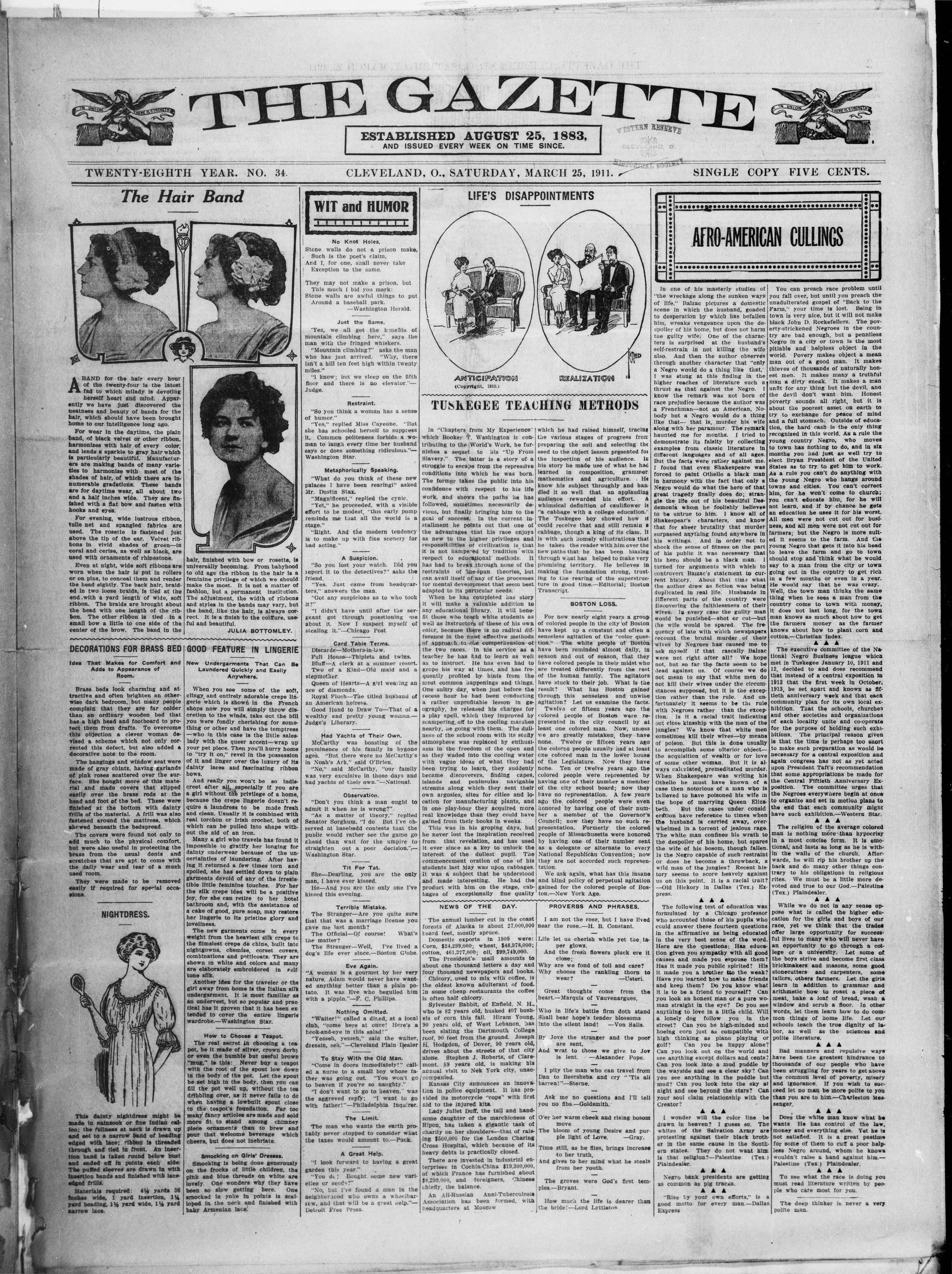
A BAND for the hair every hour of the twenty-four is the latest fad to which milady is devoting herself heart and mind. Apparently we have just discovered the neatness and beauty of bands for the hair, which should have been brought home to our intelligence long ago.
For wear in the daytime, the plain band, of black velvet or other ribbon, harmonizes with hair of every color, and lends a sparkle to gray hair which is particularly beautiful. Manufacturers are making bands of many varieties to harmonize with most of the shades of hair, of which there are innumerable gradations. These bands are for daytime wear, all about two and a half inches wide. They are finished with a flat bow and fasten with hooks and eyes.
For evening, wide lustrous ribbon, tulle net and spangled fabrics are used. The rosette is fastened just above the tip of the ear. Velvet ribbons in vivid shades of green—in coral and cerise, as well as black, are used with ornaments of rhinestone.
Even at night, wide soft ribbons are worn when the hair is put in rollers or on pins, to conceal them and render the head slightly. The back hair, braided in two loose braids, is tied at the end. with a yard length of wide, soft ribbon. The braids are brought about the head with one length of the ribbon. The other ribbon is tied in a small bow a little to one side of the center of the brow. The band in the
Idea That Makes for Comfort and Adds to Appearance of Room.
Brass beds look charming and at attractive and often brighten an otherwise dark bedroom, but many people complain that they are far colder than an ordinary wooden bed that has a high head and footboard to protect them from drafts. To overcome this objection a clever woman devised a scheme which not only corrected this defect, but also added a decorative note to the room.
The hangings and window seat were made of gray chintz, having garlands of pink roses scattered over the surface. She bought more of this material and made covers that slipped easily over the brass rods at the head and foot of the bed. These were finished at the bottom with dainty frills of the material. A frill was also fastened around the mattress, which showed beneath the bedspread.
The covers were found not only to add much to the physical comfort, but were also useful in protecting the brass from the usual dents and scratches that are apt to come with the daily wear and tear of a much used room.
They were made to be removed easily if required for special occasions.
NIGHTDRESS.
This dainty nightdress might be made in nailscook or fine Indian calico; the fullness at neck is drawn up and set to a narrow band of beading edged with lace; ribbon is threaded through and tied in front. An insertion band is taken round below bust and ended off in points each side. The pulled sleeves are drawn in with insertion bands and finished with lace-edged frills.
Materials required: 4½ yarda 36 inches wide, 1 yard insertion, 1¼ yard beading, 1½ yard wide, 1½ yard narrow lace.
THE GAZETTE
J
hair, finished with bow or rosette, is universally becoming. From babyhood to old age the ribbon in the hair is a feminine privilege of which we should make the most. It is not a matter of fashion, but a permanent institution. The adjustment, the width of ribbons and styles in the hands may vary, but the band, like the hair, is always correct. It is a finish to the collure, useful and beautiful.
New Undergarments That Can Be Laundered Quickly and Easily Anywhere.
When you see some of the soft, clingy, and entirely adorable crepe lingerie which is shown in the French shops now you will simply throw discretion to the winds, take out the bill you were fondly cherishing for something or other and have the temptress—who in this case is the little sales lady with the queer accent—wrap up your pet piece. Then you'll hurry home to "try it on," revel in the possession of it and linger over the luxury of its dainty laces and fascinating ribbon bows.
And really you won't be so indiscreet after all, especially if you are a girl without the privilege of a home, because the crepe lingerie doesn't require a laudress to be made fresh and clean. Usually it is combined with real torchon or Irish crochet, both of which can be pulled into shape without the aid of an iron.
Many a girl who travels has found it impossible to gratify her longing for dainty underwear because of the uncertainties of laudering. After having it returned a few times torn and spoiled, she has settled down to plain garments devoid of any of the irresistible little feminine touches. For her the silk crepe idea will be a positive joy, for she can retire to her hotel bathroom and, with the assistance of a cake of good, pure soap, may restore her lingerie to its pristine glory and loveliness.
The new garments come in every weight from the heaviest silk crepe to the filmselts crepe de chine, built into nightgowns, chemise, corset covers, combinations and patticoats. They are shown in white and colors and many are elaborately embroidered in self-tone silk.
Another idea for the traveler or the girl away from home is the Italian silk undergarment. It is most familiar as an undervest, but so popular and practical has it proven that it has been extended to cover the entire lingerie wardrobe.—Washington Star.
How to Choose a Teapot.
The real secret in choosing a teapot, be it made of silver, crown derby or even the humble but useful brown "mug," is this: Never buy a teapot with the root of the spout low down in the body of the pot. Let the spout be set high in the body, then you can fill the pot well up, without the tea dribbling over, as it never fails to do when having a lowbuilt spout close to the teapot's foundation. Far too many fancy articles are made and sold more fit to stand among chimney piece ornaments than to brew and pour that welcome beverage which cheers, but does not inebriate.
Smocking on Girls' Dresses
Smocking is being done generously on the frocks of little children, the pink and blue threads on white are lovely. One wonders why they have been so slow getting here. One smocked in yoke in points is scalloped in the neck and finished with baby Armenian lace.
JULIA BOTTOMLEY.
ESTABLISHED AUGUST 25, 1883 AND ISSUED EVERY WEEK ON TIME SINCE.
No Knot Holes
Stone walls do not a prison make,
Such is the poet's claim,
And I, for one, saall never take
Exception to the same.
They may not make a prison, but
This much I bid you mark:
Stone walls are awful things to put
Around a baseball park.
Washington Herald
Just the Same.
"Yes, we all get the benefits of mountain climbing here," says the man with the fringed whiskers. "Mountain climbing?" asks the man who has just arrived. "Why, there isn't a hill ten feet high within twenty miles." "I know; but we sleep on the fifth floor and there is no elevator."— Judge.
Restraint.
"So you think a woman has a sense of humor."
"Yes," replied Miss Cayenne. "But she has schooled herself to suppress it. Common politeness forbids a woman to laugh every time her husband says or does something ridiculous."—Washington Star.
Metaphorically Speaking.
"What do you think of these new palaces I have been rearing!" asked Mr. Dustin Stax.
"Magnificent." replied the cynic.
"Magnificent," replied the cynic.
"Yet," he proceeded, with a visible effort to be modest, "this early pump reminds me that all the world is a stage."
"Right. And the modern tendency is to make up with fine scenery for bad acting."
A Suspicion.
"So you lost your watch. Did you report it to the detectives?" asks the friend.
"Yes. Just came from headquarters," answers the man.
"Got any suspicions as to who took it?"
"I didn't have until after the sergeant got through questioning me about it. Now I suspect myself of stealing it."—Chicago Post
Full House—Thiplets and twins.
Bluff—A clerk at a summer resort.
Two of a Kind—Old maid and a stepmother.
Queen of Hearts—A girl wearing an ace of diamonds.
Royal Fluch—The titled husband of an American heress.
Good Hand to Draw To—That of a wealthy and pretty young woman—Judge's Liberary.
Had Yachts of Their Own.
McCarthy was boasting of the prominence of his family in bygone ages. "But there were no McCarthy's in Noah's Ark," said O'Brien.
"No," said McCarthy, "our family was very exclusive in those days and had yachts of their own."—National.
Observation
"Don't you think a man ought to admit it when he is wrong?"
admit it when he is wrong:
"As a matter of theory," replied Senator Sorghum, "I do. But I've observed at basebald contests that the public would rather see the game go ahead than wait for the umpire to straighten out a poor decision."—Washington Star.
He-And you are the only one I've kissed this evening.
Terrible Mistake.
The Stranger—Are you quite sure that that was a marriage license you gave me last month?
The Official—Of course! What's the matter?
The Stranger—Well, I've lived a dog's life ever since. Boston Globe.
Eve Again.
"A woman is a baiter by her very nature. Adam would never have wanted anything better than a plain potato. It was Eve who beguiled him with a pipin."—F. C. Phillips.
Nothing Omitted
"Waiter!" called a diner, at a local club, "come here at once! Here's a hook-and-eye in this salad!" "Yesshe, yesshe," said the waiter, dressin, seh."—Cleveland Plain Dealer
To Stay With the Old Man
"Come in doors immediately!" called a nurse to a small boy whose father was going out. "You won't go to heaven if you're so naughty." "I don't want to go to heaven," was the aggrieved reply: "I want to go with father!"—Philadelphia Inquirer.
The Limit.
The man who wants the earth probably never stopped to consider what the taxes would amount to.-Puck.
A Great Help.
"I look forward to having a great garden this year."
"You do? Bought some new varieties or seeds?"
"No, but I've found a man in the neighborhood who owns a wheelbarrow, and that will be a great help."—Detroit Free Press.
LIFE'S DISAPPOINTMENTS
ANTICIPATION
(Copyright, 1910.)
TUSKEGEE TEAC
ANTICIPATION
(Copyright, 1910.)
REALIZATION
In "Chapters from My Experience" which Booker T. Washington is contributing to the World's Work, he furnishes a sequel to his "Up From Slavery." The latter is a story of a struggle to escape from the repressive conditions into which he was born. The former takes the public into his confidence with respect to his life work, and shows the paths he has followed, sometimes necessarily devious, but finally bringing him to the goal of success. In the current installment he points out that one of the advantages that his race enjoys as new to the higher privileges and responsibilities of civilization is that it is not hampered by tradition with respect to educational methods. It has had to break through none of the restraints of line-spun theories, but can avail itself of any of the processes for mental development that seem best adapted to its particular needs.
When he has completed has story it will make a valuable addition to any educational library. It will benefit those who teach white students as well as instructors of these of his own color, because there is no radical difference in the most effective methods of approach to the comprehension of the two races. In his service as a teacher he has had to learn as well as to instruct. He has even had to grope his way at times, and has frequently profited by hints from the most common happenings and things. One sultry day, when just before the recess hour he had been conducting a rather unprofitable lesson in geography, he released his charges for a play spell, which they improved by scampering off to the cooling marshes nearby, as he going with them. The dullness of the school room with its study atmosphere was replaced by enthusiasm in the freedom of the open and as they waded into the cooling water with vague ideas of what they had been trying to learn, they suddenly became discoverers, finding capes, islands and peninsulas navigable streams along which they sent their own argosies, sites for cities and location for manufacturing plants, and in one play-hour they acquired more real knowledge than they could have gained from their books in weeks.
This was in his groping days, but he never lost the inspiration received from that revelation, and has used it ever since as a key to unlock the interest of the dulest pupil. The commencement oration of one of his students last May was upon cabbages. it was a subject that he understood and made interesting. He had the product with him on the stage, cabbages of exceptionally fine quality
The annual lumber cut in the coast forests of Alaska is about 27,000,000 board feet, mostly spruce.
Domestic exports in 1909 were: Corn, $24,299,000; wheat, $48,978,000; cotton, $41,777,000; oil, $99,749,000.
The President's mail amounts to about one thousand letters a day and four thousand newspapers and books. Chicory, used to mix with coffee, is the oldest known adulterant of food. In some cheap restaurants the coffee is often half chicory.
Sylvester Babbitt, of Enfield, N. H., who is $2 years old, husked 407 bushels of corn this fall. Hiram Young, 90 years old, of West Lebanon, has been slating the Dartmouth College roof, 90 feet from the ground. Joseph Hodgdon, of Dover, 90 years old, drives about the streets of that city alone. Stephen J. Roberts, of Claremont, 99 years old, is making his annual visit to Nek York city, unaccompanied.
Kansas City announces an innovation in police equipment. It has provided its motorcycle "cops" with first aid to the injured kita.
Lady Juliet Duff, the tall and handsome daughter of the marchioness of Ripon, has taken a gigantic task of charity on her shoulders—that of raising $500,000 for the London Charing Cross Hospital, which because of its heavy debts is practically closed.
There are invested in industrial enterprises in Cochin-China $19,300,000, of which France has furnished about $8,299,000, and foreigners, Chinese chiefly, the balance.
An All-Russian Anni-Tuberculosis Association has been formed, with headquarters at Moscow
REALIZATION
CHING METRODS
which he had raised himself, tracing the various stages of progress from preparing the soil and selecting the seed to the object lesson presented for the inspection of his audience. In his story he made use of what he had learned in composition, grammar, mathematics and agriculture. He know his subject throughly and handled it so well that an applauding audience rewarded his effort. A whimsical definition of cauliflower is "a cabbage with a college education." The Tuskegee boy showed how he could receive that and still remain a cabbage, though a king of its class. It is with such homely illustrations that he takes the reader with him over the new paths that he has been blazing through what has helped to make very promising territory. He believes in making the foundation strong, trusting to the rearing of the superstructure in good time.—Editorial; Boston Transcript.
BOSTON LOSS.
For now nearly eight years a group of colored people in the city of Boston have kept up a constant and often a senseless agitation of the "color question." The white people of Boston have been reminded almost daily, in season and out of season, that they have colored people in their midst who are treated differently from the rest of the human family. The agitators have stuck to their job. What is the result? What has Boston gained through this senseless and unwise agitation? Let us examine the facts. Twelve or fifteen years ago the colored people of Boston were represented in the city council by at least one colored man. Now, unless we are greatly mistaken, they have none. Twelve or fifteen years ago the colored people usually and at least one colored man in the lower house of the Legislature. Now they have none. Ten or twelve years ago the colored people were represented by having one of their number a member of the city school board; now they have no representation. A few years ago the colored people were even honored by having one of their number a member of the Governor's Council; now they have no such representation. Formerly the colored people of Massachusetts were honored by having one of their number sent as a delegate or alternate to every National Republican Convention; now they are not accorded such representation.
We ask again, what has this insane and blind policy of perpetual agitation gained for the colored people of Boston.—New York Age.
PROVERBS AND PHRASES.
I am not the rose, but I have lived near the rose.—H. B. Constant.
Life let us cherish while yet the taper glows.
And the fresh flowers pluck ere it close;
Why are we fond of toll and care?
Why choose the rankling thorn to wear? —Usteri.
Great thoughts come from the heart.—Marquis of Vauvenargues.
Who in life's battle firm doth stand Snail bear hope's tender blossoms into the silent land! —Von Salis.
By Jove the stranger and the poor are sent.
And wrat to those we give to Jov is lent. —Alexander Pope.
I pity the man who can travel from Dan to Beersheba and cry "Tis all barren!"—Sterne.
Ask me no questions and I'll tell you no flbs.—Goldsmith.
O'er her warm cheek and rising bosom move
The bloom of young Desire and purple light of Love. —Gray.
Time still, as he flies, brings increase to her truth,
And gives to her mind what he steals from her youth.
The groves were God's first temples.—Bryant.
How much the life is dearer than the bride!—Lord Lyttleton.
AFRO-AMERICAN CULLINGS
In one of his masterly studies of "the wreckage along the sunken ways of life," Balzac pictures a domestic scene in which the husband, goaded to desperation by which has befallen him, wreaks vengeance upon the despoiler of his home, but does not harm the guilty wife. One of the characters is surprised at the husband's self-restraint in not killing the wife also. And then the author observes through another character that "only a Negro would do a thing like that." I was stung at this finding in the higher reaches of literature such a thrust as that against the Negro. I know the remark was not born of race prejudice because the author was a Frenchman—not an American, Nobody but a Negro would do a thing like that— that is, murder his wife along with her paramour. The remark haunted me for months. I tried to demonstrate its falsity by collecting examples from classic literature in different languages and of all ages. But the facts were rattier against me. I found that even Shakespeare was forced to paint Othello a black man in harmony with the fact that only a Negro would do what the hero of that great tragedy finally does do; strangle the life out of his beautiful Desdemonia whom he foolishly believes to be untrue to him. I know all of Shakespeare's characters, and know that for sheer brutality that murder surpassed anything found anywhere in his writings. And in order not to shock the sense of fitness on the part of his public it was necessary that his hero should be a black man. I turned for arguments with which to controvert Barzac's statement to current history. About that time what the author drew as fiction was being duplicated in real life. Husbands in different parts of the country were discovering the fathlessness of their wives. In every case the guilty man would be punished—shot or cut—but the wife would be spared. The frequency of late with which newspapers recount the brutal murder of their wives by Negroes has caused me to ask myself if that rascally Balzac were not right after all? We hope not, but so far the facts seem to be dead against us. Of course we do not mean to say that white men do not kill their wives under the circumstances supposed, but it is the exception rather than the rule. And unfortunately it seems to be the rule with Negroes rather than the exception. Is it a racial trait indicating out close kinship with the man of the jungles? We know that white men sometimes kill their wives—by means of poison. But this is done usually to accomplish some ulterior object—the acquisition of wealth or for love of other women. But it is always calculated, premeditated murder. When Shakespeare was writing his Otello he must have known of a case then notorious of a man who is believed to have poisoned his wife in the hope of marrying Queen Eliza beth. But the cases under consideration have reference to times when the husband is carried away, over whelmed in a torrent of jealous rage. The white man confines his wrist to the despoiler of his home, but spares the wife of his bosom, though fallen Is the Negro capable of such restrain or does he become a throwback, a wild man of the jungles? Recent his tory seems to score heavily against us on this point. It is a racial trait—Old Hickory in Dallas (Tex.) Ex press.
▲▲▲
The following test of education was formulated by a Chicago professor who accounted those of his pupils who could answer these fourteen questions in the affirmative as being educated in the very best sense of the word. Here are the questions: Has education given you sympathy with all good causes and made you espouse them? Has it made you public spirited? His it made you a brother to the weak? Have you learned how to make friends and keep them? Do you know what it is to be a friend to yourself? Can you look an honest man or a pure woman straight in the eye? Do you see anything to love in a little child. Will a lonely dog follow you in the street? Can you be high-minded and hoeing corn just as compatible with high thinking as piano playing or golf? Can you be happy alone? Can you look out on the world and see anything except dollars and cents? Can you look into a mud paddle by the wayside and see a clear sky? Can you see anything in the puddle but mud? Can you look into the sky at night and see beyond the stars? Can your soul claim relationship with the Creator?
```markdown
```
I wonder will the color line be drawn in heaven? I guess so. The whites of the Salvation Army are protesting against their black brother in the same cause in the Southern states. They do not want him is that religion?—Palestine (Tex.) Plaindealer.
```markdown
```
Negro bank presidents are getting as common as pig tracks.
▲ ▲ ▲
"Rise by your own efforts," is a good motto for every man—Dallas Express
IN UNION THERE IS STRENGE
PY FIVE CENTS.
AN CULLINGS
You can preach race problem until you fall over, but until you preach the unadulterated gospel of "Back to the Farm," your time is lost. Being in town is very nice, but it will not make black John D. Rockefellers. The poverty-stricken Negroes in the country are bad enough, but a penniless Negro in a city or town is the most pitiable and helpless object in the world. Povery makes object a mean man out of a good man. It makes thieves of thousands of naturally honest men. It makes many a truthful man a dirty sneak. It makes a man unfit for any thing but the devil, and the devil don't want him. Honest poverty sounds all right, but it is about the poorest asset on earth to try to exchange for peace of mind and a full stomach. Outside of education, the hard cash is the only thing recognized in this world. As a rule the young country Negro, who moves to town has nothing to do, and in six months you had just as well try to elect Brian President of the United States as to try, to get him to work. As a rule you can't do anything with the young Negro who hangs around towns and cities. You can't correct him, but he won't come to church; you can't learn, and if by chance he gets an education he uses it for his worst. All men were not cut out for business, and all men were not cut out for farmers; but the Negro is more suited it seems to the farm. And the young Negro that gets it into his head to leave the farm and go to town should stop and think what he would say to a man from the city or town going out in the countrtry to get rich in a few months or even in a year. He would say that he was crazy. Well, the town man thinks the same thing when he sees a man from the country come to town with money, it does not last long, for the town man knows as much about how to get the farmers money as the farmer knows about how to plant corn and cotton—Christian index.
The executive committee of the National Negro Business league which met in Tuskegee January 10, 1911 and 12, decided to and does recommend that instead of a central exposition in 1913 that the first week in October, 1913, be set apart and known as fifteenth anniversary week and that each community plan for its own local exhibition. That the schools, churches and other societies and organizations of each locality unite and co-operate for the purpose of holding such exhibitions. The principal reason given is that the time is perhaps too short to make such preparation as would be necessary for a central exposition and again congress has not as yet acted upon President Taft's recommendation that some appropriations be made for the Central Fifteenth Anniversary Exposition. The committee urges that the Negroes everywhere begin at once to organize and set in motion plans to the end that each community might have such exhibition—Western Star.
▲ ▲ ▲
The religion of the average colored man is nothing more than hypocrisy in a most concise form. It is emotional, and lasts as long as he is within the walls of the church. Afterwards, he will rip his brother up the back and do many other things contrary to his obligations in religious rites. We must be a little more devoted and true to our God.—Palestine (Tex). Plaindealer.
▲▲▲
While we do not in any sense oppose what is called the higher education for the girls and boys of our race, yet we think that the trades offer large opportunity for successful lives to many who will never have an opportunity to go through a college or a university. Let some of the boys strive and become first class brickmakers and masons, some good stonecutters and carpenters, some tailors, others farmers. Let the girls learn in addition to grammar and arithmetic how to roast a piece of meat, bake a loaf of bread, wash a window and scrub a floor. In other words, let them learn how to do common things of home life. Let our schools teach the true dignity of labor, as well as the sciences and polite literature.
```markdown
```
Bad manners and repulsive ways have been the greatest hindrance to thousands of our people who have been struggling for years to get above the common level of poverty, misery and ignorance. If you wish to succeed let no man be more polite to you than you are to him.—Charleston Messenger.
```markdown
```
Does the white man know what he wants. He has control of the law, money and everything else. Yet he is not satisfied. It is a great pastime for some of them to cure a poor helpless Negro around, whom he knows wouldn't raise a hand against him.—Palestine (Tex.) Plaindealer.
```markdown
```
To see what the race is doing you must read literature written by people who care most for you.
The deep thinker is never a very polite man.
——
PUBLISHED EVERY SATURDAY |
SUBSCRIPTION RATES. |
(in Advance)
One Year... ccceseeeseeee 81:80
Bix Months...cccscsscesesse 100
‘Three Months.............5. 50
Subscribers are requested to re-
mit by postoffice money or
der or registered letter.
‘Entered at the postoffice In Cleveland,
Ohio, as second-class matter
Address all communications to
HARRY C. SMITH
Editor and proprietor,
‘THE GAZETTE,
Blackstone Building, Cleveland, 0.
Member Ohlo Legisiature: 1894
to 1896; 1898 to 1898; 1900 to 1902
THE GAZETTE is the oldest, and
than the largest bona fide circulation,
double that of any newspaper in the
Interest of Afro-Americans, publiehed
In the state of Ohio, and comparison
with any will Immediately estabilsh
ite rank as one of the NEWSIEST
aa BERT ba the coentan
I honor the man who in the con-
sclentious discharge of his duty dares
to stand alone; the world, with igno-
rant, intolerant judgment, may ,con-
demn, the countenances of relatives
may be averted, and the hearts of
friends grow cold, but the sense of
duty done shall be sweeter than the
applause of the world, the counten-
ances of relatives or the hearts of
friends —Charles Summer.
To sin by silence when we should
protest makes cowards out of men.
‘The human race has climbed on pro-
test. Had no voice been raised against
injustice, ignorance and lust, the in-
quisition yet would serve the law,
the guillotines decide our least dis-
putes. ‘The few who dare must speak
and speak again to right the wrongs
of many—Ella Wheeler Wilcox.
I am convinced myself that there
is no more evil thing in this present
world than race prejudice; none at
all, I write deliberately—it is the
worst single thing in life now. It
Justifies and holds together more base-
ness, cruelty and abonimation than
any other sort of error in the world.
‘Through its body runs the black blood
of coarse lust, suspicion, jealousy and
persecution and all the darkest poi-
sons of the human soul.—G. Wells in
the: New. York‘ Independent.
The Gazette intends to suspend its
Judgment of the Dr. Booker T. Wash-
ington—“Albert” Ulrich case, noted at
length elsewhere in this issue, until
it {s tried in the courts of New York
City, or settled out of them. However,
we would utter Just a word of warning
to the famous educator, and that is, a
failure on his part to prosecute his
assatlant to the fullest extent of the
law, and especially a settlement of the
case out, of court, will leave his side
of it open to much question in the
minds of the great mass of our people,
at least, the country over. It will
materially injure his standing with
them for years to come, if not for
the remainder of his life. And we
say this, too, in all kindness because
that terrible assault seems so unpro-
yoked, inexcusable and malicious as
to make abrolutely necessary, from
every sensible viewpoint, the most ag-
gressive and persistent court prose-
ution of “Albert” Ulrich.
THE INSURGENTS AND DEMOC.
RACY.
“The American people are not con-
trolled by prejudice or passion,” said
Senator Bristow of Kansas, in an argu-
ment for a change of our form of Gov-
ernment from the representative form
of its “founders” to a system, which,
in the opinion of many is liable to
“founder” the republican form of
government: in a way they feared in
their days it would—by ANARCHY.
It 1s not our purpose, at this time, to
argue the correctness of either asser-
tion, but to inquire from those who
wish to make the change whether
they do not deom it necessary to pre-
serve in theory—for a coming enact.
ment in practice—that form of gov-
ernment which the Constitution of our
Jand (as it was perfected through the
results of the war for the preservation
of Government by the people, through
the people. for the people, to use a
Lincoln phrase) guarantees to the
people, ALL the people, which of
course includes the Afro-American.
It seems the insurgents are not con-
cerned about the rights of these citl-
zens.
ee
. WHITENED SEPULCHERS IN
: CLASSIC, °
On the Mexican affair, Ex-President
Roosevelt in his speech at El Paso,
‘Texas, March 15, said: “Honest deal-
ing between man and man was the
only certain foundation of prosperity.
‘The same thing was true of the rela:
tions of communities to each other.”
Pausing, as though to select his
words, he then said he thought he
spoke for all Americans when he said
‘that all the United States demanded
of Mexico was “order, justice, inde-
pendence.” He said, further, that this
country only demanded of its neigh-
bor, that “order should reign within
its borders; and that order should be
established upon justice.” Great, isn't
it? And now, suppose with lynch-
anarchy stalking through too many of
our states, mob violence being rether
common, corruption stinking to hea-
yen, dishonesty (if T. R. is to be be-
}ieved) being a Kind of trade brand
with us, suppose Mexico should turn
the tables on us and demand of the
United States that we live up to these
requirements of civilization, first, our
selves, before we demand them from
Sthers? Great, fsn't it? Whitened
supulchers in classic.
——.
a BIT OF CAN'T DRIVEN HOME!
ntry stands before the
witht aa tho ehiet exponent ofthe
citizenship 8 not a mat-
principle that ee
Perot birth or blood, but of free
fapssnse,. Thus «bow struck at an
emcap in = foreign country be
cause of his race, is a blow at the fun-
damental principle of our American.
democracy—Chieago Examiner of
March 15, on “American Jews in Rus-
sia.”
Now come—and please, what Is it
but a blow administered at home be-
cause of his race, when this blow is
struck at the Afro-American—a citl-
zen, full-fledged under the Constitu-
tion? And if this is not a blow at the
principle of “our democracy,” what
is it?
American protests against Russian
massacres of Jews, have been futile —
Examiner,
‘True; but the Russian Government
can point out with some degree of
satisfaction that it never has display-
ed the hypocrisy of protesting againat
American lynch-murder and massacres
6f Afro-Americans, and while this does
not jusitify their own massacres in
the least, it at least protects them
against the charge of hypocrisy and
cant; and that is something. The
“American” Examiner, also our Govern-
ment and many other people, please
take note.
SHALL WE BEGIN TO DISSOLVE
THE UNION?
Senator Lodge's recent argument
before the United States Senate
against tha “direct” election of Sena-
tors did not recelve the general atten-
tion it deserved, It was delivered
amid the uproars of the Lorimer con-
test and few paused to read it. Yet
it was 0 eloquent, clear and true that
it merited universal attention, What
really was the proposal for “direct”
election of Senators? The average
man will say that it was merely to
substitute for the present method
election by the people as members of
the House are elected, It was that,
but {t was more. It proposed to strike
out of the Constitution the words eapi-
talized in the following clause:
The times, places and manner of
holding elections for Senators and
Representatives shall be prescribed in
each state by the Legislature there-
of; BUT THE CONGRESS MAY AT
ANY TIME BY LAW MAKE OR AL-
TER SUCH REGULATIONS, except
as to the places of choosing Senators,
—Constitution, Art. 1, Sec, 4, Cl. 1,
Now, the fourteen words capitalized
In the above have a very definite rea-
son for being there. That reason is
found in the unbearable situation
which the Constitution was adopted to
end, as the Founders of the Republic
saw its causes, and as Mr. Lodge thus
accurately describes it and them:
‘The makers of the Constitution
+ +" “also dealt with certain ques-
tions in regard to which they had a
peculiar and expert knowledge. ‘This
was emphatically so with the question
now before us for consideration,
+ * "They had seen the Continen:
tal congress, which had declared inde-
pendence, raised armies and made al-
lances, decline into helplessness and
discredit untiF it had become a heavier
burden to Washington than the enemy
in his front. ‘They had seen the Con-
federation which the Continental Con-
gress had established come into be-
ing, enjoy a sickly life and finally
sink into Imbecility, while the states
quarreled among themselves and do-
mestic disorder began to rear its ugly
head. And by all these disasters and
misfortunes they became convinced
that the fundamental cause of the
failure of the Continental Congress
and of the Confederation alike as
Schemes of government was that the
central government had relations only
with the states and was absolutely at
their merey.
The states were discordant and
with them thelr people. ‘The central
government had no contract with the
people and no claims on their loyalty.
There was no Nation, there was only
a group of jarring states. The mak-
ers of the Constitution met the dift-
culty and made a Nation by ‘an ar-
rangement at once bold and simple,
scientifically sound and eminently
practical,” as Senator Lodge: well
says, and which he thus describes:
They established a government
which dealt not with the states, but
directly with the people of the states,
They brought the central government |
into immediate contact with the In-
dividual man. ‘They created a real
citizenship of the United States, * *
It ig not too much to say that among
all the great solutions which these
men presented for the diffigilt pro-
lems they were called upon to meet
this was the most remarkable. It
certainly was the most vital, It
breathed the breath of life into the
government of the Constitution.
In accordance with that policy the
fourteen words emphasized above
were inserted in the Constitution. It
is true that the power thus reserved
to the central government has not at
all times nor fully been exercised. But
as Senator Lodge truly says: |
‘That the United States should have
tis Dower in reserve Was fundamen
al. ‘NO GOVERNMENT CAN HOPE
TO LIVE IF IT CANNOT PROVIDE |
THE MEANS BY WHICH IT LIVES, |
F IT CANNOT PROTECT ITS OWN
EXISTENCE,
Senator Lodge holds that a mere
change from indirect to direct elec-
ion of Senators would, of and by it-|
self, have been Immaterial—a mere |
“change in the mechanism,” which
‘does not touch the principtes upon |
which the government rests.” We
disagree with him, for it is obvious |
what such change would have im-
paired the entity of the state, as the |
change actually proposed would have |
Jestroyed the sovereignty of the Na-
don. And that would have been the
effect of the revolutionary proposal
happily defeated by the votes of pa-|
irlotic Senators acting without respect |
to party affiliations, For it was pro-
posed by chaiige in the Constitution, |
a8 Mr, Lodge says:
To put the United States govern-
ment, 80 far as the election of Sena-|
‘ors fs concerned, at the mercy of the
states—to take from the United States
any power to protect its citizens in
ihe exercise of their rights, no matter
now great the need for sitch protec-
jon. * * ¢) TWENTY-THREE |
STATES, THOUGH INCLUDING:
ONLY A’ MINORITY OF THE POPU:
LATION, COULD AT ANY TIME AR-|
REST THE MOVEMENT OF THE
NATIONAL GOVERNMENT AND
STOP ALL OPERATIONS.
How a molety of states, with a mi-
nority of population, having plenary
power to choose Senators in any man-
her and to bind Seuators, as a condi
ton of election, in any manner that
local whim, Interest or prejudice
might suggest, could tle the Nation's:
hands is self-evident. ‘The power re-
served to Congress to “make or alter
such regulations” is an essential
en a noe.
THE GAZETTE, CLEVELAND, 0., SATURDAY. MARCH 25, 1911
es ee
means by which it llver—eannot pro-| |father—St. Margaret's Sewing circ
Rist ite Gh oxiutaace™ | is being entertained by Mrs. F
| “ro call euch @ scheme a8 ths pro- Cox.—(Correspondent will lenge in
| Rressive," ap Senator Lodge well and ews earlier on MONDAYS. ator
truly says, "is mockery: Mt Is retro- OUR OWN WRITERS’ drama was a succoses—Sirs, Curie
| gression and reaction of an extreme | East Liverpool, was Mrs. G. Jobnso
| kind. If adopted it would carry the tgvest, Sunday Friend trom Marth
government back to the controversies Ferry visited Mrs, L. It. Mercer. Su
and the struggles out of which its oS ee day.—Prof. J. F. Mathews of Florid
| Constitution was born, and which be WHAT OUR PEOPLE ARE DOING |# Steubenville boy, married Mi
| get and endangered the infancy of the | ge HA Oe Cen ene come | | Maud Roberts of Oberlin, recently
| United States." It would be, in. very OF EAE Mies Pottiford give a fie recttal
deed and truth, a step toward the dis- | the euspiees Ge Co. Soong ee
solution of the Union by making {t as —— | captain. The pastor, Rev. D, W. Bt
|‘tnworkable-—-Chicago”” Daily inter fi Ten, has organized the chureh Inte
Seon. INTERESTING PERSONALNOTES | visions: ccci"to ‘rice a elven amou
| Soe SEs | fone.” He is. dois excale
| —_ work. The following C. E. office
Tm foci! Functions—church and Lodge | jic7e, flected revently: | Pres. M
|| Be Meee Matigeirand Dect (penne, as Pets moe
B's GP | Literary, Musical and Other | Mathews; treas., James Guy. TI
| Li | Notes of Interest. | meotings are exceptionally interedti
| RAANA (G | sotae and largely attended.—Rev. EB. 1
TAS. | eatgon—mue\Paarhors of Jerse] eRe, seg, ee fr, a
| y) Jom bad thelr feast last. Wednesday | § i
1k BY jem had their feast last Wednesday | here recently to a large audience a
Ay xe = Sree WILLE RAaen Eaitae ie Breatly pleased all—Mr. Silas Fle
ae A Htev. 0, W. Chilernsate. Frederik | P&®, Me Chas. Morgan and Mr, Th
| SANIRSSIES | sames ‘died recently, of tuberculosis. | Grown and Mes. 8 dabucten ave |
| ARRAS % |—Mr. Wm, Herington of Boston, "Y)"S “Murray has been added
|] ROME, Mase, is hefe visiting, en route to! Quinn’ cre ees poem, added
| RERENS UtSeaia ers une Branch “aied,|Gulea, cholr aire 2. Reynolds a
PN NN , wallets | daughter, Mattle, have gone to Nor
NY, AS Monday. Rheumatism of the heart— | Garolina—Mr, Geo. Snowden is
Hate ae | Mr. and Mrs, J. S. Clark have moved | very. ji Great improvement in. I
; tena | into their new home, 480 Arlington | Week's Gasette fret and’ fous
Bishop B. F. Lee denies the alleged
aAGTOR tnierilow ol goverai weeks
a
ror. By Ransom of NY. City, a
foray Cloyeimad Ack panton con
fs ntive ot Cambrtige, O.,12'8 candi
Sate toe buster,
baker. Washington raised
$218 Tor Edltor T, Thomas Fortune of
: oe
4
PE ile
ae
Wea i
mK Gad a
ANG. FRAO.
aR GscaoRScann
Red Bank, N. J., in recent months,
among the latter's many friends and
admirers,
T. McCants Stewart has been ap-
Pointed an Associate Justice of the
Supreme Court of Liberia. Mr. Stew-
art practiced law in New York for
many years and was at one time a
member of the Board of Education of
Brooklyn, He then settled in Hono-
lulu, Hawaii, where he lived a num-
ber of years before locating in Africa.
Assist. U.S. Dist. Atty. W. H. Lewis
of Boston, Mass., and J. C. Napier of
Nashville, Tenn., received recess ap-
pointments from the President, and
have been sworn into the offices of
Assistant U. 8. Attorney General, and
Register of the U. S. Treasury, at
Washington, D. C.
Pennsylvania announces that in the
resignaton of Ralph B. Brock, the
Afro-American superintendent of nur-
Series at the State forest academy, it
feels that it has lost a valuable pub-
lic servant. Mr, Brock has been at
Mont Alto, Pa,, a number of years,
and will now become a consulting and
contrneting, forester at West Chester,
Gale P, Hilyer, son of Mr. and Mrs.
Andrew F. Hilyer of Washington, D.
€,, a junior at the University of Min-
nesota, which has over 5,000 students,
was recently chosen by the Minnesota
State Forum (Colored) to represent
that state at the recent inter-state
debate at Des Moines, Ia. and was
also chosen by the faculty of the uni-
versity after having gone through the
usual elimination contests, to be one
of six who competed on March 17
for the Pillsbury prize for oratory;
$100 to the Ist, $50 to the 2d, $25 to
the 3rd. The winner is to have the
honor of representing the University
at the Northwestern Intercollegiate
oratorieal contest, which will take
place at Ann Arbor, Mich., in April,
Thanks “The Ojd Reliable”!
Cleveland, O., Mar. 18, 1911.
Editor Gazette—Dear Mr. Smith:
Please accept our tlanks for the no-
tices you so kindly put in your paper
concerning the colored children we
have in our care waiting for homes.
We appreciate very much your inter-
est and readiness to help us to se-
cure homes for these little ones.
Again thanking you, I remain,
Very respectfully yours,
E. J. HENRY,
Supt. The Cleveland Protestant Or-
phan Asylum,
ALWAYS “RUNG TRUE.”
Richmond, Va., Feb. 16, 1911.
Raitor Gazette, My Dear Mr. Smith:
Iam much impressed with your self-
sacrificing devotion to great princi-
ples, and though I may have at times
disagreed wih you upon questions of
expediency and good judgment, I have
always found out that you have “rung
true,”
‘The policy of The Gazette has al-
ways been the same—unswerving de-
votion to great principles and to the
race with which it is identified. With
sincere regard, 1 am,
Very truly yours,
JOHN MITCHELL, JR.
(Editor of “The Richmond Planet” and
President of the Mechanics’ Sav-
ings Bank.)
Se
Battle Creek, Mich.—D. K. Cornwell,
a retired Chicago merchant, who bas
heen living here for the last ten years,
presented Booker T. Washington with
$10,000 on March 17, to be used at
Tuskegee, Ala., university.
Undisputed.
“A man who allows his wife to have
her own way,” says a Boston profes:
sor, “is a phiiosopher and a diplomat”
Ergo, millions of married men are
philosophers and diplomats.
The Idea.
“Should you say ‘Hello!’ to the tele-
phone girl if she is a widow?" “Cer-
tainly, unless she is a grass widow;
then you should say, ‘Hay, there!’”
FRESH OniO NEWS
QUA OWN WRITERS
INTERESTING PERSONAL NOTES
lem had their feast last Wednesday
and sermon Sunday—The K. of P's
sermon will be preached Sunday by
Rey. 0. W. Childers—Mr. Frederick
James died recently, of tuberculosis.
Mr. Wm, Herington of _ Boston,
Mass., is hefe visiting, en route. to
California —Mrs, Julia’ Branch died,
Monday. Rheumatism of the heart —
Mr, and Mrs, J. S. Clark have moved
into their mew home, 480 Arlington
St.
| Sandusky.—The Patlor club's social
at Mrs. J. 8. Davis’, Tuesday evening,
and the Odd Fellows’, on Friday even:
|ing, were suecesses.—Last Friday, Mr.
| Rogers of Chicago, visited his motter-
inJaw, Mrs. Johnson, who is ill. Mrs.
[Anderson of Cleveland, also visited
her mother—Easter rally at. Second
| Baptist chureh, and winter picnic, at
Mrs. Samuel Scott's, the 31st—K. P,
annual sermon, at their hall March
26th—The improvement on pages 1
and 4 of last week's. Gazette was
Springfield—The members of the
Beacon Light chub enjoyed a very in-
teresting meeting at Central Y. M.
©. A—The Shriners gave a fine ban-
quet on the 21st.—Glover and Carter's
|company of comedians will entertain
| at the west end of the city building
| pext, week, — Rio's orchestra turn:
[ished music at tie St. Patrick dance
and whist party at the Elks’ hall, Sat
lurday evening. Prizes were awarded
the best waltz couple—Mist Bessie
| Williams ts visiting In Baltimore, Md
—Misa Alva Roberts of Xenia, 18 vis:
“iting her aunt, Mrs, Maybra—The Ga-
zette desires ‘an agent here to sell
[the papers. Write to the editor in
Cloveland.— (Correspondent will please
mall news-letter earlier on MONDAYS.
—Buitor.)
| Correspondents must mail ail tet
ters for publication at their main
postofiice sufficiently early on Monday
(or Sunday) of each week to have
them reach The Gazette office on
Tuesday morning, and always write,
also, thelr names and that of their
city’ or town on the outside of the
wrapper about retutned copies. Un-
less this latter is done, proper credit
cannot be given you. Lists of names,
Wedding presents, ete., obituary no:
tices, speeches, resolutions, poetry, in-
quiries for relatives and adveriise-
| ments of all kinds, including items
announcing entertainments to be held
|in the near future, must. be pald for
in advance at the rate of ten cents
Hine, six words to a line, Our rates
for display advertisements will be
sent on application. Send postal note
| and not stamps duripe warm weather.
| Martins Ferry.— Revival services
closed Sunday evening at Sixth St.
church. Bight conversions and the
church greatly revived. Mrs. Winston
of Pittsburg assisted Iast week and
preached Sunday morning and even-
ing. She is certainly good in both
sermon and song, and with Rev. Hain,
who also assisted in the meetings
here last week, is assisting at Mt.
Pleasant.—Mr. and Mrs. F. Worthing:
ton of Flushing, have returned home.
He is an operator for the B. & 0.
| Toad, but wishes to! purchase @ farm
and ‘retire—Mrs. Eva Ford of Steu-
\benville, visited Mrs. W, M, Randall,
Sunday, and Mrs. Blackwell of Bridge:
[port and Mrs, Winston, last riday.—
"Quarterly meeting and conference, the
27th. Dr. J. H. Jones, P. E,, will be
present.—Rev. Burden will ‘soon at-
tend his conference in Springfteld.
Cadiz.—P. 'T. Brown of East Liver-
pool, is visiting bis family.—Mr. Neal
Stewart was dined by Miss A. White,
Sunday—Mr. G. Bowles was out of
‘the elty for a few days.—Georgia and
‘Hazel Lawson were in Steubenville —
“Mrs. L. Doubt and Mrs. 8. Lucas are
Improving —Mtes. Allee “Tyler 18 it
Mr. and Mrs, J. Olmstead have a fat
baby boy.—Mr. M. Cooper was in
Pittsburg, last week—The Busy Bees
met at Mr. A. Wallace's, Sunday —
Miss Terrence of Dayton, died at her
sister, Mrs. J. Duling’s, Sunday even-
ing. Mr. H. Duling is very Ill, Helen
Duling is better—Prof. W. H. Lucas
gave the second of a series of lec-
tures on “Women of the Bible,”
“Mary, Mother of Jesus,” being the
subject discussed.—The improvement
of the first and fowrth pages of The
Gazette last week, was noted and
praised generally.
Smithfield.—Dr. J. H. Jones, P. B.,
‘held the second quarterly conference,
Saturday evening, preached ably Sun:
day morning, and administered sacra-
ment in the evening, assisted by
Revs. Veney, Cooper and the pastor.
He also preached and held communion
at Melntyre, in the afternoon.—Mrs,
G. Harris, Miss E. Carter, Mra. C.
West, F. Fitzgerald and J. Veney are
little better-—W. H, Veney, F. Carter
and several from McIntyre, were in
Steubenville, Saturday, Miss Mary
Cooper spent Sunday there—Mr. H
Harris was in Hopedale—Mrs. M
Banks and Mrs. N. Bowman visited
the former's sisters, Mrs. M. Mitchell
and Mrs. J. Carter, Wednesday and
‘Thursday. Rey. and Mrs, White were
in Steubenville, the same days. Dr.
Jones, their guest, is reported very il,
—Mrs, M. B. Veney entertained at din-
ner, Sunday, Mr. S. Banks of Stew
benville and’ Dr. Jones, and Rev. and
Mrs, White at lunch—Mrs. F. Ramsey
and children returned, Friday, from
Steubenville, accompanied by her
nephew, C. R. Foutz
Dayton. — Work on St. Margaret
-chureh’s new parish house, has begun.
—The Daughters of Jerusalem held
their mental feast last Thursday at
¢. W, €, Attorney Frank Whea-
‘ton of New York City, is here visit-
‘ing the Elks—A banquet was given
‘by the Ladies 21 club Thursday even-
‘ing at Elks’ hall—Mrs. Wm. Steward
is again iIl_—Mr. and Mrs, Roller were
‘called to Springfield Sunday by the
death of a relative—Dr. L. H. Cox
‘gave a very interesting talk to men
‘only at the Y. M,C. A., Sunday—R.
‘. Mallory stil continugs quite il—
“Miss Irene Harris, a very amiable
“young lady of Hot Springs, Ark., will
‘be our graduate from Steele High
‘school, this year—Mrs. Allie Smith
“entertained the Whist club last Friday
Just send your name and address on the coupon below—that is all you need todo, It does
not cost one penny and as soon as your name and address is received a set ‘of the world famous
Library of Universal History will be sent to you prepaid.
HERE te grat prorat, | NEVER fronts seaeet reine rn
these fttecn Beautiful volumes all prinvod trom large new tyre, | to reoammend this oder ts ener meade at is var ate
abel with over iobdoubie puree asd pase oval pags | aleeaare ans etoMnS eee caeenns aoe aE soe ee
ituerationg maay of wah aoe ssitn and over S40 pags ot | Eavwlog Wee sueroveries taereanea’s oe MSA Cea
seating Suter tear tnowladge and Liguer somcusion of ar eon eat
itis efter te made posstble by the failure ot tho publtshers, the ee eas Ueneee a
Doonan at Sokeocgomand wey wesmosinevegcane or bare | ant it Datla eum an opportaley ose for roarelt
or suueomn roctbotom Sackeupe pics of cu Sieateay ome | Bataan Sou ov dean atee You have tan he Hea al
ttnlatoa and 8200 per month fore mothe Tels poanele vo | ereuriguemafmaten:auugauons and ave rua oars of cis
Sane Somer prior cah Ufa apts inlet tating | Soest ccemanuee cnet, then Zot on Olde Sold
Matuhcw yrs aot Cute cae obaoces tis ee ecaons [eens coe eee
fers aul — int :
astro rou decide to buy wo insite 700 examine this work in | ports itatration ofthe Boa ven bere doe not do them tle;
atte ee mesa eh ou aera a morn | zou mus ec ahem o ralze whet suey are.”'You aanne
Hosavos‘ii wha fe sia aerate na'art aes | Shenton tots gr aby oun cle by makioe tis reget you
einer ae earonSe We'cencty nee yeu here | ny ask or «Seg sxannaton fo your ow
sins Us beng ee Sear pu gad nha sited tee | aviogany ome nny cing and remem ?
Hotuaet saa boas hd We bla nie Manesfehican | tod tbe Woks tac at our erpeagr And Toy
Serine aes Urey Monractea carecuceptice | tr caie'ae it le" ee
revtnning of tn tothe present yea; the grentet World Mitory | ha been tad Wossie Gay on ao- ——
Foun ataeedl yaa eeeeee spent of be ary of we Uel eee
Prof. Georze Fellows, of Indiana, says: “Most histories of the | tating reosiver's sale ut a SS fe
world ‘are dreary compilations, This work, however, is clear, | price which barely cov- =<. SS 2
Interesting and securate.” fre the cosy of tho ar SS RZ
Ex Vice-Pres, Stevenson says: “It s a complete record ot the | P° i. = “ia
‘human race and should fnd a piace in every Library.” MAIL THE ———S AGES
saver tToducsctoual voles in tse hous eurecobever wrest | COUPON Sa Gane
Rey. Frank W. Gunsaulus, of Chicago, says: “These volumes ics, bic? Oe 7
a tee tera ee | AG
Waa ieee ali <<. GaGa.
of , says: “Southe r A — Oi eth Ab i
Prat Dubey, of Weal sue; “Souter reer el Ze hic Ae
Saris cee a Geiger
‘The St. Louls Globe Democrat says: “This work gem Sie a he ee
enone — C2404
‘ ees Ce Asana ae? «.
15 Massive Volumes PS Sie. iG Lea Aae eo
Bach volume 7 inches wide SR ACA Aas <.
ee Se ce AG oss
weight, boxed, Pe I es AF
neatly a oe me ge capa CS
75 Ib a eS
S. ee et he ee CACM ET oS SSS
oe ai TE
Soe Pie Ze Gy 8 ook S
SS Ie on ee a ee SESS, soot
Pecan neg 2 aad BRA
Cee ng ap ae Sie Yea 2 $3, v3 ‘s
ae Ee A OS
| SOO SSE SSE, ifs
ee EE,
OAS a Ca sas SRR YG
clea ae a SS SS EES, ”
Ae ea KOSS CSS, Fe
As 4 <4 a: ae SS SS MES ffs Se
aa ( RMS Oe
Der Zae7 SSN Gaeceh Ge
AM 6 SES SE
a [ QON geese
: 6 Seas OEE COLE
| 2 ZZ SEER EI PLP
Real anal @ Sok MEY SEE So
i F Sn SES, “5 ie
ie . I RLEEGG CEE OS
A. SPAS LIE So
i OPES See SS 8
NG] * SSSI GP SAEF SS ot
; POPES ORS Poe ge ee
Gj Seer es
ISHED FE OPE
father.—St. Margaret's Sewing circle|
is being entertained by Mrs. F. A,
Cox—(Corresponsent wilt please mali
news earlier on MONDAYS.—Eaitor,)
Steubenville. — The Ninth Street
drama was a success—Mrs. Curtis of
East Liverpool, was Mrs. G. Johnson's
guest, Sunday.—Friends from Martins
Ferry visited Mra. L. R. Mercer, Suu-
day—Prof. J. F. Mathews of Florida,
& Steubenville boy, married Miss
Maud Roberts of Oberlin, recently. —
Miss Pettiford gaye a fine recital at
Quinn church, Friday evening, under
the anspices of Co. A, Mrs. A. J. Guy,
captain, ‘The pastor, Rev. D. W. But.
ler, has organized ‘the ehurch into di.
visions, exch to raise a given amount
of money. He is doing excellent
work. The following C. E. officers
were elected recently: Pres, M. J.
Beamer; vice, A. B. Reed; see., Mrs.
CG. Davis; corresp. sec, W. Rt
Mathews; 'treas., James Guy. ‘The
meetings are exceptionally interesting
and largely attended—Rey. BE. W.
Kinchen will soon leave for confer-
‘ence.—Prof. W. E. B. DuBois lectured
here recently to @ large audience and
greatly pleased all—Mr. Silas Flem-
Reynolds died recently —Mrs, M, J.
Brown and Mrs. S, Haliburton are iil.
—L. 8. Murray has been added to
Quinn ‘choir—Mrs. ‘T. Reynolds. and
daughter, Mattie, have gone to. North
Carolina.—Mr, Geo. Snowden is still
very ill—Great improvement in last
Week's Gazette—first and fourth
pages. It is our best race advocate.
Order a copy from Stewart Cook, the
local agent, and keep up to date,
Youngetown—Wesley Dungee and
George ———— of the. Laven -or-
-ghestra played in New Castle, Pa,
‘Sunday, for the Clover Leaf Club and
Hmaade i hit-—Mahoning Ave, H. & F,
M, society ‘met at Mrs, Philip ‘Tuck:
er’s, last Thursday, and appointed a
conimittee to arrange for a May far.
Miss Hattie Tucker has gone to Rich-
mond, Va., and Atiantle City, N. J.
[Where the will iocate ved" James
died at his mother, Mrs. Lydia At-
Se eae oe re Ae
“here-—Misses Nannie Heath and Lik
lian Lawson visited in Lorain, recent-
ly-—Logan lodge and Gold Leaf Co.
will meet in Foresters’ hall, Sunday,
at 12:30, noon, in full uniform, to at:
‘tend anniversary services at Oak Hill
Ave. chureh, Louisa Edwards Court
will meet at the church at. 1 o'clock
sharp.—Miss Lucy Scott and Mr. Hen-
‘ry Leece accompanied the body of
“Mrs. Nora Reed to Ezra, Va,, Satur-
‘day.—Mrs. Chas, Jackson! Mrs. Hattie
Jefferson and Mra, Chas, Lincoln are
‘fi—The great improvement in the
‘first and fourth pages of The Gazette
last week was a most agreeable sur-
prise to all our readers here. Tell
Your friends to take this paper, our
oldest and best race advocate and
hewspaper.—Mrs, Nora Reed died last
| Friday at C. ©. Scoit’s, She left six
sisters and two brothers, one, Miss
Lucy Scott, living in Warren, She
‘was a member of Mahoning Ave.
‘church and H. & H. lodge. Special
serviees at this church, Sunday. ‘The
‘pastor and Hey. J. W. Page ot New
Castle, Pa., preached’ morning and
evening, respectively. In the after.
noon, the Baptist S. 8. Union of W.
Pa, and Eastern Ohio rendered an in:
teresting program to a large audl-
ence,
OW 0 FOR GAe FOr: Our ary:
If your hair {s curly, kinky or dry
or otherwise unsatisfactory, write us
at once for our little book of valuable
Information concerning the care of
the hair. No dopes or medicines.
Split ends, kinky, curly, dry or stub-
born hair remedied by your own hand.
Send twenty-five cents for booklet.
General Advertisement and Sales
Agents, Address Arthur D. Ramsey,
No. 78 North High St., Akron, Ohio.
Wilbert University
| E 4
| Wilberforce, Ohio.
| Opens First Tuesday In September
| Located in Greene county, three and one-quarter miles from Xenia, 0.
‘Healthful surroundings. Refined community. Faculty of 32 members. EX-
Penses low. Classical and Scientific, Theological, Preparatory, Music, Mil-
“itary, Normal and Business Departments. TEN INDUSTRIES TAUGHT.
|GREAT OPPORTUNITIES for High School Graduates entering College
| or Professional Courses. Ohio students desiring to enter Normal, Busi
| ness or Industrial Department can obtain certificate from State Senator
or Representative entitling them to FREE TUITION, ROOM RENT AND
INCIDENTALS.
Catalogue and special information furnished, Address
W. 8. SCARBOROUGH, PRES.
| W. A. JOINER, SUPT, C. N. & |, DEPARTMENT.
1
DREHER’S
200 New $350
Upright Pianos
Terms: $5 down;
$1.25 weekly.
B. DREHER’S SONS CO.
Rey. J. E. Wood of Danville, Ky.
euitor ot The Torcblight, Rev. H. Af
Lowry of Mt. Haven Baptist church
and Dr. H. C. Bailey of Antioch Bap-
tist chureh, paid The Gazette sanctum
sanetorum ‘a very. pleasant call, Mon-
day afternoon. ‘The firstnamed ar.
rived in the city on the 18th, to con-
duct a series of revival meetings for
the churches mentioned, at Antioch.
Sunday much interest was manifested
at all three meetings and the church
was packed to its utmost seating ca-
pacity. At the evening service, six
Joined, and one made profession of
faith in Christ. Antioch is adding to
its membership each month a fine
class of young men and women. This
assures it @ splendid future.
In St. John's church, Sunday atter-
noon, Judge U. L. Marvin of the elr-
cuit court, praised our people for the
Progress made in the last decade, He
praised the race for its increasing
moral and intellectual worth. The
judge looked forward to a bright fu-
ture for the Negro in America. “You
should not think too much of polit-
ieal office,” Judge Marvin said. “Poli-
tics is not the highest pinnacle that
a citizen can attain in America, Don't
be disappointed if you do not secure
this position or that. Remember that
sound character and upright living is
more to be desired than political pret-
erence.”
Greatest Thing in Life.
Neither rich furniture, nor abund-
ance of gold, nor a descent from an
illustrious family, nor greataess of au-
thority, nor eloquence and all the
charms of speaking, can produce 50
great a serenity of life as a mind
free from guilt, kept untainted, not
only from actions, but purposes, that
are wicked.—Plutarch.