The Gazette
Saturday, May 6, 1911
Cleveland, Ohio
Page text (machine-generated)
TWENTY-EIGHTH YEAR. NO. 40.
V
IN UNION
THERE IS STRONGER
TWENTY-EIGHT
The C
EVERY one (with an eye for beauty values in the new styles) will want a hair band. The hair band is not a novelty, but it is a revival witch, for two reasons, has been steadily gaining ground in favor. Those consummate judges of the beautiful and artistic—the ancient Greeks—show us, in what remains of their art, that their women bound up their hair with bands, and the Greek colfurie, like the Greek architect, still stands the most excellent of all achievement in its line, writes Julia Bottomley in the Illustrated Milliner. The demand for the band has become so general that bands of many descriptions and styles, designed for women of various ages, complexions and build, are now manufactured and put on the market, all ready to adjust to the head. There are plain black bands of velvet or silk ribbon, finished with a plain flat bow, or a rosette for morning wear, which means also that they are appropriate for the business woman during her working hours. They fasten with one or two books and eyes, and are not confined to black but are shown in black with a little silver or white, or in white with black markings suitable for very gray hair.
The hair band supports the hair which, as the day wears on, has a tendency to sag, unless provided with some artificial support. It keeps the "scolding locks" from flying loose and straggling about the neck and face. The charm of neatness is hardly second to that of beauty, and has a beauty of its own, which has been known to win out over very beautiful but "sloppy" creatures. Besides these virtues the hair band is becoming. If the hair is dull and lifeless, the band brightens it. The older ladies with beautiful white hair, understand the life and sparkle resulting from the vivid contrast of the black velvet band, or one of vivid green. The glow of silver strands or the sparkle of cut steel or rhinestones on the band makes the white coifure a thing of distinction and beauty which is different from any other. The black hair, that is lacking in the luster and "shine" essential to beauty in dark shades, borrows brilliance from gold
1
The charm of the quaint, old fashioned fichu is not to be denied, and this summer fichus are to be much worn with frocks of thin, summery material. This fichu of white tucked batiste and embroidery is combined with a broad sailor collar and the whole arrangement fastens at the throat with an old fashioned brooch, the folds of the fichu being drawn down and plumed on the belt line. One reason for the almost universal becoming of the fichu is its V shaped arrangement at the neck. The Vd neck opening is much more apt to be flattering to the face above it than the round Dutch neck.
Lace Watch Fobs.
Iace watch fobs are very dainty. They are also new, and a charming adjunct to the light frock. The girl who is deft with her fingers should be able to make one easily at home. For this, remnants of Irish or Clany insertion may be utilized. The strips of insertion are folded over the gold or brass catch, which may be bought for fobs, and the end is pointed and finished with a white clik tassel. The girl with a military friend from whom she may beg souvenirs might substitute for the white tassel one of gold strands such as is worn on a sword.
THE GAZETTE
and silver and spangles. Women with brown hair, and all the intermediate shades or tones that gradually lead to auburn, red, deep gold, pale gold and drab and then to ash blonde, will find the selection of a band as interesting as the selection of a hat. All of them may be sure that black looks well, bringing out the wonderful colors which nature seems to delight in giving to human hair. The band is not necessarily of a contrasting color. The possessor of copper colored hair may achieve a color harmony with copper color and green or copper color and black, which will make the most jaded observer of things beautiful (if such a being lives) turn round to look and rejoice. Adopt the hair band, make a study of it, and it will be a part of you, waking or sleeping. For her modern ladyship gives attention to her night time disposition of the hair, with an eye to making it attractive as well as comfortable. If she finds it necessary to roll it up on curlers about the face, then the broad band of soft ribbon covers up a lot of unsightiness. The soft rosette at the side is a touch of frivolity which we not only forgive, but adore. Little net or silk caps with a frill of lace or band of ribbon on the face are also very nice for night wear.
Figure 1 shows a band of wide ribbon finished with a rosette. The color, in this instance, is turquoise blue and the wearer possesses a gift of nature, in hair of deep yellow, a regular gold. She should wear with equally fine effect, yellow, white, pale green, pale and deep blues, black, white, gray, lavender and yellow browns. The band shown is called the "Hortense." The ribbon of which it is made is six inches wide and two yards are required. The rosette is fastened back of the tip of the ear. The new coifures are either quite high or very low, and are designed for different types. Fig. 2 is called the "Lady Vivien." and is designed for evening wear. It is simply a strip of spangled tulle 10 to 12 inches wide finished with a small rosette. A barrette of shell, set with rhinestones, is worn with it, forming a more substantial support for the chignon.
CURVES NO LONGER IN STYLE
Decree of Fashion is That Woman Must Be Perpendicularly Parallel.
This is the season of the Disappearance Figure.
Figures—as figures—are no more. They make excellent clothes props, or pillow-case advertisements. But as figures their day is done.
Venus has now vanished. Not by sleight-of-hand or force of circumstances, but by word of mouth. The decree of fashion has gone forth, and Venus has bowed to the inevitable. Not only has she mislaid her arm; she has now lost her shape. The curves and contours of yesterday have become the lines and angles of today. Women have gone back a decade. They have discarded their corsets and curves; their broad shoulders and narrow waists. They are now perpendicularly parallel, from head to heels. In brief—they are waistless.
We do all we can nowadays to hide our figures. If Nature has blessed—or cursed—us with a few fascinating curves, we rush to the nearest Disappearing Figure-Factory, and purchase a casing to fill the unnecessary spaces.
To please the youngsters they must be stiff and perky. Plain colors always be regular colors for morning and afternoon wear in the hair.
There is a decided preference for plaids and stripes for school hours.
A good deal of smartness is given to a plain frock by topping it with a striking contrast of colors.
A blue serge, for example, looks vastly better if a big blue, red and green plaid hair ribbon catches the eye at the same time.
Plaids are not suitable for afternoon.
When a little miss changes her dress for the afternoon she may wear a flowered ribbon in her hair if she likes.
Dusty Face.
During the day use a mixture of glycerine and rose water, half and half, for cleansing the face. On retiring you may wash the face thoroughly with hot water and a mild soap, and after this apply cold cream
ESTABLISHED AUGUST 25, 1883 AND ISSUED EVERY WEEK ON TIME SINCE.
CLEVELAND, O., SATURDAY, MAY 6, 1911.
NEGROES ARE OPTIMISTIC
PESSIMISM IS PRACTICALLY AN UNKNOWN FORCE AMONG AFRO-AMERICANS.
The Prairie View Standard says in a recent issue:
"The negro pessimist has linger been with us, though he has not known himself by that name. The negro pessimist has no faith in any undertaking of his own race; he is always criticising or denouncing the preachers and the churches of his race, because it is a safe thing to do. He never takes stock in any negro enterprise. He never subscribes for a negro newspaper. When any enterprise is started he immediately predicts its failure, and does all he can to make it fail. But the influence of the negro pessimist is waning."
Commenting upon this, State Press of the Dallas News says:
"This is a new view of the negro. It has been generally understood heretofore, at least among the white folks, that there were no negro pessimists. Optimism has been the colored man's best asset, according to the Caucasian idea. Through drought and flood, through fire and famine, the black man has gone his way, serenely confident of the future, to all appearances, and wholly contented with the present. Many men of the other color have envied the Afro-American his easy mental attitude in times of stress. Millionaires in glued carriages have looked through their French plate glass at the happy black man wielding a pick in the streets and wished that the laborer's fine freedom from carping care might be transplanted into their own bosoms. The mistress of many a palatial home has longed for the restful philosophy that characterized the 'black mammy' in the kitchen. If the negro is beginning to be a pessimist, then he is losing his birthright." Pessimism is practically an unknown force among negroes.
The Standard evidently mistakes criticism for pessimism. During the past few years a good many things, long regarded as too sacred for adverse comment, have been subjected to fearless but well-intentioned criticism among negroes. Here and there, it will be admitted we have a few—a very few—presachers who have had no more preparation for their work than a mule, and who make up in clatter for what they lack in matter, who substitute sound for sense—thunder for lightning, and under whose teaching the race is not getting anywhere morally, spiritually or intellectually—and somebody has had the hardship to say so. And here and there a few men of God have shown more eagerness for the dollar than for souls—and somebody has said so. Here and there a colored man has gone into businesses and hoped to succeed by virtue of his color. He has been urged to revise his business creed and to get in the game, leaving his color out of the question. That's the sort of pessimism that is now prevalent.
Thinking men have seen that the race is long on church building, but is decidedly short on factory building. And somebody has said so.
Here and there a few secret orders, useful in themselves, have been used by designing men to enrich themselves at the expense of the many—and somebody has had the nerve to say so.
Here and there people have thought that when men organize a bank or other commercial enterprise and bid for public support, the organizers ought to have some money, some business capacity and some—honesty. These things have been voiced by fearless critics—men who were looking for no office and who were indifferent alike to applause or blame. That's the kind of pessimism that our contemporary has in mind, and it is as different from the real article as night is from day.
The negro is not losing his optimism. He's more of an optimist now than ever, because he needs to be. But along with that optimism he's becoming sufficiently keen sighted to know that every sermon is not "great;" every speech is not "grand;" every enterprise or scheme originated by negroes is not necessarily founded on strict business principles; every public uplifier is not necessarily an angel, and that every appeal made in the name of "race pride" is not necessarily unseafish.
The critics who have been radiating this sort of "pessimism" have been making conditions better for every negro of brains and worth, and for every honest enterprise an dendeavor struggling for recognition and a foundation upon which to stand. They have simply tried "To prune the luxuriant, the uncouth refine, But show no mercy to an empty mind."
and still less to the fellow who regards the race as his particular and lawful prey.
The atmosphere is becoming less and less favorable to the fellow whose chief ability is to blunder and to plunder. And that's the result of the "pesstimism" that is now frightening our honest contemporary. What? The negro is so much of an optimist that he looks for the best, and when he gets the worst, he doesn't believe it!—"Old Hickory," in Dallas Express.
How He Broke It Off.
Mrs. Coyne—Did you tell Ethel that you would disinherit her if she married that broken-down nobleman?
Mr. Coyne—No. I told the broken-down nobleman.
M.
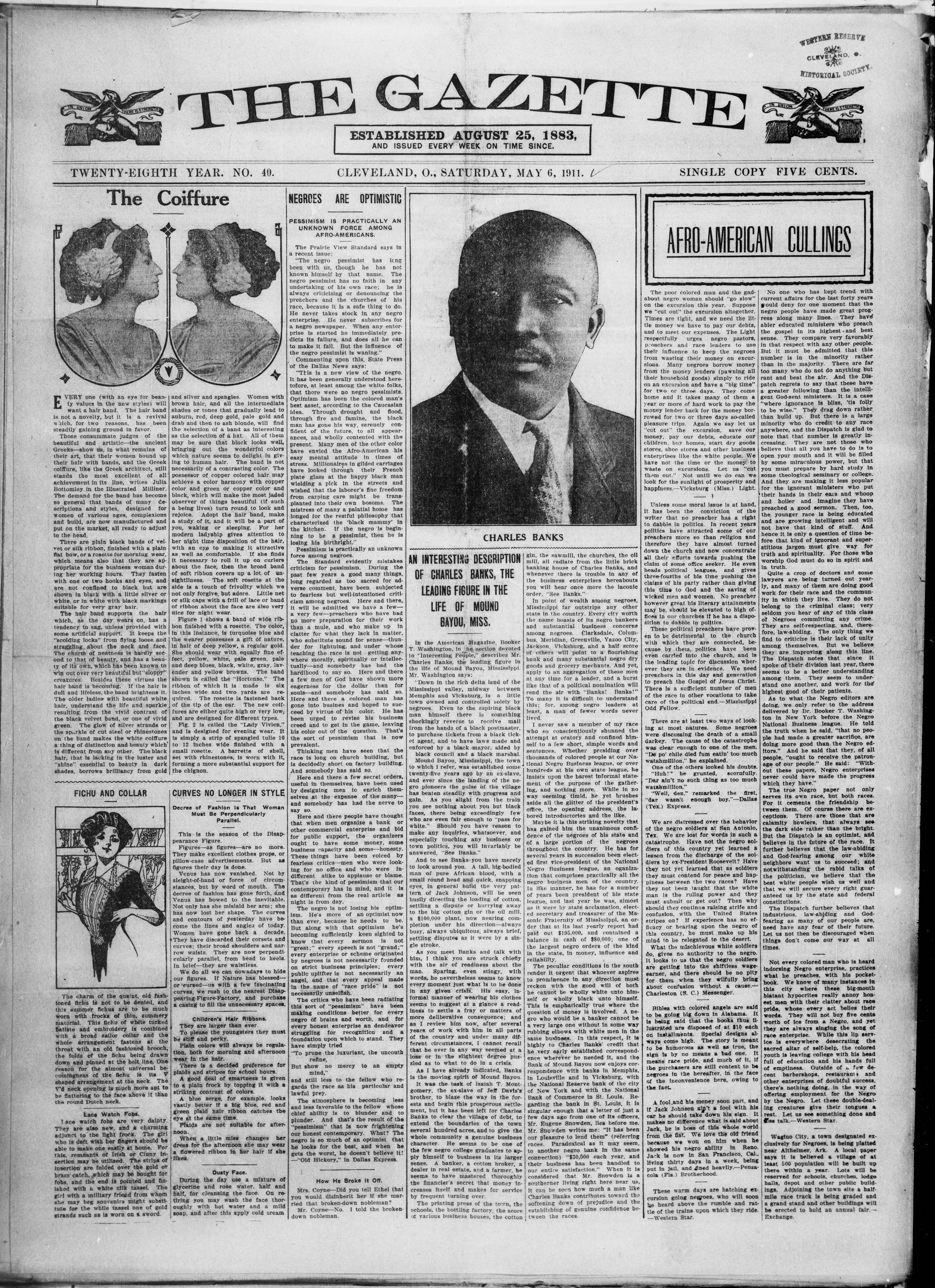
CHARLES BANKS
AN INTERESTING DESCRIPTION OF CHARLES BANKS, THE LEADING FIGURE IN THE LIFE OF MOUND BAYOU, MISS.
In the American Magazine, Booker T. Washington, in the section devoted to "Interesting People," describes Mr. Charles Banks, the leading figure in the life of Mound Bayou, Mississippi. Mr. Washington says:
"Down in the rich delta land of the Mississippi valley, midway between Memphis and Vicksburg, is a little town owned and controlled solely by negroes. Even to the aspiring black man himself there is something shockingly reverse to receive mall from the hands of a black postmaster, to purchase tickets from a black ticket agent, and to have laws made and enforced by a black mayor, aided by black council and a black marshal. Mound Bayou, Mississippi, the town to which I refer, was established some twenty-five years ago by an ex-slave, and ever since the landing of the negro pioneers the pulse of the village has beaten steadily with progress and gain. As you alight from the train you see nothing about you but black faces, there being exceedingly few who are even fair enough to "pass for white." Should you have reason to make any inquiries, whatsoever, and especially touching any business or town politics, you will invariably be answered. "See Banks."
And to see Banks you have merely to look around you. A tall, big-bodied man of pure African blood, with a small round head and quick, snapping eyes, in general build the very pattern of Jack Johnson, will be seen busily directing the loading of cotton, settling a dispute or hurrying away to the big cotton gin or the oil mill, a $100,000 plant, now nearing completion under his direction—always busy, always ubiquitous, always brief, settling disputes as it were by a single stroke.
As you meet Banks and talk with him, I think you are struck chiefly with the air of readiness about the man. Sparling, even stingy, with words, he nevertheless seems to know every moment just what is to be done in any given crisis. His easy, informal manner of wearing his clothes seems to suggest at a glance a readiness to settle a fray or matters of more deliberative consequence; and as I review him now, after several years of work with him in all parts of the country and under many different circumstances, I cannot recall that he ever in any way seemed at a loss or in the slightest degree puzzled as to what to do in a crisis.
As I have already indicated, Banks is the moving spirit of Mound Bayou. It was the task of Isaiah T. Montgomery, the ex-slave of Jeff Davis's brother, to blaze the way in the forests and begin this prosperous settlement, but it has been left for Charles Banks to clear the village of debt, to extend the boundaries of the town several hundred acres, and to give the whole community a genuine business character. He seems to be one of the few negro college graduates to apply himself to business in its larger sense. A banker, a cotton broker, a dealer in real estate, and a farmer, he seems to have mastered thoroughly the financier's secret that money increases itself and makes for service by frequent turning over.
The printing press of the town, the schools, the bottling factory, the score or various business houses, the cotton
gin, the sawmill, the churches, the oll mill, all radiate from the little brick banking house of Charles Banks, and whenever there is trouble in any of the business enterprises hereabouts you will hear once more the laconic order, "See Banks."
In point of wealth among negroes, Mississippi far outstrips any other state in the country. Every city worth the name boasts of its negro bankers and substantial business concerns among negroes. Clarkskale, Columbus, Meridian, Greenville, Yazoo City, Jackson, Vicksburg, and a half score of others will point to a flourishing bank and many substantial dry goods and grocery mechanics. And yet, apply to an aggregation of these men at any time for a leader, and a burst like that of a political nomination will rend the air with "Banks! Banks!" To many it is difficult to understand this; for, among negro leaders at least, a man of fewer words never lived.
I never saw a member of my race who so consciently shunned the attempt at oratory and confined himself to a few short, simple words and sentences. Whether presiding over thousands of colored people at our National Negro Business league, or over hundreds at his own state league, he insists upon the barest informal statement of the purpose of the gathering, and nothing more. While in no way seeming timid, he yet brushes aside all the glitter of the president's office, the opening address, the labored introductories and the like.
Maybe it is this striking novelty that has gained him the unanimous confidence of the negroes of his state and of a large portion of the negroes throughout the country. He has for several years in succession been elected first vice-president of the National Negro Business league, an organization that comprises practically all the negro business men of the country. In like manner, he has for a number of years been president of his state league, and last year he was, almost as it were by state acclamation, elected secretary and treasurer of the Masonic Fraternity of Mississippi, an order that at its last yearly report had paid out $195,000, and contained a balance in cash of $80,000; one of the largest negro orders of the kind in the state, in money, influence and reliability.
The peculiar conditions in the south render it urgent that whoever aspires to prominence in any direction must reckon with the good will of both he cannot be wholly white unto himself or wholly black unto himself. This is emphatically true where the question of money is involved. A negro who would be a banker cannot be a very large one without in some way rubbing elbows with white men in the same business. In this respect, it is highly to Charles Banks' credit that he very early established correspondence wherever he needed it, and the Bank of Mound Bayou now enjoys correspondence with banks in Memphis, in Louisville and in Vicksburg, with the National Reserve bank of the city of New York and with the National Bank of Commerce in St. Louis. Regarding the bank in St. Louis, it is singular enough that a letter of just a few days ago from one of its officers, Mr. Eugene Snowden, lies before me. Mr. Snowden writes me: "It has been our pleasure to lend them" (referring races. Paradoxical as it may seem, to another negro bank in the same connection) "$30,000 each year, and their business has been handled to our entire satisfaction." When it is considered that Mr. Snowden is a southerner living right here near us, it can be seen how much a man like Charles Banks contributes toward the softening down of prejudice and the establishing of genuine confidence between the races.
SINGLE COPY FIVE CENTS.
AFRO-AMERICAN CULLINGS
The poor colored man and the gadabout negro woman should "go slow" on the excursion this year. Suppose we "cut out" the excursion altogether. Times are tight, and we need the little money we have to pay our debts, and to meet our expenses. The Light respectfully urges negro pastors, preachers and race leaders to use their influence to keep the negroes from wasting their money on excursions. Many negroes borrow money from the money lenders (pawning all their household goods) simply to ride on an excursion and have a "big time" for two or three days. They come home and it takes many of them a year or more of hard work to pay the money lender back for the money borrowed for two or three days so-called pleasure trips. Again we say let us "cut out" the excursion, save our money, pay our debts, educate our children, buy homes, start dry goods stores, shoe stores and other business enterprises like the white people. We have not the time or the money to waste on excursions. Let us "cut them out." Not until we do can we look for the sunlight of prosperity and happiness.—Vicksburg (Miss.) Light.
Unless some moral issue is at hand, it has been the conviction of the writer that no preacher has a right to dabble in politics. In recent years politics have attracted some of our preachers more so than religion and therefore they have almost turned down the church and now concentrate all their efforts towards pushing the claim of some office seeker. He even heads political leagues, and gives three-fourths of his time pushing the claims of his party rather than giving this time to God and the saving of wicked men and women. No preacher however great his literary attainments may be, should be elevated to high offices in our churches if he has a disposition to dabble in politics.
These political preachers have proven to be detrimental to the church with which they are connected, because by them, politics have been even carried into the church, and is the leading topic for discussion wherever they are in evidence. We need preachers in this day and generation to preach the Gospel of Jesus Christ. There is a sufficient number of men of the race in other vocations to take care of the political end.—Mississippi Odd Fellow.
There are at least two ways of looking at most natures. Some negroes were discussing the death of a small darkey. The cause of the catastrophe was clear enough to one of the men "De po chile dum fæm ito' much watahmillion," he explained.
One of the others looked his doubts. "Huh!" he grunted, scornfully. "Dar saint! no such thing as too much watchmillion." "Well, den," remarked the first, "dar wasn't enough boy."—Dallas (Tex.) Express.
We are distressed over the behavior of the negro soldiers at San Antonio, Tex. We are lost for words in such a catastrophe. Have not the negro soldiers of this country yet learned a lesson from the discharge of the soldiers by ex-President Roosevelt? Have they not yet learned that as soldiers they must contend for peace and happiness between the two races? Have they not been taught that the white man is the ruling power and they must submit or get out? Then why should they continue raising strife and confusion, with the United States stripes on? If experience has no efficacy or bearing upon the negro of this country, he must make up his mind to be relegated to the desert.
What the mischievous white soldiers do, gives no authority to the negro. It looks to us that the negro soldiers are getting into the shiftless wageearner, and there should be no pity for them when they wilfully bring about confusion without a cause.—Charleston (S. C.) Messenger.
Bibles with colored angels are said to be going big down in Alabama. It is being said that the books thus illustrated are disposed of at $10 each on installments. Special designs always come high. The story is meant to be humorous as well as true, the sign is by no means a bad one. It means race pride, and much of it, if the purchasers are still content to be negroes in the hereafter, in the face of the inconvenience here, owing to the fact.
A fool, and his money soon part, and if Jack Johnson isn't a fool with his car he should take down his sign. It makes no difference what is said about Jack, he is boss of this whole world from the fist. We love the old friend because we won on him when he showed his negro ability in Reno. Jack is now in San Francisco, Cal. living thirty days in a week, being put in jail, and fined heavily—Pensacola (Fla.) Brotherhood.
These warm days are hatching excursion going negroes, who will soon be heard above the rumble and rattle of the trains upon which they ride.—Western Star.
WESTERN RESERVE
CLEVELAND, O.
HISTORICAL SOCIETY
IN UNION
THE LEGISLATURE
No one who has kept trend with current affairs for the last forty years would deny for one moment that the negro people have made great progress along many lines. They have abler educated ministers who preach the gospel in its highest and best sense. They compare very favorably in that respect with any other people. But it must be admitted that this number is in the minority rather than in the majority. There are far too many who do not do anything but rant and beat the alr. And the Dispatch regrets to say that these have a greater following than the intelligent God-sent ministers. It is a case "where ignorance is bliss, 'tis folly to be wise." They drag down rather than build up. But there is a large minority who do credit to any race anywhere, and the Dispatch is glad to note that that number is greatly increasing. They are not those who believe that all you have to do is open your mouth and it will be filled by some miraculous power, but that you must prepare by hard study in some theological seminary or college. And they are making it less popular for the ignorant ministers who put their hands in their ears and whoho and holler and imagine they have preached a good sermon. Then, too, the younger race is being educated and are growing intelligent and will not have that kind of stuff. And hence it is only a question of time before that kind of ignorant and superstitious jargon must give way for truth and spirituality. For those who worship God must do so in spirit and in truth.
Quite a crop of doctors and some lawyers are being turned out yearly, and many of them are doing good work for their race and the community in which they live. They do not belong to the criminal class; very seldom you hear of any of this class of Negroes committing any crime. They are self-respecting, and, therefore, law-abiding. The only thing we find to criticize is their lack of unity among themselves. But we believe they are improving along this line. The Dispatch notes that since it spoke of their division last year, there seems to be a better understanding among them. They seem to understand one another, and work for the highest good of their patients.
As to what the Negro editors are doing, we only refer to the address delivered by Dr. Booker T. Washington in New York before the Negro National Business league. He told the truth when he said, "that no people had made a greater sacrifice, are doing more good than the Negro editors." And he said that they, of all people, "ought to receive the patronage of our people." He said: "Without these papers, Negro enterprises never could have made the progress which they have."
The true Negro paper not only serves its own race, but both races. For it cements the friendship between them. Of course there are exceptions. There are those that are calamity howlers, that always see the dark side rather than the bright. But the Dispatch is an optimist, and believes in the future of the race. It further believes that the law-abiding and God-fearing among our white neighbors want us to succeed; and notwithstanding the rabid talks of the politician, we believe that the best white people wish us well and that we will secure every right guaranteed us by the state and federal constitutions. The Dispatch further believes that industrious, law-abiding and God-fearing as many of our people are, need have any fear of their future. Let us not then be discouraged when things don't come our way at all times.
Not every colored man who is heard indorning Negro enterprise, practices what he preaches, with his pocket-book. We know of many instances in this city where these big-mouth blantat hypocrites really annoy honest men with their clatter about race pride, whose every act belles their words. They will not buy five cents worth of ice from a Negro, and yet they are always singing the song of race enterprise. While this lip service is everywhere desecrating the sacred sirt of self help, the colored youth is leaving college with his head full of education and his hands full of emptiness. Outside of a few decent barbershops, restaurants and other enterprises of doubtful success, there's nothing doing, in the way of offering employment for the Negro by the Negro. Let these double-dealing creatures give their tongues a rest. Let us see something done and fss talk. -Western Star.
Wagino City, a town designated exclusively for Negroes, is being platted near Altheimer. Ark. A local paper says it is believed a village of at least 500 population will be built up there within a year. Lots will be reserved for schools, churches, lodge halls, depot and other public buildings. Adjoining the town site a half-mile race track is being graded and a grand stand and other buildings will be erected to hold an annual fair. -Exchange.
2
THE GAZETTE
PUBLISHED EVERY SATURDAY
One Year.....$1.50
Six Months.....1.00
Three Months......50
Subscribers are requested to
mit by postoffice money or
der or registered letter.
Entered at the postoffice in Cleveland,
Ohio, as second-class matter
Address all communications to
HARRY C. SMITH
Editor and proprietor,
THE GAZETTE,
Blackstone Building, Cleveland, O.
Member Ohio Legislature: 1894
to 1896; 1998 to 1983; 1900 to 1902
THE GAZETTE is the oldest, and has the largest bona fide circulation, double that of any newspaper in the Interest of Afro-Americans, published in the state of Ohio, and comparison with any will immediately establish its rank as one of the NEWSIEST AND BEST in the country.
To sin by silence when we should protest makes cowards out of men. The human race has climbed on protest. Had no voice been raised against injustice, ignorance and lust, the inquisition yet would serve the law, the guillotines decide our least disputes. The few who dare must speak and speak again to right the wrongs of many—Ella Wheeler Wilcox.
SHALL SENATORS HAVE POWER TO DISSOLVE THE UNION?
Under the above head, the Chicago Daily Inter Ocean published, recently, an exceptionally strong editorial which we fully indorse and of which the following is the most important part:
Senator Sutherland of Utah announces that he will again insist upon his addition to the proposed constitutional amendment for the "direct" election of Senators to which the loss of that measure was ascribed at the last session of Congress.
As put forward by its advocates at the last session, and as it has now gone from the lower House of Congress to the U. S. Senate, the proposed constitutional amendment not only substitutes for the present method of electing Senators, an election as members of the House are elected. It also strikes out of the Constitution the words capitalized in the following clause:
The times, places, and manner of holding elections for Senators and Representatives shall be prescribed in each state by the Legislature thereof; BUT THE CONGRESS MAY AT ANY TIME BY LAW MAKE OR ALTER SUCH REGULATIONS, except as to the places of choosing Senators.-Constitution, Art. 1, Sec. 4, Cl. 1.
The fourteen words capitalized have a very definite reason for being in the Constitution. That reason was in the causes of the unbearable situation which the Constitution was framed to end.
The makers of the Constitution met the difficulty and made a nation by "an arrangement at once bold and simple scientifically sound and eminently practical." What they did was so well described by Senator Lodge in his speech on the subject last February that, though we have quoted his words before, we quote them again:
They established a government which dealt not with the states but directly with the people. They brought the central government into immediate contact with the individual man. It is not to much to wish that among the organizations which these men presented for the difficult problems they were called upon to meet this was the most remarkable. It certainly was the most vital. It breathed the breath of life into the government of the Constitution. To preserve this contact of the national government with the people—with the individual man—it is absolutely indispensable that power should be reserved to Congress to make, if it should become necessary, such regulations for the election of its own members as will preserve the equal right of citizens of all states to participate in those elections.
Without this reserved power it would be possible for a state to withdraw its people from touch with the national government—to require the national government to deal, lot with the people, but only with the government of the state, and thus bringing back all of the unbearable situation that the Constitution was adopted to end.
Under the proposed constitutional amendment as it stands, providing not only for "direct" election of Senators but also withdrawing from Congress the power, under any set of circumstances, to provide the means of its own existence, it would be possible for a moiety of states, with a minority of population, having plenary power to bind Senators, as a condition of election, in any manner that local interest or prejudice might suggest, simply to tie the hands of the national government and bring all its operations to a full stop.
The proposal as it stands simply opens the door to a dissolution of the Union whenever a mere majority of states find it to their interest so to arrange their elections to Congress as to stop the operations of the national government. That is one reason why we call upon all thinking Senators, and all patriotic Americans, to insist with Senator Sutherland, if the worst comes and this amendment passes, that the national government shall continue to have that reserved power whose possession is so evidently necessary to self-preservation.
AN INTERESTING PROBLEM.
An interesting and important problem has confronted the new Union Parliament of South Africa. Should marriages between white and "Colored" persons be forbidden by law?
The answer to the question doubtless means much for the future of the country, but there is also a moral and religious issue involved, and it has been faced by Mgr. Gaughren, Vicar Apostolic of Kimberly, in the following letter:
"While many are agreed that marriages between the white and the black races are, generally speaking, very undesirable, and while we can, therefore, give Mr. Grobler credit for the best of intentions in introducing the prohibitory clauses in the Marriage Act, nevertheless, in view of the favorable suit from the adoption of this clause, it is the duty of every lover of the country to protest against it, and to oppose it by every legitimate means. The result of a mixed marriage of the kind referred to is, at worst, but a physical evil, while the prohibition will issue in a flood of moral evil comparably more ruinous and degrading. An effect probably not foreseen by the law, it will, if accepted, bring men, whose great desire is to live as dutiful and law-abiding citizens, into conflict with the law. Whatever the new law may enact, it will be the duty of the Catholic clergy, for whom I speak with authority, to bless marriages of the kind referred to, if their people call upon them to do so. They must take to the law of Parliament, in order to be faithful to the law of God. I have no right to speak for the clergy of other denominations, but I feel sure that many of them will take the same view of their duty. A law which thus conflicts with conscience can not long be maintained. Universal experience proves that, speaking generally, the less the State interferes in the matter of the dom of the citizens is respected, the better. Beyond prohibiting what the moral law plainly forbids, and determining the legal status and rights consequent on marriage, it ought to be enough for the State to be satisfied that marriage has been contracted according to the formula of any recog-nent on body, and to accord a formal sanction, — a contract such as this it is only by a certain self-restraint on the part of our law-makers that serious difficulties and complications can be avoided."
Mgr. Gaughen is right and a credit to the great Catholic Church. The moral and religious issue involved far outweighs all others, and will, as he indicates, dominate in the end as it should. More power to his kind the world over.
Present indications are that democratic members of the lower house of Congress at Washington, D. C., are preparing to open this same fight in this country. Therefore Mgr. Gaughen's letter is of special interest to Afro-Americans at this time.
EDITOR PERRY IN A NEW ROLE
Our good, old friend, Editor Chris J. Perry of the Philadelphia, (Pa.) Tribune, is jealous; yes, jealous! We never suspected it until this week. Because we reproduced in a recent issue of The Gazette an article with a portrait of our editor, taken from the Belfonteaine Daily Examiner of a recent date, at the request of Rev. Dr. J. G. Robinson of that city, our esteemed confrence of the Tribune who has grown old and grey, and we presume wrinkled, in the service (journalism), after "poking a little good natured fun at us," asks: Why don't Editor Smith get him a new picture? The one in The Gazette of April 29, '11 has done service for full twenty years. Mr. Smith must have been forty when it was snapped by the photographer; that would have been a good idea. Now he wish to foster the insinulation that he is as young and good looking now as when that photograph was plated by the lithographer?
There you are: Can't you see it Brother Perry, a fine looking "seal-brown" (skin) man twenty years ago, acknowledges indirectly in the above that he has "gone back" greatly when it comes to "looks" and, naturally we suppose, is green with jealousy because the editor of the *Gazette* (so all his friends here tell him) "looks just like that portrait in last week's *Gazette*" even though the picture was taken years ago (not twenty, by any means). Nor were we "forty" or anywhere near that age, twenty years ago. Shame on you! confere, for thus trying to make it as impossible in the future for us to secure a helpmate as it has been for you in the past and doubtless is now. Old bachelors should be far more generous in their treatment of one another, and it grieves us greatly to learn at this very late day in Editor Perry's varied career that our long-time friend and co-worker in the race's cause has apparently permitted the green-eyed monster, jealousy, to place him in the unfortunate role of a "knocker." While we are free to admit that we were "young" (and feel so yet) a few years ago, we are not willing to accept even our good, old friend's statement that we were ever "good-looking." We are very sorry indeed that Brother Perry feels his age so greatly, even sadly, and would cheer him up a bit if we could, but presume that is impossible now. Never mind, confere; in the language of the great journalist, Charles A. Dana.
We'll be happy yet—
You bet!
DOINGS
OF
THE
RAGE
Irving T. Howe is the only Afro
American member of the Boston,
Mass. High School relay team.
Illa Vincent, an Afro-American wrestler, backed by Sampson, the German Hercules (wrestler), is creating a stir in Chicago.
Mrs. Susan Joyner has just secured a $200 verdict against the Temple management of Rochester, N. The woman was refused a seat she had purchased.
C. H. Smiley, caterer, Chicago, Ill., recently deceased, left $3,000 to the
THE GAZETTE, CLEVELAND, O., SATURDAY, MAY 6, 1911
University of Chicago, for a scholarship; poor and worthy Afro-American students to be preferred.
Booker T. Washington's private secretary, Emmett J. Scott, says there is no truth in the story that Dr. Washington and northern friends are to purchase a Texas railroad.
Judge T. L. Blanton fined Atty, H. T. King $5 for using the mongrel word "nigger" in the District Court at Abilene, Tex., and said it would be $5 for each like offense hereafter in his court. Good!
Mrs. Henrietta Beasley, formerly of Jackson, Mich., committed suicide in Washington, Park, Chicago, recently. Something comparatively "new under the sun." Our people do not do this sort of thing often.
The Virginia Bureau of Insurance, through Commissioner Joseph Button, has raised the suspension and renewed the license of the Order of True Reformers. This saves the organization. The $37,000 was not raised.
FRESH OHIO NEWS
OUR OWN WRITERS'
WHAT OUR PEOPLE ARE DOING IN MANY CITIES AND TOWNS OF THE STATE.
INTERESTING PERSONAL NOTES
Social Functions—Church and Lodge Items—Marriages and Deaths—Literary, Musical and Other Notes of Interest.
wrapper about returned copies, less this latter is done, proper cannot be given you. Lists of my wedding, present, recollections, speeches, resolutions, poems, quilts for relatives and advances of all kinds, announcing entertainments to be in the near future, must be paid in advance at the rate of ten cents, six words to a line. My for display advertisements will sent on application. Send postcard and not stamps during warm weather.
Youngstown, Miss Ronnie Kei visiting relatives in Cleveland, Moses Hembrick is ill—J. H. E. has rheumatism—Mrs. Geo. Celebrated her 73d. birthday, I afternoon. Her children, granddren and other relatives were tendance. Mrs. Jas. Franklin of Pa. is Mrs. Logan's guest. The reka club's May ball at Excelsior lors on the 30th. The Ohio orc will play. Committee in charge of M. L. Geo.
An Afro-American planter of Mississippi has given Campbell College, Rev. M. M. Ponton, president, a large tract of land in Coahoma County, Miss, valued at $7,000, the income of which is to go for the maintenance of the poor but worthy students. Rev. Ponton, the resident of Cleveland, O. years ago. By an act of sixty-first Congress the only distinctive Confederate (rebel) cemetery in Missouri, located at Springfield, is to be taken over by the government and maintained along with the national cemetery, which adjoins it and in which are buried Federal veterans of the war of 1861. Out of 15 applicants for internships at the Indianapolis, Ind. City Hospital and Dispensary, 14 were appointed. L. Aldridge Lewis, a member of the race, of Nashville, Tenn., received the highest grade of any of the applicants. His average was 92%. Dr. Lewis will be given the preference of a place at the hospital or the dispensary, but those receiving the highest average are usually sent to the hospital, whose place is regarded as the most desirable.
The proud wearer of two gold medals from the board of education for merit in study and attendance in the primary department of public school No. 157, is Mrs. Martha Harmon of 198 W. 134th St., who was born in slavery in Kentucky 70 years ago when she sold her life. She has been learning her three R's and she takes great pride in the tokens she has received showing how diligent her work has been and how in all that time she never missed school and was late only once and then only three minutes.
Ulrich assaulted Booker Washington and as yet is unpunished. Another woman who abused and abused a Colored man in New York with the result that the white man is in company with departed spirits, while the Colored man is locked up. We dislike such things, but when it is understood that a Colored man will not be imposed upon, he will be let alone.
—Rochester (N. Y.) Sentinel.
"Aunt Fanny" Cockerel, the oldest recorded victim at Clarksburg, W. Va., was 116 years old, and more than half of her life was passed in slavery.
We have made astonishing financial progress since our emancipation. In 1863 we possessed comparatively nothing. Today our personal and real estate is valued at more than $800,000,000. We have bankers and merchants of all classes and a large number of planters. We represent in homes $376,000, in farms and $350,000, in church property $12,000,000 and in church property $370,000,000. Within the last thirty years we have been able to eliminate over 5 per cent of our illiteracy. We have 1,500,000 children in the public schools and 140,000 students in the higher institutions; students learning trades, 26,000; teachers, 30,000. There are 50,000 volumes in Colored libraries, 256 institutions for higher education, 500 physicians, 550 lawyers, 2,000 books written by journalists, 200 newspapers under our management. We consider this a creditable showing for forty-five years of freedom.
The sentiment of the South has conquered the nation. The white race has demonstrated to the world that it would rather live a lie in the sight of God and man rather than give to the Colored race what the law requires. The presidents that have sat in Washington since Grant have been as spineless as jelly-fish, so far as demanding and using the law to give the Colored man his rights. The country has been shrewd enough to appeal to the imbeculously of certain Colored men and through this agency has purchased a sentiment of passive resistance on the part of the Colored man. The company with this sentiment. The sentiment, however, is dangerous and is being fought and will be fought.—Rochester, Sentinel
Another week has gone by and Dr. Booker T. Washington has not yet met Mr. Ulrich in court. His New York organ declared when he did not appear at the first trial to prosecute Mr. Ulrich that he intended to prosecute him to the full extent of the law. That was four weeks ago. Dr. Washington makes his mistake, but he is not guilty of the reputation and that of the Colored people to depend on the "whitewashing" by interested or sentimental white friends. We find that the white people know that the neighborhood where he was calling is what is termed the "tenderloin." Hon. Joseph C. Manning, one of the real friends of freedom, so declared in effect at a public meeting in Washington. Ulrich made charges. Dr. Washington failed to prove his claim. The race can already refuse his leadership on this matter alone. Booker Washington should thresh it out in court.—Boston (Mass.) Guardian.
Jews May Use Waters Two Months
St. Petersburg, Russia—imperial sanction has been granted the governor of Yenisel, East Siberia, to allow the Jewish inhabitants of Siberia to use the curative waters near Minusnisk for a term of two months upon the condition that they are provided with medical certificates and forbidden to engage in trade while taking the cure.
John Armichael, an Indiana Negro enslaved at Viborg early in the month while taking photographs, whose case was taken up yesterday by the American embassy, was released from custody today.
AGENTS! READ!
When your Gazettes are not delivered on Friday mornings, call at your Central Postoffice General Delivery Window for them in the afternoon of the same day. —Editor.
FRESH OHIO NEWS OUR OWN WRITERS
WHAT OUR PEOPLE ARE DOING
IN MANY CITIES AND TOWNS
OF THE STATE.
INTERESTING PERSONAL NOTES
Social Functions—Church and Lodge Items—Marrigues and Deathe—Literary, Musical and Other Notes of Interest.
Toledo.—Mr. Elzia Hilton and Mrs. Mary Hilton are guests of Mr. and Mrs. Eaton. They arrived Sunday afternoon from Circleville to locate. He will enter the newspaper business. "Boost" The Gazette.
Sandusky.—Mrs. White of Pittsburg and Miss C. Taylor of Chicago, who visited Circleville recently, returned home. Mrs. H. Richards retired. Cleveland, last week.—The A. M. E. concert, last Wednesday evening, was a success. Both S. S. and churches were well attended. Sunday.—Madam S. M. Jones Downs of Chicago, who is leaf, will give a piano recital at the church, Wednesday evening. Give the agent your order for The Gazette.
Akron—Mrs. Harry Smith is ill.—The Second Baptist church has its annual convention Thursday, Friday, Saturday and Sunday. Rev. Taylor of Toledo, spoke Sunday. Miss R. V. Jackson who visited in this city has visited the church. Howard of Cadiz is here visiting. Bethel A. M. E. church will hold its rally, Sunday, and Miss Rosa Johnson of Cleveland, will speak. Mamie Glover has returned from Youngtown. Give the local agent your order for. The Gazette and keep posted. Jin. H. Scott, 84 years of age, years ago president of the "Underground Railroad" in this section of the country, is very ill.—Rev. Washington of Mt. Zion Baptist church, is well liked by his congregation. Rev. B. K. Smith, formerly a resident of Cleveland, keeps busy supplying pulpits at different places. E. W. Mitchell has done considerable work in the local agent's local agent your order for The Gazette and get a copy every week. Tell your friends to do likewise, please.
Mt. Pleasant—Miss Eleanor Bodre is employed here.—Mr. Wain Faithful was here Sunday.—W. Randolph had a sad accident at the rink.—Rv. R. B. Harris preached at the A. M. E. church, Thursday evening.—Mr. Nelson of Emerson, is convalescing slowly.—Mr. G. Spotwood has purchased the property of Mr. G. Ferguson of Mt. Pleasant, who has gone to Pennsylvania, to run on the railroad.—Katie Smith has gone to Steubenville, to work. Miss Edith Jackson was there Sunday. Miss Jackson was the Wheeling, Saturday.—Mrs. Sadie Blood of Dillonvale, was here recently. There was a social at the M. E. church, Saturday evening. Pity those who came from Emerson, as the car had stopped running and it rained rather hard.
Martins Ferry—The Friday Afternoon Reading club of Bellaire, was highly entertained at Mrs. Emma Morton's. The afternoon was spent in doing fancy work after which a two course luncheon was served by the hostess, the club colors, pink and green, were very artistically carried in the decorations and lunch. Each received a dairy convent of the occasion. Mrs. Morton is soon to locate in Steubenville—Mr. George Williams, Jr., is visiting his parents. The M. E. Epworth League will hold its annual convention in Bellaire, this month. Mr. and Mrs. T. Castle have sold their home on Fayette St., and are preparing to locate in Portland, Ore. Frank Worthington and family who recent moved to Collierville moved to farm Rivers, Sunday—At the A. M. E. church Rev. Bronston preached Sunday evening.
Smithfield—Mr. Ernest Jackson, the only Afro-American paper-hanger and painter in this city, does very satisfactory work and ought to be patronized generally—The festival, Saturday evening, for the trustees, was a success.—The W. M. M. S. met at Mrs. M. Bigsby's, Wednesday evening. A festival after the business session. The Sewing Circle met at Mrs. E. Powell's Friday afternoon,Wednesday, Quarterly meeting. Sunday, at the A. M. E. church and conference, Saturday—Fred, and Alice Faithful were here, recently. Mrs. S. Jackson of Clarkksburg, was here Saturday and Sunday. Her nepho, Geo. Thompson, returned with her. Mr. Ernest Freeman is working in Dillion.—Ira Toney, Sanford West of McIntyre, John Harris of Richmond, and Geo. Harris of Chestnut Ridge, spent Sunday here.—Mr. David Linear and child's funeral services were held in McIntyre last Saturday. Mr. E. West spent Saturday and Sunday in Cadiz.—Mr. Gilliam of Steubenville, spent Sunday with Mr. E. Jackson and family, Mrs. D. D. Lewis and Miss M. Beall spent Friday there; Mr. Fred Carter, Saturday.
Cadiz.—Mr. Warren Lawrence and Leander Brooks were in Rallan, Sunday.—Mrs. Lucie Carter is improving.—Mrs. Ella White has returned from Steubenville.—Mrs. Laura Banks is ill.—Mr. Geo. West has returned from the Wheeling hospital.—Mesdames Howard and Wallace attended the C. T. A. University in the week.—A. J. Brooks is barring in Oberlin.—The Busy Bee's met at Mr. Thomas Mason's, Sunday afternoon.—Mr. and Mrs. Noah Blanchard dined Miss B. Fox, Sunday. Mrs. Alice Tyler dined Mrs. G. Rudolph, the same day.—William and Miss Laura White have returned from Steubenville.—Mr. and Mrs. James Green will leave this week for Zanesville where Mr. Green is in business.—The C. I. c club met at P. T. Thompson's.—Mr. Olen White was in town a few days.—Mr. Douglass Williams of Wheeling, is visiting his parents, Ruth Shire and Martha. The A. M. E. church is making extra preparations for its annual rally in June.—Mrs. E. J. Tyler entertained at lunch, last week: Mrs. Ada Cothran, Mary Brown and Anna Redmond.—Take our best race paper and advocate The Gazette.
Correspondents must mall all letters for publication at their main postoffice sufficiently early on Monday (or Sunday) of each week to have them reach The Gazette office on Tuesday morning, and always write, also, their names and that of their city or town on the outside of the
dices and habits and by his great numbers he has caused a change in sentiment. The Colored youth that comes from the South where he has lived under limitations, on coming North he enters a new life. He enters practically a new world with worldwide opportunities before him for pleasure and dissipation. The unlimited freedom he enjoys, sometimes causes him to join the host of idlers or makes him obstreperous and offensive. The changed condition in the North was brought about because the Colored man forced it. The advanced civilization of the North that had not suffered the blight of slavery received a shock from the unbridled sway of the Colored man so recently from a land of proscription. Southern environments made the Colored man believe every act that savored of insult or discrimination, was intentionally thrown at him when in fact no one thought about him. The gregarious habits of the North were introduced into the North. The greatest benefit of the plantation has been introduced into the crowded streets of Northern cities. The superstition in religion with its accompanying noise has been transferred from the pinewoods of the South to the avenues of the North. The religious paroxysms bodily exercises and deep intonations may be heard in any of our great cities. These things have changed sentiment and conditions of the North. The Southern minister that has lungs, hands and body with such telling articulation brought that into the North. The Southern man in the North must adapt Northern customs or suffer greater humiliation—Rochester (N.Y.) Sentinel.
PROF. RICHARD T. GREENER.
Boston, Mass.-Mr. George Kempton (white), who had been a resident of Sharon since 1882, where he died recently, was a native of New Bedford. He once was a candidate for heinten governor on the Prohibition tick
J. H.
et. Prof. Richard T. Greener, the first colored man to be graduated from Harvard college, and who afterwards became a professor at Howard University, Washington, D. C., was educated through the instrumentality of Mr. Kempton, who raised the money for his college course. Prof. Greener was appointed at Rice University, during the Japanese-Russian war. On his return to this country he located in Chicago, where he is practicing law.
This Great SENT TO YOU
Just send your name and address on the not cost one penny and as soon as your name Library of Universal History will be sent.
HERE is the greatest opportunity ever offered—an offer these fifteen beautiful volumes all printed from large new embellished with over 100 double page maps and plans, 700 full illustrations, many of which are in colors, and over 5,000 page reading matter.
This offer is made possible by the failure of the publishers, Union Book Co. of Chicago. Hundreds of sets of this work be sold as 500 books and they sell worldwide of it. Now name you a rock-bottom bankrupt price of only 500 after animation and $3.00 per month for 14 months. It is impossible name a lower price for cash in full, as this is less than half a publisher's price and is made only to close out the few small sets quickly.
Before you decide to buy we invite you to examine this work your own home for an entire week absolutely free of charge, because they returned as our expense. We certainly request you to amine this Library: let your wife and children and friends see it. Books could be placed in the hands of child than this; in reads the book in fact the history of every country, nation and people from beginning to end. World History is written and endorsed by scholars everywhere.
Prof. George Fellows, of Indiana, says: "Most histories of world are dreary compilations. This work, however, is cl interesting and accurate."
Ex Vice-Pres. Stevenson says: "It is a complete record of human race and should find a place in every Library."
E. Benjamin Andrews, Chancellor of the University of Nebraska, says: "Educational value in the home is very great. Peak, University of Chicago, says: "These voles will be of immense service in stimulating history study in country. It is a work of real genius."
To our HOME
dress on the coupon below—that
on as your name and address is rece
will be sent to you prepaid.
TO OUR HOME
ver offered—an oppor-
ical less than half price
from large new type,
and plans, 700 full page
and over 5,000 pages of
of the publishers, the
sets of this work have
every cent of it, but we
be of only 50¢ per ex-
s. It is impossible to
be held on the full
out the few remaining
The illustration of the
examine this work in
the free of charge, and
it is very well known
by request you to ex-
tireen and friends see it,
the hands of children
did is in fact a complete
and people from the
great World History
where.
Most histories of the
rk, however, is clear,
complete record of the
Library.
niversity of Nebraska,
sure to be very great,
are: "These volumes
history study in our
This Great World History SENT TO YOUR HOME FREE
Just send your name and address on the coupon below—that is all you need to do. It does not cost one penny and as soon as your name and address is received a set of the world famous Library of Universal History will be sent to you prepaid.
HERE is the greatest opportunity over offered—an opportunity for our readers to secure at least half price these fifteen beautiful volumes all printed from large new type, embellished with over 100 double page maps and plans, 700 full page illustrations, many of which are in colors, and over 5,000 pages of reading matter.
This offer is made possible by the failure of the publishers, the University of California, to be sold as $60.00 each and they are worth every cent of it, but we now name a rock-bottom bankrupt price of only 500 after examination and $3.00 per month for 14 months. It is impossible to name a lower price for cash in full, as this is less than half the price, and is made only to close out the few remaining sets quickly.
NEVER BEFORE in the sample of the publishing business have we seen a reader of this paper; indeed we believe every family should own a standard World History, for by knowing how other countries are governed it gives us a better knowledge and higher appreciation of our own system of government and makes us better citizens.
We will be glad to offer an opportunity to see for yourself and make your own decision after binding the magnificent illustrations and have read parts of this great History of man on earth. Then you can decide. Should you not wish to keep the work you will notify us and we will have it returned at our expense.
Prof. George Fellows, of Indiana, says: "Most histories of the world are dreary compilations. This work, however, is clear, - Ex Vice-Pres. Stevenson says: "It is a complete record of the human race and should find a place in every Library."
E. Benjamin Andrews, Chancellor of the University of Nebraska, says: "Is its educational value in the home is sure to be very great." New Republic, Guanacaste, of Chicago, "These volumes are frank and humorous, providing history study in our country. It is a work of real genius."
Prof. Dabney, of Virginia, says: "Southern readers will be surprised by the fact in which the war for Southern independence is treated."
JERSEY UNIVERSITY HISTORY
JERSEY UNIVERSITY HISTORY
JERSEY UNIVERSITY HISTORY
JERSEY UNIVERSITY HISTORY
15 Massive Volumes
Each volume 7 inches wide
and 10 inches high;
weight, boxed,
nearly
75 lbs.
wrapper about returned copies. Unless this latter is done, proper credit cannot be given you. Lists of names, wedding presents, etc., obtituary notices, speeches, resolutions, poetry, inquiries for relatives and advertisements of all kinds, including items announcing entertainments to be held in the near future, must be paid for in advance at the rate of ten cents a minute for display advertisements will be sent on application. Send postal note and not stamps during warm weather. Youngstown—Miss Ronie Kelly is visiting relatives in Cleveland—Mrs. Moses Hembrick is ill. J. H. Bohson has rheumatism—Mrs. Geo. Logan celebrated her 73d. birthday, Friday afternoon. Her children, grandchildren and other relatives were in attendance. Mrs. Jas. Pflaklin of Pa. is Mrs. Logan's guest—The Eureka club May ball at Excelsior parlor on the 30th. The Ohio orchestra will play. Committee in charge: C. E. Leece, George Fleming, Harry Hawkins, C. Hamilton, Archie Thomas, S. Wilkinson—The child's concert at St. John's church Monday evening, given by the ladies of the St. Augustine mission for its financial rally at Tabernacle Baptist church Sunday—Charles Jackson has received word of the death of a niece Miss Edith Hamilton of Mt. Vernon—Thomas Barber and Mrs. M. A. M. moris have moved to Marshall street. Mrs. J. H. Moore is suffering from carolic acid seriously burning her face. Mrs. Fred Mayfield is seriously ill. Mrs. Gaines Williams is improviseing a play for a copy of The Gazette over a week keep up to date. No other race paper in this section of the country equals it.
CORRESPONDENTS WANTED.
The old reliable Gazette destres an active agent and correspondent in every city and town in Ohio and neighboring states having a number of Afro-American residents. Only a little time on Fridays or Saturdays is required. We are especially desirous of hearing from persons in the following cities: Zaneaville, Newark, Lancaster, Lancaster, Toledo, Urbana, Troy, Ackerman, Springfield, Columbus, Cambridge, Steubenville, St. Clairsville, Wilmington, Portsmouth, Canton, Oxford, Sabina, Gallipolis, Delaware, M. Vernon, East Liverpool, Wellsville, Hamilton, Middleport, Lima, O., and other places where we have none.
Write to the editor of The Gazette, Blackstone building, Cleveland, O., and terms will be sent promptly. Our readers will oblige us greatly by sending the address of any good person to the Gazette of the cities named above or others, to the matter we can write relative to the matter.
SOUTHERN COLORED PEOPLE IN
THE NORTH.
The original Northern Colored man is generally refined, dignified and conservative. He recognizes all men as men and has very few prejudices. His relationship with the Northern white brother is cordial, intimate and confidential. He is not acquainted with the ostracisms his Colored brother of the South has undergone. The clashes between the races of the North are due, not to him, but generally to his Southern brother that now dominates the North. The presence of the Colored man of the North has brought more changes. The Southern Colored man has forged his way to the front in the North. He is the preacher of the North. He is largely the business man of the North. He has brought from the South his peculiar preju
The St. Louis Globe Democrat says: "This work invests the study of History with a new charm that will be felt by both young and old."
NEVER BEFORE in the annals of the publishing business have we seen such a bargain. We do not hesitate to recommend this offer to every reader of this paper; indeed we every family should own a standard World History, for by knowing it we can give us a better knowledge and higher appreciation of our own system of government and makes us better citizens.
We will be glad to give you an opportunity to set for yourself and make your own decision after you have seen the beautiful binding, the magnificent illustrations and have read parts of this great History of man on earth. Then you can decide. Should you want to work you will notify us and we will have it returned at our expense.
The illustration of the books given here does not do them justice; you must see them to realize what they are. You assume no obligation to us or any one else by making this request, you simply ask for a free examination in your own without paying any one anything, and remember you can
DR. GILMERE'S INDORSEMENT.
Yellow Springs, O.—The district conference at Dayton, was certainly sincere in its endorsement of Dr. J. M. Gilmere for secretary of the Church Extension department and for delegate to the General Conference. His untiring energy as Presiding Elder is best indicated in the steady development of the western district of the Church Extension Conference of the A.M. E. church. Ohio expects to come into what she deserves—a general office—through the connection knowledge and appreciation of her candidate's worth to the church. Unassuming, thoughtful and retiring, he is an acknowledged leader in his conference and the connection. His activity and engagement in conferences, is one reason the church at large is looking to Ohio and calling for him, and why the district conference was urged to indorse him, as it did, in telegrams from leaders in three conferences and by a personal representative from the fourth conference. God speed the candidacy of the church. He brethren. It is equally urgent that he be elected a delegate to the General conference.
(REV.) F. R. C. DURDEN.
Editor Gazette, Dear Sir:—I notice that the lower House of Congress has passed the proposed constitutional amendment for the election of Senators by the people, but coupled with it a clause taking from Congress the power it now rightly possesses of controlling the manner of holding the election of Senators, thus depriving Congress of all authority to punish fraud in the elections to be held, the same being left to the state legislature, where, of a legislative body being unable to control the manner of election of its members, unless it be in Russia, and there ought to be none. Is there not significance in the fact that the measure has crowded through on the anniversary of the fall of Sumter? And I notice that a Negro-hating member from Georgia has introduced a resolution to abrogate the Fifteenth Amendment to the Constitution, of the assassination of the man who struck the shackles from millions of the race. Are these not steps toward reversing Appomattox? ANDREW McSPADDEN.
AGENTS WANTED HONEST, LIVE, WIDE
AWAKE MEN AND
WOMEN CAN MAKE GOOD MONEY
WORKING IN THEIR OWN LOCALITY OR
TRAVELING. SELLING AN OLD AND
OLD MONEY OF GOOD USED
BY THOUSANDS OF COLored
WRITE TO-DAY FOR AGENTS TERMS
AND LIBERAL CONTRACT BEFORE
THE TERRITORY YOU WANT IS TAKEN UP
ADDRESS, ALFRED SCHULTZ MGR.
232 WEST LAKE ST. CHICAGO,ILL.
DEPT. 19
WHO MAKES YOUR CLOTHES?
4316 Central Avenue,
Fine Custom Tailoring, Cleaning, Dye
inco. Repairing and Pressing.
All work guaranteed.
Local News
J. S. HALL' S, 3121 Central Ave.
L. SCHWARTZ' S, 2921 Central Ave. Open Sunday.
PUSHAW' S, Cuyahoga Building. Open Sunday.
F. WARRE F, F. WARRE 204 Central Ave.
F. VALENTINE' S, 2130 Central Ave.
A. R. CARTH' S, 2737 Central Ave.
C. J. COHNSON' S, 3315 Central Ave. Open Sunday.
NOTICE TO SUBSCRIBERS:—Subscribers not receiving The Gazette regularly should notify us at once. We desire every copy delivered promptly. We advise our patrons to carefully examine The Gazette's advertisements before making purchases. Business men who advertise in this paper should have the patronage of Afro-Americans. The fact that they advertise is assurance that they want it. Local reading notices (advertisements) ten cents a line (six words in a line.)
PURCHASE
THE
"GAZETTE" AT
FOR SALE.—Brand new, Imperial
Encyclopedia and Dictionary, 40 volumes, finely illustrated, handy to handle. Unexcelled for reference purposes. A library in itself—one that will last a life-time. Contains everything you may wish to know. Call or visit Gale, Blackstone or Building, 1422 W. 3d St., Cleveland, O, near Superior Av. This is an opportunity of a life-time for those who love good books.
For Rent—House, No. 2222 E. 97th St.; 5 rooms, bath, attic and cellar. L. W. Porter, No. 9703 Quebec Ave. Doan, 853-X.
For Rent.—Furnished front or side room for one or two; housekeeping. Apply or address Mrs. Thos. Smith. No. 2371 E. 30th St.
Lewis G. Adkins has been very ill for two weeks.
Jas. A. Ross of Buffalo, was in the city, this week.
Mrs. H. Richards of Sandusky was in the city, last week.
Harvey Jackson is head waiter at the Detroit. Mich. Country-club.
the Detroit, Mich., Country club.
John T. Morris, M. G. Lytle, Albert Hawkins, S. D. Madden and Chas. Jackson diced recently.
Mr. Benj. Dunn, who went to Kentucky to week to attend the funeral of his father has returned.
Joe Goodman has sold his store, corner Central Ave, and E. 30th St., and is running a saloon on old Champlain St.
Dr. J. M. Gilmere, P. E., left the last of last week for Springfield, to hold quarterly meeting and conference there.
Our collector will call on those indebted to the Gazette early Saturday and Monday evenings. Be prepared for him, please.
The Gazette is a household necessity. Subscribe now. Every intelligent member of the race, in Ohio particularly, ought to get a copy every week.
Mrs. Louise Cooper who has been living in Brooklyn, N. Y., for some months, has returned to the city and is at home at 2520 E. 39th St.
Mrs. Daisy Fox's son, her oldest child, is critically ill at the German Hospital, on the west side. Gus. Eubanks continues very ill. Mrs. Emma Fox's aged 55, died at the hospital April 21. Funera services, April 24, at E. F. Boy's undertaking parlors, conducted by Dr. H. C. Bailey. Interment in Woodland cemetery. Wm. B. Direys of 7918 Quincy avenue does all kinds of mason work and plastering, lays cement sidewalks, drives and cellar bottoms, contracting and all work guaranteed. Bill E. 1995-X. Chas. Alexander of Boston, Mass., formerly of the faculty of Wilberforce University, was in the city last week en route to and from Wilberforce, where he delivered an address. Mr. Lucien Armstrong has opened the cafe formerly conducted by his brother, Harvey, on the corner of Ave. and E. 37th St. The ladies of St. Andrew's church renovated and redecorated the rectory for the new pastor and his wife, and are entitled to much praise and credit.
Rev. Benj. Wellington Paxton and wife arrived Saturday from Newark, N.J., where he has resided nine years. He is the new rector of St. Andrew's church, and officiated at special services, Sunday.
A M. Spearman, a former resident of the city located near North Yakima, Wash., in renewing his subscription to The Gazette for another year, writes: "All are weil. Best regards to all inquiring friends."
Send your local items to The Gazette on Monday or Tuesday of each week. This paper is published for ALL of our people and "plays no favorites." Everybody is treated the same—fair and right. Take The Gazette and tell your friends to do so also.
Special services at St. James' church, Sunday: A special sermon at 0:15 a.m., and a special program at 7:30 a.m. In the revival will be received into full membership at the evening service. "All are welcome," says Rev. E. Forte, the pastor.
At its meeting, Monday evening, the Cleveland Association of Afro-Americans discussed the resignation of Dr. E. W. Dale, as one of the medical inspectors of Cleveland's public schools. It is said the Association proposed to allow for the place it certainly ought to, as he is a member of the organization.
John F. Ochard, aged 42, of E. 58 St., died last week aged 30 night. He was ill for several weeks. A wife survives him and has the sympathy of a host of friends, in her bereavement. The funeral from the residence, last Thursday, was largely attended. Mr. Ochard, an old resident of this city, was exceptionally well liked and had a large circle of warm friends here and in the east, where he lived a number of years while absent from Cleveland.
Don't throw away your copy of The Gazette when you have done with it, but give it to some appreciative person whom you feel would be likely to subscribe or take it regularly, if they had a copy to look over and read carefully. Oblige the
Harry C. Smith, an employee of the Hollendent, and the son of Mr. and Mrs. Abner Smith of E. 31st St., desires The Gazette to correct the Tp's announcement, last week, that he was an applicant for the U. S. Judge messengership which will doubtless be given to Mr. Ed. Daw, who held the place so satisfactorily unquestioned. Mr. Geo. Greenbrier recently attended the commencement of Mehairy Medical College of Walden University, Nashville, Tenn., and witnessed the graduation of 106 members of the race from the senior classes of the Medical, Dental, Pharmaceutical and Nurse-training departments of the University. About 5,000, including a few whites, were in attendance. Dr. C. T. W. Moore, the University's speaker, was followed by Gov. B. W. Hooper of Tennessee. George says "it was great."
O. S. Fox, local chief of the True Reformers, writes The Gazette that "the organization has raised over $30,000 in less than 60 days and that the Commissioner of Insurance of Virginia has lifted the suspension and released the order; that the Board of Directors in session granted a dispensation for four months. Naturally there is great reloicing throughout the region, in the signal letters, writes Mr. Fox. He concluded by saying that the True Reformers have broken all records and are again in the business world."
"The Negro as a Good Citizen" was the subject of a lecture delivered by Judge Jeter C. Pritchard at the Hough Ave. Congregational church one evening last week. Sunday evening he again spoke at the Willson Ave. Baptist church. Judge Pritchard served two terms as U. S. senator from North Carolina, following which he was appointed to the bench of the U. S. circuit court by former President Roosevelt. Judge Pritchard and Dr. Shepard of Durham, N. C., who Dr. Glenn of but time ago ex-Gov. Glenn of but time ago entered the interest of the National Religious Training School and Chaufaqum for our people being established at Durham. So was the ex-Governor
Cleveland's "first citizen," one of the oldest and most vigorous, is Col. O. J. Hodge, as almost every one in the city knows. The Colonel, an ex Speaker of the Ohio House of Reprepresentation, is named journalist and splendid literary man, a long friend of the race, has recently published a beautiful and exceptionally interesting book of more than 250 pages, entitled, "Reminiscences," which ought to be in every one of our homes and which is Vol. II of his reminiscences, on different subjects; and which is Vol. III of many of them of an amusing character, which have come under his observation during his residence of sixty and more years in Cleveland. Fun and pathos abound in the book and our readers will make no mistake in securing a copy just as soon as the book is published. At Burrows Brothers' book store on Euclid Ave. and costs but a dollar.
Many of our old residents will remember when Mr. Daniel Lucas, a very popular member of the race, had the finest barber-shop in the city, located on the west side of the "Public Square" near where the American Trust is now standing, and his friend of friends, Mr. Lucas, a barber, with much regret even yet, when he left Cleveland to locate in Kansas City, Mo., where, we are pleased to say, he has prospered even more than he did when here, and that is saying much, for Mr. Lucas was certainly a conspicuous success while in Cleveland. When Rev. J. M. Gilmore went to the committee meeting committee meeting in Kansas City, gave him a letter of introduction to Mr. Lucas and those who know the latter, can easily imagine the rest, for there never was a more hospitable man than "Dan" Lucas. On his return to the city recently, Dr. Gilmore brought the editor of The Gazette a newspaper, which he seated in a fine "turn-out," and valuable "trotter," all his own, which he used to show Dr. Gilmore Kansas City.-compliments of Mr. Lucas. Many thanks, good friends.
A WOMAN ON "TEDDY"
In the Northwest—His Tilt With an Entertainer—"Race Suicide" —. Foraker, Taft and Roosevelt.
Grass Valley, Oregon, May 1, 1911
Editor Gazette, Dear Sir: "Teddy" has come, and "Teddy" has gone, and as usual left quarrels and recriminations behind him. After three or four weeks of effort they secured 200 people to dine with him. They hired a professional entertainer to help make the banquet a success and requested that "Teddy" be gestion by her, that "if he were a mother of a few children he might change his views on 'Race Suicide'," and publicly rebuked her. (Somebody failed when he was a small boy, to teach him the duties of a guest). Well, some thought he had been insulted by her and some didn't and went to the museum (two days) and in the course of one of the leading men said: "They thought they could get more publicity for Portland at less cost, by entertaining Roosevelt than any other way; so his prejudices should have been respected. I should look on this as an insult in his place." There was no enthusiasm, so my daughter wrote. He was not a person who praises declaring that he looked "common," meaning course and unrefined. He has declared that he will not be a candidate for the Presiden-
tial nomination next year, but if a Democrat is elected and turns out a reactionary he will run in 1916. Does he fear, as we hope, that the great Foraker will be a candidate in 1916? I am fraid "Teddy" needs one more good spanking like New York gave him last year. Will she please give to him again? It is always a sad fact to see mothers sell their slipper on obstreperous sons. As to his friend, President Taft, I think Ohio can be trusted to give him a much-needed lesson. He is too friendly to ex-rebels. If his father were alive, he would be given a needed lecture. I expect. With all good wishes, Yours Sincerely, Mrs. Patricia Robison.
Theodore B. Green
ATTORNEY AT LAW
515 American Trust Building
Office.....Main 176
Residence.....East 1030-L
CLEVELAND . . . OHIO
Miss Marie Walker,
Agent for Mme. C. I. Walker's
Care of the HA
VALUABLE INFORMATION
Send for our little book
NO DOPES NOR MEDICIN
Split Ends, Kinky, Curly, D
Stubborn Hair REMEDIED
Your Own Hand.
General advertisement and
Agents.
Address: ARTHUR D. RAM
78 N. High St.
AKRON, . . . O
Ladies! Save Money and K
HON. J. C. NAPIER.
Washington, D. C. "The above is an excellent portrait of the new Register of the U. S. T. Treasury, succeeding Hon. W. T. Vernon, former president of Western University, Quindarbo, Kan., who held the position about four years, Mr. Vernon, is color as Mr. Napier is "light." Both however, are men of fine education,
M. B.
character and ability. Mr. Napier is a well-to-do resident of Nashville, Tenn. His wife is the only daughter of Hon. John M. Langston (deceased), at one time Minister to Haiti, president of Howard University, and a Congressman from Virginia, his native state, although Ohio was his home state. Mr. Langston was a graduate of Oberlin College. Mr. Napier's name will soon appear on your paper money, as Mr. Vernon's has for the past four years. The Gazette wishes him the fullest success in his new position.
Anxious to Leave the South.
Attack. Leave the south.
Alaska. Ga. — The Afro-American recruits available here than there are places for them in the army. Recently the local recruiting station received orders from the War Department to enlist recruits for the 24th Regiment, which was under orders to sail for the Philippines. The response was instantaneous and in a short time more men had applied than could be filled. The applicant was so disappointed at his failure that he wrote the President, urging that he be accepted as a soldier. The letter was referred to the local station, where it will be kept on file. When there is another call the applicant will be promptly notified.
Sixth Lynching Trial Starts.
Newark, O. — Quincy Sutly (white), 21, was placed on trial Monday on a first degree murder charge for alleged participation in the Newark lynching last summer. He is the sixth to be tried.
Our Girl Leads the Class.
Boston, Mass.,—Marlon Reid, 18, is the first girl of the race to be graduated from a Boston high school at the University. She had an average of 95 per cent.
DRUGGIST, THE MEANEST MAN
Woman Shopper Finds Many Things to Complain of In Drug Store.
"Give me a two-cent stamp, please. Here's a ten-dollar bill—it's the smallest I have—what, haven't you any more convenient change than all that silver? I can't carry that about with me. Well, the idea! Are you supposed to be running a drug store, or what? Let me use your telephone. No free 'phone? Well, 'this is the jumping off place. I must say. If I have to drop a nickel in I'll have to have change—please give me change for this five-dollar bill.
"Well, they don't answer. Of all the service! Is there a city directory here? Where? For goodness sake, this is last year's directory—haven't you a new one? Huh! Give me a little piece of licorice root for the baby to bite on. Why, this seems wormy—haven't you a smooth piece? How do you sell your magazines? No, I don't want to buy one — we subscribe for all the good ones, and you don't seem to have those. I'll just read this one while I'm waiting for a friend. O, and please give me a wide-mouthed bottle, holding about so much. What—five cents? You don't mean to tell me that you charge for empty bottles? I know, but when a person has been shopping all over your store, it seems to me you might be a little accommodating about little things like—Baby! Put that thermometer down—throw it down at once! It might poison you. There—I'm glad it was only a cheap thing, or you might have wanted me to pay for it because she smashed it. Thank goodness, there's my car! Will you please hold the door open till we get out?"
Purchase Your
WALL-PAPER, PAINTS, OILS, VAR
NISH, BRUSHES and ALL
WATER-COLORS
'Phone, North 1153 and Cent. 6661-R. Only Afro-American Paint and Paper Store in the City.
EHER'S
New $350
ight Pianos
$195
s: $5 down;
5 weekly.
ER'S SONS CO.
DREHER'S
IS Edited by
W. E. Burghardt DuBois
Publication 10,000
CONFERENCE Number
April 25. Cover in Colors.
R. J. H. Jackson, 2330 E.36th St.
Vesey St. New York
Fair Beautiful
Soft, Silky and Long?
10 cents a copy—$1.00 a year. J. H. Jackson, 2330 E. 36th St.
or 20 Vesey St. New York
Nelson's Hair Dressing
NELSON'S HAIR DRESSING is the finest hair pomade on the face of the earth for colored people. It makes your hair grow fast it makes the kinks and tangled hair as soft and supple as silk. It makes it healthy. It keeps it from splitting or breaking off. It makes it rich and gives it that charm so longed for by all true ladies.
Nelson's Hair Dressing and you'll never will keep clean. The roots of your hair will have the necessary alp disease. You will be delighted with its delicate perfume.
Dressing is put up in handmade four-coupe square tins boxes, like the lady holds in her hand. Druggists and box. If you can't get it, send us 30 cents and we will mail it now, or sit right down and write us. Address
ACTURING CO., Richmond, Va.
ed. Write Quick for Terms.
Nelson's Hair Dressing is put up in handsome four-ounce square t boxes, like the lady holds in her hand. Druggists and agents everywhere sell it at 25 cents a box. If you can't get it, send us 30 cents and we will mail you a full size box postpaid. Go and buy it now, or sit right down and write us. Address
No. 4 Special Buggy only $65.00
HIGHEST GRADE
A Value Unequaled. Sold on $1.00 Profit Margin.
FROM FACTORY TO USER
Write for prices and other styles. Send for Catalogue.
C. R. PATTERSON & SONS,
GREENFIELD, OHIO.
LARGEST NEGRO CARRIAGE CONCERN IN THE UNITED STATES
THE ORIOLE DANCING ACADEMY
Theodore B. Green
Office.....Main 176
Residence.....East 1030-L
Miss Marie Walker.
Agent for Mme. C. J. Walker's Wonderful Hair Grower Miss Walker has just returned from completing a Course in Hair Culture, under the competent instructions of Mme. C.J. Walker of Indianapolis, Ind., and is now prepared to give the public the Very Best Service.
This WONDERFUL HAIR GROWER is guaranteed to grow hair, cure all scalp diseases and stop hair from falling out. Call and see for yourself.
MISS MARIE WALKER, Agent,
9105 Blaine Ave. N. E.
Phone-Doan 1749R Cleveland, O
DREH
200 New
Upright
$19
Terms: $
$1.25 v
B. DREHER'
502-4 E. Superior Ave.
THE CRISIS
Circulation
ANNUAL CONFERENCE
McCall's magazine will help you dress sushi-expense by keeping you posted on the latest fashions in New Fashion Designs in each issue. Also valuable information on all home and pet apparel for aocar a year, including a free pattern. Submit your free sample for free sample copy.
expense by keeping you posted on the latest clothes and hats. 5 New Fashion Designs in each issue. Also valuable information on the latest fashion sensational matters. Only 60c a year, including a free Pattern. Send scribe today or send McCail Patterns will enable you to make in your own home, with your own hands, clothing for yourself and children which will be perfect in your own home for 15 cents. Send for free Pattern Catalogue. We Will Give You Fine Presents for getting subscriptions. Premium Catalogue and Cash Prize Offer. THE McCALL COMPANY, 239 to 249 37th St. NEW YORK
29 Arcade
Does it comb easily without breaking?
Is it straight?
Does it smooth out nicely?
Can you do it up in any of the charm-
ing styles, so it will stay, and
make you proud of it?
Is it long and full of life?
If you cannot say YES to all of the
above questions, then you need
The Magic will not burn or injure the hair, because the comb is never heated. The steel heating bar which knots the hair, is alone, put into the flame of the alcohol or gas heater. The Aluminum Comb is easily detached from the heating bar, then after the bar is heated the comb goes back into place and is held by a turn of the handle.
The Magic Heater is also suitable for curling irons, has a cover and can be carried in a handbag.
Fill with alcohol and lighten.
Magic Shampoo Drier $1.00. Magic Alcohol Heater $0.50. Liberal terms to agents. Write for literature today.
Magic Shampoo Drier Co.
Minneapolis, Minnesota.
THE WOMEN'S HAIR CARE
When we first began our wonderful work of growing all kinds, all qualities, all lengths, and all conditions of hair, even to the growing of hair on bald places of the head, many persons scorned the idea that such a thing was possible; but we have grown the hair for hundreds, rapidly believing success. The proof of value of our work that we are being cultivated and largely by persons whose own hair, we have actually grown and the further fact that they have very frequently mentioned us when trying to sell their goods (saying that "theirs is the same" or "just as good") or referred to "PORO." We advise you to use only "PORO Hair Grower, (the oldest and best of its kind). See that the name "PORO" is on every box, not genuine with out it. Prepared only by MRS. A. M. POPE.
Beware of Imitations
MRS. A. M. POPE-TURNBO 3100 PINE STREET ST. LOUIS, MO.
Pure Beer Bottled at the Brewery
Order a Case of
Gold Bond
Bottled Beer
THE CLEVELAND & SANDUSKY
BREWING COMPANY
Delivered at the Home. Both Phones.
TAYLOR'S ALCOHOL HEATER is the handiest and most convenient method of heating the Comb, and can be closed up so that you can put it in your hand-bag. Price 50c. For best results use La Crete Hair Pomade. It not only meets every requirements of the dress straighter, but promotes a luminous growth of the hair. Price 25c. FOR best results use Hairmousse. It lures hair and completes Line of Hair Goods in this country for colored suits, such as Bange, Wigs, Puffs, Switches, Pompadours, Hair Pins, Combs, Brushes, etc.
Daily == Between Cleveland and Cedar Point == Daily
Don't Fail to take a ride on the all-steel constructed, sleetest, safest twin-screw steamer on the Great Lakes.
STEAMER EASTLAND
FARE
$1
FOR
ROUND
TRIP
FIVE
HOURS
AT
THE
POINT
The EASTLAND, being of the "ocean type" of passenger steamer, moves faster and smoother in any kind of weather than any other steamer of its class on Lake Erie.
SEASON OPENS JUNE 18. CLOSES SEPT. 7.
Leave Cleveland . . . $30 A. M.
Arrive Cedar Point . . . 11:45 A. M.
Leave Cedar Point . . . 4:35 P. M.
Arrive Cleveland . . . 7:45 P. M.
Free Dancing on Board. CONNECTIONS made and THROUGH TICKETS SOLD to all points. Rail or Water.
The Eastland Navigation Co. Cleveland, 0.
MRS. A. M. POPE.
4 years ago my hair was
higger-length, and my
temple was longer.
half way up my head.
4 years ago my hair just covered my shoulders.
We Grow Our Hair
New Let Us Grow
Yours With
SUMMARY OF A WEEK'S EVENTS
Latest News of Interest
Boiled Down for the
Busy Man.
A marked victory for popular election of senators was achieved by Senator Borah in record time when the proposed constitutional amendment was favorably reported at the first meeting of the reorganized United States senate committee on judiciary. The measure now takes its place at the head of the senate calendar.
Representative Harris of Massachusetts has introduced a bill in the house for a retired list in the life saving service of the United States. A similar measure was defeated in the last congress after a spirited fight.
Representative Reilly of Connecticut has introduced a bill in the house of representatives providing an eight-hour work day for mail carriers and clerks in first and second class postoffices.
Domestic
City Chamberlain Charles H. Hyde was indicted for bribery by the grand jury at New York. The indictment is based on evidence that Chamberlain Hyde forced the Northern bank to lend $120,000 to the Carnegie Trust company and was a gainer by the transaction.
A petition to have adjudged insane Stilson Hutchins, founder of the St. Louis Times, Washington Post, Washington Times and once prominently connected with the Des Moines (Ia.) State Journal, Dubuque Herald and St. Louis Dispatch, was granted at Washington.
James Wood, son of a prominent Morris (III.) family, was arrested while taking away a package which had been placed as a decoy in answer to a letter demanding $1,000 from Oscar Collins.
The Bank of Rosemont, Neb., was entered by robbers and the safe was blown after the third explosion. The robbers made away with $1,500.
Governor Osborn of Michigan has signed the bill prohibiting fraternities in the high schools of the state.
Startling conditions in Missouri almshouses and penal institutions, described as a disgrace to a state so rich and prosperous, are contained in the report of the state board of charities and correction.
President Taft opened the third National Peace Congress in Baltimore, scores of eminent citizens of this and other countries being present.
John Poole, a wealthy farmer living four miles southeast of Powder, Ind., was arrested on a charge of murder following the finding on his farm of a partially decomposed body supposed to be that of Joseph Kemper, a farm hand, who disappeared December 12 last under circumstances which led Emory Poole, son of John Poole, to the belief his father had made away with the man.
An interlocutory decree of divorce in favor of Mary W. Gates, suing Charles G. Gates, son of John W. Gates, was signed by Supreme Justice Gerard at New York city.
It is reported at Nogales, Ariz, that a force of 30 federalals under Louis Estralla, which left Magdalena, state of Sonora, Mexico, was annihilated in a battle with rebels at Oatates, 20 miles east of Magdalena. Estralla and three of his men being the only ones to escape.
Three monstrous strikes and a lock-out threatens, if carried into effect, to throw about 63,000 men out of employment, to up the building interests of Chicago to amounts running into tens of millions of dollars, and cause general depression of business throughout Chicago and the middle west.
Failure of the Lowell (Mass.) police commission to act upon applications for liquor licenses, which has resulted in the city's being "dvr" in spite of the fact that the citizeness voted for license, has reached the courts.
A new trial has been granted Christopher Columbus Wilson, president of the United Wireless Telegraph company, in New York, on the ground of prejudice on the part of one of the jurors. He was charged with misuse of the mails.
Justice, Newburger, in the New York supreme court, signed the final judgment annulling the marriage of Jula Kuttner and Ferdinand Pinney Earle, the artist, whose matrimonial experiences added the word "affinity" to English slang.
Four mysterious attempts within a month to burn the new high school building at Niagara Falls, N. Y., led the board of education to ask the police for protection from the incendiary, and three policemen will guard the school.
At a meeting of the Medical and Chirurgical college faculty in Baltimore Dr. H. W. Peterman, an authority on throat diseases, declared rheumatism is not caused by uric acid or exposure, as has been thought for the last century, but by the tonsils.
The Ohio legislature is threatened with what may be the greatest berry exposure, in regard to the number of persons involved, that ever came to light. It is reported that private detectives have obtained evidence which will lead to the filing of charges of accepting bribes against 19 of the 34 members of the senate and against 30 of the 117 members of the house.
Franklin MacVeagh, secretary of the treasury, was made defendant in a suit for $100,000 which was filed in the circuit court in Chicago by Charles P. Leach, formerly collector of customs for Cleveland, O. The suit against Mr. MacVeagh is to collect damages for alleged libelous statements made against Leach.
The New York Medical Journal announces, after careful study of the subject, that persons caught in close quarters at great fires are the victims of speedy and probably painless asphyxiation.
Unable to stop his train in time to avoid a burning bridge encountered as the locomotive rounded a curve near Ravenna, Colo., an engineer on the Southern Pacific railroad took a chance with fate, opened his throat to the last inch and brought the 200 passengers behind him safely through the flames.
Eleven persons lost their lives when a school teachers' special excursion train was derailed and burned on the Pennsylvania railroad at Martin's Creek, N. J., near Easton, Pa. Three of the ten injured in the Easton hospital will probably die. More than fifty persons were hurt.
Addressing a meeting of laboring men at St. Louis, William D. Haywood, who was tried and acquitted for complicity in the death of former Governor Steunenberg of Idaho, advocated a general strike throughout the United States on the day the McNamara brothers are brought to trial in Los Angeles for blowing up the Times plant.
Fire destroyed practically every building in a tract two miles long and half a mile wide which contained the wholesale and retail business district and the best residential section of Bangor, Me. The loss is estimated at between $6,000,000 and $7,000,000. Hundreds of persons were made homeless.
Assertion is made by the Vienna correspondent of the Medical Record of New York that several cases of paresis, a supposedly incurable disease, have been cured by injections of Koch's tuberculin.
Stacked in a corner of the steel-
ribbed vaults of the United States
treasury at Washington $200,000 in
gold coin is going begging. The gov-
ernment cannot give it a way, yet none
of the rightful owners can be induced
to take it. It represents unclaimed
interest on the public debt.
Mrs. J. H. Nunn and seven children,
ranging in age from adults to an in-
fant, were burned to death in a fire
which destroyed their home in south
west Roanoke, Va.
Personal
Archibald Clark Wadsworth, son of Gen. Elijah Wadsworth, who was on Washington's staff, and father-in-law of former Governor Richard Yates, died at the Yates home in Springfield, Ill. He was seventy-eight years old.
A Dominican university, the only one of its kind in the United States, is to be erected in New Orleans, at a probable cost of $200,000, according to an announcement by Rev. Ferdor Lentor, vice-provincial of the Spanish province of New Orleans.
Members of the American Newspaper Publishers' association at their meeting in New York elected Bruce Haldeman of the Louisville Courier-Journal president of the association, to succeed Herman Ridder.
That the late Tom L. Johnson of Cleveland left no will is established by an application of his widow before the surrogate in New York for appointment as administratrix of the estate.
London reports bring the information that the fei兰桂 parliament has passed a bill giving the right of suffrage to all women who have reached the age of twenty-five years.
President Taft's proposed Augic- American arbitration treaty was unanimously ratified in a long-continued burst of cheers at one of the most remarkable gatherings in the history of Guildhall, London.
Details of the new aerial torpedo, on which the Krupp firm has taken out American patents, show that the weapon is designed primarily for carrying on the long discussed "war in the air."
Rebellion, brigandage and anarchy are stalking through the western half of Kwangtung province. China, murdering, pillaging and burning. Loyal troops are fighting desperately to crush the uprisings.
At Christie's London auction May 19 the famous ring which, according to tradition, Queen Elizabeth gave to the earl of Essex and the non-return of which resulted in the beheading of the earl and hastened Elizabeth's death by grief, will be offered for sale.
Advices from Canton, where the revolutionary movement started, indicates that Americans and other foreigners have escaped harm. According to the best information available no foreign missions have been molested by the rebels.
After the application of closure, chuse two of the parliament bill, which is the most important section of the British government's measure for the curtailment of the powers of the house of lords, was carried in the house of commons 299 to 195.
THE GAZETTE. CLEVELAND. O., SATURDAY. MAY 6. 1911.
MADISON SQUARE GARDEN
NEW YORK—Within a year one of the best-known buildings in New York, Madison Square Garden, will be no more, for this immense structure has just been sold to a company that intends to tear it down. On the site will be erected five modern sky-scrapers. Madison Square Garden was opened in 1890 and has been the scene of many notable affairs, but it is said to have been run at a loss during most of the time.
MONEY IN CHICKENS
WHALER SECURES RICH CARGO
George W. Elkins Establishes
Model Poultry Farm.
Member of Millionaire Family Erects $35,000 Plant, All Under One Roof —Business Is Now on a Paying Basis.
Philadelphia.—In Abingdon, one of the Old York road suburbs and close to the famous Folly Farms on the Elkins estate, young George W. Elkins, a member of the millionaire family, has succeeded in establishing a chicken farm that is really a model. Ten acres, upon which are built the most improved types of shelters and feeding spaces for the chickens, comprise the farm. It cost, in addition to the original purchase price of the land—some $20,000—the sum of $15,900 more. Experts have said that the investment is a sound, paying business proposition and not simply the gratification of a millionaire's whim.
Mr. Elkins, business man, clubman, horseman, golfer and motorist, is also an expert on chickens. The farm is under his personal supervision and care. Every detail of its management has been carefully planned. Richard Smith, the superintendent of the chicken farm, frequently goes to Mr. Elkins for advice and suggestions. The farm is built on a portion of the Ash property, which Mr. Elkins acquired recently. A unique idea of Mr. Elkins was to have his whole plant under one roof. Builders told him this was impracticable, but he succeeded in having his scheme carried out and it has proved extremely justifiable. A building one story in height, 20 feet wide and 498 feet long, was erected, facing the south. It was divided into 17 compartments, each capable of accommodating 125 chickens. At the western end of the house a brooder, 115 by 20 feet, fitted up with 32 brooders and capable of caring for 4,800 little chicks.
At the extreme northern end is a large colony house for setting hens. in this end also are the feed rooms, the heating plant and the incubator rooms. One long passageway runs the entire length of the whole house, and the entire plant is thus under one roof. This simplifies construction, nakes for economy and is a big saving of time in handling the chickens, bedded being a sanitary arrangement. With the large acreage at his disposal Mr. Elkins is not bothered with the question of runs. Five runs have been constructed, each about 80 by 190 feet. These have been set out in rye and grass and nearly 400 peach trees have been planted. Wire netting flicches the runs and the space provided is ample for each batch of 100 chickens.
Feeding troughs, nests, lofts and all equipment is kept spotlessly clean. Here the personal supervision and care of Mr. Elkins is manifested most daily. Mr. Elkins says he does lot believe in feeding chickens prepared food, but that plenty of cornmeal rollk and bread, boiled with
Brigantine of Provincetown, on Maiden Voyage, Gets Ambergils Treasure Worth $29,000.
Provincetown, Mass.—The old saw, 'A bad beginning makes a good ending,' would seem to have verification in the present voyage of the Provincetown whaling brigantine Viola, Capt John A. Cook, which has arrived at St. Helena with one thousand barrels of sperm oil and 58 pounds of ambergils for the voyage.
Leaving New Bedford for her maiden cruise—the Viola was built for the sperm whale fishery last year—the brisk turned up at Fayal, Azores, September 3, with 270 barrels of sperm oil to show for her summer catch, a rather poor beginning, it was considered.
At Fayal practically all the forward hands deserted and several of the "after guard" were discharged, leaving the craft short-handed. She sailed September 22 for Cap de Verde island to procure new men, was
CHILDREN'S TEETH BAD
tender green shoots of grass or rye is the best food.
Barred Rocks, Plymouth Rocks, White Leghorns and Indian Game are the varieties of pure-bred stock which are most in evidence at the farm now, which has been running smoothly on scientific principles for several months and is on a paying basis.
"As yet," says Mr. Elkins, "the innovation is largely on experimental lines. The proposition looks good to me, and with the success assured (he doesn't even consider the possibility of failure in the venture) additional colony houses and other needed buildings will be erected." I have found one peculiar thing since I took up the rye. It is that is known as rye raiser but his own peculiar ideas; two follow precisely the same method.
"I am deeply interested in chickens. I believe that, in chickens as well as horses, cattle or anything else, pick a good strain, get the best possible stock, use good common sense in treatment and development and you'll get results. It is possible that, after awhile, I will confine my efforts to a couple of strains—possibly White Rocks and Leghorns."
Dentists Declare Thousands of Pupils Suffer in Health from Decayed Molars—Defect Serious.
Chicago.—Declaring that in some districts of Chicago 97 per cent. of the school children have decayed teeth and that bad teeth cause criminal instincts, a research committee of the Chicago Dental society today made an appeal for the establishment of a fund of $25,000 to establish dental clinics in the schools and for the school children of Chicago.
The report of the committee characterizes the condition as alarming and dangerous. Attention of city officials, as well as dentists and philanthropic citizens, is urged to start a city-wide movement to have the school children given dental treatment.
"This means," says the report, "that unless something is done to ameliorate the condition there are ninety-seven out of every 100 school children who are to be handicapped in their efforts to make for themselves an honorable place in the world."
Several well-known Chicago philanthropists already have pledged sums ranging from $1,000 to $2,500 toward the fund.
Continuing, the report says: "School children of Chicago are suffering serious disability through neglect of their teeth. In one district in the southern part of the city where an examination of 700 children has been made it is found that 97 per cent, are in need of dental service. A child with defective teeth cannot mastache properly, poor mastache leads to bad digestion, bad digestion to faulty assimilation, and this to serious lack of nourishment. A poorly nourished child is not capable of keeping pace with a well-nourished child. He naturally craves stimulants such as tea, coffe, and often something worse, and
struck by a squall three days out of port, and lost fore and main topmasts and proceeded 4,100 miles under short sail, arriving at Cape de Verde October 8, where she was detained until late in the month, repairing damages.
After leaving the islands she went to the whaling field off Great Little Flush bays, west coast of Africa, as her recent arrival at St. Helena indicates.
The Vilola's voyage since leaving Cape Verde islands has been remarkably successful. The oil catch alone since leaving her last port of call assures profits far exceeding the average, length of cruise considered, while the sale of the immensely valuable ambergris should tend to swell the gross profits to a figure calculated to surpass the best previous single season sperm whale voyage of the last twenty years.
Allowing $500 a pound, the price received by the William A. Crozier company for their find of ten pounds, the Vilola's present lot of ambergris
EVILS OF AMERICAN JAILS
British Expert Declares United States Behind Times—Commends State Reformatories.
London—The home office publishes the report of Sir Evelyn John Rugles-Brise, chairman of the English prison commission, and the British representative at the prison congress held at Washington last October. In his report on American penal institutions Sir Evelyn commends state prisons and reformatories, but condemns the system in vogue in city and county jails.
"Promiscuity, unsanitary conditions, the absence of supervision, idleness and corruption—these remain features of many places," says the report.
After telling some of the evils he saw, Sir Evelyn concludes:
"Until the abuses of the jail system are removed it is impossible for the United States to have assigned to her by general consent a place in the vanguard of progress in the domain of 'La Science Penitentiaria.'"
Wise Guy.
"Now, this race is a sure thing. You can have a talk with the jockey if you like." "I'd rather have a talk with the horse."
he is not given a fair chance in the world. He drifts into truancy and this leads to criminality of all kinds. "The members of the Chicago Dental society stand ready to devote their time and energy to carry out this work, but they are not in a position to bear the financial burden which it entails. A fund of $25,000 is needed to equip and maintain the dispensaries for one year, by which time it is expected that the city council will recognize the fact that this is a civic economy and will make appropriations accordingly."
CHAMPION EATERS MAY MEET
Staten Island Man Wants to Wrest
Title From "Hungry" Sam Miller
of Pennsylvania.
Wilkesbarre, Pa.-John F. McKay,
of 51 Sherman avenue, Tompkinsville,
S. I., wants to meet Hungry Sam
Miller, of Strawberry Ridge, near
here, the champion eater of Pennsylvania,
in an eating contest for the
championship of the eastern section
of the United States. George W. Williams, Miller's manager, received a letter from McKay, in which he says
that he is willing to meet Miller for
$500 a side or more. McKay says:
"My reputation as an eater is local,
having not been in any contest outside
of New York city. I won the
beef-eating contest of the Forty-second Street Country club recently,
having eaten 28 pounds of beef, 8 leaves of bread and living drank 12 quarts of milk."
McKay adds he is willing to deposit
$200 with a New York newspaper to
blind the match.
Williams says he believes that Miller will be glad to make the match.
would bring $29,000. Even at present prices it should bring at least $11,600.
SWEARING IS ONLY NATURAL
Amherst Professor and Graduate of Yale Asserts It is the "Universal Language of Man."
Amherst, Mass. "Swearing is an necessary as any other form of language," said Prof. Clarence Andrews to an English class at Amherst college. "When you burn your finger," he added, "you do not stop to consider what you are going to say. It is natural to break out with some swear word, some oath which has served mankind for many ages.
"Swearing is and always will be the universal language of man. Even though the exact meaning of a phrase be not known to a foreigner, still he can comprehend the nature of an expletive through its force, appropriateness and innate expressiveness."
Professor Andrews is a graduate of Yale, 1905, and is a popular member of the Amherst faculty.
FIRST SHAFT TO WASHINGTON
Maryland Town Erected First Monument to the Father of His Country.
Boonsboro, Md.—The first monument to the memory of George Washington was erected by the citizens of Boonsboro, Md., and dedicated by them on July 4th, 1827. They assembled in the public square and marched in a body to a place on South Mountain, several miles distant, called "Blue Rocks." The orator for the occasion was the Rev. Mr. Clingham, a survivor of the Revolutionary war. The Declaration of Independence was read from one of the steps, and sev-
Memorial to Washington.
eral salutes of infantry were fired. This monument is 54 feet in circumference at its base and about 40 feet in height. The wall is composed of huge stones, many of which weigh over a ton. In the original monument, 12 feet from the base, on the west side, was inscribed a white marble slab, with the following inscription:
"Erected in memory of Washington, July 4, 1827, by the citizens of Boonsboro."
At the dedicatory services several revolutionary soldiers ascended to the top of the monument and fired three rounds. The spot on which the monument is located is 1,200 feet above the surrounding country. The picture here shown was taken some years ago. The monument is now in ruins. It was struck by lightning once and at another time was dynamited.
IN MEMORY OF SAM JONES
A Church Built in Honor of the Evangelist is Dedicated.
Cartersville, tia.—The Sam Jones Memorial church has been dedicated. All the churches of the city were invited to attend the dedication exercises, and there was preaching now where else in the city. The church, which is a large one, was crowded. All the pastors of the city attended the services. Bishop Kilgo of North Carolina formally dedicated the edifice. The music was furnished by the local choir. "In the Good Old Fashioned Way," the favorite song of the late Rev. Sam Jones, was one of the numbers.
The Sam Jones Memorial church was erected in the pastorate of the
Sam Jones Memorial Church.
Rev. George W. Duval, and to whose devotion and untiring efforts is most attributable the success of the enterprise. It cost more than $40,000 and is one of the best appointed edifices in North Georgia, being given its name in memory of the life and works of the great evangelist Sam P. Jones, who was a member of this church and one of its greatest benefactors.
FIND A COTTON SUBSTITUTE
Germans Hope to Utilize Kapok,
Which is Derived from Wild
Tree—Process Patented.
Berlin.—The annual report of the
Chemitzer Spinnerel, a leading cotton
spinning concern in Germany,
states that substantial progress has
been made with the utilization of
"kapok" as a substitute for cotton.
"kapok" is derived from a wild tree,
and the company's botanists have
obtained such satisfactory results with
the preparation and use of new fiber
that the process has been patented in
a number of foreign countries. The
Chemitz company states that it has
been unable hitherto to operate with
"kapok" on a large scale, but later
experience makes them sanguine of doing so.
Fashion Adopts Calf
Paris.—The latest Parisian fad is the Jersey calf. The new fashion is for milady to be accompanied by a wee Jersey calf led by a gold chain when she goes out for an airing. The calves look pretty and are cheaper than pet dogs.
Predicts Iron Famine
Philadelphia.-Speaking on the subject of the conservation of iron, Dr. Allerton S. Cushman, director of the bureau of industrial research at Washington, declared at the Franklin Institute that at the present rate of production the iron supply of the United States will be exhausted in thirty years.
Laborers Share With Lord Rayleigh, London.-Laborers employed on Lord Rayleigh's farm at Terling, Essex, who have $9,500 invested in the estate, have just received a dividend of 10% per cent.
5409
We illustrate herewith one of the simpler designs of the short jacket. The fitting of both front and back is accomplished by means of long seams which extend from the shoulders all the way to the hem. This arrangement leaves an unbroken panel in the back and a similar one in the front, broken, however, by the line of the closing, which is in the center. The outline of the neck is trimmed with a narrow turnover collar, in shawl style, which ends at the top of the closing, just about at the bust. Plain sleeves complete the jacket and there are small slash pockets at the sides. Serge, chevot, check or striped materials are suitable for this coat.
The pattern (5409) is cut in sizes 23 to 42 inches, bust measure. Medium size requires 2½ yards of 44 inch material.
To procure this pattern send 10 cents to "Pattern Department," this point. Write name and address plainly, and be sure to provide size and number of pattern.
NO. 5409. SIZE......
NAME......
TOWN......
STREET AND NO......
STATE.....
This dressy looking little frock is really quite simple when it comes to the making of it, for the ornamental feature is the large bertha, collar and panel, and this can be omitted if preferred, or it can be made separately and fastened on with little gilt baby pins. The under portion of the dress consists of a yoke waist, with the material full around the edges and gathered into the belt as well. The skirt is plainly gathered, except just in front, where the panel idea of the waist is continued. This dress will be dainty in any white material and the bertha may be made of all over embroidery or somewhat in the manner shown. The style is just as good for colored ginghams and the bertha of these may be edged with Hamburg. The pattern (4931) is cut in sizes 4 to 12 years. Medium size requires 3 yards of 36 inch material, with 1½ yards of insertion and 4½ yards of edging.
To procure this pattern send 10 cents to "Pattern Department," of this paper. Write name and address plainly, and be sure to give size and number of pattern.
NO. 4931. SIZE.....
NAME.....
TOWN.....
STREET AND NO.....
STATE....
Specific Order.
A nice old lady recently called at the cutlery department and told a salesman that she wished to buy a good razor for her husband. "What kind of razor do you wish, madam?" courteously inquired the salesman as he prepared to show her his wares. "I really don't know," replied the woman. "I suppose I'll have to ask your advice. Tell me what kinds you have." The salesman forthwith told his prospective customer that he had razors suited to every shaver, whether his beard was downy or strong, and also that the blades were of various widths and weights. On receiving this information the old lady pondered the matter and then said: "Suppose you give me something for a man 62 years old, who weighs 210 pounds."—Phila delphia Record.
Two Kinds.
Two millionaire met in a hotel lobby.
"Yes," said one of them, "I was born in a log house, and went to school winters, and worked my way up from office boy. I'm self-made."
But the other millionaire hung his head.
"I'm Carnegie made," he faintly muttered.