The Gazette
Saturday, June 17, 1911
Cleveland, Ohio
Page text (machine-generated)
IN UNION THERE GAS STRENGTH
TWENTY-EIGHT
TWENTY-EIGHTH YEAR. NO. 46.
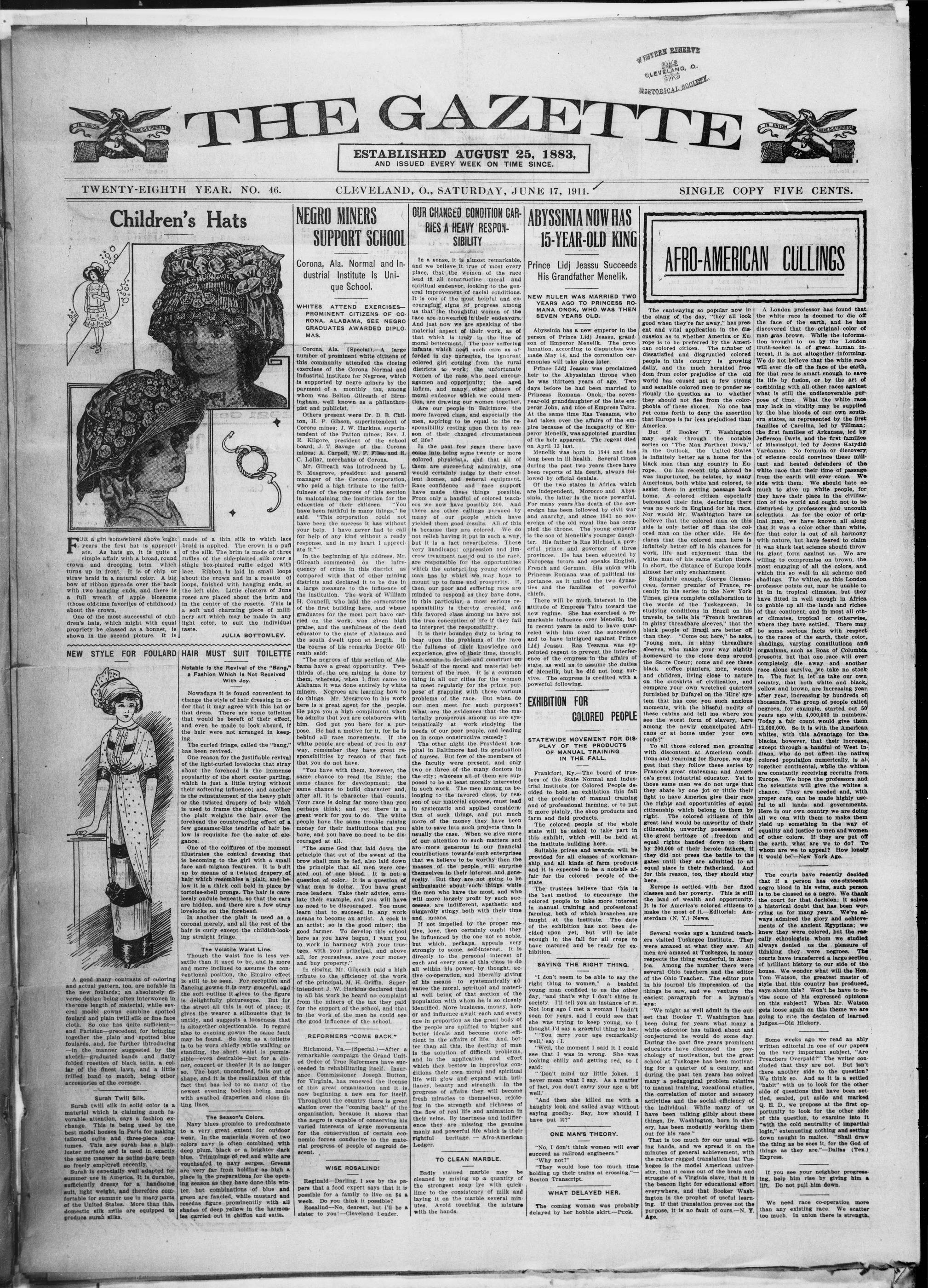
Children's Hats
BUBBLE
3
OR a girl somewhere above eight years the first hat is appropri-
ate. As hats go, it is quite a simple affair with a broad, round crown and drooping brim which turns up in front. It is of chip or straw braid in a natural color. A big bow of ribbon spreads over the back with two hanging ends, and there is a full wreath of apple blossoms (those old-time favorites of childhood) on the opposite side. One of the most successful of children's hats, which might with equal propriety be classed as a bonnet, is shown in the second picture. It is of the silk. The brim is made of three ruffles of the side-plaited silk over a single box-plaited ruffle edged with lace. Ribbon is laid in small loops about the crown and in a rosette of loops, finished with hanging ends, at the left side. Little clusters of June roses are placed about the brim and in the center of the rosette. This is soft and charming piece of millinery art which may be made in any light color, to suit the individual taste.
JULIA BOTTOMLEY.
NEW STYLE TO FOULLARD HAIR MUST SUIT IOLETTE
A
A good many contrasts of coloring and actual pattern, too, are notable in the new foulards; an absolutely diverse design being often interwoven in the one length of material, while several model gowns combine spotted foulard and plain twill stilk or fine face cloth. So one has quite sufficient—and Parisian—precedent for bringing together the plain and spotted blue foulards, and, for further introducing—in the manner suggested by the sketch—graduated bands and flatly folded rosettes of black satin, a collar of the finest lawn, and a little frilled band to match, being other accessories of the corsage.
Surah twill silk in solid color is a material which is claiming much favorable attention, says a fashion exchange. This is being used by the best model houses in Paris for making tailored suits and three-piece costumes. This new surah has a high-luster surface and is used in exactly the same manner as satins have been so freely employed recently.
Surah is especially well adapted for summer use in America. It is durable, sufficiently dressy for a handsome suit, light weight, and therefore comfortable for summer use in many parts of the United States. More than this, domestic silk mills are equipped to produce surah silks.
THE GAZETTE
9
made of a thin silk to which lace braid is applied. The crown is a puff of the silk. The brim is made of three ruffles of the side-plaited silk over a single box-plaited ruffled edged with lace. Ribbon is laid in small loops about the crown and in a rosette of loops, finished with hanging ends, at the left side. Little clusters of June roses are placed about the brim and in the center of the rosette. This is a soft and charming piece of millinery art which may be made in any light color, to suit the individual taste.
JULIA BOTTOMLEY.
Notable is the Revival of the "Bang," a Fashion Which is Not Received With Joy.
Nowadays it is found convenient to change the style of hair dressing in order that it may agree with this hat or that dress. There are some toilette that would be bereft of their effect, and even be made to look absurd, if the hair were not arranged in keeping.
The curled fringe, called the "bang," has been revived.
One reason for the justifiable revival of the light-curled lovelocks that stray about the forehead is the immense popularity of the short center parting, which is just a little trying without their softening influence; and another is the reinstatement of the heavy plait or the twisted drapery of hair which is used to frame the chignon. When the plait weights the hair over the forehead the counteracting effect of a few gossamer-like tendrils of hair below is requisite for the sake of elegance.
One of the coiffures of the moment illustrates the conical dressing that is becoming to the girl with a small face and mignon features. It is bitted up by means of a twisted drapery of hair which resembles a plait, and below it is a thick coil held in place by tortoise-shell prongs. The hair is carelessly ondule beneath, so that the ears are hidden, and there are a few stray lovelocks on the forehead.
In another the plait is used as a coronal merely, and all the rest of the hair is curly except the childish-looking straight fringe.
The Volatile Waist Line.
The Volatile Waist Line.
Though the waist line is less versatile than it used to be, and is more and more charmed in conventional position, the Empire effect is still to be seen. For reception and dancing gowns it is very graceful, and the soft outline it gives to the figure is delightfully picturesque. But for the street all this is out of place; it gives the wearer a silhouette that is untidy, and suggests a looseness that is altogether objectionable. In regard also to evening gowns the same fault may be found. So long as a toilette is to be worn chiefly while walking or standing, the short waist is permissible—even desirable—but for a dinner, concert or theater it is no longer so. The bust, unconfined, falls out of shape, and it is the realization of this fact that has led to so many of the newest evening bodices being made with swathed draperies and close fitting lines.
The Season's Colors.
Navy blues promise to predominate to a very great extent for outdoor wear. In the materials woven of two colors navy is often combined with deep plum, black or a brighter dark blue. Trimmings of red and white are vouchsafed to navy serges. Greens are very far from holding as high a place in the preparations for the opening season as they have done this winter, but combinations of blue and green are fancied, while mustard and resedas figure prominently with all shades of deep yellow in the harmonies carried out in chiffon and satin.
ESTABLISHED AUGUST 25, 1883 AND ISSUED EVERY WEEK ON TIME SINCE.
NEGRO MINERS SUPPORT SCHOOL
Corona, Ala. Normal and Industrial Institute Is Unique School.
WHITES ATTEND EXERCISES—PROMINENT CITIZENS OF CORONA, ALABAMA, SEE NEGRO GRADUATES AWARDED DIPLOMAS.
Corona, Ala. (Special).—A large number of prominent white citizens of this community attended the closing exercises of the Corona Normal and Industrial Institute for Negroes, which is supported by negro miners by the payment of a monthly tax, among whom was Belton Gilethre of Birmingham, well known as a philanthropist and publicist.
Others present were Dr. D. B. Chilton, H. P. Gibson, superintendent of Corona mines; J. W. Harkins, superintendent of the Patton mines; Rev. J. E. Kilgore, president of the school board; J. T. Savage of the Corona mines; A. Carpell, W. F. Flies and R. C. Lollar, merchants of Corona.
Mr. Gilbreath was introduced by L. B. Musgrove, president and general manager of the Corona corporation, who paid a high tribute to the faithfulness of the negroes of this section in maintaining the institution for the education of their children. "You have been faithful in many things," he said. "This corporation could not have been the success it has without your help. I have never had to call for help of any kind without a ready response, and in my heart I appreciate it." In the beginning of his address, Mr. Gilbreath commented on the infrequency of crime in this district as compared with that of other mining districts and declared it to be due in a large measure to the influence of the institution. The work of William H. Council, who laid the cornerstone of the first building here, and whose graduates for the most part have carried on the work, was given high praise, and the usefulness of the dead educator to the state of Alabama and the south dwelt upon at length. In the course of his remarks Doctor Gilbreath said:
"The negroes of this section of Alabama have a great opportunity. Two-thirds of the ore mining is done by them, whereas, when I first came to Alabama it was done entirely by white miners. Negroes are learning how to do things. Mr. Musgrove in his work here is a great agent for the people. He pays you a high compliment when he admits that you are collaborers with him. God put you here for a purpose. He had a motive for it, for he is behind all race movements. If the white people are ahead of you in any way, remember they have great responsibilities by reason of that fact that you do not have.
"You have with them, however, the same chance to read the Bible; the same chance for development; the same chance to build character and, after all, it is character that counts. Your race is doing far more than you perhaps think; and yet there is a great work for you to do. The white people have the same trouble raising money for their institutions that you have, and you have no need to be discouraged at all.
"The same God that laid down the principle that out of the sweat of the brow shall man be fed, also laid down the principle that all men were created out of one blood. It is not a question of color. It is a question of what man is doing. You have great race leaders. Take their advice, emulate their example, and you will have no need to be discouraged. You must learn that to succeed in any work means to become an artist. A cook is an artist; so is the good miner; the good farmer. To develop this school here as you have have, I want you to work in harmony with your trustees, with your principal, and above all, for yourselves, save your money and buy property."
In closing, Mr. Gilreath paid a high tribute to the efficiency of the work of the principal, M. H. Griffin. Superintendent J. W. Harkins declared that in all his work he heard no complaint from the miners of the tax they paid for the support of the school, and that in the work of the men he could see the good influence of the school.
REFORMERS "COME BACK."
Richmond, Va.—(Special)—After a remarkable campaign the Grand Unified Order of True Reformers have succeeded in rehabilitating itself. Insurance Commissioner Joseph Button, for Virginia, has renewed the license of this great organization and it is now beginning a new era for itself. Throughout the country there is great slation over the "coming back" of the organization, because it shows that the negro is capable of conserving his varied interests of large movements for the conservation of certain economic forces conducive to the material progress of people of negroid descent.
WISE ROSALIND!
Reginald—Darling, I see by the papers that a food expert says that it is possible for a family to live on $4 a week. Do you think it possible? Rosalind—No, dearest, but I'll be a sister to you!—Cleveland Leader.
OUR CHANGED CONDITION CARRIES A HEAVY RESPONSIBILITY
In a sense, it is almost remarkable, and we believe it true of most every place, that the women of the race lead in all constructive moral and spiritual endeavor, looking to the general improvement of racial conditions. It is one of the most helpful and encouraging signs of progress among us that the thoughtful women of the race are unweared in their endeavors. And just now we are speaking of the material aspect of their work, as of that which is truly in the line of moral betterment. The poor suffering infants which need such care as afforded in day nurseries, the ignorant colored girl coming from the rural districts to work; the unfortunate women of the race who need encouragement and opportunity; the aged infirm, and many other phases of women, and those which we did not mention, are drawing our women together. Are our people in Baltimore, the more favored class, and especially the men, aspiring to be equal to the responsibility resting upon them by reason of their changed circumstances of life?
In the past few years there have come into being some twenty or more colored physicists, and that all of them are succeeding admirably, one would certainly judge by their excellent homes, and general equipment. Race confidence and race support have made these things possible. From one a handful of colored teachers we now have possibly 300. And there are other callings pursued by many of our people which have yielded them good results. All of this is because they are colored. We do not relish having it put in such a way, but it is a fact nevertheless. These very handicaps: oppression and race, low respect and pride, and responsibility for the opportunities which the enterprising young colored man has by which we may hope to mount up to fame and prosperity, if, then, our poor and suffering race are minded to respond as they have done. In this particular, a most serious responsibility is thereby created, and this favored class among us have not the true conception of life if they fail to interpret the responsibility.
It is their bounden duty to bring to bear upon the problems of the race the fullness of their knowledge and experience, give of their time, thought and means to devise and construct on behalf of the moral and material betterment of the race. It is a common thing in all our cities for the women to meet regularly for the prime purpose of grapping with these various problems of the race. But when do our men meet for such purposes? or do we merely enter the materially prosperous among us are systematically at work studying the needs of our poor people, and leading on in some constructive remedy?
The other night the Provident hospital in Baltimore had its graduation of nurses. But few of the members of the faculty were present, and only two or three of the many doctors in the city; whereas all of them are supposed to be at least morally interested in such work. The men among us belonging to the favored class, by reason of our material success, must lead in systematic and applied consideration of such things, and put much more of the money they have been able to save into such projects than is usually the case. When we give more of our attention to such matters and are more generous in our financial contributions towards such enterprises that we believe to be worthy then the masses of the people will surprise themselves in their interest and generosity. But they are not going to be enthusiastic about such things while the men who have the most, and who will more largely profit by such successes, are indifferent, and niggardly stingy both with their time and means.
If not impelled by the proper motive, love, then certainly ought they be influenced by the one not so noble, but which, perhaps, appeals very strongly to some, self-interest. It is directly to the personal interest of each and every one of this class to do all within his power, by thought, active co-operation, and liberally giving of his means to systematically advance the moral, spiritual and material well being of that section of the population with whom he is so closely identified. More business, money, honor and influence await each and every one in proportion as the great body of the people are uplifted to higher and better ideals and become more efficient in the affairs of life. And, better than all this, the destiny of man is the solution of difficult problems, and in the application and effort which they bestow in improving conditions their own moral and spiritual life will glow and expand with brilliance, beauty and strength. In the progress of affairs they will become fresh miracles to themselves, rejoicing in the strength and richness of the flow of real life and animation in their veins. By inertness and indifference they are missing the genuine manly and powerful life which is their rightful heritage. — Afro-American Ledger.
TO CLEAN MARBLE.
Badly stained marble may be cleaned by mixing up a quantity of the strongest soap lye with quicklime to the consistency of milk and laying it on the marble several minutes. Avoid touching the mixture with the hands.
ABYSSINIA NOW HAS 15-YEAR-OLD KING
Prince Lidj Jeassul Succeedes His Grandfather Menelik.
NEW RULER WAS MARRIED TWO YEARS AGO TO PRINCESS RO-MANA ONOK, WHO WAS THEN SEVEN YEARS OLD.
Abyssinia has a new emperor in the person of Prince Lidj Jeassul, grandson of Emperor Menelik. The proclamation, according to dispatches was made May 14, and the coronation ceremony takes place later.
Prince Lidj Jeassul was proclaimed the Abiyssinia throne when he was thirteen years of age. Two days before he had been married to Princess Romana Onok, the seven-year-old granddaughter of the late emperor John, and nice of Empress Taitu. At the same time Ras Tessama, who had taken over the affairs of the empire because of the incapacity of Emperor Menelik, was appointed guardian of the heir apparent. The regent died on April 13 last.
Menelik was born in 1844 and has long been in ill health. Several times during the past two years there have been reports of his death, always followed by official denials.
Of the two states in Africa which are independent, Morocco and Abyssinia, the latter is the more powerful. For many years the death of the sovereign has been followed by civil war and anarchy, and since 1841 no sovereign of the old royal line has occupied the throne. The young emperor is the son of Menelik's younger daughter. His father is Ras Michael, a powerful prince and governor of three provinces. He has been educated by European tutors and speaks English, French and German. His union with Princess Romana was of political importance, as it united the two dynasties and the families of powerful chiefs.
There will be much interest in the attitude of Empress Taitu toward the new regime. She has exercised a remarkable influence over Menelik, but in recent years is said to have quarreled with him over the succession and to have intrigued against Prince Liddj Jeasuun. Ras Tasama was appointed regent to prevent the interference of the empress in the affairs of state, as well as to assume the duties of Menelik, but he did not long survive. The empress is credited with a powerful following.
EXHIBITION FOR
COLORED PEOPLE
STATEWIDE MOVEMENT FOR DISPLAY OF THE PRODUCTS OF MANUAL TRAINING IN THE FALL.
Frankfort, Ky.—The board of trustees of the State Normal and Industrial Institute for Colored People decided to hold an exhibition this fall of the products of manual training and of professional farming, or to put it more plainly, the shop products and farm and field products.
The colored people of the whole state will be asked to take part in this exhibit, which will be held at the institute building here.
Suitable prizes and awards will be provided for all classes of workmanship and all kinds of farm products and it is expected to be a notable affair for the colored people of the state.
The trustees believe that this is the best method to encourage the colored people to take more interest in manual training and professional farming, both of which branches are taught at the institute. The date of the exhibition has not been decided upon yet, but will be late enough in the fall for all crops to have matured and be ready for exhibition.
SAYING THE RIGHT THING.
"I don't seem to be able to say the right thing to women," a bashful young man confided to us the other day, "and that's why I don't shine in society. I'll tell you an instance of it. Not long ago I met a woman I hadn't seen for years, and I could see that she was trying to keep young, so I thought I'd say a graceful thing to her. "You carry your age remarkably well; say I. I. "Well, the moment I said it I could see that I was in wrong. She was looking chily and getting red, so I said: "Don't mind my little jokes. I never mean what my say. As a matter of fact, you don't carry your age a bit well." "And then she killed me with a haughty look and sailed away without saying goodbye. Say, how should I have put it?"
ONE MAN'S THEORY.
"No, I don't think women will ever succeed as railroad engineers." "Why not?" "They would lose too much time holding up their trains at crossing."—Boston Transcript.
WHAT DELAYED HER.
The coming woman was probably delayed by her hobble skirt—Puck.
AFRO-AMERICAN CULLINGS
WESTERN RESERVE
CLEVELAND, O.
HISTORICAL SOCIETY.
SINGLE COP
AFRO-AMERICA
The cant-saying so popular now in the slang of the day, "they all look good when they're far away," has present and vital application in the discussion as to whether America or Europe is to be preferred by the American colored citizen. The number of dissatisfied and disgruntled colored people in this country is growing daily, and the much heralded freedom from color prejudice of the old world has caused not a few strong and sensible colored men to ponder seriously the question as to whether they should not flee from the colorphobia of these shores. No one has yet come forth to deny the assertion that Europe is far less prejudiced than America.
But if Booker T. Washington may speak through the notable series on "The Man Farthest Down." In the Outlook, the United States is infinitely better as a home for the black man than any country in Europe. On his recent trip abroad he was importured, he relates, by many Americans, both white and colored, to assist them in getting passage back home. A colored citizen especially bemoaned their fate, declaring there was no work in England for his race. Nor would Mr. Washington have us bemoaned the colored man on this side is only better colored than the colored man on the other side. He declares that the colored man here is infinitely better off in his chances for work, life and enjoyment than the white man of his same station there. In short, the distance of Europe lends almost her only enchantment.
Singularly enough, George Clemenceau, former premier of France, recently in his series in the New York Times, gives complete collaboration to the words of the Tuskegeean. In studying conditions in Brazil on his travels, he tells his "French brethren in shiny threadbare sleeves," that the black people of Brazil are better off than they. "Come out here," he asks, "young men, in shiny threadbare sleeves, who make your way nightly homeward to the close dens around the Sacre Coeur; come and see these black coffee planters, men, women and children, living close to nature on the outskirts of civilization, and compare your own wretched quarters furnished by Dufayel on the 'Fire' system that has cost you such anxious moments, with the blissful uddity of these cabins and tell me where you see the worst form of slavery, here among the newly emancipated Africans or at home under your own roofs?"
To all those colored men groaning with discontent at American conditions and yearning for Europe, we suggest that they follow these series by France's great statesman and America's great industrial educator. Yet to those same men we do not urge that they abate by one jot or title their fight to have America give their race the rights and opportunities of equal citizenship which belong to them by right. The colored citizens of this great land would be unworthy of their citizenship, unworthy possessors of the great heritage of freedom and equal rights handed down to them by 200,000 of their heroic fathers, if they did not press the battle to the gates until they are admitted to an equal place in their fatherland. And for this reason, too, they should stay here.
Europe is settled with her fixed classes and her poverty. This is still the land of wealth and opportunity. It is for America's colored citizens to make the most of it.—Editorial: Amsterdam (N. Y.) News.
Several weeks ago a hundred teachers visited Tuskegee Institute. They were amazed at what they saw. All men are amazed at Tuskegee, in many respects the thing wonderful, in America. Among the number there were several Ohio teachers and the editor of the Ohio Teacher. The editor puts in his journal his impression of the things he saw, and we venture the easiest paragraph for a layman's eye:
"We might as well admit in the outset that Booker T. Washington has been doing for years what many a white educator has talked about and conjectured he would do some day. During the past five years prominent educators have discussed the psychology of motivation, but the great school at Tuskegee has been motivating for a quarter of a century, and during the past ten years has solved many a pedagogical problem relative to manual training, vocational studies, the correlation of motor and sensory activities and the social efficiency of the individual. While many of us have been talking glibly about these things, Dr. Washington, born in slavery, has been modestly working them out for his race."
That is too much for our usual willing hands, and we spread it on the minutes of general achievement, with the rather ragged translation that Tuskegee is the model American university, that it came out of the brain and struggle of a Virginia slave, that it is the beacon light for educational effort everywhere, and that Booker Washington is the prophet of useful learning. If that translation proves not the purpose, it is no fault of ours.—N. Y. Age.
A London professor has found that the white race is doomed to die off the face of the earth, and he has discovered that the original color of man was brown. While the information brought to us by the London truth-seeker is of great human interest, it is not altogether informing. We do not believe that the white race will ever die off the face of the earth, for that race is smart enough to save its life by fusion, or by the art of combining with all other races against what is still the undiscoverable purpose of time. What the white race may lack in vitality may be supplied by the blue bloods of our own southern states, as represented by the first families of Carolina, led by Tilman; the first families of Arkansas, led by Jefferson Davis, and the first families of Mississippi, led by Jeems Katyidy Vardaman. No formula or discovery of science could convince these militant and heated defenders of the white race that their time of passage from the earth will ever come. We side with them. We should hate so much to give up white people, for they have their place in the civilization of the world and ought not to be disturbed by professors and uncouth scientists. As for the color of original man, we have known all along that it was a color other than white, for that color is out of all harmony with nature, but have feared to claim it was black less science should throw its giant form against us. We are willing to compromise on brown, the most engaging of the colors, and shadings. The whites, as this London professor points out, may be unable to fit in tropical climates, but they have fitted in well enough in Africa to gobble up all the lands and riches of that continent, and in most other climates, tropical or otherwise, where they have settled. There may be some serious facts with respect to the races of the earth, their color, shadings, varying constitutions and organisms, such as Boaz of Columbia presents, but that one race will ever completely die away and another race alone survive, we take no stock in. The fact is, let us take our own country, that both white and black, yellow and brown, are increasing year after year, increasing by hundreds of thousands. The group of people called negroes, for example, started out 50 years ago with 4,000,000 in numbers. Today a fair count would give them 12,000,000. So it is with the American whites, with this advantage for the blacks, however, that their increase, except through a handful of West Indians, who do not affect the native colored population numerically, is altogether continental, while the whites are constantly receiving recruits from Europe. We hope the professors and the scientists will give the whites a chance. They are needed and, with proper care, can be made highly useful to all lands and governments. Here in our own country we are doing all we can with them to make them yield up something in the way of equality and justice to men and women of other colors. If they are put off the earth, what are we to do? To whom we are to appeal? How lonely it would be—New York Age.
The courts have recently decided that if a person has one-sixteenth negro blood in his veins, such person is to be classed as a negro. We thank the court for that decision; it solves a historical doubt that has been worrying us for many years. We've always admired the glory and achievements of the ancient Egyptians; we knew they were colored, but the racially ethnologists whom we studied always denied us the pleasure of thinking they were negroes. The courts have transferred a large section of brilliant history to our side of the house. We wonder what will the Hom Tom Watson, the greatest master of style that this country has produced, says about this? Won't he have to revise some of his expressed opinions on this subject? When Mr. Watson gets loose again on this theme we are going to cite the decision of learned judges.-Old Hickory.
Some weeks ago we read an ably written editorial in one of our papers on the very important subject, "Are Preachers Overpaid?" The writer concluded that they are not. But isn't there another side to the question? We think so. And as it is a settled "habit" with us to look for the other side of questions that have been settled, sealed, put aside and marked Q. E. D., we propose at the first opportunity to look for the other side of this question, to examine into it "with the cold neutrality of impartial logic," extenuation nothing and setting down naught in malice. "Shall draw the thing as he sees it, for the God of things as they are."—Dallas (Tex.) Express.
If you see your neighbor progressing, help him rise by giving him a lift. Do not pull him down.
We need race co-operation more than any existing race. We scatter too much. In union there is strength.
THE GAZETTE
PUBLISHED EVERY SATURDAY
(In Advance)
One Year.....$1.50
Six Months.....1.00
Three Months......50
Subscribers are requested to re-
mit by postoffice money or
order or registered letter.
Entered at the postoffice in Cleveland,
Ohio, as second-class matter
Blackstone Building, Cleveland, O.
Member Ohio Legislature: 1894
to 1896; 1896 to 1898; 1900 to 1902
THE GAZETTE is the oldest, and has the largest bona fide circulation, double that of any newspaper in the interest of Afro-Americans, published in the state of Ohio, and comparison with any will immediately establish its rank as one of the NEWSIEST AND BEST in the country.
Learned German professors claim that the original man was black and that the "white" races can never permanently acclimatize in Africa. An Englishman, Lionel W. Lyde, professor of economic geography in London University, agrees with the foregoing and claims that "the white man is doomed to vanish off the face of the earth, yielding to the Colored races." Poor "white" man! he has our heartfelt sympathy.
In Washington, D.C., last week Monday night, Senator "Joe" Bailey of Texas, lauded "Jefferson Davis, soldier, statesman and Christian gentleman," and then said:
"We have to solve the problem of the Negro who thinks he is good enough to come to the front door. The only way in which the two races will live in peace is for the Negro to realize and recognize his inferiority."
The next night Senator Clapp of Minnesota, threw down the gauntlet to Bailey in a speech delivered to an American congress conceived by him in America. He enologized Lincoln—in contrast to Bailey's praise of Jefferson Davis; he denounced slavery, "permanent bondage and servitude"—in contrast to the Southerner's statement that "the truth of history lies on the Confederate side." Continuing, Senator Clapp said:
"God never made any race for permanent bondage and servitude to others. There is absolutely nothing in the limitations of color to prevent the Colored man from being of fully as much service to the community and the nation as the white man."
It is President Taft's discrimination against the Afro-American in the South, in the matter of appointments to federal office there and his indorsement of various other color lines, North and South, that has so emboldened the blatant and "fire-eating" southern "statemen" in Washington, D.C., and elsewhere, as to enable them to talk such consummate "rot" as Joe Bailley of Texas induged in on a recent Monday evening, and also the Georgia congressman, one Rodenberry, when he got the worst of a street-car scuffle at the Nation's capital, recently. It is too, such "talk" as Bailley's that makes the Afro-American despise Southern democracy and distrust Northern democracy.
THE PRESIDENT POLITICAL "GAL
LERY-PLAYING."
In speaking of the Jewish private who was seeking an examination for promotion to a lieutenancy in the U. S. Army, Col. Garrard whom President Taft very properly rebuked for his exhibition of prejudice in Army matters, said, after praising the private's personal qualities: "I would not desire him in my command as an officer and a social and personal associate. The presence of the applicant's family at a military post would be subversive of discipline and would constitute a source of modification to them."
Col. Garrard, President Taft to the contrary notwithstanding, states a condition that really exists, in and out of the Army throughout this country and one that is far worse in many countries of Europe. It is wrong—this foolish prejudice—as we have said, just as wrong as is President Taft's discrimination against the American Negro in the matter of appointment to office in the South, his indorsement of color-lines in Y. M. C. A. work and other things. However, such prejudice, socially and otherwise, does exist against the Jew in this country, and everybody knows it, even if President Taft says differently in an effort to codle the Jews politically. Of course, a presidential contest is to be waged next year, and Taft hopes to be the Republican candidate (and we hope just as strongly that he will not be, for it will mean a democrat as President to succeed him in 1913) and the rich Jews down east, particularly in the vicinity of New York City, have good fat bank accounts which it will be advisable for the finance committee of the Republic National Committee to "touch" for campaign funds. Pretty "smooth," this "great, big, musk of concession," as Alfred Henry Lewis, editor of the magazine, "Human Life", dubs the President.
AS TO LYNCHING
A Committee of representative men and women of the race called on President Taft, recently, and presented a Memorial against Lynching. At the close of the reading of same the President stated that he "could not" send a special message to Congress concerning the matter, but that he would "mention" the subject in his next general message. He expressed himself as being strongly opposed to lynching and lynchers, and condemned both in severe language, and said that he thought we were right in seeking to create public sentiment against the crime of lynching. This is another opportunity—for the President—"to play to the political gallery". The U. S. Supreme Court in a decision, long years ago, relegated the matter of antilynching legislation to the Legis-
latures of the various states, on the ground that legislation against lynch-murder was a state right, pure and simple.
It was this decision 17 years ago that prompted the writer to start the effort that finally ended in our passage of a bill in 1896, that is now Ohio's famous Mob Violence or Anti-Lynching law, and under which individuals or their relatives, in five or six different cases at least, have recovered many thousands of dollars from various counties of the state "for injury, serious injury and lynching" at the hands of the mob. And it is only a question of a short time, now, until relatives of the Newark victim of last year (a white Kentuckian), will receive $5,000 from Licking County, for its lynching. This is the first "white" mob violence case, under the law, either.
Illinois is the only state in the Union to follow the lead of Ohio and enact an effective Anti-lynching law. What our "leaders," at Washington, D.C., and elsewhere, should do to accomplish material results, is to urge upon the various state Legislatures similar legislation. The right kind of an expression from a President of the country would, of course, prove helpful in molding sentiment favorable to such legislation.
The editor of The Gazette acknowledges the receipt, last week, of an invitation to attend the forty-eighth annual commencement exercises of Wilberforce University, June 8 to 15 inclusive—from President Scarborough.
President Tatt's secretary of the treasury, Mr. McVeagh, says he was a democrat "during President Cleve land's time." Some of Chicago's daily papers claim he is still a "demmy." Likewise Tatt's new secretary of the interior, a Mr. Fisher, also a resident of Chicago.
OVER A THOUSAND DOLLARS.
St. Paul's A. M. E. Church Rally Netted That Sum—a Grand Success.
Columbus, Q.-Last Sunday week was a great day in St. Paul's Church. Rev Ia A. Collins, pastor, and officers had arranged for $1,000 rally at that time. Many feared the church would not reach the mark set, but when the returns were all in Sunday evening $1,325.87 had been raised. St. Paul's choir rendered some excellent music in the morning and presented a fine musical program in the evening. St. Paul's choir presented the service of the afternoon service and with one exception it had the largest congregation to greet the members that has been in the church since its dedication six years ago. They met the expectations of the most critical and did great service for the church. Carroll Scott is the chanter and Mrs. Geneva Minter the organist. The following shows the amount each club brought in: Dorcas Club, $289.43; Daughters of Conference, $172; Embroidery Club, $172; Embroidery Club, $252.80; Passor's aid, $122.52; Ways and Means Club, $95.90; Thompson Family, $65.25; Music Club, $50; Sunday School, $50; Literary, $28; Busy Bee, $21.07; Mound Builders, $18.10; Knights of St. Paul, $14.40; Wayman Club, $10.55; F. F. Whittaker, $7.93; Public Collection, $44.57. Total $1,325.78.
The English Lionize Jack Johnson.
London, Eng.—fack John Johnson arrived in London Monday, for the moment the most famous American on British soil. He was greeted by an enormous crowd that fought frantically for a chance to grasp the hand that knocked out Jim Jeffries. Johnson was surprised and manifested his pleasure at every step. After a struggle of heart, he was knocked out by his wife and party emerged from the human press and entered automobiles, in which they made a "state procession" to the Alexandra mansion where they will stop. Along the route Johnson was cheered and his teeth gleamed constantly in recognition. Johnson declared he had a "seat booked for the coronation." "I'm going to see King George try on his new hat," he said.
CLAIMS HIS WIFE IS A NEGRO.
A Prominent Young Man Causes A Social Sensation With His Legal Action
St. Louis, Mo. — Mrs. Cora Clamoran鸿山镇, 7112 Marie Ave. , whose 20-year husband filed suit last Friday to annul their marriage on the ground that she is a Negro, declares she will fight the suit to the last resort. Mrs. Collins, who is one of an accomplished family which is celebrated in the West End for ability to entertain large parties at their home, is silent as to her lineage but both her father and mother stoutly maintain they are descendants of a Spanish nobleman named James weeks-old baby. The statutes of Missouri provide that any marriage between a white person and one with one-eighth or more Negro blood is unlawful. For four years the family of Louis F. Clamoran, for years a city employee, has been prominent in Maplewood and Ellendale social circles. The five daughters were accomplished musicians and the son an athlete as well as leader of a coterie known as the Riverside park set.
Lane College Gets $7,000.
Lane College Gets $1,000
Jackson, Tenn. The close of the 25th commencement exercises of Lane College, held here June 1, President J. E. Lane announced amidst much applause a conditional gift of $7,000 to the College by the General Education Board of New York. The donation is by far the largest ever made to the institution by other than the C. M. E. Church, and comes through the Presbyterian Society supplemented by that of Dr. J. W. Gilbert of Augusta, Ga. Lane College greatly needs another Boy's Hall and it is toward this building that the gift from the Board is made. The building will cost $20,000. The General Education Board's contribution leaves $13,000 to be raised by the Trustees and friends of the College. Of course, the condition will be met roughly, and the building will go up. The institution has just closed a most successful session, and its Trustees and friends are jubilant over its bright prospects.
Unveil Shart To John
Kansas City, Mo. A monument to
the martyr, John Brown, erected from
a fund standed by the late Bishop
Walter of the A. M. E. church,
was unveiled in Kansas City, Kas.
last Thursday, in connection with
the commencement exercises of Western
University, Quindaro, Kan. The money
was given exclusively by our people.
Miss Eva Marsh Shonts, a sister of
Theodore P. Shonts of New York: John
Stubbs, Lieut-Gov. former Governor
Gerald John of Kansas, all
the principals speakers at the
ceremonies.
DOINGS OF THE RAGE
FRESH OHIO NEWS
OUR OWN WRITERS'
WHAT OUR PEOPLE ARE DOING IN MANY CITIES AND TOWNS OF THE STATE.
INTERESTING PERSONAL NOTES
pottery owned by our people. Article of incorporation have been filed with the Secretary of State and the plan of the incorporators have been made public. The Betterware Pottery Company will be the name of the concern and the plant will be erected at cost of $40,000. N. S. Duhne is president.
Cadiz—Dr. B. H. Lee of the North Side, Pittsburg, a former pastor of t. A. M. E. church and a staunch friend of The Gazette ever since its birth 28 years ago, visited his son, Mr. H. Lee and family, tls. Re. J. W. White lectured for Buckner C. T. U., Monday evening—Children day exercises will be held at Simon church, June 25. The Epwoy league rendered a fine program, l.
Georgia was originally settled by people who had been in jail in England for debt. Cashier R. T. Hill's shortage is now said to exceed $50,000. True Reformers' bank, Richmond, Va. Colored ushers will supplant white ushers when the new Northwestern Ry. depot in Chicago is opened to the public this week. Rev. Warren C. Bishop has been appointed of St. Philip's P. E. church, N. Y. City, 25 years. It is our wealthiest church. Dwight O. W. Holmes of our Baltimore High School was elected president of Howard University's Alumni Association, last week. Taft used to weigh 340 pounds, but has trained down in 300. Some folk think it's wind that makes Bill look so big, but probably it's just natural bacon. Resident W. H. Taft has sent to Dr. Booker T. Washington of Tuskegee, Ala., Institute, a check for $100 as a contribution toward its Endowment Fund. More "politics."
"Princess Wee Wee," 21 years of age and 17 inches high, born at Bryn Mawr, Pa., of Afro-American parents, with a Barnum & Bailey's show. Patrick Ford of New York, has raised $5,000 for the Irish National fund. How much are Afro-Americans raising to secure their rights?—St Paul, Ill., Appeal. Hon. William T. Vernon, former Registrar of the U. S. Treasury, has been appointed Assistant Supervisor of Schools of the Five Civilized Indian tribes. His headquarters will be at Muskogee, Ok. Ha! We have it that Teddy's to give Taft his unqualified endorsement. That's what he gave Senator Beveridge of Indiana, and candidate for Governor Harding of Ohio, and both were defeated. Rev. W. E. Lee, D. D., 53, president of Morris-Brown College, Atlanta Ga., suddenly of his failure while at dunia University Wilberforce university Monday afternoon. Acute indigestion is thought to have superinduced the attack.
Mrs. Mary Church Terrell of Washington, has tendered her resignation as a member of the Board of Education of the District of Columbia, to take effect July 1. She will be succeeded by Mrs. James H. Harris. American citizens of Alabama, Mr. Americans to Alberta, Canada, continues. Twenty farmers and their families (200 in all) from near Fallis, Lincoln Co., Okla., have just gone and more will follow this fall and next spring. A colonization company is financing the exodus. A. D. Price, the Richmond, Va., capitalist and business man, president of the Southern Aid Society, has been elected president of the Capitol Shoe and Supply Company of enterprising Richmond, Mr. Price is rated as one of the best business men in the South.
The Taft Administration has requested Dr. Henry W. Furniss of Indianapolis, Ind., to withdraw his resignation and continue as U. S. Minister to Haytai and it is expected that he will be the consular and diplomatic service is exceptionally good. He is regarded as the most efficient Colored man now in the service.-Indianapolis Plaidealer. Harriet Tubman, nearly 100 years old, known during slavery time as a slave owner, was the dugger railroad," and who became famous by piloting over three hundred members of her race to freedom, is an inmate of the Harriet Tubman Home in Auburn, N. Y. She was taken to the home last Thursday ill and penniless. He the U. S. Treasury and Mrs. J. C. Napier now residents of Washington, D. C., have recently made a donation of $4,000 toward the American College for the Training of Religious and Moral Workers, an institution recently organized in their old home Nashville, Tenn., for the training of social and religious workers.
The whites include the Hindus, Persians, Greeks, Latins' Celts and Anglo-Saxons, or all people of Aryan stock, who number approximately 600,000,000, while the dark or colored races include 630,000,000, Mongolian, or yellow people: 150,000,000,000, Negro, or black; 35,000,000, Malay, or brown, and 150,000,000, Indian of 330,000,000 people of the dark races as compared with 600,000,000 whites.
Vice-Chancellor Walker of Trenton, N. J., in an opinion filed last week Monday sustained the validity of a deed by which Sarah Waln Hendrickson of Wainford transferred all her real and personal property to John Wilson, an Afro-American servant who had been in her employ for nearly forty years. The estate consisted of a property in the city, but not abroad, which had been in possession of the Wain family for two hundred years, together with about $4,000 of personal property.
On June 3, at Witherspoon Hall, the Hahn School of Music, Philadelphia, Pa., recognized the merit of F. Hall Johnson, violinist, as a composer, by playing one of his compositions, Carnegie Hall. Enconcert of advanced pupils. Mr. Johnson is a graduate of the University of Pennsylvania's School of Music and is specializing at the Hahn School. Miss Bessie Benson, another Afro-American, of Philadelphia, also took part in the Hahn School Concert and played excellently "Concert and played by Hayden, accompanied by the orchestra.
Twenty-four hours after his arrival in London, England, the first of this week, Jack Johnson, champion heavyweight found himself the idol of London. No visiting potentate has ever been found with attention. His apparance Monday was marked by crowds so large as to intrigue with traffic. At noon the crowd on Leicester square was so dense reserve constables had to break a way for the Johnson auto. With his silk hat on his head and a big auto duster encasing his form, he showed by his famous smile that he pleased to find himself the reigning sensation. Girls presented bouquets to him.
FRESH OHIO NEWS OUR OWN WRITERS'
WHAT OUR PEOPLE ARE DOING
IN MANY CITIES AND TOWNS
OF THE STATE.
INTERESTING PERSONAL NOTES
Social Functions—Church and Lodge Items—Marriages and Deathe—Literary, Musical and Other Notes of Interest.
Urbana.—The editor of The Gagette is expected to speak here before the end of the month, at the A. M. E. church. Those of our people who have heard him are anxious to do so again. Editor Smith is one of our most earnest and interesting speakers, and always brings much valuable information and truth as to the race's vital interests. At Watson, pastor of the church, is meeting with deserved success here.
Washington C. H.—Mr. Edward Curry's sister spent June 8 with Mr. and Mrs. J. T. Oatmeal—Mr. Pearl Jones is visiting his parents.—Mrs. Marcelus Chandler and nephew, Master Paul Cole of Idlewildton, the for-mer of nobles on H. Vivian. June 7 to the 12th.—Misses Sarah and Molly Thornton arrived June 9. Their mother is critically ill.—Miss Ona Philips of Jamestown, visited Miss Lyda Taylor en route to the Delaware commencement.—Miss Porta Jackson visited in Willmington, last week.—The mother of Miss Elizabeth nine, 17 to 0, June 4.—Miss Elizabeth Lawrence is seriously ill.—Miss Jessie Woodson returned, June 4.
Mcintyre.—Mr. John Lytle and son, Paul, of Richmond, were Mr. and Mrs. Anthony Lytle's guests, Monday.—Mr. and Mrs. Ezekial Smith were in Bloomfield, Monday.—Mrs. Burns West and Mrs. Charley Smith were called to attend Wednesday, by Mr. Alice Washington's illness.—Mr. Douglass Christian spent Wednesday with relatives.—Mr. and Mrs. Henry Smith attended the wedding of Miss Maggie Harris and Mr. Ernest Freeman, in Smithfield.—Misses Jessie Smith and Lydia West visited Mrs. Frank Smith, Saturday evening.—Mr. Matthew Toney attended Wednesday, by Mrs. Smith field. Wednesday.—Children's day exercises, Sunday. were very interesting and successful. A number from Smithfield and Fernwood, were in attendance.—Mr. Edward West and family and Mr. John Lytle and family were Mr. and Mrs. A. Lytle's guests, Sunday, Misses. Misses. Gertrude Carter were Miss Amanda Smith's guests.—The Gazette desires an agent here.
Smithfield.—Rev. S. W. White preached an excellent sermon, Sunday morning, and Rev. C. Linear of Steubenville, formerly a student at Willforce, in the evening, Mr. Jas. Guy of Steubenville, will assist in the Children's day exercises at Steubenville day evening, Mr. Jas. Ed. West and family, Mr. J. Harring, Miss S. E. Beall and others, attended the Children's day exercises at McIntyre, Sunday.—Mr. Ed. Washington and daughter, Olive, spent Saturday in Steubenville, Mr. Jas, Guy and Miss G. Carter were here Saturday and Sunday, Olive, spent Saturday in Pittsburgh, visited her aunt, here last week.—A number from McIntyre and Fernwood, attended church, here Sunday evening.—Mr. Ernest Freeman and Miss Maggie B. Harris were married, June 7, at the bride's parents.' Relatives in attendance, Rev. S. W. J. Maggie was as assistant by Mrs. White—E. Washington, J. Beall and J. Jones left last week for Canton and Lima.
Mt. Pleasant—Miss Pearl Jackson was in Steubenville, Friday and Saturday; Miss Loraine Rainbow, in Wheeling, Monday; Mrs. L. Bundy and Mrs. E. Moore, in Dillowville, Saturday; Rev. Maze and family went to Martins Ferry; Mr. Chas. Brown and family left for Lorain, Saturday; Miss Edith Johnson and sister, were in Dillowville; Rev. Maze and wife of Clarkshurg, are home—Mr. Walter Carey 'left for Steubenville, Sunday—A party was given Miss Sarah Brown, Friday evening, at Mrs. Powell's. A "surprise" was given Mrs. Lawrence Fields, the same evening. Both proved enjoyable affairs—Children's day services at Emerson, and here at the A. M. E. church, Sunday, were very successful—Mr. V. Moore's barber-shop was "first last week by an old store Mrs. M. Moore, D. Jackson, visited Mrs. D. Jackson, Saturday evening.—Mrs. Jane Faithful and Mrs. Lewis were in town, Monday.—The Emerson Baptist church rally netted $98 to be used on its indebtedness.
Correspondents must mall all letters for publication at their main postoffice sufficiently early on Monday (or Sunday) of each week to have them reach The Gazette office on Tuesday morning, and always write, also, their names and that of their city or town on the outside of the wrapper about returned copies. Unless otherwise stated, cannot be given you. Lists of names, wedding presents, etc., obituary notices, speeches, resolutions, poetry, inquiries for relatives and advertisements of all kinds, including items announcing entertainments to be held in the near future, must be paid for in advance at the rate of ten cents a week. For display advertisements will be sent on application. Send postal note and not stamps during warm weather.
Youngstown.-Miss Lena Ford is home from Wilberforce University for the summer.-Mrs. Henry Johnson spent two weeks with relatives in Marietta.-The Choral society will give a concert for St. Augustine mission in St. John's church parlor, Monday evening.-Mrs. Mamie Evans Alikers of Buffalo and Mrs. L. A. Cunningham of Cleveland, sister and mother of Nate and Nive Berry were here Sunday to visit her and witness the confirmation of one of the latter's daughters.-Tabernacle S. S. will picnic at Rock Springs park, Chester, W. Va. June 26.-Miss Isabelle Wooden and J. B. Evans were married at Oak Hill Ave. parsonage, Wednesday evening, by Rev. J. H. Smith.-Mr. and Mrs. R. D. entertained, Wednesday evening, in honor of their daughter, Mrs. Ross' 28th birthday, Music, dancing and games.-The Chrysanthemum club met Monday afternoon at Mr. and Mrs. Thos.' Robinson's and held a lawn fete in the evening at Mr. and Mrs. Blas.-Order The Gazette from the agent so you can get it on Fridays.
Zanesville.—This city is to have a.
W. E. WHITE, Prop.
American and European
Service.
Makes a Specialty of Serving Priva
c Parties and Banquets.
P. B.
Confectionaries, Cigar
co and School Su
2921 Central Ave
THE ORIOLE T
3223 Central
High Class Vaudeville and M
Confectionaries, Cigars, Tobacco and School Supplies.
3000 feet of film every day
5000 on Sunday.
This co
two to the
Sundays
Entire change of program
every day
O. J. HARRIS, Manager.
No. 4 Special Buggy only $65.0
HIGHEST GRADE
Phone Bell, North 1075-X
Cuy. Cent.
THOS. P. Mc PHILLIPS
Plumbing and
Sewer Building
This Great Sent. TO YOU
Just send your name and address on the not cost one penny and as soon as your library of Universal History will be sent
HERE is the greatest opportunity ever offered - an opportunity for our readers to secure at least that half of these fifteen beautiful volumes all printed from large new to embellished with over 100 double page maps and plans, 70 full illustrations, many of which are in colors, and over 5,000 pages reading matter.
This offer is made possible by the failure of the publishers. Union Book Co. of Chicago. Hundreds of sets of this work have been sold at $60.00 each and they are worth every cent of it, but now name you a rock-bottom bankrupt price of only 60c after amination and $3.00 per month for 14 months. It is impossible name a lower price for cash in full, as this is less than half publisher's price and is made only to close out the few remain sets quickly.
Before you decide to buy we invite you to examine this work your own home for an entire week absolutely free of charge, though you not want to buy the books after examination we will be the next of our expense. We earnestly request you to examine this Library; let your wife and children and friends see no books, or books could be used in the hands of child than this; it reads like a thrilling novel, and is in fact a complete connected History of every country, nation and people from the end of the past; the greatest World Hist ever written and endorsed by scholars every more.
Prof. George Fellows, of Indiana, says: "Most histories of world are dreary compilations. This work, however, is c
Ex Vice-Pres. Stevenson says: "It is a complete record of human race and should find a place in every Library."
E. Benjamin Andrews, Chansolive of the University of Nebraska says: "His educational value in the home is sure to be very great. Frank W. Gunsaults, of Chicago, says: "These volun will be of immense service in stimulating history study in country. It is a work of real genius."
eat World His TO YOUR HOME FRE address on the coupon below-that is all you n
This Great World History SENT TO YOUR HOME FREE
Just send your name and address on the coupon below—that is all you need to do. It does not cost one penny and as soon as your name and address is received a set of the world famous Library of Universal History will be sent to you prepaid.
HERE is the greatest opportunity ever offered—an opportunity for our readers to secure at less than half price embellished with over 100 double page maps and 700 full page illustrations, many of which are in colors, and over 5,000 pages of reading matter.
This offer is made possible by the failure of the publishers, the Union Books of Chicago. Hundreds of sets of this work have now been sold for $50.00 each, now you name a rock-bottom bankrupt price of only $50 after examination and $2.00 per month for 14 months. It is impossible to name a lower price for cash in full, as this is less than half the price and is made only to close out the few remaining sales quickly.
Before you decide to buy we invite you to examine this work in your own books. You should not want the books after examination we will have returned at our expense. We earnently request you to examine these books at our expense. We cannot request you to examine any one thing, and remember you can no better set of books could be placed in the hands of children than this; it reads like a thrilling novel, and is in fact a complete connection with the country, nation and people from the time of time to the present time. The World History ever written and endorsed by scholars everywhere.
Prof. George Fellow, of Indiana, says: "Most histories of the world boundaries. This work, however, is clear, interesting and accurate."
Es Vice-Pres, Stevenson says: "It is a complete record of the human race and should find a place in every Library."
NEVER BEFORE in the annals of the publishing business have we seen such a bargain. We do not hesitate to recommend this book to the reader. Believe every family should own a standard World History, for by knowing how other countries are ours we are governed it gives us a better knowledge and higher appreciation of our own system of government and makes us better citizens.
We will be glad to give you an opportunity to see for yourself a lower price for cash in full, as this is less than half the price and is made only to close out the few remaining sales quickly.
Before you decide to buy we invite you to examine this work in your own books. You should not want the books after examination we will have returned at our expense. We earnently request you to examine these books at our expense. We cannot request you to examine any one thing, and remember you can no better set of books could be placed in the hands of children than this; it reads like a thrilling novel, and is in fact a complete connection with the country, nation and people from the time of time to the present time. The World History ever written and endorsed by scholars everywhere.
Prof. George Fellow, of Indiana, says: "Most histories of the world boundaries. This work, however, is clear, interesting and accurate."
Es Vice-Pres, Stevenson says: "It is a complete record of the human race and should find a place in every Library."
MAIL THE
E. Benjamin Andrews, Chancellor of the University of Nebraska, says: "His educational value in the home is sure to be very great." He will be honored, Gusenauer, of Chicago, says: "These volumes are of immense historical history study in our country. It is a work of real genius."
Prof. Dabney, of Virginia, says: "Southern readers will be surprised by the fact that in which the war for Southern independence is treated."
15 Massive Volumes
Each volume 7 inches wide
and 10 inches high;
weight, boxed,
nearly
75 lbs.
pottery owned by our people. Articles of incorporation have been filed with the Secretary of State and the plans of the incorporators have been made public. The Betterware Pottery Company will be the name of the concern, and the plant will be erected at a price of $40,000. N. S. Dhuh is president.
Cadiz.—Dr. B. H. Lee of the North Side, Pittsburg, a former pastor of the A. M. E. church and a staunch friend of The Gazette ever since its birth 28 years ago, visited his son, Mr. B. H. Lee and family, this week.—Rev. H. H. Lee, pastor of the Church of C. T. U. evening—Children's day exercises will be held at Simpson church, June 25. The Epworth league rendered a fine program, last Friday evening.—W. H. Lucas and daughter, Hattle, W. L. Johnson and nieces, May and Lucille, are attending Wilberforce's commencement.—Miss Ethel Weir of Steubenville, is visiting Mrs. Ella Foster.—The Mrs. H. H. Lee and Mrs. Viola Lucas, last Friday evening.—Mr. Chas. Henderson and daughter, Lula, Mrs. H. H. Henderson and Mrs. Alice Munts of Flushing, were here Sunday.—Children's day at the A. M. E. church, Sunday, was a success, Collection, $7.88.—The C. I. C. ball team defeated the Flushing H. S. club, last Friday.—Miss Carrie Madison of Flushing, Mrs. J. Swain of Pittsburg, is visiting her aunt, Mrs. J. Redman. (Correspondent must mail her newsletter on
NO DOPES NOR MEDICINES.
Split Ends, Kinkv, Curly, Dry and
Stubborn Hair REMEDIED by
Your Own Hand.
Send twenty-five cents for our booklet.
General Advertisement and Sales
Agents.
Address: ARTHUR D. RAMSEY,
78 N. High St.,
AKRON, OHIO.
THE OWL DRUG STORE
Cor. East 38th St. Central Ave.
For the best in DRUGS, SUNDRIES,
CIGARS and CANDIES
AT CUT PRICES
We fill PRESCRIPTIONS from all
Physicians. Telephone Booths.
Courteous treatment and prompt
Service. Give us a trial.
Central Ave. & E. 38th St.
All W rk Given Prompt Attention
2079 E. 30th St. Cleveland, O.
The St. Louis Globe Democrat says: "This work
will be done by the Globe Democrat charm
that will be fels by both young and old."
AGENTS WANTED HONEST, LIVE, WIDE
AWAKEN MEN AND
WOMEN CAN MAKE GOOD MONEY
WORKING IN THEIR OWN LOCALITY OR
TRAVELING. SELLING AN OLD AND
PAUSED BY THOUSANDS OF COLORED
WRITE TO-DAY FOR AGENTS TERMS
AND LIBERAL CONTRACT BEFORE
THE TERRITORY YOU WANT IS TAKEN UP
ADDRESS, ALFRED SCHULTZ-MGR.
232 WEST LAKE ST. CHICAGO ILL.
DEPT. 19
2005 L. Cuy. Cen. 8182 W.
BARD G. SCHWARTZ,
M, BRICK CREAM.
Special Prfces to
SOCIETIES, CLUBS, ETC.
Forors for Ladies and Escorts.
Cigars, Tobac-
ool Supplies.
1 Ave.
THEATRE
Central Ave
and Moving Pictures
CHURCHES, SOCIETIES, CLUBS, ETC. Private Parlors for Ladies and Escorts.
THE ORIOLE THEATRE
This coupon and 5c will admit
two to the theater any day except
Sundays and holidays.
S, Manager.
ly $65.00
A Value Unqueased. Sold on $1.00 Profit Margin.
FROM FACTORY TO USER
Write for prices and other styles. Send for Catalogue.
C. R. PATTERSON & SONS,
GREENFIELD, OHIO.
WORLD HISTORY
OR HOME FREE
upon below—that is all you need to do. It does
and address is received a set of the world famous
you prepaid.
NEVER BEFORE IN the annals of the publishing business
have we seen such a barrain. We do not hesitate
to recommend this to the world eager of this paper; indeed we
believe every family should own a standard World History, for by
knowing how other countries ours are governed it gives us a
better knowledge and higher appreciation of our own system of
government and makes us better citizens.
We will be glad to give you an opportunity to see for yourself
and make your own decision after you have seen the beautiful
binding, the magnificent illustrations and have read parts of this
great History of man on earth. Then you can decide. Should you
not wish to keep you job you will not notify us and we will have it
returned at our expense.
The Illustration of the books given here does not do them justice; you can realize what they are. You assume no obligation to buy all the books you need, and simply ask for a free examination in your own home without paying any one anything, and remember you can
2845 Central Ave.
CLEVELAND, OHIO.
When your Gazettes are not delivered on Friday mornings, call at your Central Postoffice General Delivery Window for them in the afternoon of the same day. —Editor.
Local News
PURCHASE
THE
"GAZETTE" AT
J. S. HALL'S, 3121 Central Ave.
L. SCHWARTZ'S, 2921 Central Ave. Open Sunday.
PUSHAW'S, Cuyahoga Building. Open Sunday.
ELMER F. BOYD'S, 2604 Central Ave.
F. VALENTINE'S, 2130 Central Ave.
C. C. JOHNSON'S, 3315 Central Ave. Open Sunday.
NOTICE TO SUSCRIBERS:—Subscribers not receiving The Gazette regularly should notify us at once. We desire every copy delivered promptly. We advise our patrons to carefully examine The Gazette's advertisements before making purchases. Business men who advertise in this paper should have the patronage of Afro-Americans. The fact that they advertise is assurance that they want it. Local reading notices (advertisements) ten cents a line (six words in a line.)
FOR SALE.—Brand new, Imperial Encyclopedia and Dictionary, 40 volumes, finely illustrated, handy to handle. Unexcelled for reference purposes. A library in itself—one that will last a life-time. Contains everything you may wish to know. Call or address, The Gazette, Blackstone Building, 1422 W. 3d St., Cleveland, O, near Superior Av. This is an opportunity of a life-time for those who love good books.
FOR SALE—House and Lot: six rooms, bath, electric lights, full cellar, furnace, state roof and all modern conveniences, in East Cleveland. Must sell at once. Price, $2,700. Harry E. Davis, 1605 Williamson Bldg. Main 61; Central 104W.
Everybody is going to the Philk gans picnic. Get ready! Send your local items to The Gazette on Monday or Tuesday of each week. This paper is published for ALL of our people and "plays no far vortices." Everybody is treated the same—fair and right. Take The Gazette and tell your friends to do so also.
T. B. Akridge of 10507 Arthur Ave. an employee of the W. & L. E. Ry. Co. is making a trip through the west with his employer, an official of the road and the latter's family, which will conclude July 4—from June 7. His nephew, Ralph Thomas, is his assistant and this extensive trip. The U. O. T. R. is holding its eight annual cutting at Silver Lake, the one
FOR SALE—House and lot in East Cleveland; 8 rooms, all modern conveniences. Three houses from Euclid Ave. Lot 40x100. Price $3,200. $500 down. Must sell. Address Box 6, The Gazette, Blackstone Bldg., Cleveland, O. WANTED—Girls to sew on power machines at Morgan's Factory, 5202 Harlem Ave., N. E. Phone, 1679J.
Mrs. Mattie Hunter has closed her restaurant at 3014 Central Ave.
Miss Sadie Green of Salem, will not as usual, spend this summer in Cleveland.
Mrs. Nan Burns Lacey died, Monday. She has been a resident of this city for years.
Dr. Wm. J. Woodlin of Columbus, escorted by Dr. J. K. Nickens, called on The Gazette last week Thursday. The Gazette last week meeting of the Northern Ohio, B. Y. P. U. at Antioch church, Sunday at 2:30 p. m. All are welcome.
Miss Alice Payne of Athens, who has been very ill at Lakeside Hospital for many weeks, will return home soon.
S. A. Allen and Paul Johns of Howard University, Washington, D.C., are spending the summer vacation in this city.
The Cleveland Letter-Carriers' band will take an excursion to Put-in-Bay, Sunday, Tickets, 75 cents. This will be a treat.
His wife Wells of E. 40th St., who has been attending Howard University, has returned to the city for the summer season.
Miss Laura Hedgepath won one of the $10 prizes in the kitchen contest at the Ideal Home show, last week. Congratulations!
S. K. P.'s dance at Forest City park, Wednesday evening, was very poorly attended. Failed to advertise.
The train leaves the B. & O. depot at 8:30 a. m. Are you going? To the picnic at new and greatly improved Chippewa Lake Park, June 19. John T. Tuck & C. have just finished painting a house at 2250 E. 46th Park, Mr. Geo. Queen and the painter, Murrell's house at 2271 E. 48th St. Fishing, boating, bathing, bowling, dancing, baseball, tennis and many other attractions at Chippewa Lake Park, Monday, June 19. Don't miss this, the first picnic of the season. Mrs. Mayne Smith, wife of Mr. J. Smith, and the employee in the main Post Office, died early Tuesday morning. The remains were taken to her home in Pennsylvania for burial. Mr. Smith has the sympathy of a host of friends. Wm. B. Direys of 7918 Quincy avenue does all kinds of mason work and plastering. lays cement sidewalks, sets up fireplaces and work rooms and jobbing. All work guaranteed. Bell E. 1995-X.
We wish to call the attention of our readers, particularly, to the Fred. Douglass Life Insurance Company advertisement because it is of special interest and importance to our people throughout the country.
Rev. W. G. Wester, L. E. Shy, John S. Hall, James Bass and one other, whose name we were unable to learn attended the meeting held in the Old Stone Church, Tuesday evening, to arrange to influence the nominations for Mayor this fall.
The most elaborate arrangements for pleasure that have been made in years for any picnic, have been perfected for that of the Phillegans band, on MONDAY, and you will certainly miss a rare treat if you fail to attend it. Fine band and orchestra music galore! There will not be a dull moment throughout the entire day, and there is not the privilege of pleaser an opportunity park in the state Chippewa Lake park. Every kind of amusement device has been installed and ALL will be open to those who go with the band, Monday.
We wish particularly to call the attention of our readers to the advertisements of the Owl Drug Co., the White Restaurant and L. G. Schwartz, elsewhere in this paper. All of our advertisers ought to be by our patronage, because they are asking for your patronage. Other business places, especially on Central Ave., who do not advertise in The Gazette show by that alone that they are not entitled to the consideration of hands that advertise in The Gazette are. Remember our advertisers, patronize them and favor The Gazette.
Don't throw away your copy of The Gazette when you have done with it, but give it to some appreciative person whom you feel would be likely to subscribe or take it regularly, if they had a copy to look over and read carefully. Oblige the Editor.
Everybody is going to the Phillegans' picnic. Get ready!
Send your local items to The Gazette on Monday or Tuesday of each week. This paper is published for ALL of our people and "plays no favorites." Everybody is treated the same—fair and right. Take The Gazette and tell your friends to do so also.
B. A brikage of 10597 Arthur Ave., an employee of the W. & L. E. Ry. Co., is making a trip through the west with his employer, an official of the road and the latter's family, which will conclude July 4—from June 7. His nephew, Ralph Thomas, is his assistant on this extensive trip.
The U. O. T. R. will hold its eighth annual outing at Silver Lake, the second Thursday in July. Everybody goes to the The Reformers picnics, his to the The Reformers of the season at the most popular picnic grounds in the state. Do not miss it. O. S. Fox, chief.
the mention of County Prosecutor John A. Cline as a Republican candidate for the Mayoral nomination, this fall, recalls the fact that he promised our voters of this city, representation in the office of County Prosecutor, if nominated and elected to that office. In the fall of 2014, Cline refused to keep his promise to appoint Alexander H. Martin, Esq. In view of the fact that Cleveland Republicans and Democrats are about evenly divided, we fail to see the wisdom of the talk of the nomination of Cline who if nominated is bound to have the united opposition of every self-respecting Afro-American Republican city four million in the city numbers four thousand—a conservative estimate.
Forty-six of the sixty-nine candidates for sanitary patrolmen who took civil service examinations, recently passed. Four young men of the race took the examination. R. I. Drake present sanitary patrolman is sixth on the eligible list. James A. Milliner is the second and being a man of excellent character and reputation, will in all probability, be appointed. Mr. Milliner stood first in the examination for "inspector of garbage" about a year ago, but this position was abolished and hence no appointment was made. Henry M. Ellis of 2342 E. 31st St., who recently passed an examination for policeman, and Clarence Chinn of Blaine Ave. are the candidates for the examination. R. I. Drake stands first on the eligible list of the men, now serving as sanitary patrolmen.
Mrs. Elizabeth Sheppard, age 55 years, died at the City Hospital, June 7. Funeral services June 11 at the chapel of E. F. Boyd, funeral director, conducted by W. O. Bowles. Interment at Highland Park Cemetery, Mrs. Hester McCulough, age 49 years, died at Charity Hospital June 10. Funeral services at Antioch Church June 13 at 2 p.m. Interment by Rev. H. C. Bailley. Interment at Highland Park Cemetery, E. F. Boyd, undertaker. The remains of Homer Cooper, were removed from Woodland Cemetery vault and shipped to Albany, N. Y., June 9 for interment. Mrs. Alice Roe, age 38 years, died at Huron Road hospital, June 7. Funeral services, June 9 at E. F. Boyd's funeral directing paras, at 2 p.m., conducted by Rev. Chas. Bundy. Interment in East Cleveland Cemetery. Mrs. L. S. Jones of 2180 E. 30th St. has returned from a two week stay in Medford, Columbus, Brookville, Herstwood, L. V. Jones, violinist, assisted in the Research Club's entertainment Decoration day evening, in Toledo, and so pleased the large audience as to secure several encores.
The Seventh annual session of the Ohio Branch of the National Afro-American Medical Association, held in this city last week, proved most successful, according to the visiting members and others. Three interesting sessions were held Wednesday, two on Thursday and Friday, dance and be a Gloss, Thursday and be a banquet Friday evening at Woodliff hall. Fine papers were read by Dr. W. C. Gordon of Springfield; Dr. W. J. Woodlin of Columbus; Dr. S. J. Jordan of Chillicothe; Dr. Biggs of Lorain; Dr. R. E. Pettiford of Springfield and local physicians and dentists. Dr. H. F. Biggar's address at St. John's church, Wednesday afternoon, Dr. G. W. Crille's clinic at Lakeside Hospital, Thursday morning, were fine and special, especially for visiting doctors who lived in their praises of both. Dr. C. L. I. Mottley entertained the doctors at dinner at Adkins' restaurant. The same is true of the banquet which was a perfect success, the elaborate menu being in charge of Caterer McNaughton. Dr. E. A. Dale was toastmaster and toasts were responded to most satisfactorily by Dr. Gordon Samuel Woodman's editor Garrette. Dr. Washington sang two solos very acceptably and Fairfax's orchestra furnished excellent instrumental music. The next meeting of the Ohio Branch will be held next year in June at Chillicothe. Local members: Drs. Arthur S. Scott, W. S. Biggs, J. R. Philen, A. J. M. Howard, A. E. Dale, B. H. Lawrence, composing the Western Reserve Medical Council: Associate members, nurses; Misses J. E. Hohen, Dr. Gordon was reelected president of the state organization of the state, Dr. Scott's activity, ably assisted by Henry "Artistes" Taylor advertising agent, helped materially to make the meeting a conspicuous success—the logical outcome of such careful and excellent preparation. Congratulations, doctors.
There was a prize-fight of ten rounds in Woodliff (Green's) hall, last Thursday evening. The same evening, a Mr. Harris "got after" the husband of a sister, in the block opposite E. 29th St., and made him run naked through Mr. White's restaurant to the top of some sheds in the rear. It was the result of family trouble. When the brother reached the rooms, it is said the husband was lying on a bed "attired" as he was when he was born. Mr. White said he made "Mand S" time going through his restaurant. The Pekin club formally opened its summer garden last Thursday afternoon and evening. Ray Green furnished music.
ACCIDENT LIFE HEALTH
The Fred Douglass Life Insurance Co.
AUTHORIZED CAPITAL, $1,000,000
PROPOSED SURPLUS, 2,000,000
Home Office--Suite 828 Engineers Blg
Among our graduates from Central High School, this year, is Miss Ruth Dean, daughter of Mr. and Mrs. Louis J. Dean of 2232 E. 65th St. Mr. J. H. Sheadle, next to President Wm. Mather in control of the Cleveland Cliffs iron Co. one, if not the larger iron companies in the country, and Mrs. J. Dean of 2232 E. 65th St. with a scholarship in the College for Women, W. R. U. Mr. Dean has been an employee of the C. C. I. Co. for fourteen years, and is now one of their stenographers. Mr. and Mrs. Sheadle's gift is a splendid one and thoroughly appreciated not only by Mr. and Mrs. Dean and family but also by others of the race who know what real and material friendly interest is. Our other students include Famille L. Gardner, Estella H. Huton and Mr. Noble Sissle. Normal School graduates: Misses Lucretia Grant and Blanche Janson.
The Children's day exercises at St. John's church, Sunday, were largely attended and exceptionally successful. The Cradle-roll graduated 24 to the beginners' department. Eleven represented the graduated class. Quite a number graduated from the beginners' class, and the two classes and speeches of the little "totts" were very interesting. The beginners' primary will be entertained, Saturday afternoon, on the church lawn. Sunday evening, the choir furnished excellent special music, Miss Olive Wells and Mrs. H. E. Thompson having obligato solos that were sung beautifully, and Mrs. Henry Miner, a fine organ solo, and Mrs. James Gazette, spoke exceptionally interestingly to the parents and children many of whom came forward at the close of the exercises to shake his hand, thank and congratulate him. Dr. Chas. Bundy introduced the speaker, and has been praised generously for the excellent evening's entertainment he pro-
vided for the Worcester University, being a trustee of the N. & I. (State) department.
Prof, Ernest O. O'Rushman of St. Augustine School, Raleigh, N.C. is on route North for the summer vacation. The first of the week, he spent in Lexington, Ky., the guest of Drs. J. E. Hunter and P. D. Robinson, former Clevelanders and former for Frankfurt, Ky., where he is visiting Mr. E. E. Underwood, another former Clevelander. From there he will go to Cincinnati where he lived several years, some years ago; thence to Springfield for a week, arriving here, the old home, next for a visit with relatives and old friends, at least few days with his niece, Mrs. Sadie Cisco Bolden in Chicago, before the end of his vacation season. We will all be pleased to see "Erny" again. Mrs. L. A. Cunningham and daughter, Mrs. Mamie Evans Alkerns of Buffalo, spent Sunday in Yingang, China, and returned, respectfully, Mrs. Noni Evans Berry one of whose daughters was confirmed by Bishop Leonard, that day.
Joe Cantillon Is Sued.
St. Paul, Minn.—Napoleon Johnson, a member of the race, who is alleged to have been hit over the head by a baseball bat in the hands of Joe Cantillon, manager of the Minnesota team, has entered suit against Cantillon and George Lennon, president of the St. Paul Baseball Amusement Co. for $12,000.
**Guilty in Newark Lynching.**
Newark, O.—After, being out three hours, a jury last Thursday evening found James Richardson, (white), 19, guilty of manslaughter for participating in the Newark lynching of last July. He was this week sentenced by Judge Devore of Ashland, before whom the case was tried.
The Fred Douglass Life Insurance Co.
AUTHORIZED CAPITAL, $1,000,000
PROPOSED SURPLUS, 2,000,000
Office--Suite 828 Engineer
Cleveland, Ohio
lendid Opportunity to Pur
LITED NUMBER OF SHAR
Home Office--Suite 828 Engineers Blg Cleveland, Ohio
Stock at $3.00 per Share. The price is subject to advance without notice.ance before acceptance of subscription b full amount paid thereon shall be refundICATIONS will receive PROMPT AND INTENTION.
This price is subject to advance without notice. In case of an advance before acceptance of subscription by the company the full amount paid thereon shall be refunded. ALL COMMUNICATIONS will receive PROMPT AND COURTEOUS ATTENTION.
Wilberforce University Wilberforce, Ohio.
Opens First Tuesday In September
Located in Greene county, three and one-quarter miles from Xenia, O. Healthful surroundings. / Refined community. Faculty of 32 members. Expenses low. Classical and Scientific, Theological, Preparatory, Music, Military, Normal and Business Departments. TEN INDUSTRIES TAUGHT. GREAT OPPORTUNITIES for High School Graduates entering College or Professional Courses. Ohio students desiring to enter Normal, Business or Industrial Department can obtain certificate from State Senator or Representative entitle them to FREE TUITION, ROOM RENT AND INCIDENTALS.
Catalogue and special information furnished. Address
W. S. SCARBOROUGH, PRES.
W. A. JOINER, SUPT., C. N. & I. DEPARTMENT.
Is Your Hair Beautiful
Soft, Silky and Long?
Does it comb easily without breaking?
Is it straight?
Does it smooth out nicely?
Can you do it up in any of the charm-
ing styles, so it will stay, and
make you proud of it?
Is it long and full of life?
If you cannot say YES to all of the
above questions, then you need
Nelson's
Hair Dressing
NELSON'S HAIR DRESSING is the finest hair
pomade on the face of the earth for colored people.
It makes your hair grow hair, it makes smooth, shiny, and
tangled hair as soft and supple as silk. It makes healthy.
It keeps it from splitting or breaking off. It makes it rich
and gives it that charm so longed for by all true ladies.
Use Nelson's Hair Dressing and you'll never
have scalds.
Your head will keep clean. The roots of your hair will have the necessary
amount of oil. You will never have scalp disease. You will be delighted with its delicate perfume.
Nelson's Hair Dressing is put up in handsome four-ounce square tin boxes,
like the lady hold in her hand. Druggists and
agents everywhere set it at 25 cents a box. If you can't get it, send us 30 cents and we will mail
you a full size box postpaid. Go and buy it now, or sit right down and write us. Address
NELSON MANUFACTURING CO., Richmond, Va.
Live Agents Wanted. Write Quick for Terms.
DREHER'S
200 New $350
Upright Pianos
$195
Terms: $5 down;
$1.25 weekly.
B. DREHER'S SONS CO.
502-4 E. Superior Ave. 29 Arcade
ACCIDENT
The F
AU
PR
Home Office
A Splend
A LIMITED
Officers and Managing Board
Fishing, Boating, Bathing, Dancing, Bow ing, Baseball, Tennis &c.
Adults 60 cents. Children 30 cents.
COMMITTEE:
George A. Cisco, Chairman; Geo. A. Jackson, G. L. Milton,
F. R. Fitzhugh and C. A. Cisco.
FILL with alcohol and light here
MACGON
PATTERN MACHINE DE
TOP
THE WOMEN
When we first began our wonderful work of growing all kinds, all qualities, all lengths, and all conditions of hair, even to the growing of hair on bald places of the head, many persons scorned the idea that such a thing was possible; but we have grown the hair for hundreds, rapidly achieving success. The proof of the value of our work is that we have treated and largely by persons whose own hair we have actually grown and the further fact that they have very frequently mentioned us when trying to sell their goods (saying that "theirs is the same" or "just as good") or referred to "PORO." We advise you to use only "PORO" hair Grower, (the oldest and best of its kind.) See that the name "PORO" is on every box, not genuine with out it. Prepared only by MRS A. M. POPE.
Pure Beer Bottled at the Brewery
Order a Case of
Gold Bond
Bottled Beer
THE CLEVELAND & SANDUSKY
BREWING COMPANY
Delivered at the Home. Both Phones.
Taylor's New Shampoo Dryer
and Hair Straightener!
The Best in the World!
This Comb, properly heated, and the use of LaCreole Hair Pomade, will bring the most
crumpy hair straight and silky at every stroke and cause a rapid growth of the hair.
Don't put it off but send $1.00 today and get the comb by return mail.
PRICE OF COMB $1.
Large, Heavy Strong and Durable. Made of
copper and kerosen associated together and can
into one solid piece. Higly polished and fairly
nickle plated; siee bolt which goes through
the groove handle and caster. The metal
end of the comb to prevent the handle from getting loose or coming off. Remember it is all
in one piece. Nothing to jet out of order,
will last a lifetime.
Here is the top.
Price of Hair Straightener
and Alcohol Heater complete $1.50.
TAYLOR'S SPECIAL ALCOHOL HEATER is the handiest and most convenient method
of heating the Comb, and can be closed up so that you can put it in your hand-bag. Price $60.
For best results use LaCreole Hair Pomade. It not only meets every requirements of
the Comb Straightener, but promotes a luxurient growth of the hair. Price $25c.
SEND FOR MY FREE CATALOGUE illustrating the Largest and Most Complete Line
of Hair Clocks in this country for colored people, such as Bangs, Wigs, Puffs, Switches, Pom-
padours, Hair Pins, Combs, Brushes, etc.
Agents Wanted.
T. W. TAYLOR, Howell, Mich.
When writing please mention this paper.
MR8. A. M. POPE.
4 years ago my hair was
long, lengthy and
my temples
half way up my head.
4 years ago my hair just covered my shoulders.
4
GOVERNOR MANN OF VIRGINIA ADDRESSES COLORED PEOPLE
TELLS HIS AUDIENCE SERVANTS' WHITE CAP AND APRON ARE AS HONORABLE AS COLLEGE CAP AND GOWN.
Richmond, Va.—One of the busiest sessions ever held by the Virginia Baptist State convention. Dr. R. H. Bolding presided and the praise services were conducted by Revs. F. C. Patterson of Hollis, L. A. Green of Swansboro and J. S. Minor of Beulah.
"Home Life of the Negro" was the theme of the address delivered by President Bowling to the convention. "One of the things that we must teach our people in this, world," he said, "is the importance of getting homes and paying for them, educating their children and bettering their own conditions as individuals, and this will mean racial progress.
"Education must go a long way toward helping our people. I want that we shall do all in our power to wipe out our illiteracy, ignorance and crime. Every state in the Union should do this. The men of both races who make the most trouble are the ignorant, vicious class. While here, let me speak against crime and criminals. They are produced by loafers. Loafers of any race are dangerous and we are willing to join with the lawmakers to reduce loafing.
"Teach them that all labor is honorable; that the white cap and apron of the servant are as honorable as the college cap and gown. Teach them that the pickaxe and shovel, the plow and the hoe are as honorable as the pen and more honorable than the sword. Teach them to tell the truth, pay their debts, to give their words as hostage for their lives, and that crime, criminality, loafing, stealing, gambling, swearing, are the things which bring disgrace to races or individuals. The Virginia Baptist State convention stands for higher manhood and womanhood." Prof. W. T. B. Williams, field secretary of the Slater fund and secretary of the Negro Organization society, was presented to the convention and delivered an address. He said he was delighted to see the wonderful progress being made in the convention and felt that it meant much for the future of the negro in this country. "We cannot sit down and wait, but must be ever up and doing something."
When Governor W. H. Mann entered the Fifth Street Baptist church, accompanied by a committee consisting of Revs. W. F. Graham, Walter H. Brooks, B. Tyrell, W. B. Reed, M. B. Hocles, J. Madison Young and W. B. Hood, he was given an enthusiastic ovation by the fifteen hundred members of the convention.
The Rev. W. F. Graham, D. D., pastor of the church, introduced his excellency the governor, who addressed the convention.
Governor Mann said in part:
"Having text assigned me, I feel that I am here for two or three purposes. I want to show the people of Virginia and the people of Richmond where I stand. I stand to push forward the good of the people and I was elected governor for that purpose. I speak to you as a layman who believes that Jesus Christ came to save sinners, of which I am one.
"If I could give a word of advice to this body of representative preachers who have assembled here from all parts of the state of Virginia and District of Columbia, I would use the words of the apostle Paul, "that I know nothing about you save Jesus Christ and him crucified." The people who come to church come to hear the gospel. They care nothing about your theories and science, but they want to know the way to heaven.
"I have seen men's whole course of life changed in a moment by the Spirit. Now, have you got this religion? I hope you have. The religion that will make a man better. You can come to the throne of grace asking for loved ones, as Moses did.
"Why are you here, preachers? Preaching for money? No, I can make more money at anything else, but I am preaching because I am compelled to preach. Do you fall into error sometimes? Yes; but then what would you do? Do like the man who stumps his toes. Get up and go on serving God. Look up. Cling to the higher things in life. Read the life of Christ and that's all you need to do. You will never find a single instance where Christ did for man what he could do for himself. When he went to raise Lazarus from the dead some one had to remove the stone, because man had to do that for himself, but Christ had to raise the dead.
"I want to impress on you that God does not turn his back on human beings, but man turns his back on God. The prodigal son who left his home, left his father and went away from home. His father remained at home. Do not go away from God."
Rev. R. C. Wood responded to the address of the governor.
Among others who spoke during the day were Revs. I. Francis Walker, of Cincinnati; Granville Hunt, of New York; R. W. Young, of Upper Zion, Va.; Prof. J. S. Lee, president of the State Sunday School convention, and A. W. Holmes, president of the Order of True Reformers.
A JUDICIAL REPROOF
A justice once reproved a would be suicide thus: "Young man, you have been found guilty of attempting to drown yourself in the river. Only consider what your feeling would have been had you succeeded." Green Bag.
WORD FROM BRE'R WILLIAMS.
Watch out fer de smooth folks. Satan hisself is mighty cilw wen he is lookin' fer sinners tery fry.
De wise man sometimes acts foolish, an' den is de time dat de town keeps a still tongue, shakes his head an' looks wise.
Onless you kin beat de meat trust it don't do no good ter cuss it out; an' sence you can't make de sun stan' still der sin't no use in de wort' or swearin' at the gas bill.
THE ONLY PURELY AMERICAN MUSIC IS THAT OF THE NEGRO.
It has been said that the only purely American music is that of the Negro. Inherently the Negro is musical. He is by nature a happy and contented mortal and even in his darkest hour, he is found consoling himself with some tuneful melody and in many instances purely original. There is something so appealing and pathetic about the melodies that go right to the heart.
Hisimitators are many, but to the practiced ear the sweetness and melody is only found in the original. There has been an epidemic of "coon" songs and they are termed rag songs. These in no way represent the true Negro melodies.
Is it a wonder that our white brethren are trying to devise ways and means of robbing us of our right of being the originators of the only American music. Are we not as much American as they? Every other nationality that enters our borders are soon lost sight of in the maddening whirl and are designated as Americans. We who have prior right for some unknown reason are termed Igreos, not that we object to the name, but the inconsistency. We have much to be proud of and we do not propose to allow any nationality to usurp our rights.
The music of our souls God gave us and it has been in a measure our salvation. In our midst can be found those who can write the plantation melodies to the talented young men who have made such a stir in the musical world the past week. The entire Chicago press is talking about them. We refer to Alfred Anderson and de Koven Thompson, who have just written a love ballad that the greatest singer in the world finds pleasure in using.
There is always room at the top. These young men have gone on the theory that keeping everlastingly at it brings success. That they have gained this is now practically assured. The race is full of just such men as these and to them we would say, do not wait for an opportunity, but make one—Illinois Chronicle.
KNEW TOO MUCH
TENNYSON'S FATHER HAD TO FLY FAR FOR HIS LIFE FROM RUSSIA.
Shortly after the assassination of Emperor Paul of Russia, Tennyson, the father of the poet, dined with Lord St. Helens, the British ambassador, in Mosecow. Several Russian officers of high rank whose names he did not know were also guests. During dinner a guarded reference was made to the emperor's death.
"Why do you speak so gingerly about a matter so notorious?" cried Tennyson, impulsively, leaning across his neighbor, a Russian whose breast was covered with orders. "We know very well in England that the Emperor Paul was murdered. Count Zoboff knocked him down and Benningsen and Count Pahlen strangled him."
There was a strained silence; then the ambassador abruptly changed the subject. As the guests filed out into an adjoining room Lord St. Helens drew Tennyson aside. "Don't go into the next room," he whispered, "but by for your life. The man next you, across whose breast you leaned, was Count Pahlen, and Zoboff was also at the table."
He gave a few hurried directions, and Tennyson rushed off, threw his clothes into a portmanteau and fled behind fast horses to Odessa, still in eying garb, though the cold was intense. He lay hidden for weeks and at last, in the disguise of a servant, was smuggled on board an English frigate.
YOSEMITE VS. GRAND CANYON.
Yosemite for a home or a camp, the Grand Canyon for a spectacle. I saw a robin in Yosemite valley. Think how forlorn and out of place a robin would seem in the Grand Canyon! What would he do there? There is no turf for him to inspect and there are no trees for him to perch on. I would as soon expect to find him amid the pyramids of Egypt or amid the ruins of Karnak. The bluebird was there also, and the water ouzel haunted lucied waters. The reader may create for himself a good image of Yosemite by thinking of a section of seven or eight miles of the Hudson river midway of its course as emptied of its waters and deepened 3,000 feet or more, having the sides nearly vertical, with snow white waterfalls fluttering against them here and there, the famous spires and domes planted along the rim, and the landscape of groves and glades, with its still clear, winding river, occupying the bottom. —John Burroughs, in Century.
POETS' LICENSES.
The poet was sick at heart. He just had submitted one of his very best productions to an unfeeling editor, who had rebuffed him in these gentle words:
"I wish there was a law about poets' licenses like the dog license law. If I had my way a poet would have to take out a license every year and those who didn't would be killed."—New York Press.
DISCRETION.
Wife (whose husband, the local mayor, has just been knighted)—"Have you heard from the man who offered to trace our pedigree?" Husband—"Yes; he has found out more than enough." Wife—"What did you pay him?" Husband—"Fifty pounds—to hold his tongue!"—London Opinion.
Give a woman an inch and she'll take the arm's length, breadth and thickness.
THE GAZETTE, CLEVELAND, O., SATURDAY, JUNE 17, 1911.
SOUTH AMERICA NO PLACE FOR THE POOR MAN
Periodically up bobs a "leader of colored people who talks very loudly about South America as a possible home of the American Negro. From the other side there comes now and then the same word. For South America we have always entertained the liveliest feeling of respect, because we have it from the books and from the traveling people that race prejudice is there almost unknown and that many dark persons are 'way up in the civil and social scale. But let us settle on a territory as a land of promise, and sure as grass grows there is the man who will turn the medal. We have an example of that before us. A mayor of an Illinois town recently returned from South America. At the Wolcott he gave out an interview, from which we take the following sentence:
"South America is a revelation. We in the states don't know what there is in store there, nor do we know how to get our share of it. At the same time South America is not a place for a poor man. A farmer had better stay in this country. But a man who can go there with $25,000 and purchase a large lachenda and work it with peons can make money. The man who wants to work his own place is lost and had better stay away. There is a great opening for capital for investment in manufactures. At present South American countries import practically everything they use. It is only recently that they have begun to manufacture their own boots and shoes, and all the machinery that is going in for this purpose is American."
No place for a poor man? Then it is no place for American Negroes, for those who would seek it as a free land would also seek it as a land of labor. Few negroes have $25,000 to invest in a haclenda, and no Negro wants to be a peon. If there is not the widest opportunity in South America for free labor that will bring a living wage, there is no hope for the American Negro, who when he works lives by the sweat of his brow, and lives well. So it goes. Prejudice, proscription, injustice, inequality and the bitter gall of cruel words bow us down to the ground, but after all, there is no land like the "land of the free," and there is no promise such as is held out to us and to all in the "home of the brave." The civil opportunities that a" said to be in South America we will make in our own country by the worth of us that cannot longer be hidden—New York Age.
CHEYNEY UNIVERSITY GET GIFT
Andrew Carnegie Gives Institution $10,000 Building Which Will Be Used by Agricultural Department—School Making Progress.
Andrew Carnegie has given another building to the training school for colored teachers at Cheyney, Pa. This time it is a building for the agricultural department and will cost $10,000. It will contain the usual laboratories for scientific work in agriculture. The school offers professional courses for teaching the industrial subjects and hopes to correlate these subjects with agriculture. Three-fifths of the graduates are now teaching in the former slave states.
The Institute for Colored Youth was organized in Philadelphia in 1837. In 1903 the management decided to reorganize the work as carried in the city of Philadelphia and to concentrate their efforts and funds in a first-class normal school with this aim: To give a course of instruction, both academic and industrial, that will prepare the young people for teachers of the vartious industrial subjects and graded school work. The courses are so arranged as to permit a large portion of the time to be given to the actual work belonging to the different subjects. The Institute claims now to translate the advanced and approved educational methods of instruction into the language of the present condition of the negro child.
The school has developed and published a leaflet "Daily Menus for the School Year and a Dietary Study for October," and a set of record sheets for the keeping of storeroom and dining room accounts. Mention of the leaflet has been made in the U. S. A Experiment Station Record of 1910. The daily menus have received the commendation of experts, hotel managers, stewardesses of boarding schools and many other prominent authorites. The menus are especially commended for their variety, wholesomeness, economy and scientific arrangement.
HIS APOLOGY.
A recent refusal by a member of the English parliament to withdraw "one comma" of what he had said about a member of the government recalls the fact that Richard Brinsley Sheridan once declined to punctuate an apology. In the house of commons one day Sheridan gave an opponent the lie direct. Called upon to apologize, the offender remarked: "Mr. Speaker, I said the honorable member was a liar it is true and I am sorry for it." The insulted party was not satisfied and said so. "Sir," retorted Sheridan, "the honorable member can interpret the terms of my statement according to his ability, and he can put punctuation marks where it pleases him."
EDUCATION NEEDED
Slavery is but half abolished, emancipation is but half completed, while millions of freemen with votes in their hands are left without education. Justice to them, the welfare of the states in which they live, the safety of the whole republic, the dignity of the elective franchise—all alike demand that the still remaining bonds of ignorance shall be unloosed and broken and the minds as well as the bodies of the emancipated go free.—Robert C. Winthrop.
A VANISHING RACE
PROFESSOR LYDE BELIEVES THAT ORIGINAL COLOR OF THE HUMAN SKIN WAS DARK BROWN.
It has been satisfactorily proved—on paper—that the original man was black and that the white races can never permanently acclimatize in the black man's country. German scholars have lately written learnedly on these subjects, and the gist of their conclusions was published in their columns a few weeks ago. Now comes an Englishman, Lionel W. Lyde, professor of economic geography at London university, with the theory that the white man is doomed to vanish off the earth, yielding to the colored races.
Professor Lyde believes that the original color of the human skin was dark brown. The variations of that color are the results of the weakening or strengthening of the pigment, or skin coloring, under different climatic conditions, the object of the pigment being the protection of the protoplasm beneath the skin from disorganization by abnormal and therefore dangerous rays of sunlight.
The effects of such rays on a man unprotected by a dark skin are, he says, nervous shock, productive sometimes of total prostration, and frequently leading to excesses, alcoholic and other kinds. Thus the original brown skin color has been developed to black in those races living in the tropics and constantly subjected to dangerous rays, while on the other hand those races whose home is far from the equator have lost most of the pigment, as the absence of any great heat renders it unnecessary, while white is more advantageous for the conservation of heat.
Professor Lyde holds that in this way the race homes of mankind can be divided into different zones, that of the black peoples being on and around the equator and those of the other peoples further from the equator in proportion to the weakness of their skin coloring. The zone in which the white man can live under normal conditions has, he says, for its southern boundary latitude 55 degrees, that of Copenhagen, and he can only settle and thrive in other zones by taking steps to make himself artificially fit by such a laborious process as puts it out of the question.
Taking ordinary precautions and aided by all the great modern knowledge of the microscopic diseases of the tropics, it is possible for the white man after two years of acclimation to live in the tropics even more immune from tropical diseases than the black. But the period of this immunity is not much longer than seven years, after which the deteriorating effects of the abnormal heat on a skin not naturally protected begin to show themselves and to render the system open to the attack of any of the great tropical diseases, malaria, yellow fever, cholera, etc. Thus permanent settlement of the tropics by the white is out of the question.
But on the other hand, Professor Lyde says, the pigment, while being absolutely necessary in the tropics, is not dangerous, has no damaging effects, in colder latitudes. The professor concludes:
"Pigment is no danger, though unnecessary in high latitudes, while the absence of it is fatal in low latitudes without precautions which no ordinary white man will systematically adopt, and therefore the dark can intrude permanently into the domain of the fair with more success than the fair can intrude into the domain of the dark."
Add to this the rapid increase of the darker races, compared with the increase of whites, and the doom of the white man is inevitable suggested.
—London correspondent of the New York Sun.
WON HIS WAGER.
Mrs. Somerville, the great mathematician and scientific writer, had to a great extent the power of concentration and became so absorbed in her task as to be unconscious of what was going on around her. Dr. Somerville told Harriet Martineau that he once laid a wager with a friend that he would abuse Mrs. Somerville in a loud voice to her face and she would take no notice, and he did so. Sitting close to her he confided to his friend the most injurious things—that she rouged, that she wore a wig and other such nonsense, uttered in a very loud voice. Her daughters were in a roar of laughter, while the slandered lady sat placidly writing. At last her husband made a dead pause after her name, on which she looked up with an innocent "Did you speak to me?"
A SHADOW PHENOMENON.
It is quite possible for a man to walk away from his shadow in the crude oil districts of California, where the oil is stored in huge uncovered tanks built in the ground. The best time for the demonstration is in the morning or evening, when the shadows cast by the sun are long. A person takes a position on the edge of the reservoir, so that his shadow is cast on the surface of the oil. After standing there for a few minutes he moves away, and the darkened spot made by the shadow remains for several minutes. There are many theories advanced in explanation of this phenomenon, but they are not altogether satisfactory. The matter is, however, being given some attention, and explanations will in all probability be forthcoming at no distant time.
KEEP FISH FRESH
To have fish good and fresh it is necessary in the small soucurs to purchase it early in the foreonow, and then how to keep it until six at night has been a serious problem. The difficulty is effectually solved by putting it into a bowl set on a small piece of ice in the kettle of a hay box. Cover tight, just as for cooking and it will keep cool and fresh for hours.
The cheerful giver is generally' the habitual giver.
THE CATHOLIC CHURCH AND THE COLORED PEOPLE
Down in New Orleans from which reports have been coming of the activities of the Roman Catholics among the colored people of that great old Creole city, is where one might look with profit and interest for the history of the Roman Catholic church in this country and the interest of that organization in the colored people. New Orleans, with all the evidences of the American spirit which the stranger might notice, still retains and clings with wonderful tenacity to the traditions and customs of its earliest days in matters of religion, and the Roman Catholics are there today as of yore in large numbers. When it was under French denomination it was Roman Catholic and when it passed over into the hands of the Spaniards its people still largely continued to adhere to the teachings of the Roman Catholic church. The dominion of the Americans has not changed the Catholics of its people and the stranger would perhaps wonder when he would hear of the large number of colored people that are Roman Catholics, but wonder or not, it is evident that many of our people are of that faith and are sticking to it as faithfully as ever.
New Orleans used to be a great quadron, mulatto and octoroon center. It was in New Orleans that so many of those famous quadron balls were given in the years long before the Civil war; where duels used to be fought under the oaks about some quadron girl; where the Roman Catholic church in order to break up the source of degradation began in a quiet way to lay the foundation for an institution which would through its instrumentalities reveal to the thoughtless the fearful amount of immorality rampant in the city. It was while there was so much of this unsavory glory on all hand that, like a star of promise and hope for the future of the colored race, the Sisterhood of the Holy Family came calmly and serenely into existence and began its holy work of rescue. The condition of affairs which no state laws could regulate or prevent was taken into hand by the archbishops of New Orleans and as early as in 1835 the pastor of the St. Louis cathedral suggested what he believed would be a remedy for evils. He had among his penitents three pious colored women who slaves. One was a quadron, another a grife and the third a mullatt, representing the various grades of the evolution of the race from the African proper. These women, reared carefully in Christian households by pious masters and mistresses, felt the degradation in which women of the race were being dragged and when the good pastor of the cathedral asked the young women if they had faith enough in their religion to go and prepare themselves to work to save the souls of their weaker people, they were just too glad to consent. Freedom was obtained for them; they were taken to France and placed in the house of the Marianites of Holy Cross at Arles to study and to serve a probation as novices. For seven years these three young women remained at Arles at the expense of course of the Catholic church, where they were thoroughly equipped for future Christian service. On returning to New Orleans a religious community was founded with them as sisters and the community named the "Congregation of the Sisters of the Holy Family," the members of which take the solemn pledge to devote themselves forever to the Christian education of young girls. It was 1842 when they returned to New Orleans from France and from that time to this there has been no lack of evidence of the good work the Catholic church has been doing for the colored race through that community alone. The Convent of the Holy Family stands on the very spot where the famous quadron ballroom stood. Adjoining the convent is the St. John Berchman's asylum, which stands right where the old Orleans theater used to stand. This same community had in its charge the St. Bernard's Home for Old and Infirm Negro Women. But it would make this article too long to name all the activities which have sprung from this community of sisters alone.
ITEMS FROM THE ODD
A new town near Galveston, Tex., is to be built entirely of concrete houses, molded on the spot by the use of steel forms constructed in sections. Tests in Dublin have shown that the wind will carry disease bacteria 200 feet and as high as 60 feet into the air, even when there is a heavy rainfall. The population of the Russian empire has increased 33,000,000 in the last 13 years, or 3,000,000 more than the United States grew in the last twenty. The Russian government has contracted for a kerosene engine propelled boat for the transportation of cholera patients from infected districts to hospitals. A simple truck, supported by a wide roller instead of small wheels, with which one man can pick up and move a piano, is the invention of a Wisconsin man.
HER LITTLE COMPOSITION:
A class was reciting in a school.
A class was "Who can give me," said the teacher, "a sentence in which the words 'bitter end' are used?" Up jumped a little girl excitedly. "I can, teacher. The cat ran under the bureau and the dog ran after her and bit her end."
IDEA OF FREEDOM
There is what I call the American idea. This idea demands as the proximate organization thereof, a democracy—that is, a government of all the people, by all the people, for all the people; of course a government of the principles of eternal justice, the unchanging law of God. For shortness' sake I will call it the idea of freedom. —Theodore Parker.
The good that is done you, treasure it more than gifts of gold.
TOOK MIS FATHER'S PLACE
TOOK MIS FATHER'S PLACE
THE NIGHT EDWIN BOOTH FIRST
APPEARED AS RICHARD III.
Between the ages of fifteen and
eighteen Edwin Booth was almost
constantly the intimate companion of his
father, Junius Brutus Booth the elder.
That father's eccentricities were such
as to tax even the devotion of such a
son, but Edwin's affectionate care
never failed. He used to beguile the
tragedian's time following his arduous
performances by playing the violin or
singing negro ballads, accompanying
himself on the banjo. Many times he
attended his father on long walks between
midnight and morning. In 1851,
on a certain night, the father was
booked to appear as Richard III. at
the National theater, New York. An
hour before the time for the curtain
to rise he chose to lock himself in a
closet at his hotel and refused every
persuasion his son could offer to keep
his engagement.
In despair Edwin rushed to the theater to explain his father's absence. The house was already filled. The manager was distracted and in his excited questioning of the boy accidentally learned that the tragedian had flippantly told Edwin to go and act Richard himself. "We'll take him at his word," said the manager. And the frightened boy was hastened to the stage and helped into his father's Gloster costume, several sizes too big for him. Members of the company gave helpful encouragement.
The play opened without an explanation to the audience. When Edwin made his entrance for the opening solloquy the substitution was immediately recognized, but so also was the boy, for Edwin had several times appeared in lesser parts, notably that of Tressel in the same play, in which role he made his very first appearance. The audience was kindly tolerant for a time, then interested and finally enthusiastic, for Edwin Booth, although only eighteen years of age, played Richard worthily, revealing many flashes of that brilliant genius that afterward made him a star of much greater eminence than his father had ever achieved. On the strength of this success Edwin Booth was soon engaged by the manager of a Baltimore stock company to play any part assigned to him at the enticing salary of $6 per week. Small as that pay was, Edwin Booth later on in the far west experienced deprivation that would have been immeasurably relieved by an even smaller income.—Kansas City Star.
THE EXCURSION HABIT
Spring is here and summer is just over the hills. With the coming of this season the excursion and the picnic are about to become common. A word of warning may not prove unwelcome. It is the plain duty of every one who works hard for what he gets to be very careful about the expenditure of the same. Instead of spending money for excursions and picnics it would possibly be more to the point to buy a home and spend whatever can be spared to make it beautiful and home-like. Until this is done one is not in position to spend a dollar and more on excursions. Not only is this amount spent on the excursion but the time is lost and in many cases the trip has made one unit for work the following day. In many cases the money and time thus thrown away buys trouble enough to last four or five years if not a lifetime, not to speak of the waste which robs one of the very necessities which would make the feeling for change and excitement less imperative if not wholly foreign to feelings and life.
The money which will be thus thrown away this summer in all probability would build several homes and certainly add many conveniences if not comforts to a home already depleted because of the sporting proclivities of its inmates. Why not become wise like the ant and provide for the winter, not to speak of old age and sickness?—Durham Reformer.
HONESTY
An honest soul is like a ship at sea
That sleeps at anchor on the ocean's
calm.
But when it rages and the wind
blows high
She cuts her way with sails with ma-
jesty.
—Beaumont and Fletcher.
The man who pauses on his honesty
Wants little of the villain.
—Martyn.
The more honesty a man has the
less he affects the air of a saint.—La-
vater.
All other knowledge is hurtful to
him
Who has not honesty and good nature.
—Montaigne.
Heaven that made me honest made me
more
Than eer king did when he made a
lord. —Rowe.
THE LAWYER'S POINT OF VIEW.
HONESTY
"it costs more," said a prominent Bostonian, "to get divorced than it costs to get married."
"Maybe so," said the lawyer as he took the big check, "but it's worth more, isn't it?"—Boston Post.
AN INSCRIPTION BY CHARLES LAMB.
My friend's uncle had in his early days been a fellow clerk with Charles Lamb. I remember his showing me a book which had been given him by Lamb, with a very lamblike inscription. It was a "Table of Interest," and on the flyleaf was written:
"William Thomas Keith, from Charles Lamb. In this book, unlike most others, the further you progress the more the interest increases."—Edmund Yates.
---
GRACEFUL AND NOVEL WAIST.
4846
In this pretty model we have a novelty. It is in the first place, made on the order of the jumper, and can be worn with all manner of underbodies. There is a lining which may be faced for a yoke and which will hold up the long sleeves if these are used. The outer waist is one of the very deep, round yoke styles, with a plait down the center of the front, tucks at the shoulders in both front and back, and, in addition, it has the long strap extension on the outer side of the sleeve, which ends only at the edge of yoke. This waist will be found an excellent model for silk, satin, crepe, foulard, ponge, or good gingham, with lace or embroidery for the yoke and lower sleeve.
The pattern (4846) is cut in sizes 22 to 42 inches bust measure. Medium size requires 2½ yards of 24 inch material, with 2½ yards of 18 inch all-over lace or embroidery.
To procure this pattern send 10 cents to "Pattern Department," of this paper. Write name and address plainly, and be sure to include the city, state, and zip code.
NO. 4846. SIZE.....
NAME.....
TOWN.....
STREET AND NO.....
STATE....
1
Every woman will admit that the dressing sacque is one of the most comfortable of her garments. Our model is comparatively plain. The front has a group of tucks at each shoulder and has the same in the back. The neck is finished with an ornamental collar, opening a little at the throat in front. The bishop sleeves may be either long or short. To make an ornamental garment we must select a fancy material, and some of the flowered challies in pale color will make up prettily and can be trimmed with lace and ribbon. Of wash materials nothing is better than flowered lawn or muslin.
The pattern (4703) is cut in seven sizes, 32 to 44 inches bust measure. The size requires 3 yards of material 38 inches wide.
To procure this pattern send 10 cents to "Pattern Department," of this paper, to give size and number of pattern.
NO. 4703. SIZE......
NAME......
TOWN......
STREET AND NO......
STATE.....
Corn Timbales Entree:
Score six ears of corn and press with a spoon to remove the milk and kernels, or use a half a can of corn, put through meat grinder. With the corn use two or three eggs, a heaping teaspoon of butter, melted, one table-spoon of sugar, one-half teaspoon of sugar, one-half teaspoon and onion juice. Bake in butteed custard cups until it is "set" like a tart. Serve with a cream sauce flavored with a bay leaf, onion juice, mace and parsley.
Bungalow Candlesticks
Novelties in the candlestick line are always making their appearance, and just now the Japanese floor lantern is the latest thing. These stand from three to six feet high, or even higher, and are both picturesque and practicable. The candle is enclosed in a beautiful dome, to keep the breezes from the flame, and as the globe is arranged to hold a large candle it will burn a long time.
A Catching Time
"Jigglegirl," said the man who was away for the week-end, "caught a brook trout. His little girl caught the measles. His boy was caught out six times in a game of ball, and I caught cold watching the game. So then I caught the next train back to town"—Browning's Magazine