The Gazette
Saturday, July 8, 1911
Cleveland, Ohio
Page text (machine-generated)
TWENTY-EIGHTH YEAR. NO. 49.
THE FILM OF "THE WOMAN IN THE HAT" BY JOHN BURTON, AUTOGRAPHED BY JOHN BURTON, AUTOGRAPHED BY JOHN BURTON.
LE VOLON
INCREASES SUCCESS
TWENTY-EIGHT
For the
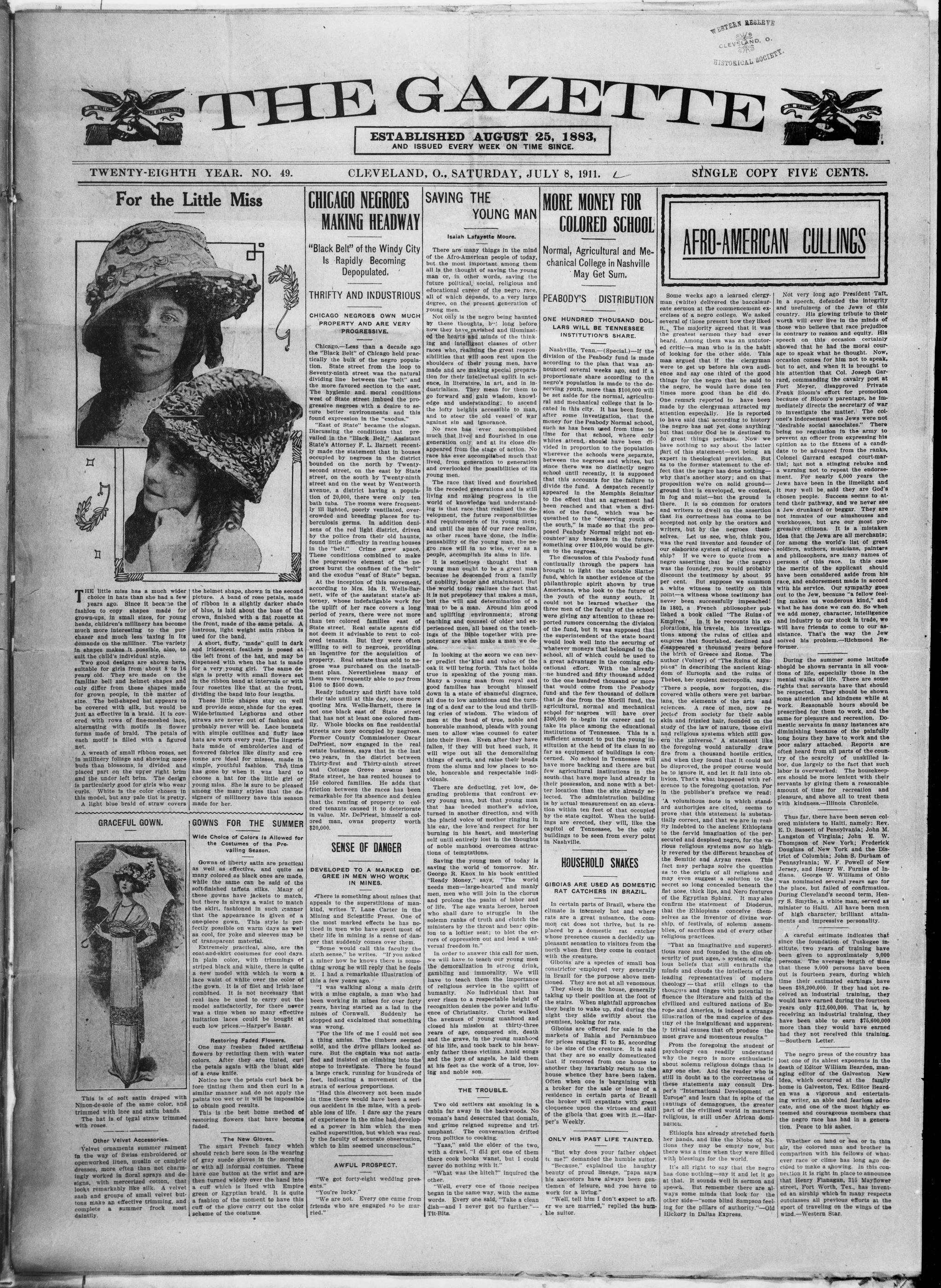
THE little miss has a much wider choice in hats than she had a few years ago. Since it became the fashion to copy shapes made for grown-ups, in small sizes, for young heads, children's millinery has become much more interesting to the purchaser and much less taxing in its demands on the milliner. The variety in shapes makes it possible, also, to suit the child's individual style.
Two good designs are shown here, suitable for girls from about 8 to 16 years old. They are made on the familiar bell and helmet shapes and only differ from these shapes made for grown people, in the matter of size. The bell-shaped hat appears to be covered with silk, but would be just as effective in a braid. It is covered with rows of fine-meshed lace, alternating with motifs in flower forms made of braid. The petals of each motif is filled with a figured net.
A wreath of small ribbon roses, set in millinery foliage and showing more buds than blossoms, is divided and placed part on the upper right brim and the under left brim. The design is particularly good for girls who wear curls. White is the color chosen in this model, but any pale tint is pretty.
A light blue braid of straw covers
This is of soft satin draped with Ninon-de-sole of the same color, and trimmed with lace and satin bands. The hat is of tegal straw trimmed with roses.
Other Velvet Accessories.
Velvet ornaments summer raiment in the way of Swiss embroidered or openworked linen, muslin or cambric dresses, more often than not charmingly worked in floral sprays and designs, with mercerized cotton, that looks remarkably like silk. A velvet sash and groups of small velvet buttons make an effective trimming, and complete a summer frock most daintily.
THE GAZETTE
the helmet shape, shown in the second picture. A band of rose petals, made of ribbon in a slightly darker shade of blue, is laid about the base of the crown, finished with a flat rosette at the front, made of the same petals. A lustrous, light weight satin ribbon is used for the band.
A short, fluffy, "made" quill in dark and fridescent feathers is posed at the left front of the hat, and may be dispensed with when the hat is made for a very young girl. The same design is pretty with small flowers set in the ribbon band at intervals or with four rosettes like that at the front, dividing the band into four lengths.
These little shapes stay on well and provide some, shade for the eyes. Wide-brimmed Leghorns and other straws are never out of fashion and probably never will be. Lace bonnets with simple outlines and fluffy lace hats are worn every year. The lingerie hats made of embroideries and of flowered fabrics like dimity and cretonne are ideal for misses, made in simple, youthful fashion. The time has gone by when it was hard to choose a hat for the little girl or young miss. She is sure to be pleased among the many styles that the designers of millinery have this season made for her.
GOWNS FOR THE SUMMER
Wide Choice of Colors is Allowed for the Costumes of the Pre-vailing Season.
Gowns of liberty satin are practical as well as effective, and quite as many colored as black ones are made, while the same can be said of the soft-finished taffeta silks. Many of these gowns have jackets to match, but there is always a waist to match the skirt, fashioned in such manner that the appearance is given of a one-piece gown. This style is perfectly possible on warm days as well as cool, for yoke and sleeves may be of transparent material.
Extremely practical, also, are the coat-and-skirt costumes for cool days. In plain color, with trimmings of striped black and white, there is quite a new model with which is worn a lace waist of white over the color of the gown. It is of fillet and irish lace combined. It is not necessary that real lace be used to carry out the model satisfactorily, for there never was a time when so many effective imitation laces could be bought at such low prices.—Harper's Bazar.
Restoring Faded Flowers.
One may freshen faded artificial flowers by retaining them with water colors. After they are tinted, curl the petals again with the blunt side of a case knife.
Notice how the petals curl back before tinting them and then curl in a similar manner and do not apply the paints too wet or it will be impossible to obtain good results.
This is the best home method of restoring flowers that have become faded.
The New Gloves.
The smart French fancy which should reach here soon is the wearing of gray suede gloves in the morning or with all informal costumes. These have one button at the wrist and are then turned widely over the hand into a cuff which is lined with Empire green or Egyptian braid. It is quite a fashion of the moment to have this cuff of the glove carry out the color scheme of the costume.
ESTABLISHED AUGUST 25, 1883 AND ISSUED EVERY WEEK ON TIME SINCE.
CHICAGO NEGROES MAKING HEADWAY
"Black Belt" of the Windy City Is Rapidly Becoming Depopulated.
THRIFTY AND INDUSTRIOUS
CHICAGO NEGROES OWN MUCH PROPERTY AND ARE VERY PROGRESSIVE.
Chicago.—Less than a decade ago the "Black Belt" of Chicago held practically the bulk of the negro population. State street from the loop to Seventy-ninth street was the natural dividing line between the "belt" and the more favored section to the east. The hygienic and moral conditions west of State street imbued the progressive negroes with a desire to secure better environments and this found expression in the "exodus."
"East of State" became the slogan. Discussing the conditions that prevailed in the "Black Belt," Assistant State's Attorney F. L. Barnett recently made the statement that in houses occupied by negroes in the district bounded on the north by Twenty-second street, on the east by State street, on the south by Twenty-ninth street and on the west by Wentworth avenue, a district having a population of 20,000, there were only ten bath tubs. The rooms were frequently ill lighted, poorly ventilated, overcrowded and breeding places for tuberculosis germs. In addition denizens of the red light district, driven by the police from their old haunts, found little difficulty in renting houses in the "belt." Crime grew apace. These conditions combined to make the progressive element of the negroes burst the confines of the "belt" and the exodus "east of State" began. At the inception of this movement, according to Mrs. Ida B. Wells-Barnett, wife of the assistant state's attorney, whose indefatigable work for the uplift of her race covers a long period of years, there were not more than ten colored families east of State street. Real estate agents did not deem it advisable to rent to colored tenants. But they were often willing to sell to negroes, providing an incentive for the acquisition of property. Real estate thus sold to negroes was purchased on the installment plan. Nevertheless many of them were frequently able to pay from $100 to $500 down.
Ready industry and thrift have told their tale until at this day, once more quoting Mrs. Wella-Barnett, there is not one black east of State street that has not at least one colored family. Whole blocks on fine residential streets are now occupied by negroes. Former County Commissioner Oscar DePriest, now engaged in the real estate business, says that in the last two years, in the district between Thirty-first and Thirty-ninth street and Cottage Grove avenue and State street, he has rented houses to 150 colored families. He adds that friction between the races has been remarkable for its absence and denies that the renting of property to colored tenants caused it to deteriorate in value. Mr. DePriest, himself a colored man, owns property worth $20,000.
SENSE OF DANGER
DEVELOPED TO A MARKED DE
GREE IN MEN WHO WORK
IN MINES.
"There is something about mines that appeals to the superstitions of mankind, writes T. Lane Carter in the Mining and Scientific Press. One of the most marked effects he has noticed in men who have spent most of their life in mining is a sense of danger that suddenly comes over them.
"Some would call this faculty the sixth sense," he writes. "If you asked a miner how he knows there is something wrong he will reply that he feels it. I had a remarkable illustration of this a few years ago.
"I was walking along a main drift with a mine captain, a man who had been working in mines for over forty years, having started as a lad in the mines of Cornwall. Suddenly he stopped and exclaimed that something was wrong.
"For the life of me I could not see a thing amiss. The timbers seemed solid, and the drive pillars looked secure. But the captain was not satisfied and insisted on climbing into the stope to investigate. There he found a large crack, running for hundreds of feet, indicating a movement of the strata of serious proportions.
"Had this discovery not been made in time there would have been a serious accident in the mine, with a probable loss of life. I dare say the years of experience in the mine had developed a power in him which the men called superstition, but which was really the faculty of accurate observation, which to him seemed unconscious."
AWFUL PROSPECT.
"We got forty-eight wedding presents."
"You're lucky."
"We are not. Every one came from friends who are engaged to be married."
SAVING THE
YOUNG MAN
Isaiah Lafayette Moore.
There are many things in the mind of the Afro-American people of today, but the most important among them all is the thought of saving the young man or, in other words, saving the future political, social, religious and educational career of the negro race, all of which depends, to a very large degree, on the present generation of young men.
Not only is the negro being haunted by these thoughts, but long before now they have revived and illuminated the hearts and minds of the thinking and intelligent classes of other races who, realizing the great responsibilities that will soon rest upon the shoulders of their young men, have made and are making special preparation for their intellectual uplift in science, in literature, in art, and in industrialism. They mean for them to go forward and gain wisdom, knowledge and understanding; to ascend the lofty heights accessible to man, and to steer the old vessel of war against sin and ignorance.
No race has ever accomplished much that lived and flourished in one generation only and at its close disappeared from the stage of action. No race has ever accomplished much that lived, from generation to generation and overlooked the possibilities of its young men.
The race that lived and flourished in the receded generations and is still living and making progress in the world of knowledge and understanding is that race that realized the development, the future responsibilities and requirements of its young men; and until the men of our race realize, as other races have done, the indispensability of the young man, the negro race will in no wise, ever as a people, accomplish its aims in life. It is sometimes thought that a young man ought to be a great man because he descended from a family of nobility, honor and attainment. But the world today realizes the fact that it is not propetency that makes a man, but the will and determination of a man to be a man. Around him good and uplifting environments; strong teaching and counsel of older and experienced men, all based on the teachings of the Bible together with propetency are what make a man we desire.
In looking at the acorn we can never predict the kind and value of the oak it will bring forth. This fact holds true in speaking of the young man. Many a young man from royal and good families has brought himself down in a state of shameful disgrace, all due to low ambitions and the turning of a deaf ear to the loud and thrilling cries of wisdom. The wisdom of men at the head of true, noble and honorable manhood, pleads with young men to allow wise counsel to enter into their lives. Even after they have fallen, if they will but heed such, it will wipe out all the demoralizing things of earth, and raise their heads from the slums and low places to noble, honorable and respectable individuals.
There are deducting, yet low, degrading problems that confront every young man, but that young man that has heeded mother's advice, turned in another direction, and with the placid voice of mother ringing in his ear, the love and respect for her burning in his heart, and mastering self until entirely lost in the thoughts of noble manhood overcomes attractions of temptations.
Saving the young men of today is saving the world of tomorrow. Mr. George R. Knox in his book entitled "Ready Money" says, "The world needs men—large-hearted and manly men, men who will join in the chorus and prolong the psalm of labor and of life. The age wants heroes, heroes who shall dare to struggle in the solemn ranks of truth and clutch the ministers by the throat and bear opinion to a loftier seat; to blot the errors of oppression out and lead a universal freedom in."
In order to answer this call for men, we will have to teach our young men the demoralization in strong drink, gambling and immorality. We will have to teach them the importance of religious service in the uplift of humanity. No individual that has ever risen to a respectable height of religion denies the power and influence of Christianity. Christ walked the avenues of young manhood and closed his mission at thirty-three years of age, conquered sin, death and the grave, in the young manhood of his life, and took back to his heavenly father these victims. Amid songs and the joys of angels, he laid them at his feet as the work of a true, loving and noble son.
THE TROUBLE
Two old settlers sat smoking in a cabin far away in the backwoods. No woman's hand desecrated that domain, and grime reigned supreme and triumphant. The conversation drifted from politics to cooking.
"Yaas," said the elder of the two, with a drawl. "I did get one of them there cook books wasnt, but I could never do nothing with it."
"What was the hitch?" inquired the other.
"Well, every one of those recipes began in the same way, with the same words. Every one said, 'Take a clean dish—and I never got no further.'"—Tit-Bits.
MORE MONEY FOR COLORED SCHOOL
MORE MONEY FOR COLORED SCHOOL
Normal, Agricultural and Mechanical College in Nashville May Get Sum.
PEABODY'S DISTRIBUTION
ONE HUNDRED THOUSAND DOLLARS WILL BE TENNESSEE INSTITUTION'S SHARE.
Nashville, Tenn.—(Special.)—If the division of the Peabody fund is made according to the plan that was announced several weeks ago, and if a proportionate share according to the negro's population is made to the deserving youth, more than $100,000 will be set aside for the normal, agricultural and mechanical college that is located in this city. It has been found, after some investigation, that the money for the Peabody Normal school, such as has been used from time to time for that school, where only whites attend, should have been divided in proportion to the population wherever the schools were separate, between the negroes and whites, but since there was no distinctly negro school until recently, it is supposed that this accounts for the failure to divide the fund. A despatch recently appeared in the Memphis Schlittar to the effect that an agreement had been reached and that when a division of the fund, which was bequeathed to the "deserving youth of the south," is made so that the proposed Peabody Normal might not encounter any breakers in the future, something over $100,000 would be given to the negroes.
The discussion of this Peabody fund continually through the papers has brought to light the notable Slatter fund, which is another evidence of the philanthropic spirit shown by true Americans, who look to the future of the youth of the sunny south. It could not be learned whether the three men of the faculty of the school were giving any attention to these reported rumors concerning the division of the fund, but it was supposed that the superintendent of the state board would look well into the securing of whatever moneys that belonged to the school, all of which could be used to a great advantage in the coming educational effort. With the already one hundred and fifty thousand added to the one hundred thousand or more that would come from the Peabody fund and the few thousand of dollars that is due from the Morill fund, the agricultural, normal and mechanical school for negroes will have over $300,000 to begin its career and to take its place among the educational institutions of Tennessee. This is a sufficient amount to put the young institution at the head of its class in so far as equipment of buildings is concerned. No school in Tennessee will have more backing and there are but few agricultural institutions in the south that have more land already in their possession, and none with a better location than the site already selected. The administration building is by actual measurement on an elevation within ten feet of that occupied by the state capitol. When the buildings are erected, they will, like the capitol of Tennessee, be the only buildings to be seen from every point in Nashville.
HOUSEHOLD SNAKES
GIBOIAS ARE USED AS DOMESTIC RAT CATCHERS IN BRAZIL.
In certain parts of Brazil, where the climate is intensely hot and where rats are a great nuisance, the common cat does not thrive, but is replaced by a domestic rat catcher whose presence causes a decidedly unpleasant sensation to visitors from the north when first they come in contact with the creature.
Giboias are a species of small bo constrictor employed very generally in Brazil for the purpose above mentioned. They are not at all venomous. They sleep in the house, generally taking up their position at the foot of the stairs. When nightfall approaches they begin to wake up, and during the night they slide swiftly about the premises, looking for rats.
Giboias are offered for sale in the markets of Bahia and Pernambuco for prices ranging $1 to $5, according to the size of the creature. It is said that they are so easily domesticated that if removed from one house to another they invariably return to the house whence they have been taken. Often when one is bargaining with a broker for the sale or lease of a residence in certain parts of Brazil the broker will expatiate with great eloquence upon the virtues and skill of the gibola that goes with it.—Harper's Weekly.
ONLY HIS PAST LIFE TAINTED.
"But why does your father object to me?" demanded the humble suitor. "Because," explained the haughty beauty of proud lineage, "papa says his ancestors have always been gentlemen of leisure, and you have to work for a living." "Well, tell him I don't expect to after we are married," replied the humble suitor.
AFRO-AMERICAN CULLINGS
WESTERN RESERVE
CLEVELAND, O.
HISTORICAL SOCIETY.
SINGLE COPY
AFRO-AMERICAN
Some weeks ago a learned clergyman (white) delivered the baccalaureate sermon at the commencement exercises of a negro college. We asked several of those present how they liked it. The majority agreed that it was the greatest sermon they had ever heard. Among them was an untutored critic—a man who is in the habit of looking for the other side. This man argued that if the clergyman were to get up before his own audience and say one third of the good things for the negro that he said to the negro, he would have done ten times more good than he did do. One remark reported to have been made by the clergyman attracted my attention especially. He is reported to have said that according to history the negro has not yet done anything but that under God he is destined to do great things perhaps. Now we have nothing to say about the latter part of this statement—not being an expert in theological prevision. As to the former statement to the effect that the negro has done nothing—why that's another story; and on that proposition we're on solid ground—ground that is enveloped, we confess, in fog and mist is, but the ground is there. It is so common for orators and writers to dwell on the assertion that its correctness has come to their correctness has come to the orators and writers, but by the rogers themselves. Let us see, who think you, the real inventor and founder of the elaborate system of religious worship? If we were to quote from a negro assertion that he (the negro) was the founder, you would probably discount the testimony by about 95 per cent. But suppose we summon a white witness to testify on this point—a witness whose testimony has never been successful impelled! In 1802, a French philosopher published a book called "The Ruins of Empires." In it he recounts his explorations, his travels, his investigations among the ruins of cities and empires that flourished, declined and disappeared a thousand years before the birth of Greece and Rome. The author (Volley) of "The Ruins of Empires" in describing the ancient kingdom of Euripia and the ruins of Thebes, her opulent metropolis, says: "There a people, now forgotten, discovered while others were yet barbarians, the elements of the arts and sciences. A race of men, now rejected from society for their sable skin and frizzled hair, founded on the study of the law of nature, those civil and religious systems which still govern the universe." A statement like the foregoing would naturally draw fire from a thousand hostile critics, and when they found that it could not be disproved, the proper course would be to ignore it, and let it fall into oblivion. That's what happened with reference to the foregoing quotation. For in the publisher's preface we read:
"A voluminous note in which standard authorities are cited, seems to prove that this statement is substantially correct, and that we are in reality indebted to the ancient Ethiopians to the fervid imagination of the persecuted and despised negro, for the various religious systems now so highly revered by the different branches of the Semitic and Aryan races. This fact may perhaps solve the question as to the origin of all religions and may even suggest a solution to the secret so long concealed beneath the flat nose, thick lips, and Nero features of the Egyptian Sphinx. It may also confirm the statement of Dioderus, that the Ethiopians conceive themselves as the inventor of divine worship, of festivals, of solemn assemblies, of sacrifices and of every other religious practices.
"That an imaginative and superstitious race and founded in the dim obscurity of past ages, a system of religious beliefs that still enthralls the minds and clouds the intellects of the leading representatives of modern theology—that still clings to the thoughes and tinges with potential influence the literature and faith of the civilized and cultured nations of Europe and America, is indeed a strange illumination of the mad caprice of destiny of the insignificant and apparently trivial causes that oft produce the most grave and momentous results."
From the foregoing the student of psychology can readily understand why the negro is more enthusiastic about solemn religious doings than is any one else. And the reader who is still in doubt as to the correctness of these statements may consult Draper's "International Development of Europe" and learn that in spite of the rantings of demagogues, the greater part of the civilized world in matters religious, is still under African domination.
Ethiopia has already stretched forth her hands, and like the Niobe of Nations they may be empty now, but there was a time when they were filled with blessings for the world.
It's all right to say that the negro has done nothing—say it and let it go at that. It sounds well in sermon and speech. But remember there are always some minds that look for the other side—"some blind Sampson feeling in the pillars of authority"—Old Hickory in Dallas Express.
Not very long ago President Taft, in a speech, defended the integrity and usefulness of the Jews of this country. His glowing tribute to their worth will ever live in the minds of those who believe that race prejudice is contrary to reason and equity. His speech on this occasion certainly showed that he had the moral courage to speak what he thought. Now, occasion comes for him not to speak, but to act, and when it is brought to his attention that Col. Joseph Garrard, commanding the cavalry post at Fort Meyer, disapproved Private Frank Bloom's effort for promotion because of Bloom's parentage, he immediately directs the secretary of war to investigate the matter. The Colonel's indemnation was Jews were not "desirable social associates." There being no regulation in the army to prevent an officer from expressing his opinion as to the fitness of a candidate to be advanced from the ranks, Colonel Garrard escaped court-martial; but not a stinging rebuke and a warning not to repeat the endorsement. For nearly 6,000 years the Jews have been in the limelight and it may well be said they are God's chosen people. Success seems to attend their pathway, and we never see a Jew drunkard or beggar. They are not inmates of our almshouses and workhouses, but are our most progressive citizens. It is a mistaken idea that the Jews are all merchants; for among the world's list of great soldiers, authors, musicians, painters and philosophers, are many names of persons of this race. In this case the merits of the applicant should have been considered aside from his race, and endorsement made in accord with his service. Our sympathy goes out to the Jew, because "a fellow feeling makes us wonderful kind," and what he has done we can do. So when we add money, character, intelligence and industry to our stock in trade, we will have friends to come to our assistance. That's the way the Jew solved his problem.—Richmond Reformer.
During the summer some latitude should be shown servants in all vocations of life, especially those in the menial walks of life. There are some rights that servants have that should be respected. They should be shown some attention and kindness while at work. Reasonable hours should be prescribed for them to work, and the same for pleasure and recreation. Domestic servants in many instances are diminishing because of the painfully long hours they have to work and the poor salary attached. Reports are often heard from all parts of the country of the scarcity of unskilled labor, due largely to the fact that such labor is overworked. The housekeepers should be more lenient with their servants by giving them a reasonable amount of time for recreation and pleasure, and above all to treat them with kindness—Illinois Chronicle.
Thus far, there have been seven colored ministers to Haiti, namely: Rev. E. D. Bassett of Pennsylvania; John M. Langston of Virginia; John E. W. Thompson of New York; Frederick Douglass of New York and the District of Columbia; John S. Durham of Pennsylvania; W. F. Powell of New Jersey, and Henry W. Furniss of Indiana. George W. Williams of Ohio was nominated several years ago for the place, but failed of confirmation. During Cleveland's second term, Henry S. Smythe, a white man, served as minister to Haiti. All have been men of high character, brilliant attainments and impressive personality.
A careful estimate indicates that since the foundation of Tuskegee institute, two years of training have been given to approximately 9,000 persons. The average length of time that these 9,000 persons have been out is fourteen years, during which time their estimated earnings have been $88,200,000. If they had not received an industrial training, they would have earned during the fourteen years only $12,600,000. That is, by receiving an industrial training, they have been able to earn $75,600,000 more than they would have earned had they not received this training. —Southern Letter.
The negro press of the country has lost one of its ablest exponents in the death of Editor William Bearden, managing editor of the Galveston New Idea, which occurred at the family home in Galveston, Tex. Editor Bearden was a vigorous and entertaining writer, an able and fearless advocate, and one of the most highly esteemed and courageous members that the negro race has had in a generation. Peace to his ashes.
Whether on land or sea or in thin air, the colored man and brother in comparison with his fellows of whatever race or clime has long ago decided to make a showing. In this connection it is right in place to announce that Henry Flanagan, 315 Mayflower street, Fort Worth, Tex., has invented an airship which in many respects outclasses all previous efforts at the sport of traveling on the wings of the wind.—Western Star.
2
a cere
“PUBLISHED EVERY SATURDAY
SUBSCRIPTION RATES
(in Advance)
Ome Year... .cceee eee eee es 8180
Bix Montha......c.sccscscss. 1.00
‘Three Monthe............... 50
Bubscribers are requested te re
mit by posteffice money on
der or registered retter.
Entered at the postoffice In Cleveland,
‘Ohio, as second-class matter
Address all communications to
HARRY C,. SMITH
Editor and proprietor,
‘THE GAZETTE,
Blackstone Building, Cleveland, O.
Member Ohio Legislature: 1994
te 1896; 1898 to 1898; 1900 to 1902
THE GAZETTE |e the oldest, and
thas the largest bona fide circulation,
double that of any newspaper in the
Interest of Afro-Americans, publiehed
Wn the state of Ohio, and comparleon
with any will Immediately establish
ite rank as one of the NEWSIEST
‘AND BEST In the codintry.
So Sam. “Langford is going to Eng-
Jand, next month,” after “Jack John-
son.” Better stay here, Sam., and
“Iet the wrong end of a mule alone.”
—_
‘The “old reliable” Gazette enters
its twenty-ninth year early next
mgnth. During all that time we have
issued this paper EVERY WEEK ON
TIME. Doesn't the knowledge of
this fact, encourage you to subscribe,
dear reader?
President Taft's “Kitchen Cabi-
net” (A few Negro officeholders at
Washington D. C.) are now operat-
ing a Pro-Tatt News-Bureau. It had
a letter in @ number of race papers
last week attacking Rev. J. Milton
‘Waldron of Washington, D. C., and
defending” President ‘Taft. ‘Trait.
orous business, from a race view.
point.
‘To sin by silence when we should
protest makes cowards out of men.
‘The human race has climbed on pro-
test, Had no voice been raised against
injustice, ignorance and lust, the in:
quisition yet would serve the law,
the guillotiies decide our least dis-
putes. The few who dare must speak
and speak again to right the wrongs
of many.—Ella Wheeler Wilcox.
President Taft has announced the
appointment of Philander “Claxton
(white), professor of education at the
University of Tennessee, as commis-
sioner of education, succeeding Elmer
E, Brown resigned. Another demon-
stration of “Taft friendship” for the
race. Tennessee, Tennessee? 0, yes,
that state is in the President's be-
loved South, and a “tough” one for
Negroes.
For the special beneft of Mrs.
Adelia C. Jones of Thomas, W. Va,
‘and others who may wish to know,
we desire to say that the race has a
leader, and there is too, an organiza-
tion, with both of which she, or any
other member of the race, can file
such complaints as are of racial inter-
est and importance. Prof. W. B. Du-
Bols is the leade?, and the: organiza-
tion in the National Association for
‘the Advancement of Afro-Americans,
‘The address of both is No. 20 Vesey
Street. New York City.
Lynching is moving briskly on
‘ward, as usual. The monotony has
‘been varied this week by a Cleveland,
©,, mob shooting a Negro to death.
—Cincinnati (0.) Union.
Our contemporary is /wrong: The
victim and two or / three other
“tramps” were stealing cherries in an
orchard east of Cleveland, and his
death was the direct result of the
victim's first shooting and seriously
wounding the farmer whose fruit he
was stealing. There was no “lynch:
ing” as the victim, after being shot
while fleeing, was taken to a hospital
where he died. Furthermore the
unfortunate affair did not occur in
Cleveland. If is had enough, Bro.
Dabney; don't make it any worse,
please. Two days afterwards, an Ital-
fan stealing berries in the same vicin.
ity was shot to death.
——
WHERE EXPERIENCE {8 NO
TEACHER.
Just as soon as “Jack” Johnson
signed the papers this week, on July
4, for that fight in Ireland, the “sour
grapes”, prejudiced American cor-
Tespondents and newspapers began
again to harp upon his “many weak
points.” Now, it is principally his
“high-living stomach”, and his “being
‘out of condition”, etc., etc., that seem
to afford them so much satisfaction
as they tilt back their chairs and
smilingly contemplate “Jack's” prob
able defeat by the Irish pugilist, Pat-
rick Curran, in Dublin, Ireland, in the
near future! They have thrust aside
(or the time only, however) all re
membrance of how they did the same
fool-thing, one year ago prior to this
July 4, and what an awful awaken-
ing there was for them on July 4,
1910, after they had similarly in-
dulged their self-jolhes (and silly pre-
fudices) over another Irish pugilist,
James J. Jeffries, “sure victory over
flat-footed Jack Johnson or ‘Lil’ J.
Arthur Johnson,” as they loved to re-
fer to the heavyweight champion of
the world, Strange, but nevertheless
true—here is a case, and a wide
‘spread one, too, where experience,
and bitter experience at that, does
hot seem to be elther teacher or
guide, It Is however a very good in-
dication of the real state of America’s
fool color and race prejudice, and the
‘bitterness of the “World's Champion
Jobnson grapes.” They are big and
Jusclous, all agree and, we think, good
to look upon and accept freely.
but ©, 80 sour to “sore” and
prejudiced American correspondents,
newspapers and ‘others,—especially
so when the fine Jooking white
wife whirls by in her $12,000
imousine with “Jack” seated st her
aide wearing that “golden smile.”
fen’t ft awful “Mabel,—George?” Even
sot We'll wager a trifle that Pat-
rick Curran will never do the “beef-
ing” Jefferies has, after Johnson gets
through with him. He has not been
“spoiled”. by American fool preju-
dice.
LANGFORD AND JOHNSON!
‘One Wins a Fight in This Country and
‘the Other is Scheduled to Do
‘80 Abroad, Soon.
New York City.—In the fifth round
of a scheduled ten-round boxing bout
at the National Sporting club last
week Thursday night Sam Langford
knocked out Jack Fitzgerald (white)
with two uppercuts, delivered in quick
succession. The. end came after Lang-
ford had previously dropped Fitzger-
ald to the mat for a count of eight
with a left hook to the jaw. It was
not a boxing bout in the full sense of
the term, but a sharpshooting event
with gloves. Langford did all the aim.
ing and smashing with Fitzgerald act
ing as a target. Only once did Fitz
gerald hit Langford. ‘Then in a frenzy
of fear he sent in a left hook thal
caught Langford in the stomach. That
blow brought about Fitzgerald's undo.
ing. It caused Langford to drive after
his man. Then the battle, if such it
‘can be called, ended. Just as soon
as Langford made up his mind to end
it, Fitzgerald was counted out, Sam
fs going to England in August, after
Tack Johnson:
London, England—Tom Flanagan
has arranged a contest between Cham:
pion Heavyweight Jack Johnson and
Petty Officer Curran (white), which
Drobably will take place in the open
air in the neighborhood of Dublin,
Ireland, during the August horse
show. Curran is one of the best men
on this side, but has no serious pre
tentions to the championship. class.
However, as Irishmen want to. sec
Johnson in action, Curran will do. as
well as anybody for an opponent.
LET YOUR MOUTH REST.
Every colored man nowadays is a
supporter of race enterprise—with his
mouth. We have right here in this
city Negro professional and trades-
men, keepers of shops, wares, etc.,
men’ playing at the game of business
in a, small way, and who in large
measure must depend upon their own
race for support, who never think of
thelr duty to colored enterprises while
they have money. If perchance their
money gives out and they can secure
something on credit from their
brother in black, all well; otherwise
nothing doing. ‘This element. of the
colored race needs to be pitied rather
than abused, for notwithstanding
many of them can read and write,
they are fools and do not know It.
Let us learn a lesson from the lower
order of creation. Even the insects
and the birds of passage have more
Sense than the average American Ne-
gro. Get together, not in strife, prej-
udice nor unlawfulness, but along
broad lines, The damnable race prej-
udice which you are called on to
face and live down demands that you
have an understanding, if you would
accomplish anything. "Let us cease
so much talk and remember that “it
takes money to buy land.”—Dallas
(Tex.) Express. \
The Pullman Palace Car Co. is te
increase its porters’ pay but ten per
cent.
Jesse S. Battles, recently appointed
is New York City’s first Afro-Amert
can policeman. °
Clarence Smith of Brooklyn, has
been appointed a detective and sta
tioned at the Coney Island Public
baths for the summer.
‘Twelve Afro-American teachers of
Fisk University, Nashville, Tenn.
have been dropped and white teachers
given their places. No explanation fs
given, elther.
Wilberforce University was NOT
given any appropriation by the Ohic
‘Legislature but its State (Normal and
Industrial) Department was. Many
race papers do not seem to under
stand this. Wake up!
‘There are said,to be upwards of
‘a hundred vacandies at West Point
but it is dollars to doughnuts that
no Afro-American will be asked (by
President Taft) to step up and fill
them —Baltimore (Ma.) Atro-Amer
ican,
‘Theo. Cable, who broke Harvard
college's hammerthrow record, on
April 30, is in England with 22 other
Harvard and Yale college athletes
competing in the International meet
with Oxford and Cambridge Univer-
sity athletes.
The attempt to “jim-crow” at the
White House, last week Monday, our
ministers in a delegation representing
the World's Baptist Alliance caused
some of them to “roast” President
Taft and his “new southern” policy
toward the race, unmercifully.
‘Phere is scarcefy an Afro-American
pupil in any of the more than 20 Afro-
American teachers’ rooms in Cleve-
land's “mixed” schools (graded or
“grammar” public schools.) One
young lady of the race is a teacher In
the Central High School of this city.
‘The True Reformers raised only
$11,500 instead of $37,000 as an-
nounced from Richmond, Va., some
weeks ago, says the Richmond (Va.)
Planet. Deception was practiced, it
charges. Chief Griffin of Washington,
D. €., an officer of the order, writes
the ‘Planet: “Hill's shortage, | to-
gether with the shortage of, money
spent by him belonging to the Grand
Fountain, will reach $90,000.” R. T-
Hilt ia the absconding cashier of the
defunct True Reformers’ bank of Rich-
mond, Va.
No other race but ours” pays its
money to encourage its actors. to
Imake fun of it. No others enjoy cari-
catures of themselves as we have
done but at last the thing is beginning
to pall, and monotony seems to be do-
ing what nothing else has been able
to do. The public is tired of varia-
tions of the same. old stunt, and de
mands a change.—Mrs. Ida B. Wells-
\ seas 7%
‘The Dream of Peace,
Kanicker—Wouldn't it be really
grand ff the leading nations signed
Erbitration treaties? Bocker—Yes; but
fe church choirs wouldn't—Judge.
THE GAZET1#, CLEVELAND, 0., SATURDAY. JULY 8 1911
nnn ee
FRESH OHIO NEWS | ‘THERE'S NO PLACE LIKE OME] HOWARD U
| Dog Walks 140 Migs to Reach Favor | aniline
1 Ite Spot Behind Butcher | WILBUR P. THIRKIEL
| ‘Shop Stove. | Located in Capital of the Nation
ae vantages unsurpassed, Modern sctet
If you've ever felt the pangs of |Carnegie Library. New Science Hal
ee homesickness and have longed for the ee from ve states and 10 other ¢
| quiet of « small town in to | selt-support. No young man of wom
WHAT OUR PEOPLE ARE DOING | foi" ci ad pat of a big ity |Drived of fs advantages
IN MANY CITIES AND TOWNS | Your sympathy will go out to Dewey, | THE COLLEGE OF A
OF THE STATE. | @ white bulldog who, pining for bis | Devoted 10 jiveral studies. | Cow
ee Personal soft spot bebind a meat mar /nq the Social Sciences, such as a
ket stove in La Crosse, Wis, walked | Sixteen professors. Kelly Miller, A.
INTERESTING PERSONALNOTES | 2°, entire distance trom st.” Pau to THE TEACHE
Vonet ogee peu ee Ree
‘Notes of Interest.
Wilberforce.—Mrs. Geo. Myers and
daughter of Cleveland are guests of
ExChaplain and Mrs. W. T. Anderson.
—Mr, and Mrs. Lowel Baker of Ash:
tabula, are visiting her parents.—Mrs.
Wallace Ormes of Chicago, is visiting
her son, Prof. Jesse Ormes, and fam-
fly—Subseribe for The Gazette and
Keep up to date with the race's news.
Melntyre.—Mr. Clark and Olive
Freeman were Mr. T. and Lydfa
West's guests, Wednesday evening.—
Mrs. B. West’ and Mrs. Logan Smith
were in Bloomfleld, Saturday. —Mr.
and Mrs. Ernest Smith are rejoicing
over a fine baby ~boy—Mr. “Henry
Smith has purchased a new binder—
Mr. and Mrs. Ezekiel Smith visited
Mr. Walter Smith of Fernwood, Sun-
day.—Miss Jessie Smith of Parlette
is visiting her parents.—Mr. and Mrs.
George Harris and family dined with
Mr. and Mrs. Frank West recently. —
Mrs. Alice of Steubenville, is ill.—Mr.
and Mrs, Edward Smith visited in
Hopedale, Sunday.
Mt. Pleasant.—Miss Lizzie Newman
has returned to Pittsburg —Mrs. Jack-
son and daughter, Pearl, were in Dil-
lonvale, last week. Also Misses Lou-
raine Rainbow, Catherine Nelson and
Eleanor Proctor—Master Roy Skin-
ner is visiting relatives in Washing-
ton, Pa—Miss Alice Newsome is home
from East Liverpool—The Fancy
Work club met at Miss Sadie Mer-
cer's, “Wednesday _afternoon.—Mrs.
‘Anna Fisher js visiting her mother,
Mrs. Fletcher—Mrs, Vinie Hawkins
of Madrid, was in town, Saturday.—
Miss Pearl Jackson visited Miss
‘Bleanor Proctor, Saturday. — Mr.
‘Charles Carey was home from Bridge:
port, where he is working—Miss Le-
Ota Moore visited Miss Edith Jackson.
=Mr. Georgie Powell was home from
emer
Smithfield.—The entertainment at
‘the A. M. B. church, for the benefit
of the trustees, Saturday evening, was
& success —Mrs. E. H. Harris enter-
tained the Sewing Circle June 30.—
Mr. Jordan Powell had a runaway
horse. We sympathize with him in
his trouble.—Mrs. W. H, Veney enter-
tained Mrs. Allensworth and son, June
30, Mrs. G. W. Veney entertained the
visitors, Saturday and Sunday.—Mrs.
Jackson and. son are visiting her
mother, Mrs. Mary Washington.—Mr.
Norman, lan Bigsby and Mrs. Carrie
Fitzgerald spent Saturday in Steuben-
ville—Mr. and Mrs. L. Castle and
family and Mr. and Mrs. Hayes Harris
and family were guests of Mr. and
Mrs. George Harris, Sunday.—Miss
Lida Beasley, who visited her sister,
Mrs. W. H. 'Veney, has returned to
Pittsburg, ‘She was accompanied by
Miss Mabel Beasley, who will remain
here a while longer—Mz, Wm, Munts
is again carrying the mail from Brad-
ey to the Wabash station.
| Correspondents must mail all let-
ters for publication at their main
postofiice sufficiently early on Monday
(or Sunday) of each week to have
them reach The Gazette office on
‘Tuesday morning, and always. write,
also, their names and that of their
city’ or town on the outside of the
Wrapper about returned copies. Un-
less this latter ts done, proper credit
cannot be given you. Lists of names,
wedding presents, éte,, obituary no-
tices, speeches, resolutions, poetry, in-
quiries for relatives and adveriise-
ments of all kinds, including items
announcing entertainments to be held
in the near future, must be pala tor
In advance at the tate of ten cents a
line, eix words to a line. Our rates
for display advertisements willbe
sent on application. Send postal note
and not stamps during warm weather,
Washington C. He Misses Helen
Jones and Nina Brandon started for
Chippewa Lake, June 29—Messrs.
Jefferson Lovings and Christopher
Mason attended the Greenfield con-
cert, June 29—Mr. Walter Lovings
Visited in this city, this week —Mtrs
Brooks of Dayton Is visiting Mr. and
Mrs. Raymond Ross.—Miss Ford of
Chillicothe is the guest of Miss Ruth
Jackson.—Miss Munse of Chillicothe
ig located here.—Mrs. R. Ernest Thor-
ton entertained several children in
honor of her daughter, Leona, July 3.
Mrs. Harry Jones ‘returned from
Springfield, “June 26.—Mr. Santford
Easton visited his daughter, Mrs.
‘Altha Lee, of Sabina, June 25.—Mr.
and Mrs. Bdward Branks, lett July 2,
for a ten-day visit in Indianapolis.
Youngstown—Mrs. Mathew Bailey
was called to Steubenville, by her
mother, Mrs. W. Brown's illness,—Mr,
Will Williams of Seattle, Wash., 13
visiting his mother, Mrs. Wesley Wil-
Hams, and sisters, ‘Mrs. Will Honesty
‘and Mrs, Fred Johnson.—All members
of Logan lodge, K. P., and U. R., in
full dress uniform, are requested to
meet at their hall, Sunday, at 12:30
noon. ‘Thos. Lonesome, C. C,, and Wil-
lis Collins, captain—Consuela Stew
art Court of Calanthe's lawn fete at
Mrs, Geo, Rideout's, last Friday even-
ing, was an exceptionally enjoyable
success. The house and lawn were
Deautifully decorated and refreshments
were served. ‘The Court met Monday
evening and listened to excellent re-
ports of the affair.—Mrs, Rosa Jobnson
of Cleveland, president of the M. M. 8.
Of the North Ohio A. M. E. conference,
Yectured at Oak Hill Ave, church, Mon-
day evening, A large aidience and a
very interesting lecture—The Chry-
santhemum club's meeting at Mrs
Fred Johnson's, Tuesday evening, and
its outing were the usual successes
of that popular organization —Rev. W.
M, Smith's lecture, Sunday evening, at
Maboning Ave, church, svas fine.” A
fair-size audience—Mrs, Ida M. Ander-
son of Pittsburg. is visiting her sis-
ter, Mrs. W. He Taylor.—Order The
LADIES! LADIES!! LADIRES*>
Call your lady friends’ and
acquaintances’ attention to oar
up-to-date fashion and pattern
departments and thus encour-
age them to subscribe or take
‘The Gazette regularly. Oblige
the Editor.
‘THERE’S NO PLACE LIKE HOME
Dog Waiks 140 Miles to Reach Favor
Ite Spot Behind Butcher
‘Shop Stove.
If you've ever felt the pangs of
homesickness and have longed for the
quiet of a small town in contrast to
the hustle and bustle of a big city
your sympathy will go out to Dewey.
@ white bulldog who, pining for bis
personal soft spot bebind a meat mar-
ket stove in La Crosse, Wis, walked
‘the entire distance from St. Paul to
that city, ‘
A letter from La Crosse tells of the
arrival there of the dog, which ts the
property of Oscar Baum, a St. Paul
meatcutter, who formerly lived tn
the Wisconsin city.
Dewey is now sleeping behind the
stove in the meat market in La
Crosse, which hia master formerly
owned. Although Mr. Baum brought
the dog fo St, Paul in the express car
of a fast Ilmited train and offered him
all kinds of inducements and delice.
les not to be had in a small town,
Dewey was not happy.
He ran away and appeared unex:
pected at bis old home, Wagging bis
short tail furiously, he scratched and
whined for admittance.
‘The 140 miles he had tramped had
made him footsore and weary. His
tongue was hanging far out of his
mouth and he was panting. Dewey's
eyes were bright, however, and be
Was not too tired ¢2 yawn In a friend:
ly manner at his old trusted friend,
the market eat.
When his master telephoned from
St. Paul that he would go to La
Crosse to get him the gaunt little
fighting pet was sleeping the peaceful
sleep of the weary. Between his
paws Was a discarded bone, and the
satisfied grin on his battle-scarred
| face told more plainly than words that
he preferred a meager bone in La
[Crosse to porterhouse steak in St
| Paul
TO AID TEETHING BABIES
Limewater Supplies Child With Juet
What It Needs at Critleal
—
Statistics prove that a large propor
tion of all the bables born die while
teething. It becomes @ serious ques
tlon to the anxious mother how she
can ald nature at this critical time
When the tooth ta almost ready to ap
pear, & judicious rubbing, or allowing
‘the child to bite bard, safe substances,
{a often healthful and benefictal,
Haye you never been alarmed at
some sudden attack of sickness, and,
when your good doctor was summoned.
had him affirm the éause to be teeth-
ing, when nothing in the appearance
of the mouth would indicate the com:
ing of anew tooth? We think any
mother who bas taken careful obser
vation will say that often, when the
tooth 6 first forming, the whole or
ganization ts more disturbed than when
the tooth is about ready to make {ts ap
pearance.
Now, how can we help matters more
than by supplying a child what its lit-
tle system most, needs in tooth-making?
If we take the trouble to look into the
matter we shall find that every tooth
{8 composed largely of lime.
‘As soon as your baby has reached
a suitable age for cutting teeth, put a
few drops of limewater in hfs milk at
each meal. By thus supplying your
child with just what he needs at this
critical time, you will ald nature in ‘her
work and prevent many troublesome,
if not fatal, results
RISE UP AGAINST MOTORS
British Women Declare They Make
Life Miserable and Endanger
Children.
‘The village women of the United
Kingdom have just petitioned the
queen to help them to get some relie
from the motor cars, “which have
made our liven a misery.” "Our chil
dren,” they continue, “are always in
danger, our things afe ruined by the
ust, we cannot open our windows, ou
rest is epolled by the notse at night."
oy. “We are only poor people, aid
the great majority ‘of those who use
motor cars take no account of us.”
Could anything be more pathetic than
this, eapectally coming from a class
whose lives are hard at the best of
times, and to whom a gleam of hu-
man sympathy must be a veritable an-
fel's visit?
‘The frony of the situation was to
be seen a day or two after the peti
ton was sent In, when a report of the
Women's Imperial Health association
appeared in the newspapers, setting
forth how by means of caravan lee
tures country people were being urged
Keep thelr windows open, and otter
wise to adopt the simple means open
{o them to improve thelr own health
and that of thelt famlltes and depend
ents—London Nation.
meen oak hu
Men along the water front have had
‘a chance to see an unusual form of
wireless apparatus. This outfit, with
three sets of antennae instead of the
usual two, is aboard the United States
cable boat Joseph Henry,
‘The Henry has on board immense
rolls of steel covered cfble to be laid
‘etween the various harbor forts. The
wireless of the Henry is of a variety
recently adopted, in which three sets
of antennae are used, the third set be
ing placed about midway on the main.
mast. Thfs form of wireless is so ar.
ranged that the usual noisy crackling
sound is absent, and the only sounds to
be heard while the apparatus Is work
ing are those that come from the con.
densor, and recelver, so that the ina
chine 4s practically noiseless.—Roston
Globe.
‘Our Mental Horizon.
In childhood we fancied ourselves
walled in by the horizon, as by a
glass bell, and doubted not, by distant
travel, we should reach the paths of
the descending sun and stars. On
experiment the horizon files before
us, and leaves us on an endless com-
mon, sheltered by no glass bell. Yet
‘tis strangs how tenaciously we cling
to that bell-astronomy, as a protected
domestic borizon.—Emerson.
HOWARD UNIVERSITY
WILBUR P. THIRKIELD, LL. D., PRESIDENT.
Located in Capital of the Nation. ‘Campus of over twenty acres. Ad-
vantages unsurpassed. Modern scientific and general equipment. New
Carnegie Library. New Science Hall. Faculty of over one hundred; 1,382
students from 37 states and 10 other countries. Unusual opportunities for
self-support. No young man or woman of energy or capacity need be de-
prived of its advantages. %
THE COLLEGE OF ARTS AND SCIENCES.
Devoted to liberal studies. Courses in English, Mathematics, Latin,
Greek, French, German, Physics, Chemistry, Biology, History, Philosophy,
and the Social Sciences, such as are given in the best approved colleges.
Sixteen professors. Kelly Miller, A. M., Dean.
THE TEACHERS’ COLLEGE.
Special opportunities for teachers. Regular college courses in Psychol-
ogy, Pedagogy, Education etc., with degree of A. B.; Pedagogical courses
leading to Ph. B. degree. High grade courses in Normal Training, Music,
Manual Arts, and Domestic Sciences. Graduates helped to positions. Lewis
B. Moore, A. M., Ph. D., Dean.
= THE ACADEMY.
Faculty of 13. Three courses of four years each. High grade pre-
paratory school. George J. Cummings, A. M., Dean.
THE COMMERCIAL COLLEGE.
Courses in Bookkeeping, Stenography, Commercial Law, History, Civ-
ics, ete. Business and English high school education combined. George W.
Cook, A. M., Dean,
SCHOOL OF MANUAL ARTS AND APPLIED SCIENCES.
purnishes thorough courses. Six instructors. Offers four-year courses
in Mechanical and Civil Engineering.and Architecture.
PROFESSIONAL SCHOOLS.
‘The School of Theology.
Interdenominational. Five professors. Broad and thorough courses.
Advantages of connection with a great university. Students’ Aid. Low ex-
penses. Isaac Clark, D. D., Dean,
THE SCHOOL OF MEDICINE,
Medical, Dental and Pharmaceutical Colleges.
Forty-nine professors. Modern laboratories and equipment. Connected
with new Freedmen’s Hospital, costing shalf million dollars, Clinical ta-
cilities not surpassed in America. Post-graudate School and Polyclinic, Ed.
ward A. Balloch, M. D., Dean, 5th and W. Sts, N. W. W.C, McNeill, M. D.,
Secretary, 901 R St. N.'W.
The School of Law.
Faculty of elght. Courses of three years, giving a thorough knowledge
of theory and practice of law. Occupies own building opposite court
house. Benjamin F. Leighton, LL, B., Dean, 420 5th St. N. W.
For catalog and special information, address Dean of Department
| HOTEL DALE.
| Cape May, New Jersey—One hundred light, airy and
| | nished rooms. EVERY MODERN IMPROVEMENT, Our
t | country. Just completed at « cost of $50,000. Hotel ‘Dale is
; | highest elevation in the heart of the residence portion of ¢¢
is directly opposite the widely’ celebrated links of the Cap
"| and its environments on all sides are perfect. ‘The hotel
| an extensive view of the harbor and sea, and the invizorat
reaches every section of it. Elegantly Furnished Dining
§ delicacies of the season and the best service. Both Europes
| plan. Beautiful Grill Room. Afternoon and Evening Conc
| plete Abyssinian Orchestra of N. Y. City. Croquet, tennis
air amusements. The finest sea bathing on the Atlantic co
| has its own PRIVATE BATH HOUSES, Perfectly safe a
omen and children to enjoy the Saltwater, Sailing an
| Also cabs, autos, etc. Heautiful country surrounds the ho'
~ | der the personal management of the owner, —B. W. Dale, 0
=| progressive and successful business men of our race. His
S| hotel man has enabled him to use thorough knowledge of
ing the equipment of his hotel to perfection. Hotel Dale |
*/ from the stations of either the Pennsylvania or Reading 1
* | ture and additional information will be mailed upon reques
> EW
|
y | Lafayette and Jefferson streets, Cape May, N.
ae nnn eee
Cape May, New Jersey—One hundred light, airy and luxuriously fur-
ished rooms. EVERY MODERN IMPROVEMENT, Our finest,. a {his
country, Just completed at a cost of $50,000, Hotel Dale is located on the
highest cievation in the heart of the residence portion of cool Cape May. It
Is directly opposite the widely celebrated links of the Cape May’ Golf Club
and {ta environments on all sides are perfect. The hotel rear. commands
an extensive view of the harbor and sen, and the invigorating ocean breeze
Teaches every section of it. Elegantly "Furnished Dining Room, all. the
Gelicacies of the season and the best service. Both European and American
Plan. Beautiful Grill Room. wAfterncon and Evening Concerts by the com
plete Abyssinian Orchestra of N.Y. City. Croquet; tennis and other open:
air amusements, The finest sen bathing on the Atlantic coast. Hotel Date
as its own PRIVATE BATH HOUSES, Perfectly safe at all times for
Nomen and children to enjoy the Saitwater, Sailing and Fishing galore.
Aiso cabe, autos, etc, Beautiful country surrounds the botel, which i tn:
der the personal management of the owner, E. W. Dale, one of, the most
progressive and successful business men of our race. Hils experience as a
hotel man has enabled ‘hima to. use thorough knowledge of details in Dring:
ing the equipment of his hotel to perfection. Hotel Dale ts easy. of access
from the stations of either the Pennsylvania or Reading railroads. Litera:
ture aud additional Information will be mailed ‘upon request. Agdress
EW. DALE,
5 Hotel Dale,
Lafayette and Jefferson streets, Cape May, N. J
Rubber Made From Beans. SR
It has taken the Germans to use| Only Married Men Count.
deans for making rubber. The process | In Corea marriage is even more fim
tas fust been patented. It colsists in | portant and essential for a man thar
extracting a thick off from the soya) It is for a woman as, until a man be
bean, treating this with nitric acid, wed, he ts a being of no account
and then heating the material to a If a father has not selected wives fo
flven temperature, whereupon It be-| tis. sons ere they reach the age 0
comes viscid and tough Ike rade rab- | twenty he ls considered worthless #n
ber. It can then be vulcanized by | neglectful
the addition of sulphur the same a2 ———_—
vegetable rubber, and used for the Our First Families.
tame purposes, Sctence tells us that the Tipulidae, 0
pe | paddy Longteas, were the original
ete eee ee | habitants of Norn America, and tha
Owing to the diminishing supply of
sturgeon caviar, Siberian fishermen
have been experimenting with salmon
roe, a commodity that was formerly
thrown away as valueless or even in-
durinds to health.
a ag
‘
Just send your name and address on the coupon below—that is all you need to do. It does
not cost one penny and as soon as your name and address is received a set of the world famous
Library of Universal History will be sent to you prepaid.
fee egies eee eed eae ees a ae
HERE (its frou rerers to scercasiaee teantalr ce | NEWER Sorere tats crate Pans tents
shows cen tanta pines a sted hee nes ov se | teraeamond score Stee’ eee et aie Vase oat
ere eee thee sana evened nies ay ne | Suara emt aaa teeta te seer se esa
iterations ‘mun of mich re lncorrand over Si vats | Hanving bo sue coins Uae ste eveoad rie bn
“Ti ler ts made pombe te fata of tbe paienra ne | SeTotent wad male us beeen Se
Meoesviay Gatch tnd wey me eoethcpecsen etic tare | wat tatoe Peal sit eceoe nets aay sere tama
now name you a rock-bottom bankrupt price of only S0c after ex- | binding, tbe magnictlent {llustrations and have read vn
selects reyes“ eer | Career ee eect aaa
Pasay nein oto fo eunnng | Feral aor xbeane = S" AMT than row ave
4 betore yoo decide te buy we Invise zon eramtoe tate mark tn | lta ierieton of te bods ives bara est do shew fale
our own home for an entire week absolutely free of cha a ize what they are. You sssume no
Mhouid' you not wane th Wook atter exon ation we will have | obligation to user any one else by making this request, you
thom revarned at our exvense, We earnestly request. you to er" | Paying any one anything, and remember youcan gy,
sie inl ibrar cece as Ana cata Aeaepentis | feud he Booka back wt our exiena, bod Ps °
Re evi poss whieh o nend agit bands ctotuess | imenber, Conte baskruya fosk-votiom
tan Whitt Hinoey of eters COuRtEY, nasion sod people ror ene | pllce of fexco for this "7.00 Library Rt
Seal of asthe een nue greqint World tery | Oe or ae Gn
Tt tere Fonows of fetuny cae: “Mowe nscinot cue | Site Suet eecintea™ see sae a
soliae Save ote Sasa eare en cere oe | ae eee ee” call ee
Tietetine a eure: Es these of tho bo = Aone
Ex Vice-Pres, Stevenson says: “It 1s a complete record of the | 7 ate Bee Sa Ae
perish Mute ite k charac” MAIL THE LS f
nbafemnantsenn Guess clas Uneaten | COUPON Pa
Rev. Prank W. Gunsautue, of Chicago, says: “These volumes St a aa ae
iifbetehinmens serie sitmugti history seedy in out — = fae
i atta ror of a ean << rie Bee BS
choent a mansteg| seemrane ete” <= ge
4 Ts St Lule Globe Democrat says: “This work Cc sau ae ae
eee I Ba way
15 Massive Volumes Le Aaa <>
Each volume 7 inches wide le Apa 6 PAE SS
nd 10 inches high; a ae: if
weight, boxed, OHO AAA SS
nearly Aa: Zag Tae ae xss ee
75 tbs. re ee a SESE
: ae ee ae igen as Po FSA
— a ey Ca ee Sees
try a lags mn a fé if $
CS —me Ape BRERA
ee ie, A 7 OSC
ieee OS ty Ye ET {3 eS S Seite,
me eA EEE
A we REREEA
OA 5 SS LIES
A A SL
eee a LS ESSER SI SSP
} eae Og eReS SOF
ae aa SS SE LEE Ee CIOS SE
CMe $i E
i Ss LEON S/S ESO OS SEE
i Lag ae SSIS. S Oe os
aa SEE IG ELD ©
= ae ee See SESE: oe ae
*, LES ES ESTEIS RS SEF SS
OD SEL IEE
B; Ee & ae RO St
SAG IY £0) 6
3 « x fg ee
e Mos is SPO SUF 8 oS S é
” PRY $i Off de
L ? Pde
+ te clegueidbalnalaR a tai sted meae ees
Science tells us that the Tipulidae, or
Daddy Long-logs, were the original In
habjtants of North America, and that
they occupied Colorado in vast num-
bers during the tertiary period. It Is
understood that the descendants of
Colonial families have protested
against this infringement of thelr
rights.—English exchange.
2 0
| Nor h 389-X
OPEN DAY AND NIGHT,
| TRY THE
Boston Dining Hall
| W.E. WHITE, Prop.
American_and European
Service.
Makes a Speciaity of Serving Pri-
vate Parties and Banquets.
2845 Central Ave.
CLEVELAND, ONO.
This Ad Good’ For
(ONE TREATMENT FREE
| Rheumatiem, indigestion, Constipation,
| kidney, Liver, Heart, Asthma, Prosta:
| titis, Lung, Locomotor Ataxia, Catarrh,
| Nevraiginy Female Troubie; Bronchitig
| Pleurisy, Pte, Insomnia Obecity, ete
NO CUTTING OR PAIN. CURE
DR.F, 0. WEBSTER, MT.
| (techano-Thieapiat)
| nat 'Stat hey cevelng 0.
H. Bryant Freeman
Paper Hanger
House Painter.
WHO MAKES YOUR
CLOTHES?
Rufus S. Justice
‘AGENTS WANTED HONEST, LIVE, WIDE]
ee Bae
WORKING IN THEIR OWN Cocky OR}
arperiat een ae re
Acai ti ae Ae
BY THOUSANDS OF COLORED PEOPLE, |
WRITE TO-DAY FOR AGENTS TERMS|
I ebay oh AGS em
aE BY neous
ADDRESS, ALFRED SCHULTZ MGR.
232 WEST LAKE ST. CHICAGO,ILL.
Local News
PURCHASE
THE
"GAZETTE" AT
PEOPLES' DRUG STORE, 3315 Central Ave. Open Sunday.
J. S. HALL'S, 3121 Central Ave.
L. SCHWARTZ'S, 2921 Central Ave. Open Sunday.
O. C. SCHROEDER'S, Cuyahoga Bldg. Open Sunday.
ELMER F. BOYD'S, 2604 Central Ave.
F. VALENTINE'S, 2130 Central Ave.
NOTICE TO SUBSCRIBERS:—Subscribers not receiving The Gazette regularly should notify us at once. We desire every copy delivered promptly. We advise our patrons to carefully examine The Gazette's advertisements before making purchases. Business men who advertise in this paper should have the patronage of Afro-Americans. The fact that they advertise is assurance that they want it. Local reading notices (advertisements) ten cents a line (six words in a line.)
FOR SALE.—Brand new, Imperial Encyclopedia and Dictionary, 40 volumes, three hundred and, handy to handle, unexcelled for reference purposes. A library in itself—one that will last a life-time. Contains everything you may wish to know. Call or address, The Gazette, Blackstone Building, 1422 W. 3d St., Cleveland, O., near Superior Av. This is an opportunity of a life-time for those who love good books.
FOR SALE—House and Lot: six rooms, bath, electric lights, full cellar, furnace, slate roof and all modern conveniences. Cleveland. Main at sell once. Price, $2,700. Harry E. Davis, 1605 Williams Bldg. Main 61; Central 104W.
Miss Mamie Clark is visiting in Mr. Vernon. The People's Drug Store is not filling any prescriptions but is operat ing its gold containers. Several young ladies gave a very enjoyable lawn party at Miss Addie Hackley's. E. 65th St., Tuesday even ing. Croquet, refreshments, etc.
While sleeping in a chair in the rooms of the Philadelphia club, 273 Central avenue S. E., early Sunday John Pierson, 2805 Woodbridge Ave S. W. was relieved of a $140 diamond pin and a gold watch. "Idleness is the devil's workshop. It is well said. What are your boy and girls doing these warm and ho
For Sale—The best restaurant in the city. Illness, the cause of selling. Apply at once to L. G. Adkins, 2613 Central Ave., Cleveland, O. 4t NOTARY PUBLIC—For such services call at The Gazette office, No 3 Blackstone Building, No. 1422 W. 3d street, near Superior avenue.
Our organizations in the July 4 parade made a good showing. Mrs. Edward Pugh, 3408 Cedar Ave., entertained at dinner Sunday. Covers were laid for 11.
Walter L. Brown is managing the vaudeville at Luna Park and Mrs. A. C. Scott is the pianist.
Mrs. J. L. Jones and little daughter leave today for Staunton, Va., to spend a mom with her father's infant died July 4 and was buried in E. Cleveland Cemetery, Wednesday, by Underaker Elmer F. Boyd.
A bright, hustling boy or girl can easily sell from one to 200 copies of the Gazette on Fridays and Saturdays every week and make "good money." Put your boys and girls to work doing something. Don't allow them to "loaf" the streets, days and evenings, during the summer vacation. If you have houses for rent or wish to rent, call at the Gazette office and make your wants known, and we will help you. Mr. Alfred Télpeje of 2176 E. 30th St. is spending his vacation in Chicago, the guest of his wife's cousin, J. H. Franklin, of 3608 State St. Wm. B. Direys of 7181 Quincy avenue does all kinds of mason work and plastering, lays cement sidewalks, drives and cellar bottoms, contracting and jobbing. All work guaranteed. Bell E. 1995-X. Few people seem to know that there was a park, last Friday evening. The Elks danced at Halmorth's hall. Tuesday evening, and there was a dance at Oriole hall, Monday evening.
Mrs. Ina Strain Perkins, whose high school diploma was destroyed by fire on Xmas day, has received a duplicate copy from Prof. Robt. F. Taylor of the Jeffersonville (Ind.) high school, endorsed by the board and faculty.
There are many school boys and girls who are doing nothing this summer who can make from $3 to $5 easily, on Friday and Saturdays of each week, selling copies of The Gazette, between E. 9th St. and E. 55th St., on Central Ave.
Hon. Henry T. Eubanks visited in Louisville, Ky., and St. Louis Mo., where he met it was so hot in both cities that he hurried home, with a vivid reminder of what it must be in hades, only to think he was there on arriving in Cleveland, the first of the week, so hot it was here.
Advertise your entertainments, etc., in The Gazette and have success. No advertising supplics newspaper advertising; nor is it as good.
Thos. B. Akridge is still on the extended trip to Boston, a railroad through the great west, from southern California to Seattle, Wash. and Vancouver.
Mrs. Grace M. Thompson's pupils gave a fine recital on the 29th ult, and rendered some high class vocal music which was thoroughly enjoyed. Both Mr. and Mrs. Thompson's splendid ability as singers, is so generally known and recognized throughout northeastern Ohio that further comment is unnecessary. Frank B. Scott, who was in Cincinnati recently, visited our Orphan Asylum of the City of Prof. Goo, S. O'Banion, a old friend of the editor of The Gazette, superintendent, and was delighted with what he saw at the institution. There were over 90 inmates, a fine building, grounds, etc. The latter, the gift of a wealthy Cincinnati (white).
Mrs. Margaret K. Schwartz, wife of the "confectionaire" whose advertisement will be found on page two, returned on Tuesday from Garrettsville, where she and her children visited friends since last Saturday. Two of the children remained for the summer vacation. Mrs. Schwartz's genial countenance was missed from the store by many patrons, who gun to fear that possibly she had developed. Mr. Schwartz's face kept getting longer and longer, from Saturday, until Tuesday he claimed to be ill, but it was only for a day, as on Wednesday he was all smiles, again. The madam had returned.
AGENTSI READI
When your Gazettes are not delivered on Friday mornings, call at your Central Postoffice General Delivery Window for them in the afternoon of the same day. —Editor.
Miss Mamie Clark is visiting in Mt. Vernon.
The People's Drug Store is not filling any prescriptions but is operating its soda fountain.
Several young ladies gave a very enjoyable lawn party at Miss Addie Hickleway's E. 66th St. Tuesday evening, and requested refreshments, etc.
While sleeping in a chair in the rooms of the Philadelphia club, 2733 Central avenue S. E., early Sunday, John Pierson, 2805 Woodbridge Ave. S. W. was relieved of a $140 diamond pin and a gold watch.
"Idleness is the devil's workshop." It is well said. What are your boys and girls doing these warm and hot evenings? They can sell copies of The Gazette on bridges and Saturdays at each week. They need no capital and run no risk of loss, whatever.
Send you, local items to The Gazette on Monday or Tuesday of each week. This paper is published for ALL of our people and "plays no favorites." Everybody is treated the same—fair at a right. Take The Gazette and teal your friends to do so also.
Lane Memorial Church has just had one of the best financial raties in her history. The highest amounts were reported by the following persons: S. Harrison, R. A. Wilson and Mrs. C. E. Webster. The pastor has certainly been a success thus far and The Gazette congratulates Dr. Webster. The Christian leader and his congregation is fortunate in having secured him.
Mesdames John Fairfax, Aaron Lewis and Miss Bertha Sutton left, Wednesday, tor Dayton, to attend the annual meet of the State Federation of Woman's clubs. Mrs. Fairfax represented the Thurman W. C. T. U., Mrs. Lewis, the Mt. Zion M. S., Miss Sutton, the Minerva club, which is composed of women, Mrs. Price, the Mrs. Hattie K. Price's illness prevented her going. She is president of her club.
The Law and Order Reform League will hold a public meeting at Mt. Zoon church, near Central Ave., on E. 31st St., Monday evening, to which all persons who live in that section of the city, are invited particularly. It is hoped to inaugurate movements at this meeting that will materially improve that section of the city, at least along moral lines. The Lord knows such a movement is sally needed from Gary J. Smith, editor of The Guerta, will be the principal speaker. All who wish to attend the meeting will be welcomed by the League's committee on reception. Tell your friends, and come yourself. An interesting program has been arranged for the evening.
Mary E., the accomplished young daughter of Mr. and Mrs. A. Stewart, of 1341 E. 120th St., was married to Charles S. Valentine last Thursday evening. Miss Edith Middleton played the wedding march. The bride, beautiful and capturing a bunch of white roses, came in leanning on her father's arm. Miss Birdie Hughes was bridesmaid; Mr. Guy Stewart, the only brother of the bride, was best man, Mrs. Valentine was the recipient of many valuable and useful presents. Quite an elaborate dinner was served. Mr. Valentine has been employed at the Jefferson Bachelor apartment, where she and her couple left on a two weeks' tour with the blessings of a host of friends and acquaintances.
The mention of County Prosecutor John A. Cline as a Republican candidate for the Mayoral nomination, this fall, recalls the fact that he promised our voters of this city, representation in the office of County Prosecutor, if nominated and elected to that office. The fact that Alexander H. Martin, Esq. in view of the fact that Cleveland Republicans and Democrats are about evenly divided, we fail to see the wisdom of the talk of the nomination of Cline who if nominated is bound to have the united opposition to him. The American Republican in this city. Our vote in this city numbers four thousand—a conservative estimate.
Mrs. L. S. Jones' entertainment of the Hiawata, I. B. C. and Fortnightly clubs, last Thursday evening, proved an unqualified success. There were more than 40 members of the three organizations present. Revs. B. W. Paxton and W. V. Clark made excellent talks and gave the group greatly in their charitable work. The editor of The Gazette, who was also to speak, was unavoidably prevented from being present. The Fortnightly club, of which Mrs. Maud Whiting is president, and Mrs. L. S. Jones, secretary, is raising as large a sum as possible to present by Thanksgiving to the Associated Charities, which does so much for our needy people, and should receive a plastic support. We, as a race, institution for organizations and institutions that help us that it is high time more of our people were taking greater interest in such movements as the Fortnightly club and a few of our other organizations have inaugurated in recent years. They at least show appreciation. It is not always how much you give when, for the spirit back of the effort, that couplemen, very much. This is instance of that kind. So help the ladies to make the best showing possible. Give them a little of your picnic, dance, visiting or other pleasure, and you will have done another good deed.
THE GAZETTE, CLEVELAND, O. SATURDAY JULY 8, 1911
A Vigilance, Committee of Prominent Men of Discrimination Organized Races
New York City.—What promises to be the biggest and most effective fight on the color line ever begun, was started here recently when leading Colored men of all parties and persuasions gathered with the most prominent local white friends of our people, and planned war till the death on discrimination in places of public accommodation and by public officials. The New York Vigilance Committee races to enforce the law guaranteeing equal rights to all people and to afford immediate relief in cases of outrage and discrimination. Prof J. E. Spengaen, formerly of Columbia, is chairman of the New York Branch and among its members are: Editor Oswald G Villard, of the New York Evening Post; Rev. W. H. Brooks, Prof. John Dewey, Dr. John Lovejoy, Miss Margaret Owlett, Waynes Holmes, Hamilton Holt, Mrs. Florence Kelly, Paul Kennedy, Mrs. F. R. Keyes, Miss Leonard Reilly, Rev. A. Clayton Powell, Edward E. Russell, Prof. E. R. A. Seligman, Dr. Shepherd S. Wise, Dr. W. M. Waller, D. Macon Webster, Geo. E. Wibecan, Bishop Alexander Walters, Robert N. Wood, ex-Congressman W. S. Bennett, Edwin Taubach and Mrs. Chas. Mittee is being formed of the best white and Colored lawyers to advise, defend and prosecute all cases. The association has divided Greater New York into districts and its purpose is to have a representative in each district who will immediately report any cases of outrage treatment and race discrimination. Such individual cases will be investigated, adequate remedies applied and every effort provided to secure the of the Colored man's rights. The prosecution of the law to him as a citizen. Two cases have already been taken up—one, discrimination against Gilchrist Stewart in a restaurant, and the other—the brutal shooting of an Afro-American by a policeman.
GUESTS OF HOTEL DALE.
Cape May, N. J., During the Past Week — Delightful Summer Resort For
You
Mrs. M, C| Terrell, Washington, D.C.; M, r; Mrs. M, G. Skelly, Merchantsville, N, J.; Mr. and Mrs. J, M. Benn, Mrs. A, M. Peyton, Atlantic City, N, J.; N. Jas, H. Anderson, Editor Amsterdam-News; Mr. and Mrs. P, A. Peyton, J. Brooks, New York City; Gov. P, B. P. Pinchback, Brooklyn, M, D. Tibbity, Mrs. M, C. White, Mrs. R, Holland, Mrs. W, H. Calughon, Mr. Amos Scott, M, J. Moulson, E, J. Velso, J. G. Beverly, B. J. Johnson, Mr. Wm. Oakley, Mr. Carl Scott, A, E. Thompson, Jos. H. Beck, Geo. A Dryer and wife, Jas. A. Purnell, Jas. T, Bradford, and Miss L. Thomas, Philadelphia; Mr. and Mrs. E. S. Mouseronne, Mrs. L. Clemens, W. Cape May, W. Phillis Germantown, Mrs. and Mrs. R, M. Madison and daughter, Albany, N, Y.; Miss Susie Young, Baltimore, MD.
We want a clean copy of The Gazette of May 13, 1911, for our file. Will some reader of this paper, please oblige us with the same?
Dances at German Court Ball.
"Do you reverse?" was a question of the '90s. Walters at the Buckingham palace state balls are debarred from "reversing." German court regulations go even further, and forbid waltzing altogether.
This veto dates back to 1859, when Empress Frederick, then crown princess, was tripped up by her partner in a waltz, and fell at the feet of her mother-in-law. Empress Augusta, a despot on the score of etiquette, forbade the inclusion of waltzes thenceforth in all balls at the New palace. So far the kaiser has resisted the pressure brought to bear on him to revive the waltz. Dancing at the Berlin court always opens with a polonaise, and the rest of the program is filled with quadrilles and polaks, the schottisches and the mazurkas.
Corea Flooding Hair Market
Corea Flooding Hair Market.
Rats, switches, puffs and human hair structures are coming down in price. These are about the only thing in the market that show a tendency to decrease. The cause is a political one, the annexation of Korea by Japan. Since the Coreans have become a part of the Japanese empire they have been cutting off their "top-knots." Barbers on the peninsula have been kept remarkably busy and tons and tons of hair have been put on the market. The greater part of hair used in puffs and rats comes from the far east. There is getting to be a regular glut of hair on the market. The result may be that the women will pile more of the false variety on their head, thus keeping the price up, but dealers along Fifth avenue promise that Cars and artificial switches shall be cheaper.
Why Father Goes to Lodge.
"Father sometimes goes to the
lodge." Ewing Herbert explains, "because he is a good deal more impor
tant there than he can ever hope to
be at home."
Phone Bell, North 1075-X
Cuy. Cent.
THOS. P. Mc PHILLIPS
Plumbing and
Sewer Building
All Work Given Prompt Attention
2079 E. 30th St. Cleveland, O.
Don't throw away your copy of The Gazette when you have done with it, but give it to some appreciative person whom you feel would be likely to subscribe or take it regularly, if they had a copy to look over and read carefully. Oblige the Editor.
M. R. S.
ICE CREAM, BRICK CREAM
CHURCHES, SOCIETIES, CLUBS, ETC. Private Parlors for Ladies and Escorts. Confectionaries, Cigars, Tobacco and School Supplies. 2921 Central Ave.
EVERYTHING IN PRINTING. THE BEST WORK. MOST REASONABLE RATES.
Opens First Tuesday In September
Located in Greene county, three and one-quarter miles from Xenia, O. Healthful surroundings. Refined community. Faculty of 32 members. Expenses low. Classical and Scientific, Theological, Preparatory, Music, Military, Normal and Business Departments. TEN INDUSTRIES TAUGHT. GREAT OPPORTUNITIES for High School Graduates entering College or Professional Courses. Ohio students desiring to enter Normal, Business or Industrial Department can obtain certificate from State Senator or Representative entitling them to FREE TUITION, ROOM RENT AND INCIDENTALS.
Catalogue and special information furnished. Address
W. S. SCARBOROUGH, PRES.
W. A. JOINER, SUPT., C. N. & I. DEPARTMENT.
Is Your Hair Beautiful
Soft, Silky and Long?
Does it comb easily without breaking?
Is it straight?
Does it smooth out nicely?
Can you do it up in any of the charm-
ing styles, so it will stay, and
make you proud of it?
Is it long and full of life?
If you cannot say YES to all of the
above questions, then you need
Nelson's
Hair Dressing
NELSON'S HAIR DRESSING is the finest hair
pomade on the face of the earth for colored people.
It makes your hair grow fast! it makes stubborn, kinky and tangled hair as soft and pepple as silk. It makes it healthy.
It keeps it from splitting or breaking off. It makes it rich and gives it that charm no longer for by all true ladies.
Use Nelson's Hair Dressing and you'll never
have dandruff.
Your head will keep clean. The roots of your hair will have the necessary
amount of oil. You will never have scalp disease. You will be delighted with its delicate perfume.
Nelson's Hair Dressing is put up in handsome four-ounce square tin boxes,
like the lady holds in her hand. Druggists and
agents everywhere sell it as 25 cents a box. If you can't get it, send us 30 cents and we will mail
you a full-size box purpuff. Go and buy it now, or sit right down and write us. Address
NELSON MANUFACTURING CO., Richmond, Va.
Live Agents Wanted. Write Quick for Terms.
DREHER'S
200 New $350
Upright Pianos
$195
Terms: $5 down;
$1.25 weekly.
B. DREHER'S SONS CO.
No. 4 Special Buggy only $65.00
HIGHEST GRADE
A Value Unsequated. Sold on $1.00 Profit Margin.
FROM FACTORY TO USER
Write for prices and other styles. Send for Catalogue.
C. R. PATTERSON & SONS,
GREENFIELD, OHIO.
LARGEST NEGRO CARRIAGE CONCERN IN THE UNITED STATES.
Cor. East 38th St. Central Ave.
For the best in DRUGS, SUNDRIES
CIGARS and CANDIES
We fill PRESCRIPTIONS from all Physicians. Telephone Booths. Courteous treatment and prompt Service. Give us a trial.
THE OWL DRUG STORE
Central Ave. & E. 38th St.
THE MAGIC IS TWO TIMES LARGER THAN PICTURE 11TH
STEEL HEATING BAR
LADIES LOOK!
Every hair if she
Magic drier
drags in
bar which icons the hair, is alone, put into the
The Magic will not burn or injure the hair, be-
ed the combs goes back into place and is held
The Aluminum Alcohols easily detached fr
ed the combs goes back into place and is held
The Magic Heater is also suitable for cur
handbag.
Fill with alcohol
and light here
Magic Shampoo Drier $1.00. Magic Alcohols
for literature today.
Magic Shampoo Drier Co.,
MRS. A. M. POPE. MRS. L.
4 years ago my hair was
only a finger-length, and
my temples were bald
half way up my head.
When we first began our wonders
qualities, all lengths, and all condition
hair on bald places of the head, we have
a thing was possible; but we have
achieving success. The proof of the
ling imitated and largely by person
grown and the further fact that that
when trying to sell their goods (sa-
as good") or referred to "PORO.
Hair Grower. (the oldest and best
is on every box, not genuine with
POPE.
Beware of
Call, or Add
MRS. A. M. POPE-TURN
DRUG STORE
Phone, North 1153 a
ve. & E. 38th St.
TIMES LARGER THAN PICTURE. IT IS 9TH LIGHT
HEATING BAR
THE MAGIC
AND HAIR-ST
MAILED ANYWHERE
SEND MONEY POSTAGE
LOOK!
Every lady can have a beautiful and
hair if she uses a MAGIC. After a sh
Magic dries the hair, retains the dau
and not er injure the hair, because the comb is never hea
the hair, is alone, put into the flame of the alcohol or gus
Cocaine easily detached from an shearing hat, then
back into place and is held by a turn of the handle.
It is also suitable for curling frogs, has a cover and e
MAGIC
TOP
Drier $1.00. Magic Alcohol Heater $0.50. Liberal terms
ay.
Minneapolis.
Mpoo Drier Co..
The
Hair
We Grow
Now Y
Y
P. POPE.
MRS. L. L. ROBERTS.
by hair was
length, and all conditions of hair, even to
places of the head, many persons scorned the
possible; but we have grown the hair for hu
success. The proof of the value of our work is
and largely by persons whose own hair we
we further fact that they have very frequent
to sell their goods (saying that "theirs is the
referred to "PORO." We advise you to use
(the oldest and best of its kind). See that the
box, not genuine without it. Prepared only.
ware of Imitation
Call, or Address Mail to
M. POPE-TURNBO 3100 PINE
ST. LOUIS
THE WOMEN
When we first began our wonderful work of growing all kinds, all qualities, all lengths, and all conditions of hair, even to the growing of hair on bald places of the head, many persons scorned the idea that such a thing was possible; but we have grown the hair for hundreds, rather than surviving success. The profession of our value of our work that we are being cultivated and largely by persons whose own hair, we have actually grown and the further fact that they have very frequently mentioned us when trying to sell their goods (saying that "theirs is the same" or "just as good") or referred to "PORO." We advise you to use only "PORO" Hair Grower, (the oldest and best of its kind). See that the name "PORO" is on every box, not genuine without it. Prepared only by MRS. A. M. POPE.
Pure Beer Bottled at the Br
Order a Case of
Beer Bottled at the Br Order a Case of
Pure Beer Bottled at the Brewery
Order a Case of
Gold Bond
Bottled Beer
THE CLEVELAND & SANDUSKY
BREWING COMPANY
Delivered at the Home. Both Phones.
Taylor's New Shampoo Dryer
and Hair Straightener!
The Best in the World!
This Comb, properly heated, and the use of LaCeole Hair Pomade, will bring the most
crimpy hair straight and silky at every stroke and cause a rapid growth of the hair.
Don't put it off but send $1.6 today and get the comb by return mail.
PRICE OF OOMB $1.
Large, Heavy Strong and Durable. Made of
copper and brass associated together and cast
into one solid piece, highly polished and faux
nickel plated; steel bolt which goes through
the large wood handle and screw into metal
end of comb to prevent the handle from
ending loose or coming off. Remember it is all
in one piece. Nothing to get in order,
will last a lifetime.
Fill with alcohol and light breeze
Here is the top!
Price of Hair Straightener
and Alcohol Heater complete
$1.50.
TAYLOR'S SPECIAL ALCOHOL HEATER is the handiest and most convenient method
of holding the Comb, and can be closed up so that you can put it in your hand-bag. Price $5c.
For best results use LaCeole Hair Pomade. It can be used to meet the requirements
of the Comb Straightener, but promotes a luxurious growth of the hair. Price $25c.
SEND FOR MY FREE CATALOGUE illustrating the Largest and Most Complete Line
of Hair Goods in this country for colored people, such as Bangs, Wigs, Puffs, Switches,
Pompadours, Hair Pins, Combs, Brushes, etc.
Agents Wanted.
T. W. TAYLOR, Howell, Mich.
When writing please mention this paper.
Decorators, Paper Hangers and House Painters.
3325 Central Av.
Phone, North 1153 and Cent. 6661-R.
THE MAGIC SHAMPOO DRIER AND HAIR STRAIGHTENER.
MAILED ANYWHERE IN U.S.$1.00
SEND MONEY BY POST OFFICE MONEY ORDER.
You can have a beautiful and luxurious head of hair with a MAGIC. After a shampoo or bath with the hair, retaining the dandruff, and it will curl neat head of hair.
Use the combs never healed. The steel heat of the pliable or curved heater will turn the beating bar, then, after the bar is heated a turn of the handle.
Irons, has a cover and can be carried in a heater $5.50. Liberal terms to agenus. Write Minneapolis, Minnesota.
The Original Hair Growers
We Grew Our Hair Now Let Us Grow Yours With
ROBERTS.
My hair just shoulders.
'PORO'
TRADE MARK Registered
Ful work of growing all kinds, all sorts of hair, even to the growing of any persons scorned the idea that such grown the hair for hundreds, rapidly value of our work is that we are be-whose own hair we have actually have very frequently mentioned us, that theirs is the same" or "just advise you to use only 'PORO' its kind.) See that the name 'PORO' out it. Prepared only by MRS. A. M.
Imitations
Press Mail to
3100 PINE STREET
ST. LOUIS, MO.
ed at the Brewery Case of
NEGRO CHURCH LIFE
4
America finds its highest expression
in the church life of these people. The
social philosopher who would make
@ careful study of them should by all
means have accurate knowledge of
their religious organizations, and of
that tnner life of the same which fur-
Aishes a true perspective through
which the better and, therefore, the
average negro may be seen.
Apart from the state, the church fs
the largest organization with which
they have to do, {t 1s the one great
soelal power affecting their conduct—
and because of its very character St
calls forth the best elements in their
nature, If, therefore, we consider its
fnfiuence upon them from the social
point of view, we will be fully repaid;
for it-seems beyond question that the
church hag done more to eivilize the
African than‘any other single egency.
‘Through {t the life of the negro peo:
ple finds, its most complete expres.
sion; in it, that life receives, form and
irection; under fts care the moral and
social are developed and refined, and
to It society owes much for what has
been accomplished.
“There are three types of | worship
which. belong to three distinct pe-
riods, though, in many cases, the old-
er type has a strange persisience in
being and continues as a reminder of
other days. This persistence of
types furnishes data for strong. gen-
eralizations the truth of which we are
inclined to accept because thelr bases
are ever before us—the diverse forms
of worship witnessed all about us
where the negro has his churches, If
the student of economic progress de
Sires to place khe results of his inves-
tigations beyond serious question, he
makes a careful study of modern {n
dustrial life and especially of modern
machinery in action. Information ‘ob-
tained at second hand would be unsat-
Istactory, for he knows that original
investigations made according to sci
entific methods now in use would alone
Femove many fatal objections, This
selentific spirit must be obeyed if any
satisfactory study. of the social life of
the colored people 1s to be made.
For the sake of clearness we may
treat the three types of worship as
represented by three periods, well de-
fined, in the chureh life of the Amer.
‘can negro:
1. ‘The period prior to 1865.
2 ‘The transition period, 1865-1890,
or thereabouts.
8, The period of Improvement and
adjustment to modern conditions, 1890
to the present,
We are now able to comply fully
‘with the sclentiffe method in our study
ot the earlier period and of the first
25 years of the second period, for It
was during the beginning ot the sec
ond period that the writer was born.
By extensive reading and by conver
sation with men and women of both
races and of various grades of intel:
Ugence, some knowledge*ot conditions
ths boon obtatned
The first period dates trom the in:
troduction of negro slavery and con:
tines about 245 years, During these
years the Christian slave holders of
tie woutherh states were the princl
pal missionaries to the African heath
en brought to thelr doors by @ fortu
stous course of events, They did much
to enlighten those durk and benight
ed beings fresh from a life of sav
agery and social degradation of the
Worst type.
Perhaps due ‘credit has never beer
given to the old-time southern people
for the great service they rendered tc
civilization by the instruction of these
humble people in the ruder arts of 2
better life, Many must have been the
saerlfices made In order to teach these
untutored beings, these children o
the forests and wilds of Africa, The
thoughtful descendants of these early
blacks will not forget this great and
Christtke service. Not only dtc
this humble rervice affect the reliz
fous life of the southern people as 1
whole, but the entire soclal organiza
tion Was slowly modified by It as a
step preliminary to something bet
ter.
Whatever evil might have been as
sociated with the earlier Americar
life was due largely to conditions: in
separable from the social fentures in
volved; and it seems wiser to study
the circumstances of those days and
to learn the valuable lessons they
have to teach than to spend thme tn
eriticising unkindly a transitory ‘type
of ofvilization so far removed trom
Sur own as to make ft difficult for us
to give it full justice. We must not
forget that the task of cfvillzing men
4s not an easy one, and that those
early Americans did a grand and noble
service in winning thousands of men
from the densest heathenism.
As the slaves bad not forgotten the
fetichism of thelr native tend, it was
natural for them (o mingle some of
their crude forms with the new sys-
tem of worship observed In the Chris
tian church in America, Most of the
heathen forms of worship were gro
tesque, as one might expect, but were
held firmly by the slaves, as some
thing sacred. In spite of the care
‘and watchfulness exercised over them
by some of their owners, the slaves oc-
casionally observed some of their na-
live rites. Even todey there are
found some traces of these anclent
African forms of worship, especially in
the lowest order of negro churches.
Jn parts of South Carolina it is com.
mon for men and women In thelr re
ligfous services to join hands and
Shout and jump around their fellows
until their physical strength fails
NOT TO BE DENIED
“Mamma, mayn't I go to the fancy
dress bell as a milkmaid?”
“You are too small.”
“Well, can't I be a condensed milk
maid?” +
AND STILL LEARNING
Gassaway—There’s one thing about
‘me, | always learn from my mistakes.”
Gerland—What a fund of, Informa.
tata. 924
some country sections only and ts pe-
eullar to the most {gnorant. ‘This is a
survival of reder forms of mingled
heathen and Christian worship of oth-
‘er days, and to this fact it seems that
too little attention has been given by
some writers in treating superstition
among southern negroes. ‘The stran-
Kest forms of worship now rapidly
passing away have, in common, some-
thing of the African heathen and the
American Christian. ‘This worship,
though crude, desultory and in many
cases Ineffecilve, had Its power over
the social life of the negro, and form-
ed a basis for Instructing him in the
better way.
During the second period, 1865-1890,
the colored preacher arose. During the
former period the negroes attended
tho churches of thelr owners, and oc-
cupied, asa rule. seats in the gallery
or elsewhere especially set apart for
them, They thus enjoyed the mints:
trations of educated clergymen at a
time when this was exceedingly de-
sirable. At the downfall of the insti-
tution of slavery in 1865, when the
hegroes left these ministratlons for
‘one or another reason, there was, for
a time, a retrogression in their forms
of worship, and in some of their
Ideals. ‘This was to be expected, for
they had perhaps less than 50 moder-
ately welltrained men {o minister to
the spiritual needs of more” than
4,000,000 of human beings—a mighty
host! About 1867, the various mission:
ary societies began the work of edu-
cating preachers and teachers for
these people—to this end schools were
established at important centers, and,
by 1875, @ number of men of very
moderate training entered the negro
pulplts. During the next decade a
great change was wrought in the
ehurch life of the people; superstition
degan to lose some of Its power, fine
church houses (too expensive in many
cases) were erected and the member-
| ship largely increased. In the midst
of much that one regrets and deplores
there is the excess of good over evil
| Since 1865 many improvements have
been made and for a quarter of a cen:
tury (1865-1890) the church has led
in the development of a higher social
ideal which 1s wielding great power in
transforming the life of the colored
people. Herein there is a great force
making for industry, order and. law.
To these people the welfare of the
home, the community, the state, the
entire country, is a matter of con-
cern and interest. The spirit of altru
ism 1s not unknown and the interest
in mankind fs real,
Whatever progress the negro has
made 1s due, in a large measure, to
the power exerted over him by ‘the
Christian church, Since the advent of
the colored preacher, though with lim
|ited training, the race has gained in
|| woalth and intelligence, and to these
leaders 1s due great honor and credit
|| for what has been accomplished. The
northern missionary, societies trained
‘the negro preachers and thus made
| thetr great work possible. Through
| the perspective years of that work of
{training a class of workers seems ot
|| increasing importance and wisdom.
|| ‘The third period may begin at some
| point between 1885-1895. This pertod
|saw a number of men with better
"| preparation for leadership enter the
‘|field; they were more deeply tm:
'| pressed with the soclal significance of
life, and laboted to show that the
'| Christian religion was not at varlance
| with economic and civic progress, that
| political and socal philosophy were
}| not hostile to a higher religious life,
‘| but that these wide spheres of human
‘Jactivity and interest’ should make
|| their proper contribution to the wel:
fare of men.
|| As a result of this effort to lead the
|| negro church to comprehend the so
|| clal and economle side of its life, and
to express this more positively in its
|| business: interests and social life, in
‘\ita relations with all men, there {ns
|| marked improvement, especially in
‘the south, Under this leadership im.
provement in the home life has been
|}80 signal that the many generalize
|tions made nowadays, but based upon
| conditions existent 15 or 20 years ago,
are far from accurate. One must visit
a large number of typical negro homes
4s they are today in order to speak
wisely concerning them. He must re
member that there are five millions
whoke Ufe has not been reached by
the tafluence of the church—five mil
Hons who are not far removed trom
barbarism. The improvement referred
to must be sought, therefore, among
the better class of the four miilions
who have been reached by the church,
‘The unreached millions are a serious
menace to the social order. The work
of training and Christianizing has not
kept pace with the increase In popula.
tion. This {s a matter worthy of ser
ous thought at the hands of reformers
and philanthropists, students of so
| clety and publicists. for the fact, rath.
er than the method of dealing with {t
||is a matter of general concern. It 1s
exceedingly hard for the four millions
|| of negro people who have been reach.
||ed to bear the responsibitity tor the
| conduct of five millions who are, so
| very ignorant of their obligation’ to
||their fellowmen, to soclety. Do. we
wonder that there ure many wrong
doers among them? The wonder Is
that the number is not much larger.
‘As a mere social force the churet
| nas been a great success so far as 1
|| has gone. To have reached more thas
|| four millions within half a century 1s
Ree en ee er ae Te
CROWDED OUT
“Anyway, her heart ts in the right.”
“1 don't believe it."
“Why, she’s noted for her charities.”
“1 know it, but look how she is
laced”
Fes ae
BE DIFFERENT
sq understand he's one of your lead-
ing citizens?”
“He fs, my boy, but for goodness’
‘sake dov't follow his example.”
THE GAZETTE, CLEVELAND, O.. SATUKDAY. JULY 8 1911.
HE GAZETTE, CLE
say that with a larger number of
trained leaders, such as our higher in-
stitutions are preparing for the mim
istry of unselfish service, the masses
will eventually bo helped, elevated.
The higher education of a suffictent
number of men for leaders of the vast
Industrial masses throughout the
southland ts @ sure way of accelerat-
ing the great work of social better-
ment among the negroes; for, with few
exceptions these ‘leaters direct the
largest interests among them toddy.
Few men, perhaps, will be inclined
to question the value of the church
‘as & social power when they reflect
upon present conditions in the light
of the past, Many organizations which
minister to the aesthetic and intel-
lectual life of progressive white men
are unknown to the masses of the
black men of the south, hence the
churches and benevolent organiza
tions must serve many purposes, and
minister to the entire spivisial nature,
‘The large attendance of negro chil:
aren at public schools, south, 1s an-
other result. ‘The trained loader
urges Industry, thrift, economy, edu-
cation and righteousness upon the peo-
ple, and in this way the Influence of
the church upon negro life has been
A matter of great importance, ‘Through
ft he has been Introduced to some
phases of American life and modern
civilization, and if a wise conserva-
tism shall avold the threatened error
of exalting the industrial typé of ed-
sucation unduly at the expense of that
equally important type of education
under which the present economic and
social status has been attained; If the
making of the mere breadwinner shall
not be prized above the development
of men who will earn bread; if the
mere human machine shall not be
Idolized to the utter neglect of the
trained man with all the powers of In-
Itlative eet free, we may expect even
greater results through that higher
type of life which ts being slowly but
surely developed in the negro
churches.
‘A more extended study of the pres-
ent economic position of the negroes,
together with their possessions in real
‘and personal property would be very
Instructive; indeed, it would show
that the work of training leaders for
these people was very opportune.
Apart from the merit of Christianity
per se, {t surely has great value as a
Social power In the life of these mil-
lions. and {t {s to this phase of the
matter that we desire to give special
emphasis. It has done much to make
the negro more economical, thrifty.
humane and altruistic, and it is a mat.
ter of common observation that the
social life of the churchgoers among
these people is far above that of thelr
unfortunate fellows all about us.
‘These facts will appeal to the consid-
erate judgment of philanthrople men
for sympathy and support in the train-
ing of black men for leadership: tn
the “College-Bred Negro,” a publics-
tlon of the Atlanta university, 1900,
Dr. DuBols shows that the negro edu-
cated in the higher institutions of
learning, north and south, 1s a pro-
gressive and Industrious member of
soclety, and that these men are, in
nearly every case, found working for
the elevation of their fellows through-
out the southern’ states. ‘They are the
advocates of peace, order and good
will to all men. It ts the poorly tratn-
ed men who are rash and dangerous
fs leaders of a vast maltitude of un-
Feached people.
If a wise philanthropy shall see to
it that @ better clase of leaders shall
be supplied to meet the pressing
needs of the millions of blacks who,
decause of thelr great poverty, cannot
supply them themselves; if wise and
conservative men and women will
only see to It that higher and Indus-
trlal education is wisely provided to
the end that the church may enjoy
the ministrations of broad-minded
men, the social and economic life of
the blacks will be constantly tm-
proved through the far-reaching inti
fice of the negro church.
Virgiania Union University,
Richmond, Va.
SMILES MAKE THE WORLD A BET:
TER PLACE.
Life would be more livable if more
of us felt it a duty to be pleasant
however things might go.
‘An old woman once told a girl with
a Puritan conselence: “Stop worrying
So much about the right and wrong
of things and keep smiling, and
you will make this world a better
place.”
‘The girl who learns to keep smiling
when she would much rather weep or
storm bas gained a victory over her
self beyond penance and fasting.
Be pleasant first from a sense of
duty, and it will soon become a habit.
If sulkiness, deceit, ill temper, nagging
can get a grip on your character, why
not pleasant ways?
If you cultivate a pleasant manner
from no other reason, do so through
self-interest. ‘The girl who ts agree-
able never moans over the world’s
treatment. Solomon knew when he
advised the “soft answer" rule for
ving.
A REAL LADY.
Among the youngsters belonging to
a college settlement in a New Eng:
land city was one little girl who re-
turned to her humble home with glow.
ing accounts of the new teacher.
“She's a perfect lady,” exclaimed
the enthusiastic youngster, “that’s
what ahe ia!”
‘The child's mother gave her a
@oubtful look. “How do you know?
she said. “You've only known her two
days.”
“It's easy enough telling,” continued
the child. “I know she’s a perfect
lady, because she makes you feel po
‘ito “all the time."—Lippincott's.
Be aera reenact
THE EXPECTED
Mrs, Jawback—John, you're a per
fect fool}
Mr, Jawback—I knew something like
that would happen when marriage
‘made you'and me one.—Toledo Blade.
NO LONGER INTERESTED
“She married him to reform him,”
“and failed?”
"No, she succeeded—and after that
‘she lost all interest in him.”
The Sunday
School Lesson
Ina, 52:13 and 52:12. Read 42:1-9;
49:1-18; 50:4-11,
Golden Text.—The Lord hath laid on
him the iniquity of us all—Isa, 53:6.
THE LESSON EXEMPLIFIED.
Chapter 54:1815: The Presence of
the Servant,
‘This mysterious figute Is impressive.
ly Imtreduced by the prophet in a
few sentences which summarize the
work of the Servant. The sufferer will
be crowned with glory and honor. The
dignity that is in store for him in the
reward of his trial and travail; it will
be in marked contrast with the humtl-
fations which he had experienced. My
servant shall deal prudently—Better
“shall prosper” (margin or Revistoz);
his labors will have a successful is.
Sue. As many were astonished at thee
—Those who witnessed his excessive
affilctions were filled with astonisb-
ment and horror, So shall he sprinkle
many nations—The attitude of amaze-
ment will be succeeded by one of
admiration and reverence. Sprinkle—
better, “startle,” so that they will
change their mind concerning the
purpose of the sufferings, when they
see his exaltation, In the sequel
shall they consider—“understand” his
motive and mission, s0 that a new
light will fall on them, Their hasty
Judgments are unjust and unfair; but
they will be revised in the light of the
‘Messiah's later work,
Chapter 53:12: ‘The Sorroms of the
Servant.
In these and the following verses
the speaker is reviewing what had al-
ready taken place, Such unparalleled
behavior stirs the thought of the spec-
tators and they see that they are
guilty. Who hath believed our report?
—"That which we have heard.” The
question implies that no one had re-
celved the message; {t fell on deat
ears. The arm of the Lord is a figure
of speech which means his activities
in the world. ‘The works of God, es-
pecially through his Servant, were per-
formed before blind eyes. “They had
no spiritual insight and so they re-
garded him as having no form of come-
Mness—The sufferer was’ without at-
traction. He was despised and re
Jected of! men—It wajkeven worse; his
appearance was posively repulsive,
and he was severely Tet alone and for.
saken (Matt, 26:56). The treatment
which he received was marked by
thoughtlesness; and this is another
form of selfishness. They judged from
mere appearances and were therefore
mistaken, They did not even trouble
to look into itis case, but covered
their face so as not to see him,
Verses 4-6; The Passion of the
Servant,
‘The popular view of suffering Is
here condemned. It 1s not always a
HELPFUL ITEMS FOR WASHDAY.
Mildew may be removed by soak-
ing the article in buttermilk.
Ironing calico, percale, ete., on
wrong side will retain a new appear-
ance,
Always sprinkle the clothes with
hot water, using a whisk broom for
that purpose.
Kerosene ol! cleans all the Lint,
stains and grease off the rubber roll-
ers of the wringer.
Kerosene will remove fruit stains
by washing in the kerosene and then
washing in the usual way.
* A small quantity of kerosene in the
starch, when cooking, will cause/ the
clothes to fron better.
If any plece hns been scorched in
froning, lay it where bright sun will
fall upon ft.” Tt will take it out,
‘All new colored cottons should be
soaked in salt water before washing,
to set the color and prevent fading.
Laces should never be rubbed, but
squeezed and well rinsed in water in
‘which soap jelly has been dissolved.
When ironing rough dried pieces
always sit on a high stool, and if one
stands on & padded rug or old quilt
folded, the fect do not become so
tired.
Towels should be thoroughly dry
before being put away. If not thor-
oughly dried after ironing, a mold
forms which is Hable to produce skin
diseases,
Put soft grease on tar, rub thor-
oughly with the hands, then wash out
grease and tar in warm water, to
which has been added a spoonful of
soda.
Black hose are apt to assume a
greenish tint after repeated wash-
ings; but if in the last rinsing water
{a put a spoonful of vinegar, the col
or will be preserved
Ink stains can be removed by pour-
ing melted, tallow on the stain before
washing, or by saturating with lemon
juice, covering with salt and laying
in the sun,
A tablespoonful of spirits of tur.
pentine put into the boiling water
will whiten the clothes. Rorax in the
rinse water has the same effect.
Flannels should be washed and
rinsed in warm water of the same
temperature. Soap should never be
rubbed on woolens as it tends to hard-
‘en the Mher; but soap jelly should be
‘used and dissolved in the water be
fore putting in the flannels. Dry in
‘the shade and press with a warm—not
hot—iron. If they are dried in the
‘bouse keep away from the fire.
punulshment for ain. The servant wae
Indeed smitten of God and afficted,
but thie humbling experfence was not
on account of his own sins; it was
their grlefs and pains that he bore
(L Pet, 2:24). He was wounded for
Our tranagresslons—“He was _plerced
for crimes that were ours.” He was
brutsed for our inlquitics—“He was
crushed for gullt that was ours.” So
then be was the substitute, and he
was also acceptable to God. ‘The chas-
tisement of our peace—The discipline
of pain and punishment which brought
them peace was experienced by him,
Not only did he endure this bitter
hardship on their behalf, but he also
thereby wrought and brought redemp-
on to them. Like sheep they had
foolishly gone astray, moved — by
Selfish impulses, and had got into
trouble. Every one to his own way—
Sin {s a fearful destroyer of unity and
harmony. The guilt of us all Jehovah
hath laid on him—"Made to light upon
him.”
Verses 7-9: The Humiliation of the
Servant.
‘A remarkable fact was the sinless.
ness of him who submitted to cruel in
Justice, yet he opened not his mouth—
“Who, when he was reviled, reviled
not again.” (1, Pet. 2:23). “He was
‘taken from prison and from Judgment
—"By tyranny and law that was
tyracny, a judicial rime” (G. A.
Smith). To all appearances his case
was considered according to law, but
At was the merest form, for they wrest
‘ed justice In condemning him. This
has been a familiar experience with
the prophets of God in all ages (Jer.
87). But the most signal illustration,
and one to which we naturally turn,
is that of Jesus at the trials before
Cajaphas and Pilate, the religious and
civ authorities of the day, "Who shall
declare his generation?—The Revision
‘makes this entire passage clear; It
‘means that his contemporaries failed
‘to understand that the stroke which
fell on him should really have lighted
—Even his burial was disgraceful.
‘The thought is repeated in the next
clause, and the rich In his death—Bet
ter translate, “yea, with the felon his
tomb.” This was not true of Jesus
who wag lald away in the sepulchre
owned by Joseph of Arimathea. But
we mut moj try to Saterpret this
prophecy Urérally, as though it were
history written before the event.
Verses 10-12: ‘The exaltation of the
Servant,
Many of the allusions {n this section
are diMcult to understand because
we do not have all the facts, This is
also true of the previous sections. But
the general thought is clear, espe-
clally as we read it in the light of the
New Testament. He. shall see his
seed—Those who shall be won by spir
tual life and Uberty, because he was
made a guilt offering. The trevall of
his soul—The pain and privation of
his life produced results which have
satisfled him. His obedience to. law,
shown when he bore {ts penalty,
though righteous himself, thereby
made many—Justify many. His reward
1s worthy of his work. Therefore will
T divide him a portion with the great
—He is represented as a victor re
turning from the war, bringing back
hls spoil; and what can that be but
the lives whom he has redeemed by
the sacrifice of his life?
A cloth wet with kerosene to rub
the hot Iron on gives a better result
than ironing wax. For rough {rons,
put a handful of salt on the board and
rub the {ron on it.
Pour boiling water upon stains
from frult or coffee on table linen as
soon as the table is cleared. Some
put a pinch of salt on a stain as soon
as it is made, which makes it easter
to come out.
Avoid folding the tablecloth in the
Same creases every time it is lnun-
dered and it will last longer, Never
starch table linen and fron on wrong
side and it will always look new.
WASHING THE SMALL
CHILD'S. STOCKINGS
Little folk’s stockings wear out at
a marvelous rate, but few mothers
realize that washing has a great deal
todo with it,
They should, first of all, be well
shaken in order to remove any dust,
and then soaked for fifteen minutes
in a lather of warm water and soap,
to which a little ammonia has been
added. *
Next make a fresh lather of soap
and water, and squeeze the stock.
ings in this, Rinse in two lots of
warm water, dry, and press with a
moderately hot iron before they are
quite dry.
SACRIFICING THE WOMAN.
‘That Carlyle could contemplate with
equanimity’ being unpraised, unmon-
eyed and neglected all his life, that
he required neither the world’s pud-
ding nor its breath and could be hap-
py without them, was pardonable and
perhaps commendable. That he should
expect another person to share this
unmoneyed, puddingless and rather
forlorn condition was scarcely consis-
tent with suck lofty principles. Men
may sacrifice themselves, if they
please, to imagined high duties and
‘ambitions, but they have no right to
marry wives and sacrifice them —Bx-
change.
REMOVABLE COAT LININGS.
It is an excellent plan in making
the small son or daughter's cloth ccat
to have the heavy wadded lining re-
movable, In this way the coat may
be worn in milder weather than
otherwise.
ANOTHER USE
“Does your wife ever sharpen pen-
lls with your razor?”
“No; nothing in that old Joke. Bat
she does use by razor to shave ice
with.”
PRUDENT PRECAUTION
What did you say when her father
said you shouldn't marry her?”
“Well, I handed him one.”
“and then?” ,
“Then 1 footed it”
HOW TO
LOVE GOD
A Sermon
Although the Bible in many places
tells us to love God, the honest Chris-
tian will acknowledge, albeit sorrow-
fully and reluctantly, that he does not
obey. He wants to love God, and tries
to love him, but he dogs not love him.
His remissness presses him sorely:
Will God own him as his child? Will
God accept anyone, no matter how
faithful his servico, who does not feel
the burning, enthusiastic love the
Bible seems to command?
But how can we love\God? We have
never seen him, and fhe abstract stiute-
‘ments that form out only description
of him are inadequate to be a basis
for the freagination to build on. Even
when we conjure up in our minds a
picture of the almighty creator of
heaven and earth we are guilty of
mental idolatry. The command to
‘make no image or likeness of God was
given for the very reason that our ig-
norance causes our best endeavor to
be only a base caricature. God is 50
far above our thoughts, as well as
our sight, that any conception of his
personality, though it be the sublim-
est vision ever dreamed by prophet.
poet or philosopher, fails so infinitely
short of the reality as to be almost
fan insult to omipotent greatness.
Hence the Father sent the Son into
the world to become a man. We are
able to know Jesus and to love him.
‘We can grasp his personality, think
intelligently about him and bring him
before our mind’s eye as a real, tan-
gible man capable of inspiring love.
Certainly all Christians do not love
Jesus in near, personal fashion; but
such love 1s eritirely possible, and the
reason that some do not so love him
Js that their imagination Js not vivid
enough to put life and reality into his
picture as painted in the Gospel. But
the Bible tells us to love the Father
also; yet if much fa sald about our
duty of loving God, far more 1s sald
about God's love for us. The Bible
ig full of it. It ts the burden of the
whole Yook. ‘The Bible would never
have been written except that God
loved us. His love it the excuse for
the Bible, the reason for It, and the
Justification of it.
We must love God in return; yet as
there are two kinds of love, we can
love him in one way, even though we
cannot love him in the other way. The
two kinds of love are active love and
passive love. Love ts a. reciprocal
feeling; and of every two human loy-
‘ers, be they parent and child, husband
and wife, or friend and friend, one of
‘them loves actively and gives, while
the other loves passively and recelves
—rejoicing not so much in loving as
in being loved. The parent loves the
child with an active, self-sacrificing
love, The dutiful child professes to
love the parent; but the child's love
is passive—the child receives; It
trusts and dependy on the parent.
Since God is our Father, it is natural
that he should have for us the father
love, while our love for him should
not be parental, but child love—the
love of a trusting child that depends
fon its father and obeys him and re-
spects his will and loves to He back ing
the great encircling arms of bis en-
folding love.
God's love is active, and our love
should be passive, answering back to
his love, corresponding to it, fitting
Into it, but not like it, because it 1s
against reason that the child should
love with the same sort of love as the
Father. Our love snould correspond
to God's love as a ball fits into the
socket, or as a lock answers to itd
own Key, or as a knife goes with a
fork, or a cup with a saucer. The
Father gives graciously; the child
should receive gratefully.
1 do not, 1 can not, love God just
as he loves me; but when I am glad
to know that he loves me, all un-
worthy as I am; when I rejoice to
think of bis care for me, bis unduti-
ful child; when I trust his providence
to supply my needs; when I am en-
Urely willing to submit myself to his
unerring eye to choose my path and to
guide my feet; when I still believe
with unfaltering faith even though I
do not clearly understand his plans
for my life; when the thought of bis
care and his wisdom and his strength
and his goodsless brings comfort to
my heart—why, then I am loving God.
1 am resting in his love as a child
cuddles up in the lap of its mother. I
am experiencing the emotion that,
one-half the times we use the word,
we call love—I am loving God. Cer-
tainly, I cannot say “Yea, I have loved
thee with an everiasting love, there-
fore with loving kindness have 1
drawn thee.” That expresses active
love, and only God can say it. But
I'can say this: “I will love thee, 0
Lord, my strength. The Lord is my
stony rock and my defense; my say-
four, my God and my might, In whom
Iwill trust; my buckler, the horn also
of my salvation and my refuge.”
The love that we feel for God ts a
responsive love, not an original love;
but the answer to bis love, the re
sponse of our hearts to his heart.
Thus St. John says: “We love him be-
cause he first loved ua;" and again,
“Herein is love; not that we loved
God (not actively, that ts), but that
he loved us.” And when the text says
“Keep yourselves in the love of God"
it does not mean keep on loving God,
but keep on believing and rejotcing
that God loves you; keep on resting
PESSIMISM
“The time is coming when an honest
man will not be able to succeed in
business in this country.”
“What do you call suoceeding in
business?”
‘Why—er—keeping a high tari on
the things you are producing.”
INVOLUNTARY ASSENT
“Don't you think in & case like this,
it fs better to suspend judgment?”
“Ob, hang It!"
WIT AND HUMOR
POSSIBLY.
Mr. Briggs—"Here’s an article, my
dear, a very interesting article, in
which a prominent doctor says that a
certain cure for nervousness in wom
en {s silence—complete silence.” Mrs.
Briggs (promptly)—"I'll bet anything
some fool of a man doctor wrote
that!"—Cleveland Plain Dealer.
EASILY ATTAINED.
“I am determined to live if luxurfous
surroundings and eat and drink the
dest the land affords,” sald the frank:
ly selfish man,
“That ought to be easily arranged,”
replied Miss Cayenne. “All you have
to do is to get a situation as a butler.”
Washington Star.
MISUNDERSTOOD
‘The verger of a large church, seeing
an old woman in one of the seats re-
served for some important persons,
beckoned to her to come out. But just
at that moment the organ started
playing.
‘The old woman, never having been
fn a church containing an organ,
startled him and the congregation by
calling out, “Ha, man! get somebody
younger; ma dancing days are past!”
—London Ideas.
HIS BUSINESS.
“Yes,” said the old lady, “now that
spring ts with us, business will plek
up with the old man.”
‘Asked what he did for a living, she
replied:
“Well, he sells rabbit fect fer watch
charms, an’ to stave off hoodoos, an’
he does fine with rattlesnake rattles,
but he makes most at selling young
mockin’ birds an’ prayin' fer rain.”
A KIND INQUIRY
“Capt. —, having been bitten by a
fox terrier chained up at the Law:
Fence hall, on Saturday, at about 8:15
p. m,, will be much obliged if the own-
er will kindly inform him as to the
health of the dog."—Advt. in Civil and
Military Gazette.
‘This is true courtesy.—London
Puneh,
BUSY NOW
“Now that your son is through col-
lege, what are you golng to make of
him?”
“Can't tell for a couple of years.
He went to a coed institution, and he's
booked that far ahead to act as am
usher at weddings.”
ALL IN
Friend—I was just in the art gal
lery, admiring your “Napoleon after
Waterloo.” The fidelity of expression
on Bonaparte’s face is wonderful.
Where did you get it?
Mr, Dobber—From life. I got my
wife to pose for me the morning aft-
er she gave her first reception —Puck.
TOO MUCH TO STAND
“Why did you dismiss George,
Gladys? He's a good, steady fellow,
doing well and would make you a fine
husband.”
“[ know all that, but, oh, Gwendo-
len, I never could be happy with a
man Who pronounces garage as
though it rhymed with carriage.”
MERELY A THEORY
“A curious thing happened in one
of the restaurants last night.”
“What was it?”
“There was more applause for ‘The
Star-Spangled Banner’ than for ‘Dixte’
when the orchestra played those two
pieces.”
“How do you account for it?”
“I think there were only two or
three people in the place who had
aot been born north of South Bend,”
OH, BLISS
“He swore she was all the world to
him.”
“Well?”
“en minutes tater he made Atlas
look like rapk amateur.”
“How was that?”
“By holding the world on his knee.”
A NEAT SYSTEM
“Have any trouble gettin’ to the
openin’ game, Mickey?”
“Nope, 1 Just goes.”
“Don't th’ boss fire you?”
‘Sure he does. An’ de boss nex’
door fires me fren Skippy. Den Skip-
py takes my. job an’ I takes Skippy's.”
THEIR LIKENESS
Smart Aleck—There Is one point
of resemblance between aeroplanes
and biplanes that's odd.
Stupid Pete—What's that?
Smart Aleck—They're both try-
planes.
DIDN'T KNOW THE ADDRESS.
Beggar—Please, mister, give a poor
man a dime to get a bite to eat?
Citizen—Nothing doing, my friend.
‘You know charity begins at home,
Beggar—All right, mister. Gimme
yore address an’ I'll call there this
evening after business hours,
FORCED TO DECLINE.
“My good man, Tl present you with
8 piece of soap if you'd like it."
“Thanks, leddy. I'd like {t well
enough, but when one Is leading a pere
Ipatetic life, one can't incumber hime
self wit" curios.”
VERY LIKELY
“I hear you have booked a singing
dog act. What have you heard about
ir
“Ob, it's a bowling success." |