The Gazette
Saturday, July 15, 1911
Cleveland, Ohio
Page text (machine-generated)
TWENTY-EIGHTH YEAR. NO. 50.
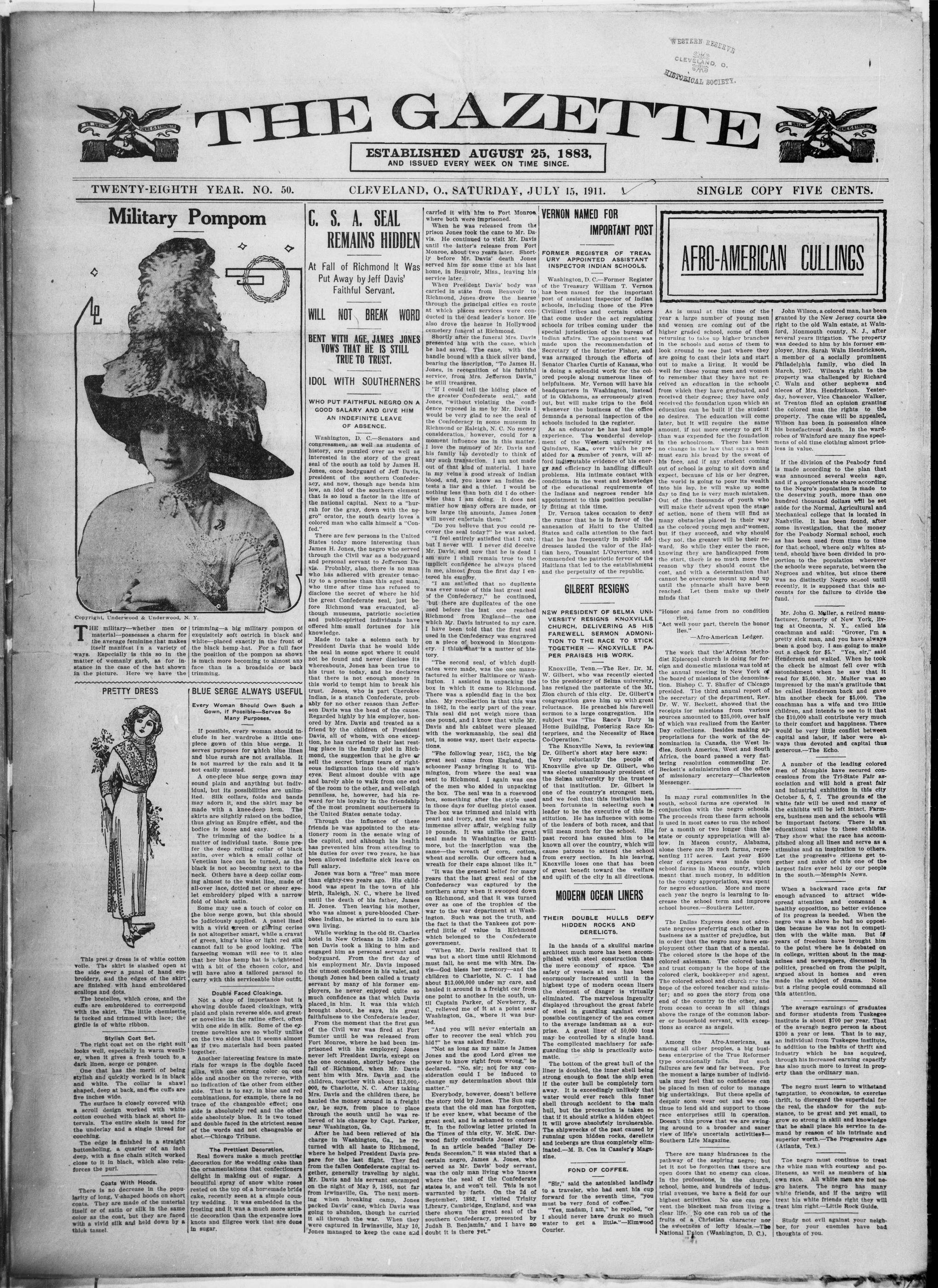
Military Pompom
4
IN URTON
THERELESS STRAINS
TWENTY-EIGHTH
Military P
Copyright, Underwood & Underwood, N. Y.
THE military—whether men or tri-
material—possesses a charm for
the average feminine that makes
itself manifest in a variety of
ways. Especially is this so in the
matter of womanly garb, as for in-
instance in the case of the hat shown
in the picture. Here we have the tri-
FRIENDS DRESS
This pretty dress is of white cotton volle. The skirt is slashed open at the side over a panel of hand embroidery, and the edges of the skirt are finished with hand embroidered scallops and dots. The bretelles, which cross, and the cuffs are embroidered to correspond with the skirt. The little chemisette is tucked and trimmed with lace; the girdle is of white ribbon.
Stylish Coat Set.
The right coat set on the right suit looks well, especially in warm weather, when it gives a fresh touch to a dark linen, serge or ponge.
One that has the merit of being stylish and quickly worked is in black and white. The collar is shawl shaped, deep at back, and the cuffs are five inches wide.
The surface is closely covered with a scroll design worked with white cotton couched with black at short intervals. The entire skin is used for the underlay and a single thread for couching.
The edge is finished in a straight buttonholing, a quarter of an inch deep, with a fine chain stitch worked close to it in black, which also reinforces the purl.
Coats With Hoods.
There is no decrease in the popularity of long, V-shaped hoods on short coats. They are made of the material itself or of satin or silk in the same color as the coat, but they are faced with a vivid silk and held down by a thick tassel.
THE GAZETTE
trimming—a big military pompon of exquisitely soft ostrich in black and white—placed exactly in the front of the black hemp-hat. For a full face the position of the pompon as shown is much more becoming to almost any face than is a broadside or back trimming.
BLUE SERGE ALWAYS USEFUL
Every Woman Should Own Such a Gown, If Possible—Serves So Many Purposes.
If possible, every woman should include in her wardrobe a little one-piece gown of thin blue serge. It serves purposes for which blue linen and blue surah are not available. It is not moused by the rain and it is not easily mussed.
A one-piece blue serge gown may sound plain and anything but individual, but its possibilities are unlimited. Silk collars, folds and bands may adorn it, and the skirt may be made with a knee-deep hem. The skirts are slightly raised on the bodice, thus giving an Empire effect, and the bodice is loose and easy.
The trimming of the bodice is a matter of individual taste. Some prefer the deep rolling collar of black satin, over which a small collar of Venetian lace can be turned, as the black is not so soon becoming next to the neck. Others have a deep collar coming almost to the waist line, made of all-over lace, dotted net or sheer eyellet embroidery piped with a narrow fold of black satin.
Some may use a touch of color on the blue serge gown, but this should be judiciously applied. A panel lined with a vlid green or glittering cerise is not altogether smart, while a cravat of green, king's blue or light red silk cannot fall to be good looking. The fareeing woman will see to it also that her blue hemp hat is brightened with a bit of the chosen color, and will have also a tailored parasol to carry with this serviceable blue outfit.
Double Faced Cloakings.
Not a shop of importance but it is showing double faced cloakings, with plaid and plain reverse side, and greater novelties in the ratine effect, often with one side in silk. Some of the extreme novelties are so wholly unlike on the two sides that it seems almost as if two materials had been pasted together.
Another interesting feature in materials for wraps is the double faced silks, with one strong color on one side and another on the reverse, with no indication of the other from either side. That is to say, in blue and red combinations, for example, there is no trace of the changeable effect; one side is absolutely red and the other side absolutely blue. It is two toned and double faced in the strictest sense of the words and not changeable or shot—Chicago Tribune.
The Brattlest Decoration
Real flowers make a much prettier decoration for the wedding cake than the ornamentations that confectioners delight in making out of sugar. A beautiful spray of snow white roses rested on the top of a homemade bride cake, recently seen at a simple country wedding. It was embedded in the frosting and it was a much more artistic decoration than the expensive love knots and filigree work that are done in sugar.
ESTABLISHED AUGUST 25, 1883 AND ISSUED EVERY WEEK ON TIME SINCE.
CLEVELAND, O., SATURDAY, JULY 15, 1911.
C. S. A. SEAL
REMAINS HIDDEN
At Fall of Richmond It Was Put Away by Jeff Davis' Faithful Servant.
BENT WITH AGE, JAMES JONES
VOWS THAT HE IS STILL
TRUE TO TRUST.
IDOL WITH SOUTHERNERS
WHO PUT FAITHFUL NEGRO ON A
GOOD SALARY AND GIVE HIM
AN INDEFINITE LEAVE
OF ABSENCE.
Washington, D. C.—Senators and
congressmen, as well as students of
history, are puzzled over as well as
interested in the story of the great
seal of the south as told by James H.
Jones, once bodyguard of Jeff Davis,
president of the southern Confederacy,
and now, though age bends him
low, an idol of the southern element
that is so loud a factor in the life
of the national capital. Next to a "hurrah for the gray, down with the negro" orator, the south dearly loves a colored man who calls himself a "Confed."
There are few persons in the United States today more interesting than James H. Jones, the negro who served through the Civil war as a bodyguard and personal servant to Jefferson Davis. Probably, also, there is no man who has adhered with greater tenacity to a promise than this aged man, who time after time has refused to disclose the secret of where he hid the great Confederate seal, just before Richmond was evacuated, although museums, patriotic societies and public-spirited individuals have offered him small fortunes for his knowledge.
Made to take a solemn oath by President Davis that he would hide the seal in some spot where it could not be found and never disclose its whereabouts, Jones has been true to his trust to today, and he declares that there is not enough money in this world to tempt him to break his trust. Jones, who is part Cherokee Indian, is a stanch Confederate, probably for no other reason than Jefferson Davis was the head of the cause. Regarded highly by his employer, honored by Mrs. Davis and treated as a friend by the children of President Davis, all of whom, with one exception, he has carried to their last resting place in the family plot in Richmond, the suggestion that he give and sell the secret brings tears of righteous indignation into the old man's eyes. Bent almost double with age and barely able to walk from one end of the room to the other, and well-night penniless, he, however, had his reward for his loyalty in the friendship of the most prominent southerners in the United States senate today.
Through the influence of these friends he was appointed to the stationery room in the senate wing of the capitol, and although his health has prevented him from attending to his duties for over two years, he has been allowed indefinite sick leave on full salary.
Jones was born a "free" man more than eighty-two years ago. His childhood was spent in the town of his birth, Raleigh, N. C., where he lived until the death of his father, James H. Jones. Then leaving his mother, who was almost a pure-blooded Cherokee Indian, he started in to earn his own living.
While working in the old St. Charles hotel in New Orleans in 1859 Jefferson Davis took a liking to him and engaged him as personal servant and bodyguard. From the first day of his employment Mr. Davis imposed the utmost confidence in his valet, and though Jones had been called a trusty servant by many of his former employers, he never enjoyed quite so much confidence as that which Davis placed, in him. It was this which brought about, he says, his great faithfulness to the Confederate leader.
From the moment that the first gun of the Civil war was fired at Fort Sumter until he was released from Fort Monroe, where he had been imprisoned with his employer Jones never left President Davis, except on the one occasion, shortly before the fall of Richmond, when Mr. Davis sent him with Mrs. Davis and the children, together with about $13,000,000, to Charlotte, N. C. After taking Mrs. Davis and the children there, he hauled the money around in a freight car, he says, from place to place through the south until he was relieved of his charge by Capt. Parker, near Washington, Ga.
After he had been relieved of his charge in Washington, Ga., he returned with all haste to Richmond, where he helped President Davis prepare for the last flight. They fleed from the fallen Confederate capital together, generally traveling by night. Mr. Davis and his servant encamped on the night of May 9, 1865, not far from Irwinsville, Ga. The next morning when breaking camp, Jones packed Davis' cane, which Davis was going to abandon, though he carried it all through the war. When they were captured in Irwinsville, May 10, Jones managed to keep the cane and
carried it with him to Fort Monroe, where both were imprisoned. When he was released from the prison Jones took the cane to Mr. Davis. He continued to visit Mr. Davis until the latter's release from Fort Monroe, about two years later. Shortly before Mr. Davis' death Jones served him for some time at his last home, in Beauvoir, Miss, leaving his service later. When President Davis' body was carried in state from Beauvoir to Richmond, Jones drove the hearse through the principal cities en route at which places services were conducted in the dead leader's honor. He also drove the hearse in Hollywood cemetery funeral at Richmond. Shortly after the funeral Mrs. Davis presented him with the cane, which he had saved. The cane, with the handle bound with a thick silver band, bearing the inscription, "To James H. Jones, in recognition of his faithful service, from Mrs. Jefferson Davis," he still treasures.
"If I could tell the hiding place of the greater Confederacy seal," said Jones, "without violating the confidence reposed in me by Mr. Davis I would be very glad to see the seal of the Confederacy in some museum in Richmond or Raleigh, N. C. No money consideration, however, could for a moment influence me in this matter. I love the memory of Mr. Davis and his family so devotedly to think of any transaction. I am not made out of that kind of material. I have in my veins a good streak of Indian blood, and, you know an Indian detests a liar and a thief. I would be nothing less than both did I do otherwise than I am doing. It does not matter how many offers are made, or how large the amounts, James Jones will never entertain them."
"Do you believe that you could recover the seal today?" he was asked. "I feel entirely satisfied that I can; but I never will. I never did deceive Mr. Davis, and now that he is dead I am sure I shall remain true to the implicit confidence he always placed in me, almost from the first day I entered his employ.
"I am satisfied that no duplicate was ever maced of this last great seal of the Confederacy," he continued, "but there are duplicates of the one used before the last one reached Richmond from England—the one which Mr. Davis intrusted to my care. I have been told that the first seal used in the Confederacy was engraved on a piece of boxwood in Montgomery. I think that is a matter of history."
"The second seal, of which duplicates were made, was the one manufactured in either Baltimore or Washington. I assisted in unpacking the box in which it came to Richmond. There was a splendid flag in the box also. My recollection is that this was in 1862, in the early part of the year. This seal did not weigh more than one pound, and I know that while Mr. Davis and his cabinet were pleased with the workmanship, the seal did not, in some way, meet their expectations.
"The following year, 1862, the big great seal came from England, the schooner Fanny bringing it to Wilmington, from where the seal was sent to Richmond. I again was one of the men who aided in unpacking the box. The seal was in a rosewood box, something after the style used in those days for dueling pistol cases. The box was trimmed and inlaid with pearl and ivory, and the seal was an immense silver affair, weighing fully 10 pounds. It was unlike the great seal made in Washington or Baltimore, but the inscription was the same—the wreath of corn, cotton, wheat and scrolls. Our officers had a wreath for their caps almost like it."
"It was the general belief for many years that the last great seal of the Confederacy was captured by the northern army when it swooped down on Richmond, and that it was turned over as one of the trophies of the war to the war department at Washington. Such was not the truth, and the fact is that the Yankees got powerful little of value in Richmond which belonged to the Confederate government.
"When Mr. Davis realized that it was but a short time until Richmond must fall, he sent me with Mrs. Davis—God bless her memory—and the children to Charlotte, N. C. I had about $13,000,000 under my care, and hauled it around in a freight car from one point to another in the south, until Captain Parker, of Newberry, S. C., relieved me of it at a point near Washington, Ga., where it was burled.
"And you will never entertain an offer to recover the seal which you hid?" he was asked finally.
"Not as long as my name is James Jones and the good Lord gives me power to know right from wrong," he declared. "No, sir; not for any consideration could I be induced to change my determination about this matter."
Everybody, however, doesn't believe the story told by Jones. The Sun suggests that the old man has forgotten, if he ever knew, what became of the great seal, and is ashamed to confess it. In the following letter printed in the Times of this city, W. McK. Darwood flatly contradicts Jones' story:
In an article headed "Balley Defends Secession," it was stated that a certain negro, James A. Jones, who served as Mr. Davis' body servant, was the only man living who knows where the seal of the Confederate states is, and won't tell. This is not warranted by facts. On the 2d of September, 1892, I visited Trinity Library, Cambridge, England, and was there shown 'the great seal of the southern Confederacy, presented by Judah B. Benjamin', and I have no doubt it is there yet.
VERNON NAMED FOR
IMPORTANT POST
FORMER REGISTER OF TREASURY APPPOINTED ASSISTANT INSPECTOR INDIAN SCHOOLS.
Washington, D.C.—Former Register of the Treasury William T. Vernor has been named for the important post of assistant Inspector of Indian schools, including those of the Five Civilized tribes and certain others that come under the act regulating schools for tribes coming under the special jurisdiction of the bureau of Indian affairs. The appointment was made upon the recommendation of Secretary of the Interior Fisher, and was arranged through the efforts of Senator Charles Curtis of Kansas, who is doing a splendid work for the colored people along numerous lines of helpfulness. Mr. Vernor will have his headquarters in Washington, instead of in Oklahoma, as erroneously given out, but will make trips to the field whenever the business of the office demands a personal inspection of the schools included in the register.
As an educator he has had ample experience. The wonderful development of the Western university at Quindaro, Kan., over which he presided for a number of years, will afford inducible evidence of his energy and efficiency in handling difficult problems. His intimate contact with conditions in the west and knowledge of the educational requirements of the Indians and negroes render his appointment to this position peculiarly fitting at this time.
Dr. Vernon takes occasion to deny the rumor that he is in favor of the annexation of Haiti to the United States and calls attention to the fact that he has frequently in public addresses lauded the valor of the Haitian hero, Tousaint L'Ouverture, and commended the patriotic fervor of the Haitians that led to the establishment and the perpetuity of the republic.
GILBERT RESIGNS
NEW PRESIDENT OF SELMA UNIVERSITY RESIGNS KNOXVILLE CHURCH, DELIVERING AS HIS FAREWELL SEMMON ADHISION TO THE RACE TO STICK TOGETHER — KNOXVILLE PAPER PRAISES HIS WORK.
Knoxville, Tenn.—The Rev. Dr. M. W. Gilbert, who was recently elected to the presidency of Selma university, has resigned the pastorate of the Mt. Zion church of this city. Dr. Gilbert's congregation gave him up with great reluctance. He preached his farewell sermon to a large congregation. His subject was "The Race's Duty in Home Building, Fostering Race Enterprises, and the Necessity of Race Co-Operation."
The Knoxville News, in reviewing Dr. Gilbert's short stay here says: Very reluctantly the people of Knoxville give up Dr. Gilbert, who was elected unanimously president of the Selma university by the trustees of that institution. Dr. Gilbert is one of the country's strongest men, and we feel that this institution has been fortunate in selecting such leader to be the executive of this Institution. He has influence with some of the leaders of both races, and that will mean much for the school. His past record has caused him to be known all over the country, which will cause patrons to attend the school from every section. In his leaving Knoxville loses one that has been of great benefit toward the welfare and uplift of the city in all directions.
MODERN OCEAN LINERS
THEIR DOUBLE HULLS DEFY
HIDDEN ROCKS AND
DERELICTS.
In the hands of a skullful marine architect much more has been accomplished with steel construction than the mere economy of space. The safety of vessels at sea has been enormously increased until in the highest type of modern ocean liners the element of danger is virtually eliminated. The marvelous ingenuity displayed throughout the great fabric of steel in guarding against every possible contingency of the sea comes to the average landsman as a surprise. A great liner of 50,000 tons may be controlled by a single hand. The complicated machinery for safeguarding the ship is practically automatic. The bottom of the great hull of the liner is doubled, the inner shell being strong enough to float the ship even if the outer hull be completely torn away. It is exceedingly unlikely that water would ever reach this inner shell through accident to the main hull, but the precaution is taken so that if it should strike a hidden object it will prove absolutely invulnerable. The shipwrecks of the past caused by running upon hidden rocks, derelicts and icebergs are thus completely eliminated.—M. B. Cea in Cassler's Magazine.
FOND OF COFFEE.
"Sir," said the astonished landlady to a traveler, who had sent his cup forward for the seventh time, "you must be very fond of coffee." "Yes, madam, I am," he replied, "or I should never have drunk so much water to get a little"—Elmwood Courier.
AFRO-AMERICAN CULLINGS
WESTERN RESERVE
CLEVELAND, O.
HISTORICAL SOCIETY.
SINGLE CODE
AFRO-AMERICA
As is usual at this time of the year a large number of young men and women are coming out of the higher graded school, some of them returning to take up higher branches in the schools and some of them to look around to see just where they are going to cast their lots and start out to make a living. It would be well for these young men and women to remember that they have not received an education in the schools from which they have graduated, and received their degree; they have only received the foundation upon which an education can be built if the student so desires. The education will come later, but it will require the same amount, if not more energy to get it than was expended for the foundation in the schoolroom. There has been no change in the law that says a man must earn his bread by the sweat of his face, and if any student coming out of school is going to sit down and expect, because of his or her degree, the world is going to pour its wealth into his lap, he will wake up some day to find he is very much mistaken. Out of the thousands of youth who will make their advent upon the stage of action, none of them will find as many obstacles placed in their way as the colored young men and women, but if they succeed, and why should they not, the greater will be their reward. So while they enter the race, knowing they are handicapped from the start, there is so much more the reason why they should count the cost, and with a determination that cannot be overcome mount up and up until the pinnacle shall have been reached. Let them make up their minds that
"Honor and fame from no condition rise,
"Act well your part, therein the honor lies."
—Afro-American Ledger.
The work that the African Methodist Episcopal church is doing for foreign and domestic missions was told at the annual meeting in New York of the board of missions of the denomination. Bishop C. T. Shaffer of Chicago presided. The third annual report of the secretary of the department, Rev. Dr. W. W. Beckett, showed that the receipts for missions from various sources amounted to $35,000, over half of which was realized from the Easter Day collections. Besides making appropriations for the work of the denomination in Canada, the West Indies, South America, West and South Africa, the board passed a very flattering resolution commending Dr Beckett's administration of the office of missionary secretary—Charleston Messenger.
In many rural communities in the south, school farms are operated in conjunction with the negro schools. The proceeds from these farm schools is used in most cases to run the school for a month or two longer than the state or county appropriation will allow. In Macon county, Alabama, alone there are 39 such farms, representing 117 acres. Last year $500 clear of expenses was made upon school farms in Macon county, which meant that much money, in addition to the county appropriation, was spent for negro education. More and more each year the negro is learning to increase the school term and improve school houses.—Southern Letter.
The Dallas Express does not advocate negroes preferring each other in business as a matter of prejudice, but in order that the negro may have employment other than that of a mental. The colored store is the hope of the colored salesman. The colored bank and trust company is the hope of the colored clerk, bookkeeper and agent. The colored school and church are the hope of the colored teacher and minister; and so goes the story from one end of the country to the other, and from ocean to ocean in all things above the range of the common laborer or household servant, with exceptions as scarce as angels.
Among the Afro-Americans, as among all other peoples, a big business enterprise of the True Reformer type occasionally falls. But such failures are few and far between. For the moment a large number of individuals may feel that no confidence can be placed in men of color to manage big undertakings. But these spells of despair soon wear out and we continue to lend aid and support to those race enterprises still in operation. Doesn't this prove that we are swinging around to a broader and saner view of life's uncertain activities?—Southern Life Magazine.
There are many hindrances in the pathway of the aspiring negro; but let it not be forgotten that there are open doors that no enemy can close. In the professions, in the church, school, home, and hundreds of industrial avenues, we have a field for our highest activities. No one can prevent the blackest man from living a clear life. No one can rob us of the fruits of a Christian character nor the sweetness of lofty ideals.—The National Union (Washington, D. C.).
IN UNION
UNION & STATE
PY FIVE CENTS.
AN CULLINGS
John Wilson, a colored man, has been granted by the New Jersey courts the right to the old Wain estate, at Wainford, Monmouth county, N. J., after several years litigation. The property was deeded to him by his former employer, Mrs. Sarah Wain Hendrickson, a member of a socially prominent Philadelphia family, who died in March, 1907. Wilson's right to the property was challenged by Richard C. Wain and other nephews and nieces of Mrs. Hendrickson. Yesterday, however, Vice Chancelor Walker, at Trenton filed an opinion granting the colored man the rights to the property. The case will be appealed, Wilson has been in possession since his benefactress' death. In the wardrobes of Wainford are many fine specimens of old time clothing almost priceless in value.
If the division of the Peabody fund is made according to the plan that was announced several weeks ago, and if a proportionate share according to the Negro's population is made to the deserving youth, more than one hundred thousand dollars will be set aside for the Normal, Agricultural and Mechanical college that is located in Nashville. It has been found, after some investigation, that the money for the Peabody Normal school, such as has been used from time to time for that school, where only whites attend, should have been divided in proportion to the population wherever the schools were separate, between the Negroes and whites, but since there was no distinctly Negro school until recently, it is supposed that this accounts for the failure to divide the fund.
Mr. John G. Muller, a retired manufacturer, formerly of New York, living at Oneonta, N. Y., called his coachman and said: "Grover, a pretty sick man, and you have always been a good boy. I am going to make out a check for $5." "Yes, sir," said Henderson and waited. When he took the check he almost fell over with astonishment when he saw that it read for $5,000. Mr. MuHer was so impressed by the man's gratitude that he called Henderson back and gave him another check for $5,000. The coachman has a wife and two little children, and intends to see to it that the $10,000 shall contribute very much to their comfort and happiness. There would be very little conflict between capital and labor, if labor were always thus devoted and capital thus generous.—The Echo.
A number of the leading colored men of Memphis have secured concessions from the Tri-State Fair association and will hold a great fair and industrial exhibition in this city October 5, 6, 7. The grounds of the white fair will be used and many of the exhibits will be left intact. Farmers, business men and the schools will be important factors. There is an educational value to these exhibits. They show what the race has accomplished along all lines and serve as a stimulus and an inspiration to others. Let the progressive citizens get together and make of this one of the largest fairs ever held by our people in the south.—Memphis News.
When a backward race gets far enough advanced to attract widespread attention and command a healthy opposition, no better evidence of its progress is needed. When the negro was a slave he had no opposition because he was not in competition with the white man. But 50 years of freedom have brought him to the point where he is debated on in college, written about in the magazines and newspapers, discussed in politics, preached on from the pulp, argued about in homes and even made the subject of drama. None but a rising people could command all this attention.
The average earnings of graduates and former students from Tuskegee Institute is about $700 per year. That of the average negro person is about $300 a year or less. That is to say, an individual from Tuskegee Institute, in addition to the leisure of thrift and industry which he has acquired, through his increased earning capacity has also much more to invest in property than the ordinary man.
The negro must learn to withstand temptation, to economize, to exercise thrift, to disregard the superficial for the real, the shadow for the substance, to be great and yet small, to grow so strong in skill and knowledge that he shall place his service in demand by reason of his intrinsic and superior worth.—The Progressive Age (Atlanta, Tex.)
The negro must continue to treat the white man with courtesy and politeness, as well as members of his own race. All white men are not negro haters. The negro has many white friends, and if the negro will treat his white friends right they will treat him right.—Little Rock Guide.
Study not evil against your neighbor, for your enemies have bad thoughts of you.
SUBSCRIPTION RATES
(In Advance)
One Year.....$1.50
Six Months.....1.00
Three Months......50
Subscribers are requested to
mit by postoffice money order
or registered letter.
Entered at the postoffice In Cleveland
Ohio, as second-class matter
Address all communications to
HARRY C. SMITH
Editor and proprietor,
THE GAZETTE,
Blackstone Building, Cleveland, O.
Member Ohio Legislature: 1894
to 1896: 1896 to 1898: 1900 to 1902
THE GAZETTE is the oldest, and has the largest bona fide circulation, double that of any newspaper in the interest of Afro-American, published in the state of Ohio, and comparison with any will immediately establish its rank as one of the NEWSIEST AND BEST in the country.
The "old reliable" Gazette enters its twenty-ninth year early next month. During all that time we have issued this paper EVERY WEEK ON TIME. Doesn't the knowledge of this fact, encourage you to subscribe, dear reader?
To sin by silence when we should protest makes cowards out of men. The human race has climbed on protest. Had no voice been raised against injustice, ignorance and lust, the inquisition yet would serve the law, the guillotines decide our least disputes. The few who dare must speak and speak again to right the wrongs of many.—Ella Wheeler Wilcox.
Miss Annie Morrison Wagar, 60 years old, of Lakewood, O, near this city, died last week. She and her father were great friends of the race and contributed liberally to our educational institutions in the South. One of our best friends is gone. We extend her near relatives heartfelt sympathy in their bereavement. Several of the Wagars have died within a year.
Our sympathy goes out to the Jew, because "a fellow feeling makes us wonderful kind," and what he has done we can do. So when we add money, character, intelligence and industry to our stock in trade, we will be able to come to our assistance. That's the way the Jew solved his problem—Richmond (Ya.) Planet.
The above reads well, Editor Mitchell, but is liable to mislead. Afro-Americans have added "money, character, intelligence and industry" to their "stock in trade." Possibly not enough, but they have done so, just the same. They have quite as much "character" and "intelligence" proportionately as the Jews, and it is claimed by those who profess to know that our best people (as a class), in this country, have decidedly more culture and refinement than the best American Jews (as a class). Then, too, the editor of the Planet's statement to the effect that "the Jew has solved his problem" is not any nearer being a fact than the statement that "the Afro-American has solved his problem," and a little careful thought will convince even our confrence. In this country the Jews' color and money give them an advantage in some respects, but do not put an end to the social and other discrimination against them, Abroad, especially in Russia, Turkey, France and Germany, their mistreatment is infinitely worse than that our people in the South are subjected to, and we haven't forgotten the massacre near Palestine, Tex., last year, either. It was the limit.
DIRECT ELECTION OF SENATORS.
Some of the friends of the direct senatorial election bill in the shape which it had when it came from the House, criticise Vice President Sherman for appointing conferees who take the Senate side in the contest between the two chambers. The proposition is for an amendment to the constitution which would take away from the legislatures the power to choose senators, and place it in the hands of the people. The difference between the two branches is this, that while the House wants to leave the supervision of these elections in the control of the states solely, the Senate, through the Bristow amendment, would retain federal supervision over these contests, as the government now has.
The House form of the proposition, therefore, is uncandid. While it pretends to seek an amendment of the constitution in only one spot, it actually would amend in two particulars. It would not only deprive the legislatures of the power to elect senators, but it would take from the central government the authority to supervise those elections, which it had from the beginning. Through the proviso by the member from Kansas, the Senate would retain this power in the National Government, though it would make the elections direct by the people instead of through the medium of the legislatures. As the Senate will not recede from its position, the conference committee of members of the two branches will have to wrestle with the subject.
Very properly, Vice President Sherman appointed senatorial conferences who agree with the Senate's contention. If he had, as his critics desired, selected members who would go over to the House position, he would have surrendered the Senate's side of the controversy, and have thrown the dispute into the hands of the House. This is not the way the appointing power in the two chambers in matters like this does things. Each section of the conferences defends the ground taken by its chamber. The South, which is timid and sensitive to an extreme degree regarding anything which is calculated to increase the national power at the expense of the states, or which would continue
this power, is against the Bristow proviso. The South wants to take from the National Government an authority which it has always had. It is to be hoped that the Senate will refuse to make the surrender which the South demands. — St. Louis (Mo.) Globe-Democrat (Repub.).
EVERYTHING TO JOHNSON
Champion Will Take Down Practically All of the Receipts.
London, England.—The fight between Jack Johnson and Patrick Curran will take place at the Dublin football grounds between Aug. 1 and 5, and the game not having been set. Under the agreement the winner will receive $25,000 and the loser $2,500. The winner also receives 45 per cent of the gate receipts after the purse and all expenses have been deducted. The remaining 55 per cent is to be divided equally between Johnson and Tom Flanagan, Johnson's manager. "It may seem the introduction to the champion," Flanagan said, on the 3d, "but it has been my ambition to have Johnson fight in Ireland and he left the terms to me. Johnson weighs 245 pounds today. He can train to apple pie condition in a fortnight. The site chosen seats 50,000 people. Curran will train at Belfast. He is now at home." The fight contract was signed by Flanagan for Johnson and by A. Adler for Curran.
NUTTY STUFF
"It if makes the lettuce blush to see the salad dressing, would it shock the corn to see the potato peeling?"
Her ice glare made him feel like an Arctic explorer in a linen suit.
If a sailor is a seadog, is an aviator a skyterrier?
Lilly-Jack wanted to take my picture today.
Tilly—Did you let him?
Lilly—No, I answered in the negative.
If Queen Anne reigned, did Nathan Hale?
She said she talked when she was only two weeks old.
"That's nothing," he replied. "I cursed the day I was born."
If a dentist pulls teeth, what does malt extract?
Phil is down in Pennsylvania now, isn't he?
Phil, who?
Bob Motts Dead.
Chicago, Ill.-Bob Motts, the last of the old-time "gambling kings," is dead at his luxurious home here. Thirty years ago Motts came to Chicago penniless from Washington, Iowa, but he soon prospered, and at the time of his death was considered one of the wealthiest Afro-Americans in Chicago. He was proprietor of the Pekin theater on the south side, in addition to being connected with many other interests.
Rey M E A Easton Sails
Rev. M. F. A. Easton Sails.
New York City—In the hope of running across historical and anthropological names to prove his assertion that our race is the oldest on earth, Robert B. F. West, died Tuesday on the steaishain Molkte, en route to Egypt and Abyssinia. He is well supplied with funds and expects to be absent about three months.
"When I return," he said, "I expect to lay before the scientific world some data of the first importance regarding the origin of my race, the oldest of all races, and firmly believe, the progenition of the Greeks. The deepear race" was in existence more than 3,000 years before Christ.
The Greek race sprang from this race in Africa, and lost its dark color through intermarriage in later ages with white races."
Held as a Lyncher
Newark, O.—A message has been received from Terre Haute, Ind, that the police there, in response to word sent from the police here, had captured Walter Dehl, under indictment for first degree murder in connection with the lynching last July of Carl Etherington, a detective (white.) Capt Swank left for Terre Haute to bring Dehl back.
DECIDES TO KEEP A DIARY
Woman Wins It at Bridge Party and
Tells Her Hubby All
About It.
"George, dear, I've got a diary and
made up my mind to keep it."
"All right, my love. It's a habit that
never becomes chronic. The diary is
gilt-edged, I suspect?
"Yes, dear, and with a lovely limp
morocco cover."
"And it matches your new walking suit, of course!"
"Why, how did you know that? And it has a sweet little pencil in a cunning groove."
"Charming. There's a calendar inside, no doubt!"
"Yes, dear. And there's a page about foreign postage and things."
"Great! And a list of the wedding anniversaries, from 'soothing sirup' to 'diamond.'"
"Yes. George. And the language of flowers and birthstones."
"Fine. And the code of handkerchief flirtations, no doubt."
"Certainly not. Now you're making fun of me. It's really a dear little book. Of course I could exchange it."
"Exchange it. Exchange a diary."
"Why, yes. You see, I won it at bridge whilst at Mrs. Dummieigh's, and it's so nice I think I'll keep it."
"But don't you intend to write in it?"
"Write in it! Why, I never thought of that!"
Force Read for Their Coats
Foxes Bred for Their Coats.
Blue Arctic foxes are bred extensively on the islands of the Alaska coast.
These creatures cannot be tamed, but they are fed all the year round and trapped in special houses in the winter when their coats are in suitable condition.
Man and His Opportunities
inumerable men and women had seen the kettle holl, but it occurred to only one that the force which lifted the light might be confined and made to do human service. The man finds or makes his opportunities, and in turn they help to make him—Bishop Spalding.
THE GAZETTE, CLEVELAND, O., SATURDAY, JULY 15, 1911
DOINGS
OF
THE
RACE
In the N. Y. Sunday Sun two weeks ago there was a picture of J. W. Cromwell Jr., of Washington, D. C., who has proven himself the mathematical genius in the contest of figures, conducted by that paper
Bob Cole, of Cole & Johnson, comedians, an inmate of the Manhattan Hospital on Ward's Island, N. Y., since last fall, for mental trouble, has been moved to the Amityville, L. L. N. Y., Sanitarium, somewhat improved. David Mitchell, a alummanate portral of the University of L. S. Berg, president of the New Orleans, Mobile & Chicago Railroad, a few weeks ago, has been given a job for life. In the wreck, which occurred in northern Minnesota, Mrs. Berg was killed. The Afro-American people have no member of the National Republican Committee; nor of either branch of Congress; nor a chairman of the State Committee; nor a member of the State Department; nor a Dixons line and one only in the Legislatures of Pennsylvania, Ohio, and Illinois.—Rochester (N. Y.) Sentinel. E. L. McElroy, 25, who would have graduated from the law department of Harvard College next year, was drowned at Sandusky, July 1, while swimming. He arrived at Put-in-Bay, June 17, where he was employed as a police officer. His studies next term. His father is David McElroy of St. Louis, Mo.
Dr. L. G. Jordan, cor. sec. of the Foreign Mission Board of the National Baptist Convention, has special knowledge of all of our Baptist associations and conventions for extra financial support at this time. Four African missionaries have died and two are ill in a London hospital. Pass the word
Since the first administration of President McKinley, Afro-Americans have been considered for appointment only on the advice of one Afro-American selected by the President. The Afro-Americans had nothing to say or do about the selection. For most of the time, the man selected by the President for this important service. We are opposed to this arrangement, as far as New York is concerned. If we want to reach the administration we should go through the regular Republican organization of New York State. We should not be forced to reach the President by way of Alabama, as Alabama, and no Alabama man, we should not be forced to reach the American voters of New York State than a Rockaway clam.—Editor T. Thos. Fortune in the Rochester Sentinel.
The philanthropic educational funds which have hitherto gone for the support of higher and academic education of Afro-Americans in the Southern States, have been cornered by the Southern Education Board and the General Educational Board, which were inspired by Dr. Booker T. Washington and William H. Baldwin, Jr. and Robert C. Ogden, and the American Missionary Society, which controls the Hand Fund of $1,000,000 and the John F. Slater Fund of $1,000,000 for Afro-American Southern education, the Jeanes Fund of $1,000,000 being controlled for the most part by Dr. Washington. All of these boards, except the American Missionary Board, make industrial education the basis of their help, and in the case of smaller schools they insist upon conditions that result being that nearly all of the smaller schools are in financial difficulty—Rochester Sentinel.
Two bills intended to purify Congressional elections were introduced in the House recently by Representative Caleb Powers, of Kentucky. One of these measures provides a penalty of not less than $1,000, nor more than $1,000, imprisonment nor more than three years for intimidation of voters at any primary or general election, for the use of money in the securing of votes or purchase of liquor for voters or for any threats by candidates to office-holders or otherwise. The other bill proposes to create the House of Representatives, to consist of three civilians, one of the dominant party in Congress, one of the party next in strength in the House, and the third to represent the party the third in strength in the House, to investigate the election of all members. The bill also elects a primary or general election who permits the use of money in his campaign, the purchase of whiskey or attempts at intimidation of voters in any way.
Same Here:
From the Pioneer Press and the
Scribbler
Editor John C. Gilmur, of the
Charleston Advocate, wants no bene
fites or testimonials, but would be
very much pleased were his delinquent
subscribers to pay up their arrear
ages. Same here, old boy!
Want a May 13 Gazette
We want a clean copy of The Gazette of May 13, 1911, for our file. Will some reader of this paper, please oblige us with the same?
EDITOR.
CORRESPONDENTS WANTED.
The old reliable Gazette desires an active reader in the New York, New England, in every city and town in Ohio and neighboring states having a number of Afro-American residents. Only a little time on Fridays or Saturdays is required.
We are especially desirous of hearing from persons in the following towns: Lancaster, Lebanon, Chillicothe, Toledo, Troy, Akron, Springfield, Piqua, Columbus, Cambridge, Steubenville, Bellaire, St. Clairsville, Wilmington, Portsmouth, Dayton, Canton, Oxford, Sabina, Gallipolis, Oberlin, Sandusky, Delaware, M. Ternon, East Liverpool, Kellville, Hamilton, Midport, Belfortaine, Lima, O., and other places where we have none.
Write to the editor of The Gazette.
Blackstone | building, Cleveland, O,
and terms will be sent promptly. Our
readers will oblige us greatly by sending
at once the addresses of persons
in the cities named above, or others,
to whom we can write relative to the
matter.
FRESH OHIO NEWS OUR OWN WRITERS'
WHAT OUR PEOPLE ARE DOING IN MANY CITIES AND TOWNS OF THE STATE.
INTERESTING PERSONAL NOTES
Social Functions—Church and Lodge Items—Marriages and Deaths—Literary, Musical and Other Notes of Interest.
Piqua —Old friends and acquaintances have long been anticipating a visit from Mr. Edgar Rial of Chevelan, an old Piqua boy. Come home, Ed. Col. L. Delaney is anticipating a visit from Mrs. K. of P. business. —Order The Gazette. Wellsville. —Miss Pearl Manley has returned from the hospital.—Mrs. A. C. Johnson is visiting her mother in New Brighton.—Harry Johnson has returned to Alliance.—Mrs. M. Smith spent Sunday with her mother in New Brighton.—Mrs. M. church has been painted and remodeled.
Salem —Miss Sarah Cyrus is in Cleveland visiting her aunt, Mrs. Alen Hyde —Clarence Bell of Crabtree, Pa., is visiting his aunt, Mrs. Henry Venable —Mrs. Bell Evans has returned home to stay awhile —Mrs. Freeman has returned to visit her mother —Miss Grace Cisco has returned from Delaware —Mrs. Steubenville —Ira Wallace of Cadiz, visited his cousin, Mrs. G. W. Vine, recently —Mrs. James Dorsey of Homestead, Pa., visited her aunt, Mrs. Spencer Banks and cousin, Mrs. Grace Walker. —Miss Martha Winston was in Bridgeport, July 4 —Carter's new restaurant is on S. 6th St. —The Gazette desires a representative here.
East Liverpool —W. P. Ormes is in Dayton, Mrs. Martha Temple of Homestead, S. 6th St. —Buffalo —The Lucas sisters' concert was fine. They are from Martins Ferry. —S. B Jackson is certainly a success as a promoter of picnics. —Miss G. Black burn was in Pittsburg, July 4.
Mt. Vernon.—A son was born recently to Mr. and Mrs. Russell Jackson.—Mrs. Earl Lee died at Barnesville recently.—Miss Addie Goins has returned from Wilberforce. She graduated from Barnesville. Master Kenneth Payne and Charlotte Coneal are visiting in Barnesville.—Mrs. Annie Guy of Zanesville, was brought to her parents, Mr. and Mrs. J. Lathen. She has creeping paralysis.—Mrs. Etta Martin has returned to Chicago. She visited her parents, Mrs. Etta Martin, and Mrs. Carle Ewing entertained the Twentieth Century Club recently.
Washington, C. H.—Mr. and Mrs. James and Harry Robinson of Columbus, and Walter Lovings of Maple Grove Springs, were here recently.—Mrs. Ada Raglin is located at her brother, Mr. John Alexander's.—Mrs. Charles Jackson's guest is this week. Mrs. Maude Wilkinson visited her sister, Mrs. Eda Pettiford of Sabina, recently.—Mr. and Mrs. G, Nelson and Mr. and Mrs. E. Edwards were in Sabina recently.—Mr. Arthur Cunningham of Newark, was here July 2.—Miss Estella Foster and Mrs. Emma Woods spent July 4 in Dayton.—Mr. John Taylor and Mrs. Emma Woods, and Mr. Lee Taylor visited Mrs. Emma Wilson of Columbus, July 4.
**Smithfield.** A. J. Guy and son arrived Sunday from Steubenville, James will remain a few days.—Mrs. Eva Ford, Mrs. Jerry Carter and daughter, Mrs. John Goins and Edward Moore of Mr. Pleasant, visited Smithfield. Mrs. John Goins and Cadiz spent Sunday with his mother.—The A. M. E. trustees' entertainment. July 4. was a success.
—Mrs. White left Wednesday for Washington, C. H., en route to Cincinnati, to attend the W. M. M. S. convention. —Mrs. Clara West and daughter of Mrs. Clara West, relatives —Mrs. L. B. Hargrove left Monday to visit her sons in Homestead, Pa. —Miss Annie Ford of Steubenville is visiting Miss Olive Washington —Miss Mary Beall of Crafton —Miss Martha of Crafton and Ross Faithful, M. Jackson, E. H. Giles and S. West spent July 4 here. Also a large crowd from McIntyre.
Mt. Pleasant—Mr. W. Randolph, M. and R. Powell were in Wheeling, to play ball. Mr. Alvin Kenney, son of Mrs. Anna Kenney, was brought from the Philippines for a sailing trip. Mrs. Flecher left for Pennsylvania to visit her son. Miss Susie Liggins has returned from Alexandria, Va.—Four young men, from Cadiz, were here and in Emerson, recently.—Four Geonis, from Steubenville, are here for their health at the hotel. Rev. Jordon of Washington, Sunday. Four Geonis, from Sunday—Chester Preman and Margaret Skinner were in St. Clairsville the 4th, and Mr. and Mrs. L. Fields and Blanche Becks, in Madrid. Ed. Benton was here, July 4. Mr. Wisdom Carey and daughter, Mildred, went to Steubenville, Sunday. Rev. C. Lewis went to Masonline Sunday. Mrs. Mildred, from Santa Clara, went to McChowell, Pa, has been visiting her parents. Miss Edith Jackson spent July 4 with Eleanor Proctor.
Correspondents must mail all letters for publication at their main postoffice sufficiently early on Monday (or Sunday) of each week to have them reach The Gazette office on Tuesday morning, and always write, also, their names and address outside of the wrapper about returned copies. Unless this latter is done, proper credit cannot be given you. Lists of names, wedding presents, etc. obituary notices, speeches, resolutions, poetry, inquiries for relatives and advertisements of the recipient, must be brought entertainment to be held in the near future, must be paid for in advance at the rate of ten cents a line, six words to a line. Our rates for display advertisements will be sent on application. Send postal note and not stamps during warm weather.
McIntyre.—A number attended the "Declaration" at Smithfield Tuesday.—Mrs. Cynthia Smith visited Mr. and Mrs. Ernest Smith, last week.—Mrs. Mary Freeman and son, spent Friday Smithfield.—Mrs. Mary Freeman spent Friday evening with Miss Mamie Smith and Rettie with Agnes Toney.—Mr. and Mrs. R. M. West, and Mr. and Mrs. Walter Smith of Fernwood, dined with Mr. and Mrs. Henry Smith, Sunday.—Mr. and Mrs. Hargrave of Smithfield, visited our S. S., Sunday.—Mr. Mathew Toney's horse was badly wounded by the storm, Friday.—Rev. D. D. Lewis and family dined with Mr. and Mrs. A.
Located in Capital of the Nation. Campus of over twenty acres. Advantages unsurpassed. Modern scientific and general equipment. New Carnegie Library. New Science Hall. Faculty of over one hundred; 1,382 students from 37 states and 10 other countries. Unusual opportunities for self-support. No young man or woman of energy or capacity need be deprived of its advantages.
THE COLLEGE OF ARTS AND SCIENCES.
Devoted to liberal studies. Courses in English, Mathematics, Latin, Greek, French, German, Physics, Chemistry, Biology, History, Philosophy, and the Social Sciences, such as are given in the best approved colleges. Sixteen professors. Kelly Miller, A. M., Dean.
THE TEACHERS' COLLEGE.
Special opportunities for teachers. Regular college courses in Psychology, Pedagogy, Education etc., with degree of A. B.; Pedagogical courses leading to Ph. B. degree. High grade courses in Normal Training, Music, Manual Arts, and Domestic Sciences. Graduates helped to positions. Lewis B. Moore, A. M., Ph. D., Dean.
THE ACADEMY.
Faculty of 13. Three courses of four years each. High grade preparatory school. George J. Cummings, A. M., Dean.
THE COMMERCIAL COLLEGE.
Courses in Bookkeeping, Stenography, Commercial Law, History, Civics, etc. Business and English high school education combined. George W. Cook, A. M., Dean.
SCHOOL OF MANUAL ARTS AND APPLIED SCIENCES.
Furnishes thorough courses. Six instructors. Offers four-year courses in Mechanical and Civil Engineering,and Architecture.
Interdenominational. Five professors. Broad and thorough courses. Advantages of connection with a great university. Students' Aid. Low expenses. Isaac Clark, D. D., Dean.
THE SCHOOL OF MEDICINE.
Medical, Dental and Pharmaceutical Colleges.
Forty-nine professors. Modern laboratories and equipment. Connected with new Freedmen's Hospital, costing half million dollars. Clinical facilities not surpassed in America. Post-graduate School and Polyclinic. Ed. ward A. Balloch, M. D., Dean, 5th and W. S. St. N. W. W.C. McNeill, M. D., Secretary, 901 R. St. N. W.
The School of Law.
Faculty of eight. Courses of three years, giving a thorough knowledge of theory and practice of law. Occupies own building opposite court house. Benjamin F. Leighton, LL. B., Dean, 420 5th St. N. W.
Cape May, New Jersey—One hundred light, airy and luxuriously furnished rooms. EVERY MODERN IMPROVEMENT. Our finest, in this country. Just completed at a cost of $50,000. Hotel Dale is located on the highest elevation in the heart of the residence portion of cool Cape May. It is directly opposite the widely celebrated links of the Cape May Golf Club and its environments on all sides are perfect. The hotel rear commands reaches every view of the harbor and sea, and the invigorating ocean breeze reaches every view of the balcony service. Both European and American plan. Beautiful Grill Room. Afternoon and Evening Concerts by the complete Abyssinian Orchestra of N. Y. City, Croquet, other air amusements. The finest sea bathing on the Atlantic coast. Hotel Dale has its own PRIVATE BATH HOUSES. Perfectly safe at all times for women and children to enjoy the Salt-water. Sailing and Fishing galore. Also cabs, autos, etc. Beautiful country surrounds the hotel, which is under the personal management of the owner, E. W. Dale, one of the most progressive and successful business men of our race. His experience as a hotel man has enabled him to use thorough knowledge of details in bringing about the moment of his hotel to perfection. Hotel Dale is easy of access from the stations of either the Pennsylvania or Reading railroads. Literature and additional information will be mailed upon request. Address E. W. DALE, Hotel Dale, Lafayette and Jefferson streets, Cape May, N. J.
EVERYTHING IN PRINTING. THE BEST WORK. MOST REASONABLE RATES.
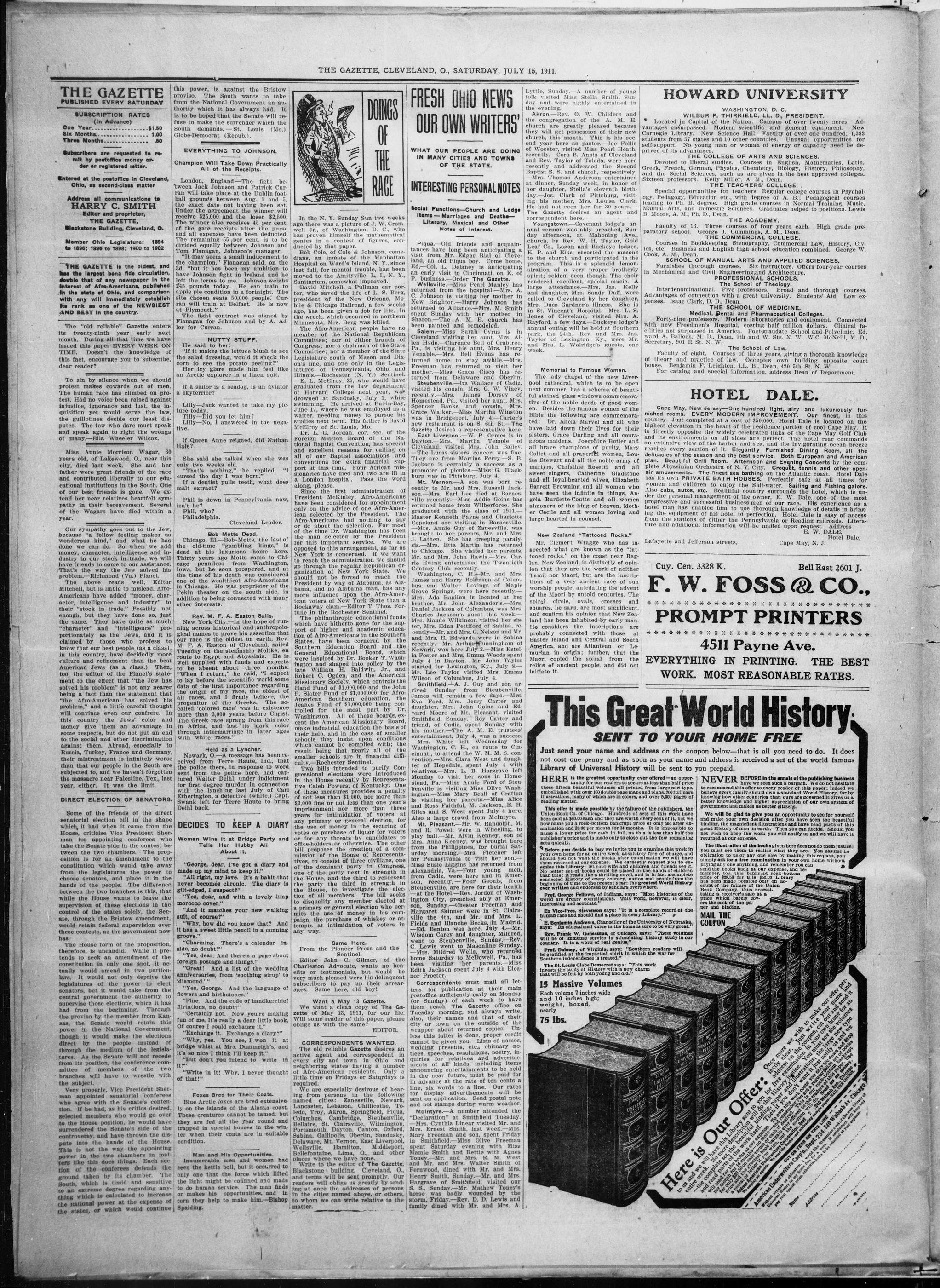
This Great World History SENT TO YOUR HOME FREE
Just send your name and address on the coupon below—that is all you need to do. It does not cost one penny and as soon as your name and address is received a set of the world famous Library of Universal History will be sent to you prepaid.
Lytle, Sunday.—A number of young folk visited Miss Stella Smith, Sunday and were highly entertained in the evening.
Akron.—Rev. O. W. Childers and the organization of the A. M. E. church are greatly pleased because they will get possession of their new church, this month. This is his second year here as pastor—Joe Follis of Wooster, visited Miss Pearl Heath, recently.—Cora B. Annis of Cleveland and Rev. Taylor of Toledo, were here visiting the church.—Baptist S. S. and church, respectively.—Mrs. Thomas Anderson entertained at dinner, Sunday week, in honor of her daughter, Stella's eleventh birthday.—Jos. Clark of Pittsburg, visiting his mother, Mrs. Louisa Clark.—The Gazette has her an agent and correspondent here.
Youngstown — Covenant lodge's annual sermon was ably preached, Sunday afternoon, at Mahoning Ave. church, by Rev. W. H. Taylor, Gold Leaf Co., Logan and Buckeye lodges, and by Rev. W. H. Taylor, to the church and participated in the program. This is a splendid demonstration of a very proper brotherly spirit; seldom seen though. The choir rendered excellent, special music. A large attendance, Mrs. Kelly, Kelly rendered excellent, called to Cleveland by her daughter, Mrs. Dues Gardner's illness. She is in St. Vincent's Hospital — Mrs. L. S. Jones of Cleveland, visited Mrs. A. Rayford, a few days. — Buckeye lodge's annual outing will be held at Southern park, the 24th — Rev. and Mrs. Jas. Taylor of Lexington, Ky., were Mr. Mrs. L. Wolrdige's guests, one week.
Memorial to Famous Women
Memorial to Famous Women.
The lady chapel of the new Liverpool cathedral, which is to be open next summer, has a scheme of beautiful stained glass windows commemorative of the noble deeds of good women. Besides the famous women of the Bible the following are commemorated: Dr. Allicia Marvel and all who have laid down their lives for their sisters, Grace Darling and all courageous maidens. Josephine Butler and all brave champions of purity, Mary Collet and all prayerful women, Louise Stewart and all the noble army of martyrs, Christine Rosetti and all sweet singers, Catherine Gladstone and all loyal-hearted wives, Elizabeth Barrett Browning and all women who have seen the infinite in things, Angela Burdette-Coutts and all women almoners of the king of heaven, Mother Cecile and all women loving and large hearted in counsel.
New Zealand "Tattooed Rocks."
Mr. Clemert Wragge who has inspected what are known as the "tattooed rocks," on the coast near Raglan, New Zealand, is distinctly of opinion that they are the work of neither Tamil nor Maori, but are the inscriptions of a very ancient race of sun worship people, antedating the advent of the Maori by untold centuries. The spiral circle, ovals, crosses and squares, he says, are most significant, and confirm his opinion that New Zealand has been inhabited by early man. He considers the inscriptions are probably connected with those at Easter Island and Central and South America, and are Atlantean or Lemurian in origin; further, that the Maori copied the spiral from the relics of ancient people, and did not initiate it.
This Great W
SENT TO YOU
Just send your name and address on the
not cost one penny and as soon as your name
Library of Universal History will be sent
HERE is the greatest opportunity ever offered—an
unity for our readers to secure at less than half
the fifteen beautiful volumes all printed from large new
embellished with over 100 double page maps and plans, 700 full
illustrations many of which are in colors, and over 5,000 page
reading matter.
This offer is made possible by the failure of the publishers,
Union Book Co. of Chicago. Hundreds of sets of this work
been sold at $60.00 each and they are worth every cent of it. but
now name you a rock-bottom bankrupt price of only $50 after
amination and ten per month for 6 months. It is impossible
name a lower price for cash in full, as this is less than the
publisher's price and is made only to close out the few remai
sets quickly.
And now decide to buy we invite you to examine this work
your own home for an entire week absolutely free of charge,
should you not want the books after examination we will
amine this Library; let your wife and children and friends
no better set of books could be placed in the hands of child
than this; it reads a thrilling novel, and is in fact a com-
munity History of the country, nation and beginning of time to the present year; the greatest World History ever written and endorsed by scholars everywhere.
A great collection of fond souls says, "Most histories of
world are dreary compilations. This work, however, is cl
interesting and accurate."
Ex Vice-Pres. Stevenson says: "It is a complete record of
human race and should find a place in every Library."
E. Benjamin Andrews, Chancellor of the University of Nebraska says: "Its educational value in the home is to be very great.
Royal College of Medicine says, will be an immense service in stimulating history study in
country. It is a work of real genius."
HERE is the greatest opportunity ever offered—an opportunity for our readers to secure at less than half price these fifteen volumes all printed from large new type, embellished with joyous illustrations, many of which are in colors, and over 5,000 pages of reading matter.
This offer is made possible by the failure of the publishers, the University of Chicago, to buy them. We have been sold at $60.00 each and are worth every cent of it, but we now name you a rock-bottom bankrupt price of only 500 after examination and $3.00 per month for 14 months. It is impossible to buy these books without asking that publisher's price and is made only to close out the remaining sets quickly.
Before you decide to buy we invite you to examine this work in our library. We know about the book about whom you should not want the books; our examination we will have them returned at our expense. We earnestly request you to examine this set of books could be placed in the hands of children. No better set of books could be placed in the hands of children. It reads like a thrilling novel, and in fact a complete book of fiction. We begin the beginning of time to the present year: the greatest World History ever written and endorsed by scholars everywhere.
Prof. George Fellows, of Indiana, says: "Most histories of the human race and should find a place in every Library."
Ex Vice-Pres. Stevenson says: "It is a complete record of the human race and should find a place in every Library."
E. Benjamin Andrews, Chancellor of the University of Nebraska, says: "Its educational value in the home is sure to be very great."
Rev. Frank W. Gunsulus, of Chicago, says: "These volumes embellished with illustrations history study in our country. It is a work of real genius."
Prof. Dabney, of Virginia, says: "Southern readers will tell us that the war in which the war for Southern independence is treated." The St. Louis Globe Democrat says: "This work invests in the war of the war charm that will be felt by both young and old."
15 Massive Volumes
15 Massive Volumes
Each volume 7 inches wide
and 10 inches high;
weight, boxed.
nearly
75 lbs.
HOWARD UNIVERSITY
WASHINGTON, D. C.
BILBUR P. THIRKIELD, LL. D., PRESIDENT
Capital of the Nation. Campus of over two
passed. Modern scientific and general eq-
yency. New Science Hall. Faculty of over one
states and 10 other countries. Unusual or
young man or woman of energy or capa-
tages.
THE COLLEGE OF ARTS AND SCIENCES
Liberal studies. Courses in English, Math
German, Physics, Chemistry, Biology, Histo-
sciences, such as are given in the best ap-
s. Kurs. A.M. German.
THE TEACHERS' COLLEGE.
fortunities for teachers. Regular college co-
ducation etc., with degree of A. B.; Pads
B. degree. High grade courses in Normal
and Domestic Sciences. Graduates helped
to Ph. D. Denn.
THE ACADEMY
13. Three courses of four years each. B. George J. Cummings, A. M., Dean.
THE COMMERCIAL COLLEGE.
Bookkeeping, Stenography, Commercial Laws and English high school education combina-
tion.
L OF MANUAL ARTS AND APPLIED SCHOOL
thorough courses. Six instructors. Offers a
and Civil Engineering and Architecture.
PROFESSIONAL SCHOOLS.
The School of Theology.
inational. Five professors. Broad and the
connection with a great university. Student
Clark, D. D., Dean.
THE SCHOOL OF MEDICINE.
Medical, Dental and Pharmaceutical College
professors. Modern laboratories and equip-
dent's Hospital, costing half million dollars
passed in America. Post-graduate School and
b. M. D., Dean, 5th and W. Sts. N. W, W. G.
R St. N. W.
The School of Law.
eight. Courses of three years, giving a the
practice of law. Occupies own building.
F. Leighton, LL B., Dean, 420 5th St. N.
g. special information, address Dean of
SCHOOL OF MANUAL ARTS AND APPLIED SCIENCES.
HOTEL DALE.
New Jersey—One hundred light, airy and
EVERY MODERN IMPROVED INYA
completed at a cost of $5,000. Hotel Date
on in the heart of the residence portion of
capsule the widely celebrated links of the Cap
ments on all sides are perfect. The hotel
NEVER BEFORE in the annals of the publishing business have we seen such a bargain. We do not hesitate to recommend this offer to every reader of this paper; indeed we believe every family should own a standard World History, for by knowing it we can better understand and better knowledge and higher appreciation of our own systems of government and makes us better citizens.
We will be glad to give you an opportunity to see for yourself and make your own decision after you have seen the beautiful binding, the magnificent illustrations and have read parts of this great History of man on earth. You can decide. Should you want to work you will notify us and we will have it returned at our expense.
The illustration of the books given here does not do them justice; you must see them to realize what they are. You assume no obligation to us or any one else by making this request, you simply ask for a free examination in your own home without having to pay any fee. You send the books back at our expense, and re-
Local News
J. S. HALL'T'S, 3121 Central Ave.
L. SCHWARTZ'T'S, 2921 Central Ave. Open Sunday.
O. C. SCHROEDER'S, Cuyahoga Bldg. Open Sunday.
ELMER F. BOYD'Y'S, 2604 Central Ave.
F. VALENTINE'S, 2130 Central Ave.
PEOPLES'D DRUG STORE, 3315 Central Ave. Open Sunday.
NOTICE TO SUBSCRIBERS:--Subscribers not receiving The Gazette regularly should notify us at once. We desire every copy delivered promptly. We advise our patrons to carefully examine The Gazette's advertisements before making purchases. Business men who advertise in this paper should have the patronage of Afro-Americans. The fact that they advertise is assurance that they want it.
Local reading notices (advertisements) ten cents a line (six words in a line.)
FOR SALE.-Brand new, Imperial Encyclopedia and Dictionary, 40 volumes, finely illustrated, handy to handle. Unexcelled for reference purposes. A library in itself—one that will has a life-time. Contains everything you may wish to know. Call or address. The Gazette, Blackstone Building, 1422 W. 3d St., Cleveland, O. near Superior Av. This is an opportunity of a life-time for those who love good books.
For Sale.-The best restaurant in the city illness, the cause of selling. Apply at once to L. G. Adkins, 2613 Central Ave., Cleveland, O. 4t
NOTARY PUBLIC.-For such services call at The Gazette office, No 3 Blackstone Building, No. 1422 W. 3d street, near Superior avenue.
Mrs. L. Youngs of E. 30th St., visited in Youngstown, last week. Mr. John Mitchell, a letter-carrier, was very ill last week and taken to a hospital.
Mrs. Jere A. Brown and children arrived the first of the week from Wilberforce where they have been visiting his relatives.
J. Clarence Brown's daughter, Mrs. Bobe Waters and two children, on Allegory Pa., visited him and her brother "Southern" (Chureance) Brown of the East End, recently.
Henry L. Thomas, a stenographer in the bureau of yards, docks, etc. Navy Department, Washington, D.C. has been offered a Government clerk ship in this city, and may accept it "Idenness is the devil's workshop, it is well said. What are your boys and girls doing these warm and hot days and evenings? They can cover of the Gazette on Tuesdays and Saturdays of each week. They no need capital and run no risk of whatever.
In spite of the law, the Law and Reform league's meeting on Monday evening at Mt. Zion church was a success. In addition to the speech of the evening which was de
If you have houses for rent or wish to rent, call at The Gazette office and make your wants known, and we will do the rest.
Rev. J. M. Gilmore was in the city the past week, visiting his family. He paid the Gazette a pleasant call, Tuesday.
Advertise your entertainments, etc., in The Gazette and have success. No advertising supplies newspaper advertising; nor is it as good.
Put your boys and girls to work doing something. Don't allow them to "loaf" the streets, days and evenings, during the summer vacation.
A bright, hustling boy or girl can easily sell from one 1,600 copies of the Gazette on Fridays and Saturdays every week and make "good money."
Hon. Wm. H. Clifford, a clerk in the Government departments at Washington, D. C., recently secured a raise in salary from $1,400 to $1,600 (a year).
Wm. B. Dievers of 7181 Quincy avenue does all kinds of mason work and plastering, lays cement sidewalks, lays concrete bottoms, contracting and jobbing. All work guaranteed.
Bell F. 1945X.
A few members of the old Excelsior band and others, had "a social session" in Clayton or Woodliff hall, Sunday afternoon. It was not a "remium" of the old band members as announced.
Mrs. J. Kelly and daughter, Mrs. S. Duff of Youngstown, were here recently to attend their daughter and sister, respectively, Mrs. Dues Gardner, who was ill in St. Vincent's hospital.
There are many school boys and girls who are doing nothing this summer who can make from $3 to $5 easily, on Friday and Saturdays of each week, selling copies of The Gazette, between E. 9th St. and E. 55th St. on Central Ave.
Mrs. Rosa Johnson attended the annual meet of the Ohio M. M. S at Cincinnati, last week, and this week attended that, too. O. M. M. S, with both as president, at Hamilton.
Both meetings were fine, she writes The Gazette.
Send you local items to The Gazette on Mon lay or Tuesday of each week. This paper is published for ALL of our people and "plays no favorites." Everybody likes and enjoys the play. Take The Gazette and tell your friends to do so also.
Jas, Bridges, age 27, died at the City Hospital, July 5. The remains were shipped to Knoxville, Tenn. July 8, for interment. Mr. and Mrs. Harry Johnson's son, the 2183 E. 37th St. interment, in E. Cleveland cemetery, July 11. Undertaker E. F. Boyd.
In announcing a dance at a Central Ave. hall recently, the small "dodger" contained the following, among other things: "The hall will be decorated and also plenty of good fresh air"; "The doors will open at 7 p. m.; you will dance until 2 a. m." You dancing doors, and decorated fresh
Mrs. Josephine Irving Pankey of Little Rock, Ark., who has been visiting her father, and sister, Mrs. Lottie Irving Gordon of 515 Gibson Ave. S, E. left for home, Wednesday. Miss Esther Irving, of Washington, D.C. arrived Sunday week and is visiting her father and sister. Both lady attorneys called on The Gazette, Tuesday.
Edwin Dunjill, stenographer of the Board of Review for years, a place secured for him years ago by the editor of The Gazette, is to be appointed clerk of the Circuit Court Judges in the near future. Powhatte Henderson, whose wife died recently, hopes to succeed "Eddie" and is now in temporary employ of the Board of Review.
T. W. Taylor of Howell, Mich., whose advertisement will be seen on page 3 of The Gazette every week, in the city for a brief stay, accompanied by Officer C. W. Curnishal of Detroit, or Taylor is the manufacturer of, and dealer in LaCroole Pomade and Cold Cream, pomadements, switches, bangs, wigs, puffs and all kinds of the best human hair goods.
When your Gazette are not delivered on Friday mornings, call at your Central Postoffice General Delivery Window for them in the afternoon of the same day. —Editor.
Mds. Jere A. Brown and children arrived the first of the week from Wilberforce where they have been visiting his relatives.
J. Clarence Brown's daughter, Mrs. Bebe Waters and two children, of Allegheny, Pa., visited him and her brother, "Sonny" (Clarence) Brown of the city recently. Henry L. Thewes is a stenographer in the bureau of yards, docks, etc. Navy Department, Washington, D. C. has been offered a Government clerkship in this city, and may accept it. "Idleness is the devil's workshop," it is well said. What are your boys and girls doing these warm and hot days and evenings? They can sell copies of The Gazette on Fridays and Saturday of each week. They need capital and run no risk of loss, whatever.
In spite of the heat, the Law and Order Reform league's meeting on Monday evening at Mt. Zion church, was a success. In addition to the speech of the evening which was delivered by the editor of The Gazette, and the president of the league, capitably, Dr. J. K. Nickens, a lady whose name we did not get, Rev. G. V. Clark and the president of the league, W. H. Smith, spoke. Revs Lowrie, Webster and Paxton were the other ministers present. Revs. Bundy, Bailey, Forte, Smith and Sissle found themselves to attend. Several sent their regrets.
A company of our students from Claflin university, Orangesburg, S. C. gave a series of concerts here in leading Methodist churches, beginning last Friday night at the Euclid Ave. church. Concerts at Wade Park, St. Clair, Lakewood and Franklin Ave. churches followed on Sunday, Monday, Wednesday and Thursday evenings, respectively. No admission fee was charged, but a collection was taken to defray the expenses of the tour and apply on the direction of additional buildings for the institution the singers represent. The tour is under the auspices of the Methodist Freedmen's bureau.
Joseph Miller, John Miller, James Miller and John Adamessky (all "white") looked up from a "friendly" game of cards in their boarding house, 2243 Broadway, early Sunday morning to look into the muzzles of two revolvers of large caliber. Behind the revolvers was a large Negro, who demanded that the four men sit still. Threats as to what would happen if they did not obey were made. They sat still. When he saw that there was going to be no response, he put one of his in his pocket, but the four men covered with the other while he went through their pockets, and took $8.95.
The mention of County Prosecutor John A. Cline as a Republican candidate for the Mayorality nomination, this fall, recalls the fact that he promised our voters of this city, representation in the office of County Prosecutor, if nominated and elected to that office. After induction he received his promise to appoint Alexander H. Martin, Esq. In view of the fact that Cleveland Republicans and Democrats are about evenly divided, we fail to see the wisdom of the talk of the nomination of Cline who if nominated is bound to have the united opposition of every self-respecting Afro-American Republican in this city. Our vote in the city number four thousand—a conservative estimate.
Leonard G. Schwartz's boyhood days were spent on a farm at Avon. He is as anxious "to get back to the soil" as he was to get away from his father's farm, many years ago. Many of the patrons of his store have often wondered why being rink (baldness) as he is by no means an old man—in the Osler class. Well, a representative of The Gazette was told Sunday (by one who feels sure that he knows) that the "rink" is the result of Mr. Schwartz's leaning his head against the warm bodies of the cows when milking, years ago, when he says he had 30 to milk ice cream. He said that she is in nowise responsible for the lack of hair on the top of her husband's head, and we are inclined to agree with her after Sunday's information.
She Wanted to Know
At one of the public schools in the city of Hamburg a little girl eleven years old asked her teacher who named Adam and Eve. It's what we'd all like to know, but as the teacher couldn't answer the question she complained of the child and had her punished, and lost her place as teacher in consequence. The school board said it was all right for anyone to find out if he could. Can you tell?
Keeping Worms From Plants.
If air-slaked lime be used in earth in which plants are potted it will keep worms away.
Land of Small Farms.
Egypt's land is for the most part divided up into small holdings of from half an acre to five acres.
Don't throw away your copy of The Gazette when you have done with it, but give it to some appreciative person whom you feel would be likely to subscribe or it take regularly, if they had a copy to look over and read carefully. Oblige the Editor.
THE GAZETTE, CLEVELAND, O., SATURDAY, JULY 15, 1911.
AGENTS WANTED HONEST, LIVE, WIDE
AWAKE MEN AND
WOMEN CAN MAKE GOOD MONEY
WORKING IN THEIR OWN LOCALITY OR
TRAVELING. SELLING AN OLD AND
USED
BY THOUSANDS OF COLLORD PEOPLE
WRITE TO-DAY FOR AGENTS TERMS
AND LIBERAL CONTRACT BEFORE
THE TERRITORY YOU WANT IS TAKEN UP
ADDRESS, ALFRED SCHULTZ MGR.
232 WEST LAKE ST. CHICAGO, ILL.
DEPT. 19
WHO MAKES YOUR CLOTHES?
Rufus S. Justice
4316 Central Avenue,
Fine Custom Tailoring, Cleaning, Dye-
ing. Repairing and Pressing.
All work guaranteed.
H. BRYANT FREEMAN,
2371 E. 30th, St.
Paper Hanger
--AND--
House Painter.
This Ad Good For
ONE TREATMENT FREE
Of any of the following diseases.
Rheumatism, Indigestion, Constipation,
Kidney, Liver, Heart, Asthma, Prostatitis, Lung, Locomotor Ataxia, Catarrh,
Neuralgia, Female Trouble, Bronchitis,
Pleuritis, Piles, Insomnia, Obesity, etc.
NO CUTTING OR PAIN. CURE
DR.F. D. WEBSTER, M.T.
(Mechano-Thirapist.)
Phone North 1082 J.
No. 3349 Central Ave., Cleveland, O.
North 389-X
OPEN DAY AND NIGHT.
TRY THE
W. E. WHITE, Prop.
American and European
Service.
Makes a Specialty of Serving Private Parties and Banquets.
2845 Central Ave.
CLEVELAND, OHIO.
Phone Bell, North 1075-X
Cuy. Cent.
THOS. P. Mc PHILLIPS
Plumbing and
Sewer Building
All Work Given Prompt Attention
2079 E. 30th St. Cleveland, O.
Only
$65.00
No. 24 Southern Buggy
Highest Grade
A Value Unique, Sold on $1.00.
Profit Marginal.
From
Factory To User
Write for prices
and other styles.
Sound for catalogue.
C. R. PATTERSON
SONS.
Greeted, Ohio
Largest Negro Carriage concern in the United States.
JOHN T. TUCK & CO.
Dealers in
Wall Paper and
Paints.
Decorators, Paper Hang-
ers and House
Painters.
Cor. East 38th St. Central Ave.
For the best in DRUGS, SUNDRIES
CIGARS and CANDIES
AT CUT PRICES
We fill PRESCRIPTIONS from all Physicians. Telephone Booths. Courteous treatment and prompt Service. Give us a trial.
LADIES! LADIES!! LADIE44.
Call your lady friends' and acquaintances' attention to our up-to-date fashion and pattern departments and thus encourage them to subscribe or take The Gazette regularly. Oblige the Editor.
Wilberforce University Wilberforce, Ohio.
Opens First Tuesday In September
Located in Greene county, three and one-quarter miles from Xenia, O. Healthful surroundings. Refined community. Faculty of 32 members. Expenses low. Classical and Scientific, Theological, Preparatory, Music, Military, Normal and Business Departments. TEN INDUSTRIES TAUGHT. GREAT OPPORTUNITIES for High School Graduates entering College or Professional Courses. Ohio students desiring to enter Normal, Business or Industrial Department can obtain certificate from State Senator or Representative entitlement them to FREE TUITION, ROOM RENT AND INCIDENTALS.
Catalogue and special information furnished. Address
W. S. SCARBOROUGH, PRES.
W. A. JOINER, SUPT., C. N. & I. DEPARTMENT.
amount of oil. You will never have scalp disease. You will be delighted with its delicate perfume.
Nelson's Hair Dressing is put up in handsome four-square tint boxes. You can buy it in any color you like, and you can buy agents everywhere it sell it at 25 cents a box. If you can't get it, send us 30 cents and we'll mail you a full-size box postpaid. Go and buy it now, or sit right down and write us. Address
DREHER'S
200 New $350
Upright Pianos
$195
Terms: $5 down;
$1.25 weekly.
B. DREHER'S SONS CO.
502-4 E. Superior Ave.
FINE CHANCE FOR INVENTORS
Urgent Demand for Telephone Booth Sliding Door That Will Really Slide.
Inventors are requested by suffering New Yorkers to exercise their ingenuity on a telephone booth sliding door that will really slide. Heading the petition is the name of a woman who had a curious experience in a drug store booth.
“There are two booths in that store side by side,” she said. “They are about as big as match boxes and are open at the top so when there is a full in street noises the conversation in each can be heard in the other. One day when listening to a long and interesting communication from the friend I had called up, I heard a man in the adjoining box ask for the number of our own telephone up town. Presently he said: “Can't you get them, Central?” Of course Central couldn't get us, for I learned afterward that not even the maid was home, so he rang off and left the booth.
"I was most anxious to detain him and learn his message. I insulted my friend for life by saying: "I can't listen to any more now," but might just as well have let her finish, for I couldn't get out of that booth. I pulled and tugged at the door, but it wouldn't budge. Finally a drug clerk let me out, but the man had got away by that time and I don't know to this day who he was or what he wanted to tell us. Imagine having to go through life with a mystery like that unsolved. The telephone company cannot equip their booths with movable doors too soon, I think."
Not the Hide of the Chamols. Chamois leather is not the hide of the chamols, but the flesh side of sheepskins.
Cast-off Uniforms in Demand.
Much money is made out of cast-off police uniforms. Quantities are bought by African trade and are reported to various parts of the "dark continent." where they are exchanged for palm-oil, skins and other merchandise. It is by no means an傻瓜 sight to see a swarthy savage dressed in the uniform of a London policeman, and wearing the regulation helmet of the force—London Mall.
NELSON'S HAIR DRESSING is the finest hair dressing. It is designed for colored people. It makes your hair grow fast it makes you tangled hair as soft and people as silk. It makes it healthy. It keeps it from spitting and it makes it rich. It makes your hair look for all by itself.
Nelson's Hair Dressing and you'll never have dandruff. You will keep clean. The roots of your hair will have the necessary hair disease. You will be delighted with its delicate perfume. Dressing is put up in handsome four-ounce square tin boxes, like the lady holds in her hand. Druggists and box. If you can't get it, send us 30 cents and we will mail you it now, or all right down and write us. Address: ACTURING CO., Richmond, Va.
ed. Write Quick for Terms.
EHER'S
New $350
Right Pianos
$195
s: $5 down;
5 weekly.
EHER'S SONS CO.
Ave. 29 Arcade
INTORS
He Booth
ll
buffering
ingenu-
gency
door
the pe-
who had
store
at store
they are
and are
are is a
location in
R. One
and in
the
HOW WILLIE WON THE PRIZE
He Got the $5, Even Though His Ideas
Differed From the
Teacher's.
Little Willie, having only one eye,
did not like to attend school, says
Mack's National Monthly. One afternoon
he stayed home, and his mother
sent him to the store for a loaf of
bread. On the way back he stopped at
the school. The examiners were there
to award a prize of five dollars in gold
to the smartest boy or girl in the class.
Just as Willie entered the teacher held
up one finger. Then Willie held up two
fingers, and Willie held up his fist.
She held up an apple, and Willie held
up the loaf of bread. She called him to
the desk and gave him the five dollars.
The examiners inquired of the teacher why she had awarded the prize to Willie. She replied:
"I held up one finger, meaning there is one Supreme Being. He held up two, meaning the starting of the race. Adam and Eve. I held up three fingers, meaning Faith, Hope and Charity. He held up his fist, meaning in unity there is strength. I held up an apple, meaning the downfall of man. He held up the bread, meaning the staff of life. Then I give him the prize."
An Arithmetic Snake.
An Englishman had one day told an editor several snake stories which made the newspaper man laugh, and then he said as a wind-up:
"I can't call any more to mind just at present. My wife knows a lot of snake stories, but I forget 'em. By the way, though. I've got a regular living curiosity down on my place. One day my eldest boy was sitting on the back step doing his sums, and he couldn't get 'em right. He felt something against his face, and there was a little snake curled up on his shoulder and looking at the slate. In four minutes he had done all those sums. We've tamed him, so he keeps all our accounts, and he is the quickest head at figures you ever saw. Hell run up a column eight feet long; three seconds. I wouldn't take a prize cow for him."
"What kind of a snake is he?" inquired the editor, curiously.
"The neighbors call him an adder." "Oh, yes, yes!" said the editor, a little disconcerted. "I've heard of the species."
---
CHURCHES, SOCIETIES, CLUBS, ETC. Private Parlors for Ladies and Escorts.
Confection
co and
2921 Cen
The Magic is two TIMES LARGER
STEEL HEATING B
AUMUNGEN COUNT
LADIES LOOK
The Magic will not burn or injure
bar which icones the hair, is at
the Amphibians Company res-
sed the comb goes back into place
The Magic Heater is also s
handbag.
Fill with alcohol
and light here
Magic Shampoo Drier $1.00.
for Herature today.
Magic Shampoo Drier
Confectionaries, Cigars, Tobacco and School Supplies. 2921 Central Ave.
THE MAGIC IS TWO TIMES LARGER THAN PICTURE-IT IS SIN LONG STEEL HEATING BAR
THE MAGIC SHAMPOO DRIER AND HAIR-STRAIGHTENER
MAILED ANYWHERE IN U.S. $1.99 POSTAGE PAID.
LADIES LOOK!
Every lady can have a pigment and human head of hair if she uses a MAGIC. After a shampoo or bath the hair will burn or injure the hair, because the comb is never heated. The steel heatings will not harm the hair and also the face of the shampoo or bath. The Aluminum Combis easily detached from the heating bar, then, after the bar is heated the comb goes back into place and is held by a turn of the handle.
The Magic Heater is also suitable for curling irons, has a cover and can be carried in a handbag.
Magic Shampoo Drier $1.00. Magic Alcohol Heater $0.50. Liberal terms to agents. Write for literature today.
Magic Shampoo Drier Co.
Minneapolis, Minnesota.
MRS. A. M. POPE.
4 years ago my hair was only a finger-length, and my temples were bald half way up my head.
MRS. L. L. ROBERTS.
4 years ago my hair just covered my shoulders.
first began our wonderful work of growing lengths, and all conditions of hair, even to places of the head, many persons scorned the possible; but we have grown the hair for his access. The proof of the value of our work is and largely by persons whose own hair we further fact that they have very frequent to sell their goods (saying that "theirs is the referred to "PORO." We advise you to use (the oldest and best of its kind.) See that the box, not genuine without it. Prepared only
ware of Imitati
When we first bega
qualities, all lengths, at
hair on bald places of
a thing was possible; b
achieving success. The
ingifted and largel
grown and the further
when trying to sell the
as good") or referred to
Hair Grower. (the olds
is on overy box, not
POPE.
Bewar
Cal
MRS. A. M. POP
When we first began our wonderful work of growing all kinds, all qualities, all lengths, and all conditions of hair, even to the growing of hair on bald places of the head, many persons scorned the idea that a thing was possible; but we have grown the hair for hundreds, proudly achieving success. The proof of the value of our work is that we are imbued and largely by personal whose own hair we have actually grown and the further fact that they have very frequently mentioned us when trying to sell their goods (saying that "theirs is the same" or "just as good") or referred to "PORO." We advise you to use only "PORO" Hair Grower, (the oldest and best of its kind.) See that the name "PORO" is on every box, not genuine without it. Prepared only by MRS. A. M. POPE.
Beware of Imitations
MRS. A. M. POPE-TURNBO 3100 PINE STREET ST. LOUIS, MO.
BELL PHONE BOMONT 3109
Pure Beer Bottled at the Brewery
Order a Case of
Gold Bond
Pure Beer Bottled at the Brewery
Order a Case of
Gold Bond
Bottled Beer
THE CLEVELAND & SANDUSKY
BREWING COMPANY
Delivered at the Home. Both Phones.
Taylor's New Shampoo Dryer
and Hair Straightener!
The Best in the World!
This Comb, properly heated, and the use of la Crocelle Hair Pomade, will bring the most crimps hair straight and silky at every stroke and causes a rapid growth of the hair.
Don't put it off but seed $1.00 today and get the Comb by return mail.
PRICE OF COMB $1.
Large, Heavy Strong and Durable. Made of copper and brass, associtated together and curled into one solid piece, highly polished and fuzzy nickel plated; steel bolt which goes through the large wood handle and screws into metal end of the comb to present the hands. Frugally grooming loops or coming off. Remember it all in one place. Nothing to get out of order, will last a lifetime.
Here is the top.
Price of Hair Straightener and Alcohol Heater complete $1.50.
TAYLOR'S SPECIAL ALCOHOL HEATER is the handiest and most convenient method of heating the Comb, and can be closed up so that you can put it in your hand-bag. Price 50c for best results with La Crocelle Hair Pomade. It is best presented in the requirements of the Comb Straightener, but promotes a luxurious growth of the hair. Price 25c.
SEND FOR MY FREE CATALOGUE illustrating the Largest and Most Complete Line of Hair Goods in this country for colored people, such as Bangs, Wigs, Puffs, Switches, Pompads, Hair Pins, Combs, Brushes, etc.
Agents Wanted.
T. W. TAYLOR, Howell, Mich.
When writing please mention this paper.
M. R. S.
4 years ago my hair just covered my shoulders.
Call, or Address Mail to
We Grew Our Hair
New Let Us Grow
Yours With
'PORO'
TRADE MARK
Registered
growing all kinds, all
even to the growing of
the idea that such
work is that we are be
hair we have actually
frequently mentioned us
is the same or "just
to use only" that name "PORO"
need only by MRS. A. M.
ations
to
PINE STREET
T. LOUIS, MO.
---
The Danger of Indifference
A Sermon
Curse ye, Meroz, said the angel of the Lord, curse ye bitterly the inhabitants thereof; because they came not to the help of the Lord, to the help of the Lord against the mighty.—Judges 5:23.
It was the custom in ancient times to celebrate signal victories in battles with a song or ode composed for and inspired by the occasion itself. Frequently the representative women composed and led the song. On the successful passage of the Red sea by the Israelites and the overthrow of Pharaoh and his hosts, Miriam, the distinguished sister of Moses and Aaron, led the populace in the famous triumphal ode, "The Lord Hath Triumphed Gloriously, the Horse and His Rider Hath He Trown Into the Sea." When Saul and David returned from the slaughter of the Philistines they were met by the women, who flattered David and enraged Saul by singing, "Saul Hath Slain His Thousands and David His Ten Thousands."
On the occasion which gave us the text the Israelites, under Barak, had just gained a signal victory over Jabrin, king of Canaan, and they celebrated the victory, according to custom, with a song. Jabrin, the king, greatly oppressed Israel through Shira. Barak, instigated by Deborah, an influential mother in Israel, collected the Israelites against him. In this famous battle all the allies of Israel assisted except Merozites. The text is a part of the ode of triumph sung for the occasion. In it curses are pronounced upon the Merozites because of their failure to assist.
We have here for consideration the foe. This foe is called "The Mighty," and his strength and formidableness justify the characterization. The enemy was Jablin, at the head of a powerful confederacy in the northern part of Palestine. At his command was a great army, and he took special delight in harassing Israel on account of former grievances. In his employ was one of the distinguished generals of history—Sisera. That he was intrusted with the command of the army indicates his eminence. In those times kings alone were considered adequate to so important a trust. Sisera had charge of Jablin's army. His skill and success give him rank with such warriors as Joshua, Alexander, Caesar, Washington and Napoleon.
Under him was a vast army. Josephus gives the number as three hundred thousand footmen, ten thousand cavalry, three hundred charlots and nine hundred iron war charlots. These last were equipped with huge iron wings and wee driven, with the horses at full speed, into the ranks of the enemy, mowing them down like a scythe, or crushing them juggernaut-like under their heavy wheels. This foe Barak had to face with barely two thousand men. He needed every one that could be mustered. His call was urgent because the demands were great. Meroz failed to respond. Just so, the church today faces a formidable foe. Her enemies may appropriately be designated "The Mighty." She has to battle with:
1. Worldlineiness.—Worldlineiness, like a mighty deluge, has inundated the earth. So deeply has it submerged the society of this age that the summits of the highest mountains are scarcely visible and the tide is still rising. Instead of men turning to God and the right, they are getting farther and farther away. To vary the figure wickedness, like a mighty confession, is spreading: forest-like, over this fair land, consuming in its progress the very foundations of morals and religion. All classes are growing lax in their duties to God and the church. The old are too weak and tired to attend to religious duties; the middle-aged are too busy in quest of wealth and fame to pause to consider their souls' interests; the young are too much engaged in the pursuit of pleasure to find time for serious matters.
2. Scepticism. There is much de-structive criticism abroad. Men eminent for learning and plenty are ex pressing blatant doubt as to the very sources of the Christian system. All this and much more the church has to face. She needs every member at his best. She calls to every one of them to come to the "help of the Lord, to the help of the Lord against the mighty," as did Barak in ancient times.
We consider next the failure of Meroz to respond. The call came; it was urgent and loud, but Meroz turned a deaf ear. Meroz was a province in the northern part of Palestine. Some of the chosen lived there. The offense of the Merozites was simply indifference and inaction. They were not open opponents of Israel; they did not take up arms against Barak and his army. They did not even give their moral support to the enemy. So far as we know, they actually sympathized with Barak, and, no doubt secretly rejoiced when his arms were victorious. They merely stood hands off while the conflict raged, instead of giving their aid.
Multitudes today, like the Merozites, are indifferent and inactive. While the church fights on they are inert, but when the victory comes they are glad, and it would not be unlike human nature for them to claim the credit and talk loudly about what "we" did.
The position of the Merozites pos-
A FUMBLED PUN
They were discussing a certain authoress at dinner and a well-known critic raised a laugh by remarking, "Well, her hair's red, even if her books are not." The mild young man in the corner made a mental note of the sally for future use, and at another party shortly afterward he carefully guided the conversation into literary channels. Fortunately, someone mentioned the desired name, and he triumphantly
sibly had something to do with their attitude in this warfare. The northern part of Palestine, their home, was on the border between the enemy and their friends. Policy dictated that they be careful. If the enemy prevailed, they might need their friendship. If Israel prevailed, all would be well, and good any way they argued. They were Hike the steward of the parable, who made himself friendly with his master's debtors, that when he was put out of the stewardship he might be taken in by his enemies. How like to many church members is this attitude! They want to carry the world and the church both at once. They want to be on friendly terms with both sides. They wish to maintain a position of neutrality, which is impossible. In religion there is no neutral position.
What did Morez do to merit the curse of God. Nothing. That was their crime. Their position of neutrality constituted their offense. By inaction Meroz became an opponent. When God and the church need your best and you withhold it, it is the same in effect as open hostility. According to the Master's own dictum, "He that is not with me is against me; and he that gathereth not with me scattereth abroad."
We have, in conclusion, the results of Meroz's failure to respond. "Cursse ye Meroz, said the angel of the Lord, curse yet bitterly the inhabitants thereof." The curses of God are dreadful. "It is a fearful thing to fall into the hands of the living God." We have some recorded instances of God's curses. Sodom and Gomorrah. These were flourishing cities at one time. The center of population, wealth, culture, prosperity. After the curses came upon them they were no more. One of the most fertile plains on earth was changed into one of the most desolate and barren. The barren fig tree affords another instance. One day it was beautiful and flourishing, the next it was blighted and soon perished. Meroz disappeared from history. The place that once knew it knows it no more. In all these cases God's curses meant total destruction. Thus the danger of indifference is great.
VALUE OF NEW IDEAS.
Some large business firms employ a man whose sole duty it is to read every trade journal, every technical paper or pamphlet and every magazine in order to get new ideas about the conduct of their business. Such information is laid each day before the heads of the various departments, who in turn pass it down the line to men under them and see that the new idea is tested. By this means each worker is kept in touch with what other men are doing in his particular line, and so his personal efficiency is increased. Almost everything can be done in a manner a little better than the present way, and modern business demands to know and practice the best. Diogenes carried around a cup to drink water out of till one day he saw a dog lapping water with his tongue. He threw away his cup and afterward drank water out of the palm of his hand. He got from the dog a new idea—Louisville Currier Journal.
SYMPATHY AND THE SERVANT
PROBLEM.
Sympathy has been tried in the ever difficult servant problem and in many households it has solved the burning question. Women ought to look at life and its duties from the servant's point of view, see Home Notes. The result is often that sympathy and kindness is engendered in this way by stopping to ask: "Should I like it?" "Is it just?" "Can it be reasonably expected?" And, if the mental reply as to whether sympathy will be appreciated is in the affirmative. It will gain its reward in the good will of those to whom it is shown.
THE RETORT QUARRELSOME.
One day a distinguished notary while breakfasting with a friend at a cafe in Paris indulged in some stinging comments on the public acts of Marshal Marmont. Suddenly another gentleman, dining at another table, arose and approached them, his musache bristling with anger. "Sir," cried he tragically, "you shall give me satisfaction!" "Are you Marshal Marmont?" quietly asked the notary. "I have not that honor," was the indignant reply, "but I am his chief aid-dcamp." "Give my your card, then, sir," said the notary, "I will send you my head clerk."—Exchange.
GOLD THAT BLACKENS.
Blackening of cuffs and shirt fronts by the rubbed-off gold is a matter of much annoyance to jewelers when their customers come back, thinking they have bought brass. The skin on the neck as well as on the fingers is frequently discolored by 14-carat, 18-carat and, some say, pure gold. An expert says that even in the case of pure gold this coloration of the skin is not due to any particular properties of the metal, but, rather, is the result of chemical changes in the body or, rather, in the perspiration and natural oil of the skin—Exchange.
USE OF CANDLE SHADES
The candle shades of paper made with a black pasteboard frame work, suggestive of the mission style, are very effective when used on an electrolier. For bedroom or desk use these inexpensive shades answer admirably in place of the more expensive ones which come designed specially for the incandescent bulb.
cried out, "Well, she's got red hair, even if her books haven't."—London Tit-Bits.
FOXY DAD.
"What does your father do when you ask him questions?" asked one small boy.
"He generally says: 'I'm busy now; don't bother me,'" replied the other.
"Then when I go out of the room he looks in the encyclopedia."—Washington Star.
THE GAZETTE, CLEVELAND, O., SATURDAY, JULY 15, 1911 DIGNITY OF LABOR UPHELD
MANASSEH'S WICKEDNESS AND PENITENCE.
Sunday School Lesson for July 16.
Golden Text—"Cease to do evil;
learn to do well." Isa. 1:16, 17.
2 Chron. 33:1-13. Commit vs. 12, 13.
Time—697-641 B. C. Places—Jeru
salem and Babylon.
Exposition—1. Manasseh's Sin, 1-10.
The character of Manasseh's reign is summed up in one evil sentence, he "did that which was evil in the sight of the Lord." Very likely that which he did was not evil in the sight of his courtiers or in the sight of the world in general; but it was evil in the sight of the Lord, and this was kept up through a long and bloody reign. Manasseh began by doing "like unto the abominations of the heathen" (v. 2); he ended by doing "worse than the heathen." When a professed follower of the Lord began by doing as the world does he usually ends by doing worse than the world. There was absolutely no excuse for Manasseh or the people. The Word of God was very plain in telling them not to do as the heathen (Lev. 18:24-30; 20:22; 23; Deut. 12:30, 31; 31:18). And the Word of God today is very plain for Christians regarding doing as the world does (2 Cor. 6:14, 17). He sought with all his heart to the work of reform that Hezekiah his father had carried on. He went so far as to build altars to the false gods in the world of Moses. He adopted the hideous rule of causing his children to pass through the fire of the false god (cf. Lev. 18:21; 20:2; Deut. 13:31; 18:20; 2 K. 21:6; 23:37). There are many professed Christians today who are sacrificing their children to the false gods of wealth and fashion and pleasure. He practiced augury (v. 6, R. V) which was sternly condemned by the Mosaic law (Lev. 19:26, R. V.; Deut. 18:10-14). These practices are closely linked to palmistry, fortune telling, etc. He practiced sorcery and dealt with them that had familiar spirits. What we call modern spiritualism is simply a resurrection of these ancient heathen practices. This is most sternly condemned in the Mosaic law (Lev. 20:6; Deut. 10:14). It was this practice which brought destruction upon King Saul (4 Ch. 10:13). "Sd Manasseh made Judah and the inhabitants of Israel to err," no darker record than that can be written of any one. It is had enough to ear oneself, but to become a seducer of others is the climax of villainy. But no man really erks alone. If a man sins he is quite sure to drag others into his whole family. The Sunday school teacher who sins drags down his whole flock. The sins that Manasseh introduced were the culmination of the evil that began in the days of Solomon. The title was rested at times under good kings like Asa, Jehoshapot and Heskelah, but now it swept in a flood and led to Judah's complete overthrow (2 K. 21:10-15). Even Manasseh's repentance and Jehoshapot's reign could not affect the rule he wrought (2 K. 23:24-26). "And the Lord spake to Manasseh." Note in verse 10 the result of Judah's refusing to hearken. If men will not hear at last he will give them to the judge (2 Ch. 36:16; 17. Neh 8:30).
2. Manasseh's Repentence, 10:13. Blessed be affection; it brought even so hopeless a case as Manasseh to repentence. It has brought many another to repentance (Ps. 119:67; 71; Luke 15:16:18). This is God's purpose in affliction (Job 33:16:30). Our afflictions are a love token from God (Heb. 12:6). Manasseh did precisely what God has told us to do in affliction (Ps. 50:15; and God did precisely what he has promised to do—"deliver." But Manasseh did not merely pray. His prayer was accompanied by that which must always accompany the prayer of a sinner if it is to be heard, self-humiliation—"humbled himself greatly before the god of his father" (Luke 18:10:4; Jas. 4:10; 1 Pet. 5:5.6; 2 Ch. 32:26). God's treatment of Manasseh is one of the most encouraging things in the Bible. Manasseh was surely one of the wickedest men that ever lived on the wickedest men that ever lived on light, and he persisted in sin against God's gracious warning; but when Manasseh repented, God pardoned even him. David is another illustration of this boundless grace of God (Ps. 32:3.5; and Saul of Tarsus another (1 Tim. 1:15). If any man is lost it because he will not come to Christ (John 5:40). The result of Jehovah's dealing with Manasseh was that "Manasseh knew that the Lord he was God." He brought forth works meet for repentance (Matt. 15:8). The truly repentant sinner always does. We will do what we can to undo the evil we have done. Manasseh took away the strange gods, etc., etc., and cast them out of the city," but he did not stop at that; "he repaired the altar of the Lord," etc. He not only ceased to do evil, but began to do right. He commanded Judah to serve the Lord God of Israel" (cf. ch. 14:4). He had "made Judah and the inhabitants of Jerusalem to err," and now he seeks to make them do right.
HER STATUS.
"Miss Gwendolyn is very popular as a table companion, isn't she? I notice at the parties all the young men fight for her as a partner."
"Yes; she is a regular dinner belle."
"Maybe she won't like me any more, but I can't help it."
"What's happened?"
"Her pet poodle was under the misstoeet and I failed to take the chance."
DIGNITY OF LABOR UPHELD
DR. J. F. FITSCHEN ADDRESSES GRADUATING CLASS AT MARY POTTER SCHOOL.
"Promotion and honor come to those who are doing any present duty in the worstest way as graduates of such an institution as this, and you will be marked men and women among your own people and your neighbors if your ideal and aim are to do your work, whatever it may be, in the best possible way and with an ambition to be of larger service, and you will know the truest success in life and your teacher and friends will never have occasion to be disappointed in you."
The annual sermon was delivered by Dr. G. Dillard of Goldsboro, N. C. This institution's curriculum is such that it prepares a student for college and a life of usefulness. Its graduates are potent examples of well rounded students, and they are found in various professions and institutions of higher education, making a record reflecting credit upon this school in the Pledged section of North Carolina.
A pertinent feature of the school is that no girl can graduate who cannot make her graduating dress. The literary department is equal to that of the best schools doing preparatory work, and every phase of training for the development of the student that is possible for the school to give is in evidence at this school. Its influence has helped white people residing in the community, and the principal is encouraged by them because it aims to make its student body a factor in the activities of life.
Dr. Shaw is a graduate of Lincoln university and of Auburn Theological school, which is considered to be one of the leading schools for the theologs in the Presbyterian church. This training has given him such broadness that the school is being conducted so that it will not be prescribed by any fad, but for the purpose of training a person for the work which he or she is best fitted by nature to do. The commencement week was quite an event in this section. Visitors from various states were present.
STARTLED THE BISHOP
AN UNTIMELY ROYAL LETTER
AND THE MESSAGE IT CONVEYED.
One night at 3 o'clock the bishop of Orleans was roused by a royal courier who had in hot haste brought a dispatch from his majesty Louis XV. The bishop imagined that something terrible had happened. Tremblingly he opened the package and read:
"Monsieur the Bishop of Orleans—My daughters wish for some preserved Orleans quinces. Pray send some. If you have none I beg that you will—"
In this part of the letter there was a drawing of a sedan chair, and underneath the chair the king's letter continued thus:
Lower down on the page was this postscript:
"The sedan chair does not mean anything. It was drawn by my daughter on this sheet of paper, which I happened to find near me."
Greatly relieved, the bishop hurried a courier into Orleans, procured the preserves and sent them to his royal master—Thomas E. Watson in "The Story of France."
Scraps
The regal-looking girl is called a "stiff" when she doesn't bend low enough to some haughty folks.
Find out about a man from the friends who owe him nothing and to whom he owes nothing.
The experienced young fellow does the tactful thing to wed an inexperienced girl, but inexperience wears off very quickly.
The girl he called the flower before, he hardly cares to cultivate after.
If Matrimony were blind, Cupid could have his eyesight restored.
I've known of some dark eyes dream of pretty fair deeds.
The society-spoiled man is soon thrown in the dumps.
Some men think marriage is serving an unusually long term.
The fellow who can toss his head at anything and grin is worth ten dozen sentimental idiots.
Some girls sing and think they entrance the listener—while mostly he gets scared into fits wondering what flattering lies he can make up before the squeals are over.
Of Interest to Our Women
Have you a frock of cashmere, cloth or silk that is too good to fall into disuse and too old to wear in the early spring of this year? To the clever and practical woman there comes a suggestion that is modish, nexpensive and easily carried out. It is black satin, a material that is decidedly in vogue.
When selecting this new fabric for your old gown do not choose a shiny, stiff satin. The supply liberty weaves are the ones that will most satisfactorily out the dress. Satin can be used always as pipings or facings in later seasons. It is excellent for hat linings, also when it has served its time on the outside of a frock.
If you have a checked volle or cloth dress, the first sketch shows a charming metamorphosis that will result by adding black satin. A bolero of the new material is made. It extends for a short space over the sleeves in caps. The top is round and and drops over a yoke of lace. A sash of black satin defines the waist line, tying in a flat bow at one side and hanging in two ends to below the knees. A hem, about six or eight inches in width, edges the skirt. If the material be supple, the skirt can be gathered at the waist line; otherwise, a gored model is the better.
A dark navy blue cloth is allied with black satin, as shown in the second model. A waist that needs a long shoulder line can be successfully given it by applying the band of black as shown. The pieces at the sides are placed over the shoulder seams and extend beyond the armholes. Wide bands are placed on the shoulder and the band and black braid is used to trim the bodice and skirt. A slightly raised line is shown at the waist. The circular skirt is trimmed with a broad satin band and a line of braid.
The new collar is shown on the striped costume worn by the central figure. It is the sailor collar in its extreme exploitation, falling over the top of each sleeve and cut to form a straight band across the front.
Cuffs and belt of satin are easily applied. The allover lace yoke is of the convenient type that can be removed. A deep hem of black finishes this chic little walking dress. Any striped material can be used to your advantage if the model be taken for your gulding star.
Last year's foulard can be made up to date by using black satin and buttons. A circular yoke extends over the shoulders and is trimmed with white buttons and an Irish lace collar. The half length sleeves are edged with straight cuffs. There is again the hem of black that will lengthen an old skirt that has become worn at the edges and is too short if allowed to be untrimmed.
Plain serge is used in the last suggestion. The combination with black is simple and effective. It is a broad strap effect that is much used in serviceable frocks.
Straight bands are placed over the shoulders, and a short connecting band crosses at the lower edge of the lace yoke.
The blouse is full and gathered into a straight band of satin. Turned-back cuffs edge the three-quarter sleeves, that are made in the scanty kilimo style.
A band of black is inserted at the lower edge of the skirt.
Black satin is the open sesame to a stylish remodeling of an old gown. Surely the convincing array before you will lead you to emulate a mode that has taken Paris by storm, and well deserved is the popularity of the serviceable trimming.
FASHION NOTES.
Buttons will match the dress in color.
Taffeta is much used for evening gowns.
Waist lines are high and big—no wasp waists this year.
Many of the new belt buckles imitate the buttoned effect.
Etamine is extremely popular in every degree of weave.
Plain leather belts are fashionable, especially in black and white.
An effective material for summer dresses has a border done in bead effect.
Striking is a white cotton marquette bordered in a design of yellow wheat.
Wide colored ribbon and narrow widths of silk are used in all sorts of sash effects.
The charming narrow, detached train remains with us for at least another season.
Wide bands of lace finished with a border of ribbon are much used to trim skirts or tunics.
The sailor collar, which is very deep at the back and hardly exists at all in front, will be shown in our summer gowns.
Beads are used to give striped effects on mousseline de sole. Black and white porcelain beads are placed in two lines on this popular fabric. Usually the vertical arrangement is seen. Buckles and ornaments of beads finished the decorative feature of these simple gowns.
Don't neglect the ribbon trimmed hat! You may edge the silk with straw or contrasting satin and velvet. Lace also is used, but the ribbon bow on all sizes of hats is the thing
TO GET RID OF BEDBUGS.
For mild infestations, a number of common remedies are quite effective. One of the best is a liberal use of gasoline. Pour it over the cracks in the mattress and about all the cracks and crevices of the bedstead. Do the work thoroughly and pour in sufficient to fill every crack. Wherever this fluid comes in contact with eggs or insects they will be killed. The gas is explosive, however, and must be used during the day and when there is no danger from fire in stoves, lamps, or cigar. Benzine will serve the same purpose. Kerosene will do equally well, but leaves an oily condition which is quite undesirable.
Where the insects infest cracks of the floor and walls of the room it may be necessary to resort to methods of fumigation. Brimstone burned at the rate of a pound to a thousand feet of space has been used with success. The vessel containing the burning brimstone should be placed in a tub of water or pail of sand to prevent the escape of fire, and the room kept closed for 24 hours.
Sometimes buildings are so badly infested that it is necessary to resort to fumigation by hydro-cyanic acid gas, but this should only be under taken by experienced persons on account of the deadly nature of the substance used.—S. Arthur Johnson, Colorado Agricultural College.
COOKING HINTS.
If cooking dishes are so fortunate as to be burnt, soap them in soapy water, adding a little washing soda or washing powder and let stand for half an hour. Then pour off the water and wash. Aluminum dishes should not be scraped with a knife, but soaked and then washed carefully and cleaned with fine scouring soap or whiting.
Put custard cups, eggs or cheese dishes and chocolate pans to soak in cold water first. Greasy pans and kettles may be helped by wiping with paper before washing to remove all extra grease. Baking pans used only for bread and cake, or cooky sheets, are better not to be washed at all unless burnt, but wiped inside and out with a clean, dry cloth while still warm. Use the same treatment on bright tin covers.
When all the dishes are dried and out of the way, wash and dry the pan, dish mops and drainer, then wash the sink with hot water, scouring soap and a brush, rinsing it with boiling water. Leave everything dry and in prospective places, with the satisfied feeling of a task well accomplished.
ACTIVE WOMAN KEEPS YOUNG.
The longestlived men are those engaged in healthy outdoor occupations, such as farming, simply because they lead an active, muscular life in the open air. Bodily activity keeps at bay the diseases of sedentary middle life. Gout and rheumatism lie in wait for the many who do not walk five miles in the week, who hate games and believe that golf is "waste of time." It is the active, busy woman who keeps her complexion when she is past 40 years of age, and girls 20 years her junior grow sallow and anaemic for lack of outdoor exercise, says Woman's Life. You must live a sedentary life, you say? I don't believe it. Even if your day is spent in an office or a shop, you have the early morning for a "tub" and 20 minutes with dumbbells. You have your evenings, and you have your week-ends.
FOR A NORTH ROOM.
It is often difficult to know how to brighten a room facing north.
I first, in one of our rooms that face that way, tried banishing curtains altogether, to let the light in, but soon found that it is not only light that is needed but sunshine; so I determined that even if I couldn't have a real thing, I would get the effect of it at any rate, says Home Chat.
I had the room tinted a soft yellow shade, shading off to an almost creamy tint for the ceiling. Pretty, short, soft yellow curtains framed the window, but were not drawn over it in the least.
I put a pretty brass flower pot with a fern in it in a dark corner and it quite transformed it. Brass firelons, candlesticks and ornaments also helped to give the room a cheery appearance, and soon the dull room was dull no longer.
COCKROACHES.
A powder made by thoroughly mix- sweet chocolate and borax is said to be very effective against cockroaches. The powder is simply spread over the pantry shelves, the roaches are attracted by the sweet chocolate, but in eating it get the borax also, and soon die. An even more effective roach food is made by mixing 1 to 2 per cent of phosphorus with flour paste and spreading the resulting paste on soft bread. The bread is scattered near where the roaches are thickest, attracts them, and kills all that eat thereof. Another remedy is to burn pyrethrum powder in infested rooms. The vapor is fatal to cockroaches.—Wallace's Farmer.
A GOOD REMEDY FOR BURNS
For a burn on a hand or foot, where it can be applied, use epsom salts, in saturated solution; that is, put in more salts than the cold water will dissolve, and keep the injured part in it until all pain has ceased; then bind with soft cloth and keep wet with the salt's solution, and there will be no fever, sore or scar even from a deep burn. I have treated many, and always with perfect success.—Mrs. H. M. Prince.
WIT AND HUMOR
TOPSY-TURVY HONESTY.
Two piles of applies lay upon the ground. One contained a large-sized and rosy selection; the fruit of the other was green and small.
"Large on the top, sir, and small at the bottom?" inquired the new assistant, his master as he prepared to fill a barrel.
"Certainly not!" replied the farmer virtuously. "Honesty is the best policy, my boy, and one I've always held to. Put the little apples at the top and the large ones at the bottom."
The assistant complied. His master was evidently as green as his greenest fruit.
"Is the barrel full, my lad?" asked the farmer.
"Yes," answered the assistant.
"Good!" said the farmer. "Now turn it upside down and label it!"—
Answers.
TOO HEARTY THANKS
McClusky was the manager of a large warehouse in Glasgow, and he was intensely disliked. One morning he announced that he had received a handsome offer from an English firm, and he had decided to give up his Glasgow job. His fellow-employees collected a purse of sovereigns and presented it to him as a thank offering.
"Weel, weel," said McClusky, as he took the purse, "this beats a'. I niver thocht v耶 liket me sae weel. But no that I see we're a' sae sorry tae lose me. I think I'll nae gang away, but just stop whaur I am"—Tit-Bits.
NOT ALWAYS.
"If a man can eat and sleep well he may consider himself lucky, no matter what his condition in life may be."
"Is that so? I used to be turnkey in a jail, and some of the men we had locked up were the best eaters and sleepers I ever saw in my life."
"OH YE OF LITTLE FAITH!"
Anxious Customer—Are you sure that you have that medicine mixed right?
Druggist—No, I am not, but I've got it mixed the way the doctor ordered it—Judge's Library.
OF COURSE NOT.
Mrs. Powers—I will never forget the things you said to me before we were married."
Mr. Powers—Bet a hundred you won't! Had I known that you had such a good memory I wouldn't have married you."
AFTER THE SCENE
Crimsonbeak—gave my wife a rainbow kiss when I left the house this morning.
Yeast—What in the world is a rainbow kiss?
"One that follows a storm."—Yonkers Statesman.
DIALECT OF THE FUTURE.
"Does you little boy study spelling and grammar?"
"No," replied the cautious parent, "I don't permit him to do so. In another generation, when all these laurels are preserved, I don't want him to be laughed at."
AN UNKIND COMMENT
"Traveling in all kinds of out-of-the-way places gives a fellow nerve. I remember one time I was with a party out in a wild part of the country, and we actually sat down to rest and swap stories on the verge of a yawning chasm."
"Humph! If you were telling the stories, I don't wonder the chasm was yawning."
AN EASIER DESTINY.
"I never feel sorry for a defeated candidate," said Farmer Corntossel. "You think he usually deserves what he gets?" No. But I think a man's lucky to get off with fault-findin' and abuse durin' a campaign insid' o' havin' to stand 'em through a whole term of office."
LONG EXPERIENCE
"I am quite surprised, Mr. Meeker, at your wife's knowledge of parliamentary law."
"She? Great Caesar! Hasn't she been speaker of the house for the last 15 years?"—Tit-Bits.
A LITERAL ONE
"Brother, in all these plans you are forming for your own business gain, have you included any uplift for your fellow-creatures?"
"Sure, I have. I'm going to put in a new elevator."
A GRAFTY APPROACH
"That fellow is an artist at making a touch."
"How so?"
"He'll come to you ostensibly for advice and wind up by striking you for a few dollars."
HIS BUSINESS.
"Jones tells me his baby is so fretful that he has to walk it the best part of the night."
"He oughtn't to mind that; isn't he a floorwalker, anyway?"
IMPROVEMENT.
"You think your daughter's music is improving?"
"Yes," replied Mr. Cumrox. "She used to practice four hours a day. Now she practices only three."