The Gazette
Saturday, August 12, 1911
Cleveland, Ohio
Page text (machine-generated)
IN UNION THERELESS NINTH
TWENTY-NINTH
TWENTY-NINTH YEAR. NO. 2.
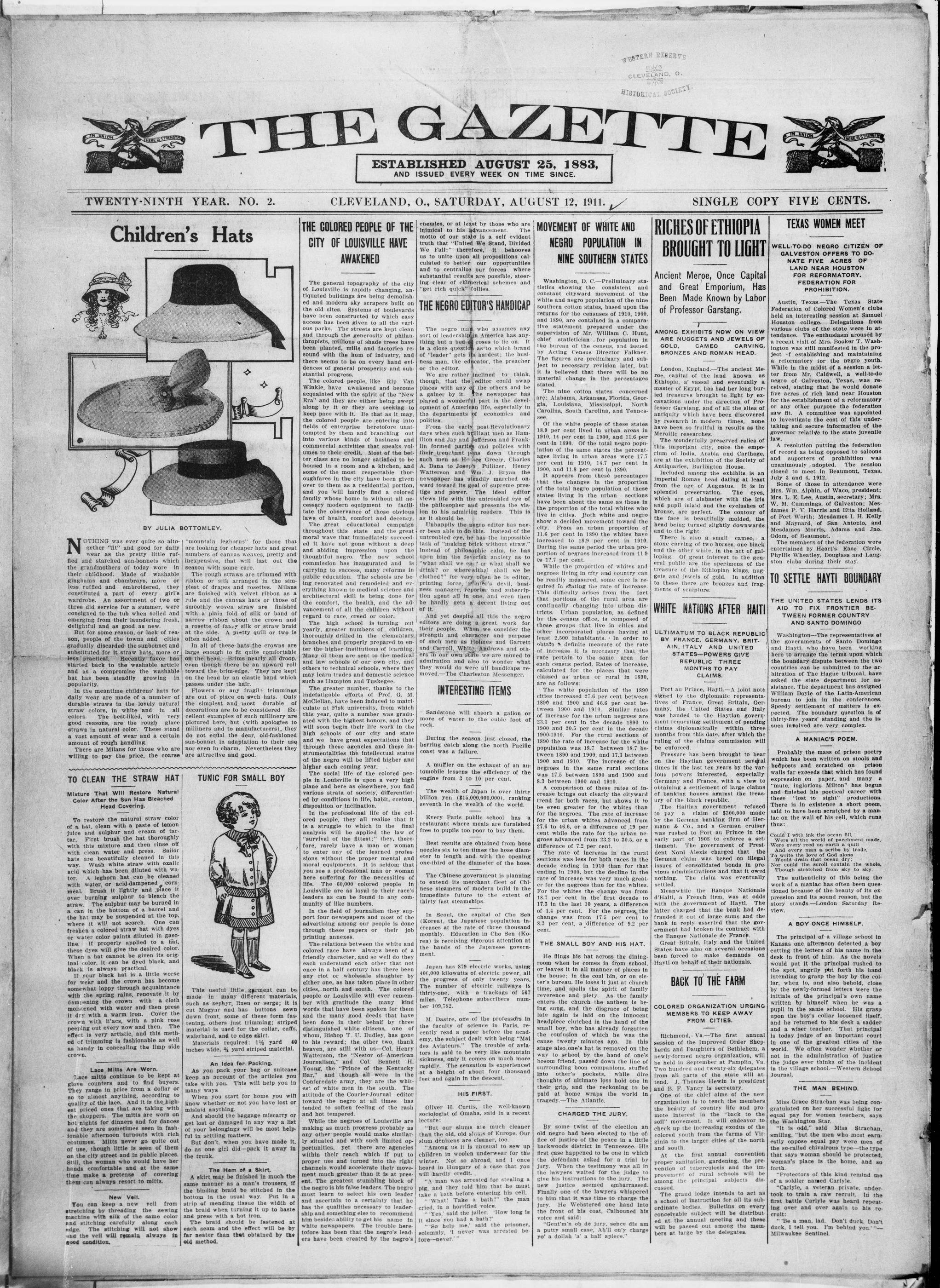
Children's Hats
Children's Hats
BY JULIA B
RY JULIA BOTTOMLEY
NOTHING was ever quite so altogether "fit" and good for daily wear as the pretty little ruffled and starched sun-bonnets which the grandmothers of today wore in their childhood. Made of washable ginghams and chambrays, more or less ruffled and embroidered, they constituted a part of every girl's wardrobe. An assortment of two or three old service for a summer, were consigned to the tub when soiled and emerging from their laundering fresh, delightful and as good as new.
But for some reason, or lack of reason, people of the towns and cities gradually discarded the sunbonnet and substituted for it straw hats, more or less practical. Recently favor has started back to the washable article and as a compromise the washable hat has been steadily growing in popularity.
In the meantime children's hats for daily wear are made of a number of durable straws in the lovely natural straw colors, in white and in all colors. The best-liked, with very good reasons, are the rough glace straws in natural color. These stand a vast amount of wear and a certain amount of rough handling.
There are Milans for those who are willing to pay the price, the coarse "mountain leghorns" for those that are looking for cheaper hats and great numbers of canvas weaves, pretty and inexpensive, that will last out the season with some care.
The rough straws are trimmed with ribbon or silk arranged in the simplest of drapes and rosettes. Milans are finished with velvet ribbon as a rule and the canvas hats or those of smoothly woven straw are finished with a plain fold of silk or band of narrow ribbon about the crown and a rosette of fancy silk or braid at the side. A pretty quill or two is often added.
In all of these hats the crowns are large enough to fit quite comfortable on the head. Brims nearly all drop, even though there be an upward roll toward the brim-edge. They are kept on the head by an elastic band which passes under the hair.
Flowers or any fragile trimming are out of place on such hats. Only the simplest and most durable of decorations are to be considered. Excellent examples of such millinery are pictured here, with (with apologies to milliners and to manufacturers), they do not entail the dear, old-fashioned sun-bonnet in adaptation to their use nor even in charm. Nevertheless they are attractive and good.
TO CLEAN THE STRAW HAT
Mixture That Will Restore Natural Color After the Sun Has Bleached Head Covering.
To restore the natural straw color of a hat, clean with a paste of lemon juice and sulphur and cream of tartar. First brush the hat thoroughly with this mixture and then rinse off with clean water and press. Sailor hats are beautifully cleaned in this way. Wash white straw with oxalic acid which has been diluted with water. A leghorn hat can be cleaned with water, or acid-dampened cornmeal. Brush it lightly and place it over burning sulphur to bleach the straw. The sulphur may be burned in a can in the bottom of a barrel and the hat may be suspended at the top, where it will not scorch. One can freshen a colored straw hat with dyes or water color paints diluted in gasoline. If properly applied to a hat, these dyes will give the desired color. When a hat cannot be given its original color, it can be dyed black, and black is always practical.
If your black hat is a little worse for wear and the crown has become somewhat loppy through acquaintance with the spring rains, renovate it by dampening the crown with a cloth moistened with water and then press it dry with a warm iron. Cover the crown with laces, with a pink rose peeping out every now and then. The effect is very artistic, and this method of trimming is fashionable as well as handy in concealing the limp side crown.
Lace Mitts Are Worn
Lace mitts continue to be kept on glove counters and to find buyers. They range in price from a dollar or so to almost anything, according to quality of the lace. And it is the highest priced ones that are taking with the shopper. The mitts are worn on hot nights for dinners and for dances and they are sometimes seen in fashionable afternoon turnouts with rich coatings. Mitts never go quite out of use, though little is seen of them on the city street and in public places. Still, the woman who would have her hands comfortable and at the same time make a pretense of covering them can always resort to mitts.
New Veit.
You can keep a new vell from stretching by threading the sewing machine with silk of the same color and stitching carefully along each edge. The stitching will not show the vell remains always in good condition.
THE GAZETTE
BOTTOMLEY.
"mountain leghorns" for those that are looking for cheaper hats and great numbers of canvas weaves, pretty and inexpensive, that will last out the season with some care.
The rough straws are trimmed with ribbon or silk arranged in the simplest of drapes and rosettes. Milans are finished with velvet ribbon as a rule and the canvas hats or those of smoothly straw are finished with a plain fold of silk or band of narrow ribbon about the crown and a rosette of fancy silk or braid braid at the side. A pretty quill or two is often added.
In all of these hats the crowns are large enough to fit quite comfortable on the head. Brims nearly all droop, even though there be an upward roll toward the brim-edge. They are kept on the head by an elastic band which passes under the hair.
Flowers or any fragile? trimming are out of place on such hats. Only the simplest and most durable of decorations are to be considered. Excellent examples of such millinery are pictured here, but (with apologetics to milliners and to manufacturers), they do not entail the dear, old-fashioned sun-bonnet in adaptation to their use nor even in charm. Nevertheless they are attractive and good.
TUNIC FOR SMALL BOY
This useful little garment can be made in many different materials, such as zephyr, linen or serge; it is cut Magyar and has buttons sewn down front, some of these form fastening, others just trimming; striped material is used for the collar, cuffs, waistband, and to edge skirt.
Materials required: $1\frac{1}{2}$ yard 40 inches wide, $3\frac{1}{4}$ yard striped material.
An idea for Packing.
As you pack your bag or suitcase keep an account of the articles you take with you. This will help you in many ways.
When you start for home you will know whether or not you have lost or mislaid anything.
And should the baggage miscarry or get lost or damaged in any way a list of your belongings will be most helpful in settling matters.
But don't, when you have made it, do as one girl did—pack it away in the trunk.
The Hem of a Skirt
A skirt may be finished in much the same manner as a man's trousers, if the binding braid be stitched in the bottom in the usual way. Put in a strip of mending tissue the width of the braid when turning it up to baste and press with a hot iron. The braid should be fastened at each seam and the effect will be by far nearer than that obtained by the old method.
ESTABLISHED AUGUST 25, 1883 AND ISSUED EVERY WEEK ON TIME SINCE.
CLEVELAND, O., SATURDAY, AUGUST 12, 1911.
THE COLORED PEOPLE OF THE CITY OF LOUISVILLE HAVE AWAKENED
The general topography of the city of Louisville is rapidly changing, antiquated buildings are being demolished and modern sky scrapers built on the old sites. Systems of boulevards have been constructed by which easy access has been given to all the various parks. The streets are kept clean and through the generosity of philanthropists, millions of shade trees have been planted, mills and factories resound with the hum of industry, and there seems to be on every hand evidences of general prosperity and substantial progress.
The colored people, like Rip Van Winkle, have awakened and become acquainted with the spirit of the "New Era" and they are either being swept along by it or they are seeking to keep pace with it. Be that as it may, the colored people are entering into fields of enterprise heretofore unattempted by them and branching out into various kinds of business and commercial activities that speaks volumes to their credit. Most of the better class are no longer satisfied to be housed in a room and a kitchen, and some of the most respectable thoroughfares in the city have been given over to them as a residential portion, and you will hardly find a colored family whose home is without all necessary modern equipment to facilitate the observance of those obvious laws of health, comfort and decency.
The great educational campaign throughout this state and the great moral wave that immediately succeeded it have not gone without a deep and abiding impression upon the thoughtful negro. The new school commission has inaugurated and is carrying to success, many reforms in public education. The schools are renovated and remodeled and everything known to medical science and architectural skill is being done for the comfort, the health, and the advancement of all the children without regard to race, creed or color.
The high school is turning out yearly, greater numbers of children, thoroughly drilled in the elementary branches and properly prepared to enter the higher institutions of learning. Many of them are sent to the medical and law schools of our own city, and others to technical schools, where they may learn trades and domestic science such as Hampton and Tuskegee.
The greater number, thanks to the indefatigable efforts of Prof. G. M. McClellan, have been induced to matriculate at Fisk university, from which this year, quite a number was graduated with the highest honors, and they will soon begin their life work in the high schools of our city and state and we have great expectations that through these agencies and these instrumentalities the intellectual status of the negro will be lifted higher and higher each coming year.
The social life of the colored people in Louisville is upon a very high plane and here as elsewhere, you find various strata of society, differentiated by conditions in life, habit, custom, disposition or inciliation.
In the professional life of the colored people, they all realize that it is a struggle to which in the final analysis will be applied the law of "survival of the fittest;" they, therefore, rarely have a man or woman to enter any of the learned professions without the proper mental and moral equipments. It is seldom that you see a professional man or woman here suffering for the necessities of life. The 60,000 colored people in Louisville are as loyal to their race's leaders as can be found in any community of like numbers.
In the field of journalism they support four newspapers and most of the advertising among our people is done through these papers or their job printing annexes.
The relations between the white and colored race have always been of a friendly character, and so well do they each understand each other that not once in a half century has there been any riot or wholesale slaughter by either one, as has taken place in other cities, north and south. The colored people or Louisville will ever remember with gratitude the many kind words that have been spoken for them and the many good deeds that have been done in their behalf by three distinguished white citizens, one of whom, Bishop T. U. Dudley, has gone to his reward; the other two, thank heaven, are still with us—Col. Henry Watterson, the "Nestor of American Journalism," and Col. Bennett H. Young, the "Prince of the Kentucky Bar," and though all were in the Conferedate army, they are the whites of white men in the south. The attitude of the Courier-Journal editor toward the negro at all times has tended to soften feeling of the rash and hot tempered.
While the negroes of Louisville are making as much progress probably as any other people would make similarly situated and with such limited opportunities, yet there are agencies within their reach which if put to proper use and turned into the right channels would accelerate their movement much greater than it is at present. The greatest stumbling block of the negro is his false leaders. The negro must learn to select his own leader and ascertain to a certainty that he has the qualities necessary to leadership and something else to recommend him besides ability to get his name in white newspapers. The trouble heretore has been that the negro's leaders have been created by the negro's
enemies, or at least by those who are intimical to his advancement. The motto of our state is a self evident truth that "United We Stand. Divided We Fall;" therefore, it behooves us to unite upon all propositions calculated to better our opportunities and to centralize our forces where substantial results are possible, steering clear of clerical schemes and "get rich quick" follies.
THE NEGRO EDITOR'S HANDICAP
The negro man who assumes any sort of leadership in America has anything but a bed of roses to lie on. It is a close question as to which brand of "leader" gets its hardest; the business man, the educator, the preacher or the editor.
We are rather inclined to think though, that the editor could swap places with any of the others and be a gainer by it. The newspaper has played a wonderful part in the development of American life, especially in the departments of economics and politics.
From the early post-Revolutionary days when such brilliant men as Hamilton and Jay and Jefferson and Franklin formed parties and policies with their trenchant puns down through such men as Heace Greely, Charles A. Dana to Joseph Pulitzer, Henry Watterson and Wm. J. Bryan the newspaper has steadily marched onward toward its goal of supreme prestige and power. The ideal editor views life with the untroubled eye of the philosopher and presents the vision to his admiring readers. This is as it should be.
Unhappily the negro editor has never been able to do this. Instead of the untroubled eye, he has the impossible task of "making brick without straw." Instead of philosophic calm, he has upon him the feverish anxiety as to "what shall we eat?" or what shall we drink? or where shall we be clothed?" for very often he is editor, printing force, printer's devil, business manager, reporter and subscription agent all in one, and even then he hardly gets a decent living out of it.
And yet despite all this the negro editors are doing a great work for their people. When we consider the strength and character and purpose of such men as Holmes and Garrett and Carroll, White, Andrews and others in our own state we are moved to admiration and also to wonder what they would do were all handicaps removed—The Charleston Messenger.
INTERESTING ITEMS
Sandstone will absorb a gallon or more of water to the cubic foot of rock.
During the season just closed, the herring catch along the north Pacific coast was a failure.
A muffler on the exhaust of an automobile lessens the efficiency of the engine from 3 to 10 per cent.
The wealth of Japan is over thirty billion yen (¥15,000,000,000), ranking seventh in the wealth of the world.
Every Paris public school has a restaurant where meals are furnished free to pupils too poor to buy them.
Best results are obtained from hose nozzles six to ten times the hose diameter in length and with the opening one-third of the diameter of the hose.
The Chinese government is planning to extend its merchant fleet of Chinese steamers of modern build in the immediate future to the extent of thirty fast steamships.
In Seoul, the capital of Cho Sen (Korea), the Japanese population increases at the rate of three thousand monthly. Education in Cho Sen (Korea) is receiving vigorous attention at the hands of the Japanese government.
Japan has 879 electric works, using 400,600 kilowatts of electric power, all the progress of only twenty years. The number of electric railways is thirty-one, with a trackings of 567 miles. Telephone subscribers number 109,782.
M. Dastre, one of the professors in the faculty of science in Paris, recently read a paper before the academy, the subject dealt with being "Maldes Aviateurs." The trouble of aviators is said to be very like mountain sickness, only it comes on much more rapidly. The sensation is experienced at a height of about four thousand feet and again in the descent.
HIS FIRST
Oliver H. Curris, the well-known sociologist of Omaha, said in a recent lecture:
"But our slums are much cleaner than the old, old slums of Europe. Our slum deensers are cleaner, too.
"Among us it is unusual to sew up children in woolen underwear for the winter. Not so abroad, and I once heard in Hungary of a case that you will hardly credit.
"A man was arrested for stealing a pig, and they told him that he must take a bath before entering his cell.
"What! Take a bath?" the man cried, in a horrified voice.
"Yes, said the jailer. 'How long is it since you had a bath?'
"So help me,' said the prisoner, solemnly, 'I never was arrested before—never.'"
WESTERN RESERVE
CLEVELAND, O.
HISTORICAL SOCIETY.
MOVEMENT OF WHITE AND NEGRO POPULATION IN NINE SOUTHERN STATES
Washington, D. C.—Preliminary statistics showing the consistent and constant cityward movement of the white and negro population of the nine southern cotton states, based upon the returns for the censuses of 1910, 1900, and 1890, are contained in a comparative statement prepared under the supervision of Mr. William C. Hunt, chief statistician for population in the bureau of the census, and issued by Acting Census Director Falkner. The figures are preliminary and subject to necessary revision later, but it is believed that there will be no material change in the percentages stated.
The nine cotton states concerned are: Alabama, Arkansas, Florida, Georgia, Louisiana, Mississippi, North Carolina, South Carolina, and Tennessee.
Of the white people of these states 18.9 per cent lived in urban areas in 1910, 14 per cent in 1900, and 11.6 per cent in 1890. Of the total negro population of the same states the percentages living in urban areas were 17.7 per cent in 1910, 14.7 per cent in 1900, and 11.8 per cent in 1890.
It appears from these percentages that the changes in the proportion of the total negro population of these states living in the urban sections have been about the same as those in the proportion of the total whites who live in cities. Both white and negro show a decided movement toward the city. From an urban proportion of 11.6 per cent in 1890 the whites have increased to 18.9 per cent in 1910. During the same period the urban proportion of negroes increased from 11.9 to 17.7 per cent.
While the proportion of whites and negroes living in city and country can be readily measured, some care is required in stating the rate of increase. This difficulty arises from the fact that portions of the rural area are continually changing into urban districts. Urban population, as defined by the census office, is composed of those groups that live in cities and other incorporated places having at least 2,500 inhabitants. In order to obtain a definite measure of the rate of increase it is necessary that the rate pertain to the same area for each census period. Rates of increase, calculated for the places that were classed as urban or rural in 1890, are as follows:
The white population of the 1890 cities increased 27.6 per cent between 1890 and 1900 and 46.6 per cent between 1900 and 1910. Similar rates of increase for the urban negroes are 23.3 per cent in the decade 1890 to 1900 and 30.5 per cent in the decade 1900-1910. For the rural sections of 1890 the rate of increase for the white population was 18.7 between 18.7 between 1890 and 1900, and 17.3 between 1900 and 1910. The increase of the negroes in the same rural sections was 17.5 between 1890 and 1900 and 8.3 between 1900 and 1910.
A comparison of these rates of increase brings out clearly the cityward trend for both races, but shows it to be even greater for the whites than for the negroes. The rate of increase for the urban whites advanced from 27.6 to 46.6, or a difference of 19 per cent while the rate for the urban negroes advanced from 23.2 to 20.5, or a difference of 7.2 per cent.
The rate of increase in the rural sections was less for both races in the decade ending in 1910 than for that ending in 1900, but the decline in the rate of increase was very much greater for the negroes than for the whites. For the whites the change was from 18.7 per cent in the first decade to 17.3 in the last 10 years, a difference of 1.4 per cent. For the negroes the change was from 17.5 per cent to 8.3 per cent, a difference of 9.2 per cent.
THE SMALL BOY AND HIS HAT.
He flings his hat across the dining-room when he comes in from school, or leaves it in all manner of places in the house; in the coal bin, or on sister's bureau. He loses it at just church time, and spills the spirit of family reverence and piety. As the family enters the church the anthem is being sung, and the disgrace of being late again is laid on the innocent headpiece clutched in the hand of the small boy, who has already forgotten the confusion of which he was the cause twenty minutes ago. In this stage also one's hat is removed on the way to school by the hand of one's bosom friend, passed down the line of surrounding boon companions, stuffed into other's pockets, while dire thoughts of ultimate loss hold one in their grip, and the reckoning to be paid at home wraps the world in tragedy.—The Atlantic.
By some twist of the election an old negro had been elected to the office of justice of the peace in a little backwoods district in Tennessee. His first case happened to be one in which the defendant asked for a trial by jury. When the testimony was all in the lawyers waited for the judge to give his instructions to the jury. The new justice seemed embarrassed. Finally one of the lawyers whispered to him that it was time to charge the jury. He Webatered one hand into the front of his coat, Calhouned his voice and said: "Gent'mn' ob de jury, sence dis am a putty small case, Ab'll on' y charge yo' a dollah 'a' a half apiece."
CHARGED THE JURY.
TE SINGLE CO
RICHES OF ETHIOPIA BROUGHT TO LIGHT
Ancient Meroe, Once Capital and Great Emporium, Has Been Made Known by Labor of Professor Garstang.
AMONG EXHIBITS NOW ON VIEW ARE NUGGETS AND JEWELS OF GOLD, CAMEO CARVING, BRONZES AND ROMAN HEAD.
London, England—The ancient Meroe, capital of the land known as Ethiopia, a vassal and eventually a master of Egypt, has had her long buried treasures brought to light by excavations under the direction of Professor Garstang, and of all the sites of antiquity which have been discovered by research in modern times, none have been so fruitful in results as the Merotic researches.
The wonderfully preserved relics of this important city, once the emporium of India, Arabia and Carthage, are at the exhibition of the Society of Antiquaries, Burlington House.
Included among the exhibits is an imperial Roman head dating at least from the age of Augustus. It is in splendid preservation. The eyes, which are of alabaster with the iris and pupil inlaid and the eyelashes of bronze, are perfect. The contour of the face is beautifully molded, the head being turned slightly downwards and to the right.
There is also a small camoe, a stone carving of two horses, one black and the other white, in the act of galloping. Of great interest to the general public are the specimens of the ocelot and the ocelon king, nuggets and jewels of gold. In addition to these there are bronzes and fragments of sculpture.
WHITE NATIONS AFTER HAIT
ULTIMATUM TO BLACK REPUBLIC BY FRANCE, GERMANY, BRITAIN, ITALY AND UNITED STATES—POWERS GIVE REPUBLIC THREE MONTHS TO PAY CLAIMS.
Port au Prince, Hayti.—A joint note signed by the diplomatic representatives of France, Great Britain, Germany, the United States and Italy was handed to the Haytian government requesting settlement of pending claims diplomatically within three months from this date, after which the ruling of the claims commission will be enforced.
Pressure has been brought to bear on the Haytian government several times in the last ten years by the various powers interested, especially Germany and France, with a view to obtaining a settlement of large claims of banking houses against the treasury of the black republic.
The Haytian government refused to pay a claim of $300,000 made by the German banking firm of Hermann & Co., and a German cruiser was rushed to Port au Prince in the early part of 1908 to enforce a settlement. The government of President Nord Alexis charged that the German claim was based on illegal issues of consolidated bonds in previous administrations and that it owed nothing. The claim was eventually settled.
Meanwhile the Banque Nationale d'Haiti, a French firm, was at odds with the government of HaytI. The latter charged that the bank had defrauded it out of large sums and the bank in reply asserted that the government had broken its contract with the Banque Nationale de France. Great Britain, Italy and the United States have also on several occasions been forced to make demands on HaytI on behalf of their nationals.
BACK TO THE FARM
COLORED ORGANIZATION URGING MEMBERS TO KEEP AWAY FROM CITIES.
Richmond, Va.—The first annual session of the Improved Order Shepherds and Daughters of Bethlehem, a newly-formed negro organization, will be held in September at Pamplin, Va. Two hundred and twenty-six delegates from all parts of the state will attend. J. Thomas Hewin is president and B. F. Yancy is secretary.
One of the chief aims of the new organization is to teach the members the beauty of country life and promote interest in the "back to the soil" movement. It will endeavor to check up the increasing exodus of the colored youth from the farms of Virginia to the larger cities of the north and south.
At the first annual convention proper sanitation, gardening, the prevention of tuberculosis and the improvement of rural schools will be among the principal subjects discussed.
The grand lodge intends to act as a school of instruction for all its subordinate bodies. Bulletins on every conceivable subject will be distributed at the annual meeting and these will be passed out among the members at large by the delegates.
---
SINGLE COPY FIVE CENTS.
FROM CITIES
---
IN UNION
THERE IS STRENGTH
TEXAS WOMEN MEET
WELL-TO-DO NEGRO CITIZEN OF GALVESTON OFFERS TO DO-NATE FIVE ACRES OF LAND NEAR HOUSTON FOR REFORMATORY. FEDERATION FOR PROHIBITION.
Austin, Texas.—The Texas State Federation of Colored Women's clubs held an interesting session at Samuel Houston college. Delegations from various clubs of the state were in attendance. The enthusiasm aroused by a recent visit of Mrs. Booker T. Washington was still manifested in the project of establishing and maintaining a reformatory for the negro youth. While in the midst of a session a letter from Mr. Caldwell, a well-do-negro of Galveston, Texas, was received, stating that he would donate five acres of rich land near Houston for the estates of a reformatory or any other purpose the federation saw fit. A committee was appointed to investigate the cost of this undertaking and secure information of the governor relative to the state juvenile law.
A resolution putting the federation of record as being opposed to saloons and supporters of prohibition was unanimously adopted. The session closed to meet in Beaumont, Texas, July 3 and 4, 1912.
Some of those in attendance were Mrs. Wm. Alphin, of Waco, president; Mrs. L. E. Lee, Austin, secretary; Mrs. W. M. Cummings, of Galveston; Mesdames P. V. Harris and Etta Holland, of Fort Worth; Mesdames I. H. Kelly and Maynard, of San Antonio, and Mesdames Morrls, Adams and Jao. Odom, of Beaumont, that the federation was entertained by Heart's Ease Circle, Phyllis Wheatley, Douglass and Langston clubs during their stay.
TO SETTLE HAYTI BOUNDARY
THE UNITED STATES LENDS ITS AID TO FIX FRONTIER BETWEEN FORMER COUNTRY AND SANTO DOMINGO
Washington—The representatives of the governments of Santo Domingo and Hayt, who have been working here to arrange the terms upon which the boundary dispute between the two countries can be submitted to the arbitration of The Hague tribunal, have asked the state department for assistance. The department has assigned William Doyle of the Latin-American bureau to join in the conferences. Speedy settlement of matters is expected. The boundary question is of thirty-five years' standing and the issues involved are very complex.
A MANIAC'S POEM.
Probably the mass of prison poetry which has been written on stools and bedposts and scratched on prison walls far exceeds that which has found expression on paper, and many a "mute, inglorious Milton" has begun and finished his poetical career with these "lost to sight" productions. There is in existence a short poem, said to have been scratched by a maniac on the wall of his cell, which runs thus:
Could I with ink the ocean fill.
Were all the world of parchment made.
Were every reed on earth a quill
And every man a scribe by trade.
To treasure all of God aloud.
Would drain that ocean dry;
Nor could the scroll contain the whole.
Though stretched from sky to sky.
The authenticity of this being the work of a maniac has often been questioned because of the beauty of its expression and its sound reason, but the story stands—London Saturday Review.
A BOY ONCE HIMSELF.
The principal of a village school in Kansas one afternoon detected a boy cutting the letters of his name in the desk in front of him. As the novels would put it the principal rushed to the spot, angrily put forth his hand intending to grasp the boy by the collar, when lo, and also behold, close by the newly-formed letters were the initials of the principal's own name written by himself when he was a pupil in the same school. His grasp upon the boy's collar loosened itself, and he returned to his desk a sadder and a wiser teacher. That principal is today judge of an important court in one of the greatest cities of the world. We often wonder whether or not in the administration of justice the judge ever thinks of the incident in the village school.—Western School Journal.
THE MAN BEHIND
Miss Grace Strachan was being congratulated on her successful fight for equal pay for women teachers, says the Washington Star.
"It is odd," said Miss Strachan, smiling, "but the men who most earnestly oppose equal pay were men of the so-called chivalrous type—the type that says woman should be protected, woman's place is the home, and so forth.
"Protectors of this kind remind me of a soldier named Carlyle.
"Carlyle, a veteran private, undertook to train a raw recruit. In the first battle Carlyle was heard repeating over and over again to his recruit:
"Be a man, lad. Don't duck. Don't duck. I tell you. I'm behind you."—Milwaukee Sentinel.
One Year. $1.50
Six Months. 1.00
Three Months. .50
Subscribers are requested to
mit by postoffice money or
order or registered letter.
Entered at the postoffice in Cleveland
Ohio, as second-class matter
Address all communications to
HARRY C. SMITH
Editor and proprietor,
THE GAZETTE,
Blackstone Building, Cleveland, O.
Member Ohio Legislature: 1894
to 1896; 1896 to 1899; 1900 to 1902
THE GAZETTE is the oldest, and has the largest bona fide circulation, double that of any newspaper in the interest of Afro-Americans, published in the state of Ohio, and comparison with any will immediately establish its rank as one of the NEWSIEST AND BEST in the country.
Be sure to read, carefully and thoughtfully, Rev. J. Milton Waldron's letter elsewhere in this paper. It is timely.
The Portland (Ore.) Advocate will please accept our congratulations and best wishes, on its triumphant entrance upon the eighth year of its existence. It is a good, strong race advocate, a positive force.
Ohio Afro-Americans, especially those in the larger cities of the state, should make every effort to secure at least one Afro-American delegate to the Constitutional Convention. Pass the word along and get busy. It is vitally important.
The Gazette thanks its contemporaries for the many kind and encouraging things they are saying about it, these days. There is still a great deal of loyalty in the "press gang" and it is a pleasure indeed to note the fact.
At the last national election, Taft received less than thirty per cent. of the intelligent and loyal "Negro vote," and if he is the republican candidate for the Presidency, next year, he will receive fewer. As we have said before, no intelligent Afro-American questions this except those holding federal jobs and those hoping to get one.
Cleveland's leading Afro-Americans are decidedly opposed to Hon. John P. Green as the Afro-American candidate for delegate to the constitutional convention. This developed at a conference held Tuesday evening. Arrangements have been made to impress the community with this fact and it is decidedly the proper thing to do. A suitable candidate will be put forward at an early date.
TAFT'S POLITICAL HONESTY.
"The President can honestly look the republican platform in the face," having lived up to it, we suppose the Chicago Record-Herald, from which we cite the above remarks, means to say. Well-intelligent citizens who are honest, will hardly endorse this statement. Nor can the Record-Herold, if it is to be honest' about the matter.
Proof: Will any Taft republican note the republican platform in full, containing as it does a plain and unreserved promise to enforce the 14th, and 15th, amendments to the U. S. Constitution in "letter and spirit," and then point out wherein Mr. Taft has shown his honesty as to this part of the party's platform? Also, will the Record-Herald and those "of a kidney" with it, quote Taft's endorsement of race prejudice as a factor in his political table and that of the party he misrepresents, by which this race prejudice excludes a man from the privileges of those against whom none is urged? And finally, will some keep logician point out to our somewhat confused mind the consistency of Mr. Taft who protests against prejudice in the case of the Jew, when Taft endorses and practices that against the Afro-American? Such points are well taken. Why evade the issue?
We are republicans, and believe in the fundamental principles of the grand old republican party, some of which President Taft has "trumped under foot" most ruthlessly to the almost vital injury of a large and potent factor of the party and citizenship of the country that has been faithfulness itself in its allegiance to the country, the party and its principles. The Afro-American contingent is deserving of better, from both party and citizenship standpoints, and if it is to get it in the near future, there must come an end to "Taftism" with the conclusion of the President's present term of office. This much is perfectly clear.
OUR TWENTY-NINTH YEAR!
With the issue of August 5, 1911, "the old reliable" Gazette entered upon its twenty-ninth year. It was in August, 1883, that this race journal was launched by Messrs. John F. Lightfoot, John A. Holmes, J. Harvey Jackson and Harry C. Smith. The first trio remained with the enterprise for short terms varying from one to three years, Mr. Holmes being the last to dispose of his stock in The Gazette Publishing Company to the present owner. During all these years the management and editing of The Gazette has been done by its present owner and editor, and not one issue has failed to appear on time during its long and useful life. It's first good work for our people of Ohio was its successful fight against the remnants of Ohio's "Black Laws," then on the state's statutes. Next, with the efforts of its editor, a member of the lower branch of the State Assembly, and its own influence on the people throughout the state, the Civil Rights' Law and the Anti-Lynching or Mob Violence law were enacted, which placed Ohio in the front rank of the law and order states of the Union. The main work and object of The Gazette has been to always defend the
Afro-American from race proscription along business and civic lines and to encourage him all it could. Personal interests have always been subordinated to those of the people. Its call to the Afro-American continually, has been to be a man and to accept nothing but what is due to one. It has advocated no conciliatory nor half-way treatment, but has demanded and always will demand for each and every deserving member of the race, all that is due American citizens. And we doubt sincerely that any one can deny this fact or can bring forth from the almost thirty years archives of The Gazette's files a single issue from which a word or letter of even a shadow of surrender, can be culled. It is this oneness of purpose that has held for this paper through all of these years, that reliable circulation that it has had and continues to hold, from New York to California, and from the Great Lakes to the Gulf of Mexico. Financial gain and the emoluments of office have never affected its efforts for the race and the principle's rights. Its firm adherence to principle is its best recommendation for the support of every member of the race to whose notice this paper is brought. Therefore, dear reader, begin with this issue to help extend its influence, not only by passing on your copy of the paper, but by urging those to whom you give your Gazette, to subscribe for it at once Also see that. The Gazette has a live agent and correspondent in your community. This will be material assistance that we will be grateful for, and that will go far toward increasing greatly this paper's field of usefulness and assisting it to further improve itself. We want to again thank the many patrons and friends who have helped The Gazette in past years, and to assure them that their efforts are thoroughly appreciated and have had much, very much indeed, to do with its long and successful career.
TAFT REFUSED TO ANSWER
Rev. J. Milton Waldron's Letter Relia
tive to He who did not He
Recipientd.
Washington, D. C., Aug. 4, 1911.
Editor Gazette: In your editorial, titled "Waldron to Taft," in your issue of July 29, you remark: "Anyhow, we want to know if the President sees Negro voters of sufficient potency the government should light to where he stands along the line of the suggestion in the Waldron open letter. How about it, Rev. Waldron?"
In answer to your question, would say that up to date President Taft has not replied to my open letter, and if his silence means anything, it would be good to have a reply for the Negro vote to design a reply to those who are urging him to use his prestige and great influence against that race prejudice which is manifesting itself in a vile form every where in this country, and which is, seemingly, acquiesced in by President Taft and the officials of the administration.
If the President is not in favor of race prejudice against the Colored man in this country, the public does not know it by anything that he has said; and although he has been appealed to by several prominent Colored men to use several opportunities which have come in his way recently to rebuke race hatred, race discrimination and colorphobia everywhere prevalent in this country, he has refused to do so. J. Milton Waldron.
"NEGRO" EH?
"Editor, Pioneer Press, (negro) Martinsburg, West Va." The foregoing is the address coming from "The White House." "Negro" was written with a small n. Why don't the "White House" officials address other editors—say the Irish World, the Staats Zeitung, et. al., Dutchman Irishman, etc.? The answer is they know better, and this negro will put their think-take on the message was to make it a base to write on -didn't read it, and don't intend to. This "negro" don't own Mr. Taft as his president and never will, from the fact he does not own him, nor his race as American citizens, and because of the violation of his oath so to do, he has no respect for him. And the only Negroes who do, are of the type that played with the murdering and selling-master class before the war, and thereby made it hard on all the Negroes who ran the game. He will not be elected—he can't be. The Negroes will Brownies, his North Carolina, Kentucky and Michigan speeches; and the 300,000 old soldiers (and hundreds of thousands of their loyal sons) will kill him, for getting $342 a day—made possible by their valor in a five years' blood-war to save this Union, and when a dollar a day bill passed the House, and a Republican Senate voted it down, before the vote and after it Mr. Taft opened not his mouth. And the "negro" and the race will permit him for allowing out of office to disfray him, "crowded." lynched, down like dogs, and putting all the Negro officeholders out of office at the Palestine, Texas, wholesale butchery—Martinsburg (W. Va.) Pioneer Press, J. R. Clifford, Esg. editor.
Booker T., Roats Colored Teachers.
St. Louis, Mo.—Booker T. W. Washington, president of the Normal and Industrial School at Tuskegee, Ala., in addressing the National Colored Teachers' Association, here July 20 told them that there were altogether "too many high-toned Negro teachers. This class of educators," said Washington, "are accomplishing nothing. They will not accomplish anything, either, until they come down to the level of their lowly race. Teach the Negro the idea of using his hands as well as his brain and you will accomplish practical results."
Just Practicing.
A girl walked into the sitting room of her home recently and on seeing her brother eating, asked him: "Are you eating?" "No," says the small boy, "I'm only practicing eating."
The Gazette is the only paper published in the city of Cleveland, for the Colored people particularly. Beware of campaign mail. The Gazette "died with its June 3, 1911 issue. EDITOR.
THE GAZETTE, CLEVELAND, O., SATURDAY, AUGUST 12, 1911.
DOINGS
OF
THE
RACE
President Simon of Haiti has been driven out of that country by revolutionists.
One of our bitterest enemies, Ex-Gov. James K. Vardaman, will be Mississippi's new U. S. Senator.
Sam Langford and Jim Smith (white), matched to fight in August, will probably be the first to fight under New York state prize fight law. John A. Langford, builder of the True Reformer's building in Washington, D. C., and for several years, located there as architect and builder, will leave Wilberforce University and locate in Jacksonville, Fl. No one should be missed. The alienation of celebration" held in Cleveland, O., Aug. 1, 1911, was a parody on the real thing, and is so regarded by the best of our people in this city. They shunned it.
The Cleveland Gazette under the continuous management of Col. Harry C. Smith, completed its 28th year of continuous publication. This is some vitality for a Negro newspaper. Almost as old as the Reformer (13 years old.)-Durham (N. C.) Reformer. Now is the time, reader, to subscribe for The Gazette—tell your friends. A year has been started, winter and political campaigns are coming, also important events of exceptional race interest and value.
The Brazilian government offers $7,500 annually for five years in prizes to the farmers who plant more than 400 acres of wheat, and a subsidy of $10,000 annually for five years to any corporation that will establish an experimental school and laboratory for the scientific study of the things pertaining to agriculture.
Booker T. Washington's speech at the University Sunday, July 30, was very disappointing to a number of his heretofore admirers. He gave his audience the same rigmarole with which he caught their resiliencies years ago at the Odeon—St. Louis (Mo.) Adv. Prof. F. H. M. Murray, editor.
The Cleveland (O.) Gazette with its last issue closed its 28th year and has the splendid record of issuing every week on time. Accept our congratulations, Bro. Smith, (dean of the Afro-American editorial corps), and may you always be as fortunate and ever better results. Louisville (Ky.) American Baptist, W. H. Steward editor.
At the International Sunday school association which met in San Francisco, W. N. Harshorn (white), of Boston, gave $1,000 to have Bishops G. W. Clinton, W. J. Gaines and Dr. R. H. Anderson. The constitution of the association provides that three Afro-Americans must always be members of the executive committee. Bishop Clinton, Dr. R. H. Boyd and Mr. Matthews of Atlanta, were appointed. Young Lourdes (white), of Philadelphia, Kid Henry Albany, N.Y., who fought such a great ten-round battle at the National Sporting club several weeks ago, are to come together in another scrap. They have been signed up by Dan McMahon, matchmaker of the Knickerbocker club and to battle ten rounds at a baseball park in that city on the night of Aug. 17.
Captain Chas. Young, commander of Troop I, Ninth U. S. Cavalry and commander of the third squadron of the regiment, will be advanced to the rank of major in the fall. This will be the first time an U.S. Army Air Command to high a position in the regular army of the United States in time of peace, excepting, of course, the advancement that has come to chapains. Captain Young is a West Pointer, an Ohioan by birth, and a gentleman by practice whom the enlisted men honor and respect. With this issue, the Gazette closes the book, and continuous publication—every week on time since August 25, 1883. How many (if any) of our contemporaries can equal "the reliable's" splendid record? Speak up, confreres!—Cleveland (O.) Gazette. Here's to you, Brother Smith, and may you be found 28 years from now at the head of the Army in America—Indianapolis (Ind.) Plaindealer, James H. Lott, Editor.
"The most surprising thing I saw abroad," remarked Mark A. Lueschen on his return to N. Y. City from Europe recently, "were the new pieces with Colored heroes. For years Americans have observed that the Colored man and woman in England and on the continent have been received, socially and otherwise, on their merits, just like representatives of all other races—without any reference to race or color, and only that with the foreigners have now gone a step farther and are putting the Colored man into hero roles in their plays. This is especially noticeable in Germany, where it is common talk that a Colored visitor or an Indian is treated as if he were some superior being. One new operetta has a Colored hero with whom a girl (white) is in love and the piece is creating a sensation. There is another piece now running in Berlin that has a Colored character that is most praised for being honored in England just as much as formerly, while in Germany he is receiving unusual attention." Good!
Editor Harry C. Smith of The Cleveland (O.) Gazette, announces his twenty-eight years of continuous publication of The Gazette. We remember Editor Smith and his activities in the Food and the Alcoholic Breast Association in Cincinnati about 20 years ago, when Editor John Mitchell of the Planet presided over the organization. At that time we were very much impressed with the healthy and dashing appearance of bishop Smith young, young and athletic, with extraordinary will-power and determination. Our impressions have been verified, in that he has kept The Gazette alive for twenty-eight years without a single break in its issue. Barring all differences of opinions on persons and public measures, between The Gazette and the Sentinel, we have witnessed Smith our hearty congratulations for his long stand in the field of Negro Journalism.—Pensacola (Fla.) Sentinel, M. M. Lewey, editor.
FRESH OHIO NEWS OUR OWN WRITERS
WHAT OUR PEOPLE ARE DOING IN MANY CITIES AND TOWNS OF THE STATE.
Social Functions—Church and Lodge Items—Marriages and Deathe—Literary, Musical and Other Notes of Interest.
Toledo—Mrs. W. Hanger is at the 79th Annual Hall of An operation—Rev. J. C. Taylor is one of three delegates appointed by Gov. Harmon to the National Educational Congress to meet in Denver, next week. W. E. Harris is a delegate from 10th St church to the Baptist convention in Cleveland this week. Mr. and Mrs. Hirsch had returned from a visit with relatives at Appomattox and Lynchburg, Va.
Zanesville—Mr. Wallace Needham will give a reading at Newark, Aug. 15—Mrs. Chas. Perrine of Granville Bertha and Blanche Weaver of Circleville, Mrs. C. D. Pattengall of Apollo Pa, and Adams Harris of Rendville are guests of Mrs. Harry Caliman—Mr. and Mrs. Chas. E. Mahoney, who are married, are living their daughter, Emily Kearney of Dayton—Mrs. Elmer Pinket of Detroit, is visiting her mother, Mrs. Curtis.
Mt. Pleasant—Miss Anna D. Boycan of Steubenville, is here visiting.—Mr. Mahon Jackson has gone to Cleveland.—The Misses Joiner and Miss Wright of Washington, Pa., are here visiting.—The Baptist church's lawn fete, in Mr. Baker's yard, Saturday evening, was well attended.—The A. M. E. church's camp-meeting was largely attended.—Mr. Frank Skinner has gone to Martins Ferry, to work. Mr. and Mrs. J. Linzezy are rejoicing over the baby girl Miss Pearl Jackson left for Steubenville. G. K. Powell and Frank Skinner were in Wheeling, last week.—Mrs. Jackson and daughters, Pearl and Edith, and Eleanor Proctor were in Dillonville, recently.
Washington, C. H.—Ethel and Emma Garnis are visits Ethel Wilson of Cleveland. Miss Ethel Garnis was in Jeffersonville, July 31. A number of Odd Fellows attended the meeting on August 15, week. Roscoe Vivens was there, July 30. Mrs. George Higgins has returned from a visit in that city—Miss Ford of Chillicothe has joined her sister, Pearl, who is visiting Ruth Jackson.—Ethel Duff and Mrs. Sally Stewart of Chillicothe visited Aug. 4.—Carl Edwards and Winona Cantleyber were in Columbus, July 31. C. E. Vivens was there, recently on business. A. E. Bass was also there on business, July 27. Mr. Wm Nelson and Mrs. Burley are ill. Mrs. Burley and Mrs. Myrta Scott were in Davenport, recently.
Steubenville.—The Stanton Social club, recently organized, has as its officers: Bart J. Guyder, pres; Dennis J. Palmer, sec; Chaucey D. Viney, treas. On Sept. 5, it will give its first annual ball at the Stanton Park Casino and it promises to be the social event of the season. Many promoters have indicated that the Gazette, have also been sent invitations and are expected to attend the ball.—The Gazette desires a live agent and correspondent here. Some one of our leading young men or misses, ought to represent it in Steubenville, and incidentally make some money every week. This is a splendid field for the paper—the oldest and best race advocate published the money for the Gazette at once. We need The Gazette here not only for its splendid race news but to encourage all of our people, particularly our youth.
Correspondents must mail all letters for publication at their main postoffice sufficiently early on Monday (or Sunday) of each week to have them reach The Gazette office on Tuesday morning, and always write, also, their names and that of their names, and their address. The wrapper about returned copies. Unless this latter is done, proper credit cannot be given you. Lists of names, wedding presents, etc., obituary notices, speeches, resolutions, poetry, inquiries for relatives and advertisements of all kinds, including items announcing entertainments to be held in the near future, must be paid for by the postmaster. On a line, six words to a line. Our rates for display advertisements will be sent on application. Send postal note and not stamps during warm weather.
Urbana.—The church aid society met at the A. M. E. parsonage Monday evening. A large attendance and a neat sum realized. The funeral of Mrs. Ada Highwarden was held at St. Paul's church, last Friday afternoon. Rev. W. T. Watson officiating.—Benjamin Lodge, a doctor of citizens, in two special cars over the Ohio Electric, for the Grand Lodge meet at Dayton, last week Thursday where our drillteam took part in the contest-drill, winning first prize. This honor has been held by the Urbana team for six years.—There will be a choir contest at North St. A. M. E. church. Springfield, Aug. 16, at 8 p. m., St. Paul's choir and the Baptist conventants. Rally Springs being conventants. Rally at St. Church, Aug. 20. The meeting of the Guild at Mrs. Edgar Boyd's last Wednesday, was a success.
Cincinnati—Mrs. Katie Childs Cook is visiting her sister, Mrs. Hutchinson Ross, Mrs. Mayme Ross is improving, Mrs. Dora Buckner McCail has a bouncing girl—Mrs. Sarah Ward Oliver and husband, Mrs. Zella Harris and daughters are and mothers, Mrs. Josephine Ward—Miss Katherine McRoberts is soon to wed—Harold B. Taylor left, Saturday for Flemingburg, Ky., to join his mother who is visiting there. Miss Edna Jones is seriously ill—Mr. Cal. Taylor is recovering from an attack of inflammatory rheumatism. Mrs. Nettie Hogan Moss is entertaining Lewis Lewis of Oxford, Joseph L. Jones is visiting in Flemingburg. Mrs. Iva Grant is visiting Niagara Falls and other places of interest. The David Franklin Calman Temperature Society held its monthly meeting Thursday afternoon, at Allen, Temple and elected Miss Lillie Nelson, superintendent of Temperance and Labor. A number will attend the Grand Judge of温度, the Temperature Society, Ms. Lucy White will go to Pittsburgh. On her return she will visit Washington, D.C.
Smithfield.—The S. S. and church club's picnic was well attended Saturday, and a delightful time was had. Mrs. Lola Ramsey and children of Hopedale, attended. Miss Grace Veney returned with her for a short visit. Miss Mary Cooper and Mr. Homer Harris were her guests. Sunday—Mrs. Lola Ramsey and children of Mrs. Ed West and family, Mrs. A Palmer and family were at Fernwood, Saturday—G. D. Bins, Fred, Carter, W. Beamley, Mrs. M. E. Veney and daughter attended the camp-meeting at Cadiz, Sunday—Rev. W. M. Randall and E. H. Giler of Mt. Pleasant, were here, Saturday—Mrs. J. Carter returned Saturday from Hopedale, accompanied by her granddaughter—Mrs. E. H. Giler of Mt. Hopedale visited his mother, last week. Paul Lee of Columbus, who has been visiting his grandmother, returned home, Tuesday—Mr. and Mrs. Ed Smith and family, Mr. and Mrs. Ru fus Smith of McIntyre, were here Saturday—Rev. and Mrs. S. W. White Mrs. T. G. White, W. M. Munte and Miss Hola Carter dined with Mr. and Mrs. E. H. Harris and a number of others attended the Woman's day exercises at McIntyre, Sunday.
Youngstown. — For twenty- eight years Arkansas state and county convicts were worked on the Hannabry plantation, under contract, and during that time thousands of acres of the land were cleared and made into farmland, abandoned, as it had become very uncertain and unsatisfactory, and often the source of costly and embarrassing litigation, due to the activity of trouble-breeding lawyers. Then recourse was had to the natural labor supply of the South, the Negro, and there has been no trouble whatever in securing all the help needed, especially for the old weevil in Louisiana and Mississippi. This is found the most dependable labor of all.—Treat it fair and right, and this is the case generally in the South and North, too.—The delegates and others who attended the Boston meeting of the Elks will return the first of next week.—The local readers of "the old drug" Gazette congratulate the Elks on their ninth year of continuous publication, every week on time. Great record that! One not held by another race publication in this country.
CORRESPONDENTS WANTED.
The old reliable Gazette desires an active agent and correspondent in every city and town in Ohio and neighboring states having a number of Afro-American residents. Only a little time on Fridays or Saturdays is required.
We are especially desirous of hearing from persons in the following named cities: Zan.esville, Newark, Lancaster, Lebanon, Chicago, Odio, Troy, Knoxfield, Plqua, Cumnin, Cambridge, Steubenville, Bellaire, St. Clairsville, Wilmington, Portmouth, Dayton, Canton, Oxford, Sabina, Gallipolis, Oberlin, Sandusky, Delaware, M. Vernon, East Liverpool, Wellsville, Hamilton, Middleport, Bellefountain, Lina, O., and other places where we have none.
Write to the editor of The Gazette. Blackstone building, Cleveland, O. and terms will be sent promptly. Our attention to the addresses greatly by sending at once the addresses of persons in the cities named above, or others, to whom we can write relative to the
MRS. E. M. AVERY'S CONGRATULA TIONS.
August 7, 1911.
Hon. Harry C. Smith, Dear Sir:
I received the copy of The Gaze inette
which is a touch of humor and
efforts in behalf of your people.
I congratulate you upon your twenty-
nine years' work. I have followed
your career with interest from the
days when as a boy you were one of
my pupils in the Central High School
and am pleased to have received
a copy of your valuable
paper. With best wishes for your
continued success,
Your former teacher,
Mrs. Elroy M. Avery.
Man and the Crowd.
An address once made by President Schurman to the graduating class at Cornell was an eloquent appeal for the individual against the crowd. "Would you abolish poverty, would you advance civilization?" he asked. "Then educate individuals one by one to be more virtuous, more intelligent, more skillful, more industrious." Upon the soundness of the plea there will be general agreement. It is but a new statement of the philosophy of Jesus that each man should take care of his own soul. But it is a creed that has been much more successfully taught on lonely farms and pastures than in universities.
Still, the creed is a good one to teach. It can never be taught too often. Better than all laws against vice and crime and folly is an impulse toward self-reform. And perhaps such an impulse was never more needed than now, for never was the voice of the crowd more clamorous nor the influence of the crowd more potent. He that can make sure of his own thought amid its noises is a philosopher. 'He that can stand against its power is a hero—New York World.
What Geese Said
An Englishman hired Kerrigan to attend to his stock farm, says the St. Louis Post-Dispatch. In the evening he asked Kerrigan if he had fed the stock and what he had given to the geese.
Kerrigan—Two bales of hay, sir.
Englishman—What? Two bales of hay to the geese to eat?
Kerrigan—Yes, sir.
Englishman—And did they eat it?
Kerrigan—No, they did not; but they were all talking about it when I left.
From a Gravestone.
I expect I didn't expect it
upon soon. Life
When your Gazettes are not delivered on Friday mornings, call at your Central Postoffice General Delivery Window for them in the afternoon of the same day. —Editor.
HOWARD UNIVERSITY
WASHINGTON, D. C.
WILBUR P. THIRKIELD, LL. D., PRESIDENT
Located in Capital of the Nation, Campus of over twenty acres. Advantages unsurpassed. Modern scientific and general equipment. New Carnegie Library. New Science Hall. Faculty of over one hundred. 1,382 students from 37 states and 10 other countries. Unusual opportunities for self-support. No young man or woman of energy or capacity need be de-
Located in Capital of the Nation, Campus vantages unsurpassed, Modern scientific and Carnegie Library. New Science Hall. Faculty students from 37 states and 10 other countries, self-support. No young man or woman of prived of its advantages. THE COLLEGE OF ARTS AND Devoted to liberal studies, College in Eg, Greek, French, German, Chemistry, B, and the Social Sciences, such as are given in Sixteen professors, Kelly Miller, A. M. Dean.
in Capital of the Nation. Campus of over twent-
upassed. Modern scientific and general equi-
rary. New Science Hall. Faculty of over one h
37 states and 10 other countries. Unusual oppo-
nies. No young man or woman of energy or capi-
tual advantages.
THE COLLEGE of ARTS and SCIENCES,
to liberal science. Colleges in English, Math-
ernal, Geography, Chemistry, Biology, Histori-
cal Sciences, such as are given in the best appr
essors. Kelly Miller. A.M. Dean.
Devoted to liberal studies. Courses in English, Mathematics, Latin, Greek, French, German, Physics, Chemistry, Biology, History, Philosophy, and the Social Sciences, such as are given in the best approved colleges. Sixteen professors. Kelly Miller, A., M. Dean.
THE TEACHERS' COLLEGE.
Special opportunities for teachers. Regular college courses in Psychology, Pedagogy, Education etc., with degree of A. B.; Pedagogical courses leading to Ph. B. degree. High grade courses in Normal Training, Music, Biology, Sciences. Graduates helped to positions. Lewis B. Moore, A. M. Ph. D. Dean.
THE ACADEMY
Faculty of 13. Three courses of four year paratory school. George J. Cummings, A. M. THE COMMERCIAL COLLECourses in Bookkeeping, Stenography, Conics, etc. Business and English high school eduCook, A. M., Dean.
SCHOOL OF MANUAL ARTS AND ARPurnishes thorough courses. Six instruct in Mechanical and Civil Engineering, and ArchPROFESSIONAL SCHOThe School of TheolInterdenominational. Five professors. BAdvantages of connection with a great universespenses. Isaac Clark, D. D, Dean.
SCHOOL OF MEDMedical, Dental and PharmaceForty-nine professors. Modern laboratories with new Freedmen's Hospital, costing halfcilities not surpassed in America. Post-grauda ward A. Balloch, M. D., Dean, 5th and W. StsSecretary, 901 R St, N. W.
of 13. Three courses of four years each. Hi-
school. George J. Cummings, A. M., Dean.
THE COMMERCIAL COLLEGE.
in Bookkeeping, Stenography, Commercial Law,
business and English high school education combine
Dean.
OOL OF MANUAL ARTS AND APPLIED SCIEN-
sies thorough courses. Six instructors. Offers foral
and Civil Engineering,and Architecture.
PROFESSIONAL SCHOOLS.
The School of Theology.
nominal. Five professors. Broad and thou-
d of connection with a great university. Students'
ac Clark, D. Dean.
THE SCHOOL OF MEDICINE.
Medical, Dental and Pharmaceutical Colleges.
the professors. Modern laboratories and equipme-
Freedman's Hospital, costing half million dollars
surpassed in America. Post-graduate School and
bloch, M. D., Dean, 5th and W. Sts. N. W. W.C.,
01 R St. N. W.
Faculty of 13. Three courses of four years each. High grade preparatory school. George J. Cummings, A. M., Dean.
THE COMMERCIAL COLLEGE.
Courses in Bookkeeping, Stenography, Commercial Law, History, Civics, etc.
Business and English high school education combined. George W. Cook, A. M., Dean.
SCHOOL OF MANUAL ARTS AND APPLIED SCIENCES.
SCHOOL OF MANUAL ARTS AND APPLIED SCIENCES.
Furnishes thorough courses. Six instructors. Offers four-year courses in Mechanical and Civil Engineering, and Architecture.
PROFESSIONAL SCHOOLS.
The School of Theology.
Interdenominational. Five professors. Broad and thorough courses.
Advantages of connection with great university. Students' Aid. Low expenses. Isaac Clark, D. D., Dean.
THE SCHOOL OF MEDICINE.
Medical, Dental and Pharmaceutical Colleges.
Forty-nine professors. Modern laboratories and equipment. Connected with new Freedmen's Hospital, costing half million dollars. Clinical facilities not surpassed in America. Post-graduate School and Policlinic. Ed.ward A. Balloch, M. D., Dean, 5th and W. Sts. N. W. W.C. McNeill, M. D., Secretary, 901 R St. N. W.
The School of Law.
Faculty of eight. Courses of three years, giving a thorough knowledge of theory and practice of law. Occupies own building opposite court house. Benjamin F. Leighton, LL B., Dean, 420 5th St. N. W.
Faculty of eight. Courses of three years, of theory and practice of law. Occupies ow house. Benjamin F. Leighton, LL. B., Dean. 4 For catalog and special information, addr
"H. H. H. WORKS WONDERS WE
of eight. Courses of three years, giving a thorou
and practice of law. Occupies own building o
Jamin F. Leighton, LL B., Dean, 420 5th St. N.
alog and special information, address Dean of D
"H. H. H."
KS WONDERS WITH THE
KINKY
For catalog and special information, address Dean of Department.
BEFORE AFTER
The wonderful new dressing for kinky or stubborn, harsh hair softer, more pliable and put up in any style the length will permit. ing how this remarkable remedy makes short wavy. Best dressing on the market for dau and falling out of the hair. Beware of imita up in 50 cent and $1.00 jars.
STOR
wonderful new dressing for kinky or curly hair.
marsh hair softer, more pliable and glossy; easy
any style the length will permit. Write for te
this remarkable remedy makes short, kinky hair
at dressing on the market for dandruff, itching
out of the hair. Beware of imitations; get the
ent and $1.00 jars.
The wonderful new dressing for kinky or curly hair. Its use makes stubborn, harsh hair softer, more pliable and glossy, easy to comb, and put up in any style the length will permit. Write for testimonies, telling how this remarkable remedy makes short, kinky hair grow long and wavy. Best dressing on the market for dandruff, itching of the scalp, and falling out of the hair. Beware of imitations; get the genuine, put up in 50 cent and $1.00 jars.
Money Back
If Not Satisfied.
The Hopewell Co.,
FREE COUPON.
Name
Street No.
City or P. O.
State
Cut out this coupon and mail it to The Hopewell Co., 851 Old South Building, Boston, Mass. A
851 Old South Building, Boston, Mass. Live Agents Wanted.
HOTEL DALE.
Capec May, New Jersey—One hundred light-nished rooms. EVERY MODERN IMPROVED country. Just completed at a cost of $50,000. The highest elevation in the heart of the residence is directly opposite the widely celebrated link and its environments on all sides are perfect, an extensive view of the harbor and sea and reaches every section of it. Elegantly Frenn delicacies of the season and the best service. plan. Beautiful Grill Room. Afternoon and a complete Abyssinian Orchestra of N. Y. City. Croat air amusements. The finest sea bathing on the has its own PRIVATE BATH HOUSES. Perf women and children to enjoy the Salt-water. also cabs, autos, etc. Beautiful country surer the personal management of the owner. E progressive and successful business men of our hotel man has enabled him to use thorough ing the equipment of his hotel to perfection. from the stations of either the Pennsylvania ture and additional information will be mailed
day, New Jersey—One hundred light, airy and ins. EVERY MODERN IMPROVEMENT. Our last completed at a cost of $50,000. Hotel Dale is located in the heart of the residence portion of cocoopose the widely celebrated links of the Cape environments on all sides are perfect. The hotel is the view of the harbor and sea, and the invigoratingery section of it. Elegantly Furnished Dining of the season and the best service. Both European tittifal Grill Room. Afternoon and Evening Concert in Orchestra of N. Y. City. Croquet, tennis and basketball in the Atlantic coast. PRIVATE BATH HOUSES. Perfume safe and children to enjoy the Salt-water, Sailfish andautos, etc. Beautiful country surrounds the horse-sonal management of the owner, E. W. Dale, one and successful business men of our race. His e has enabled him to use thorough knowledge of the shipment of his hotel to perfection. Hotel Dale is institutions of either the Pennsylvania or Reading additional information will be mailed upon request. E. W.
Cape May, New Jersey—One hundred light, airy and luxuriously furnished rooms. EVERY MODERN IMPROVEMENT. Our finest, in this country. Just completed at a cost of $50,000. Hotel Dale is located on the highest elevation in the heart of the residence portion of cool Cape May. It is directly opposite the widely celebrated links of the Cape May Golf Club and its environments on all sides are perfect. The hotel rear commands an extensive view of the harbor and sea, and the invigorating ocean breeze reaches every section of it. Elegantly Furnished Dining Room, all the dale beds of the season and the best service. Both European and American plan. Beautiful Grill Room. Afternoon and Evening. The complete Abyssinian Orchestra of N. Y. City. Croquet, tennis and other air amusements. The finest sea bathing on the Atlantic coast. Hotel Dale has its own PRIVATE BATH HOUSES. Perfectly safe at all times for women and children to enjoy the Salt-water. Sailing and Fishing galore. Also cabs, autos, etc. Beautiful country surrounds the hotel, which is under the personal management of the owner. E. W. Dale, one of the most progressive and successful business men of our race. His experience as a hotel man has enabled him to use thorough knowledge of details in bringing the equipment of his hotel to perfection. Hotel Dale is easy of access from the stations of either Pennsylvania or Reading railroads. Literature and additional information will be mailed upon request. Address E. W. Dale, Hotel Dale, Lafayette and Jefferson streets.
A. Limited Edition.
Privately printed books constitute a very interesting bypast of literature. One produced by the Prince Consort is a subject of inquiry in the current Notes and Queries. The Court Journal of September 23, 1865, mentions that the Prince Consort made a special study of Balmoral. By his directions and largely with his assistance a book on the Balmoral country, topographical, botanical, geological, descriptive and reminiscent, was compiled. It was beautifully printed by an eminent London firm, but by the Prince's strict orders only six copies were struck off. Is there a single copy now in existence? The British Museum, the Windsor Library and the Balmoral Library have been searched in vain—London Chronicle.
Take Your Choice
"Don't you think, Dr. Fourthly," said his literary parishioner, "that the larger, fuller intellectual life of the present day, with its freedom from the baseless fears and superstitions that have kept the human soul in bondage through the centuries, has been a potent agency in bringing about the demonstrated and well established increase in the average duration of human life?" "O, yes, to be sure," said the Rev Dr. Fourthly; "and then people take better care of their teeth nowadays than they used to, you know."
Too often is the mantle of charity louder than a Navajo blanket - Puck
---
Campus of over twenty acres. Ad-
fice and general equipment. New
Faculty of over one hundred; 1,332
unities. Unusual opportunities for
of energy or capacity need be de-
TTS AND SCIENCES.
oes in English, Mathematics, Latin,
history, Biology, History, Philosophy,
given in the best approved colleges.
L. Dean.
Regular college courses in Psychol-
gree of A. B.; Pedagogical courses
courses in Normal Training, Music,
Graduates helped to positions. Lewis
EDEMY.
four years each. High grade pre-
s. A. M. Dean.
CAL COLLEGE.
Phy. Commercial Law, History, Civ-
chool education combined. George W.
AND APPLIED SCIENCES.
instructors. Offers four-year courses
and Architecture.
CAL SCHOOLS.
Of Theology.
Courses. Broad and thorough courses.
University. Students' Aid. Low ex-
OF MEDICINE.
Marmaceutical Colleges.
Laboratories and equipment. Connected
half million dollars. Clinical fast-
graduate School and Polyclinic. Ed.
W. Sts. N. W. W.C. McNeill, M. D.,
Col of Law.
The years, giving a thorough knowledge
hippe on building opposite court
Dean 429 5th St. N. W.
ton, address Dean of Department.
H."
S WITH THE HAIR
KINKY HAIR
STRAIGHTENED AT
ONCE
FALLING HAIR
STOPPED
IMMEDIATELY
DANDRUFF
REMOVED and ITCHING
STOPPED
kinky or curly hair. Its use makes
liable and glossy, easy to comb, and
permit. Write for testimonies, tell-
kes short, kinky hair grow long and
for dandruff, itching of the scalp,
of limitations; get the genuine, put
FREE COUPON.
Name .....
Street No.....
City or P. O.....
State .....
Cut out this coupon and mail it to The Hopewell Co., 851 Old South Building, Boston, Mass. A Free Letter of Advice regarding "H. H. H." will be sent you post-paid.
Write Quick For Terms
red light, airy and luxuriously fur-
PROVEMENT. Our finest, in this
50,000. Hotel Dale is located on the
residence portion of cool Cape May. It
is a beautiful beach, and is the perfect. The hotel rear commands sea, and the invigorating ocean breeze
Furnished Dining Room, all the service. Both European and American and Evening Concerts by the com-
y. Croquet, tennis and other opening on the Atlantic coast. Hotel Dale
S. Perfect safe at times for women. Sailing and Fishing galore
try surrounds the hotel, which is unner, E. W. Dale, one of the most of our race. His experience as a thorough knowledge of details in bring-
fection. Hotel Dale is easy of access
sylvania or Reading railroads. Litera-
e mailed upon request! Address
E. W. DALE.
Hotel Dale,
Cape May, N. J.
And Women Only Glow.
There are rules to be observed even in expressing one's self concerning the effects of the weather upon one's anatomy. A young Frenchwoman, who was learning English while on tour with an American governess, once inadvertently exclaimed, "Oh my, I am all of a sweat!" "Made-meiselle" exclaimed the governess, severely "never let me hear you use that word again! Horses sweat, neen perspire. Women only glow."
Great Saving of Time
The manager of one of the electric light companies of the western part of the country has greatly facilitated the business of making the monthly readings of meters by having these instruments placed on the rear porches of houses instead of in the cellars. About half of the meters of this company are now located in some convenient and protected place in the rear of the house, where it is always accessible without regard to the presence or absence of the inmates of the house. The result is that the average time formerly consumed by the inspector has been cut about in half.
If air-saked lime be used in earth in which plants are potted it will keep worms away.
Uwave Legal Tender
Always Legal Tender.
As a legal tender, the standard silver dollar is unlimited, unless other rates are stipulated to a contract.
Local News
J. S. HALL'S, 3121 Central Ave.
L. SCHWARTZ'S, 2921 Central Ave. Open Sunday.
O. C. SCHROEDER'S, Cuyahoga Bldg. Open Sunday.
ELMER F. BOYD'S, 2604 Central Ave.
F. VALENTINE'S, 2130 Central Ave.
NOTICE TO SUBSCRIBERS:—Subscribers not receiving The Gazette regularly should notify us at once. We desire every copy delivered promptly. We advise our patrons to carefully examine The Gazette's advertisements before making purchases. Business men who advertise in this paper should have the patronage of Afro-Americans. The fact that they advertise is assurance that they want it. Local reading notices (advertisements) ten cents a line (six words in a line.)
FOR SALE.—Brand new, Imperial Encyclopedia and Dictionary, 40 volumes, finely illustrated, handy to handle. Unexcelled for reference purposes. A library in itself—one that will last a life-time. Contains everything you may wish to know. Call or address. The Gazette Blacktop Building, 1422 W. 2d St., Cleveland, O, near Superior Av. This is an opportunity of a life-time for those who love good books.
Mr. and Mrs. Floyd Williams left Saturday morning, for Baltimore, Md. their future home.
Miss Emby of Columbus, a teacher in the Petersburg, Va., schools, is the guest of the Misses Blue.
Mrs. Johnson, wife of Dr. Johnson of Dairie, is a guest of Mrs. Dan Faitre, officer of E. E. Shaw. Mrs. Carrie Clifford of Washington D. C., is the guest of MESDAMES Chas Chesnut and Agnes Green.
FOR RENT—Seven Suites—Available Sept. 1, in St. Eden blocks, 3852 Central Av. Steam heat and bath in all suites. Will fix them to suit tenants. Three suites, five rooms each, $20 per month each; three suites, six rooms each, $25; one suite, six rooms, $30. Apply at 2127 E. 105th St. Phone, Bell, Doom 2251. Ask for O. W. White. References required.
NOTARY PUBLIC—For such services call at The Gazette office. No 3 Blackstone Building, No. 1422 W. 3d street, near Superior avenue.
FOR RENT—Furnished rooms: 2327 East Ninetieth street.
Mr. Mahlon Jackson of Mt. Pleasant, is in the city.
Ethel and Emmy Garns of Washington C. H., are guests of Ethel Wilson of Marion Ave.
Mr. Ward of Columbus, one of the leading Transfer Co., men at the state capital, is in the city.
Mary and Morris of E. 66th St. one of our most promising High School students, is spending this week in Detroit.
It was currently rumored, the past week, that the "T-paper" was to be revived for at least a part of the fall campaign, now on.
The editor of the *Gazette* acknowledges an invitation to the Stanton social club's ball, at Steubenville, Sept. 5.
Mr. Leonard Schwartz is circulating a petition for the removal of the drinking fountain in front of Bass & Travis' saloon, cor. Central Ave. and, E. 30th St.
If you have houses for rent or wish to rent, call at the *Gazette* office and mention wants known, and we will do the rest.
The Silver Leaf club of St. Andrew's church, will give a lawn party at Mrs. Wallace Bolden's, 2214 E. 39th St. Thursday next. Refreshments will be served.
Persons interested in the Allenworth, Cal., colony, and many, very many, should do well to call Mr. H. Tinter & Co, 3191 Central Ave. local agents.
Thousands of our voters have already decided to vote for Charles S. Sutton, Esq., candidate for a republican nomination as Councilman at large.
Mr. and Mrs. Samuel Jefferson of 2919 Pine Ave., are entertaining their sister and sister-in-law, Mrs. Norman Hall and Mrs. John H. Berry of Washington, D. C.
We cordially invite our many friends to attend the excursion to Put-in-Bay, Monday, August 14th. Respectfully, Members of St. Andrews church.
Wm. B. Direys of 7518 Quincy avenue does all kinds of mason work and plastering, lays cement sidewalks, drives and cellar bottoms, contracting and jobbing. All work guaranteed. Bell E. 1985-X.
Katie L. Hurt of Jackson, Teen., is visiting her sister Mrs. C. E. Webster of 2183 Chicago where she had spent six weeks with another sister, Mrs. A. Miller of 4718 Dearborn St., that city.
Send your local items to The Gazette on Monday or Tuesday of each week. This paper is published for ALL of our people and "plays no favorites." Everybody is treated the same—fair and right. Take The Gazette and tell your friends to do so also.
The Arnett Republican club has reorganized and elected the following officers: W. B. Hawkins, president; Martin Farmer, vice president; James J. Arnold, secretary; P. P. Rose, treasurer; Charles Frances, sergeant-at-arms. The club indorsed Frank G. Hogen for mayor and Henry F. Walker for vice mayor.
Current rumor has it that Welcome To Blue and others are promoting a building for the Association. This would be a good thing, with the right kind of people at the head of it. The Clayton Grocery store, the People's Drug Store and other more or less recent Central Ave. "enterprises," are still fresh in the minds of the people.
A charge of larceny on the high seas was placed against Robert Lewis, a waiter on the D. & C. steamer, City of the Straits, when the boat docked here one morning last week. He was accused of stealing a pocketbook containing $10 which Miss F. Clark, a school teacher from Springfield, left her steaming writer room. Mrs Clark is on a vacation. She and Mrs. Clyde Moffat, another teacher from Springfield, went to Niagara Falls until the case came to a hearing. Lewis gave his address as 1622 Bolvair Rd. S. E.
Call your lady friends' and acquaintances' attention to our up-to-date fashion and pattern departments and thus encourage them to subscribe or take The Gazette regularly. Oblige the Editor.
Mr. and Mrs. Floyd Williams left, Saturday morning, for Baltimore, Md., their future home. Miss Embry of Columbus, a teacher in the Petersburg, Va., schools, is the guest of the Misses Blue.
Mrs. Johnson, wife of Dr. Johnson of Detroit, is the guest of Mrs. Dan. Fairfax sr., of E. 35th St. Mrs. Carrie Clifford of Washington, D. C., is the guest of Mesdames Chas. Chessnut and Agnes Green. R. E. Jackson and family of E. 46th St., are visiting the old home and relatives at New Brighton, Pa. Miss Maxwell of the Louisville, Ky., school of the Mrs. Gus. Coudry, and sister Peter Hill. Mrs. Katherine S. Mitchell left for Atlanta, Ga. Sunday to fill a concert engagement. Her husband, Mr. John Mitchell, is still very ill. Miss Ruffin of Washington, D. C., a graduate of the Women's College of Western Reserve University, is the guest of Miss Georgia Fields. Mr. and Mrs. Richard Smith of Carnegie Ave., entertained at lunchon Tuesday evening, Rev. H. C. Balley, Messrs. W. M. Jackson, H. W. Cash and E. O. Orsburn. Mrs. Coopers Nickens of E. 87th St., left Thursday for Indianapolis, to visit her parents and brother, Mr. Turner B. Harrison of Chicago. There will be a family reunion.
Miss Cora Johnson of E. 171 st. entertained at dinner on the 3rd, in honor of Miss Embry of the Petersburg, Va., schools, the Misses Bertha and Mabel Blue, Carrie Brown and Mrs. H. W. Cash. Dr. J. K. Nickens is proprietor of the Nickens Medicine Company of this city. His Blood Saraparilla, Fehallia, Kkg Pain, Cough, and Dag Syrup, Carrie Cure and great Alkali Liniment have a large sale throughout the country. Mrs. B. M. Shook entertained at luncheon, Aug. 3rd, Mdeses Carrie Clifford, J. P. Green, Agnes Green, G. A. Myers, Walkie Walker, W. B. Evans and daughter, Lillian, of Washington, D. C., and Miss N. Dorsey of Holly Springs, Miss. Mrs. J. M. Gillmere will leave on the 18th for Niagara Falls where she will be joined by her sisters, Mrs. J. M. Levy and Miss Willie Harris of Nashville, Toronto and places of interest will be visited. Miss Harris passes through Cleveland en route to N. V.
Antioch's B. Y, P. U, raised $63.04, July 30, for a fund to decorate the church's interior. This organization of young people is taking great interest in the church work. The pastor, Rev. H. C. Bailey preached a special sermon for the occasion and selected a most appropriate lesson from the 144th psalm. The church has granted him a thirty-day vacation, for a much needed rest. Mesdames Edwina Seelig, Cornelia P. Nickens and Hattie K. Price, charter members of the Minnesota Reading Club, have been a member of the club at Mrs. Seelig's Tuesday afternoon, in honor of Mrs. Carrie Clifford of Washington, D. C., another charter member of the organization. Mesdames Dan, Fairlax Jr., and Agnes Green were also guests of the club.
Rev. W. G. Webster, pastor of Lane Memorial church, who attended a missionary convention of the C. M. E. church at Louisville, Ky, July 26-31, has returned delitged with his trip. Delegates were there from Ohio, Indiana, Kentucky and Tennessee, Bishop Charles H. Phillips of Nashville, presided, and Gov. A. E. Wilson of Kentucky, addressed the meeting July 27. It was a grand success. The amount raised for missions in the Fifth Episcopal C. M. S. district, was $2,885.18, the amount raised at Lane Church, Rev. D. A. Walker of Mt. Sterling, Ky, will preach morning and evening. He is a veteran pulpitere and has presided over this district for several years.
Postoffice inspectors say over 1000 letters, containing small sums of money, have been taken from the mails by Frank B. Scott, a night distributor at the postoffice. He had six unopened letters in his pockets when arrested last week Wednesday at midnight. He was able to pick out our letter, which was being stashed accuracy, Inspectors Owen and Moore say. His finger tips were abnormally sensitive and he had trimmed his nails so that the nerves were nearly exposed. It was his slender, tapering fingers and fast life that led inspectors to suspect him. "Letters began to disappear several months ago," Inspector Moore said. We traced the feet to the department office two weeks ago." Wednesday night the two inspectors, Assistant Postmaster Schutt and Superintendent of Mails Hart secretly watched Scott. They noted that his thumb and forefinger seemed to pause momentarily on certain letters. As he startled to leave at midnight, officers intercepted him and found the batch of letters. Yes, I took them the Scotts mentioned. He was arrested last week Thursday on a charge of tampering with the mails. He pleaded guilty before U. S. Commissioner Walther and was held on $2,500 bond.
Don't throw away your copy of The Gazette when you have done with it, but give it to some appreciative person whom you feel would be likely to subscribe or take it regularly, if they had a copy to look over and read carefully. Oblige the Editor.
THE GAZETTE, CLEVELAND, O., SATURDAY, AUGUST 12, 1911.
Scott, thirty, has been in postal service four years. He has a wife and an eight-year-old son living at 2315 E. 101st St. They have the sympathy of the community.
OUR OHIO ODD FELLOWS.
The Grand Lodge Elects Officers and Chooses Next Meeting Place.
Cuy. Cen. 3328 K.
Bell E
F. W. FOSS @
PROMPT PRINT
Dayton, O.-At the Ohio grand lodge, G. U. of O. F. meeting here last week Thursday, M. Vernon was chosen as the next meeting place, and the following officers were elected: George H. Bailey, Springfield, grand master; J. J. Lee, Columbus, deputy grand master; Joseph L. Jones, Cincinnati, deputy grand secretary; Forest Speaks, Springfield, deputy grand treasurer; S. S. Cheeks, Oxford, deputy grand director. The meeting was well attended, and the solemn feast may be carried and thoroughly enjoyed. The people of this city "did themselves proud" in the matter of hospitality and other care of the Grand Lodge and all who came to attend the meet.
CLAIMS UNWRITTEN LAW
A White Planter Charged With In
sulting Woman's Husband Who
Shoots Him
Shreveport, La.—Probably unique is the case of C. H. Smith, a planter (white), who was shot and fatally wounded by George Karry, an Atro-American farmer, at Dixie, a settlement near here. Karry is in the parish prison here, and disarms the a written law, as a defender. He is statement to the authorities he asserts Smith insulted his wife while she was on her way home from church. Smith denies the charge. Mr. Karry, after his wife told him of the alleged insult, obtained a shotgun and sought Smith. Only a few words passed to him, and he talks of mob violence, and the general sentiment here is that there will be nothing to prevent a fair trial of the case.
Senator Foraker's Private Secretary.
Cinematti, O., August 5, 1911.
Hon. Harry C. Smith, Editor The Gazette.
Dear Mr. Smith: Allow me to congratulate you upon the splendid showing of The Gazette and upon the fact that it is just entering upon its 29th year this week. You have done a great deal of good.
The Senator is at his summer home, in Maine.
Very truly yours, etc.
J. Sagmeister.
"BOB" COLE SUICIDES!
The Comedian of the Cole and Johnson Team Drowns Himself.
Catskill, N. Y.—Robert Cole, 43, of New York City, one of the best known Afro-Americans in the theatrical profession, drowned in a shallow creek here last week Wednesday afternoon. It is believed that his act was deliberate for he had been mentally ill for some time and very dependent on his mother. The Cole & Johnson theatrical team, owners of various shows in recent years, and author of a number of songs, including "The Girl With the Dreamy Eyes." He came here July 29. Mr. Cole walked into the creek without undressing, and after himself to sink. Two friends watching say they supposed it was in play and Cole was dead before they realized the truth.
Wills $10,000 to Tuskegee
Sandusky, O.—Although born in slavery and a servant all her days in the north, Miss Georgiana Harper, aged 71, left a the $12,000 estate. The bulk of this, according to her will just filed, goes to Tuskegee institute. She owned real estate valued at nearly $10,000. One house, the smallest of five she owned and the one in which she lived, she bequeathed to a white woman, her next door neighbor, for befriending her 'when ill.
Recalls John Brown's Raid.
Sandusky, O.—Martyr John Brown's raid shortly before the Civil war was recalled by the death at Put-in-Bay last week of Mrs. John Brown, Jr., daughter of the eldest son of the great man who lost his life in attempting to free the shaves. Mrs. Brown helped conceal and save from hanging some of the followers of the martyr. She lived at Put-in-Bay over 50 years.
Johnson Won't Fight!
London, England.—Jack Johnson, in an interview, announces that he would fight in war for England but delighted with his treatment here where there are no silly, foolish "color-lines" of any kind. Here "a man is a man" and is treated so always, if he shows that he is one. Color or race "cuts no figure."
A WHITE FRIEND'S COMPLIMENTS
Go on increasing years of usefulness and cheer: Here are the compliments of an humble citizen of the Republic to The Cleveland Gazette an its 29th birthday. Fortunately for our country in these days of insanity and vulgarity, we must still have a number of sober, sane and safe papers in existence. And it is agreeable to honest criticism to be able to say that this select list compares some Negro journals also. None have I found more fearless, consistent and diligent in defending and propagating human rights, than The Cleveland Gazette. May it be that many of those in whose interest it is published more particularly, assist it along its course, by subscribing to it and having friends do so also—Jacob Egberth, Chicago, Ill., Aug. 7, 1911.
As Galsworthy Saw Life.
The wisdom of John Galsworthy: Like files caught among the impalpable and smoky threads of cobwebs, so men struggle in the webs of their own natures, giving here a start, there a pitiful small jerking, long sustained, but falling into stillness.
H. BRYANT FREEMAN,
2371 E. 30th, St.
Paper Hanger
—AND—
House Painter.
4511 Payne Ave.
EVERYTHING IN PRINTING. THE BEST
WORK. MOST REASONABLE RATES.
The 42nd Annual Fair of the Colored A. & M. Association,
LEXINGTON, KY., SEPTEMBER 12,13,14 15 & 16 1911. on the beautiful grounds of the Trotting Association. LARGER and BETTER PREMIUMS, more free Attractions and first class music. A good time for everybody. Reduced Roailrad Rates on all roads into Lexington.
Wilberforce University
Opens First Tuesday In September
Located in Greene county, three and one-quarter miles from Xenia, O. Healthful surroundings. Refined community. Faculty of 32 members. Expenses low. Classical and Scientific, Theological, Preparatory, Music, Military, Normal and Business Departments. TEN INDUSTRIES TAUGHT. GREAT OPPORTUNITIES for High School Graduates entering College or Professional Courses. Ohio students desiring to enter Normal, Business or Industrial Department can obtain certificate from State Senator or Representative entitle them to FREE TUITION, ROOM RENT AND INCIDENTALS.
Catalogue and special information furnished. Address
W. S. SCARBOROUGH, PRES.
W. A. JOINER, SUPT., C. N. & I. DEPARTMENT.
Cuy. Cen. 3328 K.
F. W. FOS
PROMPT I
4511 Pay
EVERYTHING IN PR
WORK. MOST REAL
The 42nd Annual F
A. & M. A.
LEXINGTON, KY., SEPTEMBER
1911, on the beautiful grou
LARGER and BETTER PRE
and first class music. A good
Roailrad Rates on all roads i
T. J. Wilson, Pres.
Wilberforce
Wilberforce
Opens First Tues
Located in Greene county, three
Healthful surroundings. Refined con-
penses low. Classical and Scientific
itary, Normal and Business Depa-
GREAT OPPORTUNITIES for Hif-
or Professional Courses. Ohio stud-
ness or Industrial Department can
or Representative entitling them to
INCIDENTALS.
Catalogue and special information
W. A. JOINER, SUPT., C
JOHN T. TUCK & CO.
Dealers in
Wall Paper and
Paints.
Decorators, Paper Hangers and House Painters.
Phone, North 1153 and Cent. 6661-R
Bell, Doan 1398-J, Residence East 791-L, Office
Dr. Walter S. Biggs'
Dentist.
4715 Central Ave., Cleveland, O.
Hours: 8 to 12 a.m., 1 to 5 p.m.
Sundays and Evenings by
Appointment
Phone Bell, Northb 1075-X
Cuy. Cent.
THOS.P.Mc PHILLIPS Plumbing and Sewer Building
All Work Given Prompt Attention
2079 E. 30th St. Cleveland, O.
```markdown
```
WHO MAKES YOUR CLOTHES?
4316 Central Avenue,
Fine Custom Tailoring, Cleaning, Dyeing,
Repairing and Pressing.
All work guaranteed.
Buy Hair Goods by Mail at Wholesale Prices.
Save Half.
This illustrates our heavy long hair transformation, worth in any retail store $1.75 to $2.00. Our price by mail, 75 cents.
We are large importers of fine human hair, selling direct to consumer by mail at one-half store prices.
Send for our free catalog describing the newest styles of New York hair fashions, which we sell by mail at wholesale prices.
A Handmade barrette gives free, with all purchases of one dollar and over.
Natt & Co., New York City
32 Union Square
Only
$65.00
No. 24 Southern Buggy
Highest Grade
A Value Unequaled. Sold on $1,000.
Priced Marginal
Factory to User
Write for prices
and dealer styles.
Send for catalogue.
C. R. PATTERSON
& SONS.
Greenfield, Ohio
Largest New Carriage concern in the United States.
A. L. Harden, Sec'y
University
Pace, Ohio.
Saturday In September
and one-quarter miles from Xenla, O.
community. Faculty of 32 members. Ex-
cuse, Theological, Preparatory, Music, Mil-
lions. TEN INDUSTRIES TAUGHT.
High School Graduates entering College
ents desiring to enter Normal, Busi-
btain certificate from State Senator
FREE TUITION, ROOM RENT AND
furnished. Address
W. S. SCARBOROUGH, PRES.
N. & I. DEPARTMENT.
MISS L.E. WARREN'S HAIR GROWER
Miss Warren is one of the FIRST and BEST in her business in Cleveland, and
With Each Treatment. She gives
a sample box of Hair Grower.
3927 Central Ave.
CLEVELAND, OHIO.
This Ad Good For
ONE TREATMENT FREE
Of any of the following diseases.
Rheumatism, Indigestion, Constipation,
Kidney, Liver, Heart, Asthma, Prostatitis,
Lung, Locomotor Ataxia, Catarr,
Neuralgia, Female Trouble, Bronchitis,
Pleurisy, Piles, Insomnia, Obesity, etc.
NO CUTTING OR PAIN. CURE
GUARANTEED.
DR.F. D. WEBSTER, M.T.
Phone North 1082 J.
No. 813 Superior Ave. Cleveland, O.
AGENTS WANTED HONEST LIVE, WIDE
AWAKE, MEN AND
WOMEN CAN MAKE GOOD MONEY
WORKING IN THEIR OWN LOCALITY OR
TRAVELING. SELLING AN OLD AND
WELL KNOWN LINE OF GOODS USED
BY THOUSANDS OF COLORED PEOPLE.
WRITE TO-DAY FOR AGENTS TERMS
AND LIBERAL CONTRACT BEFORE
THE TERRITORY YOU WANT IS TAKEN UP
ADDRESS, ALFRED SCHULTZ MGR.
232 WEST LAKE ST. CHICAGO,ILL.
*DEPT. 19
North 389-X
OPEN DAY AND NIGHT.
TRY THE
Boston Dining Hall
W. E WHITE, Prop.
American and European
Service.
Makes a Specialty of Serving Private Parties and Banquets.
2845 Central Ave.
CLEVELAND, OHIO.
Cor. East 38th St. Central Ave.
For the best in DRUGS, SUNDRIES
CIGARS and CANDIES
We fill PRESCRIPTIONS from all Physicians. Telephone Booths. Courteous treatment and prompt Service. Give us a trial.
THE OWL DRUG STORE
Central Ave. & E. 38th St.
Confectionaries, Cigars, Tobacco and School Supplies. 2921 Central Ave.
THE MAGIC IS TWO TIMES LARGER THAN PICTURE. IT IS 9 IN LONG STEEL WEATHER RAIL
THE MAGIC SHAMPOO DRIER AND HAIR-STRAIGHTENER
MAILED ANYWHERE IN U.S. POSTAGE PAID. SEND MONEY BY POST OFFICE. NO COMPOUND.
LADIES LOOK!
Every ladies can have a beautiful and luxurious head of hair if she uses a MAGIC. After a shampoo or bath the Magic dries the hair, removing the dandruff; and it will amplify the curls of hair, removing the dandruff; and it will magic the curls of hair, because the comb is never heated. The steel heating bar which irons the hair, is alone, put into the flame of the alcohol or gas heater. The Aluminum Comb is easily detached from the heating bar, then, after the bar is heated the comb goes back and is held by a turn of the handle. The Magic Heater is also suitable for curling irons, has a cover, and can be carried in a handbag.
Fill with alcohol and light there.
MAGIC
PALENT APPLIQUE FOR
THE WOMEN'S HAIR CARE
When we first began our wonderful work of growing all kinds, all qualities, all lengths, and all conditions of hair, even to the growing of hair on bald places of the head, many persons scorned the idea that a thing was possible; but we have grown the hair for hundreds, rapidly achieving success. The proof of the value of our hair is that we are befriended and largely by persons whose own hair we have actually grown and the further fact that they have very frequently mentioned us when trying to sell their goods (saying that "theirs is the same" or "just as good") or referred to "PORO." We advise you to use only "PORO" Hair Grower, (the oldest and best of its kind). See that the name "PORO" is on every box, not genuine with out it. Prepared only by MRS. A. M. POPE.
Pure Beer Bottled at the Brewery
Order a Case of
Gold Bond
Bottled Beer
THE CLEVELAND & SANDUSKY
BREWING COMPANY
Delivered at the Home. Both Phones.
TAYLOR'S ALCOHOL HEATER is the handiest and most convenient method of heating the Comb, and can be closed up so that you can put it in your hand-bag. Price $26c. For best results use LaCrotee Hair Pomade. It not only meets every requirements of the Comb Straightener, but promotes a luxurious growth of the hair. Price $26c.
SEND FOR MY FREE CATALOGUE illustrating the Largest and Most Complete Line of Pomades. Send people, such as Bangs, Wigs, Puffs, Switches, Pomades, Hair Pins, Caps, Brushes.
PETER H. BURGESS
CHURCHES, SOCIETIES, CLUBS, ETC. Private Parlors for Ladies and Escorts.
BELL PHONE BOMONT 3109
We Grew Our Hair
Now Let Us Grow
Yours With
'PORO'
TRADE MARK
Registered
growing all kinds, all
ever to the growing of
the idea that such
work is that we are be
hair we have actually
frequently mentioned us
is the same" or "just
to use only" that the name 'PORO'
red only by MRS. A. M.
ations
to
PINE STREET
ST. LOUIS, MO.
Capt. James Watson, the army recruiting officer at Indianapolis, Ind., has informed the war department that he holds affidavits charging Private George Peters at Fort Totten, N. X., with being an Austrian secret agent. The department is considering the charges with a view to determining a course of action.
Fearing that the senate is being swayed by opponents of the peace treaties with Great Britain and France, President Taft traveled 400 miles through Maryland and West Virginia by special trata to make an appeal in their behalf. His appeal was made direct to the Mountain Lake (Md.) Chautauqua of the Methodist Episcopal church, but in it the president included the rest of the nation as well.
Hanna Hyland, cashier of the Star Baking company, was robbed of a satchel containing $1,000 in cash in broad daylight just as she was about to enter the Lake Shore Bank and Trust company’s offices in Cleveland to deposit the money. Two men sprang out of a buggy, grabbed the satchel and then drove away.
Owing to great slides of earth and rock, the famous Culebra cut has proved to be the most annoying and expensive part of the engineering work on the Panama canal. The commission has consequently been obliged to revise its estimates and to add 5,257,281 cubic yards to the excavation work.
For drinking on a Big Four train in violation of the new state law one man was arrested at Marshall, Ill., and fined. His companion escaped through a car window.
Sporting
Uhlan, the big son of Bingen, set up a new world's mile record of two minutes flat for trotting goldings to wagon in his attempt at Cleveland, O., to beat his own mark, established last year, of 2:01. At the same time he equaled the mile wagon mark of trotting history, set up in 1903 by Lou Dillon.
The merchants and manufacturers' $10,000 stake, for 23 years the trotting classic of Detroit's blue ribbon meet, was won in straight heats by Anvil, "Pop" Geers driving. It was Geers' fifth M. and M. victory. Anvil is a bay stallion, owned by Frank Jones of Memphis, Tenn.
Personal
United States Senator William Pierce Frye, who was compelled by poor health to resign his position as president pro tem. of the senate at the beginning of the special session of congress, died of heart disease at the home of his daughter, Mrs. Helen White in Lewiston, Me. Death came suddenly to the aged senator.
John W. Gates, the American financier, died in Paris in the arms of his wife and his son, Charles G. Gates. The end was peaceful. He had battled for weeks herolically with a disease of the kidneys, and when it was believed that he was almost sure to recover contracted pneumonia.
A committee of New York citizens on the anniversary of "the mayor's providential preservation in the attack made upon his life," presented to Mayor Gaynor a handsome silver loving cup, suitably inscribed.
The announcement of the engagement of Miss Margaret Rutherford and Ogden Mills of New York is said to be a great disappointment to Kermit Roosevelt, son of the ex-president, who has been attentive to the daughter of Mrs. W. K. Vanderbilt.
Col. Edward H. R. Green, son of Hetty Green and owner of the Texas Midland railroad, expects to marry within 12 months, although he does not yet know who the bride-to-be is.
Grand Exalted Ruler John P. Sullivan of the Elks has announced the appointment of Edward Rightor of New Orleans as chief judiciary counsel of the grand lodge.
The American practice squadron with midshipmen from the Annapolis Naval academy aboard has sailed from Gibraltar, homeward bound.
The carmen have joined the other strikers on the London (Eng.) docks, and union officials say 70,000 men are now affected. Work on the south side of the Thames river is at a standstill.
A vote of censure of the British government for having obtained from the king a pledge to create, if necessary, sufficient peers to pass the veto bill was rejected by the house of commons by a majority of 119. The motion was introduced by Arthur J. Balfour, leader of the opposition, and its defeat is regarded as having failed to improve the unionist cause.
A battle was fought between Colombian and Peruvian troops in Caqueta, a large unorganized territory in Colombia, and the Colombians were defeated with great losses.
The end of the Moroccan trouble between Germany and France is in sight. Jules Cambon, the French ambassador at Berlin, and Maj. von Kilderlen-Waechrer, the German foreign secretary, have found a common ground of settlement on general lines, though the details remain to be worked out.
Gen. Cincinnatus Leconte, the revolutionary leader, made a triumphal entry into the capital, being acclaimed by the populace. Arrangements were made for a joint session of the senate and chamber of deputies, which, meeting as a national assembly, were expected to elect Leconte president in succession to Simon.
Pope Pius experienced a slight relapse. The attack came suddenly, aggravating the cold with which he has suffered, and being accompanied with gouty palms.
HAPPENINGS OF A WEEK
Latest News Told in Briefest and Best Form.
Washington
Carrying out President Taft's instruction, Frank Bloom, Battery C, Third artillery, the young Jew whose futile effort to get a commission last spring attracted attention, has been ordered to report at Fort Leavenworth, Kan., for examination September 1.
The bill granting statehood to New Mexico and Arizona was passed by the United States senate, 53 to 18, after rejection of the Nelson amendment, which proposed striking out of the Arizona constitution its judiciary recall provision.
President Taft extended to Japan through the nation's guest, Admiral Count Togo, at a dinner in the White House in honor of the Japanese naval hero, an invitation to join the United States, Great Britain and France in the great world movement for international peace.
...
George P. McCabe, solicitor of the department of agriculture testified before the house investigating committee that it was upon his recommendation and not Doctor Wiley's that all prosecutions for violations of the pure food law were ordered or dropped by the secretary of agriculture.
Charles A. White testified before the Lorimer committee that William M. Rossel, an Illinois labor leader, told him in 1910 that he was reliably informed that "Ed Hull, was sent a message to bring $65,000 to Springfield and that was where the money came from that was used in the Lorimer election." White said he was not permitted to tell this at the first Lorimer hearing.
George W. Perkins, a director of the United States Steel corporation, faces the alternative of answering questions of the house committee of inquiry into the steel composition, bearing on his personal campaign contributions and such contributions made by the New York Life Insurance company, or being cited before the bar of the national house of representatives.
James Dugan, a cab driver, ate fifty-seven ears of corn at the annual coring contest given by Tammany in New York. He won the 1911 championship and a purse of gold coin.
The peach crop in Connecticut will be so large this year that a special train will be added to the Hartford-New York schedule during the harvesting season to carry the daily output to the New York markets.
The first rattlesnake seen within the Niagara Falls International park in twenty years is on exhibition, a tribute to the nerve and prowess of four school teachers from Springfield, ill., who killed it.
. . .
While mourning for Philip Brissel, whose body lay in a coffin before the altar of St. John's Evangelical church at Kohlville, Wis., Mrs. Henry Conrad was struck dead and four other women made unconscious when a bolt of lightning pierced the house of worship.
---
Alfred May, five years old, screamed so loud when he saw a burglar entering his bed room window in New York that he scared the man away and saved $4,000 worth of jewelry in the place.
Cecil R. Carberg, a reporter on a San Diego newspaper, was carried out to sea and drowned at La Jolla, Cal., after rescuing Dorothy McGrew, twelve years old.
The Maryland branch of the Socialist party is about to launch a campaign against the Boy Scouts, which it condemns as an "organization that will prove harmful to laboring classes."
Mrs. Nettie F. McCormick of Chicago has presented the litha (N. Y.) hospital with an X-ray machine in appreciation of the careful attention received by her grandniece, Miss Kate Fowler, who was injured in an automobile accident.
. . .
Five hundred master butchers from all parts of the country are at Pittsburg attending the twenty-fifth annual meeting of the United Master Butchers of America. A banquet at which 1,000 covers were laid was a feature.
Colorado seeks $6,000 from Princeton university as an inheritance tax on $100,000 worth of property held in this state by Isaac Wyman, the Salem (Masse.) millionaire, who left a large part of his fortune to the New Jersey college.
Thomas Birmingham of Robinson, Ill., a wealthy oil operator, was killed, and R. E. Wyland, an oil contractor, was hurt when an automobile, driven by Birmingham, plunged over an eight-foot embankment at Martinsville, Ill.
The carpenters' strike, which has been in progress at St. Louis longer than three months and has caused heavy loss: to building contractors, is ended. Members of the Brotherhood of Carpenters and Joiners will receive 62½ cents an hour.
THE GAZETTE, CLEVELAND, O., SATURDAY, AUGUST 12, 1911.
Set up unto thyself pillars of the road, place for thyself way-marks; set the thy heart upon thy way, even upon the way which thou goest.—Jeremiah, xxxi, 21.
There are men who deliberately abandon the direction of their conscience until they lose all sense of moral responsibility. Their life is like a weathercock that is turned by every breeze. Without sufficient will-power to resist even a mild temptation, they yield on its first approach, and from any direction in which they may have been pursuing their life they will unhesitatingly turn and take an opposite course. These rudderless ships on the sea of life are not few; every one within his individual horizon can hall numbers of them as they drift almessly by, without chart or compass to direct their course.
Of course, these men have a philosophy of their own to bolster up their peculiar conception of human life. They have their reasons for abandoning duty and for enacting the inviolable distinctions between "thou shalt" and "thou shalt not." Conscience is not binding upon them, and the only induction they obey is that basely worldly one—never be found out. Their philosophy hinges chiefly on the notion that the individual cannot control his life; that a person's conduct is determined wholly by the worldly influences about him. The matter of responsibility, the sense of duty, is thus lightly disposed of, and the man who should endeavor to rise above the debasing influences of a purely worldly life would be deemed only a fool for his pains.
It is against this sham reasoning the prophet warns us in the words that serve as our text. Regardless of worldly influences we must set up the immovable way-marks of true human existence—the dictates of honor, of duty, of the fear of God. We are endowed with free will, and we ourselves mark out the paths we pursue. This is a fundamental moral truth. It destroys the immoral notion that the individual is altogether subject to external influences and he becomes what the world makes him. That relation which some men establish between themselves and their surroundings and which they offer as a palliative for all short-comings cannot reasonably be held to be binding. Man that has reason and free will cannot rely for moral elevation or dehassement, for choosing good or evil, upon the mere flow of circumstance. In a normal state a man does not depend upon the dice of his bread; can he then depend upon mere chance for the life or death of his very soul? There is no ground whatever for putting the blame one deserves upon the shoulders of society. There is a law, and all life bears it out, that "the soul which has sinned it shall die." This law holds good because free will is the peculiar mark of the human being. In the Biblical allegory, therefore, there was no forgiveness when, on committing the first sin, Adam threw the blame upon Eve and Eve upon the serpent. Virtue and vice are the results of our own work. Our fellow-men have no share in the destiny of our souls. It is sheer cowardice to take off the scarlet robe of guilt and place it on the back of society for a scapegoat.
Unsparingly, as becomes a true prophet of God, Jeremiah in a single phrase annihilates such false philosophy. "Set up unto thy selfs pillars of the road," he says; "set thy heart upon thy way." Every man takes the lines of destiny into his own hands. If he sows righteousness, he will reap in his conscience blessings; if he sows the wind, he will reap the whirlwind. He cannot make away with his sense of responsibility. Conscience will not be silenced. At every turn in life man hears the solenm warning, "Set thy heart upon the way which thou goest"—an echo of the fateful choice he is compelled to make when he has been told at the very beginning: "Behold, I give into you on this day life, and the good, death and evil." After all has been said about external influences, about the temptations of the world, and the like, the personal equation remains. When we shall have been brought face to face with our ultimate goal, and our hearts have become bared before the searching heavenly judgment, the world will be far removed from us, and we shall stand revealed as the sole authors of the good or evil we have done.
This is a very important lesson to bear in mind. We should take to heart the words of the prophet and set up the true way-marks in our life. Our test will then come in the choice we shall make of our points of guidance. Once the choice is made, the die is cast; we generally go on in that direction clear to our journey's end. And so the prophet uses the word which is ordinarily translated by the word "pillar," but which in Hebrew literally means a high pillar. We should be guided by high aims, noble ambitions. Not the indulgence of self, not the acquisition of worldly things, not worldly pomp or power is the true measure of life. Our guiding influences should be self-sacrifice, the performance of duty, disinterested servi-1) to our fellows and an earnest effort to realize in our life our thought of God. These are the high pillars which we should set up on the way of human life.-C. A. Rubenstein, Har Al-Salam Temple.
FISH:EATING GERMANY
The inclination of the German nation to eat all kinds of fish in all kinds of forms is supported by a live propaganda on the part of our fishy interests, rapidly and steadily in creasing—Tagliche Rundschau.
SHIPWRECK SAFER.
It is getting so that it is safer to be shipwrecked on the ocean than it is to be a passenger in a skidding automobile—Syracuse Herald.
LIBERIA MAKES CHARGES
FRENCH SAID TO HAVE IGNORED TREATY WITH REFERENCE TO THE NAVIGATION OF ALL STREAMS FORMING THE FRONTIERS BEING FREE AND OPEN TO TRAFFIC.
Monrovia, Liberia—The Liberian government has been informed by the county superintendent of Maryland that the French officials at Beiron seized recently three surf boats belonging to German firms of Harpen trading up the Cavaliary river on the Liberian side. Beiron is a French port of entry situated at the mouth of the river. The French, it is reported, demanded customs duty on the merchandise the boats considered be fore they could be loaded to proceed up the river, and declared that they (the officials) were acting strictly on instructions received from headquarters.
The headmen of the boats promptly took the matter to the Liberian officials stationed at Kablahe, situated just opposite Bileuron. The Liberians charged that the Fernch officers were violating the treaty to demand duty on traffic bound for the Liberian side of the river. This was to no avail, as the French insisted upon acting, as they claimed, on order from headquarters. The boats were compelled in these circumstances to return to Harper with their loads.
The department of state has taken the matter up with the Paris government by cable through the Liberian minister there, and asked for immediate removal of restrictions under the privilege foreseen in Article III of the treaty dated 8th September, 1907, which reads:
"The navigation of all streams forming the frontiers shall be free and open to the traffic of French citizens and proteges as well as to Liberian citizens and subjects."
The officials of Monrovia are of the mind that the colonial officers of the French have probably taken steps without instructions from Paris. At this writing there has been no reply from the French government. Meanwhile, the government at Washington has been apprised of the facts in the case in order that she may if further developments require make friendly representations in behalf of this government. While all of this is going on trade on the Cavally is absolutely blocked.
POINTED PABAGRAPHS
Some Boston Investigator says that an adult male can support a family of five on $12 a week. Five rabbits he means, perhaps.—Syracuse Post-Standard.
There are two things which cannot be escaped—death and taxes—but the philosopher who wrote this did not hear of Tag day.—Memphis Commercial-Appeal.
In the coronation procession the auto will not be recognized. This is right. A medieval institution should stick to medieval populism.—Birmingham Age-Herald.
Fifteen hundred tons of Chinese coin is reported to have reached New York in a steamer. This must amount to $5 or $10 American money.—Albuquerque Journal.
Some business men will not turn a dollar loose until they can see it in their mind's eye returning, leading a lot of small change by the hand.—Durham (N. C.) Sun.
The news that a magazine has been sold for nearly $2,000,000 will make some people wonder why publishers fought so hard against an increase in the postal rates.—Milwaukee Free Press.
So far the two scientific societies of Washington which went down to investigate the Dismal swamp have reported discovery neither of the "firefly lamp" nor the "white canoe."—Norfolk Virginian-Pilot.
A St. Louis doctor asserts that horses can suffer from neurasthenia. But the New York Evening Post insists as long as they cannot paint pictures, compose operas, and use firearms, it does not really matter.—Topeka State Journal.
A man is said to have dropped "anonymously" a $100,000 draft in the contribution plate of a New York church. Why not make it a million? An anonymous draft is as good for one sum as another—Hattiesburg News.
NOT TO BE FOOLED
A mission worker in New York tells of a youngster who had never been to "the country" until the occasion of a "fresh-air" excursion whereof he was a member.
One day this lad was seen closely examining a certain trim, well-made object on the farm. He stared at it for a while and then shook his head dubiously.
"What are you looking at, son?" asked the farmer.
"Where's the doors and windows?"
inquired, the boy.
inquire "are you"
"Doors and windows? Why, that's
one not on the haystack."
"Excuse me, pop!" returned
the youngster. "You can't string me that way. Hay don't grow in lumps like that."—Lippincott's Magazine.
THEY'D CATCH HIM, ANYWAY.
A motorist who had been scorching on a country road was brought before a justice of the peace, who had fined him before.
"You have been out with that machine again, have you?" demanded the justice. "Frightening horses again, eh? Why don't you get a flying machine if you want to beat time and be eccentric?"
"It would be no good," wearily replied the prisoner. "You would arrest me for frightening the birds."
NEGROES URGE A REWARD
ALARMED AT MANY SLAYINGS OF
NEGRO WOMEN IN ATLANTA.
Atlanta.—Alarmed at the many murders of negro women during the past two years and the failure to apprehend the murderers, negro citizens of Atlanta are circulating petitions to the governor and mayor urging that suitable rewards be offered for the arrest and conviction of those responsible for these deeds of blood.
The work of getting signatures to these petitions is in charge of H. A. Rucker, former collector of internal revenue, and Rev. J. A. Rush, pastor of the Central Avenue Methodist church (colored).
On these petitions are signed the names of many of Atlanta's foremost citizens, and to the committee circulating the petitions several prominent Atlantans have expressed hearty sympathy in the movement undertaken by the negro citizens. One prominent attorney urged that a fund be raised by white citizens for running down the murderer, and offered to contribute liberally.
The petitions point out that within the past two years there have been seventeen murders of negro women, and that the hangman's noose has not been resorted to in any case. Names of the victims and the dates of the murders are given in them.
TEXAS NEGRO BUSINESS
LEAGUE MEETS
TEXAS NEGRO BUSINESS
LEAGUE MEETS
Fort Worth, Texas.—The Negro Business league met in Ft. Worth. After transacting its routine business the league adjourned to meet at Palestine, Texas, on July 4, 1912. The following officers were elected for the ensuing year:
R. L. Smith, president, Waco, Texas.
R. C. Houston Jr., vice-president, Ft. Worth, Texas.
J. E. Stark, second vice-president, Dallas, Texas.
H. L. Price, secretary.
J. B. Bell, treasurer.
E. M. Griggs, state organizer.
Dr. Booker T. Washington was invited to visit Texas next fall.
J. B. Bell and J. J. Hardeway attended the meeting as delegates from the Houston lodge.
HANDLING A HADDOCK.
"There is no better place than a fish market to pick up queer superstitions," said a restaurant proprietor. "The other day I held up a fine specimen of haddock. The dealer, who was an Italian, nearly choked on the bunch of Neapolitan expletives that rushed into his throat.
"Nevaire, no, nevaire take up haddock so, he said.
"How? I asked.
"By the head, so your fingers touch those dark spots on each side of the head," he said. "The curse fall on you if you do."
"Whose curse?" said I.
"Whoose churse? said it."
"St. Peteaire's, said he. 'St. Petalire gave the haddock those dark spots. They are his finger prints. He catch haddock just so in the sea of Gallilee, and every haddock born since then has shown those same marks. Let go."
"And I did let go. Of course I did not believe it, but when I found that half the fish dealers in that market did believe I deemed it prudent to handle haddock by the body or tall."
—New York Sun.
ONE TRICK SENATOR MISSED.
Col. Fred Hale of Portland, Me., son of former Senator Eugene Hale of that state, cafe to Washington and called on his old friend H. C. Emery of the tariff board, also from Maine.
Emery's office is in the treasury building, and Emery showed Hale, not without pride, the long row of granite monoliths on the Fifteenth street side of that building, explaining that there were 36 in the lot, recently put up to replace the old limestone columns, and that they cost $10,000 apiece.
"Ten thousand dollars each?" repeated Hale.
"Yes."
"And they came from the Maine quarries, I suppose?"
"No," roplied Emery; "they came from the New Hampshire quarries."
"From New Hampshire?"
"Yes."
"You don't mean it!" said Hale.
"Where the deuce was father?"—Saturday Evening Post.
BIRD STORIES
A German scientific journal published in 1897 a story to the effect that a golden eagle shot in that year at Eszeg, Slavonia, was found to have a ring about its neck engraved on which were the arms of a Slavonian family and the date 1646.
In 1793 the Gentleman's Magazine told about a hawk, captured when flying in the vicinity of the Cape of Good Hope and taken by an Indian ship to England, which wore a gold collar inscribed:
"This goodife hawk doth belong to his Most Excellent Majesty James, King of England, A. D. 1610."
If this bird really escaped from England in the reign of James, 183 years elapsed between its escape and its recapture, and it had flown a distance of 6,500 miles away from its former owner.
HIS WONDERFUL MEMORY
"Excuse me," said the absent-minded professor, "but haven't we met before?" "Why, yes," replied the beautiful girl, "Our hostess introduced us just before dinner tonight." "Ah, I remember! I never forget a face!"—Stray Stories.
PINLESS HAT FOR WOMEN.
A pinless hat for women hooks around the head with hooks and eyes.
The Sunday
School Lesson
Lesson for August 13, 1911.
JEHOIAKIM BURNS THE PROPH-
ET'S BOOK.
Golden Text—"The word of our God
shall stand forever." Isa. 40:8.
Jeremiah 36:21-32. Commit vs. 23,
24.
TIME—604 B. C. PLACE—Jerusa-
lem
PRACTICAL
The Deck Passenger—I notice all of the steerage passengers bolt their food I wonder why. The Steward—They bolt their food to keep it down—Chicago News.
GAVE HIM TIME
"Judge," wailed the prisoner, "can't you give me a little time to think this thing over?" "Certainly," replied the magistrate "Six months." — Philadelphia Record.
POETRY
of and by Our People
OF HOME AND MOTHER.
"And oft when I wake 'tis swet to find
I've been dreaming of home and
mother."
The tone was plaintive, soft and low, the
tension sorely riven.
Heart throbs spoke in every note of battles sadly striven.
The morning air was glad with song,
birds sang in every tree.
The chorus rouse, in one accord, "My country, 'tis of thee."
But the orphan's heart was bowed with care, and she lifted her voice in sorrow.
To him, who counteth every hair and bids us, never horrow.
A sorrowful thought for the day to come, nor think too long of the path. But fix our hope on our heavenly home; on him all our burdens rest. In dreams she had been by her mother's knee in childhood's careless day. When mother's touch and mothers' love made sweet the roughest way; and father's touch made love as she lifted her voice that morn. And sent an echo from heaven to her
Strength well night spent—
"And oft when I wake 'sweet to find
I've been dreaming of home and
mother."
TALKING IN THEIR SLEEP.
"Because I have never a leaf to show,
Because, I stoop,
And my branches droop.
And the full grass masses over me grow;
But I'm alive in trunk and shoot.
The buds of next May
I fold away.
But I pity the withered grass at my root."
"You think I'm dead."
"The quick grass said."
"Because I've parted with stem and blade;
But under the ground
I'm safe and sound.
With the snow's thick blanket over me
I'm alive and ready to shoot
Should the spring of the year
Come dancing here.
But I pity the flower without branch or root."
In a plum tree that the wind has sown,
Patient I wait through the long winter
hours.
You will see me again;
I shall laugh at you then
Out of my eyes of a hundred flowers."
Selected
THE BRIDE.
The orange blossom crowns her
The bridal satin gowns her
The happy anthems ring;
Girlhood's gay reign is over
While Elden's voices sing
The marriage vow is spoken
The marriage broken
With blessings and with tears;
These two set out together
Through storm and sunny weather
To journey through the years;
To see the world broken
Great joy and plenty shower
From blue and kindly skies;
Earth's music and its laughter
And gladness ever after
And love that never dies.
Grace on her hands
Hands join no more to seer
The roses crown the June!
And down the aisle a-swinging
We hear the angels singing
A joyous hymnal tune.
The Masterson
SUNDAY MORNING BELLS.
From the near city comes the clang of
bells; The hundred jarring, divers tones com-
bine. In oneaint misty harmony, as fine
As the soft sweet note yon winter robin
swall. What if Thee in Thine infinity
These multiform and many colored
creeds
Seem but the robe man wraps as
masse; round the one living truth Thou givest
him-Thees?
What if these varied forms that
worship prove.
Behind heart worship, reach Thy perfect
ear.
But as a monotone, complete and clear,
Of which the music is, through Christ's
name, love?
Forest rising in the highest-on earth
pace?
BLIND BROTHER.
Outside the gates you beg of men
The coin they give to you:
Outside the gate I ask in vain,
Yet, I a beggar too,
Bob with a curly wide and blind,
My eyes are quick to see!
Blind brother, if they saw my heart,
What would they give to me?
Blind brother, it is dark without,
the sky;
And now I hear the closing doors,
And now the night birds' cry.
Blind brother, will the hours be long
That you and I must wait?
Oh, do they know it's beg for love?
I gate?
-Jeanette Marks, in Success Magazine.
WORK
Work as if thy task were made for thee; Be strong as if thou hadst the courage, And charitable as if thou hadst been rewarded: Remain as if riches are dishonorable, And carry poverty with the dignity of virtue! When others dine sumptuously, eat thy crust; Let he be thy guide and justice thy god— Not for itself alone, but for all men. Pursuing these things thou wilt be misjudged. Then uncomplaining, lie thou down at even. Cheered by the love in thy heart. And by the full grown soul of thy charity; Then hast thou won the heroic battle. -Max Ehrman.
Are not the mountains, waves and skies
a part
Of me and of my soul, as I of them?
Is not the love of these deep in my
heart
With a pure passion? should I not contemn
A tide of suffering rather than forego
Such feelings for the hard and worldly
phlegm
Of those whose eyes are only turned be-
low
Gazing upon the ground, with thoughts
which dare not glow?
—Byron.