The Gazette
Saturday, August 26, 1911
Cleveland, Ohio
Page text (machine-generated)
TWENTY-NINTH YEAR. NO. 4.
M
Photograph by Hummel, from Underwood & Underwood.
BAG FOR DRESSES OR HATS|SHOES FOR LONG TRAMPS
IN VULON
THERE IS STRONGTH
TWENTY-NINTH
"Liberty B
Photograph by Hummel, from
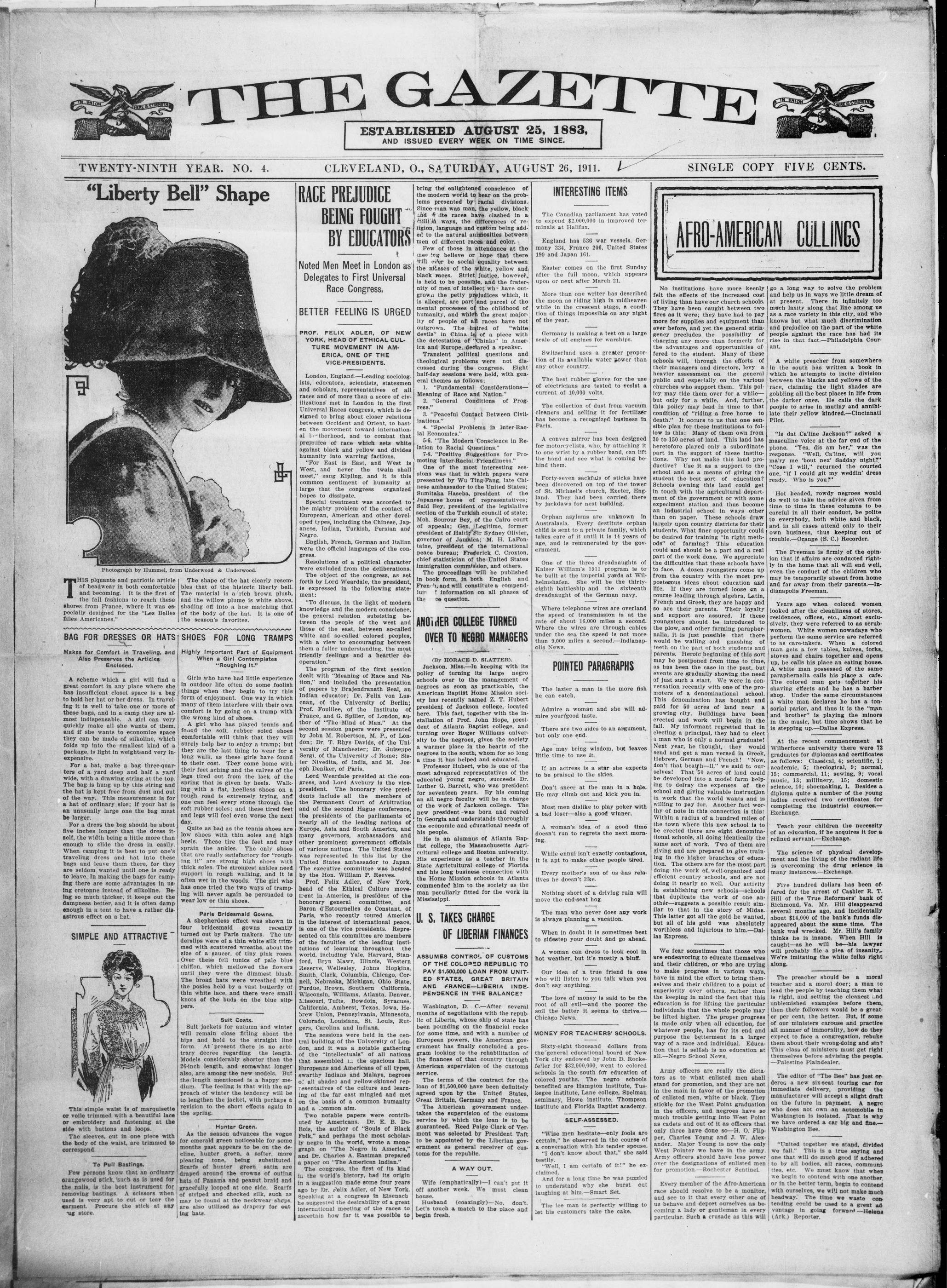
THIS piquante and patriotic article of headwear in both comfortable and becoming. It is the first of the fall fashions to reach these shores from France, where it was especially designed for the "Les Belles filles Americas."
Makes for Comfort in Traveling, and Also Preserves the Articles Enclosed.
A scheme which a girl will find a great comfort in any place where she has insufficient closet space is a bag to hold her hat or her dress. In traveling it is well to take one or more of these bags, and in a camp they are almost indispensable. A girl can very quickly make all she wants of them, and if she wants to economize space they can be made of silkline, which folds up into the smallest kind of a package, is light in weight and very inexpensive.
For a hat, make a bag three-quarters of a yard deep and half a yard wide, with a drawing string at the top. The bag is hung up by this string and the hat is kept free from dust and out of the way. This measurement is for a hat of ordinary size; if your hat is an unusually large one the bag must be larger.
For a dress the bag should be about five inches longer than the dress itself, the width being a little more than enough to slide the dress in easily. When camping it is best to put one's traveling dress and hat into these bags and leave them there, for they are seldom wanted until one is ready to leave. In making the bags for camping there are some advantages in using cretonne instead of silkline. Being so much thicker, it keeps out the dampness better, and it is often damp enough in a tent to have a rather disastrous effect on a hat.
SIMPLE AND ATTRACTIVE
This simple waist is of marquisette or volle trimmed with a beautiful lace or embroidery and fastening at the side with buttons and loops.
The sleeves, cut in one piece with the body of the waist, are trimmed to correspond.
To Pull Bastings.
Few persons know that an ordinary orangewood stick, 'such as is used for the nails, is the best instrument for removing bastings. A scissors when used is very apt to cut or tear the earment. Procure the stick at any ug store.
THE GAZETTE
The shape of the hat clearly resembles that of the historic liberty bell. The material is a rich brown plush and the willow plume is white above, shading off into a hue matching that of the season's favorites. It is one of the season's favorites.
Highly Important Part of Equipment When a Girl Contemplates "Roughing It."
Girls who have had little experience in outdoor life often do some foolish things when they begin to try this form of enjoyment. One way in which many of them interfere with their comfort is by going on a tramp with the wrong kind of shoes.
A girl who has played tennis and found the soft, rubber soled shoes comfortable will think that they will surely help her to enjoy a tramp; but they are the last thing to wear for a long walk, as these girls have found to their cost. They come home with their feet aching and the calves of the legs tired out from the lack of the spring that is given by heels. Walking with a flat, heelless shoes on a rough road is extremely trying, and one can feel every stone through the soft rubber soles; and these tired feet and legs will feel even worse the next day.
Quite as bad as the tennis shoes are low shoes with thin soles and high heels. These tire the feet and may sprain the ankles. The only shoes that are really satisfactory for "roughing it" are strong high shoes with thick soles. The strongest ankles need support in rough walking, and it is often wet in the woods. The girl who has once tried the two ways of tramping will never again be persuaded to wear low or thin shoes.
Paris Bridesmaid Gowns
A shepherdess effect was shown in four bridesmaid gowns recently turned out by Paris makers. The underslips were of a thin white silk trimmed with scattered wreaths, about the size of a saucer, of tiny pink roses. Over these fell tunics of pale blue chiffon, which mellowed the flowers until they were the dimmest blush. The broad hats were wreathed with the posies held by a vast butterfly of thin white lace, and there were small knots of the buds on the blue slippers.
Suit Coats.
Suit jackets for autumn and winter will remain close fitting about the hips and hold to the straight line form. At present there is no arbitrary decree regarding the length Models considerably shorter than the 26-inch length, and somewhat longer also, are among the new models. But the length mentioned is a happy medium. The feeling is that with the approach of winter the tendency will be to lengthen the jacket, with perhaps a revision to the short effects again in the spring.
Hunter Green.
As the season advances the vogue for emerald green noticeable for some months past appears to be on the decline, hunter green, a softer, more pleasing tone, being substituted. Scarfs of hunter green satin are draped around the crowns of outing hats of Panama and peanut braid and gracefully looped at one side. Scarfs of striped and checked silk, such as may be found at the neckwear shops, are also utilized as drapery for outing hats.
ESTABLISHED AUGUST 25, 1883 AND ISSUED EVERY WEEK ON TIME SINCE.
RACE PREJUDICE BEING FOUGHT BY EDUCATORS
Noted Men Meet in London as Delegates to First Universal Race Congress.
BETTER FEELING IS URGED
PROF. FELIX ADLER, OF NEW YORK, HEAD OF ETHICAL CULTURE MOVEMENT IN AMERICA, ONE OF THE VICE-PRESIDENTS.
London, England.—Leading sociologists, educators, scientists, statesmen and scholars, representatives of all races and of more than a score of civilizations met in London in the first Universal Races congress, which is designed to bring about closer relations between Occident and Orient, to hasten the movement toward international brotherhood, and to combat that prejudice of race which sets white against black and yellow and divides humanity into warring factions.
"For East is East, and West is West, and never the twain shall meet," sang Kipling, and it is this common sentiment of humanity at large that the congress organized hopes to dissipate.
Special treatment was accorded to the mighty problem of the contact of European, American and other developed types, including the Chinese, Japanese, Indian, Turkish, Persian and Negro.
English, French, German and Italian were the official languages of the congress.
Resolutions of a political character were excluded from the deliberations. The object of the congress, as set forth by Lord Weardale, the president, is expressed in the following statement:
"To discuss, in the light of modern knowledge and the modern conscience, the general relation subsisting between the people of the west and those of the east, between so-called white and so-called colored peoples, with a view to encouraging between them a fuller understanding, the most friendly feelings and a heartier cooperation."
The program of the first session dealt with "Meaning of Race and Nation," and included the presentation of papers by Brajendranth Seal, an Indian educator; Dr. Felix von Luscan, of the University of Berlin; Prof. Foullee, of the Institute of France, and G. Spiller, of London, author of "The Mind of Man." At the second session papers were presented by John M. Robertson, M. P., of London; Dr. T. Rhys Davids, of the University of Manchester; Dr. Guiseppe Sergi, of the University of Rome; Sister Nivedita, of India, and M. Joseph Deniker, of Paris.
Lord Weardale presided at the congress, and Lord Aveybury is the vicepresident. The honorary vicepresidents include all the members of the Permanent Court of Arbitration and of the second Hague conference, the presidents of the parliaments of nearly all of the leading nations of Europe, Asia and South America, and many governors, ambassadors and other prominent government officials of various nations. The United States was represented in this list by the United States ambassador to Japan. The executive committee was headed by the Hon. William P. Reeves. Prof. Felix Adler, of New York, head of the Ethical Culture movement in America, is president of the honorary general committee, and Baron d'Estournelles de Constant, of Paris, who recently toured America in the interest of international peace, is one of the vice presidents. Represented on this committee are members of the faculties of the leading institutions of learning throughout the world, including Yale, Harvard, Stanford, Bryn Mawr, Illinois, Western Reserve, Wellesley, Johns Hopkins, Smith, Clark, Columbia, Chicago, Cornell, Nebraska, Michigan, Ohio State, Purdue, Brown, Southern California, Wisconsin, Williams, Atlanta, Denver, Missouri, Tufts, Bowdoin, Syracuse, California, Amherst, Texas, Iowa, Hebrew Union, Pennsylvania, Minnesota, Colorado, Louisiana, St. Louis, Rutgers, Carolina and Indiana.
The sessions were held in the central building of the University of London, and it was a notable gathering of the "intellectuals" of all nations that assembled in the spacious hall. Europeans and Americans of all types, swarthy Indians and Malays, negroes of all shades and yellow-skinned representatives of the culture and learning of the far east mingled and met on the basis of a common humanity and a common aim.
Two notable papers were contributed by Americans. Dr. E. B. DuBois, the author of "Souls of Black Folk," and perhaps the most scholarly negro in the world, wrote a monograph on "The Negro in America," and Dr. Charles A. Eastman prepared a paper on "The American Indian."
The congress, the first of its kind in the world's history, had its origin in a suggestion made some four years ago by Dr. delix Adler, of New York. Speaking at a congress in Eisenach, he suggested the desirability of a great international meeting of the races to ascertain how far it was possible to
bring the enlightened conscience of the modern world to bear on the problems presented by racial divisions. Since man was man, the yellow black and white races have clashed in a chillin' ways, the differences of religion, language and custom being added to the natural animosities between men of different races and color. Few of those in attendance at the meeting believe or hope that there will ever be social equality between the nffsses of the white, yellow and black races. Strict justice, however, is held to be possible, and the fraternity of men of intellect who have outgrown the petty prejudices which it is alleged, are part and parcel of the mental processes of the childhood of humanity, and which the great majority of people of all races have not outgrown. The hatred of "white devils" in China is of a piece with the detestation of "Chinks" in America and Europe, declared a speaker. Transient political questions and theological problems were not discussed during the congress. Eight half-day sessions were held, with general themes as follows:
1. "Fundamental Considerations—Meaning of Race and Nation."
2. "General Conditions of Progress."
3. "Peaceful Contact Between Civilizations."
4. "Special Problems in Inter-Racial Economics."
5-6. "The Modern Conscience in Relation to Racial Questions."
7-8. "Positive Suggestions for Promoting Jute-Racial, Friendliness."
One of the most interesting sessions was that in which papers were presented by Wu Ting,Fang, late Chinese ambassador to the United States; Sumitaka Haseba, president of the Japanese house of representatives; Said Bey, president of the legislative section of the Turkish council of state; Moh. Sourn Bey, of the Cairo court of appeals; Gen. Jlegitime, former president of Halifat Sir Sydney Olliver, governor of Jamaica; M. H. LaFonteine, president of the international peace bureau; Frederick C. Croxon, chief statistician of the United States immigration commission, and others.
The proceedings will be published in book form, in both English and French, and will constitute a compendium of information on all phases of the ice question.
ANOTHER COLLEGE TURNED OVER TO NEGRO MANAGERS
(By HORACE D. SLATTER)
(JBY HORACE D. SLATTER)
Jackson, Miss.—In keeping with its policy of turning its large negro schools over to the management of negroes as soon as practicable, the American Baptist Home Mission society has recently named Z. T. Hubert president of Jackson college, located here. This fact, together with the installation of Prof. John Hope, president of Atlanta Baptist college, and turning over Roger Williams university to the negroes, gives the society a warmer place in the hearts of the negroes in the south, whom for so long a time it has helped and educated.
Professor Hubert, who is one of the most advanced representatives of the educated young negro, succeeds Dr. Luther G. Barrett, who was president for seventeen years. By his coming an all negro faculty will be in charge of the work of Jackson college. The new president was born and reared in Georgia and understands thoroughly the economic and educational needs of his people.
He is an alumnus of Atlanta Baptist college, the Massachusetts Agricultural college and Boston university. His experience as a teacher in the State Agricultural college of Florida and his long business connection with the Home Mission schools in Atlanta commended him to the society as the man peculiarly fitted for the work in Mississippi.
U. S. TAKES CHARGE
OF LIBERIAN FINANGES
ASSUMES CONTROL OF CUSTOMS OF THE COLORED REPUBLIC TO PAY $1,500,000 LOAN FROM UNITED STATES, GREAT BRITAIN AND FRANCE—LIBERIA INDEPENDENCE IN THE BALANCE
Washington, D. C.—After several months of negotiations with the republic of Liberia, whose ship of state has been pounding on the financial rocks for some time, and with a number of European powers, the American government has finally concluded a program looking to the rehabilitation of the finances of that country through American supervision of the customs service.
The terms of the contract for the loan of $1,500,000 have been definitely agreed upon by the United States, Great Britain, Germany and France.
The American government undertakes the supervision of the customs service by which the loan is to be guaranteed. Reed Paige Clark of Vermont was selected by President Taft to be appointed by the Liberian government as general receiver of customs for the republic.
A WAY OUT.
Wife (emphatically)—I can't put it off another week. We must clean house.
Husband (coaxingly)—No, don't. Let's touch a match to the place and begin fresh.
INTERESTING ITEMS
The Canadian parliament has voted to expend $2,000,000 in improved terminals at Halifax.
England has 536 war vessels, Germany 334, France 206, United States 199 and Japan 161.
Easter comes on the first Sunday after the full moon, which appears upon or next after March 21.
More than one writer has described the moon as riding high in midheaven while in the crescent stage, a condition of things impossible on any night of the year.
Germany is making a test on a large scale of oil engines for warships.
Switzerland uses a greater proportion of its available water power than any other country.
The best rubber gloves for the use of electricians are tested to resist a current of 10,000 volts.
The collection of dust from vacuum cleaners and selling it for fertilizer has become a recognized business in Paris.
A convex mirror has been designed for motorcyclists, who, by attaching it to one wrist by a rubber band, can lift the hand and see what is coming behind them.
Forty-seven sackfruits of sticks have been discovered on top of the tower of St. Michael's church, Exeter, England. They had been carried there by jackdaws for nest building.
Orphan asylums are unknown in Australasia. Every destitute orphan child is sent to a private family, which takes care of it until it is 14 years of age, and is remunerated by the government.
One of the three dreadnaughts of Kaiser William's 1911 program is to be built at the imperial yards at Wilhelmshafen. She will be the thirty-eighth battleship and the sixteenth dreadnaught of the German navy.
Where telephone wires are overland the speed of transmission is at the rate of about 16,000 miles a second. Where the wires are through cables under the sea the speed is not more than 9,000 miles a second.—Indianaapolis News.
POINTED PARAGRAPHS
The lazier a man is the more fish he can catch.
Admire a woman and she will admire your good taste.
There are two sides to an argument, but only one end.
Age may bring wisdom, but leaves little time to use it.
If an actress is a star she expects to be praised to the skies.
Don't sneer at the man in a hole. He may climb out and kick you in.
Most men dislike to play poker with a bad loser—also a good winner.
A woman's idea of a good time doesn't run to regrets the next morning.
While ennui isn't exactly contagious, it is apt to make other people tired.
Every mother's son of us has relatives he doesn't like.
Nothing short of a driving rain will move the end-seat hog.
The man who never does any work is always planning a vacation.
In when doubt it is sometimes best to sidestep your doubt and go ahead.
A woman can dress to look cool in hot weather, but it's mostly a bluff.
Our idea of a true friend is one who will listen to you talk when you don't say anything.
The love of money is said to be the root of all evil—and the poorer the soil the better it seems to thrive.—Chicago News.
MONEY FOR TEACHERS' SCHOOLS.
Sixty-eight thousand dollars from the general educational board of New York city endowed by John D. Rockefeller for $23,000,000, went to colored schools in the south for education of colored youths. The negro schools benefited are Hampton institute, Tuskegee institute, Lane college, Spelman seminary, Howe institute, Thompson institute and Florida Baptist academy.
SELF-ASSESSED.
"Wise men hesitate—only fools are certain," he observed in the course of a conversation with his tender spouse. "I don't know about that," she said testily.
"Well, I am certain of it!" he exclaimed.
And for a long time he was puzzled to understand why she burst out laughing at him.—Smart Set.
The ice man is perfectly willing to let his customers take the cake.
AFRO-AMERICAN CULLINGS
No institutions have more keenly felt the effects of the increased cost of living than have our church schools. They have been caught between two fires as it were; they have had to pay more for supplies and equipment than ever before, and yet the general stringency precludes the possibility of charging any more than formerly for the advantages and opportunities offered to the student. Many of these schools will, through the efforts of their managers and directors, levy a heavier assessment on the general public and especially on the various churches who support them. This policy may tide them over for a while—but only for a while. And, further, this policy may lead in time to that condition of "riding a free horse to death." It occurs to us that one sensible plan for these institutions to follow is this: Many of them own from 30 to 150 acres of land. This land has played played only a subordinate part in the support of these institutions. Why not make this land productive? Use it as a support to the school and as a means of giving the school the best sort of education? Schools owning this land could in touch with the agricultural department of the government or with some experiment school in ways other than on paper. These schools draw largely upon country districts for their students. What finer opportunity could be desired for training "in right methods" of farming? This education could and should be a part and a real part of the work done. We appreciate the difficulties that these schools have to face. A dozen youngsters come up from the country with the most preposterous ideas about education and life. If they are turned loose on a course leading through algebra, Latin, French and Greek, they are happy and so are their parents. Their loyalty and support are assured. If these youngsters should be introduced to the plow, and other farming paraphernalia, it is just possible that there would be wailing and gnashing of teeth on the part of both students and parents. Herole beginning of this sort may be postponed from time to time, as has been the case in the past, but events are gradually showing the need of just such a start. We were in conversation recently with one of the promoters of a denominational school. This denomination has bought and paid for 50 acres of land near a growing city. Buildings have been erected and work will begin in the fall. My informant regretted that in electing a principal, they had to elect a man who is only a normal graduate. Next year, he thought, they would send and get a man versed in Greek Hebrew, German and French: "Now don't that beath—ill" we said to our friend that 50 acres of land could be developed into a model farm helping to defray the expenses of the school and giving valuable instruction in work that the world wants and is willing to pay for. Another fact worthy of note in this connection is this: Within a radius of a hundred miles of the town where this new school is to be erected there are eight denominational schools, all doing identically the same sort of work. Two of them are giving and are prepared to give training in the higher branches of education. The others are for the most part doing the work of well-organized and efficient country schools, and are not doing it nearly so well. Our activity in establishing new schools—schools that duplicate the work of one another—suggests a possible result similar to that in the story of Midas. This latter got all the gold he wanted, but all of his gold was absolutely worthless and injurious to him—Dallas Express.
We fear sometimes that those who are endeavoring to educate themselves and their children, or who are trying to make progress in various ways, have in mind the effort to bring themselves and their children to a point of superiority over others, rather than the keeping in mind the fact that this education is for lifting the particular individuals that the whole people may be lifted higher. The proper progress is made only when all education, for whatever people, has for its end and purpose the betterment in a larger way of a race and individual. Education that is selfish is no education at all.—Negro School News.
Army officers are really the dictators as to what enlisted men shall stand for promotion, and they are not in the main in favor of the promotion of enlisted men, white or black. They stickle for the West Point graduation in the officers, and negroes have so much trouble getting into West Point as cadets and out of it as officers that only three have done so—H. O. Flipper, Charles Young and J. W. Alexander. Major Young is now the only West Pointer we have in the army. Army officers should have less power over the designations of enlisted men for promotion—Rochester Sentinel.
Every member of the Afro-American race should resolve to be a monitor, and see to it that every other one of us behave and deport ourselves as becoming a lady or gentleman in every particular. Such a crusade as this will
go a long way to solve the problem and help us in ways we little dream of at present. There in infinitely too much laxity along that line among us as a race variety in this city, and who knows but what much discrimination and prejudice on the part of the white people against the race has had its rise in that fact.—Philadelphia Courant.
A white preacher from somewhere in the south has written a book in which he attempts to incite division between the blacks and yellows of the race, claiming the light shades are gobbling all the best places in life from the darker ones. He calls the dark people to arise in mutiny and annihilate their yellow kindred—Cincinnati Pilot.
"Is dat Ca'line Jackson?" asked a masculine voice at the far end of the phone. "Yes, dis am her," was the response. "Well, Ca'line, will you mary me 'bout nex' Sadday night?" "Cose I will," returned the courted one, 'if I could git my weddin' dress ready. Who is you?"
Hot headed, rowdy negroes would do well to take the advice given from time to time in these columns to be careful in all their conduct, be polite to everybody, both white and black, and in all cases attend only to their own business, thus keeping out of trouble.—Orange (S. C.) Recorder.
The Freeman is firmly of the opinion that if affairs are conducted rightly in the home that all will end well, even the conduct of the children who may be temporarily absent from home and far away from their parents.—Indianapolis Freeman.
Years ago when colored women looked after the cleanliness of stores, residences, offices, etc., almost exclusively, they were referred to as scrubwomen. White women nowadays who perform the same service are referred to as care-takers. When a colored man gets a few tables, knives, forks, stoves and chairs together and opens up, he calls his place an eating house. A white man possessed of the same paraphernalia calls his place a cafe. The colored man gets together his shaving effects and he has a barber shop. Under the same circumstances a white man declares he has a torsional parlor, and thus it is the "man and brother" is playing the minors in the music, but time shows that he is stepping up.—Dallas Express.
At the recent commencement at Wilberforce university there were 72 graduates for diplomas and certificates as follows: Classical, 4; scientific, 1; academic, 5; theological, 9; normal, 15; commercial, 11; sewing, 9; vocal music, 13; millinery, 15; domestic science, 10; shoemaking, 1. Besides a diploma quite a number of the young ladies received two certificates for completing the industrial courses.—Exchange.
Teach your children the necessity of an education, if he acquires it for a refined servant.—Exchange.
The science of physical development and the living of the radiant life is overcoming the drug science in many instances.—Exchange.
Five hundred dollars has been offered for the arrest of Cashier R. T. Hill of the True Reformers' bank of Richmond, Va. Mr. Hill disappeared several months ago, and incidentally about $14,000 of the bank's funds disappeared about the same time. The bank was wrecked. Mr. Hill's family thinks he is insane. When Hill is caught—as he will be—his lawyer will probably file a plea of insanity. We're imitating the white folks right along.
The preacher should be a moral teacher and a moral doer; a man to lead the people by teaching them what is right, and setting the cleanest and unblemished examples before them, then their followers would be a greater per cent, the better. But, if some of our ministers carouse and practice all manner of immorality, how do they expect to face a congregation, rebuke them about their wrong-doing and sin? This class of ministers must get right themselves before advising the people. —Palestine Plaindealer.
The editor of "The Bee" has just ordered a new six-seat touring car for immediate delivery, providing the manufacturer will accept a slight draft on the future in payment. A negro who does not own an automobile in Washington is isolated. That is why we have ordered a car big and fine.—Washington Bee.
"United together we stand, divided we fall." This is a true saying and one that will do much good if adhered to by all bodies, all races, communities, etc. We must know that when we begin to contend with one another, or in the better term, begin to contend with ourselves, we will not make much headway. The time we waste contending could be used to a great ad vantage in going forward—Helena (Ark.) Reporter.
One Year.....$1.50
Six Months.....1.00
Three Months......50
Subscribers are requested to remit by postoffice money order or registered letter.
Entered at the postoffice in Cleveland Ohio, as second-class matter
Address all communications to HARRY C. SMITH
Editor and proprietor, THE GAZETTE,
Blackstone Building, Cleveland, O.
Member Ohio Legislature: 1894
to 1896: 1896 to 1898: 1900 to 1902
THE GAZETTE is the oldest, and has the largest bona fide circulation, double that of any newspaper in the interest of Afro-Americans, published in the state of Ohio, and comparison with any will immediately establish its rank as one of the NEWSIEST AND BEST in the country.
THE GEORGIA MASSACRE.
The so-called "race war" near Donaldsonville, Georgia, the first of the week, was in reality nothing less than another wholesale massacre of Negroes, on the order of that terrible Palestine, Texas, massacre of a year or two ago. For several days, and nights bands of white brutes scoured the country in the vicinity of Donaldsonville, killing and whipping Negroes and burning their churches, lodge rooms and schoolhouses, and seemed determined to run every Negro out of that section of the state. Well-informed persons say at least ten dead Negroes were counted in the woods. Nearly 100 were whipped and at least a dozen churches, lodge rooms and school houses were burned. The glaring attempt of the dispatches to the daily newspapers of the country, to justify or excuse the barbaric demonstration and slaughter, was so thin that any intelligent reader could easily "see through it." The fact is that Georgia did not propose to be outdone in the lynch-murder "business" by the Oklahoma and Pennsylvania lynch murders of last week. When the whole truth reaches the news-surface if it ever does, it will be found that many more than ten Negroes were killed in this Donaldsonville massacre and many more buildings were destroyed that the aforementioned dispatches to the daily papers, announced. Words fall us, to properly characterize this latest southern horror.
ELKS' GRAND OFFICERS!
Also Those of the "Daughters
Elks"<sup>a</sup>—Dedicated—Next
to the Meeting, Place
Boston, Mass.—At noon, Aug. 12, the 12th annual convention of the Improved Benevolent Protective Order of Elks of the World was brought to a close. Dayton, O., was chosen as the next meeting place. The election of grandlord officers took place after H'clock in the evening. The result of the election was to appoint L. M. Morris, Garage E. Bates, G. S. Jersey City; William E. Gales, G. T. Anacostia, Md.; K. G. Nutter, G. E. L. K. Charleston, W. Va.; Stewart E. Hoyt, G. E. L. K. Boston; William E. Leonard, G. E. L. K. Philadelphia; David Tresvain, G. O., Detroit; Dr. R. E. Jones, G. M. E., Richmond, V.; J. J. Jones, G. E., Chicago; J. Clay Smith, G. Esq., Washington, D. C. Silver cups were awarded to O. V. Catto lodge, Philadelphia, and its band for best appearance; Monarch lodge of men in the parade; number of members in the parade; Harrisburg lodge, for the smallest number of men in the parade; Ira Donaldson of Hawaii, the delegate coming the longest distance.
The grand temple of Daughters of Elks closed its sixth annual session in Investigator hall at 7:30 p. m., and then went to Faundu hall to a reception at which Acting Mayor Collins and several state and city officials were present. The election resulted in the appointment of Mary and Frances Young, G. T., Hampton, Va.; Lottie Kermit, V. D. R., New York City; Mary A. Green, G. A. D. R., Cleveland, O.; Harriet Harding, G. C., Richmond, V.; Amanda Whitfield, G. E.; Maggie White, G. D., Cambridge, G. Mass.; Sarah Robinson, Norfolk, V.; Alice Johnson, Martha Trice, New York City; trustees.
The grand glove adjourned the new officers were installed by Hon. J. Frank Wheaton, P. G. E. R. He and Dr. Atkins, P. G. E. R., were presented with jewels.
ONE "TOUCH"—$175,000!
The "Black Prince," Known as Most Famous Pickpocket in the World, Again in New York.
New York City—Alfred Laxdale, said by the police to be one of the most successful crooks in the world, is here again after an absence of five years. Laxdale, who is a Negro of courtly manner, has piled his profession from Maine to California and in times of stress "jumped over the pond" to try the European capitals. Laxdale has long had the sobriquet of "The Black Prince." He is 48 years old and comes from Sidney, N. S. W. He is known to the police of the two continents also as Alfred Woods and James Ragsdale. He takes pride in the fact that notwithstanding his trade and the color of his skin he is at heart "a square man." Laxdale performed the feat one day many years ago of "Hifting $175,000 to touch," as he was when he was young in his prison. Now he is a sufferer from solitary rheumatism. The almament brought him to New York. He returned about three weeks ago for treatment, coming here after witnessing the coronation of King George and dining in London with Champion Jack Johnson.
Weighed 650 Pounds.
Toronto, Ont., Can.-Mrs. Sellia Campbell, the largest woman in the world, died here last Saturday. She toured with a circus for six years. At that time she weighed 650 pounds, but of late had failed considerably, weighing only 350 pounds at the time of her death. She weighed 450 pounds, and a sister weighed 450 pounds. Both were members of the race.
EDWARD W. DISSETTE, ESQ.
Candidate for a Republican Nomination for Municipal Judge, Subject to the Primary, Sept 5, 1911.
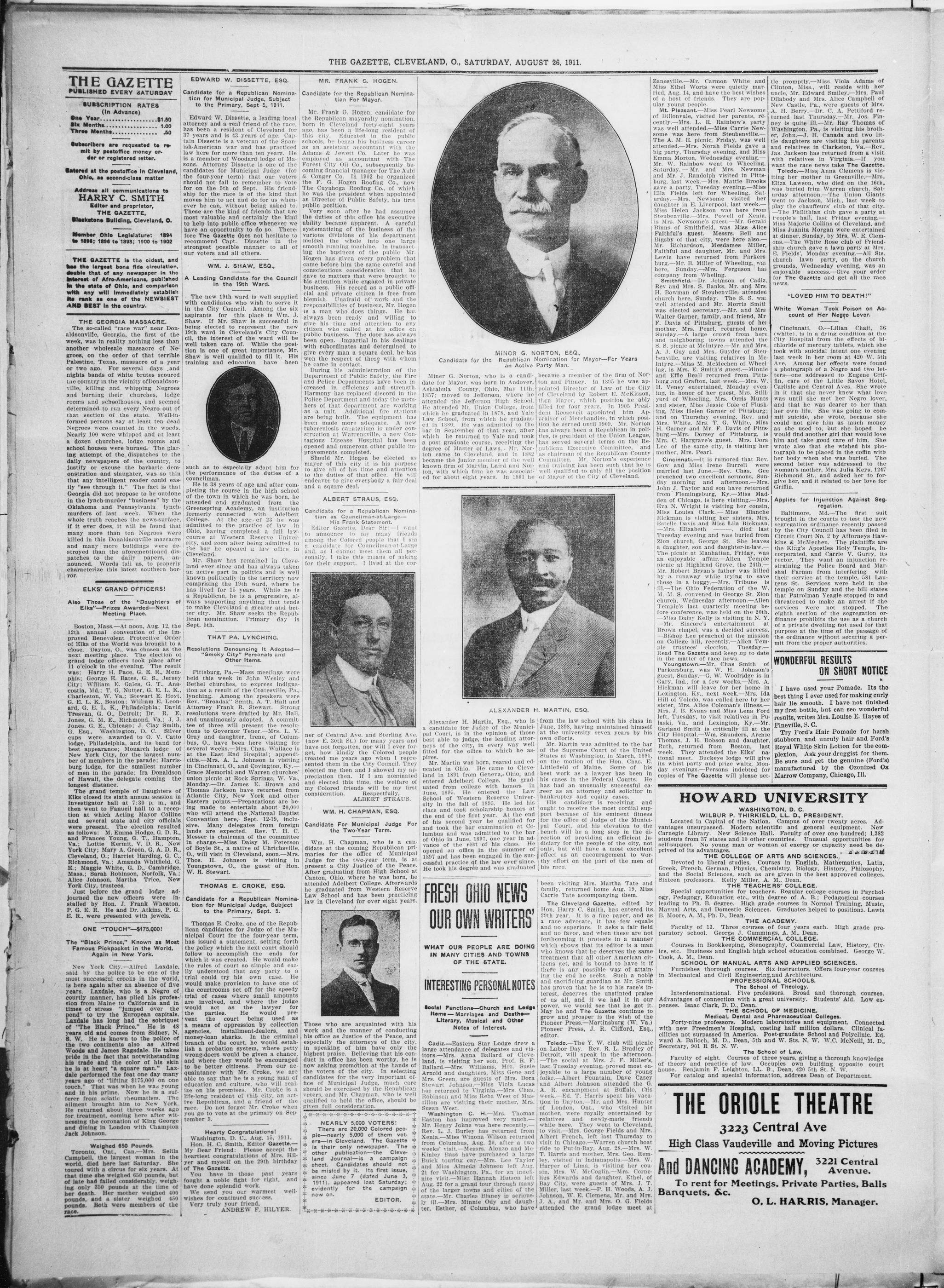
Edward W. Dissette, a leading local attorney and a real friend of the race, has been a resident of Cleveland for 37 years and is 43 years of age. Captain Dissette is a veteran of the Spanish-American war and has practiced here for more than ten years. He is a member of the Missouri Attorney Dissette is one of the candidates for Municipal Judge (for the four-year term) that our voters should not fail to remember to vote for on the 5th of Sept. His friendship for the race is of the kind that moves him to act and do for us when ever he can, without being asked to. These are the kind of friends that are most valuable and certainly the kind to help into public office whenever we have been born or where we fore The Gazette does not hesitate to recommend Capt. Dissette in the strongest possible manner to all of our voters and all others.
WM. J. SHAW. ESQ..
A Leading Candidate for the Council in the 19th Ward.
The new 19th ward is well supplied with candidates who wish to serve it in the City Council. Among the six aspirants for this place is Wm. J. Shaw. If Mr. Shaw is successful in being elected to represent the new 19th ward in Cleveland's City Council, the interest of the ward will be well taken care of. While the position is one of great importance, Mr. Shaw is well qualified to fill it. His training and education have been
such as to especially adapt him for the performance of the duties of a councilman.
He is 38 years of age and after completing the course in the high school of the town in which he was born, he attended and graduated from the Greenspring Academy, an institution formerly connected with Adelbert At the age of 23 he was admitted to the practice of law in Ohio, having completed a full law course at Western Reserve University, and soon after being admitted to the bar he opened a law office in Cleveland. Mr. Shaw has remained in Cleveland ever since and has always taken an active part in politics and is well known politically in the territory now comprising the 19th ward, where he has lived for 15 years. While he is a Republican, he is a progressive, albeit a moderate, speaking and that tends to make Cleveland a great city. Mr. Shaw seeks the Republican nomination. Primary day is Sept. 5th.
THAT PA. LYNCHING
Resolutions Denounce it Adopted — "Smoky Dog" Other Items.
Pittsburgh, Pa.—Mass meetings were held this week in John Wesley and Bethel churches, to express indignation as a result of the Coatiesville, Pa. lynchings. Among the speakers were Rev. "Broadax" Smith, A. T. Hall and Attorney Frank R. Stewart. Strong resolutions were drafted by Mr. Hall, and unanimously adopted. A committee of the Board of Governors to Governor Tener—Mrs. L. V. Gray and daughter, Irene, of Columbus, O., have been here visiting for several weeks—Mrs. Chas. Wallace is at the East End Hospital; appendicitis—Mrs. A. L. Johnson is visiting in Cincinnati, O., and Covington, Ky.—Grace Memorial and Warren churches union picnic at Rock Springs, W. Va. on June 14, 2014. Thomas Jackson have returned from Atlantic City, New York and other Eastern points.—Preparations are being made to entertain about 20,000 who will attend the National Baptist Convention here, Sept. 12-19, inclusive. Many delegates from foreign lands are expected. Rev. T. H. C. Messer is chairman of the committee of Boyle St., a native of Uhrichsville, O., will visit in Cleveland, soon.—Mrs. Thos. H. Johnson is visiting in Youngstown, O., the guest of Hon. W. R. Stewart.
THOMAS E. CROKE. ESQ.
Candidate for a Republican Nomination for Municipal Judge, Subject to the Primary, Sept. 5.
Thomas E. Croke, one of the Republican candidates for Judge of the Municipal Court for the four-year term, has issued a statement, setting forth the policy which the next court should follow to accomplish the ends for which it was created. He would make the rules of court so simple and easily understood that any party to a trial could try his own case. He would make provision to have one of the courtrooms set off for the speedy trial of cases where small amounts are involved, and where the judge would act as the interim presides. He would prevent the court being used as a means of oppression by collection agencies, installment-dealers, and money-loan sharks. In the criminal branch of the court, he would establish a probation system, where petty wrong-doers would be given a chance, and where they would be encouraged to be better citizens. From our acquaintance with Mr. Croke, we are able to say that he is a young man of education and culture, who will realize on his own that he is a resident of this city, an active Republican, and a friend of the race. Do not forget Mr. Croke when you go to vote at the primary on September 5.
Hearty Congratulations
Washington, D. C., Aug. 15, 1911.
Hon. H. C. Smith, Editor Gazette—
My Dear Friend: Please accept the
heartiest congratulations of Mrs. Hill
yer and myself on the 29th birthday
of The Gazette.
You have in those past years
fought for the fight for right, and
have done splendid work.
We send you our warmest well
wishes for continued success.
Very truly your friend,
ANDREW F. HILYER.
THE GAZETTE, CLEVELAND, O., SATURDAY, AUGUST 26, 1911
MR. FRANK G. HOGEN.
Candidate for the Republican Nomination For Mayot.
Mr. Frank G. Hogen, candidate for the Republican mayoralty nomination, born in Cleveland forty-eight years ago, has been a life-long resident of this city. Educated in the public schools, he began his business career as an assistant accountant with the Adams & Jewett Co. Later he was employed as accountant with The Forest City Oil Co., subsequently becoming financial manager for The Auld & Conger Co. In 1802 he organized the Cuyahoga Roofing Co. now The Cuyahoga Roofing Co., which he was the president when appointed as Director of Public Safety, his first public position.
Very soon after he had assumed the duties of this office his executive ability became apparent. A careful systematizing of the business of the various divisions of his department molded the whole into one large organization, managing the business of the public Mr. Hogen has given every problem that came before him the same careful and conscientious consideration that he gave to matters that were brought to his attention while engaged in private business. His record as a public official and private citizen is free from responsibilities of business, Mr. Hogen is a man who does things. He has always been ready and willing to give his time and attention to any citizen who called at his office on public business. The door has always been open. Impartial in his dealings with subordinates and determined to give every man a square deal, he has been in contact with those with whom he came in contact.
During his administration of the Department of Public Safety, the Fire and Police Departments have been increased in efficiency and strength. Harmony has replaced discord in the Police Department and today the members of that department are working as a unit. Additional fire stations are being built. The equipment has been made more adequate. A new tuberculosis sanatorium is under construction at Warrenville, a new Contagious Disease Hospital has been opened and numerous other public improvements completed. Should Mr. Hogen be elected as president of this his purpose to give all of his time and attention to the duties of that office. He will endeavor to give everybody a fair deal and a square deal.
ALBERT STRAUS, ESQ.
Candidate for a Republican Nomination as Councilman-at-Large—His Frank Statement.
Editor Gazette, Dear Sir:—I want to announce to my many friends among the Colored people that I am a candidate for Councilman-at-Large and, as I cannot meet them all personally, I take this means of asking for their support. I lived at the cor-
M. H.
ner of Central Ave. and Sterling Ave. (now E. 30th St.) for many years and have not forgotten, nor will I ever forget, how kindly the Colored people treated me years ago when I represeed me and I showed the Colored me then, and I showed my appreciation then. If I am nominated and elected this time, the welfare of my Colored friends will be my first consideration. Respectfully,
WM. H. CHAPMAN. ESQ.
Candidate For Municipal Judge For The Two-Year Term.
Wm. H. Chapman, who is a candidate at the coming Republican primaries for the office of Municipal Judge for the two-year term, is at present a City Justice of the Peace. After graduating from High School at Canton, Ohio, where he was born, he attended Adelbert College. Afterwards he graduated from Western Reserve Law School and has been practicing law in Cleveland for over eight years.
Those who are acquainted with his work and the manner of conducting his office as Justice of the Peace, and especially the attorneys of the city, in speaking of him have only the highest praise. Believing that his conduct in office has been worthy, he is now asking promotion at the hands of the voters of the city. In selecting candidates for the very important office of municipal Judge, each candidate should be exercised by the Republican voters, and Mr. Chapman, who is well qualified to hold the office, should be given full consideration.
NEARLY 5,000 VOTERS!
There are 20,000 Colored people—nearly 50% of the voters—Cleveland. The Gazette is their only newspaper. The other publication—the Cleveland Journal—is a campaign sheet. Candidates should not be misted by it. Its first issue, since June 7 (dated June 3, 1911), appeared last Saturday; evidently for the campaign now on.
[Name]
MINOR G. NORTON, ESQ.
Candidate for the Republican Nomination for Mayor—For Years an Active Party Man.
Miner G. Norton, who is a candidate for Mayor, was born in Andover, Ashtabula County, Ohio, May 11th, 1857; moved to Jefferson, Ohio, May 11th, 1857; attended the Jefferson High School. He attended Mt. Union College, from which he graduated in 1878, and Yale Law School, from which he graduated in 1880. He was admitted to the bar in September of that year, after which he returned to Yale and took a post graduate course, receiving the degree of Master of Laws. Mr. Norton came to Cleveland, and in 1882 became the Junior member of the wall committee. His experience has been such that it well qualified to ably fill the position for about eight years. In 1891 he
[Image of a man in a suit with a bow tie].
[Picture of a man in a suit with a bow tie].
ALEXANDER H. MARTIN, ESQ.
Alexander H. Martin, Esq., who is a candidate for Judge of the Municipal Court, is in the opinion of those best able to judge, the leading attorneys of the city, in every way well fitted for the office to which he aspires.
Mr. Martin was born, reared and educated in Ohio. He came to Cleveland in 1891 from Geneva, Ohio, and entered Adelbert College. He graduated from college with honors in June, 1895. He entered the Law School of Western Reserve University in the fall of 1895. He led his class and took scholarship honors at the end of the first year. At the end of his second year he qualified for and took the bar examination at Columbus and was admitted to the bar of Ohio in June, 1897, one year later. He opened an office in the summer of 1897 and has been engaged in the successful practice of the law ever since. He took his degree and was graduated
FRESH OHIO NEWS
OUR OWN WRITERS
WHAT OUR PEOPLE ARE DOING
IN MANY CITIES AND TOWNS
OF THE STATE.
INTERESTING PERSONAL NOTES
Social Functions—Church and Lodge
Items—Marriages and Deaths
—Literary, Musical and Other
Notes of Interest.
Cadiz.—Eastern Star Lodge drew a large attendance of delegates and visitors.—Mrs. Anna Ballard of Cleveland, is visiting her son, Prof. R. F. Ballard.—Mrs. Williams, Mrs. Susie Arnold and daughters, Miss Gene and Mrs. Green, are guests of Mrs. Dora Stewart Johnson—Miss Viola Lucas has returned to Virginia.—Mrs. Chas. Robinson and Miss Reba West of Mashon are visiting their mother, Mrs. peper.
Washington C. H.—Mrs. Thomas Easton has improved very much—Mr. Henry Johns was here recently.—Rev. L. J. Burley has returned from Xenia.—Miss Winona Wilson returned from Columbus, Aug. 20, after a two weeks' visit.—Messrs. Alonzo and McKinley Rose have purchased a large Kindler Rose have purchased a large Buck touring car.—Mrs. Lee Taylor and Miss Almeda Johnson left Aug. 21 for Washington, Pa., for an indefinite visit.—Miss Hannah Hutson left Aug. 22 for a grand tour through many of the larger towns and cities of the state.—Mr. Charles Blaney is seriously ill.—Mrs. Minnie Ody and daughter, Esther, of Columbus, who have
---
became a member of the firm of Norton and Pimney. In 1895 he was appointed Director of Law of the City of Cleveland by Robert E. Mckisson, then Mayor, which position he ably filled for four years. In 1905 President Roosevelt appointed him Appariser of Merchants to the United States in 1909. Mr. Norton has always been a Republican in politics, is president of the Union League, has served several terms on the Republican Executive Committee, and as chairman of the Republican County Committee. Mr. Norton's experience and training has enabled ably fill the position of Mayor of the City of Cleveland.
THE NEW YORK TIMES
from the law school with his class in June, 1898, having maintained himself at the university seven years by his own efforts.
Mr. Martin was admitted to the bar of the Supreme Court of the United States at Washington, in March, 1895, on the motion of the Hon. Charles E. McCarthy, of his best work as a lawyer has been in his cases in the Federal Courts. He has had an unusually successful career as an attorney and solicitor in bankruptcy and equity cases.
His candidacy is receiving and ought to receive the most cordial support because of his eminent fitness for the office of Judge of the Municipal Court, and his elevation to the bench will be a long step in the direction of providing an efficient judiciary for the people of the city, not only, but will have a most excellent effect as an encouragement to worthy effort on the part of the men of his race.
been visiting Mrs. Martha Tate and family, returned home Aug. 19, Miss Carrie Tate accompanying them.
The Cleveland Gazette, edited by Hon. Harry C. Smith, has entered its 29th year. It is a fine paper, and a race advocate, it has few equals and no superiors. It asks a fair field and no favor, and when these are not forthcoming it protests in a manner which shows that its editor is a man who knows that he deserves the same treatment that all other American citizens get, and is bound to have it if there is any possible way of attaining the end he seeks. Such a noble and sacrificing guardian as Mr. Smith has proven that he is to his race's interest, deserves the unstinted praise of us all, and if we had it in our hands we would have that way. May he and The Gazette continue to grow and prosper is the wish of the Pioneer Press.—Martinsburg (W. Va.) Pioneer Press, J. R. Clifford, Esq., editor.
Toledo—The Y. W. club will picnic on Labor Day. Rev. R. L. Bradley of Detroit, will speak in the afternoon. —The social at Mrs. J. F. Miller's, last Tuesday evening, proved most enjoyable to a large number of young folks—Albert Fountain, Dave Casey, and Robert Fountain. A. R. encampment at Buffalo, tis week.—Ed. T. Harris spent his vacation in Dayton.—Mr. and Mrs. Hunter of London. Ont., who visited his mother, were royally entertained by relatives and newly-made friends while here. They went to Cleveland, where they met the president of Albert French, left last Thursday to visit in Chicago.—Warren church boat ride to Put-in-Bay, Aug. 28.—Mrs. W. T. Harris and mother, Mrs. Geo. Remley, visited in Indianapolis.—Mrs. W. Harper of Lima, is visiting her cousin, Mrs. W. McCoglin—Mrs. Corneil Edwards and daughter, Ebel of, the family of Mrs. W. Harper, last week.—P. H. Woods, A. J. Johnson, W. E. Clemens, Mr. and Mrs. J. A., and Mr. and Mrs. O. G. Fields attended the grand lodge meet at
---
Zanesville—Mr. Carmon White and Miss Ethel Worts were quietly married, Aug. 14, and have the best wishes a host brings. They are popl
Mt. Pleasant—Miss Pearl Newsome of Dillowane, visited her parents, recently.—Mrs. L. R. Rainbow's party was well attended.—Miss Carrie Newsome was here from Steubenville.—The A. M. E. picnic. Friday, was well attended.—Mrs. Norah Fields gave a big party.—Miss Martha Morton, Wednesday evening.—Mr. W. Rainbow went to Wheeling, Saturday.—Mr. and Mrs. Newman and Mr. J. Randolph visited in Pittsburgh, last week.—Mrs. Mattie Brooks gave a party. Tuesday evening.—Miss Ella Fields left for Wheeling, Saturday.—Mrs. Newsome visited her daughter in Upper Pershing.—Mrs. Helen Jackson was here from Steubenville.—Mrs. Powell of Xenia is Mrs. Newsome's guest.—Mr. Gerald Binns of Smithfield, was Miss Alice Faithful's guest. Messrs. Bell and Bigsby of that city, were here also.—Mr. Richardson, Mesdames Miller, Faithful and daughter, Mr. and Mrs Lewis have returned from Parkersburg, but from Wheeling, was here. Sunday.—Mrs. Ferguson has company from Wheeling.
Smithfield.—Dr. Johnson of Cadiz, Rev and Mrs. S. Banks, Mrs. and Mrs. H. Bowman of Steubenville, attended church here, Sunday. The S. S. was well attended and Mr. Morris Smith was elected secretary.—Mr. and Mrs. Walter Garner, family, and friend, Mr. F. Davis of Pittsburg, guests of her mother, Mrs. Pearl, returned home, Sunday.—A large crowd from here arrived carrying baskets of S. plicantine olives.—Mr. and Mrs. A. J. Guy and Mrs. Guyder of Steubenville, are visiting relatives in McIntyre.—Miss M. McMechen of Wheeling, is Mrs. E. Smith's guest.—Minnie and Effie Beall returned from Pittsburg and Grafton, last week.—Mrs W. H. Veney entertained, Monday evening, in honor of her guest, Mrs. Still yard of Wheeling, Mrs. Orris Munts and sister, Miss Jessie Cole of Flushing, Miss Helen Garner of Pittsburg; and on Thursday evening, Rev. and Mrs. White, Mrs. G. F. Davis of Pittsburg; Mrs. Dorsey of Pittsburg, is Mrs. C. Hargrave's guest. Mrs. Dora Lee of the same city, is visiting her mother, Mrs. Pearl.
Cincinnati.—It is rumored that Rev. Gow and Miss Irene Burrell were married last June.—Rev. Chas. Gee preached two excellent sermons, Sunday morning and afternoon.—Mrs. John J. Taylor and son have returned from Flemingsburg, Ky.—Miss Madden of Chicago, is here visiting.—Mrs. D. A. Wright is visiting her husband. Miss Lee Clark, Miss Blanche, Rickman is visiting her sisters, Estelle Davis and Miss Lila Rickman.—Mrs. Elizabeth died last Tuesday evening and was buried from Zion church, George St. She leaves a daughter, son and daughter-in-law.—The picnic at Manhattan, Friday, was an enjoyable affair.—Allen Temple picnic at Highland Grove, the 24th.—Mr. Robert Bryan's father was killed by a runaway while trying to save those in bugs—Mrs. Tribune is ill.—The Ohio Federation of the W. M. M. S. convened in George St. Zion church, Wednesday afternoon.—Allen Temple's last quarterly meeting before conference, was held on the 20th.—Miss Dalsy Kelly is visiting in N. Y.—Mr. Sincor's entertainment at Brown chapel, was a decided success.—Bishop Lee preached at the mission on College hill, recently.—Allen Temple trustees' election.—Tuesday. Read the letter and keep up to date.
Youngstown—Mr. Chas Smith of Parkersburg, was W. H. Johnson's guest, Sunday—G. W. Woolridge is in Gary, Ind., for a few weeks. Mrs. A. Hickman will leave for her home in Lexington, Ky., next week—Mrs. Ida Lester, who is the sister, Mrs. Alice Coleman's illness. Mrs. J. B. Evans and Miss Lena Ford left, Tuesday, to visit relatives in Puaski, Va., and Lexington, Ky.-Mr. Garland Smith is critically ill at the City Hospital. Wm. Saunders, Archie Thomas, J. H. Bobson and daughter Ruth, returned from Boston, last week. The national meet Buckeye will give its whist party and prize waltz. Monday evenings—Persons indebted for copies of The Gazette will please set
HOWARD UNIVERSITY
WASHINGTON, D. C.
WILBUR P. THIRKIELD, LL.D, PRESIDENT.
Located in Capital of the Nation, Campus of over twenty acres. Advantages unsurpassed. Modern scientific and general equipment. New Carnegie Library. New Science Hall. Faculty of over one hundred; 1,332 students from 37 states and 10 other countries. Unusual opportunities for self-support. No young man or woman of energy or capacity need be deprived of its advantages.
THE COLLEGE OF ARTS AND SCIENCES.
Devoted to liberal studies. Courses in English, Mathematics, Latin, Greek, French, German, Physics, Chemistry, Biology, History, Philosophy, and the Social Sciences, such as are given in the best approved colleges. Sixteen professors. Kelly Miller, A. M., Dean.
THE TEACHERS' COLLEGE.
Special opportunities for teachers. Regular college courses in Psychology, Pedagogy, Education etc., with degree of A. B.; Pedagogical courses leading to Ph. B. degree. High grade courses in Normal Training, Music, Manual Arts, and Domestic Sciences. Graduates helped to positions. Lewis B. Moore, A. M., Ph. D., Dean.
THE ACADEMY.
Faculty of 13. Three courses of four years each. High grade preparatory school. George J. Cummings, A. M., Dean.
THE COMMERCIAL COLLEGE.
Courses in Bookkeeping, Stenography, Commercial Law, History, Civics, etc. Business and English high school education combined. George W. Cook, A. M., Dean.
SCHOOL OF MANUAL ARTS AND APPLIED SCIENCES.
Furnishes thorough courses. Six instructors. Offers four-year courses in Mechanical and Civil Engineering, and Architecture.
PROFESSIONAL SCHOOLS.
The School of Theology.
Interdenominational. Five professors. Broad and thorough courses.
Advantages of connection with a great university. Students' Aid. Low expenses. Isaac Clark, D. D., Dean.
THE SCHOOL OF MEDICINE.
Medical, Dental and Pharmaceutical Colleges.
Forty-nine professors. Modern laboratories and equipment. Connected with new Freedmen's Hospital, costing half million dollars. Clinical facilities not surpassed in America. Post-graduate School and Polyclinic. Ed. ward A. Balloch, M. D., Dean, 5th and W. Sts. N. W. W.C. McNeill, M. D., Secretary, 901 R St. N. W.
The School of Law.
Faculty of eight. Courses of three years, giving a thorough knowledge of theory and practice of law. Occupies own building opposite court house. Benjamin F. Leighton, LL. B., Dean, 420 5th St. N. W.
THE ORIOLE THEATRE
3223 Central Ave
High Class Vaudeville and Moving Pictures
And DANCING ACADEMY, 3221 Central
Avenue.
To rent for Meetings, Private Parties, Balls
Banquets, &c.
O. L. HARRIS, Manager.
tle promptly.—Miss Viola Adams of Clinton, Miss., will reside with her uncle, Mr. Edward Smiley.—Mrs. Paul Dilaboy and Mrs. Alice Campbell of New Castle, Pa., were guests of Mrs. A. H. Berry.—Dr. C. A. Pettiford returned last Thursday.—Mr. Jos. Funny is quite ill.—Mr. Jos. Pettiford is visiting his brother, John.—H. C. Canada and two little daughters are visiting his parents and relatives in Clarkston, Va.—Rev. Jas. Jackson has returned from a visit with relatives in Virginia.—If you want the race news take The Gazette. Toledo.—Miss Anna Clemens is visiting her mother in Greenville.—Mrs. Eliza Lawson, who died on the 16th, was buried frum Warren church. Saturday afternoon. The Union was a week to play the chauffeur's club of that city.
—The Philharmonic club gave a party at people's hall, last Friday evening. —Miss Majorie Collins of Cleveland, and Miss Juanita Morgan were entertained at dinner, Sunday, by Mrs. W. E. Clemens. —The White Rose club of Friendship church gave a lawn party at Mrs. E. Fields' Monday evening. —All Sts. Grounds. —The grounds. Wednesday evening, was an enjoyable success. —Give your order for The Gazette and get all the race news.
"LOVED HIM TO DEATH!"
White Woman Took Poison on Account of Her Negro Lover.
Cincinnati, O.-Lillian Chait, 36 (white), is in a dying condition at the City Hospital from the effects of bichloride of mercury tablets, which she took with suicidal intent one evening last week in her room at 420 W. 5th Ave. Among her effects were found a photograph of a Negro and two letters—one addressed to Eugene Griffin, care of the Little Savoy Hotel, of which she was in it that she never knew what love was until she met her Negro lover, and that he was dearer to her than her own life. She was going to commit suicide, she wrote, because she could not give him as much money as she used to, but she hoped he would find another girl that would love him and take good care of him. She wrote also that she wished his photograph to be placed in the coffin with her body when she was buried. The woman's mother, Mrs. Julia Keys, 1247 Richmond St., and asked her to forgive her, and it related to her love for Griffin.
Applies for Injunction Against Seg. regation.
Baltimore, Md.-The first suit brought in the courts to test the new segregation ordinance recently passed by the City Council has been filed in Circuit Court No. 2 by Attorneys Hawkins & MeChenne. The plaintiffs are the King's Apostles Holy Temple, Incorporated, and Carrie V. Gurry, its rector. They want an injunction restraining the Police Board and Marshal Farnan from interfering with their service at the temple, 581 Lauren St. in Temple Square, on Sunday and the bill states that Patrolman Yegle stopped in and threatened to make an arrest if the services were not stopped. The eighth section of the segregation ordinance prohibits the use as a church of a private dwelling not used for that purpose at the time of the passage of the ordinance without securing a permit from the proper authorities.
WONDERFUL RESULTS
ON SHORT NOTICE
I have used your Pomade. Its the best thing I ever used for making curly hair lie smooth. I have not finished my first bottle, but can see wonderful results, writes Mrs. Louise E. Hayes of Pineville, S. C.
Try Ford's Hair Pomade for harsh stubborn and unruly hair and Ford's Royal White Skin Lotion for the complexion. Ask your druggist for them. Be sure and get the genuine (Ford's) manufactured by the Ozonized Ox Marrow Company, Chicago, Ill.
Local News
PURCHASE
THE
"GAZETTE" AT
J. S. HALL'S, 3121 Central Ave.
L. SCHWARTZ'S, 2921 Central Ave. Open Sunday.
O. C. SCHROEDER'S, Cuyahoga Bldg. Open Sunday.
ELMER F. BOYD'S, 2604 Central Ave.
F. VALENTINE'S, 2130 Central Ave.
NOTICE TO SUBSCRIBERS:—Subscribers not receiving The Gazette regularly should notify us at once. We desire every copy delivered promptly. We advise our patrons to carefully examine The Gazette's advertisements before making purchases. Business men who advertise in this paper should have the patronage of Afro-Americans. The fact that they advertise is assurance that they want it. Local reading notices (advertisements) ten cents a line (six words in a line.)
NOTARY PUBLIC—For such services call at The Gazette office, No 3 Blackstone Building, No. 1422 W. 3rd street, near Superior avenue.
Wanted—A first-class, sober, industrious carriage-smith—one who knows the trade thoroughly; a married man who would be interested in acquiring and selling a good book for a good and capable man. Address The Gazette, Blackstone Bldg., Cleveland, O.
Prof. J. H. Holly of Albany, Ga., in the city. Mr. Wm. Smith of Washington, D. C., is visiting his brother, Mr. Cha Smith. Olivia L. Head of Princeton. Inn. visited Mr. and Mrs. C. C. Jackson of the F. 36th St.
FOR RENT—Seven Suites—Available Sept. 1, in St. Edwards block, 3852 Central Av. Steam heat and bath in all suites. Will fix them to tenant suits. Three suites, five rooms each, $20 per month each; three suites, six rooms each, $25; one suite, six rooms, $30. Apply at 2127 E. 105th St. Phone, Bell, Doan 2251. Ask for O. W. White. References required.
FOR SALE—Brand new, Imperial Encyclopedia and Dictionary, 40 volumes, finely illustrated, handy to handle. Unexcelled for reference purposes. A library in itself—one that will last a life-time. Contains every thing you may wish to know. Call or address, The Gazette, Blackstone Building, 1422 W. 3d St. Cleveland, O. near Superior Av. This is an opportunity of a life-time for those who love good books.
Mrs. G. Jones of Oberlin, was in the city, Sunday.
Mrs. Trimble is at Mt. Clemens, Mich., recuperating.
A number of persons attended the benefit for little Edwin Hill.
Mrs. S. Dixon of Buffalo, is visiting relatives in E. 40th St.
Mr. and Mrs. Parker of E. 37th St. have returned from Detroit. Mr. and Mrs. Geo. Carroll are visiting his son, William, in Chicago. Dwight Gordon of Canton, is stopping with Mrs. Taylor of E. 29th St. Mrs. Jesse Washington is visiting in Oberlin, the guest of Mrs. Seams. Mr. Ray Thomas of E. 31st St. has returned from a several weeks' touring trip. Mrs. Allen of E. 37th St. is visiting relatives in N. Y. City and Baltimore, Md. Dr. C. Letrobe Mottliy is spending a few weeks at Atlantic City, N. J., and other eastern points. Mrs. Frank Jones of Amherstburg, Ont., visited her sister, Mrs. Ellis of E. 30th St. Sunday. Miss Anna Carroll has returned after a pleasant visit with Rev. and Mrs. Ira A. Collins of Columbus. Mrs. Maxwell of Conneaut, is the guest of Mrs. C. Sweet of E. 37th St., who visited in Oberlin, last week. Mrs. Imees of Philadelphia, who visited Mr. and Mrs. Martin Imees of E. 31st St., returned home last Tuesday.
Mrs. R. Brown and sister, Mrs. T. Blinga of Detroit, have returned home. They were guests of Mrs. R. Campbell of Cedar Ave.
Mr. W. Black and Mrs. Cook of Detroit, attended the funeral of their brother, Mr. Sanford Black of Central Ave, who died the first of last week.
Mr. John Tuck of 3325 Central Ave, served at the Salem adjoining towns. Mrs. Lyda Williams of E. 33d St. is visiting her sister.
Mr. and Mrs. Hunter of London, Ont. Ca., are in the city visiting relatives and friends, coming here from Toledo where they visited his mother. Hon. Jere A. Brown was one of Governor Harmon's appointees to the National Educational Conference which met in Denver during the press month.
Mrs. and Mrs. J. E. Reed and Mrs. Gus Clark spent last Sunday in Lorain, guests of Mr. and Mrs. D. C. Fisher. They made the trip in Mr. Reed's auto.
Miss Anna Carroll gave a delightful lawn party recently in honor of Miss Lola Ruffin of Washington, D. C., Mrs. Clark and daughter, Mabel, of Xenia and Miss Margaret Anderson of Washington C. H. John of Circleville, is the guess of Mr. and Mrs. L. S. Jones of E. 30th St. He may locate here. Mr. Lewis represented The Gazette in Circleville some years ago. He paid our office a pleasant call, Monday. Forty members of the two local companies of U. R., K. of P., left Sunday for the national meeting at Indianapolis, and will return today. Peterson's band escorted them to the depot and had a special car. Mr. Robert Lawson, who was formerly assessor of the 11th ward, is a candidate for the City Council in that ward. He is well and favorably known in his ward, having lived there all of his life.
One person was viciously slashed, with a razor, across the face over the upper lip and marked for life, at the Forest St. Roller Rink, last week Monday evening. And many young people, even children, are permitted to attend the rink.
Do not forget to vote for Mathew Mitchell, candidate for Assessor of the new Eleventh ward. He is best qualified of any of the several candidates for the position, having had two years' experience as assistant assessor under the last assessor. Republican primaries, Sept. 5.
Olive Branch, Circle of King's Daughters and Sons, will hold its first annual rally at Antichoop church, Sunday at 3 p. m. Everyone is invited and attend and to be in the collection. The program is as follows: Song by the congregation, prayer, song by the Circle, welcome address by Mrs. Wm. Smith, solo by Miss Olive M. Wells, paper by Mrs. Goodhue, state sec, sermon by Dr. Webster of the C. M. E. church, selection by Miss Hester O. Brown, collection, benediction. Mrs. Wm. Smith, leader.
Prof. J. H. Holly of Albany, Ga., is in the city.
Mrs. Cora Washington of Arthur Ave, left Saturday to visit in Oberlin. J. H. Cisco and Will Jackson spent the first of the week in Washington, D.C.
Mr. Wm. Smith of Washington, D.C., is visiting his brother, Mr. Chas Smith.
Mr. Olivia L. Head of Princeton, Ind., visited Mr. and Mrs. C. C. Jackson of E. 36th St.
Benj. Shook, Jr. of Detroit, and two other members of the race there, have just opened a drug store in that city.
Mrs. Aria Sellers' mother, Mrs. Woodliff of Macon, Ga., died soon after the former's arrival there last week.
St. John's Church observed the fourth quarterly meeting, Sunday. Dr. J. H. Jones, presiding elder, preached, Mrs. Stevens and Mrs. Hurley of Akron, R. L. Morrison and sons of Wooster, were recent guests of Mr. and Mrs. S. T. Boyd of E. 82d St. Mrs. S. T. Boyd and his daughter, Bertha, have returned to Salem, after a pleasant visit with her sister, Mrs. John Smith of 3034 Cedar Ave.
Messrs. George and Hutchins Inge of St. Louis, Mo., en route home from the east, dined with their niece, Mrs. Edward Carter of E. 30th St., last week Wednesday.
About fifty young people attended the eighteenth anniversary party given by Mr. and Mrs. J. A. Rogers, last week Monday evening, in honor of other guests. Our voters in the 9th Ward will make no mistake in voting for Louis Hartman, candidate for councilman in that ward. He is an old Cleveland boy and a friend of the race.
A ward (republican) meeting was held at Oriole hall, Wednesday evening. Messrs. Minor G. Norton, W. B. Beebe, Cornelius Maloney, Albert Straus and Robert Lawson were advertised as the speakers, and Chas. S. Sutton, Esq., as chairman.
Wm. B. Dires of 7918 Quincy avenue does all kinds of mason work and plastering, lays cement sidewalks, lays dark bottoms, contracting and jobbing. All work guaranteed. Bell E. 1985-X.
Send your local items to The Gazette on Monday or Tuesday of each week. This paper is published for ALL of our people and "plays no favorites." Everybody is treated the same—fair and right. Take The Gazette and tell your friends to do so as "Great day at Shiloh," Sunday. The mortgage was burned and the members and friends of the church participated in a Thanksgiving service that will not soon be forgotten.
Mrs. Thomas Carroll, Mrs. Mary Turner, Mrs. Amanda King and Mrs. Joseph, Mrs. Elizabeth and Mrs. Monday, as delegates from Mt. Olive Lodge, No. 2, to the grand lodge of Good Samaritans and Daughters of Samaria.
Dr. J. K. Nickens received a telegram, Monday morning, from his wife, Mrs. Cornelia F. Nickens, announcing the death of her mother (in Indianapolis), Sunday night. Mrs. Nickens is expected to return to the city, the wife of the first of the next week. She has the earliest sympathy of many friends.
Mrs. Edw. Sain of Toledo, who visited her sister, Mrs. Etta Conwell of Collinwood, for three weeks, has returned home. Mrs. Conwell and Mrs. F Warren gave an enjoyable picnic with the family, Mrs. Conwell and aunt, on Aug. 15, and in the evening served an elaborate dinner. Covers were laid for ten. The home was beautifully decorated with masses of yellow blooms. Miss G. Brown rendered several instrumental selections and Mesdames Saln and Mrs. Conwell aptly. The day and evening's social dances proved most enjoyable indeed.
There were about forty to enjoy the rather unique manner in which Mrs. E. Gray announced the marriage of Francis E. Young and his bride of five months, Mrs. Ida Gray. Young, at their beautiful home at 188 Maple St., last summer, was artistically decorated in pink and white and the protusion of cut carnations and ferns is a rich scene of beauty and fragrance. The bride and groom left for New York, Atlantic City and several other eastern cities. They will reside in Cleveland. -Detroit Leader, Mr. and Mrs. Young, a former member of the week. She is a decided acquisition to our local social circles.
A girl at the soda fountain in the Bailey Co.'s store, was discharged last week by Manager Victor Sincere because she refused to give Mrs. Mattle Hunter of E. 29th St., proper service. He 'read the act act' to several other employees of the department and conided by saying: "I want you girls to understand that the Bailey Co.'s caters to all well-behaved people, and all, regardless of race or color, must be properly treated. There is no such thing as a 'color-line' in this store, anywhere. If there are any more complaints from this department, I will send them to Mrs. Hunter, turning to Mrs. Hunter said: "I greatly regret this occurrence and sincerely trust that there will be no more such in this store."
When your Gazettes are not delivered on Friday mornings,
call at your Central Postoffice
General Delivery Window for
them in the afternoon of the
same day. —Editor.
THE GAZETTE, CLEVELAND, O., SATURDAY, AUGUST 26, 1911.
Mrs. G. Hatcher is visiting in Richmond. No, for six or seven weeks.
mond, Va., for six or seven weeks.
Dunn & Moran have moved their barbershop to 3014 Central Ave., just east of E. 30th St.
Mr. and Mrs. A. H. Martin have as guests Mr. and Mrs. Brown, Mrs. Martin's parents.
Miss Cora Johnson went to Wooster, Tuesday, to spend a week with Mrs. R. L. Morrison.
D. C. Fisher, a representative business man of Lorain, visited The Gazette office while in the city Wednesday.
J. Andrews Young Ladies' Guild's stint on concert will be given Monday evening in the church parlor. An excellent program has been prepared.
J. H. Cisco has returned from St. Louis and Washington, D. C. He was the guest of Judge Terrell and Auditor Ralph Tyler, respectively, while at the national capital.
The Liberator extends congratulations to Editor Smith of the Cleveland Ohio Gazette on its 28th anniversary. As a brave, fearless champion of manhood rights the Gazette has rendered great service to the race. Editor Smith has just reasons to be proud.—Los Angeles (Cal.) Liberator.
The Cleveland (O.) Gazette with its last issue closed its 28th year and has the splendid record of issuing every week on time. Accept our congratulations. Bro. Smith, (dean of the may) an editorial corps), and may you always be as fortunate and may it bring you ever better results.—Louisville (Ky.) American Baptist, W. H. Steward, editor.
There were possibly 20 persons in attendance upon the (second) meeting at Shiloh church, in the parlors, Tuesday evening, of those interested in the selection of a proper person of the race, to stand as a candidate for state constitutional delegate, his candidate John P. Kearns candidacy, promoted by that Hollendens House delegates' meeting is not satisfactory to the great mass of our voters for many reasons. Therefore the recent meetings held in the parlors of St. John's and Shiloh churches. S. W. Woods presided and Prof. G. C. Sutton was secretary in attendance in attendance were Dr. Paxton of St. Andrew's church, Dr. J. K. Nickens, Messrs. R. K. Moon, Wm. Mintyre, Dallas Cooper, Walter
L. Brown, James M. Tilley, Dan Fairlake, Jr., W. E. Beacon, Geo. W. Johnson, Garrett A. Morgan, Geo. Jones, Attorneys Cheeks, Davis, Sutton, W. R. Green, and others. After full and free discussion of the matter it was unanimously decided to ask the team of The Gazette to stand as the race's candidate in this community for delegate to the state constitutional convention, and a committee, Messrs. Johnson and Nickens, were sent to his residence to bring him to the meeting. His arrival was greeted with enthusiastic applause. In his address, Mr. Smith made it clear that he would not be a candidate unless the majority of the thinking people of the race in this community wanted him to do so and would "in their opinion be most likely" in case he did comply with their unanimous endorsement and request. He also explained the importance of our having representation in that convention, etc., and was listened to with eagerness by all present. At the conclusion of his talk, a committee was appointed to take charge of future work in connection with the movement, and adjournment was taken to meet at the call of the chairman. In many respects, the meeting, like the one at the office, was uninterrupted in that way, was perfect harmony and unity of purpose, the best of good feeling and a determination to not permit certain white men of this community to dictate the selection of our people's representative in the state constitutional convention, even if they were shrewd enough to get a member of the race into their Hollenden House civic organization delegates' meetings. By the way, six of the ten candidates they endorsed have refused to accept said endorsement, and more are like that. In the case with the possible exception of one or two, are in hearty sympathy with the movement which has brought about the St. John and Shiloh parliors meeting. The one or two have not as yet expressed their views.
Greetings From South America.
Bahia, Brazil, June 21, 1911.
Editor Gazette, Dear Sir:—I am so favorably impressed with your splendid paper that I am taking advantage of this opportunity to say that The Gazette alone is proof of the Afro-American's ability to attain to the very highest education. I admire your journal because you write so strong and so broad, giving the subject of your race such perfect illustrations. This, however, should make all people of the race strive hard to bring this organ into a strong form. It is so healthy, so strong in character, so clean and generally interesting. With sincere best wishes, I am.
Yours respectfully.
(Prof.) Isaac S. Moore.
26 Runa Capitains.
Dunn & Moran
TONSORIAL PARLORS
"Four Barbers"
3014 Central Ave.
CLEVELAND.
FORD'S HAIR POMADE
MAKES PARSH, KINNY OR CRUELY HAIR
GLOSSY, SOFTEN AND MORE PLAIN,
EASY TO GND AND PUP UP IN ANY STYLE
THE LENGTH WILL PERMIT. UNCLEVELLED
FOR PREVENTING HAIR FALLS. FOR
SOUL BEAWARE OF IMITATIONS, GET THE GENUINE, PUP UP IN
25+ AND 50 BOTTLES WITH CHARLES FORD'S NAME ON
EVERY PACKAGE
TRY FORD'S ROYAL WHITE
SKIN LOTION FOR THE COMPLEXION,
MAKES THE SKIN WHITER IMEDIATELY
THE MOST DELICATE SKIN, UNCLEVELLED
FOR ECZEMA, SALT RHEUM, PIMPLES,
ROUGH SKIN AND FRECKLES.
SOLD BY DRUGGISTS. IF YOUR DRUGGIST CANNOT
SUPPLY YOU, WE WILL SEND IT TO YOU DISTRICT
THE BOLLING SKIN, WHILE ITS 20. LARGE USED BOTTLE.
50. THE OZONIZED OX MARROW CO.
232 LAKE DEPT. 297
CHICAGO, IL.
AGENTS WANTED.
F.W.FOSS@CO.,
4511 Payne Ave. EVERYTHING IN PRINTING. THE BEST WORK. MOST REASONABLE RATES.
The 42nd Annual Fair of the Colored A. & M. Association,
1911, on the beautiful grounds of the Trotting Association. LARGER and BETTER PREMIUMS, more free Attractions and first class music. A good time for everybody. Reduced Roatirad Rates on all roads into Lexington.
Opens First Tuesday In September
Located in Greene county, three and one-quarter miles from Xenia, O. Healthful surroundings. Refined community. Faculty of 32 members. Expenses low. Classical and Scientific, Theological, Preparatory, Music, Military, Normal and Business Departments. TEN INDUSTRIES TAUGHT. GREAT OPPORTUNITIES for High School Graduates entering College or Professional Courses. Ohio students desiring to enter Normal, Business or Industrial Department can obtain certificate from State Senator or Representative entitling them to FREE TUITION, ROOM RENT AND INCIDENTALS.
Matriculation Entrance Examinations, September 18 and 19. School Opens Tuesday, September 19, 1911. Catalogue and special information furnished. Address
W. A. JOINER, SUPT., C. N. & I. DEPARTMENT.
Cuv. Cen. 3328 K.
F. W. FOS
PROMPT I
4511 Pay
EVERYTHING IN PR
WORK. MOST REA
The 42nd Annual F
A. & M. A.
LEXINGTON, KY., SEPTEM
1911, on the beautiful grou
LARGER and BETTER PRE
and first class music. A good
Roailrad Rates on all roads i
T. J. Wilson, Pres.
Wilberforce
Wilberforce
Opens First Tues.
Located in Greene county, three
Healthful surroundings. Refined con-
penses low. Classical and Scientific
itary, Normal and Business Depart-
MENT GREAT OPPORTUNITIES for High
or Professional Courses. Ohio stud-
ness or Industrial Department can be
or Representative entitling them to
INCIDENTALS.
Matriculation Entrance Examinations;
Tuesday, September.
Catalogue and special information
W. A. JOINER, SUPT.,
JOHN T. TUCK & CO.
Dealers in
Wall Paper and
Paints.
Decorators, Paper Hangers and House Painters.
3325 Central Av.
'Phone, North 1153 and Cent. 6661-R.
Bell, Doan 1398-J, Residence
East 791-L, Office
4715 Central Ave., Cleveland, O.
Hours: 8 to 12 a.m., 1 to 5 p.m.
Sundays and Evenings by
Appointment
Phone Bell, North 1075-X
Cuy. Cent.
THOS. P. Mc PHILLIPS
Plumbing and
Sewer Building
All Work Given Prompt Attention
2079 E. 30th St. Cleveland, O.
WHO MAKES YOUR CLOTHES?
Rufus S. Justice
4316 Central Avenue,
Fine Custom Tailoring, Cleaning, Dye-
ing, Repairing and Pressing.
All work guaranteed.
Human Hair Goods at less
than Half Store Prices.
25c.
As an example, this beautiful pompadour, usually retailing for 75c. sold by mail, direct from importer for 25c.
Our illustrated free catalog describes this and other newest New York styles of hair dressing we sell by mail at half retail price.
This handsome barrette given free with every purchase of one dollar or over.
Natt & Co., 32 Union Square
New York City
Only
$65.00
No. 24 Southern Buggy
Highest Grade
A Valuel Unequaled. Sold on $4.
ProfitMargin
From
Factory to Use
Write for price
and other styles
Send on catalog
C. R. PATTERSON
& SONS.
GreenBold, Ohio
Largest Negro Cartridge concern in the United States.
A. L. Harden, Sec'y
University
Pace, Ohio.
Today in September
and one-quarter miles from Xenia, O.
community. Faculty of 32 members. Ex-
Theological, Preparatory, Music, Mil-
iments. TEN INDUSTRIES TAUGHT.
High School Graduates entering College
ents desiring to enter Normal, Busi-
btain certificate from State Senator
FREE TUITION, ROOM RENT AND
September 18 and 19. School Opens
ber 19, 1911.
Furnished. Address
W. S. SCARBOROUGH, PRES.
N. N. & I. DEPARTMENT.
MISSL.E. WARREN'S HAIR GROWER
Miss Warren is one of the FIRST and BEST in her business in Cleveland, and
With Each Treatment. She gives
a sample box of Hair Grower.
3927 Central Ave.
CLEVELAND, OHIO.
ONE TREATMENT FREE
Of any of the following diseases.
Rheumatism, Indigestion, Constipation,
Kidney, Liver, Heart, Asthma, Prostatitis,
Lung, Locomotor Ataxia, Catarrh,
Neuralgia, Female Trouble, Bronchitis,
Pleurisy, Piles, Insomnia, Obesity, etc.
DR.F. D. WEBSTER, M.T.
Phone North 1082 J.
No. 813 Superior Ave., Cleveland, O.
```markdown
```
H. BRYANT FREEMAN,
2371 E. 30th, St.
Paper Hanger
AND
House Painter.
North 389-X
OPEN DAY AND NIGHT.
TRY THE
Boston Dining Hall
W. E WHITE, Prop.
American and European Service.
Makes a Specialty of Serving Private Parties and Banquets.
2845 Central Ave.
CLEVELAND, OHIO.
THE OWL DRUG STORE
Cor. East 38th St. Central Ave.
For the best in DRUGS, SUNDRIES
CIGARS and CANDIES
AT CUT PRICES
We fill PRESCRIPTIONS from all Physicians. Telephone Booths. Courteous treatment and prompt Service. Give us a trial.
THE OWL DRUG STORE
Central Ave. & E. 38th St.
CHURCHES, SOCIETIES, CLUBS, ETC. Private Parlors for Ladies and Escorts.
Confection
co and
2921 Ced
The MAGIC is two times LARGER
STEEL HEATING B
ALUMINUM CORE
LADIES LOOK
The Magic will not burn or injure bar which irons the half, is also the Aluminum Crush is placed the comb goes back into place.
The Magic Heater is also so handbag.
Fill with alcohol and light here
Magic Shampoo Drier $1.00.
for literature today.
Magic Shampoo Drier
Confectionaries, Cigars, Tobacco and School Supplies. 2921 Central Ave.
THE MAGIC IS TWO THRESHES LARGER THAN PICTURE. IT IS 9 IN LONG
THE MAGIC SHAMPOO DRIER
AND HAIR-STRAIGHTENER.
MAILED ANYWHERE INLLS $1.99
SEND MONEY BY POST OFFICE MONEY ORDER.
LADIES LOOK!
Every lady can have a beautiful and durable hair
hake a shampoo or wash a Magic, removing the dandruff and is with
straighten the curliest head of hair.
The Magic will hold in place when you wash the aluminum layer heated. The steel hea-
ting bar which irons the hair, is alone, put into the flame of the alcohol or gas heater.
The Aluminum Comb is easily detached from the heating bar, then, after the bar is hea-
ted the combs go back into place and is held by a turn of the handle.
The Magic Heater is also suitable for curling irons, has a cover and can be carried in a
handbag.
Fill with alcohol and lighten.
Magic Shampoo Drier $1.00. Magic Alcohol Heater $0.50. Liberal terms to agents. Write
for literature today.
Magic Shampoo Drier Co.,
Minneapolis, Minnesota.
MRS. A. M. POPE.
4 years ago my hair was only a finger-length, and my temples were bald half way up my head.
MRS. L. L. ROBERTS.
4 years ago my hair just covered my shoulders.
first began our wonderful work of growing lengths, and all conditions of hair, even to the places of the head, many persons scorned the possible; but we have grown the hair for humbness. The proof of the value of our work is and largely by persons whose own hair we further fact that they have very frequently to sell their goods (saying that "theirs is the referred to "PORO." We advise you to use (the oldest and best of its kind.) See that the box, not genuine without it. Prepared only
ware of Imitation
When we first bega qualities, all lengths, all hair on bald places of a thing was possible; b achieving success. The ing imitated and large grown and the further when trying to sell the as good") or referred to Hair Grower, (the olds is on every box, not POPE.
Bewar
Cal
MRS. A. M. POP
When we first began our wonderful work of growing all kinds, all qualities, all lengths, and all conditions of hair, even to the growing of hair on bald places of the head, many persons scorned the idea that such a thing was possible; but we have grown the hair for hundreds, rapidly achieving success. The proof of the value of our work is that we are being imitated and largely by persons whose own hair we have actually grown and the further fact that they have very frequently mentioned us when trying to sell their goods (saying that "theirs is the same" or "just as good") or referred to "PORO." We advise you to use only "PORO" Hair Grower, (the oldest and best of its kind). See that the name "PORO" is on every box, not genuine with out it. Prepared only by MRS. A. M. POPE.
MRS. A. M. POPE-TURNBO 3100 PINE STREET
ST. LOUIS, MO.
BELL PHONE BOMONT 3109
Pure Beer
Pure Beer Bottled at the Brewery
Order a Case of
Gold Bond
Bottled Beer
THE CLEVELAND & SANDUSKY
BREWING COMPANY
Delivered at the Home. Both Phones.
The Best in the World!
This Comp, properly heated, and the use of LaCeole Hair Pomade, will bring the most
estimated results, and will yield a hard growth of the hair.
Don't put it off but send $1.00 today and get the Comp by return mail.
TAYLOR'S SPECIAL ALCOHOL HEATER is the hardest and most convenient method of heating the Comb, and can be closed up so that you can put it in your hand-bag. Price $30. For best results use LaCrete Hair Pomade. It not only meets every requirements of the Comb Straightener, but promotes a luxurious growth of the hair. Price $26.
SEND FOR ILLUSTRATING THE Largest and Most Complete Line of Comb Strips this country for colored people, such as Bangs, Wigs, Furls, Switches, Pompadours, Hair Plas, Combs, Brushes, etc.
PETER H.
4 years ago my hair just covered my shoulders.
Call, or Address Mail to
We Grew Our Hair
New Let Us Grow
Yours With
'PORO'
TRADE MARK
Registered
growing all kinds, all
growing to the growing all
grewed the idea that such
t for hundreds, rapidly,
work is that we are be
hair we have actually,
frequently mentioned us
is the same" or "just
to use only" "PORO
that the name 'PORO
red only by MRS. A. M.
ations
to
PINE STREET
ST. LOUIS, MO.
Need For Moral Uplift A Sermon
Stand ye in the ways, and see, and ask for the old paths. -Jeremiah, 6, 16. Every moral awakening is marked by a return to old ways, strong and wholesome, that have been neglected. To go to the past for guidance in hours when heart and soul are stirred is not mere sentiment. In scanning the events of former times one discerns that the great moral principles which have uplifted mankind and molded the higher life have never changed. As mankind's horizon broadens conditions and environments will naturally change, but the elements that make for the upbuilding of character are not subject to change; they are rooted eternally in the moral consciousness of the world. God himself has graven upon the tablets of stone the duties and obligations of man. Just balances and just weights are the best policy today, as they have ever been. The honest and upright man has always been a tower of strength in his community. Nor are purity and decent living amenable to any new conditions of modern life. Impurity and lascivious living the most degenerate will not defend as proper and respect able.
The admonition of the prophet to return to the old paths is one that every generation ought to lay to heart. It holds a note of encouragement for all those who are desirous to enlist in the cause of moral regeneration. In the fight for the full and free life we need to know that we do not fight alone, that we are but part of a great and glorious army that has been struggling up all the ages past. We need to catch the vision of the men who battled for the nobler things of life and feel the glow of strength that comes from touch with the great souls of every age. To seek the old path is not an indictment of the present. No one familiar with the trend and tendency of our time will dare to speak of it as a godess age. The independence of man, the dignity of woman, the nobility of labor, the freedom of research, religious tolerance, the need of a common education, the need of sympathy and help for human suffering—all these achievements stamp our age as one dedicated to the broader interests of mankind. Yet to be honest we must confess that on the whole the tendency of life has grown downward instead of upward, forward instead of inward, natureward instead of Godward. Wonderful strides have been made intellectually; morally we have not held our own. But especially must be noted in estimating the civilization of our age that the pendulum has swung from the ideal to the material altogether. Modern man is displaying marvelous strength and ingenuity in conquering the forces of nature and in removing obstacles that stand in the way of his material well-being; but he is lamentably weak and impatient when put to the test of resisting his evil passions and inclinations. Of what value, then, all discoveries and inventions, all wealth, pleasure and luxury, if in the pursuit of them we lose the power to control and regulate our passions and desires, if all material progress does not bring peace, comfort and light in the great trials and emergencies of life?
In political life thousands seem to be bereft of all sense of moral responsibility. Venality and corruption abide in low as well as in high places. Tens of thousands have been deprived by class legislation of opportunities and blessings to which they were clearly entitled. The greed and avarice of corporate interests have become a menace to the very existence of our free institutions. In social life "plain living and high thinking" has long ceased to be fashionable. Reading the daily papers one cannot help but feel that domestic virtue is at a discount. Marriage is a matter of convenience, terminated in the spirit it is entered upon. Vulgarity and ostentation pass only too often for culture. Money, not character, regulates social intercourse.
In the realm of religion conditions are not any better. In the increasing valuation and glorification of things material we are losing all sense for the appreciation of things spiritual. Ethics and religion are man-made. Love, righteousness, justice, are not rooted in the divine ideal. Shallow reasoning and cheap phrases have robbed many of the religious heritage of their fathers and driven them into the camps of mountebanks. The lack of a religious faith is apparent in the hopelessness and pessimism which leads so many to despair and destruction.
Thank God there is a moral awakening against corruption and dishonesty, against false standards of morality and against religious faddism, against a philosophy that leads to blind fatalism. Indications of uneasiness as to modern business methods abound everywhere. Public sentiment in this country is crystallizing more and more, until there will be a thorough appreciation on the part of everyone of moral responsibility. The moral consciousness of men is growing more and more sensitive. Men are beginning to criticize, freely and openly, the slightest departure from the path of moral retitude, because it is contrary to God, because it is contrary to the higher law of man and to the best interests of society. Men and women are heeding more and more their obligations to those who call them father and mother. Pure physical and moral lives are
Doome doctors could not cure a ham.
—Milwaukee Wisconsin.
And some lawyers couldn't try a
case of lard —Scranton Tribune.
And some pianists couldn't play a
line of house —Mobile Register.
And some angiers couldn't cast a
line —Youngstown Telegram.
And some hunters couldn't shoot the
chutes —Detroit Free Press.
And some shoe clerks couldn't shoot
a chicken —Houston Post.
a most valuable asset that parents can give their offspring is the slogan adopted by thousands of good people everywhere. Whether this moral awakening shall become a broad stream, whose waters shall cover the whole land, must depend upon the individual. Everyone must feel the need of personal reformation before there can be a thorough and widespread public regeneration. The only honesty which counts in every reform movement is personal honesty. If we are to have good government, everyone must be honest and seek the welfare of the nation as the highest aim of civic duty. In brief, in all the relations of life we must ever be cognizant of our duties and responsibilities and live our lives in the spirit of the great moral principles that bear the imprint of God, our Father.
DOMESTIC SUPERSTITIONS
One of the early morning sights in Boston is the small army of women farm laborers starting out for their day's work on the truck farms or gardens in the suburbs. They start early, they return late, but their season is short.
The sight of women working in the fields has come to be so common in the garden farming districts as to attract no special attention, says the Boston Globe. Almost all of these women are italians, the very picture of health, short and sturdy, straight backed and straight limbed, and they can handle a hoe or even a fork or spade with as much dexterity and effectiveness as the average man.
But when it comes to weeding these women seem to be in a class all by themselves. It is a picturesque sight to watch at a distance a group of the weeders at work. One thing the Italian won't do. She don't lay aside her bright-colored finery. It seems as necessary to her happiness when she is on her knees weeding onions or breaking her back crushing potato bugs as it is when she is gossiping on her house stoop or celebrating a holiday. The woman's mind if left to itself turns naturally to believe the make-believe. A housewife likes to pit her unreason against her reason. The mere act of absurd illogic gives variety and charm to an otherwise dull foreonon of housework and nobody is the worse for stretching the arm of imagination to include a little mild superstition of the old-fashioned sort—Youth's Companion.
THE HYPIEN'S USE.
"Here," said the teacher, pointing with her cane to the blackboard, "we have an example of a compound word—'bird-cage.'"
She paused dramatically, while her pupils bent forward in their seats and read the bold, white letters in profound silence.
"In compound words," she resumed, "a hyphen is employed to show relation between the two terms that form it. Ahem! For instance—Thomas, she broke off suddenly, "you're not attending!""
"Yes, I was," murmured Thomas.
"Well, if you were," retorted the teacher, pointing again to the blackboard, "perhaps you'll tell the class why the hyphen is placed between bird and cage?"
For a thrilling second Thomas racked his brain for light. Then he exclaimed:
"I know! It's for the bird to perch on!"—London Answers.
SURVIVING SOUTHERN GENERALS
Of the Confederate captains, there are some notable survivors. Lieut-Gen. Simon Bolvari Buckner, the old friend of Grant, who surrendered to the latter at Fort Donelson, is still alive in a green old age. There are five major generals surviving, including Hoke, Lomax, Law and G. W. C. Lee, all of whom performed notable services to their cause, and Pollgarn, now living in his old home in France. In addition, there are twenty-seven triglider-generals, of whom the best known are Cockrell of Missouri, Basil of Kentucky, Gordon, a member of congress, and Roger A. Pryor, now New York city. All these attained the full rank and commanded bodies of troops generally above that indicated by their rank.—Philadelphia Inquirer.
HAD BEEN PRINTED
Dr. C. W. Aked responded to the toast of "Eloquence" at a banquet at San Francisco. "But it is better to be silent," said Dr. Aked, in conclusion, "than to be eloquent by unfair means. "There was once a divine whose good wife said to him:
"James, dear, the Rev. Dr. Tenthly has made over $290 by the publication of a volume of sermons. You preach much better than Dr. Tenthly, dear. Why not print a few of your sermons?" "My love,' the man whispered, hoarsely, 'they were all printed long ago.'"—Washington Star.
SHE KNEW HIS FAULT.
"I have sent you flowers every day and bought you chocolates twice a week for the past year, and provided you with all the latest fiction. I have taken you to the theater and supper after the performance, and we have always had a taxicab. I have done everything to anticipate your every wish. Money has been no object. Yet you refuse to marry me. Why?" "You are too extravagant!"
And some bricklayers couldn't lay an egg.—Yonkers Statesman. And some printers couldn't impress a girl.
GETTING BETTER.
"Do you think social conditions in this country are improving?" "Ob, yes. My wife came home from a card party the other day and didn't have a single new scandal to report." —Chicago Record-Herald.
THE GAZETTE, CLEVELAND, O., SATURDAY, AUGUST 26, 1911
HAMPTON NEGRO CONFERENCE
FIFTEENTH ANNUAL MEETING
HELD AT HAMPTON INSTITUTE — CONFERENCE
LARGELY ATTENDED—
ADDRESSES INTERESTING AND PRACTICAL.
Hampton, Va.—The fifteenth annual meeting o the Hafpton Negro conference was held at Hampton institute, which brought out several hundred thoughtful and progressive negroes from many parts of the south. At each regular meeting from 350 to 500 persons were present and at the round table discussions from 50 to 200 persons were in attendance.
Mrs. Harris Barrett of Hampton, Va., a graduate of Hampton and president of the Virginia Federation of Colored Women, which was organized in 1907 at the conference, told of bringing together negro women's clubs for special state work without interfering with their community activities. Mrs. Barrett stated that the negro women's clubs which had pledged $10 each for the building of a: industrial school for wayward girls had redeemed their pledges and that there was now in hand more than $600. How much this co-operative pioneer work means only those in harmony and sympathy with the colored people of the south can estimate. The Home makers' club of Hampton raised $57 instead of the $10 pledged.
Mrs. I. C. Norcum, of Portsmouth, Va., who is chairman of the ways and means committee of the federation, read a paper on "Womens' Community Clubs." Mrs. Norcum showed the relation of the work of colored women's clubs to improvement in the conduct and appointment of the home, including well-cooked meals, school improvement societies, sanitary reforms in rural life, care of children, and the antituberculosis movement. Her paper centered about a helpful discussion of the federation motto: "Lifting as we climb."
Mrs. Laura B. Titus, of Norfolk, Va., who has had a wide experience in community work among negroes, outlined the origin and growth of the Norfolk Women's Christian association (colored) and the need of providing protection and shelter for negro girls and women in their journeys from the south to the north and back again. Negro teachers, she said, must be missionaries in the broadest sense. They must do a large share of the work in saving the negro. They must teach the young people to behave quietly on the streets, on the cars, and on the boats. In short, the salvation of the negro is through co-operation with one another and the best white people.
In her address on "The Negro Woman's Religious Activity," Mrs. Ora Brown Stokes, wife of a Baptist minister of Richmond, Va., declared that "activity" meant "work." She explained how thoroughly some of the negro ministers are being assisted by women's aid societies which care for the sick and destitute, relieve the aged, and look after the welfare of needy children. Mrs. Stokes commented on some of the tangible and beneficial results of negro women's club work; the national Christian temperance movement; the national federation of colored women's clubs, with its offspring—reform schools, or;anges, Young Women's Christian associations, hospitals and schools; women's auxiliary of the National Baptist convention; Lott Carey Foreign Mission convention; National Nurses' association; National W. W. C. A.; Women's Educational Convention of Virginia; Women's M. E. association of Virginia; Women's Aid society of the Northern Neck association of Virginia; Rappahannock Sunday School convention; Negro Baptists' Old Folks home, Richmond, Va.; the Firefies school; Women's Mite Missionary society of the Methodist church. All these organizations are devoted to the uplift and improvement of the colored people. Mrs. Stokes declared that there was an urgent call for enthusiasts, not extremists, in club work for negro women.
Dr. James B chanan, secretary of the Associated Charities of Richmond, spoke to the large audience of white and colored people concerning the need of men and women who are able to meet every question of social welfare arising in their respective communities. Dr. Buchanan is a white officer who has been engaged for eight years in social work in Richmond. Business men, he said, ask now how their money is being spent in social work what has been accomplished, and what is the program for the future. He urged the principles of economy in administration and of common sense in ideals.
W. W. Long, who is in charge of the farm demonstration work in North Carolina, Virginia and Maryland, spoke at a round table meeting on what is sometimes called "kindergarden agriculture"—deep fall plowing, the saving of farm manures, careful soil preparation, and the raising of home supplies.
A practical demonstration in proper methods of hitching and unharnessing a horse, and a talk on the essentials of good draft horses for southern farmers, was given by Dr. R. R. Clark, veterinarian and instructor in animal husbandry at Hampton institute. Dr. Hollis B. Frissell, principal of Hampton institute, in his address of welcome, referred to the appropriateness of men and women gathering at Hampton where so much of American history centers for the discussion of problems vital to the progress of the
AN EASY WAY OUT.
Ambassador Jusserand, at one of his superb dinners at the French embassy in Washington, said of diplomacy: "Diplomacy may be defined as a way out—an easy, pleasant, honorable way out. "A young royal duke, from a story current about him, is well versed in diplomacy. "This young man visited a millionaire in Cannes during the Riviera season, and his host's daughter was
negro race and its proper relation to the white people of the country. He testified to the advancement which the negro has been making everywhere throughout the south, and declared that co-operation was the thought of the time which would lift up the country. Among the other speakers were Dr. S. G. Atkins, of Winston-Salem, N. C. secretary of education for the A. M. E. Zion church; Dr. James Hardy Dillard, of New Orleans, president of the rural school fund board; Rev. C. L. Bonner, presiding elder of the C. M. E. church, Toccoa, Ga.; A. W. Nicholson, of Trenton, S. C., principal of Bettis academy; Dr. J. D. Hammond, president of Paline college, Augusta, Ga.; and Thomas C. Walker, a well-known farmer of Gloucester, Va.
NEW SCHOOLING FOR GIRLS
---
Theological students are hereby admonished to pause and reconsider their matrimonial aspirations. For signs are not wanting "that's different." A kindly German critic has recently been asking with urgency: "Why do not struggling country parisons with small, small salaries, help themselves out by taking charge of city young ladies? In Germany it is the custom for a girl to pass the year between school and society in the country in the home of some clergyman who can oversee her reading, while his wife inducts her into all the mysteries of the housewife arts. The plan has many advantages. It is more practical than your course in domestic science, for the pupil actually takes a hand in all the work of the household, from the fine laundering to sausage making. Free from the distractions of home or society, or even of the classroom, she can devote herself singleminded to the business in hand. Her first timid experiments are ventured out of range of the jeers of brothers and sisters, and of the mother's unconscious assumption that she is still a little girl. When she goes home it is in the full blush and dignity of housewifely completeness, a graduate into mature life. Moreover, the year of simple fare in the country usually sends her into society rosey and rested. The clergyman's pocket is meanwhile substantially replenished. So it is good all round. Why is it not done here?"
AMERICANS IN EUROPE.
"Mrs. Hamilton Paine—the Duchesse of Chieule-Prasinia—gives by her misadventure with Count d'Aubry another proof of the inability of Americans to grapple with European life."
The speaker, Count Jacques de la Tour Blanche, was praising, in New York, the honesty of America.
"You are, for all the tales about your politics and corporate corruption," he said, "the most honest and the most honorable people in the world It is to your credit, not to your discredit, that adventurers so often dupe you in Europe. It isn't because your minds are stupid that you are duped. It is because your minds are noble—too noble to believe such mean, small creatures as Europe adventurers can exist.
"That was a typical adventurer who, meeting an American millionaire in Paris, congratulated her upon her good fortune in making his acquaintance.
"You know, he said, 'I always pick my friends.'"
"But this lady, who was up to snuff, retorted:
"As you would a chicken, eh, marquis?" "—New York Times.
SOME LIGHT ON A SCOURGE.
"New light on cancer" is the headline over a news dispatch to the Tribune from London. It is light at least a little helped by the "X-ray" and the "X" in this, instance does not stand for an unknown quantity. One discovery made is that the cancer is not contagious. That when understood and accepted will end a large amount of fear, superstition and horror in the world. Investigation of how to cure, or to check the disease of how to extirpate it so as to prevent its recurrence is still going on among scientists. "Progress" alone can be announced by them, for neither investigation nor experimentation has yet more than begun. Vaccines and serums are benignly in use, but the relation of the disease to foods, to habits and to surroundings remains to be further examined both in animals and men—Brooklyn Eagle.
LOTS OF RAW MATERIAL
"President Diaz," said a railroad man with headquarters in Mexico, "used to have a gruff, caustic kind of wit.
"I once dined with him in Mexico City, when the subject of Dash came up—Dash, a staid millionaire of seventy-eight years, who had eloped with his sixteen-year-old stenographer.
"President Diaz philosophized, I thought, rather neatly on the matter.
thought, rather neatly on the matter. "Well," he said, "not every man is made a fool of, but every man has the raw material in him."—"Los Angeles Times."
THE STORK AND SISTER.
Little Robert was much interested in the picture of a stork which he saw in a magazine.
"Say, mamma," he asked, "what has become of the bird's other leg?"
"It has raised it up among its feathers," replied the mother.
"That's funny," the boy observed;
"I thought it was trying to clean its shoe on its stocking like sister Ethel does."
thrown at his head—so much so, in fact, that when he came to leave Cannes his hostess took him aside and declared gravely:
"It's reported all over that you are to marry Claire. I don't know what to say to people."
"The duke smiled easily."
"Oh, just tell them." he said, "that Claire refused me."—Washington Star.
Nothing looks more silly than a smile that is long drawn out.
---
The Sunday School Lesson
Sunday School Lesson for August 27, 1911.
JUDAH CARRIED CAPTIVE TO BABYLON.
Golden Text.—"Be sure your sin will find you out." Num. 32:23.
Jeremiah 39:1:10. Commit vs. 9, 10.
Time.—590 B. C. Places.—Jerusalem and Kiblah.
Exposition—1. The fall of Jerusalem, 1-4. There are four accounts in the Bible of the siege and fall of Jerusalem (Jer. 39:52; 2 K. 25; Lamentations). The siege lasted a year and six months lacking a day. The condition of the people within the city as the siege drew near its close was pittable in the extreme." (Lam. 4:4-10). At the outset of the siege there appeared to be no likelihood that Jerusalem would be taken (Lam. 4:12), but God predicted that it would and his predictions are sure. It was because of the sins of the prophets and priests and people and the consequent anger of Jehovah against Jerusalem that it fell (Lam. 4:11-13). Jehovah had withdrawn his watchcare (Ps. 127:1), and the people had put their trust in Egypt (Lam. 4:17) and Jehovah had turned back the weapons of war that were in the hands of his people and himself fought against them (Jer. 21:4-5). When the breach was made in the city, the famine was already sore (Jer. 52:6:7; 2 K. 25:3). The famine had incapacitated the men for defending the walls and the breach was made in the night (2 K. 25:3:4). The entrance of the princes of the king of Babylon into the city and their setting up of their thrones in the middle gate was a literal fulfillment of prophecy (Jer. 21:4; 1:15). The names of the princes indicate that they were worshipers of Nergal and Nebo. This does not prove that Jehovah had been conquered by Nergal and Nebo, he had himself given his people over because of their apostasy and fought against them (Jer. 21:5). Zedekiah was watching and as soon as he saw the leaders of the Chaldeans inside the city, he fled with his men of war (V. 4). The manner of his flight was an exact and literal fulfillment of prophecy (Ezek. 12:12; cf Lev. 26:36; Deu. 28:35). There was no use in his fleeing, he might have known that he could not escape (Jer. 22:4-5). He certainly ought to have believed God's word by this time.
2. The capture of Zedekiah and the deportation of the people, 5-10. Zedekiah did not get very far before he was captured (V. 5). Israel had won their great national victory in that plain (Joshua 4:13; 6:12), because they trusted Jehovah, they suffered their final defeat there because they had departed from Jehovah. Zedekiah's army had been scattered before his capture (2 K. 25:5). His capture was an exact fulfillment of prophecy
POETRY
of and by Our People
BOOKS OF THE BIBLE.
God spake in Genesis, and said:
Le there be light, and darkened fescue;
In Exodus, at his command,
An Israel fled from Egypt's land;
The Israelites and tribes befell
Leviticus and Numbers tell;
God's holy will again we see
Contained in Deuteronomy,
Then follow the Ruth.
Ruth of Samuel from his youth;
And two of Kings, the record plain
Of many a good and evil reign;
Two books of Chronicles tell o'ne
Two books of Iron from before—
Their noble deeds of valor done,
Their many battles fought and won.
Historic words our hearts inspire
Sacred Hebrew.
And Esther shows the ways of God.
While Job receives the chastening rod;
The Psalms lift up the soul with praise;
And Proverbs teach in homely phrase;
And then the song of Solomon.
Isalah now, with vision clear,
Beholds a promised Saviour near,
While Jeremiah lifts on high
the ground, and cries cry,
And Lamentations paints his grief
That Zion weeps nor finds relief;
Ezekel, Daniel, each record
The wondrous dealings of the Lord.
And Obediah, prophets true,
O'er Israel's faithless nation year,
And warn from evil to return;
When Jonah wakes, he sighs.
Goeth the worm and threatened woe;
Habakkuk prays in words sublime,
That ring through all succeeding time;
Next Zephaniah, Haggal,
After the worm, Haggal.
All they have passed in close review
From ancient Scripture to the new.
And now a Saviour's birth behold,
In Matthew's Gospel sweetly told,
Mark, Luke and John his heart and how he rose
In Acts the Holy Ghost descends,
And Christ his kingdome wide extends;
In Romans, lo! the apostle Paul
commands God, calls him God,
Commands and Galatians show
the grace that every soul may know.
Ephesians and Philippians tell
The zeal his life portrayed so well;
Josias is weak, God
of strength and comfort to the weak;
In Timothy, Paul's charge we find;
In Titus, friendship warm and kind;
Philomel shows how love constrains,
With James and Peter, John and Jude,
And Revelation, we conclude
The books that in God's word divine
Like stars of endless glory shine.
ANECDOTES OF GILBERT.
The antipathy of the late Sir William S. Gilbert to Punch, which rejected the first and only contribution sent by him to that publication, was never overcome. Sitting at dinner next to a former editor of Punch, Gilbert remarked to him: "I suppose you often have funny things sent in from outsiders?" "Heaps," said the editor. "Then why don't you put them in?" asked Gilbert. He was once standing outside his club when
TAKE HEART.
When low in the west the cloud-ships drift,
And dark o'er the landscape the shadows shift.
When doubt is the day, and the heart is lead.
Turn your face to the east; there is light ahead.
"Look up and not down; look out and not in;"
Make believe that the spirits of good are your kin;
Dwain in the past, but live just for today.
And you'll never be worsed whatever the fray.
If you cannot be first in a contest or race,
Step aside for your rival, and do it with grace.
And never deplore at the set of the sun,
The loss of a prize that another has won.
I would be friend of all—the foe, the friendless;
I would be giving, and forgetting the gift;
I would be humble, for I know my weakest;
I would look up, and laugh, and love, and lift.
—Howard A. Walter, in National Baptist Union Review.
LINCOLN'S ANSWER TO SEWARD.
William H. Seward and his friends were sorely disappointed at his failure to secure the nomination for the presidency in 1880. Lincoln displayed both sagacity and magnanimity when he gave his defeated rival the most important place in his cabinet. At the time Lincoln was largely an unknown quantity, while Seward was a man of much experience in public affairs. Seward's friends confidently expected him to be the strong man of the cabinet and even to overshadow the executive. Shortly after entering upon his duties he handed Lincoln a note containing "Some Thoughts for the President's Consideration." Among other things he suggested the necessity that some one man should take the lead and grapple boldly with the situation, closing with these words: "Either the president must do it himself, or devolve it upon some member of the cabinet. It is not my special province, but I neither seek to evade or assume responsibility." Lincoln answered the note the same day. On the question of leadership he simply said: "If this must be done I must do it." The matter was dropped then and there, and with fine discretion Lincoln kept the correspondence secret.—A. W. Macy.
a stranger approached him and said: "I beg your pardon, sir, but do you happen to know a gentleman, a member of this club, with one eye called Matthews?" Sir William paused for a moment. "I can't say I do," he replied. "What is his other eye called?"—Buffalo Commercial.
SUITED BOTH
Caller-I greatly like the tone of that picture.
Mrs. Shoddle—Oh, I wouldn't buy anything that wasn't high-toned.
5507
This absolutely plain waist is better suited to figure materials than to any others. It closes in the center of the front, with the buttons visible and the neck is finished with the Puritan collar now so fashionable. Linen, ponge, madras, cambrale and the like are used in making these waists.
The pattern (5507) is cut in sizes 32 to 42 inches bust measure. Medium size requires 3% yards of 27-inch material with five-eighths yard 27-inch contrasting material for collar and cuffs.
To procure this pattern send 19 cents to "Pattern Department, of this paper, sure to give size and number of pattern.
LADIES' DRESSING SACQUE.
4958
The dressing sacque may be made of a large variety of materials ranging from the dainty China and India silks to the thinnest and cheapest of lawn. We illustrate one model which may be very simple or quite ornamental according to the material. The garment in itself is quite plain, consisting of a simple jacket with three box-pleats in front and back, a high standing collar and bishop sleeves. By cutting out the neck according to the perforations in the pattern and trimming the neck with a broad collar a dressy effect is produced. The collar may be of fine lawn with insertion and edging to trim it.
The pattern (4958) is cut in sizes 32 to 42 inches bust measure. Medium size will require 8% yards of material 36 inches wide, with 2% yards of insertion and four yards of edging to trim as represented.
To procure this pattern send 10 cents to "Pattern Department, of this paper." For delivery address please be sure to give also the pattern of
NO. 4953. SIZE......
NAME......
TOWN......
STREET AND NO......
STATE.....
Interesting Fossils
Splendid fossils were discovered the other day during sinking operations for two new coal pits at Old Cumnock, Scotland. At about 50 fathoms deep a flower period was passed through, well defined fossils of tree branches, ferns, flowers, seeds, and seedpods being found. The most interesting, discoveries were evidently of a much earlier period, because these were found at a depth of 78 fathoms. This has evidently been a marine period, the fossils including several well defined shellfish, some of good size, embedded in the ironstone. Two most important finds are those of animals. One, in a very complete condition, resembles part of a seal or sea lion. The other splendid fossil resembles a turtle.
A Noble Man.
"Now," asked the lawyer who was drawing up the gentleman's will, "is there anything more that you wish to have mentioned?"
"You've said I want all my just debts paid, have you?"
"Yes."
"Well, just add that the ladies to whom I have been paying alimony are to have their regular allowances right along."
Ingenious Cigar Lighters.
In recent forms of pocket cigar lighters, an alloy of iron and cerium is used to ignite the alcohol in the wick. The alloy has the interesting peculiarity of emitting bright sparks when struck by a hard piece of steel. The sparks give practically no heat, but will ignite combustible gases. The light emitted by the sparks is very brilliant and penetrating.