The Gazette
Saturday, September 23, 1911
Cleveland, Ohio
Page text (machine-generated)
THE VAGON THE CITY BROTHERS
TWENTY-NINTH
Helen of Troy
TWENTY-NINTH YEAR. NO. 8.
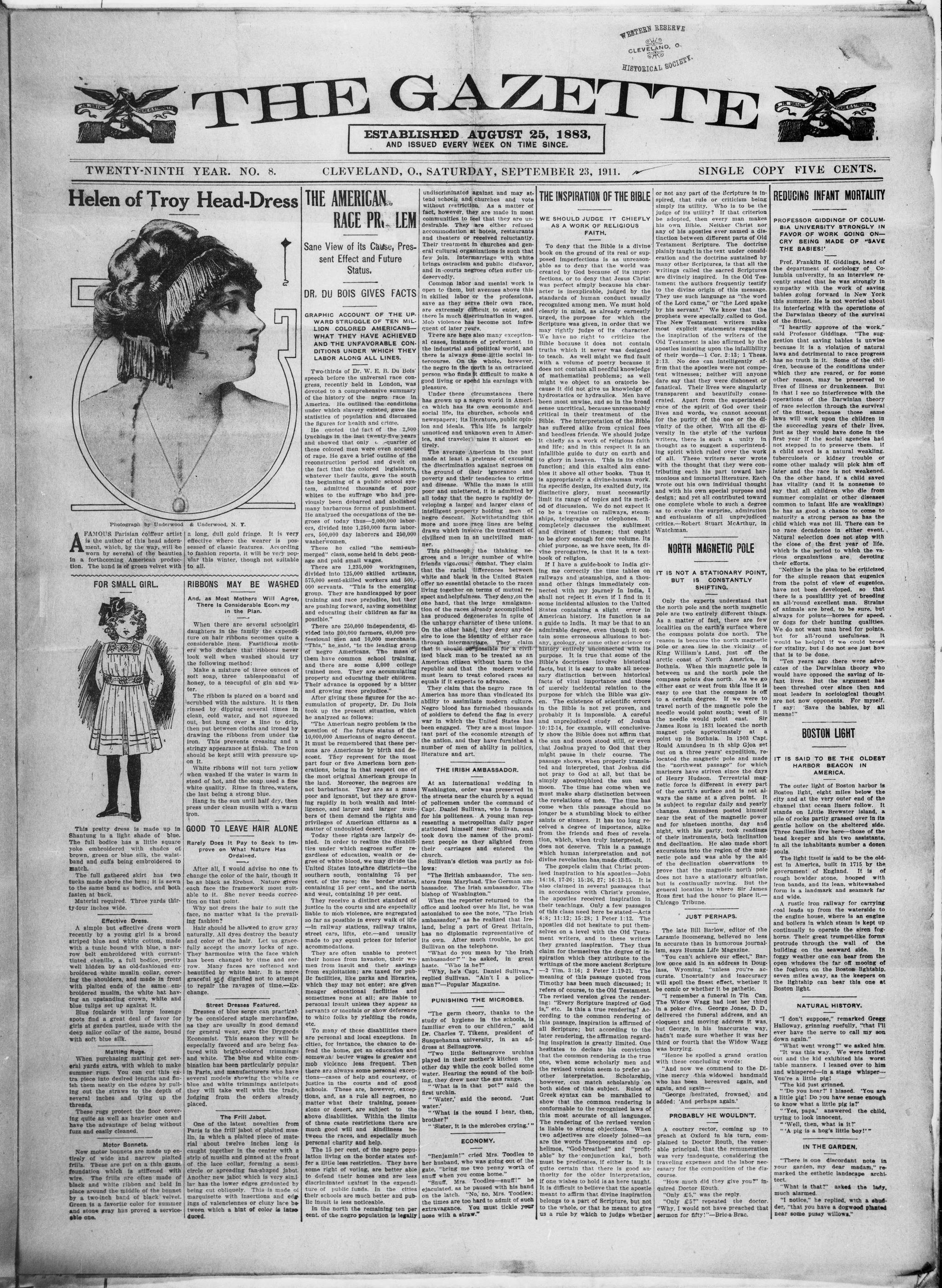
Helen of Troy Head-Dress
2
Photograph by Underwood & Underwood, N. Y.
FAMOUS Parisian coiffeur artist is the author of this head adorment, which, by the way, will be worn by several of the beauties in a forthcoming American produc tion. The band is of green velvet with a long, dull gold fi rst effective where the sessed of classic fea tion to fashion reports, it ular this winter, the tion. The band is of green velvet with to all.
FOR SMALL GIRL.
This pretty dress is made up in Shantung in a light shade of blue. The full bodice has a little square yoke embroidered with shades of brown, green or blue silk, the waistband and cuffs being embroidered to match. The full gathered skirt has two tucks made above the hem; it is sewn to the same band as bodice, and both fasten at back. Material required. Three yards thirty-four inches wide.
Effective Dress
A simple but effective dress worn recently by a young girl is a broad striped blue and white cotton, made with a tunic bound with blue, a narrow belt embroidered with currant-tinted chenille, a full bodice, pretty well hidden by an old-fashioned embroidered white muslin collar, covering the shoulders, and made in front with plaited ends of the same embroidered muslin, the white hat having an upstanding crown, white and blue tulips set up against it.
Blue foulards with large lozenge spots find a great deal of favor for girls at garden parties, made with the deep sailor collar of the same, bound with soft blue silk.
Matting Bugs.
When purchasing matting get several yards extra, with which to make summer rugs. You can cut this extra piece into desired lengths and finish them neatly on the edges by pulling out the straws to the depth of several inches and tying up the threads.
These rugs protect the floor covering quite as well as heavier ones and have the advantage of being without fuzz and easily cleaned.
Motor Bonnets.
New motor bonnets are made up entirely of wide and narrow painted frills. These are put on a thin gauge foundation which is stiffened with wire. The frills are often made of black and white ribbon and held in place around the middle of the bonnet by a two-inch band of black velvet. Green is a favorite color for summer and stone gray has proved a service-able one.
THE GAZETTE
a long, dull gold fringe. It is very effective where the wearer is possessed of classic features. According to fashion reports, it will be very popular this winter, though not suitable to all.
RIBBONS MAY BE WASHED
And, as Most Mothers Will Agree There Is Considerable Economy in the Plan.
When there are several schoolgirl daughters in the family the expenditure on hair ribbons becomes quite a considerable item. Fastidious mothers who declare that ribbons never look well when washed should try the following method:
Make a mixture of three ounces of soft soap, three tablespoons of honey, to a teacupful of gin and water.
The ribbon is placed on a board and scrubbed with the mixture. It is then rinsed by dipping several times in clean, cold water, and not squeezed out, but hung over a line to drip, then put between cloths and ironed by drawing the ribbons from under the iron. This prevents creasing and a stringy appearance at finish. The iron should be kept still with pressure upon it.
White ribbons will not turn yellow when washed if the water is warm in stead of hot, and the soap used a fine white quality. Rinse in three,waters, the last being a strong blue.
Hang in the sun until half dry, then press under clean muslin with a warm iron.
GOOD TO LEAVE HAIR ALONE
Rarely Does It Pay to Seek to Improve on What Nature Has Ordained.
After all, I would advise no one to change the color of the hair, though it be as black as Erebus. Nature gives each face the framework most suitable to it. She never needs correction on that point.
Why not dress the hair to suit the face, no matter what is the prevailing fashion?
Hair should be allowed to grow gray naturally. All dyes destroy the beauty and color of the hair. Let us gracefully accept the snowy locks of age. They harmonize with the face which has been changed by time and sorrow. Many faces are softened and beautified by white hair. It is more graceful and dignified not to attempt to repair the ravages of time.—Exchange.
Street Dresses Featured
Street Dresses Featured.
Dresses of blue serge can practically be considered staple merchandise, as they are usually in good demand for general wear, says the Drygoods Economist. This season they will be especially favored and are being featured with bright-colored trimmings and white. The blue and white combination has been particularly popular in Paris, and manufacturers who have several models showing the white or blue and white trimmings anticipate they will take well with the trade, judging from the orders already placed.
The Frill Jabot
One of the latest novelties from Paris is the frill jabot of plaited muslin, in which a plaited piece of material about twelve inches long is caught together in the center with a strip of muslin and pinned at the front of the lace collar, forming a semi-circle or spreading fan-shaped jabot. Another new jabot which is very similar has the lower edges graduated by being cut obliquely. This is made of marquette with insertions and edgings of valencennes or cluny lace between which a hint of color is introduced.
ESTABLISHED AUGUST 25, 1883 AND ISSUED EVERY WEEK ON TIME SINCE.
THE AMERICAN RACE PR LEM
Sane View of its Cause, Present Effect and Future Status.
DR. DU BOIS GIVES FACTS
GRAPHIC ACCOUNT OF THE UPWARD STRUGGLE OF TEN MILLION COLORED AMERICANS—WHAT THEY HAVE ACHIEVED AND THE UNFAVORABLE CONDITIONS UNDER WHICH THEY LABOR ALONG ALL LINES.
Two-thirds of Dr. W. E. B. Du Bols' speech before the universal race congress, recently held in London, was devoted to a comprehensive summary of the history of the negro race in America. He outlined the conditions under which slavery existed, gave the statistics of population and discussed the figures for health and crime.
He quoted the fact of the 2,500 lynchings in the last twenty-five years and showed that only 4. quarter of these colored men were even accused of rape. He gave a brief outline of the reconstruction period and dwell on the fact that the colored legislators, whatever their faults, gave the south the beginning of a public school system, admitted thousands of poor whites to the suffrage who had previously been debarred and abolished many barbarous forms of punishment.
He analyzed the occupations of the negroes of today thus—2,000,000 laborers, divided into 1,250,000 farm laborers, 500,000 day laborers and 250,000 washerwomen.
These he called "the semi-submerged" class, some held in debt pledge and paid small wages.
There are 1,235,000 workingmen, divided into 125,000 skilled artisans, 575,000 semi-skilled workers and 500,000 servants. "This is the emerging group. They are handicapped by poor training and race prejudice, but they are pushing forward, saving something and educating their children as far as possible."
There are 250,000 independents, divided into 200,000 farmers, 40,000 professional men and 10,000 merchants. "This," he said, "is the leading group of negro Americans. The mass of them have common school training, and there are some 5,000 college trained men. They are accumulating property and educating their children. Their advance is opposed by a bitter and growing race prejudice."
After giving these figures for the accumulation of property, Dr. Du Bols took up the present situation, which he analyzed as follows:
"The American negro problem is the question of the future status of the 10,000,000 Americans of negro descent. It must be remembered that these persons are Americans by birth and descent. They represent for the most part four or five American born generations, being in that respect one of the most original American groups in the land. Moreover, the negroes are not barbarians. They are as a mass poor and ignorant, but they are growing rapidly in both wealth and intelligence, and larger and larger numbers of them demand the rights and privileges of American citizens as a matter of undoubted desert.
Today these rights are largely denied. In order to realize the disabilities under which negroes suffer regardless of education, wealth or degree of white blood, we may divide the United States into three districts—the southern south, containing 75 per cent. of the race; the border states, containing 15 per cent, and the north and west, containing 10 per cent.
They receive a distinct standard of justice in the courts and are especially liable to mob violence, are segregated so far as possible in every walk of life—in railway stations, railway trains, street cars, lifts, etc. and usually made to pay equal prices for inferior accommodations.
They are often unable to protect their homes from invasion, their women from insult and their savings from exploitation; are taxed for public facilities, like parks and libraries, which they may not enter; are given meager educational facilities and sometimes none at all; are liable to personal insult unless they appear as servants or innsals or show deference to white folks by yielding the roads, etc.
To many of these disabilities there are personal and local exceptions. In cities, for instance, the chance to defend the home, get an education and somewhat better wages is greater and mob violence less frequent. Then there are always some personal exceptions—cases of help and courtesy, of justice in the courts and of good schools. These are, however, exceptions, and, as a rule all negroes, no matter what their training, possessions or desert, are subject to the above disabilities. Within the limits of these caste restrictions there are much good will and kindness between the races, and especially much personal charity and help.
The 15 per cent. of the negro population living on the border states suffer a little less restriction. They have some right of voting, are better able to defend their homes and are less discriminated against in the expenditure of public funds. In the cities their schools are much better and public insult is less noticeable.
In the north the remaining ten per cent. of the negro population is legally
undiscriminated against and may attend schools and churches and vote without restriction. As a matter of fact, however, they are made in most communities to feel that they are undesirable. They are either refused accommodation at hotels, restaurants and theaters or received reluctantly. Their treatment in churches and general cultural organizations is such that few join. Intermarriage with white brings ostracism and public disaster, and in courts negroes often suffer undeservedly.
Common labor and mental work is open to them, but avenues above this in skilled labor or the professions, save as they serve their own race, are extremely difficult to enter, and there is much discrimination in wages. Mob violence has become not infrequent of later years.
There are here also many exceptional cases, instances of preferment in the industrial and political world, and there is always some little social intercourse. On the whole, however, the negro in the north is an ostracised person who finds it difficult to make a good living or spend his earnings with pleasure.
Under these circumstances there has grown up a negro world in America which has its own economic and social life, its churches, schools and newspapers; its literature, public opinion and ideals. This life is largely unnoticed and unknown even in America, and traveler miss it almost entirely.
The average American in the past made at least a pretense of excusing the discrimination against negroes on the ground of their ignorance and poverty and their tendencies to crime and disease. While the mass is still poor and unlettered, it is admitted by all today that the negro is rapidly developing a larger and larger class of intelligent property holding men of negro descent. Notwithstanding this more and more race lines are being drawn which involve the treatment of civilized men in an uncivilized manner.
This philosophy the thinking negroes and a larger number of white friends vigorously combat. They claim that the racial differences between white and black in the United States offer no essential obstacle to the races living together on terms of mutual respect and helpfulness. They deny, on the one hand, that the large amalgamation of the races already accomplished has produced degenerates in spite of the unhappy character of these unions. On the other hand, they deny any desire to lose the identity of either race through intermarriage. They claim that it should be possible for a civilized black man to be treated as an American citizen without harm to the republic and that the modern world must learn to treat colored races as equals if it expects to advance.
They claim that the negro race in America has more than vindicated its ability to assimilate modern culture. Negro blood has furnished thousands of soldiers to defend the flag in every war in which the United States has been engaged. They are a most important part of the economic strength of the nation, and they have furnished a number of men of ability in politics, literature and art.
THE IRISH AMBASSADOR.
At an international wedding in Washington, order was preserved in the streets near the church by a squad of policemen under the command of Capt. Daniel Sullivan, who is famous for his politeness. A young man representing a metropolitan daily paper stationed himself near Sullivan, and took down the names of the prominent people as they alighted from their carriages and entered the church.
Sullivan's diction was partly as follows:
"The British ambassador. The senators from Maryland. The German ambassador. The Irish ambassador. The bishop of Washington."
When the reporter returned to the office and looked over his list, he was astonished to see the note, "The Irish ambassador," as he realized that Ireland, being a part of Great Britain, has no diplomatic representative of its own. After much trouble, he got Sullivan on the telephone.
"What do you mean by 'the Irish ambassador?'" he asked, in great haste. "Who is he?"
"Why, he's Capt. Daniel Sullivan," replied Sullivan. "Ain't I a policeman?" "Popular Magazine."
PUNISHING THE MICROBES.
"The germ theory, thanks to the study of hygiene in the schools, is familiar even to our children," said Dr. Charles T. Tikens, president of Susquehanna university, in an address at Sellinsgrove.
"Two little Sellinsgrove urchins played in their mother's kitchen the other day while the cook boiled some water. Hearing the sound of the boiling, they drew near the gas range.
"What is in that pot?" said the first urchin.
" 'Water,' said the second. 'Just water.'
" 'What is the sound I hear, then, brother?'
" 'Sister, it is the microbes crying.' "
ECONOMY.
"Benjamil!" cried Mrs. Toodles to her husband, who was going out of the gate, "bring me two penny worth of snuff when you come home." "Snuff, Mrs. Toodles—snuff!" he ejaculated, as he paused with his hand on the latch. "No, no, Mrs. Toodles; the times are too hard to admit of such extravagance. You must tickle your nose with a straw."
WESTERN RESERVE
CLEVELAND, O.
HISTORICAL SOCIETY.
THE INSPIRATION OF THE BIBLE
WE SHOULD JUDGE IT CHIEFLY AS A WORK OF RELIGIOUS FAITH.
To deny that the Bible is a divine book on the ground of its real or supposed imperfections is as unreasonable as to deny that the world was created by God because of its imperfections, or to deny that Jesus Christ was perfect simply because his character is inexplicable, judged by the standards of human conduct usually recognized among men. We must hold clearly in mind, as already earnestly urged, the purpose for which the Scripture was given, in order that we now rightly judge of its character. We have no right to criticize the Bible because it does not contain truths which it never was designed to teach. As well might we find fault with a volume of poetry because it does not contain all necessary knowledge of mathematical problems; as well might we object to an oratorio because it did not give us knowledge of hydrostatics or hydraulics. Men have been most unwise, and so in the broad sense uncritical, because unreasonably critical in their treatment of the Bible. The interpretation of the Bible has suffered alike from cynical foes and heedless friends. We should judge it chiefly as a work of religious faith and life; and in this respect it is an infallible guide to duty on earth and to glory in heaven. This is its chief function; and this exalted aim ennobles it above all other books. Thus it is appropriately a divine-human work. Its specific design, its exalted duty, its distinctive glory, must necessarily limit its range of topics and its method of discussion. We do not expect it to be a treatise on railways, steamships, telegraphs or telephones. It completely discusses the sublimest and divinest of themes; that ought to be glory enough for one volume. Its chief purpose, as we have seen, its divine prerogative, is that it is a textbook of religion.
If I have a guide-book to India giving me correctly the time tables on railways and steamships, and a thousand other things immediately connected with my journey in India. I shall not reject it even if I find in it some incidental allusion to the United States containing a slight error in American history. Its function is as a guide to India. It may be that to an admirable degree, even though it contain some erroneous allusions to botany, geology, or some other science or history entirely unconnected with its purpose. It is true that some of the Bible's doctrines involve historical facts, but it is easy to make all necessary distinction between historical facts of vital importance and those of merely incidental relation to the purpose for which the Bible was given. The existence of scientific errors in the Bible is not yet proven, and probably it is impossible. A careful and unprejudiced study of Joshua 10:12-14, for example, will conclusively show the Bible does not affirm that the sun and moon stood still, or even that Joshua prayed to God that they might pause in their course. The passage shows, when properly translated and interpreted, that Joshua did not pray to God at all, but that he simply apostrophized the sun and moon. The time has come when we must make sharp distinction between the revelations of men. The time has come when this passage should no longer be a stumbling block to either saints or sinners. It has too long received a degree of importance, alike from the friends and foes of revelation, which, when truly interpreted, it does not deserve. This is a passage which human interpretation and not divine revelation has made difficult.
The gospel claims that Christ promised inspiration to his apostles—John 14:16, 17:26, 15:26, 27, 16:13-15. It is also claimed in several passages that in accordance with Christ's promise, the apostles received inspiration in their teachings. Only a few passages of this class need here be stated—Acts 4:8, 11:12, 15:28, 1 Peter 1:12. The apostles did not hesitate to put themselves on a level with the Old Testament writers, and to these writers they granted inspiration. They thus claim for themselves the degree of inspiration which they attribute to the writings of the more ancient Scripture —2 Tim. 3:16; 2 Peter 1:19-21. The meaning of this passage quoted from Timothy has been much discussed; it refers of course, to the Old Testament. The revised version gives the rendering: "Every Scripture inspired of God is," etc. Is this a true rendering? According to the common rendering of this passage, inspiration is affirmed of all Scripture; but according to the later rendering, the affirmation regarding inspiration is greatly limited. One hesitates to declare his conviction that the common rendering is the true one, when some scholarly men and the revised version seem to prefer another interpretation. Scholarship, however, can match scholarship on both sides of this subject. Rules of Greek syntax can be marshalled to show that the common rendering is conformable to the recognized laws of this most accurate of all languages. The rendering of the revised version is liable to strong objections. When two adjectives are closely joined—as are the words Theopneustos and ophelimos, "God-breasted" and "profitable" by the conjunction kai, both must be predicates, if either is. It is quite certain that there is good authority for the older interpretation, if one wishes to hold is as here taught. It is difficult to believe that the apostle meant to affirm that divine inspiration belongs to a part of Scripture, but not to the whole, or that he meant to give us a rule by which to judge whether
or not any part of the Scripture is inscribed, that rule or criticism being simply its utility. Who is to be the judge of its utility? If that criterion be adopted, then every man makes his own Bible. Neither Christ nor any of his apostles ever named a distinction between different parts of Old Testament Scripture. The doctrine plainly taught in the text under consideration and the doctrine sustained by many other Scriptures, is that all the writings called the sacred Scriptures are divinely inspired. In the Old Testament the authors frequently testify to the divine origin of this message. They use such language as "the word of the Lord came" or "the Lord spake by his servant." We know that the prophets were specially called to God. The New Testament writers make most explicit statements regarding the inspiration of the writers of the Old Testament is also affirmed by the apostles insisting upon the infallibility of their words—1 Cor. 2:13; 1 Thess. 2:13. No one can intelligently affirm that the apostles were not competent witnesses; neither will anyone dare say that they were dishonest or fanatical. Their lives were singularly transparent and beautifully consecrated. Apart from the superintendence of the spirit of God over their lives and words, we cannot account for the purity of the one or the divinity of the other. With all the diversity in the style of the various writers, there is such a unity in thought as to suggest a superintending spirit which ruled over the work of all. These writers never wrote with the thought that they were contributing each his part toward harmonious and immortal literature. Each wrote out his own individual thought and with his own special purpose and design; and yet all contributed toward one complete whole to such a degree as to evoke the surprise, admiration and enthusiasm of all unprejudiced critics—Robert Stuart McArthur, in Watchman.
NORTH MAGNETIC POLE
IT IS NOT A STATIONARY POINT
BUT IS CONSTANTLY
SHIFTING
Only the experts understand that the north pole and the north magnetic pole are two entirely different things. As a matter of fact, there are few localities on the earth's surface where the compass points due north. The reason is because the north magnetic pole or area lies in the city of King William's Land, just off the arctic coast of North America, in Bothnia. When this magnetic pole is between us and the north pole the compass points due north. As we go either east or west from this line it is easy to see that the compass is off to a certain degree. If we were to travel north of the magnetic pole the needle would point south; west of it the needle would point east. Sir James Ross in 1831 located the north magnet pole approximately at a point up in Bothnia. In 1903 Capt. Roald Amundsen in th ship Gjoa set out on a three years' expedition, relocated the magnetic pole and made the "northwest passage" for which mariners have striven since the days of Henry Hudson. Terrestrial magnetic force is different in every part of the earth's surface and is not always the same at a given point. It is subject to regular daily and yearly changes. Amundsen posted himself near the seat of the magnetic power and for nineteen months, day and night, with his party, took readings of their instruments, both inclination and declination. He also made short excursions into the region of the magnetic pole and was able by the aid of the declination observations to prove that the magnetic north pole does not have a stationary situation, but is continually moving. But the general location is where Sir James Ross first had the honor to place it.—Chicago Tribune.
JUST PERHAPS
The late Bill Barlow, editor of the Laramie Boomerang, believed no less in accuracy than in humorous journalism, says Human Life Magazine.
"You can't achieve our effect," Barlow once said in an address in Douglass, Wyoming, "unless you're accurate. Uncertainty and inaccuracy will spoil the finest effect, whether it be comic or whether it be pathetic.
"I remember a funeral in Tin Can. The Widow Wagg had lost her third in a poker dive. George Jones, D. D., delivered the funeral address, and an eloquent and moving address it was, but George, in his inaccurate way, hadn't made sure whether it was her third or fourth that the Widow Wagg was burying.
"Hence he spoiled a grand oration with these concluding words:
"And now we commend to the Divine mercy this widowed handmaid who has been bereaved again, and again, and again—
"George hesitated, frowned, and added: 'And perhaps again.'
PROBABLY HE WOULDN'T.
A countrys rector, coming up to preach at Oxford in his turn, complained to Doctor Routh, the venerable principal, that the remuneration was very inadequate, considering the traveling expenses and the labor necessary for the composition of the discourse.
"How much did they give you?" inquired Doctor Routh.
"Only £5," was the reply.
"Only £5?" repeated the doctor.
"Why. I would not have preached that sermon for fifty!"—Bric-a Brac.
SINGLE COPY FIVE CENTS.
IN UNION
THEM 43 STATUTES
REDUCING INFANT MORTALITY
PROFESSOR GIDDING& OF COLUMBIA UNIVERSITY STRONGLY IN FAVOR OF WORK GOING ON—CRY BEING MADE OF "SAVE THE BABIES!"
Prof. Franklin H. Giddings, head of the department of sociology of Columbia university, in an interview recently stated that he was strongly in sympathy with the work of saving babies going forward in New York this summer. He is not worried about its interfering with the operations of the Darwinian theory of the survival of the fittest.
"I heartily approve of the work," said Professor Giddings. "The suggestion that saving babies is unwise because it is a violation of natural laws and detrimental to race progress has no truth in it. Some of the children, because of the conditions under which they are reared, or for some other reason, may be preserved to lives of illness or drunkenness. But in that I see no interference with the operations of the Darwinian theory of race selection through the survival of the fittest, because those same laws will work upon the children in the succeeding years of their lives, just as they would have done in the first year if the social agencies had not stepped in to preserve them. If a child saved is a natural weakling, tuberculosis or kidney trouble or some other malady will pick him off later and the race is not weakened. On the other hand, if a child saved has vitality (and it is nonsense to say that all children who die from summer complaint or other diseases common to infant life are weaklings) he has as good a chance to come to maturity a strong person as has the child which was not ill. There can be no race decadence in either event. Natural selection does not stop with the close of the first year of life, which is the period to which the various organizations are devoting their efforts.
"Neither is the plan to be criticized for the simple reason that eugenics from the point of view of eugenics, have not been developed, so that there is a possibility yet of breeding an all-round excellent man. Strains of animals are bred, to be sure, but always for points—horses for speed, or dogs for their hunting qualities. We do not want man bred for points, but for all-round usefulness. It would be helpful if we could breed for vitality, but I do not see just how that is to be done.
"Ten years ago there were advocates of the Darwinian theory who would have opposed the saving of infant lives. But the argument has been threshed over since then and most leaders in sociological thought are not now opponents. For myself, I say: 'Save the babies, by all means!'
BOSTON LIGHT
IT IS SAID TO BE THE OLDEST
HARBOR BEACON IN
MONTANA
The outer light of Boston harbor is Boston light, eight miles below the city and at the very outer end of the channel that ocean liners follow. It stands on Little Brewster island, a pile of rocks partly grassed over in its gentle hollow on the sheltered side. Three families live here—those of the head keeper and his two assistants, in all the inhabitants number a dozen souls.
The light itself is said to be the oldest in America, built in 1715 by the government of England. It is of rough bowder stone, hooped with iron bands, and its lean, whitewashed form is a landmark and seamark far and wide.
A rustic iron railway for carrying coal leads up from the waterside to the engine house, where is an engine and boilers in which steam is kept up continually to operate the siren foghorns. Their great trumpet-like forms protrude through the wall of the building on the seaward side. In foggy weather one can hear from the open windows the far off mooring of the foghorn on the Boston lightship, seven miles away, as the keepers on the lightship can hear this one at Boston light.
NATURAL HISTORY.
"I don't suppose," remarked Gregg Hallaway, grinning ruefully, "that I'll ever have the nerve to call my son down again."
"What went wrong?" we asked him. "It was this way. We were invited out and the kid exhibited his worst table manners. I leaned over to him and whispered—in a stage whisper—You're a little pig!"
"The kid just grinned." "Do you hear? I hissed. 'You are a little pig! Do you have sense enough to know what a little pig is?' "Yes, papa,' answered the child, trying to look innocent.
"Well, then, what is it?" "A pig is a hog's little boy!"
IN THE GARDEN.
"There is one discordant note in your garden, my dear madam," remarked the esthetic landscape architect.
"What is that?" asked the lady, much alarmed.
"I notice," he replied, with a shudder, "that you have a dogwood planted near some pussy willows."
One Year.....$1.50
Six Months.....1.00
Three Months......50
Subscribers are requested to
remit by postoffice money or
order or registered letter.
Entered at the postoffice in Cleveland,
Ohio, as second-class matter
Address all communications to
HARRY C. SMITH
Editor and proprietor,
THE GAZETTE,
Blackstone Building, Cleveland, O.
Member Ohio Legislature: 1894
to 1898; 1898 to 1893; 1900 to 1902
THE GAZETTE is the oldest, and has the largest bona fide circulation, double that of any newspaper in the interest of Afro-Americans, published in the state of Ohio, and comparison with any will immediately establish its rank as one of the NEWSIEST AND BEST In the country.
As far as we have been able to see and learn, Prof. W. S. Scarborough made one of the very best speeches at the Universal Races Congress—held in London, England, in July.
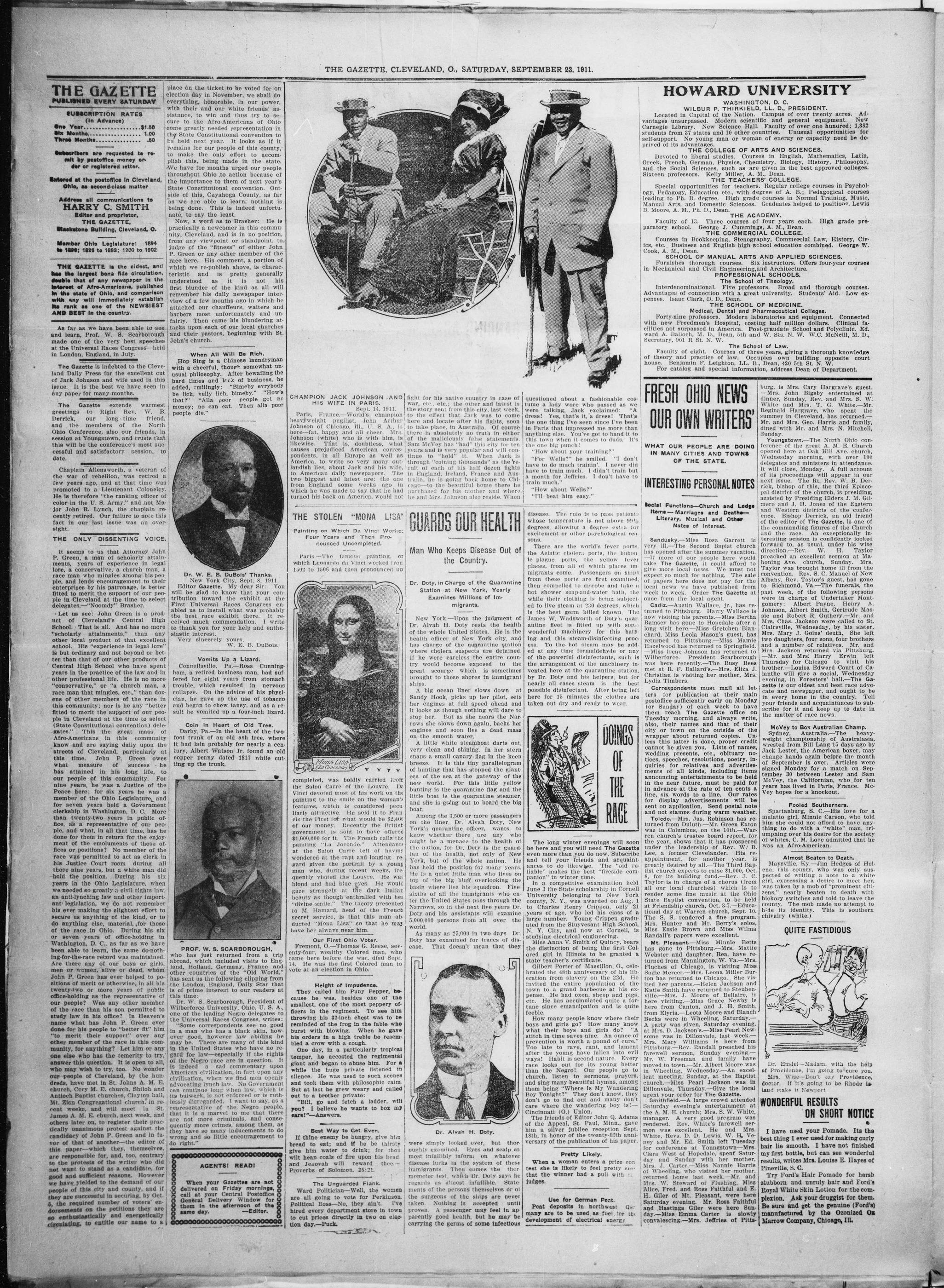
The Gazette is indebted to the Cleveland Daily Press for the excellent cut of Jack Johnson and wife used in this issue. It is the best we have seen in any paper for many months.
The Gazette extends warmest greetings to Right Rev. W. B. Derrick, our long-time friend, and the members of the North Ohio Conference, also our friends, in session at Youngstown, and trusts that this will be the conference's most successful and satisfactory session, to date.
Chaplain Allenworth, a veteran of the war of rebellion, was retired a few years ago, and at that time was promoted to a Lieutenant Colonel. He is therefore "the ranking officer of color in the U. S. Army," and not Major John R. Lynch, the chaplain recently retired. Our failure to note this fact in our last issue was an oversight.
THE ONLY DISSENTING VOICE
it seems to us that Attorney John P. Green, a man of scholarly attainments, years of experience in legal lore, a conservative, a church man, a race man who mingles among his people, and lends encouragement to their enterprises by his patronage, is better fitted to merit the support of our people in Cleveland at the time to select delegates." "Noomdy" Brasher.
Let us see: John Green is a product of Cleveland's Central High School. That is all. And has no more "scholarly attainments," than any other local product of that excellent school. His "experience in legal lore" is but ordinary and not beyond or better than that of our other products of Central High School who have spent years in the practice of the law and in other professional life. He is no more "conservative," or "a church man, a race man that mingles, etc." than dozens of other members of the race in this community; nor is he any "better fitted to merit the support of our people in Cleveland at the time to select (State Constitutional convention) delegates." This the great mass of Afro-Americans in this community know and are saying daily upon the streets of Cleveland, particularly at this time. John P. Green owes what measure of success he has attained in his long life, to our people of this community. For nine years, he was a Justice of the Peace here; for six years he was a member of the Ohio Legislature, and for seven years held a Government clerkship in Washington, D. C. More than twenty-two years in public of face, a representative of our pee, and what, in all that time, has he done for them in return for the enjoyment of the emoluments of those fices or positions? No member of the race was permitted to act as clerk in his Justice Court room during all those nine years, but a white man did the position. During his six years in the Ohio Legislature, we needed so greatly a civil rights law, an anti-lynching law and other important legislation, we do not remember his ever making the slightest effort to secure us anything of the kind, or to do anything else, material for those of the race in Ohio. During his six or seven years of office-holding in Washington, D. C., as far as we have been able to learn, the same do-noting-for-the-race record was maintained. Are there any of our boys or girls, men or women, alive or dead, whom John P. Green has ever helped to positions of merit or otherwise, in all his twenty-two or more years of public office-holding as the representative of our people? Was any other member of the race than his son permitted to study law in his office? In Heaven's name what has John P. Green ever done for his people to "better fit" him "to merit their support" over any other merit of their need to try, answer this question. It is open to all, who may wish to try, too. No wonder our people of Cleveland, by the hundreds, have met in St. Johns, A. M. E. church, Cory M. E. church, Silhon and Antioch Baptist churches, Clayton hall, Mt. Zion Congregational church, in recent weeks, and will meet in St. James A. M. E. church, next week, and others later on, to register their practically unanimous protest against the candidacy of John P. Green and in favor of that of another—the editor of this paper—which they, themselves, are responsible for, and, too, contrary to the protests of the writer who did not want to stand as a candidate, for good and sufficient reasons. However we have yielded to the demand of our people of this city and county, and if they are successful in securing, by Oct. 5, the required number of voters' endorsements on the petitions they are so enthusiastically and energetically circulating, to entitle our name to a
place on the ticket to be voted for on election day in November, we shall do everything, honorable, in our power, with their and our white friends' assistance, to win and thus try to secure to the Afro-Americans of Ohio some greatly needed representation in the State Constitutional convention to be held next year. It looks as if it remains for our people of this county, to make the only effort to accomplish this, being made in the state. We have for months urged our people throughout Ohio to action because of the importance to them of next year's State Constitutional convention. Outside of this, Cuyahoga County, as far as we are able to learn, nothing is being done. This is indeed unfortunate, to say the least.
Now, a word as to Brasher: He is practically a newcomer in this community, Cleveland, and is in no position, from any viewpoint or standpoint, to judge of the "fitness" of either John P. Green or any other member of the race here. His comment, a portion of which we re-publish above, is characteristic and is pretty generally understood as it is not his first blunder of the kind as all will remember his daily newspaper interview of a few months ago in which he attacked our chauffees, waiters and barbers most unfortunately and unfairly. Then came his blundering attacks upon each of our local churches and their pastors, beginning with St. John's church.
When All Will Be Rich.
Hop Sing is a Chinese laudryman with a cheerful, though somewhat unusual philosophy. After bewailing the hard times and lack of business, he added, smilingly: "Blimey everybody be lich, velly lich, bimehy." "How's that?" "Alla poor people got no money; no can eat. Then alla poor people die."
A. H.
D. W. E. B. DuBois nana8.
New York, NY. My e-mail: jp11.
Editor Gazette. My dear Sir: You will be glad to know that your contribution toward the exhibit at the First Universal Races Congress enabled us to install what was probably the best race exhibit there. It received much commendation. I write to thank you for your help and enthusiastic interest.
Very sincerely yours,
W. E. B. DuBois.
Vomits Up a Lizard.
Connellsville, Pa.—Ross Cunningham, a retired business man, had suffered for eight years from stomach trouble, which resulted in nervous collapse. On the advice of his physician, he gave up the use of tobacco and began to chew tansy, and as a result he vomited up a four-inch lizard.
Coin in Heart of Old Tree.
Darby, Pa.—In the heart of the two-foot trunk of an old ash tree, where it had lain probably for nearly a century, Albert Watson Jr. found an old copper penny dated 1817 while cutting up the trunk.
725
who has just returned from a trip abroad, which included visits to England, Holland, Germany, France and other countries of the "Old World." has sent us the following clipping from the London, England, Daily Star that is of prime interest to our readers at this time:
Dr. W. S. Scarborough, President of Wilberforce University, Ohio, U. S. A., one of the leading Negro delegates to the Universal Races Congress, writes:
"Some correspondents see no good in a man who has a black skin, however good, however law abiding he may be. There are many of this kind in the United States who have no regard for law—especially if the rights of the Negro race are in question. It is indeed a sad commentary upon American civilization, in fact upon any civilization, when we find men openly advocating lynch law. No Government can continue long when law, which is the result of mass murder or less disregarded. I want to say, as a representative of the Negro people, that it is a marvel to me that there are not more criminals, and consequently more crimes, among them, as they have so many inducements to do wrong and so little encouragement to do right."
When your Gazettes are not delivered on Friday mornings, call at your Central Postoffice General Delivery Window for them in the afternoon of the same day. —Editor.
THE GAZETTE, CLEVELAND, O., SATURDAY, SEPTEMBER 23, 1911.
M. H.
CHAMPION JACK JOHNSON AND HIS WIFE IN PARIS.
Sept. 14, 1911.
Paris, France—World's champion heavyweight pugilist, John Arthur Johnson of Chicago, HI. U. Arth. A., is a former champion. Johnson (white) is with him, is likewise. That is, doubtless, what causes prejudiced American correspondents, in all Europe as well as America, to write so very many outlandish lies, about Jack and his wife, to American daily newspapers. The writer from England some weeks ago in which he was made to say that he had turned his back on America, would not
Painting on Which Da Vinci Worked:
Four Years and Then Pro-
nounced Uncompleted.
Paris.—The famous painting, or
which Leonardo da Vinci worked from
1502 to 1506 and then pronounced un
Mona Lisa
completed, was boldly carried from the Salon Carre of the Louvre. He Vinci devoted most of his work on the painting to the smile on the woman's features, which is considered peculiarly attractive. He sold it to Frans the First to what would be $2,400 of our money. Recently the British government is said to have offered $1,000,000 for it. The French calls the painting "La Joconde." Attendance at the Salon Carre tell of having wondered at the rapt and longing regard given the portrait by a young man who, during recent weeks, frequently visited the Louvre. He was blond and had blue eyes. He would gaze strangely at the dark Italian beauty as though enthralled with her "divine smile." The theory presented to M. Hamard, head of the French secret service, is that this man abducted "Mona Lisa" so that he may have he always near him.
Our First Ohio Voter.
Fremont, O. — Thomas G. Reese, seventy-four, wealthy Colored man, who came here before the war, died Sept. 15. He was a man of great man to vote at an election in Ohio.
Height of Impudence.
They called him Puny Pepper, because he was, besides one of the smallest, one of the most peppery officers in the regiment. To see him throwing his 32-inch chest was to be reminded of the frog in the fable who burst with blowing. When he gave his orders in a high treble he resembled a crow with a cough.
One day, in a particularly tropical temper, he accosted the regimental giant and began to abuse him. For a while the huge private listened in silence. He was used to such scenes and took them with philosophic calm. But at last he grew weary and called out to a brother private:
"Bill, go and fetch a ladder, will you? I believe he wants to box my ears!"—Answers.
If thine enemy be hungry, give him bread to eat; and if he be thirsty, give him water to drink; for thou wilt heap coals of fire upon his head and jeovah will reward thee. Proverbs of Solomon. 25:21.
The Unguarded Flank
Ward Politician—Well, the women are all going to vote for Perkinson. Political Boss—No, they ain't. I've hired every department store in town to cut prices directly in two on election day.—Puck.
fight for his native country in case of war, etc., etc.; the other and latest is the story sent from this city, last week, to the effect that Jack was to come here and locate after his fights, soon to take place, in Australia. Of course the story is not the maliciously false statements, Sam McVey has "had" this city for ten years and is "very popular and will continue to" "hold" it. When Jack is through "coining thousands" as the result of each of his half dozen fights in England, Ireland, France and Aus. He is now in Australia, cago-to the beautiful home there he purchased for his mother and where he and Mrs. Johnson also reside. When
GUARDS OUR HEALTH
Man Who Keeps Disease Out of the Country.
Dr. Doty, in charge of the Quarantine Station at New York, Yearly Examines Millions of Immigrants.
New York—Upon the judgment of Dr. Alvah H. Doty rests the health of the whole United States. He is the health officer of New York city, and has charge of the quarantine station where cholera suspects are detained. If he were careless the entire country would become exposed to the great scourge which is sometimes brought to these shores in immigrant ships.
A big ocean liner slows down at Sandy Hook, picks up her pilot, sets her engines at full speed ahead and it looks as though nothing will dare to stop her. But as she nears the Narrows she slows down again, backs her engines and soon lies a dead mass on the smooth water.
A little white steamboat darts out, very clean and shining. In her stern snaps a small canary flag in the keen breeze. It is this tiny parallelogram of bunting that has stopped the gantess of the sea at the gateway of the new world. For this little yellow bunting is the quarantine flag and the little boat is the quarantine steamer, and she is going out to board the big boat.
Among the 3,500 or more passengers on the liner, Dr. Alvah Doty, New York's quarantine officer, wants to know whether there are any who might be a menace to the health of the nation, for Dr. Doty is the guardian of the health, not only of New York, but of the whole nation. He has held the position for many years. He is a quiet little man who lives on top of the big bluff overlooking the basin where lies his squadron. Five sixths of all the immigrants who enter the United States pass through the Narrows, so in the next five years Dr. Doty and his assistants will examine 5,000,000 persons from all over the world.
As many as 25,000 in two days Dr. Doty has examined for traces of disease. That doesn't mean that they
Dr. Alvah H. Poty.
were simply looked over, but thor-
oughly examined. Eyes and scalp atm-
steth infallibly inform on whatever
disease lurks in the system of these
immigrants. Then comes the ther
mometer test, which Dr. Doty says he
regards as almost infallible. Stat-
ments of the persons themselves or of
the surgeons of the ships are never
taken. Nothing is accepted until
proven. A passenger may feel in ap
parently good health, but he may be
carrying the germs of some infectious
questioned about a fashionable costume a lady wore who passed as we were talking, Jack exclaimed: "A dress! Yes, that's it, a dress! That's the one thing I've seen since I've been in Paris that impressed me more than anything else. You've got to hand it to this town when it comes to duds. It's the one big punch: "How about your training?"
"For Wells?" he smiled. "I don't have to do much trainin'. I never did have to train much. I didn't train but a month for Jeffries. I don't have to train much."
"How about Wells?"
"I'll beat him easy."
disease. The rule is to pass patients whose temperature is not above 99.9 degrees, allowing a degree extra for excitement or other psychological reasons.
There are the world's fever ports, the Asiatic cholera ports, the baboon plague ports, the yellow fever places, from all of which places immigrants come. Passengers on ships from these ports are first examined then compelled to disrobe and take a hot shower soap-and-water bath, the while their clothing is being subjected to live steam at 230 degrees, which is the best germ killed known. The James W. Wadsworth of Doty's quarantine fleet is fitted up with soap-wonderful machinery for this bathing and this steam-disinfecting process. To the hot steam may be added at any time formaldehyde or any of the powerful disinfectants, such is the arrangement of the machinery in vented here at the quarantine station by Dr. Doty and his helpers, but for nearly all cases steam is the best possible disinfectant. After being left here for 15 minutes the clothes are taken out dry and ready to wear.
DOINGS OF THE RACE
The long winter evenings will soon be here and you will need The Gazette even more than you do now. Subscribe and tell your friends and acquaintances to do likewise. The "old reliable" makes the best "fireside companion" in winter time.
In a competitive examination held June 3 the state scholarship in Cornell University belonging to New York county, N. Y., was awarded on Aug. 1, 2012 by Henry Crippen, only 22 years old, of large number of large number. Young Crippen graduated from the Stuyvesant High School, N. Y. City, and now at Cornell, is studying electrical engineering. Miss Anna V. Smith of Quincy, beares the distinction of being the first Colored girl in Illinois to be granted a state scholarship. Porter of Massillon, O., celebrated the 48th anniversary of his liberation from slavery on the 22d. He invited the entire population of the town to a grand barbecue at his expense. He had oxen, sheep and pigts. He has accumulated quite a force in emancipation and is quite feeble.
How many people know where their boys and girls go? How many know what their boys and girls do? A stitch in time saves nine. An ounce of prevention is worth a pound of cure. Too late to rave, rant, and be a kid in life, it can into evil ways! Habit is second nature. Every race looks out for its young better than the Negro! Our people go to church, listen to sermons, prayers, and sing many beautiful hymns, among them being "Where Is My Wandering Boy Tonight?" They don't know, they don't go to find out and many don't care where the wandering boy is! "One of Us Unknown," the friends of Editor John Q. Adams of the Appeal, St. Paul, Minn., gave him a silver jubilee reception Sept. 18th, in honor of the twenty-fifth anniversary of the publication of his paper.
Pretty Likely.
When a woman enters a prize con-
test she is likely to feel pretty sure
that the winner had a pull with ti-
ludges.
Use for German Beat
Use for German Peat.
Peat deposits in northwest Germany are to be used as fuel for the development of electrical energy
HOWARD UNIVERSITY
WASHINGTON, D. C.
WILBUR P. THIRKIELD, LL. D., PRESIDENT.
Located in Capital of the Nation. Campus of over twenty acres. Advantages unsurpassed. Modern scientific and general equipment. New Carnegie Library. New Science Hall. Faculty of over one hundred; 1,382 students from 37 states and 10 other countries. Unusual opportunities for self-support. No young man or woman of energy or capacity need be deprived of its advantages.
THE COLLEGE OF ARTS AND SCIENCES.
Devoted to liberal studies. Courses in English, Mathematics, Latin, Greek, French, German, Physics, Chemistry, Biology, History, Philosophy, and the Social Sciences, such as are given in the best approved colleges. Sixteen professors. Kelly Miller, A. M., Dean.
THE TEACHERS' COLLEGE.
Special opportunities for teachers. Regular college courses in Psychology, Pedagogy, Education etc., with degree of A. B.; Pedagogical courses leading to Ph. B. degree. High grade courses in Normal Training, Music, Biology, Sciences. Graduates helped to position<sup>1</sup>. Lewis B, Moore A, M, Ph. D, Dean.
Special opportunities for teachers
ogy, Pedagogy, Education etc., with de
leading to Ph. B. degree. High grade
Manual Arts, and Domestic Sciences.
B. Moore, A. M., Ph. D., Dean.
THE AC.
Faculty of 13. Three courses of
paratory school. George J. Cumming
THE COMMERC
Courses in Bookkeeping, Stenog
ics, etc. Business and English high sce
Cook, A. M., Dean.
SCHOOL OF MANUAL ARTS.
Furnishes thorough courses. Si
in Mechanical and Civil Engineering.
PROFESSION
The School
Interdenominational. Five profe
Advantages of connection with a great
penses. Isaac Clark, D. D., Dean.
THE SCHOOL
THE ACADEMY.
Faculty of 13. Three courses of four years each. High grade preparatory school. George J. Cummings, A. M., Dean.
THE COMMERCIAL COLLEGE.
Courses in Bookkeeping, Stenography, Commercial Law, History, Civics, etc. Business and English high school education combined. George W. Cook, A. M., Dean.
SCHOOL OF MANUAL ARTS AND APPLIED SCIENCES.
Furnishes thorough courses. Six instructors. Offers four-year courses in Mechanical and Civil Engineering and Architecture.
PROFESSIONAL SCHOOLS.
The School of Theology.
Interdenominational. Five professors. Broad and thorough courses. Advantages of connection with a great university. Students' Aid. Low expenses. Isaac Clark, D. D., Dean.
THE SCHOOL OF MEDICINE.
Medical, Dental and Pharmaceutical Colleges.
Forty-nine professors. Modern laboratories and equipment. Connected with new Freedman's Hospital, costing half million dollars. Clinical facilities not surpassed in America. Post-graduate School and Polyclinic. Ed. ward A. Balloch, M. D., Dean, 5th and W. Sts. N. W. W.C. McNeill, M. D., Secretary, 910 R. St. N. W.
Forty-nine professors. Modern la with new Freedmen's Hospital, cost cilties not surpassed in America. Poward A. Balloch, M. D., Dean, 5th and Secretary, 901 R St. N. W. The Scho Faculty of eight. Courses of the theory and practice of law. Occ house. Benjamin F. Leighton, LL. B For catalog and special informa
Faculty of eight. Courses of three years, giving a thorough knowledge of theory and practice of law. Occupies own building opposite court house. Benjamin F. Leighton, LL. B., Dean, 420 5th St. N. W. For catalog and special information, address: Department of
FRESH OHIO NEWS OUR OWN WRITERS
WHAT OUR PEOPLE ARE DOING IN MANY CITIES AND TOWNS OF THE STATE.
INTERESTING PERSONAL NOTES
Social Functions—Church and Lodge Items—Mariages and Deathe—Literary, Musical and Other Notes of Interest.
Sandusky—Miss Rosa Garrett is very ill. The Second Baptist church has opened after the summer vacation. It more of our people here would take The Gazette, it could afford to give more local news. We must not expect so much for nothing. The sale of papers here does not pay for the local news we have published from week to week. Order The Gazette at once from the local agent.
Caddis—Walace, Jr., has returned to Pittsburg. Henry Wallace is now visiting his parents. Miss Bertha Ramsey has gone to Hopedale after a long visit here. Miss Gretchen Blanchard, Miss Leola Mason's guest, has returned to Pittsburg. Miss Mamie Hazelwood has returned to Springfield. Miss Irene Johnson has returned to Wilberforce. President Scarborough has returned to Pittsburg. Bees met at R. F. Ballard's. Mrs. Eliza J. Christian is visiting her mother, Mrs. Lydia Timbs.
Correspondents must mail all letters for publication at their main postoffice sufficiently early on Monday (or Sunday) of each week to have them reach The Gazette office on Tuesday morning, and always write, also, their names and that of their city or town on the outside of the building. If the letter less this latter is done, proper credit cannot be given you. Lists of names, wedding presents, etc., obituary notices, speeches, resolutions, poetry, inquiries for relatives and advertisements of all kinds, including items announcing entertainments to be held in the near future, must be paid for by the postmaster. On a line, six words to a line. Our rates for display advertisements will be sent on application. Send postal note and not stamps during warm weather.
Toledo—Mrs. Jas. Robinson has returned from Duluth, on the 10th. Ward rench church's trustee board report, for the year, shows that it has prospered under the leadership of Rev. W. B. Lee, a former Clevelander. His reappointment, for another year, is greatly desired by all. The Third Baptist church exports to raise $1,000,000. Mrs. Lee's building of a chorus (from all our local churches) which is to render some fine music at the Ohio State Baptist convention, to be held at Friendship church, Oct. 3.7—Educational day at Warren church, Sept. 10. The S. s., rendered a fine program. Mrs. Hunter and Mr. Berry's solos, Miss Essie Brown and Miss Wilma Randall's papers were excellent.
Mt. Pleasant—Miss Minnie Betts has gone to Pittsburgh—Mrs. Mattie Webster and daughter, Rea, have returned from Mannington, W. Va.—Mrs. Fluches of Chicago, is visiting Miss Sadie Mercer—Mrs. Leona Miller Burton has returned to Chicago. She visits Katie Smith have returned to Steubenville—Mrs. J. Moore of Bellaire, is here visiting—Miss Grace Newby is here from Canton, and J. H. Smith from Elyria.—Leota Moore and Blanch Becks were in Wheeling, Saturday.—A party was given, Saturday evening, Mrs. Mary Williams was some was in Dillonville, last week.—Mrs. Mary Williams is here from Pittsburgh.—Rev. Randall preached his farewell sermon, Sunday evening.—Mr. W. Freeman and family have moved to town.—Mr. Albert Moore was in Wheeling, ednesday.—An excelent church—Miss Pearl Jackson was in Dillonville, Thursday—Give the local agent your order for The Gazette
Smithfield.—A large crowd attended Saturday evening's entertainment at the A. M. E. church; Mrs. S. W. White, manager. A very good program was rendered. Rev. White's farewell sermon was excellent. He and Mrs. White. Rev. D. D. Lewis. W. H. Veer, and Mr. Ed. Smith left Tuesday for conference at Youngstown—Mrs. Clara West of Hopedale, spent Saturday and Sunday with her mother, Mrs. J. Carter.—Miss Nannie Harris of Wheeling, who visited her mother, returned home last week.—Mr. and Mrs. W. Steward of Flushing, Miss Alice, Fred. and Ross Faithful and E. H. Giler of Mt. Pleasant, were here Saturday evening. Mr. Ross Faithful and Hastings Giller were here Sunday.—Miss Emma Carter is slowly convalescing.—Mrs. Jeffries of Pitts-
Regular college courses in Psychol-
degree of A. B.; Pedagogical courses
courses in Normal Training, Music,
Graduates helped to position. Lewis
ADEMY.
Four years each. High grade pre-
grams. A. M., Dean.
COLLEGE.
Phy, Commercial Law, History, Civ-
chool education combined. George W.
AND APPLIED SCIENCES.
x instructors. Offers four-year courses
and Architecture.
SCHOOLS.
Of Theology.
Sorors. Broad and thorough courses.
u university. Students' Aid. Low ex-
OF MEDICINE.
laboratories and equipment. Connected
ing half million dollars. Clinical fast-
graduate School and Polyclinic. Ed.
D W. Sts. N. W. W.C. McNeill, M. D.
col of Law.
see years, giving a thorough knowledge
upon building opposite court
Dean, 420 5th St. N. W.
on, address Dean of Department.
burg, is Mrs. Cary Hargrave's guest.
—Mrs. John Bigsby entertained at
dinner, Sunday, Rev. and Mrs. S. W.
Whitney, T. T. and White, Mr.
Reginald Hargrave, who opened
the summer in Cleveland, has returned.
—Mr. and Mrs. Geo. Harris and family,
dined with Mr. and Mrs. N. Mitchell,
Sunday.
Youngstown.—The North Ohio conference of the great A. M. E. Church opened here at Oak Hill Ave. church, Wednesday morning, with over 100 delegates and ministers in attendance. It will close, Monday. A full account of its proceedings will appear in our weekly newsletter. Rev. R. W. Rick, bishop of this, the third Episcopal district of the church, is presiding, assisted by Presiding Elders J. M. Gilmore and J. H. Jones of the Eastern and Western districts of the conference. Bishop Derrick, an old friend of the editor of The Gazette, is one of the commanding figures of the Church and the race. An exceptionally interested session confidently assists a user under his wise direction—Rev. W. H. Taylor preached an excellent sermon at Mahoning Ave. church, Sunday. Mrs. Taylor was brought home ill from the convention. Rev. S. C. Manuel of New Albany, Rev. Taylor's guest, has gone to Richmond, Va.—The funerals, the past week, of the following persons were in charge of Undertaker Montgomery: Albert Payne, Henry A. Johnson, Albert Smith, Gertrude Mas, Robert H. Browne, Mrs. Chas Jackson were called to St Clairsville, Wednesday, by his sister Mrs. Mary J. Goin's death, She left two daughters, four sons, four brothers and a number of relatives. Mr. and Mrs. Jackson returned via Pittsburgh—Mr. and Mrs. Harry Erwin left Thursday for Chicago to visit his brother—Louisa Edward Court of Calantha will give a social, edens lecture. Mrs. Chas Jackson will—The Gazette is our oldest and best race advocate and newspaper, and ought to be in every home in the country. Tel your friends and acquaintances to subcribe for it and keep up to date in the matter of race news.
McVey to Box Australian Champ
Sydney, Australia.—The heavy-weight championship of Australasia, wrested from Bill Lang 15 days ago by Jack Lester, the American boxer, may change hands again before the month of September is over. Articles were published in September 30 between Lester and Sam McVey, the Californian, who for ten years has lived in Paris, France. McVey hopes for a knockout.
Fooled Southerners.
Spartanburg, S. C.—His love for a mulatto girl, Minnie Carson, who told him she could not afford to have anything to do with a "white man, tribal leader," and the society of whites, C. M. Love admitted that he was an Afro-American.
Almost Beaten to Death.
Maysville, Ky.—Jim Hedges of Helena, this county, who was only susie girl, writing new no. on a white girl, expresses his desire that the county was taken by a mob of "prominent citizens," nearly beaten to death with hickory switches and told to leave the county. The mob made no attempt to kill him. This is southern chivalry (white).
QUITE FASTIDIOUS
Dr. Emdel—Madam, with the help of Providence, I'm going to cure you. Mrs. Wise—Don't say Providence, doctor. If it's going to be Rhode Island, make it Newport.
I have used your Pomade. Its the best thing I ever used for making curly hair lie smooth. I have not finished my first bottle, but can see wonderful results, writes Mrs. Louise E. Hayes of Pineville, S. C.
Try Ford's Hair Pomade for harsh stubborn and unruly hair and Ford's Royal White Skin Lotion for the complexion. Ask your druggist for them. Be sure and get the genuine (Ford's manufactured by the Ozonized Ox Marrow Company, Chicago, Ill.
Local News
PURCHASE J. S. HALL'S, 3121 Central Ave.
THE L. SCHWARTZ'S, 2921 Central Ave. Open Sunday.
O. C. SCHROEDER'S, Cuyahoga Bldg. Open Sunday.
"GAZETTE" AT ELMER F. BOYD'S, 2604 Central Ave.
F. VALENTINE'S, 2130 Central Ave.
NOTICE TO SUBSCRIBERS:—Subscribers not receiving The Gazette regularly should notify us at once. We desire every copy delivered promptly. We advise our patrons to carefully examine The Gazette's advertisements before making purchases. Business men who advertise in this paper should have the patronage of Afro-Americans. The fact that they advertise is assurance that they want it. Local reading notices (advertisements) ten cents a line (six words in a line.)
NOTARY PUBLIC—For such services call at The Gazette office, No 3 Blackstone Building, No. 1422 W. 3d street, near Superior avenue.
WANTED—International bricklayers—long job for good mechanics at the Ford Plate Glass Co.'s plant, Toledo, O., by the Henahan-King Co. No objection to color.
Mrs. Luther Hall of E. 36th St., has returned from a three weeks' visit in Palmerville. Mrs. Hollingsworth of E. 36th St. has returned from the South. Mrs. Edward Gales of E. 31st St. and Mrs. Wm. Corum of E. 108th St. have returned from Canada. Mrs. Richard Drew left, Thursday
Real Estate—If you have some money and desire to invest in real estate in or near Cleveland, state in your first letter full particulars as follows: Amount of cash you have, price of property you desire to purchase, the amount of down-payment and monthly payments you can make on the same. I can accommodate you. Address, Attorney John M. Anderson, room 520, Superior Bldg., opposite City Hall.
FOR SALE.—Brand new, Imperial Encyclopedia and Dictionary, 40 volumes, finely illustrated, handy to handle. Unexcelled for reference purposes. A library in itself—one that will last a life-time. Contains every a life-time with to know, call or address. The Gazette, Blackstone Building, 1422 W. 3d St., Cleveland, O, near Superior Av. This is an opportunity of a life-time for those who love good books.
J. H. Cisco will return, Sunday, from Niagara Falls.
Mr. and Mrs. Wm. Hunley returned from Buffalo, Thursday.
Mr. Wm. Dean, brother of Mr. Geo,
Dean of this city, died in Detroit, last
Thursday, and was buried, Sunday.
Francis H. Warren, Esq., of Detroit,
was in the city, Sunday, at the Forest
City house. Mr. Warren is editor of
the Detroit Informer.
The Brooks Investment Co., has
purchased a fine residence on E. 90th
St. for $3,000. C. Mrs. Rosie Brooks,
press, I. M. Cash, sec. and S. E.
Woods, committee.
Mr. Wm. Leach of Zanesville, was
in the city for a week visiting his
sisters, Mesdames Smith and Tilden.
He left, Wednesday, for Akron en route
home. Mr. Leach paid The Gazette a
pleasant visit.
Do not take to read our advertisements
and patronize those who ask
for your trade in the columns of The
Gazette.
Send your local items to The Gazette
on Monday or Tuesday of each
week. This paper is published for
A.M. and play in favorites." Everybody is treated the
same—fair and right. Take The Gazette
and tell your friends to do so also.
T. H. Johnson of 10101 Cedar Ave., who lost a thumb and had an arm broken in three places, about four weeks ago, is slowly convalescing. He and Mrs. Johnson wish to thank the friends for kindness shown while he was hospitalized. Mrs. Jennele Johnson has been at the Tomahawk Islands, Ca., for the summer, left Wednesday for her home in Buffalo, after a short visit with her mother, Mrs. Mary Jackson of Central Ave.
The Phillegleans band will give a public concert in Wade park, September 27, and a lawn fete and concert, this weekend, on November 1. Mrs. Mildred Gray of Pittsburgh, visited Mrs. Alice Gilliam of E. 33d St., this week. The latter entertained about twenty friends, Monday evening, in honor of Mr. Walter Ward of Detroit.
Mrs. L. S. Jones of E. 30th St., who visited relatives in Newark, Columbus and Circleville, has returned home. Mrs. Anderson and sister Lola of Lancaster, are visiting their cousin, Mrs. Jones.
Headquarters of the Citizens' Association for Civic Interests have been established in Room 2, (Green's hall) No. 2404 Central Ave., old Woodliff block, in the office of Chas. S. Sutton, Esq. address all communications to E. W. Boehner, chairman, or Geo C. Sutton, secretary. Mr. James Joyce who had charge of the repairs on the central viaduct for nearly a year and a half, under the City Engineering department, completing the work but recently, returned a few days from an extensive business and pleasure trip to Washington, D. C. and Virginia. He is contemplating the purchase of a farm in the "Old Doo
Rev. W. T. Anderson, a retired army chaplain, and former pastor of St. John's church, preached an excellent sermon there on Sunday evening. Major Anderson resides in Wilberforce, Massachusetts, and purchased a Black Bisharp Armor" homestead. He left here, Tuesday, for the annual A. M. E. conference at Youngstown, which is also being attended by Rev. J. M. Glmere, P. E., Dr. Chas. Bundy, Rev. E. Forte and members of St. John's and St. James church. Rev. Anderson was the guest of Geo. A. Myers while in the city. Tuesday morning, he paid The Gazette a very pleasant visit.
Don't throw away your copy of The Gazette when you have done with it, but give it to some appreciative person whom you feel would be likely to subscribe or take it regularly, if they had a copy to look over and read carefully. Oblige the
Mrs. Luther Hall of E. 36th St. has returned from a three weeks' visit in Painesville. Hollingsworth of E. 36th St. has returned from the South.
Mrs. Edward Gales of E. 31st St.
and Mrs. Wm. Corum of E. 108th St.
have returned from Canada.
Mrs. Richard Drew left, Thursday, for Montgomery, Ala., to locate. Mr. Horace Evans died last week at the Scranton road hospital. Mrs. Wm. Hunley, Sr., and Mrs. Patterson of Springfield, returned home, Thursday. Francis Harden, Esq., of Detroit, will visit city again, Wednesday, en route from Pittsburg, and called on The Gazette. Travis & Strawder (Central Transfer Co.) are members of the race. See their advertisement elsewhere in this paper and tell your friends to patronize them. They are the best in their line in the city. The attorneys of Cory M. E. church, have leased their property on East 37th St. to the "Church of God and Saints of Christ" congregation. They will take possession, October 1. Lewis E. Johnson, secretary of the Y. M. C. A., Washington, D. C., passed through the city recently en route to Chicago, where he was called by the sudden death of his sister, R. Etta Wright, Mr. W. B. Wright, who returned him from here. Mr. Johnson will stop in Cleveland on his return.
Why don't County Clerk Horner place James Jackson in his office, as he promised? Jackson must have a clerkship, as no messengership will satisfy our voters of this community. Wake up, Mr. Horner. Meet of the executive committee and other members of the Citizens' Association for Civic Interests, was held in Mt. Zion church. Wednesday evening, for the consideration of matters in connection with the petitions being circulated for names for our candidate for delegate to the State Constitutional convention. Additional notice of this meeting will appear in the next issue of The Ga-
The Commencement exercises of the Sunday School teacher-training classes were held Sunday afternoon in the Superior Ave. Baptist Church. There are three classes, and three being race members. The names of those who received diplomas from the elementary class are: S. L. Hill, Saul Lucas, Ellen Jackson, Alice Daniels, Madlene Lovesta Strange, Ina Perkins and Fannie Farlie. There are others in this class. The names of those who received diplomas from the advanced class are: Mrs. Sarah Pollard, Harry Gaines, Lulu Pleasant, Mrs. James Owens, Mrs. Amanda Tayor, Mabel Blow, Mrs. S. M. Jones, Helen O Bouldon, George Lilly, Mrs. Margaret, Ingram McCormick, The Teacher a few who have passed the examination and will receive diplomas later.
All interested in the matter of a race delegate to the State Constitutional convention are cordially invited to attend a meeting, relative to the petitions now being circulated, to be held next Tuesday evening at St. James Church. East Church, the Earliest of The Gazette, will be one of the speakers. All petitions must soon be filled if we are to have a candidate. Persons desiring petitions should address the secretary of the Citizens' Association for Civic Interests, Geo. C., Sutton, Room 2, 2404 Central Ave., headquarters. O. H. Issue factions, M. H. and others took active part in the meeting at Antioch church, last week, Tuesday evening. Hon. John P. Green has been dropped as a candidate by the Municipal conference which has been meeting at the Hollenden House, off and on for several weeks. This is one on one for us, and on one people are concerned as they now have but one candidate, and that one the one of their choice.
CORRESPONDENTS WANTED.
The old reliable Gazette desires an active agent and correspondent in every city and town in Ohio and neighboring states having a number of Afro-American residents. Only a little time on Fridays or Saturdays is required.
We are especially desirous of hearing from persons in the following named cities: Zanesville, Newark, Lancaster, Tahawaii, Oakland, Akron, Springfield, Plqua, Columbus, Cambridge, Steubenville, Bellaire, St. Clairsville, Wilmington, Portsmouth, Dayton, Canton, Oxford, Sabina, Gallipolis, Oberlin, Sandusky, Delaware, M. Vernon, East Liverpool, Wellsville, Hamilton, Middleport, Belfonteille, Lima, O., and other places where we have none.
Write to the editor of The Gazette, Blackstone building, Cleveland, O., and terms will be sent promptly. Our readers will be greatly by sending once the addresses of persons in the cities named above, or others, to whom we can write relative to the
LADIES! LADIES!! LADIES!!
Call your lady friends' and acquaintances' attention to our up-to-date fashion and pattern departments and thus encourage them to amuse bake The Gazette regularly. Oblige the Gazette. Editor.
THE GAZETTE, CLEVELAND, O., SATURDAY, SEPTEMBER 23, 1911
THINK IT OVER.
When the world is dark and dreary
And the skies are dull and gray.
While the sun so bright and cheery
Hides his happy self away,
Don't be held up by worry's tether—
Just remember are you sigh.
If we had no rainy weather
It would be exceedingly dry!
Fill the streams of joy again.
Till with new born vigor springing,
And a man shall know them, singing,
Fairer for the passing woe.
Let your life attain the measure
Of completeness—that is best;
Joy and sorrow, pain and pleasure,
Mirth and woe and all the rest,
For 'tis change that tells us whether
We have lived before we die;
And without a miny weather
would be exceedingly dry!
BRIDE TOO AFFECTIONATE
Smeared the Soft Stuff on So Thick That Her Husband Tried Suicide.
St. Louis, Mo.—Philip H. Nickerson of this city, who slashed the arteries of his wrists in an attempt to end his life, said, at the city hospital, that he tried to kill himself because his bride was too affectionate. Nickerson has been married only seven months. "I'm fond of my wife," he said, "and I want her to be fond of me. But there is a limit to all things. A man needs a little independence. Since I married I have had little peace. My wife has denied me the right to read and smoke.
"She wants to sit continually upon my lap and hug and kiss me. If I light my pipe while she is about she comes to me and then complains of the smoke. If I stand up she stands up too, and places her arms about me and kisses me until I can hardly breathe. It got upon my nerves."
Volcano a Wealth Producer.
A fairly enthusiastic volcano is one of the world's freaks as a wealth producer. Bongo, the volcano in question, is located in Japan, and produces refined sulphur, which by this natural method of production escapes the import duty charged by this country, amounting to $4 a ton. The owners of Bongo naturally have no desire to part with their fiery source of income.
BISHOP EASTON IN JERUSALEM
August 25, 1911.
Editor Gazette, Dear Friend:—I arrived here on the 16th, and postponed writing till I went sight-seeing some. I have visited the birthplace of Christ at Bethlehem, and his sepulchre here at Bethlehem; I visited the crucifixion, I visited the mosque of Omar on the site of Solomon's temple and palace, the Dead sea and the Jordan, and other places too numerous to mention in this letter. Our Consuls General at Alexandria, Egypt and here, Jerusalem, treated me very kindly. I have met quite a number of gentlemen from America and England. I am the best in the city, and shall write about the people here in my next. I sail tomorrow for Cairo, Egypt where I hope to receive at least a copy of the "old reliable" Gazette, the defender of the Negro's rights. I see from the London, England, newspapers that our Prof. Du-Bois and Prof. Scarborough "made good" in the Universal Races Collection in July. Holding the will flying you well and The Gazette still flying her colors high, as usual, I close, expecting to reach Cairo, Sunday evening. By the way, I addressed an audience, Sunday evening, in the Pentecost Chapel and am invited to address the Y. M. C. A. meeting; also to preach at 4 p. m., Sunday, at the American leaders is a dyed-in-the-wool Texan. Well, what do you think of that? Is it possible the millennium is about to dawn?
Yours for God and the race.
BISHOP M. F. A. EASTON.
No. 24 Southern Buggy
Highest Grade
A Value Uniqueed, Sold $1,000
Profit Margin
From
Factory to User
Write for price
and spirit styles
Send for catalogue.
C. R. R. WESTON
800 805
Greenfield, Ohio
McCall's Magazine and McCall Patterns
Have More Friends than any other magazine or patterns. McCall's is the reliable Fashion Guide monthly in one million one hundred thousand. We show you all latest designs of McCall Patterns, each issue is brimful of sparkling short stories and helpful information for women.
Save Money and Keep in Style by subscribing for McCall's Magazine at once. Costs only on the website. Show any one of the celebrated McCall Patterns free.
McCall Pattern Lead all others in style, simplicity, economy and number sold. More than any other two patterns combined. None higher than a guest. Buy from your dealer, or by mail from McCALL'S MAGAZINE
236-246 W. 37th St., New York City
Sorry, Copy-Price. All Catalogs, Fees and
MARY
MAKES HARSH, KINNY OR CURRY HAND
GLOSSY, SCOUTER AND MORE PLAIN.
EASY TO COMB AND PUT IN ANY STYLE
FOR PREVENTING MAN FROM FALLING OUT, BACKFLOW AND ITTING OF SOIL BEYOND OF INITATIONS, GET THE GENIUSE, PUP UP IN
25+ AND 50+ BOTTLES WITH CHARLES FORD'S NAME ON EVERY PACKAGE
TRY FORD'S ROYAL WHITE
SKIN LOTION FOR THE COMPLEXION.
MAKES THE SKIN WHITER IMMEDIATELY
UPON APPLICATION. WILL NOT IRRITATE
THE MOST DELICATE SKIN. UNEXCELLED
FOR ECZEMA, SALT RHEUM, PIMPLES,
ROUGH SKIN AND FRECKLEM.
THE GROUND CLEARNESS CANNOT
SUPPLY YOU WE WILL送你 TO YOUR DIRECT AT THE
FOLLOWING Prices, SMALL SIZED BOTTLE 25+ SLIED BOTTLE 30+
THE OZONIZED OX MARROW CO.
LAKE ST. DEPT. 297
CHICAGO, IL.
Opens Third Tuesday in September
Located in Greene county, three and one-quarter miles from Xenia, O. Healthful surroundings. Refined community. Faculty of 32 members. Expenses low. Classical and Scientific, Theological, Preparatory, Music, Military, Normal and Business Departments. TEN INDUSTRIES TAUGHT.
GREAT OPPORTUNITIES for High School Graduates entering College or Professional Courses. Ohio students desiring to enter Normal, Business or Industrial Department can obtain certificate from State Senator or Representative entitleing them to FREE TUITION, ROOM RENT AND INCIDENTALS.
Vicirculation Entrance Examinations, September 18 and 19. School Opens Tuesday, Septe mber 19, 1911.
Catalogue and special information furnished. Address
W. S. SCARBOROUGH
W. A. JOINER, SUPT., C. N. & I. DEPARTMENT.
THE ORIOLE THEATRE
THE ORIOLE THEATRE
3223 Central Ave
High Class Vaudeville
And DANCING ACAR
To rent for Meeting
Banquets, &c.
O, L
Vaudeville and Moving Pictures ING ACADEMY, 3221 Central Avenue. or Meetings, Private Parties, Balls Sc.
High Class Vaudeville and Moving Pictures
To rent for Meetings, Private Parties, Balls Banquets, &c.
Dunn & Moran
PARLORS Ice Cream,
rbers" Soda, and Short Orders.
TONSORIAL PARLORS "Four Barbers"
MISS L.E. WARREN'S HAIR GROWER
Miss Warren is one of the FIRST and BEST in her business in Cleveland, and
Positively Can Grow Hair
With Each Treatment. She gives a sample box of Hair Grower.
3927 Central Ave.
CLEVELAND, OHIO.
This Ad Good For
ONE TREATMENT FREE
Of any of the following diseases.
Rheumatism, Indigestion, Constipation,
Kidney, Liver, Heart, Asthma, Prostatitis, Lung, Locomotor Ataxia, Catarrh,
Neuralgia, Female Trouble, Bronchitis,
Pleurisy, Piles, Insomnia, Obesity, etc.
NO CUTTING OR PAIN. CURE
GUARANTEED.
DR.F. D. WEBSTER, M.T.
Phone North 1082 J.
No. 3903 Central Ave. Cleveland, O.
Phone Bell, North 1075-X
Cuy. Cent.
THOS. P. Mc PHILLIPS
Plumbing and
Sewer Building
All Work Given Prompt Attention
2079 E. 30th St. Cleveland, O.
The New Center Bath and Pool Room
HOT AND COLD BATHS, 15 CENTS.
Barber Shop in Connection.
Gentlemen's Social Club meets every Monday, Thursday and Saturday evenings. Free lunch and drink at every meeting of the club.
Travis & Strawder
'Central Transfer Co.'
CAREFUL MOVERS OF FURNI
TURE and PIANOS
Moving Vans
Piano Hoisting a Specialty
WHO MAKES YOUR Vans a Specialty
Light and Heavy Expressing.
Orders Promptly Attended to.
Prices Reasonable.
Office and Residence:
2903 Central Ave., Cleveland, Ohio.
Cuy. Cen. 8182R.
TELEPHONES:
Bell, Eddy 1100L.
Cuy., Central 1745R.
---
CLEVELAND.
3038 Central Ave. Cleveland, O.
O. L. HARRIS, Manager.
George A. C. Hicks, Prop'r.
Neat, Clean and Quick Service.
OPEN ALL NIGHT!
3124 Central Ave., Cleveland, Ohio.
JOHN T. TUCK & CO.
Wall Paper and
Paints.
Decorators, Paper Hang-
ers and House
Painters.
3325 Central Av.
'Phone, North 1153 and Cent. 6661-R.
North 389-X
OPEN DAY AND NIGHT.
Boston Dining Hall
W. E WHITE, Prop.
American and European
Service.
Makes a Specialty of Serving Private Parties and Banquets.
2845 Central Ave.
CLEVELAND, OHIO.
Bell, Doan 1398-J, Residence
East 791-L, Office
Dr. Walter S. Biggs,
Dentist.
(A member of the race.)
4715 Central Ave., Cleveland, O.
Hours: 8 to 12 a.m., 1 to 5 p.m.
Sundays and Evenings by
Appointment
```markdown
```
Best Hat
Least Money.
2122 E. 4th (Sheriff) St.
South of Prospect St.
CLEVELAND, OHIO
CHURCHES, SOCIETIES, CLUBS, ETC. Private Parlors for Ladies and Escorts.
Confection
co and
2921 Cen
THE MAGIC IS TWO TIMES LARGER
STEEL HEATING E
ALUMINUM COMPO
LADIES LOOK
The Magic will not burn or in-
ting bar which joins the hair, is a
The Aquinium Coath is ena-
ced the comb goes back into pla
The Magic Heater is also a
handbag.
Fill with alcohol
and light here.
Magic Shampoo Drier $1.00.
for Biterature today.
Magic Shampoo Drink
Confectionaries, Cigars, Tobacco and School Supplies. 2921 Central Ave.
THE MAGIC IS TWO TIMES LARGER THAN MIDDLE IT IS 9 INCHES
STEEL HEATING BAR
THE MAGIC SHAMPOO DRIER
AND HAIR-STRAIGHTENER
MAILED ANYWHERE IN U.S. POSTAGE PAID
SEND MONEY BY POST OFFICE MONEY ORDER.
LADIES LOOK!
Every lady can have a beautiful and luxurious head of
hair. Use a Magic. After a shampoo or bath the
Magic dries the hair, removing the dandruff and it is
straighten the curliest head of hair.
The Magic will nail cure or immerse the hair in vinegar, the comb is lower heated. The steel hea-
ting bar whirls from the hair, is slosed, but into the flame of the alcohol or gas heater.
The Aluminum Comb is easily detached from the heating bar, then, after the bar is hea-
ted the comb goes back into place and is held by a turn of the handle.
The Magic Heater is also suitable for curling irons, has a cover and can be carried in a
hand-bar.
Fill with alcohol
and lighten.
Magic Shampoo Drier $1.00. Magic Alcohol Heater $0.50. Liberal terms to agents. Write
for literature today.
Magic Shampoo Drier Co.
Minneapolis, Minnesota.
MRS. A. M. POPE.
4 years ago my hair was only a finger-length, and my temples were bald half way up my head.
MRS. L. L. ROBERTS.
4 years ago my hair just covered my shoulders.
my head. I first began our wonderful work of growing
lengths, and all conditions of hair, even to the
places of the head, many persons scorned the
possible; but we have grown the hair for hu-
ccess. The proof of the value of our hair is
and largely by persons whose own hair we
further fact that they have very frequently
to sell their goods (saying that "theirs is the
referred to "PORO." We advise you to use
(the oldest and best of its kind.) See that the
box, not genuine with out it. Prepared only
ware of Imitation
Call, or Address Mail to
M. POPE-TURNBO 3100 PINE
ST. LOUIS
When we first bega
qualities, all lengths, an
hair on bald places of
a thing was possible; b
achieving success. The
ing imitated and largel
grown and the further
when trying to sell the
as good") or referred to
Hair Grower, (the olds
is on every box, not
POPE.
Bewar
Cal
MRS. A. M. POP
When we begin our wonderful work of growing all kinds, all qualities, all lengths, and all conditions of hair, even to the growing of hair on bald places of the head, many persons scorned the idea that a thing was possible; but we have grown the hair for hundred years and achieved success. The proof of the value of our hair that we are being cultivated and largely by persons whose own hair we have actually grown and the further fact that they have very frequently mentioned us when trying to sell their goods (saying that "theirs is the game" or "just as good") or referred to "PORO." We advise you to use only "PORO" Hair Grower, (the oldest and best of its kind). See that the name "PORO" is on every box, not genuine without it. Prepared only by MRS. A. M. POPE.
Beware of Imitations
BELL PHONE BOMONT 3109
Pure Beer
Pure Beer Bottled at the Brewery
Order a Case of
Gold Bond
Bottled Beer
THE CLEVELAND & SANDUSKY
BREWING COMPANY
Delivered at the Home. Both Phones.
The Best in the World!
This Comb, properly heated, and the use of La Creme Hair Pomade, will bring the most crimpy hair straight and silky at every stroke and cause a rapid growth of the hair.
It doesn't put off it, but sell $1.00 today and get the comb to return mail.
TAYLOR'S SPECIAL ALCOHOL HEATER is the handiest and most convenient method of heating the Comb, and can be closed up so that you can put it in your handbag. Price $36. For best results use LaGrande Hair Pomade. It not only meets every requirements of the Comb Stainless Steel Comb, but also PKE. See **SEND FOR MESSAGE** FREECATALOG illustrating the Largest and Most Compatible Line of Hair Goosens in this country for colored people, such as Bange, Wiga, Puff, Switches, Pompadour, Hair Pine, Combs, Brushes, etc.
Agents Wanted. T. W. TAYLOR, Howell, Mich.
When writing please mention this paper
2
4 years ago my hair just covered my shoulders.
We Grow Our Hair
Now Let Us Grow
Yours With
"PORO"
TRADE MARK
Registered
growing all kinds, all even to the growing of the idea that such work for hundreds, rapidly work is that we are be hair we have actually frequently mentioned us is the same" or "just to use only "PORO" that the name "PORO" used only by MRS. A. M.ATIONS
to
PINE STREET
ST. LOUIS, MO.
Of Interest to Our Women
BLACK AND WHITE.
In spite of persistent rumors to the contrary, black and white is still the most popular combination in this age of two-toned costumes. At many of the smartest functions gowns showing these colors are often the most modish, having the true Parisian touch to distinguish them from frocks made at home.
There is a change, however, for now the trick is to vell black material with filmy white, instead of, as formerly, white with black.
BEDROOMS IN SUMMER.
In the summer months we must look for comfort in many gusses which we would not think of seeking out at other times of the year, therefore an especial effort should be made to discover where there can be improvement over the manner in which they are conducted at these times that the bed always proves a comfort when one is in need of rest.
To give the room an appearance of airiness it is necessary that the greater part of the furniture be taken out of
Black satin, used as a foundation and covered with white tulle or spangled net, is now the extreme of good taste for an evening frock. The great Parisian modiestes lay decided stress upon this arrangement. Callot shows a model made of black satin velled with finely plaited white tulle and lace. A deep hem of the satin finished the skirt, and under the tulle, which shows through in a most attractive way, are bands of silver galloon. The effect is extremely attractive, as are other models on the same order. White lace velling black madruisette is another fancy of the French. A handsome model of clinking black lace has an overdress of creamy lace, showing a heavy design at the hem, with a figure in trailing vines extending all the way up to the extended waist line, where it ended in the faintest tracings of thread lace.
The lace is draped over the shoulders, forming a deep V decolletages both back and front. This is filled in with fine shirrings of white tulle, and the sleeves are simulated with bands of tulle shirrings crossing the arms midway between the elbow and shoulder. A high girdle of softly folded black panne velvet is held in place a little to the left of the center of the back with an oblong buckle set with rhinestones. Long ends of the velvet, edged with fringe, added the sash effect to the costume.
COSTUMES OF SURAH.
Parisians are favoring tailored costumes of silk worn much like the one-time fashionable surah.
Very chic are those of white surah showing facings of black or black-and-white striped satin.
These have quite taken the place of satin suits at the French capital and promise to be extensively worn during the early fall season by women of fashion in America.
Coats are cut on rather straight lines, with perhaps a little more of a suggestion of fitting at the waist that has been seen for some time. Skirts are a bit fuller at the hem, but still cling closely to the figure about the hips and at the waist line, which in many of the newest models has dropped to the normal again.
Striped satin of white with black or a color, sometimes a vivid one, is employed for collar, rever and cuff facings.
Buttons, too, are covered with gay-colored silk and used as an added trimming on the black or white surah suit.
FOR ROUGH ELBOWS
Use vichy water for bathing these patches of roughened skin. Treat the elbows gently. They may be made callous by unnecessary pressure, as in continual leaning on a table or a desk. Night and morning apply a little of the following mixture: Orange flower water, 50 parts; glycerin, 10 parts; borax, 2 parts.
FRENCH FASHION NOTES.
For evening, tulle over satin is much in evidence. The unusual color combinations are the feature. For instance, pink over yellow, touched up with pale blue, purple, and royal blue, green and silver, silver and red, are some of the exquisite alliances.
Very large fat hats are worn for the events on lawn and at the shore.
One seen at a lawn fete last week was a white straw with a black velvet crown. On the brim was a band of pleated white tulle. Pale pink roses surrounded the crown. This black, white and pink combination is quite evident in the late summer millinery.
At Rumplemeyer's tearoom there was worn a beautiful white hat with a draped emblem, the velvet crown ending in a bow at the front. This was worn with a blue taffeta dress trimmed with white tulle.
Hats of linen with rölling brims, like the Breton peasant shapes, are worn. Trimming is quite simple, usually a long linen quill embroidered on the edge in coarse linen coinspots.
Beige and bright lavender are allied in plumes on biege-colored straw.
Attractive bathing caps are quite like the Oriental turbans or theater caps of the winter. A softening frill around the edge does much to make the French woman attractive in the sea.
Valenciennes lace is used in allover pattern for crowns of hats and for covering or facing lingerie hats. The narrow lace is used for ruffles on the under sleeves and on little vests for lingerie sacques.
Some of the loveliest negligees are being exhibited in little shops on our big streets. Flowered tulle and net are draped over satin, and wreathes of blue and pink forget-me-nots are the dainty trimming imbedded in soft ribbon.
Blue straw is trimmed with a scarf of pongee in natural color. Many large hats are sold with a set of adjustable scarfs to each hat. A suede or chamois scarf, a foulard, pongee, linen and eyelet embroidery band come with each large, supple shape. You can see how practical this idea is.
Deep bands of valenciennes and flet are inset on the lower part of the negleiges, piped with colored satin or velvet.
Sashes are still in high favor, and fringes of all possible descriptions are prominent in every department of dress.
BEDROOMS IN SUMMER
In the summer months we must look for comfort in many guises which we would not think of seeking out at other times of the year, therefore an especial effort should be made to discover where there can be improvement over the manner in which they are conducted at these times that the bed always proves a comfort when one is in need of rest.
To give the room an appearance of airiness it is necessary that the greater part of the furniture be taken out of the room and stored in an unoccupied part of the house, leaving only, in fact, the actual materials that cater to most imperative wants and, by the way, one's wants should not be so many in hot weather, for it is these generally that make for a greater part of the discomforts that are experienced.
Be sure that there are dark inside blinds to exclude the light that comes as a dustburber to the morning snooze, which, coupled with the afternoon nap, proves to be the beautifier that nature proffers to those who wish to garner or glean the roses that are to be found in the Garden of Rest, for none are ready to say that where there is sufficient to rest the mind and relax the muscles a relief of tension on the whole system, there are not rosy complexions as the reward.
Where in the heart of a city there is a lack of trees and their accompanying aroma a trip can be made to the woods on the outskirts about once a week and an armful of boughs can be gathered to place in a large vase, and so if one cannot get away from the city permanently for the hot months they can at least "bring the country to the town" in the shape of the oxygen-diffusing leaves of the maples and the oaks.—Cleveland Plain Dealer.
HOUSEHOLD HINTS
SWEET WATERMELON PICKLES
Peel off the green skin and cut the white rind in pieces about two inches square. Place in a porcelain kettle a layer of the watermelon, then a layer of grape leaves until the kettle is full. Cover with water and add one tablespoonful of salt and one teaspoonful of alum; cook until the melon is clear; take it out on a platter; remove the grape leaves; make a syrup of three pints of vinegar, two pounds of granulated sugar, one tablespoon cloves, five sticks of cinnamon broken up, one-half teaspoon ground cloves, one tablespoon ground cinnamon; put this syrup over the melon and cover with watermelon and cook slowly for 20 minutes; can. This is excellent, and sweet cucumber and cantaloupe pickle may be made the same way.
CHOW-CHOW
One-half peck small green tomatoes, one dozen peppers, one quart small white onions, one half dozen large cucumbers and two hundred small cucumbers, one large head cauliflower. Cut all but onions and small cucumbers in small pieces; let stand in strong brine over night, then take three quarts best vinegar, let come to a boll; have mixed one-half box of mustard, one-half cup sugar, three tablespoons of flour, and five cents' worth of turmeric, with a little cold vinegar; add to boiling vinegar and cook until thick; pour while hot over pickles. This makes six quarts, and is fine and keeps well.
EGGPLANT SOUFFLE.
Take the mashed pulp of a baked egg, plant and pass it through a sleeve. Work into it pepper, salt, a pinch of nutmeg, a tablespoonful of finely chopped parsley, four tablespoonful cream and three eggs beaten separately. Beat the whites stiff. Then beat the whole mixture until it is light, pour into a buttered baking dish, sprinkle the top with rolled bread crumbs and a dash of grated cheese, and bake in a hot oven.
EGGPLANT FRITTERS
Sift thoroughly one cupful of four, one teaspoonful baking powder, one teaspoonful salt and one-fourth teaspoonful of pepper. Add enough milk to make a stiff batter and one egg well beaten. Then stir into it the mashed eggplant. Drop this, in the spoonful at a time, into hot lard or fat, and fry a golden brown.
ROUND STEAK.
One pound steak ground, add one small onion minced, make into patties, rol in flour, put one tablespoon of butter into hot skillet and add patties, fry brown on both sides, dredge with flour, salt and pepper to taste, then add one and one-half cups of sour cream, let simmer until well done; serve hot.
JOHNNY CAKE.
One and one-half cups flour, three tablespoons cornmeal, two tablespoons sugar, one egg, lard size of an egg, two teaspoons baking powder, one cup cold water, little salt; sift, sugar, baking powder and salt with meal and flour, add lard, water and egg.
CHICKEN DUMPLINGS
Take two eggs, break in a granite dish, dish one and one-half cups flour, half teaspoon salt, two level teaspoons baking powder on the eggs, mix thoroughly with a fork, add enough sweet milk or cold water to make stiff batter, drop by spoonfuls in kettle with chicken, which should have plenty of water on and all the seasoning in. Cover tightly and not lift cover for 20 minutes. They will be light and delicious. Thicken gravy some after dumplings have been removed.
THE GAZETTE, CLEVELAND, O., SATURDAY, SEPTEMBER 23, 1911.
I know that my Redeemer liveth.—
Job, 19:25.
The assurance expressed here was
a great conscious power in the heart
of Job. Without it he would have
surrendered to the tremendous force
of the calamities which fell upon him
in hurried succession. Notwithstanding
this assurance, another great fact
forced itself upon him with relentless
persistence, and that was that this
is a world of strange, deep mysteries.
Assent to the doctrine that God reigns
does not always quietly pacify the
heart in the presence of strange, hard
events. God's ways are too wonderful
for us.
Our near view is always dim, and the distance is ever shrouded in darkness. Photographers have developed what they call pictures of the invisible. An illustration of this is found in two photographs taken at midnight, looking out over Lake Geneva, which develop faint yet distinct images of the lake and of Mont Blanc. The photographer could not see the lake nor the mountain while he was photographing them. This is something of the manner in which we behold the mount of God's glory. We never penetrate the deep cloud that surrounds him with our natural eyes, but our faith comprehends him as the lake and the faroff mountain are seen in the beauty of the night pictures. Invisibility is, of course, a relative term, and its significance depends upon the power of the observer's eye. But we all in the midst of the darkness need to see enough of the Designer and of the designed to keep us in the assurance that all are working toward beneficient ends. At best, acquiescence in the order of an unseen Ruler is the severest, but divinest, lesson, and often the last that mortals learn. It is especially so when adversity becomes a chastening rod, and it is almost invariably in the whirlwind of misfortune and sorrow that the soul slowly and cautiously yields itself to the will of the Unseen.
This chieftain of the Orient was swept suddenly and swiftly from power, luxury and popularity to invalidism, poverty and forsakenness by successive strokes, the cause of which he could not see. In the midst of great humiliation he yearned for the quiet of the grave, where, he said, the wicked cease from troubling and the weary rest. While bowing low under the weight of sorrow and misfortune these would-be friends attend upon him for the avowed purpose of comfort and correction. They insisted that his reverses and bereavements were the revenges of God for secret and distinctive sins. Job appealed from this accusation, saying "I know that my Redeemer liveth, and that he shall stand in the latter day upon the earth; and, though after worms destroy this body, yet in my flesh shall I see God." He thus declared his innocence and asserted his faith in God's sympathetic care of him while here, together with his com-
LIMIT OF HIS PATIENCE
Louis D. Brandeis was being congratulated at the Union club in Boston on the rejection of the Cunningham coal claims.
"You and your friends," said a broker, "worked hard. You must now be pleased at the successful out-come of your hard work."
"Yes," said Mr. Brandels, frankly, "some of us did work very hard. None of us, not even the least, of us soldiered."
He smiled and added:
He said:
"The thought of soldiering reminds me of an anecdote. A classmate of mine at Harvard went, in the summer of 76, to a Canadian lumber camp. He was a lean, pale, stringy chap, and he hoped the rough life would do him good.
"Well, the first day they put him on a cross-saw with an experienced sawyer, and he did fairly well. But the second day he was stiff and sore, and there was less vim in his cross-sawing. The third day, quite done with, hands blistered and every muscle aching, he saw wretchedly—wretchedly.
"His partner at the other end said nothing for some time. Then the old fellow's patience became at last exhausted, and letting go the saw handle, he straightened up and said, quietly:
"Son, I don't mind yer ridin' on this here saw, but I surely would be obliged if ye'd keep yer feet off the ground"—Washington Star.
AT THE DOOR
Thomas had been a carpenter, but owing to dullness in trade, he was engaged as a footman at the "Big House" in the village.
On the day of his engagement his mistress, having a lady visitor in the drawing room, rang the bell for the footman. "You will show this lady to the front door, Thomas," she said.
"Yes, mum," replied Thomas, and, bowing to the lady, he requested her to follow him. On coming to the door, Thomas opened it, and the lady was about to pass out when Thomas, tapping her on the shoulder, remarked: "This is the door, mum; guld pitchine i't frame two an' a half inches thick, with raised moldings; wad cost about two pound ten, mum."—Ideas.
DISSOLUTION INEXPENSIVE
Jack—So you broke your engagement with Miss Xspensive.
John—Neither she nor I broke it.
Jack—Well, why aren't the cards out?
John—Why, she told me what her clothing cost and I told her what my income was. Then our engagement gently dissolved.
Troublesome men are preferable to men who don't take the trouble to come home.
plete vindication and glorification in a world beyond. Job here teaches us that the beneficient power that attends our way here, though sometimes its ways are dark and awful, is the power of the living Redeemer. God is neither unjust nor unkind, even to the worst of men, and he never surrenders them to chance or fate.
We would all do well to observe that a great God has shaped our lives and guided our ways far better than we have thought or dreamed. Each man whose eyes may fall upon these lines may see, if he will, how a gracious Providence has intervened and overruled mistakes and sanctified hard events to his own good. The least of men are the objects of his daily care. No man and no event are unimportant in his sight. God carries on his designs with precision and determination. Then, who brought us on our way to this high mount in the pilgrimage of life? Not some blind chain of circumstances; not some preordained god of fate, nor the power of our own will alone. Men progress by the permission and grace of a living Redeemer. He encamps his hosts along the ways of our anxious and suffering pilgrimage. Unseen armies of heroes and charlies, with angels, throw themselves along the dangerous paths of every true man's life. This conviction in Job's heart made a prince of him—a great prince of character. The downpour of calamity, which rendered him poor and childless, did not drown him in irremedible despair nor cause him to charge God foolishly. He at once appealed to a Redeemer whose justice and love would, at the proper time, right the wrong of these accusing men, and turn to good the afflictions which had half stunned his trusting heart.
At last, then, every true hope of man clusters about the life of the Redeemer. From every field of strife, where the toll of the day and the weariness of night wring sweat from the brow and courage from the heart, strong appeals rise toward the tender skies. In this sense the world is a stage of human tragedy. No city presents anything of more absorbing interest than the crowds of haggard, sinful and sinning people who throng its streets. Some meet us from the palace door, while others, dingy and aching with weariness, meet us from the doors of hot and noisy workshops, and still others come from nowhere and go, they know not where. Heartaches may be seen in many a face, and eyes gleam with a lurid desperation. Some hurry on if there were no suffering in the world, while others strike the hot tears from their bloated or pinched cheeks, which have risen at the storm-swell that beats in the depths of the heart. For all these who wrong, or are being wronged, Job means to tell us there is a living Redeemer; that God loves justice and mercy, and that some day all who believe and live in the integrity of righteous motive and noble act shall turn their steps out of the lanes of life where chagrin and pain are as scorpions' stings into the thoroughfare that leads to the City of Justice and Repose, and to the great white Throne, before which each aspiring soul shall rise to greet the solemn day that shall give him peace forever, and to behold the infinitely glorious and universally adored Redeemer.
SHARP PRACTICE
"The new idea in business is honesty, openness, frankness," said Alton B. Parker at a dinner at Esopus. "We used to conceal our plumbing, and very poor, insanitary work it was. We expose it now, and it is altogether sound, wholesome and satisfactory. Well, business is like that. "When I think of some of the tricks that used to obtain in reputable business firms, I am reminded of the seaside auctioneer.
"This scoundrel once held up a $10 gold piece and said:
"Guess the date on this piece of money, friends. Make a guess and a small purchase, and the correct guesser takes the coin."
"So everybody in the crowd guessed, everybody bought some worthless rubbish, and the dealer netted a huge profit. Then, at the end he looked at the $10 gold piece, held it up and said:
"Now for it! Who guessed 1894?"
"Me! me! me! cried every man jack in the shop.
The dealer smiled."
"Then you all guessed wrong, he said, slipping the coin into his pocket. 'The date is 1882.'"—Washington Star.
A THINKING PART.
The boss was brusque and the timid stenographer had her revenge by nick-naming him Mr. Legree. The appellation "took" and finally reached the boss. The stenographer fled, but the name remained. Another stenographer came with imperious ways and changed the tone of the office, but a salesman fresh from a trip knew nothing of the change. "Hello, Mr. Legree," was his greeting to the boss. "Young man," said the chief meekly, "roles to this company have been reassigned. I now play the part of the cake of ice upon which Eliza walks."—Success Magazine.
ENFORCED MARRIAGES.
The legislator in Arkansas who proposes to make all men more than twenty-five years old marry ought to read that section of the Constitution which deals with the subject of cruel and unusual punishment.—New York Herald.
HENS' TEETH.
"Your composition, as a whole," said the professor of literature, "deserves a great deal of praise, but I must object to the expression, as fine as hen's teeth; it is not merely uncouth, but also suggestive of nature faking for it is common knowledge that hens' teeth do not exist."
"I do not see why they don't exist," muttered the composer. "Don't combs have teeth, and don't hens have combs?"—Chicago News.
The Sunday School Lesson
Sunday School Lesson for September
24. 1911.
DANIEL IN THE LION'S DEN.
Golden Text—"The angel of the Lord encampeth round about them that fear him, and delivereth them." Ps. 34:7
Daniel 6:10-23. Commit vs. 21-23. Time—537 B. C. Place—Babylon. Exposition—1. Daniel's Fearless Loyalty to Jehovah, 10-13. "He kneeled upon his knees three times a day and prayed," the secret of Daniel's marvelous life of victory is found in these words—he was emphatically a man of prayer (cf. ch. 2:17, 18; 9:3, 4). He knew to whom to pray, when to pray, and how to pray. So he knew how to get the victory in every conceivable emergency of life. To human reason there were only two alternatives open, to compromise or die for conscience. But to the eye of faith there was another way open, the way of prayer. He must "obey God rather than men" (Acts 2:39, 4:19, 20). He was willing if God so willed, to take the consequences, but he knew if God did not so will he would not die, for his God was able to deliver. He did not shut his windows that looked out toward the city where God had put his name (1 K, 8:30, 38, 48-50; 2 Ch 6:38). "Three times a day" his prayer went up. In this too he was in fellowship with the saints of all ages (Ps. 55:17; Acts 2:1, 2, 15, 31:10, 9). His prayer was accompanied with thanks to God (Phil. 4:6, 1 Thesa. 5:17, 18). Those who forget to return thanks when they pray need not expect their prayers to reach the ear of God. His godless enemies were watching for their opportunity. They thought they had found it, but it only proved to be an opportunity for God to display his power and grace and resulted in Daniel's promotion and not his ruin. They found Daniel in intense earnestness in prayer, "praying and making supplication" (cf. Eph. 6:18). They would have done well to have listened to the prayer instead of hurrying off to the king. In trying to blast Daniel they bore a testimony to all ages to his devotion.
2. The Wretchedness of the King, 14-18. "The king was sore displeased with himself." Well he might be. In his impious pride he had walked into a trap. He seemed about to lose his wisest and most trusted counsellor. He tried hard to extricate himself from the snare, but all in vain. Any man who puts himself in the place of God will have occasion to be displeased with himself before he gets through. And many a man today is putting himself in the place of God. At last the king yielded and "they brought Daniel, and cast him into the den of lions." The fear of man kept Darius beak from what in his heart he longed to do (Prov. 29:25). As Pilate at a later day sought to appease his conscience and cover up his own infamy by washing his hands, so Darius here seeks to cloak his infamy by saying, "Daniel, thy God whom thou servest continually, he will deliver thee." That was true, but it was a truth used to excuse sin. Darius had no right to do wrong trusting God to overrule the wrong he did. But after all Darius was not as sure that God would deliver Daniel as his statement would indicate (v. 20). The king had a bad night of it. He deserved to have. Daniel had a far better time in the lions' den than the king in the palace. It is far better to be in a lion's den with God than in a palace with a guilty conscience.
3. God is Able to Deliver, 18:23. For once at least the king was up early. Dignity was forgotten and he hastened to the man he had wronged. "He cried with a lamentable voice: O Daniel, servant of the living God . . . thy God whom thou servet continually." That is a grand testimony to a man. Daniel had made a great impression upon this potent but time-serving king. The testimony was true as the whole record shows. No better testimony than that to a man's character could be given. And remember Daniel was a statesman nearly all his life, and he was now near ninety. There is a striking inconsistency between Darius' testimony to Daniel and his treatment of him. Such a friend is scarce worth having, but Daniel had a better one. Daniel's answer was in a cheery tone, in marked contrast to the king's lamentable voice. God had wrought another deliverance. He is always working deliverances for his faithful servants. If he be for us no enemy can harm us (Rom. 8:31). Deliverance was wrought through an angel, it is the business of angels to look after God's own (Heb. 1:13, 14; Ps. 34:47; 2 Ch. 32:21; Acts 12:11; 27:23). He could shut every one of their mouths without the least difficulty. Paul was delivered out of the mouth of the lion in another way (2 Tl. 4:17). Daniel was delivered because he was innocent. Innocency is the best shelter from every ill. He escaped unhurt "because he believed in his God." There is no surer shield from harm than a true faith in the true God (cf. ch. 3:25, 27, 28; 1 Ch. 5:20; 2 Ch. 20:20; Ps. 7:47.10; 118:8, 9; 146:3, 6; Isa. 26:3.
FIGURATIVELY ONLY.
"Fa," said little Willem, "what is the meaning of 'figure of speech?'"
"That, my son, is the very latest name for a man's better ball." — Judge
READY FOR FINISHING
Caller—So you have just graduated at Miss Teachem's private academy?
Fair Graduate—Yes. I am now going to a finishing school to study drawing, music, language, sculpture, embroidery, etiquette, et cetera.
"To what finishing school will you go?"
"Oh, any of the public schools."
Some people cultivate eccentricity, and then as soon as it is fixed, they're sorry for being different from others.
POETRY of and by Our People
Over the river they beckon to me—
Loved ones, who've crossed to the far
the gream of their snowy robes I see.
But their voices are drowned in the rush-
ting tide.
The glass with ringlets of sunny gold,
And eyes, the reflection of heaven's own
blue;
He crossed in the twilight, gray and
cold.
And a pale mist hid him from mortal
view.
We saw not the angels, who met him
The gates of the city we could not
see;
Over the river, over the river,
My dear boy stands ready to welcome
Over the river, the boatman pale
Carried another—the household pet
Her brown curls waved in the gentle
gale—
Darling girlie, I see her yet.
She crossed on her bosom her dimpled
hands,
And fearlessly entered the phantom bark;
We watched it glide from the silver
sands;
And all our sunshine grew strangely
dark.
We know she is safe on the farther side,
Where all the ransomed and angels be;
Over the river, the mystic river.
My childhood's idol is waiting for me.
For none may return from those quiet
shores.
Who cross with the boatman cold and
pale;
We hear the dip of the golden oars,
And catch a glimpse of the snowy sail;
And let they have passed from our yearning
heart.
They cross the stream, and are gone for
aye;
We may not surrender the veil apart.
That hides from our vision the gates of
day.
We only know that their barks no
more
May sail with us 'oer life's stormy sea;
Yet somewhere, I know, on the unseen
shore.
They watch, and beoken, and wait, for
me.
And I sit and think, when the sunset's gold
I shall hear the boat as it gains the strand.
I shall pass from sight, with the boatman pale.
To the better shore of the spirit land;
I shall know the loved, who have gone before.
And joyfully sweet will the meeting be,
When over the river, the peaceful river,
The Angel of Death shall carry me.
A MEMORY SYSTEM.
Forget each kindness that you do,
As soon as you have done it;
Forget the prince that falls to you
The man who was woken up;
Forget the slander that you hear
Before you can repeat it;
Forget each slight, each spite, each
sneer.
Remember every kindness done
To you, whate's its measure;
Remember anything that hurts;
And pass it on with pleasure;
Remember every promise made
And keep it to the letter;
Remember those who lend you aid
And be a grateful debtor.
Remember all the happiness
to have to live and living;
Be hopeful and forgiving;
Remember good, remember truth,
Remember heaven's above you.
And you will find, through age and
youth.
True joys and hearts to love you.
→Exchange
BE THYSELF AND SMILE.
The happiest man or woman, too.
Are both alike and ever true.
In heart and mind and all they do.
Are never the same as you.
To be unlike "themselfs" or free
But greatest content seems to be
Their bliss which ever stays
By being self always.
Regardless what becomes our task
Of blessings we should always ask
That God would kindly on us as content
That through our lives, our natural ben
Will be to live as those who've spent
Their happiest earthly days.
By being self always.
Oh, be thyself by what is best.
In thee "Let goodness o'erpower the rest"
Of blessings may mar thy glorious dress
As no real happiness is gain
Until we've learned midst joy and pain
In sailing o'er life's solemn main
Or what times may beguile
To be ourselves an amile
Jas. P. Magwood.
THE MUSICIAN OF LIFE.
Along the Path of life I stay
To watch the movements of the day.
As there I learn and see the world
And my视线 that life unfurls
The tumult often breaks my peace
And cause me from work to cease,
But yet my gain is great indeed
Of precious lessons that I need
Though many a servant of mankind
Desire to live where none can find
His solitary thinking place
Where he is toiling for our race,
But surely those who do the most,
Who gain influence and have force:
As I watch the world go by, both know
"By contact" for their goodness shown
For when the world has learned that ar
Exacts a cost of mind and heart
To create worths that will
To create worths that will
Our lives with beauty, truth and love
The Heaven shall smile and God above
Shall then remove the gloomy skies
Which hides Art's meaning from our
SOME DAY
Some day, when lips are dumb
And o'er Love's face the rains unheeded
beat,
You'll hear this voice: "Love called. You
would not come,
No more—no more we meet!"
And through the lonely years
One other voice—the bitter in life's
sweet:
"Love asked for love. You gave him only
teams.
No more—no more we meet!"
No bather is greater than the swim
GIRL'S DRESS.
Of course there is a yoke and it is cut square. To give it the required touch of novelty, yoke and front are cut in one piece, the panel extending to the hem. In the back the yoke is cut square across. The balance of the waist is arranged in small plats at the arm holes, where they are stitched down a couple of inches and then left free. These edges may be gathered if preferred. The skirt of the dress is arranged in plats turned backward from the front panel, but this, too, may be gathered if desired. It will develop well in wash materials and for dressy occasions in some light cashmere with lace for the yoke and panel. The pattern (5103) is cut in sizes 6 to 12 years. Medium size will be required $2\%$ yards of material 44 inches wide, with $4\frac{1}{2}$ yards of braid to trim as illustrated.
To procure this pattern send 10 cents to 'Pattern Department, of this paper, with the name and address of the surgeon of pattern.
NO. 5103. SIZE.....
NAME.....
TOWN.....
STREET AND NO.....
STATE....
4812.
This season with so many sheer materials in vogue the tunic is almost a necessity. The example illustrated herewith is of graceful length, slashed down each side and with the popular peasant effect of shoulder, plaits adding to its effectiveness. This style is good for cotton or silk marquette, voile, or organde, net and the like.
The pattern (4812) is cut in sizes 32 to 40 inches bust measure. Medium size requires 2½ yards of 36 inch material.
To procure this pattern send 10 cents to "Pattern Department," of this paper. Write name and address plainly, and ensure to give size and number of pattern.
NO. 4812. SIZE.....
NAME.....
TOWN.....
STREET AND NO.....
STATE....
"He had the reputation of being the champion pipe dreamer until your Uncle Henry started in the fishing business."
"How is your daughter's execution on the piano?"
"Well, she manages to kill time."
The Reason.
"Have you been out of the motor running?"
Cause of Rust Spots.
Many rust spots on clothes are caused by bits of soap adhering to the latter when they come in contact with the bluing water. Avoid having these unsightly marks by cutting the soap into small pieces and tie them in a salt bag kept for the purpose.
Misplaced Confidence.
Confidence in an unfaithful man in time of trouble is like a broken tooth and a foot out of joint.—Proverbs of Solomon, 25:19.