The Gazette
Saturday, October 7, 1911
Cleveland, Ohio
Page text (machine-generated)
IN UNION
THERE IS STRONGTH
TWENTY-NINTH
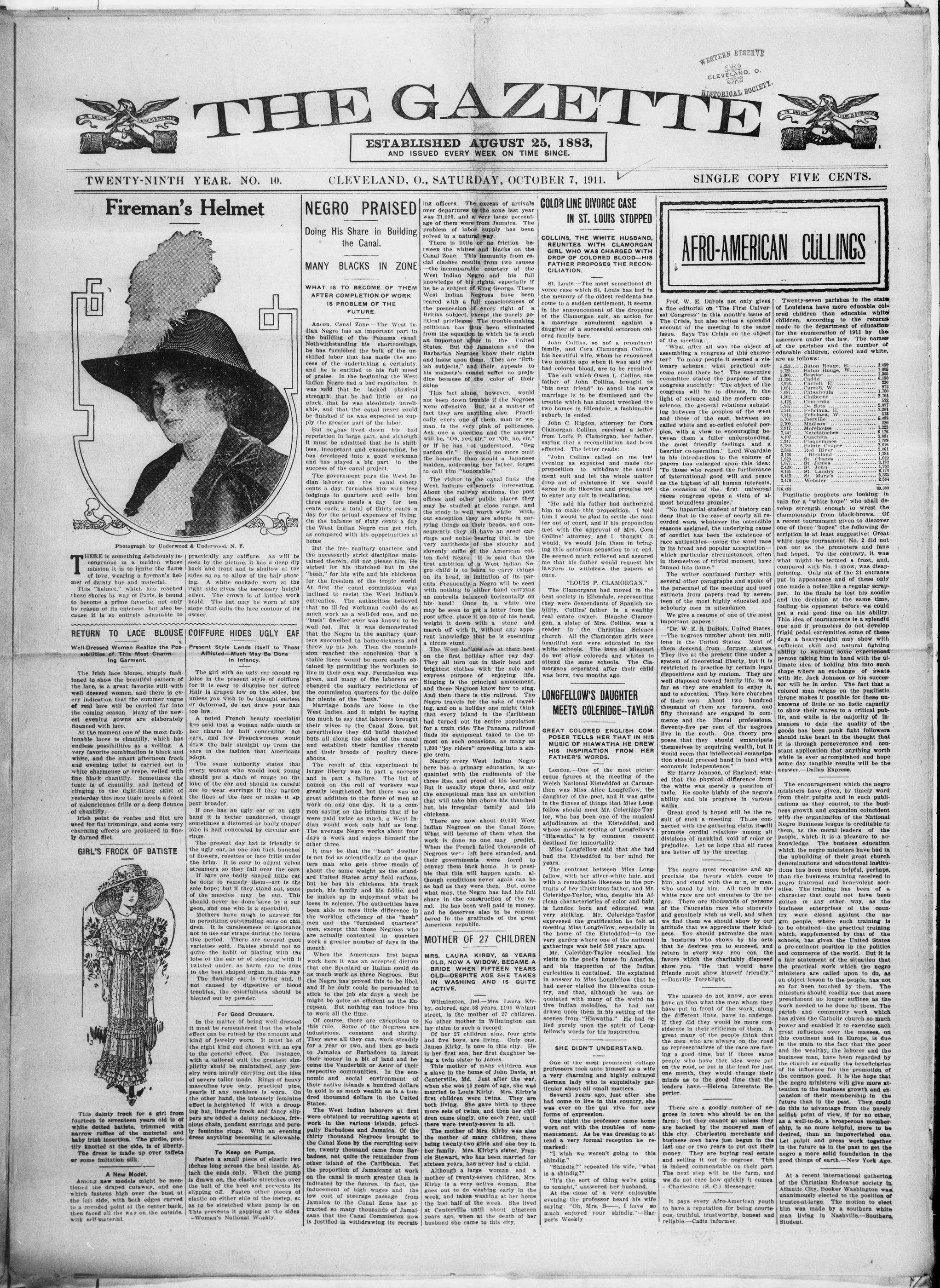
Fireman'
TWENTY-NINTH YEAR. NO. 10.
6
Photograph by Underwood & Underwood, N. Y.
THERE is something delicately incongruous in a midden whose mission it is to ignite the flame of love, wearing a fireman's helmet of durity hue and material.
practically any case seen by the picture back and front and sides so as to allow A. white goo
net of dainty like a mineral.
This "helmet," which has reached
these shores by way of Paris, is bound
to become a prime favorite, not only
by reason of its chicness but also
because it is so entirely adaptable to
Well-Dressed Women Realize the Possibilities of This Most Charming Garment.
The Irish lace blouse, simply fashioned to show the beautiful pattern of the lace, is a great favorite still with well dressed women, and there is every indication that the summer vogue of real lace will be carried far into the coming season. Many of the newest evening gowns are elaborately flounced with lace.
At the moment one of the most fashionable laces is chantilly, which has endless possibilities as a velling. A very favorite combination is black and white, and the smart afternoon frock and evening toilet is carried out in white charmure or crepe, veiled with fine black chantilly. Sometimes the tunic is of chantilly, and instead of clinging to the tight-fitting skirt of yesterday this lace tunic meets a frock of valenciennes frills or a deep flounce of chantilly.
Irish point de venise and filet are used for flat trimmings, and some very charming effects are produced in finely darned fillet.
GIRL'S FROCK OF BATISTE
3
This dainty frock for a girl from fourteen to seventeen years old is of white dotted batiste, trimmed with narrow ruffles of the material and baby Irish insertion. The girdle, prettily knotted at the side, is of liberty. The dress is made up over taffeta or some imitation silk.
A New Model.
Among new models might be mentioned the draped cutaway, and one which fastens high over the bust at the left side, with both edges curved to a rounded point at the center back, then faced all the way on the outside with self-material.
THE GAZETTE
practically any caffure. As will be seen by the picture, it has a deep dip back and front and is shallow at the sides so as to allow of the hair showing. A white cockade worn at the right side gives the necessary height effect. The crown is of lattice work braid. The hat may be worn at any slope that suits the face contour of its owner.
Present Style Lends itself to Those Afflicted—Much May Be Done in Infancy.
The girl with an ugly ear should rejoice in the present style of coifure for it is easy to disguise her defect Hair is draped low on the sides, but unless you wish to be thought earnest or deformed, do not draw your hair too low.
A noted French beauty specialist has said that a woman adds much to her charm by half concealing her ears, and few Frenchwomen would draw the hair straight up from the ears in the fashion that Americans adopt.
The same authority states that every woman who would look young should put a daub of rouge on the lobe of the ear and should be careful not to wear earrings if they harder the lines of the face or make it appear broader.
If one has an ugly ear or an ugly hand it is better unadorned, though sometimes a distorted or badly shaped lobe is half concealed by circular ear rings.
The present day hat is friendly to the ugly ear, as one can tuck bunches of flowers, rosettes or lace frills under the brim. It is easy to adjust velvet streamers so they fall over the ears.
If ears are badly shaped little car be done to remedy them—art is the sole hope; but if they stand out, some of the muscles may be cut. This should never be done 'save by a surgeon, and one who is a specialist.
Mothers have much to answer for in permitting outstanding ears on children. It is carelessness or ignorance not to use ear straps during the formal period. There are several good varieties sold. Babies should not acquire the habit of playing with the lobe of the ear or of sleeping with it twisted under, as harm can be done to the best shaped organ in this way. The flaming ear is trying and, it not caused by digestive or blood troubles, the colorfulness should be blotted out by powder.
For Good Dressers.
In the matter of being well dressed it must be remembered that the whole effect can be ruined by the amount and kind of jewelry worn. It must be of the right kind and chosen with an eye to the general effect. For instance, with a tailored suit the greatest simplicity should be maintained, any jewelry worn merely carrying out the idea of severe taller made. Rings of heavy masculine type only, practical pins, pearls if any necklace is worn. On the other hand, the intensely feminine effect is heightened if with a drooping hat, fingerlace or fancy slippers are added a dainty necklace, frivolous chain, pendant earrings and purely feminine rings. With an evening dress anything becoming is allowable.
To Keep on Pumps.
Fasten a small piece of elastic two inches long across the heel inside. Attach the ends only. When the pump is drawn on, the elastic stretches over the ball of the heel and prevents its slipping off. Fasten other pieces of elastic on either side of the instep, so as to be stretched when pump is on. This prevents it gapping at the sides - Woman's National Weekly.
ESTABLISHED AUGUST 25, 1883 AND ISSUED EVERY WEEK ON TIME SINCE.
CLEVELAND, O., SATURDAY, OCTOBER 7, 1911.
NEGRO PRAISED
Doing His Share in Building the Canal.
WHAT IS TO BECOME OF THEM AFTER COMPLETION OF WORK IS PROBLEM OF THE FUTURE.
Ancon. Canal Zone.—The West Indian Negro has an important part in the building of the Panama canal. Nothwithstanding his shortcomings, he has furnished the bulk of the unskilled labor that has made the success of the undertaking a certainty, and he is entitled to his full meed of praise. In the beginning the West Indian Negro had a bad reputation. It was said that he lacked physical strength, that he had little or no pluck, that he was absolutely unreliable, and that the canal never could be finished if he was expected to supply the greater part of the labor.
But he has lived down his bad reputation in large part, and although it must be admitted that he is shiftless, inconstant and exasperating, he has developed into a good workman and has played a big part in the success of the canal project.
The government pays the West Indian laborer on the canal ninety cents a day, furnishes him with free lodgings in quarters and sells him three square meals a day for ten cents each, a total of thirty cents a day for the actual expenses of living. On the balance of sixty cents a day the West Indian Negro can get rich, as compared with his opportunities at home.
But the free sanitary quarters, and the necessarily strict discipline maintained therein, did not please him. He sighed for his thatched but in the "bush," for his wife and his chickens, for the freedom of the tropic world. At first the canal commission was inclined to resist the West Indian's entreaties. The authorities believed that no ill-fed workman could do as much work as a well-fed one, and no "bush" dweller ever was known to be well fed. But it was demonstrated that the Negro in the sanitary quarters succumbed to home-sickness and threw up his job. Then the commission reached the conclusion that a stable force would be more easily obtained by permitting the workmen to live in their own way. Permission was given, and many of the laborers exchanged the sanitary restrictions of the commission quarters for the dolce far niente of the "bush."
Marriage bonds are loose in the West Indies, and it might be saying too much to say that laborers brought their wives to the Canal Zone, but nevertheless they did build thatched huts all along the sides of the canal and establish their families therein and their broods of poultry there-abouts.
The result of this experiment in larger liberty was in part a success and in part a failure. The list of names on the roll of workers was greatly lengthened, but there was no great addition to the force of men at work on any one day. It is a common saying on the isthmus that if he were paid twice as much, a West Indian would work only as long. The average Negro works about four days a week and enjoys himself the other three.
It may be that the "bush" dweller is not fed as scientifically as the quarters man who gets three meals of about the same weight as the standard United States army field rattons, but he has his chickens, his truck patch, his family and his fiddle, and he makes up in enjoyment what he loses in science. The authorites have been able to note little difference in the working efficiency of the "bush" men and the "furnished quarters" men, except that those Negroes who are actually contented in quarters work a greater number of days in the month.
When the Americans first began work here it was an accepted dictum that one Spaniard or Italian could do as much work as three Negroes. But the Negro has proved this to be libel, and if he only could be persuaded to stick to the job six days a week might be quite as efficient as the European. But nothing can induce him to work all the time.
Of course, there are exceptions to this rule. Some of the Negroes are industrious, constant and thrifty. They save all they can, work steadily for a year or two, and then go back to Jamala or Barbadoes to invest their money in a bit of land and become the Vanderbilt or Astor of their respective communities. In the economic and social environment of their native islands a hundred dollars in gold is as much wealth as is a hundred thousand dollars in the United States.
The West Indian laborers at first were obtained by recruiting agents at work in the various islands, principally Barbadoes and Jamaica. Of the thirty thousand Negroes brought to the Canal Zone by the recruiting service, twenty thousand came from Barbadoes, not quite the remainder from other island of the Caribbean. Yet the proportion of Jamaicans at work on the canal is much greater than is indicated by the figures. In fact, the inducement of high wages and the low cost of steerage passage from Jamala to the Canal Zone has attracted so many thousands of Jamaians that the Canal Commission now is justified in withdrawing its recruit
ing officers. The excess of arrivals over departures to the zone last year was 21,000, and a very large percentage of them were from Jamaica. The problem of labor supply has been solved in a natural way.
There is little or no friction between the whites and blacks on the Canal Zone. This immunity from racial clashes results from two causes—the incomparable courtesy of the West Indian Negro and his full knowledge of his rights, especially if he be a subject of King George. These West Indian Negroes have been reared with a full consciousness of the possession of every right of a British subject, except the purely political privileges. The trouble-making politician has thus been eliminated from the equation in which he is such an important actor in the United States. But the Jamaican and the Barbarian Negroes know their rights and insist upon them. They are "British subjects," and their appeals to his majesty's consul suffer no prejudice because of the color of their skins.
This fact alone, however, would not keep down trouble if the Negroes were offensive. But, as a matter of fact they are anything else. Practically every one of them, man or woman, is the very pink of politeness. Ask one a question and the answer will be, "Oh, yes, sir," or "Oh, no, sir," or if he has to understand, "Beg pardon sir." He would no more omit the honorific than would a Japanese maiden, addressing her father, forget to call him "honorable."
The visitor to the canal finds the West. Indians extremely interesting. About the railway stations, the post offices and other public places they may be studied at close range, and the study is well worth while. Without exception they are adepts in carrying things on their heads, and consequently they all have an erect carriage and noble bearing that is the very antithesis of the slouchy and slovenly suffle of the American cotton field Negro. It is said that the first ambition of a West Indian Negro child is to learn to carry things on its head, in imitation of its parents. Frequently a Negro will be seen with nothing in either hand carrying an umbrella balanced horizontally on his head! Once in a while one may be seen to get a letter from the post office, place it on top of his head, weight it down with a stone and march off with it, without any apparent knowledge that he is executing a circus stunt.
The West Indies are at their best on the first holiday after pay day. They all turn out in their best and brightest clothes with the sole and express purpose of enjoying life. Singing is the principal amusement, and these Negroes know how to sing. And then there is the railroad. The Negro travels for the sake of traveling, and on a holiday one might think that every island in the Caribbean had turned out its entire population for a train ride. The Panama railroad finds its equipment taxed to the utmost on such occasions, as many as 1,200 "joy riders" crowding into a single train. Nearly every West Indian Negro here has a primary education, is acquainted with the rudiments of the three Rss, and proud of his learning. But it usually stops there, and only the exceptional man has an ambition that will take him above his thatched but, his irregular family and his chickens.
There are now about 40,000 West Indian Negroes on the Canal Zone. What will become of them when the work is done no one may predict. When the French failed thousands of Negroes we left here stranded, and their governments were forced to convey them back home. It is possible that this will happen again, although conditions never again can be as bad as they were then. But, come what may, the Negro has had his full share in the construction of the canal. He has been well paid in money, and he deserves also to be remembered in the gratitude of the great American republic.
MOTHER OF 27 CHILDREN
MRS. LAURA KIRBY, 68 YEARS OLD, NOW A WIDOW, BECAME A BRIDE WHEN FIFTEEN YEARS OLD—DESPIE AGE SHE TAKES IN WASHING AND IS QUITE ACTIVE.
Wilmington, Del—Mrs. Laura Kirby, colored, age 58 years, 1104 Walnut street, is the mother of 27 children. No other mother in Wilmington can lay claim to such a record.
Of her 27 children nine, four girls and five boys, are living. Only one, James Kirby, is now in this city. He is her first son, her first daughter being a twin sister to James.
This mother of many children was a slave in the home of John Davis, at Centerville, Md. Just after the war, when she was 15 years of age, she was married to Louis Kirby. Mrs. Kirby's first children were twins. They are both living. She gave birth to three more sets of twins, and then her children came singly, one each year, until there were twenty-seven in all.
The mother of Mrs. Kirby was also the mother of many children, there being twenty-two girls and one boy in her family. Mrs. Kirby's sister, Francis Stewart, who has been married for sixteen years, has never had a child.
Although a large woman and a mother of twenty-seven children, Mrs. Kirby is a very active woman. She goes out to do washing early in the week, and takes washing at her home the last half of the week. She lived at Centerville until about nineteen years ago, when at the death of her husband she came to this city.
COLOR LINE DIVORGE CASE
IN ST. LOUIS STOPPED
COLLINS, THE WHITE HUSBAND,
REUNITES WITH CLAMORGAN
GIRL WHO WAS CHARGED WITH
DROP OF COLORED BLOOD—HIS
FATHER PROPOSES THE RECON-
CILIATION.
St. Louis.—The most sensational
divorce case which St. Louis has had in
the memory of the oldest residents has
come to a sudden settlement, it seems,
in the announcement of the dropping
of the Clamorgan suit, an action for
a marriage annulment against a
daughter of a successful octoonon
colored family here.
John Collins, so not a prominent
family, and Cora Clamorgan Collins,
his beautiful wife, whom he renounced
two months ago when it was said she
had colored blood, are to be reunited.
The suit which Owen L. Collins, the
father of John Collins, brought as
"his next friend" to annul his son's
marriage is to be dismissed and the
trouble which has almost wrecked the
two homes in Ellendale, a fashionable
suburb, is ended.
John C. Higdon, attorney for Cora
Clamorgan Collins, received a letter
from Louis P. Clamorgan, her father,
saying that a reconciliation had been
effected. The letter reads:
"John Collins called on me last
evening as expected and made the
proposition to withdraw the annul-
ment suit and let the whole matter
drop out of existence if we would
agree to do likewise and promise not
to enter any suit in retaliation.
"He said his father had authorized him to make this proposition. I told him I would be glad to settle the matter out of court, and if his proposition met with the approval of Mrs. Cora Collins' attorney, and I thought it would, we would join them in bringing this notorious sensation to an end. He seemed much relieved and assured me that his father would request his lawyers to withdraw the papers at once.
"LOUIS P. CLAMORGAN."
The Clamorgans had moved in the best society in Ellendale, representing they were descendants of Spanish nobility. Collins' father is a wealthy real estate owner. Blanche Clamorgan, a sister of Mrs. Collins, was a reader in the Christian Science church. All the Clamorgans girls were beautiful and were educated in the white schools. The laws of Missouri do not allow colors and whites to attend the same schools. The Clamorgans separated after their child was born, two months ago.
LONGFELLOW'S DAUGHTER MEETS COLERIDGE--TAYLOR
GREAT COLORED ENGLISH COMPOSER TELLS HER THAT IN HIS MUSIC OF HIAWATHA HE DREW HIS INSPIRATION FROM HER FATHER'S WORDS.
London.—One of the most picturesque figures at the meeting of the Welsh National Eisteddfod at Carmarthen was Miss Alice Longfellow, the daughter of the poet, and it was quite in the fitness of things that Miss Longfellow should meet Mr. Coleridge-Taylor, who has been one of the musical adjudicators at the Eisteddfod, and whose musical setting of Longfellow's "Hiawatha" is by common consent destined for immortality.
Miss Longfellow said that she had had the Eisteddfod in her mind for years.
The contrast between Miss Longfellow, with her silver-white hair, and with a remarkable likeness to the portraits of her illustrious father, and Mr. Coleridge-Taylor, who, despite his African characteristics of color and hair, is London born and educated, was very striking. Mr. Coleridge-Taylor expressed the gratification he felt at meeting Miss Longfellow, especially in the home of the Eisteddfod—in the very garden where one of the national gatherings was held 500 years ago.
Mr. Coleridge-Taylor recalled his visits to the poet's house in America, and his inspection of the Indian curiosities it contained. He explained in answer to Miss Longfellow that he had never visited the Hiawatha country, and that, although he was acquainted with many of the weird native Indian melodies, he had not drawn upon them in his setting of the scenes from "Hiawatha." He had relied purely upon the spirit of Longfellow's words for his inspiration.
SHE DIDN'T UNDERSTAND
One of the most prominent college professors took unto himself as a wife a very charming and highly cultured German lady who is exquisitely particular about all small matters.
Several years ago, just after she had come to live in this country, she was ever on the qui vive for new forms of expression.
One night the professor came home worn out with the troubles of commencement. As he was dressing to attend a very formal reception he remarked:
"I wish we weren't going to this shindig."
"Shindig?" repeated his wife, "what is a shindig?"
"It's the sort of thing we're going to tonight." answered her husband.
to tonight, answered her husband.
At the close of a very enjoyable
evening the professor heard his wife
saying: "Oh, Mrs. B——, I have so
much enjoyed your shindig"—Harper's Weekly
SINGLE COPY FIVE CENTS.
AFRO-AMERICAN CULLINGS
Prof. W. E. Dubois not only gives a fine editorial on "The First Universal Congress" in this month's issue of The Crisis, but also writes a splendid account of the meeting in the same issue. Says The Crisis on the object of the meeting.
Twenty-seven parishes in the state of Louisiana have more educable colored children than educable white children, according to the returns made to the department of education for the enumeration of 1911 by the assessors under the law. The names
"What after all was the object of assembling a congress of this character? To many people it seemed a visionary scheme; what practical outcome could there be? The executive committee stated the purpose of the congress succinctly: 'The object of the congress will be to discuss, in the light of science and the modern conscience, the general relations subsisting between the peoples of the west and those of the east, between so-called white and so-called colored peoples, with a view to encouraging between them a fuller understanding, the most friendly feelings, and a heartier co-operation.' Lord Weardale in his introduction to the volume of papers has enlarged upon this idea: 'To those who regard the furtherance of international good will and peace as the highest of all human interests, the occasion of the, first universal races congress opens a vista of almost boundless promise.' "No impartial student of history can deny that in the case of nearly all recorded wars, whatever the ostensible reasons assigned, the underlying cause of conflict has been the existence of race antipathies—using the word race in its broad and popular acceptance—which particular circumstances, often in themselves of trivial moment, have fanned into flame."
The writer continued further with several other paragraphs and spoke of the personnel of the meeting and used extracts from papers read by seventeen of the most highly educated and scholarly men in attendance.
We give a resume of one of the most important papers:
"Dr W E. B. DuBois, United States. — The negroes number about ten millions in the United States. Most of them descend from former slaves. They live at the present time under a system of theoretical liberty, but it is restricted in practice by certain legal dispositions and by custom. They are well disposed toward family life, in so far as they are enabled to enjoy it, and to education. They have churches of their own. About two hundred thousand of them are farmers, and fifty thousand are engaged in commerce and the liberal professions. Seventy-five per cent of the negroes live in the south. One theory proposes that they should emancipate themselves by acquiring wealth, but it would seem that intellectual emancipation should proceed hand in hand with economic independence."
Sir Harry Johnson, of England, stated that the physical difference from the white was merely a question of taste. He spoke highly of the negro's ability and his progress in various walks.
Great good is hoped will be the result of such a meeting. Those connected with the gathering claim it will promote cordial relations among all divisions of mankind, void of color or prejudice. Let us hope that all races are better off by the meeting.
The negro must recognize and appreciate the favors which come to him, and stand with the m n, or men, who stand by him. All men in the white race are not enemies to the negro. There are thousands of persons of the Caucasian race who sincerely and genuinely wish us well, and when we find them we should show by our attitude that we appreciate their kindness. You should patronize the man in business who shows by his acts that he desires you to succeed, and return in every way you can the favors which the charitably disposed show you. "He that would have friends must show himself friendly."—Danville Torchlight.
The masses do not know, nor even have an idea what the men whom they have put in front of the work, along the different lines, have to undergo. If they did they would be more considerate in their criticism of them. A great many of the people think that the men who are always on the road as representatives of the race are having a good time, but if those same people who have that idea were put on the road, or put in the lead for just one month, they would change their minds as to the good time that the leaders have.—Helena Interstate Reporter.
There are a goodly number of negroes in town who should be on the farm; but they cannot go unless they are backed by the moneyed men of this city. Charleston merchants and business men have just begun in the last one or two years to put out their money. They are buying real estate and selling it out to negroes. This is indeed commendable on their part. The next step will be the farm, and we do not care how quickly it comes. —Charleston (S. C.) Messenger.
It pays every Afro-American youth to have a reputation for being courteous, truthful, trustworthy, honest and reliable. —Cadiz informer.
Twenty-seven parishes in the states of Louisiana have more educable colored children than educable white children, according to the returns made to the department of education for the enumeration of 1911 by the assessors under the law. The names of the parishes and the number of educable children, colored and white, are as follows:
5,258. Baton Rouge, E. 3,459
7,228. Baton Rouge, W. 1,005
7,228. Baton Rouge, W. 972
11,736. Caddo 6,159
9,295. Carroll, E. 220
9,295. Catahoula, W. 972
9,297. Catahoula, W. 1,709
4,502. Clalborne 2,754
4,476. Concordia 123
5,967. Dedo, S. 2,887
5,967. Dedo, S. 2,887
3,834. Pelchiana, E. 2,381
3,834. Pelchiana, W. 2,381
5,290. Deville 5,488
5,290. Madison 220
5,917. Morehouse 1,223
5,917. Morehouse 1,223
4,107. Quincy 3,884
3,242. Pliaquemines 1,709
3,242. Pointe Coupe 2,818
2,586. Red River 2,061
3,136. Richland 1,244
1,628. Jamaica 1,023
1,628. Jamaica 1,023
8,177. St. John 3,183
2,420. St. John 3,183
2,420. St. Landry 4,775
6,413. St. Mary's 5,335
3,478. Webster 2,584
116,433 69,380
Pugilistic prophets are looking in vain for a "white hope" who shall develop strength enough to wrest the championship from black-brows. Of a recent tournament given to discover one of these "hopes" the following description is at least suggestive: Great white hope tournament No. 2 did not pan out as the promoters and fans had hoped. To the contrary, it was what might be termed a frost, and, compared with No. 1 show, was disappointing. Only six of the 21 entrants put in appearance and of these only one made a noise like a regular scraper. In the finals he lost his noodle and the decision at the same time, fouling his opponent before we could get a real good line on his ability. This idea of tournaments is a splendid one and if promoters do not develop frigid pedal extremities some of these days a heavyweight may show with sufficient skill and natural fighting ability to warrant some experienced person taking him in hand with the ultimate idea of holding him into such shape where an exchange of swats with Mr. Jack Johnson or his successor will be in order. The fact that a colored man reigns on the pugilistic throne makes it possible for these unknowns of little or no fistic capacity to show their wares to a critical public, and while in the majority of instances to date the quality of the goods has been punk fight followers should take heart in the thought that it is through perseverance and constant application that anything worth while is ever accomplished and hope some day tangible results will be the answer.—Dallas Express.
The encouragement which the negro ministers have given, by timely word from their pulpits and in such publications as they control, to the business growth and expansion coincident with the organization of the National Negro business league is creditable to them, as the moral leaders of the people, which it is a pleasure to acknowledge. The business education which the negro ministers have had in the upbuilding of their great church denominations and educational institutions has been more helpful, perhaps, than the business training received in negro fraternal and benevolent societies. The training has been of a character that could not have been gotten in any other way, as the business enterprises of the country were closed against the negro people, where such training is to be obtained—the practical training which, supplemented by that of the schools, has given the United States a pre-eminent position in the politics and commerce of the world. But it is a fair statement of the situation that the practical work which the negro ministers are called upon to do, as an object lesson to the people, has not so far been touched by them. The ministers should readily see that more preachment no longer suffices as the work needed to be done by them. The parish and community work which has given the Catholic church so much power and enabled it to exercise such great influence over the masses, on this continent and in Europe, is due in the main to the fact that the poor and the wealthy, the laborer and the business man, have been regarded by the church as equally the beneficiaries of its influence for the promotion of the common good. It is the hope that the negro ministers will give more attention to the business growth and expansion of their membership in the future than in the past. They could do this to advantage from the purely selfish point of view, if for no other as a well-to-do, a brossever member, is no more helpful, more to be desired, than an impoverished one. Let pulpit and press work together in the future as in the past to get the negro a more solid foundation in the good things of earth—New York Age
At a recent international gathering of the Christian Endeavor society in Atlantic City, Booker Washington was unanimously elected to the position of trustee-at-large. The motion to elect him was made by a southern white man living in Nashville.—Southern Student.
PUBLISHED EVERY SATURDAY
SUSSCRIPTION RATES
(Qn Advance)
Ome Vear......ecreceseee ss 81.80
Bix Months... 2.2.2... 2 2. 1.00
‘Three Months.......c2c0.0+ 0
Bubscribers are requested te re
‘mit by postotfice money on
der or registered retter.
ntered at the postoffice In Cleveland,
‘Ohio, ax second-class matter
Address all communications te
HARRY C. SMITH
Editor and proprietor,
THE GAZETTE,
Blackstone Bullding, Cleveland, 0.
Member Ohle Legislature: 1894
te 1896; 1896 to 1898; 1900 to 1902
HE GAZETTE Is the oldest, and
fase the largest bona fide circulation,
double that of any newapaper in the
Interest of Afro-Amerioans, published
in the state of Ohio, and comparison
with any will Immediately establish
hte rank as ene of the NEWSIEST
AND BEST In the country.
Three more Coatesville, Pa., mob-
ocrats have been indicted by the spe-
cial grand, fury, making seven in all.
More than one’ hundred should have
deen indicted and much more prompt:
eS ae a a eee
The death of reciprocity with Can-
ada, seems to have punctured badly
the Taft second-term-candidacy tire.
Good! Most any Republican candl-
date for the Presidency, other than
President Taft, can win next year.
Senator Joseph Benson Foraker would
make an ideal candidate, wouldn't he?
The Gazette wishes to compliment
our Cleveland ministers on thelr
broadening of the platform upon
which they have been standing in
their laudable efforts to promote the
general uplift of our people, particu-
Jarly of this community. It was really
necessary, and too long “coming.”
What a-pity it is, our people of
Ohio, outside of Cleveland, cannot or
will not see the wisdom of trying to
secure the election of delegates. (of
their own race) to the State Consti-
tutional convention, to meet next
year. All candidates for delegate
must have nearly 1,700 signatures ot
men who voted at the last November
‘election, on thelr petitions and file the
petitions with their Board of elections
‘on October 7 1911, Wake up!
‘Less than one hundred Afro-Ameri-
cans attended the meeting at the Re
publican headquarters, Tuesday even:
ing, presided over by Chairman Rod:
way, the employes of the Garbage
Plant and others in the city’s employ
constituting a majority of those in
attendance. “Starlight” Boyd, Charlle
Crawford and Tom Fleming, “the col
‘ored leaders” of the Baehr adminis.
tration, made the principal “talks.”
Chairman Rodway “took Henry Taylor
to task” for saying there was no or
ganization among our people, and Hen:
ry was right. Our voters of this com:
munity will not follow such leadership
as the Bachr administration has folst-
ed upon them and the sooner Chair.
man Rodway and Mayorality Candi
late Hogen recognize this fact and
‘make the necessary change, the bet
ter it will be for the Republican ticket
in November. Led by our local min
isters of the gospel, the great mass of
our four thousand voters in Cleveland
have for months been protesting in
vain against the “Baehr Colored polit
Jeal leadership" and Insist that the
change be made or the local Repub
lican ticket will lose hundreds if not
thousands of Afro-American votes on
lection day in November. Will
" Mesars. Hogen and Rodway act? We
shah woo.
We do not “take any stock” in the
American newspapers’ statement that
“color” had anything to do with the
refusal of the English people to per
mit the Jack Johnson-Bombardier
‘Wells fight to take place in that coun-
try, as scheduled, The effort of these
papers, to make people in this country
believe such “stuff,” is just thir
enough for any thoughtful person to
see through it, who is familiar with
the foolish American racial prejudice
and desire to have people generally
believe ‘other countries, especially
England, are also equally guilty along
the same foolish line. ‘Then, too, 80
many American newspapers were too
particular to try to spread this er
roneous belief to place them or their
questionable effort above suspicion,
with those who take the proverbial
pinch of salt before swallowing all
they read in the sensational-craving
dally papers of today. We do not
mean to say, howéver, that prejudiced
Americans at home and in that coun-
try, did not do everything in their
power to awaken the English’s dor-
mant moral sense against prize-ight-
ing, but they did so with the prime
idea of taking advantage of the re-
sultant condition just as prejudiced
and‘ misguided American newspapers
have done. We may be wrong in this
belief, bot we do not thick so.
THE STATE CONSTITUTIONAL
CONVENTION.
‘There is a provision in the Ohio
constitution for the voting of whites
‘only that ought to come out, even if
it is obsolete. Next year a new state
‘constitution is to be made. As well
Se our. yponie, evervhere, know that
these afe dangerous times for them,
Ohio Afro-Americans, outside of Cleve
Jand, are sound asleep, as far as, the
Jmportance of having direct represet:
tation in next year's Ohio State Con-
stitutional convention js concerned.
‘The U. 8. Supreme:Court has decided
that the states areypupreme in the
matter of the privilege (not a right)
Of voting except when it comes to U.
& elections —for congressmen and
presidential electors. Disfranchisement
bas grown in the south until nearly
‘every state in that section of the
country bas disfranchised its Afro-
American voters, and the feeling favor-
ing sub pernicious action is growing
northward. No one can tell, In these
peculier times, what the near future
mey bring forth slong this line even
in Ohio. The growth of prejudice
against the race in recent years has
been sufficient to at least put us on
guard and to make us careful to at
least try to be properly represented
in all law-making bodies where there
is the slightest chance to secure such
representation. The door, for the ef-
fort at least, has been opened wide
for weeks to our Ohio voters, as well
as to all others, in this matter of
representation in next year's con
stitutional convention, and it will be
closed on the 7th of next. month,
What are we doing, outside of Cleve.
land, to take advantage of this glori-
ous opportunity—more important to
us than any other class of citizens in
the “Buckeye” state? Nothing! ab:
solutely nothing, outside of Cleveland,
as far as we have been able to learn,
What in the world is the matter with
this race of ours? In the south, a
million Afro-American voters are dis
franchised. Here in the north, we'll
sleep on until some morning’ there
will come a rude awakening when it
is too late—we fear,
A SPLENDID TESTIMONIAL
By a Fair White Newspaper Writer te
Jack Johnson, Peter Jackson,
Frank Craig and the Bohee
‘Brothers Abroad.
People who do not know the Eng-
lish wondered over thelr recent ec
static reception of Jack Johnson, 1.on-
don was full of visiting royalty “when
“he came to town,” but he put them
all in the shade.’ His progress was
like a miniature Lord Mayor's pro:
cession and the crowds were more
than a hinting of those which greeted
the eoronation parade. There's a
double reason for this. Johnson is a
‘great and successful prize fighter and
|e is & Negra, ‘There are no race di
Unctions in England and with its cen:
| tury-old love of pugilism the spectacie
Jot & black champion caught the Brit
[ish faney as no other combination
could have done. The Johnson craze
Simply repeated that of Peter, Juck-
son, and Frank Craig, the “Harlem
| Coffee Cooler.” Then, ‘too, “Fingland
has always been partial to the Nexto
in publie iife, Strange as It_ may
seem, London was one of the greatest
strongholds of minstrelsy in the
World, For more than a quarter of
Century Moore & Burgess" Minstrels
played there and it was the proud
doast of “Pony” Moore, who owied
the company, that it never played out:
side of London. Until all its mem:
bers grew old and toothless, it was as
much of a London institution as Ma
dame Tussauds or Egyptian Hall
‘where all the great magicians, includ!
Ing our own Gus Hartz, were’ housed
from time to time, London welcomed
the minstrels that Jack Haverly took
there, but it reserved its greatest en
thusiaem for Callender's Georgia Min
strels, the genuine article with Billy
Kersands, who was one of the great
est minsirel comedians of any racé
pr color. Cleveland had a share of
this success for the Bohee Brothers,
who used to live here, were members
of the company. ‘They played the ban
Yo in a way that set all London talk
ing. ‘This enthusiasm grew bound:
less when King Edward, then the
Prince of Wales, and, as usual, a boy
in his desire for novelty, engaged the
brothers to teach him how to plink
plank, plunk. After that, they owned
the town and such Is. the steadfast
ness of the British liking they prob
ably have their nice little share of it
now, if they are living. ‘They were in
the flesh a few years ago. and pros
perous, but 1 haven't heard anything
about them lately. ‘This apprectation
of King Edward was rightly placed
for, without, question, they were the
finest banjoists of their time, and sd
far I haven't heard any one who sur
passed them. It is the fashion now
among the fellows who play banjos tg
go in for virtuosity and If they don’
give us the “William Tell” overture
With ‘aching fingers and sweat-be
dewed brows, it is Suppe's “Poet anc
Peasant” which they tackle. But. the
Bohee boys, as many Clevelanders
will remember, stuck to the natura
range of the banjo and its natura
music, “1 must modify this by suying
that they gave “The Rive Danube’
as a duet in a way that would have
delighted Strauss himself, They put
a rhythm in it that gave it a new
beauty and when you heard it you
Wished fo dance just as if you were
‘At-an obi meeting. But the maln run
of their repertory was made up ot
characteristic Southern music, which
they played with a wonderful’ quality
of tone, uncanny faculty, expression
and a rhythm that was hypnotic. They
used to have a saloon on Ontario
Strect with a big music hall attach
ment, and here the Bohee boys would
play ‘every evening to audiences that
‘went there to drink in the music and
not the beer. These Bohees were artists
in their line and by keeping to. the
normal quality of the banjo’ they
raised it to the dignity of a solo in-
strument. I don't blame the King for
taking lessons from them, no matter
what it cost him. He could give
draft on the First Lord of the Back
Stairs of the Bank of England and It
would be honored at sight. 1 know 1
Zot the craze from. these Bohees und
Managed. to. master the Pensacola
Quickstep after months of tortured
and torturing practice. —Wm. E.
Sage in Cleveland Dally Leader.
“EMPIRE STATE NEWS.”
New York City—A cantata, “The
Peace of Jerusalem,” was rendered
recently by the choir and friends of
the First United Christian church
(Memorial), 3% W. 182d St., under the
direction of Mfrs. E. A. Johnson, and
there was a very representative au:
dience. The soprano solo, “The Lord
is Thy Keeper", by Miss Blanche
Spence: the contralto solo, “Jerusa-
lem is Builded", by Miss W. Spence;
the tenor recitative, “I will Lift up my
Byes", by Mr. Conrad Ross; as well
as the trio by Miss B. Spence, Miss
‘Noma Edmead and Mr. A. Christo-
pher, “I was Glad”, (unaccompanied).
bronght forth rapturous applause, At
the close, short addresses were made
by FE. A. Johnson, esq., and Bishop
P. A. Hubert of the church. A vote
of thanks to all who aided in the ef-
fort, followed, The pastor, Rev. J.
Edmead, announced the ’ doxology
whlch Was composed by Rt. Rev. P. A.
Hubert, harmonized by his daughter,
“Miss Cecilia” and set to the hymn,
“Saviour Sreathe an Evening Bless:
ing.” ‘The benediction was pro-
nounced by the bishop.
AGENTS! READ!
When your Gazettes are not
delivered 08 Friday mornings,
call at your Central Postoffice
General Delivery Window for
them In the afternoon of the
same day. —Editor.
THE GAZETTE, CLEVELAND, 0., SATURDAY, OCTOBER 7, 1911.
$15.00 to $50.00 per Week, |
axes. We want reliable agents to! | geepa
be as represented. Write quicl ANS ys Kwaar’oun eh
Pennsylvania Nursery Co., Girard, | | aS 7@RuR
apes ye | ROSE E ht | IN MANY ert
—____—_ POSSE | OF TH
eons? fate ic | RSS) PACE | uteRestins
partment, has received’ an_appoint- oer ae
Pe ee Zambara, whose parents_are Cot-| ~Itema— Marri
cme, tosng at Shiloh. Baptist
churen, Monday evening, under tie
auspices of the Citizens” Association
for Civic Interests, was one of its
most enthusiastic and successful ones
‘The “speakers were: Revs, B. H.
Smith, H, C. Bailey, W. L, Brown and
the editor of The Gazette. Walter L.
‘Brown's two very. promising young
‘daughters, and Master 1. Jones, fur-
Juished excellent vocal and instrimen-
tal music. 8. E. Woods presided,
while Geo. C. Sutton, the secretary,
was ably assisted by Geo, W. Johnson
and Chas, §. Sutton, Nineteen of
the more ‘than 50 petitions, reported
nearly 1,000 signatures and success
Seems assured. All petitions must be
sworn to and filed with the Board of
Elections today (Saturday) or they
will be of no value, All were ordered
returned to the headquarters of the
Asnceiation, Room 2, 2404 Central
Ave., on Thursday of this week, and
each must be sworn to by at least
[five signers. One of the most pleas:
Ing qvents of the meeting was the
report of the commitiee sent to the
Secretary of the Munteipal Associa:
tion. Dr. J. K. Nickens, chairman,
[created great enthusiasm when he re
ported the following letter as having
[heen sent to “Mutiy” Secretary Mayo
| Fester
Headquarters
| Citizens’ Association for Civic
‘auc,
No. 2404 Central Ave:
Cleveland, O., Oct. 1, 1911.
Mr, Mayo Fesler, Sec, Municipal As:
sociation, City,
Dear Sir: Th undersigned, mem-
bers of the committee appointed by
the Citizens’ Association for Civie In-
terests, in compliance with your re-
quest, ‘are sending “in writing” the
protest made recently to you in per-
son:
‘The association, composed of lead:
ing Afro-Americans of this city, pro-
tests against your “labeling,” as “Ne-
groes” and “Colored,” Afro-American
candidates for public office in this
city and county: First, because this
harmful discrimination’ fs done in
thelr case only; secondly, because
there is no good reason why any class
of CITIZENS should be so “labeled”
or designated in your reports. It
would be equally unfair and insulting
to so “iabel” or designate Jewish,
Irish, German and candidates of other
nationalities or classes, and yet, if
this sort of thing is followed in the
case of the Afro-American, all other
candidates of the different nationali-
ties or classes should be similarly
treated in your reports,
It Is the merest nonsense to argue
in defense of such insulting discrimt.
nation that the nationality or class of
other candidates is indicated by their
names, There are many Jewish,
Irish, German and other class-candi
dates, constantly before the public,
whose names do not indicate their na-
tionality or class-connection.
‘Therefore, the Citizens’ Association
for Civic Interests protests against
such manifestly unfair treatment of
local Afro-American candidates and
respectfully requests its discontinu-
ance.
Signed:
J, K, NICKENS, M. D., Chairman,
Hi, M. LOWERY (Rev.},
CHAS. 8. SUTTON, Secretary,
a
Secretary Fesler's Reply.
‘THE MUNICIPAL ASSOCIATION
anaes oe ane
IRA i. et
Cleveland, 0., Oct. 2, 1911
Mr. J. K, Nickens, Chairman Citizens’
‘Association for Civie Interests
Commitwe, 2404 Central Ave,
City.
Dear Sir: I have your communica:
tion in regard to the use of the term
“Negro” and “Colored” after Afro:
American candidates for office. ‘The
matter will be referred to the Execi
tive Board, and 1 assure you it will
be given fill consideration, As soon
as the Hoard has scted Twill let you
know of their decision,
Very truly yours,
MAYO FESLER, Secretary.
‘The date for the next meeting will
doubtless be announced in the
churekes, Sunday, as usual,
THEATER ON WHEELS CLOSED
Balky Traction Engine Caused Paris
Manager to Abandon His Pet Pro-
ject—Will Try it Again.
Paris.—One of the most interesting
theatrical experiments of late years,
the Theater Ambulant Gemier, or the
Gemler Traveling Theater, is about to
come to an end In its present form,
and the company is going into liquida
tion,
Mr. Gemier, the enterprising actor
manager of the coneern, formerly of
tha Comedie Francaise, states that
although, from the point of view of
the receipts, averaging $600 a day,
the new veuture has been a complete
success, it is impossible to continue
the present method of tugging the
heavy theater, scenery, properties,
dressing room, caravans, lighting
plant, ete. along the roads by means
of @ traction engine, which, when
working properly gets up a speed of
three miles an hour, and at other
times, falls into ditehes, dashes down
hills into churchyarés and otherwise
complicates matters.
‘The founder, therefore, thought it
best to go {nto voluntary liquidation;
but he has not the smallest idea of
giving up this portable theater. He
Will still take it around the country
putting §t up in town after town as
he arrives; but henceforward all the
vans will be transported by rail in 2
special train.
MM. Gemter seems to have had noth
ing but trouble ever since he starred
Another setback was that at a number
of towns booked he was unable to give
performances owing to the dear-food
whale’
sanaries Are Long-Lived.
Cananer bave been known to live
Qwen*y one years.
ee |inles
ap yr sid banat IE se A agit cath
ored Cubans, was born in Berlin, Ger-
many, 22 years ago. ‘They were the-
airical people at the time and Zam
bara is « pugilist, trained in Germany
He came to America, two years ago.
Adolph Leinburger was” born In
Hamburg, Germany; also his brother
Fritz, who is also a young man and
who recently married an. Afro-Amer!-
can. ‘They are now with a troupe in
South America en route here. Both
Aived in thelr native country\ until
about 20 years of age. Like Zaimbara
they are Germans in all but color.
As a result of examinations held by
‘the W. Va. Board of Examiners. for
Certified Accountants, Gov. Glasscock
has signed certificates for fourteen
who stood the test, one belng Chas.
(E. Mitchell, Business Manager of the
“West Virginia Colored Institute, who
thus becomes the only Certified Ac-
countant of his race In the U. S.
‘A daily paper of Jackson, Missis-
sippi, is the authority for the state.
ment’ that the colored population of
that city own one million dollars’
Worth of property. This is a good
showing for the elty of Jackson's
size; but Los Angeles, California, with
& poptilution approximating 20,000,
has one distinguished colored ‘tax
payer, Mr. B.C. Owens, who owns
and controls for his family nearly the
[same amount of property. Los An:
| geles (Cal.) New Age.
President Taft more than once ax
sured the Philippine protestant
preachers that there was nothing for
them to do in the Islands, and strong:
ly advised them to stop at home (in
America). ‘They wouldn't. Now they
fare being laughed at by scoffers, who
declare that out foreign missionaries
should all be recalled until. burning
(at the stake and other horrible crimes
are suppressed in the United States;
and that meantime we oughtn't to
trouble ourselves about bulltights: in
| Mexico or cock-fights fn Panama—
Notre Dame (Ind.) Ave Maria,
| We note with much pleasure that
the Hon, Harry C. Smith, editor and
| proprietor of The Cleveland Gazette,
[is out for delegate to the Ohio State
| Consticutionat Convention, "We bone
Harry will win, a8 the race In Cleve.
| land cannot find @ more conscientious
and fearless man to represent them,
and if elected would serve his people
Creditably. Every Colored man should
Vote for him, as he has sacrificed the
best part of his life in fighting our
cause and We should show our grath
tide to the champion of human rights
to all people—Pittshurg Courier.
Prof. A. S. Peal of Clarksville
Okia., a Columbus, Ohio, bos, has ac
| cepted the chair’ of Pedagosy und
| English at Western University, Quin:
daro, Kans. He also instructs in Mil
itary Science. AS a teacher and prop
erty owner of the county, It is to be
regretted that justifiable | work was
| not obtainable in this county where a
|man. of his talent and worth could
be utilized at home. As conductor of
jthe Summer Normal, wherein his ett
J clency demonstated Itself as master
in the school room, the teachers have
expressed themselves In favor of his
ripe leadership.—Wagoner (Okla.)
Lantern.
BERLIN IS VERY QUIET CITY
Neediess Noises Are Wisely and Firm:
ty Suppressed in Kaiser's Capital,
‘Mica: ‘Rice @iada,
Berlin.—“Noiseless Germany” has
made a favorable impression on Mrs.
Isaac L. Rice of New York, president
of the Soclety for the Suppression of
Unnecessary Noises, She found among
other things that the idea that whis-
tles are a necessary evil on railroads
has been destroyed by the German
method.
A couple of years ago, in conse-
quence of the kaiser’s habit of travel
ing by night and hfs dislike of being
disturbed, orders were Issued that Ger.
man railroads should not use whistles.
Accidents on German railroads are
rare, while in Belgium, where whis
tes are screeching continually. they
are frequent. ‘The same is the case in
France.
In Germany ten minutes before the
train starts the officials tell the pas-
sengers to take their seats. There is
no crush, and when it is time, a whis-
tle like a boatswain’s is sounded and
the train starts. Mrs, Rice would like
to see the same system introduced in
to the United States.
Mrs. Rice has been devoting special
attention to automobile horns. ‘They
‘ave as great a nulsance abroad, she
says, as at home. While in a Lon
don hotel at a busy hour in the even
ing she counted 488 whistles in 15
minutes, and during a comparatively
quite time 696 in half an hour.
“In Paris,” she says, “our own
chauffeur sounded the horn 55 times
in less than three minutes, and it was
in a quiet street.
“I noticed in passing through the
streets of Paris that scarecely a win
dow was open. People cannot sleep
with open windows on account of the
noise.
“I am happy to say that several 80
cleties for the suppression of noises
are successful In Europe. They have
even induced hotel people to post
signs reading, “Kindly keep quiet.”
Charge Three More With Lynching.
Coatesville, Pa—Three ‘more ar
rests were made Sept. 28 in connec
tion with the burning of Zach Walker.
‘Those taken into custody are George
Corsarge, 17, Louis Kaiser, 25, and
Ernest. White, 13, wno are employed
in an ifon mill, ' The prisoners. are
charged with being among the leaders
of the mob.
Chinese Business Methods,
Most of the Chinese business
houses are now owned by partner
sbipa, and most partnerships are of a
large number of persons. The Chinese
who bas saved $100 local currency
will at once invest ft In a mercantile
business and become a partner.
FRESH Util NEWS
OUR OWN WRITERS’
ge eee ae
INTERESTING PERSONAL NOTES
| Notes of Interest.
| Sandusky.—Rev. Bass, the new pas:
tor, preached at Neil St. A. M. B.
Jehireh, Sunday. Attendance excel
Ient.—Rtev. G. D, Smith preached two
splendid sermons at the Second Bap
|tist chureh, Sunday. A delegation will
| attend the state convention at Toledo,
this week.—Give the agent your order
for The Gazette and get the news.
| “Newark timer. Nansome of ‘De-
| troit, visited relatives here, last week
|—Mrs, Lois Washington Carroll died
[recently at the City _hospital.—Mr.
[Harry Toney has returned from— to
| remain.—J. Arthur Cunningham visited
his old home, Washington C. H., last
|Week—Mr. and Mrs, Fountaine John-
son visited relatives in Cincinnati,
| last week.
| Zanesviite—Miss Eva Self has cone
to Calvo, Mii, via Chieago, to attend
| school Ars.’ Jos. Williams, daughter
of Mrs, Chas. Burrough, died recently.
Miss Loota Barnett has located in
Cincinnati-—Miss Zoe Self has re
turned to. Pittsburg. —Misses Carrie
Guy and Vernell Leach have returned
from Cleveland.—Rey. J. D. Scott has
made an excellent impression. He has
moved his family here —The Gazette
esizos an agent and correspondent
Toledo.—Mirs. 0. G. Fields will at
tend the state convention of the
King's Daughters, at Bellefontaine,
next week, as a delegate from the
|4ulin H. Brown elrele, and will visit
Piqua before returning. —Mrs. Marion
jArthur ix entertaining her cousin,
| Miss Louise Hyatt of Windor, Ont.,
Ca—MissPindlay of Dayton, was
| Mrs. Fields’ guest.—Mrs, C. M. Will-
|iama and Mrs, E. H. Rogers enter
| tained thelr guests, Mrs. J. 0. Taylor
| of New Kensington, Pa., and Miss Lil-
Han Crawtord of Pittsburg, the 29th,
| ult., at People’s hall. Over 100 guests.
|The ladies’ gowns were beautiful, and
the supper and dancing thoroughly en-
[ovea
(Athens. — Miss Willa Payne, who
was operated on recently for appen:
dicitis, 15 convaleseing slowly.—Mr.
Everett Cousins was here last week
from Springtield—Mr. and Mrs, Wil:
fam Miller had as thelr guests during
the fair, Mrs. John Gardner of Lan:
| cater, Miss May’ Miller of Nelson:
|Sille and Mr. Sylvantous Miller of
Washington, D. C—Among those who
attended the celebration at Rendville
Were Mts. tea Morgan and daughter,
Mrs Chris Lomax, Miss Cornella
Hayes, Charles Beil and Mr. John
Campbell, They report a fine time.
| "Delaware—Quite a number of our
| people have entered 0, W. University
| this year. ‘Those who have reported
| are: Miss Clayton of Cadiz, | Miss
Beachcamp of Maysville, ‘Messrs.
Scott of Tennessee, Johnson of Fos
|toria, ‘and Haskell” of Columbus —
| Prank Gardner was called to Carding.
ton Sunday week by the death of his
father. He was one of Cardington’s
oldest citizens, was very industrious
and will be greatly missed.—Messrs
George Wilson and George Johnson
[have gone to Bueyrus to work.—Mrs.
| Mariah Jobnson has taken charge of
the Puller cate
| Cadiz—Mir. Roy Carter visited his
| mother, In Smithfeld, last week. —
The Tiarrig sisters have moved to
| Michigan,—The justices of the Massa.
| chusetts supreme court have promot-
‘ed official stenoxrapher C. Henry Rob:
| bins to the new session of the supertor
‘eourt which opened in Boston on Mon:
day. His first duties as court ster
|oxrapher began in September, 1909,
|when, after a competitive examina:
| tion, he was appointed to Barnstable,
Dukes and Nantucket counties. After
@ year and a half he was transferred
to Essex county.—Mrs. Nicey Aun
Cole, who was said to be the oldest
| person in Westchester county, died in
[White Plains, NY. recently, in her
iWist year. She was the mother of
|12 children, Mrs. Cole was in slavery
| for 30 years,
Youngstown—Mr. and Mrs. J. H.
| stewart have returned from Pitts:
burg, to remain.—H, G, Hampton and
|B. J. Howard of Zanesville, left for
| Sieubenville, Tuesday. They were
[here three weeks—J. H. Bobson had
theumatism, this | week—Buekeye
Todge’s dancing party, Monday even:
ing, and the Waiters’ ball on the 20d.
—Pithel R, Lewis and Edgar A, Turner
of Springiteld, were married Wednes:
| day at the bride's parents’. She was
attired In white, and carried a bou:
quet of pink tearoses. Her father
gave her away. Miss Pthel Simmons
of Mt. Vernon, bridesmaid, was
dressed in pale biue chiffon over silk
and carried pink carnations. The
groom and his best man, the bride's
| brother, wore the conventional black
| Rey. RL L. Thomas officiaged, Mrs
JL. M. Berry played the wedding
| mare, and an elaborate breakfast was
served. The happy couple received a
[number of useful “presents, Close
[friends and relatives witnessed the
| ceremony: Mrs Florence Washington,
| Miss F, Smith of Struthers, Miss Daw-
| son of Willoughby and Miss Carrie
Ewing of Mt. Vernon,
Correspondents must mail all let
ters for publication at thelr main
| postofice sudcienty early on Monday
(or Sunday) of each week to have
them reach The Gazette office on
‘Tuesday morning, and always write,
also, thelr names and that of thelr
city’ or town on the outside of the
wrapper about returned copies. Un-
less this latter 1s done, proper credit
‘cannot be given you, Lists of names,
Wedding presents, etc., obituary no-
tices, speeches, resolutions. poetry, in-
Jauiries for relatives and advertise:
| ments of all kinds, including ttems
announcing entertainments to be held
jin the near future, must be paid for
in advance at the tate of ten cents a
Tine, six words to a line, Our rates
for display advertisements will be
sent on application. Send postal note
and not stamps durine warm weather.
Smithfield—Mrs. Lizzie Jeffries of
Pittsburg, Mrs. Cary Hargraves’ guest,
returned home, Saturday. Mrs, Har-
grave of Homestead, Pa., is now her
guest.—Rev. John Dickerson of Ham-
ilton, was Mr. and Mrs, W. H. Veney's
guest and others, last week, He
Re ee cae gicte
HOWARD UNIVERSITY
Sted re abd tee gt eke Dy PRESIDENT. :
Located in Capital of the Nation. "Campus of over twenty acres. 4.
vantages unsurpassed. Modern scientific. and. general equipment. sow
Carnegie Library. New Science Hall, Faculty of over one hundred; iis?
students from 37 states and 10 other countries. Unusual opportunities for
seltsupport. No young man or Woman of energy or capacity neog be de
prived of its advantages
THE COLLEGE OF ARTS AND SCIENCES.
Devoted to. liberal studies. Courses in Englist, Mathematics, Latin,
Greek, French, German, Physics, Chemistry, Biology, History, Philosophy,
and the Social Sciences, such as are given in the best approved eollaxes.
Sixteen professors. Kelly Miller, A. M., Dean
THE TEACHERS’ COLLEGE.
Special opportunities for teachers. Rexulir college courses in Psycho!
ogy, Pedagoxy, Education ete., with degree of A. B.; Pedagogical courses
leading to Ph. B. degree. High grade courses in Normal Training, Music,
Manual Arts, ‘and Domestic Sciences. Graduates helped to positions. Lewis
B. Moore, AV'M., Ph. D,, Dean.
THE ACADEMY.
Faculty of 13. ‘Three courses of four years each. High grade pre
paratory school. George J. Cummings, A. M., Dean.
THE COMMERCIAL COLLEGE.
|. Courses in Bookkeeping, Stenography, Commercial Lav, History, Civ-
Jes, etc, Business and English high school education combined. George W.
Cook, A M., Dean.
SCHOOL OF MANUAL ARTS AND APPLIED SCIENCES.
|, \Furnishes thorough courses. Six instructors. Offers fouryear purses
in Mechanical and Civil Engineering,and Architecture.
PROFESSIONAL SCHOOLS.
The School of Theology.
|. Interdenominational, Five professors. Broad and thorough courses.
Advantages of connection with a great university. Students’ Aid. Low ex-
| penses, Isaac Clark, D. D., Dean.
THE SCHOOL OF MEDICINE.
Medical, Dental and Pharmaceutical Colleges.
Forty-nine professors. Modern Iaboratories and equipment. Connected
with new Freedmen’s Hospital, costing half million dollars. CHnical ta
cilities not surpassed in America. Post-graudate School and Polyclinic. Ed.
ward A. Balloch, M. D., Dean, 3th and W. Sts, N. W. W.C. MeNelll, Mf. D.,
| Secretary, 901 R St. N.'W.
The School of Law.
| _ Faculty of elght, Courses of tnree geara eiving a thorough knowledge
of theory and practice of law. Occupies own building opposite court
“house, Benjamin F. Leighton, LL. B., Dean, 420 5th St. N. W.
| For catalog and special information, address Dean of Department.
y For Rent for BALLS,
HAL PARTIES &c.
To meet the good crowds attend DANCING
SCHOOL every Monday and Thursday even-
ings. Private Lessons Given. Private Par-
ties Taught. G. W. TURPIN, Instructor
3620 Central Ave. Cleveland, O.
here the past year, has been _re-
tured for another year—Mr, Thomas
Binns of Irwin, who has not been here
for more than 20 years, visited ‘his
Parents, last week. His daughter,
Miss Mae, is visiting them.—Mre. J.
Christian and son, Mrs, A. J. Guy and
son, Mrs. Nina Bowman and Mrs, Ag-
hes Smith of Steubenville, were here
last week during the fair—Mr. Finley
Davin of Pittsburg, was here from
Friday until Sunday.—Chas, and Ar-
chie Hargrave of Homestead, visited
their mother, last week—Miss Alice,
Fred and Ross Faithful, E, H. Giler
and M. Kenny were here during the
fair, which was largely attended in
spite of the inclement weather.—Miss
Helen Beasley, who visited her aunt,
Aivs. W. H. Veney, several weeks, re:
turned to Pittsburg, | Sunday.—Mr.
Roy Carter of Cadiz, and Mrs, Clara
West of Hopedale, visited their moth-
er, last week,
Steubenville—Mrs. Anna Stines,
who visited her sister-in-law, Mrs
Wm. H. Ross, has returned to’ Wheel:
ing Misses Dalay, Bana and Vera
Ross were guests of thelr aunt, Mrs,
Anna Gaines, of Wheeling—Mr. and
Mrs. Sam Thomas visited Mr, and
Mrs. Fred Lucas of Cadiz, and in
Georgetown ‘and Adeua—Mrs, Harry
Mathews and Mrs, Crowley visited
their daughters, Mrs, Phillips, Jr., and
Mrs, Washington,—Mr, and Mrs, John
Mathews entertained in honor of his
aunt, Mrs, Mathews and cousins.—
Mr. and irs. Ambrose Phillips enter
tained Mr. and Mrs, Marion Phillips
Jr, and sisters, Mrs, Harry Crowley
of Johnstown, aud the Misses Grace
and Marjorie Mathews of Everett,
CORRESPONDENTS WANTED.
The old reliable Gazette desires an
active agent and correspondent in
every city and town in Oblo and
neighboring states having a number
of Afro-American residents, Only a
lute time on Fridays or Saturdays ts
required.
We are especially desirous of hear-
ing from persons in the following
named cities: Zanesville, Newark,
Lancaster, Lebanon, Chillicothe, To:
ledo, Troy, Akron, Springfield, Piqua,
Columbus,’ Cambridge, Steubenville,
Bellaire, St. Clairsville, Wilmington,
Portsmouth, Dayton, Canton, Oxford,
Sabina, Gallipolis, Oberlin, Sandusky,
Delaware, Mt. Vernon, East Liverpool,
Wellsville, “Hamilton, — Middleport,
Bellefontaine, Lima, ©., and other
places where’ we have none,
Write to the editor of The Gazette,
Blackstone building, Cleveland, 0.,
and terms will be sent promptly.” Our
readers will oblige us greatly by send-
ing at once the addresses of persons
in the cities named above, or others,
to whom We can write relative to the
matter.
OFFICIAL FLIRT IN CHICAGO
Young Woman Unable to Find Single
Masher After Two Hours’ Stroll
‘on Miley Stale Atreek,
Chicago.—An official definition ot
flirting was given by Captain Halpin
acting head of the detective bureau
when @ young woman, whose services
as city flirt had been accepted, started
down State strect, accompanied by 4
detective,
“If a man only looks at the young
Indy.” said the captain to the plain
clothes wan, giving him instructions
in his novel duty, “or if he goes up to
her, takes off his hat and asks if she
is not Mise So-and-So, then passes on:
well, that isn't exactly flirting. But
he sticks to her and asks her to walk
with him and really gets offensive:
Well, that's flirting and the man ts 2
masher.”
After two hours’ stroll on State
street the young woman returned to
the Central police station without en
countering a single masher.
“I saw almost every man oh State
street between 3 and 5 o'clock,” sald
the young woman, “and not one was
rude to me, or attempted to spenk to
me. It surely seems as if Chicago
men are gentlemen.”
Darn Cived by Linktaina.
New Orleans, La—aAfter being
speechless two years, as a result of a
long filuess, Miss Jesste Fishel in
stantly recovered tite other day when
frightened by a vivid flash of lightning
and a loud peal of thunder Seven
teen specialists in several cities had
tried to restore her voice. Yer fath:
er declares the recovery is the result
of prayers offered constantly by the
family. A big family celebration bas
‘been planned.
aes ee ee
THE MINISTERS’ ALLIANCE'S AD-
DRESS TO THE PUBLIC.
We the undersigned ministers, pas-
tors of churches of all the various
denominations in Cleveland: end citi-
zens of the state of Ohio, beg to pre-
Sent our wishes to all rightthinking
‘and fustice-loving people of our be
loved city as follows: In view of the
fact that we fre contemplating the
formation of a new state constitution,
we hereby express the fond hope and
desite that that much-needed docu-
ment may be of broadest statesman.
ship. In order to do this, let the peo-
ple see to it that none but worthy,
browd-minded, fearless men be se
lected to frame such a constitution
Among other Rood things let there be
tno ambiguity of terms or eompromis-
ing features in It. Let there be more
over no class oF race discriminating
features therein, thus giving any ft
ture or presentday demagogues loop-
holes to assail the rights of one race
of class deserving of citizenship and
full, equal. protection under the law.
Relieving that sound morality must be
at the foundation of all just, stable,
sutisfactory, progressive and ultimate
ly succossfui government, sueb as will
‘bring its subjects the largest measure
of happiness and the greatest degree
‘of justice and personal Ibert,
whether that government be munici.
pal, state or national. We are con-
Vinced that eternal vigilance, intelli
‘Of the better elements of society. In
political matters are absolutely neces
sary if we are to have just laws and
Impartial administration of them. We
therefore hold that itis kilo short of
a crime against society for good citi
zens armed with Intelligence, igh
moral character and the power of the
ballot, to elther be guilty of inaction
or indifference ‘when important. legis-
“ation 1s contemplated or Important
public offices are to be filled. This
Wwe hold to be true of all avocations, We
are alike responsible for the unwhol
| some or unsatisfactory conditions of
public affairs until we have done what
| we can to remedy them. Nay, more,
it is of itself an evident truth. that
the securing of the benefits of govern-
ment to all the people of any commu-
jlty fs the first duty of any citizen,
| and should engage the attention and
activities of all men, ‘The minister
having as his calling the promotion
of the best good of the community,
| should regard it as his patriotic duty
to assist in the shaping of the political
affairs of the people and thus help to
secure the best ends of goverament
for the people, He should not regard
his office and calling as too sacred
for him to perform his dutjes to the
state, for before the church ‘made hit
& minister the state made him a citi-
zon, He should not allow the profes:
Sional politician and political “dema-
gogue to arrogate to themselves the
exclusive rights to administer the pub-
lic affairs and the political interests
of the good people of the community.
The cleaner, holler and more Intell:
gent the man the greater need bas
the community of his service tn the
xulding of their political affairs, and
the more the people have assurances,
the blessed ends of government are
to them assured, No calling excuses
or exempts a man from performing
the duties of bis citizenship. Feeling
that’ we have greatly neglected our
patriotic duty in matters political
Which concern our homes, families and
communities, we do now resolve to
take such part in public affairs in the
future as will assist in bringing about
the best xood to all concerned,
'Sunineas approving the adgrea:
Revs. W. G. Webster, president
Geo. A. Sissle, secretary; BH. Smith.
Wm. Thompson, Charles Bundy and
G. V. Clark.
WONDERFUL RESULTS
ON SHORT NOTICE
Thave used your Pomade. Its the
best thing I ever used for making curly
hair Iie smooth, 1 have not finished
my first bottle, but-ean see wonderful
results, writes Mra, Louise £. Hayes of
Pineville, S.C.
‘Try Ford's Hair Pomade for harsh
stubborn and unruly hair and Ford's
Royal White Skin Lotion for the com-
plerion, Ask your druggist for them.
Be wure and get the genuine (Ford s)
manafactured by the Ozonized Ox
Marrow Company, Chicago, lil
To Keep Balloons Full,
Hydrolith, a hydrate of carbon. 1
being used for the resupplying of bat
loons with hydrogen.
Ta Keen Bailoona Full.
Local News
J. S. HALL'S, 3121 Central Ave.
L. SCHWARTZ'S, 2921 Central Ave. Open Sunday.
O. C. SCHROEDER'S, Cuyahoga Bldg. Open Sunday.
ELMER F. BOYD'S, 2604 Central Ave.
F. VALENTINE'S, 2130 Central Ave.
NOTICE TO SUBSCRIBERS:—Subscribers not receiving The Gazette regularly should notify us at once. We desire every copy delivered promptly. We advise our patrons to carefully examine The Gazette's advertisements before making purchases. Business men who advertise in this paper should have the patronage of Afro-Americans. The fact that they advertise is assurance that they want it. Local reading notices (advertisements) ten cents a line (six words in a line.)
FOR RENT — Pleasant furnished rooms for light housekeeping—reliable married people. 10527 Arthur av.
NOTARY PUBLIC — For such services call at The Gazette office, No. 3 Blackstone Building, No. 1422 W. 3d street, near Superior avenue.
WANTED — International bricklayers—Bong job for good mechanics at the Ford Glash Glass Co.'s plant. Tledo, O, by the Hainan-King Co. No objection to color.
Mr. and Mrs. Frank Tucker have recently moved to E. 43d St., from Collinwood.
Mr. and Mrs. Fred. Corbin and daughter, Beatrice, of Lorain, are here visiting.
Rev. and Mrs. B. K. Smith and son Benjamin, of Oberlin, were in the city, this week.
Mrs. Manley and daughter, Pearl who have been visiting Mrs. Henson of the Hainan-King Co. No objection to color.
Real Estate—If you have some money and desire to invest in real estate in or near Cleveland, state in your first letter full particulars as follows: Amount of cash you have, price of property you desire to purchase, the amount of down-payment you can make on the same, can accommodate our Address, Attorney John M. Anderson, room 520, Superior Bldg., opposite City Hall.
FOR SALE—Brand new, Imperial Encyclopedia and Dictionary, 40 volumes, finely illustrated, handy to handle. Unexcelled for reference purposes. A library in itself—one that will last a life-time. Contains everything you may wish to know. Call or address, The Gazette, Blackstone Building, 1422 W. 3d St., Cleveland, O. near Superior Av. This is an opportunity of life-time for those who love good books.
Mrs. Patterson of Chicago, visited Mrs. S. Black of Central Ave. the past week.
James R. Snyder of E. 105th street, is in the employ of the city as a foreman.
Dr. Chas. Bundy is spending a week in Smithfield, the guest of Rev. and Mrs. W. H. Veney.
Mrs. L. J. Gantt and Mrs. John Smith are attending the Baptist State convention in Toledo, this week.
Mrs. E. Echay and daughter of E. 43d St. left a few weeks ago for a three months' visit in St. Louis, Mo.
Mrs. Emily Kinch, the missionary from West, Africa, is the guest of Mrs. Emma Brewer and Mrs. M. Tibbs of E. 46th St.
Mrs. H. L. Phillips of Frank Ave., entertained on the 22d ult., in honor of her son, H. Bernard's departure for Hampton, Va., Institute.
Our local Ministers' Alliance met Tuesday morning at Mt. Zion church. They are deeply interested in the petitions being circulated.
They are deeply interested in the petitions being circulated.
In one of Undertaker Elmer F. Boyd's windows and beat the barber, W. B. Hawkins. She created one a stir.
The board of elections has fixed October 5, 12, 20 and 21 as the regular days of registration for the fall election. All voters must register as a Mr. Orlando Owens and Mrs. Kate Wallace were married Sept. 28, at the new Cory M. E. church, Scovill Ave. and 436th St. Rev. G. A. Stissle officiated. Travis & Strawder (Central Transfer Co.) are members of the race. See the website for details. Paper and tell your friends to patronize them. They are the best in their line in the city. Do not tail to read our advertisements and patronize those who ask for your trade in the columns of The Gazette. Do not fall to attend the next meeting of the Ciflens' Association for Civic Interests. Ladies are doubly welcome. They do not seem to know this generally. Be sure to read the White, Adkins and Herald Lunch restaurants' advertisements, members of this paper. They remember them in the race and should have our patronage.
Send your local items to The Gazette on Monday or Tuesday of each week. This paper is published for ALL of our people and "plays no favorites." Everybody is treated the same—fair and right. Take The Gazette and tell your friends to do so also.
Headquarters of the Citizens' Association for Civic Interests have been established in Room 2, (Green's hall) No. 2404 Central Ave., old Woodiff block, in the office of Chas. S. Sutton, Esq. Address all communications to S. E. Woods, chairman, or Geo. C. Sutton, secretary.
Rev. Mitchell of Athens, who preached one sermon for, and was "called" to the pastorate of Mt. Haven Baptist church, has had the recessed by the church, rumen has it. Recessed his pastorate in Athens to come here and is therefore without a charge.
Mrs. Alice Gilliam entertained Rev. E. Gilliam of Columbus, and Mrs. Dora Hunt of Cincinnati, at dinner, Sunday. The former, who is G. C. of our Ohio K. P., spoke at Cory church, last week, Friday evening. In his honor local members of the order in uniform, attended, headed by Peterson's band, at the Cory church on Monday evening, when a concert was also given. There was a concert at St. John's church, the same evening. Both were well attended.
ATTENTION, READERS!
Don't throw away your copy of The Gazette when you have done with it, but give it to some appreciative person whom you feel would be likely to subscribe or take it regularly, if they had a copy to look over and read carefully. Oblige the Editor.
Mr. and Mrs. Frank Tucker have recently moved to E. 43d St., from Collinwood.
Mr. and Mrs. Fred. Corbin and daughter, Beatrice, of Lorain, are here visiting.
Rev. and Mrs. B. K. Smith and son, Benjamin, of Oberlin, were in the city, this week.
Mrs. Manley and daughter, Pearl, who have been visiting Mrs. Henson of E. 36th St., have returned to Wellsville.
Bishop Scott's sermon, Sunday evening at Cory church was fine; as also, was his lecture on Africa, the following evening.
Mr. Richard Jones of Akron, was in the city, the first of the week to attend Grand Monacoor Gilliam's lecture to our local K. P.
Mrs. J. W. Woods of Oberlin, was here recently, called by her daughter, Mrs. H. Brink's illness. The latter lives in Collinwood.
Mrs. Emma French of Toledo, a former resident of Finday, Ashtabula and Cleveland, was the guest of Mrs. Wallace A. Bolden of E. 39 St.,
the first of the week. On Tuesday, she was joined by Mrs. Adelaide Stewart,
Ouangtown, both mediated for Orange, N. J., to attend an Episcopal Church auxiliary meeting being held by our people. They were delegates from their local church.
The members of our local Ministers' Alliance whose address to the local church is to be sent to zette, heartily and enthusiastically endorse the candidacy of Hon. Harry C. Smith for delegate to the State Constitutional convention. Meetings of the Citizens' Association for Civic Interest have been held in about all of our local churches and will continue until the November election if the required number of signatures are secured.
St. Andrew's Woman's Auxiliary will be addressed, Wednesday afternoon, by Miss Hunt, who is connected with the "Infants' Rest." All our church women are especially invited to attend this meeting. The purpose is to bring all in closer touch with the needs of our poor children, especially those with special definitions. The Gazette urges our women to attend this meeting at St. Andrew's church, next Wednesday afternoon. It is really important.
Bishop Charles H. Phillips and Rev. T. J. Moppins of Nashville, Tenn., and Rev. C. L. Bonner of Atlanta, Ga., delegates to the Ecumenical-Conference of Methodists in session at Toronto, Ca. Oct. 4 to 17, were in the city, Sept. 30 to Oct. 2. The first named is presiding bishop of the EH Episcopal Conference, the M. C. Echinochle and the other two gentlemen are prominent members of the Church, Dr. Moppins is postor of Caper's Chapel, one of our oldest congregations in Nashville. Dr. Bonner is the presiding elder of the Elberton, Ga., district. As announced in The Gazette, last week, Dr. Ds. Bonner and Moppins, preached, Sunday morning, affectionately, at the Lone Memorial Church, very much to the delight of appreciative audiences, Bishop Phillips will be in Cleveland, again, Sunday, Oct. 15, and preach at Lane Memorial church.
In order to better accommodate their increasing patronage, the Herald Lunch, 3124 Central Ave., under the management of that wide-awake hustler, Geo. C. Hicks, has fitted up a first-class ice cream parlor, a dining room for short orders and light lunches, and a rest room for ladies and gentlemen. The stained floors, the modern furniture, the artistic wall paper and the Japanese lanterns give the place a general oriental air. Mr. Hicks has opened a room, and he will insist on its ever being such a place. The finely furnished parlor, with its up-to-date plano, will add much to the pleasure, comfort and enjoyment of all those who will favor the new Herald Lunch with their presence and patronage.
LADIES! LADIES! LADIES!!!
Call your lady friends' and acquaintances' attention to our up-to-date fashion and pattern departments and thus encourage them to subscribe or take The Gazette regularly. Oblige the Editor.
Any one who signs a petition for the ten white candidates for delegates to the State Constitutional Convention which are being circulated, will nullify his signature on that and any other petition for delegate to the State Constitutional Convention, he has signed, as no voter can sign a petition or petitions for more than ten candidates for delegates to the State Constitutional Convention. There are ten constitutional delegates to be elected in this (Cuyahoga) County—that is, ten such offices to be filled—and the law says anent this: "No elector (voter at last November's election) may sign his name to more than one nominating petition for each office to be filled." If you have been misled into signing other petitions, see that your name is crossed off them at once and in so doing use ink or indelible lead pencil only. Act promptly.
Wilberforce University
Wilberforce, Ohio
Opens Third Tuesday in Sept.
Located in Greene county, three and one-quarter miles Healthful surroundings. Refined community. Faculty of penses low. Classical and Scientific, Theological, Preparatory, Normal and Business Departments. TEN INDUS GREAT OPPORTUNITIES for High School Graduates or Professional Courses. Ohio students desiring to enter or Industrial Department can obtain certificate from or Representative entitling them to FREE TUITION, RO INCIDENTALS.
Matriculation Entrance Examinations, September 18 and 19 Tuesday, Septe mber 19, 1911.
Catalogue and special information furnished. Address
Rev. Floyd G. Snelson, known for his work among the churches along the west coast of Africa, as well as in this country, assigned to the pastorate of St. James' church, took charge Sunday. He was born in Georgia and educated at Atlanta university. He has received degrees from various universities, sent to the African coast as general superintendent of the west African work, in that way following in the footsteps of his parents, who were missionaries in that country. He was elected a fellow of the Royal Geographical Society of London for scientific work in Africa among the aborigines. After returning to America, Dr. Snelson made a application, many times, to the country in his ability to raise funds and build churches. He has had funds in Hamilton, Bellaire and Lockland. Last Sunday, he preached at St. James' church, morning and evening, and Rev. Thompson preached in the afternoon, his church choir furnishing the music. There was a large attendance, all day, Collection, $48; Mrs. Snelson, Collection, $48; Mrs. Chas, in the highest terms by Rev. Chas, G. Hazlett (white), president of the Bellaire Ministers' Association, from which city St. James' new pastor came to Cleveland.
Another "White Hope Blown."
Sydney, Australia. Jack Lester, Tommy Burns "white hope," was no match for Sam McVey in a 20-round battle Sept. 30. He succeeded in averting a knockout, but was forced to take a great deal of punishment. McVey was much happier and led all the fight was slow. McVey is the Afro-American pupil who has lived in Paris, France, for the past ten years:
Lingering Scent of Scandal.
When a long suppressed scandal breaks into publicity it is found that the odor has not improved in the meantime and it is apt to hang about those who had knowledge of it.
Education and Caste Prejudice.
It was thought that the education of Ceylonese on Western lines had weaned them from caste, class and racial prejudices. That was a mere fancy. In the case of the Occidental educational does not obliterate such antipathie, of his. What reason was there, then, for believing t. l. a similar education would cure the Oriental?—Ceylon Mail
Weight of the Blood.
There are 2s pounds of blood in the body of an average grown-up person, and at each pulsation the heart moves ten pounds
L. D. ADKIN'S
HOME RESTAURANT
Open from 7 a. m. to 10 p. m.
Open from 7 a. m. to 10 p. m.
and a Roast Dinner at 5 p. m.
Oysters in all styles
Hot Bread in the Mornings.
2613 Central Ave. Cleveland, O.
McCall's Magazine and McCall Patterns
For Women
Have More Friends than any other magazine or patterns. McCall's is the reliable Fashion Guide monthly in one million one hundred thousand homes. Besides showing all the latest designs of McCall Patterns, each issue is brightful of sparkling short stories and helpful information for women.
Save Money and Keep in Style by subcribing for McCall Magazine at once. Costs only to the magazine, and any one of the celebrated McCall Patterns free.
McCall Pattern Lead all others in style, simplicity, economy and number sold. More than 150 patterns and other items combined. Nine higher than 15 cents. Buy from your dealer, or by mail from McCALL'S MAGAZINE
236-246 W. 37th St, New York City
Norma-Koerp, Copy, Premium and Catalog Categories, New York
Only
$65.00
No. 24.1
HI
A Value for
Profit Mar
American National Carriage Company
No. 24 Southern Buggy
Highest Grade
A High Quotient,
Profit Marginal
From
To User to
Write for prices
and catalogs.
Send for catalogue.
C. R. PETERSON
GREEN VALLEY
PETERSON, Ohio
FORD'S
HAIR POMADE
MAKES HAIR, KNICK, OR CURIOUS HAIR
GLOSSY, SOFTER AND MORE PLIABLE,
EASY TO GND AND PUT IN ANY STYLE
THE LENGTH WILL PERMIT UNCLEEDED
FOR PREVENTING HAIR FROM FALLING OUT, DANGEROUS OR SCALE BEWARE OF IMITATIONS, GET THE GENIUS, PUP IN 25 AND 50 BOTTLES WITH CHARLES FORD'S NAME ON EVERY PACKAGE
TRY FORD'S ROYAL WHITE
SKIN LOTION FOR THE COMPLEXION.
MAKES THE SKIN WHITER IMMEDIATELY
UPON APPLICATION. WILL NOT IRRITATE
THE MOST DELICATE SKIN. UNEXCEELED
FOR EXCEELED SKIN. IMPLEMS,
POEMS, SKIN AND FRECKLES.
SOLD BY DRUGGISTS. IF YOUR DRUGGIST CANNOT
SUPPLIY YOU, WE WILL SEND IT TO YOU DIRECT AT THE
FOLLOWING PRICES. SMALL SIZED BOTTLE 25.4 LARGE SIZED BOTTLE
50. THE OZONIZED OX MARROW CO.
232 LAKE ST. DEPTH, CHICAGO, IL.
Wilberforce University Wilberforce, Ohio. Opens Third Tuesday in September
Located in Greene county, three and one-quarter miles from Xenia, O. Healthful surroundings. Refined community. Faculty of 32 members. Expenses low. Classical and Scientific, Theological, Preparatory, Music, Military, Normal and Business Departments. TEN INDUSTRIES TAUGHT GREAT OPPORTUNITIES for High School Graduates entering College or Professional Courses. Ohio students desiring to enter Normal, Business or Industrial Department can obtain certificate from State Senator or Representative entitling them to FREE TUITION, ROOM RENT AND INCIDENTALS.
Matriculation Entrance Examinations, September 18 and 19. School Opens
Tuesday, September 19, 1911.
Catalogue and special information furnished. Address
W. S. SCARBOROUGH, PRES.
W. A. JOINER, SUPT., C. N. & I. DEPARTMENT.
THE ORIOLE THEATRE
THE ORIOLE THEATRE
3223 Central Ave
High Class Vaudeville
And DANCING ACAD
To rent for Meetings
Banquets, &c.
O, L
High Class Vaudeville and Moving Pictures
To rent for Meetings, Private Parties, Balls Banquets, &c.
Dunn & Moran
TONSORIAL PARLORS
"Four Barbers"
3014 Central Ave.
CLEVELAND.
MISS L.E. WARREN'S HAIR GROWER
Miss Warren is one of the FIRST and BEST in her business in Cleveland, and
Positively Can Grow Hair
With Each Treatmen*. She gives a sample box of Hair Grower.
3927 Central Ave.
CLEVELAND, OHIO.
This Ad Good For
ONE TREATMENT FREE
Of any of the following diseases.
Rheumatism, Indigestion, Constipation,
Kidney, Liver, Heart, Asthma, Prostatitis, Lung, Locomotor Ataxia, Catarrh,
Neuralgia, Female Trouble, Bronchitis,
Pleurisy, Piles, Insomnia, Obesity, etc.
NO CUTTING OR PAIN. CURE
GUARANTEED.
DR.F. D.WEBSTER, M.T.
Phone North 1082 J.
No. 3903 Central Ave. Cleveland, O.
Phone Bell, North 1075-X
Cuy. Cent.
THOS. P. Mc PHILLIPS
Plumbing and
Sewer Building
All W.rk iv.n Prompt Attention
2079 E. 30th St. Cleveland, O.
The New Center Bath and Pool Room
The New Center Bath and Pool Room
Gentlemen's Social Club meets every Monday, Thursday and Saturday evenings. Free lunch and drink at every meeting of the club.
Weaver @ Davis.
3038 Central Ave.,
Cleveland, O.
Travis & Strawder
'Central Transfer Co.' CAREFUL MOVERS OF FURNITURE and PIANOS Moving Vans
Light and Heavy Expressing.
Orders Promptly Attended to.
Prices Reasonable.
Office and Residence:
2903 Central Ave., Cleveland, Ohio.
Cuy. Gen. 8182R.
TELEPHONES:
Bell, Eddy 1100L.
Cuy., Central 1745R.
Beville and Moving Pictures
ACADEMY, 3221 Central
Avenue.
Settings, Private Parties, Balls
O. L. HARRIS, Manager.
THE "HERALD LUNCH"
George A. C. Hicks, Prop'r.
Ice Cream.
Soda, and Short Orders.
Neat, Clean and Quick
Service.
OPEN ALL NIGHT!
3124 Central Ave., Cleveland, Ohio.
JOEN T. TUCK & CO.
Dealers in
Wall Paper and
Paints.
Decorators, Paper Hang-
ers and House
Painters.
3325 Central Av.
'Phone, North 1153 and Cent. 6661-R.
OPEN DAY AND NIGHT.
Boston Dining Hall
W. E WHITE, Prop.
American and European Service.
Makes a Specialty of Serving Private Parties and Banquets.
2845 Central Ave.
CLEVELAND, OHIO.
Bell, Doan 1388-J, Residence East 791-L, Office
Dr. Walter S. Biggs, Dentist.
(A member of the race.)
4715 Central Ave., Cleveland, O.
Hours: 8 to 12 a.m., 1 to 5 p.m.
Sundays and Evenings by Appointment
LAMB
```markdown
```
Best Hat
Least Money.
2122 E. 4th (Sheriff) St.,
South of Prospect St.
WHO MAKES YOUR
CLOTHES?
Rufus S. Justice
4316 Central Avenue,
Fine Custom Tailoring, Cleaning, Dye
Inc. Repairing and Pressing.
All work guaranteed.
---
TRY THE
CHURCHES, SOCIETIES, CLUBS, ETC. Private Parlors for Ladies and Escorts.
Confection
co and
2921 Cent
The Magic is two TIMES LARGER
STEEL HEATING SYSTEM
LADIES LOOK
The Magic will not burn or injure
bar which irons the hair, is also
The Humidistone Combs are used
the comb goes back into place.
The Magic Heater is also su
handbag.
Fill with alcohol
and light here
Magic Shampoo Drier $1.00
for literature today.
Magic Shampoo Drier
Confectionaries, Cigars, Tobacco and School Supplies. 2921 Central Ave.
The Magic will not burn or injure the hair, because the comb is never heated. The steel heating bar which irons the hair, is alone, put into the flame, of the alcohol or gas heater, detached. The Alcohol Heater is detached. From the heating bar, then, after the bar is heated the comb goes back into place and is held by a turn of the handle.
The Magic Heater is also suitable for curling irons, has a cover and can be carried in a handbag.
Fill with alcohol and light alcohol.
TALES APPLIED TO
TOP
Magic Shampoo Drier $1.00. Magic Alcohol Heater $20.50. Liberal terms to agents. Write for Literature today.
Magic Shampoo Drier Co. Minneapolis, Minnesota.
MRS. A. M. POPE.
4 years ago my hair was only a finger-length, and my temples were bald half way up my head.
MRS. L. L. ROBERTS.
4 years ago my hair just covered my shoulders.
first began our wonderful work of growing lengths, and all conditions of hair, even to 6 places of the head, many persons scorned the possible; but we have grown the hair for his success. The proof of the value of our work is and largely by persons whose own hair we the further fact that they have very frequently to sell their goods (saying that "theirs is the referred to "PORO." We advise you to use (the oldest and best of its kind.) See that the box, not genuine with out it. Prepared only
ware of Imitation
When we first began
qualities, all lengths of
a hair on bald places of
a thing was possible; b
achieving success. The
ingimated and large
grown and the further
when trying to sell the
as good") or referred to
Hair Grower. (the olds
is on every box, not
POPE.
Bewar
Cal
MRS. A. M. POP
When we first begin our wonderful work of growing all kinds, all qualities, all lengths, and all conditions of hair, even to the growing of hair on bald places of the head, many persons scorned the idea that a thing was possible; but we have grown the hair for hundreds, truly achieving success. The proof of the value of our work is that we are beaten and largely by persons whose own hair we have actually grown and the further fact that they have very frequently mentioned us when trying to sell their goods (saying that "theirs is the same" or "just as good") or referred to "PORO." We advise you to use only "PORO" Hair Grower, (the oldest and best of its kind). See that the name "PORO" is on every box, not genuine with out it. Prepared only by MRS. A. M. POPE.
Beware of Imitations
MRS. A. M. POPE-TURNBO 3100 PINE STREET
ST. LOUIS, MO.
BELL PHONE BOMONT 3109
Pure Beer
Pure Beer Bottled at the Brewery
Order a Case of
Gold Bond
Bottled Beer
THE CLEVELAND & SANDUSKY
BREWING COMPANY
Delivered at the Home. Both Phones.
The Best in World!
This Comb, properly beaten, and the use of LaCreole Hair Pomade, will bring the most crimpy hair straight and silky at every stroke and cause a rapid growth of the hair.
Don't put it off but send $1.00 today and get the comb by return mail.
PRICE OF OOMB $1.
Large, Heavy Strong and Durable. Made of copper and base material and made into one solid piece; highly polished and fully nickel plated; steel bolt which goes through the largest wood handle and moves from metal end of comb to prevent the handle from getting loose or coming off. Remember it's all in one piece. Nothing to do of order, will last a lifetime.
Fill with alcohol and light here.
Price of Hair Straightener and Alcohol Heater complete $1.50.
Here is the top.
TAYLOR'S SPECIAL ALCOHOL HEATER is the handiest and most convenient method of heating the Comb, and can be closed up so that you can put it in your hand bag. Price 30c.
For best results use LaCreole Hair Pomade. It not only meets every requirement of the Comb Straightener, but promotes a luxurious growth of the hair. Price 25c.
SEND FOR MY FREE CATALOGUE illustrating the Largest and Most Complete Line of Hair Pomade in this country for colored people, such as Bangs, Wigs, Puffs, Switches, Pomadours, Hair Pins, Combs, Brushes, etc.
Agents Wanted. T. W. TAYLOR, Howell, Mich. When writing please mention this paper
M.
4 years ago my hair just covered my shoulders.
Call. or Address Mail to
We Grew Our Hair Now Let Us Grow Yours With 'PORO'
TRADE MARK
Registered
growing all kinds, all
even to the growing of
learned the idea that such
hundreds, rapidly
work is that we are
beautiful we have actually
frequently mentioned us
is the same" or "just
to use only "PORO"
that the name "PORO"
need only by MRS. A. M.
ATIONS
to
PINE STREET
ST. LOUIS, MO.
Of Interest to Our Women
FRENCH FASHION NOTES
Paris. October 2. 1911.
Paris, October 2, 1911.
On the edge of the next month one looks with interested eyes at the field of fashion. Surely the theme of dress is ever interesting, isn't it? These are questions that well-dressed women are pondering over, and only can they be answered by keeping a close watch on the little changes that are constantly coming into notice.
The tunic is still with us. It is shorter and is heralding double and triple skirts. The Klimono sleeve—it to be a mode of this fall? Some designers say yes, and others hint that its knell is sounded. Sashes and military effects will be strong; Louis XVI styles are very pronounced; and so the song is without end.
The other day at the Ritz in the attractive tearoom a stunning gown of figured crape silk was seen. It had three skirts and a flat panel at the back. The color was a warm gray and oriental embroidery was used, the tangerine yellow predominating. A fischau of gray mousselline hemstitched in three parallel rows in yellow was caught under a cabochon of gray pearls and topazes. With this exquisite frock the beautiful owner wore a large gray velvet hat, turned up at each side of the front and held under huge yellow and gray poppies, with a flat ruching of gray tulle around the crown. Shoes and stockings of gray completed the symphony.
Monsieur Decoux has again pronounced a change in the coiffure. He has declared that the hair is to be waved, and not as full at the sides, while the whole mass of soft puffs and colls has been raised higher on the head. He invariably binds the evening coiffure with a bandeau of brillants, beads or oriental gauze.
'At the Maison Green there is being shown a new long cloak that is the bright idea of Monsieur Green.' It is a long traveling cloak with a deep hem turned up all around and fastened with buttons or loops. In this form it is walking length and the hem is embroidered in wool and the embroidered in decorative border. But if mildy is traveling in a motor car and feels the need of extra warmth around her feet, the hem is loosened and dropped about her feet. Isn't that clever?
The lower edge of the tunic is undergoing many modifications. The latest models show the edges cut in points or squares, the intervening spaces filled in with ruffles and the edge of the tunic piled with velvet.
Flet lace is much used for panes, yokes and undersheeves. Sometimes the figures are embroidered in colors to carry out a tone idea of the costume.
Fringe is everywhere! The long silk fringe, the beaded, glistening fringe, the ball tringe, are used in all fields of dress for young and—not so young!
And just in closing let it be repeated ed that if you would be chic, as the Parisienne uses the word, three things must match your dress: Your shoes, bag and hat. ELOISE.
TORCHON LACE.
Good old-fashioned hand-made torchon lace has been revived for the trimming of underwear. It is a durable, serviceable lace that never should have gone out of fashion, and most women will welcome its return as they would the flowers in May. Our mothers used it on all fine underwear, and it was only given up when the masses of cheap laces were introduced by the manufacturers. Now, however, consumers are recognizing the error of their ways and favor the torchon patterns made of substantial linen threads.
With this revival it is expected that some of the dainty handmade laces so dear to the heart of our feminine ancestors will again be in vogue. With a fine crochet needle and a ball of linen thread the idle hours can be profitably employed in making yards of lace after some simple pattern that will not tax the brain too much with the counting of stitches. Small handbooks can be had at the art needlework departments of our large stores, that contain full instructions in the making of laces that will not only give a dainty touch to the homemade undergarments, but would be a most acceptable gift for the bride-to-be who is busily engaged in stocking her trousseau chest. We welcome the revival of hand-made torchon lace.
DETACHABLE FLOWER
It must have been the girl of small allowance who invented the detachable flower for her bat. Trimming the winter's chapeau is so simple that it is an easy matter to whisk off one flower and put on another to match the next costume worn.
Velvet poinsettias are a favorite flower on winter hats for those who can stand the vivid red so close to the face.
Another popular flower is huge velvet roses in rich dull tones. A new idea is to outline the edges of these roses with thy bends to correspond to the color of the costume worn.
Instead of sewing on the detachable roses each time, they are provided with thy safety pins on the under side, which are quickly adjusted to the trimming.
ELDERBERRY BLOSSOM WINE.
One quart of elderberry blossoms picked from the stem, three quarts of water, three pounds of granulated sugar, one-half of a lemon, three tablespoonfuls of yeast; boil sugar and water together and pour over the blossoms in the morning; cut the lemon before pouring on water; let all stand till night; at night add the yeast; let stand till morning; strain into a keg and put a piece of mosquito netting over the bung; let stand for six weeks, when it is ready for use.
BELTS FOR EARLY FALL WEAR.
Belts of suede and patent leather will continue in first fashion for late summer and early fall wear.
Without a doubt they are the most serviceable, wear better and look better for a longer time than any other kind. The shops are now showing beautiful new styles, with all sorts of fancy buckles—some of them set with mock jewels, inlaind with enamel or carved in intricate designs.
The belts themselves are in the most part plain, but for the woman who desires a fancy touch to her costume at the waist line there is a wide selection of fancy models. A black patent-leather belt will show a lining and binding of white or some vivia colored satin. Persian designs are inset in the center and sides of the belts showing a lining of multicolored silk Straps and crossbars of shiny kid are used for ornamentation also. Some of the belts are made of soft leather that is very pliable and, when placed taut about the waist, wrinkles slightly. Other wide belts take the form of a girdle and are fastened with long metal buckles covered with patent leather.
Practically the same styles are carried out in the belts of suede. These, however, often show designs of metal nailheads all the way around. A very attractive belt is of golden brown suede which slips through several oblong slides that are connected at each end with fine chains and are set with imitation topaz in silver filigree. White suede is, of course, the proper belt to wear with white gowns, especially with the white serge skirts and lingerie blouses. These can be easily cleaned and promise to be very popular during the early fall with serge suits.
Belts of embroidered linen matching the linen suit are splendid for everyday wear, and with white linen frocks one should have a belt of linen embroidered either in white mercerized thread, a conventional design or a floral wreath in colored floss.
Some women prefer an elastic belt. They cling to the figure and are sure to set properly.
These can be bought in all colors either plain or fancy. Those trimmed with jet or steel beads are often very attractive.
For lingerie dresses the belt or girdle of softly folded satin is charming. It is best to select a delicate shade matching the ribbons or embroidery used on the gown. Satin, mouselline and even chiffon are used for girls on evening gowns when the broad hand of embroidery about the raised waist line is omitted.
ONE-PIECE FROCKS
There has been a slight effort on the part of fashion makers to bring back into favor the two-piece costume—that is, the separate skirt and bodice—but from the advanced fall styles it would seem that they were not successful.
With the high empire skirts so little material is consumed in the making of the waist that women demand the bodice be made of the same material as the skirt. If not, then some pretty soft fabric that exactly matches it in color.
Even with coat suits the coming season will see blouses matching the color of the cloth used in the suit.
The short, straight skirt, high waist line and loose blouse, with a slightly low cut neck, although not new in design, will be worn all winter. The newest models are trimmed with lace embroidery, braid and buttons in ways that give them quite a distinctive touch.
Heavy silk cord outlines the joining point of bodice and skirt and is fastened on the side with a twisted loop. Long tasselled ends fall almost to the hem of the skirt.
The slightly low neck is finished with a plaited collar of handkerchief linen edged with clung or a fine valenciennes lace. There is a cravat of silk tied in a flat bow or four-in-hand having two narrow ends hanging to the waist line and weighted with silk tassels.
Beneath the three-quarter sleeve is a four-inch undersleeve of net. Such a frock can be made of satin, serge, worseted or one of the soft cashmeres that will be much worn during the fall.
WHITE LACE VEILS
White lace veils are extremely popular and delightfully cool-looking, although their influence when spread over the face is far from it.
They are, however, of special value from the picturesque point of view, for on a black hat trimmed with line white wings a floating veil is a graceful addition.
Silk veils or the wide-meshed Shetland veils are the accepted vogue; veils of cotton thread with a lacy border are really most becoming to the majority of faces.
Face veils of large octagonal mesh lend a softening tone to the compaction; they are less warm than the Shetland veils and are worn extensively by women who value a veil as a protection from the ravages of a stiff wind.
Those in gray, black and white will be highly popular during the comb season.
FAMILY MENDING BASKET.
Large-sized collar supporters will keep children's soft ribbon sashes from having a "stingy" appearance. Get the largest size of celluloid or bone supporters and put one in front and one on each side of the sash—or more if the softness of the ribbon necessitates it.
On rainy days it is well to remember the picnics in the sunshine, even if you can't pay the price of the journey.
THE GAZETTE, CLEVELAND, O.. SATURDAY, CCTOBER 7, 1911
BLACK AND WHITE TWINS BORN
OF NEGRO PARENTS—ONE OF
THE CHILDREN IS PURE WHITE
WHILE THE OTHER IS JET
BLACK—PHYSICIANS DEEPLY
INTERESTED IN CASE.
Philadelphia, Pa.—The medical fraternity is deeply interested in twins who are children of negro parents.
Marle Boner, aged 5 months and a few days, is as black as her heart-of-Africa ancestors were. On the other hand,
Sallie Boner, likewise aged 5 months and a few days, and a twin sister to Marle, is much whiter than the average Caucasian baby.
Doctors say that it is nothing more or less than the unusual but well authenticated atavism or manifestation of a racial strain that has been submerged for generations, and finally crops out unexpectedly. The case of Marle and Sallie is all the more unusual because of their being twins—one black and the other white. The doctors declare that they have records of cases where a single baby has betrayed the submerged strain of another race, but that atavism has set dom manifested itself in this manner. Atavism is not peculiar to any race. The same freak of nature might develop in the offspring of white persons.
Marie and Sallie are at this moment snuggled side by side in a cot in the day camp of the Chestnut street recreation pier and are oblivious absolutely of the rudely curious visitors who find them a source of wondromet. Both are as healthy as children can be, and their chief recreation lies in chasing each other—like two cubes—around their trundle cot, and eventually falling into a terrific struggle for supremacy. Maybe race supremacy is the crux of their baby antagonism, and maybe it's merely the joy of being on the top of the windswept pier away from the sordidness and fetidness of the streets and alleys.
There are many wonderful conjectures about Marie and Sallie. Their mother died when they were born, and as far as their father knows there may have been the blood of the white man in Mamma Boner's veil. Friends of Mamma Boner say that it must have been four generations ago that the negro strain was broken. The grandparents of the twins came from Georgia.
Sallie is absolutely white. She isn't green nor yet blue. Neither is there the slightest indication of her Ethiopian parentage in her hair. Her lips are full, but not the thick, superensual, sagging lips of the negro. As a matter of fact, there are scores of Caucasians to be seen every day in Chestnut street whose lips are heavier and thicker. Her eyes are as blue as corn flowers, and so fair and delicate is her skin that the blue veins beneath can be traced along their forked way for inches. Her nails are pink and delicately shaded just like those of any white baby. Her little nose is going to be aquiline and daintily molded.
It is of no advantage to describe Marle. Marle is the typical pickaninny—just as cunning, just as clean and equally bright as her white sister—but a pickaninny if there ever was one. To make the distinction all the more vivid, Marle's chubby little legs are so bowed that she would easily represent the letter O if stood on her minute feet. Sallie's are as straight as legs can be.
Now the future of Marle and Sallie is no mean thing to contemplate. Some enterprising vaudeville man might teach the odd sisters to do a "sister act." Already several well-known doctors are interested in the twins and are preparing to have the children reared where they can watch their development. Both are pretty to a degree, and, while Sallie's hair now has brunette inclinations, the nurses say that it is not unlikely that it will turn blonde.
NEGROES TO LIBERIA
RACE TROUBLES IN OKLAHOMA START EXODUS FROM THAT STATE.
Denlson, Texas—Because he believes that under the present conditions it is impossible for the negro to prosper in southern Oklahoma since the recent race troubles there, Dovey Costner, a negro farmer, has announced that he will head a band of fifty negroes in an expedition to colonize in Liberia. Costner says he has found negroes in Bryan county who are willing to go with him.
A WARNING
Dr. Elmer Ellsworth Brown, the new chancellor of New York university, was talking about his desire for a larger and deeper study of the arts in American colleges.
"In youth," said Dr. Brown, "the taste is formed, and it will be a taste for fine and beautiful things, or it will be a taste for tawdry and false things. Without great care it will be a taste of the latter sort. Let us be warned by the anecdote of the little Klantone boy.
"This little boy was taken, one summer day, to the circus for the first time.
"Well, dear, how did you like it? his mother asked on his return.
"His eyes widened, and he answered with earnest and grave enthusiasm:
"Mamma, if you once went to the circus you'd never, never, consent to go to church again in all your life.
—Exchange
Bronze Replacing Bras
Bronze Repairman Brass
Bronze is taking the place of brass
in the fixings of railroad passenger
coaches.
A. Word to the English
A WORD to the POWER.
Borrow trouble for yourself, if
that's your nature, but don't lend it to
your neighbors—Rudyard Kipling.
Avoid Redundance
Where ten words suffice to express
a thought eleven are too many.
THE BURDEN OF OUR THOUGHT
A STRONG EDITORIAL FROM THE NATIONAL BAPTIST UNION REVIEW.
The burden of our thought is the well-being of the Negro, and this is in response or answer to the impulses of nature's primal law. It would be less than natural for it to be otherwise. No people, like as unto an individual, can or do rise higher than their thought or estimation of themselves. History substantiates this fact and leaves in the mind of those who peruse its pages, in serious search to learn the lessons it has to teach to its records, some valuable lessons of the life and doings of the different races of men. Each has made its impress upon the world in direct proportion to the confidence it has displayed with regard to its own ability to work out its own racial destiny. The peoples who have made the greatest show in self-development have been those who have talked and talked incessantly of their achievements and ability to further achieve, and with such persistence that it made action on their part, in order to fulfill their boasting of their powers to do an imperative duty, a necessity. The peoples lowest down in the field of things done are those who have not been spurred on to the limit of endeavor by racial publicity of what they were capable of doing. They were negligent or indifferent to the importance of giving to the world a full account of any worthy thing done by an individual or collection of things accomplished racially. For instance the Indian—the Red Man of the western plain—while he could throw his tomahawk with undevoting precision and use his bow and arrow with the unerring precision of a Tell, yet he trod the beaten path of tradition, the path of his fathers, without saying he could do greater things and making those sayings true. The Chinaman is another instance of the old way—the way that things have been done—the easy way. For untold centuries he has cried out, so to speak. "Tradition—we must uphold tradition!" He, as a sailor, builds his clumsy junk, rig it with clumsy sails and navigates it in the same clumsy way that did his ancestors a thousand years ago. Other people might be mentioned in this connection to prove that those who have not accomplished world-helpful things have been those who have failed to receive and then transmit inspiration born of racial laudation of things accomplished and things in the course of contemplation. The white man is an example of egotism, of overweening boastfulness of his power and ability to do. This trait in him is pronounced, and while it has made him overhearing and has become almost a fact with him, yet it has forced him to attempt the seemingly impossible that his boasting might hold good. He has said, "I can do anything within human possibility;" and because he has said so, he attempts. The results of these attempts have told mightily in his favor, and, in truth, he now leads in the mightiest of achievements. We have commented thus in order to say this: Let the Negro people extol their racial achievements, and their ability to achieve in that whole-hearted manner that will create substantial faith in their ability to do anything within the scope of human powers equally as great as that of any people. Let us who are more addicted to envying each other's success individually than any other race on the face of the earth, tear out this ruinous, deadly trait from our racial life and plant in its stead the beautiful spirit of encouragement and co-operativeness for the common good of all. Let us not weary in giving credit to those who are deserving of credit. Let every man of the race remember that no other man can fill the niche in the scheme of things which God the director of the material as well as the spiritual affairs of men, intended for him. Let him not hide his talent and sulk in his tent because he has but one, but let him put that to the usury of service with willingness and energy of enthusiasm as though he had been given two or five. If he does, his reward will be as great as the others, as the beautiful parable of the talents assures in these words which were spoken to the two servants having the two and five talents: "Well done, thou good and faithful servant: thou hast been faithful over a few things. I will make the ruler over many things: enter thou into the joy of the Lord." The reward was the same to both, because each had performed his duty to the best of his ability. Let us quit now, if we are guilty of doing so, wasting our energy trying to injure some fellow-laborer who may have one or more talents than we. God in his wisdom has made us a distinct people and let us contribute our share of effective service to the sum total of racial building and we will not be ashamed or dismayed at the way of accounting, but will be able to say with full assurance that we have used our talents for the welfare of our people, who have been the burden of our thought.
NOT THESE DAYS
"You are charged with fast driving," said the magistrate.
"I was driving very slowly, judge," said the culprit, "not more than 30 miles an hour."
"Heavens! Isn't that fast?"
"Not these days, judge."
ONE OF JERROLD'S RETORTS.
Very tart was Douglas Jerrold's retort to a would be wit who, having fired off all his stale jokes with no effect, exclaimed:
"Why, you never laugh when I say a good thing!"
"Don't I?" said Jerrold. "Only try me with one!"
The brave man is known behind the counter, at a desk, and in public life, without undergoing examination for berolsm.
The Sunday School Lesson
Sunday School Lesson for October
8, 1911
THE LIFE-GIVING STREAM
Golden Text — "Whoever will, let
him drink of the water of the freely."
—Rev 22:17 Ezek 47:112 Committ
v 9
9. 9
Time.—574 B. C. Place—Jerusalem.
Exposition—in the interpretation of this wonderful vision of Ezekiel, one must walk very carefully and scripturally. If free rein is given to the imagination it may be made to mean almost anything to suit the fancy of the interpreter. A favorite interpretation with some is that the river symbolizes the spread of the gospel, and that the vision teaches that the gospel is to spread wider and wider, until gradually the whole world is to be brought under its sway. But first of all there is no clear indication that the river symbolizes the gospel and its progress and spread. In the next place, if it does, it is nowhere said or hinted that this river is to fill all things; on the contrary, it is distinctly said that there will be places where its healing power is not felt (v. 11). In the next place, it is the clear teaching of the New Testament that there are to be two developments side by side, the development of the kingdom of God and the development of the kingdom of Satan; that so far from the world getting better and better until it is converted, that evil men will wear worse and worse (2t. men will wear and come,) and both to grow together until the harvest, that is 'the end of the age' (Matt. 13:30, 39). The primary meeting of the vision is the lighthouse right of the face (cf. Zech. 14:8, 22:1). There is in be in the days to come a literal restoration of Israel to Jerusalem, and from that temple a river of blessing will flow into the dead sea. It will carry fertility and life wherever it goes. It is objected to this that 'a fountain producing abundance of water was within the temple, and could not be there on the top of such a hill; and consequently these waters, as well as those spoken of by Joel and Zechariah, must be understood figuratively and typically.' But any one who believes in a God who brought water out of the wilderness will have no difficulty in believing that he can bring it out of the temple elevation in Jerusalem (cf. Isa. 41:18-20). But the literal meaning does not preclude a figurative application. Indeed, the Holy Spirit himself makes a figurative application of the smitten rock in the wilderness (1 Cor. 10:4). Of what is the river a type? We must always, if we would be safe, closely follow scripture in seeing types. This is easy in this case. Water and rivers are constant types in the Bible of the Holy Spirit (Isa. 44:3, 4); Jno. 7:39; Isa. 55:1). In our present passage a life-giving river is certainly a most fitting type of the Holy Spirit, who lives wherever he flows (Jno. 6:63; Rom. 8:2, 11). Note first that the waters came from the sanctuary. The Holy Spirit comes forth from the presence of God, from that presence too into which the high priest has gone with the shed blood. And it is when our high priest has ascended and gone to appear before God in our behalf and intercede for us, that the Holy Spirit is given (Heb. 9:24-20; Acts 2:32; Jno. 7:39; 14:16). Next, we note the importance of the waters—'waters to the ankles,' 'waters to the knees,' 'waters to the toes,' 'waters to swim in, a river that could not be passed through.' Such has been the history of the Holy Spirit's operations in various dispensations, an ever-increasing fullness in his manifestation, and such is also the history of his work in each community individual experience. Every child of God who studies and obeys the word and lives a life of prayer is constantly knowing more of the Holy Spirit's fulness. First it was only ankle deep, but now it is 'water to swim in rivers that cannot be passed through' (R. V). Next we see the fruitfulness. The Holy Spirit brings (vs. 7, 12; cf. Ps. 1:2; Jer. 17:8; Isa. 61:3, 22). Wherever this river flows there are trees along his banks, of neverfalling green, bearing fruit and health to man. Oh, how we need to have his streams turned into some of our communities and Sunday schools, into our whole land. "Everything shall live whither the river cometh." Here we have the same thought about the life-giving power of the Holy Spirit that we have in chapter 37:8, 9, 10 (cf. Jno. 6:63; 2 Cor. 3:6). We see this prophecy and promise fulfilled today. Wherever the Holy Spirit comes, life comes. Here is a man "dead in trespasses and sins," the river comes (the Holy Spirit) and the man lives. Here is a dead preacher, the river flows his way and he, too, lives, is power in his every utterance, and all his activity (1 Thess. 1:5). Here is a dead church—dead preaching, singing, Sunday school, dead prayer meeting, minister and members. But the river from the sanctuary flows into that church and what a change!
DRAMATIC CLAIMS
"That actor claims to have inherited the mantle of Edwin Forest." "Those stories are safe in the sum ments of the world. The actors w' claim to own four overgroats."
VISITING A CAR
"You know." a magazine quotes a man as saying: "I've lived here in Ohio in sight of the Big Four railroad all my life. Once I went to Nebraska for horses and had to stay two months. In six weeks I was almost desperate with homeslackness. Crossing a railroad one day, I saw a Big Four freight car standing on a sliding. I jest hitched my horse under a tree and visited with that car all afternoon."—Kansas City Star.
UNIVERSAL RACE CUNGRESS
W. B. CRITTENDEN, A. M., WRITES OF HIS TRIP TO LONDON, ENGLAND.
Imagine, if you can, yourself in the great auditorium of the University of London. There is gathered an audience of some five or six hundred earnest men and women, among whom are eminent representatives of more than twenty civilizations, there are men and women of almost every hue and color speaking some eight or ten different languages; they have come from every corner of the globe to discuss "in the light of science and modern conscience, the general relations subsisting between the peoples of the west and those of the east, between so-called white and so-called colored peoples, with a view to encouraging between them a fuller understanding, the most friendly feelings, and a heartier co-operation."
Black and white and red and yellow and brown thinkers and scholars of various peoples mingling most friendly and freely in a kaleidoscopic picture of unusual and wonderful interest.
"This congress of races is but a part of that world-wide peace movement, yet indeed, a most important and elemental part; for those of the more progressive races of the earth, as they gathered at the Hague to formulate plans and methods by which the nations of the world might be brought to reason rather than to fight together found that the first great obstacle to be removed was race misunderstanding and race prejudice. That is how this congress happened." Remarkable to say, too, it was suggested by an American, Dr. Felx Adler, of New York; so some good things along the line of race recognition do come out of the Nazareth of American civilization
About forty-eight or fifty eminent thinkers and scholars of different people were invited to contribute papers on subjects covering nearly every phase that directly or indirectly affected the inter-relation of races, scientific, ethical, economic, and religious, purposely avoiding, however, the politics. The papers were compiled and printed in book form a month or so before the opening of the congress and copies were given to the active members as they secured their admission card. They were "taken as read," which means that the writers did not read them during the sessions, but the topics variously treated in the papers were discussed each day. In five minute speeches, by men and women selected for their ability and their knowledge of the subject treated.
The sessions were opened by Dr. Seal, an Indian scholar, principal of Maharajah of Cooch Behars college, Cooch Behar, India. He sought to define the meaning of race, tribe and nation; then followed anthropological and sociological discussions affecting races and the problems of race equality, and in the afternoon of the same day were considered "The Influences of Geographic, Economic and Political Conditions Upon Races," together with such subjects as inter-racial marriage, a comparative present negro problem of America.
The paper contributed by Prof. Earl Flnch of Wilberforce University upon the subject, "The Effect of Misegenation," was a very well written and thoughtful paper, showing careful study and research. It was one of the most valuable contributions to the congress.
There is no doubt about the fact that this, the first universal races congress, is epocal, in that it was so eminently successful in bringing together men and women of the highest possible characters from all parts of the globe. Simply to have come into contact with such men as the Rt. Hon. Lord Weardale of England, the president of the congress, with Gustave Spiller, its honorable secretary, by whose genius and untiring zeal such a congress was made possible, to have sat in council with Dr. Seal, the Indian scholar, with General Legitime, the Haitian statesman; with Mr. Mead of Boston, the world pacificator, and with Dr. Hadden, the English philosopher, was in itself an inspiration of a lifetime.
It is epocal, also, in that it tells that there are many, many members of the so-called "superior race" who recognize the injustice of race prejudice, and stand pledged to exert every effort to discourage and destroy. The American negro who has been privileged to be a part of this congress, will return to his uneven struggle with a lighter heart, a brighter hope for the future, and with a more determined purpose than ever to achieve.
At the meeting of the next universal races congress it will, perhaps, be not too much to predict that it will find itself materially nearer the realization of its motto, "Concordia inter gentes ac populus," by reason of the inspiration and powerful forces generated at this, its first slitting.
Salisbury, N. C.
THE LILY EATERS
"This beautiful weather," said James Wilson, the secretary of agriculture, at a luncheon in Washington, "sends one, in thought at least, back to the farm."
Mr. Wilson smiled.
"I heard of a farm the other day," he said, "to which a certain congressman sent a gift of rare illly bulbs from the department. The farmer's wife acknowledged the gift thus:
"Dear Sir: Thank you for the particularly fine onions, which were greatly enjoyed with last evening's steak."
NO FAVORITISM.
"Is your town doing anything in the uplift way?"
"Oh, yes! We have a committee appointed to see all shows suspected of being immoral and report on them."
"Good."
"Yes, a committee of one thousand."
"Indeed! isn't that a-er—rather large committee?"
"Well, you see, we can't afford to create any hard feeling, and so we made it large enough to include about everybody."—Linpincott's.
LADY'S WAIST.
5537
This simple waist is excellent for the light weight flannels and similar fabrics used in early autumn. It has the kimono shoulder, the underarm gore and the now popular Quaker collar. In addition to flannel, it may be made of wash materials and also of silk and satin.
The pattern (5537) is cut in sizes 32 to 42 inches bust measure. Medium size requires $3\frac{1}{4}$ yards of 27 inch material, with $3\frac{1}{4}$ of a yard of 27 inch contrasting material to trim.
To procure this pattern send 16 cents to "Pattern Department, of this paper, and sure to give size and number."
CHILD'S KIMONO.
5550
This novel little garment is among the one-piece articles of dress. It can be cut without seam from wide materials, or seamed down the back. The shoulder is seamless. Cotton crepe, sateen, cashmere and many simple wash materials are suitable for this style.
The pattern (5550) is cut in sizes 2 to 12 years. Medium size requires 1% yards of 36 inch material.
To procure this pattern send 10 cents to Pattern Department, of this paper. Write name and address plainly, and be sure to give size and number of pattern.
NO. 5550. SIZE.....
NAME.....
TOWN.....
STREET AND NO.....
STATE....
Lightning Blinded Him
With the sight of one eye totally destroyed by lightning and but little hope of saving the other, Harry Adams submitted to a delicate surgical operation at the home of his father at Atlantic City, N. J. Mr. Adams, who is twenty-four years old, is interested in a Philadelphia auto truck company and was in the offices of the concern when the severe electric storm broke. Standing before a large mirror opposite a window on the Broad street side of the building, the reflection of the vivid flash of lightning so affected his optic nerves that he fell to the floor unconscious. When he was revived it was found that the young man had lost his sight and was rushed in an ambulance to a hospital. Later he was removed to his home in this city. Specialists who made the operation fear his injuries are permanent.
Lost Time.
The late Sylvanus Miller, civil engineer, who was engaged in railroad enterprise in Central America, was seeking local support for a road and attempted to give the matter point lie asked a native:
"How long does it take you to carry your goods to market by mule-back?
"Three days," was the reply.
"There's the point," said Miller.
"With our road in operation you could take your goods to market and be back home in one day."
"Very good, senor," answered the native. "But what would we do with other two days?"
Loving Friends
Never cast aside your friends if by any possibility you can retain them. We are the weakest of spendthrifts if we let one drop off through inattention, or let one push another away, or if we hold aloof from one through petty jealousy. Would you throw away a diamond because it scratched you? One good friend is not to be weighed against the jewels of the earth.