The Gazette
Saturday, October 28, 1911
Cleveland, Ohio
Page text (machine-generated)
IN VALON
THERE IS A THREET
TWENTY-NINTH
TWENTY-NINTH YEAR. NO. 13.
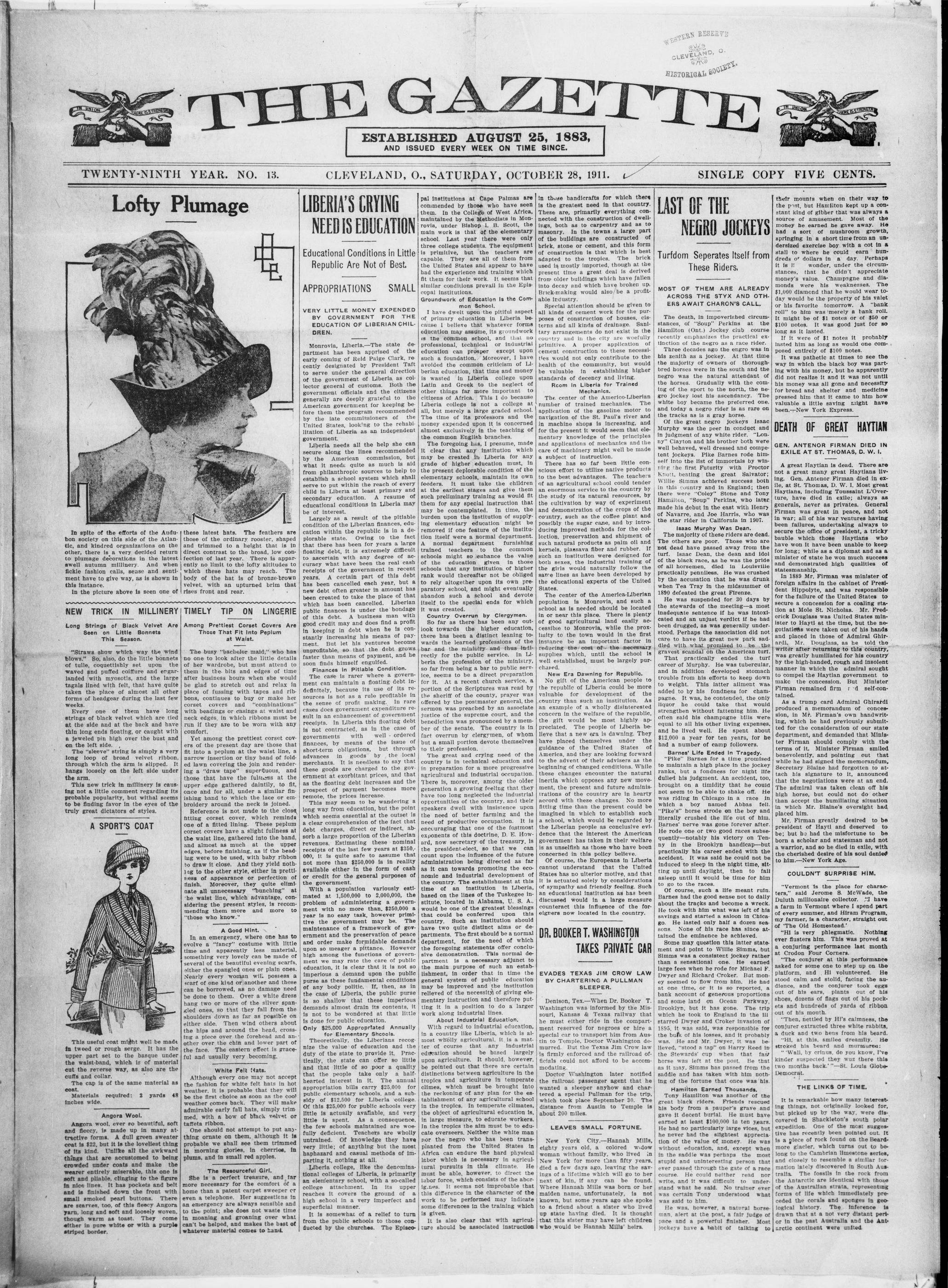
Lofty Plumage
I
E
In spite of the efforts of the Andubon society on this side of the Atlantic, and kindred organizations on the other, there is a very decided return to plumage decorations in the latest swell autumn millinery. And when fickle fashion calls, sense and sentiment have to give way, as is shown in this instance.
In the picture above is seen one of
Long Strings of Black Velvet Are Seen on Little Bonnets This Season.
"Strains show which way the wind blows." So, also, do the little bonnets of tulle, coquettishly set upon the waved and puffed coifure and engrailed with myosotis, and the large tagals lined with felt, that have quite taken the place of almost all other forms of headgear during the last few weeks.
Every one of them have long strings of black velvet which are tied at the side and at the back and have thin long ends floating, or caught with a jeweled pin high over the bust and on the left side.
The "sleeve" string is simply a very long loop of broad velvet ribbon, through which the arm is slipped. It hangs loosely on the left side under the arm.
This new trick in millinery is causing not a little comment regarding its probable popularity, but withal seems to be finding favor in the eyes of the truly great dictators of styles.
This useful coat might well be made in tweed or rough serge. It has the upper part set to the basque under the waist-band, which is of material cut the reverse way, as also are the cuffs and collar.
The cap is of the same material as
cont.
Materials required: 2 yards 48
inches wide.
Angora Wool.
Angora wool, ever so beautiful, soft and fleece, is made up in many attractive forms. A dull green sweater coat is $22, but it is the loveliest thing of its kind. Unlike all the awkward things that are accustomed to being crowded under coats and make the wearer entirely miserable, this one is soft and pliable, clinging to the figure in nice lines. It has pockets and belt and is finished down the front with small smoked pearl buttons. There are starves, too, of this fleece Angora yarn, long and soft and loosely woven, though warm as toast. They come either in pure white or with a purple striped border.
THE GAZETTE
H
these latest hats. The feathers are those of the ordinary rooster, shaped and trimmed to a height that is in direct contrast to the broad, low confection of last year. There is apparently no limit to the lofty altitudes to which these hats may reach. The body of the hat is of bronze-brown velvet, with an upturned brim that rises front and rear.
Among Prettiest Corset Covers Are Those That Fit Into Peplum at Waist.
The busy "bachelor maid," who has no one to look after the little details of her wardrobe, but must attend to them in the bits and edges of time after business hours when she would be glad to stretch out and relax in place of fussing with tapes and ribbons, continues to buy or make her corset covers and "combinations" with beadings or casings at waist and neck edges, in which ribbons must be run if they are to be worn with any comfort.
Yet among the prettiest corset covers of the present day are those that fit into a peplum at the waist line, a narrow insertion or tiny band of folded lawn covering the join and rendering a "draw tape" superfluous, and those that have the fathalmess at the upper edge gathered daintily, to fit, once and for all, under a similar finishing band to which the lace or embroidery around the neck is joined.
Reference is not made to the close fitting corset cover, which reminds one of a fitted lining. These peplum corsets cover have a slight fullness at the waist line, gathered into the band, and almost as much at the upper edges, before finishing, as if the beading were to be used, with baby ribbon to draw it close. And they yield notholog to the other style, either in prettiness of appearance or perfection of finish. Moreover, they quite eliminate all unnecessary "bunching" at the waist line, which advantage, considering the present styles, is recommending them more and more to "those who know."
A Good Hint.
In an emergency, where one has to evolve a "fancy" costume with little time and apparently less material, something very lovely can be made of several of the beautiful evening scarfs, either the spangled ones or plain ones. Nearly every woman will possess a scarf of one kind or another and these can be borrowed, as no damage need be done to them. Over a white dress hang two or more of the silver spangled ones, so that they fall from the shoulders down as far as possible on either side. Then wind others about the hips and around the head, crossing a piece over the forehead and another over the chin and lower part of the face. The eastern effect is graceful and usually very becoming.
White Felt Hats.
Although every one may not accept the fashion for white felt hats in hot weather, it is probable that they will be the first choice as soon as the cool weather comes back. They will make admirable early fall hats, simply trimmed, with a bow of black velvet or taffeta ribbon.
One should not attempt to put anything ornate on them, although it is probable we shall see them trimmed in morning glories, in cherries, in plums, and in small red apples.
The Resourceful Girl.
She is a perfect treasure, and far more necessary for the comfort of a home than a patent carpet sweeper or even a telephone. Her suggestings in an emergency are always sensible and to the point; she does not waste time in moaning and groaning over what can't be helped, and makes the best of whatever material comes to hand.
ESTABLISHED AUGUST 25, 1883 AND ISSUED EVERY WEEK ON TIME SINCE.
CLEVELAND, O., SATURDAY, OCTOBER 28, 1911.
LIBERIA'S CRYING NEED IS EDUCATION
Educational Conditions in Little Republic Are Not of Best.
SMALL
VERY LITTLE MONEY EXPENDED BY GOVERNMENT FOR THE EDUCATION OF LIBERIAN CHILDREN.
Monrovia, Liberia.—The state department has been apprised of the early coming of Reid Paige Clark, recently designated by President Taft to serve under the general direction of the government of Liberia as collector general of customs. Both the government officials and the citizens generally are deeply grateful to the American government for keeping before them the program recommended by the late commissioners of the United States, looking to the rehabilitation of Liberia as an independent government.
Liberia needs all the help she can secure along the lines recommended by the American commission, but what it needs quite as much is aid from philanthropic sources to help to establish a school system which shall serve to put within the reach of every child in Liberia at least primary and secondary education. A resume of educational conditions in Liberia may be of interest.
Largely as a result of the pitiful condition of the Liberian finances, education within the republic is in a deplorable state. Owing to the fact that there has been for years a large floating debt, it is extremely difficult to ascertain with any degree of accuracy what have been the real cash receipts of the government in recent years. A certain part of this debt has been cancelled each year, but a new debt often greater in amount has been created to take the place of that which has been cancelled. Liberian public finances is under the bondage of this debt. A business man with good credit may and does find a profit in keeping in debt when he is constantly increasing his means of payment. But let his ventures become unprofitable, so that the debt grows faster than means of payment, and he soon finds himself engulfed.
Finances in Pitable Condition.
The case is rarer where a government can maintain a floating debt indefinitely, because its use of its resources is not as a rule profitable in the sense of profit making. In rare cases does government expenditure result in an enhancement of government receipts. In Liberia this floating debt is not contracted, as in the case of governments with well - ordered finances, by means of the issue of short-term obligations, but through advances in goods by the local merchants. It is needless to say that these goods are charged to the government at exorbitant prices, and that as the floating debt increases and the prospect of payment becomes more remote, the prices increase.
This may seem to be wandering a long way from education, but the point which seems essential at the outset is a clear comprehension of the fact that debt charges, direct or indirect, absorb a large proportion of the Liberian revenues. Estimating these nominal receipts of the last few years at $350,000, it is quite safe to assume that not more than $250,000 is in reality available either in the form of cash or credit for the general purposes of the government.
With a population variously estimated at 1,500,000 to 2,000,000, the problem of administering a government with no more than, $250,000 a year is no easy task, however primitive the government may be. The maintenance of a framework of government and the preservation of peace and order make formidable demands upon so meager a pittance. However high among the functions of government we may rate the care of public education, it is clear that it is not so imperious a demand upon the public purse as these fundamental conditions of any body politic. If, then, as in the case of Liberia, the public purse is so shallow that these imperious demands almost drain its contents, it is not to be wondered at that little is done for public education.
Only $25,000 Appropriated Annually
from Elementary Schools
for Elementary Schools.
Theoretically, the Liberians recognize the value of education and the duty of the state to provide it. Practically, the state can offer so little and that little of so poor a quality that the people take only a half-hearted interest in it. The annual appropriation bills carry $25,000 for public elementary schools, and a subsidy of $12,500 for Liberia college. Of this $25,000 for public schools very little is actually available, and very little is spent. As a consequence, the few schools maintained are woefully deficient. Teachers are wholly untrained. Of knowledge they have very little; of anything but the most haphazer and casual methods of imparting it, nothing at all.
Liberia college, like the denominational colleges of Liberia, is primarily an elementary school, with a so-called college attachment. In its upper reaches it covers the ground of a high school in a very imperfect and superficial manner.
It is somewhat of a relief to turn from the public schools to those conducted by the churches. The Enisco
pal institutions at Cape Palmas are commended by those who have seen them. In the College of West Africa, maintained by the Methodists in Monrovia, under Bishop L. B. Scott, the main work is that of the elementary school. Last year there were only three college students. The equipment is primitive, but the teachers are capable. They are all of them from the United States and appear to have had the experience and training which fit them for their work. It seems that similar conditions prevail in the Episcopal institutions.
Groundwork of Education Is the Common School.
I have dwelt upon the pitiful aspect of primary education in Liberia because I believe that whatever forms education may assume, its groundwork is the common school, and that no professional, technical or industrial education can prosper except upon such a foundation. Moreover, I have avoided the common criticism of Liberian education, that time and money is wasted in Liberia college upon Latin and Greek to the neglect of other things far more important to citizens of Africa. This I do because Liberia college is not a college at all, but merely a large graded school. The time of its professors and the money expended upon it is concerned almost exclusively in the teaching of the common English branches.
The foregoing has, I presume, made it clear that any institution which may be created in Liberia for any grade of higher education must, in the present deplorable condition of the elementary schools, maintain its own feeders. It must take the children at the earliest stages and give them such preliminary training as would fit them for any special instruction that may be contemplated. In time, the burden upon the institution of supplying elementary education might be removed if one feature of the institution itself were a normal department. A normal department furnishing trained teachers to the common schools might so enhance the value of the education given in those schools that any institution of higher rank would thereafter not be obliged to rely altogether upon its own preparatory school, and might eventually abandon such a school and devote itself to the special ends for which it was created.
Country Overrun by Clergymen.
So far as there has been any outlook towards the higher education, there has been a distinct leaning towards the learned professions of the bar and the ministry and thus indirectly for the public service. In Liberia the profession of the ministry, so far from being a bar to public service, seems to be a direct preparation for it. At a recent church service, a portion of the Scriptures was read by the sheriff of the county, prayer was offered by the postmaster general, the sermon was preached by an associate justice of the supreme court, and the benediction was pronounced by a member of the senate. The country is in fact overrun by clergymen, of whom a small portion devote themselves to their profession.
The great and crying need of the country is in technical education and in preparation for a more progressive agricultural and industrial occupation. There is, moreover, among the older generation a growing feeling that they have too long neglected the industrial opportunities of the country, and their speakers dwell with insistence upon the need of better farming and the need of productive occupation. It is encouraging that one of the fostest exponents of this doctrine, D. E. Howard, now secretary of the treasury, is the president-elect, so that we can count upon the influence of the future administration being directed as far as it can towards promoting the economic and industrial development of the country. The establishment at this time of an institution in Liberia, based on the lines of the Tuskegee institute, located in Alabama, U. S. A. would be one of the greatest blessings that could be conferred upon this country. Such an institution should have two quite distinct aims or departments. The first should be a normal department, for the need of which the foregoing statements offer conclusive demonstration. This normal department is a necessary adjunct to the main purpose of such an establishment, in order that in time the general system of public education may be improved and the institution relieved of the necessity of giving elementary instruction and therefore putting it in a position to do a larger work along industrial lines.
About Industrial Education.
With regard to industrial education, in a country like Liberia, which is almost wholly agricultural, it is a matter of course that any industrial education should be based largely upon agriculture. It should, however, be pointed out that there are certain distinctions between agriculture in the tropics and agriculture in temperate climes, which must be brought into the reckoning of any plan for the establishment of any agricultural school in the tropics. In temperate climates, the object of agricultural education is, in large measure, to educate workers. In the tropics the aim must be to educate overseers. Neither the white man nor the negro who has been transplanted from the United States in Africa can endure the hard physical labor which is necessary in agricultural pursuits in this climate. He must be able, however, to direct the labor force, which consists of the aberrines. It seems not improbable that this difference in the character of the work to be performed may indicate some differences in the training which is given. It is also clear that with agriculture should be associated instruction
in those handicrafts for which there is the greatest need in that country. These are, primarily everything connected with the construction of dwellings, both as to carpentry and as to masonry. In the towns a large part of the buildings are constructed of brick, stone or cement, and this form of construction is that which is best adapted to the tropics. The brick used is mostly imported, though at the present time a great deal is derived from older buildings which have fallen into decay and which have broken up. Brick-making would also be a profitable industry. Special attention should be given to all kinds of cement work for the purposes of construction of houses, clisterns and all kinds of drainage. Sanitary arrangements do not exist in the country and in the city are woefully primitive. A proper application of cement construction to these necessities would not only contribute to the health of the community, but would be valuable in establishing higher standards of decency and living.
Rcom In Liberla for Trained Mechanics
The center of the Americo-Liberian number of trained mechanics. The application of the gasoline motor to navigation of the St. Paul's river and in machine shops is increasing, and for the present it would seem that elementary knowledge of the principles and applications of mechanics and the care of machinery might well be made a subject of instruction.
There has so far been little conscious effort to utilize native products to the best advantages. The teachers of an agricultural school could tender an enormous service to the country by the study of its natural resources, by the cultivation by way of experiment and demonstration of the crops of the country, such as the coffee plant and possibly the sugar cane, and by introducing improved methods for the collection, preservation and shipment of such natural products as palm oil and kernels, plasava fiber and rubber. If such an institution were designed for both sexes, the industrial training of the girls would naturally follow the same lines as have been developed by the educational experts of the United States.
The center of the America-Liberian population is Monrovia, and such a school as is needed should be located in or near this place. There is plenty of good agricultural land easily accessible to Monrovia, while the proximity to the town would in the first instance be an important factor in reducing the cost of the necessary supplies which, until the school is well established, must be largely purchased.
New Era Dawning for Republic.
No gift of the American people to the republic of Liberia could be more valuable for development of the country than such an institution. As an example of a wholly disinterested concern in the welfare of the republic, the gift would be most highly appreciated. The people of Liberia believe that a new era is dawning. They have placed themselves under the guidance of the United States of America, and they are looking forward to the advent of their advisers as the beginning of changed conditions. While these changes encounter the natural inertia which opposes any new movement, the present and future administrations of the country are in hearty accord with these changes. No more fitting time than the present could be imagined in which to establish such a school, which would be regarded by the Liberian people as conclusive evidence that the interest the American government has taken in their welfare is as unselfish as those who have been concerned in this policy believe.
Of course, the Europeans in Liberia cannot understand that the United States has no ulterior motive, and that it is actuated solely by considerations of sympathy and friendly feeling. Such an educational institution as has been discussed would in a large measure counteract this influence of the foreigners now located in the country.
EVADES TEXAS JIM CROW LAW BY CHARTERING A PULLMAN SLEEPER.
Denison, Tex.—When Dr. Booker T. Washington was informed by the Missouri, Kansas & Texas railway that he must either ride in the compartment reserved for negroes or hire a special car to transport him from Austin to Temple, Doctor Washington demurred. But the Texas Jim Crow law is firmly enforced and the railroad officials could not afford to be accommodating.
Doctor Washington later notified the railroad passenger agent that he wanted a sleeper anyhow and chartered a special Pullman for the trip which took place September 30. The distance from Austin to Temple is about 200 miles.
LEAVES SMALL FORTUNE.
New York City—Hannah Mills, eighty years old, a colored widow woman without family, who lived in New York for more than fifty years, died a few days ago, leaving the savings of a lifetime which will go to her next of kin, if any can be found. Where Hannah Mills was born or her maiden name, unfortunately, is not known, but some years ago she spoke to a friend about a sister who lived up state having died. It is thought that this sister may have left children who would be Hannah Mills' heirs.
SINGLE COPY FIVE CENTS.
WESTERN RESERVE
CLEVELAND, O.
HISTORICAL SOCIETY.
LAST OF THE NEGRO JOCKEYS
Turfdom Seperates Itself from These Riders.
MOST OF THEM ARE ALREADY ACROSS THE STYK AND OTHERS AWAIT CHARON'S CALL.
The death, in impoverished circumstances, of "Soup" Perkins at the Hamilton (Ont.) Jockey club course recently emphasizes the practical extinction of the negro as a race rider. Three decades ago the engro was in his zenith as a jockey. At that time the majority of owners of thoroughbred horses were in the south and the negro was the natural attendant of the horses. Gradually with the coming of the sport to the north, the negro jockey lost his ascendancy. The white boy became the preferred one, and today a negro rider is as rare on the tracks as is a gray horse.
Of the great negro jockeys Isaac Murphy was the peer in conduct and in judgment of any white rider. "Lonny" Clayton and his brother both were well behaved, dressed and competent jockeys. Pike Barnes rode himself into the list of immortals by winning the first Futurity with Proctor Knott, beating the great Salvator; Willie Simms achieved success both in this country and in England; then there were "Coley" Stone and Tony Hamilton, "Soup" Perkins, who later made his debut in the east with Henry of Navarre, and Joe Harris, who was the star rider in California in 1907.
Isaac Murphy Was Dean.
Isaac Murphy was dead.
The majority of these riders are dead. The others are poor. Those who are not dead have passed away from the Isaac Dean, the year idol of the bishop, as he was the pride of all horsemen, died in Louisville practically penniless. He was crushed by the accusation that he was drunk when Tea Tray in the midsummer of 1890 defeated the Great Firenze.
He was suspended for 30 days by the steward of the meeting—a most inadequate sentence if he was intoxicated and an unjust verdict if he had been drugged, as was generally understood. Perhaps the association did not care to have its great new park saddled with what promised to be the gravest scandal on the American turt. That practically ended the turf career of Murphy. He was tubercular, and in addition developed stomach trouble from his efforts to keep down to weight. This latter aliment was added to by his fondness for champagne. It was, he contended, the only liquor he could take that would strengthen without fattening him. He often said his champagne bills were equal to his other living expenses, and he lived well. He spent about $12,000 a year for ten years, for he had a number of camp followers.
Barnes' Life Ended in Tragedy.
"Pike" Barnes for a time promised to maintain a high place in the jockey ranks, but a fondness for night life dulled his judgment. An accident, too, brought on a timidity that he could not seem to be able to shake off. He was riding in Chicago in a race in which a boy named Abbas fell. "Pike's" horse strode on the boy and literally crushed the life out of him. Barnes' nerve was gone forever after. He rode one or two good races subsequently—notably his victory on Tenny in the Brooklyn handicap—but practically his career ended with the accident. It was said he could not be induced to sleep in the night time, sitting up until daylight, then to fall asleep until it would be time for him to go to the races.
Of course, such a life meant ruin. Barnes had the good sense not to daily about the tracks and become a wreck. He took with him what was left of his savings and started a saloon in Chicago. He lasted only half a dozen seasons. None of his race has since attained the eminence he achieved.
Some may question this latter statement and point to Willie Simms, but Simms was a consistent jockey rather than a sensational one. He earned large fees when he rode for Michael F. Dwyer and Richard Croker. But money seemed to flow from him. He had at one time, or it is so reported, a bank account of generous proportions and some land on Ocean Parkway, Brooklyn, but it has gone. The trip which he took to England in the ill starred Dwyer and Croker invasion of 1895, it was said, was responsible for the bulk of his losses, and it probably was. He and Mr. Dwyer, it was believed, "stood a tap" on Harry Reed in the Stewards' cup when that fast horse was left at the post. Be that as it may, Simms has passed from the saddle and has taken with him nothing of the fortune that once was his.
Hamilton Earned Thousands.
Hamilton Earned Thousands.
Tony Hamilton was another of the great black riders. Friends rescued his body from a pauper's grave and gave it decent burial. He must have earned at least $100,000 in ten years. He had no particularly large vices, but he never had the slightest appreciation of the value of money. He was without education, and, except when in the saddle was perhaps the most stupid and uninteresting person that ever passed through the gate of a race course. He could neither read nor write, and it was difficult to understand what he said. No trainer ever was certain Tony understood what was said to him.
He was, however, a natural horseman, alert at the post, a fair judge of pace and a powerful finisher. Most jockeys have a tabit of talking to
IN UNION
WORKS STRONGER
their mounts when on their way to the post, but Hamilton kept up a constant kind of gibber that was always a source of amusement. Most of the money he earned he gave away. He had a sort of mushroom growth, springing in a short time from an undersized exercise boy with a cot in a stall to where he could earn hundreds of dollars in a day. Perhaps it is it wonder, under the circumstances, that he didn't appreciate money's value. Champagne and diamonds were his weaknesses. The $1,000 diamond that he would wear today would be the property of his valet or his favorite tomorrow. A "bank roll" to him was merely a bank roll. It might be of $1 notes or of $50 or $100 notes. It was good just for so long as it lasted. If it were of $1 notes it probably lasted him as long as would one composed entirely of $100 notes. It was pathetic at times to see the way in which the black boy was parting with his money, but he apparently did not realize it and it was not until his money was all gone and necessity for bread and shelter and medicine pressed him that it came to him how valuable a little saving night have been.—New York Express.
DEATH OF GREAT HAYTIAN
GEN. ANTENOR FIRMAN DIED IN EXILE AT ST. THOMAS, D. W. I.
A great Haytian is dead. There are not a great many great Haytian living. Gen. Antenor Firman died in exile, at St. Thomas, D. W. I. Most great Haytians, including Toussaint L'Overture, have died in exile; always as generals, never as privates. General Firman was great in peace, and not in war; all of his war ventures having been failures, undertaking always to secure the office of president, a tricky baule which those Haytians who have won it have been unable to keep for long; while as a diplomat and as a minister of state he won much success and demonstrated high qualities of statesmanship.
In 1889 Mr. Firman was minister of foreign affairs in the cabinet of President Hippolyte, and was responsible for the failure of the United States to secure a concession for a coaling station at Mole St. Nicholas. Mr. Frederick Douglass was United States minister to Hayt1 at the time, but the negotiations were taken out of his hands and placed in those of Admiral Ghirardi. Mr. Douglass, as he told the writer after returning to this country, was greatly humiliated for his country by the high-handed, rough and insolent manner in which the admiral sought to compel the Haytian government to make the concession. But Minister Firman remained firm; and self-contained.
As a trump card Admiral Gharidi produced a memorandum of concession, in Mr. Firman's own handwriting, which he had previously submitted for the consideration of our state department, and demanded that Minister Firman should comply with the terms of it. Minister Firman smiled benevolently, and pointing out that while he had signed the memorandum, Secretary Blaine had forgotten to attach his signature to it, announced that the negotiations were at an end. The admiral was taken clean off his high horse, but could not do other than accept the humiliating situation in which Mr. Blaine's oversight had placed him.
Mr. Firman greatly desired to be president of Haytiel and deserved to be; but he had the misfortune to be born a scholar and statesman and not a warrior, and so he died in exile, with the cherished desire of his soul denied to him—New York Age.
COULDN'T SURPRISE HIM.
"Vermont is the place for characters," said Jerome S. McWade, the Duluth millionaire collector. "I have a farm in Vermont where I spend part of every summer, and Hiram Program, my farmer, is a character, straight out of 'The Old Homestead.'"
"Hi is very phlegmatic. Nothing ever flustered him. This was proved at a conjuring performance last month at Crodon Four Corners.
"The conjurer at this performance asked for some one to step up on the platform, and HI volunteered. He stood calm and stolid, facing the audience, and the conjurer took eggs out of his ears, plants out of his shoes, dozens of flags out of his pockets and hundreds of yards of ribbon out of his mouth.
"Then, nettled by Hi's calmness, the conjurer extracted three white rabbits, a duck and two hens from his beard.
"Hi, at this, smiled dreamily. He stroked his beard and mournured: 'Wall, by crinus, do you know, I've kinder suspected they wuz there this two months back.'"—St. Louis Globe-Democrat.
THE LINKS OF TIME.
It is remarkable how many interesting things, not originally looked for, but picked up by the way, were discovered in Shackleton's south polar expedition. One of the most suggestive has recently been pointed out. It is a piece of rock found on the Beardmore glacier, which turns out to belong to the Cambrian limestone series, and closely to resemble a similar formation lately discovered in South Australia. The fossils in the rock from the Antarctic are identical with those of the Australian strata, representing forms of life which immediately preceded the corals and sponges in geological history. The inference is drawn that at a not very distant peril in the past Australia and the Antarctic continent were united.
One Year.....$1.50
Six Months.....1.00
Three Months......50
Subscribers are requested to
remit by postoffice money or
order or registered letter.
Entered at the postoffice in Cleveland
Ohio, as second-class matter
Address all communications to
HARRY C. SMITH
Editor and proprietor,
THE GAZETTE,
Blackstone Building, Cleveland, O.
Member Ohio Legislature: 1894
to 1896; 1898 to 1898; 1900 to 1902
THE GAZETTE is the highest, and has the largest bona fide circulation, double that of any newspaper in the interest of Afro-Americans, published in the state of Ohio, and comparison with any will immediately establish its rank as one of the NEWSIEST AND BEST in the country.
SELF EXPLANATORY.
Headquarters Citizens' Association for Civic Interests, No. 2404 Central Avenue.
Cleveland, O, October 1, 1911
Mr. Mayo Fesler, Sec. Municipal Asc
Dear Sir:—The undersigned, members of the committee appointed by the Citizens' Association for Civic Interests, in compliance with your request, are sending "in writing" the protest made recently to you in person. The association, composed of leading Afro-Americans of this city protests against your "labeling," as "Negroes" and "Colored" Afro-American candidates for public office in this city and county: First, because this nationalization is done in their case only; secondly, because there is no good reason why any class of CITIZENS should be so labeled" or designated in your reports. It would be equally unfair and insulting to so "label" or designate Jewish, Irish, German and candidates of other nationalities or classes, and yet, if this sort of thing is followed in the case of the Afro-American, all other candidates of the different nationalities or classes should be similarly treated in your reports. It is the merest nonsense to argue in defense of such insulting discrimination that the nationality or class of other candidates is indicated by their names. There are many Jewish, Irish, German and candidates constitutionally before the public, whose names do not indicate their nationality or class-connection. Therefore, the Citizens' Association for Civic Interests protests against such manifestly unfair treatment of local Afro-American candidates and respectfully requests its discontinuance.
J. K. Nickens, M. D., Chairman.
H. M. Lowery, (Rev.)
Chas. S. Sutton, Secretary.
Committee
THE MUNICIPAL ASSOCIATION,
825-7 Engineers' Building.
Cleveland, O., Oct. 2, 1911.
Dr. J. K. Nickens, Chairman Citizens
Association for Civic Interests Com
Birtree, 2404 Central Ave., Ury,
Dear Sir: I have your communication
letter from the use of the term
"Negro" and "Colored" after Afro-
American candidates for office. The
matter will be referred to the Executive
Board, and I assure you it will be
given full consideration. As soon as
the Board has acted I will let you
know of their decision.
Very truly yours,
MAYO FESLER, Secretary.
THE MUNICIPAL ASSOCIATION OF
CLEVELAND,
Engineers' Building.
Cleveland, Ohio, October 17th, 1911.
Dr. John K. Nickens,
2404 Central Ave., City
Dear Sir:—The Executive Board of
the Managed Association at its
meeting last Friday considered
the request which your Association made
relative to the use of the word "colored" after Afro-American candidates for public office. One of the chief functions of this Association is to furnish accurate and unprejudiced information to the voters relative to candidates for office. The voters often wish to know among other things the nationality of the candidates. In most cases this is clearly indicated in the name. In the case of the American candidates, not the case. For that reason the Executive Board without any prejudices whatever for or against such candidates, feels that it must continue the policy of indicating the race or nationality. A glance at our last bulletin, I think, will convince your committee that the Municipal Association showed no prejudice in regard to your race, and I am sure that this will continue to be the policy of the Association.
Very truly yours,
MAYO FESLER
Secretary
THE MUNICIPAL ASSOCIATION OF
CLEVELAND,
Engineers Building.
Cleveland, October 17th, 1911.
Hon. Harry C. Sculpt.
Hon. Harry C. Smith,
Dear Sir:—We have not yet re-
ceived the information blank filled
out, which was mailed to you recently.
Please fill this out and return it at
once.
Very truly yours,
Mayo Fesler,
Secretary.
OFFICE OF THE GAZETTE, Blackstone Building.
HARRY C. SMITH,
Editor and Proprietor.
Cleveland, O., Oct. 20, 1911.
Mr. Mayo Fesler,
Secretary M. A.,
Engineers' Building,
City.
Dear Sir: Both of your communications were received. I am perfectly willing to comply with your request providing I can get your and your executive board's promise that they will treat me as fairly as all other candidates are treated in your bulletins and other publications, and not append after my name the word "Negro" or "Colored," unless the words "Irish," "Jew," "German" and others indicating the class or nationality of other candidates for delegate to the State Constitutional Convention are also so placed in their cases in your bulletins and other publications. Singling out any race of people and thus classifying a citizen candidate is not only
unfair, to say the least, but is not necessary unless for ulterior purposes. I wish to add my personal protest to you and your executive board against such classification for the reasons stated above and others obvious. It is not only unfair and harmful, but positively insulting discrimination, which you as an intelligent representative of the Jewish race and secretary of the Municipal Association of the City of Cleveland ought to be the last man in that organization to encourage and countenance. Members of the three races of today, namely, the so-called Negro, the Irish, and Jewish races, ought long ago to have developed a bond of sympathy for one another that would make unnecessary the urging of a united effort upon their part to put a stop to all such unfairness, harmful and insulting discriminations. I know you as an intelligent member of the Jewish race will accept this in the spirit it is written and not feel that I have any desire to give personal offense to you or any other person or persons.
Sincerely yours,
HARRY C. SMITH.
Harry O. Quinn
Cleveland, O.ct. 21, 1911
To the Members of the Executive
Board of the Municipal Association
of Cleveland:
Dear Sirs: I wish to ask you as a personal favor to me and my people of this community to read carefully as soon as your time will permit the enclosed communications. It is not necessary to call your attention to the unfairness insisted upon by your Municipal Association Secretary, Mr. Mayo Fesier. There is no fairness in labeling the candidates of one class of citizens only. It surely injures far more than you may realize the prospects of candidates of my class of people for public office, because it directs the attention of every prejudiced voter in the community to the candidate so mistreated. Then too, it is an insult both to the individual and to his class of people to be so singled out and labeled. Bad as it is, it would not be quite so bad if the candidates of other classes were similarly treated in your bulletin and publications of the Municipal Association of the Municipal by your secretary. The candidates of other classes of citizens are not so treated. The reason Mr. Fesier gives in his letter for the insulting and injurious discrimination is not true in most cases—the nationality of most candidates is not indicated in the name; nor is it necessary as all candidates must be American citizens, and no where in this state is such classification or labeling of candidates required or permitted under the law. Nor is such unfair and harmful mistreatment an indication that persons guilty of the same are "without any prejudice whatever for or against such candidates" and their race or class. I cannot believe that such prominent citizens as constitute the executive board of the Municipal Association of Cleveland have made such a mistake, or if they have, will persist in maintaining such a position in the face of the explanation herein enclosed. The concluding paragraph of Mr. Fesier's letter of the 17th of this month, a copy of which is enclosed, and the original of which was written in the face of repeated protests of our Citizens' Association for Civic Interests, borders on the ridiculous to say the least. Trusting you will give this matter the attention it surely merits for reasons repeatedly stated herein, I am, Sir.
WHAT IS YOUR FAMILY WORTH?
If your family is worth the best you can afford in house and food and clothes, is it not worth the best reading as well, is it not worth the best dining best for boys and girls, best for men and women—is to be found in The Youth's Companion. Of stories alone The Companion will print nearly 300 in 1912. With all the rest of the paper thrown in, and counting the glorious long serial stories, they cost the subscriber less than a cent apiece. Moreover, you will look long before you will find stories so varied and interesting—stories of coolness in the face of peril, strange adventures with creatures of the forest and the sea, moving stories of life's obscure heroes, wizards, roses, humor, quaint and curious character sketches. Now is the time to subscribe, for you will receive free from the time your $1.75 is received all the issues for the remaining weeks of 1911, containing the opening chapters of Ralph D. Paine's great serial story of the Boxer rebellion, "The Cross and the Dragon." And there is the gift of The Companion Calendar for 1912, "On the New England Coast," lithographed in ten colors and gold. Only $1.75 now for the 52 weekly issues, but on January 1, 1912, the subscription price is $1.75.
144 Berkeley St., Boston, Mass.
New Subscriptions Received at this
PRESIDENT TAFT.
We ask our readers, whom we have often told that President Taft is the worst foe the Colored race has, to peruse the following editorial in the Crisis, organ of the N. A. A. C. P., edited by Dr. W. E. B. DBuBs:
"Mr. William Taft, President of these United States, shows a marvelous facility for getting on the right track and saying the wrong thing. The most glaring example of this is, of course, the tariff, but his attitude toward the American Negro is a fatal second. Not only is Mr. Taft partceps criminis with the late Mr. Roosevelt in the crime of Brownsville, but he added to that the Taft Doctrine of recognizing race prejudice, instead of fitness, in Federal appointments. On top of this, and in the face of a record of murder, lynching and burning in this country which has appalled the civilized world and loosened the tongue of many a man long since dumb on the race problem, in spite of this, Mr. Taft has blandly informed a deputation of Colored men that any action on his part is quite outside his power, if not his interest. Finally, Mr. Taft has several times expressed himself on Negro education. First he was quite enthusiastic for the education of the Negroes' hands. Then—on the eye of his nomination to the presidency—he discovered at Fisk
THE GAZETTE, CLEVELAND, O., SATURDAY, OCTOBER 28, 1911
University a few black brains that deserved cultivation, but sparingly—sparingly. He would not overdo this sort of thing. Lately, on the eve of his campaign of denomination to the presidency, Mr. Taft has again declared that the Negro "ought to come and is coming more and more under the guardianship of the South!" This statement is, to speak mildly, extraordinary; and it will make thinking black men carefully considerate as to whether they are willing to enthrone this policy in the White House for another four years. Let us examine the dictum: When a guardian is appointed it is because he has shown in the past some capacity for the position. One would not usually ask a murderer to guard life, nor a slave driver to direct labor, nor a libertine to protect girls. Or if by chance such a one is so appointed, it could only be that despite a forbidding past he has shown unmistakable signs of repentance, and will and ability to do right. We ask now in all charity and calmness: Have the Southern States of this land in the past or in the present exhibited any desire or ability to settle the Negro problem in accordance with reason and justice? The answer lies in nine burning words:
Prejudice.
We submit to any unprejudiced person that a people that have shown no greater capacity for dealing with a great social problem than these fearful words indicate are not fit to be given sole and exclusive charge of ten million cattle much less ten million human souls. And we further declare that a man who in the light of the history of this land can stand up and deny to the conscience and ability of the North and West any right to help in the settlement of a problem which belongs to them just as much as it belongs to the South, if not more—we declare that such a man has no business to be President of the United States."
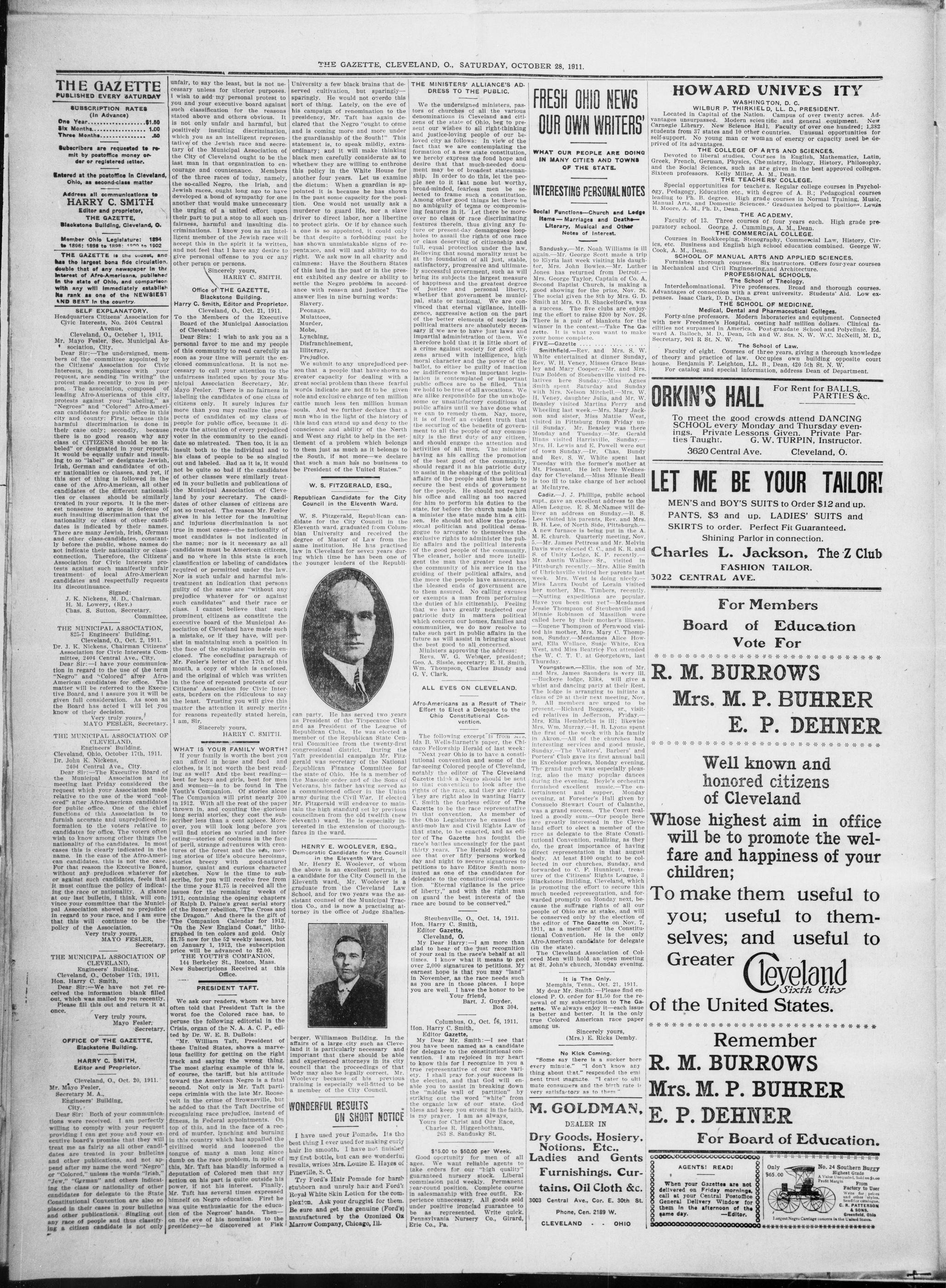
W. S. FITZGERALD, ESQ.
Republican Candidate for the City Council in the Eleventh Ward.
W. S. Fitzgerald, Republican candidate for the City Council in the Eleventh ward, graduated from Columbia University and received the degree of Master of Law from the same institution. He has practised law in Cleveland for seven years during which time he has been one of the younger leaders of the Republi-
PETER H.
can party. He has served two years as President of the Tippecanoe Club and as President of the League of Republican Clubs. He was elected a member of the Republican State Central Committee from the twenty-first congressional district. During the Taft presidential campaign Mr. Fitzgerald was secretary of the National Republican Finance Committee for the state of Ohio. He is a member of the Masonic order and of the Sons of Veterans, his father having served as a commissioned officer in the Union army during the Civil War. If elected Mr. Fitzgerald will endeavor to maintain the high standard set by previous (new eleventh) ward. He is especially interested in the extension of thoroughfares in the ward.
HENRY E. WOOLEVER, ESQ., Democrat Candidate for the Council in the Eleventh District.
Mr. Henry E. Woolever, of whom the above is an excellent portrait, is a candidate for the City Council in the Eleventh ward, Mr. Woolever is a graduate from the Cleveland Law School, and for two years was the assistant counsel of the Municipal Traction Co., and is now a practising attorney in the office of Judge Shallen-
berger, Williamson Building. In the affairs of a large city such as Cleveland it is particularly necessary and important that there should be able and experienced attorneys in its city council that the proceedings of that body may also be legally correct. Mr. Woolever because of his previous training is especially well-fitted to be a member of the City Council.
I have used your Pomade. Its the best thing I ever used for making curly hair lie smooth. I have not finished my first bottle, but can see wonderful results, writes Mrs. Louise E. Hayes of Pineville, S. C.
Try Ford's Hair Pomade for harsh stubborn and unruly hair and Ford's Royal White Skin Lotion for the complexion. Ask your druggist for them. Be sure and get the genuine (Ford's) manufactured by the Ozonized Ox Marrow Company, Chicago, Ill.
THE MINISTERS' ALLIANCE'S ADDRESS TO THE PUBLIC.
We the undersigned ministers, pastors of churches of all the various denominations in Cleveland and citizens of the state of Ohio, beg to present our wishes to all right-thinking and justice-loving people of our beloved city as follows: In view of the fact that we are contemplating the formation of a new state constitution, we hereby express the fond hope and desire that that much-needed document may be of broadest statesmanship. In order to do this, let the people see to that none but worthy, and endless, earnest men be selected to frame and lead us. Among other good things let there be no ambiguity of tegns or compromising features in it. Let there be moreover no class or race discriminating features therein, thus giving any future or present-day demagogues loopholes to assail the rights of one race or class deserving of citizenship and full, equal protection under the law, Believing that sound morality must be a foundation of all just, satisfied, progressive and ultimately successful public institutions, bring its subjects the largest measure of happiness and the greatest degree of justice and personal liberty, whether that government be municipal, state or national. We are convinced that eternal vigilance, intelligence, aggressive action on the part of the better elements of society in political matters are absolutely necessary if we are to have just laws and impartial administration of them. We therefore hold that it is little short of a crime against society for good citizenry or the intelligence and the power of the ballot, to either be guilty of inaction or indifference when important legislation is contemplated or important public offices are to be filled. This we hold to be true of all avocations. We are alike responsible for the unwholesome or unsatisfactory conditions of public affairs until we have done what we can to remedy them. Nay, more, it is of itself an evident truth that it is the benefits of government to all the people of the community, the first duty of any citizen, and should engage the attention and activities of all men. The minister having as his calling the promotion of the best good of the community, should regard it as his patriotic duty to assist in the shaping of the political affairs of the people and thus help to secure the best ends of government for the people. He should not regard his office and calling as too sacred for him to perform his duties to the state, for before the church made him a minister the state made him a citizen of the social politician and political demagogue to arrogate to themselves the exclusive rights to administer the public affairs and the political interests of the good people of the community. The cleaner, holier and more intelligent the man of his service in the guiding of their political affairs, and the more the people have assurances, the blessed ends of government are to them assured. No calling excuses for the duties of his citizenship. Feeling that we have greatly neglected our patriotic duty in matters political which concern our homes, families and communities, we do now resolve to take such part in public affairs in the future as will assist in bringing about the best good to all concerned.
Ministers approving the address:
Revs. W. G. Webster, president;
G. Shale, secretary; E. H. Smith
Wm. Thompson, Charles Bundy and
Y. G. Clark.
ALL EYES ON CLEVELAND.
Afro-Americans as a Result of Their Effort to Elect a Delegate to the Ohio Constitutional Convention
The following except is from Isaac Ida B. Wells-Warnsteyn's paper, the Chicago Fellowship Herald of last week: "Next year Ohio is to have a constitutional convention and some of the farseeing Colored people of Cleveland, notably the editor of The Cleveland Gazette think a Negro should be sent to that convention to look after the rights of the race, and they are right. They are right also in wanting Harry C. Smith the fearless editor of The Gazette to be the race representative in that convention. As member of the Ohio Legislature he caused the anti-mob law and Civil Rights Law of that state, to be enacted, and as editor of The Gazette has fought the rest of the opposition for thirty years. The Herald rejoices to see that over fifty persons worked day and night to secure signatures to petitions to have Editor Smith nominated as one of the candidates for delegate to the constitutional convention. "Eternal vigilance is the price of liberty," and with the right man on guard the best interests of the race are bound to be conserved."
Steubenville, O., Oct. 14, 1911.
Hon. Harry C. Smith,
Editor Gazette,
Cleveland, O.
My Dear Harry:—I am more than glad to hear of the just recognition of your zeal in the race's behalf at all times. I know what it means to get over 2,000 signatures to petitions. My earnest hope is that you may "land" in November, as the race needs such as you are in those places. I hope you are well. I have the honor to be
Your friend,
Bart. J. Guyder,
Box 304.
Columbus, O., Oct. 16, 1911.
Hon. Harry C. Smith,
My Dear Mr. Smith:—I see that you have been named as a candidate for delegate to the constitutional convention. I am rejoiced in my heart to know this for I recognize in you a true representative of our race variety. I shall pray for your success in the election, and that God will enable you to assist in breaking down the middle will parish by srinking the word "white" from the organic law of our state. God bless and keep you strong in the faith, is my prayer. I am as always, Yours for Christ and Our Race, Charles R. Higgenbotham, 263 S. Sandusky St.
$15.00 to $50.00 per Week.
Good opportunity for men of all ages. We want reliable agents to take orders for our "high quality" guaranteed nursery stock. Liberal commission paid weekly. Permanent year-round position. Complete course in sales position with core outfit. Ex experience unnecessary. Write special sold under positive ironclad guarantee to be as represented. Write quick. Pennsylvania Nursery Co. Girard, Erie Co., Pa.
FRESH OHIO NEWS OUR OWN WRITERS
WHAT OUR PEOPLE ARE DOING IN MANY CITIES AND TOWNS OF THE STATE.
INTERESTING PERSONAL NOTES
Social Functions—Church and Lodge Items—Marrigues and Deathe—Literary, Musical and Other Notes of Interest.
Sandusky—Mr. Noah Williams is ill again. Mr. George Scott made a trip to Elvira last week visiting his daughter, Mrs. John Bowles. Mr. Luther Jones has returned from Detroit. Mrs. George Taylor, Captain of Co. A. Second Baptist Church, is making a good showing for the prize, Nov. 26. The social given the 8th by Mrs. G. D. Smith at Mrs. O. B. Shackelford's, was an enjoyment of the effort to raise $200 by Nov. 26. There is a pair of blankets for the winner in the contest. Take The Gazette. It is what you want to make your home complete.
FIVE—Gazette
Smithfield—Rev. and Mrs. S. W. Whit entertained at dinner Sunday,
W. H. Veney, Misses Grace Beasley
Jane and Coppe—Mr. W. M. Moen
Dan Bolden of Steubenville visited relatives here Sunday—Miss Agnes
Smith spent Saturday and Sunday with Mrs. Nelson Mitchell—Mrs. W.
H. Veney, daughter Julia, and Mr. W. Beasley visited Martin Ferry and
Wheeling last week—Mrs. Mary Jackson and sister, Miss Mattie West,
Mrs. W. Beasley visited Martin Ferry and
till Sunday, Mr. Beasley was there
Monday and Tuesday—Mr. Gerald Binnis visited Harrisville, Sunday,
Mrs. H. Lewis and E. Powell were out of town Sunday—Dr. Chas, Bundy
and Rev. S. W. White spent last
Monday, the former mother at
Mrs. Pasant, left by Miss
day for Cleveland—Miss Minnie Beaule is too ill to take charge of her school at McIntyre.
Cadiz.—J. J. Phillips, public school supt., gave an excellent address to the Allen League. E. S. McNamee will deliver an address on Sunday.—B. S. Lee visited his parents, Rev. and Mrs. B. H. Lee, of North Side, Pittsburgh.—A new furnace is being put in the A. M. E. church. Quarterly meeting, Nov. 5.—Mr. James Pettress and Mr. Melvin Davis were elected C. C., and K. R. and S. of Unity Lodge, K. P. recently.—Mr. Austin Wallace Sr., visited in Pittsburgh recently.—Mrs. Allie Smith of Utrichsville visited her parents last week. Mrs. West is doing nicely. Miss Laura Doubt of Lorain visited her mother, Mrs. Timbers, recently.—Nutting expeditions are popular. Have you been out yet?—Mesdames Jessie Thompson of Steubenville and Minnie Robinson of Massillon were visited by their mother.—Eugene Thompson of Fernwood visited his mother, Mrs. Mary C. Thompson, Sunday.—Mesdames Alice Howard, Ella Wallace, Susie White, Eva West, and Miss Beatrice Fox attended the W. C. T. U. at Georgetown, last Thursday.
Youngstown—Ellis, the son of Mr. and Mrs. James Saunders is very ill.—Buckeye lodge, Elks, will give a whist and dancing party at their Rest. The lodge is arranging to initiate a class of 20 at their next meeting, Nov. 11. All members are urged to be present at the event, as related relatives in Jefferson, Friday.—Mrs. Aile Hembricks is ill; likewise Mrs. Wm. Murray.—H. B. Lyons spent the first of the week with his family in Akron.—All of the churches had interesting services and good music, Sunday.—The Walters' Barbers and Porters' Club gave its first annual ball in Excelsior parish, Monday evening. The grand march was especially pleasing, also the many popular dances in the church, and the furnished excellent music—The entertainment and supper, Monday evening, at Forester's Hall given by Consuelo Stewart Court of Calanthe, was a grand success. The Court realized a goodly sum.—Our people here are greatly interested in the Cleveland effort to elect a member of the race as delegate to the State Constitution. The lodge has a lot to do, the great importance of having direct representation in that august body. At least $100 ought to be collected in our churches, Sunday, and forwarded to C. F. Humnicott, treasurer of the Citizens' Rights League, 3 Blackstone Building, Cleveland, which is promoting the effort to secure this much needed representation, and forwarded promptly on Monday next, because the suffrage rights of all our citizens are at stake, and will be conserved only by the election of the editor of The Gazette on Nov. 7, 1911, as a member of the Constitutional Convention. He is the only Afro-American candidate for delegate (in the state).
The Cleveland Association of Colored
Men will hold an open meeting at
the University of Chicago on
Friday, March 11.
It is The Only.
Memphis, Tenn., Oct. 21, 1911.
My dear Mr. Smith—Please find enclosed P. O. order for $1.50 for the renewal of my subscription to The Gazette. We always enjoy it—each issue is better and better. It is the only true Colored American race paper among us.
Sincerely yours,
(Mrs.) E. Ricks Demby.
No Kick Coming.
"Some say there is a sucker born
every minute." "I don't know any
thing about that." responded the emi-
nent trust magnate. "I cater to olti
mate consumers and the birth rate is
very satisfactory as to them."
M. GOLDMAN.
DEALER IN
Dry Goods, Hosiery,
Notions, Etc..
Ladies and Gents
Furnishings, Cur-
tains, Oil Cloth &c.
3003 Central Ave., Cor. E. 30th St.
Phone, Cen. 2189 W.
CLEVELAND . . OHIO
HOWARD UNIVES ITY
WASHINGTON, D.C.
WILBUR P. THIRKIELD, LL.D., PRESIDENT,
in capital of the Nation. Campus of over twenty acres.
usurpassed. Modern scientific and general equipment. N
library. New Science Hall. Faculty of over one hundred; 1
mm 37 states and 10 other countries. Unusual opportunities.
No young man or woman of energy or capacity need be
advantages.
Located in Capital of the Nation. Campus of over twenty acres. Advantages unsurpassed. Modern scientific and general equipment. New Carnegie Library. New Science Hall. Faculty of over one hundred; L382 students from 37 states and 10 other countries. Unusual opportunities for supplemental man or woman of energy or capacity need be derived of its advantages.
THE COLLEGE OF ARTS AND SCIENCES.
Devoted to liberal studies. Courses in English, Mathematics, Latin, Greek, French, German, Physics, Chemistry, Biology, Philosophy, and the Social Sciences, such as are given in the best approved colleges. Sixteen professors. Kelly Miller, A. M., Dean.
d to liberal studies. Courses in English, Mathematics, Law, German, Physics, Chemistry, Biology, History, Philosophical Sciences, such as are given in the best approved college professors. Kelly Miller, A. M., Dean.
THE TEACHERS' COLLEGE.
Opportunities for teachers. Regular college courses in Psychology, Education etc., with degree of A. B.; Pedagogical courses. Ph. B. degree. High grade courses in Normal Training, Musics, and Domestic Sciences. Graduates helped to positions. Lea. M. Ph. D., Dean.
THE ACADEMY.
O of 13. Three courses of four years each. High grade school. George J. Cummings, A. M., Dean.
THE COMMERCIAL COLLEGE.
Is in Bookkeeping, Stenography, Commercial Law, History, Business and English high school education combined. George, Dean.
HOOL OF MANUAL ARTS AND APPLIED SCIENCES.
Has thorough courses. Six instructors. Offers four-year course in Civil Engineering and Architecture.
PROFESSIONAL SCHOOLS.
The School of Theology.
Bonominal. Five professors. Broad and thorough course of connection with a great university. Students' Aid. Lowrance Clark, D. D., Dean.
THE SCHOOL OF MEDICINE.
Medical, Dental and Pharmaceutical Colleges.
ine professors. Modern laboratories and equipment. Connec Freedmen's Hospital, costing half million dollars. Clinical surpassed in America. Post-graduate School and Polyclinic. M. D, Dean, 5th and W. Sts. W. N. W. McChelln, M. 101 R St. N, W.
Special opportunities for teachers. Regular college courses in Psychology, Pedagogy, Education etc., with degree of A. B.; Pedagogical courses in Music to B. degree. High grade courses in Normal Training, Music, Manual Arts, and Sciences. Graduates helped to position<sup>1</sup> Lewis B. Moore, A. M, Ph. D, Dean.
THE ACADEMY.
Faculty of 13. Three courses of four years each. High grade preparatory school. George J. Cummings, A. M., Dean.
THE COMMERCIAL COLLEGE.
Courses in Bookkeeping, Stenography, Commercial Law, History, Civics, etc. Business and English high school education combined. George W. Cook, A. M., Dean.
SCHOOL OF MANUAL ARTS AND APPLIED SCIENCES.
Furnishes thorough courses. Six instructors. Offers four-year courses in Mechanical and Civil Engineering,and Architecture.
PROFESSIONAL SCHOOLS.
The School of Theology.
Interdecominational. Five professors. Broad and thorough courses. Advantages of connection with a great university. Students' Aid. Low expenses. Isaac Clark, D.D., Dean.
THE SCHOOL OF MEDICINE.
Medical, Dental and Pharmaceutical Colleges.
Forty-nine professors. Modern laboratories and equipment. Connected with new Freedmen's Hospital, costing half million dollars. Clinical facilities not surpassed in America. Post-graduate School and Polyclinic. Ed. ward A. Balloch, M. D., Dean, 5th and W. Sts. N. W. W.C. McNeill, M. D., Secretary, 01 R. St. N. W.
The School of Law
Faculty of eight. Courses of three years, giving a thorough knowledge of theory and practice of law. Occupies own building opposite court house. Benjamin F. Leighton, LL. B., Dean, 420 5th St. N. W. For catalog and special information, address Dean of Department. ORKIN'S HALL For Rent for BALLS. PARTIES &c.
meet the good crowds attend DANCING
HOOL every Monday and Thursday even-
s. Private Lessons Given. Private Par-
s's Taught. G. W. TURPIN, Instructor.
3620 Central Ave. Cleveland, O.
ME BE YOUR TAILOR
N'S and BOY'S SUITS to Order $12 and up.
SUITS, $3 and up. LADIES' SUITS and
RTS to order. Perfect Fit Guaranteed.
Shining Parlor in connection.
Charles L. Jackson, The Z Clu
FASHION TAILOR.
CENTRAL AVE.
For Members
Board of Education
Vote For
M. BURROWS
Irs. M. P. BUHRER
E. P. DEHNER
To meet the good crowds attend DANCING SCHOOL every Monday and Thursday evenings. Private Lessons Given. Private Parties Taught. G.W.TURPIN, Instructor. 3620 Central Ave. Cleveland, O.
LET ME BE YOUR TAILOR!
MEN'S and BOY'S SUITS to Order $12 and up. PANTS, $3 and up. LADIES' SUITS and SKIRTS to order. Perfect Fit Guaranteed. Shining Parlor in connection. Charles L. Jackson, The Z Club FASHION TAILOR. 3022 CENTRAL AVE.
For Members Board of Education Vote For
Well known and honored citizens of Cleveland
ose highest aim in office will be to promote the welfare and happiness of your children;
make them useful to you; useful to them
selves; and useful to
Whose highest aim in office will be to promote the welfare and happiness of your children; To make them useful to you; useful to themselves; and useful to Greater
Cleveland
Sixth City
the United States.
Remember
M. BURROWS
M. P. BUHRER
P. DEHNER
of the United States.
Remember
R. M. BURROWS
Mrs. M. P. BUHRER
E. P. DEHNER
For Board of Education.
AGENTS! READ!
When your Gazettes are not delivered on Friday mornings, call at your Central Postoffice General Delivery Writer for them in the afternoon of the same day. —Editor.
Only $65.00
No. 24 Southern Buggy Highest Grade A Value Unrequited, Sold on $1.00 Profit Margin
From Factory User Write for prices and other styles.
G. R. PATTerson
Largest Negro Carriage concern in the United States.
Greenfield, Ohio
Local News
“J. 8 HALUS, 3121 Central Ave.
PURCHASE © SCHWARTZ'S, 2921 Central Ave. Open Sunday.
THE ©.'C. SCHROEDER'S, Cuyahoga Bldg. Open Sunday.
ELMER F. BOYD'S, 2604 Central Ave.
| “ ”
GAZETTE” AT F. vALENTINE’s, 2130 Central Ave.
NOTIGE TO SUBSCRIBERS:—Subscribers not receiving The Gazette regu-
larly should notify us at once. We desire every copy delivered promptly.
We advise our patrons to carefully examine The Gazette's advertisements
defore making purchases. Businese men who advertise in this paper
should bave the patronage of Afro-Americans, The fact that they ad
vertise 1s assurance that they want it.
Local reading notices (advertisements) ten cents a line (six words in a line.)
| Do not tail to read our advertise
NOTARY PUBLIC—For such ser-| D0, Tot fell to read our advertis
Hoes call at The Gazette offce, No.8 Tor your trade in the columns of TH
Blackstone Building, No. 1422 W. 3d | Gr 20" "
street, esr ‘Superior avenue, ‘The Clarence C. White and Harry A
Boat a ee Willams concert at Hattuorth’s hal
By ..| last Week Monday evening proved ar
WANTED International | bricklay"| enjoyable affair. Many did not knov
ers—long job for good mechanics at fan
eee ea ee ee ee aaic ero. bof the concert, however, until it was
ledo, O., by the Henahan-King Co. No | °VeT-
tor. | Send your local items to The Ga
ea | zette on Monday or Tuesday of eact
| Week. This paper is published fo
FOR SALE.—Drand new, Imperial | ALL of our people and “plays no fa
Encyclopedia and Dictionary, 40 vol- | vorites.”. Everybody is treated the
umes, finely Iiustrated, handy to han- |same—fair and right, ‘Take The Ga
dle. Unexceiled for ‘reference pur- | zette and tell your friends to do s¢
poses. A library in itself—one that |lso.
Will last a life-time. Contains every-| What's your hurry? Why I am go
thing you may wish to know. Call oF | ing’ to. get my ‘costume, What Tor?
Address, The Gazette, Blackstone | Why didn't you know there is. going
Building, 1422 W. $d St., Cleveland, O.,| to be a grand masquerade ball at Or
near Superior Av. ‘This is an oppor-| kin Hall, Tuesday | evening, Oct. 31
tunity of a lifetime for those who love |The club is doing its very’ best. tc
good books. ee ee cae ee on
ee ee eee See ea ee ee ee
moved to Detroit. '
Mrs, D. Manson of Chicago arrived
in the city Monday.
Mr. and Mrs. A.’ Allen of E. 87th
St,, have removed to E, 36th St.
irs. F. Thomas of Blaine St., re-
turned list week from an extended
visit.
Mrs. Richard Drew has returned
from Alabama and is located on E.
43d St.
‘Mrs, J. 1. Beckwith has moved to
her new and cosy home at 2188 E,
36th St.
Mr, Edgar Lee, who was, taken to
the hospital recently, is Improving
slowly.
Mr. Aaron Lewis was quite badly
injured by an automobile, the first of
the week.
Do not forget to meet the ladies at
Antioch church on Monday evening.
‘A fine program.
Dr. Chas, Bundy, assisted by Dr. H.
©. Bailey, officiated at Miss Amelia
Lawson's “funeral.
Grand mass meeting of the Citizens’
Rights’ league at St. John's church,
next Friday evening,
Grand mass meeting of the Ladies’
Auxiliary of ¢he C. R. L., at Antioch
eburch, Monday evening. 4
Mrs, W. J. Howland of 2228 B, 37th
St, has retarned from Fremont and
‘Toledo where she visited relatives.
Dr. Chas. Bundy occupied the pul
pit of St. John's church, Sunday, hav.
fng returned from a short vacation
trip In Southeastern Ohio,
Mr, Glen Stringer and Miss Evelyn
Scott, Mr. Lincoln Gowdy and Miss
Dora’ Johnson, were married Oct. 18
fat the parsonage by Dr. Chas. Bundy.
Mrs. Rosetta Jefferson of 2919 Pine
Ave, is entertaining her sisterintaw
Mrs, ‘Thomas Berry of Washington,
D, G. She will remain in our eity two
weeks.
‘Miss Lucy Manson, who has been in
New York for some’ time, was called
home Saturday by the sudden illness
of her mother, Mrs, L. Manson of B.
Mth St
Frank H. Weaver of Baltimore, late
of Brown's Drug Store, Pittsburg, ar
tived Monday, and is now employed
at the Peoples’ Drug tSore, 3315 Cen-
tral Ave.
J. H. Cisco, who slipped, fell and
injured his knee very badly while
boarding a street car in Chicago re-
cently, is slowly convalescing at. his
home,” 1884 Central Ave.
‘John T. Tuck & Co, decorated Lane
Memorial Church inside and out, and
also a house at 10512 Earl Ave. If you
‘want first class work, call on this race
firm, See their advertisement else-
where in The Gazette,
‘M. L. Hill of the Clayton Building,
who has been critically 11 at St. Vin-
cent’s hospital for several weeks, suf-
fering from heart trouble, died Tues-
day night. Mrs, Hill has the sym-
pathy of the community,
Miss Florence Tolbert of Yellow
Springs, is visiting her brother of E.
6th St. Miss Tolbert is a talented
jougician and leaves soon to take
charge of the musical department of
one of the institutions in the South.
‘The I. B. C, Club was royally enter-
tained, Tuesday evening at an enjoy.
able banquet by the “None Such Club,”
at Adkin's Home restaurant. Purapkins
and all things reminiscent of Hal-
Jowe'en furnished the decorations for
the evening, Mrs. W. E. Clemens of
Toledo, was the out-oftown guest.
One of our very best readers is Rich-
‘ard B, Harrison of Chicago. He will
be at St. John’s church, Nov. 17 and
xive a high class program which will
{include selections from Paul L. Dun-
bar's works and from the standard
plays—Merchant of Venice, Macbeth,
Jullus Caesar and Damon and Pythias.
‘Messra, Hahne & Monk, of the Al-
“Jensworth Colony Association (Pacific
Farming Co.) California, will be in
Cleveland about Nov. 1, for ten days
or two weeks. All desirous of seeing
them can do so at, the local head:
Quarters (Jones & Turner) 3119 Cen-
fral Ave. Little land in the colony
remains to be sold.
Rey. W. G. Webster is the first pas-
tor of Lane Memorial church to be re-
turned for a second year. He has Just
returned from Conference at Indian-
polis.
Tn response to a call sent out by
Rev, B. W. Paxton, there was organ
fzed at St. Andrew's church, Oct. 18,
“The Auxillary to the Humane Society
‘and Juvenile Court.” Their object is
fo assist Mrs, Stegman of the Juven-
“fle Court and Miss Hunt of the Hu-
‘mane Society, in looking after our
¢hildren. ‘The following officers were
flected: Mrs. P. J. Tarrer, pres., Mrs.
Mary Bvans, vicepres., Mrs. J. M. Gil-
‘mere, sec., Mrs. Roy Good, asst. sec.,
Mrs. Jobn Fairfax, cor. sec., and Mrs.
Barsh Pollard, treas.
—————> = =|
| Do not tuil to read our advertise:
ments and patronize those who ask
for your trade in the columns of The
Gazette.
‘The Clarence C. White and Harry A.
‘Williams concert at Haltnorth’s hall,
last week Monday evening proved an
enjoyable affair. Many did not know
of the concert, however, until it was
ee |
|__Send your local items to The Ga-
|zette on Monday or Tuesday of each
|Week. ‘This paper is published for
|ALL of our people and “plays no fa-|
vorites.” Everybody is treated the
|same—fair and right. Take The Ga-
|zette and tell your friends to do so
also.
What's your hurry? Why T am go-|
Ing to get my costume, What for? |
“Why didn't you know there is going
to be @ grand masquerade ball at Or-
kin Hall, Tuesday evening, Oct. 31
The club is doing its very’ best to
make it an enjoyable affair for all
those who are looking for a good time
‘on Hallowe'en night, Bring all_your
friends. Fairfax’s Orchestra, Cards
35 cents,
Miss Amelia Lawson, a native of
Cleveland, who had lived in Chicago
for about five years with two of her
brothers and a sister, died there on
the 17th, and was buried last week
| Exiday tfom Str, and Mrs. Daniel Fale
fax’s, B. 35th St. Interment in Wood-
land’ cemetery." E. F. Boyd, funeral
Girector. Her sister, Miss Alice, and
brother. Fred, returned to Chicago,
"Wednesday." Three other brothers
here, John, Walter, and Robert, and
Charlie whose whereabouts are un-
known, have the earnest sympathy of
‘many ‘friends. Miss Amelia was a
girl whom all who knew her, loved.
The Citizens’ Rights League meet-
Ings at Shiloh church, Sunday after
noon, at St. James’ “church In the
evening, at Cory church on Monday
evening, and at Mt. Zion Baptist
hurl inthe Rast Bnd friday eve
ing, were very successful indeed. Be-
|sidés interesting speeches and other
exercises over $50 was given in the
collection at Shiloh, and additional
sums pledged prior to the meeting,
pafd,. ‘At St, James’ ehureh, Sunday
evening, the collection amounted to:
($16, largely the result of Dr. Snel
| son's eloquent plea for ** support of
the Leagne and par ic Jarl its treas
ury, at this time. At Cory church, $%
was contributed in addition to ‘the
Leontributions made to the Ladies’
Ausiliary to the League. The princi
[pal speeches at these meetings were
|made by Dr. H.C. Bailey, Dr. J. M
|Gilmere, P. B., §. E, Woods, Rev. and
Mrs, Snelson, Mrs, Wm. Whiting, Mrs.
| Blanche A. Gilmere, Walter I. Brown,
Rev. H. M. Lowrey and the editor of
The Gazette. The ladies mentioned
and others have organized among the
women of the race of this city The
Ladies’ Auxillary of the Citizens’
Rights League, and are holding meet-
|ings daily, and sometimes twice a
day, with the firm determination to
‘raise by Tuesday next at least $150
to assist in the election of our candi
Gate for delegate to the State Con-
| stitutional Convention. The officers |
of the Auxiliary are Mrs, Wm. Whit
|ing, pres, Mrs. Burton, secy., Mrs.
C.F. Hunnicut, teas. ‘The Auxiliary,
will hold its first grand mass meet. |
ing Monday- evening at Antioch Bap-
tist church, and it is to be hoped |
that the large avditorium will be.
crowded with loyal men and women
of the race. Our suffrage rights are
At stake In this state and it {a mat
ter that strikes into the very heart
|of our homes. ‘Too much praise can-
[not be showered upon the loyal
| women of the race who have inangu-
tated and are promoting the Auxiliary.
It is grand work they are engaged in.
Sunday morning they will be at St.
[John's church. in full force. The
wonderful interest manifested in the
work of the league by all of our
people of Cleveland, is splendidly il-
lustrated in the fact that nearly 200
members of ovr local K. of P. organi-
|zations and thelr guests at a smoker,
Monday evening In their castle on
| Scovill Ave, near B, 234 St, walted
for more than an hour, late in the
evening, for the coming ‘of the editor
of The Gazette. Alexander H. Martin,
Faq. delivered a strong and forceful
address which was most enthusiast:
cally received by them and created
yery much additional enthusiasm for
the League's effort in behalf of our
Constitutional Convention candidate.
Next Sunday afternoon at 3 o'clock
the League will hold a meeting at our
church in Mt, Pleasant to which all
Joyal members of the race are cord
fally invited. Some of the speakers
at this meeting will be Rev. and Mrs,
| Snelson and the editor of The Gazette.
Next Friday evening the organization
will be at St. John’s church.
‘The new pastor of St. James church,
Dr. F. G, Snelson, and his wife were
given a rousing donation party last
Thursday evening. The following do-
| nors were present: Mr. and Mrs, John
| Thompson, Afr, and Mrs, Frank Low:
lery, Mr. and Mrs, John Wesley Byrd.
| Mr. and Mrs. Reed, B. F. Ramey, Mr.
|and Mrs. Sunfor, Misses Johns, Simp-
|son, Phillips, Mr. and Mrs. Paul
| Moore, Messrs. Simmons, Wigeins,
|Thomas, Mr. and Mrs, Judy, Mes:
{dames ‘Burton, Gilmere, Kitzmiller,
Berry, Hill, Viney, Misses Gladys and
Doris Linthecome, “the Big Pour"—
Messrs. Warrick, Brooks. Ballard,
Linthecome, Miss ‘Minnie Clarke, Mrs.
James Hartis, Miss Cenfe and Mrs.
Guy Edgerton, Mesdames Farmer,
Cole, Washington, Ward. Hawkins,
| Wiggins, Williams, Farrell, Redman,
[Mr and Mrs, Mahoney, T. H. John-
| son, and many others whose names
Were not discovered on their gifts,
ee eS Fe aan bg, phones,
= GAZETTE, CLEVELAND, O., SATURDAY, OCTOBER 28, :
ney, Harris, Burton, Miller, Cole, and
responses by the ‘pastor and wife.
Crowds are greeting Dr. Snelson at
every service. The following Board
of Deaconesses were installed by the
pastor last week Sabbath with a most
impressive service: Mesdames Cole,
Washington,’ Williams, Ward, Wig:
gins, Richardson, Hawkins, Snelson,
Farmer, Brooks’ who will engage
largely’ in social settlement work.
Rey, J. E. Thompson and his congre-
gation of Mt, Zion Baptist chureh,
East End, rejoice over a splendid
service last Sabbath at 8 P. M. rend-
ered by St, James’ pastor, choir and
congregation, The sermon was fine
and a large collection was _ taken,
‘The North Obio Conference Commit:
tee to memorialize the Bishop's Coun:
cil of the A. M. H. chureh, for a proper
observance of the centennial of Afri
can Methodism will hold a two-days’
session at the St. James church, Nov.
Land 2, ‘The committee, appoin'ed by
Bishop W. B, Derrick, is composed of
Dr. J. M. Gilmere, P. E., chairman,
br. Chas. Bundy, Dr, F. G._ Snelson,
Dr. J.,G. Robinson of Bellefontame,
Dr. J. $. Jackson of Springfield. Rev.
Robinson will preach Wednesday
evening, and on Thureday evening a
Good Citizens’ Rally will be held when
Revs, Bundy, Jackson and others will
speak. All are invited to be present
at the night sessions, A reception
will be tendered Rey. and Mrs. Snel-
son, Friday evening, at the church to
which the stewardesses Invite all
members and friends. Hon. Harry C.
Smith will be one of the speakers.
Mrs, J. M, Gilmere and Mrs. Bessie
Kitzmiller, committee on program.
St. James’ New Site Club will give
an entertainment for the benefit of
the building fund of the church, Nov.
8, at the new Cory church, Rev. F.
G. Snelson will give a short lecture on
his “Foreign Travels.” In connection
with this, there will be an excellent
musical programme, Committee, Mes-
dames Blanche A. Gilmere, Bessie
Kitzmiller, Sallie Cole, Viola Bur-
bridge and Jessie Washington.
Pree
pifvary
ext
ae
7 | - iy
Obituary—Mrs. Clory Ann Burns.
At the age of 106 yours, Mrs. Clory
Ann Burns, who was born 'in Dresden,
Kent Co., Ontario, in 1805, died Sat-
urday, Oct. 14, 1911. She leaves to
mourn her loss three daughters, Mrs.
Annie Allen of Baltimore, Md., Mrs.
Jennio Harrison of Battle Creek, Mich.,
Mrs. Francis Thurman of Ipsilanti,
Mich.; two sons, ‘Thomas Burns of
Richmond, Va., and Elijah Burns of
Dover, East Ontario (with whom his
mother made her home), five grand
children aud three great grandchil-
dren, One grandchild, Mrs. Henry
Jackeon, is a resident of this city.
Mire. Burns was possessed of remark-
able henlth, never having worn glasses
in her Ife, waiting upon herself and
helping in the work about the farm
up to the time of her death. Finally
as a result of old age, and happy in
the knowiedze that she had “fought a
good fight and kept the faith,” she
died leaving many friends of both
races to evmnathize with her family in
their great sorrow,
tt $ ”
Tm
The Start Set
French
Dry Cleaning and
Pressing Parlor,
WM. CHILDS,
MANAGER.
2495 Central Ave.
<= i THE
2404 CENTRAL AVE.
Under the Management of
J. D. HACKLEY,
First-class Food, First-class Service,
and Prices within the reach of all.
Our Spe ial Sunday Dinner Cannot
Be Beaten. Theatre Parties a
a Svecialt .
L. G. ADKIN’S
RESTAURANT
Wit" Servs's Boiled Dinner at Noon
and a Roast Dinner at 5 p. m.
Oystersin all styles
Hot Bread in the Mornings.
2613 Central Ave., Cleveland, 0.
Wilberforce © Universit
Wilberforce, Ohio.
Opens Third Tuesday in September.
Located in Greene county, three and one-quarter miles from Xenta, O.
Healthful surroundings. Refined community. Faculty of 32 members. Ex-
penses low. Classical and Scientific, Theological, Preparatory, Music, Mil-
itary, Normal and Business Departments. TEN INDUSTRIES TAUGHT.
GREAT OPPORTUNITIES for High School Graduates entering College
or Professional Courses. Ohio students desiring to enter Normal, Busi
ness or Industrial Department can obtain certificate from State Senator
or Representative entitling them to FREE TUITION, ROOM RENT AND
INCIDENTALS.
Matriculation Entrance Examinatione, September 18 and 19. Schoo! Opens
Tuesday, Septe mber 19, 1911.
Catalogue and special information furnished, Address
W. 8. SCARBOROUGH, PRES.
W. A. JOINER, SUPT., C, N. & I. DEPARTMENT.
3223 Central Ave
High Class Vaudeville and Moving Pictures
And DANCING ACADEMY, **Avescc™
To rent for Meetings, Private Parties, Balls
Banquets, &c.
O, L. HARRIS, Manager.
|
|
TONSORIAL PARLORS |
“Four Barbers”’ |
3014 Central Ave.
CLEVELAND.
MISS L.E, WARREN’S
HAIR GROWER
Miss Warren is one of th: FIRST
and BEST in her business in _
Cleveland, and
Positively Can Grow
Hair
With Each Treatment. She gives
a sample box of Hair Grower.
3927 Central Ave,
CLEVELAND, OHIO.
This Ad Good For
Gt nay ofl ne ltooyioa? cilentes
eee ee
Totney Cian ace hema! eee
Hucragha Faas traubie Bronce
Sees ee ee
No CUTTING OR PAIN. CURE
GuananrEED.
DR.F. D, WEBSTER, MAT,
(Mechano-Therapist.)
Phone North ton
No, 390 Central Aves, Clevsland, 0
ee oe
e322 FSET T ET
Phone Bell, North 1075-X
Cuy. Cent.
THOS, P, Mc PHILLIPS
Plumb ng and
Sewer Building
All Wirk iven Prompt Attention
2079 E. 30th St. Cleveland, 0.
Spee
SEC cenonsntaarneananne
HOT AND COLD BATHS, 15 CENTS.
Barber Shop in Connection,
Gentlemen's Social Club meets every
onday, Thursday and Securday oven
ings. Free lunch and drink at every
moeiing of the club,
Weaver @ Davis.
3038 Central Ave,
Cleveland, O.
Travis & Strawder
‘Ce.tral Transfer Co.”
CAREFUL MOVERS OF FURNI-
TURE and PIANOS
Moving Vans
Piano Hoisting a Specialty
Light and Heavy Expressing.
‘Onders Promptly Attended to.
Prices. Reasonable.
ofce and Residence:
2008 Comal Ave, Cleveland, ‘hie.
Cuy. Cen. 8182R.
TELEPHONES:
Bel, Easy 1100L.
Cuy., Central 1745R.
THE “HERALD LUNGH”
George A. C. Hicks, Prop’r.
Ice Cream,
Soda, and Short Orders.
Neat, Clean and Quick
Service.
OPEN ALL NIGHT!
3124 Central Ave., Cleveland, Ohio.
ERE RH
JOEN T. TUCK & CO.
Dealers in
Wall Paper and
Paints.
Decorators, Paper Hang-
ers and House
Painters.
3325 Central Av.
"Phone, North 1152 and Cent. 6661-R.
KRRKHR RHEE RHE ED
Bell, Doan 13984, Residence
East 791-L, Office
Dr, Walter S. Biggs,
Dentist.
(A member of the race.)
4715 Central Ave, Cleveland, 0.
Hours: 8 to 12 a.m. 1 to 5 p.m.
Sundays and Evenings by
‘Appointment
hee See as,
fuer lee
ues een
Fe Be cae ey
pote Ne. ag
$ | ee teres _
2ig2 E, ath (Sheriff) Sty
it “South of Prospect St
Rufus S. Justice
4316 Central Avenue,
Fine Custom Tailoring, Cleaning, Dye
ines Resalring end Pressing.
Pegaso
Cr FORD'S
oo ARES AO OR CURLY HAR
Soren es | CLISSL SOFTER AND MORE PLILBLE,
C7 | rtousomnmmursné
“- ‘THE LENGTH WILL PERMIT. ONEXCELLED
fare nro hn san Mt
+ OFSEALE BEWARE OF IMITATIONS, CCT THE GERUIAE PIT UP IM
250 AN 50+ BOTTLES wiTH CHARLES FORD'S NAME ON
Serna sc ne) gee
‘TRY FORD'S ROYAL WHITE.
SKIN LOE oa Fe COMPLEXION.
Stes ee test vaeiren temeesicteny
UAON APPLICATION, WEL NOT IRRTTATE
‘THE MOST DELICATE SKN, UNEXCELLED
FOR ECZEMA, SALT RHEUM, PIMPLES,
ROUGH SKIN’AND enecKees.© cos
Roe a ae ect cht
settee tn rar scat a
S08 THE OZONIZED OX MARROW CO.
TUR CEE, OF MARR CON nL
DEPT: 207 oc
ae Bell North 1005 L. Cuy. Cen. 8182 W.
| ¢ ) | LEONARD G. SCHWARTZ,
OER,
“i> | ICE CREAM, BRICK CREAM,
Wy Special Prices to
CHURCHES, SOCIETIES, CLUBS, ETC.
Private Parlors for Ladies and Escorts.
Confectionaries, Cigars, Terac-
co and School Supplies.
2eo21 Central Ave.
Tne Macic ia so WeaER ARGER NAR RETIRE TTT COND,
(ciasiaacieatciamminl SHAMD
Re rere ing FHEMAGIC Sater )
ee FZ Ano HAIR: STRAIGHTENER,
HATTA seed ATT A ANYWHERE EUS $28
UCU UIIALID MAILED seamen a 9128
| eowrictinae ne elie
lsd he Me MMR, Aes aaebnt oad wk
; Handle eta SSP,
tn a a es ee eee eet ae
‘The Aluminum Combis easily detached from the heating ber, then, after the barishest
caedatcan Con shat cerca lst as pasa
TT ee ee en (no Lans beter and cao becunad te
nee
a Lai Aeacos gy :
's | eee TOD
a a)
vaigelgglangggDtert.m Mag Aleoat Heer ts0, Uberattranio avatar
Magic Shampoo Drier Co., Minneapolis, Minnesota,
meee Se! le
een os me ie
oo a
Se ota, Nema p RS ee Nee
say eee WA ele |
oo NP) |
bipaiy 2 ey GP ee a
pra! dae OME: Be
i I Ae
When we Arst began our wonderful work of growing all Kinds, #)
qualities, all lengths, aud all conditions of hair, even to the growing of
Lair on bald places of the head, many >ersons scorned the idea that such
a thing was possiole; but we have grown the hair for hundreds, rapidly
achieving success. ‘The proof of the yaiue of our work is that we are be
ing imitated and largely by persons whose own hair we havo actually
grown and the further fact that they have very frequently mentioned us
Tlien trying to sell their goods (saying that “theirs {s the same” oF “Just
as good”) or referred to "PORO.” We advise you to use only “PORO”
Hair Grower, (the oldest and best of its kind.) See that the name “PORO”
fs on every box. not genuine without !t Prepared only by MRS. A.M.
POPE.
Beware of Imitations
Call, or/Address Mail to
MRS. A. M. POPE-TURNBO *1°° Stte.SaSEeT
eA Wh Sr. LOUIS, 110.
BELL PHONE BOMONT 3109 *
Sp ee oe ree
Pure Beer Bottled at the Brewery |
Order a Case of
(
Gold Bond |
Bottled Beer !
Osea )
soc Mon crim
|
THE CLEVELAND & SANDUSKY
BREWING COMPANY
Delivered at the Home. Both Phones.
ep Ra NISL PINE ERT
.
Taylor's New Shampoo Dryer
and Hair Straightener!
The Best in the World!
‘ieee alee kocctaaes Sonam ot anes conten el ty ert
sient ee oii ed nestor et eiantaal ecm oe
PRIOR OF VOMB $1. 278%: has Seare unsocinted sorsibor ant east
pnt iieoetatoas tiny td hy
: ay pie i eh
A Le Ha i Ht sed tomb io prove the adie from ge
2 UII asso pie Rh oe eae aft
a ors
3 aad ee TaD)
im ja oN mt
5 Co ecesi Price of Hale Straightener
3 ae —, sxehicoll Heater ici
ot ecTAYLOR'SSPPGIAL ALCONOL, MEAT tate benurt an mow opecnon moth |
on cob ate ade eee ale ce sae
er gofRNB ERR BN ERE CATANGUE ores ata i alu
aia Oaat Sanceee ber j
Agents Wanted, T. W. TAYLOR, Howell, Mich.
———— a ‘When writing please oention this paper ’
MRS. A. M. POPE.
4 years ago my hair was
only a Singer-length, and
my temples were bald
Gall way ch ee eae
MRS. L. L. ROBERTS.
4 years axo my balr just
covered my shouldera,
Tie Original
bo
Halt Growers
We Grew Our Hair
New Let Us Grow
Yours With
“PORO’
TRADE MARK
Registered
gentus. One Congo king, who ruled where we are accustomed to think of the people as cannibals, reasoned out a theory against war and applied it. There were no wars during his reign. When his people were attacked he refused to allow them to fight and submitted everything to arbitration. Another king forbade the use of bows and arrows. This left the people to fight with knives and axes and made their quarrels a fight to the death. They acquired a more daring bravery at the same time that they were taught to be chary of beginning a struggle. It is often said of the negro in Africa that he is evidently inferior because he does not advance in contact with European civilization. The fact is that European civilization has never been offered him in such a form that it could be accepted. The missionaries and the traders cannot do it.
The Souad is sufficient proof of the negro's power of assimilation. There, coming in touch with the Mohammedan culture, he has made it his own. Assimilation without the opportunity for social equality, it must be remembered, is not to be expected. It is a phenomenon which does not occur.
SOME MISTAKES IN
REARING CHILDREN
MANY OF THE CHILDREN OF THE RACE ARE TAUGHT NOTHING BUT TO EAT AND RUN
It's a dead out shame the way some of our people are rearing their children. They are not rearing them, but letting them come up in the world similar to the wild plants of the field and forest.
Many are taught nothing but to eat and run. They have no respect for themselves, their parents, or anybody else; a gang of juvenile bums, thieves and litterates to fill the prisons of this country. Its a common occurrence to see the small boy roving the streets at late hours in the night, when grown-up men can be scarcely seen. The knell of destruction and degradation is sounding throughout every city in the country, and every parent must take beeke.
Then, tender in age as he may be, small in size as they are, he stands facing the cruelties of a treacherous race. They will take him, drag him from his bed and hang him, and steal him away into the darkness and shoot him, like a beast.
After all of this we find those who these savageous outrages have been dealt to, in most cases to be the fruits of the half-reared child and those that are being half reared. The pleasant, polite, kind, self-respecting, respectable and law-abiding child who has been taught these necessary principles by parents who practice the same, have been ever free from the outrageous violence practiced by some of the countrymen. If there is a case, it has originated from the influence of one of the lower class, not really from his or her own cause and him. The bulk of our people must awaken. Let the phänicle of your success be the training of good and respectable children, then you build better generations.
It is said:
That it is not what you used to be,
it's what you are today that makes
you what you're going to be tomorrow.
That you should by all means prepare
to live, but for heaven's sake
don't, forget to live.
That the trouble with many of the
children of today is that they have
discovered that they are superior;
their advantages are much greater
than' ours were, and they know it—
and they rub it in.
That we should study to be what
we wish to seem.
That you can hit more cats with a
handful of sand than you can with
a brick, but you can collect more
cats with the brick.
That heaven made virtue, man, the
appearance.
That the old-time class meeting declined in popularity because people could not continue to muster up sufficient nerve to look one another in the eyes and tell so many things which all know to be untrue.-Old Hickory.
The Vicomte Touslant was formerly a colonel in the French army and mayor of Toulouse. He was a brave man and a dashing officer. During one of the hottest engagements of a terrible year of war, noticing that his troops were bending forward under a galling fire to escape the bullets of the enemy while he alone maintained an erect position, he explained, "Since when, I should like to know, has so much politeness been shown to the Prussians?" The sarcasm took instantaneous effect, for the soldiers rushed forward and carried everything before them.
"Yes, he had some rare trouble with his eyes," said the celebrated oculist. "Every time he went to read he would read double."
"Poor fellow," remarked the sympathetic person. "I suppose that interfered with his holding a good position?
"Not at all. The gas company gobble him up and gave him a lucrative job reading gas meters."—Lippincott's.
daw watching for them; and when they appear he asks plainly and palpably to be let out. On Saturday, however, when the school is shut, as soon as the doors of my house are open in the morning he makes off for the children's cottage and spends the week end with them, returning to me on Monday. And so it goes on for weeks.—The Scotman.
When a woman stuffs on puddings and ice creams, she thinks her diet is strictly vegetarian and spiritual.
TWO TYPES OF NEGRO IN AFRICA,
THE AGRICULTURAL AND THE
PASTORAL — BY PROFESSOR
BOAS.
There are two types of negro in Africa, the agricultural and the pastoral. When we make comparisons we must compare them with the ancient Europeans. It is fair to make the comparison, for the negroes, like the Europeans, have, to a large extent, developed themselves. Some things, of course, both borrowed from other countries, but in the main they are responsible for their own development.
In certain directions Europe has gone further than Africa, but this means nothing at all in respect to natural aptitude. Man has been on earth probably 150,000 or 200,000 years. To take only later times, of which we know more, he has been working upward for 25,000 years since the glacial period. When you deal with periods of time like this 2,000 years or 3,000 years means nothing in the development of a race. It is like comparing a boy of eighteen with a young man of twenty-five. One may be further along than the other because he is a trifle older, but that does not mean they have not equal capacity. The Negro in Africa Has Progressed Far.
Along their own lines the negroes in Africa have progressed far. Their industrial development is very high. Their pottery and wood carving are admirable, while their weaving compares favorably with the highest type anywhere. Their plush weaving is a most remarkable invention.
In agriculture they cultivate gardens rather than fields, but the tillage of the soil and the distribution of work between men and women is most elaborately worked out and is analogous to that of ancient Europe.
In metal work they are distinguished. It is probable, although of course it cannot be proved, that the production of iron from the ore rigated near the sources of the Nile among negroes. Certainly the art of smelting iron was known to the regro before it was understood by the most highly-developed Europeans.
They have beautiful filigree work of iron. They inlay iron with copper, and do the most difficult casting imaginable. In Benin the capital was surrounded by an enormous wall covered with brass work, which would with difficulty be copied in our best foundries.
In the social life of the negro we have to recognize that he, with the European and the West Asiatic, forms a unit of the human family. There is, to begin with, a particularly strong tendency among the negroes to moralize, just such a faculty as we have ourselves. Among the more primitive tribes this takes the form of proverbs. The African proverbs are very apt and astonishingly like our own.
"I nearly killed a bird—no one can eat nearly in a stew," which is of course, "First catch your hare."
"He runs away from the sword and hides in the scabbard," or "Out of the frying pan into the fire."
"An old dog cannot be taught." "Famine compels one to eat the fruit of all kinds of trees." There are pages and pages of these proverbs, showing the strong moralizing tendency of the Africans. African's Judicial System Praised. But more important than this is the fact that throughout Africa there is a judicial system. Now I want that emphasized, because the negroes are the only primitive people who have a regular judicial proceeding. Among other primitive peoples to say a man is guilty is to make him so—they have no idea of the right of a man to defend himself. But among the Africans there is the same idea that our forefathers worked out. A man is innocent until he is proved guilty.
Politically the African has been very much underestimated. The negroes have a good political system. There is practically one fundamental type of political organization all over the continent; it varies in different places, is better in some than in others, but it is fundamentally the same everywhere.
Ordinarily there is a king and a number of ministers who have special political functions. There will be one in charge of the administration of justice, another of the agricultural interests, and so forth. In short, it is like a cabinet. Very often the king's acts are checked by a second court presided over by a woman. That is, the decisions of the males are checked by the females and vice versa. No, not woman suffrage exactly, but something like it.
Indeed, as far back as we can go in the history of the negro there have been remarkable statesmen among them. We find that persons of great personality and power established empires and ruled them well. Even tribes which have no writing have traditions which are quite reliable back as far as the fifteenth century. In the northern provinces, where they have a knowledge of writing, their history goes back to the ninth century—I am leaving out the count now the empire of the Nile, which flourished in the time of the Pharaohs. And in all this history the striking fact is the enormous number of strong individuals that appear and the extraordinary power of initiative they had.
They were not merely men just like the rest of the tribe, but stronger and fiercer—they were persons of original
THE DOG'S MIND.
I have a skye terrifier possessing what seemed to me at least to be an extraordinary knowledge of time. On each day of the week, excepting Saturday, some scholars pass along a road at the back of my grounds about four o'clock p. m. on their way home, about a mile distant. If the dog is out of doors he invariably joins them, accompanies them home and returns. If he should happen to be indoors at the hour they pass, he sits at a win
BUT TO EAT AND RUN.
FLASH LIGHTS.
UNCALLED FOR COURTESY
A VALUABLE MAN.
THE GAZETTE, CLEVELAND, O. SATURDAY, OCTOBER 28, 1911
DISCUSSED BY THE EIMENIT
NANCY L. W. R.
PETTEDRICK
Dallas, Tex.—About 500 people, representative of the negro population of Dallas, heard Dr. W. R. Pettiford, president of the Alabama Penny Savings bank, the pioneer of negro banking in situations, from Birmingham, Ala., deliver a strong address at a mass meeting at Evening Chapel C. M. E. church. The mass meeting was held in the interest of the financial and commercial life of the negro people of the south and came at the close of the meeting of the committee on bank guarantee of the National Negro Bankers' association of which Mr. Pettiford is chairman. Dr. Pettiford urged his people to save their money and to develop a leadership in financial affairs equal to that of Booker T. Washington in educational matters. In the course of his address he said:
"Since we cannot assimilate in the fabric of business on the basis of merit, which is in the interest of racial distinction, and is the mutual desire of both races, the white people owe their moral support and assistance to the negro people in their struggle to aggregate their money, build business, entering agricultural pursuits to supplement the work given black men by themselves.
"We have assisted the men building this civilization, and now for reasons stated, we cannot reap the best results of our long toll together with the white man, it is only reciprocity for them to lend us their support in our efforts to help ourselves. The work before the leaders of the race is to build a civilization peculiar to the negro. For the same reason, the white man owes his assistance.
"The making of opportunities on the farm, in manufacturing the raw material from the clay, forest and the soil, demands the co-operative effort of the whole race."
"Building and maintaining banks is a part of that work. The Indian could not hold a place here, because he could not make the soil bring forth results by the touch of his hand. The negro in the south has a great opportunity but he has to profit by the experience of the American Indian." Other addresses were made by Dr. G. J. Jackson, who presided over the meeting; W. E. King, editor of the Dallas Express; Rev. J. S. Waytt, presiding elder Dallas district, M. E. church; R. C. Houston, president Provident Savings bank, Fort Worth, Tex.; and J. E. Johnson, cashier, People's Bank and Trust company, Muskogee, Okla.
At the meeting of the guaranty committee at Penny Savings bank, all the details for working out and conducting the guaranty plan for negro banks was considered and finally adopted. Each negro bank will contribute $500 for the first year, the same to be deposited in the Alabama Penny Savings bank, Birmingham, Ala. The officers and directorate, together with the guaranty committee of the National Negro Bankers' association, will become the agents of the fund, which will be bonded and insured.
Loans to banks in need will be made, graded according to the need, and each signatory bank must make monthly statements of their condition to the officers handling the fund. The guaranty committee declares under authority of the national association that no more negro banks shall fail, and signify their intention of throwing the whole strength of the National Negro Bankers' association behind any weak bank to prevent a failure.
On the guaranty committee were Dr. W. R. Pettiford, Alabama Penny Savings bank, Montgomery, Ala.; Victor Tulane, Alabama Penny Savings bank, Montgomery, Ala.; J. J. Scott, Fraternal Savings bank, Memphis, Tenn.; J. E. Johnson, People Bank and Trust company, muskogee, Okla., and G. I. Johnson, Perry Savings bank, Dallas, Tex.
PUMPS VERSUS BATHS
The poor are dirty because they cannot afford to be clean and not from inclination or choice. As the woman in an English town said to the doctor who thoughtlessly suggested that her child of six was old enough to be washed, "It's easy for you to talk of washin', with yer hot and cold taps, but what are the likes of me to do with only the loan of my neighbor's pump?" In the multitude of schemes occupying the attention of public bodies the establishment and maintenance of public wash houses, with due regard to the prevention of the spread of infection, ought to take a foremost place. Medical Press and Circular.
NEGRO POSTMASTER RESIGNS.
Port Gibson, Mass.—Thomas Richardson, negro postmaster at this place 33 years, continuous with the exception of two years under President Cleveland, relinquished his position to R. W. Magruder, recently appointed postmaster, by turning over the post office and all records in good shape. Richardson was appointed by President Grant in 1870. Richardson has accepted a government position at Washington.
PIANIST OFF FOR GERMANY.
Laporte, Ind.-Miss Hazel Harrison, a pianist of rare ability, has left for Berlin, Germany, where she expects to give a recital before the family of Emperor William.
RAISING THE WIND.
Dannhauer would gamble his last cent. That was his great weakness. He went home one evening after a bad day. He looked tired.
"Wife," he said, "have you got anything to eat?"
"Yes, lots of things," the wife said.
"Well, cook up everything you've got—everything."
"Gracious! Are you that hungry?"
"I'm not hungry at all. I'm going to sell the stove."—Kansas City Star.
---
The Sunday School Lesson
SUNDAY SCHOOL LESSON FOR
OCTOBER 29, 1911.
A PSALM OF DELIVERANCE.
Golden Text.—"The Lord hath done great things for us; whereof we are shad." Ps. 126.3.
Psalm 85. Commit vs. 10, 11.
Time.—536 B. C. Place.—Jerusalem.
11. "Wilt Thou not revive us again.
MAKING UMBRELLAS
THE WORK OF ASSEMBLING THE FRAMES AND PUTTING ON COVERS.
In most umbrella factories the task of turning out ribs and stems is left to other factories making a specialty of those parts. These are sent to the manufacturer, and the man whose work it is to assemble the parts inserts a bit of wire into the small holes at the end of the ribs, draws them together about the main rod and adjusts the ferrule.
In cutting the cloth or silk 75 thicknesses or thereabouts are arranged upon a table at which skilled operators work. In one department there are girls who operate hemming machines. A thousand yards of hemmed goods is a day's work for one of these girls. The machines doing this job attain a speed of some 3.000 revolution a minute. After the hemming has been done the cloth or silk is cut into triangular pieces with a knife, as before, but with a pattern laid upon the cloth. The next operation is the sewing of the triangular pieces together by machinery.
The covers and frames are now ready to be brought together. In all there are twenty-one places where the cover is to be attached to the frame. The handle is next glued on, and the umbrella is ready for pressing and in-motion.
By far the greater number of umbrellas today are equipped with wooden handles. A large variety of materials may, however, be used. Gold and silver quite naturally enter into the construction of the more expensive grades of umbrellas. A wooden handle may be quite expensive, though, by reason of the wood used—Harper's Weekly.
AND THE RIDER?
New Stable Lad—That 'un ain't
'ardly safe. I wonder you keeps 'im.
Master-Best 'oss we've got; find
'is way 'ome alone from anywhere, e
will like a dog—Punch.
TRICKS IN ALL TRADES.
Waltress—The man at my table wants some coffee and he wants it fresh made.
Proprietor—That's all right. Just wait about five minutes before taking him a cup—Boston Transcript.
VERANDA CHAT.
"I hear they have a family skeleton."
"Yes; she was in the surf this morning."—Louisville Courier-Journal.
that Thy people may rejoice in Thee." 47. In v. 4 there seems to be a going back in the thought, for the preceding verses tell us of anger already ceased and here is the prayer that it may cease. The explanation is that vs. 13 tell of a restoration and forgiveness that has already taken place, and when sin again entered, there were consequently new manifestations of God's displeasure and the Psalmist encourages his heart by recalling what God has done in the past in order to ask him to do so again. He recognizes that God's people must turn from their sin before God turns from his anger, and he recognizes too that God must "turn us" if we are to really turn, i. e. that true recompense is God's work. This is a frequent prayer in the Bible (Ps. 80: 3, 7, 19; Jer. 31: 18; Lam. 5:21). The God who thus brings men to repentance is the "God of salvation." Verse 6 is a prayer for a national revival or quickening Israel. There were many such revivals in Israel in response to the prayer of believing individuals or a believing few. (e. g. Ezra 9: 8, 9). The church and believing individuals in the church have at times taken up this prayer of ancient Israel and God has most wonderfully answered it. "Revive us again" has risen as sweet incense before God when the church has been in desolation, and might outjournings of grace have resulted. Every true revival, local or general, is begun in this prayer or substantially this prayer. The time has come for the church to take it up again and she is beginning to do it. The verse brings out beautifully the results of a true reviving from God, "That Thy people may rejoice in Thee." Nothing brings such joy to God's people as a reviving from himself.
III. "I will hear what God the Lord will speak." 8:13. The Psalmist will decided wisely when he said. "I will hear what God the Lord will speak." Some of us are very anxious that God the Lord would hear what we would say to him, but it never occurs to us that it is vastly more important that we should hear what he has to say to us. The man who really knows how to pray does not keep talking right along to God, but stops to listen to what God has to say to him. It would be well if we would often stop in our communion with God and say, "I will hear what God the Lord will speak." "In our prayers we talk to God. In our study of the Word, God talks to us. It is best to let God do most of the talking." (cf. John 15:7). Note carefully what God speaks when we hear. "For He will speak peace unto His people and unto His saints." Yes, that is what he speaks—peace (John 14:27; 10:29; 16:5; Acts 10:36). Sometimes he speaks it through his written word and the one who desires deep heart peace. "The peace of God that all understanding" should feed much on the word (Ps. 119:165). Sometimes he speaks it directly by his spirit. When one has heard the word of peace, he should walk very softly before God "Let them not turn again to folly." When one hears the great heart filling word of peace, it does not seem possible that they can turn again to folly; but alas! they often do (Gal. 4:9; 2:10; 2:19; 4:10). Salvation is right at hand for the God (v. 9), and not only salvation for the individual, but glory for the land. "When God's people are obedient mercy and truth meet together, righteousness and peace kiss each other" (v. 10). "Truth," "righteousness, prosperity, growth abound on every hand (11:13) His righteousness guides us (v. 13).
BELL WITH THE WAIL OF A CHILD.
A queerly shaped gong which occupies a position of honor in the center of the city of Seoul, Korea, is said to be one of the largest in the world and is called "the bell with the wall of a child in its voice." When first cast the bell sounded with a harsh and cracked note, and the superstitious emperor, fearing an ill omen, consulted with his magicians. These gentlemen held a long comfab and finally stated that the bell would never sound right until a live child was given to it. The mass was then melted again, and a live baby was thrown into the molten metal. The wall of agony uttered by the little tot as the bronze engulfed it seemed to be repeated every time the bell was toled, and today the Koreans still claim that the wall of a child can be heard in the voice of the metal.
RADIOACTIVITY OF SNOW.
It has been known for some time that newly-fallen snow is radioactive, but until recently, when some French scientists looked into the matter, the subject had not been examined very closely. The investigators announce that snow quickly gathered after its descent to the earth is highly radioactive, but that this quality disappears almost entirely after the lapse of two hours. Snow which has fallen on the soil appears to retain its radioactivity a little longer than that which has come to rest upon the roofs of buildings.
REMARKABLE.
"One of the astronomers claims that he has charted 60,000 new worlds." "By George, it's remarkable!" "Not so very when you consider the fact that he has the use of the largest telescope in the world." "I wasn't thinking of that. What I consider strange is that with so many other worlds in existence the lady who is acting as stepmother for my children had to light on this one."—Chicago Record-Herald.
TEACHING BY EXAMPLE
William Dean Howells is a stout opponent of those novelists who, under the pretext of reforming their readers, write books about vice.
"Such writers," said Mr. Howells, at a luncheon at Kittery Point, Me., "re remind me of a lad whose mother said to him:
"Why, Johnny, I do believe you're teaching that parrot to swear."
"No, I'm not, mother," the boy replied. "I'm just telling it what it mustn't say."—Los Angeles Times.
CONDUCT IN PUBLIC PLACES
MORE OBLIGATORY UPON NB-
GROES THAN OTHER RACES
TO CONDUCT THEMSELVES
AS GENTLEMEN.
A gentleman is a marked man; he is known and noted by observers where-sever he goes. Even the rougher sort, and rowdy sort, the blackguard sort, know and respect him when they see him and hesitate to molest him or make him afraid; on the contrary, they are rather disposed to defend him from the fibes and jests and assaults of their own sort, by that intuition which constrains the lesser to look up to the greater, the baser to respect the better. If it were not so the bottom would drop out of society and the foundations of the state would serve as Carthaginian stumps for discomfitted Mariuses to sit upon and bewail their eclipses.
What said the fallen Triumvir? This: "Tell them at Rome that you saw Marius sitting in the ruins of Carthage, and that you saw nothing more desolate than Marius!"
And that has been the wall of every blackguard since who has forced himself into the company of gentlemen.
It is more obligatory upon negroes than upon other sorts of people to so conduct themselves in places of public amusement, accommodation and transportation as gentleman—modest, quiet, unobtrusive, but without fear or subservience—because any display of vulgarity, upbushness, bumptiousness, attracts attention more readily to them than to others, because of their color. Conduct in such places which would pass unnoticed or be laughed out of countenance when exhibited by a white person, is promptly resented when exhibited by a black person, often with serious consequences it is not wise to rush into a fight, and it is foolish to run out of one when it rushes into you. Flight, when forced to do it, but fight hardest not to be forced to do it. "A soft answer turneth away wrath," but a hot temper often leadeth straight to Sing Sing.
It is useless to set up the contention that a growing rowdy, vulgar element in the northern and western cities have not done and are not doing much to aggravate the situation. They are, for the most part, "gentleman from leisure," who are awake most of the night and asleep most of the day; they have no known or certain means of support, but they do not go hungry and are usually well clothed. They are re-enforced by another sort, but of like character, who do work, but are always "out for a good time," and "not afraid of a scrap," when not working—New York Age.
POWER OF THE POLICEMAN.
Two men were walking on the grass in the capitol grounds at Washington. A policeman, tall, stalwart, grim, approached them on the run. "Get off the grass!" he shouted, no
hint of uncertainty in his tones.
The two trespassers paced on, unheeding, unmoved by the warning voice.
"Get off this grass!" shouted the policeman to the smaller of the offending couple. "It's against the law for you to be here, and I'll arrest you."
Still the two walked on, bruising the grass, ignoring the minion of the law. A heavy hand fell on the small man's shoulder. The policeman was in deadly earnest. Already the station house yawned wide for the stubborn men.
"Who appointed you to your place?" asked the small man.
"Mr. Stokes Jackson, an official of the house of representatives," answered the policeman, with dignity.
"Well," said the questioner, calmly, 'you tell Mr. Stokes Jackson that you twice warned Representative Garner of Texas and Representative Lee of Georgia to get off the grass and that they didn't pay a blanked bit of attention to you."—Popular Magazine.
DELIGHTFUL TRAVELING, BUT-
Henry Clews, at a dinner in Newport, sald of American traveling:
"It is delightful to travel in America, but I think that American porters handle our luggage a little too roughly.
"Once, at a certain station, I was amazed and pleased to hear a uniformed official shout to a burly porter:
"Hi, what are you knockin' them trunks about like that for?"
"The porter had been lifting great trunks above his head and hurling them down onto the floor furbursly; but now he stood back still in astonishment.
"What's that, boss? he said.
"What do you mean by knockin' trunks about like that?' repeated the official. "Look at the floor, man. Look at the dents you're makin' in the concrete. Don't you know you'll lose your job if you damage the company's property?" — "Manchester Union.
EASY INDOLENCE.
"A good turkey dinner and mince ple," said a New York raconteur, "always put us in a lethargic mood—make us feel, in fact, like the natives of Nola Chucky.
"In Nola Chucky one day I said to a man:
"What is the principal occupation of this town?"
"Waal, boss; the man answered, yawning, in winter they mostly sets on the east side of the house and follors the sun around to the west, and in the summer they sets on the west side and follors the shade around to the east."
ON SCHEDULE TIME.
A young member of a certain family had the measles, and the family was quarantined. One of the little girls spoke from an open window to a neighbor inquiring into the state of her health.
"No, m," she said, "I haven't got 'em yet, but I expect to have 'em day after tomorrow."—Lippincott's.
The ice man who has a coal yard is independent of such a mere trifle as temperature.
MISSES' DRESS.
5538
For the girl who attends school or college a simple dress like this will be most welcome.
The new Quaker color trim the neck, the sleeves are of kimoon cut, and the three piece skirt may be finished with or without a blas band.
Serge, cashmere, panama and similar fabrics are suitable.
The pattern (5538) is cut in sizes 14, 16 and 18 years. Medium size requires 3½ yards of 44 inch material with 1½ yards additional of contrasting material, if made without the band.
To procure this pattern send 10 cents to "Pattern Department," of this paper. Write name and address plainly, and be sure to give size and number of pattern.
NO. 5538. SIZE.
NAME.
TOWN.
STREET AND NO.
STATE.
BOY'S BLOUSE.
The plain blouse always looks well on boys and it always meets with their approval. The design shown here with is a standard one, good at all times. It has a band closing and a small box plait at each side in front, while a shallow yoke crosses the shoulders in the back.
Cambric, calico, madras, flannel, serge, etc, are used for making this style of blouse.
The pattern (5584) is cut in sizes 4 to 10 years. Medium size requires 2½ yards of 27 inch material.
To procure this pattern send 10 cents to "Pattern Department," of this paper. Write name and address plainly, and be sure to give size and number of pattern.
NO. 5584. SIZE.
NAME.
TOWN.
STREET AND NO.
STATE.
Villages All Islands
A curious and picturesque region is the "Sprewald," not far from Berlin. It contains a number of villages, each in its way a miniature Venice, with every house on a little island. Each of these islets is joined by bridges, by means of which a slender land connection is kept up throughout the district. Most of the business and amusements, however, is carried on through the canals, which not only form the main highways, but cross and recross like network the whole region. The postman goes from house to house in a skiff, the policemen glide in their boats up and down the canals, and the tradesmen go their daily rounds in quaint-looking craft heavily laden with merchandise. Even the children go in boats to and from school and little fleets of vessels take the natives to church on Sunday. In short, it is a land of boats and boatmen.
"Where Is Thy Sting?"
The students of a southern college grew so reckless in their behavior that the professor thought to improve their conduct by a lecture on morality. They listened with due submission and humility. In the course of his lecture he said: "My young friends, the floors of hell are paved with champagne, automobiles and chorus girl!" He was horrified to hear one of the students say in sepulchral tone: "Oh, death, where is thy sting"—Exchange.
Comforting to Maud.
Maud—"Did Alice say anything about me during her call yesterday?" Ethel—"Oh, no; she's a nice girl. Alice. If she can't speak well of any one she says nothing at all."