The Gazette
Saturday, November 4, 1911
Cleveland, Ohio
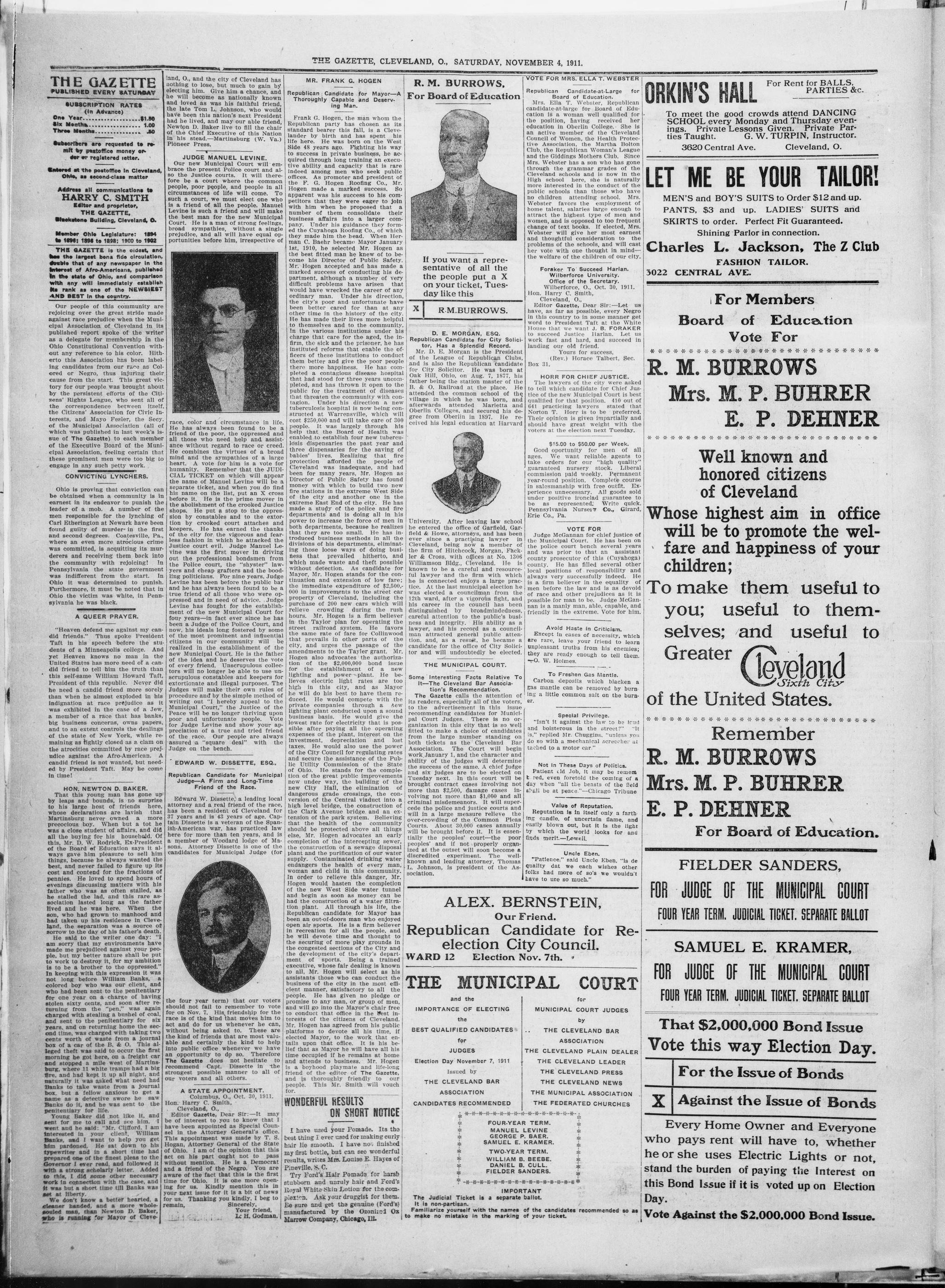
Page text (machine-generated)
TWENTY-NINTH YEAR. NO. 14.
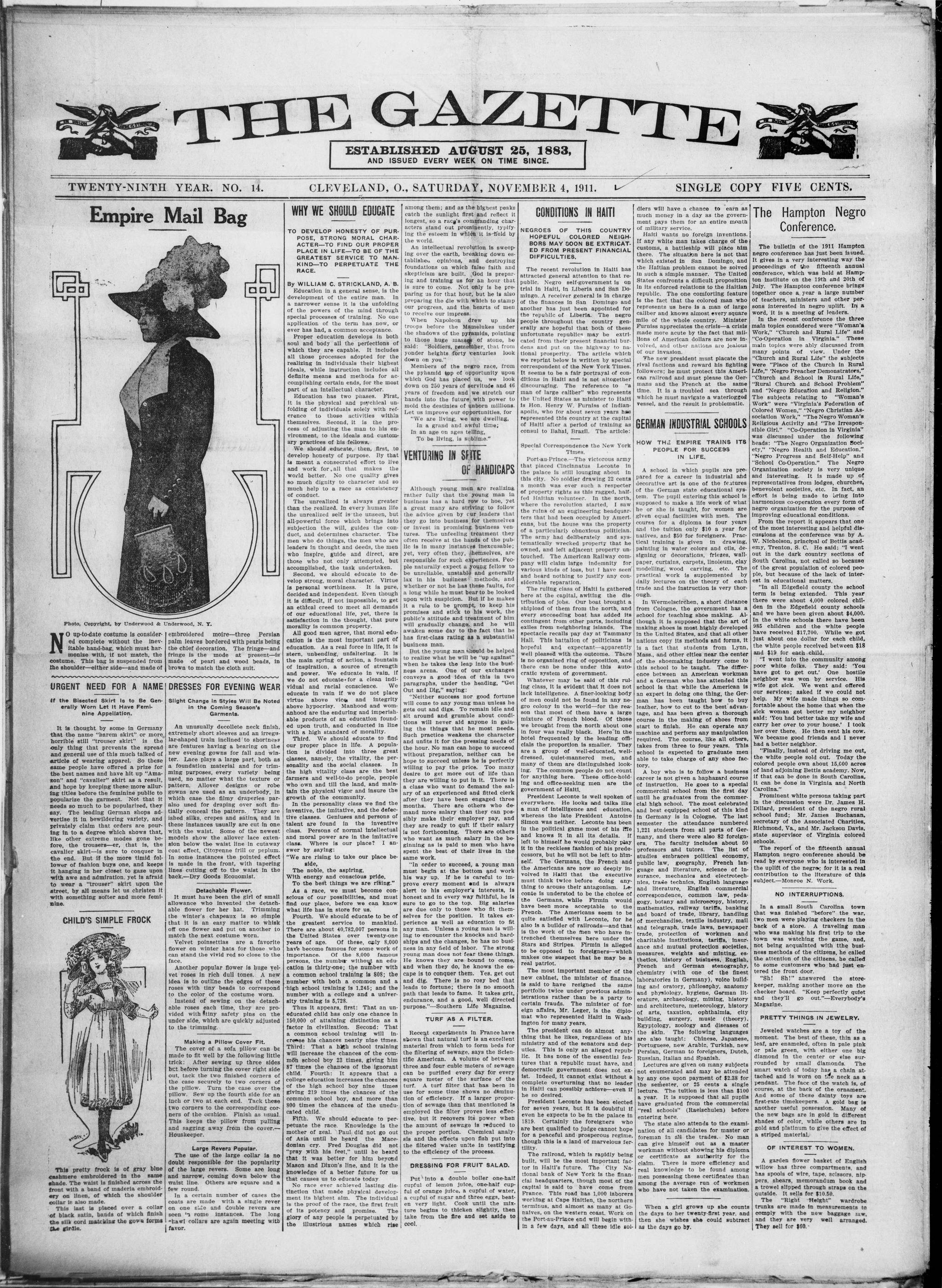
Empire Mail Bag
H
Photo, Copyright, by Underwood & Underwood, N. Y.
THE UNION
WEST STATISTICS
TWENTY-NINTH
Empire
Photo, Copyright, by Underwood &
O up-to-date costume is considered complete without the inevitable hand-bag, which must harmonize with, if not match, the costume. This bag is suspended from the shoulder—either side—and made of
If the Bissected Skirt is to Be Generally Worn Let It Have Feminine Appellation.
It is thought by some in Germany that the name "harem skirt" or more horrible still "trouser skirt" is the only thing that prevents the spread and general use of this much talked of article of wearing apparel. So these same people have offered a prize for the best names and have hit up "Amazon" and "cavalier" skirt as a result, and hope by keeping these more alluring titles before the feminine public to popularize the garment. Not that it needs so much to be popularized, they say. The leading German shops advertise it in bewildering variety, and privately claim that orders are pouring in to a degree which shows that, like other extreme modes gone before, the trousers—er, that is, the cavalier skirt—is sure to conquer in the end. But if the more timid follower of fashion buys one, and keeps it hanging in her closet to gaze upon with awe and admiration, yet is afraid to wear a "trouser" skirt upon the street, by all means let us christen it with something softer and more feminine.
CHILD'S SIMPLE FROCK
This pretty frock is of gray blue cashmere embroidered in the same shade. The waist is finished across the front with a band of madera embroidery on linen, of which the shoulder collar is also made.
This last is placed over a collar of black satin, bands of which finish the silk cord matching the gown forms the girdle.
THE GAZETTE
embroidered moire—three Persian palm leaves bordered with pearls being the chief decoration. The fringe—and fringe is the mode at present—and is made of pearl and wood beads, in brown to match the cloth suit.
Slight Change in Styles Will Be Noted in the Coming Season's Garments.
An unusually decollete neck finish, extremely short sleeves and an irregular-shaped train inclined to shortness are features having a bearing on the new evening gowns for fall and winter. Lace plays a large part, both as a foundation material and for trimming purposes, every variety being used, no matter what the texture or pattern. Allover designs or robe gowns are used as an underbody, in which case the filmy draperies paralleled for draping over soft finally conceal the pattern. They are ished silks, crepes and satins, and in these instances usually are cut in one with the waist. Some of the newest models show the allover lace extension below the waist line in cutaway coat effect, Citoyenne frill or peplum. In some instances the pointed effect is made in the front, with tapering lines cutting off to the waist in the back.—Dry Goods Economist.
Detachable Flower
It must have been the girl of small allowance who invented the detachable flower for her hat. Trimming the winter's chapeaux is so simple that it is an easy matter to whisk off one flower and put on another to match the next costume worn. Velvet poinsettias are a favorite flower on winter hats for those who can stand the vivid red so close to the face.
Another popular flower is huge velvet roses in rich dull tones. A new idea is to outline the edges of these roses with tiny beads to correspond to the color of the costume worn.
Instead of sewing on the detachable roses each time, they are provided with tiny safety pins on the under side, which are quickly adjusted to the trimming.
Making a Pillow Cover Fit
Making a Pillow Cover Ft.
The cover of a sofa pillow can be made to fit well by the following little trick. After sewing up three sides but before sewing the cover right side out, tack the two corners of the pillow. The case securely to two corners of the pillow. Turn the case over the pillow. Sew up the fourth side for an inch or two at each end. Tack these two corners to the corresponding corners of the cushion. Finish as usual. This keeps the pillow from pulling and sagging away from the cover.—Houskeeper.
Large Revera Popular.
The use of the large collar is no doubt responsible for the popularity of the large revers. Some are long and narrow, coming down below the waist line. Others are square and a tew round.
In a certain number of cases the coats are made with a single rever on one size and double revers are seen in some instances. The long "hawl collars are again meeting with
ESTABLISHED AUGUST 25, 1883 AND ISSUED EVERY WEEK ON TIME SINCE.
CLEVELAND, O., SATURDAY, NOVEMBER 4, 1911.
WHY WE SHOULD EDUCATE
TO DEVELOP HONESTY OF PURPOSE, STRONG MORAL CHARACTER—TO FIND OUR PROPER PLACE IN LIFE—TO BE OF THE GREATEST SERVICE TO MAN-KIND—TO PERPETUATE THE RACE.
By WILLIAM C. STRICKLAND, A. B.
Education in a general sense, is the development of the entire man. In a narrower sense it is the unfolding of the powers of the mind through special processes of training. No one application of the term has now, or ever has had, a common acceptance.
Proper education develops in both soul and body all the perfections of which they are capable. It includes all those processes adopted for the realizing in individuals their highest ideals, while instruction includes all definite means and methods for accomplishing certain ends, for the most part of an intellectual character.
Education has two phases. First, it is the physical and psychological unfolding of individuals solely with reference to those activities within themselves. Second, it is the process of adjusting the man to his environment, to the ideals and customary practices of his fellows.
We should educate, then, first, to develop honesty of purpose. By that it is meant a consecrated effort to live and work for, all that makes the world better. No one quality gives so much dignity to character and so much help to a race as consistency of conduct.
The unrealized is always greater than the realized. In every human life the unrealized self is the unseen, but all-powerful force which brings into subjection the will, guides the conduct, and determines character. The men who do things, the men who are leaders in thought and deeds, the men who inspire, guide and direct, are those who not only attempted, but accomplished, the task undertaken. Second, we should educate to develop strong, moral character. Virtue is personal worthiness. It is pure, decided and independent. Even though it is difficult, if not impossible, to get an ethical creed to meet all demands of our educational life, yet, there is satisfaction in the thought, that pure morality is common property. All good men agree, that moral education is the most important part of education. As a real force in life, it is stern, unbending, unfaltering. It is the main spring of action, a fountain of inspiration, a source of strength and power. We educate in vain. if we do not educate for a clean individual and racial conscience. We educate in vain if we do not place virtue above vice and integrity above hypocrisy. Manhood and womanhood are the enduring and imperishable products of an education founded upon truth, and conducted in line with a high standard of morality.
Third. We should educate to find our proper place in life. A population is divided into three great classes, namely, the vitality, the personality and the social classes. In the high vitality class are the best farmers and well-to-do people, people who own and till the land, and maintain the physical vigor and insure the growth of the community.
In the personality class we find the inventive, the imitative, and the defective classes. Geniuses and persons of talent are found in the inventive class. Persons of normal intellectual and moral power are in the imitative class. Where is our place? I answer by saying: "We are rising to take our place beside, The noble, the aspiring.
With energy and conscious pride.
To the best things we are rising."
As a race, we must become conscious of our possibilities, and must find our place, before we can know what life has in store for us.
Fourth. We should educate to be of the greatest service to mankind.
There are about 40,782,007 persons in the United States over twenty-one years of age. Of these, only 8,000 have become famous for some work of importance. Of the 8,000 famous persons, the number without an education is thirty-one; the number with a common school training is 808; the number with both a common and a high school training is 1,245; and the number with a college and a university training is 5,728.
Thus it appears, first: That an uneducated child has only one chance in 150,000 of attaining distinction as a factor in civilization. Second: That a common school training will increase his chances nearly nine times.
Third: That a high school training will increase the chances of the common school boy 23 times, giving him 87 times the chances of the ignorant child. Fourth: It appears that a college education increases the chances of the high school boy nine times giving 219 times the chances of the common school boy, and more than 800 times the chances of the uneducated child.
Fifth. We should educate to perpetuate the race. Knowledge is the mother of zeal. Paul did not go out of Asia until he heard the Maeconian cry. Fred Douglas did not "pray with his feet," until he heard that it was better for him beyond Mason and Dixon's line, and it is the knowledge of a better future for us that causes us to educate today. No race ever achieved lasting distinction that made physical development its highest alm. The individual is the proof of the race, the first fruit of its potency and promise. The glory of any people is perpetuated by the illustrious names which rise
among them; and as the biggest peaks catch the sunlight first and reflect it longest, so a race's commanding characters stand out prominently, typifying the esteem in which it is field by the world.
An intellectual revolution is sweeping over the earth, breaking down established, opinions, and destroying foundations on which false faith and skeptism are built. God is preparing and training us for an hour that is sure to come. Not only is he preparing us for that hour, but he is also preparing the die with which to stamp our progress, and the hearts of men to receive our impress.
When Napoleon drew up his troops before the Mamelukes under the shadows of the pyramids, pointing to those huge masses of stone, he said: "Soldiers, remember, that from yonder heights forty centuries look down on you."
Members of the negro race, from the pyramid top of opportunity upon which God has placed us, we look down on 250 years of servitude and 46 years of freedom and we stretch our hands into the future with power to mold the destinies of unborn millions. Let us improve our opportunities, for
"We are living, we are dwelling,
In a grand and awful time;
In an age on ages telling,
To be living, is sublime."
VENTURING IN SPITE OF HANDICAPS
Although young men are realizing rather fully that the young man in business has a hard row to hoe, yet a great many are striving to follow the advice given by our leaders that they go into business for themselves or invest in promising business ventures. The unfeeling treatment they often receive at the hands of the public is in many instances inexcusable; yet, very often they, themselves, are responsible for such experiences. People naturally expect a young fellow to be unreliable, unstable and generally lax in his business methods, and whether or not he has these faults, for a long while he must bear to be looked upon with suspicion. But if he makes it a rule to be prompt, to keep his promises and stick to his work, the public's attitude and treatment of him will gradually change, and he will awaken some day to the fact that he has first-class rating as a substantial business man.
But the young man should be helped to realize what he will be "up against" when he takes the leap into the business arena. One of our exchanges conveys a good idea of this in two paragraphs, under the heading, "Get Out and Dig." saving:
"Neither success nor good fortune will come to any young man unless he gets out and digs. To remain idle and sit around and grumble about conditions will never aid anyone in gaining the things that he most needs. Such practice weakens the character and unfits it for the pressing needs of the hour. No man can hope to succeed without preparation, neither can he hope to succeed unless he is perfectly willing to pay the price. Too many desire to get more out of life than they are willing to put in it. There is a class who want to demand the salary of an experienced and fitted clerk after they have been engaged three months. There are others who demand more salary than they can possibly make their employer pay, and they are ready to quit if their salary is not forthcoming. There are others who want as much salary in the beginning as is paid to men who have spent the best of their lives in the same work.
"In order to succeed, a young man must begin at the bottom and work his way up. If he is careful to improve every moment and is always alert to his employer's interests, is honest and in every way faithful, he is sure to go to the top. Big salaries are due only to those who fit themselves for the position. It takes experience as well as education to fit any man. Unless a young man is willing to encounter the knocks and hardships and the changes, he has no business in any field of labor. The strong young man does not fear these things. He knows they are bound to come, and when they do, he knows the escape is to conquer them. Yes, get out and dig. There is no rosy bed that leads to fortune; there is no smooth path that leads to fame. It takes grit, endurance, and a good, well directed purpose."—Southern Life Magazine.
TURF AS A FILTER.
Recent experiments in France have shown that natural turf is an excellent material from which to form beds for the filtering of sewage, says the Scientific American. A volume of between three and four cubic meters of sewage can be purified every day for every square meter of the surface of the turf. A turf filter that has been in use for some time shows no deminution of efficiency. If a larger proportion of sewage than that mentioned is employed the filter proves less effective, but it recovers its power when the amount of sewage is reduced to the proper portion. Chemical analysis and the effects upon fish put into the filtered water unite in testifying to the efficiency of the process.
DRESSING FOR FRUIT SALAD.
Put Into a double boiler one-half cupful of lemon juice, one-half cupful of orange juice, a cupful of water, a cupful of sugar and three eggs, beaten very light. Cook until the mixture begins to thicken slightly, then take from the fire and set aside to cool.
CONDITIONS IN HAITI
NEGROES OF THIS COUNTRY HOPEFUL COLORED NEIGHBORS MAY GOON BE EXTRICATED FROM PRESENT FINANCIAL DIFFICULTIES.
The recent revolution in Haiti has attracted general attention to that republic. Negro self-government is on trial in Haiti, in Liberia and San Domingo. A receiver general is in charge of the finances in San Domingo and another has just been appointed for the republic of Liberia. The negro people throughout the country generally are hopeful that both of these unfortunate republics may be extricated from their present financial burdens and put on the highway to national prosperity. The article which we reprint below is written by special correspondent of the New York Times. It seems to be a fair portrayal of conditions in Haiti and is not altogether discouraging. The reference to "a man of large caliber" who represents the United States as minister to Haiti is Hon. Henry W. Furnill of Indianapolis, who for about seven years has represented this country at the capital of Haiti after a period of training as consul to Bahal, Brazil. The article:
Special Correspondence the New York Times
Port-au-Prince.—The victorious army that placed Cinchinatus Leconte in the palace is still lounging about in this city. No soldier drawing 22 cents a month was ever such a respecter of property rights as this ragged, half-fed Haitian volunteer. In the north, where the revolution started, I saw the ruins of an engineering headquarters that had been occupied by Americans, but the house was the property of a particularly obnoxious politician. The army had deliberately and systematically wrecked property that he owned, and left adjacent property untouched. The American Railway company will claim large indemnity for various kinds of loss, but I have seen and heard nothing to justify any considerable reparation.
The ruling class of Haiti is gathered here at the capital, awiting the distribution of jobs. Our boat brought a shipload of them from the north, and every succeeding boat has added its contingent from other parts, including exiles from neighboring islands. The spectacle recalls pay day at Tammany Hall. This battalion of politicians is hopeful and expectant—apparently well pleased with the outcome. There is no organized ring of opposition, and there can be none under this autocratic system of government.
Whatever may be said of this ruling class, it is evident that it does not lack intelligence. A finer-looking body of men could not be found in any nego colony in the world—for the reason that most of them have a large mixture of French blood. Of those we brought from the north about one in four was really black. Here in the hotel frequented by the leading officials the proportion is smaller. They are a group of well-educated, well-dressed, quiet-mannered men, and many of them are distinguished looking. The common people do not count for anything here. These office-holding and office-seeking men are the government of Haiti.
President Leconte is well spoken of everywhere. He looks and talks like a man of intelligence and education, whereas the late President Antoine Simon was neither. Leconte has been in the political game most of his life and knows it in all its details. If left to himself he would probably play it in the reckless fashion of his predecessors, but he will not be left to himself. The Germans, the French and the Americans are now so deeply involved in Haiti that the executive must think twice before doing anything to arouse their antagonism. Leconte is understood to be the choice of the Germans, while Firmin would have been more acceptable to the French. The Americans seem to be quite satisfied with Leconte, for he also is a builder of railroads—and that is the work of the men who have intrenched themselves here under the Stars and Stripes. Firmin is alleged to be opposed to foreigners—which makes one suspect that he may be a real patriot.
The most important member of the new cabinet, the minister of finance is said to have resigned the same portfolio twice under previous administrations rather than be a party to certain frauds. The minister of foreign affairs, Mr. Leger, is the diplomat who represented Haiti in Washington for many years.
The president can do almost anything that he likes, regardless of his ministry and of the senators and deputies. This is only an alleged republic. It has none of the essential features that a republic must have, and democratic government does not exist. Indeed, it cannot exist without a complete overturning that no leader in Haiti can possibly achieve—even if he so desired.
President Leconte has been elected for seven years, but it is doubtful if even he expects to be in the palace in 1819. Certainly the foreigners who are best qualified to judge cannot hope for a peaceful and prosperous regime, though this is a land of marvelous fertility.
The railroad, which is rapidly being built, will be the most important factor in Haiti's future. The City National bank of New York is the financial headquarters, though most of the capital is said to have come from France. This road has 1,000 laborers working at Cape Haitien, the northern terminus, and almost as many at Gonaives, on the western coast. Work on the Port-au-Prince end will begin within a few days, and all these aid sol-
ders will have a chance to earn as much money in a day as the government pays them for an entire month of military service. Halit wants no foreign inventions. If any white man takes charge of the customs, a battleship will place him there. The situation here is not that which existed in San Domingo, and the Halitian problem cannot be solved in such a simple manner. The United States confronts a difficult proposition in its enforced relations to the Haitian republic. The one comforting feature is the fact that the colored man who represents us here is a man of large caliber and knows almost every square mile of the whole country. Minister Furniss appreciates the crisis—a crisis made more acute by the fact that millions of American dollars are now involved, and other nations are jealous of our invasion.
The new president must placate the rival factions and reward his fighting followers; he must protect this American railroad and must please the Germans and the French at the same time. It is a troubled sea through which he must navigate a waterlogged vessel, and the result is problematic.
The Hampton Neg Conference.
The bulletin of the 1911 Hampton negro conference has just been issued. It gives in a very interesting way proceedings of the fifteenth and conference, which was held at Hampton Institute on the 19th and 20th July. The Hampton conference brings together once a year a large number of teachers, ministers and other sons interested in negro uplift. I word, it is a meeting of leaders.
In the recent conference the main topics considered were "Wom Work," "Church and Rural Life," "Co-Operation in Virginia." The main topics were ably discussed in many points of view. Under "Church and Rural Life" the subtitle "Place of the Church in R Life," "Negro Preacher Demonstrate "Church and School in R Life," "Negro Church and School Proble and "Negro Education and Religion The subjects relating to "Wom Work" were "Virginia's Federation
GERMAN INDUSTRIAL SCHOOLS
HOW THE EMPIRE TRAINS ITS PEOPLE FOR SUCCESS IN LIFE.
A school in which pupils are prepared for a career in industrial and decorative art is one of the features of the German state educational system. The pupil entering this school is supposed to make a life work of what he or she is taught, for women are given equal facilities with men. The course for a diploma is four years and the tuition only $10 a year for natives, and $50 for foreigners. Practical training is given in drawing, painting in water colors and oils, designing or decorations, friezes, wallpaper, curtains, carpets, linoleum, clay modelling, wood carving, etc. The practical work is supplemented by daily lectures on the theory of each trade and the instruction is very thorough.
In Wermelsirchen, a short distance from Colgne, the government has a school for teaching shoe making. Although it is supposed that the art of making shoes is most highly developed in the United States, and that all other nations copy its methods and forms, it is a fact that students from Lynn, Mass., and other cities near the center of the shoemaking industry come to this school to be taught. The difference between an American workman and a German who has attended this school is that while the American is an expert in doing one thing, the German has been taught how to buy leather, how to cut to the best advantage, and has been given a thorough course in the making of shoes from start to finish. He can operate any machine and perform any manipulation required. The course, like all others, takes from three to four years. This school is expected to graduate men able to take charge of any shoe factory.
A boy who is to follow a business career is not given a hapazh course of instruction. He goes to a special commercial school from the first day until he graduates from the commercial high school. The most celebrated and best equipped school of this kind in Germany is in Cologne. The last semester the attendance numbered 1,221 students from all parts of Germany, and there were also 82 foreigners. The faculty includes about 50 professors and tutors. The list of studies embraces political economy, public law, geography, French language and literature, science of insurance, mechanics and electrotechnics, trade technology, English commercial correspondence, common law, pedagogy, botany and microscopy, history, mathematics, railway tariffs, banking and board of trade, library, handling of merchandise, textile industry, mall and telegraph, trade laws, newspaper trade, protection of workmen and charitable institutions, tariffs, insurance and mutual protection societies, measures, weights and minting, esthetics, history of business, English, French and German stenography, chemistry (with one of the finest laboratories in Germany), volce building and oratory, philosophy, anatomy and physiology, hygiene, German literature, archaeology, mining, history and architecture, meteorology, history of arts, taxation, ophthalmia, city building, surgery, music (theory). Egyptology, zoology and diseases of the skin. The following languages are also taught: Chinese, Japanese, Portuguese, new Arabic, Turkish, new Persian, German to foreigners, Dutch, Russian, Italian and Spanish.
Lectures are given on many subjects not enumerated and may be attended by any one upon payment of $2.38 for the semester, or 25 cents a single lecture. The tuition is less than $100 a year. It is supposed that all pupils have graduated from the commercial "real schools" (Raaelschulen) before entering here.
The state also attends to the examination of all candidates for master or foreman in all the trades. No man can give himself out as a master workman without showing his diploma or certificate as authority for the claim. There is more efficiency and real knowledge to be found among men possessing these certificates than among the average run of workmen who have not taken the examination.
When a girl grows up she counts the days to her twenty-first year, and then she wishes she could subtract as the days go by.
THE EAGLE
SACRED
The Hampton Negro Conference.
The bulletin of the 1911 Hampton negro conference has just been issued. It gives in a very interesting way the proceedings of the fifteenth annual conference, which was held at Hampton institute on the 19th and 20th of July. The Hampton conference brings together once a year a large number of teachers, ministers and other persons interested in negro uplift. In a word, it is a meeting of leaders. In the recent conference the three main topics considered were "Woman's Work," "Church and Rural Life" and "Co-Operation in Virginia." These main topics were allly discussed from many points of view. Under the "Church and Rural Life" the subjects were "Place of the Church in Rural Life," "Negro Preacher Demonstrators," "Church and School in Rural Life," "Rural Church and School Problem" and "Negro Education and Religion." The subjects relating to "Woman's Work" were "Virginia's Federation of Colored Women," "Negro Christian Association Work," "The Negro Woman's Religious Activity and the Iresponsible Girl," "Co-Operation in Virginia" was discussed under the following heads: "The Negro Organization Society," "Negro Health and Education," "Negro Progress and Self-Help" and "School Co-Operation." The Negro Organization society is very unique and interesting. It is made up of representatives from lodges, churches, benevolent societies, etc. In fact, an effort is being made to bring into harmonious co-operation every form of negro organization for the purpose of improving educational conditions.
From the report it appears that one of the most interesting and helpful discussions at the conference was by A.W. Nicholson, principal of Bettis academy, Trenton, S. C. He said: "I went out in the dark country sections of South Carolina, not called so because of the great population of colored people, but because of the lack of interest in educational matters.
"In all Edgefield county the school term is being extended. This year there were about 4,000 colored children in the Edgefield county schools and we have been given about $4,000. In the white schools there have been 985 children and the white people have received $17,700. While we got just about one dollar for each child, the white people received between $18 and $19 for each child.
"I went into the community among poor white folks. They said: 'You have got to get out.' One hostile neighbor was won by service. His wife got sick. We went and offered our services; asked if we could not help. My wife made things so comfortable about the home that when the sick woman got better my neighbor said: 'You had better take my wife and carry her over to your house.' I took her over there. He then sent his cow. We became good friends and I never had a better neighbor.
"Finally, instead of driving me out, the white people sold out. Today the colored people own about 15,000 acres of land adjoining Bettis academy. Now, if that can be done in South Carolina, it can be done in Virginia and North Carolina."
Prominent white persons taking part in the discussion were Dr. James H. Dillard, president of the negro rural school fund; Mr. James Buchanan, secretary of the Associated Charities, Richmond, Va., and Mr. Jackson Davis, state supervisor of Virginia colored schools.
The report of the fifteenth annual Hampton negro conference should be read by everyone who is interested in the uplift of the negro; for it is a real contribution to the literature of this subject.—Monroe N. Work.
NO INTERRUPTIONS
In a small South Carolina town that was finished "before" the war, two men were playing checkers in the back of a store. A traveling man who was making his first trip to the town was watching the game, and, not being acquainted with the business methods of the citizens, he called the attention of the citizens, he called to some customers who had just entered the front door.
"Sh! Sh!" answered the store-keeper, making another move on the checker board. "Keep perfect quiet and they'll go out."—Everybody's Magazine.
PRETTY THINGS IN JEWELRY.
Jewelled watches are a toy of the moment. The best of these, thin as a leaf, are enameled, in often pale pink or pale green, with either one big diamond in the center or else surrounded by small diamonds. The smart watch of today has a chain attached and is worn on the neck as a pendant. The face of the watch is, of course, at the back of the ornament. And some of these dainty toys are first-rate timekeepers. A gold bag is another useful possession. Many of the new bags are in gold in different shades of color, while others are in gold and platinum to give the effect of a striped material.
OF INTEREST TO WOMEN.
A garden flower basket of English willow has three compartments, and has spools of wire, tape, scissors, nippers, shears, memorandum book and a trowel slipped through straps on the outside. It sells for $10.50.
The "Right 'Helight' wardrobe trunks are made in measurements to comply with the new baggage law, and they are very well arranged. They sell for $50.
(In Advance)
One Year.....$1.50
Six Months.....1.00
Three Months.....50
Subscribers are requested to re-
mit by postoffice money or-
der or registered letter.
Entered at the postoffice in Cleveland,
Ohio, as second-class matter
Address all communications to
HARRY C. SMITH
Editor and proprietor,
THE GAZETTE,
Blackstone Building, Cleveland, O.
Member Ohio Legislature: 1894
to 1898; 1898 to 1898; 1900 to 1902
1898; 1898 to 1898; 1890 to 1902
THE GAZETTE is the oldest, and has the largest bona fide circulation, double that of any newspaper in the interest of Afro-Americans, published in the state of Ohio, and comparison with any will immediately establish its rank as one of the NEWSIEST AND BEST in the country.
Our people of this community are rejoicing over the great stride made against race prejudice when the Municipal Association of Cleveland in its published report spoke of the writer as a delegate for membership in the Ohio Constitutional Convention without any reference to his color. Hitherto this Association has been labeling candidates from our race as Colored or Negro, thus injuring their cause from the start. This great victory for our people was brought about by the persistent efforts of the Citizens' Rights League, who sent all of the correspondence between itself, the Citizens' Association for Civic Interests, and May Fesler, the Secy. of the Municipal Association (all of which was published in last week's issue of The Gazette) to each member of the Executive Board of the Municipal Association, feeling certain that these prominent men were too big to engage in any such petty work.
CONVICTING LYNCHERS.
Ohio is proving that conviction can be obtained when a community is in earnest in its endeavor to punish the leader of a mob. A number of the men responsible for the lynching of Carl Etherington at Newark have been found guilty of murder in the first and second degrees. Coatesville, Pa., where an even more atrocious crime was committed, is acquitting its murderers and receiving them back into the community with rejoicing! In Pennsylvania the state government was indifferent from the start. In Ohio it was determined to punish. Furthermore, it must be noted that in Ohio the victim was white, in Pennsylvania he was black.
A QUEER PRAYER
"Heaven defend me against my candid friends." Thus spoke President Taft in his speech before the students of a Minneapolis college. And yet Heaven knows no man in the United States has more need of a candid friend to tell him the truth than this self-same William Howard Taft, President of this republic. Never did he need a candid friend more sorely than when he almost exploded in his indignation at race prejudice as it was exhibited in the case of a Jew, a member of a race that has banks, big business concerns, owns papers, and to an extent controls the dealings of the state of New York, while remaining as tightly closed as a clam on the atrocities committed by race prejudice against the Afro-American. A candid friend is not wanted, but needed by President Taft. May he come in time!
HON. NEWTON D. BAKER.
That this young man has gone up by leaps and bounds, is no surprise to his large host of friends here, whose declarations are lavish that Martinsburg never owned a more precocious boy. When but a tot he was a close student of affairs, and did all the buying for his household. Of this, Mr. D. W. Rodrick. Ex-President of the Board of Education says it always gave him pleasure to sell him things, because he failed to figure up its cost, and contend for the fractions of money. He loved to spend hours of evenings discussing matters with his father who was as often stalled, as he stalled the lad, and this rare association lasted long as the father lived and he was here. When the son, who had grown to manhood and had taken up his residence in Cleveland, the separation was a source of sorrow to the day of his father's death.
He said to the writer one day: "I am sorry that my environments have made me prejudiced against your people, but my better nature shall be put to work to destroy it, for my ambition is to be a brother to the oppressed." In keeping with this expression it was not long before William Banks, a soldier who had been sent to the penitentiary for one year on a charge of having stolen sixty cents, and soon after returning from the "pen," was again charged with stealing a bushel of coal, and sent to the penitentiary for six years, and on returning home the second time, was charged with taking two cents worth of waste from a journal box of a car of the B. & O. This alleged theft was said to occur the first morning he got here, on a freight car and stopped a mile west of Martinsburg, where 11 white tramps had a big fire, and had kept it all night, and naturally it was asked what need Banks had to do, but a fellow anxious to get a name as a detective swore he saw Banks do it, and he was sent to the penitentiary for life.
Young Baker did not like it, and sent for me to call and see him. I went and he said: "Mr. Clifford, I am interested in your client, William Banks, and I want to help you get him pardoned, and in a short time had prepared one of the finest pleas to the Governor I ever read, and followed it with a strong scholarly letter. Added to this, I did some other necessary work in connection with the case, and it was but a short time till Banks was see at liberty. We did show a better hearted, a cleaner handed, and a more wholesouled man, than Newton D. Baker, who is running for Mayor of Cleve-
land, O, and the city of Cleveland has nothing to lose, but much to gain by electing him. Give him a chance, and he will become as nationally known and loved as was his faithful friend, the late Tom L. Johnson, who would have been this nation's next President had he lived, and may our able friend, Newton D. Baker live to fill the chair of the Chief Executive of this Nation in his stead.-Martinsburg (W. Va.) Pioneer Press.
JUDGE MANUEL LEVINE
Our new Municipal Court will embrace the present Police court and also the Justice courts. It will therefore be a court where the common circumstances of life will come. To such a court, we must elect one who is a friend of all the people. Manuel Levine is such a friend and will make the best man for the new Municipal Court. He is a man of strong feelings, a man of integrity, a prejudice, and all will have equal opportunities before him, irrespective of
JOHN B. HARRIS
EDWARD W. DISSETTE. ESQ..
Republican Candidate for Municipal Judge—A Firm and Long-Time Friend of the Race.
Edward W. Dissette, a leading local attorney and a real friend of the race, has been a resident of Cleveland for 37 years and is 43 years of age. Captain Dissette is a veteran of the Spanish-American war, has practiced law here for more than ten years, and is a member of Woodard lodge of Masons. Attorney Dissette is one of the candidates for Municipal Judge (for
M. B.
the four year term) that our voters should not fail to remember to vote for on Nov. 7. His friendship for the race is of the kind that moves him to act and do for us whenever he can, without being asked to. These are the kind of friends that are most valuable and certainly the kind to help into public office whenever we have an opportunity to do so. Therefore The Gazette does not hesitate to recommend Catt. Diszette in the strongest possible manner to all of our voters and all others.
A STATE APPOINTMENT
A STATE APPOINTMENT.
Columbus, O., Oct. 30, 1911.
Hon. Harry C. Smith,
Cleveland, O.,
Editor Gazette, Dear Sir--It may be a good request to you to know that you have been appointed as Special Counsel in the Attorney General's office. This appointment was made by T. S. Hogan, Attorney General of the State of Ohio. I am of the opinion that this act on his part ought not to pass without mention. He is a Democrat and a friend of the Negro. You are aware of the fact that this is the first time for Ohio. You are kindly mention this in your next issue for it is a bit of news for us. Thanking you kindly, I beg to remain. Sincerely,
Your friend,
L. H. Godman,
THE GAZETTE, CLEVELAND, O., SATURDAY, NOVEMBER 4, 1911.
MR. FRANK G. HOGEN
Republican Candidate for Mayor—A Thoroughly Capable and Deserving Man.
WONDERFUL RESULTS
I have used your Pomade. Its the best thing I ever used for making curly hair He smooth. I have not finished my first bottle, but can see wonderful results, writes Mrs. Louise E. Hayes of Pineville, S. C.
Try Ford's Hair Pomade for harsh stubborn and unruly hair and Ford's Royal White Skin Lotion for the complexion. Ask your druggist for them. Be sure and get the genuine (Ford's) manufactured by the Ozonized Ox Marrow Company, Chicago, IL.
PETER H. BURKE
If you want a representative of all the people put a X on your ticket, Tuesday like this
R.M.BURROWS
D. E. MORGAN, ESQ.
Republican Candidate for City Solici
tor, Has a Splendid Record.
Mr. D. E. Morgan is the President of the League of Republican Clubs, and is also the Republican candidate for City Solicitor. He was born at Oak Hill, Ohio, on Aug. 7, 1877, his father being the station master of the B. & O. Railroad at the place. He attended the common school of the village in which he was born, and afterwards attended Marietta and Oberlin Colleges, and secured his degree from Oberlin in 1897. He received his legal education at Harvard
University. After leaving law school he entered the office of Garfield, Garfield & Howe, attorneys, and has been ever since a practising lawyer in Cleveland, being now a member of the firm of Hitchcock, Morgan, Fackler & Cross, with offices at No. 1306 Williamson Bldg., Cleveland. He is known to be a careful and resourceful lawyer and the firm with which he is connected enjoys a large practice. At the last municipal election he was elected a councilman from the 12th ward, after a vigorous fight, and was elected a councilman distinguished by broadmindedness, careful attention to the public's business and integrity. His ability as a lawyer, and his record as a councilman attracted general public attention, and, as a result, he became a candidate for the office of City Solicitor and will undoubtedly be elected.
THE MUNICIPAL COURT
Some Interesting Facts Relative To
It—The Cleveland Bar Associac-
tion
Ton's recommendation.
The Gazette calls the attention of its readers, especially all of the voters, to the advertisement this issue record, including candidates for Munich Court Judges. There is no organization in this city that is so well fitted to make a choice of candidates from the large number standing on both tickets as the Cleveland Bar Association. The Court will begin work January 1, and the character and ability of the judges will determine the success of the same. A chief judge and six judges are to be elected on Tuesday next. In this court will be brought contract cases involving not more than $2,500, damage cases involving not more than $1,000 and all criminal misdemeanors. It will supervise the police and justice courts and urge the large over-crowding of the Common Pleas Courts. About 30,000 cases annually will be brought before it. It is essentially the peoples' court—the poor peoples' and if not properly organized at the outset will soon become a discredited experiment. The well-known and leading attorney, Thomas L. Johnson, is president of the Association.
ALEX. BE
Our B
Republican C
election Ci
WARD 12 Election M
THE MUNICI
ALEX. BERNSTEIN,
Our Friend.
Republican Candidate for Re-election City Council.
WARD 12 Election Nov. 7th.
and the
IMPORTANCE OF ELECTING
the
BEST QUALIFIED CANDIDATES
for
JUDGES
Election Day November 7, 1911
Issued by
THE CLEVELAND BAR
ASSOCIATION
CANDIDATES RECOMMENDED
FOUR-YEAR TERM.
MANUEL LEVINE.
GEORGE P. BAER.
SAMUEL E. KRAMER.
TWO-YEAR TERM.
WILLIAM B. BEEBE.
DANIEL B. CULL.
FIELDER SANDERS.
IMPORTANT
The Judicial Ticket is a separate ballot.
It is non-partisan.
Familiarize yourself with the names of the candidates re-
to make no mistake in the marking of your ticket.
Familiarize yourself with the names of the candidates recommended so as to make no mistake in the marking of your ticket.
VOTE FOR MRS. ELLA T. WEBSTER
Republican Candidate-at-Large for
EDUCATION
Mrs. Eileen T. Webster, Republican candidate-at-large for Board of Education is a woman well qualified for the position, having received her education in Oberlin College. She is an active member of the Cleveland Council of Women, the Health Protective Association, the Martha Bolton Club, the Republican Woman's League and the Gldings Mothers Club. Since Mrs. Webster has a son who has gone the graduate, the grandmother of Cleveland schools and is now in the High school here, she is naturally more interested in the conduct of the public schools than those who have no children attending school. Mrs. Webster favors the employment of home talent, salaries large enough to attract the highest type of men and women who is interested in frequent change of text books. If elected, Mrs. Webster will give her most earnest and thoughtful consideration to the problems of the schools, and will cast her vote with one thought in mind—the welfare of the children of our city.
Foraker To Succeed Harlan, Wilberforce University.
Wilberforce, O., Oct. 30, 1911. Hon. Harry C. Smith,
Cleveland, O.
Editor Gazette, Dear Sir:—Let us have, as far as possible, every Negro in this country to in some manner get word to President Taft at the White House that we want J. B. FORAKER to succeed Justice Harlan. Let us work fast and hard, and succeed in landing our old friend.
Yours for success,
(Rev.) Horace Talbert, Sec. Box 31.
HORR FOR CHIEF JUSTICE.
The lawyers of the city were asked to tell which candidate for Chief Justice of the new Municipal Court is best qualified for that position. 410 out of 641 practicing lawyers stated that Norton T. Horr is to be preferred.
Their opinion is given impartially and should have great weight with the voters at the election next Tuesday.
$15.00 to $50.00 per Week.
Good opportunity for men of all ages. We want reliable agents to take orders for our "high quality" guaranteed nursery stock. Liberal commission paid weekly. Permanent year-round position. Complete course in salesmanship with free outfit. Experience unnecessary. All goods sold under positive ironed guarantee, represented. Write quick. Pennsylvania Nurser Co., Girard, Erie Co., Pa.
VOTE FOR
Judge McGannan for chief justice of the Municipal Court. He has been on the police court bench several years and was prior to that an assistant county prosecutor of this (Cuyahoga) county. He has filled several other local positions of responsibility and always very successfully indeed. He is a firm believer in the equality of men before the law and is as devoid of race and other prejudices as it is possible for man to be. Judge McGannan is a manly man, able, capable, and in the extreme. Vote for him.
Avoid Haste in Criticism.
Except in cases of necessity, which are rare, leave your friend to learn unpleasant truths from his enemies; they are ready enough to tell them.
O. W. Holmes.
To Freshen Gas Mantle.
Carbon deposits which blacken a gas mantle can be removed by burning a little common salt on the burn-
Special Privilege.
Special Privilege.
"Isn't it against the law to be lewd and boisterous in the street?" "It is," replied Mr. Chuggins, "unless you do so with a mechanical screecher at tached to a motor car."
Not in These Days of Politics.
Patient old Job, it may be remembried, even foretold the coming of a day when "all the beasts of the field shall be at peace."—Chicago Tribune
Value of Reputation.
Reputation is in itself only a farthing candle, of uncertain flame, and easily blown out, but it is the light by which the world looks for and finds merit—Lowell.
Uncle Eben.
"Patience," said Uncle Eben, "is de quality dut we各各 wishes other folks had more of so's we wouldn't have to use so much."
RNSTEIN,
Friend.
Candidate for Re-
tory Council.
Nov. 7th.
PAL COURT
MUNICIPAL COURT JUDGES
by
THE CLEVELAND BAR
ASSOCIATION
THE CLEVELAND PLAIN DEALER
THE CLEVELAND LEADER
THE CLEVELAND PRESS
THE CLEVELAND NEWS
THE MUNICIPAL ASSOCIATION
THE FEDERATED CHURCHES
TANT
ballot.
of the candidates recommended so as
of your ticket.
VOTE FOR
1
For Rent for BALLS,
PARTIES &c
get the good crowds attend DANCING
DL every Monday and Thursday even-
Private Lessons Given. Private Par-
ught. G. W. TURPIN, Instructor.
00 Central Ave. Cleveland, O.
ME BE YOUR TAILOR
and BOY'S SUITS to Order $12 and up.
$3 and up. LADIES' SUITS and
$ to order. Perfect Fit Guaranteed.
Shining Parlor in connection.
L. Jackson, The Z Clu
FASHION TAILOR.
TRAL AVE.
To meet the good crowds attend DANCING SCHOOL every Monday and Thursday evenings. Private Lessons Given. Private Parties Taught. G.W.TURPIN, Instructor. 3620 Central Ave. Cleveland, O.
LET ME BE YOUR TAILOR!
MEN'S and BOY'S SUITS to Order $12 and up. PANTS, $3 and up. LADIES' SUITS and SKIRTS to order. Perfect Fit Guaranteed. Shining Parlor in connection.
Charles L. Jackson, The Z Club
FASHION TAILOR.
3022 CENTRAL AVE.
For Members
board of Education
Vote For
E. BURROWS
s. M. P. BUHRER
E. P. DEHNER
Board of Education Vote For
R. M. BURROWS Mrs. M. P. BUHRER E. P. DEHNER
Well known and honored citizens of Cleveland
the highest aim in office be to promote the we and happiness of you dren; make them useful t; useful to them ves; and useful t
Whose highest aim in office will be to promote the welfare and happiness of your children;
To make them useful to you; useful to themselves; and useful to Greater
Cleveland
Sixth City
United States.
Remember
BURROWS
of the United States.
Remember
R. M. BURROWS
Mrs. M. P. BUHRER
E. P. DEHNER
For Board of Education.
FIELDER SANDERS,
FOR JUDGE OF THE MUNICIPAL COURT
FOUR YEAR TERM. JUDICIAL TICKET. SEPARATE BALLOT
SAMUEL E. KRAMER, FOR JUDGE OF THE MUNICIPAL COURT FOUR YEAR TERM. JUDICIAL TICKET. SEPARATE BALLOT
That $2,000,000 Bond Issue Vote this way Election Day. For the Issue of Bonds
Every Home Owner and Everyone who pays rent will have to, whether he or she uses Electric Lights or not, stand the burden of paying the Interest on this Bond Issue if it is voted up on Election Day. Vote Against the $2,000,000 Bond Issue.
Local News
J. S. HALL'S, 3121 Central Ave.
L. SCHWARTZ'S, 2921 Central Ave. Open Sunday.
O. C. SCHROEDER'S, Cuyahoga Bldg. Open Sunday.
ELMER F. BOYD'S, 2604 Central Ave.
F. VALENTINE'S, 2130 Central Ave.
NOTICE TO SUBSCRIBERS: - Subscribers not receiving The Gazette regularly should notify us at once. We desire every copy delivered promptly. We advise our patrons to carefully examine The Gazette's advertisements before making purchases. Business men who advertise in this paper should have the patronage of Afro-Americans. The fact that they advertise is assurance that they want it.
Local reading notices (advertisements) ten cents a line (six words in a line.)
NOTARY PUBLIC—For such services call at The Gazette office, No. 3 Blackstone Building, No. 1422 W. 3d street, near Superior avenue.
The C. R. L. meeting at Mt. Haven church, Wednesday evening, was successful one in spite of the weather Do not tail to read our advertisement
FOR SALE.—Brand new, Imperial Encyclopedia and Dictionary, 40 volumes, finely illustrated, handy to hand. Unexcelled for reference purposes. A library in itself—one that will last a life-time. Contains every thing you may wish to know. Call or address, The Gazette, Blackstone Building, 1422 W. 3d St., Cleveland, O. near Superior Av. This is an opportunity of a life-time for those who love good books.
Tuesday is election day!
Do not forget to vote on Tuesday!
An important day—unusually so—is Wednesday. Tell it!
M. F. Thomas of Blaine Ave., is out of the city.
Mrs. C. Gordon and daughter of Canton, have relocated in Cleveland.
Mrs. C. Rudd and daughter, Thelma, of E. 36th St., visited relatives in Akron recently.
W. H. Smith of E. 30th St., was called to Virginia, last week by the illness of his mother.
The Hallowe'en social given by the B. Y. P. U. of Antioch church at Mr. Powell's, E. 37th St., was well attended.
Grand mass meeting of the C. R. L. tonight (Friday) at St. John's church.
Fine speakers and music. Be sure to attend and tell your friends to do so also.
The last meeting of the campaign (of the Citizens' Rights League) will be held at Antioch church, Monday evening. Fine speeches and good music. Everybody welcome.
Mr. and Mrs. A. T. Henderson announce the marriage of their daughter, Pearl, to Walter F. Harris on Oct. 28. Rev. G. V. Clark performed the ceremony. Grand mass meeting of the C. R. L. at Antioch Baptist church Monday evening. The last rally of our C. R. L. campaign. Mr. William Coleman of Hudson Ave. has returned from a visit in Buffalo, where she was the guest of Mrs. Charles Smith. Mr. Coleman left this week for Buffalo, on business, to remain a week. The Hamilton Republican Club held a meeting Thursday evening at Sylvestro's Hall, Woodhill Road and Fairmount. In addition to regular candidates, the meeting was addressed by Hon. Harry C. Smith, our candidate for delegate to the Constitutional Convention. Rev. E. L. Gilliam en route home to Columbus from Warren and other Ohio cities, called on The Gazette the first of the week. Dr. E. L. Gilliam is G. C. of the K. of P. of Ohio. He received of his brother, Mr. Hiram Gilliam.
The Independent Club gave a "Trip Around the World in automobiles visiting Washington, Boston, Japan, San Francisco, and London, and were served at each stop." It was a great success, Mrs. Wallace Ownes of San Francisco served fruit and punch. Excellent services were held at Lane Memorial church last Sunday. Rev. W. G. Webster had just returned from Conference and was most cordially belied by the congregation. For the fraternity history of the church, a pastor has been returned for the third year. Voters who were sick or 50 miles from Cleveland on the four regular registration days, may register Nov. 6, the day before election, at the board of elections rooms. The board met Thursday to prepare for the special registration. Reports of alleged fraudulent registration were received.
The Francis Harper, W. C. T. U. will meet at Mrs. Francis Hampton's, 2204 E. 43d St., Tuesday evening. Mrs. Ellot, county sup. of, of others and the ingress, address and the various superintendents will make their reports. All who are interested in this great reform are urged to attend this meeting. Joe Blue, tackle and punter of the Central High football team, will not play this Friday against Lincoln High at Shaw field. He is out of the game with a sprained ankle and will be saved for a game with an unrestricted playing week. Brown, Central lineman, out with sprained ankle will play Friday.
Mr. Marlon Hill, age 49, died at Charity Hospital, Oct. 24. Funeral services, Oct. 27 at his residence, 2828 Central Ave., 2 p. m., conducted by Rev. H. C. Bailey. Interment in E. Cleveland cemetery. Mrs. Julia Long, aged 51, died at her residence, 2166 E. 43d St., Oct. 25. Funeral services, Oct. 30 at 2 p. m. at St. John's church, conducted by Rev. Chas. Bundy with Damon Court of Calanthe and the Wright Missionary Society in attendance. Interment at Lakeview cemetery. Funeral director, E. F. Boyd.
The following is from the Louisville (Ky.) Columbian: "Mr. Ed. M. Turner of Cleveland, Ohio, made a flying trip to this city last week. Mr. Turner is a cousin of Mr. and Mrs. H. G. Weeden and he enjoys the distinction of being the only colored motorman employed by the city railway company of Cleveland. He was royally entertained during his stay here and returned home Saturday after a pleasant stay with Mr. and Mrs. H. G. Weeden. He carried a pleasant memo to grand old state of Kentucky and expressed himself well satisfied that we have a great city and state"
The C. R. L. meeting at Mt. Haven church, Wednesday evening, was a successful one in spite of the weather. Do not tail to read our advertisements and patronize those who ask for your trade in the columns of The Gazette.
John G. Walker, a member of the race, was awarded by the Carnegie Hockey Hall of Fame for a $200 towards buying a home. Walker rescued a Ga. mayor (white). The Booker T. Washington-Ulrich case which was to have come up in the general sessions court of New York City, a week ago Monday, was again postponed until Nov. 6.
Prof. E. C. Williams, principal of the M. street High School, Washington, D. C., was speaker at this week's Historical Association that city. His theme, "From the Ox-Cart to the Aeroplane," was a delightful survey of the progress of the race since Emancipation.
Send your local items to The Gazette on Monday or Tuesday of each week. This paper is published for ALL of our people and "plays no favorites." Everybody is treated the fair and right. Take The Gazette and tell your friends to do so also.
Hon. Harry C. Smith, editor of "The Old Reliable," Cleveland Gazette is, we are informed, a candidate for election as delegate to the Constitutional Convention. We need Colored representatives, and if, as we hope, Harry is selected, there will surely be something doing if the rights of our people are jeopardized—Cincinnati (O.) Union.
The Harvest Festival at St. James' church, Sunday, was a great success. Large quantities of edibles of all kinds were freely donated and the sale held Monday evening. The pastor preached eloquently Sunday morning and evening, and the young people rendered an excellent program at the event, including a presentation on "Race Progression" in the evening in which he spoke very highly of the pastor and the editor of The Gazette. Mrs. Snelson delivered a notable address at 3 p. m. Collection $28.15. The church was crowded at each service. Among those who sent Harvest Home offerings were: Mr. and Mrs. W. J. Wiggins, Mr. and Mrs. John Thompson, Mr. and Mrs. Farmer, Mr. and Mrs. Fields, Mr. andrs. Frank Wiggins, Mr. and Mrs. Ward, Mr. and Mrs. Berry, Mr. and Mrs. F. D. Ballard, Mr. and Mrs. Robert Mahoney, Mr. and Mrs. T. H. Johnson, Miss Edna Thompson, Mesdames Patterson, Junior, Davis, Timbers and Judy, Merrids, Blue, Judy, Junior, Mr. and Mrs. Jessie Washington, and Dr. Mrs. and Arnetta Snelson. Sunday will be "Patriot's Day" and the sermons will be on Sunday. There will also be addresses in the evening by several distinguished gentlemen. During October Mr. Snelson has raised over $150 in simple table collections. His accomplished wife, Mrs. Watterloo B. Snelson, was unanimously elected speaker for the Co-workers of the Citizens' Rights League, Mondays and has made several contributions to our local churches and homes in the last ten days materially assisting in promoting the candidacy of our delegate for the Constitutional Convention.
The Citizens' Rights League held a very successful mass meeting at Mt. Zion Congregational church on Sunday afternoon. After the opening prayer by Rev. H. M. Lowery, T. M. Farlice, who presided over the meeting, called on the Hon. Harry C. Smith who explained very careful the need of having our interests looked at homing St. Connolian Convention, Rev. G. V. Clark, pastor of the church, also spoke very briefly. Nearly $20 was given the League. The Co-Workers of the Citizens' Rights League held a very successful meeting Monday evening in Antioch Baptist church. In spite of the inclement weather the church was well filled as an earnest of the sincere effort of our people to have a representative in the Ohio Constitutional Convention. The meeting was opened by Mrs. Wm. W. Whitling, with Mrs. G. Glennie, presiding, with Wm. G. Webster delivered the opening prayer. Music was furnished by Mrs. Grace Thompson and Miss Brown, who sang a political song, the words of which were written in honor of Mr. Smith's candidacy, accompanied by Miss Ruth Brown. Very able talks were made by Messrs. R. M. Burrows, candidate for the Board of Education, Walter Brown, Chas. S. Sutton, Esq., Rev. W. G. Webster, Dr. J. M. Gillman, Mr. G. Snelson, Miss Houtt, Fisher of Lorain, and Mr. Harry C. Smith. Of the money raised by the Co-Workers up to this time was made, amounting to over $100, $27 of this amount being raised by the personal soliciting and earnest work of Mrs. Bessie Kitzmiller and Mrs. Blanche Glennie. Excellent work. Too much cannot be said in praise of the splendid results accomplished by this progressive organization headed by Mrs. Wm. Whiting.
When your Gazette are not delivered on Friday mornings, call at your Central Postoffice General Delivery Window for them in the afternoon of the same day. —Editor.
The Cleveland (Ohio) Gazette announces that it required the signatures of sixteen hundred voters in Ohio in order to nominate a candidate for next year's State Constitutional Convention. Hon. Harry C. Smith's friends knew this and accomplished the task with the result that his name will appear upon the ticket. We hope that he may be successful and win in the show down. He scholarly and persistent, possessing those elements of race devotion which tend to make him an ideal candidate. Both friend and foe, so far as the Colored folks are concerned, should unite in the effort to have him reach the goal that he is seeking.—Richmond (Va.) Planet.
ALL EYES ON CLEVELAND.
Afro-Americans as a Result of Their Effort to Elect a Delegate to the Ohio Constitutional Convention.
Wilberforce University
Wilberforce, Ohio.
Opens Third Tuesday in September.
Located in Greene county, three and one-quarter miles from Healthful surroundings. Faculty of 32 m.penes low. Classical and Scientific, Theological, Preparatory, itary, Normal and Business Departments. TEN INDUSTRIES GREAT OPPORTUNITIES for High School Graduates enter or Professional Courses. Ohio students desiring to enter Necess or Industrial Department can obtain certificate from St or Representative entiling them to FREE TUITION, ROOM INCIDENTALS.
Matriculation Entrance Examinations, September 18 and 19. So Tuesday, Septe mber 19, 1911.
Catalogue and special information furnished. Address
W. S. SCARBOROUGH
W. A. JOINER, SUPT. C. N. & I. DEPARTMENT
The following excerpt is from Mrs. Ida B. Wells-Barnett's paper, the Chicago Journal, "Next year Ohio is to have a constitutional convention and some of the far-seeing Colored people of Cleveland, notably the editor of The Cleveland Gazette think a Negro should be sent to that convention to look after the rights of the race, and they are right. They are right also in wanting Harry C. Smith the fearless editor of The Cleveland Gazette to attend in that convention. As member of the Ohio Legislature he caused the anti-mob law and Civil Rights Law of that state, to be enacted, and as editor of The Gazette has fought the race's battles unceasingly for the past thirty years. The Herald rejoices to see that over fifty persons worked day and night to secure signatures to the constitution, and imitated as one of the candidates for delegate to the constitutional convention. "Eternal vigilance is the price of liberty," and with the right man on guard the best interests of the race are bound to be conserved."
Steubenville, O., Oct. 14, 1911.
Hon. Harry C. Smith,
Editor Gazette,
Cleveland, O.
My Dear Harry:—I am more than glad to hear of the just recognition of your zeal in the race's behalf at the 1912 Olympics. I mean to get over 2,000 signatures to petitions. My earnest hope is that you may "land" in November, as the race needs such as you are in those places. I hope you are well. I have the honor to be
Columbus, O., Oct. 16, 1911.
Hon. Harry C. Smith,
Editor Gazette,
Mear Dry Mr. Smith:—I see that you have been named as a candidate for delegate to the constitutional convention. I am rejoiced in my heart to know that you are true representative of our race variety. I shall pray for your success in the election, and that God will enable you to assist in breaking down the "middle wall of partition" by striking out the word "white" from the organic law of the state. God bless you and your strong in the faith, is my prayer. I am as always,
Yours for Christ and Our Race,
Charles R. Higgenbotham,
263 S. Sandusky St.
Another Ohio Lyncher Guilty.
Newark, O.—Walter Dichl, 30, a B, & O. machinist, was found guilty Oct. 28 of second degree murder for politicizing a police officer in Bellington, (white), a "dry" detective. The prisoner will be sentenced this week to life imprisonment. There have been twelve convictions in the Etherington Lynching. One case has been taken to a neighboring county on the same street. Three men are main to be tried. Three men are under suspended sentence.
Editor, Gazette, Dear Sir;—I have written friends in Cleveland in your interest and sincerely hope that you may be elected.
Very truly yours,
J. B. Foraker.
When the average boy insists on a spotties collar every day one may be sure that he is leaving his childhood behind and that the responsibilities of life have begun.
Dwarf Had Long Life.
A female dwarf of Spanish origin named Llaneurus, who was less than 10 inches high, died recently near Paris at the age of 163.
M. GOLDMAN.
DEALER IN
Dry Goods, Hosiery,
Notions. Etc..
Ladies and Gents
Furnishings, Cur-
tains, Oil Cloth &c.
3003 Central Ave., Cor. E. 30th St.
Phone, Cen. 2189 W.
CLEVELAND OHIO
Wilberforce University
Opens Third Tuesday in September.
Located in Greene county, three and one-quarter miles from Xenia, O. Healthful surroundings. Refined community. Faculty of 32 members. Expenses low. Classical and Scientific, Theological, Preparatory, Music, Military, Normal and Business Departments. TEN INDUSTRIES TAUGHT GREAT OPPORTUNITIES for High School Graduates entering College or Professional Courses. Ohio students desiring to enter Normal, Business or Industrial Department can obtain certificate from State Senator or Representative entitling them to FREE TUITION, ROOM RENT AND INCIDENTALS.
Matriculation Entrance Examinations, September 18 and 19. School Opens Tuesday, Septe mber 19, 1911.
Catalogue and special information furnished. Address
W. S. SCARBOROUGH, PRES.
W. A. JOINER, SUPT., C. N. & I. DEPARTMENT.
THE ORIOLE THEATRE
3223 Central Ave
High Class Vaudeville
And DANCING ACAD
To rent for Meeting
Banquets, &c.
O, L
Vaudeville and Moving Pictures ING ACADEMY, 3221 Central Avenue. or Meetings, Private Parties, Balls &c.
High Class Vaudeville and Moving Pictures
To rent for Meetings, Private Parties, Balls Banquets, &c.
Dunn & Moran
PARLORS
Orders"
Central Ave.
LAND.
Ice Cream,
Soda, and Short Orders.
Neat, Clean and Quick
Service.
OPEN ALL NIGHT!
3124 Central Ave., Cleveland, Ohio.
TONSORIAL PARLORS
"Four Barbers"
3014 Central Ave.
MISS L.E. WARREN'S HAIR GROWER
Miss Warren is one of the FIRST and BEST in her business in Cleveland, and
With Each Treatment. She gives a sample box of Hair Grower. 3927 Central Ave. CLEVELAND, OHIO.
Phone Bell, North 1075-X
Cuy. Cent.
THOS. P. Mc PHILLIPS
Plumbing and
Sewer Building
All Work Given Prompt Attention
2079 E. 30th St. Cleveland, O.
The New Center
Bath and Pool Room
HOT AND COLD BATHS, 15 CENTS.
Barber Shop in Connection.
Gentlemen's Social Club meets every Monday, Thursday and Saturday evenings. Free lunch and drink at every meeting of the club.
Weaver @ Davis.
3038 Central Ave.,
Cleveland, O.
WHO MAKES YOUR CLOTHES?
Rufus S. Justice
CAREFUL MOVERS OF FURNI-
TURE and PIANOS
Moving Vans
Piano Hoisting a Specialty
Light and Heavy Expressing.
Orders Promptly Attended to.
Prices Reasonable.
Office and Residence:
2903 Central Ave., Cleveland, Ohio.
Cuy. Cen. 8182R.
TELEPHONES:
Bell, Eddy 1100L.
Cuy., Central 1745R.
GO TO THE
Mission Restaurant
2404 CENTRAL AVE.
Under the Management of
FORD'S
HAIR POMADE
DAVID HARSH, NINNY OR CURLY HAIR
CLOSSE, SOFTER AND MORE FLAULY,
EASY LONGER AND KEEP UP WITH GREETS
THE LONGER HAIR PERMIT DURED
J. D. HACKLEY,
First-class Food, First-class Service,
and Prices within the reach of all.
Our Special Sunday Dinner Cannot
Be Beaten. Theatre Parties a
a Specialty.
---
CLEVELAND.
'Central Transfer Co.'
O. L. HARRIS, Manager.
Decorators, Paper Hangers and House Painters.
```markdown
```
Best Hat
Least Money.
2122 E. 4th (Sheriff) St.
South of Prospect St.
4316 Central Avenue,
Fine Custom Tailoring, Cleaning, Dye-
In. Repairing and Pressing.
All work guaranteed.
FORD'S
HAIR POMADE
MARIES HAESH, KINNY OR CURLY HAIR
GLOSSY, SOFTER AND MORE PLUABLE,
EASY 10 OMG AND PUT IN ANY STYLE
FOR PREVENTING HAIR FROM TAILING OUT, DROUCHING AND INCHES
OF SCALE DENISE OF IMMITATIONS, GET THE GUINEE, PUT UP IN
28 AND 50-BOTTLES WITH CHARLES FORD'S NAME ON
EVERY PACKAGE
TRY FORD'S ROYAL WHITE
SKIN LOTION FOR THE COMPLEXION
MAKES THE SKIN WRITER IMMEIDATE
THE MOST DELICATE SKIN, UNEXCEELED
FOR ECZEMA, SALT RHEUM, PIMPLES,
ROUGH SKIN AND FRECKLES. . . .
SOLD BY DRUGGISTS. IF YOUR DRUGGING
AT THE FOLLOWING PACKS, SMALL SIZED BOTTLES 25% LARGE SIZED
BOTTLES 50% THE OZONIZED MARROW CO.
232 LASK BUILDING, CHICAGO, IL.
AGENTS WANTED
CHURCHES, SOCIETIES, CLUBS, ETC. Private Parlors for Ladies and Escorts.
Confection co and
2921 Cen
The Magic is two times larger in
STEEL HEATING BAR
LADIES LOOK
The Magic will not burn or injure
ing bar which irons the hair, is also
The Automatic Combo is used
the comb goes back into place
The Magic Heater is also su
handbag.
Fill with alcohol
and light here
Magic Shampoo Drier $1.00.
for literature today.
Magic Shampoo Drier
Confectionaries, Cigars, Tobacco and School Supplies. 2921 Central Ave.
THE MAGIC IN TWO TIMES LARGER THAN PICTURE, IT IS 9 IN LONG
STEEL HEATING BAR
THE MAGIC SHAMPOO DRIER
AND HAIR-STRAIGHTENER
MAILED ANYWHERE IN U.S. $1.99
SEND MONEY BY POST OFFICE MONEY ORDER
LADIES LOOK!
Every lady can have a beautiful and luxurious head of
hair. It is made of Magic. With a shampoo or bath the
Magic dries the hair, removing the dandruff; and it will
straighten the curliest head of hair.
The Magic will not burn or injure the hair, because the magic warmer heated. The steel heat-
bar which heats the hair is alone put into the flame of the alcohol or gas heater.
The Aluminum Comb is easily detached from the heating bar, then, after the bar is hea-
ted the comb goes back into place and is held by a turn of the handle.
The Magic Heater is also suitable for curling irons, has a cover and can be carried in a
handbag.
Fill with alcohol and lightness.
Magic Shampoo Drier $1.99. Magic Alcohol Heater $0.50. Liberal terms to agents. Write
for literature today.
Magic Shampoo Drier Co.
Minneapolis, Minnesota.
MRS. A. M. POPE.
4 years ago my hair was only a finger-length, and my temples were bald half way up my head.
MRS. L. L. ROBERTS.
4 years ago my hair just covered my shoulders.
When we first began
qualities, all lengths, and
hair on bald places of
a thing was possible; but
achieving success. The
ling imitated and largely
grown and the further
when trying to sell the
as good") or referred to
Hair Grower. (the oldes
is on every box, not
POPE.
Bewar
Cal
MRS. A. M. POP
When we first began our wonderful work of growing all kinds, all qualities, all lengths, and all conditions of hair, even to the growing of hair on bald places of the head, many persons scorned the idea that such a thing was possible; but we have grown the hair for hundreds, real achieving success. The proof of the value of our work is that we are fertilized and largely by persons whose own hair. We have actually grown and the further fact that they have very frequently mentioned us when trying to sell their goods (saying that "theirs is the same" or "just as good") or referred to "PORO." We advise you to use only "PORO" Hair Grower, (the oldest and best of its kind). See that the name "PORO" is on every box, not genuine without it. Prepared only by MRS. A. M. POPE.
Beware of Emissions of Growing All Kinds
MRS. A. M. POPE-TURNBO 3100 PINE STREET
ST. LOUIS, MO.
BELL PHONE BOMONT 3109
Pure Beer
Pure Beer Bottled at the Brewery
Order a Case of
Gold Bond
Bottled Beer
THE CLEVELAND & SANDUSKY
BREWING COMPANY
Delivered at the Home. Both Phones.
Taylor's New Shampoo Dryer
and Hair Straightener!
The Best in the World!
This Comb, properly heated, and the use of LaCreole Hair Pomade, will bring the most
crimpy hair height and shine, and will not cause a rapid breakout of the hair.
But just put it on and it looks great. $1.00 today. For orders, call 1-800-222-2222.
TAYLOR'S SPECIAL ALCOHOL HEATER is the handiest and most convenient method of heating the Comb, and can be closed up so that you can put it in your band-bag. Price $30 for the Comb, and can be opened up by the requirements of the Comb Strainerheater, but promotes a luxurious growth of the hair. Price $45 for the SEND FOR MY FREE CATALOGUE illustrating the Largest and Most Complete Lines of Hair Goods in this country for colored people, such as Bangs, Wigs, Puffs, Switches, Pom-pads, Hair Wax, Combs, Brushes, etc.
Agents Wanted.
T. W. TAYLOR, Howell, Mich.
When writing please mention this paper.
M. B.
We Grow Our Hair
New Let Us Grow
Yours With
"PORO"
TRADE MARK
Registered
growing all kinds, all even to the growing of
around the idea that such
for hundreds, rapidly
work is that we are be
we have actually
frequently mentioned us
is the same" or "just
to use only" that the name "PORO"
need only by MRS. A. M.
ations
to
PINE STREET
ST. LOUIS, MO.
FRESH OHIO NEWS
OUR OWN WRITERS
BAe ree ane comes
INTERESTING PERSONAL NOTES
Beotat Functions—Church and Ledge
Cadiz—Miss Lizzie Davis enter
tained the H. H. Club.—The Y. ML.
©. gave an entertainment at Mrs.
Martha Jones’, the 27th ult,, for the
Denefit of the Dunbar piano fund—
The “Bees” are humming even if it
is November—Wm. W. Dosota. of
Pittsburg is the guest of Ira Wallace.
=Mr. and Mrs, James Green have re-
{urned.—The fnstallation of the now
furnace is anxiously awaited by every
one—Mrs, Jennie Davis sold her fine
family horse tecently.—W. F. Tyler
has rerurned from Columbus iter:
. F. Fox preached at Stillwater and
‘Sandusky the 30th—Pumpkins are
ripe, thanks to Jack Frost and turkeys
‘are ‘ready.—Mr. Theo, Mason was in
Cleveland a few days.
Toledo—The Carolina Jubilee Sing-
‘ers gave a sacred concert at Warren
shurel, Sunday. ‘They stopped at
Hotel Pleasant—The Y. W. Club met
ut Mrs, Frank Saunder's, last Wednes-
@ay atiernoon.—A comedy in one act
was given by Mrs, Ada Stewart at
People’s hall last Friday evening for
the benefit of All Saints’ Mission. She
Was assisted by Albert King, James
Meredith, Harry Smith, and the Mre.
P. W. Johnson and Beulah McDowell.
‘rhe ‘Peoples’ Forum held the first
meeting of the season at the Third
Baptist church, Sunday, and a fine pro-
gram was rendered by students of
Gentral High School, after which the
following officora were elected: Pres,
James D. Brandon, vice-pres., Fred E.
Dorsey, sec., L. Hi. Banks, cor. sec.
Mrs. ©. G. ‘Fields, and treas,, Mrs.
tr, H. Randall,
Sandusky—I wish that I were in
Cleveland 0 that I could vote for our
editor for dolegate ® the State Con-
stitutional Convention, next Tuesday.
All the Negroes can ‘well trust him
With the interests of the race—Rev.
‘A. Dodd preached at the A. M. E.
church, Sunday evening.—Mrs. George
Taylor, Mrs, O. B, Shackelford and
Major ‘Christiin are il—Mr. George
Scott has entered the Soldiers’ Home.
Miss Mary Russelll is. visiting in
Nashville, Teun.—Co.. A will give its
last entertainment the 10th, at Mrs
Siram Jones’, Co. D will close the 17th
jand Co. B the 24th. The 26th is the
ally day at the Second Baptist Church.
Rev, H, B. Brown of Cleveland is ex
jpected to preach that day.—Cleveland
Woters, don't forget our editor on next
Tuesday when you go to the polls to
vote. Smith first, Smith last, Smith
‘All the tlme—Get The Gazetie from
the local agent.
Smithfleld—I am praying that thé
‘editor of The Gazette will be clected
‘as delegate to the Ohfo Constitutional
Convention, on Tuesday—Rev. 8. W
White predched an excellent sermor
Sunday morning as did Rev. Geo
Davis in -the evening—Mrs. Guyde
Steubenville visited her sister, Mrs,
. H, Harris —Miss Minnie Beall, whc
been ill, was able to take chargé
(ot her school in McIntyre, this week
‘=Miss ‘Mary Cooper and ‘Mr. Home
‘Harris were quictly married Wadues
day evening at Rev. D. D, Lewis’. He
iperformed the ceremony.—Mrs. M. B
Veney and daughter, Julia, and Mr
Ww. ‘Beasley visited relatives In Pitts
wurg from Saturday until Tuesday.—
|Miss L. B. Hargrave has returnet
{from a visit In Flushing —Mesdame
Nola Ramsey and Clara West of Hope
‘dale are convalescent.—Mrs, Chaunce)
‘West, who has been {il in the hos
‘pital in Steubenvill for some time, I
Quch fmproved. and will be brough
ye soon,
Youngetown.—Miss Carrie Grime:
‘visited her moiher, Mrs. Oliver Grimes
Beaver Falls,” Sunday—Mr. anc
Mrs. M. M, Brown of Steubenvill
ted thelr daughter, Mrs. Bailey 0
j@ St., Sunday. Mrs, Brown wil
in a few more weeks—Miss Ruby
wn of Salem, is the guest of Mrs
farry Williams.—Mrs, Wm. Milton
[Mts Joreph Hil and J. . Bebaon a
‘k—The Widows’ and Widowers
(Club mot at Mrs. Angie Roses’, Mon
‘day evening, for a Hallowe'en party
ihe: evening was an enjoyable one—
[he laying of the corner stone, of th
(Good Hope Baptist church, Sunda;
‘afternoon, by Covenant lodge, F. anc
\A. M., was largely ‘attended. ‘Th
‘members of Mahoning Valley lodge
‘oda Fellows; Buckeye lodge, Elks
‘Logan lodge and Gold Leaf Co., K. 0
®.; Louisa Edwards and Consuel
\gtewart Courts of Calanthe, led by th
‘Mahouing bend marched io, the Ms
‘sons’ hall where they were jomned by
Covenant lodge. Rey. J.T. Lloy
jpreached the sermon and was assiste
iby Rev. R. A. Jones of Akron and Rev
\y. H. Smith of this city.
Eecanpes the Mob.
Washington, Ga—A mob thwarted
by getting drunk after it had
jcaptured A. R. Walker and put the
‘about his neck. He had con
feased the murder of C. S. Hollens-
‘bead, a planter, but hfs 100 lquor be
jfuddied captors were too sodden to
recapture him when he made his dash
‘for lberty.
‘The Boy Saved From Hanging.
Little Rock, Ark—Gov. Donaghey
‘guve heed to’ thousands of petitions
Urging him to exercise official clen
ence and save Barl Gilchrist, the Af
fo-American boy of fifteen, from the
gsilows. The governor ‘anuounced
{hat, on account of the lad’s youth,
te would commute the sentence to
[45 years in the penitentiary. The Ind
had been aentenced to hang for the
murder of an older playmate and the
iprosecution claimed that Earl ts
Bigktcen, because bo is larce for bis
face. But his parents dented that
‘claim. ‘The state supreme court an-
hourced its decision refusing the lad
‘8 new trial, But his case had attract:
‘4. attention all over the country.
‘There was widespread feoling against
hanging of a mere boy end letters
fund potitions were beginning to pour
fn to Gov. Donaghey on the subject.
No Kick Coming.
Rome sey there is a sucker born
every minn'e” “I don't know any
thing mov! thet.” responded the em!
ipevt iret magnate “I eater to ult!
imate consusiers and the birth rate it
‘wery eaiisia.tors as to them.”
THE NEGRO IN CHARLESTON
‘Charleston, 8. C., is one of the cities
of the south where the negroes out
number the whites. The population of
the city is 65,000, of which 40,000 are
colored people. ‘There. are a large
number of colored churches with large
membership, good buildings and well
qualified pastors. In recent rallies
held by some of these churches Eman-
uel A.M. E. church, Dr. N. B. Ster
Fett, pastor, raised $2,500; Mt. Zion A.
M, E. church, Dr. E. H. Coit, pastor,
raised $1,800; the Plymouth Congre-
gational chureh, Rev. A. L. DeMond,
Pastor, raised $1,100, and St. Luke A
‘M. E, chureh, Dr. P. J. Chavis, pastor,
$700.
There are several very successful
physicians, dentists and lawyers. A
colored hospital and nurse training
School ts meeting great need of the
people and fitting many young women
for profitable employment.
‘With the organization of a stock
company composed of colored men, a
five and ten-cent store has recently
been opened on the main business
street with colored girls as clerks, and
is doing good business. ‘There are 15
nogro undertakers, two negro drug
stores, two newspapers, several real
estate dealers, a negro orphanage,
many private schools and two negro
insurance companies.
Charleston has a large oumber ot
negro contractors, storekeepers, butcb-
ers and mechanics of all kinds. Ne-
‘groes compose almost all the fishing
‘Squads, and in the phosphate factories
the black man has the first place so
far as labor is concerned.
Some negroes are employed at the
navy yard, in the custom house, and
many colored railway mail clerks
make thelr headquarters here. Mr. C.
M, English has the government con-
tract for transporting the mails to and
from the trains to the post office.
‘Charleston has colored letter carriers,
colored policemen, colored firemen,
two colored teachers in the public
schools,
‘The property owned by individual
colored people amounts to many hun-
dreds of thousands of doliars, a num-
ber of the churches are out of debt,
and some fraternities, benevolent or-
ders and labor organizations own their
‘own halls. One colored family, the
Hollavays, now live on property owned
by their kindred for 300 years,
A CLERICAL PUN.
On one occasion at Athy, where
Canon Stayely, the Engllsh divine,
was then stationed, he was visited by
the archbishop, whom he induced to
visit a new coffee house which had
just been opened in the interests of
temperance. Naturally the distin.
guished guest was served with a sam-
ple cup of coffee. He tasted tt, while
Canon Bagot and the manager waited
in complacent expectancy of com-
mendation.
They were disappointed. The cup
was hardly set aside by the bishop,
who ejaculated, with prolonged and
unmistakable emphasis:
“A-bom--nable!”
‘Then the manager suddenly remem
bered. “Ob, your grace,” ho ex
plained, “a box of matehes fell into
the coffee tank this morning, and I did
not think ft right to waste all the con
tents of it.”
“If your grace will come again,”
promised Canon Bagot, interposing
quickly, “T faithfully promise you a
matchless cup of coffee.”
LONGEST FLIGHT BY BIRDS.
Perhaps the longest straightaway
fight made by birds in thelr migra
tions is accomplished by some of the
shore and water birds that nest in the
Islands of Bering sed and spend the
winter at Hawail and Fanning {sland,
2,200 miles away.
Inasmuch as some of these birds
live entirely on the shore and are
Probably unable to rest on the surface
of the water, it Is thought that they
must accomplish the whole distance in
a single flight.
Yet, although there are no land:
marks for them upon their long
Journey over a waste of waters, they
make thelr way to their destination
with the precision of a rifle shot—
New York Herald,
MORTIFICATION WELL EARNED.
An Englishman, alone with Richard-
son, the novelist, sald to him, "I am
happy to pay my respects to the au-
thor of ‘Sir Charles Grandison,’ for at
Paris and at The Hague, and, in fact,
at ever place I have visited, it ts
much admired.”
Richardson appeared not to notice
the compliment, but when all the com-
pany were assembled addressed the
gentleman with, “Str, I think you were
saying something about ‘Sir Charles
Grandison.’”
“No, alt,” he replied. "I do not re-
member ever to have heard it men-
tioned."—From Orvine's “Cyclopedia
of Anecdotes.”
CHEESE IT.
Do you know how to play “cheese
{t?” It 4s popular on the playgrounds
because any number of boys can enter
the contest, One bas to “go it” and
ho takes the stick and stands with his
back to the others, who are groupe¢
at the far end of the yard. The boy
with the stick thumps it npon the
ground three times and then suddenly
turns around to look at the others. if
hhe can see anyone moving forward he
names him and sends him baek to the
starting point, It 1s the object of the
players to Gash forward quickly while
the catcher Is not looking and to re
main still when he turns arourd.—
Philadelphia Record.
THE RULING PASSION.
Visitor—Everybody’s going to
‘ebureh today. What's the reason?
Citizen—It’s just the “hope that
springs eternal in the buman breast.”
‘Our baseball team is at the bottom
of the league, and Rey. Gude fs going
to preach on “The Last Shall Be
First."—Puck.
‘The game of love is for the light
of henrt; so that when they lose said
member it won't leave a great
‘ona
THE GAZETTE, CLEVELAND. O. SATURDAY, NOVEMBER 4, 1911.
SS
rm would have been guilty of gross in-
SESE AE ASE AER | catnte tins 7c eat | VERNON
SOS OS OS OTS OT OG | Siened her for this work and provi ea
dentially opened to her the opportunl-| FORMER REC
The Sunda ty of performing Mt. UNITED s
iy 2. Esther's Decision and Prepara-| spOKE TO
tion for the Work, 15:7, Bather proved | Qrrirrie
ool SSOnN equal to the occasion. She took up
the work that God bad set before ber.| pattie Rook, |
Sho ook her lll ta ber hand and geh Vernon, fo
ravely mat a a
Sunday Schoo! Lesson for November | or wo perish, She recognized the poni| Uuited States tr
sion But sale, "tT periah aiperiahe rang HCE OF educat
= had lost her life, she would have sn-| @ :
ESTHER PLEADING FOR HER| iced saved it (Luke 9:24). ‘The | TOM 4 visit of t
PEOPLE. ‘Ghareh wWabla tidce Uicka Lan Gainen't OF BUCK school
Golden Text—“The Lord preserveth
all them that love him.” Ps. 145:20.
Esther 4:10—5:3. Commit 4:13, 14,
‘Time—Betweon 480-865 B.C. Place
—Shushan
Exposition—I, Esther's hesitation
and Mordecai’s faith, 10-14. This book
has been criticised because the
name “God” nowhere appears in it,
Dut the presence of God is seen in
this lesson and everywhere through-
Out the book. Herodotus informs us
that ever since the relgn of Detoces,
king of Medea, there was a law for
‘the security of the king's person that
‘no one should be admitted into bis
presence. All business must be trans-
‘acted with him through his ministers.
‘How strict this law was appears in
¥. 11 and it applied to the queen as
well as others. Esther had, good ex-
cuse for hesitating to carry out Mor-
decat’s charge to go in unto the king
to make supplication and request. in
behalf of her people (cf. v. 8). She
was not at all sure of her own hold
upon the king, for she had not been
called to appear before him for thirty
days. Moreover, she was familiar with
his treatment of his former queen,
‘Vasht!, who had once been a favorite
but lost her power in a day by an in-
discreet act (ch. 1:10-19). Mordecal
had not a glimmer of doubt but relief
and deliverance would arise to the
Jews. Of this he was sure, because
he trusted in God and he had God's
own sure word for it that the Jews
should never be destroyed as Haman
proposed (Num. 32:26, 27, 96; Jer.
B0!11; 33:24-26; 46:28; Amos 9:8, 9).
No enchantments against Israel could
succeed (Num. 3:22-24). And we may
have a similar confidence regarding
the church today; for whatever ob-
stacles and perils may atise in the
way, the gates of hell will not prevail
against it (Matt. 16:18, R. V.) Esther
might think herself secure because
she was in the king's house, but the
vengeance of God can find the one
who fails to do his duty in the king's
house as well as anywhere else, and
when he seeks to save his life by neg-
ect of duty he will lose it; but when
he takes his life in his hand in order
to do his duty, he will in the truest
sense find his life (Matt. 16:24, 25;
Jno, 12:25). ‘The one who faints tn
the day of adversity and danger and
forbears to deliver those whom it 1s In
his power to deliver, will himself suf-
fer by it, for God will see it and pun-
ish. (Prov. 24:102). If Esther, after
having been raised of God to this posi-
tion of honor that she might do the
work God had in mind when he raised
her to it, had shirked her duty and
sought only her own security, she
HOW TO MAKE WASHING PLEAS.
ANT.
Laundry work is one of the most
smportant branches of domestic work,
and different fabrics require different
methods of treatment. If the follow
ing rules are carried out, much time,
labor and expense may be avoided
‘ond the washing day become a pleas-
ure instead of drudgery. The name
“washing” 1s supposed to have been
given to the process of cleansing
clothes in water because of the pecu-
Mar sound produced—something like
the sound of the word itself.
‘Three things should be kept in view
tn washing clothes, First, to get out
all the dirt; second, to keep the
things a good color; third, to use
nothing that will destroy the mate-
rials, elther chemically or mechanical-
ly—that 1s, by using strong soap or
Dleaching powders or by rough beat-
ing or scrubbing.
‘All articles except stockings should
be mended before washing, as it saves
labor and prevents the clothes wear-
ing out so quickly. It 1s important to
remove all stains before washing, as
the alkall of soap, combined with hot
water, 1s apt to fix them as dyes and
so render them permanent.
Before attempting to remove any
stains it always is necessary to con-
sider first the substance of the stains,
and especially the nature of the ma-
terfal. In a general way, stains are
of three classes: Those caused by min-
eral, those by vegetable, and those by
animal substances. Under the first
come ink stains and those caused by
rust and metal. Under the second,
those caused by vegetable substances,
tn which are included coffee, tea,
wine, mildew and fruit. Under the
third come those caused by blood,
wax and ofl, Besides these are grass
stains and spots caused by paint,
which 1s a combination of vegetable
and mineral, Having classified the
stain {ts removal {s more or less easily
accomplished by means usually found
at band:
WATERMELON RIND PRESERVES.
Slice rind of melon that is thick,
leaving on a little of the red. Pour
water and vinegar over the sliced
tind, let stand overnight. Next morn-
ing welgh rind, allowing three-quar-_
tors of a pound of sugar to each
pound of rid. Dissolve sugar in a
Httle of the water, bo!l until rind ts
tender, after adding rind to the sirup:
also add a little white stick ginger.
Shortly before removing from the
fire add some slices of lemon.
EVERYBODY HAS TROUBLE.
“T can't get a new hat because the
children need shoes.”
“T'm in the same boat.”
“Why, you have no children.”
“True; but I can't get a new dress
because the auto needs tires.”
A thoroughly sane man is one who
shows agreement with almost any-
‘body's opinion.
», A strict code is the open door to
‘beifwespect.
would have been guilty of gross tn-
gratitude to God, as God had de
signed her for this work and provi
Gentially opened to her the opportunt-
ty of performing It.
2. Esther's Decision and Prepara-
tion for the Work, 15-17, Esther proved
equal to the occasion. She took up
the work that God had set before her.
She took her life in her hand and
bravely marched forward to conquer
‘or to perish. She recognized the peril,
but sald, “If I perish, I perish." If she
had lost her life, she would have in-
deed saved ft ‘(Luke 9:24). The
church needs today men and women
who do not count their livee dear un:
to themselves, so that they can finish
the work that God gives them to do
(ct. 20:24; 21:13; Phil. 2:30). But
Esther was wise as well as courage
ous. She made most thorough prepara-
tion for the work in hand, The first
dest preparation of all was humilis
tion of self and people before God,
and waiting upon him in prayer. There
is no mention of prayer, but it 1s clear-
ly implied in the tasting, for among
the Jews fasting was unto prayer.
The anclent way of secking God's fa-
Yor was by fasting (2 Ch. 20:3; Isa.
22:12; Joel 1:14, 16; 2:12-17; Ino.
3:4, 9). There is power in such a
recognition of one's unworthiness in
God's sight as leads one to humiliate
one’s self before him by fasting and
praying (ef. Jas. 4:-10), and there is
power in that determination to seek
God's face in prayer and not to let
hia go until the answer comes, that
lends one to turn his back even upon
his necessary food that he may give
himself up to one thing, watting upon
God (cf. Dan. 9:3, 4), Esther demand.
ed the co-operation of all the Jows in
this humiliation of self before God;
It was to be thorough-going, three
days and three nights—the same
period that Saul of Tarsus went with
out food or drink (Acts 9:9) and that
Christ was in the graye (Matt, 12:40).
But what she demanded of the Jews
she also did herself. Tho Persian law
must be risked to obey God.
3. God Gives Esther Favor in the
Sight of the King, 5:18. ‘The expres:
sion “on the third day” in Scripture
means after the completion of three
whole days and three whole nights (ef
ch. 4:16; Luke 24:21), Though Bsther's
chlet dependence was upon God, at
the same time she took wise measures
to gain the favor of the king. She ar
rayed herself in her very best. She
was wise as a serpent, as well as
harmless as a dove (Matt. 10:16), True
faith is quite consistent with the exer
cise of sanctified common sense, But
Esther had a fairer adornment than
that of her royal apparel (cf. 1 Pet
3:25). She did not stop unill she was
in the Inner court, risking all, to live
or die for her people. But God ha¢
seen the humiliation of Esther and the
people and heard their prayers, The
heart of the king is in the hand of the
Lord to turn it whithersoever he will
(Prov, 21:1) and in this cage he turne¢
it to favor Esther (cf, Neb. 1:11;
Acts 7:10). ‘The mighty king made 3
bountiful offer to Esther, but a far
mightier offer to give us whatever we
ask of him. He is saying to us today
“What wilt thou?” (ohn 14:13, 14;
15:7; I John 3:22; 8:14, 15).
DIRE EXTREMITY.
“I want a pair of gloves for my
"Enery,” sald the lady from White-
chapel, bustling into the outftter’s
shop.
“About what price, madam?"
“about fourpence.”
“The cheapest we have in stock are
one shilling a pair, madam.”
“Oh, that’s too much, "Bnery's going
to a ball, and he'll only wear them
once.”
“That's the best I an do, madam.”
“Haven't you any woolen ones at
fourpence?”
“No, madam.” .
“Then there's no help for it. "Enery
will ‘aye to wash 's ‘ands, that's all.”
—London Telegraph.
HE LICKED IT.
‘A rather simple-looking 1ad_ halted
defore a biaeksmith’s shop on bis way
home from school and eyed the do
ings of the proprietor with much tn
terest.
‘The brawny smith, dissatisfied with
the boy's curloslty, held a plece of
rod-hot iron suddenly under the
youngster’s noso, hoping to make him
beat @ hasty retreat.
“It you'll giye me half a dollar 1'u
ek 11," said the Ind,
‘The smith took from his pocket
half a dollar and held tt out.
The simplelooking youngster took
the coin, licked it, dropped it in his
pocket and slowly walked away
whistling —Ladies’ Home Journal.
THE LOYAL BOOKSELLER.
Certainly the loyalist bookseller on
‘record was the John Stubbs who ot
fended Queen Hlizabeth by publishing
‘@ book protesting against the proposea
marriage with the “imp of the crown
of France.” The unhappy man was
condemned to suffer the loss of his
right hand, which was accordingly
chopped off with a butcher's Knife in
the market ylace at Westminster. “I
remember,” says Camden, “standing
by Stubbs, who, as soon as his right
‘band was off, took off his bat with bs
left and crled aloud, “God save the
queen!’ The next moment be faint-
4."—The Romance of Bookselitng.
THE COST OF INVISIBILITY.
Jack the Glant Killer donned his
Invisible coat.
“Tt is the one 1 wore when T was
married,” he explained.
Thus we see bow it effsced him—
New York Sun.
‘THERE'S ALWAYS HOPE.
‘Let us take beart, though fortune
flout
Our honest hopes of bliss,
Next year the pennant will no doubt
Seem twice as fine as this.—Wash-
ington Star.
Some men court success with such
indifference that you'd think success
had a search warrant out for them.
Everything in life 1s transitory, m7.
the hopes of an old mald.
VERNON IN ARKANSAS
FORMER REGISTRAR OF THE
UNITED STATES. TREASURY
SPOKE TO LARGE AUDIENCE
ae LE HOGI
Little Rook, Ark.—William Tecum
seh Vernon, former registrar of the
United States treasury and now super-
visor of education in the ¢epartment
of the interior, en route to Oklahoma
from a visit of ingpection of the work
of such schools as Tuskegee and
Hampton institute, with a view of
comparing the work of these insti
tutions with that of the Indian schools
maintained by the government, spoke
to a large audience at the First A.
Baptist church in Little Rock, Ark.
The Little Rock Gazetts, in noticing
the address, says in part:
Vernon, who has long been an ed-
ueator, having until recently been
president of Western university, Quin-
daro, Ken,, is one of the most promi
nent orators of the negro race, and
for a long time entertained his hear
ers with @ recital of the progress of
the negro in the south, counseling
them in the meantime to take advan-
tage of every opportunity the south
afforded them.
‘The work of such institutions as
‘Tuskegee and Hampton was praised
by the speaker, who declared that in
@ large degree they trained the negro
doy for active participation in the lite
of the people here in the south.
"The time has come when the
negro no longer feols that he must
go north to serve his people,” he
sald, “The opportunity 1s right here
in the south. The Interest of the
black man and the white man ts so
Interwoven that they are common and
they must be worked out on a common
basis.
Tho negro has proven his right to
stay here by his bravery on a hundred
battlefields, by the fact that he has be-
trayed no trusts in the days gone by
and {sno worse now than he was then.
We must have confidence in our lead-
ers on the one hand, and on the
other we must have a leadership that
will not betray us.
“The negto race will get all that
comes to it by being worthy; as a re-
sult of education, competency, man-
hood and real worth, There is that
in manhood that appeals to manhood,
whether in white or black. The boys
who loaf on the streets by day and
thelr parents’ home by night thelr
lodging places, growing into idleness
and criminality, must be stopped. The
girls who look lightly upon values of
life and morality must be taught that
the only thing of worth is character and
virtue, whether clad in rags or in
silks.”
TALKS ON TUBERCULOSIS.
New York.—Drs, B. P. Roberts and
Johnson delivered two extremely in-
teresting lectures at St. Mark’s lyceum
last week.
Doctor Roberts said the main trou-
ble with colored people is that they
don't think enough, He advocated sav-
ing money, saying that the colored
people can’t have good health without
saving money. The doctor says as a
rule that the colored people eat too
much pork.
Doctor Johnson says that the negro
young men are dying rapidly with
tuberculosis brought on by Irregu:
larity in living. The doctor says ne
groes have as good lungs as anyone
else but their way of living to a great
extent destroys their longevity. Both
physicians were puzzled to know why
80 many negroes dislike milk. They
advised parents to teach children to
drink milk, which in time of fever,
ete., become an Impartial part of diet.
Condensed milk is good as a food for
children.
FOOLISH DELAY.
A company of colored actors was
playing “Othello” fn Alabama. Every.
thing had gone along nicely until they
‘came to the scene where Desdemona’s
fidelity 1s to be tested. Iago has se-
cured her handkerchlef by cajolery,
with the connivance of Othello him-
self, that her incontinence may be es-
tablished.
Othello—Desdemona, where am dat
handkerchief? (Desdemona rematns
sflent.)
Othello—Desdemona, once more 1
ask yo’ where am dat hankerchlef?
At this functure an old negro wom
an in the front of the house rose fu.
riously from her seat. “Go way, yo"
fool niggah!” she exclaimed loudly.
“Wipe youah nose on youah sleeve
and let this play go on!”
LINCOLN’S LEGS AND WHISKY.
A wellknown evangelist one day
cajled on Abraham Lincoln. After a
hard day the president was tying
stretched out on a couchg In the
‘course of the conversation the evan-
gelist sald: “Mr. Lincoln, it has al-
ways seemed a remarkable thing to
me that, considering the circum.
stances and conditions under which
you were brought up, you never ac
quired the drinking habit.”
‘The president smiled and then, lift.
ing up one of his long legs and siowly
waving it from side to side, said:
“Heavens, just think of those things
tangled up with whisky!”
WHERE THE POET ERRED.
Upgardson—You know what the
poet says about a woman: “If she
will do 't she will, and there's an end
cae
‘Atom—Yes; but that isn't the end
on ‘t: she keeps on talking. —Chicago
‘Tribune.
NEGROES OF COLUMBUS ARE ON
GOOD BEHAVICR.
Columbus, Ga—For the first time
tm many months, there was not a sin-
gle case tried in which a negro was
the principal, every case tried being
against white people on various
charges, One man was fined $10 and
‘bound over to the state court on a
charge of pointing a pistol at a street
car cmductor, and several were fined
for belng drunk and disorderly om the
liediahn,
Of Interest to Our Women
LINGERIE A FEATURE OF EVERY
WARDROBE.
‘The combination in one form or an-
other is the favored undergarment,
and the woman who has worn {t finds
ft hard to go back to separate corset
covers and drawers or underskirts,
with thelr multiplicity of walstbands,
always shrinking ‘out of place in the
laundering, and their troublesome
fastenings. Many women, however,
still favor them and refuse to give
them up.
‘Along with the combination skirts
and corset covers, chemises have
come into favor, but they are modified
chemises, making concession to the
law against obtrusive fullness of un-
dergarmems. They are not tight-it-
ting, but they are shaped somewhat
to the curves of the body and do not
fall from the top in full folds as they
once did. ‘The material 1s so soft and
sheer that what little fullness there is
to be disposed of about the waist is
not noticeable under a frock.
‘The combination corset covers and
skirts or corset covers and drawers,
if made with a waistband at all, are
80 cut that there is but little fullness
to shirr into the waistband, and the
princess models in which the waist-
band is eliminated entirely are popu-
lar. These, like the chemises, do not
fit quite closely, but follow the curves
of the figure easily; and in this day
of large waists, short waists and loose
frocks the slight fullness in soft ma-
terial Is not noticeable.
‘The trimming upon drawers, under-
skirts, slips and petticoats of the ultra.
modish gort dispenses with the frills
and fluffiness once so dear to the fem-
inine heart; the trimming {s absolute-
ly flat-lace inset flatly, hand embroid-
ery; hand tucks, but no frills. If frills
or flounces there be, they must. be
shaped rather than shirred and joined
to the body of the garment by inset
lace or other flat trimming.
Many bright-hued silk petticoats are
shown, and for use with linen frocks
are delightful little tub skirts of white
dotted or striped in color and with
embroidered edge of the color on the
seant flounce. On white wash peti
coats one finds flat trimming super-
seding the flounce, while closely fitted
tops of soft silk or satin often have ac-
cordion plaited or deeply plaited
flounces of chiffon or silk mousseline.
‘The vogue of the fichu and surplice
neck line has brought out an unusual
number of corset covers and combiné
tions with V-shaped decolletage finish,
‘and some of these are pretty, though
not so generally becoming as the low,
round or square finish. With the frock
extremely sheer in yoke and sleeves,
the upper part of the bodice being cut
all in one of the chiffon, net or other
semi-transparent material, a low-cut
corset cover Is in order, and one finds
many provided, which end at the bust
line and beneath the arms, being held
up by narrow straps of lace, embroid:
ery or ribbon passing over the shoul-
ders. These have, of course, been
used before for extreme decolletage.
but now are called for by many after
noon frocks as well as evening frocks.
Fulliength princess slips are an ab-
solute necessity in the summer ward.
robe in this season of unlined sheer
one-piece frocks and one may buy
them in anything from chiffon to
cheap lawn. One of fine lawn is a
practical thing if well cut and made
and it may be made extremely dainty
by flat trimming and careful finish. It
Jaunders well and s less likely to turn
yellow than the wash silk slip which
is the alternative for e tub slip.
though for a colored slip the latter is
usually preferred where a compara:
tively inexpensive slip 1s needed.
For smart evening frocks requiring
a slip and for many afternoon frocks
as well, a princess slip of soft white
satin 1 the most satisfactory thing
and there are few summer outfits this
season that do not hold one of these.
HOUSEHOLD HINTS.
If after washing a chamois there
seem to be harsh places, rub them
steadily but gently through the hands
and goon they will quite disappear.
Discarded bedspreads make excel-
lent bath towels. Cut them the size
desired, hem all around, end you will
find them as serviceable as a regular
‘Turkish towel.
‘Watery custard {s caused by cook-
ing in an oven that 1s too hot. Set
the custard in @ pan of hot water and
see that the water does not boll dur-
ing the baking.
‘When you are cleaning your sewing
machine and cannot reach parts of {t
with a cloth, try using a bieycle
pump. The suction of the pump will
drive away the dust and threads. Use
the pump first, then wipe the more
accessible parts with a dry cloth and
end with a thorough ofling.
In putting down linoleum or aii-
cloth have strips of molding nailed on
the edges next to the baseboard.
‘This prevents dust from getting un-
der and preserves the edges.
CREAM SALAD DRESSING.
‘Two eggs, two tablespoons sugar,
two tablespoons flour, one tablespoon
salt, one teaspoon mustard, a little
curry powder, one cup milk, three
fourths cup vinegar (fill cup with wa-
ter), one tablespoon butter. Mix
with ground ham or chopped hard boll-
ed eggs, makes nice plenfe sand-
wiches; or pour over potatoes and cel-
ery oF onfons for salad.
SOUR MILK BISCUITS.
Into two cupfuls of sour milk stir
two teaspoonfuls of melted shortening
and a teaspoonful of baking soda dis-
solved in a tablespoonful of hot water.
Stir in enough flour to make a soft
dough, roll out quickly, cut into rota-
ton and bake fn a quick oven.
BAKED EGGS,
+ Make a small hole in the top to
prevent bursting and stand in rows
‘against hot stones around the camp-
fire.
FADS AND FANCIES.
Despite the hot weather, autumn
hats in felt have made their appear:
ance. ‘The early display shows little
change in shape. The hats fit the
head closely, the crowns being high
and the brims narrow in front, wid:
ening a little at the sides and back.
So far, white is the principal color-
ing, and the felt Is like the old-tash:
ioned beaver,
‘The trimming for tie fett hat Is in
tulle of the same tone. arranged In
queer Hfttle frillings end pipings, and
already there is an appropriate style
of hairdressing adapted to the shape
of the hat. The hair ts waved and
parted in the center, with two bands
of velvet ribbon across the front. It
is then piled high on the head at the
back, the knot fitting nicely into the
crown,
‘The Craze for Black Velvet.
Of all the dresses made for wear at
fashionable seaside resorts, or for
country house visiting, the designs In
white ninon or mousseline with brod-
erie Anglaise decorations and touches
of black velvet are the daintiest. The
heavy velvet allied to the cobweb tex
ture of the ninon, with Its wide open
work embroidery, {s the daintiest com-
bination imaginable, and when the
hat, too, 1s white, with waving black
plumes and velvet streamers, the tol
lette fs charming.
One gown of this type has a deep
flounce of broderfe Anglaise running
up to the knees to meet a tunic of
Valenciennes and ninon arranged in
one with a baby bodice made with
long sleeves of Valenctennes to the
wrists. Between the shoulders across
the back there is a huge bow of Lib-
erty satin with streamer ends falling
down to the hem, the ends being bor-
dered with black velvet. Folds of
Diack yelvet run around the waist,
and the hat of black velvet in pfcture
style has a wreath of white satin rose-
buds,
‘The black and white vogue ts ex-
tended to all kinds of materials.
Dresses in white charmeuse are
slashed up the side with panels of
black. velvet; buttons and facings of
black velvet finish coats and skirts of
white cloth or linen; while white
dresses for the evening are trimmed
‘in one way or another with black
gatin: velvet or tulle.
BURNT LEATHER CAKE.
Stir and cook one cup of brown
sugar over a quick fire until it be-
comes rich dark brown caramel; add
one-half cup cold water and let boil
four or five minutes. Then set aside
for use. Beat one-half cup of butter
to a cream, gradually beat in one and
one-half cups of sugar. Then the well
beaten yolks of two eggs, one cup of
lukewarm water, two cups of sifted
flour. Beat five minutes, then add three
tablespoonfuls of the sirup, one tea-
spoonful of vanilla extract, four level
teaspoonfuls of baking powder sifted
with one-half cup of flour, and lastly
whites of three eggs beaten to a stiff
froth, Bake in layer cake pans in a
quick oven. Filling—One cup of sugar,
‘add four tablespoonfuls of cold water,
cook in a sirup that will spin a thread
three inches long; pour in a fine
stream on to the whites of two eggs
beaten dry; add a tablespoon of the
caramel sirup and a teaspoonful of va-
nilla; beat occasionally until cold.
CHEESE STRAWS,
Cheese straws are made by mixing
half a cup of stale, not dry, bread
crumbs with two tablespoons of flour.
Make a well in the eenter, in which put
the yolk of one egg and six tablespoons
of soft grated cheese, Work the egg.
‘and the choese together and sprinkle
over them one-half teaspoon of salt, a
‘dash of red pepper, and begin to work
in gradually the crumbs, If too dry
and hard add one tablespoon of ice
water, Roll into a very thin sheet, cut
Into narrow strips about five inches
long, place op paper, and bake in a
moderate ovest
DELICIOUS PIE.
Im warm weather, when buttermilir
sours quickly, a further use ean be
had by letting the milk sour till It is
quite thick, then drain through a thin
cloth find ‘let aun dry till no more
drips; remove trom cloth; if too thick,
add a Uttle sweet milk, sugar, egg, lit
tle flour, salt; mix well; have # ple
crust. 1h pan, put custard in, and
sprinkle ttle’ ground cinnamon on
top and bake altogether. IR.
CHEESE SANDWICHES.
For cheese sandwickes use soft
grated cheese or thin slices of Schwelt-
zer or Camembert, or grated Parmesan
or sapsago. Cutelther white of brown
bread thin, butter It lightly, put in the
cheese, cover with another slice ot
bread, press together, and cut into
‘tants wenden,
SHRIMP AND CUCUMBER,
Break shrimp in pieces and marinate
in French dressing. At serving time
ad an equa} quantity of chilled exes
of cucumber, mix with mayonnaise
dressing. Serve on lettuce,
BANANA DESSERT.
Bananas with lemon dreexing: Juice
‘of one lemon, four tablespoons sugar
and water to threefourths fll teacup.
Pour over bananas as sliced. Serve
very cold, with cake or wafers. This
makes an excellent hot weather des-
sert, easily prepared and very good.
‘TOASTED CHEESE.
Cut the cheese in pleces two inches
‘square, impale on # green stick and
| toast over the fire.