The Gazette
Saturday, November 11, 1911
Cleveland, Ohio
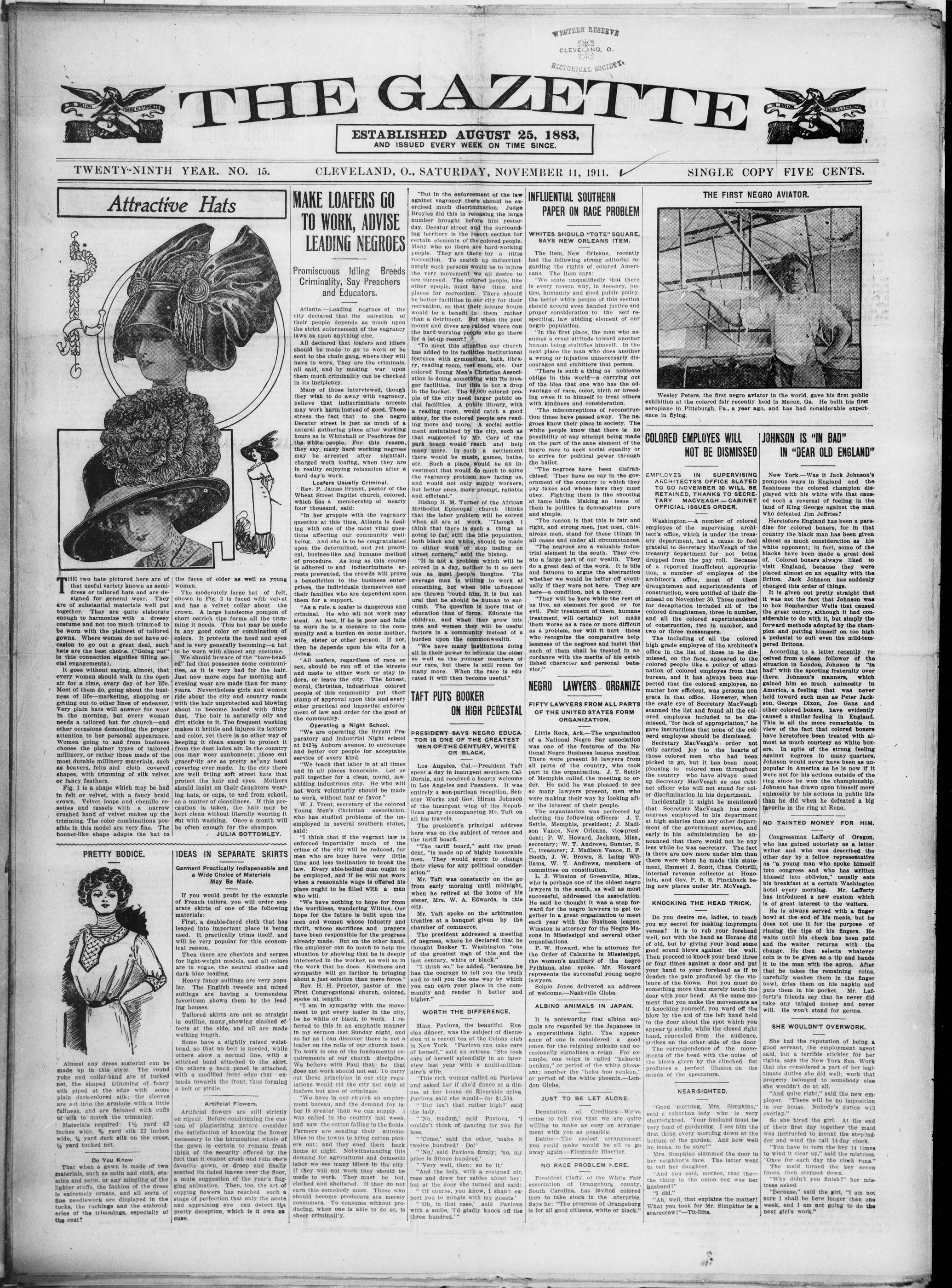
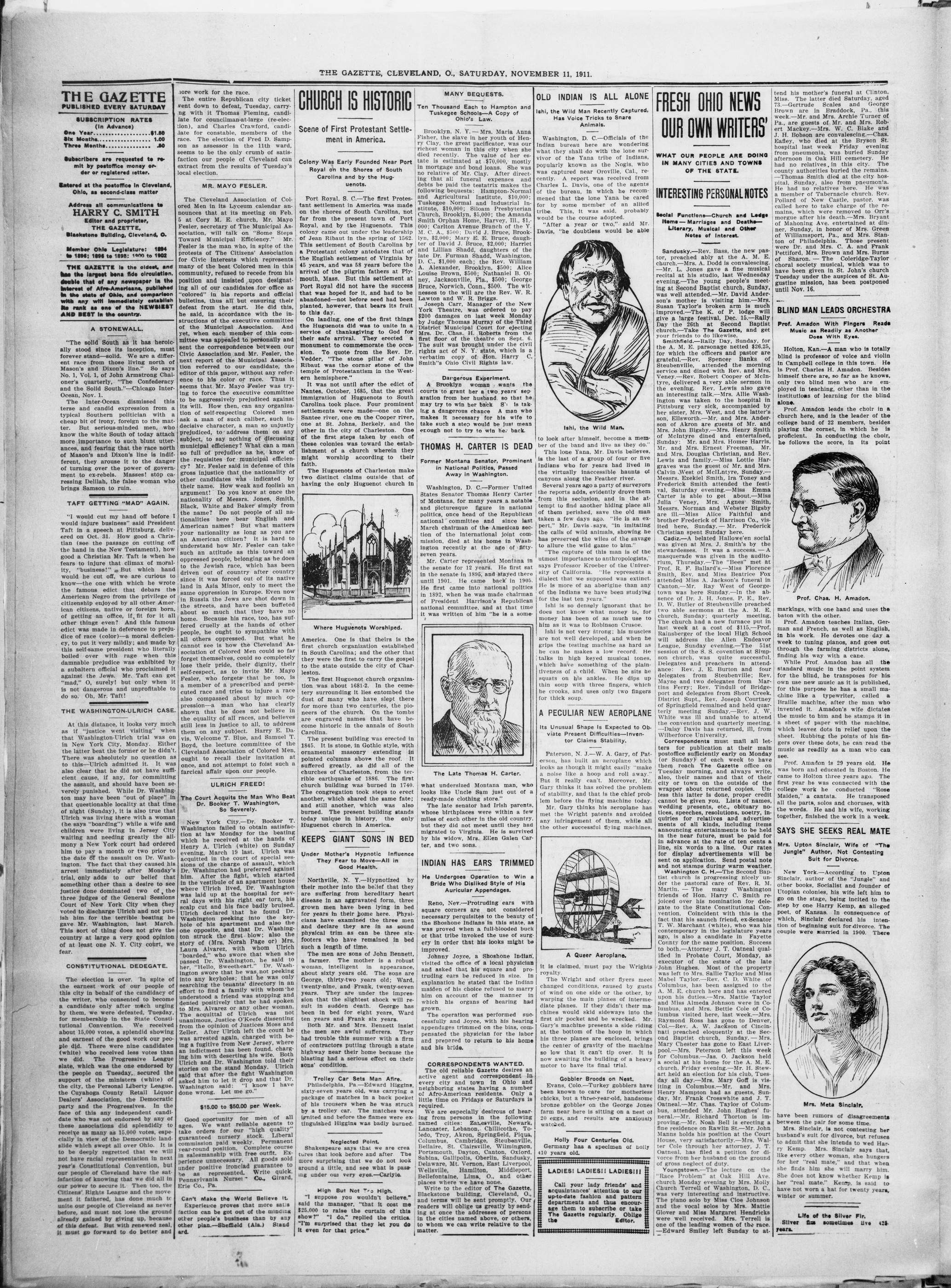
Page text (machine-generated)
TWENTY-NINTH YEAR. NO. 15.
P
IN VEILON
THERE EAS TURMITTIN
TWENTY-NINTH
Attracti
THE two hats pictured here are of that useful variety known as semi-dress or tailored hats and are designed for general wear. They are of substantial materials well put together. They are quite elaborate enough to harmonize with a dress costume and not too much trimmed to be worn with the plainest of tailored gowns. Where women do not have occasion to go out a great deal, such hats are the best choice ("Going out" in this connection signifies filling social engagements).
It goes without saying, almost, that every woman should walk in the open air for a time, every day of her life. Most of them do, going about the business of life—marketing, shopping or getting out to other lines of endeavor. Very plain hats will answer for wear in the morning, but every woman needs a tailored hat for church—and other occasions demanding the proper attention to her personal appearance. Women going to and from business choose the plainer types of tailored millinery, or rather those made of the most durable millinery materials, such as beavers, felts and cloth covered shapes, with trimming of silk velvet or fancy feathers.
Fig. 1 is a shape which may be had in felt or velvet, with a fancy braid crown. Velvet loops and chenille rosettes and tassels with a narrow crushed band of velvet makes up the trimming. The color combinations possible in this model are very fine. The bonnet-like shape adamts the hat to
PRETTY BUDICE.
Almost any dress material can be made up in this style. The round yoke and collar-band are of tucked net, the shaped trimming of fahcy silk piped at the edge with some plain dark-colored silk; the sleeves are set into the armhole with a little fullness, and are finished with cuffs of silk to match the trimming.
Materials required: 1½ yard 42
inches wide, ½ yard silk 22 inches
wide, ¼ yard dark silk on the cross,
¾ yard tucked net.
Do You Know
That when a gown is made of two materials, such as satin and cloth, examine and satin, or any mingling of the lighter stuffs, the fashion of the dress is extremely ornate, and all sorts of fine needlework are displayed in the tucks, the ruchings and the embroideries of the trimmings, especially of the coat?
THE GAZETTE
the faces of older as well as young women. The moderately large hat of felt, shown in Fig. 2 is faced with velvet and has a velvet collar about the crown. A large handsome pompon of short ostrich tips forms all the trimming it needs. This hat may be made in any good color or combination of colors. It protects the head and eyes and is very generally becoming—a hat to be worn with almost any costume. We should beware of the "bare-headed" fad that possesses some communities, as it is very bad for the hair. Just now more caps for morning and evening wear are made for many years. Nevertheless girls and women ride about the city and country roads with the hair unprotected and blowing about to become loaded with filth dust. The hair is naturally oily and dirt sticks to it. Too frequent washing makes it brittle and injures its texture and color, yet there is no other way of keeping it clean except to protect it from the dust laden air. In the country one may wear sunnonnets; those cut gracefully are as pretty as any head covered ever made. In the city there are well fitting soft street hats that protect the hair and eyes. Mothers should insist on their daughters wearing hats, or caps, to and from school, as a matter of cleanliness. If this precaution is taken, the hair may be kept clean without literally wearing it out with washing. Once a month will be often enough for the shampoo.
Garment Practically Indispensable and a Wide Choice of Materials May Be Made.
If you would profit by the example of French tailors, you will order separate skirts of one of the following materials:
First, a double-faced cloth that has leaped into important place is being used. It practically trims itself, and will be very popular for this economical reason.
Then there are cheviots and serges for light-weight models, and all colors are in vogue, the neutral shades and dark blue leading.
Heavy fancy suitings are very popular. The English tweeds and mixed suitings are having a tremendous favoritism shown them by the leading houses.
Tailored skirts are not so straight in outline, many, showing slashed effects at the side, and all are made walking length.
Some have a slightly raised waist-band, so that no belt is needed, while others show a normal line, with a stitched band attached to the skirt. On others a back panel is attached, with a modified front edge that extends towards the front, thus forming a belt or girdle.
Artificial Flowers.
Artificial flowers are still strictly enigur. Before condemning the custom of plagiarizing nature consider the satisfaction of knowing the flower necessary to the harmonious whole of the gown is certain to remain fresh think of the security offered by the fact that it cannot crush and ruin one's favorite gown, or droop and finally scatted its faded leaves over the floor, a mute suggestion of the year's flagging animation. Then, too, the art of copying flowers has reached such a stage of perfection that only the acute and appraising eye can detect the pretty deception, which is it own excuse.
ESTABLISHED AUGUST 25, 1883 AND ISSUED EVERY WEEK ON TIME SINCE.
CLEVELAND, O., SATURDAY, NOVEMBER 11, 1911.
MAKE LOAFERS GO TO WORK, ADVISE LEADING NEGROES
MAKE LOAFERS GO TO WORK, ADVISE LEADING NEGROES
Promiscuous Idling Breeds Criminality, Say Preachers and Educators.
Atlanta.—Leading negroes of the city declared that the salvation of their people depends as much upon the strict enforcement of the vagrancy laws as upon anything else.
All declared that loafers and idlers should be made to go to work or be sent to the chain gang, where they will have to work. They are the criminals, all said, and by making war upon them much criminality can be checked in its incipency.
Many of those interviewed, though they wish to do away with vagrancy, believe that indiscriminate arrests may work harm instead of good. These stress the fact that to the negro Decatur street is just as much of a natural gathering place after working hours as is Whitehall or Peachtree for the white people. For this reason, they say, many hard working negroes may be arrested after nightfall, charged with loafing, when they are in reality enjoying relaxation after a hard day's work.
Loafers Usually Criminal.
Rev. P. James Bryant, pastor of the Wheat Street Baptist church, colored, which has a membership of nearly four thousand, said:
"In her grapple with the vagrancy question at this time, Atlanta is dealing with one of the most vital questions affecting our community well-being. And she is to be congratulated upon the determined, and yet practical, businesses-like and humane method of procedure. As long as this course is adhered to and indiscriminate arrests prevented, the crowds will prove a benediction to the business enterprises, the individuals themselves and their families who are dependent upon them for a support.
"As a rule, a loafer is dangerous and criminal. He who will not work may steal. At best, if he is poor and falls to work he is a menace to the community and a burden on some mother, wife, sister or other person. If not, then he depends upon his wits for a living.
"All loafers, regardless of race or sex, should be run off of the streets and made to either work or stay indors, or leave the city. The honest, moral, Christian, industrious colored people of this community put their stamp of approval upon this and every other practical and impartial enforcement of law and order for the good of the community.
Operating a Night School.
"We are operating the Bryant Preparatory and Industrial Night school at 242° Auburn avenue, to encourage and better our people for acceptable service of every kind.
"We teach that labor is at all times and in all places honorable. Let us pull together for a clean, moral, law-abiding industrial city. He who will not work voluntarily should be made to work, without fear or favor."
W. J. Trent, secretary of the colored Young Men's Christian association, who has studied problems of the unemployed in several southern states, said:
"I think that if the vagrant law is enforced impartially much of the crime of the city will be reduced, for men who are busy have very little time and less inclination to break the law. Every able-bodied man ought to be employed, and if he will not work when a reasonable wage is offered his place ought to be filled with a man who will.
"We have nothing to hope for from the worthless, wandering Willies. Our hope for the future is built upon the men and women whose industry and thrift, whose sacrifices and prayers have been responsible for the progress already made. But on the other hand, the employer can do much to help the situation by showing that he is deeply interested in the worker, as well as in the work that he does. Kindness and sympathy will go farther in bringing about a just solution than mere force."
Rev. H. H. Proctor, pastor of the First Congregational church, colored, spoke at length:
"I am in sympathy with the movement to put every loafer in the city, be he white or black, to work. I referred to this in an emphatic manner in my sermon last Sunday night, and as far as I can discover there is not a loafer on the rolls of our church book. To work is one of the fundamental requirements of our church discipline. We believe with Paul that, he that does not work should not eat. To carry out these principles in our city regulations would rid the city not only of loafers but also of criminals.
"We have in our church an employment bureau, and the demand for labor is greater than we can supply. I was called to the country last week, and saw the cotton falling in the fields. Farmers are sending their automobiles to the towns to bring cotton pickers out; and they sued them back at night. Notwithstanding this demand for agricultural and domestic labor we see many idlers in the city. If they will not work they should be made to work. They must be fed, clothed and sheltered. If they do not earn this somebody must. Those who should become producers are merely consumers. To consume without producing, when one is able to do so, is sheer criminality."
"But in the enforcement of the law against vagrancy there should be exercised much discrimination. Judge Broyles did this in releasing the large number brought before him yesterday. Decatur street and the surrounding territory is the resort section for certain elements of the colored people. Many who go there are hard-working people. They are there for a little recreation. To snatch up indiscriminately such persons would be to injure the very movement we all desire to see succeed. The colored people, like other eople, must have time and places for recreation. There should be better facilities in our city for their recreation, so that their leisure hours would be a benefit to them rather than a detriment. But when the pool rooms and dives are raided where can the hard-working people who go there for a let-up resort?
"To meet this situation our church has added to its facilities institutional features with gymnasium, bath, library, reading room, rest room, etc. Our colored Young Men's Christian Association is doing something with its meager facilities. But this is but a drop in the bucket. The 60 000 colored people of the city need larger public social facilities. A public library, with a reading room, would catch a good many, for the colored people are reading more and more. A social settlement maintained by the city, such as that suggested by Mr. Cary of the park board would reach and help many more. In such a settlement there would be music, games, baths, etc. Such a place would be an investment that would do much to solve the vagrancy problem now facing us, and would not only supply workers, but better ones, more prompt, reliable and efficient."
Bishop H. M. T. Turner of the African Methodist Episcopal church thinks that the labor problem will be solved when all are at work. "Though I think that is such a thing as going to far, still the idle population, both black and white, should be made to either work or stop loading on street corners," said the bishop.
"It is not a problem which will be solved in a day, neither is it so sertious as most people imagine. The average man is willing to work at something, but when idle influencers are thrown 'round him, it is but natural that he should be human to succumb. The question is more that of education than of force. Educate the children, and when they grow into men and women they will be useful factors in a community instead of a burden upon the commonwealth.
"We have many institutions doing all in their power to educate the older as well as the younger members of our race, but there is still room for many more. When the race is educated it will then become useful."
TAFT PUTS BOOKER
ON HIGH PEDESTAL
PRESIDENT SAYS NEGRO EDUCATOR IS ONE OF THE GREATEST MEN OF THE CENTURY, WHITE OR BLACK.
Los Angeles, Cal.—President Taft spent a day in insurgent southern California, and received a hearty welcome in Los Angeles and Pasadena. It was entirely a non-partisan reception, Senator Works and Gov. Hiram Johnson of the insurgent wing of the Republican party accompanying Mr. Taft on all his travels.
The president's principal address here was on the subject of vetoes and the tariff board.
"The tariff board," said the president, "is made up of highly honorable men. They would scorn to change their views for any political consideration."
Mr. Taft was constantly on the go from early morning until midnight, when he retired at the home of his sister, Mrs. W. A. Edwards, in this city.
Mr. Taft spoke on the arbitration treaties at a banquet given by the chamber of commerce.
The president addressed a meeting of negroes, where he declared that he thought Booker T. Washington "one of the greatest man of this and the last century, white or black."
"I think so," he added, "because he has the courage to tell you the truth and to tell you the one way by which you can earn your place in the community and render it better and higher."
WORTH THE DIFFERENCE.
Mme. Pavlova, the beautiful Russian dancer, was the subject of discussion at a recent tea at the Colony club in New York. "Pavlova can take care of herself," said an actress. "She took care of herself splendidly in an interview last year with a multi-millionaire's wife.
"This rich woman called on Pavlova and asked her if she'd dance at a dinner at her house on Riverside drive. Pavlova said she would—for $1,500.
"But isn't that rather high?" said the lady.
"No, madam," said Pavlova. "I couldn't think of dancing for you for less.
"Come," said the other, "make it twelve hundred! Do!"
"No," said Pavlova firmly; 'no, my price is fifteen hundred.'
"Very well, then; so be it."
"And the lady, with a resigned air, rose and drew her sables about her; but at the door she turned and said:"
"Of course, you know, I shan't expect you to mingle with my guests."
"Oh, in that case," said Pavlova with a smile, "I'd gladly knock off the three hundred."
INFLUENTIAL SOUTHERN
PAPER ON RAGE PROBLEM
WHITES SHOULD "TOTE" SQUARE
SAYS NEW ORLEANS ITEM.
The Item, New Orleans, recently had the following strong editorial regarding the rights of colored Americans. The Item says:
"We state unqualifiedly that there is every reason why, in decency, justice, humanity and good public policy, the better white people of this section should accord even handed justice and proper consideration to the self respecting, law abiding element of our negro population.
"In the first place, the man who assumes a cruel attitude toward another human being stultifies himself. In the next place the man who does another a wrong or injustice unnecessarily discourages and embatters that person.
"There is such a thing as noblesse oblige in this world—a carrying out of the idea that one who has the advantage of race, color, birth or breeding owes it to himself to treat others with kindness and consideration.
"The misconceptions of reconstruction times have passed away. The negroes know their place in society. The white people know that there is no possibility of any attempt being made on the part of the same element of the negro race to seek social equality or to strive for political power through the ballot.
"The negroes have been disfranchised. They have no say in the government of the country to which they pay taxes and whose laws they must obey. Fighting them is like shooting at tame birds. Making an issue of them in politics is demagogism pure and simple.
"The reason is that this is fair and right, and strong men, just men, chivalrous men, stand for these things in all cases and under all circumstances.
"The negroes are a valuable industrial element in the south. They create a large part of our wealth. They do a great deal of the work. It is idle and fatuous to argue the abstraction whether we would be better off eventually if they were not here. They are here—a condition, not a theory.
"They will be here while the rest of us live, an element for good or for evil. Fair treatment of them, humane treatment, will certainly not make them worse as a race or more difficult as a problem, nor will it hurt those who recognize the comparative helplessness of the negroes and insist that each of them shall be treated in accordance with the merits of his established character and personal behavior."
NEGRO LAWYERS ORGANIZE
FIFTY LAWYERS FROM ALL PARTS OF THE UNITED STATES FORM ORGANIZATION.
Little Rock, Ark. —The organization of a National Negro Bar association was one of the features of the National Negro Business league meeting. There were present 50 lawyers from all parts of the country, who took part in the organization. J. T. Settle of Memphis called the meeting to order. He said he was pleased to see so many lawyers present, men who were making their way by looking after the interest of their people.
The organization was perfected by electing the following officers: J. T. Settle, Memphis, president; J. Madison Vance, New Orleans, vice-president; P. W. Howard, Jackson, Miss, secretary; W. T. Andrews, Sumter, S. C. treasurer; J. Madison Vance, B. F. Booth, J. W. Brown, S. Laing Williams, W. T. Andrews, members of committee on constitution.
L. J. Winston of Greenville, Miss., who is perhaps one of the oldest negro lawyers in the south, as well as most successful, addressed the association. He said he thought it was a step forward for the negro lawyers to get together in a great organization to meet each year with the Business league. Winston is attorney for the Negro Masons in Mississippi and several other organizations.
P. W. Howard, who is attorney for the Order of Calanthe in Mississippi, the women's auxiliary of the negro Pythians, also spoke. Mr. Howard represents the successful young negro lawyers.
Scipio Jones delivered an address of welcome—Nashville Globe.
ALBINO ANIMALS IN JAPAN
It is noteworthy that albino animals are regarded by the Japanese in a superstitious light. The appearance of one is considered a good omen for the reigning mikado and occasionally signalizes a reign. For example, one reign is called "hakuchi nenkan," or period of the white phaeasant; another the "haku hoo nenkan," or period of the white phoenix.—London Globe.
JUST TO BE LET ALONE.
Deputation of Creditors—We've come to tell you that we are quite willing to make as easy an arrangement with you as possible.
Debtor—The easiest arrangement you could make would be all to go away again.—Flegende Blüetter.
NO RACE PROBLEM F.ERE.
President Claffy, of the White Fair association of Orangeburg county, South Carolina, has invited colored men to take stock in the interprise. Says he: "The progress of Orangeburg is for all good citizens, white or black."
THE FIRST NEGRO AVIATOR.
Wesley Peters, the first negro avi
exhibition at the colored fair recently
aeroplane in Pittsburgh, Pa., a year ap-
ence in flying.
COLORED EMPLOYES WILL
NOT BE DISMISSED
Wesley Peters, the first negro aviator in the world, gave his first public exhibition at the colored fair recently held in Macon, Ga. He built his first aeroplane in Pittsburgh, Pa., a year ago, and has had considerable experience in flying.
EMPLOYEES IN SUPERVISING ARCHITECTS' OFFICE SLATED TO GO NOVEMBER 30 WILL BE RETAINED, THANKS TO SECRETARY MACVEAGH — CABINET OFFICIAL ISSUES ORDERS
Washington.—A number of colored employees of the supervising architect's office, which is under the treasury department, had a cause to feel grateful to Secretary MacVeagh of the treasury department for not being dropped from the pay roll. Because of a reported insufficient appropriation, a number of employees of the architect's office, most of them draughtsmen and superintendents of construction, were notified of their dismissal on November 30. Those marked for decapitation included all of the colored draughtsmen, three in number, and all the colored superintendents of construction, two in number, and two or three messengers.
The including of all the colored high grade employees of the architect's office in the list of those to be dismissed, on the face, appeared to the colored people like a policy of elimination of colored employees from that bureau, and it has always been suspected that the colored employees, no matter how efficient, was persona non grata in that office. However, when the eagle eye of Secretary MacVeagh scanned the list and found all the colored employees included to be dismissed, "for lack of appropriation," he gave instructions that none of the colored employees should be dismissed.
Secretary MacVeagh's order not only carried joy to the hearts of those colored men who had been picked to go, but it has been most pleasing to colored men throughout the country who have always sized up Secretary MacVeagh as one cabinet officer who will not stand for color discrimination in his department. Incidentally it might be mentioned that Secretary MacVeagh has more negroes employed in his department at high salaries than any other department of the government service, and early in his administration he announced that there would not be any less while he was secretary. The fact is there are now more under him than there were when he made this statement, Emmett J. Scott, Chas. Cottrill, internal revenue collector at Honolulu, and Gov. P. B. S. Pinchback being new places under Mr. McVeagh.
KNOCKING THE HEAD TRICK.
Do you desire me, ladies, to teach you my secret for making impromptu verses? It is to rub your forehead well, not with the head as Horace did of old, but by giving your head some good sound blows against the wall. Then proceed to knock your head three or four times against a door and put your hand to your forehead as if to deaden the pain produced by the violence of the blows. But you must do something more than merely touch the door with your head. At the same moment that you make the movements as if knocking yourself, you ward off the blow by the aid of the left hand held to the door about the spot which you appear to strike, while the closed right hand, concealed from the audience, strikes on the other side of the door. The correspondence of the movements of the head with the noise of the blows given by the clinched fist produces a perfect illusion on the minds of the spectators.
NEAR-SIGHTED.
"Good morning, Mrs. Simpkins," said a suburban lady who is very short-sighted. "Your husband must be very fond of gardening. I see him the first thing every morning down at the bottom of the garden. And how well he looks, to be sure!"
Mrs. Simpkins slammed the door in her neighbor's face. The latter went to tell her daughter.
"And you said, mother, that the—the thing in the onion bed was her husband?"
"I did."
"Ah, well, that explains the matter! What you took for Mr. Simpkins is a scarecrow!"—Tit-Bitts.
IN UNION THERE ESTIMATE
PY FIVE CENTS.
ator in the world, gave his first public
held in Macon, Ga. He built his first
o, and has had considerable experi-
JOHNSON IS "IN BAD"
IN "DEAR OLD ENGLAND"
New York—Was it Jack Johnson's pompous ways in England and the flashiness the colored champion displayed with his white wife that caused such a reversal of feeling in the land of King George against the man who defeated Jim Jeffries.
Heretofore England has been a paradise for colored boxers, for in that country the black man has been given almost as much consideration as his white opponent; in fact, some of the blacks have been made a great deal off. Colored boxers always liked to visit England, because they were placed almost on an equality with the Briton. Jack Johnson has suddenly changed this order of things.
It is given out pretty straight that it was not the fact that Johnson was to box Bombardier Wells that caused the great outcry, although it had considerable to do with it, but simply the forward methods adopted by the champion and putting himself on too high a pedestal to suit even the mild-tempered Britons.
According to a letter recently received from a close follower of the situation in London, Johnson is "in bad" with the sporting fraternity over there. Johnson's manners, which gained him so much animosity in America, a feeling that was never held toward such men as Peter Jackson, George Dixon, Joe Gans and other colored boxes, have evidently caused a similar feeling in England. This is all the more remarkable in view of the fact that colored boxes have heretofore been treated with almost as much courtesy as white boxers. In spite of the strong feeling against negroes in many quarters, Johnson would never have been as unpopular in America as he is now if it were not for his actions outside of the ring since he won the championship. Johnson has drawn upon himself more animosity by his actions in public life than he did when he defeated a big favorite in the ring at Reno.
NO TAINTED MONEY FOR HIM.
Congressman Lafferty of Oregon, who has gained notoriety as a letter writer and who was described the other day by a fellow representative as "a young man who spoke himself into congress and who has written himself into oblivion," usually eats his breakfast at a certain Washington hotel every morning. Mr. Lafferty has introduced a new custom which is of great interest to the waiters. He is always served with a finger bowl at the end of his meals, but he does not use it for the purpose of rinsing the tips of his fingers. He waits until his check has been paid and the waiter returns with the change. He then selects whatever coin is to be given as a tip and hands it to the man with the apron. After that he takes the remaining coins, carefully washes them in the finger bowl, dries them on his napkin and puts them in his pocket. Mr. Lafferty's friends say that he never did take any tainted money and never will. He won't stand for germs.
SHE WOULDN'T OVERWORK
She had the reputation of being a good servant, the employment agent said, but a terrible stickler for her rights, says the New York Sun. Work that she considered a part of her legitimate duties she did well; work that properly belonged to somebody else she wouldn't do at all.
"And quite right," said the new employer. "There will be no imposition in our house. Nobody's duties will overlap."
So she hired the girl. At the end of their first day together the maid was instructed to mount the step-ladder and wind the tail 14-day clock.
"You have to turn the key 14 times to wind it clear up," said the mistress. "Once for each day the clock runs."
The maid turned the key seven times, then stepped down.
"Why didn't you finish?" her mistress asked.
"Because," said the girl, "I am not sure I shall be here longer than one week, and I am not going to do the next girl's work."
One Year.....$1.50
Six Months.....1.00
Three Months......50
Subscribers are requested to rem-
mit by postoffice money or
der or registered letter.
Entered at the postoffice in Cleveland
Ohio, as second-class matter
Address all communications to
HARRY C. SMITH
Editor and proprietor,
THE GAZETTE,
Blackstone Building, Cleveland, O.
Member Ohio Legislature: 1894
to 1898; 1898; 1898; 1900 to 1902
THE GAZETTE is the oldest, and has the largest bona fide circulation, double that of any newspaper in the interest of Afro-Americana, published in the state of Ohio, and comparison with any will immediately establish its rank as one of the NEWSIEST AND BEST in the country.
A STONEWALL.
"The solid South as it has herically stood since its inception, must forever stand—solid. We are a different race from those living north of Mason's and Dixon's line." So says No. 1, Vol. 1, of John Armstrong Chailer's quarterly, "The Confederacy and the Solid South."—Chicago Inter-Ocean, Nov. 1.
The Inter-Ocean dismissed this tense and candid expression from a typical Southern politician with a cheap bit of irony, foreign to the matter. But serious-minded men, who know the white South of today attach more importance to such blunt utterances, and fearing that the race north of Mason's and Dixon's line is indifferent, they arouse it to the danger of turning over the power of government to ex-rebels. Masses! stop cressing Dellah, the false woman who brings Samson to ruin.
TAFT GETTING "MAD" AGAIN.
"I would cut my hand off before I would injure business" said President Taft in a speech at Pittsburg, delivered on Oct. 31. How good a Christian (see the passage on cutting off the hand in the New Testament), how good a Christian Mr. Taft is when he fears to injure that climax of morality, "business!" But which hand would he cut off, we are curious to know—the one with which he wrote the famous edict that debars the American Negro from the privilege of citizenship enjoyed by all other American citizens, native or foreign born of getting an office, if, fit for it all other thinge even? And this famous edict was made in deference to prejudice of race (color)—a moral deficiency, to put it very mildly; and made by this self-same president who literally boiled over with rage when this damnable prejudice was exhibited by a subaltern official who proclaimed it against the Jews. Mr. Taft can get "mad," O. surely! but only when it is not dangerous and unprofitable to do so. Oh, Mr. Taft!
THE WASHINGTON-ULRICH CASE
At this distance, it looks very much as if "justice went visiting" when that Washington-Ulrich trial was on in New York City, Monday. Either the latter beat the former or he didn't. There was absolutely no question as to this-Ulrich admitted it. It was also clear that he did not have sufficient cause, if any, for committing the assault, and should have been severely punished. While Dr. Washington may have been "out of place" in that questionable locality at that time of night (Sunday), it is also true that Ulrich was living there with a woman (he says "boarding") while a wife and children were living in Jersey City waiting and needing greatly the almamy a New York court had ordered him to pay a month or two prior to the date of the assault on Dr. Washington. The fact that they caused his arrest immediately after Monday's trial, only adds to our belief that something other than a desire to see justice done dominated two of the three judges of the General Sessions Court of New York City when they voted to discharge Ulrich and not punish him for the terrible beating he gave Mr. Washington, last March. This sort of thing does not give the country at large a very good opinion of at least one N. Y. City court, we fear.
CONSTITUTIONAL DEDEGATE.
The election is over. In spite of the earnest work of our people on this city in behalf of the candidacy of the writer, who consented to become a candidate only after much urging by them, we were defeated, Tuesday, for membership in the State Constitutional Convention. We received about 15,000 votes, a splendid showing and earnest of the good work our people did. There were nine candidates (white) who received less votes than we did. The Progressive League slate, which was the one endorsed by the people on Tuesday, secured the support of the ministers (white) of the city, the Personal Liberty League, the Cuyahoga County Retail Liquor Dealers' Association, the Democratic party and the Progressives. In the face of this any independent candidate who was not endorsed by any of these associations did splendidly to receive as many as 15,000 votes, especially in view of the Democratic landscape which swept all over Ohio. It is to be deeply regretted that we will not have racial representation in next year's Constitutional Convention, but our people of Cleveland have the satisfaction of knowing that we did all in our power to secure it. Then too, the Citizens' Rights League and the movement it fathered, has done much to unite our people of Cleveland as never before, and must not lose the ground already gained by giving up, because of this defeat. But with renewed zeal, it must go forward to do better and
more work for the race.
The entire Republican city ticket went down to defeat, Tuesday, carrying with it Thomas Fleming, candidate for councilman-at-large (re-election), and Charles Crawford, candidate for constable, members of the race.
The election of Fred D. Sampson as assessor in the 11th ward, seems to be the only crumb of satisfaction our people of Cleveland can extract from the results of Tuesday's local election.
MR. MAYO FESLER.
The Cleveland Association of Colored men in its Lyceum calendar announces that at its meeting on Feb. 5 at Cory M. E. church, Mr. Mayo Fesler, secretary of The Municipal Association, will talk on "Some Steps Toward Municipal Efficiency." Mr. Fesler is the man who, in spite of the protests of The Citizens' Association for Civic Interests which represents many of the best Colored men in this community, refused to recede from his position and insisted upon designating all of our candidates for office as "colored" in his reports and official bulletins, thus all but ensuring their defeat from the start. He did this, he said, in accordance with the instructions of the executive committee of the Municipal Association. And yet, when each member of this committee was appealed to personally and sent the correspondence between our Civic Association and Mr. Fesler, the next report of the Municipal Association referred to our candidate, the editor of this paper, without any reference to his color or race. Thus it seems that Mr. Mayo Fesler was trying to force the executive committee to be aggressively prejudiced against its will. How then, can any organization of self-respecting Colored men ask a man of such caliber, such indecisive character, a man so unjust prejudiced, to address them on any subject, to say nothing of discussing municipal efficiency? What can a man so full of prejudice as he, know of the requisites for municipal efficiency? Mr. Fesler said in defense of this gross injustice that the nationality of other candidates was indicated by their name. How weak and foolish an argument! Do you know at once the nationality of Messrs. Jones, Smith, Black, White and Baker simply from the name? Do not people of all nationalities here English and American names? But what matters your nationality as long as you are an American citizen? It is hard to understand how Mr. Fesler can take such an attitude as this toward an oppressed people, belonging as he does to the Jewish race, which has been driven out of country after country since it was forced out of its native land in Asia Minor, only to meet the oppression in Europe. Even now in Russia the Jews are shot down in the streets, and have been buffeted about so much that they have no home. Because his race, too, has suffered cruelly at the hands of other people, he ought to sympathize with all others oppressed. But what he cannot see is how the Cleveland Association of Colored Men could so forget themselves, could so completely lose their pride, their dignity, their self-respect, as to invite Mr. Mayo Fesler, who forgets that he too, is a member of a prescribed and persecuted race and tries to injure a race also compassed about by much oppression—a man who has clearly shown that he does not believe in the equality of all races, and believes still less in justice to all, to address them on any subject. Harry E. Davis, Welcome T. Blue, and Samuel T. Boyd, the lecture committee of the Cleveland Association of Colored Men ought to recall their invitation at once, and not attempt to foist such a farcical affair upon our people.
ULRICH FREED!
The Court Acquits the Man Who Beat Dr. Booker T. Washington, So Severely.
New York City—Dr. Booker T. Washington failed to obtain satisfaction at law Monday for the beating which he received at the hands of Henry A. Ulrich (white) on Sunday evening, March 19 last. Ulrich was acquitted in the court of special sessions of the charge of assault, which Dr. Washington had preferred against him. After the fight, which started in the vestibule of an apartment house where Ulrich lived, Dr. Washington was laid up at the hospital for several days with his right ear torn, his scalp cut and his face badly bruised. Ulrich declared that he found Dr. Washington peeking into his hole of his apartment and also the one opposing him that Dr. Washington stroked the first blow; also the story of (Murray, Norah Page or) Mrs. Aura Alvarez, with whom Ulrich "died," who swore that when she passed Dr. Washington, he said to her, "Hello, Sweetheart." Dr. Washington swore that he was not peeking into any keyholes; that he was only searching the teenants' directory in an effort to find a family with whom he understood a friend was stopping and denied positively that he had spoken to Mrs. Alvarez or any other woman. The acquittal of Ulrich of unanimous, Justice Judge dissenting from the opinion of Justices Moss and Zeller. Ulrich left the court he was arrested again, charged with being fugitive from New Jersey, where indictment has been found, charging him with his desertion wife. Both Ulrich and Dr. Washington told their stories on the stand Monday. Ulrich said that after the fight Washington asked him to let it drop and that Dr. Washington said: "I know I have done wrong. Let me go."
$15.00 to $50.00 per Week
Good opportunity for men of all ages. We want reliable agents to take orders for our "high quality" guaranteed nursery stock. Liberal commission paid weekly. Permanent year-round position. Complete course in salesmanship with free lunch. Experience unnecessary all goods sold under positive frontal guarantee to be represented. Write quick. Pennsylvania Nurse* Co., Girard, Erie Co., Pa.
Can't Make the World Believe it. Experience proves that more satisfaction can be got out of the minding other people's business than by any other plan—Sheffield (Ala.) Stand ard.
THE GAZETTE, CLEVELAND, O., SATURDAY, NOVEMBER 11, 1911.
CHURCH IS HISTORIC
Scene of First Protestant Settlement in America.
Colony Was Early Founded Near Port Royal on the Shores of South Carolina and by the Huguenots.
Port Royal, S. C.—The first Protestant settlement in America was made on the shores of South Carolina, not far from the present town of Port Royal, and by the Huguenots. This colony came out under the leadership of Jean Ribaut in the spring of 1562. This settlement of South Carolina by a Protestant colony antedates that of the English settlement of Virginia by 45 years, and was 58 years before the arrival of the pilgrim fathers at Plymouth, Mass. But this settlement at Port Royal did not have the success that was hoped for it, and had to be abandoned—not before seed had been planted, however, that bears its fruit to this day.
On landing, one of the first things the Huguenots did was to unite in a service of thanksgiving to God for their safe arrival. They erected a monument to commemorate the occasion. To quote from the Rev. Dr. Vedder, "The stone pillar of John Ribaut was the corner stone of the temple of Protestantism in the Western hemisphere."
It was not until after the edict of Nantes, October, 1685, that the great immigration of Huguenots to South Carolina took place. Four prominent settlements were made—one on the Santee river, one on the Cooper river, one at St. John, Berkeley, and the other in the city of Charleston. One of the first steps taken by each of these colonies was toward the establishment of a church wherein they might worship according to their faith.
The Huguenots of Charleston make two distinct claims outside that of having the only Huguenot church in
Where Huguenots Worshiped.
America. One is that theirs is the first church organization established in South Carolina; and the other that they were the first to carry the gospel to the state outside the city of Charleston.
The first Huguenot church organization was about 1681-2. In the cemetery surrounding it lies entombed the dust of many who have slept there for more than two centuries, the pioneers of the church. On the tombs are engraved names that have become historic in the annals of South Carolina.
The present building was erected in 1845. It is stone, in Gothic style, with ornamental masonry extending in pointed columns above the roof. It suffered greatly, as did all of the churches of Charleston, from the terrible earthquake of 1886. The first church building was burned in 1740. The congregation took steps to erect another, which shared the same fate; and still another, which was also burned. The present building stands today unique in history, the only Huguenot church in America.
KEEPS GIANT SONS IN BED
Under Mother's Hypnotic Influence They Fear to Move—All in Good Health.
Northville, N. Y.—Hypnotized by their mother into the belief that they are suffering from hereditary heart disease in an aggravated form, three grown men have been lying in bed for years in their home here. Physicians have examined the three men and declare they are in as sound physical trim as can be three six-footers who have remained in bed such a length of time.
The men are sons of John Bennett, a farmer. The mother is a robust woman, intelligent in appearance, about sixty years old. The sons are George, thirty-two years old; Ward, twenty-nine, and Frank, twenty-seven years. They are under the impression that the slightest shock will result in sudden death. George has been in bed for eight years, Ward ten years and Frank six years.
Both Mr. and Mrs. Bennett insist the men are awful sufferers. They had trouble this summer with a firm of contractors putting through a state highway near their home because the blasting had a serious effect on their sons' condition.
Trolley Car Sets Man Afire.
Philadelphia, Pa.—Edward Higgins, sixty-seven years old, was carrying a package of matches in a back pocket of his trousers when he was struck by a trolley car. The matches were ignited and before the flames were extinguished Higgins was badly burned.
Neglected Point
Shakespeare says that we are creatures that look before and after. The more surprising that we do not look around a little, and see what is passing under our very eyes.—Carlyle
High But Not Tra High
"I suppose you wouldn't believe," said the manager, "that it cost me $25,000 to raise the curtain of this show?" "I do," replied the criticism. "I'm surprised that they let you do it even for that price."
MANY BEQUESTS.
Ten Thousand Each to Hampton and Tuksegger Copy of
Ohio's Law.
Brooklyn, N. Y. — Mrs. Maria Anna Fisher, the slave in her youth of Henry Clay, the great pacificer, was our richest woman in this city when she died recently. The value of her estate is estimated at $70,000, mostly in mortgage and bond loans. She was a directing that all funeral expenses debts be paid the testatrix makes the following bequests: Hampton-Normal and Agricultural Institute, $10,000; Tuskegee Normal and Industrial Institute, $10,000; Siloam Presbyterian Church, Brooklyn, $5,000; the Amanda Smith Orphan Home, Harvey, Ill., $1,000; the Amanda Smith M. C. A., $500; David J. Bruce, Brooklyn, $2,000; Mary E. E. Bruce, daughter of David J. Bruce, $2,000; Harriet and Lillian Shadd, daughters of the late D. Furman Shadd, Washington, D. C., $1,000 each; the Rev. William A. Alexander, Brooklyn, $500; Alice Olsen, Brooklyn, $500; Brenney, Jacksonville, Fl. $500; George Bruce, Norwich, Conn. $500. The wittness to the will are the Rev. W. R Lawton and W. R. Brigges.
Joseph Carr, Manager of the New York Theatre, was ordered to pay $200 damages on last week Monday by judge Thomas Murray of the Third District Municipal Court for electing him as the first floor of the theatre on Sept. 6. The suit was brought under the civil rights act of N. Y. state, which is a verbatim copy of Hon. Harry C. Smith's Gio Civil Rights law.
Dangerous Experiment.
A Brooklyn woman wants the courts to grant her a two years' separation from her husband, so that he may try to win her back. S' is taking a dangerous chance. A man who makes it necessary for his wife to take such a step would be just mean enough not to try to win he back.
THOMAS H. CARTER IS DEAD
Former Montana Senator, Prominent in National Politics, Passed Away in Washington.
Washington, D. C.—Former United States Senator Thomas Henry Carter of Montana, for many years a notable and picturesque figure in national politics, once head of the Republican national committee and since last March chairman of the American section of the international joint commission, died at his home in Washington recently at the age of fifty-seven years.
Mr. Carter represented Montana in the senate for 12 years. He first sat in the senate in 1895, and stayed there until 1901. He came back in 1905. He first came into national politics in 1892, when he was made chairman of President Harrison's Republican national committee, and at that time it was written of him "he is a some
The Late Thomas H. Carter.
what undersized Montana man, who looks like Uncle Sam just out of a ready-made clothing store."
The late senator had Irish parents, whose birthplaces were within a few miles of each other in the old country, but they did not meet until they had migrated to Virginia. He is survived by his widow, Mrs. Ellen Galen Carter, and two sons.
INDIAN HAS EARS TRIMMED
He Undergoes Operation to Win a Bride Who Disliked Style of His Auricular Appendages.
Reno, Nev.—Protruding ears with square corners are not considered necessary perquisites to the beauty of the Shoshone Indians in this state, as was proved when a full-blooded buck or that tribe invoked the use of surgery in order that his looks might be improved.
Johnny Joyce, a Shoshone Indian, visited the office of a local physician and asked that his square and protruding ears be reduced in size. In explanation he stated that the Indian maiden of his choice refused to marry him on account of the manner in which his organs of hearing had grown.
The operation was performed successfully and Joyce, with his hearing appendages trimmed on the bias, compensated the physician for the labor and prepared to return to his home and his bride.
CORRESPONDENTS WANTED
The old reliable Gazette desires an active agent and correspondent in every city and town in Ohio and neighboring states having a number of Afro-American residents. Only a little time on Fridays or Saturdays is required.
We are especially desirous of hearing from persons in the following named cities: Zaneville, Newark, Columbus, Bentonville, Leedo, Troy, Akron, Springfield, Plaqu, Columbus, Cambridge, Steubenville, Bellaire, St. Clairsville, Wilmington, Portsmouth, Dayton, Canton, Oxford, Sabina, Gallipolis, Oberlin, Sandusky, Delaware, M. Vernon, East Liverpool, Wellsville, Hamilton, Middleport, Belfonteille, Lima, O., and other places where we have none.
Write to the editor of The Gazette, Blackstone building, Cleveland, O., and terms will be sent satisfactorily. Our office will oblige us greatly by sending at once the addresses of persons in the cities named above, or others, to whom we can write relative to the matter.
OLD INDIAN IS ALL ALONE
Ishi, the Wild Man Recently Captured,
Has Voice Tricks to Snare
Animals.
Washington, D. C.—Officials of the
Indian bureau here are wondering
what they shall do with the lone survivor of the Yana tribe of Indians,
popularly known as the Nogis, who was captured near Oroville, Cal., recently. A report was received from Charles L. Davis, one of the agents of the bureau, in which he recommended that the lone Yana be cared for by some member of an allied tribe. This, it was said, probably would be the course adopted.
"After a year or two," said Mr. Davis, "he doubtless would be able
A. B.
Ishi, the Wild Man.
to look after himself, become a member of the band and live as they do."
This lone Yana, Mr. Davis believes, is the last of a group of four or five Indians who for years had lived in the virtually inaccessible haunts of canyons along the Feather river.
Several years ago a party of surveyors the reports adds, evidently drove them from this seclusion, and in the attempt to find another hiding place all of them perished, save the old man taken a few days ago. "He is an expert," Mr. Davis says, "in imitating the calls of wild animals, showing he has preserved the wiles of the savage to allure the wild game to him."
"The capture of this man is of the utmost importance to anthropologists," says Professor Kroeber of the University of California. "He represents a dialect that we supposed was extinct. He is more of an aborigine than any of the Indians we have been studying for the last ten years."
Ishi is so densely ignorant that he does not know what money is, for money has been of as much use to him as it was to Robinson Crusoe. Ishi is not very strong; his muscles are not well developed, and when he grips the testing machine as hard as he can he makes a low record. He talks in high keyed musical tones, which have something of the plaintiveness of a child. When he sits he squats on his ankles. He dips up thin soup with three fingers, which he crocks, and uses only two fingers for thick soup.
A PECULIAR NEW AEROPLANE
Its Unusual Shape Is Expected to Obviate Present Difficulties—Inventor Claims Stability.
Paterson, N. J.—W. A. Gary, of Paterson, has built an aeroplane which looks as though it might easily "make a noise like a hoop and roll away." But it really can't. Moreover, Mr. Gary thinks it has solved the problem of stability, and that is the chief problem before the flying machine today. Mr. Gary thinks his aeroplane has met the Wright patents and avoided any infringement of them, while all the other successful flying machines.
A Queer Aeroplane.
It is claimed, must pay the Wrights royalty.
The Wright and other flyers meet changed conditions, caused by gusts of wind on one side or the other, by warping the main planes of intermediate planes. If they didn't their machines would skid sideways into the first air pocket and be wrecked. Mr. Gary's machine presents a side riding at the bottom of the hoop in which his three planes are enclosed, brings the center of gravity of the machine so low that it can't tip over. It is now awaiting the building of a heavy motor to have its final trial.
Gobbler Broods on Nest
Evans, Colo.—Turkey gobbler have been known to care for motherless chicks, but a three-year-old, handsome bronze gobbler on the George Jones farm near here is sitting on a nest of 20 eggs, and results are anxiously watched.
Holly Four Centuries Old.
Germany has a specimen of holly 410 years old.
LADIES! LADIES!! LADIES!!
Call your lady friends' and acquaintances' attention to our up-to-date fashion and pattern departments and thus encourage them to subscribe or take The Gazette regularly. Oblige the Editor.
FRESH OHIO NEWS OUR OWN WRITERS
WHAT OUR PEOPLE ARE DOING IN MANY CITIES AND TOWNS OF THE STATE.
INTERESTING PERSONAL NOTES
Social Functions—Church and Lodge Items—Marriages and Deathe—Literary, Musical and Other Notes of Interest.
Sandusky.—Rev. Bass, the new pastor, preached ably at the A. M. E. church.—Mrs. A. Dodd is convalescing.—Mr. L. Jones gave a fine musical recital at his studio, last Wednesday evening.—The young people's meeting at Second Baptist church, Sunday, was well attended.—Mr. David Anderson's mother is visiting him.—Mrs. Susan Taylor's broken arm is church improved.—P. Lodge will give a large festival, Dec. 15—Rally Day the 26th at Second Baptist church.—Take The Gazette, and get your friends to do likewise.
Smithfield—Rally Day, Sunday, for the A. M. E. parsonage netted $26.25, for which the officers and pastor are grateful.—Rev. Spencer Banks of Steubenville, attended the morning service and dined with Rev. and Mrs. Anderson, and visited the sermon, delivered a very sermon in the evening. Rev. Lewis also gave an interesting talk.—Mrs. Allie Washington was taken to the hospital in Pittsburgh very sick, accompanied by her sister, Mrs. West, and the latter's son, Ellsworth.—Mr. and Mrs. Anderson of Akron are guests of Mr. and Mrs. John Bigsby.—Mrs. Henry Smith was taken to the hospital in Sunday.—Mr. and Mrs. Homer Harris, Mr. and Mrs. Ernest Freeman, Mr. and Mrs. Douglas Christian, and Rev. Lewis and family.—Miss Lottie Hargraves was the guest of Mr. and Mrs. Calvin West of McIlntyne, Sunday.—Messrs. Ezekiel Smith, Ira Toney and Frederick Smith attended the festival, Saturday evening.—Miss Emma Carter is able to get about.—Miss Julla Veney, Mrs. Agnes Smith, Messrs. Foran and Webb Fultish, Mrs. Foran and Webb Fultish, brother Frederick of Harrison Co., visited here, Sunday.—Mr. Frederick Christian spent Sunday here.
Cadiz.—A belated Hallowe'en social was given at Mrs. J. Smith's by the stewardesses. It was a success. —A masquerade was given in the auditorium. Thursday—The "Bees" met at Prof. R. F. Ballard's—Miss Florence Smith, Rev. and Miss Beatrice Fox attended Miss A. Jackson's funeral in Canton.—Mr. Ray West of Georgetown was here Sunday.—In the absence of Dr. J. H. Jones. P. E., Rev. D. W. Butler of Steubenville preached two able sermons at the A. M. E. meeting. The church had a new furnace put in last week at a cost of $115.—Prof. Raisberger of the local High School will address the Allen Endeavor League, Sunday evening. The 51st session of the S. S. covenation at Simpson church, was quite successful. Delegates and preachers in attendance: Rev. J. E. Burton and four delegates from Steubenville; Rev. Mayse and two delegates from Martins Ferry; Rev. Tindall of Bridgeport and delegates from Short Creek. District Supt., Rev. Joseph Courtney of Springfield remained and held quarterly meeting. Sunday—Rev. W. Whitley was ill and unable to attend the convention and quarterly meeting. —Daisy Davis has returned, Ill, from Wilberforce University.
Correspondents must mail all letters for publication at their main postoffice sufficiently early on Monday (or Sunday) of each week to have them reach The Gazette office on Tuesday morning, and always write, also, their names and that of their wapper, about return copies of the wapper about return copies less this latter is done, proper credit cannot be given you. Lists of names, wedding presents, etc., obituary notices, speeches, resolutions, poetry, inquiries for relatives and advertisements of all kinds, including items announcing entertainments to be held in the near future, must be paid for in advance. For each line, six words to a line. Our rates for display advertisements will be sent on application. Send postal note and not stamps during warm weather.
Washington C. H. —The Second Baptist church is progressing nicely under the pastoral care of Rev. R. M. Martin. —The many Washington friends of Hon. Harry C. Smith rejoiced over his nomination for delegate to the State Constitutional Council, and he has fact that his saunch friend, ex.Senator T. W. Marchant (white), who was his contemporary in the legislature years ago, is also a candidate in Fayette County for the same position. Success to both. —Attorney J. T. Oatmeal qualified in Probate Court, Monday, as executor of the estate of the late John Hughes. Most of the property was left to Mrs. Salle Taylor and Miss Mabel Taylor. Rev. C. D. White of Columbus been asked to A.M. E. church here and has ever upon his duties. Mrs. Mattie Toupon and Miss Almeda Johnson were in Columbus, and Mrs. Bettle Cole of Columbus visited here, last week. Mrs. Raymond Ross has gone to Denver, Col.—Rev. A. W. Jackson of Cincinnati preached eloquently at the Second Baptist church, Sunday. —Mrs. Mary Chester has gone to East Liverpool, Mrs. eterson left for Columbus. O. J. Jackson held a social at his home for the A.M. E. church, Friday evening. Mr. H. Stewart held an election for his club. Tuesday all day. —Mrs. Mary Goff is visiting in Columbus. —Mr. and Mrs. Henry Mampton had as guests, Sunday. Mr. Frank Crosswhite and J. T. Oatmeal. —Mr. Chas. Taylor of Columbus, attended Mr. John Hughes' funeral. —Mr. Richard Thorton is improving. —Noah Bell is erecting a memorial to Mr. Mahan Mans holds his position at the Court House, very satisfactorily. —Mrs. Walter Cole through her attorney, J. T. Oatmeal, has filed a petition for divorce from her husband on the ground of gross neglect of duty.
Youngstown. —The lecture on the "Race Problem" at Oak Hill Ave. church Monday evening by Mrs. Molly Church Terrell of Washington, D. C. was very interesting and instructive. He was no monkey by Johnse and the vowel host by Mrs. Gliover and Miss Margaret Hendricks were well received. Mrs. Terrell is one of the leading women of the race. —Edward Smiley left Sunday to at
tend his mother's funeral at Clinton, Miss. The latter died Saturday, aged 73.-Gertrude Scales and George Brown are in Braddock, Pa., this week.-Mr. and Mrs. Arche Turner of Pa., are guests of Mr. and Mrs. Robert Mackey.-Mrs. W. C. Blake and J. H. Bobson are convalescing.-Chas. Eafley, who died at the Bryson St. hospital last week Friday evening from pneumonia, was buried Sunday afternoon in Oak Hill cemetery. He had no relatives, in this city. The county authorities buried the remains.
—Thomas Smith died at the city hospital, Sunday, also from pneumonia. He had no relatives he. He was a member of Tabbernacle church, and the New York pastor, was called to take charge of the remains, which were removed to Orr's morgue after his death. —Mrs. Bryant of Mahoning Ave. entertained at dinner, Sunday, in honor of Mrs. Green of Williamsport, Pa., and Mrs. Stanton of Philadelphia. Those present were Dr. and Mrs. C. A. and Frank Brown and Mrs. Burn of Sharon. —The Coleridge-Taylor choral society musical, which was to have been given in St. John's church Tuesday under the auspices of St. Augustine mission, has been postponed until Nov. 16.
BLIND MAN LEADS ORCHESTRA
Prof. Amadon With Fingers Reads Music as Readily as Another Does With Eyes.
Holton, Kan.—A man who is totally blind is professor of voice and violin in Campbell college in this town. He is Prof. Charles H. Amadon. Besides himself there are, so far as he knows, only two blind men who are employed in teaching, other than in the institutions of learning for the blind alone.
Prof. Amadon leads the choir in a church here, and is the leader of the college band of 22 members, besides playing the cornet, in which he is proficient. In conducting the choir, he follows the score, in its point
Prof. Chas. H. Amadon. markings, with one hand and uses the baton with the other.
Prof. Amadon teaches Italian, German and French, as well as English, in his work. He devotes one day a week to tuning pianos, and goes out through the farming districts alone, finding his way with a cane.
While Prof. Amadon has all the standard music in the point system for the blind, he transposes for his own use new music as it is published, for this purpose he has a small machine like a typewriter, called a Braille machine, after the man who invented it. Amadon's wife dictates the music to him and he stamps it in a sheet of paper with the machine, which leaves dots in relief upon the sheet. Rubbing the points of his fingers over these dots, he can read the music as readily as a man who can see.
Prof. Amadon is 29 years old. He was born and educated in Boston. He came to Holton three years ago. The first year he was connected with the college work he conducted "Rose Malden," a cantata. He transposed all the parts, solos and choruses, with the words. He and his wife, working together, finished the work in a week.
SAYS SHE SEEKS REAL MATE
Mrs. Upton Sinclair, Wife of "The Jungle" Author, Not Contesting Suit for Divorce.
New York.—According to Upton Sinclair, author of the "Jungle" and other books, Socialist and founder of Utopian colonies, his wife left him to go on the stage, being incited to the step by one Harry Kemp, an alleged poet, of Kansas. In consequence of which, Sinclair declared his intention of beginning suit for divorce. The couple were married in 1900. There
Mrs. Meta Sinclair.
have been rumors of disagreements between the pair for some time.
Mrs. Sinclair, is not contesting her husband's suit for divorce, but refuses to admit that she intends to wed Harry Kemp. Mrs. Sinclair says that, like every other woman, she hungers for her "real mate," and that when she finds him she will marry him. She does not know whether Kemp is her "real mate." Kemp, is said to have not worn a hat for twenty years, winter or summer.
Life of the Silver Fir.
Silver fir sometimes live 428 years.
y 9, i
y
\ WEEK SS 7)
\ /
\ YW
| \
L& J
L. SCHWARTZ’S, 2921 Central Ave. Open Sunday.
Pypeteak ©. C, SCHROEDER'S, Cuyahoga Bldg. Open Sunday.
+ gy ELMER F. BOYD'S, 2604 Central Ave.
| “GAZETTE” AT F, vALENTINE’s, 2130 Central Ave.
NOTICE TO SUBSCRIBERS:—Subscribers not receiving The Gazette regu
larly should notify us at once. We desire every copy delivered promptly.
We advise our patrons to carefully examine The Gazette's advertisements
before making purchases. Business men who advertise in this paper
should have the patronage of Afro-Americans, The fact that they ad-
vertise 1s assurance that they want {t.
Local reading notices (advertisements) ten cents a line (six words in a line.)
NOTARY PUBLiC—For such ser-|,, Memorial services were. held at
vices call at The Gazette office, No 3 |"
cite office, Nos |_F. B. Ransom, Esq, of Indianapolis,
per gee yn oa Me aaaer \* °*| was here the past week on legal busi:
E i a
FOR SALE.—Brana new, Imperial
Encyclopedia and Dictionary. 40 vol-
umes, finely illustrated, handy to han-
dle. "Unexcelled for ‘reference pur-
Doses: A library im itself—one that
will last a life-time. Contains every-
thing you may wish to know. Call or
address, The Gazette, Blackstone
Building, 1422 W. 8d St., Cleveland, O.,
near Superior Av. This is an oppor-
tunity of a life-time for those who love
good books.
St. John’s Junior M. 8. gave a splen-
did musical program, Sunday evening.
‘Thos. B. Akridge teturned recently
from an extended trip through the
South.
Do not tail to read our advertise-
ments and patronize those who ask
for your trade in the columns of The
Gazette.
Mr. and Mrs. 8. B. Woods are re-
Joicing over the arrivel of a little ten-
pound daughter who came to them
Saturday morning.
W. H. Smith, who was called to Vir-
ginia by the illness of his mother,
has returned, and reports the sad
news of her death.
Rev. J. L. Burr of Davenport, Towa,
who was called as pastor by Mt. Ha-
ven Baptist church, will take charge,
Sunday, and there will be an all-day
service.
Miss Pearl Henderson, daughter of
Mr. and Mrs, Al, Hederson, whose
marriage was announced in our last
issue, is now Mrs. Hines, and not Mrs.
Harris,
‘Miss Delaney, a foreign missionary,
was entertained by the Antioch
church M. 8. at Mrs. J. H. Beckwith’s,
2188 E. 36th St, Wednesday. She was
here several days, and gave a splen-
did lecture, /
Miss Corinne L. Thomas of New
York City, who is studying in Ober-
lin this year, was the guest of Miss
Ruth Anna Fisher at the home of Mr.
and Mrs, Edward Daw of E. 86th St.
over Sunday.
Send your local items to The Ga-
zette on Monday or Tuesday of each
week. ‘This paper is published for
ALL ‘of our people and “plays no fa-
Yorites.” Everybody is treated the
same—fair and right. Take The Ga-
Sette and elt your: telande ors y
also.
R, R. Taylor, Director of Mechanical
Industries, and Miss Nellie Green
Chesnutt, of Wilmington, Were mar-
ried Wednesday afternoon, Oct. 25,
at St. Mark’s Episcopal church, Wil-
mington, N. C.—Tuskegee (Ala.) Stu-
dent.
Mrs, H. J. Embrey and daughter re-
turned last’ week from a six weeks’
visit in St. Louis with her sister, Mrs.
©. L, Finley, and two weeks with her
brother, Mr. Jobn Smith. They report
@ most delightful time, having been
royally entertained, and having en-
Joyed a continuous round of pleasure.
‘Mrs. Rosa Johnson, pres. of the N.
0. C. B, W. M. M. 8., and first vice-
pres. of the National W. M. M. 8.,
Mrs, Ella White and Mrs. Cora Brock
as delegates, with Mrs, Carrie Scott
and Mrs. Stevely, left Cleveland, Wed-
nesday, to attend the National’ M. 8.
Convention in Chicago this week. Mrs.
Johnson will make a tour of the west
before returning home.
‘The Lyceum calendar of the Cleve-
land Association of Colored Men an-
nounces some very interesting meet-
ings at which probiems of interest to
all will be discussed by very able
speakers. The next meeting will be
held Nov. 13 at Shiloh Baptist church,
and will be addressed by Prof. A, R.
Hatton of Western Reserve Univer:
sity, Subject, “The Present Crisis in
American Political Parties.”
'T. W. 8, St. John, the well known
caterer, died last week. The funeral,
Wednesday, at St. Andrew's church,
was conducted by Rey. B, W. Paxton,
the rector. Mr. St. John was messen-
ger to Judge Day of the U. S. District
Court, which adjourned to enable the
attaches to attend the funeral. Mr.
St. John was chef at the White House
under President Arthur, and has
worked for many other prominent
people in that and this city. His
wife, who was always his closest
friend, has the sympathy of the en-
tire community,
‘The Citizens’ Rights League held
two. very successful meetings last
week at St. John’s and Antioch
churches in the interest of the edior
of The Gazette's candidacy for dele-
gate to the State Constitutional Con-
vention, Great enthusiasm was man-
ifested at each of these meetings. The
speakers were: Messrs. Chas. S.
Sutton, Dallas Cooper, Walter L
Brown, 8, B. Woods, Dr. J. K. Nick.
ens, Revs. H.C. Bailey and Chas.
Bundy, Mrs. Rosa Brooks, Mrs. Ella
T. Webster, and Mr. Smith. The last
named also addressed meetings in
Sylvestro’s Flall, East End, and in
Brooks’ Hall, Scovill Ave. near E.
14th St. on two evenings last week.
ATTENTION, READERS!
Deo't throw away your copy
ef The Gezette when have |
Gone wich it but glve Ito some
ive. person whom
HER" would be likely to subecttbe |
oa ie over and reed,
Sarebulir. ‘Oblige the ‘
Editor.
E Memorial services wereheld at 6
Pp. m. at St. Andrews’ church.
F. B. Ransom, Esq., of Indianapolis,
was here the past week on legal bus!
ness.
Mrs. Chas. Rudd and daughter,
Thelma, of FE. 36th St., visited rela-
‘tives in Findlay, Sunday.
Mr. David Manson of Chicago visit-
eq relatives in this-city. this. week.
His mother, Mrs. L. Manson, {s_stili
seriously ill.
Mrs. W. Lloyd Bowman of Chicago,
‘visited her sister, Mrs. Wm, Meln
| tyre, of E. 74th St., last week and the
first of this week.
| Wanted—Six boys, sixteen to eigh-
teen years of age, as door boys. Only
heat, polite, honest and. energetic
‘boys need apply. Hi. Leygus, The May
Co., Ontario St.
|_ itt K Wright of Seprill Ave. si
‘or of Mis, Win. Pattelion of Lake.
side Ave, and an old resident of this
city, died Sunday. She was highly
respected by all who knew her. The
relatives have the earnest sympathy
of the community.
Joe Blue, star punter and tackle
of the Ceniral High football ‘team,
will be in the game against University
school pee, afternoon at U. 8.
‘fleld. Biue has been out of the game
two weeks from injuries. He reported
for practice Tuesday.
Mrs. F. G. Snelson explained to 2
plarge congregation at St. John’s
church, Sunday, why every Colored
‘person’ should: be interested in send
ing a race man to the State Consti-
{tional Convention, “Dr. Chas, Bundy
also spoke briefly of how our interest
as a race would be conserved, should
our candidate be elected. “
‘Quarterly meeting, Sunday, at Lane
Memorial church, ‘corner Gedar “Ave.
and E, 21st St.’ Rev. D. A. Walker
P_E, will preach morning and even:
ing.” Rey, ‘Walker comes from Mt.
‘Sterling, Ky., and will be glad to meet
all his old Kentucky friends. Rev. F.
G. Snelson of St. James’ church, will
preach at Lane Memorial church, Sun:
day, at 3pm. ‘The public is cordial:
ly invited.
The Bailey Co. is to give $5,000 to
churches and charitable institutions.
For every purchare of 10 cents there
‘is one yote, and the organizations re-
‘celving the largest number of votes
from now until Feb. 28, will each re-
‘cole a share of this $9,000. Amons
the churches listed already are St
Jobn’s and St. James’ A. M. E.
ebnrches. We should patronize Bail-
ey’s, and vote for one of these
oo that we may have as large a
are as possible in this gift.
‘An entertainment will be given by
‘the stewards, trustees and members
‘or Cory churen, Scovilt Ave, and
Sot St, Thursday evening, to raise
money to give the pastor, Rev. G. A.
‘Slssle, a much-needed rest and vaca.
tion. The following program will be
‘rendered: Singing by the congress
tion; invocation, Rev. 1. M. Lowrey:
‘song by the. Cory quartette: ad
er by the Hon, J, P. Green and
the editor of The Gazette; recitation,
‘Miss L. Strange. C. L. Lacy, chair-
man of committee.
‘The reception at Cory church, Wed
nesday evening, for the benefit of the
“New Site Club” of St. James’ church,
‘Bast End, proved an exceptionally en:
foyable affair. The main events of
tier evening were the speech of the
editor of The Gazette and the solo of
(Mise Ruth A. Fisher, who has & most
promising ivrie soprano volee, “which
\Gne of the best vocal t@achers in this
jelty. Is training. ‘The other program
fumbers: were fine and the lunch and
Social features which followed wer
also thoroughly enjoyed.
‘The Madam C. J. Walker Manutac
turing Company of Indianapolis, Ind.
through its attorney, F. B. Ransom,
Esq, of Indianapolis, had Miss ‘Laura
eres of 3927 Central Ave., brought
into court and ordered to cease
using the company’s name in connec-
tion with her business, as Miss War.
fen is no longer in. the company’s
employ; nor does she handle the com:
pany’s goods. Miss Warren was in.
formed that any selling, mixing, as I
|any wise Inducing. the’ public. to be
|eve that she was representing th
company, is a direct violation of the
statutes, and renders her lable to fine
and impriconment.—Adv.
‘Monday evening's meeting at Anti
och chureh, the last of the campaign
held by the Citizens’ Rights league
(a, very! enchant and raat
matty ways. There were several gen
flomen speakers, but THE one of th
evening was undoubtedly that of Ais
Ruth Anna Fisher of Lorain. It wa:
intensely practical and thoroughly ap
preciated by the large audience in at
tendance. Instructions were given fo
the following day and everybody lef
for home hopeful of success. (Se
editorial on “Constitutional Delegate’
‘on page 2 of this paper.) The leagus
Grin meet some evening toward th
|Inst of next week, time and place be
Ing announced later. Te wilt undoub
edly "be molded into a permanent oF
| ganization and the good work starte
so well, continued in the future. A
this meeting will be made the repor
of the league's work in the campaigr
just closed and other important bust
ness transacted. Pass the word along
lene the members, please.
AGENTS! READ!
—
!
When your Gazettes are not |
delivered on Friday mornings, |
call at your Central Postoftice |
General Delivery Window for |
Geman the afternoon of the |
samo aay: —Editer. |
“HE GAZETTE, CLEVELAND, ©.. SATURDAY, NOVEMBER ll, 1911.
0 ————
‘Mrs, Chas. Smith and son, Harri- . .
son, haye fut returned: from an ex:
tended visit in St. Louis. | ce N lV Q [
Hon. Wm. R. Clifford of Washing- |
ton, D. C., wag in the city, this week, |
to vote. He holds a government clerk- | e
Ship tn ho frmsury departient Wilberforce, Ohio.
Thank You, Dr. Webster. OpensThird Tuesday in September.
Hon, Harry, C. Sinith, Located in Greene county, three and one-quarter miles fro
~ Nov, 8, "11, Healthful surroundings. Refined community, Faculty of 32 me
My dear Mr. Smith:—Accept my | pense low. Classical and Scientific, Theological, Preparatory,
hearty congratulations for your splen-| itary, Normal and Business Departments. TEN INDUSTRIES
ld showing at the polis Nov: 7, 1911: | GREAT OPPORTUNITIES for High School Graduates enter
Her Bay Covet man to-seenve LAr | oe ‘Protemaigaal Operas!” Oblo| students desiring ts, enter Ne
stances and present Condition of ness or Industrial Department can obtain certificate from Sta
hinge, aie aplenale. panoreemet | or Representative entitling them to FREE TUITION, ROOM F
Rr tt I INCIDENTALS.
(REV.) W. G. WEBSTER. Matriculation Entrance Examinations, September 18 and 19. Sct
jeu Pruceeay, bapie river ips voik
Discerning Thought. Catalogue and special information furnished. Address
Thoughts put on paper are nothing |
more than fvotsteps in the sand; you W. 8. SCARBOROUGH
see the way the man has gone, but to W. A. JOINER, SUPT. C. N. & |, DEPARTMENT.
know ‘wbat he saw on bis walk you
want bis eyes.—Schopenbauer,
aOR All! | HEF ADRINIC THAT
‘A Waycross man aimed bis pipe at
fa burglar and halted him. And some
pipes would balt anybody
Pine Tree Lives Long.
The maximum length of life of the
pine tree ts sald to be 700 yearn
ocr anne ee
WONDERFUL RESULTS
ON SHORT NOTICE
Thave used your Pomade, Its the
best thing I ever used for making curly
hair Me smooth. I have not finished
ay first bottle, but can see wonderful
rewults, writes Mrs, Louise E. Hayes of
Pineville, S.C.
‘Try Ford's Hair Pomade for harsh
stubborn and unruly hair and Ford's
Royal White Skin Lotion for the com
plexicn. Ask your druggist for them.
Be wure and get the genuine (Ford's)
manufactured by the Ozoni:ol Ox
Marrow Company, Chicago, lll.
“Four Barbers’’
3014 Central Ave.
CLEVELAND.
MISS L.E. WARREN’S
HAIR GROWER
Miss Warren is one of the FIRST
and BEST in her business in
Cleveland, and
Positively Can Grow
Hair
With Each Treatment. She gives
a sample box of Hair Grower.
3927 Central Ave,
CLEVELAND, OHIO.
Peo p ree ret
Pisses ere rst
Phone Bell, North 1075-X
Cuy. Cent.
THOS. P, Mc PHILLIPS |
Plumb'ng and
Sewer Building
All W.rk iven Prompt Attention
2079 E. 30th St. Cleveland, 0.
Sahoo
beeen inenennrnnr nce ry
See ces
eee eee eae ee eS
CLOTHES ?
Rufus S. Justice
4316 Central Avenue,
Fine Custom Tailoring, Cleaning, Dye
ihe fees ont Prana.
fasttoee cuerar tesa:
M. GOLDMAN,
DEALER IN
Dry Goods, Hosiery,
Notions, Etc..
Ladies and Gents
Furnishings, Cur-
tains, Oil Cloth &c.
3003 Central Ave., Cor. E. 30th St.
Phone, Cen, 2189 W.
| CLEVELAND - - OHIO
———— EE
i ”
The Smart Set
French
Dry Cleaning and
Pressing Parlor,
WM. CHILDS,
MANAGER.
2495 Central Ave.
Wilberforce University
Wilberforce, Ohio.
OpensThird Tuesday in September.
Located in Greene county, three and one-quarter miles trom Xenta, 0
Healthful surroundings. Refined community, Faculty of 32 members. Ex-
penses low. Classical and Scientific, Theological, Preparatory, Music, Mil-
itary, Normal and Business Departments. TEN INDUSTRIES TAUGHT.
GREAT OPPORTUNITIES for High School Graduates entering College
or Professional Courses. Ohio students desiring to enter Normal, Busi
ness or Industrial Department can obtain certificate from State Senator
or Representative entitling them to FREE TUITION, ROOM RENT AND
INCIDENTALS.
Matticulatign Entrance Examinations, September 18 and 19. School Opens
Tuesday, September 19, 191%.
Catalogue and special information furnished, Address
W. 8. SCARBOROUGH, PRES.
W. A. JOINER, SUPT. C. N. & |, DEPARTMENT.
3223 Central Ave
_ High Class Vaudeville and Moving Pictures
| 3221 Central
Avenue.
And DANCIN Y,
To rent for Meetings, Private Parties, Balls
Banquets, &c.
O, L. HARRIS, Manager.
—————_—_
LET ME BE YOUR TAILOR!
MEN'S and BOY’S SUITS to Order $12 and up.
PANTS, $3 and up. LADIES’ SUITS and
SKIRTS to order. Perfect Fit Guaranteed.
Shining Parlor in connection.
Charles L. Jackson, The Z Club
FASHION TAILOR.
3022 CENTRAL AVE.
y For Rent for BALLS,
RK S HALL PARTIES &c.
To meet the good crowds attend DANCING
SCHOOL every Monday and Thursday even-
ings. Private Lessons Given. Private Par-
ties Taught. G. W. TURPIN, Instructor.
3620 Central Ave. Cleveland, O.
Te Ghee eal: c “y DAIN | an
The New Genter |THE “H_RALD LUNCH
Georae A.C. Hicks, Prop’:
Bath and Pool a Tae
HOT AND COLD BATHS, 15 CENTS. | Sods. Sng s hon Orden
Barber Shop in Connection, |
Gentlemen's Social Club meets avery Neat, Clean and Quic
Monday, Thursday and Saturday even- Service.
ings. "Free lunch and drink at every
meeiing of the club, a
Weaver @ Davis. OPEN ALL NIGHT!
SaLeiOe 3124 Central Ave,, Cleveland, Ohio
Cleveland, 0. pi Se
Travis & Strawder
‘Ceatral Transfer Co.’
CAREFUL ‘MOVERS OF FURNI-
TURE and PIANOS
Moving Vans
Piano Hoisting a Specialty
Light and Heavy’ Expressing.
Orders Promptly Attended to.
Prices Reseonable-
Office and Reeldence:
2903 Central Ave., Cleveland, Ohio.
Guy. Cem. 8182R,
‘TELEPHONES:
Bell, Eddy 1100.
Guy.) Central 1740R.
te aan on
sir ane
J. D. HACKLEY,
First-class Food, First-class Service,
Our Spe-ial Sunday Dinner Cannot
Be Beaten. Theatre Parties a
a Specialt .
ZesIFORD'S
ai-b Hale POMADE
es tesco own a,
NST | cosine rer ara:
4 os FORD'S
‘ brie ‘WAKES HARSHLKINKY OR CURLY HAIR,
iver eee
e 2 ant
iS | “THE LENGTH WILL PERMIT. UREXCELLED
mu resco ou ote chao ota
Tes eso aos ORE
250 ano Soe BOTTLES WT CHARLES FORD'S MAME ON
So noua eee eee ne
‘TRY FORD'S ROYAL WHITE «
‘SKIN LOTION FOR THE COMPLEXION.
faites THE SAIN WHITER IMMEDIATELY
UPON APPLICATION. WILL NOT IRRITATE
THE MOST DELICATE SKIN. UNEXCELLED
FOR MEZEMA, SALT AnEUM, PIMPLES,
ROUGH SKIN AND FRECKLES! os
Meee A er Ncast chur
poe at
Se a ara sitar ape
See i eMaaROW, CO.
Sele ce eats cr
STEAM lawreo
The Comeback.
pesocee, Stent uaery | earl on
back at us by taking us in.”
THE “H_RALD LUNCH”
George A. C. Hicks, Prop’r.
Ice Cream,
Soda, and Short Orders.
Neat, Clean and Quick
Service.
OPEN ALL NIGHT!
3124 Central Ave, Cleveland, Ohio.
RR REE HERE
JOHN T. TUCK & CO.
Dealers in
Wall Paper and
Paints.
Decorators, Paper Hang-
ers and House
Painters.
3325 Central Av.
"Phone, North 1183 and Cent. 6661-R.
RRR EKER ERED
Bell, Doan 1398, Residence
East 791-L, Office
Dr, Walter S. Biggs,
Dentist.
(A member of the race.)
4718 Central Ave, Cleveland, 0.
Hours: 8 to 12am 1 to 5 p.m.
Sundays and Evenings by
“Appointment
LAMB |
= |
# |
HATS
|
best Hat
eee
niga A tins,
ain f eens! of
a ae aes
oS oe
Ae © oN
SQN) ice SiS
SISA °F rice
. Bell North 10051. Cuy. Cen. 8882 W.
\ LEONARD G. SCHWARTZ,
"eae | ICE CREAM, BRICK CREAM,
Special Prices to
ie CHURCHES, SOCIETIES, CLUBS, ETC.
: - Private Parlors for Ladies and Escorts.
Confectionaries, Cigars, Tchac-
co and School Supplies.
2921 Central Awe.
‘Ths Maoic i Two Telts ARGER WAN RETURN TT TE Gm Come =
Geers ap lt AGIC prier )
ee Mr (OF Sno HAIR: STRAIGHTENERS
ine =
Yi il iM) MAILED sscesr aus #128
LADIES LOOK! wisest seers
pede eee mae Set Soe ere ok
Parente has Roe eect OT abe ntbo
ie ea eet aaa ate eee aaa tire
i oRESRaE etp tant We etc RA on art 8
1
z ; :
de fagesnanege methine Anh ars. breasts Weta
Magic Shampog'Drier €0., Minneapolis, Minnesota,
po eee Satan eT ot ES
re ie:
ee es yr. Ve
oy ie Ss 2 a
Ges ate | Ki 2
- eee, es A
cy ee? a MO kN |
OD isc a ces cae ae 8
Ve Nae Pope |
i eo ee
iia Nee ae |
Call, or Address Mail to
MRS, A. M. POPE-TURNBO 210° SESE. SZREET
BELL PHONE BOMONT 3109
Pure Beer Bottled at the Brewery
Order a Case of
Gold Bond
Bottled Beer
THE CLEVELAND & SANDUSKY
BREWING COMPANY
Delivered at the Home. Both Phones.
Taylor's New Shampoo Dryer
and Hair Straightener!
The Best in the World!
1s Com, prop bse ote wo acre Nae Pena i ie he mo
ein ai ibaa aeindsaits Lk at eae cea co oes aa
PRIOE OF OOM gu, late Ser] Song tog Pere, Mant
Tm 8 artes tania ate
© AN Sees
2 TTI seston etree te tani toe ce
TTA is'sse"sicce Rothisg ws Setar ce ocean
2 See iit tating’
i ~~
: =
a rr , “Ape whee Speer
& Here is the opta- GEE srag eho! Hester complete
22 eee
‘gants Wanted, T. W. TAYLOR, Howell, Mich. |
o ro ‘When writing please mention this paper
SSS
MRS. A. M. POPE.
4 years ago my halr wan)
only a finger-length, and
my temples were bald,
half way ap my heed |
MRS. L. L. ROBERTS.
4 years ago my hair just
covered my shoulders,
The Original
Hait Growers
We Grew Our Hair
Kew Let Us Grow
Yours With
Board of Education Endorses Denominational School at Augusta, Ga.
"NOT OPPOSING THE INTERCHURCH COLLEGE, BUT PREFER WORK WITHIN OUR CHURCH," SAYS THE BISHOP.
Nashville, Tenn.—'No, we are not opposing the Interchurch college, we are simply taking the position that all the work which is done by our church for the colored teachers and preachers should be done through the agencies of the church and not through any independent or alien instrumentality."
This is the statement made by Bishop E. E. Hoss in answer to a question as to whether or not the Methodist Episcopal church, South, is opposing the American Interchurch college in its relation to social and religious training among the colored people.
A called meeting of the executive board of education of the Methodist Episcopal church, South, of which Bishop Hoss is a member, was held yesterday afternoon at the office of Dr. Percy Maddin, also a member, and resolutions were adopted indorsing Paine college in Augusta, Ga., and the administration of the present officials was strongly commended.
A communication from the board of missions was read in reference to the enlargement of the facilities for training colored preachers in Paine college and such additional facilities are thoroughly approved by the executive committee.
Similar action was taken by a special committee appointed for the purpose of determining the policy of the church in regard to the training of nro teachers and preachers. This special committee met yesterday also, the meeting being held at the publishing house and Paine college was indorsed unanimously.
This committee consisted of Bishop J. H. McCoy, Dr. J. D. Hammond, Senator H. H. Sherard, Dr. John M. Moore and Mrs. MacDonald. Sitting with the committee by special invitation yesterday were Dr. E. B. Chappell of the Sunday school board and Mr. Stonewall Anderson, secretary of the board of education.
One of the most interesting features of the meeting was an account given by Senator Sherard of a visit to Mound Bayou, Miss, where the entire population is colored. The visit of Senator Sherard was greatly appreciated and a paper expressing this appreciation embodied the statement that there was an urgent need of sermons from the white ministers of the southern Methodist church.
It was the sense of the committee expressed in a resolution offered by Doctor Moore, the Methodist Episcopal church, South, should operate through the Colored Methodist Episcopal church directly in all its efforts toward social and religious training of the negro, and in all other lines of work, but that the advantages offered by the church should also be open to the people of other colored churches, and especially to the Colored Methodist churches. This resolution was adopted.
The committee also will recommend that the trustees of Paine college in Augusta, Ga., be respectfully asked to give consideration to the advisability of enlarging the department for the training of preachers at Paine college and of establishing a correspondence school for colored preachers in the church.
The following resolutions were adopted:
"In view of the need of enlarging the work of Paine college in several directions, it is recommended that we request the board of education to consider the matter of authorizing the president of Paine college to set about raising immediately an endowment for the college. Assured of raising funds for current expenses. It was also recommended that the board of missions give its hearty endorsement and pledge its support to such a movement.
"Resolved. That the secretaries of the home department take steps looking to the holding of Sunday school institutes among the colored people, and that as a means to this end, the services of Doctor Chappell and his assistants be secured in the enlistment of the general Sunday school board and of the conference Sunday school boards in this work."
The question of employing young women, and others, in training Sunday school teachers in the cities was discussed, and the following resolutions were adopted:
"Resolved. That it is the sense of this committee that specially equipped and well-trained persons be employed by the home department of the board of missions to teach and train groups of colored Methodist Sunday school teachers in our cities; and.
"Resolved. That this committee call attention to those pastors and city mission boards that employ deaconesses and other trained workers to the opportunity which they have in them to help in the development of the religious and moral life of the negroes and to arrange for such use of them
The little boy was carrying home the empty bowl that had contained his father's dinner, when a big bully appeared.
"Do you mind if I kick that bowl?" inquired the bully.
"Not a bit," said the small boy.
"You mean that? Do you mind if I kick the bowl?"
"Not a bit."
"For the last time. Do you mind if I kick the bowl?"
as shall lead to the accomplishment of this end."
The following resolution was also adopted;
"Resolved. That it is the sense of this committee that our home secretaries should use all legitimate means to arouse public sentiment among the white people in the communities where there is a large colored population in favor of proper housing and sanitation among the negroes, and that efforts should be made to enlist employers of negroes in towns, cities and country in reasonable plans for the social betterment of the negroes in their employ. The committee hereby expresses its sympathy with sane and well matured negroes who are making efforts to bring about through their leagues the educational, industrial and moral improvement of their people."
After discussing the question of training colored workers the following resolution was adopted:
"We believe that Paine college should be the educational center through which the Methodist Episcopal church, South, should at present undertake to prepare colored men and women for religious service. We respectfully recommend that the board of education and the board of missions and the trustees of Paine college consider the advisability at their next meeting of establishing a training school as a department of Paine college for the training and equipment of young women deaconesses, settlement workers, Sunday school teachers and for other religious work."
religious work..
FORCE OF HABIT.
"How easy?" quised Robert Edeson. It is to form a habit and how hard it is to break or. Last week I was out on a little ride when I came to a dignified 1m. ing gentleman standing beside an ettin, about which were scattered tool-uch various sorts. Two of the tires were removed. The dignified gentleman was perspiring freely and looking helplessly at a sympathetic lady in the tonneau.
"Having some trouble?" I asked, stopping.
"I decline to be interviewed, he replied.
"Carbureter out of whack?" I inquired.
"have nothing to say," he answered stiffly.
"Had a blowout?"
"I will not make a statement at this time."
"Stripped your transmission?"
"I don't remember."
"Look here, old chap, you seem to be in trouble. Isn't there anything I can do to help you?"
"I refuse to answer on the advice of my attorney."
"Did the steering gear get stuck, or what?"
"You may quote me as saying I had nothing to say."
"Well, you're a crusty person. Don't you want some assistance?
"I have nothing to say."
"Oh, don't bother him," begged the sympathetic lady in the tonneau. The poor man has been a witness before the grand jury and two investigating committees in the last month, and it has affected him oddly." — Young's Magazine.
A YANKEE INSULT.
A book on etiquette with chapter to illustrate how the colloquial politeness of one locality may become the dreaded faux pas of another is needed for the information of travelers.
Recently a northern man traveling on a train which stopped at a small southern railroad station took advantage of an opportunity to exchange pleasantries with an old negro woman who sells sandwiches made of delicious fried chicken.
"Mammy," he began innocently, "do you raise your own chickens?"
He thought it was a compliment. Before replying she turned the whites of her eyes on him ominously.
"Yoh all kine keep dat talk to yohsoff," she said. "It doan mean nothin' roun' yeah, man. it only goes for to show dat yoh hain' not southern gemmen!"
"How so?" he ventured.
"Kase no southern gemmmen would go foh to ask a cullud lady ef she raises her own chickens!"—New York Globe.
AN APPRECIATIVE GUEST
A Scotman brought his entire family of seven to visit a relative in London. They were entertained in a manner that left nothing to be asked for two weeks—theaters, suppers, cab rides about the city, excursions into the country. The whole time McPheron never put his hand in his pocket to pay for a thing. When the family was going home the Londoner and his cousin went into the buffet for a final glass. From force of habit he groped for his wallet, but Sandy gripped his arm. "Na, na!" said he. "Ye've been verra gudge ta me an' mine this fort-nicht past. Mon, we'll hae a toss for this lasht we nipple!"—Success Magazine.
HE HAD PROSPECTS.
She was a lady visitor to the prison, kindly and well meaining, and as she chatted with a burglar who had been sentenced to six months' imprisonment she thought she detected signs of reform in him:
"And now," she said, "have you any plans for the future on the expiration of your sentence?"
"Oh, yes, mu'am." he said hopefully.
"I've got plans of two banks and a postoffice."
"No. I should like you to."
"Oh, would you?" Then watch me!
exclaimed the bully as he shattered the bowl to atoms.
"Do you mind now?"
"Not a bit," replied the small boy, edging away. "My mother borrowed the bowl from your mother this morning. You'll hear all about it when you get home!"
One's point of view is as much a matter of bank account as of mental worth.
THE GAZETTE, CLEVELAND, O. SATURDAY, NOVEMBER 11, 1911.
The Sunday School Lesson
Sunday School Lesson for November 12, 1911.
BELSHAZZAR'S FEAST AND FATE.
(World's Temperance Lesson.)
Golden Text.—"God shall bring every work into judgment, with every secret thing, whether it be good, or whether it be evil." Eccles. 12:14.
against great light; God's dealings with his grandfather had been of a most remarkable character, and Belshazzar knew of them. The extent of man's guilt is determined by the amount of light he sins against. So Belshazzar's guilt was very great. But we have more light than even Belshazzar had. Who will measure our guilt if we do not humble our hearts? Have we really done it? "But has lifted up myself against the Lord of heaven," asl for the man who does that! It has been done—again and again in the history of the world, and the man who has done it has been made a warning to all who should come after. Pharaoh (Ex. 5:2), Senenheth (Ha. 37:23, 36:38), as well as Belshazzar, some cases in point. "The God in whose heart is, and where are all the hearts best, they not
TAFT INDIGNANT AT MILLE
Beverly, Mass.—Speak of the Indian and negro schools at Hampton, Va., is a trustee, President T. Indignation at the necessity useful institutions must be and at the failure of many millionaires to conceive with contributive graduation of Booker W. Paul president, Hampton enough to entitle it to the country.
The meeting was held of Mrs. T. Jefferson Cool chester Mass. Governor.
Daniel 1: 57-130. Commit vs. 25-28. Time 5: 138. B.C. Place.-Babylon. Exposition.-1. Belshazzar's Blind and Blasphemous Folly 17-23. Daniel was a man of lofty character. He was above temptation from Belshazzar's royal gifts and honors. The king had that very evening insulted Daniel's God, and Daniel spurs gifts from such a source (Gen. 14: 23; 1 K. 5: 16). He feels the divine call to be the implious king's judge and not his beneficiary. He will not be muzzled by gifts from one to whom he must declare the stern judgment of God. There is here a lesson for men today who are called to declare the whole counsel of God. Such a time Daniel felt was no time for receiving gifts (2 K. 5: 26). Furthermore, Daniel would have it clearly understood that the gift of God was not to be exercised for pay (Aces 8: 20). Daniel lost nothing to the high force he took, for the gifts he forced upon him despite his noble disdain (v. 29). "The most high God Nebuchadnezzar thy father a kingdom," etc. Belshazzar must be allowed to him that he owes all to that very God his has insulted. Every king holds his has insulted. From God. God decides who shall rule (Dan. 4: 17, 25; Deu. 32: 8). But this was emphatically true of Nebuchadnezzar and God had made it very clear. So Belshazzar's implety was particularly inexcusable. "When his heart was lifted up . . . he was deposed." If there is any lesson clearly taught, both in Scripture and in history, it is that swift ruin awaits the man whose heart is lifted up in pride (Prov. 16: 5, 18; Dan. 4: 37; Isa. 14: 12-17; Luke 1: 51; 18: 14). Belshazzar's grandfather had been a notable example of this (vs. 20, 21; ch. 1: 30-39). When a man becomes proud and boastful, his doom is sealed. God delights to humble the boastful man in the dust. This is proven daily. God's purpose in this is most beneficent, that men may know that the Most High ruleth in the kingdom of men (v. 21). It is well that we should know this. "And thou his son, O Belshazzar, hast not humbled thine heart though thou knewest all this." Belshazzar's stout-hearted pride was peculiarly unpardonable, he sinned
POINTED PARAGRAPHS
Sooner or later the finger of scorn comes to the point.
What is "sauce for the goose" is also sauce for the goslings.
You never hear a man boast that his wife shines his shoes.
Anyway, a woman's tears float her out of a lot of difficulties.
The collector of the "wages of sin" is never turned away empty handed.
Figures may not lie, but sometimes a shoe dealer uses them to deceive.
Unless a man has a little egotism in his make-up he'll never amount to much.
A man always thinks a woman ought to be interested in the things that interest him.
Nearly every father says he'll whip the school teacher that whips his child—but he never does.
Of course it is all right for a bride to wait until her husband is sound asleep, then wake him up and ask if he's asleep yet.
The majority of us would have to work 24 hours a day if we were to love our neighbors as they love themselves—Chicago News.
HIS FEARS REALIZED.
Senator La Follette, discussing reck-procivity at a diner in Madison, according to the Philadelphia Record, said with a smile: "These fears are groundless. They are groundless to the point of being ludicrous. They remind me, in fact, of Calhoun Clay.
"Calhoun Clay was a walter at a seaside restaurant. The white glaze of the sun-drenched beach injured his eyes and he had to consult an oculist. The oculist fitted him out with spectacles, and as he left the shop with the spectacles on his nose he gave a great start and halted before a huge and extraordinary machine.
"Calhoun stared in awe at this machine for some time. Then he said: "What's dat, boss?"
"That,' said the oculist, solemnly, 'is an ophthalmometer."
"Sho,' muttered Calhoun, and he backed farther away, his eyes still fixed on the formidable instrument. 'Sho, dat's what Ah wuz afear it wuz!"
ADAPTED.
A little girl had been very naughty, so her mother told her she must have no pudding for dinner. Later the others ate a nice jam pudding, while the little culprit received only a piece of bread and butter.
"Now, Kitty," said the mother, at the end of the meal, "say grace."
Kitty obeyed. Closing her eyes and folding her hands, she said, with emphasis:
"For what they have received may they be truly thankful."
against great light; God's dealings with his grandfather had been of a most remarkable character, and Belshazzar knew of them. The extent of man's guilt is determined by the amount of light he sins against. So Belshazzar's guilt was very great. But we have more light than even Belshazzar had. Who will measure our guilt if we do not humble our hearts? Have we really done it? "But has lifted up myself against the Lord of heaven," alsa for the man who does that! It has been done again and again in the history of the world, and the man who has done it has been made a warning to all who should come after. Pharaho (Ex. 5:2), Sennacherib (Isa. 32:38, as well as Belshazzar, are cases in point. "The God in whose hand thy breath is, and whose are all thy ways, hast thou not glorified," here was another count in God's indictment against Belshazzar. Indeed was his folly. His very life, breath, all his ways, were in God's hands. God had the entire shaping of his destiny. His very life was at God's disposal and yet him had Belshazzar not glorified. What madness? Yes, but a madness that is being repeated every day in this land of Bible Light. Our breath is in God's hand (Ps. 14:29). In him we live and move and have our being (Acts 17:25, 28). Every detail of our temporal and eternal destiny is at his disposing (Prov. 20:24), and yet how many of us give him scarcely a thought. If a man has a little power over our destiny we do much to win his favor, but the God in whose hand our breath is and whose are all our ways we leave utterly disregarded.
II. The Handwriting on the Wall, 24-30. God will call me to account sooner or later. He may let them go up for some time in their forgetfulness and defiance of himself but some day they shall see the handwriting on the wall. And the word written then will be "Tekel." All men are in God's balances. He is weighing each of us day by day. How much do you think you weigh in God's balances? One may weigh well in man's balances, but go up in God's (Ps. 62: 9, R. V.; Luke 16: 15). Belshazzar was not found wanting in man's balances. But when God came to weigh him and mark him, the mark was "found wanting." The handwriting was sent in mercy. If Belshazzar had repented as the king of Nineveh had before him (Jonah 3:6:10), if he had humbled himself as his grandfather did, there was still mercy for him (ch. 4:34:37). But though Belshazzar honored the messenger, there was not repentance in sackcloth and ashes at the message, and "in that night was Belshazzar the king of the Chaldeans slain." Let every proud and impudent sinner take warning. For a long time the critics ridiculed this story of Belshazzar, for they said that Belshazzar was not mentioned by the historians (which was quite true) and his very existence was mythical. But further researches discovered a record by his own father, Nabonidus, naming him by name.
WOMAN'S WORK.
A year book publisher in Northfield Vt., has the following rhyme on the cover:
"Men work from morn till set of sun."
They do.
"But a woman's work is never done."
Quite true.
For when one task she's finished something's found
Awaiting a beginning all year round.
Whether it be
To draw the tea,
Or bake the bread,
Or make the bed,
Or ply the broom,
Or dust the room,
Or flor to scrub,
Or knives to rub,
Or table set,
Or meals to get,
Or shelves to scan,
Or fruit to can,
Or seeds to sow,
Or plants to grow,
Or linens bleach,
Or lessons teach,
Or butter churn,
Or jackets turn,
Or polish glass,
Or plate of brass,
Or clothes to mend,
Or children tend,
Or notes indite,
Or stories write—
But I must stop, for really if I should Name all the ors, take me a day it would.
NOT NEEDED.
A man recently acquired a motor car. For its proper accommodation he built a shed near his house and, when the structure was completed, a party of friends, who were invited to inspect it, noticed that, though quite small, the shed was a two-story building.
They wanted to know what he intended to keep in the second story. The owner's reason was not satisfactory, but his wife revealed the reason for the second story.
"You see," she said, "the second story was intended for a hay-loft, and it wasn't until the thing was built that Henry and I realized that a motor car doesn't eat hay."—"Tit-Bits.
PUT ON HIUS GUARD
Little Brother (who has just been given some candy)—If I were you I shouldn't take sister yachting this afternoon.
Ardent Sutter—Why do you say that?
Little Brother—Well, I heard her tell mother this morning that she feared she'd have to throw you over.—Exchange.
FAVORITE FICTION
"It Always Gives Me the Blues to Have to Loaf."
"I Tel You, Old Chap, a Man Is Happiest When He's Full of Work."
"Nothing Makes a Fellow So Uncomfortable as to Feel That He Isn't Earning His Salary."
"Yes, Occasionally I Attend Ball Games, but Really I Enjoy My Work Better."
"Time Hangs So Heavy on One's Hands, Don't You Know, When One Is Idle."
AT MILLIONAIRES
Beverly, Mass.—Speaking in behalf of the Indian and negro industrial schools at Hampton, Va., of which he is a trustee, President Tatt voted his indignation at the necessity that such useful institutions must beg for money and at the failure of the nation's many millionaires to come to their rescue with contributions. In the graduation of Booker Washington, the president said, Hampton has done enough to entitle it to the gratitude of the country.
The meeting was held at the home of Mrs. T. Jefferson Coolidge, at Manchester, Mass. Governor Mann of Virginia, "the first Virginia governor whom we have caught in New England and brought up here; for this purpose," as the president smilingly referred to him, and many of the trustees and some of the men interested in raising funds for Hampton were present.
"I always come in with a living protest—a point of indignation—that an institution as useful as that is, throughout the country," said the president, "forming, as it does, the basis for our industrial schools and suggesting a remedy and method of meeting, the negro problem still should be on a basis necessitating the organization of such meetings as this and the begging by such men as you see before you for money enough to run it from year to year. We have lots of millionaires in this country and why cannot the contributions be sufficiently large to put such an institution as Hampton on a basis that shall be support-ing?
"Hampton graduated Booker Washington, and as somebody has said, if it had not done anything else, that alone would entitle it to the gratitude of the country. Booker Washington established Tuskegee, and from Tuskegee has sprung many schools of a similar character throughout the south.
"Northern generosity and donations with reference to southern education and the education of the negro have, of course, borne fruits and I don't wait in any way to diminish the desire of those who wish to give. The negro is a citizen of the south, a very important part of the industrial make-up of the south and the negro therefore ought to come, and is coming, more and more under the guardianship of the south."
THE FIGHT OVER AFRICA
COLLECTOR CHARLES W. ANDERSON IN AN ADDRESS SHOWS HOW THE FOREIGN POWERS ARE SEEKING TO GET CONTROL WHILE THE NEGRO IS SCATTERED OVER THE WORLD AND OWNS BUT LITTLE OF THE COUNTRY.
New York—In an interesting address in which he deeply deplored the failure of the negro to stand together, Collector Charles W. Anderson spoke to a large audience at the Church of the Seven Day Adventist, 1847 West One Hundred and Thirty-fifth street, using as his subject: "The Conflict Between the Forces of the Cross and the Forces of the Crescent in Tripol, and Its Lesson to Us." Counselor Wilford H. Smith presided.
Collector Anderson informed his hearers that at this time the different foreign nations are very much worried about the various strips of land in Africa, and that the only territory not in dispute is Liberia, and that even Germany and France are unable to agree on the Liberian boundary question.
"With Germany and France ready to war over Morocco, England doing all she can to retain her foothold in Egypt, France resorting to every subterfuge to remain in control of Algiers, and Italy and Turkey fighting over Tripoll, the negro of America can readily understand the great concern Europe is taking in Africa. And yet, while the various nations are trying to get every foot of this rich and fertile country with the exception of Liberia, the descendants of Africa are scattered here and there without owning a foot of the land in a country which is causing the countries of the old world to quarrel and fight," declared Collector Anderson.
The negro was urged to get closer together in order to accomplish much good.
NEGRO CITY PLANNED
TRACT OF 1,358 ACRES ACQUIRED AT HORTENSE, TENN.
Nashville, Tenn.—A negro city has been planned for Hortense, Dickson county. A meeting was held there and option held on 1,358 acres taken up.
The United Helping society of Tennessee is back of the project, having already built a number of houses colored people at Antioch. All available land there has been used. At Hortense an agricultural and industrial school has been projected and a widows and orphans' home.
REMARKABLE.
"You think that woman has an exceptionally kindly and generous disposition."
"Unquestionably," replied Miss Cayenne. "She can read an entire column of society news clear through without once smiling cynically and saying 'humph!!'!"
A PHYSICIAN'S ANSWER
A patient once asked her physician why his mustache was black and his hair was gray. "Why," he replied, "my mustache is 20 years younger than the hair on my head."
SOME INFORMATION, ANYHOW.
"Do you think they are going to set anything by raising the Matee?"
GRAVE OF RICHARD GATLING
Remains of Inventor of Famous Gun Rest in Crown Hill Cemetery, Indianapolis.
Indianapolis, Ind.-Amid the fragrance of grass and flowers and capped by a beautiful monument the mortal remains of Dr. Richard Gatling, inventor of the famous Gatling gun, lie in. Crown Hill cemetery. But few people in this part of the state know that in that western corner of the cemetery back of the chapel is the last resting place of the man who gave to the powers the powerful medium of authority, the deadly Gatling. Richard Gatling made a fortune out of the gun and died poor. "Like all inventors," said attorney John E. Duncan, "Dr. Gatling had nothing when he
CATTILINO
Dr. Gatling's Tomb
died, although he amassed a fortune from his gun." Mr. Duncan is a nephew of the inventor His mother and Mrs. Gatling were sisters.
Dr. Gatling came to Indianapolis when a young man. He invented the first wheat drill, after which he entered the real estate business, dealing in western lands. It was after the war he invented his gun. An unsuccessful effort was made by local men to form a company and sell stock to manufacture the gun. Finally Gatling got the Colt people at Hartford, Conn., to manufacture the instrument. This took Gatling to Hartford. Later he traveled through Europe and the powers took up the gun immediately. It proved its worth afterwards, particularly in the Boer war.
Gatling died in New York city about three years ago. His remains were brought to Indianapolis and the monument was erected by his only living child, Richard H. Gatling, a New York city mortgage broker. Gatling was born in North Carolina.
HISTORIC TENNESSEE HOUSE
Remarkable Old-Fashioned and Crude-
ly Constructed Building That Has
Housed Five Generations.
Knoxville, Tenn.—The remarkable
house shown in the accompanying illu-
tration is one of the most historic
buildings in East Tennessee. It was
built about 1735. It is a two-story,
four-roomed building made entirely of
fine timber, sawed by hand with the
old-fashioned whip saw, and the nails
made by hand. The frame work is
made very strong, the corner post be-
ing twelve-inch pine beams put to-
together with large pine pins, the
entire frame is put together with pine
pins. Between every wall it is filled
with brick and mortar laid in brick
building style.
There is one especially large room,
which was used in colonial days for
dwelling, church, court house and
some of the old time singing schools
was taught in it. During the Civil war
its occupants was driven from it by
the northern soldiers and was used by
Built In 1735
them for a camp. its white piastered walls was left almost black, and its surroundings all left in a very dilapidated condition, but when its occupants returned after all danger of war was over it was soon repaired and is well preserved in spite of all the hardships, and has been handed down from one generation to another until at the present time the fifth one is living in it.
Hunting Rate Finds $2,000
Rockford, Ill.—White—hunting for rats in the cellar of a house to which he moved, Albert Raymond of Sycamore, unearthed a pickle jar containing $1,600 in currency and $400 in silver. The house was formerly the home of Richard Brown, a recluse, who died years ago. Raymond shared his find with Harry Brown, who owns the house.
Bottle of Catsun Blew Up
Springfield. Mass—Mrs. Herbert Morgan will lose the sight her left eye as the result of an explosion of a bottle of catup. A bottle of catup was on the table when it blew up, and a fragment of glass was imbedded in Mrs. Morgan's eyeball.
"Iron Jawed" Woman Falls
Mount Vernon, Ill.-Mme. Erosen while doing the iron law act, all from the top of the big tent here receiving injuries that are believed to be fatal. The rope which held the strap broke crusing the accident.
Drown Trying to Capture Pig. Akron, O.-While attempting to capture a pig on the banks of the Cuyahoga river, near Boston Mills Antonio Moravli and John Argus into the stream and were drowned.
Practical Fashions
LADY'S WAIST.
5542
This smart little waist may well be made or soft Japanese silk, or satin, messaline, mercerized gingham, batiste and other wash materials. The little yoke might have Oriental colors in the embroidery or it may be made of lace.
The pattern (5542) is cut in sizes 32 to 42 inches bust measure. Medium size requires 2½ yards of 27 inch material.
To procure this pattern send 10 cents to "Pattern Department," of this paper. Write name and address plainly, and sure to give size and number of pattern.
NO. 5542. SIZE.....
NAME.....
TOWN.....
STREET AND NO.....
STATE.....
LADY'S FITTED CORSET COVER.
5580
The fitted corset cover is absolutely necessary under the waistls of the day, and our model is shaped by French seams in both front and back. For sheer materials this corset cover may be made of silk or satin and for other uses of organdle, batiste, cambric and English longcloth.
The pattern (5580) is cut in sizes 5.2 to 44 inches bust measure. Medium size requires 1 yard of 36 inch material.
To procure this pattern send 10 cents to "Pattern Department," of this paper. Write name and address plainly, and ensure to give size and number of pattern.
NO. 5580. SIZE.....
NAME.....
TOWN.....
STREET AND NO.....
STATE....
THOSE WOMEN.
The chief was cross that morning and was venting his wrath on the pretty young lady who manipulated the typewriter.
"Everything is in confusion on my desk," he said, testily. "It always is."
"You insist that you don't want anything disturbed there," she responded, meekly.
"Well, I don't wish my papers disturbed, but I don't want this sheet of postage stamps left there."
"Where shall I put them?" she inquired, demurely, as she took them up.
"Don't ask too many questions," he snapped. "Put them anywhere out: of sight."
"Very well, sir," she cooed, as softly as a dove.
And, flicking them with her pretty red tongue, she stuck the sheet on his bald head and walked out to seek a new situation
White Wool Vells
With the coming of cool lays the white Shetland wool vells are much in evidence on motor hats. They are draped somewhat like a widow's mourning veil, it is true, but are worn by old and young alike. What will take their place when zero weather arrives it is hard to prophesy, although there is a whisper that the fur-bordered vells of heavy chiffon will be as popular here as in Russia. These vells have the advantage or disadvantage of being very costly, for the furs used at the edges must be seal, otter, sable or some other expensive short-haired pelt, light in weight and therefore high in price.
How to Clean a Waist
Put two cups of flour into one quart of gasoline and stir well. Put waist in this and let remain a couple of hours, shake and stir around, put do not rub; give a second bath of clear gasoline; put a clean coral cover over a form or pillow; stretch waist on this to dry, then brush with a soil brush to remove any remaining flour. The waist will look like new and the beads will be bright. The seams, only, need pressing.