The Gazette
Saturday, November 25, 1911
Cleveland, Ohio
Page text (machine-generated)
THE GAZETTE
IN UNION THERE IS UNION
TWENTY-NINTH
TWENTY-NINTH YEAR. NO. 17.
Hats for Matrons
#
V
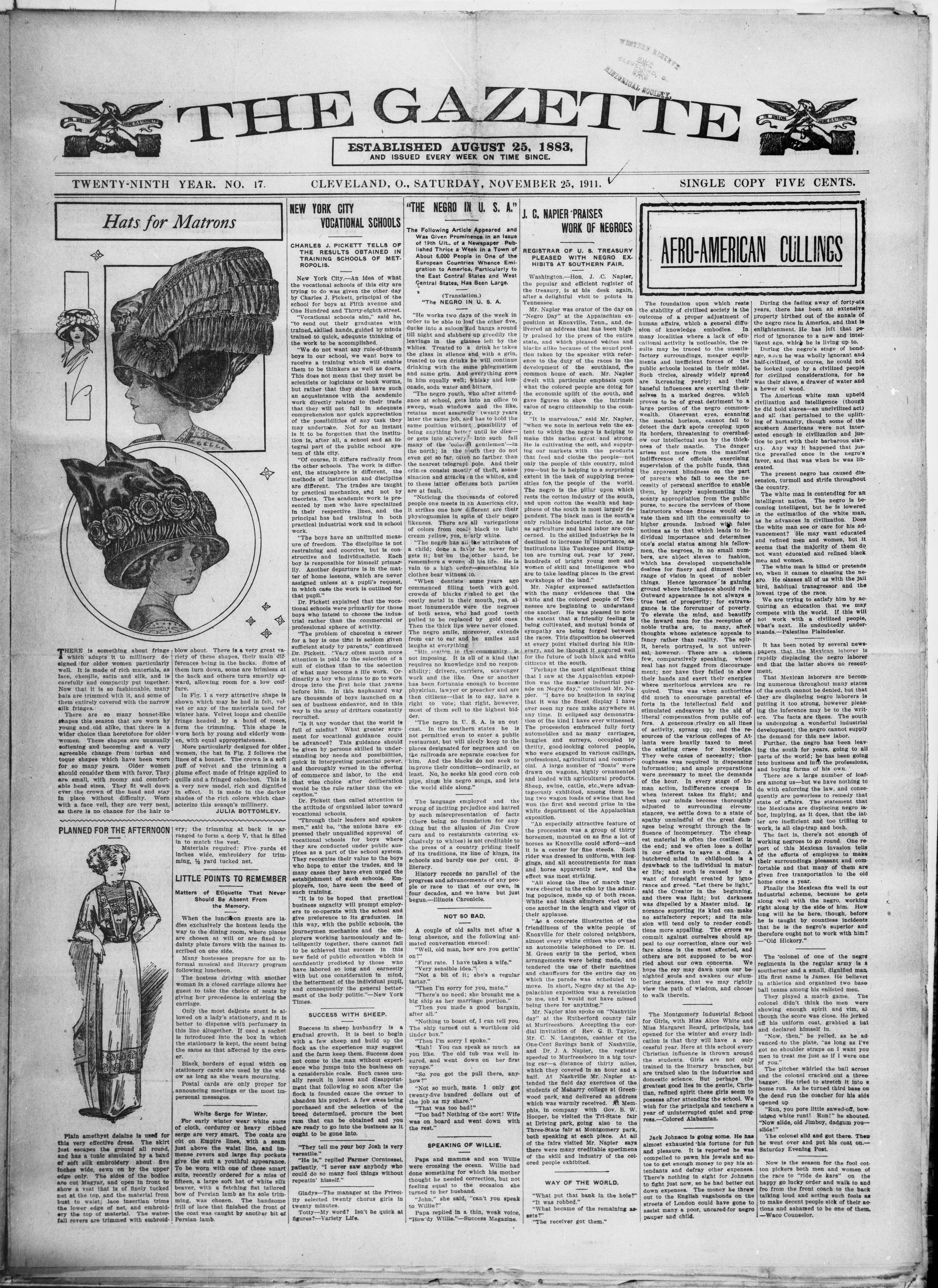
THERE is something about fringe which adapts it to millinery designed for older women particularly well. It is made of rich materials, as lace, chenille, satin and silk, and is carefully and compactly put together. Now that it is so fashionable, many hats are trimmed with it, and some of them entirely covered with the narrow silk fringes.
There are so many bonnet-like shapes this season that are worn by young and old alike, that there is a wider choice than heretofore for older women. These shapes are unusually softening and becoming and a very agreeable change from turban and toque shapes which have been worn for so many years. Older women should consider them with favor. They are small, with roomy and comfortable head sizes. They fit well down over the crown of the head and stay in place without difficulty. Worn with a face vell, they are very neat, as there is no chance for the hair to
1
Plain amethyst delaune is used for this very effective dress. The skirt just escapes the ground all round, and has a tunic simulated by a band of soft silk embroidery about five inches wide, sewn on by the upper edge only. The sides of the bodice are cut Magyar, and open in front to show a vest that is of finely tucked net at the top, and the material from bust to waist; lace insertian trims the lower edge of net, and embroidery the top of material. The waterfall revers are trimmed with embroid-
X
blow about. There is a very great variety of these shapes, their main differences being in the backs. Some of them turn down, some are brimless at the back and others turn smartly upward, allowing room for a low coifure.
In Fig. 1 a very attractive shape is shown which may be had in felt, velvet or any of the materials used for winter hats. Velvet loops and chenille fringe headed by a band of roses, form the trimming. This shape is vorn both by young and elderly women, with equal appropriateness.
More particularly designed for older women, the hat in Fig. 2 follows the lines of a bonnet. The crown is a soft puff of velvet and the trimming a plume effect made of fringe applied to quills and a fringed cabochon. This is a very new model, rich and dignified in effect. It is made in the darker shades of the rich colors which characterize this season's millinery.
ery; the trimming at back is arranged to form a deep V, that is filled in to match the vest.
Materials required: Five yards 40 inches wide, embroidery for trimming, ½ yard tucked net.
LITTLE POINTS TO REMEMBER
Matters of Etiquette That Never Should Be Absent From the Memory.
When the lunch on guests are ladies exclusively the hostess leads the way to the dining room, where places are chosen at will or are fixed by dainty plate favors with the names inscribed on one side.
Many hostesses prepare for an informal musical and literary program following luncheon.
The hostess driving with another woman in a closed carriage allows her guest to take the choice of seats by giving her precedence in entering the carriage.
Only the most delicate scent is allowed on a lady's stationery, and it is better to dispense with perfumery in this line altogether. If used a sachet is introduced into the box in which the stationary is kept, the scent being the same as that affected by the owner.
Black borders of equal width on stationery cards are used by the widow as long as she wears mourning.
Postal cards are only proper for announcing meetings or the most impersonal messages.
White Serge for Winter.
For early winter wear white suits of cloth, corduroy or heavy ribbed serge are very smart. The coats are cut on Empire lines, with a seam just above the waist line, and immense revers and large flap pockets give the suit a youthful appearance. To be worn with one of these smart suits, recently ordered for a miss of fifteen, a large soft hat of white silk beaver, with a fetching flat tailored bow of Persian lamb as its sole trimming, was chosen. The handsome frill of lace that finished the front of the coat was caught by another bit of Persian lamb.
JULIA BOTTOMLEY.
ESTABLISHED AUGUST 25, 1883 AND ISSUED EVERY WEEK ON TIME SINCE.
CLEVELAND, O., SATURDAY, NOVEMBER 25, 1911.
VOCATIONAL SCHOOLS
CHARLES J. PICKETT TELLS OF THE RESULTS OBTAINED IN TRAINING SCHOOLS OF METROPOLIS.
New York City.-An idea of what the vocational schools of this city are trying to do was given the other day by Charles J. Pickett, principal of the school for boys at Fifth avenue and One Hundred and Thirty-eighth street. "Vocational schools aim," said he, "to send out their graduates with trained, skilled hands, guided by minds trained to quick, adequate thinking of the work to be accomplished.
"We do not want any rule-of-thumb boys in our school, we want boys to receive a training which will enable them to be thinkers as well as doers. This does not mean that they must be scientists or logicians or book worms, but rather that they shall have such an acquaintance with the academic work directly related to their trade that they will not fall in adequate comprehension nor quick appreciation of the possibilities of any task they may undertake. Not for an instant is it to be forgotten that the institution is, after all, a school and an integral part of the public school system of this city.
"Of course, it differs radically from the other schools. The work is different, the atmosphere is different, the methods of instruction and discipline are different. The trades are taught by practical mechanics, and not by theorists. The academic work is presented by men who have specialized in their respective lines, and the principal has had training in both practical industrial work and in school work.
"The boys have an unlimited measure of freedom. The discipline is not restraining and coercive, but is constructive and individualistic. Each boy is responsible for himself primarily. Another departure is in the matter of home lessons, which are never assigned unless at a pupil's request, in which case the work is outlined for that pupil."
Dr. Pickett explained that the vocational schools were primarily for those boys who intend to choose the industrial rather than the commercial or professional sphere of activity.
"The problem of choosing a career for a boy is one that is seldom given sufficient study by parents," Dr. Pickett. "Every other such more attention is paid to the selection of a school than to the selection of what may become a life work. Ordinarily a boy who plans to go to work drops into the first hole that yawns before him. In this haphazard way are thousands of boys launched on a sea of business endeavor, and in this way is the army of drifters constantly recruited.
"Is it any wonder that the world is full of misfits? What greater argument for vocational guidance could be advanced? This guidance should be given by persons skilled in understanding boy needs and possibilities, quick in interpreting potential power, and thoroughly versed in the offering of commerce and labor, to the end that wise choice after deliberation would be the rule rather than the exception."
Dr. Pickett then called attention to the attitude of organized labor toward vocational schools.
"Through their leaders and spokesmen," said he, "the unions have expressed their unqualified approval of vocational schools for boys where they are conducted under public auspices as a part of the school system. They recognize their value to the boys who hope to enter the trades, and in many cases they have even urged the establishment of such schools. Employers, too, have seen the need of such training."
"It is to be hoped that practical business sagacity will prompt employers to co-operate with the school and give preference to its graduates. In this way, with the public schools, the journeymen mechanics and the employers working harmoniously and intelligently together, there cannot fail to be achieved that success in this new field of public education which is confidently predicted by those who have labored so long and earnestly with but one consideration in mind, the betterment of the individual pupil, and consequently the general betterment of the body politic."—New York Times.
SUCCESS WITH SHEEP.
Success in sheep husbandry is a gradual growth. It is best to begin with a few sheep and build up the flock as the experience may suggest and the farm keep them. Success does not come to the man without experience who jumps into the business on a considerable scale. Such cases usually result in losses and disappointment that following so soon after the flock is founded cause the owner to abandon his project. A few ewes being purchased and the selection of the breed determined, procure the best ram that can be obtained and you are ready to go into the business as it ought to be gone into.
"They tell me your boy Josh is very versatil."
"He is," replied Farmer Corntosset, patiently. "I never saw anybody who could do so many fool things without repeatin' himself."
Gladys—The manager at the Frivolity selected twenty chorus girls in twenty minutes.
Totty—My word. Isn't he quick at figures?—Variety Life.
"THE NEGRO IN U. S. A."
The Following Article Appeared and Was Given Prominence in an issue of 19th Ult., of a newspaper Published Thrice a Week in a Town of About 6,000 People in One of the European Countries Whence Emigration to America, Particularly to the East Central States and West Central States, Has Been Large.
(Translation.)
"The NEGRO IN U. S. A.
"He works two days of the week in order to be able to loaf the other five, ducks into a saloon and hangs around till night and slabbers up greedily the leaves in the glasses left by the whites. Treated to a drink he takes the glass in silence and with a grin, treated to ten drinks he will continue drinking with the same phlegmatism and same grin. And everything goes in him equally well; whisky and lemonade, soda water and bitters.
"The negro youth, who after attendance at school, gets into an office to sweep, wash windows and the like, retains most assuredly twenty years later the same job, and has to hold the same position without possibility of being anything better until he dies—or gets into slavery. Into such fall many of the colored gentlemen—in the north; in the south they do not even get so far, often no farther than the nearest telegraph pole. And their crimes consist mostly of theft, assassination and attacks on the whites, and to these latter offenses both parties are at fault.
"Noticing the thousands of colored people one meets in an American city, it strikes one how different are their physiognomies in spite of their negro likeness. There are all variegations of colors from coal black to light cream yellow, yes, nearly white.
"The negro has an the attributes of a child; done a favor he never forgets; it but on the other hand, he remembers a wrong his life. He is vain to a high order—something his clothes bear witness to.
"When dentists some years ago commenced filling teeth with gold crowds of blacks rushed to get the costly metal in their mouth, yes, almost innumerable were the negroes of both sexes, who had good teeth pulled to be replaced by gold ones. Then the thick lips were never closed. The negro smile, moreover, extends from ear to ear and he smiles and laughs at everything.
"His station in the community is not imposing. It is all of a kind that requires no knowledge and no responsibility; drivers, carriers, scavenger work and the like. One or another has been fortunate enough to become physician, lawyer or preacher and are then citizens—that is to say, have a right to vote; that right, however, most of them sell to the highest bidder.
"The negro in U. S. A. is an outcast. In the southern states he is not permitted even to enter a public restaurant, but will nicely keep to the places designated for negroes and on the railroads are separate coaches for him. And the blacks do not seek to improve their condition—ordinarily, at least. No, he seeks his good corn cob pipe, sings his negro songs, and lets the world slide along."
The language employed and the wrong of inciting prejudice and hatred by such misrepresentation of facts (there being no foundation for anything but the allusion of Jim Crow cars and to restaurants catering exclusively to whites) is not creditable to the press of a country priding itself of its traditions, its line of kings, its schools and barely one per cent, illiteracy.
History records no parallel of the progress and advancements of any people or race to that of our own, in four decades, and we have but just begun—Illinois Chronicle.
NOT SO BAD.
A couple of old salts met after a long absence, and the following animated conversation ensued:
"Well, old man, how are you gettin' on?"
"First rate. I have taken a wife."
"Very sensible idea."
"Not a bit of it; she's a regular tartar."
"Then I'm sorry for you, mate."
"There's no need; she brought me a big ship as her marriage portion."
"Then you made a good bargain, after all."
"Nothing to boast of, I can tell you. The ship turned out a worthless old tinder box."
"Then I'm sorry I spoke."
"Bah! You can speak as much as you like. The old tub was well insured, and went down on her first voyage."
"So you got the pull there, any how?"
"Not so much, mate. I only got twenty-five hundred dollars out of the job as my share."
"That was too bad!"
"Too bad? Nothing of the sort! Wife was on board and went down with the rest."
SPEAKING OF WILLIE
Papa and mamma and son Willie were crossing the ocean. Willie had done something for which his mother thought he needed correction, but not feeling equal to the occasion she turned to her husband. "John," she said, "can't you speak to Willie?" Papa replied in a thin, weak voice, "How'd Willie."-Success Magazine.
J. G. NAPIER-PRAISES WORK OF NEGROES
REGISTRAR OF U. 8. TREASURY PLEASED WITH NEGRO EXHIBITS AT SOUTHERN FAIR.
Washington.—Hon. J. C. Napier, the popular and efficient register of the treasury, is at his desk again, after a delightful visit to points in Tennessee.
Mr. Napier was orator of the day on "Negro Day" at the Appalachian exposition at Knoxville, Tenn., and delivered an address that has been highly praised by the press of the entire state, and which pleased whites and blacks alike because of the sound position taken by the speaker with reference to the duty of the races in the development of the southland, the common home of each. Mr. Napier dwelt with particular emphasis upon what the colored people are doing for the economic uplift of the south, and gave figures to show the intrinsic value of negro citizenship to the country.
"It is marvelous," said Mr. Napier, "when we note in serious veil the extent to which the negro is helping to make this nation great and strong. He is cultivating the soil, and supplying our markets with the products that feed and clothe the people—not only the people of this country, mind you—but he is helping to a surprising extent in the task of supplying necessities for the people of the world. The negro is the pillar upon which rests the cotton industry of the south, and upon cotton the wealth and happiness of the south is most largely dependent. The black man is the south's only reliable industrial factor, as far as agriculture and hard labor are concerned. The skilled industries he is destined to increase in importance, as institutions like Tuskegee and Hampton are turning out. year by year, hundreds of bright young men and women of skill and intelligence who are to take leading places in the great workshops of the land."
Mr. Napier expressed satisfaction with the many evidences that the white and the colored people of Tennessee are beginning to understand one another. He was pleased to find that he could feeling is being cultivated, and mutual bonds of sympathy are being forged between the races. This disposition he observed at every point visited during his itinerary, and he thought it augured well for the future of both black and white citizens at the south.
"Perhaps the most significant thing that I saw at the Appalachian exposition was the monster industrial parade on Negro day." continued Mr. Napier. "I have no hesitation in saying that it was the finest display I have ever seen my race make anywhere at any time. It eclipsed any demonstration of the kind I have ever witnessed. The procession embraced fully forty automobiles and as many carriages, buggies and surreys, occupied by thrity, good-looking colored people, who were engaged in various callings, professional, agricultural and commercial. A large number of "foats" were drawn on wagons, highly ornamented and loaded with agricultural products. Sheep, swine, cattle, etc. were advantageously exhibited, among them being two wagon loads of swine that had won the first and second prize in the white department of the Appalachian exposition.
"An especially attractive feature of the procession was a group of thirty horsemen, mounted on as fine a lot of horses as Knoxville could afford—and it is a center for fine steeds. Each rider was dressed in uniform, with leggings, and all accoutrements for man and horse apparently new, and the effect was most striking.
"All along the line of march they were cheered to the echo by the admiring populace, made up of both races. White and black admirers vied with one another in the length and vigor of their applause.
"As a concrete illustration of the friendliness of the white people of Knoxville for their colored neighbors, almost every white citizen who owned an automobile telephoned to Dr. H. M. Green early in the period, when arrangements were being made, and tendered the use of their machines and chauffeurs for the entire day on which the parade was scheduled to move. In short, Negro day at the Appalachian exposition was a revelation to me, and I would not have missed being there for anything."
Mr. Napier also spoke on "Nashville day" at the Rutherford county fair at Murtreesboro. Accepting the cordial invitation of Rev. G. B. Taylor, Mr. C. N. Langston, cashier of the One-Cent Savings bank of Nashville, and Dr. J. A. Napier, the register speeded to Murtreesboro in a big touring car—a distance of thirty miles, which they covered in an hour and a half. At Nashville Mr. Napier attended the field day exercises of the students of Meharry college at Greenwood park, and delivered an address which was warmly received. At Memphis, in company with Gov. B. W. Hooper, he visited the Tri-State fair at Driving park, going also to the Three-State fair at Montgomery park, both speaking at each place. At all of the fairs visited Mr. Napier says there were many creditable specimens of the skill and industry of the colored people exhibited.
WAY OF THE WORLD.
"What put that bank in the hole?"
"It was robbed."
"What became of the remaining assets?"
"The receiver got them."
SINGLE COPY FIVE CENTS.
AFRO-AMERICAN CULLINGS
The foundation upon which rests the stability of civilized society is the outcome of a proper adjustment of human affairs, which a general diffusion of knowledge embodies. In many localities where a lack of educational activity is noticeable, the results may be traced to the unsatisfactory surroundings, meager equipments and inefficient forces of the public schools located in their midst. Such circles, already widely spread are increasing yearly; and their benevolent influences are exerting themselves in a marked degree, which proves to be of great detriment to a large portion of the negro community; nor have they failed to show their hands and exert their energies where meritorious services are required. Time was when authorities did much to encourage parental efforts in the intellectual field and stimulated endeavors by the aid of liberal compensation from public coffers. A generous rivalry on all lines of activity, sprang up; and the resources of the various colleges of Atlanta were heavily taxed to meet the existing crave for knowledge. They were cases of necessity; their outhness was required in dispensing information; and ample preparations were necessary to meet the demands of the hour action. In every stage of human action, indifference creeps in when interest takes its flight; and when our minds become thoroughly adjusted to surrounding circumstances, we settle down to a state of apathy unmindful of the great damages being wrought through the influence of incompetency. The cheapest material is often the costliest in the end; and we often lose a dollar in our efforts to save a dime. A butchered mind in childhood is a drawback to the individual in mature life; and such is caused by a want of foresight created by igno rance and greed. "Let there be light," said the Creator in the beginning and there was light; but darkness was dispelled by a Master mind. Ignorance supporting its kind can make no satisfactory report; and its mission will tend only to render conditions more appalling. The errors we commit against ourselves should appeal to our correction, since our well fare alone is the most affected, and others are not supposed to be worried about our own concerns. We hope the ray may dawn upon our nighted souls and awaken our slum bering senses, that we may rightly view the path of wisdom, and choose to walk therein.
The Montgomery Industrial School for Girls, with Miss Alice White and Miss Margaret Beard, principals, has opened for the winter and every indication is that they will have a successful year. Here at this school every Christian influence is thrown around the students. Girls are not only trained in the literary branches, but are trained also in the industries and domestic science. But perhaps the greatest good lies in the gentle, Christian, refined spirit these girls seem to possess after attending the school. We wish for the principals and teachers a year of uninterrupted quiet and progress.—Colored Alabamian.
Jack Johnson is going some. He has almost exhausted 'his fortune for fun and pleasure. It is reported he was compelled to pawn his jewels and autos to get enough money to pay his attendants and defray other expenses. There's nothing in sight for Johnson to fight just now, so he had better cut down expenses. The money he throw out to the English vagabonds on the streets of London could have gone to assist many a poor, uncared-for negro pauper and child.
During the fading away of forty-six years, there has been an extensive property birthed out of the annals of the negro race in America, and that is enlightenment. He has left that period of ignorance to a new and intelligent age, which he is living up to.
During the negro's stage of bondage, when he was wholly ignorant and half-civilized, of course, he could not be looked upon by a civilized people for civilized considerations, for he was their slave, a drawer of water and a hewer of wood.
The American white man upheld civilization and intelligence (though he did hold slaves—an un civilized act) and all that pertained to the uplifting of humanity, though some of the southern Americans were not interested enough in civilization and justice to part with their barbarous slavery. Any way it happened that justice prevailed once in the negro's favor, and that was when he was liberated.
The present negro has caused dissension, turmil and strife throughout the country.
The white man is contending for an intelligent nation. The negro is becoming intelligent, but he is lowered in the estimation of the white man, as he advances in civilization. Does the white man see or care for his advanced and refined men and women, but it seems that the majority of them do not want educated and refined black men and women.
The white man is blind or pretends so, when it comes to classing the negro. He classifies all of us with the jail bird, habitual transgressor and the lowest type of the race.
We are trying to satisfy him by acquiring an education that we may compete with the world. If this will not work with a civilized people, what's next. He undoubtedly understands.—Palestine Plaindealer.
It has been noted by several newspapers that the Mexican laborer is rapidly displacing the negro laborer and that the latter shows no resentment.
That Mexican laborers are becoming numerous throughout many states of the south cannot be denied, but that they are displacing negro laborers is putting it too strong, however pleasing the inference may be to the writers. The facts are these. The south is undergoing a wonderful industrial development; the negro cannot supply the demand for this new labor.
Further, the negro has been leaving the south for years, going to all parts of the world; he has been going into business and into the professions, and buying farms of his own.
There are a large number of loafers among us—but we have nothing to do with enforcing the law, and consequently are powerless to remedy that state of affairs. The statement that the Mexicans are displacing negro labor, implying, as it does, that the latter are inefficient and too trifling to work is all clan-tran and bosh.
The fact is, there's not enough of working negroes to go round. One report of this Mexican invasion tells of the efforts of employees to make their surroundings pleasant and comfortable and that many of them are given free transportation to the old home once a year.
Finally the Mexican fits well in our industrial scheme, because he gets along well with the negro, working right along by the side of him. How long will he be here, though, before he is taught by countless incidents that he is the negro's superior and therefore ought not to work with him? — "Old Hickory."
The 'colonel of one of the negro regiments in the regular army is a southerner and a small, dignified man. His first name is James. He believed in athletics and organized two base ball teams among his enlisted men.
They played a match game. The colonel didn't think the men were showing enough spirit and vim, although the score was close. He jerked off his uniform coat, grabbed a bat and declared himself in.
"Now, then," he yelled, as he advanced to the plate, "as long as I've got no shoulder straps on I want you men to treat me just as if I were one of you."
The pitcher whirled the ball across and the colonel cracked out a three-bagger. He tried to stretch it into a home run. As he turned third base on the dead run the coacher for his side opened up
"Run, you pore little sawed-off, bow-
laided white run! Run!" he shouted.
"Now slide, old Jimboy, dadgum you—
slide!"
The colonel ald and got there. Then
he went over and put his coat on—
Saturday Evening Post.
Now is the season for the fool cotton pickers both men and women of the race to "ride de kars" on the happy go lucky order and walk to and fro from the front coach to the back talking loud and acting such fools as to make decent people sick of their actions and ashamed to be one of them. —Waco Counselor.
THE GAZETTE
PUBLISHED EVERY SATURDAY
One Year.....$1.50
Six Months.....1.00
Three Months.....80
Subcriblers are requested to
mit by postoffice money or
der or registered letter.
Entered at the postoffice in Cleveland
Ohio, as second-class matter
Address all communications to
HARRY C. SMITH
Editor and proprietor,
THE GAZETTE,
'Blackstone Building, Cleveland, O.
Member Ohio Legislature: 1894
to 1896; 1898 to 1898; 1900 to 1892
THE GAZETTE is the oldest, and has the largest bona fide circulation, double that of any newpaper in the interest of Afro-Americans, published in the state of Ohio, and comparison with any will immediately establish its rank as one of the NEWSIEST AND BEST in the country.
Thanksgiving
"For the sunshine and the rain,
For the dew and for the shower,
For the yellow, ripened grain,
And the golden harvest hour,
We bless Thee, oh, our God!
"For the heat and the shade,
For the gladness and the grief,
For the tender, sprucing blade,
And for the nodding sheaf,
We bless Thee, oh, our God!
"For the hope and for the fear,
For the storm and for the peace,
For the trembling and the cheer,
And for the glad increase,
we bless Thee, oh, our God!
"Our hands have tilted the sod,
And the soul has tilted the womb;
But the quickening was of God,
And the praise be His alone.
And the praise be his alone. We bless Thee, oh, our God!"
The man who suffers personal wrong without protest or opposition, the "peaceful" member of the community, is a demoralizing factor in our social fabric. The class that does not struggle for civic and industrial rights will eventually lapse into slavery. The nation that passively countenances encroachments upon its rights and territory is doomed to dismemberment and national bankruptcy. It is the man who defends his rights, the class that battles for political and industrial advancement, and the nation that holds its own against the entire world; it is the "litigious" person, the revolutionary class, and the vigilant nation, that keep the world from stagnation and force it onward on the path of progress—Hillquit.
CHURCH MEMBERS BAR "NEGRO."
Pittsburg, Pa. — "Rev. Richard Holmes, contributing editor of the Continent, a Presbyterian publication, has consented to be a guest at the same house as a Colored missioner from Lincoln University at the synod in Warren. The hotels and church members had refused to take the Negro."
The above appeared in the Chicago Record-Herald, Oct. 23, page 2, in a far off corner of the page and in the smallest type available. Comment not necessary beyond stating that Pennsylvania is the state in which the first public protest was raised against slavery, in Colonial times, by German Protestants who had come to the Colony under the lawyer Pastorius, to whom the Germans of today intend to erect a monument, one side of which on the panel will bear an inscription referring to this part of the esteemed pioneer's character, life and services. Incidentally we may assure a somewhat curious fellow mankind beyond the ocean, that the United States is a
Republic, a Democracy in theory from the days of the Declaration of Independence written by Thomas Jefferson, to this day, when, barring eight or nine millions of Afro-Americans—the eighth, ninth or tenth part of the population of this Republic—"this is a government by the people, of the people, for the people" in the ideal conception of one Abraham Lincoln—both deceased—and indeed very much dead in the "Democracy." We may further assure the curious observers of the "experiment of democracy" that this is a government where men are equal before the law, and that it is a civilized state in every sense of the term, that our many thousand Reverends and their flock are sure that this is a Christian country; and that we abide by His teachings in private life and especially in our public one, to neatness. The effete nations of Europe and the backward states of South America will take note.
MR. TAFT HAS THE FLOOR.
The Inter Ocean of Chicago, in a rather caustic leader recently demanded that "Mr. Taft take a stand." Here are some extracts that are interesting and of a somewhat refreshing nature to those who are tired of insidl praise of the eternal "smiler": "The public man who refuses to take his side and his stand, who twidies along discussing how much merit there may be on either side, arouses a spirit of indifference, that rapidly verges toward contempt.
"As President of the United States, Wm. Howard Taft has abundant respect and honor from his country-men. As a man, Wm. H. Taft has been regarded with increasing indifference."
And this, when Mr. Taft had just left Chicago. The Inter Ocean was a
Republican organ and still claims to be a Republican paper. Here is a refreshing bit from Taft's speech before the Hamilton club that should not be overlooked but brought to the President's notice at an early date an dn a manner that will rouse him from his moral stupor:
"The Hamilton Club takes its name from the great statesman, Alexander Hamilton, who was in favor of a national construction of the Constitution and in favor of protection as a national policy. Upon these principles the Republican party insists. Measuring our smaller problems with the larger ones that saint, Abraham Lincoln, had before him, we should not run away from them, but grit our teeth and meet them by the path, and the only path that a party can safely follow, i.e., that of enforcing the law and bringing about a condition in which the law is respected."
Finely said, Mr. Taft. But how does the Taft government fare, if one inquires why the national construction as to the fourteenth and the fifteenth amendments of the Constitution was not enforced by its party and by what the U. S. government or the Republican party in its long time of governing has done or is now doing to stamp out the lynching lawlessness and thus bringing about a condition in which "the law is respected." Personally Mr. Taft has shamely failed in doing his duty as a man, a citizen, a jurist, an (ex) judge, as regards fighting this veritable cancer o f fanarchy even if one admit that "on account of our dual system of government he could not act officially," yet there is nothing in that system that would have prevented him from strongly speaking out against this anarchy and creating public opinion as to its dangers, which would have compelled the "States" to treat the matter seriously with practical results following their action. But it is not indisputably settled that the nation is not entitled to come into the matter if the States fail to act. Or, are we really going to proclaim the "Nation will protect the foreign residents in this country (as it should—and must, under "treaty rights") while leaving its own citizens unprotected because they are Afro-American? Mr. Taft has the floor! !
SHOULD VOTE FOR WHITLEY.
Our Votes of California Should Stance Together - Principles Not Men
Los Angeles, Calif., Nov. 18, 1911.
Hon Harry C. Smith, Editor Gazette,
1911.
Dear Sir, The Colored citizens of this city have lined up with the Socialists and the laboring people of this city, and we have a good chance to elect one of our race to the city council. Now as he is a Socialist, and organized labor is backing him to a man, a word from you will help us a great deal. There are some of the Colored men being proslised by "big business" against our man. This is one of the greatest movements ever made in this country. If we can be successful in electing this ticket it will be the means of breaking down the colorline in this county, for the Socialist and laboring men and women of this city are supporting him to a man. This is the class of people who should be together. Mr. Whitley, the Colored man, was nominated from a list of other candidates, so could be eighten people nominated for the election, he stood tenth man in the race. My reason for asking you is that I know what a great advantage it is to the Colored people to have one of our own race in the different branches of this government, regardless of the political affiliation. Kindly write to an encouragement use the same for the Colored citizens of this city.
Cleveland, O. Nov. 19, 1911.
Joseph L. Thomas, Los Angeles, Calif.
Dear Sir:—In answer to your letter, permit me to implore our voters of Los Angeles to vote for our candidate, Mr. Whitley. All should do so for racial reasons, particularly. Intelligent people of all classes matters where, especially in local matters (elections), are losing sight of men and parties and adhering to principles. There is a principle, vital to the race involved, in the election of Mr. Whitley. So let Los Angeles Colored voters, every one, vote for him. We must stand by one another if we would succeed and be respected by other classes of citizens. Have and show race pride.
Yours for the race.
Harry C. Smith.
CORROTHERS VS. WASHINGTON.
7 Travers St., Haverhill, Mass.
Nov. 11, 1911
Nov. 11, 1911
Editor Gazette:—I have never met Dr. Booker T. Washington; have never accepted him, nor any man, as "the leader of my race;" nor have I ever believed in his "industrial panacea" for my people. For his ideas of educational limitations (for Negroes only) would, if forced to work with the white man, and a bottle-washer, of a Douglass, and I never shall subscribe to the doctrine that one man shall do all the thinking for ten millions of his kind—some of whom are, at least, his equals, intellectually, though they were not. James D. Corrothers, Pastor of Calvary Baptist Church.
Forget Not His Benefits.
Why not rejoice more? Count up your golden mercies; count up your opportunities to do good; count up your "exceeding great and precious promises;" count up your joys of heirship to an incorruptible inheritance, and then march on the road heavenward. "Forget not all his benefits." "Bless the Lord, O my soul, and all that is within me, bless his holy name," is the declaration of an appreciative heart.—Theodore L. Cuyler, D.D.
Washington's Proclamation.
The first Thanksgiving day proclamation ever issued by a president was signed by George Washington in 1789. The original is said to be in the possession of Rev. J. W. Wellman, who inherited it from his grandfather, William Ripley of Cornish, N. H. This proclamation was issued by request of both houses of congress through their joint committee.
THE GAZETTE, CLEVELAND, O., SATURDAY, NOVEMBER 25, 1911.
TURKEY
O turk, you who strutted the summer away. Abundant attention you're getting today, We praise you beyond all the bird or fowl kind; Our feelings to you are with favor inclined. We thanks, too, give for you, O creature of pride, And all the fruits of the season beside. Though slighted you were, in the days that are past, Attention long due you are getting at last. Arthur J. Burdick, in Sunset Magazine.
Thanksgiving
F YOU are grateful,
say so.
Thanksgiving is only half-
thanksgiving till it
blossoms into
expression. Learn a
lesson from the
noble-hearted Indian,
in whose vili-
F YOU are grateful, say so. Thanksgiving is only half-thanksgiving till it blossoms into expression. Learn a lesson from the noble-hearted Indian, in whose village the missionary, passing through, had left a few pages of the gospel in the Indian tongue. Our Indian read and rejoiced. Measuring the missionary's footprint, he fitted it with magnificent moccasins, and traveled 200 miles to give them to the missionary as an expression of his gratitude. Thus the missionary was enriched by the present, but the Indian was enriched by the thanksgiving.
The best thanksgiving is a happy heart. Blossoms mean nothing on a dead stick. Once when the czar visited Paris the ingenious French, it being winter, fastened to the bare boughs of the trees innumerable paper flowers, very pretty as a spectacle, but very unworthy as a symbol, since they were false. Our praise will be quite valueless unless it is rooted in the daily life.
Train yourself to be grateful for the common blessings. There had been a great cotton famine in Lancashire, England. For lack of material to work upon, the mills had been idle for months, and there was great distress among the operatives. At last came the first wagon-load of cotton,
The Spirit of Thanksgiving
THANKSGIVING day stands out by itself on the calendar. There is no other day with so many delightful associations and tender memories, no day upon which
T
the heart so spontaneously pours out its grateful tribute to the Father above for all his goodness through the year. And this applies equally to ourselves as a nation, as communities and as individuals. For peace within our berders, for generous harvests, for the health and welfare of our communities, we owe to God a debt of love and gratitude which finds expression in prayer, praise and the festivities appropriate to the annual festival of Thanksgiving. We are usually so much engrossed with the active business of life as a nation that we leave too little time for reflection on the divine goodness; yet every day we are surrounded by blessings. Sleeping and waking, on the farm, in the store, the office, the workshop, we are still the objects of his won-Across bounty and care. Whatever reverses we encounter, he enables us to overcome them. So, while the passing year has had its sorrows, we feel that the joys have outweighed them, and that we are still God's debtors in thanks for multifarious blessings. Let us show our gratitude for all of these mercies by reaching out a helping hand to others who have been less fortunate than ourselves. Remember the poor at Thanksgiving—the sick, the desititude, the hungry, the unemployed. In every community there are those to whom a kindly word or a generous hospitality would bring a real touch of the spirit of the festival. Pass on your blessings. By
the earnest of returning opportunity to labor. With what new eyes did the people look upon that commonplace material! They met the wagon in an exultant procession. They hugged the bales. At last, moved by a common impulse, they broke out in the noble hymn, "Praise God, from whom all blessings flow." There are in every life a thousand blessings, now little noticed of all, of which if we were deprived, their return would be welcomed with equal transports. But the going does not excuse us from the sending any more than send ing excuses us from going. If giving still went by the rule of the tenth, as in the scriptural days, then ten average Christians could anywhere constitute themselves into a church and support a pastor; and twenty could support both a pastor and a missionary.
No work is done at its best until it is done in an atmosphere of thanks giving. Beethoven understood this. He had his piano placed in the middle of a field, and there, under the smiling sky, with birds singing around him, flowers shining and grail glisten ing in the sun, the musician composed some of his great oratories. Few of us can take our work into the fields, though all of us would carry lighter hearts if we would live more out of doors; but we can all of us sur round our work with cheery atmosphere which our Father has breathed into all his works.
so doing, you will make your own heart the lighter, your own home the brighter and your own Thanksgiving table more enjoyable to all who sit around it.
Thank Him for All.
"Giving thanks for all things unto God."—Eph. v. 20.
Thanksgiving is the mark of a truly religious man. If we are always begging God for his mercies without expressing to him our sincere gratitude, we become selfish in our demands. God delights to impart his memories to us, but he also takes pleasure in our gratitude to him for his benefits. Only an appreciative heart is able to fully enjoy God's unfalling goodness. It is certain that the more we try to praise, the more we will see how our path and our daily way are beset with merces, and that the God of love is ever watching to do us good.
For These Things We Give Thanks.
Thanksgiving day we should all be able to give thanks to our parents for these things:
For a clean name, unsullied by questionable transactions, honorable in human relations.
For an untainted birth, with such health as purity transmits, and for the brooding tenderness that guarded and cherished us before birth and made careful preparation for our coming.
For wholesome food, sufficient clothing, and comfortable shelter until our coming of age, or during the lifetime of our parents.
For education, according to the best standards of which they knew suited to our individual needs and possibilities, and preparing us to earn our own livings.
For such knowledge of our bodies and minds, and such reverence for them as makes intemperance impossible.
Are You in Arrears on your subscription? You know WE NEED THE MONEY
DOINGS
OF
THE
RACE
Afro-Americans own and conduct
917,465 farms.
A Carnegie library for our people is
to be established in Houston, Tex.
Opposed of the 30,000 Afro-Americans living in Pittsburgh are employed
in the steel industry.
A State Normal School for our people is to be erected in Nashville, Tenn., at a cost of $100,000. The 100th anniversary of the birth of Wendell Phillips will be fittingly celebrated Nov. 29, by citizens of Chicago and ceremonies at Quinn chapel, Chicago, III. The Mechanics' Savings Bank, of Richmond, Va., has on deposit $162,000 and owns $144,000 worth of real estate. John Mitchell, Jr., is its president. Completed figures on our population of its county in 1910 show that the total number was 9,828,294, of whom 8,749,390 were to be found in the South, this latter having increased from 7,922,698 in 1900. The two election officials of Kingfisher County, Okla., who were charged with practicing election frauds on Afro-Americans to keep them from voting, have been finned 100 each and sentenced to the Worth Prison for one year and a day.
A boycott instituted by the white chauffeurs of New York against ours of that city so as to make it hard for the latter to secure accommodations at the various garages, has resulted in the opening of four garages by our men who have chauffeurs of both races as patrons.
The head of Trustees of the John D. Rockefeller Fund for Education has contributed between $600,000 and $700,000 to forty-one Afro-American schools, these contributions being limited to the schools of higher learning which train teachers for the public schools.
Jacob Smith, an orthodox English Jew, who conducts a dry goods store at 2634 Franklin Ave., St. Louis, Mo., Sunday morning formally will become a member of the Pleasant Green Baptist Church, when he, together with 30 or 40 Afro-Americans, will be immersed in the Mississippi river, in accordance with the baptismal document.
The number of Negroes which will be recruited by France from her African colonies as a military reserve is 1,000,000. Napoleon is said to have employed black troops in European warfare, one regiment having won distinction at the seige of Gaeta. At least 3,000 Negroes are said to have served through the Franco-German War. Rev. F. H. H. Rowley, in an editorial in "Our Dumb Animals" condemns the "African Doger," practiced so common at the fairs. He claims that it is demoralizing to the Afro-American, who puts his head through a canvas as a target for all who will gamble on the game, and, to the spectators, and that it creates contempt for our people.
At a meeting of the trustees of Fisk University, Nashville, Tenn., held in New York on the 16th, it was reported by the treasurer that $122,000 had been subscribed to the $30,000 fund for improvements and endowment. The General Education Board has promised $60,000. Colored people everywhere should be specially interested in this attention to put a first hand on the need for a service is an institution which stands for the highest development of which our young people are capable. Elisha Prueff, a 92-year-old Afro-American living near Austin, Texas, is said to have proven conclusively in a recent interview that he fought in the Texas revolution in the battle of San Jacinto. He received an honorable discharge and, in return for his services, papers granting him seven leagues of land. These papers were somehow lost and not for a pension for his services, and to the Government for a pension for his services in the war with Mexico.
There are at present two states in the South—South Carolina and Mississippi—where the Negroes exceed the whites. The number of Negroes in the so-called Southern States are as follows: Delaware, 31,181; Maryland, 2,342,242; District of Columbia, 94,446; Virginia, 671,096; West Virginia, 64,173; North Carolina, 673,843; South Carolina, 825,343; Texas, 808,699; Kentucky, 261,656; Tennessee, 473,088; Alabama, 908,275; Mississippi, 1,009,487; Arkansas, 442,891ff Louisiana, 713,874; Ohio, 137,612; Texas, 690,020.
Dr. M. A. Majors of Chicago, wrote the Daily Inter Ocean of that city recently: "Nobody refers to any particular individual of the white race as a leader of all the white people. Why as regards the Colored people, Dr Booker T. Washington is a great facet in civilization, but he is not any more the leader of the Negro race than he is the leader of the white race. He is possibly the leader of a group, whose chosen field is along the lines of industrial education, and if he leads in that group, he leads the group. Intellectualism is not narrow enough to be confined to one group of a race, fostering a certain principle, it must stand for the best in all, if at all."
The Negro vote of Ohio, Indiana, Illinois, New York, Pennsylvania and New Jersey is of the opinion that it has had enough of the Taft administration. The Colored men of the South are of the same opinion as men mendicant with Respect and continue under the present regime, the lily-white organizations at the South have received all of the encouragement desired in their efforts to drive the Colored man from the Republican party. As a result the Southern cities, legislative districts, congressional and State senatorial districts, which in favor of wresting Republican are now safely in the Democratic column. Further, the Republican enthusiasm of former days is all dead and the hope of winning the South to the Republican way of thinking is disappearing day by day. Under this light it would appear that a change is a big item of the program of the National Republican party if a Republican is still to be found from which the government is directed—Dallas (Tex.) Express (Repub.)
FRESH OHIO NEWS OUR OWN WRITERS'
WHAT OUR PEOPLE ARE DOING IN MANY CITIES AND TOWNS OF THE STATE.
INTERESTING PERSONALNOTES
Social Functions—Church and Lodge Items—Marriages and Deathe—Literary, Musical and Other Notes of Interest.
Mt. Vernon—Mr. Lon. Hammons, who resigned the headwatership of the Curtis house to take the stewardship of the Gentlemen's club, has been succeeded by Mr. Horace Rouse, Miss. Ana Washington went to Cumberland Md. recently to attend her brother, Alex, who has typhoid fever—Mr. and Mrs. Harry Hill have a new daughter.
Newark—Mr. and Mrs. C. D. Guy have a new boy—Rev. J. W. Gazaway of Xenia, visited his daughter, Mrs. Shackelford, here, recently—Prof. C. H. Johnson of Wilberforce, spoke at the A. M. E. church, Sunday evening week. H. Mrs. Mayo of Washington C. H. visited his daughter, Mrs. Philip Hamilton, recently to little Hamilton, he has been very well
Sandusky.—Mrs. Johnson has returned from Chicago. She visited her daughter—Mr. Amos Carter was in the city, Sunday—Rev. and Mrs. G. D. Smith are very grateful to the Sevond Baptist church members for the pound-party gifts, and say "come again." The two months' rally will be closed, Sunday noon when each captain will lay his company's money on the table to be counted by the officers and Rev. Sanders of the Congregational church. The pastor hopes that this will be the greatest rally in the church's history. The "touro marriage" was fine. L. Jones was the bride, Harry Alexander, the groom; Roy Smith, the preacher; Dean Alexander and Cecil Shackelford, ushers.—Read The Gazette and keep up to
Smithfield—Mr. Geo. Harris' children have chicken-pox—Miss Lottie Hargraves spent Sunday with Mrs. Mitchell—Mrs. F. G. White is improving. Rev. S. W. White delivered two able sermons. Sunday. He received a message announcing the death and burial of a brother, in Kentucky. The sister, in Indiana, of Sister Hargraves her son, Douglass, and family. Miss Minnie Beall visited her sister, Mrs. John Harris, and Mrs. N. Mitchell, Saturday—Fred, and Alice Faithful were guests of Miss M. Beall and G. Binns.—Mrs. Amanda Blysby visited relatives here, Saturday¹³. Ed. West visited parents in Steubenville, recently.—The stewardesses²² sewing clothes for the children of Sister Hargraves day. A delicious lunch was served. Miss Viola Carter visited in Steubenville, last week.
Washington C. H.—Mrs. Ida Gillis' funeral was from the house, Sunday afternoon. Interment in Washington cemetery.—Mrs. Brandon, J. O. Jackson and R. Thornton are still ill.—Mrs. Bettie Evans has returned from Columbus.—Rev. Martin was in Green Bay.—Mrs. Bettie Evans has visited her grandmother.—Miss Bell of Goodhope, is visiting her sister, Mrs. C. Jackson.—Mrs. Weaver of Bloomingburg, was here, Sunday.—Mr. J. Bryant of Jeffersonville, is visiting his son, Charles.—Mr. E. Bivens has a position with Mr. C. Jackson.—Mr. Henry Hampton is still with the Dohll-Milligan Co.—Miss Faye Jackson is the local representative of The Gazette. Notify her if you wish a copy of the Gazette. Send her a tenturement for his club Tuesday evening.—The concert given by Mrs. Effe Ross, Saturday evening, was a rousing success.
Correspondents must mail all letters for publication at their main postoffice sufficiently early on Monday (or Sunday) of each week to have them reach The Gazette office on Tuesday morning, and always write, also, their names and that of their city or town on the outside of the paper about returned copies. Less this latter is done, proper credit cannot be given you. Lists of names, wedding presents, etc., obituary notices, speeches, resolutions, poetry, inquiries for relatives and advertisements of all kinds, including items announcing entertainments to be held in the near future, must be paid for in advance at the rate of ten cents a book. For advertisements for display advertisements will be sent on application. Send postal note and not stamps during warm weather. Lockland.—On Sept. 20, when the North Ohio Conference met in Youngstown, Rev. W. E. Watson, who had pastored Bethel A. M. E. Church here for one year, was not relied upon as requested by G. W. Maxwell was appointed instead. In view of the fact of Rev. Watson's efficient work in this church during the year, this change did not meet the approval of the officers and members of the church. Therefore, they protested against Rev. Watson's removal and refused to accept any other pastor. No services have been held for the past week and community members tween the church, Presiding Elder and Bishop could be reached until Nov. 13 when a conference was held by Rev. J. M. Glimere, P. E., and the church, at which both agreed to recommend to Bishop W. B. Derrick that Rev. W. E. Watson be reappointed pastor of Bethel church and that he, as a member of the church, ferred to the eastern district, which is presided over by Rev. J. H. Jones, P. E.
Youngstown.—Mr. John Holmes, jr., has rheumatism.—Mrs. D. Brannock underwent a successful operation at the City Hospital, last week, and will be at home next week.—Paris Hall, Mrs. Georgia Marks and Mrs. Chas. Reeves are ill.—Buckeye lodge, Elks, will hold memorial services, Dec. 3. Time and place will be announced in the next week.—Mr. K. P., will institute a class of 15 candidates, Dec. 9. All members are requested to be present.—Mrs. J. T. Hill, Mrs. G. Williams and Mrs. Thompson are improving.—Mr. and Mrs. Ernest Thompson are very happy. It's a boy.—P. B. Ferguson returned. Sunday, from a month's visit in N. Y. City and Philadelphia.—Miss Ethel Lewis was entertained, and the clock timer, by Mr. and Mrs. Richardson of Miss Lewis will soon locate in Philadelphia.—The trustees of Mahoning Ave church elected the following officers, last Friday evening: Thos. H. Lonesome, pres.; W. M. Wright, sec.; Howard Thompson, treas. James Fa
gan and O. Smith, inspectors of property. Deacons: Philip Tucker, Gaines Williams, Lee Porter, George Martin, William Warnick, William Franklin and Albert Woods—The Chrysanthemum club met at Mr. and Mrs. T. D. Berry's, Monday afternoon. Business: Milford Tucker of Brownville, Pa., is the guest of Mr. and Mrs. Charles Reeves—Miss Rebecca Allen and James Alfred Winston were married at Mrs. Francis Huston's, Sharon, Pa., Wednesday evening, by Rev. E. C. West—The musicale in the St. John's church, last Thursday evening, under the auspices of St. Augustine mission was highly attended and a success. The program was well received. Chrysanthemum was of a classical nature and reflects great credit on the society's excellent director, Mr. Chas. Berry—Rev. S. T. Wright of the M. E. Mission has begun an interesting series of sermons. Ten day revival. The Oriental Literary club of the Mahoning Ave. church, gave a fine entertainment, Tuesday evening and will entertain Thursday evening. Howard Thompson, pres.; Mrs. James Fegan, first vice; Mrs. N. Pondexter, second; Mrs. J. Myers, third; Mrs. Norris, sec.; Mrs. W. Wright, treas.
CORRESPONDENTS WANTED.
The old reliable Gazette desires an active agent and correspondent in every city and town in Ohio and neighboring states having a number of Afro-American residents. Only a little time on Fridays or Saturdays is required.
We are especially desirous of hearing from persons in the following named cities: Zanesville, Newark, Columbus, Dayton, Cincinnati, Elmo, Troy, Akron, Springfield, Piquet Columbus, Cambridge, St. Louis, Bellaire, St. Clairville, Wilmington, Portsmouth, Dayton, Canton, Oxford, Sabina, Gallipolis, Oberlin, Sandusky, Delaware, M. Vernon, East Liverpool, Wellsville, Hamilton, Middleport, Bellefonte, Lima, O., and other places where we have none.
Write to the editor of The Gazette, Blackstone building, Cleveland, O., and terms will be sent promptly. Our顾问 will be at once the addresses of persons in the cities named above, or others, to whom we can write relative to the matter.
DR. WASHINGTON'S INVITATION.
Tuskegee Institute, Alabama, November 18, 1911. Hon. Harry C. Smith, Editor Gazette, Cleveland, Ohio.
Dear Mr. Smith:—I enclose herewith a notice of the forthcoming meeting of the annual Tuskegee Negro Conference, to be held here Jan. 17th, and the Workers' Conference, Jan. 18th, 1912. We shall appreciate any notice of this gathering you may decide to make. Each year, a larger number of students from farmers and laboring people from all over the South attend these sessions. I extend to you personally a cordial invitation to attend this coming meeting. I believe that you would be interested in hearing these people tell of their successes. We would expect you to be the guest of the school, and will endeavor to make your visit both pleasant and profitable. Yours very truly,
Booker T. Washington,
Principal.
*For Sale or Furs—AUTOMOBILISTS ATTENTION!* Having secured a few elegant fur-lined coats, robes and fur sets for professional services, will sacrifice for quick cash sales. Gent's black broadcloth coat, lined with Spanish mink (full skins), elegant Persian lamb collar, cost $90, will sell for $35, also gents' whole skin musk-rat lined coat, Persian lamb collar, cost $140, sell for $45. Black or brown cub bear robes, size $45x66, beaver cloth lined, cost $30, sell for $30 Latest French proof skin fur coat (brown) length 52 inches, for $30; same in black $28. Latest style Belgian lynx set $12, or black fox set $15. Iceland fox set (white), $20. All new this season. Write G. Morehead, 118 East 28th St, New York City.
$15.00 to $50.00 per Week.
Good opportunity for men of all ages. We want reliable agents to take orders for our "high quality" guaranteed nursery stock. Liberal commission paid weekly. Permanent year-round position. Complete course in salesmanship with free outfit. Experience unnecessary. All goods sold under positive ironclad guarantee to be as represented. Write quick Pennsylvania Nurse1 Co., Girard, Erie Co., Pa.
When to Relax.
Dr. Eugenia Hancock of New York says a woman should "positively relax during the noon hour." With the children demanding lunch, the telephone ringing, the grocery boy at the back door and an Armenian lace peddler at the front, not to mention the neighbor running in to borrow the lawn mower, this is very easy, of course.
Bees Preempted Letter Box.
surprise awaited a rural postman the other day when he set about collecting letters from a box at Alkegate, near Armanthwaite, Cumberland, England. He found it occupied by a swarm of bees, which made him beat a retreat. Later in the day a gentleman accustomed to bees succeeded in getting them away.
I have used your Pomade. Its the best thing I ever used for making curly hair lie smooth. I have not finished my first bottle, but can see wonderful results, writes Mrs. Louise E. Hayes of Pineville, S. C.
Try Ford's Hair Pomade for harsh stubborn and unruly hair and Ford's Royal White Skin Lotion for the complexion. Ask your druggist for them. Be sure and get the genuine (Ford's) manufactured by the Ozonized Ox Marrow Company, Chicago, Ill.
Don't throw away your copy of The Gazette when you have done with it, but give it to some appreciative person whom you feel would be likely to subscribe or take it regularly, if they had a copy to look over and read carefully. Oblige the
PURELY PERSONAL
PURCHASE
THE
"GAZETTE" AT
J. S. HALL'S, 3121 Central Ave.
L. SCHWARTZ'S, 2921 Central Ave. Open Sunday.
O. C. SCHROEDER'S, Cuyahoga Bldg. Open Sunday.
ELMER F. BOYD'S, 2604 Central Ave.
F. VALENTINE'S, 2130 Central Ave.
NOTICE TO SUBSCRIBERS:—Subscribers not receiving The Gazette regularly should notify us at once. We desire every copy delivered promptly. We advise our patrons to carefully examine The Gazette's advertisements before making purchases. Business men who advertise in this paper should have the patronage of Afro-Americans. The fact that they advertise is assurance that they want it. Local reading notices (advertisements) ten cents a line (six words in a line.)
NOTARY PUBLIC—For such services call at The Gazette office, No. 3 Blackstone Building, No. 1422 W. 3d street, near Superior avenue.
FOR SALE—Brand new, imperial Encyclopedia and Dictionary, 40 volumes, finely illustrated, handy to handle. Unexcelled for reference purposes in itself—one that will last a life time. Contains everything you may wish to know. Call or address, The Gazette, Blackstone Building, 1422 W. 3d St. Cleveland, O., near Superior Av. This is an opportunity of a life-time for those who love good books.
Mrs. Edward Chafin of E. 69th St is ill.
Mr. Wm. Trimble of Detroit Ave. is still ill.
Miss M. Deal is ill at St. Vincent's hospital.
Miss Morris of E. 31st St. visited recently.
Mr. O. Ramsey of Akron visited his aunt, Mrs. C. Rudd of 36th St., Friday.
Miss A. Clark, who was taken to the Scranton Ave. hospital Saturday, is improving.
The delay in calling a meeting of the Citizens' Rights is the re
The Misses Georgia, Cora and Mr. Henry Fleissp spent Sunday in Oberlin. The Harrison recital at St. John's church, last week, was an unqualified success.
Mr. F. G. Snelson returned the first of the week from a brief visit in Chicago.
Mr. Evans and daughter of Derrott, are guests of Mr. and Mrs. Wheeler of E. 31st St.
Mr. G. Manson and sisters, the Misses Grace and Oscu, of E. 34th St. have moved to E. 33d St.
Mr. J. Mooney of Erie, Pa., was in the city, Thursday, the guest of Master yrme Dandridge, E. 36th St.
Do not forget the entertainment at St. John's church, Wednesday evening, Dec. 6, for Tuskegee Institute. 2 Do not tail to read our advertisements and patronize those who ask for your trade in the columns of The Gazette.
Wesley Jackson of the East End, visited Chicago, last week, the guest of Frank P. George, and was also highly entertained by Samuel Fielding.
Mrs. Edwina Seelig presided very acceptably at the organ at Mt. Zion Congregational church, Sunday, in the absence of the organist, Miss Cora Fields. W. B. Chavous and "Noomdy" Brasher of Columbus, were in the city, the first of the week. The latest death of the Journal was reported this week. The new C. A. C. is said to employ over a hundred of our men and boys, many of whom have been taking their meals at the Mission and Adkins restaurants. The Metropolitan Luncheon will open at 3131 Central Ave, on or before Thanksgiving. Everything will be new, neat and first class. Proprietors, J. W. Crawford and Frank Warles, both well-known restaurateurs. A grand dancing party will be given by Western Reserve Lodge, No. 42, K. at Pole Hollow Thanksgiving evening. Nov. 30. Admission, 35 cents; music by Bart Howard's orchestra.
The Ivy Leaf Dancing club will hold its Thanksgiving soiree at Orkin's hall from 2 to 6 p. m., and from 8 p. m. to 2 a. m. Fairfax's orchestra. G. W. Turpin, floor manager. A cash prize. Send your local items to The Gazette on Monday or Tuesday of each week. This paper is published for ALL of our people and "plays no favorites." Everybody is treated the same—fair and right. Take The Gazette and tell your friends to do so also. The Young Men's Progressive Political and Social club held its first grand opening, Thursday evening, at 1604 Scovill Ave., the old wigwam. Capt. Jas. A. Starkey, pres.; Thos. Douglas, sec.; Walter Brooks, manager. The students knowledge the receipt of an invitation, the first of the week, to attend.
Though many months have elapsed since the crash of the Metropolitan Mercantile and Realty Company, into whose coffers more than a half million of hard working Colored people's money had been paid, the affairs of the defunct concern seem to have been solved, a satisfactory solution today as on the day of the disaster. The receiver of the company has never yet made a report; neither, it is said, have the stockholders at large ever held a conference.—N. Y. City Amsterdam News. Interest in Hampton Normal and Industrial School are aroused last week Thursday evening by the meeting held at the Calvary Presbyterian church, Euclid Ave, and E. 79th St. Addresses were delivered by H. B. Frissel, principal of the school; Rev H. B. Turner, chaplain, and Maj. Moton, a graduate member of the faculty. The speakers dwell upon the good being done by the school and related a number of incidents in the school. The school is proving beneficial to the Afro-American and Indian.
Here is a chance for Cleveland professional players to spend the winter in Cuba and have their traveling expenses paid in addition to receiving a salary during their stay on the island. Ed Havel, well known Cleveland player who has played in the minors for several years, and was a teammate of Armando Marsans in the Connecticut league last summer prior to Marsans signing with Cincinnati, has received a letter from Marsans in the latter seeks some players for the winter season. Havel has signed up with Marsans already and has been instructed to sign up two good pitchers, two outfielders, a catcher and two infielders. The regular Cuban season starts Dec. 15, and closes March 31, so to give the players time to get back to the states to join their regular teams. Marsans holds out the announcement of transportation payments and $150 salary a month. Havel can be addressed at 7705 Cedar Ave. Only players of good habits are instructed to apply.
Mrs. Edward Chafin of E. 69th St. is ill.
Mr. Wm. Trimble of Detroit Ave. is still ill.
Miss M. Deal is ill at St. Vincent's hospital.
Miss Morris of E. 31st St. visited Oberlin, recently.
Mr. O. Ramsey of Akron visited his aunt, Mrs. C. Rudd of E. 36th St., Friday.
Miss A. Clark, who was taken to the Scranton Ave. hospital Saturday, is improving.
Mr. I. Cuddle in calling a meeting of the Citizens' Rights league is the result of waiting for the secretary's report in detail, which Mr. Chas, Hackey, secretary, has been unable to get out as promptly as it was hoped, owing to lack of time.
The Fortnightly club gave $10 as a Thanksgiving offering to the Associated Charities, on Monday of this week, and did a very creditable thing, indeed. We must show our friends that we are all ready to receive and never give. The club is a membership of 14 ladies who meet the second and fourth Wednesdays of each month. They have done considerable charity work during the past few months.
Special Thanksgiving services at Lakes Memorial Church, cor. Cedar Creek, E 31st St. and The W. W. will serve a fine dinner at 1 p. m. The public is cordially invited.
Mrs. Mildred Case of 2171 E. 30th St., entertained the Orchard Art club from 2 to 5 p. m., recently. Covers were laid for 12 and the table beau-faceted with ferns and cutflowers. A very pleasant afternoon was spent.
Mr. John Kellogg, leader of the C. E. of Mt. Zion C. church, which meets Sundays at 6:30 p. m., is doing splendid work, especially with children. Every child who attends, receives a ticket for an entertainment given them on Thursday evening in the S. Anderson. The King's Sons and Daughters of Antioch Baptist church held their anniversary last Tuesday evening at Mrs. J. H. Beckwith's. The following program was rendered: Address by the leader, S. W. Smith; solo, Mrs. Land; remarks, Rev. E. H. Smith of Shiloh Baptist church; solo, Miss Eliza Thompson; select reading, Mrs. Fields; piano solo, Madeline Jones. Music performed by all, Reception committee; Mrs. Anabel Lugget and Mrs. Cora Anderson.
E. C. Stevens and N. M. Goodrich have obtained the lease on the building formerly known as Green's hall, 2406 Central Ave., and have renamed it the ideal hall (the hall with the it the ideal hall (the hall with the two the city with the outside lights three stories from the street. The hall has been thoroughly renovated and the floor scraped for a first-class dancing academy. All persons who enjoy respectable dancing are welcome. The Young Ladies' Sewing society held a reception for its men-members at Mrs. E. Seelig's, 2317 E. 71st St., last Wednesday evening. The president presented the ladies with favors. The lady-members were accompanied by their husbands and sweethearts, beautifully welcomed by the Misses Corn Fields, Alta Moss, Messrs. Andrew Edwards and Alex. Taylor. Delicious refreshments were served and all enjoyed themselves thoroughly.
What promises to be the finest recital of the season is that to be given on Monday evening, Dec. 11, at St. John's A. M. E. church, by the popular soprano and baritone soloists, Mr. and Mrs. H. Edward Thompson. They will be assisted by Mrs. Florence Johnson, an organist from Washington; Master Louia Jones, the most promising young violinist in this section of the country; Prof. Charles G. Sommers and Mrs. Geneva Minter, accompanists, are too well and favourably known to necessitate a moment Admission. A silver offering. Every seat in St. John's large and comfortable auditorium ought to be taken that evening and thus make the recital a testimonial to that popular and most obliging soloist, Mrs. Grace Willis Thompson.
The entertainment at Cory M. E. church last Thursday evening, directed by Mr. Chas. Lacy, for the purpose of raising funds to give the pastor, Rev. Geo. A. Sissle, a much deserved vacation, was well attended and a success. The program, consisting of songs by mahals, the church address, by Rev. W. G. Webster and the editor of The Gazette, and a reading by Miss I. Strange, were very good indeed and thoroughly appreciated. After it came refreshments, which were served in the dining rooms of the church. Mr. Lacy is entitled to much praise for the success of the entertainment. The pastor is justly every popular with his members. The church dinner will be given by Rev. No. 20. There will be chicken and other Thanksgiving dishes. The dinner is served under the auspices of the Pastor's Aid. Mrs. Wallace Owens, president.
When your Gazettes are not delivered on Friday mornings, call at your Central Postoffice or the Water Warehouse them in the afternoon of the same day. —Editor.
HE GAZETTE, CLEVELAND, O., SATURDAY, NOVEMBER 25, 1911
THOS. P. Mc PHILLIPS Miss Plumbing and Sewer Building
"The Smart Set"
French
on request.
Mesdames Cora Brock and Ella White have returned from the Parent M. S. convention in Chicago. The next meeting will be held in Detroit.
Special Thanksgiving services will also be held at St. James church. The pastor will preach at 3 p.m., assisted by Rev. J. E. Thompson of Mt. Zion Baptist church, East End, and Dr. J. M. Glimmere. Special music by the choir. A new organization, "The Daughters of St. James" will make its debut, Sunday, and listen to a special sermon. Mesdames Byrd, Matlock, King, Washington Lowery, Junior Wiggins Thomas, Poster Bunns and Fitting are in memorial. Moors Burns, Moore, Byrd, Fielda, Mahoney, Judy, Farmer, Lincombch, Harris, Brooks and Warrick constitute the new stewards' board, installed Sunday. The pastor preached interestingly morning and evening, to large congregations. The new class-leaders and assistants are: Geo. Fields, John Byrd; B. F. Ramey, Paul Moore; Mrs. Anna Frell, Stafford Williams; Robert Burns, Mrs. Mary Wilkins. F. G. Shelson, Jr., arrived, last week, from California, to remain with his parents. Dr. Shelson will lecture at Mt. Zion Baptist church on Monday, on "Race Pride our Truest Panecoon," under the auspices of the Booker T. Washington Educational club.
NOTICE TO CORRESPONDENTS.
Owing to the fact that next Thursday is a holiday, The Gazette will have to go to press on Wednesday, the day preceding. That will necessitate ALL OUR CORRESPONDENCE BEING SENT TO US A DAY EARLIER THAN USUAL NEXT WEEK.
Do not forget this, if you wish to see your local news in our next issue.
EDITOR.
Bell, Doan 1398-J, Residence East 791-L, Office
Dr, Walter S. Biggs, Dentist.
(A member of the race.)
4715 Central Ave., Cleveland, O. Hours: 8 to 12 a.m., 1 to 5 p.m. Sundays and Evenings by Appointment
Travis & Strawder
'Central Transfer Co.'
CAREFUL MOVERS OF FURNITURE and PIANOS
Light and Heavy Expressing.
Orders Promptly Attended to.
Prices Reasonable.
Office and Residence:
2003 Central Ave., Cleveland, Ohio.
Cuy. Gen. 8182R.
TELEPHONES:
Bell, Eddy 1100L.
Cuy., Central 1745R.
MISS L.E. WARREN'S HAIR GROWER
Miss Warren is one of the FIRST and BEST in her business in Cleveland, and
Positively Can Grow Hair
With Each Treatment. She gives a sample box of Hair Grower.
3927 Central Ave.
CLEVELAND, OHIO.
Phone Bell, North 1075-X
Cuv. Cent.
All W rk iven Prompt Attention
2079 E. 30th St. Cleveland, O.
**************************************************************
French Dry Cleaning and Pressing Parlor. WM. CHILDS, MANAGER. 2435 Central Ave.
McCall's Magazine and McCall Patterns
For Women
Have More Friends than any other magazine patterns. McCall's is the Fashion Magazine. Fashion Guide monthly in one million one hundred thousand homes. Besides showing all the latest designs of McCall Patterns, each issue is brimful of sparkling short stories and helpful information for women.
Save Money and Keep in Style by subscribing for McCall's Magazine at once. Cost only on the McCall Patterns free website. Any one of the celebrated McCall Patterns free.
McCall Pattern Lead all others in style, fit, simplicity, economy and number sold. More dealers sell McCall Patterns than any other two magazines to get grants. Buy from your dealer, or by mail from
McCall'S MAGAZINE
236-246 W. 37th St, New York City
Near-Sample Copy. Premium Catalogue and Fashion Catalogue
Wilberforce University
Opens Third Tuesday in September.
Located in Greene county, three and one-quarter miles from Xenia, O. Healthful surroundings. Refined community. Faculty of 32 members. Expenses low. Classical and Scientific, Theological, Preparatory, Music, Military, Normal and Business Departments. TEN INDUSTRIES TAUGHT
GREAT OPPORTUNITIES for High School Graduates entering College or Professional Courses. Ohio students desiring to enter Normal, Business or Industrial Department can obtain certificate from State Senator or Representative entitling them to FREE TUITION, ROOM RENT AND INCIDENTALS.
Matriculation Entrance Examinations, September 18 and 19. School Opens
Tuesday, Septe mber 19, 1911.
Catalogue and special information furnished. Address
W. S. SCARBOROUGH, PRE$.
W. A. JOINER, SUPT., C. N. & I. DEPARTMENT.
THE ORIOLE THEATRE
3223 Central Ave
High Class Vaudeville
And DANCING ACAR
To rent for Meeting
Banquets, &c.
O, L
G. W. TURPIN
High Class Vaudeville and Moving Pictures
To rent for Meetings, Private Parties, Balls Banquets, &c.
O. L. HARRIS, Manager.
G. W. TURPIN | Dancing Academy,
3613 Central Ave.
School Every Monday a Special Attention Giver Lessons. Private Partie Hall For Rent. A New Bell 'Phone, East 866 J.
very Monday and Thursday Evenings:ention Given to Beginners. Private Private Parties Taught. A New Dance---Chicago Three Step East 366 J.
School Every Monday and Thursday Evenings: Special Attention Given to Beginners. Private Lessons. Private Parties Taught.
Hal For Rent. A New Dance---Chicago Three Step
Bell 'Phone, East 866 J.
LAMB
Bison
$1 $2
Best Hat
Least Money.
2122 E. 4th
(Sheriff) St.,
South
of Prospect St.
Dunn & Moran
TONSORIAL PARLORS
“Four Barbers”
3014 Central Ave.
GO TO THE Mission Restaurant
2404 CENTRAL AVE.
Under the Management of
J. D. HACKLEY,
First-class Food, First-class Service,
and Prices within the reach of all.
Our Special Sunday Dinner Cannot
Be Beaten. Theatre Parties a
a Specialt.
By the author of
"The Souls of Black Folk"
The
QUEST
of the
SILVER
FLEECE
```markdown
```
A story of the land "behind the veil," a story that will make you weep — and also make you glad of the fine, strong pen wielded by this champion of his brother in blood.
AT ALL BOOKSTORES
A. C. McCLURG & CO., Publishers
New York CHICAGO San Francisco
---
$1
Best Hat
Least Money
2122 E. 4th
(Sheriff) St.
South
Of Prospect St
CLEVELAND.
3221 Central Avenue.
O, L. HARRIS, Manager.
THE "HERALD LUNCH"
George A. C. Hicks, Prop'r.
Soda, and Short Orders.
Neat, Clean and Quick Service.
OPEN ALL NIGHT!
3124 Central Ave., Cleveland, Ohio.
JOHN T. TUCK & CO.
Wall Paper and
Paints.
Decorators, Paper Hang-
ers and House
Painters.
3325 Central Av.
'Phone, North 1153 and Cent. 6661-R.
M. GOLDMAN,
DEALER IN
Dry Goods, Hosiery,
Notions, Etc..
Ladies and Gents
Furnishings, Cur-
tains, Oil Cloth &c.
3003 Central Ave., Cor. E. 30th St.
Phone, Gen. 2189 W.
CLEVELAND . OHIO
FORD'S
HAIR POMADE
MAKES HARSH, KINNEY OR CURRY HAIR
GLOSSY, SOFTER AND MORE PUNABLE,
EASY TO COME AND PUT UP IN ANY STYLE
THE LENGTH WILL PERMIT, UNEXCEELED
FOR PREVENTING HAIR FROM FALLING OUT, DIRONDUFF AND IGNITION
OF SCAR, BEWARE OF IMITATIONS. GET THE GEORGE, PUT UP IN
25 AND 50 BUTTERS WITH CHARLES FORD'S NAME ON EVERY PACKAGE
TRY FORD'S ROYAL WHITE
SKIN LOTION. USE ONLY FOR PREVENTING
MAKES THE SKIN WHITER IMMEDIATELY
UPON APPLICATION. WILL NOT IRITATE
THE MOST DELICATE SKIN. UNEXCEELED
FOR ECZEMA, SALT RHEUM, PIMPLES,
ROUGH SKIN AND FRECKLES.
SOLD BY DRUGGISTS. IF YOUR DRUGGIST CANNOT
SUPPLY YOU, WE WILL SEND IT YOU DIRECT AT THE
FOLLOWING PRESSES. SMALL SIZE OUTLET 25, LARGE SIZE OUTLET
50. THE MARROW CO.
232 LACE ST. DEPT. 297
CHICAGO, IL.
AGENTS WANTED
Only
$65.00
No. 24 Southern Buggy
Highest Grade
A Value Unqualified. Sold at $1.00.
Profit Margin
From
Factory to User
Write for prices
and design styles.
Send for catalog.
C. R. PATTerson
COINS
Greenfield, Ohio
Largest Negro Carriage concern in the United States.
WHO MAKES YOUR CLOTHES?
Rufus S. Justice
4316 Central Avenue,
Fine Custom Tailoring, Cleaning, Dye
Inq. Repairing and Pressing.
All work guaranteed.
CHURCHES, SOCIETIES, CLUBS, ETC. Private Parlors for Ladies and Escorts.
Confection co and
2921 Ced
THE MAGIC IS TWO TIMES LARGER
THAN THE ALUMINUM COMB
LADIES LOOK
The Magic will not burn or injure the which irons the hair, is safe. The Aluminum Comb is seated the comb goes back into place. The Magic Heater is also a handbag.
Fill with alcohol and light here.
Magic Shampoo Drier $1.00 for literature today.
Magic Shampoo Drier
Confectionaries, Cigars, Tobacco and School Supplies. 2921 Central Ave.
THE MAGIC SHAMPOO DRIER AND HAIR-STRAIGHTENER.
MAILED ANYWHERE IN U.S. $1.00
SEND MONEY BY POST OFFICE MONEY ORDER.
LADIES LOOK!
Every lady can have a beautiful and luxurious head of hair if she uses a MAGIC. After a shampoo or both the Magic dries the hair, removing the dandruff, and it will straighten the curliest head of hair.
The Magic will not burn or injure the hair, because the comb is never heated. The steel heat in the whisk hones the hair in less put into the flame of the alcohol or gas.
The Aluminum glue is easily detached from the heating bar, then, after the bar is heated the comb goes back into place and is held by a turn of the handle.
The Magic Heater is also suitable for curling irons, has a cover and can be carried in handbag.
Fill with alcohol and lightness.
Magic Shampoo Drier $1.00. Magic Alcohol Heater $0.50. Liberal terms to agenda. Write for literature today.
Magic Shampoo Drier Co.
Minneapolis, Minnesota.
MRS. A. M. POPE.
4 years ago my hair was only a finger-length, and my temples were bald half way up my head.
MRS. L. L. ROBERTS.
4 years ago my hair just covered my shoulders.
first began our wonderful work of growing lengths, and all conditions of hair, even to 6 places of the head, many persons scorned the possible; but we have grown the hair for humbness. The proof of the value of our work is and largely by persons whose own hair we further fact that they have very frequently to sell their goods (saying that "theirs is the referred to "PORO." We advise you to use (the oldest and best of its kind.) See that the box, not genuine without it. Prepared only
ware of Imitation
When we first bega
qualities, all lengths a
hair on bald places of
a thing was possible; b
achieving success. The
ing imitated and largel
grown and the further
when trying to sell the
as good') or referred to
Hair Grower. (the olds
is on every box, not
POPE.
Bewar
Cal
MRS. A. M. POP
When we first began our wonderful work of growing all kinds, all qualities, all lengths, and all conditions of hair, even to the growing of hair on bald places of the head, many persons scorned the idea that such a thing was possible; but we have grown the hair for hundreds, rapidly achieving success. The proof of the value of our work is that we are being imitated and largely by persons whose own hair we have actually grown and the further fact that they have very frequently mentioned us when trying to sell their goods (saying that "their is the same" or "just as good") or referred to "PORO." We advise you to use only "PORO" Hair Grower. (the oldest and best of its kind.) See that the name "PORO" is on every box, not genuine without it. Prepared only by MRS. A. M. POPE.
Beware of Imitations
Call, or Address Mail to
MRS. A. M. POPE-TURNBO 3100 PINE STREET
ST. LOUIS, MO.
BELL PHONE BOMONT 3109
Pure Beer
Beer Bottled at the Br
Order a Case of
Gold Bone
Bottled Beer
THE CLEVELAND & SANDU
BREWING COMPANY
Entered at the Home. Both P
or's New Shampoo
In Hair Straightener!
The Best in the World
Properly heated, and the use of Lactreole Hair Pomade, will
straight and silky at every stroke and cause rapid crow-
put it off but send $1.00 today and get the Comb by resu
Pure Beer Bottled at the Brewery
Order a Case of
Gold Bond
Bottled Beer
THE CLEVELAND & SANDUSKY
BREWING COMPANY
Delivered at the Home. Both Phones.
The Best in the World!
This Comb, properly heated, and the use of LaCreole Hair Pomade, will bring the most crimpy hair straight and silky at every stroke and cause a rapid growth of the hair.
Don't put it off and send $1.08 today and get the comb by return mail.
SPECIAL ALCOHOL HEATER is the handiest and most of
comb, and can be closed up so that you can put it in your hair.
Results use LaCreole Hair Pomade. It not only meets ever
better, but promotes a luxurious growth of the hair. Price
is FREE CATALOGUE illustrating the Largest and Me
this country for colored hair, such as Bange, Wig, Fur,
Fins, Combe, Brushes, etc.
T. W. TAYLOR, How
When writing please mention this paper
TAYLOR'S SPECIAL ALCOHOL HEATER is the handiest and most convenient method of heating the Comb, and can be closed up so that you can put it in your hand-bag. Price 50c of the Comb Strainer, but promotes a luxurious growth of the hair. Price 25c. SEND FOR MY FREE CATALOGUE Illustrating the Largest and Most Complete Line
SEND FOR MY FREE CATALOGUE illustrating the Largest and Most Complete Line of
Pompadour, Stair Plains, Brunshe, Brushes, etc.
M.
4 years ago my hair just
covered my shoulders.
TRADE MARK
Registered
In our wonderful work of growing all kinds, all
a all conditions of hair, even to the growing of
the head, many persons scorned the idea that such
we have grown the hair for hundreds, rapidly
proof of the value of our work is that we are be-
by persons whose own hair we have actually
act that they have very frequently mentioned us
goods (saying that "theirs is the name" or "just
"PORO." We advise you to use only "PORO"
and best of its kind.) See that the name "PORO"
guarantee without it. Prepared only by MRS. A. M.
e of Imitations
led at the Brewery
a Case of
Bond
ed Beer
D & SANDUSKY
COMPANY
ome. Both Phones.
Shampoo Dryer
nightener!
in the World!
of Lacreole Hair Pomade, will bring the most
smooth and cause a rapid growth of the hair.
ay and get the Comb by return mail.
Large, Heavy Strong and Durable. Made of copper and steel; piece thick; highly polished and fully nickel plated; steel bolt which goes through the steel; and a rubber band; to cobt to prevent the handle from getting looses or coming off. Remember it in one piece. Not all sizes order, all lasts a lifetime.
Price of Hair Straightener and Alcohol Heater complete $1.50.
FER is the handiest and most convenient method that you can put it in your hand-bag. Price 50c made. It not only meets every requirements of growth of the hair. Price 25c illustrating the Largest and Most Complete Line angle, such as Bangs, Wigs, Puffs, Switches, Pom.
TAYLOR, Howell, Mich.
mention this paper
We Grow Our Hair
New Let Us Grow
Yours With
New York bankers who have been conferring with representatives of the governors' conference and the Southern Cotton congress announce that they had raised a fund of $50,000,000 to be placed immediately in the cotton belt states for the purpose of handling the cotton crop of 1911 and enabling growers to participate in any rise in the market.
Gov. Judson Harmon of Ohio appears as one of the counsel for the Alabama & Great Southern railroad in a suit filed at Cincinnati against the government in the circuit court of the United States.
In order to maintain the parity of the postal savings bonds, trustees of the postal savings banks at Washington announced that they would purchase these securities at par.
It is believed at Topeka, Kan., that the manner of infection of pellagra has been discovered and that the disease is carried by sand fleas.
Foreign
The sale of the Huth library in London provided a sensation when a Mazarin Bible brought $29,000. Bernard Quaritch is the purchaser.
The suffragettes of London made their promised assault in parliament and were repulsed by a large force of police, after they had done considerable damage by stone throwing. More than 200 women were arrested. There were many minor casualties.
The Austrian steamer Kassa, having on board 200 Arab emigrants from Tripoli, has proceeded to Trieste. From that port the Arabs will take passage on another steamer sailing for New York, where they intend to search for work.
That another invasion of Portugal by the royalists is imminent is reported to the government by the consul at Galacia, Spain. The royalists say they will be aided by Portuguese troops who will revolt in their favor.
Chinese officials confirm the report that c massacre of foreigners, as well as Manchus, has occurred at Sian-Fu. The legations believe that the report will prove true. There were forty foreigners in Sian-Fu and many missionaries in the smaller Shen-Si towns.
It is announced in Paris that Sarah Bernhardt will shortly be married to Lou Tellegen, a twenty-six-year-old Flemish actor who wan a subordinate member of her company during her last American tour. Mme. Bernhardt is now in the sixty-seventh year of her age.
Ramon Caceres, president of Santo Domingo, was assassinated in San Domingo city while he was leaving the house of Leonte Vasquez, by two men who escaped.
The volcano of Mount Stromboli on the island of Stromboli, north of Sicily, is in active eruption and the district is in a panic. The eruption began unexpectedly, following two terrific explosions which shook the earth.
An earthquake was felt in a wide area throughout central Europe, most seriously affecting Switzerland and the German provinces along the Rhine. The shock was the most severe in Switzerland in fifty years. It was most violent in the central Alps. People spent the night outdoors, fearing that the mountains would fall upon them. There was no loss of life.
Danger of another well-organized and formidable revolutionary movement in Mexico has caused the suspension of the return to their home stations of the American troops sent into the border country during the Madero revolution.
Personal
George B. Cox, president of the Cincinnati (O.) Trust company, announced that his bank has consolidated with the Provident Savings Bank and Trust company of that city, and stated that he has retired from the banking business, as it is "a hard game."
Mayor Samuel L. Shank of Indianapolis has announced that he expects to buy 1,000 turkeys and place them on sale in the city market at cost in ample time for Thanksgiving.
Oliver H. Wilson, master of the Illinois State Grange, was elected national master of the National Grange at Columbus, O.
Mrs. Petty Green, the richest woman in the world, celebrated her seventy-seventh birthday in New York city by working as usual.
Walter Wyman, surgeon general of the United States public health and marine hospital service, died at Providence hospital, Washington, D. C., after an illness of several months.
William P. Fowler, since 1900 head of the institutions registration department of Boston, has offered his resignation to Mayor Fitzgerald. In the eleven years Mr. Fowler has been registrar he has never taken a cent for his services, although the position carries a salary of $3,000 a year.
J. Plerpont Morgan tripped in St. George's church at New York and, falling to the floor, scattered the contents of the collection plate, which was piled high with money. The banker was not hurt.
President E. P. Ripley of the Atchison, Topeka & Santa Fe railroad arrived at San Bernardino, Cal, from the east in care of a physician and nurse. Mr. Ripley is said to be suffering from a severe throat allment.
The will of John R. Walsh was filed for probate at Chicago. The entire estate is left to the widow, Mrs. Mary L. Walsh, who is named as the sole executrix. The estate consists of $800,000 in stocks and bonds and a single parcel of real estate, the home-steed.
Latest News Told in Briefest and Best Form.
Washington
How John D. Rockefeller acquired the Duluth, Messaba & Northern railway by calling a loan of $1,000,000; how he forced owners of shares now paying $200 yearly in dividends to sell for $30 a share; how reports were padded, and other methods employed by the steel trust in getting possession of $700,000,000 in ore property were testified before the Stanley investigating committee in Washington.
The cabinet at Washington decided that the situation in Santo Domingo was such, as the result of the assassination of President Caceres, as to make it expedient for the United States to have a naval force there sufficient to meet any demands for the protection of foreign lives and property and ordered two cruisers sent there at once.
Employees of the department of agriculture during the last year, in conjunction with farmers' institutes, operated 71 instruction trains, covering more than 40,000 miles, according to a statement made at Washington by Secretary Wilson.
Domestic
Neither Edward Hines, lumberman, nor Edward Tilden, packer, was the custodian of a $100,000 fund nor any other fund which was to be used to "pay off the expenses of William Lormer to the United States senate," according to experts' reports submitted to the senatorial investigating committee at Chicago.
The American Federation of Labor in session at Atlanta, Ga., indorsed the National Civic Federation and voted down a resolution instructing labor leaders to withdraw from the civic body. President Gompers is one of the officials who was asked to sever his connection with the Civic Federation.
According to the Grand Rapids (Mich.) police Perry B. McCellan, a former employee of the Adams Express company, has confessed to the robbery of the express company's safe at the railway station office there. Detectives recovered $7,653 in currency and checks at his home.
While the young victim sat emotionless, betraying no sign of a tear, Chester Anderson, a laborer of Beverly, Kan., related to a jury at Lincoln, Center, the startling story of how ten men of Lincoln county, himself one of their number, dragged Miss Mary Chamberlain, a school teacher, from a buggy near Twelve-Mile schoolhouse and administered a coat of tar to her naked body.
A delay of at least two days in beginning of the trial of the nine Criague packers indicted for violating the Sherman antitrust law was secured by their counsel. The delay was granted by Judge Kohlsaat in the United States circuit court after the defendants had been defeated in efforts to make effective a writ of habeas corpus. An appeal to the United States Supreme court was allowed by Judge Kohlsaat.
With delegates from all parts of the country in attendance, the first American Road congress was opened at Richmond, Va. President Taft was to have made an address at the opening session on the subject of highways, but gave up his trip here because his physician feared the cold from which the president is suffering might be aggravated by the exposure on the journey.
An inquiry will be made by the police and the Yale authorities into the disturbance in the Hyperion theater at New Haven, Conn., in which about 400 students were ejected from the theater by police after the stage hands had turned on a hose and drenched many in the audience. This was followed outside by hand to hand conflicts.
The American Bankers' association opened in New Orleans a convention in which the chief topic for discussion is the Aldrich plan for a national reserve association. Mr. Aldrich himself addressed the first session.
William J. Cummins, former president of the Carnegie Trust company of New York city, was found guilty by a jury of larceny in connection with his use of an alleged fund of $140,000 from the Nineteenth Ward bank.
One million pounds of cabbage were shipped from Niagara county, New York, to New York city in the last four days, and there is not a barrel left in farmers' hands. The demand for cabbage in New York this year is said to be unprecedented.
Charles P. Nelll, United States commissioner of labor, is making an investigation at St. Louis and Kansas City into the high cost of living, and the causes which have brought it about.
Adjournment until after the opening of congress was taken by the house committee which has been investigating the claim for $3,000,000 damages by E. G. Lewis against the government in St. Louis.
he can accomplish in any other way (Jas. 5:16). If Nehemiah had under-taken to accomplish something by his mere efforts without prayer for all his influence it would have come to nothing. But out of his prayers came divinely triumphant efforts (cf. Dan. 9:3,ff). His prayer was accompanied by fasting. There is no virtue in mere-
The Sunday School Lesson
Sunday School Lesson for November
26, 1911.
NEHEMIAH'S PRAYER
Golden Text.—"The effectual fervent prayer of a righteous man availeth much" Jas. 5:16.
Nehemiah 1. Commit v. 9.
Time.—444 B. C. Place.—Shushan. Exposition.—1. Nehemiah Hears of the Shame and Distress of His People, 13. Nehemiah was one of the purest hearted patriots the world has ever known. Born and reared in a foreign land, himself a high favorite at the foreign court, with everything in the way of wealth and position that heart could desire, still his whole thought was for his people in their misfortune and humiliation, trying to rebuild the city of their fathers. The fact that he himself was greatly prospered did not content him in the least as long as Jerusalem was in dishonor and his people in distress. The foundation of his patriotism, as the foundation of all true and lasting patriotism, was religious. To him came the fulfillment of the promise, "they shall prosper that love Jerusalem," (Ps. 122:6:8). The answer to Nehemiah's eager question was most disheartening. "The remnant that are left of the captivity there in the province are in great affliction and reproach; the wall of Jerusalem also is broken down, and the gates thereof are burned with fire." But all this was in accordance with prophecies made to the Jews in the days of their prosperity and pride (I K. 9:7; Jer. 24:9; 29:18).
2. Nehemiah's Prayer, 4-11. The sorrow of his people was his own sorrow. It was no pang of passing sympathy, but an overwhelming grief that lasted for days. What a lesson for us who are saved ourselves and quite content with that; have no deep lasting grief and burden for those who are still unsaved, even for the unsaved of our own household (Rom. 9:13, 10:1; Acts 20:31) Nehemiah's genuine sorrow for his people lay at the foundation of his persistent, self-sacrificing, untiring and finally successful effort for their redemption; and if we are to put forth successful efforts for the salvation of the lost today we must first have true heart sorrow for them. Of course, back of this sorrow for them was love for them; Nehemiah was a lover of his people, and back of his love for them was love for God. But Nehemiah did not stop with idle mourning and weeping—and I fasted and prayed before the God of heaven." That was the best thing he could do for his people. It is the best thing we can do for anyone. A godly man can accomplish more by his prayers than
WHAT'S IN A NAME?
An investigation of the new directory of the city of New York gives a list of unusual names, which indicates plainly that the unrighteous prevail in the metropolis.
There are two Drinkers, one Drunke, 13 Bums, one Boozer, one Jagge, seven Lushes, five Lushers, 34 Beers, five Lagers, 22 Ports, 42 Sherrys, two Brandys, four Gnins, one Rickey, six Wurzburgers, 94 Glasses, two Tipples, four Wines, two Wingardens, two Wineglasses, six Bars, 25 Seltzers, 12 Schnapps, three Sours, one Straight, one Mixer, five swallows, one Shaker and 17 Heads. But there are only four Sobers in the whole book.
The attention of the advocates of state-wide and constitutional prohibition is respectfully called to this alarming evidence of deprivacy in our leading city. As there are only a few Saints and a handful of Monks in the city it is evident that the Sobers will have very little support in attempting to keep their good resolutions, and the outlook is that they will fall off the water wagon—Louisville, Courier Journal.
CAUSE OF THE DROUGHT.
Remarkable astronomical theories were expounded in a lecture at Nantucket by Edwin Fairfax Nauity of New York. Mr. Nauity declared the remarkable weather of this spring and summer and of the last three years was due to the presence of a comet in the solar system.
"The sun is not a hot body in a state of combustion," he said, "but, on the contrary, it is a cold sphere of gaseous and liquid matter in a state of violent motion which appears hot only because seen from the earth through the earth's atmosphere, which acts as a huge transformer of cold solar force into heat and heat precisely as resistance offered to the passage of an electric current causes light and heat."
SWEETENING SOUR SOILS.
Limestone is not considered a fertilizer in itself. That is not its function. Its purpose is to create a favorable condition or environment in which the plant food may exist, awaiting consumption by the plant. Perhaps all of its functions are not yet understood, but its most important one—that of sweetening the soil or correcting the acidity—is well known, and thousands of car loads are used each year with immense profits. Its value to agriculture is so great that you cannot afford to delay in informing yourself fully on its use.
VEAL LOAF
Three pounds of lean veal chopped with one pound of raw salt pork, three eggs, one pint of roasted crackers, one tablespoon of salt, one tablespoon of pepper, one tablespoon of butter, a little sage, mix all together and make into a loaf. Put one-half pint of water in roaster; put in the loaf; sprinkle fine cracker crumbs over it and dot with small lumps of butter; bake slowly one hour; if baked on an open pan, baste the same as you would a turkey.
GOOD BUTTER MAKING.
Dairy work is no longer guess work, but science. Simple, it is true, but all the same science.
People who are troubled with their cream and butter are generally those who have made no study of the principles that absolutely govern the souring of cream and the process of making butter.
There is no excuse for any farmer's wife being ignorant of the methods of good butter making in these days of scientific teachers in the experiment stations in every state in the union.
If you are constantly having trouble with your churning, if your milk does not sour properly, if your butter is not sweet and firm, attend the short course in dairying at the state institute this fall.
NOT LIKE A WOMAN.
"Jasper," said Mrs. Grigson, who was looking over the paper, "here's a story of a woman who was robbed on a street car in broad daylight, and yet the thief got away unsuspected."
Mr. Grigson said that he had seen the item, but that it was either a typographical error or the story was pure invention.
"Why do you say that?" asked his wife.
"Look at the item again. It says her purse contained $100 in currency, does it not?"
"Yes."
"It says also there was a received bill for a five-dollar hat, does it not?"
"Yes."
"Well, no woman with $100 in cash in her possession would buy a five-dollar hat."—Mack's National Monthly.
JUST HORSES AND COLTS.
Work horses should be allowed to run out in the pastures at nights in all weather except during very severe cold and storms.
Never salt the horse's feed in the box. Place a big lump where he can reach it and he will take it when he needs it.
The long halter strap in the stall has been the cause of permanent injury to many animals.
A "cheap" harness is really about the most expensive thing on the farm, as it sometimes costs life.
AUSTRALIAN COWS.
Australia has cows enough to give each man, woman and child in the island continent three aplece; while the Argentine can do even better. There are five cattle to each inhabitant in the big South American republic.
NEEDED MORE FLAVOR.
Customer—Look here, waiter, is that the stuff you've got the cheek to call oxtail soup?
Waiter—That's it, sir.
Customer—Well, you'd better take
it out and let the ox dip his tail in
it two or three times more—London
Opinion.
"When mamma asked if I'd been
stealing jelly, I said yes."
"Why didn't you deny?"
"I didn't have the face to say no."
Of Interest to Our Women
Fashion Notes
BROCADES IN THE METAL EFFECTS.
Brocades continue among the high novelties. Wonderful metal brocades have had a great showing among the model costumes that have been prepared and duplicated many times for the English coronation ceremonies. These very expensive materials have registered a great success.
Combinations of color with gold as well as silver threads are seen in very large pattern brocades. Copies from antique tapestry design in combinations of rich colorings with old gold, silver and steel metal threads have been greatly employed for the court trains of presentation gowns.
A number of the large Parts houses have ordered exclusive patterns in these metal brocades. Worth has a beautiful line of these fabrics.
One of the most interesting patterns is the Prince of Wales feathers, with broad bands of ribbon running from one group of feathers to another to form the design. This pattern is executed in gold or silver therads on a delicate colored satin, otherwise perfectly plain. The fabric seems almost like an embroidered tissue, so perfect and so striking is the design. Another interesting pattern shows great stalks of the French fleur-de-lis tied with ribbons, the ends of which pass from one bunch to another.
EASY WASH DAY.
For an easy wash day, without the trouble of running a washing machine, bending over a wash board, or the expense of washing compounds, the following recipe, which has been in use in my family for many years, is highly recommended: First, let the clothes soak in lukewarm water for twenty to thirty minutes. Second, to a No. 9 wash boiler, two-thirds full of water, add two tablespoons full of kerosene (common lamp oil) and one bar of any laundry soap (excepting naphtha) finely sliced. Put boiler on stove and let the mixture of water, oil and soap come to a boil; then put the clothes, which have been soaked in the lukewarm water the required length of time, into the boiling solution and let boil for ten minutes, after which take clothes out, rinse in cold water, and wring. Should any of the clothes bear a deep grease stain a few light rubs on the washboard is necessary. If the above directions are followed as given the result will be perfectly clean clothes, bearing no odor of oil whatever, and a wash day made easy at a cost of not more than 25 cents for fuel, water, oil and soap.
CABBAGE IN A NEW WAY
Cut a freshly gathered cabbage into the thinnest shreds possible, season # well with salt, black pepper, vinegar, finely chopped onions, olive oil and cream. Mix all well in a bowl and garnish with slices of hard-boiled eggs, strips of tongue or ham, and sprinkle it well with chopped tarragon.
BLACK LAYER CAKE.
Two egg yolks well beaten, two tablespoons brown sugar, one cup mollasses, one teaspoon each cinnamon, cloves, and nutmeg, two cups flour,
Hats at the grand steeplechase at Autueil were enormous. Long ribbon streamers decorated some of them.
In spite of its simple effectiveness, not one woman wears a sailor hat today where five wore them a few years ago.
Sleeves just now are half and three-quarter length, but there is a rumor afloat that they are to again be long and close.
A number of pretty skirts have the slash at the side or side front, which gives opportunity for display of fetching footgear.
Lace gowns, lace coats, lace tunics, lace overalists, lace scarfs and mantles—lace abundant makes a prominent part in the summer wardrobe.
Odd satin and taffeta coats in habit shape are in great favor at the recent great race meetings of the French capital.
For bridemaids, lace caps are in vogue. They drop over the hair in soft plaited frills and are trimmed with rows of silk or mousseline flowers.
Little coats or jackets of changeable taffetas are worn with volle or mull frocks. They show the high line and the plaited frill at the lower edge.
Many of the new parasols are in bordered effects—ponge silks with bands of Persian or Dresden satins or perhaps a border of plain colored taffeta.
New blouses and gulmpes show either a closing directly in front, or one lapped to one side under three large buttons; and whether the buttons are large or small they are conspicuous for their beauty or for their decorative qualities.
Spanish and Chantilly laces are fashionable, the Chantilly in black and the Spanish in cream, white and dyed tones. Dyed Escurial laces are well spoken of for winter and a novelty lace shows a combination of silk and wool dyed in brilliant colorings.
---
one cup of boiling water, one heaping teaspoon soda, added last. Then stir all together and bake immediately in layers. Use iceing with chopped raisins for filling.
HOUSEHOLD
HINTS
FROZEN FRUIT PUDDING.
Beat the yolks of four eggs and a half cupful of sugar until light; dissolve a tablespoonful of corn starch in a little cold milk, add to the beaten yolks and gradually stir in four cupfuls of hot milk. Cook over hot water for fifteen minutes, stirring constantly until it thickens, and then only occasionally. Chop fine one cupful of English walnuts and plump out a cupful of raisins by covering them with boiling water, and after standing 15 minutes drain them and roll in granulated sugar. When the cooked mixture is cold add a little vanilla, a cupful of strawberry preserve, the nuts and raisins and freeze as ice cream. When half frozen add the whites of four eggs beaten to a stiff froth with one quarter of a cupful of sugar. When serving garnish with the halves of nuts and a little whipped cream.
ORANGE CREAM.
Cut a small hole in the top of six small oranges and with a small spoon scoop out the pulp, leaving the skins whole and clear. Take five or six more oranges and squeeze out the juice. Dissolve one ounce of gelatin in a little water and mix with it the juice of all and pulp of the six first oranges and four ounces of sugar. Strain and when cold add one pint of cream. Pour this into the scooped out orange skins. Leave them on ice for a few hours. Then with a sharp pointed knife cut around the middle of each and carefully remove the top half of the skin which has the hole in it. The cream will have a slightly rough appearance, like the inside of an orange. Garnish with some little strips of the thin yellow peel.
TUTTI FRUTTI FILLING.
One-fourth cup each of figs, prepared coconut, walnut meats and raisins, one cup of sugar, one-fourth cup of water and the white of one egg. Chop the fruit very fine. Simmer the sugar and water until it threads; beat the white of the egg and pour the sipup over it, beating until smooth; then add the chopped fruit and spread while it is warm. This makes two fillings.
NEW ENGLAND SUCCOTASH.
Take two quarts of shelled string beans (green), one dozen ears of corn (cut from the cob) and one pound pickled pork. Cover the pork with water and parchit it. Add the beans; cook until they burst; then add corn, two tablespoonfuls sugar, butter the size of a walnut, and pepper to taste. After the corn is added, watch carefully to keep from scorching.
Colored linings are again to be used for suits; sleeves will be long and will closely follow the contour of the arm.
Foulards are combined with plain silks extensively. Rarely do we see a silk dress of entirely one kind of material. It is indeed a season of remnants.
An ingenious milliner has evolved some beautiful tassels from discarded willow plumes and, attached to a heavy silk cord, they are the sole trimming of a new high-pointed crown black velvet hat.
Big wings of eyelet embroidery are among the season's millinery plumage. They are the big embroidered collars on fur coats—a fashion soon to be seen.
The most important accessory to new gowns noted recently are sleeves puffed and frilled at the elbow in such a manner that the wearing of ordinary coat sleeves over them would be quite impossible.
White broadcloth, partly covered with one of the heavy laces—Venise, macrame, crochet, yak, etc., and trimmed with ostrich, will be ranked as the dress hat, rivaling those of black velvet and feathers.
The most conspicuous features of autumn millinery are the great height of the tall-peaked crowns, appearing on all sorts and conditions of hats, and the trimmings, which is also employed to add its quota to the towering effects.
Ostrich plumes, paradise, osprey, algrettes and numerous fancy feather models are shown on the latest hat models, in all the latest colors and often combining two or more colors.
The new fashions have much in them which resembles the fashions of that brilliant French period under Louis VI. The lines of that day were slender, straight lines, suggestive of a delicate femininity in the clothes, which, when used in the present day modes, gives us delightfully simple lines.
Practical Fashions
CHILD'S COAT.
5586
This smart little coat is double-breasted and is trimmed with a yoke facing. In the back there is a box pleat which is stitched flat to about waist depth. The sleeves have a little fullness at the shoulder and are finished with a turn back cuff. Reversible cloth, tweed, storm serge and cravenette fabrics are suitable for this coat.
The pattern (5586) is cut in sizes 2 to 8 years. Medium size requires 1½ yards of 50-inch material, with % of a yard of 24-inch satin to trim.
To procure this pattern send 10 cents to "Pattern Department," of this paper. Write name and address plainly, and be
LADIES' SEVEN-GORED SKIRT.
5568
The new skirts are all showing certain trimming features and in the model illustrated we have the deep flounce effect in a novel manner. A small pleat is placed at each side seam and also in the center of the back.
For a skirt of this character such materials as chiffon, broadcloth, serge, cheviot, satin and the like are appropriate.
The pattern (5568) is cut in sizes 22 to 30 inches waist measure. Medium size requires 3 yards of 50-inch material.
To procure this pattern send 10 cents to "Pattern Department," of this paper. Write name and address plainly, and sure to give size and number of pattern.
NO. 5568 SIZE.....
NAME.....
TOWN.....
STREET AND NO.....
STATE....
Almost an Accident.
The fussy little gentleman sided up to the cabman, who was standing defectively at the bottom of the hill. "And pray, my good fellow," he purred, "what's the matter?" "Matter, sir!" replied the cabby, turning the straw in his mouth. "Why, a gentleman's 'oss ran away with a broom.' Never seed anything like it, sir. Down the 'll he came, with the reins a-dangling and the sharves splintered, and knocks a butcher's barrow into a china shop!" "Dear me!" muttered the O. M.
"Yes," continued the cabby. "Then he bangs again a carriage-and-pair and smashes the hoffside back wheel all to bits. Then he hupsets a phaeton and a gig, and if he hadn't run again my old cab and turned it right over, I'm wry much inclined to think there'd have been a haccident."—Answers.
Goethe's Charlotte.
According to the German papers there still remains one relation of Goethe's Charlotte. All who have read "The Sorrows of Werther"—upon the merits of which opinions are divided—will remember that Charlotte was the cause of Werther's sorrows. It seems that a niece of Charlotte still resides in Hanover, and the city has just made her a public grant. She is ninety-one years of age and is known as Wilhelmina Buff. She has recently enriched the Kaestner museum by presenting to the institution a number of souvenirs of her aunt, particularly a wedding present which Goethe had given her.
Repressing Vanity.
Act up faithfully to your convictions; and, when you have been unfaithful, bear with yourself, and resume always with calm simplicity your little tasks. Suppress, as much as you possibly can, all recurrence to yourself, and you will suppress much ranty—Madam Guyon.