The Gazette
Saturday, December 2, 1911
Cleveland, Ohio
Page text (machine-generated)
THE FASHION OF THE TWENTIETH CENTURY
---
IN UNION
THEY ARE STRONGER
TWENTY-NINTH
Smart
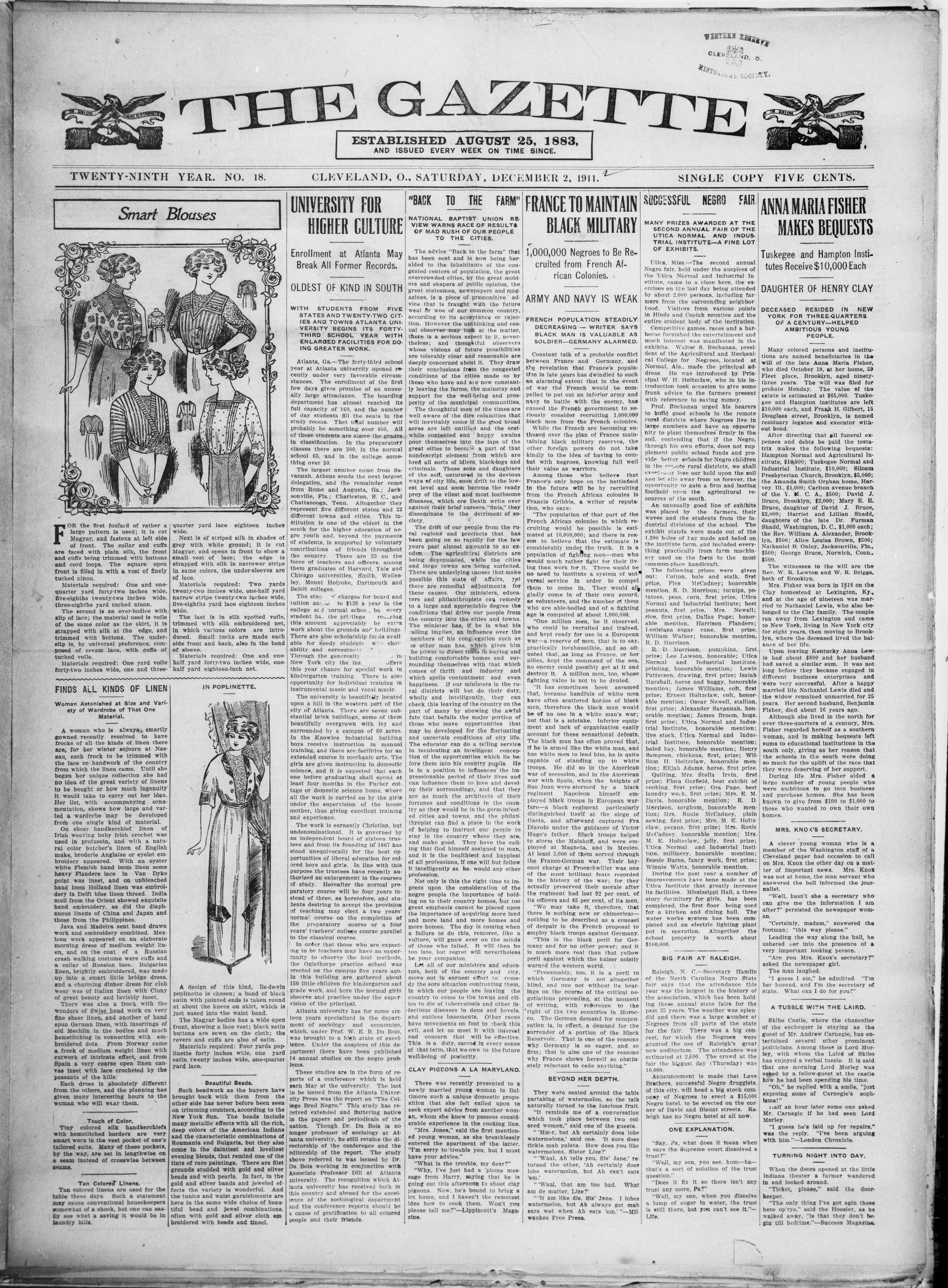
FOR the first foulard of rather a large pattern is used; it is cut Magyar, and fastens at left side of front. The collar and cuffs are faced with plain silk, the front and cuffs being trimmed with buttons and cord loops. The square open front is filled in with a vest of finely tucked ninon. Materials required: One and one-quarter yard forty-two inches wide, five-eighths twenty-two inches wide, three-eighths yard tucked ninon. The second is an over-bodice with slip of lace; the material used is volle of the same color as the skirt, it is strapped with silk at the edge, and trimmed with buttons. The underslip is, by universal preference, composed of cream lace, with cuffs of tucked volle. Materials required: One yard volle forty-two inches wide, one and three-
Woman Astonished at Size and Variety of Wardrobe of That One Material.
A woman who is always, smartly gowned recently resolved to have frocks of all the kinds of linen there are, for her winter sojourn at Nassau, each frock to be trimmed with the lace or handwork of the country from which the linen came. Until she began her unique collection she had no idea of the great variety of linsen to be bought or how much ingenuity it would take to carry out her idea. Her list, with accompanying ornamentation, shows how large and varied a wardrobe may be developed from one single kind of material. On sheer, handkerchief linen of Irish weaving Irish crochet was used in profusioin, and with a natural color butcher's linen of English maker, broderie Anglaise or eyelet embroidery appeared. With an oyster white Flémish hand loom linen some heavy Flanders lace in Van Dyke point was inset, and on unbleached hand loom Holland linen was embroidery in Delft blue linen thread. India null from the Orient showed exquisite hand embroidery, as did the diaphanous linens of China and Japan and those from the Philippines. Java and Madeira sent hand drawn work and embroidery combined. Mexican work appeared on an elaborate morning dress of medium weight linen, and on the coat of a Russian crash walking costume were cuffs and a collar of Russian lace. Bulgarian linen, brightly embroidered, was made up into a smart little bridge dress, and a charming dinner dress for club wear was of Italian linen with Cluny of great beauty and lavishy inset.
There was also a frock with the wonders of Swiss hand work on very fine sheer linen, and another of hand spun German linen, with insertings of old Mechlin in the bodice and much hemmishting in connection with embroidered dots. From Norway came a frock of medium weight linen with cutwork of intricate effect, and from Spain a very coarse open linen canvas inset with lace crocheted by the peasants of the hills.
Each dress is absolutely different from the others, and the planning has given many interesting hours to the woman who will wear them.
Touch of Color.
Tiny colored silk handkerchiefs with hemstitched borders are very smart worn in the vest pocket of one's tailored suits. Many of these pockets, by the way, are set in lengthwise on a seam instead of crosswise between seams.
Tan Colored Linens
Tan colored linens are used for the table these days. Such a statement may cause conventional housekeepers somewhat of a shock, but one can easily see what a saving it would be in laundry bills.
THE GAZETTE
quarter yard lace eighteen inches wide.
Next is of striped silk in shades of grey with white ground; it is cut Magyar, and opens in front to show a small vest of lace; the edge is strapped with silk in narrower stripe in same colors, the under-sleeves are of lace.
Materials required: Two yards twenty-two inches wide, one-half yard narrow stripe twenty-two inches wide, five-eighteen yard lace eighteen inches wide.
The last is in silk spotted voile, trimmed with silk embroidered net, in which various colors are introduced. Small tucks are made each side front and back, also in the bend of sleeve.
Materials required: One and one-half yard forty-two inches wide, one half yard eighteen-inch net.
1
A design of this kind, he-de-vin poplinette is chosen; a band of black satin with pointed ends is taken round at about the knees on skirt, which is just eased into the waist band. The Magyar bodice has a wide open front, showing a lace vest; black satin buttons are sewn on the cloth; the revers and cuffs are also of satin. Materials required: Four yards poplinette forty inches wide, one yard satin twenty inches wide, one-quarter yard lace.
Beautiful Beads.
Such beadwork as the buyers have brought back with them from the other side has never before been seen on trimming counters, according to the New York Sun. The beads include many metallic effects with all the rich deep colors of the American Indians and the characteristic combinations of Roumania and Bulgaria, but they also come in the dainiest and loveliest evening blends, that remind one of the tints of rare paintings. There are flat grounds studded with gold and silver beads and with pearls. In fact, in the gold and silver bands and jeweled effects the variety is wonderful. And the tunics and waist garnishments are here in the same wide choice of beautiful bead and jewel combinations, often with gold and silver cloth embroidered with beads and tinsel.
ESTABLISHED AUGUST 25, 1883 AND ISSUED EVERY WEEK ON TIME SINCE.
UNIVERSITY FOR HIGHER CULTURE
Enrollment at Atlanta May Break All Former Records.
OLDEST OF KIND IN SOUTH
WITH STUDENTS FROM FIVE STATES AND TWENTY-TWO CITIES AND TOWNS ATLANTA UNIVERSITY BEGINS ITS FORTY-THIRD SCHOOL YEAR WITH ENLARGED FACILITIES FOR DOING GREATER WORK.
Atlanta, Ga.—The forty-third school year at Atlanta university opened recently under very favorable circumstances. The enrollment of the first few days gives promise of an unusually large attendance. The boarding department has almost reached its full capacity of 160, and the number of day students fill the seats in the study rooms. The total number will probably be something over 400. All of these students are above the grades in classification. In the preparatory classes there are 300, in the normal school 65, and in the college something over 50.
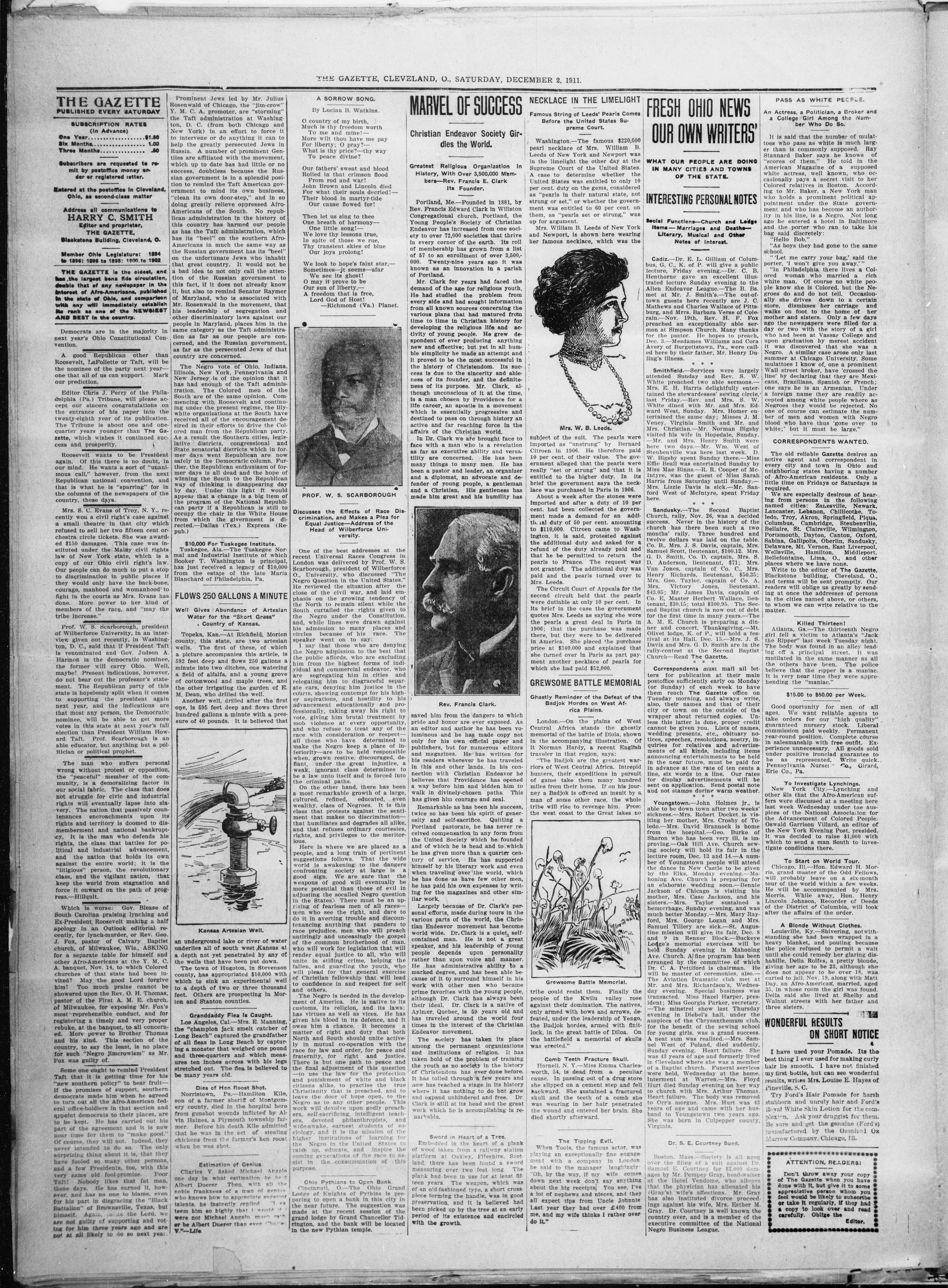
The largest number come from Savannah. Athens sends the next largest delegation, and the remainder come from Rome and Augusta, Ga.; Jacksonville, Fl.; Charleston, S. C., and Chattanooga, Tenn. Altogether they represent five different states and 22 different towns and cities. This institution is one of the oldest in the south for the higher education of negro youth and, beyond the payments of students, is supported by voluntary contributions of friends throughout the country. There are 33 on the force of teachers and officers, among them graduates of Harvard, Yale and Chicago universities, Smith, Wellesley, Mount Holyoke, Dartmouth and Beloit colleges.
The student charges for board and tuition amount to $120 a year in the college and normal school, but every student has the privilege reducing this amount appreciably by extra work about the grounds and buildings. There are also scholarship funds available for needy students who show ability and earnestness. Through the generosity in New York city the ins offers this year chance for special work in kindergarten training. There is also opportunity for individual training in instrumental music and vocal music.
The university is beautifully located upon a hill in the western part of the city of Atlanta. There are seven substantial brick buildings, some of them beautifully overgrown with ivy and surrounded by a campus of 60 acres. In the Knowles industrial building boys receive instruction in manual training, and there are facilities for an extended course in mechanic arts. The girls are given instruction in domestic science, and it is expected that each one before graduating shall spend at least four months in the Furter cotage or domestic science home, where all the work is carried on by the girls under the supervision of the house mother, thus giving excellent training and experience.
The work is earnestly Christian, but undenominational. It is governed by an independent board of sixteen trustees and from its founding in 1867 has stood unequivocally for the best opportunities of liberal education for colored boys and girls. In line with this purpose the trustees have recently authorized an enlargement in the courses of study. Hereafter the normal preparatory course will be four years instead of three, as heretofore, and students desiring to accept the provision of teaching may elect a two years' normal course on the completion of the preparatory course or a four years' teachers' college course parallel to the classical course.
In order that those who are expecting to be teachers may have an opportunity to observe the best methods, the Oglethorpe practice school was erected on the campus five years ago, in this building are gathered about 150 little children for kindergarten and grade work, and here the normal girls observe and practice under the supervision of the principal.
Atlanta university has for some sixteen years specialized in the department of sociology and economics, which, under Prof. W. E. B. Du Bois, was brought to a high state of excellence. Under the auspices of this department there have been published 14 annual studies on the negro problems.
These studies are in the form of reports of a conference which is held each May at the university. The last to be issued from the Atlanta University Press was the report on "The College Bred Negro." This study has received extended and flattering notice in the papers and periodicals of the nation. Though Dr. Du Bois is no longer professor of sociology at Atlanta university, he still retains the directorship of the conference and the editorship of the report. The study above referred to was issued by Dr. Du Bois working in conjunction with Associate Professor Dill at Atlanta university. The recognition which Atlanta university has received both in this country and abroad for the excellence of the sociological department and the conference reports should be a cause of gratification to all colored people and their friends.
"BACK TO THE FARM"
NATIONAL BAPSTIST UNION REVIEW WARNS RACE OF RESULTS OF MAD RUSH OF OUR PEOPLE TO THE CITIES.
The advice "Back to the farm" that has been sent and is now being heralded to the inhabitants of the congested centers of population, the great overcrowded cities, by the great molders and shapers of public opinion, the great statesmen, newspapers and magazines, is a piece of premonitive advice that is fraught with the future weal or woe of our common country, according to its acceptance or rejection. However the unthinking and casual observer may look at the matter, there is a serious aspect to it, nevertheless; and thoughtful observers whose visions of future possibilities are tolerably clear and reasonable are deeply concerned about it. They draw their conclusions from the congested conditions of the cities made so by those who have and are now constantly leaving the farms, the mainstay and support for the well-being and prosperity of the municipal communities. The thoughtful men of the times are well aware of the dire calamities that will inevitably come if the good broad acres are left untiled and the erstwhile contented and happy swains pour themselves into the laps of the great cities to become a part of that nondescript element from which are bred all sorts of idlers, blacklegs and criminals. These sons and daughters of the soft, untutored in the devious ways of city life, soon drift to the lowest level and soon become the ready prey of the vilest and most loathsome diseases, which are Death write over against their brief careers, "this," they disseminate to the detriment of society.
The drift of our people from the rural regions and precincts that has been going on so rapidly for the few years past almost amounts to an exodus. The agricultural districts are being depopulated, while the cities and large towns are being surfafted. There are underlying causes that make possible this state of affairs, yet there are remedial adjustments for these causes. Our ministers, educators and philanthropists can remedy to a large and appreciable degree the conditions that drive our people from the country into the cities and towns. The minister has, if he is what his calling implies, an influence over the members of his congregation such as no other man has, which gives him the power to direct them in buying and building comfortable homes and surrounding themselves with that which comes of thrift and industry and which spells contentment and even happiness. If our ministers in the rural districts will but do their duty, wholly and intelligently, they can check this leaving of the country on the part of many by showing the awful fate that befalls the major portion of those who leave opportunities that may be developed for the fluctuating and uncertain conditions of city life. The educator can do a telling service in inculcating an intelligent conception of the opportunities which lie before them into his country pupils. He is in a position to influence the impressionable period of their lives and can influence them to love and develop their surroundings, and that they are as much the architects of their fortunes and conditions in the country as they would be in the germ-infested cities and towns, and the philanthropist can find a place in the work of helping to instruct our people to stay in the country where they are, and make good. They have the calling that God himself assigned to man, and it is the healthiest and happiest of all professions, if one will but follow it intelligently as he would any other profession.
Not only is this the right time to impress upon the consideration of the negro people the importance of holding on to their country homes, but too great emphasis cannot be placed upon the importance of acquiring more land and more land and more homes and more homes. The day is coming when a failure to do this, remorse, like a vulture, will gnaw ever on the minds of those who failed. It will then be too late, but regret will nevertheless be your companion.
Let all of our ministers and educators, both of the country and city, move out in earnest effort to remedy the sore situation confronting them, in which our people are leaving the country to come to the towns and cities to die of tuberculosis and other infectious diseases in dens and hovels, and sunless basements. Other races have movements on foot to check this evil, and let us meet it with interest and concern that will be effective.
This is a duty, sacred in every sense of that term, that we owe to the future well-being of posterity.
CLAY PIGEONS A LA MARYLAND.
There was recently presented to a newly married young woman in Baltimore such a unique domestic proposition that she felt called upon to seek expert advice from another woman, whom she knew to possess considerable experience in the cooking line.
"Mrs. Jones," said the first mentioned young woman, as she breathlessly entered the apartment of the latter, "I'm sorry to trouble you, but I must have your advice."
"What is the trouble, my dear?"
"Why, I've just had a 'phone message from Harry, saying that he is going out this afternoon to shoot clay pigeons. Now, he's bound to bring a lot home, and I haven't the remotest idea how to cook them. Won't you please tell me?"—Lippincott's Magazine.
FRANCE TO MAINTAIN BLACK MILITARY
1,000,000 Negroes to Be Recruited from French African Colonies.
ARMY AND NAVY IS WEAK
FRENCH POPULATION STEADILY DECREASING — WRITER SAYS BLACK MAN IS VALUABLE AS SOLDIER—GERMANY ALARMED.
Constant talk of a probable conflict between France and Germany, and the revelation that France's population in late years has dwindled to such an alarming extent that in the event of war the French would be compelled to put out an inferior army and navy to battle with the enemy, has caused the French government to seriously consider recruiting 1,000,000 black men from the French colonies. While the French are becoming enthused over the plan of France maintaining black military reserves, the other foreign powers do not take kindly to the idea of having to combat with negroes, knowing full well their value as warriors.
Among those who believe that France's only hope on the battlefield in the future will be by recruiting from the French African colonies is Francis Gribble, a writer of reputation, who says:
"The population of that part of the French African colonies in which recruiting would be possible is estimated at 10,000,000; and there is reason to believe that the estimate is considerably under the truth. It is a population of fighting men—men who would much rather fight for their living than work for it. There would be no need to institute a system of universal service in order to compel them to come in. They would all gladly come in of their own accord, as volunteers, and the number of them who are able-bodied and of a fighting age is computed at about 10,000,000.
"One million men, be it observed, who could be recruited and trained, and kept ready for use in a European war—a reserve of men, that is to say, practically inexhaustible, and so situated that, as long as France, or her allies, kept the command of the sea, no enemy could possibly get at it and destroy it. A million men, too, whose fighting value is not to be denied.
"It has sometimes been assumed that, because handfuls of white men have often scattered hordes of black men, therefore the black man would be of no use in a white man's war; but that is a mistake. Inferior equipment and lack of organization easily account for these sensational defeats. The black man has often proved that, if he is armed like the white man, and has white men to lead him, he is quite capable of standing up to white troops. He did so in the American war of secession, and in the American war with Spain, when the heights of San Juan were stormed by a black regiment Napoleon himself employed black troops in European warfare—a black regiment particularly distinguished itself at the siege of Gaeta, and afterward captured Fra Diavolo under the guidance of Victor Hugo's father. Black troops helped to storm the Malakoff, and were employed at Magneta, and in Mexico. At least 3,000 of them served through the Franco-German war. Their lay-onet charge at Froeschwiller was one of the most brilliant feats recorded in the history of the war; for they actually preserved their morale after the regiment had lost 92 per cent. of its officers and 85 per cent. of its men. We may take it, therefore, that there is nothing new or chimerical—nothing to be described as a counsel of despair in the French proposal to employ black troops against Germany.
"This is the black peril for Germany and for no other power; and it is much more real than that yellow peril against which the kaiser notisly warned the western world.
"Presumably, too, it is a peril to which Germany is not altogether blind, and one not without its bearings on the course of the critical negotiations proceeding, at the moment of writing, with reference to the right of the two countries in Morocco. The German demand for compensation is, in effect, a demand for the surrender of a portion of the Black Reservoir. That is one of the reasons why Germany is so eager, and so firm; that is also one of the reasons why France shows herself so obstinately reluctant to cede anything."
BEYOND HER DEPTH.
They were seated around the table partaking of watermelon, so the talks naturally turned to the luscious fruit. "It reminds me of a conversation which took place between two colored women," said one of the guests. "‘Mm-r, but Ah certainly does lobe watermelons,’ said one. It sure does tinkle mah palate. How does you like watermelons, Sister Lize?’ "‘Waal, Ah tells you, Sis' Jane,' returned the other, ‘Ah certainly does lobe watermelon, but Ah can't eats 'em.'" "Waal, that am too bad. What am de matter, Lize?’ " "It am like dis, Sis' Jane. I lobes watermelon, but Ah always gets mah ears wet when Ah eats 'em.'"—Mill waukee Free Press.
SINGLE COPY FIVE CENTS.
WESTERN RESERVE
CLEVELAND, O.
HISTORICAL SOCIETY.
MANY PRIZES AWARDED AT THE SECOND ANNUAL FAIR OF THE UTICA NORMAL AND INDUSTRIAL INSTITUTE—A FINE LOT OF EXHIBITS.
Utica, Miss.—The second annual Negro fair, held under the auspices of the Utica Normal and Industrial Institute, came to a close here, the exercises on the last day being attended by about 2,000 persons, including farmers from the surrounding neighborhood. Visitors from various points in Hinds and Copiah counties and the entire student body of the institution. Competitive games, races and a barbecue furnished the entertainment and much interest was manifested in the exhibits. Walter S. Buchanan, president of the Agricultural and Mechanical College for Negroes, located at Normal, Ala., made the principal address. He was introduced by Principal W. H. Holtzclaw, who in his introduction took occasion to give some frank advice to the farmers present with reference to saving money.
Prof. Buchanan urged his hearers to build good schools in the remote rural districts where Negroes live in large numbers and have an opportunity to soil themselves firmly in the soil, contending that if the Negro, through his own efforts, does not sup plement public school funds and provide better schools for Negro children in the remote rural districts, we shall ever lose our hold upon the soil and let slip away from us forever, the opportunity to gain a firm and lasting foothold upon the agricultural resources of the south.
An unusually good line of exhibits was placed by the farmers, their waves and the students from the industrial divisions of the school. The exhibit stands were made out of the 1,200 bales of hay made and baled on the institute farm, and included everything practically from farm machinery used on the farm to the most common-place handicraft.
The following prizes were given out: Cotton, bale and stalk, first prize, Ples McCadney; honorable mention, R. D. Morrison; turnips, potatoes, peas, corn, first prize, Utica Normal and Industrial Institute; best peanuts, first prize, Mrs. Newell; rice, first prize, Dallas Page; honorable mention, Harrison Flanders; Louisiana sugar cane, first prize, William Walker; honorable mention, R. D. Morrison.
During the past year a number of improvements have bene made at the Utica Institute that greatly increase its facilities. Mississippi Hall, a three story dormitory for girls, has been completed, the first floor being used for a kitchen and dining hall. The water works system has been completed and an electric lighting plant put in operation. Altogether the school property is worth about $100,000.
BIG FAIR AT RALEIGH.
Raleigh, N. C.—Secretary Hamlin of the North Carolina Negro State fair says that the attendance this year was the largest in the history of the association, which has been holding these annual state fairs for the past 35 years. The weather was splendid and there was a large number of Negroes from all parts of the state for the fair. There was a big concert, for which the Negroes were granted the use of Raleigh's great new auditorium. The attendance was estimated at 2,500. The crowd at the fair the biggest day (Thursday) was 10,000.
Announcement is made that Love Brethers, successful Negro druggists, of this city, will head a big stock company of Negroes to erect a $15,000 Negro hotel, to be erected on the corner of Davis and Blount streets. Raleigh has no Negro hotel at all now.
ONE EXPLANATION
"Say, Pa, what does it mean when it says the Supreme court dissolved a trust?"
"Well, my son, you see, hum—ha—that's a sort of solution of the trust question."
"Does it fix it so there isn't any trust any more, Pa?"
"Well, my son, when you dissolve a lump of sugar in water, the trust is still there, but you can't see it"—Life.
IN UNION
THERE IS A THREED
ANNA MARIA FISHER MAKES BEQUESTS
Tuskegee and Hampton Institutes Receive $10,000 Each
DAUGHTER OF HENRY CLAY
DECEASED RESIDED IN NEW YORK FOR THREE-QUARTERS OF A CENTURY—HELPED AMBITIOUS YOUNG PEOPLE.
Many colored persons and institutions are named beneficiaries in the will of the late Anna Maria Fisher, who died October 19, at her home, 59 Fleet place, Brooklyn, aged ninety-three years. The will was filed for probate Monday. The value of the estate is estimated at $65,000. Tuskegee and Hampton institutes are left $10,000 each, and Frank H. Gilbert, 15 Douglass street, Brooklyn, is named residuary legatee and executor without bond.
After directing that all funeral expenses and debts be paid the testatrix makes the following bequests: Hampton Normal and Agricultural Institute, $10,000; Tuskegee Normal and Industrial Institute, $10,000; Siloam Presbyterian Church, Brooklyn, $5,000; the Amanda Smith Orphan home, Harvey III, $1,000; Carlton avenue branch of the Y. M. C. A., $500; David J. Bruce, Brooklyn, $2,000; Mary E. E. Bruce, daughter of David J. Bruce, $2,000; Harriet and Lillian Shadd, daughters of the late Dr. Furman Shadd, Washington, D.C., $1,000 each; the Rev. William A. Alexander, Brooklyn, $500; Alice Louisa Brown, $500; Nathaniel B. Onley, Jacksonville, Fla., $500; George Bruce, Norwich, Conn., $500.
The witnesses to the will are the Rev. W. R. Lawton and W. R. Briggs, both of Brooklyn.
Mrs. Fisher was born in 1818 on the Clay homestead at Lexington, Ky., and at the age of nineteen was married to Nathaniel Lewis, who also belonged to the Clay family. The couple ran away from Lexington and came to New York, living in New York city for eight years, then moving to Brooklyn, where the deceased lived the balance of her life.
Upon leaving Kentucky Anna Lewis had about $800 and her husband had saved a similar sum. It was not long before they became engaged in different business enterprises and were very successful. After a happy married life Nathaniel Lewis died and the widow remained unmarried for 25 years. Her second husband, Benjamin Fisher, died about 16 years ago. Although she lived in the north for over three-quarters of a century, Mrs. Fisher regarded herself as a southern woman, and in making bequests left sums to educational institutions in the south only, giving as her reason that the schools in the south were doing so much for the uplift of the race that they were deserving of her support. During life Mrs. Fisher aided a large number of young people who were ambitious to go into business and purchase homes. She has been known to give from $100 to $1,000 to those who wanted to own their own homes.
MRS. KNOX'S SECRETARY
A clever young woman who is a member of the Washington staff of a Cleveland paper had occasion to call on Mrs. Knox the other day on a matter of important news. Mrs. Knox was not at home, the man servant who answered the bell informed the journalist.
"Well, hasn't she a secretary who can give me the information I am after?" persisted the newspaper woman.
"Certainly, madam," answered the footman; "this way please."
Leading the way along the hall, he ushered her into the presence of a very important looking person.
"Are you Mrs. Knox's secretary?" asked the newspaper girl.
The man laughed.
"I guess I am," he admitted. "I'm her husband, and I'm the secretary of state. What can I do for you?"
A TUSSLE WITH THE LAIRD.
Skibo Castle, where the chancellor of the exchequer is staying as the guest of Mr. Andrew Carnegie, has entertained several other prominent politicians. Among these is Lord Morley, with whom the Laird of Skibo has enjoyed a verbal tussle. It is said that one morning Lord Morley was asked by a fellow-guest at the castle how he had been spending his time. "Oh," he replied with a smile, "just exposing some of Carnegie's sophisms!"
I half an hour later some one asked Mr. Carnegie if he had seen Lord Morley.
"I guess he's laid up for repairs," was the reply. "I've been arguing with him."—London Chronicle.
TURNING NIGHT INTO DAY
When the doors opened at the little Indiana theater a farmer wandered in and looked around.
"Ticket, please," said the doorkeeper.
"The only thing I've got agin these here oprys," said the Hoosier, as he walked away, "is that they don't begin till bedtime."—Success Magazine.
\! ae
——$<$
| J. S. HALL'S, 3121 Central Ave.
L. SCHWARTZ, 2031 Central Avg. Open Sunday.
FURCHASE 0. c. scHROEDER'S, Cuyahoge Bilg. Open Sunday.
V sn py ELMER F. BOYD'S, 2604 Central Ave.
| GAZETTE” AT r. vaLentiNe’s, 2130 Central Ave.’
NOTICE TO SUBSCRIBERS:—Subscribers not receiving The Gazette regu-
larly should notify us at once. We desire every copy delivered promptly.
We advise our patrons to carefully examine ‘The Gazatte's advertisements
before making purchases, Business. men who advert in this paper
should have the patronage of Afro-Americans, The tact that they ad
ects is assurance that. they want It
Local reading notices (advertisoments) ten cent a line (alx words ina ine)
NOTARY PUBLIC For such 0 | sites Ruth Anna Fisher of Lorain
ces call at The Gazette office, No. | and Afiss Corinne Thomas of Oberlin
ee ene OSubertr eyenue, | attended grand opera here to hear
umes, finely illustrated, handy to han-
die. Unexcelled for ‘reference pur-
poses. A library in itself—one that
will last a life-time. Contains every:
thing you may wish to know. Call or
Address, The Gazette, Blackstone
Building, 1422 W. $d St,, Cleveland, 0.,
near Superior Av. This is an oppor-
tunity of a life-time for those who love
good books.
For Sale or Furs—AUTOMOBILISTS
ATTENTION! Having secured a few
elegant fur-lined coats, robes and fur
sets for professional ‘services, will
‘sacrifice for quick cash sales. ‘Gents’
black broadcloth coat, lined with
Spanish mink (full skins), elegant
Persian lamb collar, cost $90, will sell
for $35, also gents’ whole skin musk-
rat lined coat, Persian lamb collar,
cost $140, sell for $45. Black or
Drown cub bear robes, size 54x66, bea-
ver cloth lined, cost $90, sell for $30
a pair, Ladies French sable fur coat
(brown), length 52 inches, bargain
for $30;' same in black, $28. Latest
style Belgian lynx set $12, or black
fox set $15, Iceland fox set (white),
$20. All new this season, Write G.
Morehead, 118 Bast 28th St, New
York City.
of Detroit, Mich., at Haltnorth’s: hall,
Monday evening, Dec. 18.
St. Andrews’ cholr will give its sec-
ond song service, Sunday. New
music, Go early and get a good seat.
The stockholders of the Peoples
Drug store have voted to sell it, and
the deal will be consummated ‘in a
few days.
Mr. Geo. Buchanan of N. Yakima,
Wash., arrived in the city, the past
‘week from Springfield where he went
to attend the funeral of a brother-in-
law.
Benjamin L. Shook, manager of Fin-
ney's great orchestra, will be pleased
to see his many friends at Haltuorth's
hall, Monday evening, Dec. 18,
Helen O, Bouldon, one of our local
public school teachers, and Nahum D.
Brascher of Columbus, will be mar-
ried, Wednesday evening, at the home
of Rev. G. V. Clark, it is reported.
Bert. Williams, ‘the comedian of
‘Geigteld’s Follies” at the Opera
house, this week, was called to New
York ‘the first of the week by his
father’s illness.
‘Arrangements are being made for a
meeting of the Citizens’ Rights league
at Antioch church, next Wednesday
evening, Announcement will be made
in all the churches, Sunday, if they
are perfected. f
Cuyahoga Lodge, Wiks, will hold its
memorial service ‘at Cory Church,
Scovill Ave. Sunday at 2:30, p.m.
‘, B. Akridge and Will R. Jackson
Fetyimed the frat of the week from
an extended trip to New Orleans and
other points in the south.
‘Do not forget the entertainment at
St. John’s church, Wednesday even-
ing, Dec. 6, for Tuskegee Institute. 2
Bo not tuil to read our advertise:
ments and_ patronize those who ask
for your trade in the columns of The
Gazette.
Send your local items to The Ga-
zette on Monday or Tuesday of each
Week. This paper is published for
ALL of our people and “plays no fa-
Yorites." Everybody is treated the
same—fair and right, Take The Ga-
zette and tell your friends to do s0
also.
Do not fail to hear Miss St. Clair
White, the 16 year old violinist, of
Northwestern University, Chicago, at
Haltnorth’s Assembly hall, Monday
evening, Dec. 4. under the auspices of
St Andrews’ Dramatic club. This is
fo be the finest affair of the season.
‘A first-class orchestra for the prom-
‘enade, will be in attendance. Admis-
sion, fifty cents.
‘The first anniversary, and installa:
tion of officers of the Law & Order
Reform league will be held at Mt.
Haven church, Tuesday evening and a
fine program will be rendered. An-
tioch’s choir of 20 voices, Revs. Sissle,
Bailey and W. G. Webster, Attorney
John M. Anderson and A. M. Parks
are the participants.
‘The editor of The Gazette acknow!-
edges the receipt of an invitation to
fattené the Chauffeurs’ Club dancing
party, Tuesday evening, at Trostler's
Academy, 2084 E. 55th St. Fairfax’s
orchestra will furnish music, | and
there will be dancing from 8:30 p.
m, to 1 a. m, The committe of ar-
fangemenis, Wm. Gray, Wm, Grant,
‘'T. L, Christopher, Art Goodwin, Fred
Ciark, floor manager, and J. B. Jobn-
Son, assistant. m
dirs, F. G. Snelson returned Sunday
afternoon from a three weeks’ visit
in Chicago. While there she attend-
ed the Parent M. S., addressed Quinn
Chapel 8. S., the C. E. of the Institu-
tional church, and on the 20th ult,
spoke at the ministerial anniversary
of Rev. A, J. Carey. She attended the
Bowman reception. the Quinn Chapel
and City Federation banquet which
‘was aiso addressed by U. 3. Senator
Lorimer, Cyrus Fields Adams, assist:
“ant register of the U, 8. treasury, and
snany others. Mrs, Snelson, ihe guest
‘ot Mra, Ida Wells Barnett of that
“oliy, addressed the Fellowship Club,
“Of which the Istter is president, and
“spoke at the memorial services in
“Bonor of the late Justice Harlan.
Poot. Purnay of the Illinois State
“Wnlversity was Miso a speaker. The
pew stewardestes’ board will be in
‘sialled Sunday at St. James’ church
Dr. Boelson’s lecture at Mt. Zion
“chureh, Sunday afternoon, {s being
‘ighly complimented.
Miss Ruth Anna Fisher of Lorain
and Miss Corinne Thomas of Oberlin
attended grand opera here to hear
Mary Garden in “Thais,” last week
Monday evening.
Dan Fairtax, exReserve fullback
and punter extraordinary, took charge
rot the Case punters last week, and
| gave the men some valuable pointers
[In how to doot to the oval. ‘Pairtax
in addition to being a good kicker
eet has developed several star
Dunters including Homer Davidson
‘Tip Tyler, Muff Portmhun, Joe Blue
of Central high and Earl Sprackling
jcaptain of the Brown eleven, Dan
worked with Slater, Kenyon, Young
and Parsons last week and before the
first lesson was ended some of the
Kickers were getting greater dis:
tance. Fairfax thinks that Kenyon
has the making of a star punter. Sla-
ter of course ig the best of the quar.
tet and next to Roby is the best pun-
ter Case has, but as Young, Parsons
and Kenyon will return to Case next
fall the drilling they are getting in
kicking now will help them materially
next season. It may look very pecul-
far to see a former star fullback of
@ neighboring university team coach-
ing the kickers of that university's
greatest rival, but that is what is hap-
pening at Case right now. ‘Times
have changed in a football way.
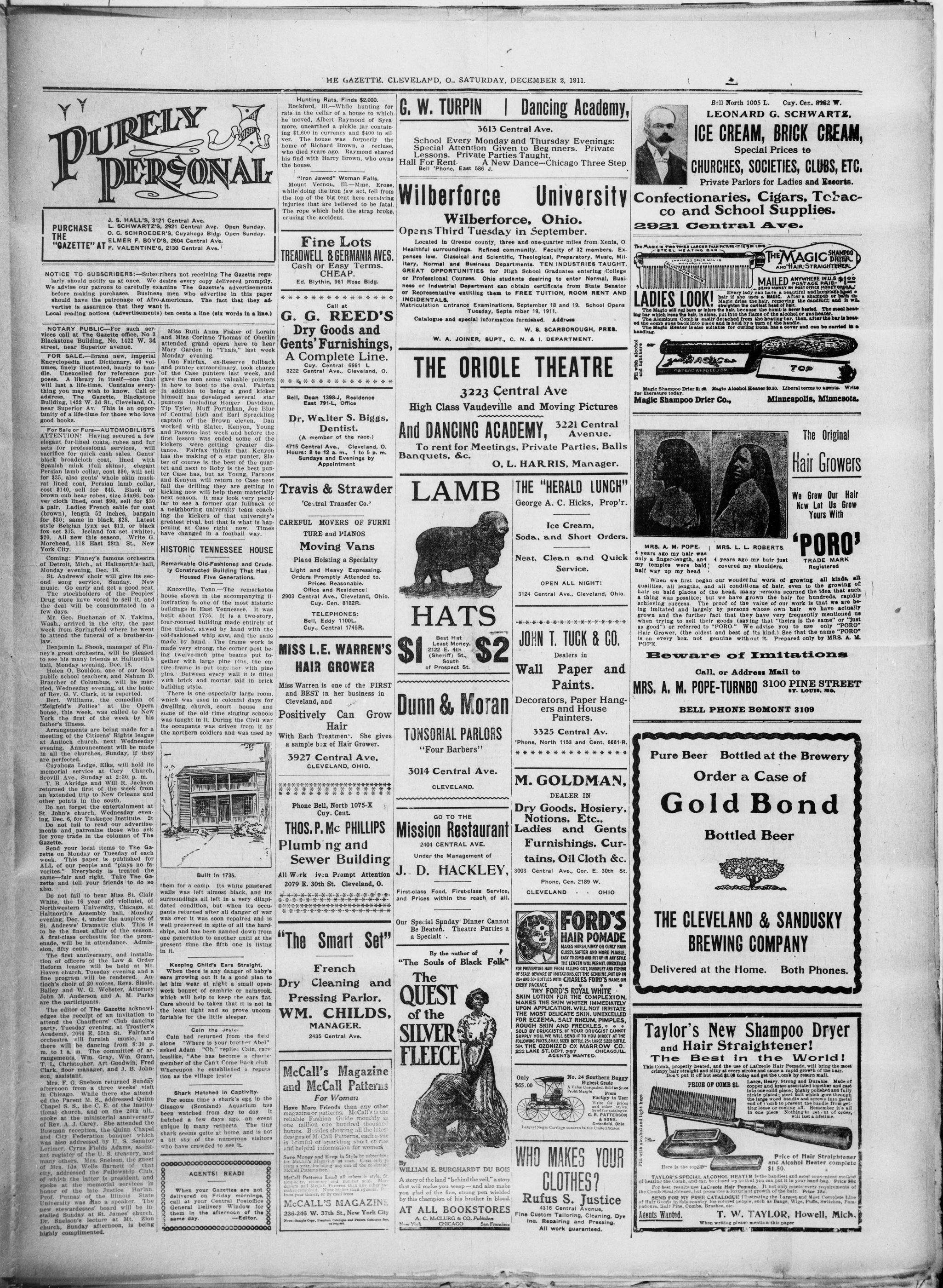
HISTORIC TENNESSEE HOUSE
Remarkable Old-Fashioned and Crude.
ly Constructed Building That Has
Licked HME Canérautliain.
Knoxville, Tenn—The remarkable
house shown in the accompanying il
lustration ts one of the most historic
buildings in East Tennessee, It was
built about 1735. It is a two-story,
four-roomed butlding made entirely of
fine timber, sawed by hand with the
old-fashioned whip saw, aud. the nails
made by hand. The frame work 1s
made very strong, the corner post be-
ing twelveineh pine beams put to-
gether with large pine pins, the en-
Ure frame Is put toge ser with pine
pins. Between every wall it is filled
with brick and mortar laid in brick
bullding style.
There is one especially large room,
which was used in colonial days for
welling, church, court house and
sume of the old time singing schools
was taught in It, During the Civil war
{ta occupants was driven from it by
the northern soldiers and was used by
“abe ih
} r
cat I;
\ Sa |
eh a | =I
= =H
*) 1 =i
|= Want)
= nie
1} -" in i
gtensS EE
| ——s7 -
ae 3
Bute in 1788
teenie 6 can. ith wars passren
elu res Nie men sss nace
surroundings all left in « very dilapt-
fuied couanies: tat ten hs gee
inte teed ther au acest of
tl ore van Gon cei ae
Bri srieceisoineiaoral toe teas
Bed tos tact brcass toon ee
Mala Gade ahi toe tes
mie
‘When there ie any danger of beby’s
ears growing out it Is a good plan to
let bim wear at night a small open
‘work bonnet of cambric or nainsook,
which will help to keep the ears flat.
Care should be taken that it is not in
the least Ugbt and so prove uncom-
fortable for the little sleeper.
Cain the Jester
Cain had returned from the field
alone “Where ts your brother Abel”
asked Adam “Ob,” repliew Cain, care
lesslike, “Abe bas become x charte:
member of the Can't Come Hack club
Whereupon he established u reputs
tion as the village jester
Shark Hatched In Captivity.
For some time a shark's exg i the
Glasgow (Scotland) Aquarium bas
been’ watched from day to day It
hatched a few days ago, an event
unique in many respects The tiny
shark seems quite at home, and is not
a bit shy of the mumeyous visitors
wbo bave crowded to see ft.
AGENTS! READ!
When your Gazettes are not
delivered. on Friday mornings,
call at your Central Postoftice
General Delivery Window for
them in the afternoon of the
game day. Editor. |
HE GAZETTE, CLEVELAND, O.. SATURDAY, DECEMBER 2, 1911.
ciel actecce ell ttienscme=oneeggecaaeeen
Hunting Rats, Finds $2,000. H
nutcase vw BW. TURPIN. | Dancing Ac
rats in the cellar of a house to which. | Vl .
he moved, Albert Raymond of Syca —
ing $1,600 in currency and $400 in sil | 3615 Central Ave.
ver. The house was formerly the) School Every Monday and Thursday Eve
Bone a eicherd Brows, eal Special Attention Given to Beginners. F
a aie ee an graymend shared | Lessons. Private Parties Taught,
Bist t Hall For Rent. A New Dance~-Chicago T!
Ee : | Bell 'Phone, East 586 J.
Mount Vernou, Il—Mme. Erose,
whild dann Gotten sea act tell hom
Teelep ol oa vir Gaal bare reoniring
{njurige that ere belleved to be fata
The rope which held the strap broke,
Fine Lots
TREADWELL & GERMANIA AVES.
Cash or Easy Terms.
CHEAP.
Eé. Biythin, 961 Rose Bldg.
Call at
G. G. REED’S
Dry Goods and
Gents’ Furnishings,
A Complete Line.
Guy, antral’ 6601 1.
Gee lane oa elsgtahy act t
Bell, Doan 1398-J, Residence
East 791-L, Office
Dr, Walter S. Biggs,
Dentist.
(A member of the race.)
A718 Central Ave, Cleveland, 0.
Hatee een Teer
cue aha Bvoninas oF
‘Appointment
Travis & Strawder
‘Ce.tral Transfer Co.’
CAREFUL MOVERS OF FURNI
TURE and PIANOS
Moving Vans
Piano Hoisting a Specialty
Light sed: envy’ Eereoning.
Oriees erarpoy Actenaed ta
Office and Residence:
2903 Central Ave., Cleveland, Ohio.
Guy. Gen. B182R.
TELEPHONES:
Bell, Eddy 1100L.
Cuy., Central 1745R.
MISS L.E. WARREN’S
HAIR GROWER
Miss Warren is one of the FIRST
and BEST in her business in
Cleveland, and =
Positively Can Grow
Hair
With Each Treatmen*. She gives
a sample box of Hair Grower.
3927 Central Ave,
CLEVELAND, OHIO.
ERP HOHE HERE EIR
ERG TE LEE E LEE EE
Phone Bell, Nortb 1075-K
Cuy. Cent.
THOS, P, Mc PHILLIPS
Plumb ng and
Sewer Building
All Work iven Prompt Attention
2079 E. 30th St. Cleveland, 0.
He HANK N-N-N-K-K-R-R- HALA He
JSS SSS
Siaguonnaiecrcarerpareerece
See eae SS
ec
“The Smart Set”
French
Dry Cleaning and
Pressing Parlor.
WM. CHILDS,
MANAGER.
2436 Central Ave.
Mor. MT SE
McCall’s Magazine
and McCall Patterns
For Women
Have More Friends than any other
ape Meee tee Suecons tte
ee cas ae
ee eee
homes. Besides showing all the lates
Nee oan acti each es
eee hee aoe
Ca hebnaes Ev euen
Sergtteney set Rew Stee Con ovis
ae
See ES wt wns
McCALL’S MAGAZIN=
236-246 W. 37th St. New York City
ee ees
3613 Central Ave.
School Every Monday and Thursday Evenings:
Special Attention Given to Begnners. Private
Lessons. Private Parties Taught,
Hall For Rent. A New Dance~-Chicago Three Step
Bell "Phone, East 586 J. :
. | .
p
v
Wilberforce, Ohio.
Opens Third Tuesday in September.
Located in Greene county, three and one-quarter miles from Xenia, O.
Healthful surroundings. Refined community. Faculty of 32 members. Ex:
Penses low. Classical and Scientific, Theological, Preparatory, Music, Mil
itary, Normal and Business Departments. TEN INDUSTRIES TAUGHT.
GREAT OPPORTUNITIES for High School Graduates entering College
or Professional Courses. Ohio students desiring to enter Normal, Busi-
ness oF Industrial Department can obtain certificate from State Senator
or Representative entitling them to FREE TUITION, ROOM RENT AND
INCIDENTALS,
Matriculation entrance Examinations, September 18 and 19, School Opens
Tuesday, Septe mber 19, 1911,
Catalogue and special information furnished, Address
W. 8. SCARBOROUGH, PRES.
W. A. JOINER, SUPT, C..N. & |. DEPARTMENT.
3223 Central Ave
High Class Vaudeville and Moving Pictures
And DANCING ACADEMY, °*Avencc™
To rent for Meetings. Private Parties, Balls
Banquets, &c.
O, L. HARRIS, Manager.
as, 3
I ned?
aga ce Re
Best Hat Pan
$i Least Money. $2
zie E, athe
(Sheritt) St,
South
of Prospect St.
Dunn & Moran
TONSORIAL PARLORS
“Four Barbers”
3014 Central Ave.
ae 7 GO TO THE
Mission Restaurant
J..D. HACKLEY,
Our Special Sunday Dinner Cannot
Be Beaks Theatre Parties a
a Specialt .
Le By the author of ,
“The Souls of Black Folk”
The
of the @
eg
SILVER 3:45
FLEECE\YA
Se |}
oe AN
Sealy Aes
GQ YASS
ne ey
WILLIAM E. BURGHARDT DU BOIS
Pa ieee
AT ALL BOOKSTORES
A.C MOLURG 6.60 Pues
Neve ee eee
G, W. TURPIN
Dancing Academy,
THE “HERALD LUNCH”
George A. C. Hicks, Prop’r.
Ice Cream,
Soda, and Short Orders.
Nest Clece oid’ Olek
Service.
OPEN ALL NIGHT!
3124 Central Ave,, Cleveland, Ohio.
RRR EE
JON T. TUCK & CO.
Dealers in
Wall Paper and
Paints.
Decorators, Paper Hang-
ers and House
Painters.
3325 Central Av.
‘Phone, North 1153 and Cent. 6661-R.
RRR K ERE RR
M. GOLDMAN,
DEALER IN
Dry Goods, Hosiery,
Notions, Etc.,
Ladies and Gents
Furnishings, Cur-
tains, Oil Cloth &c.
4003 Central Ave, Cor. E, 30th St
Phone, Cen, 2189 W.
CLEVELAND - - OHIO
es FORD'S
Fe
& ah HAIR POMADE
mac] MMs 38s me on con nan
OP | Soemorns
RG Y7 || esr toon 00 rare wanes
NOC TZ] Seecitt enna
Teton ral ane eo ae
rms ol tea ee
25+ AND Sos BOTTLES WITH CHARLES FORD'S MAME ON
saat CHALES FORD'S
TRY FORD'S ROYAL WHITE *
SKIN LOTION FOR THE COMPLEXION.
Sey eso
Sane a an
rena eee
FOR ECZEMA, SALT RHEUM, PIMPLES,
RU SAND PR cy
Sa onto ar ae ct
Sir emanate
50% THE OZONIZED OX MARROW CO.
ae eae
965.00 SAW 4 vance
Bi int Pea
ORO) ene ee
7 SO PATTERSON
xe Ss
WHO MAKES YOUR
GLOTHES?
(ORO Bell North 1005 L. —Cuy. Cen. 9962 W. :
3 ¥ 3 LEONARD G. SCHWARTZ,
{pee
» ICE CREAM, BRICK CREAM,
we Special Prices te
fe CHURCHES, SOCIETIES, CLUBS, ETC.
mi Private Parlors for Ladies and Rseorts.
Confectionaries, Cigars, Tchac-
co and School Supplies.
2921 Central Ave.
Te Ane ee TREE IS Cet ;
g yennmnaraed © “ae Fa WER.
TD wea
| see ll ne WS @ 123
“USCA Map ee i
LADIES LOOK! wae ees
"The Magi will nl burn o Injure the har Gechuge th Comin Reer Rested. Tho steal Rent
ee cae Wea te ees Rees eect ee
oe esi untae Wad nas Tor nas Is ESAS ca be arnt 8
aan pe ae
§ cacy
# CEERI Top
ee :
(Stee tee ma tee se tl ce
Magic Shampoo Drier Co., Minneapolis, Minnesota,
a ae fe. a
ea BR a Ses Bi xi
He, ee
peo ae re P
ie ee A ye a ae:
Sb
When we first vegan our wonderful work of growing all kinds ald
qualities, all lengths, aud ail conditions of hair, even to the growing of
Lair on bald places of the head, many yersons scorned the idea that such:
4 thing was possible, but we have grown the hair for hundreds, rapidly
achieving success. The proof of the vaiue of our work is that we are be-
ing Imitated and largely by persons whose own hair we have actually
frown and the further fact that they have very frequently mentioned us
when trying to sell thoir goods (saying that “theirs 1s the same” or “Just
ts good") of referred to “PORO." We advise you to use only “PORO”
Hair Grower, (the oldest and best of {ts kind.) See that the name “PORO”
fs on every box. not genuine without 't Prepared only by MRS. A ML
Porr.
Weware of Imitations
Call, or Address Mail to
MRS, A. M. POPE-TURNBO 920° SESE.S2 B27
yy As Mh Sr. LOUIS, m0,
BELL PHONE BOMONT 3109
Pure Beer Bottled at the Brewery
Order a Case of
Gold Bond
Bottled Beer
THE CLEVELAND & SANDUSKY
BREWING COMPANY
Delivered at the Home. Both Phones.
- ° ie
Taylor's New Shampoo Dryer
and Hair Straightener!
The Best in the World!
Gach re beef sme a tS cl re
Crimea pat ad donde gr tay ead gue he Lamh by enura all”
cop na) eee ota Dust sed
ei OY reenter cea ia
£ AAA ene Soeur ene et
= i HH HTML) seactton to prevent te bande ftom ge
2& aC Misono oging ut Remember ia
TL oer ne Seti cians!
3 ____ ae
7 a Pay
i. =, ee
a ita < Pokcu of Rake Siieroaar
nS game cite ge Alcohol Heater compete
sc andVQhSSRPSI ateenoy MEAT he hn et oe pen ae
re sor hese epitome LaCete He Pete, Tok sal met tat inant ot
AR ame carey eu aro ote
ian Garhi Om een ee ee ee
eats Wanted, T. W. TAYLOR, Howell, Mich.|
eer ‘Wheo writing pleaw: mention this paper ’
sn i ti all rt a il
MRS. A. M. POPE.
4 years ago my bair wan
only a finger-iength, and
my temples were bald
Ralf way ap ter head: |
.
MRS. L. L. ROBERTS.
4 years ago my bair just
covered my shoulders,
The Original
Hair Growers
We Grew Our Hair
‘iis
“PORO
On the 20th of August, 1910, I sailed from New York city for London, England. I had been given a leave of absence of two months from my work at Tuskegee, on condition that I would spend that time in some way that would give me recreation and rest. At one time it occurred to me that I should like to spend my vacation in the West Indies, looking into the condition of the portion of my race in that part of the world. After considering the matter, however, I finally came to the conclusion that I could, perhaps, learn more in Europe than anywhere else about the problems in which I am particularly interested. I concluded that in Europe I would be able to get an outside view, so to speak, of my own country and by making comparison with what I was able to see there, with what I knew of conditions at home. I should be able to get a clearer and more comprehensive view of the situation of my own people in America than I could in any other way.
Having settled upon Europe as the place to take my vacation, I determined to carry out a plan I had long had in mind of making myself acquainted with the condition of the poorer and working classes in Europe, particularly in those regions from which an ever increasing number of immigrants are coming to our country each year.
The best way to get acquainted with an individual, or with a people, according to my experience, is to visit them at their work and in their homes, and in this way find out what is back of them.
So it was that I determined to make use of my stay in Europe to visit the people in their homes, to talk with them at their work and to find out everything I could.
I was curious, for one thing, to learn why it was that so many of these European people were leaving the countries in which they were born and reared, in order to seek their fortunes in a new country and among strangers in a distant part of the world.
The majority of the people who reach this country as immigrants from Europe are, as one might expect, from the farming regions. They are farm laborers or tenant farmers. Furthermore, there exists, as I discovered, a very definite relation between the condition of agriculture and the agricultural peoples in Europe and the extent of emigration to this country. In other words, wherever in any part of Europe I found the condition of agriculture and the situation of the farm laborers at their worst, there I almost invariably found emigration at the highest. On the other hand, wherever I visited a part of the country where emigration had, in recent years decreased, there I quite as invariably found that the situation of the man on the soil had improved.
What interested me still more was the fact that this improvement had been, to a very large extent, brought about through the influence of schools. Agricultural education has stimulated an intensive culture of the soil; this in turn has helped to multiply the number of small landowners and stimulate the organization of agriculture; the resulting prosperity has made itself felt not only in the country, but also in the cities.
Another matter in regard to which I hope to get some first-hand information during my stay abroad was what I may call the European, as distinguished from the American, race problem. I knew that in the south of Europe, a number of races of widely different origin and characteristics had been thrown together in close contact and in large numbers. I suspected that in this whirlpool of contending races and classes I should find problems—race problems and educational problems—different to be sure, but quite as complicated, difficult and interesting as in our own country.
There was another thing that made the trip I had outlined peculiarly attractive to me. I believed that I would find in some parts of Europe people who in respect to education opportunity and civilization generally were much nearer the level of the masses of the negro people in the south than I was likely to find anywhere in America. I believed, also, that if I went far enough and deep enough, I should find even in Europe great numbers of people, who, in their homes, in their labor and in their manner of living, were little, if any, in advance of the negroes in the southern states. I wanted to study at first-hand, as far as I was able, the methods which European nations were using to uplift the masses of the people who are at the bottom in the scale of civilization.
One of the first things I learned in Europe was the difficulty of meeting the ordinary man and seeing and getting acquainted with the matters of everyday life. I soon discovered that the most difficult things to see are not the sights that every one goes to look at, but the common place things that no one sees. In order to carry out the plan I had in mind it was necessary for me to leave the ordinary beaten track of European travel and to plunge into regions which have not been charted and mapped, and where ordinary guides and guide-books are of little or no avail.
I set out from America, as I have said, to find the man farsthet down. In a period of about six weeks I visited parts of England, Scotland, Germany, Austria-Hungary, Italy, Sicily, Poland and Denmark. I spent some
EDUCATING FARMER BOYS.
There is no other more promising feature of educational development at the present time in the United States than the steadily increasing attention given to teaching farmers' boys how to farm. To get out of the soil the smallest measure of production at the smallest cost of labor and outlay is probably, taken all in all, the most widely beneficent undertaking in which men may engage. To instruct them of the soil how this may be
time among the poorer classes of London and in several cities in Austria and Italy. I investigate, to a certain extent, the condition of the agricultural populations in Sicily, in Bohemia, Poland and Denmark. I saw much that was sad and depressing; but I saw much, also, that was hopeful and inspiring. Bad as conditions are, in some places, I do not think I visited any place where things are not better now than they were some two years ago.
I found also that the connection between Europe and America is much closer and more intimate than I had imagined. I am sure that very few persons in this country realize the extent to which America has touched and influenced the masses of the people in Europe. I think it is safe to say that no single influence which is today tending to change and raise the condition of the working people in the agricultural regions of Southern Europe is greater than the constant stream of emigration which is pouring out of Europe into America and back again into Europe. It should be remembered that not only do large numbers of these people emigrate to America, but many of these emigrants return and take with them not only money to buy lands, but new ideas, higher ambitions and a wider outlook on the world.
II---PETTCOAT LANE AND BETH
NAL GREEN.
In the previous chapter 1 told of my purpose in visiting Europe. In the present chapter I shall tell something of my impressions of London, where my first extended observations were made.
The first thing that impressed me about London, was its size; the second was the wide division between the different elements in the population. London is not only the largest city in the world; it is also the city in which the segregation of the classes has gone farthest. The West End, for example, is the home of the King and the Count. Here are the Houses of Parliament, Westminster Abbey, the British Museum, most of the historical monuments, the Art Galleries and nearly everything that is interesting, refined and beautiful in the lives of seven millions of people who make up the inhabitants of the city.
If you take a cab at Trafalgar Square, however, and ride eastward down the Strand through Fleet street, where all the principal newspapers of London are published, past the Bank of England, St. Paul's Cathedral and the interesting sights and scenes of the older part of the city, you come, all of a sudden, into a very different region, the center of which is the famous Whitechapel.
The difference between the East End and the West End of London is that East London has no monuments, no banks, no hotels, theaters, art galleries; no history—nothing that is interesting and attractive but its poverty and its problems. Everything else is drab and commonplace.
It is said that more than one hundred thousand of the people in this part of the city, in spite of all efforts that have been made to help them, are living on the verge of starvation. So poor and so helpless are these people that it was at one time, seriously proposed to separate them from the rest of the population and set them off in a city by themselves, where they could live and work entirely under the direction of the state. It was proposed to put this hundred thousand of the very poor under the direction and care of the state because they were not able to take care of themselves; and because it was declared that all the service which they rendered the community could be performed by the remaining portion of the population in their leisure moments, so that they were, in fact, not help but a hindrance to the city as a whole.
I got my first view of one of the characteristic sights of the East End life at Middlesex street, or Petticoat Lane, as it was formerly called Petticoat Lane is the center of the Jewish quarter, and on Sunday morning there is a famous market in this street. On both sides of the thoroughfare, running northward from Whitechapel road until they lose themselves in some of the side streets, one sees a double line of push-carts, upon which every imaginable sort of ware, from wedding rings to eels in jelly, are exposed for sale. On both sides of these carts and in the middle of the street a motley throng of bargain-hunters are pushing their way through the crowds, stopping to look over the curious wares in the carts or to listen to the shrill cries of some hawker selling pain killer or some other sort of magic or cure all.
Nearly all of the merchants are Jews, but the majority of their customers belong to the tribes of the Gentiles. Among others I noticed a class of professional customers. They were evidently artisans of some sort or other, who had come to pick out from the goods exposed for sale, a plane or a saw or some other sort of second-hand tool; there were others searching for useful bits of old iron, bolts, brass, springs, keys, and other things of that sort which they would be able to turn to some use in their trade.
I spent an hour or more wandering through this street and the neighboring lane into which this petty pushcart traffic had overflowed. Second-hand clothing, second-hand household articles, the waste meats of the Saturday market, all kinds of worn-out and cast-off articles which had been fished out of the junk heaps of the city or done is a far-reaching philanthropy. Perhaps in no other country in the world has there been a more wasteful tillage than in the United States since the white man displaced the red man. Now that we have reached a time when the demand of a swarming population for food detritus has practically overtaken home supply, we are suddenly compelled to consider how best we may provide for emergent future conditions. The obvious and the rational and entirely possible thing to do is to instruct our farmers that
thrust out of the regular channels of trade, find here a ready market.
I think that the thing which impressed me most was not the poverty, which was evident enough, but the sombre tone of the whole proceedings. It was not a happy crowd; there were no bright colors and very little laughter. It was an ill-dressed crowd, made up of people who had long been accustomed to live, as it were, at second-hand, and, in close relations with the pawnbroker.
In the south it would be hard to find a colored man who did not make some change in his appearance on Sunday. The negro laborer is never so poor that he forgets to put on a clean collar or a bright necktie or something out of the ordinary out of respect for the Sabbath. In the midst of this busy, pushing throng it was hard for me to remember that I was in England, and that it was Sunday. Somehow or other I had got a very different notion of the English Sabbath.
The Sunday School Lesson
Sunday School Lesson for Dec. 3, 1911.
NEHEMIAH REBUILDS THE WALL OF JERUSALEM.
Golden Text.—Watch ye, stand fast in the faith, quit you like men, be strong.” I Cor. 16:13.
Nehemiah 4:6:18. Commit vs. 16.17.
Time—444 B. C. Place—Jerusalem.
Exposition—I. Opposition from without, 6.9. Nehemiah’s plans had been ridiculed (vs. 1.3), but he sought help from the one who never falls (vs. 4, human matters). Its verdered after the vapors of agitation has pass. What is that mysterious ‘anyway?’ It is the voice of so? Not necessarily so.
Petticoat Lane is in the midst of the "sweating" district where most of the cheap clothing in London is made. Through windows and open doors I could see the pale faces of the garment makers bent over their work. There is much furniture made in this region, also, I understand. Looking down into some of the cellars as I passed I saw men working at the lathes. Down at the end of the street was a bar room, which was doing a rushing business. The law in London is, as I understand, that travelers may be served at a public bar on Sunday but not others. To be a traveler, a "bona fide" traveler, you must have come from a distance of at least three miles. There were a great many travelers in Petticoat Lane on the Sunday morning that I was there.
This same morning, I visited Bethnal Green, another and a quite different quarter of the East End. There are a number of these different quarters of East End, like, Stephney, Poplar, St. George in the East, and so forth. Each of these has its peculiar type of population and its own peculiar conditions. Whitechapel is Jewish, St. George's in the East is Jewish at one end and Irish at the other but Bethnal Green is English. For nearly half a mile along Bethnal Green Road I found another Sunday market in full swing, and it was, if anything, louder and more picturesque than the one in Petticoat Lane.
It was about one o'clock in the morning; the housewives of Bethnal Green were out on the street hunting bar gains in meat and vegetables for the Sunday dinner. One of the most interesting groups I passed was crowded about a pushcart where three sturdy old women, shouting at the top of their lungs, were reeling off bolt after bolt of cheap cotton cloth to a crowd of women gathered about their cart.
At another point a man was "knocking down" at auction cheap cuts of frozen beef from Australia at price ranging from four to eight cents a pound. Another was selling fish, an other crockery and a third tinware and so through the whole list of household staples.
The market on Bethnal Green road extends across a street called Brick Lane and branches off again from that into other and narrower streets. In one of these there is a market exclusively for birds, and another for various sorts of fancy articles, not of the first necessity. The interesting thing about all the traffic was that, although no one seemed to exercise any sort of control over it, somehow the different classes of trade had managed to organize themselves so that all the wares o' one particular sort were displayed in one place and all the wares of another sort in another, everything in regular and systematic order. The streets were so busy and crowded that I wondered if there were any people left in that part of the town to attend the churches.
AWAITING WORLD-WIDE PEACE
Andrew B. Humphrey, secretary of the American Peace and Arbitration league, was discussing in New York the universal peace movement.
"This movement," he said, "has lately made gigantic strides, but, of course, we mustn't expect too much of it. We mustn't, like Peleg Shucka expect to see universal peace come in our time.
"Peleg Shucks, you know, was thinking of buying a gun.
"I guess, though," he said, thoughtfully, one night at the general store—I guess I'll wait a while afore pur chasin."
"Wot yor idea in waitin', Peleg? asked the storekeeper.
"Wall, ye see," said Peleg, "arter all them European nations take up this Carnegie-Taft arbitration and disarmament contract, guns is goin' to get tarnation cheap."
WILLING TO PAY.
The morning had been long and the arithmetic lesson particularly severe. Little Tommy Traddles had laboriously worked his way through a tanzalizing maze of figures to his small head ached, and he now stood before his master with the result of his travail. "Wrong!" said his instructor, curtly. "Return to your desk and do it again!" Tommy glanced at the clock. "Please, sir," he asked, "how much am I out?" "Your result is twopence short of the correct total," was the reply.
Tommy's hand sought the pocket which contained his most valued possessions. Swiftly he separated two coins from a piece of string, some marbles, a top and a penknife. "Please, I'm in a hurry, sir," he said, "if you don't mind I'll pay the difference!"—London Ideas.
they may hereafter make two blades of grass grow where one grew before. This is the task set before our agricultural colleges, and it is a pleasure to note that they are buckling down to their work in fine style, and that there is a constantly growing public appreciation of their efficiency.
Being well informed is quite as valuable as being brainy.
It is not necessary to remain up all night to be up with the times.
The Sunday School Lesson
Sunday School Lesson for Dec. 3, 1911
NEHEMIAH REBUILDS THE WALL
OF JERUSALEM.
Golden Text—"Watch ye, stand fast in the faith, quit you like men, be strong" I Cor. 16:13.
Nebeniah 4:6-18. Commit vs. 16:17
Time—444 B. C. Place—Jerusalem.
Exposition—1. Opposition from with out. 6.9. Nehemiah's plans had been ridiculed (vs. 1.3), but he sought help from the one who never falls (vs. 4.5). Success was inevitable and it came (v. 6). On the human side the secret of success was, "The people had a mind to work." When each man takes hold and does his part, the opposition of outside enemies counts for little. Nehemiah's success stirred his enemies up to greater anger. Nothing so angers the enemies of God as the activity and progress of his people. And now that success attended his affairs, "They were very wroth." It is always a good sign when Samballat and Tobiah and the Arabians and the Ammonites and the Ashdodites get mad. It proves that there is something doing. Samballat and his colleagues showed their anger in a very practical way. They were not so much at one among themselves, indeed they had grave differences, but they were one in their hate of God and his people. So they "conspired all of them together." The same thing was seen in Christ's day when those bitter enemies, the Pharisees and Sadducees, conspired together against him. So today, the most antagonistic classes make common cause against Christ and his church (Ps. 2:1:5, 8:9, 10). That is a wonderful "nevertheless" in v. 9. It looked dark and stormy, but "nevertheless" Nehemiah knew to whom to look in such an hour, so it all came out right. There can never an emergency arise in Christian life and service where, if we make our prayer to God we shall not find that the key to the situation (Ps. 50:15; Acts 4:23:11, 12:5); 2 Ch. 10:21, 10:24, 17:22:4. Often the people of God in their extremity cry, "What shall we do?" "Pray" is God's answer (James 4: 2). If Nehemiah and the people had taken themselves to their own resources, the work would have come to nothing, but they took themselves to God and so they escaped all the devices of their enemies. But they did not pray and sit down to do nothing, they "set a watch against them day and night." Watching and praying should always go hand in hand (Matt. 26:41; Luke 21:36). Casting all your care upon him is not inconsistent with being vigilant ourselves (1 Pet. 5:7, 8).
It, Discouragement within, 10:15. When Judah said, "We are not able to build the wall" it was a more serious trouble than when all their enemies conspired to fight against them. Discouragement among God's own people is far more dangerous than the fiercest opposition from without. The people of Nehemiah's day really had no just cause for their discouragement. It is true that there was "much rubbish," but it was quite within their power to clear it away. There is "much rubbish" in the church today, but we need not be discouraged. Let us get up and be doing and clean it out. While Judah was thus talking within the "adversaries" were also talking without. They said, "They shall not know," etc. But they did know. Their adversaries had forgotten that God was on their side. That is what the adversaries of God's people constantly prudence (v. 13). He saw to it that the people were fully armed (e. Eph. 6:11-18), and especially guarded the weak places. He sought first all to encourage his own helpers (v. 14). Why should God's children ever be afraid of God's enemies? (Rom. 8:31.) Note Nehemiah's cure for fear before our enemies, "Remember the Lord." We might well be frightened if we thought of ourselves, but don't think of yourself, think of him. And when they had remembered the Lord what were they to do? "And fight." Our remembrance of the mighty God should not lead us to sit down, but should give us courage to fight. It is to a warrior life that God calls us (2 Tim. 2:3), and we are to get strength and courage for the fight, not by thinking upon ourselves but upon him. Nehemiah's words had their intended effect and their enemies rightly divined that it was not Nehemiah, but God who had "brought their counsel to naught" (cf. Ps. 33: 10, 1').
111. Tolling and ready to fight, 16-18. When the enemy was foiled "every one" returned "unto his work," not to some one else's work, but to his own work. Half fought and half wrought. We need today fighting Christians and working Christians, warriors and builders. The rulers backed up the workers (v. 16). Too often the rulers are on the backs of the people instead of at the backs of the people. They worked with one hand and held the weapon with the other. That is what the Christian often has to do. Nehemiah watched and controlled all and the man to sound the trumpet was right by his side (v. 18). He was ready at every moment for the battle. So ought the Christian to be. He had no fear of the issue for he could say, "Our God shall fight for us" (v. 20). The believer can say the same and so victory is always sure.
SARTORIAL FROG POND
The frog pond had dried up to a mere puddle, when two frogs met who had not seen each other since the merry days of spring.
"I hardly recognized you," said the one who had been hailed. "You've changed since I saw you in the sping." "Of course I have," answered the other. "I was only a tadpole then."
"Ah, that accounts for it. I does make a remarkable difference, doesn't it—changing from the hobble to the harem skirt?"
A SUBGONSCICUS EXISTENCE
BY MASON A. WHITFIELD, Jackson. Miss.
In an attempt to discourse on the complex, social and political condition of this age with a Mr. Biggs, a white gentleman of broad and conservative views, one statement of his tended to change the entire social complexion of our discussion. Mr. Biggs said he was impressed mightily with the consciousness of an inexplainable force underlying human affairs. This force does not act in the nature of a warning, but seems more positive and directive in its mission. Its position is at the substratum of human matters. Its verdict is rendered after the vaporines of superficial agitations have passed away. What is that mysterious "something," anyway? It is the voice of the people? Not necessarily so, I should think. The people are as prone to render adverse judgments as any other. But the verdict of that subtitle force of which we speak is final in all matters whatsoever. Can it be the reverberations from the spirit of philosophy or the consonant play of the forces of dame nature itself? From each and all of these answers I beg to appeal. There is a manifest conscious force that gives shape to human affairs. Its voice has been heard by the spiritual-minded ones of earth eir since "Man became a living soul." The scientist hears and sees it in natural phenomena; the artist sees it on canvas and in stone; but it remains for Christian worshipers to see it charging the heart of man and producing social upheavals of a higher type.
The cause that is producing such a marked change in human affairs, then is Christianity. It is gradually and effectually ramifying every phase of life in a national way. It is capturing the hearts of men directly and indirectly. This fact may be illustrated by our political life. There are times and occasions when broad policies dominate and win; then there are times when vicious and discriminative measures assume control. The former hold adamantine sway, with no one to question their right to rule. The latter always invariably precipitate a struggle for their existence. They serve to conjure the intellect by inspiring it to concoct schemes and to invent technicalities. The relation of the two processes is nicely expressed by the story between the sly fox and the cat in the "Child's Story Book." The fox claimed to have a monopoly of all tricks, while the cat claimed but one. In an extreme moment the fox exhausted his bag full of tricks and was killed. The cat trusted her one and was saved. Men may devise and scheme to abridge the rights of those whom they have become deluded into believing are inferior to them, but oncoming generations are sure to change the verdict. History teems with evidence to sustain this assertion.
The forces of Christianity are marshalling, though in broken ranks as yet, as never before in the history of the world. Philosophy and science no longer exist as distinct entities, but have been bridled so as to facilitate the spread of Christianity in all the world. Aristotle, Plato and Newton only serve now to embellish and enhance the value of the Christian religion.
Mankind is more and more seeking how to best live together in spirit and power of the Prince/ of Peace. The most laudable project of this day is the idea expressed under "International Arbitration." To that great movement is to be mentioned the great inter-racial congress held in London, England, July 26-29, 1911. No man, of whatever race he is, can fall to see the finger of the Almighty writing the destiny of all races of earth through that great London meeting. Fully fifty nations were represented. The consensus of opinion was that man is equal to man irrespective of race, color, or inter temperate speech.
These general gatherings are destined to have a wholesome bearing on smaller bodies and even individual ideas. "Yet a little while and the wicked is no more," is a logical conclusion. The negro is scanning the spiritual skies and is about ready to answer Mrs. Sojourner Truth's declaration to Fred Douglass: "God is not dead."
While God has ever been in the world, his presence was never more manifest than it is today. In olden times it was the mission of a Moses, a Joshua or an Elijah to reveal him to the astounded bystanders. Not altogether so now. The intellectual giants of secular knowledge see an inscription on the walls of human affairs that puzzles them as mightily as ever Belshazzar of Babylonian fame was puzzled. They call it a mysterious "something." Truly it is a mystery to them. The tens of thousands of churches and Christian organizations can read the solemn mystery. "Praise God from whom all blessings flow."
WH:CH IS DIFFERENT.
The editor was trying to placate an indignant statesman.
"All we said about you in the paper, Mr. Krakajack," he assured him, "was that you seemed to have an inadequate sense of proportion."
"Not by a blamed sight!" roared the caller. "What you said about me was that I seemed to have an inadequate proportion of sense!"—Chicago Tribune.
DIPLOMACY AND HANDICAPS.
"If a man called me a liar I'd lick him if he weighed 300 pounds."
"Well, you big bluff, I say you're a liar!"
"Bluff yourself. You don't weigh more than 150, and you're immune."
—Cleve, ad Leader.
The greatest of these is charity—sometimes the greatest sham.
Look not upon the wine when it is red—extra dry ought to be buff.
POETRY
of and by Our People
SOWING AND HEALING.
(Ps. 128:6.)
He hat goeth forth and weepeth,
Sowing seed of truth divine.
Is assured most glad frulton
At the harvest harvest time.
Not alone for self he labors,
Moved by cry of others' need,
He goes forth on holy mission,
Bearing with him precious seed.
Not as seed that oft is scattered
In the hope of worldly gain,
Ofttimes sadly disappointing;
But seed pure, and true to name.
Not in gloom of darkened cloister
Can the work of God be done,
But in open fields of labor:
"All the world," said God's dear Son.
Though the virgin shall be fertile,
And abundant showers of rain;
Yet, if therein naught is planted,
Thorough tillage will be vain.
This the rule, without exception,
In the vineyard of our Lord:
If no sowing, than no grazing;
If no labor, no reward."
But God's servants need not falter,
Nor draw back from task assigned;
If the precious seed he scatter,
Rich reward he'll surely find.
When from fields of toll returning,
At the call of Christ his King,
He shall come again, rejoicing,
Precious sheaves he bring him bring,
J. Rappom Hall.
THE DAYS GONE BY.
Oh, the days gone by! Oh, the days gone by
The apples in the orchard, and the pathway through the rye;
The chirp of the robin, and the whistle of the quail
As he piped over the meadows sweet as nightlighting;
When the bloom was on the clover, and the blue was in the sky;
And my happy heart brimmed over, in the days gone by.
In the days gone by, when my naked feet were tipped
By the pincushion triangles where the water lilies dripped;
And the ripples of the river lipped the moss along the brink;
Where the piedd-eyed and lazy-footed struts of the trumpet's wayward cry
And the splashing of the swimmer, in the days gone by.
Oh, the days gone by! Oh, the days gone by!
The music of the laughing lip, the luscious of the eye;
The childish faith in fairies, and Aladdin's magic ring—
The simple soul-reposing, glad belief in everything—
When the apples like a story, holding neither sob nor nigr;
In the golden, olden glory of the days gone by.
"KEEP ON GOING."
There's only one method of meetin' life's test;
Jes' keep on a strivin' an' hope fur the dur-
Don't give up the ship an' retire in dismay
'Causeammers are thrown when you'd like a bouquet.
This world would be tiresome, we'd all get the blues.
If all the folks in it hold just the same view
So finish your work, show the best of your skill.
Some people won't like it, but other folks will.
If you're leadin' an army, or buildin' a fence.
Do the most that you kin with your own commonsense
One sense word of praise in this journey of tears
Outweighs in the balance 'gainst carloads of sneers
The plants that we're passin' as commonplace weeds
Oft prove to be jes' what some sufferer needs.
So sleep in a-going; don't stay standin' still;
Some people won't like you, but other folks will.
Selected
SOME DAY.
Some day 'twill all be over—
The toll and cares of life;
Some day the work is unacquainted
With all this journal strife;
Some day, the journey end,
I'll lay my burden down;
Some day, in realms superal
Receive, at last, my crown.
Some day I'll see the mansions
Of heaven's city fair;
Of heaven's with pleasure
The dear ones awaiting there;
Some day I'll hear the voices
Of God's angelic throng;
Some day I'll join the chorus
In heaven's immortal song.
Some day I'll see the Saviour,
And know him, face to face;
Some day, unacquainted
The blessings of his grace;
Some day he'll smile upon me,
From that white throne above;
Some day he'll unyielding fullness
Of his undying love.
DEFEAT.
Many there are among our human kind
Who labor long, and overmeer in vain.
Some deep-desired and beckoning goal
to gain—
Some cherished guerdon of the heart or mind;
Be it the tathe to imperfections blind,
Be it the soldier of fame's glory fail.
Be it the statesman in whose teeming brain
The fetish, power, is like a god enshrined.
Defeat is bitter, bitter to have fought
And failed, inglorious, in the project planned;
Through day and nighttime to have striven and wrought.
And seen food hopes fall like a house of sand;
But bitterer by far, beyond all thought.
To find the prize but ashes in the hand!
—Clinton Scollard, in Alnsee's.
THE SADDEST WORDS.
The saddest words of tongue or pen
They deprive, are these;
They claim are these:
"It might have been."
But I do not agree that they
Are saddest that have come my way
More melancholy ones I hear,
Quite often as I pointed my ear,
The words are these:
"Get up, you lout,
The doggone furnace fire is out."
There are two kinds of charity, that
which parades and that which watches
the other's parading.
MISSES' WAIST.
5567
This waist will be excellent for school wear and it has the advantage of closing in the front. The large collar may be of the waist material or of embroidery or a second collar of lawn and face, cut by the same pattern, might be basted over it.
French flannel, challis, cashmere
and figured silks will make up pre-
titly in this style.
The pattern (5567) is cut in sizes
14, 16 and 18 years. Medium size
requires 2½ yards of 27-inch material,
with ½ yard of 27-inch contrasting
fabric and 2½ yards of insertion.
To procure this pattern send 10 cents
to "Pattern Department," of this paper.
Write name and address plainly, and be
sure to give size and number of pattern.
NO. 5567 SIZE.....
NAME.....
TOWN.....
STREET AND NO.....
STATE....
MISSES' LONG COAT.
5592
The long coat is decidedly the favorite wrap of the present season and the illustration shows one which has the lace lines in front and a back fitted by French seams extending to the shoulder. The closing is high and the neck is finished with a large rounded collar. The sleeves have cuffs to match the collar.
The pattern, (5592) is cut in sizes 14, 16 and 18 years. Medium size requires 3½ yards of 50-inch material.
To procure this pattern send 10 cents to "Pattern Department," of this paper. Write name and address plainly, and be sure to give size and number of pattern.
NO. 5592 SIZE.
NAME.
TOWN.
STREET AND NO.
STATE.
Long-Lived Musicians.
A Dr. Rogers has been studying the effect of wind instruments on the life of musicians. The average life of the wind instrument artist is sixty-three, while that of others is sixty-two. Thirty-four per cent of the former category attain seventy years. Performers on the flute in Dr. Roger's "echelle de longevite" reach on the average the age of sixty-one, while the haubtols executant lives two years longer. Buglers go two years better, and the clarinet player lives till he is sixty-five. He of the cornet only falls the allotted span by one year. The ophiclede artist beats them all. His term of life is from seventy-five to eighty.
When Cleaning Furniture
When cleaning upholstered furniture it is often either impossible or inconvenient to move it outdoors. In such a case place a damp cloth over the piece of furniture and then beat it, changing the cloth several times during the process. The dust will adhere to the cloth and will not rise in the room.—Suburban Life
Child's Costly Plaything
A six-year-old Edinburgh (Scotland) child has had a rare privilege for a day or two of banging about a $500 diamond-studded watch as a playthriller. He found it in the street, and neither his father nor his mother dreamed of its value till they saw an advertisement for its recovery.