The Gazette
Saturday, December 9, 1911
Cleveland, Ohio
Page text (machine-generated)
18 UNION
THE 65 STRONGTH
TWENTY-NINTH
TWENTY-NINTH YEAR. NO. 19.
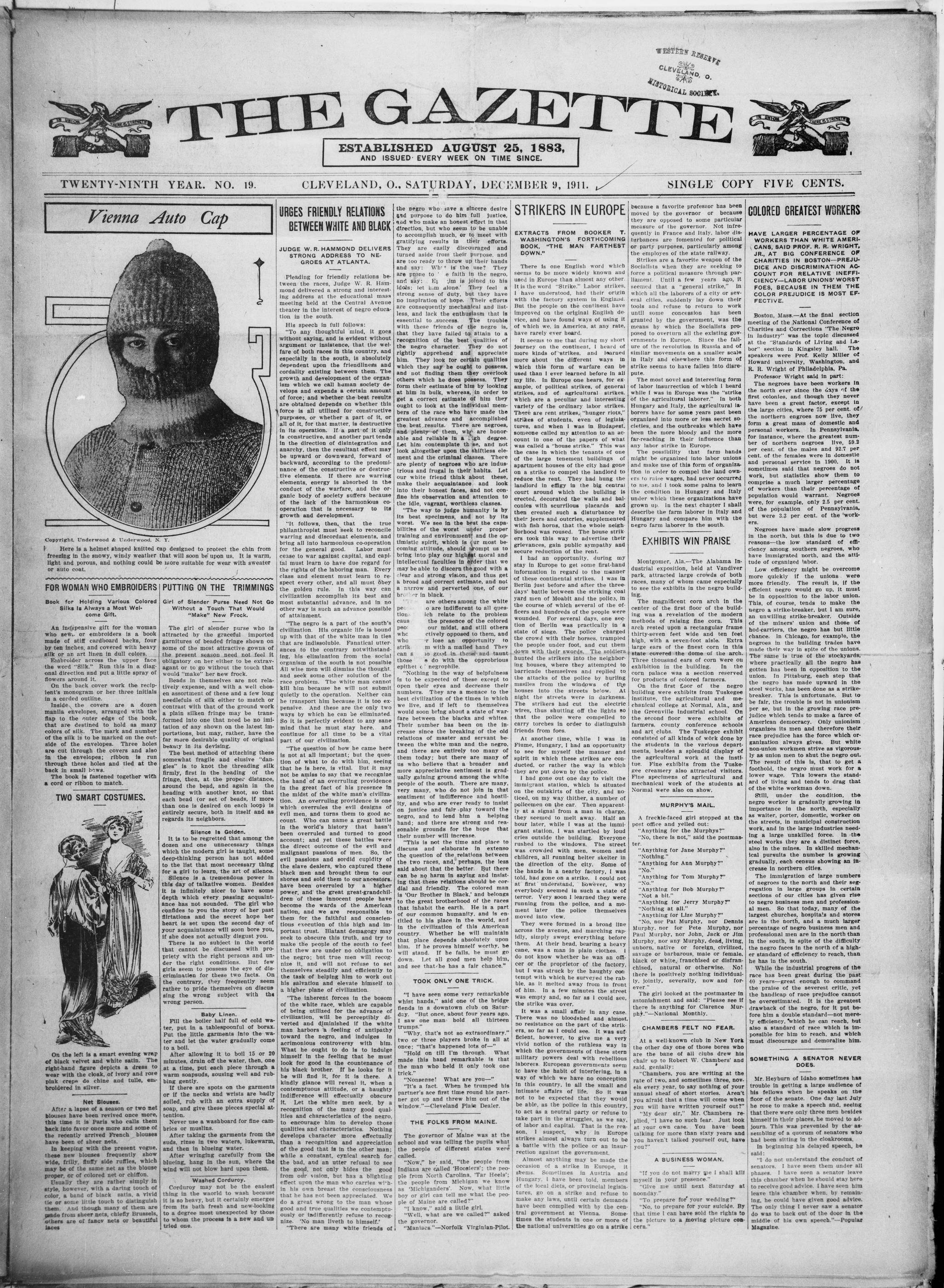
Vienna Auto Cap
Copyright, Underwood & Underwood.
Here is a helmet shaped knitted freezing in the snowy, windy weather, light and porous, and nothing could be or auto coat.
FOR WOMAN WHO EMBROIDERS
1
Here is a helmet shaped knitted cap designed to protect the chin from freezing in the snow, windy weather that will soon be upon us. It is warm, light and porous, and nothing could be more suitable for wear with sweater or auto coat.
FOR WOMAN WHO EMBROIDERS
Book for Holding Various Colored Silks Is Always a Most Welcome Gift.
An indispensable gift for the woman who sew, or embroiders is a book made of stiff cardboard backs, four by ten inches, and covered with heavy silk or an art linen in dull colors.
Embroider across the upper face the word "Silk." Run this in a diagonal direction and put a little spray of flowers around it.
On the back cover work the recipient's monogram or her three initials in a corded outline.
Inside the covers are a dozen manila envelopes, arranged with the flap to the outer edge of the book, that are destined to hold as many colors of silk. The mark and number of the silk is to be marked on the outside of the envelopes. Three holes are cut through the covers and also in the envelopes; ribbon is run through these holes and tied at the back in small bows.
The book is fastened together with a cord or ribbon to match.
PUTTING ON THE TRIMMINGS
Girl of Slender Purse Need Not Go Without a Touch That Would "Make" New Frock.
The girl of slender purse who is attracted by the graceful imported garnitures of beaded fringe shown on some of the most attractive gowns of the present season need not feel it obligatory on her either to be extravagant or to go without the touch that would "make" her new frock.
Beads in themselves are not relatively expense, and with a well chosen assortment of these and a few long needlefuls of silk either to match or contrast with that of the ground work a plain silken fringe may be transformed into one that need be no imitation of any shown on the latest importations, but may, rather, have the far more desirable quality of original beauty in its devising.
The best method of attaching these somewhat fragile and elusive "dangles" is to knot the threading silk firmly, first in the heading of the fringe, then, at the proper distance, around the head, and again in the
TWO SMART COSTUMES.
-
On the left is a smart evening wrap of black velvet and white satin. The right-hand figure depicts a dress to wear with the cloak, of ivory and rose pink crepe de chine and tulle, embroidered in silver.
Net Blouses
After a lapse of a season or two net blouses have been revived once more, this time it is Paris who calls them back into favor once more and some of the recently arrived French blouses have been of sheer nets.
In keeping with the present vogue, these new blouses frequently show wide, frilly, fluffy side ruffles, which may be of the same net as the blouse proper, or of colored net or chiffon.
Usually they are rather simply in style, however, with a daring touch of color, a band of black satin, a vivid tie or some little touch to distinguish them. And though many of them are pads from sheer nets, chiefly Brussels, others are of fancy nets or beautiful laces
THE GAZETTE
Y.
ap designed to protect the chin from
that will soon be upon us. It is warm,
e more suitable for wear with sweater
PUTTING ON THE TRIMMINGS
Girl of Slender Purse Need Not Go Without a Touch That Would "Make" New Frock.
The girl of slender purse who is attracted by the graceful imported garnitures of beaded fringe shown on some of the most attractive gowns of the present season need not feel it obligatory on her either to be extravagant or to go without the touch that would "make" her new frock.
Beads in themselves are not relatively expense, and with a well chosen assortment of these and a few long needlefolds of silk either to match or contrast with that of the ground work a plain silken fringe may be transformed into one that need be no imitation of any shown on the latest importations, but may, rather, have the far more desirable quality of original beauty in its devising.
The best method of attaching these somewhat fragile and elusive "dangles" is to knot the threading silk firmly, first in the heading of the fringe, then, at the proper distance, around the bead, and again in the heading with another knot, so that each bead (or set of beads, if more than one is desired on each loop) is entirely secure, both in itself and as regards its neighbors.
Silence Is Golden.
It is to be regretted that among the dozen and one unnecessary things which the modern girl is taught, some deep-thinking person has not added to the list that most necessary thing for a girl to learn, the art of silence. Silence is a tremendous power in this day of talkative women. Besides it is infinitely nicer to have some depth which every passing acquaintance has not sounded. The girl who confides to you the story of her past flirtations and the secret her heart is set upon the second day of your acquaintance will soon bore you, if she does not actually disgust you. There is no subject in the world that cannot be discussed with propriety with the right persons and under the right conditions. But few girls seem to possess the eye of discrimination for these two facts. On the contrary, they frequently seem rather to pride themselves on discussing the wrong subject with the wrong person.
Baby Linen.
Fill the boiler half full of cold water, put in a tablespoonful of borax. Put the little garments into the water and let the water gradually come to a boil. After allowing it to boil 15 or 20 minutes, drain off the water, then, one at a time, put each piece through a warm soapsuds, sousing well and rubbing gently. If there are spots on the garments or if the necks and wrists are badly solled, rub with an extra supply of soap, and give these pieces special attention. Never use a washboard for fine cambrics or muslins. After taking the garments from the suds, rinse in two waters, lukewarm, and then in blueing water. After wringing carefully from the blueing, hang in the sun, where the wind will not blow hard upon them.
Washed Corduroy
Corduroy may not be the easiest thing in the warlord to wash because it is so heavy, but it certainly emerges from its bath fresh and new-looking to a degree most unexpected by those to whom the process is a new and untried one.
ESTABLISHED AUGUST 25, 1883 AND ISSUED EVERY WEEK ON TIME SINCE.
CLEVELAND, O., SATURDAY, DECEMBER 9, 1911.
URGES FRIENDLY RELATIONS BETWEEN WHITE AND BLACK
JUDGE W. R. HAMMOND DELIVERS
STRONG ADDRESS TO NE-
GROES AT ATLANTA.
Pleading for friendly relations be
tween the races, Judge W. R. Ham-
mond delivered a strong and interesting
address at the educational mass
meeting held at the Central Avenue
theater in the interest of negro educa-
tion in the south.
His speech in full follows:
His speech in full follows.
"To any thoughtful mind, it goes without saying, and is evident without argument or insistence, that the welfare of both races in this country, and especially in the south, is absolutely dependent upon the friendliness and cordiality existing between them. The growth and development of the organism which we call human society develops and expands a certain amount of force; and whether the best results are obtained depends on whether this force is all utilized for constructive purposes, or whether a part of it, or all of it, for that matter, is destructive in its operation. If a part of it only is constructive, and another part tends in the direction of disintegration and anarchy, then the resultant effect may be upward or downward, forward of backward, according to the predominance of the constructive or destructive elements. If there are warring elements, energy is absorbed in the conduct of the warfare, and the organic body of society suffers because of the lack of the harmonious cooperation that is necessary to its growth and development.
"It follows, then, that the true philanthropist must seek to reconcile warring and discordant elements, and bring all into harmonious co-operation for the general good. Labor must cease to war against capital, and capital must learn to have due regard for the rights of the laboring man. Every class and element must learn to respect every other, and all must obey the golden rule. In this way can civilization accomplish its best and most substantial advance, and in no other way is such an advance possible of attainment.
"The negro is a part of the south's civilization. His organic life is bound up with that of the white man in ties that are indissoluble. Fanatical utterances to the contrary notwithstanding, his elimination from the social organism of the south is not possible. All wise men will dismiss the thought, and seek some other solution of the race problem. The white man cannot kill him because he will not submit quietly to the operation. Neither can he transport him because it is too expensive. And these are the only two ways by which he can be eliminated. So it is perfectly evident to any sane mind that he must stay here, and continue for all time to be a vital part of our civilization.
"The question of how he came here is not at all important; but the question of what to do with him, seeing that he is here, is vital. But it may not be amiss to say that we recognize the hand of an overruling providence in the great fact of his presence in the midst of the white man's civilization. An overruling providence is one which overrules the evil designs of evil men, and turns them to good account. Who can name a great battle in the world's history that hasn't been overruled and turned to good account; and yet these battles were the direct outcome of the evil and malignant passions of men. So, the evil passions and sordid culpidity of the slave dealers, captured these black men and brought them to our shores and sold them to our ancestors, have been overruled by a higher power, and the great great-grandchildren of these innocent people have become the wards of the American nation, and we are responsible to them for the faithful and conscientious execution of this high and important trust. Blatant demagogy may seek to obscure this truth, and to make to the people of the south to feel that they are under no obligation to the negro; but true men will recognize it, and will not refuse to set themselves steadily and efficiently to the task of helping him to work out his salvation and elevate himself to a higher plane of civilization.
"The inherent forces in the bosom of the white race, which are capable of being utilized for the advance of civilization, will be perceptibly diverted and diminished if the white man harbors a feeling of antipathy toward the negro, and indulges in acrimonious controversy with him. What he ought to do is to indulge himself in the feeling that he must look for good in the countenance of his black brother. If he looks for it he will find it, for it is there. A kindly glance will reveal it, when a contemptuous attitude, or a haughty indifference will effectually obscure it. Let the white men seek, by a recognition of the many good qualities and characteristics of the negro, to encourage him to develop those qualities and characteristics. Nothing develops character more effectually than a recognition and appreciation of the good that is in the other man; while a constant, cynical search for the bad, and an utter refusal to see the good, not only hides the good from our vision, but has a blighting effect upon the man who carries within his own breast the consciousness that he has not been appreciated. We do a great wrong to the man whose good and true qualities we contemptuously or indifferently refuse to recognize. "No man liveth to himself."
'There are many white friends of
the negro who have a sincere desire glad purpose to do him full justice, and who make an honest effort in that direction, but who seem to be unable to accomplish much, or to meet with gratifying results in their efforts. They are easily discouraged and turned aside from their purpose, and are too ready to throw up their hands and say: 'What is the use? They are prone to 'e faith in the negro, and say: Ei jim is joined to his idols; let him alone.' They feel a strong sense of duty, but they have no inspiration of hope. Their efforts are consequently mechanical and listless, and lack the enthusiasm that is essential to success. The trouble with these friends of the negro is, that they have failed to attain to a recognition of the best qualities of the negro character. They do not rightly apprehend and appreciate him. They look for certain qualities which they say he ought to possess, and not finding them they overlook others which he does possess. They form their estimate of him by looking at him in bulk, whereas, in order to get a correct estimate of him they ought to look at the individual members of the race who have made the greatest advance and accomplished the best results. There are negroes, and plenty of them, who are honorable and reliable in a high degree. Let him contemplate the se, and not look altogether upon the shiftless element and the criminal classes. There are plenty of negroes who are industrious and frugal in their habits. Let our white friend think about these, make their acquaintance, and look into their honest faces, and not confine his observation and attention to the idle, vagrant, worthless classes.
"The way to judge humanity is by its best specimens, and not by its worst. We see in the best the capabilities of the worst under proper training and environment, and the optimistic spirit, which is our most becoming attitude, should prompt us to bring into play our highest moral and intellectual faculties in order that we may be able to discern the good with a clear and strong vision, and thus get a broad and correct estimate, and not a narrow and perverted one, of our brother in black.
"There are others among the white peo- o are indifferent to all question- ich relate to the problem caus- the presence of the colored peo- our midst, and still others who actively opposed to them, and who lose an opportunity to strik- m with a mailed hand. They can s- io good in those and taunt those e do with the opprobrious epithet c negrophile.
"Nothing in the way of helpfulness is to be expected of these except to open their eyes and decrease their numbers. They are a menace to the best civilization of the times in which we live, and if left to themselves would soon bring about a state of warfare between the blacks and whites. Their number has been on the increase since the breaking of the old relations of master and servant between the white man and the negro, and there are entirely too many of them today; but there are many of us who believe that a broader and more appreciative sentiment is gradually gaining ground among the white people of the south. There are many, very many, who do not join in that sentiment of indifference and hostility, and who are ever ready to insist on justice and fair-play toward the negro, and to lend him a helping hand; and there are strong and reasonable grounds for the hope that their number will increase.
"This is not the time and place to discuss and elaborate in extenso the question of the relations between the two races, and, perhaps, the less said about that the better. But there can be no harm in saying and insisting that these relations should be cordial and friendly. The colored man is 'Our Brother in Black,' and belongs to the great brotherhood of the races that inhabit the earth. He is a part of our common humanity, and is entitled to his place in the world, and in the civilization of this American country. Whether he will maintain that place depends absolutely upon him. If he proves himself worthy, he will stand. If he falls, he must go down. Let all good men help him, and see that he has a fair chance."
TOOK ONLY ONE TRICK.
"I have seen some very remarkable whist hands," said one of the bridge fiends in a downtown club on Saturday. "But once, about four years ago, I saw one man hold all thirteen trumps." "Why, that's not so extraordinary," two or three players broke in all at once; "that's happened lots of—" "Hold on till I'm through. What made this hand remarkable is that the man who held it only took one trick." "Nonsense! What are you—"
"It's a fact. When he trumped his partner's ace first time round his partner got up and threw him out of the window."—Cleveland Plain Dealer.
THE FOLKS FROM MAINE.
The governor of Maine was at the school and was telling the punisms what the people of different states were called.
"Now," he said, "the people from Indiana are called 'Hoosiers'; the people from North Carolina, 'Tar Heels'; the people from Michigan we know as 'Michiganders'. Now, what little boy or girl can tell me what the people of Maine are called?"
"I know," said a little girl.
"Well, what are we called?" asked the governor.
"Mantiacs"—Norfolk Virginian-Pilot.
STRIKERS IN EUROPE
EXTRACTS FROM BOOKER T. WASHINGTON'S FORTHCOMING BOOK, "THE MAN FARTHEST DOWN."
There is one English word which seems to be more widely known and used in Europe than almost any other. It is the word "Strike." Labor strikes I have understood, had their origin with the factory system in England. But the people on the continent have improved on the original English device, and have found ways of using it of which we, in America, at any rate, have rarely ever heard.
It seems to me that during my short journey on the continent, I heard of more kinds of strikes, and learned more about the different ways in which this form of warfare can be used than I ever learned before in all my life. In Europe one hears, for example, of political strikes, of general strikes, and of agricultural strikes, which are a peculiar and interesting variety of the ordinary labor strikes. There are rent strikes, "hunger riots," strikes of students, even of legislatures, and when I was in Budapest, someone called my attention to an account in one of the papers of what was called a "house strike." This was the case in which the tenants of one of the large tenement buildings of apartment houses of the city had gone on a strike to compel the landlord to reduce the rent. They had hung the landlord in effigy in the big central court around which the building is erected, decorated the walls and balconies with scurrilous placards and then created such a disturbance by their jeers and outcries, supplemented with fish horns, that the whole neighborhood was roused. The house strikes took this way to advertise their grievances, gain public sympathy and secure reduction of the rent.
I had an opportunity, during my stay in Europe to get some first-hand information in regard to the manner of these continental strikes. I was in Berlin just before and after the three-days' battle between the striking coal yard men of Moabit and the police, in the course of which several of the officers and hundreds of the people were wounded. For several days, one section of Berlin was practically in a state of siege. The police charged the crowd with their horses, tramped the people under foot, and cut them down with their swords. The soldiers hunted the strikers into the neighboring houses, where they attempted to barricade themselves and replied to the attacks of the police by hurling missiles from the windows of the houses into the streets below. At night the streets were in darkness. The strikers had cut the electric wires, thus shutting off the lights so that the police were compelled to carry torches in order to distinguish friends from foes.
At another time, while I was in Flume, Hungary, I had an opportunity to see for myself the manner and spirit in which these strikes are conducted, or rather the way in which they are put down by the police.
I had gone out one day to visit the immigrant station, which is situated on the outskirts of the city, and noticed, on my way thither, a number of policemen on the car. Then apparently at a signal from a man in charge, they seemed to melt away. Half an hour later, while I was at the immigrant station, I was started by loud cries outside the building. Everyone rushed to the windows. The street was crowded with men, women and children, all running helter skelter in the direction of the city. Some of the hands in a nearby factory, I was told, had gone on a strike. I could not at first understand, however, why everybody seemed in such a state of terror. Very soon I learned they were running from the police, and a moment later the police themselves moved into view. They were formed in a broad line across the avenue, and marching rapidly, simply swept everything before them. At their head, bearing a heavy cane, was a man in plain clothes. I do not know whether he was an officer or the proprietor of the factory, but I was struck by the haughty contempt with which he surveyed the rabble, as it melted away from in front of him. In a few minutes the street was empty and, so far as I could see the strike was over.
It was a small affair in any case. There was no bloodshed and almost no resistance on the part of the strikers, so far as I could see. It was sufficient, however, to give me a very vivid notion of the ruthless way in which the governments of these stern military powers deal with rebellious laborers. European governments seem to have the habit of interfering, in a way of which we have no conception in this country, in all the small and intimate affairs of life. So it was not to be expected that they would be able, as the police in this country, to act as a neutral party or refuse to take part in the struggles, as we say, of labor and capital. That is the reason, I suspect, why in Europe strikes almost always turn out to be a battle with the police or an insurrection against the government.
Almost anything may be made the occasion of a strike in Europe, it seems. Sometimes in Austria and Hungary, I have been told, members of the local diets, or provincial legislatures, go on a strike and refuse to make any laws, until certain demands have been compiled with by the central government at Vienna. Sometimes the students in one or more of the national universities go on a strike
SINGLE COPY FIVE CENTS.
WESTERN RESERVE
CLEVELAND, O.
HISTORICAL SOCIETY.
TE
SINGLE COP
because a favorite professor has been moved by the governor or because they are opposed to some particular measure of the governor. Not infrequently in France and Italy, labor disturbances are fomented for political or party purposes, particularly among the employs of the state railway.
Strikes are a favorite weapon of the Socialists when they are seeking to force a political measure through parliament. Until a few years ago, it seemed that that a "general strike," in which all the laborers of a city or several cities, suddenly lay down their tools and refuse to return to work until some concession has been granted by the government, was the means by which the Socialists proposed to overturn all the existing governments in Europe. Since the failure of the revolution in Russia and of similar movements on a smaller scale in Italy and elsewhere this form of strike seems to have fallen into disrepute.
The most novel and interesting form of labor insurrection of which I heard while I was in Europe was the "strike of the agricultural laborer." In both Hungary and Italy, the agricultural laborers have for some years past been organized into more or less secret societies, and the outbreaks which have been the more bloody and the more far-reaching in their influence than any labor strike in Europe.
The possibility that farm hands might be organized into labor unions and make use of this form of organization in order to compel the land owners to raise wages, had never occurred to me, and I took some pains to learn the condition in Hungary and Italy under which these organizations have grown up. In the next chapter I shall describe the farm laborer in Italy and Hungary and compare him with the negro farm laborer in the south.
EXHIBITS WIN PRAISE
Montgomer, Ala.—The Alabama Industrial exposition, held at Vandiver park, attracted large crowds of both races, many of whom came especially to see the exhibits in the negro building.
The magnificent corn arch in the center of the first floor of the building was a revelation of the modern methods of raising fine corn. This arch rested upon a rectangular frame thirty-seven feet wide and ten feet high, with a seven-foot aisle. Extra large ears of the finest corn in this state covered the dome of the arch. Three thousand ears of corn were on exhibition in the building. In the corn palace was a section reserved for products of colored farmers.
On the first floor of the negro building were exhibits from Tuskegee institute, the agricultural and mechanical college at Normal, Ala., and the Greenville Industrial school. On the second floor were exhibits of farmers, county conference schools and art clubs. The Tuskegee exhibit consisted of all kinds of work done by the students in the various departments, besides a splendid display of the agricultural work at the institute. Fine exhibits from the Tuskegee creamery also attracted visitors. Fine specimens of agricultural and mechanical work of the students at Normal were also on show.
MURPHY'S MAIL.
A freckle-faced girl stopped at the post office and yelled out:
"Anything for the Murphys?"
"No, there is not," said the postmaster.
"Anything for Jane Murphy?"
"Nothing."
"Anything for Ann Murphy?"
"No."
"Anything for Tom Murphy?"
"No."
"Anything for Bob Murphy?"
"Not a bit."
"Anything for Jerry Murphy?"
"Nothing at all."
"Anything for Lize Murphy?"
"No, nor Pat Murphy, nor Dennis Murphy, nor for Pete Murphy, nor Paul Murphy, nor John, Jack or Jim Murphy, nor any Murphy, dead, living, unborn, native or foreign, civilized, savage or barbarous, mate or female, black or white, franchised or disfranchised, natural or otherwise. No! there is positively nothing individually, jointly, severally, now and forever."
The girl looked at the postmaster in astonishment and said: "Please see if there is anything for Clarence Murphy."—National Monthly.
CHAMBERS FELT NO FEAR.
At a well-known club in New York the other day one of those bores who are the bane of all clubs drew his chair up to Robert W. Chambers' and said, genially:
"Chambers, you are writing at the rate of two, and sometimes three, novels every year, to say nothing of your annual sheaf of short stories. Aren't you afraid that a time will come when you will have written yourself out?" "My dear sir," Mr. Chambers replied, "I have no such fear. Just look at your own case. You have been talking for more than sixty years and you haven't talked yourself out, have you?"
"If you do not marry me I shall kill myself in your presence."
"Give me until next Saturday at noonday."
"To prepare for your wedding?"
"No, to prepare for your suicide. By that time I can have sold the rights to the picture to a moving picture concern."
IN BUTTON THERE IS STRENGTH
COLORED GREATEST WORKERS
HAVE LARGER PERCENTAGE OF WORKERS THAN WHITE AMERICANS, SAID PROF. R. R. WRIGHT, JR., AT BIG CONFERENCE OF CHARITIES IN BOSTON—PREJUDICE AND DISCrimination ACCOUNT FOR RELATIVE INEFFICIENCY—LABOR UNIONS' WORST FOES, BECAUSE IN THEM THE COLOR PREJUDICE IS MOST EFFECTIVE.
Boston, Mass.—At the final section meeting of the National Conference of Charities and Corrections "The Negro in Industry" was the topic discussed at the "Standards of Living and Labor" section in Kingsley hall. The speakers were Prof. Kelly Miller of Howard university, Washington, and R. R. Wright of Philadelphia, Pa.
The negroes have been workers in the north ever since the days of the first colonies, and though they never have been a great factor, except in the large cities, where 75 per cent. of the northern negroes now live, they form a great mass of domestic and personal workers. In Pennsylvania, for instance, where the greatest number of northern negroes live, 59.2 per cent. of the females were in domestic and personal service in 1900. It is sometimes said that negroes do not work, but statistics show them to comprise a much larger percentage of workers than their percentage of population would warrant. Negroes were, for example, only 2.5 per cent. of the population of Pennsylvania, but were 3.3 per cent. of the workers. Negroes have made slow progress in the north, but this is due to two reasons—the low standard of efficiency among southern negroes, who have immigrated north, and the attitude of organized labor.
Low efficiency might be overcome more quickly if the unions were more friendly. The result is, if the efficient negro would go up, it must be in opposition to the labor union. This, of course, tends to make the negro a strike-breaker, but I am sure, an unwilling strike-breaker. Outside of the miners' union and those of hod-carriers, the negro has but little chance. In Chicago, for example, the negroes in the building trades have made their way in spite of the unions. The same is true of the stockyards; where practically all the negro has gotten has been in opposition to the union. In Pittsburg, each step that the negro has made upward in the steel works, has been done as a strike-breaker. This is fortunate. But to be fair, the trouble is not in unionism per se, but in the growing race prejudice which tends to make a farce of American democracy. Only unionism organizes its men and therefore their race prejudice has the force which organization always gives. But white non-union workmen strive as vigorously as union men to shut the negro out. The result of this is, that to get a foothold, the negro must work for a lower wage. This lowers the standard of living and tends to drag that of the white workman down.
Still, under the condition, the negro worker is gradually growing in importance in the north, especially as waiter, porter, domestic, worker on the streets, in municipal construction work, and in the large industries needing a large unskilled force. In the steel works they are a distinct force, also in the mines. In skilled mechanical pursuits the number is growing gradually, each census showing an increase in northern cities.
The immigration of large numbers of negroes to the north and their segregation in large groups in certain sections of our cities has given rise to negro business men and professional men. So that today, many of the largest churches, hospital's and stores are in the north, and a much larger percentage of negro business men and professional men are in the north than in the south, in spite of the difficulty the negro faces in the north of a higher standard of efficiency to reach, than he has in the south.
While the industrial progress of the race has been great during the past 40 years—great enough to command the face of the severest critic, yet the handicap of race prejudice cannot be overestimated. It is the greatest drawback of the negro, for it put before him a double standard—not merely efficiency, which he can reach, but also a standard of race which is impossible for him to reach, and which must discourage and demoralize him.
SOMETHING A SENATOR NEVER DOES.
Mr. Heyburn of Idaho sometimes has trouble in getting a large audience of his fellows when he speaks on the floor of the senate. One day last July he rose to make a speech and, seeing that there were only three men besides himself in their places, he moved to adjourn. This was prevented by the assembling of a quorum of senators who had been sitting in the cloakrooms. In beginning his delayed speech, he said: "I do not understand the conduct of senators. I have seen them under all phases. I have seen a senator leave this chamber when he should stay here to receive good advice. I have seen him leave this chamber when, by remaining, he could have given good advice. The only thing I never saw a senator do was to back out of the door in the middle of his own speech."—Popular Magazine.
PUBLISHED EVERY SATURDAY
GUBSCRIPTION RATES
(in Advance)
Ome Year. ccsecereccesee es 8150
lx Montha ccc LLS 1.00
Three Menthe... .ccccceeee 80
Bubscribers are requested te re
mit by postoffice money on
der or registered etter.
Entered at the postoffice In Cleveland,
‘Ohio, as second-clasa matter
Address all communications te
HARRY C, SMITH
Editor and proprietor,
THE GAZETTE,
Binekstone Building, Cleveland, 0.
Member Ohle Legislature: 1894
te 1896; 1896 to 1898: 1990 to 1902
THE GAZETTE Ie the oldest, and
fae the largest bona fide circulation,
ouble that of any newspaper in the
interest of Afro-Americans, published
In the state of Ohio, and compariaon
with any will Immediately establish
fee rank aa one of the NEWSIEST
AND BEST In the country.
The man who suffers personal
‘wrong without protest or opposition,
the “peaceful” member of the com-
munity, is a demoralizing factor in
our social fabric. The class that does
not struggle for civic and industrial
rights. will eventually lapse into sla.
Yery. The nation that passively coun-
tenances encroachments upon its
rights and territory Is doomed to dis-
memberment and national. bankrupt
ey. It is the man who defends his
rights, the class that battles for po-
litical and industrial advancement,
and the nation that holds its own
agaiust the entire world; it is the
“Uitigious” person, the revolutionary
lass, and the vigilant nation, that
Keep the world from stagnation and
force it onward on the path of prog
ress.—Hiliquit.
Columbus’ Coloréd fire company has
resulted in a separate school, a
“jimerow" ¥. M. C. A. movement, and
the closing of hundreds of public
places, tq our people. There is no
more reason for a Colored fire com-
pany than there fs for a German,
Irish, Jewish and Italfan fire com-
pany, Cleveland will have none of
this sort of thing. Our men must en-
ter the fire department like they did
years ago and just as the members
of all other classes of local Ameri-
cans do, and in no other way. Preju-
diced white persons and “sim-crow”
Negroes will please take notice. Our
dest people of this city, stand for
PROGRESS and not for separate
schools, Colored fire companies here,
“Jim-crowism,” color-lines, discrimina-
tion bn account of color and raco—
RETROGRESSION! The Gazette
wishes, here and now, to sound a note
of warning to them, that a movement
is on foot to mislead Mayor-elect Bak-
er info making the mistake of favor-
ing so harmfal a thing as a Colored
fire company for this city. Wake up!
We wish to notify those good mem-
bers of the race (about fifteen) who
were misled into attending a meet-
ing at Columbus, Monday, ostensibly
to orgunize a State Business Men's
league, by several discredited Cleve-
land Afro-Americans, at least one of
whom has worn himself out here and
been forced to locate in Columbus,
that the great mass of our people of
‘Ohio are honest, hard-working, good
people and will not rally to anything
that such persons project and domi:
nate. There is plenty of good reason
for this, too. Therefore our advise
to those who have been misled, es-
pecially those who have been “elect:
€d to office” in the so-called state “B.
M,N. L,” is to withdraw from it for
their own good, and that of the race.
You cannot afford to be so used. It
fs not a matter of surprise, under the
circumstances, that only “one Cleve-
land Afro-American, other than the
discredited ones, was invited to at-
tend Monday's meeting in Columbus,
DIRTY AND LOW “JOURNALISM.”
About a week ago, the daily press
of the country with the help of the
Associated Press, gave its readers an
exhibition of sensational craving
“yellow journalism” that best {llus-
trates the fearfully low ebb it has
reached in America. The first day it
announced the death of Hughie Jen-
nings, manager of the Detroit base-
Dall club, in an automobile accident
somewhere in Pennsylvania, The:
next day, the same telegraphic dis-
patches gravely announced in these
same daily papers, that he would die.
‘The third day, they announced that
he might live.’ The fourth day, they
announced that he would doubtless
Fecover, but that a priest, who was,
severely injured in the same accident,
was worse. Anything, to stir up the
people who read the daily papers,
‘cems to be the slogan of sensational
‘craving “yellow journals,” the As:
Sociated Press and its kindred news:
paperdispatch agencies.
From the same miserable sources:
came an announcement, a few days
ago, that New York Siate's “sport”
commissioner was contemplating a
stand that would prevent white and
‘colored pugilists from fighting in that
State and restrict them to contests
among themselves, thus drawing a
colorline, Monday, they gravely an.
nonticed that the Attorney-General of
N. Y. state had decreed against i
end then they tried to place the onus
af much dummphoolishness on he ca
ored pugilists by saying that the At
torney-General had said that “he saw |
no reason why Negroes should refuse
to meet white men In the boxing
arena fust because ‘they are at pres:
ent pugilistic champions, and that the
law does not permit any such dis-
eriminations."
‘The time is surely coming, and
cannot come too soon, when this sort
of thing will be stopped, even if legis
Jation be necessary. It simply amounts
to an outrage of decency, to say noth
jug of individuals or classes. What
has come over the managing editors
of the great daily papers of the coun-
cry that they permit this sort of thing
to be carried 10 such an extent?
See ee eens HEHE |
“Theré are among the people of
this country certain members in every |
class, filled with a form of brutal ignor-
ance which finds it the cheapest, eas-
race and rellgious hatred. "And. Wiese
men of low character, unworthy of
Sican cusenauig” juneine ane
foots Gieeaaam me ae!
trom the Senate of the U. 8. or fom
other branches of the government of
te Us
copyrighted leader of a Hearst pa-
ea toa
Deas el eaestoor te Geary
with Russia. They are true and the
position assumed correct to a nicety.
yee clans male gun ose
aie essentially more important, and
which calls upon the conscience and
Rta eeg at oe cleats anc card
forcibly than the appeal for passports
for American citizens of Jewish birth.
Justified as this appeal is, when will
eisai c erg i
Bb oy ail ub cases, aa well
eat naar Woe cor ae a
swer—from Hearst and all others!
MEN) LYNCH
US8c sone TS 18D)... < 102
1886 c 0c TL NBIOL sok s BM
18BTLL LEE 80° 190000050002 107
MRR ceco ee Gh 01 WOT cee. 107
Aba rsce cess GB, B9ORS, <625 14°86:
$9905 6655569890 AND ya cones 86
WOO WAL 190K. 88
4802000000209] 190K. LLL) Bt
1898.605055. 15S 1908.22) Bt
189400000002 Bd 1907. BU
OG ccres NZ INR, 98
ABOGL orc, s. 80 1908s. 8
1897 122 1910..06501) 6B
‘Total.....2458
LORAIN COUNTY POLITICS,
Elyria, O.—Lorain county, not dif-
ferent from the entire country, is
stirred politically as never before
singe anti-bellum days. First of all,
this county has been a rockribbed Re-
publican county until last year when
the democrats succeeded in carrying
it strongly for W. G. Sharp for Con-
gress, electing Claude Bivins, sheriff
by a plurality of 77 votes, and W. E.
Mathews, county commissioner. ‘This
county is in the 14th. congressional
district, composed of Lorain, Huron,
Richland, Ashland, Knox and Mor-
row counties, which has a normal Re-
publican plurality of 2700. Lorain ts
in the judicial circuit, composed of
Lorain, Cuyahoga, Medina and Sum-
mitt counties. It is in the judicial
common pleas district, composed of
Lorain, Medina and Summit coun-
ties, ahd in the state senatorial dis-
trict, composed of Lorain, Medina,
Ashland and Richland cointics. So
that a close observer can see at a
glance that while Lorain county is in
a very stragetic position, with her Re-
publican plurality of 2500, yet in her
Internal politics especial care must
be used and that and the merits of
the candidates will be the basis of
future letters to The Gazette. For
congressman, Richland and Ashland
must he reckoned with, and Medina
must be considered when it comes to
the nomination of a common pleas
judge, All three must be reckoned
with for state senator. We will work
it out as herevofore and win, and The
Gazette will be among the first to give
its readers the news. Subscribe for
it now. John A, Berry is out repre.
sentative in thé 1th, congressional
district,
The Negro vote of Ohio, Indiana,
Iiinois, New York, Pennsylvania and
New Jersey is of the opinion that it
has had enough of the Taft adminis-
tration, The Colored men of the
South are of the same opinion. Com
mencing with Roosevelt and continu-
ing under the present regime, the lily-
white organizations at the South have
received all of the encouragement de-
sired in their efforts to drive the Col-
ored man from the Republican party,
As a result the Southern cities, legis:
lative districts, congressional and
State senatorial districts which in for-
mer days went Republican are now
safely in the Democratic column. Fur-
ther, the Republican enthusiasm of for-
mer days is all dead and the hope of
winning the South to the Republican
way of thinking is disappearing day
by day. Under this light it would
appear that a change is a big item of
the program gf the National Republi
can party if a Republican is still to
occupy the chair in the White House
from which the givernment is di-
rected. —Dallas (Tex.) Express (Re-
pub.)
To the Public.
Conditions made it necessary to de-
fer the "Tuskegee Night” entertain-
ment. Sellers will give back the
money to those wishing it, if ticket
Is returned; or tickets will be honored
on the date to be announced later.
THE CLEVELAND TUSKEGEE
CLUB.
Me et oe ca
‘St. Marys, Ga.—J. A. O'Berry, sen-
tenced to hang for murder of ‘Atro-
American woman, and her daughter,
is first white man in this state or:
dered to be so punished for killing
‘one of our race.
Rarely Lose Their Minds.
‘An allenist ‘says allenists rarety
lose thelr minds. That thes more tre
quently lose thelr morais ts evident
from the manner in which some of
them testify tn criminal trials —
Loulsville Courler-Journat
CORRESPONDENTS WANTED.
‘The old reliable Gazette desires an
active agent and correspondent in
every city and town in Ohlo and
neighboring states having a number
of Afro-American residents. Only a
little time on Fridays or Saturdays is
required.
We are especially desirous of hear
ing from persons in the following
named cities: Zanesville, Newark,
Lancaster, Lebanon, Chillicothe, To:
edo, Troy, Akron, Springfield, Piqua,
Columbus,’ Cambridge, Steubenville,
Bellaire, St. Clairaville, Wilmingron!
Portsmouth, Dayton, Canton, Oxford,
Sabina, Gallipolis, Oberlin, Sandusky,
Delaware, Mt. Vernon, East Liverpool,
Wellsville, “Hamilton, Middleport.
Bellefontaine, Lima, 0., and other
places where we have none.
‘Write to the editor of The Gazette,
Blackstone bullding, “Cleveland, 0.
and terms will be sent promptly. Our
readers will oblige us iy by send-
ing at once the ad ‘of persons
in the cities named abgve, or others,
(o whom we ean write relative to the
matter,
‘SHE GAZETTE, CLEVELAND, O., SATURDAY, DECEMBER 9, 1911.
ee
FINE McGRAW AND RIGLER. SONS OF THe SANDS. TRAP LOST FFU
Are Arrested for Derogatory Remarks oe aan
About Cubans’ Color. | Beesley
Havana, Cuba—Manager John Me- | Cypress |
Graw of the New York National Base Cruel and Implacable Tuaregs of oa
ball club and Umpire Rigler have felt aoe Dexter, Mo—Whe
the heavy hand of Cuban Jat. ‘They Tripoli. farmer and trapper
have been fined $20 each for making | lost a trap. twenty
Alleged derogatory statements about Bat Wise econ
Gran «Auda night, while dining Native Desert Tribes Who Would Ald wooden box many 3
in a cafe, they Were accused of mAK-| “Turks to Resist Itallan Conquest | ‘possum. and raccot
Ae Tene epee sheen as ne Believed Descendants of in the lowlands nes
Hceman was called to arrest the base Crusaders. days, At each tra
ball men. McGraw and Rigler re —_— marker was placed
sisted but the policeman who was a| Tripoll,—Should Italy seriously at- !'s location, but in |
Negro, arrested them just the sime. | tempt the conquest of the interior of | {er failed to mark t
They appeared in court, where {he ‘Tripolt an interesting situation wil | 10st :
fine was imposed trio tm tho event no appears pray, Several dys aro
ake able, of the native Tuareg tribes com. ns a plece of gro
ees ne (Bon pacey have !g to the assistance of the Turks. | —————————
heen signed between Dan Mekettrich Tey are believed to be descendants
of New York, manager of Joc Jeai of the Crusaders, and although Mos-
ette, and W. A. Sharp of this city, lems, thelr favorite ornament 1s the
Inanager of Nat Dewey, binding the cross, while many of thelr customs
two to meet before the Chattanooga and some words of their language,
Athlete club Dec. 15 In an Clg: uch ae angolun for angel and. mes
Tound fight. Dewey holds the heavy- | for God, are undoubtedly of Christian
Welght championship of the south. | origin “slany ave of the opinion, how.
i | ever, that they belong to the Berber
ais Petey Mme of North Africa, and that they |
tg con remembrance of Mr, Peter | cok posession of tho devert. regions
father,” who departed this life Decem- | 1M the hinterland of Tripoll when the | ,
ber 2, 1910. ‘main body of this people were driven f
A year has passed with no incident
As sorrowful as was thy death:
‘Tis little grief that we give vent
Through tearstamed eyes and whis-
pered breath.
Oh, how we miss thee, righteous man,
As husband how loving and kind,
As father what danger thou did'st
span
With thy broad, judicious mind.
‘We know all things are done for best;
But Husband, Father we're so sad
Yet solaced, knowing thou are blest
For using well the life you had.
So let Time in his endiess ring
Roll on unceasingly, roll,
Still we survivors eer will sing
To praise the Heavens where dwells
thy soul.
The Alpha Theater.
‘The opening of the Alpha ‘Theater
will be Sunday, December 17, 1911.
‘This theater is ‘one that all the Col
ored people in Cleveland should be
proud of as it Is without a doubt the
finest theater in America owned and
operated by Colored capital. Mr. 8.
C. Green, manager of The 8. C. Green
Aimusemént Co., who owns the thea-
ter, has not left one thing undone that
would add to the comfort of the pat:
ronage. The theater is fire-proof in
every respect. The lighting system
will be the very latest, consisting of
the X-Ray Indirect light. Arrange-
ments have been made with a Chicago
booking-house to furnish the vande-
ville acts, The theater will be under
the direct management of Mr. Green,
who will use every effort to give the
people the best show possible for
fhe wen:
$15.00 to $50.00 per Week.
Good oportunity for men of all
ages. We want reliable agents to
ake orders for our “high quality”
Buaranteed nursery stock. Liveral
commission paid weekly. Permanent
year-round position. Complete course
in salesmanship with free outfit. Ex.
ferience unnecessary. All goods sold
under positive ironclad guarantee to
bo as represented, Write quick.
Pennsylvania Nurser €o, Girard,
Erie Co,, Pa,
WIFE'S CURSE WAS ON HIM
Husband, Who Deserted Her, Stricken
by Paralysis as Dying Woman
‘Had Wished,
Cincinnati, O.—The wish of a dying
women that her husband might be
paralyzed if he attended her funeral,
came true, William Huesman of this
city fs the victim.
Although nearly seventy, and the
father of several grown children, he
had lived apart from his wife, Minn'e
| Huesman, his junior by only a few
‘years. As the years of their separa
tion extended, Mrs. Huesman became
each day more and more embittered
against her husband. ‘Time and again
she declared that she hoped that when
she dled he might become’ paralyzed
on the way to the cemetery if he tried
to go to the funeral.
Immediately after her death the
husband was notifled and, forgetting
the past, tried to atone by seeing that
his wife received proper burial, He
provided a coffin for the body and
next day he was on his way to the
cemetery when he suddenly collapsed
on the street.
“Paralysis,” said the hospital physi-
clan, Huesman is not expected to re-
cover.
CHILD GETS LOST IN DRAIN
Confused in the Darkness Boy of Six
Crawls 80 Feet From the
cena.
London, England.—While playing
with some boys near bis home at
Shapperton-on-Thames Johnnie Wil:
son, aged six years, crawled into a
drain pipe. He expected to come out
‘at a joint ten feet away, but missed
the place and becoming ‘confused as
to directions kept on crawling. As he
did not return children gave an alarm
and a searching party set to work at
‘once. They dug to the drain pipe, ten
fect from the opening. Johunie was
not Mere.
‘At some distance from the opening
they dug another hele, ten feet in
depth, Johnnie heard the picks and
mistook the theaning of the noises
and kept crawling still further from
safety. Finally at 80 feet they made
another hole in the drain and caught
Johnnie by the feet just a5 he was
crawling past.
‘The lad had been in the 12-inch pipe
for five hours, but aside from being
smeared with bleck mud he suffered
‘no {ll effects from the expertence.
AGENTS! READ!
| When your Gazettes are not |
} delivered on Friday mornings, |
call at your Central Postoftice |
General Delivery Window for |
Shem in the aernoon of the
‘same day Editor, |
Crue! and Implacable Tuaregs of
Tripoli.
Native Desert Tribes Who Would Aid
Turks to Resist Italian Conquest
Believed Descendanta of
cmisanaiia,
‘Tripoll.—Should Italy seriously at-
tempt the conquest of the interior of
Tripolt an interesting situation will
arise in the event, as appears prob:
able, of the native Tuareg tribes com:
ing to the assistance of the Turks.
‘They are believed to be descendants
of the Crusaders, and although Mos-
Jems, thelr favorite ornament Is. the
cross, while many of their customs
and some words of their language,
uct a8 angelus for angel and mes!
or God, are undoubtedly of Christian
‘origin. “Many are of the opinion, how-
‘ever, that they belong to the Berber
tribes, once inhabiting the whole coast
line of North Africa, and that they
took posession of the desert regions
in the hinterland of Tripolt when the
“main body of this people were driven
back to the Atlas mountains by the
the whole of North Africa in the
eleventh century,
The Berbers are of Semitic origin
and formerly professed the Christian
‘religion, but sinee the Arab conquest
they have retrograded in every way.
and are now among the most bigoted
adherents of Mohammedanism.
It fs not improbable that many ot
the Crusaders may have remained in
"Africa and made common cause with
‘the Christian tribes against the invad-
ing Arab, as some of the expeditions
“against the Mos'Sms of Palestine land-
ed in Africa, St. Louls, the leader of
the seventh and elghth crusades, dy-
ing at Tunis; but, be that as it may,
“the Tuaregs are now stanch support
“ers of the rellsion of Mohammed. The
‘haps of tha head and teatures tavor
L
oe hg re
Fg ae
Se a ate
Pernt he ,
“le as har oy if vj
em p .\
pee ir a wo
A aes Oe et oy
i ee
eee eo 4
Clas
the European rather than the Oriental
type. The hair is dark and the beard
small, The eyes are dark and pierc-
ing. The Tuaregs are cruel, suspictous
and implacable, are usually at war
either with their neighbors or among
themselves, and are superb guerilla
fighters. It fs evident that an alliance
between these tribes of the desert and
the undoubtedly courageous soldiers
of Turkey will make the Italian occu-
pation of the interior an undertaking
of considerable difficulty. The native
population in the hinterland of ‘Tri-
poll numbers about 300,000.
LOSES HAIR AS SHE SLEEPS
Pretty Ohio Girl Is Victim of Peculiar
Sneak, Who Clips Off Her
‘Tresses,
Lima, 0.—Pretty eighteen-year-old
Jennie Williams awoke one morning
recently to find that white she slept
her thick tresses of long brown hair
had been shorn front her head. ‘The
hair was found lying upon the tep of
€ dresser with the heavy shears that
had been used in commiting the deed
upon it. A silver mirror was upon the
foot of the bed.
Police are at a loss to ascertain a
motive for the deed, although they are
looking for a former boarder at the
Williams home, who, {t 1s sald, at-
tempted to force his attentions upon
the young lady.
‘The victim is the daughter of the
late John Williams, at one time pro-
prietor of the largest hotel in the
olty.
650-Pound Man Dies From Heft.
Jersey City, N. J—The burden of
sarrying around 650 pounds of his own
flesh and bone caused the death of
George Shober, at the age of fifty.
Shobe>, so far as is known here, was
the heaviest man in the United States.
His obesity brought on an_ llness
Which began 2 year ago. His coffin
was three feet three inches wide, and
ft took 12 pallbearers to carry it.
dade nine ike ase Cia
Seattle, Wash.—Rev, James Axtell
of Centralia caused a sensation in that
city when he was earried through the
streets In a coffin as if dead, was
“resurrected” at the most prominent
corner In the elty and preached a ser
mon on “A Voice From Hell” to
boisterous crowd. After his sermon
he was “palljearered? back to h
home in his coffin
Grumbiere Power Small
Rarely Is the grumbler a mender
of methods
SGREeT ETS SaEa EN SETER ERROR
ATTENTION, READERS!
Don't throw away your copy
of The Gazette when you have
done with but give It to wome
ceereoaiye. perkes you
‘would be likely to eubeortbe
Scot leek over ond cent
. over and’ read
tarefiliy.” Obligs the
Editor,
TRAP LOST FOR 20 YEARS
Recently Found by the Original
Owner Firmly imbedded in a
Cypress “Knee.”
Dexter, Mo.—When Oscar Trotter, @
farmer and trapper living near here,
lost a trap twenty years azo, he did
not know it would be returned in a
wooden box many years later. Mink,
*possim and raccoons were plentiful
in the lowlands near Dexter In those
days, At each trap some kind of a
marker was placed which would show
fis location, but in this Instance Trot-
ter failed to mark the trap and It was
lost
Several days ago when he was clear-
ing a plece of ground he recognized
lee’
g IG x ]
| Lis
4) MW
\ swutnt TTT ET il
&
| _
t
oe
the old trap about four feet above the
ground, where it had grown into a
cypress “knee.” ‘The “knee” had
grown directly beneath the trap and
raised It and as it did so the trap had
become firmly imbedded in the wood
‘The chain had been broken when the
trap was raised. Trotter presented
the curio to William Smith, a sales
man, who had given the trap to him
with others two years before it was
lost, Smith gave it to F. A. Witte, »
hardware merchant of St. Louis, whe
has it in bis office.
HUSBAND'S CHARMER A MAN
Unique Defense Fails to Defeat Di-
vorce Plea Because There
Was Ancien,
Kansas City, Mo.—An unexpected
denouement came in the divorce sult
of Liftian Benner against Joseph G.
Benner, on trial In the circuit court
when the wife learned that “Miss May
Martin” of Leavenworth, whose lov
ing letter to her husband she had in
tercepted, was a man.
Mrs. Benner had named “Miss Mar
tin” co-respondent in the ‘suit. Ben
ner admitted he had carried on a long
correspondence with “Miss Martin’
and had endeavored to meet her sev
eral times, but each time “Miss Mar
tin” had some excuse, Finally, after
Mrs. Benner had brought her suit
Penner went to Leavenworth anc
made a still hunt for his charmer, He
didn’t find any “her,” but he did find
@ young man who had been having «
ot of fun, not only with Benner but
‘with several other men who supposec
they were corresponding with a “per
fect lady.”
_ Benner's attorney contended that
since “Miss Martin” was a man, Mrs
‘Benner was not entitled to a divorce
but that Benner was entitled to a de
cree on charges of misconduct he had
made against Mrs. Benner. Mrs. Ben
ner still had trumps, however, and in
troduced letters showing that Bennet
had written In endearing terms to @
young lady who appeared as a witness
for Mrs, Benner, who was given the
decree.
‘CASTLE TO STAY IN ENGLAND
Report That Old Tattersall Structure
Was to Be Brought to America
Set at Rest.
New York—Tattersall castle, which
is near Lincoln, in England, was re
cently offered as a gift to the Tiritist
nation. It was declined and afterware
a
boa | 5
P| ne
Ba! as ees
ae ee ca aires
ae eae eae
el ee
Tateseealt Gentle.
a report waa circulated that the castle
Was to be brought to America and re
erected on Long Island. But such
reports were get at rest when Lord
Curzon purchased it.
‘The castle is mainly of the Six
teenth century, but parts of it are
older. Its famous fireplaces, built in
1426, were the models for the fire
places in the house of parliament
Not Ai
Opportunity doess
an engraved cajling curu
Bell, Doan 1398, Residence
East 791-L, Office
Dr, Walter S. Biggs,
Dentist.
(A member of the race.)
4715 Central Ave, Cleveland, 0.
Hours: 8 to 12 a.m, 1 to 5 p.m.
‘Sundays and Evenings 6)
“Appointment
FRESH OWO NEWs
QUA OWN WRITERS’
INTERESTING PERSONAL NOTES
wegen
ing.—Mr. Harvey Clark is here work-
ing. —K. P. entertainment on the 15th,
—Mrs. F, Johnson is ill—Services ai
the Second Baptist church wiil begin:
at 8 p. m, to accommodate the hotel
people—The concert and dinner at
the A. M, E. chureh, ‘Thanksgiving,
was well atfended and a suecess.—
Mr. Geo, Scott is, much improved
since he went to the Home, His wife
had a severe fall—The churches are
preparing for Christmas.—Rev. G. D.
Smith is expecting a brother from
St. Louis—Read ‘The Gazette—tel
Your friends and acquaintances.
Smithfield—Mr. and Mrs. Geo. Ve
ney entertained at dinner, Thursday:
Rey. and Mesdames 8. W. and T. G
White and Mrs, 8. H. Harris.—Chureh
services Were well attended, Sunday
in spite of the inclement | weather
‘The social here, Saturday evening
and that at Meluiyre, Thanksgiving
day, were successes.—Mrs,_ Alice
Washington's improvement ‘is such
that she is expected home soon—Mr.
and Mrs, Chas, Smith visited an_auni
in Pittsburg, Tecently.—Mrs. B. J
Smith and daughter, Mamie, were in
Brilliant, Friday.—D. M. Bigsby and
Miss Loitie Hargraves were in Steu
benville, last. week.—Mr. EF. West
visited Mr. and Mrs, J. Bigsby —Re-
freshments were served the sewing
society at Mrs. Hargraves’, Friday —
Miss Minnfe Beall visited Miss Alice
Faithful of Harrison Co, and in
Flushing, from Friday to Sunday.—
Read The Gazette and keep in touch
with the race's news,
Cadiz.— Mrs, Dora. Johnson
wishes, through “the old reliable”
Gazette, to thank the many friends
Who 80 Kindly responded to the inv:
tation to join in the Post Card show-
er on the 65th birthday of Dr. W. J
Johnson. ‘The surprise was a very
pleasant one indeed for one of our
truest and best. men—Prof. W.. H.
Lucas was in Wheeling, last week —
Miss Leola Mason spent a week with
relatives in Bellaire, recently, Mrs.
Susie Hogans of that city, is visiting
her parents. —Mesdames Bessie
Thompson and) Rebecea West of
Smithfield, spent Thanksgiving here:
R. F. Ballard and daughter, Pau-
line, were in Wheeling, recently. Al-
so li, Jean Lueas.—The play given by
the G1. C,, under the direction of R.
F, Bailard, was a great success.—The
BB, met’at J, P. Lucas'—Miss Ber-
tha Rainsey of Hopedale, was here
recently.—Read The Gazette and keep
uptodate,
Correspondents must mail ail let:
ters for publication at their main
postoflice sufficienJy early on Monday
(or Sunday) of each week to have
them reach The Gazette office on
‘Tuesday morning, and always write,
Also, thefr names and that of their
city’ or town on the outside of the
wrapper about returned coples. Un:
less this latter is done, proper credit
cannot be given you, Lists of names,
Wedding presents, ete., obituary no:
ties, speeches, resolutions, poetry, in.
quiries for relatives and. advertise
ments of all kinds, including. items
announcing entertainments to be held
in the near future, must be paid for
in advance at the rate of ten cents a
line, six words to a line. Our rates
for ‘display advertisements will be
sent on application, Send postal note
and not stamps during warm weather.
Washington C. H—Rev. J. J. Jack
son, of Bellefontaine, spent ‘several
days here, recently.—Mrs. J. ‘Thor
ton’s house was burned week. before
last.—Mr. Wayne Jones is building a
new home—The Odd Fellows enter:
tained the state officers, recently.—
Mr. Stanly Wilson has his new home
completed.—Mrs. Mary Peterson has
gone to Columbus for the winter—
Mrs, Joe Crosswhite was visited by an
uncle from Jamestown, — recently.—
Mrs, Emma Marchant has returned
from Columbus—Both the A. M. E.
and Baptist 8. 8’s are preparing
Xmas entertainments—Mrs, Ida Eas:
ton is able to be out again.—Quarter-
ly meeting at the A.M, EB, church
Jan. 7.—Mr, Richard Jackson has im-
proved his store—Mrs, Ida _ Gillis
children were taken to the Sailors
and Soldiers Orphans Home, at
Xenia—Many will be glad to hear of
the engagement of Miss Helen Cole,
of Columbus, formerly of this city.
‘The remains of Lionel, son of Mr.
and Mrs. Walter Goffe of Columbus,
were interred in the local cemetery,
Dec. 4, Mrs, Anna Howel, Mrs, Dewey
Morris and Mrs, Frank Patterson, of
Columbus, attended the funeral. Mrs
Clande Johnson and Mrs. Sallie Hun-
ley of Dayton also attended the funer-
a of their nephew.—Mrs. Henry Hamp-
ton is convalescing.—Miss Nina Goffe
spent several days in Columbus, last
week.—Mrs. J.T. Oatmeal has en.
tered the hospital for a treatment—
Mr. James Henderson spent Sunday
in Columbus. Mr, Willard Hampton
was there last week.—Mr. George Sol
don of ——, was the guest of Miss
Marie Cassell, Sunday.—Notity the
local agent if you wish The Gazette
delivered at your home each week. —
Miss Jane Hunley and Mr. Lon An-
derson’s daughter, of Wilmington,
were guests of Miss Margaret Ander.
son, last week—Mrs, Sarah Martin
has been ill for two weeks—Mr. Joe
Seward of Mt, Sterling, was here,
Sunday.—Rev. McWilliams of Cincin
nati, called on Rev, Martin, last week.
Youngstown.—Mr. and Mrs. Chas.
jackson spent Thanksgiving with rel
atives in Pittsburg. and Mrs. Harry
Williams ond Miss Wilma Guyder, in
Steubenville. —Mrs. Robert Mackey
and a number of others, are il.—Mr.
Wm. Patterson's foot was mashed.
Mr. and Mrs. Harry Erwin have re
jurned from a two months’ stay in
Chicago.—Hank Griffin of Utica, N,
Y., is here to box at the Clover Leaf
lab—Mrs. A. Glenn and family of
——, spent Saturday with Mr. and
Mrs. H. Williams—The faneral of
che late Robert Ridley, a Warren plo-
neer, was held Sunday. McKinley
SS gn ae ae oe eae
The funeral wes ‘ergely ares ted. ite
leaves three daughters, two £0: and
a host of friends, to mourn his 1038.
Rev. Jesse Smith — officia:ed —Mr.
Jesse Lewis visited Mr. Dayid Bos-
gess and family in Ravenna, Thanks-
giving —Mr. John Hill died’ at his
daughter's, Monday morning. —Mrs.
Thomas Green of Ashtabula, is visit-
ing her son—Gold Leaf Co. U. R.
K. P., will meet, Thursday evening. —
Mrs, ‘r. D, Berry and two daughters,
Visited her mother. In Cleveland, re:
cently—Notify the local agent where
you wish The Gazette delivered, — It
is the oldest and best. race newapa-
Der and advocate in this section of
the country. Get a copy every. week
find ‘keep up to date. No other race
hianer xives the news the country over
every week Ike “the old reliable.
| Dayton—There is today a tendency
“among our people and among their
‘earnest friends to tell the halt-truth
“concerning the situation of our peo-
‘ple and to condemn those who seek
to tell the whole truth, But where is
the harm? many think, If we tell the
good things, will not the good things
multiply and the hateful things die?
No. It is a dangerous thing to dally
with the truth. Some of the greatest
“catastrophes in history have come
because the mass of men have been
deceived and misled as to the truth
of conditions by. timid, welkmeaning
‘persons, who, knowing the awful
facts, sippressed them systematically
and spread the sweet and gentle lic.
There are friends of black folk in
this land, ‘There is continual ad:
\vance in-Tuman sympathy. There is
‘an awakening in the white South on
[the race problem. All that is true.
It is also true that the Afro-American
today faces the crisis of his career:
Face prejudice is rampant and is suc:
cessfully overcoming - humanitarian:
Jism in many lines, and the determina-
[Mion of the dominant South to. beat
the black man fo his knees, to make
“him a docile ignorant beast of turden,
[was never stronger than today. ‘This
[is the truth, Let us tell the. truth,
unpleasant though it be, and through
‘the truth seek freedom.” ‘There (s no
Sakae ease
LEGAL NOTICE.
State of Ohio, Cuyahoga County, ss.
Im the Court of Common Pleas, No.
126.017, “Tune” Mason,” plaintife. vs.
John Woodford and Lizale Woodtord,
etendants.
|, Jolin. Woodford, whose residence
[is unknown, and Lizzie” Woodford,
who resides at No, 2969 Armour Ave:
nue, Chicago, Il; ‘will take notice
that June Mason filed his petition in
the Common Pleas Court of Cuya-
hoga County, Ohio, In Cause No. 126-
O17. ageinst ‘them ‘on September 8th,
1911, and alleging as a cause of action
that’ they elaim an Interest tn the fol
lowing described real estate, adverse
And hostile to himself as the owner
‘of the fee simple title and being In
“Acuial possession thereof. towit
Situated Inthe city of Cleveland,
‘county of | Cuyahora and state of
Olio, and known as being the west-
erly 18 feet '§ inches of sublot Nuin-
ber ‘Thirtysive (Ja) and the easterly
16 feet 8 Inches of sublot. Number
“Thirty-four (34) in Ford and Holden's
Subdivision of a part of aS one
hundred acre lot Number W2 as
shown by the recorded plat ‘ot said
subdivision in Volume 3 of Maps,
Page 4 of Cuyahoga Counts” Records,
Being a parcel of land having # front:
ge of 82 feet 4 inches on the Nort
erly side of Blaine Avenue N. E. and
“extending back between parallel lines
122" feet deep,—
“ecnuae of & certain land contract
dated July 15th, 1903, between them
[Seives'aa second party’ and one Wit
‘liam Bassman, the then owner of said
property, as first party, whereby they
agreed to buy said property and said
|Hussman agreed to sell the same for
the sum of $1850.00, to be paid in
monthly installments of 316.00 per
month, after an initial payment of
$150.00, until $850.00 had been: paid,
when the purchaser was to. asaume
and pay a mortgage of $1000.00 exist-
‘ing upon said property, upon receiv-
[ing a'deed then to be made by sald
vendor, first party, and” agreed as
‘second. party ‘to pay all taxes and
assessment levied on said. premises,
A default in the making of any one
payment by. sald ‘contract agreed. to
be paid caused all remaining install:
ments to become due and payable at
the option of the first party, And
further alleging that by said contract
"any default empowered the first party
to elect to declare the same void and
to reenter upon said premises and to
oust said second party of all right and
Interest and possession in the said
property by proceedings In forcible
entry and detainer, with authority. to
“sell said land without Iability to
“said second party. ‘That sald defend.
ants as second party {0 sald contract
defaulted on the payments. to be
made thereunder, that. they. were
sreatly in arrears and In default for
Performance on thelr parton July
18th, 1911, that sald William Buss-
man, sald first party elected to
‘treat sald contract an void, duly re
‘covered possession of bald’ property
‘by judgment of restitution in the
court of Virgil J. Terrell, Bq, a Jus.
tice of the Peace, and dulf conveyed
the same by warranty deed to’ said
Tune. Mason,
‘That all right and interest thereto-
fore existing in sald property in favor
of said defendants, the sald. second
party. were terminated. thereby and
fhiat the record. of ‘sald contract as
the same exists at page 124 of Volume
1273 of Cyyaboga County Records is
a cloud upon his title, and that said
defendants have no interest in said
property.
He prays that the court adjudge
them to. have no. tnterest. thereln,
that pe record of said. contract be
cancelled, “that ‘plaintit's "ttle be
duleted against all claims of sald de-
pongaaiy and for general equitable
relief.
Said John Woodford and Lizzie
Woodford are required. to answer on
or before February 3rd, 1912,
ALEXANDER H. MARTIN,
Attorney tor Plaintit,
503 American ‘Trust Bullding, Cleve-
land, Ohio, et
WONDERFUL RESULTS
ON SHORT NOTICE
Ihave used your Pomade. Its tho
best thing L ever used for making curly
hair Ne smooth, I have not finished
ay first bottle, but can see wonderful
‘esults, Writes Mrs, Louise E. Hayes of
Pineville, S.C.
‘Try Ford's Hair Pomade for harsh
stubborn and unruly hair and Ford's
Royal White Skin Lotion for the com.
plexicn, Ask your druggist for them.
Be sure and get the genuine (Ford's)
manufactured by the Ozonized Ox
‘Marrow Company, Chicago, Ill.
1 Y 2
a HA)
J ) 2 SEX wr
eee ca
PUR L. SCHWARTZ'S, 2921 Central Ave. Open Sunday.
Pee 0. C. SCHROEDER’S, Cuyahoga Bidg. Open Sunday.
GAZETTE” ATF. vaLENTINE’s, 2130 Central Ave. |
Local reading notices (advertisements) ten cents a line (six words in a line.)
Blackstone Building, No. 1422 W. aa] Mrs. Wm. Corom left Saturday for
FOR SALE.—Bran@ new, imperial
Encyclopedia and Dictionary. 40 vol
umes, finely illustrated, handy to hau-
dle. 'Unexcelled for ‘reference pur.
poses. A library in itself—one that
will last a life-time. Contains every-
thing you may wish to know. Call or
address, The Gazette, Blackstone
Building, 1422 W. 3d St., Cleveland, 0.
near Superior Av. ‘This is an oppor:
tunity of a life-time for those who love
good books.
For Sale or Furs—AUTOMOBILISTS
ATTENTION! Having secured a few
elegant fur-lined coats, robes and fur
Sets for professional ‘services, — will
sacrifice for quick cash sales. ‘Gents’
black brop‘tcloth coat, lined . with
Spanish mink (full skins), elegant
Persian lamb collar, cost 390, will sell
for $35, also gents’ whole skin musk-
rat lined coat, Perstan lamb collar,
cost $140, sell! for $45. Black or
brown cub bear robes, size 54x86, bea-
ver cloth lined, cost $90, sell for $30
a pair. Ladies French sable fur coat
(brown), length 62.inches, bargain
for $20;' same in black, $28. Latest
style Belgian lynx set $12, or black
fox set $15. Iceland fox set (white),
$20, All new this‘season. Write G.
Morehead, 118 East 28th St, New
York City.
Mrs. Kittie 8. Mitchell returned last
‘Thursday from a southern concert
trip of 8,000. miles,
Mrs, Edwards and son, Charles, of
Pittsburg, are guests of Mrs, P, H
Stevens, of 2183 B. 40th St
‘The broom-drill at Shiloh church,
Noy. 20, was an exceptional success
and they were asked to repeat it
St. James chreh will hold a fancy
fair for a week ‘commencing Dec. 18.
Booths will be in charge of the ladies.
‘The Silver Leaf club of St. An
drews’ church, gave a very suecess-
ful dance at the Ideal hall, Thanks-
giving,
Mt. Olive lodge, G. 8. & D. 8. will
give a progressive social at 2329 E.
0th St, Dec. 19, Mrs. Thos. Car-
roll, pres. ‘
Send in your locals, readers, on
time. Last week a number were re-
ceived too late for that week’s issue
of The Gazette.
Rey. Geo. A. Sissle left last_week
on @ three weeks’ vacation trip to
Southern Indiana and to Indianapolis,
where he will visit a daughter.
Mra. L. A. Cunningham, of 2196 B.
43d St. bad as her guests, Thanks-
giving, her daughter, Mrs, T. D. Ber-
ry, and two granddaughters, Lillian
and Marion, of Youngstown,
W. H. Martin, of 2180 E. 37th St.
returned recentiy from N. Y. state,
where he went to attend the funeral
of a nephew) who was accidently
killed. ‘The deceased left a wife and
‘son,
Mrs. L. Dickerson, of 2163 8. 38th
St, entertained at’ dinner, Thanks-
giving afternoon, in honor of Mrs. J.
Jones, Mrs. Arthur Minor, Mrs. V.
Lyons and Mrs. Henry Mukes, Table
decorations, carnations.
‘The Manson family desire to ex-
tend their heartfelt. thanks, through
the columns of “the old | relixble”
Gazette, to their friends for, kind.
hesses shown during the illness and
At the death of their beloved mother,
Mrs. Lucy Manson.
Send your local items to The Ga-
zette on Monday or Tuesday of each
week. ‘This paper is published for
ALL of our people and “plays no fa-
vorites.” Everybody is treated the
same—tair and right. Take The Ga-
zette and tell your friends to do so
also.
Dancing is again becoming popu-
lar and applications are received
daily for dances where the rough ele-
ment will be barred. A class will be
formed as soon as enough applica-
tions are received. Send in your ap-
plication to Stevens & Goodrich, Ideal
hall, 2406 Central Av
‘At the recent annual meeting of the
Union Realty Company, the following
were elected to the board for the en-
suing year: J. F, Meeks, president;
W. A. Brown, vicepresident; Jno. 8.
Hall, treasurer; W. 0. Bowles, secre:
tary; David Mead, Paul Eskridge and
‘Travous Hedges, directors.
‘Tuesday evening, Nov, 28, special
exercises were held at the Sterling
Right school, conducted by | Super-
visor Merriman. Addresses were
made by Assistant Superintedent
Hicks and Rev. Mr. Lewis, pastor of
Jennings Ave., M. E, church. Muste
was furnished by the Mission orches-
tra and refreshments by the school.
‘Thanksgiving day at the mission of
Branch No. 2, Christian and Mission-
‘ary Alliance, their tenth annual free
inner to the poor, was given to about
‘one hundred, including many children.
There were religious services morn.
ing, afternoon and evening, inaugu-
rating their special series of revival
meetings, held nightly.
The Aipha club of St. Andrews’
eburch will hold a Christmas bazaar.
Dee. 12, 13 and 14 In the parlors of
‘the church. Supper will be served
by the ladies from 5 to 7:30 p. m.
and a program Will be rendered each
evening. Admission free. The ladies
say: “Come and do your Christmas
shopping.”
3A. Bryant, of Pine Ave. will
Jeave about the 20th. to visit his old
home and friends in Wilmington, N. C.
‘Mrs, Bugene Daniels entertained on
the 2éth ult,, the Orchard Art club.
Mrs, Case read an excellent paper
and two new members were admitted
‘The next meeting was held at Mrs
Detson's, E. 30th St.
S. FE. Woods has been ill the past
week.
Mrs. Wm. Corom left Saturday for
Windsor, Ca,
W. T. Bhie's father died the past
week in Glenville hospital.
Do not fall to take part in the
grand march at Haltnorth’s hall, Mon:
day evening, Dec. 18. Finney’s su:
perb orchestra.
Mr. Alvin Sellers left, Wednesday,
for Macon, Ga., to join his mother,
who is there settling up the affairs
of the Woodliff estate.
Finney’s tinexcelled orchestra at
Haltnorth’s hall, Monday evening,
Dec. 18. ‘The terpsichorean festiv!
ties start at 9 p. m. and terminate at
24. m.
Mrs. Starkye of 2192 F. 43d St,
entertained the Gilt Edge Needle club,
last Friday. A very pleasant after:
noon was spent. ‘The next meeting
will be held Dec. 17 at Mrs. Bald-
win’s, B. 36th St.
Thé Chauffeurs’ select dancing par
ty at Trostler’s academy, E. 59th St.
Tuesday evening, proved a’ most en:
foyable social function, Many of the
ladies were beautifully gowned while
most of the gentlemen wore the con-
ventional dress-suit.
Considerable credit is due Messrs.
B, Stevens & Goodrich, managers of
the Ideal Hall, formerly’ Woodiift hall,
for courteous’ treatment of their pa:
trons and for having everything in
the very best of condition. The ladies
of the Silver Leaf club appreciated
greatly their many kindnesses and
Wish them every success.
Mrs, H. E, ‘Thompson, her sfster,
Mrs, Lizzie Williams, and brother,
William H, Willis, attended the funer-
al of their father, James H. Willis, in
Youngstown, last week. He died sud-
denly on Wednesday. ‘They have the
earnest sympathy of many friends.
‘Nahum D, Brasher, 31 years of age,
and Helen ©. Bouldon, 32 years of
age. one of our public schgol_ teach:
ers, were married last week, Wedues-
day evening, by Rey. G. V. Clark at
his residence. Ouly a few friends
witnessed the marriage ceremony.
The bride and groom left immediately
for Columbus, the'r fytive Lome, and
Where they will teach in P. W.’Cha-
vers’ Lincoln Industrial chool, a
comparatively new enterprise,
Next Monday evening at St. John’s
church, Mrs. Grace Willis Thompson,
the soprano soloist of the choir, will
give a recital, with the assistance of
her husband, H, Edward Thompson,
baritone soloist, Mrs. Florence J.
Washington, organist, and Master
Louia Jones, violinist.” This will be
one of the very best musical treats of
the season and our readers ought not
to miss it. ‘There will be no admis-
sion charge; only a silver offering.
Be sure to attend this recital. The
Gazette has no hesitancy in guaran-
teeing its exceptional excellence.
Fach season the Cleveland Sym-
phony Concerts play an important
part in Cleveland's musical calendar,
important because of the value in
musical enjoyment they give for the
amount expended. There is no other
musical effair given in this city
where so much can be had for so
little. ‘The price of admission Is ex
ceedingly nominal when it is consid-
ered that it presents an opportunity
to hear the best solo talent in the city,
fo say nothing of enjoying a program
of light numbers composed of a sym-
phony and some of the best operatic
misie being presented in Europe and
New York, As in previous seasons,
the concerts will be given in Grays!
Armory, ot Sunday afternoons. The
opening concert will take place Jan-
uary 7 at 8 p.m. The financial sup-
port has been most gratitying. ‘This
means that the programs should be
presented with finer ensemble be-
cause the additional finances make
possible more rehearsals and the en-
gaging of more talent. Johann Beck
and Emil Ring will again alternate at
the conductor's stand. ‘The season
tickets can be procured from Secre-
tary Paul Wunderlich, No. 6905 Zoe-
ter Ave. Phone, Bell, East 1677 X, or
at The Burrows Bros. store, January
4, 5 and 6.
‘The arrangements for the twelfth
season of the Cleveland Symphony
Orchestra series are already well un-
der way and from the outlook will
prove @ season of which the manaze-
Irent shay well fect proud.” ‘The series
will again consist of ten concerts to
be given at Grays’ Armory on Sunday
afternoons.- The arrangements _in-
clude a symphony on each program
as well as selections by a soloist.
Emil Ring and Johann Beck have
been engaged as conductors and will
alternate in directing the concert.
‘While a symphony will prove the
basic part of each concert it must not
be misinterpreted that the entire pro-
gram consists of this class of com.
position. All of the new musfe from
the operas in Europe as well as the
musical hits of the New York produc:
tion will be presented each week.
From the foregoing it can be seen
that each concert will be well worth
the price of admission even if one
was not philanthropically inclined to
assist. this exceptional educational
work. Greater interest Is being man:
ifested in this series than has been
the case previously and it will be-
hoove all who desire the same seats
for the course, to make early appl
cation, Single seats for each concert
15¢, 25¢ and $5¢, on sale every Satur-
day at The Burrows Bros. store. Sea-
son tickets $2.50, will be on sale
Thursday, Friday and Saturday, Jan.
tary 4, 5 and 6, 1912, preceding the
first concert or’ can be procured at
any time from Secretery Paul Wun:
Gerlich, 6805 Zoeter ‘ve. Bell Phone
ser7x. First concert, Sunday, Jan.
‘HE GAZETTE, CLEVELAND, 0. SATURDAY, DECEMBER 9, 1911.
| Miss L. Cox of Ravenna, visited
‘In the city, this week.
“Mrs. D. B. Johnson of No. 6712
Hague Ave, is in the Glenville hos
pital.
Miss. Effie Lawrence of Brie, Pa.
‘and Mr. Hall of Youngstown, were in
‘the city, Tuesday,
Mit. Edgar Fox of Chicago, visited
bis parents, Mr. and Mrs. 0. S. Fos,
of B. Gist Bt, this. week,
Mrs, Edward Gales, Mrs. B. Chafin
“Mrs. Trimble of Detroit Av. Miss Net
tic Deal and “Mother” Washingtox
are convalescent.
Mrs. ‘T. D. Berry and. daughters
guests of her mother, Mrs. L.A
Cunningham, have ‘returned to
Youngstown.
Geo. W. Buchanan has succeeded
Mr. Hatcher in Dunn & Moran's bar
ber shop. The latter is to open a
shop neat E, 31st St
‘A full account of the meeting of the
Cliizens’ Rights league, at Antioch
Baptist chureh, Wednesday evening,
will appear In Our next isue. Tt was
received too late for this Issue of The
Gazette. :
Francis H. Warren, editor of the
Detroit Informer, and’ several others
[spoke at the Biks" memorial. services
[at Cory chureh, Sunday. They were
‘very interesting. Editor Warren’
address was fine
| For home-made underwear, night
robes and house-dresses and aprons of
all _deseriptions, go to Edith Woods
4217 Central Ave.; open evenings.
These make the best Christmas gifts,
They are practical,
D. C, Fisher of Lorain, was in the
city, Tuesday, en route’ home from
Cohimbus, where he spent Monday.
Garrett A. Morgan returned at the
game time and entertained Mr. Fish.
‘er, Tuesday morning.
‘Mr. Wm. Patterson, possibly out
‘oldest local resident, fell the frst, of
the week and broke a hip. Mrs. Pat
terson and daughter were in Chicago,
where they were called by the crit
Heal iliness of her daughter, Mrs,
Anna Lewis.
"the editor of The Gazette is in
debted to Mr, Walter B. Wright, sec
retary to the President of the Nickel
Plate Ratiroad, for a printed copy of
‘the “official proceedings of the Vet
erarl Association” of that road. Mr,
Wright is one of Its most higlily re
spected members,
The anniversary of the consecra
tion of St, Andrews’ church’ will be
Sunday. Special music by the choir
and an appropriate sermon to. the
public. In the evening ai_6 o'clock
Rev. Davis, rector, of St. James’
church, will’ preach and the choir will
ender new and appropriate music.
‘A cordial invitation is extended to all,
‘The White violin recital, Monday
evening, at St, Andrews’ church, was
an enjoyable success, Miss St. Clair
White is most promising, while the
other participants, Mrs. Alberta Wills,
Miss Edna Halden, Mr. Ralph) Haw:
kins, Mr. Harry Ford, Miss Mayme
Yates, Miss Florence Ferguson, Mr.
Chas,’ Leatherman, Miss Lenore
Fletcher,» Mr. Arthur Spencer, Miss
Rubs Yates, Miss Clara Dyson, Miss
Ethel Moss and Master Louia Jones,
all did well indeed. The recital was
under the auspices of St. Andrews’
Dramatic chib and the organization
is to be thanked for so excellent an
lentertetninient.
BUY
Your Christmas
Cigars,
Perfumes, Candies
and Stationery
AT THE
BROWNS ~=s- 0,
carmen 238th st
XMAS POSTCARDS, 10 cents a dozen
We aieeon evry hing:
Travis & Strawder
“Ce .tral Transfer Co.’
CAREFUL MOVERS OF FURNI
TURE aad PIANOS
Moving Vans
Piaao Hoisting a Specialty
Light and Heavy Expressing.
Ondera Promptly. Attended to.
Grione, Homsonatie
Office and Residence:
203 Central Ave. Cleveland, Ohio.
Guy. Cen. B182R.
TELEPHONES:
Bell, Eady 11001.
Cuy.s Central 1740R,
MISS L.E. WARREN’S
HAIR GROWER
Miss Warren is one cf the FIRST
and BEST in her business in
Cieveland, and
Positively Can Grow
Hair
With Each Treatment. She gives
a sample box of Hair Grower.
3927 Central Ave,
CLEVELAND, OHIO.
preyverreyerrer
SEPEPLLe TET ra Es
Phone Bell, Nortb 1075-X
Cuy. Cent.
THOS. P, Mc PHILLIPS
Plumb'ng and
Sewer Building
All Work ‘iven Prompt Attention
2079 E. 30th St. Cleveland, 0.
seer tt
fraerrre rere eres
Doscoceeeennpeeunenncrens
pee nmesee teen rere tases
3613 Central Ave.
School Every Monday and Thursday Evenings:
Special Attention Given to Beginners. Private
Lessons. Private Parties Taught, _
Hall For Rent A New Dance--Chicago Three Step
Bell ‘Phone, East 586 J. :
Wi | b f U it
WIIDGITOrCe Hiversity
Wilberforce, Ohio.
Opens Third Tuesday in September.
Located in Greene county, three and one-quarter miles from Xenia, 0.
Healthful surroundings. Refined community. Faculty of 32 members. Ex
- penses low. Classical and Scientific, Theological, Preparatory, Music, Mit
“itary, Normal and Business Departments. TEN INOUSTRIES TAUGHT.
GREAT OPPORTUNITIES for High School Graduates entering College
or Professional Courses. Ohio students desiring to enter Normal, Busi
ness or Industrial Department can obtain certificate from State Senator
"or Representative entitling them to FREE TUITION, ROOM RENT AND
INCIDENTALS.
/Matricuiation, entrance Examinations, September 18 and 19. Schoo! Opens
Tuesday, Septe mber 19, 1911.
Catalogue and special information furnished. Address
W. 8. SCARBOROUGH, PRES.
W. A. JOINER, SUPT, C. N. & |. DEPARTMENT.
3223 Central Ave
High Class Vaudeville and Moving Pictures
And DANCING ACADEMY, °*Avence"
To rent for Meetings, Private Parties, Balls
Banquets, &c.
O, L. HARRIS, Manager.
eee}
ie Se
Sake Me sage
le eee
[eS aD
J traal he
Sa ey RS
Best Hat a
Least Mehey:
2a. etn
$i ONE $2
of Prospect St. ,
EET ae i a
Dunn & Mo-ar
|
~ TONSORIAL PARLORS
“‘Four Barbers’’
3014 Central Ave.
CLEVELAND.
Coat meena
at x GO TO THE
Mission Restauran
J. D. HACKLEY,
Our Spezial apenas Cannot
Be Beaten. Thea:re Parties a
a Specialt ’.
Fine Lots |
TREADWELL & GERMANIA AVES.
Cash or Easy Terms. ©
Bie aracttnas sy:
G. G. REED’S
Dry Goods and
Gents’ Furnishings,
A Complete Line.
s0it Geeta bes Cievsiand, ©.
aoe Wid MAKES YOUR
D: 1 i d
Pics pecan CLOTHES )
WM. CHILDS, Rufus S. Justice
MANAGER. Vetenapis ree
¢. W. TURPIN
Dancing Academy.
THE “HERALD (UNCH”
George A. C. Hicks, Prop’r.
Ice Cream,
Soda, and Short Orders.
Neat, Clean and Quick
Service. #
OPEN ALL NIGHT!
3124 Central Ave., Cleveland, Ohio.
ERR REAR
j
JOEN T. TUCK & CO.
Dealers in
Wall Paper and
Paints.
Decorators, Paper Hang-
ers and House
Painters.
3325 Central Av.
"Phone, North 1183 and Cent. 6661-R.
RRR EERE RHR ED
M. GOLDMAN,
DEALER IN
Dry Goods. Hosiery.
Notions. Etc.,
Ladies and Gents
Furnishings, Cur-
tains, Oi Cloth &c.
3003 Central Ave, Cor. E. 30th St
Phone, Cen. 2189 W.
CLEVELAND - - OHIO
ie ey FORD'S
he fa aK HRS. RY HA
S ‘GLOSS SOFTER AND MORE PLABLE,
Key Fees
TH LENGTH WL ERAT ONEXELED
oR REVERTING HA ROM FLING OU DROP AN TOO,
{FAL BEWARE OF IMTATONSGT THE GENUME PUT
25eAN Sos SETS WT CHARLES FORD'S NAME ON
WEY PKKAGE ee
‘TRY FORD'S ROYAL WHITE
‘SKIN LOTION FOR THE COMPLEXION.
MAKES THE SKIN WHITER IMMEDIATELY
UPON APPLICATION. WILL NOT IRRITATE
‘THE MOST DELICATE SKIN, UNEXCELLED
FOR ECZEMA, SALT RHEUM, PIMPLES,
ROUGH SKIN’AND FRECKLES. «= °
SOLD BY oRUGGISTS.(F YOUR ORUGCIsT CANNOT
$SUppLy YOU. We WILL SEND I TO YOU DIRECT AT THE
Foutome pcs su Seo BOT. 25¢tARr SUED OTE
Soe THE OZONIZED OX MARROW CO.
Baa Lane steer, 207 6. enICAGOL,
AGENTS WanteD.
ont ga) No. 24 Southern Bu;
365.0 Aer tamer crate .
Dam tearicget
actory to Use
q D> Sitertor pace
/; SRF oR PATTERSON
os 7 OT SN,
WHO MAKES YOUR
| CLOTHES?
[a
[reer ee
SEES We Bell North 1005 L. Cuy. Cen. 8182 W. at
| LEONARD G. SCHWARTZ,
‘ia ICE CREAM, BRICK CREAM,
) Special Prices to :
“RRS CHURCHES, SOCIETIES, CLUBS, ETE,
#2 Private Parlors for Ladies and Escorts.
Confectionaries, Cigars, Tchatc-
co and School Supplies. |
2921 Central Ave. :
De nuees rrp teek una ran ee
(qraccerneet erate ES Tht MAGIC Baie
a UR ee
LARVA agsese MGT AL ANYWHERE
SULLA 00000) MAILED scene aie 32
DI [eens isdy‘esn have a veaullta ab a
naire ta WAGE. “Miter ae
LA ES LOOK! inlet eee ead
‘The Magic will nat burn of injure the hal because the amb ‘aever heated. The steel heat
toe ye? wlth ane ec, ane avin Hamme ot tp loot or ene heal
‘The nines Cheha easly deiachea tou the heat bar tuca afters bar is heat
ca e's dyes bck Pues anate wold bya tra of tha Basle,
seubehbeé ier sas saab for sua oan ha svar ad can be cae tn @
3 os ee
a caren
¥ RAEN 5]
a y
voc MAEg gang ier. Mate Alcool Heater. Liberaitermsto arent Wite
Magic Shampoo Drier Co., Minneapolis, Minnesota,
eo RESa. ror Me - aeeeeerns i2i}
F are Sera ees The Original
ey <i: NR n-ne
re ay, =? Neal :
Hee De hike | be Bol |
es Be iiall bowels
AG | sas ee,
lees A ew
Cs = eH
a ae ry pS Li
ca jo Be) We Grew Our Hair
Pe i came! Ncw Let Us Grow
pee ge EN Wie : With
Speen, ef a Yours Witt
| bad tm ee Se :
i a ae
Be es ee | 6 j
MRS. A.M. POPE. | MRS. L. L. ROBERTS 0
f,rears ato miy hale wna
only a Sngeriongth, and 4 years ago my hair just TRADE MARK
my’ temples were bald covered my shoulde e
By, temples were bald: covered my shoullera Registered
Wheu we first vegan our wonderful work of growing all kinds. all
qualities, all lengths, and all conditions of hair, even to the growing of
liron bald piaces of the head, many sersous scored the idea that such
a thing was possible: but we have grown the hair for hundreds, rapidly
Schivving success. the proof of the va.ue of our work Is that we are be
ing imitated and largely by persons whose own hair we have actua‘ly
growa and the further fact that they Bave very frequently mentioued us
hen teving to sell their goods (saying that theirs 18 the same” or “Sust
ty Boot") or feferred to “PORO.” We advise you to use only “PORO™
Halt Grower, (the oldest and best of its kind.) See that the name “PORO™
tycan every box. aot genuine. witaout It Prepared only by MRS. A. ML
OPE.
Call, or Address Mail to
MRS, A. M. POPE-TURNBO 220° SESE.SIREET
BELL PHONE BOMONT 3109
Pure Beer Bottled at the Brewery
Order a Case of
Gold Bond
Bottled Beer
THE CLEVELAND & SANDUSKY
BREWING COMPANY
Delivered at the Home. Both Phones.
Taylor's New Shampoo Dryer
and Hair Straightener!
The Best in the World!
aia rr Aeabtaaes ng Snares Comraees ante
connor asec akersetaetea meee
PRIOE OF UOMB $1. Sppct usd Grane sesncatedtrrther nou cart
| iyateineeenaa amet a
= PRAM Hehe ised el gona earn
nin HHA) aieosen Seicss heat i
& Se ieidumat ns V0 Oh a
i Te reg
> =p dag |
: es
2 a se et rm Mm _ Price of Hair Straightener
iz sem i one ey $C Alcohol Heater compiete
swe AVHORESTTEIN ANCOmOL EATER, abe hanit ane mon ona et!
eee ces a ee anaes
oc gab DBO SY REE AP ONaONY Seacrest
Aents Wanted. T. W. TAYLOR, Howell, Mich.
Woo writing pleaun mention thle pape {
MRS. L. L. ROBERTS.
4 years ago my hair Just
covered my shouldera,
The Original
Hair Growers
Of Interest to Our Women
Breaded Pigs' Feet—When there is only a short half-hour in which to get a substantial meal, nothing could be more filling and appetizing than pigs' feet treated to deft flourishes.
For a person of moderate appetite one foot or knuckle is enough. Get this at the delicatessen and see that it has been boiled recently and not pickled. Split it in half, dip each half in finely powdered cracker crumbs, and brown lightly in redhot olive oil. The pepper and salt are sprinkled on before the crumbs and a squeeze of lemon juice is added when the dish is done. A green pepper may be panned in the oil and not only flank the feast well, but add another note to the taste.
Cali's Brains and Tomato Sauce—Here is a superlative dish for the little dinner to which the intimate friend has been invited. It may be cooked in a two-by-four bedroom with only the odors of paradise and the cost of 15 cents. Use olive oil in this case, also, instead of butter, for besides its superior taste, it is less smelly with cooking than butter.
Blanch the brains by letting them soak in cold water for three hours. Then remove all the fine skin and hard cartilage, during which process the brains are likely to separate in several pieces. Wipe these dry with a perfectly fresh cloth and sprinkle a little flour over all—only a dust of flour, for if too much is used the brains will harden and lose half their taste. Then brown them lightly in a pan in which the oil is already smoking hot, and as soon as this is done take up the pieces with a fork and cook the tomato sauce in the same pan. One large tomato, a shaving of fresh garlic, red pepper and salt are the requirements for this, and when the sauce, which must stew down low, is almost cooked, put in the browned brains, add a teaspoonful of butter, cover the pan and let simmer ten minutes more.
BEADS VERY POPULAR.
And still the beads are with us in endless possibility. There is the simple design, which is merely spaced vertical lines of beads spreading like rays over the corsage, or divided into sets of graduated groups meeting at the base a horizontal band of wall-of-troy pattern in the guise of a bett. Then again, there is the row of upstanding irises, lilies or arabesques, delicately outlined and veined with beads in the natural color of the blossoms, the whole picked out with gold or silver beads.
Colors are extremely varied and include monochrome and multicolor effects mingled with dashes of metal Flat and raised motifs are produced and shaded by means of bugles, seed and large beads in gold and silver, bead jet, crystal, china, glass, wood and the peculiar Venetian varieties. This beading corresponds exactly with the popular Paisley, Indian, Egyptian and Roumanian rainbow tints in fabrics and embroideries.
Hatpin heads are embroidered in beads in flowers of natural colors. Picture hats are trimmed with heavy bows composed of close circles of coral, topaz or emerald beads; while cabochons show checks like a chessboard of two or four different shades to correspond with the hat.
Belts and buckles are treated in the same way; and there are sets composed of hairpins, cabochons, buckles, belts, chain and handbag—all of which can be made to order to carry out some favorite flower or to match a new costume.
SIMPLE DESSERT FOR CHILDREN
A simple dessert enjoyed by the children consists of apples cored and each cavity filled with sugar, nutmeg, a bit of butter and two or three raisins. Add one cupful of hot water and bake in a slow oven. This may be varied occasionally by placing a meringue on the top of each apple when done, and cooking in a slow oven for seven minutes longer. Serve cold.
A heavy broom should be chosen for thorough sweeping in preference to a light one, for the weight adds to the process. Test a new broom by pressing the edge against the floor. If the straws bristle out and bend the broom is a poor one and should be rejected; they should remain in a firm, solid mass.
MOLASSES SAUCE.
To make molasses sauce, which is an excellent accompaniment to a plain rice or apple pudding, mix together one cupful of molasses, a tablespoonful of vinegar or the juice of one lemon, a saltspoonful of salt and a tablespoonful of butter. Boil ten minutes.
BACON USER
Buy bacon unselcd unless it is to be used up at once, for the cutting helps, to dry it up and harden it. Keep it juicy and sweet by leaving the rind on until the last bit is used up. The bit of skin, well washed and scraped, may then be used with half a pod of garlic to season pea soup.
BIRD CAGES.
From time immemorial it has been the custom to suspend most bird cages from a hook at the side of the window casing, or from one fastened in the ceiling. Today there is something new in cages—those which come provided with a heavy brass standard resting on the floor. The cage is swung from the arm of this standard. This makes it possible to move the songster here and there at will, and without much trouble.
CARE OF JEWELRY.
As the beauty of all precious stones depends upon the play of light upon them, it is essential that they should be kept scrupulously clean, and jewelry that is worn constantly cannot look its best unless cleaned periodically. Contact with the skin tends to dim the gems, and although real diamonds and other precious stones are so hard that the moisture does not sink in, it remains on the surface and the brilliance is impaired.
Imitation jewels, on the other hand, being more porous allow moisture to enter, so that in time their luster becomes lost and cannot be restored. Hence, if imitation gems are worn they should be set in pendants or brooches, never in rings where they come in close contact with the skin.
The first essential for cleaning jewelry at home is a new tooth brush. An old one should on no account be used. Make a nice lather of warm soapsuds, getting one of the several excellent jewelers' soaps on the market, and scrub the jewel in this. Now hang the ring or pendant on a piece of string and swing it in a bath of alcohol. This removes the soapsuds, which if allowed to remain, would dry and form a scum. By holding the jewel on a string the fingers need not be wetted in the alcohol.
Now place the gem in a box of boxwood sawdust, which is inexpensive, and may be bought at any jeweler's. This sawdust is free from anything that tends to dull a stone.
Shake it about freely, and when perfectly dry brush off any particles of sawdust with a soft, dry jeweler's brush, which should be kept strictly for this purpose, and locked carefully away when not in use, so as to be absolutely free from dust.
WHITE CLOTHES.
A slice of lemon put into the copper when boiling clothes will make them beautifully white and will remove all stains from handkerchiefs and children's clothes. Cut the lemon with the rind into slices and allow it to remain in the boiler until the clothes are ready to come out.
MUTTON
Mutton dripping will not set hard and suety, as it usually does, if directly the fat is poured from the baking tin the vessel containing it is put at the back of the stove and allowed to stay there until the stove itself cools.
DAMASK LUNCH SETS.
Luncheon sets of damask are to be had either hemstitched or scalloped and buttonholed. The hemstitched sets frequently have a little color introduced in a simple hand-embroidered design.
CHANGEABLE VELOUR.
A handsome material, for an afternoon gown is the velvet velour in stripes, woven in changeable effects. The combination of colors in this material is large and altogether pleasing.
END OF THE HONEYMOON.
It was along toward the waning of the honeymoon and his dialogue took place:
"Are you sure that you love me as much as ever?"
"Perfectly sure."
"And you will never, never love anybody else?"
"Never, never."
"Is there anything you wouldn't do to make me happy?"
"Nothing within the bounds of reason."
"Aha! I thought so! You have begun to reason. The honeymoon is over!"—Cleveland Plain Dealer.
ECONOMIC SUGGESTION.
Gladys—Tommy Tightwad is the meanest man I've ever encountered.
Gwendolyn—What has he done?
Gladys—He's engaged to Tilly Tilton, you know. It appears that he picked up a ring at a bargain sale, and had the nerve to offer it as an engagement ring. It was much too small for her finger. What do you suppose he suggested?
Gwendolyn—What?
Gladys—That she diet until she could get it on!
TOO MUCH FOR ELIZABETH
Little Elizabeth and her mother were having luncheon together, and the mother, who always tried to impress facts upon her young daughter, said: "These little sardines, Elizabeth, are sometimes eaten by the larger fish." Elizabeth gazed at the sardines in wonder, and then asked: "But, mother, how do the large fish get the cans open?"—Llipincott's.
DRAWING MATERIALS
"What's the matter, John?"
"Why, ma'am, here's a note from the master, in which he tells me that he's off on a little holiday, and he wants me to send his drawing materials along."
"Well, and isn't that plain enough?"
"Hardly, ma'am. I don't know whether to send his paint and brushes or corkscrew."
THAT PRAYER OPENING.
A new store in Charlotte, which deals exclusively in "women's wear," opened business with prayer. If we had been invited to make the invocation our prayer would have been. "Lord, have mercy on the men of Charlotte."—Houston Post.
Agitated Old Gent—Quick! My daughter is overboard! Save her, and she shall be your wife!
Blase Person—Wait till a wave rolls her over, and I can see her face—Puck.
THE GAZETTE, CLEVELAND, O. SATURDAY, DECEMBER 9, 1911.
FAIR IN ALABAMA
COLORED PEOPLE OF MACON
COUNTY, ALABAMA, HELD IM-
POSING EXHIBITION.
Tuskegee, Ala.—The Macon county
fair, held in the town of Tuskegee
recently, was one of the largest and
most imposing exhibitions ever seen
in this neighborhood. The Montgomery
Advertiser carries a full account
of the fair, and we are glad to quote
in part from this account:
"Tuskegee, Ala.—With the cheering of hundreds and to the martial strums of music rendered by the four bands, the big parade which formed in the public square marched down South Main street to the fair grounds, where the formal opening of the Macon county agricultural fair took place. Hundreds of people had already entered the fair grounds when the big parade arrived, and all day long people continued to flock into the immense enclosures. Soon after entering the fair grounds President Drakeford of the association addressed the crowd. He spoke briefly, but in his few words manifested an earnest appreciation to the people of Macon county in responding so liberally to the cause he had so zealously worked for during the past twelve months. He also bade everyone welcome to the city and extended to them the open arms of the city. Short addresses were followed by others, including several specially directed to the farmers.
"The opening of the fair was made one of the greatest events in the history of Tuskokee. From early sunrise until the opening hour people continued to pour in from the surrounding country, anxiously awaiting the time when the parade should move on toward the grounds. Promptly at ten o'clock the parade, composed of automobiles, buggies, wagons and pedestrians, began its outward march. In front were the city and county officials, followed by those of the fair association.
Smith Leads Parade.
The parade was led by Capt. N. Clark Smith and his famous band. The national airs were played and when "Dixie" was touched by the sixty pieces a thundering roar from thousands of throats greeted the musicians in response. Everybody possessed the real county fair spirit and worked to make it a great event. Practically every business house in the city closed, and their occupants moved along with the great throng to witness the opening.
The exhibits in the agricultural department were larger and more varied than they have been at any fair here-tofore held here. They showed improvement in several respects, the most noticeable being that the farmers are raising a higher class of products than formerly. A common sight was to see giant stalks of cotton setting about in the different booths, some of them containing as many as 125 and 150 bolls. Immense stalks of corn with eight and ten fully matured ears were also common. In every instance the producers said that the improved variety is much easier and cheaper to raise than the inferior or common kind. All the way through the exhibits were excellent and were even better than were expected.
Fine Stock Raised.
In the past few years the farmers of Macon county have directed much of their time towards the raising of fine cattle, horses and hogs. In this department were exhibited some of the most beautiful specimens to be found anywhere, all of them being Alabama bred and raised in this county. Among the most exhibited exhibits was that of Mr. W. A. Reynolds of Warrior Stand in the lower portion of this county. He had at the fair several colts, mares and many fine chickens, many of them having taken first prize at other fairs in the state this season. All the offerings showed that the farmers are waking up to the fact that this is not only a great farming country, but one of the greatest stock raising sections of the south.
The exhibit of the Tuskegee Normal and Industrial institute attracted considerable attention. For several days the boys and girls of the school were hard at work arranging the several exhibits and they presented a most pleasing appearance. That which attracted the most attention was the corn exhibit. The manner in which the corn for this purpose was gathered was unique. Every negro farmer in the county contributed ten ears each and with this an immense pyramid had been formed in the immediate front part of the administration building. All columns surrounding the pyramid had been covered with ears split in half and nailed on, presenting a pleasing and original design. The public schools of Tuskegee were also represented at the fair with different exhibits from the kindergarten up to the higher grades.
One-Armed Negro Had Exhibit.
A booth that attracted more than ordinary interest was that of a one-armed negro, Jim Mahone. In his exhibit he had practically everything that could possibly be raised in this climate at this season of the year, Watermelons, cucumbers, peppers, pumpkins, sweet corn, tomatoes and other garden products that up until a few years ago were attempted to be raised only in the spring. He is a very thrifty negro and is admired by many white friends here for his strict honesty and perseverance in making his own living and staying out of debt.
DEPEW'S BEST COMPLIMENT
Senator Depew, at a dinner in his honor in New York, said of his notable oratorical gift:
"I have received many compliments on my skill at after-dinner speaking, but the naivest compliment of all came from an up-state farmer.
"'Senator,' said he, 'you might have typhoid and recover, you might have pneumonia and recover, you might have yellow fever and recover, but if you ever got lockjaw you'd burst.'"—Philadelphia Record.
The Sunday
School Lesson
Lesson for December 10, 1911.
NEHEMIAH AND HIS ENEMIES.
Golden Text—"The Lord is' the
strength of my life; of whom shall I
be afraid?" Ps. 27: 1.
Nebemiah 6: 1-12. Commit v. 11.
Time B. C. 445. Place Jerusalem.
EXPOSITION—I. The Villainy of Sanballah and Tobiah, 1-9. Nebemiah is one of the strongest and most attractive characters in Jewish history, a man of unimpeachable integrity, remarkable strength and decision, thorough-going unselfishness and rare shrewdness. He worked against odds that would discourage almost any man but came off victorious. Back of all else lay his unfaltering trust in God. Step by step he had gone forward until the wall was completed and "no breach left therein." The contempt of Sanballah and Tobiah was changed into fear. Nebemiah was content with no half-way work, no matter how great the discouragements might be. Doubtless Sanballah and Geshem planned to put Nebemiah out of the way. They pretended that they were no longer opponents, but wished a consultation. When a servant of God is succeeding in accomplishing something for him, there are always enemies ready to say, "Come and let us have a discussion." They claim to want light! What they aim at is mischief. Nebemiah's answer is one to that a busy worker should ready to report false charges against him (v. 6; Jer. 9:3-6; 20:10; Rom. 3:8; 1 Pet. 2:2; 3:16). Even people as prominent and trusted as Gashmu will not hesitate to tell lies about him. Of course, Gashmu's lie seemed plausible. The devil's lies always do. They had tried this same charge before with temporary success (ch. 2:19; Ezra, 4:12-24). The charge that Nebemiah had appointed prophets to the great of him at Jerusalem was, of course, false, but very likely Sanballah and Tobiah had hired men to say these things in order to arouse suspicions about Nebemiah (cf. v. 1). Nebemiah's answer was straightforward and to the point. He saw through all their schemes. There are times when it is necessary even to tell a great man to his face that he is a liar (v. 8; cf. Acts 24:12, 13:25.17 10). The lie on Sanballah's lips had its origin in Sanballah's heart, it was his heart that was wrong (v. 8; cf. Matt. 12:34). The whole object of the plot was to make Nebemiah and his associates afraid. The devil knows if he can only scare the people of God, they are of no use (cf. 4:10-14; 2 Ch. 32:18). The fearful heart always means weakened hands. The scheme failed in this case because Nebemiah knew just to whom to look. Sanballah and his associates might try to weaken his hands, but Nebemiah could cry. "O, God, strengthen thou my hands" (cf. 1 Sam. 30: 6; Ps. 71: 1; 138.3, Isa. 41:10; 2 Cor. 12:9; Eph. 3:16; 6:10; Phil. 4:13).
11 The Perfidy of Shemaiah. 10-12
That a man claims to be a prophet of God, and even gives indication that he is a prophet of God at one time in his history may prove faithless (cf. Baalim; also Matt. 7:15). Shemaiah at this very time "was shut up." 1 e. was apart with God (cf. Jer. 36:5; Ezek. 3:24). Nevertheless the hypocrite was taking money to betray God's servant. The prophet who can be hired is the most dangerous man in the community. He sought to get Nehemliah to pervert the temple from its proper use for the worship of the people and to make it merely a sancuary for his own security. Probably he would have had Nehemlah go into the most holy place where only the high priest had a right to go and that only once a year.
There is a time when it is warrantable, even for the servant of God to flee from one city to another (Matt.10:23; Acts 8:1), but this was not a proper time for fleeing. It was a time to stand at one's post, and such a man as Nehemiah could not flee under such circumstances (cf. Acts 20:24; 21:13). There is a rare combination of courage and humility in the last part of Nehemiah's answer. He was not fit to enter the temple, for he was not a priest—there is seen his humility and he would not do wrong to save his life—therein appeared his courage. He sums up his whole great resolution in three short stirring words, "I will not." Though Shemaiah claimed to be a prophet, "God had not sent him." Many of this world's prophets, highly esteemed by man, were never sent by God (cf. Jer. 14:14; 22:16, 25; 28:15; Ezek. 13:7; I. Jno. 4.1).
"Pa what did Heroditus do?"
"Oh. I think he won a purse that was offered for three-year-olds once. Say, can't you quit bothering me when I'm trying to read what is going on in the world!"—Chicago Records Herald.
"I've advertised for a reliable, careful chauffeur."
"Do you expect to get one?"
Do you expect to get one?
"Yes, indeed. All the peckless dare
devils seem to be employed."—Detroit
Free Press.
THE CHICAGO NEGRO
COLORED RACE TAID TO BE MAK
ING BETTER PROGRESS IN CHI-
CAGO THAN IN ANY OTHER
PART OF UNITED STATES.
Many writers have advanced theories and reasons for so-called race question conditions. The subject has been studied in every section of America with but little success, for the very reason that humanity is not subject to rules, but responds only to the primal laws of nature. The negro, being after all a human being, has simply absorbed such knowledge as has been offered him in the different communities in which he happened to have his being. For this reason Chicago and the surrounding territory have shown more advance than any other portion of the United States. Chicago's great industrial institutions needed labor. During the period between 1870 and 1890 immigration from the south responded to the call. The negro who came worked side by side with the foreign-born laborer under supervision of Yankee bosses. From the one learned by actual contact how to work steadily, how to use his wages thriftily, how the beauties of a home, and a definite system of savings. From the latter he acquired a true knowledge of the word liberty, a proper dignity, and a manly bearing.
The Chicago stock yards have been responsible for more negroes becoming taxpayers than any other institution in this land, excepting possibly the Pullman company. Contrast the horizon of these men with that of eastern negroes, nearly always servants of hotels, clubs or homes, where the nature of their employment brought to their view notching but case, splendor of garment, surroundings and extravagance. The eastern "boy" saw "Mr. George" during his hours of recreation and imitated him. He saw the top of society's structure without knowing of its foundation, as did the Chicago boy. Without that influence and without the paternalism of the southland the Chicago negro developed a business ability based upon economy and willingness to work. These seemed to be the foundations upon which is built Chicago's black citizenship.
Another primitive law prevails there: That is "birds of feathers," etc. Notwithstanding any restaurant in town will serve a negro, none need to, for in that territory between Twelfth and Fiftieth streets, along Wabash, State, Dearborn and Armour can be duplicated any downtown restaurant's bill of fare. State street has its Pekin theater, as well as several smaller ones; its bank of $200,000 capitalization, real estate concerns, de department stores, hotels, small shops even its own colony of artists, an incorporated concern that does a mail order business, its lodges that own their buildings, and its churches their own edifices. A steam laundry is owned and operated by an individual. As a purely industrial matter, I can mention thirty-five saloons owned outright by negroes and catering to their own trade. And the whisky business is not out of proportion to the other lines of business. Doctors, physicians and attorneys are plentiful and aver age well.
As I said before, this business and professional structure rests upon a solid foundation of labor. Asphalt paving gangs and railway construction gangs send into Chicago to their fami lies $2,250,000 per year. The stock yards concerns get blank receipts for over $600,000 annually. Railways out of Chicago send to the State street merchants a half million in hard-earned wages via negro employees. The Illinois Trust company boasted to your writer of having 900 negro depositors, with some accounts over thirty years old, aggregating $200,000. To my definite knowledge the Jennings Trust company holds savings for 270 negroes. With such an industrial showing, and paying taxes on $2,000,000 worth of property, owning $500,000 worth of stock in close corporations of their own, it is really no surprise that the negro is more in evidence in public service in Chicago than elsewhere in this country.
To those fearing that staff and line officers in the National Guard might be a social embarrassment, let me point to the Eighth Illinois and its armory, the Uniformed Rank Knights of Pythias, and their $100,000 quarters, and the grandest negro business and social club in America, excepting only one. I refer to the Appamattox, on Wabash avenue, where only negroes hold forth. Yet were you to enter, from the appointments and service you would hardly have thought such to be the case. The Elks, a beneficial order, have a club with a membership of 1,000
It is, then, no wonder that Chicago's colored citizens keep a member in the legislature, have one of five county commissioners, an assistant state's attorney, and are now trying for a member on the school board and a judge. These added to their fire company of proved efficiency, police sergeant, detectives, and three score policemen meat inspectors, postal clerks, carriers, bailiffs, deputy sheriffs, messengers, etc., give to the Chicago negro the best showing of any American city because they have earned it. I. A. J., in New York Globe.
WHY THE ICE FORMED
Old Gent—Pon my word, madam, I should hardly have known you, you have altered so much.
Lady—For better or for the worse?
Old Gent—Ah, madam, you could only change for the better.—Judge.
TRUE SAYING.
"I suppose you find that a baby brightens up the house," said the bachelor to a friend who was showing off the first baby.
"Yes," was the semi-sad reply, "we burn twice the gas we used to."
HOW SHE KNEW
He—You refuse me, then. Oh, well,
there are others!
She—I know there are. I accepted
one of them this afternoon.
POEETRY
of and by Our People
THE WAY OF THE CROSS.
For trials daily to be born,
For chastisement, and pressing thorn,
That urge our need to seek the throne—
We thank thee, Lord.
For hopes that withered lie, or dead,
Like flowers beneath a ruthless tread;
For prayers denied our lips have plaid—
We thank thee, Lord.
For baffled purpose, strivings vain,
For cup of trembling off to drain;
For scourge of sorew lash or pain—
We thank thee, Lord.
For scattered grain, and brighting frost,
For fruitage failure, or tempest-tost;
With empty arms, and treasure lost—
We thank thee, Lord.
Because thy cross a light doth fling
On sorrow's path illumining
The mystery of suffering—
We thank thee, Lord.
That Calvary's cross points clear the way
To guide our souls to greet the day
When earth's long shadows flee away—
We thank thee, Lord.
Accept our praise, and grant that we
With faith and patience follow thee,
Then crowned with life eternally—
We'll thank thee, Lord.
THE RUSTIC MAID.
Sometimes I see her coming from the fields
With aspen full of beans or peas
That has been gathered from the vine
that yields.
She treads the path beneath the trees.
Her eyes are blue, just like the sky
above.
Her face is tanned to amber-glow:
She lives a life made bright by rustic
The kind the early learned to know.
When twilight comes and out upon the
hill.
The sunlight spreads its fading ray.
She comes down to the spring, her pail
to fill.
And then goes back the hillside way.
I see her often in this daily task;
I watch her as she homeward goes.
At times I want to go and kindly ask
I can aid her—for she knows.
Some day when all the world seems wond-
rous bright.
And love is whispered through the air,
I hope that when I reach my home at
night.
She will be waiting for me there.
—Robert G. Wyatt, Bakersville, Tenn.
PICKANINNY LULLABY.
Hush-er-bye ma baby!
Shet yer eyes jist lack er lady!
Close yer little peeper-winkers tight.
Youse yer mammy's pickanian,
An' list as good as any.
Ef yer an' soil or powerful white.
"You Thomas Alexander,
Go way tum dat do?
Wide widen it shall open
Et yer come dar any mor."
Hush-er-bye ma honey,
Pay no 'tention to dat niger;
He thinks him might smart,
Cuttin' slick a figger.
Ain' yer gwine ter sleep?
I 'low as how I'll make yer!
Shet dem eyes his minute;
Et wer doom it shall shake yer,
Pank got it shrew yer,
Dar ain' no odder way,
"Tu'n der bed down Thomas,
She's ersleep es岸 as day."
Copenhagen
THE CHILD MUSICIAN.
He had played for his lordship's levee.
He had played for his ladyship's whim.
Till the poor little head was heavy
And the poor little brain would swim.
And the face grew peaked and earl.
And the large eyes strange and bright
And he said--too late-"He is weary!
He shall rest at last tonight!"
But at dawn when the birds were waking.
As they watched in the silent room.
With the sound of a strained chord breaking.
A something snapped in the gloom.
"Twas a string of his violoncello.
And they heard him stir in his bed;
"Make room for a tired little fellow,
Kind God!" was the last he said.
THE BLIND CHILD.
I know what mother's face is like,
Although I cannot see:
It's like the music of a bell,
It's like the way the roses smell,
It's like the secrets fairies tell-
All these it's like to me.
I know what father's face is like,
I'm sure I know it all:
It's like of the bell,
It's like his whistle on the air,
It's like his arms that take such care,
And never let me fall.
So I can tell what God is like,
The God whom no one sees:
He's everything my mother means,
He's everything my father seems,
He's like my very sweetest dreams,
The Lord is my God,
—Emil Sargent Lewis, in "The Little Singer and Other Verses."
EXCEPT WE DIE.
Except thou die, thou little grain or wheat.
Except thou die thou canst not quickened be.
Thou must be trampled low beneath the feet
% Of men whom thou wouldst bless when thou art free.
Ay, free to pierce the clod, to rise, to soar,
On toward the blue that bends down from above
from above.
Unwillingly who proveth evermore
Self-sacrifice is very heart of love.
IMMORTALITY.
"For me to have made one soul
The better for my birth.
To have adorned but one flower
To earth garden
To have sown in the souls of men
One thought that will not die
To be the best in the chain of life
Shall be immortality."
THE SONG OF THE HOOKWORM.
Hook, hook, hook.
On that old tight gown. Oh, gee!
If I only dared to utter
The thoughts that rise in me,
Hook, hook, hook.
We are late wherever we go.
It's been years since I've seen
The first act of any show,
Hook, hook, hook.
From the bottom up to the top
It seems like a good long mile
With never a chance to stop.
Hook, hook, hook.
With fingers weary and worn.
With temper that's sour and depressed
5652
This coat is one of the novel reversible models. It has no seam under the arm nor at any other point except the shoulders and armholes. The neck may have either a deep collar or a hood. Sleeves are inset in the regular way. Reversible cloth is the only correct material for this coat if it is to be used reversibly, but otherwise it may be of any good coating and lined to suit.
The pattern (5652) is cut in sizes 14, 16 and 18 years. Medium size requires $2\%$ yards of 56 inch material.
To procure this pattern send 10 cents to "Pattern Department, of this paper, and ensure to give size and number of pattern.
CHILD'S DRESS.
5638
This little girls dress is made with body and sleeves in one and at the neck there is a fancy yoke facing, which comes down in tabs in front and on the shoulders. This can be omitted if desired. The sleeves are short and the neck has a round finish. The skirt is kilt plaited. Cashmere, fine twill serge, challis, novelty materials in check, stripe of plaid designs are suitable for this dress.
The pattern (5638) is cut in sizes 4 to 12 years. Medium size requires 2% yards of 44 inch material.
To procure this pattern send 10 cents to "Pattern Department," of this paper. Write name and address plainly, and be sure to give size and number of pattern.
NO. 5638. SIZE.....
NAME.....
TOWN.....
STREET AND NO.....
STATE....
For Baby's Eyes.
Mothers, please do not send your babies out without any shade for the eyes. Even though it is not summer time, they should not be allowed to sit with the sun shining in their eyes. All sorts of troubles result from this, eye inflammations of many kinds, often defective vision and nervous conditions, which remain for life. If you would try lying with the sun shining in your eyes for an hour or so you would soon realize how disagreeable it is for a baby in a goocart or carriage to be subjected to it.
Way to Oil a Clock
When a clock does not run continuously, or stops frequently, the cause is often due to a lack of oil. This may be remedied by saturating a piece of absorbent cotton with kerosene oil and placing it inside the clock, below the pendulum. When the cotton is removed a month or so later it is found to be very dirty. This shows that the fumes of the kerosene oil have not only oiled the clock, but have also cleaned it.—Pictorial Review.