The Gazette
Saturday, December 30, 1911
Cleveland, Ohio
Page text (machine-generated)
TWENTY-NINTH YE
Practical B
TWENTY-NINTH YEAR. NO. 22.
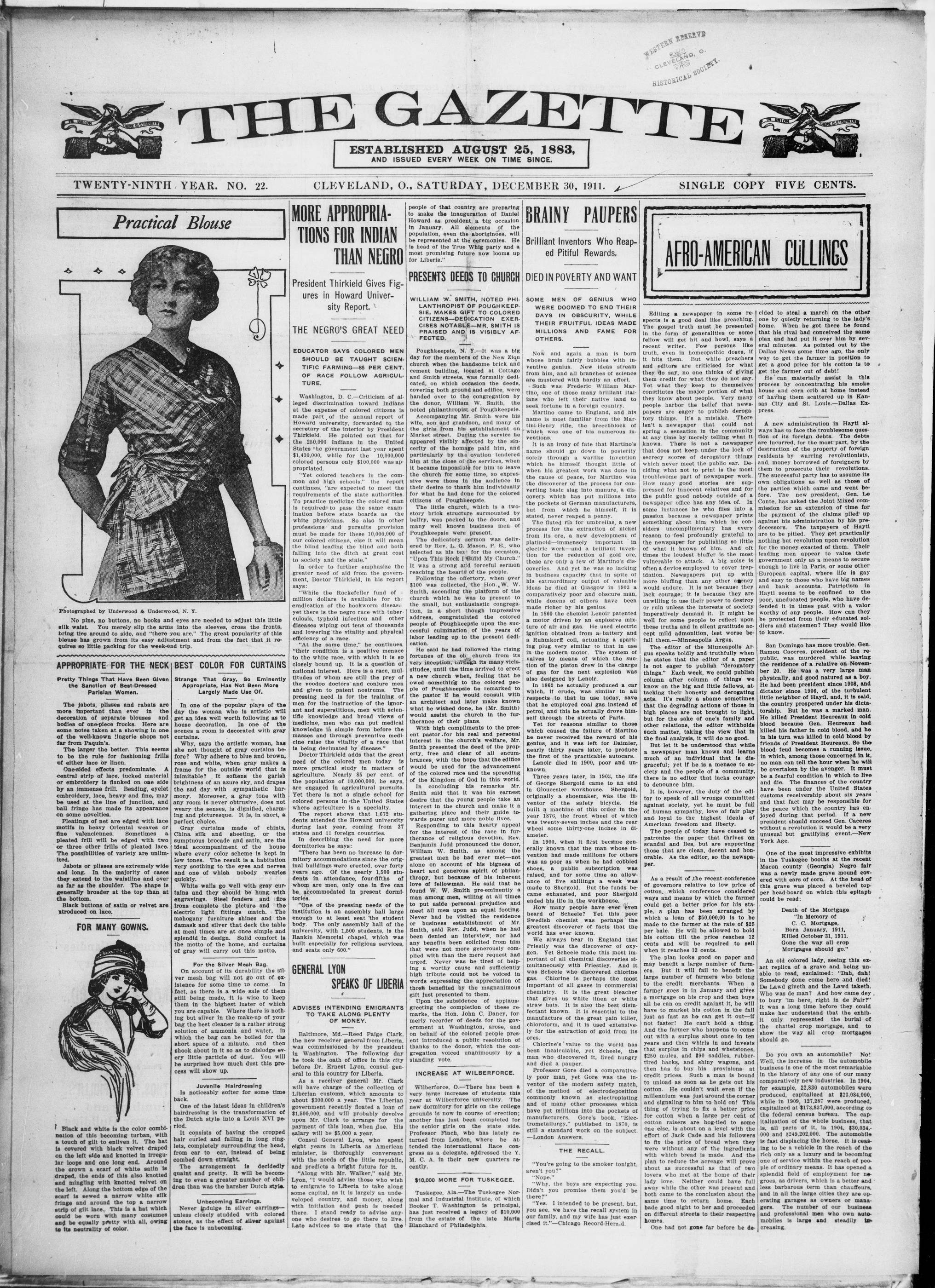
Practical Blouse
Photographed by Underwood & Underwood, N. Y.
No pins, no buttons, no hooks and eyes are
silk waist. You merely slip the arms into the
bring ties around to side, and "there you are."
blouse has grown from its easy adjustment a
quires so little packing for the week-end trip.
APPROPRIATE FOR THE NECK BEST
No pins, no buttons, no hooks and eyes are needed to adjust this little silk waist. You merely slip the arms into the sleeves, cross the fronts, bring ties around to side, and "there you are." The great popularity of this blouse has grown from its easy adjustment and from the fact that it requires so little packing for the week-end trip.
APPROPRIATE FOR THE NECK BEST COLOR FOR CURTAINS
---
IN UNION
UNION IS STRONGER
Pretty Things That Have Been Given the Sanction of Best-Dressed Parisian Women.
The jabots, plisses and rabats are more important than ever in the decoration of separate blouses and bodies of one-piece frocks. Here are some notes taken at a showing in one of the well-known 'lingerie shops not far from Paquin's.
The larger the better. This seems to be the rule for fashioning frills of either lace or linen.
One-sided effects predominate. A central strip of lace, tucked material or embroidery is fanked on one side by an immense frill. Beading, eyelet embroidery, lace, heavy and fine, may be used at the line of junction, and ball fringe has made its appearance on some novelties.
Pleatings of net are edged with lace motifs in heavy Oriental weaves or fine valenciennes. Sometimes a pleated frill will be edged with two or three other frills of pleated lace. The possibilities of variety are unlimited.
Jabots or plisses are extremely wide and long. In the majority of cases they extend to the waistline and over as far as the shoulder. The shape is generally broader at the top than at the bottom.
Black buttons of satin or velvet are introduced on lace.
FOR MANY GOWNS.
JOHNSON
Black and white is the color combination of this becoming turban, with a touch of gilt to enliven it. The hat is covered with black velvet draped on the left side and knotted in irregular loops and one long end. Around the crown a scarf of white satin is draped, the ends of this also knotted and mingling with knotted velvet on the left. Along the bottom edge of the scarf is sewed a narrow white silk fringe and around the top a narrow strip of gilt lace. This is a hat which could be worn with many costumes and be equally pretty with all, owing to its neutrality of color.
THE GAZETTE
Strange That Gray, So Eminently Appropriate, Has Not Been More Largely Made Use Of.
In one of the popular plays of the day the woman who is artistic will get an idea well worth following as to house decoration. In one of the scenes a room is decorated with gray curtains.
Why, says the artistic woman, has she not thought of gray curtains before? Why adhere to blue and brown, rose and white, when gray makes a frame for the outside world that is inimitable? It softens the garish brightness of an azure sky, and drapes the sad day with sympathetic harmony. Moreover, a gray tone with any room is never obtrusive, does not weary the senses, is dignified, charming and picturesque. It is, in short, a perfect choice.
Gray curtains made of chintz, China silk and sheeting, or the sumptuous brocade and satin, are the ideal accompaniment of the house where every color scheme is kept in low tones. The result is a habitation very soothing to the eyes and nerves and one of which nobody wears quickly.
White walls go well with gray curtains and they should be hung with engravings. Steel fenders and fire frons complete the picture and the electric light fittings match. The mahogany furniture shines and the damask and silver that deck the table at meal times are at once simple and splendid in design. Solid comfort is the motto of the home, and curtains of gray will carry out this motto.
For the Silver Mesh Bag.
For the Silver Mesh Bag.
On account of its durability the silver mesh bag will not go out of existence for some time to come. In fact, as there is a wide sale of them still being made, it is wise to keep them in the highest luster of which you are capable. Where there is nothing but silver in the make-up of your bag the best cleaner is a rather strong solution of ammonia and water, in which the bag can be boiled for the short space of a minute, and then shook about in it so as to dislodge every little particle of dust. You will be surprised how much dust this process will show up.
Juvenile Hairdressing
Is noticeably softer for some time back.
One of the latest ideas in children's hairdressing is the transformation of the Dutch style into a Louis XVI period.
It consists of having the cropped hair curled and falling in long ringlets, completely surrounding the head, from ear to ear, instead of being combed down straight.
The arrangement is decidedly quaint and pretty. It will be becoming to even a greater number of children than was the harsher Dutch style.
Unbecoming Earrings.
Never indulge in silver earrings—unless closely studded with colored stones, as the effect of silver against the face is unbecoming.
ESTABLISHED AUGUST 25, 1883, AND ISSUED EVERY WEEK ON TIME SINCE.
CLEVELAND, O., SATURDAY, DECEMBER 30, 1911.
MORE APPROPRIATIONS FOR INDIAN THAN NEGRO
President Thirkield Gives Figures in Howard University Report.
THE NEGRO'S GREAT NEED
EDUCATOR SAYS COLORED MEN SHOULD BE TAUGHT SCIENTIFIC FARMING—85 PER CENT. OF RACE FOLLOW AGRICULTURE.
Washington, D. C.—Criticism of alleged discrimination toward Indians at the expense of colored citizens is made part of the annual report of Howard university, forwarded to the secretary of the interior by President Thirkield. He pointed out that for the 250,000 Indians in the United States the government last year spent $1,430,000, while for the 10,000,000 colored persons only $100,000 was appropriated.
"Yet colored teachers in the common and high schools," the report continues, "are expected to meet the requirements of the state authorities. To practice medicine the colored man is required to pass the same examination before state boards as the white physicians. So also in other professions: and pursuits provision must be made for these 10,000,000 of our colored citizens, else it will mean the blind leading the blind and both falling into the ditch at great cost to society and the state."
In order to further emphasize the greater need of aid from the government, Doctor Thirkield, in his report says:
"While the Rockefeller fund of million dollars is available for the eradication of the hookworm disease, yet there is the negro race with tuberculosis, typhoid infection and other diseases wiping out tens of thousands and lowering the vitality and physical efficiency of a race.
"At the same time," he continues, "their condition is a positive menace to the white race, with which it is so closely bound up. It is a question of national interest. Here is a race, multitudes of whom are still the prey of the voodoo doctors and conjure men and given to patent nostrums. The pressing need is for the training of men for the instruction of the ignorant and superstitious, men with scientific knowledge and broad views of medicine, men who can put medical knowledge in simple form before the masses and through preventive medicine raise the vitality of a race that is being decimated by disease."
Doctor Thirkeld adds that the great need of the colored men today is more practical study in matters of agriculture. Nearly 85 per cent. of the population of 10,000,000, he says, are engaged in agricultural pursuits. Yet there is not a single school for colored persons in the United States where agriculture is a specialty.
The report shows that 1,672 students attended the Howard university during last year, coming from 37 states and 11 foreign countries.
In describing the need for more dormitories he says:
"There has been no increase in dormitory accommodations since the original buildings were erected, over forty years ago. Of the nearly 1,500 students in attendance, four-fifths of whom are men, only one in five can be accommodated in present dormitories."
"One of the pressing needs of the institution is an assembly hall large enough to at least seat the student body. The only assembly hall of the university, with 1,500 students, is the Rankin Memorial chapel, which was built especially for religious services, and seats only 600."
GENERAL LYON
SPEAKS OF LIBERIA
ADVISES INTENDING EMIGRANTS TO TAKE ALONG PLENTY OF MONEY.
Baltimore, Md—Reed Paige Clark, the new receiver general from Liberia, was commissioned by the president in Washington. The following day he took the oath of office in this city before Dr. Ernest Lyon, consul general to this country for Liberia.
As a receiver general Mr. Clark will have charge of the collection of Liberian customs, which amounts to about $300,000 a year. The Liberian government recently floated a loan of $1,500,000, and will probably devolve upon Mr. Clark to arrange for the payment of this loan, when due. His salary will be $5,000 a year.
Consul General Lyon, who spent eight years in Liberia as American minister, is thoroughly conversant with the needs of the little republic, and predicts a bright future for it.
"Along with Mr. Walker," said Mr. Lyon, "I would advise those who wish to emigrate to Liberia to take along some capital, as it is largely an undeveloped country, and money, along with initiation and push is needed there. I stand ready to advise anyone who desires to go there to live. Late advises to me state that the
people of that country are preparing to make the inauguration of Daniel Howard as president a big occasion in January. All elements of the population, even the aborigines, will be represented at the ceremonies. He is head of the True Whig party and a most promising future now looms up for Liberia."
PRESENTS DEEDS TO CHURCH
WILLIAM W. SMITH, NOTED PHILANTHROPIST OF POUGHKEEPSIE, MAKES GIFT TO COLORED CITIZENS—DEDICATION EXERCISES NOTABLE—MR. SMITH IS PRAISED AND IS VISIBLY AFECTED.
Poughkeepsie, N. Y.—It was a big day for the members of the New Zion church when the handsome brick and cement building, located at Cottage and Smith streets, was formally dedicated, on which occasion the deeds, covering both ground and edifice, were handed over to the congregation by the donor, William W. Smith, the noted philanthropist of Poughkeepsie.
Accompanying Mr. Smith were his wife, son and grandson, and many of the girls from his establishment on Market street. During the service he appeared visibly affected by the sincerity of the homage paid him, and particularly by the ovation tendered him at the close of the services, when it became impossible for him to leave the church for some time, so expressive were those in the audience in their desire to thank him individually for what he had done for the colored citizens of Poughkeepsie.
The little church, which is a two-story brick structure surmounted by beifry, was packed to the doors, and many well known business men of Poughkeepsie were present.
The dedicatory sermon was delivered by Rev. L. G. Mason, P. E., who selected as his text for the occasion, "Upon This Rock I Build My Church." It was a strong and forceful sermon reaching the hearts of the people. Following the offertory, when over $100 was collected, the Hon. W. W. Smith, ascending the platform of the church which he was to present to the small, but enthusiastic congregation, in a short though impressive address, congratulated the colored people of Poughkeepsie upon the successful culmination of the years of labor leading up to the present dedication. He said he had followed the rising fortunes of the old church from its very inception, through its many victories, until the time arrived to erect a new church when, feeling that he owed something to the colored people of Poughkeepsie he remarked to the pastor if he would consult with an architect and later make known what he wished done, he (Mr. Smith) would assist the church in the furtherance of their plans.
With high compliments to the present pastor for his zeal and personal interest in the church's welfare, Mr. Smith presented the deed of the property, free and clear of all encumbrances, with the hope that the edifice would be used for the advancement of the colored race and the spreading of the Kingdom of God in this world. In concluding his remarks Mr. Smith said that it was his earnest desire that the young people take an interest in the church and make it a gathering place and their guide towards purer and more noble lives. Responding to this hearty appeal for the interest of the race in furtherance of religious devotion, Rev. Benjamin Judd pronounced the donor, William W. Smith, as among the greatest men he had ever met—not alone on account of his bigness of heart and generous spirit of philanthropy, but because of his inherent love of fellowman. He said that he found W. W. Smith pre-eminently a man among men, willing at all times to put aside personal prejudice and meet all men upon an equal footing. Never had he visited the residence or business establishment of Mr. Smith, said Rev. Judd, when he had been denied an interview, nor had any benefits been solicited from him that were not more generously complied with than the mere request had urged. Never was he tired of helping a worthy cause and sufficiently high tribute could not be voiced in words expressing the appreciation of those benefited by the magnanimous gift just presented to them.
Upon the subsidence of applause greeting the completion of these remarks, the Hon. John C. Dancy, formerly recorder of deeds for the government at Washington, arose, and on behalf of the colored people present introduced a public resolution of thanks to the donor, which the congregation voiced unanimously by a standing vote.
INCREASE AT WILBERFORCE.
Wilberforce, O.—There has been a very large increase of students this year at Wilberforce university. The new dormitory for girls on the college grounds is now in course of erection; another has just been completed for the senior girls on the state side. Professor Finch, who has lately returned from London, where he attended the International Race congress as a delegate, addressed the Y. M. C. A. in their new quarters recently.
$10,000 MORE FOR TUSKEGEE.
Tuskegee, Ala.—The Tuskegee Normal and Industrial institute, of which Booker T. Washington is principal, has just received a legacy of $10,000 from the estate of the late Maria Blanchard of Philadelphia.
BRAINY PAUPERS
Brilliant Inventors Who Reaped Pitiful Rewards.
DIED IN POVERTY AND WANT
SOME MEN OF GENIUS WHO WERE DOOMED TO END THEIR DAYS IN OBSCURITY, WHILE THEIR FRUITFUL IDEAS MADE MILLIONS AND FAME FOR OTHERS.
Now and again a man is born whose brain fairly bubbles with inventive genius. New ideas stream from him, and all branches of science are mustered with hardly an effort. Such was Frederic William Martino, one of those many brilliant italians who left their native land to seek fortune in a foreign country.
Martino came to England, and his name is most familiar from the Martini-Henry rifle, the breechblock of which was one of his numerous inventions.
It is an irony of fate that Martino's name should go down to posterity solely through a warlike invention which he himself thought little of when his greatest work was done in the cause of peace, for Martino was the discoverer of the process for converting basic slag into manure, a discovery which has put millions into the pockets of German manufacturers, but from which he himself, it is stated, never resaped a penny.
The fluted rib for umbrellas, a new process for the extraction of nickel from its ore, a new development of platinoid—immensely important in electric work—and a brilliant invention for the reduction of gold ore, these are only a few of Martino's discoveries. And yet he was so lacking in business capacity that in spite of his extraordinary output of valuable ideas he died at Glasgow in 1903 a comparatively poor and obscure man, while dozens of others have been made richer by his genius.
In 1860 the chemist Lenoir patented a motor driven by an explosive mixture of air and gas. He used electric ignition obtained from a battery and a Ruhmkoff coll, actuating a sparking plug very similar to that in use in the modern motor. The system of valves by means of which the suction of the piston drew in the charge of gas for the next explosion was also designed by Lenoir.
In 1862 he actually produced a car which, if crude, was similar in all respects to that in use today, save that he employed coal gas instead of petrol, and this he actually drove himself through the streets of Paris.
Yet for reasons similar to those which caused the failure of Martino he never received the reward of his genius, and it was left for Daimler, nearly thirty years later, to produce the first of the practicable autocars.
Three years later, in 1903, the life of George Shergold came to an end in Gloucester workhouse. Shergold, originally a shoemaker, was the inventor of the safety bicycle. He built a machine of this order in the year 1876, the front wheel of which was twenty-seven inches and the rear wheel some thirty-one inches in diameter.
In 1900, when it first became generally known that the man whose invention had made millions for others was as poor as when he had cobbled shoes, a public subscription was raised, and for some time an allowance of five shillings a week was made to Shergold. But the funds became exhausted, and poor Shergold ended his life in the workhouse.
How many people have ever even heard of Scheele? Yet this poor Swedish chemist was perhaps the greatest discoverer of facts that the world has ever known.
We always hear in England that Priestly was the discoverer of oxygen. Yet Scheele made this most important of all chemical discoveries simultaneously with Priestley. And it was Scheele who discovered chlorine gas. Chlorine is perhaps the most important of all gases in commercial chemistry. It is the great bleacher that gives us white linen or white straw hats. It is also the best disinfectant known. It is essential to the manufacture of the great pain killer, chloroform, and it is used extensively for the extraction of gold from its ores.
Chlorine's value to the world has been incalculable, yet Scheele, the man who discovered it, lived hungry and died a painer.
Professor Gore died a comparatively poor man, yet Gore was the inventor of the modern safety match, of the method of electrodeposition commonly known as electroplating and of many other processes which have put millions into the pockets of manufacturers. Gore's book, "Electrometalium," published in 1870, is still a standard work on the subject.
—London Answers.
THE RECALL.
"You're going to the smoker tonight, aren't you?"
"Nope."
"Why, the boys are expecting you. Didn't you promise them you'd be there?"
"Yes. I intended to be present, but, you see, we have the recall system in our family, and my wife has just exercised it."—Chicago Record-Herald
AFRO-AMERICAN CULLINGS
Editing a newspaper in some respects is a good deal like preaching. The gospel truth must be presented in the form of generalities or some fellow will get hit and howl, says a recent writer. Few persons like truth, even in homeopathic doses, if it hits them. But while preachers and editors are criticised for what they do say, no one thinks of giving them credit for what they do not say. Yet what they keep to themselves constitutes the major portion of what they know about people. Very many people harbor the belief that newspapers are eager to publish derogatory things. It's a mistake. There isn't a newspaper that could not spring a sensation in the community at any time by merely telling what it knows. There is not a newspaper that does not keep under the lock of secrecy scores of derogatory things which never meet the public ear. Deciding how many good stories are suppressed for innocent relatives and for the public good nobody outside of a newspaper office has any idea of. In some instances he who files into a passion because a newspaper prints something about him which he considers uncomplimentary has every reason to feel profoundly grateful to the newspaper for publishing so little of what it knows of him. And oft times the loudest bluffer is the most vulnerable to attack. A big noise is often a device employed to cover trepidation. Newspapers put up with more bluffing than any other agency would endure. It is not because they lack courage; it is because they are unwilling to use their power to destroy or ruin unless the interests of society imperatively demand it. It might be well for some people to reflect upon these truths and in silent gratitude accept mild admonition, lest worse be fall them.-Minneapolis Argus.
The editor of the Minneapolis Argus speaks boldly and truthfully when he states that the editor of a paper is not eager to publish "derogatory things." Each week, we could publish column after column of things we know on the big and little fellows, attacking their honesty and derogating acts. It's really a shame sometimes that the degrading actions of those in high places are not brought to light, but for the sake of one's family and other relations, the editor withholds such matter, taking the view that in the final analysis, it will do no good. But let it be understood that while a newspaper man knows and learns much of an individual that is disgraceful; yet if he is a menace to society and the people of a community, there is no editor that lacks courage to denounce him.
It is, however, the duty of the editor to speak of all wrongs committed against society, yet he must be full of human sympathy, love of fair play and loyal to the highest ideals of American freedom and liberty.
The people of today have ceased to patronize the paper that thrives on scandal and lies, but are supporting those that are clean, decent and honorable. As the editor, so the newspaper.
As a result of the recent conference of governors relative to low price of cotton, which conference considered ways and means by which the farmer could get a better price for his staple, a plan has been arranged by which a loan of $50,000.00 is to be made to the farmer at the rate of $25 per bale. He will be allowed to hold his cotton till the price reaches 12 cents and will be required to sell when it reaches 13 cents.
The plan looks good on paper and may benefit a large number of farmers. But it will fail to benefit the large number of farmers who belong to the credit merchants. When a farmer goes in in January and gives a mortgage on his crop and then buys all he can on credit against it, he will have to market his cotton in the fall just as fast as he can get it out—if not faster! He can't hold a thing. And the farmer who happens to come out with a surplus about once in ten years and then whirls in and invests that surplus in chips and whetstones, $250 miles, and $90 saddles, rubber-tired hacks, and shiny wagons, and then has to buy his provisions at credit prices. Such a man is bound to unload as soon as he gets out his cotton. He couldn't wait even if the millennium was just around the corner and signaling to him to hold on! This thing of trying to fix a better price for cotton when a large per cent of cotton raisers are hog-tied to some one else, is about on a level with the effort of Jack Cade and his followers to fix the price of bread when they were without any of the ingredients with which bread is made. And the plan to reduce the acreage will prove about as successful as that of two lovers who met at the home of their lady love. Neither could have full sway while the other was present and both came to the conclusion about the same time to return home. Each bade good night to her and proceeded on different streets to their respective homes.
One had not gone far before he de-
cided to steal a march on the other one by quietly returning to the lady's home. When he got there he found that his rival had conceived the same plan and had put it over him by several minutes. As pointed out by the Dallas News some time ago, the only way to get the farmer in position to get a good price for his cotton is to get the farmer out of debt!
He can materially assist in this process by concentrating his smoke house and corn crib at home instead of having them scattered up in Kansas City and St. Louis.—Dallas Express.
A new administration in Haytl always has to face the troublesome question of its foreign debts. The debts are incurred, for the most part, by the destruction of the property of foreign residents by warring revolutionists, and money borrowed of foreigners by them to prosecute their revolutions. The successful party has to assume its own obligations as well as those of the parties which came and went before. The new president, Gen. Le Conte, has asked the Joint Mixed commission for an extension of time for the payment of the claims piled up against his administration by his predecessors. The taxpayers of Haytl are to be pitted. They get practically nothing but revolution upon revolution for the money exacted of them. Their leading men appear to value their government only as a means to secure enough to live in Paris, or some other European capital, where life is gay and easy to those who have big names and bank accounts. Patriotism in Haytl seems to be confined to the poor, uneducated people, who have defended it in times past with a valor worthy of any people. How can they be protected from their educated soldiers and statesmen? They would like to know.
San Domingo has more trouble. Gen. Ramon Caceres, president of the republic, was murdered while leaving the residence of a relative on November 20. He was a very large man physically, and good natured as a boy. He had been president since 1908, and dictator since 1906, of the turbulent little neighbor of Haytf, and, it is said, the country prospered under his dictatorship. But he was a marked man. He killed President Heureaux in cold blood because Gen. Heureaux had killed his father in cold blood, and he in his turn was killed in cold blood by friends of President Heureaux. So the blood feud becomes a running issue, in which, among those concerned in it, no man can tell the hour when he will be overtaken by the avenger. It must be a fearful condition in which to live and die. The finances of the country have been under the United States customs receivership about six years and that fact may be responsible for the peace which the country has enjoyed during that period. If a new president should succeed Gen. Caceres without a revolution it would be a very unusual but gratifying event.—New York Age.
One of the most impressive exhibits in the Tuskegee booths at the recent Macon county (Georgia) Negro fair was a newly made grave mound covered with ears of corn. At the head of this grave was placed a beveled top head-board on which this epitaph could be read:
Death of the Mortgage
"In Memory of
C. C. Mortgage,
Born January, 1911,
Killed October 31, 1911.
Gone the way all crop
Mortgages should go."
An old colored lady, seeing this exact replica of a grave and being unable to read, exclaimed: "Dah, dah! Somebody done come here and died! De Lawd giveth and the Lawd taketh. Who was de man? And how came dey to bury 'im here, right in de Fair?" It was a long time before they could make her understand that the exhibit only represented the burial of the chattel crop mortgage, and to show the way all crop mortgages should go.
Do you own an automobile? No! Well, the increase in the automobile business is one of the most remarkable in the history of any one of our many comparatively new industries. In 1904, for example, 22,830 automobiles were produced, capitalized at $23,084,000, while in 1909, 127,287 were produced, capitalized at $173,837,000, according to the federal census bureau. The capitalization of the whole business, that is, all parts of it, in 1904, $30,034,000 and $249,202,000. The automobile is fast displacing the horse. It is ceasing to be a vehicle in the reach of the rich only as a luxury and is becoming one of service within the reach of people of ordinary means. It has opened a splendid field of employment for negroes, as drivers, which is a better and less barbarous term than chauffeurs, and in all the large cities they are operating garages as owners or managers. The number of our business and professional men who own automobiles is large and steadily increasing.
One Year.....$1.80
Six Months.....1.00
Three Months......50
Subscribers are requested to remit by postoffice money order or registered letter.
Entered at the postoffice In Cleveland Ohio, as second-class matter
Address all communications to HARRY C. SMITH
Editor and proprietor
Member Ohio Legislature: 1894
1896 1896 to 1898: 1900 to 1902
THE GAZETTE is the oldest, and has the largest bena fide circulation, double that of any newspaper in the interest of Afro-Americans, published in the state of Ohio, and comparison with any will immediately establish his rank as one of the NEWSIEST AND BEST in the country.
Is it a fact, Bro. Dabney, editor of the Cincinnati Union, that "jimrow" cars are again being run into the Grand Central Depot of your city, and not a murmur of protest made to the State Railroad Commissioner and Governor Harmon by our people of Cincinnati? Surely, it cannot be, as reported.
A white Chicagoan has given the Fellowship League of that city, presided over by Mrs. Ida B. Wells Barnett, a complete gymnasium outfit worth $300. She is asking for donations to fit up the basement of the League's rooms on State St., and install light, heat etc., and is likely to get them, as the result of her pointed communications to the daily papers of that city. The League's rooms are open to ALL without reference to color, race or religion. Good! That is the way and the spirit! More power to you, Mrs. Barnett and your kind of members of the race.
The constitutionality of the Illinois statute to indemnify the owners of property for damages occasioned by mobs or riots has recently been upheld by the U. S. Supreme Court. As a result of this decision, Springfield, IL, is in a fair way to lose about $100,000, as suits aggregating over that amount are pending as the out growth of the race riot there in October, 1908, when several Afro-Americans were mobbed and lynched, and much property destroyed. One hundred suits against that city for the recovery of damages will be pushed, following this Federal court decision. GOOD! The Illinois Anti-Lynching law is practically a copy of our Ohio law.
Why don't Gov. Judson Harmon pardon or parole Louis H. Peck, sent to the Ohio Penitentiary for life from Akron, eleven years ago, on a charge of criminal assault which every one now knows, was never committed by Peck or anyone else? Why the delay Governor when guilty prisoners are being liberated from the Penitentiary by you as the result of paroles and pardons? Must the innocent prisoners remain and continue to suffer? Surely the Governor is being misled. Something is wrong. Look into the matter, Governor, and let justice, 'though eleven years late, be done this man. He has been made to suffer imprisonment far too long, already, by the great state of Ohio.
The man who suffers persona wrong without protest or opposition the "peaceful" member of the community, is a demoralizing factor in our social fabric. The class that does not struggle for civic and industrial rights will eventually lapse into slavery. The nation that passively countenances encroachments upon its rights and territory is doomed to dismemberment and national bankruptcy. It is the man who defends his rights, the class that battles for political and industrial advancement, and the nation that holds its own against the entire world; it is the "litigious" person, the revolutionary class, and the vigilant nation, that keep the world from stagnation and force it onward on the path of progress—Hillquit.
"JIM CROWISM" IN OHIO!
Springfield, Dayton and Columbus are to have fine branch Y. M. C. A. buildings. Perhaps Cleveland and Cincinnati perk up, wake up and take exchange.
Maybe! If so, it is to be regretted. It would be far better if our people of Springfield, Dayton and Columbus had their own, rather than permit themselves to be set aside as a "jimcrow" annex to the central or white Y. M. C. A. of their respective cities. Queer Christianity this, on the part of the latter, to say the least. It is a sort of color-line "Christianity" in Y. M. C. A. work which the Lord Jesus Christ will hardly condone, if His teachings in His great book, are to be believed and they are, even by the prejudiced white Y. M. C. A. workers who are seeking to ignore them in order to cater to their miserable selfishness and prejudice. Cleveland Afro-American will have none of this "jimcrow" annex Y. M. C. A. "business" and have said so in a way that all concerned, both white and Colored, and elsewhere, cannot and not failed to understand. This, too, even if our good people of a few other northern cities have allowed themselves to be hoodwinked and misled into favoring a "jimcrow" Y. M. C. A. annex. Here in this country, we get more than enough discrimination and color-lines of one kind and another from the whites, without "adding and abetting" the nefarious "business," especially that labeled "Christian." Those "jimcrow" Negroes in northern cities who are ever ready to "saddle" any kind of an ingesting and harmful discrimination or color-line on our people, in order that they may "kow to" prejudiced whites and at the same time provide a place or two for
themselves or friends, or both, ought to be driven from the communities they disgrace because they are a positive hindrance and serious detriment to the racial progress of their people of the places in which they live. There is no danger of Cleveland's intelligent and sensible Afro-American population "waking up" to any such contemptible "business." The poor Negro who started the Y. M. C. A. A. "jimcrow" annex movement in this city, some months ago, has been shipped to Columbus, where he is again similarly engaged, we regret to say, evidently not having been properly impressed by his dismal and harrowing experience and failure here. Our good people of that city, have our sympathy and are urged to "tie a tin can to its tail," as was done here some time ago, and thus give it the freedom of the southern part of this country for Y. M. C. A. A. "jimcrow" annex work. Ohio is only injured by such.
13 BABIES IN 3 YEARS.
Prolific White People — Twins Followed Dozen Doctors and Artists, then a Quintet, then a Quintet.
Oklahoma City, Okla.—His recent complaint that the railway station waiting room at Boynton, Okla., was without fire on a bitterly cold day led to the discovery that J. M. Jackson and his wife are parents of thirteen children, born in three years. Their fourteenth child, a son, is now 14 years old. Five years ago the increase in the Jackson family became marked. Twins are now five years old; triplets succeed the twins in twelve months and in another year triplets made their appearance; but one year after the last triplets five children on the same day. The last five are alive, but the health of the whole family. Jackson says, was impaired by the absence of warmth in the Boynton station waiting room.
Pardons an Afro-American.
Columbus, O.—The state board of administration granted its Christmas parole to Nancy Madison, a member from Jefferson county, to serve two years for receiving stolen property. Mrs. Madison's husband is now serving 15 years in the penitentiary for burglary. His wife was tried for receiving and harboring property which Mrs. Madison, the Mrs. Madison returned Christmas morning to Steubenville, her old home.
Easy for Joe Jeannette
Buffalo, N. Y.—Without extending himself Jose Jeannette, heavyweight, with aspirations to the championship, Tuesday night outpointed Jack (Twin) Sullivan all the way in a ten-round bout here. Jeannette contented himself with simply harassing Sullivan until the fifth round, when the crowd yelled for him to get into action, all over the ring, but always appeared to have a good reserve in hand in case Sullivan should break loose. He simply played with him. Four thousand people saw the bout.
ROSENWALD GIVES TO Y. M. C. A
Sends Check for $25,000, as Equa
Sum Is Raised at Nation's
Chicago, Ill.—Julius Rosenwald, president of Sears, Roebuck & Co., was notified by the Washington, D.C. Young Men's Christian Association that the provision of his conditional subscription of $25,000 toward a building for a Colored branch in connection with the Washington association, have been met. Mr. Rosenwald's subscription was incumbent upon the raising of $75,000 by the association. Upon receipt of the word from the national capital he mailed his check for $25,000, according to his agreement. The contribution insures the complete cost of the desired building, which will cost the land and building $100,000. The cities of Chicago, Los Angeles, Indianapolis, Atlanta and Philadelphia raised the necessary $75,000.
CUT RATE CLOTHING STORE
G. A. Morgan Open a New Place of Business at 2544 Central Av.
Ladies fine woolens and worsted garments, made to measure. All workmanship first class. These garments are made in Mr. Morgan's own factory and can be purchased by you for thirty to fifty per cent below the regular retail price. All retail goods at wholesale prices. This is a new race enterprise and our people should be generous in their patronage of it.
THE ALPHA THEATER THIS WEEK
When an actor is forced to return six times in one performance, it is an evident fact that he is pleasing his audience. This is what Eldon Marin is forced to do at the Alpha Theater, Tuesday evening. The crowd cheered and cheered until he made six appearances. Rose Motley, the dainty singing soubrette, has a great whistling song which pleases the audience.
CORRESPONDENTS WANTED.
The old reliable Gazette desires an active, agent and correspondent in every city and town in Ohio and neighboring states having a number of Afro-American residents. Only a time on Fridays or Saturdays is required.
We are especially desirous of hearing from persons in the following named cities: Zar.esville, Newark, Lancaster, Lebanon, Chillicothe, Toledo, Troy, Akron, Springfield, Piqua, Columbus, Cambridge, Steubenville, Bailer, St. Clairsville, Wilmington, Portsmouth, Washington, C. H. O. Jackson, Gallup, Boston, Tampa, Delaware, M. Vernon, East Liverpool, Wellsville, Hamilton, Middleport, Bellefontaine, Lima, O., and other places where we have none.
Write to the editor of The Gazette, Blackstone building, Cleveland, O., and terms will be sent promptly. Our readers will oblige us greatly by their support. Persons in the cities named above, or others, to whom we can write relative to the matter.
ATTENTION, READERS!
Don't throw away your copy of The Gazette when you have done with it, but give it to some appreciative person whom you feel would be likely to subscribe or take it regularly, if they had a copy to look over and read carefully. Oblige the Editor.
THE GAZETTE, CLEVELAND, O. SATURDAY, DECEMBER 1 1911
SOME SPORT NEWS.
Mendez and Gonzales, the Greatest Cuban Ball-players—Jack Johnson, Sam Langford and McVey, and Joe Jeannette, the Four Greatest Heavy-weight Pugilists in the World.
On his return from Cuba, recently, Christy Mathewson, the N. Y. Giants' great pitcher, said in speaking of the "Cuban" ball-players, several of whom are Afro-Americans:
"You ought to hear them growl when the umpire makes a mistake! This fellow Mendez is a great pitcher but his color bars him in this country." Gonzales, the Almendares (Havana, Cuba) catcher, held the N. Y. Giants to six steals in four games. He is by far the greatest backstop the island has ever produced and but for his color would probably be on the payroll of an American or National league club. Mendez and Gonzales are black Cubans.
DOOM LATTICE MAST
Navy Men Say They Must Be Abandoned.
Practically Indestructible, but Vibration Proves Handicap to Range Finders and Diminishes Accuracy in Gunnery.
Washington.—The skeleton masts on the United States battleships, distinctly a feature of American war craft, are said to be doomed for the scrap heap. There is a great deal of discussion in naval circles over the apparently well-founded report that the navy department intends to abandon the skeleton masts with which
New York City Americans, accord census.
Mrs. Anna Like recently left $10,000 without relatives w ed some time ago.
Sam. McVey's outpointing Sam. Langford in a 20 round bout, in Australia, recently, surprised everybody, and many Americans refuse to believe McVey really did it, though he has challenged Champion Jack Johnson on the strength of it. Almost an equal surprise was Jeanneette's easy victory, Tuesday night, over Jack (Twin) Sullivan. He was expected to win but not so easily.
Jack Johnson's next fight probably will be with Sam McVey, who defeated Sam Langford in Australia. The champion, Tuesday, received a cable from Promoter Hugh McIntosh, who is home in Australia, that Johnson would receive a guarantee of $30,000 with a liberal percentage if he would agree to meet McVey. If the offer is accepted the $30,000 must be deposited in some reliable bank before Johnson leaves Chicago. Al Kaufman also hurted a challenge at the champion, and then received from Jack Curley, manager of Jim Flynn, asking Johnson to hold off from making any matches until Curley arrived in Chicago on Sunday.
When Champion Jack returned to America, Dec. 21, he stated emphatically that he had not retired from the ring, and his appearance belied the cabled dispatches that the champion was "fat as a prize porker." He stepped upon the dock scales at Hoboken, and his appearance 233, saying as he did so that he weighed 245 when he started to train for the Jeffries fight. "It's purely a question of money, as it always has been, whether I fight again or not," he said. "I was in prime shape for Bombardier Wells, when jealousy between promoters stopped that bout. I can get ready again on short notice if I am not jealous, while." With the champion came his wife, three English valets and the famous thirteen trunkfuls of clothes that he ordered for, the coronation. Jack is start to start on a 20-week theatrical tour, after which he may go to France or Australia. His wife's illness and a desire to spend Christmas at home in Chicago, with his mother, will be missed. He can cancel a number of valuable contacts in England and come back to America. To a N. Y. reporter, he on, landing there: "Don't Believe all these stories you hear about me," said Johnson. "I'm as good as I ever was, and there isn't a man in the world I won't fight if a purse of $30,000 is offered. I have not retired from the ring, and that I am broke. I had a good time abroad and bought a new racing car—but I came back with more money than I had when I started."
A wonderful quartet of fighters are Jack Johnson, Sam Langford, Joe Jeannette and Sam McVey. The four of them far outclass any half dozen white men in the fight market. They appear to have a monopoly on all the class to be found in the heavyweight division, and nary a Caucasian or companion in the fight market. They beckoned on a strenuous deal with one of them at the present time. Johnson was the first to tread in Peter Jackson's footsteps. The champion had his first fight in Chicago in 1899. In 1901 Langford took lessons off Jimmy Walsh and has been fighting since then. McVey's career dates from 1903. Johnson was the gloves in 1904. Johnson, Langford and Jeannette have had some lively times, fighting among themselves fairly often. McVey has spent the greater part of the last ten or fifteen years in Europe, so instead of having his three countrymen to work on he has had the real Caucasians of Europe to whip. The champion and Langford set in 1906 and Jack gave the gloves after a fiery decision. After the fight scrimmage, Jeannette and Johnson have battled seven times. Joe woe once on a foul and Jack won one decision, and no decisions were rendered in the other five. Johnson has boxed McVey twice. He beat him on both occasions. Jeannette met McVey four times. The first battle went ten rounds to no decision. The jeannette had a twenty-round course. The third contest lasted fifty-one rounds. McVey being knocked out. Shortly after, they fought a thirty-round draw. Langford and Jeannette have met about eight times, with varying results. Generally Langford won, but Jeannette had an edge the last time they clashed, and in September, at New York, Langford and Jeannette have come together twice. Last April they fought a twenty-round draw in Paris, Monday, McVey got a decision over Boston Sam in twenty rounds at Sydney, Australia.
Must Have "The Old Reliable."
Berea, Ky., Dec. 26, 1911
Hon. H. C. Smith—
Find enclosed P. O. money order for The Gazette for another year. We cannot do without our paper. The Gazette, because of the fearless and fair stand it takes on all questions pertaining to the race. Mr. Titus wishes to ask this question. Cannot there be a united effort on the part of our editors, preachers and business path to induce President Taft to call the attention of Congress to the wholesale massacres, lynching and murdering of our people in the South? The whole country seems to be aroused over the action of Russia in regard to Jewish passports. Respectfully yours. MRS. A. W. TITUS.
LADIES! LADIES!! LADIES!!
Call your lady friends' and acquaintances' attention to our up-to-date fashion and pattern departments and thus encourage them to subscribe or take The Gazette regularly. Oblige the Editor.
DOOM LATTICE MAST
Navy Men Say They Must Be Abandoned.
Practically Indestructible, but Vibration Proves Handicap to Range Finders and Diminishes Accuracy in Gunnery.
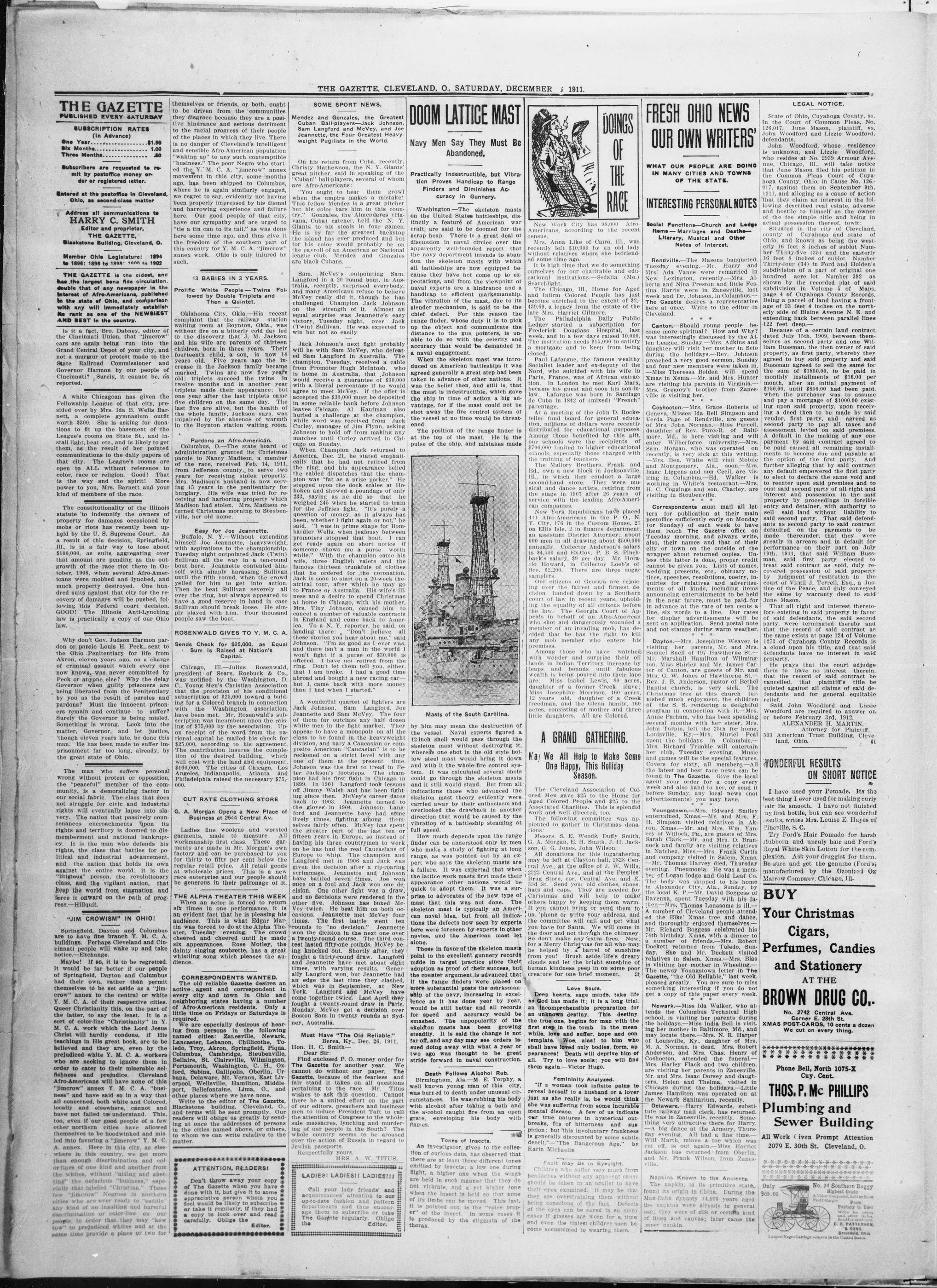
Washington—The skeleton masts on the United States battleships, distinctly a feature of American warcraft, are said to be doomed for the scrap heap. There is a great deal of discussion in naval circles over the apparently well-founded report that the navy department intends to abandon the skeleton masts with which all battleships are now equipped because they have not come up to expectations, and from the viewpoint of naval experts are a hindrance and a handicap to efficient marksmanship. The vibration of the mast, due to its slender mechanism, is said to be the chief defect. For this reason the range finder, whose duty it is to pick up the object and communicate the distance to the gun pointers, is unable to do so with the celerity and accuracy that would be demanded in a naval engagement.
When the skeleton mast was introduced on American battleships it was agreed generally a great step had been taken in advance of other nations. It was the belief then, and still is, that the mast is indestructible, which gave the ship in time of action a big advantage, for if the mast could not be shot away the fire control system of the vessel at no time would be threatened.
The position of the range finder is at the top of the mast. He is the pulse of the ship, and mistakes made
THE BATTLESHIP
Masts of the South Carolina.
by him may mean the destruction of the vessel. Naval experts figured a 12-inch shell would pass through the skeleton mast without destroying it, whereas one shot in the old style hollow steel mast would bring it down and with it the whole fire control system. It was calculated several shots could go through the skeleton masts and it still would stand. But from all indications those who advanced the skeleton mast were widely carried a way by their enthusiasm and overlooked the drawback in another direction that would be caused by the vibration of a battleship steaming at full speed.
How much depends upon the range finder can be understood only by men who make a study of fighting at long range, as was pointed out by an expert who says the skeleton masts are a failure. It was expected that when the lattice work masts first made their appearance other nations would be quick to adopt them. It was a surprise to advocates of the new type of mast that this was not done. The skeleton mast is typically an American naval idea, but from all indications the defects seen by experts here were foreseen by experts in other navies, and the American mast let alone.
Those in favor of the skeleton masts point to the excellent gunnery records made in target practice since their adoption as proof of their success, but the counter argument is advanced that if the range finders were placed on more substantial posts the marksmanship of the navy, increasing in excellence as it has done year by year, would be still better and all records for speed and accuracy would be smashed. The unpopularity of the skeleton masts has been growing steadily. It is said the change is not far off, and any day may see orders issued doing away with what a year or two ago was thought to be great stride forward in naval construction.
Death Follows Alcohol Rub
Birmingham, Ala — M. E. Torphy, a well known young man of this city, was burted to death under unusual circumstances. He was rubbing his body with alcohol after taking a bath and the alcohol caught fire from an open grate, enveloping his body with flames.
Tones of Insects.
An investigator, given to the collection of curious data, has observed that there are at least three different tones emitted by insects; a low one during flight, a higher one when the wings are held in such manner that they do not vibrate, and a yet higher tone when the insect is held so that none of its limbs can be moved. This last, it is pointed out, is the "voice proper" of the insect. In some cases it is produced by the stigmata of the thorax.
DOINGS OF THE RAGE
New York City has 98,000 Afro-Americans, according to the recent census.
Mrs. Anna Like of Cairo, Ill., was recently left $10,000 by an old lady without relatives whom she befriended some time ago.
It is high time that we do something ourselves for our charitable and educational institutions.—Sedalia (Mo.) Searchlight
The Chicago, Ill., Home for Aged and Infirm Colored People has just become enriched to the extent of $2,439.69, a legacy from the estate of the late Mrs. Harriet Gilmore.
The Philadelphia Daily Public Ledger started a subscription for Frederick Douglass Hospital, last week, and in a few days raised 10,000. The institution needs $15,000 to satisfy mortgage and to keep from being closed.
Paul Lafargue, the famous wealthy Socialist leader and ex-deputy of the Nord, who suicided with his wife in Paris, France, was of African extraction. In London he met Karl Marx, became his guest and soon his son-in-law. Lafargue was born in Santiago de Cuba in 1842 of (mixed) "French" parentage.
At a meeting of the John D. Rockefeller fund board for general education, millions of dollars were recently distributed for educational purposes. Among those benefited by this gift, 700,000 were the recipients $700,000 limited to higher educational schools, especially those charged with the training of teachers.
The Mallory Brothers, Frank and Ed, own a new block in Jacksonville, Ill., in which they conduct a large second-hand store. They were musical and dance artists, retiring from the stage in 1967 after 26 years of service with the leading Afro-American New York Republicans have placed 411 Afro-Americans in the P. O. N. Y. City, 176 in the Custom House, 21 on Ellis Isle, 2 in finance department, an assistant District Attorney; about 600 men in all drawing about $500,000 annually. Collector Anderson's salary is $4,500 and Ex-Gov. P. B. S. Pincock's salary, $9 per day. Mr. Horah W. Burford, in Collector Loeb's of fice $2,200. There are three sugar samplers.
Our citizens of Georgia are rejoicing over the fairest and firnest decision handed down by a Southern court of law in recent years, upholding the equality of all citizens before the law. The Georgia Court of Appeals in behalf of an Afro-American who sheet and dangerously wounded a slave, decided that he has the right to kill any mob member who enters his premises. Among those who have watched with wonder and surprise their oil lands in Indian Territory increase by leaps and bounds until fabulous wealth is being poured into their laps are: Miss Isabel Lewis, 80 acres dug of a former Creek slave; Miss Josephia Morrison, 160 acres 12 years old, daughter of a Creek freedman, and the Glenn family, 160 acres, consisting of mother and three little daughters. All Are Colored.
A GRAND GATHERING. May We All Help to Make Some One Happy. This Holiday Season
Season.
The Cleveland Association of Colored Men gave $25 to the Home for Aged Colored People and $25 to the Associated Charities. This is splendid work and well directed, too.
The following committee was appointed to gather in Christmas donations:
Mrs. S. E. Woods, Duffy Smith,
G. A. Morgan, E. H. Smith, J. H. Jackson,
G. C. Jones, John Wilson.
All donations for this ingathering may be left at Clayton hall, 2828 Central Ave., at the office of J. W. Wills, 2823 Central Ave., and at the People's Drug Store, cor. Central Ave. and E. 32d St. Send your old clothes, shoes, hats and caps. They are needed for Christmas and will help to make others happy by keeping them warm. If you cannot bring or send them to us, 'phone or write your address, and the committee will call, and get what you have for Santa. We will come in the door and not the chimney. If you cannot bring or send for a Merry Christmas for all who may be helped by a barrel of sunshine from you. Brush aside life's dreary clouds and let the bright sunshine of human kindness peep in on some poor creature for one brief moment. 22
Love Souls
Deep hearts, sage minds, take life as God has made it; it is a long trial, an incomprehensible preparation for an unknown destiny. This destiny the true one, begins for man with the first step in the tomb. In the mean while, love and suffer, hope and contemplate. Woe, alas! to him who shall have loved only bodies, form, appearances! Death will deprive him of all. Try to love souls; you will find them again—Victor Hugo.
Femininity Analyzed
"If a woman took infinite paints to reveal herself to a husband or a lover just as she really is, he would think she was suffering from some incurable mental disease. A few of us indicate our true natures in hysterical outbursts of bitterness and suspicion; but its voluntary frankness is generally discounted by some subtle decet."—"The Dangerous Age," by Karin Michaels.
Fault Max Be in Eyesight
Children who suffer very much from headaches without any apparent cause should be taken to an oculist to have their eyes examined. It may be that they are overstraining them without being conscious of the fact. Defects of the eyes can be cured in so many cases if glasses are worn for a time, and even the tiniest children soon be come accustomed to wearing them.
FRESH OHIO NEWS OUR OWN WRITERS
WHAT OUR PEOPLE ARE DOING IN MANY CITIES AND TOWNS OF THE STATE.
INTERESTING PERSONAL NOTES
Social Functions—Church and Lodge
Items—Marrigues and Deaths
Literary, Musical and Other
Notes of Interest.
Rendville.—The Masons banqueted
Tuesday evening.—Mr. Harry and
Mrs. Ada Vance were remarried in
New Lexington, recently. Mrs. Alberta and Nina Preston and little Foote and Harris were in Zanesville, last week and Dr. Johnson, in Columbus. The Gazette desires a representative here at once. Write to the editor in Cleveland.
Canton.—Should young people become more spiritual? How and Why? was interestingly discussed by the Alen League, Sunday.—Mrs. Adkins and daughter will visit her mother in Seio during the holidays.—Rev. Johnson presided at a very good meeting. Sunday and four new members were taken in.—Miss Theresa Bolden will spend Xmas in Xenia.—Mr. and Mrs. Hunter are visiting his parents in Virginia.—Mrs. Gregory's brother from Zanesville is visiting her.
Coschoton.—Mrs. Grace Roberts of Geneva, Misses Ida Bell Simpson and Verda Page of Reendville, are guests of Mrs. John Norman.—Miss Purcell, daughter of Rev. Purcell, of Balti more, Md., is here visiting and will enter Wil伯force university.—Mrs. Sam, Morgan, who was operated on recently, is very sick at this writing.—Mrs. Ben, White will visit Mobile and Montgomery, Ala., soon.—Mrs. Isaac Liggens and son Cecil, are visiting in Columbus.—Ed. Walker is working in White's restaurant.—Mrs. H. C. Coggings and son, Charley, are visiting in Steubenville.
Correspondents must mail all letters for publication at their main postoffice sufficiently early on Monday (or Sunday) of each week to have them reach The Gazette office on Tuesday morning, and always write, also, their names and that of their city or town on the outside of the postoffice. Unless this latter is done, proper credit cannot be given you. Lists of names, wedding presents, etc., obituary notices, speeches, resolutions, poetry, inquiries for relatives and advertisements of all kinds, including items announcing entertainments to be held in the near future, must be paid for by the post office. On a line, six words to a line. Our rates for display advertisements will be sent on application. Send postal note and not stamps during warm weather.
Dayton—Mrs. Josephine Weaver is visiting her parents, Mr. and Mrs. Samuel Snell of 197 Hawthorne St.—Mr. Marshall Hamilton of Wilmington, Miss Shirley and Mr. James Carter of Canton, are guests of Mr. and Mrs. G. W. Jones of Hawthorne St.—Mr. Anderson, Mrs. James Baptist Church, are very sick. The Christmas tree at this church furnished much enjoyment, the children of the S. S. rendering a delightful program in connection with it—Mrs. Annie Parham, who has been spending several months with her sister, Mrs. John Turpin, left the 25th for home, Louisville, Ky.—Mrs. Mariel Peal spent the holidays in Columbus,—Mrs. her club. Tuesday evening, sixt and games will be the special features, Covers for sixty, all members. All the latest and best race news can be found in The Gazette. Give the local agent your order for a copy every week and also hand to her, or send it before Sunday, any local news (not advertisements) you may have.
Youngstown.—Mrs. Edward Smiley entertained, Xmas.—Mr. and Mrs. F. H. Simpson visited relatives in Akron, Xmas.—Mr. and Mrs. Wm. Yancey of Willock, Pa. are guests of Mrs. Sarah Clark.—Mr. and Mrs. D. Branock and family are visiting relatives in Natchez. Miss.—Mrs. Frank Curtis, comp. Mrs. Salem, Xmas.—Mr. Thomas Harvey drew evening. Pneumonia. He was a member of Logan lodge and Gold Leaf Co. The body was shipped to his home in Alexander City, Ala., Sunday, by the local K. P. Mr. David Boggess of Ravenna, spent Tuesday with his father.—Mrs. Thomas Lonesome is ill. A number of Cleveland people attended the Elks' Xmas tree and dance, and thoroughly enjoyed themselves.—Mr. Richard Boggess celebrated his 74th birthday, Xmas with a dinner to Dumber's friends. Robert Dumber returned to Toledo day. She and Mr. Dockett visited relatives in Salem, Xmas.—Mrs. Blas is visiting her mother in Wheeling.—The news youngstown letter in The Gazette, "the Old Reliable," last week, pleased greatly. You are sure to miss something interesting if you do not get a copy of this paper every week.
Newark—Miss Ida Walker, who attends the Columbus Technical High school, is visiting her parents during the holidays.—Miss India Bell is visiting her mother in Baltimore, Md., and may locate them—Mrs. N. R. Harper of Louisville, Ky., daughter of Mrs. M. A. Norman, is dead. Mrs. Robert Anderson, and Mrs. Chas. Henry of Coshoton, attended the funeral. Mrs. Black and Mrs. Brown are visiting her parents in Zanesville, Mr. and Mrs. Isaac Dorssey and daughters, Helen and Thelma, visited in Chicago during the holidays—Little James Hamilton was operated on at the Newark Sanitarium, recently.
Delaware—Harry Edwards, substitute railway mail clerk, has returned. He was in Zanesville, recently. Something very attractive there for Harry.—A big dance at the Armory, Thurs evening. All had a fine time. Will Hard, a tote which was cut off, out as a Miss Ida Jackson has returned from Oberlin, and Mr. Frank Wilson, from Zanesville.
Napkins Known to the Ancients. The napkin, in its primitive state, found its origin in China. During the Man Dashu dynasty (4,000 years ago) the napkins were already in general use; they were of silk or certain kind of linen and canvas; later came the napkin napkin.
State of Ohio, Cuyahoga county. ss. In the Court of Common Pleas, No. 126.017, June Mason, plaintiff, vs. John Woodford and Lizzie Woodford, defendants. John Woodford, whose residence is unknown, and Lizzie Woodford, who resides at No. 2939 Armour Avenue, Chicago, Ill., will take notice that June Mason filed his petition in the Common Pleas Court of Cuyahoga County, Ohio, in Cause No. 126.017, against them on September 9th, 1911, and alleging as a cause of action that they claim an interest in the following: that they have and hostile to himself as the owner of the fee simple title and being in actual possession thereof towit:
Situated in the city of Cleveland, county of Cuyahoga and state of Ohio, and known as being the westier 16 feet 8 inches of sublot Number Thirty-five (35) and the easterly 16 feet 8 inches of sublot Number Thirty-four (34) in Ford and Holden's subdivision of a part of original one hundred acre lot Number 332 as shown by the recorded plat of said subdivision in Volume 5 of Maps, page 4 of Cuyahoga County Records. page 4 of Holden's subdivision in age of 33 feet 4 inches on the northerly side of Blaine Avenue N. E, and extending back between parallel lines 122 feet deen—
Because of a certain land contract dated July 15th, 1909, between themselves as second party and one William Bussman, the then owner of said property, as first party, whereby they agreed to buy said property and said Bussman agreed to sell the same for the sum of $1850.00, to be paid in monthly installments of $16.00 per month, after an initial payment of $150.00, until $850.00 had been paid. The owner agreed to pay all taxes and pay a mortgage of $1000.00 existing upon said property, upon receiving a deed then to be made by said vendor, first party, and agreed as second party to pay all taxes and assessment levied on said premises. A default in the making of any one payment by said contract agreed to be paid caused all remaining installments to become due and payable at the option of the first party. And further alleging that by said contract any default empowered the first party to elect to declare the same void and to oust the owner and pay a debt to oust second party of all right and interest and possession in the said property by proceedings in forcible entry and detainer, with authority to sell said land without liability to said second party. That said defendants as second party to said contract defaulted on the payments to be made thereunder, that they were greatly in arrears and in default for performance on their part on July 19th, 1911, that said William Bussman, said first party elected to treat said contract as void duly repaired by judgment of restitution in the court of Virigil J. Terrell, Esq., a Justice of the Peace, and duly conveyed the same by warranty deed to said June Mason.
That all right and interest therefore existing in said property in favor of said defendants, the said second party, were terminated thereby and that the record of said contract as the same exists at page 124 of Volume 1273 of Cuyahoga County Records is a cloud upon his title, and that said defendants have no interest in said property.
He prays that the court adjudge them to have no interest therein, that the record of said contract be cancelled, that plaintiff's title be quieted against all claims of said defendants and for general equitable relief.
Said John Woodford and Lizzie Woodford are required to answer on or before February 3rd, 1912.
ALEXANDER H. MARTIN,
Attorney for Plaintiff,
503 American Trust Building, Cleveland, Ohio.
6t
WONDERFUL RESULTS
ON SHORT NOTICE
I have used your Pomade. Is the best thing I ever used for making curly hair tie smooth. I have not finished my first bottle, but can see wonderful results, writes Mrs. Louise E. Hayes of Pineville, S. C.
Try Ford's Hair Pomade for harsh stubborn and unruly hair and Ford's Royal White Skin Lotion for the complexion. Ask your druggist for them. Be sure and get the genuine (Ford's) manufactured by the Ozonized Ox Marrow Company, Chicago, Ill.
BUY
Your Christmas
Cigars,
Perfumes, Candies
and Stationery
AT THE
BROWN DRUG CO..
No. 2742 Central Ave.
Corner E. 28th St.
XMAS POST-CARDS, 10 cents a dozen
We cut on every thing.
Phone Bell, North 1075-X
Cuy. Cent.
THOS. P. Mc PHILLIPS
Plumbing and
Sewer Building
All Work (Given Prompt Attention
2079 E. 30th St. Cleveland, O.
Only
$65.00
No. 24 Southern Buggy
Highest Grade
A Value Immediately and at
Priced Margin
From
Factory to User
Write for jersey
market and
Southern catalog
C. R. H. MERRSON
& MORE
Greenfield Ohio
Fangtong Negro Carriage concern in the United States.
PURELY PERSONAL
J. S. HALL'S, 3121 Central Ave.
L. SCHWARTZ'S, 2921 Central Ave. Open Sunday.
O. C. SCHROEDER'S, Cuyahoga Bldg. Open Sunday.
ELMER F. BOYD'S, 2604 Central Ave.
F. VALENTINE'S, 2130 Central Ave.
NOTICE TO SUBSCRIBERS:—Subscribers not receiving The Gazette regularly should notify us at once. We desire every copy delivered promptly. We advise our patrons to carefully examine The Gazette's advertisements before making purchases. Business men who advertise in this paper should have the patronage of Afro-Americans. The fact that they advertise is assurance that they want it. Local reading notices (advertisements) ten cents a line (six words in a line.)
FOR RENT—Nicely furnished room, all conveniences, at 2334 E. 87th St. Bell Phone, Doan 2045 R.
NOTARY PUBLIC—For such services call at The Gazette office, No 3 Blackstone Building, No. 1422 W. 3d street, near Superior avenue.
FOR SALE—Brand new, imperial Encyclopedia and Dictionary. 40 volumes, finely illustrated, handy to handle. Unexcelled for reference purposes. A library in itself—one that will last a life-time. Contains everything you may wish to know. Call or adhere to The Gazette, Blackstone Building, 1422 W. St. Cleveland, near Superior Av. This is an opportunity of a life-time for those who love good books.
Mrs. A. Taylor of E. 37th St., is ill Mrs. John A. Wilson of 2520 E. 39th St., is visiting Mrs. R. M. Mitchell in Chicago, during the holidays. Misses Lois Osborne and Eva Marshall of St. Louis, Mo., students at Oberlin, are guests of Miss Clemence Greene of 3324 Cedar Ave.
Mrs. Seelig of 2317 E. 71st St. will keep office in home on the guest, Miss Cecil Johnson of Detroit on New Year's Day from 2 to 8 p.m.
Mrs. St. John of E. 71st St., left Thursday evening for Milwaukee, Wisfré Frederic Seelig and Elmer Cheeks of Purdue University are home for the holidays.
Miss Derrick, daughter of Bishop W. P Derrick and a teacher at Wilberforce University, is spending the holiday
WANTED AGENTS—A Good chance to make from $15.00 to $50.00 a week. Good opportunity for men of all ages. We want reliable agents to take orders for our "high quality" Liberty Commission paid weekly. Perform year-round position. Complete course in salesmanship with free outfit. Experience unnecessary. All goods sold under positive ironclad guarantee to be presented. Write quick Pennsylvanian Nursery Co., Girard, Erie Co., Pa.
For Sale or Furs—AUTOMOBILISTS
ATTENTION! Having secured a few elegant fur-lined coats, robes and fur sets for professional services, will sacrifice for quick cash sales. Gent's black broadcloth coat, lined with Spanish mink (full skins), elegant Persian lamb collar, cost $90, will sell for $35, also gents' whole skin muskrat lined coat, Persian lamb collar, cost $140, sell for $45. Black or brown cub bear robes, size $45,66, beaver cloth lined coat, cost $120, will sell for $30 (brown), length 52 inches, bargain for $30; same in black $28. Latest style Belgian lynx set $12, or black fox set $15. Iceland fox set (white), $20. All new this season. Write G. Morehead, 118 East 28th St., New York City.
Mrs. M. H. Smith of 2315 E. 49th St., left Sunday for a two week's visit with relatives in Crawfordsville, Ind.
Mrs. Thos. Carroll of E. 30th St., entertained Xmas evening in honor of her birthday.
Miss Corine Smith is spending the holidays at home, E. Liverpool. Mr. James Pryor will visit her, New Year's day. Mr. O. B. Moss was called to Columbus by the death, Sunday, the 17th, of her brother-in-law, Mr. Lorenz Byrd. Mrs. Ruth Childs of Wellsburg, W. Va., is visiting her daughters, Mrs. Della Page and Mrs. Emma Crable of this city. Mrs. Edwards and son, Charles of, Pittsburgh, have returned home. They visited Mrs. P, H. Stevens of 2183 E. 43d St., two weeks. J. C. Carr and Albert, of 2327 E. 36th St., left Sunday for a two weeks' visit in Chattanooga. Tennessee and other places in Georgia. The Silver Leaf club's Xmas dancing party, Monday evening, at ideal hall, was a very well attended and enjoyable event. There were a number of out-of town attendants.
The Gazette acknowledges the receipt of a neat "little calendar, the compliments of H. C. Gilbert, manager of Gilbert's Print Shop, 3027 Central Av. The first leaf "wishes" all "A Merry Christmas and a Happy New Year." Thanks. Patronize the persons and firms that advertise in The Gazette. They are likely the best but show that they wish your trade by asking for it in these columns. Remember this particularly at this season of the year. Rev. Max. Wertheimer, Hebrew scholar, teacher and preacher, of Pittsburg, is conducting a series of biblelessons and sermons at the mission of Branch No. 2. Christian and Missionary Alliance, 1918. The missionaries will visit until Jan. 7. Bible lessons at 2:30 p. m. and sermons at 7:30 p. m. daily, except Saturdays.
B. S. Laird, supt., of the Boys' Farm at Hudson, spoke at the Association's lyeum at St. Andrew's church Monday evening week and made one or two local "hits," unintentionally, while speaking of boys at the farm names of Harry and Walter Wills. His greatly amused the audience, which small was very appreciative.
St. Andrews' Union club's New Years' Assembly and reception will held Jan. 1, 1912, at ideal hall, 2406 Central Ave. The program will begin at 8:15 p. m. standard. Object: to furnish our new club house. The participants are: Mrs. Katherine Skeene Mitchell, soprano; H. Edw. Thompson, baritone; Frederick K. Phillips, reader; Miss Anna Ma, Phillips, reader; Messrs. A. Mayherman, F. D. Hack; Walter Wills and Arthur L. Spencer, club quartette; Miss Eleanor Alexander, accompanist; orchestra.
Rev. W. L. Burr of Columbus, will preach several evenings next week at M. Haven church, beginning. Wednesday. The pastor, Rev. J. L. Burr, will preach, Sunday morning and evening, as usual; Sunday School and B. Y. P. U., at the usual hours, 12:30 noon and 6:30 p. m., respectively. Watch-meeting opens at 9 p. m. I. A. Lawson, is church clerk; S. L. Hill, chairman of the deacon board and G. L. Randolph, chairman of the trustee board. The Xmas exercises, in charge of the S. S., were very interesting. The superintendent, Mr. Hill and the pastor were nicely treated.
Mrs. A. Taylor of E. 37th St., is ill.
Mrs. John A. Wilson of 2520 E. 39th St., is visiting Mrs. R. M. Mitchell in Chicago, during the holidays.
Misses Lois Osborne and Eva Marshall of St. Louis, Mo., students at Oberlin, are guests of Miss Clemence Greene of 3324 Cedar Ave.
Mrs. E. Seelig of 2317 E. 71st St., will keep open house in honor of her guest, Miss Ceel Johnson of Detroit, on Day Four from 2 to 8 p.m.
Mrs. St. John of E. 71st St. is thursday evening for Milwaukee, Wis.
Frederic Seelig and Elmer Cheeks of Purdue University are home for the holidays.
Miss Derrick, daughter of Bishop W. B Derrick and a teacher at Wilberforce University, is spending the holidays with Mr. and Mrs. Edward Daw of Purdue University.
"Doc." White, the "Nans!" trainer, arrived in the city recently. He had been operated upon and spent some weeks in a hospital since the close of the base-ball season, according to a local daily paper.
Send your local items to The Gazette on Monday or Tuesday of each week. This paper is published for ALL of our people and "plays no factions." The Gazette is the same—fair and right. Take The Gazette and tell your friends to do so also.
The Cleveland Association of Colored Men's ingathering for the Old Folk's Home should not be forgotten this holiday season. Everybody, truly, helps the children they that will make some poor person and home the happier as a result of its receipt. Notify the Association and whatever you have will be called for willingly, and you thanked for your kindness to those who need most at this festive season of the year. Open your hearts and give, and be the hap-
Our Chauffeurs' club's select holiday dancing party. Wednesday at Trostler's hall, was another exceptionally successful social function, for which the organization is becoming famous. The ladies' costumes were again very pretty and becoming indeed, while their escorts appeared largely in the conventional evening dress. The members of the club have every reason to feel proud of the success of this holiday dancing party as well as their reception and ball which committee members. The committee in charge of this week's affair was as follows: Wm. Gray, Wm. Grant, Tom L. Christopher, Arthur Goodman, Fred. Clark (floor manager) and Jas. P. Johnson (assistant).
That many persons appreciate the Sunday afternoon concerts of the Symphony Orchestra is evident by the way requests have already been made of the secretary. This series undoubtedly will be more "popular" than its eleven predecessors. So much more interest is being shown this season than ever before that the committee in charge is looking forward with the keenest pleasure to the opening concert. Every one possessing *divs* pride must acknowledge that a series of concerts that does as much for the musical good of a choir as for a musical good of a department deserves consideration and assistance. That the public realizes the good of these concerts is evidenced by the support which the orchestra has received. It has enabled the committee to engage more men and secure talent than in previous seasons. Much musical pleasure is in store for those who contemplate attending. This because of the excellence of the programs that will be presented. As in former years the tickets will be on sale at Burrows Brothers, on Saturday, and at Grays Armory, the day of each concert. The season-ticket sale will be on Saturday, the 6th. Season-tickets can, however, be secured prior to the above date from the Secretary.
Frank Gillett, a former Clevelander, who was killed last week in Mexico and robbed of $40,000, lived on his ranch near Rosa Moranda, Tepic, Mex. He was a son of Mr. Townley Gillett, an Englishman, a civil war veteran of the American Civil War, and his Harriet Greenbrier Gillett, the oldest sister of Mrs. Elliza Greenbrier Holmes of 10506 Hudson Av. Frank Gillett had one child, a daughter, Hercella. He was 55 years of age and a native of this city. His mother was the first Colored child born in Cleveland, it is said. Frank lived here until his death, when he subsequently the father enlisted in the war of the rebellion. He joined the Seventh Ohio regiment and was killed at Gettsyburg. After the death of his father the child was taken to Cincinnati by a man named Billings and came under the tutelage of William Schreiber. Mrs. Holmes, the aunt, did not learn the whereabouts until nearly two years later, when she traced him to the southern part of the state. The lad was then brought to Cleveland for a short stay. For the next decade or more he was in the railroad business as conductor on various roads in Ohio. Then he moved to New Orleans and he joined to Guatemala, where he is the coffee business. For a score of years his Cleveland relatives heard nothing from him. During this time he had married and been divorced three times. His first wife was a Spanish woman, the second the sister of a governor of Guatemala and the third a Cleveland woman whom he divorced about a year and a half ago. It is not thought that his wife referred to as being gagged by the murderers was in reality the daughter. Hercella, Gillett was reputed to be very wealthy.
HE GAZETTE, CLEVELAND, O. SATURDAY, DECEMBER 30, 1911
LITTLE GEM Miss
LUNCH ROOM
to get a Good Lunch and Quick Service
J. W. CRAWFORD, PRO'R.,
3133 CENTRAL AVE.
---
Mrs. Trimble of Detroit Ave., is convalescent.
Mrs. L. Roberts of Scovill Ave., has moved to E. 36th St. E. 24th St. is at last to be extended to Cedar Ave., from Central Ave.
For select dancing, attend Friday evening's private parties at ideal hall. Mrs. A. Taylor of Detroit, visited her daughter, Mrs. H. Lucas of Blaine Ave, recently. Woodore B. Green, Esq., has returned from the northwest for a month's visit with his folk. Mr. Wm. Dawkins of Wilberforce, is spending the holidays in the city. Also Mrs. Smith of Cincinnati. Russell Fleming of Wilberforce, is visiting his parents. Also Edna Hill and her brother, children of Mr. and Mrs. Dan. Hill. Mr. and Mrs. Alex. Simms of Massillon, visited Mr. and Mrs. Henry Phelps, Mr. Simms' parents, and Mr. and Mrs. H. L. L Taylor of 2162 E. 43d St., Xmas. MissRuss A. Fisher of Lorain, Corine Thomas of Oberlin and Mr. Richard Fowler of Pittsburg, spent the week in the city. Rev Charles S. Nickens, former pastor of Fraternity Ave, M. E, church, Columbus, brother of Dr. J. K. Nickens of this city, is reported very ill. Pneumonia. Improvement is very slow.
Of the Christmas festivities along the avenue, L. G. Schwartz, 2921 Central Ave., led in gladdening the hearts of the little ones with his Santa Claus who gave away thousands of cards and pictures.
James Mondaaye, producing manager for the S. C. Green Amusement Company, will leave, Saturday night, for Chicago, to arrange for acts for the Alpha Theater, which is owned by the S. C. Green Amusement Company.
The cantata "Sleepy Santa," given by the children of Mt. Zion Congregational S. S., was a very enjoyable affair. The costumes and the little tots were a special feature. Miss Bertha the teacher led the children, deserves great credit.
The Alpha Theater opened last week with splendid attendance. The entertainment it furnished was excellent and the audiences thoroughly pleased. Martin Motley, in their sketch, "The Porter and the Soubrette," were very good and kept the room roaring with the time. The great Monday in his world's greatest physical culture act was fine and very pleasing indeed.
At the first concert on January 17 by the Cleveland Symphony orchestra in the Sunday afternoon series of "Pop" concerts at Grays' armory there will be heard three favorite compositions. The famous "Over境" by methamphetamine will then program; the Haydn Symphony in G minor and excerpts from Wagner's "Lohengrin" will follow, and the entire Mendelssohn Concerto for Violin will have its first performance here in many years. There will also be popular numbers. An array of soloists has been performed by the orchestra which is calculated to attract large audiences to all the concerts.
The Alpha Theater, 3206 Central Ave., under the management of the S. C. Green Amusement Company, of which S. C. Green is general manager, is perhaps the finest play-house company in the country. The lighting and ventilating facilities are fine and there is a large roomy stage with the usual footlights, regular stage curtains and an abundance of hand-painted scenes along the walls of the hand-painted landscape scenes. There are spacious aisles and roomy seats, electric announcers, ladies' bouidur, smoking rooms for gentlemen, and every modern appliance for the safety and comfort of the patrons. Perfect order is insisted upon and objectively designed. The theater force of officials is competent, obliquing and capable. Attend the Alpha Theater and see for yourself.
A FINE QUICK LUNCH FOR LADIES
AND GENTLEMEN
at—
2432 Central Ave.
HOME COOKING.
FIRST-CLASS SERVICE.
Charles R. Ellis.
Proprietor.
Travis & Strawder
'Central Transfer Co.'
CAREFUL MOVERS OF FURNI
TURE and PIANOS
Piaao Hoisting a Specialty
Light and Heavy Expressing.
Orders Promptly Attended to.
Prices Reasonable.
Office and Residence:
2903 Central Ave., Cleveland, Ohio.
Cuy. Cen. 8182R.
TELEPHONES:
Bell, Eddy 1100L.
Cuy., Central 1745R.
THE MANHATTAN
The Best Place
on Central Ave.,
Open Evenings for the Accommodation of the Theater Trade.
WHO MAKES YOUR CLOTHES?
Rufus S. Justice
4316 Central Avenue,
Fine Custom Tailoring, Cleaning, Dye
Ino. Repairing and Pressing.
All work guaranteed.
THE ORIOLE THEATRE
High Class Vaudeville and Moving Pictures
To rent for Meetings, Private Parties, Balls Banquets, &c.
Wilberforce University
Opens Third Tuesday in September.
Located in Greene county, three and one-quarter miles from Xenia, O. Healthful surroundings. Refined community. Faculty of 32 members. Expenses low. Classical and Scientific, Theological, Preparatory, Music, Military, Normal and Business Departments. TEN INDUSTRIES TAUGHT GREAT OPPORTUNITIES for High School Graduates entering College or Professional Courses. Ohio students desiring to enter Normal, Business or Industrial Department can obtain certificate from State Senator or Representative entitling them to FREE TUITION, ROOM RENT AND INCIDENTALS.
Matriculation Entrance Examinations, September 18 and 19. School Opens
Tuesday, September 21. Tuesdays, September 28. Catalogue and special information furnished. Address
W. A. JOINER, SUPT., C. N. & I. DEPARTMENT.
```markdown
```
$I
$2
Best Hat
Least Money.
2122 E. 4th
(Sheriff) St.
South
of Prospect St.
Dunn & Moran
TONSORIAL PARLORS
"Four Barbers"
3014 Central Ave.
CLEVELAND.
GO TO THE
Mission Restaurant
2404 CENTRAL AVE.
Under the Management of
J. D. HACKLEY,
First-class Food, First-class Service and Prices within the reach of all
Our Special Sunday Dinner Cannot
Be Beaten. Theatre Parties a
a Specialt.
Fine Lots
TREADWELL & GERMANIA AVES.
Cash or Easy Terms.
CHEAP.
Ed. Blythin, 961 Rose Bldg.
G. G. REED'S
Dry Goods and
Gents' Furnishings,
A Complete Line.
Cuy. Central 6661 L
3222 Central Ave., Cleveland, O.
** "The Smart Set"
French
Dry Cleaning and
Pressing Parlor.
WM. CHILDS,
MANAGER.
2435 Central Ave.
Bell, Doan 1398-J. Residence
East 791-L. Office
Dr, Walter S. Biggs,
Dentist.
(A member of the race.)
4715 Central Ave., Cleveland, O.
Hours: 8 to 12 a.m., 1 to 5 p.m.
Sundays and Evenings by
Appointment
---
3221 Central Avenue.
O. L. HARRIS, Manager.
The University
Force, Ohio.
Today in September.
July, three and one-quarter miles from Xenia, O.
nced community. Faculty of 32 members. Exc.
cientific, Theological, Preparatory, Music, Mil-
Departments. TEN INDUSTRIES TAUGHT.
For High School Graduates entering College
college students desiring to enter Normal, Busi-
t can obtain certificate from State Senator
them to FREE TUITION, ROOM RENT AND
ininations, September 18 and 19. School Opens
, Septe mber 19, 1911.
Information furnished. Address
W. S. SCARBOROUGH, PRES.
THE "HERALD LUNCH"
George A. C. Hicks, Prop'r.
Ice Cream,
Soda, and Short Orders.
Neat, Clean and Quick
Service.
OPEN ALL NIGHT!
3124 Central Ave., Cleveland, Ohio.
JOHN T. TUCK & CO.
Wall Paper and
Paints.
Decorators, Paper Hang-
ers and House
Painters.
3325 Central Av.
'Phone, North 1153 and Cent. 6661-R.
* * * * * * * * * * * *
M. GOLDMAN,
Dry Goods, Hosiery,
Notions, Etc..
Ladies and Gents
Furnishings, Curtains, Oil Cloth &c.
3003 Central Ave., Cor. E. 30tn St.
Phone, Gen. 2189 W.
CLEVELAND . . . OHIO
BUSINESS EXCHANGE
THE CENTRAL BUSINESS EXCHANGE AND COLLECTING AGENCY,
2402 Central Ave.
(012) 345-6780
Business and Private Information Given.
Call and see us. We can help you.
Legal and Business advertisements solicited for The Gazette.
S. E. WOODS, Mgr.
MISS L.E. WARREN'S HAIR GROWER
Miss Warren is one of the FIRST and BEST in her business in Cleveland, and
Positively Can Grow Hair
With Each Treatment. She gives a sample box of Hair Grower.
3927 Central Ave.
CLEVELAND, OHIO.
FORD'S
HAIR MADE!
MAKES HAIR, KINNY OR CURLY HAIR
GLOSSY, SOPTER AND MORE PLIABLE,
EASY TO CHOOSE AND PUT UP IN ANY STYLE
THE LENGTH WITH FEMININE UNCLEELED
FOR PREVENTING HAIR FROM FALLING OUT, DAMROFF AND IGING OF SCALE BEWARE OF IMMATIATIONS, GET THE GENUINE, PUT UP IN 25S AND 50-BOTTLES WITH CHARLES FORD'S NAME ON EVERY PACKAGE
TRY FORD'S ROYAL WHITE
SKIN LOTION FOR THE COMPLEXION.
MAKES THE SKIN WHITER IMmediately
UPON APPLICATION WILL NOT HIRTATE
THE MOST INDICATE SKIN UNEXCELLED
FOR ECZEMA, SALT RHEUM, PIMPLES,
ROUGH SKIN AND PRECRILES. . .
SOLD BY DRUGGISTS. IF YOUR DRUGGIST CANNOT
SUPPLY YOU WE WILL SEND IT TO YOU DIRECT AT THE
FOLLOWING PROCESS SMALL BOTTLE ON LARGE STEAM AUCTION
50% THE OZONIZED OR MARROW CO.
232 LAKE ST. DEP. 297
AGENTS WANTED.
Bell North 1005 L. Cuy. Cen. 8182 W.
LEONARD G. SCHWARTZ,
ICE CREAM, BRICK CREAM,
Special Prices to
CHURCHES, SOCIETIES, CLUBS, ETC.
Private Parlors for Ladies and Escorts.
Confection co and
2921 Cem
The Magic is two times larger
STEEL HEATING R
LADIES LOOK
The Magic will not burn or inj
in the bar which irons the hair, is al-
so the Automatic Gun is pla-
ced the comb goes back into pla-
the Magic Heater is also s
handbag.
Fill with alcohol
and light here
Magic Shampoo Drier S. O.
for literature today.
Magic Shampoo Drier
Confectionaries, Cigars, Tobacco and School Supplies. 2921 Central Ave.
THE MAGIC TWO TIMES LARGER THAN PICTURE. IT IS 9 INCHES
STEEL HEATING BAR.
THE MAGIC SHAMPOO DRIER
AND HAIR-STRAIGHTENER.
MAILED ANWHERE IN U.S. POSTAGE PAID
SEND MONEY BY POST OFFICE MONEY ORDER.
LADIES LOOK!
Every lady can have a beautiful and luxurious head o
bake. She can use a shampoo on both hair.
Magic dries the hair, removing the dandruff and it wi
straighten the curled head of hair.
The Magic will pull hair on lash. It will also pull the brower heated. The steel hea-
ting bar which cross the hair, is alone, put into the flame of the alcohol or gas heater.
The Aluminum Comb is easily detached from the heating bar, then, after the bar is hea-
ted the comb goes back into place and is held by a turn of the handle.
The Magic Heater is also suitable for curling irons, has a cover and can be carried in a handbag.
Fill with alcohol
and lighten.
Magic Shampoo Drier $1.00. Magic Alcohol Heater $0.50. Liberal terms to agents. Write
for literature today.
Magic Shampoo Drier Co.
Minneapolis, Minnesota.
Magic Shampoo Drier $1.00. Magic Alcohol Heater $0.50. Liberal terms to agents. Write for literature today.
Magic Shampoo Drier Co. Minneapolis, Minnesota.
MRS. A. M. POPE.
4 years ago my hair was only a finger-length, and my temples were bald half way up my head.
MRS. L. L. ROBERTS.
4 years ago my hair just covered my shoulders.
first began our wonderful work of growing lengths, and all conditions of hair, even to the places of the head, many persons scorned the possible, but we have grown the hair for him. The proof of the value of our work and largely by persons whose own hair we further fact that they have very frequently to sell their goods (saying that "theirs is the referred to "PORO." We advise you to use, (the oldest and best of its kind) See that the box, not genuine with out it. Prepared only
ware of Imitation
When we first began qualities, all lengths, and hair on bald places of a thing was possible; but achieving success. The ing limited and large grown and the further when trying to sell the as good') or referred to Hair Grower. (the oldes is on every box, not POPE.
Bewar
Cal
MRS. A. M. POP
When we first began our wonderful work of growing all kinds, all qualities, all lengths, and all conditions of hair, even to the growing of hair on bald places of the head, many persons scorned the idea that such a thing was possible; but we have grown the hair for hundreds, rapidly achieving success. The proof of the value of our work is that we are being imitated and largely by persons whose own hair we have actually grown and the further fact that they have very frequently mentioned us when trying to sell their goods (saying that "we are the same" or "just as good") or referred to "PORO." We advise you to use only "PORO" Hair Grower. (the oldest and best of its kind.) See that the name "PORO" is on every box, not genuine without it. Prepared only by MRS. A. M. POPE.
Beware of Imitations
Call, or Address Mail to
MRS. A. M. POPE-TURNBO 3100 PINE STREET
ST. LOUIS, MO.
BELL PHONE BOMONT 3109
Pure Beer
Beer Bottled at the Br
Order a Case of
Gold Bone
Bottled Beer
THE CLEVELAND & SANDU
BREWING COMPANY
Ordered at the Home. Both P
lor's New Shampoo
In Hair Straightener!
The Best in the World
properly hosted, and the use of LaCreole Hair Pomade, will straight and silky at every stroke and cause a rapid growth! It put it off but send $1.00 today and get the Comb by resu
Pure Beer Bottled at the Brewery
Order a Case of
Gold Bond
Bottled Beer
THE CLEVELAND & SANDUSKY
BREWING COMPANY
Delivered at the Home. Both Phones.
and Hair Straightener!
The Best in the World!
This Comb, properly heated, and the use of LaCroise Hair Pomade, will bring the most
crimy hair straight and silky at every stroke and cause a rapid growth of the hair.
Don't put it off by spending $1.00 today and get the Comb by return mail.
SPECIAL ALCOLHOL HEATER l hands- and most-omb, and can be closed up so that you, can put it in your behares result, use LaCregte Hair Pomade. It not only means even cheater, but promotes a luxurious growth of the hair. Price: MY FREE CATALOGUE Illustrating the Largest and Best Brushes, Cobras, etc., such as Hang, Wins, Pins,
TAYLOR'S SPECIAL ALCOHOL HEATER is the handiest and most convenient method of heating the Comb, and can be closed up so that you can put it in your hand-bag. Price 50c. For best results use LaCroge Hair Pomade. It not only meets every requirements of the Comb Stainless steel, but provides a hairful and growth of the hair. Price 25c. SEND FOR MY FREE CATALOQUE Illustrating the Largest and Most Complete Line of Hair Goods in this country for colored people, such as Bangs, Wigs, Puffs, Switches, Pompadours, Hair Fins, Combs, Brushes, etc.
Agents Wanted.
T. W. TAYLOR, Howell, Mich.
When please please mention this paper.
M.
4 years ago my hair just
covered my shoulders.
TRADE MARK
Registered
our wonderful work of growing all kinds, all
all conditions of hair, even to the growing of
the head. many persons scorned the idea such
we have grown the hair for such a rapid
proof of the raise of minds, in that we are be-
by persons whose own hair we have actually
act that they have very frequently mentioned us
goods (saying that "theirs is the same" or "just
PORO"). We advise you to use only "PORO"
and best of its kind). See that the name "PORO"
genuine with out it. Prepared only by MRS. A. M
e of Imitations
Bottled at the Brewery
under a Case of
Old Bond
Bottled Beer
IELAND & SANDUSKY
BWING COMPANY
the Home. Both Phones.
New Shampoo Dryer
Straightener!
Just in the World!
and the use of LaCroole Hair Pomade, will bring the most
sky at every stroke and cause a rapid growth of the hair.
and $1.08 today and get the Comb by return mail.
Large, Heavy, Strong and Durable. Made of
one solid piece; highly polished and fully
nickle plated; steel bolt which goes through
it on one solid piece; and one end of 'oumb to prevent the handle from getting looses or coming off. Remember it here! all
in one place. The piece will all last a lifetime.
Price of Hair Straightener and Alcohol Heater complete $1.50.
HOHOL HEATER is the handiest and most convenient method closed up so that you can put it in your band-bag. Price 50c pole Hair Pomade. It not only meets every requirements of the latest instructive growth of the hair. Price 25c TALOGUE! Illustrating the Largest and Most Complete Line colored people, such as Bange, Wigs, Puffs, switches, Pomes, etc.
T. W. TAYLOR, Howell, Mich. writing please mention this paper.
We Grew Our Hair
Now Let Us Grow
Yours With
EXTRACT FROM BOOKER T.
WASHINGTON'S FORTHCOM-
ING BOOK, "THE MAN
FARTHEST DOWN."
(Usad By Permission)
I have previously discussed the
status of the agricultural laborer in
Italy and Hungary. In the present
chapter I shall continue the discussion
of the agricultural conditions of
southern Europe by telling what I
saw of the conditions of country
women in Sicily.
It was late in September when I
reached Catania on the eastern side
of Sicily. The city lies at the foot
of Mt. Aetna on the edge of the sea.
Above it looms the vast bulk of the
volcano; its slopes girdled with gardens
and vineyards that mount one terrace above the other, until they lose themselves in the clouds.
Although it was Sunday morning and the bells in a hundred churches were calling the people to prayers, there was very little of the Sunday quiet I had somehow expected to meet. Most of the shops were open, in every part of the city men were sitting in their doorways or on the pavement in front of their little cell-like houses, busily at work at their accustomed trades. Outside the southern gate of the city a thrifty merchant had set up a hasty wine shop in order to satisfy the thirst of the crowds of people who were passing in and out of the city, and in order, perhaps, to escape the tax which the city imposes upon all sorts of provisions that enter the city from the surrounding country.
Out of the southern gate of the city, which leads into the fertile vinecled plain, a dusty and perspiring process—little two-wheeled carts, beautifully carved and decorated, carrying great casks of grape juice; litte donkeys with a pigskin filled with wine on either flank and a driver trolling along beside them—pushed and crowded its way into the city. At the same time a steady stream of peasants on foot, or city people in carriages, mingled with the carts and the pack-animals, poured out the gate along the dusty highway, dividing and dwindling, until the stream lost itself among the cactus hedges that lark winding roads.
It was at this gate that I observed one day, a peasant woman haggling with the custom officer over the tax she was to pay for the privilege of bringing her produce to town. She was barefoot and travel-stained and evidently came some distance carrying her little stock of fruit and vegetables in a sack slung across her back. It seemed, however, that she had hidden, in the bottom of the sack, a few pounds of nuts, covering them over with fruit and vegetables. Something in her manner, I suppose, betrayed her, for the customs officer insisted on thrusting his hand down to the very bottom of the sack and brought up triumphantly, at last, a little handful of smuggled nuts. I could no. understand what the woman said, but I could not mistake the pleading expression with which she begged the officer to let her and her little produce through, because, as she indicated, showing him her empty palms, she did not have money to pay all that he demanded.
I had heard and read a great deal about the hardships and cruelties of the tariff in America, but I confess that the best argument for free trade that I ever met was that offered by the spectacle of this poor woman, with her little store of fruit and nuts, trying to get to market with her goods.
Not far outside the city, the highway runs close beside a cemetery. From the road one can see the elegant and imposing monuments that have been erected to mark the final resting places of the wealthy and distinguished families of the city. The road to this cemetery passes through a marble archway which is closed, as I remember, by massive iron gates. Standing by this gate, I noticed one day a young peasant woman silently weeping. She stood there for a long time, looking out across the fields as if she were waiting for some one who did not come, while the tears streamed down her face. She seemed so helpless and hopeless that I asked the guide who was with me to go across the street and find out what was the matter. I thought there was, perhaps, something that we could do for her.
The guide, with the natural tact and politeness of his race, approached the woman and asked her what her trouble was. She did not move or change expression, but, while the tears still streamed down her face, pointed to a pair of high heeled slippers which she had taken off and placed beside her on the ground. "They hurt my feet," she said, and then she smiled a little for she, too, saw that there was a certain element of humor in the situation.
In the southern part of the United States the colored people manage this kind of thing better, especially on Sunday. A colored woman will buy a pair of shoes on Saturday that is often two or three sizes too small for her and has high heels, but she will walk a distance of two or three miles to church barefooted, carrying her shoes in her hand and only puts them on her feet just before she gets in sight of the church. She sits in milsery during the service, but on her way home just as soon as she has gotten away from the church she pulls of
ENLIGHTENING THE COURT.
"What is your occupation?" the justice asked the witness.
"Judge," he replied, "ain't you gittin' jase a letie吨 too palssual? Have I got to give my living away before this here hon'le court?"
"You heard the question," said the judge, "and you must answer it. What do you do for a living?"
"Well, sir. I'll just make bold to enlighten you—sence you seems to need it. In the summer, when I ain't fah-
her shoes again and goes barefooted in the direction of home. Further on we passed some of the large estates which are owned generally by some of the wealthy landed proprietors in the city. The corresponding region outside of Palermo is given up to orange and lemon groves but around Catania all the large estates apparently are devoted to the culture of the vine.
A large vineyard in the autumn and at the time of the grape harvest presents one of the most interesting sights I have ever seen. The grapes, in thick, tempting clusters, hang so heavy on the low vines that it seems they must fall to the ground of their own weight. Meanwhile, troops of bare-footed girls, with deep baskets, rapidly strip the vines of their fruit, piling the clusters in baskets. When all the baskets are full, they lift them to their heads or shoulders and, forming in line march slowly in a sort of festal procession in the direction of the wine press.
The press, which was a large, round, shallow tub-like vat, I found high up under the roof in the rough wine house. In this vat four or five men, with their trousers rolled up above their knees and their shoes and stockings on, were trotting about in a circle, and, singing as they went, tramping the grapes under their feet. Through an open space or door at the back, I caught a glimpse now and then of the procession of girls and men as they mounted the little stairs at the back of the wine house to pour fresh grapes into the press. In the light that came in through this opening, also, the figures of the men tramping the grapes, their legs stained with wine, stood out clear and distinct. At the same time, the fumes, which arose from the grapes, filled the wine house so that the air, it almost seemed, was red with their odor. It is said that the men who work in the wine press, not frequently, become intoxicated from merely breathing the air saturated with this fermenting grape juice.
As I watched these men and instened to the quaint and melancholy little song they sang, while the red wine gushed out from under their trampling feet, I was reminded of the songs the slaves sang at those times.
I was reminded of it the more as I noticed the way in which the leader in the singing bowed his head and pressed his temples, just as I have seen it done before by the one who led the singing at the corn huskings. I recall that as a boy, the way this leader or chorister bowed his head and pressed his hands against his temples made a deep impression.
All this was strangely interesting and even thrilling to me, the more so, perhaps because it seemed somehow as if I had seen or known all this somewhere before. Nevertheless after watching these men, stained with wine and sweat, crushing the grapes under shoed and stockinged feet, I had even less desire to drink wine than ever before. It would not have been so bad, perhaps, if the men had not worn their socks.
One thing that impressed me in all that I saw was the secondary and almost mental part the women took in the work. They worked directly under an overseer who directed all their movements -directed them apparently with a sharp switch which he carried in his hand. There was no laughter or singing and apparently little freedom among the women, who moved slowly, silently with the weary and monotonous precision in their work I have frequently noted in gang labor. They had little if any share in the kind of pleasurable excitement which helped to lighten the work of the men.
Once or twice every year, at the time of the grape and olive harvests, the girls and women come down from their mountain villages to share with the men in the work of the field. For these two brief periods, as I understand it, the women of each one of these little country villages, will be organized into a gang, just as is true of the wandering harvesters in Austria and Hungary. I had seen, on the Sunday I arrived in Catania, crowds of these women trooping, arm and arm, through the streets of the city. A party of them had, in fact, encamped on the pavement in the little open square at the southern gate of the city. They were there nearly all day and I suppose all night, also, I was interested to observe the patience with which they sat for hours on the curb or steps, with their heads on their bundles, waiting until the negotiations for hiring them were finished.
This brief period of harvest time is almost the only opportunity that the majority of these country women have to get acquainted with the outside world. For the remainder of the year it seems, they are rarely allowed to venture beyond the limits of the street or village in which they live. In the course of my journey across the island, I had seen, high up in the mountains some of these inaccessible little nests from which, perhaps these girls had come. In one or two cases, and especially at the time I visited the sulphur mines, I had an opportunity to see something of the life of these mountain villages. Now that I have come to speak of especially the women of the laboring and agricultural classes, I may as well tell here what I saw and learned of the way they live in their homes.
Such a village as I have referred to consists, for the most part, of rows of low, one-story, stone buildings, ranged along a street that is dirty beyond a description. The wails are frequently built without mortar or plaster, and covered sometimes with wood, but more frequently with tile. In a cor- ing, I'm prophesyin' weather, an' when the weather don't fall right I'm either a killin' of alligators an' a-sellin' of hattlesmake buttons, or attendin' campaign barbecues an' votin' around."—Atlanta Constitution.
SOME OBSERVATIONS.
Every earnest man in every generation has paid the price of individual try.
You can't dodge.
The greater you are, the greater the
THE GAZETTE, CLEVELAND, O. SATURDAY, DECEMBER 30, 1911
ner there is a stone hearth upon which the cooking is done, when there is anything to cook. As there is no chimney, the smoke filters out through the tile roofing.
I remember well a picture I saw in passing one such house. In front of the house, a woman was standing holding in her arms a perfectly naked child. Another child, with nothing on but a shirt, was standing beside her, holding her skirt. Through the open door I could see the whole of the single room in which this family lived. Back of the living room and connected with it was a stall for the cattle. This was typical of many other homes that I saw.
A German author, Mr. S. Wermert, who has studied conditions closely in Sicily and has written a great book on the social and economical conditions of the people, says, in regard to the way the people live in the little villages:
"In the south, as is well known, people live for the most part out of doors. One sits in the street before the house door; there the craftsman works at his trade! there the mother of the family carries on her domestic labors. At evening, however, all crowd into the cave, parents and children, the mule or the donkey. The fattening pig which decorated with a collar has been tied during the day in front of the house, where with all the affection of a dog, it has gilded about among the children, must also find a place in the house. The cock and heens betake themselves at sunset into this same space, in which the air is thick with smoke, because there is no chimney to the house. All breathe this air. One can imagine what a fearful atmosphere pervades the place. Every necessity of physical cleanliness and moral decency is lacking. In the corner is frequently only one bed, bunk, upon which the entire family sleeps, and for the most part it consists of nothing more than a heap of straw. In the fierce heat of the summer every one naturally sleeps without a cover; in winter every one seeks to protect himself under the covers. Even when there are separate sleeping places, all the most intimate secrets of family life become known to the children at an early age. Brothers and sisters almost always sleep in the same bed. Frequently a girl sleeps at the feet of her parents. The degree of stupidity and coarseness of a family existence is beyond description. There is naturally no such thing as a serious conception of morality among a people that for generations has grown up without education. For that reason, it frequently happens that the most unspeakable crimes are committed. It is, therefore, frequently difficult to determine with exactness the parentage of children born in the family. The saying of the Romans, that "paternity is always uncertain" holds good here. In fact, it is quite possible that this legal conception owes its origin to observations in regard to the condition of the rural population of that period. It is, however, probable that in the country districts of Sicily conditions have changed very little since Roman times."
From all that I can learn, the filthy promiscuity of these crowded houses and dirty streets have made the Sicilian rural villages breeding places of vices and crimes of a kind if which the rural negro population in the southern states, for example, probably never heard.
Even in those parts of the southern states where he has been least touched by civilization the negro seems to me to be incomparably better off in his family life than is true of the agricultural classes in Sicily. The negro is better off in his family life in the first place, because, even when his home is little more than a primitive one-room cabin, he is at least living in the open country in contact with the pure air and freedom of the woods, and not in the crowded village where the air and the soil have for centuries been polluted with the accumulated refuse and offscourings of a crowded and slatternly population.
In the matter of his religious life, in spite of all that has been said in the past about the ignorance and even immorality of certain of the rural negro preachers, I am convinced, from what I learned while I was in Sicily, that the negro has a purer religion and a better and more earnest class of ministers than is true of the masses of these Sicilian people, particularly in the country districts.
In this connection, it should not be forgotten also, that the negro is what he is because he has never had a chance to learn anything better. He is going forward. The people of Sicily, who have been Christian almost since the time that the Apostle Paul landed in Syracuse, have on the other hand, gone backward. All kinds of barbarous superstitions have grown up in connection with their religious life and have crowded out, to a large extent, the better elements.
While the condition of negro education in the southern states is by no means perfect, the negro, and particularly the negro woman, has some advantages which are so far beyond the reach of the peasant girl in Sicily that she has never dreamed of possessing them. For example, every negro girl has the same opportunities for education that are given to negro boys. She may enter the industrial school or she may, if she chooses, as she frequently does, go to college. The trades and the professions are open to her. One of the first negro doctors of Alabama was a woman. Every year there are hundreds and perhaps thousands of negro girls who go up from the farming districts of the southern states to attend these higher schools where they have an opportunity to come under the influence of some of the best and most cultivated white people and colored people in the United States. In the
penalty of your progress. The farther you go, the wider you range, the more you increase the points of contact with which you must reckon, and, therefore, you multiply your battles against misconception and slander and envy and malice. You can't avoid or evade your allotted destiny—you can only hold down your share of trouble by holding back. In every sphere men gibe and sneer—even the peace of the digger is threatened by the unemployed laborer who covets his job.
country villages in Sicily I venture to say not one girl in a hundred ever learns so much as to read and write.
To understand the difference in the position of women in Sicily from that of other parts of Europe, I learned that one had to go back to the Greeks and the Saracens, among whom women held a much lower position and were much less free than among the present people of Europe. Not only that, but I met persons who professed to be able to distinguish among women of Sicily the Greek and the Saracen types. I remember having my attention called at one time to a group of women, wearing very black shawls over their heads, who seemed more shrinking and less free in their actions than other women I had seen in Sicily. I was informed that these women were of the Saracen type and that the habit of wearing these dark shawls over their heads and holding them tight under their chins was a custom that had come from the Arabs. The shawls, I suppose, took the place in a sort of way of the veil worn by oriental women.
The Sicilian women, who are looked upon by the men as inferior creatures and guarded by them as a species of property, live like prisoners in their own villages. Bound fast on the one hand, by age-long custom, and, on the other, surrounded by a wall of ignorance which shuts out from them all knowledge of the outer world, they live in a sort of mental and moral slavery under the control of their husbands and of the ignorant and possibly vicious village priests.
For this reason the journey to America is for the women of Sicily a real emanication. In fact, I do not know of any more important work that is going on for the emanication of women anywhere than that which is being done, directly and indirectly, through the emigration from Sicily and Italy to the United States.
THE TUSKEGEE NEGRO CONFER
ENCE.
On Wednesday and Thursday, January 17 and 18, 1912, the twenty-first annual session of the Tuskegee Negro conference will convene at Tuskegee institute.
Wednesday, the first day, will be devoted to a mass meeting of the negro people. Thursday, the second day, the annual workers' conference will be held. In the call for this conference the statement is made that its purpose is "less to teach than to inspire." The first day will be taken up for the most part with informal reports and personal experiences of representative men among the farmer and laboring classes from all over the south.
The purpose of these reports is to afford a broad view of actual conditions and of what the people themselves, either as individuals or through their churches and schools, are doing to improve them. The second day will be devoted to a conference of the teachers and others who are engaged in some definite form of work to improve the masses of the colored people.
The purpose of the workers' conference is to bring the work of the school, the churches and other institutions into closer touch with the practical and everyday life of the people. The principal topic for discussion at the workers' conference will be, "How May We Encourage the Practice of Saving Among Negroes?" This subject will be divided into five sub-topics, affording opportunity for a full, free and helpful discussion.
A. NATURAL MISTAKE.
"I wish to see the lady of the house," said the tramp at the back door.
"Look here, you impudent creature! I am the lady of this house and its mistress. You can't stand here insulting me by pretending you think I'm a bired girl, either. You get right out of this." "Softly, madam," interrupted the hum, "you mistake my mistake. You look so independent, so happy, so autocratic, madam, that I thought you were the cook. I hope you will pardon me—the error was natural, as you must confess."—Cleveland Plain Dealer.
THE PRIVILEGED CLASS.
Rudyard Kipling is an anti-suffragetist, and to a New York woman who recently attempted to win him over to the suffragetist cause he wrote trenchantly:
"I don't see why women want their rights. If I only had their privileges!"—New York Tribune.
OFF THE LIST.
"After a man has invested in one of your get-rich-quick schemes do you keep on sending him literature for your new enterprises?"
"Certainly not," answered the promoter. "What's the use of wasting postage stamps on a man who is broke?"—Washington Star.
UNREASONABLE.
He—So your father thought I wanted to marry you for your money, did he?
She—Yes; and when I explained that you didn't care a snap about money, he said that you must be a fool, then.—Variety Life.
So long as you aspire, others will conspire—so long as you try, others will vie.
You'll have hostility to face in every place and at every pace.
Go straight to your goal.
So long as your conscience isn't ashamed to acknowledge you as a friend, don't you give a rap for your enemies.
Some people are floaters, others are sinks; without an anchor or a life-belt either sinks.
COLORED SCHOOLS
REPRESENTED
TWENTY-FIFTH ANNUAL CONVENTION OF THE AMERICAN AGRI CULTURAL COLLEGES HELD IN COLUMBUS.
Columbus, Ohio.—Eight states were represented by negro schools at the twenty-fifth annual convention of the Association of American Agricultural Colleges and Experiment Stations held here recently. The colored representatives held a special conference in Townsend hall at the Ohio State university. The meeting was called to order by A. C. Monahan, specialist of Land Grant college statistics. Unified States bureau of education. President Byrd Prillerman of the West Virginia Colored institute was chairman, and President Walter S. Buchanan of the Agricultural and Mechanical College of Normal, Ala., was secretary. The welcome address was delivered by President W. O. Thompson of the Ohio State university, and the response was made by President Nathan B. Young, of the Agricultural and Mechanical College, Tallahassee, Fla.
United States Commissioner Hon. P. P. Claxton delivered an address in which he presented some plans by which he hopes to greatly improve the work of the Negro Land Grant schools. He declared that he was in favor of equal opportunity for all. R. W. Stimson, special agent for agricultural education for Massachusetts, by invitation, delivered an address on "Cultural and Vocational Education." The address was most practical and helpful. Each representative of the schools present then gave a brief synopsis of what his school is doing. The other subject discussed at the conference was "Corellation of Academic and Industrial Courses." President Byrd Prillerman was made permanent chairman of the conference to make arrangements for the coming year.
Following was the representation by states: Alabama, President W. S. Buchan; Delaware, President Jason; Florida, President N. B. Young; Mississippi, President Martin; North Carolina, President J. B. Dudley, Principal t. S. Inborden and Professor Bluford; West Virginia, President Byrdo Prillerman and Prof. A. W. Curtis; Georgia, Prof. P. C. Clark; Virginia Professor Graham of Hampton institute.
THE CHAPLAIN A PATRIOT
"One of the stories told by Mr. Spencer Leigh Hughs in his speech in the house of commons the other night tickled everybody. It is the story of the small boy who was watching the speaker's procession as it wended its way through the lobby. First came the speaker, and then the chaplain, and next the other officers. "Who, father, is that gentleman?" said the small boy, pointing to the chaplain. "That, my son," said the father, "is the chaplain of the house." "Does he pray for the members?" asked the small boy. The father thought a minute and then said: "No, my son; when he goes into the house he looks around and sees the members sitting there and then he prays for the country."—Cardiff Mall.
VALUE OF CINDERS
A few years ago great heaps of clinders piled up, often being dumped into low places where new earth was needed. Manufacturing concerns were glad to get rid of the accumulations. But now the clinders are in great demand for use in the foundation for cement and concrete work. They form a perfect drainage material, and it has been found that frost acts very lightly on them. Furthermore, concrete work in which clinders are used is said to be of extreme durability. When clinders are ground and mixed with cement the mass becomes very hard.
"HANDS OFF!"
At the Art Museum the sign "Hands off" was conspicuously displayed before the statute of Venus de Milo. A small child looked from the sign to the statue. "Anybody could see that," she said dryly. "Ladies Home Journal."
THE BRIGHT SIDE.
"Let us look at the bright side of things. Nothing is ever as bad as it might be."
"You're right. Take the coats that women wear, for instance. They might be made to button down the back."-Chicago Record-Herald.
A SMART MONKEY
"Do you think monkeys are very smart?"
"Well, I saw one today that ought to make a good bookkeeper."
"What was he doing?"
"Running up a column."—Boston Record.
SPLENDID IN ONE PARTICULAR.
Demonstrator (of motor car) —We're hitting 'r up on the rate of about 60 miles an hour. Notice anything wrong?
Prospective Purchaser (chilled to the marrow)—N-no; the—the ventilation is particularly fine.—Chicago'Tribune
HIS PARTY.
"Is your husband home?"
"Yes. What do you want with him?"
"I'm—er—revising the voting list,
and I just wanted to inquire which party he belongs to."
"Do yer? Well, I'm the party wot he belongs to."—London Tatler.
To let our friends look into the depths of our hearts unashamed, nay, proud, is the welding of a love that lasts beyond the frail portals of to-day. It is one with eternity.
DEVELOPING SENTIMENT
WEST VIRGINIA COLORED INSTITUTE HAS DONE MUCH GOOD THROUGHOUT STATE.
Charleston, W. Va.—The West Virginia Colored Institute is developing a sentiment in favor of education both among the white and the colored citizens of the state. This is probably the greatest and best thing the institution is doing. When it was established in 1891 the law regarding district schools required 16 or more colored children to establish a district public school for colored youth. Since the establishment of this institution the law has been so modified as to have a similar school for ten or a less number.
The West Virginia Colored Institute opened May 3, 1892, with two teachers and 12 students. It owned at that time 37 acres of land and one building. Last year there were registered 265 students, 50 of whom graduated from the various courses in June. The first appropriation by the state was $10,000 for two years; the last appropriation was $61,550. The institution owns 77 acres of land, eight buildings and equipment, valued at more than $10,000. its literary curriculum embraces three courses—English, academic and normal. The English course is especially adapted for those who have decided to follow the trades. The academic course is designed for those preparing for college or a profession, and the normal course gives professional training and is designed for those preparing to teach. Aside from the literary work mentioned, commercial training is given as a special course. Students pursuing the commercial studies do not take any other course. Some of the graduates from this department of the institution find employment as clerks, amanuenses and as teachers of stenography.
In the industrial course girls are taught plain sewing, dressmaking, cooking and millinery. Boys are taught agriculture, carpentry, printing, blacksmithing, wheelwrighting, masonry and painting. The girls taking the trades have been most successful at dressmaking; the boys have been most successful as carpenters. Several of the boys in carpentry have become contractors. The great mass of colored people in West Virginia live in the towns and in the coil fields. The sentiment in favor of agriculture has grown, however, until last year there were ten pursuing this course in this institution, five of whom graduated. Only a small percentage of those pursuing the trades follow them for the reason that there is such an imperative demand on this institution for literary teachers, both in the state and without. Notwithstanding the large number of academic and normal graduates we sent out last year, there are still vacancies for teachers in the schools of West Virginia today.
One graduate is teaching smithing in South Carolina and another in Alabama. One is teaching agriculture in Tennessee, another in Alabama, another in Virginia. One is teaching millinery in Wilberforce University. It is the purpose of the present administration to make a special effort to develop agriculture in the school and to enlist a greater number of young people in this state in this course of study. It is the line of least resistance for the negro.
LITTLE SURPRISES.
"This is Mr. Johnson's house, isn't it? Here's that ton of coal you ordered an hour or two ago."
"Hello! Is that the janitor. Say, can't you shut off the heat somehow? You're roasting to death up here!"
"Mamma, I'm not going to eat any more o' that painted candy; teacher says it ain't wholesome."
"My Dear Son: I can't think of anything you'd like for a birthday present. Take Inclosed check for $100 and buy it yourself."
"You want me to name the day, do you, Harry? Well, how will tomorrow do?"
"Paw, wouldn't you like to go to Sunday school with me this morning?"
"Here's the mortgage on the house, Susan; I made the last payment yesterday."—Chicago Thibune.
COMPLIMENTING THE BISHOP.
The Vicar had been suddenly ill, and his church warden was in great difficulty about getting a substitute, when the bishop of the diocese kindly offered to take the Sunday service himself.
The church warden, wishing "to do the right thing," at the close of the service went up to the bishop and, after thankening him, stammered out: "A poorer preacher would have done for such wolk as us, your lordship, but we were unable to find one!"—London Times.
OUR BLESSINGS
Nexdore—Your wife used to sing and play a great deal. I haven't heard her lately."
Naybor—Since the children came she has had no time.
Nexdore-Ah, children are such a blessing!-Boston Transcript.
THE GROCER AND THE BAD EGGS
A grocer was sentenced the other day to twenty days in jail for having rotten eggs in his store; if he and they had been locked up in the same cell it would have made the punishment fit the crime.—Springfield Republican.
STUNTS DOC COOK MIGHT DO.
Dr. Cook, by going back to Denmark, convinced us that he is just the man to—
Monkey with a buzz saw.
See if a gun is loaded.
Smoke in a powder magazine.
Light a fire with kerosene oil.
Flash a roll of bills on the Bowery.
Rock a boat.
Argue with a traffic cop.
Camp out by a danger sign.
Go into the autumn woods wearing a deerskin coat.—Brooklyn Times.
MISSES' EMPIRE DRESS.
5634
This season the empire styles are in the lead and the frock herewith shown is a beautiful design in this style. The short waisted bodice is plain, except for a single, large revers at one side. There is also a trifle of fullness at the waist line in both front and back. The skirt is in three piece model. Messaline, crepe de chine, cashmere, fine serge and the like will be pretty in this style.
The pattern (5634) is cut in sizes 14, 16 and 18 years. Medium size requires 4 yards of 36 inch material.
To procure this pattern send 10 cents to "Pattern Department." of this paper. Write name and address plainly, and be sure to give size and number of pattern.
NO. 5634. SIZE.....
NAME.....
TOWN.....
STREET AND NO.....
STATE....
5640
This plain box plaited dress is one of the utility models. The closing is concealed under one of the three plains in front, the neck is high and the sleeves long. No matter what the season, little girls are dressed in wash materials, such as linen, galates, gingham and the like, but cashmere, serge, challis, etc., can all be used in making their dresses.
The pattern (5640) is cut in sizes 2 to 8 years. Eight year size requires 2½ yards of 36 inch material.
To procure this pattern send 10 cents to Pattern Department of this paper. Write name and address plainly, and be sure to give size and number of pattern.
NO. 5640. SIZE
NAME
TOWN
STREET AND NO.
STATE
Pride In Saving.
Only well-bred trained people who are used to having things take pride in saving. They who have never had breeding or training and have never been used to having anything know nothing of saving. Most menials and beggars and spendthifts believe squandering and big tipping and wide spending are a sign of big folk; aye even of decency.
Touching Tenderness.
A tender parent has been discovered in New York. Having been warned that the milk he sold to others and fed to his own babe was slowly killing the latter, he promptly took an expensive 'bottled milk for the child, though he cheerfully continued to supply the infants of his poorer neighbors with the condemned stock.
The Explosion in the Street.
Twas not the rude artillery's cruel fire;
Twas not fierce dynamite's relentless crash.
Twas but the bursting of an auto tire.
That sent somebody's pocketbook to smash.