The Gazette
Saturday, March 16, 1912
Cleveland, Ohio
Page text (machine-generated)
IN UNION THERE IS STRength
TWENTY-NINTH
TWENTY-NINTH YEAR. NO. 33
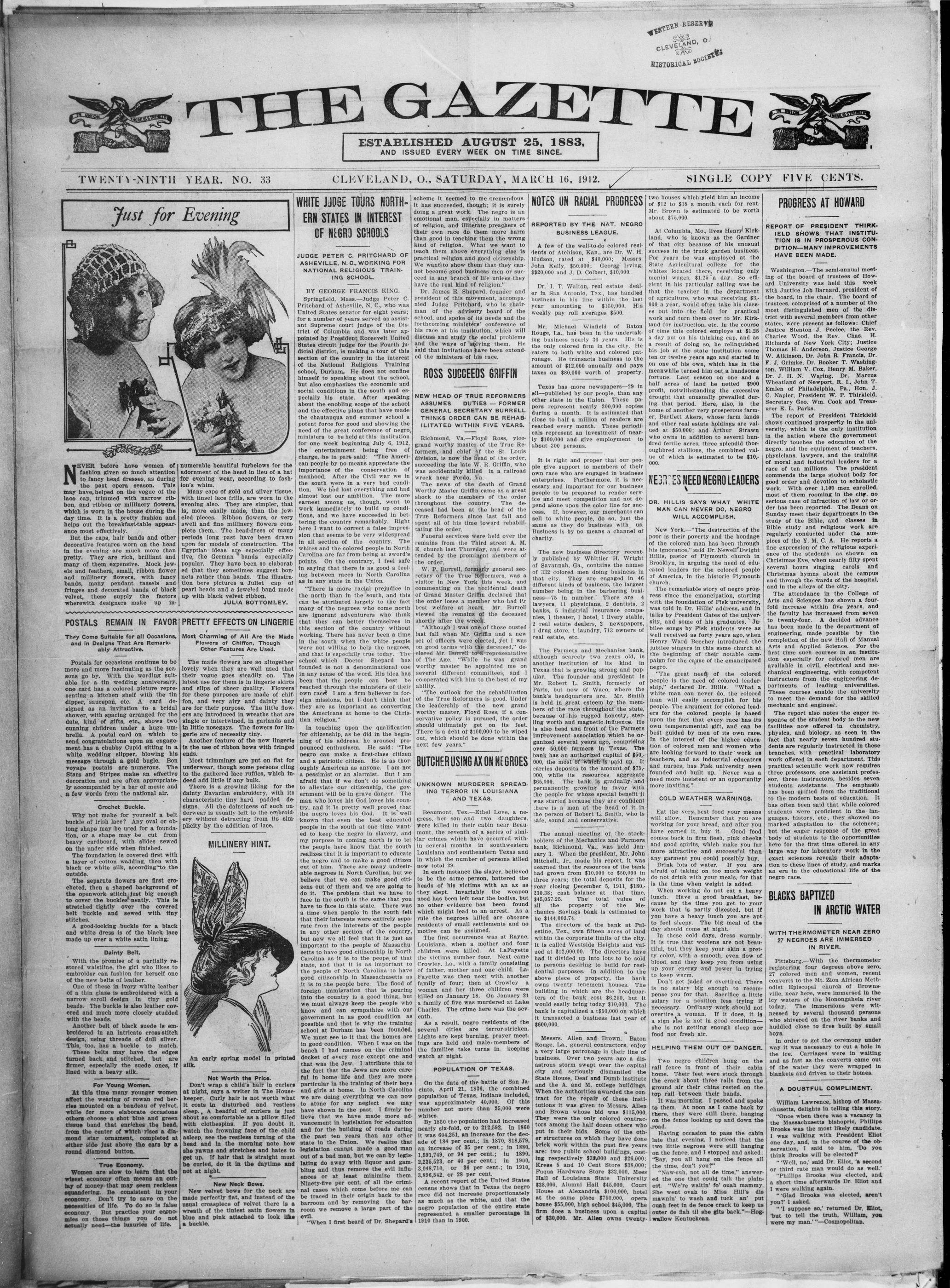
Just for Evening
H
日
NEVER before have women of fashion given so much attention to fancy head dresses, as during the past opera season. This may have, helped on the vogue of the lace cap, trimmed with narrow ribbon, and ribbon or millinery flowers, which is worn in the house during the day time. It is a pretty fashion and helps out the breakfast-table appearance most effectively. But the caps, hair bands and other decorative features worn on the head in the evening are much more than pretty. They are rich, brilliant and many of them expensive. Mock jewels and feathers, small, ribbon flower and millinery flowers, with fancy bands, many pendant tassels and fringes and decorated bands of black velvet, these supply the factors wherewith designers make up in-
They Come Suitable for all Occasions,
and in Designs That Are Remark-
ably Attractive.
Postals for occasions continue to be
more and more fascinating as the seas-
ons go by. With the wording su-
titable for a tin wedding anniversary,
one card has a colored picture repre-
senting a kitchen shelf with the tin
dipper, saucepan, etc. A card de-
signed as an invitation to a bridal
shower, with spacing arranged for the
date, kind of gifts, etc., shows two
cunning children under a huge umbrella. A postal card on which to
send congratulations upon an engagement
has a chubby Cupid sitting in a
white wedding slipper, blowing his
message through a gold bugle. Bon
voyage postals are numerous. The Stars and Stripes make an effective
decoration and are often appropriately
accompanied by a bar of music and
a few words from the national air.
Crochet Buckle.
Why not make for yourself a belt buckle of Irish lace? Any oval or oblong shape may be ured for a foundation, or a shape may be cut from heavy cardboard, with slides sewed on the under side when finished.
The foundation is covered first with a layer of cotton wadding, then with black or white silk, according to the outside.
The separate flowers are first crocheted, then a shaped background of the openwork stitch, just big enough to cover the buckles neatly. This is stretched tightly over the covered belt buckle and sewed with tiny stitches.
A good-looking buckle for a black and white dress is of the black lace made up over a white satin lining.
Dainty Belt.
With the promise of a partially restored waistline, the girl who likes to embroider can fashion for herself one of the new belts of leather.
One of these in ivory white leather of a thin glaze is embroidered with a narrow scroll design in tiny gold beads. The buckle is also leather covered and much more closely studded with the beads.
Another belt of black suede is embroidered in an intricate cross-stitch design, using threads of dull silver. This, too, has a buckle to match.
These belts may have the edges turned back and stitched, but are firmer, especially the suede ones, if lined with a heavy silk.
For Young Women.
At this time many younger women affect the wearing of rowan red berries mounted on a bandeau of velvet, while for more elaborate occasions others choose a shot blue and green tissue band that enriches the head, from the center of which rises a diamond star ornament, completed at either side just above the ears by a round diamond button.
True Economy.
Women are slow to learn that the wisest economy often means an outlay of money that may seem reckless squandering. Be consistent in your economy. Don't try to save on the necessities of life. To do so is false economy. But practice your economies on those things you do not actually need—the luxuries of life.
THE GAZETTE
numerable beautiful furbelows for the adornment of the head in lieu of a hat for evening wear, according to fashion's whim.
Many caps of gold and silver tissue, with tinsel lace frills, are worn in the evening also. They are simpler, that is, more easily made, than the jeweled pieces. Ribbon flowers, or very swell and fine millinery flowers complete them. The head-dress of many periods long past have been drawn upon for models of construction. The Egyptian ideas are especially effective, the German bands especially popular. They have been so elaborated ed that they sometimes suggest bonets rather than bands. The illustration here pictures a Juliet cap of pearl beads and a jeweled band made up with black velvet ribbon.
Most Charming of All Are the Made Flowers of Chiffon, Though Other Features Are Used.
The made flowers are so altogether lovely when they are well used that their vogue goes steadily on. The latest use for them is in lingerie skirts and slips of sheer quality. Flowers for these purposes are made of chiffon, and very airy and dainty they are for their purpose. The little flowers are introduced in wreaths that are single or intertwined, in garlands and in little nosegays. The flowers for lingerie are of necessity tiny.
Another feature of the new lingerie is the use of ribbon bows with fringed ends.
Most trimmings are put on flat for underwear, though some persons cling to the gathered lace ruffles, which indeed add little if any bulk.
There is a growing liking for the dainty Eavarian embroidery, with its characteristic tiny hard padded designs. All the daintiness of such underwear is usually left to the embroidery without detracting from its simplicity by the addition of lace.
MILLINERY HINT.
Don't wrap a child's hair in curlers at night, says a writer in The Housekeeper. Curly hair is not worth what it costs in disturbed and restless sleep. A headful of curlers is just about as comfortable as a pillow filled with clothespins. If you doubt it, watch the frowning face of the child asleep, see the restless turning of the head and in the morning note how she yawns and stretches and hates to get up. If hair that is straight must be curled, do it in the daytime and not at night.
New Neck Bows.
New velvet bows for the neck are made perfectly flat, and instead of the usual crosspiece of velvet there is a wreath of the tiniest satin flowers in blue and pink attached to look like a buckle.
JULIA BOTTOMLEY.
ESTABLISHED AUGUST 25, 1883 AND ISSUED EVERY WEEK ON TIME SINCE.
CLEVELAND, O., SATURDAY, MARCH 16, 1912.
WHITE JUDGE TOURS NORTHERN STATES IN INTEREST OF NEGRO SCHOOLS
JUDGE PETER C. PRIITCHARD OF ASHEVILLE, N. C., WORKING FOR NATIONAL RELIGIOUS TRAINING SCHOOL.
BY GEORGE FRANCIS KING.
Springfield, Mass.—Judge Peter C. Pritchard of Asheville, N. C., who was United States senator for eight years; for a number of years served as assistant Supreme court judge of the District of Columbia and was later appointed by President Roosevelt United States circuit judge for the Fourth judicial district, is making a tour of this section of the country in the interest of the National Religious Training school, Durham. He does not confine himself to speaking about the school, but also emphasizes the economic and social conditions in the south and especially his state. After speaking about the enobling scope of the school and the effective plans that have made the chautaqua and summer school a potent force for good and showing the need of the great conference of negro ministers to be held at this institution for one week beginning July 6, 1912, the entertainment being free of charge, he in part said: "The American people by no means appreciate the importance of the conservation of manhood. After the Civil war we in the south were in a very bad condition. We had lost everything and had almost lost our ambition. The more earnest among us, though, went to work immediately to build up conditions, and we have succeeded in bettering the country remarkably. Right here I want to correct a false impression that seems to be very widespread in all section of the country. The whites and the colored people in North Carolina are far from being at sword's points. On the contrary, I feel safe in saying that there is as good a feeling between races in North Carolina as in any state in the Union.
"There is more racial prejudice in the north than in the south, and this can be attributed largely to the fact many of the negroes who come north are ignorant adventurers who think that they can better themselves in this section of the country without working. There has never been a time in the south when the white people were not willing to help the negroes, and that is especially true today. The school which Doctor Shepard has founded is not a denominational one in any sense of the word. His idea has been that the people can best be reached through the ministers of their own race. I am a firm believer in foreign missions, but I don't think that they are as important as converting the Americans at home to the Christian religion."
In touching upon the qualification for citizenship, as he did in the beginning of his address, he aroused pronounced enthusiasm. He said: "The negro can make a first-class citizen and a patriotic citizen. He is as thoroughly American as anyone. I am not a pessimist or an alarmist. But I am afraid that if we don't do something to alleviate our citizenship, the government will be in grave danger. The man who loves his God loves his country, and it is pretty well proved that the negro loves his God. It is well known that even the best educated people in the south at one time wanted to keep the negro in slavery, and my purpose in coming north is to let the people here know that the south realizes that it is important to educate the negro and to make a good citizen out of him. There are many undisable negroes in North Carolina, but we believe that we can make good citizens out of them and we are going to do it. The problem that we have to face in the south is the same that you have to face in this state. There was a time when people in the south felt that their interests were entirely separate from the interests of the people in any other section of the country, but now we all feel that it is just as important to the people of Massachusetts to have good citizenship in North Carolina as it is to the people of that state, and that it is as important to the people of North Carolina to have good citizenship in Massachusetts as it is to the people here. The flood of foreign immigration that is pouring into the country is a good thing, but we must always keep the people who know and can sympathize with our government in as good condition as possible and that is why the training school at Durham has been founded. We must see to it that the homes are in good condition. When I was on the bench I had names on the criminal docket of every race except one and that was the Jew. I attribute this to the fact that the Jews are more careful in home life and they are more particular in the training of their boys and girls at home. In North Carolina we are doing everything we can now to atone for any neglect we may have shown in the past. I firmly believe that we have made more advenience in legislation for education and for the building of roads during the past ten years than any other state in the Union. We realize that legislation cannot make a good man out of a bad man, but we can by legislating do away with liquor and gambling and thus remove the evil influences or at least minimize them. Ninety-five per cent. of all the criminal cases which come before me can be traced in their origin back to the barroom and by removing the bar room we remove a large part of the evil.
"When I first heard of Dr. Shepard's
scheme it seemed to me tremendous.
It has succeeded, though; it is surely
doing a great work. The negro is an
emotional man, especially in matters
of religion, and illiterate preachers of
their own race do them more harm
than good in teaching them the wrong
kind of religion. What we want to
teach them above everything else is
practical religion and good citizenship.
We want to show them that they cannot
become good business men or suc-
ceed in any branch of life unless they
have the real kind of religion."
Dr. James E. Shepard, founder and
president of this movement, accompanied
Judge Pritchard, who is chairman of
the advisory board of the school,
and spoke of its needs and the
forthcoming ministers' conference of
his race at his institution, which will
discuss and study the social problems
and the ways of solving them. He
said that invitations have been extended
the ministers of his race.
ROSS SUGCEEDS GRIFFIN
NEW HEAD OF TRUE REFORMERS
ASSUMES DUTIES — FORMER
GENERAL SECRETARY BURRELL
THINKS ORDER CAN BE REHABILITATED WITHIN FIVE YEARS.
Richmond, Va.—Floyd Ross, vice-grad worthy master of the True Reformers, and chief of the St. Louis division, is now the head of the order, succeeding the late W. R. Griffin, who was accidentally killed in a railroad wreck near Fordo, Va.
The news of the death of Grand Worthy Master Griffin came as a great shock to the members of the order throughout the country. The deceased had been at the head of the True Reformers since last fall and spent all of his time toward rehabilitating the order.
Funeral services were held over the remains from the Third street A. M. E. church last Thursday, and were attended by the prominent members of the order.
W. P. Burrell, formerly general secretary of the True Reformers, was a visitor in New York this week, and commenting on the accidental death of Grand Master Griffin declared that the order loses a member who had 16 best welfare at heart. Mr. Burrell viewed the remains of the deceased shortly after the wreck.
"Although I was one of those ousted last fall when Mr. Griffin and a new set of officers were elected, yet I was on good terms with the deceased," deferred Mr. Burrell to a representative of The Age. "While he was grand worthy master he appointed me on several different committees, and I co-operated with him to the best of my ability.
"The outlook for the rehabilitation of the True Reformers is good. Under the leadership of the new grand worthy master, Floyd Ross, if a conservative policy is pursued, the order should ultimately get on its feet. There is a debt of $100,000 to be wiped out, which should be done within the next few years."
BUTCHER USING AX ON NEGROES
UNKNOWN MURDERER SPREADING TERROR IN LOUISIANA AND TEXAS.
Beaumont, Tex.-Ethel Love, a negress, her son and two daughters, were killed in their cabin near Beaumont, the seventh of a series of similar crimes which have occurred within several months in southwestern Louisiana and southeastern Texas and in which the number of persons killed now total 29.
In each instance the slayer, believed to be the same person, battered the heads of his victims with an ax as they slept. Invariably the weapon used has been left near the bodies, but no other evidence has been found which might lead to an arrest. As a rule the negroes killed are obscure residents of small settlements and no motive can be assigned.
The first occurrence was at Rayne, Louisiana, when a mother and four children were killed. At LaFayette the victims number four. Next came Crowley, La., with a family consisting of father, mother and one child. LaFayette was then next with another family of four; then at Crowley a woman and her three children were killed on January 18. On January 21 a family of five was murdered at Lake Charles. The crime here was the seventh.
As a result, negro residents of the several cities are terror-striken. Lights are kept burning, prayer meetings are held and male-members of the families take turns in, keeping watch at night.
POPULATION OF TEXAS.
On the date of the battle of San Jacinto, April 21, 1836, the combined population of Texas, Indians included, was approximately 40,000. Of this number not more than 25,000 were whites.
By 1850 the population had increased nearly six-fold, or to 212,592. In 1860 it was 604,251, an increase for the decade of 184 per cent.; in 1870, 818,579, an increase of 35 per cent.; in 1880, 1,591,749, or 94 per cent.; in 1890, 2,235,523, or 40 per cent.; in 1900, 3,048,718, or 36 per cent.; in 1910, 3,896,542, or 28 per cent.
A recent report of the United States census shows that in Texas the negro race did not increase proportionately as much as the white, and that the negro population of the entire state represented a smaller percentage in 1910 than in 1900.
NOTES ON RACIAL PROGRESS
REPORTED BY THE NAT. NEGRO BUSINESS LEAGUE.
A few of the well-to-colored realidents of Atchison, Kan., are Dr. W. H. Hudson, rated at $10,000; Messrs. John Kelly, $50,000; George Irving, $20,000 and J. D. Colbert, $10,000.
Dr. J. T. Walton, real estate dealer in San Antonio, Tx., has handled business in his line within the last year amounting to $150,000. His weekly pay roll averages $500.
Mr. Michael Winfield of Baton Rouge, La., has been in the undertaking business nearly 30 years. His is the only colored firm in the city. He caters to both white and colored patronage. He transacts business to the amount of $12,000 annually and pays taxes on $80,000 worth of property.
Texas has more newspapers—29 in all—published by our people, than any other state in the Union. These papers represent nearly 200,000 copies during a month. It is estimated that close to half a million of readers are reached every month. These periodicals represent an investment of nearly $100,000 and give employment to about 300 persons.
It is right and proper that our people give support to members of their own race who are engaged in business enterprises. Furthermore, it is necessary and important for our business people to be prepared to render service and meet competition and not depend alone upon the color line for success. If, however, our merchants can sell to white people, do so, just the same as they do business with us. Business is by no means a channel of charity.
The new business directory recently published by Whittier H. Wright of Savannah, Ga., contains the names of 332 colored men doing business in that city. They are engaged in 40 different kinds of business, the largest number being in the barbering business—75 in number. There are 4 lawyers, 11 physicians, 2 dentists, 2 banks, 5 industrial insurance companies, 1 theater, 1 hotel, 1 livery stable, 2 real estate dealers, 2 newspapers, 1 drug store, 1 laundry, 713 owners of real estate, etc.
The Farmers and Mechanics bank, although scarcely two years old, is another institution of its kind in Texas that is growing strong and popular. The founder and president is Mr. Robert L. Smith, formerly of Paris, but now of Waco, where the bank's headquarters are. Mr. Smith is held in great esteem by the members of the race throughout the state, because of his rugged honesty, sterling worth and magnetic influence. He is also head and front of the Farmers Improvement association which he organized several years ago, comprising over 50,000 farmers in Texas. The bank has an authorized capital of $50,000, the most of which is paid up. It carries deposits to the amount of $75,000, while its resources aggregate $65,000. The bank is gradually and permanently growing in favor with the people for whose special benefit it was started because they are confident there is a man at the head of it in the person of Robert L. Smith, who is safe, sound and conservative.
The annual meeting of the stockholders of the Mechanics and Farmers bank, Richmond, Va., was held January 3. When the president, Mr. John Mitchell, Jr., made his report, it was learned that the resources of the bank had grown from $10,000 to $50,000 in three years; the total deposits for the year closing December 5, 1911, $180,230.38; cash balance at that time, $45,057.25. The total value of all the property of the Mechanics Savings bank is estimated to be $144,003.74.
The directors of the bank at Palestine, Tex, own fifteen acres of land within the corporate limits of the city. It is called Westside Heights and valued at $12,000.00. The directors have had it divided up into lots to be sold to persons desiring to build for residential purposes. In addition to the above piece of property, the bank owns twenty tenement houses. The building in which are the headquarters of the bank cost $6,250, but it would easily bring today $10,000. The bank is capitalized a $50,000 on which it transacted a business last year of $600,000.
Messrs. Allen and Brown. Baton Rouge, La., general contractors, enjoy a very large patronage in their line of business. Over two years ago a disastrous storm swept over the capital city and seriously dismantled the State House, Deaf and Dumb institute and the A. and M. college buildings. When the authorities awarded the contract for the repair of these institutions it was given to Messrs. Allen and Brown whose bid was $11,500. They were the only colored contractors among the half dozen others who put in their bids. Some of the other structures on which they have done brick work within the past five years are: two public school buildings, costing respectively $32,000 and $26,000; Kress 5 and 10 Cent Store $38,000; Fuqua Hardware Store $23,000; Mess Hall of Louisiana State University $28,000; Alumni Hall $45,000; Court House at Alexandra $100,000, hotel at the same place $750,000, opera house $55,000, high school $45,000. The firm does a business upon a capital of $30,000. Mr. Allen owns twenty
SINGLE COPY FIVE CENTS.
WESTERN RESERVE
CLEVELAND, O.
HISTORICAL SOCIETY
two houses which yield him an income of $12 to $18 a month each for rent. Mr. Brown is estimated to be worth about $75,000.
At Columbia, Mo., lives Henry Kirkland, who is known as the Gardner of that city because of his unusual success in the truck garden business. For years he was employed at the State Agricultural college for the whites located there, receiving only mental wages, $1.25 a day. So efficient in his particular calling was he that the teacher in the department of agriculture, who was receiving $3,000 a year, would often take his classes out into the field for practical work and turn them over to Mr. Kirkland for instruction, etc. In the course of time this colored employee at $1.25 a day put on his thinking cap, and as a result of doing so, he relinquished his job at the state institution some ten or twelve years ago and started in on one of his own, which has in the meanwhile turned him out a handsome fortune. Last season on one and a half acres of land he netted $900 profit, notwithstanding the excessive drought that unusually prevailed during that period. Here, also, is the home of another very prosperous farmer, Bartlett Akers, whose farm lands and other real estate holdings are valued at $50,000; and Arthur Strawn who owns in addition to several hundred fertile acres, three splendid thoroughbred stallions, the combined value of which is estimated to be $10,000.
NEGROES NEED NEGRO LEADERS
DR. HILLIS SAYS WHAT WHITE
MAN CAN NEVER DO, NEGRO
WILL ACCOMPLISH.
New York.—"The destruction of the poor is their poverty and the bondage of the colored man has been through his ignorance," said Dr. Newell Dwight Hillis, pastor of Plymouth church in Brooklyn, in arguing the need of educated leaders for the colored people of America, in the historic Plymouth church.
The remarkable story of negro progress since the emancipation, starting with the foundation of Fisk university, was told in Dr. Hillis' address, and in talks by President Gates of the university, and some of his graduates. Jubilee songs by Fisk students were as well received as forty years ago, when Henry Ward Beecher introduced the jubilee singers in this same church at the beginning of their notable campaign for the cause of the emancipated negro.
"The great need of the colored people is the need of colored leadership," declared Dr. Hillis. "What a white man can never do, the colored man will easily accomplish for his people. The argument for colored leaders for the colored people is based upon the fact that every race has its own temperamental gift, and can be best guided by men of its own race. In the interest of the higher education of colored men and women who are looking forward to their work as teachers, and as industrial educators and nurses, has Fisk university been founded and built up. Never was a need more insistent or an opportunity more inviting."
COLD WEATHER WARNINGS.
Eat the very best food your means will allow. Remember that you are working for your bread, and after you have earned it, buy it. Good food comes back in firm flesh, pink cheeks and good spirits, which make you far more attractive and successful than any garment you could possibly buy.
Drink lots of water. If you are afraid of taking on too much weight do not drink with your meals, for that is the time when weight is added.
When working do not eat a heavy lunch. Have a good breakfast, because by the time you get to your work that is partly digested, but if you have a heavy lunch you are apt to feel sleepy. The big meal of the day should come at night.
In these cold days, dress warmly. It is true that woolens are not beautiful, but they keep your skin a pretty color, with a smooth, even flow of blood, and they keep you from using up your energy and power in trying to keep warm.
Don't get jaded or overtired. There is no salary big enough to recompense you for that. Sacrifice a little salary for a position less trying if necessary. Ordinary work should not overtire a woman. If it does, it is a sign she is not in good condition—she is not getting enough sleep nor food nor fresh air.
HELPING THEM OUT OF DANGER.
Two negro children hung on the rail fence in front of their cabin home. Their feet were stuck through the crack about three rails from the ground air their chins rested on the top rail between their hands.
It was morning. I passed and spoke to them. At noon as I came back by there, they were still there, hanging on the fence looking up and down the road.
Having occasion to pass the cabin late that evening, I noticed that the two little negroes were still hanging on the fence, and I stopped and asked: "Say, you all hang on the fence all the time, don't you?" "Naw-suh, not all de time," answered the one that could talk the plainest. "We're waltin' fo' oaum mammy. She went ovah to Miss Hill's dis mawnin' to wash and tuck an' put ouah feet in de fence crack to keep us outer de flah till she gits back."—Hogwallow Kentuckean.
IN HERES
HONOURS ESTINCTURIA
PROGRESS AT HOWARD
REPORT OF PRESIDENT THIRK-IELD SHOWS THAT INSTITUTION IS IN PROSPEROUS CONDITION—MANY IMPROVEMENTS HAVE BEEN MADE.
Washington.—The semi-annual meeting of the board of trustees of Howard University was held this week with Justice Job Barnard, president of the board, in the chair. The board of trustees, comprised of a number of the most distinguished men of the district with several members from other states, were present as follows: Chief Justice Stenton J. Peele, the Rev. Charles Wood, the Rev. Chas. H. Richards of New York City; Justice Thomas H. Anderson, Justice George W. Atkinson, Dr. John R. Francis, Dr. J. F. Grimke, Dr. Booker T. Washington, William V. Cox, Henry M. Baker, Dr. J. H. N. Waring, Dr. Marcus Wheatland of Newport, R. I., John T. Emlen of Philadelphia, Pa., Hon. J. C. Napier, President W. P. Thirkeld, Secretary E. L. Parks.
The report of President Thirkield shows continued prosperity in the university, which is the only institution in the nation where the government directly touches the education of the negro, and the equipment of teachers, physicians, lawyers, and the training of moral and industrial leaders for a race of ten millions. The president commends the large student body for good order and devotion to scholastic work. With over 1,100 men enrolled, most of them rooming in the city, no serious case of infraction of law or order has been reported. The Deans on Sunday meet their departments in the study of the Bible, and classes in Bible study and religious work are regularly conducted under the auspices of the Y. M. C. A. He reports a fine expression of the religious experience of the students as shown on Christmas Eve, when nearly fifty spent several hours singing carols and Christmas hymns about the campus and through the wards of the hospital and in the alleys of the city.
The attendance in the College of Arts and Sciences has shown a fourfold increase within five years, and the faculty has increased from seven to twenty-four. A decided advance has been made in the department of engineering, made possible by the completion of the new Hall of Manual Arts and Applied Science. For the first time such courses in an institution especially for colored men are available in civil, electrical and mechanical engineering, with competent instructors from the engineering departments of leading universities. These courses enable the university to meet the demand for the skilled mechanic and engineer.
The report also notes the eager response of the student body to the new facilities now offered in chemistry, physics, and biology, as seen in the fact that nearly seven hundred students are regularly instructed in these branches, with practical laboratory work offered in each department. This practical scientific work now requires three professors, one assistant professor, three instructors, besides seven students assistants. The emphasis has been shifted from the traditional to the modern basis of education. It has often been said that while colored students were proficient in the languages, history, etc., they showed no marked adaptation to the sciences; but the eager response of the great body of students to the opportunities here for the first time offered in any large way for laboratory work in the exact sciences reveals their adaptation to these lines of study, and marks an era in the educational life of the negro race.
BLACKS BAPTIZED IN ARCTIC WATER
WITH THERMOMETER NEAR ZERO
27 NEGROES ARE IMMERSED
IN RIVER.
Pittsburg.—With the thermometer
registering four degrees above zero,
27 colored men and women, recent
converts to the Mt. Zion African Meth-
odist Episcopal church of Browna-
ville, near here, were immersed in the
lcy waters of the Monongahela river
today. The immersions were wit-
nessed by several thousand persons
who shivered on the river banks and
huddled close to fires built by small
boys.
In order to get the ceremony under
way it was necessary to cut a hole in
the ice. Carriages were in waiting
and as fast as the converts came out
of the water they were wrapped in
blankets and driven to their homes.
A DOUBTFUL COMPLIMENT.
William Lawrence, bishop of Massachusetts, delights in telling this story.
"Once when there was a vacancy in the Massachusetts bishopic, Phillips Brooks was the most likely candidate.
I was walking with President Elliot one day, and, in the course of the observation, I sald to him, 'Do you think Brooks will be elected?'
"Well, no,' sald Dr. Elliot, 'a second or third rate man would do as well.'
"Phillips Brooks was elected, and a short time afterwards Dr. Elliot and I were walking again.
"Glad Brooks was elected, aren't you? I asked.
"I suppose so,' returned Dr. Elliot, 'but to tell the truth, William, you were my man."—Cosmopolitan.
One Year.....$1.50
Six Months.....1.00
Three Months......50
Subscribers are requested to remit by postoffice money order or registered letter.
Entered at the postoffice in Cleveland Ohio, as second-class matter
Address all communications to HARRY C. SMITH
Editor and proprietor,
THE GAZETTE,
Blackstone Building, Cleveland, O.
Member Ohio Legislature: 1894 to 1896; 1896 to 1898; 1900 to 1902
THE GAZETTE is the oldest, and has the largest bona fide circulation, double that of any newspaper in the Interest of Afro-Americans, published in the state of Ohio, and comparison with any will immediately establish its rank as one of the NEWSIEST AND BEST in the country.
Our papers should not be so "easy" and permit the Taft, Roosevelt, La Follette or any other national political bureau to "load" plate or any other kind of matter on them for free publication. They are all better able to pay for what they want from us than we are to give it to them. Do not be so imposed upon by any of them.
---
Prof. Kelly Miller's excellent comment on Colonel Roosevelt's lynch-murder article in the "Outlook," some months ago, would have impressed so much better if given out at the time, rather than at this late day when its publication seems to be for political reasons. Months ago The Gazette criticized the Colonel severely for his part-indorsement of lynch-murder in that "Outlook" article. Surely our good friend, the Professor, is not "dabbling in politics" at this late day!
The U. S. Supreme Court's recent decision upholding the right of a northwestern state to adopt the Initiative and Referendum, and refusing to interfere, shows conclusively that it is not likely to recode from its decision of years ago which indicated very plainly that the various states of the Union alone can enact antilynching legislation, this plainly coming under the head of "states' rights" an old and now generally recognized doctrine in the Court. It would be a saving of much time and effort for some of our people to note this fact.
The man who suffers personal wrong without protest or opposition, the "peaceful" member of the community, is a demoralizing factor in our social fabric. The class that does not struggle for civic and industrial rights will eventually lapse into slavery. The nation that passively countenances encroachments upon its rights and territory is doomed to dismemberment and national bankruptcy. It is the man who defends his rights, the class that battles for political and industrial advancement, and the nation that holds its own against the entire world; it is the "litigious" person, the revolutionary class, and the vigilant nation, that keep the world from stagnation and force it onward on the path of progress. -Hillquit.
Splendid progress toward the improvement of conditions existing in the Central Ave. district of this city, has already been made as a result of the two mass meetings in Shiloh Baptist church, held on Feb. 18 and March 10. This, those in a position to see and know, freely admit. For much of this, we are indebted to the Mayor of the city and Chief of Police, and if they will but continue the present activity on the part of the police in that section, there will be much less cause for complaint upon the part of all most concerned, and the entire city will be greatly benefited. We are concerned most for the children of tender years, many of whom, in that section of the city, have been harmed and some even ruined in the worst places along Central Ave. The police and state authorities have already directed their attention to these in recent weeks with excellent results in the cases of a few. However there is still much to be done.
According to the dispatches to the daily newspapers from Washington, D. C., March 4, U. S. Attorney General Wickersham who was reported at first as bitterly opposing the appointment of W. H. Lewis, deputy U. S. District Attorney at Boston, Mass., as one of his assistants in Washington, D. C., said he would resign from the American Bar Association. If that organization sustained the action of its executive committee in ousting Mr. Lewis from membership. He is also reported as saying that he was "not fighting for the admission of a Negro to the organization" but was "waging war against the idea that the American Bar Association could do a thing which he believes to be illegal." If the Attorney General is reported and quoted correctly, we fail to see how "he has won the respect of every intelligent Negro in the country," as the Newport News (Va.) Star and others put it. On the contrary, the distinguished gentleman seems to show us, beyond all question or doubt, that he has little or no interest in the "Negro." How very impressionable many of our people are in such cases particularly. That Candidate Taft fooled them so, four years ago, also to give them a rude awakening which has extended over the past three years, seems to mean nothing to them now. Do not be so quick to "swallow" such political "plays."
"TIED TO AN APRON-STRING"
AFTER ALL.
While the Ohio Afro-American persisted in his long sleep of inactivity (in the Ohio Constitutional Conven-
tion, in session at Columbus) all other people having important interests centered there have been properly represented, even if they were not directly represented in it by Delegates. Only the Afro-American held aloof and he the one most vitally concerned, or the one who should have felt and still feel, most concerned. His right or rather privilege of voting in all future state elections is at stake—and yet he slept and continues to sleep regardless of this fact. While he slept the advocates of woman suffrage worked, with the result that they have secured the passage of their proposal by the Convention which provides for the elimination of the words "white" and "male" from the Ohio constitution, providing the proposal is voted on favorably at the polls by the citizens of this state when the new constitution is submitted for their ratification or rejection. As matters now stand, every Afro-American and every other voter who desires to vote to eliminate the word "white." MUST vote also for woman suffrage in order to do so. There is absolutely no assurance that even will woman suffrage carry in Ohio, so strong is the feeling against it, largely because of the very large foreign element among its voters opposed to the same, in addition to the thousands of others. Personally, we favored and still continue to favor woman suffrage, and had the honor of being a member of the Ohio Legislature that first gave the women of this state the privilege of voting (in school affairs). But it is wise for us to have trouble coupled with that of any other portion of the state's population? In this particular instance, there is absolutely no question as to this, for the reason stated above and others. The question is therefore, what should we do? That is perfectly clear! Pass the Cunningham proposal, introduced in the O.C. C, on Jan. 17 and designed to eliminate the word "white" only. This can be done now, easier than before the passage of the woman suffrage proposal, if handled properly. There is no good reason why our matter should be coupled with any other particularly a new one, even if it is also a matter of suffrage. Let every proposition stand on its own merits if it has any, and both of these have. While it was a wise and shrewd move for the woman suffrage advocates to try to make sure of the forty one thousand Afro-American "voters" in Ohio, and thousands of others friends of the race, it certainly is not wise, shrewd or even good judgment for us to permit matters to stand as they now are. We must secure, and promptly too, the passage of the Cunningham or some similar proposal. I would properly conserve our own suffrage interests in this state for a least the next sixty years. Will the Ohio Afro-American continue "to sleep on his rights," with such an important matter pending and such danger impending? WE SHALL SEE!
A. R. R. on trial For Lynch-Murder, New Orleans, La.-The Vicksburg, Shreveport and Pacific Railroad must stand trial before a jury on the issue of being responsible in damages as a conspirator in the lynching of Robert T. Rogers at Tallulah, La., in 1907, accused of killing a man. The Court of Appeals, which reversed the lower court and ordered a new trial, Roberts' widow alloges the lynchers were conveyed to the scene of the lynching in a special train.
"Girl Stand on Your Head"
Iris, Stand up to the Head
Battle Michael, Dabel
Howie Oits of the sanitary medical corps, in a lecture to the Y. W. C. A. girls last Friday, expressed the opinion that every girl should stand on her head at least twice a day. She said she would like all feminine illies. Then she gave a demonstration of how it should be done.
SKULL USED FOR PLAYTHING
Physician Finds' Youngsters Playing
With a Fossil Supposed to Be Ten
Thousand Years Old.
Monticello, N. Y.-While making a
professional call at the home of William
Woolley here the other day Dr. James F. Curlette found the Woolley
children playing with the fossil of a
human skull which had become petrified.
Mr. Woolley said the fossil had
come from Great Neck, Long Island,
and was picked up by him in a stream
which flows through his farm there.
Skull 10,000 Years Old.
At the time of finding the fossil Mr. Woolley considered it nothing more than a stone of unusual form and structure, and took it home to his children, who have called it their in dian doll baby. The features in the fossil are very distinct, the mouth being especially large in proportion to the other features.
Dr. Curlette said in discussing the fossil:
"This fossil was found in a stream, and the action of the water upon it undoubtedly accounts for the reduced size, and to some extent the defacement of the features.
"In studying the fossil remains of this human skull I wondered whether the person upon whose shoulders once rested this head was not killed by a blow of a war club in the hands of some warlike enemy ages ago, for I noticed upon the side of the head an indentation as though a blow had been struck there which broke the skull."
THE GAZETTE, CLEVELAND, O. SATURDAY, MARCH 16, 1912
MANY PRETTY GIRLS
Mexican Town Has 3,000
Them and Only 500 Men.
Although Amazonian In Tendencies
and Assume All Hardships, There
Are Many Beautiful Young Ladies Among Them.
Mexico City—There is a town in Southern Mexico which boasts 3,000 women and but 500 men. Not only this but the women have the reputation of being the prettiest in the world. They are not only pretty but they are Amazonian in their tendencies and assume all the hardships of life as well as the responsibility of finance and municipal government. In fact this south Mexican town, Tehuantepe by name, is the place of them all most dominated by the influence of woman, yet the region in which most deference is paid to man. The cause of all of which being the discrepancy in the numbers of the two sexes
Tehanantepe is on the isthmus of the same name at the point where Mexico is narrowest just above Yucatan. The town is at the highest point where the waters of the Atlantic are separated from those of the Pacific. It is an Indian town and its inhabitants were living comfortably here when Europe knew not of the existence of America. They are a handsome, clean, intelligent, prosperous people who today lead lives that might be envied by the effete in the cities that are termed most civilized. The first impression of the tourist is the beauty of the women. Near the station of the railway that was two years ago completed across this isthmus, is the market place in the center of the town. Here are the women selling their goods. No man is to be seen. About the market place are stores and in these also woman is supreme. It is impossible to find a
A Tehuana Belle.
man about the place engaged in any sort of activity. The women think too much of the men to allow them to work
It is because of tribal wars and the cruelty of the Diaz regime that the men of the tribe are almost extinct.
WILLIAM LEWIS, ESQ.
New York City—Oswald Garrison Villard, as chairman of the board of directors of the National Association for the Advancement of Colored People, has made public a letter he has written to Lewis Cass Leducdard of this association, and has joined the association, protesting against the action of the executive committee of the bar association which recently rescinded the membership of William H. Lewis, Esq., of Boston, an assistant attorney general. Mr. Lewis was elected to the bench while he was an assistant U. S. district attorney in Massachusetts. Attorney General Wickersham has also denounced the action taken against Mr. Lewis, and now Mr. Villard officiated appeals to Mr. Leducdard. Mr. Lewis, as chairman of the William Lloyd Garrison, and is an editor of the N. Y. Evening Post.
JURY WILL NOT CONVICT
Deputy Attorney General Asks That Change of Venue Be Takeen from County.
Philadelphia, Pa. — In asking a change of venue in the case of seven defendants yet to be tried on murder charges growing out of the lynching of Zach Waker, near Coatville, Pa. last month, J. B. Cunningham, deputy attorney general, declared that “there is a deep-seated purpose on the part of the people of Chester county not to convict a white man for the murder of a Negro.” A number of men have alibis to the case, and the district court convicted the lynching and all were acquitted, “Your petitioners are firmly convinced,” the brief filed for the state says, “that to try the cases remaining before juries selected from Chester county, would only result in turning the administration of the complex mackey and travesty, and in bringing a lasting disgrace and dis honor upon the fair name and fame of the commonwealth.”
His Little Peculiarity.
"One o' de mos' curiosest things about a fool," said Uncle Eben, "is de way he'll holer and git mad if you don't let him show off his misfortune."
W. H.
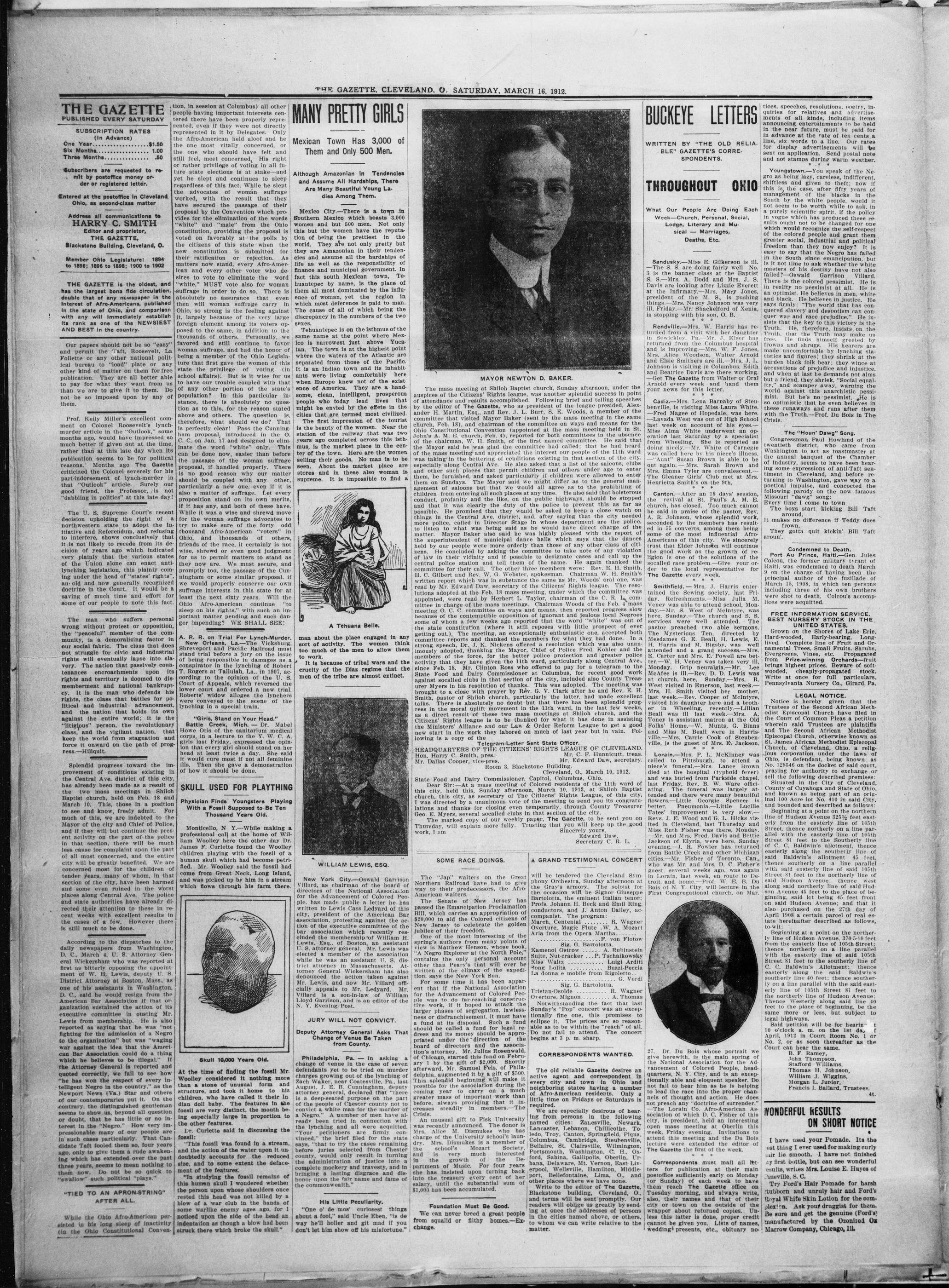
MAYOR NEWTON D. BAKER.
HEADQUARTERS OF THE CITIZEN'S RIGHTS LEAGUE OF CLEVELAND
Hon. Harry C. Smith, pres.
Mr. C. F. Hunnicutt, treas
Mr. Dallas Cooper, vice-pres.
Mr. Edward Daw, secretary
Room 3, Blackstone Building.
Cleveland, O., March 10, 1912.
State Food and Dairy Commissioner, Capitol, Columbus, Ohio.
Dear Sir:—At a mass meeting of Colored residents of the 11th ward of this city, held this, Sunday afternoon, March 10, 1912, at Shiloh Baptist church, this city, as secretary of the Citizens' Rights League, of this city, I was directed by a unanimous vote of the meeting to send you its congratulations and thanks for closing even temporarily, through County Treasurer Geo. E. Myers, several scaled clubs in that section of the city. The marked copy of our weekly paper, "Tuesday," to be sent you on Thursday will explain more fully. Trusting that you will keep up the good work Lam.
SOME RACE DOINGS
The "Jap" waiters on the Great Northern Railroad have had to give way to their predecessors, the Afro-American waiters.
The Senate of New Jersey has passed the Emancipation Proclamation Bill, which carries an appropriation of $100 million to celebrate citizens of New Jersey to celebrate the golden jubilee of their freedom.
One of the most interesting of the spring's authors from many points of view is Matthew Henson, whose book "A Negro Explorer at the North Pole," contains the only personal account of the life of a slave written of the climax of the expedition, says the New York Sun.
For some time it has been apparent that if the National Association for the Advancement of Colored People was to do far-reaching constructive work, if it hoped to attack the larger phases of segregation, lawlessness or disfranchisement, it must have a fund at its disposal. Such a fund should be its money. The fund should be appropriated under the direction of the board of directors and the association's attorney. Mr. Julius Rosenwald, of Chicago, started this fund on February 1 by the gift of $2,000. Shortly afterward, Mr. Samuel Fels, of Philadelphia, augmented it by a gift of $500. This splendid beginning will make it possible for the association during the coming year to carry on a much greater mass of important work before, always providing that it incomes steadily in members—The Crisis.
An unusual gift to Fisk University was recently announced. The donor is Mrs. Alice M. Dismukes who has charge of the University school's laundry. Mrs. Dismukes is a member of the school's Mozart Society, and is very much interested in the growth of the Department of Music. For four years she has insisted on turning back the treasury every cent of her salary, until the substantial sum of $1,000 has been accumulated.
Foundation Must Be Good.
We can never breed a great people from squalid or filthy homes.—Exchange.
---
church, Sunday afternoon, under the
was another splendid success in point
Following brief and telling speeches
resident in the English sheسی, Alex
E. E. Woods, a member of the
sent by the mass meeting in the same
committee on ways and means for the
nted at the mass meeting held in St.
ed for both committees in the absence
first named committee. He said that
mittee had called; that he had heard
the interest of people of the 11th wards
was existing in that section of the city
and the list of the walcons, clubs
children and others under age to enter
early if children were allowed to enter
the might differ as to the general man-
all agree as to the prohibiting of
any time. He also said that boisterous
the public highways, should be stopped
the police to prevent this as far as
as long as asked to keep a close watch
on the other side of the city, provided
he would have been the police,
he would have direct charge of the
the halls which says that the dances
than those of any other class of cit-
immittee to take note of any violation
he to designate cases and call up the
of the same. He again asked the
remembers of the last day, E. H. Smith,
spokesman, Chairman W. H. Smith's
the same as Mr. Woods' oral one, was
the Citizens' Rights League. The reso-
eeting, under which the committee was
Taylor, chairman Woods of the Feb. 4 mass
and means, then reported progress slow
of ignorant and jealous local Negroes
erted that the word "white was out of
reposes" since his life prospect of ever-
only antiseptic, has accepted both
members for what they had done. In
a red resolution which was also unanim-
ch of Police Fred. Kohler and the
police protection and greater police
ward, particularly along Central Ave.
offered to pay for a telegram to the
at Columbus, for recent good work
of the city, included also Count Tread
of this was adopted. The meeting was
v. G. Clark after he and Rev. E. H.
cularly the latter had made excellent
but that there has been splendid pro-
gression in the city, and the 11th ward, in the
last few weeks,
the meetings at Shiloh church, and the
ked for what it has done in assisting
the local people to do. The new
Sent State Officer.
Sent State Officer.
S' RIGHTS LEAGUE OF CLEVELAND.
Mr. C. F. Hunnicutt, treas.
Mr. Edward Daw, secretary.
Mr. Edward Daw, secretary.
Cleveland, O., March 10, 1912.
Capitol, Columbus, Ohio.
Colored residents of the 11th ward of
on March 10, 1912. at Shiloh Baptist
Schizons, the 11th day of this city,
of the meeting to send you its congratu-
remporarily, through County Treasurer
that section of the city.
paper, The Gazette, to be sent you on
trusting that you will keep up the good
sincerely yours.
A GRAND TESTIMONIAL CONCERT
will be tendered the Cleveland Symphony Orchestra, Sunday afternoon at the Gray's armory. The soloist for the occasion will be Signor Gluseppe Bartolota, the eminent Italian tenor; Profs. Johann H. Beck and Eilr. Ring, conductors, and J. Anton Dailley, accompanist. The program:
March, Centenial . . . A. R. Wagner
Overture, Magic Flute . W. A. Mozart
Aria from the Opera, Martina . P. von Flowow
Sig. G. Bartolota.
Kamenol Ostrow . . . A. Rubinstein
Suite, Nut-cracker . P. Tschalkowsky
Kiss Waltz . . . Luigi Arditi
Song Lolita . . . Marzuki-Pecelia
La donna e mobile from Rigoleto.
Sig. G. Bartolota.
Tristan-Osolde . . . R. Wagner
Overture, Migron . A. Thomas
Tristan-Osolde ..... R. Wagner
Overture, Mignon ..... A. Thomas
Notwithstanding the fact that last Sunday's "Pop" concert was an exceptionally fine one, this promises to eclipse it. The prices are so reasonable as to be within the "reach" of all. Do not fall to attend. The concert begins at 3 p. m. sharp.
CORRESPONDENTS WANTED
The old reliable Gazette desires an active agent and correspondent in every city and town in Ohio and neighboring states having a number of Afro-American residents. Only a little time on Fridays or Saturdays is required.
We are especially desirous of hearing from persons in the following named cities: Zaralesville, New Lancaster, Lebanon, Chillcothe, Toledo, Troy, Canton, Springfield, Piqua, Columbus, Cambridge, Steubenville, Bellaire, St. Clairsville, Wilmington, Portsmouth, Washington, C. H., Oxford, Sabina, Gallipolis, Oberlin, Urbana, Delaware, M. Ternon, East Lairpool, Wellsville, Hamilton, Middleport, Beliefontaine, Lima, O., and other places where we have none.
Write to the editor of The Gazette, Blackstone building, Cleveland, O., will oblige you, unless readers will oblige us greatly by sending at once the addresses of persons in the cities named above, or others, to whom we can write relative to the matter.
---
Edward Daw,
Secretary C. R. L.
WRITTEN BY "THE OLD RELIABLE" GAZETTE'S CORRESPONDENTS.
THROUGHOUT OKIO
THROUGHOUT OKIO
What Our People Are Doing Each Week—Church, Personal, Social, Lodge, Literary and Musical — Marriages, Deaths, Etc.
Sandusky. -Miss E. Gilkerson is ill.
-The S. S. are doing fairly well. No 3 is the banner class at the Baptist S. S. -Mrs. A. Dodd and Mrs. J. S. Davis are looking after Lizzie Everett at the Infirmary. -Mrs. Mary Jones, president of the M. S. is, is pushing things. -Mrs. Nancy Johnson was very ill. Friday. -Mr. Shackelford of Xenia is stopping with his son, O. B.
Rendville. -Mrs. W. Harris has returned from a visit with her daughter returned from the Columbus hospital returned from the Columbus hospital and is improving. -Mrs. W. F. Jones Mrs. Alice Woodson, Walter Arnold and Elise Smithers are ill. -Mrs. J. L. Johnson is visiting in Columbus, Edinburgh and Beatrice Davis are there working
-Get The Gazette from Walter or Oral Arnold every week and hand them your news for this letter.
Cadiz—Mrs. Lena Barnaby of Steu benville, is visiting Miss Laura White—Fred Magee of Hopeadel, was here—Lavada West was out of High School last week on account of his eyes—Miss Alma White underwent an operation last Saturday by a specialist from Wheeling. She is reported as taking care of her caricature was called here by his niece's illness—"Aunt" Susan Brown is able to be out again—Mrs. Sarah Brown and Mrs. Emma Tyler are convalescent—The Gleaner Girls' Club met at Mrs. Henrietta Smith's on the 9th. Canton—After an 18 days' session the revival at St. Paul's A, M, E church, has closed. Too much cannot be said in praise of the pastor, Rev A. R. Johnson, whose splendid work seconded by the members has resulted in 55 converts, among them being some of the most influential Afro Americans of this city. We sincerely that Elaine Ward continue the good work as the grownligion is one of the solutions of the socalled race problem. Give your or der to the local representative for The Gazette every week.
Smithfield. — Mrs. J. Harris entertained the Sewing society, last Friday. Refreshments. —Miss Julia M. Veney was able to attend school, Monday. —Mr. S. West of McIntyre, was here. Sunday. —The church and S. S. services were well attended. The pastor preached two able sermons, The Mysterious Ten, directed by Desames G. E. Beall, H. Lewis, E. McIntyre, and Mrs. E. Powell were attended and a grand success. —Mrs. E. Carter and Mrs. E. Powell are better. —W. H. Veney was taken very ill. Monday. Grip neuralgia. —Mr. Lee McAfee is ill. —Rev. D. D. Lewis was at church, here. Sunday. —Mrs. R. West visited in Emerson, last week. —Mrs. H. Smith visited her mother, last week. —Rev. Cooper of McIntyre, visited his daughter here and a brother, Mrs. R. West. Beall was ill last week. —Mrs. A. Toney is assistant matron at the Old Folks' Home. —W. Munts, G. Binns and Miss M. Beall were in Harrisville. —Mrs. Carrie Cook of Steubenville, is the guest of Mrs. E. Jackson.
Lorain—Mrs. P. L. McKinney was called to Pittsburgh, to attend a niece's funeral.—Mrs. Lance Brown died at the hospital (typhoid fever) and was buried from Parkside chapel, last Friday. Rev. B. W. B. Ware officien-tended and there were many beautiful flowers.—Little George Spencer is better. Pneumonia—Little Lucille Tates' improvement is very slow.—Revs. J. E. Wood and G. L. Hicks visited in Cleveland, last Thursday and Miss Ruth Fisher was there, Monday. Rev. J. E. Wood and Jackson of Elvira, were here, Sunday evening.—J. R. Fowler has returned from Battle Creek and other Michigan cities.—Mr. Fisher of Toronto, Can, who was Mr. and Mrs. D. C. Fisher's guest, several weeks ago, was again in Lorain, last week, en route to De-menton.—Mr. Fisher of Bois of N. Y. City, will lecture in the First Congregational church, on Mar.
[Picture of a man in a suit and bow tie].
27. Dr. Du Bois whose portrait we give herewith, is the main spring of the National Association for the Advancement of Colored People, headquarters, N. Y. City, and is an excepter not to fail to hear him as he is helping to lead the race into the proper channels of thought and action. He does not preach any "doctrine of surrender." —The Lorain Co. Afro-American Association of which D. C. Fisher of this city, is president, held an interesting open mass meeting at Oberlin this week. He attended this meeting and the Du Bois lecture were extended the editor of The Gazette the first of the week.
Correspondents must mall all letters for publication at their main postoffice sufficiently early on Monday (or Sunday) of each week to have them reach The Gazette office on Tuesday morning, and always write, also, their names and that of their city or town on the outside of the wrapper about returned copies. Unless this latter is done, proper credit cannot be given you. Lists of names, wedding presents, etc., obtitute no
tices, speeches, resolutions, poetry, inquiries for relatives and advertisements of all kinds, including items announcing entertainments to be held in the near future, must be paid for in advance at the rate of ten cents a line, six words to a line. Our rates for display advertisements will be sent on application. Send postal note and not stamps during warm weather.
Youngstown.—You speak of the Negro as being lazy, careless, indifferent, shiftless and given to theft; now if this is, the case, after fifty years of management of the blacks in the South by the white people, would it be worth while to ask, in a purely scientific way, to policy in vogue which has produced the suits ought not to be changed for one which would recognize the self-respect of the colored people and grant them greater social, industrial and political freedom than they now enjoy? It is easy to say that the Negro has failed in the South since emancipation, but he must ask whether the white masters of the South failed—Oswald Garrison Villard. There is the colored pessimist. He is in reality no pessimist at all. He is an optimist. He believes in men, white and black. He believes in justice. He says firmly: "The world that has conquered slavery and despotism can conquer war and race prejudice." He insists that the key to this victory is the key, he therefore insists on the Truth, that he is not free. He huds himself greeted by frowns and shrugs. His hearers are made uncomfortable by lynching statistics and figures; they shrink at the burden black folk bear; they wince at accusations of prejudice and injustice, and when at last he demands not alms, he lend, they shriek, "Social equality, and scammer away, wring the world against this anarchistic pessimist. He he's no pessimist. He is so optimistic that he even believes in these runaways and runs after them with the Truth—Prof. Bois in the Crisis.
The "Houn' Dawg" Song
Congressman Paul Howland of the twentieth district, who came from Washington to act as toastmaster at the annual banquet of the Chamber of Commerce, then heard some expressions of anti-Taft sentiment in Cleveland, and before returning to Washington, gave way to a poetic impulse, and concocted the following parody on the now famous Every time I come to town. The boys start kicking Bill Taft around.
It makes no difference if Teddy does frown,
They gotta quit kickin' Bill Taft aroun'.
Condemned to Death.
Port Au Prince, Halti—Gen. Jules Colcou, the former military trivant of Halti, was condemned to death March 9 on the charge of having been the principal author of the fusillade of March 15, 1908, in which ten persons including three of his own brothers were shot to death. Colcou's accomplices were acquitted.
FREE INFORMATION SERVICE.
BEST NATIONAL IN THE
UNIVERSITY STATE
Grown on the Shores of Lake Erie, Hard-wooded, Early-bearing, Long-lived. Complete line of Fruit and Ornamental Trees, Small Fruits, Shrubs, Evergreenes, Vines, etc. Propagated from Prize-winning Orchards—fruit brings highest prices. Barew of softwooded, cheaply-propagated stock. Write at once for full particulars, Pennsylvania Nursery Co. Girard, Pa.
LEGAL NOTICE
Notice is hereby given that the Trustees of the Second African Methodist Episcopal Church have filed in the Court of Common Pleas a petition wherein said Trustees are plaintiffs and The Second African Methodist Episcopal Church, otherwise known as St. James African Methodist Episcopal Church, of Cleveland, Ohio, a religious corporation under the laws of Ohio, is defendant, being known as No. 128546 on the docket of said court, praying for authority to exchange or sell the following described premises: Stituted in the City of Cleveland, Cleveland, Ohio, and known as being part of an original 100 Acre lot No. 410 in said City, and bounded and described as follows:
Beginning at a point on the northern line of Hudson Avenue 325½ feet easterly from the easterly line of 105th Street, thence northerly on a line paralleling the easterly line of Street 81 feet to the Southerly line of C. C. Baldwin's allotment, thence easterly along the southerly line of said Baldwin's allotment 45 feet, thence southerly on a line parallel with, said easterly line of said 105th Street, thence easterly on a line parallel with said Hudson Avenue; thence west along northerly line of said Hudson Avenue 45 feet to the place of beginning, said lot being 45 feet front on said Hudson Avenue; and that it also purchased on the 27th day of April 1910, a real estate hereafter described as follows, to-wit:
Beginning at a point on the northerly line of Hudson Avenue, 370-5-10 feet from the easterly line of 105th Street; thence northerly on a line parallel with the easterly line of said 105th Street 81 feet to the southerly line of C. C. Williams; thence easterly along the said Baldwin southerly line 40 feet; thence southerly on a line parallel with the said easterly line of 105th Street 81 feet to the northerly line of Hudson Avenue; Thence Westerly along said line 40 feet to the place of beginning, be the same more or less, but subject to legal highways.
Said petition will be for hearin' t 10 o'clock a. m. on the 1st da., f April, 1912 in Court Room No. 1 or No. 2, where thereafter as the Court can hear the same.
B. F. Ramey
John Thompson,
Stafford Williams,
Thomas H. Johnson,
William J. Wiggins,
Morgan L. Junior,
Francis I. Ballard, Trustees.
WONDERFUL RESULTS
ON SHORT NOTICE
I have used your Pomade. Its the best thing I ever used for making curly hair lie smooth. I have not finished my first bottle, but can see wonderful results, writes Mrs. Louise E. Hayes of Cineville, S. C.
Try Ford's Hair Pomade for harsh stubborn and unruly hair and Ford's Royal White Skin Lotion for the complexion. Ask your druggist for them. Be sure and get the genuine (Ford's) manufactured by the Ozonized Ox Marrow Company, Chicago, Ill.
PURELY PERSONAL
PURCHASE
THE
"GAZETTE" AT
F. VALENTINE'S, 2130 Central Ave.
SAM COHEN'S, 2928 Central Ave. Open Sunday.
JOHNSON'S, 3350 Central Ave.
CENTRAL HOME BAKERY, 4505 Central Ave.
NOTICE TO SUBSCRIBERS:—Subscribers not receiving The Gazette regularly should notify us at once. We desire every copy delivered promptly. We advise our patrons to carefully examine The Gazette's advertisements before making purchases. Business men who advertise in this paper should have the patronage of Afro-Americans. The fact that they advertise is assurance that they want it. Local reading notices (advertisements) ten cents a line (six words in a line.)
FOR RENT.—Houses. If you have places to rent or if you want to rent—notify The Gazette.
For Rent.—Five rooms and bath. 2223 E. 97th St. Attic and cellar. Inquire at I. W. Porter's. 9703 Quebec Av.
NOTARY PUBLIC.—For such services call at The Gazette office. No 3 Blackstone Building, No. 1422 W. 3d Street, near Superior avenue.
FOR RENT.—Furnished rooms with gas and bath. Special accommodations for theatrical people. Room and board. Mrs. I. B. Ambrose, 2285 E. 46th St. Cuv. Phone, Central 2917 L.
Mt. Zion church's physical culture class is doing nicely also.
Elmer Dillard spent Sunday in Ge neva.
Mrs. Edua Halden of Oberlin, is Mrs J. W. Will's guest.
It was Miss Hazel Coffey who sang at the Alpha Theater, Sunday, and Miss Hazel Crawford as stated in our last issue.
Mr. Brown of Central Av., who has suffered greatly from rheumatism, Mrs J. Carter and Mrs. S. Black are con valescing.
Fire destroyed the grocery and living rooms of Mr. and Mrs. U. S. Evans Central Av., near E. 34th St. Monday night.
Mr. Emuil Adams who runs on the railroad, is very ill at his home, 216 E. 2th St. He is a member of the Caterers' Association.
The Elks' cafe, Central Av., near E.
Bartender Sanders of Van Dusen's cafe takes all the responsibility for the "ghost story" of several weeks ago.
The prize-fights at the Forest St. Roller Rink, Monday evening, drew over 3,000 people at one and two dollars apiece. Mrs. Cassius Sabb of E. 37th St. drew in front of the week. Mrs. Sabb was among our oldest and most highly respected residents. The husband and daughter have the heart-felt sympathy of the community.
It is rumored that a saloon is again to be opened at 2400 Central Ave. A lady from Wilkesbarre, Pa., has succeeded to the management of the Mission restaurant and is now in charge of it.
The editor of the Gazette acknowledges the receipt of an invitation to the Buckeye lodge, Elks, Youngstown, to be held in Excelsior parlors, that city, Mar. 20.
L. G. Adkins is still doing business at the old stand, 2613 Central Av. serving breakfast from 7 to 11 a.m. hot lunch from 11:30 a.m. to 3 p.m. and dinner from 5:30 to 8:30 p.m. Open, Sunday evenings. 24. Bennett H. Hearn E. Davis Esn. he is appointed a clerk in the street repair department at the City hall; $1,000 a year. He passed the civil service examination. He was a college student.
Send your local items to The Gazette on Monday or Tuesday of each week. This paper is published for the public and is free to view. Everybody is treated the same—fair and right. Take The Gazette and tell your friends to do so also.
Judge F. A. Henry will lecture on the "Ohio Constitutional Convention" at St. John's church, Monday evening, under the auspices of the Cleveland Association of Colored Men. A special musical program will be rendered. The judge is an exceptionally able and fine man, and the association is most timely and every member of the race who can possibly do so, should hear his lecture.
A Manassas, Va., Industrial School meeting was held, Tuesday evening, at Mr. and Mrs. M. T. Silver's, 1725 Magnolia Drive and resulted in the organization of a permanent association to help the students of F. Thwong, president of Western Reserve University, presided, and Prof. Leslie Pinkney Hill, president of the school, was among the speakers to address the exceptionally successful meeting. Several scholarships at $100 each, were subscribed. New orders of the superintendent, it is said, that room for four beds have been partitioned off from the main women's ward at the Glenville hospital for our women. This has been done, we are informed, since Jan. 15, this year. Our Women's clubs should take up this matter at once. Fight it down! if the report be true, and The Gazette has it from a reliable
The Letter Carriers' band gave a concert last Saturday night in the chapel at the workhouse to inmates of the institution. John Scroggle gave a comedy sketch, and Miss and Master Ampbsurger, children of Fred Ampbsurger, a band member, gave a piano and violin duet. Supper was served to the musicians, Supt. Conley made an address of welcome. On March 15 the band will play at St. Joseph's Orphan asylum. It is doing splendid work, freely, willingly and without financial
Mrs. Mamie Evans Alkerns' husband is critically ill at their home in Buffalo. She is a daughter of Mrs. L. A. Cunningham of E. 43d St., who was notified Saturday by wire of Mr. Alkerns' serious condition. He been sick several years. Prior to his illness he was employed (as per request for many years), of the Nickle Plate railroad, running on trains between Bellevue and Buffalo. It was in this city that Mr. and Mrs. Alkerns were married and lived several years before locating in Buffalo a number of years ago. She has the heartfelt path of a host of women in both cities, of whom have naught but highest praise for her self-sacrificing devotion all through the many trying months of the years of her husband's illness. He has been practically helpless for many months.
LADIES' LADIES' LADIES'
Call your lady, friends' and acquaintances' attention to our up-to-date fashion and pattern departments and thus encourage them to be like the Gazette regularly. Oblige the Editor.
Elmer Dillard spent Sunday in Geneva.
Mrs. Edna Halden of Oberlin, is Mrs, J. W. Wills' guest.
It was Miss Hazel Coffey who sang at the Alpha Theater, Sunday, and not Miss Hazel Crawford as stated in our last issue.
Mr. Brown of Central Av., who has suffered greatly from rheumatism, Mrs, J. Carter and Mrs, S. Black are convalescing.
Fire destroyed the grocery and living rooms of Mr. and Mrs, U. S. Evans, Central Av., near E. 34th. St., Monday night.
Mr. Iemuel Adams who runs on the railroad, is very at his home, 2166 E. 37th St. He is a member of the Caterers' Association.
The Elks' cafe, Central Av., near E. 54th St., Messrs. John & Warren Cossyey, did over 4600 business the first month, it is said.
W, H. Gray of 2266 E. 46th St., returned the first of the week from Florida and other southern points. He left on the trip early last month.
The Cleveland Association of Colored Men held a very enjoyable smoker at Clayton hall, last Thursday evening, playing whistle, etc. A special Joc. Haddley in charge of the Mission restaurant, several weeks ago, has been succeeded by J. L. Jones, it is said. Mrs. Ruth Ruths was called to the city by her daughter, Miss Mary Mitchell's illness. The latter's sister, Mrs. Catherine Holt of N. Y. City, is also here. Mr. Ruther of Toronto, Can, who has been the guest of Mr. and Mrs. Geo. R. Alexander of E. 37th St., several weeks, has returned home via Lorain and Detroit. When you want Chill con carne stop at the Manhattan restaurant, 3133 Central Av. A good chicken dinner. A good chicken dinner. Special attention given to ladies. The Manhattan has the best cooks in the city. J. W. Crawford, proprietor. Antioch Baptist church received $50, the Old Folsk' home, and St. John's. M. A. E. church, each $25 of the Bailley Company's $5,000 charity benefit fund. 24th the 64th, the 6th, 6th, and St. John's 66th. There were 47 contestants.
Mar. 6, St. John's rally clubs made final report adding $71.5 to the $1600.80 already reported, making the gradn total of $1671.95. This amount was on Thursday paid on the doctor's and deebnessh the doctor's and deebnessh the fish thank all the friends who in any way assisted in this grand rally.
Mrs. J. E. Warren whose advertisement will be found elsewhere in The Gazette, returned last week from an extensive trip to Pennsylvania where she established agencies in Mercer, where she established agencies in Mercer, and then reports business as being fine, and compliments highly Miss Ellen Thomas, her able assistant.
Under the skill management of Messrs. R. A. Phillips, A. G. Belford, W. P. Cross, H. S. Taylor, H. W. Brooks and J. O. Phillips the com- pany gave under the auspices of the ima- vesable Six Pleasure club. Monday evening, at ideal hall, proved a delightful affair, being attended by a very select crowd. The music was furnished by Crawford's orchestra. The dancing continued until 2 a. m. when the doormen joined the unmat- titled in their praise of the future success of the Inseparable Six Pleasure club.
Mrs. W. H. Cornell will address the Woman's Auxiliary of St. Andrews' Episcopal church, Friday afternoon, the 29th, on "Bishop Tuttle," in the club rooms. The church club is known the club club, Mrs. A. A. Abbott, wife of the late Rev. Robert Thedral, addressed the Auxiliary, last Friday, on "The History and Scope of Woman's Auxiliary." Two physical culture classes have been organized in the church, recently, and a sewing class is being instructed by three college teachers. The director of Mr. Samuel Mather, also addressed the Auxiliary recently.
Cory M. E. church, cor. Scovill Av. and E. 25th. st. Rev. G. A. Sissle, pastor, has made wonderful progress the past fiscal year in every respect. The membership has increased 100 and the S. S. has an average attendance of 165. For the latter's rally, Sunday, for benevolence, Mrs. J. S. Thomas class (the "Silent Workers") raised $25 the young men's class, and $15 the women's class, to make the total $51. The Epworth league is active in every department. Vesper service, Sunday at 6:30 p. m. Literary society, Monday at 8 p. m. A fine program and refreshments served by the different clubs. Monday evening, the Heroes' club, Wm. Hockings, captain, served one of the finest banquets of the season. Next Monday evening, the Morning Watch club, Chas. Williams, captain, will serve. The league will give a fan drollooo, the year's work preparatory to leaving for conference at Columbus, Mar 21. The Epworth league will tender him a grand reception next week. Chas. and Fdward Hockings, cousins of Rev. Sissle, deserve great credit for the banquet, Monday evening, not only for the way the catering was done but also for the excellent manner in which the crowd was handled. The editor of The Gazette, president, and the Citizens' Rights league are to be congratulated on the grand work they are doing for the race. Already we see great improvement along Central Ave. The writer (Mrs. J. S. Thomas) could listen to his eloquent words for many hours longer. Sunday afternoon.
HE GAZETTE. CLEVELAND, O. SATURDAY, MARCH 16, 1912.
Miss Ruth Fisher of Lorain, was in the city, Monday.
Clarence Davis is our first City hall appointee, this year.
appointee, this year.
Rev. G. L. Hicks, pastor of the A. M. L. church, at Lorain, was in the city, last Thursday and called on The Gazette.
The Union club of St. Andrew, will be addressed Sunday afternoon by a well-known local speaker. All gentlemen are invited.
The Du Bois Literary society meet at Mrs. Bessie Kitzmiller's, Superior Av. Wednesday afternoon, Mar. 6, and completed its organization. The following officers were elected: Mrs. Blanche Gilmore, pres; Mrs. Viola Burbridge, vice-pres; Mrs. Amelia McNaughton, assist, and corres. sec; Mrs. Bessie Kitzmiller, treas. This motto, presented by the Biggs, was "We live to learn, to live well." The club received a letter from Dr. Du Bois thanking them for the honor done him, wishing it success and offering assistance in any way possible. The club will meet at Mrs. Florence Matthews', Mar. 20.
To cap the season's climax and make a noteworthy finale of an interesting season, a grand testimonial concert has been arranged by the committee in charge of the musical affairs of the Cleveland Symphony Orchestra. This will take place at Grays' Armory and is in the nature of a supplementary event. Both Johann Beck and Emil Ring, who have been conducting alternately the concerts of the orchestra during the season, will each offer as demonstration in four concerts the most prominent present the most popular classical selections as well as two numbers by Signor Bartolotta, a Neapolitan tenor of more than passing note as a singer. Signor Bartolotta has been engaged for a number of years in lyceum work and is one of the stars and most interesting singers of a local lyceum. He has been tenor on concert tours in the United States and in eweski, as well as a host of other vocal and instrumental stars. His engagement will do much to make the season a most remarkable one.
Left $40,000 to Lincoln University.
New York City—The will of John B. Hancock, a former student recently in Manhattan, leaves $40,000 to Lincoln University, Chester County, Pa.
The bequest is in real estate in Camden, Adamstown and Philadelphia, and he directs that it be diverted into the estate goes to the widow and children.
THE VERY BEST!
Dr. J. K. Nickens'
BLOOD SARSAPARILLA
For Rheumatism, Stomach Diseases
Kidney, Liver, &; 50c a bottle.
FEMALE TONIC
CATARRH CURE!
COUGH & LUNG SYRUP!
GREAT ALKALI LINIMENT!
DR. NICKENS' MEDICINE CO.
2334 E. 87th St.,
CLEVELAND. . . . OHIO
Travis & Strawder
'Central Transfer Co.'
CAREFUL MOVERS OF FURNI
TURE and PIANOS
Moving Vans
Piano Hoisting a Specialty
Light and Heavy Expressing.
Orders Promptly Attended to.
Prices Reasonable.
Office and Residence:
2903 Central Ave., Cleveland, Ohio.
Cuy. Cen. 8182R.
TELEPHONES:
Bell, Eddy 1100L.
Cuy., Central 1745R.
The Best Work Guaranteed!
Plumbing and Sewer Building
All Work given
Prompt Attention.
Thos P. McPhillips,
2079 E. 30th St.
'Phone Bell North 1075X
Bell, Doan 1398-J, Residence
East 791-L, Office
Dr. Walter S. Biggs,
Dentist.
4715 Central Ave., Cleveland, O.
Hours: 8 to 12 a.m., 1 to 5 p.m.
Sundays and Evenings by
Appointment
McCall's Magazine and McCall Patterns
For Women
Have More Friends than any other magazine or patterns. McCall's is the reliable Fashion Guide monthly in one million one hundred thousand homes. Besides showing all the latest designs of McCall Patterns, each issue is brimful of sparkling short stories and helpful information for women.
Save Money and Keep in Style by subscribing for McCall's magazine at once. Cate only on McCall's website. Subscribe any one of the celebrated McCall Patterns free.
McCall Patterns Lead all others in style, fit, simplicity. McCall's magazine any other two makes combined. None higher than 12 cents. Buy from your dealer, or by mail from McCALL'S MAGAZINE
236-246 W. 37th St, New York City
Northern Sample Copy, Premium Catalogue and Pattern Catalogue free, on request.
---
ACME AUTO CO,
AutoLivery. All People Treated Right.
2340 East Ninth Street. 'P ones North 1231 and Central 4161.
Decorators, Paper Hangers and House Painters.
3325 Central Av.
'Phone, North 1153 and Cent. 8661-R
************************
THE MANHATTAN
The Best Place on Central Ave.,
to get a Good Lunch
and Quick Service
J. W. CRAWFORD, PRO'R.,
3133 CENTRAL AVE.
Open Evenings for the Accommodation
of the Theaten Trade.
Bell Main 3345. Cuy. Cent. 7597 L
Globe Printing Co.,
PRINTERS AND STATIONERS.
1397 East Ninth Street
MISS L.E. WARREN'S
HAIR GROWER
Miss Warren is one of the FIRST
and BEST in her business in
Cleveland, and
Positively Can Grow
Hair
Dealer in First-Class Hair Goods.
3927 Central Ave.
CLEVELAND, OHIO.
'Phone, East 2216X.
'Phone East 1421.
THE CENTRAL AVENUE
HOME BAKERY.
4505 Central Av.,
Carries the Best Home-Baked Goods.
Phone your orders.
Wagon Delivery.
This is a race enterprise. Patronize us.
Geo. E. West Leroy M. McCurdy.
IF YOU SUBSCRIBE AT ONCE
YOU CAN STILL GET THE
52 WEEKLY ISSUES OF
THE YOUTH'S COMPANION
for the coming year for only $1.75.
Thousands of our subscribers whose subscriptions run over the first of January into the early weeks of the new year have written us to ask if we will not accept subscriptions at the old rate of $1.75 for a little while beyond the time announced for the advance in price to $2.00.
A Last Chance
In fairness to these old friends and to new subscribers who were unable to remit before the close of 1911 we have extended the time for taking subscriptions at $1.75 to
March 30
The new rate of $2.00 will be put into effect promptly on April 1. No subscription at $1.75 will be accepted after that date. Subscribe now—to-day—so as not to lose any of the good things in the Volume for 1912.
THE YOUTH'S COMPANION
144 Berkeley Street, Boston, Mass.
New Subscriptions Received at this Office.
Rufus S. Justice
4316 Central Ave. Phone E. 2342-R
CLEANING, DYEING & REPAIRING,
Goods called for and delivered to all
parts of the city.
BROWN DRUG CO..
THE MUTUAL STORE.
27/2 Central Ave, cor. E. 28to St.
Cut this ad, out and present it at
the Brown Drug Co. and receive free
sample of
B. and M. HAIR DRESSING.
This dressing is especially recommend
where the hair is stubborn or
curly, as it not only makes the hair
soft, glossy and straight, but also easy
to dress.
B. and M. Hair Dressing is highly
perfumed, has a very beneficial effect
on the scalp, and is a splendid hair
tonic.
BROWN DRUG CO.
Exclusive Sales Agents.
Call at
G. G. REED'S
Dry Goods and
Gents' Furnishings,
A Complete Line.
3222 Central Ave., Cleveland, O.
QUINADE.
(HAIR POMADE AND TONIC)
Quinade will beautify, improve and preserve the hair. Will remove Dandruff. Price 25 cents. Free sample sent on a public order. SEEBY'S "QUINACOMB," a comb made of specially tempered metal so as to retain the proper degree of heat. Used in conjunction with Quinade will remove the curl and straighten the hair. Price, 50 cents.
SEEBY DRUG CO.
Quinade and Quinacombs are sold in Cleveland by Brown Drug Co. 7742 Central Ave, cor. 28th St.; The People's Drug's t8ore, cor. Central Ave, and E. 33rd St.; Spenzer's Pharmacy, 2146 2150 Central Ave. S. E.; Zeidler's Drug Store, 2511 E. 9th St.; cor. Scovill, and druggists in general.
THE CENTRAL BUSINESS EXCHANGE
THE CENTRAL
BUSINESS EXCHANGE
'Phone 1230,
2828 Central Av., S. E. Woods, Manager.
Real Estate Transferred, Claims Adjusted, Bills Collected, Bonds Furnished, Houses to Rent, Legal and Business Advertising.
Life, Fire, Health and Accident Insurance.
We gladly furnish advice on business matters. Call and get our terms.
S. E. WOODS.
North 1230.
Agent for The Cleveland Gazette.
QUALITY
NOT
PRIMUM3
The Home of Pure Tea and Coffee.
Cuy, Central 7181 L. Bell Mahl 4714
Representing DOBIN TEA CO., Japan
JAPANESE TEA STORE.
23 Taylor Arcade.
EYE.
Shuron
GLASSES
THE
GIRL THAT
HOLDS
P. A. HOERET,
Optical Specialist.
Eyes Examined Free. Satisfaction
Guaranteed.
11 The Taylor Arcade.
FORD'S
HAIR POMADE
MANES HARSH, KINNY OR CURLY HAIR
GLOSSY, SOFTER AND MORE PLIABLE
EASY TO GMB AND PUT UP IN ANY STYLE.
FOR PREVENTING HAIR FROM FALLING OUT, DRAUGHT AND IRRITING OF SCALE BEWARE OF IMITATIONS, GET THE GENIUS, PIT UP IN 25+ AND 50 BOTTLES WITH CHARLES FORD'S NAME ON EVERY PACKAGE
TRY FORD'S ROUGH WHITE
SKIN LOTION FOR THE COMPLEXION.
MAKES THE SKIN WHITER IMEDIATELY UPON APPLICATION. WILL NOT IRRITATE THE MOST DELICATE SKIN. UNEXCELLED FOR ECZEMA. SALT RHEUM, PIMPLES, ROUGH SKIN AND FRECKLES.
SOLD BY DIPSTICKS. THE DRIEST GESTION CANNOT SUPPLY YOU. WE WILL SEND IT TO YOU DIRECT AT THE FOLLOWING Prices. SMALL SIZED BOTTLE. 25% LARGE SIZED BOTTLE. 50% THE OZONEEED OX MARROW CO.
202 LAKE ST. DEPRIST, CHICAGO,ILL.
AGENTS WANTED.
CHURCHES, SOCIETIES, CLUBS, ETC. Private Parlors for Ladies and Escorts.
Confection
co and
2921 ce
The Magic is two times larger
STEEL HEATING
ALUMINUM CORES
LADIES LOOK
The Magic will not burn or in-
ting bar which irons the hair, is a
The Aluminum Comb is ca-
sed the comb goes back into pla-
The Magic Heater is also g
handbag.
Fill with alcohol
and light oil
Magic Shampoo Drier $1.00
for Literature today.
Magic Shampoo Drink
Confectionaries, Cigars, Tobacco and School Supplies. 2921 Central Ave.
LADIES LOOK! Every lady can have a beautiful and luxurious head of hair that dries the hair, removing the sandwich and it will stay put.
The Magic will not burn or injure the hair, because the comb is never faded. The steel heat-gap bag will not burn the hair is alone, put into the flame of the alcohol or gas heater. The Aluminum Comb is easily detached from the heating bar, then, after the bar is heated the comb goes back into place and is held by a turn of the handle. The Magic Heater is also suitable for curing irons, has a cover and can be carried in handbag.
Magic Shampoo Drier $1.00. Magic Alcohol Heater $0.50. Liberal terms to agents. Write for literature today.
Magic Shampoo Drier Co. Minneapolis, Minnesota.
MRS. A. M. POPE. MRS. L. L. ROBERTS.
4 years ago my hair was only a finger-length, and my temples were bald, half way up my head.
first began our wonderful work of growing lengths, and all conditions of hair, even to places of the head, many persons scorned the possible; but we have grown the hair for his access. The proof of the value of our work is and largely by persons whose own hair we further fact that they have very frequent to sell their goods (saying that 'theirs is the referred to "PORO." We advise you to use (the oldest and best of its kind). See that the box, not genuine with out it. Prepared only
ware of Imitati
Call, or Address Mail to
M. POPE-TURNBO 3100 PINE ST. LOUIS
When we first began
qualities, all lengths, a
hair on bald places of
a thing was possible; b
achieving success. The
lingited and larger
grown and the further
when trying to sell the
as good") or referred to
Hair Grower, (the olds
is on every box, not
POPE.
Bewar
Cal
MRS. A. M. POP
When we first begin our wonderful work of growing all kinds of qualities, all lengths, and all conditions of hair, even to the growing of hair on bald places of the head, many persons scorned the idea that such a thing was possible; but we have grown the hair for hundreds, rarely achieving success. The proof of the value of our work is that they are being trained and legally by persons whose own hair we have actually grown and the further fact that they have very frequently mentioned us when trying to sell their goods (saying that "theirs is the same" or "just as good") or referred to "PORO." We advise you to use only "PORO" Hair Grower, (the oldest and best of its kind). See that the name "PORO" is on every box, not genuine without it. Prepared only by MRS. A. M. POPE.
BELL PHONE BOMONT 3109
Pure Beer
Beer Bottled at the Br
Order a Case of
Gold Bone
Bottled Beer
CLEVELAND & SANDU
BREWING COMPANY
Entered at the Home. Both P
or's New Shampoo B
Hair Straightener!
Best in the World
properly heated, and the use of LaCreole Hair Pomade will straight and silky at every stroke and cause a rapid growth!
put it off but send $1.00 today and get the comb by return
Pure Beer Bottled at the Brewery
Order a Case of
Gold Bond
Bottled Beer
THE CLEVELAND & SANDUSKY
BREWING COMPANY
Delivered at the Home. Both Phones.
The Best in the World!
This Comb, properly beated, and the use of LaCreole Hair Pomade, will bring the most
crimp to your hair. LaCreole Hair Pomade is made from pomade, lair,
don't mix it in but use seed oil 0.09 today and get the soft or return them.
SPECIAL ALCOHOL HEATER is the handiest and most of
comb, and can be closed up so that you can put it in your bas
penalty use LaCrete Hair Pomade. It not only meets every
intention but also a natural growth of the hair. Price:
$9.99. NY FREE CATALOGUE! Illustrating the Largest and Me
this country for colored people, such as Bengs, Wigs, Puffs,
ns, Combs, Brushes, etc.
d.
T. W. TAYLOR, How
When writing please mention this paper
TAYLOR'S SPECIAL ALCOHOL HEATER is the handiest and most convenient method of heating the Comb, and can be closed up so that you can put it in your handbag. Price 80c For best results use La Creme Hair Pomade. It only meets every requirements of the Comb and can be closed up. SEND FOR MY FREE CATALOGUE! I illustrating the Largest and Most Complete Line of Hair Goode in this country for colored people, such as Bange, Wige, Puffa, Switches, Pompadours, Hair Pin, Combs, Brushes, etc.
M.
4 years ago my hair just
covered my shoulders.
TRADE MARK
Registered
our wonderful work of growing all kinds of
all conditions of hair, even to the growing on
the head, many persons scorned the idea that such
we have grown the hair for hundreds, rapidly
proof of the value of our work is that we have
by personal whose own hair we have actually
that they have very frequently mentioned us
goods (saying that "theirs is the same" or "just
PORO"). We advise you to use only "PORO"
and best of its kind.) See that the name "PORO"
guarantee with out it. Prepared only by MRS. A. M.
of Imitations
or Address Mail to
E-TURNBO 3100 PINE STREET
ST. LOUIS, MO.
led at the Brewery
a Case of
Bond
ed Beer
D & SANDUSKY
COMPANY
ome. Both Phones.
Shampoo Dryer
nightener!
in the World!
Of LaCreole Hair Pomade, will bring the most
stroke and cause a rapid growth of the hair.
And get the comb by return mail.
Large, Heavy. Strong and Durable. Made of copper and brass associated together and cast into one solid piece; highly polished and fully nickle plated; steel bolt which goes through the large wood handle and screws into metal end of bomb to prevent the handle from getting loose or coming off. Remember it's all in one piece. Nothing to let out of order. will last a lifetime.
Price of Hair Straightener and Alcohol Heater complete $1.50.
ER is the handiest and most convenient method that you can put it in your band-bag. Price 80c剪. It not only meets every requirements of fast growth of the hair. Price 25c. Illustrating the Largest and Most Complete Line shape, such as Bange, Wigs, Puffs, Switches, Pom.
TAYLOR, Howell, Mich.
mention this paper
We Grew Our Hair
Now Let Us Grow
Yours With
"And it was then I saw the horrors of the slave trade. All along the path we saw the shackles and the yokes of slaves who had died on the way down to the coast. To prevent the slaves escaping at night the legs of each four of them are tightly bunched together in wooden shackles. Dozens of shackles were found along the same route in 1909; not old shackles, but green shackles, shackles still wet with the sap of the tree. Though Britain prevents slaves being shipped to Jamaica or elsewhere in Africa, there is always any amount of slavery up the back path. Africa lives on slave labor.
"It was the nightmare of my life in the interior. At all hours of the night natives came to me, saying, 'Sir, sir, we are all killed,' and they would tell me of attacks of the slavers, of women dragged off, of old men killed. Often the slavers were led by white men, men sporting false names, and there lay the difficulty. I have got date, name of town wiped out, names of all the victims, but I have not got the name of the Portuguese leader. These men put on the mask of a false name, and under the shield of it they do the devil's work in central Africa."
"Years before, Mushidi journeyed into the interior with his wife, Kapapa, and two slaves, grand total four, and this quartet terrible smashed up all the tribes of central Africa, Mushidi was a veritable Napoleon of central Africa. His brain worked with the precision of a machine. Tribe after tribe fell, under his sway, and thus was evolved a great black Babylon, where all the tribes formed a seething mob and where slaves poured in by hundreds and thousands.
"It was a city of scores of thousands of people, certainly over 100,000. And there for years I was kept practically a prisoner, for Mushidi refused to let me go. It was a case of 'Will you walk into my parlor?' said the spider to the fly. Partly, perhaps, it was a case of pride, for Mushidi wanted his enemies north, south, east and west to know that he had caught a white man.
"Life there was awful. Hills of skulls all over the place, and drastic executions daily in full swing. Blood, blood, and yet more blood, blood of babes, blood of women, blood of old men. And there was I, shut in, a hopeless prisoner, seeing these people killed off in batches, 10, 14, 20 a day, frightful murders committed with unspeakable barbarities. Fifteen or twenty people were to be killed on say the Monday morning. I begged the emperor, 'Oh, king live for ever; give me two.' Another bath on Tuesday morning. Again, 'Oh, king, live for ever; give me two more.' On Wednesday, 'Oh, king, live for ever; give me three, give me three.' And I got three. "The result is a lot of these people are called by a word which means 'begetten again from the dead,' and they turn up from all parts of Africa, bringing me little presents."
"What kind of a man was Mushidi? A typical Bantu cuttushro, but he had a wonderful head, really two heads in one, the curled, rigid occiput telling of terrible potentialities. He had 500 wives. "One day a strange flag was seen approaching, and this heralded the advent of a new factor in the country, namely, the Belgians. In a little while the great mushroom empire of central Africa was scattered to the winds and Mushidi's head was cut off and sent to the museum of a certain London institution in a petroleum tin."—From Interview of a Returned Missionary.
'TWAS A HOT BALL GAME.
Harken to this wild and woolly baseball yarn, ye fans, hot off the bat. Clark Griffith, the Washington manager, tells the story and vouchers for its truthfulness.
The scene was at Butte, back in the nineties, and the story resulted from a baseball game between Missoula and Butte at the latter town. There were a lot of gamblers in Butte who wanted to back the team, so about $5,000 was bet on the game, in which Griffith was to pitch for Missoula.
Everything went along nicely for a while, with a monster crowd on hand hollering for everything it was worth for Butte to win.
In the ninth inning Missoula was leading by one run, but after two were out Butte got a man on third and then the catcher let the ball get away from him. It rolled a short distance, but when the catcher went to retrieve it one bug leaned over the stand with a sk-shooter in his hand, "Touch that ball and you are dead," he shouted. And the catcher stood stock still in his tracks. Griff said that all the players were scared still while the tying run scored, but Missoula finally won in the tenth inning by a 5 to 4 score.
Chicago—Jim Crow regulations for the schools of Hyde Park were demanded by a unanimous vote of the Hyde Park Protective Improvement Association. The request is said to have grown out of the placing of negro teachers over white children and the inequality which allows wealthy Hyde Park residents to send their children to private schools and compels their neighbors to let their children come into daily association with negroes at the schools. The resolutions call for separate rooms until separate schools can be built.
"One More Word and I Leave the Subject With You."
"Certainly, Madam: It Will Afford Me Pleasure to Contribute Something."
"Go Ahead, Dear, I'm Listening."—Chicago Tribune.
The determined folks are those who end opposition everywhere.
HE RESCUES WHITE BABY FROM
A 60-FOOT WELL, WHEN EVERY-
BODY ELSE EXCEPT THE
CHILD MOMEN, DE
The following heroic deed of a colored boy was taken from the Wills Point (Tex.) Chronicle, a white paper, it is self-explanatory, yet we just can't resist from saying that it tells unmistakably that as true a spirit of heroism and manly qualities lurks in the colored man's breast as does in any other being living, and, in many instances, he seems to possess more. Among other things, the following is noted:
The hero of the hour was Albert Gray, a negro boy of fifteen years of age and the son of Bud Gray. The boy is smilf for his age and was thus enabled to go head downward into the small hole and fasten a rope around the child's body, by which means it was drawn from its perilous position, a feat requiring rare courage and worthy of a Carnegie medal.
The well was at the home of Vernon Stepp. In drilling it a rock had been struck some 60 feet down and the well had been abandoned for a new location. Unfortunately it had not been covered over and had not been curbed. It was of the ordinary bored well type, making a hole some 13 or 14 inches in diameter. The baby's Grandmother Stepp saw the little toddler just as its unsteady and unknowing footsteps went into the well and the little baby shot downward to the bottom. The alarm was spread rapidly and soon neighbors and men from town began to assemble, all intent on devising some means by which the child might be rescued, and stout hearts quaked as the baby's piteous voice pleaded out from its narrow prison, "Mamma, tome dit me out." This brought the assurance, however, that the child was still alive, and this assurance gave strength to men and women—some frantic, some cool and deliberate—in their efforts to devise some means of rescue. With the aid of a reflected light the child could be plainly seen and an effort was made to loop a rope about its body, but the little mind could not understand and the little arms fought off the life-saving rope. The frantic mother begged to be lowered into the well to rescue her child and, clad in man's attire, with ropes attached to her feet, she made the attempt, but her shoulders were too broad to allow her entrance in the well.
It was apparent that the only hope was to secure some person whose body was small enough and who was yet brave enough to go into the well, and a messenger had been dispatched to town for this purpose. It was the result of this trip that brought the negro boy to the scene.
He expressed his readiness to undertake the task and was first lowered into the well feet first. In this way he mangued to catch the arm of the child, but when about half way up the waistband of the child's clothing gave way and the little fellow for the second time dropped to the bottom of the well. Hearts turned sick when the falling child told listening ears what had happened. The boy was drawn out and though his head was bleeding from scratches on the walls of the well, he was ready to try again, and this time his body was lowered in the well head foremost. He carried the end of an extra rope which he fastened securely about the child's body. "All right, pull me out," he called and there was deathly silence as willing hands drew him out, closely followed by the baby, and there were few dry eyes as the little toot, spattered with mud, but still alive, was placed in the arms of its shouting mother. Although it had been in the well for nearly four hours, Dr. M. L. Cox, who had been called soon after the accident and whose wife counsel had much to do with the final rescue, pronounced its injuries apparently confined to a few bruises of no serious consequence.
The negro boy whose courage and heroism made the rescue possible was not forgotten, those present at the well at the time making up a purse of $25, which was swelled considerably by the crowd in town when he reached there, and one negro boy had reflected undying credit on his race. On all sides he was given unstinted praise for his heroic act.
And while men and women told and retold the story of the little child in the well and its rescue, father and mother were almost overcome with joy and the mother pressed her precious babe to her bosom and lavished the mother love upon it even as she had never done before, and thanked God for its delivery.
Fortunately there. was no "damp" in the well, and that the child was not seriously hurt by the two falls was marvelous. It can be accounted for only by the narrowness of the walls, which possibly impeded the downward progress, and the further possibility of the air pressure underneath the child breaking in some degree the force of the fall—or was it angels?
JEWEL AMULETS
Among the curious superstitions connected with precious stones is that cherished in Burma concerning the cat's-eye, which is supposed to secure invulnerability in war. The very water in which such gems as diamonds, pearls, topaz, sapphires, amethysts and emeralds are immersed is drunk to secure immunity from all evil.
"Are you a candidate?"
"My future is in the hands of my friends. But I am taking care to show them how to play their hands." Washington Star.
PRETTY MANNERS
Having pretty manners helps a little girl, but all a little boy gets out of pretty manners is to have the other boys call him "Sissy."—Atchison Globe.
THE GAZETTE. CLEVELAND. O. SATURDAY. MARCH 16. 1912.
NEGRO DEMONSTRATION AGENTS
WORK WHICH THEY ARE DOING
FOR NEGRO FARMERS IN
ALABAMA.
The following is a portion of an
article by Rev. A. F. Owens, published
in the Montgomery Advertiser.
Five counties in Alabama now have negro demonstration agents to carry on the work of teaching negro farmers better methods of farming by means of demonstration plots. There are at present negro demonstration agents in nearly all the soutern states, with the exception of Virginia, which has seven agents working in eleven counties. There is no other state where so much work is being done by negro agents for negro farmers as in Alabama. The reason so much is being done for the negro farmers in Alabama is undoubtedly due to the influence of Tuskegee Institute. Just as the reason that so much is being done for negro farmers in Virginia is due to Hampton Institute, of which the Tuskegee school is an offshoot.
Of the six negro demonstration agents in Alabama, four gained their training at Tuskegee, and the district agent, T. M. Campbell, who has charge of the work among the negroes in Alabama, Mississippi, Louisiana and Oklahoma, is a graduate of the same school. A recent report made by the agricultural department on the work of the demonstration agents in Alabama, shows that the negro farmers, working under the direction of these agents, have made a pretty good showing.
The following is a summary of results obtained by some of the negro county demonstration agents in farm demonstration work during the past season:
C. D. Meneefee, Lee county, conducted 59 demonstrations in corn and 60 in cotton, using 123 acres for the former and 300 acres for the latter. The results were an average of 44 bushels of corn per acre and an average of 1,869 pounds of cotton per acre.
Washington A. Tate, Macon county, had charge of 22 demonstrations in corn and 38 in cotton, using a total of 39½ in corn and 72 acres in cotton. The results were an average of 54.4 bushels of corn per acre and 1,425 pounds of cotton on the same amount of land.
Harry Sims, Wilcox county, supervised one demonstration in corn and 22 in cotton, planting one acre in corn and 35 acres in cotton. The one acre in corn yielded 27 bushels; the 35 acres in cotton yielded an average of 1,399 pounds per acre.
G. W. Patterson, Madison county, had charge of 21 demonstrations in corn and 25 in cotton. The amount of land cultivated in corn was 31 acres, and 56 acres were in cotton. This demonstrator made an average of 43.3 bushels of corn per acre and averaged 910 pounds per acre for cotton.
Some notion of what the demonstration agents have done for the negro farmers may be gathered from the fact that the average yield of corn per acre for negro farmers in 1909 the year the census was taken, was less than eight bushels per acre. The average bushels made this year by negro demonstration farmers in Macon county was 54.1 bushels per acre. This was the best average made by farmers under any of the negro demonstration agents and was nearly eight bushels above the average of the other white and negro demonstration agents throughout the state.
The average yield of seed cotton in Alabama in 1911 was about 600 pounds per acre. The highest aver age yield made on the farms conduct ed under a negro agent was in Lee county, where the average was 1.867 pounds of cotton per acre. This was 424 pounds of cotton above the aver age made on the other demonstration plots in different parts of the state and more than 1,200 pounds more than was made on the average farm.
NEGRO BUSINESS LEAGUE
Boston, Mass.—The local Negro Business league had a red letter night Wednesday of last week. There were about forty present, and a program was arranged which gave a number of men opportunity to tell about the successes they had attained in business. The stories related by many of the men were remarkable, and during the course of the evening the enthusiasm reached a high pitch. Dr. Booker T. Washington, the president of the National Negro Business league, was present as the special guest of the occasion, and delivered a stirring address. The local league is planning for much work during the present winter.
AN OLD FRIEND
A private soldier once rendered some slight service to the first Napoleon.
"Thank you, captain," said the Emperor, carelessly.
"In what regiment, sire?" was the instant response of the quick-witted private.
"In my guards," replied the Emperor, pleased with the man's ready retort.
This incident, with appropriate variations, also happened to Genghis Ghan, Ivan the Terrible, Attila, Gustavus Adolphus, Louis XIV, Charlemagne, Alexander, King Alfred, Xerxes, Richard the Lion-Hearted and Henry of Navarre.—Success Magazine.
Bacon—Hear your friend went into
the bee business last summer.
Egbert—He did.
Past—What luck?
Egbert—Oh, just his usual luck. He
got stung.
Our idea of a philosopher is one who is content to sit around all day and sine his whiskers with his fingers.—Galveston News.
DR. EDWARD W. BLYDEN DEAD
EDUCATOR AND DIPLOMAT EXPIRES AT THE AGE OF 79 YEARS —REPRESENTED LIBERIA IN MANY OFFICIAL CAPACITIES —ENJOYED FRIENDSHIP OF FAMOUS MEN.
In the death of Dr. Edward Wilmot Blyden, educator and diplomat, which occurred at Sierra Leone, West Coast Africa, the negro race loses one of its foremost scholars' and Liberia its most widely known citizen. Dr. Blyden was seventy-nine years old at his death. He was born in the Danish island of St. Thomas in the West Indies on August 3, 1832, and was baptized as a member of the Dutch Reformed church, to which his parents, who were of pure negro stock, belonged.
When eighteen years old he came to the United States to enter an American college, but every college refused to act favorably on his application for admission, and in 1850 he called for Liberia, entering the Alexander high school at Monrovia two years later. While at the Alexander high school he took a course in mathematics and classics, becoming a teacher of the school in 1858. In 1861 he was appointed a professor of languages in Liberia college, which had just been established, and made an enviable reputation. Five years later he took a leave of absence and visited Egypt and Palestine, and while on his trip improved his knowledge of Arabic.
Returning to Liberia, Dr. Blyden resumed his duties at Liberia college until 1871, when he resigned and visited Europe. About this time he was appointed by the British government as diplomatic agent to make treaties with the Mohammedan and pagan chiefs of the interior tribes of Africa. He completed his work in three years' time and then took charge of the Alexander high school. In 1877 Dr. Blyden was appointed Minister Pienpotentiary by the Liberian government to Great Britain, serving three years, and upon returning to the black republic was made president of Liberia college. In 1884 Dr. Blyden resigned as the head of the college and took up independent educational work among the Mohammedans at Sierra Leone. He was appointed Liberman representative at the court of St. James in 1892. He was secretary of state and secretary of the interior in Liberia, and in 1862 visited the United States as commissioner from the Liberian government.
Dr. Bryden was an authority on Arabic, and also spoke French, German, Italian, Spanish, Hebrew, Greek and Latin. He was author of several books, and in 1863 after the publication of his work on Liberla he received the honorary degree of A. M. from Hamilton college. In 1870 Lafayette college conferred on him the degree of D. D. He was elected corresponding and honorary member of the Society of Sciences and Letters of Benal, and was a member of the Anthenaeum club of London. The deceased was intimately acquainted with Lord Salisbury, Charles Dickens, Charles Sumner and the Earl of Derby, and was a personal friend of Gladstone.
MAKING LEADED GLASS AT HOME
If you have a mechanical turn of mind, a clear eye and steady fingers, combined with an infinite capacity for taking pains, it is quite possible to make leaded glass windows or doors at home. The diamond-shaped and the long pointed panels are the most popular designs and the simplest. Whether you desire to make a hall window or doors for the bookcase or china closet, you must first measure the space you wish to fill with a piece of paper. This serves as a pattern on which are drawn, with the utmost accuracy, the diamond shapes, one-sixteenth of an inch being allowed between the shapes for lead. The sheet of glass is then cut into diamonds with a glass cutter. If you have not a sure hand, it were better to have a glazier do this for you.
The lead is pliable and bought in strings, six feet long, at the hardware shop, where may also be obtained the solder and the soldering iron. This lead is grooved on either side, into which the glass fits. The lead is fitted around the diamond shape, cutting and mitering it at each corner, where it is then soldered. When the piece of glass has been enclosed in its frame, some thin cement should be laid along the edge of the lead so as to hold lead and glass firmly together. Now you have one pane completed with which to start. The rest of the work consists in fitting in diamond after diamond, according to the paper pattern. Heat the soldering iron in the fire or in the strong flame of a gas stove. As the lead is pliable it will be necessary to have an iron brace or two fastened across the inside of the door to make it firm. When the work is finished it is all bound by a heavier piece of lead and it is ready to be tacked or cemented to the wooden frame.
NOT TOO ENTHUSIASTIC.
Sandy was an elder in the church, and a truly pious man. He had an eye for beauty and a love for it, but he married Tina because he knew she would make him an excellent wife.
"I suppose Tina is a handsome lass" said Sandy's cousin, who met him in Glasgow not long after the marriage, and had never seen the bride. "I ken ye've gude taste, Sandy." "Aweel," said the bridegroom, cautiously, "she's the Lord's handwork, Tamaras. I'm no prepared to say she is his masterpiece."—Youth's Companion.
OBJECTION REMOVED.
"I'd buy a car if it weren't for one thing."
"What is it?"
"Having to look out for the other fellow."
"But if you had a car the other fellow would have to look out for you also."
"Gee! I never thought of that! I'll buy one."—Judge.
A sacrifice is one thing that only the Recording Angel should know.
Of Interest to Our Women
MODERN CRAZE FOR NOVELTY.
To veil one color with another is not a new idea, but to smother a multi-colored foundation with all the hues of the rainbow and to bedzien the top layer with embroidery echoing the colors of the spectrum is new and hideous also.
Over a white and gold satin sheath, for instance, you may wear, if you want to be in the very latest fashion, a slip of dazzling golden gauze, further illuminated by a velling of brilliant orange; over this again an envelope of Indian red chiffon with an embroidered overdress in yellow net, complete the scheme.
Add to this a Byzantine embroidery and touches here and there of a deep violet inspired by nothing in particular except a desire to proclaim your freedom from the ancient prejudice in favor of "matching" and there you have, not a trivety of a Turner sunset, but a fashionable party increase in intensity until we have somehow overcome the nervous restlessness which characterizes this age, when the fashion prospect is not encouraging.
We console ourselves with the belief that our restlessness must end by being bored with its own instability, and that in time Fashion will forget even her beloved vellings.
In the cloaks destined to cover one's evening magnificence there is nothing very new. Everything has been attempted: silks, satins, velts, lace and fur, Indian shawls and Japanese kilimos, all these are an old story. The cut also has been varied ingeniously in many ways.
The newest idea just now is to dispense with cut altogether. But it must be adopted with discretion, for if it be easy to find your cloak to fit a woman, it is a rare thing, on the other hand, to see your woman who really fits the cloak.
Imagine a square shapeless piece of virgin satin, merely weighted with fringe or fur, and you will understand the difficulty of lending distinction to folds which owe nothing to the dressmaker, but depend entirely upon the grace of your carriage and your ability to "carry off" an effect. This kind of thing has been seen at the opera in sky blue crepe de chine, embroidered with strange, exotic birds and beasts. It was like a cold which shifted every moment. Anything except in the hands of an expert modiste it would have become a thing of heavy pleats and prosaic hooks and eyes.
People less certain of themselves fall back on ermine. Tailless ermine (with the tails in rows to provide the inevitable black fridge), lined with real lace and chiffon-All this is almost an every day affair.
One hears complaints on every side about the expense of mere necessities, but when it comes to furs and real lace and diamonds, almost everybody seems able to afford these trifles. For this the clever imitation may be partly responsible. Even the wealthiest of women wear diamonds which have never known a mine; there are pearls in the market which might die if they were not worn at all, that face life without fear and with out reproach, as if they really were the seal and sable which they pretend to be.
FASHION HINTS
One-piece dresses are highly regarded.
Costume skirts are draped either on one or on both front sides.
Although still narrow, costume skirts simulate a much fuller appearance, the fullness being often pleated, gathered or draped to waist line, though the skirt width at the hem remains narrow.
Walst line approximates normal.
No 'radical novelty in sleeves. Three-quarter length preferred.
Cotton fabrics are in high favor.
Cotton agaric or Turkish towelling effects are very prominent.
Soft tafetas, surahs and fallies are very strong.
Indoor dresses, peignoirs, tea gowns, lounging robes, etc., have taken on strong oriental and classic features in cut, coloring and trimming.
Petticoats are little more than drop skirts, very narrow, very short, and in every instance wholly without trimming.
Button galerter boots are having a great vogue in Paris. The leading effect is perhaps mastle or ecru galerter tops, with black patent-leather forepart. Any number of new forms in galerter styles are being shown, but a great vogue continues for the galerter shoe which buttons in a straight line on the outside, with top and quarter of cloth, the forepart alone being of leather. Buttons on these models are large and flat.
The popular feature in strictly evening shoes is the use of metal brocades, notably in black and gold and silver, though rich dark shades of blue, red and purple, enlivened with gold or silver, are also seen.
Black and white footwear is expected to have another season of great popularity.
Shoes and slippers of the colonial type, with ornamental buckles of medium size, oblong and oval, are very stylish.
The old-fashioned light-colored satin and kid slippers are no longer in use. Evening footwear is wholly in metal effects.
The new color note is the introduction of the so-called caled or tan effects, beginning at the palest chagne and shading to the deep strong color known as khaki.
OYSTER STEW.
Boll one quart of good rich milk and one pint of water together, add one quart of oysters and a lump of butter the size of a walnut. Season with salt and pepper and let come to a boil once more, then add two handfuls of cracker dust. All cream is preferable to the milk and water.
HINTS ON HOME ENTERTAINING.
Now that the long winter evenings have arrived, the question how best they can be occupied becomes a pressing one, especially in families where there are many young people at home. Of course, "home lessons" usually take up a good many of the evening hours of any of the boys and girls who are still at school, but there is, or ought to be, some leisure intervals.
It is a great pity that the good old practice of reading aloud should have fallen so sadly out of favor as it has done of late years. For certainly no pleasanter method for passing a long evening can be found than for one of the party to read aloud some interesting book, while the rest are sewing or drawing or engaged in some other quiet occupation.
One great advantage of reading aloud is that only really good literature can be read aloud; poor or flimsy literature becomes intolerable when every word is properly emphasized and when "skipping" is made impossible.
In the same way a taste for poetry is often aroused in those who have the opportunity of hearing good poetry read aloud; they become interested in what they hear and are tempted to read further for themselves.
But, of course, not all the evenings need be given to reading. Games are also good.
Where there is a large family party much amusement can be got out of a good story telling game. One plan is for every one in turn, which is fixed by lot, to tell a story, original preferred.
Another good game to play on a winter's evening is called "The Malls."
In this game a handkerchief or any small object can represent the letter bag. Each player chooses the name of a city, as New York, Paris, London. Any city may hold the letter bag, but here, by way of illustration, we will say that it is held by New York, who tosses it to London, crying as he does: "The post." "From whence?" asks London. "From New York," answers the player who represents our metropolis. "Where bound?" asks London. It is then the part of New York to name any other city represented in the group, crying out: "To Paris," for example. At the same time the person holding the mail bag tosses it to the city last named. If the player holding the handkerchief makes a mistake in the name of the cities and throws it to the wrong one he must deliver up a trifle to be redeemed later on by some comic action. The player who has received the mail bag then puts the question
An entirely different kind of entertainment but one which is of the utmost importance at this season of the year is the shower for the brides of the midwinter season. When a girl announces her engagement her friends immediately feel that they must do her honor by giving a shower. The cry for something new in showers is incessant. Here is the description of one to be given soon that is really unique: The hostess has provided several yards of various towelling, squares of cheesecloth for dusters, bits of lace and insertions, materials for bags, scraps for holders, etc. She is going to ask the bride-to-be and about two dozen girls, all really good friends of hers, to come for a "sewing contest."
When all arrive they are to be given their choice of materials, and told to make an article, which is to be given the guest of honor. The invitations will say: "Bring thimbles." This is a most clever scheme and will insure an interesting afternoon. Coffee will be served with hot toast fingers, orange marmalade and German coffee cake.
THICK LACE.
It will soon be realized that thick lace is going to be the rage.
Look among your odds and ends, therefore, and see whether it is possible to find a piece of heavy guipure, which could be transformed into the covering of a single flap lapel to hang outside the opened front of your coat or mantle.
Lapels and revers are one of the most prominent and favorite additions of dress now. They are found in single, double or treble piece, one on top of the other, with the edges only showing or outspread in full view, and are made of every kind of material.
No method of renovating a dress more quickly can there be than that of adding to it revers edges of crepe de chine, with the edges left raw. There is scarcely any sewing needed, and if the colors are judiciously chosen the effect is charming. For usual purposes are recommended sand and royal blue, or cerise and the new soft gray called ghost.
Three laces that are promised a great furore are Flanders, Luxeuil and Bruges, and a fourth, guipure, has been mentioned.
FLOUNCES OF CHIFFON.
Flouences of bordered chiffon, that is, with a floral border on a white ground, are charmingly used upon petticoats of white satin, and one attractive line of white satin petticoats has deep accordion plaited flouences of white chiffon, over which are scattered big dots of color, delicate pink, or green or blue or cerise.
OYSTER ROAST.
Cut thin even slices of dry bread; trim off the crust and toast nicely. Select the smallest oysters you can get, wipe them dry and put them in an oyster broiler or on a buttered hot grillle. Broil until the gills shrivel and then lay them on toast. Dust with salt and paprika and sprinkle with finely minced white celery.
Sheer cotton crepes bordered with agaric and open-patterned ratine effects are highly recommended.
WIT AND HUMOR
HE CONSULTED THE DICTIONARY.
Franklin Matthews represented a newspaper during the Russo-Japanese war, and one day succeeded in breaking through that remarkable hedge of news censorship and reaching Field Marshal Oyama. The interview was brief but extremely courteous, and the jubilant correspondent hurried back to prepare the story for his paper. In the course of it he used this expression: "Marshal Oyama is a brick?"
The letter was duly passed along to the official translator, and presently Captain Kanaka of the marshal's personal staff, called upon the correspondent.
"Marshal Oyama presents his compliments," said the captain, suavely, "and regrets to inform the esteemed correspondent that his honorable letter can not be forwarded as written."
"Why, what's wrong with it?" cried the amazed war scribe.
Captain Kanaka explained with polite gravity.
"Marshal Oyama," he said, "objects to having the great American public regard him as baked mud."
For that is what the extremely literal translator had made of "brick."
NEW JERSEY MEASUREMENTS.
"The wilds of New Jersey," said Frank Malone, "reward the explorer well. If they who sojourn at Atlantic City or Long Branch would but penetrate into the wilds, they would see and hear many interesting things.
"Take, for example, the measurement of distance. I once asked the keeper of the general store in a New Jersey village choked with sand how far it was to Skeeter Swamp.
"Skeeter Swamp," said the store-keeper. "Well, I would say Skeeter Swamp was 'bout two whoops from here—or mebbe two whoops and a holer."
"I asked a man in Skeeter Swamp how far Flytown was. The man shifted his quid to the left cheek and replied:
"Flytown, stranger, is about three chaws to the south—unless you're a fast chawer. Then I'd say it was about three chaws and a half."
NOT A REAL CONDUCTOR.
Sousa nearly always wears his bandmaster's uniform when he goes out walking, and on one occasion this habit of his led to a certain curious mistake. He was standing on a railway station platform when a lady approached him and asked him when the next train was due to start.
"I am very sorry, madam," he replied, "but I do not know."
"Then why don't you know?" she asked, angrily, eyeing his uniform. "Surely, you are a conductor, aren't you?"
"Yes," replied Sousa, quietly, "but only of a brass band!"
SOME SATISEACTION
"Her mother wanted her to marry a duke, didn't she?" "Yes." "And she married a factory super-intendent?" "Yes." "Then it wasn't satisfactory at all, was it?" "I'm not sure. Her daughter's husband can buy out three dukes and his wife's diamonds are bigger than those of any duchess!"
UNFORSEEN RESULT.
"I notice that you courtously refrain from mentioning the name of your political rival in any of your speeches."
"I can't say my practice in that respect is so much a matter of courtesy as of prudence. I once started in to denounce a rival, but as soon as I mentioned his name the audience burst into deafening and continuous applause."
CONTRETEMPS
"I don't think I'll go to any more of my wife's parties," said Mr. Cumrox.
"Don't you enjoy yourself?"
"Yes. Only someone always mistakes me for one of the guests and starts in making remarks about how I made my money."—Washington Star.
PHYSICAL DEMONSTRATION.
"The English carry their reputation as a physical nation into their politics."
"How so?"
"Because they use a party whip when they want to beat their opponents."
NOT SO BAD.
"I went home to my aunt's the other day and asked for some lunch, as I was hungry, and she gave me the cold shoulder."
"How unkind of her."
"Not at all. She knows I like it that way."
THE THING TO DO.
"What do you do when a number of men in a baseball game die on the bases"
"if it's the home team, you the sublet."
ITS USES.
"I see where the ashes on God's pavement is often counted as a measure of philanthropy."
"Yes; so to speak, on a sliding scale."
DRASTIC MEASURES
"I am going to take legal steps about that torn book."
"What kind of steps?" "the man gave it bound over to the leap."