The Gazette
Saturday, March 23, 1912
Cleveland, Ohio
Page text (machine-generated)
TWENTY-NINTH YEAR. NO. 34.
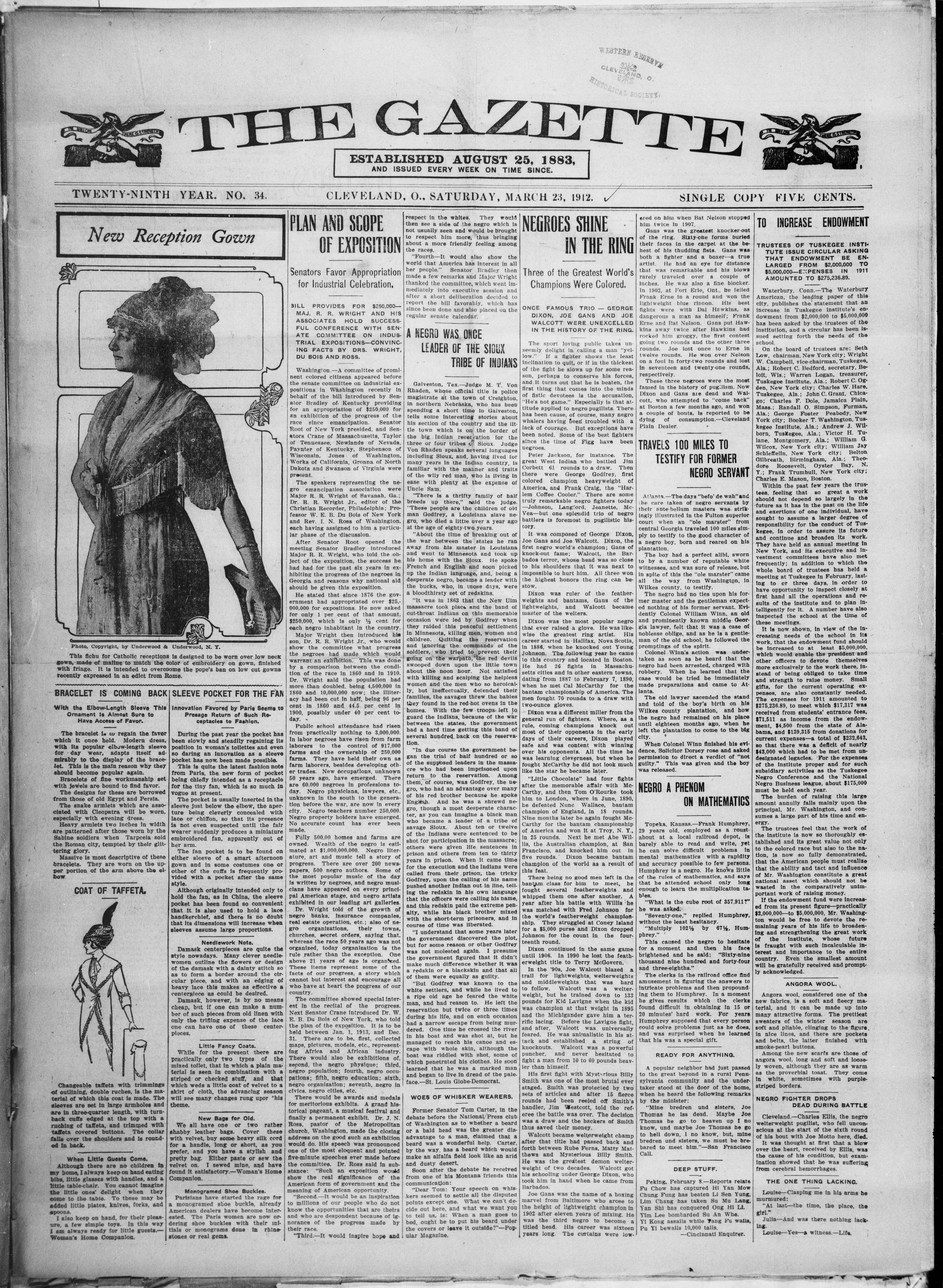
New Reception Gown
THE FASHION OF THE TWENTIETH CENTURY
Photo, Copyright, by Underwood & Underwood, N. Y.
This fichu for Catholic receptions is designed to be worn over low neck gown, made of mailine to match the color of embroidery on gown, finished with fringe. It is intended to overcome the pope's ban on low cut gowns recently expressed in an edict from Rome.
IN UNION
IN HERE GAS VIRGINIA
TWENTY-NINTH
New Rece
Photo, Copyright, by Underwood &
This fchu for Catholic reception
gown, made of mailing to match the
with fringe. It is intended to overc
recently expressed in an edict from
BRACELET IS COMING BACK
With the Elbow-Length Sleeve This Ornament is Almost Sure to Have Access of Favor.
The bracelet is to regain the favor which it once hold. Modern dress, with its popular elbow-length sleeve for day wear, adapts itself admirably to the display of the bracelet. This is the main reason why they should become popular again.
Bracelets of fine workmanship set with jewels are bound to find favor.
The designs for these are borrowed from those of old Egypt and Persia.
The snake armetts which are associated with Cleopatra will be worn, especially with evening dress.
Heavy armetts two inches in width are patterned after those worn by the Sabine soldiers when Tarpicola sold the Roman city, tempted by their glittering glory.
Massive is most descriptive of these bracelets. They are worn on the upper portion of the arm above the elbow.
COAT OF TAFFETA.
Changeable taffeta with trimmings of outlining, double ruches, is the material of which this coat is made. The sleeves are set in large armholes and are in three-quarter length, with turn-back cuffs edged at the top with a ruching of taffeta, and trimmed with taffeta covered buttons. The collar falls over the shoulders and is rounded in back.
When Little Guests Come
Although there are no children in my home, I always keep on hand eating bibs, little glasses with handles, and a little table-chair. You cannot imagine the little ones' delight when they come to the table. To these may be added little plates, knives, forks, and spoons.
I also keep on hand, for their pleasure, a few simple toys. In this way I am always ready for little guests.—Woman's Home Companion.
THE GAZETTE
SLEEVE POCKET FOR THE FAN
Innovation Favored by Paris Seems to Presage Return of Such Receptacles to Fashion.
During the past year the pocket has been slowly and steadily regaining its position in woman's toilettes and even so daring an innovation as a sleeve pocket has now, been made possible. This is quite the latest fashion note from Paris, the new form of pocket being chiefly intended as a receptacle for the tiny fan, which is so much in vogue at present. The pocket is usually inserted in the sleeve just below the elbow, the aperture being cleverly concealed with lace or chiffon, so that its presence is not even suspected until the fair wearer suddenly produces a miniature embroidered fan, apparently out of her arm. The fan pocket is to be found on either sleeve of a smart afternoon gown and in some costumes one or other of the cuffs is frequently provided with a pocket after the same style.
Although originally intended only to hold the fan, as in China, the sleeve pocket has been found so convenient that it is also used to hold a lace handkerchief, and there is no doubt that its dimensions will increase when sleeves assume large proportions.
Needlework Note
Damask centerpieces are quite the style nowadays. Many clever needle-women outline the flowers or design of the damask with a dainty stitch so as to form a border around the circular piece, and with an edging of heavy lace this makes as effective a centerpiece as could be desired.
Damask, however, is by no means cheap, but if one can make a number of such pieces from old linen with only the trifling expense of the lace one can have one of these centerpieces.
Little Fancy Goats.
While for the present there are practically only two types of the mixed toilet, that in which a plain material is seen in combination with a striped or checked stuff, and that which weds a little coat of velvet to a skirt of cloth, the advancing season will see many changes rung upon "his theme.
New Bags for Old.
We all have one or two rather shabby leather bags. Cover these with velvet, buy some heavy silk cord for a handle, long or short, as you prefer, and you have a stylish and pretty bag. Either paste or sew the velvet on. I sewed mine, and have found it satisfactory.—Woman's Home Companion.
Monogrammed Shoe Buckles
Parisians have started the rage for a monogramed shoe buckle, already American dealers have become interested. The Paris women are now ordering shoe buckles with their initials or monograms done in rhinestones or real gems.
ESTABLISHED AUGUST 25,1883 AND ISSUED EVERY WEEK ON TIME SINCE.
CLEVELAND, O., SATURDAY, MARCH 23, 1912.
PLAN AND SCOPE OF EXPOSITION
Senators Favor Appropriation for Industrial Celebration.
BILL PROVIDES FOR $250,000—MAJ. R. R. WRIGHT AND HIS ASSOCIATES HOLD SUCCESSFUL CONFERENCE WITH SENATE COMMITTEE ON INDUSTRIAL EXPOSITIONS—CONVINCING FACTS BY DRS. WRIGHT, DU BOIS AND ROSS.
Washington.—A committee of prominent colored citizens appeared before the senate committee on industrial expositions in Washington recently in behalf of the bill introduced by Senator Bradley of Kentucky providing for an appropriation of $250,000 for an exhibition of the progress of the race since emancipation. Senator Root of New York presided, and Senators Crane of Massachusetts, Taylor of Tennessee, Newlands of Nevada, Paynter of Kentucky, Stephenson of Wisconsin, Jones of Washington, Works of California, Gronna of North Dakota and Swanson of Virginia were present.
The speakers representing the negro emancipation association were Major R. R. Wright of Savannah, Ga.; Dr. R. R. Wright Jr., editor of the Christian Recorder, Philadelphia; Professor W. E. B. Du Bois of New York and Rev. I. N. Ross of Washington, each having assigned to him a particular phase of the discussion.
After Senator Root opened the meeting Senator Bradley introduced Major R. R. Wright, who told the object of the exposition, the success he had had for the past six years in exhibiting the progress of the negroes in Georgia and reasons why national aid should be given this exposition.
He stated that since 1876 the government had appropriated over $25,000,000 for expositions. He now asked for only 1 per cent of that amount $250,000, which is only ½ cent for each negro inhabitant in the country.
Major Wright then introduced his son, Dr. R. Wright Jr, who would show the committee what progress the negroes had made which would warrant an exhibition. This was done by a comparison between the condition of the race in 1860 and in 1910. Dr. Wright said the population had more than doubled, being 4,500,000 in 1860 and 10,000,000 now; the illiteracy had been cut in half, being 96 per cent in 1860 and 44.5 per cent in 1900, possibly under 40 per cent today.
Public school attendance had risen from practically nothing to 3,000,000. In labor negroes have risen from farm laborers to the control of 917,000 farms and the ownership of 255,000 farms. They have held their own as farm laborers, besides developing other trades. New occupations, unknown 50 years ago, have emerged. There are 60,000 negroes in professions today. Negro physicians, lawyers, etc., unknown in the south to the generation before the war, are now in every city. Negro teachers number 250,000. Negro property holders have emerged. No accurate count has ever been made.
Fully 500,000 homes and farms are owned. Wealth of the negro is estimated at $1,000,000,000. Negro literature, art and music tell a story of progress. There are over 200 newspapers, 500 negro authors. Some of the most popular music of the day is written by negroes, and negro musicians have appeared on every principal American stage, and negro artists exhibited in our leading art galleries.
Dr. Wright told of the growth of negro banks, insurance companies, real estate operation, etc.; also of negro organizations, their towns, churches, secret orders, saying that, where the race 50 years ago was not organized, today organization is the rule rather than the exception. One above 21 years of age is organized. These items represent some of the facts of our progress, a story which cannot but interest and encourage all who have at heart the progress of our country.
The committee showed special interest in the recital of the progress. Next Senator Crane introduced Dr. W. E. B. Du Bois of New York, who told the plan of the exposition. It is to be held between Jan. 1, 1913, and Dec. 31. There are to be, first, collected maps, pictures, models, etc., representing Africa and African industry. There would also be exhibitions of, second, the negro physique; third, negro population; fourth, negro occupations; fifth, negro education; sixth, negro organization; seventh, negro in clvics, negro cities, etc.
There would be awards and medals for meritorious exhibits. A grand historical pageant, a musical festival and finally a permanent exhibit. Dr. J. N. Ross, pastor of the Metropolitan church, Washington, made the closing address on the good such an exhibition would do. His speech was pronounced one of the most eloquent and pointed five-minute speeches ever made before the committee. Dr. Ross said in substance: "Such an exposition would show the real significance of the American form of government and the meaning of American opportunity.
"Second—It would be an inspiration to millions of our people who do not know the opportunities that are theirs and who are despondent because of ignorance of the progress made by their race.
"Third—It would inspire hope and
respect in the whites. They would then see a side of the negro which is not usually seen and would be brought to respect him more, thus bringing about a more friendly feeling among the races.
"Fourth—It would also show the world that America has interest in all her people." Senator Bradley then made a few remarks and Major Wright thanked the committee, which went immediately into executive session and after a short deliberation decided to report the bill favorably, which has since been done and also placed on the regular senate calendar.
A NEGRO WAS ONCE
LEADER OF THE SIOUX
TRIBE OF INDIANS
Galveston, Tex.—Judge M. T. Von Rhaden, whose official title is police magistrate at the town of Creighton, in northern Nebraska, who has been spending a short time in Galveston, tells some interesting stories about his section of the country and the little town which is on the border of the big Indian reservation for the three or four tribes of Sloux. Judge Von Rhaden speaks several languages including Sloux, and having lived for many years in the Indian country, is familiar with the manner and traits of the wily red man, who is living in ease with plenty at the expense of Uncle Sam.
“There is a thrifty family of half breeds up there,” said the judge. “These people are the children of old man Godfrey, a Louisiana slave negro, who died a little over a year ago at the age of eighty-two years.
“About the time of breaking out of the war between the states he ran away from his master in Louisiana and went to Minnesota and took up his home with the Sloux. He spoke French and English and soon picked up the Indian language, and, being a desperate negro, became a leader with the bucks, who, in unse days, were a bloodthirsty set of redskins.
"It was in 1863 that the New Ulm massacre took place, and the band of cut-throat Indians on this memorable occasion were led by Godfrey when they raided this peaceful settlement in Minnesota, killing men, women and children. Quitting the reservation and ignoring the commands of the soldiers, who tried to prevent their going on the warpath, the red devils swooped down upon the little town about the noon hour. Not satisfied with killing and scalping the helpless women and the men who so herocially, but ineffectually, defended their families, the savages threw the babies they found in the red-hot ovens in the homes. With the few troops left to guard the Indians, because of the war between the states, the government had a hard time getting this band of several hundred back on the reservation.
"In due course the government began the trial of half hundred or so of the supposed leaders in the massacre who had been imprisoned upon return to the reservation. Among them, of course, was Godfrey, the negro, who had an advantage over many of his red brother because he spoke English. And he was a shrewd negro, though a most desperate character, as you can imagine a black man who became a leader of a tribe of savage Sloux. About ten or twelve of the Indians were sentenced to be shot for participation in the massacre; others were given life sentences in prison and others from ten to thirty years in prison. When it came time for the execution and the Indians were called from their prison, the tricky Godfrey, upon the calling of his name pushed another Indian out in line, telling the redskins in his own language that the officers were calling his name, and this redskins paid the extreme penalty, while his black brother mixed with the short-term prisoners, and in course of time was liberated.
"I understand that some years later the government discovered the plot, but for some reason or other Godfrey was not molested again. I presume the government figured that it didn't make much difference whether it was a redskin or a blackskin and that all of them were equally as guilty.
"But Godfrey was known to the white settlers, and while he lived to a ripe old age he feared the white man, and had reason to. He left the reservation but twice or three times during his life, and on each occasion had a narrow escape from being murdered. One time he crossed the river in his boat and was shot at, but he managed to reach his canoe and escape with whole skin, although the boat was riddled with shot, some of which penetrated his clothes. He soon learned that he was a marked man and began to live in dread of the paleface.—St. Louis Globe-Democrat.
WOES OF WHISKER WEARERS.
Former Senator Tom Carter, in the debate before the National Press club of Washington as to whether a beard or a bald head was the greater disadvantage to a man, claimed that a beard was a wonderful help. Carter, by the way, has a beard which would make an alfalfa field look like an arid and dusty desert.
Soon after the debate he received from one of his Montana friends this communication:
"Dear Tom: Your speech on whiskers seemed to settle all the disputed points except one. What we can't decide out here, and what we want you to tell us, is: When a man goes to bed, ought he to put his beard under the covers or leave it outside"—Popular Magazine.
WESTERN RESERVE
CLEVELAND
NEGROES SHINE IN THE RING
NEGROES SHINE IN THE RING
Three of the Greatest World's Champions Were Colored.
ONCE FAMOUS TRIO — GEORGE DIXON, JOE GANS AND JOE WALCOTT WERE UNEXCELED IN THE HISTORY OF THE RING.
The sport loving public takes unseemly delight in calling a man "yellow." If a fighter calls the least inclination to quit, or if in the thickest of the fight he slows up for some reason, perhaps to conserve his forces, and it turns out that he is beaten, the first thing that comes into the minds of fistic devotees is the accusation, "He's not game." Especially is that attitude applied to negro pupils. There has been cause, of course, many negro whalers having been troubled with a lack of courage. But exceptions have been noted. Some of the best fighters since the time of Figg have been negroes.
Peter Jackson, for instance. The great West Indian who battled Jim Corbett 61 rounds to a draw. Then there were George Godfrey, first colored champion heavyweight of America, and Frank Craig, the "Harlem Coffee Cooler." There are some truly remarkable negro fighters today—Johnson, Langford, Jeanette, McVea—but one splendid trio of negro battlers is foremost in pugilistic history.
It was composed of George Dixon, Joe Gans and Joe Walcott. Dixon, the first negro world's champion; Gans of knock-out fame; Walcott, the Barbados terror, whose head was so close to his shoulders that it was next to impossible to hurt him. All three won the highest honors the ring can bestow.
Dixon was ruler of the featherweights and bantams, Gans of the lightweights, and Walcott became master of the welters.
Dixon was the most popular negro that ever raised a glove. He was likewise the greatest ring artist. His career started in Hallfax, Nova Scotia, in 1888, when he knocked out Young Johnson. The following year he came to this country and located in Boston. He had 26 fights in Massachusetts cities and in other eastern towns, dating from 1887 to February 7, 1890, when he met Cal McCarthy for the bantam championship of America. The men fought 70 rounds to a draw with two-ounce gloves.
Dixon was a different miller from the general run of fighters. Where, as a rule, coming champions knock out most of their opponents in the early days of their careers, Dixon played safe and was content with winning over his opponents. All the time he was learning cleverness, but when he fought McCarthy he did not look much like the star he became later.
"Little Chocolate" had four fights after the memorable affair with McCarthy, and then Tom O'Rourke took him to London, where in June, 1890, he defeated Nunc Wallace, bantam champion of England, in 18 rounds. Nine months later he again fought McCarthy for the bantam championship of America and won it at Troy, N. Y., in 25 rounds. Next he met Abe Willis, the Australian champion, at San Francisco, and knocked him out in five rounds. Dixon became bantam champion of the world as a result of this feat.
There being no good men left in the bantam class for him to meet, he fought several featherweights and whipped them one after another. A year after his battle with Willis he was matched with Fred Johnson for the world's featherweight championship. They struggled at Coney Island for a $5,000 purse and Dixon dropped Johnson for the count in the fourteenth round.
Dixon continued in the same game until 1906. In 1909 he lost the featherweight title to Terry McGovern.
In the '90s, Joe Walcott blazed a trail for lightweight, wetterweights and middleweights that was hard to follow. Walcott was a wetterweight, but he trained down to 133 pounds for Kid Lavigne when the kid was champion at that weight in 1895 and the Michigander gave him a terrific lacing. Before the Lavigne fight, and after, Walcott was universally feared. He was animalistic in his attack and established a string of knockouts. Walcott was a powerful puncher, and never hesitated to fight a man from 10 to 60 pounds heavier than himself.
His first fight with Mysterious Billy Smith was one of the most brutal ever staged. Smith was protected by two sets of articles and after 15 fierce rounds had been reeled off Smith's handler, Jim Westcott, told the referee the battle was over. The decision was a draw and the backers of Smith thus saved their money.
Walcott became wetterweight champ after that title had passed back and forth between Rube Ferns, Matty Matthews and Mysterious Billy Smith. He was the greatest demon wetterweight of two decades. Walcott got his schooling under George Dixon, who took him in hand when he came from Barbados.
Joe Gans was the name of a boxing marvel from Baltimore who arose to the height of lightweight champion in 1902 after eleven years of mixing. He was the third negro to become a titled head. His career was sixteen years long. The curtains were low.
ered on him when Bat Nelson stopped him twice in 1907. Gans was the greatest knocker-out of the ring. Sixty-one forms buried their faces in the carpet at the behest of his thudding flats. Gans was both a fighter and a boxer—a true artist. He had an eye for distance that was remarkable and his blows rarely traveled over a couple of inches. He was also a fine blocker. In 1902, at Fort Erie, Ont., he feigned Frank Erne in a round and won the lightweight blue ribbon. His bestights were with Dal Dewhkins, as dangerous a man as himself; Frank Erne and Bat Nelson. Gans put Hawkins away twice after Hawkins had rocked him groggy, the first contest going two rounds and the other three rounds. Joe lost once to Erne in twelve rounds. He won over Nelson on a foul in forty-two rounds and lost in seventeen and twenty-one rounds, respectively. These three negroes were the most famed in the history of pugilism. Now Dixon and Gans are dead and Walcott, who attempted to "come back" at Boston a few months ago, and won a couple of bounds, is reported to be dying of consumption—Cleveland Plain Dealer.
TRAVELS 100 MILES TO TESTIFY FOR FORMER NEGRO SERVANT
Atlanta. "The days 'befo' de wah" and the care taken of negro servants by their ante-bellum masters was strikingly illustrated in the Fulton superior court when an "ole marster" from central Georgia traveled 100 miles simply to testify to the good character of a negro boy, born and reared on his plantation. The boy had a perfect alibi, sworn to by a number of reputable white witnesses, and was sure of release, but in spite of this the "ole marster" came all the way from Washington, in Wilkes county, to testify. The negro had no ties upon his former master and the gentleman expected nothing of his former servant. Evidently Colonel William Winn, an old and prominently known middle Georgia lawyer, felt that it was a case of noblesse oblige, and as he is a gentleman of the old school, he followed the promptings of the spirit. Colonel Winn's action was undertaken as soon as he heard that the negro had been arrested, charged with robbery. When he learned that the case would be tried he immediately made preparations and came to Atlanta. The old lawyer ascended the stand and told of the boy's birth on his Wilkes county plantation, and how the negro had remained on his place until eighteen months ago, when he left the plantation to come to the big city.
When Colonel Winn finished his evidence, Solicitor Dorsey rose and asked permission to direct a verdict of "not guilty." This was given and the boy was released.
NEGRO A PHENOM
ON MATHEMATICS
Topeka, Kansas.—Frank Humphrey, 29 years old, employed as a roustabout at a local railroad depot, is barely able to read and write, yet he can solve difficult problems in mental mathematics with a rapidity and accuracy possible to few persons. Humphrey is a negro. He knows little of the rules of mathematics, and says that he attended school only long enough to learn the multiplication tables.
"What is the cube root of 357.911?" he was asked.
"Seventy-one," replied Humphrey, without the least hesitancy.
"Multiply 102½ by 67½, Humphrey."
This caused the negro to hesitate for a moment and then his face brightened and he said: "Sixty-nine thousand nine hundred and forty-four and three-eighths."
The clerks in the railroad office find amusement in figuring the answers to intricate problems and then propound them to Humphrey. In a moment he gives results which the clerks found difficult in obtaining in 15 or 20 minutes' hard work. For years Humphrey supposed that every person could solve problems just as he does, and was surprised when he learned that his was a special gift.
A popular neighbor had just passed to the great beyond in a rural Pennsylvania community and the undertaker stood at the door of the home, when he heard the following remarks by the minister:
"Mine bredren and sisters, Joe Thomas he is dead. Maybe Joe Thomas he go to heaven up I no know, and maybe Joe Thomas he go to hell down, I no know, but, mine bredren and sisters, we must be breared to meet him."—San Francisco Call.
Peking, February 8—Reportes relate Fu Chow has captured HI Yan Mow Chung Fung has beaten Li Sen Yung, Lim Chang has taken Su Mu Lang,尹 Shi has conquered Ong HI Ll, Yim Lee bombarded Su An Whe. Yi Kong assails while Yang Fu wals, Pu Xi bewalls 10,000 yards
SINGLE COPY FIVE CENTS.
READY FOR ANYTHING.
DEEP STUFF
-Cincinnati Enquirer.
VIRGINIA
SALUTAMUS
VIRGINIA
SALUTAMUS
TO INCREASE ENDOWMENT
TRUSTEES OF TUSKEGEE INSTITUTE ITUESE BUSE CIRCULAR ASKING THAT ENDOWMENT BE ENLARGED FROM $2,000,000 TO $5,000,000—EX:PENSES IN 1911 AMOUNTED TO $275,236.89.
Waterbury, Conn.—The Waterbury American, the leading paper of this city, publishes the statement that an increase in Tuskegee institute's endowment from $2,000,000 to $5,000,000 has been asked by the trustees of the institution, and a circular has been issued setting forth the needs of the school.
On the board of trustees are: Seth Low, chairman, New York city; Wright W. Campbell, vice-chairman, Tuskegee, Ala.; Robert C. Bedford, secretary, Belot, Wis.; Warren Logan, treasurer, Tuskegee Institute, Ala.; Robert C. Ogden, New York city; Charles W. Hare, Tuskegee, Ala.; John C. Grant, Chicago; Charles F. Dole, Jamaica Plain, Mass.; Randall O. Simpson, Furman, Ala.; George Foster Peabody, New York city; Booker T. Washington, Tuskegee Institute, Ala.; Andrew J. Wilborn, Tuskegee, Ala.; Victor H. Tulane, Montgomery, Ala.; William G. Wilcox, New York city; William Jay Schleffeln, New York city; Gilbreath, Birmingham, Ala.; Theodore Roosevelt, Oyster Bay, N. Y.; Frank Trumbull, New York city; Charles E. Mason, Boston.
Within the past few years the trustees, feeling that so great a work should not depend so largely in the future as it has in the past on the life and exertions of one individual, have sought to assume a larger degree of responsibility for the conduct of Tuskegee, in order to assure its future and continue and broaden its work. They have held an annual meeting in New York, and its executive and investment committees have also met frequently; in addition to which the whole board of trustees has held a meeting at Tuskegee in February, lasting to cr three days, in order to have opportunity to inspect closely at first hand all the operations and results of the institute and to plan intelligently for it. A number have also inspected the school at the time of these meetings.
It is now shown, in view of the increased needs of the school in its work, that the endowment fund should be increased to at least $5,000,000, which would enable the president and other officers to devote themselves more exclusively to the work there, instead of being obliged to take time and strength to raise money. Small gifts, for the current operating expenses, are also constantly needed. The expenses for 1911 amounted to $275,236,89, to meet which $17,317 was received from students' entrance fees, $71,511 as income from the endowment, $4,500 from the state of Alabama, and $139,315 from donations for current expenses—a total of $232,643, so that there was a deficit of nearly $43,000 which had to be met from undesignated legacies. For the expenses of the institute proper and for such subsidiary activities as the Tuskegee Negro Conference and the National Negro Business league, about $175,000 must be held each year.
The burden of raising this large amount annually falls mainly upon the principal, Mr. Washington, and consumes a large part of his time and energy.
The trustees feel that the work of the institute is now so thoroughly established and its great value not only to the colored race but also to the nation, is now so fully demonstrated, that the American people must realize that the ability and tact and influence of Mr. Washington constitute a great national asset which should not be wasted in the comparatively unimportant work of raising money.
If the endowment fund were increased from its present figure—practically $2,000,000—to $5,000,000, Mr. Washington would be free to devote the remaining years of his life to broadening and strengthening the great work of the institute, whose future is fraught with such incalculable interest and importance to the entire country. Even the smallest amount will be gratefully received and promptly acknowledged.
ANGORA WOOL.
Angora wool, considered one of the new fabrics, is a soft and fleecy material, and it can be made up into many attractive forms. The prettiest sweaters of the winter season are soft and pliable, clinging to the figure in nice lines, and there are pockets and belts, the latter finished with smoke-pearl buttons. Among the new scarfs are those of angora wool, long and soft and loosely woven, although they are as warm as the proverbal bloat. They come in white, sometimes with purple-striped borders.
NEGRO FIGHTER DROPS
DEAD DURING BATTLE
Cleveland—Charles Ellis, the negro welterweight pugilist, who fell unconscious at the start of the sixth round of his bout with Joe Motto here, died.
One Year. $1.50
Six Months. 1.00
Three Months. .50
Subscribers are requested to
mit by postoffice money or
order or registered letter.
Entered at the postoffice in Cleveland
Ohio, as second-class matter
Address all communications to
HARRY C. SMITH
Editor and proprietor,
THE GAZETTE,
Blackstone Building, Cleveland, O.
Member Ohio Legislature: 1894
to 1896; 1896 to 1898; 1900 to 1902
THE GAZETTE is the oldest, and has the largest bona fide circulation, double that of any newspaper in the Interest of Afro-Americans, published in the state of Ohio, and comparison with any will immediately establish its rank as one of the NEWSIEST AND BEST in the country.
Again, we remind our people, the country over to "remember Brownsville."
Our papers should not be so "easy" and permit the Taft, Roosevelt, La Follette or any other national political bureau to "load" plate or any other kind of matter on them for free publication. They are all better able to pay for what they want from us than we are to give it to them. Do not be so imposed upon by any of them.
The U. S. Supreme Court's recent decision upholding the right of a northwestern state to adopt the Initiative and Referendum, and refusing to interfere, shows conclusively that it is not likely to recede from its decision of years ago which indicated very plainly that the various states of the Union alone can enact antilynching legislation, this plainly coming under the head of "states' rights" an old and now generally recognized doctrine in the Court. It would be a saving of much time and effort for some of our people to note this fact.
Some months ago, we furnished Baltimore friends, at their request, a copy of our Ohio Anti-Lynching law for introduction in the Maryland Assembly. Last week the lower house of the Assembly of that state, refused to pass a bill which incorporated the main features of our law. Maryland thus anounces to the world that it does not desire lynch-murder to be stopped if its confines. This is the case with all young states and all northern ones, too. However, New York state copied our Ohio Civil Rights law and Illinois, our Ohio Anti-Lynching law. Some progress, anyhow.
A Catholic school for Afro-Americans is to be opened in Columbus, says Bishop J. J. Hartley of that city. This is another very natural sequel to the "jim-crow" Y. M. C. A movement inaugurated in Columbus, some months ago. However, it is somewhat of a surprise, we must confess, as we did not expect the great Catholic church, in the north, to say the least, to follow in the footsteps of prejudiced or jim-crow, Protestants, who are not Catholic. Someone might enlighten "Mother" Catherine Drexel of Philadelphia and the good Bishop, on this matter. There is absolutely no need of such "jim-crowism" in Ohio. There may be some excuse for it in the south, but there is absolutely none for it in the north, and especially here in the "Buckeye State."
The man who suffers personal wrong without protest or opposition, the "peaceful" member of the community, is a demoralizing factor in our social fabric. The class that does not struggle for civic and industrial rights will eventually lapse into slavery. The nation that passively countenances encroachments upon its rights and territory is doomed to dismemberment and national bankruptcy. It is the man who defends his rights, the class that battles for political and industrial advancement, and the nation that holds its own against the entire world; it is the "litigious" person, the revolutionary class, and the vigilant nation, that keep the world from stagnation and force it onward on the path of progress—Hillquit.
The Republican state convention of Virginia which endorsed President Taft's candidacy for renomination, barred Afro-Americans from the convention hall and officially notified them that the organization was to be a "illy-white" one from now on. All this in the last two weeks. Editor John Mitchell of the Richmond Planet, says the organization is focused on energy and power" he possesses. More power to you. Brother Mitchell. That is the only brave, manly and honorable course for you and all other Afro-Americans of the "Old Dominion" to pursue. Indeed, it is the only way to regain ground lost in the Civil War. Carter Caplan of the California state organization four years ago, urged the southern Republican state organizations to exclude Afro-Americans, from official positions in them and as candidates on state, county and municipal tickets, and later it was President Taft, speaking at Greensboro, N. C. and other southern states. The Republican state organizations on their acceptance of his advise and acting so promptly on the same. Surely our active race leaders, the country over, have not forgotten this!
The national Republican organization which President Roosevelt built up, and the "steam-roller" he used to run "rough-shod" over Senator Forker and all the other candidates in the Republican national convention at Chicago, nearly four years ago, is now arrayed against its builders in the Republican national convention in his effort to win the nomination for the Presidency, this year, rests entirely on his ability to stop the "steam-roller" by bearing the remnant of the party organization he built up, now controlled by President Taft. This is the Republican national convention it is today. Our hope is that the Roosevelt and Taft forces in the next Republican national convention this year, will be just
strong enough to defeat each other and bring about the nomination of some good Republican statesman like Ex-Senator Foraker whose triumphant November, O. that it might be our great and good friend, Judge Foraker!
SENATOR FORAKER'S TALK
to the Ohio Constitutional Convention Delegates.
Columbus, O.—On the 14th, Ex-Student Joseph Benson Foraker addressed the delegates to the O. C. (on their special invitation to do so.) Grim and gray, forceful and eloquent, ingenuous and plausible, Senator Foraker talked for an hour and a half, winning from an audience that packed the assembly at the largest gathering that has given any of the distinguished speakers who have visited the convention. Old time Foraker leuvenants from all sections of the state gathered here in such numbers that a rumor was started that Senator Foraker would become one of the active candidates for delegate-at-large to the Chicago convention and that the demonstration would be made to the campaign. The Senator is against the initiative and referendum, so much against it that he consumed more than one hour detailing his objections. "I have no political platform to enunciate," he said and the audience, taking that as a slap at Roosevelt, howled in glee. "I have great confidence in all of the candidates," he few I excuse, and the audience shouted again. "It was recently stated here the initiative and referendum went together," he said. "I hope they do and will go the right way," he continued. "No one may oppose these candidates, and I am the enemy of the people, the people of whom these leaders have special charge," he continued as the large crowd of visitors shouted its approval.
HEIR TO $1,000,000
Providence, R. I.—Victor LeBaron, has been informed by the administrators of his father's estate that he is an heir to over $1,000,000. Mr. LeBaron is a graduate of Harvard College, and has been a resident of this city for a number of years. He is a cousin to the late Alexander Dumas. He owns considerable real estate in this city. His wife is a native of Philadelphia, Pa., and is the daughter of Mrs. Lizzie Drummond Melvine. Mr. LeBaron exerts to sell in a few months for Paris, and will probably visit Philadelphia, en route, to claim their fortune. He is Superintendent of the Pastnerizing Department of the Providence Dairy Company.
Office of Dairy and Food Commissioner, Columbus, Ohio, March 15, 1912.
Mr. Edward Daw, Secretary, C. R. L., Blackstone Building, Cleveland, O. Dear Sir: Yours of March 10th received, during my absence from the office. I have read with a great deal of satisfaction of the action taken by the Citizens' Rights League at Sihloh Baptist Church, March 10, relative to the closing of several so-called clubs in that section of the city. I think there is no happier moment in the life of an official than this for doing what he knows is for the best. Thanking your league for the unanimous vote and hoping to be able to co-operate with you in the future, I am.
Very respectfully yours.
S. E. STRODE,
Commissioner.
SAM LANGFORD AND McVEY.
New York,—Joe Woodman, manager of Sam Langford, the rugged and hard hitting fighter of Boston, writes all details have been completed for the return battle of twenty rounds in Australia Easter Monday between Langford and Sam McVey, and that he is confident Langford will surely win. "Sam really is training for this game," he says. "I think he will say McVey. The bout should draw a $30,000 house at the least." McVey whipped Jim Barry (white). Chicago pugilist, in Australia, last week.
Senatorial Courtesy.
Senator Vardaman of Mississippi was making his maiden speech in the Senate.
My brain reels at the idea!" he shrieked. "My mouth is consumed within me! My speech fails! I am at a loss for words! I am burning with indignation—"
"You are out of order," announced Presiding Officer Sunny Jim calmly. "I guess that is what!" the matter was, "said the Mississippi disgusted, as he sank into his seat." Judge.
ATTACHMENT NOTICE.
Before Wm. Brown, a justice of the Peace of East Cleveland Township, Cuyahoga County, Ohio.
Geo. B. Hare, Plff., vs. E. E. Williams, Dft. On the 12th day of March 1912, said Justice issued an order of attachment in the above case for the sum of $84.97 and $10 probable costs. Said case is set for hearing on the 3d day of May 1912, at 4 p.m.
GEO. B. HARE.
By Chas. S. Sutton, his attorney.
3t.
FREE INFORMATION SERVICE.
BEST NURSERY STOCK IN THE
ON THE Shores of Lake Erie.
Hard-wooded, Early-bearing, Long-lived, Complete line of Fruit and Ornamental Trees, Small Fruits, Shrubs,
Evergreens, Vines, etc. Propagated from Prize-winning Orchards—fruit brings highest prices. Beware of soft-wooded, cheaply-propagated stock. Write at once for full particulars, Pennsylvania Nursery Co., Girard, Pa.
Wooden Leg Joke
Why is it, as a writer in the Bellman points out, that the general sense of humor is stirred when anything happens to a man's wooden leg, such as its loss or a knothole coming in it, or getting it under the cars? It is or was the same way with stealing a man's horse in the Far West. Both of these accidents are serious. Yet they are supposed to be subjects for mirth—Minneapolis Journal.
Three Buried by Snowslide
Three Buried by Snowflake:
In the course of a violent storm at Grenoble, near Paris, recently, an isolated mountain clad, climbed at a height of 5,000 feet above the surface was buried in an avalanche of snow and completely disappeared. Its three occupants have undoubtedly perished.
THE GAZETTE, CLEVELAND, O, SATURDAY, MARCH 23, 1912.
CHILD MARRIAGE IN INDIA
An American Girl, Miss Tennat, Has Spent Three Years Among Hindus Fighting the Evil.
New York—No better news has come from India in many a long day than the report that an organized movement in the interests of marriage reform is now being pushed forward there with every promise of final success. By final success is meant the abolition of that horrible practice of child marriages, which has brought
A man and a child
Husband, Aged 35; Wife 11.
about the decadence of so many millions of Hindus.
About three years ago a California girl, Miss Carrie A. Tennant, went to India with the purpose of trying to ameliorate the benighted condition of her sex in the Far East and of pointing the way to a more sane and happy life for them. She did not have any very definite notions as to how she could uplift the native women of India, but she wisely concluded that she must first study the actual social conditions and enlist men of light and leading in her cause before organizing for a practical crusade.
Miss Tennant proceeded to Calcutta there to take up her work. Quite hopeless seemed her efforts in the earlier stages of her sojourn to gain a hearing from the influential men and women to whom she appealed for support. The natives of India are suspicious of foreigners, and they were inclined to look askance at pretty Miss Tennant when she talked about wanting to help the native women free themselves from the thraldom of their unholly traditions. Meanwhile she was busy with her eyes and her camera, and a picture taken by her is here reproduced.
From a superficial glimpse it would seem that the true regeneration of India lies with her daughters. Certainly, in the scale of nations India cannot rise unless and until her women rise. The stamina of men depends on healthy and intelligent mothers; hence the real foundation of the state is motherhood.
HORSES THAT OPEN GATES
Kansas City Stock Yards Animals Learn the Trick and the Accompilation Proves a Great Convenience.
Kansas City.-Usually the horse that learns the trick of unlatching a gate uses his knowledge to gain freedom for himself and cause dismay to his owner. At the Kansas City stock yards it is the other way around. A
Opens Gates With His Noose.
horse learns to unhook and open gates with his nose, and the accomplishment is a great convenience to his driver and helps the horse to hold his job against other equine competition—for draft horses at the stock yards are extremely well treated.
The idea is this. That section of the yards where the most hauling is done is a network of pens and alleys. The alleys must be equipped with frequent gates, swinging either way, to make it possible to handle stock in and out of the pens. A hay wagon in the average day's run must pass through about 150 gates, not counting the ones found open. You may judge for yourself if the process of the driver dismounting, opening the gate, restoumling and driving on, repeated that many times, would not consume a large slice of the working day.
Hence the educated horses.
Time Told by Shadows
Among curious clock novelties is the shadow boudour clock. With it there is no need of getting up to strike a light or turn on the bulb. All that is necessary is to touch a button and the time is flashed on the wall, after the same fashion that signs are flashed on the sidewalk. When the owner of the clock retires he turns a night dial to the ceiling and when he presses a bulb the electric light reflects from the dial through the lens and appears, giving the correct time in shadow on the ceiling.
OVER 101 YEARS OLD.
Binghampton, N. Y.—James Elliott, believed by his relatives to have been about 101 years old, is dead at his home here. He was on a plantation near Dundee, N. C., when the civil war broke out. He escaped by the "underground railroad" and made his way to Great Bend, fifteen miles east of Binghampton, which was the nearest station on the route to Canada at that time. He did not attempt to go farther. He was not acquainted with property. At the age of 60 years he began to learn to read and write and became a lover of good books. He amassed a considerable fortune, which is invested mostly in real estate.
CORRESPONDENTS WANTED.
The old reliable Gazette desires an active agent and correspondent in every city and town in Ohio and neighboring states having a number of Afro-American residents. Only a little time on Fridays or Saturdays is required.
We are especially desirous of hearing from persons in the following cities: Albany, Newark, Lancaster, Albany, Chillicothe, ledo, Troy, Canton, Springfield, Piqua, Columbus, Cambridge, Steubenville, Bellaire, St. Clairsville, Wilmington, Portmouth, Washington, C. H., Oxford, Sabina, Gallipolis, Oberlin, Urbana, Delaware, M. Vernon, East Liverpool, Wellsville, Hamilton, Middleport, Bellefontaine, Lima, O., and other places where we have none.
Write to the editor of The Gazette, Blackstone building, Cleveland, O., Vermont be seated promptly. Our reader will be greeted by our sitting at once the addresses of persons in the cities named above, or others, to whom we can write relative to the matter.
RECALLS BUSY CANAL DAYS
Quaint Phases of an Old Canal Boatman's Many Unique Experiences Up the Schuylkill Valley.
Auburn, Pa.—Boating on the Schuylkill canal continued this winter for a longer period than some of the very oldest canal boatmen can remember. At least this is what Capt. Henry Repert, a retired boatman, says, and he ought to know, for he served 40 years as a boatman, and cultivated some peculiar traits. He recalls incidents that occurred on the Schuylkill canal when there were 1,200 boats plying between Port Clinton and Philadelphia, and when 3,600 men earned a liveli-
Capt. Henry Reppert.
hood as boatmen, towpath walkers and assistants; while today there are only 38 boats in service on this, one of the few canals in this state still used for freight purposes.
Although Capt. Reppert was not then employed as a canal boatman, he easily remembers when, in 1849, the first steam barge called "Experiment," came all the way from Wilmington, Del., through the Delaware river, and thence piled through the waters of the Schuylkill to the coal regions, carrying on the return trip 115 tons of coal. He remembers when the first large steam barge, known in 1852 as the Daniel P. Shenfelder, was built at Reading and carried coal down the Schuylkill into the Union canal, and finally found its course all the way to Albany, N. Y. This boat, had a capacity of 152 tons.
He also recalls the packet boats that carried passengers from Reading to Philadelphia and return. They left Reading at 4 o'clock every morning and arrived in Philadelphia at 6 o'clock in the evening. There was a relay of horses every 10 or 12 miles. The boats were known as the Planet and the Swan. A year later, in 1847, other packet boats were put in service, carrying both freight and passengers.
When Capt. Reppert started his life as a tow-path trotter, the smaller canal boats were still in use—boats 10 feet wide, 40 feet long and carrying from 25 to 30 tons.
Real Blue Blood.
An Irish contractor had the misfortune to run his car over an old man who had a bottle of bluing inside his coat. Jumping from his car and seeing the fluid rapidly staining the old fellow's breast, he cried to his friend: "Finnegan, it'll go harrud wi us! We've killed wan o' thin blue-blooded Yankees!"—Judge.
Rash Answer
A student at a medical college was under examination. The instructor asked him: "Of what cause, specifically did the people die who lost their lives at the destruction of Herculaneum and Pompeii?" "I think they died of an eruption, sir," answered the student.
Greatness No Escape
In classical history we find that even Socrates, that most dignified sage, did not escape for he was nicknamed "Flat Nose." while Plato, more fortunate, received a flattering nickname, for he is called the "Attic Bee," a graceful tribute to his literary style.
Hence the Tears.
A German lass stood at a steamship pier, weeping. "Why do you grieve, Fraunlein?" "Beause my lover has salied, and I fear that before he returns someone else may propose to me and I may accept."—Satire.
CORNER FOR THE JUNIORS WHEN FORKS FIRST CAME IN Italiane, With Their Delicate Manners, Were Responsible for Introduction of Implement.
It is difficult to imagine that anything so common as a fork was at one time considered a luxury that could be afforded only by the very wealthy. Yet this is quite true. The Italians, with their delicate manners, were responsible for the introduction of the fork into civilized society. They objected to using their fingers in conveying food to their mouths, and so the fork came into use in that country. About the time of the reign of Queen Elizabeth, forks were introduced into England. But they did not meet with favor at first. It is curious how many useful inventions are
An Old-Time Fork.
at first bitterly opposed by the public. In some parts of Europe forks were considered a great luxury and for a long time their use was looked upon as a sin by the church.
In Germany the ordinary people held that anyone who used a fork was trying to "put on alas." The clergymen considered them an insult to divine providence. They insisted that God had given man wholesome food and he ought not be ashamed to touch it with his fingers. But forks had come to stay. We wonder now how people ever managed to eat without them.
SPLINTERS IN YOUR FINGERS
New Pen Nib Makes Excellent Substitute for Pair of Tweezers—First Disinfect it.
When you get a splinter in your finger it is sometimes possible to get at it by pressing the point of a needle under it, but unless you have deft fingers or a pair of tweezers you may not be able to pull it out even then.
A new pen nib is a very good substitute for a pair of tweezers. Lay the nib over the splinter so as to Removing Splinter.
hide it. Then press down hard enough to separate the nibs as shown in the illustration.
If you now let the pen down level with the splinter and allow the nibs to close again they will take hold and you can draw the splinter out.
Remember that any metal thing that is to be applied to a wound, such as a needle, penknife or pen, should be passed lightly through a flame first, or as to disinfect it. A gas jet or a match will do.
Word Contest.
The children were seated in the library as it was pouring rain without. Tom looked up from a book and asked: "What's the longest word?" "I reckon it's valetudinarianism," replied Ben, the "dictionary" of the family.
"Oh, I know a longer one than that," cried May, coming from the windows. "It is smiles—a whole mile between its first and last letters."
"How about a word with more than three miles between its first and last syllables?" asked Catherine, smiling.
"Well, slip it," commanded Tom.
"Beleaguered," said Catherine.
Tom grinned. "I've got you all," he informed. "What's the matter with trans-continental? A whole continent between its first and last syllables."
"Oh, I don't know," said Ben, too much satisfied. "Don't you believe interoceanic would go farther than yours? An ocean is wider than any continent, you know."
Then the prize was awarded to Ben.
Has One Advantage.
The fact that a politician hasn't any presidential bee of his own sometimes makes it easier for him to stir up a hornet's nest for the other fellows.
Bell, Doan 1398-J, Residence East 791-L, Office
(A member of the race.)
4715 Central Ave., Cleveland, O.
House: 8 to 12 a.m., 1 to 5 p.m.
Sunday: 11 a.m. for nights by
Appointment.
Don't throw away your copy of The Gazette when you have done with it, but give it to some appreciative person whom you feel would be likely to subscribe or take it regularly, if they had a copy to look over and read carefully. Oblige the Editor.
BUCKEYE LETTERS
WRITTEN BY "THE OLD RELIABLE" GAZETTE'S CORRESPONDENTS.
THROUGHOUT OHIO
What Our People Are Doing Each Week—Church, Personal, Social, Lodge, Literary and Musical — Marriages, Deaths, Etc.
Newark.—Police Captain Swank telegraphed from Chicago, Tuesday, that he has arrested Dick Holler and will reach Newark this week Wednesday morning with the prisoner. Holler, a former saloonkeeper, is under first degree murder indictment, charged with participation in the Carl Etherington lynching July 8, 1910. Holler has since eluded arrest. His wife recently left Newark, but their four children are here.
---
Dayton. Mr. and Mrs. Wm. Sloan have a fine baby boy—C. O was inspected on the 19th.—Misses Ivy M. White and Vina Weaver entertained, last week. Mr. and Mrs. Richard Petford and daughter, and J. C. Johnson of Springfield, Miss Dyer of Pindley R. L. Anderson of Elyria, Mrs. Effie Quinn of Cleveland, Mrs. Flora Barrett of Muskogee, Okla. Miss Geraldine Gordon of Troy and Major J. C. Fulton of Cleveland, were here last week.
Rendville. Shawnee Tribe, L. O. R. m. will hear its first annual sermon, April 14, at the First Baptist church, Lewis Coleman, Fred. Green and E. W. Harris, committee. J. Chalklett and W. Samuels went to Columbus, Sunday, to take a high degree in Masonry, J. Kelly was here from there, Wednesdays, to see his mother who is ill—J. C. Harris, Harry Callman and sister, Miss Gladya Harris, Mrs. Will and Mrs. Frank Bransom of Zanesville are here visiting relatives.
* * *
Sandusky.—Mr. and Mrs. Geo. Scott went to Norwalk, Thursday, to attend her sister, Mrs. Mary McGee's funeral, and to attend the entertainment netted $14—Mrs. Amy Taylor is preparing to return to Louisville, Ky.—Co. B's social at Mrs. C. Gilkerson's, Monday evening, was very successful. It will give a leap year. It will give a leap year. The S. S. E. and M. convention, Mar. 25 to 28—K. P. sermon, Mar. 24, at the A. M. E. church—Mrs. M. N. Washington is ill.
Youngstown...James Saunders is improving...John Seaton's skating party at the Auditorium rink, Wednesday evening, was a success. Samuel Stewart is better. Mrs. Edward Hardy died at the City Hospital, Tuesday morning. The W. M. M. S. met at Mrs. Henry Raglan's, Thursday afternoon. The meeting was well attended. Mrs. Anna Gaufney and Augustus Freeman were married by Squire at the afternoon. Louisa Edwards, Courtney's esters' hall, Wednesday evening, was a splendid success. Chas. M. Thompson, age 19, died, Friday night. Typhoid fever. His parents and other relatives have the sympathy of the community. Funeral, Monday, from Mahoning Av, church, Rev. Pollard of ficating. Interment in Belmont park cemetery. The reception in honor of Miss Wright, daughter of Mr. and Mrs. W. Wright of Orange Co., Va. was a success. Mrs. T. M. Derry is ill. Mrs. J. Derry is erated on at the City Hospital, is improving. Give the local agent your order for our best race paper. The Gazette.
---
Correspondents must mail all letters for publication at their main postoffice sufficiently early on Monday (or Sunday) of each week to have them reach The Gazette office on Tuesday morning, and always write, also, their names and that of their city or town on the outside of the wrapper about returned copies. Unless this latter is done, proper credit cannot be given you. Lists of names, wedding presents, etc., obtuary notices, speeches, resolutions, poetry, inquiries for relatives and advertisements of all kinds, including items in the near future must be paid for in advance at the rate of ten cents a line, six words to a line. Our rates for display advertisements will be sent on application. Send post note and not stamps during warm weather.
—St. Matthews' S. S is booming. The young ladies' class has held the banner for two Sundays, and the young men's class is hustling. —Rev. B. H. Ware is in Elyria. Monday—Mr. McKinney is in Elyria hospital, last week—Persons representing the church in Elyria held union prayer service, Sunday, with our three local churches—Mrs. P. L. McKinney has returned from Pittsburg. —Mr. and Mrs. Bud. Brown were in Elyria hospital. —Ralphrick's day. —Lon Symon of Cleveland was here. Monday—Ralph Young is convalescent.
"TIED TO AN APRON-STRING"
AFTER ALL
While the Ohio Afro-American persisted in his long sleep of inactivity (in the Ohio Constitutional Convention, in session at Columbus) all other people having important interests centered there have been properly represented, even if they were not directly represented in it by Delegates. Only the Afro-American held aloof and he the one most vitally concerned, or the one who should have felt and still feel, most concerned. His right or rather privilege of voting in all future state elections is at stake—and he yet he slept and continues to sleep regardless of this fact. While he slept the advocates of woman suffrage worked, with the result that they have secured the passage of their proposal by the Convention which provides for the elimination of the words "white" and "male" from the Ohio constitution, providing the proposal is voted on favorably at the polls by the citizens of this state when the new constitution is submitted for their ratification or rejection. As matters now stand, every Afro-American and every other voter desires to vote to eliminate the word "white." MUST vote also for woman suffrage in order to do so. There is absolutely no assurance that even then will woman suffrage carry in Ohio, so strong because of the very large foreign element among its voters opposed to the same, in addition to the thousands of others. Personally, we favored and still continue to favor woman suffrage, and had the honor of being a member of the Ohio L'gislature that first gave the women of this state the privilege of voting (in school affairs). But is it wise for us to have our trouble coupled with that of any other portion of the state's population? In this particular instance, there is absolutely no question as to this, for the reason stated above and others. The question is, therefore, what should we do? That is perfectly clear! Pass the Cunningham proposal, introduced in the O. C. C. on Jan. 17 and designed to eliminate the word "white" only. This can be done now, easier than before the passage of the woman suffrage proposal, if handled properly. There is no good reason why our matter should be coupled with any other, particularly a new one, even if it is also a matter of suffrage. Let every proposition stand on its own merits, if it has any, and both of these have. While it was a wise and shrewd move for the woman suffrage advocates to try to make sure of the forty odd thousand Afro-American "voters" in Ohio, and thousands of others, friends of the race, it certainly is not wise, shrewd or even good judgment for us to permit matters to stand as now are. We must secure, and promptly too, the passage of the Cunningham or some similar proposal, if we would properly conserve our own suffrage interests in this state for at least the next sixty years. Will the Ohio Afro-American continue "to sleep on his rights," with such an important matter pending and such danger impending? WE SHALL SEE!
LEGAL NOTICE
Notice is hereby given that the Trustees of the Second African Methodist Episcopal Church have filed in the Court of Common Pleas a petition wherein said Trustees are plaintiffs and The Second African Methodist Episcopal Church, otherwise known as St. James African Methodist Episcopal Church, are the joint corporation under the laws of Ohio. is defendant, being known as No. 125446 on the docket of said court, praying for authority to exchange or sell the following described premises: Situated in the City of Cleveland, county of Cuyahoga and State of Ohio, and as being part of an original 100 Acres of Cuyahoga City and bounded and described as follows: Beginning at a point on the northern line of Hudson Avenue 225½ feet eastly from the easterly line of 105th Street, thence northerly on a line parallel with the easterly line of 105th Street 81 feet to the Southern line of Hudson Avenue allotment, thence easterly along the Southern line of said Baldwin's allotment 45 feet thence southerly on a line parallel with said easterly line of said 105th Street 81 feet to the northerly line of said Hudson Avenue 45 feet to the place of beginning, said lot being 45 feet front of said Hudson Avenue, that it also purchased on the 27th day April 1984 a certain parcel of real estate hereinafter described as follows, to-wit:
Beginning at a point on the northerly line of Hudson Avenue, 370-5-10 feet from the easterly line of 105th Street; thence northerly on a line parallel with the easterly line of 105th Street 81 feet to the southerly line of O. C. Johnson; thence easterly along the said Baldwins southerly line 40 feet; thence southerly on a line parallel with the said easterly line of 105th Street 81 feet to the northerly line of Hudson Avenue; Thence Westerly along said line 40 feet to the place of beginning, be the same more or less, but subject to always. Said petition will be for hearing at 10 o'clock a. m. on the 1st day of April, 1912 in Court Room No. 1 or 0.2, or as soon thereafter as the Court can hear the same.
B. F. Ramey,
John Thompson,
Stafford Williams,
Thomas H. Johnson,
William J. Wiggins,
Morgan L. Junior,
Francis I. Ballard, Trustees.
I have used your Pomade. Its the best thing I ever used for making curly hair lie smooth. I have not finished my first bottle, but can see wonderful results, writes Mrs. Louise E. Hayes of Pineville, S.C.
Try Ford's Hair Pomade for harsh stubborn and unruly hair and Ford's Royal White Skin Lotion for the complexion. Ask your druggist for them. Be sure and get the genuine (Ford's) manufactured by the Ozonized Ox Marrow Company, Chicago, Ill.
PURELY
PERSONAL
PURCHASE
THE
"GAZETTE" AT
J. S. HALL'S, 3121 Central Ave.
L. SCHWARTZ'S, 2921 Central Ave. Open Sunday.
O. C. SCHROEDER'S, Cuyahoga Bldg. Open Sunday.
ELMER F. BOYD'S, 2604 Central Ave.
F. VALENTINE'S, 2130 Central Ave.
SAM COHEN'S, 2928 Central Ave. Open Sunday.
JOHNSON'S, 3350 Central Ave.
NOTICE TO SUBSCRIBERS:—Subscribers not receiving The Gazette regularly should notify us at once. We desire every copy delivered promptly. We advise our patrons to carefully examine The Gazette's advertisements before making purchases. Business men who advertise in this paper should have the patronage of Afro-Americans. The fact that they advertise is assurance that they want it. Local mailing notices (advertisements) ten cents a line (six words in a line.)
FOR RENT.—Houses. If you have places to rent or if you want to rent—notify The Gazette.
For Rent.—Five rooms and bath. 2329 E. 37th St. Attic and cellar. Inquire at I. W. Porter's, 9703 Quebec Ave.
NOTARY PUBLIC:—For such services call at The Gazette office, No. 3 Blackstone Building, No. 1422 W. 3d street, near Superior avenue.
FOR RENT.—Furnished rooms with gas and bath. Special accommodations for theatrical people. Room and board. Mrs. I. B. Ambrose, 2285 E. 46th St., Cuy, Central 2917 L.
Mr. R. Thomas and family, have leased in Chicago. George Hollingsworth of E. 43d St. was quite ill this week.
Mr. Chas. Turner of Detroit, for merely a resident of this city, is quite ill.
Mrs. L. A. Cunningham left again Sunday for Buffalo. Her son-in-law Mr. Alkerins, is still critically ill.
Mr. Hazel Coffey will sing "Till the Sands of the Desert Grow Cold" at the Alpha Theater, Sunday, March 24 Don't tell her he.
Fred D. Sampson of this city, writes The Gazette that he is having the time of his life, seeing sights, etc., while railroading in Florida. He says he
FOR RENT—Five unfurnished rooms; gas, bath and all conveniences; private entrance; cheap, to the right party. Inquire after 7 p. m., except on Sunday when inquiry can be made all day—at 2181 E. 37th St. Excellent location, etc.
George A. Myers, Thomas Fleming and Will H. Hurley, are on the local Taft conference of 100.
Mrs. L. A. Cunningham of E. 43d St. left on the 17th for Buffalo, called by her son-in-law's illness.
Mr. and Mrs. Louis卢堡 entertained Mrs. Ina Perkins at a five-course dinner, Sunday. Covers were laid for four.
Harry Jackson of Lorain, was here, Sunday, and Miss Emma Scott of this city, was there, the same day. Lon Symons was there, Monday.
L. G. Adkins is still doing business at the old stand, 2613 Central Av., serving breakfast from 7 to 11 a.m. at 11:30 a.m. to 3 p. m.; and dinner from 5:30 to 8:30 p. m. Open Sunday evenings. 2t.
The third assembly of the Union club of St. Andrew will be given, Easter Monday night, at ideal hall (formerly Woodliff hall). A short program and an orchestra. 3t Our Chauffeurs' club gave another of their very enjoyable select dancing parties at Trostler's hall, Tuesday evening, the Crawford-Stewart orchestra furnishing the music. The case was against the North Ohio A. M. E. conference, was decided against him in the State Supreme Court. This is his third defeat, in this case, in the civil courts of Ohio.
The editor of The Gazette received, this week, very pretty souvenir postcards from Madam E. Azalia Hackley, who wrote us from Havana, Cuba, and from Mr. Edward Chalfin of this city, who was in Buenos Aires, S. A.
B. F. Jackson of E. 30th St., for three years, piccolo player in the Philadelphia Band, was buried last week. Tuesday, from Rogers' undertaking rooms, the band attending the funeral in a body and in uniform, and playing, as is the custom.
When you want Chill con carne stop at the Manhattan restaurant. 3133 Central Av. A good chicken dinner served every Thursday and Sunday. A great place to eat in Manhattan has the best cooks in the city. J, W. Crawford, proprietor. Mr. Richard Manley of Pittsburgh, a brother-in-law of Mrs. Cassius Sabb (deceased), returned home. Tuesday. He came to attend the funeral. While here, he was the guest of Mr. and Mrs. James Jordan, of 1333 Jordan and Mrs. Manley are sisters.
Send your local items to The Gazette on Monday or Tuesday of each week. This paper is published for ALL of our people and "plays no favorites." Everybody is treated same—fair and right. Take The Gazette and tell your friends to do so
John Henry, workhouse prisoner, was arraigned Tuesday before Judge Cull in the criminal branch of the municipal court on a charge of stabbing William Brown, another workhouse prisoner, three times about the chest. The stabbing is said to have occurred Monday, after the men entered over the entrance of a copy of The it is said, Judge Cull bound Henry over to the grand jury.
Mrs. Edith Wood wishes her many friends and acquaintances to meet her again at her pretty new store. 4217 Central Av., this Saturday evening, for its formal opening. Last Saturday's reception at the store was informal owing to the fact that all things were not in perfect shape owing to unexpected delays, unpleasant reader's, particularly, to attend this Saturday's formal opening before they will not only be pleased but benefited.
Mrs. J. M. Glimere entertained informally, at dinner, Sunday, in honor of Hon. S. A. M. Alwee, one of Chicago's prominent Afro-American attorneys. Covers were several years, some McAlwee was several years, some McAlwee was a member of the Tennessee Legislature, and graduated with honors from the college department of Fisk University, Nashville, Tenn. Dr. J. M. Glimere, P. E. who is at home for a few days, was a member of the exercises in connection with the laying of the corner-stone of a neat church being erected by the A. M. E. congregation of that town.
Call your lady friends' and acquaintances' attention to our up-to-date fashion and pattern departments and thus encourage them to subscribe or take The Gazette regularly. Oblige the Editor.
Mr. R. Thomas and family, have located in Chicago.
George Hollingsworth of E. 43d St.
was quite ill this week.
Mr. Chas, Turner of Detroit, formerly a resident of this city, is quite ill.
Mrs. L. A. Cunningham left again Sunday for Buffalo. Her son-in-law, Mr. Akernus, is still critically ill. Mr. Akernus will sing "Till the Sands of the Desert Grow O'd" at the Alpha Theater, Sunday, March 24. Don't fail to hear her.
Fred D. Sampson of this city, writes The Gazette that he is having the time of his life, seeing sights, etc., while railroading in Florida. He says he will be home again, soon.
Mrs. W. C. Fields write The Gazette occasionally and wish to be kindly remembered to their many Cleveland friends.
Rev. R. D. Phillips of Columbus will lecture, Tuesday evening, at M. Hauser, 100 West 42nd Street, through the Holy Land. The pastor will preach Sunday morning and evening.
S. S. and B. Y. P. U., as usual.
Original examinations for eligibles for the position of Inspector of Street Cleaning and Ash Collection in the Street Cleaning Division of the Department of Public Service will be held commencing at 9 a.m. Tuesday, April 2, 2015, on the 9 o'clock hour. Director Springborn on Tuesday notified James R. Snyder of his appointment to the civil service) position of foreman in the street cleaning department of the city, at $2.75 a day. He will not accept it. Mr. Snyder is employed in the old court house and has been for several months. Mrs. Ida Deaver Leatland sends her brother, Harold Leatland, Catherine has been chosen valedictorian of the class of 1912 at the Mechanic Arts High School of St. Paul, Minn., which graduates in June. She is the first, as well as the youngest on the honor roll of twenty persons in the class which numbers seventy members. The salutatorian of the class is the son of one of the leading lawyers (white) of St. Paul and the Mechanic Arts School is the banner one of that city.
Mrs. Olivia Ward Bush of Boston, conductor of the domestic bureau of Robert Gould Shaw social settlement house, who has been Rev, and Mrs. F. G. Snelson's guest for a week, left, Friday, for Chicago. Sunday morning she delivered an address at Mr. Zion Bap. and Mrs. G. Snelson, Thursday evening previous she spoke at St. James church. Mr. and Mrs. R. Blue of 2250 E. 90th St, tendered Mrs. Bush a reception which was attended by about sixty. The latter read excellently a number of her own compositions which are soon to be published. Mrs. Bush was also entertained by Mr. and Mrs. Henry Reed, Mr. and Mrs. Theodore Cole, Mrs. P. J. Tanner, and Mrs. Jackson of Hudson Av. the Thimble club, Mrs. Robert Mahoney, Mr. and Mrs. Gaines of Arthur Av., and others. On Wednesday evening, she conducted a parlor play at the residence of her host and hostess, and during the day was given a trip through the city by Mesdames Cole. Snelson and Washington. She was delighted with her treatment and was thanked for securing Mrs. Bush's presence in the city.
Rev. Geo. A. Sissle preached ably to large concerts, Sunday morning and evening, and the Sunday school at Cory M. E. church was also well attended, many strangers being present. They are always especially welcomed. The "Silent Workers" (S. s. class) won both banners. The Epworth League clubs are busy working on the talent rally, the many Monday evening, is to be the banner class for the next three months. The Brotherhood is to open a reading room for young men particularly. An excellent idea! This organization renders an excellent program every Wednesday day evening in the lecture room of the church, and hopes soon to have a complete gymnasium with bath, etc. fitted up in the basement. Another excellent idea! The institutional department in connection with the most church is a crying need Hurrah for Cory M. E. church. The K. P. annual sermon will be preached Sunday at 3 p. m. by the pastor. The class leaders' rally that day, also. A fine program has been arranged for the pastor's reception on Monday evening by the Epworth League, other members of the church and friends. A silver offering at the door. Luncheon free. The offering will go to the E. L. benevolence department. Rev. Sissle will close, Sunday, one of the most successful years in history of the church. The charity charge is entirely desired by all. The Ladies' Aid society's sermon was preached Thursday evening, and closed their rally for the year.
Wednesday's Leader and Plain Dealer did not agree as to the winner of the four round bout in Oriole hall, Tuesday evening. The former said Grant Nickens won and the latter, Joe Motto. The two plain-clothesmen
When your Gazettes are not delivered on Friday mornings, call at your Central Postoffice General Delivery Window for them in the afternoon of the same day. —B editor.
HE GAZETTE, CLEVELAND, O. SATURDAY, MARCH 23, 1912.
(policemen) at the fight, told a representative of the *The Gazette*, late Tuesday evening, that "Motto won; that Nickens could not have lasted two rounds more; and that Motto was too tough and hard to be hurt." About ten or fifteen Italian friends accompanied Motto from the hall—and at the corral, where he was cheered him as the winner of the bout. The daily newspapers say, referee stopped the fight at end of the fourth round. Motto is the same fighter that Chas. Ellis was competing with in Woodliff hall, the night he received blows on his head that resulted in death in a local hospital a few days later. The opposite Antioch Baptist church and Oriole hall is very near Mt. Zion Congregational church. Tuesday night, the crowd blocked the sidewalk in the vicinity of Oriole hall and, it is said, one fellow spat in a woman's face as she was trying to get on the floor with theisters' Alliance will take up this fight. The Mayor Baker, there will be no more fights in front of our church doors and almost under the eaves of others. Let Revs. Bailey and Clark take the lead in this matter. By the way, has our Law and Order Reform League furnished the Central Police station furnished the addresses Mayor Baker asked our committee to centrally, for? This should be done at once, if it has not been attended to.
A large number of people foreswore the pleasure of walking in the sunshine and imbibing the influences of a balmy atmosphere Sunday afternoon for the satisfaction of attending the testimonial concert of the Cleveland Symphony orchestra at Grays' armory. Their presence at a post series "pop" concert was an appreciation that proves "grateful results of the endeavors which have characterized the promoters, and though they did not fill the armory, they were rewarded by hearing one of the best concerts of the series. Both conductors, Beck and Ring, were the recipients of recognition of their effective services, and their honors the Mozart "Magic Flute" conducted the Mozart "Magic Flute" to "Tristan and Isolde" by Wagner, and "Kamenol Ostrow," Rubinstein, with his accustomed temperamental freedom, and Ring scored with the opening number, the "Centennial March." by Wagner; the Tschalkowsky "Nutcracker" suite, and the "Mignon" overture, by Ambreisle Thomas. Of the numerous numbers Tristan and Isolde "Kamenol Ostrow" the Mignon "Nutcracker" made the most successful appeal to favor, though certain numbers of the "Nussknacker Suite" struck in with their quaint and effervescent qualities. Very popular selections on the program were a noveletta and a march (Pickwick), by Louis Rich. The shinging of Signor Gluseppe Bartolotta, Italian tenor, was agonizingly beautiful. He sang an aria from "Martin" with orchestral accompaniment, and a group of songs, with Anton Dailey at the piano, and disclosed a voice of true tenor quality, and even timbre, and an operatic sense of delivery.
A SUCCESSFUL REVIVAL.
Antioch Baptist church, Dr. H, C. Bailey, pastor, has just closed a very successful religious campaign, conducted by Rev. Robert Mitchell, D, D. of Bowling Green, Ky. Dr. Mitchell commenced a series of meetings on the 10th, at the church, and up to date there have been about 55 persons converted, more than 35 being added to the church. Others joined by Christian experience. Dr. Mitchell is a very able man, intellectually, and a deep spir-
A. B.
tual and gospel preacher. He is so different from most preachers in that he never appeals to the emotional nature of his auditors. He has been of invaluable service to Rev. H. C. Bailey and Antioch church. Dr. Mitchell leaves in a few days to reassume his duties among our people of Kentucky in both state and national work. He has indelibly impressed himself upon the citizens of this city.
THE VERY BEST!
Dr. J. K. Nickens'
BLOOD SARSAPARILLA
For Rheumatism, Stomach Diseases
Kidney, Liver, &; 50c a bottle.
FEMALE TONIC
CATARRH CURE!
COUGH & LUNG SYRUP!
GREAT ALKALI LINIMENT!
All 50c a bo tle.
Address
DR. NICKENS' MEDICINE CO.,
2334 E. 87th St.,
CLEVELAND. OHIO
Travis & Strawder
'Central Transfer Co.'
CAREFUL MOVERS OF FURNI
TURE and PIANOS
Moving Vans
Piano Hoisting a Specialty
Light and Heavy Expressing.
Orders Promptly Attended to.
Prices Reasonable.
Office and Residence:
2903 Central Ave., Cleveland, Ohio.
Cuy. Cen. 8182R.
TELEPHONES:
Bell, Eddy 1100L.
Cuy., Central 1745R.
ACME AUTO CO.
Auto Livery. All Peop'e Treated Right.
2340 East Ninth Street. 'Phoones North 1231 and Central 4161.
Decorators, Paper Hangers and House Painters.
3325 Central Av.
'Phone, North 1153 and Cent. 6661-R
************************
THE MANHATTAN
The Best Place on Central Ave.,
to get a Good Lunch
and Quick Service
J. W. CRAWFORD, PRO'R.,
3133 CENTRAL AVE.
Open Evenings for the Accommodation
of the Theater Trade.
Bell Main 3345. Cuy. Cent. 7597 L
PRINTERS AND STATIONERS.
1397 East Ninth Street
The Best Work Guaranteed!
Plumbing and
Sewer Building
All Work given
Prompt Attention.
Thos P. McPhillips,
2079 E. 30th St.
'Phone Bell North 1075X
MISS L.E. WARREN'S HAIR GROWER
Miss Warren is one of the FIRST
and BEST in her business in
Cleveland, and
Positively Can Grow
Hair
Dealer in First-Class Hair Goods.
3927 Central Ave.
CLEVELAND, OHIO.
'Phone, East 2216X.
IF YOU SUBSCRIBE AT ONCE
YOU CAN STILL GET THE
52 WEEKLY ISSUES OF
THE YOUTH'S COMPANION
for the coming year for only $1.75. Thousands of our subscribers whose subscriptions run over the first of January into the early weeks of the new year have written us to ask if we will not accept subscriptions at the old rate of $1.75 for a little while beyond the time announced for the advance in price to $2.00.
A Last Chance
In fairness to these old friends and to new subscribers who were unable to remit before the close of 1911 we have extended the time for taking subscriptions at $1.75 to
March 30
The new rate of $2.00 will be put into effect promptly on April 1. No subscription at $1.75 will be accepted after that date. Subscribe now—to-day—so as not to lose any of the good things in the Volume for 1912.
THE YOUTH'S COMPANION
144 Berkeley Street, Boston, Mass.
New Subscriptions Received at this Office.
Rufus S. Justice
4316 Central Ave. Phone E. 2342-R
Highest Grade of Tailoring for Men and Young Men. Ladies' Suits, Coats and Skirts Made to Order.
CLEANING, DYEING & REPAIRING.
Goods called for and delivered to all parts of the city.
BROWN DRUG CO.
"THE MUTUAL STORE."
2742 Central Ave., cor. E. 28th St.
Cut this ad, out and present it at the Brown Drug Co. and receive free sample of
B. and M. HAIR DRESSING.
This dressing is especially recommended where tac hair is stubborn or curly, as it not only makes the hair soft, glossy and straight, but also easy to dress.
B. and M. Hair Dressing is highly perfumed, has a very beneficial effect on the scalp, and is a splendid hair tonic.
BROWN DRUG CO.
Exclusive Sales Agents.
Call at
G. G. REED'S
Dry Goods and
Gents' Furnishings,
A Complete Line.
Cuy. Central 6661 L
3222 Central Ave., Cleveland, O.
QUINADL.
(HAIR POMADE AND TONIC)
Quimade will beautify, improve and preserve the hair. Will remove Dandruff. Price 25 cents. Free sample sent on application. SEEBY'S "QUINACOMB," a comb made of specially tempered metal so as to retain the proper degree of heat. Used in conjunction with quimade will remove the curl from and straighten the hair. Price, 50 cents.
SEEBY DRUG CO.
OBRM
Quinade and Quinacambs are sold in Cleveland by Brown Drug Co., 2742 Central Ave, cor. 28th St.; The People's Drug (Sore, cor. Central Ave, and E. 33rd St.; Spenzer's Pharmacy, 2146-2150 Central Ave, S. E.; Zeidler's Drug Store, 2511 E. 9th St., cor. Scovill, and druggists in general.
THE CENTRAL BUSINESS EXCHANGE
'Phone 1230,
2828 Central Av., S. E. Woods, Manager.
Real Estate Transferred, Claims Adjusted Bill Collected, Bonds Furnished, Houses to Rent,
Legal and Business Advertising.
Life, Fire, Health and Accident Insurance.
We gladly furnish advice on business matters. Call and get our terms.
S. E. WOODS.
North 1230.
Agent for The Cleveland Gazette.
DOBIN
QUALITY
NOT
PREMIUMS
The Home of Pure Tea and Coffee.
City, Central 7181 L. Bell Main 14744
G. Y. TANGE
Representing DOBIN TEA CO., Japan
JAPANESE TEA STORE.
23 Taylor Arcade.
EYE.
Shufor
GLASSES
THE GREAT TEXT HOLDS
GRACE
THE FACE
P. A. HOERET,
Optical Specialist.
Eyes Examined Free. Satisfaction
Guaranteed.
11 The Taylor Arcade.
FORD'S
HAIR POMADE
MAKES HARSH, KINNY OR CURLY HAIR
GLOSSY, SOFTER AND MORE PLIABLE.
EASY TO COMB AND PUT UP IN ANY STYLE.
FOR PREVENTING MAIN FROM FALLING OUT, BARRAGE AND IRICKING OF SCALE BEWARE OF IMITATIONS, GET THE GENUINE, PITT UP IN 25+ AND 50+ BOTTLES WITH CHARLES FORD'S NAME ON EVERY PACKAGE
TRY FORD'S ROUGH WHITE SKIN TO THE SKIN WHITE IMPLEMENT. MAKES THE SKIN WHITE IMPLEMENT. UPON APPLICATION, WILL NOT IRRITATE THE MOST DELICATE SKIN. UNEXCELLED FOR ECZEMA, SAIT RHEUM, PIMPLES, ROUGH SKIN AND FRECKLES.
SOLD BY DRUGGISTS. IF YOUR DRUGGIST CANNOT SUPPLY YOU WE WILL SEND IT TO YOU DIRECTLY AT THE FOLLOWING SHOP, SELL FRECKLES, SELL RHEUM, SELL SKIN, THE OZONIZED OX MARROW CO.
232 LAKE ST. DEPT. 207
AGENTS WANTED.
CHURCHES, SOCIETIES, CLUBS, ETC. Private Parlors for Ladies and Escorts.
Fill with alcohol and light here.
Magic Shampoo Drier $1.00. Magic Alcohol Heater $0.50. Liberal terms to agents. Write for literature today.
Magic Shampoo Drier Co., Minneapolis, Minnesota.
MARIA
my head.
First begin our wonderful work of growing all kinds, all lengths, and all conditions of hair, even to the growing on places of the head, many persons scorned the idea that such possible; but we have grown the hair for hundreds, rapidly access. The proof of the value of our work is that we are and large, by persons whose own hair, we have actually be the largest fact that they have very frequently mentioned us to sell their goods (saying that "theirs is the same" or "just referred to "PORO." We advise you to use only "PORO" (the oldest and best of its kind.) See that the name "PORO" box, not genuine with out it. Prepared only by MRS. A. M.
ware of Imitations
Call, or Address Mail to
M. POPE-TURNBO 3100 PINE STREET
ST. LOUIS, MO.
When we first began our wonderful work of growing all kinds, all qualities, all lengths, and all conditions of hair, even to the growing of hair on bald places of the head, many persons scorned the idea that such a thing was possible; but we have grown the hair for hundreds, rapidly achieving success. The proof of the value of our work is that we have inflicted and lapely by persons whose own hair we have actually grown and the further fact that they have very frequently mentioned us when trying to sell their goods (saying that "theirs is the same" or "just as good") or referred to "PORO." We advise you to use only "PORO" Hair Grower, (the oldest and best of its kind). See that the name "PORO" is on every box, not genuine with out it. Prepared only by MRS. A. M. POPE.
BELL PHONE BOMONT 3109
Beer Bottled at the Brewery
Order a Case of
Gold Bond
Bottled Beer
CLEVELAND & SANDUSKY
BREWING COMPANY
ered at the Home. Both Phones.
Or's New Shampoo Dryer
Hair Straightener!
Best in the World!
Proofly heated, and the use of LaCreole Bair Pomade, will bring the most straight and silky at every stroke and cause a rapid growth of the hair.
Put it off but send $1.00 today and get the combs by return mail.
PRIOR OF OOMB $1.
Large, Heavy Strong and Durable. Made of copper and brass associated together and cast into one solid piece; highly polished and fully middle plated steel, both which goes through the large wood handle and screws into metal end of it to prevent the handle from getting loose or coming out. Remember it's all in one piece. Nothing to get out of order, will last a lifetime.
Pure Beer Bottled at the Brewery
Order a Case of
Gold Bond
Bottled Beer
THE CLEVELAND & SANDUSKY
BREWING COMPANY
Delivered at the Home. Both Phones.
SPECIAL ALCOHOL HEATER is both handset and most convenient methodumb, and can be closed up so that you can put it in your hand-bag. Price 50csuits use, like coats or hair powder. It not only measures requirements ofuterite, but promotes a natural growth of the hair. Price 25c.
MY FREE CATALOGUE Illustrating the Largest and Most Complete Line this country for colored people, such as Bangs, Wigs, Puffs, Switches, Pomas, Combs, Brushes, etc.
T. W. TAYLOR, Howell, Mich.
When writing please mention this paper
TAYLOR'S SPECIAL ALCOHOL HEATER lath handset and most convenient method of heating the Comb, and can be closed up so that you can put it in your hand-bag. Price $26. For best results use La Creole Hair Pomade. It not only meets every requirements of the Company, but also provides a great value. Price $26. SEND FOR MY FREE CATALOGUE! Illustrating the Laundry and complete Line of Hair Goods in this country for colored people, such as Bange, Wige, Puza, Switches, Pomadours, Hair Pin, Combs, Brushes, etc.
M. B.
Confection co and
2921 de
THE MAGIC IS THE THREE LARGEST
STEEL HEATING
LADIES LOOK
The Magic will not burn or in-
ting bar which irons the hair, is al-
so the Aluminum Comb is ca-
sed the comb goes back into pla-
the Magic Heater is also s
handbag.
Fill with alcohol
and lighters
Magic Shampoo Drier $1.00.
for literature today.
Magic Shampoo Drier
MRS. A. M. POPE.
4 years ago my hair was only a finger-length, and my temples were bald half way up my head.
When we first began qualities, all lengths, as hair on bald places of a thing was possible; be achieving success. The ing imitated and larger grown and the further when trying to sell the as good") or referred to Hair Grower, (the olds is on every box, not POPE.
Bewar
Cal
MRS. A. M. POPE
Pure Beer
Bell North 1005 L. Cuy. Cen. 8182 W.
LEONARD G. SCHWARTZ.
We Grew Our Hair
Now Let Us Grow
Yours With
4 years ago my hair just covered my shoulders.
Price of Hair Straightener and Alcohol Heater complete $1.50.
ANNUAL MEETING OF TRUSTEES OF SCHOOL, BROUGHT MANY VISITORS OF PROMINENCE FROM THE NORTH.
Tuskegee Institute, Alabama. About 50 guests from the north attended the great central meeting of the trustees of the Tuskegee Institute. One party headed by Mr. Julius Rosenwald came from Chicago, stopping on their way at Nashville, Tenn., to visit several of the colored schools of that city. The party arrived at Tuskegee by special train from Montgomery.
In addition to Mr. and Mrs. Rosenwald and their son, Lester, the party consisted of the following persons: Mr. Walter G. Franz, consulting engineer, and Mrs. Franz, Cincinnati, O.; Mr. H. F. Fisk of Northwestern university, Evanson, Ill., and Mrs. Pisk; Mr. H. H. Kohlaas, editor of the Chicago Record-Herald; Dr. A. W. Harris, president of Northwestern university; Judge Julian W. Mack of the United States court of commerce, and Mrs. Mack; Mr. Edward B. Butler, president Butler Bros., and Mrs. Butler; Mr. Charles R. Crane, president of the Crane Co., and Mrs. Crane; Mr. Joseph L. Bache, director of the United Jewish training school; Mr. Sherman C. Kingsley, director of the United Charities and the Elizabeth McCormick Memorial Fund; Mr. L. A. Phillips, superintendent of the Glenwood Manual Training school, near Chicago; Mr. and Mrs. Max Adler, brother-in-law and sister of Mr. Julius Rosenwald, and Mr. A. Mitchell Innes of the British embassy at Washington.
The other party headed by Hon. Seth Low, former mayor of New York, arrived from New York in the evening. Among those in the party were, in addition to Mr. Seth Low, chairman of the board of trustees, four other members of the trustee board: Messrs. Robert C. Ogden, William C. Wilcox, with Mrs. Wilcox and Frank Trumbull of New York city; Charles E. Mason of Boston and Mrs. Mason
Among the other members of the party from the east were: Dr. and Mrs. S. G. M. Maule of Philadelphia, Pa.; the Rev. Clarence Vincent, pastor Immanuel-Walnut Avenue Congregational church, Boston, Mass.; Mrs. Henry C. Davis, Philadelphia; Miss Katherine B. Davis, superintendent New York State Reformatory for Women, Bedford Hills, N. Y.; Mrs. Martha P. Falconer, superintendent, the house of Refuge, Girls' department, Sleighton Farm, Darlington, Pa.; Mr. Lawrence F. Abbott, president The Outlook Company, New York; Mr. Twellwil R. Coggeshall, industrial teacher, Glird college, Philadelphia, Pa.; Mrs. Robert E. Part, vice-president National Congress of Mothers and Parent-Teacher association, Wollaston, Mass.; Miss Hilda Justice of Philadelphia; Miss Emily S. Richards; Mr. Harold Peabody, Boston Mass.; Mr. J. W. Frostlingham of Brooklyn; Mrs. Alexander Purves, daughter of Mr. Robert C. Ogden; Dr. A. G. Fraser.
With the exception of four absentees all members of the board were present at this meeting, Col. Theodore Roosevelt, who had visited Tuskegee Institute when he was president, but has not seen it since he became a trustee, had expected to visit the school this year, but was unable to do so.
Tuskegee has eight trustees from the southern states—four of them white and four colored. The white trustees are Mr. Belton Gilreath, an extensive owner of coal mines in Birmingham, Ala.; Mr. R. O. Simpson, a large planter of Furman, Ala.; Mr. W. W. Campbell, vice-chairman, a banker of Tuskegee, Ala., and Mr. Charles W. Hare, a lawyer and newspaper man also of the town of Tuskegee. The colored trustees are Mr. A. J. Wilborn, a graduate of Tuskegee Institute, now doing business in Tuskegee; and Victor H. Tulane, who is cashier of the branch of the Alabama Penny Savings bank at Montgomery, Washington, and Treasurer Logan. All of these were present
At the meeting in the chapel, at which the trustees and other guests were present, it was announced that Mr. Julius Rosenwald of Chicago had accepted the position of trustee in the place of Mr. George Foster Peabody of New York city, who, at his own request, was relieved, because of not being able to give the time necessary to the school.
It was also announced that Mr. Emmett J. Scott, who, as secretary to Principal Washington, has for a number of years borne a large share of the burden of the work of the school, has been elected secretary of the institute. Mr. Scott will however continue to serve Principal Washington in the same capacity.
One of the most interesting features of the school work which the northern guests had an opportunity of observing was a novel kind of rhetorical exercise held in the chapel. Instead of the traditional essays and recitations which the announcement of rhetorical exercises had led the guests to expect, they found the stage of the chapel fitel up with steam and electrical machinery and various kinds of apparatus used by the students in the shop, in dairy and in cooking departments. A portion of the stage had been fitted up as a gining room and kitchen with a kerosene oil range, and in this setting a young woman was demonstrating to the students and guests of the school how to set a table and how to cook and serve a meal. The whole operation had been cleverly dramatized and was carried out amidst the applause of the audience. The per
THE MODERN GIRLIE
Herbert, at the baseball game—Gee, Jane, did you see that long drive out into the left garden? **Jane—See it!** Of course I saw it, but it only netted a two-bagger where it ought to have been good for three sacks if the batter had a little speed. Seems to me banker, at short, is kind of on the bunk today. He's made two glaring errors, though somebody else has saved him every time. I hate to see him fall down even one day, for
formance was especially admired by the men of the party.
Another feature of the rhetorical exercises was a demonstration of the method in which a letter written by a student is collected by the postoffice department, stamped, put in the mail bags, carried to its destination and delivered. This demonstration was given by one of the students who is employed by the Government Institute postoffice. What made this demonstration all the more interesting was that after the student had described in a very interesting manner and in the greatest detail how the letter had been written, collected, canceled, distributed, put in the mail packet, carried to the train and thence to its destination at Clark university, Atlanta, Ga., the writer took the liberty of opening the letter and reading its contents. The letter was represented as announcing to the students at Clark the result of a football battle which took place at Tuskegee last October, and in which the score was 48 to 0 in favor of Tuskegee. The reading of the letter was greeted with wild applause by the Tuskegee students.
The two parties of guests—one from Chicago and the other from New York—united and went by special train to Atlanta, where they were the guests at dinner of the Atlanta Chamber of Commerce. At that point the two parties separated again, one going north to Chicago and the other north and east to New York city. The present meeting of the board was voted one of the most successful ones in the history of the institute, and it is felt by all that much good will come from these annual visits of the trustees and other friends of the institute to the school.
In a recent report of the state board of education interesting comparisons are given regarding the scholastic status of the largest four cities of the state, as follows:
San Antonio: Federal census population, 96,614; scholastic census, 16,999, or 17.6 per cent. of the entire population; length of school session, 167 days; enrollment, 13,047, which is 76.9 per cent. of the scholastic population; average attendance, 9,297, or 54.6 per cent. of the scholastic population, and 71.2 per cent. of the enrollment; number of teachers, 279.
Dallas: Federal census population, 92,104; scholastic census, 15,673, or 16.9 per cent. of the population; length of school session, 174 days; enrollment, 12,707, which is 81.4 per cent. of the scholastic population; average attendance, 9,364, or 59.7 per cent. of the scholastic population, and 73.6 per cent. of the enrollment; number of teachers, 329.
POTASH IN THE UNITED STATES
The United States geological survey is issuing another preliminary report on its potash investigations under the special appropriation in aid of the search for an American supply of potash. The statistics contained in this report show a phenomenal increase in American purchases of German potash in 1911. The imports for the fiscal year ended June 30, 1911, were valued at $14,000,000. It seems likely that the imports for the calendar year 1911 will reach $15,000,000, an increase over the preceding year o almost $3,000,000.
During the past year a geologist of the survey, W. C. Phalen, visited practically all the salt plants in the eastern part of the United States where there seemed any likelihood of finding beds of potash salt. Samples of the brines and waste bitterns are being analyzed and some show considerable percentages of potash salts. A natural highly concentrated bittern from northern Ohio seems to hold out sufficient promise to warrant further attention. This bittern is a bugbear to the salt industry of the state, for if allowed to get into the brine from which the salt is made it renders the brine bitter and spoils the salt. As a container of potash salts, however, it may prove to be the richest known in the eastern states.
An important deposit of alunite, which has but recently been discovered near Marrysville, Utah, is now being developed. While the deposit furnishes material well adapted for utilization, the quantity thus far revealed is insufficient to supply the whole United States with potash. However, it is favorably located to compete with foreign potash in supplying the needs of the western orchards. The size of the vein and its apparent purity are probably its most unusual features.
NOT VERY YOUNG.
Mistress—One thing more, Norah, I hope you haven't a young man.
The New Mald—Oh, no, indeed, mum; he's nearly forty.
we need every game in the pennant race and Banker is usually a peachy line on inside baseball.
"Say, old man, don't get dishearden just because your first investment went wrong; the market is full of good things, and if you will come down to the office I'll give you a pointer."
"That won't do me any good; what I want is a retriever."
THE GAZETTE, CLEVELAND, O. SATURDAY, MARCH 23, 1912.
HOW MEN OF AFRICAN FORBEARS HAVE SUCCEEDED IN ART AND LETTERS—NOTABLE MODERN EXAMPLES.
The author of "In the Land of the Pharaohs" describes Achievements "of hope" of Ethiopian race, as follows: A country or people producing a John Milton or a William Shakespeare can scarcely be said to be lacking in that essential qualification of artistic eminence—genius.
Similarly a race capable of producing a Poussinkish, a Dumas and a Dunbar in letters, and a Coloridge-Taylor and a Marion Cook in music, can neither be lacking in high intellect and artistic temperament, nor devoid of that dash of creative genius without which literature is debased to the level of nonsensical drivel and music degraded to a faceted medley of conventional sounds.
It is a rather remarkable fact that three men of Ethiopian blood—Poushkin in Russia, Dumas in France, and Coleridge-Taylor in England—should have added lustre, through their names, to the art of the countries that gave them birth. And what is true of Europe is still more remarkable in the land of the dollars. Dvorak once said that the Americans had no national music except that emanating from negro melodies, and that it was to the negro that the Americans would have to look for creative work in that direction.
Quite recently Pucchi, on his return to Europe after producing "The Girl of the Golden West" in New York, although not going so far as Dvarka, also averred that the only music the Americans possessed was the negro melodies. The latter part of Dvarka's statement was something of a prophecy when we remember Will Marlon Cook, the composer of "In Dahomey," "Abyssina," "Bandanna Land," and "The Casino Girl." Thus we have four mulattoes who have done credit to the dual race to which they belong.
Alexander Sergeievich Poushkin, born in 1799 of a noble Russian family, on the paternal side had an Ethiopian grandmother. Alexander Dumas, pere, born 1802, descended from an African grandmother from Hattat and a French nobleman. The novelist's father took the name Dumas from his Ethiopian mother. Samuel Coleridge-Taylor, born in London in 1875, the son of a West African doctor and an English mother, and Will Martin Cook, with both maternal and paternal African forbears. Cook's mother was the first colored teacher in the state of Kentucky, and his father one of the first colored lawyers in America to practice in the city of Washington, D. C., where the composer was born forty-four years ago.
In France the color question is a negligible quantity and Dumas was trained for the church, although he was eventually apprenticed to a notary. Later he sailed forth like D'Artagnan to make fame and fortune in Paris with a patrimony consisting of hope and buoyancy inherited from his grandmother, bravery from his soldier father, the grand manner of a noble grandfather, a genius belonging to none but himself, and his pockets line with—twenty francs! Dumas did for French fiction what Sir Walter Scott accomplished in English literature; but while Scott's style is ponderous, and for the most part tedious, like the tread of a lumbering elephant, Dumas' style is light and airy, like the gambol of a gazelle.
Poushkin not only gave dignity to Russian poetry, but his prose works, which include such novels as "The Captain's Daughter" and "Dubnovski," and his "History of the Pugatcheff Insurrection"—for which he received 20,000 rolles in 1883—gave Russian prose a literary perfection. His intellect was original, his intuition quick, his wit keen, and his humor gentle. He possessed an extraordinary mastery of technique, both in prose and poetry, and his epigrams are said to be the best produced by any language.
Samuel Coleridge-Taylor's genius may be said to have asserted itself when, as a boy of six, Mr. Joseph Beckwith discovered him in Waddon New Road, Croydon, "holding a very small-sized violin in one hand, and playing at marbles with the other." The real discovery was, however, made by "his guardian, friend and benefactor, Col. Herbert A. Walters, V. D, late commanding the Fourth battalion, the Queen's regiment."
There have been boy prodigies in abundance, but never before in the history of music has a boy, showing early promise, such as that identified with Coleridge-Taylor's early youth—except Handel and Brindis de Salis—fulfilled that promise on arriving at man's estate. Handel wrote his first opera, "Almirai," at tweeny, "Khawatha" was produced when Coleridge-Taylor was twenty-three. Mr. Coleridge-Taylor has been recently elected principal professor of musical composition at the Guildhall School of Music, London. For five years he has been and still is, conductor of the Handel Society of London
Paul Lawrence Dunbar, the pureblooded Ethiopian poet, may be termed the Burns of the negro race. William Dean Howells, in his introduction to Dunbar's "Lyrics of Lowly Life," says: "What struck me in reading Mr. Dunbar's poetry was that however gritted his race had proved itself a literary, in several of the other arts, here was the presence of an American negro who have envinced innate distinction in literature." Here is a specimen: "When
IN A HORSE HEAVEN
The late Admiral Evans was noted for his quick bluff wit. An official of the navy department said the other day:
"The admiral was once taken through the Vanderbilt stables in New York. The stable manager showed him walls and floors of pale, translucent tilting, marble drinking troughs, mangers of Circassian walnut, solid silver fittings, and so forth.
"Do you find anything lacking, ad-
Mallind Sings," from "Lyrics of Lowly Life."
Gway and quit dat noise, Miss Lucy;
Put dat music-book away;
What's de us to keep on tryin'?
If you practice twell you're gray.
You can't stait no notes a-sflyin'
Lak de ones datrants and rings
From de kitchen to de big woods
When Malindy sings.
You ain't got de nachel o'gans
Fu' to make the soun' come right.
You ain't got de tu'nans an' twistin's
Fu' to make it sweet and light
Tell you one thing now, Miss Lucy.
An' I'm tellin' you fu' true.
When hit comes to real right singin'
'Tain't no easy thing to do.
Easy 'nough fu' folks to hollab.
Lookin' at de lines an' dots,
When dey ain't no one kin sense ft,
An' de chune comes in, in spots;
But fu' real melojs music.
Dat jes strikes yo' heat and clings,
Jas you stan' zn' listen wif me
When Malindy is.
As long as the Ethiopian race shall continue to produce Coleridge-Taylors, Dunburs, Booker T. Washings,
DuBoles, Blydens, Marion Cooks and others who have made an impression upon their age, whether in law,
letters, music or the sister arts; so long will there be hope for the social, material and political advancement of the Ethiopian race—Duse Mohamed, author of "In the Land of the Pharaohs," in London T. P.'s Magazine.
GREATEST MEN IN HISTORY
OUT OF A HUNDRED MOST NOTED MEN IN HISTORY AMERICA CONTRIBUTED TEN, ONE OF WHOM WAS A NEGRO-BOOKERT. WASHINGTON.
Mr. W. T. Stead, the brilliant editor of the Review of Reviews, London, England, has just published the results of an inquiry to determine who are the greatest men in history. Mr. Stead sent out letters to distinguished men in all parts of the civilized world and received about thirty replies, giving the names of 150 persons whom they considered the greatest of mankind. The result of the voting showed that there was a wide diversity of opinion.
Shakespeare led with a list of 23 votes out of a possible 30. Next to him, but a good way behind, came Columbus. Mr. Stead states:
"It is worth noting that out of the hundred most noted men in history, America, according to vote, contributed ten. Of these ten, one, Booker T. Washington, is a negro. The other eight Americans who were counted among the greatest men were Benjamin Franklin, George Washington, Fulton, Emerson, Lincoln, Jefferson, Ingersoll and Edison.
"The following is a list of the twenty greatest men in history as made up from the 30 lists sent to me, with the votes cast for each:
Shakespeare, greatest of modern
poets ..... 2
Calumbus, discoverer of America ..... 1
Gutenberg, inventor of typography ..... 1
Newton, founder of modern astronomy and physics ..... 1
Julius Caesar, the Roman emperor ..... 1
Darwin, founder of new science ..... 1
Dante, father of modern poetry ..... 1
Stephenson, inventor of locomotive 1
Michelangelo, painter-sculptor ..... 1
Franklin, discoverer of electric forces ..... 1
Abraham Lincoln ..... 1
Watt, inventor of steam power machines ..... 1
Moses, early theocratic civilization
Homer, ancient poetry ..... 1
Buddhda, founder of Buddhism ..... 1
Aristotle, ancient philosophy ..... 1
Socrates, Athenian philosopher ..... 1
St. Paul, apostle of Christianity ..... 1
Confucius, Chinese philosopher ..... 1
Luther ..... 1
The analysis of these reports brings out some very interesting results. Of those who have taken part in this symposium, 18 belong to the English-speaking world. They represent all classes, with the exception of the clergymen of the Church of England, none of whom have contributed to the symposium.
It is interesting to note the distribution of great men among various nations. As most of those who contributed to the symposium are English-speaking men, it is only natural that we have more than our fair proportion in the final 20. These are: Shakespeare, Newton, Darwin, Stephenson, Watt, Franklin and Abraham Lincoln.
Italy contributes Columbus, Julius Caesar, Dante, Michael Angelo; ancient Greece contributes Homer, Aristotle and Socrates. There are two Jews, Moses and St. Paul; one Chinese, Confucius; one Indian, Buddha, and two Germans, Gutenberg and Luther. France is left out altogether; so are Spain, Russia and the great Egyptian and Babylonian civilizations. Even when the whole 150 named by the contributors to the symposium are subject to a similar analysis, it will be seen that there is a preponderance of English-speaking men, with 57 out of the 150.
The other countries represented are: 17 from Italy, 15 from Greece, 7 from Germany, 13 from France, 10 from the Jews *crediting the sons of Israel with Lord Beaconsfield and Spinola*, 4 from Sweden, 3 from India, two each from Carthage, Holland and Spain, 1 each from Arabia, China, Norway, Persia and Egypt. It is curious to note that only six votes each were given to Napoleon, Washington and Oliver Cromwell.
miral?' said the manager, proudly, at the end.
"'Nothing,' the admiral replied, 'nothing except a leather-upholstered sofa for each horse.'"
A THING OF THE PAST.
Prof. Keith—Mr. Horger, how do you wignounce your name?
Horger—Hurger.
Prof. Keith—Is it French?
Horger—It used to be.—The Game-cock.
"GLORYING IN THE CROSS"
A Sermon
God forbid that I should glory, save in the cross of our Lord Jesus Christ.—Galatians 6:14.
The Apostle Paul in deciding to glory in the cross of Christ must have greatly astonished his friends, for we of today, when pausing to think of his chances to obtain worldly success, and calling to mind the shame and ignominy attached to the cross itself, are likewise compelled to wonder that a man so talented as he should choose as his life's work a vocation thoroughly saturated with public prejudice and the word "failure" apparently written upon its face.
His chances began with his birth for his parentage was of the very beast and his education was obtained at the feet of Gamalliel, a noted and competent rabbi and schoolmaster; in addition to this he possessed many natural endowments which show him to have been a man of superior intelligence. He moved in the most fashionable society, and at a comparative early age his influence was strongly felt among the people, with the result that he soon became prominent in the Sanhe drim, a political branch of Jewish government not unlike the House of Commons of England. His past was filled with ancestral nobility and cultivated intelligence, his present was laden with opportunity and responsibility, while his future was radiant with ap proaching success. Nevertheless, all this was overruled, and in a crucial moment of his life he chooses the cross and the despised Nazarene, and at once begins to champion what many of his fellows regarded as a "lost cause" and the teachings of a religious fanatic. It was as if he were holding a beautiful bouquet, each bud representing some branch of worldly success, and while he is meditating upon its beauty and worth the flowers gradually change into a design of a cross which fastens itself to his hand, as if nailed there in imitation of his being crucified with Christ.
Among his contemporaries there were those who were making capital because of their ancestry and were using their lineage as a foundation for their religion.
Others among his political associates gloried in their fame and position, and the relationship they held to the Roman emperor and the public. Some of them had been elevated to seats in the Sanhedrim, and foolishly thought they were better than the average person with whom they came into contact. Such positions were not infrequently held by corrupt practices, graft and fraud, or by those who were absolutely unworthy of the place.
There were others who made "wealth" their religion. Their fat purses gave to them an independence of feeling as well as an opportunity to satisfy their carnal appetites with worldly pleasure, but they were so deceived that upon close examination of themselves they found that instead of trusting in God they were really trusting in their wealth. They could sin at pleasure and then soothe their conscience by feeling their purses or looking at their bonds and real estate.
Why was it that the Apostle Paul did not pursue the same course? He might have done so with more success than his contemporaries, for his ancestry was of the very best. He says of himself that he was a "Hebrew of Hebrews." He meant by this that both his mother and father were Jews. Some others had a Hebrew mother and a Greek father of the "stock of Israel." That is to say, he came down the line of Jacob. Many of the Jews came down the line of Esau, of the "tribe of Benjamin." Benjamin was the son of Rachel, the wife whom Jacob loved, and the tribe was noted for its general refinement. "A Pharisee." The Pharisees composed the aristocracy of the Jews. "At touching the law, blameless," his meaning was that his life was clean and that he had obeyed to the letter the law of Moses. But he concludes by saying that "while I, with better reasons than others can give, could glory in my ancestry, I will not—for those things that were a gain to me, these I count a loss for Christ."
Doubtless his personal fame was extensive, and it is only fair to suppose that he held an intimate relationship with the political leaders of his day, yet he saw in this no good reason for boasting. Likewise with his worldly possessions, which while not great were far from poverty, but so utterly useless did they seem that he readily gave them up and suffered himself to be disinherited by his parents because he espoused the cause of Christ.
He had tried all of these things—ancestry, fame, wealth and pleasure—and had found them to be unsatisfying, for the more he had the more he wanted. They were full of sorrows and many of the pleasures had an after-taste that was extremely bitter. And he also found them to be chimerical, for none of them pproved to be what it seemed. He, therefore, made his decision in favor of the cross, not blindly, but after due trial of the best worldly things, and, to say the least, he discovered that all things of a worldly nature were subject to change and decay and must soon pass away. The plety of his ancestors was helpless to satisfy his soul, the man who received honor today was likely to be set aside tomorrow, while wealth was not only a care but often a curse, unless in some way it was connected
MUTUAL DOUBTS
The bishop grasped the purser's arm with a gentle, ecclesiastical pressure.
"I would explain to you," he began, "that I am very much pleased with my roommate. That is, I find him a gentleman in every respect, and I wouldn't have you think—er—my coming to you with these values is—er—a any reflection upon him, you know. His appearance is—er—in every way—"
with Christ. He made his decision in favor of the cross because the cross held his Saviour. Christ was dear to Paul, and as the years of his life went by he became his "all and all." He had been his help in many hours of weakness, and he had comforted him in many sorrows, and he had been made strong by the spirit of the Lord. His old sins had been nailed to the cross; and some of them had nearly wrecked his life, but they had been put to death on the cross and he knew that these sins, together with the punishment due to sin, had been removed and his pardon had been sealed. The cross gave him a broader vision of what it meant to live and from its radiance he saw new luster added to his day, and there was born in him a new hope for the world to come. What his friends then could not see we can new itself—that the choice he made was the acme of wisdom. From a feeble politician he became the greatest of all the apostles. By forsaking his lineage and ancestry he became a joint heir with Christ and was adopted into the family of God. By forsaking wealth he laid up riches in Heaven. But, above all these, he left the world richer and better by such a choice. If he had continued living under his worldly environment, he might have obtained a little more of political favor or accumulated a few more dollars, and could have harped a little more on his birth, but in doing so he would have left the world untouched by his great life. The choosing of the cross gave to the world nearly two-thirds of the New Testament, and has poured into the lives of millions of people the consolation and salvation of a crucified Christ. The choice then may have looked unwise, for he was Saul of Tarsus, but it proved to be the height of wisdom when he became Paul the Apostle. It is safe to say that no man will ever make a mistake if he chooses to follow Christ in preference to living upon the vanity of ancestral religion, or the everchanging opinion of the public, or the deceitfulness of riches; for when such a choice is made by any person the change in that life will be as great as the change was from Saul of Tarsus to Paul the Apostle of Christ.
WALTER RHODES.
HELP THE RURAL CARRIER.
One of the best friends the farmer can have is the rural mall carrier. Not that the carrier is allowed to show any special favors to any patrons by virtue of his office, but because the carrier represents a work which Uncle Sam is doing for the farmers without getting a sufficient return in money to pay for it. Rural delivery is being conducted at a loss. It must also be borne in mind that the rural carrier sometimes braves great hardships and even danger in order to serve all the patrons on his route, not because the regulations compel him to, but because of the attachment he forms for the people whose mall he delivers.
The rural carrier is not overpaid, either, although his salary looks good on paper, considering the class of work that he does—which does not require more intelligence than driving a grocery delivery wagon. However, the carrier must pay for the keep of his horse and repairs on his rig, so that very few are able to draw interest from the banks.
An effective way for the farmer to show his appreciation of the rural carrier's faithful service is by keeping an up-to-date mail box and locating it in such a way that it will be easy for the carrier to serve it without dismounting. The postal regulations provide that boxes must be three and one-half feet from the ground, and must be grouped where possible with the boxes overhanging the road, but there are few carriers who wish to have hard feeling with their patrons by reporting the matter to their superiors. Therefore, they let the matter go and serve unhady boxes in unhady ways year after year.
Ask your carrier. If your box is located in accordance with the regulations, and if you could make it more convenient for him by altering its position. Carry out his suggestions, and you will have made him the best possible gift.
HINTS FROM JAPAN.
When arranging flowers in a low bowl or dish for the center of the table a splendid idea is one borrowed from the Japanese. A round basket without a handle, made of cane or bamboo, is inverted in the bowl, and the stems of the flowers are put through the round holes in the basket. This makes a graceful arrangement for a mass of flowers like chrysanthemums, asters, roses, tulips, etc., and holds the flowers in place. China bottles, which the Japanese use for their wine, make splendid oil and sauce bottles for the table. The bottles usually come in pairs, and are sometimes placed in basket-like trays. This makes them doubly attractive. They are fitted with tight corks. The Japanese straw slippers make excellent bedroom slippers for American women. They are quite inexpensive and can be purchased in any store where Japanese goods are for sale. They are either made with thick woven soils and cross straps, or with thin matted toe covering like "moles."
PARAPHRASED.
Female Lawyer—We want a writ of womanconfoundus.
Opposing Counsel (from the East)—
What in the world is that?
What in the world is that?
His Native California Colleague
It's what we used to call mandamus.—
Puck.
"Oh, that's all right," interrupted
the purser, "the gentleman has been
to me with his own valuables, and he
says the very same thing about you."—
Hamilton's Magazine.
TOO HIGH PRICED.
"Are those eggs to make cake for your euchre party tonight?" "Law, no, ma! They're for the first prize. I want to take the conceit out of Lizzie Green. She had a diamond ring for the prize at her party."
WIT AND HUMOR
RUBBING IT IN ON "DOC."
Dr. Cyrus L. Cutler, the well-known Springfield surgeon, is a member of the Colonial club, an institution that fines its members for taking shop.
Dr. Cutler, getting out of his motor-car, entered the Colonial club the other day for luncheon, and, advancing into the restaurant, said to a lawyer, as he took off his goggles:
"Well, old man, how are you?"
The lawyer got Dr. Cutler fined then and there for talking show.
The next day, when he arrived at the club again for luncheon, the surgeon, angered at what had happened, cut the lawyer. The latter then had him fined once more—New York Tribune.
THE BISHOP OF MIMOSA.
When a bishop of Minnesota was abroad he did a great deal of work in Rome. One day, after holding a service in the English church outside the walls, he overheard one English woman say to another: "Who was the bishop who conducted service today?" "The Bishop of Mimosa," was the replay. "He comes from South Africa, you know."
ASKING TOO MUCH
"Why does Blobsey look so glum?" "Well, you know that he invented a combined potato masher, can opener and nutmeg grater." "Of course. And it's making him rich." "Sure. He's a millionaire already, but he's sore because his name was not included in the list of the world's immortals."
MUSICAL ECONOMY.
"What's all that racket about in the parlor?" asked the father.
"Why, that's Mary and Jane playing a duet on the piano," explained mother.
"Both of 'em playing at once?"
"Yes; it's a duet."
"Well, can't they wear out the piano fast enough playing one at time?"—Yonkers Statesman.
A PERTINENT QUESTION
There are great men who cannot spell, and small people who object to them. "Spell 'cat,'" said the teacher to the boy at the tail-end of the class. "K-a-t," replied the boy. "Silly," replied the teacher. "Can't you spell cat?" "Well," replied the sensible boy, "what does ka-t spell?"—London Chronicle.
TIMES DIDN'T DIFFER
The maid was in the back yard hanging out the clothes.
"And that," said the queen ruefully, "is the way we lost her. The woman who lives next door looked over the fence and offered a dollar a week more than we were giving her."—Cleveland Plain Dealer.
CHANGES
"My husband, fifteen years ago," said Mrs. Blank, "used to kiss me every time we passed through a tunnel. But now——"
She gave a bitter laugh.
"Now," she said, "he takes a long pull at his traveling flask."—London Opinion.
A NOT UNCOMMON CASE.
"That Mrs. Gaddie seems to be at home wherever she may be."
"I don't know. I saw her in a place yesterday where she appeared decidedly uneasy and restless."
"Where was that?"
"At home."
REMEMBER THIS
"Everything comes to him who waits, I suppose," said the restaurant diner patiently.
"Yes, suh," answered the colored waiter, "but the gentleman what won't wait done gets his first."—Life.
WOMAN IN WAR.
She—Talking about women being soldiers, don't you think they could fight at a pinch?
He—I am sure if there was occasion for it, they could come up to the scratch.
HIS LITTLE PECULIARITY.
"One o' de mos' curiosest things about a o' fool," said Uncle Eben, "is de way he'll holler and git mad if you don't let him show off his misfortune." —Washington Star.
INTERESTED PARTIES.
Mr. Bullion—Can't you wait a year before you marry my daughter?
Prospective son-in-law—I'll consult with my creditors, sir.
LOOKING AHEAD.
Benevolent Visitor—And what are you going to be, my little man?
Little Boy (after a huge dinner)—I'm going to be—sick
LOGICAL TEMPERATURES
"The weather men in prohibition states have an easy time." "Why so?" "They can, with safety, predict dry weather."
THEIR CLASS.
Teacher—Now, children, are your fathers mammals of invertebrates?
Child (timidly after a painful silence)—Please, miss, they're all I Republicans in this ward.