The Gazette
Saturday, March 30, 1912
Cleveland, Ohio
Page text (machine-generated)
TWENTY-NINTH YEAR. NO. 35.
Picturesque Spring Hats
6
IL DUIGNA
DUELE ESTRAILITA
TWENTY-NINTH
Picturesque
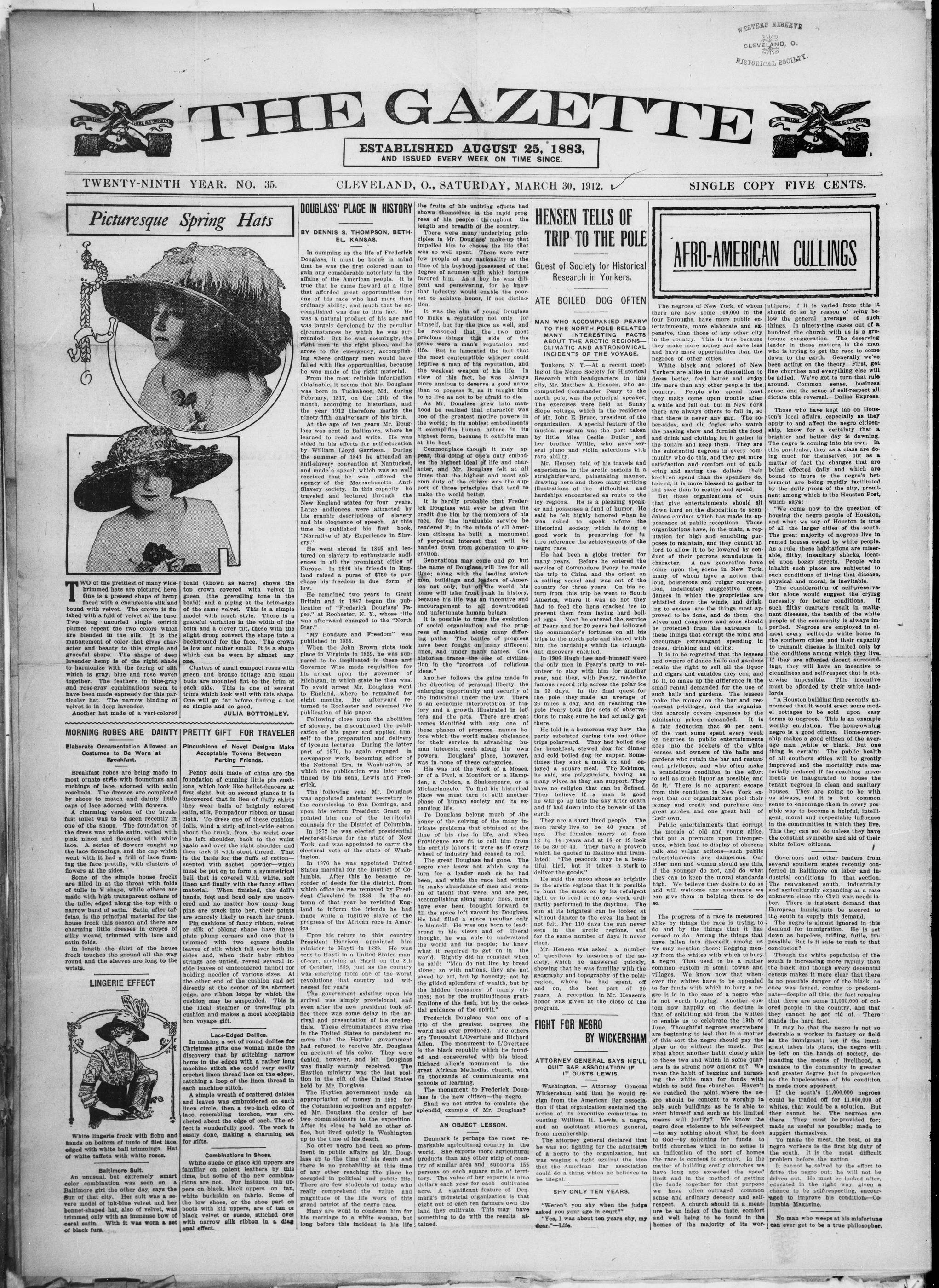
TWO of the prettiest of many wide-brimmed hats are pictured here. One is a pressed shape of hemp faced with a changeable silk and bound with velvet. The crown is finished with a fold of velvet at the base. Two long curled single ostrich plumes repeat the two colors which are blended in the silk. It is the management of color that gives character and beauty to this simple and graceful shape. The shape of deep lavender hemp is of the right shade to harmonize with the facing of silk which is gray, blue and rose woven together. The feathers in blue-gray and rose-gray combinations seem to have been made expressly for this particular hat. The narrow binding of velvet is in deep lavender.
Another hat made of a vari-colored
Elaborate Ornamentation Allowed on Costumes to Be Worn at Breakfast.
Breakfast robes are being made in most ornate style with floundings and ruchings of lace, adorned with satin rosebuds. The dresses are completed by shoes to match and dainty little caps of lace adorned with flowers.
A charming version of the breakfast toilet was to be seen recently in one of the shops. The foundation of the dress was white satin, veiled with pink ninon and flounced with white lace. A series of flowers caught up the lace floundings, and the cap which went with it had a frill of lace framing the face prettily, with clusters of flowers at the sides.
Some of the simple house frocks are filled in at the throat with folds of tulle in V shape, while others are made with high transparent collars of the tulle, edged along the top with a narrow band of satin. Satin, after tafetas, is the principal material for the house frock this season and there are charming little dresses in crepes of silky weave, trimmed with lace and satin folds.
In length the skirt of the house frock touches the ground all the way round and the sleeves are long to the wrists.
LINGERIE EFFECT
White lingerie frock with fichu and bands on bottom of tunic of fillet lace, edged with white ball trimmings. Hat of white taffeta with white roses.
Baltimore Suit.
An unusual, but extremely smart color combination was seen on a Baltimore girl the other day, says the Sun of that city. Her suit was a severe model of ink-blue velvet and her bonnet-shaped hat, also of velvet, was trimmed only with an immense bow of coral satin. With it was worn a set of black fur.
---
THE GAZETTE
braid (known as nacre) shows the top crown covered with velvet in green (the prevailing tone in the braid) and a piping at the brim-edge of the same velvet. This is a simple model with much style. There is a graceful variation in the width of the brim and a clever tilt, with the slight droop convert the shape into a background for the face. The crown is low and rather small. It is a shape which can be worn by almost any one.
Clusters of small compact roses with green and bronze foliage and small buds are mounted flat to the brim at each side. This is one of several trims which look well with this shape. One will go far before finding a hat so simple and so good.
JULIA BOTTOMLEY.
Pincushions of Novel Designs Make Acceptable Tokens Between Parting Friends.
Penny dolls made of china are the foundation of cunning little pin cushions, which look like ballet-dancers at first sight, but on second glance it is discovered that in lieu of fluffy skirts they wear balls of brightly colored satin, Pompadour ribbon or tinsel cloth. To dress one of these cushion-dolls, wind a strip of inch-wide cotton about the trunk, from the waist over the left shoulder, back to the waist again and over the right shoulder and then tack it with stout thread. That is the basis for the fluffs of cotton—scented with sachet powder—which must be put on to form a symmetrical ball that is covered with white, soft linen and finally with the fancy silken material. When finished, the doll's hands, feet and head only are uncovered and no matter how many long pins are scarcely likely to reach her trunk. Pin cushions of fancy ribbon, velvet or silk of oblong shape have three plain plump corners and one that is trimmed with two square double leaves of silk which fall over both its sides and, when their baby ribbon strings are untied, reveal several inside leaves of embroidered flannel for holding needles of various sizes. At the other end of the cushion and set directly at the center of its shortest edge, are ribbon loops by which the cushion may be suspended. This is the ideal steamer or traveling pin cushion and makes a most acceptable bon voyage gift.
Lace Edged Dollies
In making a set of round dolllies for Christmas gifts one woman made the discovery that by stitching narrow hems in the edges with a rather long machine stitch she could very easily crochet linen thread lace on the edges, catching a loop of the linen thread in each machine stitch.
A simple wreath of scattered daisies and leaves was embroidered on each linen circle, then a two-inch edge of lace, resembling torchon, was crocheted about the edge of each. The effect is wonderfully good. The work is easily done, making a charming set for gifts.
Combinations In Shoes
White suede or glace kid uppers are familiar on patent leathers by this time, but some of the new combinations are not. For instance, tan uppers on black, black uppers on tan, white buckskin on fabric. Some of the low shoes, or the shoe part on boots with kid uppers, are of tan or black velvet or suede, stitched over with narrow silk ribbon in a diagonal effect.
ESTABLISHED AUGUST 25, 1883 AND ISSUED EVERY WEEK ON TIME SINCE.
CLEVELAND, O., SATURDAY, MARCH 30, 1912.
DOUGLASS' PLACE IN HISTORY
BY DENNIS S. THOMPSON, BETH
EL, KANSAS.
In summing up the life of Frederick Douglass, it must be borne in mind that he was the first colored man to gain any considerable notoriously in the affairs of the American people. It is true that he came forward at a time that afforded great opportunities for one of his race who had more than ordinary ability, and much that he accomplished was due to this fact. He was a natural product of his age and was largely developed by the peculiar circumstances by which he was surrounded. But he was, seemingly, the right man in the right place, and he arose to the emergency, accomplishing where ordinary men would have failed with like opportunities, because he was made of the right material. From the most reliable information obtainable, it seems that Mr. Douglass was born in Tuckahoe, Md., during February, 1817, on the 13th of the month, according to historians, and the year 1912 therefore marks the ninety-fifth anniversary of his birth.
At the age of ten years Mr. Douglass was sent to Baltimore, where he learned to read and write. He was aided in his efforts for self-education by William Lloyd Garrison. During the summer of 1841 he attended an anti-slavery convention at Nantucket, and made a speech which was so well received that he was offered the agency of the Massachusetts Anti-Slavery society. In this capacity he traveled and lectured through the New England states for four years. Large audiences were attracted by his graphic descriptions of slavery and his eloquence of speech. At this time he published his first book, "Narrative of My Experience in Slavery."
He went abroad in 1845 and lectured on slavery to enthusiastic audiences in all the prominent cities of Europe. In 1846 his friends in England raised a purse of $750 to purchase his freedom in due form of law.
He remained two years in Great Britain and in 1847 began the publication of "Frederick Douglass" Paper," at Rochester, N. Y., whose title was afterward changed to the "North Star."
"My Bondage and Freedom" was published in 1855.
When the John Brown riots took place in Virginia in 1859, he was supposed to be implicated in these and Governor Wise made requisition for his arrest upon the governor of Michigan, in which state he then was. To avoid arrest Mr. Douglass went to England, where he remained for eight months. He afterward returned to Rochester and resumed the publication of his paper.
Following close upon the abolition of slavery, he discontinued the publication of his paper and applied himself to the preparation and delivery of yceum lectures. During the latter part of 1870, he again engaged in newspaper work, becoming editor of the National Era, in Washington, of which the publication was later continued by his sons, Lewis and Frederick.
The following year Mr. Douglass was appointed assistant secretary to the commission to San Domingo, and upon his return President Grant appointed him one of the territorial counsels for the District of Columbia. In 1872 he was elected presidential elector-at-large for the state of New York, and was appointed to carry the electoral vote of the state of Washington.
In 1876 he was appointed United States marshal for the District of Columbia. After this he became recorder of deeds for the district, from which office he was removed by President Cleveland in 1886. In the autumn of that year he revisited England to inform the friends he had made while a fugitive slave of the progress of the African race in America.
Upon his return to this country President Harrison appointed him minister to Haytl in 1889. He was sent to Haytl in a United States man-of-war, arriving at Haytl on the 8th of October, 1889, just as the country was emerging from one of the worst revolutions that country had witnessed for years.
The government existing upon his arrival was simply provisional, and even after the new president took office there was some delay in the arrival and presentation of his credentials. These circumstances gave rise in the United States to persistent rumors that the Haytl government had refused to receive Mr. Douglass on account of his color. They were denied, however, and Mr. Douglass was finally warmly received. The Haytl ministry was the last position in the gift of the United States held by Mr. Douglass.
The Haytien government made an appropriation of money in 1892 for the Columbian exposition and appointed Mr. Douglass the senior of her two commissioners to the exposition. After its close he held no other office, but lived quietly in Washington up to the time of his death.
No other negro had been so prominent in public affairs as Mr. Douglass up to the time of his death and there is no probability at this time of any other reaching the place he occupied in political and public life. There are few students of today who really comprehend the value and magnitude of the life work of this grand patriot of the negro race.
Many are wont to condemn him for his marriage to a white woman, but long before this incident in his life
the fruits of his unirring efforts had shown themselves in the rapid progress of his people throughout the length and breadth of the country.
There were many underlying principles in Mr. Douglass' make-up that impelled him to choose the life that was so well spent. There were very few people of any nationality at the time of his boyhood possessed of that degree of acumen with which fortune favored him. As a boy he was diligent and persevering, for he knew that industry would enable the poorest to achieve honor, if not distinction.
It was the aim of young Douglass to make a reputation not only for himself, but for the race as well, and he reasoned that the two most precious things this side of the grave were a man's reputation and life. But he lamented the fact that the most contemptible whisper could deprive a man of his reputation, and the weakest weapon of his life. In view of this fact, he was always more anxious to deserve a good name than to possess it, as it taught him to so live as not to be afraid to die.
As Mr. Douglass grew into manhood he realized that character was one of the greatest motive powers in the world; in its noblest embodiments it exemplifies human nature in its highest form, because it exhibits man at his best.
Commonplace though it may appear, this doing one's duty embodies the highest ideal of life and character, and Mr. Douglass felt at all times that the highest and most solemn duty of the citizen was the support of those principles that tend to make the world better.
It is hardly probable that Frederick Douglass will ever be given the credit due him by the members of his race, for the invaluable service he rendered it; in the minds of all American citizens he built a monument of perpetual interest that will be handed down from generation to generation.
Generations may come and go, but the name of Douglass, will live for all time; along with the leading statesmen, buildings and leaders of America not only, but of the world, his name will take front rank in history, because his life was an incentive and encouragement to all downtrodden and unfortunate human beings.
It is possible to trace the evolution of social organization and the progress of mankind along many differing paths. The battles of progress have been fought on many different lines, and under many names. One historian traces the rise of civilization in the "progress of religious ideas."
Another follows the gains made in the direction of personal liberty, the enlarging opportunity and security of the individual under the law. There is an economic interpretation of history and a growth illustrated in letters and the arts. There are great names identified with any one of these phases of progress—names before which the world makes obeisance for their service in advancing human interests, each along his own powers. Douglass' place, however, was in none of these categories.
His was not the work of a Moses, or of a Paul, a Montfort or a Hampden, a Cobden, a Shakespeare, or a Michaelangelo. To find his historical place we must turn to still another phase of human society and its expanding life.
To Douglass belong much of the honor of the solving of the many intricate problems that obtained at the time of his rise in life, and when Providence saw fit to call him from his earthly labors it were as if every wheel of industry had ceased to roll.
The great Douglass had gone. The negro race knew not which way to turn for a leader such as he had been, and while the race had within its ranks abundance of men and women of talent that were, and are yet, accomplishing along many lines, none have ever been brought forward to fill the space left vacant by Douglass. He had filled a space peculiarly only to himself. He was one born to lead; broad in his views and of liberal thought, he was able to understand the world and its people; he knew what it required to get on in the world. Rightly did he consider when he said: "Men do not live by bread alone; so with nations, they are not saved by art, but by honesty; not by the gilded splendors of wealth, but by the hidden treasures of manly virtues; not by the multitudinous gratifications of the flesh, but by the celestial guidance of the spirit."
Frederick Douglass was one of a trio of the greatest negroes the world has ever produced. The others are Toussaint L'Overture and Richard Allen. The monument to L'Overture is the black republic which he founded and consecrated with his blood. Richard Allen's monument is the great African Methodist church, with its thousands of communicants and schools of learning.
The monument to Frederick Douglass is the new citizen—the negro. Shall we not strive to emulate the splendid example of Mr. Douglass?
AN OBJECT LESSON.
Denmark is perhaps the most remarkable agricultural country in the world. She exports more agricultural products than any other strip of country of similar area and supports 155 persons on each square mile of territory. The value of her exports is nine dollars each year for each cultivated acre. A significant feature of Denmark's industrial organization is that eight out of each ten farmers own the land they cultivate. This may have something to do with the results attained.
HENSEN TELLS OF TRIP TO THE POLE
HENSEN TELLS OF TRIP TO THE POLE
Guest of Society for Historical Research in Yonkers.
ATE BOILED DOG OFTEN
MAN WHO ACCOMPANIED PEARY TO THE NORTH POLE RELATES MANY INTERESTING FACTS ABOUT THE ARCTIC REGIONS—CLIMATIC AND ASTRONOMICAL INCIDENTS OF THE VOYAGE.
Yonkers, N. Y.—At a recent meeting of the Negro Society for Historical Research, with headquarters in this city, Mr. Matthew A. Hensen, who accompanied Commander Peary to the north pole, was the principal speaker. The exercises were held at Sunny Slope cottage, which is the residence of Mr. John E. Bruce, president of the organization. A special feature of the musical program was the part taken by little Miss Cecile Butler and her brother Willie, who gave several piano and violin selections with rare ability.
Mr. Hensen told of his travels and experiences in the arctic regions in a straightforward, painstaking manner, drawing here and there many striking illustrations of the difficulties and hardships encountered en route to the ice regions. He is a pleasing speaker and possesses a fund of humor. He said he felt highly honored when he was asked to speak before the Historical society, which is doing a good work in preserving for future reference the achievements of the negro race.
He had been a globe trotter for many years. Before he entered the service of Commodore Peary he made the trip to China and the orient on a sailing vessel and was out of the country for three years. On his return from this trip he went to South America, where it was so hot they had to feed the hens cracked ice to prevent them from laying hard boiled eggs. Next he entered the service of Peary and for 20 years had followed the commander's fortunes on all his trips to the north pole and shared with him the hardships which its triumphant discovery entailed.
In 1906 Hugh Lee and himself were the only men in Peary's party to volunteer to stay with him for another year, and they, with Peary, made the famous record trip across the polar ice in 33 days. In the final quest for the pole they made an average of 26 miles a day, and on reaching the pole Peary took five sets of observations to make sure he had actually got there.
He told in a humorous way how the party subsisted during this and other trips polarward. They had bulled dog for breakfast, stewed dog for dinner and cold boiled dog for supper. Sometimes they shot a musk ox and enjoyed a square meal. The Eskimos, he said, are polygamists, having as many wives as they can support. They have no religion that can be defined. They believe if a man is good he will go up into the sky after death and if bad down into the bowels of the earth.
They are a short lived people. The men rarely live to be 40 years of age. The females marry at from 12 to 14 years and at 18 or 19 look to be 30 or 40. They have a proverb which he quoted in Eskimo and translated: "The peacock may be a beautiful bird, but it takes a stork to deliver the goods."
He said the moon shone so brightly in the arctic regions that it is possible to hunt the musk ox by its refugiful light or to read or do any work ordinarily performed in the daytime. The sun at its brightest can be looked at without danger to the eyes. Its heat is not felt. For 110 days the sun never sets in the arctic regions, and for the same number of days it never rises.
Mr. Hensen was asked a number of questions by members of the society, which he answered quickly, showing that he was familiar with the geography and topography of the polar region, where he had spent, off and on, the best part of 20 years. A reception in Mr. Hensen's honor was given at the close of the program.
FIGHT FOR NEGRO
BY WICKERSHAM
ATTORNEY GENERAL SAYS HE'LL QUIT BAR ASSOCIATION IF IT OUSTS LEWIS.
Washington. — Attorney General Wickersham said that he would resign from the American Bar association if that organization sustained the action of its executive committee in ousting William H. Lewis, a negro, and an assistant attorney general, from membership.
The attorney general declared that he was not fighting for the admission of a negro to the organization, but was waging a fight against the idea that the American Bar association could do a thing which he believes to be illegal.
SHY ONLY TEN YEARS.
"Weren't you shy when the judge asked you your age in court?" "Yes, I was about ten years shy, my dear."-Life.
WESTERN RESERVE
CLEVELAND, O.
HISTORICAL SOCIETY.
SINGLE COPY FIVE CENTS.
The negroes of New York, of whom there are now some 100,000 in the four Boroughs, have more public entertainments, more elaborate and expensive, than those of any other city in the country. This is true because they make more money and save less and have more opportunities than the negroes of other cities.
White, black and colored of New Yorkers are alike in the disposition to dress better, feed better and enjoy life more than any other people in the country. People who spend most they make come upon trouble after a while and fall out, but in New York there are always others to fall in, so that there is never any gap. The sober-sides, and old fogles who watch the passing show and furnish the food and drink and clothing for it gather in the dollars and keep them. They are the substantial negroes in every community who do this, and they get more satisfaction and comfort out of gathering and saving the dollars their brethren spend than the spenders do. Indeed, it is more blessed to gather in and save than to scatter and spend.
But those organizations of ours that give entertainments should sit down hard on the disposition to scandalous conduct which has made its appearance at public receptions. These organizations have, in the main, a reputation for high and ennobling purposes to maintain, and they cannot afford to allow it to be lowered by conduct of their patrons scandalous in character. A new generation have come upon the scene in New York, many of whom have a notion that loud, boisterous and vulgar conversation, indelicately suggestive dress, dances in which the proprieties are whistled down the winds, and drinking to excess are the things most approved to be done, and do them—the wives and daughters and sons should be protected from the extremes in these things that corrupt the mind and encourage extravagant spending in dress, drinking and eating.
It is to be regretted that the lessees and owners of dance halls and gardens retain the right to sell all the liquor and cigars and eatables they can, and do it, to make up the difference in the small rental demanded for the use of such halls and gardens. The lessees make the money on the bar and restaurant privileges, and the organization scarcely covers expenses by the admission prices demanded. It is a fair deduction that 90 per cent. of the vast sums spent every week by negroes in public entertainments goes into the pockets of the white lessees and owners of the halls and gardens who retain the bar and restaurant privileges, and who often make a scandalous condition in the effort to sell as much liquor as possible, and do it. There is no apparent escape from this condition in New York except that our organizations pool their money and credit and purchase one great garden and one great hall of their own.
Public entertainments that corrupt the morals of old and young alike, that put a premium upon intemperance, which lead to display of obscene talk and vulgar actions—such public entertainments are dangerous. Our older men and women should see this, if the younger do not, and do what they can to keep the moral standards high. We believe they desire to do so and will welcome any assistance we can give them in helping them to do so.
The progress of a race is measured alike by things the race is trying to do and by the things that it has ceased to do. Among the things that have fallen into discredit among us we may mention these: Begging money from the whites with which to bury a negro. That used to be a rather common custom in small towns and villages. We know now that whenever the whites have to be appealed to for funds with which to bury a negro it is in the case of a negro who is not worth burying. Another custom now happily on the decline is that of soliciting aid from the whites to enable us to celebrate the 19th of June. Thoughtful negroes everywhere are beginning to feel that in a matter of this sort the negro should pay the piper or do without the music. But what about another habit closely akin to these two and which in some quarters is as strong now among us? We mean the habit of begging and harassing the white man for funds with which to build fine churches. Haven't we reached the point, where the negro should be content to where the negro should be only buildings as he is able to erect himself and such as his limited means will justify? We know the negro does violence to his self-respect
—to say nothing about what he does to God—by soliciting for funds to build churches which in no sense is an indication of the sort of homes the race is content to occupy. In the matter of building costly churches we have long ago exceeded the speed limit and in the method of getting the funds together for that purpose we have often outraged common sense and ordinary decency and self-respect. A church should in a measure be an index of the taste, comfort and well being to be found in the homes of the majority of its wor-
Y FIVE CENTS.
AN CULLINGS
shipers; if it is varied from this it should do so by reason of being below the general average of such things. In ninety-nine cases out of a hundred the church with us is a grotesque exaggeration. The deserving leader in these matters is the man who is trying to get the race to come down to the earth. Generally we've been acting on the theory: First, get fine churches and everything else will be added. We've got to turn that rule around. Common sense, business sense, and the sense of self-respect all dictate this reversal.—Dallas Express.
Those who have kept tab on Houston's local affairs, especially as they apply to and affect the negro citizenship, know for a certainty that a brighter and better day is dawning. The negro is coming into his own. In this particular, they as a class are doing much for themselves, but as a matter of fact the changes that are being effected daily and which are bound to inure to the negro's betterment are being rapidly facilitated by the daily press of the city, prominent among which is the Houston Post, which says:
"We come now to the question of housing the negro people of Houston, and what we say of Houston is true of all the larger cities of the south. The great majority of negroes live in rented houses owned by white people. As a rule, these habitations are miserable, filthy, insanitary shacks, located upon boggy streets. People who inhabit such places are subjected to such conditions of living that disease, physical and moral, is inevitable. The consideration of self-preservation alone would suggest the crying necessity for better conditions. If such filthy quarters result in malignant diseases, the health of the white people of the community is always imperilled. Negroes are employed in almost every well-to-do white home in the southern cities, and their capacity to transmit disease is limited only by the conditions among which they live. If they are afforded decent surroundings, they will have an incentive to cleanliness and self-respect that is otherwise impossible. This incentive must be afforded by their white landlords.
"A Houston building firm recently announced that it would erect some model cottages to be sold upon easy terms to negroes. This is an example worthy emulation. The home-owning negro is a good citizen. Home-ownership makes a good citizen of the average man, white or black. But one thing is certain: The public health of all southern cities will be greatly improved and the mortality rate materially reduced if far-reaching movements be inaugurated to house the tenant negroes in clean and sanitary houses. They are going to be with us always, and it is but common sense to encourage them in every possible way to become a helpful, intelligent, moral and respectable influence in the communities in which they live. This they can not do unless they have the constant sympathy and aid of their white fellow citizens.
Governors and other leaders from several southern states recently conferred in Baltimore on labor and industrial conditions in that section. The reawakened south, industrially and agriculturally expanding at a rate unknown since the Civil war. needs labor. There is insistent demand that European immigrants be steered to the south to supply this demand.
The negro is almost ignored in this demand for immigration. He is set down as hopeless, trifling, futile, impossible. But is it safe to rush to that conclusion?
Though the white population of the south is increasing more rapidly than the black, and though every decennial census makes it more clear that there is no possible danger of the black, as once was feared, coming to predominate—despite all this, the fact remains that there are some 11,000,000 of colored people in the country, and that they cannot be got rid of. There stands the hard fact.
It may be that the negro is not so desirable a worker in factory or field as the immigrant; but if the immigrant takes his place, the negro will be left on the hands of society, demanding the means of livelihood, a menace to the community in greater and greater degree just in proportion as the hopelessness of his condition is made more apparent.
If the south's 11,000,000 negroes could be traded off for 11,000,000 of whites, that would be a solution. But they cannot be. The negroes are there. They must be provided for; made as useful as possible; made to support themselves.
To make the most, the best, of its negro workers is the first big duty of the south. It is the most difficult problem before the nation.
It cannot be solved by the effort to drive the negro out; he will not be driven out. He must be looked after, educated in the right way, given a chance to be self-respecting, encouraged to improve his condition—Columbia Magazine.
No man who weeps at his misfortune can ever get to be a true philosopher.
THE GAZETTE
PUBLISHED EVERY SATURDAY
One Year. $1.50
Six Months. 1.00
Three Months. .50
Subscribers are requested to re-
mit by postoffice money or
order or registered letter.
Entered at the postoffice in Cleveland
Ohio, as second-class matter
Address all communications to
HARRY C. SMITH
Editor and proprietor.
Member Ohio Legislature: 1894
to 1896; 1896 to 1898; 1900 to 1902
THE GAZETTE is the oldest, and has the largest bona fide circulation, double that of any newspaper in the interest of Afro-Americans, published in the state of Ohio, and comparison with any will immediately establish its rank as one of the NEWSIEST AND BEST in the country.
Again, we remind our people, the country over to "remember Brownsville."
The editor of The Gazette is indebted to Senator J. B. Foraker for a copy of his address to the Ohio Constitutional Convention, at Columbus, March 12, 1912, and for a copy of the one he delivered to the Business Men's club of Cincinnati, Feb. 28, 1912.
Our papers should not be so "easy" and permit the Taft, Roosevelt, La Follette or any other national political bureau to "load" plate or any other kind of matter on them for free publication. They are all better able to pay for what they want from us than we are to give it to them. Do not be so imposed upon by any of them.
Some people would rather be wrong than right. This seems to be the case with President Bigelow of the O. C. C. in his recent brutal personal attack on Ex-Senator Joseph Benson Foraker. The people of Ohio know and appreciate Judge Foraker. We wish we could say the same of the "Rev." H. S. Bigelow. The Ex-Senator is recognized as one of the greatest statesmen this country has ever produced.
The U. S. Supreme Court's recent decision upholding the right of a northwestern state to adopt the Initiative and Referendum, and refusing to interfere, shows conclusively that it is not likely to recode from its decision of years ago which indicated very plainly that the various states of the Union alone can enact anti-lynching legislation, this plainly coming under the head of "states' rights" an old and now generally recognized doctrine in the Court. It would be a saving of much time and effort for some of our people to note this fact
The Taft-Roosevelt contest for delegates to the National Republican convention has reached the stage, now, where it is easily to be seen that one of the greatest convention fights in the history of the party will be witnessed this year. LaFollette, Cummins and the other candidates will have just enough votes to help increase the bitterness of the contest in the convention. The Democratic press identical nomination fight grows even more bitter between Harmon, Wilson Clark and Folk, with Bryan as a very formidable "dark-horse" candidate. This is going to be "some" national political year, beyond all question or doubt.
The prejudiced officers of New York state's militia have encouraged the Jews of that state to make application for the organization of a Jewish regiment, knowing that this will kill the effort to secure the mustering into the state's service of the Afro-American regiment organized, drilled and uniformed some months ago for that very purpose. Gov. Dix, and other leading democrats of the "Empire State," promised this recognition before his election but have failed, to date, to keep the promise of the opposition of the aforementioned perjudiced state militia officers who have perfected a great social organization in the N. Y. state militia.
The man who suffers personal wrong without protest or opposition, the "peaceful" member of the community, is a demoralizing factor in our social fabric. The class that does not struggle for civic and industrial rights will eventually lapse into slavery. The nation that passively contenances encroachments upon its rights and territory is doomed to dismemberment and national bankruptcy. It is the man who defends his rights, the class that battles for political and industrial advancement, and the nation that holds its own against the entire world; it is the "litigious" person, the revolutionary class, and the vigilant nation, that keep the world from stagnation and force it onward on the path of progress.—Hillquit.
QUILLIN'S SILLY STATEMENTS.
Frank U. Quillin's article on "The Negro in Cleveland, Ohio," published recently in a Sunday edition of the Cleveland Plain Dealer, in the Chicago Fellowship Herald and possibly other daily and weekly papers in various parts of the country, is so full of errors and mis-statements that the few antiquated facts it contains, taken from the N. Y. Independent of Feb. 24, 1910, are almost overshadowed. The miserable article was written for a purpose that is made perfectly clear in the following excerpts: "There is no social equality between the races in Cleveland." That is not so. The opposite is, however, and has always been true. "The Negro lives by themselves in Central avenue and Avenue A." The two races prefer to live by themselves in their home life. As the Negro population increases and new land is needed to accommodate
it, adjacent property is always ready for sale at a cheap price.
"Men of the two races may meet as friends on the streets or in business, but it is never carried to the home life. The white man will not think tween the races in Cleveland." That is not so. The opposite is, however, and has always been true. These Quillin statements are not only untruthful but positively silly and harmful. There is not a large city in the country where the social intermingling of the races is carried on to a greater extent, or where the two races live less to themselves. That "adjacent property" reference, is ridiculously untrue on its very face.
We do not know Frank U. Quillin, and have never even heard of him before, but the following additional quotation, equally as silly and preposterous as the others given above, will come pretty near indicating his trend of thought and his southern-prejudice leaning. Speaking of a mythical postponement of an alleged leading local literary club banquet because a very light. complexioned Afro-American member might have been accompanied by his wife, Quillin wrote:
"The whole thing was then quietly dropped, the members of the club taking the following view of the matter expressed by one of them: 'Although I am a Southerner, I am broadminded enough to admire Mr. A. for his work. I like to talk with him and to shake his wife in social equality is a very different thing. She would not agree to it, and I could not blame her.'
Equally as foolish and untrue as the foregoing, is his statement that "a few years back some young Negroes tried to attend a public dance along with whites," and that Colored people of this city do not frequent "the white man's" public eating places or restaurants, &c.
Quillin must have been paid for the effort (in his malicious article) to boost the color-line in public places. Our people of this community can enter a vigorous and proper protest against the publication of such distribes, by local daily papers, simply by discontinuing their patronage of them, and they must do this, too.
SENATOR FORAKER DEFENDS
HIMSELF.
The Great Lawyer's Services to the Standard Oil Company were Legitimate—Had no Relation to His Duties as Senator—Brutal Personal Attack Made by President Bigelow of The Ohio Constitutional Convention.
Cincinnati, O.—Charging ex-Senator Foraker with betraying the trust of his people while their servant, "Rev," Herbert S. Bigelow, president of the Ohio constitutional convention, in an address here replied to the ex-senator's speech before the convention recently. President Bigelow made his attack on the personal character of Mr. Foraker and accused him of accepting money from the Standard Oil Company attorney while serving the people of Ohio.
Senator Foraker gave out this statement in reply to Bigelow: "Anybody can be a blackguard who cares to be even the president of the constitutional convention. I do not care to answer at any length an attack of such a character as I think I am an indulgent think I am well enough known to the people of Ohio and that it is unnecessary for me to answer such a tirade of abuse. In so far as the Standard Oil Company is concerned, I did represent it, as every body knows and did know at the time. But the services I rendered the Standard Oil Company had no relation whatsoever to my duties as a United States senator was as attorney ever rendered a vice as any attorney ever rendered a client."
DOINGS OF THE RACE
Joe Gans' widow has married Mr Ford Dabney of Washington, D. C. They are living in the Goldfield Hotel Baltimore. Md., which Joe left her.
C. S. Baker of Detroit, has sold his patent of a friction heater for street cars to a Canadian Co., for $160,000. Bishop Isaac Lane of the C. M. E. Church was 78 years old Mar. 3. He is in excellent health and as active as a man half his age. For a long time newspaper advertising vampires sucked the blood out of country newspapers, and now that it is on the wane, in comes the well paid for stereotyped matter free to all who will use it. To many it is catchy, but you must pay the Pioneer Press if you want your stuff printed.—Martinsburg (W. Va.) Pioneer Press.
You will need The Gazette this year,
more than ever. Subscribe now!
Mrs. Alice A. Hicks (white.) left the N. Y. City Colored Orphan's Asylum, $10,000. She died, recently, at Mineola, N. Y.
According to Census Director Durand, 15.8 per cent of the illiterates of this country, is furnished by the native and foreign-born whites, our people furnishing 30.5 per cent, most of this latter being in the south of course.
She was born every three minutes in Greater New York last year. No wonder New York people stay up nights—Omaha World-Herald.
A. Southern Coward!
Cincinnati, O. — Jack Johnson, the champion pugilist, was attacked in his automobile, Monday. He had been held up by a traffic officer at Sixth and Walnut streets and a crowd gathered. One of the men in the crowd suddenly leaped on the step of the au tomobile and struck Johnson two stunning blows in the face. He dispeared in the crowd immediately Johnson took the attack good-naturedly and made no effort to retaliate.
FREE INFORMATION SERVICE
BEST NEWS FROM THE
UNITED STATES
Grown on the Shores of Lake Erie Hard-wooded, Early-bearing, Long lived, Complete line of Fruit and Ornamental Trees, Small Fruits, Shrubs Evergreen, Vines, etc. Propagated from Prize-winning Orchards—fruit brings highest prices. Barew of soft wooded, cheaply-propagated stock Write at once for full particular Pennsylvania Nursery Co., Girard, Pa
ATTACHMENT NOTICE
Before Wm. Brown, a Justice of the Peace of East Cleveland Township Cuyahoga County, Ohio.
Geo. B. Hare, Plff., vs. E. E. Williams, Dft. On the 12th day of March 1912, said Justice issued an order of attachment in the above case for the sum of $84.97 and $10 probable costs. Said case is filed on the 3d day of May 1912 at 4 p. m.
GEO. B. HARE.
By Chas. S. Sutton, his attorney.
3t.
THE GAZETTE, CLEVELAND, O. SATURDAY, MARCH 30, 1912.
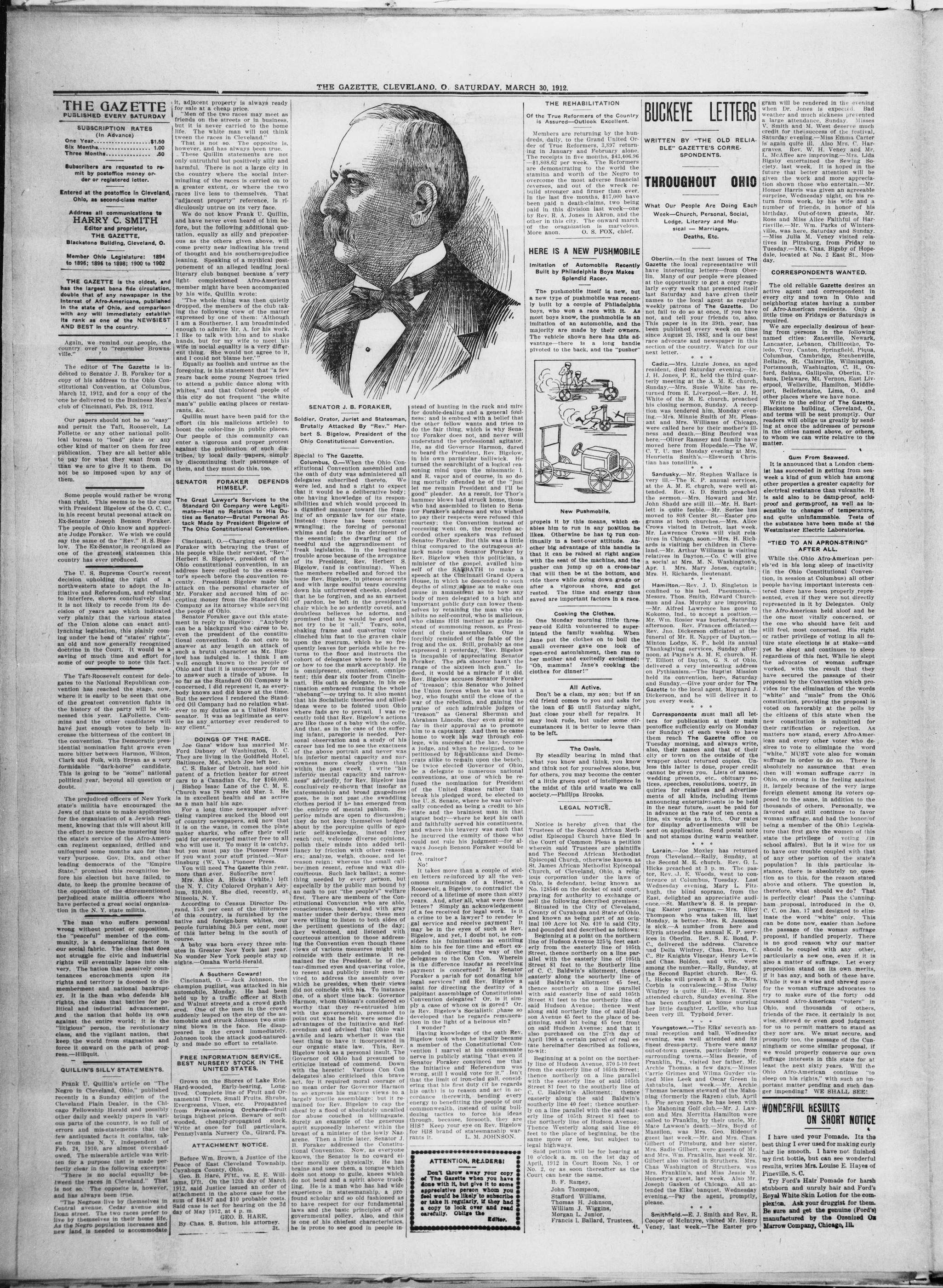
SENATOR J. B. FORAKER,
Soldier, Orator, Jurist and Statesman
Brutally Attacked by "Rev." Herbert S. Bigelow, President of the Ohio Constitutional Convention.
Special to The Gazette
stead of hunting in the ruck and micr for double-dealing and a general foulness; and is embued with a belief that the other fellow wants and tries to do the fair thing, which is why Senator Foraker does not, and never will understand the professional agitator. He should not be heard the President, Rev. Bigelow, in his own particular ballwick. He turned the searchlight of a logical reasoning mind upon the mismatic I. and R. vapor and of course, in so doing mortality offended he of the "just let me remain President and I'll be good" pleader. As a result, for Thor's hammer blows had struck home, those who were in the audience addressed to the Foraker's address and who wished to pay their respects were refused this courtesy; the Convention instead of recessing went on, the reception accorded other speakers was refused Senator Foraker. But this was a little thing compared to the outrageous attack made upon Senator Foraker by the minister of the gospel, availed himself of the SABPATH to make a speech at the Cincinnati Grand Opera House, in which he descended to such depths of slimy abuse as to make one pause in amazement as to how any body of men delegated to a high and important public duty can lower them inhibits no self-control, who is malicious, who claims HIS instinct as guide instead of summoning reason, as President of the assemblage. One is forcibly reminded of the probability of the frog and the ox. Still, the descended to one expression it yesterday. Rev. Bigelow incapable of apprehension. The doctor hindered it. would be a miracle if it were. Bigelow accuses Senator Foraker of "treason"; this Senator who joined the Union forces when he was but a boy, who fought until the close of the war of the rebellion, and gaining the praise of such admirable judges of Abraham Lincoln, they even going so far in their approval as to promote him to a captainny. And then he came home to work his way through college, win success at the bar, become a judge, and when he resigned, to be petitioned by Republicans and Democrats to vote for a wide electorate of Governor of Ohio, be a delegate to numerous national conventions, at one of which he refused the nomination for President of the United States rather than break his pledged blood, be elected to the U.S. Senate, where he was universally conceded as being a credit to his state and the brains of the nation, and faithfully served his constituents, and where his bravery was such that he incurred the enmity of those who could not rule his judgment—for always Joseph Benson Foraker would be free.
It takes more than a couple of stol en letters inrefaced by all the venomous surmises of a Ahearst, a Roosevelt, a Bigelow, to contradict the record of a lifetime of more sixty years. And, after all, what were those letters? Simply an acknowledgement of a fee received for legal work. Is it a crime to be a lawyer? to render legal service and receive payment? It may be in the eyes of such as Rev Bigelow, and yet, I doubt not, he considers his fulminations as entitling him to his fee for not donating during the way of the delegates to the Con Con. Wherein is the difference insofar as receiving payment is concerned? Is Senator Foraker a pariah for not donating his legal services? and Rev. Bigelow a saint for directing the destiny of a palpitant assemblage of Constitutional Convention delegates? Or, is it simply a case of whose ox is gored? Or. is Rev. Bigelow's Socialistic phase so developed that he regards remuneration in the light of a helnous sn?
Having knowledge of the oath Rev Bigelow took when he legally became a member of the Constitutional Convention I marvel at his consummate nerve in publicly stating "that even if Senator Foraker conyed me that the Initiative and Referendum was wrong, still I would vote for it." Isn't that the limit of iron-clad gall, considering that his first duty (if he regards his oath) is to reason for the ordinance to the people, bending every energy to benefiting the people of our own wealth, instead of using bulldozing tactics to force his ideas through, because, forsooth, they are HIS? Keep your eye on Rev Bigelow for HIS brand of statesmanship warrants it. L. M. JOHNSON.
Don't throw away your copy of The Gazette when you have done with it, but give it to some appreciative person whom you feel would be likely to subscribe or take it regularly, if they had a copy to look over and read carefully. Oblige the
THE REHABILITATION
Of the True Reformers of the Country is Assured—Outlook Excellent.
Members are returning by the hundreds, daily, to the Grand United Order of True Reformers, 3,897 returning in January and February alone. The receipts in five months, $43,406.96—$1,808.62 per week. The Reformers are demonstrating to the world the stamina and the worth of the Negro to overcome the most diverse financial障碍 of the wreck rebuild stronger and firmer than ever. In the last five months, $17,000 have been paid n death-claims, two being paid in this division last week—one by Rev. R. A. Jones in Akron, and the other in this city. The onward march of the oragnization is marvelous. More anon. O. S. POX, chief.
HERE IS A NEW PUSHMOBILE
Imitation of Automobile Recently Built by Philadelphia Boys Makes Splendid Racer.
The pushmobile itself is new, but a new type of pushmobile was recently built by a couple of Philadelphia boys, who won a race with it. As most boys know, the pushmobile is an imitation of an automobile, and the majority are made by their owners. The vehicle shown here has this advantage—there is a long handle pivoted to the back, and the "pusher"
New Pushmobile.
propeis it by this means, which enables him to run in any position he likes. Otherwise he has to run continually in a bent-over attitude. Another big advantage of this handle is that it can be raised at right angles with the seat of the machine, and the pusher can jump up on a cross-bar that will then be at the bottom, and ride there while going down grade or after a vigorous shove, and get rested. The time and energy thus saved are important factors in a race.
Cooking the Clothes.
One Monday morning little three-year-old Edith volunteered to superintend the family washing. When Jane put the clothes on to boll the small overseer gave one look of open-eyed astonishment, then ran to the mammal and exclaimed: "Oh mammal! Jane's cooking the clothes for dinner!"
All Active
Don't be a clam, my son; but if an old friend comes to you and asks for the loan of $5 until Saturday night, just close your shell for repairs. It may look rue, but under some circumstances it is better to leave than to be left.
The Oasis.
By steadily bearing in mind that what you know and think, you know and think not for yourselves alone, but for others, you may become the center of a little green spot of intelligence in the midst of this arid waste we call society.—Phillins Brooks.
LEGAL NOTICE.
Notice is hereby given that the Trustees of the Second African Methodist Episcopal Church have filed in the Court of Common Pleas a petition wherein said Trustees are plaintiffs and The Second African Methodist Episcopal Church, otherwise known as St. James African Methodist Episcopal Church, have constituted a jointious corporation under the laws of Ohio, is defendant, being known as No. 125464 on the docket of said court, praying for authority to exchange or sell the following described premises: Situated in the City of Cleveland, County of Cuyahoga and State of Ohio, and known as being part of an origination and bounded and described as follows: Beginning at a point on the northern line of Hudson Avenue $325\frac{1}{2}$ feet easterly from the easterly line of 105th Street, thence northerly on a line parallel with the easterly line of 105th Street 81 feet to the Southerly line of C. C. Baldwin's allotment, thence easterly along the southerly line of said Baldwin's allotment 45 feet, thence northerly on a line parallel with said easterly line of said 105th Street 81 feet to the northerly line of said Hudson Avenue; thence west along said northerly line of said Hudson Avenue 45 feet to the place of said Hudson Avenue; said lot being 45 feet front on said Hudson Avenue; and that if said Hudson Avenue is not within April 1908 a certain parcel of real estate hereinafter described as follows, to-wit:
Beginning at a point on the northerly line of Hudson Avenue, 370 5-10 feet from the easterly line of 105th Street; thence northerly on a line parallel with the easterly line of said 105th Street; thence northerly on a line of C. C. Baldwin's Allotment; thence easterly along the said Baldwin's southerly line 40 feet; thence southerly on a line parallel with the said easterly line of 105th Street 81 feet to the northerly line of Hudson Avenue; Thence Westerly along said line 40 feet to the place of beginning, be the same more or less, but subject to legal rights.
Said petition will be for hearing at 10 o'clock a. m. on the 1st day of April, 1912 in Court Room No. 1 or No. 2, or as soon thereafter as the Court can hear the same.
B. F. Ramey,
John Thompson,
Stafford Williams,
Thomas H. Johnson,
William J. Wiggins,
Morgan L. Junior,
Francis I. Ballard, Trustees.
BUGKEYE LETTERS
WRITTEN BY "THE OLD RELIABLE" GAZETTE'S CORRESPONDENTS.
What Our People Are Doing Each Week—Church, Personal, Social, Lodge, Literary and Musical — Marriages, Deaths, Etc.
Oberlin.—In the next issues of The Gazette the local representative will have interesting letters—from Oberlin. Many of our people were pleased at the opportunity to get a copy regularly every week that presented itself last Saturday and have given their names to the local agent as regular weekly patrons of The Gazette. Do not fail to do so at once, if you have not, and tell your friends to, also. This paper is in its 39th year, has been published every week since August 25, 1883, and is our best race advocate and newspaper in this section of the country. Watch for our next letter.
Cadiz—Mrs. Lizzie Jones, an aged resident, died Saturday evening—Dr. J. H. Jones, P. E., held the third quarterly meeting at the A. M. E. church, Sunday—Mrs. Susie White has returned from E. Liverpool—Rev. J. H. White of the M. E. church, preached the sermon, and Mrs. Williams of the tendered him, Monday evening—Mrs. Minnie Smith of Mt. Pleasant and Mrs. Williams of Chicago were called by their mother's illness and death—Bing Benford was here—Oliver Ramsey and family have been visiting Mrs. C. T. U. met Monday evening at Mrs. Henrietta Smith's-Elsworth Christian has tonsilitis.
---
Sandusky.—Mr. Stephen Wallace is very ill.—The K. P. annual services, at the A. M. E. church, were well attended. Rev. G. D. Smith preached the sermon.—Mrs. Howard and Mr. John Shadd are still ill.—Mr. H. Bartlett is quite feeble.—Mr. Serlee has been ill.—Mr. H. Bartlett grams at both churches.—Mrs. Alice Crowns visited in Detroit, last week. Mr. Lawrence Crowns will visit relatives in Chicago, soon.—Mrs. H. Richards is visiting her children in Cleveland.—Mr. Arthur Williams is visiting Mrs. H. Richards, a social at Mrs. M. N. Washington's, Apr. 1. Mrs. Mary Jones, captain; Mrs. H. Richards, leeant.
Hamilton.—Rev. J. D. Singleton is confined to his bed. Pneumonia.—Messrs. Thos. Smith, Edward Churchman and Jas. Murphy are improving.—Mr. Alfred Lawrence has gone to Kokomo, Ind., to accept a position.—Mr. Wm. Rosier was buried, Saturday afternoon. Rev. Frances officiated.—Rev. Jno. Dickerson officiated at the funeral of R. N. Rapper of Dayton.—Minton Lodge, K. P., held its annual Thanksgiving services, Sunday afternoon.—Mr. McChurk H. T. Elliott of Dayton, G. S. of Ohio delivered a very interesting address on Pythianism.—The Baptist Mission held its convention, here, Saturday and Sunday.—Give your order for The Gazette to the local agent, Maynard J. Dickerson, and he will deliver it to you every week.
Correspondents must mail all letters for publication at their main postoffice sufficiently early on Monday (or Sunday) of each week to have them reach The Gazette office on Tuesday morning, and always write also, their names and that of their children. They should also wrap about returned copies. Unless this latter is done, proper credit cannot be given you. Lists of names, wedding presents, etc., obituary notices, speeches, resolutions, poetry, inquiries for relatives and advertisements of all kinds, including items announcing entertainments, the need for entertainment, be paid for in advance at the rate of ten cents a line, six words to a line. Our rates for display advertisements will be sent on application. Send postal note and not stamps during warm weather.
Lorain—Joe Moxley has returned from Cleveland—Rally, Sunday, at the Second M. E. church. Rev. G. L. Hicks preached at 3 p. m. The pastor, Rev. J. E. Woods, went to conference at Columbus, Tuesday. Last Wednesday evening, Mary L. Fitzsimmons, an attorney in East, delighted an appreciative audience. St. Matthew's S. S. is preparing Easter programs. —Mrs. Riley Thompson who was taken ill, last Monday, is better. Mrs. R. Jamieson is sick. A number from here and Elyria aided the annual K. P. servies in Oberlin. Rev. R. J. Jamieson addressed the address. Clarence and Della Winfrey, Chas. Brown, C. C. Corbins Vlnegar, Henry Lewis and Chas. Bolden, and wife, were among the number—Rally, Sunday, at the Second Baptist church. Rev. G. L. Hicks will preach at 3 p. m. Mrs. Corbin is convalescing. Miss Daisy Winfrey is quite ill. She has been confined to day nursing. She has been confined at home nursing her little daughter. Lucille, who has been very ill. Typhoid fever.
Youngstown.—The Elks' seventh annual reception and ball, Wednesday evening, was well attended and its finest dress-party. There were many out-of-town guests, particularly from surrounding towns—Miss Bessie of Franklin, Pa. visited her daughter, Misses Carrie Grigles and Wilma Gudver visited Miss Leek and Oscar Green in Ashtabula, last week—Mr. Archie Thomas became steward of the Mahoning (formerly the Rayen) club, April 1. For seven years, he has been with the Mahoning Golf club—Mr. J. Lawson, a former member of the called to Franklin, by their uncle, Mr. Mate Lawson's death. Mrs. Boyd of Massillon, was Mrs. Geo. Rideout's guest last week.—Mr. and Mrs. Chas. Gilbert of Pittsburgh, and her sister, Mrs. Sadie Gilbert, were guests of Mr. and Mrs. Wm. Franklin, last week. Mr. and Mrs. Wm. visited in Sutherns, Mrs. Washington, of Struthers, was Mrs. Franklin's, and Miss Jessie M. Honesty's guest, last week. Also Mr. Joseph Gasken of Chicago. All attended the Elks' banquet, Wednesday evening.—Pay the agent, promptly, please.
Smithfield.—E. J. Smith and Rev. R. Cooper of McIntyre, visited Mr. Henry Veney, last week.—The Easter pro
gram will be rendered in the evening when Dr. Jones is expected. Bad weather and much sickness prevented a large attendance. Sunday. Misses V. Smith and M. West deserve much credit for the success of the festival, Saturday evening—Miss Emma Carter is again quite ill. Also Mrs. C. Harrington, Mrs. H. Venew, McAfee are in欠债—Mrs. Linda Bigsby entertained the Sewing Society, last week. It is hoped in the future that better attention will be given the work and more appreciation shown those who entertain.—Mr. Homer Harris was given an agreeable surprise, Wednesday night, on his return from work, by his wife and a number of friends, in honor of his birthday. Out-of-town guests, Mr. Ross and Miss Alice Fallow of Harrington, Mrs. Wenaw, of Wingerville, was here, Saturday and Sunday.—Miss Julia M. Veney visited relatives in Pittsburgh, from Friday to Tuesday—Mrs. Chas, Bigsby of Hopedale, located at No. 2 East St. Monday.
CORRESPONDENTS WANTED.
The old reliable Gazette desires an active agent and correspondent in every city and town in Ohio and neighboring states having a number of Afro-American residents. Only a little time on Fridays or Saturdays is required.
We are especially desirous of hearing from persons in the following Lancaster, Lebanon, Chillicothe, Toledo, Troy, Canton, Springfield, Plqua, Columbus, Cambridge, Steubenville, Bellaire, St. Clairsville, Wilmington, Portsmouth, Washington, C. H., Oxford, Sabina, Gallipolis, Oberlin, Urbana, Delaware, M. Ternon, East Liverpool, Wellsville, Hamilton, Middleport, Bellefontaine, Lima, O., and other places where we have none.
Write to the editor of The Gazette, Bellefontaine, Lake, Cleveland, O., and terms will be sent promptly. Our readers will oblige us greatly by sending at once the addresses of persons in the cities named above, or others, to whom we can write relative to the matter.
Gum From Seaweed.
It is announced that a London chemist has succeeded in getting from seaweek a kind of gum which has among other properties a greater capacity for electrical resistance than vulcanite. It is said also to be damp-proof, acid-proof and germ-proof, as well as insensible to changes of temperature, and quite uninflammable. Tests of the substance have been made at the Westminster Electric Laboratories.
"TIED TO AN APRON-STRING"
AFTER ALL.
While the Ohio Afro-American persisted in his long sleep of inactivity (in the Ohio Constitutional Convention, in session at Columbus) all other people having important interests centered there have been properly represented, even if they were not directly represented in it by Delegates. Only the Afro-American held aloof and he the one most vitally concerned, or the one who should have felt and still feel, most concerned. His right or rather privilege of voting in all future state elections is at stake—and yet he slept and continues to sleep regardless of this fact. While he slept the advocates of woman suffrage worked, with the result that they have secured the passage of their proposal by the Convention which provides for the elimination of the words "white" and "male" from the Ohio constitution, providing the proposal is voted on favorably at the polls by the citizens of this state when the new constitution is submitted for their ratification or rejection. As matters now stand, every Afro-American and every other voter who desires to vote to eliminate the word "white," MUST vote also for woman suffrage in order to do so. There is absolutely no assurance that even then will woman suffrage carry in Ohio, so strong is the feeling in it, largely because of the very large foreign element among its voters opposed to the same, in addition to the favored of others. Personally, we favored and still continue to favor woman suffrage and had the honor of being a member of the Ohio Legislature that first gave the women of this state the privilege of voting (On school affairs). But is it wise for us to have our trouble coupled with that of any other portion of the state's population? In this particular instance, there is absolutely no question as to this, for the reason stated above and others. The question is, therefore, what should we do? That is perfect clear! Pass the Cunningham proposal, introduced in the O. C. C. on Jan. 17 and designed to eliminate the word "white" only. This can be done now, easier than before the passage of the woman suffrage proposal, if handled properly. There is no good reason why our matter should be coupled with any other, particularly a new one, even if it is also a matter of suffrage. Let every proposition stand on its own merits, if it has any, and both of these have. While it was a wise and shrewd move for the woman suffrage advocates to try to make sure of the forty odd thousand Afro-American "voters" in Ohio, and thousands of others, friends of the race, it certainly is not wise, shrewd or even good judgment for us to permit matters to stand as they now are. We must secure, and promptly too, the passage of the Cunningham or some similar proposal, if we would properly conserve our own suffrage interests in this state for at least the next sixty years. Will the Ohio Afro-American continue "to sleep on his rights," with such an important matter pending and such danger impending? WE SHALL SEE!
WONDERFUL RESULTS
ON SHORT NOTICE
I have used your Pomade. Its the best thing I ever used for making curly hair lie smooth. I have not finished my first bottle, but can see wonderful results, writes Mrs. Louise E. Hayes of Pineville, S. C.
Try Ford's Hair Pomade for harsh stubborn and unruly hair and Ford's Royal White Skin Lotion for the complexion. Ask your druggist for them. Be sure and get the genuine (Ford's) manufactured by the Ozonized On Marrow Company, Chicago, Ill.
PURELY PERSONAL
PURCHASE
THE
"GAZETTE" AT
J. S. HALL'S, 3121 Central Ave.
L. SCHWARTZ'S, 2921 Central Ave. Open Sunday.
O. C. SCHROEDER'S, Guyahoga Bldg. Open Sunday.
ELMER F. BOYD'S, 2604 Central Ave.
F. VALENTINE'S, 2130 Central Ave.
SAM COHEN'S, 2928 Central Ave. Open Sunday.
JOHNSON'S, 3350 Central Ave.
NOTICE TO SUBSCRIBERS: --Subscribers not receiving The Gazette regularly should notify us at once. We desire every copy delivered promptly. We advise our patrons to carefully examine The Gazette's advertisements before making purchases. Business men who advertise in this paper should have the patronage of Afro-Americans. The fact that they advertise is assurance that they want it. Local reading notices (advertisements) ten cents a line (six words in a line.)
1
FOR RENT—Houses. If you have places to rent or if you want to rent—notify The Gazette.
For Rent—Five rooms and bath. 2329 E. 91st St. Attic and cellar. Inquire at I. W. Porter's. 9703 Quebec Av.
NOTARY PUBLIC—For such services call at The Gazette office. No 3 Blackstone Building, No. 1422 W. 3d street, near Superior avenue.
FOR RENT—Furnished rooms with gas and bath. Special accommodations for theatrical people. Room and board. Mrs. I. B. Ambrose, 2285 E. 46th St. Cuy. Phone. Central 2917 L.
Mrs. John White of Central Ave., has been quite ill this week. Mrs. Margaret Lewis attended the funeral of an aunt, in Zanesville, recently.
Mrs. Bouldon of the West end, has been critically ill for some time. The Summer League club will give an Easter dancing party at Haltmore.
Persons indebted to The Gazette will please pay promptly before the first of next month—Monday—and oblige it greatly.
Mr. and Mrs. Luther Nickens are occupying their neat and cosy new home, 1116 E. 113th. St., which built some months ago, and are directly from grass, says a scientist. All that is needed, we suppose, is a good cow and a churn—Dayton Journal.
The Elks' formal opening of their new hall, Central Ave., east of 43d St., proved an enjoyable affair. There were a number of speeches, etc.
Mrs. Elessa Wilson, daughter of Mrs. Elizabeth Hurst, died in Chicago. Mar. 18, as the result of a gasoline expulsion, the former last Friday at M. E. church.
Theodore B. Green, Esq., who returned from the northwest, some months ago, has re-established himself in offices, 508-510 Superior Bldg., and is doing nicely.
Mr. Chas. Fisher of Washington, D.C., who will graduate from the University of Pittsburg, in June, is spending his Easter vacation with Mr. and Mrs.
In recent months, a number of men and their wives (white) and sweethearts of the same class, have again been holding very enjoyable bi-monthly dances at Clayton hall.
The third assembly of the Union club of St. Andrew will be given, Easter Monday night, at ideal hall (formerly Woodliff hall). A short program and an orchestra. St. Marie Bolden, daughter of Mrs. Bolden, is one of the East High School commencement, this year. St. Bolden the champion speller of the National Educational Association meet held here several years ago.
The board of lady managers of the Old Folks' Home will meet at Mrs. Cornelia Blessy, the 2250 E. 90th St., Monday at 2 p. m. The trustees will meet next Friday, at 8 p. m., at 2520 E. 93th St. Mrs. Cornelia F. Nickens, pres.
When you want Chill con carne stop at the Manhattan restaurant 3123 Central Av. A good chicken dinner served every evening on Sunday, the location given to ladies. The Manhattan has the best cooks in the city. J. W. Crawford, proprietor.
Rev. S. Douglass McDuffie, formerly of Washington, D. C., recently of St. Louis, Mo., M. E. traveling evangelist and a graduate of Howard University's Theological department, has a large church in the absence of its pastor.
Send your local items to The Gazzette on Monday or Tuesday of each week. This paper is published for ALL of our people and "plays no favorites." Everybody has same—fair and right. Take The Gazzette and tell your friends to do so.
Headed by a band, the three lodges of our local K. P., marched to Cory M. E. church, Sunday afternoon, and listened to their annual sermon preached by Rev. F. G. Snelson, of St. James A. M. E. church. There was a large attendance, and the sermon was
Rev. R. D. Phillips of Columbus, delivered a splendid lecture at Mt. Haven Baptist church, Tuesday evening, on his travels in the "old country". The spring carnival, last week, was an encouraging event. Rev. Burke will preach, Sunday morning on "What the Kingdom of God is", and in the evening on "Steadfastness". S. S. at noon and B. Y. P. at 6:30 p. m., as usual. Services, Palm Sunday, at St. Andrews' Episcopal church, at 10:30 a.m. Special music by the st. tism at 12 m. will be distributed at the children's services also in the morning. All desiring to march in the procession must meet in the church at 9:30 a. m. Boys' desiring to join the gymnasium, should go to Central High School at 7 p. m. Tuesday. Ladies' class convenes also, the same evening. The club has transitioned from 3 to 6 every Sunday. All men are invited. Confirmation, Thursday evening at 8 p. m. Next week, Holy week.
Call your lady friends' and acquaintances' attention to our up-to-date fashion and pattern departments and encourage them to subscribe to make The Gazette regularly. Oblige the Editor.
J. H. Cisco enroute to California, last week, sent The Gazette a very pretty souvenir post-card of the "Homes of the Cliff Dwellers" from Arizona. He wrote that he would be home, April 1.
The Gazette desires to ask its readers to remember, especially, its advertisers. Patronize them; they want your trade and will treat you far better in every way than those who do not ask for your patronage in these columns.
Original examinations for eligibles for the position of Inspector of Street Cleaning and Ash Collection in the Street Cleaning Division of the Department of Public Service will be held commencing at 9 a.m. Tuesday, April 2, at Examination Room, 112 City Hall. Mrs. Efial Moore Robertson wishes to announce that she is ready for business (millinery) at her residence, 10537 Arthur Ave. Call and see her before buying your Spring Hat. She has some beautiful creations, just completed. 3r
Mrs. Edith Woods of 4217 Central Ave, has a very neat and nice drygoods and notion store which our people should take great pride in patronizing. Her informal and formal openings of the last two Saturday evening meetings at the city hospital, Mr. and Mrs. Perry Winslow's infant died at the city hospital, Mar. 21. Interment in E. Cleveland cemetery, Mar. 22. Mrs. Minnie Hatch, age 65, died at East View Village, Mar. 24. Funeral services, Mar. 27 at the residence. Interment in E. Cleveland cemetery, E. F. Boyd, funeral director. Henry T. Eubanks persists in "getting in bad" nearly every time he tries to "make a speech." Recently, it is said, that he "addressed" the Elks and took occasion to try to bellieve the moral uplift meetings held at Shiloh Baptist church last month. Tell them it—or Henry.
Many of our people have noticed that "The Song Shop" at the corner of Ontario St., and the Public square, conducted by Jerome H. Remick & Co., N. Y. City and Detroit, has a notice in their Ontario St., window to all self-respecting members, of our group. There are 20,000 Afro-Americans in this city and all are "musical." Stay out of that "Song Shop," until it shows more respect for us. Pass the word along to all you meet. (New York and Detroit race papers, please republish this notice—Ed.) From all accounts, The Gazette believes that Nickens had the best of that compound bout with Joe Motto (Italian) in Orlole hall, last week, and that is why the police stopped the fight to prevent a "knockout." It is said that Grant knocked Motto over the ropes in the fourth round. Mayor Baker insists that there be no "knockout" in local fights, if they are to continue. The statement that the man seems to go soon, ten round affair, seems to be untrue. Motto's manager does not seem to want it—for reasons obvious. Grant is willing.
for reasons unseen. Garrett A. Morgan of Harlingen Ave. have a fine seven-pound boy, born recently, and named J. Pierpont Morgan. The Guardian Savings & Trust Co., sent the little fellow a very pretty bank on which is engraved his name, and in which he put a dollar to start an account for him. Mr. and Mrs. Morgan have added materially to this, already. A letter, signed by the 12 officers of the G. S. & T. Co., accompanied the gift, and, naturally, the parents are very happy. zette and amanda have graduations. Ms. Morgan have been married about three years. Bring or send us our cigar. Brother Morgan.
The Epworth league and auxiliaries of Cory M. E. church gave Rev. G. A. Sissle a fine reception, Monday evening. The collections for this fiscal year exceeded $4,000. The pastors' return, is greatly desired, and is the talant rally was successful. The clubs were filled. The Heroes' club, Mr. W. Hawkins, captain, brought in the most money and will be the banner class for the next three months. Total amount raised $45.50—for benevolence. Mr. Richard Sissle is the nay delegate to the conference, at Columbus, this week. Services were usual; Epworth served Monday evening; the Brotherhood, Wednesday evening; All welcome.
A meeting to consider the advisability of woman's suffrage will be held at Anticho Baptist church. April 23 by the Du Bois Literary club. Miss Ruth E. Presley, sec., Woman Suffrage party, will be the principle speaker. The W. S. headquarters will furnish other speakers who will also answer questions that may be asked. Men as well as women are welcome. There will undoubtedly be a large at tendance. The club will be on Mar. 27. The program Mathews, at Cromwell ball. The program consisted of selections and sketches from Prof Du Bois' works and much interest was shown. It will be entertained by Mrs Wm. McNaughton, Apr. 17. Several new members were added recently Mrs. J. M. Gilmere, pres, and Mrs McNaughton, sec.
When your Gazettes are not delivered on Friday mornings, call at your Central Postoffice General Delivery Windows for them in the afternoon of the same day. —Editor.
HE GAZETTE, CLEVELAND, O. SATURDAY, MARCH 30, 1912.
It was decided to secure the services of Charles W. Clark, one of the most prominent concert baritones, as soon as arrangements were definitely made for the second annual joint spring festival of the Singers' Club and the Cleveland Symphony Orchestra. Mr. Clark's success has been so exceptional that more than one concert was needed to know it could secure his services. He is the possessor of a rich, vibrant and beautiful baritone voice, and this, in addition to a concert training, has made a combination which has pleased and entertained hundreds of thousands music-lovers all over the world as Mr. Clark has won many laurels about his program. He is a deliberate a program as is being arranged for this event. The orchestra after its season of ten concerts is in the best possible condition to present a program of excellence while the club has been more than busy with the program for its last concert; which means that the concert should easily be the finest these organizations have ever given to a concert. On Thursday, 3 p. m., at Keith's Hippodrome. Be sure to attend.
Judge Henry's lecture on the Ohio Constitutional Convention was postponed from Mar. 18, to Sunday, 3:30 p.m., at St. John's A. M. E. church, and a special invitation to attend given all, particularly the Citizen's Rights league and our Law & Order Reform league. For the Past Month, Judge Henry is a firm friend of the race. St. John's church should be packed to the doors, Sunday at 3 p. m. Tell your friends and be sure to go, yourself. The lecture will be an intellectual treat. The Gazette wishes to congratulate and the members of St. John's church on the excellent judgment shown in opening the church Sunday afternoon, for the "Henry" lecture. Our churches should be made popular centers on Sundays (when most of our people have time of their own) for all meetings of an intellectual, moral, and civic, as well as a religious nature, that made a social impact. Local churches other local churches follow the lead (in this mater) of St. John's A. M. E. church and Shiloh and Antioch Baptist churches.
What Fleet Street Wants.
The Newsboy—"Yus. lady, the only thing wot'll do us much good now is a good 'orbite murder reglar once a week!"—London Opinion.
Luck of a Windfall
The harsh forest laws of William the Conqueror are responsible for the meaning of good luck now so often associated with the term windfall. Under the Norman it was a criminal offense to cut down timber in the forests; but as the peasants were allowed to gather whatever wood the wind had blown down they always hailed a storm as an omen of good luck.
THE CENTRAL BUSINESS EXCHANGE
FINE HOMES—GOOD BARGAINS—
$22.50 UP. CHOICE LOTS.
TERMS TO SUIT.
Mortgage-loans, Collections, Bonds, Insurance. Estimates given.
S. E. WOODS.
2828 Central Ave. Phone, North 1230. Agent for The Gazette.
DRY GOODS, LADIES' and GENTS'
FURNISHINGS.
J. LOMSKY
3816 and 3820 Central Ave.
Double Stamps on Tuesdays and
Fridays.
Give us a trial for Easter.
QUALITY
NOT
PREMIUMS
The Home of Pure Tea and Coffee.
Cuy, Central 7181 L. Bell Main 1474 J.
Representing DOBIN TEA CO., Japan.
JAPANESE TEA STORE.
23 Taylor Arcade.
THE VERY BEST!
Dr. J. K. Nickens'
BLOOD SARSAPARILLA
For Rheumatism, Stomach Diseases
Kidney, Liver, &.; 50c a bottle.
FEMALE TONIC
CATARRH CURE!
COUGH & LUNG SYRUP!
GREAT ALKALI LINIMENT!
All 50c a bottle.
Address
R. NICKENS' MEDICINE CO.
DR. NICKENS' MEDICINE
2334 E. 87th St.,
CLEVELAND. . . . OHIO
Travis & Strawder
'Central Transfer Co.'
CAREFUL MOVERS OF FURNI
TURE and PIANOS
Moving Vans
Piano Hoisting a Specialty
Light and Heavy Expressing.
Orders Promptly Attended to.
Prices Reasonable.
Office and Residence:
2903 Central Ave., Cleveland, Ohio.
Cuy. Cen. 8182R.
TELEPHONES:
Bell, Eddy 1100L
Cuy. Cen. 1745R
ACME AUTO CO.
Auto Livery. All People Treated Right.
2340 East Ninth Street. 'Phones North 1231 and Central 4161.
AT THE ALPHA THEATER 3206 CENTRAL AVE., SUNDAY AND MO DAY, MARCH 31 AND APRIL 1. DANTE'S INFERNO
THE $100,000 MOTION PICTURE PRODUCTION,
Requiring Over Two Years' Constant Labor to Complete.
THE MOST STUPENDOUS AND WONDERFUL SPECTACLE
EVER ATTEMPTED.
It is the wonder of the moving picture profession. The most daring and
the grandest reproduction of Dante's Immortal Poem that one could ever
conceive.
See Dante and Virgil on their journey through the Pits of Hell.
See the suffering of the damned.
See the Lake of Boiling Pitch and a hundred other marvelous scenes.
ENDORSED BY THE CLERGY, PRESS AND PUBLIC.
The Best Work Guaranteed!
Sewer Building
All Work given
Prompt Attention.
Thos P. McPhillips,
2079 E. 30th St.
'Phone Bell North 1075X
The Best Place on Central Ave.,
to get a Good Lunch
and Quick Service
J. W. CRAWFORD, PRO'R.,
3133 CENTRAL AVE.
Open Evenings for the Accommodation
of the Theater Trade.
Globe Printing Co.
PRINTERS AND STATIONERS.
1397 East Ninth Street
MISS L.E. WARREN'S HAIR GROWER
Miss Warren is one of the FIRST
and BEST in her business in
Cleveland, and
Positively Can Grow
Hair
Dealer in First-Class Hair Goods.
3927 Central Ave.
CLEVELAND, OHIO.
'Phone, East 2216X.
IF YOU SUBSCRIBE AT ONCE
YOU CAN STILL GET THE
52 WEEKLY ISSUES OF
THE YOUTH'S COMPANION
for the coming year for only $1.75. Thousands of our subscribers whose subscriptions run over the first of January into the early weeks of the new year have written us to ask if we will not accept subscriptions at the old rate of $1.75 for a little while beyond the time announced for the advance in price to $2.00.
A Last Chance
In fairness to these old friends and to new subscribers who were unable to remit before the close of 1911 we have for taking subscribers at $1.75 to
March 30
The new rate of $2.00 will be put into effect promptly on April 1. No subscription at $1.75 will be accepted after that date. Subscribe now—to-day—so as not to lose any of the good things in the Volume for 1912.
THE YOUTH'S COMPANION
144 Berkeley Street, Boston, Mass.
New Subscriptions Received at this Office.
AT THE ALPHA THEATER 320
MO DAY, MARCH
DANTE'S
THE $100,000 MOTION
Requiring Over Two Years
THE MOST STUPENDOUS A
EVER AT
It is the wonder of the moving p
the grandest reproduction of Dante'
conceive.
Rufus S. Justice
4316 Central Ave. Phone E. 2342-R.
Highest Grade of Tailoring for Men and Young Men. Ladies' Suits, Coats and Skirts Made to Order.
CLEANING, DYEING & REPAIRING.
Goods called for and delivered to all parts of the city.
BROWN DRUG CO..
"THE MUTUAL STORE"
2742 Central Ave., cor. E. 28th St.
Cut this ad, out and present it at the Brown Drug Co. and receive free sample of
B. and M. HAIR DRESSING.
This dressing is especially recommended where two hair is stubborn or curly, as it not only makes the hair soft, glossy and straight, but also easy to dress.
B. and M. Hair Dressing is highly perfumed, has a very beneficial effect on the scalp, and is a splendid hair-tonic.
BROWN DRUG CO.
Exclusive Sales Agents.
Call at
G. G. REED'S
Dry Goods and
Gents' Furnishings,
A Complete Line.
Cuy. Central 6661 L
3222 Central Ave., Cleveland, O.
QUINADE
(HAIR POMADE AND TONIC)
Quinade will beautify, improve and preserve the hair. Will remove Dandruff. Prune applications. Free sample sent on application.
SEEBY'S "QUINACOMB",
a comb made of specially tempered metal so as to retain the proper degree of heat. Used in conjunction with Quinade will remove the curl from straighten the hair. Price, 50 cents.
SEEBY DRUG CO.
Quinade and Quinacombs are sold in Cleveland and Brown Drug Co., 2742 Central Ave., cor. 28th St.; The People's Drug (Store, cor. Central Ave. and E. 33rd St.; Spenzer's Pharmacy, 2146 2150 Central Ave. S. E.; Zeidler's Drug Store, 2511 E. 9th St., cor. Scovill, and druggists in general.
EYE. SNUFOTH GLASSES THE GRIP THAT HOPS P. A. HOERET. Optical Specialist. Eyes Examined Free. Satisfaction Guaranteed. 11 The Taylor Arcade.
Bell, Doan 1398-J, Residence East 791-L, Office
Dr. Walter S. Biggs, Dentist.
(A member of the race.)
4715 Central Ave., Cleveland, O.
Hours: 8 to 12 a.m., 1 to 5 p.m.
Sundays and Evenings by
Appointment
FORD'S
HAIR POMADE
MAKES HARSH, KINNY OR CURLY HAIR
GLOSSY, SOFTEN, AND MORE PUILABLE,
EASY TO GMBB AND UP IN ANY STYLE
THE LENGTH WILL PERMIT UNEXCEELED
FOR PRESENTING HAIR FROM FALLING OUT, DANBUFF AND ITEMING
OF SEAM DEVENO OF INTERIORS, THE GENIUS PITTING IN
25+ AND 50+ BOTTLES WITH CHARLES FORD'S NAME ON
EVERY PACKAGE
TRY FORD'S ROYAL WHITE
SKIN LOTION FOR THE COMPLEXION
MAKES THE SKIN IMMEDIATELY
BORN FOR THE SKIN IN MEDIATE
THE MOST DELICATE SKIN. UNEXKELED
FOR ECZEMA. SALT RHEUM, PIMPLES,
ROUGH SKIN AND FRECKLES. . . .
SOLD BY DRUGISTS. IF YOUR DRUNKING
SKIN IS BORN FOR THE SKIN IN MEDIATE
THE FOLLOWING PRISES. SMALL SQUARE BOTTLE 25. LARGE SQUARE BOTTLE 50. THE OZONIZED OX MARROW CO.
22LARE LST. $7.DET. CHICAGO,ILL.
901-232-3000
6 CENTRAL AVE., SUNDAY ANI
31 AND APRIL 1.
INFERNO
PICTURE PRODUCTION,
Constant Labor to Complete.
AND WONDERFUL SPECTACLE
TEMPTED.
icture profession. The most daring and
Immortal Poem that one could ever
CHURCHES, SOCIETIES, CLUBS, ETC. Private Parlors for Ladies and Escorts.
Confection
co and
2921 Cen
THE MAGIC IS TWO TIMES LARGER THAN
STEEL HEATING RATE
ALUMINUM CORE
LADIES LOOK
The Magic will not burn or injure
ing bar which iron's the heat so also.
The Aluminum Comb is said
and the comb goes back into place.
The Magic Heater is also su
handbag.
Fill with alcohol
and ligature.
Magic Shampoo Drier $1.00.
for literature today.
Magic Shampoo Drier
Confectionaries, Cigars, Tobacco and School Supplies. 2921 Central Ave.
THE MAGIC IS TWO TIMES LARGER THAN PICTURE. IT IS 9 INCH LONG
STEEL HEATING MARK.
THE MAGIC SHAMPOO DRIER
AND HAIR-STRAIGHTENER
MAILED ANYWHERE IN U.S. POSTAGE PAID.
LADIES LOOK!
Every lady can have a beautiful and durable head of
hair if she uses a MAGIC. After a shampoo or bath the
Magic dries the hair, cleansing the dandruff, and it will
straighten the curled head of hair.
The Magic will add burn or injure the hair, because the comb is never heated. The steel heat-
ing bar which iron the hair is, alone, put into the flame of the alcohol or was heated.
The aluminum comb is easily detached from the heating bar. After the bar is heat-
ed the comb goes back into place and is held by a turn of the handle.
The Magic Heaber is also suitable for curling irons, has a cover and can be carried in a
handbag.
FILM with alcohol
and light above.
Magic Shampoo Drier $1.99. Magic Alcohol Heater $0.50. Liberal terms to agents. Write for Magic Shampoo Drier Go. Minnesota, Minnesota.
MRS. A. M. POPE.
4 years ago my hair was only a finger-length, and my temples were bald half way up my head.
MRS. L. L. ROBERTS.
4 years ago my hair just covered my shoulders.
first began our wonderful work of growing lengths, and all conditions of hair, even to a place of the head. many persons scorned the possible; but we have the value of the hair the process. The proof of our work is and largely by persons whose own hair we further fact that they have very frequent to sell their goods (saying that "theirs is the referred to "PORO." We advise you to use, (the oldest and best of its kind). See that the box, not genuine without it. Prepared only
ware of Imitation
When we first began qualities, all lengths, an hair on bald places of a thing was possible; by achieving success. The lining imitated and large grown and the further when trying to sell the as good') or referred to Hair Grower, (the oldes is on every box, not POPE.
Bewar
Cal
MRS. A. M. POP
When we first began our wonderful work of growing all kinds, all qualities, all lengths, and all conditions of hair, even to the growing of hair on bald places of the head, many persons scorned the idea that such a thing was possible; but we have grown the hair for hundreds, rapidly achieving success. The proof of the value of our work is that we are ing imitated and largely by persons whose own hair we have actually grown and the further fact that they have very frequently mentioned us when trying to sell their goods (saying that "heirs is the same" or "just as good") or referred to "PORO." We advise you to use only "PORO" Hair Grower, (the oldest and best of its kind.) See that the name "PORO" is on every box, not genuine with out it. Prepared only by MRS. A. M. POPE.
Beware of Imitations
Call, or Address Mail to
MRS. A. M. POPE-TURNBO 3100 PINE STREET ST. LOUIS, MO.
BELL PHONE BOMONT 3109
Pure Beer
Pure Beer Bottled at the Brewery
Order a Case of
Gold Bond
Bottled Beer
THE CLEVELAND & SANDUSKY
BREWING COMPANY
Delivered at the Home. Both Phones.
The Best in the World!
This Comb, properly heated, and the use of LaCreole Hair Pomade, will bring the most crimpy hair straight and elky at every stroke and cause a rapid growth of the hair.
Don't put it off but send $1.00 today and get the comb by return mail.
PRICE OF OOMB $1.
Large, Heavy Strong and Durable. Made of copper and brass associated together and cast into one solid piece; highly polished and fully glazed, glazed bolt which goes through the tap. Glazed, glazed bolt which goes through the tap. Is groove hand handle and screw. Into metal end of comb to prevent the hands from getting loose or coming off. Remember it’s all in one piece. Nothing to get out of order, will last a lifetime.
Fill with alcohol and light here
Price of Hair Straightener and Alcohol Heater complete $1.50.
TAYLOR’S SPECIAL ALCOHOL HEATER is the handiest and most convenient method of heating the Comb, and can be closed up so that you can put it in your handbag. Price 30c. For best results use LaCroite Hair Pomade. It not only meets every requirements of the Comb Straightener, but promotes a luxuria at growth of the hair. Price 28c.
SEND FOR MY FREE CATALOGUE! Illustrating the Largest and Most Complete Line of Hair Cord in this country for colored people, such as Bangs, Wigs, Puffs, Switches, Pompadours, Shair Pins, Combe, Brushes, etc.
Agents Wanted.
T. W. TAYLOR, Howell, Mich.
When writing please mention this paper
M.
4 years ago my hair just covered my shoulders.
We Grow Our Hair
Now Let Us Grow
Yours With
'PORO'
TRADE MARK
Registered
growing all kinds, all
even to the growing of
orned for the idea that such
hundreds, rapidly
work is that we are be
bear we have actually
repeated mentioned us
is the same" or "just
to use only" PORO
that the name "PORO
red only by MRS. A. M.
ations
to
PINE STREET
ST. LOUIS, MO.
THE NEGRO QUESTION BRINGS CHURCHES TOGETHER
FIVE DENOMINATIONS OF THE PRESBYTERIAN ORDER IN CONFERENCE UPON AMALGAMA TION OF WORK FOR BLACK MAN—SOUTHERN PRESBYTERIANS IN MOVEMENT.
By Religious Rambler.
The Negro has unwittingly caused some great severings, and now it begins to look as if he may, in equal unconsciousness, be the means of a great religious union: for a conference is to be held in Philadelphia next month looking toward the actual amalgamation of all the work that is being done, or that may be done, for the Negroes of the South by five leading denominations of the Presbyterian order. This conference is absolutely official, bearing the authorizations of the respective highest church courts, and it is openly stated that it is only the first step toward a logical larger union.
The bodies involved are the Northern and Southern Presbyterian church, the Dutch Reformed and the German Reformed churches. They have already made considerable progress in their negotiations, and the outlook seems good for a real consolidation of all mission work for the Negro. Once the Presbyterians take this step the Northern and Southern Methodists and the Northern and Southern Baptists cannot long remain behind in like comity.
Where the South Comes In.
Ever since the civil war there has been soreness in the South over the methods pursued by some of the agencies at work for the Negro. A classical education was regarded as the panacea for all the ills of the exslaves. The popularity of Tuskegee is a reaction against this. The shadow of the war hung over all the missionary work done among the Negroes; the Northern and the United Presbyterian boards were called "Freedmen's boards."
This is naturally objectionable to the South. Its leaders in work for the Negro say that the name "freeman" has been outgrown; the Negroes of today are not freedmen, and there is no use in keeping old sores open. The name proposed by the Southern Presbyterians, and likely to be accepted, is "Colored Evangelical Work." This puts the religious side first, and implies that all educational enterprises are only subordinate and tributary to the ideal of evangelization.
Within the past five years the leaders in the Southern Presbyterian church have been endeavoring to bring the issue of colored evangelization to the fore. They have stressed it in the General Assembly and other general church gatherings, and in the church press. They say that the Negro is to a peculiar degree the charge of the Southern white man. He is the nearest mission problem of the Southern churches. It is a reproach to them to leave his betrayment to the care of Northerners, and then to find fault with the latter for their mistakes.
The common ground that all the churches are now finding is that the Southern man knows the Negro best, and when minded to do so, can help him most effectively. That the Negro question is really the problem of the white men of the South is coming to be the accepted conclusion. The "good Negro" of antebellum days was made such by his close contact with a high class of Southern white people; the "bad Negro" of today is at his worst in the cities of the North. Now the practical question is how to bring the Negroes once more into helpful association with those who once felt entire responsibility for them.
The rather startling measure 'seriously proposed by some of the workers for the Negro in the Northern churches is that practically all work for the Negro be turned over to the Southern Presbyterian church, the other bodies continuing and increasing their present gifts, but passing them on to the Southern church to administer. This is certainly a graceful and fraternal method but its basic idea is not courtesy, but efficiency. The Southern white man in work for the Negro can accomplish more than a Northern man. Furthermore, once this immense responsibility is upon the shoulders of the Southern church, the whole South will rally to it with characteristic loyalty. The educational effect upon Southern society of such a move would be far-reaching. This idea is already taking hold of the students in Southern colleges and universities. The Young Men's Christian Association has had a secretary at work among the students, who has laid the claims of the Negroes upon the hearts of the children and grandchildren of their former masters. A book upon the subject is being studied by the thousands of copies. The result is that instances are being reported of white young men and women conducting night schools for the Negro children; of teaching in their Sunday Schools, of conducting training classes for Negro teachers; of instructing them in domestic science and industrial work. It is a sort of missionary study in which the interested person finds his field all about him.
The slogan is sounding forth that it was the fashion in the good old days of the South's unique civilization for masters and mistresses to teach the slaves, and to look after their religious welfare. Now for a return to this method. If as is true in hun
A California paper has published several anecdotes about the late Dennis Spencer of Napa, who was noted as a lawmaker, orator and lawyer. The following story is one: One day there entered his office in Napa a bright looking well dressed Chinman. He took a chair and proceeded straight to the point. "You are Mr. Spencer, the big lawyer?" "Yes." "How much you charge to defend a Chinman?" "For what crime?" "Murder." "Five
dreds of instances, the best young people' of a community will seek to uplift the Negro, helping him to the efficiency which must be the solution of the race question, something like a solution will have been achieved. A Louisville man, the Rev. John Little, undertook this sort of thing in his student days. It grew to such proportions that his industrial, educational and religious work for the Negro became an enterprise demanding his entire attention. He gives part of his time to addressing white students throughout the South upon the Negro question. None of the social disabilities which attach to Northerners at work for the Negroes of the South have applied to him, his honor is rather the greater among his fellow Southerners. Probably this proposed union will alter the attitude of the South toward all who work for the solution of America's great race question. Certainly, if the Philadelphia conference of next month bears its expected fruit, the effect upon the enhanced solidarity of American churches, and upon the meeting of one of the great social issues of the day, will be beyond calculation.
NATIONAL NEGRO BUSINESS LEAGUE
The National Negro Business league will hold its twelfth annual meeting at Little Rock, Ark., Wednesday, Thursday and Friday, August 16, 17 and 18, 1911. Those intending to be present should notify W. M. Alexander, chairman committee on homes, $504\%$ West Ninth street, Little Rock, Ark., as early as possible.
Governor George W. Donaghey of Arkansas is manifesting great interest in this coming meeting, and has assured the local league his entire willingness to do everything possible toward making a success. Governor Donaghey, the Little Rock Chamber of Commerce and the most important white citizens of Little Rock joined with the local league of Little Rock in inviting the national organization to Little Rock. The citizens have all ready begun to make extensive preparations for this meeting.
The annual meeting of the National Negro Business league are yearly increasing in value and helpfulness to the race. They bring progressive colored men and women together from every section of the country, and afford a chance to become acquainted and exchange ideas with each other. Moreover, the deliberations of the meeting and the opportunity which the members of other races are afforded to learn of what the negro is doing for himself, are helpful in the highest degree. Lastly, the annual vacation which every person usually takes can be made both inexpensive, delightful and profitable by attendance at these meetings of the National Negro Business league.
Hon. J. E. Bush, a member of the executive committee of the national organization, is the leading spirit in all of the activities now being made for the coming meeting, and is especially anxious to have northern members of the league present in large numbers. "It is no further from New York to Little Rock than it is from Little Rock to New York, and Arkansas has always been largely represented at every meeting of the national organization." Mr. Bush assures the northern members that the progress which the colored people of Arkansas have made will fully warrant their coming south in large numbers. The railroads have already consented to make an attractive rate for this coming meeting, and delegates are especially urged to give attention to the matter of arranging for Pullman or tourist car parties. Further information will be furnished regarding this feature within the next week or ten days.
BOOKER T. WASHINGTON, President, Tuskegee Institute, Ala. J. C. NAPIER, Chairman Executive Committee, Washington, D. C. EMET J. SCOTT, Corresponding Secretary, Tuskegee Institute, Ala.
When one is in any kind of business, not temporarily, but to stay there and build it up, if he is wise he will not only make the effort to attract new customers, but will do what is still more necessary and important, namely, try to hold the old ones.
Unless the proprietor is able "to deliver the goods," the firm will fail to attract the most valuable of all buyers, the regular customers, and, of course, will finally go under.
The question of holding customers is not solved merely by the exchange of honest goods at fair prices—a question of the utmost consideration—but it is also necessary to bring into play a little tact that is based upon a knowledge of human nature.
Sometimes an occurrence, or an omission of apparent little importance, such as undue delay in waiting upon a customer, without some explanation, or neglecting to say to the purchaser, "I thank you," or victimizing him out of two or three cents, because at the time you have the chance, may result in driving his trade elsewhere.
LITERALLY.
He (after being rejected)—Goodby,
but promise to be a sister to me.
She—I will, I accepted your brother
last night—Variety Life.
hundred dollars." The Chinaman said
he would call again. A few days later
he returned to Spencer's office, gravely
placed $500 in coin on the desk before
the astonished attorney and said:
"All life. I kill 'im." Spencer defended
and acquitted him—Kansas
City Times.
Colored men are sometimes discouraged,
but now and then they find that
their own weakness constitutes the
main handicap to their success.—The
Planet.
THE GAZETTE. CLEVELAND. O. SATURDAY. MARCH 30. 1912
BUSINESS: THE WORK OF NEGRO BUSINESS LEAGUES
W. R. PETTIFORD, PRESIDENT ALABAMA PENNY SAVINGS BANK, BIRMINGHAM, ALABAMA.
(Reprinted from "Sparks," Birmingham.)
It is to be regretted that we do not have live, active, regular meetings in the local leagues throughout the country, and yet it is true to say that our leagues live at a dying rate. We are forced to the conclusion that there isn't but one good reason why we do not have regular, monthly wellattended meetings of the league, and that is, we do not understand its real purpose. Now let us see.
In the first place, the purpose of the league is to educate ourselves in the best business methods. In our league meeting we should have intelligent discussions of the best methods of buying and selling our products of our goods because no man can succeed well in business unless he knows how to buy goods to suit his customers, as well as to buy them at such a price as to sell them at a profit. This requires a great deal of information concerning the methods of the wholesale houses and jobbers, as well as to be a master of the quality of goods offered for sale.
It is an easy matter to purchase a lot of goods and have them be refused by your customers because of the quality as well as the price in contrast with the goods offered by others. It takes a great deal of thought and study and natural adaptation to sell our goods when they class up with others both in quality and price. In many cases the purchaser relies largely on the description and recommendation of the goods by the seller, and if he is not equal to the case his goods are often left in his store regardless of their merit and price. But is should be remembered by all the people who are offering goods for sale that the league is a schoolroom where they are to obtain all of this information by private study and public discussion, and the sooner our business men will learn that this part of their work is as important as getting a stock of goods and offering them for sale, the sooner they will reach a point in business where they will be profitable to themselves and their community.
Another important matter in the success of the business is the way the stock of the goods should be kept. A person may have a large stock of well selected, high-class goods, but if they are not attractively kept in clean places the sale will be poor. And this part of the work furnishes employment for intelligent and interested clerks all of the time, because it is often that when an article is properly adjusted on the shelves it greatly aids the clerks in its sale.
We also can be much profited by discussing the various difficulties in successful collections. For after a party has succeeded in all of his work up to this point, if he fails to know how to collect his bills and not offend his customers, he is still in danger of going out of business. And how profitable would a discussion of this kind be among a large number at the league who have a varied experience in this part of the work. In the National Negro Business league they have the intelligence to give correct instruction on these points, but not the time to go into details of this kind.
If there is one thing more important in the work of the league than another I would say that it is the education of public sentiment to the point where the mass of the people, as well as the leaders, would not only see that it is helpful to race elevation for them to give their trade to negro business men and women, but also to the point where they will be ashamed and chagrined when it is learned that they are not doing it. Public sentiment is a great judge, which stands behind the people, so to speak, and executes its laws. I went into a bank recently where there was a colored woman preparing to make a deposit, but when she saw me enter the door she turned her back on me to keep me from seeing her pass book in her hand. She was ashamed for me to know that she was depositing in a bank other than that of negroes. This is the way the mass of white people feel about depositing money in negro banks, and this is the point to which we must educate our people. The reason this education is necessary is that the aggregation of the money owned by the negroes is necessary. Being excluded from assimilation in business on the base of merit, we have got to build a business peculiar to ourselves for its employment and its profit.
A BUSHING BUSINESS
Recently a well known partner of a brokerage house was seen rushing wildly downstairs in a Broad street skyscraper. A friend stopped him and asked the cause of the hurry. "Why, an old client of mine stepped in to see me for a moment and the fool office boy did not tell him I was in an Inside office and he left saying he was going to be shaved, so I am following him up."
Later the broker was again met by his friend, who called out genially: "Did you find your customer in the barber's?"
"Yes, old man, and he gave me a ten-share order in New York Central," was the triumphant reply.
The friend said nothing, but thought all the more, for had not the same broker refused to carry "a mere 50 shares of Union Pacific" for him in 1906 on the plea that the firm did not care for "odd lots?"—Wall Street Journal.
THE HORRID THING.
"The baby likes to play with my hair."
But you don't trust him with it when you are out, do you? Inquired the caller—Washington Star.
AN OCTOPUS
"What sort of a chap is old Squallop?"
"Well, when you hold out two cigars to him, to offer him his choice, he takes both."—Chicago Tribune.
MONEY IN THE BANK
Have you ever stopped to consider what it means to have money in the bank? While most of us have known that such things as savings banks have been in daily operation many years, it is surprising to note that comparatively few people really know anything about the saving bank plan or what it means.
This has reference more particularly to that class of our people who are wage-earners and who have not adopted the method of carrying on their business through banks. They seem to think that the amount of money they handle is too small to bother with a bank account, and that on account of its smallness the banks will not give them the same consideration that is given to a man with a large account. That is an erroneous notion, however.
Only in a general sort of a way do the great majority of our wage-earners realize that it is a good thing "to have money in a bank." The fact that this or that man can pay his bill with a check, always inspires confidence. People say of such a man, "He has money in the bank."
No matter how small one's earnings may be, it is a good plan to adopt banking methods. It enables you to tell exactly what you spend your money for. In many transactions, it is both a record and a receipt.
Mr. Workingman, Mr. Wage-earner, do you realize that you can have money in the bank without any material effort at saving on your part? Suppose you save your dimes—just the 10-cent pieces you get when change is made in your daily purchases, or payment of bills. You scarcely ever miss a dime when you spend it. It is a small and elusive coin that slips away from you before you know it.
Suppose one puts at least a dime away—puts it in a savings bank, in a year's time these dimes will amount to $36.50. Once in a while one may have more than one dime to spare in a day, and it should go to the savings bank account, also.
With anything like thrift one can save more than $75 a year in dimes alone.
If there is not a bank of our own in your town, or nearby town, put it in the other man's savings bank, where you may get interest on your deposit just the same.
Think it over, reader, and if you haven't a bank account already, start one as soon as possible, and see if you cannot save more than one hundred dollars worth of dimes before the year is ended. The ease with which it can be done will, doubtless, surprise you, if you go at it in earnest.
You will ever afterwards, also be thankful for the suggestion that caused you to become interested.
NEGROES SELL COLD STORAGE
EGGS AT A PROFIT
NEGROES SELL COLD STORAGE
EGGS AT A PROFIT
Who said the negro wasn't a shrewd trader? It is generally understood that when a negro goes in for a trade with a white man he comes out worsted. But there are a number of Montgomery county negroes who are making a new record for their race. Montgomery people eat a good many cold storage eggs that are shipped into town from other places, but being good judges of what is fit to eat they also like good country eggs, or "yard aigs." They don't mind paying from 35 to 40 cents a dozen for these eggs so long as they know them to be fresh and genuine, and, so long too, as eggs will persist in remaining that high.
But who likes to buy fresh country eggs and learn later that many of them are cold storage eggs?
Well, whether Montgomery people like it or not, they have been doing it—or some of them have, rather.
Some of the Montgomery county negroes from the country were sharp enough to buy a supply of cold storage eggs in this city at 20 and 25 cents a dozen, mix them with a few fresh eggs and sell the lot as fresh country eggs at 35 and 40 cents.—Montgomery Daily Advertiser.
DUTCH APRONS
No longer does the white apron of transparent materials, trimmed with frivolous ribbons and many lace frills, reign supreme as a skirt protector at chafing dish parties. For the notice the Dutch apron is in possession of the field and every girl who cannot afford one of the imported specimens made of dark blue, green, yellow or red sateen, with a printed border in a contrasting dull hue, that is half the depth of the entire accessory, does the next best thing and makes her apron of whatever material she has at hand. The border, printed Holland sateen is about 24 inches wide, and has the decoration along edge, and shirring it three times across, thus forming a half-inch frill and two half-inch deep puffs against the front of the waist. But materials other than the imported Holland sateen are used and many girls prefer the transparent tablierl of dark-hued chiffon or mousseline de sole with a wide printed border, while other apron makers are applying the borders of foulards to plain-colored surah or china silks. The main thing is to have the foundation of the apron—never longer than 70 inches when finished—of dark and dull shade and the border of a decided pattern and an entirely different color.
ANOTHER VICTIM TO DRESS.
What's the matter with the fellow's fingers?"
Why, he went crazy over buttressing his wife's waist.
And why is he up on the ladder?
He thinks he has the contract for buttoning the waist of the Statue of Liberty.—Cleveland Plain Dealer.
When we war against the best that is in us, we are fighting the way God to whom we bend the knee.
Of Interest to Our Women
ART OF DRESSING WELL.
A famous designer of women's gowns was asked what she thought was the secret of being well dressed. The answer: "Knowing what to leave off."
If women digested this simple advice there would be fewer grotesque human fashion plates to rouse a laugh. Since the vogue of the tailor-made girl there are not so many caricatures in street attire. It is when she is in her festal war paint that many a woman shows ignorance.
A host, at a large dance said when leaving the receiving line: "Don't women own mirrors any more? No one who saw herself first would ever be seen in some of the costumes here tonight."
It often seems to the onlooker that women must look in their glass with unseeing eyes. Otherwise they would lack courage to sally abroad.
The fat woman, for instance, cannot realize how she looks or she would prune her taste for gay colors and broken lines, big figures and shiny fabrics, huge hats and picture effects. She would know enough to avoid all but studied simplicity.
MAKING THE HOME BEAUTIFUL.
While woman's domain is the home, as every one acknowledges, there is one part of her kingdom over which she holds no sway. This is the den. Here man comes into his element and usually enjoys the privilege of "fixing up" one room to suit his own taste.
While no reflection is cast upon the masculine idea of beauty, still it must be admitted that the appearance of the usual den does not lead one to believe that his taste is altogether artistic.
A den is usually a room in which a heterogeneous collection of furniture is to be found—furniture which would do duty nowhere else in the house. The men of the family seek comfort rather than beauty, and with this object in view bring together all their favorite tables and chairs, regardless of the fact that they may be artistically screaming against each other.
Now, comfort, of course, is to be desired—it is the keynote of the den—but this does not mean that harmony need not exist in the same room. A few suggestions as to how both may be combined may not come
Here is a list of things to avoid:
· Motor bonnets, picture hats, ultra short skirts, girlish frocks and rakih angles for the woman of uncertain age. Such are for the young only.
Dutch colors, French necks and hard lines for the girl with the scrawny throat; never a decollete gown for the woman whose neck has shriveled with age and lack of massage.
Loud figures, crude colors, eccentric lines for a girl whose type is not ultra-refined. There are some women who can carry off the bizarre; most women, however, cease to look ladlike.
Hats to the ears or hair to the eyebrows by any one past her first flush of beauty, particularly if she is rotund of figure and square and short of face.
The garb of the stage for the drawing room belle. She may look beautiful, but she does not look smart, and runs the risk of looking what she is not.
The last freak of fashion for the girl who must hang on to her clothes. The one chance for the modest income is unobtrusive dressing that cannot be bated.
High heels, frills and fluffs on the street and severe attire in the drawing room, where frills are in place.
Anything that is too ultra for the community where it is to be worn. What goes without comment in the foyer of the Metropolitan opera house or on the avenues of our great cities scandalizes a small town.
Overexaggeration, especially when it verges on lack of refinement. The too scant or too low cut or too transparent gown is bad form, though many well born and bred women offend in this way. Hair too much curled by the girl with raven locks—the kinks give an ordinary air; an overdressed head by all who aim at smartness and a disheveled head by anyone short of a beauty with wavy tresses.
RENEWING USEFULNESS OF THE CARPET.
Many a good carpet becomes shabby and worn looking without being actually old. The figures lose their brightness, and the grain is rough and unkempt looking. Here is a simple process by which the carpet or rug will once more look presentable and as good as new:
Cut an ounce of yellow soap into small squares, and with them make a lather with a pint of clear boiling water. Add to this lather a quart of hot water to which has been added an ounce of borax. Place the mixture on the stove and bring to a boil. Remove it, set to cool, and when quite cold add one ounce each of alcohol and ammonia and half an ounce of glycerine. Wipe over only a small portion of the carpet at a time and rub vigorously with a clean flannel dipped into the mixture until, finally, all the spots are removed and the color revived. The result will be surprising, for the change and improvement are remarkable.
Another good method is to shave half a pound of soap and boil it in a quart of water until dissolved, then add a gallon of hot water and one ounce of salts of tartar. Mix thoroughly. Use a stiff brush and scrub the carpet with the mixture, which should lather freely and clean the carpet without making it very damp. As you clean a breadth wipe it hard with a cloth wrung out of cold water. If there is much green in the carpet put a cup of vinegar in the cold water. This quantity will clean a large carpet, and the process is approved by those of long experience.
A housekeeper who has tried the following method says this fluid is a success for cleaning a carpet: Put one cake of white soap, two tablespoons each of ammonia, borax and sal soda into a saucepan. Boil it until it is dissolved, then add soft water enough to make three gallons and let it come to a boll, and then set aside to cool. When cold apply to the carpet with a stiff brush, rinse the carpet with a cloth wet in cold water and wrung out partially dry. Before washing rugs lay them out straight and brush with a stiff, dry scrubbing brush. You will be surprised at the amount of dirt to come out in this way, which is much better than shaking or beating them.
TIMELY TIPS.
Where there are several long haired little girls in a family the shampooing amounts to a tiresome and trying task. One mother, whose little daughter has unusually luxuriant hair, has robbed the process of most of its terrors.
"Instead of having my little girl lean over a bowl, with all her hair turned over her face," she says, "I now let her lie out straight, in as comfortable a position as she wishes. A
MAKING THE HOME BEAUTIFUL.
While woman's domain is the home, as every one acknowledges, there is one part of her kingdom over which she holds no sway. This is the den. Here man comes into his element and usually enjoys the privilege of "fixing up" one room to suit his own taste.
While no reflection is cast upon the masculine idea of beauty, still it must be admitted that the appearance of the usual den does not lead one to believe that his taste is altogether artistic.
A den is usually a room in which a heterogeneous collection of furniture is found—furniture which would do duty nowhere else in the house. The men of the family seek comfort rather than beauty, and with this object in view bring together all their favorite tables and chairs, regardless of the fact that they may be artistically screaming against each other.
Now, comfort, of course, is to be desired—it is the keynote of the den—but this does not mean that harmony need not exist in the same room. A few suggestions as to how both may be combined may not come amiss.
In a room of this kind more elastic rules for furnishing are permitted than anywhere else in the house. The owner must be careful, however, not to go so far as to render the effect obnoxious to the eye.
Take for instance, a den seen recently which was done in mission furniture with all sorts of Egyptian and East Indian draperies hung about the walls. Probably the owner, himself, realized that something was the matter with the room but did not know where the trouble lay. The mingling of styles so extreme as these is sure to bring about an inharmonious effect which will grate on the good taste of every beholder. Though there need be no fixed style preserved throughout the room, harmony should be preserved, nevertheless. In the den, as in the living room, in fact, in any room which is in use by every member of the family, there must be furniture suited to the taste of each one, but care should be exerted to keep everything in good taste. For instance, in the room mentioned above, the only change that need have been made, was in the draperies. If the hangings had been in Indian style, they would have harmonized with the mission furniture and at the same time have offered an opposing note of relief from the severity of this much used furniture. The old Navajo blankets make wonderful wall decorations and are quite as useful for rugs or sofa coverings. Then, the Indian element might have been continued to good effect in the knick-knacks. The woven blankets of the Moki Indians of Arizona and the Pueblo pottery, both make unique fittings for the mantelle or shelves.
In one den a bad light had been cleverly overcome by a repapering and a slight change in decorations. A north light is always trying, and when a room with a northern exposure is papered in blue or dark brown the effect is most depressing. A change from the brown in which this room was done to a yellow brightened its aspect. The whole appearance was altered by painting the oak woodwork white, by blue pottery on the shelves and, by changing a dark carpet to warm rugs, repeating the room colors. An added touch of red was used besides.
PRACTICAL LUNCHES.
The following list of foods and the menus planned from it will assist the mothers in planning a well-balanced lunch for home or school:
Nitrogenous Foods.—Milk, eggs, meat, fish, poultry, cheese, beans, wheat, bread, gelatine.
Fats.—Butter, olive oil, fat of meat, cream, peanut butter, nuts.
Starches and Sugars.—Potatoes and starchy vegetables; sugar, all kinds; sweet chocolate, rice, oatmeal, macaroni, fruits, cornstarch, molasses, maple syrup, taploca, honey.
Monday.—Minced chicken sandwiches, milk, white cookies, orange with sugar.
Tuesday.—Whole-wheat bread, roast beef, sliced; cake of sweet chocolate, banana.
Wednesday.—Peanut butter sandwiches, milk, taploca pudding with fruit.
Thursday.—Brown bread with cheese-and-nut filling; chocolate pudding, molded; milk.
Friday.—Egg sandwiches, milk, hermits, gelatine molded with fruit and nuts.
When the child stays for an afternoon session without coming home at noon a larger amount of food should be given.—Harper's Bazar.
MOCK STEAK.
Put one pound of lean beef through a meat chopper, add a level teaspoonful of salt, a dash of pepper and two tablespoonfuls of water. Mix thoroughly and form into a cake the size and shape of a porterhouse steak Put an iron pan on the stove and grease it; when hot put in the steak Cook for a moment on one side, turn like a pancake and sear the other, then push it over a moderate fire or put in the oven to cook slowly for 15 minutes, turning once or twice. Transfer to a heated platter and baste with a little butter.
cough will answer the purpose, or any flat surface.
"I braid the hair very loosely in two braids, roll a bath towel under her neck, and place a table so that it confes on the same level with her head, with her hair hanging over into a bowl of water placed on the table. I wash first one side and then the other, rinse well, and wash the braids thoroughly. The drying and combing are easily accomplished, because the hair has been in its natural order all the time."
LADY'S DRESS.
5406
The one piece dress is among the favorite fashions of the hour, and this model gives us an excellent design. The short waisted bodice has a tuck at each shoulder in front and a plain back. It closes at the left side in front and displays a chemisette and standing collar of lace. The skirt is cut with four gorres and has a panel effect in front and back. Cashmere, silk, crepe de chine, chevot or serge may be used for this dress. Braid is the trimming most used at present and this is always effective.
The pattern (5406) is cut in sizes 12 to 42 inches bust measure. Medium size requires 4% yards of 44 inch material.
To procure this pattern send 10 cents to "Pattern Department, of this paper. To give us the number and number of pattern
This garment has a one-piece foundation and can be made with high or regulation waist line and with or without the bottom revers. It is an excellent design and can be carried out in any wanted material.
The pattern (5744) is cut in sizes 22 to 30 inches waist measure. Medium size requires 3½ yards of 36 inch material. The foundation needs 4½ yards of 27 inch goods, ½ yard of 24 inch satin.
To procure this pattern send 10 cents to "Pattern Department," of this paper. Write name and address plainly, and be sure to provide size and number of pattern.
NO. 5744. SIZE
NAME.....
TOWN.....
STREET AND I NO. 5744.
STATE.....
JUST OCCURRED TO HIM.
"It never struck me before," said Mr. Wimpleton, "but Doctor Temple stopped me this morning to tell me what a big, handsome, manly-looking fellow our son had grown to be."
"I don't see how you could noticing it," his wife replied. "I have been aware of it all the time; but I guess a mother is more likely to look for such things than a father is."
"Oh, I've realized that Will was handsome and manly-looking, all right. You never have been any more proud of him than I have been."
"But you just said it never had struck you before."
"I mean it never struck me before how much he resembles me."
Prize Porcelain Collection
The famous Trapnel collection of Bristol porcelain was brought to London from Bournemouth. For its transit a special coach was attached to the fast train in order to minimize the risk to such a delicate freight. The pieces of porcelain number about 1,200 and the possession of these ranked Mr. Trapnel as the greatest collector of Bristol porcelain. He spent quite £15,000 on his bobby—London Graphic.