The Gazette
Saturday, April 6, 1912
Cleveland, Ohio
Page text (machine-generated)
TWENTY-NINTH YEAR. NO. 36
THE
NEEDED IN EVERY WARDROBE | NOVEL DINNER PARTY IDEA
IN UNION
THERE IS STUDENTIA
TWENTY-NINTH
Winter Millinery
Contin
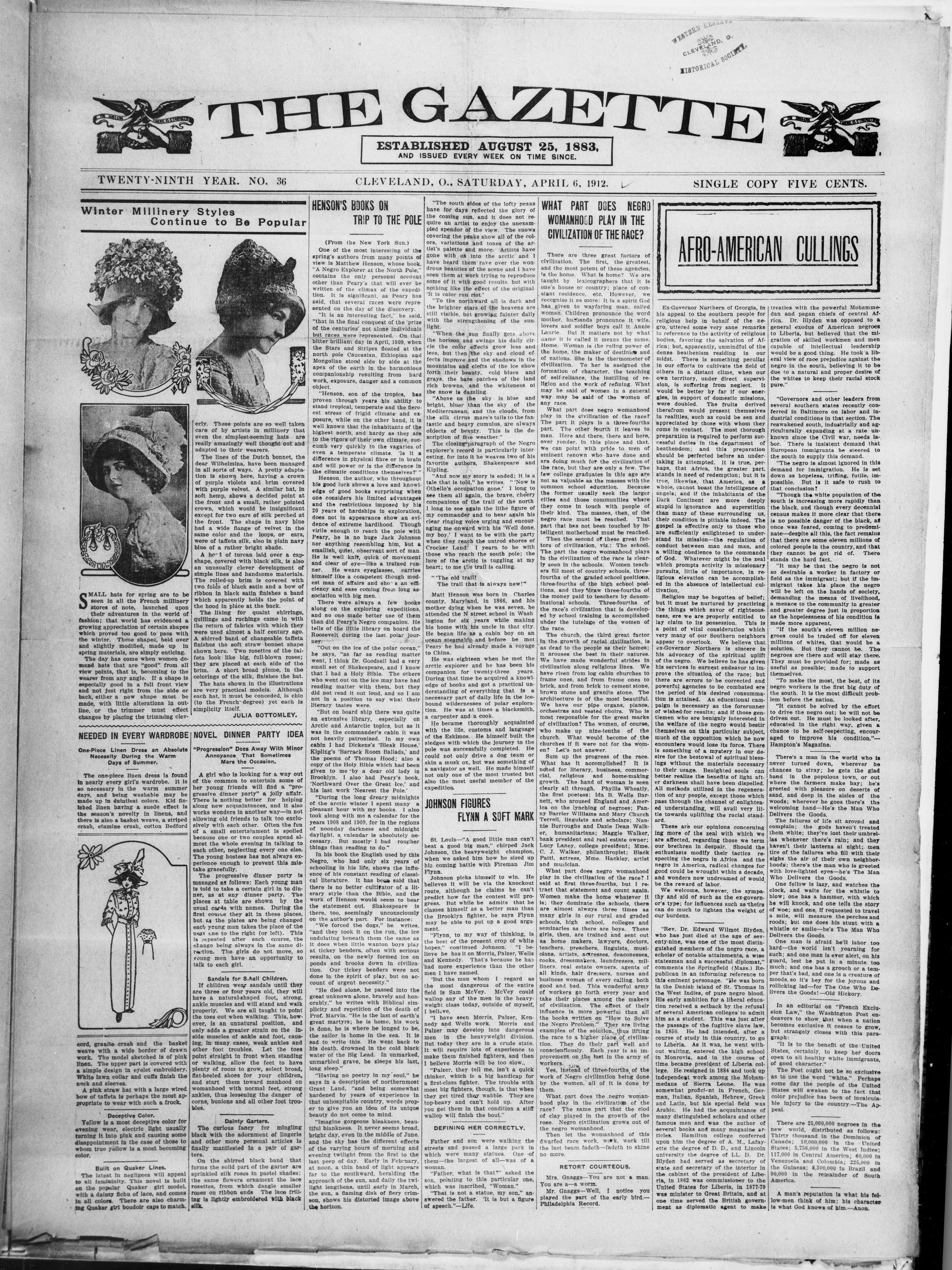
SMALL hats for spring are to be seen in all the French millinery stores of note, launched upon their adventures in the world of fashion; that world has evidenced a growing appreciation of certain shapes which proved too good to pass with the winter. These shapes, held over and slightly modified, made up in spring materials, are simply enticing.
The day has come when women demand hats that are "good" from all view points, that is, becoming to the wearer from any angle. If a shape is especially good in a full front view and not just right from the side or back, either a new shape must be made, with little alterations in outline, or the trimmer must effect changes by placing the trimming clev
One-Piece Linen Dress an Absolute Necessity During the Warm Days of Summer.
The one-piece linen dress is found in nearly every girl's wardrobe. It is so necessary in the warm summer days, and being washable may be made up in daintest colors. Kid finished linen having a suede effect is the season's novelty in linens, and there is also a basket weave, a striped crash, etamine crash, cotton Bedford
cord, granite crash and the basket weave with a wide border of drawn work. The model sketched is of pink linen. The upper part is covered with a simple design in eyelet embroidery. White lawn collar and cuffs finish the neck and sleeves.
A pink straw hat with a large wired bow of taffeta is perhaps the most appropriate to wear with such a frock.
Deceptive Color.
Yellow is a most deceptive color for evening wear, electric light usually turning it into pink and causing some disappointment in the case of those to whom true yellow is a most becoming color.
Built on Quaker Lines.
The latest in negligees will appeal to all femininity. This novel is built on the popular Quaker girl model, with a dainty fichu of lace, and comes in all colors. There are also charming Quaker girl boudoir caps to match.
THE GAZETTE
erly. These points are so well taken care of by artists in millinery that even the simplest-seeming hats are really amazingly well thought out and adapted to their wearers.
The lines of the Dutch bonnet, the dear Wilhelmina, have been managed in all sorts of ways. A pretty adaptation is shown here, having a crown of purple violets and brim covered with purple velvet. A similar hat, in soft hemp, shows a decided point at the front and a small, rather pointed crown, which would be insignificant except for two ears of silk perched at the front. The shape in navy blue had a wide flange of velvet in the same color and the loops, or ears, were of taffeta silk, also in plain navy blue of a rather bright shade.
A hoc 1 of turcan laid over a capshape, covered with black silk, is also an unusually clever development of simple lines and handsome materials.
The rolled-up brim is covered with two folds of black satin and a bow of ribbon in black satin finishes a band which apparently holds the point of the hood in place at the back.
The liking for qualt shirrings, quillings and ruchings came in with the return of fabrics with which they were used almost a half century ago. A shirred band of changeable tafetta finishes the soft straw bonnet shape shown here. Two rosettes of the tafetta look like big, full-blown roses; they are placed at each side of the brim. A short broad plume, in the colorings of the silk, finishes the hat. The hats shown in the illustrations are very practical models. Although each hat, it must be conceded, is chic (to the French degree) yet each is simplicity itself.
JULIA BOTTOMLEY.
"Progression" Does Away With Minor Annoyance That Sometimes Mars the Occasion.
A girl who is looking for a way out of the common to entertain some of her young friends will find a "progressive dinner party" a jolly affair. There is nothing better for helping along new acquaintances, and it also works wonders in another way—in not allowing old friends to talk too exclusively with each other. Often the fun of a small entertainment is spilled because one or two couples spend almost the whole evening in talking to each other, neglecting every one else. The young hostess has not always experience enough to prevent this mistake gracefully.
The progressive dinner party is managed as follows: Each young man is told to take a certain girl in to dinner, as at any dinner party. The places at table are shown by the usual cards with names. During the first course they sit in these places, but as the plates are being changed each young man takes the place of the next one to the right (or left). This is repeated after each course, the change being always in the same direction. The girls do not move, so young men have an opportunity to talk to each girl.
Sandals for S. All Children
Sandals for Sail Children.
If children wear sandals until they are three or four years old, they will have a natural-shaped foot, strong, ankle muscles and will stand and walk properly. We are all taught to point the toes out when walking. This, however, is an unnatural position, and only adds a greater strain on the inside muscles of ankle and foot, causing, in many cases, weak ankles and other foot troubles. Let the toes point straight in front when standing or walking, allow the feet to have plenty of room to grow, select broad, flat-heated shoes for your children, and start them toward manhood on womanhood with normal feet, strong ankles, thus lessening the danger of corns, bunions and all other foot troubles.
Dainty Garters.
The curious fancy for mingling black with the adornment of lingerie and other more personal articles is finally manifested in a pair of garters.
On the shirred black band that forms the solid part of the garter are sprinkled silk roses in pastel shades; the same flowers ornament the lace rosettes, from which dangle smaller roses on ribbon ends. The lace frilling is lightly embroidered with black silk.
ESTABLISHED AUGUST 25, 1883 AND ISSUED EVERY WEEK ON TIME SINCE.
CLEVELAND, O., SATURDAY, APRIL 6, 1912.
HENSON'S BOOKS ON
TRIP TO THE POLE
One of the most interesting of the spring's authors from many points of view is Matthew Henson, whose book, "A Negro Explorer at the North Pole," contains the only personal account other than Peary's that will ever be written of the climax of the expedition. It is significant, as Peary has said, that several races were represented on the day of the discovery.
"It is an interesting fact," he said, "that in the final conquest of the prize of the centuries' not alone individuals but races were represented. On that bitter brilliant day in April, 1909, when the Stars and Stripes floated at the north pole Caucasian, Ethiopian and Mongolian stood side by side at the apex of the earth in the harmonious companionship resulting from hard work, exposure, danger and a common object.
"Henson, son of the tropics, has proven through years his ability to stand tropical, temperate and the fiercest stress of frigid climate and exposure, while on the other hand, it is well known that the inhabitants of the highest north, and hardy as they are to the rigors of their own climate, succumb very quickly to the vagaries of even a temperate climate. 'Is it a difference in physical fibre or in brain and will power or is the difference in the climatic conditions themselves?'
Henson, the author, who throughout his good luck shows a love and knowledge of good books surprising when one considers his limited advantages and the restrictions imposed by his 20 years of hardships in exploration, does not in appearance show an evidence of extreme hardship. Though virile enough to reach the pole with Peary, he is no huge Jack Johnson nor anything resembling him, but a smallish, quiet, observant sort of man. He is well knit, cut of movement and clear of eye—like a trained runner. He wears eyeglasses, carries himself like a competent though modest man of affairs and she a efficiency and ease come from long association with big men.
There were always a few books along on the exploring expeditions, and no one made better use of them than did Peary's Negro companion. He tells of the little library on board the Roosevelt during the last polar journey.
"Out on the ice of the polar ocean," he says, "as far as reading matter went, I think Dr. Goodsell had a very small set of Shakespeare, and I know that I had a Holy Bible. The others who went out on the ice may have had reading matter with them, but they did not read it out loud, and so I am not in a position to say what their literary tastes were.
"But on board ship there was quite an extensive library, especially on Arctic and Antarctic topics, but as it was in the commander's cabin it was not heavily patronized. In my own cabin I had Dickens's 'Bleak House', Kipling's 'Barrack Room Ballads', and the poems of Thomas Hood; also a copy of the Holy Bible which had been given to me by a dear old lady in Brooklyn. I also had Peary's book, 'Northward Over the Great Ice', and his last work 'Nearest the Pole.' "During the long dreary midnights of the arctic winter I spent many a pleasant hour with my books. I also took along with me a calendar for the years 1908 and 1909, for in the regions of noonday darkness and midnight daylight, a calendar is absolutely necessary. But mostly I had rougher things than reading to do."
In his book the English used by this Negro, who had only six years of schooling in his life, shows the influence of his constant reading of classical literature. It has been said that there is no better cultifier of a literary style than the Bible, and the work of Henson would seem to bear the statement out. Shakespeare is there, too, seemingly unconsciously on the author's part. For instance:
"We forced the dogs," he writes, "and they took it on the run, the ice undulating beneath them the same as it does when little wanton boys play at ticket benders, on often with serious results, on the newly formed ice on ponds and brooks down in civilization. Our ticket benders were not done in the spirit of play, but on account of urgent necessity."
"He died alone, he passed into the great unknown alone, bravely and honorably," he writes with Biblical simplicity and repetition of the death of Prof. Marvin. "He is the last of earth's great martyrs; he is home, his work is done, he is where he longed to be, the sailor is home in the sea. It is sad to write this. He went back to his death, drowned in the cold black water of the Big Lead. In unmarked, unmarbled grave, he sleeps his last, long sleep."
"Having no poetry in my soul," he says in a description of northernmost Grant Land, "and being somewhat hardened by years of experience in that unhospitable country, words proper to give you an idea of its unique beauty do not come to mind.
"Iimagine gorgeous bleakness, beautiful blankness. It never seems broad, bright day, even in the middle of June, and the sky has the different effects of the varying hours of morning and evening twilight from the first to the last peep of day. Early in February, at noon, a thin band of light appears far to the southward, heralding the approach of the sun, and daily the twilight lengthens, until early in March, the sun, a fanning disk of fiery crimson, shows his distorted image above the horizon.
"The south sides of the lofty peaks have for days reflected the glory of the coming sun, and it does not require an artist to enjoy the unexamined spender of the view. The snows covering the peaks show all of the colors, variations and tones of the artist's palette and more. Artists have gone with us into the arctic and I have heard them rave over the wondrous beauties of the scene and I have seen them at work trying to reproduce some of it with good results, but with nothing like the effect of the original 'It is color run riot.'
"To the northward all is dark and the brighter stars of the heavens are still visible, but growing fainter daily with the strengthening of the sunlight.
"When the sun finally gets above the horizon and swings his daily circle the color effects grow less and less, but then the sky and cloud effects improve and the shadows in the mountains and clefts of the ice show forth their beauty, cold blues and grays, the bare patches of the land rich browns, and the whiteness of the snow is dazzling.
"Above us the sky is blue and bright, bluer than the sky of the Mediterranean, and the clouds, from the silk cirrus mare's tails to the fantastic and heavy cumulus, are always objects of beauty. This is the description of fine weather."
The closing paragraph of the Negro explorer's record is particularly interesting, for into it he weaves two of his favorite authors, Shakespeare and Kipling.
"And now my story is ended; it is a tale that is told," he writes. "Now is Othello's occupation gone." I long to see them all again, the brave, cheery companions of the trail of the north I long to see the lithe figure of my commander and to hear again his clear ringing voice urging and encouraging me onward with his 'Well done, my boy,' I want to be with the party when they reach the untrodden shores of Crocker Land. I yearn to be with those who reach the south pole; the lure of the arctic is tugging at my heart; to me the trail is calling.
"The old trail!"
The trail that is always new!"
Matt Henson was born in Charles county, Maryland, in 1866, and his mother dying when he was seven, he attended the N street school in Washington for six years while making his home with his uncle in that city. He began life as a cabin boy on an ocean steamship and before he met Peary he had already made a voyage to China.
He was eighteen when he met the arctic explorer and he has been his companion for twenty-three years. During that time he acquired a knowledge of books and got a practical understanding of everything that is a necessary part of daily life in the icebound wildernesses of polar exploration. He was at times a blacksmith, a carpenter and a cook.
He became thoroughly acquainted with the life, customs and language of the Eskimos. He himself built the stedges with which the journey to the pole was successfully completed. He could not only drive a dog team or skin a musk ox, but was something of a navigator as well. He made himself not only one of the most trusted but also the most useful member of the expedition.
JOHNSON FIGURES
FLYNN A SOFT MARK
St. Louis-"A good little man can't beat a good big man," chirped Jack Johnson, the heavyweight champion, when we asked him how he sized up his coming battle with Fireman Jim Flynn.
Johnson picks himself to win. He believes it will be via the knockout route, although he claims he can't predict how far the contest will progress. But while he admits that he classes himself as a better man than the Brooklyn fighter, he says Flynn may be able to put up a good argument.
"Flynn, to my way of thinking, is the best of the present crop of white hopes," continued Johnson. "I believe he has it on Morris, Palzer, Wells and Kennedy. That's because he has had more experience than the other men I have named.
"But the man whom I regard as the most dangerous of the entire field is Sam McVey. McVey could wallop any of the men in the heavyweight class today, outside of myself, I believe.
"I have seen Morris, Palzer, Kennedy and Wells work. Morris and Palzer may develop into dangerous men in the heavyweight division. But today they are in a crude state. It will require lots of experience to make them finished fighters, and then I believe Morris will be too slow."
"Palzer, they tell me, isn't a quick thinker, which is a big handicap for a first-class fighter. The trouble with most big fighters, though, is that when they get tired they wabble. They are top-heavy and can't hold up. After you get them in that condition a stiff wallop will finish the bout."
DEFINING HER CORRECTLY.
Father and son were walking the streets and passed a large park in which were many statues. One of them—the largest of all—was of a woman.
"Father, what is that?" asked the son, pointing to this particular one, which was inscribed, "Woman."
"That is not a statue, my son," answered the father. 'It is but a figure of speech."—Life.
WHAT PART DOES NEGRO WOMANHOOD PLAY IN THE CIVILIZATION OF THE RACE?
There are three great factors of civilization. The first, the greatest, and the most potent of these agencies, is the home. What is home? We are taught by lexicographers that it is one's house or country; place of constant residence, etc. However, we recognize it as more: it is a spirit God has given to wayfaring man, called woman. Children pronounce the word mother, husbands pronounce it wife, lovers and soldier boys call it Annie Laurie. But it matters not by what name it is called it means the same. Home. Woman is the ruling power of the home, the maker of destiny and of nations. She is the thermometer of civilization. To her is assigned the formation of character, the teaching of self-reliance, the instilling of religion and the work of refining. What may be said of women in a general way may be said of the women of any race.
What part does negro womanhood play in the civilization of the race? The part it plays is a three-fourth part. The other fourth it leaves to man. Here and there, there and here, over yonder, in this place and that, we can point with pride to men of eminent renown who have done and are doing much for the civilization of the race, but they are only a few. The few college graduates in this age are not as valuable as the masses with the common school education. Because the former usually seek the larger cities and those communities where they come in touch with people of their kind. The masses, then, of the negro race must be reached. That part that has not been touched by intelligent motherhood must be reached. Then the second of these great factors of civilization, viz.: The school. The part the negro womanhood plays in the civilization of the race is clearly seen in the schools. Women teachers fill most of country schools, three-fourths of the graded school positions, three-fourths of the high school positions, and they draw three-fourths of the money paid to teachers by denominational schools. Three-fourths of the race's civilization that is developed by school training is accomplished under the tutelage of the women of the race.
The church, the third great factor in the growth of racial civilization, is as dead to the people as their homes; it arouses the best in their natures. We have made wonderful strides in civilization along religious lines. We have risen from log cabin churches to frame ones, and from frame ones to brick, and from brick to cement stone, brown stone and granite stone. The architecture is of the most beautiful. We have our pipe organs, pianos, orchestras and vested choirs. Who is most responsible for the great marks of civilization? The women, of course, who make up nine-tenths of the church. What would become of the churches if it were not for the women? Let's not answer.
Sum up the progress of the race. What has it accomplished? It is noted for literary, business, commercial, religious and home-making growth. The hand of woman is seen clearly all through. Phyllis Wheatly, the first poetess; Ida B. Wells Barnett, who aroused England and America on the lynching of negroes; Fanny Barrier Williams and Mary Church Terrell, linguists and scholars; Nannie Burroughs and Dazle Dean Walker, humanitarians; Maggie Walker, bank president and real estate owner; Lucy Laney, college president; Mme. C. J. Walker, philanthropist; Black Patti, actress, Mme. Hackley, artist and musician.
What part does negro womanhood play in the civilization of the race? I said at first three-fourths, but I retract that statement and count again. Women make the home whatever it is; they dominate the schools, there are almost always three times as many girls in our rural and graded schools, high school, colleges and seminaries as there are boys. These girls, then, are trained and sent out as home makers, lawyers, doctors, teachers, preachers, linguists, musicians, artists, addresses, deaconesses, cooks, dressmakers, laudresses, millers, real estate owners, agents of all kinds, hair dressers, nurses and business women of every calling, both good and bad. This wonderful army of workers go forth every year and take their places among the makers of civilization. The effect of their influence is more powerful than all the books written on "How to Solve the Negro Problem." They are living examples of the solution, thus lifting the race to a higher plane of civilization. They do their part well and conscientiously. Each year is an improvement on the last in the army of workers.
Yes, instead of three-fourths of the work of Negro civilization being done by the women, all of it is done by them.
What part does the negro womanhood play in the civilization of the race? The same part that the clod of clay played in the growth of the rose. Negro civilization grows out of the negro womanhood.
Then let the womanhood of this
dwarfed race work. work. work till
the last beam fadeth—fadeth to shine
no more.
RETORT COURTEOUS:
Mrs. Gnaggs—You are not a man. You are a—a worm. Mr. Gnaggs—Well. I notice you played the part of the early bird. Philadelphia Record.
AFRO-AMERICAN CULLINGS
Ex-Governor Northern of Georgia, in his appeal to the southern people for religious help in behalf of the negro, uttered some very sane remarks in reference to the activity of religious bodies, favoring the salvation of Africa; but, apparently, unmindful of the dense heathenism residing in our midst. There is something peculiar in our efforts to cultivate the field of others in a distant clime, when our own territory, under direct supervision, is suffering from neglect. It would be better by far if our energies, in support of domestic missions, were doubled. The fruits derived therefrom would present themselves in realities, such as could be sen and appreciated by those with whom they come in contact. The most thorough preparation is required to perform successful duties in the department of heathendom; and this preparation should be perfected before an undertaking is attempted. It is true, perhaps, that Africa, the greater part, stands in need of redemption; but it is true, likewise, that America, as a whole, cannot boast the intelligence of angels; and if the inhabitants of the Dark Continent are more deeply stupid in ignorance and superstition than many of these surrounding us, their condition is pittable indeed. The gospel is effective only to those who are sufficiently enlightened to understand its mission—the regulation of conduct between man and man, and a willing obedience to the commands of God. Whatever might be the zeal which prompts activity in missionary pursuits, little of importance, in religious elevation can be accomplished in the absence of intellectual cultivation.
Religion may be begotten of belief; but it must be nurtured by practicing the things which savor of righteousness, ere we are properly entitled to lay claim to its possession. This is a point of vital consideration which very many of our Southern neighbors appear to overlook. We believe that ex-Governor Northern is sincere in his advocacy of the spiritual uplift of the negro. We believe he has given his services in earnest endeavor to improve the situation of the race; but there are errors to be corrected and powerful agencies to be combated ere the period of his desired consummation is attained. An educational campaign is necessary as the forerunner of wished-for results; and if those gentlemen who are benignly interested in the welfare of the negro would bestir themselves on this particular subject, much of the opposition which he now encounters would lose its force. There is something of a mystery in our desire for the bestowal of spiritual blessings without the materials necessary to their usage. Benighted souls can better realize the benefits of light after darkness shall have been dispelled. All methods utilized in the regeneration of any people, except those which pass through the channel of enlightened understanding, will avail very little towards uplifting the racial standard.
These are our opinions concerning ing more of the zeal with which we are affected, regarding those we term our brethren in despair. Should the enthusiasts modify their tactics respecting the negro in Africa and the negro in America, radical changes for good could be wrought into a decade, and wonders now undreamed of would be the reward of labor.
We welcome, however, the sympathy and old of such as the ex-governor's type; for influences such as theirs can do much to lighten the weight of our burdens.
"Rev. Dr. Edward Wilmot Blydon, who has just died at the age of seventy-nine, was one of the most distinguished members of the negro race, a scholar of notable attainments, a wise statesman and a successful diplomat," comments the Springfield (Mass.) Republican in an informing reference to this eminent personage. "He was born in the Danish island of St. Thomas in the West Indies, of pure negro blood. His early ambition for a liberal education received a setback by the refusal of several American colleges to admit him as a student. This was just after the passage of the fugitive slave law, in 1850. He had intended, after a course of study in this country, to go to Liberia. As it was, he went without waiting, entered the high school in Monrovia, and in the course of time became president of Liberia college. He resigned in 1884 and took up independent work among the Mohammedans of Sierra Leone. He was somewhat proficient in French, German, Italian, Spanish, Hebrew, Greek and Latin, but his special field was Arabic. He had the acquaintance of many distinguished scholars and other famous men and was the author of several books and many magazine articles. Hamilton college conferred upon him the degree of A. M. Lafayette the degree of D. D., and Lincoln university the degree of LL. D. Dr. Blydon had served as secretary of state and secretary of the interior in the cabinet of the president of Liberia, in 1862 was commissioner to the United States for Liberia, in 1877-79 was minister to Great Britain, and at one time served the British government as diplomatic agent to make
treaties with the powerful Mohammedan and pagan chiefs of central Africa. Dr. Blyden was opposed to a general exodus of American negroes to Liberia, but believed that the migration of skilled workmen and men capable of intellectual leadership would be a good thing. He took a liberal view of race prejudice against the negro in the south, believing it to be due to a natural and proper desire of the whites to keep their racial stock pure."
"Governors and other leaders from several southern states recently conferred in Baltimore on labor and industrial conditions in that section. The reawakened south, industrially and agriculturally expanding at a rate unknown since the Civil war, needs labor. There is insistent demand that European immigrants be steered to the south to supply this demand.
"The negro is almost ignored in this demand for immigration. He is set down as hopeless, trifling, futile, impossible. But is it safe to rush to that conclusion?
"Though the white population of the south is increasing more rapidly than the black, and though every decennial census makes it more clear that there is no possible danger of the black, as once was feared, coming to predominate—despite all this, the fact remains that there are some eleven millions of colored people in the country, and that they cannot be got rid of. There stands the hard fact.
"It may be that the negro is not so desirable a worker in factory or field as the immigrant; but if the immigrant takes his place the negro will be left on the hands of society, demanding the means of livelihood, a menace to the community in greater and greater degree just in proportion as the hopelessness of his condition is made more apparent.
"If the south's eleven million negroes could be traded off for eleven millions of whites, that would be a solution. But they cannot be. The negroes are there and will stay there. They must be provided for; made as useful as possible; made to support themselves.
"To make the most, the best, of its negro workers is the first big duty of the south. It is the most difficult problem before the nation.
"It cannot be solved by the effort to drive the negro out; he will not be driven out. He must be looked after, educated in the right way, given a chance to self-respecting, encouraged to improve his condition."—Hampton's Magazine.
There's a man in the world who is never turned down, wherever he chances to stray; he gets the glad hand in the populous town, or out where the farmers make hay; he greeted with pleasure on deserts of sand, and deep in the aisles of the woods; wherever he goes there's the welcoming hand—He's the Man Who Delivers the Goods.
The failures of life sit around and complain; the gods haven't treated them white; they've lost their umbrellas whenever there's rain; and they haven't their lanterns at night; men tire of the failures who fill with their sighs the air of their own neighborhoods; there's the man who is greeted with light-lipped eyes—he's The Man Who Delivers the Goods.
One fellow is lazy, and watches the clock, and waits for the whistle to blow; one has a hammer, with which he will knock, and one tells the story of woe; and one, if requested to travel a mile, will measure the perches and roods; but one does his stunt with a whistle or smile—he's The Man Who Delivers the Goods.
One man is afraid he'll labor too hard—the world isn't yearning for such; and one man is ever alert, on his guard, lest he put in a minute too much; and one has a grouch or a temper that bad, and one is a creature of moods, so it's hey for the Joyous and rolllicking lad—for The One Who Delivers the Goods!—Old Hickory.
In an editorial on "French Exclusion Law," the Washington Post endeavors to show, that when a nation becomes exclusive it ceases to grow, but strangely closes with this paragraph:
"It is to the benefit of the United States, certainly, to keep her doors open to all healthy white immigrants, of good character."
The Post ought not be so exclusive as to use the word "white." Perhaps some day the people of the United States will awaken to the fact that color prejudice has been of incalculable injury to the country—The Appeal.
There are 25,000,000 negroes in the new world, distributed as follows: Thirty thousand in the Dominion of Canada; 10,000,000 in the United States; 5,756,000 in the West Indies; 117,000 in Central America; 60,000 in Venezuela and Colombia; 225,000 in the Guineas; $300,000 in Brazil and 90,000 in the remainder of South America.
A man's reputation is what his fellow-men think of him; his character is what God knows of him—Anon.
One Year.....$1.50
Six Months.....1.00
Three Months.....5.0
Subscribers are requested to
mit by postoffice money or
order or registered letter.
Entered at the postoffice in Cleveland
Ohio, as second-class matter
Address all communications to
HARRY C. SMITH
Editor and proprietor,
THE GAZETTE,
Blackstone Building, Cleveland, O.
Member Ohio Legislature: 1894 to 1896; 1896 to 1898; 1900 to 1902
THE GAZETTE is the oldest, and has the largest bona fide circulation, double that of any newspaper in the Interest of Afro-Americans, published in the state of Ohio, and comparison with any will immediately establish its rank as one of the NEWSIEST AND BEST In the country.
It may be of interest to our many readers to know that the "L. M. Johnson" who wrote that excellent Columbus, Ohio, letter, published in The Gazette last week is a woman (white). It is one of the very best criticisms of Rev. Herbert S. Bigelow, president of the Ohio Constitutional Convention (whose unwarranted attack upon Senator Joseph Benson Foraker is inexcusable), we have yet seen in print. It certainly is an exceptionally well written communication, from every viewpoint,—one of the best The Gazette has published on any subject in a long, long time.
Pessimistic views on the present order of things were expressed yesterday by Rev. H. C. Bailey, pastor of the Antioch Baptist church, at a meeting of the Baptist ministers' conference. The meeting was held at the Euclid Avenue Baptist church. Graft obtains in the political parties, he said, and vice prevails in daily life. His topic was "Some Prominent Forces in present day living." "Tuesday's Plain Dealer.
And Elder Bailey is right, too. The conditions are bad enough, the Lord knows, to make any one who knows them, even more than "pessimistic." The world, which includes the local world, of course, is certainly growing "wiser and weaker." Anyone who questions this statement, has only to study conditions to be convinced of its truthfulness.
THE PROFESSIONAL SOUTHERNER.
The following editorial from the Chicago Daily Inter Ocean is too good to forfeit republication in The Gazette at this time;
A writer in the Saturday Evening Post devotes several entertaining columns to a study of a well-known business type—"the professional Southerner." For the benefit of those who may never have met this species in the flesh he explains that the professional Southerner does not seem to flourish down South, as one would naturally expect. On the contrary, whether born North or South, he is a product of the North—and particularly of New York city, which, incidentally, is exactly fitted for the development of the type, being "bounded on one side by a bluff of some size and on the other by a large sound." A few years ago, we are told, this remarkable type would seldom venture out without his low, black, rakish string tie and his low, black, rakish slouch hat and his strong Southern accent—an accent which he generally had acquired at considerable trouble. But the newspaper humorists poked so much fun at him that he discarded the trappings—all but the accent. However, he may still be identified by the following description:
As a general proposition, it may be said that the professional Southerner in New York is a person with the kind of a Southern accent that an actress born in Boston can call her. Ms. uses what she is playing an ingeneue Southern part; and that he opens the conversation with a stranger by telling who his grandfather was and closes it by trying to borrow $2. Very frequently he gets the two dollars, too, because the Southern pose is remunerative in New York. Unfortunately, some of the professional Southerners are not as well up in their parts as they might be. The writer mentions several cases of serious mishaps due to carelessness about accessories. Here is one of the most touching and one that should certainly warn all gentlemen in that line to have a care;
Recently there was a young person of the male sex piontering round in and about New York, who would confess without being unduly pressed, that his family was probably the oldest and the best and most aristocratic family in the whole Eastern Shore country—where the terrapins also come from. One happy day, further to impress a couple of friends—who were from Michigan or Massachusetts—he hauled out a photograph of an impressive large colonial mansion, with a pillared portico, and passed it round, stating casually that it was a picture of the family dwelling in New York of the audience turned it over and saw the name of the architect who had designed it, in 1909, for a rich woolen manufacturer!
The professional Southerners are not all men, by any means. We are told that ladies on the music hall stage are much given to billing themselves modestly as the "Southern Blossom" or the Southern Something-or-Other. They are also prone to confess for publication that they belong to "old Southern families." But, in spite of occasional mishaps, the professional Southerner survives and, in New York at least, seems to flourish. Sometimes he is young and long-haired. Sometimes he is elderly, has an iron-gray mustache and a breath like a hot mince pie. You can always count on finding him in some shape or other.
QUILLIN'S SILLY STATEMENTS.
Frank U. Quillin's article on "The Negro in Cleveland, Ohio," published recently in a Sunday edition of the Cleveland Plain Dealer, in the Chicago Fellowship Herald and possibly other daily and weekly papers in various parts of the country, is so full of errors and misstatements that the few antiquated facts it contains, taken from the N. Y. Independent of Feb. 24, 1910, are almost overshadowed. The miserable article was written for a purpose that is made perfectly clear in the following excerpts: "There is no social equality between the races in Cleveland."
That is not so. The opposite is, however, and has always been true. The Negroes live by themselves in Cedar avenue, Cedar avenue and Doan street, and they prefer live by themselves in their home life. As the Negro population increases and new land is needed to accommodate it, adjacent property is always ready for sale at a cheap price.
"Men of the two races may meet as friends on the streets or in business, but it is never carried to the home life. The white man will not think of such a thing as introducing a Colored person to his wife and have them meet on the same social plane." These Quillin statements are not only untruthful but positively silly and harmful. There is not a large city in the country where the social intermingling of the races is carried on to a greater extent, or where the two races live less to themselves. That "adjacent property" reference, is ridiculously untrue on its very face.
We do not know Frank U. Quillin, and have never even heard of him before, but the following additional quotation, equally as silly and preposterous as the others given above, will come pretty near indicating his trend of thought and his southern-prejudice leaning. Speaking of a mythical postponement of an alleged leading local literary club banquet because a very light complexioned Afro-American member might have been accompanied by his wife, Quillin wrote:
"The whole thing was then quietly dropped, the members of the club taking the following view of the matter expressed by one of them: "Although I am a Southerner, I am broadminded enough to admire Mr. A. for his work. I like to talk with him and to shake his hand, I feel I will be to meet his wife in social equality to very different thing. She would not agree to it, and I could not blame her."
Equally as foolish and untrue as the foregoing, is his statement that "a few years back some young Negroes tried to attend a public dance along with whites," and that Colored people of this city do not frequent "the white man's" public eating places or restaurants, &c.
Quillin must have been paid for the effort (in his malicious article) to boost the color-line in public places. Our people of this community can enter a vigorous and proper protest against the publication of such distribes, by local daily papers, simply by discontinuing their patronage of them, and they must do this, too.
Brown Bread Baker.
Mayor Gaynor was talking to an advertising agent about advertisement writing. "I like the literary style of the average advertisements," he said. "Even when advertisements exaggerate, they are written in good style. The best advertisements don't exaggerate; but there are some few advertisement writers who seem to think that in their line of work, a little exaggeration does no harm. They remind me, in their mistaken waws, of a miner. The miner was passing a bakery with a friend, and in front of the bakery stood a very untidy baker 'Gee,' said the miner's friend, pointing his pipe at the baker disgustedly-'gee, what a dirty looking chap to be a baker, eh?' But the miner explained with a smile: 'Oh, that's all right. He's just the fellow, you know, that makes the brown bread.'
Four Is Their Limit
A close observer has definitely established the fact that magpies and rooks cannot count further than four. A rook never returns to its nest until it is quite satisfied that there is no danger near. When four hunters or less departed in succession from a near by log cabin the rook would return to its nest after the last had gone out of sight. But whenever there were more the bird lost count and returned to its nest even while some were still in the hut. Similarly, apes do not count further than four, and the Boers of the Transvaal, when they want to hunt these animals, hide in numbers exceeding four. Four depart in succession in such a manner as to be noticed by the apes, who then come forth and are easily captured.
Politeness Little Thought Of
Politeness Little Thought Of. In all ages the gentleman has been crucified or violently killed in some other way. This shows that we recognize a strength other than our own, but we are little disposed to tolerate it. Manners, too, have been brought into disrepute by the circumstance that they are the first cloak to which hypocrisy files. But courtesy and manners are very different things in a certain sense. The heart of courtesy may coexist with the husk of extreme rudeness. Courtesy can never be taught, though deportment can. But on the day when King George finds himself ruling over a "polite" nation he will find himself ruling over a decadent nation—London Truth.
Cultivate Self-Reliance.
To be self-reliant is to look to one's self for help in all the affairs of life, not to be forever leaning upon those about you. There is great satisfaction in feeling that you have the ability to do for yourself—Clara K. Baylliss.
Where the Sea Is Shallowest
Where the Sea is Shallowest.
The shallowest place in the Atlantic Ocean between England and North America is about two hundred miles east of Newfoundland, where the water is only fifty-eight feet deep.
Evil of Modern Life
There is justification for the unrest of today, for multitudes of people spend their time in making a living and never having time to live.
THE GAZETTE, CLEVELAND, O. SATURDAY, APRIL 6, 1912
THE THREE DAYS
AT THE TOMB
The Easter Festival
By Lena M. McCauley
HE world itself keeps Easter Day," begins an old carol in recognition that Easter is a festival of spring. While the Christian faith accepts it as a movable feast depending on the time of the Paschal moon, it is always within the period when nature is awaking from winter to a renewal of life. Each day the sun rises in the sunrise sunset the frost from the ground. As if by magic the dull
HE world itself keeps Easter Day," begins an old carol in recognition that Easter is a festival of spring. While the Christian faith accepts it as a movable feast depending on the time of the Paschal moon, it is always within the period when nature is awaking from winter to a renewal of life. Each day the sun rises earlier, its warmth drawing the frost from the ground. As if by magic the dull fields are veiled in tender green and the flowers bud in the sheltered places.
In the first days of human history the cave man rubbed dry sticks together to steal fire from the sun. When the spring melted the ice of winter, he bowed more profoundly to the great luminary in the sky as it appeared in the east, and later when he built his altars he renewed the fires when the sun turned northward. The word Easter is from the Saxon "Eostre," the name of the goddess of spring. "Eoster" lived in the east with the rising sun. She was the most gentle of all the deities of the pagan world. As she tripped across the meadows the grass came out, the flowers blossomed, the ice was broken in the brooks, and the streams sang merrily. All the earth rejoiced, for the fairer seasons of the year were at hand.
Significant of Resurrection.
Each year Eostre was born again significant of the resurrection from the dead of the Christian faith. The young plants awoke to life from dry seeds, the chicks from the eggs, and everywhere in nature the springtide under the spell or Eostre became lovely after the winter's sleep. The Romans adopted the Saxon Eostre as their goddess Aurora. When the Christian fathers were naming the feasts of the church it was a wise thought that brought the old nature worship and the Easter resurrection into harmony.
The Emperor Constantine, at the beginning of the fourth century, resolved to fix the time of Easter that it should not conflict with the Jewish Passover. To prevent disputes, he made the rules which were accepted at the Council of Nice in 325 A. D. The twenty-first day of March was known as the Vernal Equinox, the next full moon was the moon of Nisan, or the Jewish Passover, and the Lord's Day following was Easter Day. But if the full moon happened on a Sunday, Easter Day was the Sunday after that. Old Easter customs, while differing widely according to religions and localities, had some things in common. The Easter flower has always been sacred to altars. Today we speak of the Easter lily, meaning the St. Joseph lily, and in other parts of the world the daffodil, or the narcissus, or the calla lily may be regarded as the Easter lily
The colored Easter eggs, as gay as the Easter flowers in the fields, are universal. In Russia and in Paris, and in fact today in all large cities of the world, imitation eggs are made of confectionery, and jewelers go so far as to make them of gold, silver and to set them with gees for the Easter trade.
Easter Symbols Universal
Easter Symbols Universal.
The Christian church introduced the most beautiful celebrations of all. Easter is the inspiring feast of the year and its celebration means a renewal of faith. Even in remote parts of the world, where priests and their little flocks assemble, the Easter lights burn on the altars and faithful congregations sing Easter carols with joy.
The most solemn celebration of all is that held in the Church of the Holy Sepulchar at Jerusalem. Pilgrims assemble from every corner of Christendom, and ascend the Via Dolorosa chanting prayers. Many attend the feet-washing ceremonies, and throngs haste to the church where devotion keeps them waiting from Good Friday until Saturday afternoon, when the Patriarch with unlighted torch enters the gloom of the sepulcher.
They watch with bated breath for his return. No light flickers in the darkness, then suddenly a blaze
flames up, the torch is on fire and with a shout of thanksgiving the multitude breaks into singing a glorious hymn of thanksgiving. Those nearest to the torch, candle after candle is lighted until every taper in the church is burning. The worshipers rise, the gloom is dispelled, and they go forth into the gray of the morning greeting one another, "Christ is arisen!" meeting the reply, "He is arisen indeed!"
Ceremonies at Rome.
The festal ceremonies at Rome are most splendid. The Pope officiates at mass on that day and St. Peter's is filled with cardinals, prelates, and dignitaries from all parts of the world. The day is ushered by by fire cannon from the Castle of St. Angelo. The magnificent basilica is richly decorated, altars are newly ornamented, and the altar is being burned, and the Pope is seated in his chair of state in vestments ablaze with gold.
Beautiful Easter Carols.
Easter carols are sung in all Christian lands. Some of the most beautiful are those from the Tyrol, where singers go from house to house. Spain gives way to joy in fetes, and gifts are made to the Virgin, who is adorned with her best robes and jewels at this time. Russians enjoy a gift tree, like our Christmas tree, while jeweled Easter eggs are exchanged in the imperial household.
There is a mystery about the origin of the Easter rabbit of Germany. Egg-hunting in the forest, where grown people have hidden the colored eggs, is as popular as egg-rolling is on the White House grounds in Washington. In some places doves are liberated at Easter, and it is quite general to fill Easter baskets with flowers, or cakes, and to make visits to renew good will among friends.
A great deal of beautiful music has been written for the Easter services, which have become elaborate occasions in the churches. Many carols that are sung have been handed down by tradition and repeated from father to son. They frequently tell the New Testament story of the first Christian Easter morning when Christ rises from the tomb, and gave all human beings faith in immortality.
CORRESPONDENTS WANTED.
The old reliable Gazette desires an active agent and correspondent in every city and town in Ohio and neighboring states having a number of Afro-American residents. Only a little time on Fridays or Saturdays is required.
We are especially desirous of hearing from persons in the following numbers: Zanesville, Newark Lancaster, Lancaster, Chillicot, Toledo, Troy, Canton, Springfield, Pigua Columbus, Cambridge, Steubenville Bellaire, St. Clairsville, Wilmington Portmouth, Washington, C. H., Oxford, Sabina, Gallipoli, Rendville, Urbana, Delaware, M. Vernon, East Lairpool, Wellsville, Akron, Dayton, Middleport, Bellefontaine, Lima, O., and other places where we have none.
Write to the editor of the Gazette. Blackstone building, Cleveland, O. and will be sent promptly. Our readers will oblige us greatly by sending at once the addresses of persons in the cities named above, or others to whom we can write relative to the matter.
THE ONLY ONE IN CLEVELAND
The Gazette is and has been, for many months, the only paper published in Cleveland and northern Ohio for the Colored people, all reports to the contrary notwithstanding. Do not be misled.
Timelessness of Rome
timelessness of Rome.
Few of us ever ask ourselves where in the identity of Rome consists. It does not consist in a physical eternity, for Rome was not without beginning and she shall surely not be without end. It is rather a philosophical eternity. It is eternity as Kant has taught it to us, the eternity of timelessness. It is the timelessness of Rome, rather than the actual extent of time which makes the eternal, and this timelessness shows itself in nothing more clearly than in Rome's eternal youth. She who today might well be an old lady with her three thousand winters, is only the incorporation of young Italy. this modern young woman, with her head full of socialistic theories and her garments ornamented with the gridiron pattern of tramways.-Jesse Benedict Carter, in the Atlantic
Unworthy Men of Wealth.
The men who have not realized the responsibility of wealth are imperiling the social system of the present time. —Exchange.
IT GIVES 160 ACRES
Of Fine Wooded Land, Which Is Very Fertile and Easily Cleared.
EDMONTON, Alberta, Canada.—This is a fine country where our people get equal rights in every business or pursuit. Those who have come are doing well; they stand the cold as well as anybody else. But it is necessary to plant early in May and not later than June 20. The amount of money necessary to cross the line is $25. We simply have to show this amount; there are no charges for inspection. Our people should bring with them everything that they have; all of their belongings; all of their tools such as plow, harrow, disk and Georgia stock. Bring chickens and hogs. The hogs are inspected by the government inspectors, which takes 30 days, after that they are shipped to owners. Little charges for feeding. They should bring all the seed and feed that they can get, as everything is high; if they bring these things with them they will find it very easy to get along. The government gives you 160 acres, easily cleared, to the man that will work industriously. The Canadian government gives you 160 acres, easily cleared, to the man that will work industriously. The Canadian government gives you 160 acres, easily cleared, to the man that will work industriously. They should bring some money with them and be careful about spending it too freely. The sun shines 16 hours and the weather is healthy.
DOINGS OF THE RACE.
President Gomez of Venezuela is a mixed blood.
France plans, with Haiti's help, to profit big commercially as a result of the opening of the Panama canal.
Madam Selika.
Madam Marie Selika (Mrs. Sampson Williams) was given a fine benefit by N. Y. and Brooklyn friends, recently.
Do not delay but subscribe now for "the old reliable" Gazette if you want the truth, without fear or favor, and all the encouraging race news every week.
M.
Hon. Geo. H. White.
Hon. Geo. H. White, ex-member of Congress from North Carolina, who has been living in Philadelphia for some years, has announced his candidacy to the House of Representatives "their house," Hon. Henry H. Bingham (white), recently deceased, in the first Pennsylvania district.
Rev. Richard Carroll, the well-known South Carolina clergyman, writing of his state's college colleges, has the following to say of Prof. R. S. Wilkinson, of South Carolina State College at Orangeburg, S. C. State College at Columbia (South Carolina) Daily Site: "In traveling over the state I find that Prof. Wilkinson gives perfect satisfaction, and even in Orangeburg, I could find no complaint. He is a member of the Episcopal church, a denomination that has a small constituency among the Negro people of South Carolina. He seems to be popular among all."
The Negroes idea of loyalty to the enterprises of his race runs entirely too much to the mouth and entirely too little to the pocketbook. What Colored men want who have taken their money and invested it in business is not so much sympathy and praise but patronage—Dallas (Tex.) Express.
LEGAL NOTICE
Notice is hereby given that the Trustees of the Second African Methodist Episcopal Church have filed in the Court of Common Pleas a petition wherein said Trustees are plaintiffs and the Second African Methodist Episcopal Church other known as St. James African Methodist Church, of Church, Ohio, a religious corporation under the laws of Ohio, is defendant, being known as No. 128546 on the docket of said court, praying for authority to exchange or sell the following described premises: Situated in the City of Cleveland, County of Cuyahoga and State of Ohio, and known as being part of an original lot of No. 128546 in said City, a bounded lot of No. 128546. Beginning at a point on the northern line of Hudson Avenue $325\frac{1}{2}$ feet easterly from the easterly line of 105th Street, thence northerly on a line parallel with the easterly line of 105th Street 81 feet to the Southerly line of C. B. Caldwell's allotment, thence easterly along the southerly line of said Hudson Avenue, thence northerly on a thence southerly on a parallel with said easterly line of said 105th Street 81 feet to the northerly line of said Hudson Avenue; thence west along northerly line of said Hudson Avenue 45 feet to the place of front, said lot being 45 feet front on said Hudson Avenue; and that it also purchased on the 27th day of April 1984 a certain parcel of real estate nevertheless described as follows, to-wit:
Beginning at a point on the northerly line of Hudson Avenue, 370-5-10 feet from the easterly line of 105th Street; thence northerly on a line parallel with the easterly line of 150th Street 81 feet to the southerly line of C. C. Baldwin's Allotment; thence northerly on the line, sale Baldwin's southerly line 40 feet, fence southerly on a line parallel with the said easterly line of 105th Street 81 feet to the northerly line of Hudson Avenue; Thence Westerly along said line 40 feet to the place of beginning, be the same more or less, but subject to legal highways.
Said petition will be for hearing at 10 o'clock a. m. on the 1st day of April, 1912 in Court Room No. 1 or No. 2, or as soon thereafter as the Court can hear the same.
B. F. Nancey,
Jon Thompson,
Stafford Williams,
Thomas H. Johnson,
William J. Wiggins,
Morgan L. Junior,
Francis I. Ballard, Trustees.
BUGKEYE LETTERS
WRITTEN BY "THE OLD RELIA BLE" GAZETTE'S CORRESPONDENTS.
What Our People Are Doing Each Week—Church, Personal, Social, Lodge, Literary and Musical — Marriages, Deaths, Ego
Hamilton—Mr. and Mrs. Thos. Works were very agreeably surprised by neighbors. Monday evening—Rev John Dickerson is ill and Rev. J. D. Singleton, Mrs. Wih Hampton and Mrs. Jos. Alexander are improving.—Miss Marjorie Hogans is home from Wilber force for the Easter vacation.—Rev Watson of Lockland, preached at A. A. Church.—Hand your local news for this letter to the agent when he delivers you paper.
---
Smithfield.-Rev. W. H. Veney is better.-Services at the A. M. E. Church were well attended and collection good, Sunday.-Mr. and Mrs. A. Guy of Steubenville and E. H. Giles of M. Pleasant, were here. Sunday.-Mrs. Dorsey of Homestead, is visiting Mrs. C. Hargraves.-Mrs. D. West and daughter of Hopedale, spent several days here with her mother, Mrs. J. Carter.-Mrs. R. West was in Steubenville, recently.-Miss L. L. Toller of Toller, were his parents, Mr. D. Freeman visited her Sunday.-For quantity and quality of news (and not paper) take "the old reliable" Gazette.
---
Sandusky.—Mrs. H. Clark of Hamilton, was called home by her father's illness.—Mr. Geo. Scott and G. D. Smith are ill—mr. Mr. J. Hanes visited in Cleveland on the 28th ul. A fine program at the Second Baptist church, where he was shackelford's.—Mrs. Amy Taylor has returned to Louisville, Ky.—Mrs. G. Miller and mother, Mrs. Jefferson, and Mrs. Bartlett entertained, last Tues day evening, Mrs. S. M. Scott and daughter, Mr. and Mrs. J. M. Davis, Mrs. and Mrs. J. M. Davis, Chas. Jones was tendered an enjoyable surprise, in honor of his nineteenth birthday, Saturday evening. A fine luncheon was served.
---
Lorain—Prof. Du Buis lectured to a very appreciative audience at the First Congregational church (white), last Wednesday evening.—The Second Baptist rally, Sunday, was a success.—Wrist E. Bond was called to an Artist W. E. Bond was called to an Artist Teter and her husband, Mr. Alvah Williams, have moved here.—The Court of Calanthe surprised the Sir Knights while in session, Monday evening, and all had a fine time. Rev. G. L. Hicks spoke on "Pythianism."—J. R. Fowler from the Smith, Smith, Betty Jackson, from Smith, Rev. Sprager, Mr. and Mrs. P. Hill and others of Elyria, spent Sunday here—Chester, youngest son of Mr. and Mrs. S. E. Dobson, has pneumonia—Give the agent your order for The Gazette.
Correspondents must mail all letters for publication at their main postoffice sufficiently early on Monday (or Sunday) of each week to have them reach The Gazette office on Tuesday morning, and always write, also, their names and that of their city or town on the outside of the appropriate address. Unless this latter is done, proper credit cannot be given you. Lists of names, wedding presents, etc., obituary notices, speeches, resolutions, poetry, inquiries for relatives and advertisements of all kinds, including items announcing entertainments to be held in advance at the rate of ten cents a line, six words to a line. Our rates for display advertisements will be sent on application. Send postal note and not stamps during warm weather.
---
Cadiz—John H. White of Steubenville, was here this week on legal business—Miss Gertrude Grandison of Martin's Ferry, visited Mrs. Francis Christian, recently—Mr. Griffith Lucas of Chillicothe, visited his sister, his Launcel Reeves, Fox is conditioned, via mail, Urchvilles, Mrs. Minnie Smith of Emerson, has returned home. Dr. W. J. Johnson is able to attend church again. Mrs. S. Williams of Chicago and Mrs. Hattie Davis of Terre Haute, Ind., have returned home. They were called here by their mother's illness and death—James Greene has gone home. Mrs. Greene, Harrisville, was Mrs. Alice Howard's guest. Can you suggest a good agent for The Gazette in Steubenville, Zanesville and Chillicothe? Write to the editor in Cleveland at once, please.
Youngstown.—C. P. Lancaster of Cleveland, state deputy of /Elks, lectured Buckeye lodge, recently, on the work and progress of the order. The lodge is growing rapidly and will take a large delegation to the Dayton meet of the grand lodge, in August—Mr. Archibald, of the lodge, on Tuesday. The Busy Bee club, organized at Mrs. W. O. Mills', recently, met Wednesday evening in Tabernacle Baptist church.—James, son of Mrs. Mary Ferras, was buried from her home, Monday afternoon. Services were held in the Syrian Catholic church, Wilson Av. There was a large cemetery, with a fine line of cemetery. Mrs. Bell Walker and John Perry visited Miss Nellie Robinson in New Castle, Sunday.—Mrs. M. F. Lonesome has remodeled her millinery establishment and has a fine line of millinery goods. Give the agent your order for The Gazette. It is our best race paper and advocate. Oberlin.—Mrs. Otis Smith, formerly Miss Jeannene Snyder of Cleveland, who has been very ill, is slowly improving. Her sister, Mrs. Louise Thomas, and father, James R. Snyder.
ATTENTION, READERSI
Don't throw away your copy of The Gazette when you have done with it, but give it to some appreciative person whom you feel would be likely to subscribe or take it regularly, if they had a copy to look over and read carefully. Oblige the
both of Cleveland, were here to see her, last week and Sunday, respectively. Mrs. Smith's baby son is in excellent health.—M. N. Work reports that our people are operating 110,337 farms in Alabama, containing one third of all the improved land in the State, and that we are helped by Afro-Americans on farms in the State in 1910 amounts to $10,000,000.—The Mill City Cotton Mills near Dallas, Tex., have started work. They represent an investment of something over $100,000.—Among the other manufacturing enterprises which our people more or less control, there are reported a silk factory in North Carolina and a hosiery mill in Mississippi, and a hosiery mill in North Carolina.
"TIED TO AN APRON-STRING"
AFTER ALL
While the Ohio Afro-American persisted in his long sleep of inactivity (in the Ohio Constitutional Convention, in session at Columbus) all other people having important interests centered there have been properly represented, even if they were not directly represented in it by Delegates. Only the Afro-American held aloof and he the one most vitally concerned, or the one who should have felt and still feel, most concerned. His right or rather privilege of voting in all future state elections is at stake—and yet he slept and continues to sleep regardless of this fact. While he slept the advocates of woman suffrage worked, with the result that they have secured the passage of their proposal by the Convention which provides for the elimination of the words "white" and "male" from the Ohio constitution, providing the proposal is voted on favorably at the polls by the citizens of this state when the new constitution is submitted for their ratification or rejection. As matters now stand, even the Afro-American and every other voter who deem to eliminate the word "white," MUST vote also for woman suffrage in order to do so. There is absolutely no assurance that even then will woman suffrage carry in Ohio, so strong is the feeling against it, largely because of the very large foreign element among its voters opposed to the same, in addition to the thousands of others. Personally, we favored and still continue to favor woman suffrage and had the honor of being a member of the Ohio Legislature that first gave the women of this state the privilege of voting (in school affairs). But is it wise for us to have our trouble coupled with that of any other portion of the state's population? In this particular instance, there is absolutely no question as to this, for the reason stated above and others. The question is, therefore, what should we do? That is perfect clear! Pass the Cunningham proposal, introduced in the O. C. C. on Jan. 17 and designed to eliminate the passage of the woman suffrage proposal, if handled properly. There is no good reason why our matter should be coupled with any other, particularly a new one, even if it also a matter of suffrage. Let every proposition stand on its own merits, if it has any, and both of these have. While it was a wise and shrewd move for the woman suffrage advocates to try to make sure of the forty odd thousand Afro-American "voters" in Ohio, and thousands of others, friends of the race, it certainly is not wise, shrewd or even good judgment for us to permit matters to stand as they now are. We must secure, and promptly too, the passage of the Cunningham or some similar proposal, if we would properly conserve our own suffrage interests in this state for at least the next sixty years. Will the Ohio Afro-American continue "to sleep on his rights," with such an important matter pending and such danger impending? WE SHALL SEE!
JEWS NUMBER 11.625.656
The Jews of the whole world now number 11,625,656. Of this world population, 1,903,926 reside in America. But one other country has a larger Jewish population and that is Russia, with 5,082,242. The population of Jerusalem is now 55 per cent. Jewish and of London 2.28 per cent.
FREE INFORMATION SERVICE,
BEST WISHES IN THE
UNITED STATES
Grown on the Shores of Lake Erie, Hard-wooded, Early-bearing, Long-lived. Complete line of Fruit and Ornamental Trees, Small Fruits, Shrubs, Evergreen, Vines, etc. Propagated from *Prince-winning* Orchards—fruit brings highest prices. Barew of soft-wooded, cheaply-propagated stock. Write at once for full particulars, Pennsylvania Nursery Co. Girard Pa.
ATTACHMENT NOTICE.
Before Wm. Brown, a Justice of the Peace of East Cleveland Township, Cuyahoga County, Ohio.
Gee. B. Hear, Pltf., vs. E. E. Williams, Dft. On the 12th day of March 1912, said Justice issued an order of attachment in the above case for the sum of $84.97 and $10 probable costs.
Said case is set for hearing on the 3d day of May 1912, at 4 p.m.
UBO B. HARE.
By Chas. S. Sutton, his attorney.
Sitting on the B-ach.
A bottle of ardent spirits floated across the Atlantic in a little over two years. And we can imagine there are men with sufficient patience and leisure to sit down on the pebbly strand and wait for the next one.—Cleveland Plain Dealer.
I have used your Pomade. Its the best thing I ever used for making curly hair lie smooth. I have not finished my first bottle, but can see wonderful results, writes Mrs. Louise E. Hayes of Pineville, S.C.
Try Ford's Hair Pomade for harsh stubborn and unruly hair and Ford's Royal White Skin Lotion for the complexion. Ask your druggist for them. Be sure and get the genuine (Ford's) manufactured by the Ozonized Os Marrow Company, Chicago, Ill.
PURELY PERSONAL
J. S. HALL'L'S, 3121 Central Ave.
L. SCHWARTZ'T'S, 2921 Central Ave. Open Sunday.
O. C. SCHROEDER'S, Cuyahoga Bldg. Open Sunday.
ELMER F. BOYD'S, 2604 Central Ave.
F. VALENTINE'S, 2130 Central Ave.
SAM COHEN'S, 2928 Central Ave. Open Sunday.
JOHNSON'S, 3350 Central Ave.
NOTICE TO SUBSCRIBERS:--Subscribers not receiving The Gazette regularly should notify us at once. We desire every copy delivered promptly. We advise our patrons to carefully examine The Gazette's advertisements before making purchases. Business men who advertise in this paper should have the patronage of Afro-Americans. The fact that they adductive is assurance that they want it.
FOR RENT —Houses. If you have places to rent or if you want to rent —notify The Gazette.
For Rent —Five rooms and bath. 2225 E. 97th St. Attic and cellar. Inquire at I. W. Porter's. 9703 Quebec Ave.
NOTARY PUBLIC —For such services call at The Gazette office. No 3 Blackstone Building. No. 1422 W. 30 street. near Superior avenue.
FOR RENT —Furnished rooms with gas and bath. Special accommodations for theatrical people. Room and board. Mrs. I. B. Ambrose, 2285 E. 46th St. Cuy. Phone. Central 2917 I.
Miss Esther Mason of E. 29th St., is convalescent. Wm. McRoss was called to Philadelphia, Monday, by his mother's death. Mrs. Snowden of Pine Ave. has re
turned to her former home, N. Y. City,
Knights Templar will hold Easter
services at St. Andrews' church, at
3 p. m.
Mr. Daniel Fairfax, sr., is suffering
from paralysis. He is one of our old
residents.
Miss Ariena Carpenter of E. 87th
St. will spend Easter with relatives
in Pittsburgh.
C. P. Lancaster and Rev. F. G. Snelson were in Youngstown and Akron,
respectively, recently.
The Mission restaurant and Mrs.
Anita Lee's, E. 37th. St., and Central
Av., have been closed.
The Cuyahoga Co. A.A. R. League
met in Clayton block, Tuesday evening.
Ar. H. Martin, Esq., pres., and
P. E. Minter, sec.
The De Trope club held a very pleasant
meeting at Mrs. Dorsey's, E. 43d
St., Thursday afternoon. Next meeting
at Mrs. G. Land's.
The bartender of the week that Vanbusen's bartender, he of the
ghost-dream, cut some man in the saloon. Saturday evening.
The editor of The Gazette will speak at St. James A. M. E. church, Sunday evening. There are to be special Easter exercises; literary and musical. The Spring term of the St. James club will be held in Harmon building, cor. Woodland and E. 20th. St. beginning Monday, Books and tuition free. The third assembly of the Union club of St. Andrew will be given, Easter Monday night, at ideal hall (formerly Woodliff hall). A short program and an orchestra. Mr. Louise Thomas of the East End University, visited her sister and the latter's other daughter, Mrs. Jeannette Otis Smith of Oberlin, last week and Sunday, respectively. Mrs. Smith has been very ill. When you want Chili con carne stop at the Manhattan restaurant, 3133 Central Av. A good chicken dinner served every Thursday and Sunday. The Manhattan has the best cooks in the city, J. W. Crawford, proprietor.
Thos. B. Akridge sent The Gazette a very pretty souvenir-post card from Chicago, the first of the week, and wrote that he was en route to St. Paul, Omaha and Kansas City. He reported fine weather (while we were wrestling with Kansas City) and Rev. S. Douglas McDuffie, formerly of Washington, D.C., recently of St. Louis, Mo., M. E. traveling evangelist and a graduate of Howard University's Theological department, has charge of Cory church in the absence of its pastor.
Mrs. George Morton Johnson died at the City hospital, last week, after several months' illness. Funeral, the next week, will be held at the derdtaker, Mrs. Chas, O. Martin deserves much credit for her unwriting efforts in this case.
Send your local items to The Gazette on Monday or Tuesday of each week. This paper is published for ALL of our people and "plays no favorites." Everybody is treated the same—fair and right. Take The Gazette and tell your friends to do so also.
The Gilt Edge Needle club met this Friday evening at Mrs. Baldwin's, 2342 E. 38th. St., and at its last meeting elected the following officers: Press, Mrs. Wickline; vice-pres, Mrs. Thompson; sec, Mrs. Shavers; treas., Mrs. R. Scott; assist, treas, Mrs. F. Boydstein.
The Gazette desires to ask its readers to remember, especially, its advertisers. Patronize them; they want your trade and will treat you far better in every way than those who do not ask for your patronage in these columns.
Many of our people have noticed that "The Song Shop" at the corner of Ontario St., and the Public square, conducted by Jerome H. Remick & Co. N. Y. City and Detroit, has a notice in their Ontario St., window to all self-respecting members of our race to stay out of that "shop." There are 20,000 Afro-Americans in this city and all are "musical." Stay out of that "Song Shop," until it shows more for us. Pass the word along to all you meet. (New York and Detroit race papers, please republish this notice.—Ed.)
Call your lady friends' and acquaintances' attention to our up-to-date fashion and pattern department, and to the ones to subscribe or take The Gazette regularly. Oblige the Editor.
ten cents a line (six words in a line.)
Special Easter services at the Mission of Branch 2, C. & M. Alliance, 1914 Woodland Av., by the S. S. at 130 p. m. Friends invited.
Mrs. Ethel Moore Roberson wishes to announce that she is ready for business (millinery) at her residence, 10527 Arthur Ave. Call and see her before buying your Spring hat. She has some beautiful creations, just completed. 3t
Rev. G. A. Sissle has been returned to Corv Church, for another year, by the Church's congregation of the M. E. Church, and the members are greatly pleased. He will preach, Sunday.
Senator W. T. Clark and Attorney Alex. H. Martin were associated in a case in the U. S. Court which came up Tuesday morning and was postponed to the October term of the court.
Rev. J. L. Burm of Mt. Haven Baptist church, will preach, Sunday morning and evening, respectively, on "The Way of God" and "What the Kingdom of God Is." Sunday-school and R. Y. P. U. at the usual hours.
A reception will be held at Mrs. Richard Blue's, 2250 E. 99th. St. April, 11, from 2 p. m. to 10 p. m., for the benefit of the Old Folks' Home. Tickets only 10 cents. Everybody should go who can. While Rev. F. G. Snelson of St. James' A. M. E. church, was preaching the Elks' sermon at Cory church in Shrimim, was preaching the Smith of Shrimim church, was telling his congregation why he refused to preach the sermon. All on account of the saloon the Elks have in their building on Central Av., near E. 55th. St. The "Mannasseh" club held another one of its bimonthly dances at Clayton hall. Tuesday evening. Several of the women (white) present, with their Colored husbands and beaux, were young and very pretty. All were beautifully gowned, most of them being in evening dress, with a white wig. All were husbands and sweet-hearts, were conspicuous. The club's dances are unique in many respects.
John H. Cisco of 1854 Central Av, returned the first of the week from a 6,630 mile trip of 15 days that included Albuquerque, N. M., Los Angeles, Calif., and southwest points in the extreme west and southwest. The party occupying his car included Mr. McBain, sup't of motive power of the L. S. & M. S. Ry, and his family. On March 29, Mr. Cisco's birthday, they presented him a gift of three pieces, genuine bone of which he is naturally very proud.
Our local Ministers' Alliance has interested itself in the case of Louis H. Peck who was sent to the penitentiary from Akron, eleven years ago, on a charge of criminal assault on a little girl, and who was sent to the learning, that no assault was ever committed on the child or was she in any way harmed by Peck. A committee from the Alliance, consisting of Rev, W. G. Webster, spokesman, Rev. J. L. Burr and Rev. H. C. Bailley, had a conference Thursday morning with S. D. Dodge, Fsq. of this city, a member of the Justice Department, to Peck's parole or pardon. The Gazette will have more to say of this case in its next issue.
Cry church's E. L. literary program every Monday evening is very interesting. The Sunbeam club served refreshments. The Willing Workers will serve, Monday evening. The Brotherhood is setting up a printing press and library, and expect to give a banquet for 100 men soon. They meet in the lecture room, Wednesday evenings, and on Sunday afternoons or at the close of the morning services, S. S. Easter service. The choir will render special music. Sunday evening. Mrs. Esther Thomas will give an Easter drill. Monday evening, for the E. L. benefit. Rev. S. D. M. Washington of Washington, two excellent alumnus, Sunday, and Mr. Richard Stisle, the church's delegate, gave an interesting report of the conference at Columbus.
It was a clever idea to combine the Singers club and the Cleveland Symphony orchestra in an entertainment of vocal and instrumental melody. Likewise, it was a good and wise thought to use the Hippodrome, where acoustics and seat accommodation lend ease and comfort to the occasion. Such an environment stimulates and incites every one to do his best. For this reason the two organizations never gave a program with better finesse in tone shading and general ensemble. The Rienzi overture started the program spelled by the noisy lyrics, was almost spilled by the noisy seating occupers. The Chadwick wrote works, with orchestra, went with a vocal polish and unity of effort that showed what could be done when the combination is effected. The concert was grand, both club and orchestra doing exceptionally fine work.
Old and New.
The old-fashioned woman who wore red flannels and turpentine as protection for her chest now has a daughter who wears talcum and a bangle on hers. -Galveston News.
When your Gazettes are not delivered on Friday mornings, call at your Central Postoffice General Delivery Window for them in the afternoon of the same day. —Editor.
Mrs. H. Hollingsworth and son have been quite ill.
The Cuxahoga Co. A.A. R. league, at its meeting this week, empowered its executive committee to draw resolutions for its April 16 meeting, which it is intended to forward to the O. C. C. at Columbus, asking that the word "white" be stricken from Ohio's constitution. This is the same old word that Henry T. Rubanka said in a talk at the Attacks club supper in St. John's church, some weeks ago, he had sent "glimmering from the state constitution" when in Columbus a few days previous. He certainly must have been dreaming. O. Henry, how could you? The league has enrolled over 100 members to date. Our people should have the good sense to "cry down" the school segregation nonsense some of our misguided ones are indulging in. The less we say about it here and to the O. C. C., the better it will be for us, as no one except the aforementioned misguided ones are agitating such a thing.
ACME AUTO
Auto Livery. All People
2340 East Ninth Street. 'Paines North 1231 a
The Best Work Guaranteed!
Rufus
4316 Central Ave.
New One on Venus
Mary, an older sister, had spent the morning shopping in town. Among her purchases was a square of dark red velvet which she intended to use as a background for a beautiful little statue of Venus de Milo, which had recently been presented to her. Just as she had temporarily fastened the velvet on the wall back of the Venus, her small brother Bobby, aged 5, walked into her room. "Well, Bobby," said Mary, "how do you like my Venus de Milo?" Would you leave the velvet there? Bobby looked thoughtful for a moment or so and then replied, "No, Mary, it wouldn't. I'd take it down and 'wap it a wound'—"Lippincottis
Moderized.
"That story of the building Tower of Babel should be need-ized." "But how would you acco-ral the confusion of tongues?" I suppose they had the tower nearly up and then somebody wrought Graft' and everybody accounted body else and the job we
In Ancient Days
The chimney corner was a favorite place for early settlers when they took their tobacco. Buckets were the chief reliance of the fire fighters. When an alarm was cried each citizen grabbed his buckets and ran to answer it. If he couldn't respond in an instant he threw his buckets out his window, and his neighbor picked them up and carried them along.
Oriental Bug Maker.
Rug makers in the Orient consider it an omen of ill fortune if a Christian looks upon them while they are engaged at their work. To conjecture the influence of the "evil eye," as they regard it, they weave a white spot in the pattern.
The Central Business Exchange
FINE 'HOMES-GOOD BARGAINS—
$22.50 UP. ONE OLD LOTS.
TERMS TO SUIT.
Mortgage-loans, Collections, Bond.
Insurance. Estimates given.
S. E. WOODS.
2828 Central Ave. Phone, North 1230.
Agent for The Gazette.
DRY. GOODS, LADIES' and GENTS'
FURNISHINGS.
J. LOMSKY
3816 and 3820 Central Ave.
Double Stamps on Tuesdays and
Fridays.
Give us a trial for Easter.
QUALITY
NOT
PREMIUMS
The Home of Pure Tea and Coffee.
Cuy. Central 7181 L. Bell Main 1474 J.
Representing DOBIN TEA CO., Japan
JAPANESE TEA STORE.
23 Taylor Arcade.
Dr. J. K. Nickensi
For Rheumatism, Stomach Diseases
Kidney, Liver, &; 50c a bottle.
FEMALE TONIC
CATARRH CURE!
COUGH & LUNG SYRUP!
GREAT ALKALI LINIMENT!
All 50t a bottle.
DR. NICKENS' MEDICINE CO.
2334 E. 87th St.,
CLEVELAND, . . . OHIO
'Central Transfer Co.'
CAREFUL MOVERS OF FURNI
TURE and PIANOS
Moving Vans
Piano Hoisting a Specialty
Light and Heavy Expressing.
Orders Promptly Attended to.
Prices Reasonable.
Office and Residence:
2003 Central Ave., Cleveland, Ohio.
Cuy. Cen. 8182R.
TELEPHONES:
Bell, Eddy 1100L.
Cuy., Central 1745R.
ACME AUTO CO.
Auto Livery. All People Treated Right.
2340 East Ninth Street. 'Pnones North 1231 and Central 4161.
The Best Work Guaranteed!
Rufus S. Justice
Plumbing and Sewer Building All Work given Prompt Attention.
2079 E. 30th St.
'Phone Bell North 1075X
THE MANHATTAN
The Best Place
on Central Ave.,
to get a Good Lunch
and Quick Service
J. W. CRAWFORD, PRO'R.,
3133 CENTRAL AVE.
Open Evenings for the Accommodation
of the Theater Trade.
Bell Main 3345. Cuy. Cent. 7597 L
Globe Printing Co.,
PRINTERS AND STATIONERS.
1397 East Ninth Street
MISS L.E. WARREN'S HAIR GROWER
Miss Warren is one of the FIRST
and BEST in her business in
Cleveland, and
Positively Can Grow
Hair
Dealer in First-Class Hair Goods.
3927 Central Ave.
CLEVELAND, OHIO.
Phone, East 2216X.
IF YOU SUBSCRIBE AT ONCE
YOU CAN STILL GET THE
52 WEEKLY ISSUES OF
THE YOUTH'S COMPANION
for the coming year for only $1.75.
Thousands of our subscribers whose
subscriptions run over the first of
January into the early weeks of the
new year have written us to ask if we
will not accept subscriptions at the
old rate of $1.75 for a little while
beyond the time announced for the
advance in price to $2.00.
A Last Chance
In fairness to these old friends and to new subscribers who were unable to result before the close of 1911 we have for taking subscriptions at $8.25 to
March 30
The new rate of $2.00 will be put into effect promptly on April 1. No subscription at $1.75 will be accepted after that date. Subscribe now — to-day — so as not to lose any of the good things in the Volume for 1912.
New Subscriptions Received at this Office.
nothing to Worry About.
"Are you not afraid that some of your children will fall into that open clistern?" asked the nervous boarder, looking over the picket fence in the back yard. "Oh, no, mum," came the complacent reply. "Anyhow, it ain't where we gets our drinkin' water"—Hampton's Magazine.
Czarina's View of Education
According to the czarina Russia's troubles are due to the education of women. All girls, says she, should be taught to sew, to care for their homes and to become helpful wives and good mothers, but they should never be taught history, philosophy or science, "because these studies, when offered to women, only result in such terrible times as Russia is now passing through."
Rufus S. Justice
4316 Central Ave. Phone E. 2342-R
Highest Grade of Tailoring for
Men and Young Men. Ladies'
Suits, Coats and Skirts Made to
Order.
CLEANING, DYEING & REPAIRING
Goods called for and delivered to all
parts of the city.
BROWN DRUG CO.
"THE MUTUAL STORE."
2742 Central Ave., cor. E. 28th St.
Cut this ad, out and present it at the Brown Drug Co. and receive free sample of
B. and M. HAIR DRESSING.
This dressing is especially recommended where to hair is stubborn or curly, as it not only makes the hair soft, glossy and straight, but also easy to dress.
B. and M. Hair Dressing is highly performed, has a very beneficial effect on the scalp, and is a splendid hair-tonic.
BROWN DRUG CO.
Exclusive Sales Agents.
Call at
G. G. REED'S
Dry Goods and
Gents' Furnishings,
A Complete Line.
Cuy, Central 6661 L
3222 Central Ave., Cleveland, O.
QUINADE.
(HAIR POMADE AND TONIC)
Quinade will beautify, improve and preserve the hair. Will remove Dandruff. Price, 25 cents. Free sample sent on application.
SEEBY'S "QUINACOMB," a comb made of specially tempered metal so as to retain the proper degree of heat. Used in conjunction with Quinade will remove the curl from and straighten the hair. Price, 50 cents.
SEEBY DRUG CO.
NEW YORK.
Quinade and Quinacombes are sold in Cleveland by Brown Drug Co., 2742 Central Ave., cor. 28th St.; The People's Drug (Sore, cor. Central Ave, and E. 33rd St.; Spenzer's Pharmacy, 2146 2150 Central Ave. S. E.; Zeidler's Drug Store, 2311 E. 9th St., cor. Scovill, and druggists in general.
EYE
SNUFOR
GLASSES
THE
GUIDELINES
HOLDS
GRACE
THE
FACE
P. A, HOERET,
Optical Specialist.
Eyes Examined Free. Satisfaction Guaranteed.
11 The Taylor Arcade.
Bell, Doan 1398-J, Residence East 791-L, Office
Dr, Walter S. Biggs,
Dentist.
(A member of the race.)
4715 Central Ave., Cleveland, O.
Hours: 8 to 12 a.m., 1 to 5 p.m.
Sundays and Evenings by
Appointment
FORD'S
HAIR POMADE
MAKES HARSH, KINNY OR CURLY HAIR
CLOSEY, SOFTER AND MORE PLABLE,
EASY TO COMB AND PUT UP IN ANY STYLE
FORD'S
NAIR POMADE
THE LENGTH WILL PERMIT GIRLCOREEL
OF PRESENTING MEN AND WOMEN TO
SOLID BEYOND OF INITIATIONS, THE GUILD, PUT UP
IN 25 AND 50 BOOTLES WITH CHARLES FORD'S NAME ON
EVERY PACKAGE.
TRY FORD'S ROYAL WHITE
SKIN LOTION FOR THE COMPLEXION,
UPON APPLICATION WILL NOT BE
THE MOST DELICATE SKIN, UNEXCELLED
FOR ECZEMA, SALT RHEUM, PIMPLES,
ROUGH SKIN AND FRECKLES. . .
SOLD BY DRUGGISTS. IF YOUR DRUGGIST CANNOT
FIND THE RIGHT SKIN, PLEASE FOLLOW
PRESSING FINE, SMALL BOOTLESS 25, LARGE BOOTLESS
50. THE OZONIZED OX MARROW CO.
234 LAKE ST. DEPT. 297
CHICAGO, IL 61611
In Desperate Mood.
That prima donna has a voice like an angel's. "You think so," responded the impresario, resentfully. "Well, I don't know how an angel talks when things don't go to suit her. But if I thought they all sounded like this prima donna, I'd think twice before wanting to go to heaven."
Far-Reaching Influence.
"It is not possible to know how far the influence of any amiable, honest hearted, duty-doing man flows out into the world."—Great Expectations.
A Toot
King Olaf—"What ho, varlet! Bring forth my drinking horn." The Varlet—"Here with the drinking horn, kid. The old man's going to have another toot."
Confection co and
2921 Ce
THE MAGIC IS TWO TIMES LARGER
THAN IT IS TO USE A TUXEDO
LADIES LOOK
The Magic will not burn or injure bar which lends the bar is also called the Aluminum Comb is easied the comb goes back into place The Magic Heater is also used handbag.
Fill with alcohol and lighter
Magic Shampoo Drier $1.00 for literature today.
Magic Shampoo Drier
Confectionaries, Cigars, Tobacco and School Supplies. 2921 Central Ave.
The Magic will not burn or injure the hair, because the comb is never heated. The steel heating bar which irons the hair, is alone, put into the flame of the alcohol or gas gaser. The Aluminum Comb is easily detached from the heating bar, then, after the bar is heated the comb is placed in place and held by a turn of the handle. The Magic Heater is also suitable for curling irons, has a cover and can be carried in a handbag.
Fill with alcohol and lighten.
Magic Shampoo Drier $1.00. Magic Alcohol Heater $0.50. Liberal terms to agents. Write for literature today.
Magic Shampoo Drier Co.
Minneapolis, Minnesota.
MRS. A. M. POPE.
4 years ago my hair was only a finger-length, and my temples were bald half way up my head.
MRS. L. L. ROBERTS.
4 years ago my hair just covered my shoulders.
first began our wonderful work of growing lengths, and all conditions of hair, even to places of the head, many persons scorned the possible; but we have grown the hair for his access. The proof of the value of our work is and largely by persons whose own hair we further fact that they have very frequent to sell their goods (saying that 'theirs is the referred to "PORO." We advise you to use (the oldest and best of its kind.) See that the box, not genuine without it. Prepared only
ware of Imitati
When we first bega
qualities, all lengths, a
hair on bald places of
a thing was possible; b
achieving success. The
ing imitated and largel
grown and the further
when trying to sell the
as good') or referred to
Hair Grower, (the older
is on every box, not
POPE.
Bewar
Cal
MRS. A. M. POP
When we first began our wonderful work of growing all kinds, all qualities, all lengths, and all conditions of hair, even to the growing of hair on bald places of the head, many persons scorned the idea that such a thing was possible; but we have grown the hair for hundreds, rapidly achieving success. The proof of the value of our work is that we are being imitated and largely by persons whose own hair we have actually grown and the further fact that they have very frequently mentioned us when trying to sell their goods (saying that "theirs is the same" or "just as good") or referred to "PORO." We advise you to use only "PORO" Hair Grower, (the oldest and best of its kind) See that the name "PORO" is on every box, not genuine without it. Prepared only by MRS. A. M. POPE.
Beware of Imitations
Call. or Address Mail to
MBS. A. M. POPE-TURNBO 3100 PINE STREET ST. LOUIS, MO
BELL PHONE BOMONT 3109
Pure Beer
Beer Bottled at the Br
Order a Case of
Gold Bone
Bottled Beer
CLEVELAND & SANDU
BREWING COMPANY
served at the Home. Both P
or's New Shampoo B
Hair Straightener!
The Best in the World
operably heated, and the use of LaCreole Hair Pomade, will straight and silky at every stroke and cause a rapid growth.
It put it off but send $1.08 today and get the combo by resur
Pure Beer Bottled at the Brewery
Order a Case of
Gold Bond
Bottled Beer
THE CLEVELAND & SANDUSKY
BREWING COMPANY
Delivered at the Home. Both Phones.
This Comb, properly heated, and the use of LaCerole Hair Fomide, will bring the heat of crimping, stripping, and the gaseous stroke and cause a rapid growth of the hair. It is also used for out of season hair.
SPECIAL ALCOHOL HEATER is the handiest and most o
omb, and can be closed up so that you can put it in your ha
results use LaCrete Hair Poudre. It not only meets ever
better, but promotes a luxurious at growth of the hair. Price
of MW FREE GATAMI HI. In creating the Largest and M
this country for colored people, such as Bengs, Wigs, Puff
as, Brushes, Brushee, etc.
T. W. TAYLOR, Howe
When please mention this paper
TAYLOR'S SPECIAL ALCOHOL HEATER is the handset and most convenient method of heating the Comb, and can be closed up so that you can put it in your handbag. Price 25c. For best results use La Crette Hair Pomade. It only meets every requirements of the Comb Straightener, but promotes a hair at growth of the hair. Price 25c. Illustrating the Largest and Most Complete Line of Hair Good in this country for colored hair, such as Benga, Wigs, Puffs, Switches, Pumpadours, Hair Plies, Combs, Brushes, etc.
M.
4 years ago my hair just
covered my shoulders.
TRADE MARK
Registered
In our wonderful work of growing all kinds, all
and all conditions of hair, even to the growing of
the head, many persons scorned the idea that such
we have grown the hair for hundreds, rapidly
proof of the value of our work is that we are be-
by persons whose own hair we have actually
act that they have very frequently mentioned us
goods (saying that "theirs is the same" or "just
"PORO". We advise you to use only "PORO"
and best of its kind.) See that the name "PORO"
genuine with out it. Prepared only by MRS. A. M.
e of Imitations
led at the Brewery
a Case of
Bond
ed Beer
D & SANDUSKY
COMPANY
ome. Both Phones.
Shampoo Dryer
Lightener!
in the World!
Of Laurele Hair Pomade, will bring the most
stroke and cause a rapid growth of the hair.
By and get the comb by return mail.
Large, Heavy. Strong and Durable. Made of copper and brass associated together and cast into one solid piece; highly polished and fully nickle plated; steel bolt which goes through the large wood handle and screws into metal end of tomb to prevent the handle from getting loose or coming off. Remember it's all in one piece Nothing to let it go order will last a lifetime.
Price of Hair Straightener and Alcohol Hater complete $1.50.
ER is the best and most convenient method that you can put it in your hand bag. Price 80c made. It not only meets every requirements of the growth of the hair. Price 25c. Illustrating the Largest and Most Complete Line TAYLOR, Howell, Mich. mention this paper
T. W. TAYLOR, Howell, Mich.
When writing please mention this paper
We Grew Our Hair
Now Let Us Grow
Yours With
'PORO'
REPORT OF SUPERINTENDENT OF
PUBLIC INSTRUCTION OF MISSOURI SHOWS 2,268 LESS COLORED CHILDREN ATTENDED SCHOOL IN 1911 THAN IN 1910.
Statistics compiled by, William P. Evans, state superintendent of public schools of Missouri, for his forthcoming annual report, shows the number of negro children of school age decreased 2,268 between July 1, 1910 and July 1, 1911.
An examination of the annual reports upon the public schools of Missouri for a number of years back reveal there has been a steady decrease in the number of negro children enumerated. The report for 1910 shows 42,899, while Mr. Evan's report, now under compilation, gives but 40,631.
The state superintendent does not know what to make of this condition. He said today it either indicates an exodus of negro residents from Missouri or the race is decreasing.
The large cities show no increase in negro children of school age, either, and the report for 1910 indicated none. The decrease for the school year ending July 1, 1911, is approximately five per cent. of the total number.
The total enumeration of white children for 1911 was 934,873 of whom 475,163 were boys and 459,710 girls. The total enumeration, including negro children, was 975,504, against 1,003,434 in 1910. This decrease was largely due to the heavy slump at St. Joseph, where the enumeration dropped off approximately 23,000.
St. Joseph received school money upon the basis of over 42,000 school children in 1910. The new enumeration gives fewer than 20,000. Mr. Evans held up money for St. Joseph to compel the authorities there to refund approximately $40,000 which the city received last year in excess of the amount to which it was entitled under the new school census. A suit to determine his right is now pending in the Supreme court. Missouri has 10,105 school districts of which 732 had an enumeration of less than 20; 1,584, an enumeration of between 20 and 30; 3,917, from 30 to 40; 2,542, from 50 to 80; and 1,320, an enumeration in excess of 80.
These figures indicate the need of consolidation, Mr. Evans says. The small districts are able to maintain school less than six months and to pay teachers low wages. A law authorizing the consolidation of school districts was enacted last winter. Few districts have taken advantage of this law, however. Another measure empowering such consolidated districts to provide for free transportation of children was also enacted. Consolidation of districts and the transportation of children have been agitated by the State Teachers' association and superintendents for many years, but with little results. There was expended for teachers' wages for the school year ending July 1, 1911, $7,952,661.56. The total amount of money paid into that fund was $9,152,356.82.
The salaries paid teachers is ridiculously low, when the increase in cost of living is considered. The average salary of male teachers in 1911 was $60.51 a month, while that for women was but $55.53 a month.
The average earnings of male teachers annually was approximately $467 and that of women about $415. The poorest paid laborer would earn more than this sum if regularly employed.
The total number of men employed at teaching in 1911 was 4,767, of whom 247 were negroes. There were 13,779 women employed as teachers, of whom 518 were colored.
The average levy for school purposes was 56 cents on $100 valuation, as against 53 for 1910. There were 41 districts in Missouri which made no tax levy, 109 levy less than 20 cents, 785 levy between 20 and 40 cents, 3,181 levy 40 cents, while 5,989 levy over 40 cents on the $100 valuation.
The average daily attendance last school year was 488,619. This is about half of the total enumeration. The average length of school term was 155 days. Sixty schools maintained less than four months; 746 between four and six months; 5,343 eight months or more. The average daily attendance was under 10 in 726, from 10 to 15 in 1,587 districts, 15 to 20 in 3,791, 25 to 40 in 2,464 and 40 or more in 1,395 districts.
Nearly one-third of the teachers Missouri taught on third-grade county certificates in 1911. There were 5,257 with third grade county certificates, 4,078 with second grade, 3,850 with first grade, 817 with Normal certificates, 836 with Normal diplomas, 412 with limited state certificates and 505 with life state certificates.
Some important changes were made in the certificates of teachers by the last legislature. Under a law the state superintendent examines the papers written before county superintendents by applicants for first-grade county certificates. These, when granted, are good in any county in Missouri, when properly indorsed. There was expended in Missouri for the school year ending July 1, 1911, $2,341,803.21 for new school buildings. How much of this sum was expended in the country is not known, but was probably less than 10 per cent. Estimated value of school property is $39,643,400. The public school districts have an aggregate bond indebtedness of $10,256,829. The low valuation of property for taxation, Mr. Evans says, is largely
VOICED HIS PLEA.
"Not guilty!" exclaimed the prisoner. "An 'Oi can prove it.' "That remains to be seen," observed the judge. "Whol' continued the prisoner, in aggrieved tones, "when the man was robbed, yer worship, what could Oi be doin' in the house when Oi wasn't there at all, at all, but was three doors down beneath the lampost mounting the baby? Shure, onyone in the state could have heard me sing!
responsible for the unsatisfactory condition of rural schools. Under the system of assessing property in Missouri the small districts while voting the maximum of taxes are rendered unable to procure enough money to conduct a creditable school. The legislature enacted a law providing for state aid for weak districts, but this rendered but little service. The solution of the difficulty, he believes, to be consolidation. The figures compiled upon the number of schools with an enumeration of fewer than 20 is an eloquent argument for larger districts. Mr. Evans and the State Teachers' association and the county superintendents of county schools are advocating the adoption of an amendment for the state constitution, levying a tax of one mill upon all property, this to be divided equally between the public schools, normals, and state university.
SCIENTIFIC FARMING BY NEGROES
REPORTS OF RESULTS OF EXPERIMENT STATION IN SUMTER COUNTY, SOUTH CAROLINA, CONDUCTED BY R. W. WESTBERRY, COUNTY DEMONSTRATOR IN CHARGE OF WORK AMONG NEGRO FARMERS.
Many different varieties of cotton and corn were planted on a farm at Horatio, S. C., to determine which would make the best yield. The several plots were planted in one field so as to give each about the same grade of land.
Among the different varieties of cotton mentioned, the Bates is the most favored, the yield of lint was 41 per cent. The Moneymaker made the largest amount of seed cotton, but the lint was only 34 per cent. The Russell big boll makes the finest lint of any of the short staple cotton. The Columbia long staple was planted near the experiment station, June 1, after oats, a little more than two acres was planted, and the amount of seed cotton gathered from the same was 1,524 pounds, lint cotton 510 pounds. The amount paid for the lint was $73.50. The seed are being sold for $1.50 per bushel, which will amount to about $45.00, making a total of $118.50 for one bale of long staple cotton nand seed. It would be a good idea if the farmers plant a portion of their farms with the good varieties of long staple cotton. There are factories in South Carolina that use no other cotton but the long staple, and whenever South Carolina farmers cannot supply the demands, it is ordered from other places.
Cotton coming in from foreign markets is very likely to bring pests into the state that would be very injurious to our cotton crops, such as boll weevil and diseases, that have been kept out of the state thus far.
The names of the different varieties of corn were: Dr. Simms, Marlboro Prolific, Strawberry, Hurson, Aldrich Perfection, Sanders Improved, Jerry Moore and Charlie Sanders. The number of bushels made per acre by each were as follows:
Dr. Simms, 45 bushels.
Marlborough Prolific, 43½ bushels.
Strawberry, 49 bushels.
Hudson, 49 bushels.
Aldrich Perfection, 40½ bushels.
Sanders Improved, 49½ bushels.
Charlie Sanders, 38½ bushels.
Jerry Moore, 70 bushels.
The Hudson variety is not a good seed for this section of the state, the weevils were in abundance on this plot. It is an early field variety, having matured nearly two weeks earlier than the other varieties. The Jerry Moore variety proved to be much heavier than the other, while Dr. Simm's was more prolific.
Charley Sanders variety has a great deal of nutrition, it will not decay or rot, as easy as the other varieties, and the corn weevils do not affect it as much. The experiment station will be planted in the same plot this year with reference to the use of fertilizer.
Yours truly,
W. R. WESTBERRY,
Sumter County Agricultural Agent,
Sumter, S. C.
HIS MANNERS.
"You see that man across the way?"
"Yes: what of him?"
"Certainly. He was dressing their hair."—Baltimore American.
away; for it's a moighty powerful voice Oh have, an' it's many a tome Ol've—"
"Stop—stop!" cried the judge, angrily. "What on earth has your voice to do with it?"
"He only means, your worship," explained Pat's counsel, smiling blandly, "that he can prove a lullaby."—National Food Magazine.
Words are not sufficient to explain some things, therefore pugilism was invented.
THE GAZETTE, CLEVELAND, O. SATURDAY, APRIL 6, 1912.
CLAREMONT TEMPERANCE
INDUSTRIAL INSTITUTE
WIELDING A GREAT MORAL INFLUENCE—PRESIDENT SMALL-WOOD AND HIS MOST VIVID WORK.
By GEO. L. M'GATLAUGH.
Upon the ancient bank of the classic James seventy-five feet above its level, stands the great work of a single man, for the negro race, with no church or charitable society at his back, this one black man has done more work for his race and demonstrated a greater amount of negro individuality than any one colored man, single handed, in all the country.
THE TEMPERANCE, INDUSTRIAL AND COLLEGIATE INSTITUTE.
This institution was founded October 12, 1892. "With less than ten pupils, and much less than fifty dollars in American money," so I am told by President Smallwood. The institution is the outgrowth of an individual effort, made by John Smallwood himself.
The institution is not a church nor a state school. It has no organization at its back. It gets not a cent from the state. It is supported by voluntary contributions and by the sublime energy of John J. Smallwood, who is acknowledged to have the greatest amount of will power, and personal determination. The institution owns 398 acres of the finest farm lands in the vicinity of Claremont, about one hundred of which lies along fronting "The James." Just how Dr. Smallwood ever succeeded in getting these river front lands, under the circumstances, is a mystery to his best friends. Upon the James river lands are situated the institution—proper, Rebuilt Old Bagley Hall, first built in 1622, and was until 1855. Rebuilt Old Bagley Hall is a most magnificent wooden seven hundred dollars, as the James gives a most pleasant and attractive view of the James. The John Hay Wharf, at the foot of the hill, is rebuilt, "John Hay Wharf," "Old Claremont John Hay Wharf," now known as the "John Hay Wharf," 798 feet long, 12% inch wide, with the best cost North Carolina and Georgia租金 costing three thousand seven hundred ninety-eight dollars, the United States mall steamer Pocahontas, or the Mob-Jack, stop at this wharf to land passengers and freight. This is the first time in the history of the ancient-classic stream, that negroes are privileged to flag a steamer to import and export, to receive and give out freight. This wharf is named in honor of Dr. Smallwood's great friend and benefactor the late Honorable John Hay, the American scholar, statesman, business man, gentleman and diplomat. The rebuilding of the "Old Claremont Wharf" (now known as the John Hay Wharf) is an example of Dr. Smallwood's business efforts and his remarkable dating business manhood.
LINCOLN MEMORIAL HALL
LINCOLN MEMORIAL HALL
This beautiful brick and stone building sits upon the great beautiful hill surrounded with beautiful poplar, oak cherry and dogwood trees. This building is $133\frac{1}{2} \times 149\frac{1}{2}$ feet, four-story, which is costing thirty-seven thousand eight hundred ninety-seven dollars, for the erection without furnishing, and it is the first building ever erected upon Virginia soil by any individual negro. Dr. Smallwood's friends did not know that he contemplated building this most commandeered building until he had the contract. Just a few rods from the stateley Lincoln hall is the power house from which power house the heat and water supply for Lincoln hall and Bagley halls are supplied. Lincoln hall will be fitted up with all modern improvements, bath, hot and cold water, steam heat, electric light, cooking ovens and the improved class and bedrooms. The grounds around this building are now being beautiful. Lincoln hall is not only a blessing and an honor to the negroes, and especially to the brave Prof. John J. Smallwood, who is the very life and stability of the institution, but it is a great credit of the white people of Claremont. Claremont and Surry counties are both known, read of and thought of, just at this time in places and by good people who and where it never would have been thought of nor heard of, had it not been that this polite, highly educated and most practical negro came to this town nineteen years ago and with prayer, faith and determination began this great work. He has accomplished great things, most assured so. In Lincoln hall will be placed the bronze bust of the late John Hay, Dr. Smallwood's greatest friend. The President Abraham Lincoln, honest merchant, farmer, the lawyer, the politician, statesman, orator emancipator and America's greatest reformer, Fred Douglass, Amanda Smith, Frances E. Willard, and it is said that Dr. Smallwood's great good southern friend, the late "Zeb," ("our Zeb") B. Vance, ex-governor of North Carolina, and late United States senator, will have a bust in this hall. The brick work is completed, the windows are all placed, the fourth and third floors and second floors, are laid. The roof is on, the tin and iron men are at work, the grounds are laid with the sewerage pipes, the artesian well, $210\frac{1}{2}$ feet, flowing 50 or 65 gallons per minute of clear, pure water. The reservoir is built, the water flowing into it, and the pipes from the well to the top of the hill are already laid.
FRUIT PUNCH.
Make a sip by boiling a pound of sugar with a cupful of water for ten minutes. Have ready in the punch bowl the juice of oranges and four lemons, one orange sliced into a can of shredded pineapples and a cupful of fresh brewed tea. Pour the sip over the mixture and let it stand until cool. Then add a cupful of marachino cherries, two sliced bananas, a cupful of California grapes cut in halves and seeded, a quart of mineral
The electric men (Mr. W. H. Jenkens of Richmond, the contractor) are at work placing the electric wires. THE POWER HOUSE. This building is $49\frac{1}{2}$ feet. In it will be placed a 75 horsepower engine and a 85 horsepower boiler, and a water tank, which will hold 3,600 gallons of water. The electric fixtures for lighting all of the buildings, the powerhouse, the sewerage and the water works are additional expenses that Dr. Smallwood did not consider when he began to rebuild the Old Claremont Wharf, and to erect to the memory and honor of his emancipator the most magnificent building. The powerhouse, the electric and steam plant, the water works and the general extensions will cost eighteen thousand nine hundred and forty-two dollars more than was thought one year ago when President Smallwood began his greatest efforts in this work
OLD SAWYER HALL
This, our building, is a plain and somewhat uncomfortable building built by President Smallwood and his pupils in 1893-94. It is a quaint wooden en structure, commanding in its appearance, and very graceful in its situation. In this building is found the president's office, entirely too crowded, but is one of the cleanest places I have ever visited. President Smallwood and his private secretary all work in the same office. In the building is also the dining room, the music room and the girl's bedrooms. Sawyer hall is named in honor of the late United States Senator Philletus Sawyer of Wisconsin, who, like the Hon. John Hay, befriended the institution in 1892, when slander and abuse thought to deter the brave negro educator.
THE SCHOOL'S PROPERTY. The institution owns 328 acres of good land, the finest mules and horses in this section of the state, so far as I have seen in my travels. The most perfectly kept harness I have ever seen upon any school grounds, white or black, one of the st kept barn-stables in the country, almost every modern farming implement is found here and the law is "that they be kept clean and under the tool shed when not in use." The Holloway and Boyce farms, of course, are not yet improved, but Dr. Smallwood only needs a chance to show his hand at their improvement, that is needed to be made upon these two valuable farms. These lands will be improved and beautified as sure as President Smallwood has his health, and work to get the money with which to make the needed improvements.
DR. SMALLWOOD AS A PATRIOT
Dr. Smallwood was a slave in 1862. He is self-educated, having had in early life no encouragements to get above his plantation life. He is a plain, gentlemanly man, without ostentation or human bigotry. He is a most easy and fluent conversationalist, and is undoubtedly the best informed negro in the south upon all economical and political, social and religious subjects.
NEGRO MUST SELL GOODS
What a tame and commonplace heading is this, there is nothing suggestive perhaps and nothing novel about it. We repeat though that the negro must sell goods. This dictum, if such you deem it, comes to us after much travel and study of the industrial and commercial condition of our race variety. In the south especially we are the largest laborers, the leading wage earners. Every Saturday night hundreds of thousands of dollars come into our hands as wages for the mental services we render other people. Just as regularly before another Saturday comes the larger part returns to the very people from whom we have received it. Our weekly stipend is scarcely touched by us er it passes on. A mobile currency is the prize-honor which financiers contend for, but not the sort of mobility referred to above.
To be mislyly to be selfish and unpatriotic. We are not advocating such a spirit, not at all. We would not suggest that negroes bcoott others; it would be folly, not to say suicide. What is needed is for enterprising negroes to open stores and shops of every kind wherever large negro communities obtain, so as to delay for a week or so at least the transfer of so much of our hard earned wages to other hands. Negro grocery stores, shoe stores, haberdashery and millinery establishments, etc., should succeed, and will, when properly managed.
Right here in Charlotte, a dozen well ordered stores could thrive. The negro is busy home getting; in many southern towns one must own his home to be a reputable citizen; farms are being purchased, also, but far too little attention is given to mercantile affairs. Even Greeks and Italians, who never spend a cent with negroes and never even "have their washing done" are getting rich selling our people'lanes, popcorn, peanuts and brittle candy.
Why can't a negro sell fruit? Why shouldn't a black man make good candy—he loves to eat it well enough.
Our chief commercial concerns are drug stores and undertaking shops. True, we need these, but if we had more real high class grocery stores and cleaner and better restaurants our drug and coffin bills would be less. We again declare that the negro must sell goods—Star of Zion.
SOME SHAPE.
Customer-What have you in the shape of oranges?
General Storekeeper—Well, we have baseballs—Harlem Life.
water and cold water enough to make six quarts of liquid in all. Serve with a block of ice in a punch bowl.
Mrs. Flubbub—Why shouldn't women serve on juries?
Mr. Flubbub—I suppose the courts are afraid a husband and wife might be drawn on the same jury—Puck.
The laughing girl sometimes keeps her laughter for special use.
FURS AND THE COMPLEXION.
A woman whose complexion is that of lilies and roses variety looks at her best when wearing white furs, while black furs are almost equally becoming, but she should as a rule avoid wearing furs of a brown color. A woman with red hair looks at her best, too when wearing furs of the white or cream variety, but she will be able to select brown skins as well, especially those with a dash of red in them, leaving severely alone pelts of a yellowish tinge. Gray-blue skins are, as a rule, becoming to women with red hair, but the girl whose eyes are inclined to take on a greenish tinge should never wear gray as these will then make her face appear hard and cold. She should also avoid pelts having a red or yellow tinge.
A girl with blue eyes looks well wearing white furs but the woman whose eyes are violet should never wear any other fur than the chinchilla or gray squirrel. These soft grays are so very alluring, and chinchilla, all though the skin par excellence of the modish woman, is delightfully artistic, the delicate blue and pearl gray shadings defying imitation.
A fair woman, whose skin is slightly inclined to sallowness can wear gray furs, as these tend to whiten the skin and also throw up any vestige of color she may possess. Sometimes sable and mink are becoming to sallow blondes, but when the eyes are light in addition to the sallow skin the brown-toned furs should be avoided.
The brunette who has roses in her cheeks can wear all kinds of golden brown furs, also black fur, and the pelts of the light brown variety, but the brunette whose skin is inclined to be sallow should choose the silver-gray furs, red or yellow fox, or dark sable.
A woman with a fresh, fair complexion can wear mink with safety, but she whose skin is sallow should avoid this fur.
Sable, that most expensive pelt, can be worn by most women, but it does not mix well with other pelts except sealskins, and as a rule a garment consisting of sable and any other fur turns out unsatisfactory in the long run. Sable skin looks best when worn with brown, gray, black, cream, or white, but it will be found that a costume of green, red, yellow, bright blue or violet tends to rob the pelt of its richness.
A woman whose face is somewhat hard in its outlines will find that by wearing fur these outlines become softened, and it is not always the most expensive furs which give this softening effect;
KITCHENETTES
Camels' hair and red sable brushes that have gotten out of shape or curled can be restored to their proper form by dipping first into hot and then into cold water.
To make individual chicken pies, line gem pans with pastry, leaving crust enough to fold over a tablespoonful of rich chicken hash, and bake in a quick oven.
If the cake flavoring has been forgotten when making the batter try sprinkling the required amount over the cake as it stands in the pan before baking.
If brooms are to sweep clean they must be washed occasionally and freed from dust and dirt. To two quarts of warm water add four tablespoonfuls of household ammonia. Stand the brooms in this for a half hour. Rinse in cold water and hang in the sun to dry. House brushes of any variety may be washed in this manner.
Ammonia will remove white stains from furniture.
A pinch of salt added to the whites of eggs will make them whip easily. Wash fabrics may be set in color if given a thorough rinsing in salt water before putting into the wash. To keep suet, take out any skin there may be and then put the suet in a saucepan and place on a warm but not hot fire and let it melt gradually. When quite melted pour it into a pan of cold water. When quite hard wipe it dry, wrap it in white paper, and when wanted for use it may be rubbed on a grater. Cold water, with but little soap, should be used in washing colored silks. If the color runs, vinegar should be stirred into the water until the color sets. When coal is needed on the fire in the sick room it should be brought into the rooms in paper bags, which should be laid gently on the fire to prevent noise.
A WINDOW GARDEN.
People who like to replant and grow hyacinth bulbs indoors will find help in remembering that there is likely to be trouble if the pots are at once brought into a strong light, as many times the bud refuses to come out of the bulb until the flower-spike is formed, in which case there will be a deformed flower.
You can prevent this by placing on the pot a paper cone, fitting the top inside its rim, made of any paper which is opaque, as blue, green or red. The cone should have an inch opening at the top, and the effect will be to make the bud draw up toward
Take a round of beef, four or five inches thick. For a piece weighing five pounds soak a pound of bread in cold water until soft; turn off the water, mash the bread fine, then add a piece of butter the size of an egg, a half teaspoonful each of salt, pepper and ground cloves, and about half a autumn, two eggs, a tablespoonful of flour and a quarter of a pound of freshork chopped fine. Gash the beef on the sides and, together with half the
the light. When it has cleared the top of the bulb remove the cone.
There is no fertilizer to be given the bulbs when they are brought in for blooming, as any given would have no effect on this year's blooms. The flower is made, or spoiled, in the growing of the roots. If a fine, large mass of fine fibrous feeding roots are grown while the pot is in the dark there will be a large, fine flower; if not it will be in proportion to the mass of roots. This is why the addition of fertilizer, after it has been brought into the light, has no effect on the blooming of the bulb.
However, there should be an abundance of water given the bulb, and it should be kept in mind that for the best effects we must simulate nature's way of growing them as far as we can.
In a state of nature they bloom outdoors, early in the spring, when the ground is wet and cool, and the sun heat makes little impression on the temperature. In order to reproduce these conditions we give the pots plenty of water and keep them out of the direct rays of the sun. A north window is an ideal place for spring blooming bulbs when being grown in the house.
IRISH HUNTING WOMEN.
Hunting absorbs keen sportswomen in Ireland just now, says an exchange, and it is seldom that a frost drives the Irish follower to hounds from the countryside. Irish women are renowned for their fearless prowess in the hunting field, where the terrible obstacles to be negotiated call for nerves of steel, and it is neck or nothing in the distressful country.
The fearsome stone walls, sometimes overgrown with turf and masking a brook, appall all but the stoutest hearts, and even the most hardened sportswoman is known to quall at the commencement of the hunting season, experiencing the sensation of the heart in the mouth when called upon to face the stiff going. She finds her nerve returning, however, after a day or so in the saddle.
The late empress of Austria used to hunt regularly in Ireland, where her reckless and brilliant horsemanship is still spoken of. With the late Bay Middleton to give her a lead, she was always in the first fight and stuck at nothing. The famous happy-lucky hospitality that marks the Irish temperament is exemplified in matters sporting, and open house is kept by those having accommodation in a good hunting district.
Every Irishman is a true sportsman, and the whole neighborhood turns out for a meet, those unable to raise a mount following on foot or driving in every sort of vehicle, some rare antidiluvian specimens seeing the light of day on such occasions.
The Irish colleen will dance all night at a hunt ball and turn up at a distant meet as fresh as paint without going to bed at all, full of life and spirit, with wit and repatriate bubbling like a font. The Irish country brings out all the daredevil Irish nature, and there is little searching for gaps or gates when the blood of Irish horse and rider is up.
Ireland is not overrepresented in the matter of hunting, and Irish packs are not by any means numerous, and may be reckoned to number a couple of dozen. Some only possess quite a restricted number of couples, and but few hunt four or five days a week, though an occasional by day may bring the total up. The Meath hunt lasts five days a week and is one of the famous hunts of the United Kingdom, and the county Galway; the Blazers four days a week.
HOME SHOULD BE RUN
ON BUSINESS BASIS
"I don't see how Mrs. Brown understands housekeeping so well," said a curious matron the other day of a bride whom she had under observation. "You know, she was a teacher until she married."
It did not occur to her that Mrs. Brown was just applying the same system which she used in her teaching to her home. She was always very systematic in her school work; consequently it was an easy matter for her to have the housekeeping wheels running without friction.
There is an immense reward for the woman who will apply businesslike methods to the ordering of her home. Many a man knows that if his business were run as slipshod as his home he would go into bankruptcy.
In a certain school of housewifery, where cooking and cleaning on the most modern lines are taught, a "housewives' creed" hangs on the walls. Here are some extracts from it.
"I believe housekeeping and cooking are and should be, interesting and worthy work, and that the majority of women would enjoy them if they had the opportunity to know more of their science.
"If a man is not ashamed of his profession or work, there is no reason why a woman should be of hers.
"I believe before marriage every woman should show to the man whom she is to marry that she thoroughly understands the work of making and keeping the home in a perfectly systematic and business basis, as much as a man has shown her that he has a profession or business capable of providing an adequate income."
dressing, place in a baking pan with lukewarm water enough to cover it. Cover the pan and put in the oven two hours, then cover the top with the rest of the dressing and put it back for an hour. Let it brown well. When serving the meat, if the gravity is not thick enough stir in a little flour and add a little butter.
When packing tie in bottle corks well and put the bottles in the middle of the trunk. If carried solidly in this way they will carry around the world.
MISSES' AND SMALL WOMEN'S DRESS.
5694
A pretty dress that is admirably suited for many purposes and possesses many features of the prevailing styles is pictured here. The dress closes at the front, a good point that does not require a recommendation to any woman. The use of the chemiseette is a matter of choice. The large sailor collar is an attractive feature of the waist and is effectively trimmed with velvet or satin. The skirt has the popular panel at back. Woolen or wash material can be used to equal advantage.
The pattern (5694) is cut in sizes from 14 to 18 years. To make the dress in the medium size will require 5 yards of 26 inch material.
To procure this pattern send 10 cents to "Pattern Department," of this paper, and an address of the same or a similar one in sure give a pattern of
NO. 5694. SIZE.....
NAME.....
TOWN.....
STREET AND NO.....
STATE....
5733
A skirt of smart appearance is pictured in this model, which will serve for separate wear or for Empire costume development. The design is a three-piece one and the closing is at the front. A fashionable panel adds to the garments attractiveness. Serge, cheviot, broadcloth, velling, cashmere, helentta, linen, poplin and other heavy cotton fabrics are suitable. The pattern (5733) is cut in sizes 14, 16 and 18 years. Medium size requires 4 yards of 36 inch material.
To procure this pattern send 10 cents to Pattern Department, of this paper. Write "Pattern Department" to the same address to give size and number of pattern.
To procure this pattern send 10 cents to Pattern Department, of this paper. Write name and address plainly, and be sure to give size and number of pattern.
NO. 5733. SIZE.....
NAME.....
TOWN.....
STREET AND NO.....
STATE.....
Continent That Was Lost.
One of the wonders of the word that men hear little about is the Lost Continent. Sea-going men are familiar with the chain of little islands that extend from the continent of Asia down to Australia. Should the ocean go down five hundred feet this Lost Continent would be restored. It is believed that a few neons ago the Lost Continent really existed.
Toleration Is Best Policy
Don't go through life looking for trouble, for faults, for failures, for the crooked, the ugly, and the deformed; don't see the distorted man—see the man that God made. Just make up your mind firmly at the very outset in life that you will not criticize or condemn others or find fault with their mistakes and shortcomings.—Orlison Swett Marden.
Again the G. P.
"My greatest profanity provocation," writes J. S. L. "is to be taken to a church entertainment by my wife and have to remain calm while a gawky, six-footed thing which calls itself a tenor and has a face like a carp, warbles, "I Wish I Were a Rose."