The Gazette
Saturday, April 13, 1912
Cleveland, Ohio
Page text (machine-generated)
TWENTY-NINTH YEAR. NO. 37.
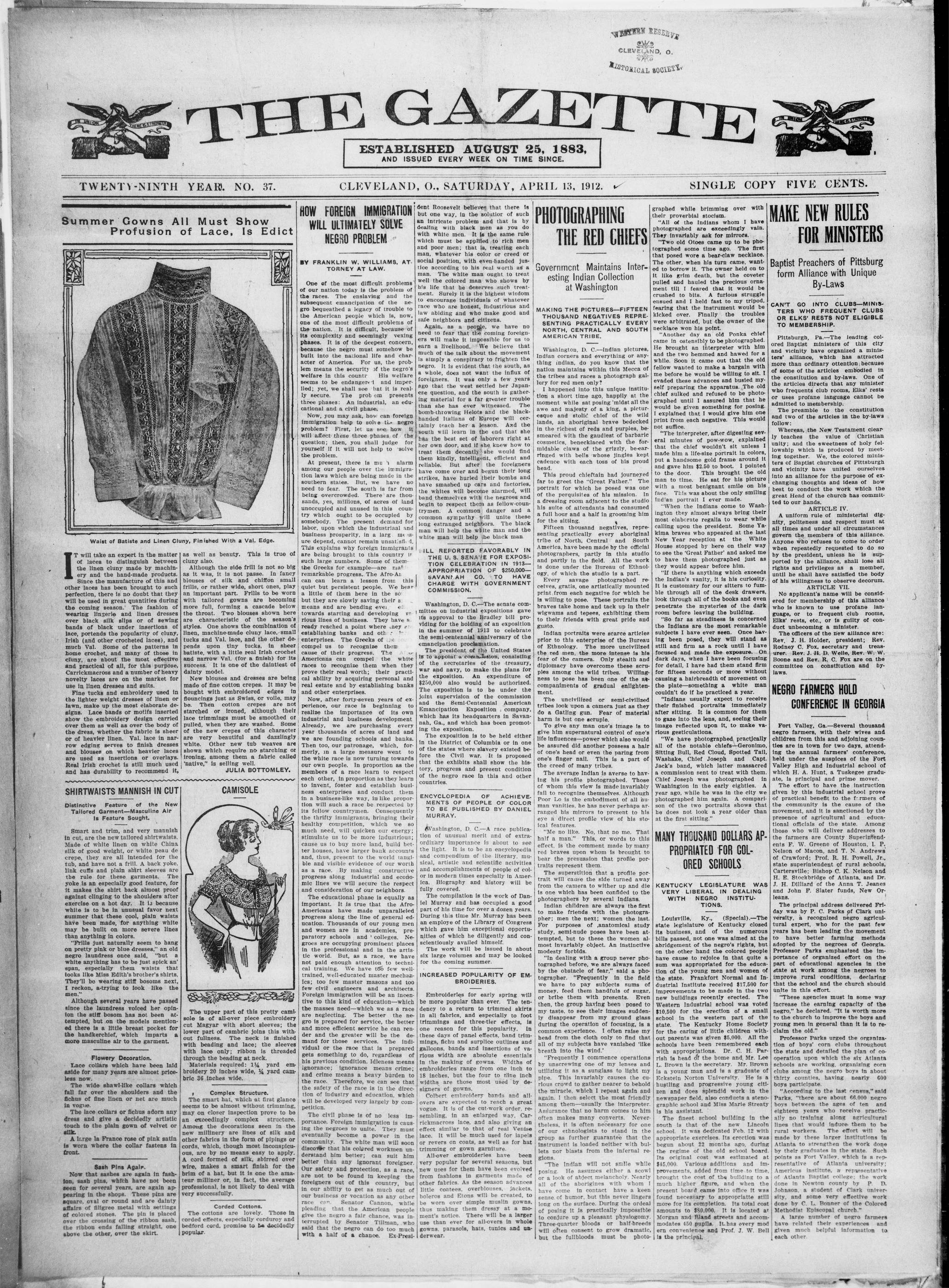
Summer Gowns All Must Show Profusion of Lace, Is Edict
Walst of Batiste and Linen Cluny, Finished With a Val. Edge.
IN UNION FOR ESSENCE STRength
TWENTY-NINTH
Summer Gowns A
Profusion
Waist of Batiste and Linen Cl
T will take an expert in the matter of laces to distinguish between the linen clung made by machinery and the hand-made products.
ery and the hand-made products. Since the manufacture of this and other laces has been brought to such perfection, there is no doubt that they will be used in great quantities during the coming season'. The fashion of wearing lingerie and linen dresses over black silk slips or of sewing bands of black under insertions of lace, portends the popularity of cluny, Irish (and other crocheted laces), and much Val. Some of the patterns in home crochet, and many of those in cluny, are about the most effective and practical of all, for this purpose, Carrickmacross and a number of heavy novelty laces are on the market for use in linen dresses and suits.
Fine tucks and embroidery used in the lighter weight dresses of linen or lawn, make up the most elaborate designs. Lace bands or motifs inserted show the embroidery design carried over them as well as over the body of the dress, whether the fabric is sheer or of heavier linen. Val. lace in narrow edging serves to finish dresses and blouses on which heavier laces are used as insertions or overlays. Real Irish crochet is still much used and has durability to recommend it.
SHIRTWAISTS MANNISH IN CUT
Distinctive Feature of the New Tailored Garment—Masculine Air Is Feature Sought.
Smart and trim, and very manlain in cut, are the new tailored shirt waistls. Made of white linen on white China silk of good weight, or white peau de crepe, they are all intended for the tub, and have not a frill. A back yoke, link cuffs and plain shirt sleeves are the rule for these garments. The yoke is an especially good feature, for it makes the shirt back almost proof against clinging to the shoulders after exercise on a hot day. It is because white is to be in unusual favor next summer that these cool, plain waistls have been made, for anything white may be built on more severe lines than anything in colors.
"Frills just naturally seem to hang on pretty pink or blue dresses," an old negro laudress once said, "but a white anything has to be just spick an' span, especially them waistls that looks like Miss Edith's brother's shirts. They'll be wearing stiff bosoms next, reckon, a-trying to look like the men."
Although several years have passed since the laudress voiced her opinion the stiff bosom has not been attempted, but on the models mentioned there is a little breast pocket for the handkerchief, which imparts a more masculine air to the garment.
Flowery Decoration.
Lace collars which have been laid aside for many years are almost priceless now.
The wide shawl-like collars which fall far over the shoulders and the fuchsia of fine linen or net are much in vogue.
The lace collars or fichus adorn any dress and give a decidedly artistic touch to the plain gown of velvet or silk.
A large la France rose of pink satin is worn where the collar fastens in front.
Sash Pins Again
Now that sashes are again in fashion, sash pins, which have not been seen for several years, are again appearing in the shops. These pins are square, oval or round and are dainty affairs of filigree metal with settings of colored stones. The pin is placed over the crossing of the ribbon sash, the ribbon ends falling straight, one above the other, over the skirt.
THE GAZETTE
as well as beauty. This is true of cluony also.
Although the side frill is not so big as it was, it is not passe. In fancy bliouses of silk and chiffon small frills, or rather wide, short ones, play an important part. Frills to be worn with tailored gowns are becoming more full, forming a cascade below the throat. Two blouses shown here are characteristic of the season's styles. One shows the combination of linen, machine-made cluny lace, small tucks and Val. lace, and the other depends upon tiny tucks, in sheer batiste, with a little real Irish crochet and narrow Val. (for a finish) for its success. It is one of the daintest of dainty model.
New blouses and dresses are being made of fine cotton crepes. It may be bought with embroidered edges in flouinings just as Swiss, or volle, may be. Then cotton crepes are not starched or ironed, although their lace trimmings must be smoothed or pulled, when they are washed. Some of the new crepes of this character are very beautiful and dazzlingly white. New new tub weaves are shown which require no starching or ironing, among them a fabric called "native," is selling well.
JULIA BOTTOMLEY.
CAMISOLE
The upper part of this pretty cam-sole is of all-over piece embroidery cut Magyar with short sleeves; the lower part of cambric joins this without fullness. The neck is finished with beading and lace; the sleeves with lace only; ribbon is threaded through the beading at neck.
Materials required: $1\frac{1}{4}$ yard embroidery 20 inches wide, $1\frac{1}{4}$ yard cam-bric 36 inches wide.
Complex Structure.
The smart hat, which at first glance seems to be almost without trimming, may on closer inspection prove to be an exceedingly complex structure. Among the decorations seen in the new millinery are lines of silk and other fabrics in the form of pliings or cords, which, though most inconspicuous, are by no means easy to apply. A cord formed of silk, shibrred over wire, makes a smart finish for the brim of a hat, but it is one the amateur milliner or, in fact, the average professional, is not likely to deal with very successfully.
Corded Cottons.
The cottons are lovely. Those in corded effects, especially corduroy and bedford cord, promise to be decidedly popular.
ESTABLISHED AUGUST 25, 1883 AND ISSUED EVERY WEEK ON TIME SINCE.
CLEVELAND, O., SATURDAY, APRIL 13, 1912.
HOW FOREIGN IMMIGRATION WILL ULTIMATELY SOLVE NEGRO PROBLEM
BY FRANKLIN W. WILLIAMS, AT TORNEY AT LAW.
One of the most difficult problems of our nation today is the problem of the races. The enslaving and the subsequent emancipation of the negro bequeathed a legacy of trouble to the American people which is, now, one of the most difficult problems of the nation. It is difficult, because of its complexity and seemingly vexing phases. It is of the deepest concern, because the negro must somehow be built into the national life and character of America. For us, the problem means the security of the negro's welfare in this country. His welfare seems to be endangered and imperiled; yet, we shall see that it is really secure. The problem presents three phases: An industrial, an educational and a civil phase.
Now, you may ask, how can foreign immigration help to solve the negro problem? First, let us see how it will affect these three phases of the question; then, you shall judge for yourself if it will not help to solve the problem.
At present, there is much alarm among our people over the immigration laws which are being made in the southern states. But, we have no need to fear. The south is far from being overcrowded. There are thousands, yes, millions, of acres of land unoccupied and unused in this country which ought to be occupied by somebody. The present demand for labor, upon which the industrial and business prosperity, in a large measure depend, cannot remain unsatisfied. This explains why foreign immigrants are being brought to this country in such large numbers. Some of them the Greeks for example—are not remarkable progress. The Afro-American can learn a lesson from this quiet but persistent people. We hear a little of them here in the soot but they are slowly saving their means and are bending even towards starting and developing various lines of business. They have a ready reached a point where they are establishing banks and other enterprises. The Greeks of the compel us to recognize them cause of their progress. The African Americans can compel the white races to recognize them when they prove their real worth; their practical ability by acquiring personal and real estate and by establishing banks and other enterprises.
Now, after forty-seven years of experience, our race is beginning to realize the importance of its own industrial and business development. Already, we are purchasing every year thousands of acres of land and we are founding schools and banks. Then too, our patronage, which, formerly, in a large measure went to the white race is now turning towards our own people. In proportion as the members of a race learn to respect each other, in proportion as they learn to invent, foster and establish business enterprises and conduct them in a business-like way, in like proportion will such a race be respected by its fellow countrymen. Consequently the thrifty immigrants, bringing their healthy competition, which we so much need, will quicken our energy; stimulate us to be more industrious; cause us to buy more land, build better houses, have larger bank accounts and, thus, present to the world tangible and visible evidence of our worth as a race. By making constructive progress along industrial and economic lines we will secure the respect and consideration of our neighbors.
The educational phase is equally as important. It is true that the Afro-Americans have made unparalleled progress along the line of general education. Thousands of our young men and women are in academies, preparatory schools and colleges. Negroes are occupying prominent places in the professional and in the artistic world. But, as a race, we have not paid enough attention to technical training. We have too few well-trained, well-educated master mechanics; too few master masons and too few civil engineers and architects. Foreign immigration will be an incentive to this kind of education—which the masses need—which we as a race are neglecting. The better the negro is prepared for service, the better and more efficient service he can render and the greater will be the demand for those services. The individual or the race that is prepared gets something to do, regardless of his previous condition. Idleness means ignorance; ignorance means crime; and crime means a heavy burden to the race. Therefore, we can see that the safety of the race is in the direction of industry and education, which will be developed very largely by competition.
The civil phase is of no less importance. Foreign immigration is causing the negroes to unite. They must eventually become a power in the community. The white man will soon discover that his colored workmen understand him better; can suit him better than any ignorant foreigner. Our safety and protection, as a race, are not to be found in keeping the foreigners out of this country, but in our ability to get as much out of our business or vocation as any other race can. Senator Cannon, while pleading that the American people give the negro a fair chance, was interrupted by Senator Tillman, who said that the negro can do too much with a half of a chance. Ex-Presi-
dent Roosevelt believes that there is but one way, in the solution of such an intricate problem and that is by dealing with black men as you do with white men. It is the same rule which must be applied to rich men and poor men; that is, treating each man, whatever his color or creed or social position, with even-handed justice according to his real worth as a man. The white man ought to treat well the colored man who shows by his life that he deserves such treatment. Surely it is the highest wisdom to encourage individuals of whatever race who are honest, industrious and law abiding and who make good and safe neighbors and citizens.
Again, as a people, we have no need to fear that the coming foreigners will make it impossible for us to earn a livelihood. We believe that much of the talk about the movement is simply a conspiracy to frighten the negro. It is evident that the south, as a whole, does not want the influx of foreigners. It was only a few years ago that the west settled her Japanese question, and the south is gathering material for a far greater trouble than she has ever witnessed. The bomb-throwing Helots and the black-handed Itallians of Europe will certainly teach her a lesson. And the south will learn in the end that she has the best set of laborers right at her own door, and if she knew how to treat them decently she would find them kindly, intelligent, efficient and reliable. But after the foreigners have come over and begun their long strikes, have hurled their bombs and have smashed up cars and factories, the whites will become alarmed, will band themselves with the negroes and begin to respect them as fellow-countrymen. A common danger and a common sympathy will unite these long estranged neighbors. The black man will help the white man and the white man will help the black man.
ILL REPORTED FAVORABLY IN THE U. S. SENAIVE FOR EXPOSITION CELEBRATION IN 1913—APPROPRIATION OF $250,000—SAVANIAH CO. TO HAVE CHARGE WITH GOVERNMENT COMMISSION.
Washington, D. C. The senate committee on industrial expositions gave its approval to the Bradley bill providing for the holding of an exposition in the summer of 1913 to celebrate the semi-centennial anniversary of the emancipation proclamation.
The president of the United States is to appoint a commission, consisting of the secretaries of the treasury, war and navy, to make the plans for the exposition. An expenditure of $250,000 also would be authorized. The exposition is to be under the joint supervision of the commission and the Semi-Centennial American Emancipation Exposition company, which has its headquarters in Savannah, Ga., and which has been promoting the exposition.
The exposition is to be held either in the District of Columbia or in one of the states where slavery existed before the Civil war. It is proposed that the exhibits shall show the history, progress and present condition of the negro race in this and other countries.
ENCYCLOPEDIA OF ACHIEVEMENTS OF PEOPLE OF COLOR TO BE PUBLISHED BY DANIEL MURRAY.
Washington, D. C.—A race publication of unusual merit and of extraordinary importance is about to see the light. It is to be an encyclopedia and compendium of the literary, musical, artistic and scientific activities and accomplishments of people of color in modern times especially in America. Biography and history will be fully covered. The compilation is the work of Daniel Murray and has occupied a good part of his time for over a dozen years. During this time Mr. Murray has been an employee of the Library of Congress which gave him exceptional opportunities of which he diligently and conscientiously availed himself. The work will be issued in about six large volumes and may be looked for the coming summer.
INCREASED POPULARITY OF EM-
BROIDERIES.
Embroideries for early spring will be more popular than ever. The tendency to a return to trimmed skirts in all fabrics, and especially to foot trimmings and three-tier effects, is one reason for this popularity. In these days of panel effects, band trimmings, fuchi and surplice outlines and galloons, bands and insertions of various width are absolute essentials in the making of gowns. Widths of embroideries range from one inch to 18 inches, but the four to nine inch widths are those most used by designers of gowns.
Colbert embroidery bands and all-overs are expected to reach a great vogue. It is of the cut-work order, resembling, in an enlarged way, Carrickmacross lace, and also giving an effect similar to that of real Venise lace. It will be much used for lappets or revers on coats, as well as for hat trimming or gown garniture.
All-over embroideries have been very popular for several seasons, but new uses for them have been evolved from fashions in garments made of other fabrics. As the season advances little contees, overblouses, jackets, boleros and Etons will be created, to be worn over simple muslin gowns, thus making them dressy at a moment's notice. There will be a larger use than ever for all-overs in whole gowns, parasols, hats, tunics and underwear.
WESTERN RESERVE
CLEVELAND, O.
HISTORICAL SOCIETY.
PHOTOGRAPHING THE RED CHIEFS
PHOTOGRAPHING THE RED CHIEFS
Governmentmc Maintains Interesting Indian Collection at Washington
MAKING THE PICTURES—FIFTEEN THOUSAND NEGATIVES REPRESENTING PRACTICALLY EVERY NORTH, CENTRAL AND SOUTH AMERICAN TRIBE.
Washington, D. C.—Indian pictures, Indian corners and everything or anything indian, do you know that the nation maintains within this Mecca of the tribes and races a photograph gallery for red men only?
I happened into this unique institution a short time ago, happily at the moment while sat sitting 'mild all the awe and majesty of a king, a pictureque and stolic chief of the wild lands, an aboriginal brave bedecked in the richest of reds and purples, besmeared with the gaudiest of barbarian cosmetics, benecked with the formidable claws of the grizzly, be-earringed with bells whose jingles kept cadence with each toss of his proud head.
This proud chieftain had journeyed far to greet the "Great Father." The portrait for which he posed was one of the perquisites of his mission. In a dressing room adjacent to the studio his suite of attendants had consumed a full hour and a half in grooming him for the sitting.
Fifteen thousand negatives, representing practically every aboriginal tribe of North, Central and South America, have been made by the official photographers, partly in this studio and partly in the field. All the work is done under the Bureau of Ethnology, of which the studio is a part. Every savage photographed receives, gratis, one artistically mounted print from each negative for which he is willing to pose. These portraits the braves take home and tack up in their wigwams and tepees, exhibiting them to their friends with great pride and gusto.
Indian portraits were scarce articles prior to this enterprise of the Bureau of Ethnology. The more uncivilized the red men, the more intense is his fear of the camera. Only stealth and diplomacy have overcome these scruples among the wild tribes. Willingness to pose has been one of the accompaniments of gradual enlightenment.
The uncivilized or semi-civilized tribes look upon a camera just as they do a Gatling gun. Fear of material harm is but one scruple.
To give any man one's image is to give him supernatural control of one's life influences—power which also would be assured did another possess a hair of one's head or even the paring from one's finger nail. This is a part of the creed of many tribes.
The average Indian is averse to having his profile photographed. Those of whom this view is made invariably fall to recognize themselves. Although Poor Lo is the embodiment of all human vanities, he has never perhaps arranged his mirrors to present to his eye a direct profile view of his stolical features.
"Me no like. No, that no me. That half a man." This, or words to this effect, is the comment made by many brave-ups upon whom is brought to bear the presupposition that profile portraits represent them.
The superstition that a profile portrait will cause the side turned away from the camera to wither up and die is one which has been confided to the photographers by several Indians.
Indian children are always the first to make friends with the photographer; men the next; women the last.
For purposes of anatomical study study, semi-nude poses have been attempted, but to these the women almost invariably object. An instinctive modesty forbids.
"In dealing with a group never photographed before, we are always faced by the obstacle of fear," said a photographer. "Frequently in the field we have to pay subject sums of money, feed them handfuls of sugar, or bribe them with presents. Even then, the group having been posed to my taste, to see their images suddenly disappear from my ground glass during the operation of focusing, is a common experience. I often raise my head from the cloth only to find that all of my subjects have vanished 'like breath into the wind.'"
"Frequently I commence operations by unscrewing one of my lenses and utillizing it as a sunglass to light my pipe. This invariably causes the curious crowd to gather nearer to behold the miracle, which I repeat again and again. I then select the most friendly among them—usually the interpreter. Assurance that no harm comes to him often makes many converts. Nevertheless, it is often necessary for one of our ethnologists to stand in the group as further guarantee that the instrument is loaded neither with bullets nor blasts from the infernal regions.
"The Indian will not smile while posing. He assumes either a scowl or a look of abject melancholy. Nearly all of the aborigines with whom I have come in contact have a keen sense of humor, but this never lingers long on the surface. During the ordeal of posing it is practically impossible to conjure up a pleasant physiogomy. Three-quarter blooms or half-breeds will often consent to grow dramatic, but the fullbloods must be photo-
graphed while brimming over with their proverbial stoolism.
"All of the Indians whom I have photographed are exceedingly vain. They invariably ask for mirrors."
"Two old Otoes came up to be photographed some time ago. The first that posed wore a bear-claw necklace. The other, when his turn came, wanted to borrow it. The owner held on to it like grim death, but the coveter pulled and hauled the precious ornament till I feared that it would be crushed to bits. A furious struggle ensued and I held fast to my tripod, fearing that the instrument would be kicked over. Finally the troubles were arbitrated, but the owner of the necklace won his point.
"Another day an old Ponka chief came in ostensibly to be photographed. He brought an interpreter with him and the two hemmed and hawed for a while. Soon it came out that the old fellow wanted to make a bargain with me before he would be willing to sit. I evaded these advances and busied myself preparing the apparatus. The old chief sulked and refused to be photographed until I assured him that he would be given something for posing. I explained that I would give him one print from each negative. This would not suffice.
"The interpreter, after digesting several minutes of pow-wow, explained that the chief wouldn't sit unless I made him a life-size portrait in colors, put a handsome gold frame around it and gave him $2.50 to boot. I pointed to the door. This brought the old man to time. He sat for his picture with a most benign smile on his face. This was about the only smiling Indian portrait I ever made.
"When the Indians come to Washington they almost always bring their most elaborate regalia to wear while calling upon the president. Some Yakima braves who appeared at the last New Year reception at the White House stopped by here on their way to see the 'Great Father' and asked me to have them photographed just as they would appear before him.
"If there is anything which exceeds the Indian's vanity, it is his curiosity. It is customary for our sitters to fumble through all of the desk drawers, look through all of the books and even penetrate the mysteries of the dark room before leaving the building.
"So far as steadiness is concerned the Indians are the most remarkable subjects I have ever seen. Once having been posed, they will stand as still and firm as a rock until I have focused and made the exposure. On dark days, when I have been focusing for detail, I have had them stand firm for fifteen seconds or more without causing a hairbreadth of movement on the plate—something a white man couldn't do if he practiced a year.
"Indians usually expect to receive their finished portraits immediately after sitting. It is common for them to gaze into the lens, and see their image reflected upon it, to make various gesticulations.
"We have photographed practically all of the notable chiefs—Geronimo, Sitting Bull, Red Cloud, Spotted Tail, Washake, Chief Joseph and Capt. Jack's band, which latter massacred a commission sent to treat with them. Chief Joseph was photographed in Washington in the early eighties. A year ago, while he was in the city we photographed him again. A comparison of the two portraits shows that he does not look a year older than at the first sitting."
MANY THOUSAND DOLLARS AP PROPRIATED FOR COL- ORED SCHOOLS
MANY THOUSAND DOLLARS AP PROPRIATED FOR COL- ORED SCHOOLS
KENTUCKY LEGISLATURE WAS VERY LIBERAL IN DEALING WITH NEGRO INSTITUTIONS.
Louisville, Ky. (Special)—The state legislature of Kentucky closed its business, and of the numerous bills passed, not one was almed at the abridgment of the negro's rights, but on the other hand the colored people have cause to rejoice in that quite a sum was appropriated for the education of the young men and women of the state. Frankfort Normal and Industrial Institute received $17,500 for improvements to be made in the two new buildings recently erected. The Western Industrial school was voted $10,500 for the erection of a small school in the western part of the state. The Kentucky Home Society for the caring of little children without parents was given $5,000. All the schools have been remembered each with appropriations. Dr. C. H. Parish is head of the home and Mr. Lee L. Brown is the secretary. Mr. Brown is a young man and is a graduate of Eckstein Norton University. He is a hustling and progressive young citizen and does splendid work in the newspaper field, also conducts a steno graphic school and Miss Marie Streaty is his assistant.
The finest school building in the south is that of the new Lincoln school. It was dedicated Feb. 12 with appropriate exercises. Its erection was begun about 22 months ago, during the regime of the old school board. Its original cost was estimated at $45,000. Various additions and improvements, added from time to time, brought the cost of the building to a much higher figure, and when the present board came into office it was found necessary to appropriate still more for its completion. Its total cost amounts to $80,000. It is located at Morgan and Bland streets and accommodates 450 pupils. It has even modern convenience and Prof. J. W. Bell is the principal.
SINGLE COPY FIVE CENTS.
IN HONOR OF THE
UNION OF
THE STATES
CAN'T GO INTO CLUBS--MINISTERS WHO FREQUENT CLUBS OR ELKS' RESTS NOT ELIGIBLE TO MEMBERSHIP.
Pittsburgh, Pa.—The leading colored Baptist ministers of this city and vicinity have organized a ministers' alliance, which has attracted more than ordinary attention because of some of the articles embodied in the constitution and by-laws. One of the articles directs that any minister who frequents club rooms, Elks' rests or uses profane language cannot be admitted to membership.
The preamble to the constitution and two of the articles in the by-laws follow:
Whereas, the New Testament clearly teaches the value of Christian unity; and the sweetness of holy fellowship which is produced by meeting together. We, the colored ministers of Baptist churches of Pittsburgh and vicinity have united ourselves into an alliance for the purpose of ex-charging thoughts and ideas of how best to conduct the work which the great Head of the church has committed to our hands.
ARTICLE IV.
A uniform rule of ministerial dignity, politeness and respect must at all times and under all circumstances govern the members of this alliance. Anyone who refuses to come to order when repeatedly requested to do so by the president, unless he is supported by the alliance, shall lose all rights and privileges as a member, until he shall have satisfied the body of his willingness to observe decorum.
ARTICLE VII.
No applicant's name will be considered for membership of this alliance who is known to use profane language, or to frequent club rooms, Elks' rests, etc., or is guilty of conduct unbecoming a minister.
The officers of the new alliance are: Rev. J. H. Holder, president; Rev. Rodney C. Fox, secretary and treasurer. Rev. J. H. D. Welle, Rev. W. W. Boone and Rev. R. C. Fox are on the committee on constitution and by laws.
NEGRO FARMERS HOLD
CONFERENCE IN GEORGIA
Fort Valley, Ga.—Several thousand negro farmers, with their wives and children from this and adjoining counties are in town for two days, attending the annual farmers' conference, held under the auspices of the Fort Valley High and Industrial school of which H. A. Hunt, a Tuskegee graduate, is principal and prime mover. The effort to have the instruction given by this industrial school prove of practical benefit to the farmers of the community is the cause of the movement, and it is sanctioned by the presence of agricultural and educational officials of the state. Among those who will deliver addresses to the farmers are County Superinfendents F. W. Greene of Houston, I. P. Nelson of Macon, and T. N. Andrews of Crawford; Prof. R. H. Powell, Jr., state superintendent of rural schools, Cartersville; Bishop C. K. Nelson and H. E. Stockbridge of Atlanta, and Dr. J. H. Dillard of the Anna T. Jeanes and John F. Slater funds, New Orleans.
The principal address delivered Friday was by P. C. Parks of Clark university, a recognized negro agricultural expert, who for the past few years has been leading the movement to have better farming methods adopted by the negroes of Georgia. Professor Parks emphasized the importance of organized effort on the part of educational agencies in the state at work among the negroes to improve rural conditions, declaring that the school and the church should unite in this effort.
"These agencies must in some way increase the earning capacity of the negro," he declared. "It is worth more to the church to improve the boys and young men in general than it is to reclaim the old."
Professor Parks urged the organization of boys' corn clubs throughout the state and detailed the plan of cooperation upon which the six Atlanta schools are working, organizing corn clubs among the negro boys in about thirty counties, having nearly 600 boys participate.
"According to the last census," said Parks, "there are about 66,000 negro boys between the ages of ten and eighteen years who receive practically no training along agricultural lines that would induce them to be rural workers. The effort will be made by these larger institutions in Atlanta to strengthen the work done by their graduates in the state. Such points as Fort Valley, which is a representative of Atlanta university; American institute, a representative of Atlanta Baptist college; the work done in Newton county by P. D. Johnson, a student of Clark university, and some very effective work done by C. L. Bonner of the Colored Methodist Episcopal church."
A large number of negro farmers have related their experiences and given much helpful information to each other.
SUBSCRIPTION RATES
(In Advance)
One Year.....$1.50
Six Months.....1.00
Three Months.....5.0
Subscribers are requested to
mit by postoffice money order
or registered letter.
Entered at the postoffice in Cleveland
Ohio, as second-class matter
Address all communications to
HARRY C. SMITH
Editor and proprietor,
THE GAZETTE,
Blackstone Building, Cleveland, O.
Member Ohio Legislature: 1894
to 1896; 1896 to 1898; 1900 to 1902
THE GAZETTE is the oldest, and has the largest bona fide circulation, double that of any newspaper in the Interest of Afro-Americans, published in the state of Ohio, and comparison with any will immediately establish its rank as one of the NEWSIEST AND BEST in the country.
Sunday, U. S. Senator Marcus A. Smith of Arizona severely beat an elevator boy in the new Ebbitt house, Washington, D. C., because the lad persisted in obeying his orders and continuing a trip upward, when the Senator wanted to go downward. The newly elected Arizona senator shows in this mistreatment of the little Afro-American just how unfit he is to sit in so august a body as a representative of the people. We trust our people of the nation's capital will not sit supinely by and permit the southern bully to escape unpunished for this dastardly act. There certainly must be some law in the District of Columbia under which even a U. S. "Senator" can be held accountable for such unwarranted, unlawful and brutal acts.
By passing a bill appropriating $250,000 to celebrate the fiftieth anniversary of the emancipation proclamation the Senate reminds the country that this year is the half-century mark of several events that fed to the end of human bondage in the United States. On March 13, 1862, Congress passed an act forbidding the return of fugitive slaves, and on July 16 ap proved an act bestowing freedom on slaves escaping to the federal line. It was by preliminary proclamation, dated September 22, 1862, that President Lincoln announced that on January 1, 1863, all persons held in slavery by men in arms against the United States would be declared free. With the new year the final proclamation took effect. It freed over 3,000,000 slaves at a stroke. The XIIIth amendment abolished slavery in its entirety, bestowing freedom upon 3,895,172 in all.
PARDON LOUIS H. PECK!
About eleven years ago, Louis H. Peck of Akron, was seared into guilty guilty of criminal assault upon a little girl (white), while being carried back to that city from this, on a special train. He was told that a mob that had destroyed public buildings in that city in an effort to get him before he was removed to Cleveland, and that had continued its work of destruction after he was taken away, would surely get him, in spite of the hundreds of state militiamen who occupied the city, if he did not plead guilty to the false charge, and thus enable the court to sentence him quickly and enable this, Cuyahoga County's sheriff and his assistants to get him back to the special train in a few minutes, and return him safely to Cleveland's county jail. Peck rushed to the Akron courthouse and back to the train, through lines of soldiers, it 'aaking but "two minutes" to and sentence him (for life) to the Ohio Penitentiary, and to get out of the court room. This is the statement that appeared in all of the daily newspaper accounts of the "trial" at the time. We remember it distinctly. It has never been contradicted, either, as far as we have been able to learn. Ten years later, about a year or two ago, the coroner at the time of the alleged assault, of Summit County in which Akron is located, a Dr. Fourier, wrote a letter for the unfortunate man, Peck, in which he distinctly stated that no assault of any kind had ever been committed on the girl by Louis H. Peck. This letter and others have been in the hands of the State Board of Pardons and Gov. Judson Harmon for many months. At least three times, the latest, on Thursday, April 11, 1912. Ex-Common Pleas Judge J. A. Kohler, an aged and able jurist of high standing in the city of Akron, has appeared before the State Board of Pardons in Peck's behalf; and the Saturday preceding last Thanksgiving day, Dr. D. J. Starr, of Columbus, exchapulation of the Ohio Penitentiary, serving nine years, and under whom Peck was converted in that institution; Rev. Edward L. Gilliam, pastor of our M. E. church, Columbus, and Grand Chancellor of our K. P., of Ohio; and the editor of The Gazette appealed to Gov. Harmon who promised to look into the case as he had promised on at least one other occasion, months before—but in vain. For many months the Governor and the State Board of Pardons have had in their possession a petition asking Peck's pardon, which has been signed by every member of the Summit County (Akron) bar, and also by each and all of that county's officers; recommendations for pardon by the editor and chief owner of the Akron City Times, and the publisher of the Akron Dally Beacon; by John Durkin who was chief of police "at the time Peck was hurried to the Penitentiary without giving him a chance for trial"; the coroner of the county, Dr. Fourier who examined the girl the day the alleged crime was said to have been committed and who filed a letter stating that he found upon a personal examination no evidence of the commission of the crime charged. "Louis F.," says Judge Kohler who sat on the bench the day Peck was hurried into that Akron-court room some
twelve years ago and out again in a few minutes—the day he is supposed to have been tried for the commission of the alleged crime—“is entitled to pardon if ever a man was and I hope the Governor will pardon him.” So do we and thousands of others interested in the sad case. When it is remembered that the average sentence served by life-prisoners is nine years, and that a number of prisoners of this kind, confessedly guilty, who had served even a less number of years' imprisonment than Peck, have been pardoned from the Ohio Penitentiary since he has been there. It does seem that an innocent man, even if he be an Afro-American without money, relatives or friends, who has served eleven or twelve years and during all this time has been a model prisoner, should be pardoned and promptly. We are not criticising, but appealing to Gov. Harron and the State Board of Pardons for justice at this late day for a man who was taken advantage of when coerced into pleading guilty of the commission of a crime that had not been committed and who has been punished twelve long years by confinement in the Ohio Penitentiary as a result of the ground less charge. Will the Governor and the Board of Pardons liberate Peck soon? We sincerely hope so.
ANOTHER INNOGENT LYNCHED!
Fort Smith, Ark., has discovered that it lynched the wrong Negro some time ago but the information is too late to be of service to the departed. —Chicago Daily News, April 3, 1912.
We are sorry to note that a paper which upon the whole is not unsympathetic toward the Afro-American, and whose general tone is ethical, should indulge in such frivolity in an affair that calls rather for sharp condemnation by the pulpist, press and public of the country which, to use the language of one Champ Clark, speaker of the national house of representatives, "is the foremost moral power in the politics of the world." It is sad to be obliged to note such inconsistencies, to put it mildly, very mildly!
In regard to the affair itself, we find in the same paper that a number of police officials in the town, where this lynch-murder occurred, have been deposed by the City Council—an action that is surely very much to be praised. But we hope that such action was not taken because of the fact "thus the wrong Negro had been lynched" but because of the crime itself which the officials could have prevented but did not. Any other reason would merely be an insult to the conscience of the country!
We hope that the Associated Press which sent out the news did not furnish the heading "that this was the reason for the City Council's action." Ft. Smith has elected a Socialistic mayor—the first case in the state's history—let us hope that he will discredit such action (if it took place) or demand a recall of the statement from the Associated Press if that organization be the author of the superscription, or otherwise, of the Chicago Daily News if this paper prove to be the author.
The new mayor of the city, that has become conspicuous by the crime and by the summary action following upon the heels of this lynch-murder, is a gentleman whose name is Peter Stewart (Ft. Smith, Ark.), and if he is a Socialist of true conviction to that party's platform of principles, he cannot be an adherent of race prejudice.
We should be pleased to hear from the mayor, or president of the City Council of the city concerned.
LOUIS H. PECK CASE.
Columbus, O.—Dr. H. C. Bailey, representing our Cleveland Ministers' Alliance, Judge J. A. Kohler of Akron, Dr. D. J. Starr, Rev. E. L. Gilliam and Dr. Burr of this city, met the State Board of Pardons. Thursday morning,
Rev. H. C. Bailey.
in the governor's office at the Capitol, pleading for a pardon for Louis H. Peck of Akron, a life prisoner in the Ohio penitentiary, sentenced for a crime (criminal assault) that was not punished. Further particulars next week.
Alien Property Holders.
The law of the land respects the right of citizen and alien alike to have and to hold property. The alien resident in the United States may dispose of his property by will with the same feeling of security as the American. This is equally true of the alien who has taken steps to make himself a citizen of the country.
To Whom It May Concern.
It was the new junior in the apartment house where the Browns live who tacked up the following subtle notice inside the dumbwalter. It was hand painted, every S being a capital and carefully turned backward: "You must not put nothing on the dum water you can put bottles on win I call for the gabbig I know who put it on."
One Way of Describing Americans. Nowhere is the architectural sense more rigorous and scholarly than in writers from the land of Babel-like sky-abrasion.—London Saturday Review
THE GAZETTE, CLEVELAND, O. SATURDAY, APRIL 13, 1912
CALLS SCOUTING HARD TASK
Picking Up Good Baseball Players in Bush Leagues Is Largely Luck, Says Arthur Irwin.
"Digging in the minors and little jerkwater towns for future diamond stars isn't what it is cracked up to be," said Arthur Irwin, the New York Yankees' veteran scout, who is soon to start on another scouting tour. According to the man whom the Yankees depend upon for their star players, real good baseball players are at a premium these days.
"Scouting," continued Arthur, "isn't like it used to be. There was a time when a man could go through the bushes and pick up all kinds of men; but times have changed since then. The scout who is lucky to pick up one really good ball player in a season can congratulate himself and feel satisfied that he has earned his salary." Scout Irwin declares there never was such a slim market for ball players as at the present time. "Big league clubs," said Irwin, "are not in the market to sell ball players, naturally, and that's why it is so hard for any one club to gather a galaxy of stars. Every club owner wants to hold on to his best men, for they are the ones who bring success to his club. Money cannot buy them. The club owner must rely on the scout, for he is the one man behind the gun, so to speak. He is the man who unearths the stars."
"I remember the days when money could buy big men; but now clubs must develop them. Few of the leading batters today were purchased for large amounts, but of course there are exceptions. Take Detroit's case with Ty Cobb, for instance. The Tigers got him from a small bush league, but they had to develop him first before he was anything. Most every headliner on the diamond today, after being brought to the majors, had to be sent back to the minors for seasoning."
BALL PLAYERS FROM LINDEN
Little Town in Tennessee is Home of Five Professionals, Including Clyde Milan of Washington.
The average city of 100,000 people feels fairly proud when it can boast of having a half dozen professional ball players among its sons, but the record is unobtained by Linden, Tenn., the home of Clyde Milan. Linden is a little hamlet in the center of the state, with a population of 350.
Clyde Milan. and yet there are exactly five professional ball players who register from there. Milan is the only one in the major leagues. He has a brother who is with Nashville. Then there are two boys named Morbidid and another named Paskell, who are playing ball in some of the smaller leagues.
AROUND THE BASES
Baseball in the air for fair. It's everywhere.
Bridgeport has traded Pitcher Ivor Swanson to Troy for Pitcher Cunningham.
Mobile is to get Outfielder Cruise, last year with Hattiesburg, and drafted by Detroit.
Silver Groh, the veteran infielder with Worcester last year, will be with Lynn this year.
Pitcher Rutus Gilbert has purchased his release from the Terre Haute Central League club.
Manager Isbell at Des Moines may play Eddie Colligan at second base this year in place of George Graham.
The Milwaukee club has purchased Outfielder Chappelle from the Eau Claire club of the Minnesota-Wisconsin league.
If Montgomery does not get a first baseman from the St. Louis Browns it hopes to get Doc Johnstone from New Orleans.
Marty O'Toole, who separated B. Drefuss from $22,500, says that his arm is all to the merry, and if that be so the Pirate expense 'bill ought to prove a vallant worker for Fred Clarke.
Turkeys In Hawaii.
In the mountainous districts of Hawaii wild turkeys are very numerous, and form an important resource for the wandering camper. They are, of course, imported American turkeys gone wild. Some of the stockmen liberated domestic turkeys, and they promptly took to a bold life and are thriving excellently, their only oop apparently being the mongoose, which ultimately will prove their undoing. This simply shows how readily domestic stock harks to wild life when given an opportunity.
THE CHILDREN
NEW ALPHABET VERY SIMPLE
Light and Dark Marks Have Different Meanings in System Just Completed by Prof. Scott.
Now a new alphabet!
Prof. Fred Newton Scott of the University of Michigan is the father of the system. He calls it simple and predicts its adoption by the English-speaking world on the theory that it will meet the modern demands of scientific management.
The new code of letters is intended to save time, to shorten words, and to make spelling "more rational."
Prof. Scott, a bearded, bald-headed, studious man just past middle age, after many months of patient study, has completed the system, which he outlined in detail in a lecture before the Modern Language association in Mandel hall at the University of Chicago.
He has just completed the preparation of a series of papers in which he discusses the subject from the technical standpoint. These, he promises, will be made public in a few weeks, after which he expects to get thousands of indorsements from the "thinking studious public."
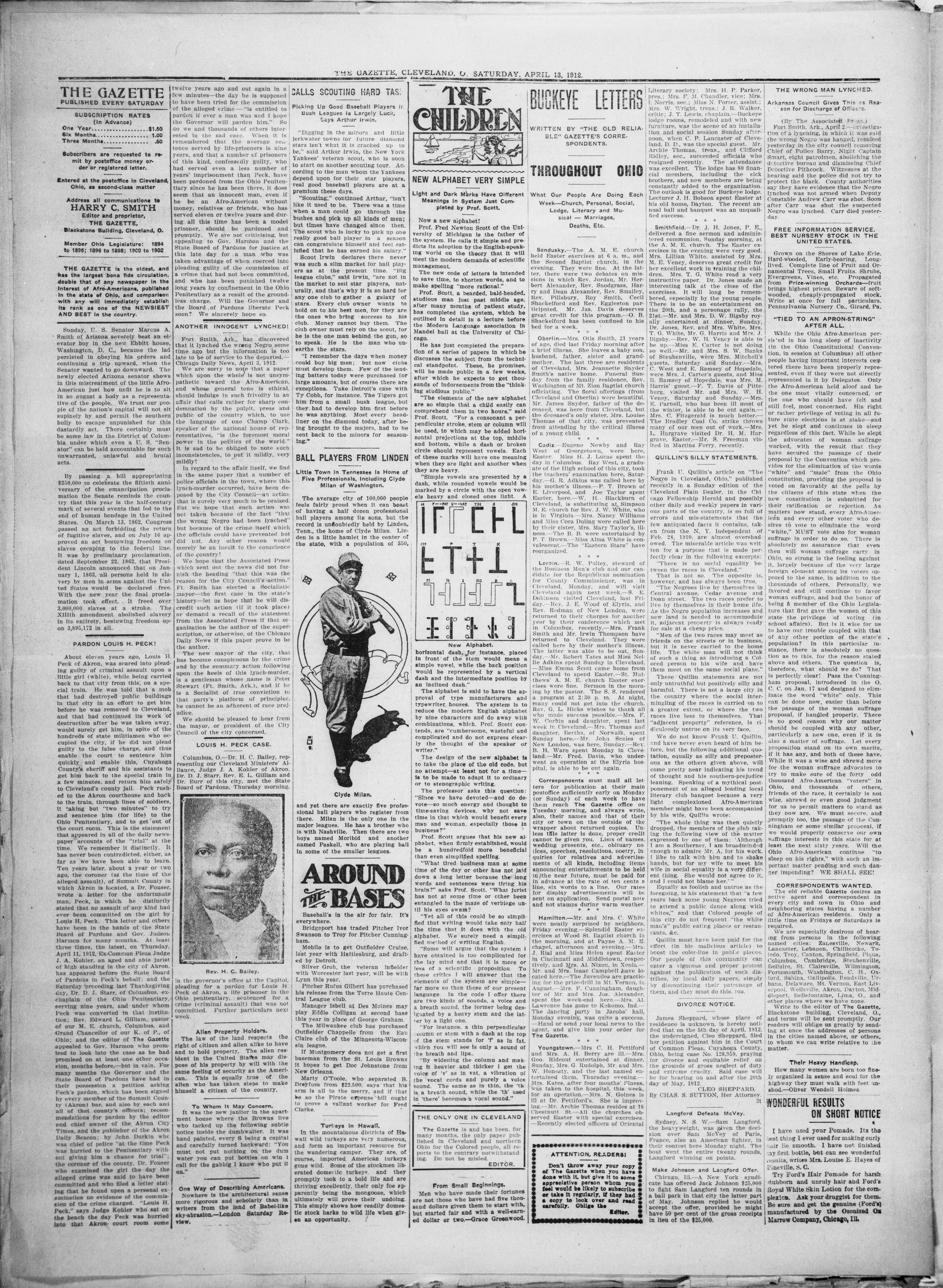
"The elements of the new alphabet are so simple that a child easily can comprehend them in two hours," said Prof. Scott. "For a consonant a perpendicular stroke, stem or column will be used, to which may be added horizontal prejections at the top, middle and bottom, while a dash or broken circle should represent vowels. Each of these marks will have one meaning when they are light and another when they are heavy.
"Simple vowels are presented by a dash, while rounded vowels would be marked by a circle with the open vowels heavy and closed ones light. A
H F--FAT V--VAT TH A SH
CH P T K
ET+L
M N I NG B C
王 王 王 王
New Alphabet.
horizontal dash, for instance, placed in front of the stem would mean a simple vowel, while the back position would be represented by a vertical dash and the intermediate position by an inclined dash."
The alphabet is said to have the approval of type manufacturers and typewriter houses. The system is to reduce the modern English alphabet by nine characters and do away with combinations, which, Prof. Scott contends, are "cumbersome, wasteful and complicated and do not express clearly the thought of the speaker or writer."
The design of the new alphabet is to take the place of the old code, but no attempt—at least not for a time—is to be made to adapt it to ordinary or to stenographic writing.
The professor asks this question: "Since we have devoted—and do devote—so much energy and thought to time-saving devices, why not save time in that which would benefit every man and woman, especially those in business?"
Prof. Scott argues that his new alphabet, when firmly established, would be a hundredfold more beneficial than even simplified spelling.
"What tired business man at some time of the day or other has not laid down a long letter because the long words and sentences were tiring his brain?" asks Prof. Scott. "What jurist has not at some time or other been entangled in the maze of verbige until his eyes swam?
"Yet all of this could be so simplified that writing would take only half the time that it does with the old alphabet. We surely need a simplified method of writing English."
"Some will argue that the system I have obtained is too complicated for the lay mind and that it is more or less of a scientific proposition. To these critics I will answer that the elements of the system are simple—far more so than those of our present language. In the code I offer there are two kinds of sounds, a voice and a breath sound, the former being designated by a heavy stem and the latter by a light one.
"For instance, a thin perpendicular column or stem with a dash at the top of the stem stands for 'f' as in fat, which you will see is only a sound of the breath and lips.
"By widening the column and making it heavier and thicker I get the voice of 'v' as in vat, a vibration of the vocal cords and purely a voice sound. The same as in thin, the 'th' is a breath sound, while the 'th' used in 'there' becomes a vocal sound."
THE ONLY ONE IN CLEVELAND
The Gazette is and has been, for many months, the only paper published in Cleveland and northern Ohio for the Colored people, all reports to the contrary notwithstanding. Do not be misled.
From Small Beginnings.
Men who have made their fortunes are not those who have had five thousand dollars given them to start with, but started fair and with a well-earned dollar or two-Grace Greenwood.
BUCKEYE LETTERS
WRITTEN BY "THE OLD RELIA
BLE" GAZETTE'S CORRE-
SPONDENTS.
THROUGHOUT OHIO
THROUGHOUT OHIO
What Our People Are Doing Each Week—Church, Personal, Social, Lodge, Literary and Musical — Marriages, Deaths, Etc.
Sandusky.—The A. M. E. church held Easter exercises at 6 a. m., and the Second Baptist church, in the evening. They were fine. At the latter, there were two debates on missions in which Rev. Jordan, Mr. Herbert Alexander, Rev. Snodgrass, Harry and Dean Alexander, Rev. Smalley, Rev. Pillsbury, Roy Smith, Cecil Shackelford and Rev. Eggleston participated. Mr. Jas. Davis deserves great credit for this program.—O. B. Shackelford has been confined to his bed for a week.
Oberlin—Mrs. Otsi Smith, 21 years of age, died last Friday morning after a brief illness. She leaves a baby son, husband, father, sister and grandmother. The last three are residents of Cleveland, Mrs. Jeannette Snyder Smith's native home. Funeral Sunday from the family residence, Rev. Washington of Mt. Zion Baptist church officiating. The floral offerings (from Cleveland and Oberlin) were beautiful. The father of the deceased, was here from Cleveland, but the deceased's only sister, Mrs. Louise Thomas of that city, was prevented from attending by the critical illness of a young child.
Cadiz—Eugene Newhy and Ray West of Georgetown, were here, Easter. Miss H. J. Lucas spent the day in Columbus, Ray West, a graduate of the High school of this city, took the teachers' examination here, Saturday. G. R. Adkins was called here by his mother's illness. P. T. Brown of E. Liverpool, and Joe Taylor spent Easter, here. W. H. Blackburn of Cleveland, is substituting at Simpson I. E. church for Rev. J. White, who died in Philadelphia, Mrs. Nancy Willingham and Miss Cora. Duling were called here by their sister, Mrs. Mary Taylor's, illness. The B. B. were entertained by P. T. Brown. Miss Alma White is convalescent. The "Eastern Stars" have reorganized.
Lorain. —R. W. Pulley, steward of the Business Men's club and our candidate for the Republican nomination for County Commissioner, was in Cleveland, Monday, and will visit Cleveland again next week. —S. E. Dobinson visited Cleveland, last Friday. —Rev. J. E. Wood of Elyria, and Rev. Redman of New London, were returned to their charges for another year by their conference which met in Columbus, recently. —Mrs. Frank Bunnel and Mr. Twain Thompson have returned to Cleveland to Clinton called here by their mother's illness. The latter was able to be out, Sunday. —Mr. Robert Tates and Miss Nell Adkins spent Sunday in Cleveland. —Miss Emma Scott came home from Cleveland to spend Easter. —St. Matthews' A. M. e. church Easter exercises were fine. Sermon in the morning by the pastor. The S. S. rendered a program at 2:30 p. m. At night many could not get into the church. Mrs. B. W. e. church who made success possible. Mrs. F. W. Corbin and daughter, spent last week in Cleveland. —Mrs. Thomas and daughter, Bertha, of Norwalk, spent Sunday here. —Mr. John Scales of New London, here was, Sunday. —Rev B. H. Ware spent Monday in Cleveland. —Mr. Fred, Davis, who underwent an operation at the Elyria hospital, is able to be out again.
Correspondents must mail all letters for publication at their main postoffice sufficiently early on Monday (or Sunday) of each week to have them reach The Gazette office on Tuesday morning, and always write to the address of the city or town on the outside of the wrapper about returned copies. Unless this latter is done, proper credit cannot be given you. Lists of names, wedding presents, etc., obituary noices, speeches, resolutions, poetry, inquiries for relatives and advertisements, announcements, announcing entertainments to be held in the near future, must be paid for in advance at the rate of ten cents a line, six words to a line. Our rates for display advertisements will be sent on application. Send postal note and not stamps during warm weather.
Hamilton—Mr. and Mrs. C. White were neatly surprised by neighbors, Friday evening. —Splendid Easter exercises at Wood St. Baptist church in the morning, and at Payne A. M. Z chapel, afternoon and evening. —Mrs. Jacqueline Lawrence in Cincinnati and Middletown, respectively, and Mrs. Al Nixon, in Xenia. —Mr. and Mrs. Isaac Campbell have located here. —The Juveniles are practicing for the prize-drill in Mt. Vernon, in August. —Mrs. F. Cunningham, daughter of Mr. and Mrs. Jos. Alexander Lawrence, who has gone to Kokomo, Ind. —The dancing party in Jacobs' hall, Monday evening, was quite a success. —Hand or send your local news to the agent, and give him your order for
Youngstown—Mrs C. H. Pettiford and Mrs. A. H. Berry are ill—Mrs. Geo. Rideout entertained at dinner, Sunday, Mrs. G. Rudolph, Mr. and Mrs. W. Honesty, and the last named enlisted man, Mrs. Kates, after four months' illness, was taken to the hospital, this week, for an operation—Mrs. N. Goines is ill at Dr. Pettiford's. She is improving. Mr. Archie Thomas resides at 18 and has attended churchs observed Easter with special officers—Recently elected officers of Oriental
Don't throw away your copy of The Gazette when you have done with it, but give it to some appreciative person whom you feel would be likely to subscribe or take it regularly, if they had a copy to look over and read carefully. Oblige the
Literary society: Mrs. H. P. Parker, pres; Mrs. F. M. Chandler, vice; Mrs. I. Norris, see; Miss N. Porter, assist; Mrs. W. Wright, treas; J. R. Walker, critic; J. T. Lewis, chaplain—Buckeye lodge rooms, remodeled and with new furniture, was the scene of an installation and social session Sunday after Cleveland, D. D., was the special guest. Mr. Archie Thomas, treas, and Clifford Ridley, sec, succeeded officials who resigned recently. The attendance was excellent. The lodge has 80 financial members, including the sick brothers, and new members are being constantly added to the organization. The outlook is good for Buckeye lodge. The lodge is in the old home, Dayton. The recent annual ball and banquet was an unqualified success.
Smithfield.—Dr. J. H. Jones, P. E. delivered a fine sermon and administered communion, Sunday morning, at the A. M. E. church. The Easter exercises in the evening were very good. Mrs. Lillian White, assisted by Mrs. M. E. Veney, deserves great credit for her excellent work in training the children. Mrs. T. G. White read a very instructive paper. Dr. Jones made an interesting talk at the close of the exercises. It will long be remembered, especially by the young people. There is to be an entertainment on the 20th and a paradeage rally, the 21st.—Mr. R. H. Harris, actively entertained at dinner, Sunday. Dr. Jones, Rev, and Mrs. White, Mrs. T. G. White, G. Harris and Mrs. J. Bigsby.—Rev. W. H. Vency is able to be up—Miss E. Carter is not doing so well.—Mr. and Mrs. S. W. Banks of Steubenville, were Mrs. Mitchell's guests, Saturday and Sunday.—Mrs. C. West and E. Ramsey of Hopedale, were Mrs. J. Carter's guests, and Miss E. Ramsey of Hopedale, was Mrs. M. Harris' guest.—F. T. Davis of Pittsburg, visited Mr. and Mrs. W. H. Veney, visited Dr. H. M. H. E. Arnell, who has been ill most the winter, is able to be out again.—Mrs. C. Fitzgerald is much better.—The Bradley Coal公司, strike throws many of our men out of work.—Mrs. L. Hargrave visited Dr. H. M. H. Hargrave, Easter.—Mr. S. Freeman visited in Martins Ferry, recently.
QUILLIN'S SILLY STATEMENTS.
Frank U. Quillin's article on "The Negro in Cleveland, Ohio," published recently in a Sunday edition of the Cleveland Plain Dealer, in the Chicago Fellowship Herald and possibly other daily and weekly papers in various parts of the country, is so full of errors and mis-statements that the few antiquated facts it contains, taken from the N. Y. Independent of Feb. 24, 1910, are almost overshadowed. The miserable article was written for a purpose that is made perfectly clear in the following excerpts: "There is no social equality between the races in Cleveland." That is not so. The opposite is, however, and has always been true. The Negroes live by themselves in the cement and a prison and Doan street. The two races prefer to live by themselves in their home life. As the Negro population increases and new land is needed to accommodate it, adjacent property is always ready for sale at a cheap price.
"Men of the two races may meet as friends on the streets or in business, but it is never carried to the home life. The white man will not think of such a thing as introducing a Colored person to his wife and have them meet on the same social plane." These Quillin statements are not only untruthful but positively silly and harmful. There is not a large city in the country where the social intermingling of the races is carried on to a greater extent, or where the two races live less to themselves. That "adjacent property" reference, is ridiculously untrue on its very face.
We do not know Frank U. Quillin, and have never even heard of him before, but the following additional quotation, equally as silly and preposterous as the others given above, will come pretty near indicating his trend of thought and his southern-prejudice leaning. Speaking of a mythical postponement of an alleged leading local literary club banquet because a very light complexioned Afro-American member might have been accompanied by his wife, Quillin wrote:
"The whole thing was then quietly dropped, the members of the club taking the following view of the matter expressed by one of them: 'Although I am a Southerner, I am broadminded and I am not afraid of his work. I like to talk with him and to shake hands, but for my wife to meet his wife in social equality is a very different thing. She would not agree to it, and I could not blame her.'"
Equally as foolish and untrue as the foregoing, is his statement that "a few years back some young Negroes tried to attend a public dance along with whites," and that Colored people of this city do not frequent "the white man's" public eating places or restaurants, &c.
Quillin must have been paid for the effort (in his malicious article) to boost the color-line in public places. Our people of this community can enter a vigorous and proper protest against the publication of such distribes, by local daily papers, simply by discontinuing their patronage of them, and they must do this, too.
DIVORCE NOTICE.
James Sheppard, whose place of residence is unknown, is hereby notified that on the 5th day of April, 1912 the undersigned, Cleo Sheppard, filed her petition against him in the Court of Common Pleas, Cuyahoga County, Ohio, being case No. 128,959, praying for divorce and equitable relief on the grounds of gross neglect of duty and extreme cruelty. Said case will be for hearing on and after the 20th day of May, 1912.
CLEO SHEPPARD
By CHAS. S. SUTTON, Her Attorney
Langford Defeats McVey.
Sydney, N. S. W.—Sam Langford, the heavyweight, was given the decision over Sam McVey of Paris, France, also an American fighter, in their contest here Monday night. The bout went the entire twenty rounds, Langford winning on points.
Make Johnson and Langford Offer.
Chicago, Ill.—A New York syndicate has offered Jack Johnson $25,000 to fight Sam Langford ten rounds in the final fight of May. Johnson replied he would accept the offer, provided he might have 50 per cent of the gross receipts in lieu of the $25,000.
Arkansas Council Gives This As Reason for Discharge of Officers.
(By The Associated Press.)
Fort Smith, Ark. April 2 — investigation of a lynching, in which it was said that strong Negro was hanged, resulted yesterday in the city council. Chief of Police Barry, Night Captain Smart, eight patrolmen, abolishing the detective bureau and dismissing Chief Detective Pitcock. Witnesses at the hearing said the police did not try to protect the black. County authorities say they have evidence that the Negro lynched was not armed when Deputy Countie Andrew Burry carried off. After Carr was shot the suspected Negro was lynched. Carr died yesterday.
FREE INFORMATION SERVICE. BEST NURSERY STOCK IN THE UNITED STATES.
Grown on the Shores of Lake Erie, Hard-wooded, Early-bearing, Long-lived. Complete line of Fruit and Ornamental Trees, Small Fruits, Shrubs, Evergreen, Vines, etc. Propagated from *Prize-winning Orchards*—fruit brings highest prices. Barew of soft-wooded, cheaply-propagated stock. Write at once for full particulars. Pennsylvania Nursery Co., Girard, Pa.
"TIED TO AN APRON-STRING"
AFTER ALL.
While the Ohio Afro-American persisted in his long sleep of inactivity (in the Ohio Constitutional Convention, in session at Columbus) all other people having important interests centered there have been properly represented, even if they were not directly represented in it by Delegates. Only the Afro-American held aloof and he the one most vitally concerned, or the one who should have felt and still feel, most concerned. His right or rather privilege of voting in all future state elections is at stake—and yet he slept and continues to sleep regardless of this fact. While he slept the advocates of woman suffrage worked, with the result that they have secured the passage of their proposal by the Convention which provides for the elimination of the words "white" and "male" from the Ohio constitution, providing the proposal is voted on favorably at the polls by the citizens of this state when the new constitution is submitted for their ratification or rejection. As matters now stand, every Afro-American and every other voter who desires to vote to eliminate the word "white." MUST vote also for woman suffrage in order to do so. There is absolutely no assurance that even it, largely because of the very large foreign element among its very opposed to the same, in addition to the few of others. Personally, we favored and still continue to favor woman suffrage, and had the honor of being a member of the Ohio Legislature that first gave the women of this state the privilege of voting (in school affairs). But is it wise for us to have our trouble coupled with that of any other portion of the state's population? In this particular instance, there is absolutely no question as to this, for the reason stated above and others. The question is, therefore, what should we do? That is perfectly clear! Pass the Cunningham proposal, introduced in the O. C. C. on Jan. 17 and designed to eliminate the word "white" only. This can be done now, easier than before the passage of the woman suffrage proposal, if hanged properly. There is no good reason why our matter should be coupled with any other, particularly a new one, even if it is also a matter of suffrage. Let every proposition stand on its own merits, if it has any, and both of these have. While it was a wise and shrewd move for the woman suffrage advocates to try to make sure of the forty odd thousand Afro-American "voters" in Ohio, and thousands of others, friends of the race, it certainly is not wise, shrewd or even good judgment for us to permit matters to stand as they now are. We must secure, and promptly too, the passage of the Cunningham or some similar proposal, if we would properly conserve our own suffrage interests in this state for at least the next sixty years. Will the Ohio Afro-American continue "to sleep on his rights," with such an important matter pending and such danger impending? WE SHALL SEE!
CORRESPONDENTS WANTED.
The old reliable Gazette desires an active agent and correspondent in every city and town in Ohio and neighboring states having a number of Afro-American residents. Only a time on Fridays or Saturdays is required.
We are especially desirous of hearing from persons in the following named cities: Zanesville, Newark, Lancaster, Lebanon, Chillicothe, Toledo, Troy, Canton, Springfield, Plaqua, Columbus, Cambridge, Steubenville, Bellale, St. Charlesville, Wilmington, South, Washington, C. H. Oxford, Sabina, Gallipolis, Fendville, Urbana, Delaware, M. Vernon, East Liverpool, Wellsville, Akron, Dayton, Middleport, Bellefountain, Lima, O., and other places where we have none.
Write to the editor of The Gazette, Blackstone building, Cleveland, O., and terms will be sent promptly. Our address is at once the addresses of persons in the cities named above, or others, to whom we can write relative to the matter.
Their Heavy Handicap
How many women are born too finely organized in sense and soul for the highway they must walk with feet unshod—Oliver Wendell Holmes.
I have used your Pomade. Its the best thing I ever used for making curly hair lie smooth. I have not finished my first bottle, but can see wonderful results, writes Mrs. Louise E. Hayes of Pineville, S.C.
Try Ford's Hair Pomade for harsh stubborn and unruly hair and Ford's Royal White Skin Lotion for the complexion. Ask your druggist for them. Be sure and get the genuine (Ford's) manufactured by the Ozonized Ox Marrow Company, Chicago, Ill.
PURELY PERSONAL
PURCHASE
THE
"GAZETTE" AT
J. S. HALL'S, 3121 Central Ave.
L. SCHWARTZ'S, 2921 Central Ave. Open Sunday.
O. C. SCHROEDER'S, Cuyahoga Bldg. Open Sunday.
ELMER F. BOYD'S, 2604 Central Ave.
F. VALENTINE'S, 2130 Central Ave.
SAM COHEN'S, 2928 Central Ave. Open Sunday.
JOHNSON'S, 3350 Central Ave.
NOTICE TO SUBSCRIBERS:--Subscribers not receiving The Gazette regularly should notify us at once. We desire every copy delivered promptly. We advise our patrons to carefully examine The Gazette's advertisements before making purchases. Business men who advertise in this paper should have the patronage of Afro-Americans. The fact that they advertise is assurance that they want it.
Local reading notices (advertisements) ten cents a line (six words in a line).
FOR RENT—Houses—If you have places to rent or if you want to rent—notify The Gazette.
For Rent—Five rooms and bath. 2329 E. 97th St. Attic and cellar. Inquire at I. W. Porter's, 9763 Quebec Av.
Wanted—Two girls, immediately, to learn manicuring and hair-work. Summer positions. L. Gordon, 2345 Central Av. N. 1293 J.
NOTARY, PUBLIC—For such services call at The Gazette office, No 3 Blackstone Building, No. 1422 W. 3d street, near Superior avenue.
FOR RENT—Furnished rooms with gas and bath. Special accommodations for theatrical people, Room and board. Mrs. I. B. Ambrose, 2285 E. 46th St., Cuy. Phone, Central 2917 L.
Rev. F. G. Snelson preached the K. P. and not the Elks' sermon, recently. Mrs. George Carroll of E. 74th St. was taken to the hospital last Thursday evening for an operation.
Undertaker White of Columbus, son of Rev. C. D. White, was in the city on business, last Friday. Also, Mr. Otis Smith of Oberlin.
Mr. and Mrs. Thos. B. Akridge of Arthur Av., have a "bran new" baby born April 5. Congratulations. Bring on the cigars, Bro. Akridge.
The Hiawatha club had as its guest Thursday the Day the Reporter's club of Oberlin, at Mrs. P. J. Tarrer's E. 100th St. The next meet at, Mrs. Smith's, Blaine Ave.
The Gazette is indebted to Dr. C. Mottley of 3112 Central Av., for a consistent friendship of years which ever and anon results in a new cash subscript of one year for The Gazette Thank you, Doctor.
Easter assembly, Monday evening, a ideal hall, was an enjoyable success over 200 being in attendance. The club's formal opening will occur May 8. R. W. Pulley, steward of the Business men's club of Lorain, and a candidate for the Republican nomination for county commissioner of his county
Isaac Monroe and Birdie L. Elliott were quietly married by Dr. Chas. Bundy, April 6, at his residence. Rev. E. H. Smith went to Pittsburgh, Sunday to conduct a ten day revival meeting for Rev. Fox of that city: Grant Palmer of this city, who is in charge of a summer resort at Geneva, was in the city several days last week and Sunday. Grant was looking for Rev. J. J. Cummings of Cincinnati, who has been conducting a revival at St. James' church, for nearly three weeks, will close it. Sunday. He has been very successful. Mrs. Ethel Moore Roberson wishes to announce that she is ready for business (millinery) at her residence, 10527 Arthur Ave. Call and see her before buying your Spring hat. She has some beautiful creations, just completed. Haven Baptist church, 3725 Cedar Ave., Sunday, Rev. J. L. Bundy will preach, in the morning, on "David's Thirst for the Old Well;" and in the evening on "The Universal Presence." S. S. at 12:30 noon and B. Y. P. U. at 6:30 p. m.
When you want Chili con carne stop at the Manhattan restaurant, 3133 Central Av. A good chicken dinner served every Thursday and Sunday. Special attention given to ladies. The menu has that beautiful city, the J. W. Crawford, proprietor. Don't you want to own a home, or to own a house and let to rent? Of course you do. Now is your chance to make the beginning and easily and cheaply too. See the Edward Blyth advertisement elsewhere in this paper. Here is a splendid opportunity. Send your local items to The Gazette on Monday or Tuesday of each week. This paper is published for ALL of our people and "plays no favorites." Everybody is treated the same—fair and right. Take The Gazette and tell your friends to do so also.
Miss Edith Boyce of Steubenville, who has been attending Wilberforce University, told me that she's Trimble, 1721 Dover Ave., last week and the first of this. Miss Boyce was undecided as to whether to attend Howard University, the rest of this term or to return home.
The Gazette desires to ask its readers to remember, especially, its advertisers. Patronize them; they want your trade and will treat you far better in every way than those who do not for your patronage in these columns.
Mrs. Louise Thomas and father, James R. Snyder, went to Oberlin, Sunday, to attend the funeral of Mrs. Jeannette Smith who died, last Friday morning. Mrs. Otis Smith was their sister and daughter, respectively, and was only 21 years of age. She leaves also a husband and a three months old son. The Rev. J. A. Hamlet, D. D., pastor of the First Colored M. E. church of Topeka, Kan., and editor of The Western Christian Index, will preach at Lane Memorial C. M. E. church (Cedar Ave. and E. 31st St. Sunday evening, October 11, 2014, cordially) at Dr. Hamlet is an eloquent and forceful preacher.
A funny incident of the Feb. 18 moral uplift meeting at Shiloh Baptist church which has not been published, is the fact that one of the speakers, by mistake, started into the pool (in the church) in his eagerness to get out a back way ahead of the large audience which was about to be dismissed. The meeting had been "too hot" for him. Many of our people have noticed that "The Song Shop" at the corner of Ontario St., and the Public square, conducted by Jerome H. Remick & Co. N. Y. City and Detroit, has a notice in Ontario St. describing the irrespecting members of our race to stay out of that "shop." There are 20,000 Afro-Americans in this city and all are "musical." Stay out of that "Song Shop," until it shows more respect for us. Pass the word along to all you meet. (New York and Detroit race papers, please republish this notice—Ed.)
Call your lady friends' and acquaintances' attention to our up-to-date fashion and pattern departments and thus encourage us to introduce The Gazette regularly. Oblige the Editor.
Undertaker White of Columbus, a son of Rev. C. D. White, was in the city on business, last Friday. Also, Mr. Otis Smith of Oberlin.
Mr. and Mrs. Thos. B. Akridge of Arthur Av. have a "bran new" baby boy born April 5. Congratulations! Bring on the cigars, Bro. Akridge.
The Hlawatha club had as its guests last Tuesday afternoon, the Progressive club of Oberlin, at Mrs. P. J. Tarrer's E. 100th St. The next meeting, at Mrs. Smith's, Blaine Ave.
The Gazette is indebted to Dr. C. I. M. Mackenzie of Central Av. for a consistent friendship, which even and anon injuries in a new cash subscription of one year for The Gazette. Thank you, Doctor.
The Union Club of St. Andrew's Easter assembly, Monday evening, at ideal hall, was an enjoyable success, over 200 being in attendance. The club's formal opening will occur May 6. R. W. Pulley, steward of the Business Men's club of Loralain, and a candidate for the Republican nomination for the county chair of his county, called on The Gazette, Monday other callers were: Revs. Bundy, Bailey, Snelson, Burr, Webster, and Cummings of Cincinnati. The Dubois Literary club will hold a grand meeting at the Antioch Baptist church, Tuesday evening, April 23, to consider the advisability of Woman's Suitrage. Both gentlemen and ladies will be invited to Miss Ruth E. Presley, see, of the Woman's Suitrage party, will be the principle speaker.
for missionary purposes, $156.20 were raised, Sunday, at St. John's A. M. E. church, Mrs. Mary Smith of Zanesville, evangelist, closed the revival, Sunday, and has returned home. About 50 conversions and accessions. Dr. Bundy preached Wm. H. Lyons' 1857 Mass, and preached his 1957 Central Avenue. Interment in Eric (E. 9th) St. cemetery. Cory M. E. St. John's and St. James' A. M. E. Antioch and M. Haven Baptist, and Lane Memorial C. M. E. churches, under the leadership of their pastors, on Sunday evening, raised funds to help employ Judge J. A. Kohler of Akron, to take charge of the effort to secure parole or parole for Pete A. Kohler, who is in the Ohio penitentiary.
While at dinner, one day recently, the waitress, one of our girls, told a representative of The Gazette that a few days previous, there were six of our girls in that restaurant with her, all of whom had been married and divorced or were not living with their young husbands; that the oldest of the girls (herself) was not 17, and the youngest was only 13 years old. What do you think of that? It’s truth, too.
The printed financial statement for 1911 of Branch 2, C. & M. Alliance, 1914 Woodland Ave., shows receipts, $3,191.89; disbursements, $3,191.89; Sunday School receipts, $167.24; disbursements, the same. A. E. Talbert is treasurer of Branch 2; Mrs. D. M. Hughes, sec.; Mrs. Kittle A. Bolden treasurer of the S. and Miss W. Blanche Jones, sec. Messrs. Jas. Burgess and Mrs. W. Burgess, Mrs. W. O. Bowles is president of the Branch and Mrs. B. H. Smooth, vice-pres.
The S. S. Easter exercises at St. James A. M. E. church, Sunday evening, were exceptionally good and those in charge of the children deserve much praise and credit. Several numbers of them were by chance to close the program, the editor of The Gazette being one of the number. The regular collections were good and an extra one was lifted to help the Ministers' Alliance committee which is working on the Louis H. Peck case. W. H. VanDusen and his bartender, Mr. Saunders, called on The Gazette, Monday, and requested it to deny that man the opportunity for the foolish "ghost-stories" that have been floating for many weeks, and to say that no man has over been cut or hurt in the VanDusen cafe. In his ten years in this city, Mr. VanDusen says there have been noights, cutting or such disturbances his places in business. This is an overridden
In a single-handed battle on a Cedar Ave. car with four men suspected of being pickpockets, Detective Arthur McFarland last Friday night captured one. Another made his escape by diving through a window. The others were caught as a defiant officer as the car reached E. 9th street only to encounter Traffic Patrolman Newman, who captured one of them. The battle lasted for two blocks and although McFarland appealed to conductor and motorman and more than 25 male passengers, he says that no one made a move to his aid. A broke arm in the fight. McFarland was afraid to use his revolver on account of the number of people in the cramped quarters. The police think that the four are members of the gang who have been systematically working cars around E. 55th street and Euclid Ave. McFarland is the only officer who has been too. Art has proven his "gameness" on many an occasion. This last affair is only the latest.
When your Gazettes are not delivered on Friday mornings, call at your Central Postoffice General Delivery Window for them in the afternoon of the same day. —Editor.
HE GAZETTE. CLEVELAND, O. SATURDAY, APRIL 13, 1912. The Elks gave a successful ball at the Armory. Tuesday evening.
Moses H. Dixon and Mabel E. Guy of Zanesville, were married, Monday, Mr. and Mrs. T. M. Farlce, Jr., left Thursday for Brewster, Wash., to locate, Mrs. L. A. Cunningham has returned from Buffalo. Her son-in-law, W. H. Alkercus, who has been ill several years, was taken to a hospital. He does not improve. St. Cecilia's mass rendered Easter by St. Andrew's choir, under the direction of J. W. Wills, assisted by Miss Clara Dyson. The entire Easter program will be repeated, Sunday, beginning at 10:30 a. m. John H. Hall desires to state that he was freed from Lucy A. Hall in January of this year, and that his marital troubles, as published in the daily papers some weeks ago, were greatly exaggerated. He also notifies all persons that he will not be responsible for any debts she may contract.
James R. Snyder returned Monday from Oberlin, where he attended on Sunday, the funeral of his younger daughter, Mrs. Jeannette Smith. The deceased leaves a husband, three months' old son, father, sister, grandmother, and a host of friends in this city (where she was born) and Oberlin. Ethel Moore Roberson's beautiful new spring hats for ladies and girls are on sale at Mrs. Edith Woods' Dry Goods and Notion Store, 4217 Central Av. Mrs. Roberson is one of the very best milliners in this city and our people should not only feel proud of her and Woods' new, neat and up-to-date store, but should patronize her and her company, ouchly competent and deserving. Go and see for yourself and take a friend or two with you.
The Easter services at Lane Memorial C. M. E. church were extremely interesting and satisfying. The pastor, Rev. W. G. Webster, preached in the morning on "The Sublime Character of Christ." The S. S. rendered a well-structured and well-caught and reflected the Easter spirit at the regular S. S. hour. In the evening the choir rendered a beautiful Easter cantata, "The Conqueror." It was not only a musical treat but also highly spiritual and edifying. The choir and members were clearly programmed for such a well-executed program.
The following is from a daily paper of last Saturday. What do our ministers know about it? Do they indorse it and its official staff? "Services will be held tomorrow at the first meeting of the Colored Working Girls' Club, and the next meeting will be at Cleveland, 2426 Prospect Ave. S. E. The home has been furnished and is ready for occupancy. The object of the organization is to provide a non-dominational home for Negro working girls. It will obtain positions for girls without work and care for transgender girls. Mrs. Beason, president and founder; Isabella Buchan, corresponding secretary; Rosa Savage, chairman of relief committee; Mrs. Harry Robinson, chairman of children's committee; Milton Crowler, assistant superintendent; the Sunday school; Mrs. Mina Thompson, attorney; Jane Beason, financial secretary; and general business manager.
Rev. H. C. Bailey, J. L. Burr and W. G. Webster, the Minister's Alliance committee on the Louis H. Peck Akron case, reported to the Alliance. Tuesday morning, at its meeting, the collection (on short notice) of $13.55 Sunday evening, in St. John's and St. Paul's Church, Mt. Haven Baptist churches, Cory M. E. and Lane Memorial C. M. E. churches. It is hoped to raise at least $25 in all to cover the cost of sending Judge J. A. Kohler of Akron, to Columbus, Thursday of this week, to meet the State Board of Pardons to plead for Peck's pardon. (See editorial "Pardon Louis H. Peck" on page 2 of this paper.) The Alliance delegated Drs. Bailey and Burr of its committee (meeting on Thursday) to Judge Johler of Akron, Dr. O. Starr, Rev. E. L. Gilliam and Dr. Burr of Columbus, in their appearance before the board, Thursday, and Dr. Bailey left, Wednesday evening, for that city. Dr. Webster and Rev. Burr were unable to accompany him as desired by the Alliance, owing to pressing engagements here at home. Rah! for our Minister's Alliance. It is doing things, sure enough, these days, to increase the number of their church work) that tells and counts, and the kind that our people in and out of the church will honor and respect them all the more for. More power to the Alliance.
CURIOUS BITS OF HISTORY
By A. W. Macy.
A STRENUOUS LOVER.
When William of Normandy was a youth of nineteen he fell violently in love with his cousin Matilda, daughter of the Duke of Flanders. The young lady, however, did not reciprocate his affection with equal ardor, though she seems to have entertained a kindly feeling for him. She kept him waiting for seven long years, and would not give him a final answer. The suspense was very trying to one of William's impetuous temperament, and he finally decided to bring matters to a crisis. Meeting her in the street one day, in company with some of her friends, he seized her and threw her in the mud, with disastrous results to both her dignity and her fine clothes. So humiliated was she, so the story goes, that she consented to become his wife without further delay.
(Copyright, 1911, by Joseph B. Bowles.
FOR SALE OR TRADE
FORD
The Best Place
on Central Ave.,
to get a Good Lunch
and Quick Service
J. W. CRAWFORD, PRO'R.,
3133 CENTRAL AVE.
Open Evenings for the Accommodation
of the Theater Trade.
Globe Printing Co.,
PRINTERS AND STATIONERS.
1397 East Ninth Street
MISS L.E. WARREN'S
HAIR GROWER
Miss Warren is one of the FIRST
and BEST in her business in
Cleveland, and
Positively Can Grow
Hair
Dealer in First-Class Hair Goods.
3927 Central Ave.
CLEVELAND, OHIO.
'Phone, East 2216X.
THE VERY BEST!
Dr. J. K. Nickens'
BLOOD SARSAPARILLA
For Rheumatism, Stomach Diseases
Kidney, Liver, &;; 50c a bottle.
Dr. Nickens'
FEMALE TONIC
CATARRH CURE!
COUGH & LUNG SYRUP!
GREAT ALKALI LINIMENT!
All 50c a bottle.
2334 E. 87th St.,
QUALITY
NOT
PREM UMS
The Home of Pure Tea and Coffee.
Cuy, Central 7181 L. Bell Main 1474 J
Representing DOBIN TEA CO., Japan.
JAPANESE TEA STORE.
23 Taylor Arcade.
A Complete Line
DRY GOODS, LADIES' and GENTS'
FURNISHINGS.
J. LOMSKY
3816 and 3820 Central Ave.
Double Stamps on Tuesdays and
Fridays.
The Central
Business Exchange
FINE HOMES—GOOD BARGAINS—
$22.50 UP. CHOICE LOTS.
TERMS TO SUIT.
Mortgage loans, Collections, Bonds,
Insurance. Estimates given.
S. E. WOODS.
2828 Central Ave. Phone, North 1230.
Agent for The Gazette.
Desirable Pew.
A paper in the neighborhood of Johnstown advertises a church pew for sale, "commanding a beautiful view of nearly the whole congregation."—Altoona Gazette.
Rufus S. Justice
4316 Central Ave. Phone E. 2342-R.
Highest Grade of Tailoring for Men and Young Men. Ladies' Suits, Coats and Skirts Made to Order.
CLEANING, DYEING & REPAIRING.
Goods called for and delivered to all parts of the city.
FREE-FREE-FREE at the
RE MUTUAL STO.
27 4/2 Central Ave., co. E. 25th St.
Cut this ad out and present it at
the Brown Drug Co. and receive free
sample of
B. and M. HAIR DRESSING.
This dressing is especially recom-
mended where the hair is stubborn or
curly, as it not only makes the hair
soft, glossy and straight, but also easy
to dress.
B. and M. Hair Dressing is highly
perfumed, has a very beneficial effect
on the scalp, and is a splendid hair
tonic.
BROWN DRUG CO.
Exclusive Sales Agents.
Call at
G. G. REED'S
Dry Goods and
Gents' Furnishings,
A Complete Line.
Cuy. Central 6661 L
*****
OUINADE.
(HAIR POMADE AND TONIC)
Quinah will beautify, improve and preserve the hair. Will remove Dan druff, hair scars. Free sample sent on application. **SEEBY'S "QUINACOMB," a comb made of specially tempered metal so as to retain the proper degree of heat. Used in conjunction with Quinah will remove the curly hair, straighten the hair. Price 50 cents.
SEEBY DRUG CO.
Quinade and Quinacombs are sold in Cleveland by Brown Drug Co. 2742 Central Ave. cor. 28th St.; The Peo Mie's Drug Store, cor. Central Ave. and E. 33rd St.; Spenzer's Pharmacy, 2146 2150 Central Ave. S. E.; Zeidler's Drug Store, 2511 E. 9th St. cor. Sco vill, and druggists in general.
EYE SOUFOR GLASSES THE GRIP THAT HOLDS
P. A. HOERET,
Optical Specialist.
Eyes Examined Free. Satisfaction Guaranteed.
11 The Taylor Arcade.
Bell, Doan 1398-J, Residence East 791-L, Office
Dr. Walter S. Biggs,
Dentist.
(A member of the race.)
4715 Central Ave., Cleveland, O.
Hours: 8 to 12 a.m., 1 to 5 p.m.
Sundays and Evenings by
Appointment
FORD'S
HAIR POMADE
MAKES MASCH, MINNY or CURLY HAIR
GLOSSY, SOFTER and MORE PLAEABLE,
EASY TO DRAFT AND PUT UP IN AMY STYLE
THE LENGTH WILL PERMITE UNCLEEDED
FOR PREVENTING HAIR FROSTING AND GIVEN SMOOTHNESS
OF SCALE BEWARE OF IMITATIONS, GET THE CURUHE, PUT UP IN
25+ AND 50-BOTTLES WITH CHARLES FORD'S NAME ON
EVERY PACKAGE
TRY FORD'S ORIGINAL WHITE
SKIN LOTION FOR THE COMPLEXION,
SKIN LOTION FOR THE COMPLEXION,
UPON APPLICATION, WILL NOT INHITATE
THE MOST DELICATE SKIN, UNEXCELED
FOR ECZEMA, SALT RHEUM, PIMPLES,
ROUGH SKIN AND FREAKLES. •
ROUGH SKIN AND FREAKLES. •
SUPPLY YOU. WE WILL SEND IT TO YOU DIRECT AT
THE FOLLOWING PRICES, SALT BOXED SIZES 22, LARGE SHEETED
30%, THE OZONIZED OX MARROW CO.
323 LASK WATER, CHICAGO, WANTED
AGENTS WANTED
Travis & Strawder
'Central Transfer Co.'
CAREFUL MOVERS OF FURNI
TURE and PIANOS
Moving Vans
Piano Hoisting a Specialty
Light and Heavy Expressing.
Orders Promptly Attended to.
Prices Reasonable.
Office and Residence:
2003 Central Ave., Cleveland, Ohio.
Cuy. Cen. 8182R.
TELEPHONES:
Bell, Eddy 1100L.
Cuy. Central 1745R.
CHURCHES, SOCIETIES, CLUBS, ETC. Private Parlors for Ladies and Escorts.
Confection
co and
2921 Ce
THE MAGIC IS TWO TIMES LARGER
THAN THE MAGIC WE ATTEND.
LADIES LOOK
The Magic will not burn or linger bar when irones the hair, is a gift. The Aluminum Combis eased the comb goes back into pli. The Magic Heater is also a handbag.
For also shampoo and light hair
Magic Shampoo Drier $1.05.
for Berrature today.
Magic Shampoo Drier
Confectionaries, Cigars, Tobacco and School Supplies. 3921 Central Ave.
THE MAGIC SHAMPOO DRIER AND HAIR-STRAIGHTENER
MAILED ANYWHERE IN U.S.$100 SEND MONEY BY POST OFFICE HONEY ORDER.
LADIES LOOK!
Every lady can have a beautiful and luxurious head of hair, and uses a brush or a shampoo or bath in the Magic dries the hair, removing the dandruff, and it will straighten the curliest head of hair.
The Magic will not burn or injure the hair, because the comb is never heated. The steel heatbags are welded to the base, put into the flame of the alcohol or gas heater.
The Aluminum comb is easily detached from the heating bar, then, after the bar is heated the comb goes back into place and is held by a turn of the handle.
The Magic Heater is also suitable for curling irons, has a cover and can be carried in a handbag.
Magic Shampoo Drier $1.00. Magic Alcohol Heater $0.50. Liberal terms to agents. Write for Literature today.
Magic Shampoo Drier Co.
Minneapolis, Minnesota.
Magic Shampoo Drier $19.99. Magic Alcohol Heater $30.99. Liberal terms to agents. Write
Magic Shampoo Drier Clerk Minnesota, Minnesota.
MRS. A. M. POPE.
4 years ago my hair was only a finger-length, and my temples were bald half way up my head.
MRS. L. L. ROBERTS.
4 years ago my hair just covered my shoulders.
first began our wonderful work of growing lengths, and all conditions of hair, even to places of the head, many persons scorned the possible; but we have grown the hair for but access. The proof of the value of our work is and largely by persons whose own hair we further fact that they have very frequently to sell their goods (saying that 'theirs is the referred to "PORO." We advise you to use (the oldest and best of its kind). See that the box, not genuine without it. Prepared only
ware of Imitation
Call, or Address Mail to
M. POPE-TURNBO 3100 PINE
ST. LOUIS
When we first began
qualities, all lengths, a
hair on baid places of
a thing was possible; b
achieving success. The
lifting imitated and large
grown and the further,
when trying to sell the
as good") or referred to
Hair Grower, (the older
is on every box, not
POPE.
Bewari
Cal
MRS. A. M. POP
When we first began our wonderful work of growing all kinds, all qualities, all lengths, and all conditions of hair, even to the growing of hair on bald places of the head, many verses scorned the idea that such a thing was possible; but we have grown the hair for hundreds, rapidly achieving success. The proof of the value of our work is that we have being cultivated and largely by persons whose own hair we have actually grown and the further fact that they have very frequently mentioned us when trying to sell their goods (saying that "theirs is the same" or "just as good") or referred to "PORO." We advise you to use only "PORO" Hair Grower, (the oldest and best of its kind). See that the name "PORO" is on every box, not genuine without it. Prepared only by MRS. A. M. POPE.
BELL PHONE BOMONT 3109
Pure Beer
Beer Bottled at the Br
Order a Case of
Gold Bone
Bottled Beer
CLEVELAND & SANDU
BREWING COMPANY
opered at the Home. Both P
or's New Shampoo B
Hair Straightener!
Best in the World
operely heated, and the use of Lactose Hair Pomade will straight and silky at every stroke and cause a rapid growth. Put it off but send $1.00 today and get the comb by return
Pure Beer Bottled at the Brewery
Order a Case of
Gold Bond
Bottled Beer
THE CLEVELAND & SANDUSKY
BREWING COMPANY
Delivered at the Home. Both Phones.
The Best in the World!
This Comb, properly heated, and the use of lace Hair Hair Pomade, bring the most crimpy hair straight and silky at every stroke and cause a tame hair to a war.
Don't put it off but send $1.00 today and get the comb by return mail.
SPECIAL ALCOHOL HEATER is the handiest and most comfortable, and can be closed up so that you can put it in your hand suits me LaCreole Hair Pomade. It not only meets every temper, but bombs a luxurious at growth of the hair. PRICE: MY FREE CATALOUS! Intracting the Largest and Most this country for colored pegas, such as Banges, Wigs, Puffs, Combs, Brushes, etc.
T. W. TAYLOR, Howe
When writing please mention this paper
TAYLOR'S SPECIAL ALCOHOL HEATER is the handiest and most convenient method of heating the Comb, and can be closed up so that you <u>can put it in your hand bag.</u> Price 50c. For best results use LaCreole Hair Pomade. It not only meets every requirements of the Comb Strehlerette, but promotes a laurita at growth of the hair. Price 25c. For hair of Goods in this country, it is suitable for such petigues, as bangs, Wigs, Puffs, Switches, Pompadours, Hair Pin, Plas, Brushes, etc.
M. A. M.
4 years ago my hair just
covered my shoulders.
TRADE MARK
Registered
our wonderful work of growing all kinds, all
and all conditions of hair, even to the growing of
the head, many persons scorned the idea that such
we have grown the hair for hundreds, rapidly
proof of the value of our work is that, by
by persons whose own hair we have actually
act that they have very frequently mentioned in
goods (saying that "theirs is the same" or "just
"PORO") We advise you to use only "PORO"
and best of its kind). See that the name "PORO"
genuine with out it. Prepared only by MRS. A. M.
of Imitations
or Address Mail to
E-TURNBO 3100 PINE STREET
ST. LOUIS, MO.
talled at the Brewery
a Case of
Bond
ed Beer
D & SANDUSKY
COMPANY
ome. Both Phones.
Shampoo Dryer
nightener!
in the World!
Large, Heavy Strong and Durable. Made of
metal, plastic, and cast iron and cast
one solid piece; highly rigid. Nickle
plated; steel bolt which goes through
the metal. Protective cover. End of
end of cup to prevent the handle from
loses or coming off. Remember it is
sail in one piece. Not lost until last
lift.
Price of Hair Straightener and Alcohol Heater complete $1.50.
ER is the handiest and most convenient method that you can put it in your hand-bag. Price 50c made. It not only meets every requirements of its growth of the hair. Price 25c, illustrating the Largest and Most Complete Line, such as Benga, Wigs, Puffs, Switches, Pom.
TAYLOR, Howell, Mich.
mention this paper
We Grow Our Hair
Now Let Us Grow
Yours With
AFRO-AMERICAN CULLINGS
During the meeting of the Trustee Board of Tuskegee Institute, at Tuskegee, when a large number of influential people of the north and west interested in southern education, were present, nothing more significant was said, as reported in The Tuskegee Student, than the short address of Mr. Bruce Payne, of the Peabody Normal college at Nashville, a white institution which "does not cater for colored trade," who said:
"I never was quite as proud of being a southerner as right now. I have never been to Tuskegee before and I cannot express to you the various and sundry emotions that have come to me in these few busy hours I have been here.
"We understand something of the in heritance that is back of us all and it is difficult to analyze it, but perhaps one thing that you and I know most about is the sacrifice and the suffering and the toll that is back of this generation. In that is a spirit of concession which you see in your father and in your mother and which I have seen in my father and my mother and which any man of my age in the south has seen in his father and his mother, which we must through all time respect. That spirit of concession is a fine asset to have behind one. It is a fine idea to live to and it takes courage to practice it and prove the need we have of such a priceless heritage. It is a great day to live in the south.
"I was thinking a minute ago of the little schoolhouse which was over in the mountains of North Carolina which, because it was the best, my father sent me to; but it was so poorly ventilated and heated that it took ten years of my life afterwards to recover from the ill effects upon my own constitution. These poor school houses are passing away and every boy and girl in the south is getting a better chance. I say it is a great day to live in the south. Even I wish I could go back ten years and make a new start so that I might have the privileges you are enjoying. It is a great day to be true to all the good things of your past, of your father's and mother's past. It is a great day to sacrifice and toll and suffer and if need be to die for such a country, for such a land as this from which you sprang."
"It is a great day to live in the south, measuring the distance from 1886 to 1912, a period of 47 years, and measuring the conditions of both races at the beginning and at the ending of that period. The white south which had education of hand and head for moral restraint and civil government and a basis in financial credit, with home and church life firmly fixed in tradition and practice, has gained more in education and wealth in the 47 years of free labor and opportunity than it enjoyed under slave labor and restricted opportunity during the 245 years prior to 1865; but the gain of the black south has been vastly greater and more creditable, as it had no foundation whatsoever to build upon. It now has reduced its agony of illiteracy by quite one-half, has built itself a home and school life and a creditable labor and business position, has laid itself a good foundation in all these upon which it is industriously and persistently building, so that the rounded century of freedom and opportunity promises it unprecedented results. If it but holds fast the metaphysical and cultural as it gathers the material things of life, the martyrs of freedom will not have lived in vain."
The United States Commissioner of Education gives the following statistics as to the filiteracy among the whites:
The illiteracy among the native white population (1900 census) was five in a thousand in Washington, six in South Dakota, six in Montana, six in Nevada, seven in Wyoming, eight in Massachusetts, eight in Minnesota, eight in Nebraska, eight in Connecticut, eight in Oregon, eight in the District of Columbia, nine in North Dakota, nine in Idaho, ten in California, twelve in New York, twelve in Iowa, thirteen in Wisconsin, thirteen in Kansas, fifteen in New Hampshire, seventeen in Michigan, seventeen in New Jersey, eighteen in Rhode Island, twenty-one in Illinois, twenty-three in Pennsylvania, twenty-four in Ohio, twenty-four in Maine, twenty-five in Oklahoma, twenty-seven in Colorado, twenty-nine in Vermont, thirty-six in Indiana, forty-one in Maryland, forty-eight in Missouri, fifty-six in Dakota, sixty-one in Texas, sixty-two in Arizona, eighty in Mississippi, eighty-six in Florida, 100 in West Virginia, 111 in Virginia, 116 in Arkansas, 119 in Georgia, 128 in Kentucky, 136 in South Carolina, 142 in Tennessee, 148 in Alabama, 173 in Louisiana, 196 in North Carolina and 294 in New Mexico.
Emmett J. Scott, who for several years has been the private secretary to Dr. Booker T. Washington, at the annual meeting of the trustees two weeks ago was elected secretary of the Tuskegee institute. His friends throughout the country are congratulating him. The Alabianian rises to offer its congratulations. He is efficient and worthy—Colored Alabianian.
Certainly it is right that the colored people give support to their enterprises, etc., and the colored people, generally speaking, will if they are treated right. It cannot be expected that every colored person will toe the mark in giving support to race enterprises, for this is a new age where in many people live with a spirit of must be served, and color is not considered like it has been, for competition is keener and the whites are catering to colored people more than ever in many sections of the country.—Galveston Times.
Equal justice to all in the southern states will bring about an earthly paradise between the white and black man of the south. The negro has never had a better friend than the southern white man, neither has he had a more bitter enemy than he, and this is the question that is puzzling the world, when they hear rumors of wars, rumors of lynch and mob law.
A colored woman was funeralized at one of the largest colored churches in this city a few weeks ago and a southern white man, a banker, attended the funeral in company with his wife and others. He was so much impressed by the sermon delivered by the colored clergyman that he inquired of us his name. In the course of our conversation he said that he was very much impressed with the sermon and that he was not only glad to attend the funeral of this colored woman, but that he would have gladly acted as a pall-bearer had he been asked to do so, and he meant every word he said. The affection and sympathy found in his bosom for this colored servant of his, are found in the bosoms of thousands of southern white men who would shed their blood in the defense of the orderly and upright negro. The negroes who know their places and stay in them, who work honestly and faithfully and attend to their own business, are never without friends.
The friction between the black and white man grows out of the spirit of equal rights. The white man in his attempt to destroy the spirit of social equality between the negro and himself, becomes too passionate and instead of waiting on the justice of the law he resorts to anarchy, mob and lynch law which breeds and increases crime among his own race like the springing up of the gourd vine of Nineveh. Equal rights and justice to all men in the courts will destroy mob and lynch law and rid the country of murderers and assassins.
The statistics of crime show a steady increase of murders in the United States and the majority of them are whites. Why should there be any among them with all the law in their own hands, is the question. We answer, they have misused the law. Equal rights and justice have no eyes to see. no color lines to draw.—Charleston Messenger.
We called on Jack Johnson in his dressing room at the Century theater in Kansas City. We said, "Jack, they say you are drinking and disspating so much that you won't be able to hold the championship very long." "You tell them when I quit the ring I will still save the championship." "Well, Jack the say you are spending your money fast; that you spend all you had on the European trip?" "Just say to them that I won't suffer. I am well supplied with cash. Now you see, I am drawing $2,500 per week, and here are telegrams and letters begging me to accept engagements for several months at $2,500 per week. Now, if I was broke they wouldn't be offering me such money, for I would be glad to work for much less rather than to miss out." He said he liked the French people. They have no prejudice. The Americans try to create race hatred in France, but don't get very far with it. Johnson is a very intelligent man and is full of business, always looking ahead for breakers. His brother is traveling with him and looks after his wardrobe, and is his general all-around man. His wife is traveling with him. They stopped over the Century theater. He also has a man who travels as his representative. We asked Jack if that was his manager. He said, "No, I am my own manager."—Topeka Plain Dealer.
The negro's poverty and unorganized resources are greater barriers in his path of progress than the color of his skin.
He must learn to get down to real practical business; to concentrate his industrial and commercial agencies and develop the resources of this great country, and thereby work out his own industrial, moral and intellectual salvation.
The white men in business in Oakland, Cal., put on foot last month a great display of their different business enterprises. A procession figured as one of the principal features, and The Local Negro Business league was invited to take part and was given a conspicuous place in the procession.
Let us have more upright dealings with one another as well as honest living. We need more men and women of trustworthiness and reliability. The man and woman who can be depended on now is a great asset to progress.
There is no substitute for wisdom. When you are not informed look wise and be silent. When we succeed, we boast of our prowess, when we fail we blame providence.—The Home Protective Record.
You might get along a little better if in the background and consider that someone else has rights that are entitled to consideration.—The Interstate Reporter.
Let the negro unite his forces in business, profession and trade and show improvement along these lines through organization. So get together and exert the power and influence that you have that due recognition may be given the race.—The Nashville Clarion.
If the average man were to imitate the crack baseball player and make a home run as soon as he gets his week's pay, the saloons would be obliged to go out of business.—The Caddis Informer.
THE GAZETTE. CLEVELAND. O. SATURDAY. APRIL 13. 1912.
COLCRED EDUCATOR IS WELCOMED IN WASHINGTON
DR. JAMES E. SHEPARD, PRESIDENT OF NATIONAL RELIGIOUS TRAINING SCHOOL AT DURHAM, N. C., WAS GIVEN ROUSING RECEPTION IN THE NATION'S CAPITAL.
(BY GEORGE FRANCIS KING)
Washington, D. C., Special—A rousing reception was tendered the brilliant young educator, Dr. James E Shepard, founder and president of the National Religious Training school, Durham, N. C., when he addressed the famous Bethel Literary and Historical association in the Metropolitan A. M. E church, this city, recently. His able and tangible conception of the possibilities of true racial uplift by building upon a foundation as set forth in his plans caused a unique ovation for him on the subject, "The Religious Training the Hope of the Negro Race." This young apostle of a Gospel that has aroused a healthy propaganda among both races throughout the country, and bringing about the needed good desired, was given such an enthusiastic indorsement that made this event an epoch-making one in the life of the Afro-American folk in the district.
Justice Wendell Phillips Stafford of the Supreme court of the District of Columbia, introduced Doctor Shepard and occasioned prolific applause. He spoke of the peculiar need of such an institution for the race and the remarkable growth and national scope this movement had attained and its indorsement by the leading educators and philanthropists. One feature that made this event one of extraordinary significance was the remarks by Rabbi Abram Simon of the Jewish synagogue. This noble exponent for equal rights and justice heartily gave impetus to the movement by his strong utterances at this meeting. For weeks a committee composed of representative citizens had been preparing for the complimentary dinner by the prominent citizens of this city, which proved to be a noteworthy event. Dr. I. N. Ross, the well known pastor of the metropolitan A. M. E church, and the ministers of the district gave their approbation of the purposes, aims and scope of the National Religious Training school of the following conference at held at the school July 6-13 inclusive, this year the study only discussed by them. "What is the moral condition of your in community? Is crime on the increase? If not, crime on the increase? What is the sanitary condition? What effort, if any, has been made to improve the sanitary conditions? Is the death rate increasing? To what extent do you cooperate with Civic Improvement leagues? Has settlement work been conducted to any extent in your community, and with what results? What has been the effect of the Temperance organizations, and do you co-operate with them? To what extent has the work of the Y. M. C. A. and Y. W. C. A. been effective in your community? Do you approve them? What is the general fitness of the city and country school teacher? What has been the attitude of the day school teacher towards the church and Sunday school? What is the real religious condition of our people? Revivals, how conducted?" During the conference ministers of all denominations will be the guest of the institution for one week.
Rev. Dr. Jesse L. Hurubt, a recognized authority on the Bible and noted author, and Rev. Dr. W. Y. Chapman, the great pulpiteer and the theologian, will be in charge of the expository features during the conference week. The summer school was another subject discussed at this affair. This event will begin July 3 and conclude August 11, 1912. The chataququa will be one of the greatest educational events ever held in this section of the country for Afro-Americans. Some of the most noted lecturers and scholars will compose the faculty and principal features of the summer school and chataququa of Doctor Shepard's school.
GRAIN DIET FOR HORSES
Horses do not absolutely demand a mixed grain diet. Feeding a mixed quantity of clover and timothy hay with corn alone, the animals have been found to get along just as well as with a mixed grain ration. The corn fed horses were just as enduring as those fed oats, and they worked just as well in the hot weather as when it was cool.
Work horses should be fed with feeds that supply energy in capsule form. The use of corn or oats alone, without other grains, has been found desirable. Of the two, corn seems to be the most palatable. As regards economy, ear corn is usually cheaper per pound than oats, while their feeding value seems to be the same.
BEEF BROTH.
Two and one-half pounds of short-ribs of beef with enough cold water to cover. Put on slow fire and let simmer for two hours or longer, until tender. When at bolting point add one small onion and two sprays of chopped parsley. One hour before done, add one-fourth cup of rice, one carrot cut up and salt. There should be a pint of stock when strained. Season and serve. Take the $2\frac{1}{2}$ pounds of cooked beef, spread top with tablespuntal of butter and put in oven long enough to brown.
CHOCOLATE CAKE.
Cream together two tablespoonfuls butter and one cupful of sugar, then add one egg. Sift together thoroughly one and one-fourth cupfuls flour, half a teaspoonful of soda and one teaspoonful of cream tartar. If baking powder is used instead of the soda take one level teaspoonful. Add alternately with a half cupful of milk to the other mixture, adding a half teaspoonful of vanilla and one square melted chocolate just before putting into the pan.
He that hath seen me hath seen the Father—John, xiv, 9.
Men have seen God in the works of nature, and through nature God has spoken by the voice of the storm, by the earthquake and by the fire—also by the small, small voice that whispers when all else becomes silent. Men have scanned the earth and searched the heavens; they have read the rocks and fathomed the seas; they have analyzed life and sought the mysterious operations of the soul, in order that by searching they might find out God. And not in vain have they searched, for they have found the God of nature. This is a real revelation of God; it is the revelation of God as Creator—the God of power.
Men have searched out God, likewise, along the path of reason. Even pagan sages have seen at least vague gimmies of God and of God's providence. St. Paul, in speaking to the Athenians of the God in whom "we live, and move, and have our being," was able to quote Greek writers, saying, "as certain even of your own poets have said." Modern philosopher, walking not in the ways of revelation, but in the paths of reason, have likewise found out God. But the God they have found is the abstract and impersonal, the infinite, the inscrutable, the first cause, the power that makes for righteousness. This, too, is a real revelation of God.
But the Hebrew prophets had a far grander conception of God, for they received revelations inspired by the Holy Spirit, and they saw visions grand and splendid. Moses saw a vision of God from a cleft of the rock; Isaiah saw "the Lord sitting upon a throne, high and lifted up"; Ezekiel beheld "the appearance of the likeness of the glory of Jehovah." These were revelations of God in visions to prophets who saw in the play of intensest light, in radiant majesty, and in glorious splendor, symbols of the God Omnipotent who reigns in lofty and holy grandeur over Heaven and earth, and over the destiny of man. But God is set forth also as the God of mercy and of love—"The loving kindness of Jehovah is from everlasting to everlasting upon them that fear him, and his righteous unto children's children." Though he is a hater of sin, he is also a forgiver of sin—"He hath not dealt with us after our sins, nor rewarded us after our iniquities." God is even spoken of as a father—"Like as a father pitheit his children, so Jehovah pitheit them that fear him." Yet is there something still lacking in the Old Testament of God, great as that revelation is. That revelation is grand, but it is austere; it is glorious, but terrible. God is a father, but he is a stern father; and his children are ruled by fear. Not yet had men the revelation that made them intimate with God, not yet that inspiring thought that enabled them to look up into the face of God and pray, "Our Father, who art in Heaven."
It is when we look upon Christ that we see God the loving Father. Therefore said Christ to Philip, "He that hath seen me math seen the Father." Christ did not say, "He that hath seen me math seen the Almighty." "The high and lofty one that inhabiteth eternity, whose name is holy." Christ did not reveal, and had no need of revealing. It was his mission to reveal God in more tender aspect. It was his mission to reveal that fatherly heart of God that "so loved the world that he gave his only begotten Son, that whosoever believeth on him should not perish, but have eternal life."
Jesus, then, revealed not God in the perfection of his nature and in the glory of his power, but God in that character that man needed most, the character of God as a loving father. This is the supreme revelation of God. God is might, God is power. God is wisdom, a spirit, infinite eternal and unchangeable—yes, that has been revealed in various ways, both by revelation and by reason; but there was no need of such revelation through Christ. Something greater, something infinitely more precious did Christ reveal concerning God. The God of infinite power is also the God of tender love. "He that hath seen me methen the Father." Nothing like this do we find in the Old Testament. "Show me, I pray thee, thy glory," cried Moses in his desire to see God; but the answer came, "Thou canst not see my face; for man shall not see me and me live." "Oh, that I knew where I might find him," cried Job, "that I might come even to his seat." In vain was the cry, "Behold, I go forward, but he is not there; and backward, but I cannot perceive him; on the left hand, when he doth work, but I cannot behold him; he hideth himself on the right hand, that I cannot see him." Yes, man wants to see God, and needs to see God; but man cannot look upon the face of God, and he would not dare even if he could.
Therefore in Christ we have the very revelation that man needs. We may look upon him and we see the Father—God in the one character that satisfies the heart. Here is God clothed in flesh; here is God manifested as a man. We look upon Christ and we see a life of perfect love; and in this life of perfect love we recognize for ourselves God as our Father. "No man hath seen God at any time; the only begotten Son who
One cupful of milk, one and one-half cupful of flour, one-half cupful of cold boiled rice, two scant teaspoonfuls of baking powder, a pinch of salt, a teaspoonful of sugar, a heaping teaspoonful of butter and one egg. Mix the dry ingredients and rub them through a sleeve into a bowl. Melt the butter and beat it into the rice. Beat the egg and add to it the milk. Add this mixture to the dry ingredients, then stir in the rice, beating all to
is in the bosom of the Father, he hath declared him" Look, then, upon Christ, ye who are doubtful, yet whose hearts hunger and thirst for life, ye who groupe through the shadows after God Look upon Christ, gaze upon him, until your hearts are satisfied; for inasmuch as ye have seen Him ye have seen the Father. Hear his words, behold his deeds, see his life of loving, unselfish ministration, his death upon the cross, and know that this is the Word of God—aye, the word of the Father, the expression, the utterance, the revelation of God as Love. "He that hath seen me hath seen the Father." CHARLES G. GIRELIUS.
NEGROES OF NEW YORK
CITY ARE GETTING BUSY
FORCED TO GIVE UP HALL USED FOR LODGE MEETINGS, THEY HAVE DECIDED TO HAVE SOME THING OF THEIR OWN.
the negroes of New York city are at last waking up to the feasibility of having their own halls, meeting places, thenters, club rooms and so on, and there is much talk of building going on these days.
There are many sensible colored people here who have discussed this matter for many years, but nothing has ever resulted from their talks and suggestions. But at the present time, there semes to be a great awakening along this particular line. The fact is, our people here are being forced in a manner to do what they are about to do.
The various lodges, societies and other social organizations pay every year to the white owners of halls and meeting rooms many thousands of dollars. Whereas, if there were one or two large buildings having meeting rooms and halls suitable for dances, receptions, etc., owned entirely by colored all, of this money which is now being paid out could be saved to them, and the cost of their building could be repaid to them in a few years.
Our people here were all along depending on an old building on West Twenty-ninth street, called Association hall, for holding most of their meetings. This place was once owned by the colored people, and was then known as the Odd Fellows' hall, but by the usual bad management or something else, this place went into the control of the white people, and now, by reason of some other changes, all of the tenants of the building will have to vacate and the colored people are obliged to find new quarters for their meetings, hence this great awakening and much talk of building. The writer is very glad of this awakening and sorry it was so long in coming.
Nearly all the big associations, clubs and lodges of every other race and nationality in this city, with tate exception of the negro, have their own halls, theaters and club rooms and now that this great activity is being manifested, we hope something tangible will be the result. Already the new theater is in progress, and plans for erecting in Harlem a fine new home building for the colored Y. M. C. A. are being formed.
The Clerf club, an organization of colored musical people of this city, at a recent meeting announced their intention of building a home in the near future and some of the orders of Odd Fellows are trying to raise enough money to have a hall of their own. We hope that all of these projects will materialize so that the colored people here will be able to meet whenever they want to and can have their entertainments, receptacles, plics, balls, etc., without having to go to a white person and pay their good money and get places with very little accommodation.
LIVE STOCK JOTTINGS.
In training the young horse to work, go about it gradually. Halter and bridle first, and allow the young animal to learn the "feel" of the harness a little at a time.
Individual hog houses scattered over a wide area are better than a central large hog house and cheaper. Too many hogs in one pen or house will thrive, as proved by many practical tests. Do not keep your pigs with large hogs. The pigs will lose by it.
Feed sows with litters according to the size of the litter. Have a long and shallow trough so that the pigs can eat slop from it as soon as they are old enough to eat. Build a separate feeding pen for the pigs, into which they can go but the sow cannot, and feed them milk separate from the sow before weaning. Do not wan them till all are able to eat and drink well. Feeding them some before weaning will help them along and prevent the sow from running down.
At the close of winter, when all animals are on dry feed, supply wheat bran or oil meal in the rations for regulating the bowels. Have all young stock in good flesh for going on to new pastures. It never pays to stunt the young.
Lambing time is the most critical period with sheep. They must be sheltered where they will be dry and warm when the young lambs arrive. Watch for the coming lambs, and when one arrives, see that it gets some warm nourishment, as soon as possible. After it swallows a few drops of new, warm milk the greatest danger point has been passed.
Now is when the ewes will need nutritious feeds. Supply a variety and plenty both before and after lambing. Oats and clover hay are excellent. A small amount of shelled corn is good.
gether quickly and well. Bake in gem pans 25 minutes in a moderate oven.
Isaacs (who has been hit with a golf ball)—I will have you in the law courts for dis. I will sue you for five pounds' damages!
Golfer—But surely you heard me shout "fore you!"
Isaacs—Right! I will take it!—London Opinion.
MAKING THE HOME BEAUTIFUL.
For the woman who entertains a great deal fittings of the guest room are of greater interest perhaps than those of any other room. In the rest of the house the individuality of the owner may compensate to some degree for lack of comfort, but in a room which changes hands so often as a guest chamber comfort must be combined with good taste of a general, not a personal, sort. A few days ago in this column the guest room for the masculine visitor was discussed.
A room, which is intended for women alone may receive very different treatment from that accorded a man's quarters. More delicate colors, dainter-draperies, lighter furniture, all go to make up a room whose appeal will be to the feminine, not masculine, senses.
As a rule, in a woman's room the predominating note is blue or pink and white. This dainty but rather instipid color scheme is apt to pall on the visitor who makes a long stay. There are some charming shades verging on the old rose which prove more satisfying than the usual light pink.
A very attractive room seen recently was done in wistaria, to very good effect. The paper was a figured one, with the wistaria blooms varying from the palest to the deepest shades climbing in an unconventional way over all the walls, making the room seem a perfect wistaria arbor. Cretonne bureau and table covers in the same design partly covered the two pieces of furniture in white maple. The window over curtains were in a plain lavender china silk, which lent balance to the figured paper.
Lavender is not very successful as a rule. It fades very quickly and leaves a washed out shade which is far from attractive. In the more expensive materials, however, it will keep its color for some time.
Yellow is a charming color in some of its shades, but, unfortunately, it cannot be relied upon. Very often it is entirely different in the sunshine than at night. Taking these difficulties of lavender and yellow into consideration, they are counted with blue, old rose and pink as the most popular shades for feminine surroundings. White maple, circassian walnut and other light woods should replace the darker mahogany and oak more suited to the masculine fancy. An old white set may be given a coat of gray paint to very good effect. Besides the one double bed or, better still, two single beds, the furniture should consist of a bureau or dressing table, a long dressing mirror, a small table, if possible a chiffonier, one easy chair and several straight chairs, a desk and perhaps a book shelf.
In providing the small requisites for a woman guest's room, it is wise to supply a brush and comb, manicure set, powder, a hand glass, a shoe horn and all the other articles which are essential to a girl's toilet. This does away with annoyances to the visitor in case of delayed luggage. The thoughtful hostess also takes care to furnish a set of sewing utensils in a basket and a well supplied pincushion, which will spare the guest the embarrassment of asking her hostess for such things after her arrival. Hairpins should also be included among the dressing table appointments. Pretty pillows and dainty bureau decorations are a means for displaying taste in a woman's room.
NEW TRIMMING FOR
EVENING DRESS
Black diamante is the newest ornamentation for evening dresses, and is taking the place of bead embroideries, pink or silver pearls and the heavy silks which have been so fashionable of late. It is also used extensively for ornamenting collar bands and caps. Made of the smallest black particles, studded closely together, this black paste at first appearance looks like cut steel, but in artificial light it sparkles brightly in curious shades of green and red. Black paste, or diamante, though at its best on a black velvet foundation, also forms an effective contrast on the new chalk-white velvets used this season for evening dresses.
In one dress of the latter material, made on simple lines with a deep hem of velvet brocade on silver tissue, bands of black diamante decorated the corsage, which was softened with folds of white chantilly and ermine. A large buckle of the black diamante, threaded with lace, finished the waist in front, and a similar trimming appeared at the back, holding in place a princess train of the velvet brocade.
LOBSTER SAVORY
CRANBERRY PIE.
Mix well together two level teaspoonfuls of cornstarch, one cupful of sugar, a pinch of salt, moisten with a little cold water and cook five minutes. Add one-half cupful of raisins, seeded and chopped, and one and a half cupful of chopped cranberries. Simmer for 15 minutes, pour into a baked crust, cover with the white of an egg beaten stuff with one tablespoonful of sugar, and brown lightly in the oven. This pie has the flavor of cherries.
Baking Powder Bread—One quart of flour, one teaspoonful of salt, a half teaspoonful of sugar, two heaping teaspoonfuls of baking powder, half of a medium sized cold, well baked potato, and water, milk or equal quantities of each will be needed for this recipe. Sift thoroughly together flour, salt, sugar and baking powder, rub in the potato, add sufficient liquid to mix rapidly and smoothly into a stiff batter or soft dough. This will require about one pint of liquid. Smooth the top with a knife dipped in melted butter and bake immediately in a moderate oven about one hour.
Lemon Ple.-Beat thoroughly the yolks of two eggs with one scant cupful of sugar, add two heaping tablespoonfuls of cornstarch, dissolved in milk; pour into the mixture one cupful of boiling water, add to this the juice and grated rind of one lemon, and when cooked pour into a baked crust. Beat the whites to a stiff froth, add one-half cupful of sugar and spread evenly on top. Put in the oven and allow to brown slightly.
Apple Dumplings Royal—Take one quart of flour, thoroughly mix it with three teaspoonfuls of baking powder and a small teaspoonful of salt, rub in a piece of butter or lard the size of an egg, and then add one small potato, grated in the flour. After the butter is well mixed, stir in the milk and knead to the consistency of soft, biscuit dough. Break pieces of dough large enough to close over four quarters of an apple or other fruit as desired, without rolling; lay in an earthen dish and steam unify the fruit is tender. Serve with brandy sauce, milk or cream.
BENEATH THE DIG COAT
Hand embroidered white satin or white crepe blouses are to be seen this winter constructed upon simple tailor made styles, with the edges of the collar and sleeves scalloped and buttonholed, a good idea for the girl who can do needlework, both plain and elaborate. Net blouses are well liked to be worn under heavy coats, should a simple dress of the one-piece order not be preferred. Gossamer-like though they are, they take the place of the fine lingerie blouses very satisfactorily and make a pleasant change.
FADS AND FANCIES.
A child's bib in white linen may have a design of a tiny horse, a dog, a cat, a little rosebud, a duck or a bird. It will only take a short time to cross stitch one of these figures in the lower left hand corner of the bib, and a present for baby is accomplished.
There are many articles made of tin and a housewife rejoices in it. Among acceptable gifts for the tin wedding celebration are candy, dessert or ice cream molds, tea infusers, bellows and pans of every shape and size.
FRENCH TEA CREAM
Scald one quart of cream, take from the fire, add one tablespoonful of any preferred kind of tea, stir for an instant, cover closely for six minutes, then strain. Return to the fire in a double boiler with five eggs and five tablespoonfuls of sugar beaten together and added to it, and stir until as thick as custard. Take from the fire add one box of gelatine which has been soaked in one cupful of cold water and stir until dissolved. Strain into a wetted mold and set away until firm. Serve with whipped cream.
FOR REMEMBRANCE
A giggle at the wrong moment is as awkward as a mistake.
An adaptive girl wins admiration.
Gentlemen always take pains to be gracious to servants.
Not all girls can be beautiful, but any girl can be attractive.
FASHION
Lovely separate blouses of velvet and chiffon are displayed. One of white brocaded velvet has the yoke and undersleeves fashioned of black mousseline de sole. A blouse of dark blue satin is embroidered with scarlet silk. The design is arranged to form a yoke. Small buttons of scarlet silk are used as trimming. The small draped toque retains its popularity. One of white velvet has a long white quill edged with seal placed at a jaunty angle to the left side. A toque of skunk fur has a trimming of black lace. Green, blue, yellow and red are used in the set mosaic designs. This used on a coat of a dark color gives a striking effect.
The blanket coat is another novelty. This is made of material resembling soft blankets. It is reversible and comes in all shades and tints. A coat made of this heavy cloth was of mauve and rose. A double hood turned back with huge revers formed the only trimming. Novelty fur coats are much sought after. Ermine is used without the tails. A coat of this fur had a band of sealskin at the hem. The same fur formed collar and cuffs and produced an extraordinary combination. A most unusual costume was fashioned from black velvet. The skirt, slightly wider than those popular earlier in the season, had a hem of ermine. The coat was a tunic, resembling those worn at church. A design of roses and tendrils made of ermine completely covered the back and front. An ermine scarf was worn with this.