The Gazette
Saturday, April 20, 1912
Cleveland, Ohio
Page text (machine-generated)
TWENTY-NINTH YEAR. NO. 38.
THE HAT
---
IN HALLOON
THERE EST INFINITA
TWENTY-NINTH
Tailored Hats Th
Be Worn by
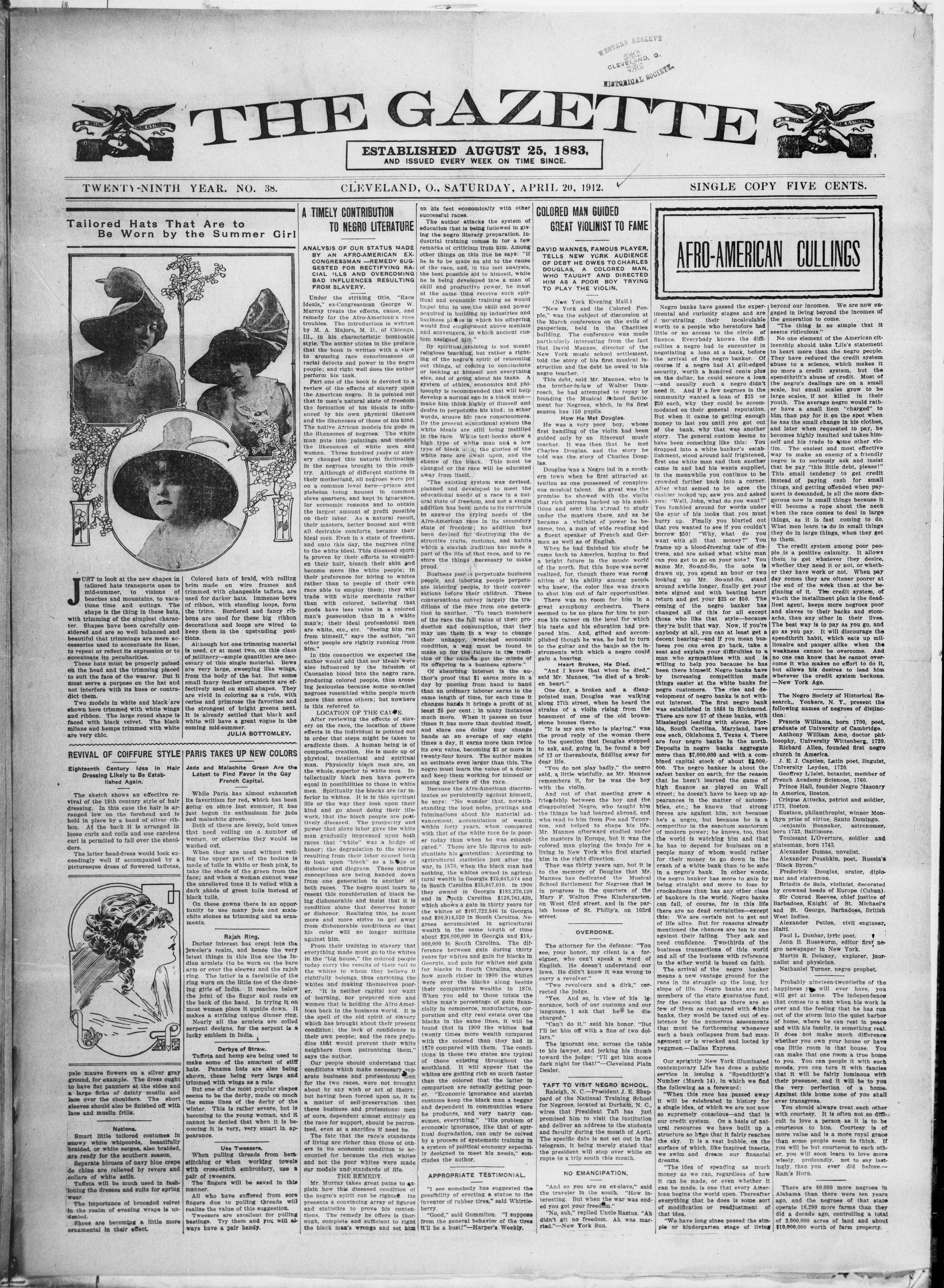
JUST to look at the new shapes in tailored hats transports ones to mid-summer, to visions of beaches and mountains, to vacation time and outings. The shape is the thing in these hats, with trimming of the simplest character. Shapes have been carefully considered and are so well balanced and beautiful that trimming are mere accessories used to accentuate its lines, to repeat or reflect its expression or to accentuate its peculiarities. These hats must be properly polished on the head and the trimming placed to suit the face of the wearer. But it must serve a purpose on the hat and not interfere with its hues or contradict them. Two models in white and black are shown here trimmed with white wings and ribbon. The large round shape is faced with black velvet. The black milans and hems trimmed with white are very chic.
Eighteenth Century idea in Hair Dressing Likely to Be Established Again.
The sketch shows an effective revival of the 18th century style of hair dressing. In this case the hair is arranged low on the forehead and is held in place by a band of silver ribbon. At the back it is arranged in loose curls and coils and one careless curl is permitted to fall over the shoulders.
The latter head-dress would look exceedingly well if accompanied by a picturesque dress of flowered taffetas.
pale mauve flowers on a silver gray ground, for example. The dress ought to have flat panniers at the sides and a large fichu of dainty muslin and lace over the shoulders. The short sleeves should also be finished off with lace and muslin frills.
Smart little tailored costumes in snowy white whippoards, beautiful braided, or white serges, also braided, are ready for the southern season.
Separate blouses of navy blue crepe de chine are relieved by revers and collars of white satin.
Taffeta will be much used in fashioning the dresses and suits for spring wear.
The importance of brocaded velvet in the realm of evening wraps is undenied.
Shoes are becoming a little more ornamental in their effect.
THE GAZETTE
Colored hats of braid, with rolling brim made on wire frames and trimmed with changeable tafeta, are used for darker hats. Immense bows of ribbon, with standing loops, form the trims. Bordered and fancy ribbons are used for these big ribbon decorations and loops are wired to keep them in the upstanding positions.
Although but one trimming material is used, cr at most two, on this class of millinery -ample quantities are necessary of this single material. Bows are very large, sweeping like wings, from the body of the hat. But some small feather feather ornaments are effectively used on small shapes. They are vivid in coloring as a rule, with cerise and primrose the favorites and the strongest of bright greens next. It is already settled that black and white will have a great vogue in the coming mid-summer.
JULIA BOTTOMLEY.
Jade and Malachite Green Are the Latest to Find Favor in the Gay French Capital.
While Paris has almost exhausted its favoritism for red, which has been going on since last summer, it has just begun its enthusiasm for jade and malachite green.
Both of these are lovely, bold tones that need velling on a number of women, or otherwise they would be washed out.
When they are used without velling the upper part of the bodice is made of tulle in white or flesh pink, to take the shade of the green from the face; and when a woman cannot wear the unrelieved tone it is velled with a dark shade of green tulle instead of black tulle.
On these gowns there is an opportunity to use many jade and malachite stones as trimming and as ornaments.
Rajah Ring.
Durbar interest has crept into the jeweler's realm, and hence the very latest things in this line are the Indian armlets (to be worn on the bare arm or over the sleeve) and the rajah ring. The latter is a facsimile of the ring worn on the little toe of the dancing girls of India. It reaches below the joint of the finger and rests on the back of the hand. In trying it on most women place it upside down. It makes a striking unique dinner ring.
Nearly all the armets are colled serpent designs, for the serpent is a lucky emblem in India.
Derbys of Straw.
Tuffeta and hemp are being used to make some of the smartest of stuff hats. Panama hats are also being shown, these being very large and trimmed with wings as a rule. But one of the most popular shapes seems to be the derby, made on much the same lines of the derby of the winter. This is rather severe, but is becoming to the young woman, and it cannot be denied that when it is becoming it is very, very smart in appearance.
Use Tweezers.
When pulling threads from hemstitching or when working towels with cross-stitch embroidery, use a pair of tweezers.
The fingers will be saved in this manner.
All who have suffered from sore fingers due to pulling threads will realize the value of this suggestion.
Tweezers are excellent for pulling bastings. Try them and you will always have a pair handy.
ESTABLISHED AUGUST 25, 1883 AND ISSUED EVERY WEEK ON TIME SINCE.
CLEVELAND, O., SATURDAY, APRIL 20, 1912.
A TIMELY CONTRIBUTION TO NEGRO LITERATURE
ANALYSIS OF OUR STATUS MADE BY AN AFRO-AMERICAN EXCONGRESSMAN —REMEDY SUGESTED FOR RECTIFYING RACIAL ILLS AND OVERCOMING BAD INFLUENCES RESULTING FROM SLAVERY.
Under the striking title, "Race Ideals," ex-Congressman George W. Murray treats the effects, cause, and remedy for the Afro-American's race troubles. The introduction is written by M. A. Majors, M. D. of Chicago. It is characteristic in the bumpee style. The author states that the book informs with a view to arousing race consciousness of racial defects and power in the negro people; and right well does the author perform his task.
Part one of the book is devoted to a review of the effects of slavery upon the American negro. It is pointed out that in man's natural state of freedom the formation of his ideals is influenced by his own physical likeness and the likenesses of those of his kind. The native African models his gods in the likenesses of negroes. The white man puts into paintings and models the likenesses of white men and women. Three hundred years of slavery changed this natural inclination in the negroes brought to this country. Although of different stations in their motherland, all negroes were put on a common level here—prince and plebeian being housed in common slave quarters, and kept in ignorance, for economic reasons and to obtain the largest amount of profit possible on their labor. As a natural result, their masters, better housed and with all desirable comforts, became their ideal men. Even in a state of freedom, and unto this day, the negroes cling to the white ideal. This diseased spirit is proven by their efforts to straighten their hair, bleach their skin and become more like white people; in their preference for hiring to whites rather than to people of their own race able to employ them; they will trade with white merchants rather than with colored, believing that goods have less value in a colored man's possession than in a white man's; their ideal professional men are white, etc., etc. "Seeing him run from himself," says the author, "all other people are rightly running from him."
In this connection we expected the author would add that our ideas were also influenced by the infusion of Caucasian blood into the negro race, producing colored people, thus arousing jeasousies because some so-called blacks were more than some others; but nowhere in this referred to
LOCATION OF THE CAUSE.
After reviewing the effects of slavery on the race, the location of these effects in the individual is pointed out in order that steps might be taken to eradicate them. A human being is of composite creation. He is made up of physical, intellectual and spiritual man. Physically black men are, on the whole, superior to white men. Intellectually black men have powers equal in possibilities to those in white men. Spiritually the blacks are far inferior to whites. It is in this spiritual life or the way they look upon their kind and go about doing their work, that the black people are positively diseased. The prosperity and power that slave labor gave the white man gradually impressed upon both races that "white" was a badge of honor; the degradation to the slaves resulting from their labor caused both to look upon "black" as a badge of dishonor and disgrace. These untrue conceptions are being handed down from one generation to another of both races. The negro must learn to resent this consideration of black being dishonorable and insist that it is condition alone that deserves honor or dishonor. Realizing this, he must more and more strive to get away from dishonorable conditions so that his color will no longer militate against him.
From their training in slavery that everything made must go to the whites in the "big house," the colored people today carry the results of their toil to the whites to whom they believe it rightfully belongs, thus enriching the whites and making themselves poorer. "It is neither capital nor want of learning, nor prepared men and women that is holding the Afro-American back in the business world. It is the spell of the old spirit of slavery which has brought about their present condition; the lack of confidence in their own people; and the race prejudice that would prevent their white neighbors from patronizing them," says the author.
Our people should understand that conditions which make necessary separate business and professional men for the two races, were not brought about by any wish or act of theirs; but having been forced upon us, it is a matter of self-preservation that these business and professional men of ours, dependent almost entirely on the race for support, should be patronized, even at a sacrifice if need be.
The fate that the race's standards of living are richer than those of others in its economic condition is accounted for because the rich whites and not the poor whites were made our models and standards of life.
THE REMEDY
Mr. Murray takes great pains to explain how this diseased condition of the negro's spirit can be righted. He presents a convincing array of figures and statistics to prove his contents. The remedy he offers is thorough, complete and sufficient to right the black man's wrongs and set him
on his feet economically with other successful races.
The author attacks the system of education that is being followed in giving the negro literary preparation. Industrial training comes in for a few remarks of criticism from him. Among other things on this line he says: "If he is to be made an aid to the cause of the race, and, in the last analysis, the best possible aid to himself, white he is being developed into a man of skill and productive power, he must at the same time receive such spiritual and economic training as would impel him to use the skill and power acquired in building up industries and business plants in which his offspring would find employment above menials and scavengers, to which ancient custom assigned him."
By spiritual training is not meant religious teaching, but rather a righting of the negro's spirit of reasoning out things, of coming to conclusions or looking at himself and everything else, and of going about his tasks. A system of ethics, economics and philosophy is recommended that will help develop a normal ego in a black man—make him think highly of himself and desire to perpetuate his kind; in other words, arouse his race consciousness. By the present educational system the white ideals are still being instilled in the race. White text-books show a high type of white man and a low type of black man; the glories of the white race are awelt upon, and the shame of the black. This must be changed or the race will be educated away from itself.
"The existing system was devised, planned and developed to meet the educational needs of a race in a natural state of freedom, and not a single addition has been made to its curricula to answer the crying needs of the Afro-American race in its secondary state of freedom; no addition has been devised for destroying the destructive traits, customs, and habits which a slavish tradition has made a part of the life of that race, and to restore the things necessary to make proud.
Business people perpetuate business people, and laboring people perpetuate laboring people, by their conversations before their children. These conversations convey largely the traditions of the race from one generation to another. "To teach members of the race the full value of their production and consumption, that they may use them in a way to change their unhappy, wretched economic condition, a way must be found to make up for the failure in the tradition of the race to put the minds of its offspring in a business sphere."
Of absorbing interest is the author's proof that $1 earns more in a day by passing from hand to hand than an ordinary laborer earns in the same length of time, for each time it changes hands it brings a profit of at least 25 per cent.; in many instances much more. When it passes on four times it has more than doubled itself, and since one dollar may change hands on an average of say eight times a day, it earns more than twice its own value, becoming $3 or more in twenty-four hours. The author makes an estimate even larger than this. The negro must learn the value of a dollar and keep them working for himself or among members of the race.
Because the Afro-American discriminates so persistently against himself, he says: "No wonder that, notwithstanding the loud noise, prattings and fulminations about his material advancement, accumulation of wealth within forty years, when compared with that of the white race he is poorer today than when he was emancipated." These are his figures to substantiate his contention: According to agricultural statistics just after the war, in 1870, when the black man had nothing, the whites owned in agricultural wealth in Georgia $75,641,574 and in South Carolina $35,847,010. In 1900 they owned in Georgia $183,701,120 and in South Carolina $126,761,430, which shows a gain in thirty years for the whites of $107,722,546 in Georgia and $90,914,540 in South Carolina. Negroes accumulated in agricultural wealth in the same length of time about $26,000,000 in Georgia and $14,000,000 in South Carolina. The difference between gain during thirty years for whites and gain for blacks in Georgia, and gain for whites and gain for blacks in South Carolina, shows how much richer in 1900 the whites were over the blacks along their comparative wealths in 1870. When you add to those totals the white man's percentage of gain financially in commerce, manufacture, corporation and city real estate over the blacks in the same lines, it will be found that in 1900 the whites had twenty times more wealth compared with the colored than they had in 1870 compared with them. The conditions in these two states are typical of those existing throughout the southland. It will appear that the whites are getting rich so much faster than the colored that the latter in comparison are actually getting poorer. "Economic ignorance and slavish customs keep the black man a beggar and dependent in communities where he produces, and very nearly consumes, everything." "His problem of economic ignorance, like that of spiritual degradation, can only be solved by a process of systematic training in a system of political economy especially designed to meet his needs," concludes the author.
APPROPRIATE TESTIMONIAL.
"I see somebody has suggested the possibility of erecting a statue to the inventor of rubber tires," said Whirteberry.
"Good," said Gummiton. "I suppose from the general behavior of the tires it'll be a bust!"-Harper's Weekly.
COLORED MAN GUIDED
GREAT VIOLINIST TO FAME
DAVID MANNES, FAMOUS PLAYER,
TELLS NEW YORK AUDIENCE
OF DEBT HE OWES TO CHARLES
DOUGLAS, A COLORED MAN,
WHO TAUGHT AND DIRECTED
HIM AS A POOR BOY TRYING
TO PLAY THE VIOLIN.
(New York Evening Mail.)
"New York and the Colored People," was the subject of discussion at the March conference on the evils of papermasters held in the Charities building. The conference was made particularly interesting from the fact that David Mannes director of the New York music school settlement, told the story of his first musical instruction and the debt he owed to his negro teacher.
This debt, said Mr. Mannes, who is the brother-in-law of Walter Damrosch, he had attempted to repay by founding the Musical School Settlement for Negroes, which, in its first season has 150 pupils.
How He Met Douglas.
He was a very poor boy, whose first handling of the violin had been guided only by an illiterant music teacher. It was then that he met Charles Douglas, and the story he told was the story of Charles Douglas.
Douglas was a Negro lad in a southern town when he first attracted attention as one possessed of conspicuous musical talent. So great was the promise he showed with the violin that rich patrons backed up his ambitions and sent him abroad to study under the masters there, and as he became a violinist of power he became, too, a man of wide reading and a fluent speaker of French and German as well as of English. When he had finished his study he came back to America, hoping to find a bright future in the music world of the north. But this hope was never realized, for, though there was recognition of his ability among people who knew, the color line was drawn to shut him out of fair opportunities. There was no room for him in a great symphony orchestra. There seemed to be no place for him to pursue his career on the level for which his taste and his education had prepared him. And, gifted and accomplished though he was, he had to turn to the guitar and the banjo as the instruments with which a negro could gain a hearing.
Heart Broken. He Died.
HEART BROKEN, He Died.
"And I know that when he died," said Mr. Mannes, "he died of a broken heart."
One day, a broken and a disappointed man, Douglas was walking along 27th street, when he heard the strains of a violin rising from the basement of one of the old brown-stone houses there.
"It is my son who is playing," was the proud reply of the woman there to the question that Douglas stopped to ask, and, going in, he found a boy of 13 or thereabouts, fiddling away for dear life.
"You do not play badly," the negro said, a little wistfully, as Mr. Mannes remembers it, for he was the boy with the violin.
And out of that meeting grew a friendship between the boy and the disappointed Negro, who taught him the things he had learned abroad, and who read to him from Poe and Tennyson, and helped to shape his life. Mr. Mannes afterward studied under the masters in Europe, but it was the colored man playing the banjo for a living in New York who first started him in the right direction.
Theae was thirty years ago, but it is to the memory of Douglas that Mr. Mannes has dedicated the Musical School Settlement for Negroes that is in progress in the quarters of the Mary F. Walton Free Kindergarten, on West 63rd street, and in the parish house of St. Philip's, on 103rd street.
OVERDONE.
The attorney for the defense: "You see, your honor, my client is a foreigner, who can't speak a word of English. He doesn't understand our laws. He didn't know it was wrong to carry a revolver."
"Two revolvers and a dirk," corrected the judge.
"Yes. And so, in view of his ignorance, both of our customs and our language, I ask that he be discharged."
"Can't do it," said his honor. "But I'll let him off with a fine of two dollars."
The ignorant one, across the table to his lawyer, and jerkling his thumb toward the judge: "I'll get him some dark night for that!"—Cleveland Plain Dealer.
TAFT TO VISIT NEGRO SCHOOL.
TAFT TO VISIT NEGRO SCHOOL
Raleigh, N. C.-President J. E. Sheppard of the National Training School for Negroes, located at Durham, N. C., wires that President Taft has just promised him to visit the institution and deliver an address to the students and faculty during the month of April. The specific date is not set out in the telegram, it being merely stated that the president will stop over while en ropte to a trip south this month.
NO EMANCIPATION.
"And so you are an ex-slave," said the traveler in the south. "How Interesting. But when the war was ended you got your freedom." "No, suh," replied Uncle Rastus. "Ah didn't git no freedom. Ah was married."—New York Sun.
AFRO-AMERICAN CULLINGS
Negro banks have passed the experimental and curiosity stages and are now strating their incalculable worth to a people who heretofore had little or no access to the circle of finance. Everybody knows the difficulties a negro had to encounter in negotiating a loan at a bank, before the arrival of the negro banker. Of course if a negro had A1 gilt-edged security, worth a hundred cents plus on the dollar, he could secure a loan—and usually such a negro didn't need it. And if a few negroes in the community wanted a loan of $25 or $50 each, why they could be accommodated on their general reputation. But when it came to getting enough money to last you until you got out of the bank, why that was another story. The general custom seems to have been something like this: You dropped into a white banker's establishment, stood around half a frightened, first one white man and then another came in and had his wants supplied, in the meanwhile you continue to be crowded further back into a corner. After what seemed to be ages the cashier looked up, saw you and asked you: "Well, John, what do you want?" You fumbled around for words under the spur of his looks that you must hurry up. Finally you blurred out that you wanted to see if you couldn't borrow $50: "Why, what do you want with all that money?" You frame up a blood-freezing take of distress, and are asked what white man can you get to go on your note? You name Mr. So-and-So, the note is drawn up, you spend an hour or two looking up Mr. So-and-So, stand around awhile longer, finally get your note signed and with22 beating heart return and get your $25 or $50. The coming of the negro banker has changed all of this for all except those who like that style—because they're built that way. Now, if you're anybody at all, you can at least get a decent hearing—and if you mean business you can even go back, take a seat and explain your difficulties to a man who sympathizes with and is willing to help you because he has been there himself. Negro banks have by increasing competition made things easier at the white banks for negro customers. The rise and development of negro banks is not without interest. The first negro bank was established in 1888 in Richmond. There are now 57 of these banks, with Mississippi listed with eleven. Florida, South Carolina, Maryland, have one each, Alabama, 2. Texas 4. There are four negro banks in the north Deposits in negro banks aggregate more than $7,000,000 and with a combined capital stock of about $2,000,000. The negro banker is about the safest bank on earth, for the reason that he hasn't learned the game of high finance as played on Wall street; he doesn't have to keep up appearances in the matter of automobiles, etc.; he knows that strong forces are against him, not because he's a negro but because he is a competitor in the sanctum sanctorum of modern power; he knows, too, that the world is watching him and that he has to depend for business on a people many of whom would rather for their money to go down in the crash of a white bank than to be safe in a negro's bank. In other words the negro banker has more to gain by being straight and more to lose by crookedness than has any other class of bankers in the world. Negro banks can fall, of course, for in this life there are no dead certainties—except this: We are certain not to get out of life alive. But for reasons already mentioned the chances are ten to one against their falling. They ask and need confidence. Two-thirds of the business transactions of this world and all of the business with reference to the other world is based on faith.
The arrival of the negro banker means a new vantage ground for the race in its struggle up the long, levy slope of life. Negro banks are not members of the state guarantee fund, for the reason that as there are so few of them as compared with white banks, they would be taxed out of existence by the numerous assessments that must be forthcoming whenever such a bank collapses from bad management or is wrecked and looted by yeggmen—Dallas Express.
Our sprightly New York illuminated contemporary Life has done a public service in issuing a "Spendthrift's Number (March 14), in which we find the following as a foreword:
"When this race has passed away it will be celebrated in history for a single idea, of which we are not now so supremely conscious—and that is our credit system. On a basis of natural resources we have built up a structure so huge that it fairly reaches the sky. It is a vast bubble, on the surface of which, like inspired insects, we swim and dream our financial dreams.
"The idea of spending as much money as we can, regardless of how it can be made, or even whether it can be made, is one that every American begins the world upon. Thereafter everything that he does is some sort of modification or readjustment of that idea.
"We have long since passed the simple or kindergarten stage of living
beyond our incomes. We are now engaged in living beyond the incomes of the generation to come.
"The thing is so simple that it seems ridiculous."
No one element of the American citizenship should take Life's statement to heart more than the negro people. They have reduced the credit system abuse to a science, which makes it no more a credit system, but the spendthrift's abuse of credit. Most of the negro's dealings are on a small scale, but small scales grow to be large scales, if not killed in their youth. The average negro would rather have a small item "charged" to him than pay for it on the spot when he has the small change in his clothes, and later when requested to pay, he becomes highly insulted and takes himself and his trade to some other victim. The easiest and most effective way to make an enemy of a friendly negro is to seriously ask and insist that he pay "this little debt, please!" This small tendency to get credit instead of paying cash for small things, and getting offended when payment is demanded, is all the more dangerous now in small things because it will become a rope about the neck when the race comes to deal in large things, as it is fast coming to do. What men learn to do in small things they do in large things, when they get to them.
The credit system among poor people is a positive calamity. It allows them to get whatever they desire, whether they need it or not, or whether they have work or not. When pay day comes they are oftener poorer at the end of the week than at the beginning of it. The credit system, of which the installment plan is the deadliest agent, keeps more negroes poor and slaves to their backs and stomachs, than any other in their lives. The best way is to pay as you go, and go as you pay. It will discourage the spendthrift habit, which eats up millionaire and pauper alike when the weakness cannot be overcome. And no one can know that he cannot overcome it who makes no effort to do it, but allows his desires to lead him wherever the credit system beckons. —New York Age.
The Negro Society of Historical Research, Yonkers, N. Y., present the following names of negroes of distinction:
Francis Williams, born 1700, poet, graduate of University of Cambridge. Anthony William Amo, doctor philosophy, University Wittenberg, 1720. Richard Allen, founded first negro church in America.
J. E. J. Captien, Latin poet, linguist,
University Leyden, 1720.
Geoffrey Lalet, botanist, member of French Academy Sciences, 1760.
Prince Hall, founder Negro Masonry in America, Boston.
Crispus Attucks, patrol and soldier,
1773, Boston.
Eustace, philanthropist, winner Month-
nth prize of virtue, Santo Domingo.
Jenjamin Bannaker, astronomer,
born 1732, Baltimore.
Toussaint L'Overture, soldier and
statesman, born 1743.
Alexander Dumas, novelist.
Alexander Poushkin, poet, Russia's
"Black Byron."
Frederick Douglas, orator, diplomat and statesman.
Brindia de Sala, violinist, decorated by crowned heads of Europe (Cuban).
Sir Conrad Reeves, chief justice of Barbadoes, Knight of St. Michael's and St. George, Barbadoes, British West Indies.
Alexander Petion, civil engineer, Haiti.
Paul L. Dunbar, lyric poet.
Jonn B. Russworm, editor first negro newspaper in New York.
Martin R. Delaney, explorer, journalist and physician.
Nathaniel Turner, negro prophet.
Probably nineteen-twentieths of the happiness will ever have, you will get at home. The independence that comes to a man when his work is over and the feeling that he has run out of the storm into the quiet harbor of home, where he can rest in peace and with his family, is something real. It does not make much difference whether you own your house or have one little room in that house. You can make that one room a true home to you. You can people it with such moods, you can turn it with fancies that it will be fairly luminous with their presence, and it will be to you the very perfection of a home. Against this home none of you shall ever transgress.
You should always treat each other with courtesy. It is often not so difficult to love a person as it is to be courteous to him. Courtesy is of more value and is a more royal grace than some people seem to think. If you will be but courteous to each other, you will soon learn to love more wisely, profoundly, not to say lastingly, than you ever did before. Ram's Horn.
There are 80,000 more negroes in Alabama than there were ten years ago, and the negroes of that state operate 16,290 more farms than they did a decade ago, controlling a total of 3,000,000 acres of land and about $10,000,000 worth of farm property.
THE GAZETTE
PUBLISHED EVERY SATURDAY
One Year. $1.50
Six Months. 1.00
Three Months. .50
Subscribers are requested to remit by postoffice money order or registered letter.
Entered at the postoffice in Cleveland Ohio, as second-class matter
Address all communications to
HARRY C. SMITH
Editor and proprietor,
THE GAZETTE,
Blackstone Building, Cleveland, O.
Member Ohio Legislature: 1894
to 1896; 1896 to 1898; 1900 to 1902
THE GAZETTE is the oldest, and has the largest bona fide circulation, double that of any newspaper in the interest of Afro-Americans, published in the state of Ohio, and comparison with any will immediately establish its rank as one of the NEWSIEST AND BEST in the country.
The South seems to have run out of lying "criminal assault" exuses for lynch-murdering members of our race and are continuing their lawless and barbarous business on any old filmy excuse. See our "Doings of the Race" department, elsewhere in this paper.
We believe that it was a white man, with blackened face, that assaulted that white woman in her home at Warwick, near Akron, last week, because of his evident familiarity with the house and even the cellar through which he went in his successful effort to get into the house after being locked out of the front door.
Roosevelt's overwhelming victories in Illinois and Pennsylvania greatly complicate the political situation and indicate the possibility of defeating the re-nomination of President Taft and the probability of the nomination of a "dark horse" candidate. That Senator Foraker will eventually be the nominee of the party is our earnest hope and prayer. Stranger things have happened in Republican national conventions and in our life-time, too.
Hurrah'! for Delegate David Cunningham of Harrison county! As he predicted and promised in his letter to THE GAZETTE (published elsewhere in this paper), his Proposal providing for the elimination of the word "white" from Ohio's Constitution has been adopted by the Ohio Constitutional Convention. All that now remains to be done is to see that the voters of the state pass favorably on the Proposal when it comes time to vote on Ohio's new constitution.
In spite of the earnest plea of our local ministers, Dr. D. J. Starr of Columbus and Judge J. A. Kohler of Akron, white friends, the Ohio Board of Pardons, on last Thursday, refused to reopen the case of Louis H. Peck. We cannot understand or explain their action unless it is based on the color or class-connection of the poor man. If ever a person was entitled to a pardon, it is this poor fellow. Something must be done! The great state of Ohio cannot afford to longer continue to rob an innocent man of his liberty who has served nearly twelve long years in the Penitentiary for a crime that was never committed. We cannot believe that Gov. Judson Harmon is the kind of a man to permit this outrage to continue, in spite of the arbitrary position of the Board or at least some member or members of it. Let our people throughout the state take an interest in the Peck case and send appeals to the Governor and keep it up until we is liberated. Those who live in the cities of Lancaster, Toledo, Cincinnati and Cleveland should also call upon Messrs George Ewing, N. W. Wright, Philip Roettinger and S. D. Dodge. Board members, and insist that Louis H. Peck be freed. Will our leading men in the various cities of the state take an interest in this matter? We sincerely hope so.
In his letter, to be found elsewhere in THE GAZETTE today, Delegate Cunningham, a consistent friend of the race, explains satisfactorily two things, in connection with the Ohio Constitutional Convention, which we know our readers are anxious to know. One thing is, that he has been compelled to care for his Proposal, to eliminate the word "white" from the Ohio Constitution, with little or no help from the very people he is seeking to benefit most by its adoption by the Convention, now, and the people of Ohio, this fall; the other is, that Assistant U. S. Attorney General W. H. Lewis's invitation, to address the Convention, was not rescinded because of his racial connection as the dispatches to the daily papers of the country, last week, would have people think. Thank you, Mr. Cunningham for the communication, and for all you have done and are still trying to do for us. We are heartily ashamed of the inactivity of our people of Ohio in their utter failure to show proper interest in the Cunningham Proposal. It is nothing new to us, however, for we received the very same treatment from them in 1894 and 1896 when we were striving to pass Ohio's Civil Rights' law and the Ohio's Anti-Lynching law, respectively. Will our people ever wake up?
ATTENTION MUSIC-LOVERS!
Tuesday morning, the following tel
egram was received:
New York City, April 16, 1912.
Hon, Harry C. Smith, Editor, GA
ZETTE, Dear Sir:—Kindly wire me at
my expense the exact nature of the
protest-program appearing in the local
columns of THE GAZETTE relative to
the Jerome H. Remick & Co. Cleveland
store and regarding our people.
LESTER A. WALTON.
N Y. Age.
A reply to this telegram was wired immediately on receipt of it, as re requested.
Attention Musicians!
Many of our people have noticed that "The Song Shop" at the corner
of Ontario street and the Public square, conducted by Jerome H. Remick & Co., New York City and De Detroit, has a notice in their Ontario street window to all self-respecting members of our race to stay out of that "shop." There are 20,000 Afro-Americans in this city and all are "musical." Stay out of that "Song Shop" until it shows more respect for us. Pass the word along to all you meet.—THE GAZETTE.
The above clipping is from THE CLEVELAND GAZETTE, and it certainly seems strange that this firm should draw the color line. It is reknow that our hundreds of Colored printed here that our readers may may be familiar with the fact that this company is friendly to the race. We know that the musicians are furnished music free by Remick, yet "The Leader" is anxious to observe what musicians have race pride enough to refuse to play this house's stuff until THE GAZETTE informs us that the sign has been removed. The writer is a vocalist and promises to play either old or new until an anlogy for this insult to the race is made—be briot Leader.
The above breathes the proper spirit and indicates a race loyalty and pride we wish was far more general as well as far more active. The facts are that the local Jerome H. Remick & Co. store persists, in spite of the personal and other protests of our ministers, people and papers, in keeping in one of its main show windows on one of Cleveland's main thoroughfares, an insulting, moving caricature of the "Negro," as rediculously gotten up as it was possible to have it. We have sent protests to the Jerome H. Remick Co., at its headquarters in New York city and Detroit, but in vain. It is, therefore, necessary that every self and race respecting member of the race in the three cities named, as well as all others through out the country, should discontinue their patronage of the Remick stores, and induce all others to do so also, they can. Strike back! when you are thus insulted and held up to ridicule, especially when it is done in so public and inexcusable a manner.
BENSON'S SUCCESSOR.
Columbus, O.—Gov. Harmon has appointed H. M. Cullinin (white) of Henry County, a trustee of Ohio University at Athens, to succeed James Cullinin (deceased) of Cleveland. The last named was a member of the race.
M'INNIS' BUM WING MENDED
Crack Little First Baseman of Champion Athletics Throws With More Speed Than Other Players.
The best news of the Athletics' training trip developed at San Antonio, when Manager Connie Mack announced that the injured right arm of Jack McInnis, the star first baseman and member of the $100,000 infield, had entirely healed.
Ever since a ball pitched by Mullin of Detroit injured the arm last September, cracking one of the bones of the wrist, a fear has been entertained by many that McInnis would not be right for this season.
McInnis had hoped to get in the world's series last fall, but could not throw enough, though he was per-
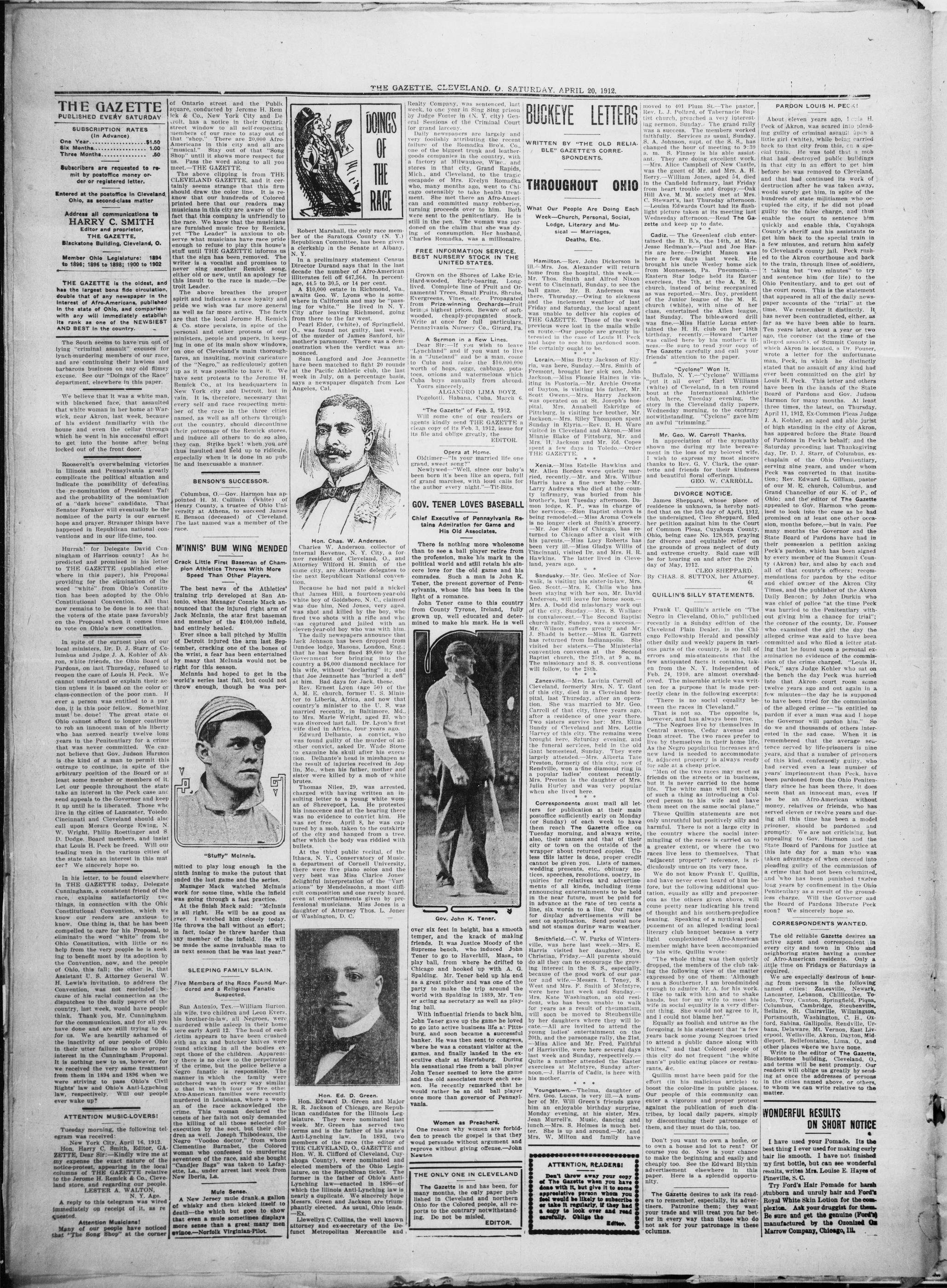
"Stuffy" McInnis.
mitted to play long enough. In the ninth inning to make the putout that ended the last game and the series. Manager Mack watched Mchnis work for some time, while the infield was going through a fast practice. At the finish Mack said: "Mchnis is all right. He will be as good as ever. I watched him closely today. He throws the ball without an effort; in fact, today he threw harder than any member of the infield. He will be made the same invaluable man to as next season that he was last year."
SLEEPING FAMILY SLAIN.
Five Members of the Race Found Mur
dered and arrested Fanatic
Suspected.
San Antonio, Tex.—William Burton-ons wife, two children and Leon Evers, his brother-in-law, all Negroes, were murdered while asleep in their home here early April 12. The head of each victim appears to have been crushed with an ax and butcher knives were found sticking in all the bodies except those of the children. Apparently there is no clew to the perpetrator of the crime, but the police believe a Negro fanatic is responsible. The manner in which the family were murdered in every in every similar to that in which four or five other Afro-American families were recently murdered in Louisiana, where a woman of the race acknowledged the crime. This woman declared the tenets of her faith not only demanded the killing of all those selected for execution by the sect, but their children as well. Joseph Thibodeaux, the Negro "Voodoo doctor," from whom elephant bait, bet, the Colored woman who confessed to murdering seventeen of the race, said she bought "Candier Bags" was taken to Lafayette, La., under arrest last week from New Iberia, La.
Mule Sense.
A New Jersey mule drank a gallon of whiskey and then kicked itself to death—the which but goes to show that even a mule sometimes displays more sense than a great many men swine—Norfolk Virginian-Pilot
THE GAZETTE, CLEVELAND, O. SATURDAY, APRIL 20. 1912
DOINGS OF THE RACE
Robert Marshall, the only race member of the Saratoga County (N. Y.) Republican Committee, has been given a clerkship in the Senate at Albany, N. Y.
In a preliminary statement Census Director Durand says that in the last decade the number of Afro-American illiterates fell of 447,344. In percentage 44.5 to 30.5 or 14 per cent.
A $10,000 estate in Richmond, Va., awaits Geo. W. Lyons who is somewhere in California and may be “passing for white.” He lived in N. Y. City after leaving Richmond, going from there to the far west. He was a white (white) of Springfield, O. was found not guilty, last week of the murder of James Sanford, his mother’s paramour. There was a demonstration when the verdict was announced. Sam Langford and Joe Jeannette have been matched to fight 20 rounds at the Pacific Athletic club, the last week on a percentage basis says a newspaper dispatch from Los Angeles, Cal.
Hon. Chas. W. Anderson.
Charles W. Anderson collector of Internal Revenue, N. Y. City, a former resident of Cleveland, O., and Attorney Wilford H. Smith of the same city, are Alternate delegates to the next Republican National convention. Because he had not paid a nickel that James Hill, a fourteen-year-old white boy of Goldsboro, N. C. claimed was due him, Ned Jones, very aged, was shot and killed by the boy, who fired two shots with a rifle and who was captured and jailed with an eleven-year-old boy who was with him. The daily newspapers announce that Jack Johnson has been dropped from Dundee lodge, Masons, London, Eng.; that he has been fined $9,600 by the Government for bringing into the courtroom 900 dollars for his wife, without "declaring" it; and that Joe Jeannette has "hurled a def" at him. Bad days for jack, these.
Rev. Ernest Lyon (age 50) of the A. M. E. church, former U. S. Minister to Liberia, Africa, and now that country's minister to the U. S. was married recently, in Baltimore, Md., to Mrs. Marile Wright, aged 23, who was divorced last fall. Dr. Lyon's first wife died in Africa, four years ago, and Dahlan's a count, who was guilty of the murder of another convict, asked Dr. Wade Stone to examine his skull after his execution. Delhante's head is mismaken as the result of injuries received in Joplin, Mo. when his father, mother and sister were killed by a mob of white brutes. Thomas Niles, 29, was arrested, charged with having written an insulting letter to a young white woman of Shreveport, La. He protested his innocence and at the hearing there was no evidence to convict him. He was set free. April, he was set free a mob, taken to the skirts of the city and hanged from a tree, after which the body was riddled with bullets.
At the third public recital, of the Ithaca, N. Y., Conservatory of Music a department of Cornell University there were five piano solos and the tenor solo of the delightful interpretation of the "Variations" by Mendelssohn, a most difficult composition and one rarely heard even at entertainments given by professional musicians. Miss Jones is a member of the Thos. L. Jones of Washington, D. C.
J. H. H.
Hon. Edward D. Green and Major R. R. Jackson of Chicago, are Republican candidates for the Illinois Legislature. They were nominated last week. Mr. Green has served two terms and is the father of his state's Anti-Lynching law. In 1893, two members of the race (the editor of THE CLEVELAND, O., GAZETTE and Hon. W. R. Clifford of Cuyahoga County), were nominated and elected members of the Ohio Legislature on the Republican ticket. The lawyer is the father of Ohio's Anti-Lynching law—enacted in 1896 of which the Illinois Anti-Lynching law is nearly a duplicate. We sincerely hope Messrs. Green and Jackson are triumphantly elected. As usual, Ohio leads.—Ex. Llewellyn C. Collins, the well-known attorney and ex-secretary of the Defunct Metropolitan Mercantile and
Realty Company, was sentenced, last week, to one year in Sing Sing prison by Judge Foster in (N. Y. city) General Sessions of the Criminal Court for grand larceny. Daily newspapers are largely and very foolishly attributing the recent arrest of Mr. Romadka, one of the biggest trunk and leather goods companies in the country, with a factory at Milwaukee, Wisc., and stores in that city, Grand Rapids, Mich., and Cleveland, to the tragic escape of Mrs. Evelyn Romadka who, many months ago, went to Chicago ostensibly to take health treatment. She met there an Afro-American and committed many robberies, turning proceeds over to him. Both were sent to the parliamentary. He is still the woman she was dined on on the claim that she was dying of consumption. Her husband Charles Romadka, was a millionaire
FREE INFORMATION SERVICE.
BEST NURSES IN THE
WESTERN STATE
Grown on the Shores of Lake Erie, Hard-wooded, Early-bearing, Long-lived. Complete line of Fruit and Ornamental Trees, Small Fruits, Shrubs Evergreen, Vines, etc. Propagated from *Prince-winning* Orchards—fruit bins; highest prices. Barew of soft wooded, cheaply-propagated stock Write at once for full particulars Pennsylvania Nursery Co., Girard, Fa
A Sermon in a Few Lines
Dear Sir:—If you wish to leave "Lynchland" and if you want to live in a "Juneland" and be a man, come to Cuba and raise the $10,000,000 worth of hogs, eggs, cabbage, potatoes, onions and watermelons which Cuba buys annually from abroad. Yours sincerely,
ALGANDRO LIMA BOYZ,
Pogolottl, Habana, Cuba, March 6.
"The Gazette" of Feb. 3, 1912.
Will some one of our readers or agents kindly send THE GAZETTE a clean copy of its Feb. 3, 1912, issue for its file and oblige greatly, the EDITOR.
Opera at Home.
Oldimer—"Is your married life one grand, sweet song?" Newlywed—"Well, since our baby's been born it's been like an opera, full of grand marches, with loud calls for the author every night."—"Tit-Bits.
GOV. TENER LOVES BASEBALL
Chief Executive of Pennsylvania Retains Admin Role Game and
Admin Role Assigned
There is nothing more wholesome than to see a ball player retire from the profession, make his mark in the political world and still retain his sincere love for the old game and his comrades. Such a man is John K. Tener, the present governor of Pennsylvania, whose life has been in the light of a romance.
John Tener came to this country from County Tyrone, Ireland, fully grown up, well educated and determined to make his mark. He is well
X
Gov. John K. Tener.
over six feet in height, has a smooth temper, and the knack of making friends. It was Justice Moody of the Supreme bench, who induced John Tener to go to Haverhill, Mass., to play ball, from where he offered to Miles and hooked up with A. G. Spalding. Mr. Tener held up his end as a great pitcher and was one of the party to make the trip around the world with Spalding in 1889, Mr. Tener acting as secretary as well as playing hall
With influential friends to back him, John Tener gave up the game he loved to go into active business life at Pittsburg, and soon became a successful banker. He was then sent to congress, where he was a constant visitor at the games, and finally landed in the executive chair at Harrisburg. During his sensational rise from a ball player John Tener seemed to love the game and the old associates more each season. He recently remarked that he would rather be an old ball player once more than governor of Pennsylvania.
Women as Preacher
One reason why women are forbidden to preach the gospel is that they woud persuade without argument and reprove without giving offense.—John Newton
THE ONLY ONE IN CLEVELAND
The Gazette is and has been, for many months, the only paper published in Cleveland and northern Ohio for the Colored people, all reports to the contrary notwithstanding. Do not be misled.
EDITOR.
BUCKEYE LETTERS
WRITTEN BY "THE OLD RELIA
BLE" GAZETTE'S CORRE-
SPONDENTS.
THROUGHOUT OHIO
Hamilton—Rev. John Dickerson is ill—Mrs. Jos. Alexander will return home from the hospital, this week. Mr. Thos. Smith and Alfred Nixon went to Cincinnati, Sunday, to see the children there. There, Thursday—Owing to sickness and the inclement weather of last Friday and Saturday, the local agent was unable to deliver his copies of THE GAZETTE. Those of the week previous were lost in the mails while en route—Our people are greatly in need. We are H Pack and hope to see him pardoned soon. He certainly ought to be.
Lorain.—Miss Betty Jackson of Elyria, was here, Sunday.—Mrs. Smith of Fremont, brought her sick son, John Jackson.—Miss Flossie Haines is visiting in Fostoria.—Mr. Archie Owens of Dayton, is visiting his father, Mr. Scott Owens.—Mrs. Harry Jackson was operated on at St. Joseph's hospital. Mrs. Annabell Eskridge of Pittsburgh, is visiting her brother, Mr. Jackson.—Mrs. Riley Thompson spent a week in Cleveland.—R. H. Were visited in Cleveland and Akron.—Miss Minnie Blake of Pittsburgh, Mr. and Mrs. H. Jackson and Mr. Ed. Copes spent a few days in Toledo.—Order THE GAZETTE.
Xenia.—Miss Estelle Hawkins and Mr. Allen Borden were quietly married, recently.—Mr. and Mrs. Wilbur Harris have a fine new baby.—Mr. Larry Andrews who died at the county infirmary, was buried from his brother's, last Tuesday afternoon. Do you remember the services — Zion Baptist church is being remodeled.—Miss Aroma Cowles is no longer clerk at Smith's grocery.—Mr. Joe Miles of Chicago, has returned to Chicago after a visit with his parents.—Miss Lacy Roberts has returned to Chicago.—Miss Cincinnati, visited Dr. and Mrs. H. R. Hawkins. The latter lived in Cleveland, years ago.
Sandusky.—Mr. Geo. McGee of Nor walk, is visiting his sister-in-law, Mrs. Geo. Scott.—Mrs. E. Chilis who has been staying with her son, Mr. David Anderson, will leave for home soon.—Mrs. A. Dodd did missionary work out of the city, Sunday.—Mrs. S. Wallace is convalescent.—The Second Baptist church rally, Sunday, was a success.—Mr. Wilson suffers greatly and Mr. Dodd is better.—B. Garrett has returned to Indiana. She has visited her sisters. The Ministerial convention convenes at the Second Baptist church, the 25th, at 9 a. m. The missionary and S. S. conventions will follow, to the 28th.
Zanesville.—Mrs. Lavinia Carroll of Cleveland, formerly Mrs. N. T. Gant of this city, died in a Cleveland hospital, last Thursday, after an operation. She was married to Mr. Geo. Carroll of that city, three years ago, after a residence of one year there. Mrs. Phila Bundy of Cleveland and Mrs. Lottie Harvey of this city. The remains were brought here, Saturday evening, and the funeral services, held in the old Gant homestead, Sunday. They were largely attended—Mrs. Alberta Tate Preston, formerly of this city, now of Cleveland. Mrs. Preston is a popular ladies' contest, recently. Mrs. Preston is the daughter of Mrs. Julia Hurley and was very popular when she lived here.
Correspondents must mail all letters for publication at their main postoffice sufficiently early on Monday (or Sunday) of each week to have them reach The Gazette office on Tuesday morning, and always write, also, their names and that of their parents. In the case of a wrapper about returned copies, Unless this latter is done, proper credit cannot be given you. Lists of names, wedding presents, etc., obituary notices, speeches, resolutions, poetry, inquiries for relatives and advertisements. Ninds, including items encouraging enquiries in the near future, must be paid for in advance at the rate of ten cents a line, six words to a line. Our rates for display advertisements will be sent on application. Send postal note and not stamps during warm weather.
Smithfield.—C. W. Parks of Wintersville, was here last week.—Mrs. E. Harris visited her daughter, Mrs. Christian, Friday.—All parents should do all they can to encourage the growing interest in the S. S., especially, the Christian faith, for tor and wife.—Messrs. I. Toney, S. West and Mrs. F. Smith of McIntyre were here last week and Sunday.—Mrs. Kate Washington, an old resident, who has been unable to walk for years as a result of rheumatism, will soon be moved to Steubenville, where she will be attending the cate.—All are invited to attend the young ladies' entertainment on the 20th, and the parsonage rally, the 21st.—Miss Alice and Mr. Fred. Faithful of Harrisville, were here several days last week and Sunday, respectively.—Quite a number attended the Easter Sunday afternoon.—Harris of Cadiz, is here with his mother.
Youngstown—Thelma, daughter of Mrs. Geo. Lucas, is very ill—A number of Mr. Will Green's friends gave him an enjoyable birthday surprise, Monday evening, at his sister, Mrs. W. Holmes, in lunch—Mrs. S. Holmes is much better. She is up and around—Mr. and Mrs. W. Milton and family have
Don't throw away your copy of The Gazette when you have done with it, but give it to some appreciative person whom you feel would be likely to subscribe or take it regularly, if they had a chance to read carefully. Oblige the
moved to 401 Plum St.—The pastor, Rev. L. J. Pollard, of Tabernacle Baptist church, preached a very interesting sermon. Sunday. The grand rally was a success. The members worked faithfully. Services as usual, Sunday. S. A. Johnson, supt. of the S. S. has changed the hour of meeting to 9:30 a. m. S. Finney is his able assistant. They are doing excellent work. Mrs. Alice Campbell of New Castle was the vice president of H. Berry—William Jones, aged 54, died in the Canfield Infirmary, last Friday from heart trouble and dropsy.—Oak Hill Ave. M. M. society met at Mrs. C. Stewart's, last Thursday afternoon.—Louisa Edwards Court had its flashlight picture taken at its meeting last Wednesday afternoon.—Read The Gazette and keep up to date.
Cadiz. — The Greenleaf club entertained the B. B.'s, the 14th, at Mrs. Jesse Redman's. — Paul and Joe Harris are here. — Dwight Mason was here a few days last week. He brought his uncle Wesley home sick from Monnessen, Pa. Pneumonia. — Eastern Star lodge held its Easter church, instead of being reorganized as was reported. — Mrs. Day, president of the Junior league of the M. E. church (white), with nine of her class, entertained the Allen league last Sunday. The bible-sword drill was fine. — Miss Hattie Lucas entertained the H. H. club on her 18th birthday. — Howard Carter dled them by his art career. — Be sure to read your copy of The Gazette carefully and call your friends' attention to the paper.
"Cyclone" Won It
Buffalo, N. Y.—"Cyclone" Williams "put it all over" Earl Williams (white) of Cleveland, in a ten round bout at the International Athletic club, here, Tuesday evening, the day before. Wednesday morning, to the contrary notwithstanding. "Cyclone" gave him an awful "trimming."
Mr. Geo W. Carroll Thanks
In appreciation of the sympathy shown me during my late bereavement in the loss of my beloved wife, I wish to express my most sincere gratitude to you for your kindness, tette and friends for their kindness and beautiful floral offerings.
DIVORCE NOTICE.
James Sheppard, whose place of residence is unknown, is hereby notified that on the 5th day of April, 1912, the undersigned, Cleo Sheppard, filed her petition against him in the Court of Common Pleas, Cuyahoga County, Ohio, being case No. 128,959, praying for divorce and equitable relief on the grounds of gross neglect of duty and extreme cruelty. Said case will be for hearing on or after the 20th day of May, 1912. CLEO SHEPPARD. By CHAS. S. SUTTON, her Attorney. 6t
QUILLIN'S SILLY STATEMENTS.
Frank U. Quillin's article on "The Negro in Cleveland, Ohio," published recently in a Sunday edition of the Cleveland Plain Dealer, in the Chicago Fellowship Herald and possibly other daily and weekly papers in various parts of the country, is so full of errors and mis-statements that the few antiquated facts it contains, taken from the N. Y. Independent of Feb. 24, 1910, are almost overshadowed. The miserable article was written for a purpose that is made perfectly clear in the following excerpts: "There is no social equality between the races in Cleveland." That is not so. The opposite is, however, and has always been true. "The Negroes live by themselves in Central avenue, Cedar avenue and Dan street. The Negroes prefer to live themselves in the North. As the Negro population increases and new land is needed to accommodate it, adjacent property is always ready for sale at a cheap price.
"Men of the two races may meet as friends on the streets or in business, but it is never carried to the home life. The white man will not think of such a thing as introducing a Colored person to his wife and have them meet on the same social plane." These Quillin statements are not only untruthful but positively silly and harmful. There is not a large city in the country where the social intermingling of the races is carried on to a greater extent, or where the two races live less to themselves. That "adjacent property" reference, is ridiculously untrue on its very face.
We do not know Frank U. Quillin, and have never even heard of him before, but the following additional quotation, equally as silly and preposterous as the others given above, will come pretty near indicating his trend of thought and his southern-prejudice leaning. Speaking of a mythical postponement of an alleged leading local literary club banquet because a very light complexioned Afro-American member might have been accompanied by his wife, Quillin wrote:
"The whole thing was then quietly dropped, the members of the club taking the following view of the matter expressed by one of them: 'Although I am a Southerner, I am broadminded enough to admire Mr. A. for his work. I like to talk with him and to shake hands with him. I am more like wife in social equality is a very different thing. She would not agree to it, and I could not blame her.'"
Equally as foolish and untrue as the foregoing, is his statement that "a few years back some young Negroes tried to attend a public dance along with whites," and that Colored people of this city do not frequent "the white man's" public eating places or restaurants, &c.
Quillin must have been paid for the effort (in his malicious article) to boost the color-line in public places. Our people of this community can enter a vigorous and proper protest against the publication of such diaries, by local daily papers, simply by discontinuing their patronage of them, and they must do this, too.
Don't you want to own a home, or to own a house and lot to rent? 0% course you do. Now is your chance to make the beginning and easily and cheaply too. See the Edward Blyth advertisement elsewhere in this paper. Here is a splendid opportunity.
The Gazette desires to ask its readers to remember, especially, its advertisers. Patronize them; they want your trade and will treat you far better in every way than those who do not for your patronage in these columns.
PARDON LOUIS H. PECK
About eleven years ago, Louis H. Peck of Akron, was scared to pleading guilty of criminal assault upon a little girl (white), while being carried back to that city from this, on a special train. He was told that a mob that had destroyed public buildings in that city in an effort to get him before he was removed to Cleveland, and that had continued its work of destruction after he was taken away, surely could get him, in spite of the hundreds of state militiamen who occupied the city, if he did not plead guilty to the false charge, and thus enable the court to sentence him quickly and enable this, Cuyahoga County's sheriff and his assistants to get him back to the special train in a few minutes, and return him safely to Cleveland's county jail. Peck rushed to the Akron courthouse and back to the train, through lines of soldiers, it 'taking but "two minutes" to and sentence him (for life) to the Ohio Penitentiary, and to get out of the court room. This is the statement that appeared in all of the daily newspaper accounts of the "trial" at the time. We remember it distinctly. It has never been contradicted, either, as far as we have been able to learn. Ten years later, about a year or two, the coroner (at the time of the alleged coroner) of Summit County in which Akron is located, a Dr. Fouser, wrote a letter for the unfortunate man, Peck, in which he distinctly stated that no assault of any kind had ever been committed on the girl by H. Peck. This is the letter and others have been in the hands of the State Board of Pardons and Gov. Judson Harmon for many months. At least three times, the latest, on Thursday, April 11, 1912, Ex-ample Pleas Judge A. Kohler, an Ex-ample and able jurist of high standing in the city of Akron, has appeared before the State Board of Pardons in Peck's behalf, and the Saturday preceding last Thanksgiving day, Dr. D. J. Starr, of Columbus, exchaplain of the Ohio Penitentiary, serving nine years, and under whom Peck was converted in that institution; Rev. Edward L. Gilliam, pastor of our M. E. church, Columbus, and Grand Chancellor of our K. of P. of Ohio; and the editor of The Gazette appealed to Gov. Harmon who promised to look into the case as he had promised on at least one other occasion, months before,—but in vain. For many months the Governor and the State Board of Pardons have had in their possession a petition asking Peck's pardon, which has been signed by every member of the Summit County (Akron) bar, and by each and all of that county's officers; recommendations for pardon by the editor and chief owner of the Akron City Times, and the publisher of the Akron Daily Beacon; by John Durkin who was chief of police "at the time Peck was hurried to the Penitentiary without giving him a chance for trial"; the coroner of the county, Dr. Fouser who examined the girl the day the alleged crime was said to have been committed and who filed a letter stating that he found upon a personal examination no evidence of the commission of the crime charged. "Louis H. Peck," says the judge Kohler who sat on the bench the day Peck was roomed into twelve years ago and again in a few minutes—the day he is supposed to have been tried for the commission of the alleged crime—"is entitled to pardon if ever a man was and I hope the Governor will pardon him." So we do and thousands of others interest in the sad case. When it is remembered that the average sentence served by life-pension is nine years, and that a number of prisoners of this kind, confessedly guilty, who had served even a less number of years' imprisonment than Peck, have been pardoned from the Ohio Penitentiary since he has been there, it does seem that an innocent man, even if he is an Afro-American without money, relatives or friends, who has served eleven or twelve years and during all this time has been a model prisoner, should be pardoned and promptly. We are not criticising, but appealing to Gov. Harmon and the State Board of Pardons for justice at this late day for a man who was taken advantage of when coerced into pleading guilty of the commission of a crime that had not been committed, and who has been punished twelve long years by confinement in the Ohio Penitentiary as a result of the groundless charge. Will the Governor and the Board of Pardons liberate Peck soon? We sincerely hope so.
CORRESPONDENTS WANTED.
The old reliable Gazette desires an active agent and correspondent in every city and town in Ohio and neighboring states having a number of Afro-American residents. Only a little time on Fridays or Saturdays is required.
We are especially desirous of hearing from persons in the following Lancaster, Lebanon, Chillicoath, ledo, Troy, Canton, Springfield, Plaqua, Columbus, Cambridge, Steubenville, Bellaire, St. Clairsville, Wilmington, Portmouth, Washington, C. H., Oxford, Sabina, Gallipolis, Rendville, Urbana, Delaware, M. Vernon, East Liverpool, Wellsville, Akron, Dayton, Middleport, Bellefontaine, Lima, O., and other places where we have none.
Write to the editor of The Gazette, Buckstone building, Cleveland, O., and persons who will promptly. Our readers will oblige us greeting at once the addresses of persons in the cities named above, or others, to whom we can write relative to the matter.
I have used your Pomade. Its the best thing I ever used for making curly hair lie smooth. I have not finished my first bottle, but can see wonderful results, writes Mrs. Louise E. Hayes of Pineville, S. C.
Try Ford's Hair Pomade for harsh stubborn and unruly hair and Ford's Royal White Skin Lotion for the complexion. Ask your druggist for them. Be sure and get the genuine (Ford's manufactured by the Ozonized On Marrow Company, Chicago, Ill.
PURELY PERSONAL
PURCHASE
THE
"GAZETTE" AT
J. S. HALL'S, 3121 Central Ave.
L. SCHWARTZ'S, 2921 Central Ave. Open Sunday.
O. C. SCHROEDER'S, Cuyahoga Bldg. Open Sunday.
ELMER F. BOYD'S, 2804 Central Ave.
F. VALENTINE'S, 2130 Central Ave.
SAM COHEN'S, 2928 Central Ave. Open Sunday,
JOHNSON'S, 3350 Central Ave.
NOTICE TO SUBSCRIBERS:—Subscribers not receiving The Gazette regularly should notify us at once. We desire every copy delivered promptly. We advise our patrons to carefully examine The Gazette's advertisements before making purchases. Business men who advertise in this paper should have the patronage of Afro-Americans. The fact that they advertise is assurance that they want it. Local reading notices (advertisements) ten cents a line (six words in a line.)
FOR RENT—Houses—If you have places to rent or if you want to rent—notify The Gazette.
Wanted—Two girls, immediately, to learn manicuring and hair work. Summer positions. L. Gordon. 2345 Central Av. N. 1293 J.
NOTARY PUBLIC—For such services call at The Gazette office, No. 3 Blackstone Building, No. 1422' W. 3d street, near Superior avenue.
FOR RENT—Furnished rooms with gas and bath. Special accommodations for theatrical people. Room and board. Mrs. I. B. Ambrose, 2285 E. 46th St., Cuy, Phone. Central 2317 L.
Miss P. Holmes of East 43rd street, is ill.
Mr. G. Dean of East 31st street, is visiting in Akron. Miss Alma Blake of Mt. Vernon, is visiting Mrs. L. S. Jones. E. 30th St. Mrs. Harry Lucas of Blaine avenue is visiting her mother, Mrs. A. Taylor in Detroit. Mrs. Williams of Linden court, who recently underwent an operation, is convalescent. Mrs. Douglass and son, of Akron were guests of Mr. and Mrs. C. Ruda of East 36th street. Mr. Summers, an Oberlin student preached very acceptably at St. John's A. M. E. Church, Sunday morning.恩平 Church, Chas. Weaver. Tom Fleming and Max Feidenbaum are Assoiler Fred D. Sampson's assistant in the 11th ward, this year. At Mt. Haven Baptist church, Sun
Miss Cora Annis is visiting out of the city.
Howard Mitchell of Central Ave. was buried, Saturday, from Shiloh Baptist church.
Miss Daisy Underwood and Miss Elizabeth Wheeler who were home, Saturday, will return again today.
Mrs. H. Hollingsworth, Mrs. R. Moby and Mr. Lawson of East 43rd street, who have been quite ill, are convalescent.
Mr. Samuel Barrett will address the Union Club of St. Andrew, Sunday, at 4:30 p. m., in the club rooms.
The committee of our Law & Order Retorn league met at Mr. Walter Brown's, Pine Ave., Monday evening.
The Cuyahoga A.-A. R. league held a meeting and gave a "smoker" at the Elk's hall, 4421 Central Ave. Tuesday evening.
The manufacler's club's last select dancing man of the season was given at Trostler's hall. Thursday evening. It was the usual enjoyable success.
"The Sterling night school sessions have been transferred, for the Spring and Summer, to room 9, Harmon building, corner of E. 20th St. and Woodland Ave., office of Mr. and Mrs. Andy Johnson, 2117 Central Ave, died April 9. Funeral services were held April 11, Rev. Wm. Stone, officiating. Interment in E. Cleveland cemetery. E. F. Boyd, funeral director. Miss Amanda Helvey of Glendale, guest of Mr. and Mrs. Jackson of 2538 E. 30th St., who gave an interesting talk on church, Sunday, visited in Lorain and returned home, the first of the week.
Send your local items to The Gazette on Monday or Tuesday of each week. This paper is published for ALL of our people and "plays no favorites." Everybody is treated the same - fair and right. Take The Gazette and tell your friends to do so also.
Rev. J. J. Cummings of Cincinnati, who conducted a two weeks' revival at St. James A. M. E. church, preached eloquently, Sunday evening, and left, Monday, for home. The ladies of the church are preparing for a May queen entertainment, the 15th. Rev. G. J. Cummings is associated at the church for Mrs. Alvina Carroll (deceased), 54 years of age, held at the family residence, 2215 E. 74th St., and Undertaker E. F. Boyd had charge of the shipment of the remains to Zanesville, Mrs. Carroll died at Lakeside hospital, April 10. Mrs. Geo. Carroll, who died at the hospital after an operation, was taken to her former home. Zanesville, last Saturday, for burial. Brief services were held here at the day, a day after the day, and to leaving with the Mr. Carroll has the sympathy of many friends. See Zanesville letter.
The following were confirmed at St. Andrews P. E. church, recently, by Bishop Leonard: Mr. and Mrs. Ralph Jackson, Mrs. Lena St. John, Ruth Bronaugh, Helen Banks, Mrs. M. B. Whiting, Grace McQueen, Robert Estell, Alva Sanford Thomas, Mrs. Nellie Hawley, Lipcino Mrs. Winnifred Smith, Eugen Brewer, Ida Moore, Mr. Wallace Brien, Madeline Taylor and Wendell Morris.
A civil service examination will be held at 9 a. m. April 23 for superintendents of Woodland, Monroe, Harvard Grove, West Park and Highland cemeteries, jobs paying from $840 to $1,000 a year; superintendents of Brookside and Erie cemeteries, paying from $600 to $720 a year, and yard superintendent at Woodland cemetery, paying $780 a year, 25. at the fire examination for engineers in the fire department will be held. Assistant engineers are eligible.
Many of our people have noticed that "The Song Shop" at the corner of Ontario St., and the Public square, conducted by Jerome H. Remick & Co., N. Y. City and Detroit, has a notice in their Ontario St., window to all self-respecting members of our race to stay out of that "shop." There are 20,000 Afro-Americans in this city and all are "musical." Stay out of that shop, until it shows more respect for us. Pass the word along all you meet. (New York and Detroit race papers, please republish this notice--Ed.)
Call your lady friends' and acquaintances' attention to our up-to-date fashion and pattern departments and thus encourage us to be particularly The Gazette regularly. Oblige the Editor.
Miss Alma Blake of Mt. Vernon, is visiting Mrs. L. S. Jones, 2180 E. 30th St.
Mrs. Harry Lucas of Blaine avenue, is visiting her mother, Mrs. A. Taylor, in Detroit, will Williams of Linden court, who recently underwent an operation, is convalescent.
Mrs. Douglass and son, of Akron, were guests of Mr. and Mrs. C. Rudd of East 36th street.
Mr. Summers, an Oberlin student, preached very acceptably at St. John's, at the University of Chicago, Ernest Burke, Chas. Weaver, Tom Fleming and Max Deenbaum are Assessor Fred D. D. Sampson's assistants in the 11th ward, this year.
At Mt. Haven Baptist church, Sunday, the pastor, Rev. J. L. Burr, will preach in the morning on "Elijah, the man and in the evening on "I Will," B. Y. P. U. and S. S. at the usual hours.
The Dubois Literary club will hold a grand meeting at the Antioch Baptist church, Tuesday evening, April 23, to consider the advisability of Woman's Suffrage. Both gentlemen and ladies are invited and urged to be present. Miss Ruth E. Presley, sec. of the Woman's Suffrage party, will be the principal speaker. Mrs. Ethel Moore Roberson's beautiful new spring hats for ladies and girls are on sale at Mrs. Edith Woods' Dry Goods and Notion Store, 4217 Central Av. Mrs. Roberson is one of the very best milliners in this city and our people should not only feel proud of her and Mrs. Woods' new, neat and up-to-date store, but should patronize those of their descent, are the toughest people and deserving. Go and see for yourself and take a friend or two with you.
The reception, on the 11th, for the Old Folks' Home at Mrs. Richard Blue's, 2250 E. 90th St., was a success, over $15 being realized. About 80 persons attended and listened to a fine program furnished by the following persons: Misses Sadie Skeene, Hazel Mountain, Bertha and Mable Blue, Emma Williams and Ms. Hattie Price. Mrs. Cornelia Montgomery was in charge of the entertainment, owing to the illness of Mrs. Alice Mountain, chairman of the entertainment committee. G. W. Rowe, for seven years chef and steward of the Edgermore Hotel, Asbury Park, N. J., coming directly to Cleveland from here, has purchased W. E. White's restaurant, 2845 Central Ave., opposite E. 29th St., and is serving the best lunches and meals at the most reasonable rates. Mrs. Rowe is assisting her husband at the restaurant and patrons can depend upon clean whooping cats and depend upon clean dogs. Give them a trial and be convinced. Just as soon as possible, a thorough renovation will be given the restaurant and everything improved.
April 22-26 is missionary week at Lane Memorial C. M. E. Church, Cedar Ave. and E. 31st St. The pastor and Woman's Home Missionary Board have secured the services of Cleveland's best missionary workers. The public is cordially invited to attend these special services. The calendar for the week is as follows: Monday evening, Rev. E. H. Smith, pastor of Shiloh Baptist Church, will preach; Tuesday evening, Rev. E. H. Smith, pastor of Shiloh Baptist Church; Wednesday evening, Rev. E. H. Smith, pastor of Cory M. E. Church; Thursday evening, Mrs. W. O. Bowles and Mrs. E. H. Smoot of the Christian and Missionary Alliance will discuss missionary work in the city of Cleveland; Friday evening, Rev. J. E. Thompson, pastor of Mt. Zion Baptist Church. The choirs of the respective churches will furnish music the evening their preaches. The Missionary Orchestra will make for itself an enviable record, will furnish the music for Thursday evening.
Branch No. 2. C. & M. Alliance, has a balance of $157.13 in its treasury, and its Sunday School also has a cash balance of $47.18. Total, in hand $204.31. GOOD! Branch No. 2 is a non-sectarian, interdenominational evangelical organization of Christian people and others, incorporated under Ohio for the spiritual, moral, intellectual, social and industrial welfare of mankind. Its headquarters are located at No. 1914 Woodland Ave., where it conducts a successful religious and social work. Religiously, it has regular, wellattended mission services, an people meeting and a Men's Association. Services held in the open air, hospitals and homes are important features of the work, also. Socially, it operates a rescue home for women and men; a home for children, working girls and others; a lodging room for men and a free library and reading room. Ported will offerings. The church officers' names were nearly all published in THE GAZETTE last week.
** ** ** ** ** ** ** ** **
When your Gazette are not delivered on Friday mornings, call at your Central Postoffice General Delivery Window for them in the afternoon of the same day. —Editor.
HE GAZETTE. CLEVELAND, O. SATURDAY, APRIL 20, 1912.
Geo. Brooks, W. O. Bowles, J. E. Dunjill, Parker Hare and S. E. Woods are our representatives on the C. P. court jury, this term.
The members of the Citizens Rights league and the Co-Workers are expected to convene at Antioch Baptist church, next Tuesday evening at 7:30 p. m., sharp. A special invitation is extended them. Everybody will be welcome. Fine program. No admission charge. Do not miss it.
In a letter to the editor of The Gazette, written April 13, 1912, at Coquimbus, Louis H. Peck wrote: "Please put a letter of thanks in The Gazette to our people of Cleveland and Columbus, their pastors there, for their help did efforts and assistance in recent weeks, and say that I still hope to obtain justice some day, and once at liberty will repay all who have so willing helped, in every way I can. I thank you and all others for all you gave me alone for me and pray God's blessings on you all. I am not discouraged."
Rev. Chas. Hawkins, E. L. evangelist, preached for the Cory M. E. church Epworth League Monday evening. The ladies were all attired in white, and the Willing Workers served refreshments. It is hoped to raise $500 for the church by the last of the month. The ladies will be held. Rev Gale's illustrated sermon, "The Prodigal Son," Sunday morning was thoroughly enjoyed. The Easter service and special music were fine, and the collection for missions was large. The children's drill, Monday evening, will be directed by Mrs. Esther Thomas. It is for the E. L. benefit. The class and prayer meet on Monday, and the testimony to prove. The two ships will start from the S. S. for Africa, Sunday. The Silent Workers and the Wesleyan classes carry a message to Bishop Scott, that they will educate one boy or girl, this year. The class reaching port first will banquet the S. S. when it is hoped 100 new scholars will have their classes with a lishing fitting up its library and putting up the printing press. All young men are welcome to its meeting every Wednesday at 8 p. m.
REAL ENCOURAGING!
But Delegate Cunningham Has To Do the Work Himself—No Help From Our People—The Lewis Invitation.
Ohio Constitutional Convention, Co. Jupitus, April. 15, 1912.
Hon. Harry C. Smith, Editor GA ZETTE, Dear Sir: "Your postal of the 13th just received. The proposal striking the word "white" out of the Ohio constitution stands second on the calendar. The committee neglected to report it out, with the evident opposition of apprehension forty thou sand the vote of our female suffrage suffrages in order to get the word "white" out. I had the committee relieved of the consideration of the bill under the rules of the Convention, and had it placed on the calendar for see and read. It has been engrossed and made ready for consideration any further action, even evening; if not, it will come up to morrow, unless some special order is forced in ahead of it, which I do not intend to allow if I can avoid it. If the measure can be forced to a vote it will pass, I think, without question; the only trouble is to get a vote on it. I will believe she she may believe it will go through either tonight or tomorrow.
As to the invitation, about which you write, to W. H. Lewis, assistant United States Attorney General, the resolution to invite him was acted on favorably and rescinded the next morning, the Convention determining not to hear any more talkers before him. I voted for the retention of the invitation, but a majority of the Convention, on account of the time that would be consumed, passed a resolution that they would not listen to any more talks from any one.
Yours very truly.
D. CUNNINGHAM,
Delegate from Harrison County.
Hurrah for Delegate Cunningham.
Columbus, April 16, 1912.
Hon. Harry C. Smith, Editor Gazette—Desert City.
My Proposal providing for the elimination of the word "white" from the Ohio Constitution, passed in the Ohio Constitutional Convention, this morning and is now all in good shape.
Very truly yours.
DAVID CUNNINGHAM.
Columbus, April 17, 1912
Hon. Harry C. Smith, Editor Gazette
Deer Sir: There was opposition to him
in the Senate. C. C. Cinnahil and some of the (female) sufrages, but it went through with
votes to spare. It received 100 affirmative votes. I do not think any
offert will be made to reconsider the Proposal, as is therefore entirely safe. We had write a fight but we won out all right.
Very truly yours,
D. CUNNINGHAM.
FRATERNAL SOCIETY NEWS
Bv C B Lancaster
Climae Lodge, No. 10 K. of P., will give their annual "smoker" and reunion in the near future.
Cuyahoga Lodge, No. 95, Elks, will celebrate their sixth anniversary at Antichie Baptist Church, May 19.
Eureka Lodge, No. 52, F. and A. M. gave five candidates the E. A. degree last Sunday at Masonic Temple.
Bezeleel Consistory installed officers, Tuesday evening, III. W. R. Johnson, com-in-chief, the work being done by III. Mosby Johnson 33d degree.
C. P. Lancaster, Grand Deputy for Ohio, has visited Youngstown, Toledo, Dayton, Xenia and Springfield. He reports the order of Elks as being in a healthy condition and preparer the Grand Lodge at Dayton in August.
Last Sunday about 100 K. of P. and friends went to Akron and held anniversary services. It was a red-letter day for Akron.
FOR SALE OR TRADE
TREADWELL and GERMANIA
Aves, Mt. Pleasant.
ACME AUTO CO.
Auto Livery. All People Treated Right.
2340 East Ninth Street. 'P.ones North 1231 and Central 4161.
The Best Work Guaranteed!
Rufus S. Justice
Plumbing and Sewer Building
All Work given
Prompt Attention.
Thos P. McPhillips,
2079 E. 30th St.
'Phone Bell North 1075X
The Best Place on Central Ave.,
to get a Good Lunch and Quick Service
J. W. CRAWFORD, PRO'R.,
3133 CENTRAL AVE.
Open Evenings for the Accommodation of the Theater Trade.
Globe Printing Co.,
PRINTERS AND STATIONERS.
1397 East Ninth Street
MISS L.E. WARREN'S
HAIR GROWER
Miss Warren is one of the FIRST
and BEST in her business in
Cleveland, and
Positively Can Grow
Hair
Dealer in First-Class Hair Goods.
3927 Central Ave.
CLEVELAND, OHIO.
'Phone, East 2216X.
McCall's Magazine
and McCall Patterns
For Women
Have More Friends than any other magazine or patterns. McCall's is the reliable Fashion Guide monthly in two volumes, to include Hampstead and homes. Besides showing all the latest designs of McCall Patterns, each is one is brimful of sparkling short stories and helpful information for women.
Save Money and Keep in Style by subscribing for McCall's Magazine at once. Coste only so cents a year, including any one of the celebrated McCall Patterns free.
McCall Patterns Lead all others in style, fit, simplicity, economy and number gold. More dealers all McCall Patterns than any other two makes combined. None higher than 16 cents.
from your dealer, or by mail from
McCALL'S MAGAZINE
236-246 W. 27th St. New York City
Newspaper Copy, Premium Catalogs and Pattern Catalogs free.
DOBIN
QUALITY
NOT
PREMIUMS
The Home of Pure Tea and Coffee.
Cuy, Central 7181 L. Bell Main 1474 J.
Representing DOBIN TEA CO., Japan.
JAPANESE TEA STORE.
23 Taylor Arcade.
DRY GOODS, LADIES' and GENTS'
FURNISHINGS.
J. LOMSKY
3816 and 3820 Central Ave.
Double Stamps on Tuesdays and Fridays.
The Central Business Exchange
FINE HOMES- GOOD BARGAINS—
$22.50 UP. CHOICE LOTS.
TERMS TO SUIT.
Mortgage-loans, Collections, Bonds,
Insurance, Estimates given.
S. E. WOODS.
2828 Central Ave. Phone, North 1230.
Agent for The Gazette.
Making Recovery an Object. The Eskimo gives his doctor a fee as soon as he comes. If the patient recovers, it is kept; if not, it is returned.
Rufus S. Justice
4316 Central Ave. Phone E. 2342-R.
Highest Grade of Tailoring for
Men and Young Men. Ladies'
Suits, Coats and Skirts Made to
Order.
CLEANING, DYEING & REPAIRING.
Goods called for and delivered to all
parts of the city.
BROWN DRUG CO.
"THE MUTUAL STORE."
2742 Central Ave. cor. E. 28th St.
Cut this ad. out and present it at the Brown Drug Co. and receive free sample of B. and M. HAIR DRESSING.
This dressing is especially recommended where the hair is stubborn or curly, as it not only makes the hair soft, glossy and straight, but also easy to dress.
B. and M. Hair Dressing is highly perfumed, has a very beneficial effect on the scalp, and is a splendid hair tonic.
BROWN DRUG CO.
Exclusive Sales Agents.
Call at
G. G. REED'S
Dry Goods and
Gents' Furnishings,
A Complete Line.
Cuy. Central 6661 L
3222 Central Ave., Cleveland, O.
QUINADE
(HAIR POMADE AND TONIC)
Quinade will beautify, improve and preserve the hair. Will remove Dandruff. Price 25 cents. Free sample sent on public mail.
SEEBY'S "QUINACOMB",
a comb made of specially tempered metal so as to retain the proper degree of heat. Used in conjunction with Quinade will remove the curl and straighten the hair. Price, 50 cents.
SEEBY DRUG CO.
NEW YORK
Quinade and Quinacobs are sold in Cleveland by Brown Drug Co. 2742 Central Ave. cor. 28th St.; The People's Drug Store, cor. Central Ave. and E. 33rd St.; Spenzer's Pharmacy, 2146 2150 Central Ave. S. E.; Zeidler's Drug Store, 2511 E. 9th St. cor. Scovill, and druggists in general.
EYE
SQUOFOR
GLASSES
GRACE
THE
FACE
THE GRIP THAT HOLDS
P. A. HOERET,
Optical Specialist.
Eyes Examined Free. Satisfaction Guaranteed.
11 The Taylor Arcade.
Bell, Doan 1398-J, Residence
East 791-L, Office
Dr. Walter S. Biggs,
Dentist.
(A member of the race.)
4715 Central Ave., Cleveland, O.
Hours: 8 to 12 a.m., 1 to 5 p.m.
Sundays and Evenings by
Appointment
FORD'S
HAIR POMADI
MAKES HARSH, RUNNY OR CURLY HAIR
GLOSS, GOTTEN AND MORE PUMA
EASY TO GROW AND PUT UP IN ANY STYL
THE LEFTHAND MAY PERMIT DENECEI
TRY FOORD'S ROLL WHITE
SKIN
MAKES THE SKIN WHITER IMMEDIATELY
UPON APPLICATION, WILL NOT IRRITATE
THE MOST DELICATE SKIN. UNEXCELLED
FOR ECZEMA, SALT RHEUM, PIMPLES,
ROUGH SKIN AND FRECKLES. • • •
SUPPLY YOU WILL SEND IT TO YOU DIRECT AT
THE FOLLOWING PRICES, SMALL SCREED BOTTLE 25%, LARGE SCREED BOTTLE 50% THE OZONIZED OX MARROW CO. 232 LAKE SHORE, CHICAGO, IL
AGENTS WANTED
Travis & Strawder
'Central Transfer Co.'
CAREFUL MOVERS OF FURNI
TURE and PIANOS
Moving Vans
Piano Hoisting a Specialty
Light and Heavy Expressing.
Orders Promptly Attended to.
Prices Reasonable.
Office and Residence:
2903 Central Ave., Cleveland, Ohio.
Cuy. Cen. 8182R.
TELEPHONES:
Bell, Eddy 1100L.
Cuy. Central 1745R.
CHURCHES, SOCIETIES, CLUBS, ETC. Private Parlors for Ladies and Escorts.
Confection co and
2921 Ced
The Magic is two times larger
ATKEL HEATING S
LADIES LOOK
The Magic will not burn or injure bar which irons the hair, is also easyed the comb goes back into place. The Magic Heater is also so handbag.
Pill with alcohol and lighture
Magic Shampoo Drier $1.00 for literature today.
Magic Shampoo Drier
Confectionaries, Cigars, Tobacco and School Supplies. 2921 Central Ave.
THE MAGIC IS TWO TIMES LARGER THAN PICTURE. IT IS 9 IN LENGTH
STEEL HEATING BAR
THE MAGIC SHAMPOO DRIER AND HAIR-STRAIGHTENER
MAILED ANYWHERE IN U.S. $100
POSTAGE PAID.
A LARGE MONTAGE OF POSTAGE OVER
LAIDIES LOOK!
Every lady can have a beautiful and luxurious head of hair if she uses a MAGIC. After a shampoo or bath the Magic dries the hair, removes the dandruff, and is with straightener the curled head of hair.
The Magic will not burn or injure the hair, because the comb is never heated. The steel heating bar which irons the hair, is alone, put into the flame of the alcohol or gas heaters. The Aluminum Comb is easily detached from the heating bar, then, after the bar is heated the comb goes back into place and is held by a turn of the handle.
The Magic Heater is also suitable for curing irons, has a cover and can be carried in a handbag.
Magic Shampoo Driler $1.00. Magic Alcohol Heater $5.00. Liberal terms to agents. Write for literature today.
Magic Shampoo Driler Co. Minneapolis, Minnesota.
Magic Shampoo Drier $10.00. Magic Alcohol Heater $20.00. Liberal terms to agents. Write
Magic Shampoo Drier Co. Minnesota, Minnesota.
MRS. A. M. POPE.
4 years ago my hair was only a finger-length, and my temples were bald half way up my head.
MRS. L. L. ROBERTS.
4 years ago my hair just covered my shoulders.
my head.
first began our wonderful work of growing lengths, and all conditions of hair, even to places of the head, many persons scorned the possible; but we have grown the hair for his success. The proof of the value of our work is and largely by persons whose own hair we further fact that they have very frequent to sell their goods (saying that "theirs is the referred to "PORO." We advise you to use (the oldest and best of its kind.) See that the box, not genuine without it. Prepared only
ware of Imitati
When we first bega
qualities, all lengths, a
hair on bald places of a
thing was possible; b
achieving success. The
ling imitated and large
grown and the further
when trying to sell the
as good") or referred to
Hair Grower. (the olds
is on every box, not
POPE.
Bewar
Cal
MRS. A. M. POP
When we first began our wonderful work of growing all kinds, all qualities, all lengths, and all conditions of hair, even to the growing of hair on bald places of the head, many persons scorned the idea that such a thing was possible; but we have grown the hair for hundreds, achieving success. The proof of the value of our work is that we are situated and largely by persons whose own hair, we have actually grown and the further fact that they have very frequently mentioned us when trying to sell their goods (saying that "theirs is the same" or "just as good") or referred to "PORO." We advise you to use only "PORO" Hair Grower, (the oldest and best of its kind.) See that the name "PORO" is on every box, not genuine without it. Prepared only by MRS. A. M. POPE.
Beware of imitations of
BELL PHONE BOMONT 3109
Pure Beer
Pure Beer Bottled at the Brewery
Order a Case of
Gold Bond
Bottled Beer
THE CLEVELAND & SAND SKY
BREWING COMPANY
Delivered at the Home. Both phones.
Taylor's New Shampoo Dryer
and Hair Straightener!
The Best in the World!
This Comb, properly heated, and the use of Lactose Hair Pomade, will being the most crimpy hair straight and silky at every stroke and cause a rapid growth of the hair.
Don't put it off but send $1.00 and get the comb by return mail.
PRICE OF 00MB $1.
Large, Heavy Strong and Durable. Made of copper and brass attached together and cast into one solid piece, highly polished and tully nickle plated; steel bolt which goes through the large wood handle and screws into metal end. It can in parent's event reimburse it from getting loose or coming off. Remember it all in one piece. Nothing to get out of order, will last a lifetime.
Fill with alcohol and light here
Here is the top!
Price of Hair Straightener and Alcohol Heater complete $1.50.
TAYLOR'S SPECIAL ALCOHOL HEATER is the bandiest and most convenient method of bearder the Comb, and can be closed up so that you can put it in your hand bag. Price $50.
For best results use Lactose Hair Pomade. It not only preserves the dimensions of the Comb Straightener, but promotes a luxurious growth of the hair. Price $25c.
SEND FOR MY FREE CATALOGUE Illustrating the Largest and Most Complete Line of Hair Goods in this country for colored people, such as Bangs, Wigs, Puffs, Switches, Pompadours, Hair Pins, Combs, Brushes, etc.
Agents Wanted.
T. W. TAYLOR, Howell, Mich.
When writing please mention this paper.
M. A. B.
4 years ago my hair just covered my shoulders.
Call, or Address Mail to
We Grew Our Hair Now Let Us Grow Yours With 'PORO'
TRADE MARK
Registered
growing all kinds, all
even to the growing of
learned the idea that such
for hundreds, rapidly
work is we are be-
haire we have actually
frequently mentioned us
is the same or "just
to use only "PORO
that the name "PORO
only by MRS. A. M
ations
to
PINE STREET
ST. LOUIS, MO.