The Gazette
Saturday, April 27, 1912
Cleveland, Ohio
Page text (machine-generated)
TWENTY-NINTH YEAR. NO. 39.
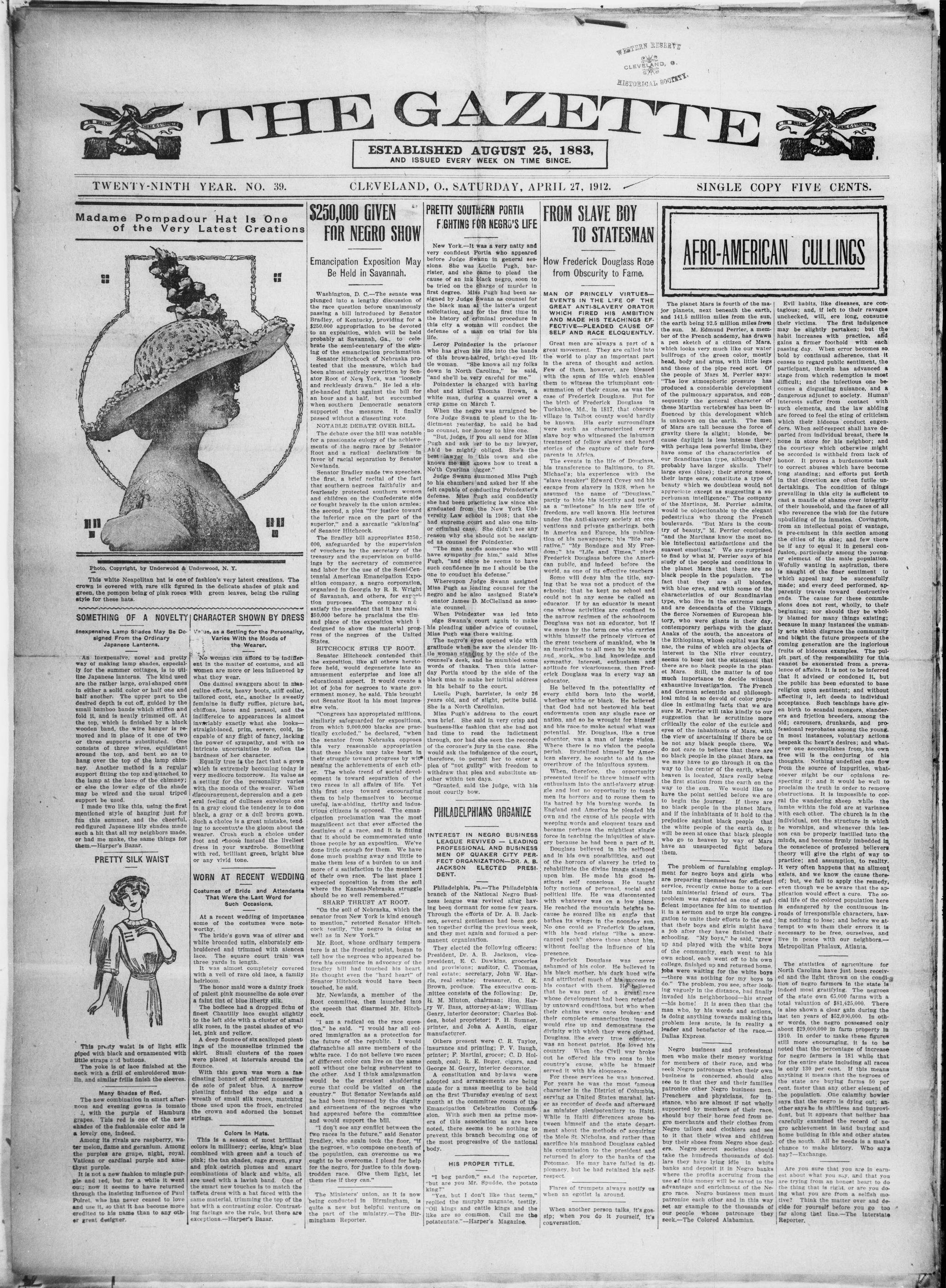
Madame Pompadour Hat Is One of the Very Latest Creations
!
Photo, Copyright, by Underwood & Underwood, N. Y.
This white Neapolitan hat is one of fashion's very latest creations. The crown is covered with rare silk figured in the delicate shades of pink and green, the pompon being of pink roses with green leaves, being the ruling style for these hats.
SOMETHING OF A NOVELTY | CHARACTER SHOWN BY DRESS
IN UBICON
THEM AS ESTHETIC
Madame Pompadour of the Very
Photo, Copyright, by Underwood &
This white Neapolitan hat is one crown is covered with rare silk figure green, the pompon being of pink roses style for these hats.
SOMETHING OF A NOVELTY
Inexpensive Lamp Shades May Be Designed From the Ordinary Japanese Lanterns.
An Inexpensive, novel and pretty way of making lamp shades, especially for the summer cottages, is to utilize Japanese lanterns. The kind used are the rather large, oval-shaped ones in either a solid color or half one and half another. The upper part to the desired depth is cut off, guided by the small bamboo bands which stiffen and fold it, and is neatly trimmed off. At the top, which is finished by a black wooden band, the wire hanger is removed and in place of it one of two or three supports substituted. One consists of three wires, equidistant around the top, and bent so as to hang over the top of the lamp chimney. Another method is a regular support fitting the top and attached to the lamp at the base of the chimney; or else the lower edge of the shade may be wired and the usual triped support be used.
I made two like this, using the first mentioned style of hanging just for fun this summer, and the cheerful, red-figured Japanese lily shades made such a hit that all my neighbors made, or had me make, the same things for them.—Harper's Bazar.
This pretty waist is of light silk piped with black and ornamented with little straps and buttons. The yoke is of lace finished at the neck with a frill of embroidered muslin, and similar frills finish the sleeves.
Many Shades of Red.
The new combination in smart afternoon and evening gowns is tomato 1, with the purple of Hamburg grapes. This red is one of the new shades of the fashionable color and is a lovely one, indeed.
Among its rivals are raspberry, water melon, flame and geranium. Among the purples are grape, night, royal. Vatican or cardinal purple and amethyst purple.
It is not a new fashion to mingle purple and red, but for a while it went out; now it seems to have returned through the insisting influence of Paul Poliret, who has never ceased to love and use it, so that it has become more credited to his name than to any other great designer.
THE GAZETTE
Value as a Setting for the Personality, Varies With the Moods of the Wearer.
No woman can afford to be indifferent in the matter of costume, and all women are more or less influenced by what they wear.
One damsel swaggers about in masculine effects, heavy boots, stiff coat, tailored coat, etc., another is sweetly feminine in fuzzy ruffles, picture hat, chiffons, laces and parasol, and the indifference to appearances is almost invariably exactly what she looks—straight-laced, prim, severe, collar, incapable of any flight of fancy, lacking the power of sympathy, and with no intricate uncertainties to soften the hardness of her character.
Equally true is the fact that a gown which is extremely becoming today is very mediocre tomorrow. Its value as a setting for the personality varies with the moods of the wearer. When discouragement, depression and a general feeling of dullness envelopes one in a gray cloud the tendency is to don black, a gray or a dull brown gown. Such a choice is a great mistake, tending to accentuate the gloom about the wearer. Crush such a choice under foot and choose instead the liveliest dress in your wardrobe. Something with red, brilliant green, bright blue or any vivid tone.
WORN AT RECENT WEDDING
Costumes of Bride and Attendants
That Were the Last Word for
Such Occasions.
At a recent wedding of importance
some of the costumes were noteworthy.
The bride's gown was of silver and
white brocaded satin, elaborately embroidered and trimmed with silencen lace. The square court train was three yards in length.
It was almost completely covered
with a veil of rare old lace, a family heirloom.
The honor maid wore a dainty frock of palest pink mousselline de sole over a faint tint of blue liberty silk.
The bodice had a dropped fuchn of finest Chantilly lace caught slightly to the left side with a cluster of small silk roses, in the pastel shades of violet, pink and yellow.
A deep flounce of six scalloped pleatings of the mousselline trimmed the skirt. Small clusters of the roses were placed at intervals around the flounce.
With this gown was worn a fascinating bonnet of shirred mousselline de sole of palest blue. A narrow pleating finished the edge and a wreath of small silk roses, matching those used upon the frock, encircled the crown and adorned the bonnet strings.
Colors In Hats.
This is a season of most brilliant colors in millinery; cerise, king's blue combined with green and a touch of pink; the tan shades, sage green, gray and pink ostrich plumes and smart combinations of black and white, all are used with a lavish band. One of the smart new touches is to match the taffet dress with a hat faced with the same material, trimming the top of the hat with a contrasting color. Contrasting facings are the rule, but there are exceptions—Harper's Bazar.
ESTABLISHED AUGUST 25, 1883 AND ISSUED EVERY WEEK ON TIME SINCE.
CLEVELAND, O., SATURDAY, APRIL 27, 1912.
$250,000 GIVEN FOR NEGRO SHOW
Emancipation Exposition May Be Held in Savannah.
Washington, D. C.—The senate was plunged into a lengthy discussion of the race question before unanimously passing a bill introduced by Senator Bradley, of Kentucky, providing for a $250,000 appropriation to be devoted to an exposition, which will be held probably at Savannah, Ga., to celebrate the semi-centenary of the signing of the emancipation proclamation.
Senator Hitchcock of Nebraska protested that the measure, which had been almost entirely rewritten by Senator Root of New York, was "loosely and recklessly drawn." He led a single-handed fight against the bill for an hour and a half, but succeeded when southern Democratic senators supported the measure. It finally passed without a dissenting vote.
NOTABLE DEBATE OVER BILL.
The debate over the bill was notable for a passionate eulogy of the achievements of the negro race by Senator Root and a radical declaration in favor of racial separation by Senator Newlands.
Senator Bradley made two speeches, the first, a brief recital of the fact that southern negroes faithfully and fearlessly protected southern women and children on the Confederate side or fought bravely in the union armies; the second, a plea "for justice toward the inferior race on the part of the superior," and a sarcastic "skinning" of Senator Hitchcock.
The Bradley bill appropriates $250,000, safeguarded by the supervision of vouchers by the secretary of the treasury and the supervision on buildings by the secretary of commerce and labor for the use of the Semi-Centennial American Emancipation Exposition company, a negro corporation, organized in Georgia by R. R. Wright of Savannah, and others, for exposition purposes. The company n satisfy the president that it has raised $50,000 before he praclalms the time and place of the exposition which it designed to show the material progress of the negroes of the United States.
HITCHCOCK STIRS UP ROOT.
Senator Hitchcock contended that the exposition, like all others heretofore held, would degenerate into an amusement enterprise and lose all educational aspect. It would create a lot of jobs for negroes to waste government money, he said. This brought out Senator Root in his most impressive vein.
"Congress has appropriated millions, similarly safeguarded for expositions, from which 9,000,000 blacks are practically excluded," he declared, "when the senator from Nebraska opposes this very reasonable appropriation that these blacks may take heart in their struggle toward progress by withressing the achievements of each other. The whole trend of social development is toward separation of the two races in all affairs of life. Yet this first step toward encouraging them to help themselves to become useful, law-abiding, thrifty and industrious citizens is opposed. The emancipation proclamation was the most magnificent act that ever affected the destinies of a race, and it is fitting that it should be commemorated unto those people by an exposition. We've done little enough for them. We have done much pushing away and little to make them less of a burden to us and more of a satisfaction to the members of their own race. The last place I expected opposition is from the soil where the Kansas-Nebraska struggle should be so well remembered."
SHARP THRUST AT ROOT.
"On the soll of Nebraska, which the senator from New York is kind enough to mention," retorted Senate Hitchcock testily, "the negro is doing as well as in New York."
Mr. Root, whose ordinary temperature is at the freezing point, began to tell how the negroes who appeared before his committee in advocacy of the Bradley bill had touched his heart. He thought even the "hard heart" of Senator Hitchcock would have been touched, he said.
Mr. Newlands, a member of the Root committee, then launched into the speech that disarmed Mr. Hitchcock.
"I am a radical on the race question," he said. "I would bar all colored immigration as a protection for the future of the republic. I would disfranchise all save members of the white race. I do not believe two races of different color can live on the same soil without one being subservient to the other. And I think amalgamation would be the greatest shuddering curse that could be visited on the country." But Senator Newlands said he had been impressed by the dignity and earnestness of the negroes who had appeared before the committee and would support the bill.
"I don't see any conflict between the two races in the future," said Senator Bradley, who again took the floor, "of the negroes, who compose one-tenth of the population, can overcome us we ought to be overcome. I plead for help for the negro, for justice to this downtrodden race. Give them light, let them rise if they can."
The Ministers' union, as it is now being conducted in Birmingham, is quite a new but helpful venture on the part of the ministry.—The Birmingham Reporter.
PRETTY SOUTHERN PORTIA FIGHTING FOR NEGRO'S LIFE
New York. It was a very naty and very confident Portia who appeared before Judge Swann in general sessions. She was Lucele Pugh, barrister, and she came to plead the cause of an ink black negro, soon to be tried on the charge of murder in first degree. Miss Pugh had been assigned by Judge Swann as counsel for the black man at the latter's urgent solicitation, and for the first time in the history of criminal procedure in this city a woman will conduct the defense of a man on trial for his life.
Leroy Poindexter is the prisoner who has given his life into the hands of this brown-halred, bright-eyed little woman. "She knows all my folks down in North Carolina," he said, "and she'll be very careful for me."
Poindexter is charged with having shot and killed Thomas Brown, a white man, during a quarrel over a crap game on March 7.
When the negro was arraigned before Judge Swann to plead to the indictment yesterday, he said he had no counsel, nor money to hire one.
"But, judge, if you all send for Miss Pugh and ask her to be my lawyer, Ah'd be mighty, obliged. She's the best lawyer in this town and she knows me and knows how to treat a Noh Cyrallian digger."
Judge Swann summoned Miss Pugh to his chambers and asked her if she felt capable of conducting Poindexter's defense. Miss Pugh said confidently she had been practicing law since she graduated from the New York University Law school in 1908; that she had supreme court and also one minor criminal case. She didn't see any reason why she should not be assigned as counsel for Poindexter.
"The man needs someone who will have sympathy for him," said Miss Pugh, "and since he seems to have such confidence in me I should be the one to conduct his defense."
Whereupon Judge Swann assigned Miss Pugh as leading counsel for the negro and he also assigned State's enator James D. McClelland as associate counsel.
When Poindexter was led into judge Swann's court again to make his pleading under advice of counsel, Miss Pugh was there waiting.
The negro's eyes opened wide with gratitude when he saw the slender little woman standing by the side of the counsel's desk, and he mumbled some words of thanks. Then this latter-day Portia stood by the side of the black man to make her initial address in his behalf to the court.
Lucile Pugh, barrister, is only 26 years old, and of slight, petite build. She is a North Carolinian.
Miss Pugh's address to the court was brief. She said in very crisp and business-like fashion that she had not had time to read the indictment through, nor had she seen the records of the coroner's jury in the case. She would ask the indulgence of the court, therefore, to permit her to enter a plea of "not guilty" with freedom to withdraw that plea and substitute another within ten days.
"Granted, said the judge, with his most courty bow.
PHILADELPHIANS ORGANIZE
INTEREST IN NEGRO BUSINESS LEAGUE REVIVED — LEADING PROFESSIONAL AND BUSINESS MEN OF QUAKER CITY PERFECT ORGANIZATION—DR. A. B. JACKSON ELECTED PRESIDENT.
Philadelphia, Pa.—The Philadelphia branch of the National Negro Business league was revived after having been dormant for some few years. Through the efforts of Dr. A. B. Jackson, several gentlemen had been gotten together during the previous week and they met again and formed a permanent organization.
They elected the following officers: President, Dr. A. B. Jackson, vice president, E. C. Dawkins, groceries and provisions, auditor, C. Thomas real estate; secretary, John W. Harris, real estate; treasurer, C. K Brown, produce. The executive committee consists of the following: Dr. H. M. Minton, chairman; Hon. Harry W. Bass, attorney-at-law; William Geary, interior decorator; Charles Bolden, hotel proprietor; P. H. Sumner, printer, and John A. Austin, cigar manufacturer.
Others present were C. R. Taylor, insurance and printing; P. V. Baugh, printer; F. Martini, grocer; C. D. Holcomb, coal; R. E. Boger, cigars, and George M. Geary, interior decorator.
A constitution and by-laws were adopted and arrangements are being made for a mass meeting to be held on the first Thursday evening of next month at the committee rooms of the Emancipation Celebration Commission. With such men as prime movers of this association as are here noted, there seems to be nothing to prevent this branch becoming one of the most progressive of the national body.
HIS PROPER TITLE.
"I beg pardon," sad the reporter, "but are you Mr. Spudde, the potato king?"
"Yes, but I don't like that term," replied the murphy magnate, testify, "Oil kings and cattle kings and the like are so common. Call me the potatentate."—Harper's Magazine
WESTERN RESERVE
CLEVELAND, G.
HISTORICAL SOCIETY.
FROM SLAVE BOY TO STATESMAN
FROM SLAVE BOY TO STATESMAN
How Frederick Douglass Rose from Obscurity to Fame.
MAN OF PRINCELY VIRTUES—EVENTS IN THE LIFE OF THE GREAT ANTI-SLAVERY ORATOR WHICH FIRED HIS AMBITION AND MADE HIS TEACHINGS EFFECTIVE—PLEADED CAUSE OF SELF AND RACE ELOQUENTLY.
Great men are always a part of a great movement. They are called into the world to play an important part in the arena of thought and action. Few of them, however, are blessed with the span of life which enables them to witness the triumphant consumption of their cause, as was the case of Frederick Douglass. But for the birth of Frederick Douglass in Tuckahoe, Md., in 1817, that obscure village in Tailow county would hardly be known. His early surroundings were such as characterized every slave boy who witnessed the inhuman treatment of fellow slaves and heard stories of the capture of their foreparents in Africa.
The events in the life of Douglass, his transference to Baltimore, to St. Michael's, his experience with the "slave breaker" Edward Covey and his escape from slavery in 1838, when he assumed the name of "Douglass," partly to hide his identity and partly as a "milestone" in his new life of freedom, are well known. His lectures under the Anti-slavery society at conventions and private gatherings, both in America and Europe, his publication of his newspapers; his "life narrative," "My Bondage and My Freedom;" his "Life and Times," place Frederick Douglass before the American public, and indeed before the world, as one of its effective teachers. Some will deny him the title, saying that he was not a product of the schools; that he kept no school and could not in any sense be called an educator. If by an educator is meant one whose activities are confined to the narrow regimen of the schoolroom Douglass was not an educator, but if we mean by the term one who carries within himself the princely virtues of the great teachers of mankind, who is an inspiration to all men by his words and work, who had knowledge and sympathy, interest, enthusiasm and aptitude for viciousness, then Frederick Douglass was in every way an educator.
He believed in the potentiality of every child born into the world, whether white or black. He believed that God had not bestowed his best endowments upon any single race or nation, and so he wrought for himself and his race to make actual what was potential. Mr. Douglass, like a true educator, was a man of large vision. Where there is no vision the people perish. Brutalized himself by American slavery, he sought to aid in the overthrow of the iniquitous system. When, therefore, the opportunity presented itself he threw himself with enthusiasm into the anti-slavery struggle and lost no opportunity to teach them its horrors and to rouse them to its hatred by his burning words. In England and America he pleaded his own and the cause of his people with weeping words and eloquent tears and became perhaps the mightiest single force in teaching the iniquities of slavery because he had been a part of it. Douglass believed in his selfhood and in his own possibilities, and out of the horrors of slavery he tried to rehabilitate the divine image stamped upon him. He made his good instincts self conscious. He taught lofty notions of personal, social and political life. He was discontented with whatever was on a low plane. He reached the mountain heights because he soared like an eagle that bathes its wings in the noonday sun. No one could see Frederick Douglass, with his head rising "like a snow-capped peak" above those about him, without feeling the influence of his presence.
Frederick Douglass was never ashamed of his color. He believed in his black mother, his dark hued wife and attributed much of his success to his contact with them. He believed that he was part of a great race whose development had been retarded by untoward conditions, but who when their chains were once broken and their complete emancipation insured would rise up and demonstrate the divinity with which they were clothed. Douglass, like every true educator, was an honest patriot. He loved his country. When the Civil war broke out he offered his two sons to his country's cause, while he himself served it with his eloquence.
For these services he was honored. For years he was the most famous character in the District of Columbia, serving as United States marshal, later as recorder of deeds and afterward as minister plenipotentiary to Hafti. While in Hafti differences arose between himself and the state department about the methods of acquiring the Mole St. Nicholas, and rather than sacrifice his manhood Douglass cabled his commission to the president and returned in glory to the banks of the Potomac. He may have failed in diplomacy, but he had retained his self-respect.
Flares of trumpets always notify us when an egotist is around.
When another person talks, it's gossip; when you do it yourself, it's conversation.
The planet Mars is fourth of the major planets, next beneath the earth, and 141.5 million miles from the sun, the earth being 92.5 million miles from the sun. M. Edmund Perrier, a member of the French academy, has drawn a pen sketch of a citizen of Mars, which looks very much like our water bullfrogs of the green color, mostly head, body and arms, with little legs and those of the pipe reed sort. Of the people of Mars M. Perrier says: "The low atmospheric pressure has produced a considerable development of the pulmonary apparatus, and consequently the general character of these Martian vertebrates has been influenced by this development which is unknown on the earth. The man of Mars are tall because the force of gravity there is slight; blonde, because daylight is less intense there; with perhaps less powerful limbs, they have some of the characteristics of our Scandinavian type, although they have larger skulls. Their large eyes (blue); their strong noses, their large ears, constitute a type of beauty which we doubtless would not appreciate except as suggesting a superhuman intelligence." The company of the Martians, M. Perrier admits, would be objectionable to the elegant pedestrians who throng the French boulevards. "But Mars is the country of beauty," M. Perrier concludes, "and the Martians know the most noble intellectual satisfaction and the suavest emotions." We are surprised to find by what M. Perrier says of his study of the people and conditions in the planet Mars that there are no black people in the population. The fact that they are all blondes, with blue eyes, and with some of the characteristics of our Scandinavian type, who live in the extreme north and are descendants of the Vikings, the fierce Norsemen of European history, who were giants in their history, contemporary perhaps with the giant Anaks of the south, the ancestors of the Ethiopians, whose capital was Karnac, the ruins of which are objects of interest in the Nile river country, seems to bear out the statement that there are no black people in the planet Mars. Still, the matter is of too much importance to decide without exhaustive investigation. The French and German scientific and philosophical mind is so devoid of color prejudice in estimating facts that we are sure M. Perrier will take kindly to our suggestion that he scrutinize more critically the color of the cuticle and eyes of the inhabitants of Mars, with the view of ascertaining if there be or not any black people there. We do not care to believe that there are no black people in the planet Mars, we may have to go through it on the way to the center of the earth, where heaven is located, Mars really being the first station from the earth on the way to the sun. We would like to have the point settled before we are to begin the journey. If there are no black people in the planet Mars, and if the inhabitants of it hold to the prejudice against black people that the white people of the earth do, it will be seen at once that black people who go to heaven by way of Mars have an unsuspected fight before them.
The problem of furnishing employment for negro boys and girls, who are preparing themselves for efficient service, recently came home to a certain ministerial friend of ours. The problem was regarded as one of sufficient importance for him to mention it in a sermon and to urge his congregation to unite their efforts to the end that their boys and girls might have a job after they have finished their schooling. "My boys," he said, "grew up and played with the white boys of the community, each went off to his own school, each went off to his own college, finished up and returned home. jobs were waiting for the white boys—there was nothing for my boys to do." The problem, you see, after looking vaguely in the distance, had finally invaded his neighborhood—his street—his home! It is seen then that the man who, by his words and actions, is doing anything towards making this problem less acute, is in reality a leader and benefactor of the race. Dallas Express.
Negro business and professional men who make their money working for members of their race, and who seek Negro patronage when their own business is concerned, should see to it that they also and their families patronize other Negro business men. Preachers and physicians, for instance, who are almost if not wholly supported by members of their race, should buy their horse feed from negro merchants and their clothes from Negro tailors and clothiers and see to it that their wives and children buy their shoes from Negro shoe dealers. Negro secret societies should take the hundreds thousands of dollars they have lying idle in white banks and deposit it in Negro banks where the profits accruing from the use of this money will be saved to the advantage and enrichment of the Negro race. Negro business men must patronize each other and in this way set an example to the thousands of our people whose patronage they seek.—The Colored Abamanian.
SINGLE COPY FIVE CENTS.
THE UNION
UNION ESSENTIALE
Evil habits, like diseases, are contagious; and, if left to their ravages unchecked, will, are long, consume their victims. The first indulgence may be slightly partaken; but the habit increases with practice, and gains a firmer foobold with each passing day. When error becomes so bold by continual adherence, that it ceases to regard public sentiment, the participant, therein has advanced a stage from which redemption is most difficult; and the infectious one becomes a disgusting nuisance, and a dangerous adjunct to society. Human interests suffer from contact with such elements, and the law abiding are forced to feel the sting of criticism which their hideous conduct engenders. When self-respect shall have departed from individual breast, there is none in store for his neighbor; and the courtesy which otherwise might be accorded is withheld from lack of honor. It proves a burdensome task to correct abuses which have become long standing; and efforts put forth in that direction are often futile undertakings. The condition of things prevailing in this city is sufficient to cast a mattle of shame over integrity of their household, and the faces of all who reverence the wish for the future upbuilding of its inmates. Covington, from an intellectual point of vantage, is pre-eminent in this section among the cities of its size; and few there be if any to equal it in general confusion, particularly among the younger element of the male population. Worfully wanting in aspiration, there is naught of the finer sentiment to which appeal may be successfully made; and every deed performed, apparently travels toward destructive ends. The cause for these commissions does not rest, wholly, to their beginning; nor should they be wholly blamed for many things existing; because in many instances the unmany acts which disgrace the community and blight the future prospects of the coming generation are the inglorious fruits of hideous examples. The pulp part of the responsibility for this cannot be exonerated from a prevalence of affairs. It is not to be inferred that it advised or condoned it, but the public has been educated to base religion upon sentiment; and without affecting it, left deeds to individual acceptance. Such teachings have given birth to scandal mongers, slanderers and friction breeders, among the old; carousers, drunkards, and professional reprobates among the young. In most instances, voluntary actions bespeak the heart's desires; and whatever one accomplishes from his own will is the conjuring of his thoughts. Nothing undefiled can flow from the source of impurities, whatsoever might be our opinions respecting it; and it would be well to proclaim the truth in order to remove obstructions. It is impossible to corral the wandering sheep while the lambs within the fold are at variance with each other. The church is in the individual, not the structure in which he worships, and whenever this lesson can be properly instilled into the minds, and become firmly imbedded in the conscience of professed believers theory will give the right of way to practice; and assumption, to reality. It very often happens that an alliment exists, and we know the cause thereof; but, we fail to apply the remedy, even though we be aware that the application would effect a cure. The social life of the colored population here is endangered by the continuous inroads of irresponsible characters, having nothing to lose; and before we attempt to win them their errors it is necessary to be free, ourselves, and live in peace with our neighbors.—Metropolitan Phaulax, Atlanta.
The statistics of agriculture for North Carolina have just been received and the light thrown on the condition of negro farmers in the state is indeed most gratifying. The negroes of the state own 65,000 farms with a total valuation of $81,425,000. There is also shown a clear gain during the last ten years of $52,000,000. In other words, the negro possessed only about $29,000,000 in farm property in 1910. In order to make these figures still more encouraging, it is to be noted that the percentage of increase for negro farmers is 181 while that for the entire state including all races is only 130 per cent. If this means anything it means that the negroes of the state are buying farms 50 per cent. faster than any other element of the population. One calamity howler says that the negro is dying out; another says he is shiftless and improvident, but it appears that neither has carefully examined the record of negro achievement in land buying and home building in this and other states of the south. All he needs is a man's chance to make history. Who says nay?—Exchange.
Are you sure that you are in earnest about what you say, and that you are trying from an honest heart to do the thing that is right or are you doing what you are from a selfish motive? Think the matter over and decide for yourself before you go too far along that line.—The Interstate Reporter.
THE GAZETTE
PUBLISHED EVERY SATURDAY
One Year. $1.50
Six Months. 1.00
Three Months. .50
Subscribers are requested to re-
mit by postoffice money or
order or registered letter.
Entred at the postoffice in Cleveland
Ohio, as second-class matter
Address all communications to
HARRY C. SMITH
Editor and proprietor,
THE GAZETTE,
Blackstone Building, Cleveland, O.
Member Ohio Legislature: 1894 to 1896; 1896 to 1898; 1900 to 1902
THE GAZETTE is the oldest, and has the largest bona fide circulation, double that of any newspaper in the interest of Afro-Americans, published in the state of Ohio, and comparison with any will immediately establish its rank as one of the NEWSIEST AND BEST in the country.
For the information of the N. Y. Age, The Gazette wishes to say that the local Remick store still had the objectional caricature in its window, when this was written, Wednesday afternoon of this week.
It is now the duty of our voters of Ohio to make votes, particularly among our white friends, for the Cunningham Proposal, as the objectionable word ("white") in the Ohio constitution will not be eliminated until the Proposal is adopted at the election at which this state's new constitution is to be voted upon. Please remember this, and pass the word along.
Prof. Geo. W. Cook, secretary of Howard University and head of its Normal department, will be tendered a reception and testimonial at Miner hall, University campus, Washington, D. C. May 3, by our leading citizens at the nation's capital. "Prof." certainly merits it and much more. The Gazette wishes it were possible for it to attend and show its appreciation of one of the race's most active forces for progress, particularly along educational lines.
The Louisiana Republican state convention, April 8, 1912, which endorsed President Taft barred twenty Afro-American delegates who were for Taft. The policeman at the door was instructed to keep out all "Negro delegates," by C. S. Herbert, collector of Customs at New Orleans, who dominated the convention. The Afro-Americans protested and said they would constitute a contesting delegation (from the fourth Louisiana district) at the Republican National convention to convene in Chicago, this summer, and support Roosevelt. More trouble.
```markdown
```
Dr. R. H. Boyd of Nashville, Tenn., who recently returned from a visit to Panama, says that he is prepared to make afidavit, backed by leading, wealthy men in Panama, that the Roosevelt and Taft administrations are responsible for race discrimination in the Canal Zone, strictly enforced by U. S. authorities, such as does not exist in Mississippi, Louisiana or South Carolina. The colorline is even drawn in church and Sunday-Schools, he says. Dr. Boyd is secretary and treasurer of the National Baptist Publication Board, and one of our wealthiest men of the South Naturally this recalls the terrible mistreatment of the "Black Battalion" of Brownville, Texas, and ought to make some of our so-called political leaders stop and think.
ATTENTION MUSIC-LOVERS!
Many of our people have noticed that "The Song Shop" at the corner of Ontario street and the Public square, conducted by Jerome H. Remick & Co., New York City and DePaul Street window to all self-respecting members of our race to stay out of that "shop." There are 20,000 Afro Americans in this city and all are "musical." Stay out of that "Song Shop" that shows more respect for the people to sing to all you meet—THE GAZETTE
The above clipping is from THIS CLEVELAND GAZETTE, and it certainly seems strange that this firm should draw the color line. It is reprinted here that our readers may know that our hundreds of Colored musicians in this city are aware of the fact that this company is unfriendly to the race. We know that the musicians are furnished music free by Remick, yet "The Leader" is anxious to observe what musicians have race pride to please to play this objection off him. THE GAZETTE informs us that the sign has been removed. The writer is a vocalist and promises to never sing another Remick song, either old or new, until an apology for this insult to the race is made.-Detroit Leader.
The following from the New York Age, written by Lester A. Walton, is pertinent:
"NEGROES SHOULD BOYCOTT.
"Instead of The Cleveland Gazette asking New York and Detroit papers to copy it should ask all the Colored papers in the country to republish its article. Colored people in the United States are lovers of music and purchase annually hundreds of dollars' worth of songs on their own. Remick Company, the largest music publishing house in the country, gets a large share of our patronage cannot be denied. However, if it does not care to have our nickels and dimes in one city the Colored musicians in other cities should show their loyalty by refusing to buy music from business institutions, as do many white individuals, underrate the value influence and status of the Colored citizens in this country, and the sooner we emancipate them from their peculiar notions about us the better. There is no more effective method to increase the currency of Uncle Sam from their ever-pawning pocketbooks, to acceptable where the color line is entirely forgotten. The Negro press of this country should so organize as
to be able to inform the members of the race of all business firms that see fit to discriminate in the various cities. There are times when radical measures are necessary, and a general boycott on all such discriminating actions is needed to senses. "In union there are stronger," and it is high time for the Negroes of this country to find out if the saying is full of truth or meaningless."
The above breathes the proper spirit and indicates a race loyalty and pride we wish was far more general as well as far more active. The facts are that the local Jerome H. Remick & Co. store persists, in spite of the personal and other protests of our ministers, people and papers, in keeping in one of its main show windows, on one of Cleveland's main thoroughfares, an insulting, moving caricature of the "Negro," as ridiculously gotten up as it was possible to have it. We have sent protests to the Jerome H. Remick Co., at its headquarters in New York city and Detroit, but in vain. It is, therefore, necessary that every self and race respecting member of the race in the three cities named, as well as all others through out the country, should discontinue their patronage of the Remick stores and induce all others to do so also they can. Strike back! when you are thus insulted and held up to ridicule especially when it is done in so pubic and inexcusable a manner.
NATIONAL ASSOCIATION MEET.
Chicago, Ill.—Methods by which race prejudice may be eliminated and by which justice and friendly relations between the races may be increased will be discussed by prominent representatives of both races at the fourth annual convention of the National Association for the Advancement of Colored People which will be held in Chicago April 28 to 30. Previous conferences have been held in New York and Boston. This is the first time one has been called for the middle west and the leaders in the movement count upon a greatly increased attendance. The first meet was held on Sunday, April 28, at the new Sinai temple Miss Jane Addams will preside and Dr. Emil G. Hirsch, Mr. Oswald Garland, Villard of New York, and Prof William Pickens of Talladega, Ala., will speak. The meetings on Monday and Tuesday will be held in Handel hall.
QUILLIN'S SILLY STATEMENTS.
Frank U. Quillin's article on "The Negro in Cleveland, Ohio," published recently in a Sunday edition of the Cleveland Plain Dealer, in the Chicago Fellowship Herald and possibly other daily and weekly papers in various parts of the country, is so full of errors and mis-statements that the few antiquated facts it contains, taken from the N. Y. Independent of Feb. 24, 1910, are almost overshadowed. The miserable article was written for a purpose that is made perfectly clear in the following excerpts: "There is no social equality between the races in Cleveland, Michigan, and its opposite is however, and has always been true. "The Negroes live by themselves in Central avenue, Cedar avenue and Doan street. The two races prefer to live by themselves in their home life. As the Negro population increases and new and is needed to accommodate additional people, always ready for sale at a cheap price.
"Men of the two races may meet as friends on the streets or in business, but it is never carried to the home life. The white man will not think of such a thing as introducing a Colored person to his wife and have them meet on the same social plane." These Quillin statements are not only untruthful but positively silly and harmful. There is not a large city in the country where the social intermingling of the races is carried on to a greater extent, or where the two races live less to themselves. That "adjacent property" reference, is ridiculously untrue on its very face.
We do not know Frank U. Quillin, and have never even heard of him before, but the following additional quotation, equally as silly and preposterous as the others given above, will come pretty near indicating his trend of thought and his southern-prejudice leaning. Speaking of a mythical postponement of an alleged leading local literary club banquet because a very light complexioned Afro-American member might have been accompanied by his wife, Quillin wrote:
"The whole thing was then quietly dropped, the members of the club taking the following view of the matter expressed by one of them: 'Although I am a Southerner, I am broadminded enough to admire Mr. A. for his work. I like to talk with him and to show him what I have seen, and meet his wife in social equality is a very different thing. She would not agree to it, and I could not blame her."
Equally as foolish and untrite as the foregoing, is his statement that "a few years back some young Negroes tried to attend a public dance along with whites," and that. Colored people of this city do not frequent "the white man's" public eating places or restaurants, &c.
Quillin must have been paid for the effort (in his malicious article) to boost the color-line in public places. Our people of this community can enter a vigorous and proper protest against the publication of such distribes, by local daily papers, simply by discontinuing their paronage of them, and they must do this, too.
No Saw Removed Destroyed
He Saw Pompeli Destroyed.
Perhaps the most famous descriptions of the destruction of Pompeli by Vesuvius in the year 79 are the letters of Pliny the Younger. Both he and his uncle, Pliny the Elder, were near Pompeli at the time the city was destroyed, but Pliny the Elder, venturing too close to the scene, was killed. It is only in recent years that this city, which had been buried for centuries, was uncovered by the Italian government. Now the traveler can walk through the old streets of Pompeli.
Calf's Little "Butters."
One day as my little friend Willie, aged four, and I were inspecting some farm animals we happened to see a young calf with very small horns, and Willie excclaimed: "Just look at the cute little butters it nas."—Exchange.
THE GAZETTE, CLEVELAND, O. SATURDAY, APRIL 27, 1912.
DOINGS OF THE RAGE
Prof. W. S. Scarborough's mother died, last week, at Wilberforce.
J. J. C., better known as "Crit" McKinley of Louisville, Ky., is dead.
Comedian Bert. Williams has signed a three-year contract with Zeigfeld, Klaw & Brianger.
Hon. Harry W. Bass of Philadelphia, our first member of the Pennsylvania Legislature, has been renominated.
Jack Johnson is preparing the old "Palace" saloon, 31st St. Chicago, for reopening under the name, "Cafe De Champion." The twentieth Afro-American girl was ordered, as well in and near Ananta, a "Jack-the-ripper" is thought to be the murderer.
Capt. Chas. L. Mitchell of Boston, a veteran of the war_of the rebellion, and our first member of the Massachusetts Legislature, is dead.
William C. Mathews of Boston, has succeeded W. H. Lewis, now Assistant U. S. District Attorney at Boston, Mathews was also a great athlete while at Harvard College.
Miss Eather Mercy, a former-student, sued Miss Marion Talbot, deam of women at the University of Chicago, for $100,000, alleging defamation of character, because Miss Mercy, the student roll of the institution
James B. Clarke is one of six seniors (five white) of Cornell University, Ithaca, N. Y., selected to speak in May for the Woodford prize in oratory, the oldest and most coveted prize at Cornell. Last year he received the honor prize and two first prizes of the National Society of French Professors in America. There is only one company of the National Society. Boston, that has received the mark of "excellent," and that is Company L. the only Afro-American company in the Massachusetts state militia.
P. B.
Hon. J. C. Napier.
Hon. J. C. Napier, register of the U.S. treasury, Washington, D. C., will be one of the speakers at Wilberforce, commencement week (in June).
President Taft deserves to be commissioned as a member of the motion of mob law. It has been a national misfortune that he has not availed himself of earlier opportunities to speak out against the nation's disgrace. Coatesville and many other lynchings horrors have come in repeated succession, but the President of the United States has not fit to call the nation's attention to her barbarous mob law. Not until the eve of election he has called the sad state of affairs to the attention of Congress. Never has he urged it as the subject for consideration by Southern governors. Whatever the motive President Taft is not in accord with the situation—N. Y. City Amsterdam News.
Some years ago Senator Cullom (recently defeated for renomination) said, in discussing the so-called race problem, that if the Negroes were permanently disfranchised, the bulk of the Southern states would go into the Republican party. This suggestion was not only unanny but criminal. Cullom was willing to destroy the results of the war and practically enslave ten millions of American citizens, if only the Republicans could see through it. He was trying for the exploitation of trusts and soulless combines. One by one the traitors to liberty are falling—Los Angeles (Cal.) Liberator.
What these revolutionary elements of the population most dislike is the rule of law. Their conception of government is a sort of glorified lynching, before which the achievements at Springfield, Ill., or at Coatesville, Pa. would fade into insignificance. Any person who is a member of his oath, ventures to declare the law to be something which is cut of agreement with their present-day prepositions, prejudices, emotions or desires, becomes a tyrant who should be dashed from his place on the bench by the profoundly wicked instrumentality of the recall of judges —Nicholas Miller, president of Columbia College.
Under the management of the newly elected president, new life has been injected into the State College, Orangeburg, S. C. There is such a difference that it hardly sees the same school. The school is being more largely attended than at any other time in the state, and we hardly readily see the reason for this in the disposition of the president, who is affable, easily approached and is endeavoring to let the people know that the college is the arts and not his. The writer wishes to say that Prof. R. Shaw Wilkinson is the right man in the right place. There was no mistake made when he was made president of the American. The entire faculty seems to be a unit, and nothing can come between, where there is a unit. Long may the president live to carry out his well begun plans—G. G. McTier, in Charleston (S. C.) Messenger.
The New York Evening Post says: "The existing Afro-American militia organizations in the United States are useful military unity, notably the 8th Illinois Infantry, the 9th Ohio Battalion, and Company L, 6th Massachusetts Regiment. Army officers have informed the writer that the 9th Ohio Battalion, when commanded by Capt. Chas. Young, 9th U. S. Cavalry, a Negro officer, a new Major, and a graduate of West Point, at Camp Alger in 1898, was the best military unif in large army assembled at that place. We were members of Afro-American regular regiments that invaded the Rough Riders at Santiago, and won the chief laurels not only of the battle, but by the 24th Regiment of infantry's volunteering after the action to face yellow fever, something requiring greater courage than facing the Spanish bullets."
FREE INFORMATION SERVICE.
BEST NEWS IN THE
UNITED STATES.
Grown on the Shores of Lake Erie, Hard-wooded, Early-bearing, Long-lived. Complete line of Fruit and Ornamental Trees, Small Fruits, Shrubs, Evergreen trees, etc. Propagated Prizewinning Orchards bring highest prices. Beware of soft-wooded, chenply-propagated stock. Write at once for full particulars, Pennsylvania Nursery Co., Girard, Pa. "The Gazette" of Feb. 3, 1912. Will some one of our readers or agents kindly send THE GAZETTE a clean copy of its Feb. 3, 1912, issue for its file and oblige great, the
MAJOR DAVID CUNNINGHAM
Ever a Staunach Friend of the Race—Prof. W. H. Lucas Writes of His Splendid Work in the Ohio Constitutional Convention.
Cadiz, O., April 24, 1912.
Our citizens of this city are proud to give honor to our distinguished township, Major David Cunningham, delegate to the State Constitutional Convention from the county of Harrison, for his persistent stand and successful efforts in having his Proposal, to have the word "white" eliminated from the State Constitution, passed by the delegates, so that our next State Constitution will be for all of its citizens without reference to race or color.
The Major has ever been a staunach and true friend of justice and of the race, and we trust that every voter of the state will show their hearty appreciation of his good work for us by heartily supporting his Proposal at the polls when the new Constitution is ready for the voters' adoption.
We also heartily appreciate the work and efforts of Editor H. C. Smith, of The Gazette, who early seeing the danger to the race, and the silence
Hon. Harry C. Smith.
and apathy of our people throughout the state, by his own personal correspondence and earnest solicitation, urged, cheered and uphold the hands of Mr. Cunningham until the good work was accomplished. All Hall to Major Cunningham, the fearless champion, and a hearty cheer for Editor Harry C. Smith. W. H. LUCAS.
Italian Winters.
The people of Florence, Italy, have a dislike for heating devices in their houses, although the weather in winter, especially when the tramontane is blowing, is uncomfortable cold. None of the houses have fireplaces, and the man who warms himself by means of the "scaldino," a pan of glowing ashes, is considered effeminate.
On Sanity's Border Line
On Santy's Border Line.
Experts can hardly define the line that separates the insane from the sane. There is a twilight of the mind in which many people buy and sell, love and divorce, marry and give in marriage and live and die. At no time in their lives are they really insane more than a few moments at a time and yet they live in a world that is jangled, out of tune and different from that all around them.
THE ONLY ONE IN CLEVELAND
The Gazette is and has been, for many months, the only paper published in Cleveland and northern Ohio for the Colored people, all reports to the contrary nowwithstanding. Do not be misled.
EDITOR
BUGKEYE LETTERS
WRITTEN BY "THE OLD RELIABLE" GAZETTE'S CORRESPONDENTS.
THROUGHOUT OHIO
What Our People Are Doing Each Week—Church, Personal, Social, Lodge, Literary and Musical — Marriages, Deaths, Etc.
Sandusky.—The N. O. D. B. M. & M. S. s. convention is in session at the Second Baptist church.—Mr. and Mrs. P. Tate attended the John Anderson-Stella Owens wedding in Detroit, this week. The latter will visit them a few days.—W. M. Jones, enthused by the factory, has returned to work after a week's rest.—All the sick are better.
Cadiz.—Miss Daisy Davis of Steubenville, spent Monday here. Albert Ford was also here. Wesley Mason is able to be out. The C. I. C.'s are entertained on the 19th, or in Ivan Vasko. When The Men's Forward Movement will meet at the A. M. E. church, Sunday afternoon.—We are all proud of Major Cunningham. Prof. W. H. Lucas has written an article anent him which will appear in this or next week's Gazette. Watch for it.
Hamilton.—Mrs. Dora Davidson is ill—Mrs. J. D. Singleton has returned from district conference in Middletown.—Mr. John Carpenter is better.—The Negro relief society was or organized, recently, at Payne's A. M. E. Chapel.—Miss Emmia Nail of Noberty.—Miss Emmia Nail of Noberty. Singleton was in his pulpit Sunday, for the first time in six weeks. Illness.—Mr. L. Davidson stopped here Sunday, en route to Detroit. Mr Jesse Coleman has located there.
Zanciesville.—The following persons, from out of the city, attended Mrs. Geo. W. Carroll's funeral services held at the Gant residence, recently. Mr. Carroll, Mrs. C. F. Hunnicutt, Mrs. Chas. Bundy, her daughter, Mrs. Lula Cox and young daughter, all of Cleve land; Mrs. Chas. Schooley and Mrs. Phillip Tolliver of Cincinnati; and N. T. Gant of Columbus. Mrs. Hunni cutt remained in the city, a few days,—Joseph Palmer, age 61, died last week.—Miss Myrtle Brown, who has been teaching at Mohawk Valley, has returned to Albany, Mitchellburg, Va., stopped here en route to Cleveland.—Chas. Wheeler of Dela ware, is here employed in Hill's bar her shop.
---
Correspondents must mail all letters for publication at their main postoffice sufficiently early on Monday (or Sunday) of each week to have them reach The Gazette office on Tuesday morning, and always write, in a neat, legible city or town on the outside of the wrapper about returned copies. Unless this latter is done, proper credit cannot be given you. Lists of names, wedding presents, etc., obituary notices, speeches, resolutions, poetry, inquiries for relatives and advertisement materials, announcements to be held in the near future, must be paid for in advance at the rate of ten cents a line, six words to a line. Our rates for display advertisements will be sent on application. Send postal note and not stamps during warm weather.
Lorain—Mr. Ed. Cooper spent Sunday in Cleveland. Mr. Ralph Owens is there visiting his brother—Miss Minnie Blake and Mrs. A. Eskridge of Pittsburg, guests of Mrs. Harry Jackson, have returned home—Mr. Roy Moore of Cleveland, visited his mother, Sunday—Mrs. Harry Jackson, have moved home from the hospital—Mr. Jas, Walker is critically ill, at this writing—Rev. B. H. Ware has moved to Cleveland—Johnnie Jackson, son of Mrs. Smith, died suddenly, Sunday evening. Funeral Tuesday afternoon, from Wiken's chapel, Rev. G. L. Hicks officiating—Quarterly meeting, Sunday, at St. Mary's Church, in Milwaukee, M. Glmilne, P. E. will be in attendance. Quarterly conference, Monday evening, and love-feast, Saturday evening.
---
Youngstown—J. H. Bobson has rheumatism—J. M. Rhode Holmes is better—Buckeye lodge, Elks, added five new members and reinstated two, Monday evening. We were greatly pleased to note Grand Deputy Lancaster's "fraternal news" in The Gazette, last week—Mr. and Mrs. W. H. Hudson of Meadville, Pa., were guests of Mr. Archie Thomas, last week—Mrs. Baker of Ashtabula, was Mrs. Robert Kerr's guest—Mrs. Berry, wife of the late Mr. Clinton Berry, an English lady, salute from that man on the 15th, for this city, to visit her husband's father, Mr. Ross Berry—Rew W. H. Taylor, pastor of Mahoning Av., Baptist church, preached ably, Sunday, and the choir rendered excellent special music. The B. Y. P. U. meeting was inspiring—Rev A. J. Wilson, pastor of St Mary's, Zion A. M. E., church, preached special sermons, Sunday, and the choir delighted the congregation with its exceptionally good singing.
```markdown
```
Smithfield—Rev. Cooper assisted in the rally at the A. M. E. church, Sunday evening. While it was fairly good, it did not come up to expectations—Mrs. S. W. White is better. After six weeks' illness, W. H. Veney was able to attend Sunday morning's services. Rev. and Mrs. Lewis of St. Paul's College attended Edward West, from Sunday until Tuesday. Mr. Ray West was also their guest—Mr. Paul and Miss Mati Fletcher, Mr. T. Christian of Steubenville, Miss N. Harris of Wheeling, Mrs. C. W. and daughter of Hope-
ATTENTION, READERSI
Don't throw away your copy of The Gazette when you have done with it, but give it to some appreciative person, whom you feel would be likely to subscribe or take it regularly, if they had a copy to look over and read carefully. Oblige the
dale, Miss M. Smith, Messrs. T. West, I. Toney and S. West of McIntyre, attended services here, Sunday. The Fletchers, Miss Harris and brothers, James and William, visited their mother.—Mrs. G. Harris and children who have been kept in doors all winter by illness, were at church, Sunday.—E. N. Giles of Mt. Pleasant, was here, Saturday evening.—Mr. Wm. Munts who spent several days in Harriville, returned, Sunday.—F. Carter and G. Binns were in Mt. Pleasant, Sunday.
---
Toledo—Miss Estelle McCoglin, a recent graduate and very popular, died, April 19, after several months' illness. She was a member and organist in the Third Baptist church, and leaves three brothers, and parents, to mourn her loss.—The Misses Delaney, Humphrey and Bailey who played at the "Valentine," this week, stopped at the Hotel Pleasant.—Miss Mrs. P. R. McCoglin, thank all for kindness shown during the illness and at the death of her father, Mr. Wm. Pine.—Mr. John Jones is ill—Mrs. Cordia Brown, a faithful member of the Warren A. M. E. church, died, April 13. Her funeral, on the 15th., was largely attended the pastor, Rev. B. F. W. Lee, was as assisted by Rev. B. F. McWilliams of the Third Baptist church.—Miss Joanne T. Hardee, another of the 224 you named, died the 224. The Gazette can be found on sale at Jackson & Vaughn's soda fountain and at Turner T. Tandy's parlor. Leave your order for it if you wish a copy every week.
DIVORCE NOTICE
James Sheppard, whose place of residence is unknown, is hereby notified that on the 5th day of April, 1912 the undersigned, Cleo Sheppard, filed her petition against him in the Court of Common Pleas, Cuvahoga County. Ohio, being case No. 128,959, praying for divorce and equitable relief on the grounds of gross neglect of duty and extreme cruelty. Said case will be for hearing on and after the 20th day of May, 1912.
CLEO SHEPPARD.
By CHAS. S. SUTTON, her Attorney.
6t
Don't you want to own a home, or
to own a house and lot to rent? Of
course you do. Now is your chance
to make the beginning and easily
cheaply too. See the Edward Blyth
advertisement elsewhere in this
paper. Here is a splendid opportunity.
The Gazette desires to ask its readers to remember, especially, its advertisers. Patronize them; they want your trade and will treat you far better in every way than those who do not ask for your patronage in these columns.
Frailty of Human Nature.
When one section of the community has power over another section it ways has abused that power, and a ways will, until the frailties of human nature are eliminated—Exchange.
PUNISHING ANIMALS AS CRIMINALS.
There were some queer doings in the Middle Ages. For instance, criminal laws were sometimes enforced against offending animals. It is a matter of record that in 1266, at Fontenay, near Paris, a pig was publicly burned for having devoured a child. In 1336 a judge at Faïsale condemned a sow to be mutilated in her legs and head, and then hanged, for having lacerated and killed a child. She was executed in the public square, dressed in a man's clothing. In 1369 a horse was tried at Dijon and condemned to death for having killed a man. In 1499 a bull was condemned to death at Canroy for killing a boy. In Ireland, in 1383, a cook was convicted of having laid an egg which hatched out a reptile.
(Copyright, 1911, by Joseph B. Bowles.)
[Image of a woman with dark hair and a neutral expression].
"Poro College
3100 Pine St.
St. Louis, Mo.
THE "PORO" SYSTEM of Scalp and
Hair treatment is based on the la-
test scientific and sanitary methods.
It is designed to promote a
growth of beautiful hair.
The "Poro" preparations used in connection with the treatment are made and sold exclusively by myself, having the exclusive right to that name; and I alone, know the secret of the composition that bears that name. Our claim has always been that when the hair begins to grow as the result of the use of "PORO," it will continue to do so if only the scalp and hair be kept clean. This sanitary method of treatment is also important to prevent the spread of diseases, for it is a fact that hair in an unsanitary condition carries the germs of disease which often prove fatal to innocent persons coming in contact with them. For treatment, call on or address:
CORRESPONDENTS WANTED
The old reliable Gazette desires an active agent and correspondent in every city and town in Ohio and neighboring states having a number of Afro-American residents. Only a little time on Fridays or Saturdays is required.
We are especially desirous of hearing from persons in the following cities: Newark, Lancaster, Lebanon, Chillicothe, lado Troy, Cauton, Springfield, Piqua, Columbus, Cambridge, Steubenville, Bellaine, St. Clairville, Wilmington, Portmouth, Washington, C. H., Oxford, Sabina, Callipolis, Rendille, Urbana, Delaware, M. T vernon, East Liverpool, Wellsville, Akron, Dayton, Middleport, Belefonte, Lima, O., and other places where we have none.
Write to the editor of The Gazette, Blackstone building, Cleveland, O., and terms will be sent promptly. Our readers will oblige us greatly by sending at once the addresses of persons in the cities named above, or others, to whom we can write relative to the matter.
WONDERFUL RESULTS
ON SHORT NOTICE
WONDERFUL RESULTS
ON SHORT NOTICE
I have used your Pomade. Its the best thing I ever used for making curly hair the smooth. I have not finished my first bottle, but can see wonderful results, writes Mrs. Louise E. Hayes of Pineville, S. C.
Try Ford's Hair Pomade for harsh stubborn and unruly hair and Ford's Royal White Skin Lotion for the complexion. Ask your druggist for them. Be sure and get the genuine (Ford's) manufactured by the Ozonized Ox Marrow Company, Chicago, Ill.
PURELY PERSONAL
PURCHASE THE "GAZETTE" AT NOTICE TO SUBSCRIBERS:—Subscribers not receiving The Gazette regularly should notify us at once. We desire every copy delivered promptly. We advise our patrons to carefully examine The Gazette's advertisements before making purchases. Business men who advertise in this paper should have the patronage of Afro-Americans. The fact that they advertise is assurance that they want it. Local reading notices (advertisements) ten cents a line (six words in a line.)
PURCHASE
THE
"GAZETTE" AT
FOR RENT -Houses- If you have places to rent or if you want to rent --notify The Gazette.
NOTARY PUBLIC -For such services call at The Gazette office, No. 3 Blackstone Building, No. 1422 W. 3d street, near Superior avenue.
FOR RENT -Furnished rooms with gas and bath. Special accommodations for the theatrical people, Room and board. Mrs. I. B. Ambrose, 2289 E. 46th St. Cuy. Phone, Central 2917 L.
Mrs. Kate Jackson of E. 36th St. is concepcent.
Mrs. Carrie Johnson of E. 12th St. is seriously ill.
Mr. Edward Chafin has returned from South America, delighted with his trip.
Mrs. Campbell of Paris, Tex., is visiting Mr. and Mrs. S. E. Woods of E. 33d. St.
Rev. J. M. Gilmore, P. E., is at home for a few days, prior to going to the A. M. E. General Conference at Kansas City, Mo.
L. E. Shy and family of Quincy A., have moved to Columbus to take charge of the C. M. E. church there, A. M. Haven Baptist church, Sunday, the pastor, Rev. J. L. Burr, will preach at the usual hours. In the evening, his subject will be "Divine Help."
The Sterling night school sessions have been transferred, for the Spring and Summer, to room 9, Harmon building, corner of E. 20th St. and Woodland Ave. Tell your friends.
The Gazette acknowledges the receipt of an invitation from President R. Hammons of our State College, Orangeburg, to attend its commencement exercises, April 25 to May 1. Thank you Prof.
Mr. Wm. Francisco, aged 94, died at 2370 E. 28th. St., on the 20th. Funeral services, 2 p. m., the 23rd, conducted by Rev. E. H. Smith. Interment in E. Cleveland cemetery. E. F. Bovd, funeral director. Education of our Law and Order Reform league, spent Sunday in Palmerville where he met many old friends. He will speak, Sunday at 8 p. m., at Gethsemineb Baptist church, E. 33d. St. Quarterly meeting at Lane Memorial C. M. E. church, Sunday. Rev. D. A. Walker, P. E. of M. Sterling, Ky., will preside morning and evening, and church, in the Shiloh Baptist church, in the afternoon. The public is cordially invited.
Send your local items to The Gazette on Monday or Tuesday of each week. This paper is published for ALL of our people and "plays no favorites." Everybody is treated the same—fair and right. Take The Gazette and tell your friends to do so also.
The Brown Drug Co., has just received a large shipment of fresh herbs and are giving away 100 pounds free to advertise its PURO HERBS. Cut out the Brown Drug Co., advertisement in this paper and go in and see for yourself. Best in the world, for a spring medal. Tell your friends and acquaintances. A woman of the race took a poodle dog into Bailey's restaurant, one day last week, and sat it beside her at the counter on a stool, during the dinner hour. When the manager told her she would have to put it on the floor away from the counter and the other dinners, she waxed it and tried to pick a quarrel with a waitress while being served. These are the things that "hurt." That entertaining and very capable dentist, Dr. W. S. Biggs, a member of the race, has moved his offices and dental parlorers to 4710 Central Av., across the street from the area. He has been so long, and so much more animated and housed. Go in and see him, and tell your friends.
The Du Bois literary club met at Mrs. Amelie Mnaughton's, Apr. 17. Two new members were admitted, "Woman's Suffrage" was freely discussed, and arrangements were perfected for a surface play in the summer. The State Federation was elected delegate to the State Federation which convenes in this city in July.
Rev. J. J. Bowman of Harrisburg, Pa. preached at Cory church, Sunday evening and the pastor in the morning. The services, the S. S., and the children's drill, Monday evening, were all well attended. Eight new seers arrived in the African work. Co K won the first (drill) prize. The boys, the second. Mr. Prior and Mrs. Esther Thomas deserve much praise for their excellent work. The Heroes served refreshments, and the Morning Stars will do so, Monday evening. Cory held the first street-meeting, Sunday afternoon, for Corr. and Con. Ruths; two professed religion and joined the church. Rev. Joseph Courtney, P. E. will hold communion, Sunday. The Epworth league will serve dinner. The public is invited, especially, strangers.
Call your lady friends' and acquaintances' attention to our up-to-date fashion and pattern departments and thus encourage them to subscribe to the Gazette regularly. Oblige the Editor.
Do not fall to read Mrs. C. C. Hawkin's advertisement elsewhere in this paper and call your friends' attention to it. Patronize her.
The president of our local women's clubs entertained the members of their clubs, at Orkin's hall, Wednesday evening. A full account, will appear in our next issue.
The body of Mrs. Catherine Jordan, (white) thirty-three years old, was found on a couch in her bedroom at 1320 E 14th street shortly after 2:30 o'clock. Monday. Her death was reported to the police by her husband, Jordan, who is employed at Helm's billiard parlor. Blue marks, which the police can see, have been due to violence, were apparent on the woman's temples. She was fully dressed, except for her shoes. Jordan was placed under arrest on a charge of being a suspicious person, and the coroner was called to view the body.
Oscar B. Moss has furnished Cleveland with a splendid, long-needed hotel at 2507 Central Av., and is furnishing the best of meals at popular prices. The building has been thoroughly renovated and new rooms added, making practically new, as well as neat and clean, the ten rooms upstairs, eight rooms on the ground floor and the basement. Fresh paint, and new carpeting throughout have worked wonders in every way in the entire building. The new Central House, the name Mr. Moss has given it, has started in splendidly and is doing an excellent business, The Gazette is pleased to say. Our readers need have no hesitancy in recommending the new hotel to all their friends in and out of the city, because its conduct is, and will continue, the best. Last Sunday many of our best people, male and female, dined there in preference to taking dinner at home.
The suffrage meeting at Antioch Baptist Church Tuesday evening under the auspices of the Du Bois Literary Club, was undoubtedly the liveliest so far in the local campaign for votes for women. Mrs Charles S. Brooks announced the opening of a question box at the close of an address by Miss Ruth E. Presley which was excellent. Hon. Harry C. Smith, editor of the Cleveland Gazette, fired the first gun. "You men must vote for the amendment to the law you right to vote may be challenged at any moment," he said. "Just remember that the word 'white' is in the constitution of Ohio. Vote for the Cunningham amendment which eliminates the word disfranchising us in state elections and don't forget to vote for woman suffrage." Enthusiastic applause accompanied his speech. Mrs Blanche Gilmere, who presided, announced that the Du Bois Club will produce the farce "Votes for Women" at any early date. Rev. J. M. Gilmere, E. S. Woods T. B. Green, Esq., Mrs. Mary Nicholls Balley and Mrs. Marian B. Vorce spoke and enlisted blanks were weighed by Charles S. Brooks and William Feather. Mrs. Bailey's paper was exceptionally fine and was highly complimented by Mrs. Vorce and many enjoyed and appreciated her splendid effort.
A BROTHERHOOD IN FACT, AS
WELL AS IN NAME.
The CORY chapter of the Brotherhood of the Methodist Episcopal Church was organized a little over a year ago under the leadership of its much beloved and most efficient pastor, the Rev. Dr. Geo. A. Sissle, with a number of its more faithful members (male). Cory church at that time was located in E 37th St. just north of Central Park, a sea of most of our Brotherhood existed without accomplishing much from a material standpoint. As a matter of fact, their opportunities, i.e., their field, was so circumscribed that it really was not possible to accomplish much; but after getting located in their new church, at E. 35th St. and Scoville Ave., which is one of the best appointed Negro to the country, and after getting the churchaffairs somewhat straightened turned to the many auxiliaries of the church, foremost among which was the Brotherhood. After a judicious survey of the situation, he silently mused to himself: "Behold! Cory, opportunity presents itself once in a lifetime; this is your opportunity, the field of harvest is now ripe and who will garner in the sweaters sult was the Cory church took on was the Cory involved an inspiration it were—a desire to do things, to do something for the wayward-inclined Negro youth of Cleveland, "What shall we do", observed someone; "Yes, what shall we do", cried another. Open a library and reading room, boldly suggested someone, "You can't open a library without books," truthfully growled some
*****
When your Gazette are not delivered on Friday mornings, call at your Central Postoffice General Delivery Window for them in the afternoon of the same day. —Editor.
chronic kicker. Put in a printing press, ventured another, Open a gymnasium, observed one, almost inaudibly. After the excitement had somewhat subsided, the president of the Brotherhood, Mr. Richard L. Sissle, addressed very succinctly, saying in effect: "Gentlemen, we can do it, we will do it." Then several of the members made short addresses in which they agreed that these things should be done; that they could be done, and would be done. During these projections, the pastor was sitting by, with a woolen hat and bovine eye, and from time to time making and offering suggestions—whenever he thought it appropriate.
and effective. He sent a check for $25 to Mr. Patton of the Patton Lantern Co., to apply on a lantern for Harmon School. This encouraged us to such a degree that we gave entertainments and netted enough to secure not only the lantern but also a Victoria Talking Machine.
Please preserve the letter for me, as it may be useful in persuading others to assist me in getting records for the graphophone and slides for our lantern.
But wasn't it kind of Mr. Mahler. When I wrote him I inclosed a clipping from The Gazette on the number of Colored teachers now employed in our public schools.
It may not be amiss to state, just here, for the benefit of the uninitiated, that the object of the Brotherhood of the Methodist Episcopal Church is, as its constitution says: "To promote the social, spiritual and physical welfare of its members." Also, it is not, strictly, a denominational affair. There have been commendable efforts made recently by some two or three Negro organizations to rid certain sections of this church from being characterized by characters. We think the conditions deplorable as they are, have had sufficient advertisise without inducing in a discussion of them here, but the old adage occurs, why "jump out the frying pan into the fire"? Why waste so much time lamenting the bad effects of a still worse condition; but rather offer some feasible and practical means of remedying the underlying causes. Now, that brings us directly back to the primary motives of the Brotherhood of the Methodist Church, are providing a decent and wholesome place where a young man may go and spend a pleasant and profitable evening, surrounded by a variety of good books and uplifting influences. After all, man is largely a creature of environment; it is only the young man with exceptional moral resistibility who can live among degrading and immoral surroundings without being contaminated himself. With the young man it is as if the Romans do, and hence the much berated turpitude among our young men.
On Wednesday evening, March 13, at their regular weekly meeting, the Brotherhood, in accordance with the furtherance of their plans for doing things, appointed several committees to systematize, formulate and push the plans. The committees with their respective chairmen, are; the Sick, Mr. J. Allen, who is also chaplain of the Brotherhood; Library, Mr. R. S. Justice, one of the city's foremost custom-tailors, irrespective of color; Mr. Mitchell Bam, a well known local contractor, is chairman of the Nymphaeum; Mr. A. B. Membership, Mr. A. B. Chatman; Publishing, Mr. A. M. Parks; Mr. Crable is secretary, and Mr. John P. Dean is treasurer. Despite the fact that these committees are young in their activity, the energy and enthusiasm which they have thrown into their work, and the success which has already crowned their efforts, have greatly surprised the non-participating onlookers. It was moved by Mr. J. E. Nelson that each member of the Brotherhood responds to the book as a beginner of the Library. All present agreed to bring a book or more, as they could afford. The result was the foundation of a good library. The Library, through the resourcefulness of its chairman, Mr. Justice, has now installed a row of shelves lined with a goodly number of books pertaining to almost every phase of human interest, besides a goodly number of current magazines, etc., and is now installing chairs, tables and other necessary furniture. The Press committee has put in a printing press and now has a small class in printing under the leadership of Mr. Gilberin in preparation for its printing business. The Gymnasium committee has not quite completed arrangements for beginning work on the gymnasium, which will be located in the basement of the church.
There is a crying need in this city, for work of this kind to divert the attention of the young men, who are constantly coming in in increasing numbers, from the sordid, vulgar, debasing and commonplace things of life, to ideals of higher and nobler aspirations, through a human activity of the sea of eternal and since the young Negro is a component part of, and is as susceptible to, this sea of unrest as any one else, it behooves the people of this city to be up and doing, taking advantage of the meritorious opportunity to provide some place where they may spend a pleasant associate hour without after compunction. Hidden in this city is a trained pastor, the Cory Brotherhood has partially fathomed this sea of unrest and is now offering a salary remedy. Of course, this is not considered as a panacea for the Negro race in this city, but it is offered as one of the foremost and most effective means of attracting the wayward-inclined young men to the church, to be trained and warped that he only looks on life from the side of promenancy vulgar.
The Brotherhood is young in its efforts to, but through the dark-cloud of many obstacles, sees a gleaming ray of hope. And, have you something, dear reader, you would like to contribute to assist a deserving cause? a book, a chair, a table or even money—for the printing press is yet paid for in full the Brotherhood and it will be called for; and the memoir of your interest will ever be dear to the Cory Brotherhood.
ROBERT B. WEAVER.
GENEROUS AS USUAL
Was Mr. Barney Mahler, One of Cleveland's First Citizens—Hurrah For Him and Mrs. S. M. Bailey.
2664 E. 48 Place,
April 25, 1912
Hon. Harry C. Smith, editor Gazette, Dear Friend: The enclosed letter is self-explanatory. Thinking that its contents will give you pleasure and believing that you will cheerfully give public acknowledgement of indebtedness and thanks to Mr. Mahler I forward it to you.
In explanation I wish to say that some time ago I became so impressed with the value of the foreign lantern as an aid in instructing, especially in a "foreign district" where language interpretation is so difficult, that I determined to secure one for Harron School. The residents of this district being not only poor but also uninterested, school attendance being largely a matter of compulsion, the question of how to raise the money became a serious problem.
Armed with my Principal's and Superintendent Muckley's permission I wrote to Mr. Barnes earlier stating that he was not available for assistance. His response was quick.
and effective. He sent a check for $25 to Mr. Patton of the Patton Lantern Co. to apply on a lantern for Harmon School. This encouraged us to such a degree that we gave entertainments and netted enough to secure our place, but also a Victoria Talking Machine. Please preserve the letter for me, as it may be useful in persuading others to assist me in getting records for the graphaphone and slides for our lantern. But it wasn't kind of Mr. Mabler. When I wrote him I included a cliping from The Gazette on the cliping of Colored teachers now employed in our public schools. *Yours hurriedly, SARAH MITCHELL BAILEY.*
MR. MAHLER'S LETTER.
Mrs. Sarah Mitchell Bailey, care Harmon School, Woodland Av. C., Dear Madam:—Yours of the 20th inst., was duly received, and I immediately got in touch with Mr. Patton, contributing $25. Hoping that the lantern will afford you much pleasure, I remain. Very truly yours. B. MAHLER. Mr. Mahler (a member of the committee of three of the Cleveland School Board, many years ago, that selected the teachers), at the request of the editor of The Gazette, insisted for weeks on the appointment as teacher of Miss Sarah Mitchell who had graduated from our Normal School, the spring previous, until he secured the same. He is a modest, unassuming gentleman but a sterling friend of the race and people generally.—Editor.
THE CENTRAL HOUSE
New, Clean and Neat Rooms, Bath
&c. Terms Reasonable.
THE BEST MEALS
Breakfast from 7 a. m., to 10 a. m.
SPECIAL SUNDAY DINNER
From 12 noon, to 8 p. m.
FOR SALE OR TRADE
9 Fine Lots. 40x150 feet each, on
TREADWELL and GERMANIA
Aves., Mt. Pleasant.
Will sell separately or trade all for renting property.
EDWARD BLYTHIN,
961 Rose Blg.
M in 2641
HAIR AND SOAP
TREATMENT!
MRS. C. C. HAWAINS
THE HAIR CULTURIST.
1311 E. Boulevard, Devere Apartment.
Phone, Eddy 2342L.
USE BROWN'S PURO HERBS and
Brown's blood-Purifier and Spring
Tons at home.
BROWN'S PURO HERBS
consist of the best possible mixture of fresh herbs, barks and roots, which when boiled with one quart of water makes one quart of the best Blood-Medicine, equal to three ordinary dollar-bottles in patient medicine, regardless of price.
BROWN'S PUBO HERBS
cleanses the system of all impurities, restores health and vigor, and drives away that tired, run-down feeling, due to imbalance in the system during the winter months.
**PURO HERBS** sell at 35c. With this advertisement and 35c we will give one box of PURO HERBS, and also 15c worth another box. Catfish, Poumoyroyl, Wormwood, Horehound, Boneset, Tancy, Peppermint, Mullen, or Red Clover.
PURO HERBS are Nature's Own Remedy
BROWN DRUG CO.
Cut-rate Druggists, Exclusive Selling
2742 Central Ave., E. 28th St.
2742 Central Ave., E. 28th St.
The Best Place on Central Ave.,
to get a Good Lunch and Quick Service
J. W. CRAWFORD, PRO'R.,
3133 CENTRAL AVE.
Open Evenings for the Accommodation of the Theater Trade.
Bell Main 3345. Cuy. Cent. 7597 L
Globe Printing Co.,
PRINTERS AND STATIONERS.
1397 East Ninth Street
Don't Overlook
that subscription. If you
are in scarcers remember
that we can always find
good use for
the MONEY
Rufus S. Justice
4316 Central Ave. Phone E. 2342-R.
Highest Grade of Tailoring for Men and Young Men. Ladies' Suits, Coats and Skirts Made to Order.
CLEANING, DYEING & REPAIRING.
Goods called for and delivered to all parts of the city.
The Best Work Guaranteed!
Plumbing and
Sewer Building
All Work given
Prompt Attention.
Thos P. McPhillips,
2079 E. 30th St.
'Phone Bell North 1075X
QUINADE.
(HAIR POMADE AND TONIC)
Quinade will beautify, improve and preserve the hair. Will remove Dandruff. Price: 25 cents. Free sample sent on application. **SEEBY'S "QUINACOMB," a comb made of specially tempered metal so as to retain the proper degree of heat. Used in conjunction with quinade will remove the curl from and straighten the hair. Price, 50 cents.
SSEBY DRUG CO.
Quinade and Quinacombs are sold in Cleveland by Brown Drug Co., 2742 Central Ave., cor. 28th St.; The People's Drug Store, cor. Central Ave. and E. 33rd St.; Spenzer's Pharmacy, 2146 2150 Central Ave. S. E.; Zeidler's Drug Store, 2511 E. 9th St., cor. Scovill, and druggists in general.
P. A. HOERET,
Optical Specialist.
Eyes Examined Free, Satisfaction Guaranteed.
11 The Taylor Arcade.
Bell, Doan 1398-J, Residence East 791-L, Office
Dr. Walter S. Biggs,
Dentist.
(A member of the race.)
4710 Central Ave., Cleveland, O.
Hours: 8 to 12 a. m., 1 to 5 p. m.
Sundays and Evenings by Appointment
The Central
Business Exchange
FINE HOMES—GOOD BARGAINS—
$22.50 UP. CHOICE LOTS.
TERMS TO SUIT.
Mortgage-loans, Collections, Bonds,
Insurance. Estimates given.
S. E. WOODS.
2828 Central Ave. Phone, North 1230.
Agent for The Gazette.
A Complete Line
DRY GOODS, LADIES' and GENTS'
FURNISHINGS.
J. LOMSKY
3816 and 3820 Central Ave.
Double Stamps on Tuesdays and Fridays.
Q ALITY
NOT
PREMIUMS
The Home of Pure Tea and Coffee.
Cuy, Central 7181 L. Bell Main 1474 J
G. Y. TANGE.
Representing DOBIN TEA CO., Japan
JAPANESE TEA STORE.
23 Taylor Arcade.
G. G. REED'S
Dry Goods and
Gents' Furnishings,
A Complete Line.
Cuy. Central 6661 L
3222 Central Ave., Cleveland, O.
Travis & Strawder
'Central Transfer Co.'
CAREFUL MOVERS OF FURNI
TURE and PIANOS
Moving Vans
Piano Hoisting a Specialty
Light and Heavy Expressing.
Orders Promptly Attended to.
Prices Reasonable.
Office and Residence:
2003 Central Ave., Cleveland, Ohio.
Cuy. Cen. 8122R.
TELEPHONES:
Bell, Eddy 1100L.
Cuy., Central 1745R.
ACME AUTO CO.
AutoLivery. All People Treated Right.
2340 East Ninth Street. 'Phones North 1231 and Central 4161.
Bell North 1005 L. Cuy. Cen. 8182 W.
LEONARD G. SCHWARTZ.
ICE CREAM, BRICK CREAM,
Special Prices to
CHURCHES, SOCIETIES, CLUBS, ETC.
Private Parlors for Ladies and Escorts.
ionaries, Cigars, Tchac-
and School Supplies.
Central Ave.
THE MAGIC SHAMPOO DRIER
AND HAIR-STRAIGHTENER
MAILED ANYWHERE IN U.S. $1.00
SEH MONEY BY POST OFFICE MONEY ORDER.
Every lady can have a beautiful and luxurious head of hair. If she sees MAGIC, after a shampoo or bath of Magic digs her hair, removing the dandruff and it with straighten the curliest head of hair.
It is placed in the closet, the combs are heated. The size: beat-hair, is alone, put into the flame of the alcohol or gas heater.
It is easily detached from the heating bar, then, after the bar is heated to place and is held by a turn of the handle.
Also suitable for curling irons, has a cover and can be carried in a MAGIC TOP
$1.00. Magic Alcohol Heater $0.50. Liberal terms to agents. Write to Drier Co., Minneapolis, Minnesota.
Bottled at the Brewery
Confectionaries
co and Sch
2921 Centra
THE MAGIC is two times larger than picture. It
will be the best selling bar.
LADIES LOOK!
Every adult, if she
Magic Dig
straighten
her bea-
bag which irons the tail, is alone, put her bea-
ted. The Aluminum Combis easily detached
ed the comb goes back into place and is held
handbag.
The Magic Heater is also suitable for our
handbag.
Magic Shampoo Drier $1.00. Magic Alcohol
for Literature today.
Magic Shampoo Drier Co..
Pure Beer Bottle
Confectionaries, Cigars, Tobacco and School Supplies. 2921 Central Ave.
Fill with alcohol and light here.
Magic Shampoo Drier $1.00. Magic Alcohol Booster $0.50. Liberal terms to agents. Write for literature today.
Magic Shampoo Drier Co. Minneapolis, Minnesota.
Pure Beer Bottled at the Brewery Order a Case of
Golden
Bottle
THE CLEVELAN
BREWING
Delivered at the H
Taylor's New
and Hair Stir
The Best in
This Comb, properly heated, and the use
crimpy hair straight and silky at every
Don't put it off but send $1.00 to
PRICE OF OOMB $1.
Here is the topper
TAYLOR'S SPECIAL ALCOHOL HEAT
of heating the Comb, and can be closed up so
For best results use LaCreole Hair Po
the Comb Stirpletone, but promotes a luxur
SEND FOR MY FREE CATALOGUE
of Hair Goode in this country for colored pro
padours, Hair Pins, Combs, Brushes, etc.
Agents Wanted.
T. W.
When writing please
old Bond
Bottled Beer
LEVELAND & SANDUSKY
BREWING COMPANY
at the Home. Both Phones.
Is New Shampoo Dryer
Hair Straightener!
Best in the World!
heated, and the use of LaCreole Hair Pomade, will bring the most
light and silky at every stroke and cause a rapid growth of the hair.
Oil but send $1.00 today and get the can by return mail.
PRICE OF COMB $1.
Large, Heavy Strong and Durable. Made of
copper and brass associated together and cast
into one solid piece; highly polished and fully
nucleate plated; one both with a grease tin and
the large wood handles and screws into metal
end of comb to prevent the moisture from ingress
ting loss of coming of moisture. It is all
in one piece. Nothing to put in of orer.
will last a lifetime.
Price of Hair Straightener
and Alcohol Heater complete
$1.50.
AL ALCOHOL HEATER is the handiest and most convenient method
and can be closed up so that you can put it in your hand-bag. Price $60.
Use LaCreole Hair Pomade. It is not only meets every requirements of
that promotes a luxurious feel. Price $10.
FREE CATALOGUE illustrating the Largest and Most Complete Line
country for colored people, such as Bange, Wigs, Puffs, Switches, Pom-
abs, Brushes, etc.
T. W. TAYLOR, Howell, Mich.
When writing please mention this paper
Delivered at the Home. Both Phones.
The Best in the World!
This comb, properly heated, and the use of LaCroche Hair Pomade, will bring the most crimpy hair straight and silky at every stroke and cause a rapid growth of the hair.
Don't put it off and send $1.00 today and get the comb by return mail.
PRICE OF OUMB $1.
Larger, Heavy Strong and Durable. Made of copper and brass associated to her hat and into one old piece; highly polished and tuffy nickel plated; a steel bolt will go through the large wood handle and provide metal end of comb to prevent the hair from getting loose or coming off. Remember the all in one piece. No plug in. get out of order. will last a lifetime.
Fill with alcohol and light here
Here is the topper
Price of Hair Straightener and Alcohol Heater complete $1.50.
TAYLOR'S SPECIAL ALCOHOL HEATER is the handiest and most convenient method of hair straightening. You can put it in your bag. Price $20c. For best results use the LaCroche Hair Pomade. For all purposes of the Comb Straightener, but promotes a luxurious growth of the hair. Price $25c.
SEND FOR MY FREE CATALOGUE Illustrating the Largest and Most Complete Line of Hair Straighteners in this country for colored people, such as Banges, Wigs, Puffs, Switches, Pompadours, Stair Pins, Combs, Brushes, etc.
Agents Wanted.
T. W. TAYLOR, Howell, Mich.
When writing please mention this paper
McCall's Magazine and McCall Patterns
McCall's Magazine and McCall Patterns
Have More Friends than any other magazine or patterns. McCall's is the reliable Fashion Guide monthly in one million one hundred thousand homes. Besides showing all the latest trends, McCall's is brimful of sparkling short stories and helpful information for women.
Save Money and Keep in Style by authorize for McCall's Magazine at once. Cash only so McCall's Patterns can one of the celebrations McCall Patterns free.
McCALL'S MAGAZINE
236-246 W. 37th St., New York City
Northeast Gallery, Copy, Printings and Patterns Gallery, New York City
AUGUST 19, 1945
---
PETER H. BURGESS
FORD'S
HAIR POMADE
BAGS HASHIN KINNY FOR CURRY HAIR
CURLS, SYSTEM AND MORE PLAZA.
THE LENGTH OF THE HAIR UNCHRISTENED
FORD'S
HAIR POMADE
HAIR PARSHING, KINNY OR CURRY HAIR
CLOSER, SALTER AND MORE PLUSABLE.
EASY TO WASH AND PUT IN ANY STYLE.
LENGTH OF HAIR IS NOT LIMITED UNEXCEEDED
FOR PREVENTING HAIR FROTH. BUT WITH SANITIZER, GUPT IN 20S AND 50BOTTLES WITH CHARLES FORD'S NAME ON EVERY PACK AGE.
TRY FORD'S ROYAL WHITE
SKIN LOTION FOR THE COMPLEXION,
UPON APPLICATION, WILL NOT INDICATES
THE MOST DELICATE SKIN, UNEXCEEDED
FOR ECECUMS, SALT HEUM, PIMPLES,
ROUGH SKIN AND FRECKLES.
SUPPLY YOU. WE WILL SEND IT TO YOU ASST AT THE
TOLLING FRIES. FRIES SOLD BOTTLES IN 50L SAME SIZE.
50L THE OZONIZED X MARROW CO.
232 LANE KS, CHICAGO, WI.
Some Are Stamped Out with a Die, Some Cut from Tubes.
BUT MOST OF THEM ARE CAST—AS A RULE, THEY ARE FORMED IN MOLDS OF CUTTLEFISH BONE, INTO WHICH THE PATTERN SINKS AS THOUGH PRESSED INTO WAK—MAKING THE MOLDS.
Cuttlefish bone is familiar to most people, as it is seen thrust between the bars of a bird cage for birds to peck at. Birds clean their beaks on it, and they like to eat it. But cuttlefish bone has other and more interesting uses. It is used in the manufacture of tooth powder and of polishing powder and in the making of a prepared food for birds, but perhaps the most interesting of its uses is in the making of molds in which to cast gold rings.
Some gold rings are cast in tiny flasks containing molds of fine sand; others are stamped out with a dye. Wedding rings are made from a drawn tube of gold in which the rounded outer shape of the ring is produced on a mandrel, the several sections thus formed being then sawed off even when finished and polished to form a perfect ring. But of the vast number of solid gold rings produced by manufacturing jewelers, including rings to be mounted with stones, 75 per cent are cast in cuttlefish bone molds.
Such a mold can be used but once, and so the manufacturing jeweler uses a lot of cuttlefish bone. The molds may be made in two, three, four or five parts, according to the elaborateness of the ring to be molded. The bone serves both as flask and as molding material.
Suppose the molder is to make for a ring comparatively simple in shape a three part mold. He sits at a bench on which he has brass patterns of the rings to be molded. The manufacturing jeweler has hundreds, many hundreds, of these pattern rings, to which he is continually adding designs. Handy by the molder has a box of cuttlefish bone. Only bone of the finest quality and finest texture is used, and such bone serves for this purpose admirably. Under pressure of an object upon it this bone breaks down perfectly and with no surrounding fractures or fissures. It takes an impression practically as perfect as a plastic material would do, while at the same time it stands up perfectly around the impression made.
The molder takes a cuttlefish bone in its familiar oval shape and with a little sharp-toothed saw saws off the tapering sides and the ends, leaving a keystone shaped or an oblong block. Then straight across he saws off one end of this block about a quarter of its length from the end, and then the larger piece he saws through from side to side midway of its thickness. Now he has the original block of bone divided into three parts.
He rubs the face of each of these parts perfectly smooth on a metal plate set before him conveniently in the bench, and then the material is ready for use as a mold. The molder turns one of the two bigger blocks over on the bench with the smoothed surface up and picks up the model ring, and with a deft, sure touch he presses this model down for half its thickness all around into the delicate fragile but evenly textured bone—this in the case of a three piece mold at one end of the block, leaving the head or cap of the ring projecting beyond the end edge. Next he picks up the other half of this block, turns its smooth face down and presses that down upon the ring as it lies with half its thickness projecting above the surface of the lower block, and now he has a mold of the ring complete except for the projecting head.
At this stage he picks up that end piece of the bone that he had saved off and presses that with its smooth face down upon the ring's head, so taking an impression of that, and then he has the mold complete, but with the model ring inside of it.
Now he scores lightly this model outside, across its side edges, and he scores lines from the top block to the sides, so that when he has taken the mold apart he can put it together again precisely as it should be, and then he opens it and takes out the pattern, and if anywhere the molded form should require a touch of smoothing he does that, and then, beginning small and opening out wider, he cuts out in the inner sides of the two halves of the big block from the bend of the ring mold out to the end of the block an opening, the gate, through which the molden gold will be poured when the ring is molded. Then he puts the pieces of the mold together again and blinds them with soft wire, and there's your cuttish bone mold perfect and complete.
Sometimes they bind half a dozen or a dozen of such molds together and cut little channels inside from the gate to each one of the separate molds within, and then when they pour the gold they mold a half dozen or a dozen rings at once—New York Sun.
A GOOD AMENDMENT.
Two little girls were hurrying to school in Parsons, Kan., fearful lest they would not arrive there until after the last bell had rung for the morning session. One said:
"Let's kneel right down and pray that we won't be tardy."
"Oh, no." said the other. "Let's hike on to school, and pray while we're 'Mdn.'"—Boston Globe.
HISTORIC CHARACTER.
An aged colored man in Washington who goes about collecting "old rags, old bottles, old rubbers, etc., is a well-known character. One day recently a citizen asked him his name.
"Mah name's George Washington, mh," replied the old man proudly.
"Seems to me I've heard that name before," said the gentleman.
"I 'spec' yu-all-has," answered the ragman; "I've been collectin' up ole rags and sic. roun' dis-yere place for more' n 20 years."
DENNIS S. THOMPSON OF BETHEL KAN., WRITES INTELLECTLY OF THE NEGRO AND SCIENTIFIC FARMING—SAYS THE DAY OF "MOON" FARMING HAS PASSED—AN ERA OF SCIENCE CONFRONTS THE BLACK FARMER.
Nowadays one hears a great deal of agitation concerning the movement of the urban population back to the soil. This is a very commendable thought and it is one that must in the very near future be put into action, because the country has reached the point in its progress where it has been brought face to face with a problem that is growing more serious each year. The great army of consumers or non-producers is enlisting new recruits each month, which in due course of time is going to make its influence for worse felt throughout the land, after which everyone will rise and exalam: "I told you so."
In regard to the negro, there are entirely too many in the populous centers, and the enactment of stringent ordinances in many cities is causing many who have no visible means of support to change their place of abode.
With the increase of the world's population, it naturally requires more each year to support this increase; there will come each succeeding year a brisker demand for the things that contribute to the sustenance of man and beast, and the negro race must begin to increase its contribution to this class of producers. This "going back to the soil" idea is one that is all right; agriculture has been the initial success of every nationality, but the time has come when there must be a discrimination in the rural districts against a certain class of people who come from the cities with a disposition to "rule or ruin."
Many negroes come from the cities and invest in land where the soil is in an impoverished condition, build a residence suitable for a millionaire's family, and then they are full-fledged farmers. They do not give any thought to the improvement of the soil and their farms, which to bring success would be the foremost consideration, but just so they have a fine house they do not care for anything higher. There is a great demand for negroes to engage in farming, but we have come to the point where we must have a class of negro farmers who are willing to combine science and experience; we cannot attempt to rely upon the "moon farmer" in these days of progress and hustle; we want negroes who understand something about building up the soil, so as to get the maximum yield out of the land at the minimum cost. We need business farmers, soil builders, and not soil robbers.
Materially speaking, there is no question but that the negro must in a short time go back to the soil, if the right class of people can be induced to go; if the right kind cannot be had, it is just as well that the shirttess left in the cities to their fate, because they would only be at a disadvantage in the country districts, where industrious and intellectual folk were endeavoring to improve their condition. Too often people coming from the cities to the country find the association of dishonest persons more congenial than that of those who would do right, and this one thing has been a most serious drawback to the negro in many farming communities.
It does not take long to introduce the things that are hurtful in a community; but once they are introduced, it requires many years of persistent effort to eradicate from the minds of the country boys and girls the seeds of evil sown by some ill-designing person from the city.
But this does not mean that the negro should not go back to the farm. There is plenty of room for those who are willing to come out and secure themselves homes and get down to business as others do. Let the negro woman come out of town to the country and go to work, just the same as the German or Swede women do. Coming to the country does not mean to sit down and gather honey from the trees, but it does mean that people who are thrifty would soon have a dependence of their own and be examples to those around them and a credit to the community.
For several centuries the negro has been a tiller of the soil here in America, and through his efforts the white man has been able to lay the foundation upon which he is accumulating millions of dollars today, and it does seem that the time is ripe for the negro to begin to make a business of agriculture for himself, and many are.
But success will not simply come just from going into the country; it requires diligence, a scientific knowledge and treatment of the soil, together with practical knowledge and a sufficient degree of judgment to resign one's self to his environment. The greatest secret about agriculture, as with anything else, is to use common sense; study nature, work in harmony with nature, till the soil at the proper time, and, if the planting has been well done, one may expect a fair degree of success, with favorable weather conditions.
Agriculture may be said to be the negro's greatest need just now, because it is important that he raise such things as he uses. He will want to raise his grain and hay and produce, to tide him over the winters; butcher his own meat, raise his poultry, keep a few cows, so he will have his milk and butter, and some to mar
A TRANSITION IN CLOTHES FROM WINTER TO SPRING.
The transition from winter to spring is marked by the appearance of many new fashions, of which will survive public criticism and become established favorites, while others, frostily received, will be withdrawn from our ken.
Trial trips of members of fresh vogues occur at this time of the year at the southern resorts, and it is at these places that the culminating
kett; which can always be done at a profit.
This can be done on small places of five and ten acres, if one wants to do so. The smaller the place the more profitable for people of limited means, because the expense and responsibility are less. People buying farms that are run down can soon bring the soil back to a state of productivity by the growing and plowing under of field peas and the liberal use of barnyard manure.
PROCTOR SUGGESTS THREE WAYS TO HELP NEGROES KEEP CLEAN
Atlanta, Ga.—Rev, H. H. Proctor In his prelude at the First Congregational church, colored, spoke on "Some Things That Would Encourage the Church."
Farmers should raise all the stock they can handle on their places; they help to keep the soil up and are profitable if judiciously managed and will pay a good return on the investment. There are many negroes who go from the city to the country who have ample means for carrying out these plans, but as soon as they locate they are ready to spend their money and time in a way that is hurtful to the race. While they are thus engaged, the white man is taking up the best land and in a short time will have it all. The negro will not be able to get employment with him, because scientific farming and improved machinery will be long displace the negro farm hand.
We should take notice of this fact.
DENNIS S. THOMPSON.
Bethel, Kan.
WHAT TO DO WITH ASHES.
In almost all farm homes either coal or wood stoves are used, producing a large quantity of ashes during the winter and a considerable quantity from the kitchen range at seasons when the heating stoves are not in use. All of these ashes are of some value, and the economical disposal of them is of importance. Wood ashes are a valuable fertilizer for a variety of plants, containing a good proportion of soluble potash salts and other useful fertilizing compounds. They are of an alkali nature, and hence are ideal for sweetening the soil of the garden and flower beds. They are a fine fertilizer sprinkled over the lawn in winter or early spring, and are also excellent for placing around fruit and ornamental trees. Used as a fertilizer for vegetables or flowers, the insoluble portions of the ashes make the soil loose and friable, as well as more retentive of moisture.
Wood ashes may be removed from the stoves and applied directly to the garden or flower bed soil, or they may be stored in barrels or boxes under cover to be used in spring and summer, when the soil is worked. The useful fertilizing compounds in these ashes are soluble, hence if they are allowed to remain where they will become wet with rains, the richness will be dissolved out of them. When sprinkled on the soil as removed from stoves, the fertility is dissolved out by rains and soaks into the soil where needed.
Coal ashes have no soluble or fertilizing compounds in them, yet they are useful as absorbent of odors and fertilizing compounds when mixed with or sprinkled on animal excreta.
One of the best uses for coal ashes is to sprinkle them over the poultry droppings in hen houses as fast as they accumulate. They will not only aid in keeping down foul odors in the poultry house, but they will absorb the gases from the droppings and make them more valuable as fertilizer. It is claimed that by use of coal ashes in this manner in poultry houses the value of the droppings is doubled in fertilizing value, as the ammonia, one of the richest compounds of the droppings, soon evaporates and is lost where no absorbing material is used.
Wood ashes must never be used in the poultry house, or with other animal excreta, as they unite chemically with them to produce foul odor and to destroy the richness of the excreta.
Where coal ashes contain hard cinders, they may be used to advantage in poultry houses and yards for the fowls to pick over. The hard cinders are the best kind of grit material for poultry, and a flock of hens will scratch over and eat out all of the fine particles of a pile of cinders with great relish, with much benefit.
A SPONGE HINT.
A sponge that has become silmy and sticky can be made as fresh as when new if well rubbed, right into the very center, with a freshly cut lemon and well rinsed. If one application be not enough, the treatment should be repeated, and the sponge put in the open air to dry. Sponges often become silmy through hard water, so a good water softener is advisable. This consists of a mixture of borax and oatmeal well stirred together and dissolved in boiling water. People whose skins are at all inclined to roughen and redden with weather changes should use a paste made of oatmeal powder and water in the palm of the hand instead of soap.
REAL OPTIMISM
The following story was told by Attorney Heir W. Huttmann at a recent Germania club dinner: "All of us probably have different ideas regarding the definition of the word 'optimism', but I think you will agree with me that the little story I am about to tell illustrates the extreme meaning of the word better than Webster does: "An itlbman at work on the seventeenth floor of a new skyscraper lost his balace and fell. As he shot down past the third floor a fellow-workman heard him say to himself: 'Wel, I'm all right yit.'"—Chicago Tribune.
The sponge has a habit hard to break from.
smartness in millinery and modes appears. Amid the beautiful surroundings at Palm Beach and other Florida resorts fashions that are bizarre look in keeping with the brilliance of the atmosphere, and against the white buildings, with sub-tropical plants and flowers all radiant with color around, and the lake a shimmer of blue, nothing that is worn is too exquisite or too wonderful.
Some folks feed on the success of others.
PROCTOR SUGGESTS THREE WAYS TO HELP NEGROES KEEP CLEAN
Atlanta, Ga.—Rev. H. H. Proctor in his prelude at the First Congregational church, colored, spoke on "Some Things That Would Encourage the Colored People to Take Part in the Campaign to Clean Up the City."
Among other things, he said:
"In addition to what I said last Sunday night in reference to the importance of our taking part in the campaign for a cleaner city, I wish tonight to make three suggestions, which, if followed, would encourage our people to take active part in this campaign.
"The first is to pave the back alleys and provide them water and sewer connections. A half-million dollars spent in this direction would be one of the best investments our city could make. The people of the alleys and those of the front street are bound up together, for it is these alleys that furnish most of the people who wash, cook and nurse for the richest people of the city.
"The second is to put in the more thickly-populated sections, where negroes live, a chain of public bath houses, where the masses of the race may have a chance at personal, physical cleanliness. This is done for foreigners in Cleveland, O., and tor blacks in Baltimore, Md. Because of the lack of facilities in many negro houses it is impossible to keep clean. "The other is to open in this city a school for domestic servants, where the principles of practical hygiene and sanitation may be taught in a simple and effective way. The colored people hold in their hands the health of this city, and they should be taught how to meet the great responsibility that is theirs in this respect. If the people of Atlanta will stand by me, I have a plan by which I can open a school like this in this city within the next ninety days."
TO APPOINT MISS CAMPBELL
JUDGES HAVE AGREED TO NAME HER REGULAR PROBATION OFFICER—HAS DONE EFFECTIVE WORK FOR NATIONAL LEAGUE FOR THE PROTECTION OF COLORED WOMEN.
New York.—New York city is soon to have a colored regular probation officer in the person of Miss Grace Campbell, who has been doing some effective probation work for the National League for the Protection of Colored Women.
Several days ago Miss Elizabeth Walton of the league had a conference with Judges Crain, Mulqueen, Rosaksky and Swann on the probation question and during their talk the judges stated that Miss Campbell had done such effective work they thought it wise to appoint her as a regular probation officer. Miss Walton, on behalf of the league, recommended Miss Campbell for the appointment, which will probably be made when the present court has a meeting of the judges.
THE WOODS PASTURE
In many sections of the country, in naturally wooded districts, there is much woodland now not under fence, and it is of very small value to the owners because it is not used to the best advantage. On the farm where a portion is in mixed timber or brush this area could be made to yield a considerable annual profit by using the same as pasture land for hogs, sheep, young stock and for any of the farm animals for a rest and change. In summer the woods pasture in connection with an open pasture is appreciated by the animals as a retreat from the hot sun during the middle of the day in midsummer. It is good bog range at all seasons.
Land with a thick growth of trees or bushes will not produce any forage crops of consequence owing to the dense shade and the soil being fully occupied with tree roots. The woods pasture for nutritious forage should be thinned out so that the sun can shine up, most of the ground at some time of the day. Light and free air are necessary for grass and other low plant growth. By thinning out the underbrush and undesirable growth, grass and other useful forage plants will have a chance to grow, and the remaining good trees will fare better. Such a pasture will not support as many animals as an open field or the same area and fertility, yet it offers protection in the heat of summer and the cold of winter. The grazing animals will aid in keeping the brush and sprouts down, and in time, with seeding, such woods will become a beauty spot of the farm, as well as yielding profit. Wood meadow grass thrives in such locations. Bluegrass and some others will do fairly well when not pastured too heavily.
A "FOWL" BALL.
A ball game between two semi-professional teams, one colored, was played on the North side and attracted a numerous following of negroes, who went a long way to root for their team. They occupied a section by themselves.
A foul ball went in among them and did not come back, causing a red-haired contender to go to that part of the stand and yell:
"Throw that ball back! What do you think it is—a chicken?"—Chicago Post.
RAPE EXCELLENT FOR LAMBS.
The Wisconsin experiment station found rape an excellent crop to cut and feed green to breeding ewes and lambs in July, when pastures were failing. Experiments at this station indicate that best results are obtained by cutting the plant four inches from the ground. The stumps readily sprout and produce succeeding crops.
An even temper bears the bark happily over matrimonial seas.
THE CARE OF HARDWOOD FLOORS
Whether one uses carpets or rugs is a matter which can be decided by preference, as there are carpets of all prices and rugs of the same variety. The advantage of a bare floor with rugs lies in the superior cleanliness and its artistic effect.
Many housekeepers claim that bare floors are hard to care for, as they show dust so readily. A bare floor does not make dust; it shows it. The dust would be there if a carpet were used and it would rest there—perhaps a week—ready to rise in the air at every footfall. Because it is not as easily seen it is not so often removed.
Many claim that bare floors are cold, but the hardwood floor is as a rule laid over a rough one, and is therefore warmer than a single floor. Whether they are waxed or oiled or varnished is a matter of expense and taste. Uncovered floors do perhaps need care a little oftener than a surface that is carpeted, but when one compares the weekly care of a hardwood floor with the weekly care of a heavy carpet the advantage is sure to be in favor of the former. Floors need not be so highly polished as to be dangerous. Oiled floors are less slippery than waxed ones, and the harder a floor is rubbed in finishing the more beautiful and the more slippery it will be. Floors finished with encasement can be made less slippery than those polished with wax. Large rugs not only look better on a floor than small ones, but they are safer—being less liable to slip about.
On no account should water—hot or cold—or soap be used to clean a finished floor, as such treatment will completely ruin any kind of a finish a floor might have; even drops of clean cold water will spot a finished floor, unless they are wiped up at once. The daily care of a hardwood floor is very simple, not nearly so difficult a matter as some seem to think. The surface should be wiped with a broom covered with a canton flannel rag or a long-handled dust mop sold for just this use. If any spots are seen they should be rubbed off with a flannel and a little turpentine. Once a week a brisk rubbing with a cloth moistened with crude oil and turpentine, in equal parts, will be sufficient. If large rugs are used only the spaces shown between them need be rubbed.
Twice a year the floor should be thoroughly cleaned and polished by one who understands the work. Prepared polishes and wax may be bought ready for use. Heavy furniture should never be rolled on about a handsome floor, and felt is sold to be glued on the feet of large pieces of furniture.
FARMHOUSE SAUCES
Country farmhouses years ago possessed a good many other treasures besides their tailboy chests and their carved oak presses, although most of these treasures seem to have vanished nowadays.
In the days before every village market town had its city products, and litterant peddlers were the chief salesmen, they thought, in fact, a great deal of their own old recipes for home-made sauces. They were made according to directions which were handed down through generations, and formed the special pride of many a busy housekeeper. As a matter of fact, many of the old recipes have become patented, and the original has acquired a world-wide reputation such as its originators would never have foretold for it.
Among the forgotten recipes is one for tomato mustard which is worthy of the consideration of those whose stock of tomatoes is greater than can be used for cooking and salads.
To two gallons of tomatoes three peppers should be added when minced, and these must be placed in a large preserving pan with a tablespoonful of freshly ground black pepper, an ounce of powdered ginger, a quarter of an ounce of cloves, half an ounce of mixed spice, two ounces of salt and the grated rind of a lemon. These ingredients should be well minced together and boiled for an hour to an orange color. Then add the contents of that time the contents of the pan should be allowed to cool, and when cold an ounce of curry powder and an ounce of powdered mustard added, with a breakfast cupful of vinegar. This mustard mixture should be bottled and corked down tightly.
NEEDLEWORK NOTES.
Clothes horses make excellent screens. First paint the top and lower part of the legs with enamel to match the wall paper. Then cover the remaining part with some pretty art muslin or silk and secure to the horse by dainty ribbons.
Getting doll patterns for little girls will amuse them and instruct them as well. If they learn to make doll's clothes by using patterns and following directions it will not be many years before they will learn to make garments for themselves.
When your scissors refuse to cut try opening and shutting the blades on the neck of an ordinary bottle; that is, try to cut off the neck of your bottle with your scissors. A few moments of this futile effort will sharpen the scissors. Don't shake your head
FOR THE LITTLE GIRL
A couple of nice little dancing frocks for a girl are respectively of pale pink and mauve tulle and white gauze with a pretty silver embroidered spot. The first is charmingly finished with little intertwined garlands of mauve Neapolitan violets and pink rambler roses, and the second with a running design of silver leaves in dull and bright metal, with a grey gatin sash silver fringed.
Undershrirts of flannelte, woolly
in incredulity, but make the experiment for yourself.
If a bodkin is not at hand, an excellent substitute is a wooden match. First strike the head; let it blaze a moment and blow out the flame. Cut or break off the burned end, then wrap the ribbon or tape firmly about the end of the match stick and push it through the hem, as is done with a bodkin. If held firmly the tape or ribbon will not slip.
DON'T WEAR TIGHT COLLARS.
It is well known to veterinary surgeons that tight collars produce "staggers" in horses. Dogs suffer very severely from the same cause.
And now we have high medical authority for the statement that men and women are the greatest sufferers of all. A clergyman, who was ill for years with headaches, confusion of mind, flushed face and a constant dazed feeling, was advised by his doctor to get a larger size in collars.
He did so, and in a few days his health was completely restored. A doctor has found many similar cases, where the tight collars and comforters worn by men and the tight neckbands of women's dresses, have caused severe nervous troubles, such as dizziness, vertigo, vomiting and a feeling of great congestion of the head.
They obstruct the blood currents, and the consequences are what we might expect.—London Answers.
WARDROBE HINTS.
Chiffon taffetas are confidently offered as the ultra-fashionable silk fabrics for the coming season. Glace chiffon taffetas are in the ultra style. Owing to the high cost of furs some imitations are now on the market; zubelette, for instance, is greatly used for linings. It looks like sable. Collatteries fashioned from velvet, brocade, silks and chiffon are warm outside wraps which take the place of furs. The wrap is light and graceful. Dressing gowns in quilted Japanese silks are most interesting for the winter season; they are adorned with embroideries, most artistic and original.
MEAT AND MACARONI.
Boll a half pound of macaroni until tender and blanch by pouring cold water over it. After draining it from the pot cut it in short pieces. Thicken two cupfuls of well seasoned gravy, or if you have no gravy, two cupfuls of tomato sauce, using a tablespoonful of four rubbed smooth with the same amount of butter. Chop fine a cupful of any cold meat, salt and pepper to taste and stir into the thickened gravy or sauce with the macaroni. Do all this over the fire, turn into a buttered dish, sprinkle crumbs over the top, bake twenty minutes, then uncover and allow to brown.
WARMED OVER ROAST BEEF.
Put the cold roast beef left over from dinner the previous day into a dripping pan together with a cupful of stock and allow it to just heat through. Turn and baste it often. Place on a hot platter and pour around it the following hot sauce: Melt a tablespoonful of butter in a saucepan, and stir into it a spoonful of flour until smooth; add a cupful of stock, a teaspoonful of Worcestershire sauce; one-half teaspoonful of salt, a dash of pepper and whatever kind of vegetable may be left from previous meals, two cupfuls or less cut fine and added to the sauce; turnips, carrots, peas or cauliflower may be used. When hot pour around the meat and serve.
TAFFETAS TAILOR-MADES.
Taffetas in heavy tailored texture something like the heavyweight Shantung is being used for spring costumes, and large hats with feather or floral trimming are being made of the same material. The costumes have very little trimming, gathered bands of the material appearing on the skirts and again on the coats with smart effect. The colorings of the taffetas include blues of all kinds, and there are new shades of pink too deep to be coral and too tight to be called vieux-rose. Brick-red taffetas is to be a popular material in the spring for dresses and costumes, according to fashion reports. A touch of black against the dull shimmer of the brick-red taffetas is striking and exceedingly smart.
PEARLS AND BROCADE
"Divinely tall and most divinely fair" is enough in itself to make a bride interesting to the customer. Indeed, she may be tall with dusky hair and ivory and rose cheeks without sacrificing the regal style of garment.
Truly beautiful is a bridal gown of perfectly plainly cut brocade in a long sheath shape, with more train than has been seen of late, the brocade being white velvet on a soft satin ground, the velvet embroidered with seed pearls. An exquisite scarf of lace is draped by another band about the shoulders, the lace, too, being worked and fringed with pearls, and the plain tulle veil is clasped round the head with a rope of the same and a couple of pearl tassels hanging behind one ear.
or colonial flannel, when worn by growing lads, often become too short in the sleeves. They can be neatly cut, joined with fresh material and finished with new wristlets, and when such shirts are made at home, or to a special order, some of the material should be kept for the purpose.
Dishonesty. of thought has its own punishment.
A bunch of poppies in the hat is worth all the opium in a pipe.
LADY'S YOKE DRESS.
5731
This graceful model would develop attractively in any of the exquisite sheer materials that are being displayed for summer, and outlines an effective dress which is easy of construction.
The pattern (5731) is cut in sizes 32 to 42 inches best measure. Medium size requires 3½ yards of 50 inch material with ½ yard of 18 inch all-over.
To procure this pattern, send 10 cents to "Pattern Department" of this paper. Write name and address plainly and be sure to give size, and number of pattern.
NO 5731. SIZE.....
NAME.....
TOWN.....
STREET AND NO.....
STATE....
5785
The coat waist is the hit of the present season, and the design here given is one of the prettiest and most stylish that could be fashioned. The garment is made with side of body and sleeves in one piece and closes at the left side of the front. All-over lace or embroidery is suitable, or plain lawn, batiste or swiss may be used.
The pattern (5785) is cut in sizes 32 to 42 inches bust measure. Medium size requires $2\frac{1}{2}$ yards of 22 inch allover, $10\%$ yards of insertion and $5\%$ yard of edging. If fashioned of one material the garment requires $2\frac{1}{2}$ yards of 36 inch material.
To procure this pattern, send 10 cents to "Pattern Department" of this paper. Write a note to the designer and be sure to give size, and number of pattern.
NO 5785. SIZE.....
NAME.....
TOWN.....
STREET AND NO.....
STATE....
Life-Saving Globe.
A substitute for life boats, recommended to several foreign governments, consists of a hollow steel globe, flattened on the bottom, about eight feet in diameter. With sixteen men inside and a supply of fresh water and provisions, it is reported to draw less than two feet of water. A twelve-inch ventilating pipe can be raised through the top of the globe when it is afloat. This pipe can, it is said, be drawn in and the opening quickly closed when desired. A small sail can be raised with the aid of the ventilating pipe. The inventor of this device, a Dane, conceived the idea on seeing an iron water-tank afloat after a terrible wreck in which a number of lives were lost.
Heroes Found In Daily Life
Heroes Found in Dairy Life.
The world has no room for cowards.
We must all be ready somehow to
toll, to suffer, to die. And yours is
not the less noble because no drum
beats before you when you go out
into your daily battlefields, and no
crowds about your coming when
you return from your daily victory or
defeat—R. L. Stevenson.
Trick Didn't Work Out
A Tick Dill Work Out.
A Castleford, Yorkshire, England,
claimant to an oldage pension
produced a prayer book the other day,
with his name entered on it as having
been born in 1839. The ink used, however,
was composed of a dye not invented till 1867, and instead of a pension the claimant got 14 days for at tempted fraud.