The Gazette
Saturday, May 4, 1912
Cleveland, Ohio
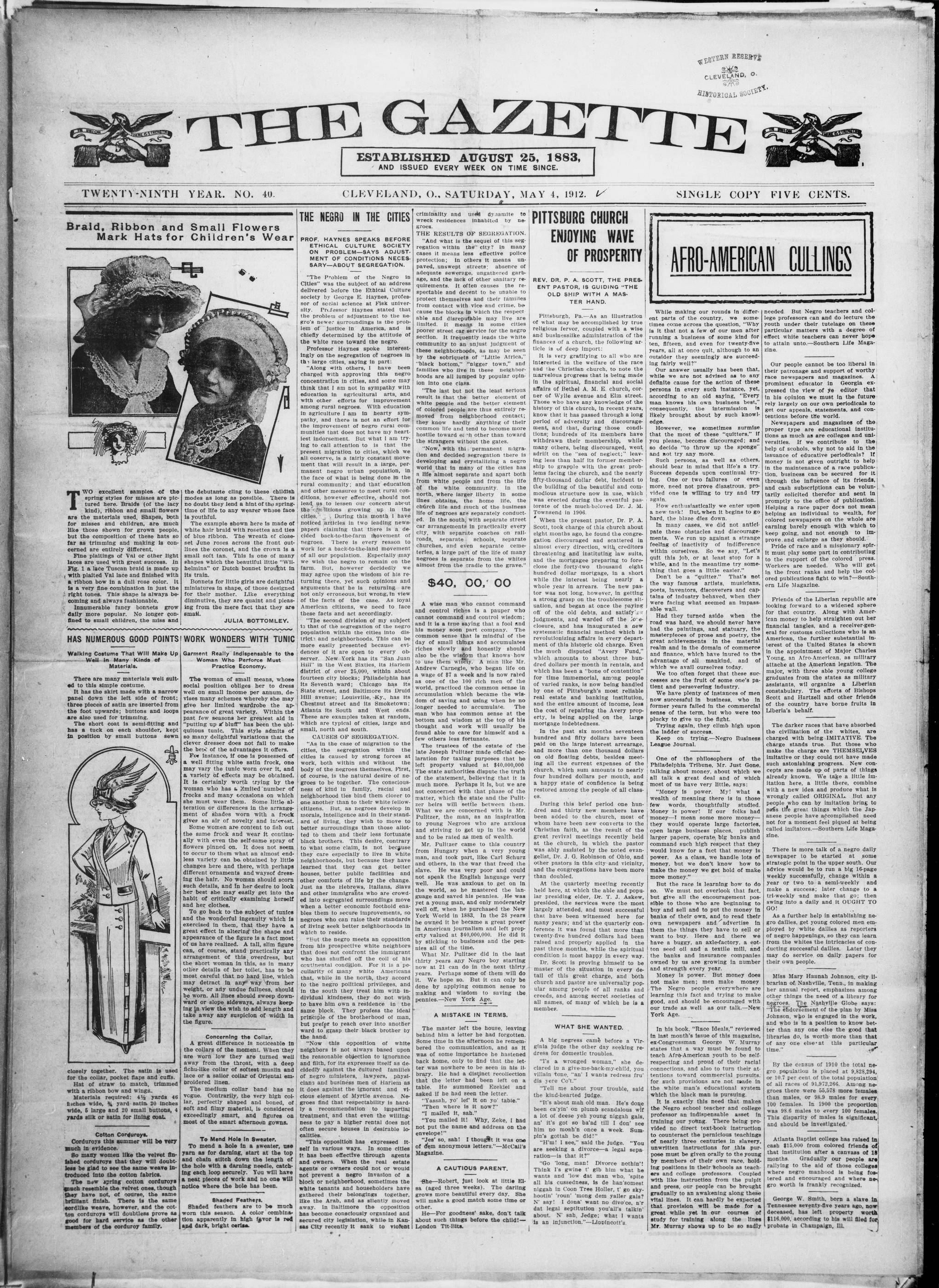
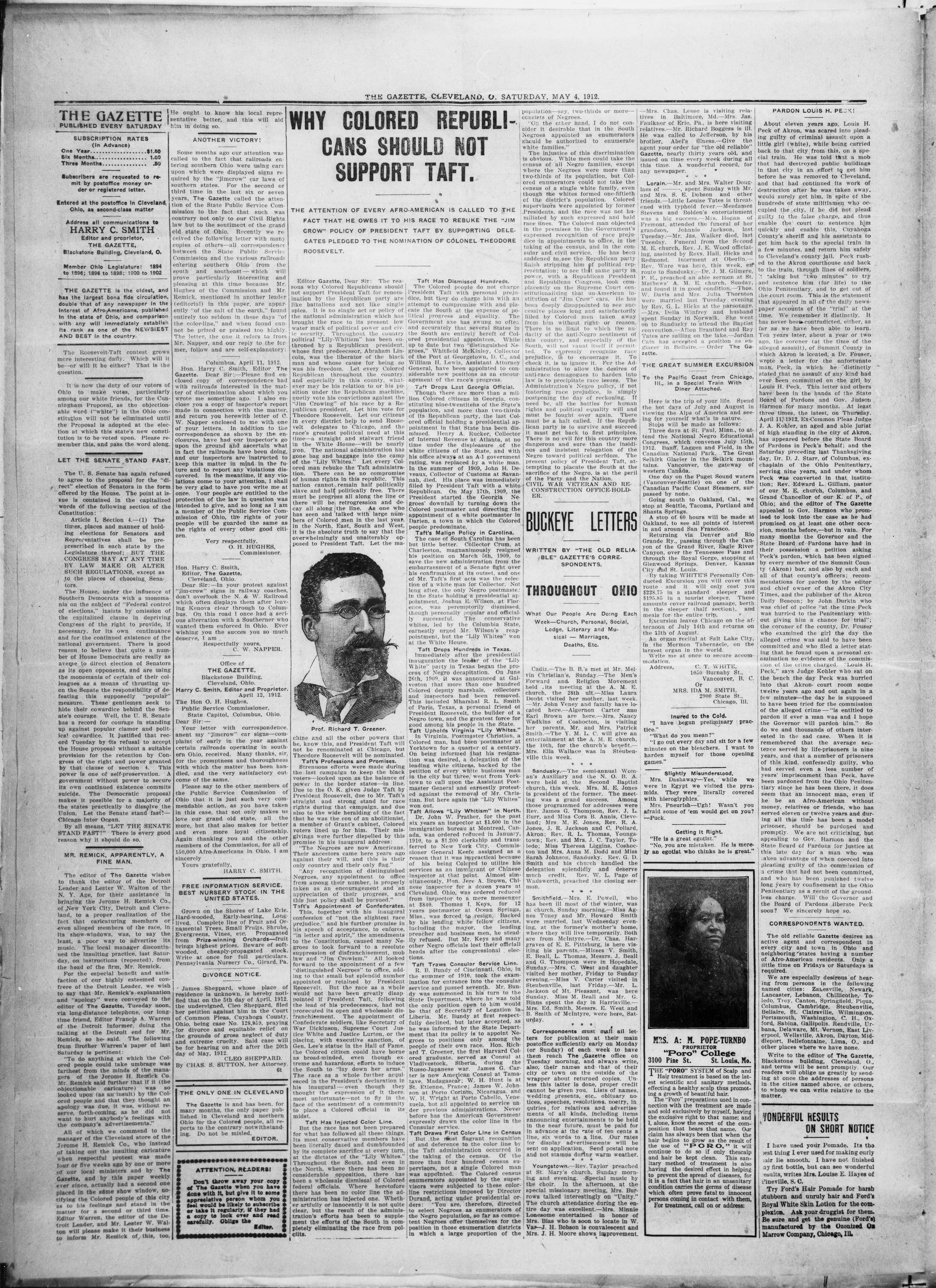
Page text (machine-generated)
TWENTY-NINTH YEAR. NO. 40.
Braid, Ribbon and Small Flowers
Mark Hats for Children's Wear
---
HAS NUMEROUS GOOD POINTS|WORK WONDERS WITH TUNIC
IN UNION
THERE IS STRONG
TWENTY-NINTH
Brald, Ribbon and
Mark Hats fo
TWO excellent samples of the spring styles for misses are pictured here. Braids (of the lace kind), ribbon and small flowers are the materials used. Shapes, both for misses and children, are much like those shown for grown people, but the composition of these hats so far as trimming and making is concerned are entirely different. Fine plaitings of Val or other light laces are used with great success. In Fig. 1 a lace Tuscan braid is made up with lace and a ribbon, and with a ribbon brow in a dull rose color. It is a very fine combination in just the right tones. This shape is always becoming and always fashionable. Innumerable fancy bonnets grow daily more popular. No longer connec-
Walking Costume That Will Make Up Well In Many Kinds of Materials.
There are many materials well suited to this simple costume.
It has the skirt made with a narrow panel down the left side of front; three pieces of satin are inserted from the foot upwards; buttons and loops are also used for trimming.
The short coat is semi-fitting and has a tuck on each shoulder, kept in position by small buttons sewn
烹
closely together. The satin is used for the collar, pocket flaps and cuffs. Hat of straw to match, trimmed with a ribbon bow and wings. Materials required: 4½ yards 46 inches wide, 4½ yard-satin 20 inches wide, 5 large and 20 small buttons, 4 yards silk or satin for lining coat.
Cotton Corduroys
Corduroys this summer will be very much in evidence. So many women like the velvet finished corduroys that they will doubtless be glad to see the same weave introduced into the cotton fabrics. The new spring cotton corduroys much resemble the velvet ones, though they have not, of course, the same brilliant finish. There is the same cordlike weave, however, and the cotton corduroys will doubtless prove as good for hard service as the other members of the corduroy family.
THE GAZETTE
the debutante cling to these childish modes as long as possible. There is no doubt they lend a hint of the springtime of life to any wearer whose face is youthful.
The example shown here is made of white hair braid with rosettes and ties of blue ribbon. The wreath of close-set June roses across the front outlines the cornet, and the crown is a small soft tan. This is one of many shapes which the beautiful little "Wilhelmina" or Dutch bonnet brought in its train.
Bonnets for little girls are delightful miniatures in shape, of those designed for their mother. Like everything diminutive, they are quaint and pleasing from the mere fact that they are small.
JULIA BOTTOMLEY.
Garment Really Indispensable to the Woman Who Perforce Must Practice Economy.
The woman of small means, whose social position obliges her to dress well on small income per annum, devises many schemes whereby she may give her limited wardrobe the appearance of great variety. Within the past few seasons her greatest aid is "putting up a bluff" has been the ubiquitous tunic. This style admits of so many delightful variations that the clever dresser does not fail to make the best of the advantages it offers.
For instance, if one is possessed of a well fitting white satin frock, one may vary the tunic worn over it, and a variety of effects may be obtained. It is certainly worth trying by the woman who has a limited number of frocks and many occasions on which she must wear them. Some little alteration or differences in the arrangement of shades worn with a frock gives an air of novelty and interest. Some women are content to fish out the same frock and wear it continually with even the self-same spray of flowers pinned on. It does not seem to occur to them what an almost endless variety can be obtained by little changes here and there, with perhaps different ornaments and ways of dressing the hair. No woman should scorn such details, and in her desire to look her best she may easily get into the habit of critically examining herself and her clothes.
To go back to the subject of tunicies and the wonderful ingenuity which is exercised in them, that they have a great effect in altering the shape and appearance of the figure is a fact most of us have realized. A tall, slim figure can, of course, stand practically any arrangement of this overdress, but the short woman in this, as in many other details of her toilet, has to be most careful that no hard line, which may detract in any way from her weight, or any undue fullness, should be worn. All lines should sweep downward or slope sideways, always keeping in view the wish to add length and take away any suspicion of width in the figure.
Concerning the Collar
A great difference is noticeable in the collars of the moment. When they are worn low they are turned well away from the throat, with a deep fichu-like collar of softest muslin and lace or a sailor collar of Oriental embroidered linen.
The medium collar band has no vogue. Contrarily, the very high collar, perfectly shaped and boned, of soft and filmy material, is considered exceedingly smart, and figures on most of the smart afternoon gowns.
To Mend Hole In Sweater
To mend a hole in a sweater, use yarn as for darning, start at the top and chain stitch down the length of the hole with a darning needle, catching each loop securely. You will have a neat pieces of work and no one will notice where the hole has been.
Shaded Feathers.
Shaded feathers are to be much worn this season. A color combination apparently in high fgvor is red and dark, bright cerise.
ESTABLISHED AUGUST 25, 1883 AND ISSUED EVERY WEEK ON TIME SINCE.
THE NEGRO IN THE CITIES
PROF. HAYNES SPEAKS BEFORE ETHICAL CULTURE SOCIETY ON PROBLEM—SAYS ADJUSTMENT OF CONDITIONS NECESSARY—ABOUT SEGREGATION.
"The Problem of the Negro in Cities" was the subject of an address delivered before the Ethical Culture society by George E. Haynes, professor of social science at Fisk university. Professor Haynes stated that the problem of adjustment to the negro's newer surroundings is the problem of justice in America, and is chiefly determined by the attitude of the white race toward the negro. Professor Haynes spoke interestingly on the segregation of negroes in the large cities, saying in part:
"Along with others, I have been charged with approving this negro concentration in cities, and some may think that I am not in sympathy with education in agricultural arts, and with other efforts for improvement among rural negroes. With education in agriculture I am in hearty sympathy, and there is not an effort for the improvement of negro rural communities that does not have my heartiest indorsement. But what I am trying to call attention to is that the present migration to cities, which we all observe, is a fairly constant movement that will result in a large, permanent negro urban population, in the face of what is being done in the rural community; and that education and other measures to meet rural conditions, however effective, should not lead us to lessen our concern about the civilians growing up in the cities. During this month I have noticed articles in two leading newspapers claiming that there is a decided back-to-the-farm movement of negroes. There is every reason to work for a back-to-the-land movement of all our population. Especially may we wish the negro to remain on the farm. But, however decidedly we may agree upon the wisdom of his returning there, yet such opinions and arguments that he is returning are not only erroneous, but wrong, in view of the facts of the case. As loyal American citizens, we need to face these facts and act accordingly.
"The second division of my subject is that of the segregation of the negro population within the cities into district; and neighborhoods. This can be more easily presented because evidences of it are open to every observer. New York has its "San Juan Hill" in the West Sixteens, its Harlem district of over 25,000, within about fourteen city blocks; Philadelphia has its Seventh ward; Chicago has its State street, and Baltimore its Druid Hill avenue; Louisville, Ky., has its Chestnut street and its Smoketown; Atlanta its South and West ends. These are examples taken at random, which are typical of cities, large and small, north and south.
CAUSES OF SEGREGATION.
"As in the case of migration to the cities, the segregation within the cities is caused by strong forces at work, both within and without the body of the negroes themselves. First, of course, is the natural desire of negroes to be together. The consciousness of kind in family, racial and neighborhood ties bind them closer to one another than to their white fellow citizens. But, as negroes develop in morals, intelligence and in their stand ard of living, they wish to move to better surroundings than those allot ted to them and their less fortunate black brothers. This desire, contrary to what some claim, is not because they care especially to live in white neighborhoods, but because they have learned that they can get better houses, better public facilities and other comforts of life by the change. Just as the Hebrews, Italians, Slavs and other immigrants who are crowded into segregated surroundings move when a better economic foothold enables them to secure improvements, so negroes who can raise their standards of living seek better neighborhoods in which to reside.
"But the negro meets an opposition from his prospective white neighbors that does not confront the immigrant who has shuffled off the coil of his continental condition. For it is a peculiarity of many white Americans that, while in the north, they accord to the negro political privileges, and in the south they treat him with individual kindness, they do not wish to have him own a residence in the same block. They profess the ideal principle of the brotherhood of man, but prefer to reach over into another ward to grasp their black brother by the hand.
"Now this opposition of white neighbors is not always based upon the reasonable objection to ignorance and filth, for its expresses itself as decidedly against the cultured families of negro ministers, lawyers, physicians and business men of Harlem as it does against the ignorant and vicious element of Myrtle avenue. Negroes find that respectability is hardly a recommendation to impartial treatment, and that even the willingness to pay a higher rental does not often secure houses in desirable localities.
"This opposition has expressed itself in various ways. In some cities it has been effective through agents and owners. When the real estate agents or owners could not or would not prevent a negro invasion of a block or neighborhood, sometimes the white tenants and households have gathered their belongings together, like the Arab, and as silently moved away. In Baltimore the opposition has become consciously organized and secured city legislation, while in Kansas City recently it sank to violent
criminality and used dynamite to wreck residences inhabited by negroes.
THE RESULTS OF SEGREGATION.
"And what is the sequel of this segregation within the city?" In many cases it means less effective police protection; In others it means unpaved, unswept streets; absence of adequate sewerage, ungathered garbage, and the lack of other sanitary requirements. It often causes the respectable and decent to be unable to protect themselves and their families from contact with vice and crime, because the blocks in which the respectable and disreputable may live are limited. It means in some cities poorer street car service for the negro section. It frequently leads the white community to an unjust judgment of these neighborhoods, as may be seen by the sobriquets of "Little Africa," "black bottom," "nigger town," and families who live in these neighborhoods are all lumped by popular opinion into one class.
"The last but not the least serious result is that the better element of white people and the better element of colored people are thus entirely removed from neighborhood contact; they know hardly anything of their common life and tend to become more hostile toward each other than toward the strangers without the gates.
"Now, with this permanent migration and decided segregation there is developing and crystallizing a negro world that in many of the cities has a life almost separate and apart both from white people and from the life of the white community. In the north, where larger liberty in some lines obtains, the home life, the church life and much of the business life of negroes are separately conducted. In the south, with separate street car arrangements in practically every city, with separate coaches on railroads, separate schools, separate churches, and even separate cemeteries, a large part of the life of many negroes is separate from the whites almost from the cradle to the grave."
$40. 00. 00
A wise man who cannot command and control riches is a pauper who cannot command and control wisdom; and it is a true saving that a fool and his money soon part company. The common sense that is mindful of the day of small things and accumulates riches slowly and honestly should also be the wisdom that knows how to use them wisely. A man like Mr. Andrew Carnegie, who began life on a wage of $7 a week and is now rated as one of the 100 rich men of the world, practiced the common sense in accumulation which became the wisdom of saving and using when he no longer needed to accumulate. The man who has common sense at the bottom and wisdom at the top of his thought and work will usually be found able to care for himself and a few others less fortunate.
The trustees of the estate of the late Joseph Pulitzer made official declaration for taxing purposes that he left property valued at $40,000,000. The state authorities dispute the truth of the statement, believing that it is much more. Perhaps it is, but we are not concerned with that phase of the matter, which the state and the Pulitzer heirs will settle between them. What we are concerned with is Mr. Pulitzer, the man, as an inspiration to young Negroes who are anxious and striving to get up in the world and to be rated as men of wealth.
Mr. Pulitzer came to this country from Hungary when a very young man, and took part, like Carl Schurz and others, in the war that freed the slave. He was very poor and could not speak the English language very well. He was anxious to get on in the world, so he mastered the language and saved his pennies. He was yet a young man, and only moderately well off, when he purchased the New York World in 1883. In the 28 years he owned it he became a great power in American journalism and left property valued at $40,000,000. He did it by sticking to business and the pennies all of the time.
What Mr. Pulitzer did in the last thirty years any Negro boy starting now at 21 can do in the next thirty years. Perhaps some of them will do it. We hope so. But it can only be done by applying common sense to making and wisdom to saving the pennies.—New York Age.
A MISTAKE IN TERMS.
The master left the house, leaving behind him a letter he had forgotten. Some time in the afternoon he remembered the communication, and as it was of some importance he hastened back home, only to find that the letter was nowhere to be seen in his library. He had a distinct recollection that the letter had been left on a table. He summoned Ezekiel and asked if he had seen the letter.
"Yassah, yo' lef it on yo' table."
"Then where is it now?"
"I mailed it, sah."
"You mailed it! Why, Zeke, I had not put the name and address on the envelope!"
"Jes' so, sah! I thought it was one of dem anonymous letters."—McCall's Magazine.
A CAUTIOUS PARENT
She—Robert, just look at little Elsa (aged three weeks). The darling grows more beautiful every day. She will make a good match some time or other.
He—For goodness' sake, don't talk about such things before the child!—London Tit-Bits.
PITTSBURG CHURCH ENJOYING WAVE OF PROSPERITY
PITTSBURG CHURCH ENJOYING WAVE OF PROSPERITY
REV. DR. P. A. SCOTT, THE PRESENT PASTOR, IS GUIDING "THE OLD SHIP WITH A MASTER HAND.
Pittsburgh, Pa.—As an illustration of what may be accomplished by true religious fervor, coupled with a wise and businesslike administration of the finances of a church, the following article is of deep import:
It is very graftifying to all who are interested in the welfare of the race and the Christian church, to note the marvelous progress that is being made in the spiritual, financial and social affairs of Bethel A. M. E. church, corner of Wylie avenue and Elm street. Those who have any knowledge of the history of this church, in recent years, know that it has passed through a long period of adversity and discouragement, and that, during those conditions, hundreds of its members have withdrawn their membership, while many others, being discouraged, wad drift on the "sea of neglect;" leaving less than half its former membership to grapple with the great problems facing the church, and the nearly fifty-thousand dollar debt, incident to the building of the beautiful and commodious structure now in use, which was erected during the eventful pastorate of the much-beloved Dr. J. M. Townsend in 1906.
When the present pastor, Dr. P. A. Scott, took charge of this church about eight months ago, he found the congregation discouraged and scattered in almost every direction, with creditors threatening and instituting law suits, and the mortgagee preparing to foreclose the forty-two thousand eight hundred dollar mortgage, in a short while the interest being nearly a whole year in arrears. The new pastor was not long, however, in getting a strong grasp on the troublesome situation, and began at once the paying off of the old debts, and satisfy judgments, and warded off the closure, and has inaugurated a new systematic financial method which is revolutionizing affairs in every department of this historic old charge. Even the much disputed "Avery Fund," which amounts to about three hundred dollars per month in rentals, and which has been a "bone of contention" for time immemorial, among people of varied ranks, is now being handled by one of Pittsburgh's most reliable real estate and banking institution, and the entire amount of income, less the cost of repairing the Avery property, is being applied on the large mortgage indebtedness.
In the past six months seventeen hundred and fifty dollars have been paid on the large interest arrearage, and more than one thousand dollars on old floating debts, besides meeting all the current expenses of the church, which sum amounts to nearly four hundred dollars per month, and a happy state of confidence is being restored among the people of all classes.
During this brief period one hundred and thirty new members have been added to the church, most of whom have been new converts to the Christian faith, as the result of the great revival meetings recently held at the church, in which the pastor was ably assisted by the noted evangelist, Dr. J. G. Robinson of Ohio, and other pastors in this city and vicinity, and the congregations have been more than doubled.
At the quarterly meeting recently held here, at which the able and popular presiding elder, Dr. T. J. Askew, presided, the services were the most largely attended, and most successful that have been witnessed here for many years; and at the quarterly conference it was found that more than twenty-five hundred dollars had been raised and properly applied in the past three months, while the spiritual condition is most happy in every way.
Dr. Scott is proving himself to be master of the situation in every detail of this great charge, and both church and pastor are universally popular among people of all ranks and creeds, and among secret societies of all names, of many of which he is a member.
WHAT SHE WANTED
A big negress came before a Virginia judge the other day seeking redress for domestic troubles.
"It's a wronged woman," she declared in a give-me-back-my-child, you villain tone, "an I want redress fru dis yere Cot."
"Tell me about your trouble, said the kind-hearted judge.
"It's about mah old man. He's done been cayin' on plumb scandalous wif a lot of deese yeh young niggah gals, an' it gets so ba'ad till I don' see him no maoh'n once a week. Sumpin's gottah be did!"
"H'm! I see," said the judge. "You are seeking a divorce—a legal separation—is that it?"
"Go 'long, man! Divorce nothin! Think I's gwine' t gib him what he wants and 'low dat man who, spi'e all his cussedness, is de han somest niggh in Coon Tree Holler, t' go skyhootin' roun' mong dum yaller gals? N' say! I' don' want no divore, n' dut legal septition you'all's talkin' about. N' sah, Jedge; what I wants is an injunction."—Lipincott's.
SINGLE COPY FIVE CENTS.
AFRO-AMERICAN CULLINGS
WESTERN RESERVE
CLEVELAND, O.
HISTORICAL SOCIETY.
SINGLE COPY
AFRO-AMERICA
While making our rounds in different parts of the country, we sometimes come across the question, "Why is it that not a few of our men after running a business of some kind for ten, fifteen, and even for twenty-five years, all at once quit, although to an outlier they seemingly are succeeding fairly well?"
Our answer usually has been that, while we are not advised as to any definite cause for the action of these persons in every such instance, yet, according to an old saying, "Every man knows his own business best," consequently, the intermission is likely brought about by such knowledge.
However, we sometimes surmise that the most of these "quitters," if you please, become discouraged; and so decide to "throw up the sponge" and not try any more.
Such persons, as well as others, should bear in mind that life's a try. Success depends upon continual trying. One or two failures or even more, need not prove disastrous, provided one is willing to try and try again.
Now enthusiastically we enter upon a new task. But when it begins to go hard, the blaze dies down.
In many cases, we did not anticipate these obstacles and discouragements. We run up against a strange feeling of inactivity of indifference within ourselves. So we say, "Let's quit this job, or at least stop for a while, and in the meantime try something that goes a little easier."
Don't be a "quitter." That's not the way famous artists, musicians, poets, inventors, discoverers and captains of industry behaved, when they were facing what seemed an impassable wall.
Had they turned aside when the road was hard, we should never have had the paintings, and statuary, the masterpieces of prose and poetry, the great achievements in the material realm and in the domain of commerce and finance, which have inured to the advantage of all mankind, and of which we avail ourselves today.
We too often forget that these successes are the fruit of some one's patient and persevering industry.
We have plenty of instances of men now successful in business, who in former years failed in the commercial sense of the term, but who were too plucky to give up the fight.
Trying again, they climb high upon the ladder of success.
Keep on trying.—Negro Business League Journal.
One of the philosophers of the Philadelphia Tribune, Mr. Just Gone, talking about money, about which we all talk a great deal and of which most of us have very little, says:
"Money is power. My! what a wealth of meaning there is in those few words, thoughtfully studied. Money is power! If our folks had money—I mean some more money—they would operate large factories, open large business places, publish larger papers, operate big banks and command such high respect that they would know for a fact that money is power. As a class, we handle lots of money, but we don't know how to make the money we get hold of make more money."
But the race is learning how to do so. We must not overlook that fact, but give all the encouragement possible to those who are beginning to buy and sell and to put the money in banks of their own, and to read their own newspapers and advertise in the things they have to sell or want to buy. Here and there we have a buggy, an axle-factory, a cotton seed oil and a textile mill, and the banks and insurance companies owned by us are growing in number and strength every year.
Money is power. But money does not make men; men make money. The Negro people everywhere are learning this fact and trying to make good, and should be encouraged with our trade as well as our talk—New York Age.
---
In his book, "Race Ideals," reviewed in last month's issue of this magazine, ex-Congressman George W. Murray states that a way must be found to teach Afro-American youth to be self-respecting and proud of their racial connections, and also to turn their attentions toward commercial pursuits, for such provisions are not made in the white man's educational system which the black man is pursuing.
It is exactly this need that makes the Negro school teacher and college professor an indispensable asset in training our young. There being provided no direct text-book instruction to counteract the pernicious teachings of nearly three centuries in slavery, unwritten instructions for this purpose must be given orally to the young by members of their own race, holding positions in their schools as teachers and college professors. Coupled with like instruction from the pulpit and press, our people can be brought gradually to an awakening along these vital lines. It can hardly be expected that provision will be made for a great while yet in our courses of study for training along the lines Mr. Murray shows up to be so sadly
FIVE CENTS.
AN CULLINGS
needed. But Negro teachers and college professors can and do lecture the youth under their tutelage on these particular matters with a degree of effect white teachers can never hope to attain unto.—Southern Life Magazine.
Our people cannot be too liberal in their patronage and support of worthy race newspapers and magazines. A prominent educator in Georgia expressed the view of ye editor that in his opinion we must in the future rely largely on our own periodicals to get our appeals, statements, and contentions before the world.
Newspapers and magazines of the proper type are educational institutions as much as are colleges and universities. If we contribute to the help of schools, why not to aid in the issuance of educative periodicals? If money is not given outright to help in the maintenance of a race publication, business can be secured for it through the influence of its friends, and cash subscriptions can be voluntarily solicited therefor and sent in promptly to the office of publication. Helping a race paper does not mean helping an individual to wealth, for colored newspapers on the whole are earning barely enough with which to keep going, and not enough to improve and enlarge as they should.
Pride of race and a missionary spirit must play some part in contributing to the support of the colored press. Workers are needed. Who will get in the front ranks and help the colored publications fight to win?—Southern Life Magazine.
Friends of the Liberian republic are looking forward to a widened sphere for that country. Along with American money to help straighten out her financial tangles, and a receiver-general for customs collections who is an American, the further substantial interest of the United States is shown in the appointment of Major Charles Young, an Afro-American, as military attache at the American legation. The major, with three able young college graduates from the states as military assistants, will organize a Liberian constabulary. The efforts of Bishops Scott and Hartzell and other friends of the country have borne fruits in Liberia's behalf.
The darker races that have absorbed the civilization of the whites, are charged with being IMITATIVE. The charge stands true. But those who make the charge are THEMSELVES imitative or they could not have made such astonishing progress. New concepts are made up of parts of things already known. We take a little imitation here, a little there, combine with a new idea and produce what is wrongly called ORIGINAL. But any people who can by imitation bring to pass the great things which the Japanese people have accomplished need not for a moment feel piqued at being called imitators.—Southern Life Magazine.
There is more talk of a negro daily newspaper to be started at some strategic point in the upper south. Our advice would be to run a big 16-page weekly successfully, change within a year or two to a semi-weekly and make a success; later change to a tri-weekly and make that go; then swing into a daily and it OUGHT TO GO!
As a further help in establishing negro dailies, get young colored men employed by white dailies as reporters of negro happenings, so they can learn from the whites the intricacies of conducting successful dailies. Later they may do service on daily papers for their own people.
Miss Mary Hannah Johnson, city librarian of Nashville, Tenn., in making her annual report, emphasizes among other things the need of a library for negroes. The Nashville Globe says: "The endorsement of the plan by Miss Johnson, who is engaged in the work, and who is in a position to know better than any one else the good that libraries do, is worth more than that of any one else at this particular time."
By the census of 1910 the total nego population is placed at 9,828,294, or 10.7 per cent of the total population of all races of 91,972,266. Among negroes there were 55,578 more females than males, or 98.9 males for every 100 females. In 1900 the proportion was 98.6 males to every 100 females. This disparity of males is significant, and should be investigated.
Atlanta Baptist college has raised in cash $15,000 from colored friends of that institution after a canvass of 18 months. Gradually our people are rallying to the aid of those colleges where negro manhood is being fostered and encouraged and where negro worth is frankly recognized.
George W. Smith, born a slave in Tennessee seventy-five years ago, now deceased, has left property worth $116,000, according to his will filed for probate in Champaign, Ill.
One Year.....$1.50
Six Months.....1.00
Three Months.....5.00
Subscribers are requested to re-
mit by postoffice money order
or registered letter.
Entered at the postoffice in Cleveland
Ohio, as second-class matter
Address all communications to
HARRY C. SMITH
Editor and proprietor,
THE GAZETTE,
Blackstone Building, Cleveland, O.
Member Ohio Legislature: 1894
to 1896; 1896 to 1898; 1900 to 1902
THE GAZETTE is the oldest, and has the largest bona fide circulation, double that of any newspaper in the Interest of Afro-Americans, published in the state of Ohio, and comparison with any will immediately establish its rank as one of the NEWSIEST AND BEST in the country.
The Roosevelt-Taft contest grows more interesting daily. Which will it be—or will it be either? That is the question.
It is now the duty of our voters of Ohio to make votes, particularly among our white friends, for the Cunningham Proposal, as the objectionable word ("white") in the Ohio constitution will not be eliminated until the Proposal is adopted at the election at which this state's new constitution is to be voted upon. Please remember this, and pass the word along.
LET THE SENATE STAND FAST
The U. S. Senate has again refused to agree to the proposal for the "direct" election of Senators in the form offered by the House. The point at is sue is contained in the capitalized words of the following section of the Constitution:
Article I, Section 4—(1) The times, places and manner of holding elections for Senators and Representatives shall be preprescribed in each state by the Legislature thereof; BUT THE CONGRESS MAY AT ANY TIME BY LAW MAKE OR ALTER SUCH REGULATIONS, except as to the places of choosing Senators.
The House, under the influence of Southern Democrats with a monomania on the subject of "Federal control of elections," insists by omission of the capitalized clause in depriving Congress of the right to provide, if necessary, for its own continuance and for the continued existence of the national government. There is good reason to believe that quite a number of House Democrats are really as averse to direct election of Senators as its open opponents, and are using the monomania of certain of their colleagues as a means of thrusting upon the Senate the responsibility of defeating this supposedly "popular" measure. These gentlemen must hide their cowardice behind the Senate's courage. Well, the U. S. Senate has a record for courage in standing up against popular clamor and political cowardice. It justified that record Tuesday by its refusal to accept the House proposal without a suitable provision for the retention by Congress of the right and power granted by that clause of section 4. This power is one of self-preservation. A government without power to secure its own continued existence commits suicide. The Democratic proposal makes it possible for a majority of the states practically to dissolve the Union. Let the Senate stand fast!—Chicago Inter Ocean.
By all means, "LET THE SENATE STAND FAST!" There is every good reason why it should do so.
MR. REMICK, APPARENTLY, A
FINE MAN.
The editor of The Gazette wishes to thank the editor of the Detroit Leader and Lester W. Walton of the N. Y. Age, for their assistance in bringing the Jerome H. Remick Co., of New York City, Detroit and Cleveland, to a proper realization of the fact that caricaturing members or even alleged members of the race, in its show-windows, was, to say the least, a poor way to advertise its music. The local manager discontinued the insulting practice, last Saturday, on instructions (repeated), from the head of the firm, Remick.
For the especial benefit and satisfaction of our highly esteemed confrere of the Detroit Leader, we wish to say that Mr. Remick's explanation and "apology" were conveyed to the editor of "The Gazette, Tuesday noon, via long-distance telephone, our long-time friend, Editor Francis A. Warren of the Detroit Informer, doing the talking at the Detroit end for Mr. Remick, so he said. The following from Brother Warren's paper of last Saturday is pertinent:
"To do anything at which the Colored people could take umbrage was farthest from the minds of the managers of the Jerome H. Remick Co. Mr. Remick said further that if it (the objectionable caricature) was so looked upon (as an insult) by the Colored people and that they thought an apology was due, it was with no serve, we did not to hurt anybody's feelings with the company's advertisements."
All of which we commend to the manager of the Cleveland store of the Jerome H. Remick Co., who instead of taking out the insulting caricature when respectful protest was made four or five weeks ago by one or more of our local ministers and by The Gazette, and by this paper weekly ever since, actually had a second one placed in the same show window, notifying the Colored people of this city as to his feelings and stand in the matter for a second or third time. Editor Warren, the editor of the Detroit Leader, and Mr. Lester W. Walton will please make it their business to inform Mr. Remick of this, too.
He ought to know his local representative better, and this will aid him in doing so.
ANOTHER VICTORY
Some months ago our attention was called to the fact that railroads entering southern Ohio were using cars upon which were displayed signs required by the "timcrow" car laws of southern states. For the second or third time in the last six or seven years. The Gazette called the attention of the State Public Service Commission to the fact that such was contrary not only to our Civil Rights law but to the sentiment of the grand old state of Ohio. Recently we received the following letter with many copies of others—all correspondence between the State Public Service Commission and the various railroads entering southern Ohio from the south and southeast—which will prove particularly interesting and pleasing at this time because Mr. Hughes of the Commission and Mr. Remick, mentioned in another leader (editorial) in this paper, are apparently "of the salt of the earth," found entirely too seldom in these days "of the colorline," and when found can not be prized or praised too highly. The letter, the one it refers to from Mr. Napper, and our reply to the forerun, follow and are self-explanatory.
Columbus, April 11, 1912
Hon. Harry C. Smith, Editor The Gazette
Dear Sir:—Please find enclosed copy of correspondence had with railroads interested in the matter of discrimination about which you wrote me sometime ago. I also enclose you a copy of inspector's report made in connection with the matter and return you herewether letter of C. W. Napper enclosed to me with one of our inspectors as shown by the enclosures, have had our inspector's go upon the ground and ascertain what in fact the railroads have been doing, and our inspectors are instructed to keep this matter in mind in the future and to report any violations discovered. In the meantime, if any violations come to your attention, I shall be very glad to have you write me at once. Your people are entitled to the protection of the law in question was intended to give, and so long as I am a member of the Public Service Comptroller, all of people will be guarded the same as the rights of every other good citizen.
Very respectfully,
O. H. HUGHES,
Commissioner.
Hon. Harry C. Smith,
Editor, The Gazette,
Cleveland, Ohio.
Dear Sir--In your protest against " Jim-crow" signs in railway coaches,
don't overlook the N. & W. Railroad
which often displays them after leaving Kenova clear through to Columbia.
On this voyage someone had a serious altercation with a Southerner who wanted them enforced in Ohio. Ever wishing you the success you so much deserve, I am
Respectfully yours,
C. W. NAPPER.
Harry C. Smith, Editor and Proprietor
April 12, 1912.
The Hon O. H. Hughes,
Public Service Commissioner,
State Capitol, Columbus, Ohio.
Dear Sir:—
Your letter with correspondence,
anent my "jim-circum" car signs—complaint of early in the year against certain railroads operating in southern Ohio, received. Many thanks, sir, for the promptness and thoroughness with which the matter has been handled, and the very satisfactory outcome of the same.
Please say to the other members of the Public Service Commission of Ohio that it is just such very commendable action, as you have taken in this case, that not only makes us love our grand old state, all the more, but that also makes for better and even more loyal citizenship.
Again thanking you and the other members of the Commission, for all 150,000 Afro-Americans in Ohio. I am sincerely
Yours gratefully,
HARRY C. SMITH.
FREE INFORMATION SERVICE,
BEST MEMBER IN THE
UNITED STATES
Grown on the Shores of Lake Erie Hard-wooded, Early-bearing, Long lived. Complete line of Fruit and Ornamental Trees, Small Fruits, Shrubs Evergreen, Vines, etc. Propagated from Prize-winning Orchards—fruit brings highest prices. Barew of soft wooded, cheaply-propagated stock Write at once for full particular Pennsylvania Nursery Co., Girard, Pa
DIVORCE NOTICE
James Sheppard, whose place of residence is unknown, is hereby notified that on the 5th day of April, 1912, the undersigned, Cleo Sheppard, filed her petition against him in the Court of Common Pleas, Cuyahoga County, Ohio, being case No. 128,959, praying for divorce and equitable relief on the grounds of gross neglect of duty and extreme cruelty. Said case will be for hearing on and after the 20th day of May, 1912.
CLEO SHEPPARD.
By CHAS. S. SUTTON, her Attorney
The Gazette is and has been, for many months, the only paper published in Cleveland and northern Ohio for the Colored people, all reports to the contrary notwithstanding. Do not be misled.
ATTENTION, READERSI
Don't throw away your copy of The Gazette when you have done with it, but give it to some appreciative person whom you feel would be likely to subscribe or take it regularly, if they had a copy to look over and read carefully. Oblige the Editor.
THE GAZETTE, CLEVELAND, O. SATURDAY, MAY 4, 1912
WHY COLORED REPUBLI CANS SHOULD NOT SUPPORT TAFT.
THE ATTENTION OF EVERY AFRO-AMERICAN IS CALLED TO THE FACT THAT HE OWES IT TO HIS RACE TO REBUKE THE "JIM CROW" POLICY OF PRESIDENT TAFT BY SUPPORTING DELEGATES PLEDGED TO THE NOMINATION OF CÓLONEL THEODORE ROOSEVELT.
Editor Gazette, Dear Sir: The reasons why Colored Republicans should not support President Taft for renomination by the Republican party are like battalions and not like single spies. It is no single act or policy of the national administration which has brought the race to its present low water mark of political power and civil disobedience. The political "Lily-Whism" has been enthroned by a Republican president, whose first predecessor, Abraham Lincoln, was the liberator of the black man and whose cause for being so was his freedom. Let every Colored Republican throughout the country, and especially in this county, whatever may be his relation to or his position in the White House, will equally vote his convictions against the "Jim Crowing" of his race by a Republican president. Let him vote for Theodore Roosevelt. Let our citizens in every district help to send Roosevelt delegates to Chicago, and the race's greatest political need at this time—a straight and stalwart friend in the White House would be nearly the same. The White House administration bagged a bag and talked into the camp of the "Lily Whites." Let every Colored man rebuke the Taft administration. There can be no compromise of human rights in this republic. This nation cannot, remain half politically slave and half politically free. There must be progress all along the line or there will be retrogression and delay. The White House can see and talked with large numbers of Colored men in the last year, in the North, East, South and West, it is the absolute truth to say that the overwhelmingly and unalterably opposed to President Taft. Let the ma-
Prof. Richard T. Greener.
chine and all the other powers that be, know this, and President Taft will not be renominated at Chicago, but Theodore Roosevelt will be nominated. Taft's Professions and Promises. Strenuous efforts were made during the last campaign to keep the black voters—looked upon as the balance of power in the border states—in line. Due to the O. K., given Judge Taft by President Roosevelt, due to Mr. Taft's straight and strong stand for race rights, that can campaign, and able to the white man, the faire that he was the son of an abolitionist, a member of Grant's cabinet, Colored voters lined up for him. Their misgivings were further dispelled by this promise in his inaugural address:
"The Negroes are now Americans. Their ancestors came here years ago against their will, and this is their only country and their only flag." "Any recognition of distinguished Negroes, any appointment to office from among their number, is properly taken as an encouragement and an appreciation of their progress, and this just policy shall be pursued."
Taft's Appointment of Confederates.
This, together with his inaugural confession of "not the slightest race prejudice," and his further promise in his speech of acceptance, to enforce, the Constitution, to the Constitution, caused many Negroes to look forward to a resolute suppression of disfranchisement, mob law and "Jim Crowism." All looked forward to the appointment of a few "distinguished Negroes" to office, adding to that small but splendid number appointed or retained by President Roosevelt. But the race as a whole would not have been greatly disappointed if President Taft, following the lead of his predecessors, had not been in office, without the franchisement. The appointment of Confederate soldiers, like Secretary of War Dickinson, Supreme Court Justice White and Justice Lurton, or the placing, with executive sanction, of Gen. Lee's statue in the Hall of Fame, the Colored citizen could have borne as broad-minded, even though extreme and hazardous, efforts to the South to "lay down her arms." The race as a whole further accrued in the President's declaration in his memoir, which they through the expression of it there most unfortunate—not to fly in the face of the sentiment of a community to place a Colored official in its midst.
Taft Has Injected Color Line.
But the race has not been prepared for what has followed all these things. Its most conservative members have been literally dared and dumbbounded by its complete sacking and disfrictions of the "Lily Whites." Throughout the South, and even in the North, where there has been no considerable opposition, there has been a wholesale dismissal of Colored federal officials. Where heretofore there has been no color line the administration has injected one. Whether artfully or innocently it is not quite clear, but the result of the administration's effort to dismantle the efforts of the South in completely eliminating the race from polls.
Taft Has Dismissed Hundreds.
The Colored people do not charge President Taft with personal prejudice, but they do charge him with an attempt to compromise with and placate the South at the expense of post-Government asexes. The Government asexes has swung so often and accurately that several States in the South are entirely bereft of Colored presidential appointees. While up to date to date "distinguished Negroes," Whitfield McKinley, Collector of the Port at Georgetown, D. C., and William H. H. McKinley, General, have been appointed to considerable new positions as an encouragement of the race's progress.
Taft Drops Last Georgia Official.
Though there are more than a million Colored citizens in Georgia, constituting nine-twentieths of the State's population, and more than two-thirds of the Colored official holding a presidential appointment in that State has been dismissed. Henry A. Rucker, Collector of Internal Revenue at Atlanta, at no time under the displeasure of the white citizens of the State, and with his office always at an A1 government office, was appointed in the summer of 1999, John H. Deveaux, Collector of Customs at Savannah, died. His place was immediately filled by President Taft with a white Republican. On May 17th, 1999, the President started the Georgia Negroes downstairs by pressing the appointment of a white postmaster in Darlen, a town in which the Colored people predominate.
Taft's Malign Policy in Carolina.
The case of South Carolina has been but little better. Collector Crum, at Charleston, magnanimously resigned his position on March 5th, 1909, to save the new administration from the loss of the state. He resigned his confirmation at its outset, and one of Mr. Taft's first acts was the selection of a white man for Collector. Not long after, the only Negro postmaster, in the State holding a presidential appointment, Joshua E. Wilson, at Florence, was peremptorily dismissed. His appointment was highly successful. The conservative whites, led by the Columbia State, earnestly urged Mr. Wilson's reappointment, but the "Lily Whites" won at the White House.
Taft Drops Hundreds in Texas.
Immediately after the presidential inauguration the leader of the "Lilly White" party in Texas began the process of Negro decapitation. On June 26th, 1909, it was announced at Galveston that more than one hundred Colored deputy marshals, collectors and inspectors had been removed.
This included Mharshal R. L. Smith of Paris, Texas, a personal friend of President Roosevelt, the builder of a Negro town, and the greatest man for good among his people in the State.
Taft Upholds Virginia "Lily Whites". In Virginia, Postmaster Christian, a Postmaster Yorktown for a quarter of a century. On being informed that his resignation was desired, a delegation of the leading white citizens, backed by the petition of every white business man in the city but three, went from Yorktown to call upon the Assistant Postmaster against the removal of Mr. Christian. But here again the "Lily Whites" won out.
Taft Allows "Lily Whitism" in North. Dr. John W. Prather, for the past six years an inspector at $1,600 in the immigration bureau at Montreal, Canada, was ordered reduced in January, 1910, to a $1,200 clerkship and transferred to New York City. Commissioner Gena Keep was impractical because of his being Colored to utilize his services as an immigrant or Chinese inspector at that point. Almost simultaneously, Hon. Jere A. Brown, Chinese inspector for a dozen years at Cleveland, Ohio, was ordered reduced from inspector to a mere messenger at $840. Thomas I. Keys, for 12 years postmaster at Ocean Springs, Miss., was forced to resign. Backed by his leading white fellow citizens, including the governor and business men, he steadily refused. But Mr. Keys and many other Negro officials lost their official heads after the congressional elections.
Taft Traws Consular Service Line.
R. B. Bundy of Cincinnati, Ohio, in the summer of 1910, took the examination for entrance into the consular service and passed seventh. Mr. Bundy was summoned in his turn to the State Department, where he was appointed to him would be that of Secretary of Legation in Liberia. Mr. Bundy at first respectfully declined, but later accepted, as he was informed by the State Department that its policy is to appoint Negroes to positions only among the people of their own race. Hon. Richard Greener, the then Honorable Consul at Dvlivostock, Siberia, during the Russo-Japanese war. James G. Carter is now American Consul at Tama-tave, Madagascar; W. H. Hunt is at St. Etienne, France; James W. Johnson at Porto Corinto, Nicaragua, and W. H. Wright at Porto Cabela, Veneza, but all appointees were never before has the American Government expressly drawn the color line in the Consular service.
Taft Draws First Color Line in Census But, the most flagrant recognition of and deference to the color line by the Taft administration occurred in the taking of the census for four hundred census supervisors, not a single Colored man was appointed. The Colored census enumerators appointed by the supervisors were subjected to these color restrictions imposed by Director Durand, acting under presidential orders: "You are, therefore, directed to select Negroes as enumerators of the census. Negroes offer themselves for the position in those enumeration districts in which a large proportion of the
population—say, two-thirds or more—consists of Negroes.
"On the other hand, I do not consider it desirable that in the South Negroes appointed as enumerators be be borized to enumerate white families."
CIVIL WAR VETERAN AND RE-
STRUCTION OFFICE-HOLDER.
BUGKEYE LETTERS
WRITTEN BY "THE OLD RELIA
BLE" GAZETTE'S CORRE-
SPONDENTS.
THROUGHOUT OKIO
What Our People Are Doing Each Week—Church, Personal, Social, Lodge, Literary and Musical — Marriages, Deaths, Etc.
Cadiz.—The B. B.'s met at Mr. Melvin Christian's, Sunday.—The Men's Forward and Religion Movement held, its meeting at the A. M. E. church, the 28th ult.—Miss Laura Doubt visited her mother, last week.
Mr. John Veney and family have located here.—Algernon Carter nur Earl Brunner.—Mrs. Nancy Wadkins of Coshocton, is visiting her parents, Mr. and Mrs. Patrick Smith.—The Y. M. L. C. will give an entertainment at the A. M. E. church, the 10th, for the church's benefit.—Mrs. Ella Wallace was in Steubenville this week.
Sandusky.—The semi-annual Woman's Auxiliary and the N. O. B. A were held at the Second Baptist church, this week. Mrs. M. E. Jones is president of the former. The meeting was a grand success. Among those programmed for addresses were Rev. James G. Thompson, Rev. J. L. Burr, and Miss Cora B. Annis, Cleveland; Mrs M. E. Jones, Rev. R. A. Jones, J. R. Jackson and C. P. Collard, Akron R. R. The T. R. Tungleson, Rev. R. V. J. C. Taylor, Leloed; Miss Theresa Liggins, Coshocton and Mrs. Anna M. Dodd and Miss Sarah Johnson, Sandusky, Rev. G. D. Smith and his church handled the delegation splendidly and deserve much credit. Rev. W. L. Page of Wadsworth, preached the closing sermon.
Smithfield.—Mrs. E. Powell, who has been ill most of the winter, was at church, Sunday morning, -Miss Agnes Toney and Mr. Howard Smith were married, last Wednesday evening, at the former's mother's home, where they live temporarily. Both are from McIntyre.—Dr. Chas. Harsh, of E. E. Pittsburgh is here identifying his parents. -Misses V. Smith, E. Beall, L. Thomas, Messrs. J. Beall and G. Thompson were in Hopedale, Sunday.—Mrs. C. West and daughter visited her mother, Friday to Sunday evening.—Miss V. Carter visited in Stenbenville, last Friday.—Mr. L. Jackson of Mr. lastasant, as here Stenbenville, M. B. Beall, and B. Blins spent the day in Harrisville. Mrs. Ed. Smith, Messrs. E. West and B. Smith of McIntyre were here, Saturday.
Correspondents must mail all letters for publication at their main postoffice sufficiently early on Monday (or Sunday) of each week to have them reach The Gazette office on Tuesday morning, and always write, also, their names and that of their parents. In the mail, a wrapper about returned copies. Unless this latter is done, proper credit cannot be given you. Lists of names, wedding presents, etc., obituary notices, speeches, resolutions, noetry, inquiries for relatives and advertisements, letters of recommendation, financing entertainments to be held in the near future, must be paid for in advance at the rate of ten cents a line, six words to a line. Our rates for display advertisements will be sent on application. Send postal note and not stamms during warm weather.
Youngstown—Rev. Taylor preached at St. Mary's church, Sunday morning and evening. Special music by the choir. In the afternoon, at the special missionary meeting, Mrs. Burrows talked interestingly on "Unity." The church attendance during the entire day was excellent. Mrs. Minnie Lonesome entertained in honor of Mrs. Bias who is to locate in W. Vax—J. H. Bobson is convalescent and Mrs. J. H. Moore shows improvement.
—Mrs. Chas. Leece is visiting relatives in Baltimore, Md.-Mrs. Jas. Faulkner of Erie, Pa., is here visiting relatives—Mr. Richard Boggess is ill. He was called to Jefferson, by his brother, Abel's illness. Give the agent your order for a holiday or reliable holiday for thirty years old, and issued on time every week during all this time. A wonderful record, for any newspaper.
Lorain —Mr. and Mrs. Walter Douglass of —, spent Sunday with Mr. and Mrs. S. E. Dobson and other friends. —Little Louise Tates is threatened with typhoid fever —Mesdames Stevens and Bolden's entertainment was a big success. —Mrs. Hogan of Fremont, attended the funeral of her grandson. —Johnnie Jackson, last Tuesday. —Mr. Jas Walker died last Tuesday. —Fumelator J. F. Scoe. E. chick. —J. E. Wood officiating at revs. Revs. Halls, Hicks and Redmond. —Interment at Oberlin. —Rev. Ware was here, this week, en route to Sandusky. —Dr. J. M. Gilmore. P. E., preached an able sermon at St. Mathews' A. M. E. church, Sunday, and found it in good condition. —Thos. W. Davis and Mrs. Julia Thornton were married last Tuesday evening by Rev. G. L. Hicks at the parsonage. —Mrs. Della Winfer and husband spent Sunday in Norwalk to attend the Baptist convention. —Afton Brantford and Ray Tates are sailing on the lake. —Jordan Cain has accepted a position as engineer in Bellaire —Order The Gazette.
THE GREAT SUMMER EXCURSION
To the Pacific Coast from Chicago Ill., in a Special Train With Diner Attached.
Here is the trip of your life. Spend the hot days of July and August in viewing the Alps of America and seeing for yourself what's in nature. Stops will be made as follows: Three days at St. Paul, Minn., to attend the National Negro Educational Congress, which convenes July 15th, 1912. Banff, Laggen and Field, in the Canadian National Park. The Great Selkirk Glacier in the Selkirk mountains. Vancouver, the gateway of western Canada. One day on the Puget Sound waters (Vancouver-Seattle) on one of the Canadian Pacific Coast Steamers, surpassed by none. Going south to Oakland, Cal., we stop at Seattle, Tacoma, Portland and Shasta Springs. A stop of 60 hours will be made at Oakland, to see all points of interest in and around San Francisco. Returning via Denver and Rio Grande Ry., passing through the Canyon of the Grand River, Eagle River Canyon, over the Tennessee Pass and through the Royal Gorge, stopping at Brownsville, Denver, Kansas City and St. Louis.
By taking WHITE'S Personally Conducted Excursion you will cover this route and it will only cost you $228.75 in a standard sleeper and $195.85 in a tourist sleeper. These amounts cover railroad passage, berth in the sleeper (half section), and meals for the entire trip.
Excursion leaves Chicago on the afternoon of July 14th and returns on the 13th of August.
An organ recital at Salt Lake City, in the Mormon Tabernacle, on the largest organ in the world.
Write me at once to secure accommodation.
Address, C. T. WHITE.
1050 Burnaby St.
Vancouver, B. C.
Or
MRS. IDA M. SMITH.
2000 State St.
Chicago, Ill.
Inured to the Cold.
inured to the Cold.
"I have begun preliminary practice."
"What do you mean?"
"What do you mean?
'I go out every day and sit for a few minutes on the bleachers. I want to harden myself for those opening games."
Slightly Misunderstood.
Mrs. Dashaway—Yes, while we were in Egypt we visited the pyramids. They were literally covered with hieroglyphics.
Mrs. Pneurish—Ugh! Wasn't you afraid some of 'em would get on you?
—Puck.
"He is a great egolist." He is more
ly an egolist who thinks he is great."
W. E. H.
THE "PORO" SYSTEM of Scalp and Hair treatment is based on the latest scientific and sanitary methods, effecting a healthy scalp thus promoting a growth of beautiful hair. The "Poro" preparations used in connection with the treatment are made and so excels by myself, having exclusive right to use. I alone, know the secret of the composition that bears that name. Our claim has always been that when the hair begins to grow as the result of the use of "PORO", it will continue to do so if only the scalp and hair be kept clean. This sanitary method treatment is also important to prevent the spread of diseases, for it is a fact that hair in an unsanitary condition carries the germs of disease which often prove fatal to innocent persons coming in contact with them. For treatment, call on or address:
PARDON LOUIS H. PECKI
About eleven years ago, Louis H. Peck of Akron, was scared into pleading guilty of criminal assault upon a little girl (white), while being carried back to that city from this, on a special train. He was told that a mob that had destroyed public buildings in that city in an effort to get him before he was removed to Cleveland, and that had continued its work of destruction after he was taken away, would surely get him, in spite of the hundreds of state militiamen who occupied the city, if he did not plead guilty to the false charge, and thus enable the court to sentence him quickly and enable this. Cuyahoga County's sheriff and his assistants to get him back to the special train in a few minutes, and return him safely to Cleveland's county jail. Peck rushed to the Akron courthouse and back to the train, through lines of soldiers, 'taking but "two minutes" to try and sentence him (for life) to the Ohio Penitentiary, and to get out of the court room. This is the statement that appeared in all of the daily newspaper accounts of the "trial" at the time. We remember it distinctly. It has never been contradicted, either, as far as we have been able to learn. Ten years later, about a year or two, ago the coroner (at the time of the alleged coroner) is located, a Dr. Fourier, wrote a letter for the unfortunate man, Peck, in which he "distinctly stated that no assault of any kind had ever been committed on the girl by Louis H. Peck. This letter and others have been in the hands of the State Board of Pardons and Gov. Judson Harmon for many months. At least three times, the latest, on Thursday, April 11, 1912, Ex-Common Pleas Judge J. A. Kohler, an aged and able jurist of high standing in the city of Akron, has appeared before the State Board of Pardons in Peck's behalf; and the Saturday preceding last Thanksgiving day, Dr. D. J. Starr, of Columbus, exchainl of the Ohio Penitentiary, serving nine years, and under whom Peck was converted into that institution; Rev. Edward L. Gilliam, pastor of our M. E. church, Columbus, and Grand Chancellor of our K. P., of Ohio, and the editor of The Gazette appealed to Gov. Harmon who promised to look into the case as he had promised on at least one other occasion, months before—but in vain. For many months the Governor and the State Board of Pardons have had in their possession a petition asking Peck's pardon, which has been signed by every member of the Summit County (Akron) bar, and also by each and all of that county's officers; recommendations for pardon by the editor and chief owner of the Akron City Times, and the publisher of the Akron Daily Beacon; by John Durkin who was chief of police "at the time Peck was hurried to the Penitentiary without giving him a chance for trial"; the coroner of the county, Dr. Fourier who examined the girl the day the alleged crime was said to have been committed and who filed a letter stating that he found a personal examination no evidence of the commission of the alleged crime—"is entitled to pardon if ever a man was and I hope the Governor will pardon him." So do we and thousands of others interested in the sad case. When it is remembered that the average sentence served by life-pironers is nine years, and that a number of prisoners of this kind, confessedly guilty, who had served even a less number of years' imprisonment than Peck, have been pardoned from the Ohio Penitentiary since he has been there, it does seem that an innocent man, even he is an Afro-American without money, relatives or friends, who has served eleven or twelve years and during all this time has been a mode prisoner, should be pardoned and promptly. We are not criticising, but appealing to Gov. Harmon and the State Board of Pardons for justice at this late day for a man who was taken advantage of when coerced into pleading guilty of the commission of a crime that had not been committed, and who has been punished twelve long years by confinement in the Ohio Penitentiary as a result of the groundless charge. Will the Governor and the Board of Pardons liberate Peck soon? We sincerely hope so.
CORRESPONDENTS WANTED.
The old reliable Gazette desires an active agent and correspondent in every city and town in Ohio and neighboring 'states having a number of Afro-American residents. Only a little time on Fridays or Saturdays is required.
We are especially desirous of hearing from person in the following named Lancaster, Zaccesville, Lancaster, Lebanon, Chillicothe, Toledo, Troy, Canton, Springfield, Piqua, Columbus, Cambridge, Steubenville, Bellaire, St. Clairsville, Wilmington, Portmouth, Washington, C. H., Oxford, Sabina, Gallipoli, Rendville, Urbana, Delaware, M. Ternon, East Liverpool, Wellsville, Akron, Dayton, Middleport, Belfonteal, Lima, O., and other places where we have none.
Write to the editor of The Gazette, Blackstone building, Cleveland, O., will be悉请悉请. Our readers will oblige us greeting at once the addresses of persons in the cities named above, or others, to whom we can write relative to the matter.
I have used your Pomade. Its the best thing I ever used for making curly hair lie smooth. I have not finished my first bottle, but can see wonderful results, writes Mrs. Louise E. Hayes of Pineville, S.C.
Try Ford's Hair Pomade for harsh stubborn and unruly hair and Ford's Royal White Skin Lotion for the complexion. Ask your druggist for them. Be sure and get the genuine (Ford's manufactured by the Ozonized Ox Marrow Company, Chicago, Ill.
PURELY PERSONAL
PURCHASE THE "GAZETTE" AT
NOTICE TO SUBSCRIBERS:—Subscribers not receiving The Gazette regularly should notify us at once. We desire every copy delivered promptly. We advise our patrons to carefully examine The Gazette's advertisements before making purchases. Business men who advertise in this paper should have the patronage of Afro-Americans. The fact that they advertise is assurance that they want it. Local reading notices (advertisements) ten cents a line (six words in a line.)
FOR RENT—Houses—If you have places to rent or if you want to rent—notify The Gazette.
NOTARY PUBLIC—For such services call at The Gazette office, No. 3 Blackstone Building, No. 1422 W. 3d street, near Superior avenue.
The Cuy. Co. A.A. Republican league held a public meeting and "smoker." Tuesday evening. Candi dates were the speakers.
Rev. B. W. Paxton was presentate a fine chair at the reception tenderer him and Mrs. Paxton, at St. Andrew's P. E. church, Tuesday evening. The
For Sale.-Restaurant-L. G. Adkins has decided to sell his well-eas-
tablished restaurant. Good reasons
for selling. Call at 2613 Central Av.
FOR RENT-Furnished rooms with
gas and bath. Special accommodations
for theatrical people. Room and board.
Mrs. I. B. Ambrose, 2285 E. 46th St.,
Cuy. Phone, Central 2917 L.
T. B. Ackridge is in the east, this
week.
Mrs. Rosa Johnson has returned to the city.
Mrs. H. B. Mason and son left, Saturday, for Pittsburgh.
Dr. J. H. Jones, P. E., preached Sunday morning at St. John's.
Mr. T. Douglass of Quebec Av., and Mrs. J. Wade were married, Saturday.
Mrs. Mary Taylor, Mrs. Henry Taylor and Mr. Arnold Allen are convalescent.
Mrs. J. Thomas of Sandusky, is visiting Mr. and Mrs. Wm. Corom, E. 108th St.
St. Andrew's Dramatic club gave an enjoyable entertainment at Trostler's hall, Tuesday evening.
Mrs. J. Aullck Thomas of E. 46th St. entertained twelve at luncheon, heathland, and the current runner has it that Mr. and Mrs. Joseph Smith have twin girl babies, as newcomers.
Do not fall to read Mrs. C. C. Hawkin's advertisement elsewhere in this paper and call your friends' attention to it. Patronize her.
Dr. Chas. Buny did the city last week, and Dr. J. M. Glimpew will attend the A. M. E. General Conference at Kansas City, Mo.
Mrs. Carrie Johnson of Gardener Ct. is slowly improving. Her son-in-law and daughter, Mr. and Mrs. R. Thomas of Detroit, are with her.
The Glitte Edge Needle club was entertained, Friday, by Mrs. Ethel Simon, 1715 Port St. Next meeting, at Mrs. J. H. Starkey's, 2192 E. 43d. St. May.
The Sterling night school sessions have been transferred, for the Spring and Summer, to room 9. Harmon building, corner of E. 20th St. and Woodland Ave. Tell your friends.
The Caterers' Association's annual outing and dance will be held at Luna Park, Tuesday evening, May 14, 1912 Dancing will begin at 8 p. m. and continue until 2 a. m. Admission, fifty cents. Don't miss it!
A reception for Mr. and Mrs. L. E Shy and family, will be at Lane M. E Church, Thursday evening. Mr. Shy went to Columbus, last week, as announced, but has returned to take his family there.
Miss Lucas, public stenographer, whose advertisement will be found elsewhere in The Gazette, is a member of the race, and competent. Patronize her. Societies, lodges and all organizations, particularly, please take notice.
That enterprising and very capable dentist, Dr. W. S. Biggs, a member of the race, has moved his offices and dental parlorors to 4710 Central AV., across the street from 4710 Central AV., has been so well located, and in now much more beautiful located and housed. Go in and see him, and tell your friends.
Mrs. John Bouldon of the west side, was buried. Monday. She was one of our oldest and most highly esteemed residents, a good christian, a grand mother and always a credit to the race. Several children survive her.
The Brown Drug Co. has just received a large shipment of fresh herbs and are giving away 100 pounds free to advertise its PURO HERBS Cut out the Brown Drug Co. adver tement in this paper. You can buy it in the world these herbs, for a spring medicine Tell your friends and acquaintances
Oscar B. Moss has furnished Cleveland with a splendid, long-needed hotel at 2507 Central Av., and is furnishing the best of meals at popular prices. The building has been thoroughly renovated and new rooms added, making practically the new as well as neat and bright eight rooms on the ground floor and the basement. Fresh paint, varnish and new paper throughout have worked wonders in every way in the entire building. The new Central House, the name Mr. Moss has given it, has started in splendidly and is doing an excellent business. The Gazette is pleased to say. Our readers need have no difficulty recommending the new hotel to all their friends and out of the city, because conduct is, and will connoisse to be first-class in every respect. Last Sunday many of our best people, male and female, dined there in preference to taking dinner at home.
LADIES! LADIES! LADIES!
Call your lady friends' and acquaintances' attention to our up-to-date fashion and pattern departments and an online subscription to subscribe or take The Gazette regularly. Oblige the Editor.
The Cuy. Co. A.A. Republican league held a public meeting and "smoker." Tuesday evening. Candidates were the speakers.
Rev. B. W. Paxton was presented a fine chair at the reception tendered him and Mrs. Paxton, at St. Andrew's P. E. church, Tuesday evening. The social features were greatly enjoyed also.
The Gazette desires to ask its readers to remember, especially, its advertisers. Patronize them; they want your trade and will treat you far better in every way than those who do not ask for your patronage in these columns.
That Song Shop, cor. Ontario St., and the Public Square, has been made to take those insulting caricatures continued insistence. The Gazette's continued insistence, assisted a few weeks by the Detroit Leader and Lester W. Walton of the N. Y. Age.
Send your local items to The Gazeette on Monday or Tuesday of each week. This paper is published for ALL of our people and "plays no favorites." Everybody is treated the calm and right way. The Gazeette and tell your friends to do so also.
Rev. J. E. Thompson will prespach at M. Haven Baptist church, Sunday, at 3 p. m., the pastor, Rev. J. L. Burr, in the morning, and the Lord's supper will be administered at 7:45 p. m. P. U. and S. S. at the usual hours.
Don't you want to own a home, or to own a house and lot to rent? OF course you do. Now is your chance to make the beginning and easily and cheaply too. See the Edward Blyth advertisement elsewhere in this paper. Here is a splendid opportunity.
Rev. and Mrs. A. H. Lealatt of St Paul, Minn., former Clevelanders were again made happy, this week when their daughter received a schoolship for one year from Hamlin Uni university, for having attained the first rank among the girls of the class of 1912 at Mechanic Art High School. St. Paul, Little Miss Lealatt will sit for her class picture today.
The executive committee, of the Citizens' Rights league held an important meeting, the first of the week which several members of the Co-Workers attended, and endorsed the editor of The Gazette as the race's candidate for the legislature, this fall. Committees were appointed to prosecute a meeting of the league in an early date, to arrange for a Cunningham "Proposal" demonstration in which the Co-Workers will be active; on resolutions, and to further the candidacy of Mr. Smith for the Legislature. The joint committee on the demonstration consists of Mesdames Blanche Gilmere, Bessie Kitzmiller, Hola Gibridge, Messrs. Heper, J. K Nickens, Emma E. Dr. J. K Nickens; resolutions, Messrs. E. Woods, C. F. Hunnicott and Edward Daw.
"The time has come when the best sentiment in the north and south must be aroused to put an end to the lynching of Negroes," said Rev. Minot Simons, pastor of the First Unitarian church, Sunday, in a sermon on "The New Abolition Movement." The topic was chosen in response to an appeal from the National Association for the Advancement of Colored People to the NAACP, "100 Negroes," said Rev. Mr. Simons, "were horribly put to death, without trial, in 1910, a fearful annual record. The American people must not be allowed to fall into an easy toleration of such a blot upon its civilization. Lynching is not an expression of a passion for justice; it is an expression of blood lust, of race hatred and of savage barbarian. White men are not allowed to be blighted when Ohio and Pennsylvania have been so recently disgraced by it, the new abolition movement, like the old, must begin in the north."
A delightful evening was spent at Orkin Hall, Tuesday, April 23, by about two hundred ladies, members of the various missionary, literary and art societies, as guests of their presiden- tion. The Sutton, toast mistress of the evening, presented an interesting programme. The vocal and instrumental conditions of Miss Ella Alexander and Mrs. Lillian Thompson were of special merit. Miss Alexander is a mistress of technique and interpretation—and Mrs. Thompson's soft, appealing tones charmed her hearers. Mrs. Thompson was the value of Women's Organizations" was favorably received. "The ideal sphere of woman is the home." said she. "Upon the home depends the prosperity of humanity. But her work does not end in the home. It must reach out to the helpless, the ignorant and the fallen. No accurate estimate can be made of the influence of women in her work is accomplished in that subtle, far-reaching often unrecognized method kfown as, educating public opinion. It is
When your Gazette are not delivered on Friday mornings call at your Central Postoffice General Delivery Window for them in the afternoon of the same day. —Editor.
^HE GAZETTE, CLEVELAND, O. SATURDAY, MAY 4, 1912.
a significant fact that no effective demand for reform is made until to the majority the need of change is apparent, and no law is effective until public opinion sustains it." Concerning the influence of club association upon woman herself, Mrs. Bailey said: "She has become a better home-maker because she has learned to understand a better understanding of a well-ordered home, food values and sanitation. She is a better mother because having come in touch with the great questions of life, which her children must soon face, she is better able to guide them into paths of safety. It has given her an interest beyond the petty gossip of her neighbors and friends, it has taught her the necessities of making individual preferences in that which will be for the highest good of the majority." Mrs. Hattie K Price, president of the Women's Federation, spoke in her gentle unassuming way of the pleasure which this large gathering of ladies gave their hostesses. She also spoke upon the coming state convention of women's clubs to be held in this city during the summer and a delightful social hour followed. Members of twenty societies were present.
The Second woman's suffrage meeting will be held at St. John's A. M. E. church, Friday, 8 p. m. May 10, under the auspices of the Du Bois Literary club. Mrs. Louise Hall of Boston, Mass., a graduate of Vasser College, who is traveling in the interest of woman suffrage, will be the principal speaker. All are invited, and the Cult hopes to present as well as ladies, next Friday evening. Admission free. Following is the Cleveland Daily News' excellent account, last week Wednesday, of the first meeting, in Antioch Baptist church: "A woman whistled as part of the program at a woman suffrage meeting at Antioch Baptist church, Tuesday night. The meeting was under the auspices of the Du Bois Literary society. Speakers were present from the Women's Quarter, the Mrs. Sarah M. Bailey, a school teacher, opened the meeting with an excellent paper on 'The Bible and Woman.' When St. Paul said 'Let your Women keep silence in the church,' he referred only to a single group of women," said Mrs. Bailey. "Otherwise today women could not be in the chair, pray or speak in meeting. It has been said that the Bible teaches you read it closely you will find it teaches absolute equality. There is no reproof of woman for her activity. We remember that the gospels were written by men. For 2,000 years men have been its translators and commentators. Their preconceived ideas have warped its interpretation." If woman's place is in the ballot, said Miss Home Presley, because the home is the center of work government for the home likewise need the ballot to protect themselves." Mrs. Charles S. Brooks and Mrs. Myron B. Charles S. Brooks and a volley of questions propounded by members of the audience. The meeting started at 8:30 and did not adjourn until 11 o'clock. On the insistence of the audience, Hon. Harry C. Smith, editor of The Cleveland Gazette, took the floor for 30 minutes. "There is no excuse or any man deny the work of the Mrs. Smith, and there is absolutely no reason why Colored men should. No manly man would care to exercise any right that he must deny his mother." Mr. Smith was greeted with loud applause. He urged the audience to be active in its support of the Cunningham amendment which will eliminate the word "white" from the Ohio constitution, if adopted at the election, this fall. Over 100 signed membership books by which they care themselves to support the Mrs. Blanche Glimre, president of the Du Bois society, announced at the close of the meeting that a farce, "Votes for Women," would be given soon."
SUPERSTITION
"For downright idiotic, superstitious, weak-minded gullible credulity," growled Jenkins, recommend me to a woman! Gave away a pair of my trousers to an old peddler to charm warts off the children's hands! Madam, you are aware that this is the twentieth century and not the middle ages?
"It does seem a little silly," said Mrs. Jenkins, mildly, "but I've heard of such things being done. You know those trousers, John, were the pair you tore on the lawn mower the other day and threw aside.
"It's not the trousers, madam; it's the childish, bebecile, fatuous, puerility of the imbeck. Besides, I left a hare's foot in one of those pockets, madam, that I've been carrying for rheumatism the past three years."—Tit-Rits.
"I'm studying for a minister, shr." "Well, why in the world don't you let him study for himself?"
Mrs. Jones—Did any of the work-
men escape with his life?
Jones—Well, I don't think anyone
escaped without his life.
MAJOR DAVID CUNNINGHAM
Ever a Staunch Friend of the Race—
Prof. W. H. Lucas Writes of His
Splendid Work in the Ohio Consti
tutional Convention.
Cadiz O. April 24 1912.
auz, O. J. Ackley. Our citizens of this city are proud to give honor to our distinguished townman, Major David Cunningham, delegate to the State Constitutional Convention from the county of Harrison, for his persistent stand and successful efforts in having his Proposal, to have the word "white" eliminated from the State Constitution, passed by the delegates, so that our next State Constitution will be for all of its citizens without reference to race or color. The Major has ever been a staunch and true friend of justice and of the race, and we trust that every voter of the state will show their hearty appreciation of his good work for us by heartily supporting his Proposal at the polls when the new Constitution is ready for the voters adoption.
We also heartily appreciate the work and efforts of Editor H. C. Smith, of The Gazette, who early seeing the danger to the race, and the silence and apathy of our people throughout the state, by his own personal correspondence, and earnest solicitation, the hand of Mr. Cunningham until the good work was accomplished. All Hall to Major Cunningham, the fearless champion, and a hearty cheer for Editor Harry C. Smith.
Public: Stenographer
MISS LUCAS
East 2544 L. 2171 E. 43d St
Office hours, 2:30 to 6:30 p. m.
Committee, Lodge and all meeting notices on postals or otherwise, as desired.
A SPECIALTY.
THE CENTRAL HOUSE
2507 Central Av., Cleveland, O.
New, Clean and Neat Rooms, Bath
&c. Terms Reasonable.
THE BEST MEALS
Breakfast from 7 a. m., to 10 a. m.
SPECIAL SUNDAY DINNER
From 12 noon, to 8 p. m.
Phone. Central 2433 W.
9 Fine Lots 40x150
feet each, on
TREADWELL and GERMANIA
Aves., Mt. Pleasant.
Will sell separately or trade
all for renting property.
EDWARD BLYTHIN,
961 Rose Bldg.
Main 2541
HAIR AND SCALP
TREATMENT!
MRS. C. C. HAWKINS
THE HAIR CULTURIST.
1311 E. Boulevard, Devere Apartment.
'Phone, Eddy 2342L.
FREE HERBS AT THE
USE BROWN'S PURO HERBS and make your own Blood-Purifier and Spring
BROWN'S PURO HERBS
consist of the best possible mixture of fresh herbs, barks and roots, which when boiled with one quart of water makes one quart of the best Blood-Medicine, equal to three ordinary dollar-bottles in volume, and patent medicine regardless of price.
BROWN'S PURO HERBS
cleanses the system of all impurities, restores health and vigor, and drives away that tired, run-down feeling, due to impurities collecting in the system during the day. **PURO HERBS** sell at 32c. With this advertisement and 32c we will give one of the following fresh herbs, free of any of the following fresh woods, free Catipit, Pennyroyal, Wormwood, Horehound, Boneset, Taney, Peppermint, Mullen, or Red Clover. *Naturalis* Owned.
BROWN DRUG CO.
Cut-rate Druggists, Exclusive Selling Agents,
2742 Central Ave., cor. E. 28th St.
Call at
G. G. REED'S
Dry Goods and
Gents' Furnishings,
A Complete Line.
Cuy. Central 6661 L
3222 Central Ave., Cleveland, O.
Don't Overlook
that subscription. If you
are in arrears remember
that we can always find
good use for
the MONEY
Rufus S. Justice
4316 Central Ave. Phone E. 2342-R.
Highest Grade of Tailoring for Men and Young Men. Ladies' Suits, Coats and Skirts Made to Order.
CLEANING, DYEING & REPAIRING.
Goods called for and delivered to all parts of the city.
QUINADE.
(HAIR POMADE AND TONIC)
Quinade will beautify, improve and preserve the hair. Will remove Dandruff and remove scars. Free sample sent on application.
SEEBY'S "QUINACOMB",
a comb made of specially tempered metal so as to retain the proper degree of heat. Used in conjunction with Quinade will remove the curls and straighten the hair. Price, 50 cents.
SEEBY DRUG CO.
NEW YORK
Quinade and Quinacombis are sold in Cleveland by Brown Drug Co., 2742 Central Ave., cor. 28th St.; The People's Drug Store, cor. Central Ave. and E. 33rd St.; Spenzer's Pharmacy, 2146 2150 Central Ave., S. E.; Zeidler's Drug Store, 2511 E. 9th St., cor. Scovill, and druggists in general.
EYE-SHUFFON GLASSES GRIP THAT HOLDS GRACE THE FACE
Optical Specialist.
Eyes Examined Free. Satisfaction Guaranteed.
11 The Taylor Arcade.
Bell, Doan 1388-J, Residence
East 791-L, Office
Dr. Walter S. Biggs,
Dentist.
(A member of the race.)
4710 Central Ave., Cleveland, O.
Hours: 8 to 12 a. m., 1 to 5 p. m.
Sundays and Evenings by
Appointment
The Central
FINE HOMES-GOOD BARGAINS-
$22.50 CHOSEN LOTS.
TERMS ARE:
Mortgage loans, Collections, Bonds
Insurance. Estimates given.
S. E. WOODS.
2828 Central Ave. Phone, North 1230
Agent for The Gazette.
A Complete Line
DRY GOODS, LADIES' and GENTS'
FURNISHINGS.
J. LOMSKY
3816 and 3820 Central Ave.
Double Stamps on Tuesdays and
Fridays.
DOBIN
QUALITY
NOT
PREMIUMS
PREMIUMS
The Home of Pure Tea and Coffee.
Cuy, Central 7181 L. Bell Main 1474 J.
Representing DOBIN TEA CO., Japan
JAPANESE TEA STORE.
23 Taylor Arcade.
Travis & Strawder
'Central Transfer Co.'
CAREFUL MOVERS OF FURNI
TURE and PIANOS
Moving Vans
Piano Hoisting a Specialty
Light and Heavy Expressing.
Orders Promptly Attended to.
Prices Reasonable.
Office and Residence:
2903 Central Ave., Cleveland, Ohio.
Cuy. Cen. 8182R.
TELEPHONES:
Bell, Eddy 1100L.
Cuy. Central 1745R.
THE MANHATTAN
The Best Place on Central Ave.,
to get a Good Lunch and Quick Service
J. W. CRAWFORD, PRO'R.,
3133 CENTRAL AVE.
Open Evenings for the Accommodation of the Theater Trade.
Globe Printing Co.,
PRINTERS AND STATIONERS.
1397 East Ninth Street
ACME AUTO CO.
Auto Livery. All People Treated Right.
2340 East Ninth Street. 'P.ones North 1231 and Central 4161.
Bell North 1005 L. Cuy. Cen. 8182 W.
LEONARD G. SCHWARTZ.
ICE CREAM, BRICK CREAM,
Special Prices to
CHURCHES, SOCIETIES, CLUBS, ETC.
Private Parlors for Ladies and Escorts.
Monaries, Cigars, Tobac-
nd School Supplies.
Central Ave.
LARGER THAN PICTURE. IT IS 9 IN LONG
THE MAGIC SHAMPOO DRIER
AND HAIR-STRAIGHTENER
MAILED ANYWHERE IN U.S. $1.20
SEND MONEY BY POST OFFICE MONEY ORDER.
BOOK!
Every lady can have a beautiful and luxuriant head a
hair if she uses a MAGIC. After a shampoo or bath the
Magic drier the hair, removing the dandruff and is will
snapliten the curstest head of hair.
Or injure the hair, because the comb or blower heated. Do see heat-
air, is more, put into the flange of the alcohol or gas heater.
Is easily detached from the heating bar, then, after the bar is heat-
to place and is held by a turn of the handle.
Also suitable for curling irons, has a cover and can be carried in a
$1.00. Magic Alcohol Heater $0.50. Liberal terms to agents. Write
Drier Co.
Minneapolis, Minnesota.
Bottled at the Brewery
CHURCHES, SOCIETIES, CLUBS, ETC. Private Parlors for Ladies and Escorts.
Confectionaries co and Schoe
2921 Central
THE MAGIC is two times larger than picture it is. It is the magic of the ice cream. It is the magic of the ice cream.
LADIES LOOK!
Every hair. If shaved. Magic drier atighten it. The Magic will salt cure or injure the hair. The magic bar which from the hair, is alone, put into the. The Aluminum Comb is easily detached foed the comb goes back into place and is held. The Magic Heater is also suitable for our handbag.
Fill with alcohol and lime beer.
Magic Shampoo Drier $1.00. Magic Alcooh for liter sizes today.
Magic Shampoo Drier Co.
Pure Beer Bottle
Confectionaries, Cigars, Tobacco and School Supplies.
The Magic will add burn or injure the hair, because the comb is never heated. The steel heating bar which is from the hair, is alone, put into the flame of the alcohol or gas heater. The Alcohol Heater is detached from the heating bar, then after the bar is heated the comb goes back into place and is held by a turn of the handle.
The Magic Heater is also suitable for curling hair, has a cover and can be carried in a handbag.
Fill with alcohol and with alcohol Magic Shampoo Drier $1.00. Magic Alcohol Heater $0.50. Liberal terms to agents. Write for literature today.
Magic Shampoo Drier Co. Minneapolis, Minnesota.
Pure Beer Bottled at the Brewery Order a Case of
Gold
Bottle
THE CLEVELAND
BREWING
Delivered at the H
Taylor's New
and Hair Stra
The Best in
This Comb, properly heated, and the use
of crimpy hair straight and silky at every
Don't put it off but send $1.00 pcd.
PRICE OF OOMB $1.
FMI with alcohol and light here
Here is the top!
TAYLOR'S SPECIAL ALCOHOL HEAT
of heating the Comb, and can be closed up so
the Comb Straightener, but promotes a luxurious
SEND FOR MY FREE CATALOGUE!
of Hair Goods in this country for colored pro-
padours, Hair Pins, Combs, Brushes, etc.
Agents Wanted.
T. W.
When writing please
old Bond
Bottled Beer
LEVELAND & SANDUSKY
BREWING COMPANY
at the Home. Both Phones.
Is New Shampoo Dryer
Hair Straightener!
Best in the World!
heated, and the use of Lacreole Hair Pomade, will bring the most
light and silky at every stroke and cause a rapid growth of the air.
Of but send $1.00 today and get the oval by return mail.
of but send $1.00 today and get the oval by return mail.
PRICE OF COMB $1.
Large, Heavy Strong and Durable. Made of
copper and brass associated together and case
infinex cold place, bright polished and fully
nickel plated piece, both will go through
the large wood handle and screw into metal-
end of omb to prevent the handle from get-
ting loose of coming off. Retention it all
in one piece. Nothing to get out of order,
will last a lifetime.
Price of Hair Straightener
and Alcohol Heater complete
$1.50.
MAL ALCOHOL HEATER is handiest and most convenient method
and can be closed up so that you can put it in your hand bag. Price $20.
and Lacreole Hair Pomade. It can only meet every requirements of
promotes a luxurious at growth of chicle. Price $10.
FREE CATALOGUE! Illustrating the Largest and Most Complete Line
country for colored people, such as Bengs, Wigs, Puffs, Switches, Pom-
bis, Brushes, etc.
T. W. TAYLOR, Howell, Mich.
When writing please mention this paper
Delivered at the Home. Both Phones.
Taylor's New Shampoo Dryer and Hair Straightener!
The Best in the World!
This Comb, properly heated, and the use of LaCrete Hair Pomade, will bring the most crimping hair, and the least wrist and cause a rapid turn of the hair.
Do not put it on until ready. FRESH, FRESH, FRESH!
PRICE OF COMB $1.
Large, Heavy Strong and Durable. Made of copper and brass associate together and case into nickel plated pieces. It will be nicely nickel plated. I bolt will go through the large wood handle and screws into metal end of comb to prevent the handle from getting loose or coming off. Remember it all in one piece. Notthing to set out of order, will last a lifetime.
Here is the top!
Price of Hair Straightener and Alcohol Hexer complete $1.50.
TAYLOR'S SPECIAL ALCOHOL HEATER is the handiest and most convenient method of heating the Comb, and can be closed up so that yo can put it in your hand bag. Price $50. For best results use LaCreate Hair Pomade. It not only meets every requirements of the Comb Straightener, but promotes a luxuria at growth of the hair. Price 25c.
SEND FOR MY FREE CREEALOOUH Illustrating the Largest and Most Complete Line of Hair Groom in this country for colored people, such as Bunge, Wiga, Puffa, Switches, Pompadours, Hair Pins, Combe, Brushee, etc.
Agents Wanted.
T. W. TAYLOR, Howell, Mich.
When writing please mention this paper.
McCall's Magazine and McCall Patterns
McCall's Magazine and McCall Patterns
Women
is than any other one.
McCalla is the
Guide monthly in
hundred thousand
HAIR POMADE
MAKES MARSH, KNIFE OR CURRY HAIR,
GLOSSY, SOFTER AND MORE PLURABLE.
EASY TO GMO AND PUT UP IN ANY STYLE.
THE LAUNCH WILL PERMIBE EXPERIENCE
Have More Friends than any other magazine or patterns. McCall's is the reliable Fashion Guide monthly in one million one hundred thousand homes. Besides showing all the latest trends, McCall's is brilliant of sparking short stirts and helpful information for women.
Save Money and Keep in Style by authorizing for McCall's Magazine at once. Costs only once a year, including any one of the celebrates.
McCall's Pattern Lead all others in style. Simplicity, economy and number sold. More pattern combinations. More height than any other two combined. None higher than 15 inches from your dealer, or by mail from
McCALL'S MAGAZINE
236-246 W. 37th St, New York City
New-Size Copy, Magazine and Fashion Catalogs, New York
JOINTS WANTED
---
A. B.
FORD'S
HAIR POMADE
MAKES HARSH, KUNKY OR CURTY HAIR
GOSSEY, SOFTER AND MORE PLABLE,
EASY TO WASH AND STYLE
THE LENGTH WILL PERFECTLY DRESS
FOR PREVENTING HAIR FROM FALLING OUT, BROUGHT AND DRIED
OF SCALE BRAVE OF IMITATION, GET THE GENUINE, PUP UP IN
20+ AND 50+ BOTTLES WITH CHARLES FORD'S NAME OR
EVERY PACKAGE
TRY FORD'S ROLL WHITE
SKIN LOTION FOR THE COMPLEXION
LIMONA LOTION
UPON APPLICATION WILL NOT IRRITATE
THE MOST DELICATE SKIN, UNEXCEELLED
FOR ECZEMA, SALT RHEUM, PIMPLES,
ROUGH SKIN AND FRECKLES.
THE MOST DELICATE SKIN, UNEXCEELLED
SUPPLY YOU WILL USE TO YOUR DIRECT AT
THE FOLLOWING PRIORIES, SMALL SSEED TITLER, 25X LARGE SSEED TITLER, 50X THE OZONIZED OX MARROW CO.
232 LAKE ST. DEPT. 297
CHICAGO, IL
TEN YEARS OF EDUCATIONAL
PROGRESS IN NORTH CAROLINA
Mr. J. Y. Joyner, superintendent of of public instruction for this state has just given to the public a statement of educational progress in North Carolina during the last decade. From this statement it appears that there were 238,000 colored children of school age in 1910 and 497,000 white, making a total of 735,000 with an average school term of 105 days for white and 94 for colored. It is also gratifying to note that this increase in days has been marked by 28 per cent. as to white and and 20 per cent. as to colored, and there is put forth plans and suggestions which if enacted into law will so increase the school term throughout the state as to make it not less than six months anywhere. Such measures cannot but meet with the hearty approval of all even though they call for increased taxation. Experience has shown that those states are forward in material character and strength of their public schools. The backwardness of the south is due more to the decadence of their public schools than to any other cause, and her present awakening is also proportionate to the seriousness with which she has grappled with the public school problem.
There is more, however. There are 8,369 white teachers in the state and 2,793 colored with average monthly salary for white teachers amounting to $34.47 and colored $23.48. The conclusion is obvious that the colored teacher controls a larger number of pupils for about two-thirds the pay and besides works under time. This is a hardship which the colored teacher must bear until the change comes. There is certainly no clearer reason for the dirth of colored teachers for the rural schools than that given by the above facts. 'A man can make more at common labor and have a steadier job than he can teaching school for $23 a month, and a good cook or laudress might find her monthly balances far in excess of that of her sister who teaches a colored school. This lack of adequate salary for colored school teachers makes school teaching a makeshift which in the end proves unsatisfactory to both the teacher and the state. Some plan will eventually be provided which will assure the teacher a living salary and thereby cause a larger number of trained men and women to devote their lives to this line of race uplift.
It is noted that no word is said by the superintendent about compulsory education. This is of course a question upon which honest men may differ. Still there appears many cogent reasons why North Carolina should have such a law, and enforce it. The masses of the people of the state need education of such kind and character as will make them better citizens. The industrial turn which all education of the masses is taking spells a new day for the development of the resources of our state and country. Should North Carolina take the lead in providing adequate and necessary facilities for the intellectual and industrial training of both races and make it compulsory for every one of school age to be trained until he has acquired enough book learning for the purposes of his life work and enough skill to make a living with his hands? Such policy if adopted and adhered to would make North Carolina the model state of the Union
FIGHTING CONSUMPTION
TUBERCULOSIS EXHIBITION CAMPAIGN IN MISSISSIPPI DOING MUCH GOOD.
Columbus, Miss.—Some real results are being reported from the tuberculosis exhibition campaign among the colored people. Principal W. I. Mitchell of Union Academy, the colored school, has written the following letter:
"I am sure the older pupils were very much benefited by visiting the exhibition. They have reduced to practice some things learned there. They now have their own drinking cups. They co-operate heartily in keeping their rooms clean. They are better prepared to listen to talks from their teachers along lines of health and cleanliness.
"The younger students under ten years of age will remember that they went to the 'Locus' exhibition, and after a while the full meaning of it will dawn upon them. Furthermore, the fact of their going interested their parents and caused many to visit the exhibition who otherwise would not have been there. Since the exhibition has been here I have screened my kitchen and dining room, installed city hydrant water and made other sanitary improvements."
PRESCRIBING A DIET.
Sir Richard Jebb, the eminent physician, was a man of irritable temper, and when bored by the querulous complaints of some of his patients could not always force himself to return a civil answer. A troublesome patient, whose illness was purely imaginary, pestered him one day with questions as to what he should eat. "My directions on that point," said Sir Richard, "will be few and simple. You must not eat the shovel, poker or tongs, for they are hard of digestion; nor the bellows, for they are windy; but anything else you please."
GLUE TONIC.
Chinese medicine developed a special fondness for fossilized "dragon bones" derived from extinct her bivora. They are also fond of "dragon teeth." as fossilized shells are called. In Shantung glue is made from asses skins. In a certain town of that province is a well, the water of which when drunk by asses makes their skins especially good for making glue. This glue brings a fancy price, as it is a famous tonic throughout China—Chicago Tribune.
STINSON GIVES ADVICE
TO THE NEGRO RAGE
STINSON GIVES ADVICE
TO THE NEGRO RAGE
EVERY NEGRO SHOULD BE TAUGHT A TRADE, DECLARES ATLANTA EDUCATOR.
Atlanta, Ga.—In a recent address, delivered to a large audience of negroes in the Atoc African Methodist Episcopal church at Dawson, Ga., Rev. R. D. Stinson, president of the Atlanta Normal and Industrial school, and one of the best known negro educators in the south, offered much timely advice to the colored race.
In part he said:
"I am not unmindful that individuals among us are making headway that will permanently enable them to be fixtures in the communities where they live so far as their own comforts are concerned, but they are one in every thousand. Let me repeat, as forbly as I am capable: Put the negro youth in a school that is manned and controlled by persons who believe in fortifying every boy and girl with a trade that will enable him to make a living for himself.
"Find your place and stay in it. If you are a cook see to it that you are the best one in town. If you are a seamstress do your work so well that when those who employ you pass you on the streets will say of you, 'there goes the best seamstress in this place.' Character and common sense are the essential things to strive for, and a few definite things along the line of right have value with God and with men. You may die ignorant, but you can die honest and respectable. 'The best thing you can give your child is a practical education. While I believe in higher education there are only ten out of a hundred that need it or would be benefited by it. God has set the metes and bounds of some things and some men."
AFRO-AMERICAN CULLINGS.
A layman whose business brings him into direct contact with a large number of negro ministers asked us a few days ago: "What are we going to do for better preachers?" On being asked to explain he said that many of those he knew did not seem to have a very definite conception of what was expected of them and fell far short of measuring up to our acceptable standard of intelligent discharge of duty. They knew little of what was required of them and frequently failed in that little. Now it has not been ours to observe so deplorable a condition, but we were struck with the sincerity of his words. He was a devout and loyal churchman who loved his own church in particular and would have given any reasonable and well loved for the pastors. He had been made aware that too many preachers failed in the knowledge of the Bible, in matters of common intelligence and above all, in sustained effort to fill the great place decreed unto them. Was he right? Perhaps not, altogether. Those who study the church today will agree that there is not the efficiency there should be, on the part of a number of pastors.
Men enter the holy calling of the ministry without the consciousness of the gravity of the work taken upon themselves, they begin without any definite idea of what they are to do and proceed without special preparation. Why wonder that failure is soon written large all over their careers? ignorance of the word of God, whether from inability to study it intelligently or evil mindedness, that precludes an insight into things which are spiritually discerned is inexcusable with the gospel ministry. If to this ignorance of mind and heart is added venality of purpose and practice there is a requirement to be expected a woeful state in the church. The church owes it to the gospel she preaches, to the great name she bears and for her own self-preservation to prepare men to fill her pulpits and shepherd her flocks.
In the councils and conferences of the church, she does so urgent a demand, more time and care should be given to providing for the training of preachers; we mean preachers who can preach the word in season and out, rather than to the equipping of servers of tables and collectors of books, that are incidental and secondary. The first preacher is primary. Brethren, for Christ's sake and the kingdom's, let us have more preachers!
CARNEGIE TO BUILD
LIBRARY FOR NEGROES
Savannah, Ga.—Within the next few days it is expected that the directors of the Savannah colored library will conclude negotiations for a valuable piece of property upon which a Carnegie library building, costing $12,000, will be erected. The custodians of the Carnegie fund have consented to erect the building under certain conditions. All of these conditions, except obtaining the site, have been compiled with. There are a number of prominent white people of Savannah interested in the movement and a sufficient amount to make the purchase of the property will be obtained, it is expected.
TOO READY TO QUIT.
"It is very kind of you to ask me to be your wife, but I must refuse," said the proud young woman haughtily. "I hope you will not hurry away and do anything rash." "Don't worry about that. I merely wanted to be sure that we understood each other." "You are so sensible that I am going to take back what I said and accept you."
EQUAL TO EMERGENCIES
Little Hazel—We've invited too many children to our tea party. There isn't enough for them to get more'n a bite each.
Little Dot—That's too bad! I dess we'll have to call it a reception.
SHOULD SHOW S. R. O. SIGN.
Maud—Did you get a seat in the car returning from the matinee?
THE GAZETTE. CLEVELAND. O. SATURDAY. MAY 4, 1912.
The Sunday School Lesson
Sunday School Lesson for May 5, 1912.
LIGHT AHEAD FOR AFRO-AMERICANS
SO SAYS DR. B. F. RILEY, WHOSE VERY LIFE WORK PLACES HIM IN POSITION TO SEE CONDITIONS IN A FAR BETTER LIGHT THAN, PERHAPS, WE OUR-
Of
WHEN GO
POVERTY AND RICHES.
Golden Text—A man's life consti-
eth not in the abundance of the things
which he possesseth. Luke 12:15.
Lesson Text—Luke 6:29:26; 16:19:
31. Commit vs. 6:20, 21.
Time—(of Luke 16:19:31) December
A. D. 30. Place—Perea.
Exposition—1. The Blessedness of
Poverty, Hunger and Persecution, 20:
26. We have in the Scripture assigned
for today material enough for two
lessons. The latter part is illustrative
of the first part, and the wise teacher
will confine himself to the latter part,
though it is misplaced at this time.
However, study carefully vs. 20:26, as
they are full of important lessons for
the present day.
2. A Rich Man and a Beggar in the Life that Now Is, 19:22. It is not said that this story is a parable. We are first introduced to a certain rich man." God did not think him of sufficient importance to mention his name. Rich men are of as much consequence in God's eyes as they are in ours. He was not lost simply because he sought his good in the things of this life (v. 25). He lived a life of magnificence and indulgence of the flesh. God is not pleased to have us squander our money (or rather his) on fine clothes and rich fare (Ez. 16:49; Am. 6:1, 4:6; Rev. 18:7). The proper use of wealth is found in verse 9 and 1 Tl. 6:17-19. The wrong use of wealth will damn a man. A few small charities will not cover up a life which, on the whole, is a life of self-indulgence. Lazarus lying at his very gate took away from the rich man all excuse for his sumptuous living. But how many today spend their money in self-indulgence while misery and want lie at their very gates, crying for help. It is better to be a beggar here, full of sores, and vainly longing for the rich man's arms, and to be a rich man here, clothed to in and fine linen, faring sumptuously every day and to go hell hereafter. Lazarus really enjoyed the life that now is better than the rich man. His name means, "God his help," and is an index of his godly character. It did not at the time look much as if God was his help, but the sequel proved it. God promises to supply all our need (Phil. 4:19), but that does not necessarily mean that we shall never hunger (1 Cor. 4:11; 2 Cor. 11:27; Phil. 4:12). Lazarus had some friends, "the dogs." They had more heart than the rich man (v. 21 R. V.). Dogs have more heart than many modern rich men. All Lazarus desired was "crumbs." That is often what the rich give the poor. Apparently Lazarus did not get even that. This is a good sentence to ponder, "the rich man also died." It was a great privilege for the poor man to die (Phil. 1:21, 23). But to the rich man death brought the end of all he loved and all his hopes. There is something appalling in the death of the godless rich. Death brought to the poor man a convoy of angels to bear him home. To the rich man it brought a funeral, "he was buried" (is there an intended irony in the words?)
3. A Rich Man and a Beggar in the Life to Come, 23-31. As soon as the rich man's eyes closed on earth he found himself in that part of Hades that is given over to torment and anguish. His condition there was a conscious one. He was principally conscious of anguish. On earth he had seen Lazarus at his gate, now he saw him in "Abraham's bosom." Many of the rich will in the life to come see the poor they despised on earth in glory while they agonize in hell. In his distress the rich man cried for "mercy," but his cry did not reveal a real desire for heaven with its holiness, but merely a desire to escape misery. The rich man's torments were through his "tongue." He had lived for his tongue and cultivated appetites for which there was no satisfaction in that world. We carry our meagories into the next world with us, and they will be a source of unspeakable joy or unspeakable anguish. The rich man was in torment because he sought his good in this life. The life that now is settles the destinies of the life to come. The rich man's request for his brothers did not indicate real repentance, only a desire that they might not be tormented. There is a covert excuse for himself in his prayer for his brothers (v 30). Abraham referred them to the Old Testament Scriptures. There was light enough there to save. It was not more light they needed, but obedience to the light they already had. The last verse should be deeply pondered by those who are seeking to discredit the Pentateuch and prophetical writings. There is according to Jesus a bad outlook for them.
Leading Questions.—What does this lesson teach us about wealth? About poverty? About death? About suffering and glory here and hereafter? Life to come? About worldliness? What is the most important lesson?
THINNESS ACCOUNTED FOR
Barber—Your hair is getting very thin, sir.
Customer—Yes; I treated it for two weeks with an anti-fat, thinking it was hair restorer.
WELSH RAREBIT
One-half pound or a little less of rich cheese, grated or shaved fine, one tablespoonful of butter and one cup of ale or flat beer. Put these three in double boiler and cover. Mix dry one-fourth teaspoonful of mustard, pinch of cayenne and two teaspoonfuls of celery salt. Add these with two well-baked eggs to the melted ingredients, being careful not to curdle. Prevent this by mixing a little of the melted cheese with the eggs first. Stir well until thick.
LIGHT AHEAD FOR
AFRD-AMERICANS
SO SAYS DR. B. F. RILEY, WHOSE VERY LIFE WORK PLACES HIM IN POSITION TO SEE CONDITIONS IN A FAR BETTER LIGHT THAN, PERHAPS, WE OURSELVES CAN SEE THEM.
What has long been called the race question in the south is at last beginning to be approached in a temper fairly free from partisan bias. It has been a period of throes through which the colored race has passed, but history teaches that such have attended on every people who have had to struggle from a lower to a higher position. Civilization has advanced only where man has had to struggle for existence, and where the struggle has been the most intense, the advance has been the most rapid. The African race in America has been no exception to this rule.
While there are occasions and reasons for discontent among the negro people of the country, because of the injustice and cruelty to which they are subjects, I want to issue a note of cheer to my brethren in black, as a life-long friend belonging to the white race, that there is now reason for cheer and hopefulness. The clouds are certainly breaking, and the light is beginning to stream through. I would not mislead any with false hope, nor do I say that there will not yet be friction and trouble, but I am in position to say that the friends of the colored man are multiplying, as I am in position to know, and if they could see the situation as I do, they would take fresh cheer and press with vigor on.
The general bearing and behavior of the colored race through the turmoil of all the years has been, for the most part, most commendable, and still is. This is helping to dissolve the difficulty and lend practical aid to every white friend enlisted in the work for the good of the colored people in which work I have been engaged for three years. I am in position to know that there is light ahead. We are going to solve this question and bring joy and light to a people in an era of a second emancipation.—Birmingham (Ala.) National Review.
A $50.000 COLORED BRIDE
Aubrey, Tex—In the country near this place there lived a dainty little brown skinned maiden who dreamed of a lover constant and true. Perhaps her dreams even included a lover of great wealth. So when it was learned that the maiden was really to wed a millionaire her relatives and friends were beside themselves with joy, and even her jealous friends, who envied her good luck, wished her a successful matrimonial voyage though a stipulation in her marriage agreement stated that she and her husband were not to live together.
Mysterious? It happened this way.
A very smooth young man who knew that maidens read the colored papers advertised for a wife, stating that she must have $1,000 in her own right, and the lucky girl was to be given $5,000 more. The young man was supposed to be the heir to a great fortune left him on condition that he marry by a certain date, and that the girl have $1,000. Miss Lola Lougrand, who lives near here, had the $1,000 and more, too. Correspondence brought the two moneyed young people together and arrangements made for the wedding. Relatives of the girl hired a lawyer, who supposed he had made a careful investigation and reported everything as O. K. McFall, as the young man was named, signed papers agreeing to give the girl the $50,000 upon their marriage and the ceremony was performed and a few days later the couple left for Muskegue, Okla.
Now the girl is back and to date has failed to collect her $50,000, and everybody asks everybody else why McFall does not send the money to his bride. McFall was supposed to have a diamond mine and property unlimited. People even sympathized with him because of the conditions of the will that forced him to wed a girl he knew not while his heart was held by another fair maiden. If McFall was a fake, pure and simple, at least he was a live one, and knew that advertising paid.
NEGROES OUGHT TO DRIVE
PLOWS, NOT AUTOS, SAYS
JUDGE.
Macon, Ga.—"If Negroes will stick to their plows instead of learning to operate autos, they and the south will be better off," declared Judge W. H. Felton of the Bibb superior court in refusing to dismiss a warrant against George McDonald, a negro chauffeur, who was charged with having used his employer's machine without permission. "It depreciates the general efficiency of the negro race for some of them to be employed as chauffeurs," added the judge.
AN AWKWARD BREAK
"You've made a mistake in your paper," said the indignant man, entering the editorial sanctum. "I was one of the competitors at the athletic match yesterday, and you have called me the well-known lightweight champion."
"Well, aren't you?" said the editor. "No, I'm nothing of the kind, and it's confoundedly awkward, because you see I'm a coal merchant."
HER DIFFICULTY
Little Mary was telling what she thought was an exciting story about a dream. She stuttered in her effort, gulped and paused hopelessly without completing the sentence.
"Why, child, what is the matter?" her mother asked.
The little girl smiled ruefully, and replied, "I swallowed a word."
To look askance at other customs from ours, ought to make us expect others to find our customs laughable.
Of Interest to Our Women
WHEN GOING ABROAD.
If you are one of the lucky mortals soon to cross the briny to other lands remember that the less luggage you take the greater will be your comfort in traveling.
First of all, you will need a warm steamer rug.
Also a wrap of extra heavy thickness to wear on shipboard.
A close fitting soft hat is necessary for comfort when sitting in a deck chair.
The wrap will be found useful to slip on during a night journey in a railway carriage.
THE INFLUENCE OF THE HOME.
The ideal home is not self-centered. It is a center of service. So far as circumstances will permit, the old-time ideals of hospitality should be maintained. In wise and uplifting ways the home should be shared. It is a good practice to invite young people who are away from home. It relieves loneliness, discouragement and temptation. Remember it is:
"Not what we give, but what we share. The gift without the giver is bare."
The home is the bulwark of civiliza-
Even in southern Europe, where the days are warm, the nights are often chilly.
Have a well made traveling suit of a color that will not show the dust.
Have your hat trimming of the sort that will withstand wind, weather and hard wear.
Take two pair of sensible walking shoes.
It will be found economical to have the traveling blouse of the color of the suit.
This may be brightened by lingerie collars and cuffs.
You will need at least one pretty costume for dinner and dressy occasions.
A kimono is, of course, indispensable.
Rubbers and umbrella should not be forgotten.
A fancy blouse for afternoon wear should also be included.
Nearly all the above mentioned articles may be packed in one large suitcase or a carryall. if it is not desirable to take a trunk along.
THE TROTTEUR SKIRT.
Women may prepare themselves to receive full effects, more draperies and even trains for indoor wear; but they need not be prepared to let tailor gowns get out of hand. A certain amount of slimness is essential for comfort, and the reverse to scantiness may easily become too weighty.
But the armiers of feminine fate in the dress world have provided for this, and the fashionable paneled skirts conceal their width. In knife-plated folds which are only discovered when walking, and which drop neatly back into place at once, Neither are women to be asked to renounce established habit of wearing the tailormade well off the ground. The reign of the train in out-of-door suits will not be of very long duration.
One of the charms of taffets is that it can be mated successfully to other materials, and little face cloth coats are being made to wear with some of the new dresses in this material.
RAISED CORNBREAD.
Heat a pint of milk almost to boiling and pour it upon a cup and a half of corn meal. Let it stand until cool; then stir in a half yeast cake dissolved in a half cup of warm water, a tablespoonful of sugar and a half cup of white flour. Let this rise overnight in a corner which is not too warm or five or six hours in a kitchen at the ordinary temperature. It should rise to double its original size. Stir In then a tablespoonful of melted butter, a half teaspoonful of salt and two beaten eggs. Beat hard, turn into muffin tins and set in a warm place to rise for fifteen minutes before baking. It will require about twenty minutes in a steady oven. Eat hot.
CRANBERRY FLUFF
As like cranberry puff, as would be expected. Cook one pint of cranberries in one-quarter pint of water until the cranberries pop open, and then run them through a colander. Add the same amount of sugar as there is berry pulp by measure and boll the two together until they are as thick as marmalade. When cool add the whites of four eggs beaten stiff. Fold well together and bake until it sets—from five to ten minutes. Serve cold in sherbet glasses with whipped cream and chopped nuts.
CRISP COOKIES.
One cupful of granulated sugar, one half cupful of butter, two slightly rounding cupfuls of flour, three small eggs or two large ones, 24 grates of nutmeg and a half teaspoonful of rose water or vanilla. Cream, butter and sugar, add yolks and beat until light. Beat the whites until a stiff froth, then beat them in with the seasoning and flour. Roll very thin on a floured board, cut in rings or stars, sprinkle with sugar and bake in a quick oven for about five minutes. No milk, no soda in this recipe.
AIR AS MEDICINE
Fresh air being the best of all medicines, folks should learn how to take it.
There's only one proper way of taking this medicine, and that is by deep breathing. And deep breathing means breathing that way all the time, not merely once or twice a day, when you happen to think about it.
The ideal deep breath is the kind you get once in a while when you yawn, and should give you much the same sense of pleasure that such a breath does.
CHIFFON.
Bleu de naut spangled robes are even more fashionable than those sequined with black.
Satin slippers with an ornamental button are worn in colors that contrast with the gown, or in vivid rose, blue or emerald with a black or white gown.
Torchon lace has been elevated from its humble role of trimming lingerie and is used in insertions and frills on smart blouses and chemiettes.
THE INFLUENCE OF THE HOME
The ideal home is not self-centered. It is a center of service. So far as circumstances will permit, the old-time ideals of hospitality should be maintained. In wise and uplifting ways the home should be shared. It is a good practice to invite young people who are away from home. It relieves loneliness, discouragement and temptation. Remember it is:
"Not what we give, but what we share. The gift without the giver is bare."
The home is the bulwark of civilization. Within the extreme limits of wealth and poverty a home may be good or bad, irrespective of social position or property.
Our homes are what we choose to make them. It is a question of what we admit and what we keep out of them. Our best selves and the best we have to give should go into the home life and to a large degree determines the character of children.
The home tends to make us better or worse. Thus the home becomes the chief factor in determining the character of the community and the nation. The trend of our times is away from the home into the countless amusements and interests of modern life.—Philadelphia Bulletin.
USE OF FRENCH CHALK.
Few women know what a real saving it is to have a little French chalk on hand. There is nothing better for removing many a spot from garments, especially when they are of silk. Cover the spot well with the chalk, and do not disturb it for at least twenty-four hours. Then cover the chalk with a piece of brown paper and iron, pressing quite hard, with a not-too-hot iron. French chalk often will remove stains from woolen fabrics, but is not so invariably successful. Better than the chalk for grease on woolen fabrics is a mixture of alcohol and chloroform in equal parts. Here, too, the warm iron comes into play. Before applying the liquid, cover the spot with a piece of brown paper and iron over it.
PICKLED PIGS FEET.
Put the clean feet in enough boiling water to cover them and cook till the meat is about to drop from the bones. Do not add more water, but be careful not to scorch them. There should be a quart or more liquid when finished. Take out the feet and set the liquid aside to cool. When the grease is hard on top remove it and return the jelly—for it will be jelly by this time—to the fire. Add one quart of vinegar to the hot broth and pour the whole over the feet. If they are not salted and peppered when put in the broth, add the spices to the hot liquid. A small bag of mixed spices (about one tahpoonful tied in a thin cloth) may be added if the flavor is liked.
MEAT LOAF WITH TOMATO DRESSING.
Any leftover meat from Saturday or Sunday may be utilized for this dish. To three cups of ground meat add one of bread crumbs, moisten with warm milk. If the mixture seems dry, add one beaten egg and season palatably with salt, pepper, a bit of curry or any desirable dry herb. Fashion into a loaf on a buttered pan, cover with flour or bread crumbs and bake. To make the dressing use one cup of tomatoes which have been pressed through a sieve, nicely seasoned and thickened with flour or corn starch; cook until smooth and pour the dressing over the browned beef before serving. Garnish with parsley.
DELICIOUS TOAST.
A woman who prides herself on the toast she serves gives very simple directions for making this usual breakfast accompaniment. Use bread at least two days old; cut the slices evenly, and put them in a moderately warm oven for a quarter of an hour. Then put the bread on the broiler of the gas stove or over the live coals of the kitchen range and let it come to a delicate brown. It is then all crumly and brittle clear through and a dish you can eat with a relish. There will not be a pasty soft portion of bread between two indifferently browned sides. Bread which is seared too quickly will be sure to be pasty, that is, if the bread is fresh and not dried out in the oven first.
OAT WAFERS.
Mix together one-half cupful of rolled oats, one-half cupful of wheat preparation, one cupful of flour, two tablespoonfuls of sugar and one-half teaspoonful of salt. Work in three tablespoonfuls of butter until well blended, then add slowly enough hot water to hold the ingredients together. Toss onto a floured cloth, shape, divide in two or three parts, roll each as thin as possible, cut in finger strips with a sharp knife. Bake on a buttered sheet in a slow oven until delicately browned. The seasoning for these cakes may be one-half teaspoonful of vanilla, a grating of nutmeg (the least speck in the world) or a few drops of rosewater. Try them.
CHILDREN'S ROMPERS.
While there are many styles of rompers now worn by the youngsters, and very attractive rompers, too, the wise mother selects those which button all the way down the back. Not only are they simpler to get on and off, but they are very much simpler to iron, and the strain on the buttonholes is not so great as those which button about the waist. The strain being less, there is, of course, less mending to be done, and fewer buttons to sew on.
Practical Fashions
LADY'S DRESS.
5784
This beautiful frock is a front-closing model with the new set-in kimono sleeves and fashionable six-gored skirt. It represents one of the cleverest styles of the season. The waist has big sailor collar, which is pretty fashioned of all-over embroidery, and there is a band of embroidery set in the skirt above the bottom. Linen is pale blue or tan with white collar and band would be charming, though the design offers choice of a wide variety of fabrics.
The pattern (5784) is cut in sizes 32 to 42 inches bust measure. Medium size requires 6½ yards of 36 inch material, with 1½ yards of 22 inch all-over.
To procure this pattern, send 10 cents to "Pattern Department" of this paper. Write name and address, and be sure to give me a number of pattern.
NO 5784. SIZE.....
NAME.....
TOWN.....
STREET AND NO.....
STATE.....
LADY'S TUNIC SKIRT.
5737
A graceful skirt is presented in design 5737, which displays the newest outline in tunic styles. The tunic is a three-piece one and the flounce is joined to a two-piece foundation. The waist line may be made high or in regulation style. The high-waisted effect is attractive for dressy wear. Ponge, serge, cashmere or mohair can be used. The pattern (5737) is cut in sizes 22 to 30 inches waist measure. To make the skirt in the medium size will require 3½ yards of 36 inch material.
To procure this pattern, send 10 cents to "Pattern Department" of this paper. Write name and address plainly and be sure to give
To procure this pattern, send 10 cents to
"Pattern Department" of this paper. Write
name and address plaintly and be sure to give
size, and number of pattern.
NO 3737. SIZE
NAME
TOWN
STREET AND NO.
STATE
Can You Box the Compass?
Can you box the compass, rattling
off the points without drawing breath?
Here they are, working round from
north in the direction of the hands of a
clock. There are thirty-two
North, nor' by east, nor'-nor-east, nor'-east by north, north-east, nor'east by east, east-nor-east, east by north, east, east-nor-east, east by north, south, east-sou-east, sou'east by east, south-east, sou'east by south, sou'sou-east, south by east, south, south by west, sou-sou-west, sou'west by south, south-west, sou'west by west, west-sou-west, west by south, west by northL, west-nor-west, nor'-west by west, north-west, nor-west by north, nor-nor-west, north by west, north.
Knew Nothing of Brain's Function.
Old writers had no idea that the brain had anything to do with the mind. They associated the mind with the heart or with other organs of the body, doubtless because these organs are moved or affected by mental action. Aristotle, the best informed of the Greeks, said that the chief business of the brain was to cool the blood for the heart.
Parisienne Learn to Box
The fair Parisian has taken up a new pursuit. Boxing among women is becoming fashionable in the French capital. Several well known society women who belong to fencing clubs have introduced teachers of the manly art, and are becoming experts in the use of their fists.