The Gazette
Saturday, August 3, 1912
Cleveland, Ohio
Page text (machine-generated)
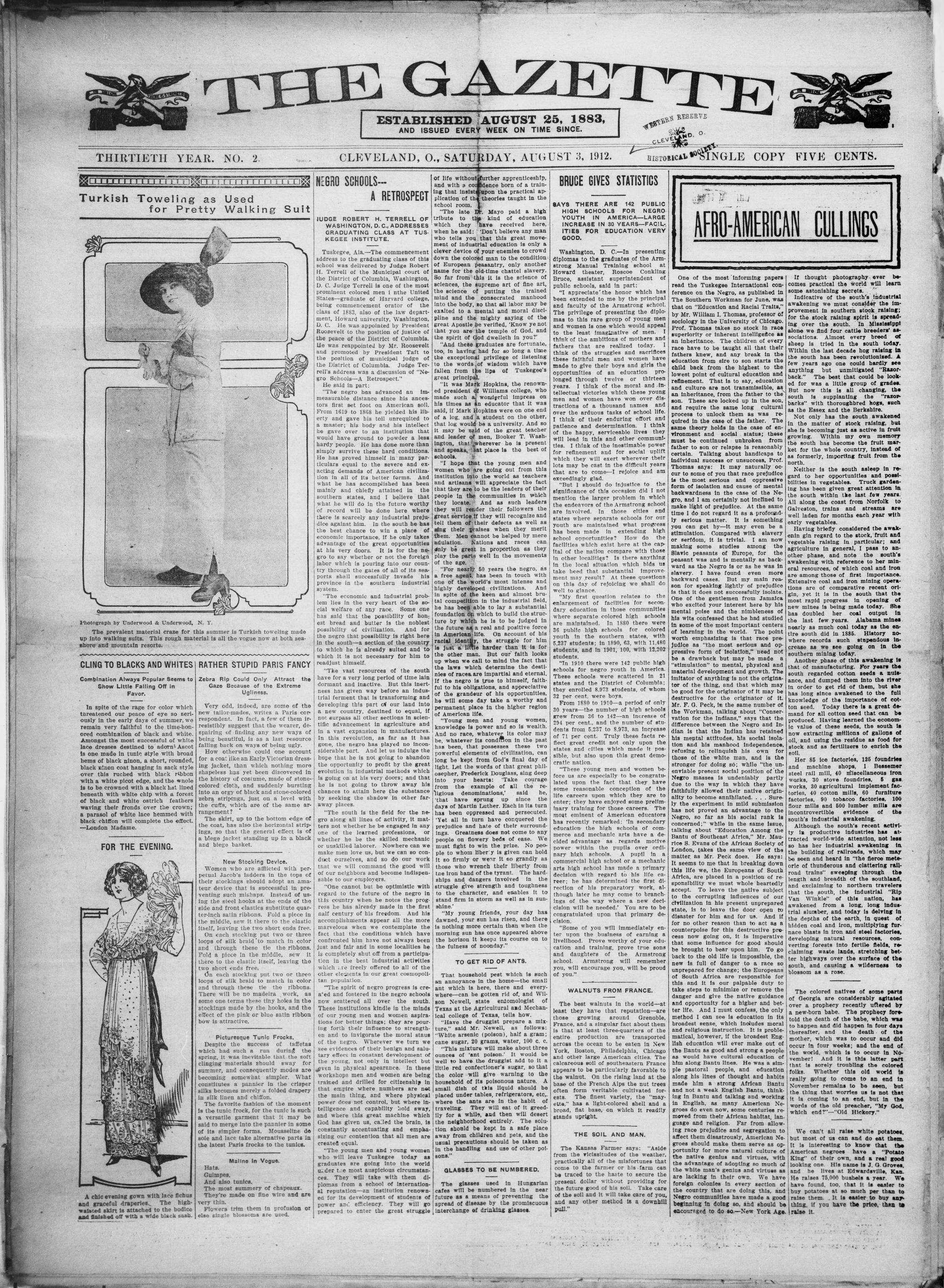
Turkish Toweling as Used for Pretty Walking Suit
I
The prevalent material craze for this summer is Turkish toweling made up into walking suits. This rough material is all the vogue now at both seashore and mountain resorts.
IN DOLOR
HAS SUSPENDED
THIRTIETH YEAR
Turkish Toweling for Pre
Photograph by Underwood & Underwood.
The prevalent material craze for up into walking suits. This rough mah-shore and mountain resorts.
CLING TO BLACKS AND WHITES
Combination Always Popular Seems to Show Little Falling Off in Favor.
In spite of the rage for color which threatened our peace of eye so seriously in the early days of summer, we remain very faithful to the time-honored composition of black and white. Amongst the most successful of white lace dresses destined to adorn Ascot is one made in tunic style with broad hems of black nylon, a short, rounded, black nylon coat hanging in sack style over this ruched with black ribbon with a white pigtot edge, and the whole is to be crowned with a black hat lined beneath with white chip with a forest of black and white ostrich feathers waving their fronds over the crown; a parasol of white lace hemmed with black chiffon will complete the effect. —London Madame.
FOR THE EVENING.
A chic evening gown with lace fuchsia and graceful draperies. The high-waisted skirt is attached to the bodice and finished off with a wide black sash.
A chic evening gown with lace fichus and graceful draperies. The high-waisted skirt is attached to the bodice and finished off with a wide black sash.
Zebra Rip Could Only Attract the Gaze Because of the Extreme Ugliness.
Very odd, indeed, are some of the new tail-mades, writes a Paris correspondent. In fact, a few of them irresistibly suggest that the wearer, despairing of finding any new ways of being beautiful, is as a last resource falling back on ways of being ugly.
How otherwise could one account for a coat like an Early Victorian dressing jacket, than which nothing more shapeless has yet been discovered in the history of costume, made of stone-colored cloth, and suddenly bursting into an orgy of black and stone-colored zebra stripings, just on a level with the cuffs, which are of the same arrangement?
The skirt, up to the bottom edge of the coat, has also the horizontal stripings, so that the general effect is of a blege jacket standing up in a black and blege basket.
New Stocking Device.
Women who are afflicted with perpetual Jacob's ladders in the tops of their stockings should adopt an amateur device that is successful in preventing such mishaps. Instead of using the steel hooks at the ends of the side and front clastics substitute quarter-inch satin ribbons. Fold a piece in the middle, sew it there to the elastic itself, leaving the two short ends free. On each stocking put two or three loops of silk braid to match in color and through these tie the ribbons. Fold a piece in the middle, sew it there to the elastic itself, leaving the two short ends free. On each stocking put two or three loops of silk braid to match in color and through these tie the ribbons. There will be no madeira work, as some one terms these tiny holes in the stockings made by the hooks, and the effect of the pink or blue satin ribbon bow is attractive.
Picturesque Tunic Frocks
Despite the success of taffetas which had such a run during the spring, it was inevitable that the soft clinging materials should sway for summer, and consequently modes are becoming somewhat simpler. What constitutes a pannier in the clisper silks becomes merely a folded drapery in silk linen and chiffon.
The favorite fashion of the moment is the tunic frock, for the tunic is such a versatile garment that it may be said to merge into the pannier in some of its simpler forms. Mousseline soie and lace take alternative parts in the latest Paris frocks to the tunics.
Malline in Vogue.
Hats.
Gulmpes.
And also tunics.
The most summery of chapeaux.
They're made on fine wire and are very thin.
Flowers trim them in profusion or else single blossoms are used.
ESTABLISHED AUGUST 25, 1883 AND ISSUED EVERY WEEK ON TIME SINCE.
A RETROSPECT
JUDGE ROBERT H. TERRELL OF
WASHINGTON, D.C., ADDRESSES
GRADUATING CLASS AT TUSK-
KEGEE INSTITUTE.
Tuskegee, Ala.—The commencement
address to the graduating class of this
school was delivered by Judge Robert
H. Terrell of the Municipal court of
the District of Columbia, Washington,
D. C. Judge Terrell is one of the most
prominent colored men I met the United
States—graduate of Harvard college
being commencement orator of the
class of 1883, also of the law department,
Howard university, Washington,
D. C. He was appointed by President
Roosevelt to the position of justice of
the peace of the District of Columbia.
He was reappointed by Mr. Roosevelt
and promoted by President Taft to
the position of municipal judge of
the District of Columbia. Judge Terrell's address was a discussion of "Negro Schools—A Retrospect."
"The negro has advanced an immeasurable distance since his ancestors first set foot on American soil. From 1619 to 1868 he yielded his liberty and gave his toll unrequited to a master; his body and his intellect he gave over to an institution that would have ground to powder a less hardy people. He has done more than simply survive these hard conditions. He has proved himself in many particulars equal to the severe and exacting demands of American civilization in all of its better forms. And what he has accomplished has been mally and chiefly attained in the southern states, and I believe that what he will do in the future worthy of record will be done here where there is scarcely any industrial prelude against him. In the south he has the best chance to win a place of economic importance, if he only takes advantage of the great opportunities at his very doors. It is for the negro to say whether or not the foreign labor which is pouring into our country through the gates of all of its seas ports shall successfully invade his province in the southern industrial system.
"The economic and industrial problem lies in the very heart of the social welfare of any race. Some one has said that the possibility of honest bread and butter is the noblest possibility of civilization. And for the negro that possibility is right here in the south—a section of the country to which he is already suited and to which it is not necessary for him to readjust himself.
"The vast resources of the south have for a very long period of time lain dormant and inactive. But this inertness has given way before an industrial ferment that is transforming and developing this part of our land into a new country, destined to equal, if not surpass all other sections in scientific advancement in agriculture and in a vast expansion in manufactures. In this revolution, as far as it has gone, the negro has played no inconsiderable part. And let us indulge the hope that he is not going to abandon the opportunity to profit by the great evolution in industrial methods which is going on at his very doors; and that he is not going to throw away his chances to attain here the substance by seeking the shadow in other far away places.
"The south is the field for the negro along all lines of activity, it matters not whether he be engaged in any one of the learned professions, or whether he be the skilled mechanic or unskilled laborer. Nowhere can we make make love us, but we can so conduct ourselves, and so do our work that we will command the good will of our neighbors and become indispensable to our employers.
"One cannot but be optimistic with regard to the future of the negro in this country when he notes the progress he has already made in the first half century of his freedom. And his accomplishments appear all the more marvelous when we contemplate the fact that the conditions which have confronted him have not always been just and fair and in some localities he is completely shut off from a participation in the best industrial activities which are freely offered to all of the other elements in our great cosmopolitan population.
"The spirit of negro progress is crea- ed and fostered in the negro schools now scattered all over the south. These institutions kindle in the minds of our young men and women aspirations for better things; they are pouring forth their influence to strengthen and to invigorate the moral status of the negro. Wherever we turn we see evidences of their benign and salutary effect in constant development of the young, not only in intellect but even in physical appearance. In these workshops men and women are being trained and drilled for citizenship in that empire where numbers are not the main thing, and where physical power does not control, but where intelligence and capability hold sway, and where this great machine which God has given us, called the brain, is constantly accentuating and emphasizing our contention that all men are created equal.
"The young men and young women who will leave Tuskegee today as graduates are going into the world under the most auspicious circumstances. They will take with them diplomas from a school of international reputation—an institution renowned for its development of students of power and efficiency. They will go prepared to enter the great struggle
of life without further apprenticeship, and with a confidence born of a training that insists upon the practical application of the theories taught in the school room.
"The late Dr. Mayo paid a high tribute to the kind of education which they have received here, when he said: 'Don't believe any man who tells you that this great movement of industrial education is only a clever device of your enemies to crowd down the colored man to the condition of European peasantry, only another name for the old-time chattel slavery. So far from this it is the science of sciences, the supreme art of fine art, the science of putting the trained mind and the consecrated manhood into the body, so that all labor may be exalted to a mental and moral discipline and the mighty saying of the great Apostle be verified, 'Know ye not that you are the temple of God, and the spirit of God dwelleth in you?' "And these graduates are fortunate, too, in having had for so long a time the exceptional privilege of listening to the words of wisdom which have fallen from the lips of Tuskegee's great principal.
"It was Mark Hopkins, the renowned president of Williams college, who made such a wonderful impress on his times as an educator that it was said, if Mark Hopkins were on one end of a log, and a student on the other, that log would be a university. And so it may be said of the great teacher and leader of men, Booker T. Washington, that wherever he is present and speaks, at place is the best of schools.
"I hope that the young men and women who are going out from this institution into the world as teachers and artisans will appreciate the fact that they are to be the leaders of their people in the communities in which they locate. And as such leaders they will render their followers the great service if they will recognize and tell them of their defects as well as sing their praises when they merit them. Men cannot be helped by more adulation. Nations and races can only be great in proportion as they play the part well in the movements of the age.
"For near! 50 years the negro, as a free agent, has been in touch with one of the world's most intense and highly developed civilizations. And in spite of the keen and almost brutal competition in the industrial field, he has been able to lay a substantial foundation on which to build the structure by which he is to be judged in the future as a real and positive force in American life. On account of his racial identity, the struggle for him is just a little harder than it is for the other man. But our faith looks up when we call to mind the fact that the laws which determine the destinies of races are impartial and eternal. If the negro is true to himself, faithful to his obligations, and appreciative of the grandeur of his opportunities, he will some day take a worthy and permanent place in the higher region of American life.
"Young men and young women, knowledge is power and so is wealth. And no race, whatever its color may be, whatever its condition in the past has been, that possesses these two powerful elements of civilization, can long be kept from God's final day of light. Let the words of that great philosopher, Frederick Douglass, sing deep into your hearts: 'Take courage from the example of all the religious denominations,' said he, 'that have sprung up since the days of Martin Luther. Each in its turn has been oppressed and persecuted. 'Yet all in turn have conquered the prejudice and hate of their surroundings. Greatness does not come to any people on flowery beds of ease. We must fight to win the prize. No people to whom libery is given can hold it so firmly or wear it so grandly as those who wrench their liberty from the iron hand of the tyrant. The hardships and dangers involved in the struggle give strength and toughness to the character, and enables it to stand firm in storm as well as in sunshine."
"My young friends, your day has dawned, your sun has risen, and there is nothing more certain than when the morning sun has once appeared above the horizon it keeps its course on to the fulness of noonday."
TO GET RID OF ANTS.
That household pest which is such an annoyance in the home—the small ant which is here, there and everywhere—can be gotten rid of, and Wilson Newell, state entomologist of Texas at the Agricultural and Mechanical college of Texas, tells how.
"Have the drugsist prepare a mixture," said Mr. Newell, as follows: "White arsenic (poison), half a gram; cane sugar, 20 grams, water, 100 c. c. "This mixture will make about three ounces of 'ant poison.' It would be well to have the drugsist add to it a little red confectioner's sugar, so that the color will give warning to the household of its poisonous nature. A small dish of this liquid should be placed under tables, refrigerators, etc., where the ants are in the habit of traveling. They will eat of it greedily for a white, and then will desert the neighborhood entirely. The solution should be kept in a safe place away from children and pets, and the usual precautions should be taken as in the handling and use of other poisons."
GLASSES TO BE NUMBERED.
The glasses used in Hungarian cafes will be numbered in the near future as a means of preventing the spread of disease by the promiscuous interchange of drinking glasses.
BRUGE GIVES STATISTICS
BAYS THERE ARE 142 PUBLIC HIGH SCHOOLS FOR NEGRO YOUTH IN AMERICA-LARGE INCREASE IN 30 YEARS-FACILITIES FOR EDUCATION VERY GOOD.
Washington, D. C.—In presenting diplomas to the graduates of the Armstrong Manual Training school at Howard theater, Roscoe Conkling Bruce, assistant superintendent of public schools, said in part:
"I appreciate' the honor which has been extended to me by the principal and faculty of the Armstrong school. The privilege of presenting the diplomas to this rare group of young men and women is one which would appeal to the least imaginative of men. I think of the ambitions of mothers and fathers that are realized today. I think of the struggles and sacrifices these faithful men and women have made to give their boys and girls the opportunities of an education prolonged through twelve or thirteen years. I think of the moral and intellectual victories which these young men and women have won over distractions of a thousand names and over the arduous tasks of school life. I think of their enduring effort and patience and determination. I think of the happy, serviceable lives they will lead in this and other communities. I think of the inestimable power for refinement and for social uplift which they will exert wherever their lots may be cast in the difficult years that are to come—I rejoice and am exceedingly glad.
"But I should do injustice to the significance of this occasion did I not mention the larger problem in which the endeavors of the Armstrong school are involved. In those cities and states where separate schools for our youth are maintained what progress has been made in extending high school opportunities? How do the facilities which exist here at the capital of the nation compare with those in other localities? Is there anything in the local situation which blurs us take heed that substantial improvement may result? At these questions on this day of reloicing we shall do well to glance.
"My first question relates to the enlargement of facilities for secondary education in those communities where separate colored high schools are maintained. In 1880 there were 36 public high schools for colored youth in the southern states, with 5,237 students; in 1890, 63, with 11,480 students, and in 1901, 100, with 12,202 students.
"In 1910 there were 142 public high schools for negro youth in America. These schools were scattered in 21 states and the District of Columbia; they enrolled 8,973 students, of whom 32 per cent were boys.
From 1880 to 1910—a period of only 30 years—the number of high schools grew from 36 to 142—an increase of 294 per cent, and the number of students from 5,237 to 8,973, an increase of 71 per cent. Truly these facts reflect great credit not only upon the states and cities which made it possible, but also upon this great democratic nation.
"These young men and women before us are especially to be congratulated upon the fact that they have some reasonable conception of the life careers upon which they are to enter; they have enjoyed some preliminary training for those careers. The most eminent of American educators has recently remarked: 'In secondary education the high schools of commerce and mechanic arts have a decided advantage as regards motive power within the pupils over ordinary high schools. A pupil in a commercial high school or a mechanic arts high school has made a primary decision with regard to his life career; he has determined the first direction of his preparatory work, although later he may come to branchings of the way where a new decision will be needed.' You are to be congratulated upon that primary decision.
"Some of you will immediately enter upon the business of earning a livelihood. Prove worthy of your education and training, prove true sons and daughters of the Armstrong school. Armstrong will remember you, will encourage you, will be proud of you."
WALNUTS FROM FRANCE.
The best walnuts in the world—at least they have that reputation—are those growing around Grenoble, France, and a singular fact about them is that at least three-quarters of the entire production are transported across the ocean to be eaten in New York, Boston, Philadelphia, Chicago and other large American cities. The calcareous soil of southeastern France appears to be particularly favorable to the walnut. On the rising land at the base of the French Alps the nut trees often form veritable cultivated forests. The finest variety, the "mayette," has a light-colored shell and a broad, flat base, on which it readily stands upright.
THE SOIL AND MAN
The Kansas Farmer says: "Aside from the vicissitudes of the weather, practically all of the misfortunes that come to the farmer or his-farm can be traced to the haste to secure the present dollar without providing for the future good of his soil. Take care of the soil and it will take care of you, and any other method is a downhill pull."
AFRO-AMERICAN CULLINGS
One of the most informing papers read the Tuskegee International conference on the Negro, as published in The Southern Workman for June, was that on "Education and Racial Traits," by Mr. William I. Thomas, professor of sociology in the University of Chicago. Prof. Thomas takes no stock in race superiority or inherent intelligence as an inheritance. The children of every race have to be taught all that their fathers knew, and any break in the education from sire to son starts the child back from the highest to the lowest point of cultural education and refinement. That is to say, education and culture are not transmissible, as an inheritance, from the father to the son. These are locked up in the son, and require the same long cultural process to unlock them as was required in the case of the father. The same theory holds in the case of environment and social status; these must be continued unbroken from father to son or relapse is reasonably certain. Talking about handicaps to individual success or unsuccess, Prof. Thomas says: It may naturally occur to some of you that race prejudice is the most serious and oppressive form of isolation and cause of mental backwardness in the case of the Negro, and I am certainly not inclined to make light of prejudice. At the same time I do not regard it as a profoundly serious matter. It is something you can get by—it may even be a stimulation. Compared with slavery or serfdom, it is trivial. I am now making some studies among the Slavic peasants of Europe, for the peasant was and is mentally as backward as the Negro is or as he was in slavery. I have found even more backward cases. But my main reason for speaking lightly of prejudice is that it does not successfully isolate. One of the gentlemen from Jamaica who excited your interest here by his mental pose and the nimbleness of his wits confessed that he had studied in some of the most important centers of learning in the world. The point worth emphasizing is that race prejudice is "the most serious and oppressive form of isolation," need not be a drawback but may be made a "stimulation" to mental, physical and material development and growth. The initiator of anything is not the originator of the thing, and that which may be good for the originator of it may be destructive for the originator of it. Mr. F. G. Peck, in the same number of the Workman, talking about "Conservation for the Indians," says that the difference between the Negro and Indian is that the Indian has retained his mental attitudes, his social isolation and his manhood independence, refusing to relinquish his own for those of the white man, and is the stronger for doing so; while "the unviable present social position of the Negro masses is undeniably partly due to the way in which they have faithfully allowed their native originally to become annihilated. . . Surely the experiment in mild sublimation has not proved an advantage to the Negro, so far as his social rank is concerned; . . while in the same issue, talking about "Education Among the Bantu of Southeast Africa," Mr. Maurice S. Evans of the African Society of London, takes the same view of the matter as Mr. Peck does. He says: It seems to me that in breaking down this life we, the Europeans of South Africa, are placed in a position of responsibility to our misheaded accept. To leave the native subject to the corrupting influences of our civilization in his present unprepared state, is to leave the door open to disaster for him and for us. And if for no other reason than to act as a counterpoise for this destructive process now going on, it is imperative that some influence for good should be brought to bear upon him. To go back to the old life is impossible, the new is full of danger to a race so unprepared for change; the Europeans of South Africa are responsible for this and it is our palpable duty to take steps to minimize or remove the danger and give the native guidance and opportunity for a higher and better life. And I must confess, the only method I can see is education in its broadest sense, which includes moral and religious instruction. It is problematic, however, if the broadest English education will ever make out of the Bantu as good and strong a people that have cultural education of him along Bantu lines. He was a simple pastoral people, and education along his lines of thought and habits made him a strong African Bantu and not a weak English Bantu, thinking in English and talking in language and religion. Far from allowing race prejudice and segregation to affect them disastrously, American Negroes should make them serve as opportunity for more natural culture of the native genius and virtues, with the advantage of adopting so much of the white man's genius and virtues as are lacking in their own. We have foreign colonies in every section of the country that are doing this, and the Negro communities have made a good beginning in doing so, and should be encouraged to do so—New York Age
If thought photography ever becomes practical the world will learn some astonishing secrets.
Indicative of the south's industrial awakening we must consider the improvement in southern stock raising; for the stock raising spirit is spreading over the south. In Mississippi alone we find four cattle breeders' associations. Almost every breed of sheep is tried in the south today. Within the last decade hog raising in the south has been revolutionized. A few years ago one could hardly see anything but unmitigated "Razorback." The best that could be looked for was a little group of grades. But now this is all changing, the south is supplanting the "razorbacks" with thoroughbred hogs, such as the Essex and the Berkshire.
Not only is the south awakened in the matter of stock raising, but she is becoming just as active in fruit growing. Within my own memory the south has become the fruit market for the whole country, instead of as formerly, importing fruit from the north.
Neither is the south asleep in regard to her opportunities and possibilities in vegetables. Truck gardening has been given great attention in the south within the last few years. All along the coast from Norfolk to Galveston, trains and streams are well laden for months each year with early vegetables.
Having briefly considered the awakening仁 gin regard to the stock, fruit and vegetable raising in particular; and agriculture in general, I pass to another phase, and note the south's awakening with reference to her mineral resources, of which coal and iron are among those of first importance. Extensive coal and iron mining operations are of comparative recent origin, yet it is in the south that the most rapid progress in opening of new mines is being made today. She has doubled her coal output in the last few years. Alabama mines nearly as much coal today as the entire south dived in 1885. History now records such stapendous increase as we see going on in the southern mining today.
Another phase of this awakening is that of manufacturing. For years the south regarded cotton seeds a nuisance, and dumped them into the river in order to get rid of them, but she has long since awakened to the full knowledge of the importance of cotton seed. Today there is a great demand for all cotton seed that can be produced. Having learned the economic value of these seeds, the south is now extracting millions of gallons of oil, and using the residue as food for stock and as fertilizers to enrich the soil.
Her 85 ice factories, 125 foundries and machine shops, I Besserman steel roll mill, 40 miscellaneous iron works, 30 stove foundries, 5 gas works, 20 agricultural implement factories, 40 cotton mills, 60 furniture factories, 90 tobacco factories, 100 flour mills and 60 lumber mills are incontrovertible evidence of the south's industrial awakening.
Although the south's recent activity is productive industries has attracted world-wide attention, not less has her industrial awakening in the building of railroads, which may be seen and heard in "the fierce meteoric of thunderous and clattering railroad trains" sweeping through the length and breadth of the southland, and exclamating to northern travelers that the south, the industrial "Rip Van Winkle" of this nation, has awakened from a long, long industrial slumber, and today is delving in the depths of the earth, in quest of hidden coal and iron, multiplying furnace blasts in iron and steel factories, developing natural resources, converting forests into fertile fields, reclaiming waste lands, stretching better highways over the surface of the south, and causing a wilderness to blossom as a rose.
The colored natives of some parts of Georgia are considerably agitated over a prophecy recently uttered by a new-born babe. The prophecy foretold the death of the babe, which was to happen and did happen in four days thereafter, and the death of the mother, which was to occur and did occur in four weeks; and the end of the world, which is to occur in November! And it is this latter part that is sorely troubling the colored folks. Whether this old world is really going to come to an end in November remains to be seen, but the thing that worries us is not that it is coming to an end, but in the words of the old preacher, "My God, which end?"—"Old Hickory."
We can't all raise white potatoes, but most of us can and do eat them. It is interesting to know that the American negroes have a "Potato King" of their own, and a real good looking one. His name is J. G. Groves, and he lives at Edwardsville, Kan. He raises 75,000 bushels a year. We have found, too, that it is easier to buy potatoes at so much per than to raise them. It is easier to buy anything, if you have the price, than to raise it.
(In Advance)
One Year.....$1.50
Six Months.....1.00
Three Months.....5.00
Subscribers are requested to remit by postoffice money order or registered letter.
Entered at the postoffice in Cleveland Ohio, as second-class matter
Address all communications to HARRY C. SMITH
Editor and proprietor,
THE GAZETTE,
Blackstone Building, Cleveland, O.
Member Ohio Legislature: 1894 to 1896; 1896 to 1898; 1900 to 1902
THE GAZETTE is the oldest, and has the largest bona fide circulation, double that of any newspaper in the interest of Afro-Americans, published in the state of Ohio, and comparison with any will immediately establish its rank as one of the NEWSIEST AND BEST in the country.
OUR THIRTIETH YEAR!
With our issue of July 27, '12, The Gazette entered upon the 30th year of its continuous publication; every week on time. From the beginning, it has been edited and managed by the writer who can hardly realize that so long a time "in the saddle" has elapsed. The Gazette's successful efforts to wipe out the remnants of Ohio's "Black Laws", years ago; to enact Ohio's Civil Rights and AntLynching laws, are well-known to all of our people, particularly those here in Ohio. What it has also done, in hundreds of cases, to help and defend and encourage our people, is also well known. Personal interests have always been subordinated to those of our people. Its call to Afro-Americans, in season and out, is never to accept anything in the way of treatment, less than that due all citizens, and too, without reference to class or color. When it comes to our citizen-rights, here in the north, we have always been unalterably opposed to a "docrine of surrender" or conciliatory policy, and shall continue to be so. The Gazette believes in demanding for our people, in this section of the country and continuing to fight for until seceded, all that is due American citizens under the law. THIS IS OUR SLOGAN! The Gazette's firm adherence to principle, through all these years, is its best recommendation for a larger support. The lack of sufficient patronage is the only thing that has prevented the doubling of the size of the paper and making other improvements we have greatly desired for years. Here is where our faithful following, thousands of readers in all parts of the country, from ocean to ocean and from the great lakes to the gulf, can afford us material assistance, if they will. Urge your friends and acquaintances to subscript for The Gazette and by the first of the year double our circulation. For all you have done in past years, we thank you and assure you of our thorough appreciation.
THE CUBAN REVOLUTION.
At the present outlook the insurection in Cuba seems to have summed. Some American papers profess to believe, that "this is the last attempt" in the matter. The West liche Post of St. Louis, a leading Ger man-American journal, doubts the correctness of this view, while the Chicago Abpostet (German) sees the "beginning of the end of the Cuban Republic", in these struggles. This paper points out, that "the warful acts of the Cuban Negroes were not so dangerous as to warrant the sending of warships by the United States to the scene", nor were the properties of "foreigners" (mainly Americans) really in such danger of destruction, or the lives of these foreigners in such danger as to warrant the action of our Government." This paper rather assumes, that the "jingo" press made much of the matter in order to prepare the American people for an exnation later on, and that the island is to be made a "white man's" Government. "This the Cuban Negroes do not like, as one can readily understand; but they will have to submit eventually", it says. The Abpostet evidently does not approve of such an immoral procedure of "this" American republic, if we read correctly between its lines. But neither "our" government nor our "people" seem to have any scruples in this "robber's game". Perhaps the Cuban revolutionists will spoil the game Wait!
The contention of certain Spanish Cuban papers, edited by American tools of avaricious trusts, that the American Republic, when forming in 1775, guarded against allowing its Negro population—not insignificant in some states—any share in the war for independence, is either based upon falsification of history or the result of ignorance of those making it. Crispus Attucks, who shed the first blood in that war, had many Colored compatriots and some "fine fellows among them", as Baron Schloezer, the Prussian statesman on our shores, wrote home (See Bancroft's History of the United States.) It is true Washington was at first loth to employ slaves—or enlist free Negroes—in the cause, but he later on changed his opinion and did receive black men into his army. So did, later on, General Jackson in the Seminole War, and we all know the conspicuous part played in the Civil War by Negroes, of whom 186,017 were employed as soldiers in the Union Army, taking part in some 449 engagements, a number of which were battles of importance. They always acquired themselves well—this part of the Spanish ("American") argument is weaker than a reed in the wind!
It is rather difficult at this distance to prognosticate the trend of affairs, or rather the shape they will assume in Cuba. But the American people, of course mainly Afro-Americans, will do well to keep their eyes on the hands
of Washington, D. C. The result of the present Presidential campaign will have a bearing on this question also—both in Cuba itself as in its reaction in our country. What strikes the writer as strange is that the socialists who made such a noise about the Mexican revolutionists whose aims hardly touched our politics as much as the Cuban revolution does, are so quiet—so "mum" on this question. Their only representative in Congress, Mr. Berger, who has made himself a figure in the "limelight" on so many "questions" of the "hour", is so reticent on this question, that is not a momentary one but one of principle and far-reaching result, as to prompt the view that Negroes do not concern much the "white" socialistic party, particularly, although it is the real socialistic party I mean—the party of the proletariat, and if there is a proletariat de facto in the United States and Cuba, it is the Colored proletariat preeminently! In the next Congressional session this matter must come up. Then the parties will have to show their hands.
PRAISE THEM!
Those of our ministers who promoted the meeting at Cory M. E. church Monday evening, to protest against the hurling of our people to color-line Luna Park, Thursday, by the alleged Cleveland Association of Colored Men, that the prejudiced park management might make hundreds of hard-earned dollars, deserve the praise and thanks of the community for their splendid stand and leadership, and practical evidence of proper racial interest. They did not "go too far" but just far enough. THEY DID THEIR CLEAR DUTY to their church members and others of the race, in this community, as we make clear in the long local item on page 3 of this paper. Let the self and race respecting members of the race in this city, PRAISE them UNSTINTEDLY for what they have done, rally around and encourage them all possible, and decry the cowards and sycophants who would criticise them or the meeting of Monday evening. More power to them and their kind; may they become even more active along the same line, for such leadership is sadly needed by the race in every community, in these sad "surrender" days; and God grant, that their kind may increase rapidly among this people of ours. Trading upon a denial of rights in a public place, in order to make "tainted" money, as was the case, Thursday, at Luna Park, is a mighty poor piece of business for so-called intelligent Colored men to be engaged in, to say the least. ALL HONOR TO THOSE MINISTERS!
LUNA PARK COLOR LINES.
Trenton, N. J., July 22—A penalty of $500, recovered by Mrs. Minerva Miller, who was excluded from a Pascal theater because of her color, was upheld in the Supreme Court in an opinion filed by Justice Kelsey July 22. The action was brought against Christopher Stampul, proprietor of the establishment, who sustained one of the incidents in barring Mrs. Miller from the resort.
This is the way to put a stop to the dance-hall, roller-skating rink and swimming-pool color-lines at Luna Park, this city. Our Ohio Civil Rights law is alright, says the Ohio Supreme Court. Attorneys Alexander Martin and John M. Anderson have won cases under it; also Ex-State Senator W. T. Clark, who helped the writer to pass it in the State Assembly in 1894. Indeed Mr. Clark has never lost a case under our Ohio Civil Rights law and has had many, very many victories—more than any other attorney in the city. There is no good reason, either, why similar color-lines at Eucell Beach Park and elsewhere in public places, in the city, county and the state of Ohio, should be permitted to exist. All that is necessary is for our people to emulate the example set by Mrs. Minerva Miller of Trenton, N. J. Dr. H. C. Bailey and others of this city, who have very properly and
promptly gone into the courts and vindicated their rights in public places, as all womanly and manly members of the race, citizens, should do when color-lines in those places are drawn on them. Our lack of activity, along this line, does not speak well for the race or its value of its citizen rights. We must be far more active and aggressive in contending, in the courts, for them.
BUGKEYE LETTERS
WRITTEN BY "THE OLD RELIABLE" GAZETTE'S CORRESPONDENTS.
K. P. GRAND LODGE AND COURT.
The Companies That Won the Prizes
—Officers Elected for the En-
dition
Dayton, O.—The 25th, annual session of the grand lodge, and Court of Calanthe, K. P. of the state, was held here in Memorial hall, July 23, 24 and 25'. It proved a delightful meeting in every respect, the attendance being very large. The parade,' banquet and other social features, were exceptionally satisfactory, the people of Dayton being most hospitable indeed. Cleveland K. P. were ably represented by nine delegates: Walter L. Milligan, Geo. L. Randolph, Moore and geo. W. W. Edwin of Edwin ango and geo. N. W. J. Howland, Walter Wright and Chas. Royal of Western Reserve lodge, No. 42; Mrs. Ellen Jackson and Mrs. Hattie Justice of Hermoine court, and Mrs. John Tuck of Damon court. Much important business was transacted by both grand bodies, and the following officers elected for the ensuing year: Rev. E. L. Gilliam of Columbus, G. C.; W. L. Anderson, G. V. C.; Thos. Kennedy, G. P.; W. A. Burke, G. K. of R & S.; H. M. Higgins, G. M. of Exx. Dr. W. T. Nelson, G. M. R.' W. H. Jones, G. A.; J. A. Scurry, G. I. G. W. F. Clark, G. O. G.; J. A. Goode, G.m.-At. Miss Ollie Pettiford was elected Clerk in the first prize. Columbus won the first prize. The Springfield companies, second and third prizes. The grand lodge and court will meet next year in Spring field. Mr. Milligan of Cleveland was elected representative to the supreme lodge, which will convene in Baltimore, Md., next year.
NORTH OHIO S. S. INSTITUTE
The Annual Session, A Great Success
—Those Who Delivered Addresses
Officers Elected for the
New Year 2004
OUR CITY FEDERATION.
Our City Federation of Women's Clubs invites all women's clubs of Cleveland to unite with it in its work for the uplift of the race. The executive board will present to the federation at its next meeting, plans, which if adopted will be far reaching in the betterment of the youths of our race. Women, not members of any club, are urged to connect themselves with some of the clubs now organized to the Federation of the youths of our race. Federation individually. The united effort of all of our women is desired. "In union there is strength." The Federation meets Aug. 7 at 7:30 p. m. at Mrs. Wm. Hawkins, 2238 E. 43d St. Mrs. Blanche Glimere, pres. C. F. C. W. C.; Mrs. Inez Fairax, pres. Executive Board; Mrs. Sarah Mitchell Bailey, secretary. Great praise is being given the Federation for its splendid resolutions against the Luma park color lines, published in The Gazette last week. They are all women who are best interests of the race. The president's explanation of them, at the meeting at Cory M. E. church, Monday evening, was telling: was fine!
The presidents of all clubs, now members of, or which shall join the F. C. F. W. C. are requested to bring or send to the secretary, Mrs. Bailley, requesting the name of their club, its president's name and address, the number of its active members, and the names and addresses of its delegates.
Sarah M. Bailey, sec'y.
WRITTEN BY "THE OLD RELIA BLE" GAZETTE'S CORRESPONDENTS.
What Our People Are Doing Each Week—Church, Personal, Social, Lodge, Literary and Musical — Marriages, Deaths, Etc.
Lorain—Mrs. Vivian Mitchell of Van Wert, is visiting her sister, Mrs. G. L. Hicks—Mrs. M. Brooks was in Cleveland, Tuesday. Mrs. Emma Scott came from there, Sunday.—Louise Brooks visited in Elyria, Tuesday.—Roy Brantford, Robert and Ray Tates have returned from the lakes. Rev. Robert Brantford, N. O. S. Institute, Thursday, in Cleveland, Mrs. K. Blaine of Toledo, is visiting her mother, Mrs. M. Robinson.—Miss Shores of New London, is the guest of Miss W. Jackson.—Miss E. Davis of Elyria, was here, Sunday.
Smithfield.—"Aunt" Sarah Benford who has had rheumatism for 40 years and who has to use crutches, walked almost a fourth of a mile, to the A. M. E. church, Sunday morning. A few more with her determination would make the churches and S. S. flourish. Send your children to school, and attend church. The hawf-social, Saturday evening, at the parsonage, was a success. It was under the management of D. W. and M. Bigsby, M. Washington and M. E. Veney—Little Allila Beall and Master Thomas are improving—Mesdames L. and S. Hargrave and little daughter, visited in the summer by Walter Garner and little daughter, Mary, and Mr. and Mrs. Hockins, are guests of Mr. and Mrs. M. Purl—S. and E. West were guests of Mr. and Mrs. F. Singer, recently—Mr. F. and Miss Faithful were guests of Miss M Beall and Mr. G. Binns—Rev. W Toney will preach here, Sunday, for Rev. S. W. White. He will visit relatives in McIntyre.
Correspondents must mail all letters for publication at their main postoffice sufficiently early on Monday (or Sunday) of each week to have them reach The Gazette office on Tuesday morning, and always write, also, their names and that of their names. The Gazette wrapper about returned copies. Unless this latter is done, proper credit cannot be given you. Lists of names, wedding presents, etc., obituary notices, speeches, resolutions, poetry, inquiries for relatives and advertisements of all kinds, including items for sale in the near future, must be paid for in advance at the rate of ten cents a line, six words to a line. Our rates for display advertisements will be sent on application. Send postal note and not stamps during warm weather.
---
Sandusky.—Rev. J. J. Jackson, former pastor of the Second Baptist church, was here last week in the interest of his theological school and Home, near Bellefontaine. Rev. Paton of Indianapolis, preached, Sunday morning and evening. The rally was a success. He is president of an industrial school.—Mr. and Mrs. J. S. Davis spent Sunday at Port Huron, visiting the N. G. encampment. Rev. J. B. Hammond, of Indianapolis, Sunday, coming from Cleveland, where he attended the N. O. S. Institute. He reported a fine meeting—Mrs. H. Richard painfully injured an arm and ankle in a fall from a street-car, last week.—Mr. G. Shadd is better.—Mrs. A. H. Dodd is attending the S. S. convention, in Springfield.—Miss R. Garrett left, last week, for Indianapolis.—Rev. G. D. Smith returned, last week, from the grand lodge meeting. In Dayton, Miss, Tittwee, there visit Mrs. Wm. Jones and grandmother, Mrs. Amanda Taylor.—Miss *Emma and Libia Gilkerson, Miss White, Mr. L. Jones and others returned, Sunday, from camping.
* * *
Cadiz.—Prof. W. H. Lucas was in Cleveland over Sunday.—Messrs. Austin and Ira Wallace have returned to Pittsburgh, after spending a few days with their parents here, last week.—Miss Pauline Barnaby of Washington D. C., is visiting at Miss Laura White's Mrs. Susie White spent Sunday in East Liverpool.—Miss Hattie Lucas returned home from Newark, O., where she visited a couple of weeks.—Simpson M. E. church meet-meeting, near Georgetown, closed Sunday. They were assisted, musically, by the Colored Orchestra club. A large number S. Johnson entertained the Y. M. L. club, on the 26th ult.—Linder, Davis and Carter made a business trip to Wheeling, recently.—The "Mystic five" still persists in holding exclusive stag parties.—Rev. H. F. Fox was out of town Sunday. The services were conducted by Bro. W. F. Tyler.—Mrs. W. A. Mason is convalescent.
Youngstown—Mrs. S. Tillery remains about the same—Mrs. Chas. Lincoln is better—Mrs. Chas. Jackson will attend the Simmons reunion at M. Vernon, next week—Mrs. Geo Lucas is ill—The Third Baptist church broke ground for their new church on Oak Hill Av., Monday—Mrs. and Mrs. Thomas Losemow, Mrs. and Mrs. Thomas Losemow, Mrs. and Mrs. Samuel Boggess, Willis Collins and James attended the K. P. grand session in Dayton, last week—Mrs. Mary Patterson left, Tuesday, for Washington, Pa., to locate—Mrs. W. M. Hardy and Mrs. Wright returned, last Friday, from a week's trip in the east.—Willis Collins was called to Circleville, the 18th by his father-in-law, Mr. Nelson Stanley's death. The following day, from a week's trip in MwI, Stewart Foster and Dudd Collins. They returned, the 29th. Mrs. G. M. Fagan and Miss Frances Moore attended the A. M. E., S. S., convention in Cleveland, last week.
---
Don't throw away your copy of The Gazette when you have done with it, but give it to some appreciative person when you feel would be likely to subscribe or take it regularly, if they had a copy to look over and read carefully. Oblige the Editor.
DOINGS OF THE RACE
Charles E. Toney, Esq., of N. Y. City, has won a $22,000 case in court. Parker N. Bailey, a teacher in M. St. High School, Washington, D. C., is dead. Likewise Dr. R. F. Boyd of Nashville, Tehn.
"Mooseville" is a good name for members of Roosevelt's "Bull Moose" or "Third Party." as it is called.
Mrs. Ellen Collins of N. Y. City, who died July 3, left $5,000 to Mr. and Mrs. Booker T. Washington.
T. Montgomery Gregory has been appointed Assistant Professor of English in the College Department of Howard University.
A bill has been passed by Congress setting apart a tract of land adjoining the Marine Hospital at Wilmington, N. C., for a Colored school. The tract covers nine city blocks, and is valued at not less than $30,000. A $40,000 building is to be erected at once on the plot.
Hiram H. Starr, a wealthy pioneer, who died recently at Fall City, Oregon, left all of his property to Booker T. Washington, of the Tuskegee, Ala. Institute, for the benefit of the education of our people. Mitchell fair on Long Island, N. Y., an Afro-American competed successfully against a number of millionaires and won the blue ribbon on ducks and poultry farming. There is a new interest manifested in farming, the old methods are being rapidly discarded.
It is reported that Jack Johnson in addition to helping other worthy poor white and Colored people of Las Vegas, N. M., while there before and after his fight with Jim Flynn, gave a sick woman of the race there a $1,500 automobile and paid a chauffeur to teach her how to run the machine.
Said President Taft, recently: "I do not think it possible to secure the punishment of lynching in the Federal courts. Lynching is not distinct from the general class of crimes within the State jurisdiction, and it would very effectively draw a line of distress, which would preserve the general line of Federal jurisdiction and State jurisdiction." The various states must follow Ohio's lead and enact anti-lynching laws, like Illinois did some years ago.
"Woodrow Wilson will stand by the Negro, and the Negro need not have any fear in supporting his presidential candidacy," said Bishop Alexander Walters at his Episcopal residence in N. Y. City, last week. Bishop Walters, who had just had an interview with Governor Wilson at Seaigt, N. J. is pleased with the earnest manner in which Wilson talked over the Negro situation. The Bishop says, Mr. Wilson says he has always been friendly to the Negro, and that he denies the statement that he would not admit a Negro student, while president of Princeton University; also that Mr. Wilson promised, if elected President, to see that the Negro was given a "square deal."
THE RESULT OF "JIMCROW" Y. M. C. A. AND SEPARATE SCHOOLS.
Indianapolis, Ind.—The courthouse playground was reopened Saturday, after several weeks of locked gates, and once again the children (white) of the center of the town were given an opportunity to enjoy the slides and swings. Colored children were not admitted to the grounds. Suits have been brought against Playgrounds Commissioner Tutewiler to force him to admit them, and we hope to win.
WICKERSHAM WILL FIGHT!
Washington, D. C.—U. S. Atty. Gen. Wickersham will go to Milwaukee this month to make a personal plea for the retention in the American bar association of his assistant, William H. Lewis, Esq., of Boston. If he fails Wickersham will resign from the association. The question promises to cause a lively battle. Reports that Wickersham will go to the convention in large numbers to outvote the northern and eastern members, who will line up for Lewis, have added interest to the coming fight.
CORRESPONDENTS WANTED
The old reliable Gazette desires an active agent and correspondent in every city and town in Ohio and neighboring states having a number of Afro-American residents. Only a little time on Fridays or Saturdays is required.
We are especially desirous of hearing from persons in the following named cities: Zan, esville, Newark, Lancaster, Lebanon, Chicago, Toledo, Columbus, Springfield, Plum Columbus, Cambridge, Stenbouw, Bellela, St. Clairsville, Wilmington, Portsmouth, Washington, H. C., Oxford, Sabina, Gallipolis, Rendville, Urbana, Delaware, M. Vernon, East Liverpool, Wellsville, Akron, Dayton, Middleport, Bellefonteau, Lima, O., and other places where we have none.
Write to the editor of The Gazette, Blackstone building, Cleveland, O., and ternus will be sent promptly. Our readers who oblige us greatly by sending us a letter of thanks in the cities named above, or others, to whom we can write relative to the matter.
Lilacs and Lilacs!
Mr. Cliffe—"By George! When we get into our suburban home I'm going to grow illacs." Mrs. Cliffe—"Don't do it, Henry. I like you much better, smooth shaved."
WONDERFUL RESULTS
ON SHORT NOTICE
I have used your Pomade. Its the best thing I ever used for making curly hair tie smooth. I have not finished my first bottle, but can see wonderful results, writes Mrs. Louise E. Hayes of Pineville, S. C.
Try Ford's Hair Pomade for harsh stubborn and unruly hair and Ford's Royal White Skin Lotion for the complexion. Ask your druggist for them. Be sure and get the genuine (Ford's) manufactured by the Ozonized On Marrow Company, Chicago, Ill.
Avery College Training School Avery and Nelson Streets,
North Side Pittsburgh, Pa.
CHARTERED AND ENDOWED JANUARY 17th, 1849.
DR. G. G. TURFLEY, President.
WILLIAM MANLEY, Vice Pres.
JOS. D. MAHONEY, Sec.-Treas.
STEES AND OFFICERS OF ADMII
W. K. McGINNESS
ELMAN
WILLIAM MANLEY
DR. G. G. TURFLEY
JOSEPH D. MAHONEY
DE
Deceased.
JOHN D. CHERRY W. K. McGINNESS
DR. HERMAN HECHELMAN WILLIAM MANLEY
*WILLIA AUSTIN DR. G. G. TURFLEY
DR. ROBERT BRADY JOSEPH D. MAHONEY
ALBERT P. WALLACE *Deceased.
The Avery College Training Schools for Young Colored Women:
The interior of all the buildings have been remodeled and decorated, The institution offers free of any expense to every young Colored woman, skilled knowledge to become self-employed in the following gentle occupations: cutting and drafting and designing, nurse training, millinery, domestic science, tailoring for young men, and an intermediate English course, using the same books as are used in our Public Schools. No Colored institution in this country offers such an opportunity to young Colored women—FREE OF ANY EXPENSE.
Organized November 16, 1906.
Organized November 16, 1906. Chartered April 8, 1909.
The only Colored Hospital in Western Pennsylvania, free to any nationality, that is modernly equipped to do such work. Located in a quiet and clean neighborhood, surrounded with a beautiful lawn and shade trees. We reach all points of the city, day or night, with our own Ambulance. Doctors and Nurses in attendance day and night. This department of Avery College was organized to meet the urgent necessity of caring for the physical side, as well as the mental and industrial.
The facilities for Nurse-Training are excellent and the standard of admission high.
The course of study covers three years, but it is so arranged that those who are able, can complete it in two years.
TUTION IS FREE. Board, Furnished Room, Laundry and Uniforms are Furnished, Free, and, Salary of $36 yearly.
Furnished Free, and Salary of $36 yearly.
We give you PROFESSIONAL TRAINING under competent white and Colored physicians.
Telephones: Bell 1464 and 9513-R Cedar, 2296 Cedar. P. & A. 1174 North.
Night Telephone: 6 P. M. to 6 A. M., Bell 1464 Cedar. Private Exchange
Phone Booths.
The rapid growth of the institution has rendered necessary the addition of a dormitory. It is heated throughout by hot water, lighted by its own electric plant, in charge of a competent matron. This building is for girls only.
For catalogues and other information address
JOSEPH D. MAHONEY,
Secretary and Treasurer,
N. S. Pittsburgh, Pa.
Forty-third Annual Exhibition OF THE COLORED A. & M. FAIR ASSOCIATION INCORPORATED Will be held at Lexington, Ky.. September 10, 11, 12, 13 and 14, 1912.
This will be the greatest fair yet given by this world-famous association. RUNNING, TROTTING and PACING RACES DAILY. Hamilton's Military Band will be heard in Concerts Daily in front of the Grand-s and. Ring exhibits extraordinary. Free Attractions unexcelled. Reduced Rates on all Railroads and Traction Lines. T. J. WILSON, Pres. A. L. HARDEN, Sec.
A. L. HARDEN, Sec.
944
Representing a Million Dollar Stock of Woolens for
If you are a lover of the
Fineest Madeo-Measure High Grade
Come and see the new fabrics, the new color tone, the new fashions and let me show you 39 special Justice features in making. Be your requirements an Overcoat, or suit or just a pair of dressers, give us a trial. I also have a cleaning department; altering and putting old clothes in order is my Special. Yes, I am a Colored man, a member of the race. Come and see me.
RUFUS S. JUSTICE,
FAILOR.
4316 Central Building near the
Elks' Building.
Architect:
To Pack a Trunk
Take a couple of horses the height of a chair; they take up little space in a stoolroom. Use them to set a trunk on when packing it. It will save your wife many a backache and save you or whoever removes it after it is packed, from lifting it up from the floor.
McCall's Magazine and McCall Patterns
Have More Friends than any other magazine or patterns. McCall's is the reliable Fashion Guide monthly in one million one hundred thousand homes. Besides showing all the latest designs of McCall Patterns, each issue is brimful of sparking short stories and helpful information for women.
WITH THE WINNER.
I pray you with all earnestness to prove, and know within your hearts, that all things are possible for those who believe in the possibilities and who determine that, for their part, they will make every day's work contribute to them—John Ruskin.
Save Money and Keep in Style by subcribing to McCall's Magazine at once. Costs only go cents a year, including any one of the celebrated McCall Patterns free.
McCall Patterns Lead all others in style, fit, economy, number sold. More. Makes combinations. Makes combinations. Makes combined. None higher than 15 cents. Buy from your dealer, or mail from
Ingenious Swindler
A laughable and ingenious fraud was played on two Glasgow (Scotland) women the other day. By representing to two housewives their husbands had fallen in the Clyde, and that he had been sent for a change of clothing, a man named Young received from the women the clothes asked, and appropriated them to his own use.
McCALL'S MAGAZINE
236-246 W. 37th St, New York City
Northeast Sample, Premium visions and Pattern Categories, New York
What He Took.
"Going down the river to spend Sunday with the folks." panted the excited week-end jaunter, as he swung aboard a moving car. "No. I don't need any huggage; all I take for these week-end excursions is just a nightbrush and a tooth-gown."
Eagle Not Always Brave
Eagles are generally believed to be very courageous. That they are not always as brave as is supposed is proved by the following anecdote: A naturalist tells of a combat between ten missile-thrushes and a white-tailed eagle, in which the latter was thoroughly vanquished, and was discovered squatting down in a shed, where he had been driven in hope of refuge from the angry birds.
French Revenue From Gambling.
From the state tax on games of chance, including the tax on the totalizator, the machine which registers race track bets, the French government receives about $1,500,000 a year.
PURELY PERSONAL
PURCHASE
THE "GAZETTE" AT
J. S. HALL'S, 3121 Central Ave.
L. SCHWARTZ'S, 2921 Central Ave. Open Sunday.
O. C. SCHROEDER'S, Cuyahoga Bldg. Open Sunday.
ELMER F. BOYD'S, 2604 Central Ave.
F. VALENTINE'S, 2130 Central Ave.
SAM. FERTMAN, 3608 Central Ave.
J. E. BRENNEN, 4401 Central Ave.
MILLER'S, 2249 E. 105th St.
NOTICE TO SUBSCRIBERS:—Subscribers not receiving The Gazette regularly should notify us at once. We desire every copy delivered promptly. We advise our patrons to carefully examine The Gazette's advertisements before making purchases. Business men who advertise in this paper should have the patronage of Afro-Americans. The fact that they advertise is assurance that they want it. Local reading notices (advertisements) ten cents a line (six words in a line.)
FOR RENT—Houses—If you have places to rent or if you want to rent—notify The Gazette.
For Sale—Desk practically new; will sell for $15; cost $24.50. Call and see it at 3710 Scovill Ave. Suite I.
For Sale—Fine lot, and will build a cottage or bungalow—all for $300 down. S. E. Woods, 2828 Central ave.
For Sale—S. E. Woods of 2828 Central Av., has several good homes. Prices ranging from $1,700 to $3,500, on easy terms.
NOTARY PUBLIC—For such services call at The Gazette office, No 3 Blackstone Building, No. 1422 W. 3d street, near Superior avenue.
Miss Sallie Fisher of Washington D. C., is visiting Mrs. Edward Daw. Miss Bertha Blue, sister and other went to Hampton, Va., recently, to attend the N. F. of Women's clubs. Lunch room, soda-water, cigars and tobacco, the best home-cooking at Geo. H. Randolph's, 3020 Central Ave. Miss Madeline Nooks will return Monday, from a two weeks' visit with Rev. and Mrs. Maxwell of Midtown Wesley Jackson of Hudson Av., S. E. spent Sunday week in Chicago, the guest of Geo. Bundy and Sam, Field ing.
Persons in the East End can purchase copies of The Gazette at Miller's Cigar and News Store, 2249 E. 105th St. Miss Mattie Dexter has returned.
For Rent—Ten room house, all conveniences, suitable for two families, nice yard and splendid location in the east end; $28 a month. Apply at The Gazette office.
FOR SALE—Eight room house in the East End, hardwood finish down stairs, all conveniences, bath, gas, beautiful yard and street, &c. Apply at The Gazette office, 3 Blackstone Bldg.
FOR SALE—Elegant eleven room house in the East End, all conveniences; electric light, stair heat, water heater, full wall, &c. Splendid opportunity and cheap, too. Apply at The Gazette office, 3 Blackstone Bldg.
FOR SALE — Bran new, Imperial
Encyclopedia and Dictionary, 40 volumes,
10,000 illustrations, handy to
handle. Unexcelled for reference
purposes. A library in itself—one
that will last a life-time. Contains
everything you may wish to know.
Call or address The Gazette Blu-
stone Building, 1422 W. 3d St. Clever
land, O, near Superior Ave. This is
an opportunity of a life-time for those
who love good books. $25.
If you are indebted to The Gazette
pay promptly, please.
Mrs. H. Justice of Central Av., is
vice president of Dayton.
Mrs. L. J. Fearhart of Lockland, is
Mrs. F. T. Berry will leave Saturday to visit relatives in Mobile, Ala.
Prof. W. H. Lucas of Cadiz, was in the city, last week attending the S. S. Institute.
Mrs. Rosa Smith and daughter, of Springfield, are Miss Hazel Mountain's guests.
Mrs. Mamie Banks of Dayton, a deli owner of the S. S. Institute, is visiting a sister here.
Arthur Lee, Maurice Cowdery, W. C. Fowler and B. B. Whiting visited in Detroit, Sunday.
Mrs. F. Dennis and sister, Mrs. C. Norris of Detroit, are guests of Mrs. C. Montgomery of E. 83d. St.
L. G. Adkins took his mother to the Pittsburgh Old Folks' Home, last week. It is the finest one of the kind in this town.
Mrs. Body of E. 71st. St., is spending the summer at Erieside, O., and Mrs. Jessie Evans Chinn, at P. Chau-tauqua, N. Y.
Mr. and Mrs. Wm. H. Whiting entertained at cards, last Wednesday evening, in honor of Mrs. Florence Burke of N. Y. City.
Miss Ida Jackson of Canton, a member of the University of 1912, Howard University, Washington, D. C., is visiting Mrs. Jas. Owen of the E. E.
Principal F. R. Davis of Sherman Industrial Institute of Huntsville, Ala., a resident of this city forty years ago, is here in the interest of his school. Dr. J. T. Suggs of Florence, Ala., will join with Mrs. Shook Suggs here on Aug. 15, to visit her sister, Miss Willa M. Shook and their parents, until the last of the month. Mr. and Mrs. Harry Dunnington of Indianapolis, were guests of Mr. and Mrs. Richard Singleton of Pine Av., the past week, having visited one week in Detroit and Windsor, Canada. Revs. Chas. Bundy, W. G. Snelson, G. Snelson, in addition to the ministers present and others, endorsed the meeting at Cory M. E. church, Monday evening; so Dr. Bailey informs us. Rev. J. E. Davis returned last Friday from Pittsburgh, where he spent a week, most successfully, in evangelistic work. Rev. D. Bundy, Barry Burr, Webster, Snelson, Lowery and Webster also called on The Gazette, re
F. L. Rowell, of Cassells & Rowell, our new restauranteurs, at 2613 Central Av., (Adkins' old stand), returned last Wednesday, from Oberlin and several points in that vicinity. Their chef is one of the very best in the city. Try her excellent cooking; also pastry. The restaurant is open evenings until midnight. The Woman's Suffrage party will make final campaign plans at an important emeting to be held this Saturday at 2 p.m., at Elks' hall, 1031 Huntley p. m., Speakers: Misses Elizabeth Huntley, Eleanor Brannen and Florence Allen. You are urged to be present and to bring interested friends. Myrta L. Jones, first vice chairman.
The Old Folk's and Working Girls' Home associations have not helped themselves by participating in that Luna park affair, Thursday. They will find it out to their sorrow before 'the end of the chapter'. Endorsing Luna park color-line kits may help to retain the confidence and support of the self and race respecting members of the race in this city, to say the least.
Miss Sallie Fisher of Washington, D. C., is visiting Mrs. Edward Daw. Miss Bertha Blue, sister and others went to Hampton, Va., recently, to attend the N. F. of Women's clubs. Lunch room, soda-water, cigars and tobacco; the best home-cooking at Geo H. Randolph's 2020 Central Ava
Wesley Jackson of Hudson Av. S., E., spent Sunday week in Chicago, the guest of Geo. Bundy and Sam, Fielding. Persons in the East End can purchase copies of The Gazette at Mille Lacs and News Store, 2249 E. 106th St. Miss Mattie Dexter has returned from a pleasant visit with Mrs. Lucy Whiting Hansbary and Mrs. S. Freeman of Painesville. Mr. Andrew McSpadden and Mr. Fred. Adsit left, Wednesday, for a visit in Chatham, Ont., Toronto and other Canadian cities. The Cleveland O. Gazette entered its ninth year of continuous publication—on time every week—last week. Some record that! Editor Harry C. Smith is the dean of the Afro-American editorial corps.—Ex. Mrs. L. S. Jones and niece, Dorothy Stanley, have returned from Circle Lake, where they were called by the death of the free women of Mr. Nelson Foster, an old citizen of that city.
Dr. R. F. Boyd who came to Cleveland, many years ago, courting Miss Rachel Walker, now living in London, Eng., died last week at his home in Nashville, Tenn. He was one of our leading, successful physicians, a remarkable justifier of several members of the advisory board of the Working Girls' Home organization, by several of our ministers and a number of other persons. If it is to be an ultimate success, there must be several changes and soon. Mt. Haven Baptist church's pastor will be the author of the Author of the New Life"; in the evening on "God's Pleasure in Man's Happiness", S. S. and B. Y. P. U. at the usual hours. Hattie Brown of Ann Arbor, Mich., was the guest of Mrs. Jennie Dyer of 2620 Central Av., for a week, and left, Saturday, for Oberlin. She has many old friends in this city.
Persons in the vicinity of E. 36th and E. 37th streets and Central av. can purchase copies of The Gazette at Sam. Fertman's newsstore, 3608 Central av. and those further east can find them at Brennen's news-stor, 4401 Central av. Tell your friends and acquaintances. If you are going to buy an overcoat, suit or just a single pair of trousers, go to Justice, the tailor, one of the race—4316 Central Ave. Also cleaning, repairing and pressing. See advertisement elsewhere in this paper. For a good time—where you will meet all of your friends—wait for St. Andrews Episcopal church's annual outing and lake-ride. The day is Monday, August 13, and the place, Pritchard, to exclude all objectable persons. The boat will leave ON TIME at 8 a.m. rain or shine. Fare, seventy-five cents, adults; twenty-five cents, children.
The Lydia Association of St. John's
A. M. E. church, held its anniversary
celebration, Sunday evening, and was
honored with the presence of a number
of members from Detroit. Rev. C.
M. Hogans of Bellare, will preach
Sunday morning and evenings. Dr.
Bundy is at the university for a
marning. Mrs. Rosa Laporte and
Mrs. N. Ellis of Detroit, represented
the Parent Society of that city. Dr.
Bundy's sermon was fine.
The Union Club of St. Andrew will
"trolley" to Puritas Springs again;
Monday afternoon and evening, August
5th. The July 15th affair was a
success notwithstanding the inclement
weather. Stewart's best orchestra
will be in attendance, Aug. 5.
The Club of St. John's Club
assembly. EACH ONE IS A SUCCESS
BAIN OR SHINE!
Ernest O. Orsburn left Millwood, Va. Monday, where he has spent several weeks, for Pittsburgh and Cleveland to visit his niece, Mrs. Ida B. Cash, who returned the first of the week from Toledo where she attended school. Mr. Orsburn is a member of the faculty of St. Augustine School, Raleigh, N. C., and an old Cleveland "boy". He will also visit his other niece, Mrs. Sadie Cisco Bolden, in Chicago, before returning south, this fall.
Mr. Edward Pugh of 2165 E. 22d St., assisted by her daughters, Mrs. Insley and Miss Lovesta Strange, entertained, last week Monday, in honor of Mrs. Nellie Smiley, public school teacher of Glasgow, Ky., and sister of Mr. and Mrs. H. Murrell of 49thSt., whom she is visiting. The table was centered with pink chrysanthemus, and covers were laid for twelve; the covers and Smith; Mesdames Smiley and Murrell; Miss Lee and Master Murrell. An excellent musical program was furnished by Messrs. Smith and Crossen, Misses Lee and Strange.
AGENTSI READI
When your Gazettes are not delivered on Friday mornings, call at your Central Postoffice General Delivery Window for them in the afternoon of the same day. —Editor.
THE GAZETTE, CLEVELAND, O. SATURDAY, AUGUST 3, 1912.
The signs were kept in sight at Luna park, the only material change being the elimination, this week, of the words "Colored People."
FORD'S HAIR POMADE
MAKES HARSH, KINNY OR CURLY HAIR GLOSSY, SOFTER AND MORE PLAYABLE.
EASY TO COMB AND UP UP IN ANY STYLE.
THE LENGTH OF HAIR IS NOT LIMITED FOR PREVENTING HAIR FROM OUTDOOR ABRUSH AND ITching OF SKIN BEWARE AT INITIATIONS GETTING GREUH. PUT UP IN
Rufus
4316 Central Ave
Highest Grad
Men and You
Suits, Coats and
Order.
Adults, 12 cents; children, forty cents.
All aboard for the 5th annual excursion and basket picnic to Put-in Bay. Monday, August 12, 1912, given by the Metropolitan Club Co. Adults, 12 cents; children, forty cents.
Washington T. Ragland called on The Gazette, Monday afternoon, and gave it one of the most interesting accounts of the Grays' recent great trip to the coast, that one would care to listen to. It was very amusing too. He said, "I was a lawyer's indigous attempt to walk to the bottom of the "grand canyon" of Arizona. "Wash" says it was a sight to see a burrow return with the chef tied, stomach down, on its back, led by an Indian guide, late in the afternoon, that day. Miller left early in the morning and before noon was "all in", and not half way down. The guide found him stretched out on his back, and he was able to walk. The chef had boasted of his ability to walk, even under an Arizona sun and on its sun-baked earth, up or down hill, long distances.
Quarterly meeting at Cory M. E. church, Sunday, Rev. Harper of S. C. preached in the morning, Rev. W. G. Webster in the afternoon and Rev. Jos. Courtney in the evening. The Lord's supper was well attended. The meetings were well attended. District conference at Bellaire, next week. Mrs. J. S. Thomas and Miss Louella Dillard are delegates from the Epworth league; Miss Beatrice Jones, Mr. and Mrs. S. L. Scholcher from the S. S.; Mrs. Mary Morris and Mrs. Caroline Prince from the Ladies' Aid; Mrs. S. E. Hunter and Miss Anna Phelps from the W. H. M. S.; Richard Sissle and W. A. Brown from the Lord's supper day evening, to protest against "jm-crowism" at Luna park, was attended by many of our best people from the churches, and pastors, who are loud in their condemnation of Rev. Paxton and the Cleveland Association of Colored Men as a result of their shameful talk and conduct, respectively, after 10 p. m. and in the church, to protest the meeting was concerned but also miserable treatment to accord the presiding officer, the pastor, Rev. G. A. Sissle, the church, and the Misters' Alliance which promoted the meeting. Our Law & Order Reform league was also well represented. The Epworth League captains served refreshments after the adjournment. The "bulldozing" case resorted the Epworth League Association Colored Men but emphasized the need of just such a meeting and for the purposes for which it was called.
The Members' Alliance mass meeting at Cory M. E. church, Monday evening, was unqualifiedly a most successful protest against "emancipation celebrations" in general and the alleged "emancipation celebration" of Thursday, at Luna park, in particular. The pastor of the church, Rev. G. A. Stissel presided, Rev. H. M. Lowery opened with prayer, and the speakers included Dr. H. C. Bailey, Johnson L. J. L. Brewster, B. W. Gaston, P. H. Lewis, Mrs. Blanche Candice and the editor of The Gazette. The S. s. room was crowded to the doors. The Alliance is due the unstinted PRAISE of all manly and womanly members of the race, for the courage and manhood exhibited in holding the meeting. It was unquestionably their DUTY so to do, in order to inform their members and all others of the race interested, as to the duty to the race and the effort to that insult and degrades our people by putting them down lower than the lowest whites in the community, by their unlawful discrimination in the park dance hall, skating rink and swimming pool on the nearly every day of the year that the park is open except possibly Aug. 1. Dr. Bailey, Mr. Lewis and Rev. Burr made especially strong pleas. Mr. Johnson exposed the efforts of the Clevelands Colored Men, the promoters of the affair of Thursday, while Mrs. Gilmore told of the splendid stand against it, of our City Federation of Women's clubs of which she is president, and whose resolutions anent the matter were published in The Gazette last week. The discordant note, and about the weakest "speech" we have ever heard anywhere and one that 95 percent of the race interested in the effort to regret and in a very restless manner, was sounded by Mr. Paxon who did not seem to anything in connection with his own statements, after sitting all evening and listening to the speakers. Earlier in the evening she had refused several invitations to speak. The reason for this appeared clear late in the evening (about 10:30 p.m. on Monday for fifteen minutes of the Clevelands Colored Men of Colored Men filed in a meeting in the Cleyton block, their purpose also clear. They were thwarted however by motions by Mr. Herbert Taylor and the editor of The Gazette which "choked" their incident effort to break up the meeting in a "row", AND IN A CHURCH, TOO. They left greatly chagrined at their failure, amidst the laughs of many of the large audience nearly all of whom were greatly indignant at the "curburest" insult in the portals of a church, in a shameful effort to stop a protest that should have been voiced by every manly and womanly, self and race respecting member of the race in the city, for weeks past. When an Afro-American, and especially a Negro minister, undertakes to plead in extinction of discrimination against the men, women and children of the race, and argues that patronizing it does so discriminates, and, to, in a meeting held by his brother ministers of the race, to protest against that very thing, little remains to be said. It is the "limit": What about an alleged association of Colored men which not only pleads in extinction, but actually induces misguided members of the race to go to such a park and spend their hard earned money with such a management? OW! FRIEND!? What about their "last ever lasting credit"-HUN. DREDS of our people refused to lower their manhood and womanhood, self and race respect, and to go Luna park Thursday, but remained away. More power to, and all praise for them. Further comment, next week.
To Clean Fountains.
The best way to clean drinking fountains which cannot be reached on the inside, is to use scalding hot water and a big handful of shot. Fill the fountain about a quarter full of hot water, and then pour in the shot. Shake the vessel briskly so that the shot will scrape along the bottom and sides of the fountain. This will remove the scum and leave the fountain sweet and clean.
THE MASTER
MASSEH KHINNY OR CURRY
GLOSSES, FOOTER AND MORE MOBILE.
EASY TO COME AND PUT UP AN
STYLE THE LENGTH WILL MAP. UNEXCEEDABLE.
FOR PREVENTING HARF FROM LISTING OUT, DANOIRF AND ICHING OF SCALE BEWARE OF IMITATIONS. GUITATE, PUP UP IN 25* AND 50* BOTTLES WITH CHARLES FORD'S NAME ON EVERY PACKAGE
SKIN LOTION FOR THE COMPLEXION.
MAKES THE SKIN WHITER IMMEDIATELY UPON APPLICATION. WILL NOT IRRITATE THE MOST DELICATE SKIN. UNEXCELED FOR ECZEMA, SALT RHEUM, PIMPLES, SOLID RYD DRUGGISTS. IF YOUR DRUGGING CANNOT SUPPLY YOU, WE WILL TO YOU DIRECT AT THE FOLLOWING PRISES, SMALL SEND BOTTLE 25* LARGE SIZED BOTTLE 50* THE OZONIZED OX MARROW CO. 232 LACE HILL, SMALL CARGO. IGENTLY AGENTS WILL
BARBER, HAIRDRESSING AND
MANICURING SCHOOLS.
By our method everybody can learn the trade in short time; expenses small, and you can earn money while at school. The course is extended to prospective colored students. NOSOKOFF, 1403 PENN AVENUE, PITTSTEWN PA
B. & M. HAIR DRESS-
A delightfully Perfumed Hair-Pomade for making harsh, stubborn, curly hair soft, pliant and glossy. It not only an ideal dressing for the hair but a wonderful hair-grower. It works directly on the scalp and roots of the hair, relieving dandruff and other diseases of the scalp-skin, thereby causing it to grow rich, long and luxurious.
B. & M. Hair Dressing
is becoming more popular every day, and is sold strictly on a guarantee.
2742 Central Ave.
Selling Agents.
Travis & Strawder
'Central Transfer Co.'
CAREFUL MOVERS OF FURNI
TURE and PIANOS
Moving Vans
Piano Hoisting a Specialty
Light and Heavy Expressing.
Orders Promptly Attended to.
Prices Reasonable.
Office and Residence:
2003 Central Ave., Cleveland, Ohio.
Cuy. Cen. 8182R.
TELEPHONES:
Bell, Eddy 1100L.
Cuy., Central 1745R.
Bell Main 8345. Cuy. Cent. 7597 L
Globe Printing Co.,
PRINTERS AND STATIONERS.
1397 East Ninth Street
Enjoy a good clean
Meal at Adkins old
stand 2613 Central Av.
Cassells & Rowell.
Proprietors.
THE BEST MEALS AT ALL HOURS
Open Evenings
Theodore B. Green,
ATTORNEY AT LAW.
508-510 Superior Building.
Office, Main 3076.
Residence, Eddy 2086-R.
CLEVELAND, O.
Public Stenographer
MISS LUCAS
3710 Scovill Ave.
Office hours, 2:30 to 6:30 p.m.
Committee, Lodge and all meeting
notices on postals or otherwise, as
desired.
A SPECIALTY
MANDEL'S
HOME-MADE BAKERY
Cor. E. 37th St. and Central Ave.
Where you can get all kinds of
FRESH BREAD, FANGY
CAKES PIES & BUNS.
Birthday and Wedding
Cakes.
GIVE MANDEL A CALL.
共-共-共-共-共-共-共-共-共-共-共-共-共-共
Call your lady friends' and acquaintances' attention to our up-to-date fashion and pattern departments and thus encourage them to subscribe or take The Gazette regularly. Oblige the Editor.
Rufus S. Justice
Rufus S. Justice
4316 Central Ave. Phone E. 2342-R.
Highest Grade of Tailoring for Men and Young Men. Ladies' Suits, Coats and Skirts Made to Order.
CLEANING, DYEING & REPAIRING.
Goods called for and delivered to all parts of the city.
ELECTRIC MASSAGE
H. A. GAINES
TONSORIAL ARTIST
3131 Central Ave.
ELECTRIC
MASSAGE
H. A. GAINES
TONSORIAL
ARTIST
3131 Central
Ave.
OUINADE
(HAIR POMADE AND TONIC)
Quinade will beautify, improve and preserve the hair. Will remove Dandruff and 25 cents. Free sample sent on application.
SEEBY'S "QUINACOMB," a comb made of specially tempered metal so as to retain the proper degree of heat. Used in conjunction with quinade will remove the curl from and straighten the hair. Price, 50 cents.
SEEBY DRUG CO.
NEW YORK.
Quinade and Quinacombs are sold in Cleveland by Brown Drug Co., 2742 Central Ave., cor. 28th St.; The People's Drug (tore, cor. Central Ave. and E. 33rd St.; Spenzer's Pharmacy, 2146 210 Central Ave. St., E. Zeddler's Drug Store, 2511 E. 9th St., Scovill, and druggists in general.
EYE-SUFFOLF
GLASSES
IN THE GRUPT THAT HOLDS
GRACE THE FACE.
Optical Specialist.
Eyes Examined Free. Satisfaction
Guaranteed.
11 The Taylor Arcade.
Bell, Doan 1398-J, Residence East 791-L, Office
(A member of the race.)
4710 Central Ave., Cleveland, O.
Hours: 8 to 12 a.m., 1 to 5 p.m.
Sundays and Evenings by
Appointment
A Complete Line
DRY GOODS, LADIES' and GENTS'
FURNISHINGS.
3816 and 3820 Central Ave.
Double Stamps on Tuesdays and
Fridays.
THE MANHATTAN
The Best Place
on Central Ave.,
to get a Good Lunch
and Quick Service
J. W. CRAWFORD, PRO'R.,
3133 CENTRAL AVE.
Open Evenings for the Accommodation
of the Theater Trade.
THE WOMEN'S HERITAGE
"Poro" College
3100 Pine St. St. Louis, Mo.
THE "PORO" SYSTEM of Scalp and Hair treatment is based on the latest scientific and sanitary methods, effecting a healthy scalp thus promoting a growth of beautiful hair. The fact that hair is in connection with the treatment are made and sold exclusively by myself, having the exclusive right to that name; and I, alone, know the secret of the composition that bears that name. Our claim has always been that when the hair begins to grow as the result of the use of "PORO," it will continue to do so if only the scalp and hair be kept clean. This sanitary method of treatment is also having the desired effect in helping to prevent the spread of diseases, for the fact that hair in an unanticipated condition carries the germs of disease which often prove fatal to innocent persons coming in contact with them. For treatment, call on or address:
MISS KATIE B. COLLIER,
4812 Payne Ave.
Cleveland, Ohio.
---
MARY HARRIS
QUINADE
GROWS HAIR REMOVES DANDRUFF
The best preparation for making Kinky, Coarse Hair soft and pliable and easy to put up in any style desired.
LIBERAL SAMPLE SENT ON APPLICATION
QUINACOMB
To straighten the hair quickly, use in conjunction with Quinade our QUINACOMB a comb made of specially tempered metal so as to retain the proper degree of heat. This comb can also be used to dry the hair quickly after shampooing.
Seeby Drug Co.
79 East 130th St., New York
Gentlemen:
QUINASOAP
Before using Qinadeqin my hair was thin and coarse and I was fast becoming bald. As soon as I used Qinadeqin my hair began to grow rapidly and is now thick, long and wavy. (Name on file at our office.)
SEEBY DRUG CO., NEW YORK
S
BOYS! THIS BALL GLOVE AND 50°
THE BOYS' MAGAZINE
(6 MONTHS)
We will also include, without extra cost, a book entitled "Fifty Ways for Boys to Earn Money." Walter Camp plays the title role of this magazine is filled with clean, fascinating stories and instructive articles, of interest to every live boy. Department of Electricity, Mechanics, Athletic Photography, Carpentry, Stamps and Coins, Colored covers and beautifully illustrated illustrations. You can buy one of the foremost American manu-
BOYS MAGAZINE
MAY
EDITED BY WALTER CAMP
fatures, of the finest tan leather, felt padded, web thumb, and deep pocket. We absolutely guarantee that you will be more than pleased with the glove, magazine and book.
Satisfaction, or money refunded. Order today.
The Scott F. Redfield Co., 925 Main St., Smethport, Pa.
The Boy's Magazine at all newsstands, 10c a copy.
THE MAGIC IS TWO TIMES LARGER THAN PICTURE. IT IS 9 IN LONG STEEL HEATING BAR.
THE MAGIC SHAMPOO DRIER AND HAIR-STRAIGHTENER.
MAILED ANYWHERE IN U.S. POSTAGE PAID.
A sturdy steel box with power caps.
LADIES LOOK!
Every lady can have a beautiful and luxurious head of hair if she uses a MAGIC. After a shampoo or bath the Magic dries the hair, removing the dandruff; and it will straighten the curlest head of hair.
The Magic will not burn or injure the hair, because the comb is never heated. The steel head bar which irons the hair, is alone, put into the flame of the alcohol or gas heater.
The Aluminum Comb is easily detached from the heating bar, then, after the bar is heated the comb goes back into place and is held by a turn of the handle.
The Magic Heater is also suitable for curling irons, has a cover and can be carried in a handbag.
Fill with alcohol and light here.
Magic Shampoo Drier $1.00. Magic Alcohol Heater $0.50. Liberal terms to agents. Write for literature today.
Magic Shampoo Drier Co., Minneapolis, Minnesota.
Pure Beer Bottled at the Brewery
Order a Case of Gold Bond
Bottled Beer
LADIES LOOK! Every lady can have a beautiful and luxuriant head hair if she uses a MAGIC. After a shampoo or bath the Magic dries the hair, removing the dandruff; and it will straighten the curlest head of hair.
The Magic will not burn or injure the hair, because the comb is never heated. The steel heating bar which irons the hair, is alone, put into the flame of the alcohol or gas heater. The Aluminum Comb is easily descalched from the heating bar, then, after the bar is heated the comb is coated and is held by a turn of the handle. The Magic Heater is also suitable for curling irons, has a cover and can be carried in a handbag.
Fill with alcohol and lighten.
Magic Shampoo Drier $1.00. Magic Alcohol Heater $0.50. Liberal terms to agents. Write for literature today.
Magic Shampoo Drier Co., Minneapolis, Minnesota.
---
Pure Beer Bottled at the Brewery
YOUNG LIFE
THE CLEVELAND & SANDUSKY
BREWING COMPANY
Delivered at the Home. Both Phones.
Taylor's New Shampoo Dryer
and Hair Straightener!
The Best in the World!
This Comp. properly heated, and the use of LaCreole Hair Pomade, will bring the most
crimy hair straight and silky at every stroke and cause a rapid growth of the hair.
Don't put it off but send $1.68 today and get the Comb by return mail.
THE CLEVELAND & SANDUSKY BREWING COMPANY Delivered at the Home. Both Phones.
Large, Heavy Strong and Durable. Made of large, heavy metal and durable into one solid piece; highly polished and fully nickle plated; steel bolt which goes through the large wood grain and screws into the metal. Great for storing loose or coming off. Remember it all in one piece. It will last all the time.
Price of Hair Straightener and Alcohol Heater complete $1.50.
TAYLOR'S SPECIAL ALCOHOL HEATER is the handiest and most convenient method of heating the Comb, and can be closed up so that you can put it in your hand-bag. Price 50c. For best results use LaCrete Hair Pomade. It not only meets every requirements of the Comb Straightener, but promotes a luxurious growth of the hair. Price 25c.
SEND FOR MY FREE CATALOGUE Illustrating the Largest and Most Complete Line of Hair Straightener in this country for colored people, such as Bangs, Wigs, Puffs, Switches, Pomadours, Sticks, Pins, Combs, Brushes, etc.
Agents Wanted.
I. W. TAYLOR, Howell, Mich.
When writing please mention this paper.
TAYLOR'S SPECIAL ALCOHOL HEATER is the handiest and most convenient method of heating the Comb, and can be closed up so that you can put it in your hand-bag. Price 50c. For best results use La Creole Hair Powder. It not only meets every requirements of the Comb Straightener, but promotes a hairful growth of this Hair. Price 25c. SEND FOR MY FREE CATALOGUE Illustrating the Largest and Most Complete Line of Hair Goods in this country for colored people, such as Bangs, Wigs, Puffs, Switches, Pom-pads, Hair Pins, Combs, Brushes, etc.
T. W. TAYLOR, Howell, Mich.
Writing please mention this paper.
Agents Wanted.
Call at
G. G. REED'S
Dry Goods and
Gents' Furnishings,
A Complete Line.
Cuy. Central 6661 L
3222 Central Ave., Cleveland, O.
The Advertised Article
is one in which the merchant himself has implicit faith—else he would not advertise it. You are safe in patronizing the merchants whose ads appear in this paper because their goods are up-to-date and never shopworn.
---
BY DR. G, W, BELL, PINE BLUFF
ARK., AN EX-SLAVE AND AN
EX-STATE SENATOR.
Many writers and public speakers claim that there is no real problem concerning the negro any more than that which relates to any other race; that the application of the "golden rule" will destroy it; that if he is given a square deal in the struggle of life and let alone, that he will solve it. Some advance the idea that wealth and education are the most potent factors and essential requisites necessary for its solution. But the one idea which attracts more attention than all the others combined is the industrial education which makes him "a better hewer of wood and a better drawer of water," and chooses for him the south in preference to all the other countries of the earth. For 45 years past, more or less, these various propositions have been before the American people and the other civilized nations of the earth, and it is strange to say, yet 'tis true, that they are far from the solution of this problem as they were when it first began. There are many elements in the formation of this all absorbing proposition which have never been discussed in the public forum heretofore. We therefore admit the existence of this problem, which began as we understand it from the flood and has continued from that period until the present day. When Nimrod sought to be independent of God and conceived within his fertile imagination the building of a tower broad enough and high enough to over come every known obstacle to his ambition, a shadow indicative of his awful sin and disobedience was reflected and indelibly imprinted upon the mind and conscience of the world. Pause a moment and look with me down through the archives of the ages and there we behold the relics of God's awful wrath lying in the valleys, upon the plains and upon the highest mountains. The carcasses of those God had so recently destroyed by the flood can be plainly seen and the stench of their decay is still fresh in the nos trills of Nimrod, the great-grandson of Noah and the grandson of Ham and the son of Cush, the first born of Ham instead of becoming awed and im pressed as he gazed upon these great and mighty deeds of God, his indignation was fired to a burning desire to be revenged on God. He therefore planned to build a tower with a base deeply riveted in the bowels of the earth and its topmost parts reaching the heavens. At this particular period there was no division in the family of Noah. Nimrod then was the ruler of all the inhabitants of the earth. He undertook the most gigantic and heroic scheme that has ever entered the brain of mankind.
God only could comprehend and overthrow his flagrant and contemptible scheme. There never has existed in the history of all the world since that eventful time such unity of mind and purpose as was concocted and cemented into a people as was matchlessly manifested by this wonderful and mighty one before the Lord. Behold his audacity! After God had confused their languages, overthrowing and checking the building of the Tower of Babel, Nimrod remained there and organized the first government upon the face of the earth after the flood. He planned and built the first Great City of Babylon and handed down the plans that enabled Ashur, the son of Shem, to build Nineveh on the River Tigris. How long he reigned and when he died we have no history. Centuries must have elapsed before the all conquest and haughty Hamatic family marched westward over the plains of Shinor and planting their great cities of Sidon, Sodom and Gomorrah upon the west bank of the Mediterranean sea. It was from these centers that Europe, Asia and Africa were colonized. It was here that the world learned its first lessons in ship-building and commercial enterprise. Here the Phallicians, the Canaanites, the Philistines, constituting three branches of the Homitic family, conducted and carried on the most prosperous commercial supremacy that the world had ever seen. They held the keys of commerce with the whole world! Should any one ask what the negroes have done in history answer them by pointing to these achievements. If they are still ignorant of the facts, call their attention to Misraine, the second son of Ham, who was the founder of Egypt, and whose name means Egypt.
He with his sons, Pathrusim, Ludim and Lebahab, migrated from Asia and settled, colonized and founded the garden spot of the earth. He was soon followed by Cush and Phut, the first and third sons of Ham. It was here in this rich and fertile country all the inventions and scientific discoveries were born! It is here we find the greatest wonders of the world! It was here that the world's greatest leader was reared and educated. Here God manifested himself to the Hamitic family in a most practical manner in the Red sea. Here also he sent his son Jesus for protection. This scrap of history is enumerated and cited on account of the direct bearing it has in dealing with the negro problem. This question, if you have followed me carefully, began at the Tower of Babel, repeating itself at Sodom, Gomorrah and in the Red sea. The negro is shown here to have reached the acme of political fame, inventive ingenuity, philosophical sagacity and the highest commercial supremacy! Yet notwithstanding the crush and overthrow at Babel, the thunderous tones of God; in
It is seldom that the amount of plant food in the soil is increased between planting and hunging time, but it is possible to change food that is indigestible or insoluble. If you prefer, into plant food that will be dissolved by water, thus making it in a form such that the plant can use it. All of the food utilized by any plant must pass up through the root and stalk to where it is needed, and it can do this only when in a liquid form.
Tillage truly is manure, in so far as striving to produce what we call and it helps to cause this change. ear of corn.
his hearing at Mt. Sinal. The miraculous lessons God gave them when he overthrew Pharaoh in the Red sea, intoxicated with his wealth and charlots of gold, he refused from time to time to accept God's messengers, who tried to teach them revealed religion. They were stiff-necked and believed only in natural causations and that there was no God.
If the Negro, after reviewing his conduct in ancient days, can catch a ray of hope, in which he is justified in drawing the inference from the memorable statement, "That before the end of time Ethiopia shall stretch forth her hands unto God," to mean that special favors are to be granted unto him, without special efforts upon his part to merit them, there is no possibility for him in attaining them. If we can properly sum up his deeds as we have shown in his most active part played in building the Tower of Babel; his attempt to be revenued upon God, his maker, and his gross and beastly immorality; his utter and total neglect and forgetfulness of God; his highhanded and most wicked statement that there is no God, that all things exist from natural laws that spring up spontaneously without a God to govern and direct them; his rejection of Abraham, when God sent him among them to teach these worldly and most prosperous people the most skilled and the most powerful forces of men, who had demonstrated in every respect all that human ingenuity, backed by its most potent factor, wealth, revealed religion!
He marshaled all his forges both in Africa and Asia Minor and fought daily against the God of Israel; God overthrew the Negro king and drowned him with his host within the Red sea. He made David to kill the brazen and stubborn Negro Philistine, Goliath. God ordered every Negro killed who was found in the Promised Land. And those in Africa he overthrew and drove them from power; from all their beautiful cities, their wonderful pyramids, into the jungle of Africa and gave his inventions, skilled acts into the hands of others who at least acknowledged the existence of a God. The real, certain and comprehensive meaning of Ethiopia stretching forth her hands unto God may be summed up after this manner; I have tried you and you have absolutely rejected me, I shall sell you into strange lands, I shall heap burdens upon you and sting you with the lash of persecution until you can see the error of your wickedness and call upon me. When you do this I will harken unto you and try you once more. The Spanish, the Dutch and Portuguese, in fact every civilized nation upon the earth, were given a large bunch of the Negroes of Africa, and history shows the most cruel treatment given unto them until they submitted and cried unto God. In proportion to their moving into the glorious sunlight of Christianity their yoke was taken from their necks.
Though they had been working the soh, fountains of knowledge were opened and the streams thereof were sent by every Negro's door. The country was stocked with preachers and teachers of the Negro race. An industrial wave has swept over the race and has created the deepest interest. He is truly becoming skilled in all the arts and sciences that his ancient ancestors handed down in their early supremacy through Greece and Rome to the world. In order that the Negro might learn and imbibe the elements of self-sacrifice and the missionary working spirit, God raised up in his midst such characters as Abraham Lincoln, Lovejoy, Harriett Beecher Stowe and Frederick Douglas, who were used as instruments of God to fire the heart and mind of all nations against over-enslavement. We have given marching orders according to the light and reason of Christian obligations to carry the gospel training, together with our knowledge manipulating the soil, over which we had roamed and more than two hundred million are now roaming, stumbling over gold and diamonds and plucking berries and other natural products from the bushes of the forest like so many wild beasts without knowing their value. Are we so blind to reason that we cannot see that history repeats itself? Let us at this moment compare God's dealing with the any people, who have more than any other race been wrapped up in history since the flood. The world owes all of its substantial structures in civic pride and commercial prowess to the Jew and the Negro. It took the Negroes four hundred years to educate the Jews In order to teach them to make brick without straw; to learn and to become skilled in pottery, wood and iron. The knew absolutely nothing of these things, for they were a nomadic people living in tents before they were sent to Egypt. The Negroes had fallen into that same condition before they were taken from Africa. Joseph was sold by his brethren, so was the Negro sold like the Jew into a foreign land. Joseph's brethren had intended to kill him if they had not found captors always put their prisoners captured from other tribes to death. But like Joseph's brethren, Arabs purchased them for the market and they were thus redeemed from a cruel death. The Jews were put to tasks, so were the Negroes. The Jews were learned in all the arts and sciences of the Egyptians, so are the Negroes imbbling these principles from every nation. Frederick Douglas and Abraham Lincoln were our Aaron and Moses. The Jews spent forty years in the wilderness after their most wonderful deliverance. Some would be ingenuely advised the going back into Egypt and to remain there rather than to bear the hardships which were necessary for their discipline in order to fit them to the world.
Thus, when we help the bacteria that are causing this to take place we are increasing the amount of plant food available for the use of the corn plant, so that it may become large and strong, making it possible for it to change a large amount of this crude inorganic matter into the more useful compounds—starch, protein, fat, etc. That is all there is to a corn plant anyhow—a large number of laboratories, each mapped by faithful chemists.
THE GAZETTE, CLEVELAND, O. SATURDAY, AUGUST 3. 1912
grapple with the great problems of fighting and building up the country which God had given them. The bones of all those old grabbers after the gold and silver which here represents the golden calf are left in the desert. There are those among us who seem to be selected by our old task masters to persuade us to believe that we can find no other place upon the face of the earth more or better suited for us than our old land of bondage. These so-called leaders walk out or ride around in palace cars and lo! they see our brethren shot down, lynched and burned at the stake. Our women murdered and insulted and unlike Moses they are conspicuously silent. Such would-be leaders advise us to obey and love our old task master, to drop all political rights, do not bother with commercialism, to let law, medicine and all the professions alone, but point with pride to southern fields, where live our "best friends," who on the slightest provocation we friendship in giving "necktie parsies." The southern Negroes in the ex-slaves in other parts of the world have become infected with the geom of selfishness and greed. Having been reared in an atmosphere every atom of which is persecution and all the attributes of citizenship and the same deuterolites and baneful elements are handed down and freely fimbled by their children. Though educated and that under a low pressure standard within such an atmosphere, how can we expect to produce strong men and women possessing the true requisites of manhood and womanhood? Just as it is impossible to rear a strong and healthy child in a laothsome and dirty foul atmosphere, which will impoverish and weaken every cell and tissue in the child's mechanism, so it must be with those who are forced to live under mental and oppressive conditions. Like the Jews, the Negroes are not grateful to God and the friends who added him in gaining his freedom from bondage. What he has gathered in art and science from his neighbors, the Negroes seek to bury it again in the flesh pots of slavery. He is again forgetting God and is running after and building up the golden calf. This is the same spirit he imbbed from his old master.
HOLES IN MACARONI
DEVICE BY WHICH THE HOLLOW STRIPS OF DOUGH ARE PRODUCED.
Haven't you often asked, "How do they get the holes in macaroni?" Yes, you undoubtedly have, and unless you have visited a macaroni factory you are probably still in doubt. Interesting methods are employed in bringing this food into the form in which it is placed before the public.
After the dough has been well mixed and kneaded in a powerful machine it is ready to form into macaroni, which is of a tube shape about one-fourth inch in diameter, or spaghetti, which is a solid shape of about one-eighth inch in diameter. This is done by forcing the dough under hydraulic pressure through a cylinder with a flat circular bronze die or mold at the bottom. The macaroni die is full of holes about one-fourth inch in diameter, and each hole has a small pin in the center of it, which is attached to one side of the hole. This pin forms the hole in the macaroni and divides the dough on one side as it starts through the hole, but before the dough reaches the end of the hole the divided side comes together and remains so, making a perfect tube. The spaghetti die contains only plain holes about one-eighth inch in diameter arranged in groups. When macaroni and spaghetti come from the presses or cylinders they are cut into certain lengths, the length depending upon whether the curing or drying is to be done on trays or by hanging over rods.
In curing or drying macaroni the length of time varies according to the process employed and to atmospheric conditions outside the factory and the standard of quality maintained. Some makers require only three days, while others take as many as six days.—Omaha Bee.
THE DOCTOR'S FEE.
There came a letup in the rush of patients, and the doctor opened two small envelopes lying on his desk. "It's all right," he said. "I wasn't sure. Without offending I couldn't open the envelopes in the presence of the persons who gave them to me. They contain the fees left by two Englishmen who called close on each other's heels. English etiquette is rather embarrassing for a physician who is used to patients who hand over their money with the denomination right on top, American fashion. In England it would be considered an insult to give a physician his fee unwrapped. You can't insult an American physician that way, but newcomers credit him with an excess of sensibility and give him a good many uneasy moments wondering if he hasn't been underpaid." -New York Sum.
AMERICAN SUNSHINE.
Until a man has made the experiment it is impossible to believe how vivid and how severe on British eyes is the glare of the American sun, and also how impossible it is, no matter how strong British prejudice may be in that regard, to play golf in the coat which all the traditions of Scotland prescribe as decent. Very, soon the Briton golfing in America will have cast from him that worse than superfluous garment and will be going with light heart and light ralment—so called "in shirt sleeves"—like the American himself—London Globe.
A NOVEL WEDDING GIFT
A very dalinity present for a bride is one of the new pot pourri baskets made of silver with a delicately-out open-work pattern through which the perfume of the dried petals is allowed to escape. A pierced lid fits into the bottom of the basket to keep the pot pourri in place. If necessary this can be removed and the basket used to hold bons bons, etc.
THE AGRICULTURAL LABORER IN ITALY AND HUNGARY
THE AGRICULTURAL LABORER IN ITALY AND HUNGARY
EXTRACTS FROM DR. BOOKER T. WASHINGTON'S BOOK, "THE MAN FARTHEST DOWN." In the present chapter I shall describe what I saw of the agricultural labor in Italy, and Hungary.
While the situation of the farm hands in Hungary differs from that of the farm hands in Italy in many ways, there are two important respects in which the situation of each is the same. First, a large part of the land of both countries is held in large estates; second, farm laborers, as a rule, particularly in Hungary, do not live, as is the case in America, on the land. On the contrary, they dwell apart in villages, so that they are hardly any more attached to the soil they cultivate than the factory hand is a tached to the factory in which he is employed. In Hungary, for example, it is the custom for a group of laborers to enter into a contract with the land owner during the summer to harvest his crop in the fall. A contractor, who either represents or employs a farm hand, will look over the field and bargain with the owner to do the harvest work for a certain percent of the crop. At the harvest time, the contractor arrives with his laborers, just as he would come with a gang of men to build a house or dig a ditch. While the work is going on the laborers, men and women together, practically camp in the fields sleeping sometimes in the open fields or in such scant shelter as they are able to find.
it happened that I was in Hungary at the harvest time and. In the course of my journey through the country, I had several times seen these gangs of men and women going to their work at daybreak. In this part of the country, the strangest costumes are worn by these peasant people, and the women, especially, with their bright kerrich claws over their heads, their short skirts and high boots, when they are not barefooted, were quite as picturesque as anything I had read had led be to expect. The field hands go to work at early dawn during the harvest season. They work sometimes as much as 16 to 18 hours a day. I have been told, and then throw themselves down to rest for the night on a truss of straw or under a single blanket. After the harvest is over they return again to their villages.
Working in this way, in troops of wandering laborers, there was no room for any permanent relationships between themselves and their employers; such relationships, for example, as exist in spite of the difference of race and color, between every white planter in the south and his negro tenants. On the other hand, the hand, the laborers, working and living together in the way I have described, come to have a strong sense of their common interest, all the more, perhaps, because they are looked down upon by the rest of the population, and particularly by the small land owners, with whom they had been associated up to the time of their emancipation in 1848.
About 1890, a series of bad harvests, coming on the heels of other changes which, for a number of years, had made their lives steadily harder, helped to increase the discontent of the agricultural laborers. Thus it was that when, about this time, the socialists turned their attention to the agricultural population of Hungary, they found the people prepared to listen to their doctrine.
What made socialism the more popular among the lowest farming classes was the fact that it not only promised to teach the farm laborers how they might increase their wages, but declared that the state was going to take up the land out of the hands of the large land owners and divide it among the people who cultivated it.
What made the situation the more difficult was the fact that, as soon as they were thoroughly organized, the agricultural laborers had the landowners, during the harvest time, at a peculiar disadvantage because when work in the fields stopped, the standing grain ripped and spoiled and the landowner was ruined.
In the emergency created by these strikes, the government came to the rescue of the landowner by establishing recruiting stations for farm laborers in different parts of the country. Collecting laborers in those parts of the country where labor was abundant, they shipped them to other parts of the country where, because of the strikes, laborers were scarce and crops were in danger. Thus the government had at one time a reserve force of not less than 10,000 strike breakers with which it was at any moment able to come to the rescue of a landowner who was threatened.
One effect of these disturbances was to greatly increase the amount of emigration to America. In 1904 when the struggle was at its height, no less than 200,000 persons, mostly from the country districts, emigrated from Hungary. Thousands of others left the country and moved into the cities. The exodus of the farm laborer from Hungary threatened, in spite of the rapid increase of the population, to permanently check the rising prosperity of that country. It was soon found that the great landowners could not rely upon repressive measures alone to solve their labor problems. Something must be done to redress the grievance and to improve the condition of the agricultural population. Relief funds were organized in 64 counties and boro-orgs to aid temporarily disabled workmen. Public
ALFALFA ENEMY
Numerous petitions that have been received by members of the United States house and senate asking for an appropriation to exterminate and control the ravages of the alfalfa leaf weevil have led Representative Rucker of Colorado to introduce a bill appropriating the sum of $10,000 for the investigation of the best methods of exterminating the pests destructive of the alfalfa plant, and the further appropriation of $25,000 for the purpose of
prizes and diplomas were offered to laborers who were faithful to their masters.
Something was also done to brighten the monotony of the agricultural laborer's life and strengthen the ties between the laborers and employers. At the suggestion of the minister of agriculture an attempt was made to revive the harvest least which brought the farmer and his laborer together, working men's clubs, libraries, friendly and co-operative societies were encouraged by the government. A popular weekly paper printed in seven different languages was started for the benefit of agricultural laborers and as a means of agricultural education. A bill for life insurance against accidents and old age for the benefit of agricultural laborers provided that if a laborer loses more than a week's time, he shall receive in addition to the expenses of doctor and medicine, a sum amounting to about 25 cents a day for 60 days. In case of death of an agricultural laborer, his family receives a sum amounting to something between $40 and $50.
In Italy the socialistic movement among the agricultural classes has taken a somewhat different course. For one thing, it was not confined merely to the poorest class, namely those laborers who live in the villages and go out at certain seasons to assist in the work on the farms, but extend to the small proprietors also and those who rented land. In many cases, the large estates in Italy are not managed as in Hungary by the proprietor, but by middlemen and overseers, who pay a certain amount of rent to the proprietor and then sublet to tenants. Sometimes, particularly in southern Italy, lands are sublet again a second and third time. In many cases, the terms upon which the land was held and worked by the small farmer were terribly oppressive, even in northern Italy, where conditions are said to be incomparably better than in the south.
Although the peasants in northern Italy were normally given their freedom in 1973, their condition, until a few years ago, has been described by one who was himself a large land proprietor as, "a little better than if they were slaves." In addition to the high rents, the tennant former was compelled to furnish the overseer with a certain number of chickens and eggs, and certain amount of peaches, nuts, figs, hemp, and flax, in proportion to the amount of land he rented.
The overseer claimed, also, just as the overlord did in the days of feudalism, the rights to the labor of the peasant and his ox cart for a certain part of every year. His children were expected to work as servants in his household at a nominal price. The overseer sold the crop of the tenant farmer, and, after deducting all that was coming to him, for rent and other charges, returned the remainder to the tenant farmer as his share of the year's work.
In one case where, as a result of the revolt of his tenants, the middle man was driven out, the tenant farmer, under the direction of the socialist leaders, undertook to rent the land directly from the landowners. It was found that the middle man had been appropriating not less than 45 per cent. of the profits, which, under the new arrangement went directly into the hands of the man who tilled the soil.
In recent years, co-operative organization of all kinds have multiplies among the small farmers of northern Italy. There are societies for purchasing supplies as well as for disposing of the products of the small farmers; the most important of these societies have been, perhaps, the cooperative credit organizations, by means of which the small landowners have been able to escape the burden of the heavy interest charges they were formerly compelled to pay.
There is much in the history of the agricultural laborers of Hungary and Italy that is interesting to any one who has studied the condition of the negro farm laborer in the south. In many respects their history has been the same. There is, however, this difference, when the serfs were freed in Hungary, as in most other parts of Europe, provision was made to give them land, though to a very large extent they were denied the political privileges enjoyed by the upper classes. In Italy also it was intended, in giving the serfs freedom and again when the vast estates of the church were taken over by the states, to create a large class of small owners and to give them land to the people who tilted it.
In both cases, however, it was but a few years before the greater portion of the peasant owners were wiped out and their lands had been absorbed into the large estates. At the present time, the small land owners, under the influence of education and agriculture organization, are gaining ground, and both countries in the interest of agriculture, are seeking to encourage this movement.
The case of the negro was just the opposite. When the masses of the negro people were turned loose from slavery, they carried in their hand, the ballot that they did not know how to use, but they took no property with them. At the present time, I believe, by a conservative estimate, that the negroes in the south own no less than twenty million acres of land, an area greater than that of the four New England states of Vermont, Massachusetts, Rhode Island and Connecticut. On the other hand, the negroes have largely lost, at least temporarily, many of the political privileges which were given them at emancipation.
The experience of the peasants of Europe, just as the experience of the devising means to check the spread of such pests, to be used in co-operating with common carriers, agricultural colleges and other means which may be devised to prevent the destruction of the alfalfa industry.
PURE WATER FOR STOCK.
Just because young calves are feed milk is no excuse for depriving them of water also. They need the water and it should be pure.
negro in America, has served to confirm an opinion I have long held, namely, that it is very hard for a man to keep anything that he has not earned or does not know how to use, and, in most cases, the best way and, in fact, the only-way, to insure any people in the possession either of property or political privileges, is to fit them by education to use these gifts for their own good and for the highest good of the community in which they live.
ONE OF THE EARLY WILDCAT GET-RICH OUICK SWINDLES
The "Mississippi scheme" was one of the famous get-rich-quick bubbles in the world's history. Thousands of people in France were swept to ruin in it, and the infant king's reign in its early years was practically discredited by it.
This pioneer of get-rich-quick schemes was the work of John Law, a notorious promoter of financial bubbles and frenzied financier of the period when Louis XV, ascended the throne of France in 1715, at the age of five years, under the regency of Philip, duke of Orleans. At thirteen the little king was declared of age.
Law was the son of a goldsmith of Edinburgh and early turned his attention to the question of public finances, always leaning toward the spectacular. Presently he came to be known as a skillful gambler and juggler of finances. He was finally forced to quit England for the killing of an antagonist in a duel, going to the continent, where he lived by his wits as a professional gambler until in 1716 when he landed in Paris. He soon ingratiated himself with the regent, the Duke of Orleans, who authorized him to establish a sort of government bank and appointed him to the management of it.
Soon afterward Law created the Mississippi company, a monumental scheme for the payment of the entire national debt and the enrichment of every person in France who chose to subscribe for it. The promoter obtained for his glided enterprise a water tight monopoly of the entire trade of France from the Cape of Good Hope eastward to all the other parts of Africa, to Persia, India, China, Japan, and even to the strait of Magellan. The French people took to Law's frenzied scheme with a rush. They put into it every penny they could beg borrow or steal. But one day the bubble was pricked and every investor in it went to sudden and complete rufn. Thousands of families that had been rated as wealthy found themselves pampers in an hour. Law fled with all France howling maledictions at his luckless heels. He became a wandering vagrant and died a few years later in Venice.
CURIOUS CONTRASTS
AUTHORS WHOSE WRITINGS AND METHODS OF LIFE WERE CONTRADICTORY.
A man of genius when he writes a book and 'all the god comes rushing into his soul' is in an abnormal state and hence lives of men of letters have often been in glaring contrast to their writings. Montagne tells us that he always observed supercelestial opinions to be accompanied with subterranean morals. On the other hand, the most latitudinarian professors of epicureanism have often lived like anchors or traplists. Some of the best sea songs have been written by men who never snuffed a salt water breeze, stirring war songs have been written by timid men and women who would have shrieked at the sight of a mouse, and hymns steeped in the very spirit of devotion have been written by men of doubtful morality, who were never less at home than in a Christian church. Charles Lamb was ready to wager that Milton's morning hymn in Paradise was penned at midnight, and we know positively that Thompson, who sang the praises of early rising in the "Seasons", used to lie abed till noon. Sir Richard Steele could discourse eloquently on temperance when he was not drunk. Woodworth in his "Old Oaken Rucket" sang the praises of cold water under the inspiration of brandy. Dr. Johnson, who wrote so well on politeness, interrupted his opponents with "You lie, sir!" "You are a vile Whig, sirt." Purna was a compound of "dirt and deity." Rousseau, who was always filling people's eyes with tears, betrayed and slandered his benefactors in turn and sent his children to the foundlings' hospital. When Moore proposed to Scott to go and see Melrose abby, as Sir Walter had described it, by moonlight, "Pooh, pooh," said Scott, "you don't suppose I ever saw it by moonlight!" — William Matthews, Salte Beuve's Weekly Chats.
U. S. FARM LIBRARIES.
The United States bureau of education, which is of recent establishment, is introducing a scheme for bringing a circulating library to the home of every farmer in the United States. The plan is to place from 100 to 150 books of suitable character in charge of the local storekeeper or postmaster, and to pay him a small salary for handling them. The books will be renewed every three months. The books will be of a character desired by the readers as far as possible. Collections may be loaned to schools. The plan is patterned after that tried in Van Wert county, Ohio, for many years.
Many farmers will allow or force their cattle and hogs to drink water that their horses won't touch. If the horses refuse the water it should not be given to the other animals, for although their noses are not so sensitive they are subject to diseases from the same causes.
Do not allow horses to drink ice water. The horse's stomach is very small, and liquids readily pass from it into the blood. Many horses are chilled every winter from drinking ice water.
2816.
Here is a pretty model for a shirred dress that can be made of silk, mull, organdy, fine lawn or swiss with skirt of embroidered flouncing as shown in the illustration, or of plain goods. The dress closes at the back and is made with body and sleeves in one. The design is easily carried out.
The pattern (5816) is cut in sizes 4 to 12 years. Medium size requires to make the frock as represented 2% yards of 17 inch flouncing, 1½ yards of 36 inch goods for waist, 1 yard of insertion and 3% yards of edging. If made of one material the frock will require 2% yards of 36 inch fabric.
To procure this pattern, send 10 cents to "Pattern Department" of this paper. Write name and number and be sure to give and number of pattern.
NO 5816. SIZE.....
NAME.....
TOWN.....
S'REET AND NO.....
STATE.....
LADY'S SURPLICE DRESSING SACK
5826
Surplice styles are so fashionable this season that we find them in dressing sacks and the model here shown represents a pretty negligee of this character. Nothing simpler could be thought of, yet the design could not be dainter. The sack may be made with or without the sleeve band. The trimming idea is a pretty one, bands of insertion following the closing line and embellishing belt and bottom of the garment. Lawn, organdy, swiss, crepe or silk may be used.
The pattern (5826) is cut in sizes 22, 36, 40 and 44 inches bust measure. Medium size requires 2½ yards of 36 inch material and 5½ yards of insertion.
To procure this pattern, send 10 cents to "Pattern Department" of this paper. Write a brief description and be sure to give size and number of pattern.
Legal Precedent.
"The court will please observe," remarked this acute counsel, with much deliberation and in a most pumpous manner, "that in the case of Shylock vs. Antonio, although judgment was rendered in favor of the plaintiff, yet circumstances prevented the execution which had issued from being carried into effect, in spite of that fact."
"To what cause," inquired the justice, with a face overspread with complexity, "did the court understand the gentleman to refer?"
"Shylock vs. Antonio, Second Shakespeare, page 235, Johnson's edition," returned the counsel solemnly. "The court will there find the case reported in full." - St. Louis PostDispatch.
When a Woman Faints
Loss of consciousness often causes much alarm, and in fact should not be treated as a light matter, because it may be a preliminary to a grave illness. The first thing to do when a woman falts is to lay the patient on her back. If the face is white and bloodless, have the head lower than the body. Open up the windows and allow plenty of fresh air to reach the patient. Loosen the clothing. Also apply cold water to the face. In most cases this will bring a return to consciousness. Aromatic spirits of ammonia is a good thing to use as a smelling salts and to give internally when consciousness returns.
Sparrows Attack Workmen
Thirty pairs of sparrows put up a good fight against workmen who were tearing down an old signboard in in front of 439 Bloomfield avenue, Montclair, N. J. The sign had been there for thirty years and behind it, against the brick wall, the sparrows had raised their young for many years. Many of the nests were taken out intact and placed elsewhere, but the birds refused to reclaim them.